#help-49
1 messages · Page 264 of 1
 wooden badger
Yes
 rugged coral
are you certain that the two sides marked with “>” are parallel
wooden badger
rugged coral
are you certain that the two sides marked with “>” are parallel
Thats how parallel lines are generally marked
rugged coral
oh alr
wooden badger
Rnt they?
rugged coral
wooden badger
Thats how parallel lines are generally marked
and the >> are parallel also right
 brittle cedar
@wooden badger lets proceed with 6
wooden badger
brittle cedar
<@1438816655399714867> lets proceed with 6
Kay
brittle cedar
do we just do 100 - x + 30+ 4x + 7x =180
wooden badger
Yes
brittle cedar
y=145
wooden badger
Yep👏
 hallow trout
Guys can you help me on rational expressions
wooden badger
hallow trout
Guys can you help me on rational expressions
!occupied
 midnight plankBOT
hallow trout
Guys can you help me on rational expressions
midnight plankBOT
hallow trout
Guys can you help me on rational expressions
Someone else is already using this help channel. If you need help with a question, please open your own help channel/thread (see #❓how-to-get-help for instructions).
wooden badger
Can u make an equation using sum of angles in triangles?
brittle cedar
wooden badger
Can u make an equation using sum of angles in triangles?
wdym
wooden badger
Sum of angles= 180
brittle cedar
ohh
the only one i could think of is 35+m = 180
but that's not correct because it's 145
wooden badger
Yes
midnight plankBOT
Channel closed
Closed by @brittle cedar
Use .reopen if this was a mistake.
midnight plankBOT
 Available help channel!
Send your question here to claim the channel.
Remember:
• Ask your math question in a clear, concise manner.
• Show your work, and if possible, explain where you are stuck.
• Do not immediately ping people or roles. After 15 minutes, feel free to ping <@&286206848099549185> once.
• Type the command .close to free the channel when you're done.
• Be polite and have a nice day!
Read #❓how-to-get-help for further information on how to ask a good question, and about conduct in the question channels.
 lone dock
HOW??????????????
 midnight plankBOT
lone dock
HOW??????????????
midnight plankBOT
lone dock
HOW??????????????
 outer saffron
lone dock
outer saffron
lone dock
what the...
 bold peak
Essentially you can split a fraction into sum of fractions with simpler denominators
 keen imp
what , i did not know that
lone dock
is it a part of calculus or just equation manipulation?
bold peak
It is expression manipulation
But the only use of it you'll see for a while is integration
bold peak
While I agree, that isn't a good way to understand what happened here
Partial fraction decomposition isn't always as simple as that
wooden badger
Isnt tht what happened here?
lone dock
makes perfect sense
lone dock
bold peak
Partial fraction decomposition isn't always as simple as that
and i looked it up, makes sense
thanks a lot!
lone dock
wooden badger
U can write 1= (k+3)-(k+2)
gotit
bold peak
wooden badger
*Isnt tht what happened here?*
Cuz the OP asked about calculus, I imagined this was in the context of integration. So like I said, while you're correct, the idea is much more general
wooden badger
bold peak
Cuz the OP asked about calculus, I imagined this was in the context of integrati...
Well tht explanation was focused on that specific ques rather than anything general💁♀️
 tall crag
u can write as $\frac{f(x)}{g(x)} = \frac{A}{x - r} + \frac{B}{x - s} + \cdots$
 grand pondBOT
Viͥђaͣnͫ
 lone dock
tall crag
u can write as $\frac{f(x)}{g(x)} = \frac{A}{x - r} + \frac{B}{x - s} + \cdots$
lone dock
tall crag
u can write as $\frac{f(x)}{g(x)} = \frac{A}{x - r} + \frac{B}{x - s} + \cdots$
oh dang...i see
tall crag
lone dock
oh dang...i see
want example?
lone dock
yeah
tall crag
ex.
$\frac{3x+5}{(x-1)(x+2)}$
grand pondBOT
Viͥђaͣnͫ
 bold peak
grand pond
**Viͥђaͣnͫ**
bold peak
grand pond
**Viͥђaͣnͫ**
Only if g is a polynomial
Let's not say this applies to all functions
tall crag
take this as an example
 lethal path
the guess $\frac{1}{(k + 2)(k + 3)} = \frac{A}{k + 2} + \frac{B}{k + 3}$ for some $A, B$ makes sense
because after multiplying both sides by $(k + 2)(k + 3)$, you get $1 = A(k + 3) + B(k + 2)$
you need to choose $A, B$ such that the right-hand side has $0k$ and also has $1$: those are 2 simultaneous equations
tall crag
lethal path
the guess $\frac{1}{(k + 2)(k + 3)} = \frac{A}{k + 2} + \frac{B}{k + 3}$ for som...
bro lemme help em
pfft
grand pondBOT
south
 lone dock
grand pond
**Viͥђaͣnͫ**
lone dock
grand pond
**Viͥђaͣnͫ**
wow okay
lethal path
tall crag
bro lemme help em
helping is not exclusive
tall crag
lethal path
helping is not exclusive
its inclusive?
lethal path
yeah
midnight plankBOT
Channel closed
Closed by @lone dock
Use .reopen if this was a mistake.
midnight plankBOT
Available help channel!
Send your question here to claim the channel.
Remember:
• Ask your math question in a clear, concise manner.
• Show your work, and if possible, explain where you are stuck.
• Do not immediately ping people or roles. After 15 minutes, feel free to ping <@&286206848099549185> once.
• Type the command .close to free the channel when you're done.
• Be polite and have a nice day!
Read #❓how-to-get-help for further information on how to ask a good question, and about conduct in the question channels.
 hallow meteor
Why does the process of determinant calculation with cofactors and minors work
midnight plankBOT
hallow meteor
Why does the process of determinant calculation with cofactors and minors work
tall crag
hallow meteor
Why does the process of determinant calculation with cofactors and minors work
hm
check the gilbert strang course on determinant
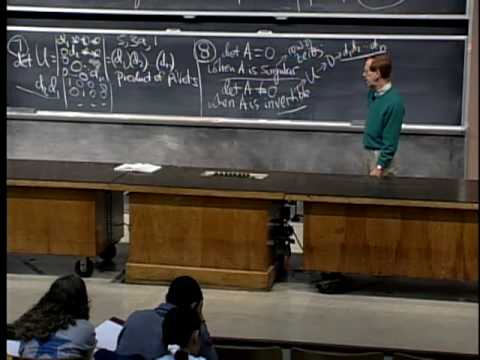
MIT 18.06 Linear Algebra, Spring 2005
Instructor: Gilbert Strang
View the complete course: http://ocw.mit.edu/18-06S05
YouTube Playlist: https://www.youtube.com/playlist?list=PLE7DDD91010BC51F8
- Properties of Determinants
License: Creative Commons BY-NC-SA
More information at https://ocw.mit.edu/terms
More courses at https://ocw.mit.edu
hallow meteor
Also why does moving the eigenvectors of a symmetric matrix to the basis, stretching them by the eigenvalues and then rotating them back to original basis work the same transformation as the symmetric matrix itself im having trouble making intuitive sense of why the composition of those 3 has the same effect
tall crag
hallow meteor
Also why does moving the eigenvectors of a symmetric matrix to the basis, stretc...
yk the main things about the symmetric matrix
idk what its called in english, features?
idk
like
hallow meteor
Being that they have orthogonal eigenvectors etc?
hallow meteor
And S = S^T
 frank wolf
hallow meteor
Why does the process of determinant calculation with cofactors and minors work
frank wolf
hallow meteor
Why does the process of determinant calculation with cofactors and minors work
ultimately i think it comes down to the uniqueness result for totally antisymmetric functions
hallow meteor
tall crag
orthonormal
Eigenvectors are not unique, eigenvectors scaled by a scalar are also eigenvectors
frank wolf
by this i mean the following
hallow meteor
tall crag
yk spectral theorem?
Yeah
frank wolf
suppose $V$ is a $n$-dimensional vector space. then up to scaling, there is a unique totally antisymmetric function $\underbrace{V \times V \times \dots \times V}_\text{n times} \to \mathbb{R}$
grand pondBOT
Pseudo (Cat theory #1 Fan)
 tall crag
hallow meteor
Eigenvectors are not unique, eigenvectors scaled by a scalar are also eigenvecto...
tall crag
hallow meteor
Eigenvectors are not unique, eigenvectors scaled by a scalar are also eigenvecto...
yes but they are orthonormal cuz they have length one
lol
tall crag
hallow meteor
Yeah
what is it?
hallow meteor
grand pond
**Pseudo (Cat theory \#1 Fan)**

frank wolf
you can prove the determinant cofactor expansion from knowing this result
hallow meteor
tall crag
yes but they are orthonormal cuz they have length one
The magnitude is irrelevant for eigenvectors.
tall crag
frank wolf
you can prove the determinant cofactor expansion from knowing this result
bro wait let dont confuse her or him
frank wolf
i'm not a bro
frank wolf
hallow meteor
<:catthink:526983414226747393>
do you know roughly how this result gets proved?
hallow meteor
frank wolf
do you know roughly how this result gets proved?
No I'm trying to understand what you're saying actually
frank wolf
hallow meteor
No I'm trying to understand what you're saying actually
so we can specialise to 2D space
suppose we have a totally antisymmetric bilinear map $\mathbb{R}^2 \times \mathbb{R}^2 \to \mathbb{R}$
grand pondBOT
Pseudo (Cat theory #1 Fan)
 frank wolf
then it has to be a scaled copy of the determinant
hallow meteor
Well
I'll look into the determinant theory
But can you explain the spectral decomposition intuition in the meanwhile
hallow meteor
hallow meteor
Also why does moving the eigenvectors of a symmetric matrix to the basis, stretc...
This
I'll just repeat it here: Why does moving the eigenvectors of a symmetric matrix to the basis, stretching them by the eigenvalues and then rotating them back to original basis work the same transformation as the symmetric matrix itself im having trouble making intuitive sense of why the composition of those 3 has the same effect
tall crag
hallow meteor
But can you explain the spectral decomposition intuition in the meanwhile
look
can u write the formuls for spectral theorem
?
hallow meteor
S = Q D Q^T
We first apply Q ^ T which takes the eigenvectors and makes them the basis
tall crag
hallow meteor
S = Q D Q^T
ok so u know what are those matrices
hallow meteor
Then stretch them according to the eigenvalues in D
And then rotate the basis back
tall crag
For each eigenvector $v_i$ we have $A v_i = \lambda_i v_i.$
grand pondBOT
Viͥђaͣnͫ
 tall crag
yk u can decompose a vector x in terms of eigenvecs
$x = c_1 v_1 + c_2 v_2 + \cdots + c_n v_n$
grand pondBOT
Viͥђaͣnͫ
 grand pondBOT
Viͥђaͣnͫ
 hallow meteor
I suppose the idea is that since the transformation is linear, in the eigenbasis, that linear transformation is gonna do the exact thing as stretching the basis vectors,
tall crag
which is stretching each coordinate in the eigenbasis.
hallow meteor
Since all vectors in that space are linear combination of the eigen vectors of the transformation
hallow meteor
tall crag
which is stretching each coordinate in the eigenbasis.
Rught
Right
Yeah makes sense
Thanks a lot
hallow meteor

tall crag
lemme
hallow meteor
tall crag
wait bro
Yeah?
tall crag
explain the whole thing
tall crag
yk that Q is orthogonal
or orthonormal
or whatever
u just know that Q^TQ = I
which is a rigid rotation
hallow meteor
Yeah, it's an orthogonal matrix, => orthonormal column vectors, i.e., no stretching
Yeah
tall crag
hallow meteor
Yeah, it's an orthogonal matrix, => orthonormal column vectors, i.e., no stretch...
mashallah
so u understood it all?
tall crag
have any questions?
hallow meteor
I suppose in the eigenbasis, the eigenvectors being stretched by the eigenvals of the lintransform is the equivalent of the entire lin transform in the original basis
So we are just rotating into the eigenbasis, stretching the eigenvectors, and then rotating back
Cool
.close
midnight plankBOT
Channel closed
Closed by @hallow meteor
Use .reopen if this was a mistake.
Available help channel!
Send your question here to claim the channel.
Remember:
• Ask your math question in a clear, concise manner.
• Show your work, and if possible, explain where you are stuck.
• Do not immediately ping people or roles. After 15 minutes, feel free to ping <@&286206848099549185> once.
• Type the command .close to free the channel when you're done.
• Be polite and have a nice day!
Read #❓how-to-get-help for further information on how to ask a good question, and about conduct in the question channels.
 twilit field
 midnight plankBOT
twilit field
tall crag
midnight plankBOT
twilit field
tall crag
whats wrong bro
twilit field
Typing out my soln
tall crag
aight lemme see
twilit field
Let $v,u \in V$ be arbitrary. Let $\phi(ST(v)) = \lambda; \phi(ST(u))= \mu$.
grand pondBOT
wai
 frank wolf
twilit field
Let $v,u \in V$ be arbitrary. Let $\phi(ST(v)) = \lambda; \phi(ST(u))= \mu$.
frank wolf
twilit field
Let $v,u \in V$ be arbitrary. Let $\phi(ST(v)) = \lambda; \phi(ST(u))= \mu$.
i don't understand this notation
what is $ST(v)$
grand pondBOT
Pseudo (Cat theory #1 Fan)
 bold peak
I'm guessing S ∘ T?
 hard shard
standard veviation
twilit field
yes , evaluvated at v
grand pondBOT
Pseudo (Cat theory #1 Fan)
 frank wolf
how are you applying $\varphi$ to a vector
grand pondBOT
Pseudo (Cat theory #1 Fan)
 tall crag
grand pond
**Pseudo (Cat theory \#1 Fan)**
tall crag
grand pond
**Pseudo (Cat theory \#1 Fan)**
ye i think its not right
tall crag
twilit field
I need to think of some other approach
yk let I be an operator on V
twilit field
I'm wondering if I need to work with a basis here
bold peak
You don't
twilit field
rank nullity feels like overkill here
grand pondBOT
Xavier 🌺
 tall crag
say that $\Phi(I^2) = \Phi(I)^2.$
grand pondBOT
Viͥђaͣnͫ
 twilit field
grand pond
**Viͥђaͣnͫ**
twilit field
grand pond
**Viͥђaͣnͫ**
I did this , this gives me phi(I)=0/1
tall crag
twilit field
I did this , this gives me phi(I)=0/1
no
it gives u 2 value
u should prove why its not 1
twilit field
sure, but that just tells me the identity goes to 0, not every LT
twilit field
grand pond
**Xavier 🌺**
okay
bold peak
If identity goes to zero, you can use composition
twilit field
ah fuck
bold peak
Every map composed with identity is itself
tall crag
yes but if u have phi(I) = 0 then u can say phi(I)phi(V) = 0
 scarlet solstice
hmm, the identity isn't the zero vector of L(V), is it? The constant map v |-> 0 is the zero vector
twilit field
scarlet solstice
hmm, the identity isn't the zero vector of L(V), is it? The constant map v |-> 0...
hmm, the operation is function composition unless I'm forgetting something
bold peak
That isn't the important part here though
It's a semigroup
(is that the one without inverse?)
 runic hamlet
monoid
scarlet solstice
yeah, but L(V) is a vector space under pointwise addition, not under composition. If you include composition as an operation L(V) turns into an algebra, ie. a ring plus a vector space
bold peak
Monoid yes
twilit field
can I have a hint pls
Oh, might have it
phi(OI)= phi(O)Phi(I)=Phi(O)phi(O)
the problem here ofcourse is division by zero
twilit field
runic hamlet
so do that
So chose two functions such that their sum is 0
and work with that
midnight plankBOT
@twilit field Has your question been resolved?
twilit field
runic hamlet
well you havent used linearity yet
how
runic hamlet
honestly I did proceed by picking a basis
twilit field
okay, so fin dim is important here
runic hamlet
dim > 1 is important
twilit field
runic hamlet
honestly I did proceed by picking a basis
Maybe I'm just not in the right frame of mind, but I don't see what to do here
should I just maybe come back to this in a bit, when I'm in a better mental state
thanks !
.close
midnight plankBOT
Channel closed
Closed by @twilit field
Use .reopen if this was a mistake.
midnight plankBOT
Available help channel!
Send your question here to claim the channel.
Remember:
• Ask your math question in a clear, concise manner.
• Show your work, and if possible, explain where you are stuck.
• Do not immediately ping people or roles. After 15 minutes, feel free to ping <@&286206848099549185> once.
• Type the command .close to free the channel when you're done.
• Be polite and have a nice day!
Read #❓how-to-get-help for further information on how to ask a good question, and about conduct in the question channels.
 keen harbor
What does the equal sign with a tilde means?
 midnight plankBOT
keen harbor
What does the equal sign with a tilde means?
midnight plankBOT
keen harbor
What does the equal sign with a tilde means?
 dawn dagger
usually isomorphic
 lyric charm
isomorphic, yeah
dawn dagger
Ann is more correct than me
 clever sedge
Isomorphism
clever sedge
dawn dagger
Ann is more correct than me
Am I the most correct
midnight plankBOT
@keen harbor Has your question been resolved?
Channel closed
Closed by @keen harbor
Use .reopen if this was a mistake.
keen harbor
thanks
midnight plankBOT
Available help channel!
Send your question here to claim the channel.
Remember:
• Ask your math question in a clear, concise manner.
• Show your work, and if possible, explain where you are stuck.
• Do not immediately ping people or roles. After 15 minutes, feel free to ping <@&286206848099549185> once.
• Type the command .close to free the channel when you're done.
• Be polite and have a nice day!
Read #❓how-to-get-help for further information on how to ask a good question, and about conduct in the question channels.
midnight plankBOT
 toxic prism
absolute
 paper prism
generally, conventionally, area bounded by a region should be taken with the sign
that is how we defined the definite integral
toxic prism
you're right, but the context matters
when area between curves is taken we usually consider it to be absolute
integrals are where we take signed
paper prism
fair enough, i guess
midnight plankBOT
@modern lynx Has your question been resolved?
Channel closed
Closed by @modern lynx
Use .reopen if this was a mistake.
Available help channel!
Send your question here to claim the channel.
Remember:
• Ask your math question in a clear, concise manner.
• Show your work, and if possible, explain where you are stuck.
• Do not immediately ping people or roles. After 15 minutes, feel free to ping <@&286206848099549185> once.
• Type the command .close to free the channel when you're done.
• Be polite and have a nice day!
Read #❓how-to-get-help for further information on how to ask a good question, and about conduct in the question channels.
 novel cobalt
Hi, I need to describe what this transformation matrix does. It is in the homogeneous coordinates. I know that the transformation scales an object to 0 and then translate to (2,1). But in order is this happening? Scale then translate or translate and then scale?
 midnight plankBOT
novel cobalt
Hi, I need to describe what this transformation matrix does. It is in the homoge...
novel cobalt
midnight plankBOT
novel cobalt
Hi, I need to describe what this transformation matrix does. It is in the homoge...
novel cobalt
.close
midnight plankBOT
Channel closed
Closed by @novel cobalt
Use .reopen if this was a mistake.
midnight plankBOT
Available help channel!
Send your question here to claim the channel.
Remember:
• Ask your math question in a clear, concise manner.
• Show your work, and if possible, explain where you are stuck.
• Do not immediately ping people or roles. After 15 minutes, feel free to ping <@&286206848099549185> once.
• Type the command .close to free the channel when you're done.
• Be polite and have a nice day!
Read #❓how-to-get-help for further information on how to ask a good question, and about conduct in the question channels.
 glass panther
Hey guys, i am 16 years old and i want to start self studying math. I just really dont know where to start. It has so many different fields and stuff and i am completly lost...
midnight plankBOT
glass panther
Hey guys, i am 16 years old and i want to start self studying math. I just reall...
 hybrid widget
depends on how much you've already learn at school
maybe number theory is one of the easiest ones, atleast for me
glass panther
hybrid widget
depends on how much you've already learn at school
I am now learning logaritms at school, i dont know if that answers your question?
glass panther
hybrid widget
maybe number theory is one of the easiest ones, atleast for me
What do you mean with that?
hybrid widget
number theory is uh the study of properties of natural numbers?
and it doesn't really need too much of pre knowledge kindof
hybrid widget
glass panther
I am now learning logaritms at school, i dont know if that answers your question...
geometry and number theory I guess
glass panther
So you think without any basics like knowing like those really wierd signs and stuff i should already get into fields?
hybrid widget
for book recommendations go to #book-recommendations
hybrid widget
glass panther
So you think without any basics like knowing like those really wierd signs and s...
you may need to know some terminology and new syntax
but if you're talking about doing the mathematical 'field' and algebraic structures, that may take a while
glass panther
hybrid widget
but if you're talking about doing the mathematical 'field' and algebraic structu...
Ah ok
thanks!
.close
midnight plankBOT
Channel closed
Closed by @glass panther
Use .reopen if this was a mistake.
midnight plankBOT
Available help channel!
Send your question here to claim the channel.
Remember:
• Ask your math question in a clear, concise manner.
• Show your work, and if possible, explain where you are stuck.
• Do not immediately ping people or roles. After 15 minutes, feel free to ping <@&286206848099549185> once.
• Type the command .close to free the channel when you're done.
• Be polite and have a nice day!
Read #❓how-to-get-help for further information on how to ask a good question, and about conduct in the question channels.
 last slate
Twenty balls are placed in an urn. Five are red, five green, five yellow and five
blue. Three balls are drawn from the urn at random without replacement. Write down
expressions for the probabilities of the following events.
(ii) The three balls drawn have different colours.
Hello! I'm not too sure if I have done this right. I thought it could be (20/20)(15/19)(10/18), as the first ball could be anything, the second has to be not the first one, and the third has to not be the second or first? Would there be a better approach ?
midnight plankBOT
last slate
Twenty balls are placed in an urn. Five are red, five green, five yellow and fiv...
 forest iron
i think its good
midnight plankBOT
Channel closed
Closed by @maiden cipher
Use .reopen if this was a mistake.
midnight plankBOT
Available help channel!
Send your question here to claim the channel.
Remember:
• Ask your math question in a clear, concise manner.
• Show your work, and if possible, explain where you are stuck.
• Do not immediately ping people or roles. After 15 minutes, feel free to ping <@&286206848099549185> once.
• Type the command .close to free the channel when you're done.
• Be polite and have a nice day!
Read #❓how-to-get-help for further information on how to ask a good question, and about conduct in the question channels.
 ember sage
How do you start
 midnight plankBOT
ember sage
How do you start
lethal path
ember sage
How do you start
midnight plankBOT
ember sage
How do you start
lethal path
ember sage
How do you start
can you convert tan^2 x into sec^2 x + something?
 main current
I personally suggest writing everything in terms of sin/cos
ember sage
lethal path
can you convert tan^2 x into sec^2 x + something?
I don't know
 visual elk
Or maybe everything in terms of sec x? You'll get a cubic equation in sec x though
lethal path
lethal path
can you convert tan^2 x into sec^2 x + something?
they don't know this identity (which they really should learn)
visual elk
visual elk
Or maybe everything in terms of sec x? You'll get a cubic equation in sec x thou...
Yeah this works, the cubic you get is really easy to solve
midnight plankBOT
@ember sage Has your question been resolved?
Channel closed
Closed by @ember sage
Use .reopen if this was a mistake.
Available help channel!
Send your question here to claim the channel.
Remember:
• Ask your math question in a clear, concise manner.
• Show your work, and if possible, explain where you are stuck.
• Do not immediately ping people or roles. After 15 minutes, feel free to ping <@&286206848099549185> once.
• Type the command .close to free the channel when you're done.
• Be polite and have a nice day!
Read #❓how-to-get-help for further information on how to ask a good question, and about conduct in the question channels.
 rapid inlet
where did the ln come from here?
 midnight plankBOT
rapid inlet
where did the ln come from here?
midnight plankBOT
rapid inlet
where did the ln come from here?
 pearl mist
rapid inlet
where did the ln come from here?
pearl mist
rapid inlet
where did the ln come from here?
result of integrating cosec theta
 fallow scarab
you can differentiate log(csc(t) - cot(t)) to verify
rapid inlet
ah so this is going to be something i have to memorize ?
pearl mist
probably
midnight plankBOT
Channel closed
Closed by @rapid inlet
Use .reopen if this was a mistake.
midnight plankBOT
Available help channel!
Send your question here to claim the channel.
Remember:
• Ask your math question in a clear, concise manner.
• Show your work, and if possible, explain where you are stuck.
• Do not immediately ping people or roles. After 15 minutes, feel free to ping <@&286206848099549185> once.
• Type the command .close to free the channel when you're done.
• Be polite and have a nice day!
Read #❓how-to-get-help for further information on how to ask a good question, and about conduct in the question channels.
hallow meteor
What if we have a matrix with non orthogonal eigenvectors
midnight plankBOT
hallow meteor
What if we have a matrix with non orthogonal eigenvectors
hallow meteor
And we move those eigenvectors to the basis
Do the stretching etc
And move back
i.e., doing a spectral decomposition-like activity with non symmetric matrices
Why does this not work
Or does it work
runic hamlet
the moving back part is harder now
you cant just transpose anymore
and you might not have enough eigenvectors for a basis
hallow meteor
Right, well have ti find inverse the hard way
runic hamlet
but other than that thats just called diagonalisation
hallow meteor
Oh
hallow meteor
runic hamlet
and you might not have enough eigenvectors for a basis
We will always have no. Of eigenvectors≤ no. Of basis vectors?
hallow meteor
Y3ah
Whys there never more
Ah right
They can't be independent
Makes sense
Also I wanted to ask about mxn matrices where m>n
What do they do exactly
R^n -> R^m
runic hamlet
what kind of answer are you expecting
hallow meteor

Sorry I don't have a clear idea gimme q sec
So am I correct in my understanding that if a matrix collapses dimensions down, then there is a matrix which does the exact inverse but we just have no way to calculate it out?
Or does that inverse just does not exist
runic hamlet
doesnt exist
we lose information
we cant get it back
imagine projecting from R^3 down to the xy plane
hallow meteor
But aren't there matrices which are like 4x3
 prime hornet
the set of outputs of a function
hallow meteor
Oh
Oh
So there is nothing that can add a dimension
?
Yeahh makes sense
Theres just not enough poinnts in R2 to somehow map to all of R3
prime hornet
there's no linear map from R^2 that fills all of R^3, if that's what you mean
there are nonlinear maps that work
 runic hamlet
linearity is a very strong condition
hallow meteor
Yeah
runic hamlet
if you have a 3x2 matrix then every vector you can get is a linear combination of those two columns
so the set that you get is <=2 dimensional
hallow meteor
Can u give example of non linear map which adds a dimension?
runic hamlet
google hilbert curve
prime hornet
In mathematical analysis, a space-filling curve is a curve whose range reaches every point in a higher dimensional region, typically the unit square (or more generally an n-dimensional unit hypercube). Because Giuseppe Peano (1858–1932) was the first to discover one, space-filling curves in the 2-dimensional plane are sometimes called Peano cu...
hallow meteor
This seejs like something which requires understanding of some other topics
prime hornet
R and R^n are bijective for any n in fact, so there always exists a bijection between the two sets
hallow meteor
I don't think I'm familiar with them
prime hornet
of course, the bijection won't be linear
hallow meteor
prime hornet
R and R^n are bijective for any n in fact, so there always exists a bijection be...
Makes sense!
runic hamlet
there are some examples of functions that give a bijection [0,1]->[0,1]x[0,1]
hallow meteor
Yeah ... So ofc there exist such mappings but with looser and looser conditions
runic hamlet
which are essentially based on decimals
prime hornet
linear maps are really important though 
despite the condition being really strong, they end up showing themselves all over the place
hallow meteor
prime hornet
despite the condition being really strong, they end up showing themselves all ov...
yeah
Not NxN
P(N)
Anyway thanks yall
❤️
.close
midnight plankBOT
Channel closed
Closed by @hallow meteor
Use .reopen if this was a mistake.
prime hornet
midnight plankBOT
Available help channel!
Send your question here to claim the channel.
Remember:
• Ask your math question in a clear, concise manner.
• Show your work, and if possible, explain where you are stuck.
• Do not immediately ping people or roles. After 15 minutes, feel free to ping <@&286206848099549185> once.
• Type the command .close to free the channel when you're done.
• Be polite and have a nice day!
Read #❓how-to-get-help for further information on how to ask a good question, and about conduct in the question channels.
 bright plinth
Just wondering, on integration questions which involve two equations and finding the area, in which cases can you take the integral of the Simultaneous Equation?
midnight plankBOT
bright plinth
Just wondering, on integration questions which involve two equations and finding...
 lofty knoll
Never
bright plinth
For example, In the question below tried just taking the integral of the simultaneous equation, and i got the wrong answer. But im sure ive done this before and got the right answer. So im confused
 lyric charm
can you show your working for this one
"integral of the simultaneous equation" does not really make sense
bright plinth
lyric charm
can you show your working for this one
Sorry, im horrible at explaining things
 lofty knoll
lyric charm
"integral of the simultaneous equation" does not really make sense
lofty knoll
lyric charm
"integral of the simultaneous equation" does not really make sense
I think they mean when they set the two equations equal to each other to find the intersect point
And then they want to integrate the function they get from that to find the area, which obviously doesnt work
lyric charm
bright plinth
Sorry, im horrible at explaining things
ok so the thing is you integrate the difference of your two functions
bright plinth
lyric charm
ok so the thing is you integrate the **difference** of your two functions
yeah, i saw that in the markscheme. However im sure ive done it like this before and got the right answer? maybe i fluked it?
lyric charm
there's a complication in that your region is not bounded by only l and C
bright plinth
lyric charm
there's a complication in that your region is not bounded by only l and C
so if its bounded by the x axis you cant do?
lyric charm
less "can't", more "requires more work"
let me desmos this to explain:
- what your calculation actually gave you;
- how to proceed properly
bright plinth
lyric charm
less "can't", more "requires more work"
which is? because i was originally planning to do it the right way, But i thought if i just took the integral of the S.E it wouldve been quicker than finding two seperate integrals and doing it like that.
lyric charm
 lyric charm
bright plinth
which is? because i was originally planning to do it the right way, But i though...
lyric charm
bright plinth
which is? because i was originally planning to do it the right way, But i though...
don't call it "integral of the SE" please, nobody will ever understand you
bright plinth
lyric charm
don't call it "integral of the SE" please, nobody will ever understand you
sorryy what do i call it?
bright plinth
lyric charm
integrate the difference of the functions
okay okay!
lyric charm
lyric charm
you see this picture?
green = what you need to find, the region R that the question talks about
what your integration did was find the area of green + purple, as you integrated the difference between the red and blue curves from 1.5 to 6
bright plinth
lyric charm
what your integration did was find the area of **green + purple**, as you integr...
Ohh okay, so it doesnt bind it by the x axis?
lyric charm
there are two routes here that you can take:
- work out the purple area as an appropriate integral of just the quadratic function, then subtract from the area you found already
or - work out green + orange as just a triangle, and then work out orange as an integral of just the quadratic, then subtract
lyric charm
bright plinth
Ohh okay, so it doesnt bind it by the x axis?
there's no x-axis boundary there, indeed
lyric charm
lyric charm
there are two routes here that you can take:
1. work out the purple area as an ...
my personal suggestion is route #2 btw
bright plinth
This is the markscheme, which is route 1?
 lyric charm
their suggestion is actually route 2, by the looks of it
they don't suggest 1 in the ms at all
though if you pull it off and do it right, it can earn you full credit
bright plinth
Okay thanks, but how would you find orange ?
bright plinth
bright plinth
Okay thanks, but how would you find **orange** ?
Wait, after a second look, i think i actually understand. Thanks alot for the help. Much appreciated!
lyric charm
bright plinth
Okay thanks, but how would you find **orange** ?
integral of just the quadratic from 5 to 6
bright plinth
lyric charm
integral of just the quadratic from 5 to 6
okay i get it now! Again, Thanks alot much appreciated!
.close
midnight plankBOT
Channel closed
Closed by @bright plinth
Use .reopen if this was a mistake.
Available help channel!
Send your question here to claim the channel.
Remember:
• Ask your math question in a clear, concise manner.
• Show your work, and if possible, explain where you are stuck.
• Do not immediately ping people or roles. After 15 minutes, feel free to ping <@&286206848099549185> once.
• Type the command .close to free the channel when you're done.
• Be polite and have a nice day!
Read #❓how-to-get-help for further information on how to ask a good question, and about conduct in the question channels.
hallow meteor
Why are singular values of left and right symmetric matrices equal
midnight plankBOT
hallow meteor
Why are singular values of left and right symmetric matrices equal
 ancient ridge
If you have eigenvector v of A^TA so that A^TAv = lambda v, then AA^TAv = lambda Av so that Av is an eigenvector of AA^T with the same eigenvalue.
midnight plankBOT
@hallow meteor Has your question been resolved?
midnight plankBOT
Channel closed
Closed due to timeout
Use .reopen if this was a mistake.
Available help channel!
Send your question here to claim the channel.
Remember:
• Ask your math question in a clear, concise manner.
• Show your work, and if possible, explain where you are stuck.
• Do not immediately ping people or roles. After 15 minutes, feel free to ping <@&286206848099549185> once.
• Type the command .close to free the channel when you're done.
• Be polite and have a nice day!
Read #❓how-to-get-help for further information on how to ask a good question, and about conduct in the question channels.
 leaden seal

 midnight plankBOT
leaden seal
bold peak
midnight plankBOT
leaden seal
bold peak
Think of it this way
When you go "towards" the angle it's cos
When you go "away from" the angle it's sin
 leaden seal
becus im trying to understand why Fs=sintheta
bold peak
Draw a rectangle with F as the diagonal

 crude adder
Is this question from an intro applied aero physics or math class? I noticed another problem with Cl and Cd which are related related varaibles just I was just curious
midnight plankBOT
@leaden seal Has your question been resolved?
Channel closed
Closed by @leaden seal
Use .reopen if this was a mistake.
Available help channel!
Send your question here to claim the channel.
Remember:
• Ask your math question in a clear, concise manner.
• Show your work, and if possible, explain where you are stuck.
• Do not immediately ping people or roles. After 15 minutes, feel free to ping <@&286206848099549185> once.
• Type the command .close to free the channel when you're done.
• Be polite and have a nice day!
Read #❓how-to-get-help for further information on how to ask a good question, and about conduct in the question channels.
last slate
I need help
midnight plankBOT
last slate
I need help
last slate

 placid spoke
!status
midnight plankBOT
What step are you on?
1. I don't know where to begin.
2. I have begun but got stuck midway.
3. I got an answer but I was told that it's wrong.
4. I got an answer and would like my work checked.
5. I have a question about someone else's work/solution.
6. I have completed the problem and don't need help anymore. Thank you.
7. None of the above
 radiant roost
I think "at least one club" can be calculated as 1 - no clubs
last slate
radiant roost
I think "at least one club" can be calculated as 1 - no clubs
wait a sec bro i posted the wrong question heres where im stuck on

im stuck on this
last slate
midnight plank
```
What step are you on?
1. I don't know where to begin.
2. I have begun but go...
1
radiant roost
The "1 -" trick should work well here too
1 - 0 heads - 1 head
Wait...
I'm dumb
last slate
radiant roost
1 - 0 heads - 1 head
Can you tell me what i did wrong?
I did C(n-1, 2) * 2
why is it wrong
we have n spots
and n-1 need to be heads
radiant roost
It should be the probability of n-1 head, + probability of n heads
last slate
so P(n-1, 2) /2! Gives us the possibilities for the 4 spots to have heads
radiant roost
Right?
last slate
radiant roost
It should be the probability of n-1 head, + probability of n heads
yeah apparently but idk why man
im so frustrated
radiant roost
Because those are the two possible ways to get at least n-1 heads
They're the only two possible ways
And they're disjoint, so you can add them
last slate
radiant roost
They're the only two possible ways
whats wrong with what i did
radiant roost
You said n spots and n-1 need to be heads
last slate
radiant roost
You said n spots and n-1 need to be heads
Yes
radiant roost
Wouldn't that be C (n, n-1)?
Idk how you got that expression
C (n-1, 2) is choosing two from n-1
That's totally different
last slate
radiant roost
C (n-1, 2) is choosing two from n-1
so yeah this id wrong
last slate
radiant roost
Wouldn't that be C (n, n-1)?
But can you please explain to me why its this
radiant roost
C(n, n-1) is the number of ways to choose n-1 heads from n flips
last slate
radiant roost
C(n, n-1) is the number of ways to choose n-1 heads from n flips
whats the intuition
radiant roost
That's pretty much the definition of C
last slate
radiant roost
That's pretty much the definition of C
why bro😭
im about to give up
{Heads}^n-1 @radiant roost
1^n-1
BROROROOOOOO
 slow thorn
last slate
Can you tell me what i did wrong?
I did C(n-1, 2) * 2
slow thorn
last slate
Can you tell me what i did wrong?
I did C(n-1, 2) * 2
for part a?
last slate
slow thorn
for part a?
yes
slow thorn
last slate
Can you tell me what i did wrong?
I did C(n-1, 2) * 2
im not sure why its C(n-1, 2)
last slate
slow thorn
im not sure why its C(n-1, 2)
its not that was wrong
But what is it
whats the logic
whats the cartesian product
for part a
slow thorn
ok the sample space is $2^n$
grand pondBOT
 last slate
Yes
last slate
yes
slow thorn
the cases would be something like
HHT, HTH, and THH
you can see that only one tail is in all these cases
slow thorn
last slate
Order doesnt matter so like {heads}^2 x {tails}
okayy so
you're saying for each case
the probability is $(P(heads))^2 \times P(tails)$
grand pondBOT
 last slate
No no im doing cartesian product
slow thorn
last slate
No no im doing cartesian product
hmm did you do this cartesian product or see it in some other problem?
last slate
slow thorn
hmm did you do this cartesian product or see it in some other problem?
im just tryna figure it out
i came up with this one particularly
1^n-1????????
slow thorn
last slate
Order doesnt matter so like {heads}^2 x {tails}
yeah but you can't just invent something like this without seeing anything related
like whats {heads} supposed to mean
last slate
slow thorn
like whats {heads} supposed to mean
Can you vc?
i cant type anymore
i cant express what im tryna say
if not its ok
slow thorn
not possible rn
last slate
but like you’re trying to get it in the order of { HHT }
wait order does matter
what’s happening bruh
how
help please man
slow thorn
last slate
but like you’re trying to get it in the order of { HHT }
cartesian product in the sens
${H, T} \times {H, T} \times {H, T}$?
grand pondBOT
 last slate
slow thorn
cartesian product in the sens
last slate
slow thorn
cartesian product in the sens
yes
but I agree that its C(n, n-1)
i figured out why
radiant roost
Yeah
last slate
radiant roost
Yeah
Thanks guys
@slow thorn thank you
but wait
how do i express C(n, n-1)
 last slate
radiant roost
last slate
radiant roost
thanks bro
midnight plankBOT
@last slate Has your question been resolved?
midnight plankBOT
Channel closed
Closed due to timeout
Use .reopen if this was a mistake.
Available help channel!
Send your question here to claim the channel.
Remember:
• Ask your math question in a clear, concise manner.
• Show your work, and if possible, explain where you are stuck.
• Do not immediately ping people or roles. After 15 minutes, feel free to ping <@&286206848099549185> once.
• Type the command .close to free the channel when you're done.
• Be polite and have a nice day!
Read #❓how-to-get-help for further information on how to ask a good question, and about conduct in the question channels.
twilit field
 midnight plankBOT
twilit field
twilit field
midnight plankBOT
twilit field
twilit field
Just wanna make sure I'm doing this right
the confusing thing for me is setting up the convolution here
like f(t)=f(z-t)=1/4
rightt
ancient ridge
I don't really like that notation but yeah
twilit field
and then the convolution gives me -2<t<2; z-2<t<z+2
but this isn't enough to find the bounds, is it
ancient ridge
I should be able to follow what you are saying without recasting it into notation that I am more comfortable with, I'm not.
twilit field
sure
ancient ridge
Start by defining $X, Y \sim U(-2,2)$ so that $Z = X + Y$ Then you have $f_Z(z) = \int_{-\inf}^{\inf} f_{Y}(z-x)f_{X}(x) dx = \frac{1}{4}\int_{-2}^{2} f_{Y}(z-x) dx$ since $f_{X}$ is zero outside of its support.
From there I think the Calculus is a little less confusing
grand pondBOT
JessicaK
 ancient ridge
I just find not explicitly defining your random variables, and using a dummy variable t to make it a lot harder to follow
twilit field
it's just a matter of z-x=t now , is it not
ancient ridge
The integrand is zero unless -2 <= z-x <= 2
twilit field
yes
twilit field
one minute
don't I have to change the bounds of integration
so it become $\int_{z-2}^{z+2} \frac{1}{16} dt$
grand pondBOT
wai
 ancient ridge
I need to write down the details because that was just definition grinding but you will need to do something like that yeah
twilit field
cool
thanks
another question

here I surely don't have to write down the table
nvm got i
it
.close
midnight plankBOT
Channel closed
Closed by @twilit field
Use .reopen if this was a mistake.
midnight plankBOT
Available help channel!
Send your question here to claim the channel.
Remember:
• Ask your math question in a clear, concise manner.
• Show your work, and if possible, explain where you are stuck.
• Do not immediately ping people or roles. After 15 minutes, feel free to ping <@&286206848099549185> once.
• Type the command .close to free the channel when you're done.
• Be polite and have a nice day!
Read #❓how-to-get-help for further information on how to ask a good question, and about conduct in the question channels.
 sick garnet
hello everyone, i sruggle getting good math grades can anyone gime me advice
midnight plankBOT
sick garnet
hello everyone, i sruggle getting good math grades can anyone gime me advice
sick garnet
8
visual elk
Most of the time when i see someone who is bad at math, it is because they have poor foundations
visual elk
What are the things on your syllabus tho
visual elk
Can you share the syllabus
sick garnet
ok
A curriculum that sets out the knowledge and skills every student should learn during their first 11 years of schooling to become lifelong learners, confident individuals, and active and informed citizens prepared to navigate a diverse and changing world.
bye but pls share advice
visual elk
sick garnet
https://f10.vcaa.vic.edu.au/learning-areas/mathematics/introduction
I see
I suggest that you should first master the properties of fractions. How they work and how they can be manipulated. Once you are comfortable enough with working with fractions, things are going to get a bit easier. Then you want to master the manipulation of algebraic expressions, factorization etc. These are the very basics
Most of the time people move onto doing higher topics without having a clear understanding of these.
Once you master fractions and algebraic manipulations, move on to exponents
Learn the rules of exponents in detail, and apply them to simplify large expressions
A big part of being good at math is being able to simplify expressions
Then you want to move onto solving equations
Solving equations the single most important thing you need in your level
Learn how to solve different kind of equations from the very start in detail
Like linear equations, quadratic ones, (cubic ones if you really wanna), systems of equations, exponential equations etc
When you master solving equations, you can combine that with your previous knowledge to solve all kinds of word problems
You just gotta practise and learn how to turn word problems into equations, simplify, and solve them
midnight plankBOT
@sick garnet Has your question been resolved?
midnight plankBOT
Channel closed
Closed due to timeout
Use .reopen if this was a mistake.
Available help channel!
Send your question here to claim the channel.
Remember:
• Ask your math question in a clear, concise manner.
• Show your work, and if possible, explain where you are stuck.
• Do not immediately ping people or roles. After 15 minutes, feel free to ping <@&286206848099549185> once.
• Type the command .close to free the channel when you're done.
• Be polite and have a nice day!
Read #❓how-to-get-help for further information on how to ask a good question, and about conduct in the question channels.
 gaunt jetty
Test
midnight plankBOT
gaunt jetty
Test
midnight plankBOT
gaunt jetty
Test
midnight plankBOT
Channel closed
Closed by @gaunt jetty
Use .reopen if this was a mistake.
bold peak
Prepare for trouble and make it double
midnight plankBOT
Available help channel!
Send your question here to claim the channel.
Remember:
• Ask your math question in a clear, concise manner.
• Show your work, and if possible, explain where you are stuck.
• Do not immediately ping people or roles. After 15 minutes, feel free to ping <@&286206848099549185> once.
• Type the command .close to free the channel when you're done.
• Be polite and have a nice day!
Read #❓how-to-get-help for further information on how to ask a good question, and about conduct in the question channels.
 tidal turret
 midnight plankBOT
tidal turret
tidal turret
midnight plankBOT
tidal turret
tidal turret
 tidal turret
well i was trying to use lagrange multipliers method
tall crag
tidal turret
well i was trying to use lagrange multipliers method
just compute the partial derivatives and set them to zero
mh
if u like to use lagrange multipliers u can too
midnight plankBOT
@tidal turret Has your question been resolved?
tall crag
u still have problem?
set up lagrange multipliers on circular boundary constraints
g_1(x,y) = (x-5)^2 + y^2 - 25 = 0
g_2(x,y) = (x-2)^2 + y^2 - 16 = 0
first for outer circle second for inner circle
then use lm
$\nabla f(x,y) = \lambda \nabla g(x,y)$
grand pondBOT
Viͥђaͣnͫ
 tall crag
then solve for (x,y) once for inner once for outer circle
midnight plankBOT
@tidal turret Has your question been resolved?
midnight plankBOT
Channel closed
Closed due to timeout
Use .reopen if this was a mistake.
Available help channel!
Send your question here to claim the channel.
Remember:
• Ask your math question in a clear, concise manner.
• Show your work, and if possible, explain where you are stuck.
• Do not immediately ping people or roles. After 15 minutes, feel free to ping <@&286206848099549185> once.
• Type the command .close to free the channel when you're done.
• Be polite and have a nice day!
Read #❓how-to-get-help for further information on how to ask a good question, and about conduct in the question channels.
twilit field
wanna make sure I'm not doing anything wrong here
 midnight plankBOT
twilit field
wanna make sure I'm not doing anything wrong here
midnight plankBOT
twilit field
wanna make sure I'm not doing anything wrong here
 frail carbon
twilit field
so E[Z]= E[Y^3+1]E[X^2-1]=E[Y^3]E[X^2]
frail carbon
twilit field
so E[Z]= E[Y^3+1]E[X^2-1]=E[Y^3]E[X^2]
this is not how expectations work, for the first equality you need independence (not the case), and the second isn't true ever since that's not how constants are handled
twilit field
so here I just brute force it?
frail carbon
I don't think there's a nice way around it
midnight plankBOT
Channel closed
Closed by @twilit field
Use .reopen if this was a mistake.
Available help channel!
Send your question here to claim the channel.
Remember:
• Ask your math question in a clear, concise manner.
• Show your work, and if possible, explain where you are stuck.
• Do not immediately ping people or roles. After 15 minutes, feel free to ping <@&286206848099549185> once.
• Type the command .close to free the channel when you're done.
• Be polite and have a nice day!
Read #❓how-to-get-help for further information on how to ask a good question, and about conduct in the question channels.
Channel closed
Channel closed due to the original message being deleted.
If you did not intend to do this, please open a new help channel,
as this action is irreversible, and this channel may abruptly lock.
paper prism
.
 west ravine
..
 icy island
there r many indians here
midnight plankBOT
Available help channel!
Send your question here to claim the channel.
Remember:
• Ask your math question in a clear, concise manner.
• Show your work, and if possible, explain where you are stuck.
• Do not immediately ping people or roles. After 15 minutes, feel free to ping <@&286206848099549185> once.
• Type the command .close to free the channel when you're done.
• Be polite and have a nice day!
Read #❓how-to-get-help for further information on how to ask a good question, and about conduct in the question channels.
 prime star
if $X_1, ..., X_n$ are iid with common mean $\mu$ and variance $\sigma^2$, show that $\frac{1}{n} \sum(X_j - \bar{X_n})^2 \to \sigma^2$ almost surely
midnight plankBOT
prime star
if $X_1, ..., X_n$ are iid with common mean $\mu$ and variance $\sigma^2$, show ...
grand pondBOT
Red
 prime star
i tried a whole bunch of things that did not get me closer to an answer
i have the strong law of large numbers on hand:
 potent knoll
grand pond
**Red**
potent knoll
grand pond
**Red**
What are you confused about this, great bard?
prime star
right now i'm trying to show that a limit converges
but i dont think i'm supposed to do that
prime star
prime star
i have the strong law of large numbers on hand:
SLLN: $\frac{1}{n} \sum X_n \to \mu = E(\bar{X_n})$ almost surely
grand pondBOT
Red

 coarse rivet
need help
prime star
coarse rivet
need help
there are other help channels open, pls go there
potent knoll
grand pond
**Red**
Are you asking how to start?
prime star
yes
potent knoll
Let me see if I can assist the great bard
potent knoll
grand pond
**Red**
Well for starters you can decompose the sample variance
Express it into terms of the true mean and the sample mean
 subtle zinc
maybe expand the square
subtle zinc
true mean = mu
prime star
$\frac{1}{n} ( \sum X_j^2 - 2 \sum X_j \bar{X_n} + \sum \bar{X_n}^2)$
grand pondBOT
Red
 prime star
then ??
$E(\bar{X_n}^2) - 2 E(\bar{X_n}^2) + E(\bar{X_n}^2) = 0$
grand pondBOT
Red
 prime star
rip your wifi i guess :')
potent knoll
It looks good so far
potent knoll
grand pond
**Red**
Hold on, is this supposed to be the next part after the one you sent?
The first term is the average of the squares. The second and third terms involve the square of the average. I believe these are two different things
Instead of them all cancelling out to 0, should they not be converging to different limits?
When you subtract them, they shouldn't cancel to 0. Shouldn't they cancel to the variance formula?
potent knoll
prime star
rip your wifi i guess :')
So far so good, the latest one you sent seems off tho
midnight plankBOT
@prime star Has your question been resolved?
prime star
oops just got back to this
prime star
potent knoll
When you subtract them, they shouldn't cancel to 0. Shouldn't they cancel to the...
yes they're definitely supposed to :')
potent knoll
prime star
yes they're definitely supposed to :')
I think that should help you correct your current step
prime star
so, where is mu supposed to appear?
potent knoll
prime star
so, where is mu supposed to appear?
Well, were following your solution so, we don't need it that (for now, I believe)
potent knoll
grand pond
**Red**
But anyways! Here's what I think is wrong with this step

Why did it do that 😭
Landscape, not portrait bruh
 fallen sparrow
,rccw
grand pondBOT
 potent knoll
fallen sparrow
,rccw
potent knoll
fallen sparrow
,rccw
Thank you 🥲
prime star
wait i think i got it
$\frac{1}{n}\sum X_j^2 - 2 \bar{X_n}^2 + \bar{X_n}^2 = \frac{1}{n}\sum X_j^2 - \bar{X_n}^2$\
$= E(X^2) - E(X)^2$\
$=Var(X) = \sigma^2$
grand pondBOT
Red
 potent knoll
grand pond
**Red**
potent knoll
grand pond
**Red**
That's right
prime star
probability... 
prime star
potent knoll
That's right
yayy thank you so much
potent knoll
Np, it was a pleasure helping the great bard 
Do you need any more help? If no more, you can .close 
prime star
.close
midnight plankBOT
Channel closed
Closed by @prime star
Use .reopen if this was a mistake.
midnight plankBOT
Available help channel!
Send your question here to claim the channel.
Remember:
• Ask your math question in a clear, concise manner.
• Show your work, and if possible, explain where you are stuck.
• Do not immediately ping people or roles. After 15 minutes, feel free to ping <@&286206848099549185> once.
• Type the command .close to free the channel when you're done.
• Be polite and have a nice day!
Read #❓how-to-get-help for further information on how to ask a good question, and about conduct in the question channels.
hallow meteor
After SVD we have X = U D V^T
midnight plankBOT
hallow meteor
After SVD we have X = U D V^T
hallow meteor
Why are the Principle components the eigenvectors of V and not the eigenvectors of U
Like why are eigenvectors of V the principle components in the first plac
Place
<@&286206848099549185>
potent knoll
hallow meteor
Why are the Principle components the eigenvectors of V and not the eigenvectors ...
It's because they are directly related to the covariance matrix of your data
potent knoll
It's not U because it contains the eigenvectors XX^T that are related to the covariance across the sample/rows. not X^TX which is related to the covariance across the features/columns
hallow meteor
Ohh
potent knoll
hallow meteor
And V is the eigenvectors of the covariance matrix
Yes, that is right
hallow meteor
So what does U give us
potent knoll
hallow meteor
So what does U give us
Left singular vectors
hallow meteor
Yeah but
What's the interpretation
Cuz like V gives the directions ordered by variance along which features have max variance (right?)
Then what does U give
potent knoll
hallow meteor
Cuz like V gives the directions ordered by variance along which features have ma...
Yes, in a way
potent knoll
hallow meteor
Then what does U give
The coordinates
hallow meteor
The coordinates... Of?
potent knoll
hallow meteor
The coordinates... Of?
Your original data points
Well after they have been projected to the new variance-maximizing axes defined by V
Think of it like this basically
V is the map directions
U is the new addresses (scaled by D)
potent knoll
hallow meteor
<:blobcry:971797574916907028>
It's okay, you can do this 😭
hallow meteor
So it's the data but written in terms of the new basis?
New basis being the pca axes?
potent knoll
hallow meteor
So it's the data but written in terms of the new basis?
Exactly
potent knoll
Np, anything else you need help on?
hallow meteor
I will be needing help, im Learning like svms, perceptrons, anns, SVD, pca, bagging amd boosting from scratch

👶
Can I @ u if I need help?
potent knoll
hallow meteor
Can I @ u if I need help?
Go ahead! I might be a bit delayed tho but feel free to:) (also studying 😭)
midnight plankBOT
Channel closed
Closed by @hallow meteor
Use .reopen if this was a mistake.
midnight plankBOT
Available help channel!
Send your question here to claim the channel.
Remember:
• Ask your math question in a clear, concise manner.
• Show your work, and if possible, explain where you are stuck.
• Do not immediately ping people or roles. After 15 minutes, feel free to ping <@&286206848099549185> once.
• Type the command .close to free the channel when you're done.
• Be polite and have a nice day!
Read #❓how-to-get-help for further information on how to ask a good question, and about conduct in the question channels.
 coral belfry
so our prof asked us to evaluate cos(3θ) using De Moivre's rule, which im not sure how to implement here. I solved it like this, using two or three easy identities. How would we go about doing it the way my prof intended?
 midnight plankBOT
coral belfry
so our prof asked us to evaluate cos(3θ) using De Moivre's rule, which im not su...
coral belfry
midnight plankBOT
coral belfry
so our prof asked us to evaluate cos(3θ) using De Moivre's rule, which im not su...
coral belfry
,rccw
grand pondBOT
 grand pondBOT
riemann
 coral belfry
yes
fallow scarab
use n=3 and equate the real and imaginary parts of both sides
coral belfry
one side is raised to the n tho how do i find the real part?
oh wait i can just do the identity
gaunt jetty
u gotta do binomial expansion
midnight plankBOT
Channel closed
Closed by @coral belfry
Use .reopen if this was a mistake.
midnight plankBOT
Available help channel!
Send your question here to claim the channel.
Remember:
• Ask your math question in a clear, concise manner.
• Show your work, and if possible, explain where you are stuck.
• Do not immediately ping people or roles. After 15 minutes, feel free to ping <@&286206848099549185> once.
• Type the command .close to free the channel when you're done.
• Be polite and have a nice day!
Read #❓how-to-get-help for further information on how to ask a good question, and about conduct in the question channels.
 tired sonnet
im having a hard time understanding this topic
 midnight plankBOT
tired sonnet
im having a hard time understanding this topic
midnight plankBOT
tired sonnet
im having a hard time understanding this topic
 rose trout
Any part in particular doesn't make sense to you?
 visual tiger
Do you know what's the range of y = asin(bx)?
At the very least y = sin(x) to start
tired sonnet
do i know the range of that format?
visual tiger
You know what the range of a function means right?
tired sonnet
yes
visual tiger
So, do you know what the range of y = sin(x) is
visual tiger
[-1,1]
tired sonnet
yes
visual tiger
And so the amplitude is...?
tired sonnet
1
tired sonnet
the period
visual tiger
Yes
tired sonnet
and the amplitude i think but idk why
visual tiger
tired sonnet
and the amplitude i think but idk why
The amplitude does not change
visual tiger
sin(bx) changes the speed of the input inside the sin
So it fluctuates faster/slower
But the range, and so the amplitude, don't change
tired sonnet
ok
visual tiger
And so what's the period of sin(bx)?
visual tiger
That's the period of sin(x)
visual tiger
Yes
tired sonnet
okay
visual tiger
So
Finally
Let's multiply by a in front
y = asin(bx)
What changes compared to sin(bx)?
tired sonnet
its the midline
visual tiger
The midline?
tired sonnet
y=a is the midline
visual tiger
Unfortunately no
The midline didn't change
If the range of sin is [-1,1], what's the range of sin multiplied by a
tired sonnet
-1a,1a
visual tiger
If a is positive (let's assume so for now), yes
So range is [-a,a]
The midpoint of that range is still 0
tired sonnet
okay
visual tiger
What about the amplitude?
tired sonnet
of what
visual tiger
Of y = a*sin(bx)
tired sonnet
is it not just a
visual tiger
It's a if a is positive
visual tiger
If a is positive, a is 3
There's also a possibility that a is negative
In that case a is ...
tired sonnet
would it not ask for -a then
visual tiger
tired sonnet
would it not ask for -a then
No?
It asks for all possible values of a and b
tired sonnet
oh
visual tiger
So a,b can be any real numbers that satisfy the conditions
tired sonnet
so a can be 3 and -3
what about b
fwait
360 divided by pi
or 2pi divided by pi
visual tiger
tired sonnet
or 2pi divided by pi
The period is 2pi/b (2pi/|b| if b is any real number)
So you need 2pi/|b| = pi
tired sonnet
b = 2?
midnight plankBOT
@tired sonnet Has your question been resolved?
Channel closed
Closed by @tired sonnet
Use .reopen if this was a mistake.
Available help channel!
Send your question here to claim the channel.
Remember:
• Ask your math question in a clear, concise manner.
• Show your work, and if possible, explain where you are stuck.
• Do not immediately ping people or roles. After 15 minutes, feel free to ping <@&286206848099549185> once.
• Type the command .close to free the channel when you're done.
• Be polite and have a nice day!
Read #❓how-to-get-help for further information on how to ask a good question, and about conduct in the question channels.
 night gyro
hello i have 2 questions
 midnight plankBOT
night gyro
hello i have 2 questions
midnight plankBOT
night gyro
hello i have 2 questions
 tribal temple
(assuming that you have some form of "ice cream cone", with half a sphere stuck to the end of a cylinder?)
night gyro
wait
 sudden yacht
What you wrote in red is exactly what's written already
 night gyro
sudden yacht
What you wrote in red is exactly what's written already
night gyro
sudden yacht
What you wrote in red is exactly what's written already
they wrote 4/3 x^3 pi
sudden yacht
night gyro
they wrote 4/3 x^3 pi
You too 😅
night gyro
sudden yacht
You too 😅
ok so wht i wrote works
sudden yacht
Maybe I'm not understanding your doubt atp
tribal temple
(as long as you're clear enough by how you mean (so e.g. have  ) then you're fine
  )
)
night gyro
tribal temple
(as long as you're clear enough by how you mean (so e.g. have <:helpparens:37165...
?
night gyro
sudden yacht
Maybe I'm not understanding your doubt atp
i wnted to know if the both i wrote and wht they wrote mean the same thing is ok
night gyro
sudden yacht
Maybe I'm not understanding your doubt atp
also how does tht not turn into 2 pi
tribal temple
night gyro
also how does tht not turn into 2 pi
To clarify, do you mean in a similar sense as to how pi + pi would make 2pi?
night gyro
tribal temple
To clarify, do you mean in a similar sense as to how pi + pi would make 2pi?
yh
sudden yacht
night gyro
also how does tht not turn into 2 pi
Well, it does
2π/3 + 4π/3 = 6π/3 which is indeed 2π
tribal temple
night gyro
?
(I would write out what I mean in TeX but I'm on my phone so can't really  )
)
sudden yacht
night gyro
also how does tht not turn into 2 pi
Where are you seeing it not happening?
midnight plankBOT
@night gyro Has your question been resolved?
night gyro
sudden yacht
Where are you seeing it *not* happening?
hello sorry i was trying the question
i still dont know

yoooo
nvm i got it
midnight plankBOT
Channel closed
Closed by @night gyro
Use .reopen if this was a mistake.
Available help channel!
Send your question here to claim the channel.
Remember:
• Ask your math question in a clear, concise manner.
• Show your work, and if possible, explain where you are stuck.
• Do not immediately ping people or roles. After 15 minutes, feel free to ping <@&286206848099549185> once.
• Type the command .close to free the channel when you're done.
• Be polite and have a nice day!
Read #❓how-to-get-help for further information on how to ask a good question, and about conduct in the question channels.
night gyro
hello why is this not correct
 midnight plankBOT
night gyro
hello why is this not correct
midnight plankBOT
night gyro
hello why is this not correct
 gusty falcon
night gyro
hello why is this not correct
gusty falcon
night gyro
hello why is this not correct
10 cm greater than the area of the rectangle
if you added 10 to the area of the rectangle then that'd be equal to the area of the triangle
 unborn stone
If you're 10 cm taller than your brother, he's the one you're gonna give boots to get taller
not you
It's the same thing here
If the triangle area is greater than the area of the rectangle, you're gonna add 10cm² to the area of the rectangle to balance it out
You need to give this 10cm² to the smaller one to balance it out, not the bigger one
night gyro
unborn stone
If you're 10 cm taller than your brother, he's the one you're gonna give boots t...
thank you
.close
midnight plankBOT
Channel closed
Closed by @night gyro
Use .reopen if this was a mistake.
Available help channel!
Send your question here to claim the channel.
Remember:
• Ask your math question in a clear, concise manner.
• Show your work, and if possible, explain where you are stuck.
• Do not immediately ping people or roles. After 15 minutes, feel free to ping <@&286206848099549185> once.
• Type the command .close to free the channel when you're done.
• Be polite and have a nice day!
Read #❓how-to-get-help for further information on how to ask a good question, and about conduct in the question channels.
midnight plankBOT
Channel closed
Channel closed due to the original message being deleted.
If you did not intend to do this, please open a new help channel,
as this action is irreversible, and this channel may abruptly lock.
Available help channel!
Send your question here to claim the channel.
Remember:
• Ask your math question in a clear, concise manner.
• Show your work, and if possible, explain where you are stuck.
• Do not immediately ping people or roles. After 15 minutes, feel free to ping <@&286206848099549185> once.
• Type the command .close to free the channel when you're done.
• Be polite and have a nice day!
Read #❓how-to-get-help for further information on how to ask a good question, and about conduct in the question channels.
 scarlet flower
 midnight plankBOT
scarlet flower
midnight plankBOT
scarlet flower