#help-49
1 messages · Page 262 of 1
 hexed barn
 clever sedge
Next you will have to buy a newspaper to see the question
 midnight plankBOT
Please do not advertise your help channel or thread in other parts of the server. There are many people who need help, so advertising can quickly turn into spam.
@vast summit Has your question been resolved?
 vast summit
clever sedge
Next you will have to buy a newspaper to see the question
vast summit
clever sedge
Next you will have to buy a newspaper to see the question
🤣🤣🤣
There y'all go
 scenic wyvern
vast summit
midnight plankBOT
scenic wyvern
vast summit
midnight plankBOT
@vast summit Has your question been resolved?
midnight plankBOT
@vast summit Has your question been resolved?
 marble hedge
midnight plankBOT
marble hedge
midnight plankBOT
Channel closed
Closed due to timeout
Use .reopen if this was a mistake.
 Available help channel!
Send your question here to claim the channel.
Remember:
• Ask your math question in a clear, concise manner.
• Show your work, and if possible, explain where you are stuck.
• Do not immediately ping people or roles. After 15 minutes, feel free to ping <@&286206848099549185> once.
• Type the command .close to free the channel when you're done.
• Be polite and have a nice day!
Read #❓how-to-get-help for further information on how to ask a good question, and about conduct in the question channels.
 twilit field
 midnight plankBOT
twilit field
twilit field
midnight plankBOT
twilit field
twilit field
I would like to solve this using convulsions
we notice$2a<x+y< \infty a$nd thus $2a<z<\infty$
 dreamy lichen
convolutions?
 dreamy lichen
yeah, i was just asking since u said "convulsions "
 grand pondBOT
wai
 twilit field
We then have $\int_{2a}^{\infty} \frac{a}{ (z-x)^2} \cdot \frac{a}{x^2}dx$
grand pondBOT
wai
 twilit field
is this right so far?
dreamy lichen
seems right
twilit field
so I just integrate this to get the density function
twilit field
dreamy lichen
seems right
tq
twilit field
dreamy lichen
what about the upper bound?
infty no
dreamy lichen
f(x) = a/x^2 for a <= x < inf
f(z-x) = a/(z-x)^2 for a <= z - x < inf
dreamy lichen
dreamy lichen
f(x) = a/x^2 for a <= x < inf
f(z-x) = a/(z-x)^2 for a <= z - x < inf
i think u missed the 2nd inequality
dreamy lichen
dreamy lichen
seems right
i too missed it actually, sorry bout that
twilit field
so the lower boud is a?
dreamy lichen
we should start by solving the inequalitites
so the second one becomes
-a >= x - z > -inf
z-a >= x > -inf
-inf < x <= z-a
twilit field
this is the method I'm using
 dreamy lichen
-inf < x <= z-a
a <= x < inf
yeah, so a <= x <= z-a
a <= x <= z-a
This is the interval in which both f(x) and f(z-x) are non-zero, if they are 0, the whole integrand is 0 anyway
so u should integrate w lower bound a and upper bound z-a
twilit field
dreamy lichen
so u should integrate w lower bound a and upper bound z-a
huh
dreamy lichen
twilit field
Look at the definition of convolution. What you are integrating is f(z-x)f(x)
twilit field
yes
dreamy lichen
twilit field
and your f is defined to be 0 for all x other than a <= x < inf
twilit field
dreamy lichen
upon rearrangement, it becomes a <= x <= z-a
sure, but adding them
dreamy lichen
adding the inequalities? Or adding what?
twilit field
dreamy lichen
adding the inequalities? Or adding what?
the inequalities
dreamy lichen
as to get 2a < z < infty?
this is true if both ineqalities are true, but it loses information
it doesnt go both ways
also, u are integrating wrt x, so z is pretty much irrelevant
u need to bound x, not z
dreamy lichen
grand pond
**wai**
otherwise it should be correct, just fix the bounds
twilit field
dreamy lichen
also, u are integrating wrt x, so z is pretty much irrelevant
so $\int_{a}^{z-a} \frac{a}{ (z-x)^2} \cdot \frac{a}{x^2} dx$
grand pondBOT
wai
 twilit field
cool
I'll just solve one more problem like this

0<x<10
same thing here
.close
midnight plankBOT
Channel closed
Closed by @twilit field
Use .reopen if this was a mistake.
midnight plankBOT
Available help channel!
Send your question here to claim the channel.
Remember:
• Ask your math question in a clear, concise manner.
• Show your work, and if possible, explain where you are stuck.
• Do not immediately ping people or roles. After 15 minutes, feel free to ping <@&286206848099549185> once.
• Type the command .close to free the channel when you're done.
• Be polite and have a nice day!
Read #❓how-to-get-help for further information on how to ask a good question, and about conduct in the question channels.
 coral cloak
hello im trying to reverse a problem
midnight plankBOT
coral cloak
hello im trying to reverse a problem
coral cloak

this is the problem and im not quit sure if i remember it correctly
and i know that the answer is n=10
but i dont know the problem
 lusty python
💀
coral cloak
furthermore i know that in the differential equation you get from solving this a=3 b=-27 and c=-30
lusty python
$C_{x}^{y} = 16(n + 1) + V_{n+1}^2$
Translated version for someone who can't understand his handwritting 💀💀💀
coral cloak
the things on the C are question marks
they arent the nimber 2
as thats the part im most unsure about
lusty python
What are the question marks for 🙏
coral cloak
because i know that there are combinations there but i dont know whats inside
great
this is my problem
lusty python
Im guessing the question mark is just some random number
coral cloak
one is a number and the opther has n in it
lusty python
The C thing obv turns to 1
coral cloak
like n+- something
lusty python
lusty python
The C thing obv turns to 1
No need to say
lusty python
coral cloak
like n+- something
What's the formula for $V$?
grand pondBOT
1 divided by 0 equals Infinity
 coral cloak
the question marks are 2 different things
lusty python
wtf
coral cloak
i just marked them the same because
frankly idk why
with the power of hindsight i wouldnt have done that
grand pondBOT
1 divided by 0 equals Infinity
 coral cloak
grand pond
**1 divided by 0 equals Infinity**
coral cloak
grand pond
**1 divided by 0 equals Infinity**
its variations
2 elements out of n+1 ones
lusty python
grand pond
**1 divided by 0 equals Infinity**
Where you know what $x$ and $y$ is and you need to find $n$, am I rigjt?
grand pondBOT
1 divided by 0 equals Infinity
 lusty python
coral cloak
its variations
lusty python
coral cloak
its variations
Im asking for the formula
coral cloak
yes
coral cloak
lusty python
Im asking for the formula
(n+1)*n
lusty python
coral cloak
(n+1)*n
I see
lusty python
coral cloak
(n+1)*n
Substitute that thing you got into the eq
And you got a quadratic of $n$
grand pondBOT
1 divided by 0 equals Infinity
 coral cloak
yes
and i know what the quadratic has to lok like once we get C
and also i know n already n is 10 we are looking for c
it is also possible that the V is wrong
lusty python
coral cloak
and also i know n already n is 10 we are looking for c
Restate the question again PLEASE
im down dead if you don't restate the question
coral cloak
what are the numbers on C
thats is my question
and i know n already
i got the solution thanks
.close
midnight plankBOT
Channel closed
Closed by @coral cloak
Use .reopen if this was a mistake.
midnight plankBOT
Available help channel!
Send your question here to claim the channel.
Remember:
• Ask your math question in a clear, concise manner.
• Show your work, and if possible, explain where you are stuck.
• Do not immediately ping people or roles. After 15 minutes, feel free to ping <@&286206848099549185> once.
• Type the command .close to free the channel when you're done.
• Be polite and have a nice day!
Read #❓how-to-get-help for further information on how to ask a good question, and about conduct in the question channels.
 tidal turret
 midnight plankBOT
tidal turret
tidal turret
midnight plankBOT
tidal turret
tidal turret
I have a question somewhat related to this exercise
I am given this Region but I want to find the frontier
aswell as the interior
is there a general method of finding those subsets?
 cerulean oyster
Lo mas facil es hacer el grafico de las ecuacion y buscar las zonas de interseccion
tidal turret
hola buenas todo bien gordo?
cerulean oyster
si
tidal turret
cerulean oyster
Lo mas facil es hacer el grafico de las ecuacion y buscar las zonas de intersecc...
ok, necesito ayuda con todo eso
cerulean oyster
a ver, te vas a tener que acordar/practicar inecuaciones
tidal turret
A = { y>= 0, 2y + x^2 <= 9} PONELE
cerulean oyster
y >= 0 es basicamente toda la region positiva
 rigid tangle
Man this sounds so interesting
tidal turret
yep basically the from y = 0 and upwards in the y dir
cerulean oyster
si, lo voy a hacer yo mismo en desmos
rigid tangle
How many plots gonna get deleted today
cerulean oyster

Despues tenes 2y + x^2 <= 9
la forma mas sencilla es tratarlo como una ecuacion (=)
Resolver para despejar y
y encontrar la curva
o sea, 2y + x^2 = 9
y despejas la coordenada y
tidal turret
cerulean oyster
tal cual mente
cerulean oyster
con el parentesis, pero si
aca basicamente dependes de tu capacidad de graficar a mano
con < es la parte hacia abajo de la curva
con > es hacia arriba
Tu region "A" es la interseccion entre las dos.

Porque son todos los puntos que cumplen las dos condiciones que te dieron
Para buscar maximos y minimos absolutos, es la misma logica que con una funcion de una sola variable
f'(x) = 0
∄f'(x)
La frontera de la region A
tidal turret
cerulean oyster
Tu region "A" es la interseccion entre las dos.
ponele, si
cerulean oyster
O sea, si lo miras con mucho cariño, la "frontera" de un area de una sola coordenada, son justamente los dos puntos extremos.
Aca tenes que que encontrar una forma de describir los valores de la funcion a lo largo de una curva
tidal turret
cerulean oyster
Tu region "A" es la interseccion entre las dos.
es dificil graficar esta parabola a mano?
y = (9 - x^2) / 2
jeje
cerulean oyster
No, la verdad que no, si sabes como hacerlas no
con x = 0, y=9/2
y sabes que va hacia abajo
tidal turret
pero como encontrar el vertice
cerulean oyster
Como no tiene termino lineal el vertice siempre esta en x = 0
tidal turret
kieee
cerulean oyster
todas las parabolas son de forma
ax^2+bx+c
si b = 0, entonces se escribe ax^2 + c
Y se dice que no tiene termino lineal
Porque bx es una linea.


 cerulean oyster
hace la derivada
te queda 2ax
eso se anula solo en x = 0
que te define un posible max/min
y como las parabolas solo tienen un max o min
tidal turret
aya
cerulean oyster
entonces esta en 0
tidal turret
cerulean oyster
y como las parabolas solo tienen un max o min
perfecto
como se deriva esto?
y = (9 - x^2) / 2
cerulean oyster
cerulean oyster
Aca tenes que que encontrar una forma de describir los valores de la funcion a l...
Cuestion con esto, vas a tener que parametrizar una curva para hacerlo de forma analitica
 tidal turret
9/2 - 1/2(x^2)
tidal turret
cerulean oyster
Cuestion con esto, vas a tener que parametrizar una curva para hacerlo de forma ...
si
tidal turret
tidal turret
9/2 - 1/2(x^2)
f'(0) = 0 solo en x = 0, la derivada me quedo -x
cerulean oyster
si
tidal turret
ya sea un maximo o minimo, no nos importa porque sabemos q ese es el vertice
cerulean oyster
o sea, igual, mientras sepas dibujar parabolas mas o menos ya deberias poder imaginarte como se ve
tidal turret
cerulean oyster
como describir la parametrizacion o a C1 o a C2, no capte muy bien la idea gordis
tidal turret
cerulean oyster
o sea, igual, mientras sepas dibujar parabolas mas o menos ya deberias poder ima...
si
cerulean oyster
O sea, si estas haciendo analisis multivariable
casi seguro que ya viste C(t)
una funcion vectorial
tidal turret
una parametrizacion de una curva o que
cerulean oyster
O sea que te queda C(t) = (t,0) t=[-3,3]
cerulean oyster
tidal turret
como encontramos la parametrizacion
tenes que saber vos como hacerlas la verdad
tidal turret
cerulean oyster
O sea que te queda C(t) = (t,0) t=[-3,3]
ah perfecto
cerulean oyster
tipo, en este caso en particular justo podes usar la formula de una parametrica de una funcion
tipo
c(t) = (t,f(t))
tidal turret
cerulean oyster
c(t) = (t,f(t))
^
cerulean oyster
pero hay veces que no existe una parametrizacion asi
ponele, para circulos, algunas hiperbolas, elipses, figuras cerradas
tidal turret
cerulean oyster
pero hay veces que no existe una parametrizacion asi
cordenadas polares a veces se usa

cerulean oyster
en este caso es lo mismo
tidal turret
y = (9 - x^2) / 2
cerulean oyster
porque sigue la misma curvatura que nuestra parabola original
si
te quedaria (t,y(t))
tidal turret
r(t) = (t, (9-t^2)/2) t ∈ ?
tidal turret
okaaay
cerulean oyster
pq son los puntos de interseccion con la linea
 cerulean oyster
es la interseccion
y=0
y=(9 - x^2) / 2
tidal turret
y = 0
2y + x^2 = 9
cerulean oyster
tipo, igualas las dos y ya esta
tidal turret
x^2 = 9
(x-3)(x+3) = 0
 pastel mantle
hi
cerulean oyster
pastel mantle
hi
!occupied
midnight plankBOT
pastel mantle
hi
Someone else is already using this help channel. If you need help with a question, please open your own help channel/thread (see #❓how-to-get-help for instructions).
tidal turret
cerulean oyster
tipo, igualas las dos y ya esta
en este caso ponele que cambiamos las inecuaciones por ecuaciones
eso fue un poco raro
cerulean oyster
las cambiamos porque las ecuaciones son siempre el borde de la inecuacion
sabiendo el borde podes definir toda el area
tidal turret
tal cual
cerulean oyster
tipo, si lo pensas
a >= b
es la composicion de
a > b y a = b
tidal turret
sii
cerulean oyster
y en su defecto, si solo tenes >, excluis los bordes
que igual en la busqueda de maximos y minimos los usas igual
si te queda que un maximo esta en el borde cuando no esta incluido, decis que se aproxima a un valor maximo alrededor de ese punto de frontera
tidal turret
cerulean oyster
si te queda que un maximo esta en el borde cuando no esta incluido, decis que se...
kieee
tidal turret
cerulean oyster
es posible en una expression matematica parametrizar la region que incluye la frontera de A y el interior de A?
osea el area ese que pintaste con los bordesitos incluidos
sera posible?
cerulean oyster
si, pero no con una curva
necesitas una parametrizacion de superficie,
en vez de C(t), tenes S(u,v)
tidal turret
ahh me acabo de dar cuenta que eso es justo lo que es A
tidal turret
cerulean oyster
necesitas una parametrizacion de superficie,
en vez de C(t), tenes S(u,v)
ah mira vos, igualmente, A es una region de dos dimensiones ponele que las superficies son 3 o mas dim
cerulean oyster
lo que el "parametro" te dice es cuantas dimensiones hay
los puntos son vectores exactos, las curvas son de 1 dimension, las superficies tienen 2, etc...
hay parametrizaciones de volumen tambien
pasa que generalmente uno se confunde con la cantidad de elementos de la pametrizacion
tipo, C(t) = (x(t),y(t),z(t)) es una curva de 1 dimension que recide en un espacio de 3
tidal turret
cerulean oyster
los puntos son vectores exactos, las curvas son de 1 dimension, las superficies ...
ya veo, la matematica es complicxdx
tidal turret
cerulean oyster
pasa que generalmente uno se confunde con la cantidad de elementos de la pametri...
tal cual
midnight plankBOT
Channel closed
Closed by @tidal turret
Use .reopen if this was a mistake.
midnight plankBOT
Available help channel!
Send your question here to claim the channel.
Remember:
• Ask your math question in a clear, concise manner.
• Show your work, and if possible, explain where you are stuck.
• Do not immediately ping people or roles. After 15 minutes, feel free to ping <@&286206848099549185> once.
• Type the command .close to free the channel when you're done.
• Be polite and have a nice day!
Read #❓how-to-get-help for further information on how to ask a good question, and about conduct in the question channels.
 tidal basalt
 midnight plankBOT
tidal basalt
tidal basalt
midnight plankBOT
tidal basalt
tidal basalt
how would i start solving this

i got this done
what about the other one?
can i just rewrite it like this

 small jasper
tidal basalt
can i just rewrite it like this
small jasper
tidal basalt
can i just rewrite it like this
Yes as long as $x \neq 2$ and you put the $\geq 0$
 grand pondBOT
Civil Service Pigeon
 small jasper
tidal basalt
does this seem correct
small jasper
tidal basalt
does this seem correct
,w x^2-4 \leq 0, (x-3)^2 (x+4)/(2-x) \geq 0
grand pondBOT


 Requested by civil_service_pigeon
tidal basalt
Requested by civil_service_pigeon
tidal basalt
thank you very much
small jasper
tidal basalt
thank you very much

tidal basalt
.close
midnight plankBOT
Channel closed
Closed by @tidal basalt
Use .reopen if this was a mistake.
midnight plankBOT
Available help channel!
Send your question here to claim the channel.
Remember:
• Ask your math question in a clear, concise manner.
• Show your work, and if possible, explain where you are stuck.
• Do not immediately ping people or roles. After 15 minutes, feel free to ping <@&286206848099549185> once.
• Type the command .close to free the channel when you're done.
• Be polite and have a nice day!
Read #❓how-to-get-help for further information on how to ask a good question, and about conduct in the question channels.
tidal basalt
 midnight plankBOT
tidal basalt
tidal basalt
midnight plankBOT
tidal basalt
tidal basalt
i have to find the area of this green shape

does this seem correct for the left one
small jasper
tidal basalt
i have to find the area of this green shape
if you only want the part to the right of x=1, then yeah
tidal basalt
small jasper
if you only want the part to the right of x=1, then yeah
okay thanks
but im just confused since
the teacher marked the correct one as
1.5
which you get if you do

not sure what those r called sorry
 sharp coral
that is an integral
tidal basalt
sharp coral
that is an integral
i meant the numbers on top and bottom
sharp coral
they are called bounds or limits
tidal basalt
sharp coral
they are called bounds or limits
ah okay
well the teacher marked the bounds as 4 on top and 1 on bottom
not 3 on top, 1 on bottom
which is odd cause i dont know if the teacher did a mistake or
sharp coral
did your teacher use absolute value inside the integral?
 dusty portal
It might be because they did int from 1 to 4 of |f(x)-g(x)|? not entirely sure but that would seem like it
tidal basalt
sharp coral
did your teacher use absolute value inside the integral?
she didnt, she just tried it the usual way but 4 on top instead
i'll ask her tomorrow
tidal basalt
small jasper
if you only want the part to the right of x=1, then yeah

the other one seem correct?
small jasper
,w area between y=x^2-4x+5 and y=5-x for 3<x<4
grand pondBOT
 Requested by civil_service_pigeon
small jasper
tidal basalt
Requested by civil_service_pigeon
small jasper
tidal basalt
good
tidal basalt
small jasper
good
appreciate it thank you
texit thing seems like rocket science at first glance
.close
midnight plankBOT
Channel closed
Closed by @tidal basalt
Use .reopen if this was a mistake.
midnight plankBOT
Available help channel!
Send your question here to claim the channel.
Remember:
• Ask your math question in a clear, concise manner.
• Show your work, and if possible, explain where you are stuck.
• Do not immediately ping people or roles. After 15 minutes, feel free to ping <@&286206848099549185> once.
• Type the command .close to free the channel when you're done.
• Be polite and have a nice day!
Read #❓how-to-get-help for further information on how to ask a good question, and about conduct in the question channels.
twilit field
 midnight plankBOT
twilit field
twilit field
midnight plankBOT
twilit field
twilit field
here <k> is supposed to be the group generated by k, right
 hard shard
yes
twilit field
so the elements look like a_n+<k>
 runic hamlet
depends on what you mean by a_n
runic hamlet
how about you do an example
hard shard
are any of those equivalent?
midnight plankBOT
@twilit field Has your question been resolved?
hard shard
wai quick question: do you know the first isomorphism theorem
twilit field
hard shard
wai quick question: do you know the first isomorphism theorem
oops, I thought I'd do that later
I'll do that now
tq
.close
midnight plankBOT
Channel closed
Closed by @twilit field
Use .reopen if this was a mistake.
Available help channel!
Send your question here to claim the channel.
Remember:
• Ask your math question in a clear, concise manner.
• Show your work, and if possible, explain where you are stuck.
• Do not immediately ping people or roles. After 15 minutes, feel free to ping <@&286206848099549185> once.
• Type the command .close to free the channel when you're done.
• Be polite and have a nice day!
Read #❓how-to-get-help for further information on how to ask a good question, and about conduct in the question channels.
 hoary drift
When is k! + 1 a perfect square?
midnight plankBOT
hoary drift
When is k! + 1 a perfect square?
hoary drift
I tried 0 to 9 and got 4, 5, and 7
 modern sapphire
Brocard's problem is a problem in mathematics that seeks integer values of
    n


{\displaystyle n}
such that
    n
    !
    +
    1


{\displaystyle n!+1}
…
midnight plankBOT
@hoary drift Has your question been resolved?
midnight plankBOT
Channel closed
Closed by @hoary drift
Use .reopen if this was a mistake.
midnight plankBOT
Available help channel!
Send your question here to claim the channel.
Remember:
• Ask your math question in a clear, concise manner.
• Show your work, and if possible, explain where you are stuck.
• Do not immediately ping people or roles. After 15 minutes, feel free to ping <@&286206848099549185> once.
• Type the command .close to free the channel when you're done.
• Be polite and have a nice day!
Read #❓how-to-get-help for further information on how to ask a good question, and about conduct in the question channels.
 buoyant linden
daily integral a few days ago
$\int_0^\pi \frac{x^2\cos^2x-x\sin x - \cos x - 1}{(1+x\sin x)^2} , dx$
midnight plankBOT
buoyant linden
daily integral a few days ago
$\int_0^\pi \frac{x^2\cos^2x-x\sin x - \cos x - 1...
grand pondBOT
Flatus
 buoyant linden
im lost
 obsidian bay
substitute?
buoyant linden
is the strat
cos^2x = 1-sin^2x
so the numerator becomes
x^2 - x^2 sin^2x - xsinx - cosx - 1
= -xsinx(1+xsinx) + x^2 - cosx - 1
obsidian bay
just spit balling
buoyant linden
oh
buoyant linden
grand pond
**Flatus**
i heavily suspect it's reverse quotient rule but i don't see the vision
obsidian bay
buoyant linden
u = xsinx?
nah that would be really confusing to get du/dx trust me
u want a substitution to get you easier to work with numbers
maybe substitution isnt the right method here
buoyant linden
oh?
obsidian bay
I think this is the correct method
buoyant linden
i never considered expanding
because i thought since denominator squared,
reminds me of quotient rule
 lethal path
yep!
obsidian bay
expand trust me
lethal path
it's indeed in the form f(x) / (1 + x sin x)^2 + c
buoyant linden
but im sure there's an rqr
obsidian bay
huh
lethal path
what you can do is to add $\frac{(1 + x \sin x)^2}{(1 + x \sin x)^2}$ then subtract back $1$
buoyant linden
obsidian bay
expand trust me
i actually see it
i think it splits into 2 parts, where one part is expanded and one part needs the factored form
buoyant linden
lethal path
what you can do is to add $\frac{(1 + x \sin x)^2}{(1 + x \sin x)^2}$ then subtr...
how did u see this vision btw
i saw it after babba mentioned expansion
lethal path
buoyant linden
how did u see this vision btw
WolframAlpha
obsidian bay
hacks
buoyant linden
lethal path
WolframAlpha
😭
obsidian bay
not a certified OG using only brain power
grand pondBOT
south

 obsidian bay
alien language
buoyant linden
say ong my handwriting is ineligible 😭
obsidian bay
ON GOD
obsidian bay
i cant read it
obsidian bay
buoyant linden
SURELY THE 2ND LAST LINE IS READABLE 😭
ues
lethal path
might seem like magic but rewrite the numerator as $x^2 \sin^2 x + x^2 \cos^2 x + x \sin x - \cos x$
grand pondBOT
south
 lethal path
also note that $\frac{d}{dx} (x \sin x +1) = \sin x + x \cos x$
grand pondBOT
south
 lethal path
(rewriting it so babba can read)
buoyant linden
grand pond
**south**
oh my lawd
lethal path
IDK how to explain it
obsidian bay
lethal path
IDK how to explain it
give final answer and log off
lethal path
,w integrate \frac{x^2\cos^2x-x\sin x - \cos x - 1}{(1+x\sin x)^2}
grand pondBOT

 obsidian bay
thanks boss
buoyant linden
grand pond
**south**
do i rqr this?
obsidian bay
im trying a different appriach
obsidian bay
buoyant linden
got up to this
are u sure the 2nd last line is correct
lethal path
obsidian bay
are u sure the 2nd last line is correct
it's correct I checked
buoyant linden
yuh
buoyant linden
obsidian bay
idk man this is pretty hard
ts wasn't even the hardest difficulty
it was on medium
normally it isn't this fried
obsidian bay
I might have someting
buoyant linden
like yesterday it was
$\int_1^\infty \frac{1}{x(x^{10}+1)^2} , dx$
which was chillin
grand pondBOT
Flatus
 buoyant linden
obsidian bay
where r u getting this
buoyant linden
obsidian bay
where r u getting this

Daily Integral
Integrate a little calculus into your day with Daily Integral. Solve new Easy, Medium, or Hard integrals every day - each with clear step-by-step solutions.
buoyant linden
obsidian bay
is this like an question generator
handmade questions
buoyant linden
obsidian bay
copyrighted?
wdym
obsidian bay
nvm dont worry
buoyant linden
obsidian bay
nvm dont worry
oh wait ur wace?
it'll prolly be interesting for u to know that the daily integral site was made by HSC students
damn and im pre sure south is from vce
obsidian bay
good stuff
buoyant linden
@lethal path
obsidian bay
I might have a solution bro
buoyant linden
yes pls 🙏
obsidian bay
i gotta try and make sure it works first hang on
obsidian bay
what is that test called
buoyant linden
nvm i didnt find it
obsidian bay
you know the one I mean
buoyant linden
lethal path
damn I thought this was some Indian curriculum shit
nah
buoyant linden
obsidian bay
what is that test called
JEE
obsidian bay
JEE lol
buoyant linden
putnam type shi
obsidian bay
cooked stuff bro
buoyant linden
interesting that everyone in this thread is from aus but diff parts
now we need a qld
obsidian bay
QCE?
obsidian bay
I was trying to do the log law stuff
like natural logs
not right I dont think
not log laws but integrating then turning into logs
 modest heart
buoyant linden
damn and im pre sure south is from vce
modest heart
buoyant linden
damn and im pre sure south is from vce
no, south is from a made up state
obsidian bay
tasmania
NT
not a state but still made up
im not gonna continue on this question
buoyant linden
obsidian bay
im not gonna continue on this question
😭 🙏
obsidian bay
are u yr12
buoyant linden
would u like another integral
obsidian bay
like graduated or class of 26
oh
what maths u taking?
I swear HSC uses some random names like extesnion or something
buoyant linden
obsidian bay
like graduated or class of 26
ye
buoyant linden
obsidian bay
what maths u taking?
4u maths
obsidian bay
wtf is this
buoyant linden
obsidian bay
I swear HSC uses some random names like extesnion or something
yeah uh
everywhere else says
applications methods specialist
obsidian bay
the f is 4u?
buoyant linden
but we say
standard, standard 2, advanced (your methods i think), extension 1, extension 2
buoyant linden
obsidian bay
the f is 4u?
it's slang for extension 2 maths
obsidian bay
are you doing the top two?
buoyant linden
becuase if u take it, in total you're doing 4 units of math
buoyant linden
obsidian bay
are you doing the top two?
yes
obsidian bay
Basically methods and specialist are the "hard" maths and applications is "easy"
buoyant linden
specialist is my ext1 + ext2 iirc
obsidian bay
buoyant linden
becuase if u take it, in total you're doing 4 units of math
thats all subjects
buoyant linden
but easier
buoyant linden
obsidian bay
thats all subjects
ok so if u take advanced, it's 2 units
extension 1 is 1 unit
extension 2 is 1 unit
obsidian bay
I honestly wont be able to solve this integral any time soon i cant lie
buoyant linden
if u take extension 2, u need to complete the advanced course and extension 1 course with it
buoyant linden
obsidian bay
I honestly wont be able to solve this integral any time soon i cant lie
it's alr
ill let it marinate here
$\int_0^\frac{\pi}{4} \frac{(1+x)\tan x}{(1+\tan x)^2} , dx$
grand pondBOT
Flatus
 buoyant linden
@obsidian bay try this one
midnight plankBOT
@buoyant linden Has your question been resolved?
Channel closed
Closed by @buoyant linden
Use .reopen if this was a mistake.
Available help channel!
Send your question here to claim the channel.
Remember:
• Ask your math question in a clear, concise manner.
• Show your work, and if possible, explain where you are stuck.
• Do not immediately ping people or roles. After 15 minutes, feel free to ping <@&286206848099549185> once.
• Type the command .close to free the channel when you're done.
• Be polite and have a nice day!
Read #❓how-to-get-help for further information on how to ask a good question, and about conduct in the question channels.
midnight plankBOT
Channel closed
Channel closed due to the original message being deleted.
If you did not intend to do this, please open a new help channel,
as this action is irreversible, and this channel may abruptly lock.
 fathom onyx
 midnight plankBOT
Available help channel!
midnight plankBOT
Available help channel!
Send your question here to claim the channel.
Remember:
• Ask your math question in a clear, concise manner.
• Show your work, and if possible, explain where you are stuck.
• Do not immediately ping people or roles. After 15 minutes, feel free to ping <@&286206848099549185> once.
• Type the command .close to free the channel when you're done.
• Be polite and have a nice day!
Read #❓how-to-get-help for further information on how to ask a good question, and about conduct in the question channels.
 royal dirge
 midnight plankBOT
royal dirge
royal dirge
midnight plankBOT
royal dirge
royal dirge
initially i just try to make a giant system and use CAS to solve it but
i cant really find any relations here
i think it probably has something to do with angles, but im not sure what
 latent wadi
I think you were supposed to use menelaus' theorem
 hallow basin
Is the problem supposed to be difficult... it would be way too easy using menelaus'...
royal dirge
these tests are super easy
its more memorization/application than it is true math
which is kinda irritating, because i love math
latent wadi
royal dirge
which is kinda irritating, because i love math
If you're looking for harder problems, I recommend trying Olympiad math
hallow basin
latent wadi
If you're looking for harder problems, I recommend trying Olympiad math <:catthu...
 I don't
nah i'm just kidding
royal dirge
i think im going to take AMC 12 next year
royal dirge
this is a competition question here
i won first place at state last year in the algebra 1 tests
now i am taking geometry
this year
latent wadi
royal dirge
now i am taking geometry
Good luck then! 
hallow basin
I didn't know AMC has these kind of geometry problems
royal dirge
no no this is not AMC
this is just IL state competition
im going to try AMC seperately from this
hallow basin
I mean uhh you won't encounter menelaus' theorem or similar thing that often even in AMC
royal dirge

wait so how do i do this one lol 😭
i found e:f = 9:4
i think im overthinking this
hallow basin
bruh why do you even need those for
royal dirge
what triangle should i be looking at here
hallow basin
Apply Menelaus' for triangle BCE with C,J and F collinear
then that same triangle with C,H and G collinear
hallow basin
well ceva's is kinda a twin of menelaus' lol
royal dirge

i still dont see it
looking at this example

oh wait its it
nah
i dont see it
i think one of the ratios is BJ/BE
or no BE/BJ
but then what
 delicate helm
maybe to BDE triangle instead?
 royal dirge
 hallow basin
yeah lol
delicate helm
oh this is two eqs and 2 unknowns
hallow basin
CHG passes inside BDE next
Then you'll have both JE and BH
Subtract those 2 to get JH
Menelaus' is just too overpower man
royal dirge
EJ = 234, JB=260
delicate helm
why does menelauses theorem work?
hallow basin
delicate helm
why does menelauses theorem work?
A bunch of similar triangles
the proof for it is quite lenghty tho
or not i dunno it has been years since I learnt it
royal dirge

DG/DE * EH/HB * BC/CD = 1
9/2 * EH/HB * 2/3 = 1
EH/HB=1/3, EH+HB=494
EH=247/2, HB=741/2
finally HJ = 260-741/2
uh oh
negative number
what did i do wrong
BJ should be greater than HB
hallow basin
,w a/b=1/3 and a+b=494
grand pondBOT

 royal dirge
oh wait thats true
hallow basin
so 247/2 is HB
 royal dirge
ive just double checked, all my calcs seem right
i used a calculator to find them as well, so they should be correct
hallow basin
 sorry dude my head's hurt so badly after I did ~50 SAT reading questions today, I can barely do any calculation in my mind rn
royal dirge
haha no worries, if you are unable to help im sure someone else can
in the meantime i will just write a summary of all my calculations here


$\frac{DF}{FE} \cdot \frac{EJ}{JB} \cdot \frac{BC}{CD} = 1$
grand pondBOT
UCYT5040
 royal dirge
Since $\frac{DF}{FE} = \frac{2}{3}$, then $\frac{DF}{FE}=\frac{2+3}{3}=\frac{5}{3}$
grand pondBOT
UCYT5040
 royal dirge
It is given that $\frac{BC}{CD}=\frac{2}{3}$
grand pondBOT
UCYT5040
 royal dirge
Then $\frac{EJ}{JB}=\frac{1}{\frac{5}{3} \cdot \frac{2}{3}}=\frac{9}{10}$
grand pondBOT
UCYT5040
 royal dirge
,w x/y=9/10 and x+y=494
grand pondBOT

 royal dirge
$EJ=234, JB=260$
grand pondBOT
UCYT5040

 grand pondBOT
UCYT5040
 delicate helm
I got 32
royal dirge
Since $DE:EF:FG = 2:3:4$ then $\frac{DG}{DE} = \frac{2+3+4}{2}$
grand pondBOT
UCYT5040
 grand pondBOT
UCYT5040
 royal dirge
It is given that $\frac{BC}{CD}=\frac{2}{3}$
grand pondBOT
UCYT5040
 royal dirge
$\frac{EH}{HB}=\frac{1}{3} \ EH+HB=494$
grand pondBOT
UCYT5040
 royal dirge
,w a/b=1/3 and a+b=494
grand pondBOT
 royal dirge
$EH=\frac{247}{2}, HB=\frac{741}{2}$
grand pondBOT
UCYT5040
 royal dirge
There must be some mistake so far, because it is imposible for HB > JB
so I did something wrong here
either in finding HB or in finding JB
grand pondBOT
UCYT5040
 royal dirge
you're right
delicate helm
yep, now it's correct
royal dirge
finally
i hate menelaus 😭
but i will still take note of this
in case it ever curses me again
delicate helm
But seriously look at https://en.wikipedia.org/wiki/Menelaus's_theorem#A_proof_using_homotheties

In Euclidean geometry, Menelaus's theorem, named for Menelaus of Alexandria, is a proposition about triangles in plane geometry. Suppose we have a triangle △ABC, and a transversal line that crosses BC, AC, AB at points D, E, F respectively, with D, E, F distinct from A, B, C. A weak version of the theorem states that
...
delicate helm
And follow link for homothety if you don't understand
royal dirge
oh its like dialation?
delicate helm
It's scaling by a factor, about a point
basically imagine that point is origin, draw vectors to everything, and multiply vectors by some scalar
positive or negative
But importantly the three transformations have 3 centers E, D, F on the line.
And they move the triangle vertices in a circle
So in this diagram it would be A -> C -> B -> A
royal dirge
i dont really understand what you mean 😭
but i watched this video
I like this explanation: https://www.youtube.com/watch?v=IHn2OAO1i6Y
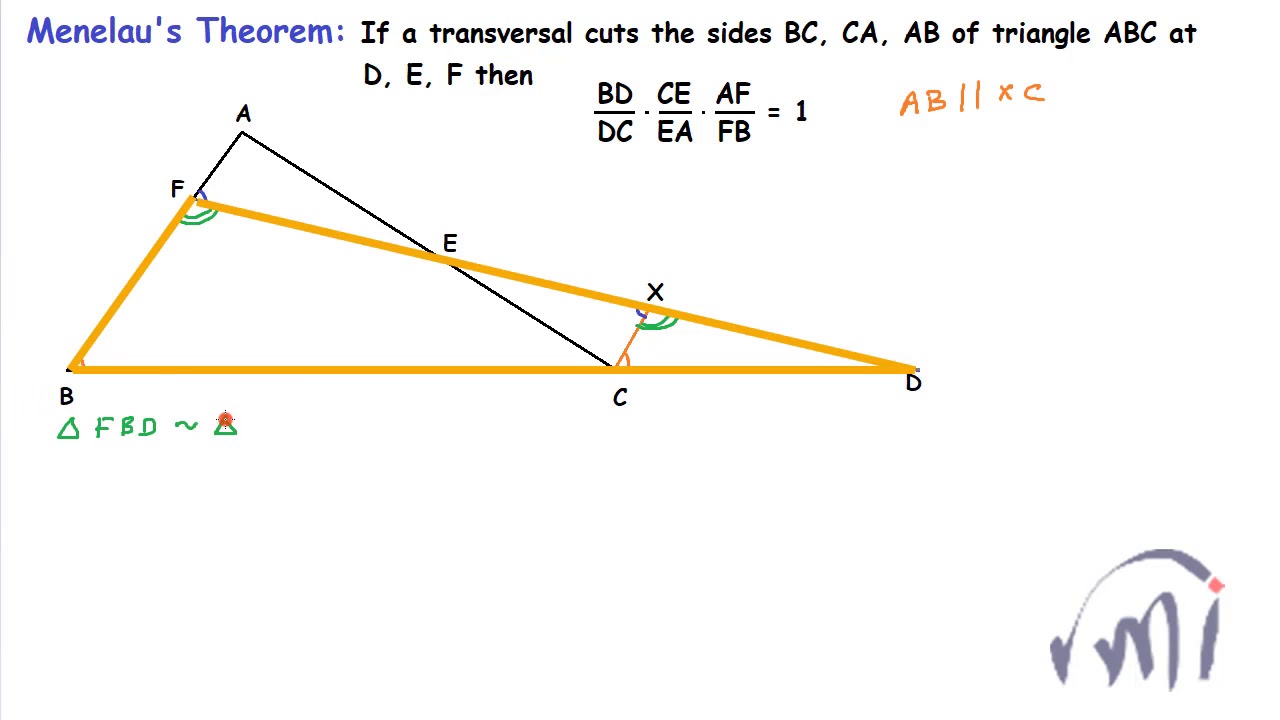
#MenelausTheorem #MelenausTheorem #CevasTheorem #INMO #PRMO #RMO #IBPS #IAS #CivilServisec #MentalAbility #Proof #Derivation
it uses similar triangles
royal dirge
lol
delicate helm
to each their own
royal dirge
im def going to look more into this later but
my brain is not working right now
anyway
thank you so much for your help
.close
midnight plankBOT
Channel closed
Closed by @royal dirge
Use .reopen if this was a mistake.
midnight plankBOT
Available help channel!
Send your question here to claim the channel.
Remember:
• Ask your math question in a clear, concise manner.
• Show your work, and if possible, explain where you are stuck.
• Do not immediately ping people or roles. After 15 minutes, feel free to ping <@&286206848099549185> once.
• Type the command .close to free the channel when you're done.
• Be polite and have a nice day!
Read #❓how-to-get-help for further information on how to ask a good question, and about conduct in the question channels.
 edgy crater
hi i was wondering whether my solution would be valid? the part im a bit dubious about is that when you split x into more than 2 terms, for example 3 terms, would it still hold that we get the highest product if we split x into 3 equal numbers, i wasn't too sure how to show this, but i was able to show this fairly easily in the case of splitting into 2 terms. thanks🙂
 midnight plankBOT
edgy crater
hi i was wondering whether my solution would be valid? the part im a bit dubious...
delicate helm
midnight plankBOT
edgy crater
hi i was wondering whether my solution would be valid? the part im a bit dubious...
delicate helm
calculus yes or no?
edgy crater
wdym
delicate helm
with calculus we can show that partial derivatives at the solution are all zero...
edgy crater
idk what partial derivates r sorry
delicate helm
nvm that then
but yes it does hold, I'm just trying to figure out how to prove tha
 mellow sand
edgy crater
hi i was wondering whether my solution would be valid? the part im a bit dubious...
mellow sand
edgy crater
hi i was wondering whether my solution would be valid? the part im a bit dubious...
i think i agree, i came to the same conclusion using am-gm inequality
edgy crater
okok ty🙂
delicate helm
You know what you can do I reckon?
you can prove it by saying consider picking out 1 term, and then the rest separately
but then consider changing the 1 term
clearly we would need to split that (additive) excess between the rest somehow
but the "best" way to split it is the one that maximizes their produc
And so it transitions into n-1 case, and you can prove by induction
mellow sand
edgy crater
okok ty🙂
did u ever find a specific way to say what the best y to use?
edgy crater
no i dont think theres a markscheme / answer for this
mellow sand
edgy crater
no i dont think theres a markscheme / answer for this
i was playing around with it, and it seemed to me that the best y is the number closest to x/e
i was thinking about the limit definition of e and how this looked close to it
this isn’t rigorous or anything but interesting to mess around with
delicate helm
maximize ln(n^x x^(-x)) = x ln(n) - x ln(x)?
mellow sand
ok, it isn’t very difficult just imagine some sum of terms and play from there
delicate helm
we can actually do that, right?
Are you absolutely sure you don't know any calculus? y = n/e
specifically max(floor(n/e), ceil(n/e))
 graceful drum
delicate helm
specifically max(floor(n/e), ceil(n/e))
graceful drum
delicate helm
specifically max(floor(n/e), ceil(n/e))
not necessarily
we have to find the closest integer to n/e
delicate helm
if (n/floor(n/e))^floor(n/e) > (n/ceil(n/e))^ceil(n/e) then y = floor(n/e) else y = ceil(n/e)
is the real (corrected) answer
for the number of terms
graceful drum
you wrote the same two things on either side of the inequality
delicate helm
thx
edgy crater
i just differentiated (x/y)^y with respect to y and got that y = x/e
graceful drum
yeah thats right for the critical point
mellow sand
edgy crater
i just differentiated (x/y)^y with respect to y and got that y = x/e
did u figure out the am gm version or nah?
delicate helm
I actually would like to know how to use am/gm to find the number of terms?
edgy crater
well i know that the am = gm if all the terms are the same, so all the terms are meant to the same since if they weren't the gm would be less than am? and the am is the constant?
mellow sand
delicate helm
I actually would like to know how to use am/gm to find the number of terms?
|| let x be your final sum number
x = a + b + c + …
by am gm
a + b + c + … / n >= (abc…)^1/n)
(a + b + c + … / n)^n >= abc….
(x/n)^n >= abc…
so max is when the two are equal. Thus max is (x/n)^n then solve in integers ||
graceful drum
basically am gm is for the first step when you prove that any maximal condition must have all terms equal
mellow sand
yea pretty much
edgy crater
ahh i see
mellow sand
just an easier way to get to that form
midnight plankBOT
Channel closed
Closed by @edgy crater
Use .reopen if this was a mistake.
Available help channel!
Send your question here to claim the channel.
Remember:
• Ask your math question in a clear, concise manner.
• Show your work, and if possible, explain where you are stuck.
• Do not immediately ping people or roles. After 15 minutes, feel free to ping <@&286206848099549185> once.
• Type the command .close to free the channel when you're done.
• Be polite and have a nice day!
Read #❓how-to-get-help for further information on how to ask a good question, and about conduct in the question channels.
 feral heron
hi guys, since i'm on vacations, i would like to ask you a simple question and that is: what are the most useful math formulas that i should learn, formulas that could help me throughout the last years of highschool or even my first years of college
midnight plankBOT
feral heron
hi guys, since i'm on vacations, i would like to ask you a simple question and t...
dreamy lichen
simple question, difficult answer
 simple olive
if by learn you mean how to derive them then volume formulas, quadratic formula and uh maybe some other stuff idk
dreamy lichen
this heavily depends on your country, college, what degree you wanna pursue etc...
if u have some extra time and wanna spend it learning math, go on khanacademy, look at every topic, take the "unit test" and see what you're weak at, then focus on that
simple olive
ye thats a good idea
 upbeat monolith
Take this with a grain of salt, I'm redoing calc this year because my school didn't have a higher level math, so that's the furthest I've gone, but I'd look into
trig identities,
calculus rules (both differentiation and integration),
quadratic formula,
basic volume and area formulas,
polynomial interpolation,
the basics of Taylor/McClaurin series,
e^(i*theta),
and maybe vector/matrix multiplication and determinants depending on how far you want to go.
feral heron
dreamy lichen
this heavily depends on your country, college, what degree you wanna pursue etc....
this year im moving to a school with a high focus on things such as physics and math and since i've always felt kinda like im losing my time on vacations and that i should use it to learn, i wanted to see if i could go any further. im currently in argentina and to give you an idea, the last thing they taught us is the bhaskara formula and quadratic ecuations in general
dreamy lichen
Yeah, this would definitely be a good resource
you can switch it to spanish if im not mistaken
yeah, u can
upbeat monolith
I'm not that familiar with the Argentinian (sorry if that's wrong) curriculum, so this is based more on the American curriculum.
Calculus rules, Taylor series and vector/matrix stuff might be a little far, but i'd look into the rest of what I said
delicate helm
polynomial interpolation is actually crazy tbh (as in, weird that's a suggestion)
feral heron
dreamy lichen
you can switch it to spanish if im not mistaken
i dont have any problem with language since i found learning languages kinda easy (i'm currently preparing for a c1 fce exam and i'm learning russian too)
feral heron
delicate helm
polynomial interpolation is actually crazy tbh (as in, weird that's a suggestion...
imma take it
upbeat monolith
It's not usually taught, but it's a really nice skill to have
It's surprisingly useful
delicate helm
upbeat monolith
It's surprisingly useful
But you can always just derive it if you really need to and can't look it up
upbeat monolith
*at least, it's not usually taught in the US
feral heron
anything that could make my brain melt from how challenging it is is sort of fun to me
upbeat monolith
I'd watch 3blue1brown's essence of calculus series on youtube, and then look into the rest of the things I talked about in that case
delicate helm
I'd say
e^(ix)
(a+b)^n (binomial, or multinomial formulae)
ad - bc (determinant of a 2x2 matrix)
quadratic formula
common trig identities
common taylor series
oh and the pythagorean theorem
feral heron
thank you all guys
ill definitely spend time on learning from what you guys suggested
.close
midnight plankBOT
Channel closed
Closed by @feral heron
Use .reopen if this was a mistake.
midnight plankBOT
Available help channel!
Send your question here to claim the channel.
Remember:
• Ask your math question in a clear, concise manner.
• Show your work, and if possible, explain where you are stuck.
• Do not immediately ping people or roles. After 15 minutes, feel free to ping <@&286206848099549185> once.
• Type the command .close to free the channel when you're done.
• Be polite and have a nice day!
Read #❓how-to-get-help for further information on how to ask a good question, and about conduct in the question channels.
 graceful ferry
For the least squares problem, in the normal equation, is the residue vector multiplied by A^T always zero? even if the columns of A are linearly dependent?
midnight plankBOT
graceful ferry
For the least squares problem, in the normal equation, is the residue vector mul...
graceful ferry
.close
midnight plankBOT
Channel closed
Closed by @graceful ferry
Use .reopen if this was a mistake.
@graceful ferry Has your question been resolved?
midnight plankBOT
@graceful ferry Has your question been resolved?
Channel closed
Closed by @graceful ferry
Use .reopen if this was a mistake.
midnight plankBOT
Available help channel!
Send your question here to claim the channel.
Remember:
• Ask your math question in a clear, concise manner.
• Show your work, and if possible, explain where you are stuck.
• Do not immediately ping people or roles. After 15 minutes, feel free to ping <@&286206848099549185> once.
• Type the command .close to free the channel when you're done.
• Be polite and have a nice day!
Read #❓how-to-get-help for further information on how to ask a good question, and about conduct in the question channels.
midnight plankBOT
Channel closed
Channel closed due to the original message being deleted.
If you did not intend to do this, please open a new help channel,
as this action is irreversible, and this channel may abruptly lock.
 rich yew

 plucky lark
midnight plankBOT
Available help channel!
plucky lark
midnight plankBOT
Available help channel!
Send your question here to claim the channel.
Remember:
• Ask your math question in a clear, concise manner.
• Show your work, and if possible, explain where you are stuck.
• Do not immediately ping people or roles. After 15 minutes, feel free to ping <@&286206848099549185> once.
• Type the command .close to free the channel when you're done.
• Be polite and have a nice day!
Read #❓how-to-get-help for further information on how to ask a good question, and about conduct in the question channels.
twilit field
 midnight plankBOT
twilit field
midnight plankBOT
twilit field
 frank wolf
Perhaps you can use the classification of finitely generated abelian groups
frank wolf
I think the prime factorisation of 120 is a good place to start
twilit field
twilit field
3,2^3,5 are the factors I care about
.
twilit field
frank wolf
I think the prime factorisation of 120 is a good place to start
yup
so $Z_{3} \oplus Z_{8} \oplus Z_5$ is one possiblity
grand pondBOT
wai
 frank wolf
I think you’re forced to have $Z_3 \oplus Z_5 \oplus H$ where $H$ is an abelian group of order 8
grand pondBOT
Pseudo (Cat theory #1 Fan)
 twilit field
frank wolf
I think you’re forced to have $Z_3 \oplus Z_5 \oplus H$ where $H$ is an abelian ...
twilit field
frank wolf
I think you’re forced to have $Z_3 \oplus Z_5 \oplus H$ where $H$ is an abelian ...
hmm, why
oh
right
yes
frank wolf
And there are only 3 options for H
twilit field
ye
frank wolf
So you can probably just go through each case and see what works
twilit field
frank wolf
And there are only 3 options for H
But not all have 3 elements of order 2.,do they
frank wolf
Yeah
twilit field
so I have to examine all cases?
frank wolf
Yeah
grand pondBOT
wai
 runic hamlet
we have done this question before
why are you always forgetting how to do things
grinding problems is useless if you keep forgetting
do less problems and make sure you actually remember them
frank wolf
twilit field
It's $Z_3 \oplus Z_5 \oplus Z_4 \oplus Z_2$
yep!
midnight plankBOT
Channel closed
Closed by @twilit field
Use .reopen if this was a mistake.
midnight plankBOT
Available help channel!
Send your question here to claim the channel.
Remember:
• Ask your math question in a clear, concise manner.
• Show your work, and if possible, explain where you are stuck.
• Do not immediately ping people or roles. After 15 minutes, feel free to ping <@&286206848099549185> once.
• Type the command .close to free the channel when you're done.
• Be polite and have a nice day!
Read #❓how-to-get-help for further information on how to ask a good question, and about conduct in the question channels.
 narrow edge
so i was trying to derive the volume of a cone by myself what is the error in my reasoning:
drop a perpendicular to the center of the base circle. we can see that 2pir triangles have been formed with base length r and height h which means that they have an area of rh/2. 2pir * rh/2 is pi*r^2 * h which is the volume of a cylinder not that of a cone
midnight plankBOT
narrow edge
so i was trying to derive the volume of a cone by myself what is the error in my...
 bold peak
What do you mean by "2pir triangles are formed"
narrow edge
there are 2pir points on that circle which means that there are 2pir hypotenuses connected to the top of the cone
bold peak
Again, what do you mean by there are "2pir points on that circle"
narrow edge
2pir is the circumference of a circle
bold peak
A circle has an uncountably infinite number of points
bold peak
narrow edge
2pir is the circumference of a circle
Circumference ≠ Number of points
 exotic stratus
length of the boundary of the circle
bold peak
The length of the boundary
narrow edge
but like
exotic stratus
I mean just think of it this, way let's say you have a circle with radius 1u, it's circumference will be 6.28u, what do you think 0.28u points are?
bold peak
exotic stratus
I mean just think of it this, way let's say you have a circle with radius 1u, it...
They're concepts of a point

narrow edge
narrow edge
but like
while deriving say the volume of a cube we note that there are x squares with an area of x^2 and get the result
narrow edge
no i derived it myslef i trusted it cuz it made sense 😭
bold peak
...
narrow edge
they dont teach derivations in hs they just make you rotelearn the formulas
bold peak
Your idea works not because it's correct, but because it's a restatement of a correct idea
If a shape has uniform cross section, then it's volume is the area of the cross section * height perpendicular to that cross section
Unfortunately this idea stops working the moment your cross section is not uniform
Like a cone. Or a sphere
And unfortunately proving the volumes for these shapes requires integration. Which I imagine is beyond your syllabus for now
narrow edge
but the cross sections can be uniform cuz all of these right triangles are congruent right?
bold peak
In which direction are you taking the height
narrow edge
bold peak
In which direction are you taking the height
perpendicular to teh base
bold peak
For the cross sections to stay uniform?
bold peak
narrow edge
perpendicular to teh base
What's the cross section there
It's circles
Circles that reduce in radius the higher you go
exotic stratus
If you want to keep going with your idea, I recommend you use circles which get progressively smaller rather than drawing lines from points on circle to the top because infinity isn't a good way to work on things. Take really thin circles and progressively make them thinner and eventually you'll see the pattern
bold peak
(at that point you've basically reinvented integration no?)
narrow edge
yea
bold peak
I'm just wondering if that's a feasible path to take
exotic stratus
If they did they would've figured out the error they made
narrow edge
ik differentiation tho if thats useful for this
exotic stratus
Integration is anti-differentiation
bold peak
Well integration is the opposite of differentiation
So you might as well look up some integration and come back to this
You shouldn't need more than the very basics
Godspeed
I'd say do three things
See basic integration
Try to derive the volumes of a cube and a cylinder through integration
Then try to derive the volume of a cube cone
bold peak
Right yes
midnight plankBOT
@narrow edge Has your question been resolved?
Channel closed
Closed by @narrow edge
Use .reopen if this was a mistake.
midnight plankBOT
Available help channel!
Send your question here to claim the channel.
Remember:
• Ask your math question in a clear, concise manner.
• Show your work, and if possible, explain where you are stuck.
• Do not immediately ping people or roles. After 15 minutes, feel free to ping <@&286206848099549185> once.
• Type the command .close to free the channel when you're done.
• Be polite and have a nice day!
Read #❓how-to-get-help for further information on how to ask a good question, and about conduct in the question channels.
 wispy mortar
yo
midnight plankBOT
wispy mortar
yo
wispy mortar
how do i show increasing

i only have doubt in showing monotone sequence
i know that we need to get xn+1 > xn
but idk how to start
 rose trout
If you show it's bounded above by 2 first I think it's a bit easier to show it's increasing.
graceful drum
wispy mortar
i know that we need to get xn+1 > xn
try using induction
wispy mortar
we can do that by putting in value of x1
graceful drum
right, so what are the values of x2 and x1
wispy mortar
root3 and 1
graceful drum
then
wispy mortar
root3 > 1
graceful drum
yeah
wispy mortar
we can take a xk > 1?
wispy mortar
ohhh
wispy mortar
yess
graceful drum
yes
if we assume xk>x(k-1)
and prove this implies x(k+1)>xk
that combined with our base caves proves that xn+1>xn for all n
*case
wispy mortar
OH
wispy mortar
graceful drum
that combined with our base caves proves that xn+1>xn for all n
i didnt know what to assume to start this proof
thanks man
wispy mortar
yess
wispy mortar
graceful drum
proving the inductive step\
which is?
graceful drum
graceful drum
how do we prove x(k+1) > xk
this
 subtle blaze
Essentially you want to show the sequence is bounded from above by 2
Then you want to show that the sequence is increasing
Then you use the theorem that a bounded monotonic sequence converges
wispy mortar
graceful drum
how do we prove x(k+1) > xk
from the equation
wispy mortar
graceful drum
how do we prove x(k+1) > xk
add 2 on both sides and then root
graceful drum
correct
$x_{k} > x_{k-1} \implies \sqrt{x_{k}+2} > \sqrt{x_{k-1}+2} \implies x_{k+1} > x_k$
grand pondBOT
CherryMan
 graceful drum
so you proved that x_n is monotone
wispy mortar
damn thats it?
graceful drum
can you prove that it is bounded similarly
wispy mortar
graceful drum
can you prove that it is bounded similarly
yesss
now we can claim that
since the limit is 2
xk < 2
graceful drum
yup
 vague seal
In induction we have 2 steps we want to do:
step 1) base case, proving that for some specific n P(n) is true, in your case it is showing that P(2), which is x_2 > x_1 is true.
step 2) induction step, this is the step where you prove the implication P(n) ⇒ P(n + 1) where in your case P(n) is x_n > x_(n - 1).
wispy mortar
and then we +2 and root on both sides
graceful drum
nice
wispy mortar
it gives xk+1 < 2
graceful drum
$x_k < 2 \implies \sqrt{x_k+2} < \sqrt{2+2} \implies x_{k+1} < 2$
grand pondBOT
CherryMan
 graceful drum
nice
wispy mortar
yesss
graceful drum
so you proved that xn is bounded and monotone
so by mct, you proved that it converges
wispy mortar
lessso thats it?
graceful drum
well you still have to find the limit
graceful drum
yes
 graceful drum
welcome
wispy mortar
.close
midnight plankBOT
Channel closed
Closed by @wispy mortar
Use .reopen if this was a mistake.
Available help channel!
Send your question here to claim the channel.
Remember:
• Ask your math question in a clear, concise manner.
• Show your work, and if possible, explain where you are stuck.
• Do not immediately ping people or roles. After 15 minutes, feel free to ping <@&286206848099549185> once.
• Type the command .close to free the channel when you're done.
• Be polite and have a nice day!
Read #❓how-to-get-help for further information on how to ask a good question, and about conduct in the question channels.
 sullen bolt
just wanted to check my thought process
this just involves fraction decomposition, then using the identity \int(1/(x+blah blah blah)=ln(x+blah blah blah) right
 midnight plankBOT
sullen bolt
just wanted to check my thought process
this just involves fraction decompositi...
midnight plankBOT
sullen bolt
just wanted to check my thought process
this just involves fraction decompositi...
 merry shale
sullen bolt
merry shale
sullen bolt
its not that bad I think