#help-49
1 messages · Page 250 of 1
 midnight plankBOT
 Available help channel!
Send your question here to claim the channel.
Remember:
• Ask your math question in a clear, concise manner.
• Show your work, and if possible, explain where you are stuck.
• Do not immediately ping people or roles. After 15 minutes, feel free to ping <@&286206848099549185> once.
• Type the command .close to free the channel when you're done.
• Be polite and have a nice day!
Read #❓how-to-get-help for further information on how to ask a good question, and about conduct in the question channels.
 leaden seal
Hi, this is a physics question from the beam and cable lab
 midnight plankBOT
leaden seal
Hi, this is a physics question from the beam and cable lab
leaden seal
midnight plankBOT
leaden seal
Hi, this is a physics question from the beam and cable lab
leaden seal
(hope you dont mind me asking here
my question is: how do we get 0.842 (the angle) where it says costheta at the bottom
midnight plankBOT
@leaden seal Has your question been resolved?
midnight plankBOT
Channel closed
Closed due to timeout
Use .reopen if this was a mistake.
Available help channel!
Send your question here to claim the channel.
Remember:
• Ask your math question in a clear, concise manner.
• Show your work, and if possible, explain where you are stuck.
• Do not immediately ping people or roles. After 15 minutes, feel free to ping <@&286206848099549185> once.
• Type the command .close to free the channel when you're done.
• Be polite and have a nice day!
Read #❓how-to-get-help for further information on how to ask a good question, and about conduct in the question channels.
 upper nexus
How would you roughly sketch this diagram?
We are given a triangle ABC such that ∠BAC < 90◦.The point D is on the opposite side of the line AB to C such that |AD| = |BD| and ∠ADB = 90◦.
Similarly, the point E is on the opposite side of AC to B such that |AE| = |CE| and ∠AEC = 90◦. The point X is such that ADXE is a parallelogram.
midnight plankBOT
upper nexus
How would you roughly sketch this diagram?
We are given a triangle ABC such tha...
upper nexus
it's just im not sure what "the opposite side" is referring to
like what is the "opposite side of the line AB"
upper nexus
oh?
 shell wigeon

C and D are on opposite sides of AB
B and E are on opposite sides of AC
I drew the perpendicular bisectors of AB and AC, and to make ADB = AEC = 90º, I just made BAD = CAE = 45º
upper nexus
oh thanks so much
 near cliff
shell wigeon
near cliff
shell wigeon
okay this made much more sense than what i was trying to visualise
shell wigeon
(I forgot to draw CE but you can imagine the right angles)
Then EX is just parallel to AD, and DX parallel to AE
upper nexus
yea
shell wigeon
Do you need help with a question about this?
shell wigeon
... are you going to post it?
shell wigeon
Why? Is it a test?
upper nexus
not exactly, it's just a problem to challenge me
midnight plankBOT
@upper nexus Has your question been resolved?
Channel closed
Closed by @upper nexus
Use .reopen if this was a mistake.
midnight plankBOT
Available help channel!
Send your question here to claim the channel.
Remember:
• Ask your math question in a clear, concise manner.
• Show your work, and if possible, explain where you are stuck.
• Do not immediately ping people or roles. After 15 minutes, feel free to ping <@&286206848099549185> once.
• Type the command .close to free the channel when you're done.
• Be polite and have a nice day!
Read #❓how-to-get-help for further information on how to ask a good question, and about conduct in the question channels.
 lament flame
 midnight plankBOT
lament flame
lament flame
midnight plankBOT
lament flame
lament flame
I am trying my hardest...
 crimson wyvern
Ok so which types of asymptotes do you feel you don’t understand?
Are you having trouble identifying them or having trouble providing the equation for them?
crimson wyvern
lament flame
I am trying my hardest...
So for a vertical asymptote to happen, a function will shoot off to positive or negative infinity (or both) around the asymptote
lament flame
crimson wyvern
So for a vertical asymptote to happen, a function will shoot off to positive or ...
I think it is a positive right?
crimson wyvern
lament flame
I think it is a positive right?
Positive what? Do you mean positive location, positive infinity?
lament flame
Ok positive 4
crimson wyvern
lament flame
Ok positive 4
Yes! Now, what do you think the equation should be based on this?
midnight plankBOT
@lament flame Has your question been resolved?
lament flame
crimson wyvern
Yes! Now, what do you think the equation should be based on this?
X/x+4 +5
I dont know the numerator yet
crimson wyvern
lament flame
X/x+4 +5
ah, that's your function equation, but you just need the equation for the asymptote line
do you know what the general equations are for vertical and horizontal lines?
lament flame
crimson wyvern
ah, that's your *function* equation, but you just need the equation for the asym...
The denominator can not be less then the numerator or equal 0
crimson wyvern
lament flame
The denominator can not be less then the numerator or equal 0
ok, let me get a visual aid
What is the equation of this blue line?
 lament flame
Its 1/x-5 right?
crimson wyvern
lament flame
Its 1/x-5 right?
you're trying to find the equation for the red function. You need to find the equation for the blue line
crimson wyvern
lament flame
The vertical asymptote is 5
yes, but, it's specifically x=5
because that is the equation for a vertical line at 5 on the x-axis
lament flame
crimson wyvern
because that is the equation for a vertical line at 5 on the x-axis
Ah....
crimson wyvern
lament flame
Ah....
yeah you have to specify because if you just write "5", that could mean either a vertical line at x=5 or a horizontal line at y=5
lament flame
Ohhhhhh
crimson wyvern
lament flame
Ohhhhhh
ok, so I think you have everything you need to answer this one correctly
crimson wyvern
what did you answer?
lament flame
Oh I missread
I dont know if I need to factor or if I dont and cancle for this one
 lament flame
crimson wyvern
what did you answer?
lament flame
crimson wyvern
what did you answer?
Do I cancle the 4x? It doesnt seem factorable
crimson wyvern
lament flame
Do I cancle the 4x? It doesnt seem factorable
so, for vertical asymptotes, you need to find all the x-values that make the denominator equal to zero (with the caveat that you need to check and make sure the numerator isn't also equal to zero at this point, as that might do something else)
lament flame
Ohhhh
crimson wyvern
lament flame
Ohhhh
and because the denominator is linear (and not constant), it has to equal 0 somewhere, and also only passes through 0 once
crimson wyvern
yup
lament flame
Then we plug it in to numerator correct?
crimson wyvern
lament flame
Then we plug it in to numerator correct?
yeah
lament flame
Plugged it in to numerator
crimson wyvern
you need to subtract that 2, not add it
nope my bad
I'm taking real analysis rn and apparently I still can't multiply two negative numbers correctly lmao
crimson wyvern
lament flame
Plugged it in to numerator
ok so your numerator is not equal to 0, and the denominator is, which means x=-1/2 should be a vertical asymptote
lament flame
Ohhhhhhh
crimson wyvern
lament flame
Ohhhhhhh
for context, getting 0/0 somewhere on the function leaves a discontinuity, but not an asymptote. I will show an example
 lament flame
Ohhhhh
crimson wyvern
but 1/x blows out to infinity because the numerator doesn't keep up with the denominator
that's why you want to check for 0/0
lament flame
Apparently there is a horazontal or oblique asymtote
crimson wyvern
yes. those are going to be quite different because they happen as you approach infinity or negative infinity on the x-axis instead of at a discontinuity
lament flame
What does it mean when they say num and denom both have a DEGREE of 1?
crimson wyvern
it is the power x is raised to
so like x+1/x^2+1 would have a numerator of degree 1 and denominator of degree 2
1/x has a numerator of degree 0 and denominator of degree 1
crimson wyvern
nope
lament flame
Wha
crimson wyvern
well, be careful, because one of those terms should be negative
crimson wyvern
so, since you are looking at it as x gets very large, what will happen?
lament flame
So wait- its... would it still be an oblique
crimson wyvern
lament flame
So wait- its... would it still be an oblique
ok, so since we are looking at very large x, we know x isn't 0 in this area
which means you can divide out the x
lament flame
Oh yeah
lament flame
crimson wyvern
ok, so since we are looking at very large x, we know x isn't 0 in this area
So -4+1/4+2?
crimson wyvern
lament flame
So -4+1/4+2?
this is after removing the lower degrees
because they become negligible as x becomes very large
crimson wyvern
lament flame
I dont understand what you mean by that
so take f(x)=x and g(x)=x+1. when x=1, g(x) = 2 and f(x) = 1. so, g(x) is double the height of f(x). Now take x=100. so g(x) = 101 and f(x) = 100. so the percent difference between them is now much less than double. as that x gets even larger, the percent difference "becomes negligible", or mathematically, approaches zero
lament flame
Ohhhhhh
crimson wyvern
lament flame
Ohhhhhh
this is why you only need to look at the highest degree. Because the highest degree of a polynomial is going to eventually blow out to infinity faster than all the lower degrees do, it's the only one that matters when you are looking at behavior as x becomes very large or small
(by small, i mean going to negative infinity here, not 0)
crimson wyvern
well, you look at y= -4x/4x, and then just divide it out
lament flame
So -1
lament flame
If it is a oblique it wants me to put it in slope intercept form?...
lament flame
crimson wyvern
y=-1
Oh-
crimson wyvern
so it's horizontal, not oblique
you only get oblique if you end up with something in the form of ax^(n+1)/bx^n
lament flame
I apologize my head is just... I dunno today
Ok domain would be
(-inf, -1/2)U(-1/2, inf) right?
crimson wyvern
yeah should be
 crimson wyvern
my guess is the denominator is a quadratic function
since quadratics can pass through 0 twice
lament flame
crimson wyvern
alright, I'm calling it for the night
Oh shoot- thanks dude you helped me a lot
midnight plankBOT
@lament flame Has your question been resolved?
midnight plankBOT
Channel closed
Closed due to timeout
Use .reopen if this was a mistake.
midnight plankBOT
Available help channel!
Send your question here to claim the channel.
Remember:
• Ask your math question in a clear, concise manner.
• Show your work, and if possible, explain where you are stuck.
• Do not immediately ping people or roles. After 15 minutes, feel free to ping <@&286206848099549185> once.
• Type the command .close to free the channel when you're done.
• Be polite and have a nice day!
Read #❓how-to-get-help for further information on how to ask a good question, and about conduct in the question channels.
 steep ravine
is this correct?
 midnight plankBOT
steep ravine
is this correct?
steep ravine
midnight plankBOT
steep ravine
is this correct?
steep ravine
its for FSM finite state machines
midnight plankBOT
@steep ravine Has your question been resolved?
midnight plankBOT
@steep ravine Has your question been resolved?
midnight plankBOT
@steep ravine Has your question been resolved?
Channel closed
Closed by @steep ravine
Use .reopen if this was a mistake.
Available help channel!
Send your question here to claim the channel.
Remember:
• Ask your math question in a clear, concise manner.
• Show your work, and if possible, explain where you are stuck.
• Do not immediately ping people or roles. After 15 minutes, feel free to ping <@&286206848099549185> once.
• Type the command .close to free the channel when you're done.
• Be polite and have a nice day!
Read #❓how-to-get-help for further information on how to ask a good question, and about conduct in the question channels.
 agile root
part c
 midnight plankBOT
agile root
part c
midnight plankBOT
agile root
part c
 lyric charm
c i, c ii, or c iii?
agile root
ii
lyric charm
p sure you want to do integration by parts
 ashen kite
LIATE
agile root
coffee?
ashen kite
Nope the rule for choosing u
agile root
what is liate
lyric charm
you want to make the log(x)^n into log(x)^(n-1) somehow
lyric charm
agile root
what is liate
don't worry about that for now
agile root
lyric charm
you want to make the log(x)^n into log(x)^(n-1) somehow
im thinking differentiating but by chain rule we get a new term
lyric charm
agile root
im thinking differentiating but by chain rule we get a new term
try it anyway
agile root
nln(x)^n-1/x
 subtle zinc
yes go on
agile root
okay so integration by parts is:
uv - int(vdu)
i guess im gonna choose my u=ln(x)^n
so i get du=nln(x)^n-1/x
dv=x^2 so v=x^3/3
ln(x)^nx^3/3 - 1/2int(x^2nln(x)^n-1)dx
wait let me just write it out
lyric charm
write out the version for definite integrals
 lethal path
also it's 1/3 multiplied by that integral
lyric charm
on paper not in discord
 tender pelican
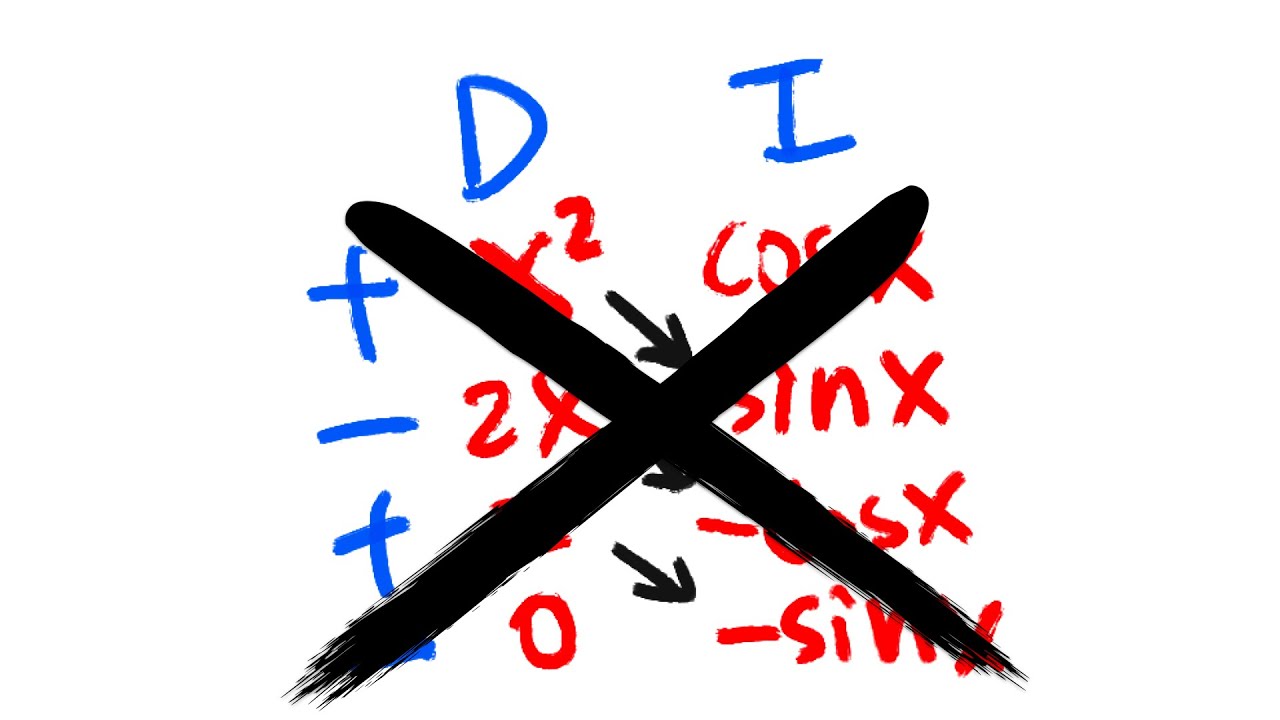
oh fun fact, ibp can be organized in a good manner using the D-I method

Integration by parts by using the DI method! This is the easiest set up to do integration by parts for your calculus 2 integrals. We will also do 3 integrals to illustrate the 3 stops of the DI method.
Dear calculus teachers, please let students use the DI Method (& why it is really the same as integration by parts) 👉 https://youtu.be/8xPfNu...
 agile root
tender pelican
https://youtu.be/2I-_SV8cwsw?si=9vUoN0ZUVrcorXUl
agile root
tender pelican
https://youtu.be/2I-_SV8cwsw?si=9vUoN0ZUVrcorXUl
i have seen this method but my teacher doesnt allow it
tender pelican
agile root
i have seen this method but my teacher doesnt allow it
Try Brilliant with 30 days free: 👉 https://brilliant.org/blackpenredpen/ (20% off with this link!) #calculus #brilliant #maths #math
In this video, we will show you why your calculus students deserve to learn and use the DI method for integration by parts. While it's true that the DI and u-dv methods are equivalent, the DI method has many a...
lmao
agile root
it isnt that she doesnt believe in it
tender pelican
they are literally the same thing
agile root
she wants me to clearly show where im integrating
lethal path
agile root
i have seen this method but my teacher doesnt allow it
the IB exams definitely allows it though
lethal path
agile root
she wants me to clearly show where im integrating
oh that's a different issue then
agile root
agile root
like this
is this correct?
lethal path
yeah to find v from dv, you better show your steps in the real exam too
agile root
my ipad died so um i used google docs
tender pelican
agile root
it isnt that she doesnt believe in it
I do wonder what she would think of the video, but I learned integration on my own and currently am not up to integration in calculus, so I'll see what happens when I get up to it
lethal path
agile root
like this
-
it helps to mention ln(e) = 1 and ln(1) = 0
-
it's better to write $\int_1^e \frac{x^3}{3} \frac{n \ln(x)^{n - 1}}{x} \ dx$ for clarity
otherwise, all good
 grand pondBOT
south
 agile root
and now this integrand will just be n/3 I(n-1) right
okay i got the result
going back to the central issue
how do i choose u and dv?
lethal path
the key insight is: differentiating (ln x)^n is the way to make the power of (n - 1) appear in the integral
so it's a case of knowing what form you want the answer to be
writing it out as $\frac{1}{3} \left(e^3 - n \int_1^e x^2 (\ln x)^{n - 1} \ dx \right)$ helps a lot
grand pondBOT
south
 lethal path
and also, a common trick in papers is that they factor something out
so the 1/3 in front here
agile root
i see, so it is sort of like inspecting what i want or which ever term is harder to integrate per se
lethal path
agile root
i see, so it is sort of like inspecting what i want or which ever term is harder...
yeah, that's the idea behind LIATE
though LIATE is not perfect and it 'fails' in many questions if you apply it in a braindead way
agile root
do u know a list of tricks we need for ib aa hl in integration
im so lost, i skipped almost all my calculus classes because i was super sick
lethal path
there's actually no tricks
agile root
techniques i mean
lethal path
IB will only give you integrals by substitution in the form $\int f'(g(x)) g'(x) \ dx$
grand pondBOT
south
 lethal path
otherwise, they will tell you exactly what to substitute
lethal path
grand pond
**south**
(this is the reverse chain rule form)
agile root
lethal path
IB will only give you integrals by substitution in the form $\int f'(g(x)) g'(x)...
here sub would be u=g(x)?
lethal path
I suggest practicing with the formula booklet also
lethal path
agile root
here sub would be u=g(x)?
yep! du = g'(x) dx
agile root
oooh
lethal path
AAHL doesn't go as deep as you think for integration
agile root
which topic is the hardest
lethal path
there's also things like, if you want to integrate $\frac{x^2}{9 + x^2}$, that equals $\frac{9 + x^2}{9 + x^2} - \frac{9}{9 + x^2}$
grand pondBOT
south
 lethal path
agile root
which topic is the hardest
lethal path
agile root
which topic is the hardest
it's subjective
do you find 3D vectors hard?
or how about complex numbers?
lethal path
agile root
i find combinatorics very very hard
to be honest, I don't think it's worth your energy
agile root
lethal path
there's also things like, if you want to integrate $\frac{x^2}{9 + x^2}$, that e...
WHAT
how did u get the insight to add and subtract 9
lethal path
agile root
how did u get the insight to add and subtract 9
if you practice you'll know
agile root
could we directly complete the square?
lethal path
that doesn't actually work, cause now you'll have -6x in the denominator
and that's even nastier
the key is to recognise the integral of 1/(x^2 + a^2) as a standard integral in your formula booklet
agile root
wow
clearly i need to practice a lot more
i think i understand this now, tysm ann, south, and a message!
.close
midnight plankBOT
Channel closed
Closed by @agile root
Use .reopen if this was a mistake.
midnight plankBOT
Available help channel!
Send your question here to claim the channel.
Remember:
• Ask your math question in a clear, concise manner.
• Show your work, and if possible, explain where you are stuck.
• Do not immediately ping people or roles. After 15 minutes, feel free to ping <@&286206848099549185> once.
• Type the command .close to free the channel when you're done.
• Be polite and have a nice day!
Read #❓how-to-get-help for further information on how to ask a good question, and about conduct in the question channels.
 coral belfry
,tex
hello, suppose we have the sequence $a_n = \frac{3n}{2n +1} $
\
and i have shown that
\
$ \frac{3}{2} \geq a_n \geq \frac{3}{2} + \frac{a}{n} $
\
\
where $a> \frac{-15}{4} $ but i havent actually proven anything more than that. is it enough to say that our sequence converges to 3/2? it seems rlly wrong to me bc im not sure if such "a" exists
midnight plankBOT
coral belfry
,tex
hello, suppose we have the sequence $a_n = \frac{3n}{2n +1} $
\\
and i have...
grand pondBOT
fijokazż

 umbral timber
grand pond
**fijokazż**
umbral timber
grand pond
**fijokazż**
try taking the limit as n tends to infinity
 runic hamlet
presumably you arent allowed to write a_n as 3/(2+1/n) and then move the limit inside the fraction?
umbral timber
then by the squeeze theorem you basically have a proof
coral belfry
umbral timber
then by the squeeze theorem you basically have a proof
yeah but i havent defined a so well
runic hamlet
assuming the inequality you showed is correct, yes
midnight plankBOT
Channel closed
Closed by @coral belfry
Use .reopen if this was a mistake.
Available help channel!
Send your question here to claim the channel.
Remember:
• Ask your math question in a clear, concise manner.
• Show your work, and if possible, explain where you are stuck.
• Do not immediately ping people or roles. After 15 minutes, feel free to ping <@&286206848099549185> once.
• Type the command .close to free the channel when you're done.
• Be polite and have a nice day!
Read #❓how-to-get-help for further information on how to ask a good question, and about conduct in the question channels.
 cosmic jolt
could I get some help please
 midnight plankBOT
cosmic jolt
could I get some help please
midnight plankBOT
cosmic jolt
could I get some help please
 pearl hull
cosmic jolt
could I get some help please
pearl hull
cosmic jolt
could I get some help please
which question specifically?
 torn compass
cosmic jolt
both
torn compass
cosmic jolt
both
isnt that as simple as resolution of forces
cosmic jolt
not sure I only js started mechanics
torn compass
u know what resolution of forces is tbh?
cosmic jolt
yh but I dont think the question is that simple
torn compass
cosmic jolt
yh but I dont think the question is that simple
it is tbh

unless if im missing smthing 
cosmic jolt
bruh
torn compass
(idk if showing the image is giving the answer  )
)
cosmic jolt
i dont get it icl
torn compass
cosmic jolt
i dont get it icl
which part
torn compass
cosmic jolt
whats the mgcos theta part then

breaking down a force into its x and y components , or resolution of forces
mg costheta would be the y component of the force
cosmic jolt
Yeah Im still new to this
torn compass
with respect to the block
cosmic jolt
.close
midnight plankBOT
Channel closed
Closed by @cosmic jolt
Use .reopen if this was a mistake.
Available help channel!
Send your question here to claim the channel.
Remember:
• Ask your math question in a clear, concise manner.
• Show your work, and if possible, explain where you are stuck.
• Do not immediately ping people or roles. After 15 minutes, feel free to ping <@&286206848099549185> once.
• Type the command .close to free the channel when you're done.
• Be polite and have a nice day!
Read #❓how-to-get-help for further information on how to ask a good question, and about conduct in the question channels.
 high wedge
 midnight plankBOT
high wedge
high wedge
midnight plankBOT
high wedge
high wedge

I have this, but I am struggling to make it to where I can have a palindrome in a palindrome, while maintaining the multiple of 3 I need
the goal is to make a context free grammar from the context free language provided
crimson wyvern
What course is this for?
 frozen talon
high wedge
the goal is to make a context free grammar from the context free language provid...
frozen talon
high wedge
the goal is to make a context free grammar from the context free language provid...
I have no idea what this means
high wedge
theory of computation
frozen talon
Are you counting palindromes or something?
crimson wyvern
It seems like a combinatorics problem yeah
high wedge
a grammar is basically a set of rules you can use to derive a string
so like
if I say
S -> A
A -> 00
I can do S -> A -> 00, which is just S => 00
crimson wyvern
I feel like this is something more in the realm of computer science than mathematics maybe? It seems very applied
high wedge
I need to make a grammar that accepts strings comprised of 0s and 1s which are palindromes, and are divisible by 3
crimson wyvern
What does divisible by 3 mean in this case?
frozen talon
what do you mean by "derive a string"
high wedge
so like 000 has a length of 3
frozen talon
crimson wyvern
What does divisible by 3 mean in this case?
the length of the string is a multiple of 3
high wedge
frozen talon
what do you mean by "derive a string"
derive meaning can get to it via the starting rule and any combination of other rules in the grammar
crimson wyvern
So theoretically there is no upper limit on length?
high wedge
crimson wyvern
So theoretically there is no upper limit on length?
nope
infinite length is acceptable
frozen talon
it doesn't if your goal isn't just counting palindromes, which it isn't
high wedge
so as a concrete example, the grammar for even length palindromes looks like this
S -> 0S0 or 1S1 or epsilon (empty string)
frozen talon
oh so this is a recursion thing
high wedge
yeah
crimson wyvern
What is the goal here exactly?
high wedge
crimson wyvern
What is the goal here exactly?
create a set of rules such that by going from rule to rule you end up with a palindrome with a length div by 3
and you must start with the start rule
frozen talon
I think having two confused people asking questions is counterproductive
crimson wyvern
Yeah I’m going to have to leave here
high wedge
this problem feels hard to me because it's induction
frozen talon
you don't care about changing the alphabet from {0, 1} right?
high wedge
frozen talon
you don't care about changing the alphabet from {0, 1} right?
nope
a and b is fine
as long as it's binary
frozen talon
well, a palindrome is entirely determined by the first half of the string, as anything you append to the left must be appended to the right
- the middle character, if it exists
high wedge
yeah and in this case we will have a middle in a lot of cases
frozen talon
my first thought was to say something like S -> 000S000, 001S100, ..., 111S111
but that excludes cases where appending only three digits (disturbing parity, therefore) still results in a palindrome
e.g. "111" (odd) || "111" (odd) = "111111" (even)
high wedge
yeah this handles all cases of length 3 or less but

no more
what you had makes sense, but then you need S -> something
frozen talon
high wedge
if I say
S -> A
A -> 00
are grammars meant to let you derive satisfactory words from other satisfactory words?
high wedge
if you want it to represent a particular language then yes
like in this case, it must always end up in a satisfactory state eventually or else the grammar doesn't represent the desired language
but generally speaking, a grammar just needs to follow certain rules, satisfactoriness can only come from some constraint being set I suppose
frozen talon
high wedge
yeah this handles all cases of length 3 or less but
ok, so grammars are not necessarily recursive, because this example generates palindromes of length 3
high wedge
frozen talon
ok, so grammars are not necessarily recursive, because this example generates pa...
yup
it can be but doesn't have to be
it's made to be expressive
frozen talon
is there a grammar-y way of expressing the reversal of a given string?
high wedge
frozen talon
is there a grammar-y way of expressing the reversal of a given string?
I don't know, but that would probably help solve this 😹
frozen talon
can you access characters in a string in this setting?
and just to be transparent, I've actually never done this before, I'm not feigning this ignorance lol
high wedge
frozen talon
can you access characters in a string in this setting?
access wdym
frozen talon
high wedge
access wdym
maybe it's not useful. I was wondering if you're able to reference a character in a specific index of a given string
high wedge
frozen talon
maybe it's not useful. I was wondering if you're able to reference a character i...
no indexing
frozen talon
ok, sure
high wedge
hmm
so we do need recursion but
I don't see how to get that recursion while maintaining the divisibility by 3, for even length it was "easy"
here there is some extra conceptual leap
I had the idea of an intermediate variable Y, which can then go back to S
maybe I got it @frozen talon
 frozen talon
high wedge
maybe I got it <@191038258728140801>
frozen talon
high wedge
maybe I got it <@191038258728140801>
I think that looks fair, cool
high wedge
yeah now I need to test it though 
like 100010001 should be accepted as a palindrome right?
length of 9 and is same forwards / backwards
well anyways, thanks for the help, I do think it looks good now, I still don't really get it though lol 😹
.close
midnight plankBOT
Channel closed
Closed by @high wedge
Use .reopen if this was a mistake.
midnight plankBOT
Available help channel!
Send your question here to claim the channel.
Remember:
• Ask your math question in a clear, concise manner.
• Show your work, and if possible, explain where you are stuck.
• Do not immediately ping people or roles. After 15 minutes, feel free to ping <@&286206848099549185> once.
• Type the command .close to free the channel when you're done.
• Be polite and have a nice day!
Read #❓how-to-get-help for further information on how to ask a good question, and about conduct in the question channels.
 twilit field
 midnight plankBOT
twilit field
twilit field
midnight plankBOT
twilit field
twilit field
Unsure of where to even start, other than the norm is non-zero everywherre but 0
 spiral rock
Consider two orthonormal basis for V w.r.t. to each of the inner products
twilit field
right
 visual tiger
spiral rock
Consider two orthonormal basis for V w.r.t. to each of the inner products
visual tiger
spiral rock
Consider two orthonormal basis for V w.r.t. to each of the inner products
You only need to consider the orthonormal basis for the second inner product
also, weird that the exercise needs norms corresponding to inner products
why not just norms
anyways
spiral rock
Is it true for general norms?
visual tiger
I thought it was widely known
twilit field
visual tiger
I thought it was widely known
this is from LADR 😭
in the chapter on inner products
visual tiger
Let's oblige then ig
visual tiger
(just know you could have shown this w/out requiring inner product norms)
let's leave this as a bonus exercise
twilit field
visual tiger
You only need to consider the orthonormal basis for the second inner product
why is this
visual tiger
twilit field
why is this
the answer lies in the proof itself
take v in V
and decompose it wrt said basis
wait lemme just check
twilit field
visual tiger
and decompose it wrt said basis
sure, but computing the norm from that is near impossible
visual tiger
twilit field
sure, but computing the norm from that is near impossible
you're not gonna compute the norm, you're gonna bound it
(hint: how do you bound ||u+v+...||?)
twilit field
Okay, I'll solve it in a norm-linear space then
twilit field
visual tiger
(hint: how do you bound \|\|u+v+...\|\|?)
triangle inequality
quick sanity check , does. the concept of orthonormal basis make sense in a norm linear space
or something similar
visual tiger
norm-linear space?
twilit field
normed space
twilit field
${\norm{\sum_{i=1}^{n} a_i e_i}}1≤ \sum{i=1}^{n} \abs{a_i} {\norm{e_i}}_1$
grand pondBOT
wai
 twilit field
does this work?
visual tiger
yes
twilit field
now under the same basis I decompose $v$ under the other norm
grand pondBOT
wai
 visual tiger
sure but related to ||v||_2
by a constant factor
so it's useless to upper bound something that's already supposed to be an upper bound
imagine i want to show a <= b, and I show a <= c, b <= d
Showing c <= d will have no consequence on the proof
twilit field
got it
visual tiger
twilit field
${\norm{\sum_{i=1}^{n} a_i e_i}}_1≤ \sum_{i=1}^{n} \abs{a_i} {\norm{e_i}}_1$
Here, the trick is to show that each term of the sum is smaller than (constant)*||v||_2
then the sum will be smaller than n * ...
twilit field
visual tiger
Here, the trick is to show that each term of the sum is smaller than (constant)*...
I was able to prove something similar I think
Let $e_1,e_2,\dots, e_n$ form a basis .
Then ${\norm{v}}1≤ c \sum{i=1}^{n}{\norm {a_ie_i}}_2$
grand pondBOT
wai
 twilit field
would this help us in anyway
twilit field
visual tiger
how did you prove that
Okay, so here I'm assuming norms satisfy |v|=0 iff v=0
$\frac{{\norm{e_1}}_1 }{{\norm{e_1}}_2} = c$ (say) . We then chose a number bigger than $c$, say $c_1$. That then gives us ${\norm{e_1}}_1≤ c_1 {\norm{e_2}}_2$
grand pondBOT
wai
 twilit field
repeating and then replacing each c_1 ,with max of all c_i, we get the inequality
visual tiger
twilit field
repeating and then replacing each c_1 ,with max of all c_i, we get the inequalit...
ok good
twilit field
now what we could do is, and I have an idea
visual tiger
So now, apply it to our problem, where e_1,...,e_n is specifically an orthonormal basis for <.,.>_2
twilit field
visual tiger
So now, apply it to our problem, where e_1,...,e_n is specifically an orthonorma...
I thought we could directly do it for normed spaces?
visual tiger
twilit field
I thought we could directly do it for normed spaces?
we could if you want to
twilit field
I'd like to
visual tiger
ah, I guess you haven't seen compacity and borel theorem
twilit field
no
visual tiger
ok so unfortunately I think you need compacity to understand why it works for every norm
So here the proof we're gonna use still requires ||.||_2 to be connected to an inner product
but notice we haven't used that ||.||_1 is linked to an inner product
twilit field
I think I have a way around that
We know that $c \norm{ \sum_{i=1}^{n} a_i e_i }2≤ c \sum{i=1}^{n} \norm{a_i e_i}$.
grand pondBOT
wai
 twilit field
visual tiger
but notice we haven't used that \|\|.\|\|_1 is linked to an inner product
twilit field
visual tiger
but notice we haven't used that \|\|.\|\|_1 is linked to an inner product
okay, let's do this, I guess the problem here will be getting a constant multiple
visual tiger
twilit field
We know that $c \norm{ \sum_{i=1}^{n} a_i e_i }_2≤ c \sum_{i=1}^{n} \norm{a_i e_...
I know what you're going for, you forgot what I said above
visual tiger
visual tiger
this will have no use
.
visual tiger
twilit field
okay, let's do this, I guess the problem here will be getting a constant multipl...
ok
so now we have this, let's show $|a_ie_i|_2 \leq |v|_2$
grand pondBOT
Raphaelisius Maximus MMIII
 twilit field
grand pond
**Raphaelisius Maximus MMIII**
twilit field
grand pond
**Raphaelisius Maximus MMIII**
this feels off, doesn';t this violate the triangle inequality
twilit field
visual tiger
?
I feel what you want me to prove violates the triangle inequality
visual tiger
twilit field
I feel what you want me to prove violates the triangle inequality
How so?
What triangle inequality would be incompatible with what I'm asking you to prove
twilit field
visual tiger
What triangle inequality would be incompatible with what I'm asking you to prove
 twilit field
visual tiger
ok, but applied to what?
twilit field
visual tiger
ok, but applied to what?
$\sum_{i=1}^{n-1} a_i e_i =v; a_ne_n=u$
grand pondBOT
wai
 visual tiger
ok?
twilit field
I feel the inequality has to be reversed
visual tiger
????
twilit field
grand pond
**Raphaelisius Maximus MMIII**
here
visual tiger
nope
visual tiger
grand pond
**wai**
also, this would give us
visual tiger
grand pond
**Raphaelisius Maximus MMIII**
keeping those notations
$|v|2 \leq |\sum{i=1}a_ie_i|_2 + |a_ne_n|_2$
grand pondBOT
Raphaelisius Maximus MMIII
 visual tiger
twilit field
I kept inserting a summation in my head
visual tiger
twilit field
I kept inserting a summation in my head
yeah no there wasn't any
xd
it was just for one i
twilit field
no, sorry
twilit field
grand pond
**Raphaelisius Maximus MMIII**
This is true as we're assuming the basis is orthonormal
visual tiger
twilit field
This is true as we're assuming the basis is orthonormal
this the idea to it
but prove it
twilit field
${\norm{a_ie_i}^2}2≤\sum{i=1}^{n}{ \norm{a_ie_i}^2}_2 = {\norm{v}^2} _2$
grand pondBOT
wai
 visual tiger
there we go
twilit field
ah cool
visual tiger
maybe don't use the same i for the particular term and the index of the sum
twilit field
so we stitch together the bit from the first part and this
visual tiger
grand pond
**wai**
now stitch this
visual tiger
grand pond
**wai**
with this
twilit field
We can select $e_i$ to be a basis of $V$, such that it's orthonormal under $\langle.,. \rangle_2$.
\ It then directly follows $\norm{v}1≤c \sum{i=1}^{n}{\norm {a_ie_i}}_2$. Further $ \norm{a_ie_i}_2≤ \norm{v}_2$. It then follows $ \norm{v}1≤c \sum{i=1}^{n}{\norm {a_ie_i}}_2≤nc \norm{v}_2$.
grand pondBOT
wai
 twilit field
visual tiger
with this
twilit field
visual tiger
with this
does this work
runic hamlet
whats c
twilit field
a positive constant
runic hamlet
but what constant
runic hamlet
twilit field
We can select $e_i$ to be a basis of $V$, such that it's orthonormal under $\la...
is this supposed to be a full proof or no?
twilit field
runic hamlet
is this supposed to be a full proof or no?
just the way to stitch together the two results proven here
so no
I can write a proper proof if needed though
We select ${e_1,e_2,\dots,e_n}$ to be an orthonormal basis under $\langle . , \rangle_2$. Under this basis $v= \sum_{i=1}^{n} a_i e_i$. Then there exists $c_1>0: \norm{v}1≤ c \sum{i=1}^{n} \norm{a_ie_i}_2$. Further $\norm{a_ie_i}_2 ≤ \norm{v}2$ so $\sum{i=1}^{n} \norm{a_ie_i}2≤ n \norm{v_n}$. It thus follows $c \sum{i=}^{n} \norm{a_ie_i}_2≤cn \norm{v_n}$. So $\norm{v}_1≤ nc \norm{v}_2$
grand pondBOT
wai
 runic hamlet
then what is the point of the message you just wrote
I dont understand it
its not a proper proof
so what is it for
twilit field
this is the question
 twilit field
runic hamlet
so what is it for
twilit field
runic hamlet
so what is it for
It was a reply to @visual tiger when he asked me to stitch the two parts together
runic hamlet
twilit field
We can select $e_i$ to be a basis of $V$, such that it's orthonormal under $\la...
but you stitched the results together here
runic hamlet
twilit field
We select $\{e_1,e_2,\dots,e_n\}$ to be an orthonormal basis under $\langle . , ...
so what is this for
twilit field
runic hamlet
so what is this for
You asked for a more comprehensive proof
runic hamlet
so this was supposed to be a proper proof?
twilit field
runic hamlet
so this was supposed to be a proper proof?
Isn't it comprehensive enough if I've proven all the required results previously
runic hamlet
what is the point of the message summarizing the previous results if I still have to read through this chat to find out those previous results
what is the point of that
either give me a proper full proof or just give me nothing
twilit field
runic hamlet
either give me a proper full proof or just give me nothing
Okay, will do
This is a mess
( typing it out)
I'll do it tomorrow, it's nearly 12 here
sorry
.close
midnight plankBOT
Channel closed
Closed by @twilit field
Use .reopen if this was a mistake.
midnight plankBOT
Available help channel!
Send your question here to claim the channel.
Remember:
• Ask your math question in a clear, concise manner.
• Show your work, and if possible, explain where you are stuck.
• Do not immediately ping people or roles. After 15 minutes, feel free to ping <@&286206848099549185> once.
• Type the command .close to free the channel when you're done.
• Be polite and have a nice day!
Read #❓how-to-get-help for further information on how to ask a good question, and about conduct in the question channels.
 wild wren
hello, i have several questions from my textbook that i dont get quite understand, theyre word problems that are related to finding the derivative of when two functions/variables are multiplied or divided (idk correct terms since im translating everything im saying) like if f(x)= x^2 * 3x, the derivative would be (2x)(3x) + (x^2)(3)
anyway i hope i was able to clarify the lesson in my textbook, if it isnt too much, ill be sending 5 questions, i hope i dont need to send them one at a time, its fine if you can answer only 1 and then guide me with the rest
i downloaded the english version of my book to send these

 midnight plankBOT
wild wren
hello, i have several questions from my textbook that i dont get quite understan...
midnight plankBOT
wild wren
hello, i have several questions from my textbook that i dont get quite understan...
 gleaming latch
what are you stuck on for 25
wild wren
i cant understand what he wants me to decipher exactly
i understand 27 and 28 and im aware of how theyre solved
29 and 30 im lost but i know its something to do with derivative of something thats being divided
wild wren
wild wren
i cant understand what he wants me to decipher exactly
like is it really that straightforward?
gleaming latch
yes theres nothing you have to do yourself they lay out all the steps
what is P'(t)?
wild wren
0.03 p(t)
gleaming latch
ok cool now find R'(t)
wild wren
im in a "memorized not understood" kinda mindset with that tho
wild wren
gleaming latch
ok cool now find R'(t)
which is (q'(t)) (p(t)) + (q(t))(p'(t))
howd he find q'(t) and p'(t) seperately tho
and it was the percentage times the original function
is that a standard or is it exclusive to the question
gleaming latch
huh? they said find R'(t) which is what you said and you know what Q'(t) and P'(t) is
just plug it in
wild wren
alr then
 quasi goblet
wild wren
which is (q'(t)) (p(t)) + (q(t))(p'(t))
quasi goblet
wild wren
which is (q'(t)) (p(t)) + (q(t))(p'(t))
just replace q'&p' by their values from the last step
wild wren
29 and 30 are the real kicker for me
gleaming latch
we'll get to those
gleaming latch
wild wren
im in a "memorized not understood" kinda mindset with that tho
memorised what
product rule?
gleaming latch
R(t) = q(t) * p(t)
R'(t) = (q'(t)) (p(t)) + (q(t))(p'(t))
wild wren
whats the division version called?
gleaming latch
quotient rule
wild wren
.close
midnight plankBOT
Channel closed
Closed by @wild wren
Use .reopen if this was a mistake.
midnight plankBOT
Available help channel!
Send your question here to claim the channel.
Remember:
• Ask your math question in a clear, concise manner.
• Show your work, and if possible, explain where you are stuck.
• Do not immediately ping people or roles. After 15 minutes, feel free to ping <@&286206848099549185> once.
• Type the command .close to free the channel when you're done.
• Be polite and have a nice day!
Read #❓how-to-get-help for further information on how to ask a good question, and about conduct in the question channels.
 toxic nova
I've been teaching myself linear algebra using Gemini and did a problem on paper, just want to know if I did my work properly. Here's the problem:
 midnight plankBOT
toxic nova
I've been teaching myself linear algebra using Gemini and did a problem on paper...
toxic nova
midnight plankBOT
toxic nova
I've been teaching myself linear algebra using Gemini and did a problem on paper...
toxic nova
and my work:

 lavish venture
yea
midnight plankBOT
Channel closed
Closed by @toxic nova
Use .reopen if this was a mistake.
midnight plankBOT
Available help channel!
Send your question here to claim the channel.
Remember:
• Ask your math question in a clear, concise manner.
• Show your work, and if possible, explain where you are stuck.
• Do not immediately ping people or roles. After 15 minutes, feel free to ping <@&286206848099549185> once.
• Type the command .close to free the channel when you're done.
• Be polite and have a nice day!
Read #❓how-to-get-help for further information on how to ask a good question, and about conduct in the question channels.
 rigid turret
Guys why am I getting negative time
 midnight plankBOT
rigid turret
Guys why am I getting negative time
rigid turret
midnight plankBOT
rigid turret
Guys why am I getting negative time
rigid turret
In case those help
 agile root
rigid turret
Guys why am I getting negative time
agile root
rigid turret
Guys why am I getting negative time
i believe it means that the event happened before your origin time
toxic nova
may i recommend using a pencil instead of a pen
agile root
your solution strictly decreases so there is no way to get it since the initial condition is P(0)=8
midnight plankBOT
@rigid turret Has your question been resolved?
midnight plankBOT
Channel closed
Closed due to timeout
Use .reopen if this was a mistake.
Available help channel!
Send your question here to claim the channel.
Remember:
• Ask your math question in a clear, concise manner.
• Show your work, and if possible, explain where you are stuck.
• Do not immediately ping people or roles. After 15 minutes, feel free to ping <@&286206848099549185> once.
• Type the command .close to free the channel when you're done.
• Be polite and have a nice day!
Read #❓how-to-get-help for further information on how to ask a good question, and about conduct in the question channels.
rigid turret
wait
midnight plankBOT
rigid turret
wait
rigid turret
toxic nova
may i recommend using a pencil instead of a pen
lol i probably should yea
rigid turret
agile root
your solution strictly decreases so there is no way to get it since the initial ...
so is my solution wrong ? I mean I'd assume that over time the disease spreads
agile root
rigid turret
so is my solution wrong ? I mean I'd assume that over time the disease spreads
your solution doesnt look wrong
your solution just means that if you went back in time by 0.159 days, you would have 100 cases
rigid turret
yea ill leave it i guess
my teacher sometimes makes bad questions
not sure why its the disease is decreasing but wtvv
midnight plankBOT
@rigid turret Has your question been resolved?
midnight plankBOT
Channel closed
Closed due to timeout
Use .reopen if this was a mistake.
Available help channel!
Send your question here to claim the channel.
Remember:
• Ask your math question in a clear, concise manner.
• Show your work, and if possible, explain where you are stuck.
• Do not immediately ping people or roles. After 15 minutes, feel free to ping <@&286206848099549185> once.
• Type the command .close to free the channel when you're done.
• Be polite and have a nice day!
Read #❓how-to-get-help for further information on how to ask a good question, and about conduct in the question channels.
 last slate
hi i need help
midnight plankBOT
last slate
hi i need help

 cerulean oyster
You know how R^3 works?
cerulean oyster
last slate
can someone explain this to me
If you assume R^3 is a 3-tuple of 3 real numbers
And that R is the set of all real numbers, which I wont define cause thats complicating things too much
Then R^3 is a vector (a,b,c)
Which are elements from a set " {something something} "
well
If our set becomes {0,1}
Then {0,1}^3 is the set of vectors of 3 elements either 1 or 0
Which, from the computation side, is basically a string of bits
From there, x \in {0,1}^3 means that x is a 3-bit string
And x0 is a kind of notation abuse
But for this case, we assume x0 implies adding a 0 as the Least significant Bit (the rightmost)
last slate
cerulean oyster
Then {0,1}^3 is the set of vectors of 3 elements either 1 or 0
i dont get it bro
cerulean oyster
R is a set, right?
{0,1} is too.
A set to the square/cube/nth power is shorthand for the sets of vectors constructed from the original set.
$\mathbb{R}^3$ has $(a,b,c)$ for $a,b,c\in\mathbb{R}$
grand pondBOT
∫ᴄ 𝐅·𝑑𝑟 = ∬ʀ ∇⨯𝐅 𝑑𝐴
 cerulean oyster
${0,1}^3$ has $(a,b,c)$ for $a,b,c$ being an element from ${0,1}$
grand pondBOT
∫ᴄ 𝐅·𝑑𝑟 = ∬ʀ ∇⨯𝐅 𝑑𝐴
 cerulean oyster
So, either 0 or 1
R^3 has infinite elements since R has infinite elements too
{0,1} and its 3-tuples dont have infinite elements though
midnight plankBOT
@last slate Has your question been resolved?
midnight plankBOT
Channel closed
Closed due to timeout
Use .reopen if this was a mistake.
Available help channel!
Send your question here to claim the channel.
Remember:
• Ask your math question in a clear, concise manner.
• Show your work, and if possible, explain where you are stuck.
• Do not immediately ping people or roles. After 15 minutes, feel free to ping <@&286206848099549185> once.
• Type the command .close to free the channel when you're done.
• Be polite and have a nice day!
Read #❓how-to-get-help for further information on how to ask a good question, and about conduct in the question channels.
last slate
cerulean oyster
R is a set, right?
but R is a set of lists
midnight plankBOT
last slate
but R is a set of lists
last slate
those bits are put in witout paranthesis
cerulean oyster
last slate
but R is a set of lists
Nope, R is a set of numbers
{0,1} is a set of numbers too
R^3 is a set of Real Valued Vectors
{0,1}^is a set of 0 or 1 Valued Vectors.
 worldly geyser
hloo
cerulean oyster
worldly geyser
hloo
!occupied
midnight plankBOT
worldly geyser
hloo
Someone else is already using this help channel. If you need help with a question, please open your own help channel/thread (see #❓how-to-get-help for instructions).
worldly geyser
cerulean oyster
!occupied
messi or ronaldo
cerulean oyster
worldly geyser
messi or ronaldo
Shut the hell up and go to #discussion 🥀
worldly geyser
cerulean oyster
Shut the hell up and go to <#268882317391429632> 🥀
did i make you angry
 scenic wyvern
worldly geyser
messi or ronaldo
scenic wyvern
worldly geyser
messi or ronaldo
welcome to the server! please head to #discussion or #chill to chat.
last slate
cerulean oyster
Nope, R is a set of numbers
set of lists of numbers..no??
grand pondBOT
∫ᴄ 𝐅·𝑑𝑟 = ∬ʀ ∇⨯𝐅 𝑑𝐴
 cerulean oyster
Set of Real Numbers
last slate
yes but like
cerulean oyster
No, R is defined as a set of numbers
last slate
what do you call numbers in paranthesis
cerulean oyster
Set
cerulean oyster
oh, thats a vector
 oak kelp
you're looking for the term "ordered pairs".
last slate
Sure?
oak kelp
or "ordered tuples" in general.
cerulean oyster
Yes, a vector is synonym for ordered tuple.
 subtle blaze
Does (a, b) mean the open interval
subtle blaze
cerulean oyster
Yes, a vector is synonym for ordered tuple.
Well not really but sure
cerulean oyster
subtle blaze
Does (a, b) mean the open interval
okay yeah, but not in this case
subtle blaze
I’m asking lnrd
last slate
$$ R^3 = R x R x R = { (r1,r2,r3) : r1 ∈ R , r2 ∈ R , r3 ∈ R }
{0,1}^2 = { ? } $$
grand pondBOT
LNRD
Compile Error! Click the  reaction for more information.
(You may edit your message to recompile.)
 subtle blaze
{(0, 0), (0, 1), (1, 0), (1, 1)}
lyric charm
last slate
$$ R^3 = R x R x R = { (r1,r2,r3) : r1 ∈ R , r2 ∈ R , r3 ∈ R }
{0,1}^2 = {...
badtex
if you want a cross for multiplication it's \times
last slate
subtle blaze
{(0, 0), (0, 1), (1, 0), (1, 1)}
how do you write that in definition terms
subtle blaze
last slate
how do you write that in definition terms
${0, 1}^2 = {(a, b): a \in {0, 1}, b\in {0, 1}}$
grand pondBOT
frosst
 lyric charm
$\mathbb{R}^3 = \mathbb{R} \times \mathbb{R} \times \mathbb{R} = \{ (r_1, r_2, r_3) : r_1 \in \mathbb{R}, r_2 \in \mathbb{R}, r_3 \in \mathbb{R} \}$
Ann
 last slate
oh
lyric charm
btw whats the original q
subtle blaze
It’s exactly what you would’ve thought it was
I didn’t do anything fancy
I just wrote exactly what you did but replaced some of the stuff with the new problem
last slate
i see
cerulean oyster
which cant be truly listed since there are infinite elements in it
meanwhile {0,1} is also a set, but with finite elements
subtle blaze
last slate
but R is a set of lists
One could imagine this if one wanted to
lyric charm
last slate
can someone explain this to me
subtle blaze
Every real number is a list of integers in its decimal expansion
lyric charm
last slate
can someone explain this to me
is this the original q?
subtle blaze
So technically you could say that R is a set of lists of integers
cerulean oyster
Nope
subtle blaze
You’d need to define what random means
last slate
letting A and B be sets
lyric charm
where are we at, actually. im a little confused
subtle blaze
(a, b) is used to denote any arbitrary element of A x B
cerulean oyster
Lets go over, do you understand what {0,1} is?
lyric charm
like i walked in to see some badtex that i fixed but what is the actual question you're asking or thing you're looking at right now specifically @last slate
last slate
lyric charm
like i walked in to see some badtex that i fixed but what is the actual question...
im just trying to figure out definitions
lyric charm
of what
last slate
Initially it was with strings
lyric charm
what object are you looking at rn that you're trying to figure out the defn of
cerulean oyster
last slate
{0,1}^2
(a,b) is an element from this set
lyric charm
{0,1}^2 is "formally" {(0,0), (0,1), (1,0), (1,1)} but commonly written as {00, 01, 10, 11} when talking about bitstrings
subtle blaze
last slate
like how is the definition put in parenthesis when there wasnt any
What do you mean by parenthesis
Cos {} and () are different
lyric charm
last slate
like how is the definition put in parenthesis when there wasnt any
parentheses are not some kind of magical beast with a life of their own btw
cerulean oyster
LMAO
lyric charm
we humans design our own notation
let's maybe step back a little; do you understand what a cartesian product is? @last slate
last slate
lyric charm
let's maybe step back a little; do you understand what a **cartesian product** i...
yes
lyric charm
ok
last slate
ill send the definition
lyric charm
then
{0,1}^2 is "formally" {(0,0), (0,1), (1,0), (1,1)}
do you also understand this?
last slate
lyric charm
then
> {0,1}^2 is "formally" {(0,0), (0,1), (1,0), (1,1)}
do you also understand...
look at the set on the right
We have ordered pairs
lyric charm
sure do.
last slate
But there isnt in the set on the right
lyric charm
ok, so your hangup is on how to quote-unquote "go from"
{(0,0), (0,1), (1,0), (1,1)}
to
{00, 01, 10, 11}
do i understand you correctly yes or no
last slate
Or rather why dont we have the second one
cerulean oyster
?
lyric charm
lyric charm
do i understand you correctly yes or no
query unanswered
lyric charm
lyric charm
do i understand you correctly yes or no
query unanswered
last slate
Uh
last slate
lyric charm
query unanswered
not really
im just hung up on how the definition is related to the product of the 2 sets
last slate
last slate
im just hung up on how the definition is related to the product of the 2 sets
yeah
like different parts of the definition
lyric charm
alright,
"the definition". send it here please.
do you mean A × B = {(a,b) : a ∈ A, b ∈ B}?
last slate
lyric charm
do you mean A × B = {(a,b) : a ∈ A, b ∈ B}?
yes
that
does this apply for every cartesian product of any 2 sets ever
cerulean oyster
The cartesian product of A and B A × B is a set constructed from two others.
Where all its elements are created from taking one elements from A, and one from B
All the elements from the cartesian product are equal to all the combinations possible.
last slate
cerulean oyster
All the elements from the cartesian product are equal to all the combinations po...
yeah this is what i was asking
i was told no
lyric charm
last slate
i was told no
by whom and where and when
do you remember the exact things that were said
last slate
cerulean oyster
Nope
.
lyric charm
you said "random"
they are not random
the elements of A × B are ALL POSSIBLE combinations of a member of A with a member of B
cerulean oyster
Lets say we have two sets A= {1,2,3} B= {4,5,6}
The elements from AxB are:
A×B= {(1,4), (1,5), (1,6), (2,4), (2,5), (2,6), (3,4), (3,5), (3,6)}
They simply cover all possibilities for mixing
cerulean oyster
lyric charm
ok, so your hangup is on how to quote-unquote **"go from"**
{(0,0), (0,1), (1,0)...
with A = {0,1}, B = {0,1}
We end up with this.
And we use {0,1}^2 as shorthand for the cartesian product of that.
cerulean oyster
Yes
cerulean oyster
last slate
lets say we have R^3 = { (a,b,c) }
To be honest this is a bit of misnomer for the definition, but yeah, lets suppose
last slate
so why isnt R^3 x R^3 = { ( (a1,b1,c1) , (a2,b2,c2) … ) }
because (a,b,c) is an element
cerulean oyster
R^3 X R^3 has elements* ((a1,b1,c1) , (a2,b2,c2) )
lyric charm
you have an extra pair of brackets
cerulean oyster
But for ease we define it as (a,b,c,d,e,f)
lyric charm
however if you even need to treat R^3 × R^3 as a thing it is easiest to pretend it is the same as just R^6
it's kinda... not that deep ig
last slate
cerulean oyster
R^3 X R^3 has elements* **(**(a1,b1,c1) , (a2,b2,c2) **)**
but thats not how its defined tho right
they do { (a1,b1) , (a2,b2) }
last slate
lyric charm
you have an extra pair of brackets
Because ur supposed to put the elements in the brackets and (a,b,c) is an element
lyric charm
are you just trying to think about this shit by yourself or are you trying to solve a problem with it
lyric charm
are you solving a homework question rn
last slate
no
lyric charm
ok so this is just idle musings
last slate
i am doing HW but not regarding thr R^3 question
lyric charm
so basically your question is "why doesn't R^3 × R^3 consist of fuckers that look like ((x1,y1,z1),(x2,y2,z2)) ie ordered pairs in which both coordinates are themselves 3-tuples?"
do i NOW understand you correctly?
answer yes/no only
last slate
lyric charm
so basically your question is "why **doesn't** R^3 × R^3 consist of fuckers that...
Yes
lyric charm
right
ok well the answer to that is
formally it does, but we usually "flatten" that sorta nested tuple into just a basic 6-tuple for convenience
last slate
what does that mean?
lyric charm
it means we strip off all those layers of brackets and put the same six numbers in the same order into one big tuple
it means we pretend R^3×R^3 is just R^6
the difference between these sets is rather technical, bureaucratic and just doesn't matter 99.9% of the time
last slate
lyric charm
the difference between these sets is rather technical, bureaucratic and just doe...
and does this thing exist in other sets
this kind of manipulation
at this point i cant trust the definition anymore or them
 sharp mauve
It looks complicated
last slate
Lowkey
cerulean oyster
last slate
and does this thing exist in other sets
You can probably understand that R^2 x R^2 -> ((a,b) , (c,d) )
is obviously different in structure from R^4 -> (a,b,c,d)
last slate
cerulean oyster
You can probably understand that `R^2 x R^2` -> **(**(a,b) , (c,d) **)**
is obvi...
right
cerulean oyster
And this will sound overcomplicated, but the connection between the two is a function.
But since those two structures, for us humans, seem so similar
We just consider them to be equal for practical cases.
lyric charm
last slate
and does this thing exist in other sets
generally A^n × A^k is identified with A^(n+k) in the same way
cerulean oyster
Its just an ordered list of 4 elements, it generally doesnt matter how we "bunch them up"
cerulean oyster
cerulean oyster
Its just an ordered list of 4 elements, it generally doesnt matter how we "bunch...
But again, the R^2 X R^2 -> R^4 isnt really special, and there are arguably more interesting ways to "re-structure" it.
last slate
Am i good with exactly following the definition
and taking the elements as they are
@cerulean oyster
 midnight plankBOT
@last slate Has your question been resolved?
midnight plankBOT
Channel closed
Closed due to timeout
Use .reopen if this was a mistake.
Available help channel!
Send your question here to claim the channel.
Remember:
• Ask your math question in a clear, concise manner.
• Show your work, and if possible, explain where you are stuck.
• Do not immediately ping people or roles. After 15 minutes, feel free to ping <@&286206848099549185> once.
• Type the command .close to free the channel when you're done.
• Be polite and have a nice day!
Read #❓how-to-get-help for further information on how to ask a good question, and about conduct in the question channels.
 inland patio
Let $(f_n)$ be a sequence of measurable, real-valued functions. Does it make sense to ask if $n\mapsto f_n(x)$ is measurable?\
Context; I have a sequence of exponentially distributed variables $U_1,U_2,\ldots$ and positive integer-valued random variable $N$. Then my book defines $U_i'=U_{N+i}$ and claims $U_i'$ is a random variable.
midnight plankBOT
inland patio
Let $(f_n)$ be a sequence of measurable, real-valued functions. Does it make sen...
grand pondBOT
psie
 midnight plankBOT
@inland patio Has your question been resolved?
midnight plankBOT
@inland patio Has your question been resolved?
spiral rock
Ui' is a map from your probability space to R, not a map from N to R
inland patio
spiral rock
Ui' is a map from your probability space to R, not a map from N to R
yes, but it is a composition of maps. Do you understand the maps it is composed of?
spiral rock
$\omega \in \Omega \mapsto (U_{N(\omega) + i})(\omega)$
grand pondBOT
ExpertEsquieESQUIE
 inland patio
spiral rock
$\omega \in \Omega \mapsto (U_{N(\omega) + i})(\omega)$
inland patio
spiral rock
$\omega \in \Omega \mapsto (U_{N(\omega) + i})(\omega)$
Hmm, ok. That's the full map. Perhaps it is not a composition?
spiral rock
Its a composition, but you shouldn't view it as such
inland patio
spiral rock
$\omega \in \Omega \mapsto (U_{N(\omega) + i})(\omega)$
Ok. I'm just curious how one would verify that this map is a random variable.
spiral rock
The inverse image of every measurable set in R will It like a big union and intersection of sets, which are measursble in omega
Something like based on where N(w) is fixed
Try it as an exercise
inland patio
spiral rock
The inverse image of every measurable set in R will It like a big union and inte...
Hmm, could you please elaborate a bit more? The $N$ in my original post is actually the Poisson process $(N_t){t\geq0}$ and I'm reading a proof of the fact that if $t>0$, and we set for every $r\geq0$, $N_r^{(t)}=N{t+r}-N_t$, then the collection $(N_r^{(t)}){r\geq0}$ is also a Poisson process. The author introduces $U_i'=U{N_t+i}$ and claims they are random variables, but without proof.
grand pondBOT
psie
 inland patio
I've been stuck for quite some time on this. 
spiral rock
$$(U_{N+i})^{-1}(A) = \bigcup_{n \in \bN} \left ( (U_{N+i})^{-1}(A) \cap N^{-1}(n) \right)$$
$$ = \bigcup_{n \in \bN} \left ( (U_{n+i})^{-1}(A) \cap N^{-1}(n) \right)$$
grand pondBOT
ExpertEsquieESQUIE
 inland patio
spiral rock
$$(U_{N+i})^{-1}(A) = \bigcup_{n \in \bN} \left ( (U_{N+i})^{-1}(A) \cap N^{-1}(...
inland patio
spiral rock
$$(U_{N+i})^{-1}(A) = \bigcup_{n \in \bN} \left ( (U_{N+i})^{-1}(A) \cap N^{-1}(...
Interesting, thank you very much. 👍 I have to carefully think about your equalities.
inland patio
spiral rock
$$(U_{N+i})^{-1}(A) = \bigcup_{n \in \bN} \left ( (U_{N+i})^{-1}(A) \cap N^{-1}(...
By the way, we assume $\mathbb{N}$ is equipped with the power set, right?
grand pondBOT
psie
 spiral rock
Like the sigma algebra?
inland patio
spiral rock
Like the sigma algebra?
Yes.
spiral rock
Well its just the lebesgue measure
And the borel sigma algebra
Which includes P(N)
inland patio
Ah, ok. 👍
midnight plankBOT
Channel closed
Closed by @inland patio
Use .reopen if this was a mistake.
Available help channel!
Send your question here to claim the channel.
Remember:
• Ask your math question in a clear, concise manner.
• Show your work, and if possible, explain where you are stuck.
• Do not immediately ping people or roles. After 15 minutes, feel free to ping <@&286206848099549185> once.
• Type the command .close to free the channel when you're done.
• Be polite and have a nice day!
Read #❓how-to-get-help for further information on how to ask a good question, and about conduct in the question channels.
 coarse ledge
given an ABC triangle, knowing that vct AB = (4, -2, 1); vct AC = (-1, -4, 0) and centriod G (-1, 1, 2/3). D(x; y ;z) is any points, prove that z(D) = 2
midnight plankBOT
coarse ledge
given an ABC triangle, knowing that vct AB = (4, -2, 1); vct AC = (-1, -4, 0) an...
coarse ledge
I tried to use the centriod
the uhm..
since D is any point
vct DA + vct DB + vct DC = 3 vect DG
so that will be
A - D + B - D + C - D = 3G - 3D
or, A + B + C - 3D = 3G - 3D
but..
A + B + C - 3D + 3D = 3G
and because of that, there will be no D
but im finding D
can you all tell me what did i do wrong?
or.. teach me a way to find the z of point D?
 late rover
coarse ledge
given an ABC triangle, knowing that vct AB = (4, -2, 1); vct AC = (-1, -4, 0) an...
late rover
coarse ledge
given an ABC triangle, knowing that vct AB = (4, -2, 1); vct AC = (-1, -4, 0) an...
Damn wth
Do you have a picture of the question
late rover
coarse ledge
uh uhh i do but its not in English
Sure whatever language it is
Maybe someone will know

 late rover
,rccw
grand pondBOT
 late rover
 okay I have no idea what it says
midnight plankBOT
@coarse ledge Has your question been resolved?
 civic gazelle
coarse ledge
D is any point
civic gazelle
coarse ledge
D is any point
if D is any point then its z coordinate can be anything
coarse ledge
civic gazelle
if D is any point then its z coordinate can be anything
oh..
coarse ledge
.close
midnight plankBOT
Channel closed
Closed by @coarse ledge
Use .reopen if this was a mistake.
civic gazelle
lạy
midnight plankBOT
Available help channel!
Send your question here to claim the channel.
Remember:
• Ask your math question in a clear, concise manner.
• Show your work, and if possible, explain where you are stuck.
• Do not immediately ping people or roles. After 15 minutes, feel free to ping <@&286206848099549185> once.
• Type the command .close to free the channel when you're done.
• Be polite and have a nice day!
Read #❓how-to-get-help for further information on how to ask a good question, and about conduct in the question channels.
 wind oxide
 midnight plankBOT
wind oxide
wind oxide
midnight plankBOT
wind oxide
wind oxide
in this question, why cant i simply equate pressures a depth of 36cm from the top of the U-Tube?
why must I equate the pressures at the interface?
 west iron
Because the pressures at the interface need to be the same, or the interface will move
The pressures at a depth of 36cm on each side are not the same, so you can't equate them
wind oxide
west iron
Because the pressures at the interface need to be the same, or the interface wil...
o
i see
ty dreyuk
west iron
np
wind oxide
.close
midnight plankBOT
Channel closed
Closed by @wind oxide
Use .reopen if this was a mistake.
 gaunt nimbus
midnight plankBOT
Available help channel!
gaunt nimbus
midnight plankBOT
Available help channel!
Send your question here to claim the channel.
Remember:
• Ask your math question in a clear, concise manner.
• Show your work, and if possible, explain where you are stuck.
• Do not immediately ping people or roles. After 15 minutes, feel free to ping <@&286206848099549185> once.
• Type the command .close to free the channel when you're done.
• Be polite and have a nice day!
Read #❓how-to-get-help for further information on how to ask a good question, and about conduct in the question channels.
midnight plankBOT
scenic wyvern
<@&268886789983436800>
midnight plankBOT
Channel closed
Channel closed due to the original message being deleted.
If you did not intend to do this, please open a new help channel,
as this action is irreversible, and this channel may abruptly lock.
 scenic wyvern
oh that was super fast
 next rock
bam
 blissful pier
next rock
bam
blissful pier
next rock
bam
⚡
 dusk furnace
.close (oh, already did)
blissful pier
midnight plank
.
dusk furnace
A spammer hit a lot of them.
scenic wyvern
cuz shit happens sometimes and we need help with those
 onyx tide
dusk furnace
A spammer hit a lot of them.
onyx tide
dusk furnace
A spammer hit a lot of them.
Can you show what they send
dusk furnace
No. A series of images that look like they were attempting to recruit victims for an advance-fee scam.
scenic wyvern
in short, stuff irrelevant to the help channels
spiral rock
dusk furnace
No. A series of images that look like they were attempting to recruit victims fo...
Something 2222?
dusk furnace
I'm not sure what 2222 means in this context.
spiral rock
Then no
I have a friend who got hacked recently
And the guy who went on his account spammed pictures similar to description you said
dusk furnace
Typically they're a sequence of three or four images of laptop screens that appear to show someone withdrawing prize money from the scam site. We ban them pretty much on sight, so if you're referencing some detail in the images, we won't see it before reaching for the banhammer. As soon as you see "[celebrity] is launching a crypto casino ..." there's no need to read further.
midnight plankBOT
Available help channel!
Send your question here to claim the channel.
Remember:
• Ask your math question in a clear, concise manner.
• Show your work, and if possible, explain where you are stuck.
• Do not immediately ping people or roles. After 15 minutes, feel free to ping <@&286206848099549185> once.
• Type the command .close to free the channel when you're done.
• Be polite and have a nice day!
Read #❓how-to-get-help for further information on how to ask a good question, and about conduct in the question channels.
wind oxide
 midnight plankBOT
wind oxide
wind oxide
midnight plankBOT
wind oxide
wind oxide
what i dont get is
in the solution to this question
why is the pressure at the line marked p_atm + d_2yg + d_1xg
like where tf did the d_1xg term come from
 hybrid widget
what's P, what's P_atm?
 modern sapphire
I think the pressure p should be at the red line level. The pressure is equal at both arms at red line level. On right side arm of the U-tube, its pressure is p, since only the trapped air exerts pressure. On the left arm, the pressure is exerted by the x-long column of d1 liquid + y-long column of d2 liquid + atmosphere
 wind oxide
modern sapphire
I think the pressure p should be at the red line level. The pressure is equal at...
wind oxide
modern sapphire
I think the pressure p should be at the red line level. The pressure is equal at...
hmm makes much more sense
but clearly pressure at interface here isnt 0
so shouldnt i first let it be at equilibrium??
modern sapphire
well, you kinda have to assume, since it only makes sense for the measurement to be at equilibrium
wind oxide
bruh
modern sapphire
otherwise you need fluid velocities
wind oxide
modern sapphire
otherwise you need fluid velocities
well no like send it to equilibrum (left goes down by x right goes up by x stuff)
but yeah that isnt solvable either i think
modern sapphire
wind oxide
well no like send it to equilibrum (left goes down by x right goes up by x stuff...
why would it? the trapped air column supports this configuration
thats why you get this pressure equation
wind oxide
modern sapphire
why would it? the trapped air column supports this configuration
but the p we derived is clearly not equal to d_2yg+p_atm which is interface pressure
theres a pressure gradiant so shouldnt it flow to equilibrium first?
modern sapphire
p would be p_atm + d_2yg + d_1xg this
wind oxide
yes yes
but
how can u assume
if its different like
is this an eg. of where i shouldnt use mah brain too much?
modern sapphire
honestly, I dont quite get what you are trying to say
do you wanna introduce shm of the interface levels here or smthn?
wind oxide
whts shm here?
modern sapphire
simple harmonic motion
modern sapphire
since you dont think its in equilibrium, the liquid would oscillate
wind oxide
modern sapphire
since you dont think its in equilibrium, the liquid would oscillate
well it would eventually reach equilibrium right
modern sapphire
with the levels going up and down about the mean equilibrium position
modern sapphire
wind oxide
well it would eventually reach equilibrium right
yes
wind oxide
modern sapphire
yes
and stay in that state right
modern sapphire
modern sapphire
yes
which I am assuming is already reached, coz you are clearly doing hs fluids
wind oxide
modern sapphire
which I am assuming is already reached, coz you are clearly doing hs fluids
but clearly it isnt
like yes m doing hs
modern sapphire
wind oxide
and stay in that state right
yea, I meant steady state equilibrium position
modern sapphire
wind oxide
but clearly it isnt
again, why do you say this? I see no reason for you to assume this is not stable
wind oxide
modern sapphire
again, why do you say this? I see no reason for you to assume this is not stable
the pressure at the line originally marked (the interface) is not same on both sides
and i have verified this numerically
modern sapphire
can you post what all you did
coz in both, stable and unstable condition, the pressure should be equal at the interface
wind oxide
modern sapphire
can you post what all you did
well i was confused so i ended up looking at the soln
so p = p_atm + d_1xg +d_2yg
putting values we find that
p = 2p_atm (nearly)
but p_atm + d_2yg is not 2p_atm
modern sapphire
ok, so you solved p = np (  ) and found n = 2
wind oxide
yes and then i checked whether the interface pressure was equal
which it clearly wasnt
modern sapphire
wind oxide
but p_atm + d_2yg is not 2p_atm
why tf would it be? 2P_atm is supposed to equal p_atm + d_1xg +d_2yg, not p_atm +d_2yg
wind oxide
modern sapphire
why tf would it be? 2P_atm is supposed to equal p_atm + d_1xg +d_2yg, not p_atm ...
because p_atm + d_2yg is pressure at the line on the left side, and p=2p_atm is the pressure at the line on the right side
no.?
we're talking bout the black line right
modern sapphire
I get what you are saying, but the pressure at black line on right side is not gonna be p
modern sapphire
it would be less by d1xg
wind oxide
wth