#help-49
1 messages · Page 242 of 1
 midnight plankBOT
midnight plankBOT
midnight plankBOT
@hearty vine Has your question been resolved?
midnight plankBOT
@hearty vine Has your question been resolved?
midnight plankBOT
@hearty vine Has your question been resolved?
 eternal pawn
you probably mean "if it doesnt then send be to any of the unpaired elements left in C ", then I think it works
 hearty vine
eternal pawn
you probably mean "if it doesnt then send be to any of the unpaired elements lef...
hearty vine
eternal pawn
you probably mean "if it doesnt then send be to any of the unpaired elements lef...
yea
i kinda switched to thinking of it as, C = A' u B' where A' n B' = 0 and |A'| = |A| and |B'| = |B| which gives me bijections between them, and then i can construct h1 and h2 out of those bijections, where h1 is just the bijection g1: A->A' but with the codomain expanded, so its still injective, and h2:C->B; if x in C is in A', then x=h1(a) for exactly one a in A because of injectivity, so then i send x to f(a); if x in C is in B', then i send it with the second bijection g2: B'->B; h2 will be surjective because for each b in B i can find an element b' in B' so that g2(b') = h2(b') = b
i think this way its more clear how it works
i think id still need to check cases with empty sets involved but i think i can work those out manually
midnight plankBOT
@hearty vine Has your question been resolved?
midnight plankBOT
Channel closed
Closed due to timeout
Use .reopen if this was a mistake.
 Available help channel!
Send your question here to claim the channel.
Remember:
• Ask your math question in a clear, concise manner.
• Show your work, and if possible, explain where you are stuck.
• Do not immediately ping people or roles. After 15 minutes, feel free to ping <@&286206848099549185> once.
• Type the command .close to free the channel when you're done.
• Be polite and have a nice day!
Read #❓how-to-get-help for further information on how to ask a good question, and about conduct in the question channels.
 still flax
 midnight plankBOT
still flax
still flax
midnight plankBOT
still flax
still flax

Hello I'm currently working on this problem and a little confused. I'm wondering if when finding DE cutting the triangle into 2 sections and using trig to find EB would make sense?
actually it wouldn't right? because from E to C is not a straight line 😅 I'm not sure what to do then
.close
midnight plankBOT
Channel closed
Closed by @still flax
Use .reopen if this was a mistake.
midnight plankBOT
Available help channel!
Send your question here to claim the channel.
Remember:
• Ask your math question in a clear, concise manner.
• Show your work, and if possible, explain where you are stuck.
• Do not immediately ping people or roles. After 15 minutes, feel free to ping <@&286206848099549185> once.
• Type the command .close to free the channel when you're done.
• Be polite and have a nice day!
Read #❓how-to-get-help for further information on how to ask a good question, and about conduct in the question channels.
 twilit field
 midnight plankBOT
twilit field
midnight plankBOT
twilit field

 lyric charm
well you have multiple issues with your TeX
twilit field
yea, I forgot to re-compile
twilit field
lyric charm
also your P(X=2) and P(X=3) are both wrong
that's what I was wondering
why
lyric charm
well they don't add up to 1 for one
and second, for 3 holes you want the two balls to land in the same hole
but it doesn't matter which one
twilit field
so just 1/4
lyric charm
your (1/4)^2 is the probability they both land in hole A
lyric charm
twilit field
yea, I forgot to re-compile
your typos look more numerous than a forgotten recompilation would suggest tbh
twilit field
how would I get that ( without using total probability)
lyric charm
the 2nd ball has 4 equally likely holes to land in, of which 3 are not the same hole as the 1st ball
twilit field
lyric charm
your typos look more numerous than a forgotten recompilation would suggest tbh
got it
tq
twilit field
lyric charm
the 2nd ball has 4 equally likely holes to land in, of which 3 are not the same ...
wait, that would be 1/4 * 3/4 then, no
lyric charm
no, again, don't force the 1st ball to land in hole A
 placid ridge
twilit field
wait, that would be 1/4 * 3/4 then, no
placid ridge
twilit field
wait, that would be 1/4 * 3/4 then, no
if the first ball can drop in any hole then its probability is just 1
midnight plankBOT
Channel closed
Closed by @twilit field
Use .reopen if this was a mistake.
midnight plankBOT
Available help channel!
Send your question here to claim the channel.
Remember:
• Ask your math question in a clear, concise manner.
• Show your work, and if possible, explain where you are stuck.
• Do not immediately ping people or roles. After 15 minutes, feel free to ping <@&286206848099549185> once.
• Type the command .close to free the channel when you're done.
• Be polite and have a nice day!
Read #❓how-to-get-help for further information on how to ask a good question, and about conduct in the question channels.
 fierce canyon
 midnight plankBOT
fierce canyon
fierce canyon
midnight plankBOT
fierce canyon
fierce canyon
,rccw
 grand pondBOT
 fierce canyon
find rectangel area
 last slate
wheres f?
 graceful drum
last slate
wheres f?
graceful drum
last slate
wheres f?
its in the chat
last slate
im guessing it's the intersection
fierce canyon
mb i didnt put it down yeah
fierce canyon
not told that
last slate
did you find it
fierce canyon
all the info is given
fierce canyon
last slate
did you find it
not yet
last slate
if it bisected it then itd be easier but welp
fierce canyon
maybe we can prove it does
i think we needa find the intersection point or something
at F
midnight plankBOT
fierce canyon
i think we needa find the intersection point or something
Please show the original problem, exactly as it was stated to you, with the entire original context. A picture or screenshot is best. If the original problem is not in English, then post it anyway! The additional context might still be helpful. Do your best to provide a translation.
graceful drum
bro do you not have the original question
cus theres 2 intersections and we dont know which one is F
fierce canyon
graceful drum
cus theres 2 intersections and we dont know which one is F
BEF
its pretty obvious theres only one F
that can be possible
graceful drum
graceful drum
bro do you not have the original question
do you have it?
last slate
graceful drum
cus theres 2 intersections and we dont know which one is F
BE can make only join to one unnamed point so
fierce canyon
fierce canyon
thats how it was shone to me
^
last slate
what grade?
fierce canyon
grade 10 rn
last slate
same
i cant solev it wothout e bisecting them though
i dont see any congruency or similarity either
fierce canyon
It might be something to do with like coordinates cuz we are doing that rn
last slate
but there are no coordinatees
you need a coordinate to apply any formula on it r8
anyway
fierce canyon
last slate
you need a coordinate to apply any formula on it r8
i meant like B as the origin or something and A is
(0,h)
idk just guessing atp
last slate
nah
doesnt add up
for equidistance you need at least one full coordinate or a coordinate which sits right with another constant coordinate
what topic is this from?
last slate
hmm sorry cant help but lmk if you find it
placid ridge
F is where AE intersec BD right
fierce canyon
ye
fierce canyon
last slate
hmm sorry cant help but lmk if you find it
algs ill see
maybe I can ask like gpt or something 😅
last slate
try it
fierce canyon
$$ (A=(0,h),;B=(0,0),;C=(w,0),;D=(w,h)).
- Let (E=(e,0)) on (BC) (so (0<e<w)). Unknowns: (w,h,e).
Step 1 — area of (\triangle ACE).
Base (CE=w-e), height (h). So
[
[ACE]=\tfrac12\cdot h\cdot (w-e)=9 \quad\Rightarrow\quad h(w-e)=18. \tag{1}
]
Step 2 — find the intersection (F) of line (AE) with diagonal (BD) using line equations (no parameters).
Equation of diagonal (BD) (through (B(0,0)) and (D(w,h))) is
[
y=\frac{h}{w},x.
]
Equation of line (AE) (through (A(0,h)) and (E(e,0))) is found from slope:
slope (m=\dfrac{0-h}{e-0}=-\dfrac{h}{e}). So
[
y = h + m x = h - \frac{h}{e},x.
]
At intersection (F=(x_F,y_F)) these two (y)-values are equal:
[
\frac{h}{w}x_F ;=; h - \frac{h}{e}x_F.
]
Divide both sides by (h) (nonzero):
[
\frac{x_F}{w}=1-\frac{x_F}{e}.
]
Bring (x_F)-terms together:
[
\frac{x_F}{w}+\frac{x_F}{e}=1 \quad\Rightarrow\quad x_F\Big(\frac{e+w}{ew}\Big)=1.
]
So
[
x_F=\frac{ew}{e+w}.
]
Then plug into (y=\dfrac{h}{w}x) to get
[
y_F=\frac{h}{w}\cdot\frac{ew}{e+w}=\frac{he}{e+w}.
]
(So we found (F) by simple line equations — no parameters.)
Step 3 — area of (\triangle BEF).
Base (BE=e) (on the x-axis) and height (vertical) (y_F=\dfrac{he}{e+w}). Hence
[
[BEF]=\tfrac12\cdot e\cdot y_F
=\tfrac12\cdot e\cdot\frac{he}{e+w}
=\frac{h e^2}{2(e+w)}.
]
We are told this equals (3), so
[
\frac{h e^2}{2(e+w)}=3 \quad\Rightarrow\quad h e^2 = 6(e+w). \tag{2}
]
Step 4 — combine (1) and (2).
From (1): (h(w-e)=18). From (2): (h=\dfrac{6(e+w)}{e^2}). Substitute that into (1):
[
\frac{6(e+w)}{e^2},(w-e)=18.
]
Divide both sides by 6:
[
\frac{(e+w)(w-e)}{e^2}=3 \quad\Rightarrow\quad\frac{w^2-e^2}{e^2}=3.
]
So
[
\frac{w^2}{e^2}=4 \quad\Rightarrow\quad \frac{w}{e}=2.
]
Thus (w=2e).
Step 5 — rectangle area.
Plug (w=2e) into (1): (h(w-e)=h\cdot e=18\Rightarrow h=\dfrac{18}{e}). Therefore
[
\text{Area}=w\cdot h=(2e)\cdot\frac{18}{e}=36.
] $$
last slate
what the
fierce canyon
that is very messy
placid ridge
What in gods name
fierce canyon
wow
last slate
this is not grade 10
my grade 10 brain cannot understand this
ask the teacher and let us know
fierce canyon
its like algebra coodrinates
grand pondBOT
dice
LaTeX source sent via direct message.
```Compilation error:```! Missing $ inserted.
<inserted text>
$
l.51
I've inserted a begin-math/end-math symbol since I think
you left one out. Proceed, with fingers crossed.``` fierce canyon
.-.
$$ (A=(0,h),;B=(0,0),;C=(w,0),;D=(w,h)).
- Let (E=(e,0)) on (BC) (so (0<e<w)). Unknowns: (w,h,e).
Step 1 — area of (\triangle ACE).
Base (CE=w-e), height (h). So
[
[ACE]=\tfrac12\cdot h\cdot (w-e)=9 \quad\Rightarrow\quad h(w-e)=18. \tag{1}
]
Step 2 — find the intersection (F) of line (AE) with diagonal (BD) using line equations (no parameters).
Equation of diagonal (BD) (through (B(0,0)) and (D(w,h))) is
[
y=\frac{h}{w},x.
]
Equation of line (AE) (through (A(0,h)) and (E(e,0))) is found from slope:
slope (m=\dfrac{0-h}{e-0}=-\dfrac{h}{e}). So
[
y = h + m x = h - \frac{h}{e},x.
]
At intersection (F=(x_F,y_F)) these two (y)-values are equal:
[
\frac{h}{w}x_F ;=; h - \frac{h}{e}x_F.
]
Divide both sides by (h) (nonzero):
[
\frac{x_F}{w}=1-\frac{x_F}{e}.
]
Bring (x_F)-terms together:
[
\frac{x_F}{w}+\frac{x_F}{e}=1 \quad\Rightarrow\quad x_F\Big(\frac{e+w}{ew}\Big)=1.
]
So
[
x_F=\frac{ew}{e+w}.
]
Then plug into (y=\dfrac{h}{w}x) to get
[
y_F=\frac{h}{w}\cdot\frac{ew}{e+w}=\frac{he}{e+w}.
]
(So we found (F) by simple line equations — no parameters.)
Step 3 — area of (\triangle BEF).
Base (BE=e) (on the x-axis) and height (vertical) (y_F=\dfrac{he}{e+w}). Hence
[
[BEF]=\tfrac12\cdot e\cdot y_F
=\tfrac12\cdot e\cdot\frac{he}{e+w}
=\frac{h e^2}{2(e+w)}.
]
We are told this equals (3), so
[
\frac{h e^2}{2(e+w)}=3 \quad\Rightarrow\quad h e^2 = 6(e+w). \tag{2}
]
Step 4 — combine (1) and (2).
From (1): (h(w-e)=18). From (2): (h=\dfrac{6(e+w)}{e^2}). Substitute that into (1):
[
\frac{6(e+w)}{e^2},(w-e)=18.
]
Divide both sides by 6:
[
\frac{(e+w)(w-e)}{e^2}=3 \quad\Rightarrow\quad\frac{w^2-e^2}{e^2}=3.
]
So
[
\frac{w^2}{e^2}=4 \quad\Rightarrow\quad \frac{w}{e}=2.
]
Thus (w=2e).
Step 5 — rectangle area.
Plug (w=2e) into (1): (h(w-e)=h\cdot e=18\Rightarrow h=\dfrac{18}{e}). Therefore
[
\text{Area}=w\cdot h=(2e)\cdot\frac{18}{e}=36.
]$$
grand pondBOT
dice
Compile Error! Click the  reaction for more information.
(You may edit your message to recompile.)
 last slate
fierce canyon
its like algebra coodrinates
last slate
fierce canyon
its like algebra coodrinates
waaittt
placid ridge
I mean its probably just because its a bit harder but overall its still using coordinates
placid ridge
And i forgot to press reply
last slate
grand pond
dice
Compile Error! Click the <:errors:504266556054962196> reaction for more inf...
but this is too bigggg
last slate
fierce canyon
i think we had to prove it
i dun think you can at least considering grade 10
placid ridge
last slate
e does bisect the line
Where do you see it?
fierce canyon
last slate
i dun think you can at least considering grade 10
i read over it its kinda just like algebra mixed with coordinates
last slate
the end of the ai solution
placid ridge
Oh yeah w=2e
last slate
fierce canyon
i read over it its kinda just like algebra mixed with coordinates
yeahh but ask your teacher once maybe
fierce canyon
probably
placid ridge
fierce canyon
i think we had to prove it
Ye you had to prove it
last slate
how tho?
graceful drum
grand pond
dice
Compile Error! Click the <:errors:504266556054962196> reaction for more inf...
this is setting a bad example on how to solve problems like this
placid ridge
last slate
how tho?
Magic or sth idk
fierce canyon
graceful drum
this is setting a bad example on how to solve problems like this
I was just tryna see if it could help us in any way since this question isnt really for our level of understanding
last slate
placid ridge
Magic or sth idk
real
anyway hands up lmk if you get the answer im friending you
fierce canyon
😔
fierce canyon
last slate
anyway hands up lmk if you get the answer im friending you
ight
last slate
ty
fierce canyon
ill look over the ai response for now cuz thats all i have
midnight plankBOT
@fierce canyon Has your question been resolved?
Channel closed
Closed by @fierce canyon
Use .reopen if this was a mistake.
midnight plankBOT
Available help channel!
Send your question here to claim the channel.
Remember:
• Ask your math question in a clear, concise manner.
• Show your work, and if possible, explain where you are stuck.
• Do not immediately ping people or roles. After 15 minutes, feel free to ping <@&286206848099549185> once.
• Type the command .close to free the channel when you're done.
• Be polite and have a nice day!
Read #❓how-to-get-help for further information on how to ask a good question, and about conduct in the question channels.
twilit field
I would like to show if $0<c<1$. Then $c^{1/n} \to 1$
midnight plankBOT
twilit field
I would like to show if $0<c<1$. Then $c^{1/n} \to 1$
 runic hamlet
well thats false
grand pondBOT
wai
 twilit field
oops, this is better?
runic hamlet
yes
twilit field
grand pond
wai
Kind of unsure of how to proceed
My first thought is c <1, so $c^{1/n} = (1-h)^n$ for some $h \in \N$
runic hamlet
have you done the c>1 case already?
lyric charm
h in R
not specific enough
grand pondBOT
wai
 twilit field
runic hamlet
have you done the c>1 case already?
twilit field
runic hamlet
have you done the c>1 case already?
I'll do that after this
grand pondBOT
wai
 runic hamlet
wai are you reading what you are writing
twilit field
yes
runic hamlet
are you sure
twilit field
grand pond
wai
I think this is true
runic hamlet
are you reading what ann wrote
lyric charm
how did the 1/n exponent become n
twilit field
I missed that
twilit field
lyric charm
how did the 1/n exponent become n
where
lyric charm

right here??
wai if you're even REMOTELY unfocused then you should put down the math
go for a walk, go do ANYTHING ELSE that doesnt require mathematical brain effort.
fuck, read a sociology book for that matter.
twilit field
I thought I was correcting a mistake when I did that
because the limit. of such a seqeunce is computable using the binomial theorm
twilit field
lyric charm
wai if you're even REMOTELY unfocused then you should put down the math
I am focused
lyric charm
you're setting c as 1-h, yes?
twilit field
yes
lyric charm
then, again, how in god's name does the 1/n transmogrify into n?
twilit field
I thought there would be such a h , that would make this true, which isn't true in hindsight
lyric charm
i mean now you've got h depending on n, which is probably not a great look as far as a rephrase goes
i will say you're gonna need to bust out the epsilons for this
twilit field
So this approach isn't optimal?
runic hamlet
you can do the c>1 case with bernoullis inequality without epsilons. I assume the c<1 aswell but havent thought about it
lyric charm
if you can do the c>1 case then in the case of c<1 take the reciprocal
lyric charm
twilit field
So this approach isn't optimal?
it's not just non-optimal, i frankly just dont see how to continue it at all
twilit field
I can do the c>1 cases with that hint. So okay, got it.
Thanks both of you!
.close
midnight plankBOT
Channel closed
Closed by @twilit field
Use .reopen if this was a mistake.
midnight plankBOT
Available help channel!
Send your question here to claim the channel.
Remember:
• Ask your math question in a clear, concise manner.
• Show your work, and if possible, explain where you are stuck.
• Do not immediately ping people or roles. After 15 minutes, feel free to ping <@&286206848099549185> once.
• Type the command .close to free the channel when you're done.
• Be polite and have a nice day!
Read #❓how-to-get-help for further information on how to ask a good question, and about conduct in the question channels.
 balmy cypress
$x^6+2x^5+2x^4-2x^2-2x-1=0$
midnight plankBOT
balmy cypress
$x^6+2x^5+2x^4-2x^2-2x-1=0$
grand pondBOT
Richard Mullin
 balmy cypress
Pls help
 pearl hull
What are you looking for?
balmy cypress
Solving
 rose pilot
guess one solution, factorize, repeat
 severe cloud

balmy cypress
Guess?
pearl hull
not guess technically
severe cloud
educated guess 
pearl hull
it's more like a trial and error
pearl hull
severe cloud
educated guess <:sotrue:826971355542192148>
ye
severe cloud
balmy cypress
Guess?
Basically try simple small values
Doesn‘t always work but it does here
severe cloud
try x=1 instead
 steel cedar
one of the solutions
runic hamlet
as a general fact, you only want to guess solutions that are divisors of the last term
severe cloud
Well, you know x=1 is a root, that means x-1 is a factor of your polynomial. So you can divide your polynomial by x-1 and get another polynomial of degree 5. then you can repeat until you get all factors, or something not factorable
balmy cypress
$(x^6+2x^5+2x^4-2x^2-2x-1)/(x-1)=0$
grand pondBOT
Richard Mullin
 balmy cypress
How to get grade 5?
balmy cypress
Yes
runic hamlet
then do it
severe cloud
That is not what polynomial division is
balmy cypress
And what would it be called?
severe cloud
balmy cypress
And what would it be called?
long division, polynomial division, it depends on where you‘re from. But maybe check your notes or online to refresh on what that is
midnight plankBOT
@balmy cypress Has your question been resolved?
midnight plankBOT
Channel closed
Closed due to timeout
Use .reopen if this was a mistake.
midnight plankBOT
Available help channel!
Send your question here to claim the channel.
Remember:
• Ask your math question in a clear, concise manner.
• Show your work, and if possible, explain where you are stuck.
• Do not immediately ping people or roles. After 15 minutes, feel free to ping <@&286206848099549185> once.
• Type the command .close to free the channel when you're done.
• Be polite and have a nice day!
Read #❓how-to-get-help for further information on how to ask a good question, and about conduct in the question channels.
 solid pilot
i got 390 on the psat10. do i have the possibility/chance to improve and get 780? (btw im also an early grad (skipped 11th))
midnight plankBOT
solid pilot
i got 390 on the psat10. do i have the possibility/chance to improve and get 780...
solid pilot
ive looked up and seen so many different test prep/study plans but idk which to go with and which ones are actually effective
my SAT is going to be around april 2026
 late rover
Dw SAT Maths are mostly algebra you can train yourself to get 780 with that much time
solid pilot
late rover
Dw SAT Maths are mostly algebra you can train yourself to get 780 with that much...
how should i work up to it?
im so slow when it comes to math 😭
late rover
solid pilot
im so slow when it comes to math 😭
Grinding school math textbook ig, SAT maths are related to ones taught in highshcool. What you've taught in school should be enough
Or use Khanacademy it's quite good
solid pilot
did u take the sat?
 gleaming latch
solid pilot
i got 390 on the psat10. do i have the possibility/chance to improve and get 780...
gleaming latch
solid pilot
i got 390 on the psat10. do i have the possibility/chance to improve and get 780...
definitely, even 800 is possible
sat maths isnt "hard" its just a lot of problems so to not screw up any of them is the real challenge
and you can learn most of it before your next test lowk
do what they said and just grind it out
solid pilot
Thats reassuring
late rover
solid pilot
did u take the sat?
I will this November but my on my practice one I got 790 so it can't be that hard ig
solid pilot
danng gj
and good luck
so, jjust set up a time after school and hw to go over all the basics and fundamentals again and work my way up?
gleaming latch
yes you can also just spam past sat/psat questions
imo english is much harder to get 800 on but if youre already solid on that then focus on math 👍
solid pilot
gleaming latch
imo english is much harder to get 800 on but if youre already solid on that then...
i got a 500 on reading
def will polish up on that as well, but i think math should be my priority
gleaming latch
yeah math is a lot easier to improve
midnight plankBOT
Channel closed
Closed by @solid pilot
Use .reopen if this was a mistake.
midnight plankBOT
Available help channel!
Send your question here to claim the channel.
Remember:
• Ask your math question in a clear, concise manner.
• Show your work, and if possible, explain where you are stuck.
• Do not immediately ping people or roles. After 15 minutes, feel free to ping <@&286206848099549185> once.
• Type the command .close to free the channel when you're done.
• Be polite and have a nice day!
Read #❓how-to-get-help for further information on how to ask a good question, and about conduct in the question channels.
 white moss
U = {(x1, ...) \in F^\infty \mid x_k \neq 0 for only finitely many k} How can this be a subspace of F^\inf if it doesnt have a zero vector for the additive identity
midnight plankBOT
white moss
U = {(x1, ...) \in F^\infty \mid x_k \neq 0 for only finitely many k} How can th...
runic hamlet
why do you think (0,0,0,...) isnt in the set
white moss
$$U = {(x_1, \hdots) \in \mathbb{F}^\infty \mid x_k \neq 0 \text{ for only finitely many } k}$$
How can this be a subspace of $\mathbb{F}^\infty$ if $\textbf{0} \notin U$
white moss
runic hamlet
why do you think (0,0,0,...) isnt in the set
cuz it says x_k cant be 0
runic hamlet
thats not what it says
 robust isle
0-many non-zero entries is finitely non-zero entries
grand pondBOT
Altanis
 white moss
yeah i understand but doesnt a zero vector have to be completely filled with 0s
robust isle
yeah
lyric charm
white moss
yeah i understand but doesnt a zero vector have to be completely filled with 0s
it does
lyric charm
the zero vector does satisfy the condition
there are no values of k for which the k'th component of 0 is nonzero
white moss
but the zero vector is (0, 0, ...., 0) with no nonzero constants
lyric charm
white moss
but the zero vector is (0, 0, ...., 0) with no nonzero constants
yeah and "none" is a finite amount
white moss
ok wait can you define the zero vector
lyric charm
notwithstanding that you're working with F^infty so there's no 0 at the very end (bc there is no end)
lyric charm
white moss
ok wait can you define the zero vector
it already has been defined for you a few times in this chat
white moss
is (0, 1, ...., 0) in F^inf a zero vector..?
lyric charm
thats a no but also this is poorly notated
you're in F^infty. there is no "last entry"
white moss
hm
so can you think of the zero vector in U as (0, 0, ....)
where all the "nonzero" elements are at the "end"
but it never ends so its filled with zeros?
idk much about inf dimensional spaces my linalg textbook hardly covers it
white moss
grand pond
**Altanis**
oh wait
i completely. misread this
can i just choose k = 0
then that means there are zero nonzero elements
ok wait im understanding better, U is just the set of elements in F^inf that eventually terminate to 0, 0, .... at the end
and (0, 0, 0, ...) is an element of U
i just didnt understand the def of U
if this is correct ill close the channel
robust isle
white moss
can i just choose k = 0
the question is how many k's exist with x_k != 0
robust isle
white moss
then that means there are zero nonzero elements
if there are 0 such k's (a finite amount), then yes you get the zero vector
robust isle
white moss
ok wait im understanding better, U is just the set of elements in F^inf that eve...
that's another way of seeing U yes
 brittle dew
gleaming latch
definitely, even 800 is possible
sat maths isnt "hard" its just a lot of problem...
brittle dew
gleaming latch
definitely, even 800 is possible
sat maths isnt "hard" its just a lot of problem...
is SAT math like i see on youtube like there youtuber saying 2^(x+3) = 32 like why i can solve this in my head what hard about SAT? or they jst spreading false info
gleaming latch
brittle dew
is SAT math like i see on youtube like there youtuber saying 2^(x+3) = 32 like w...
most of them you can solve in your head, some may require a little work but its at most polynomials and basic combinatorics
the hard thing is getting every single question right without fail
there are also some problems exceedingly harder than others and some problems that may not make sense
these are "experimental" problems and collegeboard uses them to decide what type of questions to use on future tests
midnight plankBOT
@white moss Has your question been resolved?
white moss
robust isle
that's another way of seeing U yes
Thx
white moss
gleaming latch
most of them you can solve in your head, some may require a little work but its ...
Yeah cb problems are weird
That's why lots of really good math kids still get 790s
Sat gives some weird math problem and u get cooked
Anyways I'll close
.close
midnight plankBOT
Channel closed
Closed by @white moss
Use .reopen if this was a mistake.
brittle dew
gleaming latch
most of them you can solve in your head, some may require a little work but its ...
why in thailand we even doing some complex mobius function in grade 8 :Sob:
midnight plankBOT
Available help channel!
Send your question here to claim the channel.
Remember:
• Ask your math question in a clear, concise manner.
• Show your work, and if possible, explain where you are stuck.
• Do not immediately ping people or roles. After 15 minutes, feel free to ping <@&286206848099549185> once.
• Type the command .close to free the channel when you're done.
• Be polite and have a nice day!
Read #❓how-to-get-help for further information on how to ask a good question, and about conduct in the question channels.
 half idol
 midnight plankBOT
half idol
midnight plankBOT
half idol
What step are you on?
1. I don't know where to begin.
2. I have begun but got stuck midway.
3. I got an answer but I was told that it's wrong.
4. I got an answer and would like my work checked.
5. I have a question about someone else's work/solution.
6. I have completed the problem and don't need help anymore. Thank you.
7. None of the above
find the land and water areas in the northern hemisphere as fractions of total SA of the earth
half idol
sa mean?
lyric charm
SA = surface area
lyric charm
half idol
North one has total 5 and earth has 3
not what i ask
 rough lance
What's your idea?
half idol
lyric charm
find the land and water areas in the northern hemisphere as fractions of total S...
Can you explain how we do it?
It was something like i will make it half of earth
rough lance
half idol
Can you explain how we do it?
Would you be able to turn the ratios into fractions?
half idol
2:3 total is 5 and 1:2 all but 3
lyric charm
northern land and water are 2/5 and 3/5 respectively of total northern hemisphere area
so northern land = 2/5 * 1/2 of earth area = 1/5 of earth area
do the same for water
and then do the same for total
 lusty python
half idol
lusty python
half idol
3/5*1/2=3/10 of total water
half idol
lyric charm
so northern land = 2/5 * 1/2 of earth area = 1/5 of earth area
Total will be 3-1/5=14/5
1/5:14/5
1:14
rough lance
half idol
3/5*1/2=3/10 of total water
3/10 is the water in northern hemisphere right?
half idol
Yee
rough lance
To find water in southern hemisphere we can do
Total water - Water in Northern Hemisphere
Is that making sense?
half idol
Yes
half idol
I am slightly confused
Let me do it again
And understand
2:3 half of it given ratio and total ratio is 1:2
rough lance
Yes
half idol
why are we dividing 2/5,3/5
rough lance
We can have two outcomes 2/(2+3), 3/(2+3)
half idol
True
rough lance
rough lance
We can have two outcomes 2/(2+3), 3/(2+3)
Is this alright to you?
half idol
Yes
rough lance
Nice
half idol
5 is half of it
rough lance
Let's start from the start
First is total land and total water on earth that's 1:2
Make them into fractions please
half idol
1/3,2/3
half idol
We did already?
half idol
half idol
why are we dividing 2/5,3/5
.
rough lance
2/5 and 3/5 both will be divided by 2
half idol
2/51/2, 3/51/2
rough lance
Because Northern hemisphere is half of the total earth
half idol
1/5,3/10
rough lance
Yes then find the ratio
Do tell me what you get
If any issues arise let me know
I'll assist you
half idol
1/3-1/5=2/15
rough lance
Yup
half idol
2/3-3/10=20-6=11/30
4/30 14/30
2:11
rough lance
half idol
2/3-3/10=20-6=11/30
4/30 14/30
2:11
Here is some calculation error if I'm correct
Should be 20-9 instead of 20-6
half idol
Ohh
half idol
No no
half idol
I got 2:11
rough lance
Did you?
half idol
Yeah
rough lance
I think it'll be 4:11
half idol
Why
half idol
Yes
rough lance
Water on southern hemisphere is
half idol
4/30
half idol
.close
midnight plankBOT
Channel closed
Closed by @half idol
Use .reopen if this was a mistake.
half idol
Thanks
midnight plankBOT
Available help channel!
Send your question here to claim the channel.
Remember:
• Ask your math question in a clear, concise manner.
• Show your work, and if possible, explain where you are stuck.
• Do not immediately ping people or roles. After 15 minutes, feel free to ping <@&286206848099549185> once.
• Type the command .close to free the channel when you're done.
• Be polite and have a nice day!
Read #❓how-to-get-help for further information on how to ask a good question, and about conduct in the question channels.
twilit field
How many times would you expect to roll a fair die before all 6 sides appeard atleast once
midnight plankBOT
twilit field
How many times would you expect to roll a fair die before all 6 sides appeard at...
 keen saddle
6 times lmao
 hard shard
P(X=x)=p => E(X=x)=1/p
twilit field
hard shard
P(X=x)=p => E(X=x)=1/p
hmm?
hard shard
have you taken a second to understand what i said?
twilit field
hard shard
have you taken a second to understand what i said?
I'm trying to
You're saying P(X=x)= E(X=x)=1/p?
how
 dawn dagger
implies not equal
hard shard
if the probability of an event occurring is p, it will take an expected 1/p attempts for it to occur
twilit field
I don't get how
hard shard
say you flip an unfair coin with 80% prob of landing heads
1000 times
about how many are heads?
twilit field
hard shard
about how many are heads?
800?
hard shard
yes
now we define a "run" to be the flips up to and including a heads
e.g. THTTHHH would have runs TH TTH H H
notice that each run has exactly how many heads?
twilit field
4
hard shard
just a single run
twilit field
2
twilit field
oops, read it wrong
wait, isn't a run the flips upto an including a heads
so TH is 2
hard shard
sorry the definition is bad
count a run as a set of unfavored events after the last favored event up to and including the next favored event
heres the fun part: whats the average legnth of a run in the 80% heads 1000 flips case?
twilit field
2
hard shard
how did you get that?
twilit field
hard shard
how did you get that?
1/(1/2)
hard shard
the coin is unfair
twilit field
hard shard
P(X=x)=p => E(X=x)=1/p
this
hard shard
im trying to give you the intuition, dont just apply formulas randomly
lets go back to the idea of how many heads in one run?
twilit field
1
twilit field
count a run as a set of unfavored events after the last favored event up to and including the next favored event
there will be 4?
hard shard
what can we say about the approximate number of heads? (80% heads 1000 flips)
twilit field
hard shard
what can we say about the approximate number of heads? (80% heads 1000 flips)
800
hard shard
yes and theres a 1-1 correspondence from heads to runs
so what can we say about the runs?
twilit field
hard shard
so what can we say about the runs?
There are half as many runs as heads?
hard shard
1-1 correspondence aka bijection
twilit field
so 800
twilit field
got it
twilit field
keen saddle
6 times lmao
MSE says ||14.7||
keen saddle
MSE?
twilit field
Math Stack Exchange

Mathematics Stack Exchange
What is the average number of times it would it take to roll a fair $6$-sided die and get all numbers on the die? The order in which the numbers appear does not matter.
I had this questions explai...
 twilit field
I'll close this now?
midnight plankBOT
@twilit field Has your question been resolved?
Channel closed
Closed by @twilit field
Use .reopen if this was a mistake.
midnight plankBOT
Available help channel!
Send your question here to claim the channel.
Remember:
• Ask your math question in a clear, concise manner.
• Show your work, and if possible, explain where you are stuck.
• Do not immediately ping people or roles. After 15 minutes, feel free to ping <@&286206848099549185> once.
• Type the command .close to free the channel when you're done.
• Be polite and have a nice day!
Read #❓how-to-get-help for further information on how to ask a good question, and about conduct in the question channels.
 neon geyser
haai im in the 9th grade rn and im having trouble rationalizing this radical can someone teach me 😣
midnight plankBOT
neon geyser
haai im in the 9th grade rn and im having trouble rationalizing this radical can...
lyric charm
image incoming?
 lyric charm
is the stuff in the box what you need to rationalize
neon geyser
lyric charm
is the stuff in the box what you need to rationalize
yess
lyric charm
$\frac{5x^2z^3\sqrt{3}}{2y^2\sqrt{2}}$
keen saddle
neon geyser
the video told me i couldnt have a radical on the denominator
You can have it
grand pondBOT
Ann
 lyric charm
this thing
keen saddle
It's just better to have it in the numerator
neon geyser
keen saddle
You can have it
ohh rlly
keen saddle
Easier to do stuff with it
lyric charm
yeah having radicals in denom is not illegal
it is just simpler when they are in num
neon geyser
oh okayy thanks for letting me knowww
lyric charm
now, let me ask you this: what would you do if all you had was $$\frac{1}{\sqrt{2}}$$ and you were told to rationalize it?
grand pondBOT
Ann
 lyric charm
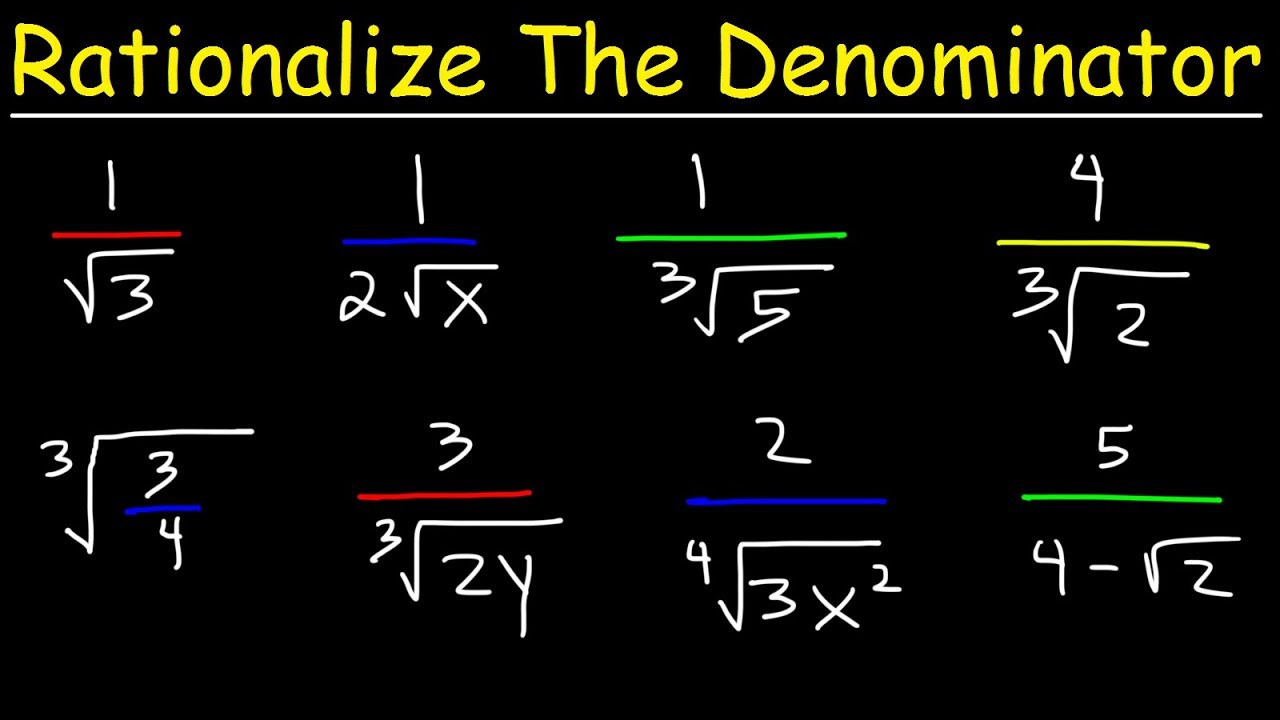
This algebra video tutorial explains how to rationalize the denominator with radicals and variables by multiplying the numerator and denominator by the something that will eliminate the radical expression in the denominator. This video contains plenty of examples and practice problems on simplifying radical expressions.
Radical Expression...
neon geyser
lyric charm
https://www.youtube.com/watch?v=5j8a75aHaSE
oh do i watch this then get back to you or is that it?
lyric charm
thats what i would say you do, yes
neon geyser
lyric charm
thats what i would say you do, yes
which onee
lyric charm
wdym "which one"
if you aren't sure which timestamp in the video to look at, then watch the whole thing -- it's like 10 minutes long.
neon geyser
oh no im sorry i meant do i watch the video then get back to you or after watching it i close it
neon geyser
last slate
Just watch the video.
i am rn ^_^
neon geyser
last slate
Come back if you have questions.
why did he put squares where did the squares come from?

 lethal path
neon geyser
why did he put squares where did the squares come from?
lethal path
neon geyser
why did he put squares where did the squares come from?
do you understand how $\sqrt[3] {5^3} = 5$, firstly?
grand pondBOT
south
 neon geyser
lethal path
do you understand how $\sqrt[3] {5^3} = 5$, firstly?
neon geyser
lethal path
do you understand how $\sqrt[3] {5^3} = 5$, firstly?
yaa
lethal path
right, so we need to find a number x
if we multiply 5^(1/3) by x, we need to get 5
so that's just $\sqrt[3] {5} \cdot x = \sqrt[3] {5^3}$
grand pondBOT
south
 neon geyser
lethal path
right, so we need to find a number x
neon geyser
lethal path
right, so we need to find a number x
huh whats a number x?
lethal path
neon geyser
huh whats a number x?
we need to find x, and x is a number
 topaz cypress
25 ?
neon geyser
topaz cypress
25 ?
what 25?
lethal path
grand pond
**south**
and then $x = \frac{\sqrt[3] {5^3}}{\sqrt[3] {5^1}} = \sqrt[3] {5^{3 - 1}}$ (rules of indices)
grand pondBOT
south
 neon geyser
grand pond
**south**
neon geyser
grand pond
**south**
where did the denominator come from?
topaz cypress
x = $$\sqrt{25}$$
grand pondBOT
AmIra
 lethal path
grand pond
**south**
lethal path
grand pond
**south**
from here, divide both sides
topaz cypress
grand pond
**AmIra**
is it true ?
neon geyser
lethal path
from here, divide both sides
oh okay
neon geyser
topaz cypress
is it true ?
ya i think its right he reacted with a thumbs up
lethal path
yeah, so I'm trying not to give you an answer which is like 'you instantly see it works'
imagine you don't know what number to multiply the top and bottom by
this is how you could find out
neon geyser
ohh
topaz cypress
wait . it is $$\sqrt[3]{25}$$
grand pondBOT
AmIra
 neon geyser
ohh
lethal path
neon geyser
why did he put squares where did the squares come from?
once you've figured out that the cube root of 25 is the number you should multiply on top and bottom
I think the working explains itself here
$\frac{\sqrt[3] {25}}{5}$ is the final answer
grand pondBOT
south
 lethal path
5 = 5/1 is a rational number, so the denominator is now a rational number
neon geyser
yaaa
neon geyser
lethal path
5 = 5/1 is a rational number, so the denominator is now a rational number
ohh
neon geyser
grand pond
**Ann**
how would i do this with a square root though?
instead of a cube root
lethal path
neon geyser
how would i do this with a square root though?
note that $\sqrt{2} \cdot \sqrt{2} = 2$
grand pondBOT
south
 topaz cypress
grand pond
**south**
topaz cypress
grand pond
**south**
soooo simple
neon geyser
topaz cypress
soooo simple
yaa its 9th grade math n i cant keep up so im asking abt it here 😓
lethal path
neon geyser
so it would be 1/2?
no!
neon geyser
oh
lethal path
you need to multiply top and bottom by the same number
topaz cypress
neon geyser
yaa its 9th grade math n i cant keep up so im asking abt it here 😓
I am Arab btw
lethal path
you said 1/sqrt(2) = 1/2 but I'm not going to hound you on that
neon geyser
is this right? or do i have to add squares asw
 topaz cypress
neon geyser
is this right? or do i have to add squares asw
topaz cypress
neon geyser
is this right? or do i have to add squares asw
true
It's like you multiplied the number by 1.
neon geyser
huh
neon geyser
topaz cypress
It's like you multiplied the number by 1.
ohhhh
grand pondBOT
AmIra
Compile Error! Click the reaction for more information.
(You may edit your message to recompile.)
 neon geyser
ohh like this right?
 topaz cypress
😭
topaz cypress
neon geyser
ohh like this right?
yesssss
neon geyser
okayy
neon geyser
grand pond
**Ann**
how am i supposed to rationalize this then
and when do i know when im supposed to add squares when multiplying stuff
neon geyser
neon geyser
why did he put squares where did the squares come from?
like on here
lethal path
neon geyser
how am i supposed to rationalize this then
the only surd in the denominator is sqrt(2)
hence you can multiply the entire fraction by sqrt(2)/sqrt(2)
(it doesn't matter at all if there are any square or cube roots in the numerator: the point is to 'get rid of them' in the denominator)
lethal path
neon geyser
and when do i know when im supposed to add squares when multiplying stuff
you have to read the question and check if it wants you to rationalise your answer
neon geyser
lethal path
you have to read the question and check if it wants you to rationalise your answ...
but on some problems i can rationalize without the squares
neon geyser
neon geyser
ohh like this right?
like this one
so idk when i should add them bcs there are also problems that have them
neon geyser
neon geyser
why did he put squares where did the squares come from?
like on here
lethal path
neon geyser
but on some problems i can rationalize without the squares
yes, cause you only need the squared numbers for cube roots
neon geyser
lethal path
yes, cause you only need the squared numbers for cube roots
ohhhhhhh
grand pondBOT
south
 neon geyser
okayy
lethal path
but for cube roots, you could either have $\sqrt[3] {2} \sqrt[3] {4} = \sqrt[3] {8}$
grand pondBOT
south
 lethal path
or $\sqrt[3] {4} \sqrt[3] {2} = \sqrt[3] {8}$, so that one with the 2 isn't squared
grand pondBOT
south
 neon geyser
okayy
neon geyser
lethal path
or $\sqrt[3] {4} \sqrt[3] {2} = \sqrt[3] {8}$, so that one with the 2 isn't squa...
okie tysm!
.close
midnight plankBOT
Channel closed
Closed by @neon geyser
Use .reopen if this was a mistake.
midnight plankBOT
Available help channel!
Send your question here to claim the channel.
Remember:
• Ask your math question in a clear, concise manner.
• Show your work, and if possible, explain where you are stuck.
• Do not immediately ping people or roles. After 15 minutes, feel free to ping <@&286206848099549185> once.
• Type the command .close to free the channel when you're done.
• Be polite and have a nice day!
Read #❓how-to-get-help for further information on how to ask a good question, and about conduct in the question channels.
 proud abyss
i do not know where to start from
 midnight plankBOT
proud abyss
i do not know where to start from
midnight plankBOT
proud abyss
i do not know where to start from
 tall bronze
Hello
Soo
@proud abyss you need to show that
where the sum is over all nonempty subsets of the set ({1, 2, \ldots, n})
grand pondBOT
YZYBlueBoy22
 proud abyss
right
tall bronze
Understand the sum.
For each subset ({a_1, a_2, \ldots, a_k}) you take the product of its elements.
grand pondBOT
YZYBlueBoy22
 tall bronze
Then you sum up the reciprocals of these products.
You have to expand the product.
Do you have a clue how to do it?
proud abyss
so, for instance, if n = 2 then its subsets would be {1}, {2}, {1, 2} and then we do 1/1 + 1/2 + 1/1.2?
tall bronze
Exactly!!
[
\frac{1}{1} + \frac{1}{2} + \frac{1}{1 \times 2} = 1 + \frac{1}{2} + \frac{1}{2} = 1 + \frac{1}{2} + \frac{1}{2} = 2.
]
grand pondBOT
YZYBlueBoy22
 tall bronze
You have to expand the product.
tall bronze
tall bronze
You have to expand the product.
@proud abyss
The product is
[
\prod_{i=1}^n \left(1 + \frac{1}{i}\right) = \left(1 + \frac{1}{1}\right)\left(1 + \frac{1}{2}\right) \cdots \left(1 + \frac{1}{n}\right).
]
grand pondBOT
YZYBlueBoy22
 tall bronze
This equals.
proud abyss
n+1
tall bronze
[
\frac{2}{1} \times \frac{3}{2} \times \frac{4}{3} \times \cdots \times \frac{n+1}{n} = \frac{n+1}{1} = n + 1.
]
grand pondBOT
YZYBlueBoy22
 proud abyss
tall bronze
You have to expand the product.
proud abyss
tall bronze
You have to expand the product.
does this give a sum of terms of the form 1/(a1.a2.a3....ak)? (a1, a2, ..., ak) is a subset of {1, 2, ..., n}
grand pondBOT
YZYBlueBoy22
 proud abyss
yeah
tall bronze
({1} \rightarrow \frac{1}{1})
grand pondBOT
YZYBlueBoy22
 tall bronze
({2} \rightarrow \frac{1}{2})
grand pondBOT
YZYBlueBoy22
 tall bronze
({3} \rightarrow \frac{1}{3})
grand pondBOT
YZYBlueBoy22
 tall bronze
({1,2} \rightarrow \frac{1}{1 \times 2} = \frac{1}{2})
grand pondBOT
YZYBlueBoy22
 tall bronze
({1,3} \rightarrow \frac{1}{1 \times 3} = \frac{1}{3})
grand pondBOT
YZYBlueBoy22
 tall bronze
({2,3} \rightarrow \frac{1}{2 \times 3} = \frac{1}{6})
grand pondBOT
YZYBlueBoy22
 tall bronze
({1,2,3} \rightarrow \frac{1}{1 \times 2 \times 3} = \frac{1}{6})
grand pondBOT
YZYBlueBoy22
 tall bronze
All these terms gives n=3
proud abyss
right
tall bronze
grand pond
**YZYBlueBoy22**
[
\sum_{\text{all subsets}} \frac{1}{\prod a_i} = n + 1.
]
grand pondBOT
YZYBlueBoy22
 tall bronze
Removing the empty subset's contribution (which is 1).
[
\sum_{\text{all nonempty subsets}} \frac{1}{\prod a_i} = (n + 1) - 1 = n.
]
proud abyss
it becomes n
grand pondBOT
YZYBlueBoy22
 proud abyss
all right, got it! thank you
tall bronze
proud abyss
all right, got it! thank you
My pleasure
proud abyss
.close
midnight plankBOT
Channel closed
Closed by @proud abyss
Use .reopen if this was a mistake.
Available help channel!
Send your question here to claim the channel.
Remember:
• Ask your math question in a clear, concise manner.
• Show your work, and if possible, explain where you are stuck.
• Do not immediately ping people or roles. After 15 minutes, feel free to ping <@&286206848099549185> once.
• Type the command .close to free the channel when you're done.
• Be polite and have a nice day!
Read #❓how-to-get-help for further information on how to ask a good question, and about conduct in the question channels.
last slate
yoyoyoo
midnight plankBOT
last slate
yoyoyoo
last slate
when finding triangular form of a matrix to find its determinant easier, is that the same as dont elementary row operations?
like guassian elemination?
 abstract birch
last slate
when finding triangular form of a matrix to find its determinant easier, is tha...
abstract birch
last slate
when finding triangular form of a matrix to find its determinant easier, is tha...
wdym
you can transform a matrix to upper or lower triangular form by doing elementary row operations
which is the same as gaussian elimination
if thats what your asking
 spiral rock
there is also triangulation
which is finding a triangular matrix that is similar to your matrix
in C its always possible to do that
and its not the same as doing row operations
last slate
abstract birch
if thats what your asking
yes
my book was facotring put numbers
out*
spiral rock
yeah this is the same as gaussian elimination, but you keep track of changes to the determinant as you do the row operations
midnight plankBOT
@last slate Has your question been resolved?
midnight plankBOT
Channel closed
Closed due to timeout
Use .reopen if this was a mistake.
midnight plankBOT
Available help channel!
Send your question here to claim the channel.
Remember:
• Ask your math question in a clear, concise manner.
• Show your work, and if possible, explain where you are stuck.
• Do not immediately ping people or roles. After 15 minutes, feel free to ping <@&286206848099549185> once.
• Type the command .close to free the channel when you're done.
• Be polite and have a nice day!
Read #❓how-to-get-help for further information on how to ask a good question, and about conduct in the question channels.
 jovial hound
How would I go about integrating the second part? Was it a good idea to split it or

 midnight plankBOT
jovial hound
How would I go about integrating the second part? Was it a good idea to split it...
jovial hound
midnight plankBOT
jovial hound
How would I go about integrating the second part? Was it a good idea to split it...
jovial hound
OH LMAO
 blissful pier
v^5/v^3=v^2
blissful pier
blissful pier
v^5/v^3=v^2
sorry forgot how to do algebra for a sec 
blissful pier
yeah also on the first one you could've just one v^2/v^3=1/v, and obviously int 1/v=ln|v|+C 
 midnight plankBOT
Channel closed
Closed by @jovial hound
Use .reopen if this was a mistake.
midnight plankBOT
Available help channel!
Send your question here to claim the channel.
Remember:
• Ask your math question in a clear, concise manner.
• Show your work, and if possible, explain where you are stuck.
• Do not immediately ping people or roles. After 15 minutes, feel free to ping <@&286206848099549185> once.
• Type the command .close to free the channel when you're done.
• Be polite and have a nice day!
Read #❓how-to-get-help for further information on how to ask a good question, and about conduct in the question channels.
last slate
yo
midnight plankBOT
last slate
yo
last slate
is this right

 waxen musk
you know you can check your work with rref on a calculator
blissful pier
appears to be, but probably not the most efficient way to RREF this matrix
last slate
waxen musk
you know you can check your work with rref on a calculator
do i have the concept right
like did i understand what they meant
last slate
blissful pier
appears to be, but probably not the most efficient way to RREF this matrix
thing is there are multiple ways to do this
either find cofactors
turn it triangular
or make a column all 0s except for 1
do all of them work the same?
and used in all cases?
last slate
waxen musk
oh *column* operations?
well no
theyre saying to clear out a23 and a33
so i just did row operations
waxen musk
oh ok
last slate
is that what they wanted?
waxen musk
they want det here
blissful pier
last slate
thing is there are multiple ways to do this
either find cofactors
turn it tr...
nvm I did not read the instructions of the problem
waxen musk
neither did i completely lol
blissful pier
I thought they wanted you to get it in RREF lmao
last slate
last slate
thing is there are multiple ways to do this
either find cofactors
turn it tr...
@waxen musk btw is this observation correct?
waxen musk
i believe so
or make a column all 0s except for 1
though this only tells you if det=0
last slate
waxen musk
>or make a column all 0s except for 1
though this only tells you if det=0
wdym?
i thought that
waxen musk
i realize its not entirely clear what you meant
waxen musk
last slate
is this right
so, your rref works here, but you need to be clearer about how youre using it to find the determinant
last slate
waxen musk
i realize its not entirely clear what you meant
like what they did here

does this work on all 4x4 matrices if i wanna find their determinant?
waxen musk
oh this is just the standard method to finding det, and you dont need rref for it
actually, rref will lose the scales here
last slate
waxen musk
oh this is just the standard method to finding det, and you dont need rref for i...
i can manually make a column have 0s to make it look like their matrix?
like is that what this question wanted
 waxen musk
i think it wants you to do this by cofactors
for example, here is one cofactor and its relevant matrix
 last slate
but theyre saying make 0s..
last slate
last slate
like what they did here
and making a column 0s looks like this
or is it not the same cause this is 3x3 and that is 4x4?
i honestly dont know at this point
waxen musk
hold on
theyre saying that we can take advantage of the 0s to make det easier
because 0 C = 0
because there are actually several ways you can expand cofactors
what theyre doing is picking on way which makes the most 0s immediate
which cuts down on how many cofactors you have to write out
make sense?
last slate
waxen musk
make sense?
so like i would still do cofactors but im ignoring the ones multiplied by 0s for obvious reasons
is that what you meant
waxen musk
yes, if i understood you correctly
last slate
so basically, creating the 0s is just a way to make expanding co factors easier
but its technically the same process
because youre just rewriting the equations they still hold true
waxen musk
we arent creating 0s per se, were just noticing 0s
last slate
wdym? we are doing row operations no?
last slate
waxen musk
we arent creating 0s per se, were just noticing 0s
wait thats if its already there right
waxen musk
last slate
like what they did here
not here
last slate
but say you have a matrix with no 0s
and you know roiw operations can give you 0s
ah alright
waxen musk
yeah, if det=0, then rref has to also give you det=0
last slate
waxen musk
yeah, if det=0, then rref has to also give you det=0
wait what
thats a seperate point right?
waxen musk
yeah
other than finding 0 determinants, row ops arent super helpful in finding det because they allow arbitrary scaling
last slate
waxen musk
other than finding 0 determinants, row ops arent super helpful in finding det be...
are you saying that without modifying the matrix if i take a regular determinant by cofactor expansion and i get 0 then i dont have to worry about rewriting anything cause the det will just be 0?
is that what youre sayin g
waxen musk
last slate
are you saying that without modifying the matrix if i take a regular determinant...
more like, if you have a matrix A and det(rref(A)) = 0, then det(A) = 0
and thats really all we use rref for in finding determinants
waxen musk
what they want you to do is find the nice cofactors of the matrix to make it easy
last slate
waxen musk
what they want you to do is find the nice cofactors of the matrix to make it eas...
throguh doing an operation with this concept right
 waxen musk
yeah, this is cofactor expansion
 last slate
generally speaking, is choosing any row/ any column and doing its cofactor expansion give us the determinant?
waxen musk
yeah
last slate
in all matrices
waxen musk
every cofactor expansion has to work
last slate
ah okay
waxen musk
it has to do with alternating products, which is a bit technical of a proof for these purposes lol
last slate
is det(RREF(A)) the same as the triangular process?
last slate
waxen musk
i forgot about this one lol
 waxen musk
this has to do with the fact that either det(rref(A)) = 1 or det(rref(A)) = 0
last slate
waxen musk
this has to do with the fact that either det(rref(A)) = 1 or det(rref(A)) = 0
is having a matrix in a lower triangular pattern the same as RREF
waxen musk
no, the rref should be the indentity or have 0 rows at the bottom
these are called triangular matrices
and because of how cofactor expansion works, the det of any triangular must be the product of its diagonal
last slate
waxen musk
and because of how cofactor expansion works, the det of any triangular must be t...
ah i see
i was thinking of that too
waxen musk
yeah triangulars happen to be very nice matrices for a lot of things
midnight plankBOT
@last slate Has your question been resolved?
midnight plankBOT
Channel closed
Closed due to timeout
Use .reopen if this was a mistake.
Available help channel!
Send your question here to claim the channel.
Remember:
• Ask your math question in a clear, concise manner.
• Show your work, and if possible, explain where you are stuck.
• Do not immediately ping people or roles. After 15 minutes, feel free to ping <@&286206848099549185> once.
• Type the command .close to free the channel when you're done.
• Be polite and have a nice day!
Read #❓how-to-get-help for further information on how to ask a good question, and about conduct in the question channels.
pearl hull
If I wanna find the negation of this statement, can I say
$\exists x(x \le -2 \vee x \ge 3)$?
 midnight plankBOT
pearl hull
If I wanna find the negation of this statement, can I say
$\exists x(x \le -2 \...
grand pondBOT
midnight plankBOT
pearl hull
If I wanna find the negation of this statement, can I say
$\exists x(x \le -2 \...
grand pondBOT
🌙 ЅκψΑиdΝιɡħτ

 scenic wyvern
looks correct
pearl hull
Alright, lemme do the rest
$\exists x(x \le -2 \vee x \ge 3)$\
$\exists x (x < 0 \vee x\ge 5)$\
$\forall x (x < -4 \vee x> 1)$\
$\forall x (x \le -5 \vee x\ge -1)$\
 grand pondBOT
🌙 ЅκψΑиdΝιɡħτ
 scenic wyvern
all correct, nice
midnight plankBOT
Channel closed
Closed by @pearl hull
Use .reopen if this was a mistake.
midnight plankBOT
Available help channel!
Send your question here to claim the channel.
Remember:
• Ask your math question in a clear, concise manner.
• Show your work, and if possible, explain where you are stuck.
• Do not immediately ping people or roles. After 15 minutes, feel free to ping <@&286206848099549185> once.
• Type the command .close to free the channel when you're done.
• Be polite and have a nice day!
Read #❓how-to-get-help for further information on how to ask a good question, and about conduct in the question channels.
last slate
yo
midnight plankBOT
last slate
yo
last slate
this is on matrix column operations, they factored out a 2 from the first column, but then doesnt the 2 just multiply into the whole matrix??

 sharp coral
not in determinants
last slate
sharp coral
not in determinants
wdym
sharp coral
2 * det(matrix) = det(that matrix with one of its columns multiplied by 2)
so multiplying the determinant of a matrix by 2 is not the same at all as multiplying the matrix by 2
last slate
but thats not a determinant being multiplied its just a cilumn operation
like theyre just saying factor out a 2
they havent taken the det yet
sharp coral
the vertical bars mean determinant
last slate
oh..
last slate
sharp coral
2 * det(matrix) = det(that matrix with one of its columns multiplied by 2)
same for row operations right
like the factoring thing
sharp coral
yes, the same applies to row operations
last slate
sharp coral
yes, the same applies to row operations
but then when you just put the number on the outside its not clear from where you factored out
and even when you find the determinant
like you multiply that number you factored out by it?
sharp coral
last slate
but then when you just put the number on the outside its not clear from where yo...
does it matter which row/column you factored it from?
last slate
yes
its like a system of equations right
i dont see how factoring like that makes sense
sharp coral
last slate
like you multiply that number you factored out by it?
yes, the equation is saying the original determinant = 2 * this new determinant, so to calculate the original determinant you end up multiplying the new one by 2
sharp coral
the column operation of multiplying a row by 1/2 would produce a determinant which is 1/2 of the original. so we cancel out the effect of that by multiplying it by 2
last slate
sharp coral
the column operation of multiplying a row by 1/2 would produce a determinant whi...
you lost me here tbh
all what its in my brain is whats factored out on the outside
 last slate
sharp coral
last slate
sharp coral
wait so determinants in general is just factoring out a value in some row / column?
thats literally what it is?
sharp coral
that's one of the properties that the determinant has
last slate
sharp coral
that's one of the properties that the determinant has
so whenever i see that a row or a column in any matrix can have a number factored out i just factor it out and thats my determinant??
sharp coral
well you still have the rest of the determinant to compute
it just is now an easier determinant to compute than before
midnight plankBOT
@last slate Has your question been resolved?
midnight plankBOT
Channel closed
Closed due to timeout
Use .reopen if this was a mistake.
Available help channel!
Send your question here to claim the channel.
Remember:
• Ask your math question in a clear, concise manner.
• Show your work, and if possible, explain where you are stuck.
• Do not immediately ping people or roles. After 15 minutes, feel free to ping <@&286206848099549185> once.
• Type the command .close to free the channel when you're done.
• Be polite and have a nice day!
Read #❓how-to-get-help for further information on how to ask a good question, and about conduct in the question channels.
 keen seal
why did they suggest k and k+1? what if its the squares of two odd numbers or two even numbers intsead of having dfferent parity
 midnight plankBOT
keen seal
why did they suggest k and k+1? what if its the squares of two odd numbers or tw...
keen seal
midnight plankBOT
keen seal
why did they suggest k and k+1? what if its the squares of two odd numbers or tw...
keen seal
wouldnt two even numbers squared give an even number
lyric charm
keen seal
why did they suggest k and k+1? what if its the squares of two odd numbers or tw...
have you actually tried following the hint
like sure, the difference of two squares of the same parity will only ever give you even numbers,
but you should read carefully what they ask you to prove
you're asked to prove
every odd number is a difference of squares
and NOT asked
every difference of squares is an odd number
keen seal
lyric charm
you're asked to prove
> every odd number is a difference of squares
and NOT aske...
whats the
difference in this
can i put both as 2k + 1 = a^2 - b^2
twilit field
what if one is odd and one is even
lyric charm
well a^2+b^2 is a sum of squares...
lyric charm
keen seal
difference in this
"all A are B" and "all B are A" are logically speaking converses to each other.
"all Harvard students are geniuses" and "all geniuses are Harvard students" are two very different statements, do you agree?
lyric charm
write what down differently from what
keen seal
so like every odd integer is diff of two squares (2k + 1 = a^2 - b^2) and every difference of square is odd number ( a^2 - b^2 =2k + 1 =)
lyric charm
let's backtrack.
have you actually tried following the hint that they give you here?
 lavish venture
when a problem starts off by showing something holds for all … it’s a good idea to consider an arbitrary thing satisfying that
start off with an odd integer and show it is the difference of two squares
keen seal
Yes. K and k + 1 are arbitrary but when the two squares are even it gives an even and I’m confused here
grand pondBOT
Ann
 lyric charm
this is the statement which you have to prove
midnight plankBOT
Channel closed
Closed by @keen seal
Use .reopen if this was a mistake.
midnight plankBOT
Available help channel!
Send your question here to claim the channel.
Remember:
• Ask your math question in a clear, concise manner.
• Show your work, and if possible, explain where you are stuck.
• Do not immediately ping people or roles. After 15 minutes, feel free to ping <@&286206848099549185> once.
• Type the command .close to free the channel when you're done.
• Be polite and have a nice day!
Read #❓how-to-get-help for further information on how to ask a good question, and about conduct in the question channels.
 foggy inlet
anyone know how to do circuits
midnight plankBOT
foggy inlet
anyone know how to do circuits
No need to ask “Can I ask…?” or “Does anyone know about…?”—it’s faster for everyone if you just ask your question! See https://dontasktoask.com/
foggy inlet
 sharp coral
what about it?
midnight plankBOT
@foggy inlet Has your question been resolved?
sharp coral
can you find the open circuit voltage and short circuit current?
midnight plankBOT
Channel closed
Closed due to timeout
Use .reopen if this was a mistake.
midnight plankBOT
Available help channel!
Send your question here to claim the channel.
Remember:
• Ask your math question in a clear, concise manner.
• Show your work, and if possible, explain where you are stuck.
• Do not immediately ping people or roles. After 15 minutes, feel free to ping <@&286206848099549185> once.
• Type the command .close to free the channel when you're done.
• Be polite and have a nice day!
Read #❓how-to-get-help for further information on how to ask a good question, and about conduct in the question channels.
 vast glen
I need help doing a not very nice integral
midnight plankBOT
vast glen
I need help doing a not very nice integral
vast glen

 lusty furnace
what have you tried
vast glen
One sec

and i want to see if $|z_2|<1$ where $z_2=-\frac{ai}{b}+\sqrt{1-\frac{a^2}{b^2}}$
grand pondBOT
Alrik
 vast glen
And i know it is, because if not the integral will be zero. I just dont know how to show it
vast glen
vast glen
And i know it is, because if not the integral will be zero. I just dont know how...
Its not a great argument for exams
vast glen
grand pond
**Alrik**
all i need is this
If i get this i can find the order of the pole (1), residue and wham bam we're done
midnight plankBOT
@vast glen Has your question been resolved?
vast glen
lets break it up in smaller problems. First, if a>b>0, then a-sqrt(a^2-b^2)<b
i want to show this
<@&286206848099549185>
midnight plankBOT
@vast glen Has your question been resolved?
midnight plankBOT
Channel closed
Closed by @vast glen
Use .reopen if this was a mistake.
midnight plankBOT
Available help channel!
Send your question here to claim the channel.
Remember:
• Ask your math question in a clear, concise manner.
• Show your work, and if possible, explain where you are stuck.
• Do not immediately ping people or roles. After 15 minutes, feel free to ping <@&286206848099549185> once.
• Type the command .close to free the channel when you're done.
• Be polite and have a nice day!
Read #❓how-to-get-help for further information on how to ask a good question, and about conduct in the question channels.
 near brook
i need help with finding range and increasing and decreasing intervals
 midnight plankBOT
near brook
i need help with finding range and increasing and decreasing intervals
midnight plankBOT
near brook
i need help with finding range and increasing and decreasing intervals
 shell wigeon
... did you forget to post f(x)?

 frozen talon
near brook
theres NO points
frozen talon
near brook
theres NO points
what do you mean by this?
shell wigeon
What exactly is your question?
near brook
okay look so
i just dont understand how to get the increasing and decreasing intervals
it doesnt make sense
frozen talon
what is an increasing interval?
near brook
above the 0
frozen talon
huh, I would've said it's an interval where the function is increasing
you can be above the y=0 line and going down
near brook
but its hard to tell because theres arrows going left and right
shell wigeon
Why are there multiple colors? Who wrote what?
near brook
shell wigeon
Why are there multiple colors? Who wrote what?
that was my teacher lmao
shell wigeon
All of it?
near brook
yes
frozen talon
did you differentiate f yet?
shell wigeon
Damn, your teacher is wrong on the range
near brook
frozen talon
did you differentiate f yet?
wdym
frozen talon
shell wigeon
Damn, your teacher is wrong on the range
lmao true
frozen talon
near brook
wdym
do you know the derivative of f yet?
near brook
bruh im in adv func and shes out here selling my grade
near brook
frozen talon
do you know the derivative of f yet?
i dont recall
frozen talon
or are you just supposed to be eyeballing a graph
near brook
frozen talon
or are you just supposed to be eyeballing a graph
honestly i think so
shell wigeon
For a simple function like this I guess that's fair
frozen talon
so you don't know derivatives?
near brook
frozen talon
so you don't know derivatives?
nope
frozen talon
ok
near brook
i have like a quiz on a chart similar to that but i just cant wrap my head around these random intervals
shell wigeon
This is f(x)
 near brook
and like test values? What do test values gotta do with this lol
near brook
shell wigeon
This is f(x)
yes thats how i wouldve done it
shell wigeon
Would you know how to find the intervals with this graph?
near brook
shell wigeon
Would you know how to find the intervals with this graph?
can i tell u what would I think the intervals would be
shell wigeon
Of course
near brook
Increasing Int : ( -4, infinity) u - Infinity, 2) (-infinity, -1)
Decreasing Int : (- infinity, -4) u (-1, infinity) u (2, - infinity)
shell wigeon
Why -4?
near brook
shell wigeon
Why -4?
for which
shell wigeon
Any