#help-49
1 messages · Page 222 of 1
 hallow meteor
Yea mb
True
But
Including prim recursion
Will give you more than presburger?
 glacial slate
if you work in lambda calculus then I guess you can do it without the usual notion of recursion
glacial slate
hallow meteor
Will give you more than presburger?
yes, in the sense that multiplication is definable
hallow meteor
glacial slate
if you work in lambda calculus then I guess you can do it without the usual noti...
Oh how so? (I'm yet to get to the lambda calculus)
glacial slate
defining naturals as church numerals allows you do simulate a form of iteration
which allows addition
(and multiplication)
 midnight plankBOT
Channel closed
Closed by @hallow meteor
Use .reopen if this was a mistake.
midnight plankBOT
 Available help channel!
Send your question here to claim the channel.
Remember:
• Ask your math question in a clear, concise manner.
• Show your work, and if possible, explain where you are stuck.
• After 15 minutes, feel free to ping <@&286206848099549185>.
• Type the command .close to free the channel when you're done.
• Be polite and have a nice day!
Read #❓how-to-get-help for further information on how to ask a good question, and about conduct in the question channels.
 woeful turret
 midnight plankBOT
woeful turret
woeful turret
midnight plankBOT
woeful turret
woeful turret
could someone tell what a,b,c, delta are?
 raven zenith
a, b, c, are side lengths, delta is the area
 full leaf
raven zenith
full leaf
raven zenith
if you're doing comp math, potentially. for school math, I'm not sure
woeful turret
oh wait
i learnt a formula R=delta/S where S = semiperimeter
is that the same thing?
raven zenith
yeah
midnight plankBOT
Channel closed
Closed by @woeful turret
Use .reopen if this was a mistake.
midnight plankBOT
Available help channel!
Send your question here to claim the channel.
Remember:
• Ask your math question in a clear, concise manner.
• Show your work, and if possible, explain where you are stuck.
• After 15 minutes, feel free to ping <@&286206848099549185>.
• Type the command .close to free the channel when you're done.
• Be polite and have a nice day!
Read #❓how-to-get-help for further information on how to ask a good question, and about conduct in the question channels.
hallow meteor
 midnight plankBOT
hallow meteor
midnight plankBOT
hallow meteor
 glacial slate
this probably isn't the best starting example to understand it
try define like, the indicator function of equality or something simple first
glacial slate
what do you mean by "work"?
hallow meteor
I mean what exactly is the function "searching" for
It's iterating over y's that's for sure
glacial slate
yeah
hallow meteor
It's finding the first y for which ? is 0?
glacial slate
the first y such that the function is defined for all values below y, and the function is 0 at y
hallow meteor
What function
glacial slate
whatever function you're doing unbounded search on
it's like primitive recursion, you need to put some functions in first
hallow meteor
Okay so theres this computable function g
Which takes in n+1 args

Ah so it's n args and one y arg
And we iterate over all ys
Checking at what point g becomes 0
glacial slate
what are you stuck on
hallow meteor
Wtf is f
glacial slate
like, is it what the resulting function does?
f is the resulting function
that you obtain by applying unbounded search on g
hallow meteor
What exactly is the resulting function
glacial slate
f(x1,x2,...,xn) returns the least y such that g(y,x1,x2,...,xn) = 0 and g(z,x1,...,xn) is defined for all z<y
we say that f is defined by unbounded search on g
hallow meteor
So g is taking in x1,...,xn,f(x1,...xn)?
glacial slate
no
hallow meteor
y is essentially f?
glacial slate
g is an n+1 arg function, yes?
it takes arguments (y, x1,...,xn)
we define a new function f, on n arguments
such that when we pass in f(x1,...,xn), it tells us the smallest y makes g(y,x1,...,xn) = 0
x1,...,xn to f
hallow meteor
So that function simply points to the first y which makes g = 0
glacial slate
yes
hallow meteor
I'm just not able to fit this into my understanding of semidecidability/RE
glacial slate
example: say $g(y,x) = |x-y|$ (where - is truncated subtraction). Then, unbounded search on $g$ gives a function $f$ such that $f(x) =$ the least y such that $g(y,x) = 0$.
 grand pondBOT
Desync
 hallow meteor
We are enumerating over ys
glacial slate
if $y=x$, then $g(y,x) = |x-y| = 0$, and if $y$ is any smaller, then $g$ is not $0$, so $f(x) = x$ is the identity function
grand pondBOT
Desync
 glacial slate
it's RE because the result is generally partial
if you want to think about it more in terms of computability, we can just plug in each value of y starting from 0
since g is computable, we can find whatever the result is
and move on to the next y if it's not 0
since we only demand that it's semidecidable, it's ok if we never find a y; it just runs forever
hallow meteor
Yeah, I'm asking if this doesn't accidentally end up defining an uncomputable function
Whats the guarantee on that
glacial slate
well, think about how that could happen
we start with a computable function g
and all we're doing is computing it at input 0
(the other inputs are fixed)
hallow meteor
Yeah if a minimising input exists well eventually find it..
glacial slate
then computing it at 1, then 2,...
glacial slate
hallow meteor
Yeah if a minimising input exists well eventually find it..
yes, and that's all that's required for RE
hallow meteor
Hmmm
glacial slate
if it's not in the set the machine does not have to halt
that's the point of semidecidability
hallow meteor
So for a given function g
Oh ok yeah sorry
Dumb question
I'm trying to learn functional programming
I keep getting diverted into things

Thanks tho
I think I kind aget it
Uh hope this is relevant to lambda calculus?.
glacial slate
yes, moreso than turing machines
PR functions/lambda calculus/FP are much more closely related
hallow meteor
Yeah..
glacial slate
turing machines are more related to procedural/imperative programming
hallow meteor
Yeah
❤️
y is nothiing special ig
It's just one of the n+1 inputs of g
Which we search over
And f, takes in the other n inputs and spits the first value of that remaining input to g,
Whivh makes g0
glacial slate
yup
it takes some inputs x_1,...,x_n and asks "what is the smallest y that makes g(y,x_1,..,x_n?) = 0?"
hallow meteor
So in terms of halting problem, the function g could be taking in M and x (machine and input tape) along with some y which is it's expected number of steps in which it halts
And iterate over y
If it never finds such a y it means the machine never halts
And otherwise it finds a y and M halts on x
glacial slate
you need to be a bit clearer with your encoding, and what g is actually doing here
you can indeed construct a halting-semidecider
Let $\varphi_e(x)$ denote the $e$-th partial computable function, and define
\begin{equation*}
h(e,x,y) = \begin{cases}
0 & \text{if the computation of } \varphi_e(x) \text{ halts in exactly } y \text{ steps},\
1 & \text{otherwise}.
\end{cases}
\end{equation*}
and define by unbounded search:
\begin{equation*}
H(e,x) = \mu y [ h(e,x,y) = 0 ].
\end{equation*}
then, $H(e,x)$ is the number of steps until the computation halts, and if $\varphi_e(x)$ does not halt, then $H(e,x)$ is undefined.
grand pondBOT
Desync
 glacial slate
you can't just say "put in a turing machine", because they're not really what we're working with; you have to phrase it in terms of PR functions
hallow meteor

I suppose all possible partial functions are countable
Since TMs have finite description
So you are attaching number e to this particular partial function
glacial slate
it's more than countable; it's effectively enumerable
you can do this via godel numberings
hallow meteor
glacial slate
it's more than countable; it's effectively enumerable
 whats the difference
glacial slate
countable just means there exists a bijection to N
doesn't mean that it's constructive, or if we do know it, that it's computable
effectively enumerable means there's a computable bijection
hallow meteor
grand pond
**Desync**
So this function h is the equivalent partial function of halting problem, takes in equivalent partial function of some turing machine, and its equivalent input, and iterates over ys
glacial slate
for an example of the difference, take the set of godel numbers of turing machines that do not halt on input 0
this is countable, since it is a subset of N, but is not effectively enumerable, because computing the bijection would give a halting oracle
glacial slate
hallow meteor
So this function h is the equivalent partial function of halting problem, takes ...
yes
hallow meteor
glacial slate
this is countable, since it is a subset of N, but is not effectively enumerable,...
Computing the bijection means listing out all turing machines that do not halt on Input 0
glacial slate
yup
hallow meteor
Yeah and all possible inputs is also a enumerable set
Hmm
Uh
NGL still kinda confused but
I'll choose to move on
Thanks a lot for the help

.close
midnight plankBOT
Channel closed
Closed by @hallow meteor
Use .reopen if this was a mistake.
glacial slate
glacial slate
just define similar sets for each input and diagonalise
oh, actually, you can do this even more directly
hallow meteor
.reopen
midnight plankBOT
✅
glacial slate
just add a wrapper around the programs and make it take 0 as an input
so given $\langle P,x\rangle$ (program and input), we can construct a program $Q_{P,x}$ that ignores its input, and simulates $P$ on $x$.
grand pondBOT
Desync
 glacial slate
then run the 0-oracle on Q_P,x
Q_P,x(0) halts if and only if Q_P,x halts for any input, if and only if P,x halts
hallow meteor

glacial slate
basically, on any input $y$, $Q_{P,x}$ ignores $y$ and simulates $P$ on $x$ such that if $P$ halts, then it also halts
grand pondBOT
Desync
 glacial slate
since it doesn't depend on the input y, it'll halt on any input if and only if it halts on 0
hallow meteor
Ah
glacial slate
and it halts if and only if P halts on x
so we can decide if P halts on x by checking if Q_{P,x} halts on 0
and the mapping from (P,x) to Q_{P,x} is computable, because it's just simulating another machine
hallow meteor
kinda not understanding
So now we are dealing with this subset of Turing machines which all take 0 as input and ignore it and then do what the turing machines would do on inout x
glacial slate
ok, we want a halting oracle
so given a program P and input x, we want to decide if P halts on x
given P and x, construct a new program Q_{P,x}
that, when given an input y, ignores y, and simulates P on x; if P halts on x, then Q_{P,x} also halts
hallow meteor
Ahh I get it now
hallow meteor
So if you have a way to list all turing machines which don't halt on some input, then you include those which ignore that input and simulate all possible turing machines, and don't halt
Giving halting oracle
glacial slate
yes; the point is that, to check any given program and input, we can construct a new program that can be checked by the specific-input-oracle, since it ignores its input
this is a pretty common trick for computability reductions
hallow meteor
Hmmm
Where else have I seen this
I guess in some sort of "emptiness is undecidable" result
Anywhoo
Thax a lor
glacial slate

here's another if you want to practice the trick btw

and here's a similar proof
midnight plankBOT
@hallow meteor Has your question been resolved?
midnight plankBOT
Channel closed
Closed due to timeout
Use .reopen if this was a mistake.
Available help channel!
Send your question here to claim the channel.
Remember:
• Ask your math question in a clear, concise manner.
• Show your work, and if possible, explain where you are stuck.
• After 15 minutes, feel free to ping <@&286206848099549185>.
• Type the command .close to free the channel when you're done.
• Be polite and have a nice day!
Read #❓how-to-get-help for further information on how to ask a good question, and about conduct in the question channels.
 viral dagger
let $a,b$ be positive reals such that
$$\frac{1}{a}+\frac{1}{b}\leq 2\sqrt{\frac{2}{5}} \text{ and } (a-b)^2=\frac{4}{25}(ab)^3$$
find the maximum of $a^2+b^2$
midnight plankBOT
viral dagger
let $a,b$ be positive reals such that
$$\frac{1}{a}+\frac{1}{b}\leq 2\sqrt{\frac...
grand pondBOT
ihave<skissue>
 viral dagger
xy just in case (ignore what i answered)

ok, so i squared the first inequality, since lhs and rhs are positive then there wouldnt be any problems
$$\frac{1}{a}+\frac{1}{b}\leq 2\sqrt{\frac{2}{5}}$$
$$\frac{a+b}{ab}\leq 2\sqrt{\frac{2}{5}}$$
$$(\frac{a+b}{ab})^2\leq (2\sqrt{\frac{2}{5}})^2$$
$$\frac{(a-b)^2+4ab}{(ab)^2}\leq \frac{8}{5}$$
$$\frac{\frac{4}{5}(ab)^3+4(ab)}{(ab)^2}\leq \frac{8}{5}$$
$$\frac{4}{5}(ab)^3-\frac{8}{5}(ab)^2+4(ab)\leq 0$$
$$\frac{4}{5}(ab)((ab)^2-2(ab)+5)\leq 0$$
grand pondBOT
ihave<skissue>
 viral dagger
x^2-10x+25 is always >=0, so the bottom inequality is <=0 when ab<=0, but we have that a and b are positive reals, which would be impossible for ab<=0
why did i get a contradiction?
squaring should be fine given both sides are positive, and sending stuff over (like the (ab)^2) is fine given positive
 civic lynx
$(a-b)^2 = \frac{4}{25}(ab)^3$, you put $\frac{4}{5}$
grand pondBOT
haseeb
 civic lynx
hmm but that would give $(ab)^2 - 10(ab) + 25$ which is nonnegative
grand pondBOT
haseeb
 midnight plankBOT
@viral dagger Has your question been resolved?
viral dagger
civic lynx
$(a-b)^2 = \frac{4}{25}(ab)^3$, you put $\frac{4}{5}$
oh oops
$$\frac{1}{a}+\frac{1}{b}\leq 2\sqrt{\frac{2}{5}}$$
$$\frac{a+b}{ab}\leq 2\sqrt{\frac{2}{5}}$$
$$(\frac{a+b}{ab})^2\leq (2\sqrt{\frac{2}{5}})^2$$
$$\frac{(a-b)^2+4ab}{(ab)^2}\leq \frac{8}{5}$$
$$\frac{\frac{4}{25}(ab)^3+4(ab)}{(ab)^2}\leq \frac{8}{5}$$
$$\frac{4}{25}(ab)^3-\frac{8}{5}(ab)^2+4(ab)\leq 0$$
$$\frac{4}{25}(ab)((ab)^2-10(ab)+25)\leq 0$$
civic lynx
viral dagger
$$\frac{1}{a}+\frac{1}{b}\leq 2\sqrt{\frac{2}{5}}$$
$$\frac{a+b}{ab}\leq 2\sqrt{...
the last step should also change, because different factoring
unfortunately, the quadratic you get is still positive or zero
grand pondBOT
ihave<skissue>
 civic lynx
that's all i see for now, unfortunately :/
viral dagger
hm by cheating the graph looks like this
 civic lynx
lol we pulled up the same thing

so there are definitely solutions, and the max is proabably that cusp
i wonder if you can do this via calc 🤔 or are you supposed to just do manipulations?
viral dagger
i think calc is allowed, just discouraged
also wouldnt you need like laplace multipliers or smth i havent learnt that yet
 small jasper
viral dagger
xy just in case (ignore what i answered)
small jasper
viral dagger
xy just in case (ignore what i answered)
Let $s=a+b$ and $p=ab$. Then, $$s^2-4p=\frac{4}{25}p^3$$ $$\frac{s}{p} \leq 2 \sqrt{\frac{2}{5}} \implies s^2 \leq \frac{8}{5} p^2$$
Now, consider ||substituting the second inequality into the first equation||
As a check, the sum of the digits of the answer is 3.
viral dagger
is it not $\frac{4}{25}p^3+4p\leq \frac{8}{5}p^2$
grand pondBOT
ihave<skissue>
 viral dagger
oh wait wrong one
$$s^2-4p-\frac{4}{25}p^3\leq -\frac{4}{25}p^3+\frac{8}{5}p^2-4p$$
grand pondBOT
ihave<skissue>
 viral dagger
actually wait what why do you have s here
grand pondBOT
Civil Service Pigeon

 second inequality to first equality?
small jasper
small jasper
As a check, the sum of the digits of the answer is 3.
second inequality to first equality?
small jasper
small jasper
As a check, the sum of the digits of the answer is 3.
Yes
viral dagger
grand pond
**ihave<skissue>**
i just realized ab=5 works here
it really was the 4/5
i swear i did this problem like thrice now and i think every time i used 4/5
alr ty!!
.solved
midnight plankBOT
Channel closed
Closed by @viral dagger
Use .reopen if this was a mistake.
midnight plankBOT
Available help channel!
Send your question here to claim the channel.
Remember:
• Ask your math question in a clear, concise manner.
• Show your work, and if possible, explain where you are stuck.
• After 15 minutes, feel free to ping <@&286206848099549185>.
• Type the command .close to free the channel when you're done.
• Be polite and have a nice day!
Read #❓how-to-get-help for further information on how to ask a good question, and about conduct in the question channels.
 nocturne harness
Ok so i understand this video https://www.youtube.com/watch?v=0VBQnR2h8XM
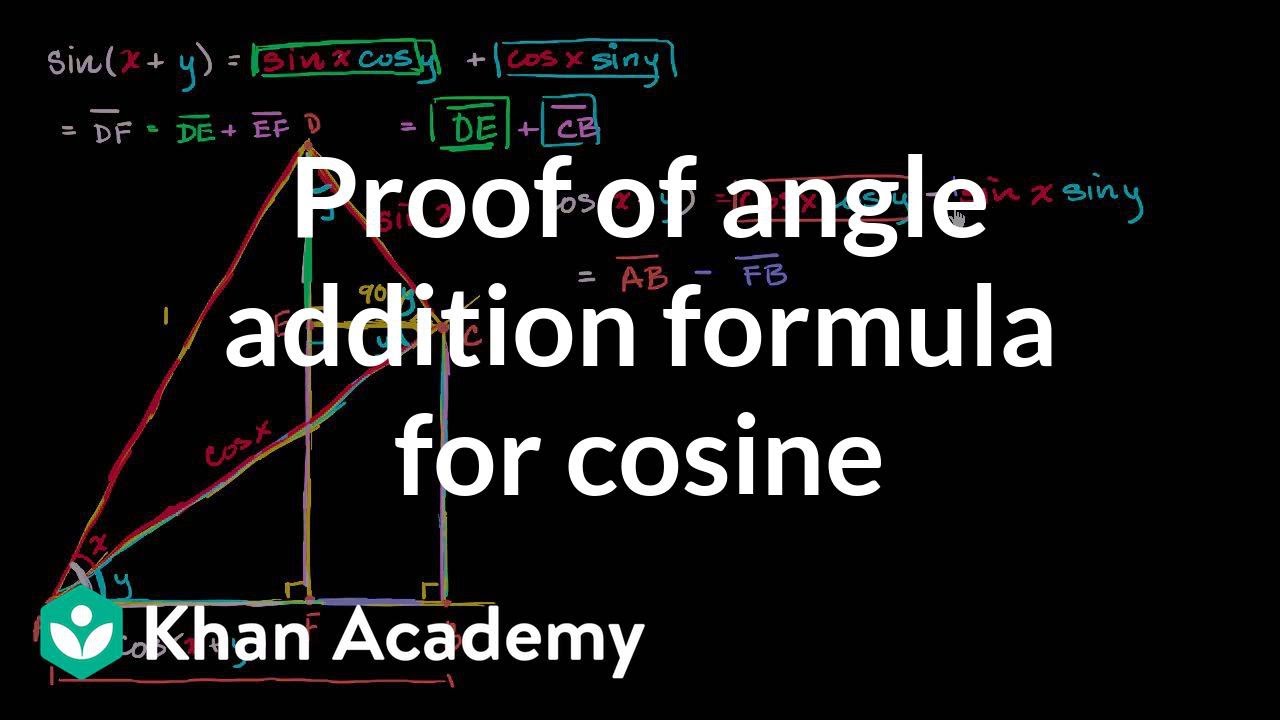
Practice this lesson yourself on KhanAcademy.org right now:
https://www.khanacademy.org/math/trigonometry/less-basic-trigonometry/angle-addition-formula-proofs/e/understanding-angle-addition-formulas?utm_source=YT&utm_medium=Desc&utm_campaign=Trigonometry
Watch the next lesson: https://www.khanacademy.org/math/trigonometry/less-basic-trigonome...
midnight plankBOT
nocturne harness
Ok so i understand this video https://www.youtube.com/watch?v=0VBQnR2h8XM
nocturne harness
Right but Its hard to kinda imagine whats happening under the hoot
So we start at a point that is on the unit circle
we can form a triangle of x and y components and that x and y are the cos and sin of say alpha
cos a and sin a right
ok so lets image that we want to rotate once more by B
To do that wed want to stack another angle on top of a
and to do that then it means that the hypotenuse of the first triangle would become cos B that would be its base
So like Im kinda trying to visualize how x and y (cos a and sin a) get scaled as its rotated by B
So yea then the height of the triangle B sorta creates a slant
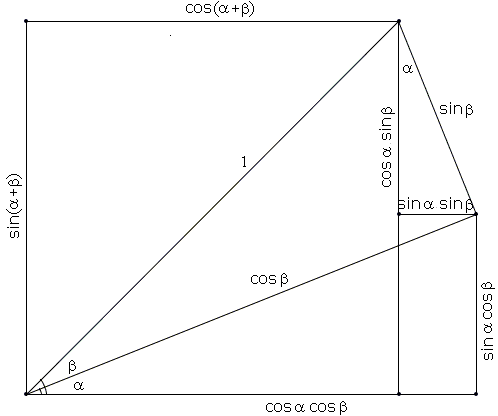 nocturne harness
 fallow scarab
https://www.cut-the-knot.org/triangle/SinCosAddition.gif
fallow scarab
https://www.cut-the-knot.org/triangle/SinCosAddition.gif
Yes

It looks kinda weird but im trying to visualize how the point cos(a), sin(a) gets scaled
fallow scarab
fallow scarab
https://www.cut-the-knot.org/triangle/SinCosAddition.gif
what part of this diagram are you having trouble with
nocturne harness
Ok so its kind of weird to imagine how the hypotenuse would be cos B
fallow scarab
why
nocturne harness
does it mean that we rotated a then we technically have a new starting point on the circle and then rotated b more on it
hold on
let me make it clearer

@fallow scarab
Ok this is the first rotation
So now we can think of cos a and sin a as the starting point
 fallow scarab
what is the question
 drowsy ferry
nocturne harness
Ok so its kind of weird to imagine how the hypotenuse would be cos B
drowsy ferry
nocturne harness
Ok so its kind of weird to imagine how the hypotenuse would be cos B
Maybe this helps answer why it's cos B?
 nocturne harness
fallow scarab
what is the question
nocturne harness
fallow scarab
what is the question
I said I'm trying to learn how cos a sna sin a scale when rotated by b
fallow scarab
that's still not a question
fallow scarab
fallow scarab
https://www.cut-the-knot.org/triangle/SinCosAddition.gif
if this diagram didn't answer your question, ask more specifically
nocturne harness
fallow scarab
that's still not a question
Yes it is
Huh??
How do cos a and sin a scale when rotated by b?
That's a question
nocturne harness
drowsy ferry
Maybe this helps answer why it's cos B?
So is the base of the red triangle cos B?
drowsy ferry
Yes, because it's a right-angled triangle with hypotenuse 1 and angle B.
fallow scarab
nocturne harness
How do cos a and sin a scale when rotated by b?
these values aren't scaled, they're rotated
drowsy ferry
(Oh, the labels didn't come through)
nocturne harness
drowsy ferry
Maybe this helps answer why it's cos B?
so cos a and sin a dont reach the unit circle?
then what is that bigger traingle?
Thats has the same ratio
nocturne harness
fallow scarab
these values aren't scaled, they're rotated
I know but can you describe what rotation does? Like how when you scale you multiply each point by a magnitude
I meant how it transforms cos a and sin a
nocturne harness
drowsy ferry
The larger triangle's apex is at (cos A, sin A)
so then how would its hypotenuse*** be cos B
fallow scarab

you multiply the starting vector (x, y) by the rotation matrix R(theta)
e.g. take (x,y) = (cos(a), sin(a))
nocturne harness
Sorry @drowsy ferry I meant hypotenuse
fallow scarab
theta is the angle from vector a to vector b in the diagram
nocturne harness
fallow scarab
theta is the angle from vector a to vector b in the diagram
So how is that rotation matrix derived
Why is it the way it is
fallow scarab
nocturne harness
So how is that rotation matrix derived
there's also this proof which may be simpler than using matrices
 midnight plankBOT
@nocturne harness Has your question been resolved?
nocturne harness
fallow scarab
https://www.sunshine2k.de/articles/RotationDerivation.pdf
This doesnt help me really
nocturne harness
fallow scarab
there's also this proof which may be simpler than using matrices
again this is not showing why you need to multiply cosb and sin a or cosa and sin b
fallow scarab
the steps are given in reverse
 nocturne harness
Yes I did
fallow scarab
so what more do you need?
nocturne harness
It all comes down to this


This is probably better
Let me get one i had before
 fallow scarab
https://www.cut-the-knot.org/triangle/SinCosAddition.gif
fallow scarab
fallow scarab
https://www.cut-the-knot.org/triangle/SinCosAddition.gif
yes i shared a similar picture earlier
nocturne harness
Ok so what i dont understand is
fallow scarab
nocturne harness
yes i agree that one is better
nocturne harness
basically how cosa*cosB,sina x cosB wouldnt be touching the unit circle
fallow scarab
define "touching"
nocturne harness
Nor would its hypotenuse
nocturne harness
fallow scarab
define "touching"
On the unit circle
fallow scarab
well it does if beta = 0
nocturne harness
Huh
fallow scarab
B = 0 implies cos(B) = 1
nocturne harness
Because cosine of 0 degrees is 1 right?
nocturne harness
No
fallow scarab
nocturne harness
basically how cosa*cosB,sina x cosB wouldnt be touching the unit circle
do you know the length of the hypotenuse formed by these coordinates
nocturne harness
Wdym
We could use phythagoreas to solve for it but if ur talking about it it shows its CosB
nocturne harness
Yes
fallow scarab
nocturne harness
basically how cosa*cosB,sina x cosB wouldnt be touching the unit circle
does that answer this then
nocturne harness
fallow scarab
does that answer this then
Ok wait so that proves that
when you take a rotation a
fallow scarab
nocturne harness
Ok wait so that proves that
?

 fallow scarab
i don't know what you're asking. anytime you have a hypotenuse of 1, you can rotate it to align with the x-axis
nocturne harness
So what happens if we take rotation a cos and sin output and use that as the starting position
nocturne harness
fallow scarab
i don't know what you're asking. anytime you have a hypotenuse of 1, you can rot...

Ok this is what i made
Wait wrong labels
it would technically be cos(a+b)
and sin(a+b)

@fallow scarab
So how do i go further than this
fallow scarab
go further to do what?
fallow scarab
nocturne harness
if you're still trying to prove the sum formulas, this image has all you need.
nocturne harness
fallow scarab
if you're still trying to prove the sum formulas, this image has all you need.
Help me with this
fallow scarab
just follow the diagram you shared earlier
fallow scarab
nocturne harness
.
 nimble leaf
nocturne harness
nimble leaf
nocturne harness
remember the hypotenuse of both triangles is 1
nocturne harness
fallow scarab
just follow the diagram you shared earlier
I'm saying i dont understand it
nimble leaf
so when finding the sides of one triangle you can basically ignore the other
fallow scarab
nocturne harness
I'm saying i dont understand it
which part of the diagram
nocturne harness
Im saying i dont under stand the way its formatted
nimble leaf
wdym?
nocturne harness
nimble leaf
so when finding the sides of one triangle you can basically ignore the other
So we are looking for the opposite and adjacent side of the a+b triangle right
nocturne harness
nocturne harness
In this graph
nimble leaf
nocturne harness
So we are looking for the opposite and adjacent side of the a+b triangle right
yes
i assume we're finding sin and cos a+b
nocturne harness
Yes im trying to derive how the formulas for them come
fallow scarab
nocturne harness
Im saying i dont under stand the way its formatted
which part exactly?
nimble leaf
i think we're both confused as to what specifically you don't understand
why don't you try explaining your understanding of the graph from the beginning until the point you get stuck
nocturne harness
nocturne harness
Ok I dont understand why the blue triangle is scaled by cos B i mean it looks weird to imagine it in a box for me id rather use a unit circle
nimble leaf
nocturne harness
Ok I dont understand why the blue triangle is scaled by cos B i mean it looks we...
cause the hypotenuse is cos B
but yes we can use the circle too
fallow scarab
do you understand that cos(B) is a number between 0 and 1?
nocturne harness
nocturne harness
So we split it at where cosB stops
nocturne harness
fallow scarab
do you understand that cos(B) is a number between 0 and 1?
Yes i know but the graph makes it seem like cos B is 1 so it looks weird
fallow scarab
nocturne harness
Yes i know but the graph makes it seem like cos B is 1 so it looks weird
i don't see why you think so
nocturne harness
Oh i see where that comes from
fallow scarab
cos(B) is the side of a right triangle whose hypotenuse is 1 so cos(B) is < 1
nocturne harness
 fallow scarab
nocturne harness
fallow scarab
nocturne harness
specifically the red right triangle
nimble leaf
nocturne harness
yeah
nocturne harness
fallow scarab
specifically the red right triangle
Ok so im less confused its overall from the fact of how sina * sinb gets subtracted from cosa*cosb i can see it but its weird
How would you desribe that why does sina*sinb affect the x
nocturne harness
Like how would you describe that
nimble leaf
nocturne harness
draw a lilne from the top of the red triangle straight down to the bottom of the rectangle
nimble leaf
fallow scarab
"affect the x"
why are we subtracting sinasinb from cosa cosb
fallow scarab
nocturne harness
the length of the top side of the rectangle is equal to the bottom side of the rectangle
nocturne harness
Let me just use the unit circle its hard to visualize that

So this is the box method on the unit circle
@fallow scarab @nimble leaf
Alright and so
fallow scarab
yes?
nimble leaf
nocturne harness
So this is the box method on the unit circle
yes
nocturne harness
To get what sin(a+b) would be we need to find those 2 purple lines at the right end
the one on the top and bottom
nimble leaf
nocturne harness
To get what sin(a+b) would be we need to find those 2 purple lines at the right ...
yes
nocturne harness
nimble leaf
yes
So we scale our original traingle by cos B
nimble leaf
well i guess you can say that, we're using the same box setup
nocturne harness
Yes its just more easy for me to see now
Ok so to get the y value of a rotation
and the x value
we scale down our original points by cosB
Then lengths of our new triangle would be
cos(a)cos(B) and sin(a)cos(B)
So we can say the first step is to scale the original values by the cosine of the angle your adding
Ok then
We now know the first portion of sin(a+B) will be sin(a)cos(B)
Ok and they
then*
nimble leaf
now you need to find the lengths of that top-right purple trianlge
nocturne harness
Yes
Let me draw some right angles

@nimble leaf
Wow that took a bit
Anyways the next step is to figure out that other purple portion so we know that we first scale by cosB which give us the first piece, sin(a)(cos(B) then we find the other piece by understanding that we still have to add on the y from B so instead of only scaling by cosB we also add on a piece that takes the cos(a) and scales it by the sin(B) So basically the y part on A is scaled by the x part on B and the y part on B is scaled by the x part on a then these two Y pieces add up to give you the sum of sin(a+B)
@nimble leaf
Is this right?
Because it seems like the y part on a is scaled by the x part on b and the y part on b is scaled by the x part on a then its added
nimble leaf
nocturne harness
Anyways the next step is to figure out that other purple portion so we know that...
so in the end you get sin a+b = sina cosb + cosa sinb
nimble leaf
nocturne harness
Is this right?
yes
 twilit jetty
its not every day you see the roblox font in a diagram
nocturne harness
nimble leaf
yes
omg it finally clicked
Multiplying sin(a) by cos(b) basically gives you how much the original Y when rotated stays vertical
So for example
nimble leaf
nocturne harness
Multiplying sin(a) by cos(b) basically gives you how much the original Y when ro...
i think you're getting towards intuition that will help a lot when understanding matrix rotaion
you should check out 3b1b's essence of linear algebra series
it's not too advanced and i think you can solidify some of what you're saying mathemetically
nocturne harness
OH I SEE IT OH MY GOSH
Wait i can visualize it omg
as cos(B) gets smaller since that is what we first scale by we can see that that first part will get smaller so year sin(a)cos(b) basically gives how much the original y stays vertical when being rotated
and sliding across cos b you can see it
and then cos(a)*sin(b) well that gives how much the x gets affected and turns vertical
so

First scale down the deep blue dot

We get our first value, sin(a)*cos(B)
since we know that the scaled down triangle is a right triangle then its other acute angle is 90-a
which means 90-a+90=180
180-a=180
So the missing angle to add is a
Ok now we know after scaling down by cos(B) that we now move up by cos(a)*sin(B)
midnight plankBOT
@nocturne harness Has your question been resolved?
midnight plankBOT
Channel closed
Closed due to timeout
Use .reopen if this was a mistake.
midnight plankBOT
Available help channel!
Send your question here to claim the channel.
Remember:
• Ask your math question in a clear, concise manner.
• Show your work, and if possible, explain where you are stuck.
• After 15 minutes, feel free to ping <@&286206848099549185>.
• Type the command .close to free the channel when you're done.
• Be polite and have a nice day!
Read #❓how-to-get-help for further information on how to ask a good question, and about conduct in the question channels.
 summer venture
i have a geometry worksheet i need help with
midnight plankBOT
summer venture
i have a geometry worksheet i need help with
 austere blade
sure, could you send an image
 scenic wyvern
please show the worksheet!
summer venture
it's to find the gradient using the first derivative

 graceful drum
,rccw
grand pondBOT
 summer venture
oh sh sorry i didnt know
summer venture
thanks
summer venture
it's from the help with the teacher but i actually didn't understand anything
austere blade
summer venture
it's from the help with the teacher but i actually didn't understand anything
well they applied the power rule for the first one
summer venture
scenic wyvern
do you know how to take a derivative?
no
scenic wyvern
i see
summer venture
i dont know calculus in general anything at all
scenic wyvern
i guess we should start with a crash course on how to take derivatives using the power rule
summer venture
yeah sure
austere blade
summer venture
i dont know calculus in general anything at all
do you know what a derivative is though at least?
summer venture
austere blade
do you know what a derivative is though at least?
no😥
scenic wyvern
the simple explanation of a derivative is that it is the tangent to the curve at a particular point
austere blade
summer venture
no😥
https://www.youtube.com/watch?v=N2PpRnFqnqY&t=246s&pp=ygUUZGVyaXZhdGl2ZSBleHBsYWluZWQ%3D. I think it's best you go first learn what a derivative is from this video, to understand it.
Courses on Khan Academy are always 100% free. Start practicing—and saving your progress—now: https://www.khanacademy.org/math/ap-calculus-ab/ab-differentiation-1-new/ab-2-1/v/derivative-as-a-concept
Why we study differential calculus. Created by Sal Khan.
Watch the next lesson: https://www.khanacademy.org/math/ap-calculus-ab/ab-derivative...
scenic wyvern
the curve of a function*
but i agree that you should probably understand what a derivative is first
summer venture
ok ill watch the video to understand even a little
graceful drum
summer venture
no😥
bruh how does your teacher expect you to do this sheet
summer venture
graceful drum
bruh how does your teacher expect you to do this sheet
bro i skipped half the grade now im Back again and don't understand a thing
austere blade
yeah that's a problem
scenic wyvern
i'm not gonna ask how you managed to skip half a grade
but let's work with what we have rn
summer venture
lowest in my grade fml 😭
scenic wyvern
anyway take a look at the video first
graceful drum
summer venture
bro i skipped half the grade now im Back again and don't understand a thing
time to grind
summer venture
ok i watched the video
summer venture
im sorry but no i didnt understand anything
scenic wyvern
oh dear 😅
 merry moat
do you know the formula?
summer venture
nothing at all, the only thing in maths i understand is adding subtracting and dividing
scenic wyvern
hm.
austere blade
summer venture
nothing at all, the only thing in maths i understand is adding subtracting and d...
What about stuff like pre-calculus
summer venture
austere blade
What about stuff like pre-calculus
nope
austere blade
algebra and geometry stuff
scenic wyvern
do you at least understand algebra?
austere blade
summer venture
nope
you shouldn't really be doing calculus then
summer venture
scenic wyvern
do you at least understand algebra?
i used to but forgot everything
summer venture
austere blade
you shouldn't really be doing calculus then
dont really have a choice it's my school work and i have to take an exam like next year
austere blade
austere blade
you shouldn't really be doing calculus then
It is best you go visit back to those basics of algebra, geometry and trigonmetry before you do calculus
summer venture
scenic wyvern
did you quit math for some time or?
nope i quit everything for some time and came back
austere blade
summer venture
dont really have a choice it's my school work and i have to take an exam like ne...
You're going to struggle a lot though
merry moat
and you jumped to calculus without the basics?
scenic wyvern
i'm surprised they let you jump grades then
summer venture
austere blade
You're going to struggle a lot though
I know I know
scenic wyvern
because you seem to need a crash course in algebra
summer venture
i didnt the teachers dont know that i have 0 knowledge of this stuff
scenic wyvern
did you tell them?
summer venture
yeah but they dont really take it seriouslu
scenic wyvern
actually, do they not make you take some sort of assessment test when coming back
summer venture
nope just jumped straight into calculus without any idea of how i can do it
scenic wyvern
this is... not good honestly.
to understand what a derivative is, you need to know what limits are
and to understand what limits are, you might wanna understand what functions are
 modern sapphire
summer venture
dont really have a choice it's my school work and i have to take an exam like ne...
modern sapphire
summer venture
dont really have a choice it's my school work and i have to take an exam like ne...
well, whats done is done, but since you got time in hand rn, you should focus on learning algebra/pre-calc stuff for now before starting these exercises
scenic wyvern
and to understand what functions are, that's algebra
so you'll need to quickly brush up on algebra
summer venture
learned algebra in like 6th grade but forgot every single thing
summer venture
modern sapphire
well, whats done is done, but since you got time in hand rn, you should focus on...
i have to have this worksheet done by this week
scenic wyvern
summer venture
learned algebra in like 6th grade but forgot every single thing
yea you might wanna revise that then
 mystic condor
if you want to learn calculus you need to at least do: (they are involved in calculus)
- algebra
- functions
- coordinate geometry
- indicies and logarithms
- sequences and series (probably)
- trigonometry (probably)
- limits
probably some other stuff
summer venture
i don't even know what the power rule is😭🙏🏻
scenic wyvern
it's the simplest rule of taking derivatives
austere blade
summer venture
i don't even know what the power rule is😭🙏🏻
and I assume you also don't know what exponent rules are as well?
summer venture
your safe to assume i dont know anything because i don't
mystic condor
summer venture
i don't even know what the power rule is😭🙏🏻
$\frac{d}{dx}x^n=nx^{n-1}$
grand pondBOT
ImOakley
 scenic wyvern
sorry OP, but this... might be a lot of trouble if you try to tackle it right now
no offense to you meant, but you really ought to quickly brush up on algebra and ask if you have questions
mystic condor
grand pond
**ImOakley**
but again you first need to do the other stuff
scenic wyvern
https://math.libretexts.org/Bookshelves
you can refer to this site for open-source texts

Mathematics LibreTexts
The Bookshelves area in this LibreTexts Library holds texts that are curated by the LibreTexts Development team and can be used either directly or as content for building customized remixes (i.e., …
summer venture
i mean i think i know how to find dy/ dx
scenic wyvern
if you do and you insist on trying without the basics, do question 8
i think that's the simplest of the remaining 3
there's only one term
 sudden yacht
summer venture
i mean i think i know how to find dy/ dx
sudden yacht
summer venture
i mean i think i know how to find dy/ dx
How's that possible??
summer venture
a friend explained a bit to me
scenic wyvern
if you don't understand that... yeah, please start from the basics
summer venture
dont even know the times table..
sudden yacht
That's really serious!!
austere blade
summer venture
dont even know the times table..
like how to multiply and divide?
mystic condor
yeah definitely go back
summer venture
mind you im in grade 10
mystic condor
maths is a ladder you need to understand one thing in order to understand the next
summer venture
austere blade
like how to multiply and divide?
i know how to divide and maybe do long divison
austere blade
summer venture
i know how to divide and maybe do long divison
what about multiplication though
sudden yacht
summer venture
i know how to divide and maybe do long divison
And you don't know the times table??
mystic condor
how do you know division but not multiplication
summer venture
austere blade
what about multiplication though
wait i forgot what that is
sudden yacht
.....
mystic condor
3x2=6
summer venture
sudden yacht
And you don't know the times table??
i use my fingers i dont know it at the top of my head
scenic wyvern
oh dear.
sudden yacht
summer venture
wait i forgot what that is
You can't do anything then...
summer venture
sudden yacht
You can't do anything then...
fr🙏🏻
scenic wyvern
summer venture
i use my fingers i dont know it at the top of my head
oh so you can multiply, i guess? you just don't know the name
ok one more question
summer venture
ok sure
scenic wyvern
have you heard of and used negative numbers?
summer venture
what
scenic wyvern
oh.
mystic condor
numbers can go below zero
austere blade
summer venture
what
Is english your native language?
summer venture
😭🙏🏻
austere blade
austere blade
Is english your native language?
There might be a language barrier maybe
summer venture
austere blade
Is english your native language?
nope maybe that's why i didnt understand the derivative explanation video
scenic wyvern
i see
mystic condor
summer venture
😭🙏🏻
negative numbers arent that bad, if you had a car with a negative speed like -10 it just means its going backwards
summer venture
mystic condor
negative numbers arent that bad, if you had a car with a negative speed like -10...
oh yeah that
scenic wyvern
so have you heard of them? have you ever used them in math?
scenic wyvern
but question 8 involves a negative...
ok, since you said you did question 8
could you please show your working?
mystic condor
if youre worried about not completing work in the required time you can just tell people about this
summer venture
i did tell my teacher but im too embarrassed to say i dont understand anything at all
scenic wyvern
summer venture
i did tell my teacher but im too embarrassed to say i dont understand anything a...
and you want to get stuck in this cycle of torture where you get tossed increasingly difficult stuff?
austere blade
You did say your teacher didn't take you seriously
 mystic condor
summer venture
i did tell my teacher but im too embarrassed to say i dont understand anything a...
mystic condor
summer venture
i did tell my teacher but im too embarrassed to say i dont understand anything a...
i mean i know people who spent ages on simple 3 digit addition problems even though they had been doing maths for years
scenic wyvern
,rccw
grand pondBOT
 austere blade
it should be -6x^2 for dy/dx
scenic wyvern
and then you'd substitute x = -2
summer venture
wait what
scenic wyvern
yeah, that's how derivatives work
mystic condor
you multiply the equation by the exponent and then reduce the exponent by 1
summer venture
1.) dy/dx = -6 xand a small 2
2.) x= -2?
sudden yacht
A small 2??
mystic condor
small 2 = to the power of 2
austere blade
the small 2 just means raised to the power of 2
sudden yacht
Don't you even know what exponent means? 
summer venture
...yeah😥
scenic wyvern
oh, dear. oh my yellow fox.
austere blade
sudden yacht
Don't you even know what exponent means? <:cat_happycry:636407813144576010>
he said before he that he didn't know exponent rules
mystic condor
summer venture
...yeah😥
do you know how powers work?
scenic wyvern
do you know what powers are?
summer venture
it's like this √?
scenic wyvern
that's a root
austere blade
that's a square root
mystic condor
summer venture
it's like this √?
close, thats the opposite
scenic wyvern
but that's the opposite of what we're looking for
summer venture
isnt that how Power works
sudden yacht
austere blade
he said before he that he didn't know exponent rules
Yeah I remember, but this was the confirmation
scenic wyvern
summer venture
isnt that how Power works
ok, what IS a power?
mystic condor
$x^3=(x)(x)(x)$
grand pondBOT
ImOakley
 summer venture
scenic wyvern
ok, what IS a power?
summer venture
scenic wyvern
ok, what IS a power?
is when someone has authority over something or idk
austere blade
summer venture
isnt that how Power works
you can think of powers as repeated multiplication
scenic wyvern
in the mathematical sense
austere blade
summer venture
is when someone has authority over something or idk
we meant in maths
summer venture
scenic wyvern
in the **mathematical** sense
in mathermeyical sense i don't know..😭
scenic wyvern
ok
sudden yacht
summer venture
in mathermeyical sense i don't know..😭
2³ = 2•2•2
This is a power @summer venture
scenic wyvern
so do you know how multiplication is repeated addition?
summer venture
sudden yacht
**2³** = 2•2•2
This is a power <@909516081876566026>
oh yeah wait it's 2 but 3 times?
summer venture
it says 8
sudden yacht
Three times as you can clearly see
scenic wyvern
it is 8
sudden yacht
summer venture
it says 8
What is 2•2?
summer venture
4
sudden yacht
And 4•2?
sudden yacht
There you go
summer venture
so 2and a small 3 means 8?
austere blade
yes 2 raised to the power of 3 is 8
sudden yacht
summer venture
so 2and a small 3 means 8?
Yes.
summer venture
ok im smart
sudden yacht
Small number = EXPONENT
summer venture
ohhh
 austere blade
I do think this may be some language barrier problem though
sudden yacht
sudden yacht
Small number = EXPONENT
And number with an exponent above to the right is a POWER
austere blade
austere blade
I do think this may be some language barrier problem though
since you said english isn't your native and you struggle
sudden yacht
austere blade
I do think this may be some language barrier problem though
Maybe, but ...
summer venture
nono im fluent
austere blade
hmm ic
scenic wyvern
either way we're kind of at an impasse atm
summer venture
yeah true
scenic wyvern
having you jump straight to derivatives seems like a very long stretch
we'd have to cover god knows how many years of material in one help channel
summer venture
no it's ok i won't bother you guys
austere blade
plus it looks like you might have to self-teach it all
sudden yacht
Yeah it's like not knowing the whole alphabet and writing a dissertation
summer venture
atleast now i know what a exponsinet is
austere blade
Or I guess hire a private tutor
scenic wyvern
i think right, OP
summer venture
am i op
sudden yacht
summer venture
atleast now i know what a exponsinet is
Exponent, though
austere blade
summer venture
am i op
yes OP just means original poster
summer venture
oh yeas
scenic wyvern
anyway, hit up that site i gave you, plus khan academy, plus other resources you can find online
summer venture
sudden yacht
Exponent, though
ok exponent is the little number at the top
summer venture
scenic wyvern
anyway, hit up that site i gave you, plus khan academy, plus other resources you...
yes i will look into it
scenic wyvern
then, practice with those resources, and if you have questions about those, ask in this server
i think i'd rather have you scaffold back to calculus
rather than doing this task right now
summer venture
thank you for your help tho ill just ask my teacher and embarrass myself
mystic condor
you cant be embarrassed by a teacher
scenic wyvern
if a teacher embarrasses you
i don't think that's a teacher worthy of being called one
source: i'm a teacher
scenic wyvern
anyway
mystic condor
a teacher is literally paid to help you
scenic wyvern
see what you can do about it
you need scaffolding and assistance
no shame in signalling for help
summer venture
i think the first thing i need to do is learn the times table
summer venture
is that like 2x6 and stuff like that
scenic wyvern
yes
summer venture
i need to count with my fingers
summer venture
maybe i think
scenic wyvern
i don't care what you use
if you are able to multiply two numbers, and you understand the concept of multiplication
imo, the multiplication table is the least of your worries right now
summer venture
i dont even know the full 2 times table
austere blade
summer venture
i dont even know the full 2 times table
you don't really need to though
mystic condor
if you are allowed a calculator then definitely prioritise algebra and stuff
summer venture
oh yes i can use calculator
scenic wyvern
right now, i advise you to learn the following
summer venture
scenic wyvern
right now, i advise you to learn the following
ok
scenic wyvern
fractions, decimals, exponents, radicals (including how to work with them, and their laws/rules)
if you already know these, you can go to algebra. if not, you might wanna master these first.
summer venture
i think i did a bit of fractions and decimals can you give an example
summer venture
3/5?
scenic wyvern
then, what is 2/5 + 1/6?
summer venture
17/30
summer venture
8/9
scenic wyvern
4/3 divided by 2/3?
summer venture
2
summer venture
yeah i remember fractions actually
scenic wyvern
but exponents - that one you need to work on
summer venture
exponents are just the small number on top of X or any number?
scenic wyvern
to the top right, but yes
mystic condor
this channel is about to cover an entire high school maths curriculum
world record
 lyric charm
wait didnt we start with a derivative problem
and now op says he struggles with arithmetic? or sth?
scenic wyvern
we did, but turns out OP skipped ten thousand miles
summer venture
im dumb
scenic wyvern
can't say that when you quit for some time
and not really productive to say that right now
time to start the grind sir
i think for the time being, grind your basics
then come back to this later
summer venture
I'll try my best 🫡
mystic condor
summer venture
im dumb
i mean im pretty sure 90% of the world wouldnt be able to add and multiply fractions first try after not doing anything for ages
scenic wyvern
i'm that 90%
anyway, i think you can close this channel first, then reopen another one if you get stuck anywhere in your grind
summer venture
no no i did a lot of division and multiplying and fractions before so i kinda remember all of that
ok sure i dont even know where ill get the help ill try
scenic wyvern
remember the two sites i mentioned?
https://math.libretexts.org/Bookshelves
and Khan Academy
Mathematics LibreTexts
The Bookshelves area in this LibreTexts Library holds texts that are curated by the LibreTexts Development team and can be used either directly or as content for building customized remixes (i.e., …
summer venture
khan academy?
oh yeah ill check
thank you everyone who tried to help my slow ah
scenic wyvern
godspeed sir
do remember to close this channel and claim a new one when you have a question
see you around if you have nothing else to ask
scenic wyvern
.close
summer venture
.close
midnight plankBOT
Channel closed
Closed by @summer venture
Use .reopen if this was a mistake.
midnight plankBOT
Available help channel!
Send your question here to claim the channel.
Remember:
• Ask your math question in a clear, concise manner.
• Show your work, and if possible, explain where you are stuck.
• After 15 minutes, feel free to ping <@&286206848099549185>.
• Type the command .close to free the channel when you're done.
• Be polite and have a nice day!
Read #❓how-to-get-help for further information on how to ask a good question, and about conduct in the question channels.
 dry ore
 dry ore
,rotate
grand pondBOT
 nimble leaf
it was fine the first time
mystic condor
id switch axes first because when one function has top and bottom its confusing
actually thats dumb
dry ore
So if I int with respect to X from O to C I always take the + x axis right ? Like the 2nd quad here?
If let's say curve was not symmetrical is there any way to int such that I wld want it in the 3rd quadrant
mystic condor
the first thing to do is find the points a c and b
dry ore
dry ore
So if I int with respect to X from O to C I always take the + x axis right ? Lik...
Because curve is symmetrical we are able to take bottom area=top area from O to C right but technically when we integrate we are getting the area in 2nd quad not 3rd
dry ore
mystic condor
the first thing to do is find the points a c and b
I alreadly did it
mystic condor
dry ore
I alreadly did it
ok good
dry ore
Js some conceptual clarifying yea
mystic condor
i think just take a regular integral from C to O, then the area of that top triangle
then one from O to B and subtract the empty triangle
dry ore
That's not my qn bro 😭
 worldly canopy
dry ore
Nah ik how to do js a qn
worldly canopy
dry ore
Nah ik how to do js a qn
If it were me I’d actually find A first and transform the whole graph such that A lies on the x axis
Like move it all down
Then integrate the bottom line equation in the relevant bounds to find the area under the graph, take the mod of this
Then subtract the right triangle with hypotenuse AB
midnight plankBOT
@dry ore Has your question been resolved?
Channel closed
Closed by @dry ore
Use .reopen if this was a mistake.
Available help channel!
Send your question here to claim the channel.
Remember:
• Ask your math question in a clear, concise manner.
• Show your work, and if possible, explain where you are stuck.
• After 15 minutes, feel free to ping <@&286206848099549185>.
• Type the command .close to free the channel when you're done.
• Be polite and have a nice day!
Read #❓how-to-get-help for further information on how to ask a good question, and about conduct in the question channels.
 timber rampart
@visual summit
midnight plankBOT
timber rampart
<@805063505836769310>
scenic wyvern
??
austere blade
?
 visual summit
timber rampart
Bro I cant talk
visual summit
timber rampart
Bro I cant talk
Type .close
 mortal mirage
why bots??

 past jay
And why did you make him claim a help channel?
visual summit
austere blade
?
U get out of here
visual summit
past jay
And why did you make him claim a help channel?
I did not
austere blade
@timber rampart you can type ,iamnot studying in bots to remove the study role
timber rampart
Oh m
visual summit
timber rampart
Oh m
Close this these are for math help
scenic wyvern
!done
midnight plankBOT
If you are done with this channel, please mark your problem as solved by typing .close
past jay
.close
midnight plankBOT
Channel closed
Closed by @past jay
Use .reopen if this was a mistake.
timber rampart
.close
midnight plankBOT
Available help channel!
Send your question here to claim the channel.
Remember:
• Ask your math question in a clear, concise manner.
• Show your work, and if possible, explain where you are stuck.
• After 15 minutes, feel free to ping <@&286206848099549185>.
• Type the command .close to free the channel when you're done.
• Be polite and have a nice day!
Read #❓how-to-get-help for further information on how to ask a good question, and about conduct in the question channels.
 jade magnet
1.i
 midnight plankBOT
jade magnet
1.i
midnight plankBOT
jade magnet
1.i
 vivid yoke
Trace back value of T(k+1)=T(k)+k+1=T(k-1)+k+(k-1)+1+1=...
Huh
What's wrong with this
jade magnet
vivid yoke
Trace back value of T(k+1)=T(k)+k+1=T(k-1)+k+(k-1)+1+1=...
i was trying to do this originally and uh
yeah i struggled
ok im noticing it's a series formula
vivid yoke
1+2+...+k=(k+1)(k+2)/2
vivid yoke
!noans 
midnight plankBOT
The purpose of this server is to help you learn, not to hand out answers. Do not ask someone to give you the answer directly.
jade magnet
jade magnet
1+2+3+4+... n times
(n^2 + n)/2 ?
so it's just (n^2 + n)/2 > 100 which is a quadratic?
vivid yoke
Yeah sum from 1 to n is (n+1)(n+2)/2 if iirc
jade magnet
vivid yoke
Yeah sum from 1 to n is (n+1)(n+2)/2 if iirc
i mean you can test it
(1+1)(1+2)/2
(2)(3)/2
3?
 nova pike
vivid yoke
Yeah sum from 1 to n is (n+1)(n+2)/2 if iirc
nova pike
vivid yoke
Yeah sum from 1 to n is (n+1)(n+2)/2 if iirc
It’s n(n+1)/2
 quartz heart
Isn't it n(n+1)/2
jade magnet
vivid yoke
Oh shot
why didnt you just check if it worked bruh 💀
vivid yoke
I'm rusting
nova pike
jade magnet
1+2+3+4+... n times
You can prove this via mathematical induction btw
jade magnet
nova pike
You can prove this via mathematical induction btw
yeah you can
but im not going to rn because i'd like to save time
for the later questions
nova pike
jade magnet
so it's just (n^2 + n)/2 > 100 which is a quadratic?
Yes, but you don’t need to solve the quadratic. Just approximate values of n given the inequality. Even by the problem statement, you can tabulate values of T(n) and find when it’s greater than 100.
nova pike
jade magnet
for the later questions
that’s good
vivid yoke
T(k)=n(n+1)/2+n, no?
nova pike
vivid yoke
T(k)=n(n+1)/2+n, no?
How? And also you mean T(n) I’m pretty sure
vivid yoke
T(k+1)=T(k)+k+1
=T(k-1)+k+(k-1)+2
=T(k-2)+k+(k-1)+(k-2)+3
.....
=T(1)+[k+(k-1)+....+1]+k
T(k+1)=T(1)+k(k+1)/2+k
jade magnet
vivid yoke
T(k+1)=T(1)+k(k+1)/2+k
im pretty sure there's no +k in the end
it's just (k)(k+1)/2
nova pike
vivid yoke
T(k+1)=T(1)+k(k+1)/2+k
That’s correct. However previously you wrote a formula for T(k) in terms of n which is completely different
vivid yoke
It's a typo lol
nova pike
vivid yoke
It's a typo lol
Okay then you’re good
nova pike
jade magnet
im pretty sure there's no +k in the end
+k comes from the k +1’s. He basically backtracked the formula all the way in terms of T(1)
midnight plankBOT
@jade magnet Has your question been resolved?
midnight plankBOT
Channel closed
Closed due to timeout
Use .reopen if this was a mistake.
Available help channel!
Send your question here to claim the channel.
Remember:
• Ask your math question in a clear, concise manner.
• Show your work, and if possible, explain where you are stuck.
• After 15 minutes, feel free to ping <@&286206848099549185>.
• Type the command .close to free the channel when you're done.
• Be polite and have a nice day!
Read #❓how-to-get-help for further information on how to ask a good question, and about conduct in the question channels.
woeful turret
 midnight plankBOT
woeful turret
fallow scarab
midnight plankBOT
woeful turret
fallow scarab
Did you draw a picture
 last slate
woeful turret
last slate
woeful turret
If a triangle is inscribed in a circle with one side as diameter, then the angle opposite to the diameter is a right angle
put the points
of origin
and another ones equal to area
woeful turret
last slate
If a triangle is inscribed in a circle with one side as diameter, then the angle...
oh what
i didnt know this property

this is what my sketch was looking like
last slate
u got like any graph with ques
woeful turret
huh?
woeful turret
yeah i named them
last slate
put them equal to area
woeful turret
oh u mean t1,t2
last slate
and solve using section fromula
last slate
woeful turret
oh u mean t1,t2
yh like dat
woeful turret
ik it but how to use it here
woeful turret
yeah
last slate
do it -
woeful turret
bro i cant understand what ur saying 😭
its also u can find zeroes??
hindi m baat kro
woeful turret
h par konsa function ka zeroes alpha,beta?
 dreamy lichen
last slate
and solve using section fromula
dreamy lichen
last slate
and solve using section fromula
u can also find the area using thales
woeful turret
dreamy lichen
u can also find the area using thales
what is thales :(
last slate
..

 woeful turret
first could u confirm that POQ will be a right angle? is it a property of parabola?
dreamy lichen
that tells you that POQ is right
dreamy lichen
woeful turret
first could u confirm that POQ will be a right angle? is it a property of parabo...
not a property of parabola, rather a property of circle
woeful turret
dreamy lichen
not a property of parabola, rather a property of circle
yea yeah got it
was just being dumb
ok now that its a right triangle
how to find P,Q?
oh ok m1m2 = -1
dreamy lichen
i'd try to introduce some variables
woeful turret
that is one condition
and another condition i can get from area in the determinant formula
that should do it right
dreamy lichen
i mean sure, if you wanna work with coordinates....
working with side lengths might be easier though
you can very very easily get the side lengths
woeful turret
oh yeah right
dreamy lichen
and then computing the coordinates is easy, though a bit tedious
woeful turret
yeah ur right
sorry im at the end of my solving for the day
so im making mistakes like this
i think ill get it now
thank you!
@last slate thanks bhai
last slate
woeful turret
<@456226577798135808> thanks bhai
:))
midnight plankBOT
@woeful turret Has your question been resolved?
midnight plankBOT
Channel closed
Closed due to timeout
Use .reopen if this was a mistake.
Available help channel!
Send your question here to claim the channel.
Remember:
• Ask your math question in a clear, concise manner.
• Show your work, and if possible, explain where you are stuck.
• After 15 minutes, feel free to ping <@&286206848099549185>.
• Type the command .close to free the channel when you're done.
• Be polite and have a nice day!
Read #❓how-to-get-help for further information on how to ask a good question, and about conduct in the question channels.
 half tangle
Hi, I need to prove C (a 2D ring) is an open set, but can't find a suiting radius of the neighborhood for all points inside the region, so I thought of dividing the ring into two rings (A and B), and then proving the points P0 (in A) and P1 (in B)are in C. Is this valid? is there an easier way to prove this?
 midnight plankBOT
half tangle
Hi, I need to prove C (a 2D ring) is an open set, but can't find a suiting radiu...
midnight plankBOT
half tangle
Hi, I need to prove C (a 2D ring) is an open set, but can't find a suiting radiu...
 runic hamlet
how would you do it for the interval (2,4)
there are also other options like considering it as an intersection of two open sets
or as the preimage of an open set under a continuous function
midnight plankBOT
@half tangle Has your question been resolved?
 mortal falcon
runic hamlet
there are also other options like considering it as an intersection of two open ...
mortal falcon
runic hamlet
there are also other options like considering it as an intersection of two open ...
This was my first thought too
You can look at the closed disk with radius sqrt(2) and take its complement, and intersect that with the open disk of radius 2
If you wanna do the basis constructoon you could just make the radius of each ball < the min of the two bounds you found
instead of having to do any cases
glacial slate
if you wanted to directly prove that it's open from the definition and find an open ball around any point in the set, you could also look at the ray from the origin through the point, and look at the distance from your point to the edge of the sets
then you can find the radius of the open ball from there and proceed via the triangle-inequality
half tangle
mortal falcon
If you wanna do the basis constructoon you could just make the radius of each ba...
You mean something like this?
 mortal falcon
mhm yup
half tangle
glacial slate
if you wanted to directly prove that it's open from the definition and find an o...
But the problem is that there are 2 distances, you could measure the distance to the inner or outer circumference depending on which one is the smallest
glacial slate
yes, just take the minimum