Channel closed
Closed due to timeout
Use .reopen if this was a mistake.
1 messages · Page 215 of 1
 midnight plankBOT
Closed due to timeout
Use .reopen if this was a mistake.
 pearl hull
.reopen
midnight plankBOT
✅
pearl hull
@sleek marsh Please reply to depression when you’re back. He wrote a whole page of explanation for you.
 finite wharf
my bad
midnight plankBOT
@sleek marsh Has your question been resolved?
midnight plankBOT
Closed due to timeout
Use .reopen if this was a mistake.
 Available help channel!
Send your question here to claim the channel.
Remember:
• Ask your math question in a clear, concise manner.
• Show your work, and if possible, explain where you are stuck.
• After 15 minutes, feel free to ping <@&286206848099549185>.
• Type the command .close to free the channel when you're done.
• Be polite and have a nice day!
Read #❓how-to-get-help for further information on how to ask a good question, and about conduct in the question channels.
midnight plankBOT
 molten bay
 civic gazelle
find its derivative
molten bay
f'(x)=3(a+2)x^2-6ax+9a
My doubt is for decreases monotonically is <=0 or <0?
@civic gazelle

,rotate
civic gazelle
we should do 2 cases
 grand pondBOT
 molten bay
civic gazelle
we should do 2 cases
molten bay
civic gazelle
we should do 2 cases
Which one?
civic gazelle
molten bay
f'(x)=3(a+2)x^2-6ax+9a
-9ax is wrong
molten bay
What do you mean?
civic gazelle
we wanted to find a so that f'(x) <= 0 for all values of x
 sudden yacht
molten bay
Why not <0?
sudden yacht
molten bay
Why not <0?
Actually, it's this because they say monotonically
molten bay
sudden yacht
Actually, it's this because they say monotonically
I see
civic gazelle
hmm?
molten bay

sudden yacht
Monotonically means that there must not be intervals where y' = 0, but single points are acceptable
molten bay
Single points?
civic gazelle
molten bay
Single points?

here f'(x) = 0 at x = -1 but the function monotonically increases
midnight plankBOT
@molten bay Has your question been resolved?
 fallen sparrow
monotonic includes equal to case as well
midnight plankBOT
@molten bay Has your question been resolved?
Closed by @molten bay
Use .reopen if this was a mistake.
Available help channel!
Send your question here to claim the channel.
Remember:
• Ask your math question in a clear, concise manner.
• Show your work, and if possible, explain where you are stuck.
• After 15 minutes, feel free to ping <@&286206848099549185>.
• Type the command .close to free the channel when you're done.
• Be polite and have a nice day!
Read #❓how-to-get-help for further information on how to ask a good question, and about conduct in the question channels.
 vernal dagger
How the hell do I explain this without the Pythagorean theorem
 vernal dagger
Ik the process and answer
But how do I teach this
To kids
I don't wanna use phytagorean theorem
They're 3rd and 4th graders
Wait
Where
Answer is supposed to be D
Bruh
<@&286206848099549185>
Bro
Can someone help me
midnight plankBOT
Closed by @vernal dagger
Use .reopen if this was a mistake.
midnight plankBOT
Available help channel!
Send your question here to claim the channel.
Remember:
• Ask your math question in a clear, concise manner.
• Show your work, and if possible, explain where you are stuck.
• After 15 minutes, feel free to ping <@&286206848099549185>.
• Type the command .close to free the channel when you're done.
• Be polite and have a nice day!
Read #❓how-to-get-help for further information on how to ask a good question, and about conduct in the question channels.
 last slate
Not sure where im going wrong, i know i have made a mistake but idk where or when
 midnight plankBOT
last slate
Not sure where im going wrong, i know i have made a mistake but idk where or whe...
midnight plankBOT
last slate
Not sure where im going wrong, i know i have made a mistake but idk where or whe...
 raven zenith
,rccw
grand pondBOT
 midnight plankBOT
Please show the original problem, exactly as it was stated to you, with the entire original context. A picture or screenshot is best. If the original problem is not in English, then post it anyway! The additional context might still be helpful. Do your best to provide a translation.
 dawn dagger
How did -3/y become +3b
last slate
because i stated let 1/x = a, and 1/y = b, so then 3/y = 3b
so i can eliminate/substitute variables
dawn dagger
but there is a minus
last slate
wait where are you seeing this?
dawn dagger
Yes
dawn dagger
y was probably a silly but changing signs was the crucial mistake, I think.
last slate
i have an expression for what a is
do i then plug it into the let 1/x = a and 1/y = b
last slate
dawn dagger
y was probably a silly but changing signs was the crucial mistake, I think.
kk
dawn dagger
last slate
do i then plug it into the let 1/x = a and 1/y = b
Yes, you can do that
(keep in mind a and b must not be 0)
last slate
dawn dagger
Yes, you can do that
kk so i just undo the reassignment at that stage?
last slate
dawn dagger
(keep in mind a and b must not be 0)
what would that do?
dawn dagger
Yeah, and I would try to do it a bit cleaner
dawn dagger
last slate
what would that do?
undefined
dawn dagger
1/x = 0 has no solutions
midnight plankBOT
Closed by @echo bronze
Use .reopen if this was a mistake.
midnight plankBOT
Available help channel!
Send your question here to claim the channel.
Remember:
• Ask your math question in a clear, concise manner.
• Show your work, and if possible, explain where you are stuck.
• After 15 minutes, feel free to ping <@&286206848099549185>.
• Type the command .close to free the channel when you're done.
• Be polite and have a nice day!
Read #❓how-to-get-help for further information on how to ask a good question, and about conduct in the question channels.
 gilded tiger
 midnight plankBOT
gilded tiger
midnight plankBOT
gilded tiger
 gaunt nimbus
Given ${f'(3) + f'(2) = 0}$
[ \lim_{x \to 0} \left( \frac{1 + f(3-x) - f(3)}{1 + f(2-x)-f(2)}\right)^{\frac{1}{x}}]
grand pondBOT
k
 gaunt nimbus
hmm
gilded tiger
gaunt nimbus
Given ${f'(3) + f'(2) = 0}$
\[ \lim_{x \to 0} \left( \frac{1 + f(3-x) - f(3)}{1 ...
....
gilded tiger
After the e^
Or before tht
gaunt nimbus
oh
gilded tiger
 thin crater
did you learn about the 1^infinity form?
thin crater
did you learn about the 1^infinity form?
Yes thats why i used the e^(f(x)-1) 1/gx
thin crater
gilded tiger
Yes thats why i used the e^(f(x)-1) 1/gx
oh yeah i forgot to look at your solution mb 😭
gilded tiger
👍ooooh
gilded tiger
gaunt nimbus
i would take ln of both sides
So what would be better
Ln directly or after the 1 power indity form
thin crater
hold on i dont think you need to use l'hopital
gilded tiger
Ok
gaunt nimbus
it makes thing simpler imo
gaunt nimbus
thin crater
it just becomes e^0?
thats what i got too
gilded tiger
1 is the answer but
thin crater
over here, shouldnt this be +f'(2)?
 gaunt nimbus
ye
gilded tiger
thin crater
multiply that by a negative sign and it becomes f'(2)
Ohhh yea noted
thin crater
gilded tiger
I mean it's it e^1/0
noooo its e^0
the 1/x was consumed when you made f'(3) and f'(2)
so it becomes
thin crater
e^(f'(3)+f'(2))/(1 + f(2-h) - f(2))
thin crater
you can assume f(2-h) - f(2) = 0 cause its not making any indeterminate form
gilded tiger
But f'3+f'2 =0
 junior jewel
hello
 mortal mirage
junior jewel
hello
mortal mirage
junior jewel
hello
!occupied
gilded tiger
thin crater
you can assume f(2-h) - f(2) = 0 cause its not making any indeterminate form
? Confused
midnight plankBOT
junior jewel
hello
Someone else is already using this help channel. If you need help with a question, please open your own help channel/thread (see #❓how-to-get-help for instructions).
junior jewel
Can anyone explain to me what reciprocal means?
mortal mirage
midnight plank
Someone else is already using this help channel. If you need help with a questio...
^^
thin crater
gilded tiger
? Confused
the denominator: 1 + f(2-x) - f(2) can be written as simply 1
thin crater
nw all the best fellow jee aspirant 👍
midnight plankBOT
Closed by @gilded tiger
Use .reopen if this was a mistake.
midnight plankBOT
Available help channel!
Send your question here to claim the channel.
Remember:
• Ask your math question in a clear, concise manner.
• Show your work, and if possible, explain where you are stuck.
• After 15 minutes, feel free to ping <@&286206848099549185>.
• Type the command .close to free the channel when you're done.
• Be polite and have a nice day!
Read #❓how-to-get-help for further information on how to ask a good question, and about conduct in the question channels.
 novel flax
I have a doubt in the conditions of rolles theorem
 midnight plankBOT
novel flax
I have a doubt in the conditions of rolles theorem
midnight plankBOT
novel flax
I have a doubt in the conditions of rolles theorem
 surreal moon
novel flax
instead of [a,b]
surreal moon
novel flax
instead of [a,b]
Because then condition 3 is meaningless
novel flax
y?
 proper kernel
Try to visualize it
surreal moon
Imagine f(x)=x everywhere except f(a)=f(b)=0
novel flax
oh fuck right
 vast loom
you can be non continuous but defined
novel flax
but if domain is [a,b] but i state that it should be cont on (a,b) then?
vast loom
surreal moon
Imagine f(x)=x everywhere except f(a)=f(b)=0
try to sketch this function
on a piece of paper
 nova compass
vast loom
you can be non continuous but defined
nova compass
vast loom
you can be non continuous but defined
✅
novel flax
vast loom
try to sketch this function
wont a=b be the only possible thing?
 quartz hornet
surreal moon
Imagine f(x)=x everywhere except f(a)=f(b)=0
quartz hornet
surreal moon
Imagine f(x)=x everywhere except f(a)=f(b)=0
.
vast loom
this function verifies all conditions, except its only continuous on (a,b) instead of [a,b], and because of that, f' never = 0 on (a,b)
so rolles theorem cant be applied if its only continuous on (a,b) and this is a counter example to that
novel flax
ohhh
vast loom
(the point I made for f(b) should be on the x-axis to verify the third condition but i moved it up so you could see it)
novel flax
wb this tho, if i make it a piecewise typa function
 vast loom
well f' = 0 on (a.b) somewhere sure, but it doesnt mean it will always be true
it doesnt come from rolles theorem here
 blissful pier
indeed while that specific f(x) may satisfy Rolle's Theorem if we don't have continuity on [a,b] we cannot assert it for general f(x)
vast loom
You cant say this function verifies the theorem so the theorem is correct, counter examples with specific functions can only show that something doesnt work, you cant use it to show that a theorem will always work
(except if your theorem is like it will work for that specific function exactly but you get the point)
 solid iris
its possible for the conditions of a theorem to fail but its result still holds
novel flax
yeah understood
solid iris
all it means is that you cant apply the theorem to get the result
novel flax
took time for brain to process it 😭
novel flax
thanks a lot!
 fallow scarab
novel flax
took time for brain to process it 😭
fallow scarab
novel flax
took time for brain to process it 😭
happens to everyone
novel flax
Hey, i have another doubt
what is the geometrical meaning of line integral
ik that normal definite integral shows area under curve
 steel crest
novel flax
or not nexessarily
steel crest
novel flax
or not nexessarily
not necessarily
if the curve represents something that's accumulating in the wire in some sense
the integral adds up what's being accumulated in that sense, for examkple
Ampere's law
novel flax
blissful pier
whats the upper and the lower line? are they separate curves?
blissful pier
novel flax
whats the upper and the lower line? are they separate curves?
if flattened/smooshed the curve C onto the xy plane, then that's the lower line
steel crest
and of course
it doesn't have to be interpreted geometrically at all
many line integrals can be a contour integral
in the complex plane
novel flax
steel crest
many line integrals can be a contour integral
idk contour stuff, just started uni
steel crest
which don't really have a geometric interpretation like area
steel crest
novel flax
idk contour stuff, just started uni
know complex number basics? Euler's formula?
novel flax
what if the function is f(x,y,z)?
novel flax
steel crest
know complex number basics? Euler's formula?
yeah
steel crest
so you can have something like
$$\oint_{\mathcal C} f(e^{i \theta}) , \mathrm d(e^{i \theta})$$ for a circle $\mathcal C$
grand pondBOT
gfauxpas
 novel flax
steel crest
$$\oint_{\mathcal C} f(e^{i \theta}) \, \mathrm d(e^{i \theta})$$ for a circle $...
novel flax
steel crest
$$\oint_{\mathcal C} f(e^{i \theta}) \, \mathrm d(e^{i \theta})$$ for a circle $...
ohk
steel crest
in this case a circle of radius 1
for a simple example
so instead of f(x) you have f(z), where z is a complex number on the unit circle
novel flax
what if the function is f(x,y,z)
where would the projection be?
steel crest
i think the analogy would be
the projection is onto a 3d space, and (x,y,z,w) is a 4d space not easy to graph
steel crest
however
if a function f is real-valued, regardless of how many variables it takes in
let's introduce a notation
f=f^+ - f^-
where
$$f^+ = \max{f,0}$$
$$f^- = \min{f,0}$$
grand pondBOT
gfauxpas
 steel crest
IF both f^+ and f^- are integrable
then int f is a measure on f
and it can be interpreted as a generalization of the idea of length/area/volume , all those concepts are genralizable and the generalization is called "measure"
so in that sense you can find: the length of something, the area of something, the volume of something, and in general, the "measure" of something
novel flax
ohh
i have understood somewhat somewhat
i have another doubt, not related to this, but surface area typa
our physics teacher gave us a homework, on a satelite problem
if the satelite is at a distance R_e from the surface of earth, find the max arc lenght it covers on the earth
basically 2R from centre of earth
i found the arc length
but if i want to find the total surface area it covers, then how do i do so?
quartz hornet
solid angle?
novel flax
ye but idk how to use that
my sir told that for 4pi its 4 pi r^2
then he told similarly for a theta, there will be a x
i didnt understand that properly..
novel flax
novel flax
my sir told that for 4pi its 4 pi r^2
then he told similarly for a theta, there ...
or maybe im a little wrong in telling what my teacher explained
midnight plankBOT
@novel flax Has your question been resolved?
Closed by @novel flax
Use .reopen if this was a mistake.
Available help channel!
Send your question here to claim the channel.
Remember:
• Ask your math question in a clear, concise manner.
• Show your work, and if possible, explain where you are stuck.
• After 15 minutes, feel free to ping <@&286206848099549185>.
• Type the command .close to free the channel when you're done.
• Be polite and have a nice day!
Read #❓how-to-get-help for further information on how to ask a good question, and about conduct in the question channels.
 woeful turret
 midnight plankBOT
woeful turret
midnight plankBOT
woeful turret
 lyric charm
$y = \frac{x}{\sqrt{a^2-1}} - \frac{2}{\sqrt{a^2-1}} \arctan\paren{\frac{\sin(x)}{a+\sqrt{a^2-1}+\cos(x)}}$
grand pondBOT
Ann
 gaunt nimbus
Why do all ur questions look cursed
woeful turret
😔
lyric charm
this is one of those other bullshit jee problems where you either know the trick and do it in 5 seconds or you dont and spend 17 years
for sure
lyric charm
but my thinking is that we might want to write a := 1/cos(alpha) or something to at least make the bullshit look a bit more presentable
where alpha lies in... (0, pi/2) \cup (pi/2, pi) i guess
what's a^2 - 1 gonna be then, tan^2(alpha)?
woeful turret
yeah
 heady badger
Isn't "a" a constant?
lyric charm
it is but i wanna make the formula have less roots in it
and sqrt(a^2-1) is obviously a recurring element
woeful turret
heady badger
Isn't "a" a constant?
yeah but just to make it more presentable
i was thinking we have to use some trig identity
to remove the tan inverse function
heady badger
Oh
 feral sedge
honestly this does not even take that long to differentiate normally and plug in x = pi/2
heady badger
If a is cosectheta then lots of things would go easier right??the range would be (-pi,-pi/2)U(pi/2,pi)
woeful turret
feral sedge
honestly this does not even take that long to differentiate normally and plug in...
im getting a lot of ugly terms while doing that tho
feral sedge
you can write the arctan(sinx / (C + cosx)) or something
just condense the a into a single constant and a lot of the ugliness goes away
everything is fine because you do not actually have to simplify the derivative. once you differentiate you can plug in x = pi/2
 plain finch
woeful turret
plain finch
woeful turret
that looks miserable to solve
woeful turret
feral sedge
everything is fine because you do not actually have to simplify the derivative. ...
i do have to simplify it
cause im getting an ugly ass expression
that somehow simplifies into 1/a
(1/k1) - (2/k1)(1/(1+k2^2))(1/(k2+1)^2)
could someone use texit to type this pls
also k1= sqrt(a^2-1)
k2 = (a+sqrt(a^2-1))
which makes it more ugly
midnight plankBOT
@woeful turret Has your question been resolved?
midnight plankBOT
@woeful turret Has your question been resolved?
 summer geode
$\frac{1}{k_1}-\frac{2}{k_1}\frac{1}{1+k_2^2}\frac{1}{(k_2+1)^2}$
grand pondBOT
Yeatte
 summer geode
this?
quartz hornet
feral sedge
honestly this does not even take that long to differentiate normally and plug in...
^ yeah because you don't really have to write f prime , you can just directly write fprime(pi/2)
Which means you can substitute sin x as 1 and cos x as zero as they form ( notice how quickly the other terms vanishes )
quartz hornet
lyric charm
this is one of those other bullshit jee problems where you either know the trick...
So real
midnight plankBOT
Closed due to timeout
Use .reopen if this was a mistake.
Available help channel!
Send your question here to claim the channel.
Remember:
• Ask your math question in a clear, concise manner.
• Show your work, and if possible, explain where you are stuck.
• After 15 minutes, feel free to ping <@&286206848099549185>.
• Type the command .close to free the channel when you're done.
• Be polite and have a nice day!
Read #❓how-to-get-help for further information on how to ask a good question, and about conduct in the question channels.
summer geode
@woeful turret it does end up simplifying into 1/a yeah(your answer with the k's was correct btw), tedious but if you combine the 2 fractions into 1 they do simplify 
midnight plankBOT
summer geode
<@728482160927047742> it does end up simplifying into 1/a yeah(your answer with ...
summer geode
.close
midnight plankBOT
Closed by @summer geode
Use .reopen if this was a mistake.
woeful turret
summer geode
<@728482160927047742> it does end up simplifying into 1/a yeah(your answer with ...
Ohh ok ty
midnight plankBOT
Available help channel!
Send your question here to claim the channel.
Remember:
• Ask your math question in a clear, concise manner.
• Show your work, and if possible, explain where you are stuck.
• After 15 minutes, feel free to ping <@&286206848099549185>.
• Type the command .close to free the channel when you're done.
• Be polite and have a nice day!
Read #❓how-to-get-help for further information on how to ask a good question, and about conduct in the question channels.
 prime hornet
a) does this proof seem okay? did I miss anything or overlook anything?
b) if it's okay, could I have made this more concise? I feel like I spent a lot of effort in the 2nd paragraph checking carefully that Phi is a global trivialization; could I have somehow made it quicker?
 midnight plankBOT
prime hornet
a) does this proof seem okay? did I miss anything or overlook anything?
b) if it...
blissful pier
prime hornet
a) does this proof seem okay? did I miss anything or overlook anything?
b) if it...
midnight plankBOT
prime hornet
a) does this proof seem okay? did I miss anything or overlook anything?
b) if it...
blissful pier
prime hornet
a) does this proof seem okay? did I miss anything or overlook anything?
b) if it...
I cannot help with any math but I see that  down there
 runic hamlet
why are you even still in the help channels
 frail carbon
This is obviously a pre-university homework-type question, wdym?
 civic lynx
frail carbon
This is obviously a pre-university homework-type question, wdym?
civic lynx
frail carbon
This is obviously a pre-university homework-type question, wdym?
math makes sense: diff geo
runic hamlet
well its so obvious, you should go and ask the next toddler on the street
instead of being here
prime hornet
civic lynx
math makes sense: diff geo
 prime hornet
runic hamlet
why are you even still in the help channels
prime hornet
runic hamlet
why are you even still in the help channels
I'm crossposting, admittedly
civic lynx
literally what i was thinking about ty
prime hornet
I've also posted in my thread
frail carbon
Even worse 🗿
prime hornet
one of the issues I'm finding now is that asking somebody to review a proof is quite a lot of work because there're so many definitions 
I'm pretty confident that my work here is sufficient, but I'm not confident at all that it couldn't be made significantly more concise
frail carbon
I have not studied diff geo but I do want to ask why in the first paragraph you mention something from a definition, but then don't use it
and instead just refer to a different part of the same definition
prime hornet
frail carbon
I have not studied diff geo but I do want to ask why in the first paragraph you ...
which part?
frail carbon
the one with projection
prime hornet
oh, in the parentheses?
frail carbon
are both needed pi_m o Phi = pi and the restrictions being isomorphisms needed to show Phi is a smooth bundle isomorphism
prime hornet
yeah

not that the restrictions are isos, but that they are linear
that's why I explicitly called out their linearity
pi_M serves the role of pi' here
 midnight plover
prime hornet
a) does this proof seem okay? did I miss anything or overlook anything?
b) if it...
midnight plover
prime hornet
a) does this proof seem okay? did I miss anything or overlook anything?
b) if it...
😭
Rip
fallow scarab
midnight plover
😭
stop spamming help channels
midnight plover
fallow scarab
stop spamming help channels
Kk who wants help
midnight plover
fallow scarab
<:monkey:651816857153699840>
Stop spamming
fallow scarab
midnight plover
Stop spamming
<@&268886789983436800> troll
midnight plover
fallow scarab
<#268882317391429632>
Understod
prime hornet
hm, I have to go now for a bit 
I guess I'll close this for now and check it again later 
.close
midnight plankBOT
Closed by @prime hornet
Use .reopen if this was a mistake.
 merry glacier
Boa noite quanto é dois mais dois mesmo?
midnight plankBOT
Available help channel!
Send your question here to claim the channel.
Remember:
• Ask your math question in a clear, concise manner.
• Show your work, and if possible, explain where you are stuck.
• After 15 minutes, feel free to ping <@&286206848099549185>.
• Type the command .close to free the channel when you're done.
• Be polite and have a nice day!
Read #❓how-to-get-help for further information on how to ask a good question, and about conduct in the question channels.
 crude kindle
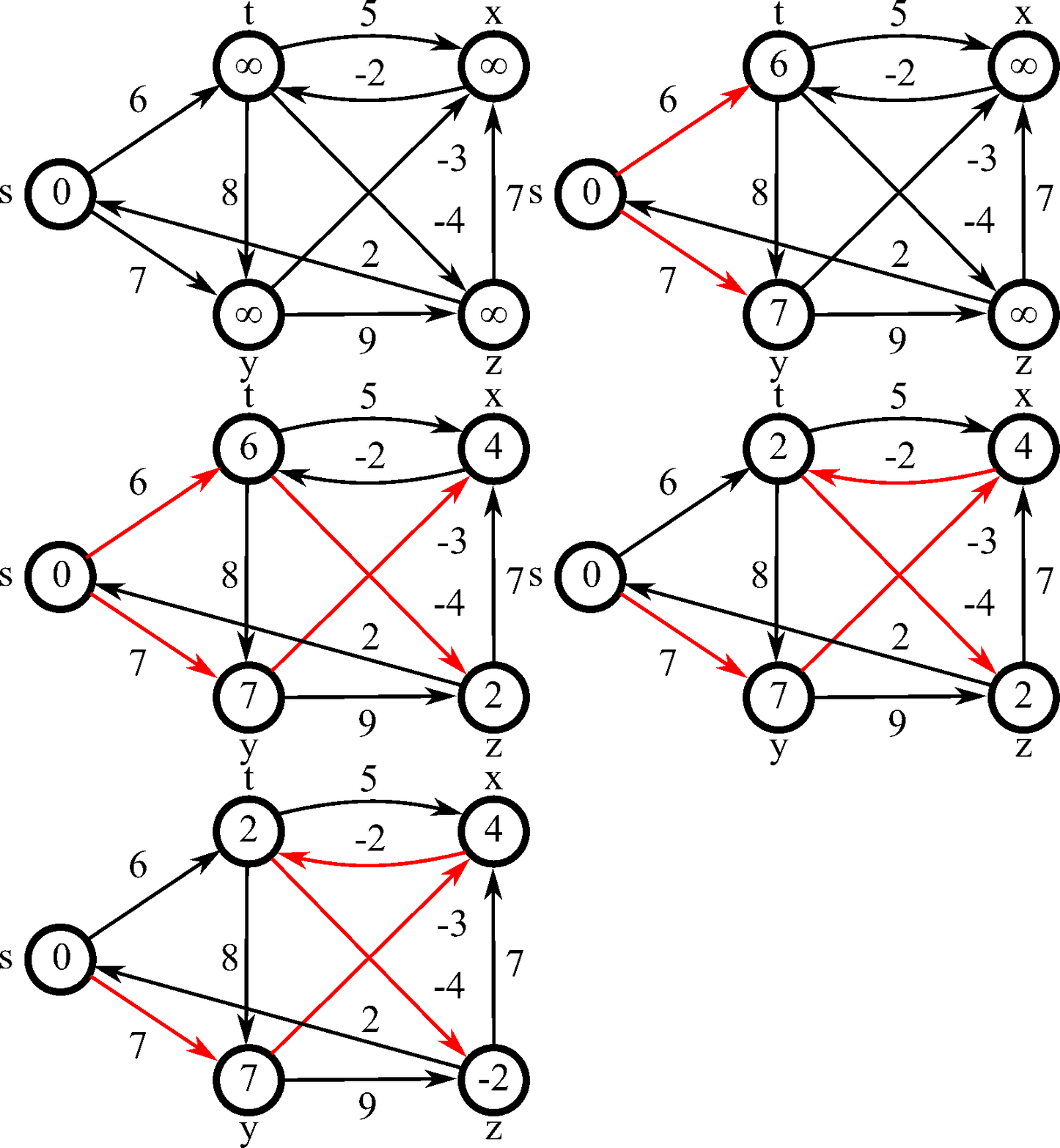
hey can someone help me understand this example of the Bellman-Ford Alg. ?
 midnight plankBOT
crude kindle
hey can someone help me understand this example of the Bellman-Ford Alg. ?
midnight plankBOT
crude kindle
hey can someone help me understand this example of the Bellman-Ford Alg. ?
@crude kindle Has your question been resolved?
 fathom onyx
crude kindle
hey can someone help me understand this example of the Bellman-Ford Alg. ?
fathom onyx
crude kindle
hey can someone help me understand this example of the Bellman-Ford Alg. ?
Willst du's auf Deutsch oder auf Englisch? [bin Englischsprechender aber kanns auf Deutsch]
-# do you want it in German or English?
crude kindle
fathom onyx
Willst du's auf Deutsch oder auf Englisch? [bin Englischsprechender aber kanns a...
dann gerne auf deutsch wenn es geht
wenns schwer wird dann englisch
fathom onyx
Nennen wir die Knoten, from the first row rightwards, A bis D, dann E bis H
Auf A starten
crude kindle
ok
fathom onyx
B und E direkt rechnen, indem wir die verbindende Pfeile nutzen
Also is B 14, und E 6
fathom onyx
ja sicher
Bin der Meinung dass man C, dann D rechnen
Dennoch wird E für dir Abkürzing benutzt
Der Grund dafür? ist nicht mit diesem Bild klar erklärt
soweit dass ichs sehe
crude kindle
stimmt eigentlich haben die sachen ja ne rheinfolge
midnight plankBOT
Closed due to timeout
Use .reopen if this was a mistake.
crude kindle
ich verstehe aber besonders nicht wie sie das letzte ding erreich haben like why C 7 and not 12

.reopen
midnight plankBOT
✅
crude kindle
or is the example simply wron
fathom onyx
Yh that's what's confusing me as well
Bis zum dritten Beispiel solls klar genug
Der letzte aber...
crude kindle
jaja bis zum dritten check ich auch noch aber das vierte ist falsch vielleicht schreib ich einfach ne mail an die prof
fathom onyx
ja vielleicht
Dennoch: 9 + (-12) + 2 gilt aber -1?
dh. go around in circles and get maximum efficiency?
Hier stimmt was definitiv nicht 
crude kindle
ich glaube das alg wird abgebrochen nach einem durchlauf
und wird dann nochmal durchgeführt um auf negative zyklen zu untersuchen
fathom onyx
yeah...
crude kindle
wenn es sich dann nochmal verringert weiß man das ein negativer zyklus drin ist
fathom onyx
Beim englischen Artikel von https://en.wikipedia.org/wiki/Bellman–Ford_algorithm gibts einen guten Beispiel
The Bellman–Ford algorithm is an algorithm that computes shortest paths from a single source vertex to all of the other vertices in a weighted digraph.
It is slower than Dijkstra's algorithm for the same problem, but more versatile, as it is capable of handling graphs in which some of the edge weights are negative numbers. The algorithm was fi...
ooh it's animated in the embed 
crude kindle
uiiii
crude kindle
ohhh das könnte sein
damn die hat das aber nicht in ihrer vorlesung dahin geschrieben haha
fathom onyx
If these are lecture slides, then this might be what was explained in the lecture
crude kindle
Nah she just put it in without context haha
fathom onyx
kein problem
midnight plankBOT
Closed by @crude kindle
Use .reopen if this was a mistake.
midnight plankBOT
Available help channel!
Send your question here to claim the channel.
Remember:
• Ask your math question in a clear, concise manner.
• Show your work, and if possible, explain where you are stuck.
• After 15 minutes, feel free to ping <@&286206848099549185>.
• Type the command .close to free the channel when you're done.
• Be polite and have a nice day!
Read #❓how-to-get-help for further information on how to ask a good question, and about conduct in the question channels.
 fierce silo
So, I'm probably missing something so unbelievably simple but I cannot seem to figure this one out. My graph does not match with this graph given in the answers part in my textbook, if anyone else could see how they got this graph as the answer, I only need to know if it's actually correct or maybe there's a mistake?
If it's correct, I'll eventually figure it out on my own, sorry for the dumb question. But I'm asking in terms of question 43.
I'm not enrolled in school or classes or anything so I don't have a teacher I can go and ask but if anyone might be able to just let me know if they also think this graph is wrong, I'd appreciate it. AI isn't helping me much and I don't want to trust it because it also said the graph was wrong but I don't trust myself to be right.
I have the same values as them, and I plug in other values that match the rules for X but I do not get that same graph ever

 midnight plankBOT
fierce silo
So, I'm probably missing something so unbelievably simple but I cannot seem to f...
midnight plankBOT
fierce silo
So, I'm probably missing something so unbelievably simple but I cannot seem to f...
 grim forge
Ye its wrong because at f(-1), it should be at (-1, 0) not (-1,1)
fierce silo
That's exactly what I'm thinking too and I'm trying to find any documentation online that might confirm it's wrong? It's James Stewart Calculus single variable and early Transcendentals if anyone else has that book.
grim forge
I mean just use your own reasoning
 dapper slate
fierce silo
So, I'm probably missing something so unbelievably simple but I cannot seem to f...
dapper slate
fierce silo
So, I'm probably missing something so unbelievably simple but I cannot seem to f...
Yes, this is incorrect.
fierce silo
Ok, you're right. Just always sketchy trusting myself since I'm only self studying so far, so I'm extra cautious about trusting myself over a textbook
Thank you though guys, this does help me, I've been stuck for like an hour on it
dapper slate
fierce silo
Ok, you're right. Just always sketchy trusting myself since I'm only self studyi...
It makes sense. Usually you can trust these books.
I would definitely not trust AI to resolve the debate because it will probably answer based on the cues in your question
fierce silo
Yeah, it gave me a graph completely wrong and way out of left field so I tried to think of another place I might be able to ask. Anyway thank you all
.close
midnight plankBOT
Closed by @fierce silo
Use .reopen if this was a mistake.
midnight plankBOT
Available help channel!
Send your question here to claim the channel.
Remember:
• Ask your math question in a clear, concise manner.
• Show your work, and if possible, explain where you are stuck.
• After 15 minutes, feel free to ping <@&286206848099549185>.
• Type the command .close to free the channel when you're done.
• Be polite and have a nice day!
Read #❓how-to-get-help for further information on how to ask a good question, and about conduct in the question channels.
 languid mica
is there a general method to find a formula for series?
midnight plankBOT
languid mica
is there a general method to find a formula for series?
sudden yacht
Not that I know
languid mica
im studying series
and i can see we can use proving that a formula is true for n=1 then suppose its true for n and prove its true for n+1
 next bramble
No. Because the function could be infinitely piecewise
next bramble
$$f(n) = \begin{cases} 1 & \mbox{if}; n = 0 \ 5 & \mbox{if}; n = 1 \ 39 & \mbox{if}; n = 2 \ ... \end{cases}$$
grand pondBOT
Shuba
 next bramble
There is no "general" way to determine this function.
languid mica
for example the sum from 1 to n of a_i^2
languid mica
next bramble
There is no "general" way to determine this function.
is there some logic behind it
sudden yacht
No
languid mica
languid mica
for example the sum from 1 to n of a_i^2
for this
next bramble
languid mica
is there some logic behind it
nope. randomise everything
sudden yacht
sudden yacht
No
Don't even try to find it 😅
next bramble
We have some tricks to help though. You're probably studing some of those.
For example, a sequence could be constant, polynomial, exponential, arithmetic, geometric, etc...
But, there is no "general" way.
languid mica
$$ \sum_{k=1}^{n} k^2 &= \frac{n(n+1)(2n+1)}{6} $$
grand pondBOT
taebek
Compile Error! Click the  reaction for more information.
(You may edit your message to recompile.)
 sudden yacht
Search on the Internet
languid mica
cant be pure luck
next bramble
For example ${ 1, 2, 4, 8, 16 }$ looks exponential, but then I tell you the next number is $31$. This is a well known sequence, but very hard to determine what it is.
languid mica
surely there is some logic
grand pondBOT
Shuba
 vast loom
You can do cubic interpolation to find the formula
languid mica
thats a completely different question
next bramble
languid mica
surely there is some logic
Nope. Finding a function for a sequence is trying to find every next number. But for any sequence, the next number could be random and indeterminable.
vast loom
vast loom
You can do cubic interpolation to find the formula
the formula for the sum of squares i mean
languid mica
grand pond
**taebek**
Compile Error! Click the <:errors:504266556054962196> reaction for mo...
what i asked is if you know the sequence like the function inside the sum how can you construct a formula that finds the value
languid mica
next bramble
Nope. Finding a function for a sequence is trying to find every next number. But...
no thats not what i asked
i asked if we have a sequence how do we find formula of the sum
so basically
languid mica
solving s_n = Sum from 1 to n of f(i)
languid mica
yes in general case you cant
vast loom
doesnt get any better if you dont know anything about f
languid mica
but whats the logic in specific case
now
if you know f

here
how would you guess the formula is n(n+1)(2n+1)/6
and then prove it by mathematical induction
is there some logic in this case ?
sudden yacht
languid mica
is there some logic in this case ?

Possible Duplicate:
How do I come up with a function to count a pyramid of apples?
Proof that $\sum\limits_{k=1}^nk^2 = \frac{n(n+1)(2n+1)}{6}$?
Finite Sum of Power?
I know that the sum of ...
midnight plankBOT
@languid mica Has your question been resolved?
midnight plankBOT
Closed due to timeout
Use .reopen if this was a mistake.
midnight plankBOT
Available help channel!
Send your question here to claim the channel.
Remember:
• Ask your math question in a clear, concise manner.
• Show your work, and if possible, explain where you are stuck.
• After 15 minutes, feel free to ping <@&286206848099549185>.
• Type the command .close to free the channel when you're done.
• Be polite and have a nice day!
Read #❓how-to-get-help for further information on how to ask a good question, and about conduct in the question channels.
 chilly cobalt
For a positive integer $N>1$ with unique factorization $N=p_1^{\alpha_1}p_2^{\alpha_2}\dotsb p_k^{\alpha_k}$, we define
[\Omega(N)=\alpha_1+\alpha_2+\dotsb+\alpha_k.]
Let $a_1,a_2,\dotsc, a_n$ be positive integers and $p(x)=(x+a_1)(x+a_2)\dotsb (x+a_n)$ such that for all positive integers $k$, $\Omega(P(k))$ is even. Show that $n$ is an even number.
midnight plankBOT
chilly cobalt
For a positive integer $N>1$ with unique factorization $N=p_1^{\alpha_1}p_2^{\al...
grand pondBOT
Copter
 chilly cobalt
could someone hint me, i cant really begin
well i know that omega is additive
omega(ab) = omega(a) + omega(b)
chilly cobalt
that isnt even the same p lol
steel crest
but... this is difficult
steel crest
what do you mean by "P(0) implies"
let me see if this Omega has a name so i can look up properties
chilly cobalt
steel crest
what do you mean by "P(0) implies"
omega(p(0)) = omega(a1a2...an) is even
steel crest
oh so "=>" was just a typo , got it
chilly cobalt
?
steel crest
ready for it? you sitting down?
dont want to shock you
it's called the "big Omega function"
grand pondBOT


 Requested by copterforgor
steel crest
Requested by copterforgor
steel crest
lmao
chilly cobalt
are there any properties you found??
steel crest
looiking
have an asymptotic that seems not useful at all for us
$$\sum_{n \le x} \Omega(n) = x \log \log x + B_2 x + o(x)$$
where
$$B_2 \approx 1.0345$$
grand pondBOT
gfauxpas
 steel crest
yeah that's u seless
chilly cobalt
whats "completely" mean
steel crest
regardless of whether the numbers are coprime
oooh found somethign
the Liouville function is defined as:
working on it
let P_E be the property "has an even number of prime factors" and P_O be the property "has an odd number of prime factors", counting multiplicity
$$\lambda(n) = \begin{cases} +1 , \text{ if $n$ is $P_{\mathcal E}$} \ -1 , \text{ if $n$ is $P_{\mathcal O}$} \end{cases}$$
grand pondBOT
gfauxpas
 grand pondBOT
gfauxpas
 chilly cobalt
theres definetly a better solution for this using only omega 😭
steel crest
yeah definitely, but i dont know how to approach this, sorry man
<@&286206848099549185>
chilly cobalt
its okay bro
For a positive integer $N>1$ with unique factorization $N=p_1^{\alpha_1}p_2^{\alpha_2}\dotsb p_k^{\alpha_k}$, we define
[\Omega(N)=\alpha_1+\alpha_2+\dotsb+\alpha_k.]
Let $a_1,a_2,\dotsc, a_n$ be positive integers and $p(x)=(x+a_1)(x+a_2)\dotsb (x+a_n)$ such that for all positive integers $k$, $\Omega(P(k))$ is even. Show that $n$ is an even number.
back to this
grand pondBOT
Copter
 chilly cobalt
im thinking we plug in the roots of this polynomial
chilly cobalt
chilly cobalt
p(0) => omega(a1) + ... omega(an) is even
from this uhh
$\prod_{i=1}^{n}p(a_i + 2) = 2^n$ something something
grand pondBOT
Copter
 chilly cobalt
might be useful?
steel crest
oh, roots, that's an idea
we can use roots of polynomial theorems
Vieta's formulas
chilly cobalt
p(-ai) = 0
steel crest
 chilly cobalt
i dont see how that would relate to n though,,
wait
the last term?
if n is even then the products should be positive
steel crest
yes
chilly cobalt
copter processing
chilly cobalt
wait why
steel crest
I take it back
chilly cobalt
omega is defined for positive integers only
steel crest
I confused alpha and a
chilly cobalt
sob
steel crest
so we knmow that n has to be an even number otherwise their product would be a negative number
that notation means "the coefficient of"
wait is that right
then maybe Omega has nothing to do with it
steel crest
oh nooo
we did a stupid mistake
a_1, a_2, ... , a_n are the NEGATIVES of the roots of the polynomial
 fresh sparrow
yeah i was about to say that lol
steel crest
alright that changes a lot
fresh sparrow
fresh sparrow
yeah i was about to say that lol
there are no roots after >0
chilly cobalt
steel crest
a_1, a_2, ... , a_n are the NEGATIVES of the roots of the polynomial
oh right yeah
steel crest
I feel more confident now that cuttlefish in 3d glasses is here
chilly cobalt
fr
fresh sparrow
steel crest
I feel more confident now that cuttlefish in 3d glasses is here
thank you, i don't know what i am doing
xd
steel crest
(-a1)(-a2)...(-an)=(-1)^n a0/an
positive only if n is even
which you can derive without vietas at all
because it's (-1)^n a1a2a3...an
chilly cobalt
chilly cobalt
oh yeah and omega(2^n) = n
i run back to this idea cause i think its promising
chilly cobalt
grand pond
**Copter**
we make this a square ,so when we cover it in omega its even and omega(2^n) = n so we might be able to argue by modulo 2
think think
oh wait
multiply by p(1) and the like term becomes square
and the rest are all squares too because we can swap the order of addition
how do i notate this 😭
$p(1) \cdot \prod_{i=1}^n p(a_i + 2) = 2^n \cdot \prod_{i=1}^n (a_i + 1)^2$ product of something something someting squared
grand pondBOT
Copter
 chilly cobalt
take omega of both sides we get rhs even
and lhs is n + even terms
so n even
amazing
chilly cobalt
grand pond
**Copter**
<@&286206848099549185> someone check this peak solution 🙏
math gods i summon thee
midnight plankBOT
@chilly cobalt Has your question been resolved?
midnight plankBOT
@chilly cobalt Has your question been resolved?
midnight plankBOT
@chilly cobalt Has your question been resolved?
midnight plankBOT
Closed due to timeout
Use .reopen if this was a mistake.
Available help channel!
Send your question here to claim the channel.
Remember:
• Ask your math question in a clear, concise manner.
• Show your work, and if possible, explain where you are stuck.
• After 15 minutes, feel free to ping <@&286206848099549185>.
• Type the command .close to free the channel when you're done.
• Be polite and have a nice day!
Read #❓how-to-get-help for further information on how to ask a good question, and about conduct in the question channels.
 grave kernel
p is a prime number and im proving that sqrtp is irrational
doing the process, assuming sqrtp = a/b and gcd(a,b) = 1 and then p = a^2/b^2
then pb^2 = a^2. now, in the solution it says, "hence, p|a^2 and so from euclids lemma p|a"
but euclids lemma says that gcd(a,p) should be 1 no? how is gcd(a,p) = 1 i dont get it, can it not be p itself or idk
midnight plankBOT
grave kernel
p is a prime number and im proving that sqrtp is irrational
doing the process, a...
lyric charm
but euclids lemma says that gcd(a,p) should be 1 no?
can you state euclid's lemma
feral sedge
i don’t like this solution
grave kernel
like, wdym
feral sedge
it very weirdly invokes a completely unnecessary lemma (and apparently it “uses” gcd(a, p) = 1 to conclude p | a, which is nonsense)
runic hamlet
the other form of euclids lemma is: if p is prime and p|ab, then p|a or p|b
feral sedge
that’s better
grave kernel
right
runic hamlet
use that version
grave kernel
can you prove that
runic hamlet
it follows from the other one pretty quickly
either the gcd is 1 or its not...
what happens in either case?
grave kernel
it divides the other number?
oooohhhhh wait
right
if gcd(a,p) = p
then p|a
if gcd(a,p) = 1
then p|b
is that correct?
given that p|ab obv
midnight plankBOT
@grave kernel Has your question been resolved?
Closed by @grave kernel
Use .reopen if this was a mistake.
midnight plankBOT
Available help channel!
Send your question here to claim the channel.
Remember:
• Ask your math question in a clear, concise manner.
• Show your work, and if possible, explain where you are stuck.
• After 15 minutes, feel free to ping <@&286206848099549185>.
• Type the command .close to free the channel when you're done.
• Be polite and have a nice day!
Read #❓how-to-get-help for further information on how to ask a good question, and about conduct in the question channels.
 wary epoch
Experience has convinced me that it is pedagogically unsound (though logically correct) to start off with the construction of the real numbers from the rational ones
Wait, why is it pedagogically bad to define real number via Dedekind cut? Quote is from Baby Rudin third edition.
midnight plankBOT
wary epoch
> Experience has convinced me that it is pedagogically unsound (though logically...
@wary epoch Has your question been resolved?
prime hornet
wary epoch
> Experience has convinced me that it is pedagogically unsound (though logically...
you can try asking in #math-pedagogy too, maybe 
my (unrefined) thoughts might be that Rudin is saying that Dedekind cuts are the sort of construction you only ever see once and are thus not super important
nobody thinks about the real numbers in terms of cuts afterwards
if you define them using Cauchy sequences instead though, then that's probably more pedagogically useful, because students will be seeing those sequences again in the future 
 hoary pulsar
At the beginning, most students simply fail to appreciate the need for doing this. Accordingly, the real number system is introduced as an ordered field with the least-upper-bound property, and a few interesting applications of this property are quickly made.
These are the sentences following that one
Like higher! said, Dedekind cuts are correct but they're not really the best way to approach it with new students
Though rather than Cauchy sequences, they're using the LUB property. Which is actually how it was defined for me as well via Stephen Abbott's RA book
wary epoch
To be fair, I used to hate Dedekind cuts, because it's not intuitive, but it's grown on me because of how simple the construction is compared to Cauchy sequences.
Anyway, thanks
.close
midnight plankBOT
Closed by @wary epoch
Use .reopen if this was a mistake.
midnight plankBOT
Available help channel!
Send your question here to claim the channel.
Remember:
• Ask your math question in a clear, concise manner.
• Show your work, and if possible, explain where you are stuck.
• After 15 minutes, feel free to ping <@&286206848099549185>.
• Type the command .close to free the channel when you're done.
• Be polite and have a nice day!
Read #❓how-to-get-help for further information on how to ask a good question, and about conduct in the question channels.
molten bay
 midnight plankBOT
molten bay
molten bay
midnight plankBOT
molten bay
molten bay
I can do it with expansion but looking for some ideas
feral sedge
i believe none of those answers are correct
molten bay
And how do you believe?
molten bay
How can you say lambda fail
Left side we got -1
-2a^3-3a^2+1=-1
,w -2a^3-3a^2+1=-1
grand pondBOT

 Requested by andy03738
lyric charm
Requested by andy03738
lyric charm
,w det {{0, cos(t), -sin(t)}, {sin(t), 0, cos(t)}, {cos(t), sin(t), 0}}
grand pondBOT
molten bay
Yes i got same thing ann
lyric charm
.w det {{1, -λ, λ}, {-λ, 1, λ}, {λ, λ, 1}}
molten bay
Cubic polynomial
lyric charm
,w det {{1, -λ, λ}, {-λ, 1, λ}, {λ, λ, 1}}
grand pondBOT
molten bay
molten bay
,w -2a^3-3a^2+1=-1
.
lyric charm
why =-1 ?
molten bay
He said put theta=pi
sudden yacht
molten bay
He said put theta=pi
I think it's better to start from the answers, which say that λ can be only 0 or 1 (when theta is π)
feral sedge
molten bay
He said put theta=pi
lambda is dependent on theta
you are given four answer choices, functions in terms of theta
all four satisfy lambda(pi) = 1 or lambda(pi) = 0, and evaluating the right determinant gives 1 or -4
lyric charm
put theta=pi, the options for lambda become:
A) 0, B) 1, C) 0, D) 0
LHS det gives -1, RHS det gives either 1 or -4 based on WA's results
feral sedge
but you found the left to evaluate as -1
this is a clear contradiction. therefore no answer is correct
molten bay
lyric charm
put theta=pi, the options for lambda become:
A) 0, B) 1, C) 0, D) 0
LHS det give...
Where does it give 1,-4?
lyric charm
put λ=0 or λ=1 into RHS value according to wolfrram
molten bay
cos^3(t)-sin^3(t)=-2a^3-3a^2+1
t=theta, a=lambda
What are you guys doing, i am confused
Okay if i put left side t=pi then it becomes
-1=-2a^3-3a^2+1
what next?
And option become what ann wrote
if I put lambda=a=0 then equal become -1=1 not possible
But why are we doing such weird thing
feral sedge
if lambda(0) = 0 then there is no contradiction
molten bay
feral sedge
all four satisfy lambda(pi) = 1 or lambda(pi) = 0, and evaluating the right dete...
I'm not getting it
feral sedge
cos(0)^3 - sin(0)^3 = 1
det(lambda(0)) = 1
it aligns
so i told you theta = pi gives you a contradiction
ann explained it very well. i suggest rereading her explanation
molten bay
I am not getting properly you guys put random values RHS then LHS
And contradiction!!
Which is totally confusion i have wrote my whole work
So here lambda=0 is satisfying
cos^3(t)-sin^3(t)=-2a^3-3a^2+1
Lambda=0, theta=0
So what conclusion?
 empty cove
molten bay
I am not getting properly you guys put random values RHS then LHS
empty cove
molten bay
I am not getting properly you guys put random values RHS then LHS
do you agree that when theta = pi, the lhs and rhs should be equal?
empty cove
what is the value of lambda when theta = pi?
molten bay
,w -2a^3-3a^2+2=0
grand pondBOT
 Requested by andy03738
molten bay
Requested by andy03738
molten bay
Here is a value
empty cove
:)
midnight plankBOT
Closed by @molten bay
Use .reopen if this was a mistake.
molten bay
Thanks all brilliant guys
midnight plankBOT
Available help channel!
Send your question here to claim the channel.
Remember:
• Ask your math question in a clear, concise manner.
• Show your work, and if possible, explain where you are stuck.
• After 15 minutes, feel free to ping <@&286206848099549185>.
• Type the command .close to free the channel when you're done.
• Be polite and have a nice day!
Read #❓how-to-get-help for further information on how to ask a good question, and about conduct in the question channels.
 viral dagger
 midnight plankBOT
viral dagger
viral dagger
midnight plankBOT
viral dagger
viral dagger
 i genuenly dont understand where the solution is going
it just made a diffrent polynomial Q*(x) such that it has roots 21 and 32, and we want to find N such that Q*(N)=4
runic hamlet
why the fuck is remainder theorem censored
feral sedge
this book censors a bunch of random words, apparently...
viral dagger
i think it incentivizes readers to think about what theorems would be useful for the problem... i dont think its doing a good job at that though
runic hamlet
Q*(N)=4 is a product of three integers
so there arent many options for what those integers could be
that should probably finish it
viral dagger
ohg
empty cove
hi
viral dagger
i see
runic hamlet
yeah
midnight plankBOT
Closed by @viral dagger
Use .reopen if this was a mistake.
midnight plankBOT
Available help channel!
Send your question here to claim the channel.
Remember:
• Ask your math question in a clear, concise manner.
• Show your work, and if possible, explain where you are stuck.
• After 15 minutes, feel free to ping <@&286206848099549185>.
• Type the command .close to free the channel when you're done.
• Be polite and have a nice day!
Read #❓how-to-get-help for further information on how to ask a good question, and about conduct in the question channels.
Channel closed due to the original message being deleted.
If you did not intend to do this, please open a new help channel,
as this action is irreversible, and this channel may abruptly lock.
midnight plankBOT
Available help channel!
Send your question here to claim the channel.
Remember:
• Ask your math question in a clear, concise manner.
• Show your work, and if possible, explain where you are stuck.
• After 15 minutes, feel free to ping <@&286206848099549185>.
• Type the command .close to free the channel when you're done.
• Be polite and have a nice day!
Read #❓how-to-get-help for further information on how to ask a good question, and about conduct in the question channels.
grave kernel
i didnt get this solution at all, its also missing a few of the lcm and gcd texts
 midnight plankBOT
grave kernel
i didnt get this solution at all, its also missing a few of the lcm and gcd text...
fathom onyx
grave kernel
i didnt get this solution at all, its also missing a few of the lcm and gcd text...
midnight plankBOT
grave kernel
i didnt get this solution at all, its also missing a few of the lcm and gcd text...
fathom onyx
grave kernel
i didnt get this solution at all, its also missing a few of the lcm and gcd text...
We often shorthand, for some dumb reason, the GCD of two numbers as follows
(x, y) = gcd(x,y)
grave kernel
oh really
mortal mirage
its really stupid imo
fathom onyx
But it does need explaining, yh - usually this SHOULD be stated at the beginning of the notes you're reading
grave kernel
okay but still tho, the solution is pretty vague to me
nah, this just randomly started, i just thought they are missing the gcd part
fathom onyx
Grab the gcd of a and b, call it d; then a = dm and b = dn for some m and n whose gcd is 1
mortal mirage
i think theres a typo in the second sentence
fathom onyx
Then a+b = (as explained)
grave kernel
right
mortal mirage
it should be (a,b)
fathom onyx
Then LCM is (as explained);
Then the rest of this solution involves hunting for d, m and n
grave kernel
how are they getting the 4 x 13
 lethal path
well it's by process of elimination
d can't be 13 or 52, because that would imply lcm(a, b) would be divisible by 13
then figure out for yourself why d can't be 1 either
grave kernel
right
grave kernel
mortal mirage
these two
how is lcm(a,b) = dmn
mortal mirage
by definition
but if you think about it because d is a common divisor, it only should appear once in the lcm
lethal path
lethal path
then figure out for yourself why d can't be 1 either
this reasoning is actually a bit tricky, so I'll start you off with the fact that if d = 1, then lmc(a, b) = ab, so ab = 168
but then since a, b are again coprime, exactly one of a, b must be divisible by 4, and the other one must not be
but then a + b = 52 ||which is a multiple of 4....||
lethal path
no worries!
midnight plankBOT
Closed by @grave kernel
Use .reopen if this was a mistake.
midnight plankBOT
Available help channel!
Send your question here to claim the channel.
Remember:
• Ask your math question in a clear, concise manner.
• Show your work, and if possible, explain where you are stuck.
• After 15 minutes, feel free to ping <@&286206848099549185>.
• Type the command .close to free the channel when you're done.
• Be polite and have a nice day!
Read #❓how-to-get-help for further information on how to ask a good question, and about conduct in the question channels.
 hybrid crow
 midnight plankBOT
hybrid crow
hybrid crow
midnight plankBOT
hybrid crow
hybrid crow
I just need help showing the only if part
Suppose null S is a subset of null T
how do we show there exists an E with that property
Intuitively I get why E must exist but I'm not sure how to formally say it
My non-rigorous explanation is that S is gonna take basis vectors v1,...,vn to either 0 or to some w's
and then we construct E to take some more w's to 0, (so that all v's taken to 0 in ET make up T's null space) and E takes the remaining w's to where T would take the v that they came from
 outer girder
Try to construct E from the given property
hybrid crow
yeah idk how
S(a1v1 + ... + anvn) = a1w1 + ... + anwn
lets just say as an example that v1,v2,v3 all go to 0 under S
but that T(a1v1 + ... + anvn) takes v1,v2,v3, and v4 to 0
outer girder
V is not given to be finite-dimensional so you can't just take a finite basis like that
hybrid crow
oh
right
wait
if V is infinite-dimensional
then doesn't that mean the null space is infinite
outer girder
it could be
actually yes it is
Here's an idea :
given a basis {b1, ... bn} of range(S), find v1, ..., vn from V with S(vi) = bi
then define E(bi) = T(vi) for i=1,...,n, and define E to be zero wherever the input is not in range(S)
it is a good exercise to show that given any vector v in V we may write v = a + b where a is in span(v1,...,vn) and b is in null(S) [-- in fact, this representation is unique]
by using the fact that null(S) is contained in null(T), you can easily show that E is well-defined
midnight plankBOT
@hybrid crow Has your question been resolved?
midnight plankBOT
Closed by @hybrid crow
Use .reopen if this was a mistake.
midnight plankBOT
Available help channel!
Send your question here to claim the channel.
Remember:
• Ask your math question in a clear, concise manner.
• Show your work, and if possible, explain where you are stuck.
• After 15 minutes, feel free to ping <@&286206848099549185>.
• Type the command .close to free the channel when you're done.
• Be polite and have a nice day!
Read #❓how-to-get-help for further information on how to ask a good question, and about conduct in the question channels.
 icy herald
can i have help
midnight plankBOT
icy herald
can i have help
icy herald
.close
midnight plankBOT
Closed by @icy herald
Use .reopen if this was a mistake.
midnight plankBOT
Available help channel!
Send your question here to claim the channel.
Remember:
• Ask your math question in a clear, concise manner.
• Show your work, and if possible, explain where you are stuck.
• After 15 minutes, feel free to ping <@&286206848099549185>.
• Type the command .close to free the channel when you're done.
• Be polite and have a nice day!
Read #❓how-to-get-help for further information on how to ask a good question, and about conduct in the question channels.
 floral apex
I have a question.
midnight plankBOT
floral apex
I have a question.
floral apex
This book says that the system:
midnight plankBOT
Closed by @floral apex
Use .reopen if this was a mistake.
midnight plankBOT
Available help channel!
Send your question here to claim the channel.
Remember:
• Ask your math question in a clear, concise manner.
• Show your work, and if possible, explain where you are stuck.
• After 15 minutes, feel free to ping <@&286206848099549185>.
• Type the command .close to free the channel when you're done.
• Be polite and have a nice day!
Read #❓how-to-get-help for further information on how to ask a good question, and about conduct in the question channels.
chilly cobalt
A positive integer $n$ is known as an interesting number if $n$ satisfies
[{\ {\frac{n}{10^k}} } > \frac{n}{10^{10}} ]
for all $k=1,2,\ldots 9$.
Find the number of interesting numbers.
midnight plankBOT
chilly cobalt
A positive integer $n$ is known as an interesting number if $n$ satisfies
\[{\ ...
grand pondBOT
Copter
 grand pondBOT
1 divided by 0 equals Infinity
 chilly cobalt
i was looking at the solution for this, and they said we can establish a bijection between interesting numbers and aperiodic necklaces $10$ beads of $10$ possible colors.
 lusty python
$10^{10} > 10^k$ for $1 \leq k \leq 9$
grand pondBOT
Copter
 chilly cobalt
grand pond
**Copter**
chilly cobalt
grand pond
**Copter**
no idea what that means tho
grand pondBOT
1 divided by 0 equals Infinity
 lusty python
and the numerator is $n$ for both fractions
grand pondBOT
1 divided by 0 equals Infinity
 lusty python
so isn't it true for all $n > 0$?
grand pondBOT
1 divided by 0 equals Infinity
 chilly cobalt
n = 10^i is false
cause for some k the fractional part will be 0
also the anwer is $\frac{1}{10}(10^{10}-10-(10^5-10)-(10^2-10))=10^9-10^4-9=999989991$?
grand pondBOT
Copter
 chilly cobalt
wth 😭
chilly cobalt
grand pond
**Copter**
anyways could someone explain this?
chilly cobalt
grand pond
**1 divided by 0 equals Infinity**
also n cant have more than 10 digits
thats a restriction
<@&286206848099549185>
midnight plankBOT
@chilly cobalt Has your question been resolved?
 wheat nymph
chilly cobalt
no idea what that means tho
wheat nymph
chilly cobalt
no idea what that means tho
Do u know what a bijection or period is?
chilly cobalt
one to one correspondence?
i dont know what "beads" and "necklaces" are unfortunately
wheat nymph
That's fine
chilly cobalt
can you fix it 💔
wheat nymph
Essentially the analogy with the circular beads is that for every 10-digit number (leading zeroes allowed), we can always shift the digits
e.g. abc...hij can be shifted 1 digit to bc...hija
Hence the necklace
Basically u can think of the digits as arranged in a circle
Does that make sense?
chilly cobalt
yeah
wheat nymph
More formally, we r partitioning the space of 10-digit numbers into these classes
The solution claims that interesting numbers must not be periodic (in the sense that their class is of size <10), and each non-periodic class contains exactly one interesting number
That's the bijection
Is that clear?
chilly cobalt
do "classes" mean like, all the possible shiftings of a number
wheat nymph
Yeah the set of these shifts
The formal term I should be using is equivalence class btw
wheat nymph
It's counting the number of non-periodic equivalence classes
wheat nymph
chilly cobalt
also the anwer is $\frac{1}{10}(10^{10}-10-(10^5-10)-(10^2-10))=10^9-10^4-9=999...
^
We can do this since there's a bijection between the set of equivalence classes and the set of interesting numbers
chilly cobalt
this?
 chilly cobalt
 wheat nymph
These r quite general formulas
In ur case u alr have a nice case where k=n
chilly cobalt
oh
wheat nymph
grand pond
**Copter**
It's reasonable to figure out why this is the case without plugging it into the formula
wheat nymph
wheat nymph
These r quite general formulas
In ur case u alr have a nice case where k=n
On a second look at this formula, yes actually it's exactly the right thing
wheat nymph
wheat nymph
It's reasonable to figure out why this is the case without plugging it into the ...
So when I say this, I mean it's not too difficult to derive
chilly cobalt
wheat nymph
So when I say this, I mean it's not too difficult to derive
oh dear
wheat nymph
chilly cobalt
i dont really get how, sorry😭
I think we should first get some definitions clear
Do u understand what it means for a necklace to be periodic
chilly cobalt
if its periodic does that mean there are some "shifts" that are equal?
wheat nymph
Yeah
Let's call a necklace q-periodic if it equals itself by a shift of q digits
Since the necklace is of length 10, what possible periods can it be (note that a necklace can have multiple periods)?
chilly cobalt
divisors of 10 right?
wheat nymph
Yeah and I should've said smallest periods it can be
Anyways
We're trying to count the number of necklaces whose smallest period is 10, so the ones that are not 1, 2, or 5
chilly cobalt
uh huh..
wheat nymph
Can u see what the 1,2 and 5- periodic necklaces should look like
And use that to count them
chilly cobalt
so you subtract?
wheat nymph
Yes
chilly cobalt
ooooh
wheat nymph
In general the number of q-periodic necklaces is 10^q
wheat nymph
grand pond
**Copter**
Hence the inner term
chilly cobalt
chilly cobalt
well, where does the 1/n come from?
wheat nymph
So now we're left with the number of aperiodic necklaces
We haven't partitioned them into their equivalence classes yet
Rmb that we're trying to count the number of equivalence classes of aperiodic necklaces
chilly cobalt
oh
wheat nymph
chilly cobalt
Btw this general formula is using the Mobius function, which is what u need when u replace 10 with k
This is arising from the inclusion exclusion stuff that's going on in our proof
But for ur question the remaining bit is to establish why u have a bijection
chilly cobalt
hmm
wheat nymph
O and also u need to show why aperiodic necklaces r not interesting
chilly cobalt
brain is loading
each interesting number is atleast a 10 digit number which are each beads or something? each color is a digit and each number is different among its shifting
sob
is this a bijection
wheat nymph
um almost
interesting number satisfies the inequalities in the question, and we can deduce the this means its 10-digit (leading zeros allowed) and aperiodic
so on one side we have the set of interesting numbers
on the other side we have 10 bead aperiodic necklaces where each bead is labelled by some digit 1 to 9
sry abt all that
chilly cobalt
its alright
wheat nymph
chilly cobalt
is this a bijection
maybe its best to figure out this bijection by means of an example
so just take an arbitary 10-digit aperiodic number, write down all 10 of its shifts and figure out which one is interesting
then figure out the common rule for all these necklaces
wheat nymph
chilly cobalt
im guessing its the least one?
Yeah so u might have alr noticed the leading digit of the interesting number must be the smallest on the necklace
So now u have to consider what happens when the necklace has multiple beads with the smallest digit
wheat nymph
E.g. what's the interesting number arising from the necklace 0911103111
wheat nymph
Yeah
The general rule, if u can't see it yet, is that u ||shift the necklace to the smallest possible value||; ||there exists a unique minimum because of the aperiodicity||
chilly cobalt
ohh