#help-49
1 messages · Page 208 of 1
 blissful pier
 languid flame
ask gpt to fix
 grand pondBOT
PajamaMamaLlama
Compile Error! Click the  reaction for more information.
(You may edit your message to recompile.)

 dusty otter
 languid flame
halfway done with getting all the zeros in first row
 midnight plankBOT
@languid flame Has your question been resolved?
midnight plankBOT
@languid flame Has your question been resolved?
midnight plankBOT
@languid flame Has your question been resolved?
 languid mica
Gauss method 😭
languid flame
i just finished column 3
languid mica
This is pure punishment having to solve all that
languid mica

languid mica
languid flame
its so wraps
I think bro is getting cooked
Idk what the point of it is though
languid mica
Like they can test if you know Gauss method with 4x4 or 5x5
languid flame
i tok my first test and after seeingthe grade i really need this
languid flame
languid mica
Like they can test if you know Gauss method with 4x4 or 5x5
that was the homework
languid mica
Yea fr this doesnt even test if you know math after some point
languid flame
.close
midnight plankBOT
Channel closed
Closed by @languid flame
Use .reopen if this was a mistake.
midnight plankBOT
 Available help channel!
Send your question here to claim the channel.
Remember:
• Ask your math question in a clear, concise manner.
• Show your work, and if possible, explain where you are stuck.
• After 15 minutes, feel free to ping <@&286206848099549185>.
• Type the command .close to free the channel when you're done.
• Be polite and have a nice day!
Read #❓how-to-get-help for further information on how to ask a good question, and about conduct in the question channels.
 neat silo
Is this somewhat related to the nine point circle?
 midnight plankBOT
neat silo
Is this somewhat related to the nine point circle?
midnight plankBOT
neat silo
Is this somewhat related to the nine point circle?

 civic gazelle
neat silo
How do i prove thay XDZY is cyclic
civic gazelle
neat silo
How do i prove thay XDZY is cyclic
prove angle XDY = XZY
neat silo
Hmm
Maybe this is a useful fact to prove it
The circumcenter of ABC is the orthocenter of its medial triangle
civic gazelle
nah you don't even need that
civic gazelle
notice that once you got XDZY cyclic, you also got XY//BC which means XDZY is an isoceles trapezoid
neat silo
I have another one
Since D lies on the nine point circle of ABC it must be the feet of perpendicular or median
But since its not the midpoint it has to be the feet of perpendicular
civic gazelle
then you can derive equal sides which leads to XY being the perpendicular bisector of AD
 hard shard
maybe its naive to say but cant you just backwards construct it by reflecting A across XY
neat silo
hard shard
maybe its naive to say but cant you just backwards construct it by reflecting A ...
Can i use the phantom points here then prove the points are congruent?
By angle chase XZY = ABC = XDY so XDZY cyclic then the conclusion follows
Yea phantom point also works
Reflect A wrt XY call it A'. Then prove A' cong D
Alr thanks all
civic gazelle
neat silo
Yea phantom point also works
It doesnt ensure that A' and Z are the only points on BC that satisfies that property tho
neat silo
civic gazelle
It doesnt ensure that A' and Z are the only points on BC that satisfies that pro...
Oh off
Oh oof
 wet blade
@toastaman needs help
civic gazelle
!occupied
midnight plankBOT
Someone else is already using this help channel. If you need help with a question, please open your own help channel/thread (see #❓how-to-get-help for instructions).
civic gazelle
neat silo
Oh off
so yea the cyclic quad way is prob the best way
and since it involves the 3 midpoints you can use the nine-point circle argument to prove
just for quick finishing
neat silo
I got another way
Since its an isosceles trapezium
AX = XB = XD which means ADB = 90
neat silo
The isosceles trapezium one is beautiful
neat silo
civic gazelle
there are many ways to end this problem after proving the cyclic quad
Yes lol
Alr thanks all
.close
midnight plankBOT
Channel closed
Closed by @neat silo
Use .reopen if this was a mistake.
midnight plankBOT
Available help channel!
Send your question here to claim the channel.
Remember:
• Ask your math question in a clear, concise manner.
• Show your work, and if possible, explain where you are stuck.
• After 15 minutes, feel free to ping <@&286206848099549185>.
• Type the command .close to free the channel when you're done.
• Be polite and have a nice day!
Read #❓how-to-get-help for further information on how to ask a good question, and about conduct in the question channels.
 minor grove
 midnight plankBOT
minor grove
minor grove
midnight plankBOT
minor grove
minor grove
Can ts be middle term splitted?
 desert siren
minor grove
Can ts be middle term splitted?
desert siren
minor grove
Can ts be middle term splitted?
No
civic gazelle
!original
midnight plankBOT
Please show the original problem, exactly as it was stated to you, with the entire original context. A picture or screenshot is best. If the original problem is not in English, then post it anyway! The additional context might still be helpful. Do your best to provide a translation.
civic gazelle
determinant is ugly so no
 civic gazelle
!nosols
midnight plankBOT
As a helper, please do not give out answers that could be copied as a homework solution. Have the student work through the problem themselves and guide them along the way.
desert siren
Hint: $\frac{a}{(\frac{b}{c})} = a \cdot \frac{c}{b}$
grand pondBOT
 desert siren
civic gazelle
!nosols
desert siren
civic gazelle
!nosols
It's !noans, for future reference
 swift osprey
i can send
desert siren
I've already given you a hint, if you insist on getting direct solutions, i will have to ping the mods. Also stop opening multiple channels when your question has already been answered.
swift osprey
im pretty useless
midnight plankBOT
As a helper, please do not give out answers that could be copied as a homework solution. Have the student work through the problem themselves and guide them along the way.
civic gazelle
minor grove
Can anyone please send the pic
let's send memes
swift osprey
hint
desert siren
Another $ at the end
swift osprey
$\frac{a/b}{c/d} = \frac{ad}{bc}$
grand pondBOT
Goofy


 magic panther
That’s crazy
midnight plankBOT
@minor grove Has your question been resolved?
midnight plankBOT
Channel closed
Closed due to timeout
Use .reopen if this was a mistake.
Available help channel!
Send your question here to claim the channel.
Remember:
• Ask your math question in a clear, concise manner.
• Show your work, and if possible, explain where you are stuck.
• After 15 minutes, feel free to ping <@&286206848099549185>.
• Type the command .close to free the channel when you're done.
• Be polite and have a nice day!
Read #❓how-to-get-help for further information on how to ask a good question, and about conduct in the question channels.
 inland patio
I have a basic question. If I have a function that is continuous and I extend it by a single point, does it suffice to prove continuity of the extension by simply proving continuity at the extended point?
midnight plankBOT
inland patio
I have a basic question. If I have a function that is continuous and I extend it...
 hoary pulsar
Yeah, so long as that doesn't somehow break the continuity of other points
inland patio
hoary pulsar
Yeah, so long as that doesn't somehow break the continuity of other points
Ok. This confuses me to a great extent. How does one "prove" this? I thought that a function is continuous iff continuous at each point. Does this statement not apply here?
hoary pulsar
Sorry did the second thing I said there confuse you? Because I don't think that's actually possible (unless you're doing some strange topology stuff maybe, idk)
If you had a function that was continuous on [a,b), and you safely extended it to [a,b], so long as the value at b is continuous with the rest of the function, the extensions is fully continuous
By safely, I mean like how you can't really extend 1/x from (0,1] to [0,1]
 main current
Are you only considering functions R -> R?
 fallen sparrow
hoary pulsar
By safely, I mean like how you can't really extend 1/x from (0,1] to [0,1]
fallen sparrow
hoary pulsar
By safely, I mean like how you can't really extend 1/x from (0,1] to [0,1]
what if you define it piecewise
yeah no that wouldn't work anyways
inland patio
hoary pulsar
If you had a function that was continuous on [a,b), and you safely extended it t...
Your statement is fine. 🙂 But I think my own original statement confused me. However, your phrase "...so long as the value at b is continuous with the rest of the function." How does one formalize this?
hoary pulsar
Limits
main current
The point we're adding is a continuous point
inland patio
main current
Are you only considering functions R -> R?
Yes, more or less. A function X from some topological space to C, the complex field.
hoary pulsar
Oh we're talking about topology?
inland patio
Yeah, this appears in a topology section.
hoary pulsar
I thought this was a calc 1 question and was treating it like one lmao
fallen sparrow
inland patio
Your statement is fine. 🙂 But I think my own original statement confused me. Ho...
take sinx/x for example
design a function such that it is sinx/x for all real except 0 and then define it as 1 for x = 0
oh shoot
my bad this is topology
main current
General topological space? I am eager to say this is not true if the space is not Hausdorff but I'll think on it
inland patio
main current
General topological space? I am eager to say this is not true if the space is no...
Yes, I think you're right. Something like that.
inland patio
hoary pulsar
Oh we're talking about topology?
To be more precise, the continuous function we are extending, we are extending it to X's one-point compaction, where X is assumed to be LCH -- locally compact Hausdorff.
hoary pulsar
Yeah, doesn't the double-zero reals break a ton of continuous stuff around 0?
Hmm...
inland patio
hoary pulsar
Yeah, doesn't the double-zero reals break a ton of continuous stuff around 0?
Oh, you mean the space X = (-1,1) U {0'} where 0' is not an element of (-1,1)?
hoary pulsar
Yeah, where every open set that contains 0 also contains 0'
I remember that being an example of a topology with some problems
So this is honestly more topology than I think I can review at 1am
inland patio
Ok, well, thanks for the help nevertheless.
hoary pulsar
Can you think of any reason why adding a point at infinity (which looks to be what you're doing) that is continuous would break the continuity of other points?
hoary pulsar
hoary pulsar
If you had a function that was continuous on [a,b), and you safely extended it t...
This honestly seems to be very similar to what I said back here
A more general topological notion of it sure, but the same general vibe
inland patio
hoary pulsar
Can you think of any reason why adding a point at infinity (which looks to be wh...
I can't, but only if I prove it, I'm convinced. 🙂
And I don't really know how to show that it suffices to prove continuity at infinity.
hoary pulsar
Hmmmmmmmm
If f:X->C is our function, X' the compactification, and F:X'->C our function extension, can you prove that if for some point b other than the one at infinity, that if F(b) isn't continuous then f(b) isn't either?
main current
I think I got it. Take the real line, we're going to add another origin.
f(origin2) ≠ f(0)
f is continuous at origin 2
There exists an open set containing f(O2), but not containing f(0).
Therefore the inverse image is an open set containing O2 but not 0, a contradiction.
 hard umbra
clearly it's sufficient that there exists a neighbourhood of every other point which doesn't contain the new point
hoary pulsar
clearly
inland patio
hoary pulsar
If f:X->C is our function, X' the compactification, and F:X'->C our function ext...
I will try. We would need to find a neighborhood U of F(b) such that F^{-1}(U) is not a neighborhood of b. I think this is what it means for F not to be continuous at b. But since F is not given explicitly, I don't know how the preimage of U is mapped.
main current
Ah wait, but that's breaking continuity of the original function too, isn't it
inland patio
main current
Ah wait, but that's breaking continuity of the original function too, isn't it
yeah it is
inland patio
hard umbra
clearly it's sufficient that there exists a neighbourhood of every other point w...
Why would that be sufficient? Such a neighborhood would perhaps be X itself?
hoary pulsar
Hmm
hard umbra
is X open?
inland patio
hard umbra
is X open?
Yes, in the one-point compactification topology it is.
hard umbra
continuity at a single point can be checked on a neighbourhood
hoary pulsar
Well thinking proof-by-contradiction-ey, imagine you've got a nbhd U of F(b) s.t F^{-1}(U) isn't a nbhd of b, what does that tell you about f^{-1}(U)?
hard umbra
so if you have a neighbourhood that excludes the new point then you're always fine
main current
Okay so I think I can fix my example, only by setting f(O2) = f(0), right? Or is there any other way?
And as such, we are forced to make this extension continuous anyway?
inland patio
hoary pulsar
Well thinking proof-by-contradiction-ey, imagine you've got a nbhd U of F(b) s.t...
If U doesn't contain the point that infinity is mapped to, then F^{-1}(U)=f^{-1}(U), right?
hoary pulsar
Yup, so then f^{-1}(U) wouldn't be a nbhd of b either, making f non-continuous
There's still the case of U containing F(inf), but I think handling that shouldn't be too bad
inland patio
hoary pulsar
Yup, so then f^{-1}(U) wouldn't be a nbhd of b either, making f non-continuous
So we need to be able to find a neighborhood that does not contain the image point of inf (not the other way around; a neighborhood of each point other than infinity).
hoary pulsar
No I think it's fine if we have a neighbourhood that includes F(inf)
We're trying to show whether or not making F continuous at infinity is enough to make F everywhere right?
inland patio
Right.
hoary pulsar
So when trying to show that it's insufficient, we should be assuming F is continuous at infinity
One moment let me lay this out a bit
inland patio
Yes, that would be great. We are proving F continuous at infinity implies F continuous everywhere, and we are proceeding by proof-by-contradiction.
inland patio
hoary pulsar
There's still the case of U containing F(inf), but I think handling that shouldn...
So I'm still thinking on this one.
hoary pulsar
I'm trying to suggest a proof by contradiction, where f is continuous everywhere and the extension F is continuous at infinity, and our contradictory assumption is that F isn't continuous anymore
So we want to show that F being continuous at infinity but not continuous everywhere implies that f isn't continuous everywhere
inland patio
Ok, makes kind of sense. I follow I think.
hoary pulsar
Okay I'm definitely on the verge of passing out here, I'm forgetting what the next things I was gonna say are
But yeah, if the preimage of an open set in X' isn't open, then it shouldn't be open in X either
inland patio
hoary pulsar
Okay I'm *definitely* on the verge of passing out here, I'm forgetting what the ...
I think all that is left to show is that if we've got a nbhd U of F(b) s.t F^{-1}(U) isn't a nbhd of b (here U is a subset of C, or R), we need to show f^{-1}(U) isn't a nbhd of b. The case where U contains F(inf) is immediate since f^{-1}(U)=F^{-1}(U) then. But the case when U contains F(inf) remains.
hoary pulsar
Hmm.... okay so if F(inf) =/= F(b) then because of Hausdorfness we can find a U only containing F(b)
So we've gotta care about when F(inf) = F(b)
Can you show that if F^{-1}(U) isn't open, then f^{-1}(U) = F^{-1}(U) - {inf} isn't open either?
inland patio
hoary pulsar
Can you show that if F^{-1}(U) isn't open, then f^{-1}(U) = F^{-1}(U) - {inf} is...
Ok, let me ask something slightly related. If U is a neighborhood of F(oo) such that F^{-1}(U) isn't a neighborhood of oo, what does that mean?
A neighborhood of p is defined to be any set such that its interior (an open set) contains p. So I guess it means F^{-1}(U)'s interior does not contain oo, so its interior is a subset of X. I'm a bit lost now.
hoary pulsar
That's gotta do with how the compactification is done
inland patio
I think I really need to understand the negation of a neighborhood. I don't think I got it right.
midnight plankBOT
@inland patio Has your question been resolved?
inland patio
hoary pulsar
Can you show that if F^{-1}(U) isn't open, then f^{-1}(U) = F^{-1}(U) - {inf} is...
The assumption is that $f$ is continuous on $X$ and that $F$ is continuous at $\infty$. Then suppose on the contrary, $F$ is discontinuous at some point $b\neq\infty$. This means that there exists a neighborhood $U$ of $F(b)$ such that $F^{-1}(U)$ isn't a neighborhood of $b$. If $U$ does not contain $F(\infty)$, then $f^{-1}(U)=F^{-1}(U)$ isn't a neighborhood of $b$ either. Impossible. \
If $U$ is a neighborhood of $F(b)$ that contains $F(\infty)$, then $\infty\in F^{-1}(U)$ but it isn't a neighborhood of $b$. Here I'm stuck.
grand pondBOT
psie
 hoary pulsar
I think... if V isn't a neighborhood of b, then wouldn't V\{inf} also not be a neighborhood of b?
inland patio
hoary pulsar
I think... if V isn't a neighborhood of b, then wouldn't V\\{inf} also not be a ...
Well, I think you're right. The tricky thing is translating that to f, since one needs to show f^{-1}(U) is not a neighborhood of b != inf for some neighborhood U of f(b).
hoary pulsar
Well if U contains F(inf), then f^{-1}(U) = F^{-1}(U)\{inf}
inland patio
hoary pulsar
Well if U contains F(inf), then f^{-1}(U) = F^{-1}(U)\\{inf}
Ok. A final question perhaps. Where in all this did we use Hausdorff-ness, if at all? 😅
hoary pulsar
Hmm... could a Compactified non-hausdorff space have a point that always shows up in open sets with infinity?
If so, I think this might break
but idk
inland patio
Ok, thank you very much for your help and patience. 🙏
inland patio
hard umbra
so if you have a neighbourhood that excludes the new point then you're always fi...
I still don't understand what you were alluding to here.
so if you have a neighbourhood that excludes the new point then you're always fine
A function f is continuous at a point p if for every neighborhood V of f(x) there is a neighborhood U of p such that f(U) subset V. Why would the existence of a neighborhood that excludes the new point make the extension continuous everywhere?
hard umbra
well first, you already assume continuity at the new point
so it remains to check continuity at all the points you already had
then you just always intersect U with the neighbourhood exclusing the new point
and thats guaranteed to be a subset of V since U doesn't contain the new point
the new point cant ruin continuity because you can always exclude it from consideration
inland patio
hard umbra
then you just always intersect U with the neighbourhood exclusing the new point
that makes sense actually, thank you 🙂 And the existence of a neighborhood that excludes the new point is guaranteed by some sort of T1 assumption (in this case, I actually assume something stronger, that X is locally compact Hausdorff, which implies that the one-point compactification is compact Hausdorff).
hard umbra
yeah seems fine
inland patio
hard umbra
then you just always intersect U with the neighbourhood exclusing the new point
A final question perhaps. How do we choose U to begin with though? The definition of continuity says that for any neighborhood V of f(x), we need to find some neighborhood U of x.
hard umbra
the function prior to extension has a U
if you want to be more precise you can probably refer to the subspace topology on X
f|X is continuous, and for it we can find a U = U' cap X, so take U'
inland patio
.close
midnight plankBOT
Channel closed
Closed by @inland patio
Use .reopen if this was a mistake.
midnight plankBOT
Available help channel!
Send your question here to claim the channel.
Remember:
• Ask your math question in a clear, concise manner.
• Show your work, and if possible, explain where you are stuck.
• After 15 minutes, feel free to ping <@&286206848099549185>.
• Type the command .close to free the channel when you're done.
• Be polite and have a nice day!
Read #❓how-to-get-help for further information on how to ask a good question, and about conduct in the question channels.
 worn light
hi
midnight plankBOT
worn light
hi
worn light
listen
i graduated highschool in june 2022 only VERY recently have i decided to go back to school im attending the university of washington now but between those years ive obviously have not done any math, i was wondering if doing khan academy would suffice to regain knowledge
or is khan academy not good enough
like algebra 1, algebra 2, geometry, trig, precalc, calc series
 rare maple
It is fine for an overview of topics
worn light
so
lets say i did everything from khan
would that be good enough for university level?
like if i had to take a placement exam for math
and i did every single one of them from khan academy
 grim vector
depends what are the programs your university is teaching
worn light
what do you gusy think
well
Udub has alot of stem related majors
but for like a math placement exam is that like good enough?
or what do you think
do you think i should look at other resources for calculus?
im not reading a textbook
i dont have time for that
instead of khan
grim vector
if you have to take a placement exam, try to seek for the past ones
worn light
please
youre not answering the question
tis a yes or no question
do you think khan is enough
 glass lantern
worn light
glass lantern
worn light
what do i do then?
lets say i do everything
algebra 1 algebra 2 trig geometry precalc calc series everything from khan academy
now what
its not enough so what do i do then whats the next step
 desert siren
And i'm redirecting them
 flat spire
take a chill pill vroski
midnight plankBOT
Channel closed
Closed by @desert siren
Use .reopen if this was a mistake.
Available help channel!
Send your question here to claim the channel.
Remember:
• Ask your math question in a clear, concise manner.
• Show your work, and if possible, explain where you are stuck.
• After 15 minutes, feel free to ping <@&286206848099549185>.
• Type the command .close to free the channel when you're done.
• Be polite and have a nice day!
Read #❓how-to-get-help for further information on how to ask a good question, and about conduct in the question channels.
 signal holly
is c correct?
 midnight plankBOT
signal holly
is c correct?
signal holly
midnight plankBOT
signal holly
is c correct?
signal holly
d is correct, I got it. but c I don't know
 high ocean
signal holly
is c correct?
high ocean
signal holly
is c correct?
Have you tried any workings for C?
signal holly
yeah
it is basically sec^2 (x) =2
but I'm wondering if any more solution is there
high ocean
Well, you can use cosec^2(theta) = 1 + cot^2(theta) and substitute that into the equation.
From there, finding theta is trivial
signal holly
no
3pi/4 is solution... I just checked
there are more solutions, how to get them?
 hollow grove
yea, 3pi is sol
signal holly
high ocean
Well, you can use cosec^2(theta) = 1 + cot^2(theta) and substitute that into the...
that just gives cot^2 (x)=1, same
umm....
high ocean
<@&268886789983436800>
signal holly
<@&268886789983436800>
 warm hazel
Donezo
high ocean
signal holly
that just gives cot^2 (x)=1, same
so try taking the root of that
cot(x) = +- 1
magic panther
Trig isn’t even half as bad as integration 😔
high ocean
signal holly
n(pi) +- pi/4
Yes. to find all solutions , simply plug n as any integer
for example, 3pi/4 = pi - pi/4 (n = 1)
signal holly
magic panther
Trig isn’t even half as bad as integration 😔
Tru Vro 😢
midnight plankBOT
Channel closed
Closed by @signal holly
Use .reopen if this was a mistake.
Available help channel!
Send your question here to claim the channel.
Remember:
• Ask your math question in a clear, concise manner.
• Show your work, and if possible, explain where you are stuck.
• After 15 minutes, feel free to ping <@&286206848099549185>.
• Type the command .close to free the channel when you're done.
• Be polite and have a nice day!
Read #❓how-to-get-help for further information on how to ask a good question, and about conduct in the question channels.
midnight plankBOT
midnight plankBOT
Channel closed
Channel closed due to the original message being deleted.
If you did not intend to do this, please open a new help channel,
as this action is irreversible, and this channel may abruptly lock.

 gaunt nimbus
Why would anyone do that😭
desert siren
Lots of idiots out there
Delete that also kek, even tho its in dm to you dont post it here
Got kids on the server

midnight plankBOT
Available help channel!
Send your question here to claim the channel.
Remember:
• Ask your math question in a clear, concise manner.
• Show your work, and if possible, explain where you are stuck.
• After 15 minutes, feel free to ping <@&286206848099549185>.
• Type the command .close to free the channel when you're done.
• Be polite and have a nice day!
Read #❓how-to-get-help for further information on how to ask a good question, and about conduct in the question channels.
 river citrus
hi guys im new here, could anyone help me with this? im not sure if im right
(sorry, its in italian, heres translation: "Complete the following equalities, deducing from the graph the value of the following limits, if they exist.")
 midnight plankBOT
river citrus
hi guys im new here, could anyone help me with this? im not sure if im right
(so...
midnight plankBOT
river citrus
hi guys im new here, could anyone help me with this? im not sure if im right
(so...
 lyric charm
a is correct
b and c are switched around
d and e are wrong
f and g are correct
river citrus
thank youu
desert siren
Welcome to the server, Dudika! 

river citrus

lyric charm
for b and c note that $x \to a^-$ means $x$ goes to $a$ \textbf{from the left} no matter if $a$ is positive or negative itself
grand pondBOT
Ann
 lyric charm
so for x -> -1^- you approach -1 from the left and you end up on the upper part of that curve that shoots off to +∞
midnight plankBOT
Channel closed
Closed by @river citrus
Use .reopen if this was a mistake.
midnight plankBOT
Available help channel!
Send your question here to claim the channel.
Remember:
• Ask your math question in a clear, concise manner.
• Show your work, and if possible, explain where you are stuck.
• After 15 minutes, feel free to ping <@&286206848099549185>.
• Type the command .close to free the channel when you're done.
• Be polite and have a nice day!
Read #❓how-to-get-help for further information on how to ask a good question, and about conduct in the question channels.
 willow lotus
Why am I getting different values for c and d? All the C(z) are mathematically equivalent.
 midnight plankBOT
willow lotus
Why am I getting different values for c and d? All the C(z) are mathematically e...
grim vector
midnight plankBOT
willow lotus
Why am I getting different values for c and d? All the C(z) are mathematically e...
grim vector
They are all at a multiplication by 1 close
willow lotus
Yes, that's what I said, so why we have different values for c and d?
if the C(z)'s are all the same
grim vector
Not the same, equivalent
civic gazelle
it's like having 4a/b and 8a/2b
different values for coefficients but they're equivalent
grim vector
Different values do implies that they're not the same but not that they aren't equivalent
Same != equivalent
midnight plankBOT
@willow lotus Has your question been resolved?
Channel closed
Closed by @willow lotus
Use .reopen if this was a mistake.
Available help channel!
Send your question here to claim the channel.
Remember:
• Ask your math question in a clear, concise manner.
• Show your work, and if possible, explain where you are stuck.
• After 15 minutes, feel free to ping <@&286206848099549185>.
• Type the command .close to free the channel when you're done.
• Be polite and have a nice day!
Read #❓how-to-get-help for further information on how to ask a good question, and about conduct in the question channels.
 woeful turret
 midnight plankBOT
woeful turret
woeful turret
midnight plankBOT
woeful turret
woeful turret
since its differentiable it will be continuous
so i got one condition by putting x=1
and then i differentiated f(x)
and i got second condition by putting x=1 again
desert siren
yes correct
woeful turret
but like i was just putting the continuity condition in the derivative of the function
is the actual logic left hand derivative = right hand derivative?
desert siren
woeful turret
is the actual logic left hand derivative = right hand derivative?
Yes
You approach the function from the right
you get RHD
and if u approach from x<1
You get LHD
so when you say a function is differentiable at a point, it means LHD=RHD
woeful turret
ok so i dont need to use first principle or something to find LHD and RHD?
desert siren
If they've given the func is diffb already then no need
since LHD is necessarily equal to RHD
If they're asking if the func is diffb then u check LHD RHD by the limit defn
midnight plankBOT
Channel closed
Closed by @woeful turret
Use .reopen if this was a mistake.
desert siren
woeful turret
desert siren
<a:MenheraThumbsUp3:998772223152226364>
btw did u give jee?
desert siren
yh
woeful turret
which year
desert siren
gave this yr
desert siren
🥀 
desert siren
yeah it's a pun- nw lel
rare maple
he changes it every single day
desert siren
rare maple
he changes it every single day
 I've only changed it twice
 silent zodiac
Hmmm
fallen sparrow
woeful turret
is the actual logic left hand derivative = right hand derivative?
yes
fallen sparrow
desert siren
yeah it's a pun- nw lel
are you a she or a he 😭
silent zodiac
Truly a mains question
desert siren
fallen sparrow
are you a she or a he 😭
I've put an any pronouns but it doesnt show at top idk
silent zodiac
Man this area under curve is killing me
fallen sparrow
desert siren
I've put an any pronouns but it doesnt show at top idk
i see
silent zodiac

desert siren
desert siren
I've put an any pronouns but it doesnt show at top idk
and anyway any pronouns role color is 🥀 so i just put blue and pink both
but yes am he
midnight plankBOT
Available help channel!
Send your question here to claim the channel.
Remember:
• Ask your math question in a clear, concise manner.
• Show your work, and if possible, explain where you are stuck.
• After 15 minutes, feel free to ping <@&286206848099549185>.
• Type the command .close to free the channel when you're done.
• Be polite and have a nice day!
Read #❓how-to-get-help for further information on how to ask a good question, and about conduct in the question channels.
 twilit field
I'm trying to prove the derived set of a set is closed
midnight plankBOT
twilit field
I'm trying to prove the derived set of a set is closed
fallen sparrow
woeful turret
ok so i dont need to use first principle or something to find LHD and RHD?
in cases like x^2sin(1/x) you gotta do definition by limit for derivative i believe
oh sorry
silent zodiac
twilit field
To do so let $ x \in (A^l)^c$, then as $x$ is not a limit point it follows $\forall \varepsilon>0 (x- \varepsilon , x+\varepsilon)\cap (A^l)^c \setminus {x} \neq \varnothing$
grand pondBOT
wai
 twilit field
As $x \in (A^l)^c$ , it further follows $(x - \varepsilon, x+ \varepsilon) \cap (A^l)^c \neq \varnothing$
grand pondBOT
wai
 twilit field
not sure what do from here
 verbal pumice
Don't trust me?
midnight plankBOT
@twilit field Has your question been resolved?
twilit field
verbal pumice
Don't trust me?
I do
that's why I'm trying to prove the complement is open
verbal pumice
Oh mb
lyric charm
is the notation for derived set really ^l and not '
twilit field
lyric charm
is the notation for derived set really ^l and not '
I mean that's the notation my prof's notes uses
verbal pumice
grand pond
**wai**
Does this need to be true for all epsilon
twilit field
oh, right, no
verbal pumice
honestly this interval notation for an epsnbhd is kind of clanky 😵💫
twilit field
verbal pumice
honestly this interval notation for an epsnbhd is kind of clanky 😵💫
you prefer $V_{\varepsilon}(x)$?
woeful turret
fallen sparrow
in cases like x^2sin(1/x) you gotta do definition by limit for derivative i beli...
ohh alr alr ty i was having trouble in finding what cases to use that
grand pondBOT
wai
 lyric charm
you can make a proof that generalizes to any metric space here
verbal pumice
sure or that B(r; t) thing if you like that
 frozen talon
twilit field
lyric charm
you can make a proof that generalizes to any metric space here
frozen talon
twilit field
lyric charm
you can make a proof that generalizes to any metric space here
Could we please stick to R here 🙏( I'll worry about metric spaces if I do well in RA)
lyric charm
you can pretend everything i say is confined to R only
twilit field
I should add all this is self studying, so please excuse any lapses in my knowledge
lyric charm
let $G = (A^l)^c$ for convenience. we aim to show $G$ is open. to do so, consider $x \in G$; we aim to draw an open ball in $G$ that contains no limit points of $A$ (i.e. lies entirely inside $G$).
\textbf{key step:} let $\boxed{\ep := \inf_{a \in A \setminus {x}} |a-x|}$.
my claim is that this $\ep > 0$, and that $V_{\ep/2}(x)$ [or perhaps even $V_{\ep}(x)$, if we're adventurous] contains no limit points of $A$.
(the idea here is that our x has to lie outside A -- but by how much? that's what epsilon quantifies)
(with an overthinkable but not too hard proof, you get that the ε-ball around x contains no points of A \ {x})
oh yes actually this is cooking
grand pondBOT
Ann
 twilit field
hmm
lyric charm
i think you have been struggling on this one problem for a week at least
twilit field
lyric charm
i think you have been struggling on this one problem for a week at least
on and off, yes
lyric charm
also the obvious extension of this to arbitrary metric spaces is that |a-x| gets replaced with dist(a,x)
 visual panther
isn't inf |a-x| = 0 and therfore not >0, or am I missing something?
lyric charm
visual panther
isn't inf |a-x| = 0 and therfore not >0, or am I missing something?
yeah you're missing the set over which i take the infimum
twilit field
how do we know an infimum exists
lyric charm
an infimum always exists, even if it's -∞ sometimes
but these distances are always lowerbounded by 0
twilit field
oh right, I thought we were taking the min, my bad
twilit field
grand pond
**Ann**
So essentially what I have to do is prove that's now contained in G
this ball is in G that is
lyric charm
yes
visual panther
lyric charm
yeah you're missing the set over which i take the infimum
The infimum does not have to be in the set, inf |1/x| = 0, even if there is no x in R, s.t. 1/x = 0
lyric charm
visual panther
The infimum does not have to be in the set, inf |1/x| = 0, even if there is no x...
i think you're overthinking something or just not seeing it
im not even making a claim epsilon as a point belongs to A
im deliberately obscuring the fact that A and G are subsets of R for wai's purposes
cause they dont need to be
epsilon is a distance
twilit field
I'm kind of unsure of how to proceed
lyric charm
prove that for any limit point $y \in A^l$ you have $|y-x| \geq \ep$ and thus $y \notin V_{\ep}(x)$
grand pondBOT
Ann
 lyric charm
you may find the sequential characterization of limit points useful here
as well as the continuity of the function a ↦ |a-x|
it's probably a bit unorthodox to have x be a fixed thing here but i cbf to shuffle notation right now
twilit field
this feels like a lot
lyric charm
it's several small things adding up to a somewhat scary-looking total
twilit field
I think I got it then.
\
Let $y \in A^l$ then as $ \varepsilon = \inf_{a \in A \setminus {x}} \abs{a-x}$ it follows that $ \abs{y-x} ≥ \varepsilon$
grand pondBOT
wai
 lyric charm
how does it follow
note that nobody said y ∈ A
y may very well be a point in A \ A^l A^l \ A !
twilit field
hmm
lyric charm
you cannot make this jump directly.
twilit field
yea, noted
 visual tiger
lyric charm
y may very well be a point in ~~A \ A^l~~ A^l \ A !
visual tiger
lyric charm
y may very well be a point in ~~A \ A^l~~ A^l \ A !
typo?
lyric charm
yes sorry i meant them the other way around
twilit field
lyric charm
you cannot make this jump directly.
Could we split this into multiple cases.
1)Let A be unbounded, in which case this follows directly
2) Let A be bounded
lyric charm
you give no shits about the boundedness of A
and no it still doesn't follow directly
twilit field
lyric charm
you give no shits about the boundedness of A
Can I think about this and ping you if/when I make progress
lyric charm
sure ig
midnight plankBOT
Channel closed
Closed by @twilit field
Use .reopen if this was a mistake.
 prime hornet
lyric charm
let $G = (A^l)^c$ for convenience. we aim to show $G$ is open. to do so, conside...
prime hornet
lyric charm
let $G = (A^l)^c$ for convenience. we aim to show $G$ is open. to do so, conside...
is it necessary to choose an explicit epsilon here? 
if you negate the definition of a limit point, don't we have the existence of such an epsilon automatically?
or am I wrong?
prime hornet
fair 
x is a limit point if for all epsilon > 0, there is a point a of A st a lies in B_epsilon(x)
so negating that...
x is not a limit point if there's an epsilon > 0 for which no a in A lies in B_epsilon(x)
i.e. we have a nbhd of x that is disjoint from A
 fathom onyx
prime hornet
is it necessary to choose an explicit epsilon here? <:pikathink:8790668725139702...
fathom onyx
prime hornet
is it necessary to choose an explicit epsilon here? <:pikathink:8790668725139702...
limit point -> for any positive epsilon, a ball with diameter epsilon contains some points in the sequence
¬limit point -> there is a positive epsilon such that a ball with this diameter contains no such points in the sequence [but we still have to prove such an epsilon exists]
prime hornet
fathom onyx
limit point -> for any positive epsilon, a ball with diameter epsilon contains s...
how is it not given automatically?
fathom onyx
Because we still have to prove that this is true
prime hornet
if we do this via the topological definition (nbhds instead of epsilon balls), is it possible to prove the existence of such a nbhd?
fathom onyx
In this case, Ann attempts this by construction, i.e. explicitly drawing such a ball
prime hornet
prime hornet
if we do this via the topological definition (nbhds instead of epsilon balls), i...
x is a limit point if for all nbhds U of x, there is a point a in A such that a is in U
fathom onyx
prime hornet
if we do this via the topological definition (nbhds instead of epsilon balls), i...
In theory, yes? but since here we're in a specific type of domain we can use some extra definitions (like epsilon) to our advantage
prime hornet
so x is not a limit point if we can find a nbhd U st no a in A is in U
prime hornet
fathom onyx
In theory, yes? but since here we're in a _specific_ type of domain we can use s...

I've never actually constructed such a set, I don't think
such a U, that is
fathom onyx
prime hornet
so x is not a limit point if we can find a nbhd U st no a in A is in U
Yes - but now you're using a different requirement; which is why this doesn't need you to construct the nbhd - you just need to claim if there is one, then something else holds
prime hornet
I don't feel like it's necessary to construct one though 
if the definition says that something works for all nbhds, then negating it gets you the existence of a nbhd for free, no?
fathom onyx
The epsilon one requires you to construct a ball/an epsilon; then show the statement from the definition of ¬limit point holds
fathom onyx
prime hornet
I don't feel like it's necessary to construct one though <:PaimonThink:121819364...
But the aim is to prove that this is true
prime hornet
fathom onyx
The epsilon one requires you to construct a ball/an epsilon; then show the state...
maybe I still don't quite understand; why do we need to construct such a ball?
why isn't the existence of one given by negating the definition of a limit point?
fathom onyx
We need to prove some set A is closed
So that is equivalent to proving that not(A) is open
prime hornet
sure, so we need to find an open ball around x in the complement of A that's contained in A
fathom onyx
okay so; ignoring the above...
prime hornet
is it not possible to use the ball given by negating the definition of a limit point for this purpose, without specifying epsilon? 
fathom onyx
You can't just negate a definition and assume it holds
fathom onyx
Suppose I want to prove that some object A has a property P, with a definition D
fathom onyx
prime hornet
what's going on when we swap epsilon-balls for open nbhds then?
The definitions themselves are different
fathom onyx
fathom onyx
Suppose I want to prove that some object A has a property P, with a definition D
It may be that if A has property P, then not(A) has property not(P) [let's assume this to be a fact from the definition]
Then not(A) would satisfy definition not(D)
We would still have to prove this
prime hornet
sorry, the letters are overloading in my head now
in our case, what is A?
which object is A, that is?
fathom onyx
e.g. a set
prime hornet
is A the set of limit points, the open ball around our not limit point, something else?
I'm trying to match things one to one
fathom onyx
I'm trying to generalise
But suppose we want to prove that A is closed; this is definitionally the same as "A' is open" - but I would still have to prove this
fathom onyx
We have two different definitions for openness here
fathom onyx
But I mean, there are two definitions, and they're slightly different; so to prove their negations true in a given situation requires different things
prime hornet
wait no
I'm still confused 
we wish to prove that some set A is closed, meaning we want its complement to be open
to prove its complement is open, we want to fix a point in it, and then identify an open set that's contained in the complement
yes?
A is the set of limit points of another set B
if x is in the complement of A, it is not a limit point of B
therefore, there's an epsilon such that no point of B lies in the epsilon ball around x
prime hornet
yes, but it's closed
lyric charm
y'all wanna yap about it over in #「helpers-lounge」 ?
midnight plankBOT
Available help channel!
Send your question here to claim the channel.
Remember:
• Ask your math question in a clear, concise manner.
• Show your work, and if possible, explain where you are stuck.
• After 15 minutes, feel free to ping <@&286206848099549185>.
• Type the command .close to free the channel when you're done.
• Be polite and have a nice day!
Read #❓how-to-get-help for further information on how to ask a good question, and about conduct in the question channels.
woeful turret
 midnight plankBOT
woeful turret
woeful turret
midnight plankBOT
woeful turret
woeful turret
so the doubtful points are 0 and pi
so we need to check LHD and RHD at these points right?
 tulip moon
yes
woeful turret
could u check if i got them right
because i dont want to have gotten the answer by accident
tulip moon
i can give it a quick look
woeful turret
checking for one case would be enough

this is f'(pi)
sorry if the handwriting is bad lmk if u cant understand anything
woeful turret
yeah
woeful turret
yeah
im having a little trouble with the LHD
is the only difference that h-->0-?
woeful turret
cause my teacher gave me a definition where
lim h-->0 (f(x-h) - f(x))/-h
woeful turret
 quartz hornet
pi-h
quartz hornet
pi-h
no x=pi-h but h will still tend to 0 right
quartz hornet
yeah
thats right
effectively saying you are taking a x which just a little little *100 tad smaller from pi
woeful turret
woeful turret
cause my teacher gave me a definition where
lim h-->0 (f(x-h) - f(x))/-h
my doubt is instead of this can i use the definition
lim h-->0- (f(x+h)-f(x))/h
@quartz hornet
quartz hornet
that doesnt make sense tho ,if you are checking at x1 ,and you are aproaching from left you need a x which is infinitesmilly smaller than x1
x+h would imply you are looking at a number biger than x , effectively looking from rhs
(imo)
you can try to check the continuity on gif with this , instead of replacing x=x-h, use x=x+h
that should put things in perspective
quartz hornet
what your teacher said would work yeah
but idt this question wants ytou to do alltha
woeful turret
it dosent?
quartz hornet
you could also just differentiate the function (if ou are quick at it) , and quickly check lhs rhs
basically checking the continuity of the differentiated function at the critical points
woeful turret
quartz hornet
you could also just differentiate the function (if ou are quick at it) , and qui...
differentiate that shit 🙏 im good
quartz hornet
woeful turret
it dosent?
it looks a tad repetative , so made me think there might be a trick to it , thats all , maybe not tho
woeful turret
i am not quick at it
quartz hornet
thats fine too lhd rhd should work same
 woeful turret
was it obvious
quartz hornet
yeah
woeful turret
so what if they are repeated roots?
quartz hornet
now if a function has repetative roots at these points
they are differentiable at thoese points
woeful turret
oh huh
quartz hornet
think about it
consider (x-a)^2
diff it
2(x-a)(1)
now if i put x=a from either side i would get zero
making the differentiated function continuous , hence the function differentiable
quartz hornet
similarly if you try to differentiate the above product you will notice that when you diff e^|x| -1 , (x-1) is untounched , hence it vanishes , and similarly other terms will vanish too at x=0 and x=pi
quartz hornet
woeful turret
im just wondering why this was not taught to me
now you know!
woeful turret
quartz hornet
similarly if you try to differentiate the above product you will notice that whe...
ohh ok
thanks bro
.close
midnight plankBOT
Channel closed
Closed by @woeful turret
Use .reopen if this was a mistake.
midnight plankBOT
Available help channel!
Send your question here to claim the channel.
Remember:
• Ask your math question in a clear, concise manner.
• Show your work, and if possible, explain where you are stuck.
• After 15 minutes, feel free to ping <@&286206848099549185>.
• Type the command .close to free the channel when you're done.
• Be polite and have a nice day!
Read #❓how-to-get-help for further information on how to ask a good question, and about conduct in the question channels.
 magic ingot
e
midnight plankBOT
magic ingot
e
 magic ingot

 ruby burrow
magic ingot
ruby burrow
magic ingot
add the fractions, then use butterfly method and solve for x
midnight plankBOT
@magic ingot Has your question been resolved?
midnight plankBOT
Channel closed
Closed due to timeout
Use .reopen if this was a mistake.
midnight plankBOT
Available help channel!
Send your question here to claim the channel.
Remember:
• Ask your math question in a clear, concise manner.
• Show your work, and if possible, explain where you are stuck.
• After 15 minutes, feel free to ping <@&286206848099549185>.
• Type the command .close to free the channel when you're done.
• Be polite and have a nice day!
Read #❓how-to-get-help for further information on how to ask a good question, and about conduct in the question channels.
 modern pendant
Can someone help me look over an application question? It’s for a SI/TA position for classical physics
midnight plankBOT
modern pendant
Can someone help me look over an application question? It’s for a SI/TA position...
midnight plankBOT
Channel closed
Closed by @modern pendant
Use .reopen if this was a mistake.
midnight plankBOT
Available help channel!
Send your question here to claim the channel.
Remember:
• Ask your math question in a clear, concise manner.
• Show your work, and if possible, explain where you are stuck.
• After 15 minutes, feel free to ping <@&286206848099549185>.
• Type the command .close to free the channel when you're done.
• Be polite and have a nice day!
Read #❓how-to-get-help for further information on how to ask a good question, and about conduct in the question channels.
 narrow apex
what is the amplitude of this sinusoidal signal in AC?
given channel 1 voltage div(y) = 10v/div?
 midnight plankBOT
narrow apex
what is the amplitude of this sinusoidal signal in AC?
given channel 1 voltage d...
lyric charm
midnight plankBOT
narrow apex
what is the amplitude of this sinusoidal signal in AC?
given channel 1 voltage d...
lyric charm
do you mean that the y-axis grid scale is 10V per grid division
narrow apex
lyric charm
do you mean that the y-axis grid scale is 10V per grid division
yes
in this case is nDiv only 1.5-1.8? is the mid line on the third line counting from above (the partial square line)?
lyric charm
what the hell is nDiv
im seeing from this clipart-looking picture that the wave spans about 5 divisions vertically
which means its peak and trough are 50V or so apart
narrow apex
yeah but whats the amplitude? I think the amplitude is only the peak?
ndiv is the number of squares you gotta count as divisions
since it starts at line 3, id assume the amplitude or peak is around 1,5 ndiv or 15V peak amplitude
do you think this is correct?
midnight plankBOT
@narrow apex Has your question been resolved?
midnight plankBOT
Channel closed
Closed due to timeout
Use .reopen if this was a mistake.
Available help channel!
Send your question here to claim the channel.
Remember:
• Ask your math question in a clear, concise manner.
• Show your work, and if possible, explain where you are stuck.
• After 15 minutes, feel free to ping <@&286206848099549185>.
• Type the command .close to free the channel when you're done.
• Be polite and have a nice day!
Read #❓how-to-get-help for further information on how to ask a good question, and about conduct in the question channels.
 molten bay
 midnight plankBOT
molten bay
molten bay
midnight plankBOT
molten bay
molten bay
Is this closed or open set?
lyric charm
!status
midnight plankBOT
What step are you on?
1. I don't know where to begin.
2. I have begun but got stuck midway.
3. I got an answer but I was told that it's wrong.
4. I got an answer and would like my work checked.
5. I have a question about someone else's work/solution.
6. I have completed the problem and don't need help anymore. Thank you.
7. None of the above
At x=0
I got [1,infinity)
lyric charm
so you got F = [1, +∞) yes?
lyric charm
your definition of closed set is?
molten bay
Which contains all limit points
midnight plankBOT
Channel closed
Closed by @molten bay
Use .reopen if this was a mistake.
midnight plankBOT
Available help channel!
Send your question here to claim the channel.
Remember:
• Ask your math question in a clear, concise manner.
• Show your work, and if possible, explain where you are stuck.
• After 15 minutes, feel free to ping <@&286206848099549185>.
• Type the command .close to free the channel when you're done.
• Be polite and have a nice day!
Read #❓how-to-get-help for further information on how to ask a good question, and about conduct in the question channels.
inland patio
Consider the topology of uniform convergence on compact sets on $\mathbb{C}^X$, generated by sets of the form $$\left{g\in \mathbb{C}^X:\sup_{x\in K}|g(x)-f(x)|<n^{-1}\right}\quad(n\in\mathbb{N},f\in \mathbb{C}^X,K\subset X\text{ compact}).$$Let's denote these sets by $B_K(f,n^{-1})$. Are these sets, for fixed $f$, a neighborhood base for $f$?\
What we need to check is that each $B_K(f,n^{-1})$ contains $f$ (obvious) and that for open $U\ni f$ in the topology, there exists a compact $K$ and an $m$ such that $B_K(f,m^{-1})\subset U$ (how do I do that?). I am sort of considering the topology when $X$ is locally compact Hausdorff.
midnight plankBOT
inland patio
Consider the topology of uniform convergence on compact sets on $\mathbb{C}^X$, ...
grand pondBOT
psie
 midnight plankBOT
@inland patio Has your question been resolved?
midnight plankBOT
@inland patio Has your question been resolved?
inland patio
<@&286206848099549185>
inland patio
.close
midnight plankBOT
Channel closed
Closed by @inland patio
Use .reopen if this was a mistake.
midnight plankBOT
Available help channel!
Send your question here to claim the channel.
Remember:
• Ask your math question in a clear, concise manner.
• Show your work, and if possible, explain where you are stuck.
• After 15 minutes, feel free to ping <@&286206848099549185>.
• Type the command .close to free the channel when you're done.
• Be polite and have a nice day!
Read #❓how-to-get-help for further information on how to ask a good question, and about conduct in the question channels.
 hidden oyster
Can someone clarify?
 midnight plankBOT
hidden oyster
Can someone clarify?
midnight plankBOT
hidden oyster
Can someone clarify?
 jaunty ivy
hidden oyster
Can someone clarify?
jaunty ivy
hidden oyster
Can someone clarify?
what do you need a clarification with?
lyric charm
what part needs clarification?
hidden oyster
I am studying linear algebra, but I was surprised with this quadratic equations question in the exercises so I am puzzled and can not make a grasp of it
jaunty ivy
once you plug in the points, those quadratics just become simple numbers
bx^2 at x=2 is just b(2^2)=4b
hidden oyster
even the matrix notation contain the unknowns not the coefficients, what does this mean?
hidden oyster
jaunty ivy
once you plug in the points, those quadratics just become simple numbers
there are no specific points to plug as you can see the figure is vague
jaunty ivy
hidden oyster
there are no specific points to plug as you can see the figure is vague
they are generalizing the solution set
so they pick arbitrary points
that (x1, y1) could be any point
hidden oyster
still did not get it!! let's go straight to the point, how should I attack this problem?
here is the solution if it could assist someone with explanation
 midnight plankBOT
@hidden oyster Has your question been resolved?
midnight plankBOT
Channel closed
Closed due to timeout
Use .reopen if this was a mistake.
midnight plankBOT
Available help channel!
Send your question here to claim the channel.
Remember:
• Ask your math question in a clear, concise manner.
• Show your work, and if possible, explain where you are stuck.
• After 15 minutes, feel free to ping <@&286206848099549185>.
• Type the command .close to free the channel when you're done.
• Be polite and have a nice day!
Read #❓how-to-get-help for further information on how to ask a good question, and about conduct in the question channels.
 tardy bloom
lim n→ infinity nsin(2 pi e n !)
midnight plankBOT
tardy bloom
lim n→ infinity nsin(2 pi e n !)
 small yoke
what have you tried?
 hushed mauve
is that thing at the end there multiplication or exponentiation
gaunt nimbus
[ \lim_{n \to \infty} n\sin(2\pi e n!)?]
grand pondBOT
k
 hushed mauve
i see pi, e and n all there
gaunt nimbus
grand pond
**k**
like this?
gaunt nimbus
can i use stirling?
tardy bloom
gaunt nimbus
can i use stirling?
What is that?
gaunt nimbus
or is it unneccessary?
gaunt nimbus
tardy bloom
What is that?
approx
 dense harness
tardy bloom
lim n→ infinity nsin(2 pi e n !)
dense harness
tardy bloom
lim n→ infinity nsin(2 pi e n !)
Use minority criteria
small yoke
you can just frame it
tardy bloom
gaunt nimbus
approx
The original question was that = kpi
Then find k
Don't think approximation will help here
tardy bloom
dense harness
Use minority criteria
What is that too?
gaunt nimbus
tardy bloom
The original question was that = kpi
Then find k
Don't think approximation will ...
ye doesnt wokr
dense harness
tardy bloom
What is that too?
On second thought the e breaks stuff
dense harness
Probably doesn’t converge?
grand pondBOT


 Requested by nuclearinteraction
tardy bloom
Requested by nuclearinteraction
tardy bloom
?
So the question is wrong then?
dense harness
Would be a yucky thing to prove I think
small yoke
maybe its supposed to ask the limit in 0?
dense harness
Hmm that would be just 0 tho
hushed mauve
by any chance do you have the original question? maybe there is a mistake with interpretation
tardy bloom
 hushed mauve
is that supposed to be a factorial
gaunt nimbus
 tardy bloom
Another way of writing factorial
civic gazelle
that's a factorial?
tardy bloom
Yeah
small yoke
in which country
hushed mauve
i'm admittedly taking a shot in the dark here, but would it help to consider the taylor series expansion of (en!)?
hushed mauve
gaunt nimbus
,w lim_{n to infty} n sin( 2pi e n!)
i went to your query on wolframalpha, and it seems like if you tell it to assume a discrete limit, there is an answer
gaunt nimbus
Interesting
hushed mauve
and i think the idea behind it is to split the taylor series expansion of (en!) into an integer and fractional part
would that be enough information to solve?
hushed mauve
this is the taylor series expansion for en!, right?
tardy bloom
I just wrote the expansion of e
And then multiplied it by n!
Did you mean something else?
hushed mauve
what if you look at it this way?

can you now split this expansion into an integer part and a fractional part?
hint: compare m to n. when will n!/m! produce an integer? when will it produce a fraction?
tardy bloom
Wouldn't it always be an integer since n is bigger than m
hushed mauve
m is also growing without bound
basically both n and m are growing without bound, and we aren't fixing n >= m
hushed mauve
hushed mauve
hint: compare m to n. when will n!/m! produce an integer? when will it produce a...
so let's come back to this question. what do you think?
tardy bloom
I am not getting it. Wouldn't it just give
n!/1+ n!/2!+....+1
hushed mauve
tardy bloom
I am not getting it. Wouldn't it just give
n!/1+ n!/2!+....+1
when m > n, what happens?
tardy bloom
How will m be greater than n, n approaches infinity?
hushed mauve
m is also approaching infinity
i mean, we are summing to infinity
for any given n, there will always be values of m > n because m is tending to infinity too
hushed mauve
alright
so let's split the series
and let's just consider the fractional part (on the right)

for large n, what does the fractional part approximate to?
tardy bloom
1?
hushed mauve
so we have 1/(n+1) + 1/(n+1)(n+2) + ...
tardy bloom
0
hushed mauve
i think the idea behind the question is that the whole series approximates to 1/(n+1)
tardy bloom
How does the 1/n+1 come?
hushed mauve
because the decay in value from subsequent terms is significant enough

(for large n)
tardy bloom
Where does this lead to?
hushed mauve
ok so we have split the taylor series of en! into its integer and fractional parts
let's call the integer part I and the fractional part F
tardy bloom
Ok, what after that??
 hushed mauve
so you can remove 2pi(I_n) from the sine
you will need to use small angle approximation
tardy bloom
I get it
hushed mauve
remember the approximation of f_n? substitute it here
then use your standard limits techniques to solve for k
tardy bloom
n sin(2pi/k+1) = 2
hushed mauve
n+1*
tardy bloom
hushed mauve
because the decay in value from subsequent terms is significant enough
I get the answer but this part still bothers me
hushed mauve
tardy bloom
I get the answer but this part still bothers me
you're not wrong to question it, but it is an approximation
if someone else has a better way or can justify it, i'll be happy to hear
but for me, that's my only justification unfortunately
tardy bloom
Thanks a lot
hushed mauve
glad to have helped!
midnight plankBOT
@tardy bloom Has your question been resolved?
midnight plankBOT
Channel closed
Closed due to timeout
Use .reopen if this was a mistake.
Available help channel!
Send your question here to claim the channel.
Remember:
• Ask your math question in a clear, concise manner.
• Show your work, and if possible, explain where you are stuck.
• After 15 minutes, feel free to ping <@&286206848099549185>.
• Type the command .close to free the channel when you're done.
• Be polite and have a nice day!
Read #❓how-to-get-help for further information on how to ask a good question, and about conduct in the question channels.
 sage zodiac
 midnight plankBOT
sage zodiac
sage zodiac
midnight plankBOT
sage zodiac
sage zodiac
How to solve it through substitution???
 zenith snow
Use anyone of these equations
lyric charm
would you know what to do if the numbers were not roots
zenith snow
And find the value of one variable
lyric charm
it's basically the same shit
sage zodiac
lyric charm
would you know what to do if the numbers were not roots
Yeah!!
 sudden yacht
Then what's the trouble?
civic gazelle
square root phobia
sudden yacht
Roots are just normal numbers
sage zodiac
I get it
lyric charm
roots are just normal numbers but pedagogically they are a hurdle
lyric charm
civic gazelle
square root phobia
rhizophobia i guess or something
like... ok, you do need to exercise a bit of extra care when handling these roots
in particular make sure not to confuse $\sqrt{2}x$ with $\sqrt{2x}$ --- one handwriting trick that helps for this is to put a little hook on the end of your root symbols
grand pondBOT
Ann

 buoyant linden
 slender walrus
 lyric charm
 sage zodiac
I am stuck 😑
zenith snow
Show ur work
sage zodiac
 zenith snow
Where did the root over 2 go
sage zodiac
zenith snow
Where did the root over 2 go
Look there is still a sign of root
@lyric charm
slender walrus
not over the 2 in the last equation which is the issue being pointed out
sage zodiac
slender walrus
not over the 2 in the last equation which is the issue being pointed out
Aah I see
Let me fix it
zenith snow
But either way u continue in the normal way
Subtract
To make it easier briing root 8 to a simpler form
lyric charm
what is this word
 sage zodiac
zenith snow
To make it easier briing root 8 to a simpler form
sage zodiac
zenith snow
To make it easier briing root 8 to a simpler form
Ehh?
lyric charm
specifically what is the first letter in there
lyric charm
zenith snow
To make it easier briing root 8 to a simpler form
here you don't need it...
anyway
 sage zodiac
lyric charm
specifically what is the first letter in there
sage zodiac
lyric charm
specifically what is the first letter in there
Put 
lyric charm
the important thing you care about is that this equation reduces to $\paren{\frac{3}{\sqrt{2}} - \sqrt{8}}y = 0$, and one thing you can say for sure about $\frac{3}{\sqrt{2}} - \sqrt{8}$ is that it's not zero
grand pondBOT
Ann
 lyric charm
sage zodiac
Put <:opencry:586078614865444865>
lyric charm
sage zodiac
Put <:opencry:586078614865444865>
if it says "put" then what are these bits doing there
 zenith snow
Cursive
lyric charm
💀
sage zodiac
lyric charm
if it says "put" then what are these bits doing there
That's cursive
Isn't it cool?
lyric charm
no it's not
sage zodiac
lyric charm
you're talking to someone who deliberately taught herself a semi-cursive hand out of hatred for Russian cursive
sage zodiac
Back to the question
lyric charm
grand pond
**Ann**
anyway you reacted with ❓ to this. what's unclear?
sage zodiac
lyric charm
anyway you reacted with ❓ to this. what's unclear?
Your English and explaination
lyric charm
you collect like terms and the equation becomes $\paren{\frac{3}{\sqrt{2}} - \sqrt{8}}y = 0$
grand pondBOT
Ann
 lyric charm
understand or no?
sage zodiac
Understand
lyric charm
$\frac{3}{\sqrt{2}} - \sqrt{8}$ is not zero
grand pondBOT
Ann
 lyric charm
and to say the quiet part out loud: the best next step is to divide by that
sage zodiac
So everything becomes 0
lyric charm
⚠️
sage zodiac
Right?
lyric charm
"everything" is not a word you should throw around lightly like that
sage zodiac
Y=0
lyric charm
too vague to answer.
sage zodiac
@lyric charm
sage zodiac
lyric charm
too vague to answer.
Ehh??
lyric charm
i do not know what you mean by "there is any natural number"
sage zodiac
If there is any natural number Instead of zero
lyric charm
like on the RHS?
well then you may have to do some simplification magic with the radicals
sage zodiac
lyric charm
like on the RHS?
Yeah
lyric charm
eventually you'll come to a point where you need to do something like multiplying by the conjugate to rationalize the denominator
best if you come here with a specific example question though tbh
sage zodiac
lyric charm
_eventually_ you'll come to a point where you need to do something like **multip...
Oh yess!
lyric charm
rather than force me to explain things in generality and fail to make you understand
lyric charm
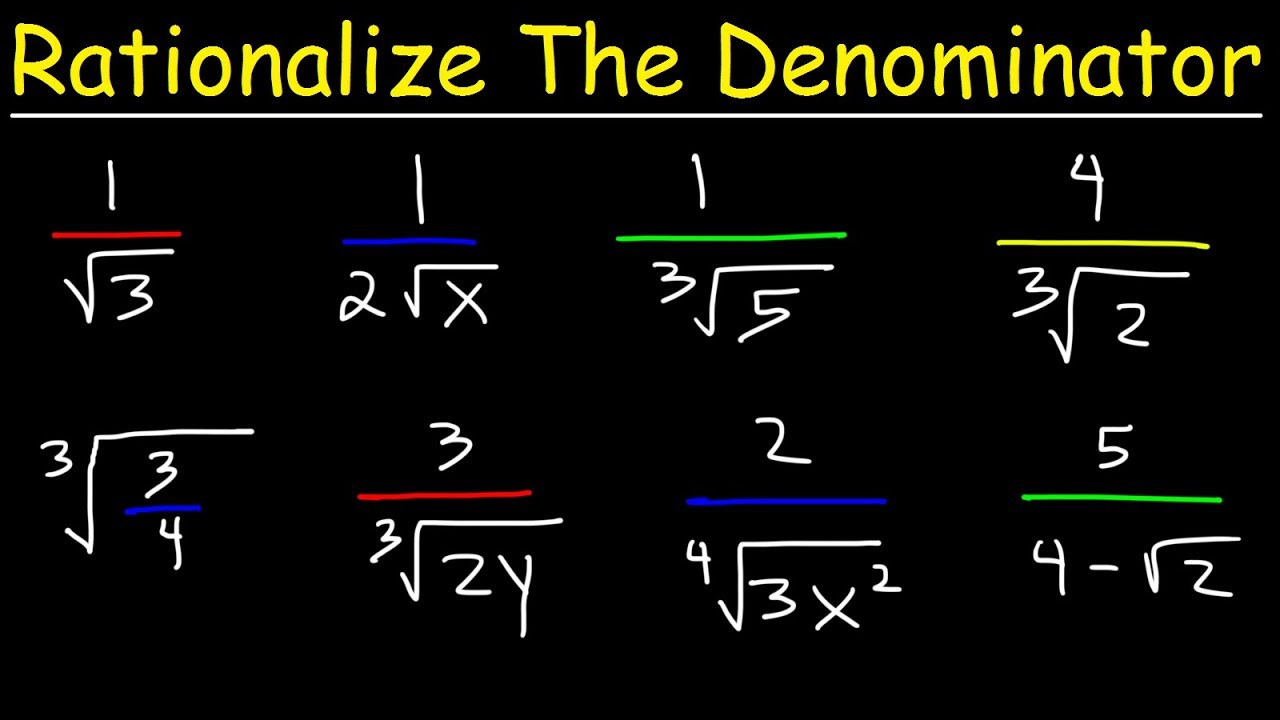
This algebra video tutorial explains how to rationalize the denominator with radicals and variables by multiplying the numerator and denominator by the something that will eliminate the radical expression in the denominator. This video contains plenty of examples and practice problems on simplifying radical expressions.
Radical Expression...
sage zodiac
lyric charm
https://www.youtube.com/watch?v=5j8a75aHaSE
Ohk!!
Well @lyric charm why there is no vc?
Vc will help to end the doubt more quickly
lyric charm
dunno, ask the mods. not me.
- i don't have the energy for voice chat right now anyway
lyric charm
mods == moderators
if you want to speak to them as a team, you can DM @shadow scaffold
midnight plankBOT
Channel closed
Closed by @sage zodiac
Use .reopen if this was a mistake.
midnight plankBOT
Available help channel!
Send your question here to claim the channel.
Remember:
• Ask your math question in a clear, concise manner.
• Show your work, and if possible, explain where you are stuck.
• After 15 minutes, feel free to ping <@&286206848099549185>.
• Type the command .close to free the channel when you're done.
• Be polite and have a nice day!
Read #❓how-to-get-help for further information on how to ask a good question, and about conduct in the question channels.
 fallen vault
I have the function 144x/(x+9)^2 but only in the domain x>=0.
Is there a tangent to the function at x=0 or no?
Because without the domain constraint it does have a tangent there but with it, the function isn't differentiable at x=0.
midnight plankBOT
fallen vault
I have the function 144x/(x+9)^2 but only in the domain x>=0.
Is there a tangent...
lyric charm
why do you claim it's not differentiable at x=0?
$\lim_{h\to 0} \frac{f(h)-f(0)}{h}$ still exists just fine, does it not??
grand pondBOT
Ann
 lyric charm
it just resolves to the one as $h \to 0^+$ due to the domain restriction, that's all -- but that doesn't stop it from existing.
grand pondBOT
Ann
 fallen vault
lyric charm
why do you claim it's not differentiable at x=0?
fallen vault
lyric charm
why do you claim it's not differentiable at x=0?
I believed that at "endpoints" functions are not differentiable
lyric charm
what, like inherently?
fallen vault
lyric charm
what, like inherently?
yea
lyric charm
well you're wrong about that, what else can i say
fallen vault
lyric charm
well you're wrong about that, what else can i say
good to know ig
So because the right side limit of the derivative exist, a tangent does exist to the function at that point?
lyric charm
yeah sure
midnight plankBOT
@fallen vault Has your question been resolved?
Channel closed
Closed by @fallen vault
Use .reopen if this was a mistake.
Available help channel!
Send your question here to claim the channel.
Remember:
• Ask your math question in a clear, concise manner.
• Show your work, and if possible, explain where you are stuck.
• After 15 minutes, feel free to ping <@&286206848099549185>.
• Type the command .close to free the channel when you're done.
• Be polite and have a nice day!
Read #❓how-to-get-help for further information on how to ask a good question, and about conduct in the question channels.
 prime garden
Is this a correct proof of the product rule?
limit h->0 (f(x+h) - f(x))/h = f'(x)
Therefore, f(x+h) = hf'(x) + f(x)
d/dx f(x) g(x) = limit h->0 (f(x+h)g(x+h) - f(x) g(x))/h = ((f'(x)h + f(x))(g'(x)h + g(x)) - f(x) g(x))/h
= (f'(x)g'(x) h^2 + f'(x) g(x) h + f(x) g'(x) - f(x) g(x))/h = h f'(x) g'(x) + f'(x) g(x) + f(x) g'(x) = 0 + f'(x) g(x) + f(x) g'(x)
midnight plankBOT
prime garden
Is this a correct proof of the product rule?
limit h->0 (f(x+h) - f(x))/h = f'(...
 fallow scarab
There are dozens of proofs online you can compare yours to
lyric charm
f(x+h) = hf'(x) + f(x)
this equality is not literally true.
it provides good intuition, but for a proof you may need something more precise like little o notation
midnight plankBOT
Channel closed
Closed by @prime garden
Use .reopen if this was a mistake.
midnight plankBOT
Available help channel!
Send your question here to claim the channel.
Remember:
• Ask your math question in a clear, concise manner.
• Show your work, and if possible, explain where you are stuck.
• After 15 minutes, feel free to ping <@&286206848099549185>.
• Type the command .close to free the channel when you're done.
• Be polite and have a nice day!
Read #❓how-to-get-help for further information on how to ask a good question, and about conduct in the question channels.
 proud ember
Hi! If a/b,c/d are Farey Neighbours in F_n, why can't they have more than 1 fraction between them in F_{n+1}? I wanna try justifying this without the fact that |bc-ad|=1? Now if b+d>n+1, they're still gonna be neighbours but what if b+d=n+1?
midnight plankBOT
proud ember
Hi! If a/b,c/d are Farey Neighbours in F_n, why can't they have more than 1 frac...
proud ember
Here's what I got so far:
so firstly, if a/b<r/(b+d)<s/(b+d)<c/d
k/(b+d) must also lie between a/b and c/d for all k beteween r and s both inclusive
so I only took the case where s=r+1
and when I did that what I got is a/b<(2d-1)/(2c-1) and 1/(bc-ad)<1/b+1/d
<@&286206848099549185>
midnight plankBOT
proud ember
<@&286206848099549185>
Please only use the <@&286206848099549185> ping once if your question has not been answered for 15 minutes. Please do not ping or DM individual users about your question.
@proud ember Has your question been resolved?
proud ember
<@&286206848099549185>
midnight plankBOT
@proud ember Has your question been resolved?
midnight plankBOT
@proud ember Has your question been resolved?
midnight plankBOT
Channel closed
Closed due to timeout
Use .reopen if this was a mistake.
Available help channel!
Send your question here to claim the channel.
Remember:
• Ask your math question in a clear, concise manner.
• Show your work, and if possible, explain where you are stuck.
• After 15 minutes, feel free to ping <@&286206848099549185>.
• Type the command .close to free the channel when you're done.
• Be polite and have a nice day!
Read #❓how-to-get-help for further information on how to ask a good question, and about conduct in the question channels.
 lime oracle
hellooo does anyone know why the magnitude and angle of RF are wrong?
 midnight plankBOT
lime oracle
hellooo does anyone know why the magnitude and angle of RF are wrong?
lime oracle
midnight plankBOT
lime oracle
hellooo does anyone know why the magnitude and angle of RF are wrong?
lime oracle
the table is correct
you dont need to give me answer im so grateful if someone guides me through it 🥺 🙏
<@&286206848099549185> 🙏
is this using the phytagorean theorem and trigo?
midnight plankBOT
@lime oracle Has your question been resolved?
 carmine sigil
@lime oracle the reason why you haven't gotten much in the way of answers is that the information you have provided is incomplete.
!original
midnight plankBOT
Please show the original problem, exactly as it was stated to you, with the entire original context. A picture or screenshot is best. If the original problem is not in English, then post it anyway! The additional context might still be helpful. Do your best to provide a translation.
midnight plankBOT
Show your work, and if possible, explain where you are stuck.
lime oracle
hold onnn, sorry. this part is actually supposed to be done by my groupmate but i am doing it insteaddd so i dont have her solution (I think she used ai 😭)
lime oracle
carmine sigil
<@1379466566604951614> the reason why you haven't gotten much in the way of answ...
this is only what our teacher gave usss
let me showww
carmine sigil
Do you not have a diagram of the way the pulleys are arranged?
lime oracle
aaaa wait i just realizeddd

im also watching this video right now, not sure if its the right one that i should watch but https://youtu.be/RxV06Oj5sMc?si=veTlzsGBCy_Lntee

This physics video tutorial explains how to find the resultant of two vectors.
Direct Link to The Full Video: https://bit.ly/3ifmore
Full 31 Minute Video on Patreon:
https://bit.ly/41WNmI9
Vectors - Free Formula Sheet:
https://www.video-tutor.net/physics-formula-sheets.ht...
lime oracle
lime oracle
aaaa wait i just realizeddd
i genuinely just saw the diagram man
carmine sigil
lime oracle
im also watching this video right now, not sure if its the right one that i shou...
This seems like a good video to watch
lime oracle
i looked for the N part myself 😭
carmine sigil
lime oracle
i genuinely just saw the diagram man
No worries. A difficult part of learning is not knowing which questions to ask.
lime oracle
thank you, i just thought it was a picture of our teacher showing us how to assemble the force table
carmine sigil
So when I ask, "do you have a diagram?" That can be useful as an answer to a question you didn't even know you had 🙂
lime oracle
carmine sigil
So when I ask, "do you have a diagram?" That can be useful as an answer to a que...
yesyesss ❤️
this is my current progress
carmine sigil
Good luck with the Squid Game btw.
lime oracle
its very small LOL
 lime oracle
carmine sigil
Good luck with the Squid Game btw.
lime oracle
carmine sigil
Good luck with the Squid Game btw.
AGHHH s1 will always be my fav
lime oracle
carmine sigil
Follow along with the video
Okaaayy
carmine sigil
And then, if you still have questions, let me know.
lime oracle
okay okay, thank you!!!
carmine sigil
Ping me, I'm going to look elsewhere for a minute
carmine sigil
lime oracle
if im done will it be alright if u check it?
Absolutely
May I also make a recommendation, you don't have to do this, but it might help your other students (and yourself)
Once you figure out how to do this, it might help you solidify your understanding if you teach your project partner how to do it.
lime oracle
carmine sigil
May I also make a recommendation, you don't have to do this, but it might help y...
YESS SURE
slr i just saw ur message
i am halfway done btw
@carmine sigil i am done but i am very unsureeee
for the clockwise/counterclockwise part when u subtract 180 degreess
 carmine sigil
,rcw
grand pondBOT
 lime oracle
i followed with the guy in youtube, but for his one of his sign was negative but mine are both positiveee
so i think i followed wrong HAHAHAA
lime oracle
thank youuu 😭 yesyes
also my part of the activity was vector resolution, and it's the same but for mine it's 46.6
carmine sigil
So I'm seeing something a little bit unusual, and I was hoping you could clear it up