#help-49
1 messages · Page 204 of 1
 narrow edge
 oak nymph
Think why
oak nymph
Think why
cuz 5 linear terms are being multiplied
hey im actually understanding ts
:D
there are 5 ways for x^4 x y because there are 5 terms in the expression
shouldnt the same be applicable to x^3 x y
narrow edge
oak nymph
You mean x³y?
sorry x^3 x y^2
oak nymph
narrow edge
sorry x^3 x y^2
Yes
 sudden yacht
narrow edge
shouldnt the same be applicable to x^3 x y
sudden yacht
narrow edge
shouldnt the same be applicable to x^3 x y
(Don't use x as multiplication symbol)
If you really really want, at least write * not x.
× is typically used in elementary schools when you have no numbers, especially no x appearing
narrow edge
oak nymph
You mean x³y?
why is x^4 * y wrong
sudden yacht
But here I strongly suggest to use either nothing (the best) or •
narrow edge
sudden yacht
(Don't use x as multiplication symbol)
If you really really want, at least write...
how to use those symbols
oak nymph
narrow edge
why is x^4 * y wrong
No you are correct there are 5 ways to get x^4*y
I meant the x for multiplying and x variable was confusing
sudden yacht
narrow edge
how to use those symbols
I think you have them on your keyboard (if you're using your mobile phone)
narrow edge
sudden yacht
I think you have them on your keyboard (if you're using your mobile phone)
im using my pc
oak nymph
How many ways will be there to get x^3*y^2
narrow edge
oak nymph
How many ways will be there to get x^3*y^2
by our previous logic shouldnt it be 5?
why is it 10
sudden yacht
narrow edge
im using my pc
Then you can copy-paste from the Internet or maybe you could try finding them with the combination "Win + ."
oak nymph
Because there are 10 ways to pick 2 things from 5 things. So there are 10 ways to pick two xs from the brackets and the rest have to be ys which makes x^3*y^2
narrow edge
sudden yacht
Then you can copy-paste from the Internet or maybe you could try finding them wi...
are brackets fine?
narrow edge
oak nymph
Because there are 10 ways to pick 2 things from 5 things. So there are 10 ways t...
ohhh
and for the x^4 * y case its 5 choose 1
oak nymph
Yes
 lethal path
yeah if you have to choose exactly 1 y, you must have the rest being xs, or 4 xs
oak nymph
What about the x^5*y^0 case
narrow edge
got it now
sudden yacht
From the best to the worst notation (in my opinion):
- x³y²
- x³ • y²
- x³ * y²
@oak nymph
(Now I won't interrupt you any more, sorry)
narrow edge
oak nymph
What about the x^5*y^0 case
0! has 1 arrangement
lethal path
so it's pretty clear there are 5 ways to do that, since you can choose 1 y from any of the 5 brackets
oak nymph
narrow edge
0! has 1 arrangement
Correct
 midnight plankBOT
Channel closed
Closed by @narrow edge
Use .reopen if this was a mistake.
lethal path
you can do:
XXOOO
XOXOO
XOOXO
XOOOX
OXXOO
OXOXO
OXOOX
OOXXO
OOXOX
OOOXX
so that gives you 4 + 3 + 2 + 1 ways for 5 choose 2 and 5 choose 3
narrow edge
lethal path
you can do:
XXOOO
XOXOO
XOOXO
XOOOX
OXXOO
OXOXO
OXOOX
OOXXO
OOXOX
OOOXX
XO?
lethal path
in general n choose 2 = 1 + 2 + 3 + ... + (n - 1)
= (n - 1)(n - 1 + 1)/2 = n(n + 1)/2
midnight plankBOT
 Available help channel!
Send your question here to claim the channel.
Remember:
• Ask your math question in a clear, concise manner.
• Show your work, and if possible, explain where you are stuck.
• After 15 minutes, feel free to ping <@&286206848099549185>.
• Type the command .close to free the channel when you're done.
• Be polite and have a nice day!
Read #❓how-to-get-help for further information on how to ask a good question, and about conduct in the question channels.
 languid mica
How do i find new limits of integration on Gaussian integral if its from 1/2 to 3/2
midnight plankBOT
languid mica
How do i find new limits of integration on Gaussian integral if its from 1/2 to ...
languid mica
When converting to polar
 sharp coral
if the gaussian integral doesn't go to infinity then the polar conversion trick doesn't really help because then you have a square region
languid mica
How can i convert it to polar?
sharp coral
and the only way to solve it is either in terms of the error function or numerically
languid mica
Or i cant
languid mica
sharp coral
and the only way to solve it is either in terms of the error function or numeric...
Why would it not work
sharp coral
you can convert it to polar, but polar only works well for circular regions, and doing the trick where you square it would give you a square region
languid mica
Cant i find what the rectangle 1x1 starting at 1/2 1/2 transofroms to in polar?
sharp coral
you certainly can, but it will not be nice to integrate
sharp coral
well you would need to convert the lines x = 1/2, x = 3/2, y = 1/2, y = 3/2 into polar coordinates
languid mica
sharp coral
well you would need to convert the lines x = 1/2, x = 3/2, y = 1/2, y = 3/2 into...
Meaning ?
Ill get a rectangle no?
sharp coral
well do you know the polar coordinate conversion formulas?
languid mica
sharp coral
well do you know the polar coordinate conversion formulas?
As in with matrix ?
Like the 2x2 matrix
sharp coral
no like [ x = r\cos\theta \qquad y = r\sin\theta ]
 grand pondBOT
cloud
 sharp coral
not the jacobian
sharp coral
but you also substitute those to get your bounds
languid mica
sharp coral
but you also substitute those to get your bounds
Yes
Problem is its 2 variables
For each bound
So how do i find them
sharp coral
well you would end up with variable bounds for the inner integral
the usual way is for the inner integral to be with respect to r, then the bounds will be the bounds on r as a function of theta
are you familiar with double integrals with variable bounds?
languid mica
sharp coral
are you familiar with double integrals with variable bounds?
How would i calculate it then
If im stuck with cosθ and sinθ in bounds
sharp coral
because there is an outer integral with respect to theta
your integral ends up looking like
[ \int_{\alpha}^{\beta} \int_{g(\theta)}^{h(\theta)} f(r, \theta) r \odif{r,\theta} ]
grand pondBOT
cloud
 sharp coral
languid mica
Yea how will i integrate e^(1/^2cosθ....
sharp coral
languid mica
Yea how will i integrate e^(1/^2cosθ....
well that's the point where you realize that converting to polar wasn't very helpful in calculating this integral
languid mica
In the inner integral i first do θ
languid mica
sharp coral
well that's the point where you realize that converting to polar wasn't very hel...
So how do i calculate it
sharp coral
either in terms of the error function or numerically
sharp coral
there is no formula that will give it to you in terms of elementary functions
if you want a "precise" formula then there is no avoiding the error function
languid mica
Can i not do any trick to find it
Like some coordinate system conversation or anything
sudden yacht
No you can't.
Even if you insist lol
languid mica
Idrk what the error function is you keep referring to
languid mica
sudden yacht
No you can't.
Even if you insist lol
Is that proven or
sharp coral
the tricks for finding the gaussian integral only worked because the limits were from -infinity to infinity. you could do a similar trick for 0 to infinity, but for any other bounds you run out of luck
sudden yacht
languid mica
Idrk what the error function is you keep referring to
Well then you really have no way to do
languid mica
sharp coral
the tricks for finding the gaussian integral only worked because the limits were...
Is there any other coordinate change or jdk
sharp coral
languid mica
Idrk what the error function is you keep referring to

In mathematics, the error function (also called the Gauss error function), often denoted by erf, is a function
      e
      r
      f

    :

      C

    →

      C


{\displaystyle \mathrm {erf} :\mathbb {C} \to \mathbb {C} }
…
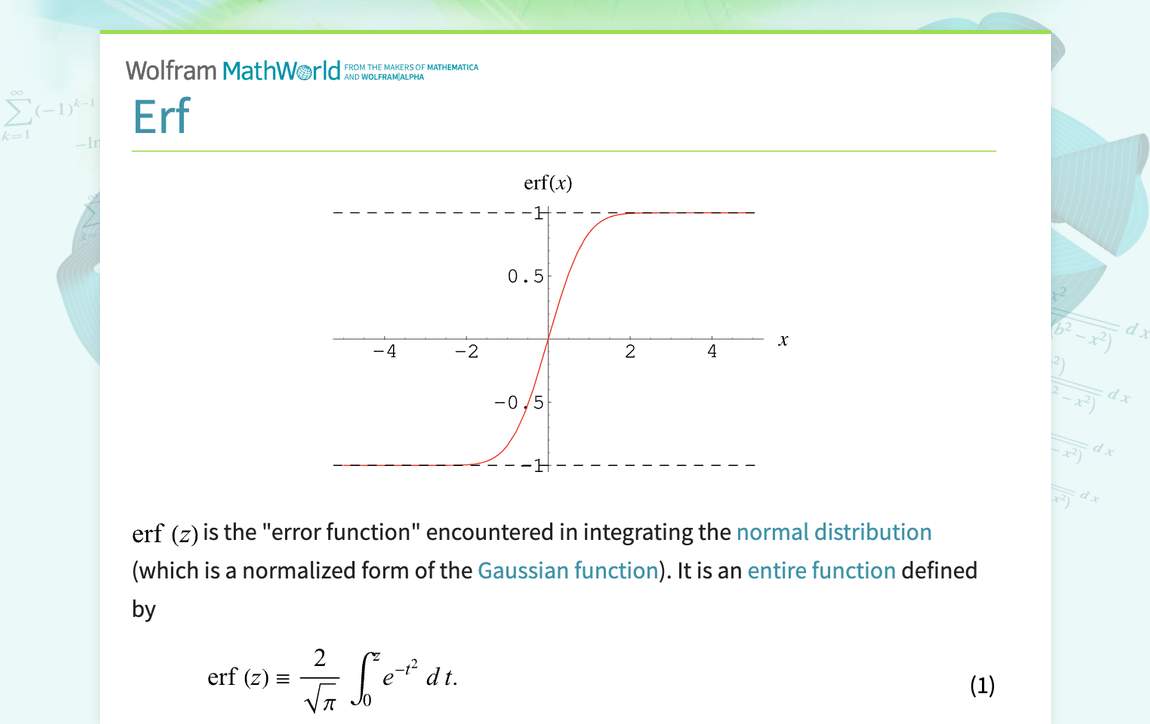
erf(z) is the "error function" encountered in integrating the normal distribution (which is a normalized form of the Gaussian function). It is an entire function defined by erf(z)=2/(sqrt(pi))int_0^ze^(-t^2)dt. (1) Note that some authors (e.g., Whittaker and Watson 1990, p. 341) define erf(z) without the leading factor of 2/sqrt(pi). Erf is ...
languid mica
Like its proven that it cant be calculated in terms of elementary functions
sharp coral
you can do plenty of coordinate changes but none that would give an elementary formula for the integral
languid mica
sharp coral
you can do plenty of coordinate changes but none that would give an elementary f...
How do you know
languid mica
sharp coral
https://en.wikipedia.org/wiki/Error_function
https://mathworld.wolfram.com/Erf.h...
What is this
sudden yacht
Try it and see what you get
languid mica
What θ bounds though
sharp coral
do the same thing you did to find the r bounds but solve for theta instead
 crystal plover
It is known that no antiderivative of e^(-x²) can be written as finite combination of elementary simple functions
The error function erf(x) is basically defined to be its antiderivative (up to some constants)
You can keep trying, but it won't get you anywhere
sudden yacht
crystal plover
You can keep trying, but it won't get you anywhere
He won't like this fact lol
But this is a matter of fact 🤷♂️
 languid mica
 dawn dagger
bruh he opened a help channel
dawn dagger
bruh he opened a help channel
I opened before
midnight plankBOT
@languid mica Has your question been resolved?
Channel closed
Closed by @languid mica
Use .reopen if this was a mistake.
Available help channel!
Send your question here to claim the channel.
Remember:
• Ask your math question in a clear, concise manner.
• Show your work, and if possible, explain where you are stuck.
• After 15 minutes, feel free to ping <@&286206848099549185>.
• Type the command .close to free the channel when you're done.
• Be polite and have a nice day!
Read #❓how-to-get-help for further information on how to ask a good question, and about conduct in the question channels.
 woeful turret
can someone help me do this using binomial approximation
 midnight plankBOT
woeful turret
can someone help me do this using binomial approximation
midnight plankBOT
woeful turret
can someone help me do this using binomial approximation
 fallow scarab
do you mean taylor expansion?
woeful turret
sorry
yes
i mean ill send u a pic..im not really sure of the method name
i put theta = h+pi/4
so h--->0

and this is what i got
im kind of new to limits..so are we allowed to expand it like this?
fallow scarab
quite messy and hard to follow
woeful turret
i got the answer by simplifying
cos theta + sin theta as sqrt 2 ( cos (pi/4 - theta)
woeful turret
woeful turret
but im unsure why this method was not successful
woeful turret
woeful turret
im kind of new to limits..so are we allowed to expand it like this?
^^
 dreamy lichen
woeful turret
dreamy lichen
woeful turret
uh so you used the fact that sinx ~ x for x near 0?
It's quite hard to follow, but if you used that, which it seems like you did, then its incorrect
woeful turret
dreamy lichen
uh so you used the fact that sinx ~ x for x near 0?
uh no i used sin x expansion
dreamy lichen
woeful turret
x-(x^3)/3!
this works pretty well, as long as x is near 0
unfortunately, theta + pi/4 isnt near 0 (as theta -> 0)
woeful turret
yeah
woeful turret
dreamy lichen
unfortunately, theta + pi/4 isnt near 0 (as theta -> 0)
thats why i put theta as h+pi/4
so that h--->)
h-->0
oh
dreamy lichen
woeful turret
thats why i put theta as h+pi/4
That doesnt solve the issue
woeful turret
wait i get ur point
dreamy lichen
the argument of sine is still around pi/4
woeful turret
dreamy lichen
this works pretty well, as long as x is near 0
i did not know it was only applicable for x near to 0
dreamy lichen
if x is far from 0, you would have to use the entire expansion
which is infinite
so that wouldnt be very helpful
woeful turret
thats why when i simplified it to this form it worked
 dreamy lichen
or alternatively, you would have to make an expansion around x = pi/4
dreamy lichen
woeful turret
thats why when i simplified it to this form it worked
now when theta -> pi/4, theta - pi/4 -> 0
so the argument of cosine goes to 0
so the approximation should work fine
but it's also one of the well known limits
(1 - cosx) / x^2 -> 1/2 (as x -> 0) iirc
woeful turret
whats iirc
dreamy lichen
"if i remember correctly"
midnight plankBOT
Channel closed
Closed by @woeful turret
Use .reopen if this was a mistake.
 desert siren
dreamy lichen
(1 - cosx) / x^2 -> 1/2 (as x -> 0) iirc
desert siren
dreamy lichen
(1 - cosx) / x^2 -> 1/2 (as x -> 0) iirc
General result is (1-cos(mx))/x^2 limit as x approaches 0 is m^2/2 :)
midnight plankBOT
Available help channel!
Send your question here to claim the channel.
Remember:
• Ask your math question in a clear, concise manner.
• Show your work, and if possible, explain where you are stuck.
• After 15 minutes, feel free to ping <@&286206848099549185>.
• Type the command .close to free the channel when you're done.
• Be polite and have a nice day!
Read #❓how-to-get-help for further information on how to ask a good question, and about conduct in the question channels.
 mint ravine
Wait, are the cousins considered distinguishable or not?
 midnight plankBOT
mint ravine
Wait, are the cousins considered distinguishable or not?
midnight plankBOT
mint ravine
Wait, are the cousins considered distinguishable or not?
 quartz hornet
i would start by asuming humans are distinguishable yes
desert siren
Lolz
mint ravine
sorry i have to go now i'll keep this channel open
quartz hornet
[4] 1
[3,1] 4
[2,2] 6
[2,1,1] 6
?
i liked your method , did i miss something brandon
quartz hornet
s(4,1)+s(4,2)+s(4,3)?
desert siren
Officially zonked 
mint ravine
.close
midnight plankBOT
Channel closed
Closed by @mint ravine
Use .reopen if this was a mistake.
midnight plankBOT
Available help channel!
Send your question here to claim the channel.
Remember:
• Ask your math question in a clear, concise manner.
• Show your work, and if possible, explain where you are stuck.
• After 15 minutes, feel free to ping <@&286206848099549185>.
• Type the command .close to free the channel when you're done.
• Be polite and have a nice day!
Read #❓how-to-get-help for further information on how to ask a good question, and about conduct in the question channels.
 sand flume
So for the part where he starts -a≤x≤a he says -x≤a. So I understand he uses the given and just multiplies it by negative one. But what about if you looked at it like this. If x less than 0 |x|=-x. -x<x≤a. So -x<a but then we have two definitions
 midnight plankBOT
sand flume
So for the part where he starts -a≤x≤a he says -x≤a. So I understand he uses the...
midnight plankBOT
sand flume
So for the part where he starts -a≤x≤a he says -x≤a. So I understand he uses the...
 velvet compass
If x is less than zero then -x < x is false.
midnight plankBOT
Channel closed
Closed by @sand flume
Use .reopen if this was a mistake.
midnight plankBOT
Available help channel!
Send your question here to claim the channel.
Remember:
• Ask your math question in a clear, concise manner.
• Show your work, and if possible, explain where you are stuck.
• After 15 minutes, feel free to ping <@&286206848099549185>.
• Type the command .close to free the channel when you're done.
• Be polite and have a nice day!
Read #❓how-to-get-help for further information on how to ask a good question, and about conduct in the question channels.
 bright shoal
I have some doubt about Goldbach Conjecture
midnight plankBOT
bright shoal
I have some doubt about Goldbach Conjecture
 lyric charm
!da2a
midnight plankBOT
No need to ask “Can I ask…?” or “Does anyone know about…?”—it’s faster for everyone if you just ask your question! See https://dontasktoask.com/
lyric charm
ask away ig
oak nymph
why did you delete your question (same as this) in https://discord.com/channels/268882317391429632/1018703538517454919?
lyric charm
let him spit it out
oak nymph
he asked already, "can we solve it"
lyric charm
@bright shoal
midnight plankBOT
@bright shoal Has your question been resolved?
lyric charm
no question was ever asked
bright shoal
So Sorry
i am struggling with network issues
When i wrote the question in help channel 48
help channel did not get occupied by me
lyric charm
midnight plank
<@920981665692647434> Has your question been resolved?
click ❌ on this
bright shoal
no like i have a doubt
lyric charm
bright shoal
When i wrote the question in help channel 48
well then repost the question here
bright shoal
Does anyone have any info on goldbach conjecture
i need to ensure before asking the actual doubt
lyric charm
bright shoal
no like i have a doubt
click ❌ on bot's prompt unless you want the channel to close
lyric charm
bright shoal
i need to ensure before asking the actual doubt
no you need to ask the doubt now
bright shoal
So like is there any exact formula to calculate the number of goldbach pairs for even number
I tried looking up but like could not find any valid source
Mind looking on this?

This is like even number v/s goldbach pairs for each upto 100000 number
s
 pine wave
bright shoal
pine wave
bright shoal
Probably computed by computer program
bright shoal
i mean number of goldbach pairs
bright shoal
pine wave
Probably computed by computer program
Yes but like i was just interested in asking do we have any formula to calculate the number
of pairs
Sorry guys if like this is not suitable for here but like i asked this in Python and WoC
pine wave
Probably doesnt get any easier than "sieve out primes and check"
oak nymph
if we did, it would probably not be hard to decide then if no. of pairs is >0 for all even numbers or =0 for some even numbers thus solving the conjecture
bright shoal
pine wave
Probably doesnt get any easier than "sieve out primes and check"
Yes
Yes
i am researching on this
pine wave
pine wave
Probably doesnt get any easier than "sieve out primes and check"
Granted some fast convolution algorithm can help but... thats about all the computational speedup you have
 carmine sigil
Yes, there is, but it involves calculating it by simply enumerating the possible pairs, and checking if both numbers are prime
bright shoal
I have been working and learning prime checking algos goldbach conj primality test etc since few days
carmine sigil
oh I was scrolled up lol
bright shoal
So like i thought maybe working on a formula would lead in the direction of solving it
Then i came here to like
cross verify that are their any approximations
and there were as Omnipotent told
bright shoal
pine wave
Granted some fast convolution algorithm can help but... thats about all the comp...
Convolution algorithm?
Could you describe some more i could apply that
cause current algo is slow and like sieve takes up space
lets say for n>10^12
pine wave
bright shoal
lets say for n>10^12
Sorry cant help for that
Sieve + convolution can only take you to 10^9
bright shoal
No like describe some about how to define a convolution algorithm
I am writing this down one sec
pine wave
Look for FFT (fast fourier transform)
bright shoal
scipy.fft ?
carmine sigil
@bright shoal do you understand what a convolution is?
if not, you might need some additional background education before you can hope to tackle and open problem 😉
midnight plankBOT
Channel closed
Closed due to timeout
Use .reopen if this was a mistake.
pine wave
You kinda want exact answers so you need to work in a finite field
bright shoal
rough idea like somewhat combining two functions
pine wave
.reopen
midnight plankBOT
✅
carmine sigil
it's a specific method for doing that, but yeah that's the gist.
bright shoal
So like fft s would help in this case
pine wave
basically "count number of pairs summing up to x" if you need answers across different x can be processed together by running something like a fourier transform
bright shoal
i checked fft and i could implement them using scipy
but how to define a convolution for this
pine wave
Its a discrete convolution
pine wave
Another way is encoding the entire list inside a big integer and doing multiplication
But of course number of digits increases with how big your n is
bright shoal
oh so you mean like first calculate all by running a sum and sieve and then use some fourier transform or so
bright shoal
pine wave
Another way is encoding the entire list inside a big integer and doing multiplic...
the sieve?
pine wave
So you would be working with squaring roughly a 10^10 digit number when doing up to n=10^9
bright shoal
oof
So like implementing a convolution algorithm would speed up ?
Man sorry but i am liking getting a little overwhelmed here
Sorry
pine wave
bright shoal
So like implementing a convolution algorithm would speed up ?
No better if the multiplication already uses convolution
carmine sigil
well, here's a question: what would checking a whole bunch of numbers accomplish in this case?
bright shoal
I am thinking
carmine sigil
if the goal is to prove the goldbach conjecture, then verifying it up to 10^20 or 10^100 or 10^10^10^100 squintillion isn't sufficient.
midnight plankBOT
Please show the original problem, exactly as it was stated to you, with the entire original context. A picture or screenshot is best. If the original problem is not in English, then post it anyway! The additional context might still be helpful. Do your best to provide a translation.
pine wave
Oh wait not exactly
bright shoal
Lets say one derives a exact formula to like find the number of goldbach pairs
how we will verify it that it works for all n
like back to the whiteboard typa thing
until its a rigorous proof
pine wave
Is it going to be easy looking at 10^9 numbers and picking out a formula
pine wave
bright shoal
You already can see this and you cant imagine a formula which does this
What will more data give you?
bright shoal
Look i am just asking if on rigorous analysis lets say you define a formula or function which fits even 10^4 numbers and fails for 10^7 ?
i just mean how would it be verified that formula is true for all n until its derived from a rigorous proof?
right?
Like omnipotent said the case is same with the goldbach conjecture
bright shoal
pine wave
You already can see this and you cant imagine a formula which does this
Man my original question was like is there a formula but when you told about convolution algorithm i got eager sorry
i was eager to like speed up
and run for more numbers faster
Could you help me like develop and understand how would this help in working out number of pairs for more numbers
If it is pointless then sorry for taking time of you all and thanks for the help to all the people who came here
pine wave
bright shoal
Could you help me like develop and understand how would this help in working out...
You run against output limits rather easily when you want to break past 10^9
To produce m bits of output takes O(m) time at least
bright shoal
Right
Man i want to like understand what was about the convolution algorithm you were telling
sieve can be implemented how to implement that
lets say we only want to test upto 10^9
Man i am not interested in asking ai or something thats i would be grateful if you could help
😔 🥲
pine wave
Task: calculate 110110111 * 110110111 and see how the digits of the result match with number of ways to make 6 to 20 with 2 primes
bright shoal
through sieve we would get O(Nlog(logN)) to find prime list
lets say N is 10^9 here
thats done
bright shoal
pine wave
Task: calculate 110110111 * 110110111 and see how the digits of the result match...
ok lemme check
6 to 20 with 2 primes?
pine wave
Essentially only the even numbers
bright shoal
like every number of pairs for each number from 6 to 20 right
pine wave
Since the digits of 110110111 encode 19 17 13 11 7 5 3
Actually it works all the way up to 22
,calc 110110111*110110111
grand pondBOT
Result:
1.2124236544432e+16
6: 3+3
8: 3+5 5+3
10: 3+7 5+5 7+3
12: 5+7 7+5
14: 3+11 7+7 11+3
bright shoal
right
pine wave
So essentially something similar can calculate number of ways
Though you may need to pad the digits further apart if it gets to more than 10/100/1000/... ways
pine wave
Yeah
bright shoal
oh
Bro sorry
but i am like confused how this relates to the number sorry again
i am like slow
Sorry again
pine wave
bright shoal
12,12,42,36,54,44,32,321
Ones digit: ways to make 6
Tens digit: ways to make 8
Hundreds digit: ways to make 10
... all the way until 22 (24 is also correct but 26 is missing 23+3 and is hence wrong)
bright shoal
no way
what is this sorcery
no way
Man i cant still believe it
No way
like you wanna say
encoding and multiplying two large numbers gives me no of pairs
beginning from ones digit
no way
pine wave
$110110111=\sum_{3\leq p\leq19,\text{prime}}10^{(p-3)/2}$
 grand pondBOT
Element118
 pine wave
$110110111^2=\sum_{3\leq p,q\leq19,\text{prime}}10^{(p+q-6)/2}$
grand pondBOT
Element118
 bright shoal
Man this is sorcery indeed where do we learn such math
pine wave
By living in my head
bright shoal
Man
you are too genius please stay
i now definitely know with your help imma gonna build the algo
please
pine wave
idk if the algo is going to achieve anything
bright shoal
but like this is like incoding all number of pairs how
pine wave
i have better projects for myself
bright shoal
pine wave
i have better projects for myself
🥲
man you single handedly calculated 6 to 22 number of ways to prime
using like multiplication
which can be made faster using ffts
🥲
man your knowledge is helping in a good way
🥲
So like how do we encode for big N
lets say 100
pine wave
lemme show you for up to 100
bright shoal
thanks man
just teach me this i can implement fft for faster multiplication myself thanks
oak nymph
i think most programming languages already implement it
carmine sigil
Well, I wouldn't say most. You generally have to use a bignum library to get fft based multiplication
bright shoal
Yes
pine wave
$100000001000001000100000101000100000101000001000100010100010000010100000100010100010100010101=\sum_{3\leq p\leq97,\text{prime}}100^{(p-3)/2}$
grand pondBOT
Element118
 bright shoal
so like fft would do multiplication with time complexity O(nlogn)
right
what
Man such big numbers is this possible to achive 10^6 with this?
i mean like pairs for prime numbers
carmine sigil
pine wave
100000001000001000100000101000100000101000001000100010100010000010100000100010100010100010101 if i didnt make a mistake
bright shoal
carmine sigil
https://en.wikipedia.org/wiki/Sch%C3%B6nhage%E2%80%93Strassen_algorithm
Yes i will implement that
bright shoal
I am like wanting to work as much as i can this summer on primes
without ai
i feel scipy has it l
bright shoal
Omnipotent do you have any knowledge
bright shoal
 quiet hinge
the libraries are made without ai
quiet hinge
the libraries are made without ai
yes these are like libraries built by people
these are for years
Python is approx 33 or 34 years old man
Thats why people say everything is there in python
Omnipotent how is Element118 doing this trickery
is there any math i can learn?
pine wave
bright shoal
Omnipotent how is Element118 doing this trickery
I mean i finished my undergrad in math
bright shoal
grand pond
**Element118**
lemme check the digits of this number
pine wave
In general use the summation to calculate the number
pine wave
Its gonna go up to about 10^10 digits for going up to 10^9
oak nymph
grand pond
**Element118**
if we want to start encoding primes from some q, we can make the exponents in the summation (p-q)/2
bright shoal
and like fft has nlogn where n is number of digits right?
oak nymph
does that help in saving computation?
bright shoal
fft would save
carmine sigil
bright shoal
Omnipotent how is Element118 doing this trickery
I showed you the page with the algorithm, you just need to read and understand if you want to learn how to multiply. There's also, like, the Russian Peasant's algorithm for multiplying numbers. element 118 could have been using that as well.
bright shoal
carmine sigil
I showed you the page with the algorithm, you just need to read and understand i...
no like how is encoding these primes
and like the sum?
pine wave
carmine sigil
I showed you the page with the algorithm, you just need to read and understand i...
Russian peasant is still quadratic time tho
bright shoal
carmine sigil
I showed you the page with the algorithm, you just need to read and understand i...
Thanks again
Sure i am gonna read
bright shoal
Which
oh that one
so we need to sum
oh
so like we just need to sum for the prime numbers we want?
and we get the number
like the bounds
right?
pine wave
Hard to get bounds this way
bright shoal
But lets say we do for 3<=p,q<=10^9
so we need 10^9 prime number right
oh shi
we need all 10^9 numbers
by sieve
pine wave
Yeah you still need to sieve
bright shoal
O(nlog(logn))
ok
and like lets say we get the number
how much complexity does the sum have
pine wave
But after you sieve you construct the big number, square it then read the digits
pine wave
You may need to work in the computers native base to speed up
bright shoal
like numbers would be summed up
pine wave
Which is likely a power of 2
pine wave
So instead of 100^... you might want to do 1024^...
 pine wave
because its essentially useless for this problem
bright shoal
Man i am shocked
bright shoal
pine wave
because its essentially useless for this problem
why?
like its making finding pairs faster right
its useful
pine wave
Calculating lots of values brings you no closer to solving
bright shoal
;-;
i know you are right but this solves my current problem of computing
bigger number pairs
ok so like
Sieve
to find bounds
then we sum to get number
what is tc of sum ?
fft has O(nlogn) for n bits right?
pine wave
You may have to optimize that part
Summing up - best to see how the numbers work to see what base to use instead of power of 10
I only did power of 10 for human understanding
midnight plankBOT
@bright shoal Has your question been resolved?
bright shoal
@pine wave Sorry i went
actually i need to go
i will come
hopefully this does not reset due to timeout
pine wave
It kinda does
But at least the messages stay on this server
If you need to dm me, you may, but i may not be available at all times
midnight plankBOT
@bright shoal Has your question been resolved?
 analog canyon
hiiii i'm new here
sudden yacht
analog canyon
hiiii i'm new here
!occupied
midnight plankBOT
analog canyon
hiiii i'm new here
Someone else is already using this help channel. If you need help with a question, please open your own help channel/thread (see #❓how-to-get-help for instructions).
analog canyon
sudden yacht
!occupied
oh sorry
sudden yacht
Don't worry
midnight plankBOT
Channel closed
Closed due to timeout
Use .reopen if this was a mistake.
Available help channel!
Send your question here to claim the channel.
Remember:
• Ask your math question in a clear, concise manner.
• Show your work, and if possible, explain where you are stuck.
• After 15 minutes, feel free to ping <@&286206848099549185>.
• Type the command .close to free the channel when you're done.
• Be polite and have a nice day!
Read #❓how-to-get-help for further information on how to ask a good question, and about conduct in the question channels.
 inland patio
I'm reading on Wikipedia that polynomials in one variable over a field F are zero on finite sets or on all of F. The latter case occurs iff it is the zero polynomial, correct?
midnight plankBOT
inland patio
I'm reading on Wikipedia that polynomials in one variable over a field F are zer...
lyric charm
yes
inland patio
.close
midnight plankBOT
Channel closed
Closed by @inland patio
Use .reopen if this was a mistake.
midnight plankBOT
Available help channel!
Send your question here to claim the channel.
Remember:
• Ask your math question in a clear, concise manner.
• Show your work, and if possible, explain where you are stuck.
• After 15 minutes, feel free to ping <@&286206848099549185>.
• Type the command .close to free the channel when you're done.
• Be polite and have a nice day!
Read #❓how-to-get-help for further information on how to ask a good question, and about conduct in the question channels.
 chilly cobalt
Let ABC be a triangle with orthocenter H. The tangent lines from A to the circle with diameter BC touch this circle at P and Q. Prove that H,P,Q are collinear
midnight plankBOT
chilly cobalt
Let ABC be a triangle with orthocenter H. The tangent lines from A to the circle...
chilly cobalt
no idea😓
i know that PQ is polar of A wrt to the circle but how do i show that H is on the polar??
midnight plankBOT
@chilly cobalt Has your question been resolved?
midnight plankBOT
Channel closed
Closed due to timeout
Use .reopen if this was a mistake.
Available help channel!
Send your question here to claim the channel.
Remember:
• Ask your math question in a clear, concise manner.
• Show your work, and if possible, explain where you are stuck.
• After 15 minutes, feel free to ping <@&286206848099549185>.
• Type the command .close to free the channel when you're done.
• Be polite and have a nice day!
Read #❓how-to-get-help for further information on how to ask a good question, and about conduct in the question channels.
 waxen knot
For what values of the parameter m the equation |x − 1| + |x + 2| = m has
maximum number of solutions?
midnight plankBOT
waxen knot
For what values of the parameter m the equation |x − 1| + |x + 2| = m has
maxi...
 topaz epoch
waxen knot
For what values of the parameter m the equation |x − 1| + |x + 2| = m has
maxi...
topaz epoch
waxen knot
For what values of the parameter m the equation |x − 1| + |x + 2| = m has
maxi...
Consider the x-values where the moduli change sign
Then just do case bashing
midnight plankBOT
@waxen knot Has your question been resolved?
Channel closed
Closed by @waxen knot
Use .reopen if this was a mistake.
Available help channel!
Send your question here to claim the channel.
Remember:
• Ask your math question in a clear, concise manner.
• Show your work, and if possible, explain where you are stuck.
• After 15 minutes, feel free to ping <@&286206848099549185>.
• Type the command .close to free the channel when you're done.
• Be polite and have a nice day!
Read #❓how-to-get-help for further information on how to ask a good question, and about conduct in the question channels.
sand flume
 midnight plankBOT
sand flume
sand flume
midnight plankBOT
sand flume
sand flume
How can I properly format this proof
 runic hamlet
you should be more concerned with the fact that what you are trying to prove is false
 blissful pier
Counterexample: x=1
dreamy lichen
sand flume
Seems like you intended to write |x| = 0 <=> x = 0
sand flume
blissful pier
Counterexample: x=1
Yes but if you plug that in the definition you get 1
sand flume
runic hamlet
you should be more concerned with the fact that what you are trying to prove is ...
How so?
blissful pier
sand flume
Yes but if you plug that in the definition you get 1
but |1|=1, however 1≠0
sand flume
Oh oops
Ok sorry for that but then what is the right way to format this because it looks ugly
 sage helm
Generally when you're doing proofs of an iff (<=>) statement, you'd just break it in two parts, and there's really no need for the bullet point or the "Work" subheading
dreamy lichen
You could either go for a one liner
|x| = 0 iff ...... iff x = 0
or split it into the two directions as neon suggested
sand flume
So I need to show that if |x| = 0 then x=0 and the other way around right?
But what about the actual formating itself with latex
runic hamlet
you can also do
\begin{enumerate}
  \item[$\implies$] this direction
  \item[$\impliedby$] the other direction
\end{enumerate}```Also I just want to make sure it would be necessary to define the absolute value definition correct?
sand flume
Why is that because don't we need to refer to it when evaluating |x|
runic hamlet
sure but that doesnt mean we have to copy it down from whereever else we defined it
\begin{enumerate}
  \item[$\implies$] Let $\abs{x}=0$. We consider two cases. Let first $x\geq 0$. From the definition of the absolute value it follows that $0=\abs{x}=x$, i.e. $x=0$. Let now $x<0$. Then from the definition of the absolute value it follows that $0=\abs{x}=-x$, hence $x=0$. In both cases we see that $x=0$.
  \item[$\impliedby$] Let $x=0$. Then in particular $x\geq 0$ and from the definition of the absolute value it follows that $\abs{x}=x=0$.
\end{enumerate}```for example something like that
but proof writing and formatting is somewhat subjective and other people will write and format it differently
midnight plankBOT
Channel closed
Closed by @sand flume
Use .reopen if this was a mistake.
sage helm
also if you think the arrows are too long, you can use \Rightarrow and \Leftarrow instead
runic hamlet
you can also put them in () or in "" or something else
sand flume
Ok thank you
midnight plankBOT
Available help channel!
Send your question here to claim the channel.
Remember:
• Ask your math question in a clear, concise manner.
• Show your work, and if possible, explain where you are stuck.
• After 15 minutes, feel free to ping <@&286206848099549185>.
• Type the command .close to free the channel when you're done.
• Be polite and have a nice day!
Read #❓how-to-get-help for further information on how to ask a good question, and about conduct in the question channels.
 sullen scaffold
Hello,
Bayesian inference: Where does it comes the ' in the integral?
 midnight plankBOT
sullen scaffold
Hello,
Bayesian inference: Where does it comes the ' in the integral?
sullen scaffold
midnight plankBOT
sullen scaffold
Hello,
Bayesian inference: Where does it comes the ' in the integral?
sullen scaffold
Or am I overcomplicating stuffs and it's simply the theta?
 subtle blaze
It’s just another symbol
It’s being integrated away
It’s just the dummy symbol for integration
midnight plankBOT
@sullen scaffold Has your question been resolved?
Channel closed
Closed by @sullen scaffold
Use .reopen if this was a mistake.
Available help channel!
Send your question here to claim the channel.
Remember:
• Ask your math question in a clear, concise manner.
• Show your work, and if possible, explain where you are stuck.
• After 15 minutes, feel free to ping <@&286206848099549185>.
• Type the command .close to free the channel when you're done.
• Be polite and have a nice day!
Read #❓how-to-get-help for further information on how to ask a good question, and about conduct in the question channels.
 upbeat timber
,, \int_2^n \frac{\ln(x)}{x^3} \dd{x}
grand pondBOT
criRata
 midnight plankBOT
upbeat timber
,, \int_2^n \frac{\ln(x)}{x^3} \dd{x}
lyric charm
midnight plankBOT
upbeat timber
,, \int_2^n \frac{\ln(x)}{x^3} \dd{x}
lyric charm
not a lot else you can do
upbeat timber
lyric charm
not a lot else you can do
how do i verify if my work is correct?
lyric charm
look over it painfully
 dire tundra
hi anyone?
upbeat timber
dire tundra
hi anyone?
no
this is my channel , go read those introduction channels
rules and other shit
dire tundra
i need to know what are the prerequisites of abstract algebra
upbeat timber
bruh
or ask in #math-discussion
if its a question related to a hormework or smth , open a channel
 zealous schooner
upbeat timber
like its really long bruh
zealous schooner
upbeat timber
like its really long bruh
Do you know the tabular method of IBP? Might prove to be a bit easier
dire tundra
bro its fine i'll ask them
upbeat timber
zealous schooner
Do you know the tabular method of IBP? Might prove to be a bit easier
hmm , i just use u ,du
and then integrate by parts
should i learn it ?
zealous schooner
It's basically the same but using the tabular method can be easier to write

Integration by parts by using the DI method! This is the easiest set up to do integration by parts for your calculus 2 integrals. We will also do 3 integrals to illustrate the 3 stops of the DI method.
Dear calculus teachers, please let students use the DI Method (& why it is really the same as integration by parts) 👉 https://youtu.be/8xPfNu...
midnight plankBOT
Channel closed
Closed by @upbeat timber
Use .reopen if this was a mistake.
 dusty portal
upbeat timber
like its really long bruh
dusty portal
upbeat timber
like its really long bruh
You can get an easier IBP with the sub u=ln(x)
upbeat timber
.reopen
midnight plankBOT
✅
dusty portal
(or just a faster one)
grand pondBOT
criRata
 upbeat timber
is this where i ibp @dusty portal ?
dusty portal
upbeat timber
is this where i ibp <@1245133657690214403> ?
Yes
 old ravine
dire tundra
i need to know what are the prerequisites of abstract algebra
old ravine
dire tundra
i need to know what are the prerequisites of abstract algebra
proof writing
parsing logical statements
dusty portal
$\int ue^{-2u}du$
old ravine
set theory
grand pondBOT
;(
 dusty portal
old ravine
proof writing
dusty portal
old ravine
proof writing
!occupied
midnight plankBOT
old ravine
proof writing
Someone else is already using this help channel. If you need help with a question, please open your own help channel/thread (see #❓how-to-get-help for instructions).
midnight plankBOT
Channel closed
Closed by @upbeat timber
Use .reopen if this was a mistake.
midnight plankBOT
Available help channel!
Send your question here to claim the channel.
Remember:
• Ask your math question in a clear, concise manner.
• Show your work, and if possible, explain where you are stuck.
• After 15 minutes, feel free to ping <@&286206848099549185>.
• Type the command .close to free the channel when you're done.
• Be polite and have a nice day!
Read #❓how-to-get-help for further information on how to ask a good question, and about conduct in the question channels.
sand flume
How can I prove |. |x|-|y|. |≤|x-y|
midnight plankBOT
sand flume
How can I prove |. |x|-|y|. |≤|x-y|
 exotic stratus
sand flume
How can I prove |. |x|-|y|. |≤|x-y|
exotic stratus
sand flume
How can I prove |. |x|-|y|. |≤|x-y|
!showyourwork
midnight plankBOT
sand flume
How can I prove |. |x|-|y|. |≤|x-y|
Show your work, and if possible, explain where you are stuck.
sand flume
exotic stratus
!showyourwork
Ok so I have attempted it in two ways

@exotic stratus
I then tried using the triangle inequality but that was also a dead end
exotic stratus
sand flume
I then tried using the triangle inequality but that was also a dead end
What domain are you working in?
i.e. are x and y real or complex numbers?
sand flume
exotic stratus
i.e. are x and y real or complex numbers?
Real
exotic stratus
If you go case by case this will be lengthy but that is the simplest way
sand flume
Yes I tried that but I must have made a mistake which I cannot seem to find since it gets equal not less than or equal
Quick question you state that case work is the longest what is a more efficient way then?
exotic stratus
sand flume
Yes I tried that but I must have made a mistake which I cannot seem to find sinc...
Yes, you aren't considering the differnt outputs when |x| > |y|, |x| = |y|, |x| < |y|
exotic stratus
sand flume
Quick question you state that case work is the longest what is a more efficient ...
Prolly something with triangle inequality as you also guessed, though I don't see it immediately, I think there prolly does exist one.
sand flume
exotic stratus
Prolly something with triangle inequality as you also guessed, though I don't se...
Yes I saw this on stack exchange: https://math.stackexchange.com/questions/127372/prove-that-x-y-le-x-y
But it wasn't clear how they achieved the final results
sand flume
exotic stratus
Yes, you aren't considering the differnt outputs when |x| > |y|, |x| = |y|, |x| ...
Why do we have to consider these? So if I consider these do I need to look at the different values of x and y. Or is this more important than that. And if so why
midnight plankBOT
@sand flume Has your question been resolved?
dreamy lichen
sand flume
ill have to go soon so i prob wont be able to explain it, but this is wrong
if x < 0, then |x| should be replaced with -x
you replaced it with |-x|
it's not true that ||x| - |y|| = |x-y| in general
it's true for some specific cases (x, y > 0 or x, y < 0) but not in general
sand flume
.close
midnight plankBOT
Channel closed
Closed by @sand flume
Use .reopen if this was a mistake.
midnight plankBOT
Available help channel!
Send your question here to claim the channel.
Remember:
• Ask your math question in a clear, concise manner.
• Show your work, and if possible, explain where you are stuck.
• After 15 minutes, feel free to ping <@&286206848099549185>.
• Type the command .close to free the channel when you're done.
• Be polite and have a nice day!
Read #❓how-to-get-help for further information on how to ask a good question, and about conduct in the question channels.
 safe onyx
 safe onyx

I tried graphing it
but like the equation for their intersection only gives it in x and y
$6x^{2}+4y^{2}+5\left(x^{2}+y^{2}\right)^{2}=30$
grand pondBOT
smeagol
 safe onyx
but I'm not quite sure how to get the tangent lines
I think z is constant when they intersect
since it's like a slice of the elipsoid
but this makes me doubt that now 

 fierce arrow
z isn't constant when they intersect
safe onyx
since I see purple inside of the red and blue on the outsdie
fierce arrow
z = x2 + y2
safe onyx
but I am not sure what strategy to use to get the tangent line
desert siren
grand pond
**smeagol**
Implicit diff for the tangent line from this, I think
fierce arrow
Do the gradient of both and then cross product
fierce arrow
The cross product of the gradients at that point will give you a directional vector of the tangent of the tangent line to the curve of intersection
safe onyx
I got <48,21,-10>
as the cross product
wait i messed up
<-2,2,-1> gradient at (-1,1,2) for the first eq
fierce arrow
I got <48,52,8>
safe onyx
<-12,8,20> for the gradient of the sec
fierce arrow
gradients: -2 2 -1 and -12 8 20
safe onyx
fierce arrow
I got <48,52,8>
I messed up with the first eq gradient's x comp
safe onyx
fierce arrow
I got <48,52,8>
I got this now yeah
so now that I have the direction and point I am all done?
fierce arrow
Yeah
safe onyx
just x= 48t-1 etc
midnight plankBOT
Channel closed
Closed by @safe onyx
Use .reopen if this was a mistake.
midnight plankBOT
Available help channel!
Send your question here to claim the channel.
Remember:
• Ask your math question in a clear, concise manner.
• Show your work, and if possible, explain where you are stuck.
• After 15 minutes, feel free to ping <@&286206848099549185>.
• Type the command .close to free the channel when you're done.
• Be polite and have a nice day!
Read #❓how-to-get-help for further information on how to ask a good question, and about conduct in the question channels.
dusty portal
googoogaga
 midnight plankBOT
dusty portal
googoogaga
dusty portal
midnight plankBOT
dusty portal
googoogaga
dusty portal
Mb bro
anyways this is just killing me
Note: $\kappa(a, r)={z\in\bC:|z-a|=r}$\
$I=\int_0^{2\pi}\frac{\frac12+\frac12\cos(4\theta)}{1-2p\cos(\theta)+p^2}d\theta}=\frac12I_2+\frac12\int_0^{2\pi}\frac{\cos(4\theta)}{1-2p\cos(\theta)+p^2}d\theta=\frac12I_2+\frac12I_3$, where $I_2=\int_0^{2\pi}\frac{1}{1-2p\cos(\theta)+p^2}d\theta$ and $I_3=\int_0^{2\pi}\frac{\cos(4\theta)}{1-2p\cos(\theta)+p^2}d\theta$
grand pondBOT
;(
Compile Error! Click the  reaction for more information.
(You may edit your message to recompile.)
 dusty portal
I'm slow at typing today
Jesus
So I know that $I_2=\int_{\kappa(0, 1)}\frac1{1-p(z+z^{-1})+p^2}\frac{dz}{iz}$ with the sub $z=e^{i\theta}$
Nah wrong
grand pondBOT
;(

 autumn canopy
I've seen something very similar; try to re-writing it as [\frac{A}{2i(1 - qz)} - \frac{B}{2i(1 -q \overline z)}] where $z \coloneqq e^{ix} = \cos(x) + i \sin(x)$, in the case of what I've seen, namely [\frac{q \sin(x)}{1 - 2q \cos(x) + q^2},] that was the way to go and rewrite this into a series
grand pondBOT
Kepe

 autumn canopy
This is really funny because it was on the last homework sheet at my uni
dusty portal
💀
autumn canopy
 dusty portal
Trying to find a fourier transform or something?
autumn canopy
Maybe it could be rewritten in a similar fashion
dusty portal
Or just a conversion
autumn canopy
Just conversion
dusty portal
autumn canopy
Maybe it could be rewritten in a similar fashion
I think I have the gist of it
Like, I "solved" it in my notebook but my working is very convoluted
I know how to get to the answer, I'm just not being precise
dusty portal
grand pond
**;(**
For convienience I'm just going to call $\kappa(0, 1)$ $\gamma$


 dusty portal
(quadratic explaining the simple pole part)
and thennnnnn
Ugh, since 0<p<1 we have that 1/p is outside K(0, 1) but p is inside
So we only need the residue at z=p

 dusty portal
So that is what I was missing
Now I guess we need to calculate I_3 with the same approach
grand pondBOT
;(


 patent snow
Use LaTeXOCR 
dusty portal
@gray widget Does it look good?
Fucking hell
<@&286206848099549185>
I gotta eat people
brr
GOOGOOGAGA
I NEED DA VERIFICATION
midnight plankBOT
@dusty portal Has your question been resolved?
midnight plankBOT
Channel closed
Closed due to timeout
Use .reopen if this was a mistake.
Available help channel!
Send your question here to claim the channel.
Remember:
• Ask your math question in a clear, concise manner.
• Show your work, and if possible, explain where you are stuck.
• After 15 minutes, feel free to ping <@&286206848099549185>.
• Type the command .close to free the channel when you're done.
• Be polite and have a nice day!
Read #❓how-to-get-help for further information on how to ask a good question, and about conduct in the question channels.
 spark nebula
please help me understand what is going on here
 midnight plankBOT
spark nebula
please help me understand what is going on here
midnight plankBOT
spark nebula
please help me understand what is going on here
 floral depot
spark nebula
please help me understand what is going on here
floral depot
spark nebula
please help me understand what is going on here
<@&286206848099549185>
floral depot
spark nebula
please help me understand what is going on here
Ik whats going on
math
jk
<@&286206848099549185>
velvet compass
spark nebula
please help me understand what is going on here
Any info about how g(x) and f(x) are related?
fallow scarab
spark nebula
please help me understand what is going on here
Show the full context
velvet compass
The rest if pretty simple
spark nebula
fallow scarab
Show the full context
that's the full context

question 2
let me translate
fallow scarab
spark nebula
please help me understand what is going on here
and which line confuses you first
spark nebula
fallow scarab
and which line confuses you first
second
let u = x + 1 , x: 0 -> 2pi that means that u : 1 -> 2pi + 1
but what they wrote is u : -1 -> 2pi - 1
that's the translation
 velvet compass
This is why they shifted the bounds in the 2nd line, so that after the u-sub they become the same as beforehand
spark nebula
velvet compass
This is why they shifted the bounds in the 2nd line, so that after the u-sub the...
yeah but the bounds seems wrong
how it's u = x + 1
velvet compass
u = x + 1
for the 1st integral:
when x = 2pi - 1 --> u = 2pi
when x = -1 ---> u = 0
(works)
2nd:
u = x - 1
when x = 2pi + 1 ---> u = 2pi
when x = 1 ---> u = 0
(works)
spark nebula
velvet compass
u = x + 1
for the 1st integral:
when x = 2pi - 1 --> u = 2pi
when x = -1 ---> u...
alright alright let me try to understand so let's say that you trying to integrate x from a to b and then from a - 1 to b-1 you will not get the same result meaning the changing the bounds without a changing the variable does affect the integral's result
i don't know how it worked here
and i really want to understand so i can use it later
but
hold on
does that have any relation with the 2pi period
midnight plankBOT
@spark nebula Has your question been resolved?
velvet compass
spark nebula
does that have any relation with the 2pi period
Yes
grand pondBOT
Modus
 velvet compass
In fact you can change the bounds in any way as long as they difference is 2pi
wait
I wrote it wrong
spark nebula
velvet compass
In fact you can change the bounds in any way as long as they difference is 2pi
okay but again it works only for periodic funcs
velvet compass
spark nebula
okay but again it works only for periodic funcs
Yes
spark nebula
velvet compass
Yes
Okay thank you so much
velvet compass
spark nebula
Okay thank you so much
I recommend you to read this article
The guy literally had the same problem as yours
midnight plankBOT
@spark nebula Has your question been resolved?
midnight plankBOT
Channel closed
Closed due to timeout
Use .reopen if this was a mistake.
Available help channel!
Send your question here to claim the channel.
Remember:
• Ask your math question in a clear, concise manner.
• Show your work, and if possible, explain where you are stuck.
• After 15 minutes, feel free to ping <@&286206848099549185>.
• Type the command .close to free the channel when you're done.
• Be polite and have a nice day!
Read #❓how-to-get-help for further information on how to ask a good question, and about conduct in the question channels.
 tidal turret
 midnight plankBOT
tidal turret
tidal turret
midnight plankBOT
tidal turret
tidal turret
f^-1 denotes the preimage
midnight plankBOT
@tidal turret Has your question been resolved?
tidal turret
 midnight plankBOT
@tidal turret Has your question been resolved?
tidal turret
 midnight plankBOT
@tidal turret Has your question been resolved?
midnight plankBOT
Channel closed
Closed due to timeout
Use .reopen if this was a mistake.
 hybrid crane
,w solve x - 3y = 1, -2x + y + az = 2, y + bz = b - 3
grand pondBOT


 Requested by strangequarkal
midnight plankBOT
Available help channel!
Requested by strangequarkal
midnight plankBOT
Available help channel!
Send your question here to claim the channel.
Remember:
• Ask your math question in a clear, concise manner.
• Show your work, and if possible, explain where you are stuck.
• After 15 minutes, feel free to ping <@&286206848099549185>.
• Type the command .close to free the channel when you're done.
• Be polite and have a nice day!
Read #❓how-to-get-help for further information on how to ask a good question, and about conduct in the question channels.
tidal turret
 midnight plankBOT
tidal turret
midnight plankBOT
tidal turret
 azure oracle
yea can u translate it into english
lyric charm
Let B = ... be a basis of R^3 and f : R^3 -> R^3 be the linear map whose matrix wrt B for input and E for output is [see image].
Find a ∈ R such that f(1,2,-1) = (1,3,2) and for this value of a find all v ∈ R^3 such that f(v) = (1,3,2).
 safe yew
thanks ann
lyric charm
E stands for the canonical/standard basis, yes? @tidal turret
safe yew
I was about to use my basic french to try and translate it
tidal turret
lyric charm
E stands for the canonical/standard basis, yes? <@1187916384341078070>
yes!!
i got some ideas
lyric charm
safe yew
I was about to use my basic french to try and translate it
i'm riding on that and latin lmfao
tidal turret

i can find a such that the first condition holds
the problem is when i try to figure out the preimage of (1,3,2)


,w rref {{3,2,1,1},{1,2,1,3},{2,2,1,2}}
grand pondBOT

 Requested by renatoxbz
tidal turret
Requested by renatoxbz
tidal turret

@lyric charm do you happen to see the mistake?
the answer is different, though, a = 3 is correct
lyric charm
uhh sorry im a little busy with other stuff and dont feel like reviewing your arithmetic and shit
midnight plankBOT
@tidal turret Has your question been resolved?
Channel closed
Closed due to timeout
Use .reopen if this was a mistake.
tidal turret
.reopen
hybrid crane
@tidal turret $$ \beta = 2 - \frac{\gamma}{2} $$
grand pondBOT
StrangeQuarkAL
 tidal turret
hybrid crane
<@1187916384341078070> $$ \beta = 2 - \frac{\gamma}{2} $$
tidal turret
hybrid crane
<@1187916384341078070> $$ \beta = 2 - \frac{\gamma}{2} $$
yes xD
not (2-2gamma)/2
tidal turret
hybrid crane
<@1187916384341078070> $$ \beta = 2 - \frac{\gamma}{2} $$
good catch, i found it a bit ago, fixed it, ty
hybrid crane
no problem
tidal turret
 hybrid crane
isn't the (alpha, beta, gamma) you get from solving for the preimage expressed in B?
tidal turret
hybrid crane
isn't the (alpha, beta, gamma) you get from solving for the preimage expressed i...
yes (x)B is equivalent to (f^-1(1,3,2))B
is a line of coordinates
 hybrid crane
yeah that's what I got as well
tidal turret
what?

 hybrid crane
thanks
tidal turret
but i think there is something
hybrid crane
what else
tidal turret

 tidal turret
hybrid crane
what else
tidal turret
hybrid crane
what else
i don't get the same line of solutions prof got, where is the mistake? 🤔
please don't leave, there must be a logical explanation
hybrid crane
i'm looking don't worry
tidal turret
we found (v)B correctly
tidal turret
tidal turret
if you check in geogebra this two (x)B lines are the same line
hybrid crane
oh
tidal turret
so we found (v)B correctly, but fucked up when finding all the v
there must be a logical explanation
hybrid crane
no, we found it correctly
(5, 0, -1) + t (-1, 1, 0)
and (3, 0, -1) + s(1, -1, 0) describe the same line
wait no
yeah no, my bad
tidal turret
we made a computational mistake somewhere
hybrid crane
ohhhhhh
tidal turret
🤔
 tidal turret
hybrid crane
it's because of what we chose as our variable
tidal turret
hybrid crane
it's because of what we chose as our variable

i did both possibilities
tidal turret
hybrid crane
i did (x,y,z)=(-1,y,4-2y) and (x,y,z)=(-1,2-z/2,z)
hybrid crane
your teacher copied the answer wrong
tidal turret
this is how i got the lines earlier, which both are correct representation of (v)B
hybrid crane
should be (5, -2, -1) not (5, 0, -1)
notice when they summed the vectors, they got (-L + 5, L - 2, -1)
so what we got before should still be correct
$$ (3, 0, -1) + t(1, -1, 0) $$
$$ (5, -2, -1) + s(-1, 1, 0) $$
are the same line
grand pondBOT
StrangeQuarkAL
 tidal turret
hybrid crane
your teacher copied the answer wrong
tidal turret
hybrid crane
your teacher copied the answer wrong
bro my teacher is stupid
tidal turret
hybrid crane
should be (5, -2, -1) not (5, 0, -1)
notice when they summed the vectors, they g...
you are a genius mate!!
hybrid crane
everyone makes mistakes :/
hybrid crane
tidal turret
you are a genius mate!!
ha idk about that but thanks
tidal turret
hybrid crane
everyone makes mistakes :/
sure, but you shouldnt do them where other people will use your solution to correct themswlves
because i have been stuck in this one for 24h
hybrid crane
true true, it definitely becomes a hassle for everyone else
tidal turret
hybrid crane
ha idk about that but thanks
i appreciate it and sorry for wasting your time
hybrid crane
you're welcome and it's all good! Maths is what summer break is for
tidal turret
hybrid crane
you're welcome and it's all good! Maths is what summer break is for
you are a genius
ty for your time !!
.solved
midnight plankBOT
Channel closed
Closed by @tidal turret
Use .reopen if this was a mistake.
 cursive swan
tidal turret
you are a genius
cursive swan
tidal turret
you are a genius
no
desert siren

midnight plankBOT
Available help channel!
Send your question here to claim the channel.
Remember:
• Ask your math question in a clear, concise manner.
• Show your work, and if possible, explain where you are stuck.
• After 15 minutes, feel free to ping <@&286206848099549185>.
• Type the command .close to free the channel when you're done.
• Be polite and have a nice day!
Read #❓how-to-get-help for further information on how to ask a good question, and about conduct in the question channels.
 nimble kraken
Hullo
 midnight plankBOT
nimble kraken
Hullo
nimble kraken
midnight plankBOT
nimble kraken
Hullo
nimble kraken
Should my answer give the eigenvector solution in terms of basis for W?
Like always?
 prime hornet
there's nothing wrong with that
nimble kraken
for example here
runic hamlet
what you shouldnt do is give the eigenvectors as for example (0,0,1)
cause that is not an element of W
nimble kraken
 nimble kraken
runic hamlet
what you shouldnt do is give the eigenvectors as for example (0,0,1)
nimble kraken
runic hamlet
what you shouldnt do is give the eigenvectors as for example (0,0,1)
Got it
thank you for confirming that's a good catch i should have thought of
.close
midnight plankBOT
Channel closed
Closed by @nimble kraken
Use .reopen if this was a mistake.
Available help channel!
Send your question here to claim the channel.
Remember:
• Ask your math question in a clear, concise manner.
• Show your work, and if possible, explain where you are stuck.
• After 15 minutes, feel free to ping <@&286206848099549185>.
• Type the command .close to free the channel when you're done.
• Be polite and have a nice day!
Read #❓how-to-get-help for further information on how to ask a good question, and about conduct in the question channels.
woeful turret
 midnight plankBOT
woeful turret
woeful turret
midnight plankBOT
woeful turret
woeful turret
is there a way to simplify or do i just notice that denominator is bigger than numerator
carmine sigil
@woeful turret what have you tried so far?
 silent zodiac
Just use standard limit properties
fallow scarab
woeful turret
is there a way to simplify or do i just notice that denominator is bigger than n...
latter if you can prove it
carmine sigil
woeful turret
is there a way to simplify or do i just notice that denominator is bigger than n...
You can divide the numerator and denominator by 5^n and handle it term by term
silent zodiac
I think answer should be quite obvious
carmine sigil
(notice that 5^-n / 5^-n = 1, so this is an allowed operation)
woeful turret
carmine sigil
You can divide the numerator and denominator by 5^n and handle it term by term
by that u mean handle each term in the numerator?
silent zodiac
The thing is
patent snow
There's a hidden 9^n in the denominator
carmine sigil
woeful turret
by that u mean handle each term in the numerator?
and denominator
carmine sigil
silent zodiac
9 is there in denominator
I see that now
 carmine sigil
So instead you'll want to use 9^-n / 9^-n
silent zodiac
I think u can tell its over
silent zodiac
carmine sigil
So instead you'll want to use 9^-n / 9^-n
Dont need it
Just neglect everything smaller
carmine sigil
do need it if you want to prove it
patent snow
The best solution is to factor out the numerator by the "largest growth term", and same for the denominator
woeful turret
can one person help
patent snow
So factor out the 5^n above and the 9^n below

 nova yoke
proof by BIGGGG
 grim vector
silent zodiac
Some big number by a BIGGGGER number
grim vector
silent zodiac
Some big number by a BIGGGGER number
Also can be seen as q^n where |q| < 1 so it converges to 0
 patent snow
It's (5/9)^n factor some things that converge to a real number
So by product you should get the answer
silent zodiac
0
woeful turret
patent snow
It's (5/9)^n factor some things that converge to a real number
oh ok so that is the only term we need to worry about? if that term was >1 then it would not converge?
patent snow
woeful turret
oh ok so that is the only term we need to worry about? if that term was >1 then ...
It'd diverge to +oo (or -oo depending on signs)
silent zodiac
Approaches to 0
patent snow
This factoring out method is quite neat in general
woeful turret
patent snow
It'd diverge to +oo (or -oo depending on signs)
ohh alr 👍 thank you
.close
midnight plankBOT
Channel closed
Closed by @woeful turret
Use .reopen if this was a mistake.
midnight plankBOT
Available help channel!
Send your question here to claim the channel.
Remember:
• Ask your math question in a clear, concise manner.
• Show your work, and if possible, explain where you are stuck.
• After 15 minutes, feel free to ping <@&286206848099549185>.
• Type the command .close to free the channel when you're done.
• Be polite and have a nice day!
Read #❓how-to-get-help for further information on how to ask a good question, and about conduct in the question channels.
nimble kraken
 midnight plankBOT
nimble kraken
nimble kraken
midnight plankBOT
nimble kraken
nimble kraken
dim(U+W) = dim(U)+ dim(W) - dim(U interesct W)
dim(U+V) = P_3 = 4
dim(U) = 3
dim(W) = 1+ dim(U intersect W)
Hence D is correct
I stumbled looking at E. I felt like D would have be correct on exam, but I was unsure about why E was for sure wrong
can someone explain?
prime hornet
imagine if dim(W) = 4
the only 4-dimensional subspace of P_3 is P_3 itself
so W = P_3
then the intersection of U and W is just U
prime hornet
uhh, hold on 
