#help-49
1 messages · Page 183 of 1
 cursive swan
Angle ABC = (360 - 10x - 5x - 7x) = 360 - 22x
angle BAC = angle BCA = (180 - (360 - 22x))/2 = 11x - 90
Also, angle ABD = angle ADB = (180 - 10x)/2 = 90 - 5x
So angle DOA = (11x - 90) + (90 - 5x) = 6x
In triangle AOD, by the angle sum characteristic, 10x + 6x + (90 - 5x) = 180
11x = 90
x = 90/11
cursive swan
 lyric charm
is this another ex recto one
lyric charm
is this another ex recto one
No. I saw this on Youtube.
Is it correct?
Because the person in the video got x = 10 deg
<@&286206848099549185>
lyric charm
cursive swan
Because the person in the video got x = 10 deg
video link?
lyric charm
cursive swan
Angle ABC = (360 - 10x - 5x - 7x) = 360 - 22x
angle BAC = angle BCA = (180 - (36...
im surprised that this kind of angle chasing even works at all here
lemme repro...
lyric charm
cursive swan
Angle ABC = (360 - 10x - 5x - 7x) = 360 - 22x
angle BAC = angle BCA = (180 - (36...
10x is not an angle in triangle AOD
cursive swan
Oh.
lyric charm
 cursive swan
Lol.
lyric charm
this is what plain angle chasing would give us
i will ask once again that you link the video
and timestamp
cursive swan
You won't understand it.

🌟 Discover the Ultimate Math Learning Journey for Spring 2025! 🌟
🎯 Tailored programs to help you master math like never before. Pick the right level and join the batch that's perfect for YOU!
💡 Explore Our Courses:
✅ OMM Level 7: Spring 2025 Batch (IOQM) (Grade 8–12): 📚 https://vdnt.in/Level7_april2025
✅ OMM Level 6: Spri...
lyric charm
i can follow the diagram at least
 midnight plankBOT
Channel closed
Closed by @cursive swan
Use .reopen if this was a mistake.
 Available help channel!
Send your question here to claim the channel.
Remember:
• Ask your math question in a clear, concise manner.
• Show your work, and if possible, explain where you are stuck.
• After 15 minutes, feel free to ping <@&286206848099549185>.
• Type the command .close to free the channel when you're done.
• Be polite and have a nice day!
Read #❓how-to-get-help for further information on how to ask a good question, and about conduct in the question channels.
Please don't occupy multiple help channels.
 grim vector
Ah now the link has changed <@&268886789983436800>
midnight plankBOT
Channel closed
Channel closed due to the original message being deleted.
If you did not intend to do this, please open a new help channel,
as this action is irreversible, and this channel may abruptly lock.
midnight plankBOT
Available help channel!
Send your question here to claim the channel.
Remember:
• Ask your math question in a clear, concise manner.
• Show your work, and if possible, explain where you are stuck.
• After 15 minutes, feel free to ping <@&286206848099549185>.
• Type the command .close to free the channel when you're done.
• Be polite and have a nice day!
Read #❓how-to-get-help for further information on how to ask a good question, and about conduct in the question channels.
 molten bay
Sin|x| differentiability
midnight plankBOT
molten bay
Sin|x| differentiability
 gaunt nimbus
Yes
 runic hamlet
you cant compute the derivative like that at x=0
molten bay
??
runic hamlet
you have to take the limit
molten bay
Then should I have to take limit?
runic hamlet
the chain rule doesnt work if the inner function isnt differentiable
molten bay
Definition of derivative
 sage helm
take the limit of that function you got
 astral terrace
just plot the graph thats the easiest method
but if you wanna do it mathematically just use the first princ
astral terrace
molten bay
F'(0)=f(0+h)-f(0)/h
sinh-0/h
=Sinh/h
it will be sin|h| not sin(h)
limit of sinh/h exists
sin|h|/h doesn’t
Cz the numerator is positive for 0+h aswell as for 0-h
but denominator changes sign
midnight plankBOT
@molten bay Has your question been resolved?
molten bay
.close
midnight plankBOT
Channel closed
Closed by @molten bay
Use .reopen if this was a mistake.
midnight plankBOT
Available help channel!
Send your question here to claim the channel.
Remember:
• Ask your math question in a clear, concise manner.
• Show your work, and if possible, explain where you are stuck.
• After 15 minutes, feel free to ping <@&286206848099549185>.
• Type the command .close to free the channel when you're done.
• Be polite and have a nice day!
Read #❓how-to-get-help for further information on how to ask a good question, and about conduct in the question channels.
 dusty portal
I can’t integrate $\int_0^1\int_0^1\sqrt{x^2+y^2}dydx$ using a polar subsitution because $[0, 1]\times [0, 1]$ is a square, right?
midnight plankBOT
dusty portal
I can’t integrate $\int_0^1\int_0^1\sqrt{x^2+y^2}dydx$ using a polar subsitution...
 grand pondBOT
;(

 blissful pier
[\int_0^1\int_0^1\sqrt{x^2+y^2}dydx=\int_{0}^{\frac{\pi}{4}}\int_{0}^{\sec(\theta)}r^2drd\theta+\int_{\frac{\pi}{4}}^{\frac{\pi}{2}}\int_{0}^{\csc(\theta)}r^2drd\theta]
grand pondBOT
PajamaMamaLlama
 blissful pier

Mathematics Stack Exchange
I have the following double integral
$\int_{0}^{1}\int_{0}^{1}\frac{x}{\sqrt{x^2+y^2}}dxdy$
The integrand is fairly simple: $\frac{x}{\sqrt{x^2+y^2}}dxdy=\frac{r\cos(\theta )}{\sqrt{r^2}}rd\theta...
you can but to say the substitution is obvious is silly lmao
dusty portal
Ok
midnight plankBOT
@dusty portal Has your question been resolved?
midnight plankBOT
Channel closed
Closed due to timeout
Use .reopen if this was a mistake.
Available help channel!
Send your question here to claim the channel.
Remember:
• Ask your math question in a clear, concise manner.
• Show your work, and if possible, explain where you are stuck.
• After 15 minutes, feel free to ping <@&286206848099549185>.
• Type the command .close to free the channel when you're done.
• Be polite and have a nice day!
Read #❓how-to-get-help for further information on how to ask a good question, and about conduct in the question channels.
 regal barn
 midnight plankBOT
regal barn
regal barn
midnight plankBOT
regal barn
regal barn
it is differentiable at x=0
gaunt nimbus
Solve for?
 tired osprey
Not differentiable
 humble wolf
regal barn
humble wolf
regal barn
!xy
midnight plankBOT
regal barn
Please show the original problem, exactly as it was stated to you, with the entire original context. A picture or screenshot is best. If the original problem is not in English, then post it anyway! The additional context might still be helpful. Do your best to provide a translation.
@regal barn Has your question been resolved?
regal barn
humble wolf
!xy
this is the original problem
humble wolf
regal barn
this is the original problem
on the right of ur img, it's a comma, indicating that the sentence doesn't end there
regal barn
humble wolf
on the right of ur img, it's a comma, indicating that the sentence doesn't end t...
alpha>0
alpha>1
alpha>=0
humble wolf
regal barn
alpha>0
!xy
midnight plankBOT
regal barn
alpha>0
Please show the original problem, exactly as it was stated to you, with the entire original context. A picture or screenshot is best. If the original problem is not in English, then post it anyway! The additional context might still be helpful. Do your best to provide a translation.
regal barn
alpha>=1
midnight plankBOT
@regal barn Has your question been resolved?
midnight plankBOT
Channel closed
Closed due to timeout
Use .reopen if this was a mistake.
Available help channel!
Send your question here to claim the channel.
Remember:
• Ask your math question in a clear, concise manner.
• Show your work, and if possible, explain where you are stuck.
• After 15 minutes, feel free to ping <@&286206848099549185>.
• Type the command .close to free the channel when you're done.
• Be polite and have a nice day!
Read #❓how-to-get-help for further information on how to ask a good question, and about conduct in the question channels.
 chilly adder
How do I read the left side of this equation? i mean, how do i start writing the terms?
 midnight plankBOT
chilly adder
How do I read the left side of this equation? i mean, how do i start writing the...
chilly adder
midnight plankBOT
chilly adder
How do I read the left side of this equation? i mean, how do i start writing the...
chilly adder
I know this is the Vieta's formula for sum of products of r roots for a general polynomial, just curious on how this notation works
 verbal pumice
Set i_1 = 1 first
then i_2 has to be 2
i_3 is 3
on and on
then incremenet i_r until it hits the max
then increment i_(r-1) and incremenet i_r again
chilly adder
ohhhh
verbal pumice
try matching the formula up with a small value of n like 3 or 4
chilly adder
okay so i choose i_1 to be anything between 1 and n and keep incrementing?
verbal pumice
you'll see what I mean
verbal pumice
chilly adder
okay so i choose i_1 to be anything between 1 and n and keep incrementing?
well technically thats fine
but to maintain order you generally should start from 1
chilly adder
start with i_1=1 yes
verbal pumice
yeah
chilly adder
wait so
Let $n=3$ and $r=2$, then
$$\sum\limits_{1\leq i_1<i_2\leq 3}\left(\prod\limits_{j=1}^2\alpha_{i_j}\right)$$
grand pondBOT
@chilly adder
 chilly adder
so if i start with i_1=1, then i_2=2
then for the first term the product becomes $\alpha_{i_1}\alpha_{i_2}=\alpha_1\alpha_2$
then i set i_1=2?
grand pondBOT
@chilly adder
 chilly adder
hhh
if i do that i_2=3
so product is now alpha_2alpha_3
thats it?
there should be an alpha_1alpha_3 term too
midnight plankBOT
@chilly adder Has your question been resolved?
chilly adder
chilly adder
there should be an alpha_1alpha_3 term too
@verbal pumice my bad if you're busy, i have this last question
midnight plankBOT
@chilly adder Has your question been resolved?
chilly adder
.close
midnight plankBOT
Channel closed
Closed by @chilly adder
Use .reopen if this was a mistake.
midnight plankBOT
Available help channel!
Send your question here to claim the channel.
Remember:
• Ask your math question in a clear, concise manner.
• Show your work, and if possible, explain where you are stuck.
• After 15 minutes, feel free to ping <@&286206848099549185>.
• Type the command .close to free the channel when you're done.
• Be polite and have a nice day!
Read #❓how-to-get-help for further information on how to ask a good question, and about conduct in the question channels.
 zenith prism
Yo stupid question but is
Y/-2
The same as Y × -1/2
midnight plankBOT
zenith prism
Yo stupid question but is
Y/-2
The same as Y × -1/2
midnight plankBOT
Channel closed
Closed by @zenith prism
Use .reopen if this was a mistake.
midnight plankBOT
Available help channel!
Send your question here to claim the channel.
Remember:
• Ask your math question in a clear, concise manner.
• Show your work, and if possible, explain where you are stuck.
• After 15 minutes, feel free to ping <@&286206848099549185>.
• Type the command .close to free the channel when you're done.
• Be polite and have a nice day!
Read #❓how-to-get-help for further information on how to ask a good question, and about conduct in the question channels.
 sage crypt
Ik this a very easy question
But i need someone to use scaler vectors way strictly
Please dont help if your gonna use coordinate geometry
 midnight plankBOT
sage crypt
Ik this a very easy question
But i need someone to use scaler vectors way stri...
midnight plankBOT
sage crypt
Ik this a very easy question
But i need someone to use scaler vectors way stri...
@sage crypt Has your question been resolved?
midnight plankBOT
Channel closed
Closed due to timeout
Use .reopen if this was a mistake.
Available help channel!
Send your question here to claim the channel.
Remember:
• Ask your math question in a clear, concise manner.
• Show your work, and if possible, explain where you are stuck.
• After 15 minutes, feel free to ping <@&286206848099549185>.
• Type the command .close to free the channel when you're done.
• Be polite and have a nice day!
Read #❓how-to-get-help for further information on how to ask a good question, and about conduct in the question channels.
midnight plankBOT
sage crypt
No
sage crypt
.reopen
midnight plankBOT
@sage crypt Has your question been resolved?
 fallow scarab
did you draw a picture
 shadow schooner
sage crypt
Ik this a very easy question
But i need someone to use scaler vectors way stri...
shadow schooner
sage crypt
Ik this a very easy question
But i need someone to use scaler vectors way stri...
yeah try drawing a picture
midnight plankBOT
@sage crypt Has your question been resolved?
midnight plankBOT
Channel closed
Closed due to timeout
Use .reopen if this was a mistake.
Available help channel!
Send your question here to claim the channel.
Remember:
• Ask your math question in a clear, concise manner.
• Show your work, and if possible, explain where you are stuck.
• After 15 minutes, feel free to ping <@&286206848099549185>.
• Type the command .close to free the channel when you're done.
• Be polite and have a nice day!
Read #❓how-to-get-help for further information on how to ask a good question, and about conduct in the question channels.
 merry sail
Can anyone explain how my teacher went from the first line to second? I can send the whole context if needed
 midnight plankBOT
merry sail
Can anyone explain how my teacher went from the first line to second? I can send...
midnight plankBOT
merry sail
Can anyone explain how my teacher went from the first line to second? I can send...
 tough shale
Do you know the expansion for (a+b)²?
merry sail
yes
 polar star
merry sail
Can anyone explain how my teacher went from the first line to second? I can send...
polar star
merry sail
Can anyone explain how my teacher went from the first line to second? I can send...
im sure you can understand how the second line implies the first line. the trickier part is how the first line implies the second
have you learnt "completing the square"
merry sail
polar star
have you learnt "completing the square"
yea b/2 squared
 rustic tartan
$t^2 - 2 \times 2t + 2^2$
grand pondBOT
╰ 𝕃 𝕌 ℂ 𝕀 𝔽 𝔼 ℝ ╮
 polar star
merry sail
yea b/2 squared
polar star
merry sail
yea b/2 squared
they are using that method to convert it to vertex form
i can link a video that shows how to convert from the standard form to vertex form

This algebra video tutorial explains how to convert a quadratic equation from standard form to vertex form and from vertex form to standard form.
Algebra Review: https://www.youtube.com/watch?v=i6sbjtJjJ-A
Quadratic Equations - Free Formula Sheet:
https://www.video-tutor.net/algebra-formula...
sage crypt
shadow schooner
yeah try drawing a picture
Wha can u pls solve it?
polar star
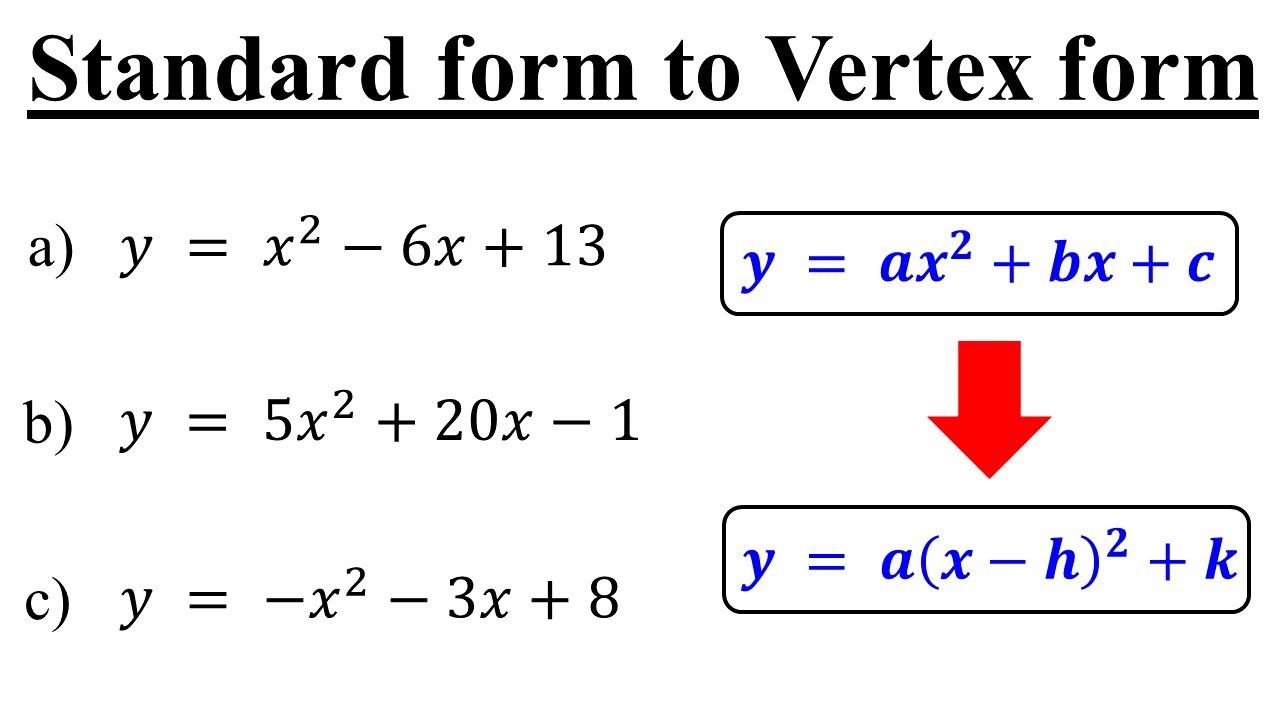
This algebra math tutorial explains how to convert standard form to vertex form of a quadratic equation using the completing the square method.
standard to vertex from, standard from to vertex from, how to convert standard form to vertex form, converting standard form to vertex form, vertex form of a quadratic equation, vertex form, standard...
rustic tartan
Also: $(a-b)^2 = a^2 - 2 \times ab + b^2$
grand pondBOT
╰ 𝕃 𝕌 ℂ 𝕀 𝔽 𝔼 ℝ ╮
 polar star
sage crypt
Wha can u pls solve it?
polar star
sage crypt
Wha can u pls solve it?
make another channel
merry sail
polar star
i can link a video that shows how to convert from the standard form to vertex fo...
alright thanks i’ll watch them
.close
midnight plankBOT
Channel closed
Closed by @merry sail
Use .reopen if this was a mistake.
sage crypt
polar star
make another channel
Alr
midnight plankBOT
Available help channel!
Send your question here to claim the channel.
Remember:
• Ask your math question in a clear, concise manner.
• Show your work, and if possible, explain where you are stuck.
• After 15 minutes, feel free to ping <@&286206848099549185>.
• Type the command .close to free the channel when you're done.
• Be polite and have a nice day!
Read #❓how-to-get-help for further information on how to ask a good question, and about conduct in the question channels.
 dawn pine
is there any way to solve these types of questions mentally?
37^12 / 23 has a remainder of ....
35^10 / 19 has a remainder of ...
midnight plankBOT
dawn pine
is there any way to solve these types of questions mentally?
37^12 / 23 has a r...
 lethal path
dawn pine
is there any way to solve these types of questions mentally?
37^12 / 23 has a r...
lethal path
dawn pine
is there any way to solve these types of questions mentally?
37^12 / 23 has a r...
yes, using modular arithmetic
$37 \equiv 14 \equiv -9 \pmod {23}$
grand pondBOT
south
 lethal path
then repeated squaring, so (-9)^12 = 81^6 mod 23 = (-11)^6 mod 23
= 121^3 mod 23 = 6^3 mod 23 = 36 * 6 mod 23
= 13 * 6 mod 23 = 78 mod 23
= 9 mod 23
that's the closest you can get
for other similar questions you could also use Fermat's little theorem
midnight plankBOT
Channel closed
Closed by @dawn pine
Use .reopen if this was a mistake.
midnight plankBOT
Available help channel!
Send your question here to claim the channel.
Remember:
• Ask your math question in a clear, concise manner.
• Show your work, and if possible, explain where you are stuck.
• After 15 minutes, feel free to ping <@&286206848099549185>.
• Type the command .close to free the channel when you're done.
• Be polite and have a nice day!
Read #❓how-to-get-help for further information on how to ask a good question, and about conduct in the question channels.
astral terrace
 midnight plankBOT
astral terrace
astral terrace
midnight plankBOT
astral terrace
astral terrace
How could I approach this problem?
 viral dagger
astral terrace
viral dagger
astral terrace
Q seems the easiest, notice how its just the sum of the squares of P then -10
astral terrace
Yeah
viral dagger
then for S its kinda the same thing
astral terrace
the fourth power comes in
and it is a fifth degree polynomial so it wont be that easy
not even to find the sum of squares ig
how will you solve that?
midnight plankBOT
@astral terrace Has your question been resolved?
astral terrace
<@&286206848099549185>
 karmic snow
What does "zeros alpha1, alpha2, etc." means? @astral terrace
If you know the alpha[] value then this would be trivial no?
viral dagger
karmic snow
If you know the alpha[] value then this would be trivial no?
yes but you cant really find the value for qlpha easily
viral dagger
astral terrace
the fourth power comes in
ol i have no idea weather its correct or not but it may be equivalent to
(a^2+b^2+c^2+d^2+e^2)^2-2(ab+ac+ad+ae+bc+bd+be+cd+ce+de)^2+4(abc+abd+abe+acd+ace+ade+bcd+bce+bde+cde)(a+b+c+d+e)-4(abcd+abce+abde+acde+bcde)
karmic snow
Ok but what are we suppose to use P(x) for?
viral dagger
karmic snow
Ok but what are we suppose to use P(x) for?
for all the alphas
viral dagger
viral dagger
ol i have no idea weather its correct or not but it may be equivalent to
(a^2+b^...
i cant check cause im too lazy to do it manually, chatgpt sucks, wolfram alpha breaks
astral terrace
karmic snow
What does "zeros alpha1, alpha2, etc." means? <@783743429401116683>
zeroes are roots
But i assume you already know that
man i have an examination rn so i gotta leave now
karmic snow
astral terrace
But i assume you already know that
I'm an idiot 
midnight plankBOT
@astral terrace Has your question been resolved?
midnight plankBOT
Channel closed
Closed due to timeout
Use .reopen if this was a mistake.
Available help channel!
Send your question here to claim the channel.
Remember:
• Ask your math question in a clear, concise manner.
• Show your work, and if possible, explain where you are stuck.
• After 15 minutes, feel free to ping <@&286206848099549185>.
• Type the command .close to free the channel when you're done.
• Be polite and have a nice day!
Read #❓how-to-get-help for further information on how to ask a good question, and about conduct in the question channels.
 vague crag
for this, do i need to show that t(0)=0? if so how?

 midnight plankBOT
vague crag
for this, do i need to show that t(0)=0? if so how?
lyric charm
midnight plankBOT
vague crag
for this, do i need to show that t(0)=0? if so how?
lyric charm
uppercase T not lowercase t, but yes you do need to use that T(0) = 0.
it is not hard if you consider that 0 = 0 + 0
and the defn of linearity
 uneven aspen
Do you have any information about T? If T is one-to-one, then you can use that.
lyric charm
this start is a bit sus though tbh
vague crag
lyric charm
it is not hard if you consider that 0 = 0 + 0
oh i see
vague crag
uneven aspen
Do you have any information about T? If T is one-to-one, then you can use that.
nope
uneven aspen
Why do you think this is true?
vague crag
T is linear and from V to W
uneven aspen
Try to find a counter example.
vague crag
so it's not always true?
lyric charm
i mean i think OP needs to be clear on what exactly his assertions and goals are for this proof
cause right now the beginning's kinda sloppy and the logic is, for lack of a better word, clouded
uneven aspen
I claim you can always find a linear transformation that will map any independent set to a dependent one.
@vague crag , try to think of a simple example of a linear transformation T where you end up with a depdendent set.
lyric charm
this is a "prove or disprove" question btw right @vague crag
vague crag
yeah
vague crag
uneven aspen
<@1329372826540576768> , try to think of a simple example of a linear transforma...
hmm
lyric charm
that's a context that you have to give
always without exception
also yes it pays to try and think of the simplest, dumbest linear map that could possibly exist.
why the unamused react?
vague crag
wait lemme think
so basically it fails if ker(T) doesn't equal 0 or not injective. So maybe a T where it maps all vectors to the 0 vector?
uneven aspen
"So maybe a T where it maps all vectors to the 0 vector?" You tell me, is the set with just the zero vector a dependent set?
vague crag
ye
uneven aspen
So, in particular, if you apply T to a independent set you'd get a dependent set.
vague crag
.close
midnight plankBOT
Channel closed
Closed by @vague crag
Use .reopen if this was a mistake.
midnight plankBOT
Available help channel!
Send your question here to claim the channel.
Remember:
• Ask your math question in a clear, concise manner.
• Show your work, and if possible, explain where you are stuck.
• After 15 minutes, feel free to ping <@&286206848099549185>.
• Type the command .close to free the channel when you're done.
• Be polite and have a nice day!
Read #❓how-to-get-help for further information on how to ask a good question, and about conduct in the question channels.
 spare dawn
 midnight plankBOT
spare dawn
spare dawn
midnight plankBOT
spare dawn
spare dawn
I need help solving this ITF question
tried converting to tan
but in the end this comes

 prime hornet
spare dawn
prime hornet
spare dawn
wait, this identity doesn't seem true? 
spare dawn
prime hornet
wait, this identity doesn't seem true? <:kongouderp:483988392099446794>
this is true
 round parcel
Yes, the inputs for the second arcsine go from 1 - 1 to 1 + 1.
viral dagger
sus
 spare dawn
for further help i used the solution but it confused me even more
round parcel
It's false for x = 1, for example.
polar star
spare dawn
perhaps the question was to show that there exists only one real solution
round parcel
,calc asin(1) + asin(1 - 1)
grand pondBOT
Result:
1.5707963267949
,calc acos(1)
grand pondBOT
Result:
0
okay
spare dawn
 round parcel
It gets two solutions in the end, so it's not an identity.
viral dagger
spare dawn
thats sesrching for solutions
spare dawn
what happened in 4th step?
viral dagger
spare dawn
what happened in 4th step?
sin(sin^-1(x))=x
round parcel
sin(pi/2 - x) = cos(x) for the right side.
round parcel
No problem.
midnight plankBOT
@spare dawn Has your question been resolved?
midnight plankBOT
Channel closed
Closed due to timeout
Use .reopen if this was a mistake.
midnight plankBOT
Available help channel!
Send your question here to claim the channel.
Remember:
• Ask your math question in a clear, concise manner.
• Show your work, and if possible, explain where you are stuck.
• After 15 minutes, feel free to ping <@&286206848099549185>.
• Type the command .close to free the channel when you're done.
• Be polite and have a nice day!
Read #❓how-to-get-help for further information on how to ask a good question, and about conduct in the question channels.
 twilit lodge
anyone know why part b might be wrong
 midnight plankBOT
twilit lodge
anyone know why part b might be wrong
midnight plankBOT
twilit lodge
anyone know why part b might be wrong
@twilit lodge Has your question been resolved?
twilit lodge
<@&286206848099549185>
karmic snow
Isn't there a formula for p?
twilit lodge
Umm i honestly just plug everything in ti84 for these problems
But let me check I don’t think you can solve without technology
Yea no I looked it up and it’s pretty much only done using technology and I seem to have followed the steps correctly
It’s probably just an error
midnight plankBOT
@twilit lodge Has your question been resolved?
midnight plankBOT
Channel closed
Closed due to timeout
Use .reopen if this was a mistake.
Available help channel!
Send your question here to claim the channel.
Remember:
• Ask your math question in a clear, concise manner.
• Show your work, and if possible, explain where you are stuck.
• After 15 minutes, feel free to ping <@&286206848099549185>.
• Type the command .close to free the channel when you're done.
• Be polite and have a nice day!
Read #❓how-to-get-help for further information on how to ask a good question, and about conduct in the question channels.
 inland patio
I'm reading a proof of the fact that a set $\mathcal C$ of commuting linear operators are simultaneously diagonalizable (the other direction is also true and a bit easier). They proceed by induction on the dimension of the whole space. When the whole space has dimension $1$, they say that every linear operator is diagonalizable by the standard basis. This phrasing confuses me, as the whole space is just an arbitrary vector space. It does not necessarily have "a standard basis", or?
midnight plankBOT
inland patio
I'm reading a proof of the fact that a set $\mathcal C$ of commuting linear oper...
grand pondBOT
psie

 azure oracle
ummm... why wouldnt theree be a standard basis?\
inland patio
.close
midnight plankBOT
Channel closed
Closed by @inland patio
Use .reopen if this was a mistake.
midnight plankBOT
Available help channel!
Send your question here to claim the channel.
Remember:
• Ask your math question in a clear, concise manner.
• Show your work, and if possible, explain where you are stuck.
• After 15 minutes, feel free to ping <@&286206848099549185>.
• Type the command .close to free the channel when you're done.
• Be polite and have a nice day!
Read #❓how-to-get-help for further information on how to ask a good question, and about conduct in the question channels.
 twilit field
 midnight plankBOT
twilit field
midnight plankBOT
twilit field
 dawn dagger
you can prob prove it also direct but whats the step you stuck
twilit field
To show it's increasing, we perform induction.
\
$a_{n} - a_{n-1} ≥0$
\
so
Now inducting $a_{n+1} - a_n = 3 - \frac{1}{a_n} -a_n$
\
 gaunt jetty
Showing that it is increasing and a_n < 3 for all n should be two things you handle separately
grand pondBOT
What a wonderful world !
 twilit field
gaunt jetty
Showing that it is increasing and a_n < 3 for all n should be two things you han...
twilit field
gaunt jetty
Showing that it is increasing and a_n < 3 for all n should be two things you han...
I'm doing that
gaunt jetty
Well, it's more logical to perform induction on the a_n < 3 for all n case
twilit field
let $a_n<3$
grand pondBOT
What a wonderful world !

 fresh sparrow
aw it's a heart <3
twilit field
We then have $a_{n+1} = 3 -\frac{1}{a_n}$. but $\frac{1}{a_n}>\frac{1}{3}$
grand pondBOT
What a wonderful world !
 fresh sparrow
indeed
twilit field
so $\frac{-1}{a_n}<\frac{-1}{3}$
grand pondBOT
What a wonderful world !
 grand pondBOT
What a wonderful world !

 vocal inlet
yup
twilit field
Now to prove it's increasing
for that I have to show 0 isn't possible
Not too sure
😔
twilit field
I did try that earlier
twilit field
grand pond
**What a wonderful world !**
here
dawn dagger
Apply definition of a_n
vocal inlet
yeah
twilit field
grand pond
**What a wonderful world !**
I have...
vocal inlet
you'll get 3 - 1/an -3 + 1/a_n-1
twilit field
yes, so 1/a_{n-1} -1/a-n
vocal inlet
yeah
twilit field
but I already know that that's positive ( by inductive hypothesis), I suppose?
vocal inlet
yes
midnight plankBOT
Channel closed
Closed by @twilit field
Use .reopen if this was a mistake.
Available help channel!
Send your question here to claim the channel.
Remember:
• Ask your math question in a clear, concise manner.
• Show your work, and if possible, explain where you are stuck.
• After 15 minutes, feel free to ping <@&286206848099549185>.
• Type the command .close to free the channel when you're done.
• Be polite and have a nice day!
Read #❓how-to-get-help for further information on how to ask a good question, and about conduct in the question channels.
 last slate
 midnight plankBOT
last slate
last slate
midnight plankBOT
last slate
last slate
why -1.175?
shouldnt it be positive
cuz the z sign is > and the value next to z is negative
.close
midnight plankBOT
Channel closed
Closed by @hidden hedge
Use .reopen if this was a mistake.
midnight plankBOT
Available help channel!
Send your question here to claim the channel.
Remember:
• Ask your math question in a clear, concise manner.
• Show your work, and if possible, explain where you are stuck.
• After 15 minutes, feel free to ping <@&286206848099549185>.
• Type the command .close to free the channel when you're done.
• Be polite and have a nice day!
Read #❓how-to-get-help for further information on how to ask a good question, and about conduct in the question channels.
midnight plankBOT
Channel closed
Channel closed due to the original message being deleted.
If you did not intend to do this, please open a new help channel,
as this action is irreversible, and this channel may abruptly lock.
Available help channel!
Send your question here to claim the channel.
Remember:
• Ask your math question in a clear, concise manner.
• Show your work, and if possible, explain where you are stuck.
• After 15 minutes, feel free to ping <@&286206848099549185>.
• Type the command .close to free the channel when you're done.
• Be polite and have a nice day!
Read #❓how-to-get-help for further information on how to ask a good question, and about conduct in the question channels.
 zenith mirage
can someone help me qith this question? like the formulas to use and making sure i do i correctly (but also letting me do the qork instead of doing it for me type of thing?
 midnight plankBOT
zenith mirage
can someone help me qith this question? like the formulas to use and making sure...
zenith mirage
midnight plankBOT
zenith mirage
can someone help me qith this question? like the formulas to use and making sure...
zenith mirage
please ping me as qell
midnight plankBOT
Show your work, and if possible, explain where you are stuck.
zenith mirage
i quiteliterally asked for the formulas so that eould indicate i dont knoe the formula to even start?
polar star
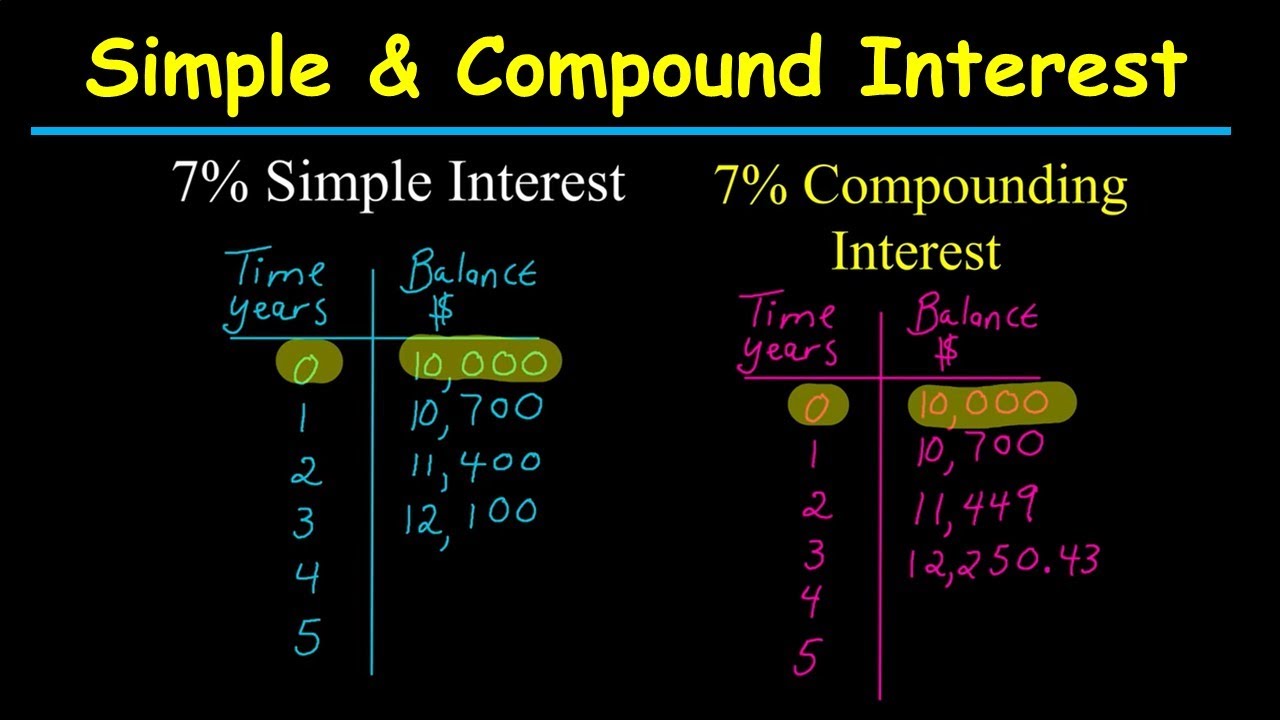
In the online high school math financial algebra video tutorial, you will compare two bank accounts. One account will yield 7% simple interest applied yearly. The other account will yield 7% compounded yearly. Each account will start with the same initial investment of $10,000. You will learn that simple interest can be model using arithmetic gr...

This finance video tutorial explains how to calculate interest that is compounded continuously. It also explains how to calculate the time it takes for your investment to double using natural logs and the rule of 72.
Final Exam and Test Prep Videos:
https://bit.ly/41WNmI9
Logarithms - The Easy Way! ...
the first one is simple and compounded yearly
the second one is continuous compounding
zenith mirage
thank you
couldyou type the forumlas outso i dont go through the video looking for it?
i feel itd be easier to do that than
looking for videos but
actually nevermind
.close
midnight plankBOT
Channel closed
Closed by @zenith mirage
Use .reopen if this was a mistake.
polar star
zenith mirage
looking for videos but
$SI = P \times r \times t
A = P(1 + r)^t
A = Pe^{rt}$
wawit
$
[
SI = P \times r \times t
]
[
A = P(1 + r)^t
]
[
A = Pe^{rt}
]$
grand pondBOT
mia
Compile Error! Click the  reaction for more information.
(You may edit your message to recompile.)
 zenith mirage
I have close the channel
polar star
oh
zenith mirage
Please leave me alone.
polar star
um okay
midnight plankBOT
Available help channel!
Send your question here to claim the channel.
Remember:
• Ask your math question in a clear, concise manner.
• Show your work, and if possible, explain where you are stuck.
• After 15 minutes, feel free to ping <@&286206848099549185>.
• Type the command .close to free the channel when you're done.
• Be polite and have a nice day!
Read #❓how-to-get-help for further information on how to ask a good question, and about conduct in the question channels.
 small zenith
i am having trouble getting my head around this
 midnight plankBOT
small zenith
i am having trouble getting my head around this
small zenith
midnight plankBOT
small zenith
i am having trouble getting my head around this
small zenith
how did $csc^2 x$ disappear
grand pondBOT
Lavandula
 small zenith
i am not familiar with cscx cotx integration
 slender walrus
do you know the derivative of cot(x)?
small zenith
not rly
gaunt jetty
small zenith
how did $csc^2 x$ disappear
They did a $u$-substitution by taking $u = \6\cot x -1$ before applying integration by parts. Then you can refer to what ramonov said
grand pondBOT
Aero ݁˖ ❀ ⋆。˚
 small zenith
i only know tan(x) derivative is sec^2 x tho
gaunt jetty
small zenith
not rly
It's not particularly hard to derive. Do you know the quotient rule for derivatives by any chance?
small zenith
yes
gaunt jetty
So, knowing that [
y = \6\cot x = \4{\6\cos x}{\6\sin x},
]
use the quotient rule to find $dy/dx$
grand pondBOT
Aero ݁˖ ❀ ⋆。˚
 gaunt jetty
small zenith
Why did a bullet pt replace that
gaunt jetty
small zenith
Why did a bullet pt replace that
you can put a \ before the - to disable that
Anyways you're right
That's it
Do you see how and why it cancelled now then?
small zenith
ohh
r there any others
i only know derivatives of sinx, cosx and tanx
regarding the ones angle-related
gaunt jetty
I mean I wouldn't say you need to memorise them, as they're clearly easy to derive if you know the derivatives of cos and sin
But it's generally good to know like, cos, sin, tan, sec, csc, cot, arcsin, arccos, arctan
gaunt jetty
Yeah just Google it
midnight plankBOT
Channel closed
Closed by @small zenith
Use .reopen if this was a mistake.
midnight plankBOT
Available help channel!
Send your question here to claim the channel.
Remember:
• Ask your math question in a clear, concise manner.
• Show your work, and if possible, explain where you are stuck.
• After 15 minutes, feel free to ping <@&286206848099549185>.
• Type the command .close to free the channel when you're done.
• Be polite and have a nice day!
Read #❓how-to-get-help for further information on how to ask a good question, and about conduct in the question channels.
twilit field
 midnight plankBOT
twilit field
twilit field
midnight plankBOT
twilit field
twilit field
So first I use the root test to find that $0≤ \sqrt[n]{\abs{c_n}}< \frac{1}{4}$
Now checking $c_n (-4)^n$ for absolute convergence
$
grand pondBOT
What a wonderful world !
 twilit field
$\sqrt[n]{ \abs{ 4^n c_n} } = 4 \sqrt[n] {c_n}$

 grand pondBOT
What a wonderful world !
 twilit field
this is betewen 0 and 1/2 with the root test , so it converges
midnight plankBOT
@twilit field Has your question been resolved?
 visual tiger
grand pond
**What a wonderful world !**
visual tiger
grand pond
**What a wonderful world !**
uh
first of all
how did you find that series of c_n(-4)^n is absolutely convergent?
visual tiger
grand pond
**What a wonderful world !**
and also why is this true
midnight plankBOT
@twilit field Has your question been resolved?
 tribal temple
(and ideally, that isn't the way to go about it either!)
 quiet hinge
twilit field
Which is between 0 and 1/4 so this converges
quiet hinge
twilit field
Which is between 0 and 1/4 so this converges
So what converges?
midnight plankBOT
Channel closed
Closed due to timeout
Use .reopen if this was a mistake.
Available help channel!
Send your question here to claim the channel.
Remember:
• Ask your math question in a clear, concise manner.
• Show your work, and if possible, explain where you are stuck.
• After 15 minutes, feel free to ping <@&286206848099549185>.
• Type the command .close to free the channel when you're done.
• Be polite and have a nice day!
Read #❓how-to-get-help for further information on how to ask a good question, and about conduct in the question channels.
 mint moth
can someone explain what happened at this point? i understand everything else
 midnight plankBOT
mint moth
can someone explain what happened at this point? i understand everything else
mint moth
midnight plankBOT
mint moth
can someone explain what happened at this point? i understand everything else
mint moth
especially in the denominator, why did sin get squared?
 thorny plinth
mint moth
especially in the denominator, why did sin get squared?
thorny plinth
mint moth
especially in the denominator, why did sin get squared?
its not supposed to be squared
it was a mistake
mint moth
so whats the real solution
cuz i get
how 1 - sin^2x turned into cos^2x
but even so, how does sinxcosx turn into just sin x
and the cos^2x goes where?
thorny plinth
mint moth
so whats the real solution
just remove the square in that one step
 thorny plinth
mint moth
but even so, how does sinxcosx turn into just sin x
thorny plinth
mint moth
but even so, how does sinxcosx turn into just sin x
they cancelled the common factor from the numerator and denominator
mint moth
so cos^2x gets cancelled out once
by the cosx in the denominator
leaving just
cosx over sinx?
thorny plinth
yes
mint moth
okay thank u
thorny plinth

mint moth
.close
midnight plankBOT
Channel closed
Closed by @mint moth
Use .reopen if this was a mistake.
midnight plankBOT
Available help channel!
Send your question here to claim the channel.
Remember:
• Ask your math question in a clear, concise manner.
• Show your work, and if possible, explain where you are stuck.
• After 15 minutes, feel free to ping <@&286206848099549185>.
• Type the command .close to free the channel when you're done.
• Be polite and have a nice day!
Read #❓how-to-get-help for further information on how to ask a good question, and about conduct in the question channels.
cursive swan
 midnight plankBOT
cursive swan
cursive swan
midnight plankBOT
cursive swan
cursive swan
(Source: IOQM 2024)
 dreamy lichen
I'd just try to label the sides and apply similarity and perhaps pythagoras
cursive swan
It is known that hypotenuse >= the corresponding height / 2
AC >= 24
Because we can draw the right angled triangle in semi circle of radius AC/2 and then get that the maximum value of h as the sides vary is R = AC/2
 exotic stratus
 lyric charm
i think you can make a rather elegant solution to this if you consider that triangles ADB and BDC are similar and in so doing get a relationship between AD and DC
cursive swan
AD * DC = 144
AD + DC = integer
min(AD + DC) = 24
AC = 24 is not possible due to Fermat's last theorem.
AC = 25 is possible.
Done?
exotic stratus
lyric charm
i think you can make a rather elegant solution to this if you consider that tria...
In this case wouldn't the triangles just be congruent if they were similar?
lyric charm
AC = 24 is not possible due to Fermat's last theorem.
you're joking right
what's fermat-wiles gotta do w/ this
lyric charm
you could have just said "they can't both be 12 bc then the perimeter would be 24 + 24sqrt(2)" or something
cursive swan
exotic stratus
In this case wouldn't the triangles just be congruent if they were similar?
What?
How?
dreamy lichen
i dont think they'd necessarily be congruent
cursive swan
lyric charm
you could have just said "they can't both be 12 bc then the perimeter would be 2...
Oh. I didn't know! Thanks!
lyric charm
was that sarcastic or genuine?
dreamy lichen
cursive swan
AD + DC = integer
min(AD + DC) = 24
AC = 24 is not possible due to Fermat's last...
This essentially works, doesnt it? If you change the reasoning from fermat's last theorem to what Ann said
exotic stratus
dreamy lichen
i dont think they'd necessarily be congruent
Oh yea there is 1 counter case which is when $\angle A = \angle DBC$, otherwise they're congruent I think
grand pondBOT
@exotic stratus
 dreamy lichen
exotic stratus
Oh yea there is 1 counter case which is when $\angle A = \angle DBC$, otherwise ...
dreamy lichen
exotic stratus
Oh yea there is 1 counter case which is when $\angle A = \angle DBC$, otherwise ...
they are almost never congruent
cursive swan
Lol.
exotic stratus
If $\angle A = \angle C$ then they're congruent by ASA rule
grand pondBOT
@exotic stratus
 cursive swan
dreamy lichen
This essentially works, doesnt it? If you change the reasoning from fermat's las...
cursive swan
dreamy lichen
This essentially works, doesnt it? If you change the reasoning from fermat's las...
Mhm. We're lucky.
cursive swan
exotic stratus
In this case wouldn't the triangles just be congruent if they were similar?
What do you mean by this though?
cursive swan
exotic stratus
Oh yea there is 1 counter case which is when $\angle A = \angle DBC$, otherwise ...
And this
dreamy lichen
you can have sth like this
 exotic stratus
I was just thinking since $\bar{BD}$ is common between $\triangle ABD$ and $\triangle BDC$, $\angle D = 90^{\circ}$ (both of them) if $\triangle ADB \sim \triangle BDC$ it may imply $\triangle ADB \cong \triangle BDC$
grand pondBOT
@exotic stratus
 cursive swan
May?
dreamy lichen
BD is common, but it corresponds to different kind of side in each case
cursive swan
Yes
exotic stratus
cursive swan
May?
It was a thought
exotic stratus
dreamy lichen
BD is common, but it corresponds to different kind of side in each case
Yea that's the conclusion I ended up with
dreamy lichen
dreamy lichen
you can have sth like this
e.g. here BD is the longer leg of smaller triangle and smaller leg of larger triangle
exotic stratus
dreamy lichen
e.g. here BD is the longer leg of smaller triangle and smaller leg of larger tri...
I found the contradiction lol no worries
midnight plankBOT
Channel closed
Closed by @cursive swan
Use .reopen if this was a mistake.
midnight plankBOT
Available help channel!
Send your question here to claim the channel.
Remember:
• Ask your math question in a clear, concise manner.
• Show your work, and if possible, explain where you are stuck.
• After 15 minutes, feel free to ping <@&286206848099549185>.
• Type the command .close to free the channel when you're done.
• Be polite and have a nice day!
Read #❓how-to-get-help for further information on how to ask a good question, and about conduct in the question channels.
 cosmic epoch
im studying SVD right now, and noticed that A*A^T has the same eigenvalues as A^T*A--aside from the multiplicities of their zeroes and typically you choose to find the eigenvalues of A^{T}A, but that matrix may be larger than the former.
so id like to pick the smaller square matrix of the two to speed up computations since i have an exam on this topic.
im just curious whether this is valid in all cases. im aware of the proof for eigen(AA^T) = eigen(A^TA). i just need to ask if theres any picky considerations i should be aware of with using this strategy
midnight plankBOT
cosmic epoch
im studying SVD right now, and noticed that A*A^T has the same eigenvalues as A^...
@cosmic epoch Has your question been resolved?
grand pondBOT
00100000

 brittle grotto
then, $AA^TAx=A(\lambda x)$
grand pondBOT
00100000
 brittle grotto
so $AA^T(Ax)=\lambda (Ax)$ for eigenvector $x\neq0$ of $\lambda$
so, you're right
grand pondBOT
00100000
 brittle grotto
which actually kind of surprised me. definitely would mess around with multiplicities tho, since the matrices aren't necessarily of the same size
midnight plankBOT
@cosmic epoch Has your question been resolved?
cosmic epoch
brittle grotto
which actually kind of surprised me. definitely would mess around with multiplic...
the multiplicities can be found easily right? via knowing the rank
if eigen(AA^T) = l1, l2, l3, .... where AA^T is (mxm)
then eigen(A^TA) = l1, l2, l3, ..., 0, 0, 0, ... until we hit the rank of the matrix
 paper inlet
use integration
midnight plankBOT
Someone else is already using this help channel. If you need help with a question, please open your own help channel/thread (see #❓how-to-get-help for instructions).
midnight plankBOT
@cosmic epoch Has your question been resolved?
Channel closed
Closed by @cosmic epoch
Use .reopen if this was a mistake.
Available help channel!
Send your question here to claim the channel.
Remember:
• Ask your math question in a clear, concise manner.
• Show your work, and if possible, explain where you are stuck.
• After 15 minutes, feel free to ping <@&286206848099549185>.
• Type the command .close to free the channel when you're done.
• Be polite and have a nice day!
Read #❓how-to-get-help for further information on how to ask a good question, and about conduct in the question channels.
 tidal turret
 midnight plankBOT
tidal turret
midnight plankBOT
tidal turret
 dawn dagger
- looks like you will have to solve a quadratic in k
tidal turret
wdym?¿
dusty portal
tidal turret
Okay, so can you extend the distance formula to 3D? Also, can you set up the formula?
tidal turret
tidal turret
oh this is for 2D, I am working in 3D
tidal turret
dusty portal
Okay, so can you extend the distance formula to 3D? Also, can you set up the for...
how?
dusty portal
Try to think of a rectangular prism.
tidal turret
 dusty portal
How would you find the long diagonal connecting the opposite points?
tidal turret
dusty portal
How would you find the long diagonal connecting the opposite points?
pythagoras ig, idk
dusty portal
Perfect. So try it out. And if you feel more comfortable talking in Spanish, that’s alright.
 spice mason

dawn dagger
tidal turret
wdym?¿
time will reveal
tidal turret
dusty portal
Perfect. So try it out. And if you feel more comfortable talking in Spanish, tha...
I prefer english so the ppl can understand us hehexd
dusty portal
Alright then, just apply the formula.
dawn dagger
- looks like you have to construct a right triangle at B
tidal turret
-
Determine all values of ( k \in \mathbb{R} ) such that
[ d(A, B) = 5, \text{ where } A = (-1, 0, k) \text{ and } B = (3, k, 3).] -
Given
[ A = (1, -2, 3), \quad B = (2, 3, 5) \text{ and } P = (4, a, -1), \quad \text{find } a \in \mathbb{R} \text{ such that the triangle } ABP \text{ is right-angled at } B.]
grand pondBOT
938c2cc0dcc05f2b68c4287040cfcf71
 dawn dagger
so AB and BP must be orthogonal if yk
dusty portal
||Dot product||
tidal turret
interesting, let me finish 1) first
dawn dagger
hopefuly it wont finish you
tidal turret
lmfao
dawn dagger
grammar finished me
 dawn dagger
apparently i understand spanish
tidal turret
,, A = (x_1, y_1, z_1) \ B = (x_2, y_2, z_2) \ d(A,B) = \sqrt{(x_2 - x_1)^2 + (y_2 - y_1)^2 + (z_2 - z_1)^2}
dusty portal
I also have a question about translation but we can do this after
grand pondBOT
938c2cc0dcc05f2b68c4287040cfcf71
 dawn dagger
the values are missing
dawn dagger
tidal turret
that's literally here
i see, you took care of k already
no you skipped to 2.
usually you start with 1
i see
tidal turret
A = (-1,0,k)
B = (3,k,3)
,, A = (x_1, y_1, z_1) \ B = (x_2, y_2, z_2) \ d(A,B) = \sqrt{(x_2 - x_1)^2 + (y_2 - y_1)^2 + (z_2 - z_1)^2} \\ A = (-1, 0, k) \ B = (3, k, 3) \ d(A,B) = \sqrt{(3 + 1 )^2 + (k - 0)^2 + (3 - k)^2}
dawn dagger
and d is also equal to something
grand pondBOT
938c2cc0dcc05f2b68c4287040cfcf71
 tidal turret
,w sqrt(16 + k^2 + (3-k)^2)
grand pondBOT


 Requested by 938c2cc0dcc05f2b68c4287040cfcf71
tidal turret
Requested by 938c2cc0dcc05f2b68c4287040cfcf71
tidal turret
what?
tidal turret
oh ok
dawn dagger
and solve the quadratic in k dear
tidal turret
,, 5 = \sqrt{(3 + 1 )^2 + (k - 0)^2 + (3 - k)^2}
grand pondBOT
938c2cc0dcc05f2b68c4287040cfcf71
 dawn dagger
no
tidal turret
ok
dawn dagger
the inside is always nonnegative here
grand pondBOT
Result:
9
time revealed
grand pondBOT
 Requested by 938c2cc0dcc05f2b68c4287040cfcf71
tidal turret
Requested by 938c2cc0dcc05f2b68c4287040cfcf71
tidal turret
0 = k^2 + (k^2 + 6k + 9) - 9
0 = 2k^2 + 6k
zero product property
0 = k(2k + 6)
- k = 0
- 2k = -6 ==> k = -3
k = {0, -3}
dawn dagger
mistake
dawn dagger
tidal turret
0 = k^2 + (k^2 + 6k + 9) - 9
-6k
tidal turret
my god
tidal turret
0 = k^2 + (k^2 - 6k + 9) - 9
0 = 2k^2 - 6k
0 = k(2k - 6)
- k = 0
- 2k = 6 ==> k = 3
dawn dagger
there you go
dawn dagger
what about it
tidal turret
ok
AB = B - A = (2,3,5) - (1,-2,3) = (1,5,2)
BP = P - B = (4,a,-1) - (2,3,5) = (2, a - 3, -6)
,w (1,5,2).(2,a-3,-6) = 0
grand pondBOT
 Requested by 938c2cc0dcc05f2b68c4287040cfcf71
dawn dagger
Requested by 938c2cc0dcc05f2b68c4287040cfcf71
dawn dagger
embodiment of lazy 🦥
dawn dagger
this is why you should draw a picture
draw the 3 points A,B and P
you want at B a right angle
well B can only be connected to A and P
so you get two segements
that need to be perpendicular at B
 dawn dagger
it does not need to be perfect but yea
tidal turret
wdym?
dawn dagger
the drawing
now imagine you connect red with blue and blue with green
you then get vectors in space floating around, but now you want them to be perpendicular, so they make a right triangle
thats the idea behind
tidal turret

 dawn dagger
nah you are making stuff up now
tidal turret
L : X = a(0,1,0) + (4,0,-1)
dawn dagger
a is not a parameter but a constant
tidal turret
oh ok
dawn dagger
it's an arbitrary point you move around in space
a=5 happens to be the value where you get the right triangle
midnight plankBOT
Channel closed
Closed by @tidal turret
Use .reopen if this was a mistake.
midnight plankBOT
Available help channel!
Send your question here to claim the channel.
Remember:
• Ask your math question in a clear, concise manner.
• Show your work, and if possible, explain where you are stuck.
• After 15 minutes, feel free to ping <@&286206848099549185>.
• Type the command .close to free the channel when you're done.
• Be polite and have a nice day!
Read #❓how-to-get-help for further information on how to ask a good question, and about conduct in the question channels.
midnight plankBOT
 marble trellis
Is there a way to find the answer by jus looking at it
Knowing what the origional graph looks like
Nvm forget thay


Can i get help wid dis
midnight plankBOT
Channel closed
Channel closed due to the original message being deleted.
If you did not intend to do this, please open a new help channel,
as this action is irreversible, and this channel may abruptly lock.
Available help channel!
Send your question here to claim the channel.
Remember:
• Ask your math question in a clear, concise manner.
• Show your work, and if possible, explain where you are stuck.
• After 15 minutes, feel free to ping <@&286206848099549185>.
• Type the command .close to free the channel when you're done.
• Be polite and have a nice day!
Read #❓how-to-get-help for further information on how to ask a good question, and about conduct in the question channels.
twilit field
Trying to find $\pdv{z}{s}$and $\pdv{x}{t}$
 midnight plankBOT
twilit field
Trying to find $\pdv{z}{s}$and $\pdv{x}{t}$
twilit field
midnight plankBOT
twilit field
Trying to find $\pdv{z}{s}$and $\pdv{x}{t}$
twilit field
We start with $\pdv{z}{s}$
grand pondBOT
What a wonderful world !
 twilit field
$\pdv{z}{r} \cdot \pdv{r}{s}+ \pdv{z}{\theta} \cdot \pdv{\theta}{s}$$
grand pondBOT
What a wonderful world !
Compile Error! Click the reaction for more information.
(You may edit your message to recompile.)
 twilit field
So that gives us $e^rcos(\theta) \cdot t -e^r \sin(\theta) \cdot \frac{ s}{\sqrt{s^2+t^2}}$
grand pondBOT
What a wonderful world !
 twilit field
is this right
grand pondBOT
What a wonderful world !
 last slate
twilit field
is this right
last slate
twilit field
is this right
is that the final answer? i thought its gonna continue further
midnight plankBOT
@twilit field Has your question been resolved?
twilit field
last slate
is that the final answer? i thought its gonna continue further
It is yea
.close
midnight plankBOT
Channel closed
Closed by @twilit field
Use .reopen if this was a mistake.
midnight plankBOT
Available help channel!
Send your question here to claim the channel.
Remember:
• Ask your math question in a clear, concise manner.
• Show your work, and if possible, explain where you are stuck.
• After 15 minutes, feel free to ping <@&286206848099549185>.
• Type the command .close to free the channel when you're done.
• Be polite and have a nice day!
Read #❓how-to-get-help for further information on how to ask a good question, and about conduct in the question channels.
twilit field
 midnight plankBOT
twilit field
twilit field
midnight plankBOT
twilit field
twilit field
Now I know I can just expand this
but is there no other way
$\pdv{z}{r} = f_x(x,y) \cos(\theta) + f_y(x,y) \sin(\theta)$
grand pondBOT
What a wonderful world !
 twilit field
$\pdv{z}{\theta} = -f_x(x,y) \cdot r \sin(\theta) + f_y(x,y) r \cos(\theta)$
grand pondBOT
What a wonderful world !

 boreal plaza
Guys, I can't solve this question, I didn't understand about centroids and everything, and this is one of the last questions I need to finish from the list that I have to submit today. Please help me, I'm in high school and I entered this math olympiad to challenge myself because I enjoy it, but I think it's too much for me with so little time to complete a list at this level along with other questions.I know that these concepts will be used, because I was recommended to read a very dense material about it, but I understood very little, especially about barycentric coordinates, because of that, I can't move forward to apply Ceva's Theorem.

ADVANCED LEVEL
cursive swan
boreal plaza
Guys, I can't solve this question, I didn't understand about centroids and every...
!occupied
midnight plankBOT
boreal plaza
Guys, I can't solve this question, I didn't understand about centroids and every...
Someone else is already using this help channel. If you need help with a question, please open your own help channel/thread (see #❓how-to-get-help for instructions).
twilit field
!occupied
midnight plankBOT
Someone else is already using this help channel. If you need help with a question, please open your own help channel/thread (see #❓how-to-get-help for instructions).
cursive swan
Open a new channel.
boreal plaza
THANKS
midnight plankBOT
Channel closed
Closed by @twilit field
Use .reopen if this was a mistake.
midnight plankBOT
Available help channel!
Send your question here to claim the channel.
Remember:
• Ask your math question in a clear, concise manner.
• Show your work, and if possible, explain where you are stuck.
• After 15 minutes, feel free to ping <@&286206848099549185>.
• Type the command .close to free the channel when you're done.
• Be polite and have a nice day!
Read #❓how-to-get-help for further information on how to ask a good question, and about conduct in the question channels.
cursive swan
Prove that a tangent is perpendicular to the line joing the point of tangency to the centre.
midnight plankBOT
cursive swan
Prove that a tangent is perpendicular to the line joing the point of tangency to...
cursive swan


angle CDB is always 90 deg.
As D gets closer to the point of tangency B, it basically falls on the tangent! And that will be when it is coincident with B. And that will be when angle DCB = 0 deg. So angle CBD will be 180-(0 + 90) = 90.
Is this a correct ||proof||?
 lyric charm
was there any reason for spoiler-tagging the word "proof"?
anyway, no. i'd say it's an ok thing for intuition but i would not consider it a rigorous proof at all.
cursive swan
lyric charm
was there any reason for spoiler-tagging the word "proof"?
Yes, to shock the helper.
.close
midnight plankBOT
Channel closed
Closed by @cursive swan
Use .reopen if this was a mistake.
lyric charm
........
oh yeah because shocking the helper is such a good thing to set up on purpose.
(/s)
cursive swan
/s = sarcasm?
exotic stratus
Yes /s = $\sum_{i = 1}^{sarcasm} i$
grand pondBOT
@exotic stratus
 lyric charm
exotic stratus
Yes /s = $\sum_{i = 1}^{sarcasm} i$
lyric charm
exotic stratus
Yes /s = $\sum_{i = 1}^{sarcasm} i$
 lyric charm
cursive swan
/s = sarcasm?
lyric charm
cursive swan
/s = sarcasm?
yes
lyric charm
exotic stratus
Yes /s = $\sum_{i = 1}^{sarcasm} i$
this joke was supremely unfunny.
 surreal moon
lyric charm
this joke was supremely **un**funny.
surreal moon
lyric charm
this joke was supremely **un**funny.
||un||funny
lyric charm
surreal moon
||un||funny
can you please not?
midnight plankBOT
Available help channel!
Send your question here to claim the channel.
Remember:
• Ask your math question in a clear, concise manner.
• Show your work, and if possible, explain where you are stuck.
• After 15 minutes, feel free to ping <@&286206848099549185>.
• Type the command .close to free the channel when you're done.
• Be polite and have a nice day!
Read #❓how-to-get-help for further information on how to ask a good question, and about conduct in the question channels.
 graceful ferry
$\int(lnx)^2dx$
midnight plankBOT
graceful ferry
$\int(lnx)^2dx$
grand pondBOT
prograce
 graceful ferry
what method
 deep oriole
ibp i reckon
graceful ferry
What is u and what is v' ?
 silver bluff
graceful ferry
What is u and what is v' ?
silver bluff
graceful ferry
What is u and what is v' ?
differentiate (ln(x))^2 and integrate 1
after 1 iteration you will realise
 worthy spruce
Or u sub x=e^y if you fancy. Still have to use ibp, but it makes it a bit easier
graceful ferry
.solved
midnight plankBOT
Channel closed
Closed by @graceful ferry
Use .reopen if this was a mistake.
midnight plankBOT
Available help channel!
Send your question here to claim the channel.
Remember:
• Ask your math question in a clear, concise manner.
• Show your work, and if possible, explain where you are stuck.
• After 15 minutes, feel free to ping <@&286206848099549185>.
• Type the command .close to free the channel when you're done.
• Be polite and have a nice day!
Read #❓how-to-get-help for further information on how to ask a good question, and about conduct in the question channels.
graceful ferry
$\int_{0}^{1}\frac{ln(1+x)}{x^{\frac{3}{2}}}dx = \lim_{\epsilon \to 0^+}\int_{0-\epsilon}^{1}\frac{ln(1+x)}{x^{\frac{3}{2}}}$ ?
midnight plankBOT
graceful ferry
$\int_{0}^{1}\frac{ln(1+x)}{x^{\frac{3}{2}}}dx = \lim_{\epsilon \to 0^+}\int_{0-...
graceful ferry
help
lyric charm
missing } just before the last dollar
grand pondBOT
prograce
 lyric charm
lower limit should be just epsilon not -epsilon
also missing dx also missing \ln command
gaunt jetty
graceful ferry
I have to find indefinite integral can u help ?
Classic integration by parts
graceful ferry
I thought I could use taylor series for ln(1+x) and then calculate integral for polynomials
graceful ferry
gaunt jetty
Classic integration by parts
o ok
gaunt jetty
graceful ferry
also \ln for what
\[
\int_0^1 \frac{\ln(1+x)}{x^{\frac32}}\,dx = \lim_{\epsilon \to 0^+}\int_\epsilon^1\frac{\ln(1+x)}{x^{\frac32}} \, dx
\]
Aero ݁˖ ❀ ⋆。˚
 gaunt jetty
This is what she meant I believe
gaunt jetty
graceful ferry
I thought I could use taylor series for ln(1+x) and then calculate integral for ...
Overcomplicated. No need
lyric charm
graceful ferry
also \ln for what
$\ln(x)$ and not $ln(x)$
grand pondBOT
Ann
 lyric charm
btw do you need to calculate the integral or just test it for convergence?
graceful ferry
This one test convergence
I feel like now you mentioned it that what I'm doing trying to calculate the integral is a bit useless and there's another way?
I'm a bit stuck now too
visual tiger
if you only want to test for convergence
just try to compare ln(1+x) with an easier function to work with
only after we established convergence can we start manipulating the integral to find its value
graceful ferry
visual tiger
just try to compare ln(1+x) with an easier function to work with
Like x?
visual tiger
graceful ferry
Like x?
like x
graceful ferry
then its just 1/x^1/2 and since the power is less than 1 then it converges
since integral is between 0 and 1
right?
.solved
midnight plankBOT
Channel closed
Closed by @graceful ferry
Use .reopen if this was a mistake.
midnight plankBOT
Available help channel!
Send your question here to claim the channel.
Remember:
• Ask your math question in a clear, concise manner.
• Show your work, and if possible, explain where you are stuck.
• After 15 minutes, feel free to ping <@&286206848099549185>.
• Type the command .close to free the channel when you're done.
• Be polite and have a nice day!
Read #❓how-to-get-help for further information on how to ask a good question, and about conduct in the question channels.
 modern shard
 midnight plankBOT
modern shard
modern shard
midnight plankBOT
modern shard
modern shard


did I do something wrong? or answer is given wrong?
aha nvm found it
it would be root w
.close
midnight plankBOT
Channel closed
Closed by @modern shard
Use .reopen if this was a mistake.
midnight plankBOT
Available help channel!
Send your question here to claim the channel.
Remember:
• Ask your math question in a clear, concise manner.
• Show your work, and if possible, explain where you are stuck.
• After 15 minutes, feel free to ping <@&286206848099549185>.
• Type the command .close to free the channel when you're done.
• Be polite and have a nice day!
Read #❓how-to-get-help for further information on how to ask a good question, and about conduct in the question channels.
cursive swan
Find all integer solutions to (5^a - 2^b)^2 = 1
midnight plankBOT
cursive swan
Find all integer solutions to (5^a - 2^b)^2 = 1
 nimble leaf
So every power of 2 which is either 1 above or 1 below a power of 5
Trivial examples are a=0 b=1 and a=1 b=2
cursive swan
 opaque mural
the part in the ( )
opaque mural
the part in the ( )
Minus. Clearly, it can't be positive.
nimble leaf
cursive swan
Minus. Clearly, it can't be positive.
Why not?
opaque mural
modules could help u find a solution
midnight plankBOT
@cursive swan Has your question been resolved?
lyric charm
5^a - 2^b = -1 has a lot less solutions than 5^a - 2^b = 1, or so one would think.
wow ok the strikethrough completely obliterated the minuses.
 fast estuary
cursive swan
Minus. Clearly, it can't be positive.
fast estuary
cursive swan
Minus. Clearly, it can't be positive.
5^1 - 2^2 = 1
1^2 = 1
Not sure if maybe there's a misunderstanding about what was meant here
cursive swan
The question is:
Find all integer solutions to (5^a - 2^b)^2 = 1
fast estuary
I understand the question
Someone offered the observation that this means the quantity in parentheses must equal 1 or -1
cursive swan
Yes, that is, |(5^a - 2^b)| = 1.
Because there could be some pairs that satisfy 2^x - 5^y = 1, where x > y. That is why I squared it.
I found no solutions for 0 <= a, b < 100.
midnight plankBOT
@cursive swan Has your question been resolved?
dreamy lichen
cursive swan
Because there could be some pairs that satisfy 2^x - 5^y = 1, where x > y. That ...
(a, b) = (0, 1)
(a, b) = (1, 2)
those are 2 solutions with 0 <= a, b < 100
cursive swan
I mean there are not more than (0, 1) and (1, 2)
dreamy lichen
For even x:
2^(2x) - 1 = 5^y
(2^x + 1)(2^x - 1) = 5^y
this would mean that both 2^x + 1 and 2^x - 1 are powers of 5, which is clearly impossible
5^(2y) - 1 = 2^x
(5^y - 1)(5^y + 1) = 2^x would mean both are powers of 2, which is also impossible
Oh wait
2^n - 1 will always be divisible by 3
or maybe im stupid
i honestly dont know
yeah, im stupid
it will only be divisible by 3 for even n
or maybe
no
5^n - 1 is divisible by 6 for even n
and always by 4
cursive swan
yes, by 24
dreamy lichen
just brainstorming
i honestly have no idea on how to approach this
if only 4 wasnt a power of 2
for odd n, the other factor will be
5^n + 5^(n-1) + .. + 1
5^n + 1 will often be diviisble by 3
by 6
ohhh
namely when n is even
oh..
damn it
cursive swan
 midnight plankBOT
Channel closed
Closed by @cursive swan
Use .reopen if this was a mistake.
Available help channel!
Send your question here to claim the channel.
Remember:
• Ask your math question in a clear, concise manner.
• Show your work, and if possible, explain where you are stuck.
• After 15 minutes, feel free to ping <@&286206848099549185>.
• Type the command .close to free the channel when you're done.
• Be polite and have a nice day!
Read #❓how-to-get-help for further information on how to ask a good question, and about conduct in the question channels.
 west bay
Help
 midnight plankBOT
west bay
Help
west bay
midnight plankBOT
west bay
Help
west bay
Is the answer for the first one 16? How do i do the rest?
midnight plankBOT
@west bay Has your question been resolved?
 fathom onyx
west bay
Help
fathom onyx
west bay
Help
I'm getting 16 for a as well
But the other ones are just elaborate lines, they don't contain regions of points as such
So I'm getting 0 for those
No wait mb I'm massively misreading that
Do each of these with cases, depending on which quadrant the point (x,y) is in
These are still collections of (geometric 1x1) squares, but you need to determine which squares
midnight plankBOT
Channel closed
Closed due to timeout
Use .reopen if this was a mistake.
Available help channel!
Send your question here to claim the channel.
Remember:
• Ask your math question in a clear, concise manner.
• Show your work, and if possible, explain where you are stuck.
• After 15 minutes, feel free to ping <@&286206848099549185>.
• Type the command .close to free the channel when you're done.
• Be polite and have a nice day!
Read #❓how-to-get-help for further information on how to ask a good question, and about conduct in the question channels.
inland patio
 midnight plankBOT
inland patio
inland patio
midnight plankBOT
inland patio
inland patio
Let <x,y>=xAy* be an inner product on C^2, with A={{1, i} , {-i, 2}}. Why does the conjugation overline become a conjugate transpose?
grand pondBOT
psie

 sharp coral
it's a 1x1 matrix which makes it automatically symmetric
inland patio
sharp coral
it's a 1x1 matrix which makes it automatically symmetric
right, I agree that it's a 1 x 1 matrix, but shouldn't the inner product be a scalar?
sharp coral
in linear algebra we tend to implicitly use the isomorphism between 1x1 matrices and scalars by treating them interchangeably
inland patio
ok, that makes sense
midnight plankBOT
@inland patio Has your question been resolved?
Channel closed
Closed by @inland patio
Use .reopen if this was a mistake.
Available help channel!
Send your question here to claim the channel.
Remember:
• Ask your math question in a clear, concise manner.
• Show your work, and if possible, explain where you are stuck.
• After 15 minutes, feel free to ping <@&286206848099549185>.
• Type the command .close to free the channel when you're done.
• Be polite and have a nice day!
Read #❓how-to-get-help for further information on how to ask a good question, and about conduct in the question channels.
 opaque elk
What's the actual difference between the pigeonhole principle and it's generalized form?
midnight plankBOT
opaque elk
What's the actual difference between the pigeonhole principle and it's generaliz...

 midnight plankBOT
Channel closed
Closed by @opaque elk
Use .reopen if this was a mistake.
midnight plankBOT
Available help channel!
Send your question here to claim the channel.
Remember:
• Ask your math question in a clear, concise manner.
• Show your work, and if possible, explain where you are stuck.
• After 15 minutes, feel free to ping <@&286206848099549185>.
• Type the command .close to free the channel when you're done.
• Be polite and have a nice day!
Read #❓how-to-get-help for further information on how to ask a good question, and about conduct in the question channels.
inland patio
Let $x_1,x_2\in\mathbb C$. Consider the expression $$|x_1|^2+2\Re(ix_1\overline{x_2})+2|x_2|^2.$$ How can I convince myself this is positive for $x_1$ or $x_2$ not equal to $0$? If one them is zero and the other isn't, it's obviously $>0$. However, if both of them are not equal to $0$, I don't see how to motivate that the expression is $>0$.
midnight plankBOT
inland patio
Let $x_1,x_2\in\mathbb C$. Consider the expression $$|x_1|^2+2\Re(ix_1\overline{...
grand pondBOT
psie
 sharp coral
the inner product is only guaranteed positive if you take the inner product of a vector and itself
inland patio
sharp coral
the inner product is only guaranteed positive if you take the inner product of a...
Yes, in my example we had $$A=\begin{pmatrix}1&i\ -i&2\end{pmatrix},$$and we were considering $\langle x,y\rangle=xAy^\ast$. Now I'm trying to show that $\langle x,x\rangle >0$ if $x\neq 0$. If $x=(x_1,x_2)$, then $xAx^\ast$ reduces to the expression above.
grand pondBOT
psie
 sharp coral
well in the worst case scenario you would have 2Re(ix1 x2bar) = -2|x1||x2|
inland patio
sharp coral
well in the worst case scenario you would have 2Re(ix1 x2bar) = -2|x1||x2|
how do you know that 2Re(ix1 bar(x2))< -|x1|^2-2|x2|^2? I don't see it.
sharp coral
well it's greater than that
and that's the only part which can be negative
so we need to convince ourselves that the parts that must be positive will necessarily be bigger than the parts that could be negative
inland patio
right, and I can't see why 2Re(ix1 bar(x2))< -|x1|^2-2|x2|^2 is false
sharp coral
well at this point we can just replace the magnitudes entirely with real numbers
so we want to convince ourselves that x^2 - 2xy + 2y^2 > 0 for real x,y (equality if both are 0)
inland patio
sharp coral
so we want to convince ourselves that x^2 - 2xy + 2y^2 > 0 for real x,y (equalit...
so if |x1|=x and |x2|=y, how do you know Re(ix1bar(x2))=xy? That is what I gather from your reasoning.
 zealous schooner
inland patio
so if |x1|=x and |x2|=y, how do you know Re(ix1bar(x2))=xy? That is what I gathe...
zealous schooner
inland patio
so if |x1|=x and |x2|=y, how do you know Re(ix1bar(x2))=xy? That is what I gathe...
Re(ix1 x2bar) >= -xy
sharp coral
the magnitude of ix1 bar(x2) is xy, so -xy <= Re(that) <= xy
midnight plankBOT
Channel closed
Closed by @inland patio
Use .reopen if this was a mistake.
Available help channel!
Send your question here to claim the channel.
Remember:
• Ask your math question in a clear, concise manner.
• Show your work, and if possible, explain where you are stuck.
• After 15 minutes, feel free to ping <@&286206848099549185>.
• Type the command .close to free the channel when you're done.
• Be polite and have a nice day!
Read #❓how-to-get-help for further information on how to ask a good question, and about conduct in the question channels.
 green mesa
 midnight plankBOT
green mesa
green mesa
midnight plankBOT
green mesa
green mesa
.close
midnight plankBOT
Channel closed
Closed by @green mesa
Use .reopen if this was a mistake.
green mesa
.reopen
midnight plankBOT
✅
green mesa

It's been a little while since I've done anything with torque. To verify, do I set the rotational axes at the ends of the ladders, calculate the torque generated by the person and the ladder, then calculate from that the force the wall/floor has to exert to keep it in equilibrium?

For this, I don't really know what to do
midnight plankBOT
@green mesa Has your question been resolved?
green mesa
<@&286206848099549185>
 vast ginkgo
green mesa
It's been a little while since I've done anything with torque. To verify, do I s...
vast ginkgo
green mesa
It's been a little while since I've done anything with torque. To verify, do I s...
the rotational axis in this case is the point on the ladder on the pavement
(since it's kept in place)
green mesa
vast ginkgo
the rotational axis in this case is the point on the ladder on the pavement
so what do I do to find the force on the ladder from the wall?
vast ginkgo
green mesa
so what do I do to find the force on the ladder from the wall?
well you can see the wall's only purpose here is to balance the torque for the ladder by pushing back on it
green mesa
wait
I meant how do you find the force from the pavement
I got the wall, rotational axis floor, torque equals torque from wall
but what about the floor?
vast ginkgo
no
well
gravity would be one of the forces
acting on the ladder at the floor
what's the other
(horizontal one)
green mesa
vast ginkgo
(horizontal one)
normal force from the wall
so the torque from the normal force equals the torque from the weight of the ladder and person. But how do I calculate the force from the floor?
oh
green mesa
vast ginkgo
what's the other
friction
vast ginkgo
green mesa
friction
yes
what is friction cancelling out in this case
(the only other horizontal force)
green mesa
vast ginkgo
what is friction cancelling out in this case
not normal force fromt he wall?
vast ginkgo
green mesa
not normal force fromt he wall?
it is the normal force from the wall
that's what the frictional force will be equal to
vast ginkgo
you have the wall force right
green mesa
Not yet
vast ginkgo
oh
green mesa
I haven't calculated anything yet
I've been doing other homework, and I'm tired of the numebrs lol
vast ginkgo
fair
green mesa
I'm taking a break and just planning this one
vast ginkgo
well id find the wall force first
green mesa
okay
It's kind of confusing, though, because it implies that there's only one force acting on the ladder from the floor
maybe I should ignore the weight?
vast ginkgo
green mesa
okay
It's kind of confusing, though, because it implies that there's only one fo...
there's 2
1 net force
green mesa
So do you think I should find the magnitude of the net force?
vast ginkgo
yes
green mesa
okay
and how do I calculate the weight? I assume it's not mass times gravity because of the wall
vast ginkgo
unless the question specifically asked for like the magnitude of the friction
vast ginkgo
green mesa
and how do I calculate the weight? I assume it's not mass times gravity because ...
the wall doesn't matter
green mesa
okay, so just normal weight calculation
vast ginkgo
the weight force is always equal to an object's mass times gravity
pointed straight down
green mesa
that should do it for the first one, thank you very much for your help
I'll go back and look at this later
Any tips for number 2?
I haven't got an idea of how to do that one
vast ginkgo
well it definitely will involve torque
do you know what the "pivot point" in this case would be
green mesa
It's just one?
vast ginkgo
yes
vast ginkgo
yep
green mesa
okay
What can I calculate from the angle of the strings?
vast ginkgo
all forces can
green mesa
So I can use the angle of the torque somehow to determine distance?
The torque would have to be equal, right?
vast ginkgo
well not necessarily
green mesa
But in this case?
vast ginkgo
the sum of both tension x components will equal 0
yes
and remember the torque exerted by each tension force is just the y component times r (dist from center of mass)
from what it looks like you never actually have to solve for tension
youre just using it to relate equations to actually solve for x
green mesa
would it also work if you did the magnitude of the tension times sin of the angle between the cables and the beam, and the distance from the center of mass?
Is that the same as the y component times sin 90 times distance?
vast ginkgo
green mesa
would it also work if you did the magnitude of the tension times sin of the angl...
yes
T_1 and T_2 would represent the magnitudes of the ropes
(for example)
you can use mechanical equilibrium to solve for x from component forms of the tensions
(eg. T_1 * sin(theta))
you want to rearrange for two expressions equal to T_1/T_2 (or the other way around)
then you'll be left with x as the only unknown
which you can solve for
(based on how i believe the problem would work out)