#help-49
1 messages · Page 176 of 1
 fallow scarab
 grand pondBOT
riemann

 violet dune
okay
so now i have $\frac{162*6^x}{\ln{6}} + C$. is there anything i can do after that?
grand pondBOT
Krish
 violet dune
i just checked the answer key it says $\frac{27*6^{x+1}}{\ln{6}} + C$, which is the same thing. which would be considered more simplified? or does it matter which one i put as the answer? keep in mind this is practice for an integration bee i am participating in
grand pondBOT
Krish

 tough shale
violet dune
i just checked the answer key it says $\frac{27*6^{x+1}}{\ln{6}} + C$, which is ...
tough shale
violet dune
i just checked the answer key it says $\frac{27*6^{x+1}}{\ln{6}} + C$, which is ...
It really depends on how you define 'simplified'
If u prefer only x's for exponents, then yours is right
If u prefer all constants to be sucked up by the exponent, then the book one is more simplified
violet dune
yeah true. what do you think they would ask for in an integration bee?
tough shale
I'm not sure about what is the standard for mathematics though
violet dune
or do you think they would care?
because imo theyre the same level of simplification
tough shale
I don't think they would care. Both of them give the same answer after differentiating again
I too think so
violet dune
thank you, and thanks to the other ppl for the help
i do have one more that im a little stuck on
$\int_1^2{(x^{x^2+1})(2\ln{x}+1)}dx$
grand pondBOT
Krish
 violet dune
i tried using integration by parts but how would i take the derivative of x^x^2+1
violet dune
haha yeah 2xlnx looks a lot better
violet dune
$x*x^{x^2}$
grand pondBOT
Krish
 tough shale
Yes
grand pondBOT
Krish
 violet dune
would it be 2x*x^x^2?
tough shale
You know how to differentiate x^x²?
violet dune
not really because theyre both functions of x
im used to doing derivatives of x^2 or 2^x, etc. but x^x is weird
grand pondBOT
Suika
 tough shale
We want $\frac{dy}{dx}$
grand pondBOT
Suika
 violet dune
yes
violet dune
lny = xlnx?
tough shale
Mb
grand pondBOT
Suika
 tough shale
Yes
violet dune
ok cool yeah
grand pondBOT
Suika
 violet dune
$\frac{1}{y} = \ln{x} + 1 + C$?
grand pondBOT
Krish
 tough shale
There's the chain rule on lhs
grand pondBOT
Suika
 tough shale
And there's a trick...
violet dune
so you just substituted y back in for x^x right?
violet dune
<@&268886789983436800>
tough shale
tough shale
And there's a trick...
For $x^x$, if the exponent were constant, you would do $x\cdot x^{x-1}$ right?
violet dune
yeah
grand pondBOT
Suika
 tough shale
If the base were constant, you would do $x^x\ln{x}$
grand pondBOT
Suika
 violet dune
i see
violet dune
so definition of derivative of $x^x = x^x(\ln{x}+1)$
grand pondBOT
Krish
 tough shale
Yes
grand pondBOT
Krish
 tough shale
No
tough shale
 violet dune
$\frac{1}{y} * y' = 2x\ln{x} + \frac{x^2}{x}$?
grand pondBOT
Krish
 violet dune
therefore $\frac{dy}{dx} = x^{x^2}(2x\ln{x} + x)$
tough shale
Yes, that's right
grand pondBOT
Krish
 violet dune
okay im getting it now
tough shale
tough shale
Or u can use that little trick there
violet dune
yeah i was just about to look at that, i didnt open the spoiler because i wanted to do it myself first
tough shale
tough shale
Or u can use that little trick there
If you're confused,
Treat the exponent like a constant, differentiate, treat the base like a constant, differentiate, and then add
violet dune
thats still a little bit confusing ill start using that once i get more comfortable with it, but for now ill try the long way
tough shale
grand pond
**Krish**
Now we've already reached your required answer 😅
violet dune
now since the derivative of 1 is 0, we can say that $\frac{dy}{dx} (x^{x^2+1}) = x^{x^2+1}(2x\ln{x} + \frac{x^2 + 1}{x})$. is that correct?
grand pondBOT
Krish
 violet dune
theres your 2xlnx that you like so much lol
tough shale
grand pond
**Krish**
I don't think u would need this
tough shale
grand pond
**Krish**
This is ur question itself
violet dune
wdym?
tough shale
grand pond
**Krish**
.
violet dune
thats 2xlnx + x though, not 2lnx + 1
tough shale
$\int x^{x^2}x(2\ln x+1)dx$
grand pondBOT
Suika
 grand pondBOT
Suika
 grand pondBOT
Krish
Compile Error! Click the  reaction for more information.
(You may edit your message to recompile.)
 violet dune
so the integral is just $x^{x^2}$ from 1 to 2
grand pondBOT
Krish
 tough shale
Yes
violet dune
so 16-1=15
violet dune
ok that makes so much sense thank you
tough shale
No problem
violet dune
.close
 midnight plankBOT
Channel closed
Closed by @violet dune
Use .reopen if this was a mistake.
 Available help channel!
Send your question here to claim the channel.
Remember:
• Ask your math question in a clear, concise manner.
• Show your work, and if possible, explain where you are stuck.
• After 15 minutes, feel free to ping <@&286206848099549185>.
• Type the command .close to free the channel when you're done.
• Be polite and have a nice day!
Read #❓how-to-get-help for further information on how to ask a good question, and about conduct in the question channels.
 inland patio
Let ${u,v}$ be an ordered basis in $\mathsf R^2$. Then it is called right-handed if $u$ can be rotated counterclockwise through an angle $\theta$ ($0<\theta <\pi$) to coincide with $v$. Define the orientation $\operatorname{O}$ of ${u,v}$ to be $$\operatorname{O}\begin{pmatrix}u\ v\end{pmatrix}=\frac{\det\begin{pmatrix}u\ v\end{pmatrix}}{\left |\det\begin{pmatrix}u\ v\end{pmatrix}\right|}.$$
I'm working the following exercise: ${u,v}$ is right-handed if and only if $\operatorname{O}\begin{pmatrix}u\ v\end{pmatrix}=1$. \
I think I've managed to prove the forward direction, using the fact that a rotation counterclockwise by angle $\theta$ is given $\mathsf T_\theta(a,b)=(a\cos\theta-b\sin\theta,a\sin\theta+b\cos\theta)$. I don't know how to proceed with the backward direction. If $u=(a,b)$ and $v=(c,d)$, then we have $ad-bc>0$ since $\operatorname{O}\begin{pmatrix}u\ v\end{pmatrix}=1$. How do I proceed?
midnight plankBOT
inland patio
Let $\{u,v\}$ be an ordered basis in $\mathsf R^2$. Then it is called right-hand...
grand pondBOT
psie

 floral apex
backwards direction assuming O(u,v)=1?
inland patio
floral apex
backwards direction assuming O(u,v)=1?
indeed
floral apex
maybe you can do contra and cases? hrm
actually no cases
assume theta over or equal pi
inland patio
floral apex
maybe you can do contra and cases? hrm
ok, so prove if {u,v} is not right-handed, then O(u,v) equals -1 (since it can only equal 1 or -1). But what does it mean for {u,v} to not be right-handed?
floral apex
clearly if u,v is a basis for R2 then neither is 0
so both have an angle in a meaningful sense
so it must be that angle(u) - a = angle(v) for some a
you can reformulate this into either (u,v) is righthanded or lefthanded
with ...is chiral the word? maybe mirrored definitions along the domain of the rotation angle
does that make sense?
inland patio
floral apex
does that make sense?
well, I don't understand what you mean by
you can reformulate this into either (u,v) is righthanded or lefthanded
floral apex
it must be u can be rotated SOME amount to overlap v
if that amount is between 0 and pi, its righthanded
if its between pi and 2pi its left
inland patio
ok 
inland patio
floral apex
so ... i think this is enough maybe
but sorry if I'm silly... where did you use that O(u,v)=1?
floral apex
you dont, you assume its not 1
inland patio
right, we are doing the contrapositive
floral apex
and show its ~(right handed)
inland patio
floral apex
and show its ~(right handed)
we need to show O(u,v)=-1 though, right?
floral apex
theres some edge case stuff i think
floral apex
inland patio
we need to show O(u,v)=-1 though, right?
i dont think so
but you could
just use abs defn right
the piecewise one i mean
inland patio
so you are not proving the contrapositive then? because the contrapositive of O(u,v)=1 implies right-handed is left-handed implies O(u,v)=-1, or?
floral apex
contrapositive is assume O(u,v)!=1 show (u,v) isnt right handed
inland patio
floral apex
contrapositive is assume O(u,v)!=1 show (u,v) isnt right handed
the contrapositive of A -> B is not B -> not A?
floral apex
if you do the edge case and some defns and stuff this is O(u,v) = -1 implies (u,v) is lefthanded
floral apex
oh wait
did i get mixed up
yes lol
youre right, assume left handed
sorry its been a day
inland patio
floral apex
yea
so {u,v} is left-handed if u can be rotated in an angle theta (pi < theta < 2pi) to coincide with v? My book only says that a right-handed coordinate system is when u can be rotated in an angle 0 < theta < pi to coincide with v, and otherwise it is left-handed. So it doesn't give a definition really.
But it makes sense if this is the definition of left-handed.
.close
midnight plankBOT
Channel closed
Closed by @inland patio
Use .reopen if this was a mistake.
midnight plankBOT
Available help channel!
Send your question here to claim the channel.
Remember:
• Ask your math question in a clear, concise manner.
• Show your work, and if possible, explain where you are stuck.
• After 15 minutes, feel free to ping <@&286206848099549185>.
• Type the command .close to free the channel when you're done.
• Be polite and have a nice day!
Read #❓how-to-get-help for further information on how to ask a good question, and about conduct in the question channels.
 fringe cairn
I have this matrix, how do I solve it for V1, V2, V3 from the matrix. Also please tell me generally how to do it, I need to show the calculations. The k’s are the magnitude kilo. If you can’t read something lmk.
midnight plankBOT
fringe cairn
I have this matrix, how do I solve it for V1, V2, V3 from the matrix. Also pleas...
fringe cairn

 fresh sparrow
by hand??
fringe cairn
🙂
 nova yoke
fringe cairn
nova yoke
fringe cairn
I buit the matrix
 tawny apex
so you multiply each row of the first matrix with the coloumn of the second matrix and then add it
fringe cairn
tawny apex
so you multiply each row of the first matrix with the coloumn of the second matr...
like $0 = V2 * ( -1/(2.2k) + 1/(2.2k) + 1/(3.9k) - 1/(3.9k))$?
grand pondBOT
unrushed

 grand pondBOT
 tawny apex
i did one of it
fringe cairn
i feel like this is a back step from my equations
tawny apex
uhh you have to solve for v1,v2 and v3 so youll have to do this
fringe cairn
 tawny apex
you want to solve these equations right?
so why make a matrix?
ohh i think i know what you mean
that process would be lengthy tho
fringe cairn
That is kinda how the prof taught it that I would not need to solve the matrix, but to just make the matrix. Now I need to solve it to solve for another piece of the puzzle
I'm open to any solutions
tawny apex
youll have to first find the inverse of the first matrix
so lets say the first matrix is A, the one with v1 is V and the last matrix is B
tawny apex
fringe cairn
That is kinda how the prof taught it that I would not need to solve the matrix, ...
ohh
yeah then just solve the equation from here
it would be faster
fringe cairn
my first thought is replace all v1 with 5
fringe cairn
set each other equal to each other
tawny apex
fringe cairn
my first thought is replace all v1 with 5
then we'll have 2 equations with 2 variables and ten we can solve it
tawny apex
fringe cairn
set each other equal to each other
yeahh
but youll have 2 variables
so it wont do much good
cause we'll need 2 equations to solve
fringe cairn
my other thought is solve for V3 of the first equation and place it in the second for V3
i started to do that earlier, but got scared of the algebra
tawny apex
fringe cairn
my other thought is solve for V3 of the first equation and place it in the secon...
yeah
this is better
tawny apex
fringe cairn
i started to do that earlier, but got scared of the algebra
the fractions are a little scary yeah?
convert them first
fringe cairn
like common denominator?
tawny apex
yes
and also remove the decimals by multiplying the numerator and denominator with 100
the numbers are bad lol
tawny apex
fringe cairn
90.7335k as a common
what's k?
fringe cairn
kilo
fringe cairn
 tawny apex
fringe cairn
90.7335k as a common
tawny apex
fringe cairn
90.7335k as a common
where'd you get this from?
ohhh you are doing the third equation
i suggest you do the second one
cause it would be easier
fringe cairn
8.58k
tawny apex
find v2 in terms of v3 and plug it in the third equation
fringe cairn
i think you think my k are 4's
grand pondBOT
Aria
 fringe cairn
over 8.58k
fringe cairn
i see
tawny apex
and 8.58 is not equal to zero, thus the numerator has to be 0
now solve this, and derive v2 in terms of v3
you can also derive v3 in terms of v2 but it would make it difficult for us as the third equation has more no. of v3 variables
fringe cairn
$V3 = (3.9k(V2-5)+2.2k(V2))/(2.2k)$
grand pondBOT
unrushed
 grand pondBOT
Aria
 tawny apex
im not writing k for now
fringe cairn
yes
grand pondBOT
Aria
 fringe cairn
ok
fringe cairn
 fringe cairn
90.7335
grand pondBOT
Aria
 tawny apex
just make sure my calculation is correct or not
and multiply by 1000 here
giving
$19305(v3-5)+23265(v3-u) +27495v3-604890=0$
here u is our value of v2
fringe cairn
grand pond
**Aria**
yes
tawny apex
this is so bad ughh
who gives calculations like this:((
anyways put the value of u and solve that too
fringe cairn
do you understand the context?
tawny apex
uhh its a physics question no?
tawny apex
i never have seen this much difficult calculations in physics and thus its making me wonder if we are correct
fringe cairn
its a circuits class
grand pondBOT
Aria

 fringe cairn
VL is the final bit of the puzzle
 lethal steeple
fringe cairn
lethal steeple
fringe cairn
Do you know the AX=B method for matrix?
tawny apex
i thought solving this would have been easier but now we'll have to use matrix
lethal steeple
Do you know how to find inverse of a matrix?
fringe cairn
lethal steeple
Do you know how to find inverse of a matrix?
no
lethal steeple
This might help.
https://youtu.be/UfwXTMygeVs?si=zR2c5WY0UNmB_682
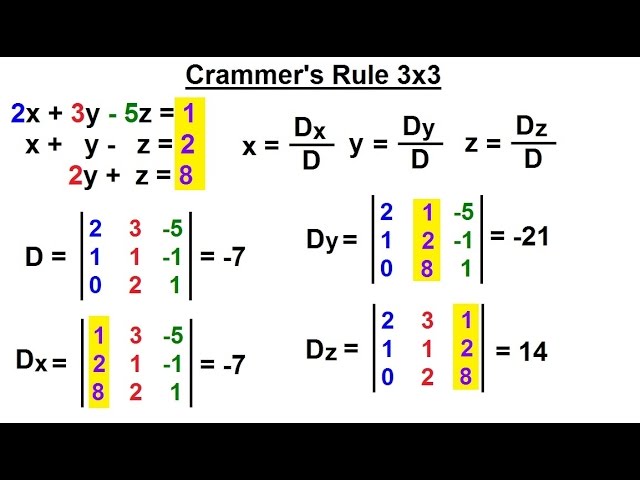
Visit http://ilectureonline.com for more math and science lectures!
In this video I will find x=? y=? z=? of systems of 3 linear equations using Cramer's rule.
First video in the Matrices series can be seen at:
https://youtu.be/pSgaeGFyLH0
fringe cairn
lethal steeple
This might help.
https://youtu.be/UfwXTMygeVs?si=zR2c5WY0UNmB_682
Ok thank you
fringe cairn
tawny apex
yeah then youll have to use algebra
Ok thank you
lethal steeple
But the calculation is still gonna be lengthy
tawny apex
yeah it has some pretty bad calculations
midnight plankBOT
Channel closed
Closed by @fringe cairn
Use .reopen if this was a mistake.
midnight plankBOT
Available help channel!
Send your question here to claim the channel.
Remember:
• Ask your math question in a clear, concise manner.
• Show your work, and if possible, explain where you are stuck.
• After 15 minutes, feel free to ping <@&286206848099549185>.
• Type the command .close to free the channel when you're done.
• Be polite and have a nice day!
Read #❓how-to-get-help for further information on how to ask a good question, and about conduct in the question channels.
 woeful turret
 midnight plankBOT
woeful turret
woeful turret
midnight plankBOT
woeful turret
woeful turret
can someone explain what they did?
fallow scarab
woeful turret
can someone explain what they did?
which line
woeful turret
after they expanded the determinant
fallow scarab
expanding along R_1 means they took the coefficients of the first row and multiplied them by the sub determinants
fallow scarab
 woeful turret
the factor, then the homogenous expression of degree 3
woeful turret
fallow scarab
yes dude i know how to expand a determinant 😭
fallow scarab
then what's your question
woeful turret
after they expanded the determinant
and got 0
what did they do to prove that its equal to the rhs
fallow scarab
did you simplify this
 woeful turret
its just 0 right
grand pondBOT


 fallow scarab
woeful turret
and got 0
fallow scarab
woeful turret
and got 0
does that answer your question
woeful turret
i dont think u understood
my question

this part
and just because the determinant = 0 how did they prove b+c and c+a are factors?
fallow scarab
$a+b$ is a ``factor" of $\Delta$ when $a+b = 0$, then $\Delta = 0$
grand pondBOT
riemann
 fallow scarab
just like how $x+1$ is a factor of $f(x) = (x+1)(x+2)$ because $x+1=0$ implies $f(x) = 0$
grand pondBOT
riemann
 woeful turret
fallow scarab
$a+b$ is a ``factor" of $\Delta$ when $a+b = 0$, then $\Delta = 0$
woeful turret
fallow scarab
$a+b$ is a ``factor" of $\Delta$ when $a+b = 0$, then $\Delta = 0$
oh so they did the samething for b+c and c+a and that also yielded determinant = 0 so thats how they are the factors?
,w det{{r-1,-1,-5},{-2,0,3},{-6,0,6}}
,w det{{r-1,r-2,r-6},{2r-4,2r-6,2r-11},{3r-9,3r-12,3r-18}}


 midnight plankBOT
@woeful turret Has your question been resolved?
Channel closed
Closed by @woeful turret
Use .reopen if this was a mistake.
midnight plankBOT
Available help channel!
Send your question here to claim the channel.
Remember:
• Ask your math question in a clear, concise manner.
• Show your work, and if possible, explain where you are stuck.
• After 15 minutes, feel free to ping <@&286206848099549185>.
• Type the command .close to free the channel when you're done.
• Be polite and have a nice day!
Read #❓how-to-get-help for further information on how to ask a good question, and about conduct in the question channels.
 woeful badge
hey
midnight plankBOT
woeful badge
hey
woeful badge
Back at it with this annoying question

Solved it but there has been a dispute. The highlighted part in yellow is where the problem is. My friends are saying it’s 11 - 4.9 and others including me are saying 10 - 4.9

Which is correct? Is it 10 or 11?
 last arch
woeful badge
Which is correct? Is it 10 or 11?
last arch
woeful badge
Which is correct? Is it 10 or 11?
11
woeful badge
last arch
11
How sure are you?
woeful badge
Negative 5 to positive 5 is ten
last arch
It says there -5.5
woeful badge
Woah
last arch
woeful badge
Woah
I mean am I missing something or
Even though the curve itself intersects x=5
The whole area includes the rectangle from -5.5 to 5.5
woeful badge
Yeah I said woah cause ive been seeing 5
maybe casue the intersection or wtv

Just wanna get confirmation that this derivative result i got is correct, no need to check anything else
just look at the dn/dt
 midnight plankBOT
@woeful badge Has your question been resolved?
midnight plankBOT
Channel closed
Closed due to timeout
Use .reopen if this was a mistake.
Available help channel!
Send your question here to claim the channel.
Remember:
• Ask your math question in a clear, concise manner.
• Show your work, and if possible, explain where you are stuck.
• After 15 minutes, feel free to ping <@&286206848099549185>.
• Type the command .close to free the channel when you're done.
• Be polite and have a nice day!
Read #❓how-to-get-help for further information on how to ask a good question, and about conduct in the question channels.
 lusty cave
 midnight plankBOT
lusty cave
lusty cave
midnight plankBOT
lusty cave
lusty cave
hey how do i solve this kind of problem
 placid spoke
Area of a triangle is
$A = (1/2)ab\sin(C)$
grand pondBOT
doaby
 midnight plankBOT
Channel closed
Closed by @lusty cave
Use .reopen if this was a mistake.
Available help channel!
Send your question here to claim the channel.
Remember:
• Ask your math question in a clear, concise manner.
• Show your work, and if possible, explain where you are stuck.
• After 15 minutes, feel free to ping <@&286206848099549185>.
• Type the command .close to free the channel when you're done.
• Be polite and have a nice day!
Read #❓how-to-get-help for further information on how to ask a good question, and about conduct in the question channels.
 green mesa
the combination of linear and rotational movement is throwing me off, what's the first step?
midnight plankBOT
green mesa
the combination of linear and rotational movement is throwing me off, what's the...

 sharp coral
you can conserve linear momentum to find his linear velocity and conserve angular momentum to find his angular velocity
green mesa
sharp coral
you can conserve linear momentum to find his linear velocity and conserve angula...
really?
I'll try it
It worked
thanks
.close
midnight plankBOT
Channel closed
Closed by @green mesa
Use .reopen if this was a mistake.
midnight plankBOT
Available help channel!
Send your question here to claim the channel.
Remember:
• Ask your math question in a clear, concise manner.
• Show your work, and if possible, explain where you are stuck.
• After 15 minutes, feel free to ping <@&286206848099549185>.
• Type the command .close to free the channel when you're done.
• Be polite and have a nice day!
Read #❓how-to-get-help for further information on how to ask a good question, and about conduct in the question channels.
 regal barn
 midnight plankBOT
regal barn
regal barn
midnight plankBOT
regal barn
regal barn
without graph is there any method?
 rose lake
regal barn
rose lake
regal barn
i havent done this before, but i think intuitively the answer should be 2
because theres 3 parameters. its the points connecting each function that are not differentiable (unless the function happens to smoothly transition to the next one)
 thorny cove
regal barn
thorny cove
regal barn
My prep-school math teacher always recommended using graphs for questions like these

Desmos
regal barn
can i use one thing here is that if i make equal three of these functions
so i got three points
x=1,7/4,-9/4
 spare tiger
rose lake
because theres 3 parameters. its the points connecting each function that are no...
spare tiger
rose lake
because theres 3 parameters. its the points connecting each function that are no...
there can be more than 2 transitions by the way, like consider max(x^2, 1)
rose lake
spare tiger
there can be more than 2 transitions by the way, like consider max(x^2, 1)
oooh i didnt think of that
one of the functions can be put between a single function.. thats kind of annoying
spare tiger
yup
rose lake
idk how you would solve that rigorously
spare tiger
the best way to do this I think is to just calculate when 2 of the 3 are equal
regal barn
spare tiger
the best way to do this I think is to just calculate when 2 of the 3 are equal
please show
thorny cove
the easiest way would be to see where the graphs are intersecting

since that's where the function would get a sharp point
regal barn
thorny cove
the easiest way would be to see where the graphs are intersecting
yes i was saying same thing
rose lake
thorny cove
i was right but for the wrong reason lol
thorny cove
regal barn
yes i was saying same thing
ah, I see
thorny cove
rose lake
i was right but for the wrong reason lol
lmao
thorny cove
If you wish to do it without making a graph, just equate the equations
9 - 4x = 2x^2 + 3
start with that
then verify with 9 - 4x = 4x + 1 and 2x^2 + 3 = 4x + 1
rose lake
thorny cove
If you wish to do it without making a graph, just equate the equations
what happens if one of the intersections doesnt play a role either though
thorny cove
wdym?
rose lake
something like this
 thorny cove
well if one of the function is not intersecting, you can't really get the maximum properly iirc
I mean, y is a function of the maximum of those three equations
rose lake
if i put them in the max function it just spits out the parabola lol. i guess its obvious in this case but it might not be in other cases
thorny cove
yes, that'd just become y = x^2 + 10
thorny cove
regal barn
lmao I just realized that I had this question in a test two years ago
so... do I just close this thread or...?
rose lake
whatever your heart desires
midnight plankBOT
@regal barn Has your question been resolved?
midnight plankBOT
Channel closed
Closed due to timeout
Use .reopen if this was a mistake.
midnight plankBOT
Available help channel!
Send your question here to claim the channel.
Remember:
• Ask your math question in a clear, concise manner.
• Show your work, and if possible, explain where you are stuck.
• After 15 minutes, feel free to ping <@&286206848099549185>.
• Type the command .close to free the channel when you're done.
• Be polite and have a nice day!
Read #❓how-to-get-help for further information on how to ask a good question, and about conduct in the question channels.
 earnest forge
A cabinetmaker uses cherry wood to produce 5 desks each day. Each delivery of one container of wood is $5000, whereas the storage of that material is $10 per day per unit stored, where a unit is the amount of material needed by her to produce 1 desk. How much material should be ordered each time, and how often should the material be delivered, to minimize her average daily cost in the production cycle between deliveries?
midnight plankBOT
earnest forge
A cabinetmaker uses cherry wood to produce 5 desks each day. Each delivery of on...
earnest forge
I don't know where to begin
 vague remnant
gotta create formulas, then find derivative, then minimum
midnight plankBOT
@earnest forge Has your question been resolved?
earnest forge
.close
midnight plankBOT
Channel closed
Closed by @earnest forge
Use .reopen if this was a mistake.
midnight plankBOT
Available help channel!
Send your question here to claim the channel.
Remember:
• Ask your math question in a clear, concise manner.
• Show your work, and if possible, explain where you are stuck.
• After 15 minutes, feel free to ping <@&286206848099549185>.
• Type the command .close to free the channel when you're done.
• Be polite and have a nice day!
Read #❓how-to-get-help for further information on how to ask a good question, and about conduct in the question channels.
 last slate
howw
 midnight plankBOT
last slate
howw
last slate
midnight plankBOT
last slate
howw
last slate
I tried doubling the lengths to get 2 diameters but then I am lost
The answer is A but how
 lyric charm
call the radii of the circles r_A, r_B etc
then AB = r_A + r_B
BC = r_B + r_C
and so on
midnight plankBOT
@last slate Has your question been resolved?
midnight plankBOT
Channel closed
Closed due to timeout
Use .reopen if this was a mistake.
midnight plankBOT
Available help channel!
Send your question here to claim the channel.
Remember:
• Ask your math question in a clear, concise manner.
• Show your work, and if possible, explain where you are stuck.
• After 15 minutes, feel free to ping <@&286206848099549185>.
• Type the command .close to free the channel when you're done.
• Be polite and have a nice day!
Read #❓how-to-get-help for further information on how to ask a good question, and about conduct in the question channels.
 chilly cobalt
"Consider a trapezoid with diagonals with length 5 and 3. If the length of the line connecting the bisectors of the parallel sides is 2, what is the area of the trapezoid?"
 midnight plankBOT
chilly cobalt
"Consider a trapezoid with diagonals with length 5 and 3. If the length of the l...
chilly cobalt
midnight plankBOT
chilly cobalt
"Consider a trapezoid with diagonals with length 5 and 3. If the length of the l...
chilly cobalt
i have no idea what to do..
okay so

ive been stuck on this for a bit
i draw BE parallel to AB
and another line parallel to the line connecting the midpoints at B
chilly cobalt
chilly cobalt
and another line parallel to the line connecting the midpoints at B
and this line bisects DE as well
also ive noticed that BDE and ABCD have the same area
so all thats left is to find the area of BDE
how do i do that?
chilly cobalt
chilly cobalt
so all thats left is to find the area of BDE
<@&286206848099549185> ?
midnight plankBOT
@chilly cobalt Has your question been resolved?
midnight plankBOT
@chilly cobalt Has your question been resolved?
midnight plankBOT
Channel closed
Closed due to timeout
Use .reopen if this was a mistake.
Available help channel!
Send your question here to claim the channel.
Remember:
• Ask your math question in a clear, concise manner.
• Show your work, and if possible, explain where you are stuck.
• After 15 minutes, feel free to ping <@&286206848099549185>.
• Type the command .close to free the channel when you're done.
• Be polite and have a nice day!
Read #❓how-to-get-help for further information on how to ask a good question, and about conduct in the question channels.
 violet rivet
chilly cobalt
"Consider a trapezoid with diagonals with length 5 and 3. If the length of the l...
violet rivet
chilly cobalt
"Consider a trapezoid with diagonals with length 5 and 3. If the length of the l...
 midnight plankBOT
violet rivet
midnight plankBOT
violet rivet
 cedar mason

violet rivet
🔺️FEB'
½ • 2 • 3 = ½(x + y)h
Trapezium area
= ½(2x + 2y)h = ½ • 2(x + y)h = (x + y)h
midnight plankBOT
Please show the original problem, exactly as it was stated to you, with the entire original context. A picture or screenshot is best. If the original problem is not in English, then post it anyway! The additional context might still be helpful. Do your best to provide a translation.
cedar mason
!nosols .
midnight plankBOT
As a helper, please do not give out answers that could be copied as a homework solution. Have the student work through the problem themselves and guide them along the way.
 carmine sigil
@cedar mason that guy is OP
violet rivet
chilly cobalt
"Consider a trapezoid with diagonals with length 5 and 3. If the length of the l...
here
carmine sigil
Oooh
violet rivet
oh it's closed
midnight plankBOT
As a helper, please do not give out answers that could be copied as a homework solution. Have the student work through the problem themselves and guide them along the way.
cedar mason
.close
midnight plankBOT
Channel closed
Closed by @cedar mason
Use .reopen if this was a mistake.
Available help channel!
Send your question here to claim the channel.
Remember:
• Ask your math question in a clear, concise manner.
• Show your work, and if possible, explain where you are stuck.
• After 15 minutes, feel free to ping <@&286206848099549185>.
• Type the command .close to free the channel when you're done.
• Be polite and have a nice day!
Read #❓how-to-get-help for further information on how to ask a good question, and about conduct in the question channels.
 gusty flame
 midnight plankBOT
gusty flame
gusty flame
midnight plankBOT
gusty flame
gusty flame
how do i approach this problem
im guessing i should use the root test but how would that even work with the n^2
 gleaming latch
gusty flame
how do i approach this problem
gleaming latch
gusty flame
how do i approach this problem
what problem lol all you gave is a summation
are we proving it diverges?
lyric charm
gusty flame
im guessing i should use the root test but how would that even work with the n^2
can you write out what you need to work out for the root test, without worrying about how that would work
just apply the test as-written without thinking about how to simplify it
gusty flame
gleaming latch
are we proving it diverges?
conv or div
gusty flame
lyric charm
can you write out what you need to work out for the root test, **without** worry...
well when i do the root test
floral apex
you could use the root test its a fools errand tho
why not check easier requirements firs
gusty flame
gusty flame
well when i do the root test
honestly not sure how to
gusty flame
floral apex
you could use the root test its a fools errand tho
whats a fools errand
cedar mason
gusty flame
whats a fools errand
waste of time
floral apex
like check nth term, or do a naive comparison first
gleaming latch
well it obviously diverges right
gusty flame
gleaming latch
well it obviously diverges right
yes ofc
gusty flame
i mean i can see it divs
floral apex
we can take log right
gusty flame
not sure how to
 midnight plankBOT
Channel closed
Closed by @gusty flame
Use .reopen if this was a mistake.
gusty flame
no problem bro
midnight plankBOT
✅
gusty flame
floral apex
i hit it with the root test
sure what does it look like
floral apex
so you get $\lim \qty( \frac{n}{n+1} )^n$
grand pondBOT
jan Niku
 gusty flame
right
floral apex
this is $\lim \qty(1- \frac{1}{n+1} )^n$
grand pondBOT
jan Niku
 floral apex
i had to do some approximating from here
this is $\lim \qty(1- \frac{n}{n+1} + \frac{n(n-1)}{2(n+1)^2} - \dots )$
grand pondBOT
jan Niku
 floral apex
approximately, as long as 1/(n+1) is small
gusty flame
what a weird problem
gusty flame
yes
floral apex
like $\frac{n(n-1)){(n+1)^2}$ is just 1
grand pondBOT
jan Niku
Compile Error! Click the reaction for more information.
(You may edit your message to recompile.)

 signal hawk
floral apex
this is $\lim \qty(1- \frac{n}{n+1} + \frac{n(n-1)}{2(n+1)^2} - \dots )$
signal hawk
floral apex
this is $\lim \qty(1- \frac{n}{n+1} + \frac{n(n-1)}{2(n+1)^2} - \dots )$
Pretty sure you can't do this when the exponent is variable
floral apex
grand pond
**jan Niku**
so this is actually $\lim _{n \to \infty} \sum \frac{(-1)^m}{m!}$
grand pondBOT
jan Niku
 floral apex
signal hawk
Pretty sure you can't do this when the exponent is variable
floral apex
signal hawk
Pretty sure you can't do this when the exponent is variable
ahhh yu might be right
i was thinking all this approximation is not needed
its a known limit
im sure of it
signal hawk
Yea just take log(exp(...)) and youll get that I think
signal hawk
yea
gusty flame
floral apex
wacky
yeah weird problem
midnight plankBOT
@gusty flame Has your question been resolved?
midnight plankBOT
Channel closed
Closed due to timeout
Use .reopen if this was a mistake.
Available help channel!
Send your question here to claim the channel.
Remember:
• Ask your math question in a clear, concise manner.
• Show your work, and if possible, explain where you are stuck.
• After 15 minutes, feel free to ping <@&286206848099549185>.
• Type the command .close to free the channel when you're done.
• Be polite and have a nice day!
Read #❓how-to-get-help for further information on how to ask a good question, and about conduct in the question channels.
 sweet shuttle
how can I isolate a variable here -3x+4y=2
midnight plankBOT
sweet shuttle
how can I isolate a variable here -3x+4y=2
 fathom atlas
sweet shuttle
how can I isolate a variable here -3x+4y=2
fathom atlas
sweet shuttle
how can I isolate a variable here -3x+4y=2
Use rules of equations
sweet shuttle
but then I would have y=3x+2/4
fathom atlas
Parentheses...
sweet shuttle
y=(3x+2)/2 ?
fathom atlas
4..
fathom atlas
/4
sweet shuttle
this is part of a bigger question btw here is the full question I basically have to get this to y = something and use that to solve and get the factors

Give all the solutions for the nonlinear system.
^ that is the instructions
sweet shuttle
fathom atlas
/4
oh yeah mb
 wanton rock
sweet shuttle
but then I would have y=3x+2/4
wanton rock
sweet shuttle
but then I would have y=3x+2/4
here a hint. it's supposed
4y = (3x + 2)
the parentheses is important
sweet shuttle
wanton rock
here a hint. it's supposed
4y = (3x + 2)
the parentheses is important
but then I would have y unc I would just have an equation
wanton rock
"unc l"?
sweet shuttle
unc=uncle
 dusty portal
He’s calling you old
wanton rock

dusty portal
sweet shuttle
but then I would have y unc I would just have an equation
It’s the whole point anyways.
wanton rock
tbh i still don't understand
dusty portal
You can just subsitute into the first equation, no?
 gritty bane
dusty portal
You can just subsitute into the first equation, no?
gritty bane
dusty portal
You can just subsitute into the first equation, no?
Yes
sweet shuttle
but where would I put 4y=(3x+2) if I dont have x or y ?
wanton rock
move the 4
sweet shuttle
y=(3x+2)/4
dusty portal
sweet shuttle
but where would I put 4y=(3x+2) if I dont have x or y ?
Well, isolate y (which you did already), then plug it into the other equation.
wanton rock
to the right side
sweet shuttle
sorry typo
wanton rock
sweet shuttle
y=(3x+2)/4
congrats 🎉
sweet shuttle
wanton rock
congrats 🎉
unc I just fucking had that and u told me not to use it ?
dusty portal
!volunteers
midnight plankBOT
Helpers are just people volunteering their time to help you. Be polite and patient.
dusty portal
Just be warned
wanton rock
tbh i don't really understand his point
sweet shuttle
I was being respectful just a question
dusty portal
I get it, it’s just rubs off as rude
dusty portal
Anyways, yes, you had it right.
wanton rock
sweet shuttle
but then I would have y=3x+2/4
because this isn't same as
y = (3x + 2) / 4
sweet shuttle
wanton rock
because this isn't same as
y = (3x + 2) / 4
ahh ok thanks
ngl now im confused again I have x^2+(3x+2)/4=5
do I multiply by denominator ?
dusty portal
sweet shuttle
ngl now im confused again I have x^2+(3x+2)/4=5
(Second term is squared!)
dusty portal
sweet shuttle
do I multiply by denominator ?
Yeah.
It ends up being a bit nasty, but not too bad.
midnight plankBOT
Channel closed
Closed by @sweet shuttle
Use .reopen if this was a mistake.
midnight plankBOT
Available help channel!
Send your question here to claim the channel.
Remember:
• Ask your math question in a clear, concise manner.
• Show your work, and if possible, explain where you are stuck.
• After 15 minutes, feel free to ping <@&286206848099549185>.
• Type the command .close to free the channel when you're done.
• Be polite and have a nice day!
Read #❓how-to-get-help for further information on how to ask a good question, and about conduct in the question channels.
last slate
Hi
midnight plankBOT
last slate
Hi
 normal prawn
What's ur question
dusty portal
!da2a
midnight plankBOT
No need to ask “Can I ask…?” or “Does anyone know about…?”—it’s faster for everyone if you just ask your question! See https://dontasktoask.com/
last slate
The Gauss Markov assumption of random sampling
Does it imply Cov(Yi,Yj)= 0?
Where Yi, Yj are dependent variable values from the data
cedar mason
nvm idk
 polar star
,w Gauss Markov assumption of random sampling
grand pondBOT

Wolfram Alpha doesn't understand your query!
Perhaps try rephrasing your question?
Click here to refine your query online
 Requested by _mia_34
fallow scarab
Requested by _mia_34
fallow scarab
 fallow scarab
In statistics, the Gauss–Markov theorem (or simply Gauss theorem for some authors) states that the ordinary least squares (OLS) estimator has the lowest sampling variance within the class of linear unbiased estimators, if the errors in the linear regression model are uncorrelated, have equal variances and expectation value of zero. The errors ...
last slate
Random sampling assumption states that we are working with a completely random population and only one population
If there's any clarification needed pls tell me
<@&286206848099549185>
cedar mason
last slate
<@&286206848099549185>
last slate
It feels like it should be true that if we have a random sample, then it's individual Y terms are uncorrelated
 loud heath
Hlo
last slate
Reiterating clearly: The Gauss Markov assumption of random sampling, Does it imply Cov(Yi,Yj)= 0? Where Yi, Yj are dependent variable values from the data.
It feels like it should be true that if we have a random sample, then it's individual Y terms are uncorrelated.
But then that implies autocorrelation by itself. Which seems wrong that one GM assumption would imply the other.
cedar mason
loud heath
Hlo
!occupied
midnight plankBOT
loud heath
Hlo
Someone else is already using this help channel. If you need help with a question, please open your own help channel/thread (see #❓how-to-get-help for instructions).
@last slate Has your question been resolved?
 untold willow
Huh
last slate
.close
midnight plankBOT
Channel closed
Closed by @icy zenith
Use .reopen if this was a mistake.
 molten bay
Anybody check this solution
midnight plankBOT
Available help channel!
Send your question here to claim the channel.
Remember:
• Ask your math question in a clear, concise manner.
• Show your work, and if possible, explain where you are stuck.
• After 15 minutes, feel free to ping <@&286206848099549185>.
• Type the command .close to free the channel when you're done.
• Be polite and have a nice day!
Read #❓how-to-get-help for further information on how to ask a good question, and about conduct in the question channels.
 twin ridge
Can someone explain this to me?
 midnight plankBOT
twin ridge
Can someone explain this to me?
twin ridge
midnight plankBOT
twin ridge
Can someone explain this to me?
twin ridge
I've watched 6 videos on the subject and tried reading the textbook, but none of them have even come close to telling me wtf this beta thing is, let alone how to find it.
.close
midnight plankBOT
Channel closed
Closed by @twin ridge
Use .reopen if this was a mistake.
midnight plankBOT
Available help channel!
Send your question here to claim the channel.
Remember:
• Ask your math question in a clear, concise manner.
• Show your work, and if possible, explain where you are stuck.
• After 15 minutes, feel free to ping <@&286206848099549185>.
• Type the command .close to free the channel when you're done.
• Be polite and have a nice day!
Read #❓how-to-get-help for further information on how to ask a good question, and about conduct in the question channels.
dusty portal
Test
Yep it’s fucking dead
<@&268886789983436800> Don’t know if this is the right ping but the bot is down right now
Sorry if I shouldn’t have pinged
Aa
midnight plankBOT
dusty portal
Test
midnight plankBOT
Channel closed
Closed by @dusty portal
Use .reopen if this was a mistake.
 grim vector
dusty portal
There we are
grim vector
dusty portal
There we are
Ain't no way bro is meta tester
dusty portal
grim vector
Ain't no way bro is meta tester
?!
Me and bonk noticed it
I was just seeing if it was really dead
fathom atlas
Bot needs rest too
grim vector
Nothing bad to this
 buoyant yoke
dusty portal
I was just seeing if it was really dead
buoyant yoke
dusty portal
I was just seeing if it was really dead
you dont need to do this much testing to see that the bot is dead
just try a few commands and thats al you need lol
dusty portal
buoyant yoke
you dont need to do this much testing to see that the bot is dead
Nah I’m like that
Paranoid
buoyant yoke
and pinging mods is unnecessary
midnight plankBOT
Available help channel!
Send your question here to claim the channel.
Remember:
• Ask your math question in a clear, concise manner.
• Show your work, and if possible, explain where you are stuck.
• After 15 minutes, feel free to ping <@&286206848099549185>.
• Type the command .close to free the channel when you're done.
• Be polite and have a nice day!
Read #❓how-to-get-help for further information on how to ask a good question, and about conduct in the question channels.
 raven hawk
Is my calculator broken? Here's what I'm looking at
midnight plankBOT
raven hawk
Is my calculator broken? Here's what I'm looking at
raven hawk

But I keep getting 40.814.....
(actually, my problem uses 2.75 instead of 2.8, but still)
 fallow scarab
,calc 1/2 * pi * 3^2
grand pondBOT
Result:
14.137166941154
,calc 4 * 3 / (3 * pi)
grand pondBOT
Result:
1.2732395447352
oh you didn't use parentheses in your calculator probably

and similarly for the last term with 3pi in the denom
raven hawk
I've tried with and without parentheses.. tried each operation individually instead of all on a single line..
fallow scarab
then you're inputting the parentheses incorrectly
fallow scarab
fallow scarab
,calc 4 * 3 / (3 * pi)
follow this
midnight plankBOT
Channel closed
Closed by @raven hawk
Use .reopen if this was a mistake.
Available help channel!
Send your question here to claim the channel.
Remember:
• Ask your math question in a clear, concise manner.
• Show your work, and if possible, explain where you are stuck.
• After 15 minutes, feel free to ping <@&286206848099549185>.
• Type the command .close to free the channel when you're done.
• Be polite and have a nice day!
Read #❓how-to-get-help for further information on how to ask a good question, and about conduct in the question channels.
 uneven sandal
$I = \int_\mathbb{C} d^2z \, \omega(z) P_j(z) \overline{P_k(z)} z$
tobi
 uneven sandal
can I evaluate this for general orthogonal Polynomials with weight w?
because the z term is kinda annoying and I dont know how to deal with it
found some recursion formula on wikipedia
.close
midnight plankBOT
Channel closed
Closed by @uneven sandal
Use .reopen if this was a mistake.
midnight plankBOT
Available help channel!
Send your question here to claim the channel.
Remember:
• Ask your math question in a clear, concise manner.
• Show your work, and if possible, explain where you are stuck.
• After 15 minutes, feel free to ping <@&286206848099549185>.
• Type the command .close to free the channel when you're done.
• Be polite and have a nice day!
Read #❓how-to-get-help for further information on how to ask a good question, and about conduct in the question channels.
midnight plankBOT
 exotic basalt
angle a?
midnight plankBOT
Channel closed
Channel closed due to the original message being deleted.
If you did not intend to do this, please open a new help channel,
as this action is irreversible, and this channel may abruptly lock.
exotic basalt
rn u cant do sine rule
wait so then u have b already?
or did u that using sine rule
nice
then use sine rule now
to find A
wait hold on
no use cosine rule again
both works
ah
ok
yeah
so its like
recall how a sin graph works
it goes up to 1 at 90 then goes back down to 0 at 180
correct?
so if ur value u had was like 75
on the other side of the sine graph, 105 would also be a valid value

smth like this
so it honestly depends if the question was asking u to find an acute or obtuse angle
but a better way to bypass that ambiguity is using cosine rule
since cosine goes from 1 to 0 at 90 then 0 to -1 at 180
no overlaps
midnight plankBOT
Available help channel!
Send your question here to claim the channel.
Remember:
• Ask your math question in a clear, concise manner.
• Show your work, and if possible, explain where you are stuck.
• After 15 minutes, feel free to ping <@&286206848099549185>.
• Type the command .close to free the channel when you're done.
• Be polite and have a nice day!
Read #❓how-to-get-help for further information on how to ask a good question, and about conduct in the question channels.
exotic basalt
yeah we'll continue here
would u agree that sin(75) and sin( 105) would output the same answer
like if y=sinx, it would be the same y value
so thats why our calculator is a bit confused
it gives the value closest to 0 instead of what we want
so imo i'd rather use cosine rule as it removes that confusion
always
cuz angles in a triangle can never get past 180
and from 0 to 180 the cos graph is never symmetrical
np
midnight plankBOT
Channel closed
Closed by @tall lily
Use .reopen if this was a mistake.
midnight plankBOT
Available help channel!
Send your question here to claim the channel.
Remember:
• Ask your math question in a clear, concise manner.
• Show your work, and if possible, explain where you are stuck.
• After 15 minutes, feel free to ping <@&286206848099549185>.
• Type the command .close to free the channel when you're done.
• Be polite and have a nice day!
Read #❓how-to-get-help for further information on how to ask a good question, and about conduct in the question channels.
 meager ore
Let $p$ be a prime number, $k \in \mathbb{Z}^+$, and $G$ a cyclic group of order $p^k$. Prove that $|\text{Aut}(G)| = p^{k-1}(p-1)$.
midnight plankBOT
meager ore
Let $p$ be a prime number, $k \in \mathbb{Z}^+$, and $G$ a cyclic group of order...
grand pondBOT
Halex
 meager ore
I know $p^{k-1}(p-1) = \phi (p ^k)$ is the number of generators of $G$
grand pondBOT
Halex
 meager ore
And also, $f \in \text{Aut}(G)$ implies $\langle f(g) \rangle = G$ where $\langle g \rangle = G$
grand pondBOT
Halex

 gaunt plume
Do you know what the automorphisms of this group look like?
That's probably the best place to go next
meager ore
gaunt plume
Do you know what the automorphisms of this group look like?
Every element in G is a power of g. The image of g under some automorphism of G is also a generator of G
Is it wrong?
gaunt plume
meager ore
And also, $f \in \text{Aut}(G)$ implies $\langle f(g) \rangle = G$ where $\langl...
No that's right, that's just a rephrasing of this
You can be a bit more specific though
meager ore
How so?
gaunt plume
As in that's just a property that every automorphism has
What you want to try and do is find all of them
meager ore
gaunt plume
What you want to try and do is find all of them
Yup, I want to get a relation that allows me to show they are $p^{k-1}(p-1)$.
grand pondBOT
Halex
 meager ore
Could you give me a hint please?
gaunt plume
Sure
gaunt plume
meager ore
And also, $f \in \text{Aut}(G)$ implies $\langle f(g) \rangle = G$ where $\langl...
See if you can prove the converse to this
or a converse, I should say
meager ore
gaunt plume
See if you can prove the converse to this
it would not be surjective?
gaunt plume
Wdym
meager ore
for the converse, if we assume < f(g) > ≠ G, then | f (g) | ≠ p^k = | G |
meager ore
Okay I'm dumb
grand pondBOT
depression
 gaunt plume
meager ore
Okay I'm dumb
gaunt plume
meager ore
Okay I'm dumb
Nw it's easily done
The contrapositive is just the same statement but written differently (assuming TND at least but let's not go there)
meager ore
gaunt plume
Assume that $\langle f(g)\rangle=G$
if f an homomorphism by hypothesis?
meager ore
gaunt plume
Any luck?
Yes
Took a while
Let $y \in G$. Since $\langle f(g) \rangle = G$ it follows $( f(g) )^k = y$ for some $k \in \mathbb{Z}^+$, which is the same as $ f(g^k) = y$ since $f$ is an homomorphism. Thus $f$ is surjective
grand pondBOT
Halex
 meager ore
Assume $f(x) = e$ where $e$ is the identity of $G$. We will show that $\text{Ker}(f) = {e}$. Since $x \in G$, we have that $x = g^m$ for some $m \in \mathbb{Z}^+$. $$f(g^m) = (f(g))^m,$$ so $m = |G| \cdot k$ for some $k$. Hence $$x = g^{|G| k} = (g^{|G|})^k = e^k = e.$$ Thus $\text{Ker}(f) = {e}$.
gaunt plume
G is a group, not a homomorphism, so ker(G) doesn't really mean anything
Well done though
meager ore
gaunt plume
G is a group, not a homomorphism, so ker(G) doesn't really mean anything
my bad
it should be fixed now
gaunt plume
You're still talking about ker(G)
G does not have a kernel
Your logic is good though
grand pondBOT
Halex
 gaunt plume
grand pond
**Halex**
gaunt plume
grand pond
**Halex**
So now can you finish the proof of this?
meager ore
gaunt plume
So now can you finish the proof of this?
There's no need to prove that f is an automorphism then < f(g) > = G?
gaunt plume
Oh sorry I thought you were done with that proof
As in I thought you'd proven that already
Yes you need it
meager ore
well, this implication is a little bit harder than the previous one
how do I show < f (g) > = G?
gaunt plume
I'd do it by contradiction personally
But you don't have to, you can do it directly as well
gaunt plume
meager ore
And also, $f \in \text{Aut}(G)$ implies $\langle f(g) \rangle = G$ where $\langl...
I thought you had it already because you said so here
meager ore
it was by intuition haha
meager ore
gaunt plume
I'd do it by contradiction personally
By way of contradiction, if $\langle f(g) \rangle \neq G$ this would mean that $f(G) \neq G$ which contradicts the fact that $f$ is surjective?
grand pondBOT
Halex
 gaunt plume
Ummm... yes but you haven't actually specified why this means that f(G) =/= G. You just said there's a contradiction and left it as an exercise for the reader haha
Sorry if that sounds mean but I'd probably give half marks
Really focus on the fact that g generates G
meager ore
I'm a bit confused now
gaunt plume
$\bigl\langle f(g)\bigr\rangle$ is the group generated by the element $f(g)$. $f(G):={f(g)\mid g\in G}$ is the setwise image of $G$ under $f$.
They are not the same
a priori
grand pondBOT
depression
 gaunt plume
So one not being equal to the whole group doesn't necessarily mean that the other isn't
If that makes sense
meager ore
gaunt plume
Really focus on the fact that g generates G
Let $a \in G$, it follows $a = g^k$ for some $k$, then $f(a) = f(g^k) = (f(g))^k$.
since $a$ is arbitrary, $f(G) = { (f(g))^k : k \in \mathbb{Z}^+ } = \langle f(g) \rangle$
grand pondBOT
Halex
 meager ore
since f(G) = G as we get our desired result
meager ore
meager ore
Let $p$ be a prime number, $k \in \mathbb{Z}^+$, and $G$ a cyclic group of order...
Now, how does this help me prove this?
meager ore
gaunt plume
what does that give you?
Not sure how to conclude
gaunt plume
grand pond
**Halex**
result 1
meager ore
$f \in \text{Aut}(G)$ if and only if $ \langle f(g) \rangle = G$ with $ \langle g \rangle = G$?
grand pondBOT
Halex
 gaunt plume
Good
That tells you exactly what the automorphisms are and what they look like
You should be able to count them now
For simplicity fix a generator g
meager ore
I might be missing something, but I do not get the relation with the totient function
gaunt plume
It was one of the first things you said
gaunt plume
grand pond
**Halex**
.
meager ore
Yep, but I didn't say I know why it is the order of |Aut(G)| 😔
gaunt plume
Ah okay
gaunt plume
grand pond
**Halex**
That comes from this
There is one automorphism for every generator of G
meager ore
May I be missing another property of Aut(G)?
gaunt plume
That's what that statement means
Because homomorphisms are determined exactly by what they do to the generators of a group
Do you see why that's true?
meager ore
There are $\phi (p^k)$ generators of $G$
grand pondBOT
Halex
 gaunt plume
Yes there are
grand pondBOT
Halex
 meager ore
Is this wrong?
meager ore
Okay, I see the point now
meager ore
gaunt plume
Do you understand why it's true though?
What I don't get at all is how we can make the conclusion in a formal proof
gaunt plume
If $x = g_1^{a_1}g_2^{a_2}\cdots g_n^{a_n}$, then $f(x) = f(g_1)^{a_1}f(g_2)^{a_2}\cdots f(g_n)^{a_n}$ for any homomorphism f
grand pondBOT
depression
 gaunt plume
That's why
if g_1, ...., g_n is a generator set
You've got all the pieces already
You've just proven that the automorphisms are in bijection with the generators of G
gaunt plume
grand pond
**Halex**
This is the bijection
meager ore
G has $\phi(p^k)$ generators and every generator $g \in G$ determines an automorphism. So $| \text{Aut}(G)$ has $\phi(p^k)$ elements
grand pondBOT
Halex
 meager ore
I get the point. But is it clear enough? Like how do I write it in a formal proof?
gaunt plume
That sounds formal to me
If two sets are in bijection, then by definition they are the same size
meager ore
gaunt plume
a unique automorphism*
I didn't prove it was unique did I?
gaunt plume
grand pond
**depression**
That's from this
A homomorphism is uniquely determined by what it does to generators
 lapis garnet
Ok
meager ore
I didn't know that 🤔
gaunt plume
Okay maybe I shouldn't've said it then haha
but for a cyclic group it's pretty clear
Because all elements are of the form g^k
so f(g^k) = f(g)^k
The only thing that matters is what happens to g
meager ore
I am a bit confused
gaunt plume
Do you know what a homomorphism is?
meager ore
Yes
gaunt plume
What is it?
meager ore
A function f:A->B satisfying f(ab) = f(a)f(b) where A and B are groups with some binary operations
meager ore
I know the product <x> determines a subgroup
gaunt plume
Yes
But in this case, $G$ is a cyclic group, so {\sl every/} element of $G$ can be written as $g^k$ for some $k\in\mathbb N$
grand pondBOT
depression
 meager ore
What I don't get is the uniqueness
gaunt plume
Okay
Let's say $f$ and $h$ are two different homomorphisms such that $$f(g)=h(g)=g^k$$
grand pondBOT
depression
 gaunt plume
Since they are different, there is an $i$ such that $f(g^i)\ne h(g^i)$
grand pondBOT
depression
 gaunt plume
What is the contradiction?
meager ore
Weren't we talking about automorphisms?
gaunt plume
automorphisms are homomorphisms
but with extra conditions as well
f and h can be automorphisms if you want, it doesn't make a difference
This is a more general result
An automorphism is just an invertible homomorphism from G to itself
meager ore
gaunt plume
Since they are different, there is an $i$ such that $f(g^i)\ne h(g^i)$
Why does such index exist?
They are different and all of the elements of G had the form g^m
gaunt plume
if $f$ and $h$ are different, then there must be some element $x$ of the group such that $f(x)\ne h(x)$
grand pondBOT
depression
 meager ore
So there's at least one value where they differ?
grand pondBOT
depression
 meager ore
What does this exactly provd?
gaunt plume
Uniqueness?
gaunt plume
meager ore
What I don't get is the uniqueness
.
meager ore
gaunt plume
Uniqueness?
An endomorphism of a cyclic group is unique
gaunt plume
Well no not exactly
There are quite a lot of endomorphisms
But we're talking about endomorphisms such that f(g) = something in particular
meager ore
grand pond
**Halex**
That something in particular are the homomorphism satisfying this
gaunt plume
No, that something in particular is any generator of G
meager ore
gaunt plume
Let's say $f$ and $h$ are two different homomorphisms such that $$f(g)=h(g)=g^k$...
Could you tell me what the statement is again please?
I got lost
gaunt plume
meager ore
I didn't prove it was unique did I?
Your question was whether there was a unique automorphism for every generator of G
And I just showed that the answer is yes
meager ore
If you suppose there are two different of them, why you assumed f(g) = h(g)?
gaunt plume
That's what we're showing isn't it?
We're trying to show that there's a bijection between automorphisms of G, and generators of g
gaunt plume
grand pond
**Halex**
.
For any homorphism f, f is an automorphism if and only if f(g) is a generator of G
So for a fixed generator of G, there is an automorphism f such that f(g) = said fixed generator
And this shows it's unique
Look it's been 3 hours and I have stuff to do
But I have given you everything
Ping helpers if you need any more help
meager ore
Yep, thank you for your patience
midnight plankBOT
@meager ore Has your question been resolved?
midnight plankBOT
Channel closed
Closed due to timeout
Use .reopen if this was a mistake.
Available help channel!
Send your question here to claim the channel.
Remember:
• Ask your math question in a clear, concise manner.
• Show your work, and if possible, explain where you are stuck.
• After 15 minutes, feel free to ping <@&286206848099549185>.
• Type the command .close to free the channel when you're done.
• Be polite and have a nice day!
Read #❓how-to-get-help for further information on how to ask a good question, and about conduct in the question channels.
 copper ginkgo
uh help?
 midnight plankBOT
copper ginkgo
uh help?
lyric charm
midnight plankBOT
copper ginkgo
uh help?
lyric charm
how did you get 1000 as the number of terms
copper ginkgo
 lyric charm
hmmm
copper ginkgo
or am i understanding the question wrongly
lyric charm
i dont think they would have expected you to do that
you were instead expected to use the alternating series error bound
ie that the error in a finite approximation of an alternating series is at most the magnitude of the first term thrown out
lyric charm
wait what
was it not brought up in class 
for a series $\sum_{n=1}^{\infty} (-1)^n b_n$, with partial sums $S_n$ and true sum $S$, you have $$|S_n - S| \leq b_{n+1}$$
grand pondBOT
Ann
 midnight plankBOT
@copper ginkgo Has your question been resolved?