
#help-49
1 messages · Page 172 of 1
 grand pondBOT
 midnight plankBOT
@gloomy scaffold Has your question been resolved?
midnight plankBOT
Channel closed
Closed due to timeout
Use .reopen if this was a mistake.
 solid iris
.reopen
midnight plankBOT
Channel closed
Closed due to timeout
Use .reopen if this was a mistake.
 Available help channel!
Send your question here to claim the channel.
Remember:
• Ask your math question in a clear, concise manner.
• Show your work, and if possible, explain where you are stuck.
• After 15 minutes, feel free to ping <@&286206848099549185>.
• Type the command .close to free the channel when you're done.
• Be polite and have a nice day!
Read #❓how-to-get-help for further information on how to ask a good question, and about conduct in the question channels.
 gloomy scaffold
hi im back
midnight plankBOT
gloomy scaffold
hi im back
gloomy scaffold
do u think you can isolate t from d=80e^{-\frac{t}{4}}-0.25t^2+20t-80
dammit
okay thanks
.solved
midnight plankBOT
Channel closed
Closed by @gloomy scaffold
Use .reopen if this was a mistake.
Available help channel!
Send your question here to claim the channel.
Remember:
• Ask your math question in a clear, concise manner.
• Show your work, and if possible, explain where you are stuck.
• After 15 minutes, feel free to ping <@&286206848099549185>.
• Type the command .close to free the channel when you're done.
• Be polite and have a nice day!
Read #❓how-to-get-help for further information on how to ask a good question, and about conduct in the question channels.
Channel closed
Channel closed due to the original message being deleted.
If you did not intend to do this, please open a new help channel,
as this action is irreversible, and this channel may abruptly lock.
Available help channel!
Send your question here to claim the channel.
Remember:
• Ask your math question in a clear, concise manner.
• Show your work, and if possible, explain where you are stuck.
• After 15 minutes, feel free to ping <@&286206848099549185>.
• Type the command .close to free the channel when you're done.
• Be polite and have a nice day!
Read #❓how-to-get-help for further information on how to ask a good question, and about conduct in the question channels.
 native ruin
Hey,
There is a new concept I'm doing, but I am unsure if I'm doing it correctly here. What I'm asking for is a pair of eyes to tell me if I got the concept correct, since I am going by the book, but it seems not simplified enough compared to the other problems

 midnight plankBOT
native ruin
Hey,
There is a new concept I'm doing, but I am unsure if I'm doing it correctl...
native ruin
midnight plankBOT
native ruin
Hey,
There is a new concept I'm doing, but I am unsure if I'm doing it correctl...
native ruin
if you know what I mean haha, any help would be much appreciated!
 lyric charm
your picture is a bit too low-res to tell what the second fraction is -- is it meant to be $\frac{3}{1 + \frac{4x}{z}}$ maybe?
grand pondBOT
Ann
 lyric charm
in any case, whether its denominator is $1 + \frac{4x}{z}$ or $1 + \frac{4z}{z}$, you simplified it incorrectly
grand pondBOT
Ann
 native ruin
lyric charm
in any case, whether its denominator is $1 + \frac{4x}{z}$ or $1 + \frac{4z}{z}$...
native ruin
lyric charm
in any case, whether its denominator is $1 + \frac{4x}{z}$ or $1 + \frac{4z}{z}$...
Apologies, it's the second one in the picture below
lyric charm
ok then as your first step you could have (and imo should have) simplified that to just 4
and leave yourself with $\frac{x}{z} - \frac{3}{5}$
grand pondBOT
Ann
 native ruin
grand pond
**Ann**
native ruin
grand pond
**Ann**
That would be a lot easier wouldn't it
lyric charm
indeed
native ruin
lyric charm
indeed
So this should be the best format then? (sorry for any sloppiness, can't really take photos of irl scratchwork)
 lyric charm
correct now
lyric charm
native ruin
Hey,
There is a new concept I'm doing, but I am unsure if I'm doing it correctl...
but just to make sure, can you zoom in on the thing in image #2 here to confirm that it really is 4z/z
cause i am getting a sneaking suspicion that both of our eyesights may be failing us
native ruin
lyric charm
cause i am getting a _sneaking suspicion_ that both of our eyesights may be fail...

Still sorta blurry, but I'm pretty sure it's a z
lyric charm
ok that did not help
it is incredibly blurry
is there no way to zoom in on the website that it gives your expression on
it'd be really annoying if we get this wrong because of inability to read the original properly
native ruin
Ctrl + Zoom is what I'm doing right
but compared to the x and z on the left, I'd think it is a z
native ruin
lyric charm
well, ok, so be it then
Lol, I thank you for the concern though, means you care
ty again ❤️
.close
midnight plankBOT
Channel closed
Closed by @native ruin
Use .reopen if this was a mistake.
midnight plankBOT
Available help channel!
Send your question here to claim the channel.
Remember:
• Ask your math question in a clear, concise manner.
• Show your work, and if possible, explain where you are stuck.
• After 15 minutes, feel free to ping <@&286206848099549185>.
• Type the command .close to free the channel when you're done.
• Be polite and have a nice day!
Read #❓how-to-get-help for further information on how to ask a good question, and about conduct in the question channels.
 dire thorn
Find the number of ways of choosing the vertices of a regular 17-gon so that the three vertices form an obtuse triangle
midnight plankBOT
dire thorn
Find the number of ways of choosing the vertices of a regular 17-gon so that the...
dire thorn
<@&286206848099549185>
 nimble copper
dire thorn
<@&286206848099549185>
nimble copper
dire thorn
<@&286206848099549185>
!15m
midnight plankBOT
dire thorn
<@&286206848099549185>
Please only use the <@&286206848099549185> ping once if your question has not been answered for 15 minutes. Please do not ping or DM individual users about your question.
midnight plankBOT
@dire thorn Has your question been resolved?
midnight plankBOT
Channel closed
Closed due to timeout
Use .reopen if this was a mistake.
Available help channel!
Send your question here to claim the channel.
Remember:
• Ask your math question in a clear, concise manner.
• Show your work, and if possible, explain where you are stuck.
• After 15 minutes, feel free to ping <@&286206848099549185>.
• Type the command .close to free the channel when you're done.
• Be polite and have a nice day!
Read #❓how-to-get-help for further information on how to ask a good question, and about conduct in the question channels.
midnight plankBOT
Channel closed
Channel closed due to the original message being deleted.
If you did not intend to do this, please open a new help channel,
as this action is irreversible, and this channel may abruptly lock.
Available help channel!
Send your question here to claim the channel.
Remember:
• Ask your math question in a clear, concise manner.
• Show your work, and if possible, explain where you are stuck.
• After 15 minutes, feel free to ping <@&286206848099549185>.
• Type the command .close to free the channel when you're done.
• Be polite and have a nice day!
Read #❓how-to-get-help for further information on how to ask a good question, and about conduct in the question channels.
 azure basin
I voluntarily attended a session today where they offer help with mathmatics at the school I attend. Maths teacher told me that d[v * cos(a)] where v and cos(a) both are functions means the derivative of v * cos(a). In other words f(v)' * f(a) + f(v) * f'(a), in other words the chain rule or whatever it's called. Is there a parallel between that and what d means under other circumstances like integral of (2x dx)? Or like, maybe dy/dx( 2x ), I think the notation is when you take the derivative.
If you're unsure about what I mean by this question, I will be happy to elaborate as it was a bit verbose.
midnight plankBOT
azure basin
I voluntarily attended a session today where they offer help with mathmatics at ...
 fallow scarab
azure basin
I voluntarily attended a session today where they offer help with mathmatics at ...
fallow scarab
azure basin
I voluntarily attended a session today where they offer help with mathmatics at ...
just sounds like total derivative

Mathematics LibreTexts
We extend this idea to functions of two variables.
azure basin
I am more curious about the notation and whether d with squarebrackets is related to the d we usually se in other expressions.
fallow scarab
um
brackets are just to clarify that d is applied to the product v and cos(a) and not interpreted as (dv) * cos(a)
azure basin
How do you apply d to an entire expression?
You can spot it's first occurrance on page 11 in this document
https://www.diva-portal.org/smash/get/diva2:556835/FULLTEXT01.pdf
midnight plankBOT
@azure basin Has your question been resolved?
 final monolith
azure basin
How do you apply d to an entire expression?
final monolith
azure basin
How do you apply d to an entire expression?
it's like change of variables or u-substitution
dx but x=vcos(theta)
midnight plankBOT
@azure basin Has your question been resolved?
midnight plankBOT
Channel closed
Closed due to timeout
Use .reopen if this was a mistake.
Available help channel!
Send your question here to claim the channel.
Remember:
• Ask your math question in a clear, concise manner.
• Show your work, and if possible, explain where you are stuck.
• After 15 minutes, feel free to ping <@&286206848099549185>.
• Type the command .close to free the channel when you're done.
• Be polite and have a nice day!
Read #❓how-to-get-help for further information on how to ask a good question, and about conduct in the question channels.
 umbral sparrow
so im on part B right now
 midnight plankBOT
umbral sparrow
so im on part B right now
umbral sparrow
midnight plankBOT
umbral sparrow
so im on part B right now
umbral sparrow

and this is my sketch

i just wanna know if im write with those variables
like did i do "c" right?
<@&286206848099549185>
 wet pollen
umbral sparrow
like did i do "c" right?
wet pollen
umbral sparrow
like did i do "c" right?
Looks good to me so far.
umbral sparrow
wet pollen
Looks good to me so far.
thank you sm
midnight plankBOT
@umbral sparrow Has your question been resolved?
midnight plankBOT
Channel closed
Closed due to timeout
Use .reopen if this was a mistake.
Available help channel!
Send your question here to claim the channel.
Remember:
• Ask your math question in a clear, concise manner.
• Show your work, and if possible, explain where you are stuck.
• After 15 minutes, feel free to ping <@&286206848099549185>.
• Type the command .close to free the channel when you're done.
• Be polite and have a nice day!
Read #❓how-to-get-help for further information on how to ask a good question, and about conduct in the question channels.
 twilit field
 midnight plankBOT
twilit field
twilit field
midnight plankBOT
twilit field
twilit field
To start, it is continuous at the origin, as it's the product of two continuous functions
The partial derivative wrt x, can be computed as follows
$0^{1/3}\lim_{h \to 0} \frac {(h)^{1/3}}{h}=0$
hmm
grand pondBOT
What a wonderful world !
 twilit field
Similarly, we can find the pdv wrt y
I'll do the next bit after my class
thanks a lot
.close
midnight plankBOT
Channel closed
Closed by @twilit field
Use .reopen if this was a mistake.
midnight plankBOT
Available help channel!
Send your question here to claim the channel.
Remember:
• Ask your math question in a clear, concise manner.
• Show your work, and if possible, explain where you are stuck.
• After 15 minutes, feel free to ping <@&286206848099549185>.
• Type the command .close to free the channel when you're done.
• Be polite and have a nice day!
Read #❓how-to-get-help for further information on how to ask a good question, and about conduct in the question channels.
 brittle grotto
ok so
midnight plankBOT
brittle grotto
ok so
brittle grotto
I don't really need help on solving this question (yet)
but uhhh
I just need to figure out if it's asking what I think it's asking

 brittle grotto
brittle grotto
brittle grotto
(this is 1.13)
anyways, from the way it's currently worded, isn't this a really trivial problem? f lipscitz => f locally lipschitz and f cts, letting us use picard-lindelof to conclude that there must be a unique solution
statement of picard-lindelof in the book btw

clearly, each $(t_0,x_0)\in D$ since $f$ is independent of $t$ and defined for $\R$
grand pondBOT
00100000
 midnight plankBOT
@brittle grotto Has your question been resolved?
solid iris
@brittle grotto no we have to define things appropriately first
 wheat nymph
brittle grotto
anyways, from the way it's currently worded, isn't this a really trivial problem...
wheat nymph
brittle grotto
anyways, from the way it's currently worded, isn't this a really trivial problem...
So ig u've shown that x(t) has a unique solution
brittle grotto
solid iris
<@693216533614166042> no we have to define things appropriately first
YES U R HERE
PLS HELP
wheat nymph
U still have to prove y(t) has a unique solution
solid iris
let $r=(x,y)$ and $F(t,r)=F(t,(x,y))=(f(x),g(x)y)$
grand pondBOT
ロケットジャンプ
 solid iris
the IVP is $r'=F(t,r),~r(t_0)=r_0$
grand pondBOT
ロケットジャンプ
 brittle grotto
wheat nymph
U still have to prove y(t) has a unique solution
brittle grotto
wheat nymph
U still have to prove y(t) has a unique solution
wait... why is that the case?
wheat nymph
brittle grotto
anyways, from the way it's currently worded, isn't this a really trivial problem...
from what u've said, f satisfies the conditions of Picard-Lindelof, so x'=f(x) should have a unique sol
brittle grotto
yes
wheat nymph
still, u have the diff eq y'=g(x)y
and u have to show g(x)y then satisfies the conds of Picard-Lindelof
brittle grotto
but they're saying to show that 1.13 has a unique solution, right?
and 1.13 doesn't depend on y at all
wheat nymph
it actually does
brittle grotto
wait, but why?
wheat nymph
so the formalism from the other guy is important
bc the book is confusing u with its variable choices
brittle grotto
wheat nymph
so the formalism from the other guy is important
oh true I still need to read that carefully
wheat nymph
actually, def 1.6 should rly be adopting his notation, or actually i would prefer if they used $\vec{x}$ instead
grand pondBOT
Bob the Builder
 wheat nymph
in place of x
brittle grotto
wait wait
wheat nymph
bc if u look carefully, u should notice that f has codomain R^n (and not necessarily R)
brittle grotto
but isn't x necessarily not vector valued here?
since $x'=f(x)$ when $f:\R\rightarrow\R$?
grand pondBOT
00100000
 brittle grotto
is it possible for an $\R^n$-valued function to have an $\R$-ranged derivative?
wheat nymph
yea
grand pondBOT
00100000
 wheat nymph
grand pond
**ロケットジャンプ**
wheat nymph
grand pond
**ロケットジャンプ**
^ so this is important
solid iris
in general x and f must have same codomain
brittle grotto
thank you two very much for your help 🙏 I'm going to carefully read through rocket jump's thingy and close this if it resolves all my questions
solid iris
so that x'=f(x) makes sense
this is precisely why i picked r
we physicists have sorted out good notation already
brittle grotto
solid iris
in general x and f must have same codomain
wait wait wait, so you're saying that the codomain of $x$ is indeed $\R$ here?
grand pondBOT
00100000
 brittle grotto
now I'm a little confused
solid iris
mm u might be tired
brittle grotto
wheat nymph
bc if u look carefully, u should notice that f has codomain R^n (and not necessa...
yeah I did notice this, but I assumed $f(x)=f(t,x)$
grand pondBOT
00100000
 solid iris
general first order is x'=f(x), but here we have a system of first orders
brittle grotto
since they're both notated by $f$
grand pondBOT
00100000
 solid iris
for the theory to apply i rewrote it as a single first order
brittle grotto
solid iris
mm u might be tired
honestly, i feel fine. I'm just a fucking idiot 💀
solid iris
as im always telling ppl, we must always read the form of things in math instead of the exact letters
brittle grotto
I HATE THE AUTHOR FOR USING f TWICE 💀
brittle grotto
solid iris
as im always telling ppl, we must always read the form of things in math instead...
honestly, as a general rule, how can I tell that they're different functions?
do i just need to know the theory well enough to be able to say "well, the interpretation $f(x)=f(t,x)$ just wouldn't make sense"?
grand pondBOT
00100000
 solid iris
as a general rule u must be familiar with the form of a statement instead of the exact lettering 🙂
i can describe ur confusion by a simpler example
lets say someone knows how to solve $ax^2+bx+c=0$
grand pondBOT
ロケットジャンプ
 brittle grotto
grand pond
**ロケットジャンプ**
brittle grotto
grand pond
**ロケットジャンプ**
now, what's confusing me a little is how you get from $F(t,(x,y))$ to $(f(x),g(x)y)$
grand pondBOT
00100000
 solid iris
theyve been solving eqns of that exact form their whole lives. they think theyve become experts at apply the theory
brittle grotto
solid iris
i can describe ur confusion by a simpler example
pls continue with this thought tho 🙏
solid iris
but then they come across smth like $ax^{10}+bx^5+c=0$ and their brain freezes
grand pondBOT
ロケットジャンプ
 solid iris
thats clearly not a quadratic eqn! they dont know what to do!
brittle grotto
oh I see I see
solid iris
they give up all hope until someone tells them "just rescale the variable!!! all is fine"
brittle grotto
ok, you're actually such a good explainer 💀 literally explaining to me the meta-reason this problem confuses me so bad
🙏 orz
solid iris
so now in this situation
ur the amateur quadratic solver and im the guy telling u to relabel variables 🙂
brittle grotto
lmaoooooo
*expert quadratic solver (he just doesn't know how to relabel the variables)
solid iris
hopefully this lil tale drives home the lesson of reading forms instead of letters!
brittle grotto
ok, I'm gonna think very carefully abt ur variable relabeling 🫡
solid iris
lets now state the form of IVP in plain english to make it independent of letters
derivative of unknown possibly vector valued function=possibly vector valued mix of time and unknown function
thats whats meant every time we write x'=f(t,x), its just that once we write x and f in this context their meanings are locked in
solid iris
but in our problem we have x,y,f,g and the x,f here have somewhat different meaning so we must fall back to the english form
brittle grotto
solid iris
but in our problem we have x,y,f,g and the x,f here have somewhat different mean...
so would it not be inaccurate to rewrite this system by rewriting 1.13 as $$z(t)=h(t,z)$$ $$z(t_0)=z_0$$?
ok wtf latex
grand pondBOT
00100000
 solid iris
yes and thats what i did at the start 🙂
solid iris
 brittle grotto
it looks like both systems are independent
solid iris
 brittle grotto
since the equations in the problems don't depend on t
solid iris
y'=g(x)y
brittle grotto
solid iris
in physics we say the system is coupled
this is honestly starting to make me think that knowing almost no physics is making me really bad at diffeq
brittle grotto
solid iris
y'=g(x)y
yeah. isn't this all independent of the z, h, and t in the system that I rewrote?
solid iris
ur form using z,h is identical to my form using r,F
i just prefer to stick to my letters
brittle grotto
grand pond
**00100000**
sorry 😓 this step is still confusing me
solid iris
remember the form
derivative of unknown possibly vector valued function=possibly vector valued mix of time and unknown function

how do we rewrite LHS as the derivative of a single vector valued function?
brittle grotto
LHS?
solid iris
left hand side
solid iris
the system
brittle grotto
solid iris
https://cdn.discordapp.com/attachments/1018703621841494076/1355038508355686483/1...
oh, you mean from here?
solid iris
no im walking u to how i got my form
solid iris
and we need to rewrite it as a single system...
brittle grotto
wait, so trying to wrestle it into $r'=F(t, r)$
grand pondBOT
00100000
 solid iris
mhm
brittle grotto
wait I still need to figure out how to wrestle it into that form
solid iris
hopefully rewriting LHS is obvious
grand pondBOT
00100000
 solid iris
yes so LHS = r'
brittle grotto
which I would've never been able to think of on my own
so then, lhs is uhhhh, (x',y')
solid iris
oh wait this may help u
brittle grotto
so uhhhh
solid iris
$\dv{t}\m{x\y}=\m{f(x)\g(x)y}$
grand pondBOT
ロケットジャンプ
 solid iris
yes?
brittle grotto
right hand side is... (f(x),g(x)y)?
brittle grotto
solid iris
yes?
yeah
solid iris
well if thats clear then my form should be clear too
derivative of unknown possibly vector valued function=possibly vector valued mix of time and unknown function
brittle grotto
ok I think I finally get what this damn problem is asking now
solid iris
is it clear at last how i picked my r and F?
brittle grotto
yes
solid iris
perf
brittle grotto
so, generally, would you rewrite the equations like this if given a problem in a similar form?
or would it be better to just "get it"
solid iris
any system of first order DE
brittle grotto
honestly I really hate the author for re-using the same letters
isn't the only reason that you can tell that the x's are different because x' is necessarily real valued while the other x isn't?
solid iris
i simply get on by understanding forms and manipulating stuff to match them 🙂
brittle grotto
I see I see. thanks for help 🙏 it's so much clearer now
solid iris
ill refer back to the quadratic story
brittle grotto
lol yeah that's a good story lol
solid iris
u shouldnt fixate on the fact x^2 and x^10 are different
but simply take it as a suggestion to relabel stuff
brittle grotto
to be fair tho, i feel like this situation is worse since the same exact letters are being used for different things
solid iris
ofc theyre in different context but thats how analogies work. i compare ur problem to a highschoolers problem so u can get some perspective on a general lesson
the same exact letters are being used for different things
and this did happen for the highschooler!
he had x^2 for the usual quadratic and x^10 in the rescaled one
brittle grotto
this is like writing
"you're given x^10+2x^5+1=0. Find solutions to the problem x^2+2x+1=0"
wait wait
uhhhh
I wrote that poorly
brittle grotto
solid iris
so hes gonna ask "where my x go???"
no im not asking where my f went!
I'm saying "THERE'S 2 DAMN Fs"
solid iris
thats what the highschooler sees too
they see the quadratic formula with x^2 and x then they see a problem with x^10 and x^5
brittle grotto
no but like
it's written in the same system
hmmmmm
ok, regardless, thanks so much for ur help 🙏
solid iris
i think ur trying to nitpick away from my general point on understanding forms haha
brittle grotto
no i do get ur point
solid iris
at the end of the day its an analogy meant to help u see what i see
brittle grotto
I just think that this variable reusage is really evil
and I wanna vent abt it lol
solid iris
noone denies its tricky
at a lower level lets say real analysis
or even calc
we see tons of theorems concluding smth about arbitrary f
brittle grotto
solid iris
or even calc
basically the same thing lol
solid iris
but many problems make us apply those theorems on smth like f+g or cf or f^2
brittle grotto
oh wait I see I see
solid iris
those problems too are solved by understanding the form of a theorem
brittle grotto
I've actually been thinking about this wrong the whole time I think
1.13 isn't a system incorporated into problem 1.5, it's what we're supposed to get the two equations we're given in 1.5 into!
and it took me until now to realize that 💀
solid iris
thats how we interact with almost every definition and theorem...
but better to realize now than never!
brittle grotto
I think I've actually finally exited from my analogous perspective of the quadratic equation solver's perspective now lmao
brittle grotto
solid iris
thats how we interact with almost every definition and theorem...
wait I know this
but I just short circuited when he wrote in the problem "to solve 1.13"
it made me think 1.13 is part of the system
in a way?
idk, am I making any sense?
solid iris
what i do agree is evil is how the problem directly refers to 1.13 as if its immediately in that form
brittle grotto
I think if it literally just said "show that this system has a unique solution (hint: rewrite it as an IVP similar to 1.13)" it would've been way clearer
ok anyways, thanks for your help as always 🙏 I appreciate it
.close
midnight plankBOT
Channel closed
Closed by @brittle grotto
Use .reopen if this was a mistake.
Available help channel!
Send your question here to claim the channel.
Remember:
• Ask your math question in a clear, concise manner.
• Show your work, and if possible, explain where you are stuck.
• After 15 minutes, feel free to ping <@&286206848099549185>.
• Type the command .close to free the channel when you're done.
• Be polite and have a nice day!
Read #❓how-to-get-help for further information on how to ask a good question, and about conduct in the question channels.
brittle grotto
as a final sort of sanity confirmation summary tho, I think the big problem here was that I confused 1.13 as part of the system rather than a form to put the system in, right?
midnight plankBOT
brittle grotto
as a final sort of sanity confirmation summary tho, I think the big problem here...
midnight plankBOT
Channel closed
Closed by @brittle grotto
Use .reopen if this was a mistake.
solid iris
what i do agree is evil is how the problem directly refers to 1.13 as if its immediately in that form
but hopefully after the quadratic story u will start to develop a physicist habit of knowing when to relabel stuff to fit a form, so that u will never fall for these traps again 🙂
brittle grotto
solid iris
but hopefully after the quadratic story u will start to develop a physicist habi...
indeed indeed
I feel dumb for committing such a... "naive" mistake tbh lol
but eh. I hate how the author worded it still
solid iris
the author is slightly evil but i want u to have this physicist habit in the future to cover ur ass
the world is filled with many small evils and it only helps to prep ahead 
brittle grotto
🙏
midnight plankBOT
Available help channel!
Send your question here to claim the channel.
Remember:
• Ask your math question in a clear, concise manner.
• Show your work, and if possible, explain where you are stuck.
• After 15 minutes, feel free to ping <@&286206848099549185>.
• Type the command .close to free the channel when you're done.
• Be polite and have a nice day!
Read #❓how-to-get-help for further information on how to ask a good question, and about conduct in the question channels.
twilit field
 midnight plankBOT
twilit field
twilit field
midnight plankBOT
twilit field
twilit field
for this I can just say that the potential function is $ \frac{1}{2} \ln(x^2+y^2)$ and be done, right
 sage helm
yeah
although I am worried about one thing
if the curve encloses the origin is the integral still 0?
i might be misremembering but i've done a similar question before which required two cases, one around the origin, and one not around the origin
solid iris
@sage helm radial fields are conservative
 hard umbra
it's d of something so it's fine
ydx/(x^2 + y^2) - xdy/(x^2 + y^2) is the nontrivial one or something
 zealous schooner
hard umbra
ydx/(x^2 + y^2) - xdy/(x^2 + y^2) is the nontrivial one or something
zealous schooner
hard umbra
ydx/(x^2 + y^2) - xdy/(x^2 + y^2) is the nontrivial one or something
isn't that d(arctan(x/y))
I guess that isn't continuous
hard umbra
arctan(x/y) isn't a function on R^2\{0}
zealous schooner
right
solid iris
the nontrivial one is 2pi or i2pi
sage helm
solid iris
<@718461587236716584> radial fields are conservative
ah yeah it works 
solid iris
sage helm
ah yeah it works <:catthumbsup:614540188747563008>
in particular gravity is conservative. congrats u just did physics
midnight plankBOT
@twilit field Has your question been resolved?
midnight plankBOT
Channel closed
Closed due to timeout
Use .reopen if this was a mistake.
midnight plankBOT
Available help channel!
Send your question here to claim the channel.
Remember:
• Ask your math question in a clear, concise manner.
• Show your work, and if possible, explain where you are stuck.
• After 15 minutes, feel free to ping <@&286206848099549185>.
• Type the command .close to free the channel when you're done.
• Be polite and have a nice day!
Read #❓how-to-get-help for further information on how to ask a good question, and about conduct in the question channels.
 safe onyx


 midnight plankBOT
@safe onyx Has your question been resolved?
midnight plankBOT
@safe onyx Has your question been resolved?
safe onyx
.close
midnight plankBOT
Channel closed
Closed by @safe onyx
Use .reopen if this was a mistake.
Available help channel!
Send your question here to claim the channel.
Remember:
• Ask your math question in a clear, concise manner.
• Show your work, and if possible, explain where you are stuck.
• After 15 minutes, feel free to ping <@&286206848099549185>.
• Type the command .close to free the channel when you're done.
• Be polite and have a nice day!
Read #❓how-to-get-help for further information on how to ask a good question, and about conduct in the question channels.
safe onyx
How is this simplified
 midnight plankBOT
safe onyx
How is this simplified
safe onyx
midnight plankBOT
safe onyx
How is this simplified
safe onyx
what happens to the sin^2?
 fresh sparrow
safe onyx
what happens to the sin^2?
fresh sparrow
safe onyx
what happens to the sin^2?
sin^2 = 1-cos^2
midnight plankBOT
Channel closed
Closed by @safe onyx
Use .reopen if this was a mistake.
 prime garden
safe onyx
ah I only knew
sin^2 x = 1/2 (1 - cos(2x)
prime garden
safe onyx
ah I only knew
sin^2 x = 1/2 (1 - cos(2x)
?
sin^2(x) + cos^2(x) = 1 is much more common than sin^2 (x) = (1 - cos(2x))/2
midnight plankBOT
Available help channel!
Send your question here to claim the channel.
Remember:
• Ask your math question in a clear, concise manner.
• Show your work, and if possible, explain where you are stuck.
• After 15 minutes, feel free to ping <@&286206848099549185>.
• Type the command .close to free the channel when you're done.
• Be polite and have a nice day!
Read #❓how-to-get-help for further information on how to ask a good question, and about conduct in the question channels.
 lost sphinx
do i need to +c for the second integral? is it definite or indefinite?
 midnight plankBOT
lost sphinx
do i need to +c for the second integral? is it definite or indefinite?
midnight plankBOT
lost sphinx
do i need to +c for the second integral? is it definite or indefinite?
 frosty ice
lost sphinx
do i need to +c for the second integral? is it definite or indefinite?
frosty ice
lost sphinx
do i need to +c for the second integral? is it definite or indefinite?
then second is the integral from 0 to x ?
the second doesnt need + C
 rustic tartan
lost sphinx
do i need to +c for the second integral? is it definite or indefinite?
rustic tartan
lost sphinx
do i need to +c for the second integral? is it definite or indefinite?
F(7) + C - {F(0) + C}
C - C = 0
frosty ice
but you should write as the integral from 0 to x of f(y)dy
frosty ice
i didnt say its wrong
 small helm
lost sphinx
do i need to +c for the second integral? is it definite or indefinite?
small helm
lost sphinx
do i need to +c for the second integral? is it definite or indefinite?
first one is indefinite and has a +c
second one is definite and does not have a +c
frosty ice
but its better to write it as int f(y)dy
lost sphinx
i dont understand the importance
small helm
lost sphinx
i dont understand the importance
ok let's say
you know that integrals are anti derivatives right?
small helm
because its from 0 to x
lost sphinx
looks exactly the same just without +c
small helm
its F(x) - F(0)
 sinful topaz
is this an x or a 7?
 lost sphinx
x
small helm
supposedly x
sinful topaz
frosty ice
but its better to write it as int f(y)dy
then yeah this guy is right
lost sphinx
why is using x bad
lost sphinx
small helm
its F(x) - F(0)
then when is indefinite int used
frosty ice
lost sphinx
why is using x bad
you will get the same result as well
lost sphinx
ye but wheres the conflict
sinful topaz
lost sphinx
why is using x bad
you are using x as your integration variable and then having it as a limit, better to use a different variable
small helm
sinful topaz
you are using x as your integration variable and then having it as a limit, bett...
it doesn't make a difference?
or am I wrong
frosty ice
small helm
it doesn't make a difference?
it doesnt make a difference
small helm
so just for clarity
frosty ice
you will get the same result
sinful topaz
but its better to do it
small helm
anyways
small helm
lost sphinx
then when is indefinite int used
i don't understand
frosty ice
lost sphinx
then when is indefinite int used
both integrals has the same result
but the second is without C
lost sphinx
but since C is a number the result is kinda different
frosty ice
that if F(0) =0
 shrewd tusk
lost sphinx
but since C is a number the result is kinda different
shrewd tusk
lost sphinx
but since C is a number the result is kinda different
The c get canceled in definite integrals
lost sphinx
yeah and they stay in indefninite integrals
small helm
correct
small helm
there are no limits for indefinite
shrewd tusk
There are no limits
small helm
that's why it's called indefinite
small helm
lost sphinx
is indefinite all hypothetical?
assumption we can say i think
shrewd tusk
lost sphinx
whats the point of int without limits?
Well it’s to understand them better and to have identities like int cos x gives sinx
Also helpful in differential
Equations
small helm
F(+infinity) - F(-infinity)
lost sphinx
would f(+inf) be in terms of x if its not approaching a limit?
small helm
definite integrals gives numbers
definite integrals will never give a solution in x except when the limits are in x
shrewd tusk
lost sphinx
whats the point of int without limits?
You could also think of it as finding a function whose slope is the original function
lost sphinx
small helm
definite integrals will never give a solution in x except when the limits are in...
does this mean that unless a function is odd, int from -inf to +inf is improper?
midnight plankBOT
@lost sphinx Has your question been resolved?
Channel closed
Closed by @lost sphinx
Use .reopen if this was a mistake.
Available help channel!
Send your question here to claim the channel.
Remember:
• Ask your math question in a clear, concise manner.
• Show your work, and if possible, explain where you are stuck.
• After 15 minutes, feel free to ping <@&286206848099549185>.
• Type the command .close to free the channel when you're done.
• Be polite and have a nice day!
Read #❓how-to-get-help for further information on how to ask a good question, and about conduct in the question channels.
 wary trail
 midnight plankBOT
wary trail
wary trail
midnight plankBOT
wary trail
wary trail

Part d
Why can I not replace $t$ of the moment generating function of $S_n$ with $\frac{t}{\sqrt{n\sigma^2}}$
grand pondBOT
Xetrov
 fallow scarab
what would that get you
midnight plankBOT
@wary trail Has your question been resolved?
 midnight plankBOT
@wary trail Has your question been resolved?
midnight plankBOT
Channel closed
Closed due to timeout
Use .reopen if this was a mistake.
wary trail
.reopen
midnight plankBOT
✅
midnight plankBOT
@wary trail Has your question been resolved?
midnight plankBOT
@wary trail Has your question been resolved?
midnight plankBOT
@wary trail Has your question been resolved?
 jaunty canopy
wary trail
jaunty canopy
wary trail
ur method looks fine
yeah i would do the same as u, start with MGF = E[e^tS_n*]
sub in what S_n* is and rearrange
pull out the constants etc.
ngl i cba to check ur answer but the method's fine
wary trail
I have no idea why the solutions don't just expand the mgx but it did for part c
midnight plankBOT
@wary trail Has your question been resolved?
midnight plankBOT
Channel closed
Closed due to timeout
Use .reopen if this was a mistake.
Available help channel!
Send your question here to claim the channel.
Remember:
• Ask your math question in a clear, concise manner.
• Show your work, and if possible, explain where you are stuck.
• After 15 minutes, feel free to ping <@&286206848099549185>.
• Type the command .close to free the channel when you're done.
• Be polite and have a nice day!
Read #❓how-to-get-help for further information on how to ask a good question, and about conduct in the question channels.
 dark wharf
I need to find how many functions there are from [n] to [k] so that for every 1≤i≤n-1, f(i)+ i ≤ f(i + 1)
midnight plankBOT
dark wharf
I need to find how many functions there are from [n] to [k] so that for every 1≤...
 sinful trout
[n] to [k]?
dark wharf
Yes
sinful trout
haven't seen that notation before
dark wharf
From {1,2,...n} to {1,2,...k}
sinful trout
ah that's... much clearer
lyric charm
dark wharf
I need to find how many functions there are from [n] to [k] so that for every 1≤...
so $f(i+1) - f(i) \geq i$
grand pondBOT
Ann
 dark wharf
I'll try solving it using that, I think I have a direction
I can't seem to figure it out, everything I find depends on f instead of n and k
lyric charm
try defining a function $\tilde{f}$ that ``shortens the gaps'' between the values of $f$ somehow
grand pondBOT
Ann

 carmine sigil
(if you manage to define f-tilde such that f-tilde(i+1) - f-tilde(i) ≥ 1 instead, you will be able to use a standard combinatorical function.)
midnight plankBOT
Channel closed
Closed by @dark wharf
Use .reopen if this was a mistake.
Available help channel!
Send your question here to claim the channel.
Remember:
• Ask your math question in a clear, concise manner.
• Show your work, and if possible, explain where you are stuck.
• After 15 minutes, feel free to ping <@&286206848099549185>.
• Type the command .close to free the channel when you're done.
• Be polite and have a nice day!
Read #❓how-to-get-help for further information on how to ask a good question, and about conduct in the question channels.
 earnest forge
 midnight plankBOT
earnest forge
midnight plankBOT
earnest forge
 sinful trout
recall the definition of e
and replace 1/n with a similar h
you might see some similarities
sage helm
earnest forge
Does this help?
now just multiply and divide the right term with h and use the standard limit you'll be done
sinful trout
hi neon
sinful trout
sh
earnest forge

grand pondBOT
shawarma
 earnest forge
Yes, it's e
sage helm
 no it's not e
earnest forge
Oh sorry
sage helm
earnest forge
Oh sorry
have you not come across standard limits before? such as sin(x)/x, tan(x)/x, and this one?
sinful trout
sinful trout
note that this is the natural log of (1+x)^(1/x)
which is what i was pointing to earlier
earnest forge
grand pond
**shawarma**
This is 1
sinful trout
correct
sinful trout
earnest forge
Does this help?
here you can multiply both bits by h
use the limit
and voila
sage helm
[ \lim_{h \to 0} \f 1h - \f 1h \cdot \f{h}{\ln (1 + h)} ]
grand pondBOT
shawarma
 earnest forge
sage helm
can you simplify it?
earnest forge
sage helm
can you simplify it?

 earnest forge
So, What should I do?
sage helm
just directly replace that with 1
grand pondBOT
shawarma
 sage helm
simplify lmao 😭 what's left to do
earnest forge
0?
grand pondBOT


 Requested by neonperseus
earnest forge
Requested by neonperseus
earnest forge
¯_(ツ)_/¯
sage helm
looks like we fucked up
lyric charm
you can't do partial direct sub like that
sage helm
yeah I realized when you factored
I think it's better to just take the LCM and then taylor expand it
lyric charm
earnest forge
this is a 0/0 form by any other name
lyric charm
earnest forge
Does this help?
$\lim_{h \to 0^+} \frac{\log(1+h) - h}{h \log(1+h)}$
grand pondBOT
Ann
 earnest forge
Okay I did this initially and then backed up
lyric charm
you can do some series expansion from here
$\log(1+h) = h - \frac12 h^2 + o(h^2)$ on the top and bottom (and in fact on the bottom expanding only up to $h^1$ is enough)
grand pondBOT
Ann


 solid iris
yep and now ur limit toolbox includes taylor expansion (which is just smarter lhopital)
earnest forge
I agree
I am required to do all these limits using LHopital's rule
Taylor series is still like four chapters away from where I am
lyric charm
earnest forge
you do not need to expand this far for this limit tbh
earnest forge
Okay
I am trying out all these limits with and without Lhopitals' for now, so that's fine!
.close
midnight plankBOT
Channel closed
Closed by @earnest forge
Use .reopen if this was a mistake.
 vapid trench
L hospital
midnight plankBOT
Available help channel!
Send your question here to claim the channel.
Remember:
• Ask your math question in a clear, concise manner.
• Show your work, and if possible, explain where you are stuck.
• After 15 minutes, feel free to ping <@&286206848099549185>.
• Type the command .close to free the channel when you're done.
• Be polite and have a nice day!
Read #❓how-to-get-help for further information on how to ask a good question, and about conduct in the question channels.
earnest forge
 midnight plankBOT
earnest forge
earnest forge
midnight plankBOT
earnest forge
earnest forge
Should I use the expansion of e^x?
 dawn dagger
earnest forge
Should I use the expansion of e^x?
dawn dagger
earnest forge
Should I use the expansion of e^x?
yes
 molten pivot
Try using L'Hospital rule
dawn dagger
and also dont take the limit partially
from the pre last step use the expansion and them conclude it
earnest forge
 dawn dagger
looks righz
earnest forge
.close
midnight plankBOT
Channel closed
Closed by @earnest forge
Use .reopen if this was a mistake.
midnight plankBOT
Available help channel!
Send your question here to claim the channel.
Remember:
• Ask your math question in a clear, concise manner.
• Show your work, and if possible, explain where you are stuck.
• After 15 minutes, feel free to ping <@&286206848099549185>.
• Type the command .close to free the channel when you're done.
• Be polite and have a nice day!
Read #❓how-to-get-help for further information on how to ask a good question, and about conduct in the question channels.
twilit field
 midnight plankBOT
twilit field
midnight plankBOT
twilit field
 floral apex
is this just amgm
twilit field
I was thinking Lagrange multipliers
floral apex
twilit field
I was thinking Lagrange multipliers
am gm is easiest
im not sure what is most constructive or uhh
 mental stratus
twilit field
mental stratus
twilit field
am>= gm
floral apex
intuitive
 lament knoll
mental stratus
c/n
lament knoll
mental stratus
c/n
don’t give the solution
floral apex
sure you could do it other ways though
twilit field
It's more that I need to parctice LM
floral apex
tbh idk the am gm proof by memory either
mental stratus
floral apex
sure you could do it other ways though
yeah, there was an extremely cool way of doing this with binomial theorem or smth i dont remember now tho 😅
lament knoll
floral apex
tbh idk the am gm proof by memory either
by logarithm concavity
mental stratus
lament knoll
by logarithm concavity
?
floral apex
try taking log of both sides
wai sorry were bumping off a bit

wai wants help to solve this with lagrange multipliers
grand pondBOT
What a wonderful world !
 lament knoll
mental stratus
?
lament knoll
mental stratus
?
$ln(\frac{x_1+…+x_n}{n}) \geq \frac{1}{n} (ln(x_1)+…ln(x_n))=ln((x_1 \cdot x_2 …\cdot x_n)^{\frac{1}{n}})$ and then you apply exponential
grand pondBOT
tm
 lament knoll
if im not wrong
twilit field
That's using AM-GM though
righ
$( \frac{1}{n} (x_1^{1/n-1) (x_2 \cdot x_3 \dots \cdot x_n)^{1/n} , \frac{1}{n} (x_1 \cdot x_3 \dots \cdot x_n)^{1/n} x_2^{1/n-1} , \dots , (x_1 \cdot x_2 \dots \cdot x_{n-1})^{1/n} \cdot \frac{1}{n} x_n^{1/n-1}) =\ \lambda(1,1, \dots, 1)$
[
\left( \frac{1}{n} x_1^{1/n-1} (x_2 \cdot x_3 \dots x_n)^{1/n} , \frac{1}{n} (x_1 \cdot x_3 \dots \cdot x_n)^{1/n} x_2^{1/n-1} , \dots , \frac{1}{n} (x_1 \cdot x_2 \dots \cdot x_{n-1})^{1/n} x_n^{\frac{1}{n}-1} \right) = \lambda(1,1, \dots, 1)
]
grand pondBOT
What a wonderful world !

What a wonderful world !
Compile Error! Click the  reaction for more information.
(You may edit your message to recompile.)
 twilit field
uggh
[
\left( \frac{1}{n} x_1^{1/n-1} (x_2 \cdot x_3 \dots x_n)^{1/n} , \frac{1}{n} (x_1 \cdot x_3 \dots \cdot x_n)^{1/n} x_2^{1/n-1} , \dots , \frac{1}{n} (x_1 \cdot x_2 \dots \cdot x_{n-1})^{1/n} x_n^{1/n-1} \right)
= \lambda(1,1, \dots, 1)
]
This works I guess
grand pondBOT
What a wonderful world !
\[
\left( \frac{1}{n} x_1^{1/n-1} (x_2 \cdot x_3 \dots x_n)^{1/n} , \frac{1}{n} (x_1 \cdot x_3 \dots \cdot x_n)^{1/n} x_2^{1/n-1} , \dots , \frac{1}{n} (x_1 \cdot x_2 \dots \cdot x_{n-1})^{1/n} x_n^{1/n-1} \right)
= \lambda(1,1, \dots, 1)
\]
```Compilation error:```! Missing $ inserted.
<inserted text>
$
l.1424
I've inserted a begin-math/end-math symbol since I think
you left one out. Proceed, with fingers crossed.``` twilit field
so uh
how do I solve this
this iasn't going to be fun to solve
I have these equations
and $\sum_{i=1}^{n} x_i =c$
grand pondBOT
What a wonderful world !
 floral apex
i found a blog about it
twilit field
One possible solution I can think of is $x_i = \frac{c}{n}$
grand pondBOT
What a wonderful world !
 twilit field
The thing is a system of n+1 equations in n variables either has inifnitely many solns
or just 1
right
twilit field
floral apex
i found a blog about it
Mind sharing it
floral apex
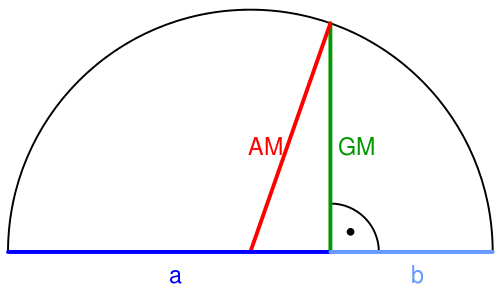
Let us demonstrante another application of the Lagrange Multipliers and prove AM-GM!
midnight plankBOT
Channel closed
Closed by @twilit field
Use .reopen if this was a mistake.
twilit field
I think I'll try this agin tomorrow
midnight plankBOT
Available help channel!
Send your question here to claim the channel.
Remember:
• Ask your math question in a clear, concise manner.
• Show your work, and if possible, explain where you are stuck.
• After 15 minutes, feel free to ping <@&286206848099549185>.
• Type the command .close to free the channel when you're done.
• Be polite and have a nice day!
Read #❓how-to-get-help for further information on how to ask a good question, and about conduct in the question channels.
 carmine birch
was doing this question and i differentiated and got k = +- tan(theta)
 midnight plankBOT
carmine birch
was doing this question and i differentiated and got k = +- tan(theta)
carmine birch
midnight plankBOT
carmine birch
was doing this question and i differentiated and got k = +- tan(theta)
carmine birch
however i dont understand why we reject k = -tan(theta)

like i dont understand the justification they give
 hearty rune
k>0
tan(theta) is positive in the given set for theta
so -tan(theta) is negative, so this cant be k as k is positive
carmine birch
hearty rune
so -tan(theta) is negative, so this cant be k as k is positive
oh ok
thank you
sorry brain was a bit slow today
.close
midnight plankBOT
Channel closed
Closed by @carmine birch
Use .reopen if this was a mistake.
midnight plankBOT
Available help channel!
Send your question here to claim the channel.
Remember:
• Ask your math question in a clear, concise manner.
• Show your work, and if possible, explain where you are stuck.
• After 15 minutes, feel free to ping <@&286206848099549185>.
• Type the command .close to free the channel when you're done.
• Be polite and have a nice day!
Read #❓how-to-get-help for further information on how to ask a good question, and about conduct in the question channels.
earnest forge
 midnight plankBOT
earnest forge
midnight plankBOT
earnest forge
 slow thorn
 midnight plankBOT
@earnest forge Has your question been resolved?
earnest forge
I prefer not to
 silk forge
fair
 flat sequoia


 midnight plankBOT
Channel closed
Closed by @earnest forge
Use .reopen if this was a mistake.
midnight plankBOT
Available help channel!
Send your question here to claim the channel.
Remember:
• Ask your math question in a clear, concise manner.
• Show your work, and if possible, explain where you are stuck.
• After 15 minutes, feel free to ping <@&286206848099549185>.
• Type the command .close to free the channel when you're done.
• Be polite and have a nice day!
Read #❓how-to-get-help for further information on how to ask a good question, and about conduct in the question channels.
 rancid pine
sqrt(9^x+9^y)=81
what is (x+y)^2
deepseek comes to conclude that (x+y)^2 is 64 but he took 20 steps is there a shortcut? i found it in ig reels
midnight plankBOT
rancid pine
sqrt(9^x+9^y)=81
what is (x+y)^2
deepseek comes to conclude that (x+y)^2 is 64 b...
 lethal owl
Is that
$$\sqrt{9^x+9^y}=81$$
grand pondBOT
Sherif Player
 rancid pine
lethal owl
Is that
$$\sqrt{9^x+9^y}=81$$
rancid pine
lethal owl
Is that
$$\sqrt{9^x+9^y}=81$$
yes
lyric charm
!nogpt
midnight plankBOT
Please do not trust ChatGPT or similar AI tools for mathematical tasks, as they often generate output which "sounds correct" but has numerous factual or logical errors. Use of these AI tools to answer other people's help questions is strictly against server rules (see #rules).
lethal owl
 grim vector
So 9^x + 9^y = 9⁴
grim vector
So 9^x + 9^y = 9⁴
Is that form useful tho
It is addition here not multiplication
grim vector
lethal owl
Is that form useful tho
It is addition here not multiplication
Trying things
lyric charm
rancid pine
sqrt(9^x+9^y)=81
what is (x+y)^2
deepseek comes to conclude that (x+y)^2 is 64 b...
also this question does not have enough info as stated
grim vector
That sqrt definitely to get rid of ig
rancid pine
lyric charm
also this question does not have enough info as stated
no way to simplify ?
lyric charm
no, no way.

here.
you can slide a around and there will be intersections with the red curve still.
so it is literally impossible to figure out the value of (x+y)^2.
!xy
midnight plankBOT
Please show the original problem, exactly as it was stated to you, with the entire original context. A picture or screenshot is best. If the original problem is not in English, then post it anyway! The additional context might still be helpful. Do your best to provide a translation.
 verbal pumice
(he did say he found it on an instagram reel, do you really expect quality problems)
rancid pine
verbal pumice
(he did say he found it on an instagram reel, do you really expect quality probl...
itx my daily math routine everyday so yeah
 verbal pumice
probably a reason its on 3 likes and 0 comments
rancid pine
verbal pumice
probably a reason its on 3 likes and 0 comments
yeah
lyric charm
rancid pine
itx my daily math routine everyday so yeah
ah yes and a random reel is such an authoritative source for math problems.
rancid pine
lyric charm
so it is literally impossible to figure out _the_ value of (x+y)^2.
wait are u implying u can find values of variables using demos graph?
lyric charm
i am not implying anything beyond what i said explicitly.
rancid pine
lyric charm
ah yes and a random reel is such an authoritative source for math problems.
i dont like books man
lyric charm
... i don't like being called "man". could you not?
lethal owl
rancid pine
wait are u implying u can find values of variables using demos graph?
You didn't hear about finding solutions to equations graphically
lyric charm
lyric charm
i am not implying anything beyond what i said explicitly.
anyway, if you try to read between my lines, that's your prerogative but not mine.
rancid pine
lyric charm
... i don't like being called "man". could you not?
my bad Ann
okay cya until i find new reel
.close
midnight plankBOT
Channel closed
Closed by @rancid pine
Use .reopen if this was a mistake.
midnight plankBOT
Available help channel!
Send your question here to claim the channel.
Remember:
• Ask your math question in a clear, concise manner.
• Show your work, and if possible, explain where you are stuck.
• After 15 minutes, feel free to ping <@&286206848099549185>.
• Type the command .close to free the channel when you're done.
• Be polite and have a nice day!
Read #❓how-to-get-help for further information on how to ask a good question, and about conduct in the question channels.
Channel closed
Channel closed due to the original message being deleted.
If you did not intend to do this, please open a new help channel,
as this action is irreversible, and this channel may abruptly lock.
grim vector
Wth
midnight plankBOT
Available help channel!
Send your question here to claim the channel.
Remember:
• Ask your math question in a clear, concise manner.
• Show your work, and if possible, explain where you are stuck.
• After 15 minutes, feel free to ping <@&286206848099549185>.
• Type the command .close to free the channel when you're done.
• Be polite and have a nice day!
Read #❓how-to-get-help for further information on how to ask a good question, and about conduct in the question channels.
 dark locust
is it possible to solve this kind of question without natural logarithm bcs we havent learned abt this (ims tudying for exams) or should i just learn this to eb safe?
 midnight plankBOT
dark locust
is it possible to solve this kind of question without natural logarithm bcs we h...
verbal pumice
midnight plankBOT
dark locust
is it possible to solve this kind of question without natural logarithm bcs we h...
verbal pumice
it is possible
dark locust
is it required? regarding rulesthe last one we were taught was just chain rule and then the basic differentiation ruless
dark locust
verbal pumice
it is possible
oooo
verbal pumice
but its horrendously long winded and annoying
verbal pumice
if you know how the logarithm works there's no reason for you not to learn this
verbal pumice
dark locust
is natural logarithm hard/?
well, i dont find it hard
and most dont
suit yourself lol
verbal pumice
(not to be condescending)
 cedar mason
yeah we take logarithms here
dark locust
cedar mason
yeah we take logarithms here
OO
cedar mason
because they have the fun property of $\ln(f(x)^n) = n\ln(f(x))$, and doing it any other way is insane.
verbal pumice
if you know your basic log properties and the chain rule its super simple
grand pondBOT
Percy
 cedar mason
this holds for any base log but we use the natural because $\frac{d}{dx} \ln(x) = \frac1{x}$ which makes things major easy
grand pondBOT
Percy
 cedar mason
@dark locust https://www.youtube.com/watch?v=cEvgcoyZvB4
Back to the basics with logarithms.
Full playlist: https://www.youtube.com/playlist?list=PLZHQObOWTQDP5CVelJJ1bNDouqrAhVPev
Home page: https://www.3blue1brown.com
Brought to you by you: https://3b1b.co/ldm-thanks
Triangle of power:
https://youtu.be/sULa9Lc4pck
Beautiful pictorial summary by @ThuyNganVu:
https://twitter.com/ThuyNganVu/status/12...
midnight plankBOT
@dark locust Has your question been resolved?
Channel closed
Closed by @dark locust
Use .reopen if this was a mistake.
midnight plankBOT
Available help channel!
Send your question here to claim the channel.
Remember:
• Ask your math question in a clear, concise manner.
• Show your work, and if possible, explain where you are stuck.
• After 15 minutes, feel free to ping <@&286206848099549185>.
• Type the command .close to free the channel when you're done.
• Be polite and have a nice day!
Read #❓how-to-get-help for further information on how to ask a good question, and about conduct in the question channels.
lament knoll
Let ( f ) be a ( C^1 ) map from an open set ( U \subset \mathbb{R}^p ) to ( \mathbb{R}^q ). Assume ( 0 \in U ) and that the differential ( df_0 ) is injective. Then there exists:
\begin{itemize}
\item an open set ( V \subset \mathbb{R}^q ) containing ( 0 ),
\item an open set ( U' \subset U ) with ( f(U') \subset V ),
\item a diffeomorphism ( \varphi: V \to \varphi(V) ),
\end{itemize}
such that
[
\varphi(f(x^1, \dots, x^p)) = (x^1, \dots, x^p, 0, \dots, 0).
]
midnight plankBOT
lament knoll
Let \( f \) be a \( C^1 \) map from an open set \( U \subset \mathbb{R}^p \) to ...
grand pondBOT
tm
 lament knoll
if i understand, this theorem means for example that we can always parameterize a surface from a plan by defining $(x,y) \mapsto (x,y,0)$?
grand pondBOT
tm
 lament knoll
the case where p=2 and q=3
lament knoll
lament knoll
if i understand, this theorem means for example that we can always parameterize ...
locally*
oh i’m dumb
.close
midnight plankBOT
Channel closed
Closed by @lament knoll
Use .reopen if this was a mistake.
midnight plankBOT
Available help channel!
Send your question here to claim the channel.
Remember:
• Ask your math question in a clear, concise manner.
• Show your work, and if possible, explain where you are stuck.
• After 15 minutes, feel free to ping <@&286206848099549185>.
• Type the command .close to free the channel when you're done.
• Be polite and have a nice day!
Read #❓how-to-get-help for further information on how to ask a good question, and about conduct in the question channels.
twilit field
 midnight plankBOT
twilit field
twilit field
midnight plankBOT
twilit field
twilit field
Why would I want to use green's theorm here?
😭
Much easier to just come up with the function $f(x,y)= \frac{x^2}{2} + xy^2$
grand pondBOT
What a wonderful world !
 twilit field
and say based on this, it's a potential function
verbal pumice
I mean, they say green's, you use green's
 main current
You're correct that this is a good potential function and presenting it already proves the question
twilit field
Lemme just try using green's
$\int_{ \partial D^{+}} (x+y^2,2xy)\cdot(dx,dy)= \iint_{S} 2y - 2y dA = \int_{D} 0 =0dA$
grand pondBOT
What a wonderful world !
 twilit field
Does this work
main current
You need a region to integrate over. What's the region here?
twilit field
main current
You need a region to integrate over. What's the region here?
The closed curve of any curve connecting 0 to (a,b) , and back from (a,b) to (0,0) again
main current
Good! Finally, can you interpret what an integral of 0 means for this question?
twilit field
It's a conservative field
main current
You might know the answer for this but I am asking badly haha.
Basically you can take any two curves from (0,0) to (a,b). I'll call those curves C and D.
The curve C - D is a closed loop that starts/ends at (0,0) but passes through (a,b).
Via green's, integral of C - D = 0
Integral of C = Integral of D
twilit field
Thanks
midnight plankBOT
@twilit field Has your question been resolved?
Channel closed
Closed by @twilit field
Use .reopen if this was a mistake.
midnight plankBOT
Available help channel!
Send your question here to claim the channel.
Remember:
• Ask your math question in a clear, concise manner.
• Show your work, and if possible, explain where you are stuck.
• After 15 minutes, feel free to ping <@&286206848099549185>.
• Type the command .close to free the channel when you're done.
• Be polite and have a nice day!
Read #❓how-to-get-help for further information on how to ask a good question, and about conduct in the question channels.
 hasty holly
how we got the summation from substraction 2nd equation from first?
 verbal pumice
just subtracted term by term
hasty holly
verbal pumice
just subtracted term by term
( a1/a1-z ) - ( a1/a1-z dash ) = 0?
hasty holly
oh ok ok i am sorry theres a misprint in the question on the sheet and the one in video, thank you tho
.close
midnight plankBOT
Channel closed
Closed by @hasty holly
Use .reopen if this was a mistake.
silk forge
hasty holly
how we got the summation from substraction 2nd equation from first?
mathmerizing?
midnight plankBOT
Available help channel!
Send your question here to claim the channel.
Remember:
• Ask your math question in a clear, concise manner.
• Show your work, and if possible, explain where you are stuck.
• After 15 minutes, feel free to ping <@&286206848099549185>.
• Type the command .close to free the channel when you're done.
• Be polite and have a nice day!
Read #❓how-to-get-help for further information on how to ask a good question, and about conduct in the question channels.
 tired ferry
can a generator get the same element twice before reaching identity for the first time?
midnight plankBOT
tired ferry
can a generator get the same element twice before reaching identity for the firs...
tired ferry
no right? as they are sets im not sure if this holds
 frail carbon
as who are sets?
frail carbon
can you clarify why you're asking
as in
I assume you're asking whether we can have g^m = g^n for m =/= n, where both 0 < m, n < o(g) for a group element g
tired ferry
Lets say G = <g> right
and that g^r is the identity, or <g> is power r
ok?
from here, assume n and m are both less than r
can we have it so g^n = g^m?
note, n != m
frail carbon
 tired ferry
oh
hmm
ok this is more for examples in Z mod smth
where they can be in the same equivilance class
for a more spesific case
so like
g^n = g^m mod n
but n != m
so the genirater hits the same equivilance class twice before hitting Id
solid iris
if g has finite order then this happens. if not then it may not happen
frail carbon
... not before hitting the identity though
if g^m = g^n, then WLOG m < n (otherwise swap what I'm about to do) and multiplying both sides by the inverse of g m times gives e = g^(n-m), but (I'm assuming we're working with positive integers) n-m < n too
solid iris
yeah im talking in general
if ordg finite then g^n=g^m
if ordg need not be finite take g=1 in (Z,+)
midnight plankBOT
@tired ferry Has your question been resolved?
midnight plankBOT
Channel closed
Closed due to timeout
Use .reopen if this was a mistake.
Available help channel!
Send your question here to claim the channel.
Remember:
• Ask your math question in a clear, concise manner.
• Show your work, and if possible, explain where you are stuck.
• After 15 minutes, feel free to ping <@&286206848099549185>.
• Type the command .close to free the channel when you're done.
• Be polite and have a nice day!
Read #❓how-to-get-help for further information on how to ask a good question, and about conduct in the question channels.
 kind ledge
!help
midnight plankBOT
To ask for mathematics help on this server, please open your own help channel or help thread. See #❓how-to-get-help for instructions.
midnight plankBOT
kind ledge
!help
 blissful talon
Complete the square
kind ledge
wdy,
midnight plankBOT
@kind ledge Has your question been resolved?
kind ledge
.close
midnight plankBOT
Channel closed
Closed by @kind ledge
Use .reopen if this was a mistake.
midnight plankBOT
Available help channel!
Send your question here to claim the channel.
Remember:
• Ask your math question in a clear, concise manner.
• Show your work, and if possible, explain where you are stuck.
• After 15 minutes, feel free to ping <@&286206848099549185>.
• Type the command .close to free the channel when you're done.
• Be polite and have a nice day!
Read #❓how-to-get-help for further information on how to ask a good question, and about conduct in the question channels.
midnight plankBOT
 lavish venture
nice
midnight plankBOT
Channel closed
Channel closed due to the original message being deleted.
If you did not intend to do this, please open a new help channel,
as this action is irreversible, and this channel may abruptly lock.
grim vector
Kekw
lavish venture
did mods get him?
 surreal moon
before I even got the mod ping out
lavish venture
or did he delete
 gilded trout
 grim vector
lavish venture
or did he delete
grim vector
lavish venture
or did he delete
Bro was ashamed of scamming with Facebook link
surreal moon
possibly deleted given the speed. Let us move on then
midnight plankBOT
Available help channel!
Send your question here to claim the channel.
Remember:
• Ask your math question in a clear, concise manner.
• Show your work, and if possible, explain where you are stuck.
• After 15 minutes, feel free to ping <@&286206848099549185>.
• Type the command .close to free the channel when you're done.
• Be polite and have a nice day!
Read #❓how-to-get-help for further information on how to ask a good question, and about conduct in the question channels.
 grim sierra
Suppose the curve $z = e^{-x^2}$ in the $x-z$ plane is rotated about the $z$-axis. Write the resulting surface as an equation in cylindrical coords.
midnight plankBOT
grim sierra
Suppose the curve $z = e^{-x^2}$ in the $x-z$ plane is rotated about the $z$-axi...
grand pondBOT
.RODATA
 grim sierra
i understand that $z = e^{-(r^2\cos^2(\theta))}$ if it weren't rotated about the $z$-axis
grand pondBOT
.RODATA
 grim sierra
but what does rotating about the z-axis do to the equation
and can i have an explanation as to why it does that
never mind i must make the substitution $x^2 + y^2 = r^2$
grand pondBOT
.RODATA
 grim sierra
.close
midnight plankBOT
Channel closed
Closed by @grim sierra
Use .reopen if this was a mistake.
midnight plankBOT
✅
grim sierra
$z = x$ is revolved around the $z$-axis. What is the equation that describes this surface in cylindrical coordinates.
grand pondBOT
.RODATA

 grand latch
z=x is a plane
grand latch
i can't imagine what the curve will be
grim sierra
grand latch
i can't imagine what the curve will be
you revolve it around the z axis
so, after graphing, it should look like z = +/- r (z^2 = r^2)
but im not sure how to get that in steps
similar issue with $z = e^{{-x}^2}$ being revolved around the $z$-axis
grand pondBOT
.RODATA
 grand latch
grand latch
grand latch
still can't imagine maybe someone else can help, sry
grim sierra
what's the point of "helping" if you're going to be sarcastic
maybe try using a few of your braincells to put stuff into words
grand latch
i wasn't being sarcastic, we both were trying to find out the solution
grand latch
grim sierra
sure
maybe you didn't like that and that's fine
grim sierra
i'm convinced you're being sarcastic still
because obviously rotating that graph around the z axis is z^2 = r^2
but im asking how im supposed to show that on paper if im asked this
grand latch
@gray widget
grim sierra
ok wait
@grand latch
i just read ur past messages and i realize you probably are not trolling/being sarcastic
grand latch
maybe, you tell me
grim sierra
grim sierra
what's the point of "helping" if you're going to be sarcastic
im very sorry for these messages
grim sierra
yeah thanks
midnight plankBOT
@grim sierra Has your question been resolved?
 clear inlet
when you resolve the curve around the z axis the distance to the rotation axis (z) changes
 grim sierra
yep
clear inlet
can you convice yourself that the new distance to the z axis when it's resolved now has to be sqrt(x^2+y^2)?
clear inlet
exacltly
grand pondBOT
.RODATA
 grim sierra
on paper, id convert to $z = e^{-(r^2\cos^2(\theta)}$
grand pondBOT
.RODATA
 clear inlet
no
grim sierra
so, in general, what am i meant to do for a curve being revolved around the z-axis. just visualization?
clear inlet
because x is the distance from each point of the curve to the z-axis. when resolved, now this distance is r=sqrt(x^2+y^2)
grim sierra
clear inlet
because x is the distance from each point of the curve to the z-axis. when resol...
yes
grim sierra
clear inlet
think about x as the distance to the z axis
mhm
grand pondBOT
leonardomoura
 clear inlet
Can you write the equation of the surface now?
grim sierra
sorry i'm back
grim sierra
grand pond
**leonardomoura**
ohhh
so when revolving, the distance of each curve to the z axis is sqrt(x^2 + y^2), which is r
so its z=. e^(-r^2)
clear inlet
yes
clear inlet
go ahead
grim sierra
ok so i can visualize the rotation now
the distance from the z axis to the curve is still $\sqrt{x^2 + y^2}$?
grand pondBOT
.RODATA
 grim sierra
so $x \to r$
grand pondBOT
.RODATA
 grim sierra
so $z = r$?
grand pondBOT
.RODATA
 clear inlet
grand pond
**.RODATA**
clear inlet
grand pond
**.RODATA**
this one
grim sierra
oh
clear inlet
not a parabola
grim sierra
yeah the revolution is a parabola
uhh
z = sqrt(x^2 + y^2)
z^2 = x^2 + y^2
cylinder?
clear inlet
no, visualize it in 3d
grim sierra
now ait
ok
i know r = 2 is a cylinder of radius 2
r = 3 is a cylinder of radius 3
clear inlet
yes
grim sierra
so it would be like
a bunch of circles stacked along the z axis
just in increasing radius
grim sierra
idk what that shape is
im just describing it
it looks like a concave up parabola but 3d
wait
it's just a cone lol
clear inlet
perfect
grim sierra
cuz the radius increases linearly
clear inlet
yes, it's a cone
grim sierra
z = r^2 is a parabola since the radius increases exponentially?
clear inlet
a paraboloid
grim sierra
alr
lemme try ONE last questio
y = 0 in spherical coords
so y = 0 is just the xz plane
clear inlet
yes
clear inlet
around which axis?
grim sierra
z