#help-49
1 messages · Page 166 of 1
 wicked mauve
you need to use x
well no
but in this case it makes no sense
this is apart of cardanos theorem
use this
have you look up the proof for the theorem
wicked mauve
 obtuse idol
Is r p?
obtuse idol
Is r p?
here
just look at this because it might be different depending on the vid you saw
obtuse idol
That looks like a whole lot more work than the method I saw
wicked mauve
do you have a video of this method
obtuse idol
no
wicked mauve
obtuse idol
That looks like a whole lot more work than the method I saw
that moment when the cubic formula actually turns out to be a lot of work like i said 800 times
obtuse idol
One of the videos I saw was by mathologer
obtuse idol
wicked mauve
that moment when the cubic formula actually turns out to be a lot of work like i...
Maybe not as much work as it looks
wicked mauve
obtuse idol
Maybe not as much work as it looks
so they say
obtuse idol
i
obtuse idol
Yes
wicked mauve
okay yes
obtuse idol
And cos
obtuse idol
I saw it in the link
obtuse idol
What is 0 with a line going through it
obtuse idol
m
obtuse idol
ok
I think im going to ignore all of ur advice and continue with what ive been doing originally
 obtuse idol
Have u not ever used x=y-b/3a?
wicked mauve
no
nor have i used the cubic formula for than 1 time
because its irrelevant and useless
nor do i see that when referring to cardanos method
also not ever is redundant, use never
obtuse idol
I’ll see if I get the same answer for p using the other strat
wicked mauve
go ahead
obtuse idol
Btw what year are u?
obtuse idol
And what are learning
wicked mauve
calc 2
obtuse idol
Is this goodbye?
 obtuse idol
Wym
wicked mauve
if you dont need no help
wicked mauve
obtuse idol
Wym
exactly that
obtuse idol
I don’t get it
wicked mauve
exactly
obtuse idol
But I do get it
wicked mauve
is rage baiting in your top 3 hobbies
obtuse idol
I think I got bored of it
obtuse idol
Yes
obtuse idol
Like months ago
obtuse idol
Algebra 1
obtuse idol
What is uni
wicked mauve
UNIVERSITY
wicked mauve
ah gotcha
obtuse idol
wicked mauve
knew it
Wym
obtuse idol
What exactly made u think that of me
obtuse idol
I don’t get it
wicked mauve
go ahead
obtuse idol
Alr
wicked mauve
fun travels with cubic
 midnight plankBOT
Channel closed
Closed by @obtuse idol
Use .reopen if this was a mistake.
midnight plankBOT
 Available help channel!
Send your question here to claim the channel.
Remember:
• Ask your math question in a clear, concise manner.
• Show your work, and if possible, explain where you are stuck.
• After 15 minutes, feel free to ping <@&286206848099549185>.
• Type the command .close to free the channel when you're done.
• Be polite and have a nice day!
Read #❓how-to-get-help for further information on how to ask a good question, and about conduct in the question channels.
 sweet shuttle
can someone help me sovle 125^x = 5 rn I have 5^3x = 5 cause 5^3 is 125
midnight plankBOT
sweet shuttle
can someone help me sovle ```125^x = 5``` rn I have 5^3x = 5 cause 5^3 is 125
sweet shuttle
but im stuck here
 lavish venture
equate exponents
sweet shuttle
there is no exponent for the right
lavish venture
there is
 dusk pier
Congratulations
lavish venture
Congratulations
dusk pier
You just won the lottery
dusk pier
Now you have 2 options
 night obsidian
im wooing supportively
sweet shuttle
WHAT ?? REALLY
sweet shuttle
money
dusk pier
Thank you
sweet shuttle
take it
sweet shuttle
all day
 sweet shuttle
x = 1/3
dusk pier
Good boy
 midnight plankBOT
Channel closed
Closed by @sweet shuttle
Use .reopen if this was a mistake.
dusk pier
sweet shuttle
i love u all
I don't
sweet shuttle
fuck you
sweet shuttle
lmfaooo
midnight plankBOT
Available help channel!
Send your question here to claim the channel.
Remember:
• Ask your math question in a clear, concise manner.
• Show your work, and if possible, explain where you are stuck.
• After 15 minutes, feel free to ping <@&286206848099549185>.
• Type the command .close to free the channel when you're done.
• Be polite and have a nice day!
Read #❓how-to-get-help for further information on how to ask a good question, and about conduct in the question channels.
 solar moon
 midnight plankBOT
solar moon
solar moon
midnight plankBOT
solar moon
solar moon
Any hint for it?
midnight plankBOT
@solar moon Has your question been resolved?
midnight plankBOT
@solar moon Has your question been resolved?
Channel closed
Closed by @solar moon
Use .reopen if this was a mistake.
midnight plankBOT
Available help channel!
Send your question here to claim the channel.
Remember:
• Ask your math question in a clear, concise manner.
• Show your work, and if possible, explain where you are stuck.
• After 15 minutes, feel free to ping <@&286206848099549185>.
• Type the command .close to free the channel when you're done.
• Be polite and have a nice day!
Read #❓how-to-get-help for further information on how to ask a good question, and about conduct in the question channels.
 low marlin
I can't exactly figure out how 6. d.) works. I've solved the other ones . So far i tried doing it by cases by doing 4!*4! + 5!*3! and then i tried doing 7! - 6!x2! but neither of them are right.
 midnight plankBOT
low marlin
I can't exactly figure out how 6. d.) works. I've solved the other ones . So far...
midnight plankBOT
low marlin
I can't exactly figure out how 6. d.) works. I've solved the other ones . So far...
 misty bronze
low marlin
I can't exactly figure out how 6. d.) works. I've solved the other ones . So far...
misty bronze
low marlin
I can't exactly figure out how 6. d.) works. I've solved the other ones . So far...
the odd numbers are 1, 3, 5, 7
how many groups of 3 can you make from these
low marlin
24?
misty bronze
low marlin
24?
no
have you learned combinations ?
misty bronze
low marlin
Meant 4
yes
let's say i pick 1,3,5
i take these numbers and put them in a group, so i'll consider them as one entity
(135), 2, 4, 6, 7, 8
how many arrangements can you do of this
low marlin
(6-1)! = 5! =120
misty bronze
low marlin
(6-1)! = 5! =120
yea
but we know that we can make 4 groups
so you multiply this by
low marlin
4 I'm assuming
misty bronze
yes
this is one case
where 3 odd numbers are together
if all 4 are together
we can take (1357) as a group
and arrange them
and then u add both the cases
low marlin
misty bronze
yea
but we know that we can make 4 groups
Doesn't this have to get multiplied by like 3! Tho?
misty bronze
low marlin
Doesn't this have to get multiplied by like 3! Tho?
why do you think so
low marlin
misty bronze
we can take (1357) as a group
To order the odd numbers
low marlin
misty bronze
we can take (1357) as a group
And this would be like 1! * 4! * 4! right
misty bronze
low marlin
And this would be like 1! * 4! * 4! right
yes
misty bronze
oh you also need to remove the cases where 7 is next to (135) in the first case
low marlin
Ohhh
misty bronze
there are 6 spots in the circle
we fix one and give it to the group
5 spots remain , 2 cannot be used by 7
there are 3 spots that can be used by 7
so 4 x 3! x 3 x 4! = 1728
this should be correct now
misty bronze
misty bronze
there are 6 spots in the circle
we fix one and give it to the group
5 spots rem...
the 4! is arranging the even numbers
misty bronze

 midnight plankBOT
Channel closed
Closed by @low marlin
Use .reopen if this was a mistake.
midnight plankBOT
Available help channel!
Send your question here to claim the channel.
Remember:
• Ask your math question in a clear, concise manner.
• Show your work, and if possible, explain where you are stuck.
• After 15 minutes, feel free to ping <@&286206848099549185>.
• Type the command .close to free the channel when you're done.
• Be polite and have a nice day!
Read #❓how-to-get-help for further information on how to ask a good question, and about conduct in the question channels.
 dark locust
im sorry my channel closedd 😭 is this correctt? @slender walrus
 midnight plankBOT
dark locust
im sorry my channel closedd 😭 is this correctt? <@220517274845577216>
dark locust
midnight plankBOT
dark locust
im sorry my channel closedd 😭 is this correctt? <@220517274845577216>
dark locust
@violet dune 🥲
 violet dune
yes that looks right
i saw your older message but couldnt react to anything or text lol
 slender walrus
shouldn't be writing the Lim after already having applied the h->0
violet dune
you did get the right derivative though
violet dune
ofc
midnight plankBOT
@dark locust Has your question been resolved?
midnight plankBOT
Channel closed
Closed due to timeout
Use .reopen if this was a mistake.
Available help channel!
Send your question here to claim the channel.
Remember:
• Ask your math question in a clear, concise manner.
• Show your work, and if possible, explain where you are stuck.
• After 15 minutes, feel free to ping <@&286206848099549185>.
• Type the command .close to free the channel when you're done.
• Be polite and have a nice day!
Read #❓how-to-get-help for further information on how to ask a good question, and about conduct in the question channels.
 drowsy notch
Calculate the area of an equilateral triangle in terms of x
midnight plankBOT
drowsy notch
Calculate the area of an equilateral triangle in terms of x
 lyric charm
but it was wrong
says who?
drowsy notch
The one that checked my paper
 sharp coral
x being the side length?
lyric charm
did you just get a big fat 0 on the problem or did you get more specific feedback
.... this was an "or" question
you dont answer those with "yes"
which is it
drowsy notch
sharp coral
x being the side length?
yeah
lyric charm
$A = \frac12 \cdot x \cdot x \cdot \sin(60\dg)$ is correct but unsimplified, btw.
 grand pondBOT
Ann
 drowsy notch
lyric charm
did you just get a big fat 0 on the problem or did you get more specific feedbac...
drowsy notch
lyric charm
did you just get a big fat 0 on the problem or did you get more specific feedbac...
Big fat X
lyric charm
do you have the question paper with you so we can look at the specific instructions written on it
drowsy notch
lyric charm
do you have the question paper with you so we can look at the specific instructi...

No. 2
lyric charm
so that's it.
but then, again, maybe they expected you to simplify it
and/or know the value of sin(60°) and substitute it in
drowsy notch
lyric charm
but then, again, maybe they expected you to simplify it
What woild be the simplified answer then? (x^2 sqrt3)/4 ?
lyric charm
yes
sharp coral
also possible that they expected you to use a different method (although imo they should give full points for any correct method)
midnight plankBOT
Channel closed
Closed by @drowsy notch
Use .reopen if this was a mistake.
midnight plankBOT
Available help channel!
Send your question here to claim the channel.
Remember:
• Ask your math question in a clear, concise manner.
• Show your work, and if possible, explain where you are stuck.
• After 15 minutes, feel free to ping <@&286206848099549185>.
• Type the command .close to free the channel when you're done.
• Be polite and have a nice day!
Read #❓how-to-get-help for further information on how to ask a good question, and about conduct in the question channels.
 solemn solar
hey, i got a majority of the question right, but for S (state) i dont know how the textbook got 18-2x? i got 2y since i placed a pronumeral for O (overseas), can someone help?

 midnight plankBOT
solemn solar
hey, i got a majority of the question right, but for S (state) i dont know how t...
midnight plankBOT
solemn solar
hey, i got a majority of the question right, but for S (state) i dont know how t...
@solemn solar Has your question been resolved?
 shrewd tusk
solemn solar
hey, i got a majority of the question right, but for S (state) i dont know how t...
shrewd tusk
solemn solar
hey, i got a majority of the question right, but for S (state) i dont know how t...
It mentions 22 in their own state
so people who were only in their state will be 22-2x-2-2=18-2x
midnight plankBOT
Channel closed
Closed due to timeout
Use .reopen if this was a mistake.
Available help channel!
Send your question here to claim the channel.
Remember:
• Ask your math question in a clear, concise manner.
• Show your work, and if possible, explain where you are stuck.
• After 15 minutes, feel free to ping <@&286206848099549185>.
• Type the command .close to free the channel when you're done.
• Be polite and have a nice day!
Read #❓how-to-get-help for further information on how to ask a good question, and about conduct in the question channels.
 inland patio
In my linear algebra book they gave some applications to composition of linear maps, and I found the following exercise. \
Exercise. For an incidence matrix $A$ with related matrix $B$ defined by $B_{ij}=1$ if $i$ is related to $j$ and $j$ is related to $i$, and $B_{ij}=0$ otherwise, prove that $i$ belongs to a clique if and only if $(B^3)_{ii}>0$. \
An incidence matrix is a square matrix with $0$s on the diagonal, and $0$s and $1$s elsewhere. A clique is a maximal collection of three or more people with the property that any two can send to each other. I don't really know where to start with this exercise. I know no graph theory and the book hasn't presented any. I notice it is an iff statement, so there are two implications I need to prove. Also, $B$ is symmetric.
midnight plankBOT
inland patio
In my linear algebra book they gave some applications to composition of linear m...
grand pondBOT
psie
 lyric charm
well
this is specifically linalg as applied to graph theory right
try to draw up some graph on like 5 nodes that's neither edgeless nor complete
write down its incidence matrix
and then look at its square first
see if you can find meaning in the entries of B^2
inland patio
lyric charm
see if you can find meaning in the entries of B^2
yes, it's an example from graph theory, but I think one should be able to solve it without any knowledge of this subject (which I don't have 🙂 ). Anyway, the meaning of A^2, the square of an incidence matrix is the number of ways in which people can send to each other in at most two stages. The interpretation of (A+A^2+...+A^m)_ij is the number of ways in which person i can send to person j in at most m stages.
lyric charm
ok right
so
(A^3)_ii is the number of paths of length 3 that begin and end at node i
ie (A^3)_ii > 0 iff node i belongs to a triangle in the graph
inland patio
ok👍
 runic hamlet
just fyi, usually a matrix B like this for a graph is called adjacency matrix and not an incidence matrix
lyric charm
also B yeah not A
inland patio
inland patio
yes, it's an example from graph theory, but I think one should be able to solve ...
so my interpretation was wrong here?
lyric charm
you didn't need to look at the sum of the powers
B^m holds the number of paths of length EXACTLY m between each pair of nodes
runic hamlet
(to avoid some potential confusion, note that path here does not mean that each edge is unique. its certainly possible to go over the same edge multiple times)
lyric charm
you will not wake me up at 3am and make me successfully able to explain which of "path" and "walk" means what
inland patio
ok, currently trying to make sense of the meaning of B^2 and B^3, by just using the definition of matrix multiplication. I have yet to learn what this terminology all means 😔
runic hamlet
do what Ann said
draw a small graph, write down B and during the multiplication pay attention to which 1*1 terms occur and to which edges they correspond
midnight plankBOT
Channel closed
Closed by @inland patio
Use .reopen if this was a mistake.
midnight plankBOT
Available help channel!
Send your question here to claim the channel.
Remember:
• Ask your math question in a clear, concise manner.
• Show your work, and if possible, explain where you are stuck.
• After 15 minutes, feel free to ping <@&286206848099549185>.
• Type the command .close to free the channel when you're done.
• Be polite and have a nice day!
Read #❓how-to-get-help for further information on how to ask a good question, and about conduct in the question channels.
 twilit field
 midnight plankBOT
twilit field
twilit field
midnight plankBOT
twilit field
twilit field
So firstly, this is $\pdv{(\pdv{z}{s})}{r}$, right
grand pondBOT
What a wonderful world !
 twilit field
if so we first find $\pdv{z}{s} = \pdv{f(x,y)}{x}\cdot (2s) + \pdv{f(x,y)}{y} \cdot (2s)$
grand pondBOT
What a wonderful world !
 twilit field
we then have $\pdv{( \pdv{f(x,y)}{x}\cdot (2r) + \pdv{f(x,y)}{y} \cdot (2s))}{s}$
oof, this is going to be a pain
grand pondBOT
What a wonderful world !
 twilit field
$2r\pdv[2]{f(x,y)}{x}( 2s+2r) + 2r \pdv{f(x,y)}{\partial{y} \partial{x}}(2s+2r) + 2s ( \pdv[2]{f(x,y)}{y})(2s+2r) + 2s \pdv{f(x,y)}{\partial{x} \partial{y}}(2s+2r)$
grand pondBOT
What a wonderful world !

 subtle blaze
Maybe use $\partial_x$ notation
grand pondBOT
frosst
 twilit field
[
2r \frac{\partial^2 f(x,y)}{\partial x^2} (2s+2r) + 2r \frac{\partial^2 f(x,y)}{\partial x \partial y} (2s+2r) + 2s \frac{\partial^2 f(x,y)}{\partial y^2} (2s+2r) + 2s \frac{\partial^2 f(x,y)}{\partial y \partial x} (2s+2r)
]
grand pondBOT
What a wonderful world !
 twilit field
grand pond
**frosst**
twilit field
grand pond
**frosst**
hmm, I suppose I should have
twilit field
grand pond
**What a wonderful world !**
Is this fine
of course I could further factorise this
.close
midnight plankBOT
Channel closed
Closed by @twilit field
Use .reopen if this was a mistake.
midnight plankBOT
Available help channel!
Send your question here to claim the channel.
Remember:
• Ask your math question in a clear, concise manner.
• Show your work, and if possible, explain where you are stuck.
• After 15 minutes, feel free to ping <@&286206848099549185>.
• Type the command .close to free the channel when you're done.
• Be polite and have a nice day!
Read #❓how-to-get-help for further information on how to ask a good question, and about conduct in the question channels.
 gusty falcon
Hi, I found this question online, but isn't this an ambiguous question?
 midnight plankBOT
gusty falcon
Hi, I found this question online, but isn't this an ambiguous question?
gusty falcon
midnight plankBOT
gusty falcon
Hi, I found this question online, but isn't this an ambiguous question?
gusty falcon
what does "solve for all three variables" mean
 icy juniper
gusty falcon
what does "solve for all three variables" mean
icy juniper
gusty falcon
what does "solve for all three variables" mean
I think to get a value of those 3 variables
 hard umbra
i mean the obvious interpretation is that A should be 3 and B should be 4
icy juniper
hard umbra
i mean the obvious interpretation is that A should be 3 and B should be 4
yea
hard umbra
but like yeah it's kinda not a very well posed question
icy juniper
gusty falcon
That's the obvious interpretation 😭
is that wrong?
hard umbra
there's a whole wealth of things that can go wrong here
gusty falcon
gusty falcon
what does "solve for all three variables" mean
Well it's not wrong but like uh idk this causes ambiguity, no?
Like?
icy juniper
hard umbra
there's a whole wealth of things that can go wrong here
there is?
gusty falcon
Well it's fair to see that the question is far from well posed so might as well just analyze all the things that can go wrong
gusty falcon
icy juniper
there is?
u can define z to be a parameter t
 dim cloak
hi
gusty falcon
z = t
hard umbra
well it's only in the "general" case that you need 3 for A
gusty falcon
and then well other variables would be in terms of said parameter
that also solves all three variables
and well u don't need 3 linearly independent rows for that 
gusty falcon
hard umbra
well it's only in the "general" case that you need 3 for A
hmmm, what's the "non general" case
hard umbra
it's easy to construct 3 distinct equations that have 0, 1, or infinitely many solutions
gusty falcon
hard umbra
it's easy to construct 3 distinct equations that have 0, 1, or infinitely many s...
indeed
that was my issue too and 😭 for me infinitely many solutions is still "solving for all three variables" right?
i guess 0 solutions doesn't work? cuz uhm variables don't have values?
hard umbra
that's also another issue yes
gusty falcon
is what i said like an example which disproves the "validity" of this question?
hard umbra
i mean having no solutions is a "solution" in a sense
like you've solved the problem by classifying what the solutions are
gusty falcon
hard umbra
i mean having no solutions is a "solution" in a sense
😭 whaa, wait do you thijnk it counts for "solve for all three variables"?
gusty falcon
what's the most obvious issue with the question
is it what i pointed out above with the uh
infinite solutions?
and what fixes can one make without introducing linear algebra
hard umbra
well just the fact that it's ambiguous
gusty falcon
so no "linearly independent" bla bla
gusty falcon
hard umbra
well just the fact that it's ambiguous
right, but if someone asks why it's ambiguous
what's the response to that?
gusty falcon
doesn't distinc tequations just mean
distinct equations 😭
like just 3/4 diff equations
hard umbra
x + y = 1 and 2x + 2y = 2 are distinct equations
gusty falcon
hard umbra
x + y = 1 and 2x + 2y = 2 are distinct equations
but yes okay so something liek this gets you to
hard umbra
but they're not really distinct in a sense that would be useful
gusty falcon
infinite or no solutions right?
hard umbra
sure
gusty falcon
hmm fair so i guess the consensus is that
we don't know what "solve" means
as in how that works for
a system with infinite or 0 solutions right?
hard umbra
i mean i feel like you're reading too much into it though
gusty falcon
hard umbra
i mean i feel like you're reading too much into it though
😭 wait i forgot to post the other choices
but there's merit in reading too much
give me a second
one of the choices is
"can't be determined"
😭
hard umbra
💀
hard umbra
okay well rip
gusty falcon
hard umbra
i mean the obvious interpretation is that A should be 3 and B should be 4
they just decided to go with this
hard umbra
i guess you're screwed
gusty falcon

hard umbra
if the only options were A is greater and B is greater then you can just assume the question setter wasn't thinking very deeply
but clearly many things can go wrong
gusty falcon
hard umbra
if the only options were A is greater and B is greater then you can just assume ...
😭
okay i think the question isn’t worth much time right?
hard umbra
probably not
gusty falcon
do i just say can’t be determined cuz “solved” isn’t a precise vocabulary here
hard umbra

gusty falcon
to capture cases where the system isn’t full rank?
gusty falcon
no i mean like in a mathematical context
hard umbra
yeah
gusty falcon
does that mean u agree with what i said above for uh why it’s “can’t be determined” mathematically?
if so, thanks 
hard umbra
yes
gusty falcon
😭 this was much easier than the barycentric question anyway
idk why i was reminded of that
hard umbra
in general you could require any number equations to determine a unique solution
gusty falcon
hard umbra
in general you could require any number equations to determine a unique solution
wait wouldn’t the answers be 3 and 4 for u pique solutions
unique*
and well distinct meaning
linearly independent
hard umbra
no you can give 3 equations and have infinitely many solutions
gusty falcon
cuz otherwise there’s no meaning to distinct
hard umbra
and then give more
hard umbra
gusty falcon
linearly independent
okay sure if you insist on this
gusty falcon
wait we’re not assuming linear independence when u say that right?
ah fine
yeah you’re right
i agree
gusty falcon
i think those 2 were probably what they wanted to say
😭
given the answer being quantity B is bigger
anyway alright that’s settled
thank you once again! 
hard umbra

gusty falcon
.close
midnight plankBOT
Channel closed
Closed by @gusty falcon
Use .reopen if this was a mistake.
midnight plankBOT
Available help channel!
Send your question here to claim the channel.
Remember:
• Ask your math question in a clear, concise manner.
• Show your work, and if possible, explain where you are stuck.
• After 15 minutes, feel free to ping <@&286206848099549185>.
• Type the command .close to free the channel when you're done.
• Be polite and have a nice day!
Read #❓how-to-get-help for further information on how to ask a good question, and about conduct in the question channels.
 ornate glacier
 midnight plankBOT
ornate glacier
ornate glacier
midnight plankBOT
ornate glacier
ornate glacier
Q35
lyric charm

might wanna crop your screenshots so you don't flash us with the names of a few dozen of (presumably) your classmates
grand pondBOT
jan Niku
 lyric charm
lyric charm
lyric charm
write the powers of cos in terms of sin using the Pythagorean identity
ornate glacier
In the evaluate part it is not cos^6x but cos^6 (x)
lyric charm
we recognized that as a typo just fine
ornate glacier
I dont think that we gotta use the evaluate part
lyric charm
...
ornate glacier
I think we should use the given part and mold it to get that
lyric charm
well if you wanna throw my suggestion to the ground i can't stop you lol
lyric charm
do you know how to write cos^2(x) in terms of sine?
ornate glacier
Yes
Oh ok
Then i would get cos^6 (x) = (1-sin^2 (x) )^3/2
That looks terrifying
lyric charm
^3 not ^(3/2).
ornate glacier
Oyes
lyric charm
you're going to end up with a 6th degree polynomial with sin(x) as its variable.
ornate glacier
Hmmm
lyric charm
(which you might as well abbreviate to a single letter like s unless you like having your life be difficult)
ornate glacier
Ok
lyric charm
you can (and imo should) divide this polynomial by (s^3 + s^2 + s - 1) and find the remainder.
lyric charm
lyric charm
you're going to end up with a 6th degree polynomial with sin(x) as its variable.
@ornate glacier calculate this (on paper), simplify it as much as you can, and show me what you get from doing that.
ornate glacier
Ok
lyric charm
also just to be explicit: don't advance any further than that.
 midnight plankBOT
Channel closed
Closed by @ornate glacier
Use .reopen if this was a mistake.
lyric charm
ornate glacier
wow it's also incredibly poorly typeset
ornate glacier
Hmmm
lyric charm
but also yes i guess it is kinda out of nowhere.
midnight plankBOT
Available help channel!
Send your question here to claim the channel.
Remember:
• Ask your math question in a clear, concise manner.
• Show your work, and if possible, explain where you are stuck.
• After 15 minutes, feel free to ping <@&286206848099549185>.
• Type the command .close to free the channel when you're done.
• Be polite and have a nice day!
Read #❓how-to-get-help for further information on how to ask a good question, and about conduct in the question channels.
 odd current
 midnight plankBOT
Channel closed
Closed due to timeout
Use .reopen if this was a mistake.
midnight plankBOT
Available help channel!
Send your question here to claim the channel.
Remember:
• Ask your math question in a clear, concise manner.
• Show your work, and if possible, explain where you are stuck.
• After 15 minutes, feel free to ping <@&286206848099549185>.
• Type the command .close to free the channel when you're done.
• Be polite and have a nice day!
Read #❓how-to-get-help for further information on how to ask a good question, and about conduct in the question channels.
 meager ore
Let $A = { a_1, a_2, \ldots, a_n, \ldots}$ a set of positive integers. Show that there exists an subindex $k \in \mathbb{Z}^{+}$ such that $$\gcd(A) = \gcd(a_1, a_2, \ldots, a_k)$$
midnight plankBOT
meager ore
Let $A = \{ a_1, a_2, \ldots, a_n, \ldots\}$ a set of positive integers. Show th...
grand pondBOT
Halex
 meager ore
Cannot use congruences
runic hamlet
consider b_n = gcd(a_1,...,a_n)
meager ore
runic hamlet
consider b_n = gcd(a_1,...,a_n)
Ohh didn't consider to do that, but it means the gcd will vary no?
Like it was a sequence
runic hamlet
the b_n form a sequence, yes
meager ore
runic hamlet
the b_n form a sequence, yes
So I 'd have to show b_k is the gcd of the all the a_k terms?
runic hamlet
what are some basic properties that sequences can have and does the sequence b_n have them?
meager ore
b_n divides all of the terms in the gcd
runic hamlet
in which gcd. you need to be more precise
meager ore
And also it can be written as a linear combination of such terms
meager ore
runic hamlet
in which gcd. you need to be more precise
gcd(a1, a2,...,an)
b_n | a1
b_n | a2
.
.
.
b_n | an
runic hamlet
yes
the property I am interested in is monotonicity
what can you tell me about it
runic hamlet
lets do an example. lets say A={60, 42, 80, 15, ...}
can you compute the first few b_n ?
meager ore
Yes
meager ore
runic hamlet
can you compute the first few b_n ?
For the first three, it's 2
For the first 4, it's 1
So the more terms I have, the more chance of their gcd becoming 1?
runic hamlet
well thats just because of the specific numbers I chose
what about the first two b_ns
and can you now tell me something about increasing or decreasing?
meager ore
3
meager ore
runic hamlet
and can you now tell me something about increasing or decreasing?
I'd say decreasing
runic hamlet
meager ore
3
?
meager ore
If we chose the set of even numbers, wouldn't we always get 2?
runic hamlet
yes
meager ore
So not increasing nor decreasing in this case, no matter how much terms we have
I think this sequence shouldn't be increasing tho
runic hamlet
yes
its something called a "non-increasing" sequence
which is often also called decreasing
meager ore
Ohh yeah heard of those
What can we do with that conclusion?
How does it help us find our k
runic hamlet
something important about non-increasing sequences of positive integers is that eventually they are constant
cause you cant get smaller forever
meager ore
z_n >= z_{n+1}
runic hamlet
yes
meager ore
But still don't see where the k takes part in
meager ore
runic hamlet
yes
How do I show it?
runic hamlet
because the sequence is eventually constant that means that there exists a k so that b_k = b_(k+1) = b_(k+2) = ...
I am claiming that this b_k is gcd(A)
meager ore
I get the point
How do we construct a formal proof then?
That claim must be proven as well right?
meager ore
By way of contradiction?
runic hamlet
thats what I am leading up to, yes
meager ore
Not sure what it implies
meager ore
The greatest common divisor of (a1, a2, ..., an,...)
runic hamlet
no
meager ore
Forgot the ...
runic hamlet
and that means?
meager ore
That the gcd divides all of those terms?
And can be represented as a linear combination?
runic hamlet
lets forget the linear combination bit
so the gcd divides all terms
and its the biggest of all numbers which divide all terms
always these two conditions
so there are two possibilities for b_k to not equal gcd(A)
it could not satisfy the first or the second of these conditions
what happens if it doesnt satisfy the first one
meager ore
it would not divide the terms
meager ore
It would not divide terms after a_{k+1}?
runic hamlet
it might divide some of them, but there is at least one a_n which it doesnt divide
what can you tell me about b_n ?
meager ore
Is it not the gcd?
runic hamlet
gcd of what
midnight plankBOT
@meager ore Has your question been resolved?
midnight plankBOT
Channel closed
Closed due to timeout
Use .reopen if this was a mistake.
midnight plankBOT
Available help channel!
Send your question here to claim the channel.
Remember:
• Ask your math question in a clear, concise manner.
• Show your work, and if possible, explain where you are stuck.
• After 15 minutes, feel free to ping <@&286206848099549185>.
• Type the command .close to free the channel when you're done.
• Be polite and have a nice day!
Read #❓how-to-get-help for further information on how to ask a good question, and about conduct in the question channels.
solemn solar
this looks so simple but i dont think ive learnt enough content, find x
 midnight plankBOT
solemn solar
this looks so simple but i dont think ive learnt enough content, find x
solemn solar
midnight plankBOT
solemn solar
this looks so simple but i dont think ive learnt enough content, find x
solemn solar
so far i did x/x+24 = 8/20
then simplified 8/20 to 2/5
then i cross multiplied into 5x = 2x+24
7x = 24
when textbook answer is 16
 tacit rose
solemn solar
then i cross multiplied into 5x = 2x+24
tacit rose
solemn solar
then i cross multiplied into 5x = 2x+24
This part is wrong
solemn solar
oh
tacit rose
It's 2(x + 24) = 5 * x
 peak herald
solemn solar
peak herald
solemn solar
ohhh
ok that mkaes more sens
e
i just thought the 2 would go to the x
thanks guys
.close
midnight plankBOT
Channel closed
Closed by @solemn solar
Use .reopen if this was a mistake.
tacit rose
solemn solar
i just thought the 2 would go to the x
No because you have something like a(b + c) = ab + ac, distribution
midnight plankBOT
Available help channel!
Send your question here to claim the channel.
Remember:
• Ask your math question in a clear, concise manner.
• Show your work, and if possible, explain where you are stuck.
• After 15 minutes, feel free to ping <@&286206848099549185>.
• Type the command .close to free the channel when you're done.
• Be polite and have a nice day!
Read #❓how-to-get-help for further information on how to ask a good question, and about conduct in the question channels.
 frail skiff
heyoo
midnight plankBOT
frail skiff
heyoo
frail skiff
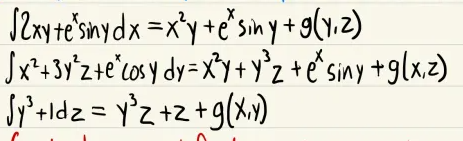
im struggling with finding the parent function of a conservative vector field in 3d
lemme attach my work so far

i integrated each part of the vector field F with its respective position variable but im not sure what to do with these newfound constants g
 solid iris
parent=potential?
frail skiff
my prof described it as a venn diagram, but im not sure where to go from there
solid iris
u mean just del?
frail skiff
the del operator itself is just a vector of derivatives
frail skiff
yessir
solid iris
ic
frail skiff
i gotta plug in the endpoints/starting points so i can use the FTC
frail skiff
ohhh okay mb
yeah my prof said parent function and potential function were interchangeable terms
solid iris
u cant use g for unknown function every time
solid iris
they may be different functions
frail skiff
but if you derive a function with respect to the main variable, the other two would disappear
so if you integrate that function you have to add an unknown constant that would include those two
solid iris
thats not the issue
u already used g for an unknown function
u need to use smth else for another unknown function
frail skiff
ohhh i get what you mean
solid iris
say h
frail skiff
i mean the variable choice is arbitrary i just dont know how to assemble the function
i can just use c1 c2 c3
 frail skiff
yessir
solid iris
lets call the unknown functions g_1, g_2, g_3
frail skiff
ya
solid iris
theyre all equal yes?
bc they all equal f
so we must compare all the expressions
g_1 consists of terms only depending on y,z
frail skiff
Yessir
solid iris
can u tell me those terms
grand pondBOT
ロケットジャンプ
 frail skiff
There are none that have both x and z so ig just z
grand pondBOT
ロケットジャンプ
 solid iris
same logic for g_3, tell me what u get
frail skiff
X^2 y and e^x sin y
solid iris
$g_3(x,y)=x^2y+e^x\sin y$
grand pondBOT
ロケットジャンプ
 frail skiff
Oh is it as simple as just assembling them into a system of equations and crossing out the duplicates
frail skiff
Got it appreciate it dude I think I was just overthinking lol
solid iris
np man 🙂
midnight plankBOT
@frail skiff Has your question been resolved?
Channel closed
Closed by @frail skiff
Use .reopen if this was a mistake.
midnight plankBOT
Available help channel!
Send your question here to claim the channel.
Remember:
• Ask your math question in a clear, concise manner.
• Show your work, and if possible, explain where you are stuck.
• After 15 minutes, feel free to ping <@&286206848099549185>.
• Type the command .close to free the channel when you're done.
• Be polite and have a nice day!
Read #❓how-to-get-help for further information on how to ask a good question, and about conduct in the question channels.
 tacit kelp
 midnight plankBOT
tacit kelp
tacit kelp
midnight plankBOT
tacit kelp
tacit kelp
why is it 90.0 - 32.6???
 stiff pollen
tacit kelp
why is it 90.0 - 32.6???
stiff pollen
tacit kelp
why is it 90.0 - 32.6???
try drawing it
 midnight plankBOT
Channel closed
Closed by @tacit kelp
Use .reopen if this was a mistake.
midnight plankBOT
Available help channel!
Send your question here to claim the channel.
Remember:
• Ask your math question in a clear, concise manner.
• Show your work, and if possible, explain where you are stuck.
• After 15 minutes, feel free to ping <@&286206848099549185>.
• Type the command .close to free the channel when you're done.
• Be polite and have a nice day!
Read #❓how-to-get-help for further information on how to ask a good question, and about conduct in the question channels.
twilit field
Let $f$ and $g$ be functions of one real variable and define $F(x,y) = F(x \cdot g(y))$ . Find the first partial derivative of the the first order , expressed in terms of the derivatives of $f$ and $g$
midnight plankBOT
twilit field
Let $f$ and $g$ be functions of one real variable and define $F(x,y) = F(x \cdot...
grand pondBOT
What a wonderful world !
 twilit field
so $\pdv{F(x\cdot g(y))}{x} = \pdv{F(x \cdot g(y))}{x \cdot g(y)} \cdot \pdv{x \cdot g(y)}{x}$
grand pondBOT
What a wonderful world !
 twilit field
I dont think I've simplified it enough
twilit field
grand pond
**What a wonderful world !**

Need to get rid of the circled part somehow
twilit field
twilit field
I mean to start this is $\pdv{ F(x \cdot g(y))}{ (x \cdot g(y))} \cdot g(y)$
grand pondBOT
What a wonderful world !
 midnight plankBOT
@twilit field Has your question been resolved?
midnight plankBOT
Channel closed
Closed by @twilit field
Use .reopen if this was a mistake.
Available help channel!
Send your question here to claim the channel.
Remember:
• Ask your math question in a clear, concise manner.
• Show your work, and if possible, explain where you are stuck.
• After 15 minutes, feel free to ping <@&286206848099549185>.
• Type the command .close to free the channel when you're done.
• Be polite and have a nice day!
Read #❓how-to-get-help for further information on how to ask a good question, and about conduct in the question channels.
 lost ocean
Can someone help me prove the convergence of $$x_{n+1} = x_{n} - \frac{2(f(x_n))^2}{f(x_n + f(x_n)) - f(x_n − f(x_n))}$$, the newton method with the approximation $$f'(x_n) = \frac{f(x_n + f(x_n)) - f(x_n - f(x_n))}{2(f(x_n))}$$
I'm using this prove as a base: https://fractal.math.unr.edu/~ejolson/701-12/code/hw2sol/hw2sol.pdf
midnight plankBOT
lost ocean
Can someone help me prove the convergence of $$x_{n+1} = x_{n} - \frac{2(f(x_n))...
lost ocean
I'm trying
grand pondBOT
vascomarq
Compile Error! Click the  reaction for more information.
(You may edit your message to recompile.)
 lost ocean
Some keep not appearing but I guess u get the gist
midnight plankBOT
@lost ocean Has your question been resolved?
midnight plankBOT
Channel closed
Closed due to timeout
Use .reopen if this was a mistake.
midnight plankBOT
Available help channel!
Send your question here to claim the channel.
Remember:
• Ask your math question in a clear, concise manner.
• Show your work, and if possible, explain where you are stuck.
• After 15 minutes, feel free to ping <@&286206848099549185>.
• Type the command .close to free the channel when you're done.
• Be polite and have a nice day!
Read #❓how-to-get-help for further information on how to ask a good question, and about conduct in the question channels.
 slim portal
No. 20
A box contains five red marbles, two blue marbles, and one green marble. Two marbles will be randomly drawn from the box.
The probability that the two drawn marbles have different colors is...
(A) 9/25
(B) 2/5
(C) 5/14
(D) 11/26
(E) 17/28
midnight plankBOT
slim portal
No. 20
A box contains five red marbles, two blue marbles, and one green marble....
slim portal
Please help me guiding
 viral dagger
id count the probability that you draw the same color then subtract it
midnight plankBOT
Channel closed
Closed by @slim portal
Use .reopen if this was a mistake.
lyric charm
slim portal
Compliment
complement ≠ compliment
slim portal
lyric charm
compl**e**ment ≠ compl**i**ment


midnight plankBOT
Available help channel!
Send your question here to claim the channel.
Remember:
• Ask your math question in a clear, concise manner.
• Show your work, and if possible, explain where you are stuck.
• After 15 minutes, feel free to ping <@&286206848099549185>.
• Type the command .close to free the channel when you're done.
• Be polite and have a nice day!
Read #❓how-to-get-help for further information on how to ask a good question, and about conduct in the question channels.
twilit field
The equation $f(\frac{y}{x},\frac{z}{x})=0$ implicitly defines $z$ as a function of $x$ and $y$. Say $z=g(x,y)$.
\
Show that $$x \pdv{g}{x} + y \pdv{g}{y} = g(x,y)$$
midnight plankBOT
twilit field
The equation $f(\frac{y}{x},\frac{z}{x})=0$ implicitly defines $z$ as a functio...
grand pondBOT
What a wonderful world !
 twilit field
NO idea
 dawn dagger
twilit field
NO idea
dawn dagger
twilit field
NO idea
have you tried to attain g_x and g_y?
twilit field
dawn dagger
have you tried to attain g_x and g_y?
how would I do that
The best I can think of is
$
dawn dagger
you think of money?
 grand pondBOT
What a wonderful world !
 dawn dagger
z is a function of x and y
twilit field
yea
Oh god
$\pdv{f}{x} \cdot ( \frac{-y}{x^2} - \frac{z}{x^2} \cdot \pdv{z}{x})=0$
grand pondBOT
What a wonderful world !
 twilit field
dawn dagger
you would need product/quotient rule
twilit field
dawn dagger
you would need product/quotient rule
why
midnight plankBOT
@twilit field Has your question been resolved?
Channel closed
Closed by @twilit field
Use .reopen if this was a mistake.
midnight plankBOT
Available help channel!
Send your question here to claim the channel.
Remember:
• Ask your math question in a clear, concise manner.
• Show your work, and if possible, explain where you are stuck.
• After 15 minutes, feel free to ping <@&286206848099549185>.
• Type the command .close to free the channel when you're done.
• Be polite and have a nice day!
Read #❓how-to-get-help for further information on how to ask a good question, and about conduct in the question channels.
 ornate umbra
- I need help with d^2y/dx^2
 midnight plankBOT
ornate umbra
- I need help with d^2y/dx^2
midnight plankBOT
ornate umbra
- I need help with d^2y/dx^2
@ornate umbra Has your question been resolved?
midnight plankBOT
ornate umbra
- I need help with d^2y/dx^2
Show your work, and if possible, explain where you are stuck.
Channel closed
Closed due to timeout
Use .reopen if this was a mistake.
Available help channel!
Send your question here to claim the channel.
Remember:
• Ask your math question in a clear, concise manner.
• Show your work, and if possible, explain where you are stuck.
• After 15 minutes, feel free to ping <@&286206848099549185>.
• Type the command .close to free the channel when you're done.
• Be polite and have a nice day!
Read #❓how-to-get-help for further information on how to ask a good question, and about conduct in the question channels.
 trim lance
how do I solve this? I'm stuck from the first step..
 midnight plankBOT
trim lance
how do I solve this? I'm stuck from the first step..
midnight plankBOT
trim lance
how do I solve this? I'm stuck from the first step..
 trim lance
like tan 20 = h/x like that?
trim lance
x = h/tan20?
trim lance
y = h/tan 18
slender walrus
and then apply pythagoras
trim lance
ohhhhh
thank youu
wait i still cant get past that step though because i have variable h to figure out
slender walrus
applying pythag will give you an (quadratic) equation with only one variable h
solving that will give you its value
midnight plankBOT
@trim lance Has your question been resolved?
Channel closed
Closed by @trim lance
Use .reopen if this was a mistake.
midnight plankBOT
Available help channel!
Send your question here to claim the channel.
Remember:
• Ask your math question in a clear, concise manner.
• Show your work, and if possible, explain where you are stuck.
• After 15 minutes, feel free to ping <@&286206848099549185>.
• Type the command .close to free the channel when you're done.
• Be polite and have a nice day!
Read #❓how-to-get-help for further information on how to ask a good question, and about conduct in the question channels.
 gritty holly
 midnight plankBOT
gritty holly
gritty holly
midnight plankBOT
gritty holly
gritty holly
so for part a i need to take the limit of the sequence right?

 )
)
 tribal temple
Actually misread a and b, got them mixed up 
tribal temple
gritty holly
Yep  I thought a was actually b
gritty holly
okay sick so its convergent right becasue its 0
gritty holly
ya... and since i know that the lim goes to zero then thats the same for a series divergence test right
but with the divergence test the 0 tells us that it diverges not converges right?
tribal temple
tribal temple
Try it anyway (cause I wanna watch you <:glassescat:1153031958755029102>)
This is why I was wanting you to try it out
gritty holly
ya im looking at my notes
tribal temple
The limit being 0 of the sequence doesn’t tell us whether the sequence converges or diverges  the series of 1/n^2 converges (to pi^2/6), the series of 1/n diverges (cough hint), but both corresponding sequences have limit 0
If the limit of the sequence is not zero, and is anything else (including a non zero limit, not converging, going to an infinity) then the series does not converge
They’re telling you to “Justify your answer using an appropriate series convergence test”, so we really should 
Of course, divergence test is inconclusive here, so that’s one gone 
gritty holly
tribal temple
Of course, divergence test is inconclusive here, so that’s one gone <a:inTheTras...
what is it inconclusive? when the limit=0
tribal temple
gritty holly
what is it inconclusive? when the limit=0
Yep, inconclusive when the limit is 0, because you could have either [series] convergence or divergence if the [sequence] limit is 0
tribal temple
tribal temple
The limit being 0 of the sequence doesn’t tell us whether the sequence converges...
See here for a case of convergence and divergence 
gritty holly
so if i needed to know wat the sequence converged to i would need to do another test? the answer isnt 0
tribal temple
Well, for the sequence, if you know it has a limit of 0, you’d have to do more work and another test
If you got the sequence limit as anything that isn’t 0, then you instantly know the series diverges 
lavish venture
gritty holly
so if i needed to know wat the sequence converged to i would need to do another ...
the sequence converges to 0 but do you mean the series perhaps?
gritty holly
lavish venture
the sequence converges to 0 but do you mean the series perhaps?
i havent started the series yet i was just asking if i needed to know exactly what the sequence sin(1/n) converges to would i need to do another test
lavish venture
you do know what the sequence converges to
you just took the limit of sin(1/n) to get 0
the sequence a_n converges to 0
this does not mean the series converges to 0 though
tribal temple
(Nor that the series converges at all, remember the harmonic series)
gritty holly
the harmonic series is (-1)^n/n right
lavish venture
no thats the alternating harmonic i guess you could call it
harmonic series is 1/n
gritty holly
oh ya okay
lavish venture
out of curiosity, does your intuition tell you this converges or diverges
lavish venture
like just by inspection/feel would you say the series sin(1/n) converges or diverges
without doing any tests
gritty holly
well i know that 1/n by itself diverges
gritty holly
and isnt sin(n) also divergent
lavish venture
it is
gritty holly
so is sin(1/n) also divergent
lavish venture
well its not because sin(n) is divergent
gritty holly
or does something weird happen that makes two divergent things convergent?
lavish venture
but yes
gritty holly
gritty holly
or does something weird happen that makes two divergent things convergent?
does this ever happen?
lavish venture
consider [\lim_{x \to 0} \frac{\sin x}{x}]
grand pondBOT
knief
 lavish venture
gritty holly
does this ever happen?
lavish venture
gritty holly
does this ever happen?
i mean
1/n times 1/n is 1/n^2 which converges but im not sure i know what you mean exactly
gritty holly
lavish venture
1/n times 1/n is 1/n^2 which converges but im not sure i know what you mean exac...
honestly neither am i its okay
lavish venture
grand pond
**knief**
do you remember what this is
lavish venture
sure
gritty holly
oh no
lavish venture
but this is a pretty famous limit
gritty holly
is it -cos(x)/x^2
lavish venture
that is not how you do lhopitals
lavish venture
[\lim_{x \to a} \frac{f(x)}{g(x)} = \lim_{x \to a} \frac{f'(x)}{g'(x)}]
grand pondBOT
knief
 lavish venture
assuming conditions are satisfied of course
gritty holly
so i need to keep the -1/x in the denominator?
gritty holly
oh so its just cos(x)
lavish venture
and as x -> 0
gritty holly
=1
grand pondBOT
knief
 lavish venture
can you see how this is relevant for our problem
gritty holly
um no
lavish venture
do you agree that
gritty holly
how do i get sin(x)/x from sin(1/n)
lavish venture
[\lim_{x \to \infty} \sin \left(\frac{1}{x}\right) = \lim_{x \to 0} \sin x]
grand pondBOT
knief
 gritty holly
ya
grand pondBOT
knief
 gritty holly
ya
lavish venture
grand pond
**knief**
ok and you still dont see how this shows up?
what tests do you know
that might involve a limit
gritty holly
let me think 🥹
gritty holly
lavish venture
that might involve a limit
the limit comparison test?
gritty holly
okay thank god
gritty holly
lavish venture
can you state what the test says
um i can try to type it or i can send a pic of the notes
gritty holly
well a_n has to be sin(1/n) and can b_n be sin(n)? or does that not work
lavish venture
why?
gritty holly
why what?
gritty holly
that the limit was 1, but how can comparing sine to x be legal? dont a and b have to be related
lavish venture
idk what you mean legal
lavish venture
grand pond
**knief**
why would i ask you this?
gritty holly
like acceptable
lavish venture
grand pond
**knief**
and this?
gritty holly
but the limit is changing from infinity to 0 in those but in the limit comparison its just infinity
gritty holly
oh fuck is it 1/n
im over here about to cry this fucking class is so frustrating!!!!
gritty holly
so i have this
 gritty holly
lavish venture
you need to know this to solve climate change
gritty holly
lavish venture
you need to know this to solve climate change
no to solve climate change we need to reorganize society away from fossil fuels and consumer culture
lavish venture
what happened to sin(1/n)????
lavish venture
gritty holly
no to solve climate change we need to reorganize society away from fossil fuels ...
word
and determine the convergence of series
gritty holly
lavish venture
what happened to sin(1/n)????
they left the chat
lavish venture
every problem you do cleans up 100 pounds of microplastics in the ocean
probably

chartbit has the best reacts
gritty holly
okay wait give me one sec my dad called me and i need to pay tuition real quick
gritty holly
okay im back
gritty holly
lavish venture
at least you have in state tuition
ya but its still basically 15k a year
lavish venture
gritty holly
ya but its still basically 15k a year
better than 60
gritty holly
ya thats crazy
gritty holly
lavish venture
chartbit has the best reacts
this is so true🫶
gritty holly
gritty holly
so i have this
so now i can say that this limit is 1 (i fixed the 1/n)
lavish venture
which means
gritty holly
that they behave the same and are both divergent
grand pondBOT
knief
 gritty holly
lavish venture
try this one
gritty holly
lavish venture
try this one
oh no the anxiety spike from this
can i do the divergence test?
lavish venture
try it
gritty holly
is it 1?
lavish venture
no
tribal temple
You're banned from using the word "it" 
lavish venture
i think if i tell you the trick you won't learn
hmm
do you know any inequalities involving sin and cos
gritty holly
tribal temple
You're banned from using the word "it" <a:catBugJail:1269468453245554761>
noo what am i going to do
tribal temple
gritty holly
noo what am i going to do
State what you mean as clearly as you can (else you'll get a react, you even admitted you use ambuguity to get away with it )
gritty holly
they are both confined between -1 and 1
lavish venture
which means what about cos^2
gritty holly
tribal temple
State what you mean as clearly as you can (else you'll get a <a:catBugJail:12694...
ya i should have kept my mouth shut about that... now its biting me in the ass
lavish venture
$-1 \leq \cos x \leq 1$
grand pondBOT
knief
 gritty holly
lavish venture
which means what about cos^2
gritty holly
lavish venture
which means what about cos^2
ya i have no idea how squaring it would change it
lavish venture
well what do you know about x^2 to begin with
do you know any inequality about x^2
gritty holly
its a U shape graph
lavish venture
inequality
gritty holly
that goes on to infinity
lavish venture
gritty holly
that goes on to infinity
and what else
so it has no maximum
does it have a minimum?
gritty holly
ya 0
lavish venture
lavish venture
*inequality*
^
gritty holly
0<x^2<infinity
gritty holly
looks great!
lavish venture
so what can we say about cos^2 x
tribal temple
gritty holly
ya i should have kept my mouth shut about that... now its biting me in the ass
(on a more serious note though, it does mean we can make sure you understand stuff properly, and of course I'd like to think you know it's safe to try anything and we won't roast you )
gritty holly
lavish venture
so what can we say about cos^2 x
umm would cos^2 have to be greaterthan 0 too?
gritty holly
but cos^2 cant to to infinity can it?
lavish venture
it can not
gritty holly
would cos^2 still have 1 be the max
lavish venture
$0 \leq \cos^2 x \leq 1$
grand pondBOT
knief
 lavish venture
why is this useful?
gritty holly
also the amount of times ive had to change "it" to cos^2 already is horrendous
gritty holly
grand pond
**knief**
maybe to know that cos^2 wont be negative?
lavish venture
grand pond
**knief**
well we have this yea
lets start with what your intuition tells you
is it going to converge or diverge
gritty holly
my intuition is shit!
lavish venture
50/50
gritty holly
ill say converge becasue p>1
lavish venture
how can we use this?
what test should we use to prove this
we know 1/n^2 converges since p > 1
gritty holly
ooo umm the direct comparison
lavish venture
grand pond
**knief**
can you see why this is useful
gritty holly
honestly no
gritty holly
to show that they behave the same
gritty holly
showing that if one series is smaller that something convergent it converges and vice versa for something larger than a divergent series
lavish venture
great so how can we use this
gritty holly
would it be since cos^2 is between 0 and 1 that its smaller?
lavish venture
$\cos^2 n \leq 1 \implies \frac{\cos^2 n}{n^2} \leq \frac{1}{n^2}$
grand pondBOT
knief
 gritty holly
yay okay
lavish venture
would you like another one
gritty holly
ya
lavish venture
$\sum_{n = 2}^{\infty} \frac{1}{(n + (-1)^n)^2}$
grand pondBOT
knief
 gritty holly
then ill keep trying to do my practive problems