#help-49
1 messages · Page 127 of 1
 golden comet
just need to proof ab is rational
the proof is there lol
after proving ab is rational
let a=m/n and b=p/q
a+b=m/n+p/q=(mq+pn)/nq
and that is a whole number divided by whole number
thus rational
 zealous schooner
Thr problem is you're assuming previous knowledge about how addition and multiplication works in rationals
 twilit field
I suppose we can assume how they work
 radiant roost
$mn^{-1}+pq^{-1} = mqq^{-1}n^{-1}+pnn^{-1}q^{-1}=(mq+pn)q^{-1}n^{-1}$
 grand pondBOT
Axe
 zealous schooner
Yeah this was what I was thinking of
You will also need a^{-1}b^{-1}=(ab)^{-1} to end it off
radiant roost
aha
yes
because we need to show it's the product of an integer and the inverse of an integer
zealous schooner
Yep
radiant roost
sure
 midnight plankBOT
Channel closed
Closed by @twilit field
Use .reopen if this was a mistake.
midnight plankBOT
 Available help channel!
Send your question here to claim the channel.
Remember:
• Ask your math question in a clear, concise manner.
• Show your work, and if possible, explain where you are stuck.
• After 15 minutes, feel free to ping <@&286206848099549185>.
• Type the command .close to free the channel when you're done.
• Be polite and have a nice day!
Read #❓how-to-get-help for further information on how to ask a good question, and about conduct in the question channels.
 last slate
!help
midnight plankBOT
To ask for mathematics help on this server, please open your own help channel or help thread. See #❓how-to-get-help for instructions.
midnight plankBOT
last slate
!help

 slender walrus
because that's asking about what's happening around that location
and not the function value itself
last slate
What does the red dot above supposed to represent tho?
Also look at th graph given on teh side
Yeah i see that
slender walrus
the dot indicates the function value
last slate
slender walrus
the dot indicates the function value
Well isnt the function 2 when x approaches to negative 2?
last slate
slender walrus
the dot indicates the function value
Don't dots show that the function is undefined tho?
 sharp wave
last slate
Well isnt the function 2 when x approaches to negative 2?
sharp wave
last slate
Well isnt the function 2 when x approaches to negative 2?
f(-2) = 2
last slate
My apologies if I am wrong
golden comet
yeah the function is 2 when it equals -2
but we are infinitely approaching -2
not AT -2
last slate
Ohhhhhh
sharp wave
last slate
Don't dots show that the function is undefined tho?
it just says that f(-2) is not -1 and it has a value somewhere else
like the [x] function
golden comet
but
we are approaching that 1 value infinitely
againt we are not AT the -2 point
and if we are appraoching x=-2
we will get infinitely close to 1 first
before going to 2 AT -2
golden comet
np
last slate
!close
slender walrus
for the limit, you're considering
 golden comet
(btw never learned calculus lol, only heard of some basics of it XD)
last slate
slender walrus
for the limit, you're considering
Ah
golden comet
pretty sure it is .close
sharp wave
last slate
!close
put a . not !
midnight plankBOT
Channel closed
Closed by @modest flame
Use .reopen if this was a mistake.
last slate
👍
midnight plankBOT
Available help channel!
Send your question here to claim the channel.
Remember:
• Ask your math question in a clear, concise manner.
• Show your work, and if possible, explain where you are stuck.
• After 15 minutes, feel free to ping <@&286206848099549185>.
• Type the command .close to free the channel when you're done.
• Be polite and have a nice day!
Read #❓how-to-get-help for further information on how to ask a good question, and about conduct in the question channels.
 drowsy hawk
Hello! if anybody is familiar with mathematica/wolfram (i have never touched it in my life), i just wanted to know if its feasible to graph something like this on the app? /how hard would it be/how would i do it 😔also would i need just wolfram engine or actually mathematica bc i dont wanna buy it
 midnight plankBOT
drowsy hawk
Hello! if anybody is familiar with mathematica/wolfram (i have never touched it ...
midnight plankBOT
drowsy hawk
Hello! if anybody is familiar with mathematica/wolfram (i have never touched it ...
 sharp coral
,w contour plot cos(x)sin(y) x from 0 to 25, y from 0 to 15
grand pondBOT


 Requested by cloudedhorizons
midnight plankBOT
Requested by cloudedhorizons
midnight plankBOT
@drowsy hawk Has your question been resolved?
drowsy hawk
sharp coral
,w contour plot cos(x)sin(y) x from 0 to 25, y from 0 to 15
oh thanks!
midnight plankBOT
Channel closed
Closed by @drowsy hawk
Use .reopen if this was a mistake.
Available help channel!
Send your question here to claim the channel.
Remember:
• Ask your math question in a clear, concise manner.
• Show your work, and if possible, explain where you are stuck.
• After 15 minutes, feel free to ping <@&286206848099549185>.
• Type the command .close to free the channel when you're done.
• Be polite and have a nice day!
Read #❓how-to-get-help for further information on how to ask a good question, and about conduct in the question channels.
 tidal turret
For how many values of the digit $A$ is it true that $63$ is divisible by $A$ and $273{,}1A2$ is divisible by $4$?
midnight plankBOT
tidal turret
For how many values of the digit $A$ is it true that $63$ is divisible by $A$ an...
grand pondBOT
938c2cc0dcc05f2b68c4287040cfcf71

 dreamy lichen
tidal turret
For how many values of the digit $A$ is it true that $63$ is divisible by $A$ an...
dreamy lichen
tidal turret
For how many values of the digit $A$ is it true that $63$ is divisible by $A$ an...
just try all of the digits with A | 63
there is not too many of them
tidal turret
which numbers are divisible by 63?
dreamy lichen
63 must be divisible by A
63 is divisible by e.g. 21
but 21 isnt a single digit
so you dont even need to consider that
what else is 63 divisible by?
tidal turret
by 7 and by 3
dreamy lichen
there are 2 more possible digits
dreamy lichen
You could just start from 1 and try every possible digit and see if it divides 63
so e.g. 1 does divide 63
2 doesnt
3 does
4 doesnt
5 doesnt
6 doesnz
7 does
...
tidal turret
Divisibility Rule of 4
If the last two digits of a number are divisible by 4, then that number is a multiple of 4 and is divisible by 4 completely
 slow thorn
dreamy lichen
slow thorn
dreamy lichen
And you can easily test that 12, 32, 72 and 92 are all divisible by 4
so that's it
now just look back at what the question asks for and answer it
midnight plankBOT
Channel closed
Closed by @tidal turret
Use .reopen if this was a mistake.
midnight plankBOT
Available help channel!
Send your question here to claim the channel.
Remember:
• Ask your math question in a clear, concise manner.
• Show your work, and if possible, explain where you are stuck.
• After 15 minutes, feel free to ping <@&286206848099549185>.
• Type the command .close to free the channel when you're done.
• Be polite and have a nice day!
Read #❓how-to-get-help for further information on how to ask a good question, and about conduct in the question channels.
 fierce canyon
 midnight plankBOT
fierce canyon
grand pondBOT
midnight plankBOT
fierce canyon
grand pondBOT

 rain wasp
fierce canyon
rain wasp
fierce canyon
what have you tried?
rain wasp
you basically solved the damn thing
since EBC is an isosceles triangle (angle CEA = angle CBD = 20deg), you know that EC = CB
you now are able to prove the triangle ECA is congruent to triangle BCD
the rest is obvious
rain wasp
wait have you learned congruent triangles?
fierce canyon
like sas and stuff?
rain wasp
yeah
fierce canyon
oh wait is it angle side side
rain wasp

midnight plankBOT
Channel closed
Closed by @fierce canyon
Use .reopen if this was a mistake.
midnight plankBOT
Available help channel!
Send your question here to claim the channel.
Remember:
• Ask your math question in a clear, concise manner.
• Show your work, and if possible, explain where you are stuck.
• After 15 minutes, feel free to ping <@&286206848099549185>.
• Type the command .close to free the channel when you're done.
• Be polite and have a nice day!
Read #❓how-to-get-help for further information on how to ask a good question, and about conduct in the question channels.
 median arrow
Can someone help me with this?
 midnight plankBOT
median arrow
Can someone help me with this?
median arrow
midnight plankBOT
median arrow
Can someone help me with this?
median arrow
1st question

I'm stuck here
And 2nd question
I'm here

@anyone 😃
I did 2b

But idk how to do 1) and 2)-a
.close
midnight plankBOT
Channel closed
Closed by @median arrow
Use .reopen if this was a mistake.
midnight plankBOT
Available help channel!
Send your question here to claim the channel.
Remember:
• Ask your math question in a clear, concise manner.
• Show your work, and if possible, explain where you are stuck.
• After 15 minutes, feel free to ping <@&286206848099549185>.
• Type the command .close to free the channel when you're done.
• Be polite and have a nice day!
Read #❓how-to-get-help for further information on how to ask a good question, and about conduct in the question channels.
twilit field
If $x= ( 1 2 3 )$ and $y = (1 2 )$ find $x^2 y$
midnight plankBOT
twilit field
If $x= ( 1 2 3 )$ and $y = (1 2 )$ find $x^2 y$
grand pondBOT
ƒ(Why am. I here)=I don't Know

 rough birch
Make a map of what each number maps to. Do you understand how multiplying permutations works?
twilit field
Not entirely, but I'm working on it
rough birch
twilit field
Not entirely, but I'm working on it
when you multiply permutations, you take each element, and see what it maps to under the rightmost permutation. take this new value. you then work your way left, and see what this now maps to on the second rightmost permutation.
continue all the way until you reach the leftmost permutation
twilit field
so I effectively have to find $(1 2) (1 2 3) (1 2 3)$
grand pondBOT
ƒ(Why am. I here)=I don't Know
 rough birch
well when we write $(123)(123)(12)$, we first do the rightmost one, and then middle and then left
grand pondBOT
Arnavutköy
 rough birch
so it would still be written as $(123)(123)(12)$
grand pondBOT
Arnavutköy
 rough birch
although a more intutive way of thinking about it is we apply $(12)$ first, and then we apply $(123)$ twice
grand pondBOT
Arnavutköy
 twilit field
so ( 1,2,2,3) is what I get
which is (1,3)
I suppose I could break it down and see what I get
rough birch
tell me what $1$, $2$, and $3$ go to
grand pondBOT
Arnavutköy
 twilit field
1 goes to 3
rough birch
no. can you work through the steps of what you did to get that so i can see what you are doing wrong?
so under $(12)$, where does $1$ go to
grand pondBOT
Arnavutköy
 grand pondBOT
Arnavutköy
 rough birch
similarly, where does $2$ and $3$ go?
grand pondBOT
Arnavutköy
 twilit field
under the first cycle 2 goes to 1, under the next cycel 2 goes to 3 and under the final cycle it goes to 1
3 goes to 3 under the first cycle, to 1 under the second cycle and to 2 under the final cycle
rough birch
twilit field
under the first cycle 2 goes to 1, under the next cycel 2 goes to 3 and under th...
well under the first cycle $2$ goes to $1$, but then we should care about where $1$ goes for the second cycle because that was the result of the first cycle
grand pondBOT
Arnavutköy
 twilit field
what
rough birch
twilit field
what
wait so like when we plugged in $1$ we had $1\to 2 \to 3\to 1$ right
grand pondBOT
Arnavutköy
 rough birch
but now, we plug in $2$
grand pondBOT
Arnavutköy
 rough birch
you did $2\to 1$
twilit field
yes
grand pondBOT
Arnavutköy
 twilit field
yes
rough birch
but then we need to use $1$ next, as that is what we are at right now.
grand pondBOT
Arnavutköy
 rough birch
so it would be $2\to 1\to 2\to 3$ in fact
grand pondBOT
Arnavutköy
 twilit field
I still don't follow
in the first cycle it's 1
in the second cycle it maps to 2
and it maps to 3 in the final sycle
oh
right
rough birch
so we have in the end, $1$ goes to $1$, $2$ goes to $3$, and $3$ goes to $2$
grand pondBOT
Arnavutköy
 rough birch
you will see that this is always a permutations, no $2$ terms will ever go to the same thing under the product of a bunch of cycles
grand pondBOT
Arnavutköy
 rough birch
twilit field
so the permutation cycle's result would be (1 3)
rough birch
twilit field
so the permutation cycle's result would be (1 3)
no, $1$ goes to $1$
grand pondBOT
Arnavutköy
 rough birch
not to $3$
grand pondBOT
Arnavutköy
 rough birch
yes
don't put the commas by the way
the lack of commas indicate that it is a permutation
midnight plankBOT
Channel closed
Closed by @twilit field
Use .reopen if this was a mistake.
midnight plankBOT
Available help channel!
Send your question here to claim the channel.
Remember:
• Ask your math question in a clear, concise manner.
• Show your work, and if possible, explain where you are stuck.
• After 15 minutes, feel free to ping <@&286206848099549185>.
• Type the command .close to free the channel when you're done.
• Be polite and have a nice day!
Read #❓how-to-get-help for further information on how to ask a good question, and about conduct in the question channels.
twilit field
Let $S$ be a set with an associative law of composition and with an identity element. Prove that the subset consisting of the invertible elements in $S$ is a group
midnight plankBOT
twilit field
Let $S$ be a set with an associative law of composition and with an identity ele...
grand pondBOT
ƒ(Why am. I here)=I don't Know
 twilit field
So I have to show 3 things
wait
isn't this a group by definition
The law of composition is associative, it posses an identity elements, and all elements in the set are invertible
rough birch
yeah so associativity is inherited
the identity is also inherited obviously
so all which is left to show is that the law of composition is well-defined (i.e. closure in the subset) and that the inverse is in the group
rough birch
twilit field
That's going to be hard to show
well first of all what is the definition of invertible we are using here
twilit field
$a^{-1} a =1=. aa^{-1}$
grand pondBOT
ƒ(Why am. I here)=I don't Know
 twilit field
right
rough birch
yeah so then if $a$ is in $S$, so is $a^{-1}$ right?
grand pondBOT
Arnavutköy
 rough birch
twilit field
why
rough birch
twilit field
why
you agree that $(a^{-1})^{-1}=a$ (set-wise right?)
grand pondBOT
Arnavutköy
 twilit field
yes
rough birch
therefore both $a$ and $a^{-1}$ are in the set. we now just need to show that in the group $a$ and $a^{-1}$ are actually inverses
grand pondBOT
Arnavutköy
 rough birch
twilit field
Not too sure of hwo to do that
rough birch
twilit field
Not too sure of hwo to do that
okay, so i will refer to $a^{-1}$ as $c$ because we don't actually know they are inverse in the group yet and its getting confusing
grand pondBOT
Arnavutköy
 rough birch
so we have that $ac=e$ and $ca=e$
grand pondBOT
Arnavutköy
 rough birch
so now, take an arbitrary element $b$ in our new set of invertible elements.
grand pondBOT
Arnavutköy
 rough birch
actually, ignore that
rough birch
rough birch
so we have that $ac=e$ and $ca=e$
we have that $e$ is the identity in our new group right?
grand pondBOT
Arnavutköy
 rough birch
and $ac=e$ and $ca=e$ are literally the definition of inverses in the group
grand pondBOT
Arnavutköy
 twilit field
yes
rough birch
so this implies that $a$ and $a^{-1}$ are acutally inverses
grand pondBOT
Arnavutköy
 rough birch
closure is non-trivial
we need to show that the product of two invertible elements is also invertible
twilit field
we also need to show that if I take two arbitrary elemets, it's in the set
do I not
rough birch
twilit field
we also need to show that if I take two arbitrary elemets, it's in the set
we need to show that the product of two arbitrary elements is also in the group yes
so suppose we have that $aa^{-1}=a^{-1}a=bb^{-1}=b^{-1}b$.
grand pondBOT
Arnavutköy
 rough birch
Show that $ab$ is also invertible
grand pondBOT
Arnavutköy
 rough birch
Hint: Show that $(ab)^{-1}=b^{-1}a^{-1}$.
grand pondBOT
Arnavutköy
 twilit field
I already have
rough birch
twilit field
I already have
oh have you showed this? then ur done
rough birch
you have shown all $4$ properties
- Closure and well-definedness of set (If $a,b$ are invertible then so is $ab$
- Identity (Inherited)
- Associativity (Inherited)
- Inverse (The inverse of the element in the set is also the inverse of the element in the group)
grand pondBOT
Arnavutköy
 midnight plankBOT
Channel closed
Closed by @twilit field
Use .reopen if this was a mistake.
midnight plankBOT
Available help channel!
Send your question here to claim the channel.
Remember:
• Ask your math question in a clear, concise manner.
• Show your work, and if possible, explain where you are stuck.
• After 15 minutes, feel free to ping <@&286206848099549185>.
• Type the command .close to free the channel when you're done.
• Be polite and have a nice day!
Read #❓how-to-get-help for further information on how to ask a good question, and about conduct in the question channels.
 summer ravine
Hi
midnight plankBOT
summer ravine
Hi
summer ravine
Is this correct?
lim x-> infinity x root2 root(1-cos(180/x)) = pi
slender walrus
no
 worthy wing
summer ravine
Is this correct?
lim x-> infinity x root2 root(1-cos(180/x)) = pi
worthy wing
summer ravine
Is this correct?
lim x-> infinity x root2 root(1-cos(180/x)) = pi
Root2?
rough birch
worthy wing
Root2?
yes there is a root 2
summer ravine
yes
rough birch
 slender walrus
180 not pi
rough birch
slender walrus
180 not pi
i think it was intended that cosine was calculated in terms of degrees instead of radians
rough birch
assuming that cosine is calculated in terms of degrees this is still right though
slender walrus
in the presence of calculus and no degree symbol,
i'm going to assume the original value is in radians regardless of how special it looks
rough birch
it probably should just be clarified
worthy wing
Must*
summer ravine
rough birch
assuming that cosine is calculated in terms of degrees this is still right thoug...
ok thank you
so, can this be called a formula for calculating pi?
rough birch
summer ravine
so, can this be called a formula for calculating pi?
?
sure, but i mean calculating cosine without using pi is pretty nontrivial
you would have to use taylor series expansions
midnight plankBOT
@summer ravine Has your question been resolved?
Channel closed
Closed by @summer ravine
Use .reopen if this was a mistake.
Available help channel!
Send your question here to claim the channel.
Remember:
• Ask your math question in a clear, concise manner.
• Show your work, and if possible, explain where you are stuck.
• After 15 minutes, feel free to ping <@&286206848099549185>.
• Type the command .close to free the channel when you're done.
• Be polite and have a nice day!
Read #❓how-to-get-help for further information on how to ask a good question, and about conduct in the question channels.
twilit field
Let $G$ be a group. Define an opposite group $G^{\circ}$ , with law of composition $a \ast b$as follows, The underlying set is the same as $G$, but the law of composition $a \ast b =ba$ Prove $G^{\circ}$ is a group
\
Proof: As the underlying set is the same the identity element belongs to the group $G^{\circ}$
\
\
as $a^{-1}a = aa^{-1}$, the group is closed under inverses
\
$a \ast ( b \ast c) = a \ast (cb) = cba$
\
$(a \ast b)\ast c = ba \ast c = cba$
\
this prove its law of composition is associative.
\
It is therefore a group
midnight plankBOT
twilit field
Let $G$ be a group. Define an opposite group $G^{\circ}$ , with law of compositi...
grand pondBOT
ƒ(Why am. I here)=I don't Know
 midnight plankBOT
@twilit field Has your question been resolved?
twilit field
<@&286206848099549185>
 uncut gull
!status
midnight plankBOT
What step are you on?
1. I don't know where to begin.
2. I have begun but got stuck midway.
3. I got an answer but I was told that it's wrong.
4. I got an answer and would like my work checked.
5. I have a question about someone else's work/solution.
6. I have completed the problem and don't need help anymore. Thank you.
7. None of the above
4
 runic hamlet
thats not what closed under inverses means
and just because the identity element of G is still in G^° does not mean that it is also the identity element under the new operation
radiant roost
the part where you show associativity is correct
twilit field
cool, thanks
runic hamlet
!nosols
midnight plankBOT
As a helper, please do not give out answers that could be copied as a homework solution. Have the student work through the problem themselves and guide them along the way.
twilit field
I suppose I could start by determining what $a \ast 1$
grand pondBOT
ƒ(Why am. I here)=I don't Know
 twilit field
$a \ast 1 = 1a =a$. Thus It has a multiplicative identity
grand pondBOT
ƒ(Why am. I here)=I don't Know
 runic hamlet
thats not the (full) def of multiplicative identity
twilit field
I also need to verify that $1 \ast a=a$, which is similarly true
grand pondBOT
ƒ(Why am. I here)=I don't Know
 twilit field
$1 \ast a =a1 =. a$ Thus it has a right multiplicative identity, which is equal to its letf multiplicativ idenity
grand pondBOT
ƒ(Why am. I here)=I don't Know
 radiant roost
that shows 1 is a left identity in G°, not a right identity
grand pondBOT
ƒ(Why am. I here)=I don't Know
 radiant roost
yeah
twilit field
I'm not too sure what closure under inverses means tbh
radiant roost
i think what you have to show is closure under *,
and the existence of inverses
these are 2 different things right?
radiant roost
you have to show for all a, b in the underlying set,
a*b is in the set
twilit field
We already know that in $G$ $ab$ and $ba$ are both in the set .
\
$a \ast b = ba$, which is in $G$ and thus in $G^{\circ}$ and $b \ast a = ab$, which is in $G$ and thus in $G^{\circ}$
grand pondBOT
ƒ(Why am. I here)=I don't Know
 radiant roost
👍 it's not necessary to show both a*b and b*a
runic hamlet
twilit field
exsitance of inverses , I've shown
where
twilit field
Oh
nvm
Thought I had
as $a^{-1}a = aa^{-1}$, the group is closed under inverses
here
grand pondBOT
ƒ(Why am. I here)=I don't Know
 radiant roost
you need to show for all a, there's some element b with a*b = b*a = 1
this should be done only after showing 1 is an identity of G°
twilit field
ah
I see
so $a \ast a^{-1} = a^{-1}a=1$ should come after I show $1$ is an identity in $G^{\circ}$?
grand pondBOT
ƒ(Why am. I here)=I don't Know
 radiant roost
yeah
radiant roost
you should also say a^-1 * a = aa^-1 = 1
twilit field
yeah
radiant roost
i think that's it
midnight plankBOT
Channel closed
Closed by @twilit field
Use .reopen if this was a mistake.
midnight plankBOT
Available help channel!
Send your question here to claim the channel.
Remember:
• Ask your math question in a clear, concise manner.
• Show your work, and if possible, explain where you are stuck.
• After 15 minutes, feel free to ping <@&286206848099549185>.
• Type the command .close to free the channel when you're done.
• Be polite and have a nice day!
Read #❓how-to-get-help for further information on how to ask a good question, and about conduct in the question channels.
 craggy sequoia
I need help with geometry, pyramids to be exact, well i got a hypothenosis and one other side of the base triangle and i got the s and i need to calculate volume, how can i get the height of the pyramid?
midnight plankBOT
craggy sequoia
I need help with geometry, pyramids to be exact, well i got a hypothenosis and o...
craggy sequoia
a=6cm
that is the other side of the base
and c=10cm
that is the hypothenosis
i already calculated the b and it is 8cm
i also calculated the area of the base and it is 24 square centimeters
i can get the apothem but how do i get the height
but how?
craggy sequoia
 thorn sorrel
whats a hypothenosis
thorn sorrel
whats a hypothenosis
longest side of a right angle triangle
i'm not native in english sorry
thorn sorrel
oh hypothenuse
craggy sequoia
thorn sorrel
whats a b and c
the other sides of the triangle
craggy sequoia
thorn sorrel
oh hypothenuse
yes!
thorn sorrel
so its a triangular based pyramid?
craggy sequoia
yes
thorn sorrel
whys there an apothem then
thorn sorrel
that would be helpful thanks

 wanton ore
Trigo, law of cosines
craggy sequoia
Oh man i got a test tomorrow and we haven't learned that
wanton ore
craggy sequoia
Oh man i got a test tomorrow and we haven't learned that
Law of cosines?
craggy sequoia
No
thorn sorrel
what informstikn do you have
thorn sorrel
wanton ore
Law of cosines?
i dont think that will help here
craggy sequoia
I have all sides of the base
craggy sequoia
craggy sequoia
The small h
and the s
thorn sorrel
is it an equilateral triangle?
thorn sorrel
are the sides equal
craggy sequoia
craggy sequoia
The small h
i just used this as a reference
one side is 6cm, the other is 8cm and the hypothenuse is 10cm
craggy sequoia
craggy sequoia
The small h
the s which is 13cm
I tried literally everything i could think of
thorn sorrel
is the apex of the pyramid directly over one of the vertices of the triangle?
craggy sequoia
craggy sequoia
The small h
here is the reference again
craggy sequoia
i tried but i couldn't get another side to use for pythagorian theorem
the height falls 90 degrees on the base
so if i get some line on the base that has the height on it
i could calculate it
but i don't
If i could get the R i could calculate everything
 craggy sequoia
thorn sorrel
try sketxhing the ptramid
craggy sequoia
thorn sorrel
try sketxhing the ptramid
I sketched every side but i see no way to calculate this
<@&286206848099549185>
@midnight plank
midnight plankBOT
@craggy sequoia Has your question been resolved?
craggy sequoia
no!?
midnight plankBOT
@craggy sequoia Has your question been resolved?
midnight plankBOT
Channel closed
Closed due to timeout
Use .reopen if this was a mistake.
Available help channel!
Send your question here to claim the channel.
Remember:
• Ask your math question in a clear, concise manner.
• Show your work, and if possible, explain where you are stuck.
• After 15 minutes, feel free to ping <@&286206848099549185>.
• Type the command .close to free the channel when you're done.
• Be polite and have a nice day!
Read #❓how-to-get-help for further information on how to ask a good question, and about conduct in the question channels.
 vocal briar
how do I find b and a?
 midnight plankBOT
vocal briar
how do I find b and a?
vocal briar
midnight plankBOT
vocal briar
how do I find b and a?
vocal briar
I got c = 0 and d = 3 pretty easily
but now i did f''(1) = 0, but thats only getting me 0 = 6a + 2b
 fallow scarab
Show your whole work
vocal briar
ok

i tried doing a system of equations at the bottom there
with the equation i got from the second derivative
but a != -1
nvm i think im stupid
fallow scarab
vocal briar
Where does the bottom equation here come from
 vocal briar
yeah
uh
the origianl function
but the next step is wrong
after that
cuz i wrote 2 = a+ b
should be -4
midnight plankBOT
Channel closed
Closed by @vocal briar
Use .reopen if this was a mistake.
midnight plankBOT
Available help channel!
Send your question here to claim the channel.
Remember:
• Ask your math question in a clear, concise manner.
• Show your work, and if possible, explain where you are stuck.
• After 15 minutes, feel free to ping <@&286206848099549185>.
• Type the command .close to free the channel when you're done.
• Be polite and have a nice day!
Read #❓how-to-get-help for further information on how to ask a good question, and about conduct in the question channels.
 obtuse totem
 midnight plankBOT
obtuse totem
obtuse totem
midnight plankBOT
obtuse totem
obtuse totem

i swear
im not trippin right???
u1=1/6 and u2=0 doesnt work
cause -12(1/6)+0 !=2
 vestal jungle
yeah maybe its supposed to be -1/6
midnight plankBOT
@obtuse totem Has your question been resolved?
obtuse totem
@tribal temple hii
 tribal temple
obtuse totem
<@788085606483361802> hii
tribal temple
obtuse totem
<@788085606483361802> hii
Hiii  (kinda sleepy but wanted to say hi cause I saw you
  )
)
obtuse totem
oh my goddd
smth is wrong
againn
wtf


my work, i’ll redo😓
ahh eigenvectors are wrong
midnight plankBOT
@obtuse totem Has your question been resolved?
obtuse totem
ok imma take a short walking break
but ike damn ive got so much to review still
okok
lockin
midnight plankBOT
@obtuse totem Has your question been resolved?


 shadow hare
fallow scarab
obtuse totem
shadow hare
fallow scarab
obtuse totem
The vector (2,1) has slope 1/2
fallow scarab
obtuse totem
The eigenvector has slope 2 from the graph
obtuse totem
yup!
I got it, thank you
also I feel alot better now
when I first looked at the practice final it was OVER
but now Im just doing each question slowly and looking at solutions, reviewing stuff I didnt review before
so its actually alright, for now
obtuse totem

i have a question about c)

but I can say y=Vo^4/Vo^2 - R
oh wait its not squaring entire term
its not (2gR)^2
this makes sense, cause denominator cant be 0


but this doesnt
fallow scarab
obtuse totem
Do you know what g and R represent physically
obtuse totem


oh wait
nono makes sense

why doesn’t this work?
@fallow scarab
wait i found roots wrong
midnight plankBOT
Channel closed
Closed by @obtuse totem
Use .reopen if this was a mistake.
midnight plankBOT
Available help channel!
Send your question here to claim the channel.
Remember:
• Ask your math question in a clear, concise manner.
• Show your work, and if possible, explain where you are stuck.
• After 15 minutes, feel free to ping <@&286206848099549185>.
• Type the command .close to free the channel when you're done.
• Be polite and have a nice day!
Read #❓how-to-get-help for further information on how to ask a good question, and about conduct in the question channels.
 keen seal
is the potential energy when the ball is at 40m 40x9.8x0.04?
 midnight plankBOT
keen seal
is the potential energy when the ball is at 40m 40x9.8x0.04?
rough birch
midnight plankBOT
keen seal
is the potential energy when the ball is at 40m 40x9.8x0.04?
rough birch
change in kinetic energy is same as change in potential energy
keen seal
rough birch
change in kinetic energy is same as change in potential energy
so at the 40m
it should be 40x9.8x0.04 right
rough birch
yes that would be the potential energy at the top
keen seal
what i did is i calculated 10x9.8x0.04
but
actually yeah it gave 196
so v initial is 14 right
and 40x9.8x0.04
rough birch
but we are only calculating change in kinetic energy from A to B
we have no need to calculate the initial kinetic energy or anything
keen seal
yeah but A goes from A to the peak to B
rough birch
it would just be the change in potential energy from 30 meters to 0 meters
rough birch
keen seal
yeah but A goes from A to the peak to B
yeah, so it gains potential energy and then loses it
it doesn't matter what path the ball takes assuming the energy is being converted to heat or friction or anything. only what matters is the beginning and end for potential energy
keen seal
rough birch
it doesn't matter what path the ball takes assuming the energy is being converte...
okay so 0.4x9.8x30 thats like
118 or smt
x2 and /0.04
588
= v^2
it doesnt rly add up i think
rough birch
keen seal
okay so 0.4x9.8x30 thats like
it should be 0.04 not 0.4
rough birch
and that gives 11.8
rough birch
yeah no need to calculate speed
keen seal
wait let me see if i can do it using the method i was using earlier
whihc is individual E_k
keen seal
rough birch
yeah no need to calculate speed
okay yeah so basically what i did is U_k of 10m is like 3.92J therefore v initial would be 14m/s
and U_k at 40m would be 15.68
but if i put 15.68 = 1/2mv^2
the v would be like 28
wait
what am i doing
why am i calcu.ating speed again
rough birch
again, this is te whole point of kinetic and potential energy
they didn't want you to calculate speed, that is hard
midnight plankBOT
Channel closed
Closed by @keen seal
Use .reopen if this was a mistake.
midnight plankBOT
Available help channel!
Send your question here to claim the channel.
Remember:
• Ask your math question in a clear, concise manner.
• Show your work, and if possible, explain where you are stuck.
• After 15 minutes, feel free to ping <@&286206848099549185>.
• Type the command .close to free the channel when you're done.
• Be polite and have a nice day!
Read #❓how-to-get-help for further information on how to ask a good question, and about conduct in the question channels.
twilit field
My book says the klein four group, consisting of the four matices $\begin{bmatrix} \pm 1 & \&\pm 1 \end{bmatrix}$ is the simplest group that's not cyclic
midnight plankBOT
twilit field
My book says the klein four group, consisting of the four matices $\begin{bmatri...
grand pondBOT
ƒ(Why am. I here)=I don't Know
 rough birch
this is not a rigorous definition
i just think they mean it is the easiest example to come up with
midnight plankBOT
Channel closed
Closed by @twilit field
Use .reopen if this was a mistake.
midnight plankBOT
Available help channel!
Send your question here to claim the channel.
Remember:
• Ask your math question in a clear, concise manner.
• Show your work, and if possible, explain where you are stuck.
• After 15 minutes, feel free to ping <@&286206848099549185>.
• Type the command .close to free the channel when you're done.
• Be polite and have a nice day!
Read #❓how-to-get-help for further information on how to ask a good question, and about conduct in the question channels.
keen seal
how do i do c
 midnight plankBOT
keen seal
how do i do c
midnight plankBOT
keen seal
how do i do c
 gusty falcon
😦
tribal temple
Did you draw a line of best fit 
If so, "the usual way", e.g. pick two points from the line of best fit and use those
keen seal
tribal temple
If so, "the usual way", e.g. pick two points from the line of best fit and use t...
yeah i did
but look at the answer

How can it be 1.32 when
X moves less fast than y
tribal temple
Well if y moves faster than x, you’d expect the gradient to be more than 1, which it is, no…
tribal temple
keen seal
X moves less fast than y
Unless you meant to say the other way around? (In which case,  )
)
tribal temple
It would[n’t], but it doesn’t here 
E.g. at x = 1, you’re less than 1, about 0.6, but at x = 2, you’re more than 2, about 2.2
So y increased more than x does at least there
keen seal
tribal temple
So y increased more than x does at least there
Yes y increase more than x here
So why is c) 1.32 aka more than 1
That’s what i wanted to know
tribal temple
keen seal
If x moves faster than y, the slope would be positive no?
Oh wait I just noticed what you said, no not this
It would be less than 1
keen seal
Yeah….
tribal temple
(e.g. think about the line y = 0.5x or something)
tribal temple
Well how exactly do you mean “x moves faster than y” here? 
For a fixed change in x, you have that y will change more than that, and that makes the gradient more than 1
If it were the other way around, for a fixed change in x that you have y changes less than that, you’d have the gradient being between 0 and 1 (assuming positive change of course)
keen seal
keen seal
but look at the answer
In this
midnight plankBOT
@keen seal Has your question been resolved?
keen seal
tribal temple
For a fixed change in x, you have that y will change more than that, and that ma...
Turns out
I always thought for slope it was x2-x1/y2-y1
So that means
I finished calculus
And linear algebra
Without ever realizing
It was the contrary
………
How in the universe
Did that happen 😭😭😭
midnight plankBOT
Channel closed
Closed by @keen seal
Use .reopen if this was a mistake.
Available help channel!
Send your question here to claim the channel.
Remember:
• Ask your math question in a clear, concise manner.
• Show your work, and if possible, explain where you are stuck.
• After 15 minutes, feel free to ping <@&286206848099549185>.
• Type the command .close to free the channel when you're done.
• Be polite and have a nice day!
Read #❓how-to-get-help for further information on how to ask a good question, and about conduct in the question channels.
gusty falcon
wait is it even possible for a rhombus to have diagonals 1000 and 0.001?
midnight plankBOT
gusty falcon
wait is it even possible for a rhombus to have diagonals 1000 and 0.001?
gusty falcon
😭
thorn sorrel
why not
thorn sorrel
there are none
midnight plankBOT
Channel closed
Closed by @gusty falcon
Use .reopen if this was a mistake.
midnight plankBOT
Available help channel!
Send your question here to claim the channel.
Remember:
• Ask your math question in a clear, concise manner.
• Show your work, and if possible, explain where you are stuck.
• After 15 minutes, feel free to ping <@&286206848099549185>.
• Type the command .close to free the channel when you're done.
• Be polite and have a nice day!
Read #❓how-to-get-help for further information on how to ask a good question, and about conduct in the question channels.
keen seal
 keen seal
how do i find the first

why this extra thing

if it said I on top combines the inertia of two disks
midnight plankBOT
@keen seal Has your question been resolved?
 prime hornet
keen seal
why this extra thing
prime hornet
keen seal
why this extra thing
parallel axis theorem
keen seal
uh
prime hornet
 prime hornet

keen seal
prime hornet
but it said that I there was made of two disks of different size)
so doesnt it incorporate both? supposedtly
also
theres not even the mass of body
they didnt give
midnight plankBOT
@keen seal Has your question been resolved?
Channel closed
Closed by @keen seal
Use .reopen if this was a mistake.
Available help channel!
Send your question here to claim the channel.
Remember:
• Ask your math question in a clear, concise manner.
• Show your work, and if possible, explain where you are stuck.
• After 15 minutes, feel free to ping <@&286206848099549185>.
• Type the command .close to free the channel when you're done.
• Be polite and have a nice day!
Read #❓how-to-get-help for further information on how to ask a good question, and about conduct in the question channels.
 eternal pine
wave 9 guys, can i clear it?
 midnight plankBOT
eternal pine
wave 9 guys, can i clear it?
eternal pine
midnight plankBOT
eternal pine
wave 9 guys, can i clear it?
eternal pine
it doesn't make sense to me
does this mean
$$log (12) = log (3) \cdot log(2) \cdot log(2)$$
grand pondBOT
Jaeger

 torn compass
eternal pine
is this the case?
torn compass
eternal pine
is this the case?
$$\log (AB) = ??$$
grand pondBOT
JustToPro
 torn compass
no , its just to spot ur mistake
torn compass
grand pond
**Jaeger**
log 12 = log (3 * 2 * 2)
and u said log AB = log A + log B
Then how did u write that equation as log 3 * log2 * log2
eternal pine
dude log has so many traps wtf
eternal pine
torn compass
log 12 = log (3 * 2 * 2)
and u said log AB = log A + log B
Then how did u write...
do you know answer to 1?
torn compass
eternal pine
do you know answer to 1?
ofc
eternal pine
yeah then show me what i need to do
torn compass
basically
eternal pine
i know all the rules and still dunno how to act here
torn compass
eternal pine
i know all the rules and still dunno how to act here
$$\log 12 = \log (2 \cdot 2 \cdot 3)$$
$$\implies \log 12 = \log 2 + \log 2 + \log 3$$
$$\implies \log 12 = x + x + y$$
grand pondBOT
JustToPro

 torn compass
simple stuff , no need to break log rules
eternal pine
torn compass
simple stuff , no need to break log rules
lol what is up with 200 i can't think of a common multiplier where 2, 3 and 7 become 200
torn compass
eternal pine
lol what is up with 200 i can't think of a common multiplier where 2, 3 and 7 be...
yeah i got no clue myself xD
eternal pine
- is 2z - y
torn compass
probably make it 2 * 10 * 10
but idk what they wants from us D:
eternal pine
- y -x
- is crazy i think it is x - x -y
@elder zephyr wave 9 is crazy
- log (2 *7) /log 3
so z+x - y
4 should be in theory
log (2/6)
so: log 2 / log (2 *3)
x - ( x + y)
but it is wrong i guess
yeah no this is complex stuff
.close
midnight plankBOT
Channel closed
Closed by @eternal pine
Use .reopen if this was a mistake.
Available help channel!
Send your question here to claim the channel.
Remember:
• Ask your math question in a clear, concise manner.
• Show your work, and if possible, explain where you are stuck.
• After 15 minutes, feel free to ping <@&286206848099549185>.
• Type the command .close to free the channel when you're done.
• Be polite and have a nice day!
Read #❓how-to-get-help for further information on how to ask a good question, and about conduct in the question channels.
 jovial crest
hi!
midnight plankBOT
jovial crest
hi!
jovial crest
if i need to prove that for all even n i can find some k st k(2^n)+1 is composite
can i proof it like this
i assume k(2^n)+1 is prime and then i prove that if it is prime i can make a definite modification to k to make it composite?
like basically i proved that if i find k such that this sum is prime i can find a k for which the sum is composite by adding 2 to the original k for which it is prime
 west iron
i would just look at the residues mod 3
west iron
well aside from 2 and 3 yes
jovial crest
what i proved is that if this number is ≡ 1 mod 6 or ≡ 5 mod 6 for some k, i can make both of these ≡ 3mod6 by increasing k by 2
and any number ≡ 3mod6 can never be prime right
in essence the same thing
west iron
jovial crest
what i proved is that if this number is ≡ 1 mod 6 or ≡ 5 mod 6 for some k, i can...
i feel like this is just false
jovial crest
wait lmao this was a case i took where n>=4 i proved for n=2 separately
midnight plankBOT
@jovial crest Has your question been resolved?
Channel closed
Closed due to timeout
Use .reopen if this was a mistake.
Available help channel!
Send your question here to claim the channel.
Remember:
• Ask your math question in a clear, concise manner.
• Show your work, and if possible, explain where you are stuck.
• After 15 minutes, feel free to ping <@&286206848099549185>.
• Type the command .close to free the channel when you're done.
• Be polite and have a nice day!
Read #❓how-to-get-help for further information on how to ask a good question, and about conduct in the question channels.
twilit field
$\lim_{(x, y) \to (0, 0)} \frac{y^4}{x^4 + 3y^4}$
midnight plankBOT
twilit field
$\lim_{(x, y) \to (0, 0)} \frac{y^4}{x^4 + 3y^4}$
grand pondBOT
ƒ(Why am. I here)=I don't Know
 twilit field
I have to determine if this exists or not
I suspect not
we first approach along the x-axis , in which case the limit doesn't exist
we then approach it along the y-axis, in which case the limit is 1/3
 subtle blaze
That’s it
twilit field
0/0 at 0
radiant roost
yes so it's undefined at (0,0)
but as you approach (0,0) it's 0
0/x^4 is 0 for x!=0
west iron
If it didn't exist then that would automatically be enough to say the whole limit doesn't exist
twilit field
[
\lim_{(x,y) \to (1,0)} \ln \left( \frac{1 + y^2}{x^2 + xy} \right)
]
grand pondBOT
ƒ(Why am. I here)=I don't Know
 twilit field
Here, I was thinking we approach it along x=-1 and the x-axis]
radiant roost
you can't approach along x=-1 but you can approach along x=1
radiant roost
the line must intersect (1,0)
twilit field
okay
right
so approaching it along x =1 , we get $\lim_{y\to 0} ln(\frac{1+y^2}{1+y})$$
grand pondBOT
ƒ(Why am. I here)=I don't Know
Compile Error! Click the  reaction for more information.
(You may edit your message to recompile.)

 atomic cargo
mx plus b
twilit field
y=mx+b?
tried y=x-1, it gives the same limit
Sorry, I've got to sleep now
thanks for the help
.close
midnight plankBOT
Channel closed
Closed by @twilit field
Use .reopen if this was a mistake.
midnight plankBOT
Available help channel!
Send your question here to claim the channel.
Remember:
• Ask your math question in a clear, concise manner.
• Show your work, and if possible, explain where you are stuck.
• After 15 minutes, feel free to ping <@&286206848099549185>.
• Type the command .close to free the channel when you're done.
• Be polite and have a nice day!
Read #❓how-to-get-help for further information on how to ask a good question, and about conduct in the question channels.
 proud scaffold
 midnight plankBOT
proud scaffold
proud scaffold
midnight plankBOT
proud scaffold
proud scaffold
$\theta \in \mathbb{R}, n \in \mathbb{N}$ calculate the remainder of the division of the polynomial $(\cos{\theta} + x \sin{\theta})^n \in \mathbb{R}[x]$ by $x^2 + 1$
grand pondBOT
isomorphic to god
 proud scaffold
is it $\cos{\theta} + x \sin{\theta}$?
grand pondBOT
isomorphic to god
 proud scaffold
i did the calculations in $\mathbb{C}[x]$, dividing by $x-i$ and $x+i$ and since the degree of the remainder is 1 or 0 we can find it in $\mathbb{C}[x]$
grand pondBOT
isomorphic to god
 proud scaffold
<@&286206848099549185>
midnight plankBOT
@proud scaffold Has your question been resolved?
proud scaffold
<@&286206848099549185>
cmon helpers, easy question
helpers of mathematics when they see a question that isn't about calculus or probability: 😱
fallow scarab
proud scaffold
helpers of mathematics when they see a question that isn't about calculus or pro...
maybe don't be a dick
proud scaffold
fallow scarab
maybe don't be a dick
useless comment
answer my question or get off
fallow scarab
useful because volunteers don't want to help people who are dicks
ergo, don't be a dick
 agile cliff
no it’s cos(nθ)+xsin(nθ)
use the complex trig identities and the remainder theorem
you’re welcome. now act your age
midnight plankBOT
@proud scaffold Has your question been resolved?
 spiral osprey
proud scaffold
cmon helpers, easy question
spiral osprey
proud scaffold
cmon helpers, easy question
if it's an easy question then why are you here asking about it
midnight plankBOT
Channel closed
Closed due to timeout
Use .reopen if this was a mistake.
Available help channel!
Send your question here to claim the channel.
Remember:
• Ask your math question in a clear, concise manner.
• Show your work, and if possible, explain where you are stuck.
• After 15 minutes, feel free to ping <@&286206848099549185>.
• Type the command .close to free the channel when you're done.
• Be polite and have a nice day!
Read #❓how-to-get-help for further information on how to ask a good question, and about conduct in the question channels.
 noble jewel
 midnight plankBOT
noble jewel
noble jewel
midnight plankBOT
noble jewel
noble jewel
Anyone got a video on how to solve these
Ik the limit is x--> 0 but idk what the F(X) exists is supposed to help me with
 mellow sand
means the limit to 0 from left and right is the same
noble jewel
Wym left and right
mellow sand
going to 0+ and 0-
noble jewel
Oh
U got a vid on how to solve these tho? Going through the entire process
What do I search on yt
noble jewel
All I know is that these are piecewise calculus limit questions?💀
Dang
Ight ty
.close
midnight plankBOT
Channel closed
Closed by @noble jewel
Use .reopen if this was a mistake.
midnight plankBOT
Available help channel!
Send your question here to claim the channel.
Remember:
• Ask your math question in a clear, concise manner.
• Show your work, and if possible, explain where you are stuck.
• After 15 minutes, feel free to ping <@&286206848099549185>.
• Type the command .close to free the channel when you're done.
• Be polite and have a nice day!
Read #❓how-to-get-help for further information on how to ask a good question, and about conduct in the question channels.
 fringe vector
For this equation I am starting by making the common denominator across the equation 4x which is getting me 6x^2 - 4x + 16x = 52 - x - 6x^2 but I'm wondering if that isn't what I should be doing for the first step since I find it difficult to complete the equation after that.
 midnight plankBOT
fringe vector
For this equation I am starting by making the common denominator across the equa...
midnight plankBOT
fringe vector
For this equation I am starting by making the common denominator across the equa...
@fringe vector Has your question been resolved?
Channel closed
Closed by @fringe vector
Use .reopen if this was a mistake.
midnight plankBOT
Available help channel!
Send your question here to claim the channel.
Remember:
• Ask your math question in a clear, concise manner.
• Show your work, and if possible, explain where you are stuck.
• After 15 minutes, feel free to ping <@&286206848099549185>.
• Type the command .close to free the channel when you're done.
• Be polite and have a nice day!
Read #❓how-to-get-help for further information on how to ask a good question, and about conduct in the question channels.
 viral dagger
how do i do ii?
 midnight plankBOT
viral dagger
how do i do ii?
fallow scarab
midnight plankBOT
viral dagger
how do i do ii?
fallow scarab
,w diff x^2 * log(2x)
grand pondBOT


 digital crag
viral dagger
for (ii) i couldnt think of anything using u sub
digital crag
viral dagger
for (ii) i couldnt think of anything using u sub
U must integrate by parts
fallow scarab
viral dagger
for (i) i got 2xln(2x)+x
solve for x log(2x) in part i) and then integrate both sides
$\int \frac{dy}{dx} dx = y + C$
grand pondBOT
riemann

 grand pondBOT
Skissue ping4response
 viral dagger
like this lol?
fallow scarab
$\int 2x\log(2x) dx = \int \lp \frac{dy}{dx} - x \rp dx$
 lavish venture
there should be a 2 though as a constant multiple for the left side
fallow scarab
oh i left a 2 out yes
viral dagger
so it becomes $y-\frac{x^2}{2}+C$
grand pondBOT
Skissue ping4response
 viral dagger
?
grand pondBOT
riemann
 lavish venture
grand pond
**Skissue ping4response**
lavish venture
grand pond
**Skissue ping4response**
yea then divide everyone by 2 and convert y back to what it was
fallow scarab
divide everyone by 2
viral dagger
$\frac{x^3\ln(2x)}{4}$
grand pondBOT
Skissue ping4response
 viral dagger
wait
lavish venture
why is there an x^3
lavish venture
ln(2x)
viral dagger
ugj
lavish venture
close though
grand pondBOT
Skissue ping4response
 lavish venture
🤌🏻
fallow scarab
,w int xlog(2x)
grand pondBOT
 fallow scarab
0 points. forgot to factor out x^2
viral dagger
.close
midnight plankBOT
Channel closed
Closed by @viral dagger
Use .reopen if this was a mistake.
viral dagger
fallow scarab
0 points. forgot to factor out x^2
bonk
midnight plankBOT
Available help channel!
Send your question here to claim the channel.
Remember:
• Ask your math question in a clear, concise manner.
• Show your work, and if possible, explain where you are stuck.
• After 15 minutes, feel free to ping <@&286206848099549185>.
• Type the command .close to free the channel when you're done.
• Be polite and have a nice day!
Read #❓how-to-get-help for further information on how to ask a good question, and about conduct in the question channels.
 fluid bronze
 midnight plankBOT
fluid bronze
fluid bronze
midnight plankBOT
fluid bronze
fluid bronze
is this solution wrong? i thought the derriv of cosx was -sinx
where did sec come from?
proud scaffold
from the derivative rule
division rule
and then the composite function derivative rule
 daring dagger
fluid bronze
divison rule as in quotient rule?
daring dagger
fluid bronze
divison rule as in quotient rule?
yes, basically
you can rewrite $f$ as $f(x)=\cos(x^6)\sec^5(x)$ and then use the chain rule, product rule and the fact that $\frac{\dd }{\dd x}\sec(x)=\sin(x)\sec^2(x)$
grand pondBOT
derivada.schwarziana
 midnight plankBOT
@fluid bronze Has your question been resolved?
midnight plankBOT
Channel closed
Closed due to timeout
Use .reopen if this was a mistake.
Available help channel!
Send your question here to claim the channel.
Remember:
• Ask your math question in a clear, concise manner.
• Show your work, and if possible, explain where you are stuck.
• After 15 minutes, feel free to ping <@&286206848099549185>.
• Type the command .close to free the channel when you're done.
• Be polite and have a nice day!
Read #❓how-to-get-help for further information on how to ask a good question, and about conduct in the question channels.
 grave creek
I need help solving A-D please step by step
 midnight plankBOT
grave creek
I need help solving A-D please step by step
grand pondBOT
midnight plankBOT
grave creek
I need help solving A-D please step by step
grand pondBOT

 floral apex
grave creek
I need help solving A-D please step by step
floral apex
grave creek
I need help solving A-D please step by step
what have you tried?
grave creek
floral apex
what have you tried?
Oh wait sorry it’s multiple choice so
I haven’t try anything since I didn’t get it
floral apex
do you know how to use a unit circle
grave creek
Nope
floral apex
do you know what it is
grand pondBOT
jan Niku
 grave creek
floral apex
do you know what it is
grave creek
floral apex
do you know what it is
Yeah I heard of it before
floral apex
so you know what it tells you
grave creek
floral apex
so you know what it tells you
I’m not sure how to use it
floral apex
grave creek
I’m not sure how to use it
it tells you sine, or cosine, of an angle
grave creek
floral apex
it tells you sine, or cosine, of an angle
Right what do I look for then?
grand pondBOT
jan Niku
 grave creek
floral apex
do you know tan is defined
grave creek
floral apex
do you know tan is defined
Yeah
grand pondBOT
jan Niku
 grave creek
Yeah
floral apex
so if we can find $\frac{-7\pi}{4}$ on this unit circle we are basically done
grand pondBOT
jan Niku

 floral apex
thats positive
grave creek
Ohhh
floral apex
all the angles on the unit circle are nonnegative
so we need to make -7pi/4 into ap ositive angle
grave creek
How do we do that?
floral apex
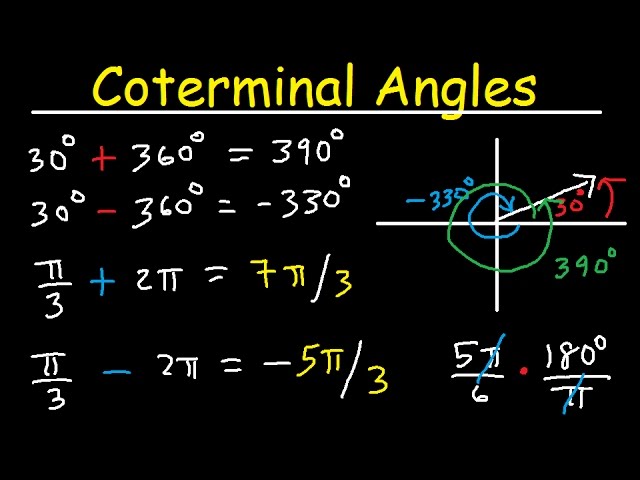
This trigonometry video tutorial explains how to find a positive and a negative coterminal angle given another angle in degrees or in radians using the unit circle. It also shows you how to convert radians to degrees and degrees to radians. This video contains plenty of examples and practice problems.
Trigonometry - Free Formula Sheet: ...
if you are totally new
basically: you add 360 degrees / 2 pi
grave creek
Yeah
grave creek
grand pond
Would it be D then?
grave creek
Wait can you show me how you would solve it please? I’m a visual learner so 😭
grave creek
Mmmm
No sorry my bad I’m multitasking rn
I think I got it tho I’ll js watch the video
floral apex
sure sorry  i cant really understand it for you
you have to interact with it, youll get it
midnight plankBOT
@grave creek Has your question been resolved?
midnight plankBOT
Channel closed
Closed due to timeout
Use .reopen if this was a mistake.
Available help channel!
Send your question here to claim the channel.
Remember:
• Ask your math question in a clear, concise manner.
• Show your work, and if possible, explain where you are stuck.
• After 15 minutes, feel free to ping <@&286206848099549185>.
• Type the command .close to free the channel when you're done.
• Be polite and have a nice day!
Read #❓how-to-get-help for further information on how to ask a good question, and about conduct in the question channels.
 barren onyx
how are the coordinates (2acostheta,0) and (0,2asin theta)
 midnight plankBOT
barren onyx
how are the coordinates (2acostheta,0) and (0,2asin theta)
midnight plankBOT
barren onyx
how are the coordinates (2acostheta,0) and (0,2asin theta)
 barren onyx
 livid python
what
livid python
barren onyx
what
It’s makes a right angled triangle
With hypotenuse 2a and an angle θ
sin(θ)=opp/hyp=opp/2a
Multiply by 2a
2asin(θ)=opp
cos(θ)=adj/hyp=adj/2a
multiply by 2a
2acos(θ)=adj
barren onyx
livid python
It’s makes a right angled triangle
With hypotenuse 2a and an angle θ
sin(θ)=opp...
my teacher said to solve via parametric
do yk how to solve it by parametric?
livid python
barren onyx
my teacher said to solve via parametric
Not sure about that sorry
midnight plankBOT
@barren onyx Has your question been resolved?
barren onyx
.
barren onyx
.close
midnight plankBOT
Channel closed
Closed by @barren onyx
Use .reopen if this was a mistake.