
#help-49
1 messages · Page 126 of 1
 obtuse totem
but then the inner circle part would be principal
oh
wait what
no this doesn’t make sense
the first shows |z-4|<4
 radiant roost
0<|z-4| simply excludes the point at 4
obtuse totem
so i don’t have to find a series for it?
radiant roost
i don't know about laurent series
obtuse totem
because in these examples, the graph is always split into two or three

note the eg for 3) is not done, I can show the rest tho

yea i’m not sure how to solve this
<@&286206848099549185>
cause you cant change it to a geometric series if its not a simple pole right?
omg i cant even watch youtube videos im pretty sure you cant just have a constant here
 radiant roost
hm? looks like a partial fraction decomposition
obtuse totem
oh yes
thats my bad im remembering smth wrong

its only if you expand it out that you have to do bx+c
radiant roost
ah
obtuse totem
or like in form (x+b)^2
radiant roost
i think there's a special rule in that case
obtuse totem
obtuse totem
but pls how do you do this
radiant roost
do i understand example (1) correctly?
when |z|<2, the principal part of the laurent series is 0
when |z|>2, the analytic part is 0
obtuse totem
also I think you can split into two parts you have 0<|z-4| which is principal part and |z-4|<4 which is analytic
but Im not sure if you can change into geometric series cause one of the poles is power 3
obtuse totem
radiant roost
do i understand example (1) correctly?
when |z|<2, the principal part of the lau...
no i dont think so
radiant roost
but for |z|<2, you've written f as a series with z^n, which should comprise the analytic part, no?
and that series is meant to be the laurent series?
obtuse totem
@tribal temple hii
obtuse totem
radiant roost
and that series is meant to be the laurent series?
both the analytic and principal part is the laurent series
radiant roost
obtuse totem
both the analytic and principal part is the laurent series
yeah maybe i'm missing something
so for example (3), when 1<|z|<2, do you have f as the sum of 2 series?
or is it still just 1 series like the other examples on that page
i imagine it will have 2: one for the analytic part and one for the principal part
obtuse totem
oh it seems like you only need to find expansion when z=0
obtuse totem
obtuse totem
for this question
because


in this example, since the singularities 1 are inside the area i guess it doesnt have to be expanded? not sure why tho
radiant roost
(z+1)/(z(z-4)^3) is undefined when z=0
how can you find an expansion when z=0?
obtuse totem
sorry worded it wrong, 0<|z-4|
radiant roost
obtuse totem
in this example, since the singularities 1 are inside the area i guess it doesnt...
the singularity at 1 is not inside the area 0<|z-1|<2
obtuse totem
I'll send a photo soon dw
radiant roost
all right
radiant roost
obtuse totem
because in these examples, the graph is always split into two or three
i think that's because the examples are finding the laurent series in as may domains as possible.
the question you posted only asks you to find the laurent series in the domain 0<|z-4|<4
obtuse totem
no im stupid its the same thing as eg3. both annulus
just wait ill send a photo
yup
radiant roost
yes but presumably eg3 solves it for different domains
0<|z-4|<4 is an "annulus" but the central hole is only a single point
obtuse totem
@tribal temple can you explain how to do this question
obtuse totem
obtuse totem
^
 tribal temple
obtuse totem
<@788085606483361802> can you explain how to do this question
tribal temple
obtuse totem
<@788085606483361802> can you explain how to do this question
(If you give me a while I can try? Just had to go out for a while so don’t have my notes with me  )
)
obtuse totem
ok, thank you!
radiant roost
obtuse totem
cause you cant change it to a geometric series if its not a simple pole right?
in the video you're watching, z=1 is not a simple pole, right?
did they use an approach other than geometric series?
 midnight plankBOT
@obtuse totem Has your question been resolved?
midnight plankBOT
@obtuse totem Has your question been resolved?
midnight plankBOT
@obtuse totem Has your question been resolved?
midnight plankBOT
@obtuse totem Has your question been resolved?
midnight plankBOT
Channel closed
Closed due to timeout
Use .reopen if this was a mistake.
midnight plankBOT
 Available help channel!
Send your question here to claim the channel.
Remember:
• Ask your math question in a clear, concise manner.
• Show your work, and if possible, explain where you are stuck.
• After 15 minutes, feel free to ping <@&286206848099549185>.
• Type the command .close to free the channel when you're done.
• Be polite and have a nice day!
Read #❓how-to-get-help for further information on how to ask a good question, and about conduct in the question channels.
 deft quarry
I have like 3 sources telling me what to do in very different ways, and now I'm confused. Should I do the derivative first thing on the equation, or? @~@ And if so, should you not go past the point they did in the 2nd pic? I originally did and got -12x-8x^2+6x^3+9, but that was wrong according to another calculator T~T

 midnight plankBOT
deft quarry
I have like 3 sources telling me what to do in very different ways, and now I'm ...
midnight plankBOT
deft quarry
I have like 3 sources telling me what to do in very different ways, and now I'm ...
 warm vine
Are you the kind of person who tries to avoid the product rule?
As is often the case with math, there are a couple ways to solve it
deft quarry
I do try to avoid it, but failed here xD
that's where I got the -12x thingy from
Ig I could just stop at where they stopped, and do the whole plugin thingy 🤔
warm vine
Is there a way you can rewrite f(x) to avoid having to use the product rule?
deft quarry
I'm guessing f(1) is not the answer
warm vine
Although I think the derivative you found using the product rule looks correct, so you could just use that
deft quarry
:D yay
warm vine
What does the derivative mean?
deft quarry
slope of the tangent line
ah oki so that's where the point slope comes in
I seeee
ok I might've been overthinking this xD
justpossibly
warm vine
That’s easy to do with math
deft quarry
I'm good with manipulating point slope and slope int, I can do the rest of this, thank you :D
warm vine
You’re welcome
deft quarry
I was very unsure about the derivative's correct-ness, ty for checking it :')
have a good afternoon :)
.close
midnight plankBOT
Channel closed
Closed by @deft quarry
Use .reopen if this was a mistake.
Available help channel!
Send your question here to claim the channel.
Remember:
• Ask your math question in a clear, concise manner.
• Show your work, and if possible, explain where you are stuck.
• After 15 minutes, feel free to ping <@&286206848099549185>.
• Type the command .close to free the channel when you're done.
• Be polite and have a nice day!
Read #❓how-to-get-help for further information on how to ask a good question, and about conduct in the question channels.
 umbral cave
When determining sequence convergence or divergence and I have (-1)^ncos(npi) can I just bound cos and then dct it with something that has one as a placeholder for it?
midnight plankBOT
umbral cave
When determining sequence convergence or divergence and I have (-1)^n*cos(n*pi) ...
@umbral cave Has your question been resolved?
deft quarry
umbral cave
When determining sequence convergence or divergence and I have (-1)^n*cos(n*pi) ...
I personally can't help you, but there's a rule saying that after 15 mins of no response, you can ping the helpers ping :)
 robust isle
umbral cave
When determining sequence convergence or divergence and I have (-1)^n*cos(n*pi) ...
robust isle
umbral cave
When determining sequence convergence or divergence and I have (-1)^n*cos(n*pi) ...
wdym by dct here ?
you can just compute cos(n pi) explicity, it's simple enough
midnight plankBOT
@umbral cave Has your question been resolved?
midnight plankBOT
Channel closed
Closed due to timeout
Use .reopen if this was a mistake.
Available help channel!
Send your question here to claim the channel.
Remember:
• Ask your math question in a clear, concise manner.
• Show your work, and if possible, explain where you are stuck.
• After 15 minutes, feel free to ping <@&286206848099549185>.
• Type the command .close to free the channel when you're done.
• Be polite and have a nice day!
Read #❓how-to-get-help for further information on how to ask a good question, and about conduct in the question channels.
 last slate
midnight plankBOT
last slate
last slate
midnight plankBOT
last slate
 surreal moon
last slate
can anyone explain question 17 for me
surreal moon
last slate
can anyone explain question 17 for me
!noans
midnight plankBOT
last slate
can anyone explain question 17 for me
The purpose of this server is to help you learn, not to hand out answers. Do not ask someone to give you the answer directly.
 rough birch
last slate
can anyone explain question 17 for me
rough birch
last slate
can anyone explain question 17 for me
5 plug in me kya aata he
surreal moon
last slate
Try rationalizing the denominator
 snow iron
could try using the conjugate
last slate
rough birch
L'Hopital's rule?
but can i use i am currently on class 11th my sir told use it for 12th
snow iron
last slate
but can i use i am currently on class 11th my sir told use it for 12th
use Conjugate
rough birch
last slate
but can i use i am currently on class 11th my sir told use it for 12th
oh ok, then you probably need to rationalize yes as others are saying
last slate
yes
surreal moon
last slate
but can i use i am currently on class 11th my sir told use it for 12th
you don't need it. Rationalize denominator will be the play. If you know how to do that
l'hopital would work, but tbh with radicals, the work involved would not be radical 
last slate
thank u guys finally got the answer
midnight plankBOT
@last slate Has your question been resolved?
Channel closed
Closed by @rugged barn
Use .reopen if this was a mistake.
Available help channel!
Send your question here to claim the channel.
Remember:
• Ask your math question in a clear, concise manner.
• Show your work, and if possible, explain where you are stuck.
• After 15 minutes, feel free to ping <@&286206848099549185>.
• Type the command .close to free the channel when you're done.
• Be polite and have a nice day!
Read #❓how-to-get-help for further information on how to ask a good question, and about conduct in the question channels.
 upbeat plinth
One message removed from a suspended account.
midnight plankBOT
upbeat plinth
One message removed from a suspended account.
upbeat plinth
One message removed from a suspended account.
One message removed from a suspended account.
 inner wolf
You need to set the derivative of that to zero, to find critical points
 outer saffron
2
midnight plankBOT
outer saffron
2
As a helper, please do not give out answers that could be copied as a homework solution. Have the student work through the problem themselves and guide them along the way.
upbeat plinth
inner wolf
You need to set the derivative of that to zero, to find critical points
One message removed from a suspended account.
One message removed from a suspended account.
One message removed from a suspended account.
One message removed from a suspended account.
 subtle torrent
I think it's E
upbeat plinth
One message removed from a suspended account.
One message removed from a suspended account.
outer saffron
upbeat plinth
One message removed from a suspended account.
The I will just put values and check
subtle torrent
Yah for the second question you can also adopt this strategy, it's very quick @upbeat plinth
upbeat plinth
One message removed from a suspended account.
upbeat plinth
One message removed from a suspended account.
One message removed from a suspended account.
outer saffron
upbeat plinth
One message removed from a suspended account.
Do you know deeivatives
upbeat plinth
One message removed from a suspended account.
subtle torrent
inner wolf
You need to set the derivative of that to zero, to find critical points
Otherwise just follow ankit's advice, same for the second question, find its derivative
 blazing pike
hello im new in server
outer saffron
blazing pike
hello im new in server
Ok
outer saffron
blazing pike
hello im new in server
What do you want
upbeat plinth
One message removed from a suspended account.
midnight plankBOT
Channel closed
Closed by @upbeat plinth
Use .reopen if this was a mistake.
midnight plankBOT
Available help channel!
Send your question here to claim the channel.
Remember:
• Ask your math question in a clear, concise manner.
• Show your work, and if possible, explain where you are stuck.
• After 15 minutes, feel free to ping <@&286206848099549185>.
• Type the command .close to free the channel when you're done.
• Be polite and have a nice day!
Read #❓how-to-get-help for further information on how to ask a good question, and about conduct in the question channels.
upbeat plinth
One message removed from a suspended account.
midnight plankBOT
upbeat plinth
One message removed from a suspended account.
upbeat plinth
One message removed from a suspended account.
 grand pondBOT
 upbeat plinth
One message removed from a suspended account.
 lavish venture
spider-man pjs
upbeat plinth
One message removed from a suspended account.
upbeat plinth
One message removed from a suspended account.
lavish venture
reduce the powers
upbeat plinth
One message removed from a suspended account.
 fallow scarab
lavish venture
spider-man pjs
fallow scarab
lavish venture
spider-man pjs
Lololol
upbeat plinth
One message removed from a suspended account.
One message removed from a suspended account.
lavish venture
f(x) = x^2 - 4x + 7
upbeat plinth
One message removed from a suspended account.
One message removed from a suspended account.
One message removed from a suspended account.
lavish venture
f’(x) = 2x - 4
upbeat plinth
One message removed from a suspended account.
One message removed from a suspended account.
lavish venture
what
$\frac{x^3-4x^2+7x}{x} = \frac{x^3}{x} -\frac{4x^2}{x} + \frac{7x}{x} = x^2 - 4x + 7$
grand pondBOT
knief
 upbeat plinth
One message removed from a suspended account.
One message removed from a suspended account.
One message removed from a suspended account.
midnight plankBOT
Channel closed
Closed by @upbeat plinth
Use .reopen if this was a mistake.
midnight plankBOT
Available help channel!
Send your question here to claim the channel.
Remember:
• Ask your math question in a clear, concise manner.
• Show your work, and if possible, explain where you are stuck.
• After 15 minutes, feel free to ping <@&286206848099549185>.
• Type the command .close to free the channel when you're done.
• Be polite and have a nice day!
Read #❓how-to-get-help for further information on how to ask a good question, and about conduct in the question channels.
 ember sage
The theta in the bracket means it’s in the fourth quadrant right
 midnight plankBOT
ember sage
The theta in the bracket means it’s in the fourth quadrant right
midnight plankBOT
ember sage
The theta in the bracket means it’s in the fourth quadrant right
 subtle gulch
yes
midnight plankBOT
Channel closed
Closed by @ember sage
Use .reopen if this was a mistake.
midnight plankBOT
Available help channel!
Send your question here to claim the channel.
Remember:
• Ask your math question in a clear, concise manner.
• Show your work, and if possible, explain where you are stuck.
• After 15 minutes, feel free to ping <@&286206848099549185>.
• Type the command .close to free the channel when you're done.
• Be polite and have a nice day!
Read #❓how-to-get-help for further information on how to ask a good question, and about conduct in the question channels.
 keen seal
when we have a row or column that repearts in a matrix in linear algebra
midnight plankBOT
keen seal
when we have a row or column that repearts in a matrix in linear algebra
keen seal
does that mean theres no solution?
keen seal
 sharp coral
sometimes it might mean infinite solutions
sharp coral
sometimes it might mean infinite solutions
so i can just parametric them basically
<@&268886789983436800>
 analog vine
no screenshot necessary for future reference, we can see deleted messages
keen seal
oh ok
midnight plankBOT
@keen seal Has your question been resolved?
Channel closed
Closed by @keen seal
Use .reopen if this was a mistake.
Available help channel!
Send your question here to claim the channel.
Remember:
• Ask your math question in a clear, concise manner.
• Show your work, and if possible, explain where you are stuck.
• After 15 minutes, feel free to ping <@&286206848099549185>.
• Type the command .close to free the channel when you're done.
• Be polite and have a nice day!
Read #❓how-to-get-help for further information on how to ask a good question, and about conduct in the question channels.
 low stream
Hi, I am want to show that for $A = {x \in \mathbb{R} \mid x^2 < 2}, (\sup{A})^2 = 2$.
My work: Use trichotomy to prove a contradiction in other two cases where $ (\sup{A})^2 > 2$ and $ (\sup{A})^2 < 2$.
(i will refer to lub as z) First assume that square of lub is greater than 2. that means lub is greater than sqrt(2). then, take $\epsilon = z - \sqrt{2} > 0$. Then, for $w = z - \frac{\epsilon}{2} < z$, since $z$ is lub then $w \in A$. Then, $w^2 = (z - \frac{\epsilon}{2})^2 = z^2 - z\epsilon + (\frac{\epsilon}{2})^2
Basically I aim to show that there will be an upper bound smaller than $z$ if we assume it to be greater than sqrt(2) and there is a least upper bound which is greater if we assume $z$ to be less than sqrt(2), but i am not sure how to flesh that out in the details.
midnight plankBOT
low stream
Hi, I am want to show that for $A = \{x \in \mathbb{R} \mid x^2 < 2\}, (\sup{A})...
grand pondBOT
shell
Compile Error! Click the  reaction for more information.
(You may edit your message to recompile.)
 low stream
i know that i want to find that if z is the lub then if we assume z to be less than 2 and take w > z then we want to show that w is in A (which contradicts the fact that it cannot be in A if z is to be the lub) and similar for z being greater than 2
just not sure how exactly to execute the idea
midnight plankBOT
@low stream Has your question been resolved?
 rugged saffron
The idea is to show that sup(A)^2 >= 2 and sup(A)^2 <= 2. Call M=sup(A), so first suppose M^2 < 2. The idea to contradict this is to find a real number x > M such that x^2 < 2. You will have to consider the interval (M^2, 2)
low stream
rugged saffron
The idea is to show that sup(A)^2 >= 2 and sup(A)^2 <= 2. Call M=sup(A), so firs...
yes i understand that and my approach was to assume, say, M^2 > 2. then, M > sqrt(2) and we can take epsilon = M - sqrt(2) > 0. then, w = M + epsilon and therefore w > M but then i wasnt sure how to turn this into w^2 < 2
or sorry i meant w < M for w = M - epsilon
then i wanted to show that w^2 > 2
which implies w is not in A
which implies z is not
lub
rugged saffron
Firstly, I think the point of this exercise is to show that sqrt(2) actually exists, so we should probably not use it in the proof. If we assume M^2 > 2, the contradiction we are looking for here is that there exists a delta > 0 such that $(M-\delta)$ is also an upper bound for A, as then M would not be the least upper bound. I think this is what you are trying to do right?
grand pondBOT
elliot
Compile Error! Click the reaction for more information.
(You may edit your message to recompile.)
 low stream
rugged saffron
Firstly, I think the point of this exercise is to show that sqrt(2) *actually ex...
low stream
rugged saffron
Firstly, I think the point of this exercise is to show that sqrt(2) *actually ex...
yeah i mixed it up sorry
thats what i wanted to do
then i was going to show that this quantity squared is greater than 2 which means it is not in the set
but the answer key uses sqrt(2)
and answer key doesnt really make sense to me
 rugged saffron
Okay yeah they aren’t actually giving you epsilon in terms of what I have called M. But the overall idea is that if M > 2, then there is something just below that satisfies x^2 > 2. And on the other hand, if M < 2, there is something just above that satisfies x^2 < 2. In the second case, M is no longer an upper bound
low stream
ii get the concept but i dont really get how the epsilon comes into play
maybe that means i dont get the concept idk
rugged saffron
I think they have skipped some working to show you what they have done. We are just trying to quantify this small nudge from M. If I want (M - delta)^2 > 2, then I just expand this bracket and try to rearrange for delta in terms of M
low stream
Ok so we nudge down to show that there is a least upper bound smaller than M right
rugged saffron
Yes that’s correct
low stream
and we get to that conclusion by showing that if we take z^2 > 2 and w < z then we find that w^2 > 2 ( because we assume that the lub^2 is > 2) that this contradicts the fact that z is the lub
rugged saffron
Yes but be careful with wording. We are saying given z, there exists a w < z such that bla. The goal of this part of the proof is to construct this w and show it satisfies that property of w^2 > 2
low stream
right yes
so when we take w as z minus some epsilon and find its square, im not sure how they find that the square is greater than 2
rugged saffron
Yeah this is not a given and your proof just shoves it under the rug by saying “when epsilon is small…”
If you wanted to be rigorous you would have to say “epsilon must be this small”
That’s the idea of the proof
low stream
im not sure then why they take epsilon to be z - sqrt 2
that. seems arbitrary
or is that the whole point
that they inadvertantly aim to contradict the fact that epsilon is greather thgan 0?
when it is actually equal to 0
rugged saffron
Yeah the point is that if z is not equal to sqrt(2) we have a positive epsilon distance between them, work with this, get a contradiction
It’s a fairly common idea
low stream
ah i see
i get that part but im not sure how the computation works out to getting w^2 > 2
rugged saffron
If you just think about it completely concretely with a number line the contradictions become clearer I think. If the lub is < sqrt(2), then the midpoint must have square >=2, but this is absurd
e.g. suppose 1.4 is the lub for A
We know sqrt(2) = 1.414….
So this logic would say that 1.41^2 > 2
But this is just not true
low stream
ok so in the case where lub > 2 if we say lub is 1.5 is the lub we can say like 1.45 is less than the lub but 1.45^2 is also greater than 2 right
rugged saffron
Yeah exactly
low stream
and we can do this infinite times because sqrt2 is not in the rationals
makes senes
well ig we. can do this infinite times if sqrt2 waws in the rationals
but we would never get an answer since it is not
rugged saffron
I don’t know what you mean by infinite times, just this always works if you assume either lub < sqrt(2) or lub > sqrt(2). This has nothing to do with sqrt(2) being irrational, I could do the exact same thing with sqrt(4)
low stream
yeah i meant like we will not get an actual answer, ik we can do it infinite times for anything
rugged saffron
Okay yeah, the point of these proofs is that I could choose M to be anything and this would give me the recipe for contradiction
low stream
right yeah
but i dont really udnerstand the symbolic version in the answer because if w^2 is greater than z^2 ( a number which is greater than 2) minus a positive number, that doesnt mean w^2 is greater than 2
are we just assuming epsilon is small enough to make this true
rugged saffron
But how small is that positive number
rugged saffron
low stream
are we just assuming epsilon is small enough to make this true
Yeah i think so
rugged saffron
As I said, your solutions are not fully detailed
low stream
yeah
rugged saffron
There is a way to be completely convincing
low stream
i assume thats beyond the scope of my class
rugged saffron
No when I learned it in an equivalent class they supplied a proof
low stream
i see
can i ask another question
my professor gave this weird proof for showing that set of rationals whose squares is less than 2 does not have a least upper bound in rational numbers

this seems like a very inelegant way and it also doesnt really make sense to me
rugged saffron
Yeah tbh it is quite a lot of jargon to get your head around, it would take me a while to fully digest. What you could do to prove this fact is use what you have just done above with showing sup(A)^2 = 2, and use the uniqueness of supremum. We already know sqrt(2) is irrational, so this is a proof
rugged saffron
low stream
But the principle of this argument is very common. Assume for contradiction, conclude either that it is not an upper bound, or not the least upper bound
low stream
yeah my initial thought was to just use what i did above and then we know sqrt2 is irrational but i think this proof assumes the same but gets to the conclusion in a different way
rugged saffron
Yeah so the strategy is sort of the same, instead of nudging by a real number delta, they are nudging by a small enough 1/n, which ensures that we stay rational
low stream
is this the archimedean property
rugged saffron
Yeah it is
low stream
these notes are weird it introduces the property after this example
rugged saffron
Yeah that’s weird, it’s basically one of the first properties of R you should learn
rugged saffron
No worries, hope it is at least a bit clearer
low stream
yeah helped a lot was stuck on this for a while
midnight plankBOT
@low stream Has your question been resolved?
Channel closed
Closed by @low stream
Use .reopen if this was a mistake.
midnight plankBOT
Available help channel!
Send your question here to claim the channel.
Remember:
• Ask your math question in a clear, concise manner.
• Show your work, and if possible, explain where you are stuck.
• After 15 minutes, feel free to ping <@&286206848099549185>.
• Type the command .close to free the channel when you're done.
• Be polite and have a nice day!
Read #❓how-to-get-help for further information on how to ask a good question, and about conduct in the question channels.
 gaunt jetty
Both the poisson and normal distributions are able to approximate the binomial distribution
midnight plankBOT
gaunt jetty
Both the poisson and normal distributions are able to approximate the binomial d...
gaunt jetty
My question is, how does one decide between which approximation to choose?
midnight plankBOT
@gaunt jetty Has your question been resolved?
midnight plankBOT
Channel closed
Closed due to timeout
Use .reopen if this was a mistake.
Available help channel!
Send your question here to claim the channel.
Remember:
• Ask your math question in a clear, concise manner.
• Show your work, and if possible, explain where you are stuck.
• After 15 minutes, feel free to ping <@&286206848099549185>.
• Type the command .close to free the channel when you're done.
• Be polite and have a nice day!
Read #❓how-to-get-help for further information on how to ask a good question, and about conduct in the question channels.
upbeat plinth
One message removed from a suspended account.
midnight plankBOT
upbeat plinth
One message removed from a suspended account.
 tidal turret
the linearization is the tangent line at x = a
upbeat plinth
One message removed from a suspended account.
One message removed from a suspended account.
One message removed from a suspended account.
One message removed from a suspended account.
One message removed from a suspended account.
tidal turret
ye
upbeat plinth
One message removed from a suspended account.
tidal turret
the linearisation is an approximation of the function at the point, so it's not going to be exact
you need to differentiate tan aswell
upbeat plinth
One message removed from a suspended account.
One message removed from a suspended account.
One message removed from a suspended account.
One message removed from a suspended account.
One message removed from a suspended account.
tidal turret
L(x) ≈ tan(-pi/4) + sec^2(-pi/4)(x+pi/4)
upbeat plinth
One message removed from a suspended account.
tidal turret
L(x) ≈ tan(-pi/4) + 2(x+pi/4)
upbeat plinth
One message removed from a suspended account.
One message removed from a suspended account.
One message removed from a suspended account.
tidal turret
upbeat plinth
One message removed from a suspended account.
,w tan(-pi/4)
grand pondBOT


 Requested by 938c2cc0dcc05f2b68c4287040cfcf71
upbeat plinth
Requested by 938c2cc0dcc05f2b68c4287040cfcf71
upbeat plinth
One message removed from a suspended account.
One message removed from a suspended account.
One message removed from a suspended account.
One message removed from a suspended account.
One message removed from a suspended account.
midnight plankBOT
Channel closed
Closed by @upbeat plinth
Use .reopen if this was a mistake.
midnight plankBOT
Available help channel!
Send your question here to claim the channel.
Remember:
• Ask your math question in a clear, concise manner.
• Show your work, and if possible, explain where you are stuck.
• After 15 minutes, feel free to ping <@&286206848099549185>.
• Type the command .close to free the channel when you're done.
• Be polite and have a nice day!
Read #❓how-to-get-help for further information on how to ask a good question, and about conduct in the question channels.
gaunt jetty
 midnight plankBOT
gaunt jetty
gaunt jetty
midnight plankBOT
gaunt jetty
gaunt jetty
Am i just incorrect or their integration variables are incorrectly placed?
shouldnt it be dydzdx under their configuration, or something?
actually, i have no idea what they're doing in there. Their way of evaluating the integral is completely flying over my head
 untold rune
midnight plankBOT
untold rune
midnight plankBOT
Channel closed
Closed by @gaunt jetty
Use .reopen if this was a mistake.
midnight plankBOT
Available help channel!
Send your question here to claim the channel.
Remember:
• Ask your math question in a clear, concise manner.
• Show your work, and if possible, explain where you are stuck.
• After 15 minutes, feel free to ping <@&286206848099549185>.
• Type the command .close to free the channel when you're done.
• Be polite and have a nice day!
Read #❓how-to-get-help for further information on how to ask a good question, and about conduct in the question channels.
 vague marsh
 midnight plankBOT
vague marsh
vague marsh
midnight plankBOT
vague marsh
vague marsh
Should this problem have two solutions or just one?

They only advise the above x = 30° + n * 120° is the answer

But shouldn't we apply both identities?
 last arch
vague marsh
last arch
vague marsh
It's the fact that the basic angle just happens to be 90
And 180-90=90
So that solution just happens to be included in the given solution
vague marsh
last arch
So that solution just happens to be included in the given solution
Oic, I mathed more and see that - is x = 30° + n * 120° then considered the better representative answer over x = n * 60° - 30°?
last arch
vague marsh
Oic, I mathed more and see that - is x = 30° + n * 120° then considered the bett...
I don't think the other answer works
Try just 0*60-30=-30deg as a test case
How'd you get that one
vague marsh
last arch
How'd you get that one
Oh so are we trying to find the best expressions where n = 0+ fits within the interval?
 last arch
Yea
last arch
vague marsh
Now I see
Alright if you're done you can close the post
midnight plankBOT
@vague marsh Has your question been resolved?
Channel closed
Closed by @vague marsh
Use .reopen if this was a mistake.
Available help channel!
Send your question here to claim the channel.
Remember:
• Ask your math question in a clear, concise manner.
• Show your work, and if possible, explain where you are stuck.
• After 15 minutes, feel free to ping <@&286206848099549185>.
• Type the command .close to free the channel when you're done.
• Be polite and have a nice day!
Read #❓how-to-get-help for further information on how to ask a good question, and about conduct in the question channels.
 twilit field
If There exists a $c \in \R$ such that $a<c<b$ for all $a \in A, b \in B$ then $sup(A) < inf(B)$.
\
I'd try a proof by contrapositive. If $\sup(A) \geq inf(B) $, then there exists $a \in aA, b \in B$, suhc that $a \geq c \geq b ; \forall c \in \R$
midnight plankBOT
twilit field
If There exists a $c \in \R$ such that $a<c<b$ for all $a \in A, b \in B$ then $...
grand pondBOT
ƒ(Why am. I here)=I don't Know
 twilit field
Does this sound right so far
twilit field
 runic hamlet
a statement like a >= c for all c clearly cant work
runic hamlet
a statement like a >= c for all c clearly cant work
no, not the proof, the contrapositive so far
logically
runic hamlet
you didnt negate correctly
if that is your question
$\exists c\in\bR: (\forall a\in A: a<c)\land (\forall b\in B: c<b)$
grand pondBOT
Denascite
 runic hamlet
thats the statement you have to negate
twilit field
So the negation would be $\forall c \in \R : ( \exists a \in A : a \geq c) \lor ( \exists b \in B : c \geq b)$
grand pondBOT
ƒ(Why am. I here)=I don't Know
 twilit field
If $sup(A) \geq inf(B)$, then $\forall c \in \R : ( \exists a \in A : a \geq c) \lor ( \exists b \in B : c \geq b)$
grand pondBOT
ƒ(Why am. I here)=I don't Know
 twilit field
This is false consider $A =[0,1] , B= [0.5,1]$. Clearly $\sup(A)= 1$ and $inf(B)=0.5$, This statement is clearly not true for all $c\in \R$
grand pondBOT
ƒ(Why am. I here)=I don't Know

 indigo stone

 visual tiger
grand pond
**ƒ(Why am. I here)=I don't Know**
visual tiger
grand pond
**ƒ(Why am. I here)=I don't Know**
wait you're showing this is false
twilit field
visual tiger
wait you're showing this is false
yea, I wasn't sure of how to proceed with a direct proof
so I decided to try to prove the contrapositive
visual tiger
I don't think I understand your counterexample still
runic hamlet
well its wrong. so that doesnt help
twilit field
How's it wrong
twilit field
Yeah, misread the second part
oops
I feel like this is going to be even harder to prove, being a forall statement
hmm
visual tiger
grand pond
**ƒ(Why am. I here)=I don't Know**
try to find a counterexample for the original statement
runic hamlet
shhh
visual tiger
runic hamlet
shhh
I didn't say a lot
runic hamlet
you said whether the statement is true or not
which really is the hard part of true/false questions
twilit field
I can't talk about the infimum ans supremums of infty
can I
Let $B= [0,1], A=[0.5, 1.5]$
grand pondBOT
ƒ(Why am. I here)=I don't Know
 runic hamlet
why
twilit field
2 is greater than all elements in A and less than all elements in B, so c=2
but sup(A) = inf(B)
Cool
Thanks!
.close
midnight plankBOT
Channel closed
Closed by @twilit field
Use .reopen if this was a mistake.
midnight plankBOT
Available help channel!
Send your question here to claim the channel.
Remember:
• Ask your math question in a clear, concise manner.
• Show your work, and if possible, explain where you are stuck.
• After 15 minutes, feel free to ping <@&286206848099549185>.
• Type the command .close to free the channel when you're done.
• Be polite and have a nice day!
Read #❓how-to-get-help for further information on how to ask a good question, and about conduct in the question channels.
twilit field
The uniquness part is confusing me
midnight plankBOT
twilit field
The uniquness part is confusing me
twilit field
I'm unable to understand this

is uniquness because composition of functions is always associative
<@&286206848099549185>
.close
midnight plankBOT
Channel closed
Closed by @twilit field
Use .reopen if this was a mistake.
Available help channel!
Send your question here to claim the channel.
Remember:
• Ask your math question in a clear, concise manner.
• Show your work, and if possible, explain where you are stuck.
• After 15 minutes, feel free to ping <@&286206848099549185>.
• Type the command .close to free the channel when you're done.
• Be polite and have a nice day!
Read #❓how-to-get-help for further information on how to ask a good question, and about conduct in the question channels.
 hoary urchin
https://prnt.sc/VDBWKoEdn6MC This screen has the question i am a bit confused about, from what I have done so far I am confident in a-c but for d/e i am not 100% certain my answer is right. I got part d as 0.00000054842, and for part e i believe this is just ^3 since there are 3 independent starting points
 midnight plankBOT
hoary urchin
https://prnt.sc/VDBWKoEdn6MC This screen has the question i am a bit confused ab...
midnight plankBOT
hoary urchin
https://prnt.sc/VDBWKoEdn6MC This screen has the question i am a bit confused ab...
Please don't occupy multiple help channels.

 midnight plankBOT
Channel closed
Closed by @hoary urchin
Use .reopen if this was a mistake.
midnight plankBOT
Available help channel!
Send your question here to claim the channel.
Remember:
• Ask your math question in a clear, concise manner.
• Show your work, and if possible, explain where you are stuck.
• After 15 minutes, feel free to ping <@&286206848099549185>.
• Type the command .close to free the channel when you're done.
• Be polite and have a nice day!
Read #❓how-to-get-help for further information on how to ask a good question, and about conduct in the question channels.
last slate
How can I resolve this ? I have no idea and I need it. Using guides and AI doesnt help me
 midnight plankBOT
last slate
How can I resolve this ? I have no idea and I need it. Using guides and AI doesn...
last slate
midnight plankBOT
last slate
How can I resolve this ? I have no idea and I need it. Using guides and AI doesn...
last slate
It's maybe too easy for you but I dont understand anything
 carmine sigil
If you just need to solve for z, then a first step is typically to clear all of the fractions. You can multiply both sides of the equation by 10(z+2)(z-4) to do this.
 silent parcel
last slate
How can I resolve this ? I have no idea and I need it. Using guides and AI doesn...
silent parcel
last slate
How can I resolve this ? I have no idea and I need it. Using guides and AI doesn...
Bring the variables to the LHS and numbers to the RHS
 summer ravine
Firstly, make the two fractions into a single one on the L.H.S. For that, you need to take a number of both (z+2) and 10. So you shall just multiply them out. Now adjust the numerators accordingly. Now, use the fact that: if a/b = c/d, then ad = bc
midnight plankBOT
@last slate Has your question been resolved?
silent parcel

 silent parcel
That’s a solution
summer ravine
Ok
last slate
silent parcel
Thank you king
midnight plankBOT
Channel closed
Closed by @weak stratus
Use .reopen if this was a mistake.
last slate
Ty all
midnight plankBOT
Available help channel!
Send your question here to claim the channel.
Remember:
• Ask your math question in a clear, concise manner.
• Show your work, and if possible, explain where you are stuck.
• After 15 minutes, feel free to ping <@&286206848099549185>.
• Type the command .close to free the channel when you're done.
• Be polite and have a nice day!
Read #❓how-to-get-help for further information on how to ask a good question, and about conduct in the question channels.
 fierce canyon
factorise fully (x^2-x-6)(x^2+3x-4)+24
midnight plankBOT
fierce canyon
factorise fully (x^2-x-6)(x^2+3x-4)+24
 flat plinth
well first expand to see if the 24 can be factorise once its added to the other constants
!status
midnight plankBOT
What step are you on?
1. I don't know where to begin.
2. I have begun but got stuck midway.
3. I got an answer but I was told that it's wrong.
4. I got an answer and would like my work checked.
5. I have a question about someone else's work/solution.
6. I have completed the problem and don't need help anymore. Thank you.
7. None of the above
.
fierce canyon
flat plinth
well first expand to see if the 24 can be factorise once its added to the other ...
We haven’t really learnt about factorising x^4 and other stuff like that
flat plinth
if youve never done a quartic does your teacher just want you to ignore the +24?
flat plinth
if you dont factorise from a qaurtic
the furthest you can get is
$(x-3)(x+2)(x+4)(x-1) + 24$
grand pondBOT
Nyxzore
 fallow scarab
are you supposed to use vieta's formula
fierce canyon
I’m not too sure
flat plinth
flat plinth
well first expand to see if the 24 can be factorise once its added to the other ...
this is the only thing i see working
fierce canyon
flat plinth
this is the only thing i see working
i tried expanding it and i got x4+2x3−13x2−14x+48
but im not too sure how to factrosie
flat plinth
use law of natural roots
 fierce canyon
flat plinth
use law of natural roots
fierce canyon
flat plinth
use law of natural roots
Sry I’m a bit unfamiliar with this
fallow scarab
so some small negative integer should work
and probably also small positive number too
fierce canyon
How do we factorise this tho?
fallow scarab
find two roots using ^ then polynomial/synthetic division it out then quadratic formula the rest
flat plinth
The idea is that if you plug f(Z) into a function f where Z is an integer if f(Z)=0 then x-Z is a factor
fallow scarab
fallow scarab
so some small negative integer should work
should take you all of 2 minutes to do this
fallow scarab
fallow scarab
and probably also small positive number too
and this
midnight plankBOT
@fierce canyon Has your question been resolved?
fierce canyon
<@&286206848099549185> im still rlly stuck
fallow scarab
fierce canyon
<@&286206848099549185> im still rlly stuck
why
fierce canyon
i dont understand what to do
fallow scarab
fallow scarab
i think also from here you can guess what x
.
fallow scarab
fierce canyon
Yeah that’s where I’m at currently
you said that's where you are almost an hour ago
fallow scarab
fallow scarab
so some small negative integer should work
did you do this yet
plug in x=-1,-2,-3
fierce canyon
fallow scarab
you said that's where you are almost an hour ago
you didnt really explain much to me
what am i meant to find by plugging in
fallow scarab
flat plinth
The idea is that if you plug f(Z) into a function f where Z is an integer if f(Z...
because he explained it here
there shouldn't need to repeat something already explained when you can just scroll up and read
fierce canyon
i didnt really understand what he meant
fallow scarab
.............
fallow scarab
fallow scarab
plug in x=-1,-2,-3
do this and it'll give you one of the factors
 fallow scarab
so you found one of the factors
fallow scarab
fallow scarab
so you found one of the factors
now you have 2 factors
fallow scarab
fallow scarab
find two roots using ^ then polynomial/synthetic division it out then quadratic ...
you're at this step now
fierce canyon
how would we do that step?
fallow scarab
.......
This video tutorial explains how to perform long division of polynomials with remainder and with missing terms.
Algebra - Free Formula Sheets: https://bit.ly/3CBeZMY
Algebra Final Exam Review:
https://www.youtube.com/watch?v=U0Y8nSmEpNM
Introduction to Polynomials:
https:...
did you find your two factors? because you can't do the division until you figure them out
fallow scarab
scroll down to see a higher order one https://www.mathsisfun.com/algebra/polynomials-division-long.html

process is the same
midnight plankBOT
@fierce canyon Has your question been resolved?
fierce canyon
.close
midnight plankBOT
Channel closed
Closed by @fierce canyon
Use .reopen if this was a mistake.
Available help channel!
Send your question here to claim the channel.
Remember:
• Ask your math question in a clear, concise manner.
• Show your work, and if possible, explain where you are stuck.
• After 15 minutes, feel free to ping <@&286206848099549185>.
• Type the command .close to free the channel when you're done.
• Be polite and have a nice day!
Read #❓how-to-get-help for further information on how to ask a good question, and about conduct in the question channels.
 dim anchor
How to find integral on 5)
 midnight plankBOT
dim anchor
How to find integral on 5)
midnight plankBOT
midnight plankBOT
dim anchor
How to find integral on 5)
midnight plankBOT
Channel closed
Closed by @dim anchor
Use .reopen if this was a mistake.
Available help channel!
Send your question here to claim the channel.
Remember:
• Ask your math question in a clear, concise manner.
• Show your work, and if possible, explain where you are stuck.
• After 15 minutes, feel free to ping <@&286206848099549185>.
• Type the command .close to free the channel when you're done.
• Be polite and have a nice day!
Read #❓how-to-get-help for further information on how to ask a good question, and about conduct in the question channels.
obtuse totem
hello
midnight plankBOT
obtuse totem
hello
obtuse totem
i dont think i have question yet
but pls lemme stay in the channel
i got absolutely DESTROYED in my complex analysis exam
took a massive day off for break
but im feeling so defeated and so unmotivated
staying here will keep me accountable
also like again all my friends are getting internships i havent heard back from anything im feeling so worthless rn
fallow scarab
#therapy
obtuse totem
like absolute sht
last arch
Rip
obtuse totem
yup yup
fallow scarab
If only that was a real channel
last arch
Bro needs to seek professional counselling ong
obtuse totem
frfr
i got a massive cup of coffee and like nice candles and some chocolate i still feel horriblle
been on my phone for the whole day ngl
its bad
last arch
Melt the chocolate into the coffee
lavish venture
obtuse totem
been on my phone for the whole day ngl
making it worse
last arch
It's like a ice bath
lavish venture
just exercise bruh
obtuse totem
bruh too late now gyms closed and its so cold
obtuse totem
yea😔 i just feel so uncapable of anything
because theres nothing to show for it
and social media is bad like rlly bad
 torn flint
Turn the device off and do something to get the blood flowing
obtuse totem
its making me want to take an "easier route"
i need to just stop
and start studying for my next exam cause all im doing is complaining
i just need a good cry
whats wrong wme😭
obtuse totem
true
lavish venture
obtuse totem
its making me want to take an "easier route"
engineering
obtuse totem
which is why Im gonna start studying now
i'll have questions fs

for this question, we learnt to guess particular solutions (in this case a polynomial, A/x) but the method only works if its constant coefficients in front of y'', y', and y
so what should you do when theres polynomials in front of ys
oh nvm
question only asks for the particular sol, so you dont need the homogenous part
so not the c1y1+c2y2 part
robust isle
try A/x anyway @obtuse totem
obtuse totem
yup! I got it
midnight plankBOT
@obtuse totem Has your question been resolved?
midnight plankBOT
@obtuse totem Has your question been resolved?
obtuse totem

not sure how they simplified it lol

oh wait
im good

everything was good until the integral😭
i keep making these mistakes
you know, if I actually get my degree,
that would be the most insane thing ever
fallow scarab
obtuse totem
that would be the most insane thing ever
C's get degrees is my motto
obtuse totem
facts😤
i may be stupid but im still trekking along🤩
you know what maybee i take a break and do more questions later
thank you for tuning into my beauuutiful life story byeeeeeeeee
.close
midnight plankBOT
Channel closed
Closed by @obtuse totem
Use .reopen if this was a mistake.
midnight plankBOT
Available help channel!
Send your question here to claim the channel.
Remember:
• Ask your math question in a clear, concise manner.
• Show your work, and if possible, explain where you are stuck.
• After 15 minutes, feel free to ping <@&286206848099549185>.
• Type the command .close to free the channel when you're done.
• Be polite and have a nice day!
Read #❓how-to-get-help for further information on how to ask a good question, and about conduct in the question channels.
tidal turret
 midnight plankBOT
tidal turret
tidal turret
midnight plankBOT
tidal turret
tidal turret
Let $P(x) = x^3 - 2x^2 + 3x - 6$. Find the polynomial $Q \in \mathbb{R}[x]$ of minimal degree such that the polynomial $H = P \cdot Q$ has one triple root and two double roots, and $H(-1) = 27$.
grand pondBOT
938c2cc0dcc05f2b68c4287040cfcf71

 grim vector
What are the roots of P(x) ?
midnight plankBOT
@tidal turret Has your question been resolved?
midnight plankBOT
Channel closed
Closed due to timeout
Use .reopen if this was a mistake.
Available help channel!
Send your question here to claim the channel.
Remember:
• Ask your math question in a clear, concise manner.
• Show your work, and if possible, explain where you are stuck.
• After 15 minutes, feel free to ping <@&286206848099549185>.
• Type the command .close to free the channel when you're done.
• Be polite and have a nice day!
Read #❓how-to-get-help for further information on how to ask a good question, and about conduct in the question channels.
midnight plankBOT
grim vector
<@&268886789983436800>
midnight plankBOT
Channel closed
Closed by @misty gorge
Use .reopen if this was a mistake.
flat plinth
then youre violating discord's tos bro
grim vector
 misty gorge
please don't troll in the help channels
misty gorge
please don't troll in the help channels
Ty
 late hill
ok bye then
analog vine
💣
flat plinth
danko
midnight plankBOT
Available help channel!
Send your question here to claim the channel.
Remember:
• Ask your math question in a clear, concise manner.
• Show your work, and if possible, explain where you are stuck.
• After 15 minutes, feel free to ping <@&286206848099549185>.
• Type the command .close to free the channel when you're done.
• Be polite and have a nice day!
Read #❓how-to-get-help for further information on how to ask a good question, and about conduct in the question channels.
 vestal moth
need help with this:
Prove
Q(k): C¹ₖ₋₁/(k-1)-C²ₖ₋₁/(k-2)+C³ₖ₋₁/(k-3)+...+(-1)ᵏ⁻²⋅Cᵏ⁻¹ₖ₋₁/[k-(k-1)]+(-1)ᵏ⁻¹⋅Cᵏₖ/k=1/k
which can also be written as
1-(k-1)/2!+(k-1)(k-2)/3!-(k-1)(k-2)(k-3)/4!+...+(-1)ᵏ⁻²+(-1)ᵏ⁻¹⋅1/k=1/k
Q(2):1-1/2=1/2 true
Q(3):1-2/2!+1/3=1-1+1/3=1/3 true
Q(4):1-3/2!+3⋅2/3!-1/4=1-3/2+6/6-1/4=2/2-3/2+(1-1/4)=-1/2+3/4=-2/4+3/4=1/4 true
No idea how to prove Q(k-1)⇒Q(k).
Q(k-1): 1-(k-2)/2!+(k-2)(k-3)/3!-(k-2)(k-3)(k-4)/4!+...+(-1)ᵏ⁻³+(-1)ᵏ⁻²⋅1/(k-1)=1/(k-1)
Q(k): 1-(k-1)/2!+(k-1)(k-2)/3!-(k-1)(k-2)(k-3)/4!+...+(-1)ᵏ⁻²+(-1)ᵏ⁻¹⋅1/k=1/k
midnight plankBOT
vestal moth
need help with this:
Prove
Q(k): C¹ₖ₋₁/(k-1)-C²ₖ₋₁/(k-2)+C³ₖ₋₁/(k-3)+...+(-1)ᵏ⁻...
@vestal moth Has your question been resolved?
midnight plankBOT
@vestal moth Has your question been resolved?
midnight plankBOT
@vestal moth Has your question been resolved?
midnight plankBOT
@vestal moth Has your question been resolved?
Channel closed
Closed by @vestal moth
Use .reopen if this was a mistake.
Available help channel!
Send your question here to claim the channel.
Remember:
• Ask your math question in a clear, concise manner.
• Show your work, and if possible, explain where you are stuck.
• After 15 minutes, feel free to ping <@&286206848099549185>.
• Type the command .close to free the channel when you're done.
• Be polite and have a nice day!
Read #❓how-to-get-help for further information on how to ask a good question, and about conduct in the question channels.
tidal turret
Let $P(x) = x^3 - 2x^2 + 3x - 6$. Find the polynomial $Q \in \mathbb{R}[x]$ of minimal degree such that the polynomial $H = P \cdot Q$ has one triple root and two double roots, and $H(-1) = 27$.
midnight plankBOT
tidal turret
Let $P(x) = x^3 - 2x^2 + 3x - 6$. Find the polynomial $Q \in \mathbb{R}[x]$ of m...
grand pondBOT
938c2cc0dcc05f2b68c4287040cfcf71
 tidal turret
 midnight plankBOT
@tidal turret Has your question been resolved?
midnight plankBOT
@tidal turret Has your question been resolved?
midnight plankBOT
@tidal turret Has your question been resolved?
 fierce rain
grand pond
**938c2cc0dcc05f2b68c4287040cfcf71**
fierce rain
grand pond
**938c2cc0dcc05f2b68c4287040cfcf71**
@tidal turret factor P(x) first
tidal turret
how
we dont know any roots of P(x)
ah, you mean use rational root theorem?
dont tell me its rational root theorem
fierce rain
i am just giving you ideas, but 2 is a trivial root
so apply euclidean division, P(x) by x-2
and you get the rest of the factors
so already you have 2, and have options to turn 2 into a triple or double root based on your choice of Q
fierce rain
just plug it in man, its a small number that happens to verify that its a root
tidal turret
?
fierce rain
2^3 - 2x2^2 + 2x3 - 6
tidal turret
how did you got it
fierce rain
its not important, you are distracting yourself from the question
but if you really insist:
x3-2x2+3x-6
x2(x-2)+3(x-2)
(x-2)(x2+3)
happy?
@tidal turret
tidal turret
I guess I am happy
tidal turret
fierce rain
so apply euclidean division, P(x) by x-2
$\polylongdiv{x^3 - 2x^2 + 3x -6}{x-2}$
grand pondBOT
938c2cc0dcc05f2b68c4287040cfcf71
 fierce rain
now the next step is to calculate P(-1)
we get that P(-1)= -12
-1 CANT be a root for Q(x) because that would mean H(-1)=0
tidal turret
,calc (-1)^3 -2(-1)^2 + 3(-1) - 6
grand pondBOT
Result:
-12
so you have to construct Q(x) so that Q(-1)= -27/12 , Q(2)=0 and a root "a" of your choice is triple
we have that Q(x)=(x-2)Q' with Q'(x)=k(x-a)^3
tidal turret
what does Q' denote? the first derivative of Q(x)
fierce rain
no, just a factor of Q
it will be the factor with a triple root
H(-1)=P(-1)Q(-1)
27=-12(-3)Q'(-1)
27/36=Q'(-1)
we now found a condition on Q'
k(x-a)^3 = 27/36 = 3/4 x=-1
tidal turret
fierce rain
we have that Q(x)=(x-2)Q' with Q'(x)=k(x-a)^3
we have that?
fierce rain
by construction
tidal turret
how in the world
fierce rain
just re-read my messages
you have problems following, let me get a paper
but the reason is simple
H needs to have a double root and a triple root
P already has a root which is 2
tidal turret
why is 2 a root for Q
fierce rain
Q needs to be the smallest degree possible, so its in our interest to construct Q so that 2 is also a root
we want 2 to become the double root OR triple root
i chose for 2 to be the double root
therefore we get Q(x)=(x-2)Q'(x)
with Q' being a certain polynomial that has a triple root, since thats the goal
do you follow?
tidal turret
wait a second, H = P.Q has to have a triple root and two double roots
how is Q related to the double roots
we found P has a root at x = 2
fierce rain
oh two double roots, i have misread, well nothing changes anyways
fierce rain
tidal turret
how is Q related to the double roots
Q needs to have x = 2
tidal turret
gimme a second
fierce rain
because H needs to be of a minimal degree
tidal turret
,w x^2 +3 =0
fierce rain
they are complex solutions
tidal turret
P has one real root and two complex
fierce rain
i dont know if the question imposes for them to be real or not
is there any other context provided?
tidal turret
in order for Q to be minimal polynomial we repeat the root of x = 2 for Q
since H = P.Q has a triple root and two double roots
we can repeat the complex roots but is easier if we repeat x = 2
fierce rain
actually it would be advantageous to repeat the complex roots
because that already gives us two double roots
tidal turret
lets repeat the complex roots then
fierce rain
alright then
tidal turret
,w x^2 +3 =0
fierce rain
this means
grand pondBOT
 Requested by 938c2cc0dcc05f2b68c4287040cfcf71
fierce rain
Requested by 938c2cc0dcc05f2b68c4287040cfcf71
fierce rain
Q(x)=k(x-2)^2(x^2+3) = k(x-2)P(x)
we only need to find k for the condition on H
H(-1)=P(-1)Q(-1)
27= k(-3)P(-1)P(-1)
27=k(-3)(-12)(-12) blablabla
k=-27/432
k=-9/144
tidal turret
,w expand (x-isqrt(3))(x+isqrt(3))
fierce rain
tidal turret
,w expand (x-i*sqrt(3))(x+i*sqrt(3))
no need to manipulate the complex roots
grand pondBOT
Result:
-432
,calc 27/432
grand pondBOT
Result:
0.0625
yea thats 1/16
tidal turret
2 is the triple root
and the two complex roots from P are the two double roots
for Q
tidal turret
,w expand (x-2)(x^2+3)
grand pondBOT
 Requested by 938c2cc0dcc05f2b68c4287040cfcf71
tidal turret
fierce rain
Q(x)=k(x-2)^2(x^2+3) = k(x-2)P(x)
Requested by 938c2cc0dcc05f2b68c4287040cfcf71
tidal turret
fierce rain
Q(x)=k(x-2)^2(x^2+3) = k(x-2)P(x)
lmao
I understood, but It wasn't easy
fierce rain
it comes with time
dont think in terms of theorems, its more liberating, you should only draw them last
sometimes solutions are just infront of you
midnight plankBOT
Channel closed
Closed by @tidal turret
Use .reopen if this was a mistake.
midnight plankBOT
Available help channel!
Send your question here to claim the channel.
Remember:
• Ask your math question in a clear, concise manner.
• Show your work, and if possible, explain where you are stuck.
• After 15 minutes, feel free to ping <@&286206848099549185>.
• Type the command .close to free the channel when you're done.
• Be polite and have a nice day!
Read #❓how-to-get-help for further information on how to ask a good question, and about conduct in the question channels.
 grave summit
 midnight plankBOT
grave summit
grave summit
midnight plankBOT
grave summit
grave summit
i dont even know where to begin with this
i looked it up and it said smth abt Ricatti equations - but this is meant to be an interview problem so
what's going on here
 wide isle
I am not too good at these; maybe this observation helps: sometimes, when you have dy/dx = y^2, the solution uses the property of a/x acting similarly when differentiated and squared.
grave summit
oh i see a bit?
wide isle
although I am not 100% it's useful here.
midnight plankBOT
@grave summit Has your question been resolved?
midnight plankBOT
Channel closed
Closed due to timeout
Use .reopen if this was a mistake.
Available help channel!
Send your question here to claim the channel.
Remember:
• Ask your math question in a clear, concise manner.
• Show your work, and if possible, explain where you are stuck.
• After 15 minutes, feel free to ping <@&286206848099549185>.
• Type the command .close to free the channel when you're done.
• Be polite and have a nice day!
Read #❓how-to-get-help for further information on how to ask a good question, and about conduct in the question channels.
 verbal kindle
$$I=\int^{\pi}_{0}\dfrac{x|\sin 2x|}{3+\sin^2 x},dx.$$
midnight plankBOT
verbal kindle
$$I=\int^{\pi}_{0}\dfrac{x|\sin 2x|}{3+\sin^2 x},dx.$$
grand pondBOT
Amadeus
 verbal kindle
how do you even approach this
midnight plankBOT
@verbal kindle Has your question been resolved?
verbal kindle
.close
midnight plankBOT
Channel closed
Closed by @verbal kindle
Use .reopen if this was a mistake.
 dense idol
substitution u=pi-x would be good
midnight plankBOT
Available help channel!
Send your question here to claim the channel.
Remember:
• Ask your math question in a clear, concise manner.
• Show your work, and if possible, explain where you are stuck.
• After 15 minutes, feel free to ping <@&286206848099549185>.
• Type the command .close to free the channel when you're done.
• Be polite and have a nice day!
Read #❓how-to-get-help for further information on how to ask a good question, and about conduct in the question channels.
 young pelican
is this integral converge conditionally? and if does how to prove it?
 midnight plankBOT
young pelican
is this integral converge conditionally? and if does how to prove it?
midnight plankBOT
young pelican
is this integral converge conditionally? and if does how to prove it?
 uneven sandal
it does converge, you can check this by splitting up your integral in 3 parts
1 from 0 to epsilon
1 from epsilon to N, where N is a big finite number
1 from N to infty
for very small x the sqrt(x) term will dominate, and for very large x the x term will dominate in the denominator
midnight plankBOT
@young pelican Has your question been resolved?
young pelican
uneven sandal
it does converge, you can check this by splitting up your integral in 3 parts
1...
to prove it formaly should i use dirichlet's test or something else?
uneven sandal
the dirichlet's test is perfect for this, for example one can show that
$\int_1^{\infty} \frac{\sin(x)}{x} ,dx$ is convergent using the Dirichlet test, which is similar to your problem.
grand pondBOT
tobi
 young pelican
ok ty
midnight plankBOT
@young pelican Has your question been resolved?
midnight plankBOT
Channel closed
Closed due to timeout
Use .reopen if this was a mistake.
midnight plankBOT
Available help channel!
Send your question here to claim the channel.
Remember:
• Ask your math question in a clear, concise manner.
• Show your work, and if possible, explain where you are stuck.
• After 15 minutes, feel free to ping <@&286206848099549185>.
• Type the command .close to free the channel when you're done.
• Be polite and have a nice day!
Read #❓how-to-get-help for further information on how to ask a good question, and about conduct in the question channels.
 last hatch
Martha arranged books on two shelves with the same internal dimensions. All the books were the same size. She filled the first shelf (I) completely with 12 books. On the second shelf (II) she decided to arrange the books side by side across the entire width of the shelf so that there was free space above them, as shown in the drawing.
Note: the drawing shows the first shelf completely filled with books (I) and the second shelf partially filled with books (II).
How many books at most could Martha fit on the second shelf (II) with the arrangement shown?
A) 7
B) 8
C) 10
D) 11
midnight plankBOT
last hatch
Martha arranged books on two shelves with the same internal dimensions. All the ...
last hatch

6b = 21 cm
b = 21/6
b = 3,5 cm
28/3,5 = 8
So she can fit 8 books?
B)?
<@&286206848099549185>
 hearty rune
seems logically sound
 remote merlin
Hi
last hatch
remote merlin
Hi
Hola
midnight plankBOT
last hatch
<@&286206848099549185>
Please only use the <@&286206848099549185> ping once if your question has not been answered for 15 minutes. Please do not ping or DM individual users about your question.
 🍉
🍉

 midnight plankBOT
@last hatch Has your question been resolved?
midnight plankBOT
@last hatch Has your question been resolved?
midnight plankBOT
Channel closed
Closed due to timeout
Use .reopen if this was a mistake.
Available help channel!
Send your question here to claim the channel.
Remember:
• Ask your math question in a clear, concise manner.
• Show your work, and if possible, explain where you are stuck.
• After 15 minutes, feel free to ping <@&286206848099549185>.
• Type the command .close to free the channel when you're done.
• Be polite and have a nice day!
Read #❓how-to-get-help for further information on how to ask a good question, and about conduct in the question channels.
 fervent storm
 midnight plankBOT
fervent storm
fervent storm
midnight plankBOT
fervent storm
fervent storm
answer is 152 but how teacher didnb give explanation
 lucid dew
since AB is parallel to CD, angle BDE is 76
fervent storm
mhm
 thorn sorrel
x is angle d + b
lucid dew
because ABD and BDE are alternate interior angles
and angle BDE is equal to angle DBE since triangle DBE is isosceles
so angle BED is 180-76-76=28
x is 180-BED=180-28
 rain wasp
no perm moment
fervent storm
.close
midnight plankBOT
Channel closed
Closed by @fervent storm
Use .reopen if this was a mistake.
Available help channel!
Send your question here to claim the channel.
Remember:
• Ask your math question in a clear, concise manner.
• Show your work, and if possible, explain where you are stuck.
• After 15 minutes, feel free to ping <@&286206848099549185>.
• Type the command .close to free the channel when you're done.
• Be polite and have a nice day!
Read #❓how-to-get-help for further information on how to ask a good question, and about conduct in the question channels.
tidal turret
One gear turns $33\frac{1}{3}$ times in a minute. Another gear turns 45 times in a minute. Initially, a mark on each gear is pointing due north. After how many seconds will the two gears next have both their marks pointing due north?
midnight plankBOT
tidal turret
One gear turns $33\frac{1}{3}$ times in a minute. Another gear turns 45 times in...
grand pondBOT
938c2cc0dcc05f2b68c4287040cfcf71
 tidal turret
is lcm lcd exercise not related to physics btw
but if you want we can look for angular velocity
 sharp wave
tidal turret
is lcm lcd exercise not related to physics btw
sharp wave
tidal turret
is lcm lcd exercise not related to physics btw
i know but i had a question like this in my physics course and i found it easier with the angular velocity, let me try without it tho
midnight plankBOT
As a helper, please do not give out answers that could be copied as a homework solution. Have the student work through the problem themselves and guide them along the way.
last arch
Mb I mean
sharp wave
alright so after finding w, you can do is 2pi* n1 = w1* t and 2pi* n2 = w2*t
n1 and n2 are just any natural numbers
last arch
tidal turret
!nosols
You have the functions
(100/3)*t and 45t
And we're trying to find the t when both functions are whole numbers
tidal turret
I need more handhold
how do I find the w velocity
how do I find the t such that both functions are whole
sharp wave
do you know what w is
 soft latch
I feel like finding w is MASSIVELY overcomplicating an LCM problem...
Find out how many seconds it takes for each gear to make a full revolution, and find the lcm of those two numbers and you're done
100/3 times/min means it spins 600/3 = 200 times/sec, or it takes 1/200 seconds to spin once. the other is 45*60 = 2700times/min, or it takes 1/2700 seconds to spin once. just find lcm there and you're done
midnight plankBOT
@tidal turret Has your question been resolved?
radiant roost
last arch
You have the functions
(100/3)*t and 45t
i took this approach too
radiant roost
tidal turret
how do I find the t such that both functions are whole
you can factor 100 and factor 45
midnight plankBOT
Channel closed
Closed due to timeout
Use .reopen if this was a mistake.
Available help channel!
Send your question here to claim the channel.
Remember:
• Ask your math question in a clear, concise manner.
• Show your work, and if possible, explain where you are stuck.
• After 15 minutes, feel free to ping <@&286206848099549185>.
• Type the command .close to free the channel when you're done.
• Be polite and have a nice day!
Read #❓how-to-get-help for further information on how to ask a good question, and about conduct in the question channels.
 floral grail
can someone please explain why (B) is wrong
 midnight plankBOT
floral grail
can someone please explain why (B) is wrong
midnight plankBOT
floral grail
can someone please explain why (B) is wrong
 lethal path
floral grail
can someone please explain why (B) is wrong
lethal path
floral grail
can someone please explain why (B) is wrong
you only know that f(2) = 6
you don't know anything about f(2 * 2) = f(4)
f(4) could be anything!
floral grail
isn't there a limit property where you can pull out the constant
lethal path
you've confused $f(2x)$ with $2 f(x)$
grand pondBOT
south
 lethal path
floral grail
isn't there a limit property where you can pull out the constant
lethal path
floral grail
isn't there a limit property where you can pull out the constant
like if I know that $f(x) = 6$, then $3f(x) = 18$
that's where this limit property comes from
grand pondBOT
south
 midnight plankBOT
Channel closed
Closed by @floral grail
Use .reopen if this was a mistake.
floral grail
Can someone explain how the correct answer (B) was found because I got (A) and I don't know how to do it... https://www.desmos.com/calculator/0wr3u3actd <- desmos with relevant functions

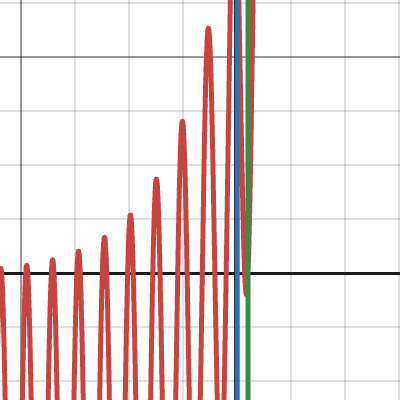
Desmos
lethal path
floral grail
Can someone explain how the correct answer (B) was found because I got (A) and I...
you just set $\frac{d}{dt} (f(t) - g(t)) = f'(t) - g'(t) = 0$
grand pondBOT
south
 lethal path
find the value of t
no need to sub the critical value of t back into f(t) - g(t), cause that would give you the max number of people
besides you don't know what f(t) and g(t) are without integrating
lethal path
floral grail
Can someone explain how the correct answer (B) was found because I got (A) and I...
yes click on your graph to find the zero of the function
it is indeed 7.888
there is another one at 10.974 yes but you can look at the graph
only t = 7.888 goes from positive derivative to negative derivative
so increasing then decreasing
midnight plankBOT
Available help channel!
Send your question here to claim the channel.
Remember:
• Ask your math question in a clear, concise manner.
• Show your work, and if possible, explain where you are stuck.
• After 15 minutes, feel free to ping <@&286206848099549185>.
• Type the command .close to free the channel when you're done.
• Be polite and have a nice day!
Read #❓how-to-get-help for further information on how to ask a good question, and about conduct in the question channels.
twilit field
Show that if $a,b \in \Q$, then $a+b$ and $ab$ are also rational.
\
Proof: Suppose $ab$ is not rational. Let their product be $c$. We then have $ab = c$, or equivalently $a= \frac{c}{b}; b\neq 0$. However, a being rational is the quotient of two rationals, this contradicts that. Therefore $c$ cannot be irrational.
midnight plankBOT
twilit field
Show that if $a,b \in \Q$, then $a+b$ and $ab$ are also rational.
\\
Proof: Supp...
grand pondBOT
ƒ(Why am. I here)=I don't Know

 drifting cloak
what is the question here?
drifting cloak
oh
drifting cloak
i think it could be more rigorous
twilit field
Hmm, how?
drifting cloak
but intuitively it makes sense
 tawdry laurel
drifting cloak
i think it could be more rigorous
tawdry laurel
drifting cloak
i think it could be more rigorous
How
radiant roost
you're assuming an irrational over a rational is irrational
drifting cloak
yeah that
tawdry laurel
radiant roost
what is the contradiction?
c is not irrational
He assumed c is irrational
radiant roost
yes
tawdry laurel
And cant be expressed as real / real
twilit field
oh
tawdry laurel
radiant roost
you're saying he showed c is rational, and that's the contradiction?
Yes i think
twilit field
I see the problem
radiant roost
i don't see anywhere he showed c is rational
 zealous schooner
Yeah this is just a constructive proof, you didn't use the assumption that c is irrational anywhere
radiant roost
i agree a direct proof will work
twilit field
Hmm, okay
tawdry laurel
Ah i got confused
twilit field
let me think
radiant roost
you should use the definition of rational
zealous schooner
You're also assuming b != 0 which isn't really necessary
drifting cloak
radiant roost
you should use the definition of rational
yea
if a is rational then a = p/q where p, q = ___?
tawdry laurel
W
twilit field
radiant roost
you're assuming an irrational over a rational is irrational
I'm just using the fact that every rational is the quotient of two rationals by defn, no?
 formal orchid
@twilit field Let a = x/y and b = m/n where x, y, m, n belongs to Z
radiant roost
it can be expressed as a quotient of two integers
but it can also be expressed other ways
radiant roost
for example, as an irrational over an irrational
for example, 1/2 is rational but it's equal to sqrt(2)/(2sqrt2)
twilit field
formal orchid
<@796939110815629322> Let a = x/y and b = m/n where x, y, m, n belongs to Z
I think That's overkill, for I don't know anything about xm/yn
radiant roost
no that's right
drifting cloak
drifting cloak
if a is rational then a = p/q where p, q = ___?
you might need to prove the lemma if gcd(p, q) = 1 then gcd(p^n, q^n) = 1
radiant roost
you know xm is an integer and you know yn is an integer
twilit field
so I assume closure under multiplication of integers
radiant roost
yes
twilit field
drifting cloak
you might need to prove the lemma if gcd(p, q) = 1 then gcd(p^n, q^n) = 1
p,q \in Z
$
radiant roost
we would normally build integers first before building rationals
so
we can assume integer properties
radiant roost
i mean in theory, anyway
zealous schooner
drifting cloak
you might need to prove the lemma if gcd(p, q) = 1 then gcd(p^n, q^n) = 1
Why?
zealous schooner
twilit field
My book doesn't do that 😭
How did your book define the rationals
twilit field
A rational is any number that can be expressed in the form p/q , where p,q are integers
zealous schooner
twilit field
A rational is any number that can be expressed in the form p/q , where p,q are i...
So what does division mean here
radiant roost
hm
drifting cloak
twilit field
A rational is any number that can be expressed in the form p/q , where p,q are i...
p, q are coprime i.e gcd(p, q) = 1
twilit field
Let $a= \frac{p}{q}, p,q \in \Z$, $b= \frac{m}{n}; m,n \in \Z$
\
$\frac{p}{q} \frac{m}{n} = \frac{pm}{qn} =c \implies c \in \Q$
grand pondBOT
ƒ(Why am. I here)=I don't Know
 twilit field
zealous schooner
So what does division mean here
twilit field
zealous schooner
So what does division mean here
multiplication by $q^{-1}$, right
grand pondBOT
ƒ(Why am. I here)=I don't Know
 radiant roost
grand pond
**ƒ(Why am. I here)=I don't Know**
radiant roost
grand pond
**ƒ(Why am. I here)=I don't Know**
looks reasonable
zealous schooner
drifting cloak
p, q are coprime i.e gcd(p, q) = 1
Not necessarily
zealous schooner
twilit field
multiplication by $q^{-1}$, right
Yes
radiant roost
twilit field
right
yeah get a common denominator etc.
zealous schooner
grand pond
**ƒ(Why am. I here)=I don't Know**
But you don't know how multiplication works yet
twilit field
$\frac{p}{q} + \frac{m}{n} = \frac{pn+qm}{nq} = c$ again
grand pondBOT
ƒ(Why am. I here)=I don't Know
 zealous schooner
You should probably prove this
radiant roost
are you talking about multiplication in Q or in Z?
twilit field
zealous schooner
But you don't know how multiplication works yet
I think in my book we formally construct the reals in the 8th chapter
zealous schooner
You're assuming you know how multiplication and addition works in the rationals
twilit field
yeah, section 8.6 is a construction of R from Q
zealous schooner
But that doesn't constitute a proof I think
radiant roost
yeah, that should also be a matter of definitions, right?
zealous schooner
radiant roost
yeah, that should also be a matter of definitions, right?
Why?
radiant roost
shouldn't there be a definition of multiplication in Q that he can use?
zealous schooner
pq^{-1}mn^{-1}=pmq^{-1}n^{-1}
zealous schooner
radiant roost
shouldn't there be a definition of multiplication in Q that he can use?
Yeah it depends on how things are defined
radiant roost
that does seem more rigorous
twilit field
hmm
 golden comet
what are we solving?
twilit field
We're done, I think
twilit field
grand pond
**ƒ(Why am. I here)=I don't Know**
But this
golden comet
so proving a+b and ab are ratrional?
radiant roost
ye