#help-49
1 messages · Page 69 of 1
 midnight plankBOT
@last slate Has your question been resolved?
midnight plankBOT
@last slate Has your question been resolved?
 hybrid crane
 last slate
well i know the answer is not equialteral because if it is fully contained insid...
last slate
well i know the answer is not equialteral because if it is fully contained insid...
You can definitely construct one that isn't fully confined
 last slate
hybrid crane
last slate
hybrid crane
oh yeah nice, what "software" did you use?
hybrid crane
desmos
 hybrid crane
I just read the documentation whenever I needed a certain feature
 hybrid crane
It's a function that returns a point. If you're familiar with complex numbers, it makes more sense
It basically gives n equal spaces points on a circle of radius s
last slate
right i follow that, but is this just boiler plate code?
hybrid crane
v is just the "point number" like point 0, point 1
hybrid crane
last slate
right i follow that, but is this just boiler plate code?
yeah it is
last slate
mmmmm interesting
hybrid crane
On the topic at hand, I think it is necessarily equilateral
I'm not entirely sure but lemme explain my reasoning
hybrid crane
last slate
but otherwise it's not
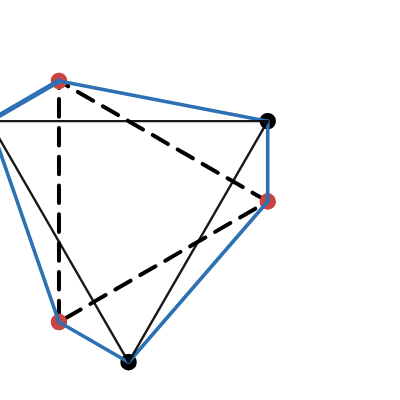
the diagram I sent shows a case where it is equilateral when it's not confined to EFD
 last slate
hybrid crane
the diagram I sent shows a case where it is equilateral when it's not confined t...
last slate
hybrid crane
the diagram I sent shows a case where it is equilateral when it's not confined t...
hmmm wait are we sure that's how you would draw the diagram?
okay wait your case is a special case,no?
hybrid crane
It's one case
hybrid crane
Idk then tbh
 hybrid crane
Ohhhhhhhhhh
I didn't think about the triangles not necessarily oriented is a similar way
last slate
hybrid crane
I didn't think about the triangles not necessarily oriented is a similar way
i still don't get how to draw it tbh
😭
i suck at geometry arghhh
how did they draw that
hybrid crane
is this any help?
 last slate
hybrid crane
is this any help?
last slate
hybrid crane
is this any help?
no i mean probably dumb question but it's late for me
how do you draw that on paper
or whatever
hybrid crane
hybrid crane
is this any help?
oops, error
last slate
what's the motivation to draw it
hybrid crane
last slate
how do you draw that on paper
Well if you really wanted to, you could use a ruler and a protractor to draw the EFD.
The angle DEA, BFE, CDF are the same so there's that
last slate
hybrid crane
Well if you really wanted to, you could use a ruler and a protractor to draw the...
no no
how do i make a sketch of it lol

for this i first drew ABC
then i just drew outward triangles BCF, ACD, and ABE
then connected the vertex of each of those outward triangles and got DEF
i don't care about the exact measurement ofc
i just have to draw a sketch
but i can't think of how to draw a sketch of however the ABC thing will look like after it's out of DEF
last slate
.close
midnight plankBOT
Channel closed
Closed by @dim fractal
Use .reopen if this was a mistake.
hybrid crane
last slate
how do i make a sketch of it lol

just reflect A in line ED and join up the points
midnight plankBOT
 Available help channel!
Send your question here to claim the channel.
Remember:
• Ask your math question in a clear, concise manner.
• Show your work, and if possible, explain where you are stuck.
• After 15 minutes, feel free to ping <@&286206848099549185>.
• Type the command .close to free the channel when you're done.
• Be polite and have a nice day!
Read #❓how-to-get-help for further information on how to ask a good question, and about conduct in the question channels.
 bleak wren
cat, nut, not, act, art, bat
this is an unique arithmetic sequence, where a letter corresponds to a number.
determine the next word in this sequence
midnight plankBOT
bleak wren
cat, nut, not, act, art, bat
this is an unique arithmetic sequence, where a let...
 fossil knot
hm
so c, n, a, and b are consecutive
The tens digits also jump from c to r to a
so r=n
cat nut not act ant bat
you also go from a back to a in five numbers
So the common difference is a multiple of 20
probably either 40 or 60
midnight plankBOT
@bleak wren Has your question been resolved?
Channel closed
Closed by @bleak wren
Use .reopen if this was a mistake.
Available help channel!
Send your question here to claim the channel.
Remember:
• Ask your math question in a clear, concise manner.
• Show your work, and if possible, explain where you are stuck.
• After 15 minutes, feel free to ping <@&286206848099549185>.
• Type the command .close to free the channel when you're done.
• Be polite and have a nice day!
Read #❓how-to-get-help for further information on how to ask a good question, and about conduct in the question channels.
 normal citrus
f is a function of R^3, how can i show this?

 midnight plankBOT
normal citrus
f is a function of R^3, how can i show this?
midnight plankBOT
normal citrus
f is a function of R^3, how can i show this?
 deep vine
do you now the domain and codomain?
normal citrus
hum i guess yes
it is just write that it's a function of R^3 so i guess the domain and codomain are R^3
 hard umbra
it doesn't look like f is just any function
perhaps you mean to specify that it is linear?
normal citrus
it's not write but we can assume it, what do we gain with the linearity
hard umbra
well nobody talks about kernel and image for non-linear stuff
normal citrus
ye that's true
 rose trout
For the problem, start by showing that ker(f) and im(f) do indeed make a direct sum (show that their intersection is {0}).
Then you can use a really nice theorem about the dimensions of kernels and images :p
normal citrus
that's the part i'm strugling with
x€Ker so f(x) = 0
and f^3(x) + f(x) = 0
idk what to do with that
rose trout
Take some element y in both ker(f) and in im(f). You want to show that this has to be 0.
If it's in ker(f), then f(y) = 0.
If it's in im(f), then there is some x such that f(x) = y.
You'll want to use both of those, along with f^3(x) + f(x) = 0 to get to y = 0.
normal citrus
ok i made it
for the second part we're using the fact that we are in finished dimension
rose trout
Yeah. The direct sum is a subspace of R^3, and you can get its dimension from what you constructed.
midnight plankBOT
Channel closed
Closed by @normal citrus
Use .reopen if this was a mistake.
Available help channel!
Send your question here to claim the channel.
Remember:
• Ask your math question in a clear, concise manner.
• Show your work, and if possible, explain where you are stuck.
• After 15 minutes, feel free to ping <@&286206848099549185>.
• Type the command .close to free the channel when you're done.
• Be polite and have a nice day!
Read #❓how-to-get-help for further information on how to ask a good question, and about conduct in the question channels.
 sharp wave
hello
midnight plankBOT
sharp wave
hello

 midnight plankBOT
@sharp wave Has your question been resolved?
sharp wave
<@&286206848099549185>
sharp wave
 hidden stone
what step do you need help with
hidden stone
what step do you need help with
i substituted the values of f(x) and f(pi/2-x) but then im stuck on how to simplify
 tidal turret
prolly we need tfc1,no? but i cant manage to put all the pieces together
sharp wave
tfc1?
should i write it down?
and show you guys

we have been taught a property but that dosent help
over here
sharp wave
okay let me try
how does that work
youre stuck with a sin2x term right
wait should we sub 2x as u maybe thatll work
since the lim its then come in the asnwers format
 neat hamlet
sharp wave
wait should we sub 2x as u maybe thatll work
neat hamlet
sharp wave
wait should we sub 2x as u maybe thatll work
no
do partial fraction decomposition first
that way you can separate out the x and pi/2 - x
sharp wave
but there are still two terms in the numerator no
wait let me try i like this
yep that worked @neat hamlet
i still had to sub 2x as u though
thank you so much both of you
.close
midnight plankBOT
Channel closed
Closed by @sharp wave
Use .reopen if this was a mistake.
midnight plankBOT
Available help channel!
Send your question here to claim the channel.
Remember:
• Ask your math question in a clear, concise manner.
• Show your work, and if possible, explain where you are stuck.
• After 15 minutes, feel free to ping <@&286206848099549185>.
• Type the command .close to free the channel when you're done.
• Be polite and have a nice day!
Read #❓how-to-get-help for further information on how to ask a good question, and about conduct in the question channels.
 twilit field
prove that $a^n|b^n \implies a|b$
midnight plankBOT
twilit field
prove that $a^n|b^n \implies a|b$
 grand pondBOT
ƒ(Why am. I here)=I don't Know
 twilit field
without prime factorisation
I would like to use EDA if possible
eulclds division algorithm that is
so I have $b^n=da^n$
grand pondBOT
ƒ(Why am. I here)=I don't Know
 twilit field
I was thinking of equating b^n/a^n to some integer k^n
then take the nth root of both sides
twilit field
yeah, I know
 frank wolf
I feel like you’ve been told this many times but for some reason you insist on using fractions
twilit field
sorry
frank wolf
hm, im not sure how Euclidean division could help..
twilit field
alternatively bezout's lemma may help
twilit field
my book does have a hint,just as minute
put d=gcd(a,b) and write a=rd, b=sd where gcd(r,s)=1. my part (a) gcd(r^n,s^n)=1 . show that r=1 whence a=d
part (a) is if gcd(a,b)=1 then gcd(a^n,b^n)=1
frank wolf
oh huh, interesting
twilit field
problem a is if gcd(a,b)=1 then gcd(a^n, b^n)=1
 worthy kestrel
cant u show the contra positive easily
twilit field
that is if a|b \implies a^n|b^n
frank wolf
hmm how would you show the contrapositive?
frank wolf
twilit field
part (a) is if gcd(a,b)=1 then gcd(a^n,b^n)=1
Do you know how to do this?
twilit field
frank wolf
Do you know how to do this?
yeah, bezout's lemma
twilit field
let me try
worthy kestrel
frank wolf
hmm how would you show the contrapositive?
ok wait this is hard too :(
twilit field
frank wolf
can you show that r = 1?
I'm not too sure, but I guess bézout's lemma
frank wolf
twilit field
I'm not too sure, but I guess bézout's lemma
so try to use a^n | b^n
grand pondBOT
ƒ(Why am. I here)=I don't Know
 worthy kestrel
assume a doesnt divide b
so there exists some p^w that divides a that doesnt divide b. the p power in b is <w. looking at the p power of a^n is >=wn. while p power of b^n is <wn. thus a^n doesnt divide b^n
that works?
twilit field
worthy kestrel
assume a doesnt divide b
so there exists some p^w that divides a that doesnt div...
what?
I don;t follow
I feel like I should try to understand EDA once more I thought solving problems would help, but doesn't seem like it's helping
can I close this for now?
 pearl idol
sure
twilit field
.close
midnight plankBOT
Channel closed
Closed by @twilit field
Use .reopen if this was a mistake.
midnight plankBOT
Available help channel!
Send your question here to claim the channel.
Remember:
• Ask your math question in a clear, concise manner.
• Show your work, and if possible, explain where you are stuck.
• After 15 minutes, feel free to ping <@&286206848099549185>.
• Type the command .close to free the channel when you're done.
• Be polite and have a nice day!
Read #❓how-to-get-help for further information on how to ask a good question, and about conduct in the question channels.
twilit field
https://math.stackexchange.com/a/696537/879009 could someone explain this?

Mathematics Stack Exchange
I need to prove that:
If $\gcd(a,b)=1$, then $\gcd(a+b,ab)=1.$
So far I used what's given so I have:
$ax+by=1$ (I wrote the gcd of a and b as a linear combination)
and
$(a+b)u+ab(v)=1$ (I also
midnight plankBOT
twilit field
https://math.stackexchange.com/a/696537/879009 could someone explain this?
 grand pondBOT
ƒ(Why am. I here)=I don't Know
 twilit field
hmm, if gcd(a,b)=1
twilit field
no, I get that, but how is $ab=-a^2$
grand pondBOT
ƒ(Why am. I here)=I don't Know
 worthy kestrel
it isnt
worthy kestrel
its just with gcd there are some properties that allow u to get from one part to the next
twilit field
ah
ok
How am I supposed to know this identity if I've never seen it before, is it supposed to be obvious?
 visual tiger
Another way to see it
Is the euclid algorithm
To compute gcd(x,y) you compute the remainder of y/x
And so on until you reach 0
twilit field
yes
midnight plankBOT
Channel closed
Closed by @twilit field
Use .reopen if this was a mistake.
twilit field
.reopen
midnight plankBOT
✅
twilit field

I'm having a hard time understanding this
so the only elements of the field are -\infty, 0 and \infy?
pearl idol
twilit field
so the only elements of the field are -\infty, 0 and \infy?
no
it's all real numbers, as well as ∞ and -∞
twilit field
ah
pearl idol
and it's not a field
twilit field
so it's. a vector space?
pearl idol
what makes you think that?
twilit field
oh right
 prime hornet
check the vsp axioms 
twilit field
that's the question
 pearl idol
ah
twilit field
OK, I think I have a rough idea of how to do this now, let me TeX a proof
so we'll have to prove teh following 1) Commutativity, associativity, additive identity, aaditive inverse, multiplicative idenrity and the distibutive property
pearl idol
lots of things to prove
twilit field
- commutativity
\
$a+b=b+a$ , from the defn it follows that $\infty+a=a+ \infty$ and the same for negative $\infty$
2)associativity : $(a+b)+c=a+(b+c)$ over R and as any number + $\infty$ is \infty the same holds true as one or more variables tends to infty - 0 is an element by defn
- as is1
grand pondBOT
ƒ(Why am. I here)=I don't Know
Compile Error! Click the  reaction for more information.
(You may edit your message to recompile.)
 twilit field
TeX massacred
oof
- commutativity
$a+b=b+a$ , from the defn it follows that $\infty+a=a+ \infty$ and the same for negative $\infty$
\
2)associativity : $(a+b)+c=a+(b+c)$ over R and as any number + $\infty$
\is $\infty$ the same holds true as one or more variables tends to infty
\ - 0 is an element by defn
- as is 1
grand pondBOT
ƒ(Why am. I here)=I don't Know
 pearl idol
for example for commutativity, you have the case where a and b are both real numbers, and the case where a is ∞ or -∞
there's still another case
twilit field
$\pm \infty \pm \infty = \pm \infty$
grand pondBOT
ƒ(Why am. I here)=I don't Know
 twilit field
and $\infty - \infty =0$
grand pondBOT
ƒ(Why am. I here)=I don't Know
 pearl idol
right
so if a and b are equal
then commutativity is obvious: a + b is clearly equal to b + a
so the only case you need to consider is ∞ + (-∞) = (-∞) + ∞
which is fine bc they're both 0
so commutativity is good
what about associativity
twilit field
That's true over R and true at $\pm \infty$ as $ a+ \pm \infty = \pm \infty$
grand pondBOT
ƒ(Why am. I here)=I don't Know
 pearl idol
I don't know what you mean by that
there are three different variables in the statement of associativity
(a + b) + c = a + (b + c)
which ones are in R and which ones are infinite, in what you are considering?
twilit field
(a+b)+c=a+(b+c) is a property of R
pearl idol
okay, so that handles the case where a, b, and c are all part of R
what about the other cases?
worthy kestrel
actually more
twilit field
I guess I can prove it for one case and say it's simialrly true for all other cases?
pearl idol
(you should also be able to tell when yo'ure done, ofc)
pearl idol
twilit field
I guess I can prove it for one case and say it's simialrly true for all other ca...
why?
why would the other cases be similar
twilit field
one var is \pm \infty the other two belong to R
in the next case two vars are some form of infty and the other blongs to R
worthy kestrel
write it out
pearl idol
yeah, let's consider that first case where one var is ±∞ first
twilit field
$\infty+(a+b) = \infty = (\infty+a)+b= \infty )$
grand pondBOT
ƒ(Why am. I here)=I don't Know
 pearl idol
I think you wrote it a little weirdly, but good
worthy kestrel
uve an extra ) but its goos
pearl idol
I would've written something like: [\infty + (b + c) = \infty = \infty + c = (\infty + b) + c]
grand pondBOT
biased_estimatERIC
 pearl idol
and then the same proof works for a = -∞
what about if b is ±∞, and a and c are real? does it also work
twilit field
yes
twilit field
yeah, it works simialry for all cases
worthy kestrel
write it
pearl idol
yeah, it's good to practice writing it out
even if it may seem tedious
associativity is often hard to check because there are three variables involved!
twilit field
yeah, Wrote it in my notebook
pearl idol
okay can you show me
twilit field
uh, it's kind of messy, let me re-write it
pearl idol
alright
twilit field
 pearl idol
okay yeah that looks good
worthy kestrel
pearl idol
I would've written something like: \[\infty + (b + c) = \infty = \infty + c = (\...
btw isn't this not exactly exhaustive
u need more details no?
pearl idol
there's still more cases, yeah, if that's what you mean
worthy kestrel
yea
twilit field
yeah, I realise there are 3 possibilities for each variable, so 27 possible cases
pearl idol
worthy kestrel
u need more details no?
I'm assuming b, c are real for that case
yeah, a lot of them are similar, but not all of them are similar
what about the options where both a and b are infinite now? (and c is a real number)
this is where it might get tricky
twilit field
that's still \infty
worthy kestrel
pearl idol
I'm assuming b, c are real for that case
i mean inf in the middle or last position
pearl idol
worthy kestrel
i mean inf in the middle or last position
I'm assuming a = ±∞ for that case; I made him do the other two positions in the picture he sent (b = ±∞ and c = ±∞)
worthy kestrel
ah i see thats good
twilit field
now to prove the distributive property for the additive identity and multiplicative identity are trivially ture, right?
pearl idol
hang on
stay with associativity
did you consider the options where a and b are infinite, and c is a real number yet?
twilit field
I did , I got $\infty$
grand pondBOT
ƒ(Why am. I here)=I don't Know
 twilit field
$(\infty + \infty)+c = \infty +c =\infty=\infty+(\infty+c)=\infty$
\
$(- \infty + \infty )+c=0+c=c but - \infty+(\infty +c)= -\infty+\infty =0$
\
pearl idol
how does that demonstrate the associative property?
twilit field
oh, right
worthy kestrel
associativity is
(a+b)+c=a+(b+c)
grand pondBOT
ƒ(Why am. I here)=I don't Know
 pearl idol
 so then what can you conclude
twilit field
this isn't a vector space
pearl idol
good! because associativity doesn't work
intuitively, you can think of adding infinity as "losing information"
if you start with some real number c, then add infinity, then subtract infinity, you lose track of the original number c was
that's not possible in a vector space
twilit field
I see. yeah, makes sense
pearl idol
any addition operation is perfectly reversible in a vector space
twilit field
thanks!
pearl idol
(more generally, in what's called an "abelian group" this is also true)
(but don't worry about that too much right now)
twilit field
I pressume group theory is a late undergrad course?
pearl idol
it's an undergrad course
when you take it in undergrad depends on your interests and school
pearl idol
you're welcome! you're doing well
midnight plankBOT
Channel closed
Closed by @twilit field
Use .reopen if this was a mistake.
worthy kestrel
good job
midnight plankBOT
Available help channel!
Send your question here to claim the channel.
Remember:
• Ask your math question in a clear, concise manner.
• Show your work, and if possible, explain where you are stuck.
• After 15 minutes, feel free to ping <@&286206848099549185>.
• Type the command .close to free the channel when you're done.
• Be polite and have a nice day!
Read #❓how-to-get-help for further information on how to ask a good question, and about conduct in the question channels.
 urban prism
find a condition a,b and c so that one zero of ax^2+bx+c is the square of other
midnight plankBOT
urban prism
find a condition a,b and c so that one zero of ax^2+bx+c is the square of other
urban prism
Let me tell u my side first
basically
it is saying one should be alpha so other should be alpha^2
right?
sum = alpha + alpha^2 = -b/a
product = alpha X alpha^2 = alpha^3 = c/a
but what after that
grand pondBOT
kheerii

 zealous schooner
What variable do you wish to eliminate from this?
 worthy wing
$\alpha^3=\alpha^2 \alpha$
grand pondBOT
Samuel
 urban prism
product = alpha X alpha^2 = alpha^3 = c/a
urban prism
urban prism
product = alpha X alpha^2 = alpha^3 = c/a
^^^
$\alpha+\alpha^2=-\frac{b}{a}, \alpha^3=\frac{c}{a}$
grand pondBOT
Thor
 midnight plankBOT
@urban prism Has your question been resolved?
urban prism
<@&286206848099549185> 15 mins have passed so
 dim edge
guys what is a good game rn which is like either a city game or maybe like a vintage old game or vintage old military related stuff in roblox
urban prism
dim edge
guys what is a good game rn which is like either a city game or maybe like a vin...
??
.close
midnight plankBOT
Channel closed
Closed by @urban prism
Use .reopen if this was a mistake.
midnight plankBOT
Available help channel!
Send your question here to claim the channel.
Remember:
• Ask your math question in a clear, concise manner.
• Show your work, and if possible, explain where you are stuck.
• After 15 minutes, feel free to ping <@&286206848099549185>.
• Type the command .close to free the channel when you're done.
• Be polite and have a nice day!
Read #❓how-to-get-help for further information on how to ask a good question, and about conduct in the question channels.
 vast bone
I need help
 midnight plankBOT
vast bone
I need help
midnight plankBOT
vast bone
I need help
 grim vector
Distribute it first
vast bone
okay so kx^2-56x = -16
vast bone
so would it be kx^2-56x+16=0?
grim vector
Yes it would
vast bone
but what is the least possibel
grim vector
Now do you know delta ?
vast bone
no im in 9th grade
grim vector
The discriminant ?
grim vector
b^2 - 4ac
grim vector
You apply it to the quadratic you got
grim vector
Yes so let k as it is
grim vector
vast bone
or like the a value
The a value is k
vast bone
wait is < 0 one solution?
grim vector
vast bone
wait is < 0 one solution?
No its no solution
The one solution is when the discriminant = 0
vast bone
but why do i have to solve for no solution
grim vector
Cuz they ask for
vast bone
srry im confused on this part
ohhhh
wait yeah wait icic
but after you set it as less than what do you do
grim vector
You have 56^2 -4k*16 < 0
vast bone
mhm
grim vector
You solve for k
grim vector
I think you forgot to turn the inequality sign no ?
When divided by a negative numbers
grim vector
There you go
midnight plankBOT
@vast bone Has your question been resolved?
Channel closed
Closed by @vast bone
Use .reopen if this was a mistake.
Available help channel!
Send your question here to claim the channel.
Remember:
• Ask your math question in a clear, concise manner.
• Show your work, and if possible, explain where you are stuck.
• After 15 minutes, feel free to ping <@&286206848099549185>.
• Type the command .close to free the channel when you're done.
• Be polite and have a nice day!
Read #❓how-to-get-help for further information on how to ask a good question, and about conduct in the question channels.
vast bone
can someone explain why
 midnight plankBOT
vast bone
can someone explain why
vast bone
midnight plankBOT
vast bone
can someone explain why
vast bone
yeah
 unreal fjord
so... when t = 0 (initially), you have P(0) = (C)(2)^0. Agree?
vast bone
yes
unreal fjord
so C = 12000, agree?
vast bone
unreal fjord
if it is double after 4 hours, then 2^(4r) = 2
wait what?
unreal fjord
Ok so P(4) = 24000 = 12000(2^(4r)), agree?
vast bone
unreal fjord
if it is double after 4 hours, then 2^(4r) = 2
this
unreal fjord
yes
unreal fjord
you can take log. or you can just realize that 2^(4r) = 2^1, and conclude that 4r = 1
midnight plankBOT
@vast bone Has your question been resolved?
midnight plankBOT
Channel closed
Closed due to timeout
Use .reopen if this was a mistake.
midnight plankBOT
Available help channel!
Send your question here to claim the channel.
Remember:
• Ask your math question in a clear, concise manner.
• Show your work, and if possible, explain where you are stuck.
• After 15 minutes, feel free to ping <@&286206848099549185>.
• Type the command .close to free the channel when you're done.
• Be polite and have a nice day!
Read #❓how-to-get-help for further information on how to ask a good question, and about conduct in the question channels.
 inland summit
Can someone tell me the answer for this
 midnight plankBOT
inland summit
Can someone tell me the answer for this
midnight plankBOT
inland summit
Can someone tell me the answer for this
 velvet compass
Have you tried solving it?
velvet compass
more precisely when x < -2, but yes
inland summit
inland summit
-x^2 -7x-8 =0
But if I multiply -1 here
velvet compass
or (-7 - root(17))/2
inland summit
velvet compass
or (-7 - root(17))/2
ya
inland summit
K
velvet compass
then x = (-7-root(17))/2
inland summit
Ohh
velvet compass
is the only solution
inland summit
Thx bro
velvet compass
Do you know why x < -2?
inland summit
Absolute value
velvet compass
yep
inland summit
But how is it
For the first mod 3 is absolute value
And for the second -1
How is it -2
velvet compass
what do you mean by "mod"? Case?
inland summit
Modulus
velvet compass
for the 1st one we have |x+2| then x = -2
 midnight plankBOT
Channel closed
Closed by @inland summit
Use .reopen if this was a mistake.
midnight plankBOT
Available help channel!
Send your question here to claim the channel.
Remember:
• Ask your math question in a clear, concise manner.
• Show your work, and if possible, explain where you are stuck.
• After 15 minutes, feel free to ping <@&286206848099549185>.
• Type the command .close to free the channel when you're done.
• Be polite and have a nice day!
Read #❓how-to-get-help for further information on how to ask a good question, and about conduct in the question channels.
twilit field
let $a<b$, where a and b are positive , show $a^2<b^2$
midnight plankBOT
twilit field
let $a<b$, where a and b are positive , show $a^2<b^2$
grand pondBOT
ƒ(Why am. I here)=I don't Know
 twilit field
I mean this is obviosuly true
 obtuse void
let b=a plus some constant k
 pearl hull
 hard shard
wat are you thinking
hard shard
wat are you thinking
Same question
twilit field
hard shard
wat are you thinking
Not too sure tbh
am working on it now
just like working on discord
hard shard
oh
hard umbra
do you have any axioms to work with?
 humble torrent
I guess you’re allowed to multiply by a positive number by both sides of the inequality?
 dreamy lichen
k > 0
m < n => km < kn
This should be enough to prove it
dreamy lichen
humble torrent
I guess you’re allowed to multiply by a positive number by both sides of the ine...
yeah, this
twilit field
I was actually thinking of arguing if b>a adding b to it self b times will be more than adding a to itself a times
dreamy lichen
that works only for integers
twilit field
oh,right
hard shard
eh its nt anyway
hard umbra
adding b to it self b times
adding a to itself a times
apparently not
lang's calculus is it?
twilit field
A first course in calculus
hard umbra
calculus yes
obtuse void
couldn’t you use geometry since both a and b are positive and can be used as side lengths?
humble torrent
hard umbra
do you have any axioms to work with?
Try and see if you can find this @twilit field in the textbook
hard shard
you could
twilit field
obtuse void
couldn’t you use geometry since both a and b are positive and can be used as sid...
i could
hard umbra
i dont have a copy of the textbook so idk what lang covers
twilit field
humble torrent
Try and see if you can find this <@796939110815629322> in the textbook
I'll check
there a few rules
if a>b and b>c then a>c
if a>b and c>0
then ac>bc
I suppsoed I could use this
dreamy lichen
those are sufficient actually
hard shard
dont flip your signs
humble torrent
Yup
dreamy lichen
twilit field
a^2>ab
do you mean a^2 < ab?
dreamy lichen
hard shard
dont flip your signs
this, otherwise it's correct
twilit field
is it normal to miss the obvious stuff while just starting college , haven't have had to think in such an elemenatry way in a while
thanks everyon!
dreamy lichen
twilit field
is it normal to miss the obvious stuff while just starting college , haven't hav...
You got it quite quickly after looking at the axioms
humble torrent
Yeah I think you’re always doing very well the times I chime into these help channels
midnight plankBOT
Channel closed
Closed by @twilit field
Use .reopen if this was a mistake.
midnight plankBOT
Available help channel!
Send your question here to claim the channel.
Remember:
• Ask your math question in a clear, concise manner.
• Show your work, and if possible, explain where you are stuck.
• After 15 minutes, feel free to ping <@&286206848099549185>.
• Type the command .close to free the channel when you're done.
• Be polite and have a nice day!
Read #❓how-to-get-help for further information on how to ask a good question, and about conduct in the question channels.
twilit field
if a/b<c/d , show that a/b<(a+c)/(b+d)
midnight plankBOT
twilit field
if a/b<c/d , show that a/b<(a+c)/(b+d)
twilit field
I just cross multiplied and got back the oG inequality
is there any other way to do this?
humble torrent
You can reverse those steps
 surreal moon
twilit field
if a/b<c/d , show that a/b<(a+c)/(b+d)
surreal moon
twilit field
if a/b<c/d , show that a/b<(a+c)/(b+d)
Can you assume all a,b,c,d>0?
twilit field
oh yeah, that too
twilit field
humble torrent
You can reverse those steps
so I start with ad<bc
then I add ab to both sides
and I'm done I think
thanks
.close
midnight plankBOT
Channel closed
Closed by @twilit field
Use .reopen if this was a mistake.
midnight plankBOT
Available help channel!
Send your question here to claim the channel.
Remember:
• Ask your math question in a clear, concise manner.
• Show your work, and if possible, explain where you are stuck.
• After 15 minutes, feel free to ping <@&286206848099549185>.
• Type the command .close to free the channel when you're done.
• Be polite and have a nice day!
Read #❓how-to-get-help for further information on how to ask a good question, and about conduct in the question channels.
twilit field
 midnight plankBOT
twilit field
twilit field
midnight plankBOT
twilit field
twilit field
so to start let $v_1,v_2\in V_c$
where $v_1=a+bi$
$v_2=c+di$
then $v_1+v_2 =(a+c)+(b+d)i$
similarly $v_2+v_1 = (c+a)+(d+b)i$
these two req equivalent due to the commutativity on $\R$
grand pondBOT
ƒ(Why am. I here)=I don't Know

 clear void
Yeah
twilit field
just a minute
now to prove associativity
let $v_1 and v_2$ be defined the same way they were above and then we have $v_3 =e+if$
so$ (v_1+v_2)+v_3_= ((a+c)+e+i((b+d)+f)$
and $v_1+(v_2+v_3)=(a+(c+e))+i(b+(d+f))$
which are once again equal due to the laws of associativity on $\R$
grand pondBOT
ƒ(Why am. I here)=I don't Know
Compile Error! Click the reaction for more information.
(You may edit your message to recompile.)
 clear void
Yea
twilit field
next let $v_1= a+ib ; v_2=0+0i$ so we have $v_1+v_2=a+ib$, but this doesn't prove the existance of an additive identity
grand pondBOT
ƒ(Why am. I here)=I don't Know
 twilit field

 jagged saffron
yes it does you just wrote it down
jagged saffron
you just showed that there is some vector such that you add it to any other vector you get that vector back
also i should note that everything you are doing is essentially identical to how you (presumably) showed C is a vector space
twilit field
yeah, that's essentially the question
for the existance of an additive inverse let $v_1 =a +ib ; v_2 =-a+-ib$ so $v_1+v_2=0$
grand pondBOT
ƒ(Why am. I here)=I don't Know
 twilit field
now to prove the existence of a multiplicative identity if $v_1=a+bi$ and $v_2=1+0i$ then $v_1 v_2=v_1 proving the existance of the same$
grand pondBOT
ƒ(Why am. I here)=I don't Know
 midnight plankBOT
Channel closed
Closed by @twilit field
Use .reopen if this was a mistake.
twilit field
thanks everyone!
midnight plankBOT
Available help channel!
Send your question here to claim the channel.
Remember:
• Ask your math question in a clear, concise manner.
• Show your work, and if possible, explain where you are stuck.
• After 15 minutes, feel free to ping <@&286206848099549185>.
• Type the command .close to free the channel when you're done.
• Be polite and have a nice day!
Read #❓how-to-get-help for further information on how to ask a good question, and about conduct in the question channels.
 chrome root
How do I ask for help
midnight plankBOT
chrome root
How do I ask for help

 fleet flume
 chrome root
ahuh
I thionk I got it
Cuz
im currently doing my onine math test

did I get this right?
and dis

 sage olive
it's against server rules to ask for help for a graded assessment
midnight plankBOT
@chrome root Has your question been resolved?
 violet storm
.close
midnight plankBOT
Channel closed
Closed by @violet storm
Use .reopen if this was a mistake.
midnight plankBOT
Available help channel!
Send your question here to claim the channel.
Remember:
• Ask your math question in a clear, concise manner.
• Show your work, and if possible, explain where you are stuck.
• After 15 minutes, feel free to ping <@&286206848099549185>.
• Type the command .close to free the channel when you're done.
• Be polite and have a nice day!
Read #❓how-to-get-help for further information on how to ask a good question, and about conduct in the question channels.
twilit field
$\lim_{x\rightarrow a}\left(f\left(x\right)+g\left(x\right)\right)=\ \lim_{x\rightarrow a}f\left(x\right)+\lim_{x\ \rightarrow a}g\left(x\right)$
midnight plankBOT
twilit field
$\lim_{x\rightarrow a}\left(f\left(x\right)+g\left(x\right)\right)=\ \lim_{x\rig...
grand pondBOT
ƒ(Why am. I here)=I don't Know

 carmine void
Look at the proof for sequences
twilit field
without epsilon-delta limits
twilit field
carmine void
Look at the proof for sequences
👍
zealous schooner
Hey wai
twilit field
what exactly should I look up??
twilit field
zealous schooner
Hey wai
hey
carmine void
twilit field
hey
The proof that you can split the limit of a sum of two sequences if both limits exist
zealous schooner
twilit field
$\lim_{x\rightarrow a}\left(f\left(x\right)+g\left(x\right)\right)=\ \lim_{x\rig...
This is only true if both limits exist, which is important
twilit field
zealous schooner
This is only true if both limits exist, which is important
I know that
zealous schooner
twilit field
everything seems to be using epsilon delta limits
Yeah that’s what I was thinking too
twilit field
so for now I just accept it as a fact?
I mean it's obvious
I could probably learn epsilon delta limits

thanks
zealous schooner
twilit field
I could probably learn epsilon delta limits
Honestly it’s like 2 lines lmao
twilit field
I know, but I've never done epsilon delta limits before
thanks again everyone
.close
midnight plankBOT
Channel closed
Closed by @twilit field
Use .reopen if this was a mistake.
zealous schooner
twilit field
everything seems to be using epsilon delta limits
Hmm, the sequence one is also using epsilon delta?
twilit field
yeah
zealous schooner
Can you show me
twilit field
 sage helm
zealous schooner
Hmm, the sequence one is also using epsilon delta?
sage helm
zealous schooner
Hmm, the sequence one is also using epsilon delta?
there's no delta to talk of
zealous schooner
twilit field
https://www.quora.com/How-do-you-prove-that-the-limit-of-the-sum-product-of-two-...
Oh, hmm
I guess it’s just the same as a normal limit
zealous schooner
sage helm
there's no delta to talk of
What
sage helm
when i proved that stuff there was no delta
I think epsilon-delta is only for limits of functions
zealous schooner
sage helm
when i proved that stuff there was no delta
Huh?
twilit field
ok, I don't know how to solve epsilon limits either
sage helm
yeah
zealous schooner
Or there isn’t an epsilon rather
twilit field
what
zealous schooner
twilit field
what
If you’re taking a limit to infinity you don’t use |x-a|<epsilon, you use x>N
twilit field
I have no idea what that means
zealous schooner
When you study epsilon delta proofs you’ll understand
twilit field
Thanks a lot though
midnight plankBOT
Available help channel!
Send your question here to claim the channel.
Remember:
• Ask your math question in a clear, concise manner.
• Show your work, and if possible, explain where you are stuck.
• After 15 minutes, feel free to ping <@&286206848099549185>.
• Type the command .close to free the channel when you're done.
• Be polite and have a nice day!
Read #❓how-to-get-help for further information on how to ask a good question, and about conduct in the question channels.
last slate
 midnight plankBOT
last slate
last slate
midnight plankBOT
last slate
last slate
Please solve it
I might be offline so please solve fully. I tried solving it but could only work out 2 ordered pairs, one is (1,2) and second is (2,1).
last slate
Well, I did get solutions so-
last slate
 potent veldt
if u want a hint ask for that but no sols
potent veldt
if u want a hint ask for that but no sols
And it's only against the rules if you haven't fully solved the question, but if you have then you might. Still, I'll try to work with a hint if that's the best I can get.
worthy wing
!show
midnight plankBOT
Show your work, and if possible, explain where you are stuck.
potent veldt
last slate
And it's only against the rules if you **haven't** fully solved the question, bu...
The show ur work instead
last slate
last slate
I might be offline so please solve fully. I tried solving it but could only work...
This is my work ;-;
I got (1,2) and (2,1)
potent veldt
So u didn't solve it
last slate
But then it will be (phi,1) or (phi,2) and A union B won't be {1,2}
It's gonna be either {1} or {2}
I guess
I'm confused
potent veldt
why's B gotta be {1} or {2}
potent veldt
A and B are sets
potent veldt
np
last slate
I got 9 elements
Combinations of A and B*
Oh
Wait
4 combos
Because others have phi as an element which will not satisfy the condition
Lemme fheck the answer
Oh ;-;
It's 9 for some reason
worthy wing
Read the question again
midnight plankBOT
Channel closed
Closed by @wheat remnant
Use .reopen if this was a mistake.
Available help channel!
Send your question here to claim the channel.
Remember:
• Ask your math question in a clear, concise manner.
• Show your work, and if possible, explain where you are stuck.
• After 15 minutes, feel free to ping <@&286206848099549185>.
• Type the command .close to free the channel when you're done.
• Be polite and have a nice day!
Read #❓how-to-get-help for further information on how to ask a good question, and about conduct in the question channels.
sage helm
 sage helm
Have I proved it the wrong way around

 frozen talon
is def'n 2.2.3 just that of a sequence converging to its limit?
sage helm
yeah
frozen talon
then yeah, you did it the other way around. you used that which you wanted to prove as an assumption
also you never declared a positive epsilon
so we don't know who this epsilon character is on mathy line 2
sage helm
frozen talon
so we don't know who this epsilon character is on mathy line 2
Does this fix all of that?
 frozen talon
we ignore the first line you write because it assumes the conclusion. also, the algebraic step between 2 and 3 may be unclear
sage helm
Oh yeah the first line
sage helm
frozen talon
we ignore the first line you write because it assumes the conclusion. also, the ...
multiplying 2/3?
frozen talon
I guess it depends lol
sage helm
 sage helm
frozen talon
I guess it depends lol
sage helm
frozen talon
I guess it depends lol
Yeah I've done worse before
I think I'll let it slide
frozen talon
that's fair
there's a better procedure that doesn't incur the handwaviness at the end
frozen talon
you just massage the inequality of (2) a bit to look like (2x_n - 1)/3 converges to 1
sage helm
I guess I could do some triangle inequality stuff
frozen talon
that's not necessary either
sage helm
Huh
frozen talon
2x/3 - 4/3 = (2x-4)/3 = (2x-1)/3 - 1
and abs((2x-1)/3 - 1) < epsilon for all n >= N, hence (2x-1)/3 converges to 1
frozen talon
rad
sage helm
 frozen talon
I was typing up a comment about using a colon after the N on the first line but I rescind it lol
I think the colon is good and fixes a problem that I have
frozen talon
wherein me using a comma in place of a colon on the first line (such that for all n >= N{: -> ,}) makes me want to treat the math mode stuff like a sentence and thus put a period on the last math line in (3)
 frozen talon
probably not but I figured I'd share my thought anyway in case you had any more insight about the usage of the colon lol
frozen talon
pog, np
sage helm
.close
midnight plankBOT
Channel closed
Closed by @sage helm
Use .reopen if this was a mistake.
midnight plankBOT
Available help channel!
Send your question here to claim the channel.
Remember:
• Ask your math question in a clear, concise manner.
• Show your work, and if possible, explain where you are stuck.
• After 15 minutes, feel free to ping <@&286206848099549185>.
• Type the command .close to free the channel when you're done.
• Be polite and have a nice day!
Read #❓how-to-get-help for further information on how to ask a good question, and about conduct in the question channels.
 agile carbon
Help for d and e pls

 midnight plankBOT
agile carbon
Help for d and e pls
agile carbon
midnight plankBOT
agile carbon
Help for d and e pls
agile carbon
its tech active so i can use my cas to find the discriminant, but i need some guidance
midnight plankBOT
@agile carbon Has your question been resolved?
agile carbon
.close
midnight plankBOT
Channel closed
Closed by @agile carbon
Use .reopen if this was a mistake.
midnight plankBOT
Available help channel!
Send your question here to claim the channel.
Remember:
• Ask your math question in a clear, concise manner.
• Show your work, and if possible, explain where you are stuck.
• After 15 minutes, feel free to ping <@&286206848099549185>.
• Type the command .close to free the channel when you're done.
• Be polite and have a nice day!
Read #❓how-to-get-help for further information on how to ask a good question, and about conduct in the question channels.
 slow moon

 midnight plankBOT
Channel closed
Closed by @slow moon
Use .reopen if this was a mistake.
midnight plankBOT
Available help channel!
Send your question here to claim the channel.
Remember:
• Ask your math question in a clear, concise manner.
• Show your work, and if possible, explain where you are stuck.
• After 15 minutes, feel free to ping <@&286206848099549185>.
• Type the command .close to free the channel when you're done.
• Be polite and have a nice day!
Read #❓how-to-get-help for further information on how to ask a good question, and about conduct in the question channels.
 waxen silo
how do I solve the last question?
midnight plankBOT
waxen silo
how do I solve the last question?
waxen silo


I tried doing it by subbing 0.004 as s and find for t but it gives me a decimal like 0.0666687... and that is clearly not correct
how are you suppose to do this?
midnight plankBOT
@waxen silo Has your question been resolved?
waxen silo
<@&286206848099549185>
waxen silo
.close
midnight plankBOT
Channel closed
Closed by @waxen silo
Use .reopen if this was a mistake.
midnight plankBOT
Available help channel!
Send your question here to claim the channel.
Remember:
• Ask your math question in a clear, concise manner.
• Show your work, and if possible, explain where you are stuck.
• After 15 minutes, feel free to ping <@&286206848099549185>.
• Type the command .close to free the channel when you're done.
• Be polite and have a nice day!
Read #❓how-to-get-help for further information on how to ask a good question, and about conduct in the question channels.
twilit field
prove that $x-\frac{x^3}{6} \leq sin(x)$
midnight plankBOT
twilit field
prove that $x-\frac{x^3}{6} \leq sin(x)$
grand pondBOT
ƒ(Why am. I here)=I don't Know
 twilit field
my first idea was to say that x-x^3/6 is only a part of sin(x)'s taylor expansion
or alternatively, first find the derivative of both sides
to obtain $1-cos(x) - \frac{x^2}{2}$
grand pondBOT
ƒ(Why am. I here)=I don't Know
 last slate
are you allowed to use taylor series?
twilit field
I know taylor series, but haven't covered it yet in the book so idts
this is the same as $2sin^2(x/2) -x^2/2$
grand pondBOT
ƒ(Why am. I here)=I don't Know
 frank wolf
twilit field
prove that $x-\frac{x^3}{6} \leq sin(x)$
frank wolf
twilit field
prove that $x-\frac{x^3}{6} \leq sin(x)$
This is only for $x \geq 0$?
grand pondBOT
Pseudonium
 twilit field
yes
grand pondBOT
ƒ(Why am. I here)=I don't Know
 frank wolf
twilit field
or $sin(t)<t$
frank wolf
twilit field
or $sin(t)<t$
Also this is false for $t \geq 0$
grand pondBOT
Pseudonium
 last slate
i think
twilit field
,w is x>sin(x)
last slate
last slate
i think
just using a counter example would be fine
frank wolf
twilit field
,w is x>sin(x)
It’s true for x > 0
grand pondBOT


 Requested by physicsrocks
frank wolf
Requested by physicsrocks
frank wolf
But i assume you need it to work for x >= 0
twilit field
as t=x/2
twilit field
grand pond
**ƒ(Why am. I here)=I don't Know**
that's why it's $\leq$ here
grand pondBOT
ƒ(Why am. I here)=I don't Know
 frank wolf
Yeah so why not just do $\sin x \leq x$
grand pondBOT
Pseudonium
 twilit field
grand pond
**ƒ(Why am. I here)=I don't Know**
twilit field
grand pond
**ƒ(Why am. I here)=I don't Know**
from here, to move foward , I need to sub x/2=t
right
twilit field
grand pond
**Pseudonium**
to bring it to this form
frank wolf
Oh yeah sure
But I don’t see how you get from that back to your original thing
Like I totally agree that $2 \sin^2(x / 2) - x^2 / 2 \leq 0$
grand pondBOT
Pseudonium
 frank wolf
And I agree with your proof strategy of setting $t = \frac x2$ to do this
grand pondBOT
Pseudonium
 twilit field
$2sin^2(t)-2t^2<0$
grand pondBOT
ƒ(Why am. I here)=I don't Know
 twilit field
or $sin^2(t) \leq t^2$
grand pondBOT
ƒ(Why am. I here)=I don't Know

 subtle blaze
twilit field
I know taylor series, but haven't covered it yet in the book so idts
subtle blaze
twilit field
I know taylor series, but haven't covered it yet in the book so idts
But how do we define sin(x) if not with Taylor series
frank wolf
twilit field
$2sin^2(t)-2t^2<0$
You seem to keep introducing strict inequalities when they’re unnecessary
twilit field
subtle blaze
But how do we define sin(x) if not with Taylor series
lang has defined it as $\frac{y}{\sqrt{x^2+y^2}}$
frank wolf
twilit field
or sin(t)<t or -sin(t)<t
Right, so you do need the second one
twilit field
or using a triangle
frank wolf
And you know why both are true?
subtle blaze
Missing } at the end
twilit field
frank wolf
Right, so you do need the second one
yes
frank wolf
Ok cool
grand pondBOT
ƒ(Why am. I here)=I don't Know
 twilit field
in a right triangle
humble torrent
subtle blaze
But how do we define sin(x) if not with Taylor series
Lol
subtle blaze
grand pond
**ƒ(Why am. I here)=I don't Know**
And what’s y
twilit field
side length of opposite side
subtle blaze
grand pond
**ƒ(Why am. I here)=I don't Know**
But surely then x is not the input
You’d need it to be the angle
frank wolf
You need to define a function $\text{sin} : \mathbb{R} \to \mathbb{R}$
grand pondBOT
Pseudonium
 twilit field
subtle blaze
But surely then x is not the input
twilit field
subtle blaze
But surely then x is not the input
x isn't the input here
it's the adjacent side
subtle blaze
 geometry
I feel like I’d want to approach questions with sine using the definition of sine given
subtle blaze
grand pond
**ƒ(Why am. I here)=I don't Know**
Like how do you know this is true
You’d want to refer to the definition of sine
twilit field
frank wolf
You need to define a function $\text{sin} : \mathbb{R} \to \mathbb{R}$
hmm?
frank wolf
As in
hard umbra
then that raises the question
humble torrent
Yeah in an earlier question they said it was given
hard umbra
how did you prove that result 
frank wolf
twilit field
hmm?
Given a real number t, you need to be able to give me the output sin(t)
twilit field
derivatives
frank wolf
Otherwise im not convinced you have a function
subtle blaze
hard umbra
how did you prove that result <:kekw:752021756650455061>
Hey I was gonna sweep it under the rug and not look
But now you’ve opened the can of worms
frank wolf
Because, after all, a function is supposed to send inputs to outputs
twilit field
sin(x) can't really be defined wrt to its input without taylor series afaik
subtle blaze
Well I mean idk dude you want to use sine in a question you better give me a definition
twilit field
grand pond
**ƒ(Why am. I here)=I don't Know**
this
subtle blaze
Otherwise we’re gonna just pull random facts out of our ass
frank wolf
twilit field
this
This definition doesn’t meet my requirement
How do I use this definition to find sin(1)?
humble torrent
Im pretty sure sinx < x is a given fact, they stated that in an eariler question
subtle blaze
“Given fact”
frank wolf
Yeah that’s fine
twilit field
humble torrent
Im pretty sure sinx < x is a given fact, they stated that in an eariler question
no, I proved it, I can prove it again if needed
humble torrent
damn
twilit field
frank wolf
How do I use this definition to find sin(1)?
you can't, I'd probably use the unit circle in that case
subtle blaze
If you can’t tell me what sin(1) is, you haven’t prescribed to me a function
In order to define a function you must tell me where every input goes
If I have a particular input I must be able to compute the corresponding output
twilit field
I'm not sure how I'd do that without the taylor series
hard umbra
subtle blaze
In order to define a function you *must* tell me where every input goes
except when you dont due to uniqueness theorems 
frank wolf
But Taylor series are the most convenient
twilit field
frank wolf
I mean there are other ways to define sin than Taylor series
yeah, but they are geometric , right?
subtle blaze
hard umbra
except when you dont due to uniqueness theorems <:kekehands:1130985995102322719>
But don’t uniqueness theorems tell us where things go in a round about way
frank wolf
And define $\sin(x)$ to be the solution satisfying $y(0) = 0, y’(0) = 1$
grand pondBOT
Pseudonium
 hard umbra
subtle blaze
But don’t uniqueness theorems tell us where things go in a round about way
hard umbra
subtle blaze
But don’t uniqueness theorems tell us where things go in a round about way
are you a constructivist 
frank wolf
This is a perfectly legitimate definition of sin
twilit field
true
grand pondBOT
Pseudonium
Compile Error! Click the reaction for more information.
(You may edit your message to recompile.)
 hard umbra
cant we just assume the inequalities and move on
twilit field
anyway, should I prove sin(x)<x first?
frank wolf
If you say you’ve proved it it’s probably fine
twilit field
ok, so in that case is my proof fine?
grand pondBOT
Pseudonium
 frank wolf
However I don’t see how you get back from this to your original statement
twilit field
$2sin^2(t)-2t^2\leq 0$
grand pondBOT
ƒ(Why am. I here)=I don't Know
 twilit field
so $sin(t) \leq t$
grand pondBOT
ƒ(Why am. I here)=I don't Know
 twilit field
or $-sin(t) \leq t$
grand pondBOT
ƒ(Why am. I here)=I don't Know
 frank wolf
twilit field
$2sin^2(t)-2t^2\leq 0$
frank wolf
twilit field
$2sin^2(t)-2t^2\leq 0$
Yeah no I totally agree you’ve proved this (I think)
Although the way you phrase it is a little annoying…
Really, you should convince me that, starting from $\sin(t) \leq t$ and $- \sin(t) \leq t$, we can deduce $2 \sin^2(t) - 2 t^2 \leq 0$
Atm you seem to be proving things backwards
Which, I’m not sure if you’re good enough at proofs for me to trust that you know what you’re doing
twilit field
$\sin(t) \leq t$ and $- \sin(t) \leq t$, we can deduce $2 \sin^2(t) - 2 t^2 \leq 0$
frank wolf
Ok, why?
twilit field
the TeX it bot is down?
frank wolf
Yeah I was wondering
twilit field
so from $sin(t)\leq t$