#help-49
1 messages · Page 24 of 1
 wary thorn
 plain phoenix
that I did see
 runic hamlet
what does the notation U_ei(xi) mean
wary thorn
In R you can mostly think of open balls as open intervals
There’s some caveats but that’s about it
plain phoenix
alright!
runic hamlet
you should probably first stick with convergence of sequences before you worry about continuity of functions
plain phoenix
the vicinity (I'm not so sure of the english word for it) of xi with the radius ei, I think
plain phoenix
Maybe U_ei(xi) = {x_1, x_2, x_3...}. If I got it somewhat right, the set should consist of all the elements past a certain point that converge against x_i
runic hamlet
the definition of U_ei(xi) should be completely separate from any sequence or anything
runic hamlet
plain phoenix
the vicinity (I'm not so sure of the english word for it) of xi with the radius ...
this, but in set notation
runic hamlet
well, closer
U_ei(xi) = {x in R: |x-xi| < ei}
so in your case U_1(3) would be the open interval from 2 to 4
so (2,4)
and the intersection of that with D is just {3}
plain phoenix
runic hamlet
and the intersection of that with D is just {3}
why? I'm so confused about this
your D was 1,2,3,4,3,4,5,3,1,2,3,4,3,3,3,3,3,3,3,...
runic hamlet
no
D was {1,2,3,4,5}
the sequence (an) which converges to 3 was 1,2,3,4,3,4,5,3,1,2,3,4,3,3,3,3,3,3,3,...
plain phoenix
ah yes, but still!
oh wait, open interval
that means it doesn't contain 2 and 4 right?
runic hamlet
yes
plain phoenix
runic hamlet
so in your case U_1(3) would be the open interval from 2 to 4
could you explain this to me a little more? I'm scared I'm coming up with my own wild explanations
runic hamlet
U_1(3) are the numbers with |x-3|<1
so less than 1 away from 3
so between 2 and 4
plain phoenix
that makes.... a lot of sense
thanks!
and why would that always be the case, even if we have a different sequence and different epsilon?
runic hamlet
well we can always take the minimum distance to the other points
there are only finitely many
one of them will be the closest
plain phoenix
so if I tried to apply our example to the general case
argh I'm still lost 😦 I did understand your example, though
So we have U_ei(xi) = {x in R: |x-xi| < ei > 0} where ei is the minmimal distance between x_i and x_j from D
and then there is D, which is anything, but it's finite
so if the intersection is supposedly just x_i
then the only x, for which U_ei(xi) = {x in R: |x-xi| < ei > 0} is true, must be x_i
xi - xi is 0
which is indeed smaller than something that is bigger than 0
but why can't there be some xj, where xj - xi is smaller than ei
runic hamlet
well that xj would have to be in D
but ei was specifically chosen so that this cant happen
plain phoenix
true
Could you please also explain to me why then it follows that the sequence (f(a_n)) has an end piece (f(x_i))?
runic hamlet
well if the a_n are all equal to x_i after some point
then also all the f(a_n) are equal to f(x_i)
plain phoenix
right!
I really need to famliarise myself with convergence more. It's all buzzing in my head
Thank you for the help! That's all I was wondering about
.close
 midnight plankBOT
Channel closed
Closed by @plain phoenix
Use .reopen if this was a mistake.
midnight plankBOT
 Available help channel!
Send your question here to claim the channel.
Remember:
• Ask your math question in a clear, concise manner.
• Show your work, and if possible, explain where you are stuck.
• After 15 minutes, feel free to ping <@&286206848099549185>.
• Type the command .close to free the channel when you're done.
• Be polite and have a nice day!
Read #❓how-to-get-help for further information on how to ask a good question, and about conduct in the question channels.
 slate sigil
A plane travelled for 600 kilometres from airport A, on a bearing of 210°, before changing direction and travelling a further 250 kilometres on a bearing of 300° to land at airport B.
Calculate the three-figure bearing of airport B from airport A.
midnight plankBOT
slate sigil
A plane travelled for 600 kilometres from airport A, on a bearing of 210°, befor...
 spare ore
To find the bearing of airport B from airport A, we need to find the angle between the two paths.
The plane travelled from airport A on a bearing of 210° and then travelled on a bearing of 300° to airport B.
The angle between these two paths is the difference between the two bearings:
[300° - 210° = ?°.]
midnight plankBOT
@slate sigil Has your question been resolved?
Channel closed
Closed by @slate sigil
Use .reopen if this was a mistake.
Available help channel!
Send your question here to claim the channel.
Remember:
• Ask your math question in a clear, concise manner.
• Show your work, and if possible, explain where you are stuck.
• After 15 minutes, feel free to ping <@&286206848099549185>.
• Type the command .close to free the channel when you're done.
• Be polite and have a nice day!
Read #❓how-to-get-help for further information on how to ask a good question, and about conduct in the question channels.
 twilit field
$f\left(x\right)=\sqrt{\log\left(\frac{\left(5x-x^2\right)}{6}\right)}$
midnight plankBOT
twilit field
$f\left(x\right)=\sqrt{\log\left(\frac{\left(5x-x^2\right)}{6}\right)}$
 grand pondBOT
Why am. I here
 grand pondBOT
Why am. I here

 honest kelp
grand pond
**Why am. I here**
honest kelp
grand pond
**Why am. I here**
the expresison can be equal to 1, too
grand pondBOT
Why am. I here
 twilit field
ah, OK, got it. Tysm!
honest kelp
yw)
twilit field
.close
midnight plankBOT
Channel closed
Closed by @twilit field
Use .reopen if this was a mistake.
midnight plankBOT
Available help channel!
Send your question here to claim the channel.
Remember:
• Ask your math question in a clear, concise manner.
• Show your work, and if possible, explain where you are stuck.
• After 15 minutes, feel free to ping <@&286206848099549185>.
• Type the command .close to free the channel when you're done.
• Be polite and have a nice day!
Read #❓how-to-get-help for further information on how to ask a good question, and about conduct in the question channels.
 rocky quest
help
 midnight plankBOT
rocky quest
help
midnight plankBOT
midnight plankBOT
rocky quest
help
midnight plankBOT
@rocky quest Has your question been resolved?
 lyric patrol
how i would solve it is by graphing it if u know how to graph in slope intercept u can convert that equation to slope intercept
rocky quest
lyric patrol
how i would solve it is by graphing it if u know how to graph in slope intercept...
ill try it
rocky quest
lyric patrol
how i would solve it is by graphing it if u know how to graph in slope intercept...
so quadrant 2 and 4?
rocky quest
lyric patrol
how i would solve it is by graphing it if u know how to graph in slope intercept...
ill keep this in mind
thank you
.close
midnight plankBOT
Channel closed
Closed by @rocky quest
Use .reopen if this was a mistake.
midnight plankBOT
Available help channel!
Send your question here to claim the channel.
Remember:
• Ask your math question in a clear, concise manner.
• Show your work, and if possible, explain where you are stuck.
• After 15 minutes, feel free to ping <@&286206848099549185>.
• Type the command .close to free the channel when you're done.
• Be polite and have a nice day!
Read #❓how-to-get-help for further information on how to ask a good question, and about conduct in the question channels.
twilit field
Find the range of $e^x-e^{-x}$
midnight plankBOT
twilit field
Find the range of $e^x-e^{-x}$
grand pondBOT
Why am. I here
 twilit field
First I found the limit at $+\infty$
grand pondBOT
Why am. I here
 twilit field
which is $+\infty$
grand pondBOT
Why am. I here
 twilit field
then what?
Do I check if it's monotonically increasing now
Ok, so on differentiating I get $e^x+e^{-x}$ , which is greater than 0 for all x
grand pondBOT
Why am. I here
 twilit field
so does this prove that the range is $R$?
grand pondBOT
Why am. I here

 civic wedge
The limit as x to infty is +infty, and as x to -infty, -infty. Then yes, MVT will get that the range is $\mathbb{R}$
grand pondBOT
pramana
 twilit field
hmm, I don't know the MVT, so is my reasoning correct?
civic wedge
there are increasing functions whose range in not all of $\mathbb{R}$
grand pondBOT
pramana
 twilit field
yes, but I've proved it's increasing everywhere
civic wedge
$e^x$ is increasing everywhere and its range is $(0,\infty)$
grand pondBOT
pramana
 twilit field
oh, so I can do this by finding the limit at $-\infty$ and then whatever I said follows even without MVT right?
Thanks
grand pondBOT
Why am. I here
 twilit field
Thanks
civic wedge
I'm pretty sure you need MVT to prove that it hits all $y\in\mathbb{R}$, but maybe there's a way to do it w/o that
grand pondBOT
pramana
 midnight plankBOT
Channel closed
Closed by @twilit field
Use .reopen if this was a mistake.
midnight plankBOT
Available help channel!
Send your question here to claim the channel.
Remember:
• Ask your math question in a clear, concise manner.
• Show your work, and if possible, explain where you are stuck.
• After 15 minutes, feel free to ping <@&286206848099549185>.
• Type the command .close to free the channel when you're done.
• Be polite and have a nice day!
Read #❓how-to-get-help for further information on how to ask a good question, and about conduct in the question channels.
 signal sleet
 midnight plankBOT
signal sleet
midnight plankBOT
midnight plankBOT
signal sleet
midnight plankBOT
@signal sleet Has your question been resolved?
midnight plankBOT
Channel closed
Closed due to timeout
Use .reopen if this was a mistake.
Available help channel!
Send your question here to claim the channel.
Remember:
• Ask your math question in a clear, concise manner.
• Show your work, and if possible, explain where you are stuck.
• After 15 minutes, feel free to ping <@&286206848099549185>.
• Type the command .close to free the channel when you're done.
• Be polite and have a nice day!
Read #❓how-to-get-help for further information on how to ask a good question, and about conduct in the question channels.
 cerulean heron
 midnight plankBOT
cerulean heron
cerulean heron
midnight plankBOT
cerulean heron
cerulean heron
i cant solve this
midnight plankBOT
cerulean heron
i cant solve this
 eager oxide
have you tried exchanging the order of integration?
cerulean heron
eager oxide
have you tried exchanging the order of integration?
yes
eager oxide
did you adjust the bounds when you changed it?
cerulean heron
yes
eager oxide
what step are you stuck at
looks good to me, now you can evaluate the left integral with substitution and the right with power rule and it should get you the right answer
cerulean heron
what should i substitute u for ?
eager oxide
u = 1+(y^3)/2
midnight plankBOT
@cerulean heron Has your question been resolved?
midnight plankBOT
Channel closed
Closed due to timeout
Use .reopen if this was a mistake.
midnight plankBOT
Available help channel!
Send your question here to claim the channel.
Remember:
• Ask your math question in a clear, concise manner.
• Show your work, and if possible, explain where you are stuck.
• After 15 minutes, feel free to ping <@&286206848099549185>.
• Type the command .close to free the channel when you're done.
• Be polite and have a nice day!
Read #❓how-to-get-help for further information on how to ask a good question, and about conduct in the question channels.
 arctic forum
Find the coordinates of the circumcenter of the triangle with the given vertices. 6. T(-6, -5), U(0, -1), V(0, -5)
midnight plankBOT
arctic forum
Find the coordinates of the circumcenter of the triangle with the given vertices...

 proud fog
It’s the point of intersection of perpendicular bisectors of the sides

 proud fog
arctic forum
proud fog
arctic forum
The perpendicular bisector of the bottom side is off
The circumcenter should be located at the mid point of the hypotenuse in this case
arctic forum
Oh
midnight plankBOT
@arctic forum Has your question been resolved?
Channel closed
Closed due to timeout
Use .reopen if this was a mistake.
Available help channel!
Send your question here to claim the channel.
Remember:
• Ask your math question in a clear, concise manner.
• Show your work, and if possible, explain where you are stuck.
• After 15 minutes, feel free to ping <@&286206848099549185>.
• Type the command .close to free the channel when you're done.
• Be polite and have a nice day!
Read #❓how-to-get-help for further information on how to ask a good question, and about conduct in the question channels.
 static elbow
 midnight plankBOT
static elbow
static elbow
midnight plankBOT
static elbow
static elbow
help prove
i have theta=x and whatever the other one is =y
simlified right hand side and got sin^2(x)+cos^2(y) / cos^(x)+sin^(y)
midnight plankBOT
@static elbow Has your question been resolved?
Channel closed
Closed by @static elbow
Use .reopen if this was a mistake.
Available help channel!
Send your question here to claim the channel.
Remember:
• Ask your math question in a clear, concise manner.
• Show your work, and if possible, explain where you are stuck.
• After 15 minutes, feel free to ping <@&286206848099549185>.
• Type the command .close to free the channel when you're done.
• Be polite and have a nice day!
Read #❓how-to-get-help for further information on how to ask a good question, and about conduct in the question channels.
twilit field
If $ f:\mathbb{R} \rightarrow \mathbb{R}$ satisfies $f(x+y)=f(x)+f(y)$ and $f(1)=7$ Then $\sum_{r=1}^nf\left(r\right)$ is?
midnight plankBOT
twilit field
If $ f:\mathbb{R} \rightarrow \mathbb{R}$ satisfies $f(x+y)=f(x)+f(y)$ and $f(1)...
grand pondBOT
Why am. I here
 twilit field
My attempt:-
Let's define $f'\left(x\right)=\lim_{h\ \rightarrow0}\left(\frac{\left(f\left(x+h\right)-f\left(x\right)\right)}{h}\right)$
grand pondBOT
Why am. I here
 twilit field
or
$f'\left(x\right)=\lim_{h\ \rightarrow0}\left(\frac{\left(f\left(x\right)+f\left(h\right)-f\left(x\right)\right)}{h}\right)$
grand pondBOT
Why am. I here
 runic hamlet
I wanna stop you right there. there is no reason to believe that f is continuous or even differentiable
twilit field
hmm, OK
runic hamlet
the problem is much simpler than that
midnight plankBOT
Channel closed
Closed by @twilit field
Use .reopen if this was a mistake.
twilit field
.reopen
midnight plankBOT
✅
twilit field
OK, I've tried something, want to makesure I'm on the right track
$f(1+0)=f(1)+f(0)$
grand pondBOT
Why am. I here
 runic hamlet
yes
twilit field
so $f(0)=0$
grand pondBOT
Why am. I here

 last slate
yea thats good
runic hamlet
now you are on the right track. play around with this
twilit field
and then $f(2)=14; f(3)=21$ and so on
grand pondBOT
Why am. I here
 runic hamlet
yes
last slate
yep!
twilit field
so it's simply $\frac{7(n)(n+1)}{2}$
grand pondBOT
Why am. I here
 last slate
thats true
twilit field
Thanks!
last slate
I mean, the general stratergy at a low level involving f.eq. is to just play around
twilit field
Yeah, I know I've solved such problems before, I'm just too used to calculus  . Sorry. Thanks for all the help Arch and Denascite !
Can I close this now?
runic hamlet
unless you have further questions
last slate
twilit field
Yeah, I know I've solved such problems before, I'm just too used to calculus <:o...
lol, that's fine, if you've seen a lot of calc related questions, then that seems the natural way to think
twilit field
.close
midnight plankBOT
Channel closed
Closed by @twilit field
Use .reopen if this was a mistake.
midnight plankBOT
Available help channel!
Send your question here to claim the channel.
Remember:
• Ask your math question in a clear, concise manner.
• Show your work, and if possible, explain where you are stuck.
• After 15 minutes, feel free to ping <@&286206848099549185>.
• Type the command .close to free the channel when you're done.
• Be polite and have a nice day!
Read #❓how-to-get-help for further information on how to ask a good question, and about conduct in the question channels.
 deft quarry
Apparently the answer here was 26.9, but I don't understand why? I can't see any issues in my math or sig figs? Did I just horribly misunderstand cross multiplication ? (The answer I'm talking about is the last number, in red)
 midnight plankBOT
deft quarry
Apparently the answer here was 26.9, but I don't understand why? I can't see any...
deft quarry
midnight plankBOT
deft quarry
Apparently the answer here was 26.9, but I don't understand why? I can't see any...
deft quarry
I did, 26.897 is rounded from an even larger amnt of decimals
and the only number in there with limited sig figs is 453.59 (5)
 sinful trout
well, the sig figures come after the decimal point-
deft quarry
this one is going badly too. I'm doing something weird mathematically and in regards to sig figs T~T
 sinful trout
if we have 3 sig figs that means three 3 dps. i can't write 1,001.3234 as 100 with 3 sf--it'll be 1,001.323
@deft quarry use 3 d.p.s for this one too
deft quarry
I thought that was only for adittion/subtraction, and multiplication was all the sig figs
deft quarry
wha
sinful trout
why would you think that?
deft quarry
I can show you what our teacher gave us to read?
sinful trout
if someone asks you to write 5748.948 with 2 sf. they won't want you to write 58... they'll mean 5748.95
deft quarry
but in that case, wouldn't the 26.897 then be even longer?
deft quarry
but that's 4 sig figs D:?
deft quarry
oh I see what you're saying-
sinful trout
yea...
deft quarry
I was following the rules as I understood them in class, but maybe there's just a weird disconnect, hrm
sinful trout
!done
midnight plankBOT
If you are done with this channel, please mark your problem as solved by typing .close
deft quarry
.close
midnight plankBOT
Channel closed
Closed by @deft quarry
Use .reopen if this was a mistake.
deft quarry
ty :)
sinful trout
np
midnight plankBOT
Available help channel!
Send your question here to claim the channel.
Remember:
• Ask your math question in a clear, concise manner.
• Show your work, and if possible, explain where you are stuck.
• After 15 minutes, feel free to ping <@&286206848099549185>.
• Type the command .close to free the channel when you're done.
• Be polite and have a nice day!
Read #❓how-to-get-help for further information on how to ask a good question, and about conduct in the question channels.
twilit field
Find the nature of $\ln(\ln(\ln(x)))$
midnight plankBOT
twilit field
Find the nature of $\ln(\ln(\ln(x)))$
grand pondBOT
Why am. I here
 twilit field
i.e is it surjective, injective etc
Other than calculus, how else can I solve this
Oh , and the map is from $(e,\infty$ to R
grand pondBOT
Why am. I here

 cedar coral
well, start by the definitions
what does it mean that it's injective?
what does it mean that it's surjective?
can you prove either?
twilit field
cedar coral
what does it mean that it's injective?
One-One
cedar coral
that's not a definition tho. That's another way to call it
 strong lava
twilit field
Other than calculus, how else can I solve this
strong lava
twilit field
Other than calculus, how else can I solve this
By applying elementary properties of functions
twilit field
cedar coral
what does it mean that it's surjective?
Every image has at least one pre-image
twilit field
strong lava
By applying elementary properties of functions
such as?
cedar coral
well then, can you prove that every image has at least one pre-image?
strong lava
This is ln applied 3 times
Properties may carry over
Study that
For instance, the composition of 2 increasing functions is increasing
twilit field
hmm, OK. Thanks
twilit field
cedar coral
well then, can you prove that every image has at least one pre-image?
I guess, ln(x) when given an input between e and infty outputs a positive number in R+ ,so the output would be negative, and though the log of a negative number isn't defined in R, every image in R will have a pre-image.
twilit field
strong lava
For instance, the composition of 2 increasing functions is increasing
As for proving it's one-one I'd probably use this fact.
.close
midnight plankBOT
Channel closed
Closed by @twilit field
Use .reopen if this was a mistake.
midnight plankBOT
Available help channel!
Send your question here to claim the channel.
Remember:
• Ask your math question in a clear, concise manner.
• Show your work, and if possible, explain where you are stuck.
• After 15 minutes, feel free to ping <@&286206848099549185>.
• Type the command .close to free the channel when you're done.
• Be polite and have a nice day!
Read #❓how-to-get-help for further information on how to ask a good question, and about conduct in the question channels.
 hallow mauve
Can someone help me with this question pls
 midnight plankBOT
hallow mauve
Can someone help me with this question pls
midnight plankBOT
hallow mauve
Can someone help me with this question pls
 muted steeple
!status
midnight plankBOT
What step are you on?
1. I don't know where to begin.
2. I have begun but got stuck midway.
3. I got an answer but I was told that it's wrong.
4. I got an answer and would like my work checked.
5. I have a question about someone else's work/solution.
6. I have completed the problem and don't need help anymore. Thank you.
7. None of the above
2
muted steeple
then tell us what you've got
hallow mauve
I know it’s 40% of men as men was the last subject mentioned
muted steeple
hallow mauve
I know it’s 40% of men as men was the last subject mentioned
what is 40% of men? i dont understand what you mean
hallow mauve
40% of men were unmarried
muted steeple
okay anything else you can draw out from the question as its stated to you?
hallow mauve
Lemme try
Total no of women = 4/5 x men
I don’t know how to set up an equation from the second sentence
After unmarried
midnight plankBOT
What step are you on?
1. I don't know where to begin.
2. I have begun but got stuck midway.
3. I got an answer but I was told that it's wrong.
4. I got an answer and would like my work checked.
5. I have a question about someone else's work/solution.
6. I have completed the problem and don't need help anymore. Thank you.
7. None of the above
<@&286206848099549185>
midnight plankBOT
@hallow mauve Has your question been resolved?
hallow mauve
<@&286206848099549185>
midnight plankBOT
@hallow mauve Has your question been resolved?
midnight plankBOT
Channel closed
Closed due to timeout
Use .reopen if this was a mistake.
Available help channel!
Send your question here to claim the channel.
Remember:
• Ask your math question in a clear, concise manner.
• Show your work, and if possible, explain where you are stuck.
• After 15 minutes, feel free to ping <@&286206848099549185>.
• Type the command .close to free the channel when you're done.
• Be polite and have a nice day!
Read #❓how-to-get-help for further information on how to ask a good question, and about conduct in the question channels.
twilit field
let $f(x)$ be a polynomial function satisfying $f(x)f(\frac{1}{x})=f(x)+f(\frac{1}{x}).$ and $f(2)=9$. then
midnight plankBOT
twilit field
let $f(x)$ be a polynomial function satisfying $f(x)f(\frac{1}{x})=f(x)+f(\frac{...
grand pondBOT
Why am. I here
 twilit field
which is true
A) 2f(4)=3f(6)
- 14f(1)=f(3)
- 9f(3)=f(5)
f(10)=f(11)
where do I start, Would differentitating both sides help?
or do I say $f(x)=a_0+a_1x+a_2x^2...a_nx^n$?
grand pondBOT
Why am. I here
 twilit field
would that help more?
twilit field
grand pond
**Why am. I here**
Following on this idea, we get $(a_0+a_1x+a_2x^2...a_nx^n)(a_0 +\frac{a_1}{x}+\frac{a_2}{x^2}...\frac{a_n}{x^n})$= a_0+a_1x+a_2x^2...a_nx^n + a_0 +\frac{a_1}{x}+\frac{a_2}{x^2}..$
grand pondBOT
Why am. I here
Compile Error! Click the  reaction for more information.
(You may edit your message to recompile.)

 lethal lava
twilit field
where do I start, Would differentitating both sides help?
lethal lava
twilit field
where do I start, Would differentitating both sides help?
Try to collect terms one side
It looks like a special format
You have ab=a+b
Take one side then by adding one both sides
You will get
No by subtracting one ig you will get something like (a-1)(b-1)=1
 glass dome
with these sorts of functional equations, often it's good to just throw some numbers in
let x = 1, then f(1)^2 = 2f(1)
twilit field
hmm, i did think of that, let me try. Thanks!
glass dome
like after that'll you know f(1) and f(2) which is probably enough to get a whole bunch of things
lethal lava
lethal lava
No by subtracting one ig you will get something like (a-1)(b-1)=1
You see (a-1) and (b-1) should be reciprocal of each other and a=f(x) , b=f(1/x) so anything of form 1+x power n or 1-x power n would work
Here f(2)=9 therefore 1+2 powern=9 therefore n=3
So f(x)= 1+x³
twilit field
ah yeah, it;s a polynomial function. Got it . Thanks!
lethal lava
It could not be 1-x power n form because 2 power n cannot be equal to -8
twilit field
lethal lava
It could not be 1-x power n form because 2 power n cannot be equal to -8
Thanks a lot!
I'll close this channel now if that's fine
lethal lava
twilit field
ah yeah, it;s a polynomial function. Got it . Thanks!
Yes and that was the derivation
lethal lava
twilit field
I'll close this channel now if that's fine
Sure
twilit field
.close
midnight plankBOT
Channel closed
Closed by @twilit field
Use .reopen if this was a mistake.
midnight plankBOT
Available help channel!
Send your question here to claim the channel.
Remember:
• Ask your math question in a clear, concise manner.
• Show your work, and if possible, explain where you are stuck.
• After 15 minutes, feel free to ping <@&286206848099549185>.
• Type the command .close to free the channel when you're done.
• Be polite and have a nice day!
Read #❓how-to-get-help for further information on how to ask a good question, and about conduct in the question channels.
twilit field
How many functions satisfy lcm(f(n),n)-hcf(f(n),n)<5
midnight plankBOT
twilit field
How many functions satisfy lcm(f(n),n)-hcf(f(n),n)<5
 steep hinge
wdym with hcf
steep hinge
oh the gcd
twilit field
oh, forgot to mention the function is from N to N
 feral sedge
twilit field
how would I even start this
feral sedge
twilit field
how would I even start this
to visualize, i would try see what happens for various values of f(n) and n
twilit field
feral sedge
to visualize, i would try see what happens for various values of f(n) and n
hmm, let me try, thanks
feral sedge
for questions that involve weird functions, this is always the go-to first step
twilit field
feral sedge
for questions that involve weird functions, this is always the go-to first step
so that would be 4
I don't see how this helps
feral sedge
it helps because <5 is an extremely restrictive constraint
for any given value of n, there are very few values of f(n) that satisfy the provided inequality
this is because lcm grows much faster than gcd (not a good way of putting it but)
twilit field
ah, thanks! How do I think like this😢
 harsh marten
twilit field
How many functions satisfy lcm(f(n),n)-hcf(f(n),n)<5
harsh marten
twilit field
How many functions satisfy lcm(f(n),n)-hcf(f(n),n)<5
Is it for every n?
twilit field
harsh marten
Is it for every n?
every n belonging to N
feral sedge
twilit field
ah, thanks! How do I think like this😢
i believe probably primarily just messing around with problems until you see something
and over time, you build your intuition
in this case, like if n = 2, then we can see that f(n) absolutely cannot be larger than 6 otherwise we fail to satisfy the inequality
twilit field
feral sedge
i believe probably primarily just messing around with problems until you see som...
wait, n can't be larger than 6?
can't f(n) be a decreasing function?
feral sedge
i mean f(n) cannot be larger than 6
twilit field
huh, why?
feral sedge
let's see what happens when f(n) = 7 or something
lcm - gcd = 14 - 1 = 13, greater than 5
what about f(n) = 8 ? then,
lcm - gcd = 8 - 2 = 6, also greater than 5
and from here, you can see that you won't get any other values where the inequality is satisfied for n = 2
feral sedge
twilit field
How many functions satisfy lcm(f(n),n)-hcf(f(n),n)<5
so
i think the most effecive way to do this problem would be to start by finding all possible pairs of (n, f(n)) that satisfy the given inequality
twilit field
the question doesn't ask for the soln, just the number of solutions (0,1, infinite or finitely many )
So I think this would be enough, thanks!
feral sedge
oh that's the question?
well that would have been slightly useful to know beforehand
twilit field
yup, should have mentioned that, sorry
feral sedge
😅
midnight plankBOT
Channel closed
Closed by @twilit field
Use .reopen if this was a mistake.
midnight plankBOT
Available help channel!
Send your question here to claim the channel.
Remember:
• Ask your math question in a clear, concise manner.
• Show your work, and if possible, explain where you are stuck.
• After 15 minutes, feel free to ping <@&286206848099549185>.
• Type the command .close to free the channel when you're done.
• Be polite and have a nice day!
Read #❓how-to-get-help for further information on how to ask a good question, and about conduct in the question channels.
 tropic marten
could i screen share to someone and they can help me find stem and leaf plot of whole numbers and decimals? im confused on how to write it down
midnight plankBOT
tropic marten
could i screen share to someone and they can help me find stem and leaf plot of ...
tropic marten
could we go into a call so i could show you?
midnight plankBOT
@tropic marten Has your question been resolved?
midnight plankBOT
Channel closed
Closed due to timeout
Use .reopen if this was a mistake.
Available help channel!
Send your question here to claim the channel.
Remember:
• Ask your math question in a clear, concise manner.
• Show your work, and if possible, explain where you are stuck.
• After 15 minutes, feel free to ping <@&286206848099549185>.
• Type the command .close to free the channel when you're done.
• Be polite and have a nice day!
Read #❓how-to-get-help for further information on how to ask a good question, and about conduct in the question channels.
 normal citrus
how do we derivate a function like that
 midnight plankBOT
normal citrus
how do we derivate a function like that
midnight plankBOT
normal citrus
how do we derivate a function like that
 visual tiger
use FTC
normal citrus
you mean i calculate the integral and then i derivate it?
visual tiger
if you don't have theorems that allow you to manipulate this directly, maybe try to make something like $\int_x^1\frac{e^{-t}}{t}dt$ appear
grand pondBOT
rafilou2003
 visual tiger
normal citrus
you mean i calculate the integral and then i derivate it?
visual tiger
normal citrus
you mean i calculate the integral and then i derivate it?
no no need
just say that an antiderivative exists
normal citrus
ok but i don't know its expression
if it would be an integral a to x i would say that the derivate is what inside the integral but here it's not the case
visual tiger
normal citrus
ok but i don't know its expression
no need
name the antiderivative you picked "F"
normal citrus
ok then it's equal to F'(+infinite) - F'(x)
grand pondBOT
rafilou2003
 visual tiger
yes
normal citrus
then it's equal to lim f(a) - f(x) = -f(x)
visual tiger
normal citrus
then it's equal to lim f(a) - f(x) = -f(x)
? what is f
normal citrus
what's inside the integral
visual tiger
normal citrus
then it's equal to lim f(a) - f(x) = -f(x)
ok but the first thing you wrote is not true
$\lim_{a\to\infty}F(a)$ is a constant
grand pondBOT
rafilou2003
 midnight plankBOT
Channel closed
Closed by @normal citrus
Use .reopen if this was a mistake.
midnight plankBOT
Available help channel!
Send your question here to claim the channel.
Remember:
• Ask your math question in a clear, concise manner.
• Show your work, and if possible, explain where you are stuck.
• After 15 minutes, feel free to ping <@&286206848099549185>.
• Type the command .close to free the channel when you're done.
• Be polite and have a nice day!
Read #❓how-to-get-help for further information on how to ask a good question, and about conduct in the question channels.
plain phoenix
Hello! 👋  Unfortunately, I do not understand the bold statements in the proof of the following proposition. Could someone please explain them to me?
midnight plankBOT
plain phoenix
Hello! 👋 <:cat_bread:933424847206383637> Unfortunately, I do not understand th...
plain phoenix
Proposition: Let f : D → R be continuous in a. Let t < f(a) < z. Then there is a δ-environment Uδ(a) of a such that for all x ∈ D ∩ Uδ(a), t < f(x) < z.
The proof: Assume that such an environment U does not exist. Then for every δ-environment of a there is an "exception x" with f(x) ≥ z or f(x) ≤ t. In particular, for every U_1/n(a), n ∈ N, there is an xn ∈ U_1/n (a) ∩ D with f(xn) ≥ z or f(xn) ≤ t. Then (xn) converges to a, and since f is continuous in a, (f(xn)) must converge to f(a). However, since all f(xn) are not contained in (t, z), f(a) = limn→∞ (f(xn)) cannot be contained in (t, z) either. This is a contradiction to our assumption that t < f(a) < z.
I'm currently reading an introduction to calculus book, and although I found the chapter on convergence comprehensible and was able to do the exercises which I revised today, I'm struggling with the current chapter on continuity of functions, where convergence is constantly used as a tool. I find it very frustrating 😦
steep hinge
allright what we have
do you know the defintion of a function continuous at a point z?
plain phoenix
no
plain phoenix
I don't think I've read about it
steep hinge
so that assumption is totally dark to you ?
 plain phoenix
ohhh, no
I do know the definiton of that
but I don't see how it's relevant in my highlighted parts
I discovered it being used here: f is continuous in a, (f(xn)) must converge to f(a)
but not elsewhere
steep hinge
okk
"since all f(xn) are not contained in (t, z)" here it is used that f(x_n)>=z or f(x_n)<=t hence f(x_n) is in (-infinity, t] or [z, infinity)
hence f(x_n) is not in (t,z)
is this clear to you?
plain phoenix
embarrassingly clear 😅 how did that not make sense to me before
I think I really led myself astray with the examples that I came up with for clarity
steep hinge

 still sluice
Calculus introduction books lol
plain phoenix
How about this: Then (xn) converges to a?
 plain phoenix
hmmm
steep hinge
plain phoenix
hmmm
what is the problem?
plain phoenix
maybe there is none. I'm just slow to read this mathy language. One moment!
steep hinge
plain phoenix
maybe there is none. I'm just slow to read this mathy language. One moment!
you can insult me if that help your understanding
plain phoenix
what? why would I want to insult you?
still sluice
So you could then
lim n-> infinity f(x_n)=f(x)?
You said f(a) = f(x_n) so if it’s invert-able, then f^-1(f(a)) = f^-1(f(x_n)) so a = x_n in your thoughts right?
Also you could use an example to make it clear.
still sluice
plain phoenix
maybe there is none. I'm just slow to read this mathy language. One moment!
And always use an example to bring the mathy language from abstract world
steep hinge
plain phoenix
what? why would I want to insult you?
i don t know maybe that can help people to think better ..i reapet i dont really know
still sluice
still sluice
And always use an example to bring the mathy language from abstract world
You would want to define sets and functions and variables first
plain phoenix
so to me, the red part reads as: there is xn in the interval (a + 1/n, a - 1/n)
steep hinge
yes exaclty
hence |a-xn|<1/n
and goes to zero when n goes to infinity i.e. $\lim_{n\to\infty}x_n=a$
grand pondBOT
everg
 still sluice
Go on with example, it’s a good one
plain phoenix
steep hinge
hence |a-xn|<1/n
this looks familiar. I recognise the epislon definition there
but I can't see immediatelyhow xn ∈ (a + 1/n, a - 1/n) is the same as |a-xn|<1/n. Let me try to grasp it
plain phoenix
still sluice
And always use an example to bring the mathy language from abstract world
so to do this
if a = 3
and 1/n, let's say 2
then xn ∈ (5, 1)
and this |a-xn|<1/n would translate to |3 - xn| < 2
still sluice
plain phoenix
but I can't see immediatelyhow xn ∈ (a + 1/n, a - 1/n) is the same as |a-xn|<1/n...
Notice that absolute value makes things weirder, 1/n must be positive and if n-> infinity, it’ll be 0 and Archimedean Principle works
plain phoenix
okay, i got it
still sluice
I was talking about Archimedes today so I saw it directly
0 <= x_n <= lim n-> infinity
steep hinge
look at this: xn in (a - 1/n, a + 1/n) implies xn>a - 1/n AND xn<a + 1/n implies xn-a>-1/n AND xn-a<1/n IMPLIES |xn-a|<1/n
since if -1/n<c<1/n then |c|<1/n
still sluice
So we were limiting the whole time and we could figure out that it’ll be 0 on limit
Or undefined as output
plain phoenix
steep hinge
look at this: xn in (a - 1/n, a + 1/n) implies xn>a - 1/n AND xn<a + 1/n implies...
this is great 😭 thank you so much for this. I think not being able to look at intervals that way before was largely what caused me so much trouble!
steep hinge
chill it is just get used to this sh*t
still sluice
I just constructed the worst function to visualise undefinity here, I just wanted to visualise
plain phoenix
alright, I think I get the proof now. I just went over it again and it seems clear. Thanks!
steep hinge
np ;D
plain phoenix
still sluice
Notice that absolute value makes things weirder, 1/n must be positive and if n->...
yeah, thanks 😁
.close
midnight plankBOT
Channel closed
Closed by @plain phoenix
Use .reopen if this was a mistake.
midnight plankBOT
Available help channel!
Send your question here to claim the channel.
Remember:
• Ask your math question in a clear, concise manner.
• Show your work, and if possible, explain where you are stuck.
• After 15 minutes, feel free to ping <@&286206848099549185>.
• Type the command .close to free the channel when you're done.
• Be polite and have a nice day!
Read #❓how-to-get-help for further information on how to ask a good question, and about conduct in the question channels.
 ocean token
Im stuck on the 1st one, Ima also need help with the 2nd one too
 midnight plankBOT
ocean token
Im stuck on the 1st one, Ima also need help with the 2nd one too
midnight plankBOT
ocean token
Im stuck on the 1st one, Ima also need help with the 2nd one too
@ocean token Has your question been resolved?
harsh marten
<@&268886789983436800> there is a mess
 normal zenith
midnight plankBOT
normal zenith
midnight plankBOT
@ocean token Has your question been resolved?
 solid iris
.close
midnight plankBOT
Channel closed
Closed by @solid iris
Use .reopen if this was a mistake.
Available help channel!
Send your question here to claim the channel.
Remember:
• Ask your math question in a clear, concise manner.
• Show your work, and if possible, explain where you are stuck.
• After 15 minutes, feel free to ping <@&286206848099549185>.
• Type the command .close to free the channel when you're done.
• Be polite and have a nice day!
Read #❓how-to-get-help for further information on how to ask a good question, and about conduct in the question channels.
 rose badger
Hello, can I get some help?
midnight plankBOT
rose badger
Hello, can I get some help?
 surreal moon
rose badger
Hello, can I get some help?
surreal moon
rose badger
Hello, can I get some help?
!da2a
midnight plankBOT
rose badger
Hello, can I get some help?
No need to ask “Can I ask…?” or “Does anyone know about…?”—it’s faster for everyone if you just ask your question! See https://dontasktoask.com/
rose badger
surreal moon
!da2a
The city of Austin is erecting a radio tower to boost cell phone coverage. They must install guy wires to support the tower in the wind. The guy-wires must attach to the tower at a point 56 feet above the base of the tower, and must form a 50° angle with the ground. Assuming that the tower is on level ground, how far from the base of the tower will the guy-wires be secured to the ground?
This
How do I began?
wary thorn
I'm not doing that
surreal moon
City of @wary thorn 
surreal moon
rose badger
?
Just pinging a friend for some good laughs
rose badger
I agree, it isn't a great city
wary thorn
Wow
 signal sigil
lol
wary thorn
Catching strays now
rose badger
OOOOHHHHHH, I see
wary thorn
In all seriousness, draw a picture
rose badger
Bam
 surreal moon
rose badger
The city of Austin is erecting a radio tower to boost cell phone coverage. They ...
surreal moon
rose badger
The city of Austin is erecting a radio tower to boost cell phone coverage. They ...
drawing a diagram may help. Sounds like it would be a right triangle
 glass dome
so now you can do trig right
surreal moon
Do you know SohCahToa?
rose badger
Yes
Sin Opposite x Hypotenuse / Cosin Adjacent x Hypotenuse / Tangent Opposite x Adjacent
?
rose badger
surreal moon
Do you know SohCahToa?
Yes
rose badger
surreal moon
Do you know SohCahToa?
Hello?
surreal moon
rose badger
Sin Opposite x Hypotenuse / Cosin Adjacent x Hypotenuse / Tangent Opposite x Adj...
You know the angle, and the opposite side, and you want the adjacent side. So that's all you really need
rose badger
surreal moon
You know the angle, and the opposite side, and you want the adjacent side. So th...
How do I turn that into the bottom side though?
 rose badger
Yes
surreal moon
What is the length of the side opposite this angle?
rose badger
56
surreal moon
and you want to find the length of the side adjacent to the angle, do you not?
rose badger
yes
surreal moon
so then which of soh, cah, toa do you think you should use?
midnight plankBOT
@rose badger Has your question been resolved?
rose badger
surreal moon
so then which of soh, cah, toa do you think you should use?
But the problem is, I don't know how to use the opposite side and the angle, to find the adjacent side
 grave marsh
I think in this case you need to use Sine and when you come to the division part, take the sine inverse of the division
That’s if you wanna find the bottom angle
 nocturne yew
rose badger
But the problem is, I don't know how to use the opposite side and the angle, to ...
nocturne yew
rose badger
But the problem is, I don't know how to use the opposite side and the angle, to ...
tan (θ) = opposite/adjacent
then rearrange
so adjacent = opposite/tan(θ)
that's assuming u have all those values
dk what the question is lol
rose badger
nocturne yew
so adjacent = opposite/tan(θ)
How do I find TAN if I don't know adjacent?
rose badger
grave marsh
I think in this case you need to use Sine and when you come to the division part...
The bottom side, and can you lay that out into an equation?
grave marsh
Sine 📐 = opposite/hypotenuse
rose badger
grave marsh
Sine 📐 = opposite/hypotenuse
Right, sohcahtoa
grave marsh
Eg. Sine📐= 2/4
📐= sine-1 (2/4)
grave marsh
rose badger
Right, sohcahtoa
Yeah
rose badger
Thanks!
midnight plankBOT
@rose badger Has your question been resolved?
Channel closed
Closed by @rose badger
Use .reopen if this was a mistake.
Available help channel!
Send your question here to claim the channel.
Remember:
• Ask your math question in a clear, concise manner.
• Show your work, and if possible, explain where you are stuck.
• After 15 minutes, feel free to ping <@&286206848099549185>.
• Type the command .close to free the channel when you're done.
• Be polite and have a nice day!
Read #❓how-to-get-help for further information on how to ask a good question, and about conduct in the question channels.
twilit field
$g(f(x))=x^2$ for $x\geq0$ and $g(f(x))=e^x-1$ for $x<0$. Then find the nature of $g$ and $f$
midnight plankBOT
twilit field
$g(f(x))=x^2$ for $x\geq0$ and $g(f(x))=e^x-1$ for $x<0$. Then find the nature o...
grand pondBOT
Why am. I here
 twilit field
(one-one , onto etc)
Could I have a hint
so my first thought was to differentitate the function
so $f'(x)g'(f(x))=2x$
grand pondBOT
Why am. I here
 grand pondBOT
Why am. I here
 twilit field
This is a MCQ
the options are g is onto
f is onto
g is one-one
and f is one-one
 placid spoke
find out of g(f) is 1-1, onto, etc. there is a Theorem that says if g(f) is one of those two, you can say something about g and or f without knowing what g or f are
I can spoil what the theorem says if you want
twilit field
placid spoke
find out of g(f) is 1-1, onto, etc. there is a Theorem that says if g(f) is one ...
hmm, let me think about this , I'll reopen this channell if I don;t get it. Thanks!
.close
midnight plankBOT
Channel closed
Closed by @twilit field
Use .reopen if this was a mistake.
Available help channel!
Send your question here to claim the channel.
Remember:
• Ask your math question in a clear, concise manner.
• Show your work, and if possible, explain where you are stuck.
• After 15 minutes, feel free to ping <@&286206848099549185>.
• Type the command .close to free the channel when you're done.
• Be polite and have a nice day!
Read #❓how-to-get-help for further information on how to ask a good question, and about conduct in the question channels.
 vocal trail
!close
midnight plankBOT
@vocal trail Has your question been resolved?
Channel closed
Closed by @vocal trail
Use .reopen if this was a mistake.
Available help channel!
Send your question here to claim the channel.
Remember:
• Ask your math question in a clear, concise manner.
• Show your work, and if possible, explain where you are stuck.
• After 15 minutes, feel free to ping <@&286206848099549185>.
• Type the command .close to free the channel when you're done.
• Be polite and have a nice day!
Read #❓how-to-get-help for further information on how to ask a good question, and about conduct in the question channels.
 orchid gazelle
The last here how did he get this ?
 midnight plankBOT
orchid gazelle
The last here how did he get this ?
orchid gazelle
midnight plankBOT
orchid gazelle
The last here how did he get this ?
orchid gazelle
How is it (alpha - beta)^2 - 4 alpha beta
 neon rune
must be a typo
orchid gazelle
Owhh
neon rune
should be (α+β)^2-4αβ
orchid gazelle
Owh i see
How do we get that doe
From the question we have (alpha^2 - beta^2) = 144
neon rune
$\left(α+β\right)^{2}-4αβ=α^{2}+β^{2}+2αβ-4αβ=α^{2}+β^{2}-2αβ=\left(α-β\right)^{2}$
grand pondBOT
B-eard
 neon rune
orchid gazelle
From the question we have (alpha^2 - beta^2) = 144
neon rune
orchid gazelle
From the question we have (alpha^2 - beta^2) = 144
no.
notice the wording:
squared difference; not difference of squares
orchid gazelle
Owhhh yeah
I just noticed lmao
What should i do if it was difference of squares ?
neon rune
before proceeding into the process, you know what? I solved the exact question with misreading it as difference of squares about an year ago, when I was in 10th
orchid gazelle
Owhh lol
neon rune
orchid gazelle
What should i do if it was difference of squares ?
Solvable but long ass method
neon rune
$α^{2}-β^{2}=\left(α+β\right)\left(α-β\right)=\left(α+β\right)\left(\sqrt{\left(α+β\right)^{2}-4αβ}\right)$
grand pondBOT
B-eard
 neon rune
This is how you would go on by solving it if it were "DIFFERENCE OF SQUARES"
neon rune
difference of squares formula
midnight plankBOT
Channel closed
Closed by @orchid gazelle
Use .reopen if this was a mistake.
neon rune
welcome 
midnight plankBOT
Available help channel!
Send your question here to claim the channel.
Remember:
• Ask your math question in a clear, concise manner.
• Show your work, and if possible, explain where you are stuck.
• After 15 minutes, feel free to ping <@&286206848099549185>.
• Type the command .close to free the channel when you're done.
• Be polite and have a nice day!
Read #❓how-to-get-help for further information on how to ask a good question, and about conduct in the question channels.
 hot zinc
Hi, how do I find the range for a parabola with a maximum value of 9?
 mellow plinth
if the maximum value is 9, can the range include values more than 9?
 forest thorn
Want to know how to solve these, the repeating decimal question I didn’t really understand the guys method in the video

 hot zinc
!occupied
midnight plankBOT
Someone else is already using this help channel. If you need help with a question, please open your own help channel/thread (see #❓how-to-get-help for instructions).
hot zinc
mellow plinth
if the maximum value is 9, can the range include values more than 9?
No. I'm just not too sure how to write it. I wrote (-inf, 9)
ahh omg
I just realized my mistake
it is (-inf, 9]
mellow plinth
yeah lol
hot zinc
.close
midnight plankBOT
Channel closed
Closed by @hot zinc
Use .reopen if this was a mistake.
midnight plankBOT
Available help channel!
Send your question here to claim the channel.
Remember:
• Ask your math question in a clear, concise manner.
• Show your work, and if possible, explain where you are stuck.
• After 15 minutes, feel free to ping <@&286206848099549185>.
• Type the command .close to free the channel when you're done.
• Be polite and have a nice day!
Read #❓how-to-get-help for further information on how to ask a good question, and about conduct in the question channels.
orchid gazelle
is there a relation between sum of zeroes and product of zeroes ?
midnight plankBOT
orchid gazelle
is there a relation between sum of zeroes and product of zeroes ?
orchid gazelle
.close
midnight plankBOT
Channel closed
Closed by @orchid gazelle
Use .reopen if this was a mistake.
midnight plankBOT
Available help channel!
Send your question here to claim the channel.
Remember:
• Ask your math question in a clear, concise manner.
• Show your work, and if possible, explain where you are stuck.
• After 15 minutes, feel free to ping <@&286206848099549185>.
• Type the command .close to free the channel when you're done.
• Be polite and have a nice day!
Read #❓how-to-get-help for further information on how to ask a good question, and about conduct in the question channels.
 ebon parrot
 midnight plankBOT
ebon parrot
ebon parrot
midnight plankBOT
ebon parrot
ebon parrot
is this just {1}?
since any a/1 can be just a
i mean g is a function that we dont know so is it just Z or?
 lethal path
ebon parrot
lethal path
ebon parrot
All rational number inputs can map to the same number
It doesn't matter which number that is, 0, pi, sqrt2 etc
ebon parrot
ye I mean q can be a codomain but is it the smallest co domain?
lethal path
Well the function can't map to an empty set
Like I don't think that makes sense for a function
Idk
placid spoke
keep in mind that the function can take in ANY rational number in lowest terms. what are the possible numerators for a rational number?
ebon parrot
any integer
lethal path
Ah okay I think I misread the q
placid spoke
pretty much
midnight plankBOT
Channel closed
Closed by @ebon parrot
Use .reopen if this was a mistake.
midnight plankBOT
Available help channel!
Send your question here to claim the channel.
Remember:
• Ask your math question in a clear, concise manner.
• Show your work, and if possible, explain where you are stuck.
• After 15 minutes, feel free to ping <@&286206848099549185>.
• Type the command .close to free the channel when you're done.
• Be polite and have a nice day!
Read #❓how-to-get-help for further information on how to ask a good question, and about conduct in the question channels.
 bitter tartan
what rule should i use to solve
 midnight plankBOT
bitter tartan
what rule should i use to solve
midnight plankBOT
bitter tartan
what rule should i use to solve
 lusty elm
chain rule is fastest maybe
 sharp coral
rewrite the fraction as a power, then use power rule & chain rule
bitter tartan
why the chain rule looking confusing
 fallow scarab
bitter tartan
why the chain rule looking confusing
fallow scarab
bitter tartan
why the chain rule looking confusing
Do power rule first then chain rule will be obvious
 slender walrus
various ways. apply what you know.
with a fraction, you can apply quotient rule if you want
its actually less conversion / switching between exponential forms than the method above
midnight plankBOT
@bitter tartan Has your question been resolved?
midnight plankBOT
Channel closed
Closed due to timeout
Use .reopen if this was a mistake.
midnight plankBOT
Available help channel!
Send your question here to claim the channel.
Remember:
• Ask your math question in a clear, concise manner.
• Show your work, and if possible, explain where you are stuck.
• After 15 minutes, feel free to ping <@&286206848099549185>.
• Type the command .close to free the channel when you're done.
• Be polite and have a nice day!
Read #❓how-to-get-help for further information on how to ask a good question, and about conduct in the question channels.
 frail heart
 midnight plankBOT
frail heart
frail heart
midnight plankBOT
frail heart
frail heart
I know how to get the denominator but can't get the numerator

This is the step I'm stuck on
frail heart
How?
frail heart
Like this?

 vague eagle
frail heart
vague eagle
frail heart
Yea so now do we get y²-14?
frail heart
.close
midnight plankBOT
Channel closed
Closed by @frail heart
Use .reopen if this was a mistake.
midnight plankBOT
Available help channel!
Send your question here to claim the channel.
Remember:
• Ask your math question in a clear, concise manner.
• Show your work, and if possible, explain where you are stuck.
• After 15 minutes, feel free to ping <@&286206848099549185>.
• Type the command .close to free the channel when you're done.
• Be polite and have a nice day!
Read #❓how-to-get-help for further information on how to ask a good question, and about conduct in the question channels.
 midnight flame
if x > y > 0 and z =/ (does not equal) 0, the inequality which is NOT always correct is
a) x-z > y-z
b) x^2 > y^2
c) x/z^2 > y/z^2
d) xz > yz
midnight plankBOT
midnight flame
if x > y > 0 and z =/ (does not equal) 0, the inequality which is NOT always cor...
 proven slate
midnight flame
if x > y > 0 and z =/ (does not equal) 0, the inequality which is NOT always cor...
proven slate
midnight flame
if x > y > 0 and z =/ (does not equal) 0, the inequality which is NOT always cor...
with a),b),c) the value of z doens't affect the inequality
with d), if z is negative, the inequality is not true
midnight plankBOT
proven slate
with a),b),c) the value of z doens't affect the inequality
with d), if z is nega...
As a helper, please do not give out answers that could be copied as a homework solution. Have the student work through the problem themselves and guide them along the way.
 nimble copper
The two aren't mutually exclusive
You did give the answer, you just explained why it was the answer
proven slate
so how could i explain that such simple inequality
midnight flame
.close
midnight plankBOT
Channel closed
Closed by @midnight flame
Use .reopen if this was a mistake.
proven slate
if u could, try to do it in a better way
midnight plankBOT
Available help channel!
Send your question here to claim the channel.
Remember:
• Ask your math question in a clear, concise manner.
• Show your work, and if possible, explain where you are stuck.
• After 15 minutes, feel free to ping <@&286206848099549185>.
• Type the command .close to free the channel when you're done.
• Be polite and have a nice day!
Read #❓how-to-get-help for further information on how to ask a good question, and about conduct in the question channels.
 lament fox
How can I evaluate this infinite sum?
 midnight plankBOT
lament fox
How can I evaluate this infinite sum?
midnight plankBOT
lament fox
How can I evaluate this infinite sum?
@lament fox Has your question been resolved?
midnight plankBOT
Channel closed
Closed due to timeout
Use .reopen if this was a mistake.
Available help channel!
Send your question here to claim the channel.
Remember:
• Ask your math question in a clear, concise manner.
• Show your work, and if possible, explain where you are stuck.
• After 15 minutes, feel free to ping <@&286206848099549185>.
• Type the command .close to free the channel when you're done.
• Be polite and have a nice day!
Read #❓how-to-get-help for further information on how to ask a good question, and about conduct in the question channels.
 fair meadow
Hello guys, do añyone know a trick of choosing a scale for a graph work.
midnight plankBOT
fair meadow
Hello guys, do añyone know a trick of choosing a scale for a graph work.
slender walrus
choose something that'll allow you to fit what you want to graph on the page
twilit field
You just chose a scale that's convenient , the skill comes with experience . For instance if the x axis has data in multiples of 100, as does the y axis, chose 100 as the scale
midnight plankBOT
@fair meadow Has your question been resolved?
midnight plankBOT
Channel closed
Closed due to timeout
Use .reopen if this was a mistake.
midnight plankBOT
Available help channel!
Send your question here to claim the channel.
Remember:
• Ask your math question in a clear, concise manner.
• Show your work, and if possible, explain where you are stuck.
• After 15 minutes, feel free to ping <@&286206848099549185>.
• Type the command .close to free the channel when you're done.
• Be polite and have a nice day!
Read #❓how-to-get-help for further information on how to ask a good question, and about conduct in the question channels.
 low tiger
Pls help me solve this question
 midnight plankBOT
low tiger
Pls help me solve this question
midnight plankBOT
low tiger
Pls help me solve this question
 tardy wyvern
 wanton shore
|x| + |y| >= |x+y|
wanton shore
|x| + |y| >= |x+y|
Thats something triangle inequality right?
wanton shore
tardy wyvern
Thats something triangle inequality right?
More general form?
midnight plankBOT
@low tiger Has your question been resolved?
low tiger
wanton shore
And equality holds when x and y are of same signs
I'm sorry could u elaborate pls
low tiger
wanton shore
|x| + |y| >= |x+y|
How did u come to this
wanton shore
low tiger
How did u come to this
Like you had to remember this
There is an easy proof for this
midnight plankBOT
@low tiger Has your question been resolved?
midnight plankBOT
Channel closed
Closed by @low tiger
Use .reopen if this was a mistake.
midnight plankBOT
Available help channel!
Send your question here to claim the channel.
Remember:
• Ask your math question in a clear, concise manner.
• Show your work, and if possible, explain where you are stuck.
• After 15 minutes, feel free to ping <@&286206848099549185>.
• Type the command .close to free the channel when you're done.
• Be polite and have a nice day!
Read #❓how-to-get-help for further information on how to ask a good question, and about conduct in the question channels.
last slate
How can i obtain the "yellow line" with a function
 midnight plankBOT
last slate
How can i obtain the "yellow line" with a function
midnight plankBOT
last slate
How can i obtain the "yellow line" with a function
 twilit jetty
last slate
ive tried several functions cant seem to find
twilit jetty
last slate
ive tried several functions cant seem to find
immediate idea is to graph something like x = my + b + a/(y + c)
you can test this by typing that into desmos then finding out an m, b, a, and c that work
twilit jetty
alr
last slate
also what is the name of this function?
twilit jetty
last slate
also what is the name of this function?
its usual shape is y = (polynomial in x) / (a different polynomial in x) where it's called a "rational function"
then chose the numerator polynomial to be (mx + b)(x + c) + a and the denominator polynomial to be x + c
so y = ((mx + b)(x + c) + a)/(x + c) simplifies to y = mx + b + a/(x+c)
this is a particular rational function that looks like 1/x but moved around and slanted
then I swapped x and y to get it sideways
midnight plankBOT
@last slate Has your question been resolved?
midnight plankBOT
@last slate Has your question been resolved?
last slate
twilit jetty
its usual shape is y = (polynomial in x) / (a different polynomial in x) where i...
i cannot graph it on desmos
it gives error
even though i am varying the values
midnight plankBOT
@last slate Has your question been resolved?
midnight plankBOT
Channel closed
Closed by @uneven imp
Use .reopen if this was a mistake.
Available help channel!
Send your question here to claim the channel.
Remember:
• Ask your math question in a clear, concise manner.
• Show your work, and if possible, explain where you are stuck.
• After 15 minutes, feel free to ping <@&286206848099549185>.
• Type the command .close to free the channel when you're done.
• Be polite and have a nice day!
Read #❓how-to-get-help for further information on how to ask a good question, and about conduct in the question channels.
 oblique torrent
f: R[X] $\longrightarrow$ A \
P $\mapsto$ (P(0), P'(0))
where A is the ring $(R^2, +, \ast)$
midnight plankBOT
oblique torrent
f: R[X] $\longrightarrow$ A \\
P $\mapsto$ (P(0), P'(0))
where A is the ring $(...
grand pondBOT
lilisworld.
 steep hinge
hence $P(x)=a_0+a_1x+...+a_nx^n\to (a_0,a_1)$
grand pondBOT
everg
 steep hinge
for every $a,b\in R$, the polynomial p(x)=a+bx map to (a,b)
grand pondBOT
everg
 steep hinge
so it is surjective ...but this map is not a homomorphism
midnight plankBOT
Channel closed
Closed by @oblique torrent
Use .reopen if this was a mistake.
Available help channel!
Send your question here to claim the channel.
Remember:
• Ask your math question in a clear, concise manner.
• Show your work, and if possible, explain where you are stuck.
• After 15 minutes, feel free to ping <@&286206848099549185>.
• Type the command .close to free the channel when you're done.
• Be polite and have a nice day!
Read #❓how-to-get-help for further information on how to ask a good question, and about conduct in the question channels.
twilit field
Is there any way to do this than manually computing the maxima and minima ?
 midnight plankBOT
twilit field
Is there any way to do this than manually computing the maxima and minima ?
grand pondBOT
midnight plankBOT
twilit field
Is there any way to do this than manually computing the maxima and minima ?
grand pondBOT
everg
 twilit field
yes . 0, I think
steep hinge
however no there is no method to compute manually maxima and minima
twilit field
hmm, I was actually talking about $g(x)$
grand pondBOT
Why am. I here
 steep hinge
but it is easy to prove that if $a_n, b_n\to0 \implies \max(a_n,b_n)\to 0$
grand pondBOT
everg
 steep hinge
twilit field
hmm, I was actually talking about $g(x)$
steep hinge
twilit field
hmm, I was actually talking about $g(x)$
i asked for $f$ at first
grand pondBOT
everg
 midnight plankBOT
Channel closed
Closed by @steep hinge
Use .reopen if this was a mistake.
Available help channel!
Send your question here to claim the channel.
Remember:
• Ask your math question in a clear, concise manner.
• Show your work, and if possible, explain where you are stuck.
• After 15 minutes, feel free to ping <@&286206848099549185>.
• Type the command .close to free the channel when you're done.
• Be polite and have a nice day!
Read #❓how-to-get-help for further information on how to ask a good question, and about conduct in the question channels.
 glossy sleet
 midnight plankBOT
glossy sleet
glossy sleet
midnight plankBOT
glossy sleet
glossy sleet
i don't understand the solution here
in the second step they get the original equation
and they multiply the original eqn by the conjugate of the denominator, and also by some other fraction
shouldn't these be addition?

ik there's probably a really easy way to solve this but i just started learning calculus a week ago so i don't know anything
midnight plankBOT
@glossy sleet Has your question been resolved?
midnight plankBOT
@glossy sleet Has your question been resolved?
glossy sleet
<@&286206848099549185>
slender walrus
no
they're applying conjugates twice
what's highlighted is (conj of numerator)/(conj of numerator)
the expression in the middle is the original fraction
and the thing below is (conj of denom)/(conj of denom)
midnight plankBOT
Channel closed
Closed by @glossy sleet
Use .reopen if this was a mistake.
Available help channel!
Send your question here to claim the channel.
Remember:
• Ask your math question in a clear, concise manner.
• Show your work, and if possible, explain where you are stuck.
• After 15 minutes, feel free to ping <@&286206848099549185>.
• Type the command .close to free the channel when you're done.
• Be polite and have a nice day!
Read #❓how-to-get-help for further information on how to ask a good question, and about conduct in the question channels.
 young wing
if i need to use the chain rule for this, what's the inside and outside function?
 midnight plankBOT
young wing
if i need to use the chain rule for this, what's the inside and outside function...
midnight plankBOT
young wing
if i need to use the chain rule for this, what's the inside and outside function...
@young wing Has your question been resolved?
midnight plankBOT
@young wing Has your question been resolved?
midnight plankBOT
Channel closed
Closed due to timeout
Use .reopen if this was a mistake.
Available help channel!
Send your question here to claim the channel.
Remember:
• Ask your math question in a clear, concise manner.
• Show your work, and if possible, explain where you are stuck.
• After 15 minutes, feel free to ping <@&286206848099549185>.
• Type the command .close to free the channel when you're done.
• Be polite and have a nice day!
Read #❓how-to-get-help for further information on how to ask a good question, and about conduct in the question channels.
 violet whale
 midnight plankBOT
violet whale
violet whale
midnight plankBOT
violet whale
violet whale
can sm1 help
 rose kayak
use the fact that for absolute inequalities have the following property:
|ax - b| < c

ax - b < c
-(ax-b) < c = -ax + b < c
In both cases, you solve for x and then combine the inequalities into one statment
violet whale
rose kayak
use the fact that for absolute inequalities have the following property:
```
|...
i still do not understand
rose kayak
violet whale
i still do not understand
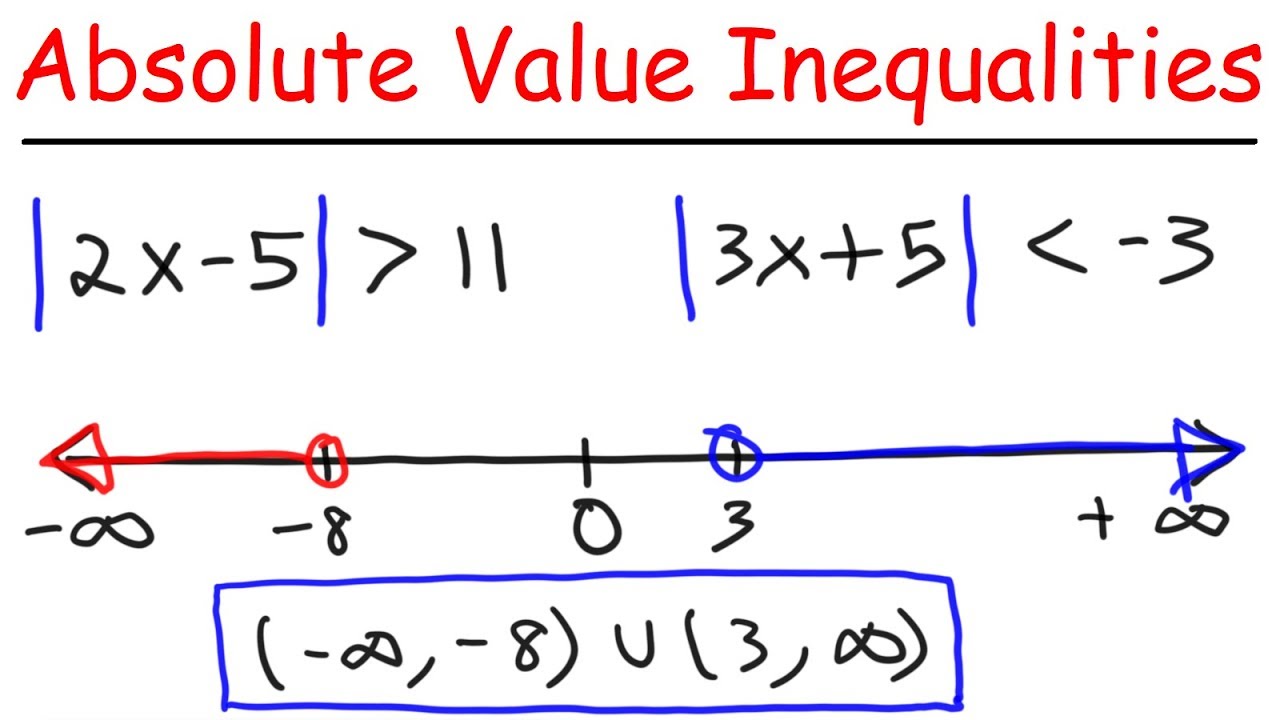
This math video tutorial explains how to solve absolute value inequalities.
Plotting Inequalities on a Number Line: https://www.youtube.com/watch?v=KkiYqww4eg0
How To Solve Linear Inequalities:
https://www.youtube.com/watch?v=rIl2USa8XPY
Solving Absolute Value Inequalities:
https://www.youtube...
midnight plankBOT
@violet whale Has your question been resolved?
midnight plankBOT
Channel closed
Closed due to timeout
Use .reopen if this was a mistake.
Available help channel!
Send your question here to claim the channel.
Remember:
• Ask your math question in a clear, concise manner.
• Show your work, and if possible, explain where you are stuck.
• After 15 minutes, feel free to ping <@&286206848099549185>.
• Type the command .close to free the channel when you're done.
• Be polite and have a nice day!
Read #❓how-to-get-help for further information on how to ask a good question, and about conduct in the question channels.
 drifting mason
 midnight plankBOT
drifting mason
drifting mason
midnight plankBOT
drifting mason
drifting mason
im having a hard time understanding this—why is potential energy being used as the “output force”? The Pe isnt what is making the mass move. I dont get it
the kinetic energy should be 3 Joules, no? Because the kinetic energy = (1/2) * (6 kg) * (1 ms^-1)^2, which is 3 J
additionally, if W = Fs, how do objects that are moving at constant velocity have work??? F = ma and if acceleration is 0, then that would make the W = Fs equation equal 0
additionally, why does the force carrying the plate HAVE to be Fn??? Wouldnt there be an Fa thats parallel to the displacement of the plate????
 midnight plankBOT
@drifting mason Has your question been resolved?
midnight plankBOT
@drifting mason Has your question been resolved?
midnight plankBOT
@drifting mason Has your question been resolved?
 tulip token
drifting mason
additionally, why does the force carrying the plate HAVE to be Fn??? Wouldnt the...
tulip token
drifting mason
additionally, why does the force carrying the plate HAVE to be Fn??? Wouldnt the...
if you carry a plate around at a constant velocity, you will see that there is no horizontal force required to keep it moving
in any case, it's asking about how much is done to support it
tulip token
drifting mason
im having a hard time understanding this—why is potential energy being used as t...
the kinetic energy is already in the mass that's moving vertically; the extra energy added is to the gravitational potential energy of the system
midnight plankBOT
Channel closed
Closed due to timeout
Use .reopen if this was a mistake.
Available help channel!
Send your question here to claim the channel.
Remember:
• Ask your math question in a clear, concise manner.
• Show your work, and if possible, explain where you are stuck.
• After 15 minutes, feel free to ping <@&286206848099549185>.
• Type the command .close to free the channel when you're done.
• Be polite and have a nice day!
Read #❓how-to-get-help for further information on how to ask a good question, and about conduct in the question channels.
wanton shore
Find no. Of terms in the expansion of
(1+x+x⁴)^n
midnight plankBOT
wanton shore
Find no. Of terms in the expansion of
(1+x+x⁴)^n
wary thorn
!status
midnight plankBOT
What step are you on?
1. I don't know where to begin.
2. I have begun but got stuck midway.
3. I got an answer but I was told that it's wrong.
4. I got an answer and would like my work checked.
5. I have a question about someone else's work/solution.
6. I have completed the problem and don't need help anymore. Thank you.
7. None of the above
!show
midnight plankBOT
Show your work, and if possible, explain where you are stuck.
wanton shore
 wary thorn
, rotate
grand pondBOT
 wanton shore
??
 wispy sonnet
lol
midnight plankBOT
@wanton shore Has your question been resolved?
placid spoke
grand pond
gonna be honest I can't read this like at all
placid spoke
wanton shore
I observed the pattern and my answer is
4n-2, n>=2
this is correct, but are you asked to prove it?
wanton shore
placid spoke
this is correct, but are you asked to prove it?
Nah i was just told to give answer by observation
Now that you mention it is there any proof?
placid spoke
you'd use some sort of counting argument, this is a combinatorics kinda problem
or induction if that doesn't work
but it would be a little icky
placid spoke
sure im bored
wanton shore
Induction would work i think
placid spoke
seems correct to me
induction would be hard bc predicting what powers show up for a general case would be super hard
midnight plankBOT
Channel closed
Closed by @wanton shore
Use .reopen if this was a mistake.
Available help channel!
Send your question here to claim the channel.
Remember:
• Ask your math question in a clear, concise manner.
• Show your work, and if possible, explain where you are stuck.
• After 15 minutes, feel free to ping <@&286206848099549185>.
• Type the command .close to free the channel when you're done.
• Be polite and have a nice day!
Read #❓how-to-get-help for further information on how to ask a good question, and about conduct in the question channels.
 tranquil kite
I think I'm supposed to use a hypergeometric probability distribution to solve this. The way I know how to do this requires that we know the number of successes in the population, r. Where I'm stuck is finding r. I can't think of how to get the number of successes in 15 restaurants from the average price, $48.60, and the threshold at which a result is considered a success, $50.
 midnight plankBOT
tranquil kite
I think I'm supposed to use a hypergeometric probability distribution to solve t...
midnight plankBOT
tranquil kite
I think I'm supposed to use a hypergeometric probability distribution to solve t...
@tranquil kite Has your question been resolved?
tranquil kite
<@&286206848099549185>
 mighty flame
i think you have to multiply the chance of each step
so the first restaurant probability that it exceeds 50 is like
1/5 yeah
then after you go to a different restaurant
the chance is 2/14
or wait
tranquil kite
From what my textbook says:
Mean = n(r/N)
So solving for r I do:
u = n(r/N)
u/n = r/N
(u*N)/n = r
But when I plug in the values:
r = (48.6 * 15) / 3
r = 243
I don't think that's possible because the population is only 15.
mighty flame
Ok question is that average cost of $48.60 part of the solution
Like if you're gonna need that value then I'm not gonna be of much help at all
tranquil kite
I assumed we need 48.6 in order to determine r.
midnight plankBOT
@tranquil kite Has your question been resolved?
midnight plankBOT
Channel closed
Closed due to timeout
Use .reopen if this was a mistake.
Available help channel!
Send your question here to claim the channel.
Remember:
• Ask your math question in a clear, concise manner.
• Show your work, and if possible, explain where you are stuck.
• After 15 minutes, feel free to ping <@&286206848099549185>.
• Type the command .close to free the channel when you're done.
• Be polite and have a nice day!
Read #❓how-to-get-help for further information on how to ask a good question, and about conduct in the question channels.
last slate
I need help with some factoring.
 midnight plankBOT
last slate
I need help with some factoring.
slender walrus
midnight plankBOT
last slate
I need help with some factoring.
slender walrus
factor based on the lowest power
last slate
what do you mean by that?
slender walrus
consider how you'd factorise something like
p^5 + 3p^3 + 2p^2
walk me through your thought process
midnight plankBOT
@last slate Has your question been resolved?
midnight plankBOT
Channel closed
Closed due to timeout
Use .reopen if this was a mistake.
Available help channel!
Send your question here to claim the channel.
Remember:
• Ask your math question in a clear, concise manner.
• Show your work, and if possible, explain where you are stuck.
• After 15 minutes, feel free to ping <@&286206848099549185>.
• Type the command .close to free the channel when you're done.
• Be polite and have a nice day!
Read #❓how-to-get-help for further information on how to ask a good question, and about conduct in the question channels.
twilit field
I would like a hint here
 midnight plankBOT
twilit field
I would like a hint here
twilit field
midnight plankBOT
twilit field
I would like a hint here
twilit field
I started by finding the vertices of both the parabolas
the max of f(x) is $1-\frac{b^2}{4}$
grand pondBOT
Why am. I here
 twilit field
and the min of $g(x)=c-1$
grand pondBOT
Why am. I here

 peak walrus
Try equate the two parabolas
2x^2+(2-b)x+c-1
And then I’m pretty sure the solution would be when the discriminant = 0 although haven’t tried it myself
twilit field
hmm, so $-x^2+bx+1=x^2+2x+c$. ?
peak walrus
Lemme try it first actually
grand pondBOT
Why am. I here
 twilit field
and 1-b^2/4=c-1
midnight plankBOT
Channel closed
Closed by @twilit field
Use .reopen if this was a mistake.
midnight plankBOT
Available help channel!
Send your question here to claim the channel.
Remember:
• Ask your math question in a clear, concise manner.
• Show your work, and if possible, explain where you are stuck.
• After 15 minutes, feel free to ping <@&286206848099549185>.
• Type the command .close to free the channel when you're done.
• Be polite and have a nice day!
Read #❓how-to-get-help for further information on how to ask a good question, and about conduct in the question channels.
 mossy nacelle
Does anyone know how to solve for part b? The answer key states there's a second answer where 2cosx + 1 = 0, but I can't figure out how to solve for the equation in any other way where these two don't cancel out.
 midnight plankBOT
mossy nacelle
Does anyone know how to solve for part b? The answer key states there's a second...
midnight plankBOT
mossy nacelle
Does anyone know how to solve for part b? The answer key states there's a second...
 brittle shoal
mossy nacelle
Does anyone know how to solve for part b? The answer key states there's a second...
brittle shoal
mossy nacelle
Does anyone know how to solve for part b? The answer key states there's a second...
it is correct
next you can write 1 as tan45°
and you get the answer for x
mossy nacelle
Yeah, but there's supposed to be two cases
This is the first
The other is 2cosx + 1 = 0
Which I guess would be cosx = -1/2
 fallen galleon
mossy nacelle
Yeah, but there's supposed to be two cases
fallen galleon
mossy nacelle
Yeah, but there's supposed to be two cases
instead of dividing you subtract
brittle shoal
mossy nacelle
Does anyone know how to solve for part b? The answer key states there's a second...
wait you did it wrong
fallen galleon
so have sinx(2cos(x)-1) = cosx(2cos(x)-1)
brittle shoal
cos 2x can be written as $2cos^2x -1$
grand pondBOT
斯韋裡
 brittle shoal
not +1
 azure furnace
mossy nacelle
Does anyone know how to solve for part b? The answer key states there's a second...
azure furnace
mossy nacelle
Does anyone know how to solve for part b? The answer key states there's a second...
Dude there's problem in your both solution 💀
mossy nacelle
Oh, that was the old thing I was trying. I solved for a and I guess I erased that by accident
You factor out sinx and cosx and cancel them out to get tanx = 1, don't you?
fallen galleon
mossy nacelle
You factor out sinx and cosx and cancel them out to get tanx = 1, don't you?
but what if 2cos(x)-1 is 0
you're effectively dividing by 0
azure furnace
mossy nacelle
You factor out sinx and cosx and cancel them out to get tanx = 1, don't you?
Yeah but how did you reach on the result that
both numerator and denominator has 2cosx +1
Cuz the cos2x identity is 2cos^x -1
Not +1
fallen galleon
 mossy nacelle
I'mma redo the math on this rq
azure furnace
fallen galleon
but what if 2cos(x)-1 is 0
If it is so then this problem will become undefined if that soln in the picture is correct
Cuz it'll result in 0/0 form
fallen galleon
mossy nacelle
I'mma redo the math on this rq
no you're correct up to the last part
look at what i wrote on my picture
azure furnace
fallen galleon
no you're correct up to the last part
How???
fallen galleon
azure furnace
How???
you can subtract the RHS from both sides
then since you have a common factor of 2cos(x)-1 you can factor that out too
and you're left with (sinx - cosx)(2cos(x)-1) = 0
and thats where your cases come in
@mossy nacelle ^
azure furnace
fallen galleon
and you're left with (sinx - cosx)(2cos(x)-1) = 0
Ohh yeah you're right
But look at the first step
How is cos2x + cosx = cosx (2cosx +1)
 fallen galleon
azure furnace
Ohh yeah you're right
But look at the first step
How is cos2x + cosx = cosx (2co...
fallen galleon
azure furnace
Ohh yeah you're right
But look at the first step
How is cos2x + cosx = cosx (2co...
ur missing the +1
cos(2x) + cos(x) + 1
fallen galleon
mossy nacelle
yes the proof is correct
and then for part b instead of cancelling them out you factor them like i said before