#🔒 Python assignment help
86 messages · Page 1 of 1 (latest)
 desert peakBOT
@eternal knot
 Python help channel opened
Remember to:
- Ask your Python question, not if you can ask or if there's an expert who can help.
- Show a code sample as text (rather than a screenshot) and the error message, if you've got one.
- Explain what you expect to happen and what actually happens.
:warning: Do not pip install anything that isn't related to your question, especially if asked to over DMs.
Closes after a period of inactivity, or when you send !close.
 eternal knot
Need help with homework assignment
desert peakBOT
eternal knot
it says code is too long
 dreamy iris
Read the bot message
eternal knot
dreamy iris
play = [[0, 0, 0]] * 7
This is a problem
You'll have the same list seven times. So changes to one "row" will appear in all rows
Because they're the same list
eternal knot
what should i do about that?
i was provided a starter file and this was already included in that starter file
dreamy iris
eternal knot
i was provided a starter file and this was already included in that starter file
Who made the starter file?
dreamy iris
eternal knot
my professor
I would see if you can disenroll and get your money back
In the meantime, you'd use a list comprehension to make sure that each sub-list is a separate object
!listcomp
desert peakBOT
List comprehensions
Do you ever find yourself writing something like this?
>>> squares = []
>>> for n in range(5):
...    squares.append(n ** 2)
[0, 1, 4, 9, 16]
Using list comprehensions can make this both shorter and more readable. As a list comprehension, the same code would look like this:
>>> [n ** 2 for n in range(5)]
[0, 1, 4, 9, 16]
List comprehensions also get an if clause:
>>> [n ** 2 for n in range(5) if n % 2 == 0]
[0, 4, 16]
For more info, see this pythonforbeginners.com post.
eternal knot
so i would use listcomp with play = [[0, 0, 0]] * 7
 cursive mica
eternal knot
so i would use listcomp with play = [[0, 0, 0]] * 7
cursive mica
eternal knot
so i would use listcomp with play = [[0, 0, 0]] * 7
The list comprehension would replace that.
eternal knot
is this better?
# Declare a 7 row by 3 column list
column = 3
row = 7
play = [[int() for _ in range(column)] for _ in range(row)]
or this for more condensed play = [[int() for _ in range(3)] for _ in range(7)]
 tall summit
!code
desert peakBOT
eternal knot
play = [[int() for in range(3)] for in range(7)]
I see that you copy-pasted by highlighting your text 😄
some characters have special meaning for formatting in Markdown, which discord employs
italics for example
that word is surrounded by *
cursive mica
I'd personally write 0 instead of int(). And I'd probably not use a list comprehension for the 3-element inner list. But ya.
tall summit
tall summit
I see that you copy-pasted by highlighting your text 😄
you can right click and copy text option if you need to copy the raw text of a message
eternal knot
ok
cursive mica
Ya, you can't mutate a number, so it doesn't matter if you have multiple references to the same number.
eternal knot
this is a program for the 21 card trick do i want to the values in list to be immutable
cursive mica
Numbers are just inherently immutable. If you want a list of numbers, the mutability isn't your main concern. The fact that they're immutable makes them "safer" in some circumstances though.
eternal knot
ok
so i changed the line deal(deck) to deal(deck,play) and that fix one error i was having
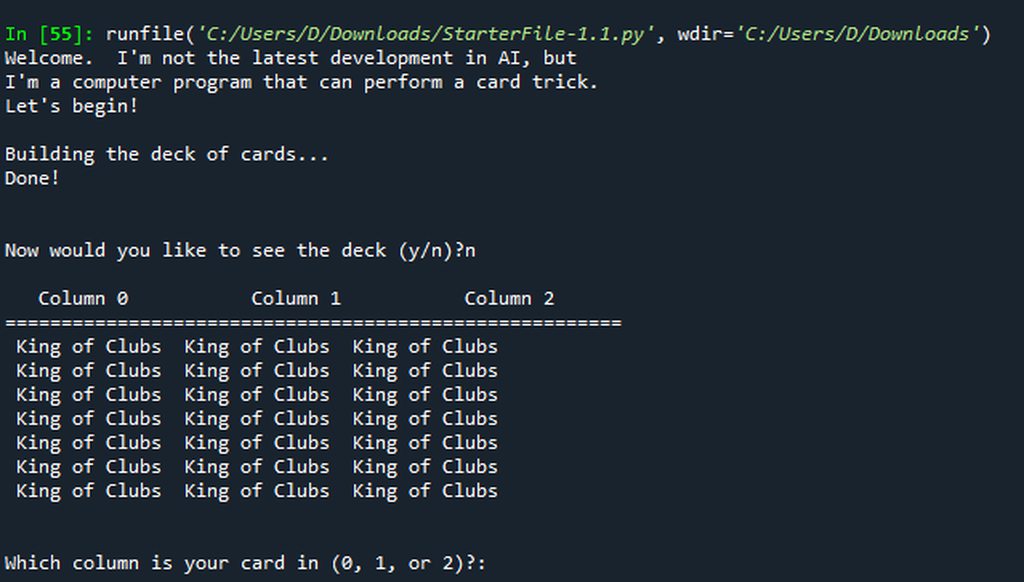
i can finally see the 3 columns now but it's all the same card atm
https://paste.pythondiscord.com/ARRQ so i think i got most of it working now
just not printing the cards right
https://imgur.com/a/SvXzNv4
 cursive mica
What's wrong?
eternal knot
each card is supposed to be a different card
then the program is supposed to pick up the cards and then use those same cards and put them in each column
cursive mica
Notice how BuildDeck doesn't use the deck parameter. That function does some work then throws away everything it does.
So you create deck via deck = [0] * 52, then it doesn't change after that.
Then that deck full of only 0s is passed into Deal.
eternal knot
i see what you mean
i was trying to make BuildDeck
build a deck of 52 cards in random order but for some reason it's not working
cursive mica
You want a list full of unique numbers in random order?
eternal knot
yeah from 1 to 52
cursive mica
Just use random.shuffle.
eternal knot
or 0 or 51
cursive mica
!e
import random
cards = list(range(52))
random.shuffle(cards)
print(cards)
@cursive mica :white_check_mark: Your 3.12 eval job has completed with return code 0.
[36, 10, 21, 6, 41, 22, 48, 18, 29, 16, 9, 11, 42, 38, 17, 12, 2, 37, 28, 7, 8, 39, 3, 31, 51, 34, 23, 44, 32, 27, 4, 30, 0, 13, 35, 20, 24, 47, 50, 1, 45, 25, 43, 15, 49, 33, 26, 40, 5, 19, 14, 46]
That's 0-51 inclusive.
eternal knot
would i use deck = list(range(52))?
cursive mica
Well, that's a very easy to create a list with the numbers 0-51. That's what'd I'd use unless they're forcing you to do something different.
eternal knot
i think it'll work as long as put it into the BuildDeck function
cursive mica
That won't work with how your code currently is, where deck is passed in. You'd need to return the list of numbers from BuildDeck.
Wow, there's not a single return in that code. Have you learned about return?
eternal knot
i don't remember how it works tho
cursive mica
!return
desert peakBOT
Return statement
A value created inside a function can't be used outside of it unless you return it.
Consider the following function:
def square(n):
    return n * n
If we wanted to store 5 squared in a variable called x, we would do:
x = square(5). x would now equal 25.
Common Mistakes
>>> def square(n):
...     n * n  # calculates then throws away, returns None
...
>>> x = square(5)
>>> print(x)
None
>>> def square(n):
...     print(n * n)  # calculates and prints, then throws away and returns None
...
>>> x = square(5)
25
>>> print(x)
None
Things to note
print()andreturndo not accomplish the same thing.print()will show the value, and then it will be gone.- A function will return
Noneif it ends without areturnstatement. - When you want to print a value from a function, it's best to return the value and print the function call instead, like
print(square(5)).
cursive mica
!e
def build_deck():
    deck = list(range(52))
    return deck
d = build_deck()
print(d)
@cursive mica :white_check_mark: Your 3.12 eval job has completed with return code 0.
[0, 1, 2, 3, 4, 5, 6, 7, 8, 9, 10, 11, 12, 13, 14, 15, 16, 17, 18, 19, 20, 21, 22, 23, 24, 25, 26, 27, 28, 29, 30, 31, 32, 33, 34, 35, 36, 37, 38, 39, 40, 41, 42, 43, 44, 45, 46, 47, 48, 49, 50, 51]
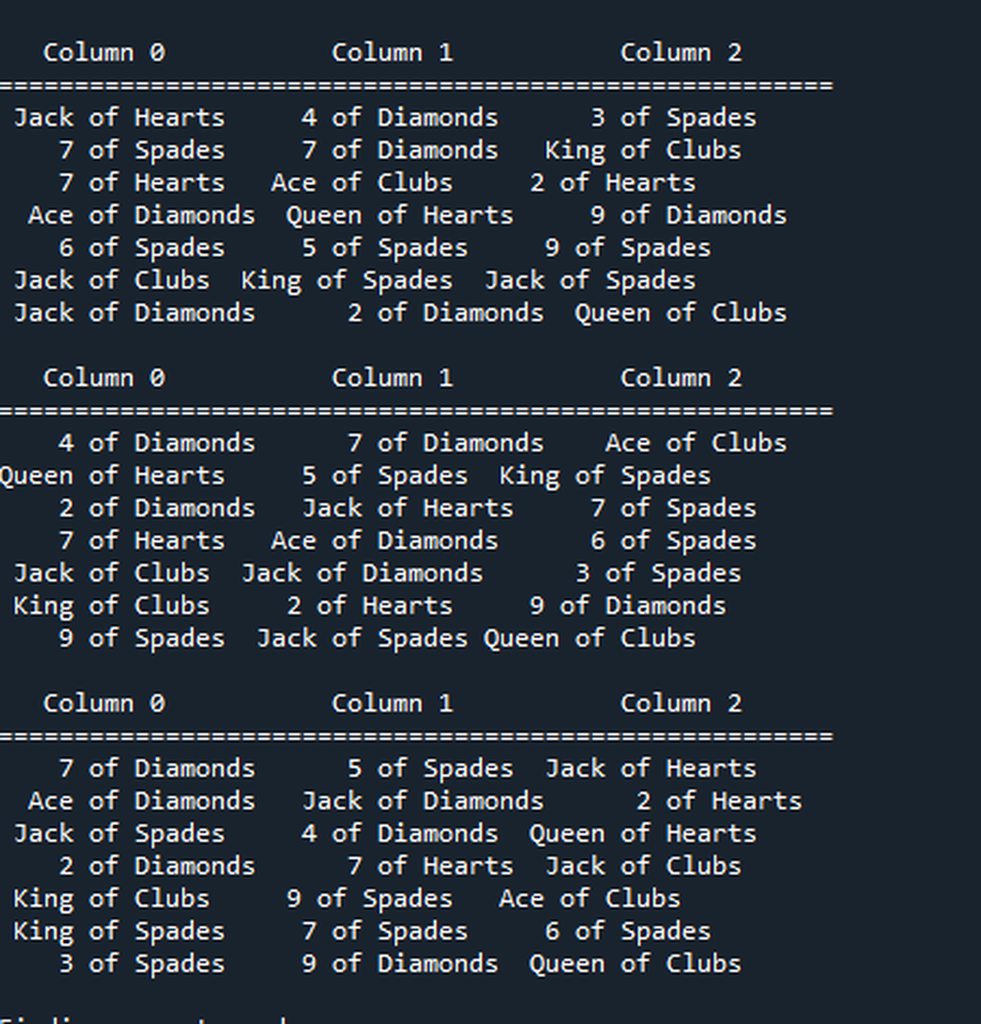
Then maybe also add a shuffle call in there if you also want that function to produce the deck as shuffled.
 cursive mica
That looks better
eternal knot
not sure why the last card is always the same card
column 2 row 7 is always the same
maybe my PickUp() is not correct
i messed up one number in my PickUp() but it's working now
but the last card is always the same card for some reason
desert peakBOT
 Python help channel closed
This help channel has been closed and it's no longer possible to send messages here. If your question wasn't answered, feel free to create a new post in #1035199133436354600. To maximize your chances of getting a response, check out this guide on asking good questions.