#AoC 2022 | Day 12 | Solutions & Spoilers
1320 messages · Page 2 of 2 (latest)
 knotty vale
 candid vortex
I can't see your response in my client

be my test subject for a bit while I debug, I'll delete the posts I make as i go
knotty vale
ok
candid vortex
ok apparently the client setup I had just broke, maybe using a different electron version just broke stuff
 placid quail
how's it going?
 placid quail
ah
ok
so
that is because
it gets to the end
before that thing finishes
so if you replace the while loop with a for loop and do it 1000 times it's normal
 merry scarab
there's probably better than run dijkstra for each 'a' elevation right ?
 balmy bramble
Didn't really bother doing a more efficient thing for P2, was fast enough just iterating all possibilites:
from common import *

with open(infile('12.txt'), 'r') as f:
    text = f.read().strip()

grid, *_ = parse_block_grid(text, str)
grid = grid_to_dict(grid)

start = next((i, j) for i, j in grid if grid[i, j] == 'S')
end = next((i, j) for i, j in grid if grid[i, j] == 'E')

def dist_to_end(begin):
    d = deque()
    d.append((begin, 0))
    visited = set()
    while d:
        cur, ln = d.popleft()
        if cur in visited:
            continue
        if cur == end:
            return ln
        visited.add(cur)
        for nxt in neighbours(*cur):
            if nxt in grid:
                if grid[cur] == 'S' or ord(grid[nxt]) <= ord(grid[cur]) + 1:
                    d.append((nxt, ln+1))
    return float('inf')

def part1():
    return dist_to_end(start)

def part2():
    return min(dist_to_end(v) for v in grid if grid[v] == 'a')

print("Part 1:", part1())
print("Part 2:", part2())
@balmy bramblecould you define "fast enough"
balmy bramble
 merry scarab
this doesn't look like dijkstra
balmy bramble
yes, in unweighted graph first path from BFS is shortest
- kind of the point of a breadth first search 😅
all dijkstras does is emulate BFS but with the definition of "breadth" adjusted w.r.t weights
balmy bramble
merry scarab
an idiot with a working djikstra algo, but still
at least you can implement dijkstras
merry scarab
yeah, took me a lot of time for a mediocre result
T_T
I guess I've learn something at the very least
balmy bramble
the smarter thing here would be to do BFS starting at E and record the distance to every other node, then this becomes pretty fast, but I couldn't be bothered reorganizing code
just one pass that way
 tacit forge
balmy bramble
the smarter thing here would be to do BFS starting at E and record the distance ...
tacit forge
balmy bramble
the smarter thing here would be to do BFS starting at E and record the distance ...
I've also learnt that you can do it with one pass starting from the a's. You set the distance for all the a's to 0 and add them all to the queue at the start
doing it that way I didn't even have to reorganise the way adjacent nodes are calculated
 scenic bay
balmy bramble
the smarter thing here would be to do BFS starting at E and record the distance ...
scenic bay
balmy bramble
the smarter thing here would be to do BFS starting at E and record the distance ...
me either, I literally just reran the bfs for each start an took the min, didn't even bother passing multiple starts to one bfs run. too lazy 🙂
balmy bramble
scenic bay
me either, I literally just reran the bfs for each start an took the min, didn't...
yep, < 3s is whatever
candid vortex
it would have been nice if the input was bigger to actually force people to be a bit more clever for p2
balmy bramble
yeah It would have been nice to actually reverse the BFS direction, but I guess having too many as would make part 1 trivial because of too many paths
candid vortex
another missed opportunity for teaching a worthwhile lesson
candid vortex
balmy bramble
yeah It would have been nice to actually reverse the BFS direction, but I guess ...
or one bfs with all 'a's as starting points
scenic bay
balmy bramble
yep, < 3s is whatever
I should put a timer on it. One secx.
On a slow laptop, but it's basically instant
 novel plume
3.5s / 2.5s ☺️
balmy bramble
novel plume
3.5s / 2.5s ☺️
is this the time for your parts?
novel plume
yes. soo fast. 😅
candid vortex
2.5s?
scenic bay
balmy bramble
is this the time for your parts?
start: 0.000001
setup: 0.019665
part1: 412
part1 total: 0.011642
part2: 402
part2 total: 0.987779
nice
candid vortex
~250us on my side, but I'm cheating by not using python 😛
scenic bay
balmy bramble
nice
print('part1:', bfs(start,end))
print(f'part1 total: {perf_counter()-t1:0.6f}');t1 = perf_counter()
print('part2:', min(filter(None,(bfs(start,end) for start in heatmap if heatmap[start]==ord('a')))))
print(f'part2 total: {perf_counter()-t1:0.6f}')
look at that hacky part2. It's just that it's fast enough not to worry about making it better.
candid vortex
candid vortex
~250us on my side, but I'm cheating by not using python 😛
(and only 2 bfs)
balmy bramble
why not just use a generator expression instead of doing a filter
candid vortex
I've realized we have different thresholds for fast enough 😛
balmy bramble
wouldn't that be faster
candid vortex
I try to keep under 1ms per day if possible
balmy bramble
candid vortex
I try to keep under 1ms per day if possible
Don't make me impolement this in aecor to fight you
candid vortex
(and 1s across all days, which was my target last year)
balmy bramble
I did everything in C last year
some of the days got... really annoying
GitHub
Advent of Code solutions for 2021. Contribute to mustafaquraish/aoc-2021 development by creating an account on GitHub.
candid vortex
I learned rust from scratch during AoC last year
balmy bramble
rust or scratch?
candid vortex
(and managed a total sum of times of <0.5s)
 gloomy basin
c sounds like a pain for aoc
candid vortex
sounds kinda fun
candid vortex
balmy bramble
rust or scratch?
oh god, doing this in scratch would have been something...
what task so far actually require something fancy?
rather than just arrays or similar
scenic bay
Ok, so I tried passing all the starts and runing one bfs:
start: 0.000001
setup: 0.019679
part1: 412
part1 total: 0.010674
part2: 402
part2 total: 0.010168
so about 90 times faster.
candid vortex
helped a bit 🙂
scenic bay
but 0.90s vs 0.01s is not that much of difference in raw value. 🙂
candid vortex
(Eric is too kind to people with his input sizes)
scenic bay
*sometimes.
candid vortex
most of the time
scenic bay
This one felt right. If you did it wrong, it was impossible and would never complete, if you did it right, it was not bad at all.
candid vortex
(I would argue your bfs from all points isn't "right")
(but I'm pretentious about algos like that)
as said I think it's a missed opportunity to teach a nice lesson
about one to many bfs
scenic bay
it's only day 12, the lessons come next weekend. 🙂
candid vortex
similar for the range problem we had that was easily bruteforcable
when there are nice lessons about interval math in there
I liked yesterday, it actually made me have to be creative to hit my time goals 😛
since running all 10000 iterations turned out too slow
"oh hey, you got stuck in a cycle, I can stop here and exploit this"
merry scarab
takes 4sec with n bfs instead of 20-30 with n djikstra
 brisk ginkgo
I'm starting to think I got lucky with my Part 2... I stop looking after hitting the first a, but I've seen mention of people checking multiple paths :/
 vast helm
if you're doing a breadth first, then the finding the first "a" sounds right
 modest glacier
Or keep searching until you find the start to do both parts at once
scenic bay
merry scarab
takes 4sec with n bfs instead of 20-30 with n djikstra
There might be room for optimization in there. 4 seconds sounds like a long time.
merry scarab
@scenic bay that's because my bfs and dijkstra expect a fixed origin and destination
instead of looking for the first 'a' char
 winged zodiac
4 seconds sounds really bad though
merry scarab
that's the next step I guess
well times 1 bfs * number of 'a' nodes
656 bfs to be precise
scenic bay
merry scarab
<@255074198559391744> that's because my bfs and dijkstra expect a fixed origin a...
I did a min of a bfs for every start to the end, and it ran in under a second. When I rewrote it to do 1 bfs it was 0.01 seconds. so a lot faster, but even the terrible slow way was still pretty fast.
scenic bay
winged zodiac
4 seconds sounds really bad though
"really bad" sounds a touch harsh, we're not all at the same experience level with these sorts of problems.
brisk ginkgo
Here we go:
def traverse_terrain(terrain: Terrain, source: Point, dest: Point, asc: bool = True) -> int:
    """Traverse a terrain.

    Can either go from low elevation to high (asc is True, default) or from
    high elevation to low (asc is False).

    Parameters
    ----------
    terrain : Terrain
        The terrain to traverse
    source : Point
        Source point
    dest : Point
        destination point, ignored if asc = False
    asc : bool, optional
        ascending (low to high) or not, by default True

    Returns
    -------
    int
        Number of steps to reach the destination.
    """
    visited: list[Point] = [source]
    heap: list[tuple[int, int, int]] = [(0,) + source]

    destination = dest if asc else "a"

    while heap:
        steps, y, x = heapq.heappop(heap)

        if (y, x) == destination or terrain[y][x] == destination:
            return steps

        for ox, oy in ((0, -1), (1, 0), (0, 1), (-1, 0)):
            dx = x + ox
            dy = y + oy

            if (dy, dx) in visited or not in_bounds(terrain, dx, dy):
                continue

            current_elevation = ord(terrain[y][x]) - 97
            next_elevation = ord(terrain[dy][dx]) - 97
            delta_elevation = next_elevation - current_elevation

            if not asc:
                delta_elevation *= -1

            if delta_elevation <= 1:
                heapq.heappush(heap, (steps + 1, dy, dx))
                visited.append((dy, dx))

    return 0
S and E are converted to a and z in terrain before being passed into this function. Their coords are held in start and dest. This function handles ascending and descending with the asc flag.
scenic bay
brisk ginkgo
Here we go:
```py
def traverse_terrain(terrain: Terrain, source: Point, dest: P...
does this follow the assumption that every step can only go up, and there are no down steps?
tacit forge
balmy bramble
yeah It would have been nice to actually reverse the BFS direction, but I guess ...
why would too many paths make it trivial? no matter the number of paths there would only be one that's the shortest
winged zodiac
scenic bay
"really bad" sounds a touch harsh, we're not all at the same experience level wi...
sure ig. the data is really not that big though
balmy bramble
merry scarab
takes 4sec with n bfs instead of 20-30 with n djikstra
ca probably still optimize it more
merry scarab
well seems like vs doesn't want to let me use the profiler with a cmake project so this is where I stop for tonight
tyvm for pointing out my mistakes
scenic bay
brisk ginkgo
no
ah I get it. any descent would also be <= 1 by default.
brisk ginkgo
Yeah I flip the sign on descent
scenic bay
no I mean while ascending you can go from r to s, or from r to c max 1 up, or unlimited down
and vice versa if going from z to a
scenic bay
There we go, fast enough for me.
start: 0.000
setup: 0.019
part1: 412
part1 total: 0.010
part2: 402
part2 total: 0.013
My old machines is disassembled currently, I don't have any of my old code. =/
Would have come in handy.
brisk ginkgo
I ought to take notes of what each day's puzzle is. Might help me in future.
I got lucky this time that I remembered a vaguely similar puzzle
candid vortex
my rust code is kinda boring, but short for being rust I guess
fn bfs(input: &[Vec<u8>], starts: Vec<Pt>, target: Pt) -> AocResult<i32> {
  let mut queue = VecDeque::new();
  queue.extend(starts.into_iter().map(|pt| (0, pt, b'a')));

  let mut visited = vec![vec![false; input[0].len()]; input.len()];

  while let Some(v) = queue.pop_front() {
    let (dist, cur, h) = v;

    for (dx, dy) in [(-1, 0), (1, 0), (0, -1), (0, 1)] {
      let p = Pt::new(cur.x + dx, cur.y + dy);
      // In range?
      if let Some(new_h) = input
        .get(p.y as usize)
        .and_then(|row| row.get(p.x as usize))
      {
        // Valid height?
        if h >= new_h - 1 {
          // At target?
          if p == target {
            return Ok(dist + 1);
          }
          // Not previously visited?
          if !visited[p.y as usize][p.x as usize] {
            visited[p.y as usize][p.x as usize] = true;
            queue.push_back((dist + 1, p, *new_h));
          }
        }
      }
    }
  }

  aoc_error("No answer found")
}
Pt is point?
candid vortex
(well, of course this isn't the whole code, but the parsing isn't interesting, and neither is the code that calls this for part 1 and 2)
right, just a dumb struct containing an x and an y
balmy bramble
I optimized my code to run in 0.4 seconds from 2.6 seconds
I only had to change one line
python3 12.py
to
pypy3 12.py
why the multiple starts?
why not jsut do one BFS starting from E
would probably be faster no?
candid vortex
balmy bramble
why the multiple starts?
this is the function I use for both parts
candid vortex
for part 1 I pass the S, for part 2 I pass all the a's
balmy bramble
you will get distance to S for free
if you keep going
if you don't exit early BFS will give you shortest path from one node to every other node in the graph
that way you only need one bfs for both parts togteher
candid vortex
you could do that, but idk if making the code messier to shave a bit of time off is worth it
I'm already way under my target time
balmy bramble
don't think it woiuld be messier?
can you give me your full rust code I'll try do it
merry scarab
ok I've found my weakness
I just went from debug -> release
it's all good now lol
candid vortex
you could probably get it closer to mid 100us
balmy bramble
candid vortex
<https://github.com/algmyr/aoc-2022/blob/master/src/solutions/day12.rs>
just for sake of curiosity at this point, probably won't be a performance benefit
brisk ginkgo
Anyone recommend a decent benchmarking lib? Timeit is an utter pain to work with the way i set up my AoC days
 merry scarab
~400ms for the ~600 bfs
merry scarab
@brisk ginkgo I like line_profiler but it's more a profiler than a benchmark per say.
candid vortex
balmy bramble
ah too much work to pukll it out, I give up
you could just compile the whole crate
and run with the input file as a command line arg
it's currently set up to run day 12 like that
(and you can pass an integer after the file name for number of times to run and time)
e.g. this to take time across 1000 runs
> cargo run --release -- inputs/12input 1000
My part 2, including parsing:
0.6427856066991808
 spice ocean
This was my solution for today: https://paste.pythondiscord.com/isosozufuk.py
spice ocean
brisk ginkgo
Anyone recommend a decent benchmarking lib? Timeit is an utter pain to work with...
I just do time ... in Bash 
Works well enough for me ¯_(ツ)_/¯
Although I write my solutions so that the problem gets piped into standard input.
So to time my code, I do: ```bash
time cat input | python solution.py
If I want to try an example, I do ```bash
cat example | python solution.py
looks clean

python solution.py < example
Ah yeah that would also work
candid vortex
using cat and a pipe for this is a bit of an anti-pattern
spice ocean
Not sure why I never thought to do it that way
 latent kindle
I just run it in notebooks and get the time of each cell.
spice ocean
candid vortex
using cat and a pipe for this is a bit of an anti-pattern
Will people think I'm crazy if I do ```bash
<input python solution.py
In my mind, the data has to flow from left to right 😄
latent kindle
Add click and take an arg in your script?
candid vortex
spice ocean
Will people think I'm crazy if I do ```bash
<input python solution.py
```?
that's fine, though I probably wouldn't write it like that
redirecting from file is generally better for performance than doing the cat pipe dance
you give the program access to the file directly that way
rather than streaming things over a pipe
spice ocean
Right ic
 lime osprey
for part1 just BFS and then return the first to reach end?
bcs the first to reach end should also be the shortest
spice ocean
 runic finch
🤣 where did i most likely fed up
runic finch
🤣 where did i most likely fed up
Maybe you're considering paths with cycles?
The shortest path will never contain a cycle, so if you're doing a breadth-first-search, you don't need to consider re-visiting any locations you've already visited along the current path.
runic finch
spice ocean
The shortest path will never contain a cycle, so if you're doing a breadth-first...
i dont know what breadth first search is
how likely is it that i implemented that?
:S
runic finch
!paste
spice ocean
@runic finch This site has a really nice introduction to searching algorithms: https://www.redblobgames.com/pathfinding/a-star/introduction.html
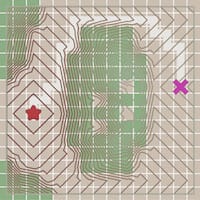
Interactive tutorial for A*, Dijkstra's Algorithm, and other pathfinding algorithms
runic finch
i just did start with 0 on S
and then all neighbors reachable +1
and all the ones visited i put in checked
and then i added new neighbors
checked again etc.
runic finch
spice ocean
How have you implemented it? Can I see?
if u have questions, feel free to ask. + ty for looking
spice ocean
Does it return the right answer?
runic finch
yep i get part 1 correct
but it takes 30 seconds
so in part 2 checking all "a" which are like ~1000 i think
i dont want to torture my CPU
spice ocean
You might be able to simplify your code a bit. What does coords2check do?
runic finch
it adds coordinates to unchecked-set
spice ocean
Oh right. Which coordinates get added?
runic finch
assuming a grid 9x9 for example
when the S is at arr[4][0]

like here
in the first iteration it would get

those green ones
in the next

the blue ones
spice ocean
Oh. Are you sure this will work? For example what if the path goes out and back again?
I think there might be a function missing from the code you provided @runic finch Where is cleaner? And also, what is state.
 tight kraken
realizing now that making a graph of all nodes and using Dijkstra was probably overcomplicating it, this was practically made for A*
Also spent WAY too long pulling my hair out cause I missed reading that you could go down more than one level
runic finch
spice ocean
Oh. Are you sure this will work? For example what if the path goes out and back ...
i have two different sets unchecked and checked.
even if one does not get checked immedietely it remains in unchecked for later checking ig
runic finch
spice ocean
I think there might be a function missing from the code you provided <@240512720...
state = True
and cleaner is not working u can just delete it 
 manic gyro
very rare you would ever have such a large grid
and if the grid is that large I'd probably use numpy
runic finch
spice ocean
Oh. Are you sure this will work? For example what if the path goes out and back ...
i thought its maybe the nested for loop in check_neighbor
but i also cannot see how i would do it without it
spice ocean
runic finch
i thought its maybe the nested for loop in check_neighbor
Oh yeah. For every node in unchecked, you are comparing it against every node in checked, rather than generating the (up to four) neighbours of the node.
If you had a function neighbors(node), then you could do: ```py
for candidate in unchecked:
for neighbor in neighbors(candidate):
...
You'll need to check that the neighbor is a valid location on the map. But other than that, your code will be mostly unchanged.
spice ocean
I'll show you. One sec.
@runic finch I made a few small changes to your code: https://paste.pythondiscord.com/alitozepov.py
- I deleted
coords2checkand replaced it with a set comprehension. This shouldn't affect the efficiency. - I created a
neighborsfunction, and used it incheck_neighbor, as I described above. This is what will have had the biggest effect on the efficiency. - I put the main part of your code in a
main()function, and I have it reading the input fromstdin, to make it easier for me to test different inputs.
Change the main function back to read from a file if that's more convenient for you.
But now it runs quite quickly actually: about 1.2 seconds for my input.
And yes, I think you have essentially implemented breadth-first search.
runic finch
i will try to implement your ideas before i look at it
spice ocean
Do you understand the changes I've made?
spice ocean
runic finch
i will try to implement your ideas before i look at it
Ah right ok.
runic finch
yes
whats different from this to the A* , djistara(?) things
are they just more performant?
spice ocean
Erm, Dijkstra's algorithm (a.k.a. uniform cost search) is slightly more general than breath-first search. It allows you to find the minimum cost path on graphs where the cost of moving between two nodes isn't necessarily constant.
A* search is like Dijkstras, but with an AI element. It uses a "heuristic" (kind of like an estimate of the distance to the goal) to guide it towards the goal.
runic finch
spice ocean
Erm, Dijkstra's algorithm (a.k.a. uniform cost search) is slightly more general ...
i see. they are explained on your link. ill look at it after i hopefully fixed the problem on my own. if not i take your code (but thats kind of illegal)
ty!
 balmy hedge
part 1 took me like 6 hours to do, but now i can honestly say I have Successfully Implemented Djikstra's Algorithm. An accomplishment approximately 12 years in the making lol (I tried to do it back in uni for some reason but gave up after awhile)
now lets see if I can pull off part 2... I think just flipping the direction would work and stopping as soon as I find a tile with height 'a'. I might need another beer first lol
knotty vale
Sounds like you are on the right path.
balmy hedge
about the algorithm or the beer :p
knotty vale
both!
balmy hedge
correct!
manic gyro
balmy hedge
now lets see if I can pull off part 2... I think just flipping the direction wou...
backwards gang lets go
balmy hedge
i considered going backwards from the beginning, but i had more trouble visualizing things that way :p. I also considered a sort of double-ended solution where i take turns searching from the end and the start, but decided that was too complicated and probably wouldn't be much faster anyways
knotty vale
start = "E" end = "a"
balmy hedge
alternatively, I could write a script to just attempt submitting every number under my part 1 solution, decrementing by 1 every minute until it's correct. The answer has to be less than part 1's solution, and probably not by much.
Maybe I should race that lol
knotty vale
That would only take a few minutes using the data I was provided.
balmy hedge
so what im hearing is that's the optimal solution 🤣
part 1: fancy named graph theory algorithm. part 2: BRUTE FORCE bayBEEE
winged zodiac
balmy hedge
alternatively, I could write a script to just attempt submitting every number un...
it slows you down eventually
balmy hedge
true, and making a script for that would take longer anyway :p
balmy bramble
Did you do Dijkstra's with the priority queue and everything?
That's not quite needed for today's solution, though it probably will later in AoC
knotty vale
It was the first thing I thought of. Just used heapq for it.
winged zodiac
why though
knotty vale
When I think of path finding, my limited experience says Dijkstra or A*.
I know how those work and how to implement them.
winged zodiac
why not just bfs though
knotty vale
I never went to school for this stuff. I'm not sure what bfs is.
breadth first search or something?
Is the only difference the priority queue?
winged zodiac
basically. also you keep track of distances
 distant palm
balmy hedge
alternatively, I could write a script to just attempt submitting every number un...
distant palm
balmy hedge
alternatively, I could write a script to just attempt submitting every number un...
Not sure that your assumption here is true
Also the ratelimit is exponential I think
1, 1, 5, 10 IIRC
balmy hedge
distant palm
Not sure that your assumption here is true
ah fair, I only ever had to resub a couple times before. I was joking around anyway, The whole point is to solve the problems with programming!
distant palm
Not but like also I'm not convinced that p1 is guaranteed to be more than the shortest path
I wouldn't be entirely surprised is someone had p1 == shortest
balmy hedge
less than or equal to then. offbyones everywhere
winged zodiac
also the instructions say something along the lines of "consider the level of S to be a", but does that mean reaching "S" counts as an "a"?
knotty vale
Hmm... I'm not actually sure what algo I used then... here is my code:```py
Day 12: Hill Climbing Algorithm
https://adventofcode.com/2022/day/12
from heapq import heappop, heappush
def shortest_path(grid, start, ends, direction):
# This function returns the shortest path in the grid
# from the start point to one of the ends.
next_node = []
visited = set()
heappush(next_node, (0, start))
# Loop until we hit an end.
while True:
steps, (x, y) = heappop(next_node)
if (x, y) in visited:
continue
if (x, y) in ends:
return steps
visited.add((x, y))
for nx, ny in ((x - 1, y), (x + 1, y), (x, y - 1), (x, y + 1)):
if 0 <= ny < len(grid):
if 0 <= nx < len(grid[ny]):
if (ord(grid[ny][nx]) - ord(grid[y][x])) * direction <= 1:
heappush(next_node, (steps + 1, (nx, ny)))
Parse the puzzle input file.
with open("advent_of_code\2022\day12.txt") as puzzle_input:
height_map = [list(row) for row in puzzle_input.read().splitlines()]
# Set the start and end positions.
# Part 1, S is the start and E is the end.
# Part 2, E is the start and any position that contains an "a" is the end.
starts = [None, None]
ends = [set(), set()]
for y, line in enumerate(height_map):
for x, height in enumerate(line):
if height == "S":
height_map[y][x] = "a"
starts[0] = (x, y)
if height == "E":
height_map[y][x] = "z"
starts[1] = (x, y)
ends[0].add((x, y))
if height_map[y][x] == "a":
ends[1].add((x, y))
Part one.
print(shortest_path(height_map, starts[0], ends[0], 1))
Part two.
print(shortest_path(height_map, starts[1], ends[1], -1))
Yes, S is an a
distant palm
knotty vale
Hmm... I'm not actually sure what algo I used then... here is my code:```py
# Da...
BFS/Dijkstra's
They're actually the same when the cost is 1
knotty vale
That's basically the only one I know.
distant palm
There's also A* where the priority is (cost so far + heuristic underestimating the distance to the goal)
knotty vale
Oh, yeah, I know about that one. I felt like what I coded was fast enough, so I didn't add heuristics.
distant palm
I wrote what I thought was A* then realised it didn't work so it was just Dijkstra's/BFS lol
But it's fine because it solved the puzzle
balmy hedge
WOO got it in right under the wire
candid vortex
a well implemented bfs in python would take like 0.01s on this size of input
runic finch
spice ocean
Ah right ok.
i made it btw. it ran in 0,1 seconds and i just bruteforced the second part with it 🥹 . ty again for the help
 glossy matrix
are we to assume E has an elevation value of z?
manic gyro
it says in the brief
runic finch
glossy matrix
are we to assume E has an elevation value of z?
and the location that should get the best signal (E) has elevation z.
glossy matrix
ah, right, my bad
 balmy canopy
we can just do bfs right with weghts = 1
spice ocean
runic finch
i made it btw. it ran in 0,1 seconds and i just bruteforced the second part with...
No probs 👍
spice ocean
balmy canopy
we can just do bfs right with weghts = 1
Maybe 👀
candid vortex
moving here because spoilers
@ivory glen what do you think applies if I looked at only 5?
wait
wrong day
 quick drum
 midnight surge
My code works with example but not with the input
placid quail
same bro