#AoC 2022 | Day 7 | Solutions & Spoilers
1 messages · Page 2 of 1
 queen breach
 last flower
Does it work? That would make s and d reference the same list
queen breach
yeah, it somehow works
and i have no idea why
my best guess is that one of them is reassigned somewhere
 inner ingot
you also reassign it again on line 4, so maybe you got lucky
last flower
I think i just got stuck in an infinite loop for my input
nvm, you're using stdin for input
queen breach
inner ingot
you also reassign it again on line 4, so maybe you got lucky
got lucky
nothing < 10k before my first cd ..
inner ingot
queen breach
nothing < 10k before my first cd ..
lol
queen breach
 high bane
`min(_ for _ in d if _>sum(s)-4e7)`
`min(filter((sum(s)-4e7).__gt__,d)`
😔
high bane
`min(_ for _ in d if _>sum(s)-4e7)`
`min(filter((sum(s)-4e7).__gt__,d)`
😔
your filter thing is missing )
or rather, your min is missing that
high bane
rip
 viscid sail
it does work
 rancid heath
viscid sail
it does work
rancid heath
viscid sail
it does work
Maybe it's input-dependent
viscid sail
rancid heath
Maybe it's input-dependent
check yours. I doubt that may be case
 royal axle
absolute trash
queen breach
it's input dependent
royal axle
i put all paths in string form /abc/def/ghi/.../ and than build with that a dict
queen breach
and i think it's plausible that there's an input which doesn't work
royal axle
royal axle
i put all paths in string form `/abc/def/ghi/.../` and than build with that a di...
the rest was pretty much ok
rancid heath
viscid sail
check yours. I doubt that may be case
Part 2 gives the correct answer but part 1 is incorrect
queen breach
yeah
viscid sail
high bane
`min(_ for _ in d if _>sum(s)-4e7)`
`min(filter((sum(s)-4e7).__gt__,d)`
😔
you forgot bracket for min
high bane
no u
queen breach
gotem
viscid sail
high bane
no u
and the answer comes wrong even after correcting that kek
 cunning wraith
My solution: ```python
class File:
def init(self, name, size):
self.name = name
self._size = size
def size(self):
    return self._size

def __repr__(self):
    return f"{self.name}"
class Directory:
def init(self, name):
self.name = name
self.children = {}
def get_dir(self, dirname):
    if dirname not in self.children:
        self.children[dirname] = Directory(dirname)

    return self.children[dirname]

def add_file(self, file):
    self.children[file.name] = file

def walk_dirs(self):
    yield self
    for child in self.children.values():
        if isinstance(child, Directory):
            yield from child.walk_dirs()

def __repr__(self):
    return f"{self.name}/{self.children}"

def size(self):
    return sum(child.size() for child in self.children.values())
root = Directory("root")
working_dir = [root]
for instruction in data.split("\n"):
if instruction.startswith("$ cd"):
dirname = instruction.removeprefix("$ cd").strip()
if dirname == "/":
working_dir = [root]
elif dirname == "..":
working_dir.pop()
else:
working_dir.append(working_dir[-1].get_dir(dirname))
elif instruction[0].isdigit():
size, name = instruction.split()
working_dir[-1].add_file(File(name, int(size)))
total = 0
for directory in root.walk_dirs():
size = directory.size()
if size <= 100000:
total += size
print("Part 1:", total)
remaining = 70000000 - root.size()
needed = 30000000 - remaining
possible = []
for directory in root.walk_dirs():
size = directory.size()
if size >= needed:
possible.append(size)
print("Part 2:", min(possible))
how long did that took u?
cunning wraith
not sure, I did it a few hours ago and wasn't going for speed though.
 elder bolt
I've seen a few solutions utilizing a type of directory class for this problem, wondering if I want to do a second solution using a class
inner ingot
i want to make a solution that simulates it on an actual file system
cunning wraith
I thought of doing that haha
viscid sail
high bane
`min(_ for _ in d if _>sum(s)-4e7)`
`min(filter((sum(s)-4e7).__gt__,d)`
😔
if you want to use filter do this :
min(filter(lambda x:x>sum(s)-4e7,d))
 wheat cradle
royal axle
absolute trash
wheat cradle
royal axle
absolute trash
why trash tho
high bane
if its not gt its gotta be lt
inner ingot
cunning wraith
I thought of doing that haha
i mean the only hard part would be parsing. there's already a bunch of tools that can do the solving part pretty much
royal axle
wheat cradle
why trash tho
Input parsing is always trash
Working with the parsed stuff was ez

 hallow ether
I really want to do a 100% bash solution to this one
cunning wraith
inner ingot
i mean the only hard part would be parsing. there's already a bunch of tools tha...
Just gotta hope you don't get any 1tb files in your input :P
although the filesystem is 70mb (taking 1 size as 1 byte) so should be fine
inner ingot
cunning wraith
Just gotta hope you don't get any 1tb files in your input :P
i'll just put it on the NAS 🥴
 soft hatch
inner ingot
i'll just put it on the NAS 🥴
soft hatch
inner ingot
i'll just put it on the NAS 🥴
I'm more worried about reading the thing
inner ingot
soft hatch
I'm more worried about reading the thing
wdym?
inner ingot
wait what
ohhh, you thought 1tb long input
also, i am woefully inexperienced with linux stuff. can you spoof file metadata to show a file size without actually storing that amount of data
cunning wraith
Not sure, although you could always implement a custom filesystem to let you do that 🙃
inner ingot
oh yeah. i've been wanting to do something like that tbh
 tough hinge
cunning wraith
Not sure, although you could always implement a custom filesystem to let you do ...
tough hinge
cunning wraith
Not sure, although you could always implement a custom filesystem to let you do ...
When I got stuck, I was very seriously considering actually writing to disk and letting pathlib do the parsing
queen breach
💀
tough hinge
Was going to write the size as text inside the file and everything
soft hatch
tough hinge
When I got stuck, I was very seriously considering actually writing to disk and ...
you don't even need the names
queen breach
lol
tough hinge
soft hatch
you don't even need the names
I have to keep track of them somehow
queen breach
do you though?
soft hatch
the input follows a dfs order
queen breach
just stuff it into a list
tough hinge
soft hatch
the input follows a dfs order
Department of Family Services?
soft hatch
you don't actually need to keep track of names
queen breach
tough hinge
Department of Family Services?
dog for shenanigans
 bronze jewel
I cannot even remember if I did a DFS. Just remember using match
queen breach
ye
inner ingot
i didn't want to assume that while solving though
queen breach
overengineering
tough hinge
That's my specialty!
soft hatch
inner ingot
i didn't want to assume that while solving though
my code would not be happy about
cd a
cd ..
cd a
cd ..
...
numpy would still destroy this. atleast the print part
soft hatch
(+ some files in there)
 inner ingot
soft hatch
my code would not be happy about
```
cd a
cd ..
cd a
cd ..
...
```
inner ingot
soft hatch
my code would not be happy about
```
cd a
cd ..
cd a
cd ..
...
```
i had already gotten rolled by duplicate directory names so i really didn't want to assume anything
soft hatch
if I wrote the task I would have been the asshole adding some duplicate directory visits to input data
tough hinge
tough hinge
That's my specialty!
I mean, if you're not editing setuptools options to get your CI to run your AoC tests, and you even really AoCing?
queen breach
why would i do that for lc easies?
soft hatch
inner ingot
i had already gotten rolled by duplicate directory names so i really didn't want...
see, names can be hurtful
tough hinge
soft hatch
if I wrote the task I would have been the asshole adding some duplicate director...
Duplicate directory names broke my code
There's a vote against names
rancid heath
soft hatch
my code would not be happy about
```
cd a
cd ..
cd a
cd ..
...
```
My code would be fine with that LMAO
queen breach
skill diffed by duplicate names 😔
 slow oriole
me who didnt even encounter such problem
queen breach
my problem was the dumbest
rancid heath
I had double-counting issues resulting as the manifestation of a different bug
slow oriole
⭐ n o d e s ⭐
rancid heath
So I used nested dictionaries instead of just keeping track
slow oriole
are leaf nodes something different
slow oriole
oh
bronze jewel
I just used a defaultdict with the paths and total size
slow oriole
then what is the term for directory
rancid heath
bronze jewel
I just used a defaultdict with the paths and total size
That was my first solution but it didn't work kekw
wheat cradle
bronze jewel
I just used a defaultdict with the paths and total size
yeah this worked just fine
inner ingot
slow oriole
then what is the term for directory
internal nodes
bronze jewel
Ooof.
First attempt for me didn't either. Then I realised that I was counting dirs etc only once (basically left out the brackets part in the question)
Anyone got a node version that I can peek at?
slow oriole
my node class
basically self.sum contains sum of file size in the uppermost level i.e that dir itself , and total just adds up the sum of internals
class node:
    def __init__(self,c,p):
        self.curr = c
        self.parent = p
        self.v = {}
        self.sum = 0
    @property
    def total(self):
        return self.sum + sum(i.total for i in self.v.values() if isinstance(i,node))
I just used dictionaries; when I was making my physical ElfFS I updated my code to use a type alias (to declare what it was already doing) - Folder = dict[str, typing.Union[int, "Folder"]]
(mypy doesn't like recursive type aliases but Pylance is fine with them)
rancid heath
If you want me to send the repo link again I can
(I posted it way earlier at the beginning of the thread too lmao)
bronze jewel
I can do a search
 rancid heath
bronze jewel
I can do a search
rancid heath
bronze jewel
I can do a search
You can also find my GH in my connections
soft hatch
I wonder what the first problem that actually requires some compute power will be
rancid heath
slow oriole
TIL you can just put a `# type: ignore` for ignoring pylance
Yeah # type: ignore means 'disable all type-checking for this line'
bronze jewel
That is easier.... The search is being wack on my phone
slow oriole
rancid heath
Yeah `# type: ignore` means 'disable all type-checking for this line'
oh thats pretty cool
the problem was match case
rancid heath
rancid heath
Yeah `# type: ignore` means 'disable all type-checking for this line'
*not technically true if you're writing a multiline statement
slow oriole
the warnings were wrong
slow oriole
rancid heath
*not technically true if you're writing a multiline statement
it will ignore the entire file if you put it on the top tho
rancid heath
If it's at the end of a parenthesised statement, it's disabled for the whole statement; if it's on (e.g.) a single parameter it disables only that expression
rancid heath
slow oriole
it will ignore the entire file if you put it on the top tho
Good to know
soft hatch
slow oriole
the warnings were wrong

rancid heath
soft hatch
<:pithink:652247559909277706>
It happens
Usually when a type-hint somewhere is wrong
Sometimes when self is involved
soft hatch
usually the warnings are right, but in an annoying and pedantic way
 hollow trail
need some help 🥲
day_input = day_input.strip().split('\n')
path = Path()
size_map = defaultdict(int)
line = 0
size_map[''] = 0

while line < len(day_input):
    out : list[str] = day_input[line].split(' ')

    match out[1]:
        case 'cd':
            path = (path / out[2]).resolve()
        case 'ls':
            tline = line+1
            while tline < len(day_input) and not day_input[tline].startswith('$'):
                if (size := day_input[tline].split(' ')[0]).isnumeric():
                    size_map[path.stem] += int(size)  # add size of file to parent dir
                tline += 1
            size_map[path.parent.name] += size_map[path.stem]  # add size of file to parent of parent dir
            line = tline - 1

    line += 1

print(sum([i for i in size_map.values() if i <= 100000]))
I hate pylint with a passion
hollow trail
gives incorrect ans on p1
slow oriole
soft hatch
I hate pylint with a passion
i hate every linter with a passion
just set a break point and use a debugger (not formatting related ofc)
tough hinge
OMD you're actually using pathlib
slow oriole
yeah
cunning wraith
I don't mind some linters, but pylint is way too picky imo
slow oriole
black is nice
bronze jewel
Black is great
queen breach
the only lints i have are type hinting and style lints
bronze jewel
The default linter for pycharm is.... Augh.... Painful
queen breach
don't use pycharm so can't relate
soft hatch
queen breach
black is nice when i'm not golfing
black is opinionated, and I don't agree with a bunch of its opinions :^)
slow oriole
tough hinge
OMD you're actually using pathlib
oh my dog ?🐶
tough hinge
yep
queen breach
soft hatch
black is opinionated, and I don't agree with a bunch of its opinions :^)
sure, and that's your opinion
slow oriole
dang
queen breach
otoh i like black's choices
soft hatch
formatters in general are good though
soft hatch
queen breach
otoh i like black's choices
" for quotes is heresy
hollow trail
hollow trail
need some help 🥲
```py
day_input = day_input.strip().split('\n')
path = Path()...
this works on sample input tho 🤔
queen breach
soft hatch
" for quotes is heresy
so non-python is heresy?
rancid heath
soft hatch
usually the warnings are right, but in an annoying and pedantic way
No warning for impossible type hints though kekw
I accidentally declared a method with a self annotation that could never be satisfied and no warning
soft hatch
queen breach
so non-python is heresy?
in python in particular
 weak meadow
is everyone else ignoring ls too, or did you guys build proper parsers?
queen breach
i stick to " because that way it's consistent between all langs
slow oriole
hollow trail
this works on sample input tho 🤔
it might be failing due to presence of duplicate names at different dir levels (in the actual input)
bronze jewel
turns on PC to then accidentally turn it off again....
 weak mauve
hollow trail
gives incorrect ans on p1
weak mauve
hollow trail
gives incorrect ans on p1
did you add the sizes to all ancestor dirs?
queen breach
weak meadow
is everyone else ignoring `ls` too, or did you guys build proper parsers?
a proper parser could ignore ls and be fine
soft hatch
queen breach
i stick to " because that way it's consistent between all langs
python itself uses ' though
 teal rune
weak meadow
is everyone else ignoring `ls` too, or did you guys build proper parsers?
teal rune
weak meadow
is everyone else ignoring `ls` too, or did you guys build proper parsers?
I wound up ignoring everything at wasn't either a "cd" or size value
queen breach
quotes is one example of that
rancid heath
soft hatch
python itself uses ' though
You can turn off quote normalisation
slow oriole
am i the only one who split by '$'
hollow trail
weak mauve
did you add the sizes to *all* ancestor dirs?
hmmm propagate the result the back up huh
slow oriole

soft hatch
rancid heath
You can turn off quote normalisation
(I can't force ')
but yeah, I know
black's inability to run on part of a file is pretty annoying
rancid heath
soft hatch
black's inability to run on part of a file is pretty annoying
IIRC they've discussed changing their stance on this
weak mauve
hollow trail
gives incorrect ans on p1
also some directories can have the same name.
rancid heath
Also blacken is a thing
tough hinge
And blacken docs
bronze jewel
One thing about a linter I previously used was the removing of imports when I decided to comment out code or remove it.... And no auto import
tough hinge
Because black=good
rancid heath
bronze jewel
One thing about a linter I previously used was the removing of imports when I de...
Yeah I hate this about the default JS/TS formatter
cunning wraith
soft hatch
(I can't force ')
but yeah, I know
would you use ''' for multiline strings?
(or, do you?)
weak mauve
hollow trail
gives incorrect ans on p1
and for a directory there is no difference between .name and .stem
tough hinge
weak mauve
and for a directory there is no difference between .name and .stem
And for not directories?
weak mauve
it only makes a difference if the name contains a dot.
tough hinge
What does it actually do?
weak mauve
the stem is the name without the suffix
hollow trail
weak mauve
also some directories can have the same name.
i think this is the issue
hollow trail
yh ik
soft hatch
cunning wraith
would you use `'''` for multiline strings?
I would. I'm fine with """ for docstrings because telling docstrings and multiline strings apart is actually nice, but sadly that seems to be an unpopular opinion
rancid heath
soft hatch
I would. I'm fine with `"""` for docstrings because telling docstrings and multi...
My opinion on quote normalisation is that I didn't used to like it, but now it makes reading things quickly easier and helped me use the right quotes in other languages
soft hatch
I've never had issues context switching between langs, but maybe that's just me
inner ingot
when switching from python to other langs i sometimes mess up : and {} but it only takes like 1 error to full switch over
cunning wraith
soft hatch
I've never had issues context switching between langs, but maybe that's just me
Was working with typescript and python a couple of days ago and found myself adding a semicolon to one of my lines of Python 
rancid heath
kekw
soft hatch
I find " visually noisier than ' when reading code
queen breach
valid
inner ingot
hmm. i kinda just gloss over it
queen breach
i find " more familiar
soft hatch
inner ingot
hmm. i kinda just gloss over it
||the code?||
rancid heath
I tend to read '' as 'internal string' and "" as 'external string'
Or 'might be printed'
queen breach
i only use ' when inside another string, when golfing, or when writing code quickly
inner ingot
soft hatch
||the code?||
like, i kinda ignore the delimiter, it's just not really an issue what it is
soft hatch
I only use " if it makes the string have less escaping 😛
queen breach
oh escaping
that too
i usually don't need quotation marks in my strings though, so that's rare
soft hatch
inner ingot
like, i kinda ignore the delimiter, it's just not really an issue what it is
💩my string💩
rancid heath
Honestly I just use ' because it's easier to type than shift-2 (") and then I let black normalise it
cunning wraith
I could probably argue that I preferred one over the other visually but then again I'm able to ignore the red squiggly lines from pylance all over my code so I can't really speak lol
rancid heath
It does cause me to sometimes syntax-error in languages that care though lol
inner ingot
rancid heath
Honestly I just use ' because it's easier to type than shift-2 (") and then I le...
well that's cause you have a weird keyboard
queen breach
lol
rancid heath
inner ingot
well that's cause you have a weird keyboard
Standard UK ISO layout
viscid sail
😩 can't get any lesser. Have been trying since an hour and a half now. I guess 190 is the limit.
soft hatch
even on US ' is easier, no?
queen breach
yeah
 little wedge
https://github.com/nekitdev/advent-of-code/blob/main/advent_of_code/year_2022/day_7.py even more funky code
GitHub
Advent of Code Solutions. Contribute to nekitdev/advent-of-code development by creating an account on GitHub.
inner ingot
soft hatch
even on US ' is easier, no?
yeah, but " is basically the same since you shift with the other hand
little wedge
intrusively linked structs be gaming
queen breach
rancid heath
Standard UK ISO layout
i memed about uk stuff being esoteric in one of the code jams
i think joe had the qualifier use uk spelling and i opened a pr fixing the "esoteric spelling"
soft hatch
have you seen swedish layout? typing []{} is terrible
tough hinge
little wedge
https://github.com/nekitdev/advent-of-code/blob/main/advent_of_code/year_2022/da...
FYI, the creators have asked people not to share their inputs
https://www.reddit.com/r/adventofcode/comments/k99rod/comment/gf2ukkf/
rancid heath
queen breach
i think joe had the qualifier use uk spelling and i opened a pr fixing the "esot...
Esoteric spelling is discarding consistency with the root word (analysing analyses, anyone?)
little wedge
tough hinge
FYI, the creators have asked people not to share their inputs
<https://www.reddi...
oh
queen breach
rancid heath
Esoteric spelling is discarding consistency with the root word (analysing analys...
i was memeing
rancid heath
I don't mind having a few of the inputs posted, please don't go on a quest to collect many or all of the inputs for every puzzle.
I read this as meaning 'a couple of repos is probably fine but don't go looking'
queen breach
(realizing that i spelt the word wrong genuinely was the most time consuming part of the quali though)
hollow trail
ok ty jenna
doing it with pathlib was fun
day_input = get_input(7)
day_input = day_input.strip().split('\n')
path = Path()
size_map = defaultdict(int)
dir_map = defaultdict(list)
line = 0
while line < len(day_input):
    out : list[str] = day_input[line].split(' ')

    match out[1]:
        case 'cd':
            path = (path / out[2]).resolve()
            if out[2] != '..':
                dir_map[str(path.parent)].append(str(path))

        case 'ls':
            tline = line+1
            while tline < len(day_input) and not day_input[tline].startswith('$'):
                if (size := day_input[tline].split(' ')[0]).isnumeric():
                    size_map[str(path)] += int(size)  # add size of file to parent dir
                tline += 1
            for parent in path.parents:
                size_map[str(parent)] += size_map[str(path)]  # add size of file to parent of parent dir
            line = tline - 1

    line += 1
print(sum([i for i in size_map.values() if i <= 100000]))  # p1
remaining = 70000000 - size_map['/']
print(min(i for i in size_map.values() if remaining + i >= 30000000))  #p2
I forgot about .parent
Does that exist on PurePath?
hollow trail
yes
queen breach
i don't think pathlib is efficient in terms of characters
especially since you don't need the paths at all

queen breach
that is invalid, code golf is the only way
slow oriole
no
queen breach
no you don't need any path
slow oriole
yes
hollow trail
hahahha
slow oriole
if i didnt sleep rn
i will again wake late
and see some super golfed code of day 8
queen breach
lol
i just wait for artemis to post an initial golf, then for cef to completely ignore it and post a better one
and then i snipe the last few chars
 teal orchid
Could someone help me understand why this error is happening? Will probably need to show more code. Trying to recursively update the size of the parent directory when we add a new file
def set_folder_size(self, file_size):
  self.size += file_size
    if self.parent is not None:
      self.get_folder(self.parent).set_folder_size(file_size)
AttributeError: 'NoneType' object has no attribute 'set_folder_size'
Im not sure why this isnt being caught by my None check
teal orchid
Im returning None somwhere, somehow
def get_folder(self, target):
  if self.name == target:
    return self
  elif self.subfolders:
    for f in self.subfolders:
      sf = f.get_folder(target)
      if sf: return sf
return None
i check against itself first
rancid heath
It's not in a subfolder
tough hinge
teal orchid
Im returning None somwhere, somehow
```py
def get_folder(self, target):
if sel...
Replace your return None with a raise ValueError(target)
Then you can start excepting [and/or printing] various crap from there
Even better with a debugger
weak mauve
Maybe it is in a subfolder. But not in every subfolder.
So depth-first-search doesn't work.
teal orchid
but my point is shouldnt if self.name == target return self return the object before it starts DFSing?
since Im directly passing it the name of the object i want
viscid sail
is this match-case thingy new in python3.10?
Also, what's the folder variable
rancid heath
teal orchid
since Im directly passing it the name of the object i want
How sure are you that it isn't ..?
teal orchid
its not
its ValueError: /
which doesnt have a parent
but that should be caught by None
rancid heath
viscid sail
is this match-case thingy new in python3.10?
Also, what's the folder variable
Yes and I'm guessing FT
weak mauve
teal orchid
since Im directly passing it the name of the object i want
so self.name == self.parent?
rancid heath
teal orchid
its `ValueError: /`
That sounds like an absolute path
viscid sail
rancid heath
Yes and I'm guessing FT
how is the program even running? 
teal orchid
weak mauve
so self.name == self.parent?
in this case:
def set_folder_size(self, file_size):
  self.size += file_size
    if self.parent is not None:
      self.get_folder(self.parent).set_folder_size(file_size)
I am just passing the parent of the current folder to update the parents size as well
viscid sail
rancid heath
Yes and I'm guessing FT
Also, won't CDir.pop() become an empty list at some point throwing an error?
weak mauve
teal orchid
in this case:
```py
def set_folder_size(self, file_size):
self.size += file_si...
yes, you're passing the parent to self.get_folder()
weak mauve
That doesn't seem to make sense either. But I'm not sure.
rancid heath
teal orchid
Should be self.parent.get_folder()?
I don't think you need get_folder at all
 weak mauve
much better 
teal orchid
teal orchid
Should be self.parent.get_folder()?
Is there a better way to get the parent object if I’m already in the class?
weak mauve
no idea how the class looks like.
or how it's used.
from your latest snippets it would be if self.parent: self.parent.set_folder_size(file_size)
teal orchid
class Folder(object):
    def __init__(self, name, parent=None):
        self.name = name
        self.size = 0
        self.parent = parent
        self.subfolders = []
        self.files = []

    def __repr__(self):
        return f"{self.name, self.size, self.parent, self.subfolders, self.files}"

    def add_subfolder(self, folder):
        self.subfolders.append(folder)

    def add_file(self, file):
        self.files.append(file)

    def get_folder(self, target):
        if self.name == target:
            return self
        elif self.subfolders:
            for f in self.subfolders:
                sf = f.get_folder(target)
                if sf: return sf
        raise ValueError(target)

    def get_parent_name(self):
        return self.parent

    def set_folder_size(self, file_size):
        self.size += file_size
        if self.parent is not None:
            self.get_folder(self.parent).set_folder_size(file_size)
parent is just a string
which is why i have the get_folder function
rancid heath
teal orchid
parent is just a string
Make parent a Folder instead
Just objectively better
teal orchid
would that just be
self.parent = Folder()
When constructing a folder instead of parent.name, pass parent
weak mauve
not just objectively better. it's the only way.™️
rancid heath
root = Folder('/')
tmp = Folder('tmp', root)
rancid heath
weak mauve
not just objectively better. it's the only way.™️
If the root is stored globally you could DFS for the current folder, then go up one level
Possible, just objectively worse
 faint lava
day 7 seems like it's one you could do a lot easier if you just strip out the fun parts and don't treat it like a file structure.
teal orchid
weak mauve
from your latest snippets it would be `if self.parent: self.parent.set_folder_si...
so if parent is an object then i could do this
rancid heath
Yes
faint lava
I don't think my solution was optimal, but I like the way it came out, and I got to play with match/case.
weak mauve
hm.. yes, or store all folders globally. :think:
queen breach
faint lava
day 7 seems like it's one you could do a lot easier if you just strip out the fu...
that's exactly what it is
 clear herald
I am currently trying and failing to create a dictionary to re-create the file structure and I think this is hurting me more than helping
queen breach
skill diff
weak mauve
or store subfolders as a dict. so you can add a .. to the parent.
queen breach
just store the path as a tuple or something
rancid heath
weak mauve
or store subfolders as a dict. so you can add a .. to the parent.
In hindsight I should have done this
queen breach
that's what i did for my first try
rancid heath
I had a special case for .. lmao
queen breach
who didn't?
rancid heath
Just found the relevant path every time because .. was pain
Kinda tempted to go make a proper shell and then make it runnable as a shell for like a visualisation thing
faint lava
clear herald
I am currently trying and failing to create a dictionary to re-create the file s...
I think there are 2 safe approaches: 1) a recursive dictionary, 2) a flat dictionary where each dir has the full path
teal orchid
So I changed the class to
class Folder(object):
    def __init__(self, name, parent=None):
        self.name = name
        self.size = 0
        self.parent = Folder()
        self.subfolders = []
        self.files = []
Traceback (most recent call last):
  File "main.py", line 49, in <module>
    root = Folder('/')
  File "main.py", line 5, in __init__
    self.parent = Folder()
TypeError: __init__() missing 1 required positional argument: 'name'
Why is it trying to make a parent if theres a default argument None?
weak mauve
But with a .. in the subfolders you would have to special case it when traversing the subfolders. 
queen breach
there's also the dangerous approach of actually making the files and stuff
faint lava
teal orchid
So I changed the class to
```py
class Folder(object):
def __init__(self, na...
self.parent = Folder() <--- needs the name
rancid heath
queen breach
there's also the dangerous approach of actually making the files and stuff
queen breach
Fix files being too small
rancid heath
Yes
queen breach
it's lipsum
weak mauve
I hope they accounted for the fs overhead.
rancid heath
queen breach
it's lipsum
Yes
rancid heath
weak mauve
I hope they accounted for the fs overhead.
No it's file contents size
teal orchid
i think im just lost now lol
hollow trail
queen breach
there's also the dangerous approach of actually making the files and stuff
hmmmm another fun way of solving it
rancid heath
rancid heath
You mean like <https://github.com/Starwort/advent-of-code-2022/tree/master/day_0...
@hollow trail see
clear herald
faint lava
I think there are 2 safe approaches: 1) a recursive dictionary, 2) a flat dictio...
I think my approach for today will just be taking the L
hollow trail
rancid heath
<@338947895665360898> see
beautiful
queen breach
faint lava
I think there are 2 safe approaches: 1) a recursive dictionary, 2) a flat dictio...
it's possible to do without any dicts
it's kind of a safe approach, if you know part 2 beforehand
clear herald
queen breach
it's possible to do without any dicts
Correct, but that is my current approach and I am not succeeding at that
queen breach
skill issue
faint lava
clear herald
I think my approach for today will just be taking the L
Nah, you got this, don't be afraid to consult with others (aks the peeps here)
clear herald
queen breach
skill issue
Also correct, if a little blunt
hollow trail
faint lava
I think there are 2 safe approaches: 1) a recursive dictionary, 2) a flat dictio...
i did the second one
queen breach
faint lava
Nah, you got this, don't be afraid to consult with others (aks the peeps here)
be afraid, some of us are golfers
teal orchid
faint lava
`self.parent = Folder()` <--- needs the name
did you literally mean self.parent = Folder(name)
faint lava
teal orchid
did you literally mean `self.parent = Folder(name)`
You have written your code such that calls to Folder() must be passed a name, you can change it to make the name not required, or you can pass one. Or you can have the parent default to None until you assign one.
rancid heath
Where are you currently making Folders?
faint lava
teal orchid
did you literally mean `self.parent = Folder(name)`
this is probably what you want:
self.parent = None
or pass in the parent.
rancid heath
rancid heath
Where are you currently making Folders?
@teal orchid show us an example of where you're already calling Folder()
teal orchid
preemptively apologizing for the war crime of code you are about to witness
root = Folder('/')
for c in commands:
    if 'cd' in c.split() and c.split()[2] != '..':
        curr_dir = c.split()[2]
    elif 'cd' in c.split() and c.split()[2] == '..':
        curr_dir = root.get_folder(curr_dir).get_parent_name()
    elif not c.startswith('$'):
        if 'dir' in c.split():
            new_folder = Folder(c.split()[1], parent=root.get_folder(curr_dir))
            root.get_folder(curr_dir).add_subfolder(new_folder)
        else:
            new_file = File(c.split()[1], int(c.split()[0]))
            root.get_folder(curr_dir).add_file(new_file)
            root.get_folder(curr_dir).set_folder_size(new_file.get_size())
it gets all the data!
rancid heath
new_folder = Folder(c.split()[1], parent=root.get_folder(curr_dir))
Change this tonew_folder = Folder(c.split()[1],parent=curr_dir)
May also need to change curr_dir to be a Folder
rancid heath
I'm guessing that when you update curr_dir you're doing something involving .name or root?
 cedar trout
teal orchid
```py
root = Folder('/')
for c in commands:
if 'cd' in c.split() and c.split...
cedar trout
teal orchid
```py
root = Folder('/')
for c in commands:
if 'cd' in c.split() and c.split...
def parse_directories(data: list[str]) -> FileSystem:
    file_system = None
    for line in data:
        match line.split():
            case ["$", "cd", dir_]:
                if file_system is None:
                    file_system = FileSystem(dir_)
                else:
                    file_system.cd(dir_)
            case ["dir", dir_name]:
                file_system.add_dir(dir_name)
            case [size, _] if size.isnumeric():
                file_system.add_content(int(size))
            case _:
                pass
    return file_system
I did it with patter matching, works really nicely for this one
 sonic lark
queen breach
skill issue
sonic lark
queen breach
skill issue
this kind of repeated messaging isn't really in line with our code of conduct and the type of atmosphere we like to have in the server. Even if you mean it jokingly, it's coming across as rather mean spirited.
faint lava
teal orchid
```py
root = Folder('/')
for c in commands:
if 'cd' in c.split() and c.split...
You'll also need to update your class to allow you to pass the parent in to it.
queen breach
sonic lark
this kind of repeated messaging isn't really in line with our code of conduct an...
k
no more then
faint lava
Anyone else abuse namedtuple to make classes?
class Dir(namedtuple('Dir', 'name folders files parent')):
and later:
case ['dir',f] : curr.folders[f] = Dir(f, {}, [], curr)
No
Didn't really see a need for classes
Haven't at all yet so far, actually
 twin prawn
faint lava
Anyone else abuse namedtuple to make classes?
```py
class Dir(namedtuple('Dir', ...
twin prawn
faint lava
Anyone else abuse namedtuple to make classes?
```py
class Dir(namedtuple('Dir', ...
was just thinking that i should have used named tuples, (although instead of collections.namedtuple use typing.NamedTuple and you get class like syntax)
 rich aspen
faint lava
Anyone else abuse namedtuple to make classes?
```py
class Dir(namedtuple('Dir', ...
rich aspen
faint lava
Anyone else abuse namedtuple to make classes?
```py
class Dir(namedtuple('Dir', ...
Do you know there's a class variant of namedtuple found in the typing module?
faint lava
rich aspen
Do you know there's a class variant of `namedtuple` found in the `typing` module...
I saw NamedTuple in typing but not looked at how it works.
rich aspen
faint lava
I saw NamedTuple in typing but not looked at how it works.
Oh right. It's pretty similar to a frozen dataclass, if you're familiar with dataclasses.
I mean, it's pretty similar to namedtuple too of course.
faint lava
rich aspen
Oh right. It's pretty similar to a frozen dataclass, if you're familiar with dat...
I actually started with a dataclass, but the namedtuple seemes even easier to play with.
rancid heath
I like dataclass better because it's properly typed
faint lava
rancid heath
I like dataclass better because it's properly typed
says the person that doesn't use classes. 🙂 🙂
rancid heath
Meant for AOC lol
I do use classes when they make sense for other bits of Python
Also TypedDict is quite nice
faint lava
I suppose my code gets a little cleaner if I treat files as directories with no children
 lucid pike
I like attrs
rancid heath
attrs?
lucid pike
Yes, it's a great third-party package for class generation
dataclasses were in part inspired by attrs
clear herald
clear herald
Correct, but that is my current approach and I am not succeeding at that
It feels close, but I think I'm throwing in the towel for the day (output based on example input):
{'/': [{'a': []}, 14848514, 8504156, {'d': []}],
 'a': [{'e': []}, 29116, 2557, 62596],
 'd': [4060174, 8033020, 5626152, 7214296],
 'e': [584]}
Why is your folder structure Folder = dict[str, list[typing.Union["Folder", int]]]?
Why use a list and not just directly nest contents?
You can do a postprocessing step to reduce each one down to a size
(||it'll also help you for part 2||)
clear herald
I'm currently iterating over each ls line and either creating a temporary "sub folder" or appending a file size
cedar trout
why is the subfolder temporary?
clear herald
So that I can then continue to the next command in the parsed input
cedar trout
yeah, I had a FileSystem class that tracked the root directory and the pwd
rancid heath
IMO the easiest way of solving the puzzle is to make parsing code that generates something like {'a': {'e': {'i': 584}, 'f': 29116, 'g': 2557, 'h.lst': 62596}, 'b.txt': 14848514, 'c.dat': 8504156, 'd': {'j': 4060174, 'd.log': 8033020, 'd.ext': 5626152, 'k': 7214296}}
Which can be done without too much pain
As long as you don't make a typo in your cd code 🙃
rancid heath
queen breach
just track the pwd
I think you mean cwd ('current working directory'), pwd is 'print working directory'
queen breach
present working directory
teal orchid
rancid heath
> `new_folder = Folder(c.split()[1], parent=root.get_folder(curr_dir))`
Change t...
Looking back at this, Im not really sure what this would do, because the curr_dir already exists so wouldnt this make another one?
 rancid scaffold
rancid heath
IMO the easiest way of solving the puzzle is to make parsing code that generates...
rancid scaffold
rancid heath
IMO the easiest way of solving the puzzle is to make parsing code that generates...
How do you solve the issue of passing n number of indexes?
teal orchid
teal orchid
Looking back at this, Im not really sure what this would do, because the curr_di...
like if you take the first example, i start by initing root, but they that would try to make it again with parent = Folder(curr_dir)?
rancid heath
teal orchid
Looking back at this, Im not really sure what this would do, because the curr_di...
No, it sets the parent to the current directory
teal orchid
when I do Folder(curr_dir) its not calling a constructor?
rancid heath
teal orchid
like if you take the first example, i start by initing root, but they that would...
root = Folder('/')
cwd = root
# some time later
# not making a new one     vvv
tmp = Folder('tmp', parent=cwd)
# some time later still
cwd = tmp
'n number of indices'?
elder bolt
rancid heath
IMO the easiest way of solving the puzzle is to make parsing code that generates...
I actually think the easiest would be something like
'/': 48381165, '/a': 94853, '/a/e': 584, '/d': 24933642
rancid heath
elder bolt
I actually think the easiest would be something like
`'/': 48381165, '/a': 94853...
Maybe
bronze jewel
viscid sail
is this match-case thingy new in python3.10?
Also, what's the folder variable
Yes, new in 3.10
The folder variable in the match-case I take it? That is for when there is a line for the dir <dir_name> that exists. Also, the code does crash with the popping of the empty list, but that can easily be handled with a try-catch. But is does not really matter due to the fact that is solves aoc-generated inputs. if the input was manually generated, why would you start with cd .. or go any further back than the most parent directory? (just me thinking while typing 😉 )
rancid heath
I had a postprocess step that transformed to that
teal orchid
rancid heath
```py
root = Folder('/')
cwd = root
# some time later
# not making a new one ...
oh makes sense lol
so I have all that, now just another stupid None AttributeError
somehow
viscid sail
bronze jewel
Yes, new in 3.10
The folder variable in the match-case I take it? That is for wh...
I checked, try catch would be needed. Doesn't work for my inputs 😅
bronze jewel
really?
elder bolt
Here's my parsing. Not the cleanest, but creates the structure I show and I believe would be the easiest
def get_input():
    """Get and parse the input."""
    f = open('day7/input.txt', 'r')
    raw = f.read().strip()
    lines = [line for line in raw.split('\n')]

    dir_tree = {}
    current_dir = []

    for line in lines:
        command = line.split(' ')
        if command[0] == '$':
            if command[1] == 'cd':
                if command[2] == '..':
                    current_dir.pop()
                else:
                    current_dir.append(command[2])
        else:
            if command[0].isdigit():
                for i in range(len(current_dir)):
                    dir = '/'.join(current_dir[0:i+1])
                    if dir in dir_tree:
                        dir_tree[dir] += int(command[0])
                    else:
                        dir_tree[dir] = int(command[0])

    return dir_tree
popping the issue?
bronze jewel
also, does just x.split() by default split on whitespaces?
rancid heath
Optimising interpreter :)
bronze jewel
i am too lazy to change to 3.11 now
rancid heath
bronze jewel
also, does just `x.split()` by default split on whitespaces?
Yes, ' \t\f\v\n' by default
bronze jewel
might just stick with 3.10.5
elder bolt
Ah, for some reason I thought it just splits all characters by default
teal orchid
root = Folder('/')
for c in commands:
    if 'cd' in c.split() and c.split()[2] != '..':
        curr_dir = c.split()[2]
    elif 'cd' in c.split() and c.split()[2] == '..':
        curr_dir = root.get_folder(curr_dir).get_parent_name()
    elif not c.startswith('$'):
        if 'dir' in c.split():
            new_folder = Folder(c.split()[1], parent=Folder(curr_dir))
            root.get_folder(curr_dir).add_subfolder(new_folder)
        else:
            new_file = File(c.split()[1], int(c.split()[0]))
            root.get_folder(curr_dir).add_file(new_file)
            root.get_folder(curr_dir).set_folder_size(new_file.get_size())
Traceback (most recent call last):
  File "c:\Python\AdventOfCode\day7\day.py", line 55, in <module>
    curr_dir = root.get_folder(curr_dir).get_parent_name()
  File "c:\Python\AdventOfCode\day7\day.py", line 28, in get_parent_name
    return self.parent.name
AttributeError: 'NoneType' object has no attribute 'name'
Somehow the parent isnt getting set
this is just a mess now lol
viscid sail
bronze jewel
really?
yeah 😅
got intrigued and copy-pasted the code and ran it.
popping seems to be the issue
 elder bolt
Unpacking was something new I learned by reading these chats xD
rancid heath
teal orchid
```py
root = Folder('/')
for c in commands:
if 'cd' in c.split() and c.split...
You're creating a new folder of curr_dir, that's wrong
(and that folder has no parent)
rancid heath
What you want instead of curr_dir = c.split()[2] is curr_dir = curr_dir.get_folder(c.split()[2]) (assuming that that call returns a Folder... it does, right?)
And if it's .. you just curr_dir = curr_dir.parent
Then after you define the root, just set curr_dir = root
Now curr_dir is a Folder that you can just directly interact with instead of finding it by name from the root every time
And Folder.parent is also a Folder (or None, but then you have other problems) that you can just interact with
teal orchid
rancid heath
What you want instead of `curr_dir = c.split()[2]` is `curr_dir = curr_dir.get_f...
think it would be curr_dir = root.get_folder(c.split()[2]) but yeah it returns a folder
rancid heath
It's only if the cd dir starts with / that you need a special case (that's an absolute path and you need to set curr_dir = root before trying to cd there)
rancid heath
teal orchid
think it would be `curr_dir = root.get_folder(c.split()[2])` but yeah it returns...
No, because c.split()[2] isn't going to be a unique name
Only if it starts with a / is that the right behaviour
cd foo = find foo in the current directory i.e. curr_dir.get_folder('foo')
 warped kraken
hi guys
i coded a solution for part 1
and it works on the test data
but not on my input data
it's erroring for the input data
i'll post
but it's very messy
bronze jewel
Also Guitar, that first if-statement is a bit redundant. Can be removed (from looking at the code, doesn't look like ls will be an issue either)
teal orchid
rancid heath
What you want instead of `curr_dir = c.split()[2]` is `curr_dir = curr_dir.get_f...
and then i just need a special case like you said for / to init curr_dur?
bronze jewel
viscid sail
yeah 😅
got intrigued and copy-pasted the code and ran it.
popping seems to be ...
mind sharing your input?
rancid heath
teal orchid
and then i just need a special case like you said for `/` to init curr_dur?
If the destination (c.split()[2]) starts with /, set curr_dir to root and then find the path, yeah
But also set curr_dir to root immediately after creating root
Don't wanna use unbound variables by accident 🙃
warped kraken
text = open(r"C:\Users\ollys\Documents\AOC Files\2022 #7.txt", "r").read().splitlines()

curfolder = ""
tree = {}

for line in range(len(text)):
    stepfd = 1
    if text[line][0] == "$" and text[line][2] == "c":
        #cd
        if text[line][5] != ".":
            #cd directory (not cd ..)
            curfolder = text[line][5:]
    if text[line][0] == "$" and text[line][2] == "l":
        #ls
        tree[curfolder] = []
        array = []
        while text[stepfd + line][0] != "$":
            array.append(text[stepfd + line])
            stepfd += 1
        tree[curfolder] = array

def hasnodirs(dir):
    for item in tree[dir]:
        if item[0].isdigit():
            return(dir)
        else:
            return(False)

#directories that only contain files (no other directories)

def getfilesize(folder):
    total = 0
    for file in folder:
        for char in range(len(file)):
            if file[char] == " ":
                endofnum = char
                break
        total += int(file[:endofnum])
    total = str(total) + " "
    return total


def searchandreplace():
    for dir in tree:
        for item in range(len(tree[dir])):
            if tree[dir][item].startswith("dir"):
                dirname = tree[dir][item][4:]
                for finaldir in range(len(finaldirs)):
                    if dirname == finaldirs[finaldir]:
                        tree[dir][item] = finaldirsizes[finaldir]
                        break

foldersizes = {}

while not hasnodirs("/"):
    finaldirs = []
    finaldirsizes = []

    for dir in tree:
        if hasnodirs(dir):
            finaldirs.append(dir)


    for finaldir in finaldirs:
        finaldirsizes.append(getfilesize(tree[finaldir]))

    for i in range(len(finaldirs)):
        foldersizes[finaldirs[i]] = finaldirsizes[i]

    searchandreplace()

part1tot = 0

for dirsize in foldersizes:
    if int(foldersizes[dirsize]) <= 100000:
        part1tot += int(foldersizes[dirsize])

print(part1tot)
sry for destroying chats
but does anyone know why this only works for test data?
teal orchid
rancid heath
But also set `curr_dir` to `root` immediately after creating `root`
wait so set it twice?
curr_dir = root = Folder('/')
for c in commands:
    if 'cd' in c.split() and c.split()[2] == '/':
        curr_dir = root
#1049917148186804275 message
guess that isn't allowed :/
rancid heath
teal orchid
wait so set it twice?
```py
curr_dir = root = Folder('/')
for c in commands:
...
Yeah, that works; I'd recommend making cd handling an if in an if though
if 'cd' in c.split():
  if c.split()[2] == '/': curr_dir = root
  elif c.split()[2] == '..': ...
yeah thats where im up to now
root = Folder('/')
for c in commands:
    if 'cd' in c.split():
        if c.split()[2] == '/':
            curr_dir = root
        if c.split()[2] != '..':
            curr_dir = curr_dir.get_folder(c.split()[2])
        if c.split()[2] == '..':
            curr_dir = curr_dir.parent
    elif not c.startswith('$'):
        if 'dir' in c.split():
            new_folder = Folder(c.split()[1], parent=curr_dir)
            print(f"curr_dir: {curr_dir}, new_folder: {new_folder}")
            curr_dir.add_subfolder(new_folder)
        else:
            new_file = File(c.split()[1], int(c.split()[0]))
            curr_dir.add_file(new_file)
            curr_dir.set_folder_size(new_file.get_size())

print(root)
and followed up on my idea that files are just folders without children:
class File(namedtuple('File', 'name fsize folders files parent')):
    @property
    def size(self):
        return self.fsize + sum(d.size for d in [*self.folders.values(),*self.files])
    def find(self,n,m):
        if m>self.size>n: yield self
        yield from [f for d in self.folders.values() for f in d.find(n,m)]

curr = drive = File('/',0,{},[],None)
for line in open(filename).read().splitlines():
    match line.strip('$').split():
        case ['cd','/']  : curr = drive
        case ['cd','..'] : curr = curr.parent
        case ['cd',f]    : curr = curr.folders[f]
        case ['dir',f]   : curr.folders[f] = File(f,0,{},[],curr)
        case [n,f]       : curr.files.append(File(f,int(n),{},[],curr))

print('part1', sum(d.size for d in drive.find(0,100000)))
print('part2', min(d.size for d in drive.find(drive.size - 40000000, drive.size)))
oooooof
teal orchid
teal orchid
yeah thats where im up to now
```py
root = Folder('/')
for c in commands:
if...
now the parent just doesnt set?
curr_dir: ('/', 0, None, [], []), new_folder: ('a', 0, None, [], [])
curr_dir: ('/', 23352670, None, [('a', 0, None, [], [])], [('b.txt', 14848514), ('c.dat', 8504156)]), new_folder: ('d', 0, None, [], [])
curr_dir: ('a', 0, None, [], []), new_folder: ('e', 0, None, [], [])
Traceback (most recent call last):
  File "c:\Python\AdventOfCode\day7\day.py", line 57, in <module>
    curr_dir = curr_dir.parent
AttributeError: 'NoneType' object has no attribute 'parent'
Probably gonna take a break for now lol
faint lava
bronze jewel
oooooof
I don't mind having a few of the inputs posted, please don't go on a quest to collect many or all of the inputs for every puzzle. Doing so makes it that much easier for someone to clone and steal the whole site. I put tons of time and money into Advent of Code, and the many inputs are one way I prevent people from copying the content.
I think this sums it up. In general if you're helping someone and they give you their input to test, that's ok.
But don't just go posting your input on a public forum, and don't go trying to collect a lot of different inputs.
it's unkind.
faint lava
teal orchid
now the parent just doesnt set?
```
curr_dir: ('/', 0, None, [], []), new_folder...
your curr_dir at that point is None. consider adding some prints to see how that happened, or use a debugger and follow the values as they change.
bronze jewel
@viscid sail it is interesting because why would the input go further back than cd /? possibly an error with your input values? But i guess I can just add in a try-catch or if-statement into there
faint lava
And I think I'm happy with that current version, the match/case looks clean, and the class seems a lot simpler.
And mostly, I feel preapred if this is a callback puzzle where he asks us to add more functionality.
rancid heath
teal orchid
now the parent just doesnt set?
```
curr_dir: ('/', 0, None, [], []), new_folder...
That means you're trying to cd .. while in /
rancid heath
faint lava
And mostly, I feel preapred if this is a callback puzzle where he asks us to add...
Oh god maybe
teal orchid
rancid heath
That means you're trying to `cd ..` while in `/`
oh duh
rancid heath
I should do a proper rewrite tomorrow
teal orchid
== / is also != ..
rancid heath
Wait hold on wtf
        if c.split()[2] != '..':
            curr_dir = curr_dir.get_folder(c.split()[2])
        if c.split()[2] == '..':
            curr_dir = curr_dir.parent
What
viscid sail
bronze jewel
<@417374125015695373> it is interesting because why would the input go further b...
possibly a list of cd .. emptying the list
rancid heath
Oh wait I can't read nvm lmao
But also just make that an if-elif chain lmao
I'd add some debug-prints to that logic though
bronze jewel
faint lava
and followed up on my idea that files are just folders without children:
```py
c...
learnt a fair bit from this. thanks
rancid heath
Print 'finding folder [what are we looking for] in [current folder name]' at the start of the if cd bit and 'now in folder [new folder name]' at the end of the if cd bit and you should be able to find out what's wrong @teal orchid
faint lava
bronze jewel
learnt a fair bit from this. thanks
Awesome. I don't get to use match/case much so this was fun to play with.
that last case used to have an if on it too before I stripped the '$', which is handy to know you can do:
case [n,f] if n.isdigit():
    curr.files.append(File(f,int(n),{},[],curr))
finding folder / in ('/', 0, None, [], [])
now in folder ('/', 0, None, [], [])
finding folder a in ('/', 23352670, None, [('a', 0, None, [], []), ('d', 0, None, [], [])], [('b.txt', 14848514), ('c.dat', 8504156)])
now in folder ('a', 0, None, [], [])
finding folder e in ('a', 94269, None, [('e', 0, None, [], [])], [('f', 29116), ('g', 2557), ('h.lst', 62596)])
now in folder ('e', 0, None, [], [])
finding folder .. in ('e', 584, None, [], [('i', 584)])
now in folder None
finding folder .. in None
...how
faint lava
sounds like the parent isn't being set correctly?
faint lava
teal orchid
```py
finding folder / in ('/', 0, None, [], [])
now in folder ('/', 0, None, []...
where do you set the parent?
teal orchid
So in the class def I have self.parent = None and the line is
if 'dir' in c.split():
  new_folder = Folder(c.split()[1], parent=curr_dir)
  curr_dir.add_subfolder(new_folder)
else:
  new_file = File(c.split()[1], int(c.split()[0]))
  curr_dir.add_file(new_file)
  curr_dir.set_folder_size(new_file.get_size())
@faint lava did you take a look at today's golf? take a shot at it if you like 🙂
faint lava
viscid sail
<@255074198559391744> did you take a look at today's golf? take a shot at it if ...
I got mine down to 17 readable lines and I'm pretty happy with it. 🙂 I've mostly given up on actual golf this year. Last year I had some fun with it. This year no time.
you want self.parent = parent and None as the default in the def.
bronze jewel
faint lava
Awesome. I don't get to use match/case much so this was fun to play with.
that l...
yep. in my case I left it in because I went the path of ignoring the dir <folder> . If it goes, then the code gets confused. but it can also be easily solved with adding another case for that
I have no idea how people can golf.... it just hurts my brain
3 characters in and I am already lost
rancid heath
faint lava
you want `self.parent = parent` and None as the default in the def.
@teal orchid this is the solution to your issue (notice in your output all the parents are null)
faint lava
bronze jewel
I have no idea how people can golf.... it just hurts my brain
I don't think of it as coding, more like it's puzzle solving.
bronze jewel
and I admire the okes that can do that stuff. Truly impressive
teal orchid
rancid heath
<@258800985504219149> this is the solution to your issue (notice in your output ...
yeah about that
 faint lava
It can be fun, but eeking out those last few chars can be time consuming.
faint lava
teal orchid
yeah about that
yes that looks better.
rancid heath
teal orchid
yeah about that
That looks like it's behaving, you can turn off the prints now
faint lava
teal orchid
yeah about that
maybe want to trim what you print when printing a folder, but the info is good.
bronze jewel
aight, see you guys again for day8
rancid heath
rancid heath
That looks like it's behaving, you can turn off the prints now
(that's also why I said print folder name FYI LMAO)
faint lava
bronze jewel
aight, see you guys again for day8
I'm out too. ciao all.
rancid heath
I should sleep also
 red canyon
parsing feelsbadman
teal orchid
yeah its still not working but ill see what i can do, thanks for your help
red canyon
i was definitely too late for this
rancid heath
teal orchid
yeah its still not working but ill see what i can do, thanks for your help
Your output looks fine
red canyon
had to redo it because apparently there's duplicates
rancid heath
That's just what recursive structures look like when you print them like that
teal orchid
Traceback (most recent call last):
  File "c:\Python\AdventOfCode\day7\day.py", line 55, in <module>
    curr_dir = curr_dir.get_folder(c.split()[2])
  File "c:\Python\AdventOfCode\day7\day.py", line 23, in get_folder
    sf = f.get_folder(target)
  File "c:\Python\AdventOfCode\day7\day.py", line 23, in get_folder
    sf = f.get_folder(target)
  File "c:\Python\AdventOfCode\day7\day.py", line 25, in get_folder
    raise ValueError(target)
ValueError: d
speaking of value errors, i had keyerror and had to discover all_directories = defaultdict(lambda: 0)
faint lava
red canyon
had to redo it because apparently there's duplicates
Yeah, to catch the people that treat it like a flat file system instead of a hierarchy.
rancid heath
teal orchid
```
Traceback (most recent call last):
File "c:\Python\AdventOfCode\day7\day.p...
Weird
red canyon
faint lava
Yeah, to catch the people that treat it like a flat file system instead of a hie...
sadge! it worked perfectly for the test case 😦
rancid heath
teal orchid
```
Traceback (most recent call last):
File "c:\Python\AdventOfCode\day7\day.p...
OH
That's because you're doing DFS instead of BFS
So you run out of possibilities in an unrelated folder before finding the real one
Just change the raise to a return None and it should be fine
faint lava
red canyon
sadge! it worked perfectly for the test case 😦
you can probably still do that if you include the path as part of the name, so likley not a big fix, or at least it's not a rewrite
rancid scaffold
I spent hours trying to do this in a python way and I just cannot work out how... so this is what I did:
 rancid heath
Lmao
red canyon
faint lava
you can probably still do that if you include the path as part of the name, so l...
yeah i tried that but ended up restarting it anyway
rancid heath
rancid scaffold
I spent hours trying to do this in a python way and I just cannot work out how.....
faint lava
rancid scaffold
I spent hours trying to do this in a python way and I just cannot work out how.....
nice visualization!
red canyon
i might definitely revisit this one
rancid heath
I love the number of people who all did the same 'just make the folders lol' thing
rancid scaffold
rancid heath
https://www.reddit.com/r/adventofcode/comments/zeubth/2022_day_7_i_created_a_cop...
Aha they actually made the files the right size - mine are just text files that include the "size"
rancid heath
Myself included, though after I solved the puzzle
rancid heath
rancid scaffold
Aha they actually made the files the right size - mine are just text files that ...
(that was me)
rancid scaffold
Nice!
rancid heath
And yeah, using a lipsum generator
rancid scaffold
I could not work out how to do it any other way
red canyon
rancid heath
https://www.reddit.com/r/adventofcode/comments/zeubth/2022_day_7_i_created_a_cop...
github allowed that 20gb monstrosity?
rancid heath
4MB...
 cyan musk
Any python aoc utils you recommend? To get data , submit answer from python.
rancid scaffold
mine only comes in at 217kb
red canyon
this was hella relatable
 red canyon
cyan musk
Any python aoc utils you recommend? To get data , submit answer from python.
red canyon
cyan musk
Any python aoc utils you recommend? To get data , submit answer from python.
there's aoc lube
rancid heath
cyan musk
Any python aoc utils you recommend? To get data , submit answer from python.
If you want plain-and-simple, nothing fancy: advent-of-code-data
If you want batteries-included aoc solving, there's aoc_helper or aoc_lube
if you get aoc_helper, install 1.6.15 because 1.7 includes @young nacelle's broken testing PR and I didn't get around to reverting that yet
cyan musk
rancid heath
If you want plain-and-simple, nothing fancy: advent-of-code-data
If you want bat...
Thanks!
cyan musk
red canyon
there's aoc lube
Thank you
rancid scaffold
Day 5 and 6 i felt like I had this
cyan musk
I just need access to chatGPT then I'm good
rancid heath
(~2.5k p1 and ~2k p2)
red canyon
crates, day5? was probably my favorite
rancid scaffold
today I feel like... I got to the answer but I feel nothing but shame
red canyon
cyan musk
I just need access to chatGPT then I'm good
i don't think it solves advent of code
rancid scaffold
red canyon
i don't think it solves advent of code
See leaderboard
rancid heath
red canyon
i don't think it solves advent of code
People literally used it to solve aoc with 10s times
red canyon
wtf
faint lava
LOL, someone made a github of the elves' filesystem with all of the files filled with junk text to meet the size.
rancid heath
faint lava
LOL, someone made a github of the elves' filesystem with all of the files filled...
If you're talking about https://www.reddit.com/r/adventofcode/comments/zeubth/2022_day_7_i_created_a_copy_of_the_elves/, that was me
rancid scaffold
faint lava
LOL, someone made a github of the elves' filesystem with all of the files filled...
#1049917148186804275 message
cyan musk
red canyon
i don't think it solves advent of code
It does. You can 1:1 copy puzzle and it spits out python code. It's crazy
faint lava
rancid heath
If you're talking about https://www.reddit.com/r/adventofcode/comments/zeubth/20...
You're bonkers.
red canyon
cyan musk
It does. You can 1:1 copy puzzle and it spits out python code. It's crazy
god damn
faint lava
I love it.
rancid heath
rancid scaffold
See leaderboard
Leaderboard got cleaned I think
red canyon
i thought it would work for 1 or two liners but can you really throw in a whole ass question in there?
rancid heath
Wait no nvm
cyan musk
red canyon
i thought it would work for 1 or two liners but can you really throw in a whole ...
Yep
rancid scaffold
rancid heath
Leaderboard got cleaned I think
hmmm, not sure I agree with that
faint lava
red canyon
i thought it would work for 1 or two liners but can you really throw in a whole ...
they solved some of the days pretty quickly, and then got hammered the last couple of days.
rancid heath
rancid heath
Wait no nvm
 rancid scaffold
So apparently the search is "deep first" so you can just replace the cd with open and lcose brackets and it all solves out into a nice nested list?
red canyon
faint lava
they solved some of the days pretty quickly, and then got hammered the last coup...
yesterday was basically cake, i wonder how they did it today
cyan musk
red canyon
yesterday was basically cake, i wonder how they did it today

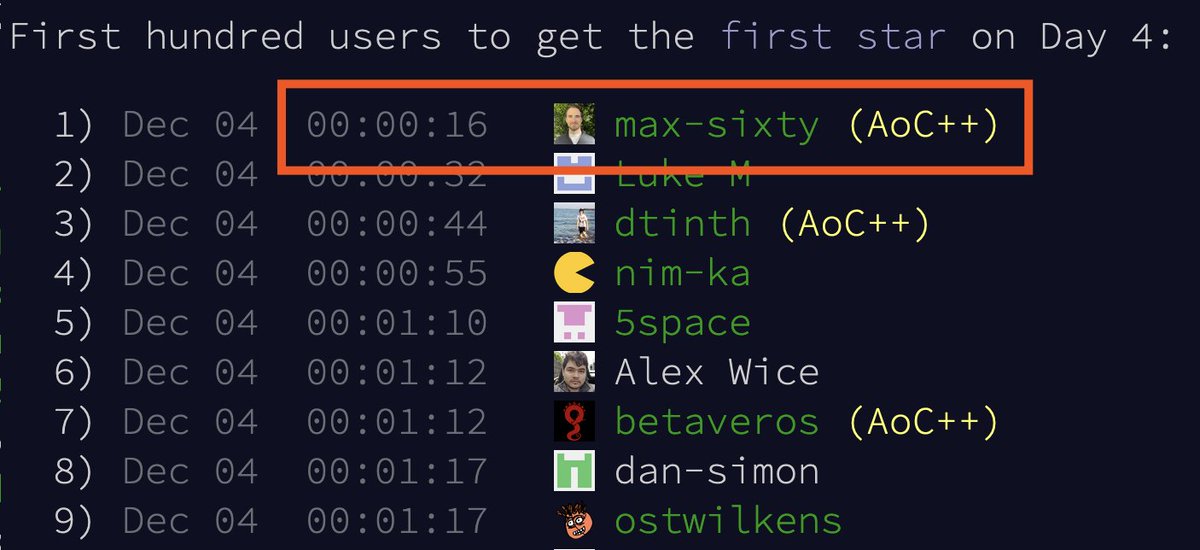
I placed 1st (out of ~100,000) in #AdventOfCode Part 1 today, again by having GPT-3 write the code
A win for GPT-3, @OpenAI, AI — and the creativity of humans!
Likes
300
 Twitter
·
faint lava
red canyon
yesterday was basically cake, i wonder how they did it today
Twitter
·
faint lava
red canyon
yesterday was basically cake, i wonder how they did it today
didn't make the leaderboard for day7
neither of them
red canyon
oof
rancid scaffold
I imagine the AI solutions will either solve it instantly or never
red canyon
are people actually competing for the leaderboards?
not me waking up 10 hours after the problem goes live
red canyon
to each their own i guess, feeling rewarding is one thing but taking them hella seriously is defo not healthy
rancid scaffold
for me AOC is about learning to write better code and picking up some new tricks. better code > fast code
cyan musk
Global too fast for me but private lb yes 🙂
rancid heath
red canyon
are people actually competing for the leaderboards?
I do
rancid heath
cyan musk
Global too fast for me but private lb yes 🙂
I made global once this year
red canyon
rancid heath
I do
busts out chatgpt3
rancid heath
Definitely used to be better than I am now
rancid scaffold
its a good community thing too - plenty of help so you can get a wide range of solutions to a problem unlike basically any other problem you come accross
rancid heath
red canyon
> > busts out chatgpt3
No
cyan musk
rancid heath
I made global once this year
Congratulations
rancid scaffold
My private leaderboard we do based on stars, not time. We are all busy with jobs / life etc so finding time to sit down and do it might not be any time competitive.
faint lava
red canyon
are people actually competing for the leaderboards?
Some do. Not me. I had a good result last year. Pretty casual this year.
red canyon
i feel bad for people shitting on the tweet author for using the ai and yoinking leaderboard position
rancid scaffold
Honestly I dont mind the Ai stuff. You cant prevent it so embrace it
red canyon
it's not like i'm gonna get a position on the leaderboard anyway
faint lava
I don't mind the AI stuff, but claiming that you solved it in 10 seconds using the AI is a little disingenuous.
red canyon
faint lava
I don't mind the AI stuff, but claiming that *you* solved it in 10 seconds using...
that i can 100% get behind
rancid scaffold
Depends i guess, if you wrote the Ai, and the scripts to support it then I think you deserve some credit
faint lava
rancid scaffold
Depends i guess, if you wrote the Ai, and the scripts to support it then I think...
Yeah that seems fair.
rancid scaffold
if you just pulled it off github and sovle_aoc() then.... not really your work
faint lava
Like if this was google as a team posting their score I'd be like damn.
rancid scaffold
To be fair there is only a few people making it work
which makes me think its not that straightforward.
red canyon
rancid scaffold
which makes me think its not that straightforward.
it is straightforward for obvious problems, i just gave the bot "solve advent of code 2022 day 7" and the bot was like oops sorry can't pull questions from there yet™️
rancid scaffold
It seems like microsoft have exclusive use of GPT-3 so I don't know how they are feeding it custom data
elder bolt
red canyon
are people actually competing for the leaderboards?
Just one private leaderboard and aiming to end top 100 on the server leaderboard
rancid scaffold
I get up too late to be on a leaderboard
 crystal pier
Tried to do it in Rust, but couldn't manage the input parsing, so I gave up and did it in python. Code is too long for discord, so splitting it up into parsing and problem-solving sections
from dataclasses import dataclass
from functools import cache


class Node:
    def __init__(self, parent, data):
        self.parent = parent
        self.data = data
        self.children = dict()

    def root(self):
        node = self
        while node.parent:
            node = node.parent
        return node

    def add_child(self, data):
        item = Node(self, data)
        self.children[data] = item


@dataclass(frozen=True)
class Directory:
    name: str


@dataclass(frozen=True)
class File:
    name: str
    size: int


Item = Directory | File


def parse(base: str) -> Node:
    lines = (r.split() for r in base.split("\n") if r)
    name = Directory(next(lines)[2])
    root = Node(None, name)
    current_node = root
    for line in lines:
        # print(line)
        if line == ["$", "ls"]:
            continue
        elif line == ["$", "cd", ".."]:
            current_node = current_node.parent
        elif line == ["$", "cd", "/"]:
            current_node = current_node.root()
        elif line[1] == "cd":
            desired = Directory(line[2])
            current_node = current_node.children[desired]

        elif line[0] == "dir":
            name = Directory(line[1])
            current_node.add_child(name)

        else:
            [size, name] = [int(line[0]), line[1]]
            value = File(name, size)
            current_node.add_child(value)

    return current_node.root()
@inner ingot maybe you'll get a kick out of this mess
rm -rf root
mkdir root
grep -v '\bls\b' | perl -p -e 's/^dir/mkdir/;s#^([0-9]+) (.*)#dd if=/dev/zero of=\2 bs=\1 count=1#;s/^\$ //;s#cd /#cd root#' |
while read cmd; do
  $cmd
done

size() {
  wc -c $@ | tail -1 | grep -o '[0-9]*'
}

all_sizes() {
  find root -type d |
  while read f; do
    size $(find $f -type f)
  done
}

all_sizes | grep -P '^([0-9]{1,5}|100000)$' | xargs | tr ' ' + | bc
total=$(size $(find root -type f))
torem=$((30000000 - (70000000-total)))
all_sizes | awk "\$1 >= $torem" | sort -g | head -1
```running it
```sh
algmyr: [git] ~/tmp
> bash do.sh < 07input 2> /dev/null
1543140
1117448
algmyr: [git] ~/tmp
> ll root
total 240K
drwxr-xr-x  3 algmyr algmyr 4.0K Dec  7 23:29 dcvzbqf
drwxr-xr-x  9 algmyr algmyr 4.0K Dec  7 23:29 qdtw
drwxr-xr-x 10 algmyr algmyr 4.0K Dec  7 23:29 qmfvph
-rw-r--r--  1 algmyr algmyr  24K Dec  7 23:29 gsdpmrq.bsz
-rw-r--r--  1 algmyr algmyr  25K Dec  7 23:29 nfngbl.mcn
-rw-r--r--  1 algmyr algmyr 175K Dec  7 23:29 plw.frm
@cache
def size(node: Node) -> int:
    assert isinstance(node.data, File) != bool(node.children)
    if isinstance(node.data, File):
        return node.data.size
    else:
        return sum(map(size, node.children.values()))


def flatten(c):
    return (a for b in c for a in b)


def sizes(node: Node) -> list[tuple[Item, int]]:
    return [(node.data, size(node))] + list(flatten(map(sizes, node.children.values())))


def part1(base: str) -> int:
    data = parse(base)
    # print(data)
    # print(size(data))
    # print(sizes(data))
    valids = [
        size
        for (item, size) in sizes(data)
        if isinstance(item, Directory) and size <= 100000
    ]
    return sum(valids)


def part2(base: str) -> int:
    data = parse(base)
    total = 70000000
    desired = 30000000
    available = total - size(data)
    required = desired - available
    posses = [
        (item, size)
        for (item, size) in sizes(data)
        if isinstance(item, Directory) and size >= required
    ]
    val = min(posses, key=lambda x: x[1])
    print(val)
    return val[1]


def main():
    file = "data/07.txt"
    with open(file) as f:
        words = f.read()
    print(part1(words))
    print(part2(words))


if __name__ == "__main__":
    main()
yes, this is rewriting the input to commands that actually navigate around and create files, and then the operations is done on the actual files
teal orchid
ah shit it works on the test but not the real input
crystal pier
Misread it as needing the folder name, not the folder size, so printed/kept more info than required.
teal orchid
Wait a lot of this repeats, so I have to check if a folder exists yeah?
I didnt realize we go in and out
 heavy frigate
any cd into a directory is always valid
but there's likely something in the real input that AoC sneakily didn't do with the example
teal orchid
im just thinking because everytime i see a dir i try to add it
if 'dir' in c.split():
  new_folder = Folder(c.split()[1], parent=curr_dir)
  curr_dir.add_subfolder(new_folder)
and i got a
Traceback (most recent call last):
  File "c:\Python\AdventOfCode\day7\day.py", line 77, in <module>
    curr_dir.add_file(new_file)
AttributeError: 'NoneType' object has no attribute 'add_file'
thats all i can think of rn
soft hatch
soft hatch
<@182894631921516545> maybe you'll get a kick out of this mess
```py
rm -rf root...
@heavy frigate rate my terrible thing
 narrow sail
teal orchid
im just thinking because everytime i see a dir i try to add it
```py
if 'dir' in...
narrow sail
teal orchid
im just thinking because everytime i see a dir i try to add it
```py
if 'dir' in...
you only have to count files that are cd'd
teal orchid
we dont look in every directory?
 lone schooner
I've been busy, but I managed to get day 7 done this morning.
soft hatch
teal orchid
we dont look in every directory?
I'm pretty sure you do
lone schooner
yay trees
teal orchid
oh ok
heavy frigate
soft hatch
<@356930145409433603> rate my terrible thing
You built out the actual filesystem? 😄
 tame groveBOT
day7.py lines 99 to 110
# part 1
print("Part 1:", sum(d.size for d in root.dirs() if d.size < 100000))

# part 2
total_storage = 70_000_000
required_storage = 30_000_000

storage_used = root.size
storage_free = total_storage - storage_used
to_free = required_storage - storage_free

print("Part 2:", min(c.size for c in root.dirs() if c.size > to_free))```yeah im not entirely sure whats up because it worked with the test input
soft hatch
heavy frigate
You built out the actual filesystem? 😄
indeed
heavy frigate
I did contemplate that at one point when I hit a snag 😄
soft hatch
it's actually not that slow ~1.1s on an HDD
red canyon
crystal pier
Tried to do it in Rust, but couldn't manage the input parsing, so I gave up and ...
rust moment, this looks neat as hell with classes
lone schooner
that device must be old. Only 70Mib of space.
soft hatch
so, one very annoying thing is that directories have sizes
heavy frigate
lol imagine if AoC snuck in a few 10G files just to mess with people taking that approach 😛
soft hatch
lone schooner
that device must be old. Only 70Mib of space.
70MB
actually base 10 for once
red canyon
heavy frigate
lol imagine if AoC snuck in a few 10G files just to mess with people taking that...
was it not like that? 👀 i thought i saw 70gb in one of the viz. on subreddit
heavy frigate
the device can only hold 70,000,000 bits
lone schooner
maybe they assumed it was the size in kilobytes
heavy frigate
so not likely
lone schooner
!e print(70_000_000 / 8, "bytes")
tame groveBOT
@lone schooner :white_check_mark: Your 3.11 eval job has completed with return code 0.
8750000.0 bytes
bits?
soft hatch
bytes
narrow sail
isn't disk space measured in bytes
lone schooner
they don't say
narrow sail
soft hatch
actually, what unit are they even using?
elvites
heavy frigate
to be fair I don't think the description actually says what the units are
rancid scaffold
heavy frigate
You built out the actual filesystem? 😄
#1049917148186804275 message
heavy frigate
Aren't you paying attention, they need those yummy stars
lone schooner
apparently nothing because all the folders are equally eligible for deletion without risking stability
narrow sail
red canyon
don't they have gifts to arrange
gifts are now in folders because they've run out of materials due to the pandemic and they're going digital
heavy frigate
It's the classic "I don't know what this is so I will delete it" school of making space on your computer 😄
narrow sail
or they just don't want to do forced labor any more so they just waste time on making files
soft hatch
using regex to build commands to make the files felt so right somehow
red canyon
what did i help them move those damn crates 👿
soft hatch
so dumb, yet so right
soft hatch
true
rancid scaffold
I feel like this might be possible with mostly replace commands
lone schooner
inb4 the system runs on ROM
heavy frigate
Just send it to /dev/null. You can email Linus Torvalds to get it back later.
red canyon
tries to install update
it's popos
it's popos
soft hatch
who ever needed anything from /usr/lib?
lone schooner
sudo mv /dev/* /dev/null
soft hatch
I'm curious what that will actually end up doing
soft hatch
right
that's what I'm guessing
but I don't feel like trying to mv one of my drives in /dev to test
red canyon
time to docker
lone schooner
If you move /dev/core to /dev/null, you get errors about the same file. moving any other device to /dev/null fails because "Device or resource busy"
last flower
Hmm, I think there's too much being stored in /dev/nvme0. Best I move the folder to my hard drive.
narrow sail
bets on day 8 6h 6m 18s later?
soft hatch
lone schooner
If you move /dev/core to /dev/null, you get errors about the same file. moving a...
which one is busy?
the disk?
lone schooner
probably
soft hatch
I guess you could try to umount it first
last flower
what happens if I add /dev/null to my fstab
soft hatch
🥴
lone schooner
root@49b586774add:/# umount /
umount: /: must be superuser to unmount.
root is not superuser
soft hatch
lol what
rancid scaffold
Hmmm, could you regex it ?
cd (.*?)\$ ls(.*?)\$
yes, grep and then slapping some regex on it does the job to create runnable commands
rancid scaffold
teal orchid
so i did some tracing to where my error starts, and its around here
# Printing current directory:
...
('nblfzrb', 160378, [], [('jhc', 160378)])
('nblfzrb', 249412, [], [('jhc', 160378), ('fst', 89034)])
('nblfzrb', 587555, [], [('jhc', 160378), ('fst', 89034), ('sdwnsgwv.mjm', 338143)])
('nblfzrb', 718216, [], [('jhc', 160378), ('fst', 89034), ('sdwnsgwv.mjm', 338143), ('vmpgqbcd', 130661)])
None
Traceback (most recent call last):
  File "c:\Python\AdventOfCode\day7\day.py", line 74, in <module>
    curr_dir.add_file(new_file)
AttributeError: 'NoneType' object has no attribute 'add_file'
I think my cd is trying to back out too far or something? not 100% sure
rancid scaffold
I think this might be a quick solution to be honest : https://regex101.com/r/hz8ECy/1
Then all you have to do is parse the matches
queen breach
any better golfs yet?
narrow sail
queen breach
any better golfs yet?
what's the best one and its length
queen breach
i believe this one
narrow sail
queen breach
i believe this one
here's a 188 then ```py
s=[];d=()
for r in open(0):
a,,b=r.split()
if'/'>b:*s,v=s;d+=v,;s[-1]+=v
elif'$ d'>r:s+=0,
if'/'<a<':':s[-1]+=int(a)
print(sum((1e5>)for _ in d),min( for _ in d if _>sum(s)-4e7))
oh nice
 cosmic depot
I didn't know you could do that
narrow sail
cosmic depot
I didn't know you could do that
behaviour of x += y in lists are different from x = x + y in the way that you can put any iterable as y in the first one
(also true for dictionaries but using |=)
narrow sail
narrow sail
behaviour of `x += y` in lists are different from `x = x + y` in the way that yo...
i don't know why i converted d into a tuple though
narrow sail
updated ```py
m=[]d=[]s.xscanall("(%B+)%B+(.+)",(a,b):{ifzip'/'>b:'/'<a<':'{@m,v=m d+=v,;m[-1]+=v}m[-1]+=int(a)elif'$ d'>r m+=0,})print(sum(x*(1e5>x):x~>d),min(x:x~>d:x>d[()]-4e7))
might merge ifzip and if into one
 vivid patrol
only optimized based off of characters, not bytes smh
narrow sail
narrow sail
here's a 188 then ```py
s=[];d=()
for r in open(0):
a,*_,b=r.split()
if'/'>b:*...
120 degen ```py
exec(bytes('㵳嵛搻⠽潦湩漠数⡮⤰愠⨬ⱟ㵢灳楬⡴椠❦✯戾⨺ⱳ㵶㭳⭤瘽㬬孳ㄭ⭝瘽 汥晩搠㸧㩲⭳〽ਬ椠❦✯愼✼✺猺ⵛ崱㴫湩⡴⥡瀊楲瑮猨浵弨⠪攱㸵⥟潦 湩搠Ⱙ業⡮ 潦 湩搠椠㹟畳⡭⥳㐭㝥⤩','u16')[2:])
📉 Not stonks! 😠
vivid patrol
where's the optimized for bytes solution 😠
queen breach
narrow sail
updated ```py
m=[]d=[]s.xscanall("(%B+)%B+(.+)",(a,b):{ifzip'/'>b:'/'<a<':'{@m,v...
here
but not in python

vivid patrol
💀
narrow sail
the ruby expert from TCCPP made this ```ruby
$stdin = open 'day7.txt'
A=[];D=proc{s=0;$<.map{_1['..']&&break;s+=_1["$ c"]?D[]:+_1.to_i};s.tap{A<<+_1}};C=D[];p([A.select{_1<1e5}.sum,A.select{C-("|\s";4e7)<=_1}.min]);/#/
openai chatbot managed to explain it
vivid patrol
wow
narrow sail
yeah i'm going to add some parts of it into my WIP language
sonic lark
royal axle
can someone explain the question in simple English please
I cannot understand the question
for example what does this mean 14848514 b.txt?
 summer herald
where would the place be to ask for help on this?
I've beat myself against this for 12 hours
inner ingot
here
teal orchid
royal axle
for example what does this mean```
14848514 b.txt```?
the size of the file and the name of it
royal axle
summer herald
I've beat myself against this for 12 hours
12 hours 
summer herald
I did yesterday's in 10 minutes -_-
royal axle
teal orchid
the size of the file and the name of it
would making a class using list be a good idea?
or I'm just complicating the problem
teal orchid
I used a class, but lots of people did not
summer herald
is it alright to post the code I have so far here?
summer herald
import re
from itertools import chain


class Directory:

    def __init__(self, identity, parent=None):
        self.identity = identity
        self.parent = parent
        self.contents = []
        self.size = 0

    def add(self, identity, type, parent, size=None):
        if type == 'file':
            self.contents.append(File(identity, size))
        else:
            self.contents.append(Directory(identity, self))
        self.parent = parent
        size = self.get_size()

    def get_size(self):
        size = 0
        for item in self.contents:
            if isinstance(item, File):
                size += int(item.size)
            else:
                size += int(item.get_size())
        return size

    def iterable_of_sizes(self):
        return chain([self.size],
                     *[child.iterable_of_sizes() for child in self.contents])

    def cd(self, command):
        if command == '..':
            return self.parent
        else:
            return Directory(command)


class File:

    def __init__(self, name, size):
        self.name = name
        self.size = size

    def iterable_of_sizes(self):
        return chain([self.size])


with open("input_7.txt", "r+")as input_file:
    blocks = [x.rstrip().split("\n") for x in re.split(r"(?=\$)", input_file.read())]
    location = None
    for block in blocks:
        match block[0].split():
            case ["$", "ls"]:
                for entry in block[1:]:
                    if entry.split()[0].isnumeric():
                        location.add(entry.split()[-1], 'file', location, entry.split()[0])
                    else:
                        location.add(entry.split()[-1], location, 'directory')
            case ["$", "cd", dir]:
                if not location:
                    location = Directory(dir)
                location = location.cd(dir)
print([item for item in location.iterable_of_sizes()])```This is the second attempt. My first attempt I used treelib and I got the directory structure just fine but then could not work out how to extract the information from it
so I tried making my own classes and throwing in some bits of code from other places and am very unsure about what I am doing. This is a type of problem I just simply haven't encountered before
royal axle
if I solved this tomorrow, would I got 2 star? or I should solve it before the next question?
I really want to sleep
 final anchor
you get both stars
 storm epoch
royal axle
if I solved this tomorrow, would I got 2 star? or I should solve it before the n...
storm epoch
royal axle
if I solved this tomorrow, would I got 2 star? or I should solve it before the n...
yeah you can solve it whenever you want
final anchor
your score will be lower, but the stars always remain constant
storm epoch
even next year
royal axle
Thanks, have a good night
summer herald
It's so frustrating. I was breezing through to this point. I was travelling and did the first five on my phone using Pydroid
vivid patrol
?
teal orchid
and i know what causes it, but not why
vivid patrol
rips
cosmic depot
If you are storing just the directory name, ||there may be directories in other places that have the same name||
teal orchid
Yeah, I was thinking maybe that but probably not. I have some prints and I know I read in a directory in a dir, but when I cd into it, I just get a NoneType attribute error
def get_folder(self, target):
        if self.name == target:
            return self
        elif self.subfolders:
            for f in self.subfolders:
                sf = f.get_folder(target)
                if sf: return sf
        return None
Traceback (most recent call last):
  File "c:\Python\AdventOfCode\day7\day.py", line 77, in <module>
    curr_dir.add_file(new_file)
AttributeError: 'NoneType' object has no attribute 'add_file'
it works with the demo, and my input through the first 200 lines and a certain something just kills it
vivid patrol
teal orchid
Yeah, I was thinking maybe that but probably not. I have some prints and I know ...
directory names aren't unique
i.e.
you can have
cvf/abc
and
dlf/asw/abc
teal orchid
so how would I know which one to get? check the parent?
summer herald
when I tried my libtree approach I just added an incrementing number tag to each folder name
summer herald
│   ├── 13 bnl
│   │   ├── 19 dhw
│   │   │   └── file 237421 vccwmhl
│   │   ├── 23 dmpsnhdh
│   │   │   ├── 28 chf
│   │   │   │   ├── 33 zfgznbz
│   │   │   │   │   ├── file 171574 vglqg
│   │   │   │   │   └── file 179409 cnj.gdn```
etc.an approach you can use is thru cwd
but i think others just hard coded paths or smth
teal orchid
teal orchid
so how would I know which one to get? check the parent?
dont think i could implement this
because we cant really know the parent of the target without ... finding it
 young nacelle
teal orchid
I used a class, but lots of people did not
young nacelle
teal orchid
I used a class, but lots of people did not
i also used a class ^
vivid patrol
you always know the parent of a directory (if you store it)
vivid patrol
young nacelle
i also used a class ^
wtfrick pro
vivid patrol
i think most people with classes did it slower though
young nacelle
it's rlly m essy tho
class Node:
    def __init__(self, parent: "Node" = None):
        self._parent = parent
        self.nodes = {}
        self.files = {}

    def create_directory(self, name):
        self.nodes[name] = Node(self)

        return self.nodes[name]

    def go_to_outermost(self):
        if self._parent is None:
            return self
        else:
            return self._parent.go_to_outermost()

    def go_back(self):
        return self._parent

    def add_file(self, size, name):
        self.files[name] = size

    def get_size(self, directory_sizes):
        if not self.nodes.values():
            directory_sizes.append(self._total_size())
            return directory_sizes[-1]
        else:
            result = self._total_size()

            for node_name, node in self.nodes.items():
                result += node.get_size(directory_sizes)

            directory_sizes.append(result)
            return result

    def _total_size(self):
        return sum(self.files.values())
i did it fast so it's kinda ugly
vivid patrol
young nacelle
```py
class Node:
def __init__(self, parent: "Node" = None):
self._...
you even added typing(s) wtf
young nacelle
oh yeah lmao
teal orchid
vivid patrol
you always know the parent of a directory (if you store it)
yeah i have it in the class, but given the name of the directory from cd we need to find the class object first to get the parent?
summer herald
any ideas on mine?
vivid patrol
teal orchid
yeah i have it in the class, but given the name of the directory from `cd` we ne...
what
summer herald
I'm just trying to get the total size of all the directories out at the moment but even that's not working. I'm completely confused.
vivid patrol
current implementation? @summer herald
summer herald
summer herald
```py
import re
from itertools import chain
class Directory:
def __init_...
here
would it be better to put it in a paste or something?
vivid patrol
immediate thing is that i'm seeing dir and not "dir"
summer herald
the dir from the match case is a string
vivid patrol
dir is a python func? unless match is weird
last flower
you can reassign the value of dir
summer herald
like a reserved word?
vivid patrol
!e print(dir([]))
tame groveBOT
@vivid patrol :white_check_mark: Your 3.11 eval job has completed with return code 0.
['__add__', '__class__', '__class_getitem__', '__contains__', '__delattr__', '__delitem__', '__dir__', '__doc__', '__eq__', '__format__', '__ge__', '__getattribute__', '__getitem__', '__getstate__', '__gt__', '__hash__', '__iadd__', '__imul__', '__init__', '__init_subclass__', '__iter__', '__le__', '__len__', '__lt__', '__mul__', '__ne__', '__new__', '__reduce__', '__reduce_ex__', '__repr__', '__reversed__', '__rmul__', '__setattr__', '__setitem__', '__sizeof__', '__str__', '__subclasshook__', 'append', 'clear', 'copy', 'count', 'extend', 'index', 'insert', 'pop', 'remove', 'reverse', 'sort']
🤷♀️ I can change that name, I don't think it's the issue tbh
last flower
vivid patrol
!e print(dir([]))
!e ```py
dir = "hello"
print(dir)
@last flower :white_check_mark: Your 3.11 eval job has completed with return code 0.
hello
they don't do that
summer herald
yeah, changed that name, doesn't change how it runs
vivid patrol
summer herald
🤷♀️ I can change that name, I don't think it's the issue tbh
doesn't really seem like you're maintaining uh
relationship between parent and child directories
summer herald
almost certainly!
last flower
vivid patrol
they don't do that
they do. the match statement changes the value of dir, at least under that scope iirc
summer herald
I have pretty much just been moving things around at random for the last four hours or so hoping something happens
vivid patrol
last flower
they do. the match statement changes the value of `dir`, at least under that sco...
that is so weird ok then
vivid patrol
summer herald
I have pretty much just been moving things around at random for the last four ho...
    def cd(self, command):
        if command == '..':
            return self.parent
        else:
return Directory(command)```probably should maintain a list of child directories
and when you call cd search that list
teal orchid
vivid patrol
what
My point is that I am storing the parent of the directory, but I have no way to access it unless I have the object, which is what the get_folder function is trying to do
summer herald
vivid patrol
and when you call cd search that list
I hope this doesn't sound petulant, but how?
Like a list internal to the Directory object?
Because it already has one
vivid patrol
summer herald
I hope this doesn't sound petulant, but how?
!e
class Directory:
  def __init__(self):
    self.child_dirs = {}
  def cd(self, cmd):
    if cmd == "..":
      pass
    else:
      return self.child_dirs[cmd]
  def add_dir(self, dir_name):
    self.child_dirs[dir_name] = Directory()

a = Directory()
a.add_dir("blah")
print(a.cd("blah"))
oops
tame groveBOT
@vivid patrol :white_check_mark: Your 3.11 eval job has completed with return code 0.
<__main__.Directory object at 0x7f7218570710>
then keep a variable pointing to the current directory 🤷♂️
teal orchid
teal orchid
My point is that I am storing the parent of the directory, but I have no way to ...
or I guess since we are cding in from the same level, the parent would be the same as the parent of the current directory
yep
summer herald
vivid patrol
!e
```py
class Directory:
def __init__(self):
self.child_dirs = {}
def c...
sorry, it might just be tiredness/frazzledness but I don't see how to integrate that into what I have, or are you saying what I have is unfixable
vivid patrol
summer herald
sorry, it might just be tiredness/frazzledness but I don't see how to integrate ...
yours probably will look like
    def cd(self, command):
        if command == '..':
            return self.parent
        else:
            for i in self.contents:
              if i.identity == command:
                return i
idk
also i have little clue how match works 🤷♂️
summer herald
it's just mostly a neater way of doing if/else
case ["$", "cd", directory]: is triggered if the input is $ cd * and it passes the third word in as 'directory'
vivid patrol
it's different from other language's switches
and i never really felt like figuring it out kek
last flower
I've had people in python general yell at me after saying match is like a switch statement 😔
last flower
yes
summer herald
python's the only language I can do anything beyond toy programming with
narrow sail
vivid patrol
basic basic it's just a switch statement
match statement
summer herald
yeah it can do a lot of parsing
that's more what it's for really as far as I can understand. the tutorial uses the example of a classic text adventure game
vivid patrol
narrow sail
match statement
🤷♂️
tough hinge
vivid patrol
also i have little clue how match works 🤷♂️
Have you seen this?
https://realpython.com/python310-new-features/#structural-pattern-matching
vivid patrol
😔

 vivid patrol
no
tough hinge

vivid patrol
better 👍
 vivid patrol
tough hinge
Have you seen this?
<https://realpython.com/python310-new-features/#structural-p...
vivid patrol
tough hinge
Have you seen this?
<https://realpython.com/python310-new-features/#structural-p...
not this article exactly but i've heard bits and pieces of match
 cyan wadi
im still stuck in part 1, it works in the example but not in the actual input. i feel sad for getting stuck in day 7...
from dataclasses import dataclass, field


@dataclass
class Directory:
    size : int = 0
    subdirs : list = field(default_factory=list)


f = open("./puzzle_input.txt", "r")
get_next_line = lambda file: file.readline().rstrip("\n")
max_dir_sum = 100000
dirs : dict[str, Directory] = {}

line = get_next_line(f)

while(line != ""):

    _, cmd, dir = line.split(" ")

    if cmd == "cd" and dir != "..":
        line = get_next_line(f)
        _, cmd = line.split(" ")

        if cmd == "ls":
            if dir not in dirs:
                dirs[dir] = Directory()

            while((line := get_next_line(f)) != "" and not line.startswith('$')):
                val, name = line.split(" ")

                if(val == "dir"): # directory
                    dirs[dir].subdirs.append(name)

                else: # file
                   dirs[dir].size += int(val)

            continue
    line = get_next_line(f)

f.close()
result = 0
for dir in dirs.values():
    dir_sum = dir.size + sum(dirs[sub].size for sub in dir.subdirs)
    if dir_sum <= max_dir_sum:
        result += dir_sum


print(result)
just never actually did a dive into it
vivid patrol
cyan wadi
im still stuck in part 1, it works in the example but not in the actual input. i...
directories don't necessary have unique names
i.e.
ads/asd/foo
and
bcd/foo
can both exist
vivid patrol
probably one way of doing it
cyan wadi
okay, thanks a lot ^^
summer herald
vivid patrol
yours probably will look like
```py
def cd(self, command):
if comman...
I've tried this and several variations and it keeps giving me errors indicating that it's returning None
vivid patrol
i probably misred something or another on how you stored stuff
tldr is that you're trying to find the folder name that matches the input
summer herald
I get that
 slender bane
cyan wadi
so i must store the entire path for each directory?
slender bane
cyan wadi
so i must store the entire path for each directory?
ohh i didn’t think of doing that
summer herald
I suspect it's getting called before the contents list is populated
vivid patrol
it shouldn't
slender bane
i just went straight for the tree approach with a node class
tough hinge
slender bane
i just went straight for the tree approach with a node class
Have you posted your solution?
vivid patrol
summer herald
I suspect it's getting called before the contents list is populated
check to see if you're actually populating your list, and print the steps out when ur running on the test input
summer herald
vivid patrol
it shouldn't
Yeah. Did some print-debugging. It's the root
slender bane
vivid patrol
check to see if you're actually populating your list, and print the steps out wh...
teal orchid
cosmic depot
If you are storing just the directory name, ||there may be directories in other ...
yeah, ive just confirmed thats 100% my problem, I made a MWE and you can see the problem from printing the resulting tree:
$ cd /
$ ls
dir a
1 test.txt
dir b
$ cd a
$ ls
dir b
2 test2.txt
$ cd ..
$ cd b
$ ls
100 hund.txt
name: / size: 103 subdirs: [name: a size: 102 subdirs: [name: b size: 100 subdirs: [] files: [100]] files: [2], name: b size: 0 subdirs: [] files: []] files: [1]
Looks like b is going into the subdirectory of A instead of /
 summer herald
the cd is called before any ls
cyan wadi
slender bane
i just went straight for the tree approach with a node class
must be harder right?
summer herald
I'll try and implicate a special case for the root
slender bane
slender bane
https://paste.pythondiscord.com/anelafecum
see here if you'd like to take a peek at my solution @cyan wadi
vivid patrol
!e
dirs = {"/": [(1234, "abcd.txt")], "/a": [(3, "test.txt")], "/a/b": [(1111, "abcc.txt")], "/c": []}
for i in dirs:
  size = 0
  for j in dirs:
    if j.startswith(i):
      size += sum(map(lambda x: x[0], dirs[j]))
  print(f"Size of directory {i} is {size}")
interesting
cyan wadi
slender bane
see here if you'd like to take a peek at my solution <@617497940038123521>
okay
summer herald
goes further but None's out again
cyan wadi
slender bane
see here if you'd like to take a peek at my solution <@617497940038123521>
looks good but i dont think its really needed to store the directory tree with nodes, just iterating the file line by line after 'ls' knowing which directory was cd'ed
but thanks anyway 🙂
vivid patrol
pain to calculate directory sizes if you use paths though
cyan wadi
having a bit of trouble storing the whole path for each directory
maybe recursion helps
summer herald
Pastebin
Pastebin.com is the number one paste tool since 2002. Pastebin is a website where you can store text online for a set period of time.
vivid patrol
vivid patrol
!e
```py
dirs = {"/": [(1234, "abcd.txt")], "/a": [(3, "test.txt")], "/a/b": [(1...
solution but it's slow af
vivid patrol
summer herald
https://pastebin.com/e2qSYpBC
probably better to do
                if not location:
                    location = Directory(directory)
                else:
location = location.cd(directory)```also uh
summer herald
Hmm, maybe I should go back to my treelib approach. I got a multidimensional dict out of it but could not work out how to unpack it at all
vivid patrol
                for entry in block[1:]:
                    if entry.split()[0].isnumeric():
                        location.add(entry.split()[-1], 'file', location, entry.split()[0])
                    else:
location.add(entry.split()[-1], location, 'directory')```not sure what this is doing
summer herald
adding a file or a directory. but yeah the variables are in the wrong order
narrow sail
i'm gonna try to have fun with classes for once in this year's AoC
tough hinge
slender bane
https://paste.pythondiscord.com/anelafecum
Ah, see, that's what I wanted to do, but I didn't want to make a bunch of searching for the node with the right name, so I wrapped them in dicts recording the names.
In retrospect I don't actually need the names for the solutions though.
Nice job, very clean
https://github.com/shenanigansd/scratchpad/blob/main/events/advent_of_code/2022/7/python/script_day7.py
slender bane
ahh i see
summer herald
It's more like 14 hours now 😅 gone through demoralisation to just tired bewilderment. I do not understand what I am trying to do.
slender bane
yeah, could've used a dict for the children attr instead
vivid patrol
summer herald
It's more like 14 hours now 😅 gone through demoralisation to just tired bewilde...
oh uh line 18
self.parent = parent
can you delete that
just need a sanity check
summer herald
no change in behaviour
slender bane
tough hinge
Ah, see, that's what I wanted to do, but I didn't want to make a bunch of search...
nice nice, good use of dataclasses as well
summer herald
yesterday's was 13 lines. I did it while my coffee was brewing 😭

 finite tundra
I started doing this one and gave up :/ for a relatively new programmer it was almost impossible, idek how to use classes lmao
vivid patrol
changed add a little bit too
 vivid patrol
finite tundra
I started doing this one and gave up :/ for a relatively new programmer it was a...
vivid patrol
finite tundra
I started doing this one and gave up :/ for a relatively new programmer it was a...
you don't need classess!
tough hinge
Embrace classes!!
vivid patrol
classes are slow to write >:((
finite tundra
vivid patrol
you don't need classess!
Ok well I have no idea how to do it regardless lmao
tough hinge
If you need speed then embrace Rust BTW
teal orchid
holy hell, i know exactly what is wrong with my code and what to do to fix it, but i have no idea how
this is so stupid
inner ingot
tough hinge
If you need speed then embrace Rust BTW
rust would be even slower to write, wouldn't it?
summer herald
vivid patrol
this completes without an AttributeError?
tough hinge
inner ingot
rust would be even slower to write, wouldn't it?
I started typing before they edited in the [to write]
Yeah - Rust BTW takes way longer to write
vivid patrol
embrace javascript and approach everything as a dict(ish)
tough hinge
oh no
narrow sail
last flower
everything is a dict
a dict is a glorified hash array
or it is a hash array
vivid patrol
i think you mean an array is just a glorified dict
summer herald
a dict is [n] tuples in a trenchcoat
narrow sail
vivid patrol
i think you mean an array is just a glorified dict
no i meant it's just a glorified address
vivid patrol
!e
arr = {0: "a", 1: "b"}
print(arr[0])```@vivid patrol :white_check_mark: Your 3.11 eval job has completed with return code 0.
a
 bronze leaf
stack-based solution for nim:
include aoc
import fusion/matching
{.experimental: "caseStmtMacros".}

let sizes = block:
  var sizes, stack: seq[int]

  proc stack_pop =
    sizes.add stack.pop
    stack[^1] += sizes[^1]

  for line in fetch(2022, 7).splitlines.mapIt(it.split):
    case line:
      of ["$", "cd", ".."]: stack_pop()
      of ["$", "cd", _]: stack.add 0
      of ["$", "ls"]: discard
      of ["dir", _]: discard
      of [@size, _]: stack[^1] += size.parseInt

  while stack.len > 1: stack_pop()
  sizes.add stack.pop
  sizes

part 1: sum sizes.filterIt(it <= 100_000)

part 2: min sizes.filterIt(it > sizes[^1] - 40_000_000)
Wait - how does that add the sizes to the parents?
Oh - The procedure dumps the previous total back onto the stack?
Dog that looks wierd
Does the input never backtrack or repeat?
teal orchid
Just going to throw this here if anyone has any last ideas, I added a check to compare the parent directories when searching to make sure I found the "correct one". I guess its possible that they could still be the same at multiple folders deep? Worked with my test that was broken earlier, nothing on the real input.
https://paste.pythondiscord.com/mewukiqeti