with open("04_input.txt") as file:
    data = file.read().splitlines()

total_lines_contained = 0
total_lines_overlapping = 0

for line in data:
    assignment_1, assignment_2 = (tuple(map(int, interval.split("-"))) for interval in line.split(","))
    interval_1, interval_2 = set(range(assignment_1[0], assignment_1[1] + 1)), set(range(assignment_2[0], assignment_2[1] + 1))
    if interval_1 & interval_2 in (interval_1, interval_2):
        total_lines_contained += 1
    if interval_1 & interval_2:
        total_lines_overlapping += 1

print(total_lines_contained)
print(total_lines_overlapping)
#AoC 2022 | Day 4 | Solutions & Spoilers
1508 messages · Page 2 of 2 (latest)
 pastel pilot
 somber notch
Super difficult pt. 1 and then... surprise even more difficult pt 2 no Christmas rest for you
 jovial marten
oh right, 2019 25 was an intcode text adventure
 vagrant token
- that's not a CLI that's a script interface
- how is 'a' and 'b' more clear than '1' and '2'? Literally 'the first part' and 'the second part'
 somber notch
vagrant token
1) that's not a CLI that's a script interface
2) how is 'a' and 'b' more clear t...
somber notch
vagrant token
1) that's not a CLI that's a script interface
2) how is 'a' and 'b' more clear t...
- okay fair
- Just subjectively, things like 1a is clearer than 1-1 or whatever IMO, but again, subjective
(you can do either one in the script interface, I checked)
 kind niche
Nothing that can save characters unfortunately
 wide ore
#d4p1
def d4p1(text):
    lines = text.splitlines()
    func = lambda x:any([all([c in list(range(int(x.replace('-',' ').replace(',',' ').split()[0]),int(x.replace('-',' ').replace(',',' ').split()[1])+1)) for c in list(range(int(x.replace('-',' ').replace(',',' ').split()[2]),int(x.replace('-',' ').replace(',',' ').split()[3])+1))]),all([z in list(range(int(x.replace('-',' ').replace(',',' ').split()[2]),int(x.replace('-',' ').replace(',',' ').split()[3])+1)) for z in list(range(int(x.replace('-',' ').replace(',',' ').split()[0]),int(x.replace('-',' ').replace(',',' ').split()[1])+1))])])
    #func = lambda x:[x.replace('-',' ').replace(',',' ').split()]
    for i in lines:
        yield func(i)

#d4p2
def d4p2(text):
    lines = text.splitlines()
    func = lambda x:any([any([c in list(range(int(x.replace('-',' ').replace(',',' ').split()[0]),int(x.replace('-',' ').replace(',',' ').split()[1])+1)) for c in list(range(int(x.replace('-',' ').replace(',',' ').split()[2]),int(x.replace('-',' ').replace(',',' ').split()[3])+1))]),any([z in list(range(int(x.replace('-',' ').replace(',',' ').split()[2]),int(x.replace('-',' ').replace(',',' ').split()[3])+1)) for z in list(range(int(x.replace('-',' ').replace(',',' ').split()[0]),int(x.replace('-',' ').replace(',',' ').split()[1])+1))])])
    for i in lines:
        yield func(i)
```d4 solve almost one line solutionactually i can make it less
somber notch
return map(lambda x ...., text.splitlines())
pastel pilot
sum(anyfunc for i in text.splitlines()) you don't need the lambda
wide ore
def d4p1(text):
    return sum([any([all([c in list(range(int(x.replace('-',' ').replace(',',' ').split()[0]),int(x.replace('-',' ').replace(',',' ').split()[1])+1)) for c in list(range(int(x.replace('-',' ').replace(',',' ').split()[2]),int(x.replace('-',' ').replace(',',' ').split()[3])+1))]),all([z in list(range(int(x.replace('-',' ').replace(',',' ').split()[2]),int(x.replace('-',' ').replace(',',' ').split()[3])+1)) for z in list(range(int(x.replace('-',' ').replace(',',' ').split()[0]),int(x.replace('-',' ').replace(',',' ').split()[1])+1))])]) for x in text.splitlines()])
def d4p2(text):
    return sum([any([any([c in list(range(int(x.replace('-',' ').replace(',',' ').split()[0]),int(x.replace('-',' ').replace(',',' ').split()[1])+1)) for c in list(range(int(x.replace('-',' ').replace(',',' ').split()[2]),int(x.replace('-',' ').replace(',',' ').split()[3])+1))]),any([z in list(range(int(x.replace('-',' ').replace(',',' ').split()[2]),int(x.replace('-',' ').replace(',',' ').split()[3])+1)) for z in list(range(int(x.replace('-',' ').replace(',',' ').split()[0]),int(x.replace('-',' ').replace(',',' ').split()[1])+1))])]) for x in text.splitlines()])
here we go
 gloomy comet
Had to write it on mobile, it was painful
import re
from operator import methodcaller
from pathlib import Path

data = Path("input.txt").read_text().split("\n")

pattern = re.compile(r"(\d+)-(\d+),(\d+)-(\d+)")

print(sum((x1<=y1<=x2 and x1<=y2<=x2) or (y1<=x1<=y2 and y1<=x2<=y2) for x1, x2, y1, y2 in map(lambda g: map(int, g),  map(methodcaller("groups"), (map(pattern.match, data))))))

print(sum((x1<=y1<=x2 or x1<=y2<=x2 or y1<=x1<=y2) for x1, x2, y1, y2 in map(lambda g: map(int, g),  map(methodcaller("groups"), (map(pattern.match, data))))))
Is there a more interesting way to check overlap? Besides creating the full range
 potent summit
gloomy comet
Had to write it on mobile, it was painful
```py
import re
from operator import m...
potent summit
gloomy comet
Had to write it on mobile, it was painful
```py
import re
from operator import m...
x2 >= y1 and y2 >= x1
I tend to think of this as if they don't overlap, that means either the first one takes place entirely before the second (first ending before second start) or the second one takes place entirely before the first (second ending before first start)
jovial marten
the negated version is more obvious to reason about imo
 neat mountain
Wrote mine in the comfort of my desk.
def parse_sections(s: str):
    start, end = map(int, s.split("-"))
    return set(range(start, end + 1))


def main(data: str):
    redudnant_count = 0
    overlapping_count = 0
    for line in data.splitlines():
        # e - elf
        e1, e2 = map(parse_sections, line.split(","))
        if e1.issubset(e2) or e1.issuperset(e2):
            redudnant_count += 1
        if e1.intersection(e2):
            overlapping_count += 1
    print("Part 1:", redudnant_count)
    print("Part 2:", overlapping_count)
not (r1 < l2 or r2 < l1)
That's pretty good yeah
potent summit
jovial marten
```py
not (r1 < l2 or r2 < l1)
```
That is the version I used in my solution, though I think you have the first set flipped, they need to be endings < beginnings for each
Which is actually a mistake I made during my solve too, where I had one flipped
potent summit
I see, r1 is an end. Zig was using x1,x2,y1,y2 so the 2's were the endings
jovial marten
ah, right
potent summit
gloomy comet
That's pretty good yeah
I've implemented this solution a lot at work checking for overlapping date ranges
jovial marten
potent summit
I've implemented this solution a lot at work checking for overlapping date range...
ideally you would abstract this away since the logic generalizes
like, this works for any intervals where the endpoints can be compared with <
 plush ibex
106
print(sum(1-(a>c<=d<b or d>b>=a<c)+1j*(a<=d>=c<=b)for a,b,c,d in[eval(l.replace(*'-,'))for l in open(0)]))```
78 with encoding
```py
exec(bytes('牰湩⡴畳⡭ⴱ愨挾㴼㱤牯搠戾㴾㱡⥣ㄫ⩪愨㴼㹤挽㴼⥢潦ⱡⱢⱣ湩敛慶⡬敲汰捡⡥✪Ⱝ⤧昩牯氠椠灯湥〨崩⤩','u16')[2:])```new best
it's a 106
 median seal
import re

with open('input.txt') as f:
    data = f.read().splitlines()

part_1_matches = 0
part_2_matches = 0
for line in data:
    a1, a2, b1, b2 = map(int, re.findall(r'\d+', line))
    set_a, set_b = set(range(a1, a2+1)), set(range(b1, b2+1))
    if len(set_a | set_b) == len(set_a) or len(set_a | set_b) == len(set_b):
        part_1_matches += 1
    if set_a & set_b:
        part_2_matches += 1


print(part_1_matches) #Part 1
print(part_2_matches) #Part 2
Why using regex?
plush ibex
plush ibex
106
```py
print(sum(1-(a>c<=d<b or d>b>=a<c)+1j*(a<=d>=c<=b)for a,b,c,d in[eval(...
78 with shenanigans
exec(bytes('牰湩⡴畳⡭ⴱ愨挾㴼㱤牯搠戾㴾㱡⥣ㄫ⩪愨㴼㹤挽㴼⥢潦ⱡⱢⱣ湩敛慶⡬敲汰捡⡥✪Ⱝ⤧昩牯氠椠灯湥〨崩⤩','u16')[2:])```!e ```py
print(bytes('牰湩⡴畳⡭ⴱ愨挾㴼㱤牯搠戾㴾㱡⥣ㄫ⩪愨㴼㹤挽㴼⥢潦ⱡⱢⱣ湩敛慶⡬敲汰捡⡥✪Ⱝ⤧昩牯氠椠灯湥〨崩⤩','u16')[2:])
 tulip ravenBOT
@neat mountain :white_check_mark: Your 3.11 eval job has completed with return code 0.
b"print(sum(1-(a>c<=d<b or d>b>=a<c)+1j*(a<=d>=c<=b)for a,b,c,d in[eval(l.replace(*'-,'))for l in open(0)]))"
and this is why we count bytes
plush ibex
yeah
jovial marten
185 bytes
jovial marten
you don't have 76 bytes though 😛
 lean copper
plush ibex
106
```py
print(sum(1-(a>c<=d<b or d>b>=a<c)+1j*(a<=d>=c<=b)for a,b,c,d in[eval(...
lean copper
plush ibex
106
```py
print(sum(1-(a>c<=d<b or d>b>=a<c)+1j*(a<=d>=c<=b)for a,b,c,d in[eval(...
@kind niche this. noice!
kind niche
Good ol demorgans strikes again
plush ibex
yep
vagrant token
I read that as demagorgons and was confused lol
 still matrix
I am оωo "sets are cool" #4962 py def day4(inp: str) -> tuple[int, int]: cnt = 0 tcnt = 0 for i in inp.strip().split("\n"): (af, at), (bf, bt) = map(lambda i: map(int, i.split("-")), i.split(",")) if set(range(af, at + 1)) & set(range(bf, bt + 1)) in [set(range(af, at + 1)), set(range(bf, bt + 1))]: cnt += 1 if set(range(af, at + 1)) & set(range(bf, bt + 1)): tcnt += 1 return (cnt, tcnt)
 feral cliff
Sets probably easier to read but checking boundaries faster to compute
jovial marten
still matrix
and I have a good PC
wanna try some custom input? 😛
feral cliff
This puzzle is easy for most compute. Thinking scaling:)
still matrix
nononono
jovial marten
here 
still matrix
still, only 1k lines lol
jovial marten
number of lines isn't the issue
 turbid nebula
I like doing this for fun 🤷♂️
jovial marten
the size of the interval is
turbid nebula
I'm not bothered about a hypothetical production implementation of a small fun little puzzle
feral cliff
For sure. Just talking:)
jovial marten
what I'm sad about is having a puzzle with a nice lesson (doing fast operations on ranges) that is trivially bruteforce-able
still matrix
jovial marten
what I'm sad about is having a puzzle with a nice lesson (doing fast operations ...
yeah
feral cliff
If that was interview question, that would be next q probably:)
jovial marten
as I stated before, we need more lanternfish
still matrix
I originally solved #1 without sets lol
feral cliff
jovial marten
as I stated before, we need more lanternfish
Oh no! I broke my brain on this one 🙂
When difficult puzzles start,?
jovial marten
(when does the first puzzle that makes me take >1ms in rust come)
 idle locust
Wow, now I can doing 1d line collision detection
 thin pagoda
🎉
 still lintel
pandas rocks again
# Part 1
print(pd.read_csv("day_4.input", header=None).apply(lambda c: c.str.split("-")).explode([0, 1], ignore_index=1).astype(int).mask(lambda fr: pd.DataFrame([fr.index % 2] * 2).T.astype(bool), lambda fr: fr.add(1)).groupby(lambda idx: idx // 2).agg(list).applymap(lambda v: {*range(*v)}).agg(lambda r: r[0] | r[1] in (r[0], r[1]), 1).sum())

# Part 2
print(pd.read_csv("day_4.input", header=None).apply(lambda c: c.str.split("-")).applymap(lambda v: pd.Interval(*map(int, v), "both")).agg(lambda r: r[0].overlaps(r[1]), 1).sum())
 hollow tulip
with open("4.txt") as f:
    pairs = [i.replace("\n", "") for i in f]
    pairs = [i.split(",") for i in pairs]

overlaps = 0
with open("4.txt") as f:
    pairs = [i.strip() for i in f]
    pairs = [i.split(",") for i in pairs]     # divides each pair into sub-lists e.g.([[1-2, 2-3], [2-3, 4-5]]

overlaps = 0
for i in pairs:
    l1 = [i for i in range(int(i[0].split("-")[0]), int(i[0].split("-")[1]) + 1)]  # makes 1 list for the first pair range

    l2 = [i for i in range(int(i[1].split("-")[0]), int(i[1].split("-")[1]) + 1)]  # makes other list for the second pair
    l3 = set(l1).intersection(l2)  # makes a set with only the intersecting items
    if set(l1) == l3 or set(l2) == l3:  # checks if the set == any of the two pairs...
        overlaps += 1  # ...if so, they are intersecting

print(overlaps)
What do you guys think of my code for part 1?
thin pagoda
l1 = [i for i in range(int(i[0].split("-")[0]), int(i[0].split("-")[1]) + 1)]
this can just be
l1 = list(range(int(i[0].split("-")[0]), int(i[0].split("-")[1]) + 1))
but also, I think you should just turn them into sets right away
l1 = set(range(int(i[0].split("-")[0]), int(i[0].split("-")[1]) + 1))
l2 = set(range(int(i[1].split("-")[0]), int(i[1].split("-")[1]) + 1))```since you're doing that multiple times later on anway
thin pagoda
I did a similar thing, so here's how I did mine
count = 0
count2 = 0
for x in re.findall(r'(\d+)-(\d+),(\d+)-(\d+)', raw):
    a, b, c, d = map(int, x)
    s1 = set(range(a, b + 1))
    s2 = set(range(c, d + 1))
    if len(s1.union(s2)) == max(len(s1), len(s2)):
        count += 1
    if len(s1 & s2) > 0:
        count2 += 1
with open("4.txt") as f:
    pairs = [i.replace("\n", "") for i in f]
    pairs = [i.split(",") for i in pairs]
can I make this part better? I'm really confused since I learned about list comprehension just yesterday
thin pagoda
i.replace("\n", "") instead of this you can just do i.strip() to remove the whitespace at the beginning and end of the line
hollow tulip
thin pagoda
I did a similar thing, so here's how I did mine
```py
count = 0
count2 = 0
for x...
ngl I dont understand much about the code, but I find interesting how you used regex
thin pagoda
with open("4.txt") as f:
pairs = [i.split(",") for i in f.readlines()]```I think readlines() gives you each line without the newline character
thin pagoda
np
 fair lagoon
readlines keeps the line endings
thin pagoda
ah, well then you'll need to i.strip().split(',')
 obsidian snow
lets go custom data types and loops + 1 for the win
 severe heath
i usually go with f.read().splitlines()
 agile bronze
I'm wondering if there's a fleshed-out Interval Class for Python
I don't think there is one for the standard library
But someone should have done one for pypi by now
 pine field
I like to think my code is still readable. 🙂 pure golfing is more like write once, read never.
 tall torrent
i'm surprised by the people that come up with a golfing solution in the first 8 minutes of the puzzle being released
plush ibex
why?
tall torrent
like, I assumed most people would just write a short solution and then make it shorter from there
severe heath
that's what they do
plush ibex
yea
severe heath
but there are some very common tricks to make it shorter
tall torrent
the first 8 minutes
plush ibex
i could probably do these problems in 2 minutes with sloppy code
then use the remaining 6 to golf
8 mins is fast but not surprising
at least not for the first few days
 median stirrup
can someoone explain me why i don't get the wright answer ? I can figure it out

 leaden stratus
"2" > "13"
pine field
median stirrup
can someoone explain me why i don't get the wright answer ? I can figure it out
if you post your code I can copy/paste and show you things. I'm not retyping anything from an image though.
median stirrup
oops yeah, next time
plush ibex
i will compile the code in my head
 muted ingot
not too sure what's wrong here, this should be right unless I didn't fully understand the overlapping (FOR PART 2)
input = open("input.txt").read().split("\n")
newList = []
for x in input:
    z = x.split(",")
    newList.append([z[0].split("-"), z[1].split("-")])

pairsList = []
count = 0
for x in newList:
    fp1 = int(x[0][0])
    fp2 = int(x[0][1])
    sp1 = int(x[1][0])
    sp2 = int(x[1][1])

    if fp1 >= sp1 or fp2 >= sp1:
        count += 1

print(count)
3-4,1-2
hollow tulip
the overlapping is for any range that overlaps in any way (like 2-4, 4-5, wich overlaps in 4)
muted ingot
thanks for example! I was searching for a wrong answer in the correct output lists couldn't stumble on 1 thats incorrect but didn't think about that ^^


 topaz fiber
Why does this not work.... ```py
def convert_range_to_list(x: str) -> str:
x = x.split('-')
x = list(map(int, x))
x = list(range(x[0], x[1]+1))
x = ','.join(map(str, x))
return x
with open(os.path.dirname(sys.argv[0]) + "/input.txt", 'r') as f:
data = f.read()
data = data.split('\n')
data = [d.split(',') for d in data]
counter = 0
for n, d in enumerate(data):
elf1 = convert_range_to_list(d[0])
elf2 = convert_range_to_list(d[1])
if elf1 in elf2 or elf2 in elf1:
counter += 1
print(counter)
It gives me an answer that is too high
obsidian snow
Use Rust
topaz fiber
This is pt 1, I am creating a string for each of the tasks and then comparing with in. It works on the sample input, but it doesnt on my problem input
topaz fiber
obsidian snow
Use Rust
I don't know if you noticed but this is the pyhton discord server.....
plush ibex
use rust regardless
obsidian snow
where is the main function?
topaz fiber
there isnt a main function
obsidian snow
that's your problem
topaz fiber
No its not - you dont need a main function
plush ibex
topaz fiber
This is pt 1, I am creating a string for each of the tasks and then comparing wi...
1-1,11-11
elf1 in elf2 but 1-1 is not a subset of 11-11
obsidian snow
the counter should be a += 0.5
plush ibex
np
topaz fiber
plush ibex
np
This is a horrible solution but it worked. Such a niche edge case, I would have spent forever looking for that.
    y = lambda x: '.' + str(x) + '.'
    x = ','.join(map(y, x))
 vocal osprey
def parse_raw():
    with open('input.txt') as f:
        data = f.read().strip().split('\n')
        data = [pair.split(',') for pair in data]
        data = [[pair[0].split('-'), pair[1].split('-')] for pair in data]

        for idx, pair in enumerate(data):
            elf_1_start = int(pair[0][0])
            elf_1_stop = int(pair[0][1])
            elf_2_start = int(pair[1][0])
            elf_2_stop = int(pair[1][1])

            elf_1_range = range(elf_1_start, elf_1_stop + 1)
            elf_2_range = range(elf_2_start, elf_2_stop + 1)

            data[idx] = [set(elf_1_range), set(elf_2_range)]

    return data


data = parse_raw()


def part_one():
    count = 0
    for pair in data:
        if (pair[0].issubset(pair[1]) or pair[1].issubset(pair[0])):
            count += 1
    print(count)


def part_two():
    count = 0
    for pair in data:
        if (len(pair[0] & pair[1]) > 0):
            count += 1
    print(count)


part_one()
part_two()
``` I like how clean / simple the actual solutions are, but I wish I knew a less obtuse way to format the input that would still result in the same data structurefrfr look at how clean and simple my solution is
print(sum(1-(a>c<=d<b or d>b>=a<c)+1j*(a<=d>=c<=b)for a,b,c,d in[eval(l.replace(*'-,'))for l in open(0)]))```Sets feel a bit overkill for these imo
 winter gulch
It’s the easiest way to deal with it, no faffing around with the range boundaries, just do set operations. Obv won’t work for large inputs though
vocal osprey
feral cliff
Sets feel a bit overkill for these imo
perhaps, but sets were still fresh in my mind from day_03
feral cliff
vocal osprey
perhaps, but sets were still fresh in my mind from day_03
Oh day three was solved by chatGPT for me
leaden stratus
bruh
vocal osprey
coming up with the solution myself is part of the fun for me, but to each their own
as long as youre not trying to place on leaderboards with it i dont see the issue
plush ibex
for the first few days, it's not too fun to come up with solutions, since they're trivial
golfing is where it's at
vocal osprey
everyone is at different levels of experience tho 🙂 i dont consider myself that advanced, so the early days are still good practice for me
feral cliff
Yeah using AI for it was fun way to learn that it can solve it with 1:1 copy of puzzle instructions. Crazy
severe heath
vocal osprey
as long as youre not trying to place on leaderboards with it i dont see the issu...
the top on the lb for both d1p1 and d3p1 were both ai 
vocal osprey
i know 😦
plush ibex
i might try ai for d5
vocal osprey
pretty disappointing in my opinion
feral cliff
vocal osprey
as long as youre not trying to place on leaderboards with it i dont see the issu...
Today part 1 was taken by GPT3
vocal osprey
im nowhere close to being competitive enough to be on the leaderboards. but i feel bad for the people who are, yet lose out on spots due to others using AI
feral cliff

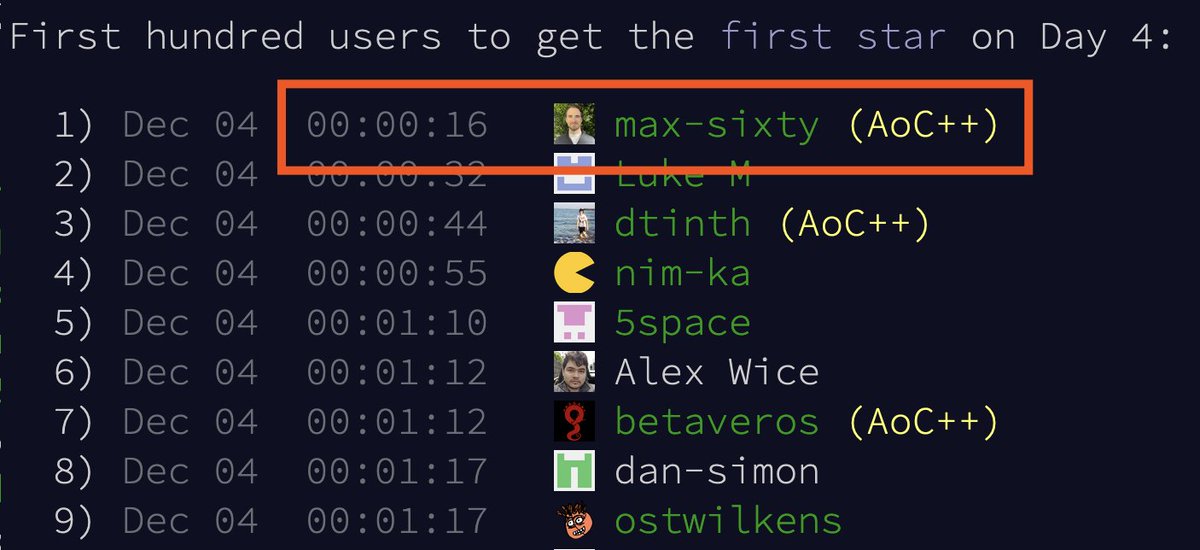
I placed 1st (out of ~100,000) in #AdventOfCode Part 1 today, again by having GPT-3 write the code
A win for GPT-3, @OpenAI, AI — and the creativity of humans!
Likes
177
 Twitter
·
vocal osprey
Twitter
·
vocal osprey
yup ive seen all the drama on twitter / AoC subreddit
like yeah its cool that it can solve it in 16 seconds, its very impressive. but its lame to take away spots from humans actually trying to compete
feral cliff
vocal osprey
pretty disappointing in my opinion
Huge progress on one end.
plush ibex
lame but there's almost nothing that can be done to enforce it
vocal osprey
feral cliff
Huge progress on one end.
agreed. it is cool and very impressive that these language models are so advanced they can solve it in 16 seconds. i just feel bad for the people trying to compete to get on the leaderboards
plush ibex
they'll get their chance in later days
feral cliff
vocal osprey
agreed. it is cool and very impressive that these language models are so advance...
Most of the time is handling input output i would imagine
vocal osprey
just my 2 cents, everyone is entitled to their own opinion 🙂
feral cliff
Solving is instant i would guess
plush ibex
no
feral cliff
Yeah probably
Maybe rules should prevent it. Sure making sure it doesn't happen is different story
jovial marten
obsidian snow
7.3ms lets go
what lang?
obsidian snow
assembly
jovial marten
then 7.3ms feels kinda slow 
plush ibex
probably inefficient code
feral cliff
Depends on the machine:)
plush ibex
true
leaden stratus
hard to imagine a >1000x increase based on hardware alone though
jovial marten
I have <20μs including file read and parsing
feral cliff
Unless it's Atarii 1200 😆
plush ibex
leaden stratus
hard to imagine a >1000x increase based on hardware alone though
if their cpu clock frequency is measured in khz instead of ghz…
 burnt wadi
do they have an actual clock?
tulip ravenBOT
Hey @obsidian snow!
You either uploaded a .txt file or entered a message that was too long. Please use our paste bin instead.
plush ibex
burnt wadi
do they have an actual clock?

A clock generator is an electronic oscillator that produces a clock signal for use in synchronizing a circuit's operation. The signal can range from a simple symmetrical square wave to more complex arrangements. The basic parts that all clock generators share are a resonant circuit and an amplifier.
The resonant circuit is usually a quartz piezo...
idk if this counts
obsidian snow
jovial marten
what lang?
the assembly is too long
 sleek python
can you not use the pastebin?
obsidian snow
 obsidian snow
sleek python
can you not use the pastebin?
obsidian snow
sleek python
can you not use the pastebin?
too big
jovial marten
I guess you miss out on compiler optimizations
sleek python
I feel like at this point a compiled Nim or C version would be faster
because of the optimizations
plush ibex
man's getting skill diffed by compilers 😔
sleek python
Maybe you could use the -S flag and look at the output assembly by the compiler
and find some good tips
*it might be another flag I forget which
jovial marten
jovial marten
I have <20μs including file read and parsing
@sleek python yes
though maybe the approach is also different
sleek python
If you really want to be extreme you could embed the file input in the data of your assembly
Or use extreme parallelization on the GPU
this seems like something that could be parallelized
jovial marten
can you even send data to the gpu in <20μs?
sleek python
jovial marten
can you even send data to the gpu in <20μs?
that is the only issue
leaden stratus
m1 mac? 👀
plush ibex
sleek python
If you really want to be extreme you could embed the file input in the data of y...
if you really want to be extreme, you could embed the expected output in the data of your assembly
sleek python
It might be possibly to use some sort of async file access
plush ibex
😎
sleek python
where you are reading and operating at the same time
I know it's possible in C (I think it's in the Boost library) and you could get ~2700 more operations while reading the file
boost::asio::async_read(s, boost::asio::buffer(data, size), handler);
jovial marten
or just accept that GPU isn't going to be helpful for this tiny size
simd is a better bet for speedups
sleek python
The GPU + Parallelization will be slower for tiny input but will speed up significantly for a ridiculously large input I would guess
jovial marten
this is AoC
sleek python
but because we have a small input it's probably better not to use GPU
jovial marten
no input is that huge
topaz fiber
Is there a neater way of doing this kind of assignment in python:
    if len_range(a) < len_range(b):
        sub_list = a
        mainlist = b
    else:
        sub_list = b
        mainlist = a
sub_list, mainlist = a, b
if len_range(a) < len_range(b):
  mainlist, sub_list = sub_list, main_list
is one way that is shorter
not sure about neater
I would at least use the comma assignment though
because it is neater
        sub_list = a
        mainlist = b
becomes
sub_list, mainlist = a, b
imo that's much more annoying to read
topaz fiber
sleek python
```py
sub_list, mainlist = a, b
if len_range(a) < len_range(b):
mainlist, sub_...
Ah yeah thats an idea, I guess you could even do it like this:
mainlist, sub_list = (b, a) if len_range(a) < len_range(b) else (a, b)```we don't need to golf his solution lol
topaz fiber
wtf is golf? 😂
sleek python
mainlist,sub_list=((b,a),(a,b))[len_range(a)<len_range(b)]
sleek python
topaz fiber
wtf is golf? 😂
making the shortest code possible
jovial marten
if you don't mind keeping the old names, then
if ...:
  a, b = b, a
How about a weirder way 🥴
main_list = max(a, b, key=len_range)
sub_list = min(a, b, key=len_range)
if not in expected order, swap
topaz fiber
ahh I like the min max 😝
jovial marten
gloomy comet
How about a weirder way 🥴
```py
main_list = max(a, b, key=len_range)
sub_list ...
sorted
gloomy comet
true
sleek python
topaz fiber
wtf is golf? 😂
like yesterday we golfed the solution to:
# LF (144)
*z,=open(0,'rb');u=sum;print(u((u({*a[(l:=len(a)//2):]}&{*a[:l]})-96)%58for a in z),u((u({*b}&{*c}&{*d})-106)%58for b,c,d in zip(*3*[iter(z)])))
# CR (144)
*z,=open(0,'rb');u=sum;print(u((u({*a[(l:=len(a)//2):]}&{*a[:l]})-96)%58for a in z),u((u({*b}&{*c}&{*d})-109)%58for b,c,d in zip(*3*[iter(z)])))
# CRLF (146)
*z,=open(0,'rb');u=sum;print(u((u({*a[(l:=len(a)//2-1):]}&{*a[:l]})-96)%58for a in z),u((u({*b}&{*c}&{*d})-119)%58for b,c,d in zip(*3*[iter(z)])))
# xplatform (156)
z=open(0,'rb').read().split();u=sum;print(u((u({*a[(l:=len(a)//2):]}&{*a[:l]})-96)%58for a in z),u((u({*b}&{*c}&{*d})-96)%58for b,c,d in zip(*3*[iter(z)])))
# xplatform one loop (161)
u=sum;print(u(u((u({*a[(l:=len(a)//2):]}&{*a[:l]})-96)%58for a in(b,c,d))+(u({*b}&{*c}&{*d})-96)%58*1j for b,c,d in zip(*3*[iter(open(0,'rb').read().split())])))
# encoded
# LF (97)
exec(bytes("稪㴬灯湥〨✬扲⤧画猽浵瀻楲瑮用⠨⡵⩻孡氨㴺敬⡮⥡⼯⤲崺♽⩻孡氺絝㘹┩㠵潦湩稠Ⱙ⡵用笨截♽⩻絣符搪⥽ㄭ㘰┩㠵潦ⱢⱣ湩稠灩⨨⨳楛整⡲⥺⥝⤩",'u16')[2:])
# CR (97)
exec(bytes("稪㴬灯湥〨✬扲⤧画猽浵瀻楲瑮用⠨⡵⩻孡氨㴺敬⡮⥡⼯⤲崺♽⩻孡氺絝㘹┩㠵潦湩稠Ⱙ⡵用笨截♽⩻絣符搪⥽ㄭ㤰┩㠵潦ⱢⱣ湩稠灩⨨⨳楛整⡲⥺⥝⤩",'u16')[2:])
# CRLF (98)
exec(bytes('稪㴬灯湥〨✬扲⤧画猽浵瀻楲瑮用⠨⡵⩻孡氨㴺敬⡮⥡⼯ⴲ⤱崺♽⩻孡氺絝㘹┩㠵潦湩稠Ⱙ⡵用笨截♽⩻絣符搪⥽ㄭ㤱┩㠵潦ⱢⱣ湩稠灩⨨⨳楛整⡲⥺⥝⤩','u16')[2:])
# xplatform (103)
exec(bytes("㵺灯湥〨✬扲⤧爮慥⡤⸩灳楬⡴㬩㵵畳㭭牰湩⡴⡵用笨愪⡛㩬氽湥愨⼩㈯㨩絝符愪㩛嵬⥽㤭⤶㔥昸牯愠椠⥺甬⠨⡵⩻絢符挪♽⩻絤㘹┩㠵潦ⱢⱣ湩稠灩⨨⨳楛整⡲⥺⥝⤩",'u16')[2:])
# xplatform one loop (106)
exec(bytes("㵵畳㭭牰湩⡴⡵⡵用笨愪⡛㩬氽湥愨⼩㈯㨩絝符愪㩛嵬⥽㤭⤶㔥昸牯愠椠⡮ⱢⱣ⥤⬩用笨截♽⩻絣符搪⥽㤭⤶㔥⨸樱映牯戠挬搬椠楺⡰㌪嬪瑩牥漨数⡮ⰰ爧❢⸩敲摡⤨献汰瑩⤨崩⤩
",'u16')[2:])
exactly
feral cliff
topaz fiber
Is there a neater way of doing this kind of assignment in python:
```py
if ...
What if they are equal length
topaz fiber
Oh dear god
jovial marten
this is why we should measure bytes, not characters
topaz fiber
feral cliff
What if they are equal length
Then it doesnt matter which way around it uses them
sleek python
jovial marten
this is why we should measure bytes, not characters
this is also why exec should be banned in most cases
feral cliff
Still need to assign main sub not?
jovial marten
topaz fiber
Then it doesnt matter which way around it uses them
the min max one could end up with the same list twice
topaz fiber
Ah thats true
gloomy comet
then do min(b, a) just in case
 rotund forge
sleek python
this is also why `exec` should be banned in most cases
rotund forge
sleek python
this is also why `exec` should be banned in most cases
I think exec is fine, for example the eval trick for parsing today's input was cool. But yeah, golf for bytes not characters.
severe heath
sleek python
Or use extreme parallelization on the GPU
i know someone who did day 1 and day 2 in futhark
rotund forge
Obviously, the code should include everything it needs to run, don't open another file or fetch from the internet and exec that
sleek python
rotund forge
I think exec is fine, for example the eval trick for parsing today's input was c...
I said exec not eval, but I can agree that if you're doing something fancy like running .replace() on a string you are executing to shorten it then I can see that being valid
Something like:
# xplatform one loop (106)
exec(bytes("㵵畳㭭牰湩⡴⡵⡵用笨愪⡛㩬氽湥愨⼩㈯㨩絝符愪㩛嵬⥽㤭⤶㔥昸牯愠椠⡮ⱢⱣ⥤⬩用笨截♽⩻絣符搪⥽㤭⤶㔥⨸樱映牯戠挬搬椠楺⡰㌪嬪瑩牥漨数⡮ⰰ爧❢⸩敲摡⤨献汰瑩⤨崩⤩
",'u16')[2:])
Kind of ruins the point tbh
rotund forge
You can replace exec with eval in that if the original was a single print call or whatever and it will work. Doesn't make sense to differentiate between the two when it comes to code golf really
jovial marten
sleek python
Something like:
```py
# xplatform one loop (106)
exec(bytes("㵵畳㭭牰湩⡴⡵⡵用笨愪⡛㩬氽湥愨⼩㈯㨩...
that's 268 bytes
jovial marten
that's why we shouldn't measure characters
sleek python
"Optimal" solution for every problem ever:
print(eval(input()))
# and
exec(input())
When "input can be given in any convenient format"
sleek python
I mean you can put any valid code and it will work fine
the only things that are shorter than that
are like
print(5)
or something small
exec(input())
print(123456)
you can print a maximum of a 5 character expression
before beating that
 normal obsidian
Love to see situations where part 2 require 3 more lines of code
def puzzle():
    crossovers = 0
    anyCrossOver = 0
    for pair in pairs:
        order1 = set(range(pair[0][0], pair[0][1] + 1))
        order2 = set(range(pair[1][0], pair[1][1] + 1))
        if order1.intersection(order2) == order1 or order1.intersection(order2) == order2:
            crossovers += 1
        elif not order1.isdisjoint(order2):
            anyCrossOver += 1
    return crossovers + anyCrossOver


with open('input.txt', 'r') as file:
    data = file.read().split("\n")

pairs = [[[int(i) for i in hyphen.split('-')] for hyphen in row.split(',')] for row in data]

puzzle()
 supple creek
finished!
I got to use sets for this too
def part_1(ranges: list[Iterator[int]]) -> int:
    r = [
        i
        for i in ranges
        if (a := set(range(next(i), next(i) + 1))).issubset(
            b := set(range(next(i), next(i) + 1))
        )
        or b.issubset(a)
    ]

    return len(r)


def part_2(ranges: list[Iterator[int]]) -> int:
    r = [
        i
        for i in ranges
        if set(range(next(i), next(i) + 1)) & set(range(next(i), next(i) + 1))
    ]

    return len(r)
``` was my solutionhmm, the second thing for an intersection doesn't have to be a set, does it
ah, yeah, if you use .intersection you can pass any iterable
eh whatever, & is cleaner
where ranges was ranges = [map(abs, extract_ints(l)) for l in raw_input]
jovial marten
O(😔)
severe heath
i'm surprised y'all actually constructed ranges
supple creek
What the fuck
severe heath
i did at first when i thought you could do range in range
supple creek
my pc crashed when I tried to create two huge sets for an intersection with timeit
severe heath
but bounds checking is so much easier
supple creek
severe heath
i did at first when i thought you could do `range in range`
lol, I tried that at first too
jovial marten
severe heath
but bounds checking is so much easier
(and faster)
supple creek
but muh sets
leaden stratus
new feature for 3.12, range.intersect
supple creek
PRing immediately
sleek python
leaden stratus
new feature for 3.12, `range.intersect`
this idea isn't horrible actually
but they would probably just say convert to set
severe heath
lmfao i was expecting someone to pr Range::overlaps and Range::covers to rust
surprised it hasn't happened yet
leaden stratus
sleek python
but they would probably just say convert to set
surely they wouldn't. that's such a poor way to do it
turning a O(1) time and memory to O(n) time and meemory
sleek python
I suppose so
supple creek
Is intersection O(1)?
severe heath
ranges can do trivial bounds checking, they don't calculate everything beforehand
sleek python
Yes
supple creek
I see
leaden stratus
as i found out quite recently in #algos-and-data-structs !
idle locust
I'm a JS user :)
severe heath
oh yes, steps exist
sleek python
jovial marten
because step sizes
differing step sizes would be nightmarish
severe heath
completely forgot about those
sleek python
same step sizes wouldn't change anything
jovial marten
at least intersect for general ranges would still be a range
(afaik)
err...I guess negative steps makes the direction weird
supple creek
just error on steps 😤
jovial marten
what's the intersection between range(10) and range(9, -1, -1)?
leaden stratus
you could just default to a >0 step
sleek python
!e ```py
a = set(range(10))
b = set(range(9, -1, -1))
print(a)
print(b)
print(a&b)
:O sets are ordered??? /j
tulip ravenBOT
@sleek python :white_check_mark: Your 3.11 eval job has completed with return code 0.
001 | {0, 1, 2, 3, 4, 5, 6, 7, 8, 9}
002 | {0, 1, 2, 3, 4, 5, 6, 7, 8, 9}
003 | {0, 1, 2, 3, 4, 5, 6, 7, 8, 9}
no lol
sleek python
Replace the two ranges to test what the intersection should be
leaden stratus
now do range(10000000000000000)
sleek python
!e ```py
a = set(range(100000000))
b = set(range(9, -1, -1))
print(a)
print(b)
print(a&b)
@sleek python :warning: Your 3.11 eval job timed out or ran out of memory.
[No output]
Skill issue
sleek python
yeah that's unsuprising
jovial marten
sleek python
Replace the two ranges to test what the intersection should be
we were talking about intersection of ranges producing new ranges
sleek python
jovial marten
we were talking about intersection of ranges producing new ranges
the output is the range
sleek python
it would be equivalent to the set() of the range
I think
but I haven't tested like anything so I'm probably wrong
sleek python
what would the logic be though for every case
idle locust
random shit
jovial marten
sleek python
what would the logic be though for every case
it's a linear diophantine equation
you can solve it
burnt wadi
yes, the step might be least common multiple
jovial marten
the answer is a range
sleek python
jovial marten
you can solve it
is it O(1) to solve though? Cause if not then set() solution is easier
jovial marten
sleek python
is it O(1) to solve though? Cause if not then `set()` solution is easier
you need to compute a gcd, but that's about it
gcd is what? log(n)?
sleek python
alright
Yeah I'm pretty sure its log(n)
Worst case is
log10(min(x,y))
where x, y are the inputs
for the most optimized algorithm
leaden stratus
!d math.gcd
jovial marten
another example
a = range(1, 100, 3)
b = range(0, 100, 5)
a&b could be range(10, 15, 100)
hm. what is gcd good for in this case? 
sleek python
solving a "linear diophantine equation"
jovial marten

In mathematics, a Diophantine equation is an equation, typically a polynomial equation in two or more unknowns with integer coefficients, such that the only solutions of interest are the integer ones. A linear Diophantine equation equates to a constant the sum of two or more monomials, each of degree one. An exponential Diophantine equation is ...
sleek python
I'm unfamilar with the term "diophantine" at all but I'm gonna trust fiery on this one
jovial marten
a diophantine equation is just an equation with only integers allowed
this is a particularly easy one
sleek python
oh this seems way easier then
we would have to write a solution in C and add it to the range class
jovial marten
but as mentioned, it's a bit ill-defined
sleek python
I'll see if I can find the source for range
jovial marten
e.g. for a mix of negative and positive step sizes
 ember junco
tulip ravenBOT
ember junco
tulip ravenBOT
@ember junco :x: Your 3.11 eval job has completed with return code 1.
001 |   File "<string>", line 1
002 |     raise raise raise
003 |           ^^^^^
004 | SyntaxError: invalid syntax
GitHub
The Python programming language. Contribute to python/cpython development by creating an account on GitHub.
found the definition
of PyRange_Type
 odd frost
A little late to the party because I wasn't there this wk:
def all_overlapping(parts):
    first = list(map(int, parts[0].split("-")))
    second = list(map(int, parts[1].split("-")))
    return (first[0] <= second[0] and first[-1] >= second[-1]) \
            or (second[0] <= first[0] and second[-1] >= first[-1])

def some_overlapping(parts):
    first = list(map(int, parts[0].split("-")))
    second = list(map(int, parts[1].split("-")))
    return (first[0] <= second[0] and first[1] >= second[0]) or \
            (second[0] <= first[0] and second[1] >= first[0])

def part1(content):
    return sum([all_overlapping(line.split(",")) for line in content.split("\n")])

def part2(content):
    return sum([some_overlapping(line.split(",")) for line in content.split("\n")])

content = read_file("input.txt").strip()
print(part2())
 inland leaf
with open('day4\input.txt', 'r') as f:
    inputlist = f.read().split('\n')

total = 0

def formula(x):
    return {num for num in range(int(x[0]), int(x[1]) + 1)}

for line in inputlist:
    a, b = [half.split('-') for half in line.split(',')]
    seta, setb = formula(a), formula(b)
    if seta.intersection(setb) != set():
        total += 1

print(total)```
Solution for part 2, lmk if you spot any obvious optimizations that can be made!set(range(int(x[0]), int(x[1]) + 1))
also technically if seta.intersection(setb): is enough, but maybe you were trying to be verbose
inland leaf
Ah, I was not :P because python treats empty stuff as false?
gloomy comet
if you're looking for optimization, then comparing the boundaries will be more efficient than generating the entire set for each pair of integers
inland leaf
gloomy comet
if you're looking for optimization, then comparing the boundaries will be more e...
Yeah I did find out about that when I saw other peoples solutions but decided to keep with how I solved it and try to look for simple optimizations since I'm only a beginner
inland leaf
gloomy comet
`set(range(int(x[0]), int(x[1]) + 1))`
Ah, ty, I didn't know range could be used like that outside of for loops
gloomy comet
range is just a function (technically a class), it can be used anywhere
inland leaf
Also question, why can't I replace the line
if seta.intersection(setb) != set():```
with
```py
if seta.isdisjoint(setb):```
It seems like they should be the same thingyou want to know if they're not disjoint
inland leaf
ah, yeah I thought it might be something like that, how would I write that?
gloomy comet
if not seta...
inland leaf
tysm
plush ibex
ig i don't get a pin 😦
pine field
seta.intersection(setb)
seta.intersection(setb) is the same as not seta.isdisjoint(setb) in truthyness
pine field
gloomy comet
if you're looking for optimization, then comparing the boundaries will be more e...
I was actually surprised that part 2 was not specifically about adding enough scale that comparing sets would not work.
gloomy comet
pine field
I was actually surprised that part 2 was not specifically about adding enough sc...
Too early I guess. Might return in a future puzzle
gloomy comet
plush ibex
frfr look at how clean and simple my solution is
```py
print(sum(1-(a>c<=d<b or ...
pine field
gloomy comet
Too early I guess. Might return in a future puzzle
Seems likely.
 surreal wigeon
pine field
I was actually surprised that part 2 was not specifically about adding enough sc...
surreal wigeon
pine field
I was actually surprised that part 2 was not specifically about adding enough sc...
im guessing 60-90% of people would compare ranges though
and for those people scale doesn't pose that much of an issue
pine field
I'll be honest, I was also surprised to see so many people using sets instead of just comparing the end points.
 deft flame
And here I thought I was cool because I thought outside the box and came up with this cool idea for sets...
pine field
sets are cool. I love sets. didn't use them this time. =/
severe heath
for some reason comparisons always mess me up
 ripe kraken
Laughably unoptimised this time, but I was lazy lol
def day_4():
    def part_one():
        return len([1 for pair in DATA.splitlines() if all([n in range(int(pair.split(",")[1].split("-")[0]), int(pair.split(",")[1].split("-")[1]) + 1) for n in range(int(pair.split(",")[0].split("-")[0]), int(pair.split(",")[0].split("-")[1]) + 1)]) or all([n in range(int(pair.split(",")[0].split("-")[0]), int(pair.split(",")[0].split("-")[1]) + 1) for n in range(int(pair.split(",")[1].split("-")[0]), int(pair.split(",")[1].split("-")[1]) + 1)])])
    def part_two():
        return len([1 for pair in DATA.splitlines() if any([n in range(int(pair.split(",")[1].split("-")[0]), int(pair.split(",")[1].split("-")[1]) + 1) for n in range(int(pair.split(",")[0].split("-")[0]), int(pair.split(",")[0].split("-")[1]) + 1)]) or any([n in range(int(pair.split(",")[0].split("-")[0]), int(pair.split(",")[0].split("-")[1]) + 1) for n in range(int(pair.split(",")[1].split("-")[0]), int(pair.split(",")[1].split("-")[1]) + 1)])])
    return part_one()
i got the logic right yesterday in my submission, but it took me about 15 minutes to mentally work through it when helping someone this morning
 pine swan
pine field
I'll be honest, I was also surprised to see so many people using sets instead of...
pine swan
pine field
I'll be honest, I was also surprised to see so many people using sets instead of...
I tried to do it that way, but it was too early in the morning xd
ripe kraken
pine field
I'll be honest, I was also surprised to see so many people using sets instead of...
I did that at first but it just wasn't working. It wasn't till after I started another approach that I realized I was using < and > on strings XD
pine swan
ripe kraken
I did that at first but it just wasn't working. It wasn't till after I started a...
This might have been the problem for me too... xD
surreal wigeon
ripe kraken
Laughably unoptimised this time, but I was lazy lol
```py
def day_4():
def p...
wow
uh
:= is your friend
 wet wagon
i used all and any for the first time
wet wagon
I've never had to use it @frank sleet
 frank sleet
no kidding
normal obsidian
Agreed
 quiet crypt
Here's mine for part one
# Checks if any range fully contains the other
def fully_contains(range_one, range_two):
    one_fully_contains_two = range_one[0] <= range_two[0] and range_one[1] >= range_two[1]
    two_fully_contains_one = range_two[0] <= range_one[0] and range_two[1] >= range_one[1]

    return one_fully_contains_two or two_fully_contains_one

def main():
    # Opens input file in read mode
    with open("problem_4_input.txt", "r") as input_file:
        # Number of ranges that fully contains the other
        num_fully_contains = 0

        for line in input_file.readlines():
            # Split line into two ranges
            line = line.rstrip("\n")
            ranges = line.split(",")
            # Split both ranges into two integer strings
            range_one = ranges[0].split("-")
            range_two = ranges[1].split("-")
            # List versions of both ranges
            range_one_list = [int(range_one[0]), int(range_one[1])]
            range_two_list = [int(range_two[0]), int(range_two[1])]
            # If either range fully contains the other, increase number of ranges that fully contains the other
            if fully_contains(range_one_list, range_two_list):
                num_fully_contains += 1

        # Print result
        print(num_fully_contains)

if __name__ == "__main__":
    main()
Tips and suggestions are welcome
 ocean elm
wet wagon
ocean elm
wet wagon
with open("the.txt","r") as f:
    ko = f.read().split("\n")
    count = 0
    for i in ko:
        k, l = i.split(",")
        do,xo = k.split("-")
        fo,go = l.split("-")
        do = int(do)
        xo = int(xo)
        fo = int(fo)
        go = int(go)
        if do >= fo and xo >= go:
            count += 1
        elif fo >= do and go >= xo:
            count += 1
print(count)```What's wrong exactly?
tall torrent
wet wagon
```py
with open("the.txt","r") as f:
ko = f.read().split("\n")
count = 0...
1-6,5-7
5 >= 1 and 7 >= 6, but neither interval contains the other
wet wagon
tall torrent
`1-6,5-7`
5 >= 1 and 7 >= 6, but neither interval contains the other
Ty I fixed it
I don't think I really understand part 2
tall torrent
wet wagon
I don't think I really understand part 2
first part is to count the amount of fully contained assignments, part 2 is to count the amount of assignments with at least 1 overlap
tall torrent
tall torrent
`1-6,5-7`
5 >= 1 and 7 >= 6, but neither interval contains the other
like in this case, there would be an overlap between the two (in 5 and 6)
wet wagon
Ah
 snow olive
cleaned up my solution a bit
def part1(section_ids):
    set_a = set(range(section_ids[0], section_ids[1] + 1))
    set_b = set(range(section_ids[2], section_ids[3] + 1))
    smallest_set = set_a if len(set_a) < len(set_b) else set_b
    return set_a & set_b == smallest_set


def part2(section_ids):
    set_a = set(range(section_ids[0], section_ids[1] + 1))
    set_b = set(range(section_ids[2], section_ids[3] + 1))
    return not len(set_a & set_b) == 0


with open("../inputs/day4.txt") as file:
    sections = list(map(lambda s: list(map(int, s)),
                        [ids.replace('-', ',').split(',') for ids in file.read().splitlines()]))

print("Part 1:", len(list(filter(part1, sections))))
print("Part 2:", len(list(filter(part2, sections))))
can someone explain what i am doing wrong?
def range_to_string(lower, upper):
    return "".join([str(x) for x in range(int(lower), int(upper) + 1)])


def main() -> int:
    contains_count = 0

    with open("input.txt", "r", encoding="UTF-8") as f:
        for line in f:
            line = line.strip("\n")

            e1_range, e2_range = line.split(",")

            e1_lower, e1_upper = e1_range.split("-")
            e2_lower, e2_upper = e2_range.split("-")

            elf_1 = range_to_string(e1_lower, e1_upper)
            elf_2 = range_to_string(e2_lower, e2_upper)

            if (elf_1 in elf_2) or (elf_2 in elf_1):
                contains_count += 1

    print(contains_count)

    return 0
this outputs 2 for the example they gave but when i try it on my own puzzle input it is wrong apparently
 fair yacht
d4a = sum(a<=c<=d<=b or c<=a<=b<=d for a,b,c,d in (map(int, line.replace(",","-").split("-")) for line in in4a.splitlines()))
My single-liner :3
fair yacht
wet wagon
can someone explain what i am doing wrong?
```py
def range_to_string(lower, uppe...
You're converting them to a string of numbers, which may have false-positives. Like first elf having 1-2 and second having 12-whatever
The task specifically says they used single digits there so they could nicely show the overlap and that real task will have multiple digit numbers
wet wagon
fair yacht
You're converting them to a string of numbers, which may have false-positives. L...
just to clarify, does 50-55 mean 50, 51, 52, 53, 54, 55 ?
fair yacht
wet wagon
just to clarify, does ``50-55`` mean 50, 51, 52, 53, 54, 55 ?
Yes. The example specifically showed that both ends are inclusive. You're doing that one part correctly, the only bad part is the string and false-positives stemming from that
Okay, second part finished:
d4a = sum(a<=c<=d<=b or c<=a<=b<=d for a,b,c,d in (map(int, line.replace(",","-").split("-")) for line in in4a.splitlines()))

d4b = sum((min(b,d)+1-max(a,c))>0 for a,b,c,d in (map(int, line.replace(",","-").split("-")) for line in in4a.splitlines()))
 empty river
with open('advent4.txt', 'r') as txtfile:
    from re import split
    txtlst = [list(map(int, split(r',|-', line.strip()))) for line in txtfile]
    #print(txtlst)
This is how I'm parsing. So I didn't use the read() or readline() but it still works? Is there a reason to use read() over looping. Please don't comment about the parsing method yet I'm going to try to do it my way first
winter gulch
empty river
```py
with open('advent4.txt', 'r') as txtfile:
from re import split
txt...
Sometimes you might want the whole text in one go, rather than line by line
empty river
winter gulch
Sometimes you might want the whole text in one go, rather than line by line
I agree, but I mean I did it without using the read methods
I guess read() is what you mean
and readline() same as looping?
what I did
*iterating
winter gulch
empty river
and readline() same as looping?
Close, though I think readline() might preserve the \n at the end
winter gulch
empty river
I guess read() is what you mean
Yes that is what I was referring to
empty river
Gotcha gotcha ty
empty river
def parttwo(loloi):
    counter = 0
    for item in loloi:
        rge1, rge2 = set(range(item[0], item[1] + 1)), set(range(item[2], item[3] + 1))
        #if not rge1 - rge2 or not rge2 - rge1:
        if rge2 & rge1:
            counter += 1
    return counter

with open('advent4.txt', 'r') as txtfile:
    from re import split
txtlst = [list(map(int, split(r',|-', line.strip()))) for line in txtfile]```This is my incorrect solution for parttwo. I would like to be given a hint.
It seems to me a simple intersection should do the trick.
EDIT: input was wrong. Solution works
winter gulch
empty river
This is my ~~in~~correct solution for parttwo. I would like to be given a hint.
Did you try testing against the test input?
empty river
winter gulch
Did you try testing against the test input?
I did
I got the same answer of 4 as here

I'm thinking there must be an edge case I'm missing.
 minor grove
empty river
```py
def parttwo(loloi):
counter = 0
for item in loloi:
rge1, r...
minor grove
empty river
```py
def parttwo(loloi):
counter = 0
for item in loloi:
rge1, r...
seems to work for my input for some reason
empty river
minor grove
seems to work for my input for some reason
😭
Let me double-check my input file.
minor grove
yeah, maybe just redownload it
empty river
minor grove
yeah, maybe just redownload it
🙄 I failed to copy paste last line. My answer was one off.
minor grove
💀
empty river
Thank you for testing in your input
 solid quarry
solution (not python)```ruby
aoc problem 4
class Range
def overlap?(other)
self.end >= other.begin or self.begin > other.begin and self.begin <= other.end
end
end
def input
File.read('4.txt').lines.map do |l|
l.split(/,/).map do |r|
start, stop = r.split(/-/)
start.to_i..stop.to_i
end
end
end
return unless FILE == $0
part 1 solution
puts input.count {|r0, r1| r0.cover? r1 or r1.cover? r0}
part 2 solution
puts input.count {|r0, r1| r0.overlap? r1}
ok now yes python ```py
aoc problem 4
def getinput():
acc = []
with open('4.txt') as f:
for l in f.read().splitlines():
(r0start, r0stop), (r1start, r1stop) = [r.split('-') for r in l.split(',')]
acc.append((set(range(int(r0start), int(r0stop) + 1)),
set(range(int(r1start), int(r1stop) + 1))))
return acc
def full_contains(rangepairs):
acc = 0
for r0, r1 in rangepairs:
if (r0 | r1) == r0 or (r0 | r1) == r1:
acc += 1
return acc
def overlaps(rangepairs):
acc = 0
for r0, r1 in rangepairs:
if (r0 & r1) != set():
acc += 1
return acc
def main():
inpt = getinput()
print(full_contains(inpt)) # part 1 solution
print(overlaps(inpt)) # part 2 solution
if name == 'main':
main()
sets are cool
supple creek
solid quarry
solution (not python)```ruby
# aoc problem 4
class Range
def overlap?(other...
ruby?
plush ibex
yeah that's rb
solid quarry
supple creek
ruby?
yeah its ruby
 candid fable
input_file = "4.txt"

with open(input_file) as f:
    data = f.read().split("\n")

score = 0
for line in data:
    one, two = line.split(",")
    one_range = one.split("-")
    two_range = two.split("-")
    one_range = list(range(int(one_range[0]), int(one_range[1])+1))
    two_range = list(range(int(two_range[0]), int(two_range[1])+1))

    if any(x in two_range for x in one_range) or any(x in one_range for x in two_range):
        score += 1
print(score)
# for part 1, just change the `any` functions to `all`
I keep getting a wrong answer for the part 1 (my input is fine). It works for the test values. Could someone help me out? Thanks
f = open("inputday4.txt",'r')
filecontents=f.read().replace('\n',',').replace('-',',').split(',')
filecontents = [filecontents[x:x+4] for x in range(0,len(filecontents),4)]


assignments1 = []
assignments2 = []

for x in filecontents:
    assignments1.append([z for z in range (int(x[0]),int(x[1])+1)])
for x in filecontents:
    assignments2.append([z for z in range (int(x[2]),int(x[3])+1)])

assignments1 = [','.join([str(z) for z in x])for x in assignments1]
assignments2 = [','.join([str(z) for z in x])for x in assignments2]

assignments_containing_the_other = 0

for x in range(len(assignments1)):
    if assignments1[x] in assignments2[x] or assignments2[x] in assignments1[x]:
        assignments_containing_the_other+=1

print(assignments_containing_the_other)

f.close()
if you have
x1           x2
       y1           y2
your if statement is true because y1 is in between x1 and x2, but it should be false because the whole range (y1, y2) isn't inside (x1, x2) (or vice versa)
 dreamy kestrel
hello
i am facing some awkward issue with this problem
8
2 6 4 8
True False False True
2 4 3 5
True False False True
5 7 7 9
True False False True
2 3 8 7
True True False False
['2', '8'] ['3', '7']
6 4 6 6
False True True True
['6', '6'] ['4', '6']
2 4 6 8
True False False True
5 5 5 5
True True True True
['5', '5'] ['5', '5']
13 8 98 13
True True False False
['13', '98'] ['8', '13']
4
here, my condition was

so you see for the last experimental input which is 13-98,8-13
the program shouldn't count this pair as it doesn't fulfill the condition
but the program somehow counts it
here in this part s_point_1st_elf <= s_point_2nd_elf s_point_1st_elf is 13 and s_point_2nd_elf is 8, so 13 <=8 should have been False but when printed the result for this input it is True
13 8 98 13
True True False False
['13', '98'] ['8', '13']
x1 = 13 and x2 = 8
y1 = 98 and y2 = 13
so for the first condition
13 <= 8 is False and 98 >= 13 is True which results False so it shouldn't count
as for the second condition
8 <= 13 is True and 13 >= 98 is False which also results False and won't count
so this pair shouldn't count at all
but how come my program is counting it?
the worst thing is i am not seeing any wrong with my program but if we read the program it shouldn't count this pair but it does anyway
#Advent of code
#Problem 4
#--- Day 4: Camp Cleanup ---

with open("day4exp.txt") as f:
    inp = f.read()

li1 = [list(map(str, i.split("\n"))) for i in inp.strip().split("\n\n")]

li2 = []
for i in li1[0]:
    str1 = i.split(",")
    li2.append(str1)

cnt = 0

for j in li2:
    temp_li1 = j[0].split("-")
    temp_li2 = j[1].split("-")
    x1 = temp_li1[0]
    y1 = temp_li1[1]
    x2 = temp_li2[0]
    y2 = temp_li2[1]

    if (x1 <= x2) and (y1 >= y2):
        cnt += 1
    elif (x2 <= x1) and (y2 >= y1):
        cnt +=1

print(cnt)
here's my program and idk why it doesn't work
it works on the example input
but like i said this program count some pair which it shouldn't count
that's why i get wrong answer in the part 1
kind niche
dreamy kestrel
that's why i get wrong answer in the part 1
You're not converting them to integers are you?
You're probably doing string comparison here
Which isn't right
dreamy kestrel
ahh damn! okay let me try after converting them to integer
dreamy kestrel
kind niche
You're not converting them to integers are you?
ohh it worked now! thanks!
idk why this thought didn't cross my mind, tried every way to find the bug except this.
kind niche
Happens to the best of us 😅
It's easier to find certain bugs when you have a fresh pair of eyes
dreamy kestrel
my brain is not working today at all lol
dreamy kestrel
kind niche
It's easier to find certain bugs when you have a fresh pair of eyes
yeah true
kind niche
You've probably just been looking at it too long, and think it does what you want, not what it says
Been there done that
dreamy kestrel
yeah sorry! learned my lesson today 