#AoC 2022 | Day 3 | Solutions & Spoilers
1 messages · Page 2 of 1
 sand jungle
 hoary parcel
sand jungle
<@310263589913100288> what is the shortest till now?
hoary parcel
sand jungle
<@310263589913100288> what is the shortest till now?
pinned
 proud hamlet
lines = open("../inputs/day3.txt").read().splitlines()

lines = [lines[n:n+3] for n in range(0, len(lines), 3)]

indexes = " abcdefghijklmnopqrstuvwxyzABCDEFGHIJKLMNOPQRSTUVWXYZ"
print(sum(indexes.index(list(set(group[0]).intersection(set(group[1]).intersection(set(group[2]))))[0]) for group in lines))
not great but ¯_(ツ)_/¯
sand jungle
hoary parcel
pinned
Crlf doesn't work for me
hoary parcel
sand jungle
Crlf doesn't work for me
are you on windows and did you provide an input using stdin
sand jungle
hoary parcel
are you on windows and did you provide an input using stdin
Mac. Input through file
hoary parcel
sand jungle
Mac. Input through file
you shouldn't be using CRLF then
use the LF one
sand jungle
hoary parcel
use the LF one
Tried that as well. P1 works. P2 doesn't falls 10 short of the actual answer
hoary parcel
sand jungle
Tried that as well. P1 works. P2 doesn't falls 10 short of the actual answer
what about the xplatform one
does it give the same wrong answer
hoary parcel
sand jungle
Xplatform works
probably with CR line endings?
hoary parcel
sand jungle
Xplatform works
added a CR version
sand jungle
What does that mean? I mean , how do I do that?
hoary parcel
hoary parcel
added a CR version
either that's the error or some misprovided input
hoary parcel
sand jungle
What does that mean? I mean , how do I do that?
check the solutions and test the one labeled CR
hoary parcel
sand jungle
I changed nothing and ran the LF again and it worked
oh
hoary parcel
sand jungle
Tried that as well. P1 works. P2 doesn't falls 10 short of the actual answer
CRLF did this?
 chilly linden
todays discovery was for first_elf, second_elf, third_elf in zip(*[iter(data)] * 3): magical
 wintry depot
indeed ... thanks to stackoverflow I found that as well
chilly linden
last night you didn't want to enter the esoteric python territory, what is this today 😭
 lethal spindle
i did it in lua, I miss Sets 
chilly linden
wintry depot
indeed ... thanks to stackoverflow I found that as well
i initially used the usual range but wasn't happy with it and found that gem
very neat
when i first saw the question i thought it was gonna be hard, turned out to be surprisingly ez
wintry depot
Yeah didn't seem easy at first, but now it looks quite simple. But still took me about 30 minutes the 2nd part
 quiet heath
I thought part 2 was going to be difficult in particular. Was surprised it was almost exactly the same as part 1, just with slightly altered input
wintry depot
I can't wait for the next puzzles. Hope I get further than last year, before I lose motivation
 fallen sinew
d3a = sum(ord(e.lower())-ord('a')+1+26*e.isupper() for line in in3a.splitlines() for e in set(line[:len(line)//2])&set(line[len(line)//2:]))

in3b = in3a.splitlines()
d3b = sum(ord(e.lower())-ord('a')+1+26*e.isupper() for x,y,z in (in3b[i:i+3] for i in range(0,len(in3b),3)) for e in set(x)&set(y)&set(z))
One liners (for second task, I only did splitlines separately because it would look ugly and repeat it many times) on phone :3
chilly linden
fallen sinew
```py
d3a = sum(ord(e.lower())-ord('a')+1+26*e.isupper() for line in in3a.splitl...
im surprised i understood this 100% because its literally a one liner of my program lol
 ornate linden
import string

 scores = {letter: score for score, letter in enumerate(string.ascii_letters, 1)}


 def split_strings(row):
     lenstr = len(row) // 2
     return row[:lenstr], row[lenstr:]


 def intersections(*tups):
     tups = iter(tups)
     first = set(next(tups))
     for tup in tups:
         first &= set(tup)
     return first.pop()


 with open("puzzle.input") as f:
     print(
         "part1:",
         sum(scores[intersections(*tup)] for tup in map(split_strings, f.readlines())),
     )


 with open("puzzle.input") as f:
     lines = [line.strip() for line in f.readlines()]
     zipped = zip(lines[::3], lines[1::3], lines[2::3])
     print(
         "part2:",
         sum(scores[intersections(*tup)] for tup in zipped),
     )
 woeful phoenix
ahh ord() I knew there had to be a function that converted strings to ints. I just used a list.
chilly linden
woah
 mighty robin
with open("inputs/input_3.txt", "r") as input_file:
    inputs = [line.strip() for line in input_file.readlines()]

PRIORITIES = "abcdefghijklmnopqrstuvwxyzABCDEFGHIJKLMNOPQRSTUVWXYZ"


def part_one(input):
    total_sum = 0
    for i in inputs:
        comp_one, comp_two = set(i[0 : len(i) // 2]), set(i[len(i) // 2 : len(i)])
        intersection = comp_one.intersection(comp_two)
        total_sum += PRIORITIES.index(list(intersection)[0]) + 1
    print(total_sum)


def part_two(input):
    total_sum = 0
    elf_groups = [input[i : i + 3] for i in range(0, len(input), 3)]
    set_elfs = [[set(k) for k in i] for i in elf_groups]
    for i in set_elfs:
        intersection = i[0].intersection(i[1], i[2])
        total_sum += PRIORITIES.index(list(intersection)[0]) + 1
    print(total_sum)


part_one(inputs)
part_two(inputs)
Any suggestions on how to clean part_two?
elf_groups = [input[i : i + 3] for i in range(0, len(input), 3)]
set_elfs = [[set(k) for k in i] for i in elf_groups]
Here I just divide into groups first and then turn each element of the groups into sets, but I feel like there is a better way haha
 frigid hawk
mighty robin
```py
with open("inputs/input_3.txt", "r") as input_file:
inputs = [line.str...
frigid hawk
mighty robin
```py
with open("inputs/input_3.txt", "r") as input_file:
inputs = [line.str...
FYI you can use string.ascii_letters to get the string of all the letters
mighty robin
frigid hawk
FYI you can use `string.ascii_letters` to get the string of all the letters
Yeah I just avoid imports in general for AOC
 naive bridge
""" Day 3 Part 1 Solution """

f = open("puzzle_input.txt", "r")
puzzle_input = f.read()

priority_sum = 0
priority_value = lambda it: ord(it) - (96 if(ord(it) in range(ord('a'), ord('z')+1)) else 38)

for line in puzzle_input.split("\n"):
    middle = int(len(line)/2)
    first = line[:middle]
    second = line[middle:]

    for item in second:
        if item in first:
            priority_sum += priority_value(item)
            break

print(priority_sum) # 7863


""" Day 3 Part 2 Solution """
import functools

f = open("puzzle_input.txt", "r")
puzzle_input = f.read()
puzzle_input_lines = puzzle_input.split("\n")

priority_sum = 0
team_size = 3
priority_value = lambda it: ord(it) - (96 if(ord(it) in range(ord('a'), ord('z')+1)) else 38)

for lineidx in  range(0, len(puzzle_input_lines), team_size):

    elf_team = [puzzle_input_lines[lineidx+i] for i in range(team_size)]
    team_item = functools.reduce(lambda x,y: set(x) & set(y), elf_team)
    priority_sum += priority_value(team_item.pop())

print(priority_sum) # 2488
Fair - I try to avoid importing anything thats not a builtin lib
 regal harness
🥴 meanwhile me:

 hasty moon
import os
file_path = os.path.realpath(os.path.dirname(__file__)) + "/input.txt"

def get_priority(char):
    return ord(char) - 64 + 26 if char.isupper() else ord(char) - 96

def part_1(lines):
    def get_points(bag):
        m = len(bag) // 2
        return get_priority(*set(bag[:m]).intersection(set(bag[m:])))

    ans = 0
    for line in lines:
        ans += get_points(line)
    return ans

def part_2(lines):
    def get_points(lines):
        return get_priority(*set.intersection(*map(set, lines)))

    ans = 0
    for i in range(0, len(lines) - 2, 3):
        ans += get_points(lines[i:i+3])
    return ans

lines = open(file_path).read().strip().split('\n')
print(part_1(lines))
print(part_2(lines))
Just why... hahahaha
naive bridge
xD
regal harness
mighty robin
Just why... hahahaha
they take 0 time and importing them if I need to will take a second or two
frigid hawk
mighty robin
Just why... hahahaha
after importing all that he calculates the answer by hand. The only other line is:" print("The answer is: 12403")
regal harness
i ended up not using numpy by default because it actually does take 0.3s to import
 warm oracle
a&b&c for a,b,c in zip(*[iter(pzl)] * 3) is there a nice way to convert to sets during the zip as well?
mighty robin
frigid hawk
after importing all that he calculates the answer by hand. The only other line i...
That sounds about right
mighty robin
regal harness
i ended up not using numpy by default because it actually does take 0.3s to impo...
0.3 just to import really?
frigid hawk
I feel like there is a nicer way of doing this but im pretty happy with what I have: ```py
import sys
import os
import string
Get Data
with open(os.path.dirname(sys.argv[0]) + "/input.txt", 'r') as f:
data = f.read()
data = data.split('\n')
Pt 1
priorities = []
for d in data:
splitpoint = int(len(d) / 2)
a = d[:splitpoint]
b = d[splitpoint:]
for i in a:
if i in b:
priorities.append(string.ascii_letters.index(i) + 1)
break
print(sum(priorities))
 regal harness
yup, you can check yourself via python -X importtime the_script.py 2>importtime_profile, and then showing that file with tuna
mighty robin
Huh, will do
mighty robin
mighty robin
Any suggestions on how to clean part_two?
```py
elf_groups = [input[i : i + 3] f...
Any ideas?
quiet heath
hasty moon
show me the shortest code and the most over engineered code
Here’s my over engineered today: https://github.com/Fiddle-N/advent-of-code-2022/blob/master/day_03/process.py
GitHub
Advent of Code 2022 Solutions in Python. Contribute to Fiddle-N/advent-of-code-2022 development by creating an account on GitHub.
 hallow vapor
from pathlib import Path
data = Path("input.txt").read_text().strip().split("\n")

def priority(item: str) -> int:
    return ord(item) - 96 + 58*(ord(item) < 97)

def part1():
    total = 0
    for racksack in data:
        middle = len(racksack) // 2
        common_letter = (set(racksack[:middle]) & set(racksack[middle:])).pop()
        total += priority(common_letter)
    print(total)

def part2():
    total = 0
    for i in range(0, len(data), 3):
        common_letter = (set(data[i]) & set(data[i+1]) & set(data[i+2])).pop()
        total += priority(common_letter)
    print(total)
Is there a reason (other than avoiding imports) to use ord() rather than string.ascii_letters?
warm oracle
sum((a & b & c).pop() for a, b, c in zip(*[iter(map(set, pzl))]*3))```
alright I like this spring tinsel
If anything, I like how AoC brings the absolute garbage outta everyone's code
Been long since I last wrote nested listcomp, and fuck yea I'm gonna write more of that stuff
warm oracle
both ways, the quick and dirty + the unreadable 1 lines
hallow vapor
frigid hawk
Is there a reason (other than avoiding imports) to use ord() rather than string....
And then use index? I just grabbed the first tool I had in mind, but that sounds less efficient
frigid hawk
hallow vapor
And then use index? I just grabbed the first tool I had in mind, but that sounds...
I used: string.ascii_letters.index(i)
hallow vapor
You need to look through the string every time with index
The time difference is negligible probably but still
frigid hawk
Ah right, while ord() + some maths is quicker?
hallow vapor
that's my guess, didn't measure
warm oracle
ord(literal) should be converted to int on execution
 dark fjord
There are people that make equations to solve it.
frigid hawk
hallow vapor
And then use index? I just grabbed the first tool I had in mind, but that sounds...
Looks a bit quicker - not much in it though.
for 10 million loops:
ord: 1074 ms
index: 1265 ms
hallow vapor
yeah didn't expect it to be significant, the string is pretty small after all
 tropic quarry
frigid hawk
Looks a bit quicker - not much in it though.
for 10 million loops:
ord: 1074 m...
tropic quarry
frigid hawk
Looks a bit quicker - not much in it though.
for 10 million loops:
ord: 1074 m...
how are u timing ur code?
dark fjord
!d timeit
 broken condorBOT
Source code: Lib/timeit.py
This module provides a simple way to time small bits of Python code. It has both a Command-Line Interface as well as a callable one. It avoids a number of common traps for measuring execution times. See also Tim Peters’ introduction to the “Algorithms” chapter in the second edition of Python Cookbook, published by O’Reilly.
Similar names: ipython.timeit
tropic quarry
is it possible to use time.time for an entire python file and not a one line
frigid hawk
I dont see why not?
ornate linden
You could also time it from the commandline. Use time on linux or get-history on powershell
tropic quarry
im getting an error when i try subtract t1-t0
frigid hawk
You risk timing things you dont want to doing that though
ornate linden
True, like interpreter startup
frigid hawk
I use this decorator: ```py
def timeit(func):
@functools.wraps(func)
def new_func(*args, **kwargs):
start_time = time.time()
for i in range(100_000_000):
result = func(*args, **kwargs)
elapsed_time = time.time() - start_time
print('function [{}] finished in {} ms'.format(
func.name, int(elapsed_time * 1_000)))
return result
return new_func
Which i named timeit to make it super not confusing
ornate linden
Use time.perfcounter instead. Its got better resolution
Time.perfcounter_ns gives it in nanoseconds
tropic quarry
time.time_ns() also gives nanoseconds idk what the difference is
 wraith gulch
#1
p = lambda x: ord(x) - 64 + 26 if x.isupper() else ord(x) - 96
g = lambda l: p(*set(l[:len(l) // 2]).intersection(set(l[len(l) // 2:])))
s = lambda k: sum(g(o) for o in k)
print(s(open("input.txt").read().split("\n")))

#2
p = lambda x: ord(x) - 64 + 26 if x.isupper() else ord(x) - 96
g = lambda l: p(*set.intersection(*map(set, l)))
s = lambda k: sum(g(k[i:i+3]) for i in range(0, len(k) - 2, 3))
print(s(open("input.txt").read().split("\n")))
 proper barn
It all depends on your cpu clock anway
wraith gulch

ornate linden
Perf counter is made for checking how long things take. Time.time is meant for lower resolution timing
frigid hawk
I switched it out for the perf_counter but its no different in actual performance
ornate linden
Probably because you're doing 100mn runs of the function. If you were running it once it would make more of a difference
frigid hawk
Just doing it once can get you wildly varying results though
always best to average out over a longer run
hallow vapor
what's wrong with timeit?
frigid hawk
nothing functionally, just find the interface to it annoying
I find the decorator quicker and easier to understand
 north night
print("Part 1 : ", sum([ord(min(n))-96 if min(n).islower() else ord(min(n))-38 for n in [set(l[:len(l)//2]).intersection(l[len(l)//2:]) for l in [n.rstrip() for n in open("input.txt").readlines()]]]))
print("Part 2 : ", sum([ord(min(n))-96 if min(n).islower() else ord(min(n))-38 for n in [''.join(set([n.rstrip() for n in open("input.txt").readlines()][i]).intersection([n.rstrip() for n in open("input.txt").readlines()][i+1]).intersection([n.rstrip() for n in open("input.txt").readlines()][i+2])) for i in range(0,len([n.rstrip() for n in open("input.txt").readlines()]), 3)]]))
unreadable
 nimble pagoda
these one liners doesn't really optimize your code
proper barn
they optimize for unreadability
nimble pagoda
naive approach written in one line
nimble pagoda
proper barn
they optimize for unreadability
they put so much time in it to write that one line tho 
frigid hawk
Optimise for smallest screen space
nimble pagoda
screen space crisis
 coarse trail
def part_1(data):
    priority = 0

    for line in data:
        half = len(line) // 2
        r = (set(line[:half]) & set(line[half:])).pop()
        priority += ord(r) - 96 if ord(r) >= 97 else ord(r) - 38

    return priority


def part_2(data):
    priority = 0

    for group in data:
        r = (set(group[0]) & set(group[1]) & set(group[2])).pop()
        priority += ord(r) - 96 if ord(r) >= 97 else ord(r) - 38

    return priority
I use utility functions to load in the data, for part 2 I used a chunking loader, which basically just uses more-itertools.chunked to get the groups of 3.
chilly linden
coarse trail
```py
def part_1(data):
priority = 0
for line in data:
half = l...
oo i like how you played with ord utilizing ifs, i just went with .isupper() neat solution, pretty much how i did it as well
for part two i found this gem: for first_elf, second_elf, third_elf in zip(*[iter(data)] * 3)
coarse trail
I did consider checking for isupper but I quite liked sticking with ord() 😄
I have across this zip(*[iter(data)] * 3) before. I should write it down for times where more-itertools isn't available
chilly linden
coarse trail
I did consider checking for `isupper` but I quite liked sticking with `ord()` 😄
ya i ended up using that in combination with ord
def part_one(data):
    total = 0
    for sack in data:
        split_index = len(sack) // 2
        first_half, second_half = sack[:split_index], sack[split_index:]
        common = "".join(set(first_half) & (set(second_half)))
        if common.isupper():
            total += ord(common) - 38
        else:
            total += ord(common) - 97 + 1
    return total


def part_two(data):
    total = 0
    for first_elf, second_elf, third_elf in zip(*[iter(data)] * 3):
        common = "".join(set(first_elf) & set(second_elf) & set(third_elf))
        if common.isupper():
            total += ord(common) - 38
        else:
            total += ord(common) - 97 + 1
    return total
i love how python makes these things a breeze, absolutely love it
 zinc wing
I used string.ascii_letters.index(letter)+1 :P
chilly linden
zinc wing
I used `string.ascii_letters.index(letter)+1` :P
wait what
zinc wing
!e
import string
print(string.ascii_letters.index("a")+1)
@zinc wing :white_check_mark: Your 3.11 eval job has completed with return code 0.
1
@chilly linden
 karmic crow
I deliberately went with alphabet.lower() + alphabet.upper() as I think it's a bit more explicit. It doesn't require any special knowledge about string.ascii_letters to understand. E.g. the fact that lowercase letters come before uppercase (which is the kind of thing I would forget  ).
).
 analog mulch
karmic crow
I deliberately went with `alphabet.lower() + alphabet.upper()` as I think it's a...
analog mulch
karmic crow
I deliberately went with `alphabet.lower() + alphabet.upper()` as I think it's a...
I'll tell you what I told Tom
@karmic crow
karmic crow
Don't have the energy to write one-liners at the moment 😓
analog mulch
karmic crow
Don't have the energy to write one-liners at the moment 😓
Cause you spent it all doing  crap
crap
karmic crow
¯_(ツ)_/¯
chilly linden
zinc wing
<@162901491168837632>
🗿
 maiden lava
hallow vapor
```py
from pathlib import Path
data = Path("input.txt").read_text().strip().spli...
maiden lava
hallow vapor
```py
from pathlib import Path
data = Path("input.txt").read_text().strip().spli...
I like it 😄 learnt some new things
hallow vapor
hallow vapor
```py
from pathlib import Path
data = Path("input.txt").read_text().strip().spli...
alternative part2
sum(map(priority, map(set.pop, map(partial(reduce, and_), chunked(map(set, data), 3)))))
 still magnet
that's a elegant one liner 
naive bridge
GitHub
My solutions for the Advent of Code 2022 problems with python - GitHub - R1c4rdCo5t4/AdventOfCode2022: My solutions for the Advent of Code 2022 problems with python
quiet heath
naive bridge
https://github.com/R1c4rdCo5t4/AdventOfCode2022
Looks pretty clean. Try not to commit/push puzzle inputs though, the AoC creator would prefer that you refrain from doing so
naive bridge
Understood, thanks!
 frail schooner
quiet heath
Looks pretty clean. Try not to commit/push puzzle inputs though, the AoC creator...
frail schooner
quiet heath
Looks pretty clean. Try not to commit/push puzzle inputs though, the AoC creator...
Oh, is it okay if I keep the repo private until the finals?
Or even then the inputs shouldn't be pushed to repo?
I wanna make it public later on
quiet heath
frail schooner
Or even then the inputs shouldn't be pushed to repo?
Probably best to do this. Just don’t push the input files in the first place
coarse trail
quiet heath
Looks pretty clean. Try not to commit/push puzzle inputs though, the AoC creator...
Why?
frail schooner
Okay, gotcha.
 night egret
Hi
quiet heath
coarse trail
Why?
The creator is against it. Let me find the link
reddit
10 votes and 18 comments so far on Reddit
 unique pivot
In that case, I should probably remove the inputs from my repo
 cursive sail
it's best to just gitignore them
coarse trail
Hmm. Odd reasoning. And if they're bothered they should have this on the site, not some random Reddit post.
quiet heath
coarse trail
Hmm. Odd reasoning. And if they're bothered they should have this on the site, n...
I think it’s more like they’d prefer you not to post them, rather than decreeing it as a must
coarse trail
Well it's sure fire way to make sure everyone doesn't know and commits them. I have. For years. As I was none the wiser.
 full scarab
A 1-liner for part one but in three lines.```py
def day_3():
f = open("2022/day_3.txt", "r").read().splitlines()
c = [
(((ord(p) - 96) if p.islower() else (ord(p) - 38)) if p.isalpha() else 0) for q in
[[v if v in i[len(i) // 2:] else "0" for v in i[:len(i) // 2]] for i in f]
for p in set(q)
]
print(sum(c)) # PART 1
 random mango
coarse trail
Well it's sure fire way to make sure everyone doesn't know and commits them. I h...
random mango
coarse trail
Well it's sure fire way to make sure everyone doesn't know and commits them. I h...
Oh huh i thought people just pushed them because of a "fuck you" to the author. Honestly I feel like i remembered there being a big label about it on the website before, but i cant find anything.
So i may be completely out of my zone about this 😓
https://github.com/imsofi/advent-of-code/blob/main/2022/day_03.rb
Here is my ruby solution for day 3, challenging myself to try another language proper this time around.
quiet heath
random mango
Oh huh i thought people just pushed them because of a "fuck you" to the author. ...
I used to do it before completely accidentally. I think that’s the most common situation
random mango
quiet heath
I used to do it before completely accidentally. I think that’s the most common s...
Yeah, i just feel like i remember a login screen or similar of importance to be like "hey lets not upload the private inputs, so people cannot revere engineer the algorithmn that generates them, thanks and have fun!"
But its been like 3 years now, and i can find nothing of the sort 😓
 wise rose
oh dang, I need to update my gitignore then
def parse_group(sacks):
    sack0 = set(sacks[0])
    sack1 = set(sacks[1])
    sack2 = set(sacks[2])
    for item in sack0:
        if item in sack1 and item in sack2:
            print(item)
            return item

def score_item(letter):
    ord_val = ord(letter)
    if ord_val>96:
        return ord_val-96
    return ord_val-64+26

if __name__ == '__main__':
    total_score = 0
    group_size = 3
    group = []
    with open('input.txt', 'r') as sacks:
        for line in sacks:
            sack = line.rstrip()
            group.append(sack)
            if len(group) < group_size:
                continue
            duped_item = parse_group(group)
            total_score+= score_item(duped_item)
            group = []
    print(total_score)
hrmm, code highlighting not happening
random mango
wise rose
oh dang, I need to update my gitignore then
Ah shoot. Yeah its no fun that it is so
But i find the reasoning good. I have seen seed crackers in minecraft, so i understand the worry.
frail schooner
wise rose
hrmm, code highlighting not happening
put py after the three grave symbols
for python colors
frail schooner
wise rose
```
def parse_group(sacks):
sack0 = set(sacks[0])
sack1 = set(sacks[1])
...
def parse_group(sacks):
    sack0 = set(sacks[0])
    sack1 = set(sacks[1])
    sack2 = set(sacks[2])
    for item in sack0:
        if item in sack1 and item in sack2:
            print(item)
            return item

def score_item(letter):
    ord_val = ord(letter)
    if ord_val>96:
        return ord_val-96
    return ord_val-64+26

if __name__ == '__main__':
    total_score = 0
    group_size = 3
    group = []
    with open('input.txt', 'r') as sacks:
        for line in sacks:
            sack = line.rstrip()
            group.append(sack)
            if len(group) < group_size:
                continue
            duped_item = parse_group(group)
            total_score+= score_item(duped_item)
            group = []
    print(total_score)
gotcha
frail schooner
wise rose
am I violating some group norms, I'm noticing a lot of people are trying for one liners?
frail schooner
no they are doing code golfs
trying to get the shortest solutions possible
in terms of number of characters used in the file
quiet heath
wise rose
am I violating some group norms, I'm noticing a lot of people are trying for one...
You can code however you want to
wise rose
:nods: I'm familiar with the concept
frail schooner
Its not a group norm, so no worries
wise rose
my background values clarity as well as brevity
analog mulch
quiet heath
Looks pretty clean. Try not to commit/push puzzle inputs though, the AoC creator...
OH wat
oops
wise rose
I could probably tweak my parse_sacks to use a list comprehension though, i try for generality in the main body, but then it's kind of hard coded to groups of size 3 in the parser
quiet heath
wise rose
am I violating some group norms, I'm noticing a lot of people are trying for one...
I think there’s three main schools of thought for solutions :
- Get the solution done as quickly as possible and leave it at that
- Code golf it
- Overengineer it completely
frail schooner
 naive oriole
Last night a huge group of ~9 ish people all collaborating made the solutions that are pinned
# LF (144)
*z,=open(0,'rb');u=sum;print(u((u({*a[(l:=len(a)//2):]}&{*a[:l]})-96)%58for a in z),u((u({*b}&{*c}&{*d})-106)%58for b,c,d in zip(*3*[iter(z)])))
# CR (144)
*z,=open(0,'rb');u=sum;print(u((u({*a[(l:=len(a)//2):]}&{*a[:l]})-96)%58for a in z),u((u({*b}&{*c}&{*d})-109)%58for b,c,d in zip(*3*[iter(z)])))
# CRLF (146)
*z,=open(0,'rb');u=sum;print(u((u({*a[(l:=len(a)//2-1):]}&{*a[:l]})-96)%58for a in z),u((u({*b}&{*c}&{*d})-119)%58for b,c,d in zip(*3*[iter(z)])))
# xplatform (156)
z=open(0,'rb').read().split();u=sum;print(u((u({*a[(l:=len(a)//2):]}&{*a[:l]})-96)%58for a in z),u((u({*b}&{*c}&{*d})-96)%58for b,c,d in zip(*3*[iter(z)])))
# xplatform one loop (161)
u=sum;print(u(u((u({*a[(l:=len(a)//2):]}&{*a[:l]})-96)%58for a in(b,c,d))+(u({*b}&{*c}&{*d})-96)%58*1j for b,c,d in zip(*3*[iter(open(0,'rb').read().split())])))
If i had fluid in my mouth it would have been all over my monitor right now
 naive oriole
What's kind of funny is that it got so golfed that there were different versions for different platforms
because the newline style is different
unique pivot
lmao
wise rose
naive oriole
```py
# LF (144)
*z,=open(0,'rb');u=sum;print(u((u({*a[(l:=len(a)//2):]}&{*a[:l]...
 quiet heath
CR only is quite funny. Isn’t that the old Mac OS before X that used to do that?
frail schooner
is there like a full form for CR and LF and CRLF?
naive oriole
naive oriole
```py
# LF (144)
*z,=open(0,'rb');u=sum;print(u((u({*a[(l:=len(a)//2):]}&{*a[:l]...
honestly these solutions have some good principles for golfing:
,=operator:=operator*iterunpacking{*z}set conversionu=sumoverused function renamingopen(0)read from stdin- uses an overcomplicated
(x-96)%58for the value calculation (a=1, b=2, A=27) - uses
&for lots of stuff
unique pivot
naive oriole
honestly these solutions have some good principles for golfing:
- `,=` operator
...
,= operator
the WAHT
naive oriole
technically it's not an operator
frail schooner
naive oriole
honestly these solutions have some good principles for golfing:
- `,=` operator
...
We need this pinned bro
I am saving this in my personal Discord for safekeeping
unique pivot
ah, I see, a kind of unpacking
naive oriole
It's equivalent to saying
frail schooner
wait so *x, means all the elements except the last on in x?
naive oriole
yeah
naive oriole
*x, _ = list
_ = last element
*x = everything else
analog mulch
quiet heath
Looks pretty clean. Try not to commit/push puzzle inputs though, the AoC creator...
naive bridge
naive oriole
`*x, _ = list`
_ = last element
*x = everything else
really nice
frail schooner
wait so to do x = list[:-2] we do *x, , = list? or is there like a different way?
analog mulch
analog mulch
https://tenor.com/view/im-doing-my-part-serious-stare-gif-11979677
https://githu...
OMD I hate the way Discord plays with embeds
naive oriole
,= basically means discard last elem
frail schooner
okay, I thought maybe there was a way to do like *x, 2*y = list or something
its basically like regex, ig? like if I think in terms of regex, I get it
 upper tundra
after just finishing day 3, i now feel really stupid for not just doing python values = 'abcdefghijklmnopqrstuvwxyzABCDEFGHIJKLMNOPQRSTUVWXYZ' and index() + 1 to get the priority levels
naive oriole
found this video: https://www.youtube.com/watch?v=KeIMUw22SZ8
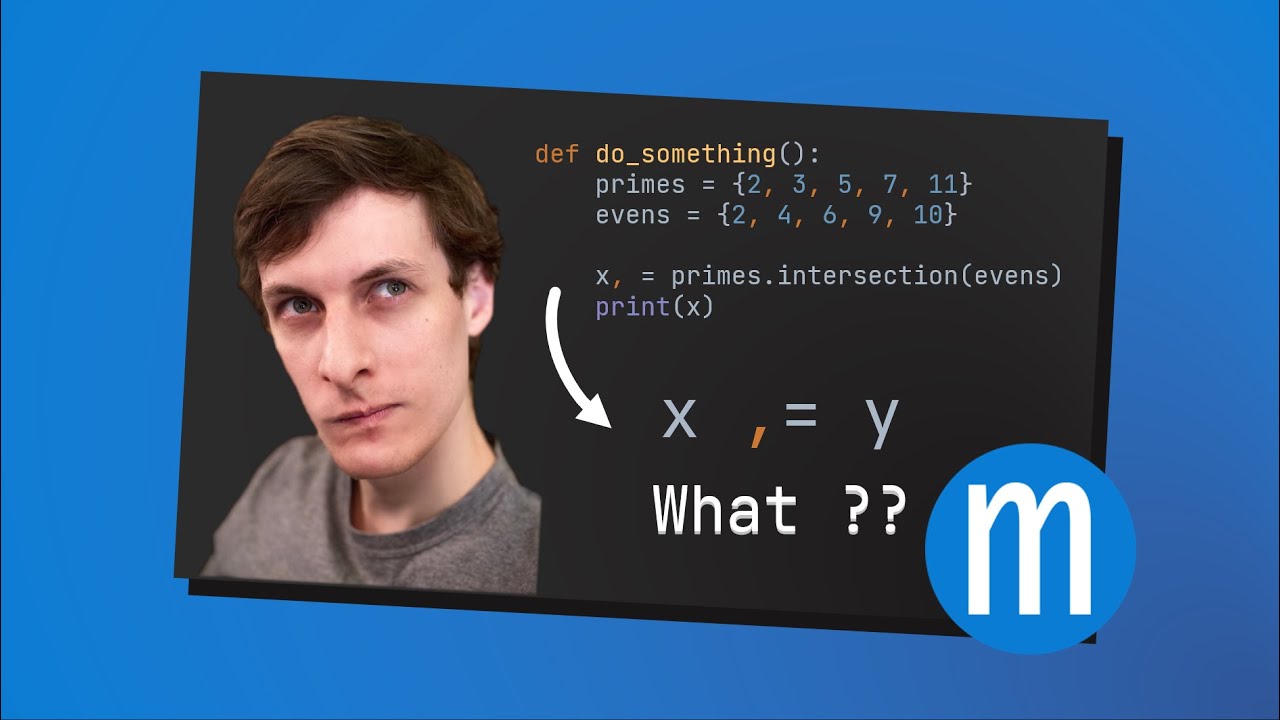
Do you know what x ,= y does in Python?
― mCoding with James Murphy (https://mcoding.io)
Source code: https://github.com/mCodingLLC/VideosSampleCode
SUPPORT ME ⭐
Patreon: https://patreon.com/mCoding
Paypal: https://www.paypal.com/donate/?hosted_button_id=VJY5SLZ8BJHEE
Other donations: https:...
unsure if it's good
but hopefully it explains it
upper tundra
i made this whole function thinking i was being so smart ```python
def prio(char):
if char.islower():
return ord(char) - 96
else:
return ord(char) - 38
you can do
import string
values = string.ascii_letters
I got halfway through typing out something like this before I remember string existed
naive oriole
Artemis, hsop, cereal, cefqrn, tesseract, jenna, salt-die, indie, and xelf
were everyone who helped
with the golfing
I think
upper tundra
shoutout to them
upper tundra
at the very least, im still happy I learned a little bit of new stuff today
with the ord() function
wise rose
frail schooner
in hindsight most of us were being obtuse
would the ord function be a bit faster?
frail schooner
like the if else?
no, the list would have lesser lines, it just getting the index
wise rose
index() is linear, while ord is constant? admittedly small n, but principle of the thing
naive oriole
Actually we ended up doing a hacky solution and ignored ord by reading in "rb" (binary mode) to get the characters as binary numbers (what ord would return)
so we skipped the conversion entirely
O(0)
frail schooner
wise rose
index() is linear, while ord is constant? admittedly small n, but principle of t...
true ig, then best solution would be the (ord(x)-96)%58 that these guys found
yeah or just call as rb
wise rose
upper tundra
i made this whole function thinking i was being so smart ```python
def prio(char...
is the else necessary in this case? return breaks out of the function so everything after it doesn't exist
frail schooner
I just did everything the hard way, I have no clue how I finished in about 8 minutes considering I was using the wrong index for the second half of the lines while splitting them for like the first 5 minutes..
wise rose
I wonder when I'll be writing test cases for my helper functions...
frail schooner
helper functions?
full scarab
frail schooner
true ig, then best solution would be the (ord(x)-96)%58 that these guys found
Why the 58%?
frail schooner
for the negative values iirc
naive oriole
Yeah it's because it ends up being negative
upper tundra
wise rose
is the else necessary in this case? return breaks out of the function so everyth...
yes? because if the character is not a lower case character I want to return something different
naive oriole
and then you do the %58 to get it correct
wise rose
frail schooner
helper functions?
like my parse_group or score_item functions, when will they be doing complicated enough things I'll want to verify they work on simpler cases
upper tundra
the first return statement is not guaranteed to always trigger
oh wait
i think i know what u mean nvm
wise rose
upper tundra
yes? because if the character is not a lower case character I want to return som...
but if the if doesn't trigger, then what's after it will always run, so the else provides some semantic feedback, but it's not quite necessary
full scarab
Oh, so with %58 you wouldn't have to do -38 on the lowercase ones?
upper tundra
wise rose
but if the if doesn't trigger, then what's after it will always run, so the else...
yea i see what u mean now 🙂
wise rose
I dunno, I just habitually try to early-return to avoid indentation as much as possible
frail schooner
full scarab
Oh, so with `%58` you wouldn't have to do `-38` on the lowercase ones?

Don't laugh at my solutions https://github.com/HeavenEvolved/Advent_Of_Code_2022
naive oriole
 frail schooner
wait aah I didnt change it back to public while removing the data files
full scarab
frail schooner
Uh, it doesn't return negative for me.
frail schooner
sec
naive oriole
full scarab
Uh, it doesn't return negative for me.
what?
frail schooner
can you try now?
frail schooner
full scarab
Uh, it doesn't return negative for me.
what do you mean?
naive oriole
!e ```py
print(ord("A")-96)
print((ord("A")-96)%58)
@naive oriole :white_check_mark: Your 3.11 eval job has completed with return code 0.
001 | -31
002 | 27
it returns negative cuz in ASCII uppercase comes before lowercase
frail schooner
so uppercase has lower value than lowercase
naive oriole
!e ```py
print(ord("a")-96)
print((ord("a")-96)%58)
@naive oriole :white_check_mark: Your 3.11 eval job has completed with return code 0.
001 | 1
002 | 1
@frail schooner :white_check_mark: Your 3.11 eval job has completed with return code 0.
97 65
okay I was right
dark fjord
frail schooner
Don't laugh at my solutions https://github.com/HeavenEvolved/Advent_Of_Code_202...
Only thing I can say is why also check for upper? What are you expecting? 👀
frail schooner
naive oriole
!e ```py
for a in "abcdefghijklmnopqrstuvwxyzABCDEFGHIJKLMNOPQRSTUVWXYZ":
print(ord(a)-96,(ord(a)-96)%58)
@naive oriole :white_check_mark: Your 3.11 eval job has completed with return code 0.
001 | 1 1
002 | 2 2
003 | 3 3
004 | 4 4
005 | 5 5
006 | 6 6
007 | 7 7
008 | 8 8
009 | 9 9
010 | 10 10
011 | 11 11
... (truncated - too many lines)
Full output: https://paste.pythondiscord.com/befifafamu.txt?noredirect
full scarab
ord("a")-96 and ord("A")-38 works for me, where should I use the %58?
frail schooner
dark fjord
Only thing I can say is why also check for upper? What are you expecting? 👀
I have no idea bro, my brain was doing donuts while doing the code
my brain just thinks there will be an issue so I did that
full scarab
def day_3():
    f = open("2022/day_3.txt", "r").read().splitlines()
    c = [
        (((ord(p) - 96) if p.islower() else (ord(p) - 38)) if p.isalpha() else 0) for q in
        [[v if v in i[len(i) // 2:] else "0" for v in i[:len(i) // 2]] for i in f]
        for p in set(q)
    ]

    print(sum(c)) # PART 1
I'm also using ord-38
naive oriole
full scarab
`ord("a")-96` and `ord("A")-38` works for me, where should I use the `%58`?
(ord(character)-96)%58 is the full code where character is any character from "a-zA-z"
naive oriole
broken condor
<@595288204593332235> :white_check_mark: Your 3.11 eval job has completed with r...
see this output
and it will demonstrate what is happening
frail schooner
(ord(p) - 96) if p.islower() else (ord(p) - 38)) if p.isalpha()
youre using this so you can replace it with (ord(p)-96)%58
wait.. else 0?
dark fjord
This my part 1 solution ```py
print(sum([ord(x) - 96 if x.islower() else ord(x) - 38 for r in data for x in set(r[:int(len(r) / 2)]) if x in set(r[int(len(r) / 2): len(r)])]))
If I remove it, I get invalid syntax.
Doing 0 doesn't effect the sum.
unique pivot
One thing I was worndering is this is how I split the lines into groups of three, is there a way I could have done this in the forloop without having to have that second list comp?
sacks = input.splitlines()
for i in range(0, len(sacks), 3):
    group = [set(s) for s in sacks[i:i+3]]
ord(x) - 96 if x.islower() else ord(x) - 38
# Is equivalent to:
(ord(x)-96)%58
That's quite cool ngl.
dark fjord
unique pivot
One thing I was worndering is this is how I split the lines into groups of three...
[data[i:i + 3] for i in range(0, len(data), 3)]
I guess, but then I have to loop over that comp
I was imagining that there was something like
for group in something(sacks):
There was some version of that
that we came up with when golfing
I don't know exactly what it was
you can try and find it
frail schooner
would for a, b, c in range(0, len(data), 3) work?
dark fjord
naive oriole
```py
ord(x) - 96 if x.islower() else ord(x) - 38
# Is equivalent to:
(ord(x)-96...
That's very cool.
frail schooner
or do you need the zip thing?
dark fjord
Who knew I'd learn something on day =< 3 :3
frail schooner
nope doesnt work
naive oriole
Honestly I should compile a list of code golfing tips for python
I would just have to find them all
frail schooner
wise rose
one thing I've been trying to is to parse the inputs as streams rather than loading it all into memory at once, am I actually doing that?
frail schooner
I think they used open(0,'rb') to read directly from stdin
wise rose
but like,
if __name__ == '__main__':
    total_score = 0
    group_size = 3
    group = []
    with open('input.txt', 'r') as sacks:
        for line in sacks:
            sack = line.rstrip()
            group.append(sack)
            if len(group) < group_size:
                continue
            duped_item = parse_group(group)
            total_score+= score_item(duped_item)
            group = []
    print(total_score)
is line 5 doing that?
my mental model of how iterators work is lacking
frail schooner
line 5 is just opening the input.txt file in read mode
if you want to parse the input from stdin, then I think you use open(0,'r')
naive oriole
I'm still finding more code golf tips
frail schooner
wait @naive oriole with the stdin open() thing, do you just run the code and then paste the input data in the terminal?
the program is just exiting for me
naive oriole
Yeah you paste it I think
frail schooner
would it work in any terminal? for example vscode?
naive oriole
Not sure actually
Other people were doing more of the testing
I was mainly just looking for more techniques
 north creek
My attempt to part 1:
sum(ord((c:=({*s[:(l:=len(s)//2)]}&{*s[l:]}).pop()).lower())-96+26*(c<'a')for s in I.strip().split())
101 character
frail schooner
aah only part 1
north creek
didnt read part 2 yet, wait a bit
naive oriole
The part 1 section of the code:
*z,=open(0,'rb');u=sum;print(u((u({*a[(l:=len(a)//2):]}&{*a[:l]})-96)%58for a in z))
not sure how many chars
frail schooner
85
frail schooner
no, it has no errors
naive oriole
good
frail schooner
as far as vscode is concerned
 grave vapor
it took me almost an hour for part 2 (including me eating lunch) bc i didn't read it properly 😭
thought it said that we had to split it in half
not in groups of 3
unique pivot
rip
grave vapor
here's my solution for part 2 tho
@submit(2, 2022, 3, test=True, submit=False, parser=part_two_parser)
def part_two(daily_input):
    """Solution for AOC Day 3 Part 2."""
    return sum([
calculate_priority(set(batch[0]).intersection(set(batch[1])).intersection(set(batch[2])).pop())
        for batch in daily_input
    ])
oh that's formatted weirdly
dark fjord
naive oriole
The part 1 section of the code:
```py
*z,=open(0,'rb');u=sum;print(u((u({*a[(l:...
; that's cheating
north creek
dark fjord
`;` that's cheating
replace it with \n
anyway it is one char
naive oriole
dark fjord
`;` that's cheating
replace the usage of the var
with the command
it would be shorter too
north creek
north creek
My attempt to part 1:
```py
sum(ord((c:=({*s[:(l:=len(s)//2)]}&{*s[l:]}).pop())....
remove .strip -> 95 chars
dark fjord
I'm still thinking if my solution could be shorter ```py
print(sum([(ord(x)-96)%58 for r in data for x in set(r[:int(len(r) / 2)]) if x in set(r[int(len(r) / 2): len(r)])]))
you would have to also add [:-1] because of the ,= I think
so it would still be ~85 chars
but one line
north creek
# Part 1: 93 chars
sum(ord((c:=({*s[:(l:=len(s)//2)]}&{*s[l:]}).pop()).lower())-96+26*(c<'a')for s in I.split())
# Part 2: 97 chars
sum(ord((d:=({*a}&{*b}&{*c}).pop()).lower())-96+26*(d<'a')for a,b,c in zip(*[iter(I.split())]*3))
 lilac atlas
pandas keeps rocking
m = pd.Index([*pd._testing._random.string.ascii_letters]).to_series().pipe(lambda s: s.groupby(s, sort=0).ngroup().add(1))

# Part 1
print(pd.read_csv("day_3.input", header=None, squeeze=True).pipe(lambda s: s.apply(list).explode().groupby(pd.RangeIndex(len(s)*2).repeat(s.str.len().floordiv(2).repeat(2)))).agg("".join).groupby(lambda idx: idx // 2).agg(list).apply(pd.Series).agg(lambda r: next(iter({*r[0]}.intersection(r[1]))), 1).map(m).sum())

# Part 2
print(pd.read_csv("day_3.input", header=None, squeeze=True).groupby(lambda idx: idx // 3).agg(list).apply(pd.Series).assign(**{"3": lambda fr: fr.iloc[:, :2].agg(lambda r: {*r[0]} & {*r[1]}, 1)}).rename(columns=int).agg(lambda r: next(iter({*r[2]} & r[3])), 1).map(m).sum())
Indeed they do.
lilac atlas
who needs import string when i can do pd._testing._random.string
 lyric folio
lol
broken condorBOT
Hey @naive oriole!
You either uploaded a .txt file or entered a message that was too long. Please use our paste bin instead.
naive oriole
@frail schooner
https://paste.pythondiscord.com/xocamutoce
frail schooner
naive oriole
<@241674019940597770>
https://paste.pythondiscord.com/xocamutoce
I will save this for later reading! Thank you so much!
naive oriole
Yeah I'm probably missing some tips, and just keep in mind that sometimes these will not be shorter (there are always exceptions)
naive bridge
dark fjord
I'm still thinking if my solution could be shorter ```py
print(sum([(ord(x)-96)%...
it's not much of a difference but you can remove the len(r) in the list splicing in the secod set, so it would be:
this:
print(sum([(ord(x)-96)%58 for r in data for x in set(r[:int(len(r) / 2)]) if x in set(r[int(len(r) / 2):])]))

instead of this:
print(sum([(ord(x)-96)%58 for r in data for x in set(r[:int(len(r) / 2)]) if x in set(r[int(len(r) / 2): len(r)])]))
Replace int(len(r) / 2) with len(r)//2, it does the same thing
naive bridge
true
so this:
print(sum([(ord(x)-96)%58 for r in data for x in set(r[:len(r) // 2]) if x in set(r[len(r) // 2:])]))
yup thought about that
naive oriole
because you then don't need to calculate len(r) // 2 twice
naive bridge
exactly
frail schooner
is there a way to do something like print(x:= a for a in [0,1,2])?
like reduce for loop and printing the elements one by one into one line?
naive oriole
print(*(0,1,2))
or better yet
print(*"012")
equivalent to doing
print("0", "1", "2")
frail schooner
oh shit
frail schooner
sep='\n'?
frail schooner
print(*data,sep='\n') I just did this?
naive oriole
that would prob work
frail schooner
aah okay
naive oriole
unless '\n'.join(data) is shorter but it looks longer
frail schooner
okay so again this * is just taken as a value in data without even having to iterate over it?
hmm..
dark fjord
frail schooner
okay so again this * is just taken as a value in data without even having to ite...
Unpacking
frail schooner
naive oriole
unless `'\n'.join(data)` is shorter but it looks longer
this would give error if the values were not str
naive oriole
the real best answer would be if you shorten your variable name
naive oriole
n='\n'
p=print
p(*d,sep=n)
p(n.join(d))
just prints the contents 5 times
frail schooner
how would I do like each entry multiplied by 5?
naive oriole
oh ok
hm
it might have to just be that comprehension
and we can't use 5for because it could be 5f or or 5 for
although it might work in previous versions
 oak estuary
My solution seems to skip a line if there are two consecutive matches 😭
frail schooner
two consecutive matches?
oak estuary
So my list is 299 when there's 300 characters
For for part A
For if there's a match of B for one line and another match of B on the second line, it skips it
frail schooner
did you check the number of lines in your data file?
frail schooner
and the sum list has 299 entries?
oak estuary
Yep
frail schooner
oak estuary
For if there's a match of B for one line and another match of B on the second li...
just take the intersection of the two halves and use that?
can you send whatever conditional statements youre using?
oak estuary
Sure
from string import ascii_lowercase, ascii_uppercase

file = open('day_3.txt', encoding="utf-8")
last_i = None
counter = 0


stuff = []
for line in file.readlines():
    line = line.strip('\n')
    reference = int(len(n)/2)
    part_a = line[:reference]
    part_b = b[reference:]
    print([art_a, part_b)
    for i in part_a:
        for it in part_b:
            if i == it and last_i != i:
                stuff.append(i)
                last_i = i


table = [None]
for digit in ascii_lowercase:
    table.append(digit)

for digit1 in ascii_uppercase:
    table.append(digit1)

print(stuff)

for item in stuff:
    counter += table.index(item)
    if table.index(item) == -1:
        raise TypeError

print(counter)
file.close()
I should have probably used with but oh well (for file handling)
dark fjord
Doesn't really matter if your program stops in 20ms anyways
wise rose
dark fjord
Doesn't really matter if your program stops in 20ms anyways
I'm approaching it as a practice situation, practice makes permanent
 oak estuary
Splits it in half
wise rose
frail schooner
b[reference:]?
it's the middle index, odd choice of variable name
oak estuary
odd choice yeah
oak estuary
that's copied weirdly
dark fjord
Could someone maybe explain // rq?
oak estuary
yes it should be
 eternal cipher
dark fjord
Could someone maybe explain `//` rq?
eternal cipher
dark fjord
Could someone maybe explain `//` rq?
Floor division
Divide x by y and round down to next whole number
wise rose
as opposed to running the result through int?
frail schooner
// is floor division, it rounds down the result of / to the lowest integer value possible with rounding
so 9.6 result would give 9
instead of 10
wise rose
probably a bit more performant since it's staying in the same type the whole time
doesn't it come from bit shifting?
frail schooner
it does
 frail schooner
@oak estuary is it just me or is that another issue?
 oak estuary
let me send an updated one, the variable names were a little confusing if I was going to share it
from string import ascii_lowercase, ascii_uppercase

file = open('day_3.txt', encoding="utf-8")
last_i = None
counter = 0


stuff = []
for line in file.readlines():
    line = line.strip('\n')
    reference = len(line)//2
    part_a = line[:reference]
    part_b = line[reference:]
    print(part_a, part_b)
    for i in part_a:
        for it in part_b:
            if i == it and last_i != i:
                stuff.append(i)
                last_i = i


table = [None]
for digit in ascii_lowercase:
    table.append(digit)

for digit1 in ascii_uppercase:
    table.append(digit1)

print(stuff)

for item in stuff:
    counter += table.index(item)
    if table.index(item) == -1:
        raise TypeError

print(counter)
file.close()
there
frail schooner
also dont use this
 dark fjord
Is there also a ceil operator then?
frail schooner
use ```py
part_a&part_b
I think there is a ceil function somewhere? not sure might be in the math or numpy libraries
 frail sparrow
!d math.ceil
broken condorBOT
math.ceil(x)```
Return the ceiling of *x*, the smallest integer greater than or equal to *x*. If *x* is not a float, delegates to [`x.__ceil__`](https://docs.python.org/3/reference/datamodel.html#object.__ceil__ "object.__ceil__"), which should return an [`Integral`](https://docs.python.org/3/library/numbers.html#numbers.Integral "numbers.Integral") value.math.ceil but dont use that
You'll get floating point errors for some numbers
Use -(a // -b)
frail schooner
frail schooner
use ```py
part_a&part_b
``` iirc
dont use this
set(part_a) & set(part_b)
!e
a = 21
b = 8
print(-(a // -b))
to get the intersection
broken condorBOT
@eternal cipher :white_check_mark: Your 3.11 eval job has completed with return code 0.
3
what does the & operator do?
eternal cipher
frail schooner
to get the intersection
.
oak estuary
!e print(set([1, 2, 3]&set([2,3,4])))
broken condorBOT
@oak estuary :x: Your 3.11 eval job has completed with return code 1.
001 | Traceback (most recent call last):
002 |   File "<string>", line 1, in <module>
003 | TypeError: unsupported operand type(s) for &: 'list' and 'set'
hmm
frail schooner
aah
oak estuary
oh
wise rose
roller coaster
frail schooner
!e print(set([1, 2, 3])&set([2,3,4]))
broken condorBOT
@frail schooner :white_check_mark: Your 3.11 eval job has completed with return code 0.
{2, 3}
xD
it gives the common elements in both the sets
there's unions, intersections, etc.
wise rose
ok, why not use &? or the .intersection() method?
I suppose you can't do an early escape because we know from context that there'll only be one item
frail schooner
with .intersection() you would have to write lots of .intersections if you wanted to do more than two at a time
wise rose
so there's some performance left on the table
frail schooner
but with set(a)&set(b)&set(c)
its a single line to get the intersection between all the sets you want
broken condorBOT
Hey @full scarab!
It looks like you tried to attach a Python file - please use a code-pasting service such as https://paste.pythondiscord.com
wise rose
frail schooner
its a single line to get the intersection between all the sets you want
you said not to use & but that reads like an argument in it's favor to me
frail schooner
no I said use &
frail schooner
frail schooner
use ```py
part_a&part_b
``` iirc
I said dont use this cuz I didnt type cast it to set
frail schooner
set takes unique values and then you can do the intersection
full scarab
part 1:
# priority = letters.index(LETTER) + 1
letters = "abcdefghijklmnopqrstuvwxyzABCDEFGHIJKLMNOPQRSTUVWXYZ"
total_priority = 0

with open("input.txt", "r", encoding="UTF-8") as f:
    for line in f:
        line = line.replace("\n", "")
        half_len = int(len(line) / 2)
        compartment_1, compartment_2 = set(line[:half_len]), set(line[half_len:])

        total_priority += letters.index(list(compartment_1.intersection(compartment_2))[0]) + 1

print(total_priority)```
part 2:
```py
# priority = letters.index(LETTER) + 1
letters = "abcdefghijklmnopqrstuvwxyzABCDEFGHIJKLMNOPQRSTUVWXYZ"
total_priority = 0
buffer = []

with open("input.txt", "r", encoding="UTF-8") as f:
    for count, line in enumerate(f):
        line = line.replace("\n", "")
        count += 1

        buffer.append(line)

        if count % 3 == 0:
            total_priority += letters.index(list(set(buffer[0]) & set(buffer[1]) & set(buffer[2]))[0]) + 1
            buffer = []

print(total_priority)
anything that could be shortened/simplified?
full scarab
frail schooner
why are you doing encoding?
just used to it, pylint complains otherwise (i use vscode)
frail schooner
no worries
frail schooner
full scarab
just used to it, pylint complains otherwise (i use vscode)
doesnt for me?
hallow vapor
int(len(line) / 2) -> len(line) // 2
full scarab
frail schooner
doesnt for me?
 wise rose
I personally would put list(compartment_1.intersection(compartment_2))[0] on it's own line just for readability
frail schooner
 hallow vapor
intersection can be done with &
full scarab
is pylint activated? lol
frail schooner
yep
full scarab
wise rose
I personally would put `list(compartment_1.intersection(compartment_2))[0]` on i...
yeah i was using that before but decided to use &
frail schooner
also you can ignore pylint errors per line if you want
full scarab
is there a difference or preference between & or .intersection apart from readability?
full scarab
yeah had to use that for part 2
well it's probably good practice to specify encoding + i'm used to specifying it anyway 🤷♂️
hallow vapor
Also assigning to two variables two unrelated values is pretty meh
I would assign to two variables in the same line only if it was something like unpacking
frail schooner
@full scarab use to ignore the error on the line
 full scarab
hallow vapor
int(len(line) / 2) -> len(line) // 2
full scarab
hallow vapor
int(len(line) / 2) -> len(line) // 2
i thought i was going crazy, len(line) / 2 returns a float so i just cast it to int, i checked if all of the lines were even to determine to use // or not
eternal cipher
My message just sent like 20 mins late
frail schooner
xD
Man I really should go to sleep.. its 1:20AM..
but I really wanna sit here and try new things xD
full scarab
frail schooner
<@456226577798135808> use to ignore the error on the line
i'm aware, but if pep says it's better to specify encoding then i may aswell do it 🤷♂️
i'm doing this during the day anyway, if i was sweaty i'd probably not specify it
but sadly it releases at 4 am for me so can't compete
full scarab
!e
a = [1,2]
print(len(a) / 2)
@full scarab :white_check_mark: Your 3.11 eval job has completed with return code 0.
1.0
like what
oak estuary
I found out what happened, it's skipping a "B"
frail schooner
and why is it doing that?
 wanton arrow
it's more about clarity than shortness. Also as we are indexing the list the extra chars would ruin the indexes.
oak estuary
I think its how I coded it
frail schooner
ah okay
oak estuary
the B matches are consecutive
but obviously my logic was to ensure that each line has a unique match - I obviously coded it wrong the first time
frail schooner
I think you made everything a little more complicated than was needed xD
frail schooner
since you already have the uppercase and lowercase lists
oak estuary
Hoepfully part 2 is more straightforward
hallow vapor
full scarab
part 1:
```py
# priority = letters.index(LETTER) + 1
letters = "abcdefghijklmnop...
you can also pop from the set, you don't need to convert it to a list
frail schooner
you could've just used the indexes to get the values
full scarab
hallow vapor
you can also pop from the set, you don't need to convert it to a list
oh nice, i did not think of that
full scarab
frail schooner
you could've just used the indexes to get the values
on a set?
frail schooner
not you, was talking to mesub
I will ping you when I reply to you xD
wrong emoji..
hallow vapor
full scarab
part 1:
```py
# priority = letters.index(LETTER) + 1
letters = "abcdefghijklmnop...
line.strip() is a bit more elegant than line.replace("\n", ""), although for aoc I just read the whole input and then split by \n
full scarab
oak estuary
```py
from string import ascii_lowercase, ascii_uppercase
file = open('day_3.tx...
i also did from string import ascii_lowercase, ascii_uppercase but realized the string is literally hardcoded into the module so i copy pasted it into my open program
frail schooner
isnt there like a string callable for the whole list of alphabets?
thats seems like a missed opportunity
full scarab
 frail schooner
I think I saw someone import something from string library in the morning.. dont remember it now
hallow vapor
full scarab
part 1:
```py
# priority = letters.index(LETTER) + 1
letters = "abcdefghijklmnop...
in part two you do count += 1, but you can do enumerate(f, start=1)
frail schooner
or ascii_letters
broken condorBOT
@real musk :white_check_mark: Your 3.11 eval job has completed with return code 0.
abcdefghijklmnopqrstuvwxyzABCDEFGHIJKLMNOPQRSTUVWXYZ
wait why didnt you just import that instead of those two separate ones xD
full scarab
full scarab
i also did ``from string import ascii_lowercase, ascii_uppercase`` but realized ...
.
full scarab
hallow vapor
in part two you do `count += 1`, but you can do `enumerate(f, start=1)`
ah didn't know you could do that, thanks
 real musk
you also could use ord
full scarab
well i don't think start= is required
real musk
wait
full scarab
since start is the 2nd arg
dark fjord
With all the new knowledge this is my final result for part 1
print(sum(((l:=len(r)//2,ord(*(set(r[:l])&set(r[l:])))-96)[1]%58for r in data)))
chr*
full scarab
real musk
chr*
what
real musk
talking about generating the alphabet
full scarab
real musk
you also could use ord
for what?
hallow vapor
full scarab
ah didn't know you could do that, thanks
in general though I would just iterate over indices with a step of 3, or user more_itertools.chunked. I think that's better than appending to a list and then checking if it's modulo 3
real musk
full scarab
for what?
generating the alphabet (but you have to use chr)
full scarab
hallow vapor
in general though I would just iterate over indices with a step of 3, or user mo...
i'm not too familiar with itertools, i'll check it out
frail schooner
!e print(sum(((l:=len(r)//2,ord(*(set(r[:l])&set(r[l:])))-96)[1]%58for r in [[1,2,3,4,5,6,7,8]])))
broken condorBOT
@frail schooner :x: Your 3.11 eval job has completed with return code 1.
001 | <string>:1: SyntaxWarning: invalid decimal literal
002 | Traceback (most recent call last):
003 |   File "<string>", line 1, in <module>
004 |   File "<string>", line 1, in <genexpr>
005 | TypeError: ord() takes exactly one argument (0 given)
dark fjord
print(sum(((l:=len(r)//2,ord(*(set(r[:l])&set(r[l:])))-96)[1]%58for r in [[1,2,3,4,5,6,7,8]])))
!e print(sum(((l:=len(r)//2,ord(*(set(r[:l])&set(r[l:])))-96)[1]%58for r in [[1,2,3,4,5,6,7,8]])))
broken condorBOT
@frail schooner :x: Your 3.11 eval job has completed with return code 1.
001 | <string>:1: SyntaxWarning: invalid decimal literal
002 | Traceback (most recent call last):
003 |   File "<string>", line 1, in <module>
004 |   File "<string>", line 1, in <genexpr>
005 | TypeError: ord() takes exactly one argument (0 given)
I am just copying your code
dark fjord
That isn't a valid input tough
full scarab
i was trying to simplify ```py
set(buffer[0]) & set(buffer[1]) & set(buffer[2])
e.g can't do the first two then do the last one (or am i wrong?)oh right
!e print(sum(((l:=len(r)//2,ord(*(set(r[:l])&set(r[l:])))-96)[1]%58for r in [['xAbchasjhHgsdG']])))
broken condorBOT
@frail schooner :x: Your 3.11 eval job has completed with return code 1.
001 | <string>:1: SyntaxWarning: invalid decimal literal
002 | Traceback (most recent call last):
003 |   File "<string>", line 1, in <module>
004 |   File "<string>", line 1, in <genexpr>
005 | TypeError: ord() takes exactly one argument (0 given)
!e print(sum(((l:=len(r)//2,ord(*(set(r[:l])&set(r[l:])))-96)[1]%58for r in ['xAbYHu'])))
broken condorBOT
@frail schooner :x: Your 3.10 eval job has completed with return code 1.
001 | Traceback (most recent call last):
002 |   File "<string>", line 1, in <module>
003 |   File "<string>", line 1, in <genexpr>
004 | TypeError: ord() takes exactly one argument (2 given)
check pinned for best golf till now. current 144 chars
frail schooner
!e print(sum(((l:=len(r)//2,ord(*(set(r[:l])&set(r[l:])))-96)[1]%58for r in ['xAbYHu'])))
broken condorBOT
@frail schooner :x: Your 3.11 eval job has completed with return code 1.
001 | <string>:1: SyntaxWarning: invalid decimal literal
002 | Traceback (most recent call last):
003 |   File "<string>", line 1, in <module>
004 |   File "<string>", line 1, in <genexpr>
005 | TypeError: ord() takes exactly one argument (0 given)
!e print(sum(((l:=len(r)//2,ord(*(set(r[:l])&set(r[l:])))-96)[1]%58for r in ['xAbYAu'])))
broken condorBOT
@frail schooner :white_check_mark: Your 3.11 eval job has completed with return code 0.
001 | <string>:1: SyntaxWarning: invalid decimal literal
002 | 27
okay finally
oak estuary
okay I found the actual solution to what I had 😭
frail schooner
oak estuary
basically for every new line, I had to stop comparing to the last line
which fixed it
!!!!
frail schooner
xD
dark fjord
part 2 :3 ```py
print(sum([(ord(*(set(x[0])&set(x[1])&set(x[2])))-96)%58 for x in [data[i:i+3] for i in range(0, len(data), 3)]]))
check pinned for best golf till now. current 144 chars
dark fjord
sand jungle
check pinned for best golf till now. current 144 chars
I saw but I don't like that "short" one. It's good but using ; is kinda cheating imo
cursive sail
you can shave off some whitespace there
print(sum([(ord(*(set(x[0])&set(x[1])&set(x[2])))-96)%58for x in[data[i:i+3]for i in range(0,len(data),3)]]))
what do the different codes mean in this? (lf, cr...)
cursive sail
that's the newline sequence
windows uses carriage return (cr) line feed (lf), unix uses line feed, old macos uses carriage return
dark fjord
cursive sail
you can shave off some whitespace there
```py
print(sum([(ord(*(set(x[0])&set(x[...
Actually I updated it to ```py
print(sum([(ord(*(set(x)&set(y)&set(z)))-96)%58 for x,y,z in zip(3[iter(data)])]))
the space before the for is unneeded
dark fjord
lmao yeah but my ide is on drugs if I do that.
And... I like it like this. I'm gonna stop now... ||maybe if I kept going it will be 10 characters long.||
wanton arrow
dark fjord
Actually I updated it to ```py
print(sum([(ord(*(set(x)&set(y)&set(z)))-96)%58 f...
does that get the right answer?
ah the iter pops 1 each time? so the zip does work?
dark fjord
wanton arrow
does that get the right answer?
ah the iter pops 1 each time? so the zip does wo...
Yep
wanton arrow
what does your data = line look like? You could move the ord part there.
 azure cargo
sets are cool py def day3(inp: str) -> tuple[int, int]: sco = 0 slc = inp.strip().split("\n") for i in slc: num = int(len(i) / 2) a, b = i[:num], i[num:] ins = list(set(a) & set(b))[0] sco += list(" abcdefghijklmnopqrstuvwxyz" + "abcdefghijklmnopqrstuvwxyz".upper()).index(ins) gsco = 0 for i, j, k in zip(slc[::3], slc[1::3], slc[2::3]): gsco += list(" abcdefghijklmnopqrstuvwxyz" + "abcdefghijklmnopqrstuvwxyz".upper()).index(list(set(i) & set(j) & set(k))[0]) return (sco, gsco)
wanton arrow
dark fjord
Yep
add a .splitlines() to the text test data
dark fjord
wanton arrow
what does your `data = ` line look like? You could move the ord part there.
f.read().split("\n")
dark fjord
!e ```py
data = """dWlhclDHdFvDCCDfFq
mGdZBZBwRGjZMFgvTvgtvv
jwwJrzdzGdSbGGnNlzWczHzPHPhn
cczcbMBszhzzDBTBPPPGjtvtlt
LqJLfpwdLnvQLRGQjGtj
gSgnSJJCGSGpGSrwgfhchmmmHzcrHDmbrmMm""".split("\n")
print(sum(((l:=len(r)//2,ord(*(set(r[:l])&set(r[l:])))-96)[1]%58 for r in data)))
@dark fjord :white_check_mark: Your 3.11 eval job has completed with return code 0.
192
Doesn't matter since it won't have any matches.
azure cargo
but for the actual data...
dark fjord
There aren't any trailing whitespaces so it doesn't matter.
 fleet ivy
#part 1
def dupe(sttr):
    '''finds dupe characters in the string but needs to make sure
    :param sttr: string
    :return string: character that is in twice, but only once in each half of the string
    '''
    for char in sttr:
        if sttr[len(sttr) // 2:].count(char) >= 1 and sttr[:len(sttr) // 2].count(char) >= 1:
            return char
def summer(lll):
    '''sums up the priority score for each duplicate character
    :param lll: list of string
    :return int: sum of priority scores
    '''
    import string as str
    PRIORITIES = dict(zip(str.ascii_lowercase, range(1,28)))
    UPPERCASE = dict(zip(str.ascii_uppercase, range(27,53)))
    PRIORITIES.update(UPPERCASE)

    sum = 0
    for line in lll:
        sum += PRIORITIES[dupe(line)]
    return sum

with open('advent3.txt', 'r') as file:
    text = file.read().splitlines()
print(summer(text))

#part2
def dupe2(sttr1, sttr2, sttr3):
    ''' finds the character in three given strings
    :param sttr1: string
    :param sttr2: string
    :param sttr3: string
    :return string: character that is in twice, but only once in each half of the string
    '''
    for char in sttr1:
        if char in sttr2 and char in sttr3:
            return char

def summer2(lll):
    '''sums up the priority score for each duplicate character in the three string group
    :param lll: list of list of string
    :return int: sum of priority scores
    '''
    import string as str
    PRIORITIES = dict(zip(str.ascii_lowercase, range(1,28)))
    UPPERCASE = dict(zip(str.ascii_uppercase, range(27,53)))
    PRIORITIES.update(UPPERCASE)

    sum = 0
    for list in lll:
        sum += PRIORITIES[dupe2(list[0], list[1], list[2])]
    return sum

with open('advent3.txt', 'r') as file:
    text = file.read().splitlines()
lolos = [[text[index], text[index + 1], text[index + 2]] for index in range(0, len(text), 3)]
print(summer2(lolos))
I didn't even know about sets. 🤡 🤡 🤡 🤡
dark fjord
Not in my input.
dark fjord
fleet ivy
```py
#part 1
def dupe(sttr):
'''finds dupe characters in the string but nee...
Then you're going to find & hilarious.
fleet ivy
dark fjord
Then you're going to find `&` hilarious.
is that the same thing as set?
dark fjord
fleet ivy
is that the same thing as set?
No it shows if both sets have the same values.
fleet ivy
bloody hell
dark fjord
!e ```py
print({1, 2, 3} & {3, 4, 5})
@dark fjord :white_check_mark: Your 3.11 eval job has completed with return code 0.
{3}
Thank you
cursive sail
set intersection is great today
i'm very proud of how concise my solution was because of it
dark fjord
What did you come up with?
cursive sail
# part 1
s = 0
for r in data.splitlines():
    a, b = r[:int(len(r)/2)], r[int(len(r)/2):]
    c = list(set(a) & set(b))[0]
    s += string.ascii_letters.index(c) + 1
print(s)

# part 2
s = 0
for g in chunked(data.splitlines(), 3):
    c = list(set(g[0]) & set(g[1]) & set(g[2]))[0]
    s += string.ascii_letters.index(c) + 1
print(s)
that was not particularly clean though
i was trying to get a solution as fast as possible
the int(len(r)/2) should really have been floor div
proper barn
What's chunked?
cursive sail
!d more_itertools.chunked
broken condorBOT
more_itertools.chunked(iterable, n, strict=False)```
Break *iterable* into lists of length *n*:

```py
>>> list(chunked([1, 2, 3, 4, 5, 6], 3))
[[1, 2, 3], [4, 5, 6]]
```  By the default, the last yielded list will have fewer than *n* elements if the length of *iterable* is not divisible by *n*:

```py
>>> list(chunked([1, 2, 3, 4, 5, 6, 7, 8], 3))
[[1, 2, 3], [4, 5, 6], [7, 8]]
``` To use a fill-in value instead, see the [`grouper()`](https://more-itertools.readthedocs.io/en/stable/api.html#more_itertools.grouper "more_itertools.grouper") recipe...it's coming as itertools.batched in 3.12
 earnest sail
you can also find something equivalent named grouper in https://docs.python.org/3/library/itertools.html#itertools-recipes
 stray spear
cursive sail
it's coming as `itertools.batched` in 3.12
stray spear
cursive sail
it's coming as `itertools.batched` in 3.12
curious why they decided on batched as a name
 full bane
I thought they use grouper
cursive sail
so maybe they just mostly copied that
oh they have both
def batched(iterable, n):
    "Batch data into lists of length n. The last batch may be shorter."
    # batched('ABCDEFG', 3) --> ABC DEF G
    if n < 1:
        raise ValueError('n must be at least one')
    it = iter(iterable)
    while (batch := list(islice(it, n))):
        yield batch
```is in thereI also have issues with pairwise
 solid estuary
Rust Structs for the win
stray spear
because from math that feels like it should be about all pairs
not adjacent pairs
rust structs aren't that special
rust's enums are fun though
solid estuary
just go line by line with a counter, adding each line to a list, when the counter reaches 3 go to the next list index
stray spear
solid estuary
just go line by line with a counter, adding each line to a list, when the counte...
A dynamically-sized view into a contiguous sequence, [T]. Contiguous here means that elements are laid out so that every element is the same distance from its neighbors.
solid estuary
neato
hallow vapor
cursive sail
oh they have both
```py
def batched(iterable, n):
"Batch data into lists of ...
nothing like the trick with zip
stray spear
sadly array_chunks https://github.com/rust-lang/rust/issues/74985 isn't in stable

GitHub
The feature gate for the issue is #![feature(array_chunks)]. Also tracks as_(r)chunks(_mut) in #![feature(slice_as_chunks)]. About tracking issues Tracking issues are used to record the overall pro...
cursive sail
eh who doesn't use nightly anyway /hj
if you're writing a binary, nightly is fine
it's not like it breaks all that often
stray spear
I usually do
this time I ended up using tuples from itertools

I'm assuming I could drop the 53 from the type side
or maybe something better still
oh _ for array lengths is not in stable
sad
ok, I'm dumb, I can do
let mut counts = [0u8; 53];

 mystic kindle
day three 🎉
here was my solution ```py
priorities = dict(zip(string.ascii_letters, range(1, 53)))
def part_1(data: list[str]) -> int:
halves = [
next(iter(set(i[: int(len(i) / 2)]).intersection(set(i[int(len(i) / 2) :]))))
for i in data
]
priorities_sum = sum(priorities[s] for s in halves)
return priorities_sum
def part_2(data: list[str]) -> int:
chunks = chunked(data, 3)
badges = [
next(iter(set(a).intersection(set(b)).intersection(set(c))))
for a, b, c in chunks
]
priorities_sum = sum(priorities[s] for s in badges)
return priorities_sum
sets are nice
oh, you can do intersection with &, can't you
cursive sail
mhm
mystic kindle
ah, my solution would've been more concise then
yeah that's better ```py
priorities = dict(zip(string.ascii_letters, range(1, 53)))
def part_1(data: list[str]) -> int:
halves = [
next(iter(set(i[: int(len(i) / 2)]) & set(i[int(len(i) / 2) :]))) for i in data
]
priorities_sum = sum(priorities[s] for s in halves)
return priorities_sum
def part_2(data: list[str]) -> int:
chunks = chunked(data, 3)
badges = [next(iter(set(a) & set(b) & set(c))) for a, b, c in chunks]
priorities_sum = sum(priorities[s] for s in badges)
return priorities_sum
still blazing fast


 fallen sinew
stray spear
||pls don't make the obvious joke||
fallen sinew
stray spear
||pls don't make the obvious joke||
||never gonna give you up||
full scarab
with open("the.txt","r") as f:
    inpt = f.read().split("\n")
    letters = "abcdefghijklmnopqrstuvwxyz"
    letters += letters.upper()
    x = []
    total = 0
    dic = {}
    for i in range(1,53):
        x.append(i)
    the_list = list(zip(letters,x))
    for i in the_list:
         dic[i[0]] = i[1]
    print(dic)
    print(dic)
    for i in inpt:
        number_of_elements = len(i)
        half_indx = (number_of_elements/2) -1
        first_half = i[0:int(half_indx)]
        second_half = i[int(half_indx):]
        common_element = set(first_half).intersection(second_half)
        for n in common_element:
            total += dic[n]
print(total)```It says too low
Why?
eternal cipher
You're taking away 1 when you divide, why?
stray spear
solid estuary
still blazing fast
I mean the task is super tiny, basically any solution will be fast, mightnas well write something sebsible
https://github.com/algmyr/aoc-2022/blob/master/src/solutions/day03.rs

GitHub
Contribute to algmyr/aoc-2022 development by creating an account on GitHub.
mystic kindle
time to do it in rust
solid estuary
solid estuary
used no outside info, the only thing I looked at was the aoc prompt
stray spear
the time taken is...insignificant

I wonder what the first day with some meat to it will be 
stray spear
none
cursive sail
ah
full bane
i hand rolled my benchmark thing also. your percentage progress bar thing looks nice
stray spear
I have my own code for timing runs
and yeah, the display code is probably where the biggest chunk of work went 😛
full bane
i wrote a macro to generate a match case for all the days, which was fun
wanton arrow
full bane
i wrote a macro to generate a match case for all the days, which was fun
what does it do?
stray spear
I wrote a macro too, but nothing clever
 full scarab
eternal cipher
You're taking away 1 when you divide, why?
full scarab
eternal cipher
You're taking away 1 when you divide, why?
Index star from 0
While the len starts at 1
full bane
wanton arrow
what does it do?
so in rust you can't dynamically use things, but i wanted to do that. i wrote a proc macro that generated a function with a match case that went
match day {
  0 => {
    // load day 0
  }
  ...
}
``` basicallyOh wait
cursive sail
mind just does the tiniest bit more
macro_rules! days {
    ($($day:literal)*) => {
        paste! {
            $(mod [<day $day>];)*

            pub fn parts(day: u8) -> (fn(&str) -> String, fn(&str) -> String) {
                match day {
                    $($day => ([<day $day>]::part_one, [<day $day>]::part_two),)*
                    _ => panic!("invalid day"),
                }
            }
        }
    };
}

days! {
    01
}
the machinery is very very yucky
mystic kindle
man I'm just manually cargo running all my solutions
cursive sail
i might make it into a trait
mystic kindle
I was thinking of writing some small helper to automatically fetch and submit stuff, though
full bane
cursive sail
mind just does the tiniest bit more
```rs
macro_rules! days {
($($day:litera...
your solutions are forced into returning strings?
cursive sail
right now. i'll planning to change that later.
whenever i stop being lazy
will probably do some trait nonsense or something to make it cleaner
full bane
currently my thing just runs the functions. i want to return it also, but then i'd either have to make the functions all return strings which is sad or something else
stray spear
I have a run result struct that holds Box<dyn Display> for the answers
dumb but works
stray spear
I wouldn't use it for anything performance critical
cursive sail
i mean Box isn't actually horrible
but i hate that it's magic
since it has the aliasing rules of &mut T or something like that
stray spear
it's a very good type for what's actually needed, just something that I can display
though I guess just wrapping stuff in format! works as well
and just deal with strings
but you can at least move that out of solutions
cursive sail
cursive sail
`*const ()` + `TypeId` >>>
(don't actually do this, but it's fun to when you can)
wanton arrow
it still feels like python should have an easier way of splitting a string in 1/2 the three methods I've seen so far all feel clunky, and 2 of them involve downloading other libraries.
mystic kindle
I just sliced by dividing the len in half
and they're all even, so it'll work fine
stray spear
yeah, I would say this is quite nice already
n = len(s)
s[:n//2]
s[n//2:]
but in rust 👀 let (l, r) = s.split_at(s.len() / 2); 👀
mystic kindle
more-itertools has split_at too >.>
wanton arrow
more itertools has divide
that was one of the 2
numpy reshape was the other.
map(set,np.fromiter(map((' '+items).index,d),int).reshape(2,-1))
eww
wanton arrow
stray spear
eww
yeah
wanton arrow
stray spear
eww
import numpy as np
from string import ascii_letters as items
data = [[*map((' '+items).index,line.strip())] for line in open(filename)]

λ=lambda d:set.intersection(*map(set,np.array(d).reshape(2,-1))).pop()
print(sum(map(λ,data)))
oh, popping is probably a nicer way to get the first item
I did next(iter(...)) >.>
wanton arrow
yeah .pop() seems simple.
stray spear
!e
s = 'abcdefgh'
a, b = zip(*zip(*len(s)//2*[iter(s)]))
print(a, b)
@stray spear :x: Your 3.11 eval job has completed with return code 1.
001 | Traceback (most recent call last):
002 |   File "<string>", line 2, in <module>
003 | ValueError: too many values to unpack (expected 2)
err, maybe I should have test run this
oh, one zip too many
!e
s = 'abcdefgh'
a, b = zip(*len(s)//2*[iter(s)])
print(a, b)
@stray spear :white_check_mark: Your 3.11 eval job has completed with return code 0.
('a', 'b', 'c', 'd') ('e', 'f', 'g', 'h')
it's terrible, but it works
dark fjord
!e ```py
s = 'abcdefgh'
print(*zip(4[iter(s)]))
*zip
broken condorBOT
@dark fjord :white_check_mark: Your 3.10 eval job has completed with return code 0.
('a', 'b', 'c', 'd') ('e', 'f', 'g', 'h')
oh hey, this works ```py
priorities_sum = sum(
[priorities[(set(a) & set(b)).pop()] for a, b in [divide(2, i) for i in data]]
)
l=len(s:="abcdef")//2
print(*zip(*l*[iter(s)]))
that's part 1 one-lined, pretty much
wanton arrow
mystic kindle
oh hey, this works ```py
priorities_sum = sum(
[priorities[(set(a) & set...
yeah that's a lot cleaner to read too.
except I hate seeing i be a non-int. 🙂
mystic kindle
sure
wanton arrow
map
stray spear
mystic kindle
oh hey, this works ```py
priorities_sum = sum(
[priorities[(set(a) & set...
remove the []
mystic kindle
I was doing some fancy str.maketrans stuff before I realized I could just skip it and do ```py
priorities = dict(zip(string.ascii_letters, range(1, 53)))
ah right, sum will take the generator
full bane
the chad (string.ascii_lowercase + string.ascii_uppercase).index
wise rose
I dunno, left, right = string[mid:], string[:mid] is pretty legible
ok, I got those backwards, but still
mystic kindle
it would've been if I calculated mid on its own line >.>
stray spear
I did
fn priority(n: u8) -> u8 {
  if n & 32 == 0 {
    (n & 31) + 26
  } else {
    n & 31
  }
}
because knowing the logic of ascii is neat
wanton arrow
halves = partial(divide,2)
for a,b in map(halves,data)
a map would be more concise here, yeah
wanton arrow
fn priority(n: u8) -> u8 {
    n & 31 + 26 * !(n & 32)
}
not that it matters for this challenge
wanton arrow
can you do ! for not?
full bane
yeah
wanton arrow
n & 31 + 26 * !(n & 32)
stray spear
wanton arrow
```py
fn priority(n: u8) -> u8 {
n & 31 + 26 * !(n & 32)
}
```
err 1 - (n&32) is for sure wrong
wanton arrow
stray spear
err `1 - (n&32)` is for sure wrong
yeah, at a min it needs the ==0 in there
mystic kindle
    priorities_sum = sum(
        priorities[(set(a) & set(b) & set(c)).pop()] for a, b, c in chunked(data, 3)
    )
``` part 2 one-lined tooit is
dark fjord
mystic kindle
```py
priorities_sum = sum(
priorities[(set(a) & set(b) & set(c)).po...
chunked hmmm
mystic kindle
more-itertools!
stray spear
fn is a giveaway
wanton arrow
chunked is good
mystic kindle
actually, I think salt's aoc_lube has a chunked function too, but whatever
 clever dune
yeah, it's just chunk though
wanton arrow
stray spear
`fn` is a giveaway
yeah, I'm sure there are other languages that use it too.
clever dune
i don't live in the past
mystic kindle
lolol
stray spear
wanton arrow
yeah, I'm sure there are other languages that use it too.
I don't know of any off hand
clever dune
actually found that often the easiest way to parse input is with a combination of extract_ints and chunk
wanton arrow
mystic kindle
I was doing some fancy `str.maketrans` stuff before I realized I could just skip...
I just did index + 1 or added a space at the start and then indexed.
map((' '+items).index,line.strip())
like, 2018 day 3 input looked like:
#1 @ 596,731: 11x27
#2 @ 20,473: 23x22
#3 @ 730,802: 23x23
and you can just
chunk(extract_ints(raw_input), 5)
gleam uses fn, but its a lesser known thing
mystic kindle
wanton arrow
I just did index + 1 or added a space at the start and then indexed.
```py
map(...
mm, yeah that's more concise
cursive sail
elixir uses fn
stray spear
clever dune
like, 2018 day 3 input looked like:
```
#1 @ 596,731: 11x27
#2 @ 20,473: 23x22
#...
lol, if there is any critique I can give to AoC, many of the input formats kinda suck
cursive sail
i think it uses fn for lambdas? i'd have to check.
clever dune
there's a library for reverse format strings that can help parse if you have issues
mystic kindle
yeah it uses fn for anonymous functions
stray spear
if I really need it I'll probably just bash things with regex or do something hacky
grave vapor
mystic kindle
oh hey, this works ```py
priorities_sum = sum(
[priorities[(set(a) & set...
omg i should've used binary and
i did. intersection
grave vapor
i really wanna do aoc in kotlin but there aren't many good helpers 😭
clever dune
nim uses proc
mystic kindle
nim seems cool
wanton arrow
nim does seem cool, and iirc can use python libraries and has an option to compile to python code or something like that?
I just don't have time at the moment for yet another language. 🙂
clever dune
yes, i use aoc_lube to fetch input in nim
import nimpy

proc fetch*(year, day: int): string =
  ## Get AoC input.
  "aoc_lube".pyImport.callMethod(string, "fetch", year, day)
that star after the proc name means it's public function
wanton arrow
it just feels like nim should be a natural progression from python, there's a lot of coupling there. I hope it does well in the future.
mystic kindle
I wanted to do AOC in haskell, but I forgot to properly learn it 😔
clever dune
my day 3 solution:
include aoc

type Sacks = seq[string] | seq[seq[char]]

let sacks = fetch(2022, 3).splitLines()

proc priority(c: char): int =
  1 + c.ord - (if c >= 'a': 'a'.ord else: 'A'.ord - 26)

proc sumPriorities(groups: seq[Sacks]): int =
  sum groups.mapIt(
    it.mapIt(it.toSet).foldl(a * b).chooseOne.priority
  )

part 1: sumPriorities sacks.mapIt(it.distribute(2))
part 2: sumPriorities sacks.chunk(3)
that doesn't seem like a great choice for syntax though, like one of the devs was being clever instead of having a "public" keyword.
mystic kindle
yeah, I'm not a fan of the star
full bane
feels like latex
naive oriole
does nim support macros
clever dune
wanton arrow
that doesn't seem like a great choice for syntax though, like one of the devs wa...
i prefer it, it makes it very easy to see public functions at a glance with little boilerplate
yes, nim has templates and macros
mystic kindle
templates, like, C++ templates?
naive oriole
so technically you could just make a macro replacing public with *
clever dune
templates are like compile-time code replacements
naive oriole
templates would probably work better
wanton arrow
like pub proc fetch( seems better. but I'm complaining about a language I don't use so I have little room to stand on.
naive oriole
so you could put the public first
mystic kindle
variable names can have spaces?
stray spear
full bane
feels like latex
AoC in LaTeX 👀
clever dune
did you know that snake_case and snakeCase are the same name in nim
stray spear
(lualatex is cheating)
clever dune
mystic kindle
variable names can have spaces?
yeah, but you need to use ```
mystic kindle
I see
clever dune
actually i don't know if spaces work
mystic kindle
what's up with part 1, then?
cursive sail
clever dune
did you know that `snake_case` and `snakeCase` are the same name in nim
what the fuck i hate it
stray spear
stray spear
AoC in LaTeX 👀
Writing an explanatory pdf with latex code computing the answer would be wack
clever dune
but operators are done with:
proc `+`(a: MyClass): MyClass =
  ...
does it ignore cases and special characters?
naive oriole
clever dune
did you know that `snake_case` and `snakeCase` are the same name in nim
the devs were really trying to be clever with nim
clever dune
no, the first letter case matters
cursive sail
clever dune
but operators are done with:
```py
proc `+`(a: MyClass): MyClass =
...
```
impure operator definitions 👀
full bane
stray spear
AoC in LaTeX 👀
i think it's turing complete
mystic kindle
tfw arithmetic has side effects >.>
stray spear
naive oriole
the devs were really trying to be clever with nim
there is clever, and there is that
clever dune
naive oriole
the devs were really trying to be clever with nim
the reason they chose to do that is not to force a style on anyone -- similarly you can take a c-library and bind the functions to nim and keep your libraries style
naive oriole
still less "clever" than JS (==, var, {} + {})
naive oriole
clever dune
the reason they chose to do that is not to force a style on anyone -- similarly ...
I mean the naming thing isn't a huge issue
stray spear
JS isn't clever, it's a clusterfuck
naive oriole
you don't really need two variables with a nearly exact same name
stray spear
so I could alternate between camel_case and snakeCase between every usage? sounds like fun
mystic kindle
aLMOST_SCREAMING_SNAKE_CASE
clever dune
the reason i like nim though is the uniform function call syntax:
type Vector = tuple[x, y: int]

proc add(a, b: Vector): Vector =
  (a.x + b.x, a.y + b.y)

let
  v1 = (x: -1, y: 4)
  v2 = (x: 5, y: -2)

  # all the following are equivalent
  v3 = add(v1, v2)
  v4 = v1.add(v2)
  v5 = v1.add v2
core dev sponsored obfuscation
cursive sail
i can get on board with those first two, but the last scares me
 lunar lance
naive oriole
you don't really need two variables with a nearly exact same name
lunar lance
naive oriole
you don't really need two variables with a nearly exact same name
You don't need, but they are telling me I can't.
I think it is my decision as a programmer to make, not theirs as a language designer.
cursive sail
i don't mind parenless function application, but i've never seen them optional
clever dune
you whitespace hater
naive oriole

Whitespace is an esoteric programming language developed by Edwin Brady and Chris Morris at the University of Durham (also developers of the Kaya and Idris programming languages). It was released on 1 April 2003 (April Fool's Day). Its name is a reference to whitespace characters. Unlike most programming languages, which ignore or assign little ...
clever dune
but it makes dot auto-complete really good
cursive sail
clever dune
you whitespace hater
i like that
i use haskell sometimes, which does function application without parens too
but having both is weird to me
clever dune
i really hate parens, mostly because of the difficulty in typing them
shift + 9/0 is the most awkward combination
naive oriole
Shift + 9 and Shift + 0 are so far
Though none of !@#$%^&*() are particularly simple, yet are used very often
clever dune
the curly and square brackets are much better
mystic kindle
That's why real programmers swap the top letter row with the number row
cursive sail
i usually keep my right hand a little further right on my keyboard than normal
so it's strange to hear that these are difficult for some
mystic kindle
I don't have much problem typing special characters, yeah. But I guess it does vary person to person
naive oriole
not difficult per se but difficult compared to asdfhjlk
clever dune
i do shift combinations one-handed --- pinky on right shift + middle-finger on parens is so weird
cursive sail
i've been tempted to completely remap certain key combos on my keyboard to arbitrary symbols, but i can't figure out how to do it nicely on windows 
naive oriole
Razer supports complete keyboard remapping
stray spear
[](){} is good to practice of you need to type C++ lambdas
mystic kindle
are you on a laptop?
dark fjord
naive oriole
particularly +_
Maybe something for u
 naive oriole
 naive oriole
dark fjord
Maybe something for u
naive oriole
dark fjord
Maybe something for u
i hate this
mystic kindle
Or do you use an external keyboard?
dark fjord
I got the keychron k8 pro recently.
mystic kindle
mechanical keyboards >>
stray spear
stray spear
`[](){}` is good to practice of you need to type C++ lambdas
sadly []()<>{} isn't quite valid C++
clever dune
naive oriole
does nim support macros
if you want to see some crazy macros -- this is me trying to implement multiple inheritance in nim with macros:
https://github.com/salt-die/nimheritance/blob/main/nimheritance/classes.nim
stray spear
but very close
mystic kindle
I've been putting together my first custom board for the past few weeks
dark fjord
@clever dune Use <url> to suppress embeds.
naive oriole
clever dune
if you want to see some crazy macros -- this is me trying to implement multiple ...
wow that is unique although tbf I'm not particularly familiar with nim
stray spear
oh god, vtables
naive oriole
the macro *class looks insane for a macro
stray spear
stray spear
oh god, vtables
I know they exist and what they are for, but I don't want to think about them...
clever dune
for this, they only exist at compile time
spits out some normal nim objects and functions at the end
i've seen some aoc helpers in nim that use macros that turn something like:
day 1:
    part 1:
        some_code()

    part 2:
        some_more_code()
into auto-submissions
stray spear
idk, I'm all for automating tedious things
naive oriole
I mean that sounds good
stray spear
but I've never seen a need for that
submitting is close enough to being a one-off thing that I don't feel the need to automate it
naive oriole
I've just been too lazy to automate it honestly
wanton arrow
I'm not fast enough that automating the submission would help, worse it might get the wrong answer. lol
clever dune
it's not just saving time --- it's very easy to read
stray spear
Don't forget the time you spend finding the chart to look up what you save. And the time spent reading this reminder about the time spent. And the time trying to figure out if either of those actually make sense. Remember, every second counts toward your life total, including these right now.
(and don't get me wrong, I love automating stuff, I use vim and write a lot of small scripts)
(thinks just have to start annoy me by being tedious for me to automate them)
quiet heath
whilst others code golf, I've been adding type hints to my code instead XD
all my solutions pass mypy with strict mode
 plush crater
uppercase = string.ascii_uppercase
lowercase = string.ascii_lowercase
letters =   dict(enumerate((lowercase + uppercase),1))

common_letters = ''
total = 0
def clean(first_half,second_half):
    global common_letters
    for letter in first_half:
        if letter in second_half:
            common_letters += letter
            return

with open('zzzinp.text','r') as file:
    compartment = file.readlines()
    for line in compartment:
        half = len(line)// 2
        clean(line[:half],line[half:])

#
def get_key(val,my_dict):
    for key, value in my_dict.items():
        if val == value:
            return int(key)
    return 0
print(common_letters)
for common in common_letters:
    total += get_key(common,letters)
print(total) ```onto 2nd
wanton arrow
plush crater
```py
uppercase = string.ascii_uppercase
lowercase = string.ascii_lowercase
lett...
!global
broken condorBOT
When adding functions or classes to a program, it can be tempting to reference inaccessible variables by declaring them as global. Doing this can result in code that is harder to read, debug and test. Instead of using globals, pass variables or objects as parameters and receive return values.
Instead of writing
def update_score():
    global score, roll
    score = score + roll
update_score()
do this instead
def update_score(score, roll):
    return score + roll
score = update_score(score, roll)
For in-depth explanations on why global variables are bad news in a variety of situations, see this Stack Overflow answer.
wanton arrow
also, you can reverse the indexes of a dict by swapping the key/value.
letters = {v:k for k,v in enumerate((string.ascii_letters),1)}
oh and ascii_letters is lowercase + uppercase, so you can use that too. 🙂