#AoC 2022 | Day 2 | Solutions & Spoilers
1447 messages · Page 2 of 2 (latest)
 brave grail
 light abyss
`rb` is a part of how it works
light abyss
`rb` is a part of how it works
hmm ok
 livid crescent
Can you explain this please?
brave grail
livid crescent
Can you explain this please?
well seems like i'm not the only one without a clue here
 ionic summit
ValueError: too many values to unpack (expected 4)
doesn't work for me lol
.\d2cg.py < .\input2.txt
livid crescent
brave grail
well seems like i'm not the only one without a clue here
You didn't write it?
light abyss
ionic summit
`ValueError: too many values to unpack (expected 4)`
it relies on every line having 4 bytes
including the newline
 echo halo
I like that Part 2 is basically the opposite mapping
ionic summit
is rb read bytes? so its like... binary to start with which removes the use of ord?
brave grail
when file name in the shortest code is changed to input.txt it's 88 bytes so still 18 bytes away
brave grail
ionic summit
is `rb` read bytes? so its like... binary to start with which removes the use of...
yes
for the stuff where i just exclude the part where the data is loaded into a variable i just replace it with ...for a,_,b in s.encode().split('\n')
ionic summit
what is ~
light abyss
binary not
brave grail
ionic summit
what is `~`
bitwise NOT operator
~x == -x - 1
ionic summit
ok fun, what's the j doing in there?
brave grail
ionic summit
ok fun, what's the j doing in there?
python complex number/imaginary number
brave grail
ionic summit
oh is it to separate p1 and 2
yes
and also you can add them unlike ordinary tuples
ionic summit
christ
brave grail
i have no idea how i still have a sane enough mind to explain since it's about to become midnight for me
echo halo
Part 1: ```js
.split("\n").map(e=>({X:1,Y:2,Z:3})[e[2]]+{A:{X:3,Y:6,Z:0},B:{X:0,Y:3,Z:6},C:{X:6,Y:0,Z:3}}[e[0]][e[2]]).reduce((a,c)=>a+c)
Part 2: ```js
.split("\n").map(e=>({X:0,Y:3,Z:6})[e[2]]+{A:{X:3,Y:1,Z:2},B:{X:1,Y:2,Z:3},C:{X:2,Y:3,Z:1}}[e[0]][e[2]]).reduce((a,c)=>a+c)
js?
ionic summit
brave grail
i have no idea how i still have a sane enough mind to explain since it's about t...
i get it mostly now, thx. the not operator is still confusing though
echo halo
light abyss
js?
yes
ionic summit
especially with how it works with signed ints
echo halo
let me make a Python solve
 edgy sail
I used a class for today's challenge
brave grail
ionic summit
i get it mostly now, thx. the not operator is still confusing though
just think of it as -x - 1
so like ```py
~2 == -3
~50 == -51
~(-50) == 49 # parentheses not needed
it might help to see what A, B, C and X, Y, Z gets converted to when read in bytes
is it 0, 1, 2?
brave grail
ionic summit
it might help to see what A, B, C and X, Y, Z gets converted to when read in byt...
>>> dict(zip(x:='ABCXYZ', map(ord, x)))
{'A': 65, 'B': 66, 'C': 67, 'X': 88, 'Y': 89, 'Z': 90}
the not operator is only confusing because python has dynamic sized ints
light abyss
it is confusing
brave grail
light abyss
it is confusing
it's literally just -x - 1
edgy sail
What's confusing about "make all the 0's 1's and all the 1's 0's"
brave grail
edgy sail
What's confusing about "make all the 0's 1's and all the 1's 0's"
that's more confusing to beginners imo than just saying it's basically -x - 1
ionic summit
ok. so you aren't using ~ for anything special other than shorthand for subtraction and -1
edgy sail
it's a binary operator. They need to have an understanding of binary math to understand binary operators
light abyss
oh i know what a not operator does to fixed size ints
well it's a unary operator 🙃
but a bitwise unary operator
brave grail
ionic summit
ok. so you aren't using `~` for anything special other than shorthand for subtra...
yes
light abyss
It's just confusing with dynamic ints as you said.
brave grail
that's often how it's used in code golfing
light abyss
yeah
- is a binary operator because it operates on 2 values
~ is not, because it operates on one
brave grail
light abyss
It's just confusing with dynamic ints as you said.
how is it confusing?
like wrapping your head around the result or the implementation?
light abyss
brave grail
how is it confusing?
because I think of it as a bitwise operator
And a python integer starts with an infinite number of 0s
brave grail
light abyss
because I think of it as a bitwise operator
well yes
brave grail
light abyss
And a python integer starts with an infinite number of 0s
well no
light abyss
Which it turns all into ones in theory
light abyss
brave grail
well no
obviously not really
but it doesn't operate on the actual physical representation either
brave grail
ok midnight hit and it sort of surprised me to suddenly see "3 December 2022" on my screen
 brave grail
light abyss
but it doesn't operate on the *actual* physical representation either
brave grail
light abyss
but it doesn't operate on the *actual* physical representation either
so like thinking about the implementation?
light abyss
well
thinking of what it's doing to the bits
>>> bin(5)
'0b101'
>>> bin(~5)
'-0b110'
the confusion is warranted, it can't be the actual complement (in something like C) since Python doesn't store numbers in a limited number of bits
 dark fernBOT
Objects/longobject.c lines 4888 to 4893
if (IS_MEDIUM_VALUE(v))
    return _PyLong_FromSTwoDigits(~medium_value(v));
x = (PyLongObject *) long_add(v, (PyLongObject *)_PyLong_GetOne());
if (x == NULL)
    return NULL;
_PyLong_Negate(&x);```wots the -1 for?
 brave grail
ionic summit
wots the -1 for?
brave grail
ionic summit
wots the -1 for?
subtract to cancel out the negative result from 1j*~
echo halo
brave grail
it's literally just `-(v + 1)`
yeah, I mean it's a fake complement that doesn't actually do a bitwise complement (because Python numbers aren't even stored in two's complement anyways)
that's why Artemis was confused
brave grail
i mean for small numbers that fit in a 30-bit integer it just does a normal bitwise not
echo halo
yes, but that's not the confusing part
anyway do you like my Python solve
https://paste.pythondiscord.com/ifuqakerad.py
I didn't optimize for size, but I optimized for something else which I think people here might like
light abyss
if you did bitwise not on an unsigned int in c or whatever you'd still have a position (or at least unsigned) number
bitwise not on a positive python int gives a negative int
brave grail
echo halo
I didn't optimize for size, but I optimized for something else which I think peo...
damn
echo halo
light abyss
if you did bitwise not on an unsigned int in c or whatever you'd still have a po...
well because there are no unsigned number types in Python yea lol
light abyss
exactly
ionic summit
echo halo
anyway do you like my Python solve
https://paste.pythondiscord.com/ifuqakerad.p...
what?
lmao
echo halo
ionic summit
what?
do you like it?
brave grail
echo halo
well because there are no unsigned number types in Python yea lol
(except the internal C integers in a python integer)
brave grail
echo halo
I didn't optimize for size, but I optimized for something else which I think peo...
it's horrific and full of underscores and dunders
nice
was it automated
ionic summit
i dont understand any of it. nice
echo halo
brave grail
was it automated
yes, but it's the shortest possible one I think
brave grail
echo halo
yes, but it's the shortest possible one I think
could've probably used a walrus
echo halo
where
brave grail
echo halo
where
everywhere
echo halo
oh, you mean for the X, Y and Z variables?
I think this way is shorter, I'm not going for a one-liner but shortest file size in general
or actually, I guess it would be shorter with walrus yea since there's only one extra character, no new line and no need to specify the variable name for the first use (one char shorter)
brave grail
what's the original code
echo halo
import builtins
builtins.print(builtins.sum(builtins.map(lambda e:builtins.ord(e[2])-87+{'A':{'X':3,'Y':6,'Z':0},'B':{'X':0,'Y':3,'Z':6},'C':{'X':6,'Y':0,'Z':3}}[e[0]][e[2]],builtins.open(0,'r').read().split("\n"))))
can you tell I like underscores
edgy sail
I had fun with enums today. https://github.com/killjoy1221/aoc22/blob/main/day2.py

GitHub
Contribute to killjoy1221/aoc22 development by creating an account on GitHub.
 rugged kestrel
I don't bother with code quality 😅 https://paste.pythondiscord.com/idavinereh
But got to use match-case in actual code!
 woeful tapir
My solution is hardcoded. I tried to be clever and decided I couldn't be bothered. Not gonna share because I'm so embarrassed.
 versed kernel
Hello everyone!
 proven vault
woeful tapir
My solution is hardcoded. I tried to be clever and decided I couldn't be bothere...
proven vault
woeful tapir
My solution is hardcoded. I tried to be clever and decided I couldn't be bothere...
Hey, if you solved it, that's what matters
versed kernel
woeful tapir
My solution is hardcoded. I tried to be clever and decided I couldn't be bothere...
It is not that bad to hardcode at times, in the plus side you were able to conquer the problem. 
 fallow sky
@brave grail can we somehow use xors to shorten this further? 🤔
print(sum(b-87+(b+~a)%3*3-1j*~((~-a+b)%3+~-b%3*3)for a,_,b,_ in open(0,'rb')))
I too am having a
decided I couldn't be bothered.
thing with me rn
versed kernel
there is an todo in my day_2 😄
https://github.com/Achxy/AoC-2022/blob/main/source/day_2.py

GitHub
Advent of Code 2022 - https://adventofcode.com/2022 - AoC-2022/day_2.py at main · Achxy/AoC-2022
proven vault
so I just also went for a less impressive solution in the end
versed kernel
proven vault
so I just also went for a less impressive solution in the end
I want to go for an impressive solution, just too tired to do it. Maybe I should allocate aoc-solving-time to the morning lol 🥴
proven vault
I coded it in the morning - still didn't help
if anything made it worse
I am not a morning person
versed kernel
just read the code above, yall have some seriously esoteric code
 paper geyser
// Part2
var input2 = File.ReadAllLines("input.txt").Select(x => x.Split()).Select(y
=> (y[0] - 'A', y[1] - 'X'))
.Select(z => z.Item2 * 3 - 3 + ((z.Item2 - 2 + z.Item1 - 1) % 3 + 3) % 3 + 1)
.Sum();
``` did this one in c# the math took me like 2 hours to work out pulsar flame
brave grail
```py
>>> dict(zip(x:='ABCXYZ', map(ord, x)))
{'A': 65, 'B': 66, 'C': 67, 'X': 8...
pulsar flame
brave grail
```py
>>> dict(zip(x:='ABCXYZ', map(ord, x)))
{'A': 65, 'B': 66, 'C': 67, 'X': 8...
yo whats :=
never seen it before
versed kernel
pulsar flame
yo whats :=
it's commonly called walrus operator
pulsar flame
what does it do
versed kernel
further reading: https://realpython.com/python-walrus-operator/
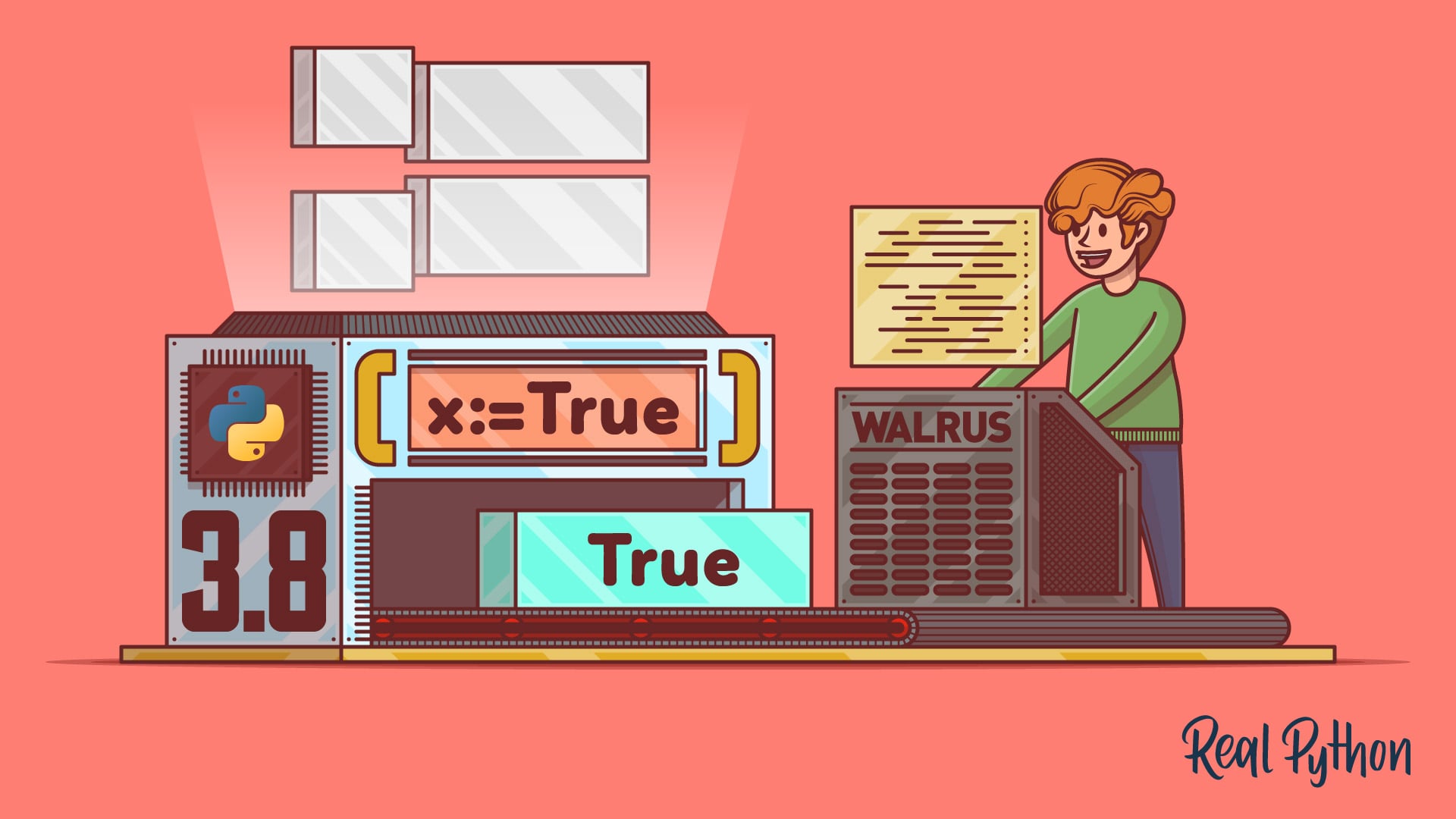
In this tutorial, you'll learn about assignment expressions and the walrus operator. The biggest change in Python 3.8 was the inclusion of the := operator, which you can use to assign variables in the middle of expressions. You'll see several examples of how to take advantage of this new feature.
pulsar flame
bet
versed kernel
👌
 verbal jetty
def solve():
    lst = text.splitlines()
    index = 0
    score = 0
    for i in lst:
        index += 1
        x = index % 3
        p = {
            'X':1,
            'Y':2,
            'Z':3
        }
        if True:
            if x == 0:
                score += 8+p[i[-1]]
            elif x == 1:
                score += 0+p[i[-1]]
            else:
                score += 3+p[i[-1]]
    print(score)
    print(len(lst))

solve()```what have i done wrong?you seem to have ignored the game of rock paper scissors
that's an important part of the problem
I don't understand what you are doing with the index
 opaque thicket
basically mine 
 verbal jetty
echo halo
I don't understand what you are doing with the index
verbal jetty
echo halo
I don't understand what you are doing with the index
wait i thought line 1 4 7 etc will always win and 2 5 8 lose and 3 6 9 draw
ok i misreaded
 limpid flare
"""
Solution for
Day 1: Calorie Counting
"""


"""
rock: 1
paper: 2
scissors: 3
"""

player_choices = {
    "A": 1,
    "B": 2,
    "C": 3,
    "X": 1,
    "Y": 2,
    "Z": 3
}


with open("data.txt") as file:
    data = file.readlines()

for idx,lines in enumerate(data):
    data[idx] = lines.replace("\n","")


def part_one():


    combinations = {
        "A X": 3,
        "A Y": 6,
        "A Z": 0,
        "B X": 0,
        "B Y": 3,
        "B Z": 6,
        "C X": 6,
        "C Y": 0,
        "C Z": 3
    }

    total_score = 0
    for lines in data:
        score = combinations.get(lines) + player_choices.get(lines[2:])
        total_score += score
    print(total_score)


def part_two():
    #dictionaity to store what points the player gets when he needs to win
    win_table = {
        "A": 2,
        "B": 3,
        "C": 1
    }

    loose_table = {
        "A": 3,
        "B": 1,
        "C": 2
    }


    total_score = 0
    for lines in data:
        if lines[2:] == "X":#lose
            total_score += loose_table.get(lines[:1])
        elif lines[2:] == "Y":#draw
            total_score += 3 + player_choices.get(lines[:1])# 3 points for draw + amount of points for the character the opoonent has
        elif lines[2:] == "Z":#win
            total_score += 6 + win_table.get(lines[:1])# 6 points for winning + amount of points given for winning symbol -> use combinations dictionairy
    print(total_score)

part_two()
noob solution ;-;
 jagged flax
Ugh, spent way too long before I realised the "bonus" was 1-indexed (1 extra for rock instead of 0)
from aocd import submit, lines

score = 0

decoded = {c: (i % 3) for (i, c) in enumerate("ABCXYZ")}
bonus = {c: i + 1 for (i, c) in enumerate("XYZ")}

score_table = {
    f"{them} {us}": ((decoded[us] - decoded[them] + 1) % 3) * 3 + bonus[us]
    for them in "ABC"
    for us in "XYZ"
}

result = sum(score_table[l] for l in lines)
submit(result, part="a")

move_table = {
    f"{them} {outcome}": decoded[outcome] * 3
    + (decoded[outcome] + decoded[them] - 1) % 3
    + 1
    for outcome in "XYZ"
    for them in "ABC"
}

print(move_table)

assert move_table["A Y"] == 4
assert move_table["B X"] == 1
assert move_table["C Z"] == 7

result = sum(move_table[l] for l in lines)
submit(result, part="b")
me trying to use lambda in 1 line to solve whole problem: 🤓
 cinder spruce
# part 1
with open("input.txt") as file:print(sum(1+(B:=ord(b)-ord("X"))+3*((B-ord(a)+ord('A'))%3+1)for a,_,b_ in file))
# part 2
with open("input.txt") as file:print(sum(3*(B:=ord(b)-ord("X"))+((ord(a)-ord('A')-1+B)%3+1)for a,_,b,_ in file))
```Can be less verbose but I left some of the math and ords uncancelledhttps://paste.pythondiscord.com/edogerelih this simple
def d2p2(text):
    lst = text.splitlines()
    dic = {
        'A':1,
        'B':2,
        'C':3
    }
    func = lambda item:dic[item[0]] if item[-1] == 'X' else dic[item[0]]+3 if item[-1] == 'Y' else dic[item[0]] +6
    for i in lst:
yield func(i)```ok why is this not workingIf I chose paper and you're supposed to lose, you can't choose paper
 lofty geode
pandas still rocks
# Part 1
m = pd.Index([*"ABCXYZ"]).to_series().pipe(lambda s: s.groupby(s).ngroup().mod(3).add(1))

print(pd.read_csv("day_2.input", sep=" ", header=None).apply(lambda c: c.map(m)).assign(d=lambda fr: fr.diff(axis=1)[1]).pipe(lambda fr: fr[1].add(fr.d.mod(3).add(1).mul(3).mod(9))).sum())

# Part 2
w = m[[*"XYZ"]].reset_index().pipe(lambda fr: fr.set_axis(fr[0]).drop(columns=0).squeeze())

print(pd.read_csv("day_2.input", sep=" ", header=None).assign(**{"1": lambda fr: fr.apply(lambda c: c.map(m)).sum(1).sub(2).mod(3).pipe(lambda s: s.add(s.eq(0).mul(3))).map(w)}).drop(columns=1).rename(columns=int).apply(lambda c: c.map(m)).assign(d=lambda fr: fr.diff(axis=1)[1]).pipe(lambda fr: fr[1].add(fr.d.mod(3).add(1).mul(3).mod(9))).sum())
method chaining for the win
 worthy magnet
that is an impressive number of lambda functions!
verbal jetty
wow 😵
https://paste.pythondiscord.com/okoxapevil code for both of the solves
basically this 🤣
 worthy magnet
I personally prefer numpy
import numpy as np
a = np.genfromtxt("input2", dtype = 'c').view(np.uint8).astype(int)
part_1 = 3*np.sum(((b := (a[:,1] - 23 - a[:,0])%3))%2-b//2)+3*a.shape[0] + np.sum(a[:,1] - 87)
part_2 = np.sum((a[:,0] + a[:,1]-154)%3 + 1) + 3*np.sum(a[:,1]-89) + 3*a.shape[0]
what does ```py
a[:,1]-23-a[:,0]
A is 65 is ascii, while X is 88
The difference between your move and your opponents move is (you-opponent)%3
that is a[:,1]-23-a[:,0]) % 3
verbal jetty
kill me i dont understand it 🔫
 pale mist
bump, is it a good approach?
 astral jasper
verbal jetty
what does ```py
a[:,1]-23-a[:,0]
```means
astral jasper
verbal jetty
what does ```py
a[:,1]-23-a[:,0]
```means
You mean the indexing or the magical -23?
verbal jetty
astral jasper
You mean the indexing or the magical -23?
the indexing
im too dumb to understand numpy 😂
astral jasper
verbal jetty
the indexing
Numpy multi-dimensional indexing
verbal jetty
me goes offline and sleep because dont understand what is numpy multi-dimension indexing
 solar glacier
verbal jetty
*me goes offline and sleep because dont understand what is numpy multi-dimension...
solar glacier
verbal jetty
*me goes offline and sleep because dont understand what is numpy multi-dimension...
its like list indexing but multiple
list[1:2]
matrix[1:2, 2:3]
proven vault
Do you have the full code?
 edgy umbra
proven vault
Do you have the full code?
edgy umbra
proven vault
Do you have the full code?
how can i do syntax highlighting?
astral jasper
edgy umbra
how can i do syntax highlighting?
!code read the embed
dark fernBOT
Here's how to format Python code on Discord:
```py
print('Hello world!')
```
These are backticks, not quotes. Check this out if you can't find the backtick key.
astral jasper
edgy umbra
hold on, im using wsl so pasting does not go smooth
Ctrl+shift+c usually copies from terminal
You missed the py on the opening of backticks for the colours 🙂
You're iterating over the file twice. Files get "used up", after the first loop there's nothing there.
Put file.seek(0) before the second loop to rewind your file to the beginning
edgy umbra
like this? ```py
for lines in file.seek(0):
No. Just file.seek(0) before the loop. The loop should be still the same as it was
Btw, do young people nowadays even know what "rewind" means? I mostly associate it with cassettes, so I'm curious how younger people think about this word
edgy umbra
yeah, i think its common on youtube and other video players
My answer is too high [15802]
should i remove the second for loop
Before I had only one for loop that all added to sum
however, only 'A' , 'B' , 'C' values actually added to sum
Here is my original attempt my result is 4681 which is too low
astral jasper
Also, a/b/c mens what elves showed. Your own score is dependent on x/y/z
 oblique fog
why does scores exist?
if there's no nested loops, you can just return sum at the end
edgy umbra
i just never refactored, i can take it out
oblique fog
oh did you read the question as there being multiple tournaments of RPS?
i thought there might be initially but yeah no in the end
astral jasper
Where you have A X, change elif to just if - that way those double letter conditions will be checked regardless of one-letter conditions
 pine void
rock, paper, scissor, and cheat - 2star baby
oblique fog
pine void
rock, paper, scissor, and cheat - 2star baby
pro tip just do Z every time
pine void
rust match function
astral jasper
You got the order wrong.
B X means paper vs rock means L. B Z is W
C X is W, C Y is L
edgy umbra
astral jasper
You got the order wrong.
B X means paper vs rock means L. B Z is W
C X is W, C Y...
yeah i just tried that and it didnt work maybe i missed something
omg
astral jasper
A Y
B X
C Z
This example was supposed to give 15
edgy umbra
I get 9
astral jasper
Did you fix what I said?
edgy umbra
believe so let me scan through
astral jasper
You still didn't fix what I said
A Y is a W, even the example says so
You got the order wrong.
B X means paper vs rock means L. B Z is W
C X is W, C Y is L
 scarlet latch
lofty geode
pandas still rocks
```py
# Part 1
m = pd.Index([*"ABCXYZ"]).to_series().pipe(lam...
scarlet latch
lofty geode
pandas still rocks
```py
# Part 1
m = pd.Index([*"ABCXYZ"]).to_series().pipe(lam...
that looks a touch esoteric!
edgy umbra
astral jasper
You still didn't fix what I said
it worked thanks, I just needed to redo all the conditions since I thought A B C was your own data

 pine void
test it plz
 coarse spoke
 wheat bison
when you paste part 1 into gpt3
wheat bison
when you paste part 1 into gpt3
man, that's really close to my solution
 manic zealot
haha me who used a giant if statement
 quick mist
ok, I stole code with the lookup values just to test <4s. of which just reading the 4GB file is the majority
(I'll now go back to not bother about optimization on a trivial problem)
 blissful sand
wheat bison
when you paste part 1 into gpt3
blissful sand
wheat bison
when you paste part 1 into gpt3
Prompt?
 sterile forum
wheat bison
that is scarily close
sterile forum
wheat bison
that is scarily close
I guess that's AoC 2023 leaderboard that will be entirely untrustworthy.
blissful sand
We will be, we are competing with bots . Good or bad?
I guess like chess or similar...
 quiet tangle
Very verbose (part two was way less clean than I want, but it works): https://www.damoncroberts.com/sections/blog/posts/advent_of_code/advent_of_code.html
I would not classify myself as a wonderful coder, but I’ll give it a go. 2021 was attrocious and I did not really come up with a single document to show my answers. But here’s post-2022 attempts!
 solar prairie
def part_one():
    puzzle_input = utils.get_puzzle_input(day="two")
    rpc_scores = {"X": 1, "Y": 2, "Z": 3}
    wins = ["A Y", "B Z", "C X"]
    losses = ["A Z", "B X", "C Y"]
    ties = ["A X", "B Y", "C Z"]
    score = 0
    for round_ in puzzle_input.splitlines():
        score += rpc_scores[round_.split()[-1]]
        if round_ in wins:
            score += 6
        elif round_ in losses:
            continue
        elif round_ in ties:
            score += 3
    return score

def part_two():
    puzzle_input = utils.get_puzzle_input(day="two")
    rpc_scores = {"A": 1, "B": 2, "C": 3}
    outcome_scores = {"X": 0, "Y": 3, "Z": 6}
    # Position 0 gives what you need to win
    # Position 1 gives what you need to lose
    shape_map = {"A": ["B", "C"], "B": ["C", "A"], "C": ["A", "B"]}
    score = 0
    for round_ in puzzle_input.splitlines():
        shape, outcome = round_.split()
        score += outcome_scores[outcome]
        if outcome == "X":
            score += rpc_scores[shape_map[shape][1]]
        elif outcome == "Y":
            score += rpc_scores[shape]
        elif outcome == "Z":
            score += rpc_scores[shape_map[shape][0]]
    return score
Here are my solutions 😅
Probably not the most elegant
But hey I mean they both worked first try at least
verbal jetty
#d2 p1
def d2p1(text):
lst = text.splitlines()
func = lambda item:7 if item[0] == 'C' and item[-1] == 'X' else 8 if item[0] == 'A' and item[-1] == 'Y' else 9 if item[0] == 'B' and item[-1] == 'Z' else 1 if item[0] == 'B' and item[-1] == 'X' else 2 if item[0] == 'C' and item[-1] == 'Y' else 3 if item[0] == 'A' and item[-1] == 'Z' else 4 if item[0] == 'A' and item[-1] == 'X' else 5 if item[0] == 'B' and item[-1] == 'Y' else 6
for i in lst:
yield func(i)
#d2 p2
def d2p2(text):
lst = text.splitlines()
func = lambda item:1 if item[-1] == 'X' and item[0] == 'B' else 2 if item[-1] == 'X' and item[0] == 'C' else 3 if item[-1] == 'X' and item[0] == 'A' else 4 if item[-1] == 'Y' and item[0] == 'A' else 5 if item[-1] == 'Y' and item[0] == 'B' else 6 if item[-1] == 'Y' and item[0] == 'C' else 7 if item[-1] == 'Z' and item[0] == 'C' else 8 if item[-1] == 'Z' and item[0] == 'A' else 9
for i in lst:
yield func(i)```this is mine lol still smelt
wow
coarse spoke
verbal jetty
```py
#d2 p1
def d2p1(text):
lst = text.splitlines()
func = lambda item:...
oh my
edgy sail
aoc is turning into #esoteric-python
coarse spoke
🙃
edgy sail
def d2p1(text):
    return map(lambda item:7 if item[0] == 'C' and item[-1] == 'X' else 8 if item[0] == 'A' and item[-1] == 'Y' else 9 if item[0] == 'B' and item[-1] == 'Z' else 1 if item[0] == 'B' and item[-1] == 'X' else 2 if item[0] == 'C' and item[-1] == 'Y' else 3 if item[0] == 'A' and item[-1] == 'Z' else 4 if item[0] == 'A' and item[-1] == 'X' else 5 if item[0] == 'B' and item[-1] == 'Y' else 6, text.splitlines())
the absurd amount of if[-elif]-else required in most solutions posted here makes me question the difficulty of this day
 haughty folio
it's a remarkably simple problem
just fairly repetitive (at least with the naïve soluion? i've seen some clever ones)
wheat bison
blissful sand
Prompt?
yep
scarlet latch
edgy sail
```py
def d2p1(text):
return map(lambda item:7 if item[0] == 'C' and item[-1...
why not return the sum? or better just return the value, and map the function ?
worthy magnet
IMO the naive solution is the best solution to this problem, as it is readable (with normal formatting).
but more fun to do a clever solution
 sleek wraith
print(sum("B XC YA ZA XB YC ZC XA YB Z".index(line.strip())//3+1 for line in open('input.txt')))```@brave grail I tried to limit the amount of ifs and elses in mine
solar prairie
sleek wraith
```py
print(sum("B XC YA ZA XB YC ZC XA YB Z".index(line.strip())//3+1 for line ...
.
impressive
edgy sail
My actual solution: https://github.com/killjoy1221/aoc22/blob/main/day2.py#L92-L101
dark fernBOT
day2.py lines 92 to 101
def part1(data: MoveData):
    move_map = {"X": "A", "Y": "B", "Z": "C"}

    def map_data(line: tuple[ABC, XYZ]):
        a, b = line
        return Move(a), Move(move_map[b])

    game = Game()
    game.play(map(map_data, data))
return game.score```nice.
proven vault
edgy sail
My actual solution: https://github.com/killjoy1221/aoc22/blob/main/day2.py#L92-L...
looks pretty clean :)
scarlet latch
sleek wraith
```py
print(sum("B XC YA ZA XB YC ZC XA YB Z".index(line.strip())//3+1 for line ...
now that's closer to what I did. you can probably clean it up by removing the spaces.
data = f.read().replace(' ','').splitlines()
sum(map('  BXCYAZAXBYCZCXAYBZ'.index,data))//2
I did enjoy this meme from the subreddit
https://i.redd.it/gol8dkkucf3a1.jpg
 brave grail
edgy sail
I used no chained ifs 🙂
brave grail
edgy sail
I used no chained ifs 🙂
same
i still have no idea how i managed to formulate it
edgy sail
arrange your enum in such a way that you can do it all based on the ordinal
brave grail
brave grail
i still have no idea how i managed to formulate it
it's a single expression
sleek wraith
scarlet latch
now that's closer to what I did. you can probably clean it up by removing the sp...
Oh, that looks nice. I think I'll revise mine. 
edgy sail
the next enum will always beat the previous one. The first enum will beat the last. Vice versa for losing
brave grail
i remember being so worried about finding the answer much faster
like wtf did i do here
proven vault
For p1 I made a list of pairs of enum members, and then assigned win or lose based on looking up a pair in the list and the order of the members within the pair
sleek wraith
okay, revised. py print(*(sum(part.index(a+b)//2+1 for a,b in zip(*2*[iter(open('input.txt').read().split())])) for part in ["BXCYAZAXBYCZCXAYBZ", "BXCXAXAYBYCYCZAZBZ"]))
i think you were right. it looks cleaner without spaces. ☺️
 strong whale
My smol brain solutions, at least they're one line
def day_2():
    def part_one():
        return sum([((a:={"A":1,"B":2,"C":3}[o])+(b:={"X":1,"Y":2,"Z":3}[u]))*0+(3if a==b else 6if a-b in(-1,2)else 0)+b for o,u in[c.split()for c in DATA.splitlines()]])

    def part_two():
        return sum([((a:={"A":1,"B":2,"C":3}[x])+(b:={"X":0,"Y":3,"Z":6}[y]))*0+((a if b==3else 1if b+a in(2,9)else 2if b+a in(3,7)else 3)+b)for x,y in[c.split()for c in DATA.splitlines()]])
    return part_two()
Essentially I turned the inputs into numbers (1, 2, 3 for rock, paper, scissors and the point values for the needed answer), then I wrote out all the comparisons. I noticed some patterns when performing math on the two values being compared, so I grouped the resulting values based on an operation that yielded unique results for each possible outputted value. Then I just summed that list and made it one line
 tulip narwhal

GitHub
Contribute to Mikep89/AdventOfCode2022 development by creating an account on GitHub.
tulip narwhal
sleek wraith
okay, revised. ```py
print(*(sum(part.index(a+b)//2+1 for a,b in zip(*2*[iter(op...
what in the world ?! that's insane how did you figure that out?
strong whale
It's interesting to see all the different ways people solve the same problem
tulip narwhal
agreed, I kind of like the whole using ord, I don't know why it really appealed to me at the time mind you, it's not the most legible code...
I did tdd so you can see my tests along with the code in a sub directory, but I'm still trying to think how I can clean it up a little bit...
sleek wraith
tulip narwhal
what in the world ?! that's insane how did you figure that out?
figure what out? i mean the zipping part is pretty self-explanatory. and then i only had to sort the possible inputs by score value.
strong whale
tulip narwhal
agreed, I kind of like the whole using ord, I don't know why it really appealed ...
I considered that, I just used dictionaries tho
 sturdy widget

GitHub
Contribute to n0Oo0Oo0b/advent-of-code development by creating an account on GitHub.
did someone say "not the most legible code"?
tulip narwhal
lol i like how you give a spaghetti code warning
sturdy widget
It's not like the other one is any more readable either
tulip narwhal
I'm no better my code isn't any more readable
I feel like that's one of those please increment comments thats all 🙂
sleek wraith
self: int 🥴
sleek wraith
no. it's fine.
strong whale
One thing I like about AoC is that no matter how good your code is or how clever your methods are, you get the exact same answer as everyone else
sturdy widget
cough lanternfish cough
tulip narwhal
strong whale
One thing I like about AoC is that no matter how good your code is or how clever...
totally agree
sleek wraith
strong whale
One thing I like about AoC is that no matter how good your code is or how clever...
sometimes code only works for your input.
tulip narwhal
sleek wraith
sometimes code only works for your input.
that would suck
strong whale
sleek wraith
sometimes code only works for your input.
Well the 2.5k lines of input greatly reduces the likelihood of that happening
sleek wraith
yes. usually when code works it works. but sometimes the input doesn't contain all border cases.
tulip narwhal
I had someone at work trying to solve the day in excel so I wouldn't put it pass someone to brute force the answer
day 1 in excel, they eventually gave up
tulip narwhal
yup, another person figured out how to do it in vbscript, I was impressed
tulip narwhal
I coded in VBA for 3 years, then SAS and now I mostly do Python
I'm really glad for the change because I couldn't imagine doing AOC in VBA...
I guess you could potentially do it in sql but that could would be terrible
sql select column1, column2, partition blah blah blah
wouldn't recommend it
brave grail
tulip narwhal
yup, another person figured out how to do it in vbscript, I was impressed
figuring out how to do advent of code using minecraft command blocks
strong whale
Theoretically it's Turing complete, so it could be done. I made an addition calculator w/ redstone once, maybe there's some way to turn this problem into some binary operations
Ofc getting the input would take a while lol
blissful sand
wheat bison
yep
I meant what prompt did you use,? 🙂
wheat bison
copied and pasted the problems from AoC
and below i wrote something like “write code to solve this problem”
 quartz trout
print(sum([1 if p[1] == 'X' and p[0] == 'B' else 2 if p[1] == 'X' and p[0] == 'C' else 3 if p[1] == 'X' and p[0] == 'A' else 4 if p[1] == 'Y' and p[0] == 'A' else 5 if p[1] == 'Y' and p[0] == 'B' else 6 if p[1] == 'Y' and p[0] == 'C' else 7 if p[1] == 'Z' and p[0] == 'C' else 8 if p[1] == 'Z' and p[0] == 'A' else 9 for p in [line.split() for line in open('pin.txt', 'r').readlines()]]))
is this solution acceptable
livid crescent
wheat bison
that is scarily close
Yeah
And the way it explains it
Exactly like a real human
 heavy snow
Why isn’t my code working?
quartz trout
heavy snow
Why isn’t my code working?
Broken
sleek wraith
heavy snow
Why isn’t my code working?
i think your win_list is actually your lose_list.
AZ, BX, CY are the combinations where you lose the game.
 dire kestrel
score=sum((a+1+b)%3+1+b*3+3 for a,b in map(lambda str: ((-1 if str[0]=="A" else 0 if str[0]=="B" else 1, -1 if str[2]=="X" else 0 if str[2]=="Y" else 1)), string.split("\n"))) One line solution for part 2
string is the input
The worst part is mapping the letters into numbers
 stark cave
how do you guys even do 1 liners... I mean I am no programmer but jesus it seems like something that can damage my brain haha
verbal jetty
just some if else statements
 median badge
Any way I can improve this?
class OpponentResponse(Enum):
    A = "ROCK"
    B = "PAPER"
    C = "SCISSORS"


class MyResponse(Enum):
    X = "ROCK"
    Y = "PAPER"
    Z = "SCISSORS"


class Scores(Enum):
    ROCK = 1
    PAPER = 2
    SCISSORS = 3


class Outcome(Enum):
    LOSE = 0
    DRAW = 3
    WIN = 6


WIN_CONDITIONS: dict[tuple[OpponentResponse, MyResponse], int] = {
    (OpponentResponse.A, MyResponse.X): Outcome.DRAW.value,
    (OpponentResponse.B, MyResponse.Y): Outcome.DRAW.value,
    (OpponentResponse.C, MyResponse.Z): Outcome.DRAW.value,
    (OpponentResponse.A, MyResponse.Z): Outcome.LOSE.value,
    (OpponentResponse.C, MyResponse.Y): Outcome.LOSE.value,
    (OpponentResponse.B, MyResponse.X): Outcome.LOSE.value,
    (OpponentResponse.C, MyResponse.X): Outcome.WIN.value,
    (OpponentResponse.B, MyResponse.Z): Outcome.WIN.value,
    (OpponentResponse.A, MyResponse.Y): Outcome.WIN.value,
}


def calculate_total_score(input: str) -> int | str:
    """
    Calculates the total score from playing a rock, paper, scissors game
    according to a given input
    """
    total = 0
    path = Path(input)

    if path.exists():
        with path.open(mode="r") as file:
            for line in file:
                line = line.split()
                my_response = str(MyResponse[line[1]].value)
                total += Scores[my_response].value
                total += WIN_CONDITIONS[(OpponentResponse[line[0]], MyResponse[line[1]])]
            return total
    return "File does not exist"


print(calculate_total_score("input.txt"))
Not sure the first two enums are good usage of enums
Second two are more what I’d expect
median badge
proven vault
Not sure the first two enums are good usage of enums
What would you substitute then?
proven vault
Tbh dictionaries. Map a string to one of the other two enum members
median badge
Ok yea that would work also. Thanks
 spark egret
tulip narwhal
I had someone at work trying to solve the day in excel so I wouldn't put it pass...
spark egret
tulip narwhal
I had someone at work trying to solve the day in excel so I wouldn't put it pass...
I did a few of the days last year in Excel

 copper bronze
sleek wraith
okay, revised. ```py
print(*(sum(part.index(a+b)//2+1 for a,b in zip(*2*[iter(op...
copper bronze
sleek wraith
okay, revised. ```py
print(*(sum(part.index(a+b)//2+1 for a,b in zip(*2*[iter(op...
what are these long strings?
copper bronze
score = 0
for x,y in zip(*2*[iter(open('i').read().split())]):
    score += [0,6,3,0][ord(x)-ord(y)+21] + ord(y) - 87
print(score)
Any ideas why this is wrong?
I got 11325 as my output
 cloud sleet
The inputs are all different
cloud sleet
I'm not sure, sorry
proven vault
copper bronze
anyway, any ideas why this is wrong?>
let me try and debug and see
proven vault
copper bronze
```py
score = 0
for x,y in zip(*2*[iter(open('i').read().split())]):
score +...
this part 1 or 2?
copper bronze
one
proven vault
i can never quite tell with the golfed solutions
copper bronze
thats the point ;p
hmm, i tried this now
score = 0
for x,y in zip(*2*[iter(open('i').read().split())]):
    score += [0,0,6,3,0,6][ord(x)-ord(y)+25] + ord(y) - 87
print(score)
does it work?
copper bronze
nope
proven vault
lol
proven vault
doing so now
so it doesn't work on the test input either
but I'm running the test input a row at a time
A Y should be 8, but I get 2
oh wait you edited it again
nope still wrong, still get 2
 vale tapir
 pale hearth
Final solution 🤷♂️ https://github.com/DJJ05/AOC2022/blob/main/2/main.py
Aim was unreadability
Although pinned soln bests me
 lofty obsidian
ah fuck, I forgot to push mine to github
I got to use match for something, at least
pale hearth
I like making oneliners just for the fun
Its formatted onto multiple but the spirits there
 languid fox
I feel like my answer for day 2 is very... organic
proven vault
languid fox
I feel like my answer for day 2 is very... organic
Let’s see?
languid fox
def parse_round(moves):
    #X -> rock, Y-> Paper, Z-> scissors
    move_score = {'X':1, 'Y':2, 'Z':3, }
    vict_score = {'L':0, 'T':3, 'W':6, }
    opp_map = {'A':'X', 'B':'Y', 'C':'Z'}
    results = ["T", "W", "L"]
    opp = opp_map[moves[0]]
    mine = moves[1]

    # if opp==mine:
    #     result= "T"

    score_delta = move_score[mine]-move_score[opp]

    result = results[
        ( score_delta )%3
        ]
    print(mine, opp, score_delta, result)

    return move_score[mine]+vict_score[result]

if __name__ == '__main__':
    total_score = 0
    with open('input.txt', 'r') as rounds:
        for line in rounds:
            moves = line.rstrip().split(' ')
            total_score+= parse_round(moves)
    print(total_score)
part A
move_score = {'X':1, 'Y':2, 'Z':3, }
vict_score = {'L':0, 'T':3, 'W':6, }
opp_map = {'A':'X', 'B':'Y', 'C':'Z'}
results = ["T", "W", "L"]


def parse_round(moves):
    #X -> rock, Y-> Paper, Z-> scissors
    opp = opp_map[moves[0]]
    mine = moves[1]

    # if opp==mine:
    #     result= "T"

    score_delta = move_score[mine]-move_score[opp]

    result = results[
        ( score_delta )%3
        ]
    print(mine, opp, score_delta, result)

    return move_score[mine]+vict_score[result]

def solve_round(round_data):
    victory = {'A':'Y', 'B':'Z', 'C':'X'}
    loss = {'A':'Z', 'B':'X', 'C':'Y'}
    opp = round_data[0]
    result = round_data[1] #X-> lose Y->draw z->win
    # opp = opp_map[round_data[0]]
    result_number = {"X":2, "Y":0, "Z":1}
    if result == 'Y':
        choice = opp_map[opp]
    if result == 'Z':
        choice = victory[opp]
    if result == 'X':
        choice = loss[opp]

    return [opp, choice]

if __name__ == '__main__':
    total_score = 0
    with open('input.txt', 'r') as rounds:
        for line in rounds:
            round_data = line.rstrip().split(' ')
            moves = solve_round(round_data)
            total_score+= parse_round(moves)
    print(total_score)
part B
I at least was able to reuse the parse round function, so that's not too bad, but I gave up on being clever to reverse the round
I shouldn't be too hard on myself because it was started on a wrong assumption about what the input data meant, so of course the abstractions are bad
 latent garnet
languid fox
I at least was able to reuse the parse round function, so that's not too bad, bu...
latent garnet
languid fox
I at least was able to reuse the parse round function, so that's not too bad, bu...
Honestly you weren't far off a really small solution.
If you kept going with the dicts this would decrease your code by like 90%
languid fox
I only started today, so I got an answer and moved on, I'll try editing day 1 and 2 tomorrow and like
 hoary viper
with open('input.txt', 'r') as file:
    data = file.read().split()

shapeScore = {'A': 1, 'B': 2, 'C': 3}
loseScore = {1: 3, 2: 1, 3: 2}
winScore = {1: 2, 2: 3, 3: 1}

opponentMove = ['A', 'B', 'C']
response = ['X', 'Y', 'Z']
opponentMoves = []
responses = []
score = 0

for letter in data:
    if opponentMove.count(letter) > 0:
        opponentMoves.append(letter)
    else:
        responses.append(letter)

for letter in responses:
    if letter == 'Z':
        score += 6
    elif letter == 'Y':
        score += 3
    else:
        continue

for i in range(len(opponentMoves)):
    if responses[i] == 'Y':
        score += shapeScore[opponentMoves[i]]
    elif responses[i] == 'X':
        score += loseScore[shapeScore[opponentMoves[i]]]
    else:
        score += winScore[shapeScore[opponentMoves[i]]]

print(score)
My solution for part 2
Not super elegant but I'm fairly proud of it
 earnest finch
# aoc problem 2 part 1

win_scores = {
    'A': {'Y': 6, 'Z': 0, 'X': 3},
    'B': {'Z': 6, 'X': 0, 'Y': 3},
    'C': {'X': 6, 'Y': 0, 'Z': 3}
}

shape_scores = {'X': 1, 'Y': 2, 'Z': 3}


def process_input():
    with open('2.txt') as f:
        return [l.split(' ') for l in f.read().splitlines()]


def score(opponent, player):
    return win_scores[opponent][player] + shape_scores[player]


def main():
    print(sum(score(o, p) for o, p in process_input()))


if __name__ == '__main__':
    main()
# aoc problem 2 part 2

win_scores = {'X': 0, 'Y': 3, 'Z': 6}

shape_scores = {
    'A': {'X': 3, 'Y': 1, 'Z': 2},
    'B': {'X': 1, 'Y': 2, 'Z': 3},
    'C': {'X': 2, 'Y': 3, 'Z': 1}
}

def process_input():
    with open('2.txt') as f:
        return [l.split(' ') for l in f.read().splitlines()]


def score(opponent, player):
    return win_scores[player] + shape_scores[opponent][player]


def main():
    print(sum(score(o, p) for o, p in process_input()))


if __name__ == '__main__':
    main()
The long strings are the possible combinations of A,B,C and X,Y,Z sorted by their score value.
"BXCYAZAXBYCZCXAYBZ" for part 1, and "BXCXAXAYBYCYCZAZBZ" for part 2.
In part 1 BX has score 1, CY has score 2, AZ has score 3, etc.
In part 2 BX has score 1, CX has score 2, AX has score 3, etc.
 viral bluff
only just got round to reading all this (again, tysm for the breakdown) and I just wanna say that this is absolutely genius, took me a second to get it, but wow.
 manic gazelle
viral bluff
only just got round to reading all this (again, tysm for the breakdown) and I ju...
manic gazelle
viral bluff
only just got round to reading all this (again, tysm for the breakdown) and I ju...
No issues, glad you found it helpful
 minor geyser
I like how everyone here kinda made their solution simple. Would my OOP approach be an overkill? https://github.com/Qoyyuum/adventofcode/tree/main/2022/day02
GitHub
Advent of Code to all of the daily puzzles of each year. - adventofcode/2022/day02 at main · Qoyyuum/adventofcode
proven vault
minor geyser
I like how everyone here kinda made their solution simple. Would my OOP approach...
Not an overkill at all, and you aren’t the only one with an overkill solution :)
proven vault
minor geyser
I like how everyone here kinda made their solution simple. Would my OOP approach...
GitHub
Advent of Code 2022 Solutions in Python. Contribute to Fiddle-N/advent-of-code-2022 development by creating an account on GitHub.
verbal jetty
131 lines 💀
def d2p1(text):
    lst = text.splitlines()
    func = lambda item:7 if item[0] == 'C' and item[-1] == 'X' else 8 if item[0] == 'A' and item[-1] == 'Y' else 9 if item[0] == 'B' and item[-1] == 'Z' else 1 if item[0] == 'B' and item[-1] == 'X' else 2 if item[0] == 'C' and item[-1] == 'Y' else 3 if item[0] == 'A' and item[-1] == 'Z' else 4 if item[0] == 'A' and item[-1] == 'X' else 5 if item[0] == 'B' and item[-1] == 'Y' else 6
    for i in lst:
        yield func(i)
def d2p2(text):
    lst = text.splitlines()
    func = lambda item:1 if item[-1] == 'X' and item[0] == 'B' else 2 if item[-1] == 'X' and item[0] == 'C' else 3 if item[-1] == 'X' and item[0] == 'A' else 4 if item[-1] == 'Y' and item[0] == 'A' else 5 if item[-1] == 'Y' and item[0] == 'B' else 6 if item[-1] == 'Y' and item[0] == 'C' else 7 if item[-1] == 'Z' and item[0] == 'C' else 8 if item[-1] == 'Z' and item[0] == 'A' else 9
    for i in lst:
        yield func(i)
```mine10 lines
copper bronze
💀
 chrome vine
proven vault
Not an overkill at all, and you aren’t the only one with an overkill solution :)
chrome vine
proven vault
Not an overkill at all, and you aren’t the only one with an overkill solution :)
:O no way lmao, i came here to post my overengineered solution as well
https://paste.pythondiscord.com/yowurepuso.py
so behind on aoc 😔 but had an amazing camp this weekend, so works lol
minor geyser
proven vault
This is mine: https://github.com/Fiddle-N/advent-of-code-2022/blob/master/day_02...
I like how you use Enums on this one. Really nice 😃
edgy sail
I also used enums
 jovial shore
#Advent of code day 2
#Problem 2
#--- Day 2: Rock Paper Scissors ---

with open("day2inp.txt") as f:
    inp = f.read()


li1 = [list(map(str, i.split("\n"))) for i in inp.strip().split("\n\n")]

opponent_li = ['A','B','C']
my_li = ['X','Y','Z']

#Rock beats Scissors... X beats C... A beats Z... 1-3
#Paper beats Rock... Y beats A... B beats X...2-1
#Scissors beats Paper... Z beats B... C beats Y...3-2

#PART 1
score = 0
for i in li1[0]:
    first_card = opponent_li.index(i[0])
    last_card = my_li.index(i[2])
    if first_card == last_card:
        score +=  (last_card+1) + 3
    elif (i == 'C X') or (i == 'A Y') or (i=='B Z'):
        score += (last_card+1) + 6
    else:
        score += (last_card+1) + 0

print(score)

#PART 2

win_li = ['C','A','B']
lose_li = ['B','C','A']

score2 = 0
for i in li1[0]:
    if i[2] == 'X':
        score2 += (lose_li.index(i[0])+1) + 0
    elif i[2] == 'Z':
        score2 += (win_li.index(i[0])+1) + 6
    else:
        score2 += (opponent_li.index(i[0])+1) + 3

print(score2)
not really satisfied with my code
but hey it works 😂
thought about using dictionary which would make the code shorter
but too lazy to pull that off
it's medium in size though looks big because of comments
pale hearth
verbal jetty
```py
def d2p1(text):
lst = text.splitlines()
func = lambda item:7 if it...
no way you hardcoded all that 😭
verbal jetty
lol
 dim oasis
with open('DAY_2/input.txt') as f:
    data = f.read().splitlines()

VALUES = {'X': 1, 'Y': 2, 'Z': 3}
PLAYER_OPPONENT = {'X': 'A', 'Y': 'B', 'Z': 'C'}

def rps(data):
    data.split()
    OPPONENT = data[0]
    PLAYER = data[2]

    if OPPONENT == PLAYER_OPPONENT[PLAYER]:
        return 3 + VALUES[PLAYER]
    elif OPPONENT == 'A':
        if PLAYER == 'Z':
            return 6 + VALUES[PLAYER]
        else:
            return 0 + VALUES[PLAYER]
    elif OPPONENT == 'B':
        if PLAYER == 'X':
            return 6 + VALUES[PLAYER]
        else:
            return 0 + VALUES[PLAYER]
    elif OPPONENT == 'C':
        if PLAYER == 'Y':
            return 6 + VALUES[PLAYER]
        else:
            return 0 + VALUES[PLAYER]

SCORES = []

for i in data:
    SCORES.append(rps(i))

print(sum(SCORES))
idk what i am doing wrong
oh wait nvm
e its wrong still
proven vault
dim oasis
e its wrong still
have you tried testing against the test input?
 round cliff
solar prairie
```py
def part_one():
puzzle_input = utils.get_puzzle_input(day="two")
r...
round cliff
solar prairie
```py
def part_one():
puzzle_input = utils.get_puzzle_input(day="two")
r...
Similar to my strategy.
 desert mason
def part1_engine(turn):
    d = dict(enumerate("AX BY CZ".split(), start=1))
    convert = lambda x: next(k for k, v in d.items() if x.upper() in v)

    a, b = map(convert, turn.split())

    return b + [0, 3, 6][(b - a + 1) % 3]

def part2_engine(turn):
    d = dict(zip("XYZ", (0, 3, 6)))
    d |= dict(zip("ABC", range(1, 4)))

    a, b = map(d.get, turn.split())
    return b + (b//3+a+1) % 3 + 1

def game(data, engine):
   return sum(map(engine, data.splitlines()))

print( game(INPUT, part1_engine) )
print( game(INPUT, part2_engine) )
reduced version -
def part1_engine(turn):
    d = {
      'X': 1, 'A': 1,
      'Y': 2, 'B': 2,
      'Z': 3, 'C': 3
    }

    a, b = map(d.get, turn.split())

    return b + [0, 3, 6][(b - a + 1) % 3]

def part2_engine(turn):
    d = {
      'X': 0, 'A': 1,
      'Y': 3, 'B': 2,
      'Z': 6, 'C': 3
    }

    a, b = map(d.get, turn.split())
    return b + (b//3+a+1) % 3 + 1


def game(data, engine):
   return sum(map(engine, data.upper().splitlines()))


print( game(INPUT, part1_engine) )
print( game(INPUT, part2_engine) )
Hey @muted plover!
It looks like you tried to attach a Python file - please use a code-pasting service such as https://paste.pythondiscord.com
 muted plover
what the hell did i do wrong? https://paste.pythondiscord.com/orepamagif
i've spent 3-4 hrs on this
 trail estuary


def equi(x, y):
    table = { 'A': {'X': 3, 'Y': 4, 'Z': 8}, 'B': {'X': 1, 'Y': 5, 'Z': 9}, 'C': {'X': 2, 'Y': 6, 'Z': 7}}
    return table[x][y]
with open('aoc2.txt', 'r') as lines:
    inputs = list(map(lambda line: line.rstrip().split(' '), lines))
    result = sum(map(lambda x: equi(x[0], x[1]), inputs))
print(result)```Basically there's pre calculated table. Only downside that it differs between 2 parts.