#advent-of-code
1 messages · Page 45 of 1
 loud yew
 mossy stream
what da heck is today's puzzle
 terse comet
it is fun
 devout tusk
YAY
terse comet
almost definitely harder than the previous days, but that's to be expected at this point
part 1 is trivial, but part 2 requires some planning :p
mossy stream
alright, so the first ten combinations on each line are here to help you figure out what is the wire mapping, and you only count the last four digits when calculating the output?
terse comet
yeah
 woven sable
Agh
mossy stream
I see
 hazy pendant
devout tusk
YAY
hazy pendant
devout tusk
YAY
i also recommended day 8 to some people too 🙃
 ruby epoch
Day 8 is really simple?
I was thinking after 4 I'd skip 5 and go to 6, but in that case, I might do 8 before 6
 sonic silo
day 8 isnt simple
ruby epoch
Ouch, ok
6 is the one where ||you have to do 80 iterations for part 1 and 256 for part 2||, right?
sonic silo
yea
devout tusk
ruby epoch
6 is the one where ||you have to do 80 iterations for part 1 and 256 for part 2|...
yep
sonic silo
tbf day 6 aint that bad
||like theres at least 3 or 4 ways to improve the solution to something that can be computed||
ruby epoch
I haven't tried it yet, but I did hear that doing it in the most obvious way will just result in overflow errors, so I need to make sure I bounce of some folks to get this right
Meanwhile, I need to knock out day 4 first, I've only just started
 torpid karma
Just want to make sure but for day 8 part 2 the 7-segment they give you in the example would be different for each line of the input?
 rotund rapids
Yes
You can basically throw out what you had for other lines bc it doesn’t matter except result
torpid karma
OK thanks
mossy stream
I have no idea what I am doing lmao
 wooden jewel
insert jpeg of dog here

 mossy stream
Here is my algo so far for part 2:
||1. Run a loop for every possible mapping of each number to an actual 7-segments number||
||2. For each of those numbers, constraint the segments that makes it to only the output segments that made the number||
||3. If each segment is constrained to a single other segment, we won||
I don't know if the technique or the implementation is faulty
Actually
7! = 5040
it isn't that hard to bruteforce
 peak dock
mossy stream
it isn't *that* hard to bruteforce
peak dock
mossy stream
it isn't *that* hard to bruteforce
bad akarys
 mossy stream
Alright, my algorithm only works on edge cases
For real, are you supposed to be able to solve that without a constraint solver?
 sleek lark
@mossy stream Have you tried to use part 1 ?
 livid gull
Is there a python leaderboard json parser?
livid gull
ive gotten the json file, just trying to parse it
 mossy basin
How does this look?
wooden jewel
livid gull
ive gotten the json file, just trying to parse it
import json

with open('file.json', 'r') as f:
    content = json.load(f)
I mean I guess I can guess the top digit easily using the first part
 placid lake
wow
mossy stream
That's as far as I can get
livid gull
mossy basin
How does this look?
Holy crap is that in python?
mossy basin
yep
mossy stream
and wtf salt you are insulting me at that point
mossy basin
in python and in my terminal
 woven oriole
mossy basin
How does this look?
woven oriole
mossy basin
How does this look?
damn did you post it on subreddit visualization
mossy stream
I don't like you salt
mossy basin
not yet
mossy stream
Also please add some sound effects
mossy basin
mossy stream
I don't like you salt
mom?
woven oriole
mossy stream
I don't like you salt
imagine food without it
 worldly grove
mossy basin
in python and in my terminal
worldly grove
mossy basin
in python and in my terminal
Any lib that can simplify a colors and basic shapes in a terminal was used there?
mossy stream
Through little deduction
I don't know if this is an euphemism or if I'm really over complicating things
sleek lark
@mossy stream Try making relationships between numbers
mossy basin
worldly grove
Any lib that can simplify a colors and basic shapes in a terminal was used there...
no, but it can load animations and images directly
peak dock
mossy stream
> Through little deduction
I don't know if this is an euphemism or if I'm really...
its not trivial by any means
worldly grove
mossy basin
no, but it can load animations and images directly
Could you share some links about it? I've never been using any terminal graphic, only GTK or wxWindows taff visualisation
mossy basin
dont know much about it, it's super esoteric library no one has ever heard of: https://github.com/salt-die/nurses_2
 tacit sandal
man i really enjoyed day 8, a nice combo of thinking and coding
 warm grail
yeahh
mossy basin
i spent several hours trying to figure out how to implement a back-tracker for it, but since the order of the digits can change it gets complicated
 topaz summit
i had a cipher solver sitting around, but it doesnt work without the order
mossy basin
if you make an array like:
# a b c
  1 1 0  # 0
  0 1 0  # 1
  0 0 1  # 2
but for the segments and digits, call it A
then you can try to solve:
P @ A @ Q = B
where P and Q are permutation matrices
but i didn't discover any tricks to solving this way, only brute force
loud yew
mossy basin
dont know much about it, it's super esoteric library no one has ever heard of: h...
"super esoteric and no one has heard of it" links to own github
lol
mossy stream
mossy basin
i spent several hours trying to figure out how to implement a back-tracker for i...
Did you end up brute forcing?
mossy basin
my initial solution was brute force, i did make a smarter version
was trying to finish fast though, which was not very successful
 digital ember
mossy basin
How does this look?
digital ember
mossy basin
How does this look?
WOW, that's really cool
mossy stream
Alright, so non bruteforcy solutions aren't that trivial
peak dock
yeah lol they definitely arent trivial
 dusk ibex
this is a call for help :')
I do not get what even the questions asks in part 1
day 8
can anyone help?
pls
 hollow wharf
!aoc
 marsh currentBOT
Calling vs. Referencing functions
When assigning a new name to a function, storing it in a container, or passing it as an argument, a common mistake made is to call the function. Instead of getting the actual function, you'll get its return value.
In Python you can treat function names just like any other variable. Assume there was a function called now that returns the current time. If you did x = now(), the current time would be assigned to x, but if you did x = now, the function now itself would be assigned to x. x and now would both equally reference the function.
Examples
# assigning new name

def foo():
    return 'bar'

def spam():
    return 'eggs'

baz = foo
baz() # returns 'bar'

ham = spam
ham() # returns 'eggs'
# storing in container

import math
functions = [math.sqrt, math.factorial, math.log]
functions[0](25) # returns 5.0
# the above equivalent to math.sqrt(25)
# passing as argument

class C:
    builtin_open = staticmethod(open)

# open function is passed
# to the staticmethod class
 minor cave
hollow wharf
!aoc
minor cave
hollow wharf
!aoc
.aoc
 hidden copperBOT
 Command Help
**```
.adventofcode
**Can also use:** `aoc`

*All of the Advent of Code commands.*

**Subcommands:**
**`about `**
*Learn about Advent of Code*
**`countdown `**
*Return time left until next day*
**`dayandstar [maximum_scorers_day_and_star=10]`**
*Get a view that lets you filter the leaderboard by day and star*
**`global `**
*Get a link to the global leaderboard*
**`join `**
*Learn how to join the leaderboard (via DM)*
**`leaderboard [aoc_name]`**
*Get a snapshot of the PyDis private AoC leaderboard*
**`link [aoc_name]`**
*Tie your Discord account with your Advent of Code name.*
**`stats `**
*Get daily statistics for the Python Discord leaderboard*
**`subscribe `**
*Notifications for new days*
Page 1 / 2
hollow wharf
thanku
dusk ibex
dusk ibex
this is a call for help :')
ok I got it lmao
woven oriole
dusk ibex
ok I got it lmao
reading thoroughly will solve the problem
solve the problem of not understanding the problem
dusk ibex
woven oriole
**solve the problem of not understanding the problem**
😶🌫️
thx and will do! 👍
hollow wharf
what da heck am I looking at
woven oriole
akarys
hollow wharf
his code is.. interesting lmao
I mean the new version is fine
but lmao what is this commented out code
woven oriole
where is the code smh
woven oriole
day6part2

for a second i thought you are really printing the day at which the code finished executing
lmfao
 woven solar
appropriate
woven solar
seems to be
hollow wharf
It took like 20s at the 120th iteration, after which I killed it
I'll time a full run in the background out of curiosity
minor cave
We should keep links to solutions, especially for the latest day in #advent-of-code-spoilers-archive
woven oriole
aye aye captain
hollow wharf
yes ma'am
is it fine with a spoiler tag @minor cave ?
In #advent-of-code-spoilers-archive ? Sure!
wooden jewel
 craggy wraith
my code is like 144 lines long though
craggy wraith
my code is like 144 lines long though
that's not too bad
Also more lines != worse
hollow wharf
hollow wharf
I'll time a full run in the background out of curiosity
19m23s
wait
oh lol it got killed by the OS I think
on day 166
after taking 890s to compute a single day
I don't know how much ram this VM has
4 or 8 GB I think
wooden jewel
Someone calculated that you need at least 700GB of ram to do that solution naively
So no big surprise there :P
woven solar
wooden jewel
Someone calculated that you need at least 700GB of ram to do that solution naive...
1.56 terabyte (when using an array with one byte per element), 8 times that (12.52 TB) if using a Python list 🥴
(well, based on what my answer was; I don't know the distribution of answers.)
 restive imp
I have the most convoluted solution for part 2 today, and it doesn't even work yet 😦
wooden jewel
woven solar
1.56 terabyte (when using an array with one byte per element), 8 times that (12....
Yeah, but you could get fancy and store an int in 4 bits in this case, because it never goes over 16
It was a best-case scenario :P
wooden jewel
hehe
I also have access to a 256 gig box, but it's a bit overkill for these challenges :P
hollow wharf
anyone mind explaining to me what the day 8 part 2 is asking me for?
that's the most difficult part of these for me, getting specifically what its asking
Adding all of the output values in this larger example produces 61229.

For each entry, determine all of the wire/segment connections and decode the four-digit output values. What do you get if you add up all of the output values?
like it says that
but here's part of the example
fdgacbe cefdb cefbgd gcbe: 8394
fcgedb cgb dgebacf gc: 9781
cg cg fdcagb cbg: 1197
efabcd cedba gadfec cb: 9361
so is each one an individual number
or
how does that work
woven solar
yes, each word is a digit
hollow wharf
ohhhh
mkmk
that makes a lot more sense lol
gotta remove spaces-
yeah i'm dumb, lol
woven sable
hollow wharf
||recursion|| always feels like magic
||What's your solution using recursion? Did you use recursion for permutations? Or backtracking||
hollow wharf
woven sable
||What's your solution using recursion? Did you use recursion for permutations? ...
||I did a backtracking search to find a function which maps all of the segments in the signals to valid digits||
||I don't think it's optimal but it's kinda cool||
woven sable
hollow wharf
||I did a backtracking search to find a function which maps all of the segments ...
||Ah, in #advent-of-code-spoilers-archive would you mind showing your solution? I'm wondering how people did it with backtracking||
hollow wharf
woven sable
||Ah, in <#910196070729015346> would you mind showing your solution? I'm wonderi...
fair warning, I have yet to make it nice at all. this is a first working example. also it's in Haskell
 onyx gulch
hidden copperBOT
onyx gulch
hidden copperBOT
What is Advent of Code?
Advent of Code (AoC) is a series of small programming puzzles for a variety of skill levels, run every year during the month of December.
They are self-contained and are just as appropriate for an expert who wants to stay sharp as they are for a beginner who is just learning to code. Each puzzle calls upon different skills and has two parts that build on a theme.
How do I sign up?
Sign up with one of these services:
Auth Services
GitHub
Google
Twitter
Reddit
How does scoring work?
For the global leaderboard, the first person to get a star first gets 100 points, the second person gets 99 points, and so on down to 1 point at 100th place.
For private leaderboards, the first person to get a star gets N points, where N is the number of people on the leaderboard. The second person to get the star gets N-1 points and so on and so forth.
Join our private leaderboard!
Come join the Python Discord private leaderboard and compete against other people in the community! Get the join code using .aoc join and visit the private leaderboard page to join our leaderboard.
Last Updated
·
restive imp
Yes, finally... done for today
 marble minnow
Anyone kind to explain what I have to do in the day 8 part 1?
restive imp
Count the occurrence unique digits (1, 4, 7, 8) @marble minnow
@marble minnow I can explain in more detail in #advent-of-code-spoilers-archive , if you want
marble minnow
yeah, would be great
 unique osprey
Not sure if you guys saw it, but day 7 input is a valid intcode program:
C:\scratch\AdventOfCode>py scratch.py
Ceci n'est pas une intcode program

Done
neat little 🥚
woven solar
unique osprey
Not sure if you guys saw it, but day 7 input is a valid intcode program:
```
C:\...
oh shit, nice
unique osprey
sonic silo
the sample input?
no the real input
woven solar
post in in the subreddit for some free karma, if noone did yet
unique osprey
i think everyone's starts with the same intcode program
then it's just unused junk memory after that
unique osprey
woven solar
post in in the subreddit for some free karma, if noone did yet
It's where i found it
woven solar
ah
unique osprey
I wonder if there's any other easter eggs that would require some sort of code to reveal
...just so i can bake it into my aoc framework
 sleek cave
unoptimized solution (||you probably actually simulated lanternfish using a list||): a few hours to days, given 12 or 20 TB of memory
optimized solution: about a second
woven solar
I'll have you know the unoptimized solution can be done in as little as 780GB of memory!
12TB if using a list though, yes.
sleek cave
woven solar
I'll have you know the unoptimized solution can be done in as little as 780GB of...
wowowowow then my computer can stand it?!?!?!? lol
woven solar
all you'll need is to represent each fish as half a byte
sleek cave
oh wait, memory not storage
woven solar
yeah. Well, of course you could use a memory-mapped file 🥴
that'll extend the time to weeks, though, probably.
sleek cave
weeks-
this just shows how astounding the difference is between an unoptimized algorithm and an optimized one
woven solar
actually, good question, how long will it take... assuming you can read at 20MB/s, it'll take you around 39 000s for each read of the list in the later days
sleek cave
i wrote two ||recursive functions|| and i even tested 512, works in a second
with a normal list, it'll probably take months
or maybe even years
or decades
wait no
woven solar
so we can roughly estimate the time as ~50 hours hmm, hold on, is that right...
 woven solar
so we can roughly estimate the time as ~~~50 hours~~ hmm, hold on, is that right...
woven solar
woven solar
so we can roughly estimate the time as ~~~50 hours~~ hmm, hold on, is that right...
yeah, about right actually - 76 hours is my estimate based on 20MB/s disk read/write speed, and assuming you store each fish as half a byte
in other words, if you have a 1TB hard drive, you can totally solve part2 the naive way in only 3 days!
woven solar
relatable
woven sable
sleek cave
bruh today's puzzle is hard to comprehend
I was opening the puzzle on my phone this morning and I just saw the wall of text and I was like "Nope. I'm not doing this"
turns out all that text was just for quite an easy P1
hollow wharf
Hopefully today’s problem is a bit more straightforward lol
woven sable
hollow wharf
Hopefully today’s problem is a bit more straightforward lol
Agreed, I had a bit of fun with today's problem though tbh
right after frying my brain
sleek cave
satisfying input
 hollow wharf
woven sable
Agreed, I had a bit of fun with today's problem though tbh
hollow wharf
woven sable
Agreed, I had a bit of fun with today's problem though tbh
It was cool enough but definitely a brain-fryer
woven sable
hollow wharf
It was cool enough but definitely a brain-fryer
For sure
Hoping tomorrow is something nicer
I spent half my class time in school working on AOC so it was quite brain frying
sleek cave
um part one is way too easy i'm scared
i still have homework to do i can only spare two more hours
BRO NO WAY
||I WAS PRAYING FOR AOC TO NOT THROW ME A PUZZLE WHERE I HAVE TO AUTOMATE DEDUCTION|| (minor spoilers for pt 2)
AHHHHHHHHH
woven sable
sleek cave
||I WAS PRAYING FOR AOC TO NOT THROW ME A PUZZLE WHERE I HAVE TO AUTOMATE DEDUCT...
||Tip: take a brain break so you know what you're gonna do before jumping in, so you don't have code that you're not sure what it does (that happened to me :P)||
sleek cave
woven sable
||Tip: take a brain break so you know what you're gonna do before jumping in, so...
||my thought process is always to play with a few values first. i'll deduct a few input/output correspondences by hand and see if i can find a pattern, then i'll try to automate it||
woven sable
sleek cave
||my thought process is always to play with a few values first. i'll deduct a fe...
||good idea!||
hollow wharf
woven sable
||good idea!||
||i tried doing a thing where i checked the values in whatever string evaluated to 1, eg: dg and then checking if that was in a string of length five, this should result in the number 3, because the values in 1, dg must be present in 3, but sometimes it returned empty? why the hecc is that?||
woven sable
hollow wharf
||i tried doing a thing where i checked the values in whatever string evaluated ...
Let's move this to #advent-of-code-spoilers-archive , and then you can post your code there and we can figure out what's wrong
hollow wharf
ok
 rancid creek
so that you don't construct the list each time:
next(e for e in mylist if e)
 pliant comet
are the 10 things on the left of the pipe always numbers 0 to 9?
(ik that they're shuffled, but does it always have 0 to 9?)
 hidden musk
that wasn't a real number lol

 trail flare
pliant comet
trail flare
pliant comet
ty
sleek cave
god i use too many sets for part 2 lmao
never in my life have i found such abundance usage of sets until now
hidden musk
how fitting, there's only one s because the emojis are a set!
pliant comet
what about the gold shiny bags last year 😳
hidden musk
~~you mean shiny gold 😔 ~~
rancid creek
pliant comet
what about the gold shiny bags last year 😳
Shiny bags was fun
sleek cave
fun stats: my most used import statement (besides from a get input helper module) in this event is from collections import Counter
it's just so useful
hidden musk
rancid creek
Shiny bags was fun
i was so confused by what it was asking, it was so easy but i parsed the problem statement wrong
⭐ 👜
rancid creek
hidden musk
i was so confused by what it was asking, it was so easy but i parsed the problem...
Yesterday I pretty much had part 2 solved when I double checked to see what exactly part one was asking for.
rancid creek
I used to be a public figure for a company where I was (name of company)_elf, after I left I became xelf.
so, to me it's ex-elf. 🙂
minor cave
I don't think I'm meant to brute force day 7... yet here I am :)
 low condor
Part 1 I managed not to brute force... just
Part 2 ... not so much lol. I was close to an efficient solution, but not close enough, so I did the brute force
pliant comet
low condor
Part 2 ... not so much lol. I was close to an efficient solution, but not close ...
huh, what is the brute force solution? honestly i'm having trouble thinking of a bad-time-complexity solution that would be easy to think of... unless you're not talking about day 8? (maybe show me in #advent-of-code-spoilers-archive ?)
low condor
pliant comet
huh, what is the brute force solution? honestly i'm having trouble thinking of a...
Kat was talking about Day 7
pliant comet
ah ok
i was just confused because i don't see how you could not brute force part 1 but then brute force part 2 lol
rancid creek
minor cave
I don't think I'm meant to brute force day 7... yet here I am :)
brute force is fine. it's the quickest way to code it, even if execution time is slower than others.
woven sable
low condor
Part 1 I managed not to brute force... just
I was gonna brute force Part 1 but I may or may not have heard before hand that the ||median is the O(n) way||
so i just used that
wooden jewel
Yeah, someone in another forum posted some edge cases that can be done quickly, but with the size of test cases that AOC provides just brute forcing it is fine
low condor
It's weird to see a brute-forceable Part 2 in AOC though
 sinful pawn
I wonder if there are people who do AoC "by hand"
low condor
But I read on the subreddit that someone did one by hand that was crazy to me
Someone did Reservoir Research manually, the crazy person
sleek cave
don't mind me, just blasting o fortuna at full volume to hype myself as i commence to program the last step towards solution
holy shit, 3 hours
i've been working on part 2 for three hours
so hyped
low condor
How close are you to the solution?
hidden musk
minor cave
I don't think I'm meant to brute force day 7... yet here I am :)
ehh, only n^2, and there's like less than 10000
still brute forceable :P
minor cave
woven sable
I was gonna brute force Part 1 but I may or may not have heard before hand that ...
I tried ||mean|| and then ||mode|| and then realized I was too lazy to do it properly and brute forced it
hidden musk
i guessed ||mean|| after correctly guessing ||median|| for part 1, i just rounded wrong
low condor
hidden musk
i guessed ||mean|| after correctly guessing ||median|| for part 1, i just rounde...
||Because I also rounded wrong but didn't know that rounding the other way would fix it, I just rewrote it as brute force||
rancid creek
I did bf, and then tried the clever approaches after.
 bright haven
low condor
||Because I also rounded wrong but didn't know that rounding the other way would...
bright haven
low condor
||Because I also rounded wrong but didn't know that rounding the other way would...
I did the same thing 🙂
rancid creek
It's frequently easier to figure out the harder approaches if you have an already working solution.
hidden musk
i paid for the whole speedometerprocessor, i'm gonna use the whole processor
rancid creek
hidden musk
i paid for the whole ~~speedometer~~processor, i'm gonna use the whole processor
Or as much as the GIL lets you use.
sleek cave
here, you have a success, an Objectivitix beyond the purest joy, and o fortuna's climax playing in background
 minor cave
hidden musk
i paid for the whole ~~speedometer~~processor, i'm gonna use the whole processor
minor cave
hidden musk
i paid for the whole ~~speedometer~~processor, i'm gonna use the whole processor
meeeeeeeeeee
hidden musk
yeah, esp for day 6
low condor
this RAM can fit so many lanternfish in it
woven sable
AOC Day 6 Part 2
 hollow wharf
lmfao
woven sable
||I seriously thought it wouldn't take that long for 256 iterations but then someone in here said it would take 11 TB of RAM and then I realized||
low condor
exponential growth
Even though I know how exponential growth works, it still surprises me when things take long because of it, even though it feels like it shouldn't
hollow wharf
 minor cave
||For pt 2, 1 -> 112 is super speedy, it then grows exponentially for each additional day. I killed mine at day 200, when it was chewing through like... I think 2 Gb RAM?||
low condor
minor cave
||For pt 2, 1 -> 112 is super speedy, it then grows exponentially for each addit...
||Ditto at around 150 - I could tell I was going to need to euthanise the process, put it out of its misery||
hollow wharf
I think that the RAM requirement for a naïve implementation of day 6 grows like e^(1.09n) or so
mossy basin
i didn't even try part two with initial solution, i knew the solution we were lead to in part 1 was bait even while i wrote it
sleek cave
woven sable
||I seriously thought it wouldn't take that long for 256 iterations but then som...
||i thought it wouldn't take that long as well, until i realized i had to iterate over 26984457539+ fishes at one point lmfao||
sleek cave
low condor
||Ditto at around 150 - I could tell I was going to need to euthanise the proces...
ditto at around 120 😂 me potato computer blew up after that, had to hard restart
just realized i don't need spoilers for that lmao
sleek cave
 1)  496   470 |  54.75%  51.88%
 2)  454   444 |  50.11%  49.01%
 3)  424   366 |  46.80%  40.40%
 4)  319   301 |  35.21%  33.22%
 5)  288   281 |  31.79%  31.02%
 6)  287   272 |  31.68%  30.02%
 7)  269   265 |  29.69%  29.25%
 8)  243   196 |  26.82%  21.63%
```here's your daily dose of falloff statslmao the difference on day 8.
pt1: that was fun!
pt2: .... I'll come back to that later
 maiden brook
at this rate, we'll have 10 by christmas
minor cave
Day 3 still proves to be the bigger culling between pt1 and pt2
maiden brook
because people couldn't be bothered to crunch numbers I assume?
rancid creek
sleek cave
```
1) 496 470 | 54.75% 51.88%
2) 454 444 | 50.11% 49.01%
3) 424 ...
What's that? Completion stats? Some people take a while, or wait for weekends, so the number will tweak a little as time passes.
hidden musk
right, but i think most the people who will ever complete it have completed it
rancid creek
Pretty sure there is evidence to the contrary from previous years. But the numbers might be small relatively.
hidden musk
hmm 🤔 , would be cool to graph that data
minor cave
We can query the API since it gives completion times, create a chart from that
rancid creek
generally goes up each year, but so far last year had more than this year, so I see that as meaning there are still more coming this year.
maiden brook
yes I would like to think that AoC is growing more than it is dying
at least I hope so
minor cave
definitely still growing https://twitter.com/ericwastl/status/1466462582034817029
 hidden musk
ples give points for more than top 100. top 1000 at least 🥺
minor cave
hidden musk
ples give points for more than top 100. top 1000 at least 🥺
hahaha, other people are thinking the same https://twitter.com/ShaneHuntley/status/1466464352974770176

@ericwastl Congrats! With this growth in users, does it now make sense to give points to more than the first 100 on each problem?
 Twitter
·
hidden musk
Twitter
·
hidden musk
with top 1000 i'd have points 😔
 clear nimbus
Hey, this is the first year i'm solving AOC, can someone tell me if this year is being in general easier or harder or equally difficulty to other years? What year was the hardest? thanks 🙂
in your opinion of course
sleek cave
minor cave
lmao the difference on day 8.
pt1: that was fun!
pt2: .... I'll come back to tha...
pt 1: 10 minutes
pt 2: 2 ~ 3 hours
the difference lmao
sleek cave
rancid creek
https://adventofcode.com/2020/stats
sea monster doesn't seem that brutal
sleek cave
clear nimbus
Hey, this is the first year i'm solving AOC, can someone tell me if this year is...
i haven't done the previous years, so i'm not sure, but apparently 2020 and 2021 are slightly easier than the rest
but still, the days generally get harder as they progress
maiden brook
what if today's problem is the hardest thing we've ever seen
rancid creek
sleek cave
sea monster doesn't seem that brutal
Really? I think it's the single hardest puzzle he's had in any year.
 velvet stag
no way
rancid creek
maiden brook
what if today's problem is the hardest thing we've ever seen
You mean you've seen? Today wasn't that bad relatively. (unless like me you didn't read the problem and tried to solve part 2 first)
One stat you can look at, completion time for the top 100.
2020.20 #100: 1 hour 13min, 2021.8 #100: 20 min
maiden brook
today meaning tomorrow 
sleek cave
rancid creek
Really? I think it's the single hardest puzzle he's had in any year.
my bad, i meant by looking at the completion rate, it isn't that brutal
rancid creek
2019.18: #100 1hour 57 minutes.
(that was the keys/gates one)
https://adventofcode.com/2019/day/18
hidden musk
ah, that one was fun
velvet stag
i solved sea and keys with no hints, i can't consider them toughest
but can;t argue with lb times
rancid creek
velvet stag
i solved sea and keys with no hints, i can't consider them toughest
What's your thoughts on toughest?
I think I lucked out on the CRT one as I had just the day before been explaining CRT to a /r/learnpython user.
velvet stag
i also solved crt with no hints, i didn't know it's even called that
i also lucked out because earlier I noticed that's how lcm of 2 numbers works
rancid creek
But probably not this much lucked out:
print('part 1:', bus*(time-t), 'part 2:', sympy.ntheory.modular.crt(m,r)[0])
 acoustic coral
.aoc unsubscribe
hidden copperBOT
Okay! You have been unsubscribed from notifications about new Advent of Code tasks.
peak dock
TIL sympy has crt lol
 gilded grail
is today's part 2 just figuring out how to figure out where each letter is
my brain cant function rn
 void ocean
yeah
 gloomy kernel
gilded grail
my brain cant function rn
gloomy kernel
gilded grail
my brain cant function rn
Try debugging it
hollow wharf
DAY 9 APPROACHETH
gilded grail
gloomy kernel
Try debugging it
i got it eventually
sonic silo
sleek cave
sea monster doesn't seem that brutal
lol
i think youve just seen part 1
part 1 was hella easy with a trick
but part 2 required you to do both the prev part and the jigsaw solving "legit"
 late frigate
GL everyone!
 prisma sundial
gl
 north silo
.aoc countdown
hidden copperBOT
Day 9 starts <t:1639026000:R>.
<@&518565788744024082> Good morning! Day 9 is ready to be attempted. View it online now at https://adventofcode.com/2021/day/9. Good luck!
sinful pawn
oops
hollow wharf
ah nice
sinful pawn
I keep forgetting about these
hazy pendant
h
 signal grotto
 fluid pebble
what is the defination of the `low points`?
fluid pebble
what is the defination of the `low points`?
the locations that are lower than any of its adjacent locations
 sharp panther
any location touching the item in question, I'd imagine
signal grotto
Yep, except diagonals
fluid pebble
signal grotto
> the locations that are lower than any of its adjacent locations
like
4 5 6
7 8 9```
1 is the lowpoint? crystal shard
fluid pebble
like
```1 2 3
4 5 6
7 8 9```
1 is the lowpoint?
crystal shard
fluid pebble
like
```1 2 3
4 5 6
7 8 9```
1 is the lowpoint?
yes
 onyx plank
question, in my test input it gives 98789, why is 7 not a low point?
signal grotto
fluid pebble
like
```1 2 3
4 5 6
7 8 9```
1 is the lowpoint?
Yes, 1 is the only low point there. Keep in mind there are multiple in your actual answer
onyx plank
it's lower than both numbers next to it
signal grotto
onyx plank
question, in my test input it gives `98789`, why is 7 not a low point?
Don't just consider those left and right of the number, you also need to check those up and down from it
onyx plank
OHHH
fluid pebble
the advent questions now looks harder now
signal grotto
fluid pebble
the advent questions now looks harder now
Yep, they get harder.
onyx plank
fluid pebble
the advent questions now looks harder now
yeah ramping up
still easier than yesterday imo
signal grotto
onyx plank
ok i didn't see that part i thought it was just directly next to
No problem, reading is crucial as you get further along in these
fluid pebble
i got 100 lines of input...
signal grotto
fluid pebble
i got 100 lines of input...
Mhm?
onyx plank
the worst part is i don't know how many times i reread up, down, left, right but somehow thought it meant the adjacent is up and down lmao
fluid pebble
signal grotto
Mhm?
do you have any idea?
signal grotto
fluid pebble
do you have any idea?
I'm sure #advent-of-code-spoilers-archive will have some soon
 stable heron
im sure there is a wayy smarter method to do this 😔
fluid pebble
signal grotto
I'm sure <#910196070729015346> will have some soon
and what is the height?
signal grotto
fluid pebble
and what is the height?
What do you mean?
onyx plank
stable heron
im sure there is a wayy smarter method to do this 😔
i mean rn i'm gonna do the dirty method of putting it all in a numpy array
it's ugly but it'll work
fluid pebble
 signal grotto
The height is the number itself
warm grail
yeah
signal grotto
Each number corresponds to the height of a particular location, where 9 is the highest and 0 is the lowest a location can be.
warm grail
fluid pebble
the risk levels are 2,1,6,6 because the heights are 1,0,5 and 5 respectively
fluid pebble
signal grotto
> Each number corresponds to the height of a particular location, where 9 is the...
i dont understand, can you gimme an example?
fluid pebble
warm grail
the risk levels are 2,1,6,6 because the heights are 1,0,5 and 5 respectively
ah
signal grotto
fluid pebble
i dont understand, can you gimme an example?
There is one, in the problem.
 somber plover
how to part 1
onyx plank
somber plover
how to part 1
what is the question
signal grotto
somber plover
how to part 1
The point of the event is to learn, give it a shot!
somber plover
ok!
fluid pebble
signal grotto
The point of the event is to learn, give it a shot!
and
this question sounds weird
but
if i do for x in range, for the first loop is x = 0?
signal grotto
!e ```py
for x in range(3):
print(x)
@signal grotto :white_check_mark: Your eval job has completed with return code 0.
001 | 0
002 | 1
003 | 2
By the way, solutions should be discussed in #advent-of-code-spoilers-archive 😉
onyx plank
question, i'm basically trying to put the entire input file into a 2d array of ints
I have this solution and it works fine
    with open(file) as f:
        fdata = f.readlines()
        data = []
        for line in fdata:
            line = line.strip()
            l = []
            for n in line:
                l.append(int(n))
            data.append(l)
but is there any way to do it that's more concise and less ugly?
bc i'm basically building each item manually
signal grotto
signal grotto
By the way, solutions should be discussed in <#910196070729015346> 😉
See this please
mossy basin
that was messy
 humble copper
||for part 2, are we supposed to assume that every basin will be surrounded by 9s?||
||and that something that goes like (lowpoint)1 2 6 4 is a basin?||
signal grotto
Please only discuss part 2 and any solutions in #advent-of-code-spoilers-archive, people can't see part 2 at first so it's a spoiler 🙂
humble copper
oh my bad
signal grotto
No worries!
somber plover
signal grotto
The point of the event is to learn, give it a shot!
I solved it :D
signal grotto
somber plover
I solved it :D
Nice, good job!
hollow wharf
Part 1 is fortunately very straightforward. Having some friends over tonight, but I’ll take a crack at it before bed
 narrow crown
hows sthe latests day
hollow wharf
Part 1 looks very straightforward. Can’t speak for part 2.
narrow crown
ill catch up soon (few yrs later)
hollow wharf
I’ll see if I wind up wasting a lot of time today. Often I write one internal representation of the data for part 1 then I get to part 2 and realise that I need a completely different representation
hazy pendant
oh, ok
 lapis tapir
How do i see the puzzle for today?
 fringe temple
hmm my code works for the in-page example but for the input it gives an answer for a different input set
lapis tapir
What is the puzzle?
 winter vigil
ik i am bounds checking in 2d list properly
fringe temple
day 9
winter vigil
and i am getting the right answer in the sample input
fringe temple
fringe temple
hmm my code works for the in-page example but for the input it gives an answer f...
I got a 10x5 set from the actual input and it works for that too =_=
 honest nacelle
Quick tip for anyone who is having trouble debugging and is using a regular 1-dimensional array: make sure you're calculating ALL of your map boundaries correctly
There's a particular case that the sample doesn't run into
hazy pendant
oops
lapis tapir
sharp panther
https://adventofcode.com/2021/day/9
tyvm
humble copper
i am literally so close with finishing part 2
||i have the basin size calculating complete but idk how to find the largest 3 numbers|| 😭
humble copper
one of these days im going to do all parts of a day within the first hour that its out
humble copper
sinful pawn
I so hope that day 5+ weren't like day 4
i wish you the best
sinful pawn
thank you
 mystic plover
ikr
winter vigil
there is some edge case
mystic plover
yea
mystic plover
what happens when theres two equal heights
winter vigil
to count the low point
fringe temple
honest nacelle
There's a particular case that the sample doesn't run into
OH I always forget this
mystic plover
hmm
 sturdy lichen
honest nacelle
There's a particular case that the sample doesn't run into
sturdy lichen
honest nacelle
There's a particular case that the sample doesn't run into
Yeah, found this weird - the sample makes it seem like all of the boundaries need to be exactly 1 higher for it to flow down (part 2)
 queen python
fringe temple
hmm my code works for the in-page example but for the input it gives an answer f...
queen python
fringe temple
hmm my code works for the in-page example but for the input it gives an answer f...
im in the same boat
stable heron
fringe temple
queen python
im in the same boat
My mistake was ||forgetting that list[-1] is valid||
void ocean
 peak dock
😔
inb4 people on the global leaderboard figure out a polynomial time algorithm and end up solving it in 3:46 minutes
stable heron
void ocean
next AoC problem:
https://images-ext-2.discordapp.net/external/Je5n7CY01rgFJ9ObV...
 sinful pawn
man... I was so confused as to why something wasn't working
it turns out, I was making a tensor of height 0
void ocean
peak dock
inb4 people on the global leaderboard figure out a polynomial time algorithm and...
lmao
inb4 aoc solves p=np????
peak dock
they should just throw in some random unsolved problem once in a while
 peak dock
LMAO for a second i fell for it
velvet stag
it's never been done, even without that large bound, no one has found any at all
and yet it's not known to be impossible
sonic silo
gotta love the "next aoc puzzle is a yet-to-be-solved/unsolvable problem"
sinful pawn
welp... I've absolutely confused myself
this is quickly becoming more and more unfun
sinful pawn
welp... here we pray

:faint: that wasn't it
perhaps you meant to post in #advent-of-code-spoilers-archive
anyways...

yeehaw
oh lord. part 2 ;-;
 jovial pebble
sinful pawn
perhaps you meant to post in <#910196070729015346>
jovial pebble
sinful pawn
perhaps you meant to post in <#910196070729015346>
sorry, yeah
fringe temple
again it works for the example but not the input ;_;
 proud cosmos
had the same thing for part 1 haha
I think one part that gave my code problem was an area with || all 9s, and I did > instead of >= accidentally||
 bleak sable
proud cosmos
I think one part that gave my code problem was an area with || all 9s, and I did...
bleak sable
proud cosmos
I think one part that gave my code problem was an area with || all 9s, and I did...
I had wrong sign in day 3 at first
Yesterday I forgot to do len and I got wrong order ~sometimes~
proud cosmos
rip
fringe temple
fringe temple
again it works for the example but not the input ;_;
is there a way to find out what's wrong short of going through the entire input manually 😩
bleak sable
You can cut your input to one line and do it manually and compare
 bright spindle
velvet stag
bright spindle
velvet stag
I like how the user is lcollatz 😄
proud cosmos
I printed the neighbours of every basin I checked (I had too many) and looked if anything was weird
winter vigil
btw, does advent of code have an API?
void ocean
yeah
winter vigil
it would be nice to run a function that downloads your input given the day number
winter vigil
void ocean
yeah
docs?
i tried looking at the fetch/xhr in network, but i couldn't find anything
void ocean
There are repos dedicated to that already
bright spindle
winter vigil
it would be nice to run a function that downloads your input given the day numbe...
There's a Python package that does that.
void ocean
I think salt has one
bright spindle
aoc_helper I think
winter vigil
ah, so a wrapper for it
bright spindle
I use one for Rust as well
winter vigil
aoc_helper is repo name?
bright spindle
Yeah, and pypi package
winter vigil
ah wow
bright spindle
So you can install it with pip
winter vigil
nice
bleak sable
winter vigil
it would be nice to run a function that downloads your input given the day numbe...
As long as you auth (and oauth is kinda hard to do manually) you can just fetch input by url. So wrappers are nice because you skip the hard part
winter vigil
bleak sable
As long as you auth (and oauth is kinda hard to do manually) you can just fetch ...
ye
not sure why they didn't make a public documentation for it?
bleak sable
why would they? it's not their problem. and oath has a lot of docs already
How does authentication work? Advent of Code uses OAuth to confirm your identity through other services. When you log in, you only ever give your credentials to that service - never to Advent of Code. Then, the service you use tells the Advent of Code servers that you're really you. In general, this reveals no information about you beyond what is already public; here are examples from Reddit and GitHub. Advent of Code will remember your unique ID, names, URL, and image from the service you use to authenticate.
jovial pebble
I was wondering, I see a lot of solutions that find basins starting from the low points. But that's not guaranteed to find all basins right? Because a basin could have two minima next to each other that wouldn't be counted as a low point.
proud cosmos
I don't think that exists in our input
But yes technically thay would be missed I suppose
bleak sable
jovial pebble
I was wondering, I see a lot of solutions that find basins starting from the low...
low points - the locations that are lower than any of its adjacent locations
if they are equal, then they are not lower
jovial pebble
Exactly. So if you only start at low points, you'd miss a basin like this:
99999
92229
99999```that type of a basin doesn't exist
jovial pebble
Can you be sure of that?
warm grail
according to the input
jovial pebble
ah I see
lol
A basin is all locations that eventually flow downward to a single low point.
So it doesn't say that my proposed basin doesn't exist, but just that that wouldn't be counted as a basin
fringe temple
Is something like
6875
5134
3847```
a basin or do they need to have consecutive numbers from the minimum?I literally quotes the task just above you.
low points - the locations that are lower than any of its adjacent locations
and said: "if they are equal, then they are not lower"
and further from the task:
A basin is all locations that eventually flow downward to a single low point
single low point
and your example is not a low point because of the first quote
bleak sable
fringe temple
Is something like
```
6875
5134
3847```
a basin or do they need to have consecut...
example with size of 14 has 5 surrounded with 2 8s, so any higher should be okay
fringe temple
oh i thought that 8 came from the 5 > 6 > 7 path
maiden brook
jovial pebble
So it doesn't say that my proposed basin doesn't exist, but just that that would...
I think they mean the other quote "all other locations will always be part of exactly one basin"
jovial pebble
Ok you're right. Reading is hard. This has previously broken me up 😄
fringe temple
Looks like they have to be consecutive. In the first example, there's are 8s next to the 1 and 3 not counted
hollow wharf
I'm just staring blankly at today's problem
bleak sable
fringe temple
Looks like they have to be consecutive. In the first example, there's are 8s nex...
there are 9s
not 8s
peak dock
no
bleak sable
no. even first part was without diagonals
fringe temple
🤦♂️ thanks
bleak sable
hollow wharf
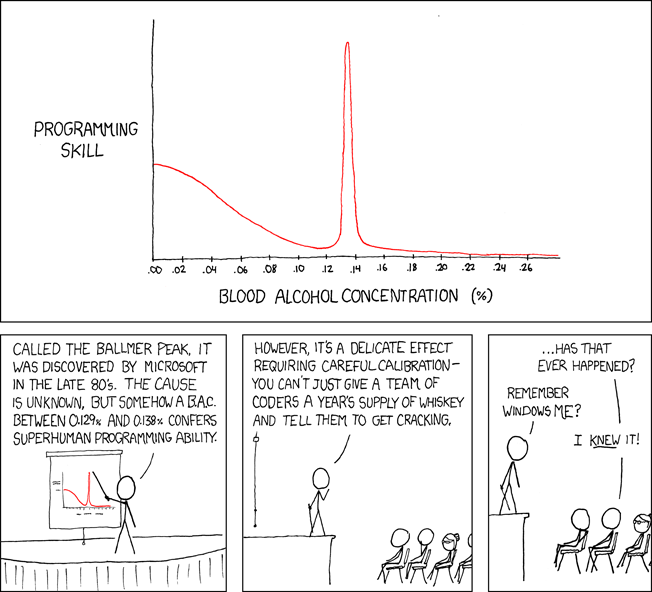
programming is hard enough when I'm sober. should probably try again tomorrow
.xkcd 323 you missed your peak
 hollow wharf
Yeah I know I overshot the Ballmer peak by a few daiquiris
peak dock
F
hollow wharf
just means I have to try less daiquiris next time and hone my optimal BAC for top programming
it's an optimisation problem 😎
bright spindle
||The problem description specifically said diagonals don't count, y'know.||
 zenith moat
.aoc join
bright spindle
Also, please save discussions of the current problem for #advent-of-code-spoilers-archive .
fringe temple
sorry
hollow wharf
representing 2D spaces can be such a pain in the ass...
sinful pawn
omg finally...
 proud cosmos
Nice!
sinful pawn
4 hours...
hollow wharf
grats
sonic silo
uh
sinful pawn
oh no
sinful pawn
lord, I hate these
sonic silo
tbf
sinful pawn
My code is so unholy
sonic silo
nth arrays are a very convenient way to represent data
but for example ||today you could use dicts in order to represent positions||
:)
sinful pawn
convenient if you can wrap your head around them 
hollow wharf
sonic silo
nth arrays are a very convenient way to represent data
lol they're the worst in Haskell
proud cosmos
Part 3 is a 7d version where the 7th dimension is time.
sinful pawn
oh yes. part 3
sonic silo
hollow wharf
lol they're the worst in Haskell
those are lists tho
hollow wharf
sonic silo
those are lists tho
well yes
sonic silo
which is slightly different due to time complexity and how theyre structure in memory blah blah
structured*
and evne how theyre used
hollow wharf
sonic silo
which is slightly different due to time complexity and how theyre structure in m...
Yeah I know, just makes representing multi-dimensional data kind of a pain
proud cosmos
Like yesterday was pretty bad
sonic silo
hollow wharf
Yeah I know, just makes representing multi-dimensional data kind of a pain
ye
hmm
hollow wharf
sinful pawn
idk how y'all do this
experience mostly
hollow wharf
sonic silo
haskell must have an equivalent to an array of data
I think there's a library that provides those
bright spindle
I think most of the time ||representing grids with sets of positions rather than multidimensional arrays is way easier||
hollow wharf
bright spindle
I think most of the time ||representing grids with sets of positions rather than...
My plan was to do something like ||Map (Integer, Integer) Integer|| but that makes parsing a pain in the ass
sonic silo
theres a mutable version in the sense that its managed thru an IO monad
bright spindle
hollow wharf
My plan was to do something like ||`Map (Integer, Integer) Integer`|| but that m...
I did that, it was easy in Rust
sonic silo
:o
hollow wharf
bright spindle
I did that, it was easy in Rust
ah I'll try again tomorrow morning once I'm sober
proud cosmos
That was not a good day for me
hollow wharf
maybe my brain is just not seeing it
proud cosmos
Should be easy honestly but yeah idk
 stiff kraken
ugh i'm behind so many days on AoC, but uni is shoving so many things about programming down our throat i'm starting to burn me out
makes me sad
woven sable
Oh nice, today sounds fun
sleek cave
part 1 looks deceptively easy
perhaps part 2 would be to construct a quantum algo determining the most efficient way to escape the cave system while simultaneously avoiding smoke
I may as well work on part 1 at school lmao
placid lake
i’m doing part 2 at school lmao
bright spindle
sleek cave
perhaps part 2 would be to construct a quantum algo determining the most efficie...
It's to create an accurate simulation of smoke physics in 3D space.
placid lake
on the ||networkx|| docs
sleek cave
sinful pawn
It took me 4 hours just for day 5
you can persevere for 4 hours
idk how you do this
jokes aside, you're doing amazing if you're continuing for 4 hours and finally finding the solution
sleek cave
bright spindle
It's to create an accurate simulation of smoke physics in 3D space.
wtf.
placid lake
lmfao
bright spindle
sleek cave
wtf.
C'mon, this is baby stuff.
bright spindle
(Just for the sake of Poe's law, I'm being facetious)
bright spindle
: meant to be humorous or funny : not serious
mossy basin
proud cosmos
The 4d game of life
my function for that was the same as the previous part
mossy basin
proud cosmos
The 4d game of life
i found it:
||
def convolve_dimension_(n):
KERNEL = np.ones((3, ) * n, dtype=np.uint8)
KERNEL[(1, ) * n] = 0
universe = data[(None, ) * (n - 2) + (..., )]
for _ in range(6):
neighbors = convolve(universe, KERNEL)
universe = (neighbors == 3) | (np.pad(universe, 1) & (neighbors == 2))
return universe.sum()
def part_one():
return convolve_dimension_(3)
def part_two():
return convolve_dimension_(4)
||
sonic silo
lol
i remember doing a generic n-d game of life
i found it
||`import sys, os, re, math, hashlib, itertools, string
from collections import namedtuple, defaultdict, Counter
import numpy as np
def hyperconway(raw, G=100,N=2):
if N < 2 or G < 1: raise ValueError()
adj_coords = list(filter(any, itertools.product((-1, 0, 1), repeat=N)))
m1 = {(i,j,*([0]*(N-2))) for j,y in enumerate(raw.split("\n")) for i,x in enumerate(y) if x == "#"}
print(f"Gen 0, count={len(m1)}")

for g in range(1,G+1):
    neighbours = Counter(tuple(v+dv for v,dv in zip(V,dV)) for dV in adj_coords for V in m1)
    m1={p for p in neighbours if neighbours[p]==3 or (p in m1 and neighbours[p]==2)}
    print(f"Gen {g}, count={len(m1)}")

return len(m1)
def one(raw):
return hyperconway(raw,G=6,N=3)
def two(raw):
return hyperconway(raw,G=6,N=4)`||
 blazing kraken
python is too slow

it is taking 2min to calculate one number
for aoc 2021
day 8
hidden musk
that's not python's fault :P
honest nacelle
blazing kraken
python is too slow
Python may be a bit slower than some of its peers, but there's nothing in day 8 that should require anything that would take it more than a few milliseconds
blazing kraken
honest nacelle
Python may be a bit slower than some of its peers, but there's nothing in day 8...
maybe its just my bad code
i will try to optomise
honest nacelle
A good call!
blazing kraken
looks like i found the culprit
permutations

are they slow?
I mean there are a lot of permutations
humble copper
ok im so lost
honest nacelle
blazing kraken
are they slow?
I can't imagine there'd be enough to choke up python, it takes a lot of inputs before things start to slow down. Maybe head on over to #advent-of-code-spoilers-archive if you need some help diagnosing your code
If it's not a logical error, there is at least almost certainly some way to do what you're doing with less data to manage
blazing kraken
honest nacelle
I can't imagine there'd be enough to choke up python, it takes a _lot_ of inputs...
well i was looping over stuff for no reason instead of removing them from the stack
so maybe not python or perm fault
honest nacelle
is it running faster now?
honest nacelle
humble copper
ok im so lost
What's up?
blazing kraken
honest nacelle
is it running faster now?
yes
 honest nacelle
blazing kraken
yes
honest nacelle
blazing kraken
yes
Nice! Good a lesson as any to double check your logic if things are going slower than expected. It might be fun to play around with operations on various sized datasets to see what kind of numbers cause python to slow down
humble copper
honest nacelle
What's up?
part 2 solution is breaking after only a few points
so im going to redo the whole thing
honest nacelle
humble copper
so im going to redo the whole thing
#advent-of-code-spoilers-archive is here for you if you need any help!
honest nacelle
good luck and godspeed
humble copper
thank you
humble copper
honest nacelle
good luck and godspeed
 honest nacelle
humble copper
honest nacelle
humble copper

 hard fable
My Day 9 part two works with the sample but doesn't with the real data 😕
honest nacelle
hard fable
My Day 9 part two works with the sample but doesn't with the real data 😕
Head over to #advent-of-code-spoilers-archive if you need any help!
hard fable
I'll try to solve it by my own first but yeah
sleek lark
hard fable
I'll try to solve it by my own first but yeah
If you have come to say this kind of things, you are already seeking help. You can post a bit of code and discuss about hints in spoilers
hidden musk
sleek lark
If you have come to say this kind of things, you are already seeking help. You c...
you can complain about things and not want help at the same time
woven oriole
is there a better way to check neighbour digits than recursion
hidden musk
iteration!
woven oriole
👀
i am thinking of collecting all the 9's indices
and doing some sorcery with it
😩
but it is not that simple
woven oriole
yeah
 tulip elbow
9's are walls
woven oriole
thats why made a class
hm
btw i am assuming that the recursion does not go simultaneously if we deployed multiple function calls right
like
def re(p):
  if con:
      ...
  return re(hm) + re(ok) + re(bruh)
so re(hm) should finish his complete dynasty of recursions before moving to the next
or is it
vsauce moosic plays
hidden musk
yes, it should
woven oriole
ok
 craggy rover
.aoc join
 eternal forge
Got the right answer for the test-data for P1 and P2, but only P1 for the real data 🙃
 regal garnet
I dont understand how finding the lower points works, the example confuses me
eternal forge
regal garnet
I dont understand how finding the lower points works, the example confuses me
If all "neighbours" are greater than the current number, it is a lower point
 sick fern
rotund rapids
sick fern
rotund rapids
for a basin it doesn't have to have adjacent numbers that are either one higher or one lower it just has to be adjacent nums not 9?
honest nacelle
rotund rapids
for a basin it doesn't have to have adjacent numbers that are either one higher ...
correct
eternal forge
Oh so like 0, 2, 6, is a valid basin?
rotund rapids
yea as long as they are connected
eternal forge
Jeez
rotund rapids
the examples just show that bc all of our inputs have consecutive numbers anyways
you want find like 026 connected
only num that doesn't apply is 9 whiuch is the wall
eternal forge
Here I am checking for increments of 1 only 😄
rotund rapids
yea, that got me
eternal forge
Woo, got the right answer then 😄
Time to refactor the horrendous code and remove all the prints 😄
hollow wharf
ay, we solved day 8
quite happy with it, it runs in only 1.8s
I feeeeeelll like day 9 without numpy will probably push CPython to its limit
devout tusk
hollow wharf
I feeeeeelll like day 9 without numpy will probably push CPython to its limit
my both parts finish in 14 ms....
without numpy..
pliant comet
yeah input isn't that big
devout tusk
hollow wharf
0.02s to parse everything
20ms to parse? that's a lot!
peak dock
oop that should prolly go to spoilers
hollow wharf
I'm trying to guess what part 2 may be
so I don't lock myself
oh well
a rewrite never killed anyone, did it
hollow wharf
every grid is 100x100?
peak dock
there is only one
 peak dock
fun
hollow wharf
well that's a problem
I get the right answer on the sample
if not (0 <= x < SIZE and 0 <= y < SIZE) why doesn't this work correctly 
oh my god the sample isn't a square
sleek lark
@hollow wharf yes it is I think
@hollow wharf I think you did not read the riddle correctly
hollow wharf
and all other locations will always be part of exactly one basin.
That's a bit concerning, considering assigning a location to a basin or another will give you a different output
peak dock
wdym?
proud cosmos
mossy basin
i found it:
||
`def convolve_dimension_(n):`
` KERNEL = np.ones((3, ) * n, dt...
I also tried/did a general one but mine was huge.. amazing you did that so easily haha
hollow wharf
If it were to have overlap though there would be many different answers to the puzzle
woven sable
Today is my favorite day so far, ||I've never actually had to use recursion for a problem so it's refreshing to use it  ||
||
woven oriole
woven sable
Today is my favorite day so far, ||I've never actually had to use recursion for ...
same
used recursion for continuous 2 days
 pearl moon
@woven sable I used iteration for that one 🙂
woven sable
pearl moon
<@!584817706646110333> I used iteration for that one 🙂
How'd you do it? (what was your solution? btw you might wanna send it to #advent-of-code-spoilers-archive )
pearl moon
Well I'll just say this...there's usually an iterative way to solve common ||graph search problems||. I'd suggest Googling it a bit if you're not already familiar. It can be really handy if you're ever doing it for real and you have a huge graph that will blow up your stack (unless you have tail recursion)
 brittle mauve
Man i gave up on advent of code
I couldnt do day 3 then i forgot about the other days and when i checked it was too complicated for me
pearl moon
I withdrew from the leaderboard I was in. It was making me feel stupid not being able to finish as quickly as the others
Want to see my journal entry from Tuesday?
Quit Advent of Code. Just too stupid and slow to keep up.
 modern harness
My poor performance last night knocked me from 7th place on the discord leaderboard to 14th... ouch, that is a huge impact for just a single day's problem
woven oriole
i did today's one after 10 hrs of being uploaded due to some work , lost 19 places
¯_(ツ)_/¯
peak dock
modern harness
My poor performance last night knocked me from 7th place on the discord leaderbo...
oof
 fossil cipher
I seem to have gone up several places since day 3 or 4. I guess due to some people having dropped out rather than any skill on my part 😄
Although I got kinda lucky today. My solution is very close to an algo I used in a minesweeper game (for the cascade of squares being revealed if you reveal an empty tile).
woven oriole
fossil cipher
Although I got kinda lucky today. My solution is very close to an algo I used in...
damn
perks of game development
woven sable
pearl moon
<@!584817706646110333> I used iteration for that one 🙂
Ohh I think I get what you did
woven oriole
you always gotta work around matrix and stuffs
fossil cipher
It was a little toy project I did a few years ago for the lols. Wasn't very good overall, but I guess it came in useful 😄
pearl moon
I think the leaderboards are probably not a good thing....unless you reveal them at the end, maybe. But it doesn't encourage good code. It encourages fast code
woven oriole
pearl moon
I think the leaderboards are probably not a good thing....unless you reveal them...
consistency matters at end
fossil cipher
The leaderboard is very much a "oh nice" thing for me. I don't even look at the day's puzzle until several hours after it's unlocked, so not storming to the top of any leader boards any time soon 😄
woven oriole
so its fine not to be worried about your pos because why should you
pliant comet
i think it's fun to try to solve it as fast as possible at first, and then make your code better later
i like racing against my friends :D
fossil cipher
The leaderboard definitely scratches the itch of the competitive programmers out there lol
woven oriole
cough cpp
devout tusk
pearl moon
I think the leaderboards are probably not a good thing....unless you reveal them...
https://www.youtube.com/watch?v=CFWuwNDOnIo
even the creator agrees. He believes that analyzing, understanding and solving a problem in a creative way is what should matter

Advent of Code is an Advent calendar of small programming puzzles for a variety of skill sets and skill levels that can be solved in any programming language you like. People use them as a speed contest, interview prep, company training, university coursework, practice problems, or to challenge each other. In this talk, the creator of Advent of ...
woven oriole
but the thing is that we cant compare codes on the basis of beautification or approach so the only way left is speed 🥴
pearl moon
Well, the competition could be to see who completes all the challenges...not that many people do that
I mean, does the top person on the leaderboard win anything?
woven oriole
uh people dont do things to win something
they are just doing their competitive grindset
 steep shard
why would my code get the right answer on the example input but not on the actual input
for todays thing
is there something weird about the example input
woven oriole
steep shard
why would my code get the right answer on the example input but not on the actua...
did you hardcode some critical points
steep shard
no
woven oriole
we shall discuss in #advent-of-code-spoilers-archive
devout tusk
woven oriole
but the thing is that we cant compare codes on the basis of beautification or ap...
github copilot can determine a list of codes to output depending on some attributes...They could perhaps define beauty as a parameter to classify codes.
This is dumb, I am rambling, I should sleep, don't read what I just said...
steep shard
if u didnt want us to read it then why did u send it
 turbid lake
What means "advent of code"?
pearl moon
Lol I wonder how many people are using copilot on this
And how useful it is
8 and 9 are probably a 3-4 IMO
minor cave
turbid lake
What means "advent of code"?
check out #911684406605930496! It should answer your questions~
woven oriole
devout tusk
github copilot can determine a list of codes to output depending on some attribu...
👀 interesting
devout tusk
lel
 already midnight
devout tusk
woven oriole
<:lemon_sleepy:754441881739591831> already midnight
already midnight
devout tusk
woven oriole
<:lemon_sleepy:754441881739591831> already midnight
lol, where you @?
woven oriole
pearl moon
Lol I wonder how many people are using copilot on this
just for experimental purpose after finishing
woven oriole
devout tusk
lol, where you @?
india
devout tusk
woven oriole
india
ahh cool
 pulsar hollow
cdfbe: 5
gcdfa: 2
fbcad: 3
dab: 7
cefabd: 9
cdfgeb: 6
eafb: 4
cagedb: 0
ab: 1``` i dont understhis at all what is the logic applied when decoding the digitsi get that 8 is for 7 and 7 for 3 and 2 for 1 etc
but how are others decided
pearl moon
For that one....there's more than one way of comparing digits, or rather comparing the data that makes up the digits. One way is a lot more useful than the other
woven sable
pulsar hollow
but how are others decided
So you see the diagram of the seven segments above?
fbcad light up to form 3
 tepid raptor
hey, this is a more general question, let me know if I'm in the incorrect channel. Last year (and this one) I've seen people use libraries like networkx for their solutions . Where did you guys learn to use those for your problems? Do they have common implementations? If so, for what? I knew a bit about numpy and its linear algebra library, but never thought that I could use linear algebra for solving the problem from AoC.
terse comet
what if I told you those are libraries made to solve real-world problems that people use in their regular day to day work?
I don't mean to be rude or pick on you, it is just a bit funny
tepid raptor
I wouldn't be surprised. I don't mean that those libraries are meant only for AoC problems.
terse comet
networkx in specific is widely used for working with graph networks in python, which makes some kind of problems easier
tepid raptor
I haven't studied graph theory nor any field of computer science (I know some basic introductions but nothing else), I was asking for resources to learn what kinds problems do they solve to see where I can apply them as well.
tepid raptor
terse comet
`networkx` in specific is widely used for working with graph networks in python,...
thank you
 rapid wolf
in my case, it's just having some knowledge of the underlying math. It's the same as with any math problem, you just sometimes see the relation to a math concept you already know and solve it that way
terse comet
yeah... most of the time on these cases, it is about recognising that a determined problem is related to a topic you already know.
usually things like "find the shortest distance between two points"
(oversimplifying it a little bit)
tepid raptor
yeah, I did recognise something in day7 about that
not specifically about the points, just about maths
I guess I'll have to research more on graph theory
genuinely interested
terse comet
yeah - even though not every problem is related to graph theory, it can be fun to learn some things about it and play around with graphs a bit
tepid raptor
sure!
terse comet
there are even some "NoSQL" databases based on graph theory (such as Neo4J) if you want to mess around with it
rapid wolf
Graph theory is one of the most useful parts of CS overall. Most fields have at least some GT problems
an unexpected-ish place is register allocation in compilers
tepid raptor
welp, that is REALLY interesting
I'm making my own C compiler, and already made a sort of working register allocator, never knowing it actually follows a known pattern
rapid wolf
graph coloring is afaik the more specific description
 low condor
 unreal patrol
with this 2
unreal patrol
with this 2
This channel is for Advent of Code. Please open a help channel
 vague tundra
unreal patrol
with this 2
vague tundra
unreal patrol
with this 2
You're looking for the functions -
list.count() , list.index() , and probably list-comprehensions .
vague tundra
low condor
This channel is for Advent of Code. Please open a help channel
Yep.
 halcyon portal
hi
sleek cave
||part 2 is one of those searching algorithms, exactly what i'm inexperienced with lmao 😔||
though this is why i LOVE aoc
learn so much new stuff
||oh it's a recursive solution again isn't it||
proud cosmos
Not necessarily
sleek cave
proud cosmos
Not necessarily
||my mind just flew to recursion lmao||
proud cosmos
would probably work
sleek cave
||sure, you can probably solve it iteratively, but why when you can recurse :D||
proud cosmos
||Some advantages to doing it iteratively usually||
sleek cave
true true
proud cosmos
|| BFS is terrible recurisvely as far as I know, DFS is easy though||
low condor
halcyon portal
hi
Hello 🙂
sharp panther
2019 was the year of intcode, right? I've heard that that year was particularly fun and want to do it.
proud cosmos
Yea
sleek cave
i heard that recursion gets a bad rep for being inefficient, but then again you have @cache
sharp panther
ty
proud cosmos
Poor cache person
I have to actually do 2019 at some point
i stopped cause it was a bit too much for my skills

 slender steeple
dont use recursion please
sleek cave
proud cosmos
I have to actually do 2019 at some point
i'm doing 2019 right after 2021 lol
mossy stream
if my output number takes more than the full length of the my terminal to show up, do you think I messed up?
proud cosmos
If it's a single number and you're doing day 9
yes
The maximum you could get (which isn't even possible) is every single input data
unlikely (read won't happen) and not sure that'd fill it 
mossy stream
||Find the three largest basins||
it would help if I were to read the prompt

1825553075572295861000688390570293789728808334688285126417584321133963999289062138010144228311094741155009439264911024135120900171851405879947173198105108715459217161078552924894715943887311121450728850201515251664265399503302964559270002842643988480000000000000000000000000000000000000000000000000000000000 would have been an interesting output though
mossy stream
what even is spoily here
proud cosmos
part 2 question
woven sable
sleek cave
||oh it's a recursive solution again isn't it||
||yeah, i think it's called BFS from what I"ve heard||
sleek cave
okay i need to stop clicking on spoilers now
luckily, i don't know how to do breadth-first search
mossy stream
well, I got it wrong on the input but right on the sample
sleek cave
so that spoiler doesn't affect me :D
mossy stream
so like
proud cosmos
I had the same thing
mossy stream

proud cosmos
some things aren't covered
woven sable
sleek cave
okay i need to stop clicking on spoilers now
Oops sorry
proud cosmos
For example I believe || if you did not include ONLY lower than all adjacent ones (so <= is fine)|| is not covered (wrong)
woven sable
I also learned about BFS today though
mossy stream
If anybody has any clue what's going on: ||https://paste.pythondiscord.com/nujasehute.py||
sleek cave
recursion is breaking my brain
today's puzzle reminds me of trees
i hate trees
thus, i hate this puzzle
but i also love it
 noble skiff
did anyone discover a super optimal solution for day 7
proud cosmos
There are some nice solutions for both of them
So yes someone did do things that could fit that criteria
noble skiff
are there no spoilers allowed here? Can you point me to anywhere those solutions are posted?
proud cosmos
#advent-of-code-spoilers-archive is for spoilers
woven sable
sleek cave
i hate trees
Wow, you hate the trees that pump out oxygen? /j
sleek cave
woven sable
Wow, you hate the trees that pump out oxygen? /j
i take it back
today's puzzle is so fun
trees are amazing
woven sable
sleek cave
today's puzzle is so fun
Exactlyy
 craggy mural
@hidden musk
pearl moon
 gilded grail
im kinda confused at what edge case the sample input doesnt have that the actual does
nvm
thats so stupid
void ocean
the history an AoC doer
 peak dock
woven sable
||yeah, i think it's called BFS from what I"ve heard||
peak dock
woven sable
||yeah, i think it's called BFS from what I"ve heard||
bfs generally isn't implemented recursively
dfs is commonly implemented both recursively and iteratively
hollow wharf
it took me an embarrassingly long time to notice that my solution wasn't working because ||I had made a graph with a cycle in it||
it worked on the sample. I was losing my mind
 wispy glacier
anyone on day 3? 
hollow wharf
wispy glacier
anyone on day 3? <a:dogekek:739754966809575445>
I made such a mess of day 3 lol
sharp panther
me!
sharp panther
I've been skimming and coming up with half-solutions that don't completely work, but not actually doing them all
sharp panther
I basically attempt all of them, but if they'll take more than 15 minutes for me, then I'll wait to come up with a complete solution (which is all of them beyond the second)
I might do them over break



 forest basalt
Does anyone know how I can use curl to get my input file from the website? When I pull the file it says Puzzle inputs differ by user. Please log in to get your puzzle input.
sharp panther
You need to use your session token as a cookie