#type-hinting
1 messages · Page 57 of 1
 dim trail
why? i mean, it works with type
 tranquil turtle
from typing import Union

class X:
    __or__ = Union.__or__  #mypy: error   operator - Unsupported left operand type for | ("_SpecialForm")
bug?
not bug
Union is not type, it is instance of _SpecialForm
 trim tangle
what are you trying to do?
tranquil turtle
i am implementing GenericAlias in python
 grave fjord
tranquil turtle
i am implementing `GenericAlias` in python
grave fjord
tranquil turtle
i am implementing `GenericAlias` in python
Uhh why?
Read the code in typing_extensions
 spare mauve
like typing._GenericAlias ?
grave fjord
Uhh actually this one https://pypi.org/project/typing/ maybe?

 pastel egret
That’s an old backport for 3.4 and earlier.
You’ll want the stdlib typing module:
https://github.com/python/cpython/blob/main/Lib/typing.py
Note though, all the implementation here is private and has changed a lot between releases to be more efficient or accomodate new features.
trim tangle
pastel egret
You’ll want the stdlib typing module:
<https://github.com/python/cpython/blob/ma...
that is actually a bit of a pain if you want to inspect type annotations
spare mauve
or types.GenericAlias
spare mauve
looks like that's what e.g. list[int] gives you
yea, the API is only __args__ right
or some such thing
tranquil turtle
def __or__(self, other):
    return Union[self, other]
mine was actually no good
 tulip hearth
How would i typehint an anyio task created by TaskGroup.start or start_soon
i see its none
 blazing nest
That's because start_soon() doesn't return anything
So it is None
Do you want to get the result of a task?
@tulip hearth ^
tulip hearth
No, i just wanted to type hint the task but i figured out that anyio works a bit differently than normal asyncio code i.e in asyncio i can do sometask = asyncio.create(somecoro) which returns a future object, turns out anyio wraps everything
grave fjord
tulip hearth
No, i just wanted to type hint the task but i figured out that anyio works a bit...
tasks can only have side effects
that's the trio magic
tulip hearth
O_o seems pretty magical indeed, its gonna take some time to adjust to this
blazing nest
Yeah if you wanted the result await it directly
tulip hearth
👍
 soft matrix
spare mauve
yea, the API is only `__args__` right
soft matrix
spare mauve
yea, the API is only `__args__` right
It's also parameters and a getitem
spare mauve
soft matrix
It's also parameters and a getitem
ah, that's true
 twilit badge
Hi, first time I'm using overloads and I can't figure out how to solve this: ```py
@overload
def init(self, pattern: ValidPatternType, repetitions: int, or_more: bool = False):
...
@overload
def __init__(self, pattern: ValidPatternType, minimum: int, maximum: int):
    ...

def __init__(self, pattern: ValidPatternType, *args, **kwargs):
  pass
Basically, I don't know how to extract the attributes I need from `*args` or `**kwargs`, since the variables can be both positional and keyword, I'm struggling a bit with doing this, isn't there a better way to parse them out so that it matches the signatures from the overloaded functions?I could probably figure out a way to parse it out manually, but I'd also like it to give out an exception if the *args or **kwargs can't be passed in the way the user provided them. i.e. if the function is called like with pattern="x", repetitions=12, random_variable="x") it should raise an exception that's at least similar to what python would give out if it were a real function taking those parameters, this just seems incredibly complex to do just to have some overloads
twilit badge
so, I found out I can do this: ```py
def init(self, pattern: ValidPatternType, *args, **kwargs):
s1 = inspect.Signature(
parameters=(
inspect.Parameter("repetitions", kind=inspect.Parameter.POSITIONAL_OR_KEYWORD),
inspect.Parameter("or_more", kind=inspect.Parameter.POSITIONAL_OR_KEYWORD)
)
)
s2 = inspect.Signature(
parameters=(
inspect.Parameter("minimum", kind=inspect.Parameter.POSITIONAL_OR_KEYWORD),
inspect.Parameter("maximum", kind=inspect.Parameter.POSITIONAL_OR_KEYWORD)
)
)
try:
bound = s1.bind(*args, **kwargs)
i = bound.arguments["repetitions"]
j = None
or_more = bound.arguments["or_more"]
except TypeError:
bound = s2.bind(*args, **kwargs)
i = bound.arguments["minimum"]
j = bound.arguments["maximum"]
or_more = False
...
 oblique urchin
Why are you trying to use these overloads? If I were you I'd probably just write two different classmethods as alternative constructors
twilit badge
hmm, I could do that, though it would be a bit weird, I mean, I'd be defining 2 class methods that act very similarely to just init calls: ```py
class Foo:
def init(i: int, j: Optional[int] = None, or_more: bool = False):
...
@classmethod
def from_range(cls, minimum: int, maximum: int) -> "Foo":
    return cls(minimum, maximum, False)

@classmethod
def from_repetitions(cls, repetitions: int, or_more: bool = False) -> "Foo":
    return cls(repetitions, None, or_more)
To show the similarity, here are some examples for using init vs the class methods: ```py
x = Foo(1, 15)
x = Foo.from_range(1, 15)
y = Foo(15, or_more=True)
y = Foo.from_repetitions(15, or_more=True)
``` At this point, I might aswell just use the `__init__` alone, but to have a more descriptive way show up when initializing it I defined those overloadsI find the classmethods a lot clearer and easier to reason about
twilit badge
they're certainly cleaner, but it just feels weird to have a class method that essentially does the same as __init__, also there was another purpose behind those overloads which was that they restricted what could actually be passed into __init__, they prevented things like setting both i and j along with or_more=True. While this could be handled explicitly in __init__ it's just more annoying to do
but I suppose it's better than the signature mess
 rotund flax
twilit badge
hmm, I could do that, though it would be a bit weird, I mean, I'd be defining 2 ...
rotund flax
twilit badge
hmm, I could do that, though it would be a bit weird, I mean, I'd be defining 2 ...
Its is possible to overload method, using metaclasses. Calling functions of a class with the same name - but different arguments.
Yet doing so would slow down the program at run time.
I would suggest renaming the functions, to what they do OR have an additional argument - to change how the code is run.
blazing nest
Just use keyword arguments 😅
trim tangle
twilit badge
hmm, I could do that, though it would be a bit weird, I mean, I'd be defining 2 ...
If your class has either range or repetitions, why not make two classes?
@hidden spoke list[int] is a list where each element is an integer. You can't append a list of integers to it.
If you want a list of lists of integers, that would be list[list[int]]
Sounds like you need a proper class 🙂
perhaps a dataclass
I've never seen someone learn about type annotations before classes 👀
I guess that's a good strategy
soft matrix
!d dataclasses
 rough sluiceBOT
Source code: Lib/dataclasses.py
This module provides a decorator and functions for automatically adding generated special methods such as __init__() and __repr__() to user-defined classes. It was originally described in PEP 557.
The member variables to use in these generated methods are defined using PEP 526 type annotations. For example, this code...
 red atlas
from typing import TypeVar, Iterable, Union

T = TypeVar('T')
Tree = Iterable[Union[T, 'Tree']]
this is valid, right? no type checkers ive tried seem to be able to handle the recursive aspect of it. am i doing it wrong? or recursive types are just poorly supported?
oblique urchin
red atlas
```py
from typing import TypeVar, Iterable, Union
T = TypeVar('T')
Tree = Itera...
pyright supports recursive type aliases I believe. But this sort of thing is hard to solve for the typevar solver
spare mauve
soft matrix
It's also parameters and a getitem
ah, just remembered, __origin__ is a part of the API too
soft matrix
oh i was thinking of UnionType
 thin bridge
!d classes
rough sluiceBOT
Graph types
NetworkX provides data structures and methods for storing graphs.
All NetworkX graph classes allow (hashable) Python objects as nodes and any Python object can be assigned as an edge attribute.
The choice of graph class depends on the structure of the graph you want to represent.
rotund flax
!d metaclasses
rough sluiceBOT
By default, classes are constructed using type(). The class body is executed in a new namespace and the class name is bound locally to the result of type(name, bases, namespace).
The class creation process can be customized by passing the metaclass keyword argument in the class definition line, or by inheriting from an existing class that included such an argument. In the following example, both MyClass and MySubclass are instances of Meta...
trim tangle
 loud osprey
can anyone give a short summary of how type hinters like mypy work ?
loud osprey
can anyone give a short summary of how type hinters like mypy work ?
what do you mean by "how they work"?
loud osprey
trim tangle
what do you mean by "how they work"?
like, how do they detect inconsistencies in type hinting?
I want to contribute to mypy but the code feels too complex and when I see the in code comments, they have too many technical terms
trim tangle
loud osprey
I want to contribute to mypy but the code feels too complex and when I see the i...
ah, I have no idea how it works 🙂
it is pretty arcane
I tried making a plugin for mypy, I didn't go very far
loud osprey
oh
trim tangle
!rule 5
rough sluiceBOT
5. Do not provide or request help on projects that may break laws, breach terms of services, or are malicious or inappropriate.
trim tangle
not the right channel, not the right server
soft matrix
AFAIK it runs semantic analysis (https://github.com/python/mypy/blob/master/mypy/semanal.py#L1-L49) then actual type analysis (https://github.com/python/mypy/blob/master/mypy/typeanal.py) then the checker is ran (https://github.com/python/mypy/blob/master/mypy/checker.py)
 hasty hull
trim tangle
I tried making a plugin for mypy, I didn't go very far
hasty hull
trim tangle
I tried making a plugin for mypy, I didn't go very far
I don't blame you, I've written a mypy plugin and the whole process was painful
trim tangle
I'm too stupid to understand mypy plugins
hasty hull
to be honest I don't really understand it anymore
it was just loads of trial and error really
 fierce ridge
hasty hull
I don't blame you, I've written a mypy plugin and the whole process was painful
fierce ridge
hasty hull
I don't blame you, I've written a mypy plugin and the whole process was painful
I have wanted to write probably 3 or 4 different plugins and always got scared away
hasty hull
Yeah I regret even writing it lol
hasty hull
This bug has been fixed in pyright 1.193
trim tangle
Here's a cool trick that's now possible with TypeVarTuple:
https://paste.pythondiscord.com/okehayubut.py
@tail_rec
def factorial(n: int, acc: int) -> TailRec[int, int, int]:
    if n <= 0:
        return Return(acc)
    return Call(n - 1, acc * n)

reveal_type(factorial)  # function (int, int) -> int
is this a mypy bug?
Incompatible types in assignment (expression has type "Sequence[Union[Literal['Parent'], Literal['Expert'], Literal['Educator'], Literal['Individual'], Literal['Other']]]", variable has type "List[str]") [assignment]
those Literals are all strs 
is this some variance issue with List?
ah yep that was it
fierce ridge
i had this, more or less:
# 3rd-party code
get_some_text() -> List[str]: ...

# my code
parse_foo(parts: Sequence[str]) -> Sequence[Literal['a', 'b']]: ...

foo = get_some_text()
foo = parse_foo(foo)
i changed it to this and it worked:
# 3rd-party code
get_some_text() -> List[str]: ...

# my code
parse_foo(parts: Sequence[str]) -> Sequence[Literal['a', 'b']]: ...

foo_raw = get_some_text()
foo = parse_foo(foo_raw)
--allow-redefinition 😄
oblique urchin
no, but why wouldn't you always want it?
fierce ridge
because imo it shouldn't be default, "failing open" as it were
easy to assign the wrong thing to the wrong thing just because of a typo
blazing nest
trim tangle
Here's a cool trick that's now possible with `TypeVarTuple`:
<https://paste.pyt...
Couldn't you use ParamSpec here?
trim tangle
blazing nest
Couldn't you use ParamSpec here?
No, because ```py
class Call(Generic[Unpack[P]]):
def init(self, *args: Unpack[P]) -> None:
self.args = args
But it would if you'd allow both args and kwargs?
 trim tangle
blazing nest
But it would if you'd allow both args and kwargs?
trim tangle
blazing nest
But it would if you'd allow both args and kwargs?
what would you put in the return type here?
@tail_rec
def factorial(n: int, acc: int) -> TailRec[???, int]:
    if n <= 0:
        return Return(acc)
    return Call(n - 1, acc * n)
there isn't really a way to construct a ParamSpec from thin air
btw there should also be a return type here: ```py
def tail_rec(fn: Callable[[Unpack[P]], TailRec[Unpack[P], T]]) -> Callable[[Unpack[P]], T]:
...
but I removed it because of a pyright bug 🙂TailRec[[int, int], int]
Does that work?
I've never constructed a ParamSpec other than from a Callable
trim tangle
blazing nest
```python
TailRec[[int, int], int]
```
Does that work?
I've never constructed a...
I'm not sure, but that certainly doesn't include kwargs
lol nice error
 trim tangle
blazing nest
```python
TailRec[[int, int], int]
```
Does that work?
I've never constructed a...
trim tangle
blazing nest
```python
TailRec[[int, int], int]
```
Does that work?
I've never constructed a...
just checked that this doesn't work
I think there are no paramspec literals
fierce ridge
trim tangle
there isn't really a way to construct a `ParamSpec` from thin air
i still want to be able to derive a ParamSpec from a function and a Protocol from a class
trim tangle
and I want a flat in Moscow
trim tangle
fierce ridge
i still want to be able to derive a `ParamSpec` from a function and a `Protocol`...
make a mypy plugin 😉
fierce ridge
i wish!
and i bet if i post that on python-ideas that's exactly what people will say
soft matrix
Protocol from a class is already a thing on the python/typing repo
param spec from a function sounds like what ambv suggested for callable syntax or maybe with the protocol pep
trim tangle
blazing nest
But it would if you'd allow both args and kwargs?
actually no https://github.com/microsoft/pyright/issues/2667
fierce ridge
soft matrix
param spec from a function sounds like what ambv suggested for callable syntax o...
hm.. i don't really need special syntax for it. just "a ParamSpec that has the same args, kwargs, and return annotations as some specific function"
 waxen raft
so uh if we have a class let's call it MyClass and we need to annotate an attribute of another class as being an instance of MyClass, do we do like var: MyClass = MyClass() or var: 'MyClass' = MyClass() or something else
oblique urchin
waxen raft
so uh if we have a class let's call it ``MyClass`` and we need to annotate an at...
Both work but the former is preferred. You need the quoted form in some unusual situation, most frequently when you're annotating a method as returning an instance of its own class.
waxen raft
ok cool thanks
pastel egret
To the type checker (who doesn't care about definition order) it treats them the same, you just need the string in cases where the class wouldn't be defined yet.
On classes though, annotations are assumed to be instance attributes - you'd need typing.ClassVar[TheType] to indicate class attrs.
loud osprey
if I have to define a tuple of int of length 100, how would I type hint it?
because for tuple, I have to mention the type of each individual element
is there a shorter way to do it?
 acoustic thicket
no, afaik
tuple[int, ...] would be a tuple of any number of ints, and i think thats the closest alternative
 chrome thicket
Hi, is it possible to set type hints for **kwargs?
oblique urchin
chrome thicket
Hi, is it possible to set type hints for `**kwargs`?
For now, only if the type is homogeneous
chrome thicket
oblique urchin
For now, only if the type is homogeneous
thank you
blazing nest
oblique urchin
For now, only if the type is homogeneous
TypedDict **kwargs when 😳
oblique urchin
Once I get PEP 464 into typing-extensions I'm planning to make **kwargs: Unpack[TypedDict] mean what you want it to mean in pyanalyze
Would still require a PEP for standardization though
trim tangle
oblique urchin
Once I get PEP 464 into typing-extensions I'm planning to make `**kwargs: Unpack...
wait, that's a thing?
that basically solves the nasty-kwargs problem
soft matrix
its not a thing yet
trim tangle
no I mean, in pyanalyze
oblique urchin
Not officially. PEP 646 supports the corresponding thing for *args so it seems logical to make **kwargs work the same way
oblique urchin
trim tangle
no I mean, in pyanalyze
Not yet but it should be easy to add because I already have internal support for heterogeneous **kwargs
So just needs surface syntactic support
soft matrix
i personally dont really see the point in using a TypedDict for kwargs myself unless you are stubbing out a library. what other use cases are there that cant already be done now?
trim tangle
soft matrix
i personally dont really see the point in using a TypedDict for kwargs myself un...
libraries which use pass-through kwargs, like matplotlib or aiohttp
oblique urchin
You could have multiple wrapper functions for a function that takes a lot of kwargs
soft matrix
trim tangle
libraries which use pass-through kwargs, like `matplotlib` or `aiohttp`
shouldnt you just hope for this #type-hinting message?
trim tangle
trim tangle
libraries which use pass-through kwargs, like `matplotlib` or `aiohttp`
Like, every time I see this https://github.com/aio-libs/aiohttp/blob/master/aiohttp/client.py#L312-L314
rough sluiceBOT
aiohttp/client.py lines 312 to 314
def request(
    self, method: str, url: StrOrURL, **kwargs: Any
) -> "_RequestContextManager":```it just breaks my heart
soft matrix
oblique urchin
You could have multiple wrapper functions for a function that takes a lot of kwa...
personally i dont see how moving the definition to somewhere else is particularly useful just seems like another situation of inline vs stubbed types
trim tangle
trim tangle
it just breaks my heart
what was the point of carefully type hinting everything in _request if request is basically "you want to add an argument? well friend, you're up to a journey"
soft matrix
rough sluice
`aiohttp/client.py` lines 312 to 314
```py
def request(
self, method: str, u...
but what if?py def request( self, method: str, url: StrOrURL, **kwargs: ParametersOf[_request] ) -> "_RequestContextManager":
or something
i swear this reads so much better
instead of ```py
def request(
self, method: str, url: StrOrURL, **kwargs: Unpack[RequestFnKwargs]
) -> "_RequestContextManager":
that adds a new concept to the type system -- the ability to reference the type of a symbol
which is arguably more stuff to add to the already complex system
oblique urchin
It's also not necessarily strong enough because you may not support all parameters of _request
soft matrix
as i said i feel like this should have come with 612
soft matrix
oblique urchin
It's also not necessarily strong enough because you may not support *all* parame...
if we are only talking about pass through methods surely thats not something to be considered, theoretically you could do some gross stuff with Concatenate and add a Deconcatenate special form to do the opposite
this certainly could be a lot nicer if you could be named arguments in getitem aswell
trim tangle
Any considered harmful: ```py
return await response.json()
I think I made this mistake 3 times because I'm using httpx and not aiohttp
blazing nest
soft matrix
instead of ```py
def request(
self, method: str, url: StrOrURL, **kwargs: Un...
There is an argument to be made about what other languages do, and TypeScript does this for their equivalebt to kwargs
blazing nest
trim tangle
`Any` considered harmful: ```py
return await response.json()
```
What's wrong?
trim tangle
blazing nest
What's wrong?
response.json() is a blocking call that actually reads the whole response
for some reason httpx decided to cram an async response and a sync response into one class 🤷
so I had to do json.loads(await response.aread())
but because .json() returns Any, type checking passed
blazing nest
trim tangle
`response.json()` is a blocking call that actually reads the whole response
Why did you expect something else I am confused?
blazing nest
trim tangle
`response.json()` is a blocking call that actually reads the whole response
Oooooh
trim tangle
blazing nest
Why did you expect something else I am confused?
I expected it to be async or something
just like in aiohttp
blazing nest
But you should've gotten an error then trying to await a dictionary?
trim tangle
yes
blazing nest
trim tangle
for some reason httpx decided to cram an async response and a sync response into...
Also, I don't understand this. Didn't you use AsyncClient?
trim tangle
I did.
blazing nest
trim tangle
I did.
Ah...
trim tangle
But it produces the same response object as the blocking client
oblique urchin
list[list[int]] means a list of lists of int
if you mean a numpy array you'd do something different
oblique urchin
I think mypy will recognize the type from later .append operations
oblique urchin
I remember in mypy it's called "partial types" and it causes quite a bit of headaches
trim tangle
oblique urchin
I remember in mypy it's called "partial types" and it causes quite a bit of head...
is there a type checking feature that doesn't cause quite a bit of headaches? 🙂
oblique urchin
Any. It only solves problems.
tranquil turtle
x: list[Obj] = []
or
x = list[Obj]()
 rancid cloud
I am just looking at types in plain python3 (as opposed to mypy) and I noticed that type({}) returns <class 'dict'> but you can also use {} to create a set class, by doing myset = {1,2,5} then type(myset) returns <class 'set'>
is mypy a bit more "strongly" typed than generic python?
oh i showed up 5 hrs after that conversation. oh well.
blazing nest
rancid cloud
I am just looking at types in plain python3 (as opposed to mypy) and I noticed t...
The thing is, {} always becomes a dictionary. That's no special MyPy thing or special behaviour
!e print(type({,}))
rough sluiceBOT
@blazing nest :x: Your eval job has completed with return code 1.
001 |   File "<string>", line 1
002 |     print(type({,}))
003 |                 ^
004 | SyntaxError: invalid syntax
Basically, dicts were added to Python well before sets, so it had to stay that way for backwards compatibility.
blazing nest
There's no way to create an empty set with literals
pastel egret
Unless you count {*()}.
pastel egret
Not really, just unpacking a tuple. No colon, so it's a set. And the tuple is empty, so it's an empty set. Not too efficient though, it builds an empty set, then unpacks a tuple for no reason.
acoustic thicket
you almost never need to typehint self
pastel egret
Type checkers will deal with it correctly. However sometimes it's useful to specify it as a type var, so you can indicate the method returns/requires others of the same type (if the class is being subclassed).
Yeah.
trim tangle
@hidden spoke 
as you can see, Foo is hinted correctly, but BadFoo is not
so when you subclass BadFoo, everything kind breaks
 rustic gull
is it because the self in BadFoo defaults to an invariant type?
pastel egret
Yeah, since it's not a typevar/generic at all.
trim tangle
rustic gull
is it because the `self` in `BadFoo` defaults to an invariant type?
No, it's because BadFoo.do_something always returns BadFoo
and this type doesn't automatically get changed when you make a subclass
because you could have something like this: ```py
class BadFoo:
def do_something(self) -> "BadFoo":
return BadFoo()
oh I see it's fixed to BadFoo that's not great
 kind bronze
whats type hinting
trim tangle
kind bronze
whats type hinting
see the second pin
kind bronze
thanks
trim tangle
typeHintingChannel.on(/does mypy not support (.+?) yet/, message => message.reply(":pensive:"))
😔
trim tangle
!ban @acoustic thicket self-bot 
rough sluiceBOT
:x: @trim tangle, you may not ban someone with an equal or higher top role.
trim tangle
Is there a way to type hint an instance of a class which inherits from some metaclass?
Like, I have ```py
class FooMeta(type):
...
class Foo(metaclass=FooMeta):
...
class Bar(metaclass=FooMeta):
...
and I want a type hint for an instance of Foo or an instance of Bar (or any other class based on FooMeta)
If I use FooMeta as the hint, it's for the class, not the instance
oblique urchin
trim tangle
Is there a way to type hint an instance of a class which inherits from some meta...
I don't think so
soft matrix
You could theoretically do it with a protocol
T = TypeVar("T", bound=type)
class InstanceOf(Protocol[T]):
class: T
Although it needs type ignores
 rocky anvil
rancid cloud
I am just looking at types in plain python3 (as opposed to mypy) and I noticed t...
rocky anvil
rancid cloud
I am just looking at types in plain python3 (as opposed to mypy) and I noticed t...
mypy is just a type checker, a tool which checks all your types, not related to any cpython interpreter
rocky anvil
rancid cloud
is mypy a bit more "strongly" typed than generic python?
in reply to it
oblique urchin
rocky anvil
mypy is just a type checker, a tool which checks all your types, not related to ...
mypy does also ship a Python compiler (mypyc)
rocky anvil
oblique urchin
mypy does also ship a Python compiler (mypyc)
I didn't know that
need to check
tranquil turtle
mypyc supports only what mypy supports
and mypyc isnt very fast, cython is better
mypyc classes cant be subclassed in pure python and patched
soft matrix
mypyc's benefit is that it should just directly speed up anything that currently can be typed checked by mypy
tranquil turtle
mypy has a lot of bugs and not implemented features
and mypyc build is very slow
cython build is a lot faster
rocky anvil
You always need cython where heavy computations need to be run in a single thread and don't want to spawn processes, I know it's a lot of pain but we can never escape that GIL thing....
oblique urchin
Until the nogil branch gets merged 🙂
rocky anvil
😌
rocky anvil
I wonder to create a multithreaded desktop application with Python and C++ specifically for running cpu bound operation in a separate thread
but I need to learn language binding for that
soft matrix
pybind11 is nice so is cython
rocky anvil
what about swig?
soft matrix
never heard of it
rocky anvil
SWIG supports many languages and by SWIG you can bind language by writing inline code, not sure about it. You can Google it.
 errant tulip
can you set type of a variable that was created using __setattr__? Say for an example object.__setattr__(obj, 'var', 5).
how do I set type of var?
errant tulip
In the way I could have done var: int = 5, now if I use __setattr__, I can't define that var should be int
pastel egret
You just do var: int in the class block.
errant tulip
class Programme(object):
    all_: dict[int, Programme] = {}
    direct_conn: set

    def __new__(cls: Type[Programme], p_id: str):
        p_id = int(p_id)
        if p_id not in cls.all_.keys():
            obj = object.__new__(cls)
            obj.direct_conn = set()
            cls.all_[p_id] = obj
        return cls.all_[p_id]
Found this work around. Let me know if there is anything wrong in this code
errant tulip
pastel egret
You just do `var: int` in the class block.
think this is what you suggested
pastel egret
Yep.
soft matrix
its probably a pycharm bug if you are using it
pastel egret
Which type can't you setL
errant tulip
if I do obj.direct_conn: set[Programme] in __new__, I get this error from pylance Type annotation not supported for this type of expressionPylance
I am using vscode
soft matrix
if you change obj to self does it work?
pastel egret
You don't need to do that there, that's what the annotation is doing in the class block.
errant tulip
pastel egret
You don't need to do that there, that's what the annotation is doing in the clas...
but if I remove it from the class block, it still shows the same error
soft matrix
also you should probably use super().__new__(cls)
pastel egret
Change that to direct_conn: set[Programme].
errant tulip
pastel egret
Change that to `direct_conn: set[Programme]`.
yeah did that
pastel egret
And don't annotate in new or init.
errant tulip
soft matrix
also you should probably use `super().__new__(cls)`
what is the difference? i see the same thing. actually I was trying different things to figure out what would work, and then used object instead of super
errant tulip
pastel egret
And don't annotate in new or init.
why not?
pastel egret
Because it's redundant if you annotate at the class level.
You can do it, but they'd have to match.
errant tulip
pastel egret
Because it's redundant if you annotate at the class level.
I understand, but what if I want to annotate only in __new__? Pylance then shows that error. I don't understand what is wrong. But I guess I have found the solution
pastel egret
Because annotating self is a special case, normally annotationing attributes is invalid.
 wicked berry
when passing in a FrozenSet to secrets.choice mypy complains:
Argument 1 to "choice" has incompatible type "FrozenSet[str]"; expected "Sequence[<nothing>]"
Isn't a FrozenSet a sequence? 🤔
soft matrix
No it doesn't support getitem
wicked berry
Ah
soft matrix
Atleast I don't think it does
wicked berry
checking
>>> dir(frozenset("abcd"))
['__and__', '__class__', '__class_getitem__', '__contains__', '__delattr__', '__dir__', '__doc__', '__eq__', '__format__', '__ge__', '__getattribute__', '__gt__', '__hash__', '__init__', '__init_subclass__', '__iter__', '__le__', '__len__', '__lt__', '__ne__', '__new__', '__or__', '__rand__', '__reduce__', '__reduce_ex__', '__repr__', '__ror__', '__rsub__', '__rxor__', '__setattr__', '__sizeof__', '__str__', '__sub__', '__subclasshook__', '__xor__', 'copy', 'difference', 'intersection', 'isdisjoint', 'issubset', 'issuperset', 'symmetric_difference', 'union']
Alright, in this case I can coerce it to a string first
oblique urchin
Sequence is actually a bit too strict, proposed https://github.com/python/typeshed/pull/6562 to widen it

GitHub
It only does len() and [i]:
(3.6)
def choice(self, seq):
"""Choose a random element from a non-empty sequence."""
try:
...
wicked berry
oblique urchin
Sequence is actually a bit too strict, proposed https://github.com/python/typesh...
Awesome, thank you!
While you're at it does random.choice have the same issue?
oblique urchin
yeah probably but I don't know how to edit multiple files in the web editor 😄
but now there's a branch so I can just put it on the same branch
secrets.choice actually is just random._SystemRandom.choice
 proud brook
I was making my first abstract base class in Python and I thought "why not add type hints too?"
How do I annotate an abstract base class with properties?
With only a getter
trim tangle
proud brook
I was making my first abstract base class in Python and I thought "why not add t...
!d abc.abstractproperty
rough sluiceBOT
@abc.abstractproperty```
Deprecated since version 3.3: It is now possible to use [`property`](https://docs.python.org/3/library/functions.html#property "property"), `property.getter()`, `property.setter()` and `property.deleter()` with [`abstractmethod()`](https://docs.python.org/3/library/abc.html#abc.abstractmethod "abc.abstractmethod"), making this decorator redundant.

A subclass of the built-in [`property()`](https://docs.python.org/3/library/functions.html#property "property"), indicating an abstract property.

This special case is deprecated, as the [`property()`](https://docs.python.org/3/library/functions.html#property "property") decorator is now correctly identified as abstract when applied to an abstract method:

```py
class C(ABC):
    @property
    @abstractmethod
    def my_abstract_property(self):
        ...
```...Yeah I've researched
trim tangle
it's deprecated but there's an explanation as to what to do 🙂
soft matrix
oblique urchin
yeah probably but I don't know how to edit multiple files in the web editor 😄
You can open it in GitHub.dev
And you can do that with comma or period from GitHub
 buoyant swift
huh?
 rigid narwhal
Umm
 green gale
rigid narwhal
What is prefix?
green gale
rigid narwhal
What is prefix?
The prefix is !. You can try !help in #bot-commands. This, however, is not the correct channel for testing the bot.
grave fjord
Show your code?
rough sluiceBOT
Pasting large amounts of code
If your code is too long to fit in a codeblock in discord, you can paste your code here:
https://paste.pythondiscord.com/
After pasting your code, save it by clicking the floppy disk icon in the top right, or by typing ctrl + S. After doing that, the URL should change. Copy the URL and post it here so others can see it.
grave fjord
And also what your mypy version is
rustic gull
0.910
soft matrix
try running this using the master version of mypy
(also you shouldnt use mysql here as it will block the bots event loop)
grave fjord
File "'mypy /main.py" line 165, in run_build WHERE fisher_id = %s
Seems odd
rustic gull
soft matrix
(also you shouldnt use mysql here as it will block the bots event loop)
ya i noticed last night
grave fjord
Do you have a file called mypy/main.py in your cwd?
soft matrix
i feel like they must have just edited the file as they were running it right?
rustic gull
grave fjord
Do you have a file called mypy/main.py in your cwd?
the file i posted is called main.py but it's not in a mypy folder
there's just a mypy.ini
grave fjord
Show the output from tree?
rustic gull
soft matrix
try running this using the master version of mypy
master branch worked thanks
rustic gull
hello, i have a sqlmodel base class that is the parent of all of my model classes. i added a get_or_create helper that accepts the same kwargs as __init__ and would like to type them, preferably generically on the base class. is that possible in python 3.10?
this is the class ```class BaseModel(SQLModel):
class Config:
arbitrary_types_allowed = True
uuid: Optional[UUID] = Field(default_factory=uuid4, primary_key=True)
timestamp: Optional[datetime] = Field(default_factory=datetime.utcnow)

@classmethod
def get_or_create(cls, session: Session, **kwargs):
    instance = session.exec(select(cls).filter_by(**kwargs)).first()
    if instance:
        return instance
    else:
        instance = cls(**kwargs)
        session.add(instance)
        session.flush()
        return instance```
You'd have to do it manually.
rustic gull
is there a way to do it without specifying every single class var?
and is there any pep that works towards this?
maybe an extension to paramspec?
tranquil turtle
you should use ParamSpec
mypy doesnt support it, but pyright does
rustic gull
how can ParamSpec be used for kwargs?
tranquil turtle
rustic gull
yeah im familiar with paramspec but i dont understand how to use it to type the kwargs of my get_or_create method
could you please demonstrate it with the BaseModle i posted above
tranquil turtle
P = ParamSpec('P')
T = TypeVar('T', bound=SQLModel)

class BaseModel(SQLModel):
    ...
    def get_or_create(cls: type[T], session: Session, **kwargs: P.kwargs) -> T:
        ...
        instance = cls(**kwargs) # it should be checked
        ...
i hope this should work
rustic gull
it first complains about missing args: "args" and "kwargs" members of ParamSpec must both appear within a function signature Pylance
and then after adding it ParamSpec "P" has no meaning in this context Pylance reportGeneralTypeIssues
and when get_or_create is used it says Param spec "P@get_or_create" has no bound value Pylance reportGeneralTypeIssues on the first kwarg
grave fjord
tranquil turtle
```py
P = ParamSpec('P')
T = TypeVar('T', bound=SQLModel)
class BaseModel(SQLMo...
try this
import typing

P = typing.ParamSpec("P")


class SQLModel:
    pass


class Session:
    pass


T = typing.TypeVar("T", bound=SQLModel)


class BaseModel(SQLModel):
    @classmethod
    def get_or_create(
        cls: typing.Callable[P, T],
        session: Session,
        /,
        *args: P.args,
        **kwargs: P.kwargs,
    ) -> T:
        instance = cls(*args, **kwargs)
        return instance
it works, thank you!
class BaseModel(SQLModel):
    class Config:
        arbitrary_types_allowed = True

    uuid: Optional[UUID] = Field(default_factory=uuid4, primary_key=True)
    timestamp: Optional[datetime] = Field(default_factory=datetime.utcnow)

    @classmethod
    def get_or_create(
        cls: Callable[P, T],
        session: Session,
        /,
        *args: P.args,
        **kwargs: P.kwargs,
    ) -> T:
        statement = select(cast(type[T], cls)).filter_by(**kwargs)
        instance = session.exec(statement).first()
        if instance:
            return instance
        else:
            instance = cls(**kwargs)
            session.add(instance)
            session.flush()
return instance```type hints in cpython are really coming along
is there a resource that gives a good overview of all type hint related stuff?
soft matrix
check the pins
rustic gull
neat, thanks!
trim tangle
rustic gull
POOL: Optional[aiomysql.pool.Pool] = None
do you need the optional for a global variable with a default of None?
soft matrix
yes
 hallow flint
rustic gull
`POOL: Optional[aiomysql.pool.Pool] = None`
do you need the optional for a globa...
hallow flint
rustic gull
`POOL: Optional[aiomysql.pool.Pool] = None`
do you need the optional for a globa...
you don't if you type ignore 😉
that is, if you know you'll initialise it before you ever use it, not using Optional + using type ignore can be useful, so you don't have to do assert POOL is not None everywhere you use it
(of course, then the type checker won't help you catch places where you might not have initialised POOL)
 novel saffron
How would you type hint getattr functions?
oblique urchin
novel saffron
How would you type hint `getattr` functions?
You mean the __getattr__ method?
novel saffron
yeah, basically I have a util function which I want to typehint
def _recursive_getattr(obj: typing.Any, attribute: str) -> typing.Any:
    """Get an attribute recursively. All `.` in attribute will be accessed recursively."""
    for name in attribute.split("."):
        obj = getattr(obj, name)
    return obj
 little hare
novel saffron
yeah, basically I have a util function which I want to typehint
```py
def _recur...
little hare
novel saffron
yeah, basically I have a util function which I want to typehint
```py
def _recur...
is that mine? lol
oblique urchin
novel saffron
yeah, basically I have a util function which I want to typehint
```py
def _recur...
Yeah you're not going to get much other than Any for that
novel saffron
little hare
is that mine? lol
yes lol
oblique urchin
with pyanalyze you'd be able to write a custom plugin that handles this function
novel saffron
oblique urchin
Yeah you're not going to get much other than Any for that
but wouldn't obj always be a class object and the return type be a property/class var, so there may be a better way
little hare
novel saffron
yes lol
good because I was starting to think I implemented it much less efficient than the above
oblique urchin
novel saffron
but wouldn't `obj` always be a class object and the return type be a `property`/...
The function you posted isn't limited to class objects
little hare
^ iirc I'm using it on class instances as well as types
novel saffron
but only classes have attrs
oblique urchin
novel saffron
but only classes have attrs <:pithink:652247559909277706>
every object in Python has attributes
little hare
and every attribute is an object, fun times
 boreal ingot
any reason asyncio.sleep uses ... instead of None which is the default?
https://github.com/python/typeshed/blob/master/stdlib/asyncio/tasks.pyi#L233
https://docs.python.org/3/library/asyncio-task.html#asyncio.sleep
rough sluiceBOT
stdlib/asyncio/tasks.pyi line 233
def sleep(delay: float, result: _T = ...) -> Future[_T]: ...```defaults arent put in stubs
boreal ingot
why not?
in this case knowing the return type is None when no argument is provided would be useful
soft matrix
idk check pep 484
well you can tell from the type var that thats the case can you not?
soft matrix
trim tangle
🤔
oblique urchin
This particular rule isn't in PEP 484, it's a convention we adopted in typeshed
boreal ingot
this is annoying: Type of "await asyncio.sleep(1)" is "_T@sleep"
because we can clearly know it should be None
oblique urchin
We might actually change it soon because it's useful for language servers to know the actual defaults
soft matrix
out of curiosity when do you use the result argument with asyncio.sleep?
boreal ingot
I dont, which is actually the problem 🙃
I have the strictest options on when using pyrigth, soo .....
Result of call expression is of type "_T@sleep" and is not used; assign to variable "_" if this is intentional
I can of course just slap on a # type: ignore (or set the argument explicitly), but it feels like this should not be a issue to begin with
spare mauve
boreal ingot
I can of course just slap on a `# type: ignore` (or set the argument explicitly)...
that seems to be way more of an annoyance than a benefit
you could probably do
_ = sleep()
I can, and that I was I opted to do
boreal ingot
trim tangle
why does `sleep` even have that parameter?
yhe it is a strange one, like wont you already have that value, why have sleep return it
soft matrix
from what i read on a not particularly convincing stack overflow post, they just used it for mocking a database call
boreal ingot
after a quick google, one use case is passing it as a coroutine to another function that expects a result
spare mauve
boreal ingot
after a quick google, one use case is passing it as a coroutine to another funct...
So it's for the benefit of type checking?
boreal ingot
no, imagine you have a function that takes a coroutine, awaits it and then uses the result ```py
import asyncio
async def foo(cor):
result = await cor
do_something(result)
async def bar():
I want to make foo sleep 2 seconds, and use this result
await foo(asyncio.sleep(2, result="abc"))``` that is one usecase I can think of
I cant think of a real world example of this, maybe for testing stuff
boreal ingot
right
ofc if you dont want it to sleep you would use 0, or just another func like py async def returns_abc(): return "abc"
spare mauve
ok gotcha
 crimson solstice
What's the best way to type around black-box functions like pickle? i.e.
import pickle

def deserialize() -> int:
    return pickle.load(open("my_local_file", 'rb'))
➜  pyexample python3 -m mypy main.py --strict
main.py:4: error: Returning Any from function declared to return "int"
Found 1 error in 1 file (checked 1 source file)****
It feels counter-intuitive to have to define a local variable when it's being immediately returned, and the type is signified by the return signature.
trim tangle
crimson solstice
What's the best way to type around black-box functions like pickle? i.e.
```p...
I think you can turn off this rule in mypy.
Generally, this signature is a lie. You never check that it's really an int.
 void panther
or you could cast it if you know it's right
trim tangle
yes
soft matrix
!d typing.cast
rough sluiceBOT
typing.cast(typ, val)```
Cast a value to a type.

This returns the value unchanged. To the type checker this signals that the return value has the designated type, but at runtime we intentionally don’t check anything (we want this to be as fast as possible).if you dont want to do that
crimson solstice
I think typing cast might be the best option, thanks! Ultimately this is a toy example, and some cases cannot be cast in a real way, so typing.cast seems like an okay alternative
trim tangle
wdym 'cast in a real way'?
crimson solstice
If I'm loading in a Torch model, I wouldn't want to then attempt to re-initialize that object.
oblique urchin
you could still insert a runtime assert isinstance(..., Torch model)
soft matrix
id just # type: ignore cause this isnt worth casting over imo
trim tangle
crimson solstice
If I'm loading in a Torch model, I wouldn't want to then attempt to re-initializ...
typing.cast does not do anything at runtime
crimson solstice
Yes, I'm agreeing with you - the difference between casting to the toy example, i.e. int(x) and cast(x, int
trim tangle
it's just a signal to the typechecker to narrow the type
soft matrix
it would be nice now that typing has a c module if this like NewType.call was just a no-op
 upbeat wadi
it does?
trim tangle
you can't really do that kind of optimization in Python
at least without a JIT or something
oblique urchin
Mark Shannon claims that at some point calling a Python function will be faster than calling a C function 🙂
trim tangle
🙂
buoyant swift
rotund flax
Quick question, what's better for a (big) project - typing or __future__ module for #type-hinting .
void panther
what do you mean with the future module? annotations?
oblique urchin
What Python versions do you support?
rotund flax
Thinking typing is the way to go, for a project at such scale, yet saw that __future__ (annotations) is very popular as of late.
rotund flax
oblique urchin
What Python versions do you support?
Only 3.X, or more specifically 3.6, 3.6.5, 3.7, 3.8, 3.9, 3.10 .
oblique urchin
Then from __future__ import annotations isn't an option because it's not in 3.6
void panther
You'll need to use things from typing no matter what you do, the future import just (may) allows you to use certain things even if they're not valid in that python version
oblique urchin
rotund flax
Thinking `typing` is the way to go, for a project at such scale, yet saw that `_...
Those two aren't really exclusive alternatives though
void panther
it'll also break the moment something tries to inspect the annotations that were postponed and aren't valid
rotund flax
void panther
You'll need to use things from typing no matter what you do, the future import j...
Just as I thought, this confirms it. Many thanks for the tip. 
boreal ingot
is there something I am missing here? to me this looks like it should work ```py
from typing import ParamSpec, Concatenate, Generic, Callable, Any
P = ParamSpec("P")
class Foo(Generic[P]):
def init(self, func: Callable[P, Any]) -> None: ...
def bar(baz: Foo[Concatenate[int, P]]) -> Foo[P]: ...
def test(a: int, b: str) -> str: ...
abc = Foo(test)
reveal_type(abc)
bar(abc)but pyright is not happy
Type of "abc" is "Foo[(a: int, b: str)]"
Argument of type "Foo[(a: int, b: str)]" cannot be assigned to parameter "baz" of type "Foo[(Concatenate[int, P@bar])]" in function "bar"
TypeVar "P@Foo" is invariant
Type "(a: int, b: str)" cannot be assigned to type "(Concatenate[int, P@bar])"
Parameter 1: type "Concatenate[int, P@bar]" cannot be assigned to type "int"
Function accepts too few positional parameters; expected 2 but received 1
Keyword parameter "b" is missing in destination```
trim tangle
boreal ingot
is there something I am missing here? to me this looks like it should work ```py...
sounds like a bug\
boreal ingot
it does feel like a bug, I was just not sure as it was my first time using Concatenate
trim tangle
it do be like that sometimes lol
boreal ingot
trim tangle
sounds like a bug\
I am gonna create a issue then and hope for the best
trim tangle
boreal ingot
I am gonna create a issue then and hope for the best
6 hours later: "as designed, just read the PEP"
boreal ingot
I did have a quick look in the pep, and a example really similar to this is in it, so......
trim tangle
I tried to play around with it a little bit, it wasn't very fruitful
boreal ingot
from the pep ```py
T = TypeVar("T")
P_2 = ParamSpec("P_2")
class X(Generic[T, P]):
f: Callable[P, int]
x: T
def f(x: X[int, P_2]) -> str: ... # Accepted
def f(x: X[int, Concatenate[int, P_2]]) -> str: ... # Accepted
def f(x: X[int, [int, bool]]) -> str: ... # Accepted
def f(x: X[int, ...]) -> str: ... # Accepted
def f(x: X[int, int]) -> str: ... # Rejected``` so I feel like it should be supported
 small sparrow
Thats cool
boreal ingot
the code I wrote that lead me to find this was py def with_argument( option: traits.CommandOption[O] ) -> Callable[[_SlashCommand[Concatenate[O, P]]],_SlashCommand[P]]: def decorator(command: _SlashCommand[Concatenate[O, P]]) -> _SlashCommand[P]: command.options.append(option) return command # type: ignore return decorator
well issue created, now I sleep 🙃
spare mauve
boreal ingot
the code I wrote that lead me to find this was ```py
def with_argument(
opti...
I think I would use TypeVar for this
could make it a little more readable
 jovial jacinth
Let's say I have a generic type, class B(Generic[T]): ..., what do I call something like B[int]? A B <foo>, what is <foo> here? (it's not exactly a subclass)
 hoary pagoda
instantiation of the generic type is the name I hear often
tranquil turtle
!e
print(list[int].__origin__)
print(type(list[int]))
print(type(list[int].__origin__))
@tranquil turtle :white_check_mark: Your eval job has completed with return code 0.
001 | <class 'list'>
002 | <class 'types.GenericAlias'>
003 | <class 'type'>
int is the type argument if that's what you're asking
Like with function parameters and arguments.
You can think of B as a function taking a type and returning a type
tranquil turtle
why std library isnt annotated?
soft matrix
It is
But FR there are concerns about speed also making things slower, maintainers not wanting to update the code and it really slowing down typeshed stuff
tranquil turtle
what is "FR"?
soft matrix
for real
 rain warren
Does anyone know what the two type parameters for numpy.ndarray are?
soft matrix
_ShapeType, _DType_co
rain warren
Is there any way I can find some examples? I tried searching for the Numpy typing docs, but they are very sparse
soft matrix
shape type is any and _DType_co is numpy.dtype
soft matrix
the first param doesnt seem useful atm but im not an expert
rain warren
Okay thanks a lot!
soft matrix
i think pep 646 will bring support for it
 urban root
Hello! Can someone explain me why the type of custom_id is still str | None even after that if?
 oblique urchin
The type checker doesn't know that self.custom_id and custom_id are the same
soft matrix
if you want it to work just set custom_id to custom_id or os.urandom(16).hex()
oblique urchin
I'd generally recommend only assigning the instance attribute once
blazing nest
soft matrix
But FR there are concerns about speed also making things slower, maintainers not...
Some of the annotations would still have to use .pyi files for the C extensions yeah?
soft matrix
for builtins and _asyncio etc yeah
boreal ingot
is there a way for a generic to only be considered a subclass of a Abstract class for one of its instances, to be specific, I have ```py
class ApplicationCommand(ABC):
@abstractmethod
def convert_to_dict(self) -> internal.CommandStructure:
...
class _SlashCommand(ApplicationCommand, Generic[P]):
def init(
self,
...j
func: CommandCallback[P],
) -> None:
...
def convert_to_dict(self: _SlashCommand[[]]) -> internal.CommandStructure:
    ...``` So if a function takes a `command: ApplicationCommand` I only want a `_SlashCommand[[]]` to be a valid type to pass, I know I could do a union in the function  `command: ApplicationCommand | _SlashCommand[[]]` , but I would like to keep `_SlashCommand` a subclass of `ApplicationCommand` as that makes sense
because _SlashCommand is a ApplicationCommand, but it is only valid to be passed to functions taking ApplicationCommand when P is []
(because functions taking ApplicationCommand are going to call convert_to_dict, which is only valid for _SlashCommand[[]])
oblique urchin
Sounds like you want to use Protocols
boreal ingot
oh right, that would work
completely forgot about those
ah, but, other classes also have convert_to_dict methods that are not subclasses of ApplicationCommand
oh wait, that is not a issue, because those other methods dont return a CommandStructure 🤦
trim tangle
@boreal ingot I would expect convert_to_dict to return a dict 🙂
boreal ingot
trim tangle
<@!366331361583169537> I would expect `convert_to_dict` to return a `dict` 🙂
CommandStructure is a TypedDict
soft matrix
its probably a typed dict
 hearty shell
Hey guys, do any of you know what is wrong with this?
The mypy Playground is a web service that receives a Python program with type hints, runs mypy inside a sandbox, then returns the output.
I have been breaking my head for quite a while about this x)
Trying to add stubs to an external ORM library that doesnt have them and it is proving itself to be quite challenging
The first error about The erased type... might just be a mypy limitation, but if that is the case that is fine since I can just add a @classmethod decorator and mypy is fine with it then and the fact that these are just stubs
The second error I don't really know how to solve, and finally the type is revealed to be ItemSet*[T'-1] but is should in theory be ItemSet*[FooItem*]
rustic gull
any suggestions for a linter to check only for real errors? No styling or any of that nonsense.
it should catch things like missing or misnamed function parameters
hearty shell
If you are in vsc there is also Pylance

 loud osprey
what is actually a language server?
Like, is there some remote server from which my editor gets autocompletion?
trim tangle
loud osprey
Like, is there some remote server from which my editor gets autocompletion?
this explains it pretty well https://microsoft.github.io/language-server-protocol/
basically, it's like an editor plugin, but editor-agnostic
hearty shell
hearty shell
Hey guys, do any of you know what is wrong with this?
Looks like a mypy issue
Just tried the same with Pyright x)
 cosmic plinth
Is there a way to subclass pathlib.Path that Mypy accepts? I'm at a loss.
cosmic plinth
adding extra methods
hearty shell
Well, can you give an example?
Just subclassing and adding random unrelated methods wont make it complain
cosmic plinth
well the issue is you must do it like:
# https://github.com/python/cpython/blob/7b78e7f9fd77bb3280ee39fb74b86772a7d46a70/Lib/pathlib.py#L1067
class Path(pathlib.WindowsPath if os.name == 'nt' else pathlib.PosixPath):
Lib/pathlib.py line 1067
cls = WindowsPath if os.name == 'nt' else PosixPath```mypy will probably like it better if you do something like if os.name == "nt": _PathBase = pathlib.WindowsPath else: _PathBase = pathlib.PosixPath; class MyPath(_PathBase): ...
oblique urchin
oh you need to use sys.platform
The mypy Playground is a web service that receives a Python program with type hints, runs mypy inside a sandbox, then returns the output.
hearty shell
I really thought it would evolve making your own small type factory xD
cosmic plinth
ty! why does that work? 😮
cosmic plinth
tyvm!!!
pastel egret
There's a few specific conditions type checkers look for, sys.version_info is another (in case different Python versions change the definition).
Actually those are the only ones: https://www.python.org/dev/peps/pep-0484/#version-and-platform-checking
 tribal badger
Oof, just learned Pylance doesn't support the Numpy typing stuff yet --- until numpy 1.22.x gets out of rc. :'[ Also, is there a place for users to give samples of their code for others to check their style/linting/etc.? I'd like to get a bit better at my readability.
grave fjord
tribal badger
Oof, just learned Pylance doesn't support the Numpy typing stuff yet --- until n...
!paste ?
rough sluiceBOT
Pasting large amounts of code
If your code is too long to fit in a codeblock in discord, you can paste your code here:
https://paste.pythondiscord.com/
After pasting your code, save it by clicking the floppy disk icon in the top right, or by typing ctrl + S. After doing that, the URL should change. Copy the URL and post it here so others can see it.
hasty hull
Is this a valid use of ParamSpec? ```py
from typing_extensions import ParamSpec
from typing import Dict, Generic, Optional
P = ParamSpec('P')
class HTTP:
def init(self, headers: Optional[Dict[str, str]] = None) -> None:
...
class _Base(Generic[P]):
def init(self, foo: str, *args: P.args, **kwargs: P.kwargs) -> None:
...
Base = _Base[HTTP]
class Sub(Base):
def init(self) -> None:
super().init(foo='foo', headers={'foo': 'bar'})
Pyright complains: ```
foo.py:23:37 - error: No parameter named "headers" (reportGeneralTypeIssues)
foo.py:23:9 - error: Argument missing for parameter "__p0" (reportGeneralTypeIssues)
It's not in the pep but it would be a nice to have feature
blazing nest
Oooh
That's so cool though
What if you "convert" HTTP into Callable[P, HTTP]?
Since Type[HTTP] is an instance of type() that when called returns an instance of HTTP.
hasty hull
That doesn't work because pyright then complains that class Sub(Base): is missing a type variable
oblique urchin
tribal badger
Oof, just learned Pylance doesn't support the Numpy typing stuff yet --- until n...
you can use github.com/python/typing/discussions
soft matrix
hasty hull
That doesn't work because pyright then complains that `class Sub(Base):` is miss...
No it's not?
hasty hull
Yeah nevermind, I don't know how I got that error originally but retried it and the same original error occurs
trim tangle
hasty hull
Is this a valid use of `ParamSpec`? ```py
from typing_extensions import ParamSpe...
GitHub
Version: from main, commit 275956d3d1e1814a3562a12a9c2a2ef4f3fde326 I'm trying to encapsulate the args and kwargs to a function in a class. Code from typing import Callable, Generic, TypeVa...
(probably)
hasty hull
Oh :(
trim tangle
hasty hull
Oh \:(
I guess you can use TypeVarTuple
If you need just the positional args, it's like 42069 times better
hasty hull
trim tangle
I guess you can use `TypeVarTuple`
I need the keyword arguments unfortunately
hearty shell
though maybe a annotating with a decorator that takes a callable of param to a callable of a callable that concas both would work
trim tangle
hasty hull
I need the keyword arguments unfortunately
what do you want to do, generally?
hasty hull
trim tangle
what do you want to do, generally?
I'm using a wrapper over httpx clients, e.g. https://github.com/RobertCraigie/prisma-client-py/blob/main/src/prisma/_async_http.py

GitHub
Prisma Client Python is an auto-generated and fully type-safe database client providing a simplistic yet extremely powerful API - prisma-client-py/_async_http.py at main · RobertCraigie/prisma-clie...
I actually probably could refactor it so I don't need the wrapper, I only originally wrote the wrapper as I needed to have a common interface spanning multiple different http client libraries but as I just support httpx now it could be refactored
I gave up trying to strictly type the kwargs as it's just used internally anyway
 frank glade
hello, i have a that might as well end up in #esoteric-python or #internals-and-peps but i'll check here first 🙂
in https://github.com/amogorkon/justuse we're working on a way to programmatically decorate everything in a loaded module that matches some given filter

GitHub
Just use() code from anywhere - a functional import alternative with advanced features like inline version checks, autoreload, module globals injection before import and more. - GitHub - amogorkon/...
currently we only have a way to filter by a checking type (function, class, method etc) and name (via regex)
but we're pondering ways to filter by signature
so, what i'm wondering whether there is a way to check if a given signature is a subset of another signature
like list would be a match to list|np.array
oblique urchin
frank glade
like `list` would be a match to `list|np.array`
No standardized way. Obviously every type checker will have some logic that works kind of like what you need, but it's not necessarily easy to extract.
frank glade
i need it during runtime
rustic gull
something other then typing everything by hand with regex
oblique urchin
My typechecker https://github.com/quora/pyanalyze would allow this, you'd call pyanalyze.annotations.type_from_runtime and then use the .can_assign method. I'm guessing runtime typecheckers like pydantic would also support this, but no idea what the API would be.
rustic gull
like individual functions or "collections" of functions to be filtered by signature
frank glade
oblique urchin
My typechecker https://github.com/quora/pyanalyze would allow this, you'd call `...
how would that work with subsets of signatures?
oblique urchin
frank glade
how would that work with subsets of signatures?
Not entirely clear on what you need there, but it may be doable by fiddling with the direction of the can_assign
oblique urchin
Like you want to match every function that takes a parameter typed as a list?
frank glade
yes
rustic gull
yeah
oblique urchin
I guess then you could use inspect.signature and iterate over the parameters?
frank glade
oblique urchin
I guess then you could use `inspect.signature` and iterate over the parameters?
does that work with complex signatures like list|np.array or containers?
oblique urchin
yeah, you'd still need something (like pyanalyze) that knows to deal with that
Can you clarify why you need this though? I read over the README of your repo and it's not clear to me what you'd want this for
frank glade
if you look at https://github.com/amogorkon/justuse/blob/unstable/docs/Showcase.ipynb, fairly at the end
you can decorate everything in one go, for instance to log, debug, time..
rustic gull
and we want to be to filter not only everything
but multiple functions aswell, not just everything
oblique urchin
Right, I don't see why you'd want to decorate "all functions that take a list as an argument" though
frank glade
it's a first step to get an overview, there's very little to go on property-wise
actually gives me an idea
we already build an html to get an overview for a dry-run "what-if" decoration.. we could build on that and provide a neat interface with different filters so the user only needs to copy&paste the line into their code
frank glade
then it's easier to combine different filters
like "all functions that return a np.array, name starting with "sig"
and the user could directly see which functions would get hit
rustic gull
great
we got the idea of what we can try
I'm gonna do some stuff with decorators in vscode and then think about how to implement it
frank glade
excellent
soft matrix
is there a reason types.GenericAlias doesnt set __orig_class__?
 spiral fjord
There doesn't seem to be a reference to that attribute in the python docs
soft matrix
there are a lot of typing things that are completely undocumented
__org_bases__ is another thing
not even sure why this is the case
they are incredibly useful for introspection
spiral fjord
What's supposed to be in orig class?
soft matrix
its the subscripted generic when subclassing something
mro_entries overwrites it in bases
spiral fjord
In the end GenericAlias just seems to be type(list[int]) with no changes to it anyway
soft matrix
In [11]: class this(list[int]):
    ...:     ...
    ...:

In [12]: this.__bases__
Out[12]: (list,)

In [13]: this.__orig_bases__
Out[13]: (list[int],)```this is what i mean
spiral fjord
I don't think type is a subclass like that though
spiral fjord
Ah, I thought you were using it on GenericAlias itself
hearty shell
hearty shell
Hey guys, do any of you know what is wrong with this?
Looks like this is impossible to do without the Self type
That is interesting as I thought Self would just be for convenience and clarity
soft matrix
it should but the way things are special cased for it in type checkers makes it possible for things where its descriptors and it might be hard for them to normally understand whats going on there
jelle said this was something they wanted to see improve in the issue you made on the typing repo i think
hearty shell
Oh wow, small world, I was just testing around with your fork 😂
Yeah I ended up opening an issue on Pyright as they are currently the only ones supporting pep 673 and they said it was just a limitation of the checkers
soft matrix
anyways im gonna try and fix whatevers up my fork
 opaque lake
can sm1 explain to me the need for mypy etc. when using annotations along with an IDE? i don't really understand what else i get from using it.
void panther
a dedicated type checker will be stricter and helps you catch more errors
soft matrix
depending on what ide you use there might not be a point using mypy
if you use something that uses pyright like vsc or maybe sublime its pointless imo
soft matrix
hearty shell
Oh wow, small world, I was just testing around with your fork 😂
!remind 24h
rough sluiceBOT
NEGATORY.
Sorry, you can't do that here!
opaque lake
soft matrix
depending on what ide you use there might not be a point using mypy
i use pycharm. they have type hinting, but idk what they use for it. it says
PyCharm supports type hinting in function annotations and type comments using the typing module and the format defined by PEP 484
opaque lake
void panther
a dedicated type checker will be stricter and helps you catch more errors
can you explain how type hinting can be more or less strict? i thought this is a fairly simple task -> either the type matches or not
soft matrix
pycharms type checking is very very lenient and flat out wrong sometimes, using mypy with it will definitely catch bugs that pycharm doesnt
void panther
Yeah usually pycharm will just let things through it it's not something simple
It's also not very good in figuring out types in certain situations, e.g. it couldn't figure out the types from an iterable that had a typehinted iter
hearty shell
if you decide to use it I would recommend adding mypy as a precommit script on pycharm or bind the command to a hotkey using plain mypy. The pycharm extension is unbearably slow and buggy imo
trim tangle
opaque lake
i use pycharm. they have type hinting, but idk what they use for it. it says
> ...
you can't put PyCharm into your CI 🙂
also, not everyone on your team will use PyCharm
so there needs to be some reusable program that checks types.
rustic gull
Is there a standard/good way to type hint mapping keys?
soft matrix
mappings not dicts?
rustic gull
Is there a difference between the keys you can use for mappings and dicts? If there is, then I mean dicts
oblique urchin
I'm not sure I understand your question. You can use annotations like Mapping[int, str] or dict[int, str] to indicate that you want a Mapping (or concretely a dict) with int keys
There is also TypedDict for dicts with specific string keys
rough sluiceBOT
class typing.TypedDict(dict)```
Special construct to add type hints to a dictionary. At runtime it is a plain [`dict`](https://docs.python.org/3/library/stdtypes.html#dict "dict").

`TypedDict` declares a dictionary type that expects all of its instances to have a certain set of keys, where each key is associated with a value of a consistent type. This expectation is not checked at runtime but is only enforced by type checkers. Usage...No I mean how can I type hint "anything that can be used as a dict key"
oblique urchin
oh Hashable
rustic gull
Ah thanks
oblique urchin
Though historically that hasn't necessarily worked too well because hashability is inherited in weird ways. Haven't tried using it recently though.
rustic gull
That sounds like an uncommon use case anyway so I won't worry about it too much
pastel egret
The problem is that object.__hash__ exists, and it's only subclasses of that that then remove hashability.
In typeshed right now, mappings and sets accept any object as a key.
 eager vessel
soft matrix
depending on what ide you use there might not be a point using mypy
eager vessel
soft matrix
depending on what ide you use there might not be a point using mypy
If multiple users are working on a project you would want to setup mypy in your CI pipeline 🙂
PyCharm doesn't detect all the errors that mypy does when using stricter configuration e.g. no-untyped-defs ...
eager vessel
Yep, plus different people use different ide's
And sometimes you can forget to run mypy before committing 😵💫
 stray summit
hmm, does anyone have any idea why usage/integration of signature objects/changes has not been considered for pep 612 (parameter specification variables) and pep 677 (function type specs)
soft matrix
You want to change a function signature or do you mean an inspect.Signature?
stray summit
@soft matrix in a way both - Callable[somesignature] would be a nice addition, in particular of parameter specs worked in a similar way (stuff like declared wrappers/changing decorators automatically fixing up type declarations, overrides and signatures in one go would be neat)
soft matrix
I think the authors were just concerned it would be too much to implement in one step
oblique urchin
At the typing meetups there was actually a lot of discussion of providing a more powerful syntax for callables, but the authors of PEP 677 decided to stick with only positional-only + ParamSpec because their data showed little usage of more complicated signatures
fierce ridge
i'd be curious about that data, because my subjective experience is the opposite, that people use extremely complicated / multi-function interfaces all the time without even thinking that they're complicated, because python is dynamically typed so it just doesn't matter
or maybe it's just a handful of libraries like django, pandas, etc
trim tangle
fierce ridge
i'd be curious about that data, because my subjective experience is the opposite...
I sometimes see people complain that static types make everything "bloated" and "verbose". But very often the issue is that the API is really complicated, and has pretty complex invariants that you have to hold in your head.
this from 10:48: https://youtu.be/VUThGgxOf28?t=648 (from the creator of teal, a gradual typing thing for Lua)
oblique urchin
fierce ridge
i'd be curious about that data, because my subjective experience is the opposite...
I think it's linked in the PEP. Pradeep analyzed typeshed and a few other projects
oblique urchin
trim tangle
I sometimes see people complain that static types make everything "bloated" and ...
Yeah, with untyped APIs it's often really hard to figure out what types are actually expected
trim tangle
oblique urchin
Yeah, with untyped APIs it's often really hard to figure out what types are actu...
Sometimes though, it is kind of the fault of the type checker not to allow to express common idioms.
For example, mypy doesn't have narrowing of TypedDicts based on a key existing or not. That's the sort of thing that I mean.
Wait... what the hell? mypy disallows @final on a TypedDict?
what's the reasoning behind that?
oblique urchin
mypy tends to be very restrictive in disallowing things it doesn't understand
probably it just disallows all decorators on TypedDiict?
trim tangle
oblique urchin
mypy tends to be very restrictive in disallowing things it doesn't understand
pyright made a nice addition where you can do type narrowing on final TypedDicts:
@final
class A(TypedDict):
    a: int
    b: str

@final
class B(TypedDict):
    b: int
    c: str

def f(ab: A | B):
    if "a" in ab:
        # ab s A here
    else:
        # ab is B here
so it's pretty disappointing to see that code using this feature will now be totally incompatible with mypy
well, I guess you can put a # type: ignore on the final
It's pretty strange that you can't @final a TypedDict, given that you can subclass them...
fierce ridge
i wish you could decorate a class (including TypedDict) with @frozen that prevents mutation at the type-checker level (other than in __init__), or maybe just prevents mutation by things other than instance methods
then you could have things like subclassing a TypedDict with a more-specific type
soft matrix
theres an issue open on the typing github about this
fierce ridge
@frozen
class CMSEntry:
    id: str
    content_type: str

class Article(CMSEntry):
    content_type: Literal['article']
what's the repo/issue?
soft matrix

GitHub
☝️ NOTE I have since refined this issue, see #922 (comment) Below I have kept the original text Are there any ideas about making read-only attributes in Protocol easier to define? Immutable objects...
oh it got closed
fierce ridge
hm i guess they decided to go with typing.Property

GitHub
Currently there is no type for the values @Property returns. a) the returned value of property has no typing equivalent def create_property() -> ???: some_really_bad_code = True def setter(v...
soft matrix
no i think they are going with builtins.property but that wouldnt solve the issue
fierce ridge
no, it wouldn't. should someone comment and request that it be reopened, since the special case proposed does not actually cover the original issue?
dim trail
Im struggling with how to type hint a Proxy object, that exposes the underlying objects attributes dynamically. Specifically, the Proxy object should match the Protocol that matches the underlying object. Heres a toy example:
from typing import Protocol


class TestMethod(Protocol):
    def test(self):
        ...

class A:
    def test(self):
        print("works!")

class Proxy:
    def __init__(self, _obj):
        self._obj = _obj

    def __getattr__(self, name: str):
        return getattr(self._obj, name)

a = A()
p = Proxy(a)

c: TestMethod = p
c.test() # works!
As you can see the Proxy works and allows me to call the method of the underlying object. I just have no clue what i would need to do to typehint this.
This is the error in case its relevant, on the second to last line.
Expression of type "Proxy" cannot be assigned to declared type "TestMethod"
  "Proxy" is incompatible with protocol "TestMethod"
    "test" is not present
my current line of thought is that i would need to somehow typehint the return type of getattr to the underlying objects attribute type for the name, though i have no clue how to accomplish this.
trim tangle
@dim trail that's impossible
your best option is p: A = Proxy(a) # type: ignore
or perhaps p: TestMethod = Proxy(a) # type: ignore
hasty hull
dim trail
my current line of thought is that i would need to somehow typehint the return t...
You could add a classmethod to the proxy class that is typed to return the original object
E.g. ```py
T = TypeVar('T', bound=TestMethod)
class Proxy:
@classmethod
def proxy(cls, obj: T) -> T:
# type ignore required as we are tricking the type checker
return cls(obj) # type: ignore
p = Proxy.proxy(a)
c = p.test()
The disadvantage of this approach is that you will then have to type ignore any attribute access for the actual proxy class
hasty hull
dim trail
Im struggling with how to type hint a Proxy object, that exposes the underlying ...
Another solution could be subclassing the protocol, however you would then need to create a new proxy class if you want to proxy other protocols
hasty hull
soft matrix
This is a good use case for intersection
I've never heard of that in terms of typing, is there a pep?
soft matrix
Not currently some people are working on it
Not sure when it will be out
proxy = classmethod[[type[Self], T], Self & T]
Would be my thinking
spare mauve
fierce ridge
i'd be curious about that data, because my subjective experience is the opposite...
that's also something I've seen as well..
dim trail
@trim tangle @hasty hull thank you for the responses. i think i will try to figure out a way to do what im trying to do without the proxy object, as none of the possible solutions make sense in my case (deciding what instance of the proxied class to use when the attribute is accessed)
 deep pendant
I am totally lost in typehinting this:
def validate_sent_data(validation_form) -> Callable:
    def decorated(f) -> Callable:
        @wraps(f)
        def inner(*args, **kwargs) -> tuple[Response, int]:
            if request.method == "GET":
                form = validation_form(request.args)
            else:
                valid_json_data, error_http_message = check_valid_json_data(
                    request
                )
                if error_http_message or not valid_json_data:
                    return jsonify(error_http_message), 400

                multi_dict = MyMultiDict(valid_json_data)
                form = validation_form(multi_dict)

            if not form.validate():
                form_errors = {}
                field_code_name: str
                for field_code_name in form.data:
                    # match fields errors keys names from a request
                    form_field = getattr(form, field_code_name)
                    field_error = form.errors.get(field_code_name)
                    if field_error:
                        form_errors[form_field.name] = field_error

                return make_error_response_bad_params(form_errors), 400
            return f(form, *args, **kwargs)

        return inner

    return decorated
Could you help me?
Details:
validation_formis a subclass of Flask-WTFForm(so e.g.MyCustomForm)- The presented decorator is used to validate Flask's requests arguments (both
GETand the ones with body) - see the photo

tuple[Response, int]is correct becausemake_error_response_bad_paramsis a wrapper around (Flask's)jsonify
trim tangle
deep pendant
I am totally lost in typehinting this:
```python
def validate_sent_data(validati...
What should *args, **kwargs be?
deep pendant
Especially - what kind of Callable should I use and how to - generally - improve this code
trim tangle
Oh wait, I seee
deep pendant
It's rather empty by the way
trim tangle
Unfortunately you can't do this with mypy yet
deep pendant
So what type-checker can do this?
hasty hull
deep pendant
So what type-checker can do this?
Probably pyright
trim tangle
yep
https://pyright-playground.decorator-factory.su/?gist_id=d5880aa4f761ab37372dedb98170cc70&filename=example.py @deep pendant
(there's a type_reveal at the bottom)
deep pendant
Okey, I will see.
trim tangle
If you want to use mypy, there's probably something in mypy-extensions https://pypi.org/project/mypy-extensions/
dim trail
trim tangle
<https://pyright-playground.decorator-factory.su/?gist_id=d5880aa4f761ab37372ded...
nice page, been looking for a online pyright one for a while. tho i instantly found a visual bug https://img.laundmo.com/u/jeP59Q.png
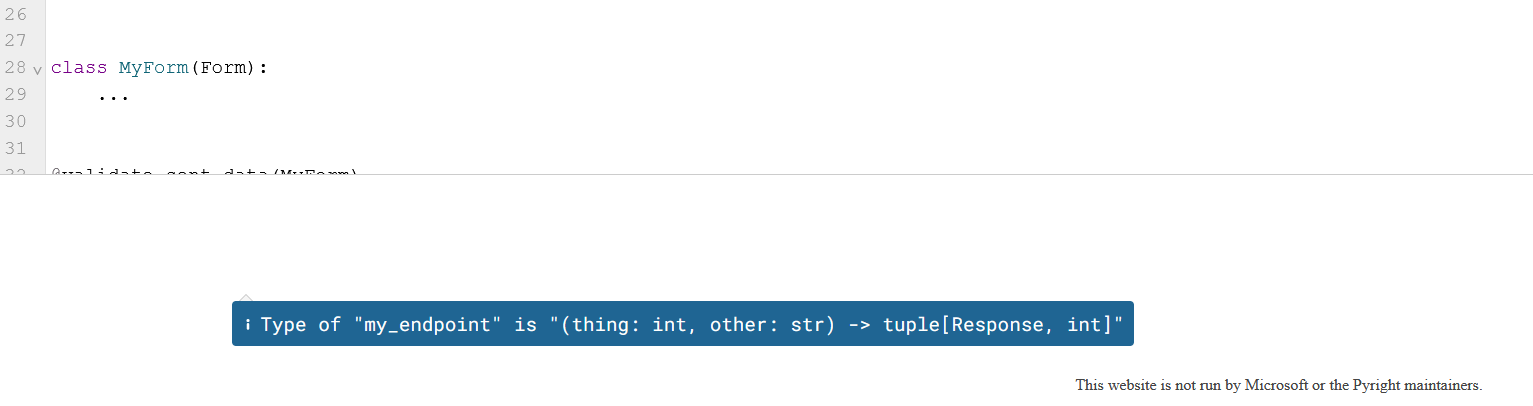
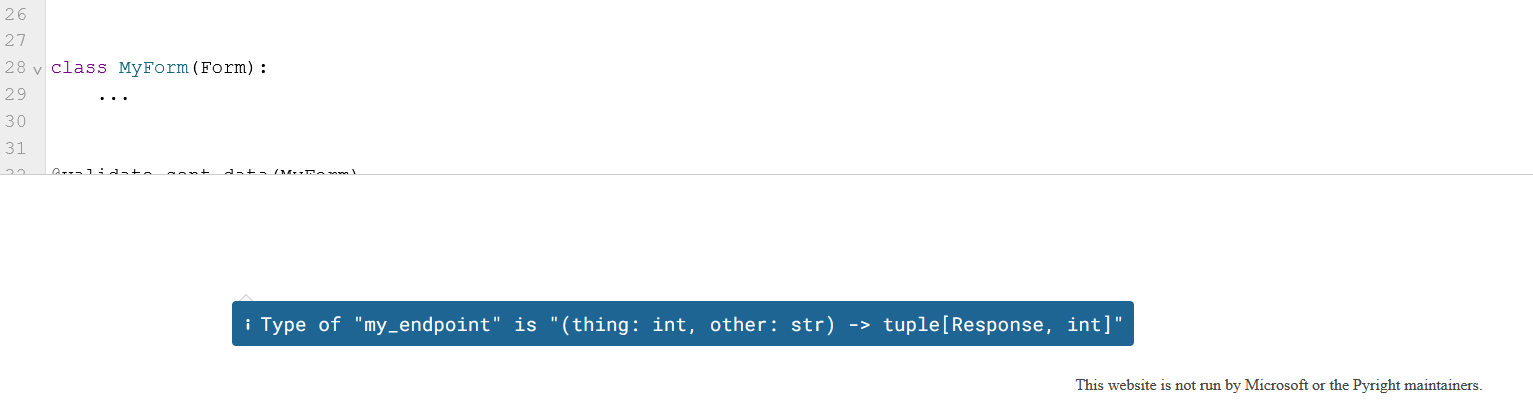 trim tangle
dim trail
nice page, been looking for a online pyright one for a while. tho i instantly fo...
trim tangle
dim trail
nice page, been looking for a online pyright one for a while. tho i instantly fo...
Yeah, it's annoying
Maybe someone can send a PR 🙂 https://github.com/decorator-factory/pyright-playground
deep pendant
trim tangle
If you want to use mypy, there's probably something in `mypy-extensions` <https:...
quite old 😦
trim tangle
trim tangle
If you want to use mypy, there's probably something in `mypy-extensions` <https:...
No, wrong package
but theoretically it should be possible with a mypy extension
trim tangle
trim tangle
Maybe someone can send a PR 🙂 <https://github.com/decorator-factory/pyright-pla...
wait, I forgot that the code is shit
but hopefully that will not be a major obstacle
deep pendant
https://github.com/python/mypy/issues/8645
There are changes lately 😉
GitHub
Hello! I got a little scared off from working on this by the many other enthusiastic people volunteering their time in #8373. However, there doesn't seem to have been much progress; since I...
oblique urchin
yes, mypy does have some basic ParamSpec support now
deep pendant
There is a comparison of type checkers? Especially pytype, pyre-check, pyright and mypy...
There is a lot of them
oblique urchin
deep pendant
There is a comparison of type checkers? Especially pytype, pyre-check, pyright a...
I'm not aware of any general comparison doc. I'll say that mypy and pyright are probably the only ones with widespread usage outside the companies they derive from.
I follow the github trackers for all of them, and pyre and especially pytype rarely get outside bug reports
deep pendant
Isn't a Google's pytype a tool to get better, still bad (codebase)?
pyright also looks more mature regarding PEP implementation - but yea, I will not judge 😄
trim tangle
deep pendant
There is a comparison of type checkers? Especially pytype, pyre-check, pyright a...
                pyright     mypy
has a plugin      NO         YES
system?

fast?             YES         NO

up to date with
the latest PEPS,  YES         NO
including experi-
mental ones?
So what should I write in requirements.dev.txt in order to use pyright? NPM directly? pyright from PyPi is weird
hasty hull
pyright from PyPi is weird
You're welcome lol
hasty hull
deep pendant
So what should I write in _requirements.dev.txt_ in order to use pyright? NPM di...
What do you mean by weird?
It's just a wrapper over the npm CLI that downloads node for you if you don't already have it
trim tangle
I personally wouldn't want to install pyright via pip 👀
hasty hull
how dare you
trim tangle
at least it doesn't make remote calls to the pyright playground API 🙂
oblique urchin
don't give people ideas
trim tangle
I only have $3.38 on my cloud account 😦
although that's probably going to be a few million calls
I already got billed 0.04 roubles for storing docker images
hearty shell
trim tangle
<https://pyright-playground.decorator-factory.su/?gist_id=d5880aa4f761ab37372ded...
Holy xD
Callable[[Callable[Concatenate[F, P], None]], Callable[P, tuple[Response, int]]]
pep 677 when?
😂
trim tangle
hearty shell
`Callable[[Callable[Concatenate[F, P], None]], Callable[P, tuple[Response, int]]...
it is a bit cringe indeed
there isn't a good way to extract this to a type alias, unfortunately
hearty shell
I mean with 677 that would become
((F, **P) -> None) -> ((P) -> tuple[Response, int])
oblique urchin
The prospects for PEP 677 aren't looking good on the Python mailing list, unfortunately
hearty shell
Humm, I hand't seen the mailing list, interested to see their reasons
grave fjord
oblique urchin
The prospects for PEP 677 aren't looking good on the Python mailing list, unfort...
I tend to just use Protocol
I'd rather have a nicer lambda syntax
fierce ridge
i wish they had used something other than Concatenate
or given us an infix operator + as shorthand
 fervent moss
oblique urchin
The prospects for PEP 677 aren't looking good on the Python mailing list, unfort...
fervent moss
oblique urchin
The prospects for PEP 677 aren't looking good on the Python mailing list, unfort...
what's against it?
upbeat wadi
what do os.PathLike[str] and os.PathLike[bytes] indicate (the generic argument)?
oblique urchin
upbeat wadi
what do `os.PathLike[str]` and `os.PathLike[bytes]` indicate (the generic argume...
The __path__ method returns either str or bytes
oblique urchin
fervent moss
what's against it?
People think it complicates Python syntax too much for little gain
upbeat wadi
thanks
oblique urchin
I just put up a simple tool on pypi to add obvious type annotations: https://github.com/JelleZijlstra/autotyping. I added thousands of annotations with it today, so I hope it's useful for others too!
green gale
oblique urchin
I just put up a simple tool on pypi to add obvious type annotations: https://git...
.bm that looks amazing!
 mighty lindenBOT
React with 📌 to be sent your very own bookmark to [this message](#type-hinting message).
upbeat wadi
pyright --verifytypes gives me an error for the provided code: ```py
class SnowflakeList(array.array):
...
discord.utils.SnowflakeList
error: Type of base class "array.array" is partially unknown
Type argument 1 for class "array" has unknown type
When I do `class SnowflakeList(array.array[int])` the error goes away, but subscripting `array.array` like this fails at runtime. Is this an invalid error or is there a proper way to type this?Yeah this is a known awkward case: the class is conceptually generic but is not marked generic in the stub. Normally the workaround is to quote it, like "array.array[int]", but obviously that won't work for a base class.
So the only solution I'm aware of is something like if TYPE_CHECKING: _Base = arrray.array[int] else: _Base = array.array class SnowflakeList(_Base):
upbeat wadi
alright, thanks
soft matrix
Just up the base version to 3.9 :)
soft matrix
oblique urchin
The `__path__` method returns either str or bytes
__fspath__
urban root
Hello. I have a class, whose init which looks like this
def __init__(
        self,
        author: Union[discord.User, discord.Member],
        options: List[SelectOption],
        content: List[str] = [],
        embeds: List[Optional[discord.Embed]] = [],
        clear_on_timeout=False,
        timeout: int = 60,
    ) -> None:
And I initialise the class like
ClassName(self.interaction.user, options, embeds=embeds)
But pylance gives this error
Argument of type "List[Embed]" cannot be assigned to parameter "embeds" of type "List[Embed | None]" in function "__init__"
  TypeVar "_T@list" is invariant
    Type "Embed" cannot be assigned to type "Embed | None"
      Type cannot be assigned to type "None"
What am I doing wrong here?
 trim tangle
urban root
Hello. I have a class, whose init which looks like this
```py
def __init__(
...
trim tangle
urban root
Hello. I have a class, whose init which looks like this
```py
def __init__(
...
That's because lists are invariant. Consider this:
def f(xs: list[int | None]):
    f.append(1)
    f.append(None)

ys: list[int] = [4, 3, 2]
f(ys) # oops
You can read more here https://mypy.readthedocs.io/en/stable/generics.html#variance-of-generic-types
What you should do is accept Sequence[Embed | None].
And don't use mutable defaults. But that's a separate issue
urban root
trim tangle
What you should do is accept `Sequence[Embed | None]`.
That worked, but I am not sure how it solved the issue
trim tangle
urban root
That worked, but I am not sure how it solved the issue
Sequence is covariant because the snippet above cannot happen with it
urban root
hmm I see
urban root
trim tangle
And don't use mutable defaults. But that's a separate issue
and also, can you elaborate? Might as well fix some more issues while at it
tranquil turtle
content: List[str] = [],
lists is mutable, so you shouldnt set empty list as default value
!e
def f(l = []):
  l.append(0)
  return l

print(f())
print(f())
print(f())

print(f([]))
print(f([]))
@tranquil turtle :white_check_mark: Your eval job has completed with return code 0.
001 | [0]
002 | [0, 0]
003 | [0, 0, 0]
004 | [0]
005 | [0]
I see
what should I be doing then?
Is it better to pass in the list rather than using default?
oblique urchin
The normal workaround is to set the default to None and then inside the function do if content is None: content = []
oblique urchin
yes
urban root
Because I do not do any assignment to the lists
oblique urchin
That's actually what I usually try to do. Mutating your arguments is a risky thing to do anyway.
urban root
Ah
trim tangle
oblique urchin
That's actually what I usually try to do. Mutating your arguments is a risky thi...
Yep. For mappings there's mappingproxy
oblique urchin
trim tangle
Yep. For mappings there's `mappingproxy`
Oh, so like default=types.MappingProxyType({})? Hadn't thought of that
trim tangle
Yep
rocky anvil
What would be the type of object instance of a class? i.e count
import timeit

import typing
class Static:
    counter = 0

    def __setattr__(self, name, value):
        setattr(self, name, value)
    def __delattr__(self, name):
        del self.name

    @staticmethod
    def myfunc():
        Static.counter += 1
        return Static.counter


if __name__ == '__main__':

    def main1():
        count = Static()                            #with instance of class and slower
        print(f"First call : {count.myfunc()}")
        print(f"Second call : {count.myfunc()}")
        print(f"Third call : {count.myfunc()}")
        return count
Static?
rocky anvil
The return of main1() function I'm talking about.
soft matrix
-> Static
trim tangle
Yes, just like int means an integer
rocky anvil
No need to import typing module for that?
Isn't there any build-in types there in the typing module for this?
soft matrix
no you dont need to use the typing module here
rocky anvil
okay.
grave fjord
https://mypy-play.net/?mypy=master&python=3.10&gist=20f66b99e2a121b83dca27eadffcab9c&flags=strict I'm trying out the new ParamSpec - but it looks like it doesn't support Generics?
The mypy Playground is a web service that receives a Python program with type hints, runs mypy inside a sandbox, then returns the output.
oblique urchin
grave fjord
https://mypy-play.net/?mypy=master&python=3.10&gist=20f66b99e2a121b83dca27eadffc...
It's limited and I think the focus was on getting typeshed ParamSpec'ed functions to work
grave fjord
the reveal_type seems to show the correct annotation
__main__.SyncToAsync[def [T] (delay: builtins.float, value: T`-1), T`-1]
is there documentation on the known limits?
oblique urchin
the blog post http://mypy-lang.blogspot.com/2021/12/mypy-0930-released.html has a little
We’ve just uploaded mypy 0.930 to the Python Package Index ( PyPI ). Mypy is a static type checker for Python. This release includes new ...
grave fjord
Note that typing.Concatenate and some other use cases are still not supported.
fierce ridge
i didn't even know about NotRequired
very happy to see ParamSpec and TypeAlias support
i also really need to start using TypeGuard... we have one application at work with a lot of TypedDicts and there are currently casts all over the code to deal with it
grave fjord
I asked on gitter https://matrix.to/#/!FjKyUUyKpKFUvCNnMz:gitter.im/$CVfQ_UH6zkYJI7rlWULLK6Nb9caF4rSCcORdnV6nW00?via=gitter.im&via=matrix.org&via=one.ems.host re the missing use-cases
You're invited to talk on Matrix
grave fjord
fierce ridge
i also really need to start using `TypeGuard`... we have one application at work...
?
fierce ridge
grave fjord
?
def to_foodict(x: Mapping[str, Any]) -> SpecialDict:
    if 'specialKey' not in x:
        raise ValueError('x is not a SpecialDict')
    return cast(SpecialDict, x)
this is what we have now in several places
i'd rather have
def is_foodict(x: Mapping[str, Any]) -> TypeGuard[SpecialDict]:
    return 'specialKey' in x
oh I see
grave fjord
yeah I think you want something safer like this?
def is_foodict(x: Mapping[str, object]) -> SpecialDict | None:
    try:
        v = x["specialKey"]
    except KeyError:
        return None
    if isinstance(v, SomeType):
        return SpecialDict(specialKey=v)
    return None
like a mapping might not be a dict
it's annoying you can't do a Mapping-based TypedDict
fierce ridge
grave fjord
it's annoying you can't do a Mapping-based TypedDict
very much so 🙂
grave fjord
and that you can't match on a TypeDict
fierce ridge
soft matrix
you go from immutable to mutable
this is a good point... i think in our actual code i use Dict and not Mapping, but i'll check
grave fjord
also I avoid TypeDict in new code in favour of dataclasses (attr.s) and or pydantic
then parse it from the json.loads' Any at the "edges" of the codebase that does all the deep/recursive checks
then shallow isinstance will work for the rest of the code
fierce ridge
indeed, refactoring to use attrs is on my todo list. need to flesh out the test suite first to make sure it doesn't break in the process, which is what i happen to be doing this week
soft matrix
do you use mypy or pyright?
fierce ridge
mypy
soft matrix
if your loading these into classes it would be a really good idea to use pydantic as graingert suggested as i think it supports from/to_dict in a typed way
fierce ridge
it does, and also a good point
in this case the application is mostly marshalling data back and forth between a CMS and MongoDB
so really i need two layers of transformations, python <-> mongo and python <-> cms
i want somewhat precise manual control over that process anyway, so the convenience of pydantic isn't worth much in that case
if i wrote the whole thing from scratch using fastapi i probably would use pydantic though
trim tangle
TIL you can't make a generic TypedDict 🥴
grave fjord
Can't do anything fun ;)
I want a Generic NamedTuple or the ability to add typed unpack to custom types
soft matrix
trim tangle
TIL you can't make a generic `TypedDict` 🥴
there is a proposal to add it
its in my github stars
but i havent seen anything happen with it in a while
GitHub
Tracking an attempt to add generic support for TypedDict - GitHub - sransara/py-generic-typeddict: Tracking an attempt to add generic support for TypedDict
 dire bobcat
def func(arg:int):
   ...
"""how can I see what `arg` is typehinted to?"""```I think so, ty
rough sluiceBOT
inspect.get_annotations(obj, *, globals=None, locals=None, eval_str=False)```
Compute the annotations dict for an object.

`obj` may be a callable, class, or module. Passing in an object of any other type raises [`TypeError`](https://docs.python.org/3/library/exceptions.html#TypeError "TypeError").

Returns a dict. `get_annotations()` returns a new dict every time it’s called; calling it twice on the same object will return two different but equivalent dicts.

This function handles several details for you:cause this will handle string-ized annotations
dire bobcat
what would you use if you wanted to get the typehint from the actual typehinted variable itself>
like inside func
i could see what arg itself is typehinted to
dire bobcat
nah cant use thar
im making a check to make sure arg is of the typehinted value
without manually entering typehinted valeu
rough sluiceBOT

Unbearably fast runtime type checking in pure Python.
trim tangle
dire bobcat
im making a check to make sure arg is of the typehinted value
func.__annotations__["arg"]
or just make a decorator?
That would not get you very far though. You can't really "verify" more complex types, like a function or a generator or even a list.
 vapid quarry
If we have a dictionary that stores class instances, would following be accurate in terms of type hinting:
class Info:
  def __init__(self):
    pass

if __name__ == "__main__":
  data:dict[Info] = {}
yes
vapid quarry
ok thank you (:
dire bobcat
trim tangle
`func.__annotations__["arg"]`
how would i get the current func tho?
trim tangle
you can't really, without extra hacks
dire bobcat
i dont wanna manually write the func name, is there a builtin method or property that tells me the current func its in
oh ok
trim tangle
you can make a decorator
trim tangle
@dire bobcat
This should work for functions that only take keyword-only arguments.
from functools import wraps
from typing import TypeVar, Callable, cast

F = TypeVar("F", bound=Callablle)

def check_types(fn: F) -> F:
    @wraps(fn)
    def new_fn(**kwargs):
        with_defaults = {**fn.__kwdefaults__, **kwargs}
        for name, arg in with_defaults.items():
            if name not in fn.__annotations__:
                continue
            ann = fn.__annotations__[name]
            if not isinstance(arg, ann):
                raise TypeError(f"Argument {name!r} ({arg!r}) is not of type ({ann!r})")
        return fn(**with_defaults)
    return cast(F, new_fn)
For others you'll have to do a bit more work (with inspect), but the idea is the same
(this will obviously only work for very simple types, won't even work for None)
soft matrix
just use beartype
 bright dome
https://bpa.st/WWSQ my validate decorator.... bugs?
soft matrix
this breaks if you have defaults i think
bright dome
I believe I tried it with defaults and it worked. Must be annotated
I could be wrong lol
I'm using wraps from functools btw
soft matrix
oh yeah actually that probably fixes it
TypeError: isinstance() arg 2 must be a type or tuple of types
generics dont work
vapid quarry
If I am appending different class instances to a list/array, how should it be type hinted.
Does below look about right?
from typing import List, Union
class Foo:
  pass

class Bar:
  pass

class FooBar:
  pass

if __name__ == "__main__":
  updates:List[Union[Foo, Bar, FooBar]] = []
it doesnt work with stringified types
bright dome
soft matrix
generics dont work
Yeah I didn't account for generics. I haven't gotten into them yet..
soft matrix
vapid quarry
If I am appending different class instances to a list/array, how should it be ty...
thats fine yes
bright dome
soft matrix
it doesnt work with stringified types
Yeah it's basic lol
soft matrix
are you planning on actually using this in production?
bright dome
soft matrix
are you planning on actually using this in production?
me? OF course not lol
I know it's full of holes. It was me just dabbling with decorators and seeing if I could validate some func params...
trim tangle
I generally think that this is a lost cause
little hare
well that's kind of insulting to inzane
trim tangle
Not saying it's not useful. It's pretty useful if it's in some library code that all kinds of people use
but:
- there's a runtime cost (you can use some switch flag, but there's a good chance that few people will remember to turn it on/off). It will actually change the asymptotic complexity (big O) of some algorithms. Would you check every element of a list in a binary search function?
- it will not work 100% even for simple things like
list[int]orSequence[str] - it will completely not work for more complex types (like functions or generators)
trim tangle
trim tangle
I generally think that this is a lost cause
that is what I meant by this
fierce ridge
vapid quarry
If I am appending different class instances to a list/array, how should it be ty...
this looks right. remember that in 3.9+ you can use list instead of typing.List
trim tangle
trim tangle
that is what I meant by this
So what it can do is provide better error messages in some cases where you use a completely different type.
What I would do "in production" is:
- use a static type checker to catch most of the stuff
- if something does break, hopefully your tests will catch that
- take a look at https://pypi.org/project/deal/
vapid quarry
Thanks for mentioning that. I will look into transitioning to list.
How do we format it if classnames are long and we have several of them.
Does the following work by creating an alias of Classes in this case:
# create an alias of classes
Classes = Union[FooPerformsFoo, BarPerformsBar, FooBarPerformsFooBar]
updates:list[Classes] = []
Is that what aliases are for?
oblique urchin
yes
trim tangle
vapid quarry
Is that what aliases are for?
yep
or if you repeat the same type over and over
or if you just want a type-level named constant
like YesNo = Literal["yes", "no"]
vapid quarry
And do we declare aliases globally?
oblique urchin
Usually yes
vapid quarry
ok
oblique urchin
Support for aliases at class or function scope is inconsistent
vapid quarry
oblique urchin
Support for aliases at class or function scope is inconsistent
How do you mean?
oblique urchin
Some type checkers don't support it
bright dome
trim tangle
What I would do "in production" is:
- use a static type checker to catch most of...
Oh cool..... deal....
oblique urchin
Don't remember the details, it was discussed on the mailing lists a few times
trim tangle
oblique urchin
Some type checkers don't support it
Do you think it's possible to write code that works equally well with all the major typecheckers?
or... practical
I'm using pyright/pylance for development, but of course nobody has pyright in their CI
soft matrix
yes only use generics :)
oblique urchin
trim tangle
Do you think it's possible to write code that works equally well with all the ma...
Usually yes, it tends to be just more obscure cases where you get incompatibility
we do it all the time in typeshed 🙂
trim tangle
oblique urchin
Usually yes, it tends to be just more obscure cases where you get incompatibilit...
Callable attribute is the worst so far
probably
oblique urchin
oh yeah that's a really long-standing mypy bug
trim tangle
yeah, 6 years or so
Pyright has the opposite issue - try writing a method decorator
that does something non-trivial
vapid quarry
oblique urchin
Some type checkers don't support it
oh ok I see
trim tangle
that would be solved with something like an intersection type: And[Callable[[T, Unpack[P]], int], Descriptor[Callable[[Unpack[P]], int]]]...
yikes
soft matrix
trim tangle
that would be solved with something like an intersection type: `And[Callable[[T,...
soon™️
rustic gull
How should I type hint something that can be a subclass, let's say of class A, but not A itself?
And I'm talking specifically about classes, not class instances
pastel egret
Aside from specifying a union of all the subclasses, it's not possible I think.