#type-hinting
1 messages · Page 56 of 1
 little hare
 rustic gull
little hare
er, that is actually a different story 😳
rustic gull
little hare
er, that is actually a different story 😳
hm how come?
little hare
it doesn't do anything unless the program wants to look at it
 trim tangle
yep, that's sometimes useful
rustic gull
and when does the program want to look at it?
little hare
when there's code that wants to do that, and afaik there's no stdlib that does look at typehinting
wait---
yes there is
!d dataclasses.dataclass
 rough sluiceBOT
@dataclasses.dataclass(*, init=True, repr=True, eq=True, order=False, unsafe_hash=False, frozen=False, match_args=True, kw_only=False, slots=False)```
This function is a [decorator](https://docs.python.org/3/glossary.html#term-decorator) that is used to add generated [special method](https://docs.python.org/3/glossary.html#term-special-method)s to classes, as described below.

The [`dataclass()`](https://docs.python.org/3/library/dataclasses.html#dataclasses.dataclass "dataclasses.dataclass") decorator examines the class to find `field`s. A `field` is defined as a class variable that has a [type annotation](https://docs.python.org/3/glossary.html#term-variable-annotation). With two exceptions described below, nothing in [`dataclass()`](https://docs.python.org/3/library/dataclasses.html#dataclasses.dataclass "dataclasses.dataclass") examines the type specified in the variable annotation.

The order of the fields in all of the generated methods is the order in which they appear in the class definition.okay now we're way beyond me knowledge in python xD
trim tangle
is your question "who wants to inspect type annotations?" @rustic gull
rustic gull
trim tangle
is your question "who wants to inspect type annotations?" <@456226577798135808>
kind of, yes
 oblique urchin
trim tangle
~~it just ignores them~~
oblique urchin
trim tangle
~~it just ignores them~~
(except for InitVar and ClassVar)
little hare
rustic gull
kind of, yes
tldr libraries that do something based on the code's typehints
OR type-checkers 😓
trim tangle
A type checker just looks at your code, considers the annotations (statically, without running anything), and then tell you about the errors you've got. Or shows you what type something is. Kind of like a code reviewer.
trim tangle
oblique urchin
(except for InitVar and ClassVar)
oh right
rustic gull
Alr thanks
Last question, might not be considered in this topic but idk what it is, maybe it is a type 🤷 but i've seen people use yield, what is that?
is there a docs command i can run for that object?
little hare
!d yield
rough sluiceBOT
7.7. The yield statement
yield_stmt ::=  yield_expression
``` A [`yield`](https://docs.python.org/3/reference/simple_stmts.html#yield) statement is semantically equivalent to a [yield expression](https://docs.python.org/3/reference/expressions.html#yieldexpr). The yield statement can be used to omit the parentheses that would otherwise be required in the equivalent yield expression statement. For example, the yield statements

```py
yield <expr>
yield from <expr>
``` are equivalent to the yield expression statements...okay nvm i wont understand that xD, thanks guys!
trim tangle

In this step-by-step tutorial, you'll learn about generators and yielding in Python. You'll create generator functions and generator expressions using multiple Python yield statements. You'll also learn how to build data pipelines that take advantage of these Pythonic tools.
rustic gull
For sure 🙂
little hare
once you get into testing... and perhaps use pytest
rustic gull
trim tangle
<@456226577798135808> https://realpython.com/introduction-to-python-generators/
Thank you
little hare
I actually need to get better at generators
rustic gull
I know how generators works
and iterators, iterables etc...
never crossed the field with yields though
little hare
rustic gull
and iterators, iterables etc...
nice, that's a lot better than me 😬
rustic gull
I doubt that xD 😂
little hare
er well
I made a class to implement a function I wrote to be a generator as __next__
then I learned that iter() exists
!d iter
rough sluiceBOT
iter(object[, sentinel])```
Return an [iterator](https://docs.python.org/3/glossary.html#term-iterator) object. The first argument is interpreted very differently depending on the presence of the second argument. Without a second argument, *object* must be a collection object which supports the [iterable](https://docs.python.org/3/glossary.html#term-iterable) protocol (the `__iter__()` method), or it must support the sequence protocol (the `__getitem__()` method with integer arguments starting at `0`). If it does not support either of those protocols, [`TypeError`](https://docs.python.org/3/library/exceptions.html#TypeError "TypeError") is raised. If the second argument, *sentinel*, is given, then *object* must be a callable object. The iterator created in this case will call *object* with no arguments for each call to its [`__next__()`](https://docs.python.org/3/library/stdtypes.html#iterator.__next__ "iterator.__next__") method; if the value returned is equal to *sentinel*, [`StopIteration`](https://docs.python.org/3/library/exceptions.html#StopIteration "StopIteration") will be raised, otherwise the value will be returned.the only thing i know @little hare about these are:
iterators are iterable
iterable can make iterators
list comp is a expression that leaves you with a iterable
generators is a expression that leaves you with a generator
a generator is a iterator, which is iterable
and the list is iterable, which means it can make a iterator
if that makes sense for you, idk xD I usually note stuff
little hare
ah lol
rustic gull
so basically: ```py
NOTES
#iterators are iterable
#iterables can make iterators
listcomp = [i for i in range(10)] #the expression gives you a iterable
#since it's iterable we can do:
for i in listcomp:
print(i)
#since we can make iterables a iterator we can do:
iter(listcomp)
print(next(listcomp))
generator = (i for i in range(10)) #the expression gives you a iterator, which is iterable
#since it's a iterator we can do:
print(next(generator))
#since iterators are also iterable we can do:
for i in generator:
print(i)
This is what I understood how generators works so 🤷@little hareMaybe it isn't 100% accurate but
 buoyant swift
list comps give you lists
and you can't do next(listcomp) since it's still a list, iter doesn't modify it
little hare
!e ```py
listcomp = [i for i in range(10)] #the expression gives you a iterable
#since we can make iterables a iterator we can do:
iter(listcomp)
print(next(listcomp))
@little hare :x: Your eval job has completed with return code 1.
001 | Traceback (most recent call last):
002 |   File "<string>", line 4, in <module>
003 | TypeError: 'list' object is not an iterator
!e ```py
listcomp = [i for i in range(10)] #the expression gives you a iterable
#since we can make iterables a iterator we can do:
print(next(iter(listcomp)))
@little hare :white_check_mark: Your eval job has completed with return code 0.
0
@rustic gull ^
rustic gull
Ah yeah sorry my bad
trim tangle
I'd like some feedback for my tutorial on TypeVars 🙂
https://dev.to/decorator_factory/typevars-explained-hmo
buoyant swift
and their subclases, of course
😩
 granite plover
so, shouldnt intellisense pick up that the type of records here is List[Record] or am i thinking that intellisense is smarter than it actually is
def create_records(raw_source: List[str]) -> List[Record]:
    records = []
    for line in raw_source:
        date, name = line.split("\t")
        records.append((date, name))
    return records
other than that, seems alright, although you should probably get someone who doesn't know anything about type variables to read it
granite plover
seconded
buoyant swift
thirded
 granite plover
small nitpick, why is this lowercased
 trim tangle
🤷
granite plover
but this one isnt
 buoyant swift
stupidsense
trim tangle
what IDE is that?
granite plover
vscode
trim tangle
ah, it does do that
granite plover
goshdarn stupidsense
trim tangle
maybe it's another microoptimization 🙂
don't want to waste those precious CPU cycles on unifying the names
little hare
granite plover
small nitpick, why is this lowercased
the one case gives it a value of [] where the other one is a func param
granite plover
drowning in them microoptimizations 🥵
little hare
so in one it is confirmed to be type list whereas the other one is just a typehint of List
trim tangle
granite plover
drowning in them microoptimizations 🥵
have you tried reading pyright's code?
it is cursed
granite plover
little hare
so in one it is confirmed to be type list whereas the other one is just a typehi...
tbh the cause doesnt matter to me, do you know how i could normalize this?
its bothering me
one or the other, doesnt matter
trim tangle
file a bug on the repo

 trim tangle
Speaking of cursed...
def create_records(raw_source: List[str]) -> List[Record]:
    def _gen():
        for line in raw_source:
            date, name = line.split("\t")
            yield date, name
    return list(_gen())
this should typecheck alright 🙂
little hare
granite plover
tbh the cause doesnt matter to me, do you know how i could normalize this?
use 3.9+
granite plover
this is 3.9.7
trim tangle
then use list[str]
little hare

 granite plover
i could i guess, no one in the office is using <3.9
little hare
if you use list[] then its not a problem
granite plover
alright i'll do just that then
trim tangle
buoyant swift
> and their subclases, of course
😩
actually I blame dev.to
it has a terrible editor
and its markdown interprets single line breaks as actual line breaks 🤦
which is cursed because I was first writing the markdown in VSCode
 undone carbon
i m in py3.10 but mypy keeps givin me tiz error: "tuple" is not subscriptable
here's the code: alias = tuple[int, int]
buoyant swift
isn't that supposed to be fixed by now
undone carbon
ya gg
lemme check it's version
oh, i used the wrong mypy
wat does tiz mypy error mean then Type application has too many types (1 expected)?
code: alias = MyClass | tuple[Optional[int], Optional[int]] using py3.10 btw
oblique urchin
the latest release of mypy is still pretty buggy with lowercase tuple
 grave fjord
undone carbon
wat does tiz mypy error mean then `Type application has too many types (1 expect...
grave fjord
undone carbon
wat does tiz mypy error mean then `Type application has too many types (1 expect...
Also seems odd to mix the old and new syntax
It's MyClass | tuple[int | None, int | None]
undone carbon
oh okayy
undone carbon
how should i type hint any class?
trim tangle
undone carbon
how should i type hint any class?
wdym by 'any class'?
trim tangle
Like your_function(str)?
trim tangle
or ```py
class Foo:
pass
your_function(Foo)
ya kinda like tat
trim tangle
well, str is a class as well
The type of a type is type
so you'd do ```py
def your_function(cls: type):
...
 pastel egret
If you want to require only classes that are subclasses of some other class (or something like Mapping[int, str]), wrap it in typing.Type[MyClass].
 wicked scarab
Traceback (most recent call last):
File "C:/Users/drago/PycharmProjects/playground2/main.py", line 73, in <module>
a: list[int] = [1]
TypeError: 'type' object is not subscriptable
```umm.... I got 3.9 tho? solid light
wicked scarab
```py
Traceback (most recent call last):
File "C:/Users/drago/PycharmProjects/...
solid light
wicked scarab
```py
Traceback (most recent call last):
File "C:/Users/drago/PycharmProjects/...
If you've got that error then you're not using 3.9
What output does this give?py import sys print(sys.version)
 solid light
Then you're using 3.8.10 :p
You just need to change what you're running
You need to configure PyCharm to use 3.9 instead of 3.8
 solid light
You've still got it configured to 3.8
It says so at the bottom of that image
< Python 3.8 (playground2) >
wicked scarab
3.9.9 (tags/v3.9.9:ccb0e6a, Nov 15 2021, 18:08:50) [MSC v.1929 64 bit (AMD64)]
maybe restart
wait
this is weird

 wicked scarab
wait, isn't configuring the interpreter enough?
or...
I need to do something else
solid light
You have to configure the interpreter and then actually select it
solid light
solid light
Click the thing the arrow is pointing to and select the 3.9 interpreter @wicked scarab
wicked scarab
I did
 solid light
That's the one for the DiscordBot project
wicked scarab
huh? Can't I use the same interpreter for different project?
 solid light
wicked scarab
huh? Can't I use the same interpreter for different project?
solid light
wicked scarab
huh? Can't I use the same interpreter for different project?
You shouldn't.
wicked scarab
solid light
Just click it and select 3.9
I dont have 3.9...
solid light
Then you've not added the interpreter
 solid light
No worries lol
PyCharm version control is very confusing to people who aren't familiar with it
wicked scarab
yeah indeed
solid light
It took me ages to get used to it (and I still struggle sometimes)
wicked scarab
 thanks anyway
solid light
wicked scarab
it worked
So is it all working now?
wicked scarab
yeah
solid light
Nice 👍
 twilit badge
How should I type-hint a variable that can hold any instance of any class
Also, is it correct if I type-hint a variable that can hold any class (but not the instance) as owner_cls: type?
 void panther
twilit badge
How should I type-hint a variable that can hold any instance of any class
void panther
twilit badge
How should I type-hint a variable that can hold any instance of any class
object or typing.Any, depending on how exactly it's used
twilit badge
well, I'm trying to type-hint a descriptor class
so specifically, these methods:
def __set_name__(self, owner_cls: type, name: str) -> None:
    ...
def __get__(self, instance, owner_cls) -> Any:
    ...
def __set__(self, instance, value) -> None:
    ...
def __delete__(self, instance) -> None:
    ...
class typing.Protocol(Generic)```
Base class for protocol classes. Protocol classes are defined like this:

```py
class Proto(Protocol):
    def meth(self) -> int:
        ...
``` Such classes are primarily used with static type checkers that recognize structural subtyping (static duck-typing), for example...why? I mean, what's the advantage of having a protocol like that if I can just define them in my class directly?
twilit badge
void panther
object or typing.Any, depending on how exactly it's used
so does typing.Any make sense in this use-case? also is owner_cls: type a proper way to decorate the non-initialized class or should it be something else?
 upbeat wadi
twilit badge
why? I mean, what's the advantage of having a protocol like that if I can just d...
upbeat wadi
twilit badge
why? I mean, what's the advantage of having a protocol like that if I can just d...
What do you mean by
if I can just define them in my class directly
twilit badge
class Descriptor:
    def __set_name__(self, owner_cls: type, name: str) -> None:
        self.name = name
        self.cls = owner_cls

    def __get__(self, instance: Any, owner_cls: type) -> Any:
        if instance is None:
            return self
        return instance.__dict__.get(self.name)

    def __set__(self, instance: Any, value: Any) -> None:
        instance.__dict__[self.name] = value

    def __delete__(self, instance: Any) -> None:
        del instance.__dict__[self.name]
I can just do this, why would I want a protocol that defines which methods should be present in a descriptor?
all my descriptors will inherit from this class
upbeat wadi
You would have the typehint as Descriptor
upbeat wadi
twilit badge
Also, is it correct if I type-hint a variable that can hold any class (but not t...
Yes
twilit badge
I just can't see what's the advantage of a protocol
upbeat wadi
I wasn't aware that all descriptors would be a subtype of a specific class
upbeat wadi
twilit badge
```py
class Descriptor:
def __set_name__(self, owner_cls: type, name: str) -...
Also you can make the signature for __get__ more specific instead of returning Any (using overloads)
twilit badge
isn't protocol only really useful if you need to do something like Protocol[int] which is a type-variable that is shared across multiple methods
but I don't think I need something like that for descriptors
twilit badge
upbeat wadi
Also you can make the signature for `__get__` more specific instead of returning...
yeah, in my child descriptors, I do this: ```py
def get(self, instance: Any, owner_cls: type) -> float:
"""Implement Coordinate getter."""
ret = super().get(instance, owner_cls)
return cast(float, ret) # This will be float, since it's imposed in setter
but I don't see how overloads in the main descriptor class would make sense here
though I could do this py def __get__(self, instance: T, owner_cls: type[T]) -> Any: ... since the __get__ is invoked just by doing: __get__(a, type(a)) (which makes me wonder why is it even there but I suppose it's just for legacy reasons to ensure backwards compatibility)
upbeat wadi
twilit badge
yeah, in my child descriptors, I do this: ```py
def __get__(self, instance: Any,...
Yeah overloads won't be necessary
twilit badge
hmm, now that I'm thinking about it it may actually make sense to make it into a generic though
from typing import Any, TypeVar, Generic

T = TypeVar("T")

class Descriptor(Generic[T]):
    def __set_name__(self, owner_cls: type[T], name: str) -> None:
        self.name = name
        self.cls = owner_cls

    def __get__(self, instance: T, owner_cls: type[T]) -> Any:
        if instance is None:
            return self
        return instance.__dict__.get(self.name)

    def __set__(self, instance: T, value: Any) -> None:
        instance.__dict__[self.name] = value

    def __delete__(self, instance: T) -> None:
        del instance.__dict__[self.name]
since when a descriptor is created in a Foo class, I could then do this ```py
class Foo:
x: Descriptor["Foo"] = Descriptor()
If you aren't using it as a return type for __get__ it wouldn't have an effect
twilit badge
?
return type for get is any
it's what the user puts into the descriptor, I can't control that
upbeat wadi
Yes so having instance be Any and owner_cls be type has the same effect; it doesn't need to be generic
twilit badge
f = Foo()
f.x = "s"  # now ret type for __get__ is str
f.x = 2  # now it's int
...
I suppose since the user isn't calling those it's true, but it's not a mistake and it kind of makes sense to still do it like this imo
it will mean that whenever the instance passed into something like __set__ will be of certain type, we can always know that the instance passed to __get__ will also be of that type, same for delete
and we can know that it's the same instance just by looking over the class immediately
if it were Any and type, it could mean that those differ from call to call, but that's not true since once it's initialized, these will always be the same
 blazing nest
twilit badge
isn't protocol only really useful if you need to do something like `Protocol[int...
blazing nest
twilit badge
isn't protocol only really useful if you need to do something like `Protocol[int...
Not really, it's static type checking. Say you have this one protocol, that say that the types need a fetch() method.
class Fetchable(Protocol):
    def fetch(self) -> None: ...
Now you can define these classes that implement the protocol without subclassing Fetchable.
class Monkey:
    def fetch(self) -> None:
        ... # Do something
Instances of Monkey can now be passed to parameters and attributes annotated as Fetchable
All of those Sequence, Iterable, etc. type of types can be implemented as protocols (I am not 100% sure if they truly are).
rustic gull
wicked scarab

wicked scarab
hmm?
trim tangle
blazing nest
All of those `Sequence`, `Iterable`, etc. type of types can be implemented as pr...
they are ABCs
because they provide some utility methods afaik
twilit badge
blazing nest
Not really, it's static type checking. Say you have this one protocol, that say ...
oh, that's interesting, so if I define a Fetchable protocol like you did, would something like issubclass(Moneky, Fetchable) or isinstance(Monkey(), Fetchable) return True or is it purely for type-hinting? Also, while this is really cool to know, I still don't see why protocols would be useful in my case, since I do actually want to be able to use or subclass that descriptor class
oblique urchin
twilit badge
oh, that's interesting, so if I define a `Fetchable` protocol like you did, woul...
only if you use @runtime_checkable
Also a more general response to what you were talking about earlier: avoid Any if at all possible, because it basically turns off the type system, so if you use it, you don't get the benefits of static type checking
instead, look for some way to give a safe type, perhaps a Protocol or object
grave fjord
oblique urchin
Also a more general response to what you were talking about earlier: avoid `Any`...
I really want a tool that replaces redundant Any with object
trim tangle
I only recently learned that I should be using object if I really don't care about the object type, not Any
it's not obvious
 brazen jolt
trim tangle
I only recently learned that I should be using `object` if I really don't care a...
brazen jolt
trim tangle
I only recently learned that I should be using `object` if I really don't care a...
really? but what's the difference? when is Any not an object? That's super non-obvious
trim tangle
brazen jolt
really? but what's the difference? when is `Any` not an `object`? That's super n...
Any is a subtype of any other type, and any type is a subtype of object.
Any type is a subtype ofobject, but object is only a subtype of itself.
little hare
run that by me again?
trim tangle
So this passes @brazen jolt @little hare : py def f(x: Any) -> None: print(x + "!") and this fails: ```py
def f(x: object) -> None:
print(x + "!")
in other words, you can do anything with Any, but you can't do much with object.
little hare
oh even when that interaction on x would be invalid
void panther
Any disables the type checking around it, object only allows what's valid on a plain object
trim tangle
yep
brazen jolt
that's interesting
little hare
!e print(str(object()))
rough sluiceBOT
@little hare :white_check_mark: Your eval job has completed with return code 0.
<object object at 0x7f322eeb4130>
You can still do type narrowing on object though: ```py
def f(x: object) -> None:
if isinstance(x, str):
print(x + "!")
interesting
brazen jolt
trim tangle
You can still do type narrowing on `object` though: ```py
def f(x: object) -> No...
can't you also do this with Any
rough sluiceBOT
typing.Any```
Special type indicating an unconstrained type.

• Every type is compatible with [`Any`](https://docs.python.org/3/library/typing.html#typing.Any "typing.Any").

• [`Any`](https://docs.python.org/3/library/typing.html#typing.Any "typing.Any") is compatible with every type.You can.
But with Any, you are just allowed to cast it implicitly to any type
brazen jolt
but you can also cast an object to any other type, can't you? ```py
def f(x: object) -> int:
return cast(int, x)
Yes, but this is an explicit cast
little hare
wow
trim tangle
by 'implicit cast' I meant just not checking anything
rough sluiceBOT
Lib/typing.py lines 412 to 424
@_SpecialForm
def Any(self, parameters):
    """Special type indicating an unconstrained type.

    - Any is compatible with every type.
    - Any assumed to have all methods.
    - All values assumed to be instances of Any.

    Note that all the above statements are true from the point of view of
    static type checkers. At runtime, Any should not be used with instance
    or class checks.
    """
raise TypeError(f"{self} is not subscriptable")```ah, I see
buoyant swift
little hare
i can't even tell how it works
all types are an Any, is the point. you can apply it to literally Anything
little hare
buoyant swift
all types are an `Any`, is the point. you can apply it to literally *`Any`thing*
no no the point is the source for Any is identical to NoReturn and others
brazen jolt
though I'm not sure I like object more than Any in that case, since with Any, I can directly cast it to something else when I know what will be returned and work with that, and when i don't know, it won't give me any errors, whereas with an object, it would be failing when I didn't cast it explicitly, making it a pain to work with for the user. If each time you'd do self.x when x is a descriptor, you'd also have to specify a type, I feel like that would just get way too distracting
buoyant swift
little hare
no no the point is the source for `Any` is identical to NoReturn and others
the docstring is the same? 🤔
rough sluiceBOT
Lib/typing.py lines 426 to 439
@_SpecialForm
def NoReturn(self, parameters):
"""Special type indicating functions that never return.
Example::
from typing import NoReturn
def stop() -> NoReturn:
raise Exception('no way')
This type is invalid in other positions, e.g., ``List[NoReturn]``
will fail in static type checkers.
"""
raise TypeError(f"{self} is not subscriptable")```yeah, you can't subscript it
little hare
but how does it work, internally
brazen jolt
although I can see why it could be useful
brazen jolt
little hare
but how does it work, internally
does it even have some implementation like this, isn't that just up to type checkers, such as mypy?
I don't think there's really anything Any would need to implement on it's own, the type-checking functionality isn't present in python directly, that's up to an external static type checker tool, there's pretty much no significance to type-hints in pure python, it will run even if all of those type-hints are completely wrong
at most the ability to do isinstance(x, Any), but python doesn't implement that, there are external tools that can check these type-hints on run-time with a decorator, but direct runtime checks aren't implemented with Any at all afaik
buoyant swift
because everything is an Any
brazen jolt
yeah, but I meant it more generally, Any is just one such type
little hare
brazen jolt
I don't think there's really anything `Any` would need to implement on it's own,...
true
trim tangle
Yeah, type checkers just special-case Any
grave fjord
It's annoying you can't do def get(self, v: V) -> K | NoReturn[KeyError]:
brazen jolt
that would be cool though NoReturn wouldn't be the type-hint to use, since it can also be used in cases like these: py def foo() -> NoReturn: while True: pass so NoReturn taking exception as an argument is a bit weird, perhaps if there were something like Raises
blazing nest
brazen jolt
that would be cool though `NoReturn` wouldn't be the type-hint to use, since it ...
But there it would just be un-annotated.
brazen jolt
yes, that is a possibility, but it's still a bit weird imo
void panther
hinting exceptions is a bit weird as there are some that can be raised anywhere as normal behaviour and then there's also an API that'd allow you to do that for any exception
brazen jolt
if we could pass exceptions into NoReturn there should also then be a way to pass in an infinite loop, since just doing NoReturn could then mean any exception or function hangs
brazen jolt
void panther
hinting exceptions is a bit weird as there are some that can be raised anywhere ...
that's a good point
grave fjord
void panther
hinting exceptions is a bit weird as there are some that can be raised anywhere ...
You just add the | NoReturn[KeyboardInterrupt] to every def
Generators would need a throw type
 soft matrix
maybe its time to work on var args for type annotations like generator and coroutine
grave fjord
It you could just use the SendType | NoReturn[CancelledError]
 green gale
Does pyright have a setting to error if a type hint is not present? (Mandate them, basically)
Or another tool like flake8, perhaps
 green gale
Thanks!
trim tangle
green gale
Does pyright have a setting to error if a type hint is not present? (Mandate the...
The strict option probably?
green gale
I shall try, thank you!
brazen jolt
strict does a more than just enforce type hints (in fact, I'm not even sure if it does enforce them). flake8-annotations will most likely be a better option as it gives you the ability to ignore specific things, such as annotations for special variables, such as self, or cls and just gradually fine-tune everything, either with global flake8 exception ignores or with individual noqa comments. But yeah, certainly try out both (and if you don't mind, let me know whether strict mode does actually enforce type hints, since I don't really think it does, but I may be wrong)
the general way to think of strict is that it always imposes stricter types, if it can, for example: py lst = [1, 8, "foo"] will not be of type list[Any], but rather of type: list[Union[int, str]
@green gale ^^
green gale
I'll try out both and get back to you, thanks!
 boreal ingot
green gale
Does pyright have a setting to error if a type hint is not present? (Mandate the...
boreal ingot
green gale
Does pyright have a setting to error if a type hint is not present? (Mandate the...
there is the reportMissingParameterType (strict does turn this on)
reportMissingParameterType [boolean or string, optional]: Generate or suppress diagnostics for input parameters for functions or methods that are missing a type annotation. The 'self' and 'cls' parameters used within methods are exempt from this check. The default value for this setting is 'none'.
rustic gull
ive been confused every time i read this example in the pep
def async_query(on_success: Callable[[int], None],
                on_error: Callable[[int, Exception], None]) -> None:
does it mean Exception class and subtypes like?
>>> def foo(x: Exception): pass
...
>>> foo(Exception)
Exception and a subtype of Exception like IndexError are both the type metaclass so that doesnt make sense
soft matrix
it means an instance of Exception not the type Exception
Exception() (or subclasses) should type check Exception should not
brazen jolt
if you wanted to check for a type directly, you would want to do Type[Exception]
void panther
What's incompatible with these signatures?
    @t.overload
    def value(
        self,
        categories: collections.abc.Iterable[str],
        key: str,
        *,
        default: t.Any = _DEFAULT_SENTINEL,
        sync_on_missing: bool = False,
    ) -> TOMLType:
        ...

    @t.overload
    def value(
        self, key: str, *, default: t.Any = _DEFAULT_SENTINEL, sync_on_missing: bool = False
    ) -> TOMLType:
        ...

    def value(
        self,
        categories_or_key: t.Union[collections.abc.Iterable[str], str, object] = _MISSING_SENTINEL,
        key: t.Union[object, str] = _MISSING_SENTINEL,
        *,
        default: t.Any = _DEFAULT_SENTINEL,
        sync_on_missing: bool = False,
        categories: t.Union[collections.abc.Iterable[str], object] = _MISSING_SENTINEL,
    ) -> TOMLType:
Is it the names? I thought I had it working with differing names before as long as it was usable in the same manner but I can't get it now
the more succinct version would be
@t.overload
def f(a: int, b: str):
    ...
@t.overload
def f(b: str):
    ...
def f(a_or_b: t.Union[str, int], b: str = _MISSING_SENTINEL, *, a: int = _MISSING_SENTINEL):
    ...
The names are important yes, since you could do f(a="blah"). You could use the / positional-only marker, or fix the names.
void panther
pastel egret
The names are important yes, since you could do `f(a="blah")`. You could use the...
shouldn't that be covered by the kwarg only?
pastel egret
No, the args on the right are keyword only, but the ones to the left are still positional or keyword.
You can call value(categories=x), and that should work by your sig but it doesn't.
void panther
should it? If only categories is passed in then key will be missing
the actual implementation would work with it, but that can be taken care of in the body
pastel egret
Ah yeah you need key too, but I mean it can be passed by keyword, but then categories_or_key isn't defined for your implementation?
Ah, misread slightly for the categories but.
But value(key=x) is valid for sig 2, but your implementation wouldn't take that.
void panther
It should work, as they all have defaults
void panther
but anyway, is there any way to get it working in some way like I had it, or do I either have to use nonsensical names (key when it's actually a category etc.), or positional/kwarg only ?
pastel egret
What I normally do is use the nonsensical names yeah, then on the first lines swap the values around to the right vars, or reassign them into say key_ and use that thereafter.
void panther
hmm, that sucks, as it also muddies it a bit for the user when they're in the overloaded signatures
trim tangle
@void panther I think the central issue is that categories will map to different parameters depending on whether it's is positional on keyword.
so the type checker thinks this is invalid
void panther
is there a better way to typehint the sentinels I used above than just ... | object or creating an enum for it ?
oblique urchin
Not yet, PEP 661 is hoping to fix that
pastel egret
What I’ve done a few times is cast them to the non-sentinel type or Any, so they’re just allowed. Though then you need to ensure you do the is-checks, since the type checker won’t catch it anymore.
soft matrix
id just annotate it as Any as well, im assuming you dont want people to actually pass these as values
void panther
ah that'll probably be a bit better, thanks
grave fjord
I tend to use an Enum with only one item
Although sometimes you need a bunch of sentinels and they can all go in the same Enum
trim tangle
I usually do py class _Unset: pass _UNSET = _Unset() and then do Union[actual_type, _Unset] and then use isinstance to narrow
void panther
I used the enum approach previously but it feels a bit weird
grave fjord
You can use Literal[...] with Enums
 viral bramble
I wrote something like this recently:
class _Missing:
    pass

Missing = _Missing()

value: Union[SomeType, None, _Missing] = mapping.get(key, Missing)
didn't like it but did it anyway 🤷
soft matrix
you are missing the Union part of that
viral bramble
thanks
soft matrix
it probably cant be None would be my guess?
viral bramble
the mapping can contain None as a valid value
viral bramble
I annotated it purely for developer convenience; we're not even using a type checker
I really enjoy being able to do if value is Missing:
really I think most of the weirdness in the annotation comes from None being special-cased
🤷
soft matrix
from typing import Union

class _Missing:
    pass

Missing = _Missing()

mapping: dict[str, int | None] = {}
key = ""
value = mapping.get(key, Missing)
reveal_type(value)```this works for me with pyrightNo pyproject.toml file found.
Assuming Python platform Linux
Searching for source files
Found 1 source file
/home/runner/PyrightPlayground/pyright.py
/home/runner/PyrightPlayground/pyright.py:11:13 - info: Type of "value" is "int | _Missing | None"
0 errors, 0 warnings, 1 info
Completed in 7.447sec```👍
soft matrix
so did the old version
 leaden oak
difflib.py:41: error: Module "typing_extensions" has no attribute "GenericAlias" 
Is this due to fact the name definition is guarded in typing_extensions's source by an indirect version check?
trim tangle
Can you add this hack to your message please? 👀
soft matrix
would you mind updating the pyright version?
last time i checked it wasnt very up to date
trim tangle
@soft matrix done
updated to 1.1.190
I also made it create random files so that two people can use it at the same time
soft matrix
:)
trim tangle
maybe I should make a proper service tomorrow
trim tangle
I asked if I can register a domain name with 'pyright' in it
if not, I'll just put it somewhere else
boreal ingot
trim tangle
maybe I should make a proper service tomorrow
one think I would like is to see the errors marked in the file, like with the mypy playground
(the json output mode should help with that 😉 https://github.com/microsoft/pyright/blob/main/docs/command-line.md#json-output)
boreal ingot
a proper playground should be fun
I wonder if it is possible to do it without creating temp files
trim tangle
Maybe I could display mypy & pyright & something else side by side
trim tangle
boreal ingot
I wonder if it is possible to do it without creating temp files
why not?
boreal ingot
right, it should not be to hard
soft matrix
pyright doesnt support passing text as input atm afaik
boreal ingot
trim tangle
why not?
that would be super cool
trim tangle
Btw, is there a way to speed up pyright? it takes, like, 5-8 seconds to run.
soft matrix
maybe ask eric nicely 🥺
trim tangle
Maybe try in watch mode?
soft matrix
that sounds like a decent idea
its probably a case of replit machines not being very powerful
upbeat wadi
trim tangle
Can you add this hack to your message please? 👀
<https://pyrightplayground.dfa...
i was wondering whether there was something like mypy's playground for pyright, nice
 tranquil turtle
why mypy gives no error?

 fierce ridge
!e print(isinstance(True, int))
rough sluiceBOT
@fierce ridge :white_check_mark: Your eval job has completed with return code 0.
True
interesting
green gale
booleans are subclasses of ints
brazen jolt
pyright gives x possibly unbound
soft matrix
thats not the issue here
brazen jolt
I thought mypy detected those too
soft matrix
its that x is not defined for the False case
brazen jolt
apparently, it does not

but I don't see how True/False being int is relevant here, since it's not the bool parameter that gets returned it's the unbound variable x
soft matrix
i think they just misread the snippet
brazen jolt
it's really surprising to me that mypy didn't find this though, I usually use pyright so I didn't even realize this wasn't a thing in mypy, but I guess it just isn't (perhaps there's some way to turn it on?) Apparently, it just sees that x was at some point set to an int, so it carries that type definition and just works with x as being int without any checks that ensure that it was even set before it's used
tranquil turtle
is it possible to create some object x, such that annotation var: x = x would be correct?
i want to create singleton for which you do not need to use two names for annotation
example:```py
from ... import sentinel
def f(x: int | sentinel = sentinel) -> int:
if x is sentinel:
return 0
return x
but now i must use two names: sentinel and SentinelType, which is annoying
soft matrix
no
brazen jolt
I don't think you can, apart from maybe: x: type = type since type is of type type (type(type) is type)
but that's only because type has quite a unique implementation in python source itself I don't believe this is replicable with any new class with pure-python code
apparently x: None = None also works
soft matrix
oh maybe theoretically you could do something like
class sentinal(type):
    def __new__(mcs, name) -> object: return super().__new__(mcs, name, (), {})()
    @property
    def __class__(cls): return cls
    if TYPE_CHECKING:
        __class__: sentinal
type checkers will likely complain anyway since they won't run that code
brazen jolt
if you had active type checking, i.e. some implementation that checked types at runtime, perhaps this would be ok, but we usually implement add typing so that it can be checked statically
soft matrix
this can be statically type checker idk what you mean
tranquil turtle
soft matrix
oh maybe theoretically you could do something like
```py
class sentinal(type):
...
there are no annotations, so type checker will not check this code
brazen jolt
this would be what you'd actually need to pass mypy even on the definition of such class: ```py
from typing import TYPE_CHECKING
class sentinel(type):
def new(cls, name):
return super().new(cls, name, (), {})()
@property
def __class__(cls):  # type: ignore # mypy doesn't like this being obscured later
    return cls

# mypy doesn't like read-write __dict__ attribute being
# overridden by read-only property, so we need a setter
# to suppress that warning
@__class__.setter
def __class__(cls, _):  # type: ignore # mypy doesn't like this being obscured later
    pass

if TYPE_CHECKING:
    __class__: "sentinel"  # type: ignore # mypy doesn't like this already being defined
and even with all this py s = sentinel("s") x: s = s still fails mypy with: ```
error: Variable "file.s" is not valid as a type
so yeah, you can't really do it
pyright also fails with: ```
error: Expression of type "Type[__class_sentinel]" cannot be assigned to declared type "__class_sentinel"
"Type[sentinel]" is incompatible with "Type[__class_sentinel]" (reportGeneralTypeIssues)
class sentinel:
    sentinel: ClassVar[sentinel]

sentinel.sentinel = sentinel  # type: ignore[assignment]


def test1(x: sentinel = sentinel.sentinel) -> sentinel:
    return x

def test2(x: int | sentinel = sentinel.sentinel) -> int:
    if x is sentinel:
        return 0
    assert isinstance(x, int)
    return x
sentinel sentinel sentinel sentinel sentinel sentinel sentinel sentinel sentinel sentinel
it works at type-check time and runtime
brazen jolt
then again, sentinel.sentinel isn't just sentinel this would still be failing: ```py
s: sentinel = sentinel
yea, but this solves my issue
brazen jolt
please don't actually use this
little hare
brazen jolt
this would be what you'd actually need to pass mypy even on the definition of su...
.bm
little hare
brazen jolt
please don't actually use this
saw this and was like, i will not do that 🙂
tranquil turtle
it fails when compiled with mypyc (
brazen jolt
well, problem with the above code is that even though it should logically work, it actually won't because type checkers will just not accept s as the type like this, but yeah even just attempting anything like this is kind of crazy
brazen jolt
tranquil turtle
it fails when compiled with mypyc (
I'm not at all surprised, doing this is very hacky and weird
what's so wrong with SentinelType? lol
tranquil turtle
it is additional name to import
brazen jolt
I mean, doing what you're doing is completely counter-intuitive and if it's a library, users will have no idea how to type-hint your sentinels at all
 brazen jolt
are you on python >=3.9?
brazen jolt
hm
use the class directly then
class Sentinel:
    pass

def foo(x: type[Sentinel] = Sentinel) -> type[Sentinel]:
    return x
this one should work

!pep 661
rough sluiceBOT
 tranquil turtle
!e
class _sentinel_meta(type):
    def __repr__(cls) -> str:
        return '<sentinel>'

class sentinel(metaclass=_sentinel_meta):
    pass


def test1(x: type[sentinel] = sentinel) -> type[sentinel]:
    return x

def test2(x: int | type[sentinel] = sentinel) -> int:
    if x is sentinel:
        return 0
    assert isinstance(x, int)
    return x

print(f'{sentinel = }')
print(f'{test1() = }')
print(f'{test2() = }')
print(f'{test2(1) = }')
it may be a bit neater with this syntax: ```py
class SentinelFactory(type):
def new(cls, name: str):
return super().new(cls, name, (), {})
def __repr__(cls) -> str:
    return "<sentinel>"
MISSING = SentinelFactory("MISSING")
def foo(x: type[MISSING] = MISSING) -> type[MISSING]:
return x
until PEP 661 is addressed that is
hm, apparently mypy doesn't like that though, but pyright is fine with it
 hallow flint
a singleton enum is one of the nicest ways to do sentinels, since you can use is checks, like you would with normal sentinels
 loud osprey
what is wrong in the type hint here?
 trim tangle
loud osprey
what is wrong in the type hint here?
trim tangle
loud osprey
what is wrong in the type hint here?
Show the whole function
 hasty hull
loud osprey
what is wrong in the type hint here?
hasty hull
loud osprey
what is wrong in the type hint here?
You need to return a function
brazen jolt
you're returning none and type-hinting that you're returning a callable
loud osprey
def fib_memoization() -> Callable:
    """
    >>> fib_memoization()(5)
    5
    >>> fib_memoization()(100)
    354224848179261915075
    >>> fib_memoization()(25)
    75025
    >>> fib_memoization()(40)
    102334155
    """
    # Cache must be outside recursuive function
    # other it will reset everytime it calls itself.
    cache: dict[int, int] = {1: 1, 2: 1}  # Prefilled cache

    def recursive_fn(num: int) -> int:
        if num < 1:
            raise ValueError("Enter positive integer")
        if num in cache:
            return cache[num]

        value = recursive_fn(num - 1) + recursive_fn(num - 2)
        cache[num] = value
        return value
oh. Alright
trim tangle
loud osprey
```py
def fib_memoization() -> Callable:
"""
>>> fib_memoization()(5)
...
You're not returning anything from this function
brazen jolt
you probably forgot return recursive_fn
trim tangle
yep
loud osprey
trim tangle
You're not returning anything from this function
thnx. Its fixed
trim tangle
Also, please don't use generics like List or Dict or Callable without parameters (e.g. use Callable[[int], int] instead of Callable).
it makes the type gods very sad 😦
brazen jolt
yeah, if your function is returning a callable that takes an int and returns an int, you can specify that directly rather than just specifying that it's any kind of callable
loud osprey
trim tangle
Also, please don't use generics like `List` or `Dict` or `Callable` without para...
Callable[int] would mean that the inner function is taking an int right?
brazen jolt
callable needs 2 arguments
first one is the list of arguments your fucntion takes and second one is what it returns
hasty hull
loud osprey
`Callable[int]` would mean that the inner function is taking an `int` right?
Callable[[int], int] is what you want
loud osprey
brazen jolt
first one is the list of arguments your fucntion takes and second one is what it...
oh.
trim tangle
Callable[int] is not valid, yeah
Callable[[int], int] is a function taking an int and returning an int
loud osprey
trim tangle
`Callable[[int], int]` is a function taking an `int` and returning an `int`
ohh.
trim tangle
well, not necessarily a function
a callable
So CachedFibo() would be a callable as well
class CachedFibo:
    def __init__(self):
        self._cache = {}

    def __call__(self, num: int) -> int:
        if num < 1:
            raise ValueError("Enter positive integer")
        if num in self._cache:
            return self._cache[num]

        value = self(num - 1) + self(num - 2)
        self._cache[num] = value
        return value

fibo = CachedFibo()

c: Callable[[int], int] = fibo  # OK
yeah, this would probably pass this type-hint```py
class Foo:
def new(cls, num: int) -> int:
return num
x: Callable[[int], int] = Foo
not sure all type-checkers would support it though since it's a bit weird
brazen jolt
brazen jolt
not sure all type-checkers would support it though since it's a bit weird
pyright is fine with this, mypy complains though
trim tangle
classic
btw, I asked Eric if I'm allowed to register pyright-play.net, he'll get back on Monday
soft matrix
well it violates the super()'s return type
brazen jolt
looking forward to that playground!
soft matrix
i actually dont think pyright should allow that
brazen jolt
soft matrix
i actually dont think pyright should allow that
well, sometimes you do want to do some werid stuff like singletons that could return an instance directly from __new__
soft matrix
yeah but the singleton should be an instance of the class
brazen jolt
yeah, but I don't think it should strictly be frobidden, I agree that it's weird though
mypy does complain about it, though you could do type: ignore there
problem is that even if you ignore it, mypy still complains about the type-hint for x not being correct. But yeah, pyright could also probably detect it as a violation and allow you to ignore these cases specifically
soft matrix
makes sense
upbeat wadi
trim tangle
btw, I asked Eric if I'm allowed to register `pyright-play.net`, he'll get back ...
nice, do you plan to make it open source just wondering?
trim tangle
upbeat wadi
nice, do you plan to make it open source just wondering?
sure
also
can you ping me if you're replying?
upbeat wadi
sure
trim tangle
🙏
little hare
does pyright have a block on all domain names or some licensing thing?
I mean like a trademark
trim tangle
little hare
does pyright have a block on all domain names or some licensing thing?
well I don't want to get into legal troubles with microsoft 🙂
brazen jolt
I wasn't able to find a trademark, but yeah, I would double-check that and be careful with using it, though I think it's fine
grave fjord
usually it's ok to use a trademark to refer to the thing it's trademarked for
eg if you put M&Ms in a cookie you can sell them as M&M cookies
there's some fancy stuff like complying with a specification eg Thunderbolt 4 tm
where to use the branding you have to comply to a specification
that's different because you can't just go and make some sugar coated chocolates and call them M&Ms, as there's no public specification or compliance process
Pyright is different again because it's available under the MIT license https://github.com/microsoft/pyright/blob/main/LICENSE.txt
GitHub
Static type checker for Python. Contribute to microsoft/pyright development by creating an account on GitHub.
brazen jolt
that's just a license for that code, it has nothing to say about using the name itself
grave fjord
It forces you to use the name when you sublicense the software
In the "above copyright notice"
When you redistribute it (etc) you have to include:
Pyright - A static type checker for the Python language
Copyright (c) Microsoft Corporation. All rights reserved.
but there's no sublicensing happening afaik, isn't the playground just supposed to utilize pyright without actually editing it's source or anything like that? Just using an MIT licensed software in any other license only requires you to mention the usage of it
grave fjord
It would come under "use"?
brazen jolt
well, you're installing the tool and making calls to it, then taking the output and utilizing it to nicely show where is an error, etc. it's essentially like having an MIT library in your dependencies
mentioning the usage of that tool may be required by the MIT license, but it's mentioned in the dependencies which is usually enough. It has nothing to say about you using the name of that software in your own name, that's a completely different issue and I really don't see how MIT license allows nor prohibits the usage of the name of the software licensed under it
loud osprey
okay, what is wrong here now?
 soft matrix
this is returning a list not a Callable
soft matrix
it should return list[int]
 dusk osprey
Hi, I am doing a node graph where I procedurally generate nodes based on a user defined execute method's .__annotations__ dictionary. This works wonderfully with inputs, only one slight problem, I can't figure out a way of supporting multiple return types? Currently a return type is specified the default python with the -> type syntax, this works quite well for nodes that only require a single output, but when I want to return something more complex, it becomes a little annoying. My system currently names the function inputs based on the __annotations__ variable names, I would like this to persist and work similarly on the return type system.
Are there some type, that supports typeing, that lets the user define keys and types exactly as when specifying function parameters?
Example of current syntax:
class StringConstantNode(KSNodeItem):
    _title: str = "Sting Constant"

    def execute(self) -> str:
        return "String1234"

class PrintString(KSNodeItem):
    _title: str = "Print String"

    def execute(self, string: str, boolean: bool) -> None:
        print(string)
This would be the ideal syntax:
def execute(self, string: str, boolean: bool) -> (outputString: str, outputInt: int):
  ...
Or more realistically:
def execute(self, string: str, boolean: bool) -> MyDynamicNodeReturnType(outputString: str, outputInt: int):
  ...
 oblique urchin
dusk osprey
Hi, I am doing a node graph where I procedurally generate nodes based on a user ...
oblique urchin
dusk osprey
Hi, I am doing a node graph where I procedurally generate nodes based on a user ...
Do you expect these functions to return dictionaries? Maybe you could use a TypedDict
dusk osprey
I don't really mind the specific type since the execute function's return type will only be evaluated once, but I need some sort of key/value type where I can specify the key and value type in the return type.
dusk osprey
grave fjord
Eg `-> {"key": int}:`
My IDE sure doesn't like it.

I think it wants me to use typing.Dict[]
soft matrix
grave fjord
Is there a pep for inline TypedDict yet?
there was some stir about this kind of thing but i dont think anything is gonna happen with it
dusk osprey
Can I do a TypeAlias inline?
soft matrix
from typing import TypedDict

class Foo(TypedDict):
    foo: str

def bar() -> Foo: ...```this is how you are meant to do this atmWhat versions does this support?
dusk osprey
Welp, I am in 3.7.7 because of the host software (Autodesk Maya)
Can I extend the typing module myself?
soft matrix
no
dusk osprey
Huh?
dusk osprey
soft matrix
just do pip install typing_extensions
I can't really use non-standard modules.
soft matrix
ok then you need to use
def bar() -> typing.Dict[str, str]: ...```you cant get any better than that
grave fjord
You can use:
if typing.TYPE_CHECKING:
    from typing_extensions import TypedDict
    class Foo(TypedDict):
        foo: str
else:
    Foo = dict
There is really no way of extending typing? This seems kinda wired?
grave fjord
mypy considers typing_extensions installed even when it's not
soft matrix
extending typing would be really hard for type checkers to implement
trim tangle
mypy supports custom plugins.
But yeah, arbitrarily extending the type system is not easy 🙂
dusk osprey
trim tangle
But yeah, arbitrarily extending the type system is not easy 🙂
But possible? xD I just wonder were the return type is stored and if it can somehow be changed manually, python usually quite open with internal data...
Remember, I am only using this for syntax and not any sort of type checking or deep logic.
soft matrix
it can be manually changed yes, but only at runtime and typecheckers cant tell that happens
trim tangle
dusk osprey
But possible? xD I just wonder were the return type is stored and if it can some...
Type hints don't do anything on its own. They only matter to type checkers that statically analyze the code.
So if you're not using a type checker, just put the more complicated information into the docstring
or in a comment
dusk osprey
The function annotations are not used anywhere at runtime?
soft matrix
not normally, some things like pydantic do use them at runtime
but you probably arent using that
dusk osprey
How would I access a docstring at runtime?
trim tangle
but why?
trim tangle
but why do you need to access the docstring?
dusk osprey
I just need some way of linking some return specification to the method statically that I can access later when creating the nodes in runtime.
trim tangle
dusk osprey
I just need some way of linking some return specification to the method statical...
Are you inspecting annotations at runtime?
dusk osprey
Yeah, that's how i generate inputs.
soft matrix
!d typing.get_type_hints
rough sluiceBOT
typing.get_type_hints(obj, globalns=None, localns=None, include_extras=False)```
Return a dictionary containing type hints for a function, method, module or class object.

This is often the same as `obj.__annotations__`. In addition, forward references encoded as string literals are handled by evaluating them in `globals` and `locals` namespaces. If necessary, `Optional[t]` is added for function and method annotations if a default value equal to `None` is set. For a class `C`, return a dictionary constructed by merging all the `__annotations__` along `C.__mro__` in reverse order.

The function recursively replaces all `Annotated[T, ...]` with `T`, unless `include_extras` is set to `True` (see [`Annotated`](https://docs.python.org/3/library/typing.html#typing.Annotated "typing.Annotated") for more information). For example:use this
trim tangle
yeah
soft matrix
cause you cant use the more lenient inspect.get_annotations
dusk osprey
Right.
I still need to find a way to force the return key/type dict into the __annotations__['return'] value.
Could properly be done with a method decorator?..
void panther
Shouldn't this work?
import collections.abc
import typing

a: collections.abc.Iterable[str] = "abc"
typing.cast(str, a)
a.split()
or do I have to narrow it through an assert or something
void panther
ah
trim tangle
Hm... looks like mypy and pyright both reject this code. If you have typing_extensions or Python >=3.10, you can use ParamSpec.
import functools
from typing import Callable, TypeVar, ParamSpec


T = TypeVar("T")
P = ParamSpec("P")


def log(function: Callable[P, T]) -> Callable[P, T]:
    @functools.wraps(function)
    def wrapper(*args: P.args, **kwargs: P.kwargs):
        try:
            output = function(*args, **kwargs)
            return output
        except Exception as e:
            raise e
    return wrapper
``` Sadly mypy doesn't support `P.args` and `P.kwargs` yet, so I'd just put `# type: ignore`It does on master afaik
trim tangle
upbeat wadi
It does on master afaik
no
upbeat wadi
trim tangle
upbeat wadi
<https://github.com/python/mypy/pull/11594>
hmm, maybe the playground has an old version
upbeat wadi
Not sure
trim tangle
grave fjord
It would come under "use"?
Eric said that I can register a domain name with pyright in it as long as I say somewhere that the website isn't run by Microsoft or maintainers of pyright
 tame spear
trim tangle
Hm... looks like `mypy` and `pyright` both reject this code. If you have `typing...
tame spear
trim tangle
Hm... looks like `mypy` and `pyright` both reject this code. If you have `typing...
My PyCharm seems to reject P as the first parameter of Callable. Any idea?
 buoyant swift
you need a list of arguments
tame spear
But in the official doc, [] is not included
 brazen jolt
what pycharm version did you use? does it have support for paramspec yet?
tame spear
I'm using 2021.2.3 professional ed. I have checking for 3.10 turned on. Maybe PyCharm doesn't have that support yet?
brazen jolt
it's possible, paramspec is still a fairly new thing and not many people are using 3,10 yet, try running the type-checking tools manually aside from pycharm
tame spear
Yeah I checked Pycharm issue checker. The support for ParamSpec seems to be poor
Thanks!
 spare mauve
what is the story for annotating the names of a return tuple? e.g. "multiple return values"
is there a standard way? 😦
oblique urchin
spare mauve
what is the story for annotating the names of a return tuple? e.g. "multiple ret...
tuple[int, str]?
spare mauve
that works good for indicating the types
undone carbon
can anyone explain to me wat's generic and typevar ?
tranquil turtle
def f() -> tuple[x=int, s=str, l=list[int]]:
  return 0, '', [0]
``` 🤔?
oblique urchin
tranquil turtle
```py
def f() -> tuple[x=int, s=str, l=list[int]]:
return 0, '', [0]
``` 🤔
That's not legal syntax. Use typing.NamedTuple instead
(or why not use a dataclass already)
tranquil turtle
oblique urchin
That's not legal syntax. Use `typing.NamedTuple` instead
yes, i know
but it is legal with
!pep 637
rough sluiceBOT
**PEP 637 - Support for indexing with keyword arguments**
Status
Rejected
Python-Version
3.10
Created
24-Aug-2020
Type
Standards Track
 little hare
what is the comment to make mypy or pyright ignore something?
undone carbon
# type: ignore
undone carbon
can someone explain to me wat's TypeVar & Generics??
 acoustic thicket
undone carbon
can someone explain to me wat's `TypeVar` & `Generics`??
acoustic thicket
undone carbon
can someone explain to me wat's `TypeVar` & `Generics`??
https://dev.to/decorator_factory/typevars-explained-hmo
(written by @trim tangle)

DEV Community
If you're totally unfamiliar with type annotations in Python, my previous article should get you...
undone carbon
haha okayy thx
trim tangle
Generic is not explained there 🙂
undone carbon
trim tangle
`Generic` is not explained there 🙂
tat's quite a nice article tho actually
how bout generics?
undone carbon
ya i mean, is there any suggested articles?
trim tangle
ah
There's mypy docs:
https://mypy.readthedocs.io/en/stable/generics.html
Or this SO post:
https://stackoverflow.com/questions/6725868/generics-templates-in-python
undone carbon
ook thx
undone carbon
i would like to ask why doesnt python allow List[int, str] like Tuple does? i mean, why not?
trim tangle
undone carbon
i would like to ask why doesnt python allow `List[int, str]` like `Tuple` does? ...
Lists are generally homogenous. If you want to mix elements in a certain pattern, use a tuple
although I'm not sure about the "official" reasoning
undone carbon
oh okayy
trim tangle
also, for example asyncio.gather returns a list, but it's type-hinted to return a tuple
because of this
undone carbon
?
trim tangle
undone carbon
?
The type stub for asyncio.gather says that it returns a tuple, like py asyncio.gather(a, b, c) where a is Awaitable[int], b is Awaiatable[str] and c is Awaitable[bool] should return Awaitable[tuple[int, str, bool]] according to it.
At runtime, it returns a list. But because it's impossible to write an accurate type annotation for a list like that, the tuple hack was used.
undone carbon
haha okayy thx
acoustic thicket
why not return a tuple?
undone carbon
ya, just curious
trim tangle
acoustic thicket
why not return a tuple?
that would be a breaking change, I suppose
you can't just change a stdlib function
undone carbon
lol
acoustic thicket
well yeah
but when a function returns "multiple things" its usually as a tuple anyway
trim tangle
acoustic thicket
but when a function returns "multiple things" its usually as a tuple anyway
internally, it probably uses a list of Nones where it sets indices as the awaitables complete
so converting to a tuple is extra overhead
acoustic thicket
hm makes sense
trim tangle
I do not understand if that is sarcasm or not 🙂
hasty hull
oh sorry lol
soft matrix
Where's the mobile version :angerycat:
hasty hull
I actually mean that, I hate having to use the mypy playground
trim tangle
the monaco editor is a giant pain in the butt... doesn't seem possible to make responsive
little hare
huh so far, mypy, black, and now pyright, neat
i'm actually slightly surprised
that they don't share a similar framework or something
trim tangle
trim tangle
the monaco editor is a giant pain in the butt... doesn't seem possible to make r...
it also takes a few minutes (!!!) to build on my VPS
little hare
trim tangle
it also takes a few minutes (!!!) to build on my VPS
just copy black's playground and switch it to pyright 
trim tangle
Eric also mentioned that it's theoretically possible to run Pyright in the browser
Shameless plug
little hare
@trim tangle hey, follow the format of this 👀 #type-hinting message
trim tangle
Now the frontend will invoke a lambda function instead of my crappy VPS
the response time seems to be twice as low
hasty hull
trim tangle
why?
Just cause it's mypy and I've had to implement horrible workarounds in my library just to support mypy
Like if I add a certain field to a certain TypedDict then it causes mypy to OOM
And making a class generic makes mypy take ~30 minutes to run
trim tangle
hasty hull
Just cause it's mypy and I've had to implement horrible workarounds in my librar...
ah, so you're generally disappointed in mypy, not specifically in mypy-play.net
hasty hull
yeah, sorry should've clarified that
trim tangle
I think the only advantages mypy has over pyright are:
- it's written in python, so you don't need to install node
- it has a plugin system
which might be pretty important
hasty hull
Yeah the plugin system is the biggest advantage
I've kind of solved 1 with https://github.com/RobertCraigie/pyright-python
GitHub
Python command line wrapper for pyright. Contribute to RobertCraigie/pyright-python development by creating an account on GitHub.
trim tangle
it's a hack though, right?
hasty hull
yes
void panther
does pyright work without an internet connection? It hanged yesterday when I tried it once
hasty hull
It just downloads node if you don't already have it and then runs pyright through node
hasty hull
void panther
does pyright work without an internet connection? It hanged yesterday when I tri...
Are you using the wrapper I wrote?
If so, it doesn't have support for offline usage yet
void panther
no, normal pyright
trim tangle
Normal pyright works without the internet
hasty hull
normal pyright should work without an internet connection
trim tangle
I just checked
void panther
I wonder what the issue was then, it got stuck for over a minute without output so I just killed it
when I tried it now after disabling the network adapter I got a pyright.errors.VersionCheckFailed: Version check for pyright failed, see output above. after a bunch of npm errors
But yesterday I had a network connection, just not internet
hasty hull
Thats the wrapper I wrote
little hare
!pypi pyright
rough sluiceBOT

Command line wrapper for pyright
hasty hull
That's why it's not working
little hare
This project works by first checking if node is in the PATH and if it is not then we download node at runtime using nodeenv and then install the pyright npm package using npx.
We also automatically upgrade the pyright npm package to it's latest version on every run, see below for how to change this behaviour.
hasty hull
@void panther You can disable this behaviour by explicitly setting the version
e.g. set the evironment variable PYRIGHT_PYTHON_FORCE_VERSION to 1.1.190
little hare

gonna modify that and not submit it as-is, but would like to see a way to set update checking
hasty hull
Yeah I do want to support that in the future
A cli for the wrapper itself is a good idea, I hadn't thought about that before
little hare
hasty hull
A cli for the wrapper itself is a good idea, I hadn't thought about that before
made the issue then 😛
RobertCraigie/pyright-python#19
 mighty lindenBOT
 hasty hull
I have considered automatically releasing a new version whenever a new pyright version is released
little hare
huh, that would be neat too
basically a mirror
hmm
wouldn't want to change pyright tool itself since it already works right but a wrapper that will uses its own version to get the other version would be neat
hasty hull
idk I think it would be better to consolidate that into the existing wrapper as it would probably get confusing
people already get confused over the current python package
little hare
trueee
hasty hull
If I do end up implementing that I would change the current autoupdate behaviour to simply output a message that the current package is out of date instead of automatically upgrading
trim tangle
So I updated http://pyright-playground.decorator-factory.su/ a bit:
- switched from monaco to codemirror
- made the editor more responsible by switching to a lambda for pyright
TODO:
- clean up the code (it is a mess)
- add Pyright version selection
- add Python version selection
- fix squiggly line not showing up if the error is at the last char
- reset the tooltips somehow after a new set of diagnostics is received
- colour-code toolitps depending on the severity
here's the code if anyone is interested https://github.com/decorator-factory/pyright-playground
global TODO: rewrite the backend for Node
brazen jolt
for some reason, the red highlight is off by 2 characters to left for me (on firefox), bit weird
 oblique urchin
what would be really cool is a single playground that lets you choose between mypy, pyright, and even other typecheckers
brazen jolt
oblique urchin
what would be really cool is a single playground that lets you choose between my...
that would be really nice
trim tangle
brazen jolt
for some reason, the red highlight is off by 2 characters to left for me (on fir...
sigh... I'll look at that tomorrow
brazen jolt
trim tangle
here's the code if anyone is interested <https://github.com/decorator-factory/py...
you should probably add some license there
brazen jolt
YAY
trim tangle
trim tangle
brazen jolt
for some reason, the red highlight is off by 2 characters to left for me (on fir...
Yeah I have some off by one bug.
That's what you get for not writing tests
tranquil turtle
 little hare
!rule 4 which is probably why it was deleted
rough sluiceBOT
4. Use English to the best of your ability. Be polite if someone speaks English imperfectly.
little hare
(if you were wondering)
tranquil turtle
little hare
!rule 4 which is probably why it was deleted
i deleted it, I was wrong with the layout

lol
 brazen jolt
nice
trim tangle
so I pushed a few updates, should look nicer now

 deep pendant
How to type MongoDB aggregation keywords an TypedDict?
E.g.:
[{
    $match: {
        name: {
            $in: ['John', 'Smith']
        }
    }
}]
and
class MyQuery(TypedDict):
    x: int
    y: int
    $in: str # neither this
    '$in': str # nor this work
    label: str
(both is sample)
trim tangle
deep pendant
How to type MongoDB aggregation keywords an `TypedDict`?
E.g.:
```javascript
[{
...
probably this
deep pendant
Should work, thanks!
And another (probably with fast answer) question - I have a custom type AggQuery = TypedDict(...) and I pass it (a pure - but typed - dict!) to a function which takes dict.
Type checker (mypy) complains about type of dict which I pass to the function.
In TypeScript I will write obj1 as dict, but how to get rid of this issue in Python?
Do not get me wrong - all of benefits of typing the dict are consumed, no need to do it further
oblique urchin
deep pendant
And another (probably with fast answer) question - I have a custom type `AggQuer...
Sounds like a variance issue, can you use Mapping as the annotation instead?
oblique urchin
deep pendant
This [https://docs.python.org/3/library/collections.abc.html#collections.abc.Map...
yeah or typiing.Mapping
(depending on your Python version)
hasty hull
deep pendant
And another (probably with fast answer) question - I have a custom type `AggQuer...
If you ever want to explicitly tell the type checker what a type is you can use cast
trim tangle
@deep pendant Can you show your code?
deep pendant
 trim tangle
@deep pendant Here's the issue:
class Foo(TypedDict):
    bar: int
    baz: str

def fizz(foo: dict[str, Any]):
    foo["new field"] = 42
    foo["bar"] = "wrong type"

foo: Foo = {"bar": 1, "baz": "aaa"}
fizz(foo)
Argument 1 to "get_tracks_list" has incompatible type "AggQuery@189"; expected "Dict[Any, Any]"
trim tangle
trim tangle
<@!665307283093454869> Here's the issue:
```py
class Foo(TypedDict):
bar: in...
Right, because if that was allowed, this code would type-check, which it shouldn't
dict is "invariant" relative to its key and value parameters. That means that even if A is a subtype of B, dict[A, V] is not a subtype of dict[B, V].
What you need to do is make that function accept a Mapping[your-key, your-value].
Mapping is "covariant". It means that if K1 is a subtype of K2 and V1 is a subtype of V2, then Mapping[K1, V1] is a subtype of Mapping[K2, V2].
oblique urchin
Mapping is covariant only in its value type, the key type is still invariant. But usually it's the value type that causes problems, the key type should just be str for TypedDict
deep pendant
trim tangle
<@!665307283093454869> Here's the issue:
```py
class Foo(TypedDict):
bar: in...
yea, simplified.
trim tangle
oblique urchin
Mapping is covariant only in its value type, the key type is still invariant. Bu...
ah, alright
why is the key invariant though?
deep pendant
Nevertheless, I anyway have to modify the function argument's types, yea? Even if it doesn't matter if this would be Mapping (friendly to other callers) or my type
trim tangle
wdym?
oblique urchin
trim tangle
why is the key invariant though?
https://github.com/python/typing/pull/273 and some other old linked discussion. We haven't revisited this in a while though
deep pendant
I meant that I have to change (function) get_tracks_list: (query: dict, offset: int) -> list to either (query: Mapping[...], offset: int) or (query: AggQuery, offset: int)
I've loss the point 😅
Thank you a lot!
twilit badge
How should I type-hint a traceback object (I need this for __exit__ method in my context mgr class), I know there's traceback module, but i wasn't able to find the traceback class in it
trim tangle
twilit badge
How should I type-hint a traceback object (I need this for `__exit__` method in ...
types.TracebackType
!d types.TracebackType
rough sluiceBOT
class types.TracebackType(tb_next, tb_frame, tb_lasti, tb_lineno)```
The type of traceback objects such as found in `sys.exc_info()[2]`.

See [the language reference](https://docs.python.org/3/reference/datamodel.html#traceback-objects) for details of the available attributes and operations, and guidance on creating tracebacks dynamically.oh, I see, thanks
pastel egret
Most of the internal types are found in types.
tranquil turtle
not even close
most of the public internal types are found in types
>>> iter(()).__class__
<class 'tuple_iterator'>
>>> iter([]).__class__
<class 'list_iterator'>
>>> iter({}).__class__
<class 'dict_keyiterator'>
>>> iter('').__class__
<class 'str_iterator'>
>>> iter(b'').__class__
<class 'bytes_iterator'>
>>> iter({0,}).__class__
<class 'set_iterator'>
>>> iter(bytearray()).__class__
<class 'bytearray_iterator'>
Indeed yes, those are a notable exception since all you should care about is that they're an Iterator[X].
tranquil turtle
!e
print(object.__subclasses__()[52])
rough sluiceBOT
@tranquil turtle :white_check_mark: Your eval job has completed with return code 0.
<class 'symtable entry'>
oh no, space in class name
pastel egret
Spaces and other rules for names are just a syntactic restriction - manually constructing things let you use any string for class names, globals, attributes etc.
leaden oak
!eval
Printer = type(
    "my-basic-printer", (), {"hello-world": lambda self, x: print(x)}
)
p = Printer()
print(p.__class__)
getattr(p, "hello-world")("hello, world!")
@leaden oak :white_check_mark: Your eval job has completed with return code 0.
001 | <class '__main__.my-basic-printer'>
002 | hello, world!
 rotund flax
tranquil turtle
oh no, space in class name
rotund flax
tranquil turtle
oh no, space in class name

tranquil turtle
from typing import Callable, Generic, TypeVar

T = TypeVar('T')


class X(Generic[T]):
    f: Callable[..., T]

    def __init__(self, f: Callable[..., T]) -> None:
        self.f = f  # mypy: error   assignment - Cannot assign to a method
is it bug in mypy?
pastel egret
That doesn't look right, yeah.
trim tangle
tranquil turtle
```py
from typing import Callable, Generic, TypeVar
T = TypeVar('T')
class X(...
Yep. It's been an issue for 6 years https://github.com/python/mypy/issues/708
The best workaround is with a protocol ```py
class Function(Protocol[T]):
def call(self, *args, **kwargs) -> T:
...
whoa...an issue tat hasnt been fixed in 6 years? gg
 opal spoke
@overload
def foo(t: T) -> List[T]:
    ...


@overload
def foo(t: List[T]) -> List[T]:
    ...


def foo(t: Union[List[T], T]) -> List[T]:
    if isinstance(t, list):
        return t
    return [t]
does anyone know how to make pyright happy here?
trim tangle
undone carbon
whoa...an issue tat hasnt been fixed in 6 years? gg
this one has been up for 8 years https://github.com/python/mypy/issues/230
undone carbon
Lmfaoooooo
trim tangle
opal spoke
```py
@overload
def foo(t: T) -> List[T]:
...
@overload
def foo(t: List[T]...
If you call foo(x) where x is List[int], should it return List[int] or List[List[int]]?
From the first overload, it should return List[List[int]].
Right now you can't really specify "any-type-except-list"
Actually, why do you even have these overloads? just do ```py
def foo(t: Union[List[T], T]) -> List[T]:
if isinstance(t, list):
return t
return [t]
Although that still has the same issue.
Actually, isn't this a bug? 🤔
Probably related to https://github.com/microsoft/pyright/issues/2568?
I made this https://github.com/microsoft/pyright/issues/2642
upbeat wadi
I think this applies too https://github.com/python/typing/issues/926#
Oh that might be specific for TypeGuard nevermind
opal spoke
trim tangle
I made this <https://github.com/microsoft/pyright/issues/2642>
thanks for the link!
 spiral fjord
trim tangle
Actually, isn't this a bug? 🤔
spiral fjord
trim tangle
Actually, isn't this a bug? 🤔
Isn't Union[List[T], T] just T?
trim tangle
spiral fjord
Isn't Union[List[T], T] just T?
No?
well, depends on the context
if the type variable is already decided by some outer context, like ```py
class Foo(Generic[T]):
def init(self):
self._items: list[T] = []
def insert(self, items: Union[list[T], T]) -> None:
    ...
ints = Fooint
ints.insert(42) # ok
ints.insert([1, 2, 3]) # ok
(of course this will break if the type variable is assigned list[something]... but that's another story)
so the issue here is how T is inferred
spiral fjord
If a TypeVar can represent any type, that would also include List[T]
trim tangle
spiral fjord
If a TypeVar can represent any type, that would also include List[T]
in the context of that function - yes, I think this signature is broken
which is why I opened the pyright issue
 fair elbow
trying to figure out how properly should I use Literal type with Union 🤔 List[Literal["a", "b"]] works fine as a type argument but if I add a Union to it then mypy starts to get confused and wraps it in a wrong way, is this intended? what I would like is an argument that can take Union[List[Literal["a", "b"]], List[Literal[1, 2]]]
oblique urchin
fair elbow
trying to figure out how properly should I use Literal type with Union 🤔 List[...
That should be fine. Are you running into variance issues? For arguments I'd generally recommend using Sequence instead of List
fair elbow
oblique urchin
That should be fine. Are you running into variance issues? For arguments I'd gen...
def foo(arg: Union[Sequence[Literal["a", "b"]], Sequence[Literal[1, 2]]]):
    return arg

foo(["a", "b"]) # has incompatible type "List[str]"; expected "Union[Sequence[Union[Literal['a'], Literal['b']]], Sequence[Union[Literal[1], Literal[2]]]]"
foo([1, 2]) #  has incompatible type "List[int]"; expected "Union[Sequence[Union[Literal['a'], Literal['b']]], Sequence[Union[Literal[1], Literal[2]]]]"
looks like a bug to me
fair elbow
trim tangle
looks like a bug to me
thanks. thought so 😦 will try with different mypy versions and if that will not help then I'll create a bug issue.
void panther
How do I typehint this? RecursiveDefaultDict is RecursiveDefaultDict(dict[_KT, _VT], t.Generic[_KT, _VT])
        hint = RecursiveDefaultDict[str, t.Union["TOMLType", "hint"]]
        self._settings_dict: hint = RecursiveDefaultDict()
that's another 6 year old issue https://github.com/python/mypy/issues/731
works on pyright tho
did you also discover this trick? ```py
def Y():
return defaultdict(Y)
Yeah, but unfortunately when used like that it's not easy to control the default factory of all the dicts it creates
so the above typehint is correct?
trim tangle
void panther
so the above typehint is correct?
IIRC the spec says that type checkers are not strictly required to implement recursive aliases
so the type hint is correct, but mypy doesn't support it
void panther
trim tangle
works on pyright tho
hmm with pyright on this code it detects it as Type[RecursiveDefaultDict[str, ...]] for some reason
a : TypeAlias=RecursiveDefaultDict[str, t.Union["union_arg", "a"]]
b:a = RecursiveDefaultDict()
reveal_type(b)
reveal_type(b["a"])
\scratch.py:115:13 - info: Type of "b" is "RecursiveDefaultDict[str, int | str | Type[RecursiveDefaultDict[str, ...]]]"
\scratch.py:116:13 - info: Type of "b["a"]" is "int | str | Type[RecursiveDefaultDict[str, ...]]"
pyre gets it right but then complains about the b assignment
trim tangle
void panther
hmm with pyright on this code it detects it as `Type[RecursiveDefaultDict[str, ....
can you show the code for RecursiveDefaultDict?
void panther
trim tangle
void panther
hmm with pyright on this code it detects it as `Type[RecursiveDefaultDict[str, ....
the type inference seems right to me
what's wrong?
void panther
Since it's a type alias, it should be seeing the RecursiveDefaultDict as a hint for an instance of it no?
so b["a"]["b"] would work as it's a RecursiveDefaultDict[str, t.Union["union_arg", "a"]]
trim tangle
void panther
so `b["a"]["b"]` would work as it's a `RecursiveDefaultDict[str, t.Union["union_...
What if b["a"] is a str?
What is union_arg in your case?
void panther
Just union_arg = t.Union[int, str]
void panther
trim tangle
What if `b["a"]` is a `str`?
I'm not sure I understand, since it's an union it should matter? At least I'd expect it to allow both of the accesses
right now b["a"]["b"] fails as it think I'm indexing the string from the union:arg
Or well, if I'm not understanding it correctly, how would I typehint the case where the dict's values can be anything from the union_arg, or its own type with the same generic arguments
trim tangle
void panther
I'm not sure I understand, since it's an union it should matter? At least I'd ex...
If you have an Optional[int] (which is Union[int, None]), you can't just add it to an int
in general, an operation is only allowed on a union if all variants support it
maybe I don't understand how your class works?
void panther
so should I just keep it at [str, t.Any] if any key can be either a value or an another recursive dict?
trim tangle
void panther
so should I just keep it at [str, t.Any] if any key can be either a value or an ...
if you want to basically turn off type checking on indexing, then yes
if you want to do it in a "type-safe" way, you could make a method for RecursiveDict that takes a list of keys and traverses the dict, checking each step
void panther
So there'd be no way of making an arbitrary amount of direct accesses work?
trim tangle
no
because operations on unions are strict
as in, you can't do an operation if just one of the variants allows it
which makes sense from a type safety perspective
hasty hull
Would be hacky but couldn't you overload __getitem__?
 tulip hearth
I usually tend to avoid hackyways since typecheckers go brrr with them
void panther
I don't think that would work as the keys will always be strings
 surreal forum
Hello fellow typing friends. What's the correct way of distinguishing an async generator from an async function that eventually returns an async iterator? Those two things are very different, but they look absolutely the same in terms of hinting :/
async def v1() -> AsyncIterator[int]:
    yield 0

async def v2() -> AsyncIterator[int]:
    return v1()
Why are they very different? Don't they work the same from a user's perspective?
surreal forum
oblique urchin
Why are they very different? Don't they work the same from a user's perspective?
No, calling v1() gives you an async iterator. Calling v2() gives you an awaitable that gives you an async iterator.
I.e. you'd do [x async for x in v1()] , but you'd have to do [x async for x in await v2()]
surreal forum
 brisk hedge
AsyncGenerator[int, None]?
brisk hedge
AsyncGenerator[int, None]?
Thats synonymous to AsyncIterator, and most importantly, that's the thing we're supposed to use for typing an async generator... but I'm afraid we can't declare an async function returning said thing.
brisk hedge
Then can you wrap v2 in Awaitable[], is that valid?
This seems like an unfortunate edge case
surreal forum
Doesn't feel that way.. Awaitable[] should be implied by the function being async, else you couldn't distinguish between Awaitable[int] and Awaitable[Awaitable[int]]
brisk hedge
(of the implicit async typing of functions)
surreal forum
So sad ^^
Maybe just use AsyncIterable[T] because that one never gets picked for annotating generators ^^
 surreal forum
Hm, it's kind of an unfortunate effect of python not declaring the nature of function-vs-generator in the def-line..
brisk hedge
The type is not determined by the signature
Though that's just how generator functions generally exist so
surreal forum
soft matrix
this seems to work fine for me
That's what I meant. Those two things are very different API-wise, but the 'header' is exactly the same.
soft matrix
That's just how it is I don't see how else it could be
surreal forum
That's the correct answer I suppose.. without looking at the body, one cannot truly know the type of a function for sure :/
upbeat wadi
could someone explain the error pyright is giving? py def a(iterable: Iterable[T]): # type: ignore itertools.pairwise(iterable)``````Argument of type "Iterable[T@a]" cannot be assigned to parameter "__iterable" of type "Iterable[_T@__new__]" in function "__new__" TypeVar "_T_co@Iterable" is covariant Type "T@a" cannot be assigned to type "_T@__new__"
grave fjord
upbeat wadi
could someone explain the error pyright is giving? ```py
def a(iterable: Iterabl...
What type is T?
upbeat wadi
Regular TypeVar (regular meaning not covariant or contravariant - is invariant the term?)
Tried with a covariant one too
grave fjord
Also you need more than one use of a type variable for it to do anything
upbeat wadi
Yeah in my actual implementation I did
grave fjord
Ok show your actual code?
upbeat wadi
import itertools
from typing import TypeVar
from collections.abc import Iterable, Iterator

T = TypeVar('T')

def triplewise(iterable: Iterable[T]) -> Iterator[tuple[T, T, T]]:
    "Return overlapping triplets from an iterable"
    # triplewise('ABCDEFG') -> ABC BCD CDE DEF EFG
    for (a, _), (b, c) in itertools.pairwise(itertools.pairwise(iterable)):
yield a, b, c```The mypy Playground is a web service that receives a Python program with type hints, runs mypy inside a sandbox, then returns the output.
Mypy likes it
There's also more_itertools.triplewise
upbeat wadi
yeah this code is copied directly from that
though i should probably just use that instead, since there's no reason not to
upbeat wadi
grave fjord
Mypy likes it
might be a pyright bug then
grave fjord
Seems like it, make sure you have the latest version?
oblique urchin
here is the relevant typeshed stub, maybe an issue with how it understands typevars in __new__? https://github.com/python/typeshed/blob/master/stdlib/itertools.pyi#L206
rough sluiceBOT
stdlib/itertools.pyi line 206
class pairwise(Iterator[_T_co], Generic[_T_co]):```Woah it's a class
upbeat wadi
yeah seems like that's the case
upbeat wadi
not at runtime
oblique urchin
Curious if itertools.combinations has similar issues, it has an even more complicated __new__
grave fjord
I feel like way too much stuff is secretly a class
oblique urchin
can't write a generator function in C
upbeat wadi
def foo(iterable: Iterable[T]) -> Iterator[tuple[T, T]]:
return itertools.combinations(iterable, 2)```successfully type checks, so not sure.topic
fierce ridge
surreal forum
Maybe just use `AsyncIterable[T]` because that one never gets picked for annotat...
AyncIterator i think is wrong and AsyncIterable is what you should use anyway 🙂 the docs for example recommend Iterable instead of Generator, not Iterable
doesn't fix your problem though
that's actually really weird situation
the first return type is correct because that's literally what it is
the second return type is correct because implicitly it gets wrapped in Awaitable
however the revealed types are in fact correct
main.py:9: note: Revealed type is "def () -> typing.AsyncIterable[builtins.int]"
main.py:10: note: Revealed type is "def () -> typing.Coroutine[Any, Any, typing.AsyncIterable[builtins.int]]"
i don't know that there's a solution
unfortunate
would be worth a post on the typing-sig mailing list
brisk hedge
surreal forum
That's the correct answer I suppose.. without looking at the body, one cannot tr...
cursed idea: Annotated[AsyncIterable[int], (yield)] so the generator flag is visible in the signature
:>
trim tangle
opal spoke
thanks for the link!
Eric said that he's going to change something in the next version
grave fjord
anyone know why https://mypy-play.net/?mypy=latest&python=3.6&gist=676c8066f624302d49a6b8cfbb8a849e fails but https://mypy-play.net/?mypy=latest&python=3.6&gist=1b6547d3f57f5b86cde4db977ff4de86&flags=strict passes?
The mypy Playground is a web service that receives a Python program with type hints, runs mypy inside a sandbox, then returns the output.
The mypy Playground is a web service that receives a Python program with type hints, runs mypy inside a sandbox, then returns the output.
trim tangle
@grave fjord the type hint of the actual implementation is not taken into account
So your first function's type is just ```py
@overload
def bar(name: str, *, return_length: Literal[True] = ...) -> Tuple[str, int]:
...
@overload
def bar(name: str, *, return_length: Literal[False]) -> str:
...
ah except that it has to be compatible with the overrides
trim tangle
yep
grave fjord
ah of course so you can do stuff like:
@overload
def ham(name: Literal["ham"]) -> Ham: ...
@overload
def ham(name: Literal["spam"]) -> Spam: ...
def ham(name: object) -> Ham | Spam:
    if name == "ham": return Ham()
    if name == "spam": return Spam()
    raise ValueError
yep
oblique urchin
yeah there's been some talk about making bool equivalent to Literal[True, False]. might even be a mypy PR for it already
 cosmic tree
That would be cool indeed 
grave fjord
also is:
class Foo(enum.Enum):
    ham = auto()
    spam = auto()
is Foo equivalent to Literal[Foo.ham, Foo.spam] ?
grave fjord
oblique urchin
yeah there's been some talk about making bool equivalent to Literal[True, False]...
it's not currently - but if you have a PR it would be interesting to see
The mypy Playground is a web service that receives a Python program with type hints, runs mypy inside a sandbox, then returns the output.
trim tangle
grave fjord
also is:
```python
class Foo(enum.Enum):
ham = auto()
spam = auto()
```...
🤔 can you subclass enums?
oblique urchin
trim tangle
I mean, can you subclass `Foo`?
no
trim tangle
then yeah, they're the same
oblique urchin
you cannot extend a subclass of enum that defines enum members
trim tangle
right, that makes sense
oblique urchin
thanks to some dark metaclass magic
little hare
oblique urchin
you cannot extend a subclass of enum that defines enum members
but you can extend one that doesn't define enum members?
wait ik you can
oblique urchin
little hare
but you can extend one that doesn't define enum members?
yes
little hare
I have a place in my code that does that
making a BitwiseAutoEnum for a bitmask enum
rough sluiceBOT
class enum.IntFlag```
Base class for creating enumerated constants that can be combined using the bitwise operators without losing their [`IntFlag`](https://docs.python.org/3/library/enum.html#enum.IntFlag "enum.IntFlag") membership. [`IntFlag`](https://docs.python.org/3/library/enum.html#enum.IntFlag "enum.IntFlag") members are also subclasses of [`int`](https://docs.python.org/3/library/functions.html#int "int").?
grave fjord
!e
import enum

class Ham(enum.Enum):
    pass

class Spam(Ham):
   umad = enum.auto()
   brohiem = enum.auto()

print(Spam.umad)
urrgh
rough sluiceBOT
@grave fjord :white_check_mark: Your eval job has completed with return code 0.
Spam.umad
ah I see it's special cased for empty enums
grave fjord
oblique urchin
thanks to some dark metaclass magic
it could probably be done with __init_subclass__ now right?
https://mypy-play.net/?mypy=latest&python=3.10&flags=strict&gist=91ffdba2f473f4644f1878129a797fc4 mypy doesn't/won't care it seems
The mypy Playground is a web service that receives a Python program with type hints, runs mypy inside a sandbox, then returns the output.
oh it got fixed back in october https://github.com/python/mypy/issues/10857

GitHub
Feature Subtyping with Enum exact values This core currently passes mypy: from enum import Enum class A(Enum): x = 1 class B(A): ... But, in runtime this code fails with: Traceback (most recent cal...
grave fjord
right but I'm using 0.910
 dim trail
how would i typehint that a variable is storing any type, such as a = int a = str
i tried just using Type since that seemed most intuitive to me, but no luck
https://img.laundmo.com/u/C2YqVq.png
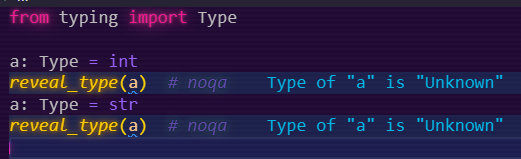
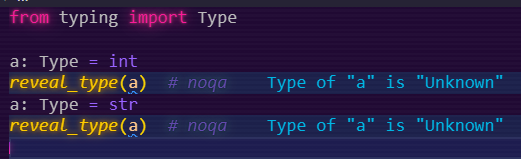
obviously Literal would work, but it would be quite hard to collect all the possible values
oblique urchin
dim trail
how would i typehint that a variable is storing any type, such as `a = int` `a =...
that's weird, is this pyright? maybe try Type[Any] or lowercase type
dim trail
it is Pyright (or Pylance to be more accurate)
trim tangle
type should work
dim trail
yeah it does. wierd that the typing.Type without any arguments in [] doesnt have the same effect
https://img.laundmo.com/u/xL40rc.png
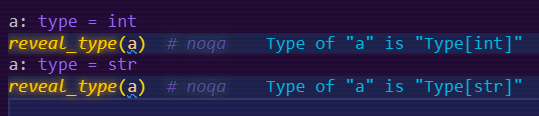
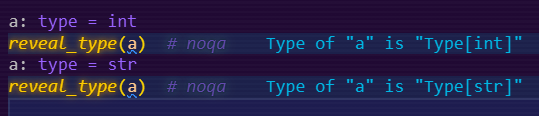 grave fjord
The mypy Playground is a web service that receives a Python program with type hints, runs mypy inside a sandbox, then returns the output.
@dim trail what are you using this for?
often it's better to use a type annotation that more reflects how you'll use it, eg Callable[[object], object]
dim trail
i made a class that represents a mapping from a incoming type to a outgoing type