#type-hinting
1 messages · Page 46 of 1
 hasty phoenix
 trim tangle
why do you want this though? do you really want to overwrite `print`?
trim tangle
why do you want this though? do you really want to overwrite `print`?
No, it was a made up example. But I have a similar use-case where a function is conditionally run on some flag with alternative do-nothing functions which accepts everything.
Without this the code gets littered with
if enabled:
   do_something_when_enabled()
which looks ugly if this is done very many times in a function.
hasty phoenix
Why is mypy complaining about the return type? Isn't __eq__() always returning bool?
def foo(a: Any, b: Any) -> bool:
    return a == b  # mypy: Returning Any from function declared to return "bool"
Hm... strange ```py
from typing import Any
reveal_type(object.eq) # (object, object) -> bool
def f(x: object, y: object) -> None:
reveal_type(x == y) # shows: object
def g(x: Any, y: Any) -> None:
reveal_type(x == y) # shows: Any
== doesn't have to return a boolean. For example, if a and b are numpy arrays, then a == b is also a numpy array (an array of boolean with elementwise equality)
However, object.__eq__ pretends that doesn't exist and is typed as (object, object) -> bool
maybe operator results on Any are just always inferred as Any
 mossy rain
trim tangle
maybe operator results on `Any` are just always inferred as `Any`
mossy rain
trim tangle
maybe operator results on `Any` are just always inferred as `Any`
yes, any operation with Any is inferred as such iirc
hasty phoenix
Is it customary to declare __eq__with Any or to use the expected use-case for comparison? In principle anything can be compared, right?
class A:
    # Declare `other` as `Any` or `A`?
    def __eq__(self, other: Any) -> bool:
        if not isinstance(other, A):
            return False
        return some_comparison_of(self, other)
 restive rapids
hasty phoenix
Is it customary to declare `__eq__`with `Any` or to use the expected use-case fo...
restive rapids
hasty phoenix
Is it customary to declare `__eq__`with `Any` or to use the expected use-case fo...
use object and return NotImplemented when other is not an A, so that type(other) could still implement __eq__ that'd work with A
mossy rain
hasty phoenix
Is it customary to declare `__eq__`with `Any` or to use the expected use-case fo...
The (probably wrong spelling but idc) "Listkov substitution prinicple" would be broken
*Liskov substitution principle (right spelling per mypy)
hasty phoenix
What's the difference between using object as type vs Any ? Everything inherits object doesn't it?
mossy rain
hasty phoenix
What's the difference between using `object` as type vs `Any` ? Everything inher...
Any does not in the eye of type checkers. objects always have some attributes, e.g. __name__, Any does not
restive rapids
hasty phoenix
What's the difference between using `object` as type vs `Any` ? Everything inher...
if you use Any, you're allowing the implementation to do anything with it, which is not desirable, you want an opaque thing that you cant really do anything specific with until you make sure its an A
hasty phoenix
mossy rain
The (probably wrong spelling but idc) "Listkov substitution prinicple" would be ...
That would then be liskov for the implicit class object which A is based on, right?
mossy rain
hasty phoenix
That would then be liskov for the implicit `class object` which A is based on, r...
yeah, i suppose so
hasty phoenix
Thanks, this makes sense
mossy rain
np
trim tangle
any always "has" all the attributes and methods you could imagine
 viscid spire
That reply doesn't make sense
!e Actually it does.
from typing import Protocol
print(type(Protocol))
 rough sluiceBOT
viscid spire
!e Actually it does.
```py
from typing import Protocol
print(type(Protocol))
```
rough sluiceBOT
viscid spire
!e Actually it does.
```py
from typing import Protocol
print(type(Protocol))
```
:white_check_mark: Your 3.14 eval job has completed with return code 0.
<class 'typing._ProtocolMeta'>
 rare scarab
viscid spire
!e Actually it does.
```py
from typing import Protocol
print(type(Protocol))
```
rare scarab
viscid spire
!e Actually it does.
```py
from typing import Protocol
print(type(Protocol))
```
What about the implementing classes?
viscid spire
Same with ABCs, you just inherit
Or did you mean are they also an instance of the metatype? The answer is yes.
trim tangle
viscid spire
Or did you mean are they also an instance of the metatype? The answer is yes.
I think unalivejoy meant that, if you already have an incompatible metaclass and want to satisfy an ABC, you can replace an ABC with a protocol, which you can implement explicitly without inheriting from it
viscid spire
I don't understand
trim tangle
viscid spire
I don't understand
!e
from abc import ABC, abstractmethod

class Fruit(ABC):
    @abstractmethod
    def eat(self) -> None: pass

class BananaMeta(type): pass
class BaseBanana(metaclass=BananaMeta): pass

class Banana(BaseBanana, Fruit):  # TypeError: metaclass conflict
    def eat(self) -> None: print("nomnomnom")
:x: Your 3.14 eval job has completed with return code 1.
001 | Traceback (most recent call last):
002 | File [35m"/home/main.py"[0m, line [35m10[0m, in [35m<module>[0m
003 | class Banana(BaseBanana, Fruit): # TypeError: metaclass conflict
004 | def eat(self) -> None: print("nomnomnom")
005 | [1;35mTypeError[0m: [35mmetaclass conflict: the metaclass of a derived class must be a (non-strict) subclass of the metaclasses of all its bases[0m
!e
vs: ```py
from abc import abstractmethod
from typing import Protocol
class Fruit(Protocol):
@abstractmethod
def eat(self) -> None: pass
class BananaMeta(type): pass
class BaseBanana(metaclass=BananaMeta): pass
class Banana(BaseBanana):
def eat(self) -> None: print("nomnomnom")
fruit: Fruit = Banana() # ok
fruit.eat()
:white_check_mark: Your 3.14 eval job has completed with return code 0.
nomnomnom
 fiery canyon
@mossy rainI should be able to del the ABC with no problem, right?

I just like deling anything that users shouldn't interact with (:
viscid spire
trim tangle
!e
vs: ```py
from abc import abstractmethod
from typing import Protocol
class F...
I see
mossy rain
viscid spire
That reply doesn't make sense
You said that protocol itself doesnt fail there (tbh your reply was a little unspecific, but i got that from my original msg), so i said that the checkers i ran over the script dont fail either
mossy rain
fiery canyon
I just like `del`ing anything that users shouldn't interact with (:
Yeah, thats what i originally did in the PR, you said its used by some other internal part though?! If thats not the case anymore, sure, go for it.
fiery canyon
mossy rain
Yeah, thats what i originally did in the PR, you said its used by some other int...
The class _AnyEvent is, but I don't think deling the subclassed (ABC) will make it not work
viscid spire
mossy rain
You said that protocol itself doesnt fail there (tbh your reply was a little uns...
I think I misunderstood the topic earlier
mossy rain
fiery canyon
The class _AnyEvent is, but I don't think `del`ing the subclassed (ABC) will mak...
Oh, you wanna del the subclasses, sure that works
mossy rain
viscid spire
I think I misunderstood the topic earlier
ah yeah, idk, but i hope there isnt a lot of confusion now, sorry for confusing you, mb
fiery canyon
mossy rain
Oh, you wanna del the subclasses, sure that works
Yessir :D
Gotta be consistent 🫡

 jolly cipher
fiery canyon
I just like `del`ing anything that users shouldn't interact with (:
jolly cipher
fiery canyon
I just like `del`ing anything that users shouldn't interact with (:
i see where you're coming from
but it may not be worth it in the long run
you can always accidentally break something that needs these symbols as free variables
these "leaks" only truly matter if you have an __init__.py that doesn't define __all__, since then your leaks pollute somebody who wildcard-imports your package; it's easier to just define __all__
 brazen jolt
definitely, and with how dynamic python is, your users could still technically get to the class if they really tried
brazen jolt
!e ```python
class Foo:
def foo(): ...
class Bar(Foo): ...
del Foo
Foo = Bar.bases[0]
print(Foo)
:white_check_mark: Your 3.14 eval job has completed with return code 0.
<class '__main__.Foo'>
there's a ton of ways to do that
but the cool thing is -- it's not your responsibility
brazen jolt
yeah, library users should respect conventions and not do things like that, or if they do, then they should know it's their responsibility to maintain and that they might face unexpected behavior as you change your internals
jolly cipher
relying on hacks always backfires because it introduces backward compatibility problems where they should never appear
restive rapids
jolly cipher
python is not java. it's consenting adults
(java has powerful reflection too)
jolly cipher
exposing to breakage more than necessary
jolly cipher
restive rapids
(java has powerful reflection too)
fair
i shouldn't have mentioned java :) barely touched it
fiery canyon
jolly cipher
you can always accidentally break something that needs these symbols as free var...
I do have __all__ and that doesn't stop someone from importing something they shouldn't use
brazen jolt
the purpose of __all__ isn't to prevent others from importing private things
 brazen jolt
it's to stop wildcard imports
if you have some internals that shouldn't be exposed when someone does from yourlib import *
jolly cipher
brazen jolt
it's to stop wildcard imports
explicitly define*, would describe it
brazen jolt
also, some lang servers / type checkers can warn you about importing internals
it's a useful tool if you have some internal variables that aren't _ prefixed that shouldn't be exposed
mossy rain
yeah, but you can always modify everything in Python. Even of some custom __getattr__ or __setattr__ exists, they could ve overwritten with some new functionality.
still del'ing stuff, and making a __all__ is best practice to try and avoid stuff like that (especially for inexperienced users)
 tropic glen
How come I get an error when a function typed to return [A|B|C] returns [sA|sB|sC] where sX is a subclass of X?
surely Python's type system understand that if Y is an acceptable type for something bound to X, then list[Y] is an acceptable type for something bound to list[X]?
restive rapids
tropic glen
surely Python's type system understand that if Y is an acceptable type for somet...
https://en.wikipedia.org/wiki/Covariance_and_contravariance_(computer_science)
https://peps.python.org/pep-0483/#covariance-and-contravariance
Many programming language type systems support subtyping. For instance, if the type Cat is a subtype of Animal, then an expression of type Cat should be substitutable wherever an expression of type Animal is used.
Variance is the category of possible relationships between more complex types and their components' subtypes. A language's chosen var...

Python Enhancement Proposals (PEPs)
This PEP lays out the theory referenced by PEP 484.
restive rapids
tropic glen
surely Python's type system understand that if Y is an acceptable type for somet...
do you think list[int] is a list[int | str]?
def f(xs: list[int | str]):
  xs.append("hi")

def g():
  xs: list[int] = [42]
  f(xs) # you think that since int <: int | str, then list[int] <: list[int | str]
  # well, now our list[int] has a string in it
Lol the semantics of return type are obviously different to the semantics of argument type
I assume this is just a case of needing to work around python's halfarsed type system again
restive rapids
tropic glen
Lol the semantics of return type are obviously different to the semantics of arg...
how so?
restive rapids
tropic glen
I assume this is just a case of needing to work around python's halfarsed type s...
maybe you should educate yourself on a topic before calling the type system "halfarsed"
there are a couple issues with it, but variance is pretty standard
do you actually need the type to be list (which is mutable), or an immutable sequence would do too? then you wouldn't have issues with invariance
tropic glen
oh so I might have stored the list of subclass type and the calling function can modify it
can't help but feel you could have said that less snarkily lol
restive rapids
tropic glen
can't help but feel you could have said that less snarkily lol
yeah i guess i could, sorry
tropic glen
no worries
and I'm sure being educated makes me more prone to feel snarkedl ol
I think it feels halfarsed because it's a language that used to love duck typing
and formalising it adds all these hard errors that would previously have been subtle semantic edgecases
restive rapids
tropic glen
I think it feels halfarsed because it's a language that used to love duck typing
it still loves duck typing, but now we have constructs to express some of that duck typing statically
tropic glen
hm
I guess it feels like the type system innovation didn't come with the basic language changes I would have expected
restive rapids
tropic glen
I guess it feels like the type system innovation didn't come with the basic lang...
mhm. its purely "bolted on top" of a dynamic language
brazen jolt
Like @restive rapids suggested here, you probably shouldn't need a list here, python has collections.abc.Sequence which can represent an immutable sequence type, you can pass a list to it, but the funciton that takes that type should not make any modifications to that list
trim tangle
To answer your question, you can annotate the list explicitly if the type inferred from the list literal is wrong ```py
def make_lists_or_strings() -> list[int | str]
things: list[int | str] = [1, 2, 3]
if random.random() > 0.5:
things.append("banana")
return things
yeah that makes sense
brazen jolt
for example, consider this: ```python
from collections.abc import Sequence
def foo(x: Sequence[str | int]):
x.append("f") # type-error: Sequence type doesn't support 'append'
# however, you can get the elements inside of the sequence and do stuff with them:
print(x[2])  # valid
and you can now call it with a list, since list is a subtype of Sequence, so this call is valid: foo(["hi"))
tropic glen
yeah that's definitely what I should have been doing
maybe I can ask another question: what's a good way to do discriminated union matching?
seems like I always end up having to cover the hypothetical base case even if I just raise
restive rapids
tropic glen
maybe I can ask another question: what's a good way to do discriminated union ma...
what exactly do you mean by that? because there's no builtin discriminated union
restive rapids
i usually do
type U = A | B
@dataclass
class A:
  ...
@dataclass
class B:
  ...
and then
match u:
  case A():
    ...
  case B():
    ...
if needed, or just overload methods if possible
brazen jolt
a type-checker shouldn't complain about a missing base case if you exhausted all possible options to discriminate on
tropic glen
restive rapids
what exactly do you mean by that? because there's no builtin discriminated union
well I don't know the name for the technique but python can figure out that inside a branch checking a variable has a certain type
but it seems to still think you could fall off the end of an exhaustive if/elif
restive rapids
tropic glen
well I don't know the name for the technique but python can figure out that insi...
ah, well, narrowing is not exactly specified so it depends on the typechecker you use
isinstance and match should work fine though
tropic glen
for every possibility
restive rapids
can you show a case where you have an issue?
tropic glen
hm I'll try to find one
brazen jolt
yeah, it's pretty hard to understand what you mean here, a type-checker shouldn't force you into adding a base case if your conditions exhausted all of the possible options for the type
def foo(union_val: A | B | C) -> None:
    if isinstance(union_val, A): return
    if isinstance(union_val, B): return
    reveal_type(union_val)  # union_val should be inferred as 'C', no need for another if + base case
 feral wharf
Is reportShadowImports (still) a thing in pyright? i can't find much about it other than it being in someone's config but it's being reported as an unknown rule
brazen jolt
feral wharf
Is reportShadowImports (still) a thing in pyright? i can't find much about it ot...
it was removed in v1.1.406:
https://github.com/microsoft/pyright/commit/7905b1936a0f42642c56bae9060d9f3112faddd0
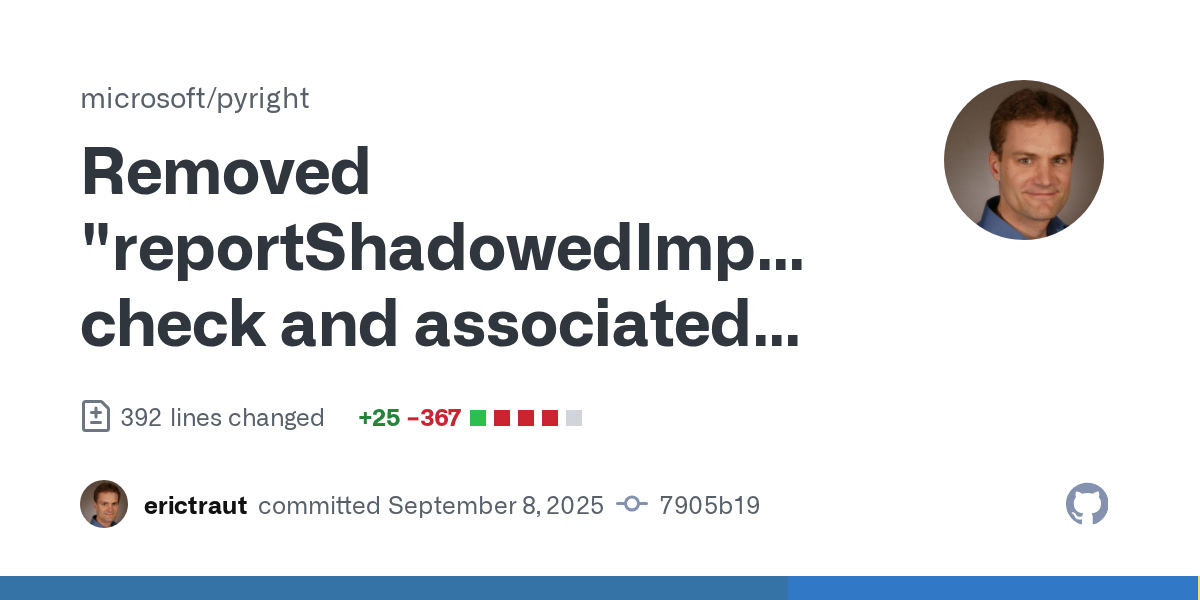
GitHub
…ile" action. This feature is off by default in pyright although enabled by default in pylance. (#10891)
It's problematic for a number of reasons:
- It's not a type check...
feral wharf
Ooh
 bleak imp
Is there way way to add extra typing info to a function call in-line? Like how if you have a generic class, you can do Foo[int](x) to tell the type checker that the generic is int, is there any way to do the same thing with a function?
trim tangle
bleak imp
Is there way way to add extra typing info to a function call in-line? Like how i...
!pep 718
rough sluiceBOT

Status
Draft
Python Version
3.15
Created
23-Jun-2023
Type
Standards Track
bleak imp
trim tangle
why do you want this though?
:( I’m making/using a rust like result type, and I’m trying to add a method for mapping ok/err, but if I chain these maps with lambdas the inference stops working and I get unknown types
trim tangle
bleak imp
:( I’m making/using a rust like result type, and I’m trying to add a method for ...
can you show an example?
bleak imp
trim tangle
can you show an example?
Here's the actual code I'm having issues with playground
I did have a small repro but I can't find it, and am having trouble remaking it, so it might be a while until I can
trim tangle
what a nice error message
 bleak imp
Yep, the generic soup makes for such fun error messages
trim tangle
bleak imp
Yep, the generic soup makes for such fun error messages
In the second lambda, what is x[1][0] supposed to be?
bleak imp
trim tangle
In the second lambda, what is `x[1][0]` supposed to be?
The parser returns the modified input in the ok branch, so that’s the modified input from the then parser
The tuple passed into the second lambda is (self output, (other modified input, other output))
trim tangle
bleak imp
The tuple passed into the second lambda is `(self output, (other modified input,...
No, the second element of the tuple is a ParserOutput
Try rewriting this using proper functions instead of lambdas. You'll see the mistake
(you cannot express what you have with Result.map, you need Result.then as well)
 wind skiff
@overload
async def insert_account(
    self, account: Account, *, fields: tuple[AccountField, ...] = ...
) -> Account: ...

@overload
async def insert_account(self, account: Account, *, fields: None = ...) -> None: ...

async def insert_account(
    self, account: Account, *, fields: tuple[AccountField, ...] | None = None
) -> Account | None:

foo = await repo.insert_account(account) # type of foo reported by tyep checker is Account but should be None
why is this happening
only when i pass fields explicitly as None then the type of foo becomes None
brazen jolt
in your overloads, both have a default value (elipsis), omit the default value for fields where it doesn't match the one from the implementation
wind skiff
brazen jolt
in your overloads, both have a default value (elipsis), omit the default value f...
so i shouldnt do fields: None = ...?
brazen jolt
you should, because for the None case (2nd overload) it does have a default
wind skiff
yeah so what do i do to fix?
brazen jolt
the issue here is that with your first overload, you have: ```python
@overload
async def insert_account(
self, account: Account, *, fields: tuple[AccountField, ...] = ...
) -> Account: ...
notice that there's fields: tuple[AccountField, ...] = ...
which means you're telling the type-checker that fields has a default value and doesn't need to be specified
with elipsis there, type-checker thiks the default value will just be the type you typed it to be (tuple[AccountField, ...])
just omit the default there
e.g. make it just: ```python
@overload
async def insert_account(
self, account: Account, *, fields: tuple[AccountField, ...]
) -> Account: ...
that way fields becomes required
wind skiff
oh so if i do = ... that means the default value is the type i give to fields?
brazen jolt
for this overload to apply
trim tangle
wind skiff
oh so if i do = ... that means the default value is the type i give to fields?
= ... means that the argument is optional
wind skiff
yeah thats what i knew
brazen jolt
wind skiff
oh so if i do = ... that means the default value is the type i give to fields?
kind of, it just tells the type checker that there is some default value there, and since overloads are checked from the order they're defined in, if the overload states that a value has a default, then it doesn't need to be specified, and the overload applies
wind skiff
i thought if the argument is optional in the original function you have to keep it like that in every overload 💀
trim tangle
The important point is that overloads are checked in order
brazen jolt
wind skiff
i thought if the argument is optional in the original function you have to keep ...
if you changed the order and made the None overload first, it would work
wind skiff
what even the order matters
wind skiff
thats why i remember this working before
brazen jolt
if you tried to match the type signature of the call
you call the function with just Account as the first arg
wind skiff
when i pass fields=None explictly how does it match that?
brazen jolt
so it goes to check which overload applies there
it first evaluated the overload that was defined first
wind skiff
i have told it that fields is None when optional right
brazen jolt
and for that, yeah, the fields is optional, the overload matches
so the type checker stops there and thinks that it found the right overload
trim tangle
If possible, I would write overloads in a non-overlapping way, so that you don't have to think about their order ```py
@overload
async def insert_account(self, account: Account, *, fields: tuple[AccountField, ...]) -> Account: ...
@overload
async def insert_account(self, account: Account, *, fields: None = ...) -> None: ...
if we say fields: None = ... does it mean when fields is optional it is None or does it mean match this overload when field is optional and None
trim tangle
It will match the second overload when you call insert_account(account) and insert_account(account, fields=None)
brazen jolt
wind skiff
if we say fields: None = ... does it mean when fields is optional it is None or ...
when you define an overload, the type checker doesn't cross-compare with the implementaion types, it just considers the overloads in order they were defined
wind skiff
then why did it match a overload which had optional ... but type tuple[AccountField] when the function clearly has a default of None? does it just check what is the first overload which is optional?
brazen jolt
it has no idea that the actual default for fields is None at that point
it just goes one by one and checks whether one of the overloads can match the way the function was called
wind skiff
oh that makes sense, then it just sees the first optional overload
trim tangle
Why does it return None if you don't pass any fields though? Why not always return an Account?
wind skiff
trim tangle
Why does it return `None` if you don't pass any fields though? Why not always re...
if fields are None a returning clause isnt added to the sql statement and there is nothing to return
fields define what you wanna get back from the db
@overload
async def insert_account(
    self, account: Account, *, fields: tuple[AccountField, ...]
) -> Account: ...

@overload
async def insert_account(self, account: Account, *, fields: None = ...) -> None: ...

async def insert_account(
    self, account: Account, *, fields: tuple[AccountField, ...] | None = None
) -> Account | None:
    """Insert an account."""
    cols, vals = account.to_columns_and_values()
    stmt = sql.insert(self.table).columns(*cols).values(*vals)
    if fields is not None:
        stmt.returning(*fields)
        return await self.driver.select_one(stmt, schema_type=Account)

    await self.driver.execute(stmt)
    return None
so it's going to return an Account with some fields potentially missing? What if fields is ()?
wind skiff
trim tangle
so it's going to return an `Account` with some fields potentially missing? What ...
the repository layer expects either some fields or None, but yeah thats a good point i can just make the check if not fields, but anyways the service layer will never do that
wind skiff
trim tangle
Why read the fields of what you just inserted though? 🤔
i mean whats the point of a returning clause? mostly to read auto generated columns like id's created at, when an account is being inserted the Account(...) doesnt have the created_at set but if fields spenicfies created_at then it will fetch that autgenerated field
brazen jolt
some dbs auto-fill defaults or use increments / autogenerated IDs, etc. I can see wanting to obtain that back as useful, though unless you really care about performance here, I'd probably choose to return an entire instance back every time
wind skiff
i am not using a orm here so i need to do the filling and all myself
brazen jolt
(or rather, either an entire instance or nothing, not a partial instance)
trim tangle
yeah I forgot about server generated things
I think it always makes sense to specify the exact fields you need. You never know when a table gets a column with large values
trim tangle
especially if you only want the ID
brazen jolt
I suppose that's fair yeah
wind skiff
when the record gets big its not a good idea to always return *
bleak imp
trim tangle
Try rewriting this using proper functions instead of lambdas. You'll see the mis...
Ah, I see. I figured it out, I should be doing map to the result of other.parse, instead of the outer map's result.
The one issue with that is I need a flatten op. That isn't too hard to make as a standalone function, but I'd also like it to be a method, but am having trouble with the self types. Could I get some help? code (still using basedpyright playground but the link is now too long for a discord message). The flatten standalone function works, but the methods do not.
Huh, interestingly just moving the flatten function upwards and doing flatten = flatten in both Ok and Err works. I wonder if I should do that for all of the methods? It doesn't seem to give errors for wrong self types though, which isn't the best, but does at least work
Ah, I got it, it looks like using the classes own generics is what makes it not work, if I make the method have two new generics it works out
bleak imp
The extra funny part is that even now that I have all these advanced result methods working, for basically anything complex I'm not even using then and just going back to match since the errors are so unreadable xD
And in fact, that has just given me another revelation: For a bunch of these non-parser-internal parsers I've been struggling on, since I was smart and made it so that they work exactly like the parser internal methods, I can also just write them the same way using mostly only matches to get a much more sensical error output.
 digital pewter
eek sorry
def bar(xs: list[int] | list[float]): ...

def foo[T: (int, str)](xs: list[T]):
    bar(xs)
we're saying this is valid for mypy?
trim tangle
yes
digital pewter
it's flagging for me :\
trim tangle
s/float/str
trim tangle
i have more bugs than mypy
btw @digital pewter , the reason mypy doesn't error is that, when encountering constrained typevars, it just instantiates the function with all the possible combinations and type checks them separately. Here is one side effect
class Ye: pass
class No: pass

class Foo[A: (Ye, No), B: (Ye, No), C: (Ye, No)]:
    def __init__(self) -> None:
        reveal_type(self)
``` ```
main.py:6: note: Revealed type is "__main__.Foo[__main__.Ye, __main__.Ye, __main__.Ye]"
main.py:6: note: Revealed type is "__main__.Foo[__main__.Ye, __main__.Ye, __main__.No]"
main.py:6: note: Revealed type is "__main__.Foo[__main__.Ye, __main__.No, __main__.Ye]"
main.py:6: note: Revealed type is "__main__.Foo[__main__.Ye, __main__.No, __main__.No]"
main.py:6: note: Revealed type is "__main__.Foo[__main__.No, __main__.Ye, __main__.Ye]"
main.py:6: note: Revealed type is "__main__.Foo[__main__.No, __main__.Ye, __main__.No]"
main.py:6: note: Revealed type is "__main__.Foo[__main__.No, __main__.No, __main__.Ye]"
main.py:6: note: Revealed type is "__main__.Foo[__main__.No, __main__.No, __main__.No]"
So it synthesizes
def foo1(xs: list[int]):
    bar(xs)
# and
def foo2(xs: list[str]):
    bar(xs)
``` and both workWell, the most common usecase for constrained typevars seems to be (str, bytes), so it's only 2 instances
so just don't represent a chess board like that and it should be fine
speaking of exponential growth, enum.IntFlag will cache all the flag combinations as you're creating them
so if you have 32 bits in the enum, you could end up with 2**32 enum instances cached
IIRC it has to do that because enum instances must be comparable with is
bleak imp
Why aren't type checkers able to rule out the never branch of this code? This happens with pyright, mypy, and ty, so am I missing something? Both Ok and Err are final, so there's no issue where there could be a possible subclass that inherits from both. Both T and E should be covariant, which ty confirms, so as far as I can tell Err[Never] should not be constructible. So why is it that none of these type checkers can determine that the Err branch of this code is unreachable? And more probably, what am I missing here?
trim tangle
bleak imp
Why aren't type checkers able to rule out the never branch of this code? This ha...
seems like they don't understand the fact that Err[Never] is itself empty
For example: imagine you're making a stub file. How do you express that?
bleak imp
Hm. I think I see, for example, list[Never] is not empty, since it has a valid element of [], so as far as the type checkers know Err[Never] could be inhabited despite having Never
trim tangle
something like that, yes
bleak imp
:/
feral wharf
I think this is the correct channel for this.. I can't see my pyright is failing with the same stuff on every commit when it works compleletly fine locally..
failing action's log: https://paste.pythondiscord.com/TJFQ
failing action from workflow:
- name: "Run Pyright @ ${{ matrix.python-version }}"
  uses: jakebailey/pyright-action@v2
  with:
    warnings: false
    verify-types: "bugcord"
    ignore-external: true
    annotate: ${{ matrix.python-version != '3.x' && 'all' || 'none' }}
figured out why we ain't seeing it locally
because we aren't setting the verifytypes flag
still not sure why it's throwing those warnings tho
feral wharf
wait, is this not the point of TypeIs?
Return type of TypeIs ("Sequence[_BoundPage | _BoundV2Page | _SelectBoundPage | _SelectBoundV2Page]") is not consistent with value parameter type ("_BoundPage | _BoundV2Page | _SelectBoundPage | _SelectBoundV2Page")
oh i think i need TypeGuard
 oblique urchin
feral wharf
wait, is this not the point of TypeIs?
```py
Return type of TypeIs ("Sequence[_B...
oblique urchin
feral wharf
wait, is this not the point of TypeIs?
```py
Return type of TypeIs ("Sequence[_B...
unless your Page class is a sequence of itself that error indicates your type guard function doesn't make sense
feral wharf
im confused
oblique urchin
the error suggests you have a function like def guard(x: _BoundPage) -> TypeGuard[Sequence[_BoundPage]]: (plus some more kinds of pages)
that only makes sense if a _BoundPage can also be a Sequence[_BoundPage]
which is possible in theory but seems weird
feral wharf
oh yeah that's wrong
I basically want a function that returns True if input is a sequeue of a valid obj, so that I can do [0] on it. The following seems to work
def _is_sequence_of_pages(
    page: BoundPage | BoundV2Page | SelectBoundPage | SelectBoundV2Page, /
) -> TypeGuard[Sequence[_BoundPage | _BoundV2Page | _SelectBoundPage | _SelectBoundV2Page]]:
    if isinstance(page, Sequence) and not isinstance(page, (str, bytes, bytearray)):
        return True

    return False
type _BoundPage = str | discord.Embed | discord.ui.Button[Any] | discord.ui.Select[Any] | dict[str, Any] | File
type BoundPage = _BoundPage | Sequence[_BoundPage]

type _BoundV2Page = (
    str
    | discord.ui.ActionRow[Any]
    | discord.ui.Container[Any]
    | discord.ui.File[Any]
    | discord.ui.MediaGallery[Any]
    | discord.ui.Section[Any]
    | discord.ui.Separator[Any]
    | discord.ui.TextDisplay[Any]
    | dict[str, Any]
    | File
)
type BoundV2Page = _BoundV2Page | Sequence[_BoundV2Page]

type _SelectBoundPage = _BoundPage | PaginatorOption[Any]
type _SelectBoundV2Page = _BoundV2Page | PaginatorOption[Any]

type SelectBoundPage = _SelectBoundPage | Sequence[_SelectBoundPage]
type SelectBoundV2Page = _SelectBoundV2Page | Sequence[_SelectBoundV2Page]
the parameter type of _is_sequence_of_pages seems wrong there then
oh wait the one without an underscore includes Sequences
feral wharf
ya
fiery canyon
Didn't expect this to work lol

Not sure I like that though, users might be confused on whether it's a dict or an obj
It's either that, or this..
 feral wharf
I think this is the correct channel for this.. I can't see my pyright is failing...
feral wharf
feral wharf
I think this is the correct channel for this.. I can't see my pyright is failing...
anyone?
 drowsy wadi
Inferred child class type is missing type annotation and could be inferred differently by type checkers
If you give it these, does it become happy?
wind skiff
drowsy wadi
If you give it these, does it become happy?
yeah i guess, for example it errors for the following
global_password_hasher = PasswordHasher()


def provide_password_hasher() -> PasswordHasher:
    """Provide password hasher."""
    return global_password_hasher
but doesnt error for the following
global_password_hasher: PasswordHasher = PasswordHasher()


def provide_password_hasher() -> PasswordHasher:
    """Provide password hasher."""
    return global_password_hasher
(btw i am working with him so i am aware of the problem)
 hallow widget
Not sure if this a good topic/help channe for Pydantic but either way I'm working with a yaml file:
---
id: example_tweak
name: Example tweak
actions:
  - !registryValue:
    path: 'HKLM:\SOFTWARE\Example'
    name: 'ExampleValue'
    # value: ["value1", "value2", "value3"]
    value:
      - value1
      - value2
      - value3
    type: REG_MULTI_SZ
It contains information on how to automate certain tasks e.g. setting registry values and keys, I read the yaml like so:
from aegis.models import Tweak
import yaml

class YamlHandler:
    def __init__(self, file_path: str):
        self.file_path = file_path

    def read_yaml(self) -> Tweak:
        with open(self.file_path, "r", encoding="utf-8") as file:
            data = yaml.safe_load(file)
            print(data)
            return Tweak(**data)
Here is the tweak model:
from aegis.actions.base import Action

class Phase(str, Enum):
    SPECIALIZE = "Specialize"
    DEFAULT_USER = "DefaultUser"
    FIRST_LOGON = "FirstLogon"
    USER_ONCE = "UserOnce"

@dataclass(config=ConfigDict(arbitrary_types_allowed=True))
class Tweak:
    id: str
    title: str | None = Field(default=None, alias="name")
    description: str | None = None
    phase: Phase = Field(default=Phase.SPECIALIZE)
    enabled: bool = True
    category: str | None = "uncategorized"
    depends_on: list[str] = Field(default_factory=list)
    build: str | int | None = None
    actions: list[Action] = Field(default_factory=list)
Please react with ✅ to upload your file(s) to our paste bin, which is more accessible for some users.
hallow widget
Now to validate the registryValue action I have this model:
rough sluiceBOT
hallow widget
Now to validate the registryValue action I have this model:
Click here to see this code in our pastebin.
hallow widget
But if you look at line 35:
value: list = Field(default_factory=list)
This ends up not recognizing the list of strings, sample output:
actions=[
  RegistryValueAction(path='HKLM:\\SOFTWARE\\Example', name='ExampleValue', type=RegistryValueType.REG_MULTI_SZ, value=[])
]
```py

But if I use the `Any` type from `typing` lib:
```py
value: Any
I get this:
actions=[
  RegistryValueAction(path='HKLM:\\SOFTWARE\\Example', name='ExampleValue', value=['value1', 'value2', 'value3'], type=RegistryValueType.REG_MULTI_SZ)
]
Not sure what the problem could be and I could get away with using Any but it's of course not ideal.
trim tangle
It's really strange that it produces an empty list instead of an error 
trim tangle
hallow widget
Not sure if this a good topic/help channe for Pydantic but either way I'm workin...
Is this your own YAML format? Or do you have to adhere to an existing format?
hallow widget
This is my own YAML format, I have yet to make a JSON Schema to get intellisense and stuff but it's my own.
I handle that !registryValue tag as well:
import yaml

class Action:
    yaml_tag: str = None

    def __init_subclass__(cls, **kwargs):
        super().__init_subclass__(**kwargs)
        tag = getattr(cls, "yaml_tag", None)
        if tag:
            for variant in (tag, f"{tag}:"):
                yaml.add_constructor(variant, cls._from_yaml, Loader=yaml.SafeLoader)
            yaml.add_representer(cls, cls._to_yaml, Dumper=yaml.SafeDumper)

    def __repr__(self):
        attrs = ', '.join(f"{k}={v!r}" for k, v in self.__dict__.items())
        return f"{self.__class__.__name__}({attrs})"

    @classmethod
    def _from_yaml(cls, loader, node):
        values = loader.construct_mapping(node)
        return cls(**values)

    @classmethod
    def _to_yaml(cls, dumper, data):
        return dumper.represent_mapping(cls.yaml_tag, data.__dict__)

    # abstract methods
    def execute(self):
        raise NotImplementedError("Subclasses must implement the execute method.")

    def backup(self):
        raise NotImplementedError("Subclasses must implement the backup method.")

    def rollback(self):
        raise NotImplementedError("Subclasses must implement the rollback method.")
If you can change it to something like this: ```yaml
path: 'HKLM:\SOFTWARE\Example'
name: 'ExampleValue'
payload:
type: REG_MULTI_SZ
value: [value1, value2, value3]
apparently pydantic doesn't support discriminated union where the field is in the outer container... bummer
hallow widget
Wait but doesn't it fail because if I were to use list it would expect that no matter the type so even if the type was REG_DWORD which does not accept a list it would still expect that?
I'm gonna try make use of a model_validator because I kinda want this syntax:
value:
  - value1
  - value2
  - value3
I'm not sure I understand
hallow widget
@dataclass
class RegistryValueAction(Action):
    yaml_tag = u"!registryValue"

    path: str
    name: str
    value: Any
    type: RegistryValueType

    @model_validator(mode="after")
    @classmethod
    def check_value(cls, data):
        reg_type = data.type
        if reg_type in {
            RegistryValueType.REG_DWORD,
            RegistryValueType.REG_QWORD,
            RegistryValueType.REG_DWORD_LITTLE_ENDIAN,
            RegistryValueType.REG_QWORD_LITTLE_ENDIAN
        }:
            if isinstance(data.value, str) and data.value.isdigit():
                data.value = int(data.value)
            elif not isinstance(data.value, int):
                raise TypeError(f"Value must be an integer for type {reg_type}")
        elif reg_type in {
            RegistryValueType.REG_SZ,
            RegistryValueType.REG_EXPAND_SZ,
            RegistryValueType.REG_LINK
        }:
            if isinstance(data.value, int):
                data.value = str(data.value)
            elif not isinstance(data.value, str):
                raise TypeError(f"Value must be a string for type {reg_type}")
        elif reg_type == RegistryValueType.REG_MULTI_SZ:
            if not (isinstance(data.value, list) and all(isinstance(i, str) for i in data.value)):
                raise TypeError(f"Value must be a list of strings for type {reg_type}")
        elif reg_type == RegistryValueType.REG_BINARY:
            if isinstance(data.value, str):
                    data.value = data.value.encode()
            elif not isinstance(data.value, (bytes, bytearray)):
                raise TypeError(f"Value must be bytes for type {reg_type}")
        elif reg_type == RegistryValueType.REG_NONE:
            if data.value is not None:
                raise TypeError(f"Value must be None for type {reg_type}")
        return data
I'm just validating it with a model_validator, instead of relying on type hinting I guess.
I don't like this approach but I really want this syntax to work:
value:
  - value1
  - value2
  - value3
Plus I found discriminated unions extremely confusing because I'm not sure how I would even use a discriminator I haven't worked enough with Pydantic to understand.
And I don't want to have to nest it like this:
payload:
  type: REG_MULTI_SZ
  value: [value1, value2]
I want it like flat:
type: REG_MULTI_SZ
value: [value1, value2]
yeah I don't know pydantic well enough to figure out how to make it work
hallow widget
I'm not sure if my code now follows like good practice because the value parameter accepts Any but as long as I validate which I do I think it should be fine I suppose.
trim tangle
your situation is exactly what discriminated unions are supposed to solve
Serde (a Rust library) supports this with adjacently tagged mode: https://serde.rs/enum-representations.html#adjacently-tagged
pydantic just doesn't implement that
 little hare
I have questions about this
nitpick: dict[str, object] (avoid Any unless really necessary)
What do people think about using object over Any or Any over object
This seems to be advice, but for invariant generics it doesn't
trim tangle
little hare
What do people think about using object over Any or Any over object
do you understand the difference?
little hare
trim tangle
do you understand the difference?
somewhat
but in convarient objects its kind of annoying and mistyped
I'd rather have unspecification rather than my typechecker complaining that I'm using an attribute that doesn't exist in a dictionary
trim tangle
little hare
somewhat
Any means that you are allowed to do anything with the object:
foo: dict[str, Any] = ...

bar = foo["bar"]
bar.quack()  # allowed
bar += 1 # also allowed
baz: int = bar  # also allowed
For "statically typed code", it's in the same drawer of tools as typing.cast and # type: ignore, it turns off type checking for part of your program
If you are annotating the parameter of a function, you are correct that dict[str, object] is probably not ideal. If you intend to only read from the value, use Mapping[str, object]
dict[str, Any] is okay if you're dealing with untyped JSON and you're totally fine if the code is making an incorrect assumption about its shape
So what I meant was: "when it makes no difference otherwise, use object instead of Any to prevent future mistakes"
fiery canyon
Yea I use dict[str, Any] where I'm too lazy to parse the dict
Not even about being lazy sometimes, there's times where I think it's genuinely useless to type a dict
For example a class that takes dict parameter to make self attrs from its keys
Depends where and when.
viscid spire
fiery canyon
For example a class that takes dict parameter to make self attrs from its keys
In that case, I would use mapping unpacking instead of a dict parameter
feral wharf
Or just define a TypedDict for the known keys, like a good codebase would 
fiery canyon
Just not so necessary
That's something I wouldn't do even if I decided to parse all objects ngl
fiery canyon
Main reason I have objects such as the ones here unparsed is recursive objects, feel like it'd be pointless to make full on objects for my small project

Maaaybe I'll make a TypedDict for the top level keys
fiery canyon
Well yea it's just that I'll "have" to make classes for everything lol (take flags and color for example)
not the worst thing ever but adds a big portion of code that feels unrelated to the main thing
I might just skip the types 💀
 feral wharf
And? It's not like it'll slow down your code or anything. It'll give a nicer experience to people using your lib and potentially extending it or even maintain it.
Embrace the OOP.
fiery canyon
hmm maybe ill try then
feral wharf
Wait you get full objects with the events?
Also, you may be interested in a package like the following if you don't feel like typing them classes yourself: https://github.com/Bluenix2/discord-typings

GitHub
Python typings of all payloads that Discord sends as TypedDicts. - Bluenix2/discord-typings
fiery canyon
Nawr would rather only make what I need
feral wharf
Fair
fiery canyon
Is there a way to tell type checker that the object that will subclass this does have id?

This worked, is that ideal?
 feral wharf
How would Mentionable be an instance of HasID there
restive rapids
HasID is a protocol, so isinstance(x, HasID) is basically hasattr(x, "id")
Mentionable by itself shouldn't be instantiated though, so i think it should be an ABC
fiery canyon
My intention is for classes to subclass Mentionable
feral wharf
And those classes will not have an id attribute?
fiery canyon
they will
restive rapids
methinks something like
from abc import ABC, abstractmethod


class Mentionable(ABC):
    @property
    @abstractmethod
    def id(self) -> int:
        ...
    @id.setter
    @abstractmethod
    def id(self, new: int) -> None:
        ...
    @property
    def mention(self) -> str:
        return f"<@{self.id}>"

class User(Mentionable):
    def __init__(self, id: int):
        self.id = id

User(42)
sadly without a setter you'd have to go through something like
self._id = id
@property
def id(self):
  return self._id
idk
ts sucks 🥀
fiery canyon
feral wharf
But why not add the id classvar to the Mentionable class instead
or this
restive rapids
fiery canyon
or this
if you just do id: int in Mentionable, then it is not an error to instantiate it by itself, even though its wrong
fiery canyon
eh the typing works
feral wharf
Then it's a mixin no?
 feral wharf

feral wharf
Usually they're in a separate file
But yes
I feel like banner and avatar could be one class called Asset or something
fiery canyon
Yea i wont keep everything thrown in one file, i think
Ngl I looked in dpy code for reference for some stuff lol
But yeah what they did there is complete overwork for what I'm trying to achieve
Except for the basic stuff
 stiff acorn
Can I (and should I) bump a typeshed PR that's been sitting for about ~2 weeks?
For reference: https://github.com/python/typeshed/pull/14866
 stable fjord
looks reasonable to bump
 terse sky
I upgraded my python environment, and I'm now getting an error on pandas.to_pickle
Even though it was just fine before
I can see to_pickle defined in pandas-stubs
How would I go about debugging this?
The error is just that "to_pickle is not a known module attribute of pandas"
The code works at runtime, to be clear
trim tangle
terse sky
I upgraded my python environment, and I'm now getting an error on pandas.to_pick...
error from who?
trim tangle
terse sky
I upgraded my python environment, and I'm now getting an error on pandas.to_pick...
What version of pandas-stubs do you have?
terse sky
2.3.2
Pandas is 2.3.3
I wonder if the versions need to be identical. But then that should have been expressed by version constraints
trim tangle
there's 2.3.2.250827 and 2.3.2.250926
terse sky
I have the latter
trim tangle
terse sky
It's in another file
trim tangle
If it's supposed to be exported from the pandas module itself, then it needs to be in this stub file
terse sky
I assumed a star import somewhere
Looks like there are none
So the stubs are bugged I guess?
trim tangle
maybe the stubs were bugged before?
terse sky
I didn't have the error before though
trim tangle
Seems like the pandas package doesn't document or advertise the fact that to_pickle is exported from the root pandas package
(on the docs site)
Hm, it does import it explicitly https://github.com/pandas-dev/pandas/blob/main/pandas/__init__.py#L149
rough sluiceBOT
pandas/__init__.py line 149
to_pickle,```and lists it in __all__
trim tangle
terse sky
Going to revert pandas-stubs and see
terse sky
Yeah it used to work
This is pretty dumb IMHO
pandas-stubs should be type checking what pandas offers
Not making its own judgement calls
pandas has this in all, even if it's not choosing to document it
trim tangle
that could be for backwards compatibility
but at the same time, it's not deprecated 🤷♂️
terse sky
Yeah
If it's not deprecated in the actual code then removing this is incorrect
IMHO
It's also like... What's the actual benefit of this
For the pandas-stubs project
Miniscule
But creates pointless work for users of pandas
trim tangle
seems like they wanted to deprecate it in a quick follow up in 2022, but then they just kept procrastinating
python has an unusual kind of deprecation called "is planned to be deprecated"
terse sky
Yeah, I can certainly appreciate that
But there was really no need to rush removal from the stubs
trim tangle
if it's planned to be deprecated, maybe just change your code to import it from the correct module?
terse sky
It's not just an import
They do add some functionality
And it's hard to justify actually changing code when it works fine and they may simply one day deprecate it
trim tangle
nope
terse sky
So it doesn't help me at all does it
trim tangle
🥲
terse sky
Lol
Like... Am I really going to copy and paste this function into my codebase
Because one day it might be deprecated
Seems crazy
Alternative I guess is there's probably a way to suppress this specific error codebase wide in mypy
Those are the only two real options
I could stay on the old stubs file for now but that's not really a long term solution
terse sky
Is there actually a way to do this? Suppress all mypy errors for a particular function
Inlining the function into my codebase is definitely a pain in the ass
trim tangle
terse sky
Inlining the function into my codebase is definitely a pain in the ass
vendor the stubs

terse sky
That's awful
I was looking into whether I can have my own stubs file that can add more stubs
trim tangle
external stubs will suffer from this kind of problem, when they're a second class sort of thing
rare scarab
Have you considered fixing the function's types?
trim tangle
?
rare scarab
If you don't like vendoring stubs, fix it upstream
terse sky
rare scarab
Have you considered fixing the function's types?
... Have you read the whole convo or jumped in part way?
terse sky
trim tangle
external stubs will suffer from this kind of problem, when they're a second clas...
Pandas stubs are maintained by pandas though afaik
rare scarab
It's a very long conversation. I'll stay out of it.
terse sky
So I don't believe it is second class, but I could be wrong
terse sky
rare scarab
It's a very long conversation. I'll stay out of it.
tl dr the function was already annotated correctly and they removed it because pandas is saying they should one day deprecate it. Even though they haven't
I guess I will open an issue, talked to someone else who's opinion I trust on these matters who agrees this is not the way to do things
rare scarab
So the stubs removed it instead of adding @typing.deprecated? Is it even deprecated yet?
trim tangle
terse sky
Pandas stubs are maintained by pandas though afaik
yeah, so it's extra strange
I guess the advantage is that you can release them at a different cadence?
drowsy wadi
terse sky
... Have you read the whole convo or jumped in part way?
I read the whole convo and had the same thought as him 
terse sky
How can I fix the functions types if it's not there anymore 🤔
drowsy wadi
terse sky
How can I fix the functions types if it's not there anymore 🤔
PR 'em back in!
feral wharf
how broken are you?
yes
https://images.soheab.com/qNNhPfMrYU8.mp4
rare scarab
feral wharf
>how broken are you?
>yes
https://images.soheab.com/qNNhPfMrYU8.mp4
Move your types out of the TYPE_CHECKING block. They're used at runtime.
feral wharf
not if I stringify them?
rare scarab
I believe discord.ui.Button's generic args are important at runtime.
fiery canyon
feral wharf
>how broken are you?
>yes
https://images.soheab.com/qNNhPfMrYU8.mp4
Is that something you're doing for dpy?
feral wharf
rare scarab
I believe discord.ui.Button's generic args are important at runtime.
nah, it's just for the self.view attribute's type
feral wharf
fiery canyon
Is that something you're doing for dpy?
it's a paginator extension for dpy yes
https://images.soheab.com/AUtmuR7YkfM.mp4 even funnier
fiery canyon
What's the point of conditional typing imports?
I mean it's not like it'll take much more memory for users without type checker
feral wharf
circular imports and I don't need them at runtime
fiery canyon
hmm alright then
bleak imp
Why do mypy, pyright, and pyrefly all treat Callable as always having a __name__? ty is the only one that works correctly on this, since this code does give a NameError at runtime, so why are all the other type checkers consistently not reporting it?
from typing import Callable

def foo(func: Callable[..., object]) -> None:
    print(func.__name__)

class A:
    def __call__(self) -> None:
        pass

foo(A())
I think the general issue is that there is no way to type that something is a function specifically (which do have __name__) in a generic way
so I'm guessing that they said "Callables are functions"
bleak imp
Hm, but you can make a callable protocol with a __name__ attribute
viscid spire
you could yeah
oblique urchin
bleak imp
Why do [mypy](https://mypy-play.net/?mypy=latest&python=3.14&flags=strict&gist=8...
yeah this is a known unsoundness, Callable and function types are sort of entangled
viscid spire
viscid spire
bleak imp
Hm, but you can make a callable protocol with a `__name__` attribute
or one that doesn't have a __name__ attribute
I'm glad to see that **P accepts [] and ...
drowsy wadi
bleak imp
Why do [mypy](https://mypy-play.net/?mypy=latest&python=3.14&flags=strict&gist=8...
Basedmypy also gets this right. You can select this in the mypy playground.
feral wharf
can we overload on optional parameters with a required order using a protocol, or in general?
class SetItemCallbackProto(Protocol):
    @overload
    def __call__(
        self, interaction: Interaction, view: BaseView, item: ViewItem
    ) -> Coroutine[Any, Any, Any]: ...

    @overload
    def __call__(
        self, interaction: Interaction, view: BaseView
    ) -> Coroutine[Any, Any, Any]: ...

    @overload
    def __call__(self, interaction: Interaction) -> Coroutine[Any, Any, Any]: ...

    def __call__(
        self,
        interaction: Interaction = ...,
        view: BaseView | None = ...,
        item: ViewItem | None = ...,
    ) -> Coroutine[Any, Any, Any]: ...
this "works", but it only cares about the type of the first param and whether there aren't any extra params
_SelectItemCallbackType = Callable[[], Coroutine[Any, Any, Any]]

_SetItemCallbackType_Interaction = Callable[[Interaction], Coroutine[Any, Any, Any]]
_SetItemCallbackType_InteractionView = Callable[[Interaction, V], Coroutine[Any, Any, Any]]
_SetItemCallbackType_InteractionViewItem = Callable[[Interaction, V, I], Coroutine[Any, Any, Any]]

SetItemCallbackType = (
    _SelectItemCallbackType

    | _SetItemCallbackType_Interaction
    | _SetItemCallbackType_InteractionView
    | _SetItemCallbackType_InteractionViewItem
)
usage:
class Foo:
  def set_callback(func: <type>) -> None:
    ...

inst = Foo()

async def my_callback():
# async def my_callback(interaction: Interaction):
# async def my_callback(interaction: Interaction, view: View):
# async def my_callback(interaction: Interaction, view: View, item: Item):
  ...

inst.set_callback(my_callback)
wait a sec
V and I are typevars
okay that works kinda
it doesn't handle subclasses??
bruh
trim tangle
feral wharf
can we overload on optional parameters with a required order using a protocol, o...
class SetItemCallbackProto(Protocol):
    def __call__(
        self,
        interaction: Interaction = ...,
        view: BaseView | None = ...,
        item: ViewItem | None = ...,
        /
    ) -> Coroutine[Any, Any, Any]: ...
Do you know what "contravariance" is?
feral wharf
Not really
feral wharf
trim tangle
```py
class SetItemCallbackProto(Protocol):
def __call__(
self,
...
Wait what
trim tangle
feral wharf
Not really
class Animal: pass

class Cat(Animal):
    def meow(self): print("meow")

class Dog(Animal):
    def bark(self): print("woof")

def handle_animal_callable(fn: Callable[[Animal], None]) -> None:
    fn(Cat())
    fn(Dog())

def handle_just_cats(cat: Cat) -> None:
    cat.meow()

handle_animal_callable(handle_just_cats)
``` do you see why the last call is problematic?positional parameters can be optional
trim tangle
feral wharf
But, what if I only care about the class
What do you mean?
feral wharf
trim tangle
positional parameters can be optional
I assumed it would still require them to be passed in for some reason
feral wharf
trim tangle
What do you mean?
Like I don't need any methods from the passed class, it just needs to be a subclass of Animal
Since Animal already implements all the methods I need
trim tangle
are you ever going to call this function?
trim tangle
feral wharf
Like I don't need any methods from the passed class, it just needs to be a subcl...
Can you show a more realistic example of what you have?
If the function must accept an arbitrary animal, it cannot be annotated as accepting only cats
If you are inspecting annotations at runtime and deciding what argument to pass based on the annotation, then the best you can do is probably using Any as the argument type. And then validating the argument at runtime
feral wharf
trim tangle
are you ever going to call this function?
Yes
The passed function will be called with the three optional arguments
feral wharf
trim tangle
Can you show a more realistic example of what you have?
Will try to create one in a hour or so
hasty phoenix
__getitem__ when used on bytes return int when the size is 1. How can I type annotate that?
I think I can answer that myself:
    @overload
    def __getitem__(self, index: int) -> int: ...
    @overload
    def __getitem__(self, index: slice) -> bytes: ...
    def __getitem__(self, index: int|slice) -> bytes|int:
seems right
hasty phoenix
I wanted to ask how to extend this to a method get() in an ABC. But I think I might have found the solution while prepping the question. Overloads must be repeated in the subclass too it seems:
class A(ABC):
    @overload
    def get(self, size: Literal[1] = 1) -> int: ...
    @overload
    def get(self, size: int) -> int|bytes: ...
    @abstractmethod
    def get(self, size: int = 1) -> bytes|int:
        """ Get size bytes """

class B(A):
    @overload
    def get(self, size: Literal[1] = 1) -> int: ...
    @overload
    def get(self, size: int) -> int|bytes: ...
    def get(self, size: int = 1) -> bytes|int:
        if size == 1:
            return 42
        else:
            return b'hello'
indeed, otherwise, you are saying that the return type does not depend on the input type in the subclass
trim tangle
that seems like an unfortunate interface though
trim tangle
hasty phoenix
I wanted to ask how to extend this to a method `get()` in an `ABC`. But I think ...
Why though? Why not return a bytes object of size 1 when the size is 1?
hasty phoenix
trim tangle
Why though? Why not return a `bytes` object of size 1 when the `size` is 1?
Because I'm emulating what b"a"[0] is doing
trim tangle
That's gotta be a very annoying interface to consume as a user. After you provide the size, you have to check whether you've got bytes or int back.
hasty phoenix
Is __getitem__(self, index: int|slice) -> bytes|int any better?
viscid spire
your case is a bit different, because you are changing the return type based on type or subtype of the input
trim tangle
hasty phoenix
Is `__getitem__(self, index: int|slice) -> bytes|int` any better?
The overload actually helps in that case. When I do a_bytes[0:5], I always get a bytes object back
even if the slice is empty or of size 1
viscid spire
hasty phoenix
I wanted to ask how to extend this to a method `get()` in an `ABC`. But I think ...
what if the user passes in an int, which happens to have a value of 1?
it will not get caught by Literal[1]
hasty phoenix
viscid spire
what if the user passes in an `int`, which happens to have a value of `1`?
Yes, that can't be determined statically, sure
trim tangle
viscid spire
it will not get caught by `Literal[1]`
That's why the return type is int | bytes in that case
viscid spire
so in practice, you mostly have a non-overloaded function
which returns int | bytes variably
viscid spire
trim tangle
That's why the return type is `int | bytes` in that case
yeah I was getting to it ^
trim tangle
redis infamously added async to their type annotations in this way (pseudocode):
class Client:
    def hlen(self, name: str) -> int | Awaitable[int]:
``` If I had to use that more than twice, I would actually ragequit and write my own stubs. Or a new library. Or use a different programming languageinsane
trim tangle
I mean, libraries aren't required to play well with type checkers. In that case they could've just left it as Any or something
there's an issue open https://github.com/redis/redis-py/issues/2399 that's over 3 years old
hasty phoenix
It isn't always easy to know what's right to do in typing, and devs aren't always to keen on fixing typing annotations is my experience
trim tangle
hasty phoenix
I wanted to ask how to extend this to a method `get()` in an `ABC`. But I think ...
To clarify: are you making a new interface or are you just adding types to existing code?
hasty phoenix
trim tangle
To clarify: are you making a new interface or are you just adding types to exist...
The latter
viscid spire
refactor
trim tangle
This kind of special casing is extremely annoying, even if you never use a type checker. It means you cannot write code in a generic way
e.g. you cannot just compute a length through some generic way (e.g. how much items do I need to get to fill up my buffer?) and use the result as is
and all you get from this special case is the ability to write foo.get(1) instead of foo.get(1)[0] or foo.get_one()
hasty phoenix
jep
 raw valve
Is there any way to make this work?
class MyClass:
    def _target_method(self, a: int, b: str) -> str:
        return f"Target: {a}, {b}"

    def delegating_method(self, *args: P.args, **kwargs: P.kwargs) -> R:
        # Here, we're assuming the target method is known and its signature is what P represents.
        # In a more general case, you might pass the target method as an argument.
        return self._target_method(*args, **kwargs)
pylance says P has no meaning in this context
It seems you cannot use ParamSpec without callable? Meaning its really only for a decorator. No way to say a method delegates its arguments to another method?
rare scarab
Make a decorator that returns the input function type
raw valve
I dont want to bc in my context _target_method is an abstract method on an abc
viscid spire
raw valve
Is there any way to make this work?
```python
class MyClass:
def _target_me...
what is P bound to?
raw valve
viscid spire
what is `P` bound to?
yeah im starting to see that
nothing so I cant do it. There's no way to type hint that is there?
rare scarab
def forwards[R, **P](fn: Callable[P, R]) -> Callable[[Callable[..., R]], Callable[P, R]]:
    def decorator(func):
        return func
    return decorator
Basically a no-op type assertion decorator
raw valve
I decorate _target_method?
rare scarab
Yes, pass in the function you're calling
raw valve
interesting
let me try
To be clear bc I am using python 3.10
from typing import ParamSpec, TypeVar

R = TypeVar("R")
P = ParaSpec("P")

def forwards(func: Callable[P, R]) -> Callable[[Callable[..., R]], Callable[P, R]]:
    def decorator(func):
        return func
    return decorator

class MyClass:
    @forwards
    def _target_method(self, a: int, b: str) -> str:
        return f"Target: {a}, {b}"

    def delegating_method(self, *args: P.args, **kwargs: P.kwargs) -> R:
        # Here, we're assuming the target method is known and its signature is what P represents.
        # In a more general case, you might pass the target method as an argument.
        return self._target_method(*args, **kwargs)
you're saying that should work?
rare scarab
Use it like @forwards(_target_method)
raw valve
I think I finally get you
from typing import ParamSpec, TypeVar

R = TypeVar("R")
P = ParaSpec("P")

def forwards(func: Callable[P, R]) -> Callable[[Callable[..., R]], Callable[P, R]]:
    def decorator(func):
        return func
    return decorator

class MyClass:

    def _target_method(self, a: int, b: str) -> str:
        return f"Target: {a}, {b}"

    @fowards(_target_method)
    def delegating_method(self, *args: P.args, **kwargs: P.kwargs) -> R:
        # Here, we're assuming the target method is known and its signature is what P represents.
        # In a more general case, you might pass the target method as an argument.
        return self._target_method(*args, **kwargs)
Still getting same warning from pylance though
rare scarab
You won't get type hinting inside the method, but you'll get proper types when you call it.
raw valve
ok so the P has no meaning in this context will stay
Alright I guess I can live with that, thanks
rare scarab
Just remove it
raw valve
You dont need it?
raw valve
now if _target_method is an abstract method that subclasses will implement, this wont work right?
rare scarab
As long as it's defined
raw valve
The type checker is smart enough for that? Interesting
This was very educational and that no op decorator is slick
raw valve
I just thought the type checker would some reason only lookat the initially passed abstractmethod on the ABC
rare scarab
The decorator makes the type checker think the type of the function is the same as the one you passed in.
But in reality, the decorator is no-op
raw valve
from typing import TypeVar, ParamSpec, Callable
from abc import ABC, abstractmethod

R = TypeVar("R")
P = ParamSpec("P")

def forwards(func: Callable[P, R]) -> Callable[[Callable[..., R]], Callable[P, R]]:
    def decorator(func):
        return func
    return decorator

class Foo(ABC):

    @abstractmethod
    def compute(self, *args, **kwargs) -> int:
        ...

    @forwards(compute)
    def __call__(self, *args, **kwargs) -> int:
        return self.compute(*args, **kwargs)

class Bar(Foo):

    def compute(self, a:int, b: int) -> int:
        return a+b

b = Bar()
b("a", 1) # No rejection
That doesn't get rejected but I'd assume it would by my understanding of what u said
viscid spire
raw valve
That doesn't get rejected but I'd assume it would by my understanding of what u ...
I believe unalivejoy was referring to a situation without inheritance
raw valve
eh no
it works if I explicitly define compute hints on Foo
well yeah, so you're both right
It ignores the subclass but if the abstract has the same method signature then it works
viscid spire
raw valve
it works if I explicitly define `compute` hints on `Foo`
show that
raw valve
but if i Know the method signature then __call__ bit is useless
viscid spire
maybe don't do this compute --> _call_ thing
viscid spire
fairnuff
raw valve
from typing import TypeVar, ParamSpec, Callable
from abc import ABC, abstractmethod

R = TypeVar("R")
P = ParamSpec("P")

def forwards(func: Callable[P, R]) -> Callable[[Callable[..., R]], Callable[P, R]]:
    def decorator(func):
        return func
    return decorator

class Foo(ABC):

    @abstractmethod
    def compute(self, a: int, b:int) -> int:
        ...

    @forwards(compute)
    def __call__(self, *args, **kwargs) -> int:
        return self.compute(*args, **kwargs)

class Bar(Foo):

    def compute(self, a:int, b: int) -> int:
        return a+b

b = Bar()
b("a", 1) # rejected
@raw valve There's no way to automatically "pick up" the signature of the method inherited by a subclass. You could do something like: ```py
class MyClass**P, R:
@abstractmethod
def _target_method(self, *args: P.args, **kwargs: P.kwargs) -> R: ...
def delegating_method(self, *args: P.args, **kwargs: P.kwargs) -> R:
    return self._target_method(*args, **kwargs)
class Impl(MyClass[[int, str], bool]):
def _target_method(self, foo: int, bar: str) -> bool:
return foo == len(bar)
pyright still complains about __call__ in Foo in Melen's code above
raw valve
trim tangle
<@283018194275270656> There's no way to automatically "pick up" the signature of...
Now how do I do that without the class [] things i'm stuck on 3.10
viscid spire
trim tangle
<@283018194275270656> There's no way to automatically "pick up" the signature of...
I was thinking of this earlier, with manually binding the type parameters
trim tangle
raw valve
Now how do I do that without the class `[]` things i'm stuck on 3.10
P = ParamSpec("P")
R_co = TypeVar("R_co", covariant=True)

class MyClass(Generic[P, R_co]):
    @abstractmethod
    def _target_method(self, *args: P.args, **kwargs: P.kwargs) -> R: ...

    def delegating_method(self, *args: P.args, **kwargs: P.kwargs) -> R:
        return self._target_method(*args, **kwargs)
Typescript makes relating function types together easier
but that's easier to do because it defines its own grammar, instead of being built into runnable JS
trim tangle
typescript really makes you feel sadness when you go back to python's typesystem
raw valve
Yeah well I'm trying to apply typing and use it a gauge on if i'm going doing a good path or not on design
like if I cannot type hint, probably bad
idk how valid that is though
Cuz like some pretty major libraries do whacky shit that cant be type hinted
like pandas
trim tangle
If it's very important that the code is statically analyzed as much as possible, then this is a decent metric. It also means that you probably picked the wrong programming language
Otherwise, I think it's just a symptom of type hints not being as powerful as we'd like them to be
viscid spire
typehints make it easier to write good python code
it's not a "I will use python because it has typehints"
trim tangle
trim tangle
Otherwise, I think it's just a symptom of type hints not being as powerful as we...
If something is possible in TypeScript or Rust or Haskell, but not in (typed) Python, does it mean it's a bad design? Obviously not
raw valve
i'm also worried about making barrier to entry too high, if I do all this generic stuff idk if others at will be able to do it
I'm struggling and im the lead
trim tangle
oh, it's a real work project?
raw valve
yeah im spit balling an interface right now
trim tangle
raw valve
yeah im spit balling an interface right now
Did you read everything in https://typing.python.org/en/latest/ and also the non-mypy-specific parts of mypy docs (https://mypy.readthedocs.io/en/stable/)?
raw valve
nope
trim tangle
are your teammates familiar with at least one statically typed language?
or just Python?
raw valve
most are a couple years out of college at best and have no real programming experience outside the job which has been just python
i mean im only 6 years at work but i do open source contributions and am reading discourse constantly
so i know a good bit of the language fundamentals
viscid spire
that will make it tricky
trim tangle
trim tangle
Did you read everything in <https://typing.python.org/en/latest/> and also the n...
I would probably read through both of these sites
trim tangle
raw valve
most are a couple years out of college at best and have no real programming expe...
Are your teammates familiar with typing in general? Like, do you have a type checker in CI?
raw valve
We've been running mypy (in CI) and working towards its on some older projects and am trying to do it 100% clean going forward
but yeah its fairly new to us all
trim tangle
You can throw the mypy docs at the teammates, specifically "First steps" and "The type system reference"
drowsy wadi
raw valve
i'm also worried about making barrier to entry too high, if I do all this generi...
I might just be a freak of nature but I feel like generic stuff is more easy to understand.
I suppose... the rest of my life has taught me that this is an unusual trait 
 novel notch
trim tangle
You can throw the mypy docs at the teammates, specifically "First steps" and "Th...
novel notch
trim tangle
You can throw the mypy docs at the teammates, specifically "First steps" and "Th...
Link me up Scotty
raw valve
trim tangle
```py
P = ParamSpec("P")
R_co = TypeVar("R_co", covariant=True)
class MyClass(G...
if we then overloaded the implemented abstractmethod on subclass with say multidispatch or singledispatch does this then work?
asumming we did the typing.overload decorator correctly
fiery canyon
Let's say an API response has 2 possible data structures, and I have a TypedDict for each.
The data is passed to a class - there, how can I validate which TypedDict am I actually parsing? Since it's conditional
rare scarab
Is the union discriminated? Meaning a key whose value determines the type.
fiery canyon
No
rare scarab
Check for the presense of one of the keys
trim tangle
raw valve
if we then overloaded the implemented abstractmethod on subclass with say `multi...
No, parameterizing ParamSpec only works for simple positional argument signatures
fiery canyon
feral wharf
Stop being lazy smh
It's in the works xD

Figured I'd make this file for users to be able to use some enums



So far I've only parsed user
But I'm making good progress in the objects framework
feral wharf
Hot
fiery canyon
- Is
Anythe appropiate type annotation forotherin__eq__? Saw some other code useobject. - How's this (I mean to ask if it's good enough) for a minimal Color class in context of the Discord API? xD

Note that my library doesn't have any built in methods to send anything therefore I did not include any from_x classmethods.
novel notch
fiery canyon
1. Is `Any` the appropiate type annotation for `other` in `__eq__`? Saw some oth...
Depends on what objects you want to define/support equality for.
fiery canyon
novel notch
Depends on what objects you want to define/support equality for.
I mean technically the user may pass anything
But it should be Color only
novel notch
Then I would type it as Color and maybe not even bother to runtime check the type of other.
rare scarab
fiery canyon
1. Is `Any` the appropiate type annotation for `other` in `__eq__`? Saw some oth...
Using object will stop you from accessing any properties without an explicit type check.
You're already using isinstance on it
novel notch
You want the user to see a type error/warning as soon as possible (in their editor).
rare scarab
__eq__ is supposed to support all objects.
if x == y raises a TypeError, that's a bug.
restive rapids
rare scarab
`__eq__` is supposed to support all objects.
!e
class A:
    def __hash__(self): return 0
    def __eq__(self, other):
        if not isinstance(other, A): raise TypeError("A.__eq__ other is not an A")
class B:
    def __hash__(self): return 0
d = {A(): 42}
d[B()]
:x: Your 3.14 eval job has completed with return code 1.
001 | Traceback (most recent call last):
002 | File [35m"/home/main.py"[0m, line [35m8[0m, in [35m<module>[0m
003 | [31md[0m[1;31m[B()][0m
004 | [31m~[0m[1;31m^^^^^[0m
005 | File [35m"/home/main.py"[0m, line [35m4[0m, in [35m__eq__[0m
006 | if not isinstance(other, A): [1;31mraise TypeError("A.__eq__ other is not an A")[0m
007 | [1;31m^^^^^^^^^^^^^^^^^^^^^^^^^^^^^^^^^^^^^^^^^^^^^[0m
008 | [1;35mTypeError[0m: [35mA.__eq__ other is not an A[0m
(here's an example of why: there might be things using __eq__ that are not that obvious, but you dont expect them to error when the types mismatch)
rare scarab
Save your type choosing for methods not implemented by default, like __lt__
In that case, return NotImplemented instead of TypeError (IIRC)
Seems __eq__ can also return NotImplemented
restive rapids
rare scarab
Seems `__eq__` can also return `NotImplemented`
yeah, if type(x).__eq__(x, y) returns NotImplemented, then type(y).__eq__(y, x) is tried, and if that returns NotImplemented too, then its False
rare scarab
Unless the object somehow returned NotImplemented on itself
fiery canyon

rare scarab
For simple classes, you don't need to worry about NotImplemented
fiery canyon
do i just type to Color and thats it
restive rapids
rare scarab
Unless the object somehow returned NotImplemented on itself
!e
class A:
  def __eq__(self, other):
    print("A.__eq__")
    return NotImplemented
class B:
  def __eq__(self, other):
    print("B.__eq__")
    return NotImplemented
a = A()
b = B()
print(a == a) # lol
print(A() == A())
print(a == b)
:white_check_mark: Your 3.14 eval job has completed with return code 0.
001 | A.__eq__
002 | A.__eq__
003 | True
004 | A.__eq__
005 | A.__eq__
006 | False
007 | A.__eq__
008 | B.__eq__
009 | False
This is #type-hinting and your code has a frightening lack of types
restive rapids
rare scarab
This is <#891788761371906108> and your code has a frightening lack of types
and then there is me doing #esoteric-python message with types
fiery canyon
What does notimplemented even mean as a value
 restive rapids
fiery canyon
What does notimplemented even mean as a value
restive rapids
fiery canyon
What does notimplemented even mean as a value
its specialcased both by typecheckers and python itself in the evaluation of operations with dunders, usually meaning that "this operation is not valid but you should try the respective dunder on the other thing"
 trim tangle
Yes
fiery canyon
A bit annoying that the typechecker doesn't like when I do
... = Obj(data["key"]) if data.get("key) else None

So I have to do that instead..
restive rapids
the first one could be PublicUserFlags(data.get("public_flags", 0)), i think
the other ones i guess stay as-is
fiery canyon
restive rapids
the first one could be `PublicUserFlags(data.get("public_flags", 0))`, i think
t...
None of these classes should take None
I want the whole attr to be nullable, not the class to be modified based on that
Ah the first one
rare scarab
fiery canyon
A bit annoying that the typechecker doesn't like when I do
`... = Obj(data["key"...
Try a walrus operator ```py
... = Obj(d) if (d := data.get("key")) else None

 fiery canyon
rare scarab
Try a walrus operator ```py
... = Obj(d) if (d := data.get("key")) else None
```
fiery canyon
rare scarab
Try a walrus operator ```py
... = Obj(d) if (d := data.get("key")) else None
```
Lowkey never did this xD
rare scarab
Is your public_flags key nullable?
fiery canyon
Alright
 restive rapids
fiery canyon
So would this be the common practice that I should do?
restive rapids
fiery canyon
So would this be the common practice that I should do?
you could also say that there is a 0% chance someone would want PublicUserFlags(a) == b to be True unless b is a PublicUserFlags and do return isinstance(other, PublicUserFlags) and self.value == other.value, that would be fine too 🤷
fiery canyon
rare scarab
Is your public_flags key nullable?
Yea but I don't trust the discord dev docs so to be careful I set as 0
Many things there are marked as optional keys (not necessary nullable) when i've never seen or cant think of a context where they dont appear
rare scarab
just to be safe then
fiery canyon
restive rapids
you could also say that there is a 0% chance someone would want `PublicUserFlags...
tbh users shouldnt init that class at all xD
just put it for them to compare a fetched user's flags to another's
🙏🏻

It's just that logically flags are not supposed to be None, why would a user have no flags? I do not know because the Discord dev docs don't tend to say why some keys may be optional. Nullables are a different case.
rare scarab
For public flags, it might be better to do PublicUserFlags(data.get("public_flags") or 0)
fiery canyon
Thanks didn't think of that

Another correction bool keys being optional is just weird to me. Who knows.
 rare scarab
default value is already None, which makes False
fiery canyon
o yea
Man oh man I got a long way to go parsing all those objects. Parsing guild will most definitely take the longest

Guess it's worth it at the end
rare scarab
Any reason you're not using discord.py?
fiery canyon
rare scarab
Any reason you're not using discord.py?
I'm making a wrapper for Discord's webhook events. Neither of those have that or will ever have it
I'm not going to make a new wrapper for the whole api/gateway xD
rare scarab
!pip discord-webhook
rough sluiceBOT

Easily send Discord webhooks with Python
Released on <t:1741169888:D>.
fiery canyon
Nah that's just webhooks
rare scarab
Or are you trying to receive webhooks?
fiery canyon
Yeah
No one has released a lib for it yet, surprisingly (:

Those are all just normal "webhooks". totally different
I got it on Github, once I feel confident enough with it and once I know how to publish a library properly, I'll put it there
It's funny because in the beginning when I heard Discord released this, I wanted to use it but I didn't know much back then. I was frustrated that there was no library for it (yes I waited a while until I could say this)
For the initial implementation on my framework, I figured out pretty much how to set it up with Flask
Then moved to FastAPI
Then started doing this
rare scarab
fiery canyon
No one has released a lib for it yet, surprisingly (:
This might help for some types. https://github.com/discord/discord-api-spec/blob/main/specs/openapi.json
rare scarab
In case you want to generate code
fiery canyon
Nawr my lib does not send anything
feral wharf
fiery canyon
No one has released a lib for it yet, surprisingly (:

GitHub
A discord.py extension that allows to easily set up, receive, and handle Webhook Events. - DA-344/discord-ext-webhook-events
fiery canyon
feral wharf
https://github.com/DA-344/discord-ext-webhook-events
That's cool honestly but I'm not going to just delete my code 
feral wharf
It's very different than what you're doing
fiery canyon
It's meant to be paired with discord.py
feral wharf
That's literally an extension for dpy where it subclasses dpy's classes and calls its stuff
fiery canyon
This would've been useful if I found out about it earlier
feral wharf
Lol
fiery canyon
feral wharf
That's literally an extension for dpy where it subclasses dpy's classes and call...
Yep, won't be useful for anyone who doesnt use dpy
little hare
-# i mean, could be a fork
feral wharf
Way too bloated to fork and modify it just to receive those events
fiery canyon
What iiiiif I refrained from using enums for any x_type (e.g. ChannelType) and would use such logic instead (this logic = properties that are bool checks. Alternatively I can be super duper lazy and return string of the x_type 

Eh cuz I feel like I have no good way of implementing public usage of the enums for users
At first I thought about an "extras.py" top level file with all of those enums, but idk
fiery canyon
What should I do to fix this? One thing that comes to mind is just using Any

Or Ill just turn off strict type checker lul
drowsy wadi
Idk; what determines the type of Container?
Is this one of those things you fix by specifying discord.ui.Containerint or whatever?
fiery canyon
idek


 fiery canyon
drowsy wadi
Is this one of those things you fix by specifying discord.ui.Container[int]() or...
fiery canyon
drowsy wadi
Is this one of those things you fix by specifying discord.ui.Container[int]() or...
This but with Any works, obviously, so yeah I assume there's a correct way to do it
drowsy wadi
Well, maybe throw a LayoutView in there and go from there.
Play in the space; don't be afraid 
Except of Any. Be afraid of Any.
fiery canyon
drowsy wadi
Well, maybe throw a LayoutView in there and go from there.
That actually worked lol ty
fiery canyon
Finally

I removed fields that seem to be absent in my context, I don't want to include something that's never populated or never present
So yea I hope I got it right
 fiery canyon
Is there a way to make typechecker acknowledge that guild is not None if is_guild_install?
 restive rapids
fiery canyon
Is there a way to make typechecker acknowledge that guild is not None if `is_gui...
restive rapids
fiery canyon
Is there a way to make typechecker acknowledge that guild is not None if `is_gui...
atleast pyright doesnt seem to narrow from attributes like this:
from typing import reveal_type

class P[A, B]:
    a: A
    b: B
def f[E: (P[int, str], P[str, int])](e: E):
    if isinstance(e.a, int):
        reveal_type(e.b) # says str | int even though it should really be only str
so the best i can come up with is
from typing import Literal, TypeIs, reveal_type

class Guild:
    name: str

class _ApplicationAuthorized[IsGuildInstall: bool, GuildType: Guild | None]:
    is_guild_install: IsGuildInstall
    guild: GuildType

type ApplicationAuthorizedWithGuild = _ApplicationAuthorized[Literal[True], Guild]
type ApplicationAuthorizedWithoutGuild = _ApplicationAuthorized[Literal[False], None]

type ApplicationAuthorized = ApplicationAuthorizedWithGuild | ApplicationAuthorizedWithoutGuild

def is_guild_install(aa: ApplicationAuthorized) -> TypeIs[ApplicationAuthorizedWithGuild]:
    return aa.is_guild_install

def test(aa: ApplicationAuthorized):
    if is_guild_install(aa):
        reveal_type(aa) # _ApplicationAuthorized[Literal[True], Guild]
    else:
        reveal_type(aa) # _ApplicationAuthorized[Literal[False], None]
ill be honest i have no idea how to integrate this into what i have
so i take theres no way practically?
restive rapids
fiery canyon
so i take theres no way practically?
practically you should only check if aa.guild is not None. Why would there be a guild in a non-guild install? Or why would a guild install not have a guild? is_guild_install and guild is not None provide the same information, im not sure why they coexist
fiery canyon
restive rapids
practically you should only check `if aa.guild is not None`. Why would there be ...
Yea that's right
Although it looks weird if you use that and there's the check
 tawny kite
i hope u are going well
is there anyone hiring dev?
viscid spire
tawny kite
i hope u are going well
is there anyone hiring dev?
!rules 6 9
rough sluiceBOT
6. Do not post unapproved advertising.
9. Do not offer or ask for paid work of any kind.
viscid spire
also please keep discussions to the topic of the channel.
 slender basin
Hey. I have a situation like -
def f(**kwargs):
    if kwargs['some_val'] > 0:
        other_func()
When I try to type-annotate the argument as **kwargs: Any, to appease pyright, flake8 gets annoyed with ANN401 Dynamically typed expressions (typing.Any) are disallowed.
I don't control the full layout of kwargs (so TypedDict isn't really an option). Is there some idiomatic way to appease both the type-checkers and the linters, or do I have to resort to disabling one of them on such cases?
trim tangle
slender basin
Hey. I have a situation like -
```python
def f(**kwargs):
if kwargs['some_va...
If you're okay with using Any in your codebase, just disable the lint
 spiral fjord
Can't you make a typeddict with only the params you need?
Looks like it just rejects the extras
Do you not know how your function is being called at all? Or do you know it and is it just different between calls
in the later case you can use NotRequired
class Kwargs(TypedDict):
    x: int
    y: NotRequired[str]


def example(**kwargs: Unpack[Kwargs]):
    if kwargs["x"] > 0:
print("Big X")```If you don't want to use a TypedDict, you can also use object, but then you'll have to do if isinstance(kwargs["some_val"], int) first
trim tangle
spiral fjord
Looks like it just rejects the extras
I hope this will be fixed once closed TypedDicts from PEP 728 are relased
The current type system is confused as to whether typeddicts are open or closed in some contexts
For example: ```py
from typing import TypedDict, Unpack
class Kwargs(TypedDict):
x: int
y: str
class BetterKwargs(TypedDict):
x: int
y: str
impostor: bool
def example(**kwargs: Unpack[Kwargs]) -> None:
...
d1: BetterKwargs = {"x": 1, "y": "a", "impostor": True}
d2: Kwargs = d1
example(x=1, y="a", impostor=True) # not allowed by either
example(**d1) # allowed by pyright not by mypy
example(**d2) # allowed by both
I wonder why pyright allows **d1
trim tangle
well, BetterKwargs is-a Kwargs
slender basin
Thanks everyone. I'll just disable the linter on kwargs lines for now.
rare scarab
slender basin
Hey. I have a situation like -
```python
def f(**kwargs):
if kwargs['some_va...
I usually disable ANN401
feral wharf
trim tangle
```py
class SetItemCallbackProto(Protocol):
def __call__(
self,
...
doesn't seem to work.. it wants all parameters and with a default value
trim tangle
feral wharf
doesn't seem to work.. it wants all parameters and with a default value
https:/...
So you want a function that is either callable with one argument, two arguments, or three arguments?
How would you know how to call it?
feral wharf
yes
inspect.signature(func).parameters
already got that part
class _ProxyItemCallback:
    def __init__(
        self, func: SetItemCallbackType, item: ViewItem, parameters_amount: int
    ) -> None:
        self.func: SetItemCallbackType = func
        self.item: ViewItem = item
        self.parameters_amount: int = parameters_amount

    def __call__(self, interaction: Interaction) -> Coroutine[Any, Any, Any]:
        if self.parameters_amount == 1:
            return self.func(interaction)
        elif self.parameters_amount == 2:
            return self.func(interaction, self.item)
        elif self.parameters_amount == 3:
            return self.func(interaction, self.item, self.item.view)
        else:
            raise TypeError("callback must accept 1 to 3 parameters")


# self.callback = _ProxyItemCallback(func, self, len(params))  # type: ignore
then this #type-hinting message seems like what you want, how is that not working for you?
(What's V and I though?)
feral wharf
these
I = TypeVar("I", bound="Item", covariant=True)

T = TypeVar("T", bound="ItemInterface", covariant=True)
V = TypeVar("V", bound="BaseView", covariant=True)
M = TypeVar("M", bound="BaseModal", covariant=True)
current situation:
class Item(Generic[T]):
  ...


class ViewItem(Item[V]:
  async def callback(self, interaction):
    ...

  # new
  def set_callback(self, func: SetItemCallbackType, /):
    ...


class ModalItem(Item[M]):
  ...
So you want the first argument to be Interaction, the second argument (if it's present) to be V, and the third argument to be the class the method is on (like ViewItem[V])?
feral wharf
correct
trim tangle
feral wharf
correct
Would this work? ```py
V = TypeVar("V", bound="BaseView")
I = TypeVar("I", bound="Item[Any]")
_Coro = Coroutine[object, Any, Any]
SetItemCallbackType = ( # SetItemCallbackType is a generic type alias with two parameters, V and I
Callable[[], _Coro]
| Callable[[Interaction], _Coro]
| Callable[[Interaction, V], _Coro]
| Callable[[Interaction, V, I], _Coro]
)
...
V_co = TypeVar("V_co", bound="BaseView", covariant=True)
class ViewItem(Item[V_co], Generic[V_co]):
def set_callback(self, func: SetItemCallbackType[V_co, "ViewItem[V_co]"], /):
...
what do you mean?
feral wharf
like would something like the following still work
# library
class Button(ViewItem[V]):
  ...

# user
button = Button(...)

async def func(interaction: Interaction, view: View, button: Button):
  ...

button.set_callback(func)
Ah, you want to subclass ViewItemFurther
What lowest Python version are you targeting?
trim tangle
Are you already depending on typing-extensions somewhere?
feral wharf
fortunately yes, it's a required dep
trim tangle
If so, you can do ```py
from typing_extensions import Self
class ViewItem(Item[V_co], Generic[V_co]):
def set_callback(self, func: SetItemCallbackType[V_co, Self]):
...
Personally, I would just keep it simple and always require accepting those 3 arguments. If the user doesn't need them, they can just do py async def my_callback(interaction, _view, _item) async def my_callback(interaction, view, _item) async def my_callback(interaction, _view, _item) async def my_callback(interaction, _view, item) # doesn't seem possible with your approach (it also prevents various edge cases when the function uses *args/**kwargs and such without using @functools.wraps)
(But some people like that, and that's your library of course)
feral wharf
well this method is supposed to be used a quick way to add a callback to an item, the more "proper" way is subclassing and overriding the callback method, but I agree. I'll ask around.
the above seems to work!
thank you (again) 
trim tangle
Another thing: I would always provide generic parameters to generic types. i.e.: always do list[Any] instead of list to make it clear when an Any is being invoked.
Pyright has a reportMissingTypeArgument configuration option, not sure about mypy
feral wharf
agreed
 hardy linden
Is there a decent, not-terrible-looking way to implement branching logic based on combinations of types, where those types come from user-defined TypeIs functions?
My use-case involves needing to satisfy the overload conditions of a function. It's got two arguments, and the return type varies based on the combination of input types:
@overload
def myfunc(x: Foo, y: Foo) -> T1: ...
@overload
def myfunc(x: Foo, y: Bar) -> T2: ...
@overload
def myfunc(x: Bar, y: Foo) -> T3: ...
@overload
def myfunc(x: Bar, y: Bar) -> T4: ...
def myfunc(x: Foo | Bar, y: Foo | Bar) -> T1 | T2 | T3 | T4:
    # Implementation here
Notably, Foo and Bar are not actual classes, they're type aliases for certain constructions of builtins (in my case, certain arrangements of nested tuples). However, I do have a TypeIs:
def is_foo(obj: object) -> TypeIs[Foo]:
    ...
Now, TypeIses return bools under the hood, so what I'd like to do is something like this:
match is_foo(x), is_foo(y):
    case True, True:  # return a T1
    case True, False:  # return a T2
    case False, True:  # return a T3
    case False, False:  # return a T4
    case _: typing.assert_never(x, y)
But that doesn't work. Well... it does work at runtime, but not in the type-checker: within each case, the types of x and y don't get narrowed; they're still both Foo | Bar.
What I can do is:
if is_foo(x):
    if is_foo(y):
        # return a T1
    # return a T2
if is_foo(y):
    # return a T3
# return a T4
But that code is, IMO, difficult to read, difficult to understand, and also just... ugly, frankly.
The kicker is that this example uses only two variables with two types; adding more variables or types makes the combinatorics go nuts.
There's got to be a better way... right?
rare scarab
No match/case or mappings in the type system yet
What you have with the overloads is the best we can do right now
hardy linden
Blagh. Okay, understood.
I'm not that frustrated with the overload definitions, but is there any better alternative to the if-statement structure?
I'm not even allowed to do:
if is_foo(x) and is_foo(y):
    # return a T1
if is_foo(x) and not is_foo(y):
    # return a T2
# etc. etc. with remaining combinations
because even within that if block, neither x nor y gets narrowed to the proper type.
(This would require a bunch more calls to is_foo, but the resultant code has a consistent pattern to it and feels much easier to read as a result. I suppose I could wrap is_foo in a functools.lru_cache or something.)
hardy linden
I'm not familiar with that; let me read the docs
rare scarab
The basic goal is to replace your TypeIs with an isinstance call, which will work for match/case too
match x, y:
  case Foo(), Foo(): return T1()
  case Foo(), _: return T2()
  case _, Foo(): return T3()
  case _, _: return T4()
Okay, yeah, that makes sense on paper. Trying to figure out if my use-case will work here.
(Sorry, I'm scrambling to get up to speed on this because I haven't done a Protocol before)
trim tangle
(I think recommending runtime_checkable is a bad idea)
rare scarab
We could help with the ideal solution if you shared how the typeis is implemented
hardy linden
My actual use-case is differentiating between:
Foo:Sequence[int | float]Bar:Sequence[Sequence[int | float]]- i.e.,
Bar:Sequence[Foo]
- i.e.,
I was previously doing:
def is_foo(obj: object) -> TypeIs[Foo]:
    return (
        isinstance(object, Sequence)  # I forget this exactly
        and all(isinstance(x, (int, float)) for x in obj)
    )
but that's slow as hell in practice, so I started shortcutting it:
def is_foo(obj: Foo | Bar) -> TypeIs[Foo]:
    return isinstance(obj[0], (int, float))
That is kind of... um..
hardy linden
It's not safe whatsoever, but all of the code is mine, so I'm trusting that it works 🙃
I profiled the code with the rigorous checking enabled and the repeated isinstance calls had the largest tottime in the entire script; switching to the shortcutted version took a quarter of the time to execute
rare scarab
yes, you changed it from O(n) to O(1)
Everywhere you go, you'll find someone who recommends against type narrowing of collections
hardy linden
hardy linden
It's not safe whatsoever, but all of the code is mine, so I'm trusting that it w...
Let me rephrase this:
Shortcutting it like that is not sound, but all of the callers of this function are all my code, so I'm making the assumption that it's being fed valid data, and I'm just trying to differentiate between the two types of values it should ever be fed
trim tangle
the only soundness hole in here is if the collection is empty
otherwise it's fine
(because float cannot be a Sequence)
hardy linden
Good point, yeah. In practice, that shouldn't actually happen; I believe I may be able to safely change Foo and Bar to tuple[int | float, ...] and tuple[tuple[int | float, ...], ...] respectively, but I'd need to fix any places that broke upstream if the callers are using lists, etc.
oblique urchin
trim tangle
(because `float` cannot be a `Sequence`)
why can't it be
rare scarab
You could recreate this with ```py
Numeric = int | float
match a, b:
case [Numeric(), *_a], [Numeric(), *_b]: ...
Does this syntax match sequences, or just lists?Oh, I thought it would have incompatible bases or something
oblique urchin
trim tangle
Oh, I thought it would have incompatible bases or something
I don't think so. It would be a pretty bad idea in practice to have a float subclass be a Sequence though
trim tangle
!e
Yeah, it's a thing apparently...
from collections.abc import Sequence

class Wtf(int, Sequence[int]):
    def __len__(self) -> None:
        return len(str(self))

    def __getitem__(self, idx: int) -> int:
        return int(str(self)[idx])

answer = Wtf(42)
print(len(answer))
print(answer.count(4), answer.count(9))
:white_check_mark: Your 3.14 eval job has completed with return code 0.
001 | 2
002 | 1 0
IIRC the Compound Statments docs say that [] and () are both sequences, not just lists
rare scarab
Just tested it myself. ```py
match 0,:
... case []: print("was a list")
... case (,): print("was a tuple")
... case _: print("what?")
...
was a list
yeah, found it:
There is no difference if parentheses or square brackets are used for sequence patterns (i.e.
(...)vs[...]).
trim tangle
yes, it just checks if it's a sequence (but not a str or bytes)
hardy linden
rare scarab
You could recreate this with ```py
Numeric = int | float
match a, b:
case [Num...
This is really nice; I'll give this a try
rare scarab
does ruff/black normalize ()/[] in match/case?
trim tangle
oblique urchin
I don't think so. It would be a pretty bad idea in practice to have a float subc...
Yeah I remember now, you only get incompatibility if two bases are C types with incompatible layouts
oblique urchin
trim tangle
Yeah I remember now, you only get incompatibility if two bases are C types with ...
!pep 800
rough sluiceBOT
Status
Draft
Python Version
3.15
Created
21-Jul-2025
Type
Standards Track
trim tangle
Here's an annoying thing...
from collections.abc import Sequence

def foo(x: Sequence[object] | bool) -> int:
    match x:
        case [*_]: return 420
        case True: return 69
        case False: return 57
this type checks with pyright but it's a bug
if I call foo("a string") it will return None...
hardy linden
rare scarab
You could recreate this with ```py
Numeric = int | float
match a, b:
case [Num...
I'm getting UnionType is not a class in Pyright from the Numeric()
I can do this, though:
case [int() | float(), *_a], [int() | float(), *_b]:
It feels like pyright is getting mypyed too 😔
issued get added at a much faster pace than they get fixed
maybe microsoft decided to divert resources elsewhere, predicting that everyone will switch to ty/pyrefly anyway
oblique urchin
trim tangle
maybe microsoft decided to divert resources elsewhere, predicting that everyone ...
Microsoft doesn't invest much in pyright, Eric Traut does but he's no longer at Microsfot
trim tangle
ah right
rare scarab
trim tangle
issued get added at a much faster pace than they get fixed
inb4 stalebot
trim tangle
oblique urchin
Microsoft doesn't invest much in pyright, Eric Traut does but he's no longer at ...
Since they're short staffed, maybe I can leverage Microsoft Copilot to help them out
 rare scarab
Force feed them their own dogfood
trim tangle
Trolling Microsoft is cool, though trolling Eric who's the presumably the only person maintaining a 120k line TypeScript codebase is not very cool
rare scarab
Is he still at microsoft?
trim tangle
Good. I'm a native headphones
rare scarab
I'm also a native microphone.
 brisk hedge
trim tangle
```py
from collections.abc import Sequence
def foo(x: Sequence[object] | bool) ...
brisk hedge
trim tangle
```py
from collections.abc import Sequence
def foo(x: Sequence[object] | bool) ...
the desire for Sequence[str] & ~str strikes yet again
terse sky
yeah, str being Sequence[str] is pretty terrible. I don't really understand why people defend python not having a character type, but here we are
rare scarab
meanwhile rust has 12 different string types
terse sky
yes, though a lot of that is a consequence of not being a GC language
so there's differing types based on ownership concerns
rare scarab
and the many different ways to represent a string
terse sky
and also different types (or differently qualified types) for mutability or lack thereof, not sure if you were including that
yeah, I'm not sure what happens in python if you want to interact with the filesystem and a filename is not valid unicode
not something I've ever had to deal with
rare scarab
it raises an OSError
terse sky
does that basically stop you from using e.g. pathlib almost at all then?
rare scarab
Why would it?
terse sky
I mean like if you had files like that in such a directory, and you wanted to iterate over the directory and then delete files conditional on something
some concrete use case like that
then when you iterate over the files, my impression from what you're saying is that you'll raise OSError immediately upon entering the for loop
rare scarab
open() supports bytes
terse sky
yeah, it does not throw OSError immediately on construction at least
pathlib seems to work fine actually
i was able to delete a file using Pathlib after iterating over it
I guess it will be more awkward to do certain things
rare scarab
And can you represent that file as a string?
terse sky
When I print it I just get a blank
rare scarab
but repr()?
terse sky
not an exception
rare scarab
unprintable characters doesn't mean unrepresentable
terse sky
repr spits out the escaped bytes
In [1]: from pathlib import Path

In [2]: x = list(Path(".").iterdir())

In [3]: repr(x[1])
Out[3]: "PosixPath('\\udc80\\udc81\\udc82')"
so I would say pathlib does pretty well here overall, without introducing the complexity of another string type - you could definitely argue that this is perfectly reasonable trade-off over what Rust does
rare scarab
It's technically still unicode
terse sky
then maybe this is a bad example? I did a quick google search for creating a filename with an invalid unicode filename
 rare scarab
\udc80 is just a surrogate character
trim tangle
Oh yes, this is stinky
terse sky
hmm, then yeah, probably a bad example
trim tangle
Python strings are allowed to have surrogate characters. And apparently they are used to encode invalid UTF-8 sequences when working with OS paths
terse sky
I do think a lot of people are going to have entire careers and never once come across dealing with invalid unicode filenames
terse sky
trim tangle
Python `str`ings are allowed to have surrogate characters. And apparently they a...
interesting
I don't understand unicode well enough to know what all the ramifications of that are
introducing a new type though does add a non-trivial amount of friction for what's basically a niche case
trim tangle
Could just be bytes
rare scarab
Path doesn't support bytes
terse sky
it would be a lot less ergonomic still, wouldn't it. 99% of teh time you want to go between strings and paths in python
so you'd constantly be converting still
trim tangle
Yeah, I meant before that (chronologically). Maybe Python 3 changed too many things into unicode
terse sky
I mean the argument is - that conversion doesn't have to succeed, so you should do it explicitly etc etc
I think python and rust's approach here are both reasonable, fwiw, can see the arguments both ways.
the lack of a char type though is not something I can do that with
rare scarab
It really depends on how you define a char
terse sky
there's multiple ways to define a char, and there's arguments for all of them, and I'd be okay with almost anything
but i'm not okay with not having one at all and having a string as an array of str or what not
rare scarab
It's too late now 😔
terse sky
yeah. I mean I guess before typing existed and when python was just the happy-go-lucky-it-just-works language, there probably didn't seem to be any need
but today you write x: Sequence[str] and passing "hello" to x type checks, it's eye watering to put it mildly
rare scarab
and before collections.abc.Sequence was widely used
terse sky
I've definitely hit this before, too. I can't remember if I decided ot live with it, or just use list[str] instead
rare scarab
I hate this. ```py
set(dir(())) - set(dir(""))
{'class_getitem'}
Here's an interesting quirk... I created a банан.txt file in Windows using Windows1252 as the preferred encoding. When I do os.listdir("C:/") in Python 3.4, I do get "банан.txt" as the file name. But when I do os.listdir(b"C:/"), I got b"?????.txt". Really weird that it doesn't give you the actual raw bytes
I do wonder how Windows managed to even create a file with these characters if the system encoding is Win1252, it doesn't have б, а, н
rare scarab
it probably falls back to utf8
it's done this since windows 1.0 I think, at least it did for edit charset detection
trim tangle
Actually, with python3.14 on linux it does give the raw UTF-8 bytes for files having non-ascii names
maybe it's a Windows XP thing or a Python 3.4 thing
rare scarab
I'm down for blaming microsoft.
trim tangle
again?
rare scarab
never gets old
terse sky
the real question is why do you have easy access to python 3.4
trim tangle
terse sky
the real question is why do you have easy access to python 3.4
python 3.4 is the last version to support Windows XP
and I don't have a more recent windows VM
terse sky
why do you have windows XP as a VM though
I could understand not having it at all
but what is XP good for at this point
is it in the same folder as your punchard VM
trim tangle
I used it to play heroes of might and magic 3 for extra nostalgia points
and then for some reason I installed python on it
terse sky
trim tangle
I used it to play heroes of might and magic 3 for extra nostalgia points
good taste
although it does run on newer windows too
I'm pretty I've played that game on my desktop
on W11
trim tangle
yeah, it does work
trim tangle
Hello typing people. Looking for feedback and tomatoes on the latest tutorial article.
https://decorator-factory.github.io/typing-tips/tutorial/4-assignability/
My grand plain is to introduce variance using examples of previously known types, before teaching how to make your own generic classes
Otherwise it's too many concepts at once
viscid spire
trim tangle
Hello typing people. Looking for feedback and tomatoes on the latest tutorial ar...
seems that only 1 out of 9 examples in the first section are negative. Perhaps that ratio should be adjusted. Maybe include a negative example with a generic type too.
trim tangle
 torpid cosmos
Does anybody here know AI and ML with python?
torpid cosmos
Does anybody here know AI and ML with python?
You're in the wrong channel. Check out #python-discussion or #data-science-and-ml. Also make sure to ask your actual question, not if anyone is around to answer some questions.
trim tangle
Yes. I am Bender Rodriguez
viscid spire
torpid cosmos
Uhm r u a bot?
???
torpid cosmos
Hi
trim tangle
viscid spire
seems that only 1 out of 9 examples in the first section are negative. Perhaps t...
Oh yeah, I should do something like "int is not assignable to str"
but for generic types, that's sort of why the rest of the chapter exists
viscid spire
trim tangle
Hello typing people. Looking for feedback and tomatoes on the latest tutorial ar...
not sure what you could do with this, but this line gets clipped, so you have to scroll to see the last 6 chars. It is in the Union with None section.
 trim tangle
viscid spire
not sure what you could do with this, but this line gets clipped, so you have to...
trim tangle
viscid spire
not sure what you could do with this, but this line gets clipped, so you have to...
Yeah I noticed, I agree that it's annoying. I should probably add custom CSS to make the article column wider on all pages
viscid spire
same at the "How do you type the add_event_handler method? Your first guess might be this:" part, where it clips the return typehint
of course some of these lines are just quite long and there's not much to do about it, except perhaps multilining a function definition
for example, at ChatBot.add_event_handler
trim tangle
I also dislike the design of the # type: ignore[rule1, rule2, ...] feature because it has to be on the same line, potentially making it comically large. TypeScript did it correctly
yeah I might multiline some things to make it more digestible on mobile
viscid spire
e.g. what black does for this class
class ChatBot:
    def add_event_handler[E: Event](
        self, event_type: type[E], handler: Callable[[E], None]
    ) -> None: ...
some of the LSP popups unfortunately are just long and not quite multiline-able, like this one which is 146 chars long:
Argument of type "(event: NewMessage) -> None" cannot be assigned to parameter "handler" of type "(Event) -> None" in function "add_event_handler"
For real. Pyright yapping to much
I was thinking of adding some fancy thing where, during build time, a fancy IDE-like popup is added to the code example automatically
viscid spire
icic
trim tangle
But maybe it's too much work and it's already understantable
viscid spire
ok I'll leave further notes to someone else
 jade viper
What are the use cases of these type hints?
var: Any
var: Unknown
var: object
Should someone ever use object?
rare scarab
jade viper
What are the use cases of these type hints?
```py
var: Any
var: Unknown
var: ob...
Any disables type checking for that var. Unknown doesn't exist, it's a type checker internal. Object is for any type with type checking.
A type is unknown if it can't be resolved, such as an invalid type or a missing import.
jade viper
Got it, thanks
jade viper
rare scarab
Any disables type checking for that var. Unknown doesn't exist, it's a type chec...
Not sure I understand the use cases for Any vs object
I understand that one turns off type checking
But what does type checking for any type mean?
rare scarab
Most Any uses can be replaced with Object
var: Any; var.foo() passes
var: object; var.foo() fails
jade viper
rare scarab
`var: Any; var.foo()` passes
`var: object; var.foo()` fails
Ooooooh I see
Makes sense
rare scarab
Annotating as object requires narrowing
jade viper
Thank you!
novel notch
I have a function that retrieves a parameter, most parameters are integers, but a few are strings. So mypy will correctly warn if I don't check for int or str. One way to tell mypy the typ is using asserts:
size = get_parameter("FOO_SIZE")
assert isinstance(size, int)
...
Is it possible to supply the return type as a second parameter to get_parameter("FOO_SIZE", int) and also let this argument have default value int?
def get_parameter(n, return_type=int) -> return_type:
   ...
- Can this function be written? How?
- How to restrict
return_typeto onlyintorstr?
feral wharf
def get_parameter[T: int | str = int](size: int, return_type: T) -> T: ...
I think?
Default requires 3.13+
https://docs.python.org/3/library/typing.html#typing.TypeVar
Not sure if it should be T: (int, str) = int
little hare
feral wharf
```py
def get_parameter[T: int | str = int](size: int, return_type: T) -> T: ......
typing_extensions my old friend
feral wharf
If that's used at runtime, yes absolutely
novel notch
feral wharf
```py
def get_parameter[T: int | str = int](size: int, return_type: T) -> T: ......
Can it be done in python 3.10?
feral wharf
Wait no it doesn't have to be used at runtime
novel notch
For my usecase static analysis (not runtime) is enough.
feral wharf
You can import TypeVar from typing_extensions instead
-# I'll let qtit handle the rest
novel notch
To start with str and int is fine. How much more complicated would it be with subclass support is interesting
Do I need to import extra package for this to work? 🫢🙈
little hare
then Union[type[int], type[str]] would work iirc
novel notch
What would be the total result of the function definition and typevar declarations?
little hare
feral wharf
You can import TypeVar from [typing_extensions](<https://pypi.org/project/typing...
-# come back here i need to sleep
feral wharf

little hare
oh my god i am tired
I
i didn't notice the big ol return_type
I'd probably end up writing an overload because i forgot about generics again
which also wouldn't have subclass support
feral wharf
from __future__ import annotations
from typing import TYPE_CHECKING

if TYPE_CHECKING:
    from typing_extensions import TypeVar

    T = TypeVar("T", bound=type[int] | type[str])

def get_parameter(n: str, rtype: T) -> T: ...
I usually don't blindly write typing code either, but rather let Pyright hold my hand through it; so definitely experiment with that above