#networks
1 messages · Page 44 of 1
 bronze anchor
sure, np. someone will be around
 ember ledge
Cool
bronze anchor
the s_client command here https://blog.raylu.net/2020/09/14/debug_http.html is what output that, btw ^
ember ledge
Alright thank you so much for your time, I really appreciate it
 final meteor
How do I use scapy? I can't find a tutorial thats updated. The only ones I find use old versions that doesn't seem to work with the latest version. And the docs are so confusing and doesn't work
ember ledge
final meteor
How do I use scapy? I can't find a tutorial thats updated. The only ones I find ...
lsc() type in scapy interpréter , this command will give all the info you need
final meteor
ember ledge
lsc() type in scapy interpréter , this command will give all the info you need
And whats the scapy interpreter?
final meteor
How can I use windows cmd to see all the available wireless networks in the area?
Like when I choose a wifi through the gui and I see all the different wifis and the connection strength
ember ledge
Idk know how it’s works there but in Linux terminal just run sudo scapy3
ember ledge
final meteor
How can I use windows cmd to see all the available wireless networks in the area...
https://www.thepythoncode.com/article/building-wifi-scanner-in-python-scapy
This website will help you.But idk how ur going to do this in windows because u have to use ur wireless adapter

Building a Wi-Fi scanner in Python using Scapy that finds and displays available nearby wireless networks and their MAC address, dBm signal, channel and encryption type.
final meteor
Im watching a tutorial that uses scapy.arping() but .arping does not seem to exist for me
final meteor
ember ledge
https://www.thepythoncode.com/article/building-wifi-scanner-in-python-scapy
This...
Does the available methods vary between unix based systems and windows? I read somewhere that scapy is not made for windows
ember ledge
u can do use scapy in windows I saw some YouTubers
But not sure
if u can do everything
ember ledge
Eventually I decided to prepare the code I'm using and the traceback for today. With the intention of starting fresh next week 😅. I feel like there is sensitive information within the Traceback. Can I send it to you privately alongside the code I'm using to call the api?
Thank you so much in advance
 fervent apex
Hey guys
I need help
How can I communicate with my su 200 plc over Ethernet with python
 pure wyvern
Anyone using Jinja for Cisco config templating
Yes, for simple show commands across Cisco devices.
 sick violet
I need help with some IP address calculations.... essentially I need to convert IP networks, ip/mask, into one or more wild card DNS records that would match them.... so for 1.2.3.4/32 I need to return: 4.3.2.1.sub.domain.org .... for 1.2.3.0/24, *.3.2.1.sub.domain.org.... etc.
I wrote a function that seems to work fine, but it uses a naive logic.... iterates on every possible IP in the given cidr, and then figures out the octetes that go from 0 to 255, then replaces them with wildcard *.... not cool 🙂 I would appreciate hints on how improve this function.
sick violet
I guess my question is just how to find all /24 subnets in a given network/mask .... because those are what I need to replace with a wildcard... others would need to be listed one per IP.
 fossil wing
Can someone try and help me in #help-chili if you can, it's about web browsers and stuff like that in python.
sick violet
sick violet
I guess my question is just how to find all /24 subnets in a given network/mask ...
I guess this is all I needed:
In [4]: list(ipaddress.ip_network('142.0.176.0/20').subnets(new_prefix=24))
bronze anchor
ember ledge
Eventually I decided to prepare the code I'm using and the traceback for today. ...
no, keep it on the server. if it's sensitive, why show some random dude on the internet via DM?
 cloud spruce
sick violet
I guess this is all I needed:
In [4]: list(ipaddress.ip_network('142.0.176.0/20'...
cloud spruce
sick violet
I guess this is all I needed:
In [4]: list(ipaddress.ip_network('142.0.176.0/20'...
yeah, just answered almost the same question the other day: #networks message
ember ledge
bronze anchor
no, keep it on the server. if it's sensitive, why show some random dude on the i...
It makes sense
ember ledge
I replicated the environment in my local computer executed the same code and it works, but in that server it doesn't🤷
bronze anchor
yeah, this works for me
>>> requests.get('https://www.afedegi.com')
<Response [200]>
>>> requests.__version__
'2.25.0'
what version of requests do you have on that one?
ember ledge
bronze anchor
yeah, this works for me
```py
>>> requests.get('https://www.afedegi.com')
<Respo...
2.27.1
bronze anchor
ok. on that machine, what happens if you just curl -I https://www.afedegi.com?
ember ledge
bronze anchor
ok. on that machine, what happens if you just `curl -I https://www.afedegi.com`?
HTTP/1.1 200 Connection established
curl: (60) SSL certificate problem: self signed certificate in certificate chain
More details here: https://curl.haxx.se/docs/sslcerts.html
curl failed to verify the legitimacy of the server and therefore could not
establish a secure connection to it. To learn more about this situation and
how to fix it, please visit the web page mentioned above.
bronze anchor
ah, so you don't have the CA for LE... interesting
run the s_client command here on that domain https://blog.raylu.net/2020/09/14/debug_http.html
ember ledge
bronze anchor
run the `s_client` command here on that domain https://blog.raylu.net/2020/09/14...
This one?
openssl s_client -connect https://www.afedegi.com -servername https://www.afedegi.com < /dev/null | openssl x509 -noout -text -certopt no_header,no_version,no_serial,no_signame,no_pubkey,no_sigdump
bronze anchor
yeah. what did that output?
ember ledge
bronze anchor
yeah. what did that output?
No output
ember ledge
It seems like it doesn't terminate
ember ledge
bronze anchor
yeah. what did that output?
140329658971712:error:2008F002:BIO routines:BIO_lookup_ex:system lib:crypto/bio/b_addr.c:730:Servname not supported for ai_socktype
connect:errno=0
unable to load certificate
139929155102272:error:0909006C:PEM routines:get_name:no start line:crypto/pem/pem_lib.c:745:Expecting: TRUSTED CERTIFICATE
bronze anchor
yeah, you don't want https
ember ledge
ember ledge
This one?
`openssl s_client -connect https://www.afedegi.com -servername https:/...
I did this command to get that output adding https and omitting port number
Pretty weird not gonna lie
ember ledge
bronze anchor
yeah, you don't want https

Medium
Recently I have been working with the Python requests module to secure an API call using the server’s certificate.
bronze anchor
oh, is the intermediate cert missing?
that doesn't explain why s_client hangs
yeah the intermediate certs are sent just fine https://www.ssllabs.com/ssltest/analyze.html?d=www.afedegi.com
ember ledge
bronze anchor
that doesn't explain why `s_client` hangs
Yeah I feel like the intermediate is missing that's why it says certificate chain
ember ledge
ember ledge
https://levelup.gitconnected.com/solve-the-dreadful-certificate-issues-in-python...
Btw this is me right now😅
 fossil fiber
Hey there, I'm back. I've looked into sending data over sockets with struct, but can't seem to figure out how to apply it to my game engine. Since each game object needs to send different data, how could I use a struct to do so? Since encoding/decoding with the struct library depends on a specific format (one that does not accept strings, only a set of numbers such as ints, floats, ect) I cant find a practical use for my engine. I apologize for my naivety, but I'm basically starting from square 1 when it comes to networking.
cloud spruce
fossil fiber
Hey there, I'm back. I've looked into sending data over sockets with struct, but...
you don't want to send full game objects, that will most probably be to much data which will put unnecessary load on the server and introduce lag
fossil fiber
Right, but some objects only need to send maybe a position, but others may need a scale, rotation, animation state, ect.
using struct seems like the best option but im having trouble understanding how to send that data, especially when decoding that data requires a pre-determined format
cloud spruce
fossil fiber
Right, but some objects only need to send maybe a position, but others may need ...
i don't know much about game engines, but i would let the servers dictate what happens in the world around the players and send updates to the clients about what's happening
and only let clients send there actions as intents to the server and then let the server decide the outcome of that intent and send that back to the server, just to minimize the chance of cheating
fossil fiber
You are correct, that is how I would handle that too, my issue is packing the game object data on the server using structs. Since structs require both a set format in packing and unpacking, I dont see how a client could decrypt object data without that special format, considering the format is different on an object by object bases
The simple answer to this would be to store the decryption format on the client too, but then how does the client know what data corresponds to each object?
I guess I'm having a hard time with the specifics of this lol
cloud spruce
and i'm guessing you mean decode and decoded rather then decrypt and decrypted, just so that we are talking about the same thing here
fossil fiber
I would imagine lol, sorry not exactly caught up on the vocabulary yet either
To be the most specific i mean struct.pack and struct.unpack
cloud spruce
you probably want some transport security in the form of encryption as well, for example TLS, but it's not relevant to this discussion right now
fossil fiber
well any information helps, Ill look into it once i get actual data sent from server to client
I can send basic text already, but ive heard sending actual game data should be done with structs
 mortal summit
if i have a server and a client using socket and ssl should i pack the ssl certificate into a variable to use it when its executed on a machine or should the client request the certificate? And if you think its the second how does the server detect that the client doesnt wants to further communicate and only get the certificate to connect with it again? should the server just try to send a test message and if a exception is raised it will understand that the client disconnected?
cloud spruce
mortal summit
if i have a server and a client using socket and ssl should i pack the ssl certi...
you probably mean TLS rather then SSL, just use a ready made library for it and let it handle all that for you
mortal summit
cloud spruce
you probably mean TLS rather then SSL, just use a ready made library for it and ...
could you recommend me one
cloud spruce
fossil fiber
I can send basic text already, but ive heard sending actual game data should be ...
first of all i would abstract it with functions, like an api, so that i can change the underlying implementation of the network protocol and optimize it later
fossil fiber
cloud spruce
first of all i would abstract it with functions, like an api, so that i can chan...
I dont really understand what you mean by most of that lol. Again, all im trying to do is encode game object data, send it from server to client, and have the client be able to edit the corresponding objects data
cloud spruce
fossil fiber
I dont really understand what you mean by most of that lol. Again, all im trying...
just that i would have high level functions in the code that i call of the different things i want to happen
then implement those functions with a very basic network protocol and optimize it later on
cloud spruce
mortal summit
could you recommend me one
just use the ssl library from the python standard library: https://docs.python.org/3/library/ssl.html
 fossil wing
Can anyone tell me how to implement the built in plugin supports for PyQtWebEngine, with the Pepper Plugin API, how would you make a plugin, how would you add them to your PyQt Web Browser and how would you make an extensions GUI button for removing and disabling plugins? I found some documentation, I how this can help some of you guys to at least make it a bit easier to help me: https://doc.qt.io/qt-5/qtwebengine-features.html#pepper-plugin-api
cloud spruce
!rule 8
 errant bayBOT
8. Do not help with ongoing exams. When helping with homework, help people learn how to do the assignment without doing it for them.
cloud spruce
errant bay
@unreal path rules says no 👆
 cedar marsh
I am trying to use proxies to perform a request, often its not actually using the proxy but my own public ip... How can i prevent that from happening?
ember ledge
cedar marsh
I am trying to use proxies to perform a request, often its not actually using th...
maybe its the proxy server that is not working
cedar marsh
ember ledge
maybe its the proxy server that is not working
i am checking that
cloud spruce
cedar marsh
I am trying to use proxies to perform a request, often its not actually using th...
everything that needs to use the proxy also needs to be configured to do so
and many times your system will still do dns lookups for what is being connected to though the proxy
 wary kayak
where i can host a socket server over the internet?
 prisma cobalt
wary kayak
where i can host a socket server over the internet?
prisma cobalt
wary kayak
where i can host a socket server over the internet?
you could self host (hosting it yourself) or you could use AWS for free (for a year i believe) or heroku or repl (although repl is quite limited and requires a workaround to stay active)
wary kayak
prisma cobalt
you could self host (hosting it yourself) or you could use AWS for free (for a y...
how i would self host, i kinda tried to do the heroku method, but i had the socket server start on another thread, cause in the main thread i had the webapp but it didn't really worked out as i expected
prisma cobalt
wary kayak
how i would self host, i kinda tried to do the heroku method, but i had the sock...
you would self host by running the program on your own computer and opening the port in your router settings to allow traffic through
wary kayak
prisma cobalt
you would self host by running the program on your own computer and opening the ...
oh i see, it's that port forwading?
cloud spruce
wary kayak
oh i see, it's that port forwading?
yeah
cloud spruce
wary kayak
oh i see, it's that port forwading?
you would typically port forward port 80 and 443 on the router that has your public ip address to some other ports on your computers private ip address on the lan
prisma cobalt
wary kayak
i think i'm gonna try with the repl just to test it out lol
you picked the hardest option of all three lol
repl automatically stops its process after a certain amount of inactivity, this means to keep your server running you need to GENERATE your own activity which another process
wary kayak
i was researching about it but it says replit actually doesn't handle sockets
prisma cobalt
you can sign up to an external service to do this for you i think
wary kayak
so basically i have two programs one that is a python program that records audio live and send it to the server that it serves to the website, but sockets doesn't seem to work that good on heroku neither repl, do you think there's a way to convert it into websockets?
the two programs are like the python program for recording audio live and sending it, and the website who manages it and makes it playable, by just entering the page in any device
 cloud spruce
 unreal path
looks okay to me if that is the ip address range you are working with and the number of required users are right and you don't need much more room to grow
cloud spruce
the subnet calculations and all is right as far as i can see
unreal path
when I put it on packet tracer it doesn't work properly
as all devices are connected but the message is not delivered from one side to the other

 cloud spruce
what ip addresses and routing have you assigned to the two hosts and the router?
unreal path
so the pc's the last host of the subnet
cloud spruce
would that be pc-b?
unreal path
same
cloud spruce
no, i see now, it's pc-a
but what does the ip addressing and routing look like on pc-a and pc-b?
unreal path
 unreal path
cloud spruce
but what does the ip addressing and routing look like on pc-a and pc-b?
unreal path
cloud spruce
but what does the ip addressing and routing look like on pc-a and pc-b?
how to open that?
cloud spruce
you also need to do show run int gi0/0/0 and show run int gi0/0/1 so that i can see the rest of the interface configuration
cloud spruce
ans just a show run then?

 cloud spruce
in config mode, run: ip routing
to enable routing between L3 interfaces in the default vrf
unreal path
yeah
cloud spruce
unreal path
yeah
does it work now?
cloud spruce
you can check it with show run again to see if you can see that new line in the configuration
then you can try pinging again from pc-a to pc-b
cloud spruce
okay, then it looks like it's enabled by default on that platform
or well, the platform they are emulating
unreal path
yeah but the issue is still there
cloud spruce
from R1, can you ping pc-a and pc-b?
unreal path
btw, do you know the table I sent, can you tell me the gateway, because i'm not sure if it is this for PC-A (for example): 192.168.103.64

 cloud spruce
the gateway for each network segment is the ip address of the router interface on that network segment
unreal path
so the one I sent you?
cloud spruce
yeah, so computers on the 192.168.103.0/26 segment would have 192.168.103.1 as their default gateway for example
unreal path
 cloud spruce
that 0 should be a 1
cloud spruce
the error is with the pc-b default gateway, it's right now pointing to the .0 network address instead of the routers interface .1
the network address is just another broadcast address of sorts
so, that's no good for use as the default gateway
 cloud spruce
and then it's the same on pc-a as well
unreal path
so 65?
cloud spruce
.64 is the network address, you should use the routers interface ip address as the default gateway for the computers on that segment
yeah
unreal path
ok done that
cloud spruce
now try pinging between the computers
 cloud spruce
you understand why this works too now?
unreal path
as the default gate was wrong
gateway
so the router doesnn't where to send the message?
cloud spruce
yeah, so if you should reach anything outside of your own network segment you need a route to that network through some gateway (most often a router of some kind)
it's the computer that didn't know where to send the message to reach outside of the network segment
it was trying to lookup the mac address of a host on the same network segment with the .64 ip address, but it couldn't find one
cloud spruce
now it can find the mac address of the routers interface and send the ip packet to that mac address to have it routed to the next network segment
 unreal path
cloud spruce
now it can find the mac address of the routers interface and send the ip packet ...
unreal path
cloud spruce
now it can find the mac address of the routers interface and send the ip packet ...
can you see?
i don't it matters
cloud spruce
unreal path
can you see?
what do you mean?
the message goes through the switch just fine, doesn't it?
unreal path
can we ping a switch and a router?
cloud spruce
this switch is probably just a L2 device, that means it doesn't have any ip address, at least not on this network segment
it just switches packets based on mac address using mac learning
 cloud spruce
it will learn which of the switches network interfaces which mac address belongs to
cloud spruce
unreal path
aha, i would just put N/A for those cells
as the switch isn't participating in anything that has to do with Layer 3 as it's working on the below layer, Layer 2
cloud spruce
it's just switching packets back and forth, not routing them, it doesn't care about ip addresses or the ip protocol at all, just ethernet and arp
no, that switch neither has an ip address or a gateway, it doesn't concern it self with ip at all
unreal path
but the teacher said to give the gateway as part of gateway
Imma put that anyway
but It doesn't have any ip address or mask
as they are not meant to be routing anyway
cloud spruce
if the switch supports management you could set an ip address and a default gateway on the switch as well if you would like to
cloud spruce
no, it shouldn't it will just add another L3 device on that network segment on that side of the router
see if you can bring up a console on the switch just like you could with the router or if you can configure an ip address and gateway on it similar as you could do with the simulated pcs
it you can't, then that simulated switch is just a dumb, non-management switch and it has no idea about the ip protocol at all
in that case you shouldn't put anything other than N/A on all the columns for the S1 device
cloud spruce
and even if it's a managed switch, the way it was configured when we ran the lab just now it's still N/A for all those columns for the S1 device
unreal path
 cloud spruce
as you have not given it an ip address, ip mask or a default gateway
unreal path
how long do you think this can take up to?
cloud spruce
oh, you have a bit of ways to go
unreal path
cloud spruce
as you have not given it an ip address, ip mask or a default gateway
I'll justify why I didn't put this, obviously it makes sense not to put it
unreal path
cloud spruce
oh, you have a bit of ways to go
is that hard?
cloud spruce
but it looks like you should configure all the intermediary devices, i would interpret that as meaning the switch as well
unreal path
yeah
cloud spruce
see if you can configure that in almost the same way as when you were to configure the router
can you bring up the console on that one as well?
unreal path
so I'll start that in a bit, I need to finish the other bit
unreal path
cloud spruce
see if you can configure that in almost the same way as when you were to configu...
you still here?
cloud spruce
but that would change what you put in that table
unreal path
that is the second bit, something different from the begging no?
cloud spruce
if you can configure it you can put the ip address, mask and gateway in for S1 in that table as well
unreal path
cloud spruce
if you can configure it you can put the ip address, mask and gateway in for S1 i...
you still there?
unreal path
cloud spruce
if you can configure it you can put the ip address, mask and gateway in for S1 i...
hello?
cloud spruce
yeah, still here, multitasking a bit
see if you at least can get a console for the switch S1 so that you can configure it
it looks to be a cisco switch which supports management, in that case it should be very similar to the cisco router R1
cloud spruce
unreal path
hello?
my time is running out and i really need to be going
how is that console access to S1 coming along?
unreal path
I have set the two routers has hostnames
unreal path
cloud spruce
my time is running out and i really need to be going
how is that console access ...
wait
cloud spruce
unreal path
I have set the two routers has hostnames
you only have one router on that map, the other one is a switch
cloud spruce
then set a password according to the rules explained in the text you got
cloud spruce
it should be ccnaconpass
unreal path
yeah
when it says all EXEC I have given router a password
and now I have to do that to the PCs and switch too?

What is the difference
cloud spruce
you can't configure the pcs like that
unreal path
I might have messed up
cloud spruce
but the router and probably the switch as well
it's only the router and switch that count as intermediaries the pcs are considered end stations

 cloud spruce
the other one is for the console, you set it in another way
unreal path
what is the correct way?
cloud spruce
it should be at the end of the configuration that you see when you run show run
unreal path
so how can I fix it?
cloud spruce
conf t
line con 0
password ccnaconpass
login
if i remember it right
unreal path
 cloud spruce
enable secret and then the exec password
unreal path
 cloud spruce
i think you will have to remove the enable password first with no enable password as you can only have one of them
oh, some cisco systems just support having one of them not both at the same time
unreal path
yeah
cloud spruce
but you should remove it anyways
cloud spruce
you also want to have service password-encryption so that your console password is encrypted
 cloud spruce
if you now exit all the way?
unreal path
cloud spruce
you also want to have `service password-encryption` so that your console passwor...
that doesn't work
cloud spruce
you should have a new password prompt
unreal path
 cloud spruce
yeah, there it is, the console password
cloud spruce
conf t
service password-encryption
end
didn't work on your simulated cisco device?
unreal path
yes
cloud spruce
that should be ccnaconpass
cloud spruce
why what?
cloud spruce
yeah
cloud spruce
on the switch you also want to set an ip on int vlan 1
cloud spruce
yeah that's what the service password-encryption in configuration mode does

 cloud spruce
yeah, and then you check it with show run and you should not see any clear text passwords anymore
you'll also want to add a default route to the switch pointing to the interface of the router
unreal path
 unreal path
cloud spruce
you'll also want to add a default route to the switch pointing to the interface ...
unreal path
cloud spruce
you'll also want to add a default route to the switch pointing to the interface ...
how to do that?
because it is needed
cloud spruce
ip default-gateway 192.168.103.65 because the switch is not a routing device and doesn't have ip routing enabled
ip default-gateway is only used by the switch it self, not for the traffic flowing through the switch
after that pc-b should be able to ping the switch and the switch should be able to ping the ip address of pc-b as well
they should now be able to reach each other over R1
unreal path
I'm trying to fix that goddam password for S1
cloud spruce
unreal path
because it is needed
you know you can google most of this stuff right, like cisco ios default gateway
because i really need to get going, should have left for quite some time ago
unreal path
well ok, but it gets complicated after with adding admin and passwrods
that's all
you can go, will you come back?
cloud spruce
unreal path
you can go, will you come back?
sure, but it will be quite a few hours until i'm back
cloud spruce
unreal path
well ok, but it gets complicated after with adding admin and passwrods
okay, before i go i'll leave you with this: google cisco ios add user and don't use the username ... password version of the command, use username ... secret version instead
also, use tab expansion (by pressing tab) on the command line and use ? when you are unsure, like username ? in configuration mode 👋
unreal path
see ya soon
unreal path

why isn't it telling me that something has changed, instead it just adds the ipv6 into the g0/0/0
 cloud spruce
unreal path
why isn't it telling me that something has changed, instead it just adds the ipv...
cloud spruce
unreal path
why isn't it telling me that something has changed, instead it just adds the ipv...
hi again, it won't tell you every time something changes
don't forget to add logging synchronous to your line con 0 section for both the switch and the router
unreal path
One sec
Lemmi go on my pc

done that
so I'm assigning Ipv6 now
basically the last bit
but I don't know what is link local address


I don't know the gateway on the PCs
cloud spruce
unreal path
?
as far as i remember you shouldn't need to set any default gateway with ipv6 since it should be mostly self configuring in that regard
but then, ipv6 isn't something i work with a lot
cloud spruce
unreal path
I've done what I could
have you checked if you can ping across the router using ipv6?
cloud spruce
unreal path
What's done is done
have you submitted the task already or are you out of time or something?
cloud spruce
unreal path
What's done is done
and have you checked that you didn't miss any items on the work sheet, like setting the password policy, motd or disabled dns lookups?
unreal path
Yeah done all of that
Didn't do the last part
I was up all night
I hope they understand and pass me off
Cuz, I cba rn
fossil fiber
Hey there, back again. I know I keep returning for a similar question, but every time I feel i've figured it all out, something else comes up. So I've figured out how structs work finally, how I would package all the object data up and send it from the server to the client. However, I'm having difficulty figuring out how the client will determine what object to propagate that data to. The server has a master list of all objects in the world, and so does the client. Since each object sends different data to the client, the format for struct packing is different. The simple answer is to store the format per object in the client, but since the object id is still in the encoded data, we cant get the object, therefore we cant get the format, and we cant decode the data in the first place, so its a loop. Even if we did know what the class of the game object is (ie weapon or player or bullet ect) how could the client know which specific object in the world to use that data for?
 hollow urchin
is someone able to explain to me exactly how I can change my router to connect to the receiver in a different place than before?
bronze anchor
@fossil fiber make each object have a common header that includes its ID (and probably type). the client decodes the header first, determines the type, and then decodes the rest of the object
(this is the same way e.g. HTTP works; you look at the Content-Type header and decide if you're rendering html or text or an image)
fossil fiber
bronze anchor
<@580140453588893706> make each object have a common header that includes its ID...
so this would use the iterable unpack as opposed to the normal unpack method?
bronze anchor
the header is of a fixed length, so you first grab the first n bytes and unpack that, then deserialize the remaining len-n bytes
fossil fiber
bronze anchor
the header is of a fixed length, so you first grab the first n bytes and unpack ...
Interesting, just so Im clear- can you describe what a header is exactly?
bronze anchor
it's just some stuff at the beginning of a packet that describes the rest of the packet
for example, b.net 1 tells you which packet it is in the second byte of the packet: https://bnetdocs.org/document/10/battle-net-chat-server-protocol-overview
you then take that ID and deserialize accordingly (if it's 0x0F, you deserialize a https://bnetdocs.org/packet/307/sid-chatevent
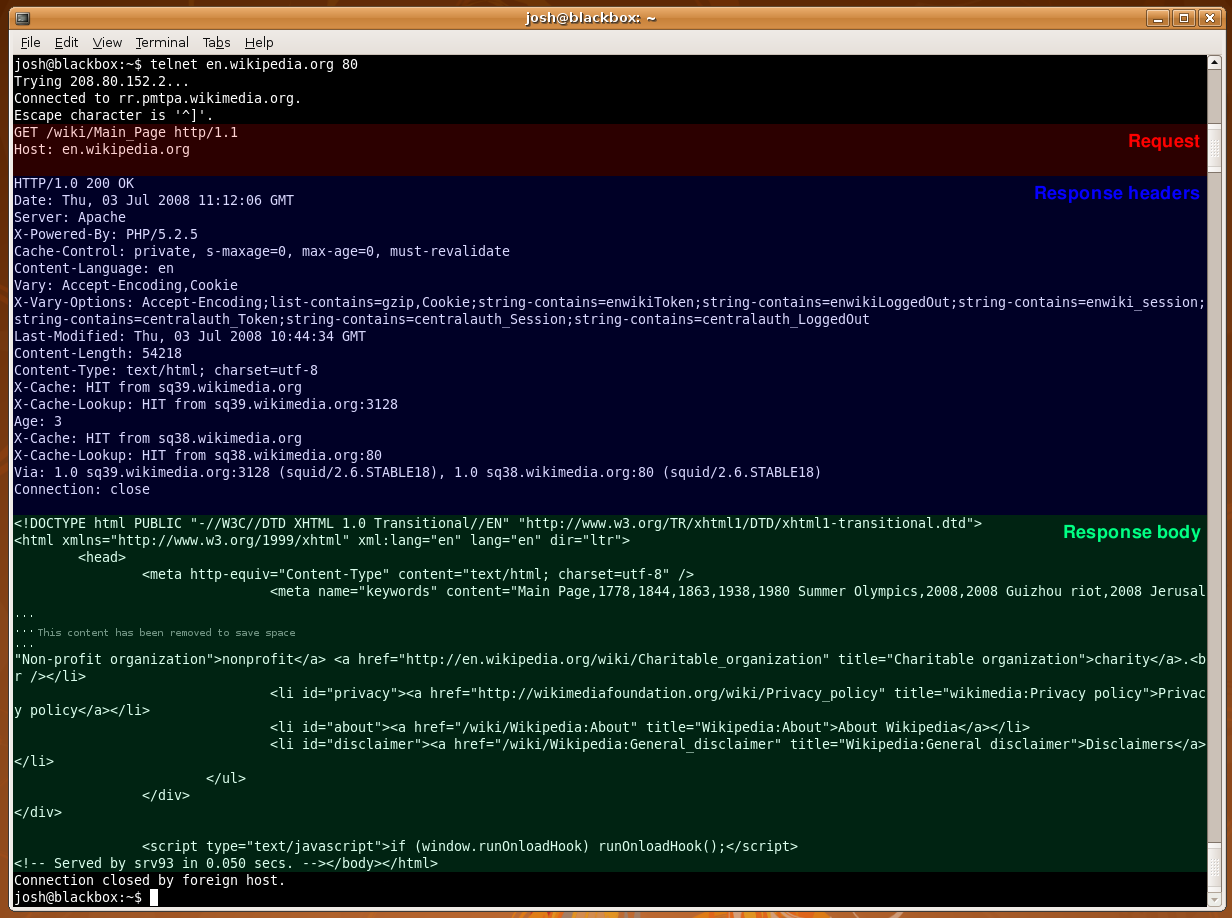
HTTP sends the headers in plain text. this header says Content-Type: text/html, so you know to render the body as html (instead of an image or whatever) https://en.wikipedia.org/wiki/File:Http_request_telnet_ubuntu.png
 fossil fiber
I see, that's actually really cool, thanks! That's exactly what I was looking for
Side note, if we're only reading the first byte, how many different objects can I differentiate? Or would I do it so maybe the first byte tells us it's it's weapon, and the second byte tells us what specific type if weapon the object is, for example..
bronze anchor
another example: DNS tells you how many of each record type you're getting. you deserialize each one in order (they're just concatenated together) https://www.catchpoint.com/blog/how-dns-works
every byte can encode 2^8 = 256 values. in 2022, I wouldn't bother using less than 4 bytes for any number @fossil fiber
fossil fiber
Wow, I really need to read up on what a byte actually is lol. I will attempt to implement this, ill share the results later, thanks again!
bronze anchor
if you use i, you get a 4 byte int (which stores 2^32 = 4 bil possible values) https://docs.python.org/3/library/struct.html#format-characters
bronze anchor
@fossil fiber ^
fossil fiber
Oh, sorry didnt see that
prisma cobalt
bronze anchor
the header is of a fixed length, so you first grab the first n bytes and unpack ...
not necessarily, you used the example of HTTP headers which are of variable length
bronze anchor
fair, but we probably don't want to deal with variable-length headers
fossil fiber
i sincerely dont lmao
prisma cobalt
lol
cloud spruce
fossil fiber
i sincerely dont lmao
the point is that you can make the fixed length header any number of bytes you want/need to describe the rest of the variable length data that follows the header, this is essentially how a lot of the network protocols work that you use every day without thinking about it
the ethernet protocol header does almost this for example
cloud spruce
 umbral cargo
is there a way to get a specific (web browser) cookie to python
umbral cargo
is there a way to get a specific (web browser) cookie to python
all cookies set for that domain and path will be delivered from the client to the server with the http request
umbral cargo
cloud spruce
all cookies set for that domain and path will be delivered from the client to th...
sorry, im pretty noob, can u explain it to me?
cloud spruce
umbral cargo
sorry, im pretty noob, can u explain it to me?
web requests that are made by the client (web browser) will send all it's stored cookies for that domain and uri path to the server (which runs your python code) with the request as part of the http request headers
umbral cargo
cloud spruce
web requests that are made by the client (web browser) will send all it's stored...
My slow brain hurts
cloud spruce
umbral cargo
My slow brain hurts
don't worry, it's new to everyone at one time
umbral cargo
cloud spruce
don't worry, it's new to everyone at one time
Well, so it's possible then?
cloud spruce
umbral cargo
Well, so it's possible then?
yes, very much so, as long as the cookie you are after is set for that domain that the server is hosted at (this is a bit simplified, there are some restrictions)
umbral cargo
cloud spruce
yes, very much so, as long as the cookie you are after is set for that domain th...
Can you help me to do it?
👉 👈
cloud spruce
umbral cargo
Can you help me to do it?
i don't think i will have time to get you all the way there, but i can give you pointers
do you have a site, a domain and/or somewhere to host that?
umbral cargo
cloud spruce
i don't think i will have time to get you all the way there, but i can give you ...
Can I MD you?
cloud spruce
umbral cargo
Can I MD you?
you take a help channel #❓|how-to-get-help for this instead and if i don't have time to walk you through it all someone else might be able to jump in and continue where i left off
after you got your self a help channel you just write which one in here
umbral cargo
cloud spruce
you take a help channel <#704250143020417084> for this instead and if i don't h...
Yeah I do that as first but nobody help and the help chat auto dormant
:(
cloud spruce
aha, lets try again and when you have one i'll join it and we can continue in there
cloud spruce
umbral cargo
Yeah I do that as first but nobody help and the help chat auto dormant
i will need to know which channel if you have taken a new channel now since the old one became dormant
umbral cargo
cloud spruce
i will need to know which channel if you have taken a new channel now since the ...
yee
im doing it rn
umbral cargo
cloud spruce
i will need to know which channel if you have taken a new channel now since the ...
 teal furnace
How to I get my flask app onto my public ip?
 thorn stratus
you need to port forward on your router
teal furnace
what are some examples
 grand salmon
I think some ISPs won't allow that for normal users anyway
cloud spruce
teal furnace
what are some examples
you would need to reconfigure your home router to port forward to the computer where you are running your code
 keen jewel
I moved into a new house and don't have wifi yet. I have unlimited data on my phone and use it as hotspot on my laptop. I would like to share the laptop connection to my PC through an ethernet cable.
I enabled network sharing on my laptop wifi adapter. Setup IPV4 on laptop ethernet adapter to IP: 192.168.0.1 Subnet: 255.255.255.0
on my PC I set ethernet adapter IPV4 settings to: IP: 192.168.0.2 Subnet 255.255.255.0 Default gateway 192.168.0.1 DNS 192.168.0.1
This worked for a day but then my PC connection got real slow while my laptops connection was still fast. Today I didn't have an internet connection on PC. Media state says enabled and it's sending/receiving bytes but it just has no internet acces.I tried uninstalling adapter/drivers, resetting network settings, /flushdns, /registerdns, /release, /renew, disabling ipv6 and some other fixes. Nothing works. Is there someone that can help me. I need internet acces on my PC desperately for school/work.
 balmy crystal
Is this related to python?
keen jewel
No
fossil fiber
keen jewel
I moved into a new house and don't have wifi yet. I have unlimited data on my ph...
I know its not python, but theres a program called Connectify that will turn your laptop into a sudo-router. You can use it to ethernet the connection to your PC. It may be slow seeing as how you are using a mobile hotspot, but I used that for a while
 cunning void
can any one pls tell me where to start
 supple quest
fossil fiber
I know its not python, but theres a program called Connectify that will turn you...
supple quest
fossil fiber
I know its not python, but theres a program called Connectify that will turn you...
im gonna give that a try as well. are there any issues with it besides speed?
fossil fiber
supple quest
im gonna give that a try as well. are there any issues with it besides speed?
The free version requires you to manually restart the connection every hour, but paying for it (its not that expensive, I think i bought mine for like 20 or 40 bucks?) removes that restriction
supple quest
fossil fiber
The free version requires you to manually restart the connection every hour, but...
oh ok, that doesn't sound to bad. I'm gonna give it a shot later.
cloud spruce
cunning void
can any one pls tell me where to start
"where to start" with what exactly?
 tired elbow
Hi. Suppose that I, as a server, have a trio.SSLStream object. How would I fetch the client certificate, or otherwise validate that the incoming connection's client certificate is signed by a CA to the domain they claim to be from? The documentation of Trio doesn't make it clear and doesn't seem to provide such an option which is critical in my program (federated server-to-server protocols).
I'm using Trio, the structured async library's socket streams.
 frozen drum
tired elbow
Hi. Suppose that I, as a server, have a `trio.SSLStream` object. How would I f...
frozen drum
tired elbow
Hi. Suppose that I, as a server, have a `trio.SSLStream` object. How would I f...
the SSL context (passed with ssl_context to SSLStream) holds information about CA certs you are using to validate client certs
if you want to use custom CA certs (such as self-signed certs) you can add them to the default CA cert folder on your system or add them to a custom context you create yourself
bronze anchor
you can also apparently just call .getpeercert()? https://github.com/python-trio/trio/blob/0c2998f642d119f23a41e52d8b018fea1e1e1c28/trio/_ssl.py#L369
errant bayBOT
trio/_ssl.py line 369
"getpeercert",```Ah, thanks 😄
 zenith sinew
Hi, I am not sure if this is the right channel but I try.
I currently develop a flask API.
I want to deploy the flask API a a docker Container.
Now I search a way to create something like a load balancer.
So, my main app should access the API via the IP but behind the IP there should be different instances of the flask API for load balancing (the Endpoints of the API did much heavy work to I want to have multiple instances for load balancing)
What should I google?
I can not find the right way
cloud spruce
zenith sinew
Hi, I am not sure if this is the right channel but I try.
I currently develop a ...
haproxy is also an option
zenith sinew
Ok thanks guys I will have a look
 azure crypt
Can apache2 put wordpress in https://localhost/blog and phpmyadmin in https://localhost/phpmyadmin ? If yes, are there any tutorial / sites for me to follow?
cloud spruce
azure crypt
Can apache2 put wordpress in https://localhost/blog and phpmyadmin in https://lo...
it can without any problems accommodat for that
however, how you do it depends on your specific setup
azure crypt
cloud spruce
it can without any problems accommodat for that
however, how you do it depends o...
Yes i am wishing for a tutorial for that specific setup, i cannot find any or i dunno what keyword this technique called
cloud spruce
azure crypt
Yes i am wishing for a tutorial for that specific setup, i cannot find any or i ...
you should be able to find tutorials on how to set each one up individually with apache
by default phpmyadmin will be configured to live under /phpmyadmin, follow any of the standard phpmyadmin on apache tutorials online and be sure to secure it
 warped hazel
Can anyone help me with a Scapy question?
cloud spruce
azure crypt
Yes i am wishing for a tutorial for that specific setup, i cannot find any or i ...
which os/distribution are you using to run everything on?
cloud spruce
warped hazel
Can anyone help me with a Scapy question?
just ask the question in the channel and see if anyone can answer it (unfortunately i'll be going afk for a while now)
warped hazel
What's the best way to check if a sniffed packet is outgoing or incoming?
cloud spruce
warped hazel
What's the best way to check if a sniffed packet is outgoing or incoming?
i don't think you can know for sure, but you can try to figure it out by looking at the mac addresses and ip addresses in the packet
 cloud spruce
azure crypt
Aws ec2 Ubuntu
cloud spruce
azure crypt
Aws ec2 Ubuntu
for phpmyadmin, this will probably work on aws as well as it's ubuntu: https://www.digitalocean.com/community/tutorials/how-to-install-and-secure-phpmyadmin-on-ubuntu-20-04
warped hazel
.decode() does trouble and str() also doesn't work
ember ledge
warped hazel
It's a print line I wrote
The whole line is a str or a byte
Or it’s in a dictionary
 ember ledge
Don’t use str in scapy
warped hazel
What's the alternative then
azure crypt
cloud spruce
for phpmyadmin, this will probably work on aws as well as it's ubuntu: https://w...
Thanks for linking the first result on google search but its not for specfic setup and now both wordpress and apache2 using port 80, I dont even know if setting apache2 port 8000 can auto redirect /phpmyadmin, reverse proxy is cloestest thing come in mind but still cannot find tutorials about it
 ember ledge
warped hazel
What's the alternative then
ember ledge
warped hazel
What's the alternative then
U can do :
v = b“domain ”+pkt[....]
Print(v.decode)
warped hazel
ember ledge
U can do :
v = b“domain ”+pkt[....]
Print(v.decode)
I'm not sure I understand what that means
Could you explain please if its not too much trouble
ember ledge
make a variable where it’s a byte So when u get a byte u add to the variable so now we have full line of bytes. Then convert it into str by decoding
#packet[DNSRR].rrname = b"google.com"
#line = b"Domain: "+packet[DNSRR].rrname
#print(line.decode())
ember ledge
use replace("b","")
warped hazel
meaning some packets I can't concatenate
ember ledge
before u have to make it a str
ember ledge
yes
l = b"Domain:"+b"google"
l = str(l)
l
"b'Domain:google'"
l.replace("b","")
"'Domain:google'"
or before u return the domain u can check if its a byte just decode there before printing it
warped hazel
 ember ledge
wait u said sometime it returns bytes and str?
warped hazel
ember ledge
wait u said sometime it returns bytes and str?
Yep..
that's the problem basically
ember ledge
try:
return data.decode()
except (UnicodeDecodeError, AttributeError):
return data
ember ledge
warped hazel
u dont need that
ember ledge
ember ledge
try:
return data.decode()
except (UnicodeDecodeError, AttributeError):
r...
just try to decode if i got a error thats mean its a string
warped hazel
It works!
I just filter out the non str responses
which are no use to me
you are amazing for helping some random guy online
thank u
ember ledge
welcome ;)
 tranquil current
azure crypt
Can apache2 put wordpress in https://localhost/blog and phpmyadmin in https://lo...
tranquil current
azure crypt
Can apache2 put wordpress in https://localhost/blog and phpmyadmin in https://lo...
Yes, you use Apache rewrite rules
It's probably easier to just use subdomains though.
cloud spruce
azure crypt
Thanks for linking the first result on google search but its not for specfic set...
it's no problem using the same port for both wordpress and phpmyadmin as they are on two different paths
you should not need any other port for this and reverse proxy and the rewrite module works but is unnecessary for what you are trying to do
cloud spruce
azure crypt
Thanks for linking the first result on google search but its not for specfic set...
it may be the first hit on google depending on what you google
it's a very long tutorial but at least it tries to secure phpmyadmin which is more then i can say about a lot of the other much shorter tutorials which i was hopping that you didn't follow
we are trying to help people here without knowing what knowledge they have or what they have tried already, so that attitude is unnecessary
ember ledge
How can I convert my Nginx website from port 80 to 443?
By convert I mean do I have to do anything in terms of Cloudflare settings, Domain, etc.?
When I tried switching it in the server block, I started getting Error 521s
cloud spruce
ember ledge
How can I convert my Nginx website from port 80 to 443?
where are you hosting your site, is it on cloudflare?
ember ledge
cloud spruce
where are you hosting your site, is it on cloudflare?
Hosting on AWS, Using cloudflare
I just installed a SSL certificate from CloudFlare on my server
cloud spruce
ember ledge
I just installed a SSL certificate from CloudFlare on my server
yeah, that's the first thing you need
cloud spruce
ember ledge
I wanna transition to Full SSL Encryption (CloudFlare setting)
unfortunately i have not used cloudflare my self, so just know some basic stuff about it

 cloud spruce
cloudflare needs to know where to reverse proxy the traffic
ember ledge
How do I set the new port then?
cloud spruce
as i haven't used cloudflare my self i don't know exactly how or where, but it has to be somewhere on in the settings at cloudflare
cloud spruce
ember ledge
Could it be in the DNS possibly?
no, DNS has nothing to do with ports
cloud spruce
ember ledge
I don't see a port option
it might just automatically assume port 443 on the remote server when you change the ssl/tls setting on cloudflare to "Full" (start with this one first) or "Full (strict)" (if you get the first one working you can move on to this one)
cloud spruce
ember ledge
Whenever I set my Nginx port to 443
have you configured your server to use the private key and the certificate with the intermediate certificates in the chain?
@ember ledge setting up nignx with ssl/tls certificates: https://www.digitalocean.com/community/tutorials/how-to-host-a-website-using-cloudflare-and-nginx-on-ubuntu-16-04
and setting things up at cloudflare: https://www.youtube.com/watch?v=MYYb9IqWIOU
ember ledge
cloud spruce
have you configured your server to use the private key and the certificate with ...
Yeah I did, I added the key and the certificate to my Nginx server block
Sadly still displaying a 521
 vagrant hamlet
Any websocket pros around?
 spare vessel
i don't see any questions about it so i don't see why there would be any
vagrant hamlet
Ha that's fair
Just struggling with a websockets issue and didn't get any bites in my help channel
spare vessel
i mean i've implemented the websocket protocol, so i know a bit about the internals, but i don't know your question
vagrant hamlet
Sorry
I'm trying to send data to several websocket clients at once, but I'm running into concurrency issues with asynchio
How do you start a server and keep it alive while also doing other tasks?
I think I need to have two tasks running, one that handles the new WS clients, and one that runs a while loop over sending data to all of them.
spare vessel
which server library are you using for the websockets? i could take a look to see if there's a nice way to do it
vagrant hamlet
Ah I just saw the #async-and-concurrency channel. Maybe that's a better fit
Just the regular 'ol "websockets" library
licence version pyversions wheel tests docs websockets is a library for building WebSocket servers and clients in Python with a focus on correctness, simplicity, robustness, and performance. Built ...
spare vessel
https://websockets.readthedocs.io/en/stable/topics/broadcast.html#
what about this mechanism here?
WebSocket servers often send the same message to all connected clients or to a subset of clients for which the message is relevant. Let’s explore options for broadcasting a message, explain the des...
handler handles WS client connections, and you can broadcast data to each client concurrently
vagrant hamlet
I'll try that, I've been hesitant to use it though, because eventually I will want to send different data to all clients
spare vessel
there's a lot of potentially relevant discourse later on in the documentation there which you could repurpose pretty easily, or at least fit into what you want
vagrant hamlet
Yes, you're right, I have prematurely written off this page, there is indeed a lot of good info here
Thank you for the help
spare vessel
nw, ping in #async-and-concurrency if there's any implementation issues
 fair kindle
 amber bobcat
```py
import websockets
import socket
```
any difference between them?
amber bobcat
```py
import websockets
import socket
```
any difference between them?
yes there is, sockets is generic and built-in
amber bobcat
okay
fair kindle
websockets are a specific protocol i think
amber bobcat
fair kindle
websockets are a specific protocol i think
which one am i supposed to learn first
fair kindle
amber bobcat
which one am i supposed to learn first
From https://stackoverflow.com/a/4973689:
Even though they achieve (in general) similar things, yes, they are really different. WebSockets typically run from browsers connecting to Application Server over a protocol similar to HTTP that runs over TCP/IP. So they are primarily for Web Applications that require a permanent connection to its server. On the other hand, plain sockets are more powerful and generic. They run over TCP/IP but they are not restricted to browsers or HTTP protocol. They could be used to implement any kind of communication.
amber bobcat
fair kindle
From <https://stackoverflow.com/a/4973689>:
> Even though they achieve (in gener...
okay so sockets then
fair kindle
yeah
amber bobcat
fair kindle
yeah
import socket

with socket.socket(socket.AF_INET, socket.SOCK_STREAM) as s:
    s.bind((HOST, PORT))
    s.listen()
    conn, addr = s.accept()
what does conn and addr do
import socket

HOST = "127.0.0.1"  # The server's hostname or IP address
PORT = 13583  # The port used by the server

with socket.socket(socket.AF_INET, socket.SOCK_STREAM) as s:
    s.connect((HOST, PORT))
    s.sendall(b"Hello, world")
    data = s.recv(1024)

print(f"Received {data!r}")
s.connect((HOST, PORT))
ConnectionRefusedError: [WinError 10061] No connection could be made because the target machine actively refused it
??
ember ledge
Host and port are the same în both files?
cloud spruce
amber bobcat
what does conn and addr do
conn is the object for the socket and addr gives you the address and port for the remote peer that connected to the server listening socket
cloud spruce
amber bobcat
```py
s.connect((HOST, PORT))
ConnectionRefusedError: [WinError 10061] No connec...
if the server is using the same ip address and port that the client is trying to connect to i would say you have a host based firewall that is blocking the connection, which is kind of rare for connections to the local host loopback interface 127.0.0.1
oh, windows... check your windows firewall settings
amber bobcat
cloud spruce
oh, windows... check your windows firewall settings
and how do i do that..
cloud spruce
amber bobcat
and how do i do that..
sorry, not really a windows person, i'm on linux desktop since basically forever
amber bobcat
okay it's fine
tired elbow
DO NOT use WebSockets when not specifically developing something for Web browsers
(I don't make and generally don't use Web applications or most of the modern Web for other reasons, but anyhow I vastly prefer native programs)
grand salmon
Do torrents create a true PvP connection between seed and leech?
if so how? does it all just boil down to the tracker giving the leech the seeder's IP and then the leech opening a socket pointed at that IP?
 cunning garden
tired elbow
*DO NOT* use WebSockets when not specifically developing something for Web brows...
cunning garden
tired elbow
*DO NOT* use WebSockets when not specifically developing something for Web brows...
why not?
That's actually useful since it's a well known protocol, firewalls and other middlewares are well aware of it and it generally works well
Note: not meaning in a way to always replace sockets
tired elbow
recursive_error: Simpler technology (i.e. not basing application protocols session protocols on top of application protocols) has much less overhead
It is understandable to have WebSockets for Web applications because after all that's all Web applications could use
Also this question has been bugging me: Why would you use programs in browsers, usually hundreds of megabytes big, when a program of a few kilobytes (in case of programs I use) or a few tens of megabytes (in case of the casual user) would suffice?
 carmine gulch
hello there
i wanted to ask, how can we block a hostname from joining or even able to send packets to our server?
cloud spruce
carmine gulch
i wanted to ask, how can we block a **hostname** from joining or even able to se...
i would use a firewall in the network if it's available otherwise a host based firewall on the server it self
if you don't have access to configure such things you can configure your server software or change your code to pick up the remote ip address of the client and refuse those connections or requests depending on what level your code is working with
cunning garden
tired elbow
recursive_error: Simpler technology (i.e. not basing application protocols sessi...
Not sure if you are referring to the hundreds of megabytes big for the browsers themselves of the javascript/html/etc.
But regardless, the benefits are that it comes down to making the deployment and updates so much easier and manageable, in addition to keeping the users captive. It also enables the consolidation of the backend (and thus mutualize some of the costs) and to deal with a level of complexity that cannot be contained to a single machine.
From a user's perspective, it provides me with a working environment, with my data, from anywhere at any time.
In the context of websockets, we could take coinbase as an example. They provide a websocket feed of the market updates.
On their side, scalability and reliability is solved with traditional tooling.
On the user side, users can use that in their frontend, or even write their own program, including python scripts, to connect and get their data. Since it's websocket, there are tons of libraries around.
cloud spruce
tired elbow
recursive_error: Simpler technology (i.e. not basing application protocols sessi...
and i'll add to what @cunning garden said by mentioning that it will most likely be less of a hassle to get the traffic through firewalls and proxies and one can easily reap the benefits of protected communications with the help of TLS which will be well implemented and supported by many different web servers and much easier to setup that way
and as to why someone would opt to use a "program" in a browser, because it doesn't require the user to install additional software on their computer, just go to a website and start using the service without much downloading, installing and setup
 tawny belfry
Hi guys, I don't even know if this is considered a "networking question" but I want to be able to run my python project on the cloud so I dont have to run it on my computer
its a super small script with a few 3rd party libraries
I looked at azure but dont even understand where to start... every tutorial I've seen seems like its answering different questions, and is way above my head at the moment
 zealous flint
tawny belfry
I looked at azure but dont even understand where to start... every tutorial I've...
zealous flint
tawny belfry
I looked at azure but dont even understand where to start... every tutorial I've...
Tutorials don't really work all that well for this. best if you refer to Azure's documentation or go exploring yourself
Once you kind of understand how it works, it becomes much easier
 barren flower
If anyone has done this plz let me know. I have a multiplayer game using sockets and it works but only if both clients are on the same local network i would like to set it up where i can give this game to anyone and they can join a party but the only way i found out is enabling (Port Forwarding) which mean everyone has to enable it which is not what i want.
cloud spruce
barren flower
If anyone has done this plz let me know. I have a multiplayer game using sockets...
create a server software for the game that everyone can reach and connect to, that way none of the clients need to setup port forwarding as they don't connect peer to peer directly
 dull lynx
barren flower
If anyone has done this plz let me know. I have a multiplayer game using sockets...
dull lynx
barren flower
If anyone has done this plz let me know. I have a multiplayer game using sockets...
So it seems like what you're doing right now is having your players setup their own individual servers and running into the issue of not all of your players network setting being configured to accept connections from the web.
One way you can fix this is bu hosting your own gameserver that all players connect to. They can create a party on your server and just share a code for others to join in
You'll have to maintain a record of all parties and players, as well as making sure that the server is up and running.
 earnest blaze
barren flower
If anyone has done this plz let me know. I have a multiplayer game using sockets...
earnest blaze
barren flower
If anyone has done this plz let me know. I have a multiplayer game using sockets...
(Port Forwarding) which mean everyone has to enable it which is not what i want.
That is not true. Port forwarding need only be configured on the network of the server.
 past spindle
Hi, I am writing a client side driver to test and interface with a device. The device requires me to start the communication service, and after the start request, it will start sending UDP datagrams every 30ms. The device can send a few types of UDP datagrams, and they are variable length with different fields. They should be parsed according to their OP Code and length encoded into the header of the message. The problem is that the offset, or location, of those header fields is not consistent between messages. Frame of Type A will have the OP code at 0x08 offset from the start, where as a frame of Type B will have the OP Code at 0x04 from that start. How should I handle this?
ember ledge
anyone know how to use sockets to monitor the changes to a website
cloud spruce
earnest blaze
> (Port Forwarding) which mean everyone has to enable it which is not what i wan...
i think @barren flower is using a peer-to-peer network where each client need to connect to every other client
i don't think there is any server software created for this game yet other then the client it self
that's why i suggested creating a server that everyone that should join the same game connects to
then only the person running the server needs to port forward if it's not running directly on a public ip address already
cloud spruce
ember ledge
anyone know how to use sockets to monitor the changes to a website
you will need to poll the website with requests at an interval and compare the response
fair kindle
tired elbow
*DO NOT* use WebSockets when not specifically developing something for Web brows...
people do this,any idea why?
 halcyon robin
Might anyone have an idea to why a text-to-voice script I wrote isn't outputting any sound to the speakers when running the script over SSH on a host computer?
I am guessing it has something to do with how when you SSH to a host, you are created a child session, and for some reason this child session does not have access to the main host computer's speakers.
 white basalt
Hello anyone here i can talk to talk about servers?
Im making a game that requires data transfer and request from a server and my team is complaining about how this things work
tired elbow
fair kindle
people do this,any idea why?
Imo abuse
cloud spruce
fair kindle
people do this,any idea why?
i would say that is @tired elbow opinion and is using "strong language" with the upper case text
i do partially agree that one would probably not be best served by using websockets outside of a browser environment in many cases and should opt for tcp or in some cases even udp sockets, unless you have specific requirements and have weighed your options carefully
reasons for using websockets outside of browser environments can be due to for example the server environment that has been chosen to develop the software on the server side
cloud spruce
halcyon robin
I am guessing it has something to do with how when you SSH to a host, you are cr...
if it's sound out of speakers connected to the remote system you are running ssh to it can still be done but it will be much more involved to get it working
cloud spruce
white basalt
Im making a game that requires data transfer and request from a server and my te...
what's the complaint/problem more specifically?
tired elbow
cloud spruce
i would say that is <@939582252482969670> opinion and is using "strong language"...
That's called BCP 14 language, but yeah
I personally prefer SCTP
white basalt
cloud spruce
what's the complaint/problem more specifically?
its complicated
i prefer to pm
cloud spruce
white basalt
i prefer to pm
i won't be able to dedicate my time like that as i'm doing other things as well
if you put it in the channel or in a help channel others can join in and help you with the problem
white basalt
ok
cloud spruce
tired elbow
That's called BCP 14 language, but yeah
I personally prefer SCTP
sure, but as you might know it is many times interpreted as raising ones voice or even screaming then chatting, especially if it's not an abbreviation of some kind
and even in BCP 14 context it's meant to strongly or even forcefully convey ones intention/meaning and remove any ambiguity
SCTP is a nice protocol 👍
but can sometimes be hard to traverse firewalls with in more hostile network environments or if one needs to go through a proxy which might only allow proper http on port 80 and the connect method and proper TLS on port 443
on the other hand it can in other environments be easier to bypass the firewall with since the person configuring the firewall might have "forgotten" about the fact that there are other protocols on-top of IP then just TCP, UDP and ICMP 🤦 😄
tired elbow
Yeah, those are sad, but they are also uncommon
Also, there's SCTP-over-TCP
The main problem with SCTP isn't with routers; rather it's with NATs
tired elbow
s/TCP/UDP/
cloud spruce
 muted cobalt
what should we do when we have slow internet?
muted cobalt
what should we do when we have slow internet?
that is really a broad question with too little context, i think you need to be more specific
 fluid basin
Should I be running NGINX inside or outside of a docker container?
ember ledge
muted cobalt
what should we do when we have slow internet?
If it’s cellular internet, u can turn off backgrounds apps (that ur not using ).
it will help a little, about speed and also saving data
zealous flint
halcyon robin
Might anyone have an idea to why a text-to-voice script I wrote isn't outputting...
SSH doesn’t support audio unfortunately
 frank hull
I'm trying to establish a connection between 2 programs of mine who act as a client and a server.
However, the connection shortly ends after being established. Any help?
**Code is in #help-peanut **
 zealous flint
Is there an E) all of the above 
 grim sonnet
zealous flint
Is there an E) all of the above <:pithink:652247559909277706>
grim sonnet
zealous flint
Is there an E) all of the above <:pithink:652247559909277706>
sadly
no
cloud spruce
grim sonnet
i wouldn't exactly say that d) is correct as it's not "the internet" as such that does the exchanging, it's clients and servers that does that, the internet just facilities the transfer of information between those, but now i'm being picky
cloud spruce
grim sonnet
the other three are true but due to confirmation bias in both search engines and social media platform I would say even if c) is true in theory, in practice it's mostly the other way around, you go deeper and deeper in to the same rabbit hole as what you usually search for and click on
 latent drum
hi guys. i'm writing a user guide for a company. the company i chose is smal and sell energi drinks or juice. so the question is, what kind of computers should they use. pc, mac or something else. anyone has some advice? 🙂
cloud spruce
latent drum
hi guys. i'm writing a user guide for a company. the company i chose is smal and...
i don't think the #networks channel on this Python server probably isn't the right place for this question
but I would say it depends on budget (mac is expensive) and what proficiency the employees of the company has with the different operating systems
also, if the computers will be in a customer environment there might exist a consideration about what image the company project towards customers, depending on the demographic the company is targeting with its products
latent drum
cloud spruce
i don't think the <#716325106619777044> channel on this Python server probably i...
i'm discussing in python channel.:)
 latent drum
cloud spruce
i don't think the <#716325106619777044> channel on this Python server probably i...
latent drum
cloud spruce
i don't think the <#716325106619777044> channel on this Python server probably i...
i decided now that the company would have windows 11. . the operating system is microsoft 365,and i wrote about how to install it
the company is small. i have no idea how it works at the company . i haven't been there before.lol. but my teacher said that the company would open as new, and the workers do not know much about tech. cuz there was a question about how to install app programs
cloud spruce
latent drum
i decided now that the company would have windows 11. . the operating system is ...
i think that makes perfect sense
cheaper than mac, and it's easy to find people that can both use and service an windows environment
just to clarify, it's windows 11 that is the operating system, not Microsoft 365, the latter is the office suite of programs
cloud spruce
 undone sky
Is that original or fake?
undone sky
Is that original or fake?
impossible to say from just a picture like that, and 802.11g looks like really old tech
latent drum
cloud spruce
i think that makes perfect sense
cheaper than mac, and it's easy to find people ...
nice, one more question.
what network do the company need? i suggested LAN. but waht do u think is better, connecting it wired or wireless? and what do they need to connect it?
cloud spruce
latent drum
nice, one more question.
what network do the company need? i suggested LAN. but...
to keep cost down I would suggest wifi, especially if they are going to use laptops
installing a lot of ethernet cable infrastructure can cost quite a lot and you would need to pre-plan the layout of the space and how many plugs should go where and its quite static
cloud spruce
latent drum
nice, one more question.
what network do the company need? i suggested LAN. but...
what kind of space is this, office or store?
latent drum
i guess i don't need to think of the cost. cuz it is not real, but we need to write something about the network suggested for them. this is the question from the teacher(
What network will you set up for them - which one is ideal
)
latent drum
cloud spruce
what kind of space is this, office or store?
store i guess
cloud spruce
latent drum
store i guess
if it's a store there might not be a lot of computers and maybe not even laptops if there is fixed positions for the computers, then cable might make more sense
undone sky
cloud spruce
impossible to say from just a picture like that, and 802.11g looks like really o...
What do you recommend for me,
Also im thinking to buy the tp-link one
cloud spruce
undone sky
What do you recommend for me,
Also im thinking to buy the tp-link one
depends on what you are going to use it for and what your requirements are
latent drum
cloud spruce
if it's a store there might not be a lot of computers and maybe not even laptops...
how does it seem for the office?
undone sky
cloud spruce
depends on what you are going to use it for and what your requirements are
Packet injection, monitor mode
prisma cobalt
🤔 all for "educational" or pen-testing purposes ofc?
ember ledge
Hello, does the socket library creates a server from scratch or does it just binds to server like a WSGI?
cloud spruce
undone sky
Packet injection, monitor mode
aha, that explains the choice of older tech such as 802.11g hardware
it's hard to find cutting edge or even current gen hardware that has drivers that can do that
some "alfa" stuff is good for that, depending on the chipset used
but that is as far as i will go on this subject because of:
!rule 5
errant bayBOT
5. Do not provide or request help on projects that may break laws, breach terms of services, or are malicious or inappropriate.
cloud spruce
ember ledge
Hello, does the socket library creates a server from scratch or does it just bin...
you would create client or server software from scratch with the socket library
 fading trellis
Hi everyone,
Currently I'm trying to install a Cloudflare SSL certificate on my server. I am following the DigitalOcean guide on how to do so, but once I successfully install the certificate as per Digital Ocean's instructions, my website stops working.
This is the output of sudo systemctl status nginx:

This is my Nginx configuration:```nginx
server {
listen 80;
listen [::]:80;
server_name api.website.com;
return 302 https://$server_name$request_uri;
}
server {
listen 443 ssl http2;
listen [::]:443 ssl http2;
ssl_certificate /etc/ssl/certs/cert.pem;
ssl_certificate_key /etc/ssl/certs/key.pem;

server_name api.website.com;

location / {
    proxy_pass http://localhost:8000;
}
}```
I am using a proxy_pass because I have a FastAPI API running locally on the machine.
Any ideas why my setup is not working? When I switch back to non-SSL and using port 80, it works fine.
fading trellis
Please @ me if you respond.
 frosty idol
I’m attempting to send data collected by a python script to a chrome browser on another computer (both on same network) via WebSockets but when trying to establish a connection on the browser via JavaScript I get “WebSocket connection to x failed”
Scoured the Internet for a solution but no dice, was looking at other alternatives to WebSockets but again having trouble finding
cloud spruce
frosty idol
I’m attempting to send data collected by a python script to a chrome browser on ...
we need a little bit more information on what you have tried on the python side of things, not the collection parts, the "send data to a chrome browser" part is probably enough
what are you using there, i.e fastapi or the websockets library directly?
ember ledge
Hello, about https and ssl certificates, does someone know where the certificate is located in the response? In the header? In the payload?
Like how does the client actually know this is https, instead of just http?
cloud spruce
ember ledge
Hello, about https and ssl certificates, does someone know where the certificate...
TLS/SSL does not live on-top of or inside the http protocol, the http protocol is running on-top of the TLS (what used to be named SSL back in the days) protocol (check out the OSI model)
the certificate is exchanged in a handshake that happens when the client connects to the server right after the TCP handshake has completed
after the client and server has completed first the TCP handshake and then TLS handshake the client can start issuing HTTP requests
fading trellis
I apologize, as this is not inherently a Python question. I just thought I'd ask here because of how good the help is here.
Currently I'm trying to install a Cloudflare SSL certificate on my Ubuntu server that uses Nginx. I am following a guide on how to do so, but once I successfully install the certificate as per the instructions, my host seems to stop working and Cloudflare shows an Error 522 when visiting my domain.
My Nginx Configuration: ```nginx
ubuntu:/etc/nginx/sites-available$ cat ascend.so
server {
listen 80;
listen [::]:80;
listen 443 ssl http2;
listen [::]:443 ssl http2;
server_name  ascend.so;
root   /var/www/html/ascend.so;
index  index.html;

ssl_certificate /etc/ssl/certs/cloudflare_ascend.so.pem;
ssl_certificate_key /etc/ssl/private/cloudflare_key_ascend.so.pem;
ssl_client_certificate /etc/ssl/certs/origin-pull-ca.pem;
ssl_verify_client on;

client_max_body_size 100M;

autoindex off;

location / {
    try_files $uri $uri/ =404;
}
}```
$ cat /var/log/nginx shows this:
2022/05/20 13:30:49 [error] 9267#9267: *113 rewrite or internal redirection cycle while internally redirecting to "/index.php", client: 45.9.135.234, server: ascend.so, request: "GET /phpMyAdmin-5/index.php?lang=en HTTP/1.1", host: "3.15.150.145"
2022/05/20 13:30:49 [error] 9267#9267: *114 rewrite or internal redirection cycle while internally redirecting to "/index.php", client: 45.9.135.234, server: ascend.so, request: "GET /phpmyadmin2017/index.php?lang=en HTTP/1.1", host: "3.15.150.145"
2022/05/20 13:30:49 [error] 9267#9267: *115 rewrite or internal redirection cycle while internally redirecting to "/index.php", client: 45.9.135.234, server: ascend.so, request: "GET /phpMyAdmin-5.1.1/index.php?lang=en HTTP/1.1", host: "3.15.150.145"
2022/05/20 13:30:49 [error] 9267#9267: *116 rewrite or internal redirection cycle while internally redirecting to "/index.php", client: 45.9.135.234, server: ascend.so, request: "GET /phpMyAdmin-5.1.0/index.php?lang=en HTTP/1.1", host: "3.15.150.145"
2022/05/20 13:30:50 [error] 9267#9267: *117 rewrite or internal redirection cycle while internally redirecting to "/index.php", client: 45.9.135.234, server: ascend.so, request: "GET /phppma/index.php?lang=en HTTP/1.1", host: "3.15.150.145"
2022/05/20 13:30:50 [error] 9267#9267: *118 rewrite or internal redirection cycle while internally redirecting to "/index.php", client: 45.9.135.234, server: ascend.so, request: "GET /phpMyAdmin-4.9.7/index.php?lang=en HTTP/1.1", host: "3.15.150.145"
That's very weird since I'm not even using PHP.
ember ledge
cloud spruce
TLS/SSL does not live on-top of or inside the http protocol, the http protocol i...
I see, so tsl/ssl is a protocal of the presentation layer in OSI model. So should the client build ssl/tsl request in the packet each time the client makes a request to the server? Or the server automatically nest the layer in the packets?
cloud spruce
fading trellis
`$ cat /var/log/nginx` shows this:
```2022/05/20 13:30:48 [error] 9267#9267: *11...
do you know what this client with 45.9.135.234 (the ip range is registered to Cable World in Spain) is?
otherwise it might be something that's just randomly probing the internet for vulnerable setups
fading trellis
cloud spruce
do you know what this client with `45.9.135.234` (the ip range is registered to ...
I think it might be some random thing, I've never even used that.
As for the other issues, do you have an idea?
cloud spruce
ember ledge
I see, so tsl/ssl is a protocal of the presentation layer in OSI model. So shoul...
kind of, TLS stands for Transport Layer Security but really has a bad fit within the OSI model
my point was more that it's HTTP which lives on the application layer is wrapped inside TLS which in turn is wrapped in TCP and so on
and the certificate exchange will happen before any HTTP stuff and the HTTP stack don't even have to know or bother with if it's wrapped directly in TCP or has TLS sitting in-between it self and TCP, for the HTTP traffic it will be all the same
if it was a path it would probably look something like Ethernet/IP/TCP/TLS/HTTP
ember ledge
cloud spruce
kind of, TLS stands for Transport Layer Security but really has a bad fit within...
Ok, got it, thanks.
I just wanted to know if the client/common user/browser actually requests the certificate, or everything happens on server+authority, and then client/browser reinterprets the recv http as http(s).
cloud spruce
ember ledge
Ok, got it, thanks.
I just wanted to know if the client/common user/browser actu...
the client/browser need to implement TLS and the certificate is sent to the client by the server as part of the TLS handshake and the client has to validate the certificate
but this all happens before and totally independent of HTTP, there is no special HTTP request for that or anything, you can run other protocols then HTTP on-top of TLS
https is just the combination of HTTP over TLS
cloud spruce
fading trellis
I apologize, as this is not inherently a Python question. I just thought I'd ask...
i see that you are doing mTLS there with client side certificate verification
i guess that is to make sure that only CloudFlare can connect to port 443 on that server
ember ledge
cloud spruce
the client/browser need to implement TLS and the certificate is sent to the clie...
So the client/standard browser (chrome, safari, firefox) add a TLS protocol nested bewteen TCP/HTTP, for every single request, by default?
cloud spruce
ember ledge
So the client/standard browser (chrome, safari, firefox) add a TLS protocol nest...
not for every request, but for every TCP connection between the client and the server
then the client can often reuse that connection for many http requests
ember ledge
cloud spruce
not for every request, but for every TCP connection between the client and the s...
Ok, so when tcp connexion has been established between client and server; and ssl/tsl handshake made, then the proof of handshake/security would be somewhat stored in client's session until connexion closed
frosty idol
cloud spruce
we need a little bit more information on what you have tried on the python side ...
Here are a few examples to get you started quickly with websockets. Say “Hello world!”: Here’s a WebSocket server. It receives a name from the client, sends a greeting, and closes the connection. s...
cloud spruce
ember ledge
Ok, so when tcp connexion has been established between client and server; and ss...
yeah basically, i guess that is one way to describe it
ember ledge
cloud spruce
yeah basically, i guess that is one way to describe it
Thank you
fading trellis
Does anyone have any experience with an AWS Lightsail instance not connecting?
I can no longer SSH into it. I have a feeling it might be ufw?
 rain cipher
Hey, I am trying to scrape from a site which requires "validation_id". I have this id, but im stuck at how I need to post that in my header? any help very much welcome ( sorry if wrong channel)
 scenic vortex
Why does a short TTL help DNS load balancing? I thought it would just mean that the entries update faster but how does that affect the load?
would it not be the same quantity just with more up to date IP addresses (more or less)
it seems obvious/logical but theres a step missing in my head
cloud spruce
scenic vortex
Why does a short TTL help DNS load balancing? I thought it would just mean that ...
with a shorter TTL you get the agility to move the ip addresses faster to rebalance the load or act upon failures quicker because the DNS entries will not be cached in DNS resolvers along the way for as long
cloud spruce
scenic vortex
would it not be the same quantity just with more up to date IP addresses (more o...
correct, i see no other benefit to a short TTL than what i just wrote above, which seem to be along the lines that you are already thinking
are someone or some text telling you otherwise but without explaining why they say so?
scenic vortex
cloud spruce
with a shorter TTL you get the agility to move the ip addresses faster to rebala...
Thank you, I’m not sure if Im taking it too literally but why does this aid load rebalancing if if is simply updating addresses rather than redistributing them between servers?

(sorry for the terrible drawing art is certainly not a strong poinr XD)
The old entries are updated faster that makes sense but if its the same number of entries (green stars), which are being "replaced" with the updated entries (blue stars) then how does this affect load balancing - i kinda am reasoning it as the same number overall
I think I have missed a logical step or have not got a correct understanding of DNS load balancing
cloud spruce
scenic vortex
I think I have missed a logical step or have not got a correct understanding of ...
before you go in to DNS load balancing, do you have a deep understanding of how the DNS protocol works?
scenic vortex
i hope so but if you have time to go over it then please do, then I can check my understanding
I understand how DNS resolves domains to IPs if thats what you mean, if not then no
and i assume load balancing is just the same as general server load balancing
cloud spruce
scenic vortex
i hope so but if you have time to go over it then please do, then I can check my...
going into how DNS works in depth will take way to long to write here, but maybe i can skim it a bit
scenic vortex
scenic vortex
I understand how DNS resolves domains to IPs if thats what you mean, if not then...
^
cloud spruce
a client want to look up a name, lets say a client wants to look up www.google.com
the client will typically use the stub DNS resolver built in to the OS to request that information
the OS has the IP address configured to one or more DNS resolvers that it will send such requests to, it doesn't do the heavy lifting it self
scenic vortex
yep
cloud spruce
the DNS resolver will look in it's cache to see if it can find an A or CNAME record for that name, if not, it needs to look it up
to look it up it will start to see if it has a cache entry for one or more NS records for an authoritative name server for the domain google.com to ask for such a record
scenic vortex
yep
cloud spruce
if not, it needs too look that up first, and it will check for a NS record for com to ask
if it doesn't have such a record it will look in it's root hints file to find the root domain servers to ask them about an NS record for com
scenic vortex
i learnt as like browser -> root dns -> TLD -> domain nameserver -> ip adress sent back to broswer
(theoretically all the above may not be necessary)
cloud spruce
once it gets an answer it will cache it for the number of seconds that the TTL says it can cache such an entry
scenic vortex
okay does that vary by server or by entry
cloud spruce
scenic vortex
i learnt as like browser -> root dns -> TLD -> domain nameserver -> ip adress se...
nope, that's not how it works
cloud spruce
scenic vortex
okay does that vary by server or by entry
it can varies by entry, but many times it's set for the whole zone and then you can override some entries with longer or shorter TTLs
every resolving DNS server has something called "root hints" which is a list of hostnames and ip addresses for the global root servers
each entry is typically an ip address that is not for a server but instead an anycast address that will be load balanced between many servers spread over a big area and many different data centers and ISP:s to create high availability of these servers
anycast is a whole subject by it self and is a very powerful tool to spread load from clients around the world and achieve high availability for the service, but for right now i'll leave it at that
scenic vortex
thats okay, thank you
cloud spruce
scenic vortex
your above explanation makes sense
what OS are you running?
scenic vortex
(I will make a note of it and look into it)
i use several machines they run windows & linux
traceroute dns?
cloud spruce
any unix/linux like environment where you have the dig command will do if you want to follow along with commands
cloud spruce
lets say you where a DNS resolver that a client has configured as it's DNS server, you would have a list stored on the server, the content of that list would look something like what you get if you run
dig +noall +additional @a.root-servers.net . NS
scenic vortex
that is very cool thank you
cloud spruce
the DNS resolver server would use one of the IP address from that list and ask it for the a NS record (the DNS servers) for the .com domain, you would such a list if you issue the command
dig @a.root-servers.net com NS
cloud spruce
using that list it would pick one of those entries that contains the authoritative DNS servers for the .com domain to find out about the authoritative DNS servers for the google.com domain
dig @a.gtld-servers.net google.com NS
scenic vortex
okay I see
cloud spruce
the second column is the TTL, the maximum number of seconds that the DNS resolver may cache the entry for
scenic vortex
oh okay and they are consistent (in the list) since they are the same zone?
cloud spruce
that is how it usually looks but they can be different, but typically they will be the same within one zone
dig is a tool from the bind DNS server software package
the output of dig almost the same as the zone configuration file could look for bind (and many other DNS servers as well)
the resolver server would do this walk all the way until it either has NS entry that matches the domain it is trying to look up or until it gets a negative answer
so we'll do dig @ns1.google.com www.google.com NS
and we have our negative answer, because there is no DNS server for www.google.com, but there could be
cloud spruce
now that we know that www.google.com doesn't have it's own authoritative DNS we will query the last authoritative DNS that we got about an A or CNAME record for www.google.com
dig @ns1.google.com www.google.com CNAME will be negative
but dig @ns1.google.com www.google.com A will give you a positive answer
you'll also see that they have decided to give this A record a lifetime of only 5 minutes (300 seconds)
now the DNS resolver server can reply back to the DNS stub resolver of the OS that was forwarding its DNS request to the resolver server
and the resolver server will typically be caching all those answers to reuse all or parts of that information the next time it needs to do lookups until each entry expires
the OS will let the browser know which IP address to connect to to reach the web server for www.google.com
the whole DNS infrastructure and the domains can be seen as a tree structure
scenic vortex
all in a few seconds as well that's pretty cool
further down tree = more precision?
i will google an image
cloud spruce
probably within one digit or low two digit number of milliseconds even
cloud spruce
not more precision, at the root you are as far from your final destination as you can and then you come closer and closer to your destination
cloud spruce
that's fine, you can see it as an upside down tree too, that doesn't matter much but you work your way from the trunk out further and further out the branches
scenic vortex
yes getting bit by bit to the actual place you want
cloud spruce
i need to go afk for about 30 minutes, then i'll be back
cloud spruce
scenic vortex
yes getting bit by bit to the actual place you want
exactly and the client computer doesn't even have to do this work
scenic vortex
the walkthrough with commands helped a lot it's much better to see something real rather than theoretical speculation
thank you
cloud spruce
@scenic vortex now i'm back again
scenic vortex
hello
cloud spruce
scenic vortex
the walkthrough with commands helped a lot it's much better to see something rea...
at the same time you learn how to troubleshoot DNS problems by walking the tree by hand
as you could see when running the dig command the hostname or ip address after @ sign is the server you ask and then you specify the DNS name that you are going to ask about and then you may also include the record type that you want to ask about
and as you saw you got multiple answers for some queries and single records for others
when you get more then one record it's typicly refereed to as a RRset (a set of multiple Resource Records) and you can pick any one (or even several) of them for your next operation
the responding server usually will shuffle the order of the records around when sending them just in case it is sending it to a dumb receiver that always picks the first or last record to spread the load, but the receiver should pick any and not just the first or last one, so it's just a precaution
here you have the first example of load balancing in DNS, to spread the load among DNS servers for NS records and between other servers for other types of DNS records
but this way the DNS server doesn't really have any control as to which record will be used
an authoritative DNS server that is handing out the leaf node records such as A records and CNAME records can decide to give out different answers to different requests
this still isn't very granular as the requester is probably a DNS resolve server that is serving many clients and will cache the answer and then just serve that same answer to all it's clients for the duration of the TTL without asking the authoritative DNS server again until the record expires
@scenic vortex remember that i'm skimming through this here, the resolver server is actually doing even more steps when walking the tree that those dig commands hiding
cloud spruce
remember when we asked the root servers that we already know about from the "hints" file?
scenic vortex
yes
cloud spruce
the request and answer would rather look more like this the following dig +noall +auth @a.root-servers.net com NS
scenic vortex
(btw just realised will have to go in 10 mins wasnt keeping track of time ;-;)
cloud spruce
you notice that you are not getting any ip addresses for the DNS servers for those requests?
it will have have to look them up too in the same manner before it can proceed unless it receives something called "glue records" (bonus answers that it didn't ask for but that are related) in the additional section of the answer
okay, anyways we have just started to touch upon the load balancing part of the story
but this is basically what is happening every time a browser, your python script or other program want to look up a hostname to get the ip address of where it should connect
scenic vortex
thats awesome
cloud spruce
i think you can also begin to see how using DNS for load balancing servers is a pretty coarse and blunt tool, but it's still useful if you use it in the right way
typically you use it on a high level and then you use other types of load balancing where you have more control closer to the servers
scenic vortex
yes
cloud spruce
so you might use DNS to load balance traffic between IP addresses that is handled by other types of load balancers to spread the load between them
like a load balancing for the load balancers or to direct traffic from one part of the network or the world towards what the DNS load balancer believes to be the closest server farm to the requester, which will typically not be the client it self but instead the DNS resolver server that the client is using
if you don't have any load balancer you can use DNS as a poor mans load balancer by just sending out multiple records so that the clients will spread the load amongst all of those servers that the records are pointing at, but without much control over the process
scenic vortex
I am afraid I g2g, thank you very much for all your guidance and teaching @cloud spruce it was brilliant
(i will be able to read anything when I log back onto discord tomorrow if there is anything you recommend I should look up)
cloud spruce
scenic vortex
I am afraid I g2g, thank you very much for all your guidance and teaching <@9367...
well, hope you got anything out of it 🙂
see you around 👋
scenic vortex
thank you for your time it has been extremely helpful
cloud spruce
scenic vortex
thank you for your time it has been extremely helpful
your welcome 🙂
 pastel oriole
Hi anyone have experiance using Flask-user library?
cloud spruce
pastel oriole
Hi anyone have experiance using Flask-user library?
you'll find lots of people that knows Flask and it's related libraries in #web-development
pastel oriole
cloud spruce
you'll find lots of people that knows Flask and it's related libraries in <#3666...
I did ask.. But no one replied.. I hope someone will reply
 novel junco
Does anyone have a good list of proxies?
 wispy jackal
Hey network peeps,
I just released a new library, CIDR-Bottle: https://pypi.org/project/cidr-bottle/
CIDR-Bottle is yet another implementation of a Patricia Trie for handling network routing information (such as ROAs & Routing Tables) for reconciliation.
However, unlike other implementations it supports both sub-tree checking and longest-prefix matching.
I know there are others out there, but they were either missing features, or just weren't pythonic, so I wrote my own.
I would love some feedback (hopefully either positive, or at least constructive).

PyPI
CIDR-Bottle is yet another Patricia Trie implmentation, however this one is specifically designed for parsing and validating CIDRS in routing tables and ROAs.
 sweet karma
hey, i am kinda stuck 
how do i use rcon to send and request commands, i am getting timeouted always

 cloud spruce
sweet karma
cloud spruce
sweet karma
!code instead of screenshots of code please
errant bayBOT
Here's how to format Python code on Discord:
```py
print('Hello world!')
```
These are backticks, not quotes. Check this out if you can't find the backtick key.
cloud spruce
sweet karma
hey, i am kinda stuck <:lemon_angrysad:817323592693841961>
how do i use rcon to...
and are you running the game server on the same computer?
frozen drum
wispy jackal
Hey network peeps,
I just released a new library, CIDR-Bottle: https://pypi.or...
what's with the bottle/drinking naming? is it a reference to something?
cloud spruce
frozen drum
what's with the bottle/drinking naming? is it a reference to something?
probably just a joke since CIDR almost spells and sounds like cider
 sweet karma
cloud spruce
and are you running the game server on the same computer?
sweet karma
cloud spruce
and are you running the game server on the same computer?
yes
from rcon.source import Client


def main():
    with Client('127.0.0.1', 25575, passwd='test123') as client:
        response = client.run('listplayers')
        print(response)


if __name__ == "__main__":
    main()
error:
rcon.exceptions.SessionTimeout```i try to send the rcon command to my local gameserver
cloud spruce
sweet karma
i try to send the rcon command to my local gameserver
what os is it running on?
sweet karma
cloud spruce
what os is it running on?
windows 10
cloud spruce
sweet karma
windows 10
have you changed the port for your server?
By default, SRCDS listens for RCON connections on TCP port 27015.
can you run the following in powershell and make the window a bit wider before running the command to show that something is really running on that port?
Get-NetTCPConnection -State Listen -LocalPort 25575
can you paste the output of that command in here?
sweet karma
cloud spruce
have you changed the port for your server?
> By default, SRCDS listens for RCON ...
doesnt work says check request arguments
@cloud spruce
 cloud spruce
sweet karma
doesnt work says check request arguments
cloud spruce
sweet karma
doesnt work says check request arguments
oh, theirs your problem then, nothing is listening to that port, so that's not what your game server is listening on or it's not currently running
if you instead run the same command but without -LocalPort 25575 you will get a list of all the ports that has something listening on them
the error messages are really crappy though, it should instead say what is actually wrong or give an empty list as output, but no not microsoft...
sweet karma
cloud spruce
oh, theirs your problem then, nothing is listening to that port, so that's not w...
alright i got a list and now ?
@cloud spruce
port now open

still error: rcon.exceptions.SessionTimeout
cloud spruce
sweet karma
<@936769916072259654>
port now open
did you start the server?
cloud spruce
sweet karma
or need restart?
don't think so, it's running now according to the output in powershell
now it's probably your windows firewall that is in the way
cloud spruce
sweet karma
i opend port for incoming and outcoming on my windows firewall
incoming tcp on that port is what you want to open for
should be enough
sweet karma
cloud spruce
incoming tcp on that port is what you want to open for
should be enough
it is
server and python file are local
cloud spruce
sweet karma
server and python file are local
and your not running python in any virtualization such as wsl/wsl2 ?
sweet karma
cloud spruce
and your not running python in any virtualization such as wsl/wsl2 ?
idk tbh i use standard of this
 cloud spruce
sweet karma
idk tbh i use standard of this
cloud spruce
sweet karma
idk tbh i use standard of this
you're probably okay then
sweet karma
@cloud spruce i check logs now it sends to console hello, but it gives timeout error
and cant request data to print user list etc
rcon.exceptions.SessionTimeout
 meager nebula
If I have a API request that requires a machine learning model to run (1.5 minutes), should I respond with 200, store the job in a database and then process the request after that? And in the frontend, I just query ID to see the job status in the DB?
cloud spruce
sweet karma
<@936769916072259654> i check logs now it sends to console hello, but it gives t...
if you run that powershell command again and look at the numbers under OwningProcess and run this command with those numbers at the end instead of numbers_here
Get-Process -Id numbers_here
this?

gives error
ah wait
@cloud spruce what now sir?
 cloud spruce
sweet karma
<@936769916072259654> what now sir?
cloud spruce
sweet karma
<@936769916072259654> what now sir?
you see the name at the end there, is that the name of the server program that you expect to be connecting to?
sweet karma
yes thats the server
cloud spruce
sweet karma
gives error
yes, the numbers has changed since you restarted the server process
but looks like you figured that one out already 🙂
sweet karma
yes
cloud spruce
sweet karma
yes
hold on, i'm looking up things as i'm not used to windows, i'm on linux since more or less forever
sweet karma
cloud spruce
hold on, i'm looking up things as i'm not used to windows, i'm on linux since mo...
alright thank you very much!
cloud spruce
sweet karma
alright thank you very much!
in powershell, try:
Test-NetConnection 127.0.0.1 -Port 25575
 cloud spruce
sweet karma
cloud spruce
sweet karma
looks like your firewall is giving you trouble still
cloud spruce
sweet karma
i also updated the command above to say 127.0.0.1 instead of localhost so that it does the same thing as your program and doesn't try IPv6 (the ::1 that you see in the output)
cloud spruce
meager nebula
If I have a API request that requires a machine learning model to run (1.5 minut...
could be one way, the people in #web-development or #async-and-concurrency might have ideas on how to run a long running process under the framework that you are using
sweet karma
cloud spruce
i also updated the command above to say `127.0.0.1` instead of `localhost` so th...
 cloud spruce
sweet karma
cloud spruce
sweet karma
what happens now if you try to run your python code?
sweet karma
same
rcon.exceptions.SessionTimeout
@cloud spruce
server sees the rcon request btw
 cloud spruce
sweet karma
server sees the rcon request btw
cloud spruce
sweet karma
server sees the rcon request btw
that is defensively a step in the right direction 👍
does it say the same in the log if you change the password in your code to something that you know is wrong or does it say something else or nothing then?
sweet karma
cloud spruce
that is defensively a step in the right direction 👍
does it say the same in th...
rcon.exceptions.WrongPassword
in code

@cloud spruce
cloud spruce
sweet karma
rcon.exceptions.WrongPassword
good, then we know a 100% that the password that you where using was the correct one, you can change it back again
is the command listplayers the right command?
sweet karma
cloud spruce
good, then we know a 100% that the password that you where using was the correct...
still same
yeah it is


@cloud spruce
cloud spruce
sweet karma
still same
strange, because you get some warning in the server log
at least we know the server now gets the connection and the command
so that much is at least working now
sweet karma
cloud spruce
strange, because you get some warning in the server log
at least we know the ser...
yeah, do u think we can get it fixed?
cloud spruce
sweet karma
yeah, do u think we can get it fixed?
there must be something wrong with either the game server software or with the code, since we now know that the connectivity works
past spindle
Hi I have a very basic networking question. I have a server that is sending me UDP packets from address 10.0.0.10, port 2000, to my machine at 10.0.0.101, port 54874. I am trying to receive those packets using a python script. Do I create a socket and bind to the remote machines address and port? Or do I bind to the local machines ip and port?
I have tried both, and am still failing to receive the appropriate packets. As its UDP, do I need to set my receive buffer to the exact length of the message?
sweet karma
cloud spruce
there must be something wrong with either the game server software or with the c...
on their docs

    try:
        with Client('127.0.0.1', 5000, timeout=1.5) as client:
            with Client('138.201.62.108', 27216, passwd='prastacruc') as client:
                response = client.run('listplayers')
                print(response)
    except socket.timeout as timeout:
print(' >> timeout')```i did this
and got timeout

@cloud spruce ideas?
cloud spruce
sweet karma
```py
try:
with Client('127.0.0.1', 5000, timeout=1.5) as client:
...
this doesn't look like it makes any sense
        with Client('127.0.0.1', 5000, timeout=1.5) as client:
            with Client('138.201.62.108', 27216, passwd='prastacruc') as client:
your trying to connect to two different servers
one on you localhost 127.0.0.1 and TCP port 5000 where you don't have a game server running and without any password, this will of course fail with a timeout
if it had not failed you would have connected to the remote system with ip address 138.201.62.108 and TCP port 27216 with a password and overwriting the variable client that was set previously, but that will not happen since the previous connection attempt fails and the code never reaches this point
i think you're looking for something like this:
    try:
        with Client('138.201.62.108', 27216, passwd='prastacruc', timeout=1.5) as client:
            response = client.run('listplayers')
            print(response)
    except socket.timeout as timeout:
        print(' >> timeout')
if that is the right ip address, tcp port and password
then you probably want to change your password as well
sweet karma
@cloud spruce hey bud i use mcrcon as module now that works instantly without errors
rcon is kinda bugged ig
cloud spruce
sweet karma
<@936769916072259654> hey bud i use mcrcon as module now that works instantly wi...
good to hear that it's working out for you now 👍 🙂
sweet karma
@cloud spruce thanks for helping tho!
 umbral yacht
i'm trying to use asyncio's network sockets to implement an already-documented protocol, i have about 80% of the initial handshake (identify as client and authenticate) working, but for some reason after a certain stage my socket Reader starts reading data that doesn't show up anywhere in Wireshark (searched for the bytes Python's receiving, no matches), where would I even start with trying to debug this?
(code that gets me to this point below)
        auth_result = await self.reader.read(11)
        logging.debug("Abandoning authentication attempt, you are on your own")
        logging.debug(auth_result)
(self.reader is the reader for the connection to the server)


i'm currently trying to use asyncio's sockets to implement a client for a well-documented protocol (so i'm not just blindly fishing in the dark, i know what to expect) but at a certain point in the code i start receiving bytes that show up nowhere in my Wireshark capture (i'm logging network traffic between my client and the server for debugging) - any ideas on where to even start with debugging that?


        auth_result = await self.reader.read(11)
        logging.debug("Abandoning authentication attempt, you are on your own")
        logging.debug(auth_result)
(Reader is, well, the reader for the network socket communication happens on)
the bytes 0B 00 00 00 and 09 00 00 00 do show up at various points in the capture, but never next to each other
umbral yacht
…for now, disregard what I’ve sent so far, I think I have some serious misunderstandings about how socket I/O works which has lead to mistakes in my code… if I’m still having this issue when I’ve fixed those I’ll come back
umbral yacht
I might as well close this out for the curious… it was my fault. it was a hack I implemented coming back to bite me. I’d neglected to read data from the buffer, and it was just being Left There for the next time I read from the buffer, hence the confusion. the reason why it wasn’t showing up in wireshark? I’d made a typo in the find box 
went back, did what I was originally trying to do “properly” instead of taking shortcuts, code now works as intended
i feel like there’s an idiom for this that I’m forgetting
 cloud spruce
ember ledge
amm
this is port forwarding
so
what whould i add in external ip
my public ip?
cloud spruce
ember ledge
amm
this is port forwarding
so
what whould i add in external ip
my public ip?
It depends on what public ip address the device that is port forwaeding from a public ip to another ip address has on one of its interfaces
 boreal berry
is there a http requests library which has all the headers of say chrome etc.
 thorn sleet
Do anyone know how to do path base routing in haproxy
 trim sonnet
Anyone got much experience with snmp? I'm trying to control a pdu via pysnmp, get commands work super quickly, but when I'm setting I can be waiting 10+s for a response, which is awfully slow, especially when I need to turn on 18 sockets in a certain order
Is this normal? Is there a preferred way for sending multiple set commands?
cloud spruce
boreal berry
is there a http requests library which has all the headers of say chrome etc.
there is https://github.com/hellysmile/fake-useragent but it hasn't been updated since 2018
boreal berry
cloud spruce
there is https://github.com/hellysmile/fake-useragent but it hasn't been updated...
Yup, very believable smile 🙂
cloud spruce
boreal berry
Yup, very believable smile 🙂
the alternative is go out and gather this information and make a list of user-agent strings as it doesn't seem to be a up to date list readily available
boreal berry
cloud spruce
the alternative is go out and gather this information and make a list of user-ag...
yup, that's the only way to do it.
 lofty mango
Does anyone know why this error occurs when i attempt to install metric-server helm chart to my minikube cluster “Kubernetes cluster unreachable: Get “https://127.0.0.1:65437/version”: x509: “minikube” certificate is not standards compliant”
 lyric wigeon
hello
I saw a recent post about microsoft giving cloud computing: data fundamentals training + Certificate for free
 eternal glade
Oh hey there's a networking channel
Anyone know their way around Paramiko here?
cloud spruce
eternal glade
Oh hey there's a networking channel
Anyone know their way around Paramiko here?
just ask your question as specific as you can and see if someone can answer it instead
eternal glade
Yeah sure
I'm trying to configure a handler for keyboard interactive authorization, and the way I'm seeing in the documentation is throwing a "list object is not callable" error.
Here's what I'm trying to do, can anyone tell me if it's wrong?
def handler(title, instructions, fields):
    if len(fields) > 1:
        raise SSHException("Expecting one field only.")
    return ['MyPassword123']

transport = paramiko.Transport(('myServer',22),
    default_max_packet_size=10000, default_window_size=10000)
transport.connect()
transport.auth_interactive('myAccount', handler('title','instructions',[('Password:', False)]))
channel = transport.open_channel('session',dest_addr=None,src_addr=None,window_size=None,max_packet_size=None,timeout=None)```had to install paramiko in to a venv and read up a bit on it as i have never used it before
change the line:
transport.auth_interactive('myAccount', handler('title','instructions',[('Password:', False)]))
to:
transport.auth_interactive('myAccount', handler)
you only give the function name as a callable (not string) parameter and auth_interactive calls it with parameters
to better understand what's happening also import logging and add the following line above the line where you call paramiko.Transport:
paramiko.util.log_to_file('paramiko.log', logging.DEBUG)
you will get a log file named paramiko.log in the current directory as you execute the script from which will give you detailed of what going on
eternal glade
Oh my gosh thank you so much @cloud spruce, going to give that a shot
Okay I've gotten farther now @cloud spruce, hopefully just one more
It's giving me an auth failed even though I know I've supplied a good password in the return of the handler
Logging showed me the following (starting with end of the kex handshake):
DEB [20220524-19:06:51.760] thr=1 paramiko.transport: kex engine KexCurve25519 specified hash_algo <built-in function openssl_sha256>
DEB [20220524-19:06:51.760] thr=1 paramiko.transport: Switch to new keys ...
DEB [20220524-19:06:51.761] thr=1 paramiko.transport: Got EXT_INFO: {'server-sig-algs': b'rsa-sha2-256,rsa-sha2-512'}
DEB [20220524-19:06:51.831] thr=1 paramiko.transport: userauth is OK
DEB [20220524-19:06:51.934] thr=1 paramiko.transport: EOF in transport thread``` light zealot
how do you send a list of socket objects(a peer list), to all the clients?
I tried pickle.dumps and json.dumps but it results in the error socket object in not serializable
how would I go about doing this then?
cloud spruce
light zealot
how do you send a list of socket objects(a peer list), to all the clients?
you can't
cloud spruce
light zealot
I tried pickle.dumps and json.dumps but it results in the error `socket object i...
sockets are bound to state in your os, and in the os of the peer you are connected to, you can't just move or copy that
cloud spruce
light zealot
how would I go about doing this then?
this sounds like a xy-problem
instead, what are your ultimate goal/problem that you are trying to achieve/solve? (not the sending of the socket objects)
light zealot
cloud spruce
this sounds like a xy-problem
instead, what are your ultimate goal/problem that ...
Here's my idea:
there's a main server which has the list of all the peers in the chat room.
Every client has a broadcast function which sends the message to every other client in the room (I don't wanna share the info with the server!)
got any idea to solve this?
 steady horizon
Why do you need to do that
The whole point of the server is to broadcast this kind of messages if it's appropriate
What are the clients who receive the message supposed to do?
light zealot
steady horizon
What are the clients who receive the message supposed to do?
just print it to the console
light zealot
steady horizon
The whole point of the server is to broadcast this kind of messages if it's appr...
the thing is I want to create a p2p network
and I've got no idea about how would I go on doing this
I've worked with the client-server model in the past
cloud spruce
light zealot
the thing is I want to create a p2p network
that's a challenge if both parties are behind NAT
steady horizon
Yeah and each client will need to know the ports and IP address of every other client
cloud spruce
light zealot
Here's my idea:
there's a main server which has the list of all the peers in the...
i think the best way to do this would be to use end-to-end encryption and send the messages through the server and just drop the whole p2p thing
then the server doesn't get the messages but still has meta data such as who sends messages to who/all and when and the proximate length (given overhead and padding) of the message
cloud spruce
light zealot
and I've got no idea about how would I go on doing this
another way would be to not doing it directly p2p but using a network such as tor and setting up a hidden service on each client and then let all clients connect indirectly p2p over tor to the hidden service of each user
cloud spruce
light zealot
I've worked with the client-server model in the past
otherwise you would need to be sharing the ip address of each client with each client which wouldn't be very anonymous (as ip addresses can somewhat be mapped to location) and also run the risk of one bad actor in the network could try to hack, DDoS or otherwise directly attack other members of the network unless they use a vpn to hide their true ip addresses
cloud spruce
light zealot
and I've got no idea about how would I go on doing this
if you still decide that you want true p2p regardless of the privacy concerns you could look in to STUN, ICE and TURN that all try to solve the problem that arises when both to parties that want to have direct communications are behind NAT in slightly different ways
https://en.wikipedia.org/wiki/STUN
https://en.wikipedia.org/wiki/Interactive_Connectivity_Establishment
https://en.wikipedia.org/wiki/Traversal_Using_Relay_NAT
light zealot
thanks for the links!
cloud spruce
light zealot
the thing is I want to create a p2p network
some other p2p-networks tries to solve the problem with NAT for both parties by making some of the clients into "super nodes" if they are detected to not be behind NAT or strict firewalls so that others can connect directly to them
these super nodes would route messages between two parties that want to talk with each other, here end-to-end encryption helps so that the super nodes just gets partial meta data about the communication and one can even use something very similar to onion routing with super nodes to try to alleviate that problem somewhat
cloud spruce
light zealot
thanks for the links!
either way you go, you still can't share socket objects, you would instead need to get the ip addresses of the peers and distribute those ip addresses among the peers, and you would need ports that they register as well, some of this is what the three protocols above is about
light zealot
I see
cloud spruce
light zealot
I see
hope all the above info helps in your endeavors for what you are building
ember ledge
well I can not find any help with my code
I am trying to make a IRC bot
and evertime it works and connects intill it makes everything a massive blank screen
 dapper pulsar
ember ledge
I am trying to make a IRC bot
dapper pulsar
ember ledge
I am trying to make a IRC bot
using what?
ember ledge
socket
 split wasp
 wind oriole
Can anyone help me understand, what is more like the multiple connections a browser makes to a webpage... multithreaded requests or asynchronous (a-la aiohttp)?
cloud spruce
wind oriole
Can anyone help me understand, what is more like the multiple connections a brow...
does it really matter?
each browser can implement it in it's own way, but i would think it would be async rather then threads since it's io bound
they probably use threads for other things like parsing, rendering and executing javascript
wind oriole
I think you're right, was reading about HTTP1.1 protocols and the request pipelining does sound more like async. Just want to make sure I'm not pissing off site owners when I crawl.
cloud spruce
wind oriole
I think you're right, was reading about HTTP1.1 protocols and the request pipeli...
oh, so that's what this is about
if you want to play really nice, first get /robots.txt and parse that file to get instructions on what you can and can't crawl according to them
i think browsers usually has a maximum of 6 connections per domain to run concurrent requests through, but you will probably be fine with just one
wind oriole
Yeah I go with 6 semaphores, and I honor robots.txt and usually check for an XML sitemap first, plus I only hit any domain once every 8 seconds minimum
New browsers are well past 6 now though, even though they're technically not supposed to
the new Edge does 12 I think
final meteor
How does routers know where to send the package? Ik they use routing tables and such but what if the destination is not in the table? What does it do then
cloud spruce
final meteor
How does routers know where to send the package? Ik they use routing tables and ...
either the destination address is part of a CIDR prefix or the router will send the traffic to the default route if it has one or more of those configured, otherwise it will just drop the packet
 sacred isle
Hello! I have a very basic routing question
cloud spruce
sacred isle
Hello! I have a very basic routing question
ask away

 cloud spruce
sacred isle
cloud spruce
sacred isle
the image is a bit cut of, what does it say to the right, eth.... ?
sacred isle
eth0
cloud spruce
sacred isle
Can anyone help me understand this?
and what is the exact question?
sacred isle
Completing the blanks, this is the solution of an exercise and I don't really understand it : (
cloud spruce
sacred isle
Completing the blanks, this is the solution of an exercise and I don't really un...
do you know how to read CIDR prefixes and how longest match works for routes?
sacred isle
For instance, when the exit port of R01 (router) is eth1 it makes sense that the network where it goes is 192.268.2.0/27 but then for eth0 the mask goes from 24 to 27
sacred isle
cloud spruce
do you know how to read CIDR prefixes and how longest match works for routes?
Yes, I believe that I know how this works
cloud spruce
sacred isle
For instance, when the exit port of R01 (router) is eth1 it makes sense that the...
where do you see 242?
sacred isle
Sorry, I meant 24
cloud spruce
sacred isle
Sorry, I meant 24
larger prefix (such as the /24 in this case) can contain many smaller prefix, here it's at least one /27 and a /26
in this instance it's 192.168.2.0/24 (192.168.2.0 - 192.168.2.255) which is just a prefix and not a actual network
it contains the network (or prefix if you will) 192.168.2.0/27 (192.168.2.0 - 192.168.2.31) which is directly connected to R01 on eth1
and 192.168.2.192/26 (192.168.2.192 - 192.168.2.255) and called network (cloud) A which is directly connected to R01 on eth2
cloud spruce
sacred isle
Sorry, I meant 24
then you have yet another route entry that says that 192.168.2.0/23 (192.168.2.0 - 192.168.3.255) is accessible via another router with the address 10.0.0.22 which is reachable on a small link network 10.0.0.20/30 connected to R01 on eth0 which has the ip address 10.0.0.21 on that link network
but as you can see the two networks that R01 has on eth1 and eth2 is contained inside that /23 network as well but traffic to those addresses in the /27 and /26 networks will not be sent over eth0 as R01 has more specific (longer prefixes and smaller networks) routes configured which will take precedence over the bigger network with the shorter /23 prefix
@sacred isle does that make sense to you?
sacred isle
cloud spruce
<@484100119185063947> does that make sense to you?
I understand some concepts better now. I am very new to this and have an exam tomorrow so everything feels hard to understand to me. I get the concept of smaller networks but what still is unknown to me is how, without the solution, you can solve this
For example, line 3. Imagine that you have to fill up the blank. How would you do it?
Because I can't really think of an operation or idea that will get me to chosing so specifically 192.168.2.192/26
Like to do this exercise, for eth2, you just have 192.168.2.0/24. How is it possible to get that right answer?
cloud spruce
sacred isle
For example, line 3. Imagine that you have to fill up the blank. How would you d...
with the information in the image alone network A could be anything
but i guess they are saying it's 192.168.2.0/24 or any smaller network within/beneath it that it not exactly 192.168.2.0/27, as it's already taken and we can't have two that are exactly the same
other then that, it's too little information to infer that it would be 192.168.2.192/26 specifically
cloud spruce
sacred isle
Like to do this exercise, for eth2, you just have 192.168.2.0/24. How is it poss...
are you sure that was not just an example and that any network within 192.168.2.0/24 other then 192.168.2.0/27, even 192.168.2.0/24 it self, would do?
sacred isle
cloud spruce
with the information in the image alone network `A` could be anything
but i gues...
This makes more sense now
sacred isle
cloud spruce
are you sure that was not just an example and that any network within `192.168.2...
That was my attempt

After thinking for a long time, I get why the first one is wrong. That's because the 10.0.0.22/30 is assigned to the Router2!
Though yeah, the 2 last ones still confuse me
cloud spruce
sacred isle
That was my attempt
it looks like the form is covering a part of the network diagram
the furthest to the right i can see is that eth0 on R01 has 10.0.0.21
so i can't see if the next router actually has 10.0.0.22 assigned as it's address
sacred isle
cloud spruce
it looks like the form is covering a part of the network diagram
the furthest to...
 cloud spruce
sacred isle
cloud spruce
sacred isle
and what is the prefix of the cloud to the right that is cut off?
cloud spruce
sacred isle
now things are making more sense to me, some of the addresses are already in use in other networks which would be unreachable if you picked just any network for A
sacred isle
cloud spruce
and what is the prefix of the cloud to the right that is cut off?
192.168.3.128/25
cloud spruce
sacred isle
is there any more text that goes along with that image?
sacred isle
In this image it does not appear but the network A is 192.168.2.0/24 and that the links between routers all have a mask /30
cloud spruce
sacred isle
192.168.3.128/25
because to me 0.0.0.0/0 for the prefix on the fourth row would be valid on R01 and even my preferred route/answer there unless there are any more constraints that says we should keep routing as small as possible just to accommodate this network
cloud spruce
sacred isle
In this image it does not appear but the network A is 192.168.2.0/24 and that t...
/30 is the classic prefix for any point to point link that doesn't need to accommodate more then two ip addresses
but nowadays the special case /31 is quite common for such links to conserve ip addresses in the ip space
then you don't really have any network address or broadcast address on the link just the two hosts (usually routers or other device capable of routing traffic such as a firewall or similar)
but this is not applicable to this/your case
sacred isle
cloud spruce
because to me `0.0.0.0/0` for the prefix on the fourth row would be valid on `R0...
It also says to use maximum length prefix, maybe that's why 0.0.0.0 can't be used?
cloud spruce
sacred isle
It also says to use maximum length prefix, maybe that's why 0.0.0.0 can't be use...
yes, there is the constraint i was talking about earlier, then that makes perfect sense, then we have to stick to as specific routes as possible
sacred isle
So does that third line now also have more sense?