#networks
1 messages · Page 8 of 1
 jovial gate
But I'm trying to get multiple copies of the layer to get read, so I'd like to convert it to using
packetfield instead. Having a little bit of trouble figuring out how that messes up the building functions though.
jovial gate
Actually it messes with a ton of stuff. Ugh. Back to the drawing board.
 flint nexus
Library == module, no?
 coarse summit
flint nexus
Library == module, no?
coarse summit
flint nexus
Library == module, no?
GeeksforGeeks
A Computer Science portal for geeks. It contains well written, well thought and well explained computer science and programming articles, quizzes and practice/competitive programming/company interview Questions.
jovial gate
Now at the point where I have Scapy correctly dissecting the packet. Yay!
Sadly, it still shows several layers, all as children of each other, instead of as siblings.
Can anybody give me a clue on making these layers siblings instead of parent/child?
All I can think of is making another layer that is an empty excepting a packetlistfield object
 empty jacinth
Hey im getting an error when trying to have a client interact with a server, can someone ping if they are able to help?
 ember ledge
Just ask your question, not asking and waiting for someone to answer to ask your question is wasting time
 nova sequoia
any tips?
coarse summit
nova sequoia
any tips?
on?
 real badger
Hello,
I am having a very hard to understand issue with network authentication: I have a python 3.10 + python-behave project that is essentially a network client to test several https server back ends. I use requests to implement all the communication (not sure of the version, the one that comes by default with ubuntu 22.04). A normal run of the code might have a few thousand requests. The issue I am experiencing is that every 20 or so runs a random request might get stuck on a function on ssl.py. I have seen 5 cases so far, 4 of them on do_handshake() and one on read(). I can provide stack traces created from py-spy. I have also ps-ed during the issue and i can see that there are many idle python threads. Googling this issue gives me very few results and the ones I get are old. The most recent is this one: https://github.com/openssl/openssl/issues/19066 . If this answer has anything to do with my issue, it would imply that somewhere in my module stack some python code is using openssl from several threads at the same time and deadlocking.
Has anyone seen this issue? Any insights? Let me know if there is any more info I should provide.
Thanks

GitHub
Discovered while attempting to make PyMongo fork() safe (see PYTHON-3406). OpenSSL 3.0.5 can deadlock in SSL_do_handshake after fork() in a multithreaded process. Scenario: Process is running multi...
 edgy pelican
SEND COOOODEEEEEE
real badger
edgy pelican
SEND COOOODEEEEEE
sorry is this to me? I am not sure what part of the project is relevant to share. I can't share it all because it's proprietary code and as far as I know my calls to request.post are rather normal:
import requests
import json
from requests.packages.urllib3.util.retry import Retry
session = requests.Session()
session.verify = False
retries = Retry(total=5, backoff_factor=1)
session.mount("https://", HTTPAdapter(max_retries=retries))
url = "my.server.domain"
user = test_user
res = session.post(url + "/login", data=json.dumps({"user": user}))
There is no call stranger than that. Besides I believe what is causing the issue is some poor code in behve, requests or ssl python modules, which won't benefit from any code I share, hence why I didn't do it. Happy to be proven wrong tho
real badger
I don't implement threads. All the code me or my team have created is single threaded. Any multithreaded behaviour must come from one of the modules I use, probably behave
edgy pelican
send stack traces

 ember ledge
how i can make a requests with a proxy list like proxy.txt ?
ember ledge
ember ledge
how i can make a requests with a proxy list like proxy.txt ?
u read file and make a list
jovial gate
For anybody who was following my Scapy journey: I added another layer that implemented absolutely nothing except PacketFieldList, and with proper extract_padding implementations it is working properly.
Now I just have to add a guess_payload_class somehow into the PacketFieldList and I'm golden.
 proper viper
hi
 grand kayak
this channel is about computer networking, not social networking
 fallen turtle
My bad
 topaz drum
grand kayak
this channel is about computer networking, not social networking
topaz drum
grand kayak
this channel is about computer networking, not social networking
LOL! I was moments from posting something similar until I read someone's toubleshoot xD xD
 random cobalt
Anyone knows how do i avoid site not reached ERR_TUNNEL_CONNECTION_FAILED error when logging into outlook mail ?
https://discord.com/channels/267624335836053506/1151716496263876689 thread is here
edgy pelican
you'd be unlikely to find help here
random cobalt
😦
 grave lily
Suggestion: whatever you do, make it an async library. That makes it easier for caller apps to integrate into their event loops.
 steady junco
How to scale load balancers?
For example, say service A has lots of nodes and they make requests to Service C which also has lots of nodes via Load balancer B. As the requests increase, a single load balancer will no longer be sufficient. So how do we add more load balancers? Usually load balancers are the devices that split traffic. In this case, who can split traffic between load balancers?
Thanks in advance.
PS: I hope this is the right channel for this question
 crystal current
steady junco
How to scale load balancers?
For example, say service A has lots of nodes and t...
crystal current
steady junco
How to scale load balancers?
For example, say service A has lots of nodes and t...
I googled it for you. You either need a bigger load balancer or you need a different approach like round-robin DNS. https://serverfault.com/questions/268597/what-is-a-typical-method-to-scale-out-a-software-load-balancer

Server Fault
I often see web app architectures with a SLB / reverse-proxy in front of a bunch of app servers.
What happens when the number of connections to the SLB requires too many resources for a single SLB...
steady junco
crystal current
I googled it for you. You either need a bigger load balancer or you need a diffe...
Thanks a bunch 👍
 harsh temple
is there anywhere to see a comprehensive list of ALL possible socket connection errors and what situations they occur in/what exactly they mean? i tried writing my code based on the manpage here https://man7.org/linux/man-pages/man2/connect.2.html but just now had a crash with a ECONNABORTED during connect which wasnt mentioned :/
grand kayak
harsh temple
is there anywhere to see a comprehensive list of ALL possible socket connection ...
this thread explains it better than I could
https://stackoverflow.com/q/9646550/11317314

Stack Overflow
I'm using python 2.7 on an ubuntu machine.
The client tries to connect to the server. I get a EINPROGRESS which is expected for non-blocking sockets.
To check whether or not the connection succe...
although a bit outdated lol
harsh temple
grand kayak
this thread explains it better than I could
https://stackoverflow.com/q/9646550...
i'd really like to avoid further unexpected crashes, so am looking for a list of potential errors that can occur during socket operations like ECONNABORTED
like any other ones that the manpage doesn't mention
 cedar forum
harsh temple
is there anywhere to see a comprehensive list of ALL possible socket connection ...
cedar forum
harsh temple
is there anywhere to see a comprehensive list of ALL possible socket connection ...
there is a loose list of errno mappings here https://docs.python.org/3/library/errno.html

Python documentation
This module makes available standard errno system symbols. The value of each symbol is the corresponding integer value. The names and descriptions are borrowed from linux/include/errno.h, which sho...
but like... this is probably not the way to go about it
catch the obvious ones and add a generic case to handle any you haven't caught
if they become so recurrent you need special handling, then add a new clause before your general one
harsh temple
cedar forum
catch the obvious ones and add a generic case to handle any you haven't caught
using nonblocking sockets so need to discern between errors that mean unrecoverable failure, and errors that mean 'try again later'. a generic case would be too broad and could potentially catch an unexpected retryable error.
as of now i've encountered these:
if platform.system() == 'Linux':
    RETRY = (115, 114, 11,) # EINPROGRESS, EALREADY, EAGAIN
    RETRY_HARDER = (110,) # ETIMEDOUT
    FAILED = (111, 103,) # ECONNREFUSED, ECONNABORTED
    SUCCESS = (106,) # EISCONN
elif platform.system() == 'Windows':
    RETRY = (10035,) # WSAEWOULDBLOCK
    RETRY_HARDER = ()
    FAILED = (1022,) # WSAEINVAL
    SUCCESS = (10056,) # WSAEISCONN
one other issue is that EAGAIN seems to mean multiple things and i havent been able to figure out how to discern extra context via select/connect_ex.
sometimes retrying after an EAGAIN works and other times it hangs 🤷♂️
grand kayak
@stark spear, welcome to our community.
This channel is about computer networking, and not social networking. I hope you can find better help in #1035199133436354600.
If you ever have any questions regarding computer networks, feel free to ask over here.
 stark spear
 pliant solstice
i made a python socketserver ```py
import asyncio
import websockets
async def echo_server(websocket, path):
try:
await websocket.send("connected to server: ready for echo")
    async for message in websocket:
        try:
            print(f"Received message from client: {message}")
            # Process the received message here
            await websocket.send(f"Received: {message}")
            print(f"Sent response to client: Received: {message}")
        except Exception as e:
            print(f"Error processing message: {e}")
except websockets.ConnectionClosedError:
    print("Client disconnected.")
start_server = websockets.serve(echo_server, "0.0.0.0", 8765)
asyncio.get_event_loop().run_until_complete(start_server)
asyncio.get_event_loop().run_forever()
and i want to connect a computer from cc:tweaked computercraft to it with the following code written in lualua
local ws = assert(http.websocket("ws://myip:8765"))
print(ws.receive()) -- receive welcome
sleep(2)
ws.send("Hello!") -- Send a message
print(ws.receive()) -- And receive the reply
ws.close()```
i used this code with a public echo server and it works
but when i hook it up to my own server i can only send messages from server to client
i can not send anything from client to server
i tested both client and server and they work independently
what am i doing wrong?
 bold wyvern
whats the best way to learn how to make a private network system in python? i need to learn how to make one for my A level project but dont know where to start...
 split dust
What are the main frameworks for networking? Paramiko, Netmiko as the extesion of paramiko and something else worth learning?
 steady horizon
split dust
What are the main frameworks for networking? Paramiko, Netmiko as the extesion o...
steady horizon
split dust
What are the main frameworks for networking? Paramiko, Netmiko as the extesion o...
Idk I just use the standard library. What do you network?
split dust
I mainly use networking for Routers and interacting with them. I want to start using SNMP functions as well.
The big issue is that i want to start automating a huge ammount of routers and L3 switches (probably way more than 50k).
My idea atm is to create a DB with daily backups and SNMP readings but for a small population of routers and then expand
 forest patrol
@vestal scroll i like your profile pic , nice duck
ember ledge
forest patrol
<@284565640684109824> i like your profile pic , nice duck
Would be nice to keep the channel on topic ^^
grand kayak
split dust
I mainly use networking for Routers and interacting with them. I want to start u...
depending on what you're automating, you could do something like ansible to run tasks using snmp
 viral plaza
hmm well I am able to connect to my home network via my phone ,but im not able to do the same with the pc, there are too many networks near me , and it does not show networks after a certain number of them. its not even showing network of my mobile hotspot
help
edgy pelican
 celest fern
What kind of netwokring is thsi?
celest fern
What kind of netwokring is thsi?
like how tls is really cool
can we just talk about how tls is kinda scuffed tho
CAs signing CAs signing CAs signing-
do you guys have any better way to communicate securely?
you could have a secure conneciton with passwords or smth
but
 zealous flint
edgy pelican
do you guys have any better way to communicate securely?
zealous flint
edgy pelican
do you guys have any better way to communicate securely?
Is there a problem with our existing secure communications protocols?
 wispy panther
The nsa
zealous flint
That sounds right
zealous flint
Don't think so. IPv6 has it's own special address for listening on all interfaces
Don't remember what it is off the top of my head
 oblique wharf
zealous flint
Don't remember what it is off the top of my head
oblique wharf
zealous flint
Don't remember what it is off the top of my head
Isn't it just ::?
 gloomy root
yes
 steep solstice
When I send an outbound TCP request to a server and on Wireshark, it showed to be Connection Reset [RST, ACK]. Is it issue on my side or issue on server side?
 red crow
How can i bypass this or log out in everywhere where ever it is logged in or have the session data or cookie related to this account. I am trying to login my student account for the exam comming up but i can't log in and says this. Last time I log in to this account in a computer shop in the last exam which is 6 months ago. I don't know why they keep a session data expiry that so long or cookie. How can i solve this from my side? I think the shop I last time logged in they don't do this often so probaly they have not log in any other account for this site after me (my guess). Also last time i forgot the password for the account and the site did not have a forgot password option. So I went to college and and tell them that i have forgot the password then they give me the password that is save in raw.
(Do you think this is a poor practice and design for a website?)
How can I login in my account again?
 crystal current
red crow
How can i bypass this or log out in everywhere where ever it is logged in or hav...
crystal current
red crow
How can i bypass this or log out in everywhere where ever it is logged in or hav...
Did you try clearing cookies/data and resetting browser settings?
I doubt anyone here can help you much beyond that.
red crow
crystal current
Did you try clearing cookies/data and resetting browser settings?
I doubt anyo...
i have cleared all the cockie for this site in my all browsers. that i have with me and used to login with
so the only prosible place will be the shop where i last time print out a copy to submit in college from this site
but i can't got to the shop and has no contact with them.
if there are any other way possible
crystal current
red crow
i have cleared all the cockie for this site in my all browsers. that i have with...
The only solution I can imagine is that the website owner fixes their ish. I would badger them until they do.
jovial gate
My Google is weak today. Does anybody know of an application that actually uses the urgent flag/pointer in TCP?
 long gazelle
Good day guys!!
Please can anyone help me on how host my twisted project so that my users can send and receive bytes to each other.
I am using digitalocean
Thanks in advance
Please guys help me I needed this
coarse summit
long gazelle
Good day guys!!
Please can anyone help me on how host my twisted project so tha...
what do you need help with exactly?
long gazelle
coarse summit
what do you need help with exactly?
I have a python twisted code that uses Datagramprotocol to send and receive bytes from one user to another but it's locally how can this go in production mode I am using digitalocean as a server deployment company
coarse summit
do you know how to host something?
long gazelle
coarse summit
do you know how to host something?
Yes I know
coarse summit
long gazelle
Yes I know
what issues are you facing when hosting the app?
long gazelle
coarse summit
what issues are you facing when hosting the app?
I never hosted a python twisted Datagramprotocol to live
steady horizon
Is your networking system peer-to-peer or server-client?
Usually it's always server-client to some degree, so you host the server program and ship client programs
long gazelle
steady horizon
Is your networking system peer-to-peer or server-client?
Peer-to-Peer
steady horizon
Then you don't need to host any server
Keep in mind that if a consumer wants to communicate with another consumer somewhere else around the world, they need to set up port forwarding
 jolly idol
jovial gate
My Google is weak today. Does anybody know of an application that actually uses ...
jolly idol
jovial gate
My Google is weak today. Does anybody know of an application that actually uses ...
i think wireshark has mostly tcp filtering no sure abt the other one tho
 grim timber
what is this server
 uneven sequoia
🙋 Looking for a study buddy to dive into Machine Learning with!
⏰ Ideal if you're in or around my timezone (UTC +2).
🧠 Should have some familiarity with:
RNN (Recurrent Neural Networks)
LSTM (Long Short-Term Memory)
🌲 Regression Trees
Feel free to reach out if you're interested!
ember ledge
uneven sequoia
🙋 Looking for a study buddy to dive into Machine Learning with!
⏰ Ideal if you'...
This channel is not for socializing, it's about computer networks 👍
edgy pelican
uneven sequoia
🙋 Looking for a study buddy to dive into Machine Learning with!
⏰ Ideal if you'...
please read description and delete ty
try moving over to #data-science-and-ml
ember ledge
budget? is it harder?
edgy pelican
essentially,
HTTPs is just HTTP over TLS
what you're asking is why would someone create a connection without TLS
(TLS is the shit they use to secure connections)
anyways so
ember ledge
tls is transfer layer security righ?
edgy pelican
yup
anyways so
an overview of how TLS works is
(oh god i need to explain a lot of shit)
firstly
we have a symmetric cipher
ember ledge
oh lòrd 😭
edgy pelican
basically, 1 key to decrypt and encrypt
ember ledge
alright
edgy pelican
S = symmetric cipher
S(key, plaintext) = ciphertext
S(key, ciphertext) = plaintext
secondly
ember ledge
yup
edgy pelican
you have a "key exchange algorithm"
what it does is
the client needs to send a "public key" to the server, and vice versa
what both sides do, is use it to create a "shared key" for the symmetric cipher
no not that
 ember ledge
was that pgp?
edgy pelican
https://en.wikipedia.org/wiki/Diffie–Hellman_key_exchange
its usually elliptic-curve diffie-hellman, but same concept

Diffie–Hellman key exchange is a mathematical method of securely exchanging cryptographic keys over a public channel and was one of the first public-key protocols as conceived by Ralph Merkle and named after Whitfield Diffie and Martin Hellman. DH is one of the earliest practical examples of public key exchange implemented within the field of cr...
anyway
the issue is
someone could sit in the middle
and create a connection with both the client and the server and decrypt and re-encrypt all the msgs and read them
so
you need a digital certificat
heres the real hard bit
so
gotta eat dinner
edgy pelican
@ember ledge back
ember ledge
i thought you bailed on me @edgy pelican
edgy pelican
i had to eat dinner
it was 7:45 here
anyways
the good part
so now, the server needs to use a certificate
essentially it works like this
sign(private_key, data) -> stuff
open(public_key, stuff) -> data
the sign just signs the data, and you can re-"open" it with the public key
it ensures authenticity/integrity
ember ledge
this is like ssh keys
edgy pelican
yeah essentially
the problem is
you dont know if those keys are actually from the server or not
which is big sad
ember ledge
oh
edgy pelican
what you need is a CA
(certificate authority)
a CA has their own certificate public & private key
what they do, is the CA uses their private key to sign the server's public key
ember ledge
how do you know that the certificate is from the server
edgy pelican
very cool
problem solved
next problem: how do we know if the CA hasn't been hacked
ember ledge
yeah
edgy pelican
which is big sad
what happens next
is another CA uses their private key to sign the other CA's public key
now how do we know THAT hasn't been hacked
we get another CA
and so on
ember ledge
is this a joke 😭
edgy pelican
no this is actually how modern communication works
ember ledge
so you keep signing it... forever?
edgy pelican
its kinda funny
edgy pelican
ember ledge
so you keep signing it... forever?
ah thats the problem
you can't go on forever
you need to have someone at the top that you can trust
ember ledge
my ISP?
edgy pelican
@ember ledge you can actually see this
edgy pelican
ember ledge
my ISP?
no
ember ledge
the DNS?
edgy pelican
there's like 3 top CAs
if they get hacked, the entire internet essentially crumbles
ember ledge
i understand now
edgy pelican
http isnt even complicated
ember ledge
i read some http requests using wireshark once haha
edgy pelican
its not like its public info or anything
ember ledge
wym ;-;
edgy pelican
ember ledge
wym ;-;
like, the HTTP format
anyway, you can actually see the certificate chain
ember ledge
using wireshark?
ember ledge
linux
edgy pelican
cools
anyway
fire up your terminal
and run openssl s_client -showcerts -connect discord.com:443
ember ledge
im scared
edgy pelican
it'll show a whole fuck ton of info about it
only part you want is the one under Certificate chain
ember ledge
whats ssl
edgy pelican
!d ssl
 errant bayBOT
Source code: Lib/ssl.py
This module provides access to Transport Layer Security (often known as “Secure Sockets Layer”) encryption and peer authentication facilities for network sockets, both client-side and server-side. This module uses the OpenSSL library. It is available on all modern Unix systems, Windows, macOS, and probably additional platforms, as long as OpenSSL is installed on that platform.
Note
Some behavior may be platform dependent, since calls are made to the operating system socket APIs. The installed version of OpenSSL may also cause variations in behavior. For example, TLSv1.3 with OpenSSL version 1.1.1.
Similar names: urllib3.ssl
edgy pelican
read like, the first paragraph
ember ledge
thank you
edgy pelican
anyway heres the interseting part https://paste.pythondiscord.com/FKZA
ember ledge
what about the 443
ember ledge
ohhh i see
ember ledge
uhm... can i ask smth?
edgy pelican
what
edgy pelican
In computer networking, a port or port number is a number assigned to uniquely identify a connection endpoint and to direct data to a specific service. At the software level, within an operating system, a port is a logical construct that identifies a specific process or a type of network service. A port at the software level is identified for each transport protocol and address combination by the port number assigned to it. The most common transport protocols that use port numbers are the Transmission Control Protocol (TCP) and the User Datagram Protocol (UDP); those port numbers are 16-bit unsigned numbers.
edgy pelican
basically only for the server
ember ledge
well what if my phone is a server?
edgy pelican
then you need to open up a port on your network for anyone to connect to it outside your network
(network as in LAN)
edgy pelican
✨ information ✨
ember ledge
thank you <3
edgy pelican
anyways you can see the cert chain
the discord one is shockingly short
the bottom one (the server cert) is a cloudflare certificate
 0 s:C = US, ST = California, L = San Francisco, O = "Cloudflare, Inc.", CN = sni.cloudflaressl.com
   i:C = US, O = "Cloudflare, Inc.", CN = Cloudflare Inc ECC CA-3
   a:PKEY: id-ecPublicKey, 256 (bit); sigalg: ecdsa-with-SHA256
   v:NotBefore: Nov 19 00:00:00 2022 GMT; NotAfter: Nov 19 23:59:59 2023 GMT```

the top one is also a cloudflare certificate
``` 1 s:C = US, O = "Cloudflare, Inc.", CN = Cloudflare Inc ECC CA-3
   i:C = IE, O = Baltimore, OU = CyberTrust, CN = Baltimore CyberTrust Root
   a:PKEY: id-ecPublicKey, 256 (bit); sigalg: RSA-SHA256
v:NotBefore: Jan 27 12:48:08 2020 GMT; NotAfter: Dec 31 23:59:59 2024 GMT```theres 2 of them
which is very little
google.com has
3
and all of them are google certs, even the top one
ember ledge
i think you exposed where you live...
edgy pelican
i dont think i did
ember ledge
baltimore... im coming
ember ledge
oh lol
 storm cove
why
 ember ledge
storm cove
why
ember ledge
storm cove
why
Unrelated to networking, ask in #1035199133436354600 or #python-discussion
 hushed pecan
Anyone who is into web crawling with python?
ember ledge
Maybe
long gazelle
Guys why is this happening
self.transport.write in python twisted says Nonetype has no attribute write
ember ledge
self.transport is None
long gazelle
ember ledge
`self.transport` is `None`
I dont understand
How can it be None when the class of Datagramprotocol is up and running
ember ledge
Don't know, I just know it's None as the error says
Don't have a crystal ball to guess your code or get some logs either
coarse summit
ember ledge
Don't have a crystal ball to guess your code or get some logs either
you should..
ember ledge
Yeah sometimes it could be useful 
bold wyvern
I am just starting network and i was wondering if anybody has any guides or recommendations on how to use python sockets or if i should use something else for my project(a multiplayer card game for 4 people)
steady horizon
bold wyvern
I am just starting network and i was wondering if anybody has any guides or reco...
Python documentation
Author, Gordon McMillan,. Abstract: Sockets are used nearly everywhere, but are one of the most severely misunderstood technologies around. This is a 10,000 foot overview of sockets. It’s not reall...
That is if you want to use socket sockets. Python has a higher level networking interface in the asyncio library and it's asynchronous, but you would have to turn your program into an async/await program
bold wyvern
steady horizon
That is if you want to use `socket` sockets. Python has a higher level networkin...
if the game is turn based then should i use async?
steady horizon
If you still want to use socket sockets, you can use those for the clients and a socketserver socket for the server
bold wyvern
steady horizon
If you still want to use `socket` sockets, you can use those for the clients and...
alright thank you
steady horizon
You probably don't need a client socket to be asynchronous as each client is going to be using one socket at a time with a game server probably (you wouldn't be playing multiple games at once)
So you can just use socket for the client sockets. Just make sure they are set to not block and use selectors to get the client connection communicating right
 sturdy vine
!resources
errant bayBOT
Resources
The Resources page on our website contains a list of hand-selected learning resources that we regularly recommend to both beginners and experts.
edgy pelican
#bot-commands
 sand ridge
Anyone here that can give me code for simple quic implementation using aioquic library
A simple client server would work
Or some link to a working example
sand ridge
I would also appreciate any alternative libraries that have good documentation for implementing quic
bold wyvern
steady horizon
So you can just use `socket` for the client sockets. Just make sure they are set...
how do i use selectors? i am complete beginner to networks and sockets.
steady horizon
bold wyvern
how do i use selectors? i am complete beginner to networks and sockets.
Nvm, you don't need to use selectors for the client
 umbral kiln
Hii
I have setup an flask application in my local system which is having post endpoint to get the request
Now I want to make it accessible through internet while flask app run on my system
Is that possible?
 silver crater
umbral kiln
Hii
I have setup an flask application in my local system which is having post en...
silver crater
umbral kiln
Hii
I have setup an flask application in my local system which is having post en...
You can port forward the flask host and then access your application using your ISP provided IP and the port you forwarded to. You need to configure the port forwarding in your router.
crystal current
umbral kiln
Hii
I have setup an flask application in my local system which is having post en...
I normally do what cokdheart says but if you're behind nat or don't have the ability to port forward there are tools like ngrok
silver crater
Best tip I can give you is rent a small cloud instance (from for example Hetzner or some other similar provider). Not very expensive and makes life easy
 golden tartan
Hey
 signal raven
Any Django devs here
steady horizon
Why here and not #web-development
 solar badge
Hi all, I am using flask and I would like to retreive the form data. I am sending the form data through a react web. However, I keep getting empty request.form in flask..
    print(request.form)
    username = request.form.get('username')
    password = request.form.get('password')
In case you need the react code:
export const POST = async (formData: FormData) => {
    const url = "http://127.0.0.1:5000/login"
    try {

        const response = await fetch(url, {
            method: "POST",
            body: formData,
        })
        const data = await response
        return data
        return NextResponse.json(data)
    }catch(error) {
        console.log("FAILED")
        console.log(error)
        return NextResponse.json({message: error})
    }
}
 pearl anchor
im having some difficulty understanding how dhts work and how do they function as a look up. i understand each dht implimentation varies and dependant on requirements but generally, how does a mdns dht become reachable. if im writting a p2p software that tries to connect to a mesh net, how can i let other devices on the same network independantly find the nearest peer.
ember ledge
Hi, for video app like youtube is SSE good or Websockets? connection will be one directional i just wanna user receive video blop.It looks SSE is generally good for mono directional but looks so expensive for me
flint nexus
hi! i'm writing a tcp listening server that should accept several simultanous incoming connections and then data from each of these connections should be output together in a single outgoing tcp stream. this is trivial, with queues and all that to communicate between the different threads, or even by using async, but the problem i have is regarding garbage collection. there could be quite a bit of backpressure here, so a lot of data could be queued up in the memory where this server is running and i want to make sure that this is not bloated over time. the only way i have figured that i can safely clean up is by running this in a separate process and then terminate it once it's done.
flint nexus
yup
but i have fixed this by inserting a header when sending out the data at the sender side
flint nexus
the logic for all this is created, the only problem i'm left with is the garbage collection
receiver is not able to receive data quickly enough, so it will build up a buffer of data on the server running this code
it should store it, yes, and that will consume memory. and i need to make sure that this is freed afterwards, since it can be lots of GBs worth of data
it sends it constantly, as long as the receiver is able to receive and that we have available data in the correct order
the inputs are sending quickly, but the problem may arise when the receiver is not able to receive quickly enough
then the memory on this machine will start to be utilized to buffer the data
so you mean once i have issued .send() on the socket, it's no longer "my" problem?
meaning: my memory's problem
but isn't this something that's done after the process terminates?
not every input, but every socket
what's the difference between a process pool and just processes?
yeah, so i can have a shared socket for the outgoing data and all the different threads can write to that? but i still need to make sure that this happens in the right order, so i need to have an "organizer" of some sort that will monitor a queue
or i could just use async?
did you see the link i posted?
yeah, but the conclusion i'm getting from that is that i can't use threads safely and get garbage collection
hm, i'll look into this again. see if i can make sense of it
because i have code that uses this that has been running for a few weeks and now its memory usage is roughly 3 GBs
and it's not doing anything
it's not serving clients
but its memory has bloated and i have a memory leak
that's the whole script
it seems like if i let this run for a while and handle a few incoming streams, then the memory usage for this script will never go down, instead it will constantly keep the memory usage of its "largest" run
well, this is async code, so it doesn't spawn any processes
but i'm considering rewriting this to use processes instead, to make sure that the memory is wiped when the process is terminated
but the problem i'm facing is how to make sure that the memory isn't bloated in the main process, but instead in the different processes
if that makes sense
right now i'm considering just outputting ALL data to the shared outgoing socket and then that process will have the job of reordering the packets and then send it to the end destination. it's not pretty, but it'll work
ok, cool 🙂
.. preferably not in Go, though 🙂
flint nexus
gotta run, but i'll check back here tomorrow morning. thanks in advance 🙂
flint nexus
Hehe
 pure thunder
Implement backpropagation neural network, trace the error and compute the accuracy.. can anyone help with a step by step instructions?
edgy pelican
pure thunder
Implement backpropagation neural network, trace the error and compute the accura...
wrong channel
pearl anchor
im having some difficulty understanding how dhts work and how do they function as a look up. i understand each dht implimentation varies and dependant on requirements but generally, how does a mdns dht become reachable. if im writting a p2p software that tries to connect to a mesh net, how can i let other devices on the same network independantly find the nearest peer.
steep solstice
What is the easiest way to create local connection between 2 computer in python(they connect to same WiFi)
Also need to capable to make multiple different connection to different computer
edgy pelican
steep solstice
What is the easiest way to create local connection between 2 computer in python(...
sockets
steep solstice
It work terrible for me every time I try lmao
edgy pelican
steep solstice
Also need to capable to make multiple different connection to different computer
sockets
steep solstice
Don't need to send twice lol
Then one more question, are there any built-in library that can do similar thing except socket?
coarse summit
steep solstice
Then one more question, are there any built-in library that can do similar thing...
instead of that, what does work terribly when using sockets?
steep solstice
Like I tried to connect between my laptop and my phone(since I don't own a second computer), it failed to connect
And another time I tried between 2 public computer on same internet
And also doesn't work
Like at the connection and accept stage
edgy pelican
steep solstice
And another time I tried between 2 public computer on same internet
did you use local or public ip address
steady horizon
steep solstice
Then one more question, are there any built-in library that can do similar thing...
asyncio
Look into asyncio.start_server and asyncio.open_connection
It is high level and uses async/await syntax though
There are examples in the docs, look up "Python Streams" on Google
edgy pelican
well yeah, but it wnot help that problem
steady horizon
steep solstice
Like I tried to connect between my laptop and my phone(since I don't own a secon...
The server needs to be bound to one of the private IP addresses on its machine because these are the only IP addresses known to the rest of the entities in the private network
You can get a list of usable TCP addresses for the server by running this on the server machine:
from socket import getaddrinfo, AF_UNSPEC, SOCK_STREAM, IPPROTO_TCP
from pprint import pprint

pprint(getaddrinfo("", 8000, AF_UNSPEC, SOCK_STREAM, IPPROTO_TCP))
The address "" means "any interface/address available".
Just as an example, this searches port 8000 (but could be anything you want, this does not check usability).
AF_UNSPEC means "an unspecified address family", so either IPv4 or IPv6 addresses, maybe others too.
SOCK_STREAM for stream sockets.
IPPROTO_TCP for sockets using TCP
steady horizon
Or use this PowerShell command and pick an address
(Get-NetIPAddress -InterfaceAlias '*Wi-Fi' -SkipAsSource 0).IPAddress
 static ether
I want to know how a http/3 response for sending html css and img looks like
steep solstice
edgy pelican
did you use local or public ip address
Local
 ocean bay
static ether
I want to know how a http/3 response for sending html css and img looks like
ocean bay
static ether
I want to know how a http/3 response for sending html css and img looks like
Isnt the html/css/img just put in the ‘data’ part of the packet?
 stoic moth
<@&831776746206265384>
 remote citrus
@open olive, we are not an ad board.
 open olive
remote citrus
<@745309932689162370>, we are not an ad board.
open olive
remote citrus
<@745309932689162370>, we are not an ad board.
Oh ok
 static verge
Hi, not sure where the right place to ask is. I'm interested in fiddling with code for multi-party video conferencing. I'm trying to get some footing.
This is how far I've progressed. If you know any complete projects, please point me in that direction.

Else we can have a long chat about this topic and make it simpler to digest.
ember ledge
static verge
This is how far I've progressed. If you know any complete projects, please point...
For the record, it's a Python server
static verge
ember ledge
For the record, it's a Python server
I don't mind a pythonic answer, Krypton.
ember ledge
static verge
I don't mind a pythonic answer, Krypton.
If your current code is in JS, what's the point
We help with Python code or issues/questions, not JS.
static verge
you're right, I'll rework it in python before speaking to a single soul. What would I need, opencv, pyaudio, asyncio, aiortc, threading, sockets, requests... I just asked myself: do I need to be doing this, or has someone done this already? Do you have an answer to that question? There is no apropos to fetching projects that I know of.
ocean bay
static verge
Hi, not sure where the right place to ask is. I'm interested in fiddling with co...
https://docs.bigbluebutton.org/greenlight/v3/install/ ive been an end user for a site that used greenlight before and it worked rly well, maybe take a look at that?
Greenlight Installation
Its a preconfigured web conferencing web app I think u just gotta do some docker install wtv
static ether
ocean bay
Isnt the html/css/img just put in the ‘data’ part of the packet?
If you know then show me the http/3 response to send them
ocean bay
I got this off google but this is what an http3 packet would look like fully encapsulated

an http response is just an http response

that whole thing parsed
 fluid leaf
guys you have channel i want to learn administration control for my work im currently in computer laboratory assigned im freshment i want to learn basic role of an admin please can someone help me?
edgy pelican
fluid leaf
guys you have channel i want to learn administration control for my work im curr...
you might be better-suited in another discord server
fluid leaf
edgy pelican
you might be better-suited in another discord server
can you suggest me some server?
static ether
ocean bay
an http response is just an http response
Thanks for the Answer
HTTP response is not just HTTP response as HTTP version 1.1, 2 and 3 all have somewhat different response. I want to just see how a raw HTTP 3 response looks because I want to know how more than one file in is sent in one response using UDP, QUIC, etc in HTTP 3
 obsidian tinsel
 ember ledge
obsidian tinsel
ember ledge
obsidian tinsel
Are you sure it isn't socket.Socket?
obsidian tinsel
yes im pretty sure
ember ledge
You probably have to specify the name=value in the parameters
obsidian tinsel
ember ledge
You probably have to specify the `name=value` in the parameters
wdym?
 mystic mauve
obsidian tinsel
mystic mauve
obsidian tinsel
What is the name of your file?
If the name is "socket.py", the issue occurs because Python tries to import local data first instead of the library. Change the name to something else, but not "socket".
obsidian tinsel
no its not socket i made sure of that
steady horizon
obsidian tinsel
Some other Python file in its directory is named socket
steady horizon
Also just so you know, AF_INET and SOCK_STREAM are the default arguments to the address family and socket type
steady horizon
obsidian tinsel
anyway i fixed it thanks y'all
How did you solve this?
obsidian tinsel
steady horizon
How did you solve this?
created a diff directory and ran there
in the help section my close post isn't working any idea how to close it?
steady horizon
!close
 fervent thunder
do i need to keep my intermedia ca's .csr file around after i sign it with my root ca?
ember ledge
I LOVE NETWORKS WHEYYYYYY
 karmic spruce
indeed
ember ledge

Learn how to establish secure communication using Python. Create server and client applications with cryptography library for data encryption
ember ledge
ember ledge
https://denizhalil.com/2023/10/12/secure-communication-with-python/
I'd love to read it but.. UX wise not possible
 ember ledge
I'd love to read it but.. UX wise not possible
ember ledge
ember ledge
I'd love to read it but.. UX wise not possible
Thank you very much for the notification. I will fix this problem as soon as possible
 haughty birch
edgy pelican
haughty birch
edgy pelican
@ember ledge as a next project, try making it without knowing the key beforehand
tip: ||check out how CAs work||
ember ledge
edgy pelican
tip: ||check out how CAs work||
thank you dude
 fallow furnace
Hi im a newbie at network programming and im making this I’d like to have some returns if possible https://github.com/ksfi/sniffer
GitHub
Network analyzer. Contribute to ksfi/sniffer development by creating an account on GitHub.
 rugged cedar
hi guys, i wanted to learn Python. and I dont know anything about codes and programming, maybe a little, can anyone help me learn ?
ember ledge
rugged cedar
hi guys, i wanted to learn Python. and I dont know anything about codes and prog...
This channel is not for social networking, ask in #python-discussion
 hallow vine
why dose python get the riff raff 🤣
coarse summit
hallow vine
why dose python get the riff raff 🤣
huh?
 long linden
Hey , may i ask for help , i tried to connect to clients and i want the first client to get the message that the second client connected , heres my code:

 ember ledge
From where do you have that
 hardy quarry
ember ledge
From where do you have that
hardy quarry
ember ledge
From where do you have that
from a textbook
ember ledge
Then there's likely an explanation before/after
hardy quarry
ember ledge
Then there's likely an explanation before/after
there isnt
its just in a section with questions
but i couldnt find how to calculate it in the chapter
ember ledge
You don't get random questions in a text book
hardy quarry
ember ledge
You don't get random questions in a text book
i know
ember ledge
You get questions based on its content, so use the content to answer
hardy quarry
ember ledge
You get questions based on its content, so use the content to answer
but i couldnt find anything
 hollow stratus
anyone know a good network api
crystal current
hollow stratus
anyone know a good network api
What sort of "network API" are you looking for? To do what exactly?
hollow stratus
crystal current
What sort of "network API" are you looking for? To do what exactly?
one that can work with pygame
crystal current
hollow stratus
one that can work with pygame
Stack Overflow
I need to do some basic networking for a Pygame project.
Basically, it's a 2D single player or cooperative game. The networking only needs to support two players, with one as a host.
The only infor...
hollow stratus
k
 stray nest
hello there, pretty much new here. wondering if anyone knows how to fetch API using python requests with some generated headers and how to detect those generated headers
https://api.debank.com/feed/hot_list?limit=100 <- lets say for this endpoint, i want to fetch it datas. While it might work a couple of times, i always get rate-limited after a couple of request. I came to a conclusion that I am getting rate-limited because it keeps generating new nonce, sign, or ts. (can someone pls confirm if this is true too) or even checks if the same User-Agent keeps getting in which I dont think should be the problem
Oh and fyi I call request for every 50 minutes which doesnt make sense to get a 429 response (too much requests)
Thanks in advance
steady horizon
You have to respect the API's rate limits, which the API needs to cover somewhere in its documentations. In any case, it's a good idea to store cached data and only fetch again when it is necessary to get an update. As an example, you can have fetch functions which periodically fetch up-to-date data every now and then according to what the rate limit on a specific resource allows, cache the data, and use non-fetching functions which use data from the caches
 signal cloud
ember ledge
I'd love to read it but.. UX wise not possible
signal cloud
ember ledge
I'd love to read it but.. UX wise not possible
This is good
@ember ledge can use more strong encryption to create a encrypted tunnel for client and sever
edgy pelican
signal cloud
<@456226577798135808> can use more strong encryption to create a encrypted tunne...
fernet is basically as good as can be
(which isnt saying much)
signal cloud
edgy pelican
fernet is basically as good as can be
Need more development
edgy pelican
its like how vpn companies say "military-grade encryption"
well no shit everyone uses "military-grade encryption" (well, except for people who use outdated shit, and chacha20 probably but its about as secure)
signal cloud
edgy pelican
its like how vpn companies say "military-grade encryption"
VPN stores our activity in logs .....and not much encrypted they are basic ....well a skilled system admin can trace
edgy pelican
signal cloud
VPN stores our activity in logs .....and not much encrypted they are basic ....w...
not really
VPN encryption is as good as it can be
signal cloud
edgy pelican
VPN encryption is as good as it can be
I prefer proxy chain ⛓️
Multiple proxies
VPN set us at one location and can be filtered by sys admin
edgy pelican
back
edgy pelican
signal cloud
I prefer proxy chain ⛓️
well then use it
signal cloud
edgy pelican
well then use it
👽
edgy pelican
what im saying is that strong encryption isnt hard
signal cloud
edgy pelican
what im saying is that strong encryption isnt hard
Yes true buddy
Yup can be used for chat apps too made by u right ✅️
edgy pelican
signal cloud
Yup can be used for chat apps too made by u right ✅️
me: makes a chat app
"military-grade encryption"
signal cloud
edgy pelican
me: makes a chat app
"military-grade encryption"
Cool
What u do ? College ? Job
edgy pelican
grade school :P
signal cloud
Cool
stray nest
steady horizon
You have to respect the API's rate limits, which the API needs to cover somewher...
any guidance at this? and i do respect the APIs rate limit, it is just that for "some reason" that im not sure what... either it being the parameters i mention above during the request header or is it another factor
signal cloud
anyone did ssh using paramiko library ?
steady horizon
stray nest
any guidance at this? and i do respect the APIs rate limit, it is just that for ...
I have yet to implement what I talked about. I suggest looking for an official Debanked API wrapper on PyPi. If none exist, you're going to have to implement one on your own. Being rate-limited in HTTP means receiving an HTTP 429 status code. In short, this response code is received when making too many requests regarding a resource, not because you included the wrong headers in the request. RESTful APIs respond with 429 responses to tell their users they won't be served for sending the same request regarding a resource until a duration of time passes or until a date is in the past (dictated by the Retry-After header in the error response). You can learn more about caching specifically in HTTP in here. I don't know which headers Debanked's API expects you to inspect for caching its resources if it even uses any. It might just be in the documentations
crystal current
signal cloud
anyone did ssh using paramiko library ?
Many people have. Try asking your actual question.
stray nest
steady horizon
I have yet to implement what I talked about. I suggest looking for an official D...
i see, thanks for the insight... are u 100% sure about the no headers in the request though? because I am seeing a changing nonce, sign, and ts on the front-en (lemme link u up the website url) https://debank.com/stream?tab=hot and u can see at the end of request headers there are changing generation of those parameters. Also, debank openAPI doesnt provide this endpoints.

DeBank
The real Web3-native messenger and the best web3 portfolio tracker that covers all your tokens, DeFi protocols, NFTs across all EVM chains.
stray nest
steady horizon
I have yet to implement what I talked about. I suggest looking for an official D...
is there any reason their 429 response never gave a Retry-After? i tried printing it using response.headers
thanks for the help though
steady horizon
stray nest
is there any reason their 429 response never gave a Retry-After? i tried printin...
It's not required by the server according to the proposed standard

IETF Datatracker
This document specifies additional HyperText Transfer Protocol (HTTP) status codes for a variety of common situations. [STANDARDS-TRACK]
stray nest
steady horizon
It's not required by the server according to [the proposed standard](https://dat...
okay thanks for that
still wondering why only debank has this nonce and stuff
just tested in the server, 1 request per 1 hour and still isnt working, getting 429 after 5 requests
and trying on the front-end too, refreshed 10 times in a minute and it's still working haha
steady horizon
Considering said front-end provides additional headers in its requests, it might be an issue of authentication or authorization
The API probably wants you to authenticate before being able to make these requests
Meaning Debanked's API is weird for sending you this error response for an authentication error
stray nest
steady horizon
The API probably wants you to authenticate before being able to make these reque...
so their authentication or authorization is a bit weird i think, they use this Account key
which gets some random id im not even sure how to get those
at first i thought it shouldnt be a problem since i could be fetching a couple time
steady horizon
Well do you have an account?
It's weird that you need an account key and not some specialized personal API key
stray nest
steady horizon
Well do you have an account?
i do!
steady horizon
Then use that key if it abides by their terms of service
stray nest
lemme shoot u with a screenshot
stray nest
steady horizon
It's weird that you need an account key and not some specialized personal API ke...
i took a conclusion that these keys arent necessary... but after running the request for usually the 5th time, i get rate-limited as always
and would have to wait another 5 hrs to be able to fetch again
while i could reload website normally
10x every minute
steady horizon
To be sure, are you making HTTPS requests?
In any case, the X-Api- headers seem vital for it to work. Aren't they covered in the documentations of the API?
You may want to remove this screenshot from Discord so people don't authenticate as you by the way
stray nest
steady horizon
You may want to remove this screenshot from Discord so people don't authenticate...
removed, thanks for the reminder haha
stray nest
steady horizon
In any case, the `X-Api-` headers seem vital for it to work. Aren't they covered...
nope, and yes i think it's vital for this request
steady horizon
The Account header might be vital too, it isn't standard. It's weird that it isn't prefixed with X-Api- like the rest
Though maybe it's because it isn't necessary for the API endpoints to be used
stray nest
steady horizon
The `Account` header might be vital too, it isn't standard. It's weird that it i...
so i keep trying to find these x-api- keys and ways to generate them
is it possible they're stored in the front-end?
steady horizon
It says on https://cloud.debank.com/#view-all-apis that the initial rate limit for API calls is 100 requests per second, and from https://docs.cloud.debank.com/en/readme/open-api I understand it applies to the Pro Plan

Built for DeFi Developers.
DeBank Cloud - Explore the Future of Web3 Infrastructure
Here are the error codes they use just in case you need to know them: https://docs.cloud.debank.com/en/readme/error-code

And it seems you should be using the API through specific endpoints
stray nest
steady horizon
And it seems you should be using the API through specific endpoints
yeah, i understand that
steady horizon
Which feed doesn't seem like one of the endpoints
steady horizon
Then it seems you can't legally access feed data
If that is a thing
Or their documentation is severely lacking which is unlikely
Maybe it is true that the documentation is lacking because you seem to be able to use that endpoint through a web browser
Where did you even get that endpoint from to begin with
stray nest
steady horizon
Then it seems you can't legally access feed data
this is true
stray nest
steady horizon
Or their documentation is severely lacking which is unlikely
possibly not
stray nest
steady horizon
Where did you even get that endpoint from to begin with
uhh i just had to check the network and apis they r communicating with
im still wondering about these x-api stuff tho, like how r they generated? because i have checked repeatedly that there r no back-end involved for these keys
steady horizon
stray nest
uhh i just had to check the network and apis they r communicating with
It sounds funny to me that this part of the API is exposed for web browsers but not documented for users to use
Should've been hidden behind the servers of the actual website
In any case, you shouldn't try to use these API endpoints because they're undocumented
Might want to contact them about it
stray nest
steady horizon
It sounds funny to me that this part of the API is exposed for web browsers but ...
hahaha yeah apparently so, do u by any chance know how to check front-end functions or somewhat reverse engineer them?
stray nest
steady horizon
Might want to contact them about it
i see
would they tolerate me knowing i been trying to scrape something they dont provide tho? hahaha
steady horizon
stray nest
hahaha yeah apparently so, do u by any chance know how to check front-end functi...
It isn't legal unless specified otherwise by the terms of service or whatever seems relevant as it
It's a fault on their part for failing to hide this side of their service, but it doesn't legally allow you to use/reverse engineer it
stray nest
steady horizon
It's a fault on their part for failing to hide this side of their service, but i...
this is true too
 cold adder
hi there is some one familiar with the DNS server Bind9 in Ubuntu22.04?
is for a task i have to do but i have an error in the /etc/bind/db.local config it probably in the MX well i attach some photos and if someone is interested pls tell me what should i do I'm attaching a config photo a cheack photo and a status of the server cheack


ty
ik this may not be the server correct to say this but if someone know what should be could help me i would be happy 🙂 ty
 radiant fern
networking
intersting
but its seems hard to learn
what kind of networking is strong
for Penetrate
as n Security purpose
long gazelle
Good day guys!!
I think I am in the right place,
Please did anyone knows how run a twisted server in production????
Thanks in advance
 grizzled harbor
im looking to setup a local proxy server that i can route all my traffic through and modify as i need
something like mitmproxy, any way i can do that?
crystal current
grizzled harbor
im looking to setup a local proxy server that i can route all my traffic through...
Something like mitmproxy? Why not... mitmproxy?
grizzled harbor
crystal current
Something like mitmproxy? Why not... mitmproxy?
im planning on making a web content filter and since im not sure if i can stop mitmproxy from being modified, i decided to try and make my own
 rapid shadow
this question arises from my superficial understanding of the OSI model and websocket connection:
It came to my understanding that in the context of ws connection between a client and a server. only the server sends PING frames.
- what would be the benefits/drawbacks (if any) of explicitly making the server disregard any incoming
PINGframe?
ember ledge
ICMP is sometimes blocked to avoid letting outsiders know, "it" is up, by preventing them to send an echo and make an attack a little harder, like doing a port scan, because u'd know, which one is up and the scan would be profitable. (correct me if wrong)
hallow vine
most of the time you can just send a SYN if ICMP is blocked
rapid shadow
so either i have some serious ressource reading to do or we're talking about different things.
the PING frame i'm talking about is the one sent by the server in what is called heartbeat whatchamacallit.
the server pings each of the connected clients, regularly to see if they're still reachable or not.
it's delivered through the websocket connection
edgy pelican
hi rme
 snow yoke
rapid shadow
so either i have some serious ressource reading to do or we're talking about dif...
snow yoke
rapid shadow
so either i have some serious ressource reading to do or we're talking about dif...
https://stackoverflow.com/questions/46111656/must-websockets-have-heartbeats
Just did a quick google because I was curious as well; the answer seems to be no, you don't have to implement nor respond to PING/PONG events.
But if a client or server is expecting that practice, you cannot ignore it either.
rapid shadow
snow yoke
https://stackoverflow.com/questions/46111656/must-websockets-have-heartbeats
Jus...
yeah, i came across that answer. what i understood is that:
- servers sends pings, not clients
- the browser api (
WebSocket) doesn't even expose a way to send a ping from the client because that isn't what a client sends
then, some time later, while reading about nginx, i came across a directive to explicitly disregardPINGframes. and that's why i asked whether to set it or not.
now, after a bit of thought, i'm tending towards not having to explicitly disregard these frames, because: - for a ping to be sent, a ws connction needs to be instantiated and in the end-of-world scenario where someone managed to establish a ws connection outside the vue app, they can check the status of the connection by other means.
- i can easily forget about having set that directive in some distant future and cause myself unnecessary pita if i ever wanted to make something that relies on my server being pinged that way
snow yoke
rapid shadow
yeah, i came across that answer. what i understood is that:
- servers sends ping...
Well if the server or client are using PING/PONG events to determine whether the heartbeat is still alive (which is the primary purpose for this) then I'd imagine it might be an issue if you're dealing with clients that are expecting them.
If you own both the server and the client; then it seems reasonable if you have some other way to determine whether a specific client has and is maintaining a connection. I'm not sure why you'd explicitly forbid this behavior personally, because it's kind of handy as a level of abstraction to know if your websocket is still alive.
If the server is sending PINGs, the and the client is responding with the appropriate PONGs, then that's still the client implementing that behavior. If you only control one point in this chain, there could be logic you're not accounting for in whether or not some sort of reconnection behavior is dependent on these events occurring.
Typically a lot of what you're going to read about handing PING in the context of networks is going to be as other users suggested, ICMP 8 0 events. They have some dangers associated, but a PING/PONG event in the context of a websocket is probably less of a concern.
rapid shadow
what i was asking if i should do or not is: Should my server acknowledge incoming PING frames, at the NGINX level.
it will be always able to send them, as in outgoing PING frames to clients.
snow yoke
Ahh, I'm sorry I misunderstood.
rapid shadow
no worries, lol. you pushed me into seriously stepping up my defense game anyways
snow yoke
I don't see any reason for you to explicitly forbid that behavior; but provided you're the writer of the client and you aren't going to implement any logic that relies on the client sending a PING to the server, then I don't see it being an issue disabling it.
Clients can still send PING events, and the server should still respond with a PONG.
Whether you want to take advantage of that is entirely a design decision, and I don't think it has any security implications in either direction that wouldn't be covered in the establishing of the connection anyway.
rapid shadow
the thing is, what i gathered to understand is that this isn't anything like the ICMP ping, this is a websocket frame that doesn't carry any data except that hex that any client implementing the ietf stnadards of websockets responds to appropriately
snow yoke
rapid shadow
the thing is, what i gathered to understand is that this isn't anything like the...
Actually it works more or less the same as ICMP pings to be honest. Both ICMP pings and the websocket pings themselves can contain data, and the protocol dictates that data should be reflected back in the response in full.
rapid shadow
yeah, what i'm gonna focus on is to learn and understand exactly how the browser ~instantly knows when a ws connection has been terminated. it checks the socket through an os sys call, alright. how the socket ~instantly knows that the ws connection has been terminated, and so on and so forth
i know that it's at the tcp level (for the socket part), but still, i have too many knowledge gaps that i frankly am not confortable with
snow yoke
Sockets are implemented through TCP;
My impression (and honestly, I truly don't know) is that SYN/ACK flags are degraded over websocket connections, they likely emulate UDP afterward, whereby you're sending minimal headers with data-- without actual acknowledgement; it would kind of defeat the purpose of a websocket if it was just a regular TCP connection.
Since you're no longer tracking SYN/ACK sequentially in that manner, you probably need some way to check that your connection has degraded or disconnected entirely.
Wireshark or something would probably reveal this behavior pretty transparently-- you should be able to see how your syn/ack flags increment during that particular TCP session.
rapid shadow
i see, thanks, man, yeah i think learning wireshark is a must
i believe that it operates over a single tcp connection, it starts as an http request with an upgrade header, and once it's in the realm of websocket, it's pretty much magic to me (the inner mechanics)
snow yoke
Yeah I'm not super up to speed on the specific inner workings, I just know that conceptually I don't think websockets could support the speed and multiplexing they're intended to have without kinda' stepping around the TCP protocol after the initial handshake.
rapid shadow
hmm, i understand. if you have any ressources you can throw my way, i would love it. for now, i'm pretty much stuck between surface level litterature and RFCs lol
even title of books that you found very insightful when it comes to networking
snow yoke
rapid shadow
hmm, i understand. if you have any ressources you can throw my way, i would love...
Hmm. I don't have any good networking books off the cuff to be honest.
Most of my learning has been formal, through classes and whatnot. A lot of Cybersecurity tends to be raw memorization of protocols and implementations in formal settings. 🥴
If you find something that helps you though, please do let me know so I can add it to my own collection.
rapid shadow
i admire your academic breath abilities, that must've not been easy at all, lol
💯% for the books, i will ping you with titles whenever i found a really good one
snow yoke
Eh, just don't ask me to do anything beyond addition and subtraction in math, that ship has sailed. 😅
rapid shadow
lmao, well you did the brunt of the work when it comes to that, so you earned your right to chill
ember ledge
@snow yoke
RFC's (Online)
And the these two books I thought are not bad:
https://www.amazon.com/TCP-Guide-Comprehensive-Illustrated-Protocols/dp/159327047X
https://www.amazon.com/Protocol-Suite-Mcgraw-hill-Forouzan-Networking/dp/0073376043/ref=zg_bs_g_3624_sccl_21/134-8092353-1786211?psc=1

The TCP/IP Guide: A Comprehensive, Illustrated Internet Protocols Reference

TCP/IP Protocol Suite (Mcgraw-hill Forouzan Networking)
snow yoke
ember ledge
<@227921192772698114>
RFC's (Online)
And the these two books I thought are not ...
Neat, cheers. I've read through plenty of RFC's. I have a pretty good intuition for how a lot of the common networking stuff works, so I'll give those a read and if they kinda' hit what (I) think should be covered, I'll add them to my recommended list. 😛
Thanks again!
edgy pelican
rfc goog
ember ledge
I played around a few times with scapy to craft and understand "packets" and so on but I need to do it more frequently.
while looking in wireshark, what is happening.
edgy pelican
ah cool
snow yoke
ember ledge
while looking in wireshark, what is happening.
That’s basically how I developed an intuition for packets, encapsulation, and the OSI model as a whole. Just screwing around until things “clicked”.
ember ledge
make it, break it, learn. Practice, practice, practice and repeating. This is the way, I do but unfortunatley I forget stuff, if I haven't looked into it, for longer time.
(at home ofc.)
steady horizon
snow yoke
Sockets are implemented through TCP;
My impression (and honestly, I truly don't...
From my research, it's just a different application-layer protocol which uses the same ports (
80 for regular WebSocket connections and port 443 for WebSocket connections tunneled over Transport Layer Security (TLS)
).
I think the purpose is simply using a different application-layer protocol than HTTP/1.1. Read https://stackoverflow.com/questions/28582935/does-http-2-make-websockets-obsolete - seems like web sockets is a technology which is superseded by HTTP/2.0. If you want UDP behavior for HTTP, why not use HTTP/3.0 which is implemented atop QUIC over the actual UDP protocol?
Stack Overflow
I'm learning about HTTP/2 protocol. It's a binary protocol with small message frames. It allows stream multiplexing over single TCP connection. Conceptually it seems very similar to WebSockets.
Are
steady horizon
rapid shadow
yeah, what i'm gonna focus on is to learn and understand exactly how the browser...
Python TCP socket methods raise an OSError exception when the connection is terminated improperly due to a problematic internet connection or due to a clueless peer or connection problems on either peer's side. According to TCP's RFC, connections terminate properly when either peer sends a packet with the FIN bit flag set and the termination process goes on to completion. Python's socket.socket.send sets this bit flag when sending an empty message
rapid shadow
steady horizon
Python TCP socket methods raise an `OSError` exception when the connection is te...
i see very well, thanks man
so the PING frame is for the server to check the health of a websocet connection. it seems like the very nature of the ws connection can create a situation where the tcp connection is open but on the application layer level, the webocket connection isn't operational
there's no way around it. this is ietf RFC realm, i can't rely on tech authors' effots alone
 signal drum
I am in a situation where my school network manager can see all my network traffics, should i use tails linux or just a vpn is enough?
gloomy root
I am under the assumption that you are in school
so the question arises, what are you looking at that would raise questions by your network manager
but yes a VPN would be enough assuming there is not a system installed on the device
signal drum
gloomy root
so the question arises, what are you looking at that would raise questions by yo...
github
gloomy root
why would github raise questions
signal drum
My school blocks github because of the 0.5% of bad softwares on it
gloomy root
that is dumb
signal drum
i agree
ember ledge
All you have to do is wait.
 karmic glen
ember ledge
All you have to do is wait.
karmic glen
ember ledge
All you have to do is wait.
I know 😭
But I'm stupid for not being clear about my intentions behind my message and I apologize for that.
I wanted to know if, with the help of testing libraries, one could just do a few general request and save them in JSON files, then create unit testing functions instead of just sending a request then realize I wrote videoId = requests['videoId'] and got requests is not defined because I actually named my variable request XD
You know, just to avoid those long hours just "writing" the code if that makes sense?
ember ledge
You can, no need of libraries either
 dark moon
signal drum
I am in a situation where my school network manager can see all my network traff...
dark moon
signal drum
I am in a situation where my school network manager can see all my network traff...
Me i think you can use both
signal drum
dark moon
Me i think you can use both
What exactly do you mean? Use vpn on tails linux?
edgy pelican
signal drum
I am in a situation where my school network manager can see all my network traff...
wdym can see all my network traffic
are they just passively viewing it or mitming the traffic
 quartz frigate
edgy pelican
are they just passively viewing it or mitming the traffic
quartz frigate
edgy pelican
are they just passively viewing it or mitming the traffic
both, probably
It's a school
They have some legal requirements to make a "best effort" attempt at certian things
 uncut mulch
is it possible to create a c++ server socket, host it on your ip, and then try to connect to it using a curl request on windows? like Im trying to create a c++ rest api from scratch using sockets, and im wondering how can i test it,so for testing it do I have to create a client socket too?? im wondering how to simulate as if the server has recieved a http web request .
Currently on using curl curl -v http://localhost:8000/ im just getting the error where the server refused to connect.
ocean bay
very beginner question but what exactly does it mean in the docs when it says socket.socket() 'creates' a socket https://docs.python.org/3/library/socket.html#socket.socket? from what I read a socket is just an endpoint that is ip + port, so there isn't really a 'creating' of a socket. can someone please explain to me thanks
Python documentation
Source code: Lib/socket.py This module provides access to the BSD socket interface. It is available on all modern Unix systems, Windows, MacOS, and probably additional platforms. Availability: not ...
steady horizon
uncut mulch
is it possible to create a c++ server socket, host it on your ip, and then try t...
To what host is the server socket bound? That should be what you enter in localhost's stead
Web browsers can connect even to local servers like these, so it's definitely possible as long as you connect to the right address
steady horizon
ocean bay
very beginner question but what exactly does it mean in the docs when it says `s...
Just an object which transmits packets over a network. An endpoint of host & port is a bound TCP socket which listens to endpoints whose deal is simply connecting to it. Then, they communicate over TCP
All via different methods of the same type of object
You construct sockets to communicate over TCP when you do socket.socket(). The default arguments construct a blocking, streaming TCP/IP socket, but you can override any of them by passing different arguments into it
steady horizon
ocean bay
very beginner question but what exactly does it mean in the docs when it says `s...
You need to read https://docs.python.org/3/howto/sockets.html as a beginner
Python documentation
Author, Gordon McMillan,. Abstract: Sockets are used nearly everywhere, but are one of the most severely misunderstood technologies around. This is a 10,000 foot overview of sockets. It’s not reall...
 surreal pumice
server_socket = socket.socket(socket.AF_INET,  socket.SOCK_STREAM)
server_socket.setsockopt(socket.SOL_SOCKET, socket.SO_REUSEADDR, 1,)
i am not sure what the second line does
if you could clarify it to me
crystal current
surreal pumice
```py
server_socket = socket.socket(socket.AF_INET, socket.SOCK_STREAM)
server_...
Stack Overflow
As it is stated in the Linux man page
Use this constant as the level argument to getsockopt or setsockopt to manipulate the socket-level options described in this section
But I don't get this
edgy pelican
wrong channel, #ot0-psvm’s-eternal-disapproval is more suited for this
and also please read the channel description next time, located on the top of the discord app/web page
 red tendon
Um what does jo-selfie-pond mean?
edgy pelican
red tendon
Um what does jo-selfie-pond mean?
?
coarse summit
edgy pelican
?
the ot channel name
edgy pelican
oh
 oak wigeon
ember ledge
https://denizhalil.com/2023/10/12/secure-communication-with-python/
oak wigeon
ember ledge
https://denizhalil.com/2023/10/12/secure-communication-with-python/
I was thinking the same way to encrypt the packet when making my own tcp chat-server. I'm just worried if the user could've just capture the packet and take the encrypted message and using it to spam the servers with the same packets cuz yk the encrypted data never changed.
steady horizon
surreal pumice
```py
server_socket = socket.socket(socket.AF_INET, socket.SOCK_STREAM)
server_...
It sets the socket option SO_REUSEADDR to true, which allows different sockets to be bound to the same address without waiting a time duration referred to as TIME_WAIT by the netstat program
surreal pumice
mm
thanks🙏
steady horizon
Needless to say, the implementation and behavior is different across different platforms
This stack overflow answer is thorough
Stack Overflow
The man pages and programmer documentations for the socket options SO_REUSEADDR and SO_REUSEPORT are different for different operating systems and often highly confusing. Some operating systems don't
edgy pelican
oak wigeon
I was thinking the same way to encrypt the packet when making my own tcp chat-se...
https://signal.org/docs/specifications/doubleratchet/
double ratchet
(man, the signal protocol is great, its like its a widely used standard across messaging platforms or something! oh wait, it is)

Signal Messenger
The Double Ratchet algorithm is used by two parties to exchange encrypted messages based on a shared secret key.
signal drum
edgy pelican
are they just passively viewing it or mitming the traffic
they have a system to see what websites you visit and they can see every single network request you make if they want to
sorry for the late reply
 tall dome
I'm working on a project that has a tcp socket for clients to connect to and I want to encrypt it with SSL. If I get a cert from let's encrypt will clients need to install it before connecting? Or will it be like HTTPS and automatically be verified because let's encrypt is already trusted by clients?
rapid shadow
rapid shadow
this question arises from my superficial understanding of the OSI model and webs...
@ember ledge does this question ^ even make sense? also, how does an os socket detect that the tcp connection is no longer (since i understood that that's how the browser detects a websocket connection is no longer)
i see, i see, thanks man. well at least this convinces me further that it's at a lower level than anything i'd dabble in
lmao, so true
i hear you. the thing is, it's like when you swim in clear water, the bottom is always way further deep than it seems at first lol
yeah, i really like that python always try to abstract complexity but not obscure it. many times, it exposes the underlying endpoints of the C api. like in socket, for example. it's literally the same hooks and options
hahaaaa, amen
that's very true
i just checked coq on google, that's in the realm of sorcery for me, lol
dang
this, i think i kinda get, yeah
i'mma ping you in an ot channel, lol, i'm sorry if this is getting annoying
edgy pelican
signal drum
they have a system to see what websites you visit and they can see every single ...
so they can see the request or can decrypt it
signal drum
edgy pelican
so they can see the request or can decrypt it
I think they can directly sees it, even they can't they can just see your previous screen
edgy pelican
signal drum
I think they can directly sees it, even they can't they can just see your previo...
ah so its a school computer
yeah just give up :p
esp. that you doing it would probably anger the school
steady horizon
tall dome
I'm working on a project that has a tcp socket for clients to connect to and I w...
If I get a cert from let's encrypt will clients need to install it before connecting?
You can check that by simulating the case and testing. Download the Let's Encrypt CA chain and use it for the server and not for the client, explicitly so, and try to connect the client to the server with a default context like fromssl.create_default_context. If the TLS/SSL handshake fails, anssl.SSLErrorexception will be raised on the client program. Look out for one about an untrusted host certificate in order to get your answer.
Or will it be like HTTPS and automatically be verified because let's encrypt is already trusted by clients?
Read Python's explanation of certificates. Additionally, look at the examples of using Python'ssslmodule to understand how verification is done on both sides. If you're usingasyncioto create either the server or the client, peer verification is set up by passing anssl.SSLContextobject to thesslparameter of the respective functions and a string forserver_hostnamefor the client side function. Encryption in TLS or SSL is done using ciphering protocols at a networking layer which, as an application, you don't control beyond being able to choose security settings and letting it do its job basically. Verification happens in the server and client programs themselves. Read the security considerations section about certificate verification settings and cipher selection settings as well as other security considerations
Python documentation
Source code: Lib/ssl.py This module provides access to Transport Layer Security (often known as “Secure Sockets Layer”) encryption and peer authentication facilities for network sockets, both clien...
signal drum
edgy pelican
ah so its a school computer
They say I'm allowed to bring my own laptop
edgy pelican
signal drum
They say I'm allowed to bring my own laptop
did the school tell you to install a certificate on your laptop
or do you need to enter your password the first time you join the internet
if so you're fucked
tall dome
steady horizon
> If I get a cert from let's encrypt will clients need to install it before conn...
Thank you!
signal drum
edgy pelican
did the school tell you to install a certificate on your laptop
not this
signal drum
edgy pelican
or do you need to enter your password the first time you join the internet
but why this?
signal drum
its a wifi password
signal drum
edgy pelican
like, enter your laptop password
no
but why would it matter?
Just wondering
edgy pelican
just wifi password and you're connected?
signal drum
edgy pelican
just wifi password and you're connected?
yep
edgy pelican
did you have to do anything special to enter the wifi (install anything, download something, ...)
signal drum
I think their wifi authentication is username and password
signal drum
edgy pelican
did you have to do anything special to enter the wifi (install anything, downloa...
nope
edgy pelican
wait then how can they see your screen
that deosnt make sense
and how do you know that in the first place
like, know they can see network traffic
signal drum
oh theyre different
when i say they can see your screen it's when i'm using school computer
They probably can't see decrypt the request if I'm using my own laptop
edgy pelican
signal drum
when i say they can see your screen it's when i'm using school computer
oh yeah you're fine (unlike me)
just avoid HTTP (not HTTPs) sites and you'll be fine
and avoid doing stupid stuff on school computer
signal drum
and using just a vpn is enough?
edgy pelican
you probably wont even needi t
signal drum
but they can see your DNS
edgy pelican
okay? just change your dns to 1.1.1.1 or smth
signal drum
Okay
but i have another question
what are their ways of them decrypting the request when I'm using school computer?
edgy pelican
idk just dont do stupid stuff to be safe
i gotta go to class in 3 minutes so cant really explain
signal drum
but i know they can see every single keyboard input on school computers
edgy pelican
(they can just always look at search history)
signal drum
edgy pelican
i gotta go to class in 3 minutes so cant really explain
okay have fun
thanks for your help
edgy pelican
signal drum
okay have fun
(im not going to)
zealous flint
signal drum
what are their ways of them decrypting the request when I'm using school compute...
School computers can restrict applications like VPNs from running so it's trivial to MITM yourself
signal drum
zealous flint
School computers can restrict applications like VPNs from running so it's trivia...
but can they decrypt https requests?
steady horizon
rapid shadow
<@456226577798135808> does this question ^ even make sense? also, how does an os...
Because TCP/IP sockets are connection based, a good indicator is checking whether the socket's IP address and TCP port, which are a TCP/IP socket's unique identifiers basically, are in use.
[Explained by Wikipedia:]
After a TCP/IP socket is done as in programmatically closed/released and the connection is virtually gone, the system waits for a few minutes before allowing the IP address and TCP port to be reused for new connections. Wikipedia explains this here too and there's a diagram :D (although it is unrelated).
[Not explained by Wikipedia (as in I didn't link a Wikipedia article):]
You can configure it so the system doesn't delay reusing by setting a socket option like:
sock = socket.socket()
sock.setsockopt(socket.SOL_SOCKET, socket.SO_REUSEADDR, True)
This apparently works on some platforms, but the reuse delaying behavior for a connection is platform specific and may require setting other socket options on some platforms to match results. It all is explained in this Stack Overflow answer, which, I have to note, has an astoundingly impressive number of upvotes.
Other than that, ungraceful disconnects means resending packets a few times to see whether the peer is responding or timing out on waiting for an acknowledgement, truly disgraceful. I know setting a global socket timeout in Python is possible as a function under the socket module, but I think resending is done by timing out then resending then repeat basically by the developer. The heartbeat system in web sockets is basically a timeout based system for (hopefully gracefully) disconnecting yourself unless your PING message was acknowledged by the peer with a PONG message on time (and not by looking at TCP ACKs for God knows what reasons). Heartbeat control frames are literally interjected between other frames, by design, every heartbeat
Stack Overflow
The man pages and programmer documentations for the socket options SO_REUSEADDR and SO_REUSEPORT are different for different operating systems and often highly confusing. Some operating systems don't
The Transmission Control Protocol (TCP) is one of the main protocols of the Internet protocol suite. It originated in the initial network implementation in which it complemented the Internet Protocol (IP). Therefore, the entire suite is commonly referred to as TCP/IP. TCP provides reliable, ordered, and error-checked delivery of a stream of octe...
rapid shadow
steady horizon
Because TCP/IP sockets are connection based, a good indicator is checking whethe...
goddamn, man. i would kiss you if i could, lol
this is truly trully a nice explanation
i see very well, now, thank you ( :
rapid shadow
steady horizon
Because TCP/IP sockets are connection based, a good indicator is checking whethe...
I'm currently reading this. A great find, man
Stack Overflow
The man pages and programmer documentations for the socket options SO_REUSEADDR and SO_REUSEPORT are different for different operating systems and often highly confusing. Some operating systems don't
steady horizon
signal drum
I am in a situation where my school network manager can see all my network traff...
I'm not keen on how VPNs, beyond being proxies, attempt to hide personal info (sorry VPN ads on YouTube, I didn't listen one bit), but I think that if you're using the school's network, through WiFi or through Ethernet cables, then you're physically giving access to all of your traffic through their network routers/switches/whatnot and there's nothing you can do about them choosing to monitor this traffic except by begging
 woeful minnow
How can I get the symmetrics key in python SSL library (I want to capture my traffic in wireshark and dycrypt them):
i open socket like this:
        raw_socket = socket.socket(socket.AF_INET, socket.SOCK_STREAM)
        raw_socket.connect((self.hostname, self.port_number))

        self.raw_socket = raw_socket
        sock_addr = raw_socket.getsockname()
        print(f'connected to: {self.hostname}:{self.port_number} --> {sock_addr[0]}:{sock_addr[1]}')
then in other function I do this for creating ssl context on socket:
        # Create SSL context
        ssl_context = ssl.SSLContext(ssl.PROTOCOL_TLS_CLIENT)
        ssl_context.check_hostname = False
        ssl_context.verify_mode = ssl.CERT_NONE
        ssl_context.set_alpn_protocols(['h2'])

        # Wrap the raw socket with SSL/TLS
        ssl_socket = ssl_context.wrap_socket(self.raw_socket, server_hostname=self.hostname)
        self.tls_socket = ssl_socket
        print('TLS connection established')
How can I get the symmetric keys here like SSLKEYLOGFILE format in browsers. I could not get the keys with setting the SSKEYLOGFILE env variable.
the format for LOGFILEKEY that wireshark uses is like this:
CLIENT_HANDSHAKE_TRAFFIC_SECRET d64ca46ac763ec65fba8efdb5fa88842b7e37796f5b4312985739af37a572cea dfa5f6e1c83d6f0e6f8b80411d84318ae4af8e56e0beb83faea6d76396501daf
SERVER_HANDSHAKE_TRAFFIC_SECRET d64ca46ac763ec65fba8efdb5fa88842b7e37796f5b4312985739af37a572cea 4c81cfd56f7e7bd4fd929bf059d29e2e230eb13039a22405cb5eeccf47e36a54
CLIENT_RANDOM 2da4c0fa3cae4d19fe4306b166e0c452cd49686d35da63cec5e112efb1ec2151 ae2c318e7e3a08f57398c28fb73da11f2feb50c5a8997330a6183b9ab75bdcd37fb2030eb921dc797d314e964c7a71c1
idk read openssl docs
steady horizon
I thought private keys change each session
steady horizon
woeful minnow
How can I get the symmetrics key in python SSL library (I want to capture my tra...
You can read about decrypting captured TLS packets in Wireshark here: https://wiki.wireshark.org/TLS
 hot helm
ssl.SSLCertVerificationError: [SSL: CERTIFICATE_VERIFY_FAILED]
I used a python package called python-certifi-win32 to fix this issue, but when I make an executable and run the file I am getting this error again. I also referred from another post and directly imported certifi-win32 package into my program and it worked except I am getting the same error in another part of my project.
This is the fix I got from another post.
if sys.platform == 'win32':
    import certifi_win32
    os.environ['REQUESTS_CA_BUNDLE'] = certifi_win32.wincerts.where()
    certifi_win32.generate_pem()
This is the error I am getting after trying these fixes:
Exception in Tkinter callback
Traceback (most recent call last):
  File "tkinter\__init__.py", line 1948, in __call__
  File "customtkinter\windows\widgets\ctk_button.py", line 554, in _clicked
    self._command()
  File "src\app\frontend\main_ui.py", line 51, in run_orm_google_sheets
    status = orm.run_google_sheets_save(drive_folder_id)
             ^^^^^^^^^^^^^^^^^^^^^^^^^^^^^^^^^^^^^^^^^^^
  File "src\app\backend\oscilloscope_report_maker.py", line 219, in run_google_sheets_save
    spreadsheet_id = gs.create("Report")
                     ^^^^^^^^^^^^^^^^^^^
  File "src\app\backend\google_sheets_api_methods.py", line 41, in create
    .execute()
     ^^^^^^^^^
  File "googleapiclient\_helpers.py", line 130, in positional_wrapper
  File "googleapiclient\http.py", line 923, in execute
  File "googleapiclient\http.py", line 222, in _retry_request
  File "googleapiclient\http.py", line 191, in _retry_request
  File "google_auth_httplib2.py", line 218, in request
  File "httplib2\__init__.py", line 1724, in request
  File "httplib2\__init__.py", line 1444, in _request
  File "httplib2\__init__.py", line 1366, in _conn_request
  File "httplib2\__init__.py", line 1158, in connect
  File "ssl.py", line 517, in wrap_socket
  File "ssl.py", line 1075, in _create
  File "ssl.py", line 1346, in do_handshake
ssl.SSLCertVerificationError: [SSL: CERTIFICATE_VERIFY_FAILED] certificate verify failed: self-signed certificate in certificate chain (_ssl.c:1002)
I hope this is the right channel to ask this question.
steady horizon
@hot helm is there anything wrong with the default context created by ssl.create_default_context?
signal drum
steady horizon
I'm not keen on how VPNs, beyond being proxies, attempt to hide personal info (s...
what vpns do is they encrypt your request and send it to the vpn's server
i think
hot helm
steady horizon
<@680687204699471924> is there anything wrong with the default context created b...
Im not really knowledgeable in this area, I am a student, what do you mean by that exactly?
All ik is that, the company in which I am doing the internship in uses self signed certificates, and they didn't work in the beginning and later I tried the fixes as I mentioned above which worked well but didnt hold up after making an executable.
Im sorry if I sound like a noob 😭.
steady horizon
The context created by the ssl.create_default_context function has access to CA stores with trusted authorities for everything I've ever tried connecting to
steady horizon
hot helm
ssl.SSLCertVerificationError: [SSL: CERTIFICATE_VERIFY_FAILED]
I used a python ...
This error means the handshake which verifies a secure connection failed
hot helm
Oh okay
steady horizon
Could be due to not having a trusted authority in the CA chain, or by not having verified the host during a handshake
hot helm
I think it's due to not having a trusted authority.
steady horizon
I'm assuming you're using a service which uses TLS, right?
hot helm
Yeah
Have you worked with Google's Python API? I am using trying to connect to Google sheets using that. That's where the error comes.
Ik there is a fix by disabling the verification (I read abt it somewhere) but I also read it is not recommended to do so.
steady horizon
hot helm
Have you worked with Google's Python API? I am using trying to connect to Google...
Does using a default context as created by ssl.create_default_context fail? Is that the reason you need to use other certificates?
steady horizon
hot helm
Ik there is a fix by disabling the verification (I read abt it somewhere) but I ...
That's a security setting you do not need to compromise on
You would be exploitable by man in the middle attacks
hot helm
steady horizon
Does using a default context as created by `ssl.create_default_context` fail? Is...
I never thought of that really, its just that it's always used the other certificate.
I dont think I have control over what certificates I use. I dont have access to things like this. (As I mentioned I am intern)
steady horizon
Does the Python library for Google API not have a parameter to set a TLS/SSL context?
It needs one one way or another
Maybe the library uses its own certificates, but that means you wouldn't get this error unless they messed it up. Maybe the library is outdated or doesn't request new certificates after they expire automatically
steady horizon
hot helm
I dont think I have control over what certificates I use. I dont have access to ...
Can you view the context's check_hostname value? If it's True, the problem is that Google APIs trusts none of your organization's certificates. If it's False, try enabling it so the verification process happens
steady horizon
hot helm
I dont think I have control over what certificates I use. I dont have access to ...
By the way, you totally do if you think setting the environment variable named REQUESTS_CA_BUNDLE is a path to a CA chain. You're literally setting it to the value of certifi_win32.wincerts.where(), which I assume contains a path to the self signed CA chain which Google doesn't trust
It seems as though controlling which CA chain to use is possible, so just get one which Google API trusts
You can get default paths from: https://docs.python.org/3/library/ssl.html#ssl.get_default_verify_paths
Python documentation
Source code: Lib/ssl.py This module provides access to Transport Layer Security (often known as “Secure Sockets Layer”) encryption and peer authentication facilities for network sockets, both clien...
Try use those
hot helm
Ah alright, ill try these. Thank you
 unborn ridge
I am trying to send requests to a (Linux+docker) server that is on my network (different PC).
It works for the first few requests but then it cannot resolve the hostname. I'm not sure why this would be. Full error and additional info can be found in this help post
ember ledge
Anyone here familiar with aioxmpp? I'm running into a host-unknown error message when trying to open an XMPP connection.
import asyncio
import aioxmpp

loop_policy = asyncio.WindowsSelectorEventLoopPolicy()
asyncio.set_event_loop_policy(loop_policy)

async def main():
    username = '...'
    password = '...'
    resource = '...'
    domain = '...'

    client = aioxmpp.PresenceManagedClient(
        aioxmpp.JID(username, domain, resource),
        aioxmpp.make_security_layer(password)
    )
    async with client.connected() as stream:
        ...

asyncio.run(main())
I have verified that domain exists with socket.getaddrinfo. Am I doing something wrong when trying to connect?
Traceback here.
woeful minnow
steady horizon
You can read about decrypting captured TLS packets in Wireshark here: https://wi...
I know how to decrypt packets in wireshark with the keys.
I do not know how to get the keys in python code
 viral agate
hi all just got a quick question, I was trying to go a simple get request via python requests but the site kept returning an error while it worked on curl so I tried http.client and voila it worked, so this led me to question why didn't the requests module work? I assume the site's blocked the python requests module fingerprint but am not so sure, would like to hear what do you guys think?
edgy pelican
viral agate
hi all just got a quick question, I was trying to go a simple get request via py...
they blocked python requests module fingerprint
steady horizon
If you'd gotten responses for requests you sent with the requests module, it might've been caused by sending too many requests and the server not liking it. http.client might be using a different user agent that might be all the server has to go off for blocking clients
steady horizon
woeful minnow
I know how to decrypt packets in wireshark with the keys.
I do not know how to g...
There may be better ways than automating a GUI program to get content which is displayed through it. If it doesn't have a CLI, then better options include using scapy or generally other tools which sniff packets and let you work with them nicely. If you're on Windows, there's pktmon under System32 which is on PATH by default. It produces .etl files which can be turned into .pcap files in case you know either file formats enough to be able to get the decryption keys, the etl2txt produces .txt files which don't include payload as far as I know
viral agate
steady horizon
If you'd gotten responses for requests you sent with the requests module, it mig...
Ahh my requests do contain custom headers and the same was used for curl and http.client as well
viral agate
edgy pelican
they blocked python requests module fingerprint
yep that's what I thought
 craggy ocean
Im not sure if this is the right channel, but i started trying to code for the fgirst time yesterday and didnt know what to code so i tried to code a "friend" for fun, but it is so confuesing, if any1 wanna help please dm me. And yes i know it sounds like im lonely... im not..
edgy pelican
craggy ocean
Im not sure if this is the right channel, but i started trying to code for the f...
#ot0-psvm’s-eternal-disapproval wrong channel
please read the description of the channel before sending any messages
craggy ocean
Olau thanks
 whole furnace
is there a way to carry out a “ping” command without using os.system or some other equivalent
because its OS dependent
however i’m pretty sure icmp requires root privileges so i’m not sure how that would go
i figure the only alternative is to carry out a tcp ping using sockets
crystal current
whole furnace
is there a way to carry out a “ping” command without using os.system or some oth...
I googled it for you: https://pypi.org/project/icmplib/

 round eagle
Does anyone know how to make a minecraft bot that joins servers in python?
ember ledge
Lots of people do
steady horizon
How can that be legal
static ether
We all know that mobile phones can transmit electromagnetic waves then why can we access the hardware that does it with python or any other language
edgy pelican
static ether
We all know that mobile phones can transmit electromagnetic waves then why can w...
what
also wrong channel
ocean bay
phones run on operating systems, operating systems determine when to send a wave, operating systems expose apis to interact with them, languages use those apis to do stuff
 atomic wyvern
might look a little into the OSI model to get a feel for how those relate
 rigid valley
Hello everyone! I recentlyi installed python 3.11.6 on wsl throught pyenv . I then ran python -m test test_socket to check whether this module is installed properly. But the test stucked and remained stucked for hours. I attemped multiple times but it remained stuck. Here is an output of one of my attempts:
0:00:00 load avg: 0.00 Run tests sequentially
0:00:00 load avg: 0.00 [1/1] test_socket
^C

== Tests result: INTERRUPTED ==
Test suite interrupted by signal SIGINT.

1 test omitted:
    test_socket

Total duration: 5 min 22 sec
Tests result: INTERRUPTED
Should I care about it? How to fix it? Will the socket module work properly?
Thanks..
 inland rampart
rigid valley
Hello everyone! I recentlyi installed python 3.11.6 on `wsl` throught `pyenv` . ...
inland rampart
rigid valley
Hello everyone! I recentlyi installed python 3.11.6 on `wsl` throught `pyenv` . ...
hmm, for me (Linux) this test takes ~30s and works on 3.10, 3.11, 3.12.
Googling a little, it seems it's a known bug in WSL: https://discuss.python.org/t/unit-test-test-test-socket-threadedvsocksocketstreamtest-teststream-hangs-on-wsl2-ubuntu-22-04-with-python-3-12-0a4/23017/6

Discussions on Python.org
Feel free to change it if you can. I can’t.
rigid valley
inland rampart
hmm, for me (Linux) this test takes ~30s and works on 3.10, 3.11, 3.12.
Googling...
Okay, it seems a wsl2 issue. How much does this test for socket module matters? Will I be able to use this module or packages that depend on this module properly?
Thanks for the response.
inland rampart
The thread claims it's an issue with support for VSOCK. I don't know offhand what this even does (it's for communication between a host and virtual machines running on it, apparently), so you'd want to wait for someone else who does to know for sure - but I doubt it's important; people'd know by now if networking in WSL was broken in an important way.
rigid valley
inland rampart
The thread claims it's an issue with support for VSOCK. I don't know offhand wha...
I am a beginner and aspiring to learn python. I was only trying to verify my python install using python -m test. Then I came across this issue. Will this issue affect my learning process? I As far as I know several libraries like requests depend on socket module for their work. Will it work? I know it is a noob question but I was just frustated so I asked it here. 😫
Thanks again.
inland rampart
It's an issue with one particular obscure protocol - I wouldn't expect it to extend to anything people actually use often.
rigid valley
Thanks
coarse summit
round eagle
Does anyone know how to make a minecraft bot that joins servers in python?
I do
round eagle
coarse summit
I do
can u teach me from dm please I very need it
please please
at the same time I am studying 💀

 errant bayBOT
5. Do not provide or request help on projects that may violate terms of service, or that may be deemed inappropriate, malicious, or illegal.
round eagle
oh ok
isn't illegal??
I am just learning???
also its not for hack or for spam bot
coarse summit
how do I know
round eagle
just I need mine bot
round eagle
coarse summit
how do I know
why I do this?
coarse summit
round eagle
I am just learning???
ill rob a bank to learn
ill keep the money but it is for learning purposes
if you want to do stuff that breaks tos or rules, don't ask people to be part of it
round eagle
I didn't break rules
coarse summit
because you don't know how to
round eagle
if u don't believe isn't my problem
round eagle
coarse summit
I don't believe, that's true
ok
coarse summit
please stop asking for stuff that breaks rules or tos
round eagle
there are 2 thing and one break rule
spam bot its break
mining/place bot don't break
static ether
edgy pelican
what
also wrong channel
There is not channel called low level hardware interaction with python and networking was the closest channel where I could get my answer
edgy pelican
static ether
There is not channel called low level hardware interaction with python and netwo...
there is a channel called #ot0-psvm’s-eternal-disapproval and #python-discussion
 timid garden
hey guys what is _crsf?
grand kayak
timid garden
hey guys what is _crsf?
can you give more context please?
 bright meteor
timid garden
hey guys what is _crsf?
bright meteor
timid garden
hey guys what is _crsf?
do you mean CSRF (Cross-Site Request Forgery)? if so, #web-development or #cybersecurity might be a better channel to answer any questions you might have about it
speaking of questions, I have a question
is it possible for a process to listen as well as connect on the same socket or with the same address?
I was trying to implement a P2P system using TCP hole-punching and I've read through the code of a Python-based BitTorrent client to see how it can be done, but unfortunately it only implemented the leeching (client) part
if anyone has any example code or repos that implement this (if it's even possible), that'd be helpful
grand kayak
bright meteor
speaking of questions, I have a question
is it possible for a process to [liste...
You could listen on a socket, say 8080, and still connect to remote sockets on 8080.
Is that what you mean? If not, please provide more context on what you're trying to achieve
steady horizon
They mean listening on port X and connecting to a peer who is listening on port X on their end simultaneously
I have no idea how TCP sockets handle handshaking this way
Even if it worked
Since they send SEQs and all
grand kayak
Huh. I see.
ember ledge
Hello im networking
grave lily
rigid valley
I am a beginner and aspiring to learn python. I was only trying to verify my pyt...
I imagine VSOCK is part of KVM (the Linux virtualization architecture), while WSL2 is built on top of Microsoft Hyper-V, which is why it doesn’t work.
Tip: if you want to learn proper Linuxy stuff, learn it on a proper Linux installation.
grave lily
Just found out that the “micro-CA” mode in OpenSSL 3 defaults to creating certs with “CA:true” in basicConstraints. I wrote this example https://gitlab.com/ldo/ssl_try_python/ of how to do two-way TLS authentication+encryption a few months ago, and I have amended the setup instructions to turn the CA option off.

GitLab
Exercise in two-way TLS/SSL authentication in Python
bright meteor
grand kayak
You could listen on a socket, say 8080, and still connect to remote sockets on 8...
listening on port 8080 and sending to remotes with the local port as 8080 as well
sorry, I went to sleep shortly after posting the question
bright meteor
steady horizon
They mean listening on port X and connecting to a peer who is listening on port ...
no, that's actually doable with bind and then connect
it's the bind then listen and connect that's not… happening
steady horizon
bright meteor
no, that's actually doable with bind and then connect
I know
steady horizon
bright meteor
it's the bind then listen and connect that's not… happening
I feel like it's because the listener plays an important role in the TCP handshaking
This ability is not standard between NATs anyway as far as I know
bright meteor
even if I remove NAT from the equation, it still doesn't work with, say, the loopback interface
steady horizon
It would be too confusing for the loopback interface as the same address will be attributed to two sockets
This has to be done on different interfaces
bright meteor
right, as in, it can't be done
steady horizon
Have you tried running peers from different interfaces?
 obsidian ridge
hiii
unborn ridge
Im running a server on my local network. When I run my code on a different machine it is able to send and receive data from the server. After X requests (generally between 10-20) it will no longer "be able to resolve hostname" even with a while loop trying over and over for 3 min. If I restart my code it immediately works for another X requests. I am doing nothing special just using a basic requests call to send and receive, no special arguments or anything.
bright meteor
steady horizon
Have you tried running peers from different interfaces?
I've run peers as containers, but with one listening socket and a socket per peer
that's not hole-punching though
grand kayak
bright meteor
I've run peers as containers, but with one listening socket and a socket per pee...
maybe having 2 docker networks and a simple forwarding on the docker host is a better test scenario
don't know if docker NAT is suitable for hole punching, though
bright meteor
if docker doesn't simulate the actual behaviour, I might have to find actual machines behind a NAT ¯_(ツ)_/¯
grand kayak
or... virtual machines
as a last resource you could use openwrt as nat router
 gray gull
Hello
Is this the Neral network chat
Is it possible to build ai whitch only python built in modules
grand kayak
gray gull
Is it possible to build ai whitch only python built in modules
this question would be better placed over here: https://discord.com/channels/267624335836053506/366673247892275221
 heady breach
unborn ridge
Im running a server on my local network. When I run my code on a different machi...
heady breach
unborn ridge
Im running a server on my local network. When I run my code on a different machi...
Hmm. Perhaps buffering? you could try start the server or client with python3 -u or set the env variable export PYTHONUNBUFFERED=1
sounds odd though like the host name is reassigned by dhcp to another device and they both want to own that ip.
edgy pelican
@gloomy geyser send your question here, i dont take dms
 gaunt apex
Network A advertises its routes via provider B. The link between network A and provider B was changing status (flapping) at the following times:

13:30, 13:40, 13:50, 14:00, 14:10, 14:20, 14:30, 14:40
The problem was resolved at 14:45 and after that, there were no more status changes of the link. Initially, the Penalty for network A was 0. With each flap, the routes receive a Penalty of 200. When there is no flapping, the Penalty decreases at a constant rate of 100 every 10 minutes (regardless of the current value of the Penalty).

If the Suppress limit is 650, and the reuse limit is 300, from when to when was route A not advertised over the Internet?

Note: Show the complete solution on paper, and in the text box, enter the time of the cessation of advertising and the time of recommencement of advertising, separated by a comma (without spaces), in the following format:

HH:MM,HH:MM

This was my attempt to solve this, however the correct solution is :
14:20,15:40
What concept am I missing? Thanks
unborn ridge
heady breach
Hmm. Perhaps buffering? you could try start the server or client with `python3...
client already had this. Added to the server with no effect.
I noticed that now the ping request will sometimes fail as it could not find the hostname. However this is much less frequent than the program failing.
And then immediately works on the following try
heady breach
unborn ridge
client already had this. Added to the server with no effect.
I noticed that now...
Are both machines using dhcp or Is one static ip?
unborn ridge
I think both use dhcp
Unfortunately I have to go for a bit, thank you for your help so far (I did not excpect such a quick response)
 ashen jay
Is it allowed to ask a question here about an internet issue that's not related to python at all? I'm at a loss for what to try to figure this out and I know there are some smart people here.
atomic wyvern
ashen jay
Is it allowed to ask a question here about an internet issue that's not related ...
I might've been able to answer it if you had asked it
steady horizon
ashen jay
Is it allowed to ask a question here about an internet issue that's not related ...
If you don't want to ask here, ask in an off-topic channel
coarse summit
ashen jay
Is it allowed to ask a question here about an internet issue that's not related ...
just ask
@trail bridge 2 in a row
 trail bridge
!pban 1168338667169923083
errant bayBOT
:incoming_envelope: :ok_hand: applied ban to @marble pivot permanently.
coarse summit
you're on fire
trail bridge
ty
ashen jay
I'm getting no help in the official Wyze discord, and I've hit a dead end with my efforts. Anyone have any tips on how to troubleshoot this? Here's what I said on their discord:
I'm having a really weird issue. A bit over a week ago I bought and installed two Wyze Wireless Video Doorbell Pro cameras and subscribed to cam plus. Immediately after I started running into issues with my internet dropping out. My internet has basically never gone out in the 2ish years I've lived here, rock solid, run a dozen game servers 24/7. I didn't really make the connection at first, my gf started blaming the cameras, but it just seemed like a reach to me... but to appease her and just to see I unplugged both chimes and powered down both cameras for a couple of days and started running network monitoring software. Well, no internet drops at all during that time! So I put them back into service and started testing. So it seems like she can open the app on her iPhone and view the cameras without causing any issues but as soon as I even open the app to the screen where it lists my devices (on my Android) the internet goes out. It's not my wifi, it's not my pfsense box, it's actually the DSL modem completely crapping out. When the issue happens I can't even access the modem's IP address, it's like it reboots or something! Anyone else experience anything like this?
 oak flower
Hi Guys!
I hope i'm in the right text channel. I have not so much experience at ble programming with python and i have a problem with my project:
https://stackoverflow.com/questions/77415750/problem-at-connecting-of-two-devices-using-python-and-ble
Do can someone help me?
thx very much!
Stack Overflow
I have a client-App running on PC-1 and a Server-App on PC-2.
The Server-App runs fine, but when i run the client after starting the Server.
I get this Error after choosing the PC i want to connect...
grand kayak
hey, you're in the right place.
did you think about what is your server supposed to do?
I suggest a simple plain flask app
flask can return json pretty easily and is one of the simplest http frameworks out there, very well documented also
for the client you can use just python requests also widely used
flask does support asyncio: https://flask.palletsprojects.com/en/2.3.x/async-await/
it's not obligatory though. and it's far from one of the fastest web frameworks in python.
you could also look up fastAPI, it's pretty popular too.
and deals with json marvelously.
 gloomy geyser
edgy pelican
<@265151484780478467> send your question here, i dont take dms
gloomy geyser
edgy pelican
<@265151484780478467> send your question here, i dont take dms
Here or i create a thread ? With my secured chat project i have errors and my errors are The JSONDecodeError on client side and OperationalError on server side, i have a error with database but i don't know how to fix it, i'm not sure if i can send my codes here because it's like 250 ligns and there's no blatant errors but just i dont really know how to fix it
This is for everyone, not only for one person
edgy pelican
gloomy geyser
Here or i create a thread ? With my secured chat project i have errors and my er...
!paste
errant bayBOT
Pasting large amounts of code
If your code is too long to fit in a codeblock in Discord, you can paste your code here:
https://paste.pythondiscord.com/
After pasting your code, save it by clicking the Paste! button in the bottom left, or by pressing CTRL + S. After doing that, you will be navigated to the new paste's page. Copy the URL and post it here so others can see it.
 knotty wind
hi, I'm having an issue with emits in flask_socketio. If anyone is familiar with the module, could you have a look at my question? I'd be happy about any hint at what to check/try/read to solve it.
https://discord.com/channels/267624335836053506/1171216908998152202
grave lily
Which would be the channel for talking about telephony APIs?
I was looking at Python wrappers for Asterisk, and none of them seems to cover all the bases—not even the non-Python ones. So naturally I created one that would.
 patent cedar
How can I request content-length when I have a restful api python app?
hallow vine
Don't you just set / modify it in the headers when the request / response is made ?
Some servers do it automatically maybe you could check with curl or httpie
atomic wyvern
if you're using requests (just what I use) here's some example for it directly https://requests.readthedocs.io/en/latest/user/quickstart/#custom-headers
steady horizon
There are HTTP/1.1 instances where this header is missing
As described in the protocol
 waxen talon
 sonic vale
guys I really need help
 random fox
?
crystal current
sonic vale
guys I really need help
 trail ferry
lol , help getting help
ember ledge
Hey guys does anyone know how to use socket to host a python script via TELNET?
quartz frigate
!docs telnetlib
errant bayBOT
Source code: Lib/telnetlib.py
Deprecated since version 3.11, will be removed in version 3.13: The telnetlib module is deprecated (see PEP 594 for details and alternatives).
The telnetlib module provides a Telnet class that implements the Telnet protocol. See RFC 854 for details about the protocol. In addition, it provides symbolic constants for the protocol characters (see below), and for the telnet options. The symbolic names of the telnet options follow the definitions in arpa/telnet.h, with the leading TELOPT_ removed. For symbolic names of options which are traditionally not included in arpa/telnet.h, see the module source itself.
quartz frigate
Though it will be removed next year
quartz frigate
edgy pelican
the last time i saw that word was like
You’ve never seen ASCII Star Wars???
BRO
you’re missing out
edgy pelican
quartz frigate
You’ve never seen ASCII _Star Wars_???
i've never seen star wars
quartz frigate
edgy pelican
i've never seen star wars
 edgy pelican
yep thats me
quartz frigate
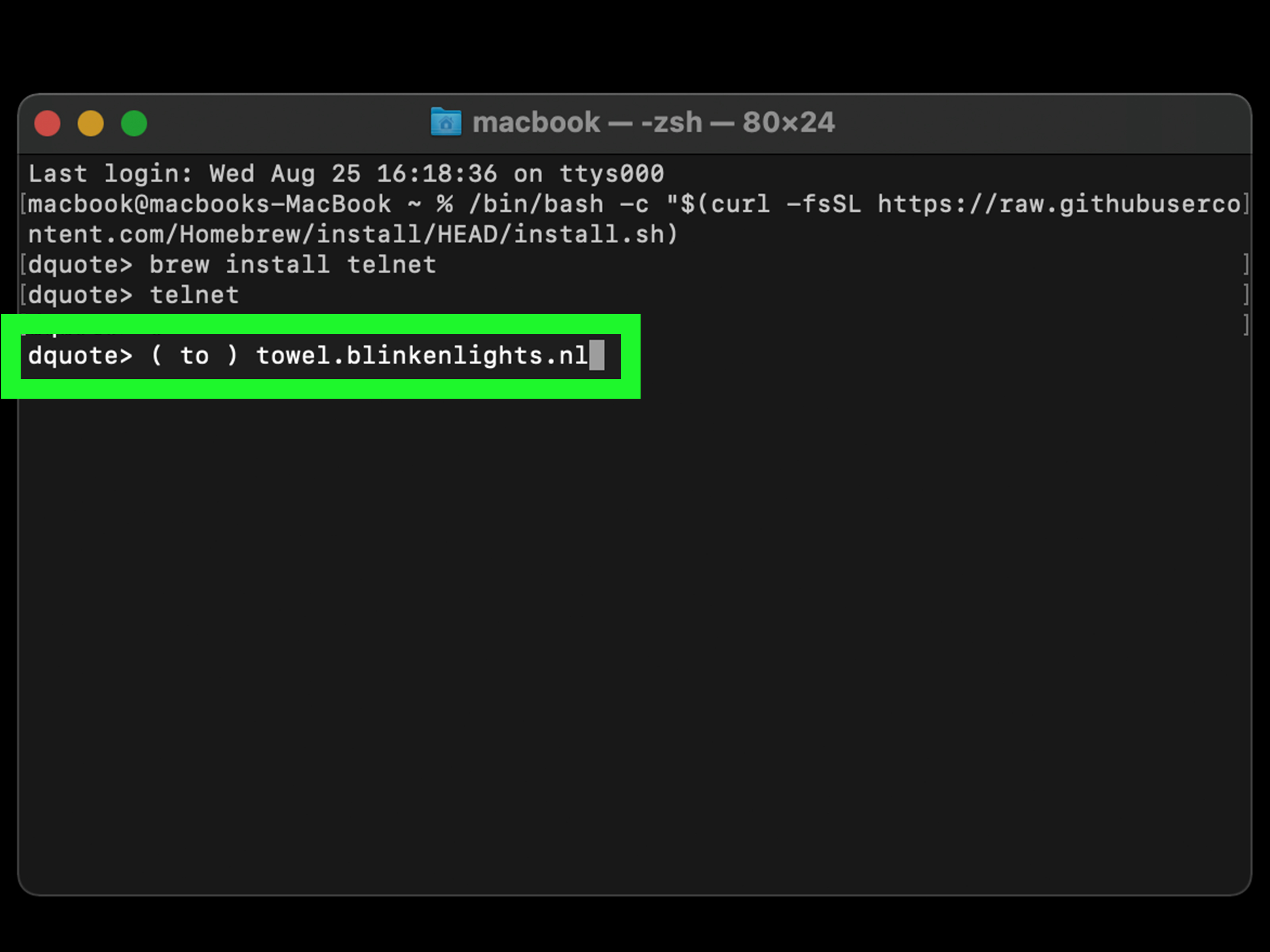
wikiHow
This wikiHow teaches you how to watch an animated version of Star Wars rendered entirely in ASCII characters (by folks with a lot of free time) using the telnet command on your computer. As of 2021, the server hosting the ASCII version of...
quartz frigate
_your loss _
edgy pelican
quartz frigate
_your loss _
muh unencrypted connection
 hybrid coyote
Hello
I've been looking around, I have a bunch of questions
- Let's say you're using sockets and threads to allow LAN communication across devices connected to the same wifi network, how much different would it be to set up the same thing but using WAN/across the world, so you could set up some communication between clients from anywhere. i.e, something like port forwarding?
- I read the pins regarding port forwarding, seems to be more mechanical than to integrate with software/games. Is using a hosting service really required when port forwarding? I'm not against it, but isn't it possible to say allow each client to host servers so other clients could join the room/lobby/server? Or does that still require a hosting service as a middle man
- I'm wondering if there are any code-based tutorials on port forwarding with python, unfortunately Googling didn't help much, nor YouTube or GPT. Seems to be obscure . I did find these though - Neural Line (in pins) but again it seems to be LAN, Random Github repo with 100 stars Cool but I'm looking for an explanation/tutorial so I can swap things around
- Would you say it takes a lot of networking background to get something like port forwarding set up, or would a novice like myself be able to hack something together without too much stress. I'm comfortable with Python, very limited in the scope of networking though
zealous flint
hybrid coyote
I've been looking around, I have a bunch of questions
- Let's say you're using s...
You need to expose your internal network to the wider internet if you want people outside your internet to connect to your server. It's like leaving your front door open.
What you decribed here is basically P2P (peer to peer):
I read the pins regarding port forwarding, seems to be more mechanical than to integrate with software/games. Is using a hosting service really required when port forwarding? I'm not against it, but isn't it possible to say allow each client to host servers so other clients could join the room/lobby/server? Or does that still require a hosting service as a middle man
And port-forwarding isn't really done code-side - it's more done on the side of the router.
For server/client stuff most people run it on a cloud host (since you don't really have to configure port forwarding, and a bunch of other advantages)
steady horizon
hybrid coyote
I've been looking around, I have a bunch of questions
- Let's say you're using s...
Port forwarding is a necessary step. It's a setting in your router. I can access this setting in a webpage which is served by my router via its gateway IP address.
If you don't want to do it on your router or you can't, you use a hosting service which lets you do it.
Game rooms/lobbies are structured as sessions which the main game server knows about and notifies other players about. The sessions can be server programs running on a player's machine which is hosting the game session OR isolated units on the main game server (in a subprocess, in a different thread or whatever you can think of which works best for you). There are pros and cons for hosting sessions on the main game server vs on a player's machine
hybrid coyote
I understand, so the configuration is a necessary step. I'm assuming hosting on the players machine means their computer would need to be configured to allow port forwarding too. Then I guess a main server approach works better, but it probably requires some amount of payment one way or the other, hence making this seem less likely for me to do.
zealous flint
hybrid coyote
I understand, so the configuration is a necessary step. I'm assuming hosting on ...
P2P is cheaper (as in, no central server) but opens a host of vulnerabilities
It's not too common these days I don't think
 shy pebble
o/
Before I go off writing some scripts, is there some program I could use to test how my application handles timeout? That is, have it dripfeed bytes from some hex dump into the network/insert a 30s pause into the middle of the stream.
hybrid coyote
zealous flint
P2P is cheaper (as in, no central server) but opens a host of vulnerabilities
Cheaper in the sense completely free, correct? I've been following two pygame games that do this so far, so yeah not that common. But one heck of a mechanic to have in a game
shy pebble
Ye, more or less free (except for the cost of the time you spend dealing with bug reports due to the many issues P2P has :P)
gloomy root
shy pebble
o/
Before I go off writing some scripts, is there some program I could use to te...
You could maybe use Jespen? Which is more for distributed systems, but it'll definitely find any timeout issues if it exists
shy pebble
I just wrote some shell scripts with nc, xxd -r -p and sleep. Jespen is absolutely overkill for this.
 oak tundra
is there any way for me to access account protected network locations using python?
Running the following:
open(r'\\server\d$')```
Returns:
```python
Permission Denied: `\\\\server\\d$`
Is there any way to pass an account?
edgy pelican
oak tundra
is there any way for me to access account protected network locations using pyth...
sudo it
maybe not
oak tundra
edgy pelican
sudo it
it is a windows server unfortunately, but I have found https://pypi.org/project/smbprotocol/ which allows me to pass in credentials and get access that way
hybrid coyote
hybrid coyote
I've been looking around, I have a bunch of questions
- Let's say you're using s...
If I'm willing to spend, what would the server costs be to run an API that handles a game with packets being sent and received in real time be like? And what would a good hosting service for such a case be
This probably wouldnt be port forwarding anymore?
shy pebble
hybrid coyote
If I'm willing to spend, what would the server costs be to run an API that handl...
That depends a lot on the playerbase - the more, the pricier, as well as on the complexity of the game. For some basic game, you could probably get away with a midrange VPS, so that's like 10-20 $ a month if you have ~100 players in various lobbies.
As for which VPS provider, hetzner and netcup are the two most recommended providers I hear about. I have also need some people experiment with using aws lambda style hosting for game servers, but that is a fairly new idea and I wouldn't recommend starting out with it.
if you really just have 2-3 lobbies at a time, you could be fine with just some random free-tier VPS from your cloud provider of choice
hybrid coyote
Hmm alright, thank you. Unfortunately free tier services still require credit cards to hold a bit of money(around a dollar) to verify identity, so if I'm paying I might as well go through with it
gloomy root
most if not all providers require that
they are a business and often they do refunds within the first 14 days which would be very easy to abuse if you didnt force card verification
 finite bay
I need guidance on how to connect to an smtp outlook 365 server using oAuth in Python.
zealous flint
finite bay
I need guidance on how to connect to an smtp outlook 365 server using oAuth in P...
Does MS have a graph API for automated emails?
At least, that's what my team does
finite bay
zealous flint
Does MS have a graph API for automated emails?
Yeah I am using the O365 library now
I am trying to authenticate
from O365 import Account
import os


def send_message():
    credentials = (os.getenv('ms_client_id'), os.getenv('ms_client_secret'))
    account = Account(credentials, auth_flow_type='credentials', tenant_id=os.getenv('ms_tenant_id'))
    if account.is_authenticated:
        print('Authenticated!')
    m = account.new_message()
    m.to.add(os.getenv('ms_email'))
    m.subject = 'Testing!'
    m.body = "This is a test"
    m.send()
What I have so far
account.is_authenticated evaluates to False
zealous flint
finite bay
```py
from O365 import Account
import os
def send_message():
credentials =...
Not familiar with this library. It doesn't look official, is it just some 3rd party library?
finite bay
zealous flint
Not familiar with this library. It doesn't look official, is it just some 3rd pa...
 rough knot
Can anyone help me with the client and server python program? I have built a C2 which is used to scan for malicious activity in PCs in an active directory but my client side program isn't working properly when i try to connect with Windows vm.
 lament veldt
Any good resources to learn Computer Network lesson
crystal current
lament veldt
Any good resources to learn Computer Network lesson
If you want an overview of basic fundamentals, look for ConpTIA Network+ study materials. Professor Messer on YouTube has a lot of videos for example.
 glad surge
How to get the code of an import?
Or maybe is there a documentation how to get new followers and donations on TikTok?
 mild jasper
Does anyone have any suggestions how could I fix the following issue: Using requests the connections stall indefinitely but only inside WSL2 environment (Ubuntu 22.04.3 LTS). So if I do ctrl+c the code is always at:
  File "/home/hyvok/miniconda3/envs/air/lib/python3.8/socket.py", line 669, in readinto
    return self._sock.recv_into(b)
Probably related that I am using VPN
Networking inside WSL environment seems to otherwise work as expected and I am able to ping etc. the local machines I am trying to access via VPN
 regal birch
hi , does the pythonping(https://github.com/alessandromaggio/pythonping) faster then the ping(https://github.com/torvalds/linux/blob/master/net/ipv4/ping.c) cmd tool of linux , or does my benchmarking strategy incorrect ? my bechmarking results shows 5 times faster , and linux ping is still making syn call , maybe its part of ping strategy , maybe it should provide a async flag
https://github.com/Agent-Hellboy/my-pen-on-python/blob/main/22_Nov_2023.md
can somebody check both the codebase and tell me why?
GitHub
A simple way to ping in Python. Contribute to alessandromaggio/pythonping development by creating an account on GitHub.

GitHub
Linux kernel source tree. Contribute to torvalds/linux development by creating an account on GitHub.

GitHub
Contribute to Agent-Hellboy/my-pen-on-python development by creating an account on GitHub.
edgy pelican
regal birch
hi , does the pythonping(https://github.com/alessandromaggio/pythonping) faster ...
this isnt really a fair comparison
the linux ping tool waits until it has a response and waits for a bit before sending the next ping
the pythonping is continuous
think of it like this
pythonping:
         20x
client ------------------- server
linux ping
            20x
|--------| ------------ server
| client |               /
|--------| -------------/```of course its fatser, it doesnt have to wait for anythign
regal birch
edgy pelican
the linux ping tool waits until it has a response and waits for a bit before sen...
why?
bright meteor
edgy pelican
think of it like this
pythonping:
```
20x
client ------------------- s...
if you use the flood mode, ping changes behaviour
-f Flood ping. Outputs packets as fast as they come back or one hundred times per second, whichever is more. For every ECHO_REQUEST sent a period “.” is printed, while for every ECHO_REPLY received a backspace is printed. This provides a rapid display of how many packets are being dropped. Only the super-user may use this option. This can be very hard on a network and should be used with caution.
 unreal sundial
Is there a Twisted discord server?
Twisted's own udp server / client doesn't work. seems kind of crazy but, doesnt work on windows
running echoserver_udp and then echo_clientudp doesnt do anything?
fervent thunder
i can ssh (from an internet-connected device) into one that's not connected to the internet
how would i share the internet connection over ssh?
so, this would be like making the first device a proxy to the ssh server
edgy pelican
fervent thunder
i can ssh (from an internet-connected device) into one that's not connected to t...
 hard apex
Anyone got any experience with mininet-wifi?
crystal current
hard apex
Anyone got any experience with mininet-wifi?
It might be worth asking your actual question instead
 fathom walrus
Suppose you need to connect to the internet, and have 3 unstable/low-quality wifi connections available to you. Is there some sort of software that automatically connects to whichever source is more stable/high-quality, or simultaneously connects to all three and switches according to stability/quality?
crystal current
fathom walrus
Suppose you need to connect to the internet, and have 3 unstable/low-quality wif...
If you have multi WiFi cards you can probably aggregate them, depending what OS you are on: https://superuser.com/questions/1025471/using-two-wireless-nics-at-the-same-time-on-windows-10-desktop-pc

Super User
I have read similar questions in the past (i.e. How do I use my dual band Wi-Fi card to connect to 5GHz and 2.4GHz simultaneously on Windows? and Connect multiple WiFi networks simultaneously), how...
 fresh gull
Hi, can anyone help me with socket library differences in python and javascript
since websocket and socket are different things wanna know if javascript has a library for socket and not websocket
steady horizon
I already explained this
fresh gull
steady horizon
I already explained this
yes tnx.
 last tiger
 abstract hinge
Hello everyone! Who wanna code together for kaggle?
 twin bough
Hey what is recommended websocket client lib to use?
 supple quiver
Hi everyone, is there anyone experienced with DTLS handshake with PSK and Cipher Suite who would like to help me? I'm not well versed in networking I know a little bit but not enough to go into RFC and do the building/wrapping of the packet itself.
 dense ibex
imap_server = "imap.gmail.com"

# create an IMAP4 class with SSL
mail = imaplib.IMAP4_SSL(imap_server)

# authenticate
mail.login(username, password)

mail.select("Inbox")

# getting uids based on labels
status, data = mail.uid("search", '(X-GM-LABELS "Inbox/Vendors Affiliates")')

print(data)
#output
[b'56987 61298 61320 61725 61807 108724']
What encoding is used here?
How do I get uids from the bytes?
fathom walrus
if a Linux server's public IP keeps changing how the heck do I SSH to it
fathom walrus
can I somehow use a domain name to fix this?
edgy pelican
fathom walrus
if a Linux server's public IP keeps changing how the heck do I SSH to it
coarse summit
edgy pelican
https://duckdns.org
https://www.noip.com/ as well
 steel agate
Hey if anyone here wants to participate in a hackathon, please let me know, my company is organizing a hackathon soon for python developers, DM if you are interested.
fathom walrus
thanks for the references!
coarse summit
np
edgy pelican
coarse summit
https://www.noip.com/ as well
duckdns is better because you get 5 free domains and you dont need to do some funny renewing shit every month
coarse summit
edgy pelican
duckdns is better because you get *5* free domains and you dont need to do some ...
why do you even want 5 domains
for the renewing part, I've just automated it
edgy pelican
coarse summit
for the renewing part, I've just automated it
well yeah but you dont with duckdns
edgy pelican
coarse summit
why do you even want 5 domains
idfk if oyu need more than 1?
coarse summit
not a big issue to me tbh
edgy pelican
ok you do you
coarse summit
edgy pelican
idfk if oyu need more than 1?
5 domains for the same ip or different servers?
because then i'd understand
edgy pelican
coarse summit
5 domains for the same ip or different servers?
different servers
coarse summit
mb then it completely makes sense
edgy pelican
and *.hello.duckdns.org points to your ip
for example you can do passwordmanager.hello.duckdns.org for your passowrd manager, vpn.hello.duckdns.org for vpn, ...
coarse summit
interesting
edgy pelican
something that noip doesnt do
coarse summit
but then it is only 1 domain name with subdomains