is it to be expected that a selectors event loop, when registering EVENT_WRITE, keeps one CPU core at very high utilization if at least one client is connected, regardless of network traffic?
the same doesn't happen if i only register EVENT_READ and write to the socket directly with .send().
example code with EVENT_WRITE that keeps one core busy is here, if that is of any relevance:
https://ahuemer.xx.vu/volatile/2023-07-14-RIpVXTpDZs4/main.py
strace says epoll_wait(3, [{events=EPOLLOUT, data={u32=5, u64=5}}], 2, -1) = 1 is executed over and over again.
it's understandable that the socket is writable virtually all of the time.
question is, is there anything that can be done to reduce CPU utilization in idle situations when clients are connected or do i have to accept that? (well, or reside to send without the loop again)
#networks
1 messages · Page 7 of 1
 balmy axle
 cunning garden
!rule 9
 frozen drum
balmy axle
is it to be expected that a selectors event loop, when registering `EVENT_WRITE`...
frozen drum
balmy axle
is it to be expected that a selectors event loop, when registering `EVENT_WRITE`...
are you on MacOS?
balmy axle
🐧
frozen drum
ok, but you want to update the selector depending on what you want to do
if you don't have anything to write, don't set the EVENT_WRITE selector
balmy axle
well, 'anything to write' depends on the point of view, right? i do have to send data, but we are not talking about excessive amounts
frozen drum
yes but you're basically emptying your output buffer
when it's empty, you should clear the write flag
balmy axle
i wonder if there are objective decision criteria, you know, something based on a formula that gives you an indication if EVENT_WRITE or direct send() is the better approach for a given situation
balmy axle
frozen drum
when it's empty, you should clear the write flag
hmm, i might have a gap in understanding there. how do i do that?
frozen drum
you can modify a selector
e.g. sel.modify
and then only set the new event to EVENT_READ
if you know you have no data to send
balmy axle
oh... i get the idea
interesting
thanks for the suggestion, i'll give that a try
related topic... is my understanding correct that if i use EVENT_READ and EVENT_WRITE it is virtually not possible to run in an EWOULDBLOCK situation, but if i send out of sync with the event loop that only handles EVENT_READ than there is a non-zero possibility?
my tests indicate exactly that under high pressure situations, but i am not sure how how-suited my tests are
implicit -> explicit: this is a non-blocking socket
frozen drum
well
technically if you have control over the entire network path you are right
I wouldn't count on it though
e.g. if the other side of your pipe (or even a broken intermediary) reads way slower than you write, you can still get a full write buffer
balmy axle
okay, so i'll have to account for the possibility of that situation / exception regardless. got it
frozen drum
yes
99.99% of cases you probably don't
..but it's not guaranteed you won't hit that situation
balmy axle
you know, i find it relaxing to understand fully what i am working on. accounting for the 0.01% case isn't a mistake as far as i am concerned 🙂
well, thanks! very helpful information. i'll go hit the keyboard again
frozen drum
it's been a while since I've done any low level socket implementations, but I work with networking every day and can tell you weird shit happens at least every day..
have fun !
balmy axle
my dayjob isn't coding anymore since more than 10 years so i am pretty rusty. but yeah, can confirm, weird shit happens every single day 😄
 final meteor
What does it mean when theres a double backslash in the middle of a url infront of an ip?
example: http://google.com/?page=//10.10.14.25/somefile
 inland rampart
I don't think it means anything in particular; it's a pretty weird format but you can have all sorts of things in the query string
 languid umbra
Any suggestions about how to get usage metrics for my flask API?
 prisma cobalt
languid umbra
Any suggestions about how to get usage metrics for my flask API?
prisma cobalt
languid umbra
Any suggestions about how to get usage metrics for my flask API?
this might serve your needs: https://flask-track-usage.readthedocs.io/en/latest/
languid umbra
prisma cobalt
this might serve your needs: https://flask-track-usage.readthedocs.io/en/latest/
Eh, not really what I need. Is there a way to just have a universal route handler? Like any route requested will ping that hook and then go to the route normally?
balmy axle
frozen drum
e.g. `sel.modify`
wanted to let you know that this works beautifully. after accept()ing a connection i only subscribe to EVENT_READ. once i am done processing input, i temporarily subscribe to EVENT_WRITE as well. that then sends the data until the output buffer is empty. when that is achieved, i remove the subscription to EVENT_WRITE.
this seems to work entirely reliably. i can process around 15k EVENT_READ triggers per second without any issue.
when clients are connected without doing anything, CPU utilization is nada.
frozen drum
balmy axle
wanted to let you know that this works beautifully. after accept()ing a connecti...
sounds great!
 shadow swift
Hi there, I'm currently stuck at a point where I want to establish connection between host and guest (VM) machine.
I have a process running on Windows Host machine on a specific port. I want to access It via Linux VM.
 quasi widget
shadow swift
Hi there, I'm currently stuck at a point where I want to establish connection be...
quasi widget
shadow swift
Hi there, I'm currently stuck at a point where I want to establish connection be...
what process
shadow swift
quasi widget
what process
what process?
quasi widget
I have a process running
shadow swift
I have a process running on windows machine, that uses specific port. Now, I want to access it via VM.
shadow swift
Does it matter to create connection between host and guest?
I can share my entire system via teamviewer. If you can help.
quasi widget
you're avoiding my question
shadow swift
No, I'm not..I'm just tired. Since last 18hr I'm trying to search the solution but I'm not at all around the solution.
Everyone are just curious about the process.
Even I'm curious about setting up the server.
quasi widget
ill go sleep now, please do not mention me while i'm away
just say what process it is
shadow swift
cool,
you've no benefit from it dear..
😄
It's some Daemon running on my window host machine.
 coarse summit
shadow swift
Hi there, I'm currently stuck at a point where I want to establish connection be...
coarse summit
shadow swift
Hi there, I'm currently stuck at a point where I want to establish connection be...
what issue are you having?
shadow swift
coarse summit
what issue are you having?
I've no clue whether I should be configuring the VM network settings or Is it because of firewall.
I'm able to connect to port that is runnnig on windows host from my linux(in vm).
When I try to ping: It say's connection refused,
coarse summit
from which os to which os are you trying to access
shadow swift
I checked the ipconfig and if config. Both are on different network and my virtualbox adapter shows some other IP which is not at all used in linux(VM)
coarse summit
coarse summit
from which os to which os are you trying to access
.
shadow swift
Windows (HOST) <=> Kali Linux (VM)
coarse summit
shadow swift
Windows (HOST) <=> Kali Linux (VM)
from which pc are you sending the ping request
shadow swift
Vice versa
coarse summit
wdym viceversa
shadow swift
linux to windows
coarse summit
how are you listening in linux
shadow swift
windows ipv4 start with 192.168 and Linux ith 172.2.
quasi widget
quasi widget
Can you Ping 1.1.1.1 or something else
.
quasi widget
You have No internet
shadow swift
$ ping HOST_IP
Destination host unreachable
I'm using internet.. 😒
shadow swift
At both place
quasi widget
shadow swift
At both place
You'd be able to Connect to 1.1.1.1 ifnyou Had internet
quasi widget
shadow swift
```sh
$ ping 1.1.1.1
ping connect: Network is unreachable
```
See
You dont
shadow swift
 quasi widget
Change Network adapter
shadow swift
sry you were right
quasi widget
To bridged
shadow swift
are you sure?
quasi widget
Yes
shadow swift
I shall change adapter 2 to bridged?
 quasi widget
Try now
shadow swift
try what? pinging host from vm?
quasi widget
Yes or Just 1.1.1.1 to Check if you are conencted
 quasi widget
And 1.1.1.1?
shadow swift
same
quasi widget
Not Sure then, maybe Just don't use Kali/virtualbox
shadow swift
do you think that is this something related to firewall or iptables?
quasi widget
shadow swift
Ther
shadow swift
So, now do you have any sugessstion regarding I should be discussing this somewhere else or a specific community?
quasi widget
quasi widget
Connect to eth0 instead of eth1
.
shadow swift
If i connect t eth0, I'll be able to ping 1.1.1.1 but that would be NAT not bridged..
shadow swift
I'm able to ping in that way
quasi widget
So Just do that
shadow swift
I was able to do that, Now I tried pinging the linux machinne ipv4 from windows and got request timed out
quasi widget
shadow swift
I was able to do that, Now I tried pinging the linux machinne ipv4 from windows ...
Also the Public IPv4?
shadow swift
yes I was successfully able to ping public ipv4 of windows from Linux
quasi widget
And Ping Linux from Windows?
shadow swift
nope that din't worked
shadow swift
Request timed out
@quasi widget tysm for your time.. It's late already 3.14am here.. going to crash on bed now. See you again! Thanks Again 😄
quasi widget
shadow swift
Request timed out
Public or private ip
I'll also Go sleep now
Answer later
shadow swift
one i found in ipconfig
Wireless LAN adapter Wi-Fi:

   Connection-specific DNS Suffix  . :
   Link-local IPv6 Address . . . . . : **************************
   IPv4 Address. . . . . . . . . . . : 192.168.1.122
cool, you sleep I'll give it a try and sleep
quasi widget
Alright
shadow swift
I found the ip (this ip http://api.ipify.org/) to be same on both system.
I'm still stuck in same state.
quasi widget
shadow swift
But still can't access the port
is the port open in windows? also check firewall
shadow swift
quasi widget
is the port open in windows? also check firewall
Hey I just checked that I'm only able to connect thorugh lookpack
Currently, I'm on windows,
ADB interface is running on 127.0.0.1:5555
My ipv4 on windows is 192.168.56.104
When I'm trying to connect to adb interface using this command "adb -s emulator-5554 connect 127.0.0.1:5555" then the connnection is success.
But whenI'm trying to connect to adb interface using this command "adb -s emulator-5554 connect 192.168.56.104:5555" then I'm getting error "cannot connect to 192.168.1.122:5555: No connection could be made because the target machine actively refused it. (10061)"
quasi widget
shadow swift
Currently, I'm on windows,
ADB interface is running on 127.0.0.1:5555
My ipv4 o...
use 127.0.0.1 as your ip on both linux and windows
shadow swift
quasi widget
use 127.0.0.1 as your ip on both linux and windows
This work on windows but not on linux
On linux I get this error:
└─$ adb -s emulator-5554 connect 127.0.0.1:5555
failed to connect to '127.0.0.1:5555': Connection refused
Starting Nmap 7.93 ( https://nmap.org ) at 2023-07-16 09:30 BST
Nmap scan report for localhost (127.0.0.1)
Host is up (0.000053s latency).
Not shown: 65532 closed tcp ports (conn-refused)
PORT      STATE SERVICE
1716/tcp  open  xmsg
5037/tcp  open  unknown
46331/tcp open  unknown

Nmap done: 1 IP address (1 host up) scanned in 0.80 seconds
Has someone made a mail server with https://twisted.org ?
I am unable to understand how to make one
 cerulean onyx
Hey everyone I'm having a really hard time with threads and sockets, here's my code:
import socket
import time
from random import randint,random

HOST = "127.0.0.1"


def serve(port):

    with socket.socket(socket.AF_INET, socket.SOCK_STREAM) as s:
        s.bind((HOST, port))
        s.listen(1000)

        while True:
            conn, addr = s.accept()
            with conn:
                print(f"Connected by {addr}")
                try:
                    request = conn.recv(1024)

                    if request == b"r":
                        print(f"Request received {request}")
                        # time.sleep(random())
                        time.sleep(0.01)
                        value = randint(0, 2048)
                        conn.sendall(value.to_bytes(2, byteorder='big'))
                        print(f"{value} were sent")

                except socket.error as e:
                    if isinstance(e.args, tuple):
                        print("Detected remote disconnect")
                    else:
                        print("socket error ", e)
                        s.close()
                        break
this one is server as you can tell
then i have 3 different scripts which work like this : ```py
from serve import serve
PORT = 65432
serve(PORT)```
ports are different for each of them obviously
and i want to asynchronously connect with server and get the data
i wrote this code and it works
async def get_value_async(host, port,i):
    try:
        reader, writer = await asyncio.open_connection(host, port)
        writer.write(b"r")
        data = await reader.read(1024)
        writer.close()
        data_int = int.from_bytes(data, 'big')
        print(f"{i} - Received {data_int}")
        return data_int
    except Exception as e:
        print(f"Error while connecting to {host}:{port}: {e}")
        return 0

async def get_values_async():
    tasks = [get_value_async(HOST, port,i) for port in PORTS for i in range(1000)]
    results = await asyncio.gather(*tasks)
    total_values = sum(results)
    return total_values / (len(PORTS) * 1000)

async def runAsyncronousProcess():
    print("Start of asynchronous calls")
    start_time = time.time()
    result = await get_values_async()
    print(f"Average value retrieved asynchronously: {result}")
    end_time = time.time()
    elapsed_time = end_time - start_time
    print(f"Asynchronous calls took {elapsed_time:.4f} seconds to complete.")


async def main():
    # runSyncronousProcess()
    await runAsyncronousProcess()

if __name__ == "__main__":
asyncio.run(main())```buuuut
works without errors if i create 100 tasks and not 1000
otherwise gives error : Error while connecting to 127.0.0.1:65430: [WinError 1225] The remote computer refused the network connection
Can someone tell me why this happens?
cerulean onyx
update: i identified why this error happens
when the server is sleeping and tasks try to read data from sleeping server, error happens
but i cant fix it
any ideas?
 modern ravine
cerulean onyx
any ideas?
modern ravine
cerulean onyx
any ideas?
Pretty sure you may have asked yourself those Qs already but just a dumb Q: why does the server sleep and is there a timeout on it? What can you do to keep it from sleeping?
Or maybe the code needs a trigger to wake it up
cerulean onyx
modern ravine
Pretty sure you may have asked yourself those Qs already but just a dumb Q: why ...
Server should sleep as it's given in task description, I guess whole problem was to deal with sleeping servers with asynchronous tasks somehow
Bh the way i fixed it
Took a while but came up with xD solution
If tasks don't connect with server, then it means server is sleeping so, i make tasks sleep to and retry connection after some intervals over and over again until they connect with servers xD
Dunno if it's the best solution but it works xD
 ember ledge
cerulean onyx
```py
async def get_value_async(host, port,i):
try:
reader, writer ...
ember ledge
cerulean onyx
```py
async def get_value_async(host, port,i):
try:
reader, writer ...
¯_(ツ)_/¯
 wicked salmon
I recently made a simple TCP chatroom, that you can message each other in the terminal. My question is, how can I have other users use my tcp chatroom from a different network?
I was originally thinking of hosting my tcp chatroom on some cloud provider but am completely lost on how another user can use my chatroom from a different network.
 open isle
wicked salmon
I recently made a simple TCP chatroom, that you can message each other in the te...
open isle
wicked salmon
I recently made a simple TCP chatroom, that you can message each other in the te...
The cloud provider machine will need to have a fixed public IP that your clients can connect to
Most hosting cloud services should come with one, sometimes for free, sometimes for extra
 weary prairie
Can someone help in Ubuntu ? I am operating 20.04 version, and I bought a package with 4 IPs. However, I don't know how to use them since they give me access to only 1 IP and the rest is unmanaged. Someone care to help here to activate the other 4 IPs ?
 wind radish
Why do you need 4 IPs for one machine?
weary prairie
It was a sweet package and I bought it. I need for instance 2 IPs for sending mails so that I don't get blacklisted
 humble wing
does anyone know why my rdns address gives no response?
do i need ports 25 and 465 open?
the mail ports
background info, im trying to install wazuh on a hetzner cloud instance
humble wing
kms
wind radish
weary prairie
It was a sweet package and I bought it. I need for instance 2 IPs for sending ma...
If you will be blacklisted on one IP, you could be blacklisted on 2nd as well
You probably can configure one IP on a single network interface, then switch upon need.
You also could configure multiple IPs on a single network interface. It is very possible. However, you will also need to read LARTC (https://lartc.org/), configure policy-based routing, and become Linux expert admin to use such configuration.
 quaint token
        except CannotSendRequest as e:
            logger.exception("Couldn't connect to server")

            if len(e.args) > 0 and e.args[0] == "Request-sent":
                # try reconnect
                logger.info("Reconnecting...")
                self.connect(self.hostname, self.port)

            return None
I'm trying to catch the CannotSendRequest exception and stop it from printing a stacktrace. Unfortnately, it still prints a stacktrace even though I'm catching it. Does anyone know how what to do?
 round parrot
Any chance I could find a CFM packet implementation for scapy, so I don't have to write it from scratch?
round parrot
I assume not, so I have some questions
I'm trying to add padding while crafting a custom layer packet based on the length of multiple other fields
e.g.
field2 = "bbb"```

in this case, I want add padding so the total number of bytes adds up to 10, so ```aaabbb0000```It looks so easy, but I can't really figure it out without rewriting a bunch of stuff
inland rampart
Add up the fields and then .ljust(10,b"0")?
quaint token
round parrot
I'm trying to add padding while crafting a custom layer packet based on the leng...
I'm not really sure what you're trying to do. If you want to send a packet with a fixed size over tcp sockets just create a byte buffer with that size, put your data in and send it. the unused bytes wll be zeros
you didn't mean this: https://en.wikipedia.org/wiki/IEEE_802.1ag with CFM, right?
IEEE 802.1ag is an amendment to the IEEE 802.1Q networking standard which introduces Connectivity Fault Management (CFM). This defines protocols and practices for the operations, administration, and maintenance (OAM) of paths through 802.1 bridges and local area networks (LANs). The final version was approved by the IEEE in 2007.IEEE 802.1ag is ...
round parrot
quaint token
you didn't mean this: https://en.wikipedia.org/wiki/IEEE_802.1ag with CFM, right...
I did mean that CFM, yes
I don't just want to send the packets, but to describe the layer as a new scapy packet, so I can dissect/craft the packets
this is below TCP, there's no TCP at this level, only ethernet 🙂
quaint token
round parrot
this is below TCP, there's no TCP at this level, only ethernet 🙂
geez you are doing something this low level in python?
quaint token
round parrot
I don't just want to send the packets, but to describe the layer as a new scapy ...
hmm I'll give it a read since Im writing an exam about computer networking in like two weeks anyways, but this is not something I'm familiar with unfortunately
round parrot
yes, it's quite a niche topic. But the issue I described is a more generic scapy thing, not CFM only. So it would work with higher level packets as well
quaint token
round parrot
yes, it's quite a niche topic. But the issue I described is a more generic scapy...
Maybe ask in a more specialized place, I'm sure there is somne kind of networking subreddit/forum where you might get an answer
coarse summit
 empty iron
i can't get socskets to work for some reason don't know why <#71632510661977704...
empty iron
i can't get socskets to work for some reason don't know why <#71632510661977704...
you will need to elaborate
ember ledge
Does anyone know how I can create a wifi hotspot in Python? Sort of like those wifi networks were you watch adverts in order to get more mb to browse more?
 mint tinsel
Hello bosses 👋🏾
Please has any one implemented OSPF routing for an SDN with mininet and ryu?
I want to learn how to do so
I'd appreciate if you could share useful resources (articles, sample implementations etc)
🤧✨
 scenic flower
from selenium import webdriver
import os
os.environ['PATH'] += r"/home/needjobcoder/Documents/Development/Web/webPythonProject/selenium/selProject/chromeDriver
"
driver = webdriver.Chrome() ```does this add to path each time when it is run ?
wind radish
it doesn't do export, so it will affect current process only
inland rampart
(export isn't global either though, it only affects the process and its children. but yes, this doesn't do lasting changes.)
 umbral steeple
import socket
s = socket.socket()
s.connect(('127.0.0.1', 9001))
s.send(b'Hey!\n')
data = s.recv(4096)
Can anyone explain what this does? I'm new to socketing
Specifically the s.connect() line
wind radish
@umbral steeple it is explained here:
https://docs.python.org/3/library/socket.html#socket.socket.connect
prisma cobalt
umbral steeple
```py
import socket
s = socket.socket()
s.connect(('127.0.0.1', 9001))
s.send(b'...
when you call socket.connect() you attempt to establish a bridge between your socket and a server socket on the other end (in this case, you have a local server running on port 9001). The call will block until it succeeds or errors (which you will need to catch).
Overall, the script will create a socket, connect it to your local server, send "Hey!\n" and then store whatever the server sends in the data variable
umbral steeple
prisma cobalt
when you call `socket.connect()` you attempt to establish a bridge between your ...
thank you
umbral steeple
wind radish
<@817603098649821215> it is explained here:
https://docs.python.org/3/library/so...
thank you
 sullen sphinx
Hi everyone I live in souther California and am new to learning to code. Working through Angela Yu and freecodecamps python courses to get started. Can anyone recommend any meetups or conventions that would be cool for me to attend?
 zealous flint
sullen sphinx
Hi everyone I live in souther California and am new to learning to code. Working...
zealous flint
sullen sphinx
Hi everyone I live in souther California and am new to learning to code. Working...
Hi! This channel is for computer networking rather than social networking - the mixup happens a lot so not your fault 😛 (we should probably change the channel name haha)
Python had a fair bit of conferences and meetups, the last one was EuroPython for the European folks. #python-events will generally keep you up to date on these
 molten abyss
Does anyone know what versions of socketio, engineio, and flask-socketio I need to make 'em compatible? I have tried:
pip install --upgrade python-socketio==4.6.0

pip install --upgrade python-engineio==3.13.2

pip install --upgrade Flask-SocketIO==4.3.1
and
pip install Flask-SocketIO==5.1.1 python-socketio==5.4.0 python-engineio==4.2.1
The client is using an unsupported version of the Socket.IO or Engine.IO protocols (further occurrences of this error will be logged with level INFO)
wind radish
sullen sphinx
Hi everyone I live in souther California and am new to learning to code. Working...
sullen sphinx
@zealous flint lmao shit.
@wind radish thank you for the recommends I’ll check it out
 limber stump
hello all, have anyone used nornir ?
 radiant vortex
Hi Guys! I need some advice doing basic network diagnostics on my PC with a python program. here is what i'd like to be able to find out:
No internet connection already able to do with by loading a website (try and except) but need to know why I cant load website:
No wireless network connected - Already able to do with with OS and CMD.
No ethernet cable connected to PC?
No ethernet cable connected to router?
**Router offline? **
PC in aeroplane mode?
Any other reasons there is no Wifi?
If anyone could point me in the right direction if these are all possible and what libraries or how to do that, I'd appreciate it greatly!
Thank you!
ember ledge

Discover how PrivacyNet, an anonymization tool, empowers your online privacy by routing internet traffic through Tor, concealing your real IP
ember ledge
Hey there! I am currently pursuing a degree in bioinformatics..I was looking for someone in the same field or in the data science domain in order to participate with..to solve an extremely challenging and interesting problem statement available on Kaggle..would love if anyone would want to collaborate..looking forward to the same!!! Do DM if u r an enthusiast too!
 arctic galleon
Hello there, i have a problem with my domain got a domain with arecord set on noip with the duc now i got my minecraft server with port 25565 open and if i try to join the server with the domain on my network it works. but if someone else wants to they cant. im pretty sure i configured everything correctly in noip but could be wrong. i also diasabled firewall and put the server in dmz nothing seems to work. if anoyne has time would be nice if i can recieve help been strugling with this for 2 days and its pain
 glossy walrus
Hello, Bony from Kenya. I’m looking for anyone new to Python that has probably started #100DayOfCodeChallenge so we can monitor each other’s progress. Thank you.
 lucid widget
how to send response to previously opened socketio connection?
can socketio connection opened on server side
for example server sends me something without i requesting anything from it
 edgy pelican
example?
lucid widget
what example
lucid widget
socketio.open("ws://ip")
edgy pelican
how should it work
 lapis badger
Hi guys sorry if this is the wrong channel, but i have a question.
I want to make a python script which downloads music from SoundCloud and stream it to a plain website. The download part is done, now i just need to stream the audio. But i don't really know how to approach it
Thanks guys for the help! 😄
 errant bayBOT
:incoming_envelope: :ok_hand: applied timeout to @real compass until <t:1690639432:f> (10 minutes) (reason: duplicates spam - sent 4 duplicate messages).
The <@&831776746206265384> have been alerted for review.
 frigid osprey
Guys does anyone know if replit still support the pinging thing to keep a host 24/7 online?
quasi widget
frigid osprey
Guys does anyone know if replit still support the pinging thing to keep a host 2...
!rule 5 thats Not allowed
errant bayBOT
5. Do not provide or request help on projects that may violate terms of service, or that may be deemed inappropriate, malicious, or illegal.
frigid osprey
quasi widget
!rule 5 thats Not allowed
My question is nowhere malicious or illegal
nor inapporopriate
quasi widget
Doing so is though
coarse summit
"How do I rob a bank"
ember ledge
frigid osprey
Guys does anyone know if replit still support the pinging thing to keep a host 2...
idk but u can try and see
 dull mist
How can I connect to my raspberry pi outside of my home network without port forwarding?
coarse summit
dull mist
How can I connect to my raspberry pi outside of my home network without port for...
Why can't you open ports
?
coarse summit
dull mist
Parents haven't given me wifi admin
You could searche the documentation on your router
And see if the password is still the default
It also may be on the back of the router
coarse summit
Np
ember ledge

The OSI model, a fundamental framework for data communication in computer networks, divides network functions into seven layers.
 modern spear
is anyone here familiar with http/requests/post and the requests module
 thick heart
running into annoying issues with circular imports with flask, and i don't wanna structure around their blueprints. looks like my other alternatives are mostly Quart, FastAPI, and Sanic framework. can some folks with strong opinions share them?
(maybe this would be better in the #1035199133436354600 forum, idk. let me know if i'm in the right place)
 gloomy root
thick heart
running into annoying issues with circular imports with flask, and i don't wanna...
gloomy root
thick heart
running into annoying issues with circular imports with flask, and i don't wanna...
you will likely have the same issue with all of those
switching framework doesnt really solve the whole cirular import issue
 pastel cedar

92 votes and 23 comments so far on Reddit
i came across this tool that's "100% open source" and got curious about their subscription model, and why people dont just bypass it. turns out the creator themselves pointed out the exact part of code to modify it to blank out the "pro" paywall. based
 crystal current
modern spear
is anyone here familiar with http/requests/post and the requests module
crystal current
modern spear
is anyone here familiar with http/requests/post and the requests module
Probably a lot of people... Don't ask to ask, just ask
pastel cedar
oh oops this is a python channel still
modern spear
pastel cedar
wild https://www.reddit.com/r/ReverseEngineering/comments/it7yv7/http_toolkit_op...
thats the exact tool im using, where do i go to fork it so its working?
he said to put return true here but i dont know exactly where
 pastel cedar
modern spear
thats the exact tool im using, where do i go to fork it so its working?
pastel cedar
modern spear
thats the exact tool im using, where do i go to fork it so its working?
ok tbh building this has revealed its like very very outdated and using a ton of depracated stuff. so in the end other stuff like fiddle or mitmproxy feels better
modern spear
pastel cedar
ok tbh building this has revealed its like very very outdated and using a ton of...
thanks for telling me
you have to pay for fiddle though😂
pastel cedar
modern spear
you have to pay for fiddle though😂
no fiddle classic is free
modern spear
well im using the http listiner for a mobile device
and httptolkit was teh only thing that had a aandroid option that ive found
do you know how i would connect the proxy to a android emulator
pastel cedar
modern spear
do you know how i would connect the proxy to a android emulator
see if this helps https://mitmproxy.org/
android emulator is on windows right?
idk how that works tbh
modern spear
pastel cedar
android emulator is on windows right?
yes
memu play it makes a virtual phone on your machine
pastel cedar
nice then just use that mitmproxy program. you dont even need to go as far as installing root certs just run mitmdump
and set your windows proxy to use localhost:8080
 kindred briar
I wanna setup a testbed of wireless mesh networks, to test different routing protocols like BATMAN, AODV, OLSR babble. Currently I have a single router on which I flashed Openwrt and installed BATMAN. I want to create more mesh nodes. Does anybody have any cheap but reliable hardware in mind?
 fiery kernel
has anyone worked with Qualys API? Im using a post request to download their whole KB but the response is really big and causing the script to crash...it works fine on my pc but hit and miss on this aws VM...wondeirng what i can do with requests to make it more reliable
crystal current
fiery kernel
has anyone worked with Qualys API? Im using a post request to download their who...
What script? Are you following their sample code? https://blog.qualys.com/product-tech/2021/03/02/qualys-api-best-practices-knowledgebase-api
This API Best Practices Series shows how to optimize your API usage starting with the KnowledgeBase API. The accompanying video presents these API best practices along with live code examples…
ember ledge
can someone in here checkout #1136762867652239580 its related to networking
 molten prism
hi, i'm asking this because i've seen answers but they don't explain enough
how do i make a wget-style progressbar with downloads
(using urllib.request)
 summer canyon
If i want to learn networking and use it with python, where should i start?
wind radish
@summer canyon Depends on what exactly you want to learn...
If you want to understand networks in general, read Tanenbaum "Computer Networks"
If you want to deeply understand how TCP works, read e.g. O'Relly "TCP/IP Network Administration" book
If you are not interested in theory at all, and you just want to program in Python, do socket programming
kindred briar
I was using wireshark to mointor traffic, and Ive made a bunch of custom filters that I wanna look for during normal operation, I would like to process all the incoming packets in real time and use it in backend for my django based backend. How do I apply multiple filters at the same time on the incoming traffic and output the results in an organized manner.
you can apply filters in the command itself but I wanna capture all the traffic and then flag whatever strikes
Any thoughts ?
kindred briar
lol what haha
 silent imp
am trying to send a post request with cookies, headers , etc using urllib.requst
but I'm not getting the same response when using requests
ember ledge
silent imp
am trying to send a post request with cookies, headers , etc using urllib.requst...
k
maybe u could give a code
silent imp
import json
import ssl
import http.cookiejar
from urllib.request import urlopen
from urllib.error import HTTPError, URLError
import urllib.request
from urllib.request import urlopen, Request

ssl._create_default_https_context = ssl._create_unverified_context

def make_request(url, headers=None, data=None, cookies=None):
    request = Request(url, headers=headers or {}, data=data or {}, method='POST')
    try:
        cookie_jar = http.cookiejar.CookieJar()
        for cookie_name, cookie_value in cookies.items():
            cookie = http.cookiejar.Cookie(
                version=0,
                name=cookie_name,
                value=cookie_value,
                port=None,
                port_specified=False,
                domain='www.example.com',
                domain_specified=True,
                domain_initial_dot=False,
                path='/',
                path_specified=True,
                secure=False,
                expires=None,
                discard=True,
                comment=None,
                comment_url=None,
                rest={'HttpOnly': None},
                rfc2109=False
            )
            cookie_jar.set_cookie(cookie)

        opener = urllib.request.build_opener(
            urllib.request.ProxyHandler(
                {'http': '',
                 'https': ''}),
            urllib.request.HTTPCookieProcessor(cookie_jar))
        resp = opener.open(request, timeout=10)
   except Exception as er:
        print(er)
it's required argument
ember ledge
ikn
silent imp
ember ledge
so we all can see 😛
lmao
ember ledge
and req
silent imp
?
ember ledge
and requests code
silent imp
it's like basic post request
import requests
cookies = {}
headers = {}
json_data = {}
r = requests.post(url, headers=headers, cookies=cookies, data=json_data)
idk withput testing
but try verify=False in requests
silent imp
same thing
 silk plaza
Help
 edgy pelican
silk plaza
Help
edgy pelican
silk plaza
Help
wrong channe
 frigid vault
Does anyone know how to make a minecraft bot that joins servers in python?
Like how to construct the packets and send them.
coarse summit
frigid vault
Like how to construct the packets and send them.
I used twisted for the client
frigid vault
I know the wiki, but I don't understand how to make the packets based on it.
coarse summit
frigid vault
I know the wiki, but I don't understand how to make the packets based on it.
Wdym by that
Try checking out twisted for the client, you don't need to worry about constructing packets
You could also use socket library for that
If you really want to construct them yourself check the scapy library
frigid vault
I mean I don't want to make a client, but just the network part.
coarse summit
frigid vault
I mean I don't want to make a client, but just the network part.
It's also called a client
frigid vault
coarse summit
Wdym by that
I mean I know what packets I have to send, but I don't know how to make those packets.
coarse summit
frigid vault
I mean I know what packets I have to send, but I don't know how to make those pa...
My recommendation is using socket or twisted for not constructing the packets yourself
You just send data though the socket and it will create a packet automatically
frigid vault
any twisted libraries?
frigid vault
But I think I still have to make the packets. I don't see how the libraries makes the packets.
frigid vault
coarse summit
https://twisted.org/
Isn't it the same as socket lib?
coarse summit
You create a Clas for your cliente extended from the protocol class
coarse summit
frigid vault
Isn't it the same as socket lib?
It is built on top of the socket lib
frigid vault
Right. I will send the packets with twisted, but how to make the actual packets, because I see that I still have to make them.
coarse summit
frigid vault
Right. I will send the packets with twisted, but how to make the actual packets,...
Are created and sensed automatically when you use the data
coarse summit
coarse summit
https://docs.twisted.org/en/twisted-18.9.0/core/howto/clients.html
Check this
 fading ruin
Hi, I have a quick question, would a python http.server work connecting my server with a vpn, like hamachi?
frigid vault
fading ruin
Hi, I have a quick question, would a python http.server work connecting my serve...
I think if you set it up. Yes.
frigid vault
coarse summit
Check this
I found quarry that does it for me.
coarse summit
frigid vault
I found **quarry** that does it for me.
It is very outdated though
frigid vault
I used it for 1.17.1 server and it worked.
ember ledge
This channel is not for social networking, it's for
Discussion on network protocols, technologies, hardware with relation to Python
lucid widget
im using this library https://github.com/gabrielbull/php-websocket-client wss://site.com does going to this url sends cookies automatically how?
A simple WebSocket WAMP client implemented in PHP. Contribute to gabrielbull/php-websocket-client development by creating an account on GitHub.
 red crow
hi am having prpoblem with deploying a django to server, using nginx and gunicorn. i am getting bad request 400, i am trying a lot to solve this but it is not solved yet
 civic fog
No clue where to put this but im trying to send an attachment (smsmessage.txt) through email with python but it sends a corrupted file that is not the one im trying to specify
import smtplib from email.mime.multipart import MIMEMultipart from email.mime.text import MIMEText from email.mime.base import MIMEBase from email import encoders mail_content = '''''' #The mail addresses and password sender_address = 'augustaustralia@transgender.army' sender_pass = '(MY PASSWORD)' receiver_address = '(MY PHONE NUMBER)@vzwpix.com' #Setup the MIME message = MIMEMultipart() message['From'] = sender_address message['To'] = receiver_address message['Subject'] = '' #The subject line #The body and the attachments for the mail message.attach(MIMEText(text, "text" )) attach_file_name = 'smsmessage.txt' attach_file = open(attach_file_name, 'rb') # Open the file as binary mode payload = MIMEBase('application', 'octate-stream') payload.set_payload((attach_file).read()) #add payload header with filename payload.add_header('Content-Decomposition', 'attachment', filename=attach_file_name) message.attach(payload) #Create SMTP session for sending the mail session = smtplib.SMTP('box.courvix.com', 587) #use gmail with port session.starttls() #enable security session.login(sender_address, sender_pass) #login with mail_id and password text = message.as_string() session.sendmail(sender_address, receiver_address, text) session.quit() print('SMS Sent')
crystal current
red crow
hi am having prpoblem with deploying a django to server, using nginx and gunicor...
ember ledge
Hi does anyone offer 1 on 1 guidance ? If yes dms are open 💕
 fathom walrus
Any reading suggestions if I want to understand the theory of how localhost works? i.e., localhost seems to make a computer behave like if it was itself a network, how exactly is this possible and how is it happening?
we can for instance host on one same computer multiple servers that communicate with one another using the same protocols they'd use to communicate with physically distinct machines
 shrewd sparrow
re: pygen
So at the highest level, when an IP addressed packet reaches whatever packet routers are managed by my ISP, my current understanding says they would strip the Ethernet frame (which was addressed for the ISP), strip the IP frame to parse the destination IP, then wrap the bare TCP frame in a new IP frame and send it on its way?
What I'm confused about is what level the packet is at when it reaches the ISP? Does it have an Ethernet frame at that point or just an IP frame? What kind of IP mappings does the ISP maintain?
 hoary sorrel
there's always a TCP frame inside an IP frame inside an ethernet frame
your router removes an ethernet frame that says that it is the destination, and replaces it with an ethernet frame that says that (a router at) your ISP is the destination.
The ISP's router removes the ethernet frame saying that it is the destination, and replaces it with an ethernet frame that says that the next hop is the destination.
And every hop along the way repeats this until it reaches the actual machine it's destined for
shrewd sparrow
fathom walrus
Any reading suggestions if I want to understand the theory of how localhost work...
I offer a link I have referenced in the past: https://tldp.org/LDP/nag/node65.html#SECTION007700000
Very old but the only real thing that's changed is the syntax to the ifconfig/ip command afaict
fathom walrus
shrewd sparrow
I offer a link I have referenced in the past: https://tldp.org/LDP/nag/node65.ht...
will get on that, thank you!
hoary sorrel
fathom walrus
we can for instance host on one same computer multiple servers that communicate ...
there's no particular magic involved here. You can mail a letter with your own home address as the destination. A computer can send an IP packet with its own address as the destination.
there might be some optimizations in place, though. Your mail carrier might realize that you addressed a letter to yourself, and stick it right back in your mailbox without ever taking it back to the post office. Similarly, your OS might realize that you addressed an IP packet to yourself, and skip some of the work that it might need to do if it was sending that packet to a different computer.
and "localhost" is just a name that always means "this computer"
shrewd sparrow
hoary sorrel
there's always a TCP frame inside an IP frame inside an ethernet frame
I think this question indicates that what I really want to know is "a general overview of how packets move" so like if this is something I ought to find a textbook for instead lmk lol.
Is there any intuition for when a router will choose to route by IP vs routing by MAC address then? My previous understanding was that the IP frame would hold the ultimate packet destination (sans NAT): so does the ethernet frame hold the "next hop"?
 glossy hull
I just made this real quick
 hoary sorrel
it always does both (well, at least for IP packets). It looks at the destination IP address in the IP frame to decide what MAC address to send the packet to - which becomes the destination MAC address in the ethernet frame
shrewd sparrow
I see. The router does that IP lookup in the local ARP cache. And then it fills the returned MAC address into the dest field of the Ethernet frame. And then whatever hardware (driver) or switch the packet is currently in takes that MAC/IP pair and, well, routes it
shrewd sparrow
Right, I understand that jargon now ^^
Layer 2 switch would be something like my router/modem box, right? Because it doesn't have ARP cached MAC data for my ISP servers, it routes it by doing funky stuff over IP?
Or would the layer 2 switch be the one that the ISP is running, doing the top level IP translation?
glossy hull
layer 2 switches are usually used on LAN networks to get more ports, think of them like USB hubs
shrewd sparrow
So this guy's a layer 2? Grey cord goes into the router
 glossy hull
most likely yes
shrewd sparrow
So that's why it's the case that devices plugged into the switch are actually assigned IP addresses and accessible over WLAN -- it's all about the layer the switch is operating at?
Damn maybe skipping the networking class in uni is coming back to hurt me 😭
glossy hull
shrewd sparrow
So that's why it's the case that devices plugged into the switch are actually as...
so getting assigned IP addresses is done with DHCP (most likely a DHCP server on your router)
basically everything plugged into the network is shouting out "Hey can I get an IP please!" (even tho the system doesn't have an IP it does have an IP packet, setting the source to 0.0.0.0 and destination to 255.255.255.255, meaning "send this to everyone on the network"), and then the DHCP server replies by sending a packet to the clients MAC address.
When it comes to accessibility all the switch is really doing is giving you more ports (at least layer 2 switches), the router will keep track of a table like this to know where each device is (storing a mapping from port to MAC):
| Port | devices |
| WLAN | Device1 |
| Eth0 | Switch, Device2, Device3 |
and the switch will keep track of something similar:
| Port | devices |
| Eth0 | Router |
| Eth1 | Device2 |
| Eth2 | Device 3 |
shrewd sparrow
glossy hull
so getting assigned IP addresses is done with DHCP (most likely a DHCP server on...
Wait... DHCP working through IP layer multicast is really cool. And I did not even consider that without the source MAC address the router has no way to respond to the DHCP request at all
glossy hull
shrewd sparrow
Wait... DHCP working through IP layer multicast is really cool. And I did not ev...
well you could still respond in theory, include some ID code with the request, then the DHCP server also uses the broadcast adress and the ID in its response (althought MAC is ofc better)
shrewd sparrow
glossy hull
well you could still respond in theory, include some ID code with the request, t...
If that is all the case, how does DHCP over VPN work? Does a VPN just simulate the ethernet-level MAC addressing as if all the devices--
I see, I was in the middle of typing the message when you noted alternative IDs are possible
glossy hull
possible yes, implented? I dont think so
glossy hull
glossy hull
so getting assigned IP addresses is done with DHCP (most likely a DHCP server on...
this is also why having multiple DHCP server can completely fuck over a network, because it is basically random which response you are gonna get first
hoary sorrel
moreover, they don't know what addresses have been assigned by the other one (assuming they're both assigning addresses in the same range)
glossy hull
exactly
shrewd sparrow
So if I wireshark'd my VPN connection as I was spinning up my conn, would I just see all the same ARP identification packets and DHCP multicast requests as I do on my regular old LAN?
(Assuming the VPN gateway is running a DHCP server)
hoary sorrel
I'm not sure - that's a bit past my depth. I'd expect not, since VPNs are - well, virtual, I'd expect them to be able to be set up in a higher level way
glossy hull
yhe I am not terribly familiar with VPNs, although they usually setup a virtual network card, so they can do a lot of that in software, and might use their own protocols for it
shrewd sparrow
At least in the case of the one I manage, that is indeed the case, it's registered as a physical iface
But it's standard dhcpd
glossy hull
also there are many types of VPNs
shrewd sparrow
That is fair. I'm sure at the very least a mesh network type VPN has its own protocols lest a connecting client just screams into the void asking its two other p2p clients for an IP address
prisma cobalt
shrewd sparrow
re: pygen
So at the highest level, when an IP addressed packet reaches whatever ...
I’ll just note, after a packets leaves your home network, arp is no longer used to route the packet. Imagine every packet requiring the router to ask all other routers that it’s connected to if they know where to send the packet lol, it’s not feasible. Each router maintains a mapping of ip addresses and destinations but it’s a particularly big list relative to the size of the internet. If the destination ip in not in the list, the router forwards the packet upstream, this goes on and on until it reaches your isp infrastructure which contains some of the biggest routing tables on the internet. The packet is then routed to the correct isp and then goes down the router chain to the target network.
hoary sorrel
(and ARP isn't used for discovering which what the best path from one network to another is - instead a protocol called BGP is used for that)
shrewd sparrow
prisma cobalt
I’ll just note, after a packets leaves your home network, arp is no longer used ...
Gotcha, that was part of what I was confused about. So in order for your home router to submit a packet to the ISP, it simply submits a packet to a known host that is "closer" to the ISP.
Is there a protocol to keep those known-good host lists in sync?
(Is that the aforementioned BGP?)
hoary sorrel
shrewd sparrow
I think this question indicates that what I really want to know is "a general ov...
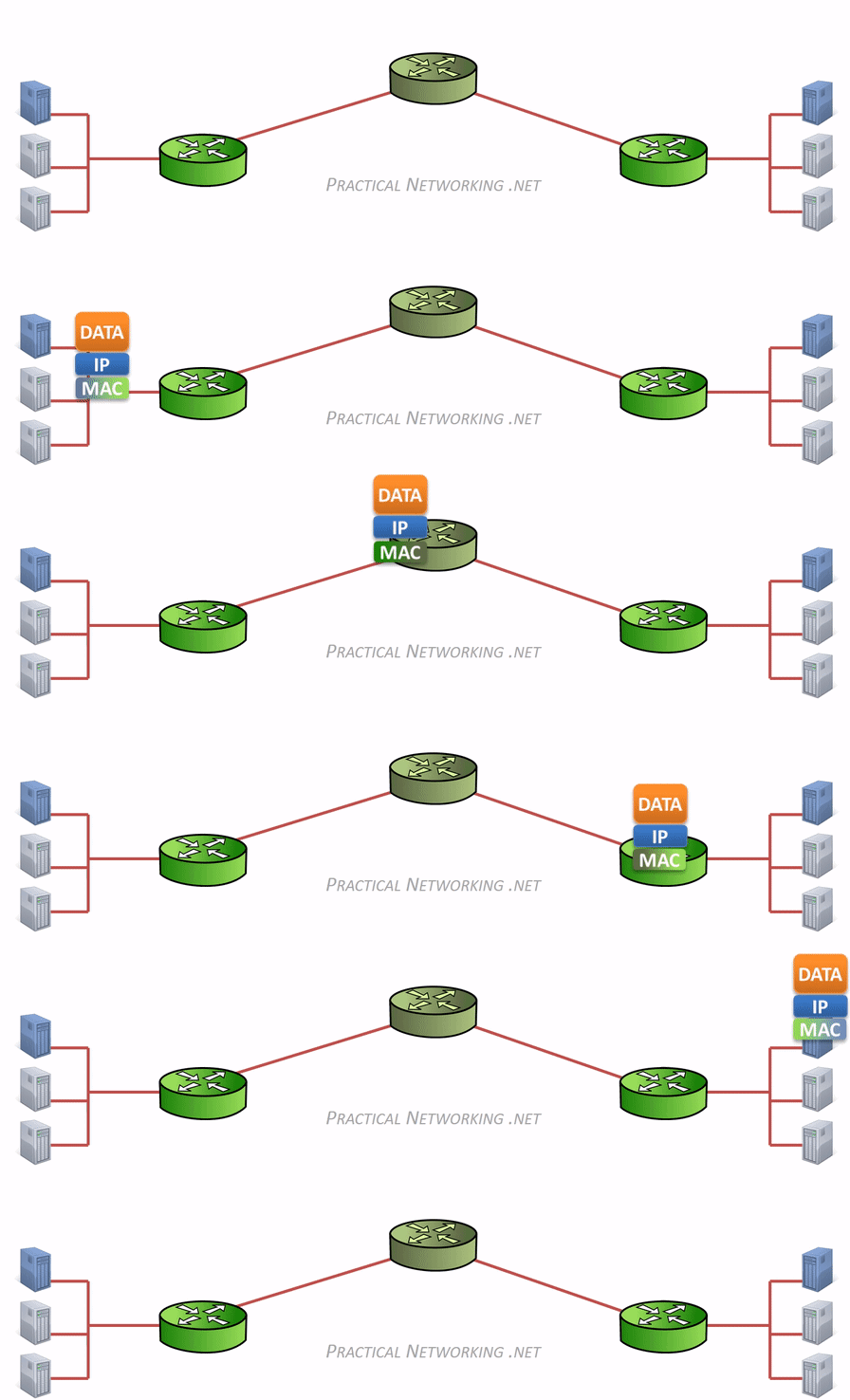 glossy hull
side note, to try and get some more details on that VPN question I found a youtube video which went into it a bit techincally
your vpn does not keep logs on you or track you
dude, that is not a feature of a vpn, that is just companies telling you they dont
 shrewd sparrow
Lolol. Well my VPN better be keeping logs, I told it to!
hoary sorrel
shrewd sparrow
Gotcha, that was part of what I was confused about. So in order for your home ro...
your router routes everything to a router owned by your ISP. That router knows what paths to take to reach other networks because of BGP
prisma cobalt
shrewd sparrow
Gotcha, that was part of what I was confused about. So in order for your home ro...
So when you send off a packet, it’ll go up the router chain and then down once it encounters a router high enough in the chain that it’s common to both the sender and target device
I’ll draw a diagram
glossy hull
glossy hull
*side note, to try and get some more details on that VPN question I found a yout...
30 seconds later:
if a vpn is keeping logs on you
I thought you said it didnt 🙃
shrewd sparrow
prisma cobalt
So when you send off a packet, it’ll go up the router chain and then down once i...
How does that top level router knows that the destination is in its list of known hosts? Doesn't the top level router "fan out", so this would have to be like a DFS BFS?
Unless it's as simple as "yeah the DFS BFS is just on a scheduled job" and it just periodically asks all its nodes what nodes they node, and it just aggregates all that data up
prisma cobalt
an ISP will purchase a block of addresses, they can then assign these addresses and keep track of how to route to these addresses I believe
since they provide the infrastructure, they can maintain their routing tables
hoary sorrel
shrewd sparrow
Unless it's as simple as "yeah the ~~DFS~~ BFS is just on a scheduled job" and i...
that's BGP
shrewd sparrow
hoary sorrel
that's BGP
Ahh. So it all comes together
prisma cobalt
if a packet reaches the top of the chain (an NSP backbone server) then BGP or suchlike (there are alternatives) is used to route the packet
 glossy hull
cant believe what I learnt in school is becoming useful.... is teaching others "useful"?
prisma cobalt
we picture packets as hop by hop which is correct but you also have to picture an "up and down chain"
hoary sorrel
teaching others is one of the best ways to realize gaps in your own knowledge!
they have a way of asking questions you struggle to answer, or to answer succinctly and coherently 😄
shrewd sparrow
I see from https://www.cloudflare.com/learning/security/glossary/what-is-bgp/ that IANA maintains a master list of ASNs corresponding to known-good BGP enabled systems

Border Gateway Protocol (BGP) is the routing protocol for the Internet. Much like the post office processing mail, BGP picks the most effecient routes for delivering Internet traffic.
glossy hull
certainly! I realised I have no clue how vpns work on the low level
hoary sorrel
yep, ditto, hehe
fathom walrus
applications listen to IP/port pairs and not only to ports?
hoary sorrel
yes
shrewd sparrow
shrewd sparrow
I see from https://www.cloudflare.com/learning/security/glossary/what-is-bgp/ th...
This answers my question of "well yeah, but how does the ISP know what to do if they don't own the block of the destination IP"
prisma cobalt
fathom walrus
applications listen to IP/port pairs and not only to ports?
it depends on the application, some listen to addresses regardless of port but none can listen to just a port
hoary sorrel
the arguments that you provide when binding a socket are an IP address (or a wildcard meaning "all possible IP addresses") and a port.
fathom walrus
I see, ty!
shrewd sparrow
I mean, you can really muck up your iptables config to bind to a port regardless of source/destination IP address (source: oops! all my traffic is suddenly getting clobbered through my gateway)
fathom walrus
Suppose IP1, IP2 are two IP addresses. Is there a conflict if application1 is listening to the pair IP1 with port 50000 and application2 is listening to the pair IP2 with port 50000?
fathom walrus
I see, ty!
 quartz frigate
Each host can only host one thing per port at a time.
hoary sorrel
not true
quartz frigate
Oh?
hoary sorrel
each host can host one thing per port per ip address at a time
quartz frigate
I....
Huh
hoary sorrel
each ip address has its own set of bindings (though one call to bind can bind to multiple ip addresses with a wildcard)
shrewd sparrow
hoary sorrel
each host can host one thing per port per ip address at a time
is the bound IP not the "host" in the jargon
coarse summit
hoary sorrel
each host can host one thing per port per ip address at a time
per socket?
shrewd sparrow
so you're both right ^^
prisma cobalt
cant raw sockets be bound multiple times for multiple applications to listen at the same time?
quartz frigate
hoary sorrel
each ip address has its own set of bindings (though one call to bind can bind to...
Or 0.0.0.0, right?
hoary sorrel
coarse summit
per socket?
a socket can be listening on multiple addresses
hoary sorrel
quartz frigate
Or 0.0.0.0, right?
that's the wildcard that I meant
quartz frigate
ic
shrewd sparrow
prisma cobalt
cant raw sockets be bound multiple times for multiple applications to listen at ...
afaict no.... unless you fork()
prisma cobalt
running wireshark (which listens for traffic accross every port) wont block the traffic from being delivered to a different program on the server
hoary sorrel
that's true, but I don't think wireshark works by binding sockets
shrewd sparrow
wireshark puts the actual network card into that weird sniffing mode though
promiscuous mode?
prisma cobalt
prisma cobalt
running wireshark (which listens for traffic accross every port) wont block the ...
this is because of the level of the binding, you dont need to bind a socket at the transport layer
shrewd sparrow
it doesn't have to do that but it can
hoary sorrel
promiscuous mode is about whether it receives packets that were intended for other hosts, not whether it receives packets that are intended for other ports
fathom walrus
I can have an application outputting to localhost:50000 and another listening to this pair without a conflict, right?
hoary sorrel
most people will only ever bind to 127.0.0.1 or to 0.0.0.0 when binding a TCP socket. They're by far the two most common options: listen on all of this machine's public addresses, or listen only on the loopback address.
hoary sorrel
fathom walrus
I can have an application outputting to localhost:50000 and another listening to...
what do you mean by "outputting to"?
shrewd sparrow
hoary sorrel
promiscuous mode is about whether it receives packets that were intended for oth...
I see wym
I would be curious to see how libpcap works then, it's gotta be doing some magic on the TCP layer
fathom walrus
hoary sorrel
what do you mean by "outputting to"?
sending packets to? I'm not 100% sure if this is the main way applications send things through IP/port pairs
prisma cobalt
yes, that'll work
if you have a server listening on port 50000, aa different program can send traffic to that address
hoary sorrel
TCP sessions are identified by 4 numbers: source IP address, source port, destination IP address, destination port
a client on 127.0.0.1 can connect to a server bound to 127.0.0.1:50000 just fine, though there will be a different (randomly assigned) source port for that connection
fathom walrus
I see, thanks for the answers!
hoary sorrel
(just in general, outgoing connections are assigned random port numbers)
shrewd sparrow
Do incoming and outgoing ports conflict?
Err, ports bound for listening and ports bound for sending
hoary sorrel
they're drawn from the same pool
you can't have two things listening on 127.0.0.1:12345 (one server waiting for incoming connections, and one client waiting for a response to a message it sent)
shrewd sparrow
Yeah, but can you have one listening for conns w/ dest port :12345 and one sending with the src port :12345?
hoary sorrel
no, because responses come to the port you sent from
if I start a tcp connection to a server on 127.0.0.1:50000, and I'm assigned source port 12345 for that, then my client is the thing bound to 127.0.0.1:12345. I can't also have another server bound to 127.0.0.1:12345, because if I did the kernel wouldn't know whether to give an incoming packet addressed to 127.0.0.1:12345 to my client or to the other server
prisma cobalt
hoary sorrel
TCP sessions are identified by 4 numbers: source IP address, source port, destin...
are you sure? the router should be able to distinguish the connections because the session as you said is based on these 4 numbers
hoary sorrel
I'm... fairly sure.
shrewd sparrow
!!! Found the real deets

From the man page:
SO_REUSEADDR Specifies that the rules
used in validating addresses supplied
to bind() should allow reuse of local
addresses, if this is supported by the
protocol. This
It's a socket option
prisma cobalt
that option just allows the binding of a socket to a used address before its "cooldown" period
shrewd sparrow
At least, for allowing re-binding of sockets that still might have open TCP sessions. Close enough
Look sifting through man pages is hard 😭
fathom walrus
so say I have a program that sends lowercase strings and a server that capitalizes them, then returns it to a program that can read it. the server is on the same physical machine. Then the structure of this whole apparatus is two connections as such:
localhost:port1 -(lowercase string)-> localhost:port2; localhost:port3 -(uppercase string)-> localhost:port4, where my server listens to localhost:port2, then establishes a connection to localhost:port4 with source localhost:port3? is this correct?
hoary sorrel
yep, that sounds right
fathom walrus
i see, thanks for the help!
prisma cobalt
hoary sorrel
if I start a tcp connection to a server on 127.0.0.1:50000, and I'm assigned sou...
just tested, no errors :)
hoary sorrel
interesting. huh. well, fair enough then
shrewd sparrow
prisma cobalt
that option just allows the binding of a socket to a used address before its "co...
https://lwn.net/Articles/542629/ There we go
One of the features merged in the 3.9 development cycle was TCP and UDP
support for the SO_REUSEPORT socket option; that support was
implemented in a series of patches by Tom Herbert. The new socket option
allows multiple sockets on the same host to
bind to the same port, and is intended to improve the performance of
multithreaded network serv...
SO_REUSEPORT allows ephemeral reuse of listening ports as long as the listening application starts first
Cool stuff.
I mean, afaict, it actually just straight up allows N listeners too
hoary sorrel
that was traditionally done by forking instead
one process would bind the socket, and then fork N times, and then you'd have N processes that could accept connections on that socket
prisma cobalt
shrewd sparrow
https://lwn.net/Articles/542629/ There we go
oo interesting, multiple threads listening to the same port at the same time
shrewd sparrow
hoary sorrel
that was traditionally done by forking instead
This is across process boundaries though
Err, so is forking
But this is across execution contexts
hoary sorrel
sure, I'm not saying this isn't a new capability
just giving some flavor about what you would do without it (or on platforms that don't have it)
shrewd sparrow
Fair fair
hoary sorrel
the model where you bind to the socket, call listen, then fork, then call accept in the (each) subprocess is called "pre-forking"
it's a common web server pattern, there are lots of pre-forking web servers
shrewd sparrow
I've heard that jargon, but whats the alternative? Accepting in a main process then forking per-request?
Sounds expensive
Or is pre-forking simply The One Way To Do It
hoary sorrel
shrewd sparrow
I've heard that jargon, but whats the alternative? Accepting in a main process t...
yep
hoary sorrel
shrewd sparrow
Or is pre-forking simply The One Way To Do It
it's a pattern exactly because it has less per-request overhead
@shrewd sparrow You should check out http://www.practicalnetworking.net/series/packet-traveling/osi-model/#osi-layer-23 btw
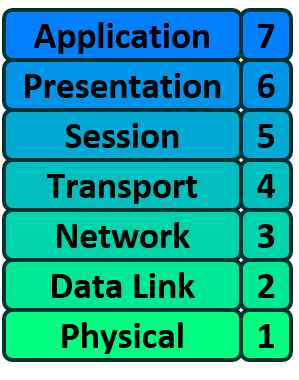
The OSI Model is the reason the Internet is not owned by one company. Each layer of the model serves an individual purpose to network communication.
shrewd sparrow
hoary sorrel
<@80888203774533632> You should check out http://www.practicalnetworking.net/ser...
Bookmarked, thank ya!
 scenic adder
Could someone explain to me what a VPC does? I just learned of it and my web host wants me to improve my database security by implementing that. I have no idea what a VPC does though and how it would help my database security.
frozen drum
scenic adder
Could someone explain to me what a VPC does? I just learned of it and my web hos...
a VPC is a logically isolated section of resources only for your use - basically you don't share hardware with other people running other virtualized resources
it can be a separate network, completely separate hosts, or anything else really.. it's kind of a vague marketing term
scenic adder
frozen drum
a VPC is a logically isolated section of resources only for your use - basically...
So then is the process of accessing that like using an ssh client or something?
frozen drum
scenic adder
So then is the process of accessing that like using an ssh client or something?
no, as I said it's really vague.. depends what their definition of a "private cloud" is
scenic adder
Ah okay. Thank you. This clears it a bit up for me
wind radish
scenic adder
Could someone explain to me what a VPC does? I just learned of it and my web hos...
What is VPC? It is a network without public addresses, but also in the cloud
 nocturne tulip
👋 idk if i'm on the appropriate channel. I'm implementing a solution where multiple threads are writing to a unix socket then they wait for answer from server before continuing their process. What's your recommendation to do this? Is it a problem to create a socket object and call connect method on each thread?
I'm a bit confused with all solution possible (using EpollSelector, Streams with asyncio, etc)
 wild dove
How to stop running python script using common javascript
wind radish
wat
civic fog
tried that
what do i put for format(attach_file_name))
and
attach_file = open(attach_file_name, 'rb')
crystal current
wild dove
How to stop running python script using common javascript
Doesn't seem possible unless your Python has an API that would allow this (and I've never seen such a thing in practice)
ember ledge
first answer yes. second depends, most home internets have dynamic ip, but it also dependes of ur isp how often they change it. Could be every 24 hours, or cople of days to weeks or after every reset of router
third answer also yes
inland rampart
usually a static IP is a toggle you can check in your account on your ISP's site, often one you have to pay extra for.
wind radish
not for cell internet though
 void raptor
crystal current
Doesn't seem possible unless your Python has an API that would allow this (and I...
void raptor
crystal current
Doesn't seem possible unless your Python has an API that would allow this (and I...
hi, @crystal current
 jovial gate
I'm trying to fix a bug in a Scapy dissector, but I'm struggling to understand the deep internal structures of Scapy, even with reading the docs.
I've managed to get the packet layer to process properly in my print statement, but there is still a bunch of weirdness with the underlying payload
And also, somehow, I've made a len(variable) respond with an expected value of 99, but my debugger reports that it's size 132 (the original incorrect value)
Long story short, Scapy correctly identifies the ADU and PDU, but then incorrectly reads the length of the PDU, overlapping into the second ADU/PDU of the same layer.
I'm pretty sure I corrected this by assigning length_from=lambda pkt: pkt.byteCount,, and now the field is the correct length according to the len() function, and the print() function shows only the expected values
But the payload is still entirely consumed by the first PDU, and the variable prints a count of 99 words, but is still the incorrect size of 132 words in memory
....I think this is more complex to explain than I realized and I should start a thread for it.
jovial gate
A link to a more thorough summary of my problem: https://discord.com/channels/267624335836053506/1140747269751177347
wild dove
Hello
I built a flask server locally.
My project is Laravel + javascript + flask.
I am sending a request request in javascript.
I want to stop the execution of the currently running api on the server.
How can I implement this?
jovial gate
Thanks to locating an old bug report in how scapy handles BGP, I learned about the PacktListField: https://scapy.readthedocs.io/en/latest/api/scapy.fields.html#scapy.fields.PacketListField
This seems to be the exact solution I need. Now I just have to make it work...
 tiny hatch
hit this interesting error trying to deploy an app using Google cloud and WSL.
I was planning to use ray to distribute a training workload to multiple computers on different networks, but due to the problems with internal and external IPs I have gotten very confused.
I am running my head node on Google Cloud, with most ports open (for testing). I installed python 3.10.6 and ray onto this server and started the head node with ray start --head --port=6379 --node-ip-address=34.71.183.XX. This server works fine, and I can run ray applications locally on the server.
the issue occurs when I try to connect to this ray head over a WSL instance running on a windows laptop: ray start --address=34.71.183.XX:6379 --node-ip-address=172.31.86.XXX
the node IP being the IP address that my WSL instance appears to be running (according to ip addr show eth0). this command 'works' but throws the warning:
details.2023-08-15 12:52:33,971 WARNING utils.py:1401 -- Unable to connect to GCS (ray head) at 34.71.183.58:6379. Check that (1) Ray with matching version started successfully at the specified address, (2) this node can reach the specified address, and (3) there is no firewall setting preventing access.
when I go to run ray.init() it throws this error:
RuntimeError: b"This node has an IP address of 172.31.86.217, and Ray expects this IP address to be either the GCS address or one of the Raylet addresses. Connected to GCS at 34.71.183.58 and found raylets at 10.128.0.2 but none of these match this node's IP 172.31.86.217. Are any of these actually a different IP address for the same node?You might need to provide --node-ip-address to specify the IP address that the head should use when sending to this node."
I have been stuck on this, some help would be nice.
crystal current
wild dove
I built a flask server locally.
My project is Laravel + javascript + flask.
I am...
Question isn't that clear to me but if you know how implement API endpoints in Flask, you can make then do pretty much anything you want.
wild dove
What should I do if I want to monitor the flask server in real time and start it again when the server is stopped?
crystal current
wild dove
What should I do if I want to monitor the flask server in real time and start it...
What exactly is "stopped" and why? That will determine what exactly you're trying to monitor.
Is this a physical dedicated server that you want to restart or where is it hosted? You want to restart the whole server and not just your Flask app?
Is this related to your original question somehow?
fathom walrus
is it possible that my router doesn't support telnet? or ssh?
coarse summit
fathom walrus
is it possible that my router doesn't support telnet? or ssh?
I doubt it doesn't support it
may be blocked
coarse summit
fathom walrus
argh
why do you thing it doesn't support it?
fathom walrus
coarse summit
why do you thing it doesn't support it?
telnet fails and ssh gets connection refused, but I see no options to change it on my browser
coarse summit
fathom walrus
telnet fails and ssh gets connection refused, but I see no options to change it ...
how are you using telnet and ssh
as server or client
fathom walrus
as client, running ssh admin@192.168.0.1 on cmd
coarse summit
fathom walrus
as client, running ssh admin@192.168.0.1 on cmd
can you send error message as text
fathom walrus
coarse summit
can you send error message as text
ssh: connect to host 192.168.0.1 port 22: Connection refused
coarse summit
which server are you trying to connect to
fathom walrus
the router's, seems like some routers have a ssh server enabled by default
fathom walrus
i wanted to check if I could modify its files, or run wireshark on it
or otherwise flash it
trying to figure out how networks work
fathom walrus
yeah, i already did, and i've been messing around with configs and such
couldn't find anything explicitly called ssh
tried forwarding 22, still refused
coarse summit
not all routers have ssh
 crystal current
fathom walrus
tried forwarding 22, still refused
crystal current
fathom walrus
tried forwarding 22, still refused
Port forwarding will let you connect to a device on your network from outside, so not relevant. If you want to SSH or Telnet into your router, you need to look up the documentation for your router to find out if that's possible.
And flashing the firmware is another story but also depends on your specific router. Probably doesn't require SSH or Telnet
It's a common error you can find lots of possible solutions for if you search around. I don't know about Laravel but Flask has various settings you can use to allow CORS
wind radish
fathom walrus
is it possible that my router doesn't support telnet? or ssh?
Most likely it can be disabled or enabled
fathom walrus
thanks for comments!
 shell skiff
how should i store data like images that i can recreate at a later time. I have a system where it uses json but it proves to be inefficient when i try to introduce it to bytes that are for pictures, files.... And so i need a way to store these as a file that i can then encrypt(cryptography library fernet) and then give the file to someone which that someone can decrypt it and basically decrypt the entire data stored and process it, XML might come as a good option but idk if it will work and how will i work with it
(i use fernet cryptography to encrypt it and its user is assigned with a special key so no worries as the admins cannot understand that much the file contents but the bot can)
crystal current
shell skiff
how should i store data like images that i can recreate at a later time. I have ...
Totally off topic in this channel or am I missing something?
Sounds like you either want something like a) links to encrypted files (in an S3 bucket or whatever), b) encrypted blobs in a DB (if the images are small) or c) encrypted base64 strings (probably the least attractive option in general but closest to what you describe doing currently)
shell skiff
crystal current
Totally off topic in this channel or am I missing something?
Sounds like you e...
well i was in #algos-and-data-structs
and i was redirected here
even tho both channels secuirity and networking sounded off topic
i tried on networking
so im just gonna open a question on #1035199133436354600
sorry for like the entire disturbence ig
crystal current
shell skiff
sorry for like the entire disturbence ig
It's all good. Have I not answered your question already though?
shell skiff
well
kinda
i tried like using bytes
on json
which is not a good approach
and the file size from like some kilobytes to 2 mega bytes
which isn't ideal
and idk about base64
it might be the same too
gloomy root
converting binary data to text formats will pretty much always have an increase in size
crystal current
shell skiff
all types of files
I gave you two different approaches to doing that
gloomy root
What dowcet mentioned is about what i'd expect in your situation
shell skiff
also i don't wanna store it in a db
like i already have a db
and i basically give a encrypted file to the user as sort of a snapshot
for the S3 bucket i don't really know what to do
gloomy root
how is the user decrypting this tho?
shell skiff
gloomy root
how is the user decrypting this tho?
the bot does
its basically a middle man
crystal current
shell skiff
like i already have a db
Already having a DB sounds like a great reason to use it?
shell skiff
crystal current
Already having a DB sounds like a great reason to use it?
well..... im sharing the file with the user
i don't wanna add too much memory for snapshots
gloomy root
Eh, I'm not normally a big fan of storing large blobs in DBs, particularly relational DBs
shell skiff
so the solution i came up with
is have a file encrypted
and give it to the user to store it
crystal current
shell skiff
for the S3 bucket i don't really know what to do
For example, upload the file to the bucket with boto3 and store a URL in your DB. Retrieve/decrypt the image as needed
shell skiff
which later they can use to recreate the snapshot
gloomy root
wait? The user has to store the encrypted file?
shell skiff
gloomy root
wait? The user has to store the encrypted file?
well yup
gloomy root
What is the point in the middleman then?
As a user, it's just easier to manage them yourself
shell skiff
gloomy root
What is the point in the middleman then?
well its responsible for decryption and encryption
and processing
in between
gloomy root
but... Why? Since the only interaction where the file being encrypted is actually useful is the process of transporting the file, from the user, to the bot
Which realistically is a bit pointless most of the time
I'd argue it's easier for the file to just not be encrypted and just ask the user for the file in order to do what ever processing it needs at the time
shell skiff
gloomy root
but... Why? Since the only interaction where the file being encrypted is actuall...
let me backtrack a bit
gloomy root
it's going to be no less secure
crystal current
shell skiff
let me backtrack a bit
Better move it to a help channel
 simple locust
Hello
shell skiff
crystal current
Totally off topic in this channel or am I missing something?
Sounds like you e...
a bit of a update
i encoded to base64 and not only it reduced the file size it also worked
but
i feel like it can scale even lower
but lets not clutter and move to https://discord.com/channels/267624335836053506/1141750632122945617
 short flume
Need help intercepting http and ws requests being made by a desktop application
The application is using its own certificates for SSL
So using a proxy like mitm is not working
Any suggestions?
 jaunty oasis
Hey all, could anyone help me? I'd like to know how to create a very basic python websocket which reads from a .pipe file and broadcasts it to all connections. I have a working websocket and a working pipe file, however I cannot seem to connect the two without 1 blocking the process of the other. Much appreciated!
wind radish
shell skiff
i encoded to base64 and not only it reduced the file size it also worked
base64 can't reduce files size. base64 is literally encoding with 6-bit alphabet, while byte has 8-bits
 ember seal
Wassup fellas any decent coders want to join FG
coarse summit
ember seal
Wassup fellas any decent coders want to join FG
No
ember seal
coarse summit
No
Ahhh, figured. Thanks anyways.
 grave lily
short flume
The application is using its own certificates for SSL
grave lily
short flume
The application is using its own certificates for SSL
Patch it to replace the certs?
ember ledge
finally i was able to post it, the tool has some minor issues, but it works just fine
https://github.com/HalilDeniz/ICMPWatch
 errant bayBOT
5. Do not provide or request help on projects that may violate terms of service, or that may be deemed inappropriate, malicious, or illegal.
ember ledge
ember ledge
finally i was able to post it, the tool has some minor issues, but it works just...
Good but don't use py Charm instead use visual code
ember ledge
ember ledge
Good but don't use py Charm instead use visual code
I actually use pycharm all the time 😅😅
Yep a lot of people use it, once I used py Charm (just to try) and I just stick with visual code, it's py Charm but more
ember ledge
PyCharm* please 
edgy pelican
good but dont use visual code use neovim
coarse summit
edgy pelican
good but dont use visual code use neovim
Use a hex editor instead
crystal current
coarse summit
Use a hex editor instead
Use butterflies. Just kidding, use Emacs. https://xkcd.com/378/

 covert forge
Hello, does anyone know, how to use a Rasperry Pi as an bluetooth speaker?
ember ledge
covert forge
Hello, does anyone know, how to use a Rasperry Pi as an bluetooth speaker?
covert forge
ember ledge
<#545603026732318730>
It's networking too ._.
coarse summit
covert forge
It's networking too ._.
Yeah but you'll get better help there
ember ledge
Hello
How does my router know which device to forward if I only give out my public ip of my router?
zealous flint
ember ledge
How does my router know which device to forward if I only give out my public ip ...
I believe that is configurable
At least on my home router I remember having to point the router at my server with the open port
coarse summit
in my router it's automatically done
ember ledge
Anyone write socket code?
wind radish
ember ledge
How does my router know which device to forward if I only give out my public ip ...
For the outgoing connection established from LAN it maintains nat table for each connection.
For the incoming connections - you configure Port Forwarding, or for some applications it is configured automatically via UPnP
ember ledge
wind radish
For the outgoing connection established from LAN it maintains nat table for each...
Thanks
What is the point of NAT?
wind radish
To use single IP address in WAN, even if there are multiple devices behind the router.
open isle
NAT was primarily invented IIRC (this is wrong) is quite useful so IPv4 addresses can be used more efficiently. In the context of residential internet, instead of assigning a globally unique IPv4 address to each device, each customer gets only one IP address.
There are simply not enough IPv4 addresses to assign a globally unique address to each device.
IIUC there is also carrier-grade NAT, ie. NAT at the ISP level
ember ledge
So what is NAT?
🙃
Nevermind. You were helpfull. Think I just need to do more research.
ember ledge
open isle
NAT ~~was primarily invented IIRC~~ (this is wrong) is quite useful so IPv4 addr...
I'm guessing it translate public to private ip and vice versa
wind radish
NAT is Network Address Translation. The name occurred because in a nutshell it is manipulations with IP addresses stored inside IP packets headers
ember ledge
I know that the tcp header contains a source and destination ip address. I believe they are both global.
ember ledge
Well if you want to connect over the internet you'd pass the global ones correct?
But if it's local you may use the private ones
wind radish
as a destination IP - yes
but when the packet leaves your PC, it has local IP as source IP inside the header
ember ledge
Is the source used to send messages back?
wind radish
yes
ember ledge
Hmm I made a socket connection. Was able to send a message to myself with that special ip but not my global ip
Think I need port forwarding
ember seal
Is this the place to find a programming mentor?
zealous flint
ember seal
Is this the place to find a programming mentor?
No, this channel is for computer networking (sorry if the name is confusing)
We don't usually do mentoring here but you can ask questions as you have them
ember ledge
My sockets book is written by Warren W Gay
On the side it says Gay at the top
Gay Linux socket programming
By example
That's pretty funny to me
ember ledge
This is actually fucking hilarious.
errant bayBOT
7. Keep discussions relevant to the channel topic. Each channel's description tells you the topic.
ember ledge
Got a problem?
coarse summit
ember ledge
Got a problem?
?
ember ledge
coarse summit
?
I was talking about a sockets book. That is network related.
 odd token
Hi. The SSLv3 protocol is outdated and not supported since python 3.6+. Is it possible to use this protocol in newer versions?
fathom walrus
when a process is listening to a port for a packet, what OS/kernel-level process is it interacting with?
coarse summit
fathom walrus
when a process is listening to a port for a packet, what OS/kernel-level process...
Transport
fathom walrus
coarse summit
Transport
nice, the transport layer has a kernel component?
coarse summit
U got me there
fathom walrus
nevertheless i'll probably get better search hits using the layer model, thanks!
coarse summit
What do you mean if the layer has a kernel @fathom walrus
fathom walrus
coarse summit
What do you mean if the layer has a kernel <@190081918526685184>
I mean if a OS' kernel contains a component that deals with the transport layer, or if whatever interacts with the transport layer is external to the kernel
coarse summit
fathom walrus
I mean if a OS' kernel contains a component that deals with the transport layer,...
"The kernel primarily deals with the lower layers of the OSI model, such as the network and data link layers. The transport layer is typically handled by the operating system's networking stack, which works closely with the kernel to manage data transmission and flow control."
fathom walrus
coarse summit
"The kernel primarily deals with the lower layers of the OSI model, such as the ...
nice ok
now, need to figure out what exactly is the networking stack
ty for the help!
coarse summit
fathom walrus
ty for the help!
Np
 dusty notch
hey guys hope yall doing well here. I was wondering if someone understands a lil bit trading, because i'm developing a neural network trading AI that is nearly finished: I have a float issue because i want to float my broker balance and that is perturbing me a lot and i am struggling to fix. If you want to help. Please ping me. PS: I'm 15 y/o I don't have as many experience as you here. Thanks for reading
crystal current
dusty notch
hey guys hope yall doing well here. I was wondering if someone understands a lil...
ember ledge
Anymore make money from coding Projects?
open isle
ember ledge
Anymore make money from coding Projects?
This is the wrong channel to ask in. This channel is about computer networking, think the internet, IPv4, HTTP, routers/switches/other networking hardware.
jovial gate
Having a small problem with scapy layer binds. I have two layers that always come as a pair such as Base_Layer/Upper_Layer1 or Base_Layer/Upper_Layer3 The problem is they can come in multiple sets. I've fixed scapy so that it properly parses the lengths of each layer, but when I try to process the second/third/fourth batch, the only way I can figure out how to do it is with the bind_layer functions like so:
bind_layer(Upper_Layer2,Base_Layer,)
bind_layer(Upper_Layer3,Base_Layer,)```
This works, but I have something like 30 different upper layer packet types.Is anybody aware of a better way to handle this?
I feel like there is going to be something smarter I can do in the Base_Layer guess_payload_class function but I just haven't found any clues yet how to do it
grave lily
If you have to have a lot of variable names which are the same except for numeric suffixes, that may be a job for an array.
edgy pelican
grave lily
If you have to have a lot of variable names which are the same except for numeri...
wrong channel?
 drowsy knot
jovial gate
edgy pelican
wrong channel?
drowsy knot
jovial gate
edgy pelican
wrong channel?
No, he's trying to help me, and he's got a good general point that, unfortunately, doesn't work in this particular case.
Also, I think I'm going to try converting each ADU/PDU pair to instead be an ADU with a packetlistfield, so we'll see how that breaks the build/dissect functions already in there.
 restive rover
Oh! Looks like this is the wrong type of networking channel 🤣
ember ledge
We won't join calls for things that are not worth posting in help channels, it's more useless to join the voice channel in that case
Small questions can very well go in text channels instead of making people join calls
wind radish
Take your time and came up with a question. If you don't have any questions it doesn't worth to communicate.
ember ledge
Considering your post in the help channel, you were here in the wrong channel
Yeah, and that is the wrong channel
This channel is for computer networking rather than social networking. The mixup happens a lot so not really your fault

 forest patrol
hello is wifi speed is included in networking ?
cunning garden
forest patrol
hello is wifi speed is included in networking ?
What would be your question if it was?
forest patrol
cunning garden
What would be your question if it was?
how to make my internet speed better without paying any extra cost ?
if it is possible
cunning garden
forest patrol
how to make my internet speed better without paying any extra cost ?
In general, you can't
you could optimize some things, but can't stuff more than the pipe allows
forest patrol
why 😔
cunning garden
For instance having ad blockers
forest patrol
why cant i have good wifi for once
cunning garden
forest patrol
why cant i have good wifi for once
wifi != Internet
forest patrol
i have bad internet and bad wifi and bad 4G
cunning garden
You are gonna have to divide and conquer
forest patrol
like there isnt some tips and dialy hacks to make it better
cunning garden
there is no magic
cunning garden
you check your logs/system to understand what it is saying when it refuses to do so
cunning garden
there must be a reason
forest patrol
is there a way to make a normal folder into a zip file without keeping the original folder ?
cunning garden
you make a zip file and then delete the original folder
or if you mean not having the folder in the zip file, then just zip the files inside it
forest patrol
that is the problem i cant delete the original folder
edgy pelican
me and da bois rewriting amazon in brainfuck
wind radish
forest patrol
hello is wifi speed is included in networking ?
I don't even understand what are you asking. Do you mean your wired connection has good speed, but your wireless (wifi) connection is much worse?
 small basin
Would anyone know why it is preferable to have a IP range start at E.g. 192.168.1.10-192.168.1.255 rather then starting at 192.168.1.2... in essance why start at .10 rather then .2
zealous flint
small basin
Would anyone know why it is preferable to have a IP range start at E.g. 192.168....
Is it? I haven't heard of such a thing
small basin
yeah i have seen it on some systems the DHCP will start assigning from 192.168.1.10 - ...255 and leave .2-.9 unassigned i think its a type of reservation for static addresses but idk and trying to confirm
wind radish
it's up to you
zealous flint
small basin
yeah i have seen it on some systems the DHCP will start assigning from 192.168.1...
that sounds like just leaving some space for statically assigned hosts
 long gazelle
Good day guys it's my first time here!
My question is can someone suggest to me a video tutorial or a step by step guide on how to host twisted python to internet to work in real life not in local host
long gazelle
Please guys help
ember ledge
long gazelle
Good day guys it's my first time here!
My question is can someone suggest to me...
get a vps and configure it with nginx
or use dokku
or dont get a vps and put ur localhost on cloudflare tunnels or ngrok
ember ledge
ember ledge
get a vps and configure it with nginx
or rent some of the app platforms that do all hostng for u
long gazelle
ember ledge
or rent some of the app platforms that do all hostng for u
Please can you suggest any app thag does so??
Thanks in advance
ember ledge
long gazelle
Please can you suggest any app thag does so??
Thanks in advance
digital ocean
long gazelle
ember ledge
digital ocean
Thank you very much I will surely look into it deeply
 inland tiger
wait where is that minimal code link
i think there was a gist pinned
maybe im blind but i dont see any gists
 heady bane
I am trying to build the following architecture https://imgur.com/a/uPWwN9W , where from our platform internal resources will be analyzed from it . what's the best way to achieve this ?

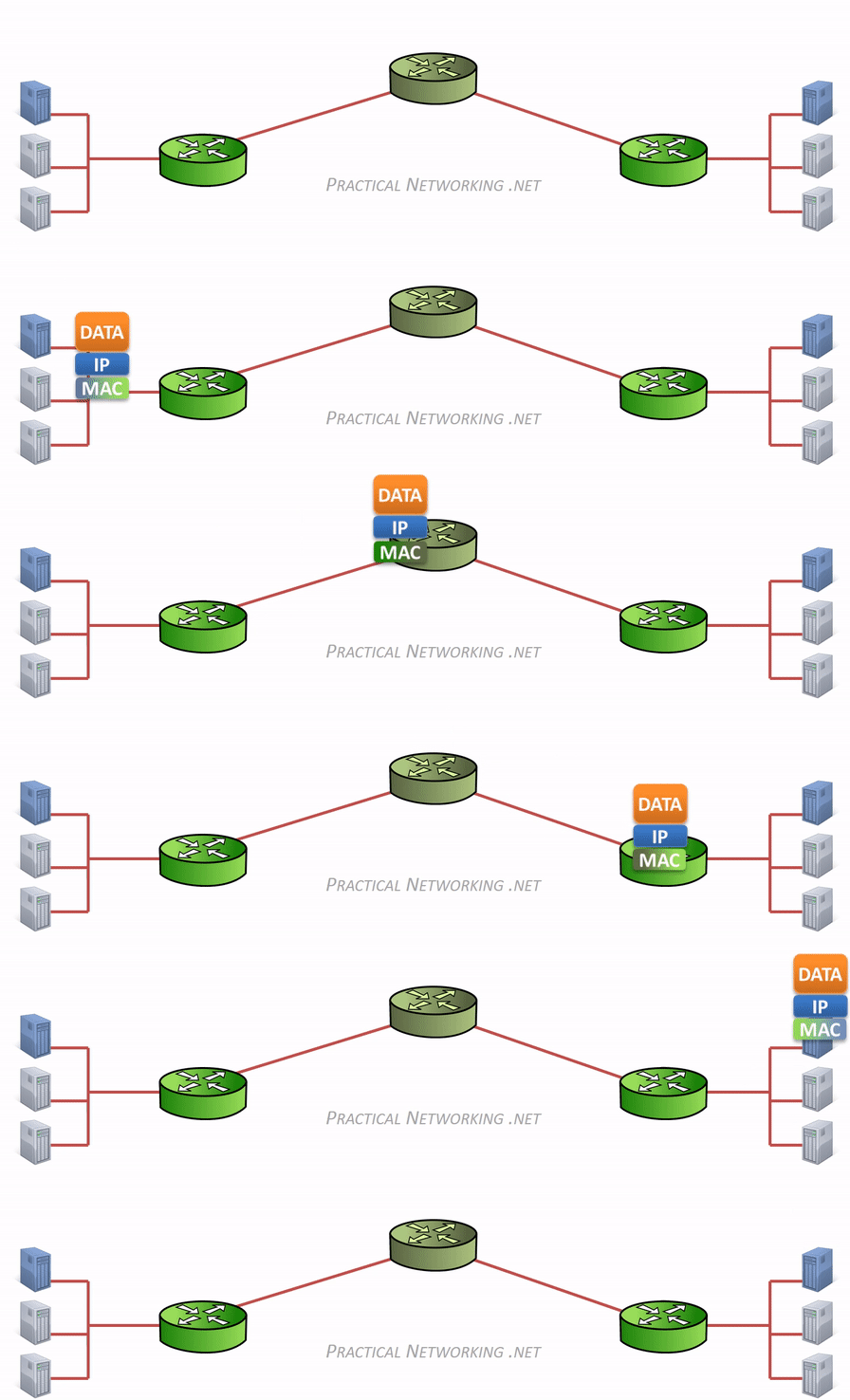
 umbral vector
what
heady bane
How do you build a saas internet to reach internet resources?
 steady epoch
hi
wind radish
heady bane
I am trying to build the following architecture https://imgur.com/a/uPWwN9W , wh...
I don't understand why you call it architecture. This aint architecture.
 robust badge
Hi everyone, I recently completed an internship at an ISP company and learnt quite a lot about Networking that i didn’t know before but now I need ideas on projects I can build with python based on networking
wind radish
robust badge
Hi everyone, I recently completed an internship at an ISP company and learnt qui...
- Connecting to devices via pexpect / paramiko / netmiko
- Generating configs via jinja2 templating engine
- Parsing output with regexp's and TextFSM
- Working with csv (maybe with sqlite as well)
- Learning what Ansible is and how to use it
- Learning what Fabric (fabfile.org) is and how to use it
here is good resource: https://pyneng.readthedocs.io/en/latest/
also you could like the "Automate the Boring Stuff with Python" book
robust badge
wind radish
* Connecting to devices via pexpect / paramiko / netmiko
* Generating configs v...
Thank you!
 urban river
hello, I would like to know about a possible web system showing data to customers. I am redirected from #web-development , but I can synthesize: I need to build a web app which is made of a single page which displays data obtained from a remote server. Such remote server is running python endlessly, as it continuously generate data. The webpage and the server are located in a company network, with the server protected behind a router and it being accessible through vpn only, while the webpage server is available for customers without authentication and can access to the python server. Do you think it is possible to adopt obfuscation strategies such that the server URL is not visible from the webpage?
or should I ignore that and adopt authentication strategies?
edgy pelican
urban river
hello, I would like to know about a possible web system showing data to customer...
1: no, 2: #web-development
although i think the best idea would be to use a reverse proxy
---------------------
| proxy & webserver | <----------------- server
---------------------``` lilac mantle
Does anyone have a good resource for learning scapy?
urban river
edgy pelican
although i think the best idea would be to use a reverse proxy
in absence of alternatives I will take that into consideration, thanks
edgy pelican
lilac mantle
Does anyone have a good resource for learning scapy?
#cybersecurity might be more suitable
fathom walrus
is there any way to track wifi strength of a device receiving wifi from the router itself?
or does this necessarily have to be device-side
zealous flint
fathom walrus
is there any way to track wifi strength of a device receiving wifi from the rout...
Not without said device telling the router about the signal strength, no
fathom walrus
was hoping there was some sort of handshake going on, oh well. thanks!
lilac mantle
Is there a way to run python code on a router?
 ocean bay
idts but you could point the router to a proxy server that runs python
zealous flint
lilac mantle
Is there a way to run python code on a router?
Depends on the router
wind radish
fathom walrus
is there any way to track wifi strength of a device receiving wifi from the rout...
My Mikrotik shows signal strength for each connected device
edgy pelican
wait so if 2 ppl have the same web browser version, hardware, and OS version, they'd have the same fingerprint
 jagged copper
they wouldnt
edgy pelican
JA3 gathers the decimal values of the bytes for the following fields in the Client Hello packet; SSL Version, Accepted Ciphers, List of Extensions, Elliptic Curves, and Elliptic Curve Formats. It then concatenates those values together in order, using a "," to delimit each field and a "-" to delimit each value in each field.
and extensions
like, if you have the same hardware & OS & web browser, it'd be the same
jagged copper
and depending on the site, adds in ip, location, cookies, headers etc
ember ledge
Does anyone has any project on networking using sockets and so?
edgy pelican
ember ledge
Does anyone has any project on networking using sockets and so?
chat app
bonus points if you make it encrypted :) (kinda hard tho)
ember ledge
Who is making it?
edgy pelican
ember ledge
Who is making it?
i am
ember ledge
edgy pelican
i am
How can I help?
edgy pelican
ember ledge
How can I help?
mostly working on https://github.com/SomeHybrid/crypto
(im making it from scratch scratch, so cant really help)
An encryption library written in Rust with PyO3 bindings - GitHub - SomeHybrid/crypto: An encryption library written in Rust with PyO3 bindings
 cyan plume
Hi, is anyone interested in becoming programming buddies ?
ember ledge
I want programming buddies
always
xD
but if u use diapers and don't sleep until 4 am due to an overdose of caffeine
ember ledge
edgy pelican
mostly working on https://github.com/SomeHybrid/crypto
(im making it from *scra...
So it is an encryption library?
cyan plume
cyan plume
Hi, is anyone interested in becoming programming buddies ?
if someone is interested please pm me
ember ledge
i will
edgy pelican
ember ledge
So it is an encryption library?
yeaaahhhhhhhhh
ember ledge
and you are coding an encryption algorithm from sratch because there is no hyper-optimzed version of it yet?
edgy pelican
ember ledge
and you are coding an encryption algorithm from sratch because there is no hyper...
no
its because i can
edgy pelican
(dont do this at home kids, something something dont roll your own crypto something something schneier's law, something something timing attacks, something something side-channel vulnerabilities, something something just dont waste your time)
tl;dr: dont
edgy pelican
but this is more #cybersecurity land
edgy pelican
ember ledge
It is gonna be fun though
no its not
im translating literal garbage C code
where they dont use loops for the sake of not using loops
uGH
ember ledge
That's my definition of fun
edgy pelican
gtg
edgy pelican
ember ledge
That's my definition of fun
here's a taste
(not even the worst of it)
        d0 = ((unsigned long long)h0 * r0) + ((unsigned long long)h1 * s4) + ((unsigned long long)h2 * s3) + ((unsigned long long)h3 * s2) + ((unsigned long long)h4 * s1);
        d1 = ((unsigned long long)h0 * r1) + ((unsigned long long)h1 * r0) + ((unsigned long long)h2 * s4) + ((unsigned long long)h3 * s3) + ((unsigned long long)h4 * s2);
        d2 = ((unsigned long long)h0 * r2) + ((unsigned long long)h1 * r1) + ((unsigned long long)h2 * r0) + ((unsigned long long)h3 * s4) + ((unsigned long long)h4 * s3);
        d3 = ((unsigned long long)h0 * r3) + ((unsigned long long)h1 * r2) + ((unsigned long long)h2 * r1) + ((unsigned long long)h3 * r0) + ((unsigned long long)h4 * s4);
d4 = ((unsigned long long)h0 * r4) + ((unsigned long long)h1 * r3) + ((unsigned long long)h2 * r2) + ((unsigned long long)h3 * r1) + ((unsigned long long)h4 * r0);```It looks fun, if that's how you want to spend your time I see it as praiseworthy
 normal cape
This is supposed to be a proxy that an application can connect to over http and have its connection be bounced to a specific url over https. It's a long story, but I have a piece of software that needs to talk to a database without encryption, and for a few different reasons the database connection needs some TLS.
import asyncio, sys, ssl

LISTEN_PORT = 7500
DST_PORT = 443
DST_HOST = "wikipedia.com"
#DST_HOST = "neverssl.com"

async def pipe(reader, writer):
    try:
        while not reader.at_eof():
            data = await reader.read(2048)
            print(f"Received {data!r}")
            writer.write(data)
    finally:
        writer.close()

async def handle_client(client_reader, client_writer):
    try:
        # connect to database server
        ssl_context = ssl.create_default_context(ssl.Purpose.SERVER_AUTH)
        ssl_context.check_hostname = True
        server_reader, server_writer = await asyncio.open_connection(
            DST_HOST, DST_PORT, ssl=ssl_context)
        print("Connected to server")
        pipe1 = pipe(client_reader, server_writer)
        pipe2 = pipe(server_reader, client_writer)
        await asyncio.gather(pipe1, pipe2)
    except Exception as e:
        # printing the error message
        print(f"Error connecting to server: {sys.exc_info()[0]}")
        print(f"{e}")
    finally:
        print("Closing connection")
        client_writer.close()

async def main():
    server = await asyncio.start_server(handle_client, '127.0.0.1', LISTEN_PORT)

    print('Serving on {}'.format(server.sockets[0].getsockname()))
    try:
        await server.serve_forever()
    except KeyboardInterrupt:
        pass

    server.close()
    await server.wait_closed()

asyncio.run(main())
I've tested a very slightly modified version of this (just no https) locally with regular old http over netcat and everything works fine, and I've tried connecting to neverssl.com over this using a web browser and that works fine as well.
When I change the code to use https and try connecting to 127.0.0.1:7500 using a web browser I get this in the console:
Error connecting to server: <class 'ssl.SSLCertVerificationError'>
[SSL: CERTIFICATE_VERIFY_FAILED] certificate verify failed: unable to get local issuer certificate (_ssl.c:992)
Closing connection
I've probably forgotten to mention something important, but thanks for any input in advance!
normal cape
Oh, one thing I forgot to mention is that the answers to this that I'm seeing online have to do with pip installing certifi (already installed) and running a Certificates.command executable (I'm on a mac), but my python install doesn't include that anywhere for me to run it.
 next marsh
normal cape
Oh, one thing I forgot to mention is that the answers to this that I'm seeing on...
next marsh
normal cape
Oh, one thing I forgot to mention is that the answers to this that I'm seeing on...
Did you install python via an installer or homebrew?
normal cape
homebrew
next marsh
Certificates should have been handled for you then. The installer lacks permissions for both actions and, as you found online, gives the user an additional command to run.
normal cape
Ok, that makes sense. I was hoping that was the case.
next marsh
Aside from ensuring that certifi is up-to-date, I'm not sure myself. The SSL error is not the one I'd expect if the certs are bad.
normal cape
Ok, just checked and certifi is definitely up to date. Thanks for trying, I appreciate the effort.
next marsh
Things I'd doublecheck: Make sure you are running python with the same homebrew python version you installed. Make sure that homebrew version included ssl (it feels like it didn't). Might even check if you have openssl installed (via homebrew). Total spitballing here. As others check in here maybe more options will be forthcoming.
normal cape
ok, just checked all three of those things and they all look correct
normal cape
It was, in fact, just an issue with my local dev environment. I tried it on a different machine and there were no problems.
I spent a long time on that for it to end up being nothing. Ouch.
 weary coyote
Сloud Builders: Python Conf is already today 🐍
Are you with us? Just save your place 👉 https://www.cloud-builders.tech/en/python-conf
Today's evening, we will start with the cosmic journey with a fireside chat about Python's role in unlocking the secrets of the Universe with the JamesWebbSpaceTelescope 🌌
Then we join 4 deep-dive Python talks: #codeimprovement with #formatters like Black PyBetter; AIspace, Open-Source models, Caikit, OpenShift, API; synergy between OpenSearch, Python, and serverlessarchitecture; and speedrun Pythondeployments with azd.
👀 See you soon!

On September 6, we invite you to join Cloud Builders: Python Conf: 1000+ like-minded people from around the world, 6+ global Python & Cloud experts & even more.
 cedar forum
normal cape
It was, in fact, just an issue with my local dev environment. I tried it on a di...
cedar forum
normal cape
It was, in fact, just an issue with my local dev environment. I tried it on a di...
the joy of certificates
 grand kayak
normal cape
It was, in fact, just an issue with my local dev environment. I tried it on a di...
grand kayak
normal cape
It was, in fact, just an issue with my local dev environment. I tried it on a di...
damn. that's why I use a clean docker container for my tests every time
edgy pelican
!rule ads
edgy pelican
@queen moth also wrong channel, this is about network protocols, not ads
 queen moth
edgy pelican
<@1104396544758788169> also wrong channel, this is about network protocols, not ...
queen moth
edgy pelican
<@1104396544758788169> also wrong channel, this is about network protocols, not ...
Ok, will change. Thanks.
cedar forum
edgy pelican
which sort
anything x509
edgy pelican
cedar forum
anything x509
oh that sort
never had to deal with them, never want to deal with them
https://tls12.xargs.org already makes it look painful

Every byte of a TLS connection explained and reproduced
cedar forum
edgy pelican
https://tls12.xargs.org already makes it look painful
you know the crazier thing
edgy pelican
what
cedar forum
TLS v1.2, v1.3 etc etc
their actual protocol header does not identify them as that
they all "pretend" to be TLS v1.0 for back compatibility
edgy pelican
protocol engineering is ???
cedar forum
even when they started saying that connections were TLS v1.2 when you use 1.3 it still pretends to be 1.2
spec literally says "hardcode this value to tls v1.2"
edgy pelican
lmao
cedar forum
and even better, it doesn't use version numbers like 1.2
edgy pelican
that kinda boosts my self-esteem
knowing that its not only my code that's held together with tape and glue
cedar forum
lol
edgy pelican
lol indeed
cedar forum
but yeah all TLS versions are technically "extended versions" of SSL
SSL was 3,0, TLS 1.0 was 3,1 because it was a minor revision to SSL, so TLS 1.3 is 3,4
confusingly
edgy pelican
oh wait
so
how does the client know what CA is being used?
does the server just send the name
or does it just go through its root CAs and check
cedar forum
certificates contain a "hierarchy"
so you have a certificate for pythondiscord.com which in turn gets signed by X numbers of intermediary CAs and then a trusted root CA
 edgy pelican
ic ic
edgy pelican
very cool
and then the client just iterates over the intermediary CAs and get their public keys?
edgy pelican
turtles all the way down :)
normal cape
grand kayak
damn. that's why I use a clean docker container for my tests every time
I did initially, too. For some reason it wouldn't work in the container and I didn't get any errors anywhere, so I switched from docker thinking debugging it would be easier.
Famous last words.
normal cape
edgy pelican
https://tls12.xargs.org already makes it look painful
that looks awesome, thanks for sharing
grand kayak
normal cape
I did initially, too. For some reason it wouldn't work in the container and I di...
that's strange, what image were you using? typically you can see the errors in docker logs
cedar forum
normal cape
that looks awesome, thanks for sharing
there is also a great one for QUIC https://quic.xargs.org/

Every byte of a QUIC connection explained and reproduced
normal cape
grand kayak
that's strange, what image were you using? typically you can see the errors in d...
just the latest python image
 winter knot
hello everyone! can someone help me with a socket code? I am trying to send a pickled object through socket. but whenever the client side receives the data, a '0' is automatically added in front of the serialized object which makes the object impossible to deserialize. do you have any idea why this might happen?
cedar forum
winter knot
hello everyone! can someone help me with a socket code? I am trying to send a pi...
do you have any sample code?
and is it a 0 or is it a \0 (null byte)
winter knot
the starting should be b'\x80\x04... whereas it becomes b'0\x80\x04...
cedar forum
any example code would be great, it's almost impossible to diagnose this without that
upload some client and server code to https://paste.pythondiscord.com/
winter knot
cedar forum
any example code would be great, it's almost impossible to diagnose this without...
have a look here: https://paste.pythondiscord.com/CF4Q
tell me if you need anything more
cedar forum
is there any chance that player_serial could be 0
i get the feeling that you are sending a 0 and then you are sending your pickle encoded data, not "a 0 is appearing in front of my pickle data"
winter knot
yes
cedar forum
yes
then that's it
you're not reading pickle data, you're reading the player_serial that you've sent and then the pickle data
winter knot
but the problem is, whenever I try to unpickle it gives me unpickling stack underflow error. in order to diagnose that problem, I unpickled the same pickled object on the server side and there it runs without a problem.
cedar forum
it's not at all related to the pickling
that works fine
okay so let's run through what data gets sent
the client connects, then client.sendall(str.encode(str(player_serial))) runs and sends the player_serial, that will be 0
now at the client end, the receive buffer will sit at 0
then the server will send client.sendall(pickle.dumps(game))
at the client end, the buffer will now sit at 0[ALL THE PICKLE DATA]
do you see where the 0 is coming from now?
winter knot
the 0 is inside the binary serialization: b'0\x80\x04...
or pickle serialization whatever you call it
cedar forum
on the client end you are running client.recv(1024)
that will recieve ALL data that has been sent to the client and is waiting to be read
you are sending two things, the 0 from player_serial and then the pickled game information
client.recv does not know those are two different things, it will just bundle them together as one binary blob, it has no idea what pickle is, it just knows you've sent a bunch of bytes and want to receive a bunch of bytes
cedar forum
well, you can use newlines (\n) to separate data
or maybe the smarter way would be to not use pickle for this and to use JSON and instead of just sending the player_serial as 0 send it as it's own JSON message format
that way you can parse all messages on the client the same and know "oh this JSON object is the player_serial", "oh this JSON object is the player state", etc.
(more secure this way as well, accepting/sending raw pickle over a network socket is a horrible idea as anyone that sends you data can execute code remotely on your system)
winter knot
by the way, there's another client.receive(1024) in another method before this particular one which sends it in an encoded string.
cedar forum
 winter knot
cedar forum
<https://docs.python.org/3/library/pickle.html>
winter knot
cedar forum
<https://docs.python.org/3/library/pickle.html>
okay I get it
it works... thanks a lot. I was stuck here for almost a day.
 flint nexus
i want to create a library/module for python to speak a specific header-based protocol. (i'm probably not using the correct jargon here). the protocol basically works like this:
- connect to a tcp server
- send a specifically crafted message to issue data
- start while loop to read data from the socket
- parse header for message type and message length
- parse message type, if message type data, then read data, if message type EndOfData, then terminate
i want to "hide" most of these details in a library/module.. so i can for instance just do frame = <library>.get_frame() or similar
grand kayak
flint nexus
i want to create a library/module for python to speak a specific header-based pr...
could you please provide some info on how we can help you?
 turbid dock
flint nexus
i want to create a library/module for python to speak a specific header-based pr...
turbid dock
flint nexus
i want to create a library/module for python to speak a specific header-based pr...
It'd probably be a lot easier if you had a library to run PHP
jovial gate
flint nexus
i want to create a library/module for python to speak a specific header-based pr...
Scapy is a tool that is designed to do a lot of this.
umbral vector
scrapy is a pretty nice framework but with the things written as the only purpose, it might be overkill
jovial gate
Speaking of Scapy, can anybody offer guidance on the difference between using guess_payload_class vs packetfield?
umbral vector
it seems like a really niche problem to write a library for. maybe having it stuffed away in its own little module where you need it in your own project can work