#internals-and-peps
1 messages · Page 151 of 1
 raven ridge
 torpid bridge
It's honestly an interesting perspective into rust's adoption. Writing less bugs is one of the driving powers of the language, but most people get on board because it's easier to write faster code instead.
raven ridge
re: Python 3, it turns out that even a lot of professional engineers have a pretty fuzzy understanding the difference between a UTF-8 encoded byte string and a Unicode text string. They're two different representations of the same information.
 white nexus
raven ridge
re: Python 3, it turns out that even a lot of professional engineers have a pret...
white nexus
raven ridge
re: Python 3, it turns out that even a lot of professional engineers have a pret...
so, er, what is the difference
what features of py2 made it able to be really easily testable? IIRC unittest was a backport.
additionally, testable functions have to be written in a way that is testable, that I don't understand how py2 made it easy, since it feels easy enough in py3.
I've seen for the most part, libraries that support 2.7 on pypi, restrict 3.0, 3.1, 3.2, 3.3, and sometimes 3.4, allowing only 3.5.3 and up to install.
I know the 3.5.3 is because asyncio was provisional, but what other features did 3.4 and 3.5 bring that were key?
raven ridge
white nexus
so, er, what is the difference
A Python 3 Unicode str string stores an array of Unicode code point numbers.
A UTF-8 byte string is an alternative representation for those same code points - namely, the UTF-8 representation.
white nexus
I just realised I replied to everything in the opposite order of how it was sent, lol
raven ridge
white nexus
what features of py2 made it able to be really easily testable? IIRC unittest wa...
pytest supported 2.7 as well, and there used to be nose and nose2 as well. I don't think there's any substantial testability improvements in 3, save for the unittest.mock module - which exists as mock on PyPI, installable for 2.7
white nexus
raven ridge
A Python 3 Unicode str string stores an array of Unicode code point numbers.
A U...
I'm sorry, I'm still confused 😅
white nexus
raven ridge
pytest supported 2.7 as well, and there used to be nose and nose2 as well. I don...
oh, til. So was any aspect of py2 (in your opinion) easier to test than on python3.5, which is the first one you started with?
raven ridge
None that I can think of.
raven ridge
white nexus
I'm sorry, I'm still confused 😅
!e ```py
as_str = "😅"
as_bytes = as_str.encode("utf-8")
print(f"{len(as_str)=} {len(as_bytes)=}")
print(f"{as_str[0]=} {as_bytes[0]=}")
 fallen slateBOT
@raven ridge :white_check_mark: Your eval job has completed with return code 0.
001 | len(as_str)=1 len(as_bytes)=4
002 | as_str[0]='😅' as_bytes[0]=240
Python 3 Unicode strings operate on logical characters, more or less. Byte strings operate on the individual bytes that make up one specific representation of those characters or another.
white nexus
as str is a unicode emoji
encoded as utf-8
the len is different because of how the encoding works
this makes some sense I feel like this will bite me
white nexus
white nexus
as str is a unicode emoji
encoded as utf-8
the len is different because of how t...
.bm
white nexus
raven ridge
Python 3 Unicode strings operate on logical characters, more or less. Byte strin...
.bm (The actual explanation for the previous bookmark)
raven ridge
They're two different representations of the exact same data, though. One representation operates on it at the binary level of one specific encoding of that data, and one operates on it at the abstract level of idealized characters
And if you don't have a good handle on what each of those representations is for, and when you need each one, it's really hard to understand why you need to keep converting between them in a Python 3 program.
white nexus
yeah idk when I would need a bytes, unless I'm using a method from a different library that needs bytes
raven ridge
When you want to serialize that data to a concrete representation. If you want to store it in a database or write it to a file or send it to a web server, you need to pick some sequence of bytes that represents that abstract textual string, and whoever reads it on the other side needs to use the same representation to make sense of what you've written
white nexus
oh that makes a lot of sense
but when manually messing with it, it's best to have it in string form
so that's why subproccess communicate and such are byte streams!!
raven ridge
Yep. And why things like open() take an encoding= argument: to allow you to write text strings which they'll automatically handle encoding into your chosen binary representation
white nexus
hmmm
but there's also the modes in open, "rb" and "wb"
so, if open takes ascii as encoding, and wb as the mode, what exactly would happen if we wrote a bytestream to the open file?
raven ridge
They're mutually exclusive. You can't provide an encoding if you open in binary mode
white nexus
it's binary mode and not bytes mode??
raven ridge
Same thing. The raw bits/bytes that the file is storing.
white nexus
I think after asking "are bytes different from binary mode" that might be my cue to go sleep
raven ridge
You either provide an encoding and open in text mode (so things you read/write are automatically de/encoded using the given encoding) or you give the "b" flag, and the file deals with raw bytes and you're responsible for doing any relevant en/decoding
white nexus
white nexus
I think after asking "are bytes different from binary mode" that might be my cue...
(yes they are slightly different but also that should have been obvious that the mode is the same, since I know binary and what bytes are)
white nexus
raven ridge
You either provide an encoding and open in text mode (so things you read/write a...
makes sense, I feel like I should always use bytes mode
anyways, I need to go sleep, I'll read your replies in the morning
raven ridge
white nexus
makes sense, I feel like I should always use bytes mode
When you're dealing with textual data, that's really inconvenient, and it's better to let the file object handle encodings so you can deal with strings.
 verbal escarp
for me f-strings were the killer feature to switch to 3, but i also wanted to experiment with async, enums and pathlib.. dispatching was also on my wishlist (singledispatch let me down, though)
 spice pecan
Bytemode also disables the automatic conversion of newlines to "\n"
verbal escarp
also something that changed quite a bit how i write my code in python 3 (.8) were positional-/keyword only arguments
that is one small underrated thing for me
 grave jolt
I could 100% live without f-strings
 tame grove
Is it a bug in Python 3.10??
a dot is missing between now() and strftime but it is suggesting that most probably a comma is missing.
 grave jolt
tame grove
Is it a bug in `Python 3.10`??
a dot is missing between `now()` and `strftime` b...
grave jolt
tame grove
Is it a bug in `Python 3.10`??
a dot is missing between `now()` and `strftime` b...
if datetime.now(), strftime(...) != "19:50:00": return is also valid
ultimately it can't perfectly guess your intention
but you can always file a bug 🙂
tame grove
grave jolt
`if datetime.now(), strftime(...) != "19:50:00": return` is also valid
oh I didn't know that
tame grove
grave jolt
but you can always file a bug 🙂
no it's ok
grave jolt
tame grove
oh I didn't know that
actually no, it's invalid syntax
!e
if datetime.now(), strftime(...) != "19:50:00": pass
@grave jolt :x: Your eval job has completed with return code 1.
001 |   File "<string>", line 1
002 |     if datetime.now(), strftime(...) != "19:50:00": pass
003 |                      ^
004 | SyntaxError: invalid syntax
then it's probably a bug
tame grove
oh ok
tame grove
grave jolt
then it's probably a bug
Which components is affected??
tame grove
tame grove
Which components is affected??
Interpreter core?? Windows??
grave jolt
why would this be caused by a problem with windows?
tame grove
So I'm selecting Interpreter core
ok??
 surreal sun
I think the keyword in that error is 'Maybe', it's more or less a suggestion because the program isn't sure what errored out, whether it was a missing comma, a missing ., etc.
raven ridge
True, but it might be able to make a better guess, even if it's a heuristic.
surreal sun
raven ridge
True, but it might be able to make a better guess, even if it's a heuristic.
True.
I think this error is likely raised in the lexer though right? What is the token that is assigned to it and if it's missing it raises the following error
I don't think i'm being clear oops
I meant like which "missing" group of tokens raises this error
 naive saddle
surreal sun
I think this error is likely raised in the lexer though right? What is the token...
naive saddle
surreal sun
I think this error is likely raised in the lexer though right? What is the token...
it's probably raised in the parser as the custom error message is actually implemented in the PEG grammar itself
surreal sun
ah
raven ridge
It should, hopefully, be able to avoid suggesting that you forgot a comma in cases where adding a comma would be a syntax error 🙂
seems like Pablo would be glad for the test case, at least.
 true ridge
tame grove
Is it a bug in `Python 3.10`??
a dot is missing between `now()` and `strftime` b...
true ridge
tame grove
Is it a bug in `Python 3.10`??
a dot is missing between `now()` and `strftime` b...
I believe we have removed these sort of messages on 3.11
It will only be printed if the expression in the context is within parentheses now
white nexus
..they were only added in 3.10, weren't they?
true ridge
no, they are still there but the context targetting is better now
white nexus
oh okay
true ridge
GitHub
https://bugs.python.org/issue45727
Automerge-Triggered-By: GH:pablogsal
 mild flax
class ReusableGenerator():
    def __init__(self, iterable = tuple()):
        self._cache = []
        self._original = iterable
    def __iter__(self):
        yield from self._cache
        while True:
            try:
                new_item = next(self._original)
            except StopIteration:
                break
            self._cache.append(new_item)
            yield new_item
    # VS
    def __getitem__(self, idx):
        if idx < len(self._cache):
            return self._cache[idx]
        self._cache.extend(itertools.islice(self._original, idx - len(self._cache) + 1))
        return self._cache[idx]
```Are there any significant differences with implementing this with one of these methods vs the other? And is there another better way?well I guess one big difference is that one of them is indexable, but other than that?
spice pecan
I personally prefer __iter__ for iteration and view __getitem__-based iterables as more of a backwards-compatible sort of thing. It's fine to provide both (and I'd probably do that), but if you just want iterability alone, I'd do __iter__
You could also try to use itertools.tee
 prime estuary
The getiterm logic here's also a fair bit more complicated if you only need to iterate, it'll be constructing and destructing the islice iterator and the like each call.
spice pecan
Yeah, that wouldn't be very fun either if you're iterating one item at a time
Though it would be partially if not completely mitigated by the implementation of __iter__
grave jolt
a().b seems valid
grave jolt
mild flax
```py
class ReusableGenerator():
def __init__(self, iterable = tuple()):
...
why tuple() though?..
mild flax
uhhh I think that was left over from something else I tried
now that I'm looking at it though i'd have to be careful of next
grave jolt
@mild flax btw, if you want to accept an iterable, do self._original = iter(iterable)
mild flax
yeah
btw, what would be the proper class in collections.abc to inherit from if I only implemented __getitem__?
grave jolt
mild flax
btw, what would be the proper class in collections.abc to inherit from if I only...
Iterable
mild flax
i dont think it likes that
 radiant garden
I don't think __getitem__ without __len__ is a thing, at least not commonly
You could check the base classes though
grave jolt
grave jolt
ah, it needs an `__iter__`
then you can do this ```py
class ReusableGenerator:
def init(self, iterable = ()):
self._cache = []
self._original = iterable
def __iter__(self):
    for i in itertools.count():
        try:
            yield self[i]
        except IndexError:
            break

def __getitem__(self, idx):
    if idx < len(self._cache):
        return self._cache[idx]
    self._cache.extend(itertools.islice(self._original, idx - len(self._cache) + 1))
    return self._cache[idx]
hmmm actually no this is terrible
or maybe not
I guess it's not
mild flax
no worse than iterating with getitem i think
radiant garden
Yeah, collections.abcs with __getitem__ always have __len__
mild flax
mild flax
```py
class ReusableGenerator():
def __init__(self, iterable = tuple()):
...
alright I found a problem with that implementation of __iter__
rg = ReusableGenerator(range(10))
i = iter(rg)
i2 = iter(rg)

for _ in range(5):
    print(next(i))

for _ in i2:
    pass

for item in i:
    print(item)
```prints
0
1
2
3
4
which isn't a problem with __getitem__
prime estuary
__iter__ isn't required, if you have __getitem__ iter() automatically adapts. Though the ABCs wouldn't recognise that.
 steel solstice
anybody happen to know the directive thats used for a code-block with sphinx?
i tried docutils.parsers.rst.directives.body.CodeBlock but the formatting is all funky

 snow bronze
😵💫
>>> type(obj)
<class 'dict'>
>>> len(obj)
170
>>> sys.getsizeof(obj)
9312
>>> obj2 = dict(obj)
>>> type(obj2)
<class 'dict'>
>>> len(obj2)
170
>>> sys.getsizeof(obj2)
4696
>>> obj == obj2
True
why does size cut half?
 visual shadow
That must have been all the size it needed. So the more important question to ask is why obj wanted to have more size. The answer most likely lies in the overallocation python uses, so details about how obj was created is relevant
snow bronze
visual shadow
That must have been all the size it needed. So the more important question to as...
obj was created by <Response>.json()
snow bronze
visual shadow
That must have been all the size it needed. So the more important question to as...
Ohhh, I hadn't thought of the question that way...
visual shadow
So, for things that grow dynamically, such as python lists or in this case dictionaries, python promises an average time complexity of append(list)/adding an item(dict) as O(1). to achieve this practically, it has a system of overallocating and growing, so every once in a while, it runs out of space, has to reallocate the whole thing, but it takes more memory than it needs, so that theres room to add newer items without taking an O(n) reallocation
While i dont exactly know the mechanisms of the .json method involved here, it's easy enough to speculate that .json must benefit from or require python dictionaries to be created incrementally, or possibly, even if they did not need to be done that way, they end up making the python dictionary item by item.
So that's what youre seeing. it's not obj2 becoming "more efficient" so much so as not needing the extra "overallocated" space because obj2 was given the entire input whose* length was known upfront (that being the len of obj dict)
so obj2 didnt need overallocation
prime estuary
Additionally for dicts, they want to avoid being too full - if that occurs, it's more likely there's hash collisions requiring checking multiple locations. So Python's dict currently doubles in size whenever it becomes more than ⅔ full.
 grizzled spire
this shouldn't exist
SyntaxError: assignment expression cannot be used in a comprehension iterable expression
no real reason
spice pecan
the real reason is there's an implicit function scope
and the results of that can be very difficult to debug
If you aren't aware of it, that is
grizzled spire
spice pecan
If you aren't aware of it, that is
if cond or (var := "stuff"):
  print(var)
for example has this propery but its allowed
spice pecan
if has no scope
spice pecan
Most things don't
In fact, I can't think of anything that does other than functions, classes and modules
spice pecan
I guess something like an implicit nonlocal for assignment targets within a scope would work
grave jolt
walrus in a list comprehension is cursed
a list comprehension shouldn't have any side effects
spice pecan
It can sometimes be useful for the actual comprehension, but at that point it's usually way more readable to just have a loop
 elder blade
grave jolt
walrus in a list comprehension is cursed
elder blade
grave jolt
walrus in a list comprehension is cursed
I disagree
['a' if some_var else 'b' for item in my_list if (some_var := do_something_with_it(item)) is not None]
I guess this is roughly manageable
elder blade
Equivalent to: ```python
new = []
for item in my_list:
if not (some_var := do_something_with_it(item) is not None:
continue
new.append('a' if some_var else 'b')
I originally thought the behaviour would be that you got access to the last item, and agreed with you.. that said the more I think about it the more I like it
[value if (value := something(item)) else None for item in my_list]
Another example
All of these can of course turn into ```python
[item if item else None for item in [something(item) for item in my_list]]
That said... What do you prefer 😉
verbal escarp
object.__dir__(thing) works like a charm, but if i try to do object.__getattribute__(thing, name) some methods are included in the dir i can't access that way, why is that?
getattr(thing, name) catches those, interestingly
 peak spoke
getattribute only does a direct lookup, skipping things like looking things up on the parent type
!e
class A:
    a = 0

class B(A):
    b = 1

getattr(B, "a")
object.__getattribute__(B, "a")
@peak spoke :x: Your eval job has completed with return code 1.
001 | Traceback (most recent call last):
002 |   File "<string>", line 8, in <module>
003 | AttributeError: 'type' object has no attribute 'a'
A for loop, both look very scary to me
grave jolt
I would use a for loop or py bar = [item if item else None for item in (something(item) for item in my_list)] or maybe ```py
foo = (something(item) for item in my_list)
bar = [item if item else None for item in foo]
The former doesn't work does it?
grave jolt
elder blade
The former doesn't work does it?
why?
you can put any expression in there
elder blade
Ooooohh, I missed the parenthesis
 unkempt rock
Why are type hints are required in dataclasses?  #help-chili
 limpid forum
grave jolt
I would use a for loop or ```py
bar = [item if item else None for item in (somet...
limpid forum
grave jolt
I would use a for loop or ```py
bar = [item if item else None for item in (somet...
I'd do item or None instead of item if item else None
Because if item is falsy, then other part will be evaluated and returned (or returns first truthy element or last element if all were falsy)
grave jolt
limpid forum
I'd do `item or None` instead of `item if item else None`
Because if item is fal...
I agree
prime estuary
unkempt rock
Why are type hints are required in dataclasses? <:lemon_glass:754441879935778867...
It's a convenient way to define all the names, not make them class variables unless you want to, and provide types. To answer your question there about ClassVar, dataclasses checks for that in the annotation and skips it.
unkempt rock
interesting
!e py from typing import get_type_hints class C: x: bool y: int print(get_type_hints(C))
fallen slateBOT
@unkempt rock :white_check_mark: Your eval job has completed with return code 0.
{'x': <class 'bool'>, 'y': <class 'int'>}
 quick snow
!e
class C:
    x: bool
    y: int
print(C.__annotations__)
@quick snow :white_check_mark: Your eval job has completed with return code 0.
{'x': <class 'bool'>, 'y': <class 'int'>}
 cloud crypt
getting back seldom-reoccurring discussions on HKTs, I feel that making TypeVars subscriptable as an opt-in seems like a good idea
as a short example of what's on my mind now, here goes
I = TypeVar("I", bound=Iterable, args=1)  # or something else
# having an exact amount of args could benefit simple runtime checks
# (the default would be 0, which makes perfect sense to me)```

let `Bound` be the type passed as `bound` for `I` type variable
then `I[T]` is *roughly* `Bound[T]`, with the main idea of preserving the actual type

I'm not exactly certain what would be required for type-checkers to implement this, but it seems like a fine idea to check against the `bound` when calling functions (and other cases)
(i.e. for `I[T]` we need to check if some type `A` is `Iterable[T]`)

when acting on these types, type-checkers would have to track the type to ensure it stays the same as the original `I`, but I don't think anything else is needed

if we look at it in action, here is a (slightly stripped) use-case
```python
W = TypeVar("W", bound="Wrap", args=1)

@dataclass()
class Wrap(Generic[T]):
     value: T

    def unwrap(self) -> T:
        return self.value

    def map(self: W[T], function: Function[T, U]) -> W[U]:
        return self.__class__(function(self.unwrap()))

class Derived(Wrap[T]):
    pass

wrap = Derived(42)  # Derived[int]
result = wrap.map(str)  # Derived[str]
print(result.unwrap())  # str```
I'd be happy to hear other inputs on this issue :)I've come across the need to abstract over the type constructor quite often, so it is definitely one of the main features I'd love to see implemented
for example, I've been working on iterators that aim to bring rust-like operations to python
I = TypeVar("I", bound="Iter", args=1)

class Iter(Iterator[T]):
    iterator: Iterator[T]  # implementation detail, need not to be generic over type

    def unwrap(self) -> Iterator[T]:
        return self.iterator

    def map(self: I[T], function: Function[T, U]) -> I[U]:
        return self.__class__(map(function, self.unwrap()))

    def exhaust(self) -> None:
        exhaust(self.unwrap())  # this function is implemented elsewhere```
and it would be neat if anyone could derive from `Iter[T]` to add useful (and more specific) functionality:
```python
class ForEach(Iter[T]):
    def for_each(self, function: Function[T, None]) -> None:
        self.map(function).exhaust()```
(obviously a toy example, since `for_each` is a pretty general and useful function, but I hope I have given a use-case)what ide do you guys recommend rn i am using pycharm
verbal escarp
not really a good topic for this channel
surreal sun
cloud crypt
getting back seldom-reoccurring discussions on HKTs, I feel that making TypeVars...
I would agree, but what about if a TypeVar isn't bound?
I[T] would be quite weird
or would it only be used for when bound to something
cloud crypt
hm, I don't really think it makes sense to have non-bound type variables? not fully sure though
surreal sun
Don't people use non-bound type variables like a generic?
something like
from typing import TypeVar

T = TypeVar("T")

list[T]
i'm not fully sure though, because I don't use TypeVar all too much
I've mostly seen other people use it
cloud crypt
well, yeah, they do, but the point is, applying type arguments to a type variable would make sense only when you have something generic to apply them to
surreal sun
how would a type checker handle two non-bound typevars together though like
I[T]? where I and T are both non-bound typevars
would it be something like Any[Any]
genuine question btw, i'm quite inexperienced with typing
cloud crypt
cloud crypt
well, yeah, they do, but the point is, applying type arguments to a type variabl...
if we have python T = TypeVar("T", args=1) what would T[A] mean? anything generic that has A as the type argument? it neither seems like something useful, nor is it fully clear
surreal sun
so I'm gonna assume your proposal is only limited to bound typevars?
cloud crypt
essentially, yeah
surreal sun
Oh yeah, i'd agree then for sure
cloud crypt
args > 0 is going to be allowed iff bound is passed as well
since, again, it's not clear how to handle non-bound type variables, and, besides, I do not see a use-case for that
from typing import Callable, Protocol

F = TypeVar("F", bound="Functor", args=1)
T = TypeVar("T")
U = TypeVar("U")

Function = Callable[[T], U]

class Functor(Protocol[T]):
    def map(self: F[T], function: Function[T, U]) -> F[U]:
raise NotImplementedError()``` and that's what the possible implementation of a *functor* from functional programming can beI quite like the way it works (or can work, rather), so what I'm especially looking for are edge-cases I could've missed
grave jolt
@cloud crypt now comes the hard part: convince a bunch of Python developers on why that is useful 🙂
surreal sun
convincing python-ideas is like talking to a brick wall, except that brick wall sometimes agrees
cloud crypt
haha, indeed
cloud crypt
grave jolt
<@!292448864944783360> now comes the hard part: convince a bunch of Python devel...
I've almost started composing a PEP a bunch of times before for HKTs, haha
 gusty marsh
Heres the corresponding section of the code, basically I am trying to reimpor the functions on file change event so they get updated but it seems its hanging on the from solution import line.
Logs:
/home/shivansh/Programming/python_projects/aoc-py/2021/01
importing...
/home/shivansh/Programming/python_projects/aoc-py/2021/01
importing...
imported...
<function part_one at 0x7f6d654f95a0> of 1...
❌ Testing of day 1 part 1 failed! Please try again. Here's the output:
        Expected: 7
        Recieved: 17
Modified
importing...
 white nexus
cough is this was you were dming me about
gusty marsh
fallen slateBOT
aoc/watcher.py line 52
class ModificationWatcher(FileSystemEventHandler):```ee yes, i figured i could just make an alt and test it
white nexus
help channel may be more fitting
gusty marsh
 deft ruin
Does anyone know if it has already been suggested (in a PEP or otherwise) that generator objects should be handled lazily in sequence unpacking? Specifically when used like:
a, b, *rest = some_generator
that rest will be the remaining generator, rather than a fully evaluated list of that generator?
elder blade
I am not sure whether I like that, it'll be a breaking change for sure
I take that back already, I can't decide
I feel like both behaviors have their benefits and can be expected
prime estuary
It would be very nice to have, but it'd be an odd special case.
Should probably be some additional syntax?
deft ruin
I agree that it would have been much better to introduce with 3.0 or something
 native flame
a, b, rest = next(gen), next(gen), gen is fairly clean \🤔
elder blade
Yeah
native flame
might be some way to use itertools.islice too
deft ruin
thats true, both ways of achieving the same thing. It was also the non-lazy behaviour which surprised me
prime estuary
You definitely could.
a, b = itertools.islice(gen, 2)
Though the downside is both of these are probably slow func calls, we'd have to see though if the 3.11 adaptions make it comparable.
elder blade
Oh wait...
!e ```python
def gen():
count = 0
while True:
count += 1
yield count
g = gen()
a, b = g
print(a, b, g)
@elder blade :x: Your eval job has completed with return code 1.
001 | Traceback (most recent call last):
002 |   File "<string>", line 8, in <module>
003 | ValueError: too many values to unpack (expected 2)
Makes sense
deft ruin
Lol, that was exactly the code I tried that made me consider this
because adding a *c to the unpacking, makes it hang forever
prime estuary
Thought, allow this to indicate it should not try to consume additional values:
a, b, ... = blah
A star-arg at the end would be prohibited since it's contradictory, use a walrus if you need to save.
spice pecan
some sugar for lazy evaluation would definitely be nice
deft ruin
Maybe we could borrow from JS and use ... (or just ..) as a lazy alternative to *
a, b, ..c = gen
spice pecan
I'm still rooting for _ to become an actual throwaway
deft ruin
Yeah would be nice
spice pecan
then you would be able to do a, b, *_ to lazily get the first two, and a, *_, b to get the first and the last without collecting everything in between and actually discarding it
deft ruin
how does that work for generators though...
maybe that is the reason it cant be. because when generators (or custom iterables) are involved, it must evaluate all intermediate values. But it wouldnt have to store them
you could at least save some memory
spice pecan
depending on the shape of lhs, either stop iteration on *_, or save the exact amount of args after it into a list and unpack that
deft ruin
but then it would only work with objects that define __len__
spice pecan
not really
you could achieve the same with a maxsized deque
keep pushing new items and discard irrelevant ones as you go
deft ruin
oh yeah fair point
spice pecan
a fair bit more work for the compiler, but I personally would love that
if you ignore the fact that _ is currently a valid identifier, it shouldn't be breaking either
deft ruin
PEP 677: Better sequence unpacking. _ as a memory free 'hole' and .. as a lazy alternative to *.
😄
but surely the _ thing has been suggested before
spice pecan
Yeah, it's currently used for i18n
So I highly doubt this will ever get into the language
but if you give special treatment to unpacking into _, you can get both lazy and eager evaluation without a breaking change (except for _ and weird constructs that maybe rely on eager evaluation for side effects?) and without introducing new syntax
deft ruin
well, I think you can't have it both ways. Either it is a hole which does not store values (and can be placed anywhere) or it makes * lazy, and can only really be used at the end
because what if i want to use the generator again later
whats left of it anyway
Or maybe its smart enough to know, that if it is at the end, then it stores the remaining generator. Otherwise nothing
elder blade
spice pecan
then you would be able to do `a, b, *_` to lazily get the first two, and `a, *_,...
That's impossible for generators though?
spice pecan
well it currently isn't
deft ruin
impossible while keeping them as generators
the current implementation essentially converts to a list (or tuple?) and then goes ahead
spice pecan
but if you just use the equivalent of a sized deque to capture exactly N items, you get all the benefits
with a simple circular buffer you avoid storing intermediate values and only get the relevant ones, which are then popped into the assignment targets
and if you don't have any targets after the discard, there's no need to evaluate the rest
deft ruin
is it fine for random people like me to make PEPs? or is that frowned upon unless I really know what im doing
spice pecan
You should first get the general consensus in the mailing list
and if there's demand, you go further and draft a pep
deft ruin
Oh, I thought the mailing list was like invite only or something
interesting
Ah, non members can post to Python-dev
spice pecan
elder blade
That's impossible for generators though?
Explaining what I mean with equivalent python code:
a, _, b = sample  # Use current semantics
# Roughly
t = list(sample)
if len(t) < 3: raise ValueError("not enough values to unpack")
if len(t) > 3: raise ValueError("too many values to unpack")
a = t[0]; b = t[2];

a, b, *_ = sample  # Lazily evaluate first two args
# Roughly
i = iter(sample)
a = next(i)
b = next(i)

a, *_, b, c = sample  # Lazily evaluate, discarding intermediate values
# Roughly
i = iter(sample)
a = next(i)
d = deque(i, maxsize=2)  # Two targets after *_, size = 2
if len(d) < 2: raise ValueError("not enough values to unpack")
b = deque.pop_left()
c = deque.pop_left()

a, *b, c = sample  # Use current semantics
# Roughly
i = iter(sample)
a = next(i)
t = list(i)
b = t
c = t.pop()
Sample is any Iterable
There's no way this is getting into the language, but a man can dream
deft ruin
A new syntax might be possible to add though...
spice pecan
Yeah, but I don't think the chances are good
new operators add a fair bit of complexity
deft ruin
and using the lazy unpacking, at least cases with .._ at the end, would work the same as yours
yeah
i also am not sold on the syntax
spice pecan
The main issue here is that all this can be implemented fairly simply with a function
and there's little ground to force it into the language
deft ruin
well, most things can be fairly simply implemented with a function, especially syntactic sugar things 😄
I agree that it certainly isn't necessary, but I do think it would be nice (if a better syntax were found. The more i look at .. the uglier i find it)
spice pecan
def unpack_lazy(iterable, first=0, last=0, keep_intermediate=False):
    i = iter(iterable)
    yield from islice(i, first)
    length = None if keep_intermediate or not last else last
    yield from collections.deque(i, maxlen=length)

first, second, second_to_last, last = unpack_lazy(i, 2, 2)
*body, last = unpack_lazy(i, last=1, keep_intermediate=True)
ig keep_intermediate is not necessary, because it just turns it into regular unpacking, but yeah. Good enough for most purposes
 lusty scroll
lazy unpacking is a thing?
deft ruin
but it should be (imo)
spice pecan
sort of
lazy unpacking of n first items is just islice
and unpacking last n isn't really lazy
lusty scroll
so the idea is improved efficiency?
deft ruin
For generators the idea is to act more intuitively, and manageably
as said, it works also with islice but I think some syntactic sugar would be cool
lusty scroll
so it's like partially unpacking a sequence (or unpacking part of the sequence and leaving the rest in a separate argument)
spice pecan
yeah
take first N items and leave the rest intact
Or take first N and last N, actually discarding everything in between instead of accumulating into a list and then immediately throwing it away
(well, in most cases you won't even throw the list away, it'll just stay bound to whatever placeholder you give it)
white nexus

GitHub
What's the problem this feature will solve? https://arstechnica.com/information-technology/2021/11/malware-downloaded-from-pypi-41000-times-was-surprisingly-stealthy/ Pypi currently uses fa...
verbal escarp
oh man, i just went in functools to check update_wrapper and stumbled over this
class Negator:
    @singledispatchmethod
    @classmethod
    def neg(cls, arg):
        raise NotImplementedError("Cannot negate a")

    @neg.register
    @classmethod
    def _(cls, arg: int):
        return -arg

    @neg.register
    @classmethod
    def _(cls, arg: bool):
        return not arg
that's soo ugly..
there has to be a better way!
 feral cedar
slams desk
grave jolt
obviously
Negator = exec_haskell("""
    class Negatable a where
        neg :: a -> a

    instance Negatable Integer where
        neg n = -n

    instance Negatable Bool where
        neg = not

    -- export Negatable as Negator
""")
right.. 
spice pecan
I mean
What's wrong with a function? Is there a real need for a class here?
def negate(arg):
    if isinstance(arg, bool):
        return not arg
    return -arg
hey you left off int
😔
!e ```py
f = 5.4
print(-f)
@white nexus :white_check_mark: Your eval job has completed with return code 0.
-5.4
Does it matter?
white nexus
and why does it not support floats.
white nexus
verbal escarp
```python
class Negator:
@singledispatchmethod
@classmethod
def neg(...
(ref this, why does it not support floats for that)
spice pecan
Depending on your domain, you may want int specifically
But then just typehint it as such and follow the consenting adults principle
If they pass a float and it breaks something, it's their problem, not yours - you did let them know that ints are needed
And if you intend to support any negatable type/any numeric type, you should either use a duck-typing protocol that defines __neg__, or hint it as numbers.Numeric (or something along those lines, my memory is hazy on those ABCs)
verbal escarp
well, for one, the stacked decorators simply look ugly, secondly, and more importantly, having several functions with the same name is not a good idea, greatly confuses IDEs and interpreters alike
it's a similar problem with properties, basically impossible to get nice looking code without messing up the tooling
 wheat plover
singledispatchmethod is essentially a dict on first argument type (I think?) so if the decorator looks ugly, just use a dict (or match stmt)
verbal escarp
you can't overload an external function that way
grave jolt
the main question is: why would anyone need a Negator like this?
verbal escarp
grave jolt
the main question is: why would anyone need a `Negator` like this?
i think it's an example for a class with some method that is overloadable
spice pecan
It's a really poor example
verbal escarp
it is
grave jolt
wheat plover
singledispatchmethod is essentially a dict on first argument type (I think?) so ...
well, this is a bit complicated, because a subclass of int (which is not bool) should still get to the int branch
or does singledispatchmethod just look at the concrete type?
verbal escarp
i think it only checks concrete type
grave jolt
that's pretty silly
verbal escarp
it's a workaround, nothing more
i've been disappointed by dispatching in python for a long while
spice pecan
I'd probably either generalize better (like above), or dispatch to specific overloads via match
wheat plover
https://www.python.org/dev/peps/pep-0443/ here is the pep
spice pecan
verbal escarp
i've been disappointed by dispatching in python for a long while
IME it's rarely actually needed, and in the few cases where it is, match covers it very well
But I do admit that it's... not as good as it could've been
verbal escarp
spice pecan
IME it's rarely *actually* needed, and in the few cases where it is, `match` cov...
but only if you have access to the generic function though
if you can't manipulate the patma, you're out of luck, mostly
wheat plover
I think problem with generalization is that multiple inheritance exists.
So MyWeirdClass(int, bool) would qualify for both
Something like that would make say, java throw errors on you
spice pecan
verbal escarp
if you can't manipulate the patma, you're out of luck, mostly
Just redefine?
grave jolt
@verbal escarp I think you want typeclasses 🙂
verbal escarp
grave jolt
<@!500372058186842123> I think you want typeclasses 🙂
i do? ^^
tell me more
wheat plover
But python doesnt do overloading anyways so singledispatch only does so much
spice pecan
Ad-hoc polymorphism, sounds really fitting
grave jolt
unless I completely misunderstand what you want
@verbal escarp you want to extend an existing function someone else wrote to accept your own class, right?
verbal escarp
grave jolt
<@!500372058186842123> you want to extend an existing function someone else wrot...
yes
verbal escarp
how would you realize the Negator with typeclasses?
grave jolt
class Negatable a where
    neg :: a -> a

instance Negatable Integer where
    neg n = -n

instance Negatable Bool where
    neg = not
``` 🙂in python :p
grave jolt
wheat plover
btw is this a good place to ask for library recs?
grave jolt
verbal escarp
that looks fairly similar to singledispatch?
I think it's only different in that it has mypy support 🙂
verbal escarp
grave jolt
I think it's only different in that it has `mypy` support 🙂
that's something.
grave jolt
can't you actually do what you want with singledispatch?
verbal escarp
as i said, i only stumbled over this ugly corner in the documentation while looking for update_wrapper.. i've used singledispatch before, but it always left a kind of stale aftertaste in my mouth
been looking for better alternatives to dispatching and property ever since
grave jolt
what's wrong with property?
verbal escarp
ever used it?
spice pecan
!pypi multipledispatch have you considered this?
fallen slateBOT

Multiple dispatch
verbal escarp
spice pecan
!pypi multipledispatch have you considered this?
actually i haven't, thanks for reminding me
grave jolt
verbal escarp
ever used it?
🤔 yes
verbal escarp
grave jolt
what's wrong with `property`?
it looks fine on first sight, but if you try working with it, you either have to abandon best practices or you get ugly code that screams "unpythonic" at you
spice pecan
I guess it depends largely on your domain
But I've never had that issue
Can you give an example?
grave jolt
I generally don't use property to be honest
in my mind it's just a tool for backwards compatibility, or when you have to conform to an interface, or something
so I usually just make a method 🤷
verbal escarp
no, properties are awesome as a concept
i do love the idea
but the code to actually get there is just.. meh
spice pecan
I find them much more useful in languages that obsess over access obstruction
But I don't see much of a difference between properties in, say, C# and Python
white nexus
verbal escarp
no, properties are awesome as a concept
!d unittest.mock.PropertyMock I need to figure out how this works, I was just setting the property to the necessary mock, when this would be so much better
fallen slateBOT
class unittest.mock.PropertyMock(*args, **kwargs)```
A mock intended to be used as a property, or other descriptor, on a class. [`PropertyMock`](https://docs.python.org/3/library/unittest.mock.html#unittest.mock.PropertyMock "unittest.mock.PropertyMock") provides `__get__()` and `__set__()` methods so you can specify a return value when it is fetched.

Fetching a [`PropertyMock`](https://docs.python.org/3/library/unittest.mock.html#unittest.mock.PropertyMock "unittest.mock.PropertyMock") instance from an object calls the mock, with no args. Setting it calls the mock with the value being set...because if I'm mocking a property, being able to know when my methods don't use that property is somewhat nice to know imo
verbal escarp
sure, but properties are much more useful than keeping track of access
white nexus
oh, yeah, ofc
I mean, if I had to overwrite a property with an attribute, I haven't used a mock since I didn't know this existed
I've just used the value that it needs directly
verbal escarp
one thing i fiddled with a long time ago was a flyweight class that would abstract access to numpy arrays
white nexus
but haven't been able to apply side effects or anything
verbal escarp
a slotted class with an ID as the only real attribute
you could pass it around and do things like cell.material
then it would go to the numpy array, basically as an API
it was a huge class, only consisting of properties
so i experimented with different ways to define properties so that my IDE wouldn't complain about duplicated names on one hand or having 2, 3, 4 definitions with everything, polluting the namespace
sorry, i can't find the code anymore on the spot
spice pecan
I think the larger issue is not property (or any other similar python feature) itself, but moreso the fact that typechekers have a REALLY hard time keeping up with (fairly predictable, by human standards) levels of dynamic typing
verbal escarp
those issues aren't exclusive 🙂 both ends are a mess
spice pecan
Python as a language gives you a lot of tools that allow for very powerful and, I can't really find a better word for it, quirky constructs, that are not necessary, but appealing as a concept. And when you try to apply typecheckers to this, they tend to go nuts
spice pecan
verbal escarp
those issues aren't exclusive 🙂 both ends are a mess
They aren't exclusive, sure
But, in my personal experience, one magnifies the other significantly, while the other barely ever pops up at all
I've seen and experienced first-hand a plethora of cases where things are pretty readable and function well, but then you start trying to shove typing in or fix that one thing the IDE is bugging you about
And embark on an adventure that results in a huge mess and something along the lines of "I should've really just kept it simple"
Typing is nice, and so is the dynamic nature of python. Do they mesh together well? Not at all
spice pecan
I wish python had a typing system as good as ts
grave jolt
I only had to //@ts-ignore (or similar hacks) some very arcane stuff
spice pecan
Javascript also manages to be fairly fast
And has a ton of money poured into developing it
 empty kite
Is there a better way to type hint recursive functions than having <return type of final recursion> | Callable[<repeat all argument types>]?
grave jolt
empty kite
Is there a better way to type hint recursive functions than having `<return type...
hm?
empty kite
As a return type
grave jolt
a recursive function doesn't return a function, does it?
empty kite
Yeah you're right mb
spice pecan
A recursive function calls itself, and it returns the result of a recursive call immediately in a lot of cases, but it still returns the same type
unless you're into voodoo magic
grave jolt
yep ```py
def factorial(n: int) -> int:
if n <= 0:
return 1
return n * factorial(n - 1)
or if it has side-effects depending on the level of recursion
but side-effects are hard to type anyway
wonder if any language has a way to type side-effects
maybe something like a doctest asserting proper manipulation of something?
spice pecan
Well, you'd most commonly see ways to type a lack of side-effects
Or a general presence of them
But I myself am not aware of a language that actively types the exact side-effects it has
(inb4 it turns out haskell does that, too)
verbal escarp
hmm
i was just thinking of parsers, but maybe a better abstraction would be an FSM
with behaviour ("return type") depending on the current state
that should actually be feasible in python
quick snow
verbal escarp
wonder if *any* language has a way to type side-effects
Yes, e.g. Haskell
verbal escarp
a closure whose return type is depending on previous input
verbal escarp
quick snow
Yes, e.g. Haskell
how does that work in haskell?
quick snow
verbal escarp
how does that work in haskell?
it's not exactly how you say, it doesn't type the exact side effect, but e.g. if you want to do I/O, the type of the function includes the IO monad
(but it's been a looong time since I did any Haskell, so take it with a grain of salt)
But this kind of handling is typical for functional programming languages. It's the same in SML, IIRC
verbal escarp
lmao
if we empowered python's typing system to include input-dependent output and allowed literals as types, we'd be heading straight for a parser-language syntax for typing
just a thought
quick snow
may as well use a language that does types properly then, not the half assed type hints that are a necessary consequence of Python's dynamicness
verbal escarp
quick snow
may as well use a language that does types properly then, not the half assed typ...
well said.
grave jolt
yeah, smoothly transition your application from Python to Agda 😉
quick snow
π works
I'm sure there's a plugin for your editor of choice that translates LaTeX symbol names to Unicode
verbal escarp
i have to check that
quick snow
(Or just use the supreme way of entering text, the Compose Key)
verbal escarp
quick snow
(Or just use the supreme way of entering text, the Compose Key)
and have all the codes memorized? 😉
quick snow
not all of them, but all that I'd ever use in LaTeX or natural language
verbal escarp
https://marketplace.visualstudio.com/items?itemName=oijaz.unicode-latex <- nice, thanks for the idea 🙂
Extension for Visual Studio Code - Insert unicode symbols for latex names
quick snow
your coworkers (etc.) will love you
spice pecan
quick snow
(Or just use the supreme way of entering text, the Compose Key)
what's the C-x M-c Butterfly XKCD again
quick snow
378
spice pecan
.xkcd 378 I think
 neon troutBOT
Real programmers set the universal constants at the start such that the universe evolves to contain the disk with the data they want.
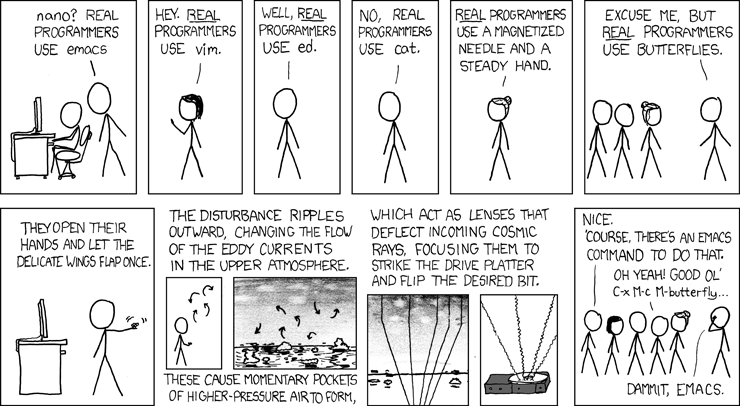
2008/2/1 - #378, 'Real Programmers'
quick snow
yep :D
verbal escarp
🤣
quick snow
(of course I actually have to remember two compose-y ways, because Vim has a similar, but incompatible feature)
verbal escarp
apropos half-assed type hints of python, any news on deferred annotations? everything still in limbo on that front or did they decide that pydantic has to die for the greater good by now?
quick snow
I thought I read a few weeks ago that the alternative proposal was accepted, no? So __future__.annotations will never come directly, but __annotations__ will become some kind of magical lazy dict.
quick snow

Discussions on Python.org
(For visibility, posted both to python-dev and Discourse.) Over the last couple of months, ever since delaying PEP 563’s default change in 3.10, the Steering Council has been discussing and deliberating over PEP 563 (Postponed Evaluation of Annotations), PEP 649 (Deferred Evaluation Of Annotations Using Descriptors), and type annotations in gen...
Not accepted, but "favored" by SC (PEP 649)
verbal escarp
i wonder why there's so much opposition for a DSL, it wouldn't even be the first one in python
ahhh.. oh no
"We definitely care about the overhead of type annotations. At one point pre-PEP-563 I think our codebase spent 1% of total CPU on executing annotations. That’s a lot, although I believe most of it was due to the old GenericMeta implementation that is also gone in Python 3.7 thanks to class_getitem.
I don’t think we know yet how the performance compares, or whether the difference is significant. I tried to do some performance comparisons a few months ago on a large well-annotated codebase, but I wasn’t able to get the reference implementation of PEP 649 to work at all so didn’t make those comparisons. I think that it would be valuable to have a working reference implementation and some performance data (and then perhaps some work on perf tuning: possibilities have been suggested in earlier threads about PEP 649) before making a final decision on PEP 649."
i guess that might count as an argument against a DSL
on the other hand, one could maybe pre-compile all annotations
quick snow
can't
How would you precompile foo: bar.bat, when bar is a user-defined object which can do whatever on __getattr__? Also, I think there was something about nested classes and get_type_hints not working with that.
basically the expression (might?) need access to the definition scope
verbal escarp
hmm.. it doesn't have to be "legal" code from the static compiler's pov, just turn the str into a code object that is executable in the runtime step
your dynamic example wouldn't be checkable by a static checker either, i think
quick snow
Right, isn't that almost what PEP 649 is doing? Haven't looked too deeply into specifics, got too frustrated by some peoples' attitude
quick snow
verbal escarp
your dynamic example wouldn't be checkable by a static checker either, i think
I don't follow? You mean something like mypy?
verbal escarp
yeah
quick snow
Right, but the whole argument is about usecases other than static typechecking; actually useful stuff like the things pydantic does
verbal escarp
quick snow
Right, isn't that _almost_ what PEP 649 is doing? Haven't looked too deeply into...
i thought it's the other way round? annotations are valid python code first and stringified on demand?
quick snow
verbal escarp
i thought it's the other way round? annotations are valid python code first and ...
That's the case right now with/without the future import. PEP 649 does something equivalent to storing the string plus the scope, and evaluating it on demand.
as far as I understood
verbal escarp
raises a couple of eyebrows
quick snow
That way you have no problems with forward references (the original usecase of the future import), but you still can do stuff pydantic etc. do
Other than pydantic, the only time I used type annotations was for registering commands in an fungoid esoteric programming language, so I'm not the most unbiased person in this debate, but I think PEP 649 is a great compromise
verbal escarp
okay, reading 649 more in detail, it does sound much smarter
although, i can foresee some potential issues
not sure how well it would handle access to the annotation during the limbo of definition time
he says that forward references shouldn't be a problem, but i'm skeptical
unkempt rock
any1 know why im getting 0
 verbal escarp
unkempt rock
any1 know why im getting 0
verbal escarp
unkempt rock
any1 know why im getting 0
that's probably better answered in one of the help channels 🙂
quick snow
In a help channel someone will help you, here it's unlikely
grave jolt
@unkempt rock Each topical channel has a particular topic, otherwise we'd just have 100 channels named #python-0 through #python-99. You should see #❓|how-to-get-help and claim a help channel.
unkempt rock
im currently learning about language developement and im reading a chapter about parser and Im on a bit called panic mode error recovery
Before it can get back to parsing, it needs to get its state and the sequence of forthcoming tokens aligned such that the next token does match the rule being parsed. This process is called synchronization.```I dont understand this
does anyone have a simpler way to explain this
I cant understand what synchronization means
 pearl river
unkempt rock
I cant understand what synchronization means
pearl river
unkempt rock
I cant understand what synchronization means
I'm not sure that's fit for #internals-and-peps, but the idea is that in order to continue parsing after an error (so as to report more errors), you need to somehow ignore some tokens so that the remaining ones are valid.
unkempt rock
 pliant tusk
basically you dump tokens until you find one that makes sense
pliant tusk
basically you dump tokens until you find one that makes sense
wdym by dump
throw way temporarily?
pliant tusk
yea
unkempt rock
pearl river
I'm not sure that's fit for <#709904092280914030>, but the idea is that in order...
ohhh you basically cut away the whole area of invalid tokens so the ones after can continue running
thank you
 rich cradle
Not running, but so you can report other syntax errors after, since smacking one syntax error at a time like whack-a-mole is no fun
pliant tusk
^
i mean, you could technically make a language that auto recovers and keeps running but that would be unwieldy
unkempt rock
so if you find one error the parser cuts away the invalid tokens so you can find additional errors
elder blade
I don't think Python did this right?
unkempt rock
pliant tusk
i mean, you could technically make a language that auto recovers and keeps runni...
An esoteric programming language (sometimes shortened to esolang) is a programming language designed to test the boundaries of computer programming language design, as a proof of concept, as software art, as a hacking interface to another language (particularly functional programming or procedural programming languages), or as a joke. The use o...
pliant tusk
no python bails out
unkempt rock
this is what I am trying to do
im gonna make an extremely similar recreation of python with python and then make it entirely upside down
learning the theory right now
Thank you guys
❤️ 👍
unkempt rock
rich cradle
Not running, but so you can report other syntax errors after, since smacking one...
relatable
syntax error wack-a-mole is the most relatable thing ever for programmers lol
you deal with 1 and 2 pop out
 paper echo
https://bugs.python.org/issue39529 this is kind of frustrating
i am hoping that the devs take this request and reasoning seriously https://bugs.python.org/msg407600
elder blade
paper echo
https://bugs.python.org/issue39529 this is kind of frustrating
What about it?
grave jolt
Do you think it's acceptible to have single-letter type variables?
 flat gazelle
I find it a bit silly, but it is the universal convention by now
paper echo
elder blade
What about it?
the change makes it a lot harder to write non-async "setup code" that will be used to set up an async application
 gleaming rover
grave jolt
Do you think it's acceptible to have single-letter type variables?
gleaming rover
grave jolt
Do you think it's acceptible to have single-letter type variables?
yeah, why not
lusty scroll
grave jolt
Do you think it's acceptible to have single-letter type variables?
certainly for generic parameters, and I'd call both uses acceptable, but depending on the audience more descriptive names could be better
native flame
I suppose its useful that having single-letter names makes it distinguishable from concrete classes
i don't think i've seen multi-letter names anywhere
(well, excluding suffixes like in T_co)
spice pecan
I like the C# convention of T for regular generics and TKey, TValue for mappings, for example
Makes type variables distinct, gives them sane names when needed
verbal escarp
all this typing theory.. weird it never really was a topic when i studied CS
times change..
datastructures, computability, parsing.. OOP of course with subclassing etc. but types per se as something important?
radiant garden
For theory of programming languages, yes
grave jolt
verbal escarp
datastructures, computability, parsing.. OOP of course with subclassing etc. but...
I remember the good old OOP days
We had factories, sorted in place created singletons like there was no tomorrow
SOLID - everyone's forgotten about the SOLID principles. It gave us hope and shared values.
I could do everything withAbstractSingletonProxyFactoryBean. Why change something so simple?
Doginherits fromAnimal.Catinherits fromAnimal.
Just override.eat()and BAM! Dinner's served
verbal escarp
grave jolt
> I remember the good old OOP days
> We had factories, sorted in place created s...
damn right. those were the days.. strokes his grey beard
who needs protocols and weird-ass annotations!
radiant garden
STOP DOING TYPES
This is real type theory done by real mathematicians
They have played us for absolute fools
gleaming rover
verbal escarp
datastructures, computability, parsing.. OOP of course with subclassing etc. but...
think as FP got more popular, people started using types to encode program behaviour
but honestly if you look back at e.g. Hungarian notation, there was demand for doing something like that
we just didn’t have the appropriate tools
grave jolt
hot take: putting Error or Exception at the end of your exception class name is Hungarian notation
not joking
quick snow
Except your custom exception classes aren't usually instances of Exception
grave jolt
?
quick snow
If I name my variable i_age (i for int), then that variable is an instance of int
quick snow
But your custom exception class isn't an instance of Exception, it's a subclass
It would apply if you would name the instances of your exception *_exception
except MyException as custom_exception <- here I agree :D
lusty scroll
quick snow
It would apply if you would name the instances of your exception `*_exception`
if you name a class Exception or even try to use it as one, but it's not a BaseException, then what are you smoking? 😂
 dusk comet
use Exception as metaclass
 olive marsh
dusk comet
use `Exception` as metaclass
olive marsh
dusk comet
use `Exception` as metaclass
looking forward to an example
dusk comet

why is it working? 
>>> MyAwesomeException
Exception('MyAwesomeException', (), {'__module__': '__main__', '__qualname__': 'MyAwesomeException'})
>>> class X(metaclass=print): ...
...
X () {'__module__': '__main__', '__qualname__': 'X'}
>>> X is None
True
```now `print` is metaclassIt doesn't implement the right protocol, so arguably it isn't a metaclass
Otherwise any function that takes three positional arguments is a metaclass
And I don't think that's really right, heh
quick snow
Now find a useful example of using metaclass= with something that isn't
!e Defining a string without quotes, maybe:
class Foo(metaclass=str.format): ...

print(repr(Foo))
@quick snow :white_check_mark: Your eval job has completed with return code 0.
'Foo'
 raven ridge
!e print(str.format("Foo", (), {}))
fallen slateBOT
@raven ridge :white_check_mark: Your eval job has completed with return code 0.
Foo
Pretty cursed.
 magic nova
now make it so I don't have to pre-define Foo
spice pecan
quick snow
!e Defining a string without quotes, maybe:
```py
class Foo(metaclass=str.format...
Ok wow
That's an interesting solution
!e ```py
def stringer(func):
return func.name
@stringer
def unquoted_string(): pass
print(unquoted_string)
@spice pecan :white_check_mark: Your eval job has completed with return code 0.
unquoted_string
!e
from operator import attrgetter

@attrgetter("__name__")
def unquoted_string(): pass

print(unquoted_string)
@grave jolt :white_check_mark: Your eval job has completed with return code 0.
unquoted_string
Yeah I thought of that
Instantiating for each decorator call is such a performance hit /s
spice pecan
Each @attrgetter('__name__') would instantiate a new attrgetter, which is just an intolerable performance penalty
grave jolt
spice pecan
Each `@attrgetter('__name__')` would instantiate a new attrgetter, which is just...
the decorator is computed only once, when the function is defined
spice pecan
Yeah, but for each function you define, you'd have a separate one
spice pecan
My joke was based on that
grave jolt
smh why have more than 1 function
lusty scroll
how many temporaries can we waste in a single expression?
surreal sun
temporaries just being short-lived objects?
lusty scroll
!e
yeah, is there some magic to reuse things like empty lists/tuples? like there is with small(ish) integers?
from functools import reduce
_, _, _, _, _, _ = [*reduce(type([]).__add__, map(list, (((1,),)+((2,),)+((3,),)+((4,),)+((5,),)+((6,),))))]
print(f"{_=}")
@lusty scroll :white_check_mark: Your eval job has completed with return code 0.
_=6
(I was inspired by this)
lusty scroll
grave jolt
!e
```py
from operator import attrgetter
@attrgetter("__name__")
def unquoted_s...
this is clever 😄
 vast saffron
I get the feeling #esoteric-python can't be contained! 😄
/s
lusty scroll
!e
in a similar vein:
import operator, types
@operator.itemgetter(0)
@operator.attrgetter("__args__")
@operator.itemgetter(0)
@operator.attrgetter("__orig_bases__")
class A(types.GenericAlias(list, "Hello World!")):
    pass
print(A)
@lusty scroll :white_check_mark: Your eval job has completed with return code 0.
Hello World!
it's spreading like a disease
vast saffron
vast saffron
I get the feeling <#470884583684964352> can't be contained! 😄
/s
This was a joke, I actually like to get to know those "cursed" tricks.
I call them python crimes and it actually quite enjoyable to do stuff that is unpythonic tricks.
Like an enum implementation that keeps a registry of subclasses, is a singleton and assignes itself automatically to other objects as category tag.
enum implementation:
Meta class that defines all necessary methods as class-methods (dunder), so they are never instantiated.
damn code to long to post the criminal meta-class
lusty scroll
vast saffron
This was a joke, I actually like to get to know those "cursed" tricks.
I call t...
that's just the built-in Enum class ...
grave jolt
speaking of
Is there a flake8 plugin that prohibits creating a metaclass?
I will write one if there isn't one
lusty scroll
arw you supposed to compile C extensions with -std=c99 ?
grave jolt
I am truly amazed how C programs even work, given that there are no namespaces
vast saffron
lusty scroll
that's just the built-in `Enum` class ...
Extended but yes. Is the way I learn best, seeing something and trying to recreate the effect without copying the code.
I also hate using black-box libraries, so this stuff also helped me understand their code.
it is still absolutely useless though (the stuff I made not stdlib Enum)
lusty scroll
these rules could be expanded to PEP 8 as well, imo:
Use 4-space indents and no tabs at all.
No line should be longer than 79 characters.
though I use two-space tabs in my personal code (with appropriate shame)
(I think I'm ok because it also says rules are there to be broken)
vast saffron
I understand the reasoning behind 79 characters width, but is there actually anyone that preferers this?
Even reading code at that width is kind of confusing for me.
lusty scroll
with 4-space indents it adds up to 79 pretty fast
rich cradle
That's one of (or maybe the only?) PEP 8 rule I absolutely reject, I am a fan of 100 or 120
vast saffron
lusty scroll
with 4-space indents it adds up to 79 pretty fast
this sentence alone put you over more than half the allowed chars (49)
Is there a vast silent majority with 30 year old CRT's?
lusty scroll
my phone screen can show only 78 columns, at least at what I consider a reasonable font size
flat gazelle
Afaik no. I think it was just chosen for maximum compatibility, not maximum utility to the average programmer
Actually enforcing it doesn't really make sense IMO
grave jolt
Long lines are just inconvenient to read in some contexts, like when looking at diffs side-by-side
but maximum line length isn't very important IMO
grave jolt
if your average line length is 70, then it's a mess
because there's clearly too much stuff happening in one line
peak spoke
it does make sense as a guideline for the code complexity, but cutting it off at it will imo lead to less readable code in most cases
lusty scroll
maybe it comes down to punch card size
where does it say 49?
PEP 7 and 8 say "No line should be longer than 79 characters" and "Limit all lines to a maximum of 79 characters" respectively, unless my eyesight is worse than I thought
grave jolt
lusty scroll
PEP 7 and 8 say "No line should be longer than 79 characters" and "Limit all lin...
they meant that the sentence was over half the allowed chars, where 49 is more than the half is
lusty scroll
oh, haha
Well.. I expect discord to do the line-wrapping ping for me, so I wasn't being measured with line length 😄 But with email, can't assume even that much
(48 characters)
challenge accepted, @vast saffron
vast saffron
lets go back to the days of banishing consonants from variable names for size 🙂
lusty scroll
vast saffron
lets go back to the days of banishing consonants from variable names for size 🙂
oh like lCtr and pszCrnt ?
unkempt rock
hi how can i run the codes that i copied in cmd?
 signal tide
vast saffron
lets go back to the days of banishing consonants from variable names for size 🙂
signal tide
vast saffron
lets go back to the days of banishing consonants from variable names for size 🙂
why not just banish consonants vowels for everything
fr tm n lst:
  prnt(tm)
much more readable imo 😄
surreal sun
are you talking about sorted?
I think that uses the timsort algo which is faster than the other two (I think)
correct me if i'm wrong
peak spoke
why wouldn't it use something a bit more complex if it performs better for the general use case
 spark magnet
it uses a better algorithm
surreal sun
is it the timsort algo? or something else
peak spoke
python's already not great with speed so having it in the stdlib just makes sure users don't have to worry about picking a right one for the data (and python) themselves for most of the time
spark magnet
yes, list.sort uses Timsort
signal tide
raven ridge
```
FR TM N LST:
    PRNT(TM)
```
imagine using punctuation
FR TM N LST
PRNT TM```it does use mergesort, but it switches to binary insertion sort for small granularities. this turns out to be much faster than just a normal mergesort
 boreal umbra
!otn s bogosort
fallen slateBOT
Query results
• bogosort-vs-timsort-the-final-showdown
boreal umbra
still waiting for that showdown.
white nexus
flat gazelle
Afaik no. I think it was just chosen for maximum compatibility, not maximum util...
old terminal widths were 80 characters IIRC
unkempt rock
Guys, I need idea for my semester end project idea..any suggestions ?
spice pecan
I vaguely remember something about Java using a modified version of timsort for object arrays, with the reasoning somehow being connected to pointers
Seems like Rust, Swift and V8 also have timsort, though I don't know if it's the default in any of those
grave jolt
spice pecan
Seems like Rust, Swift and V8 also have timsort, though I don't know if it's the...
https://doc.rust-lang.org/std/vec/struct.Vec.html#method.sort
"The current algorithm is an adaptive, iterative merge sort inspired by timsort."
spice pecan
Nice
prime estuary
The key part of Timsort is that it detects and takes advantage of already partially sorted sections in the list, which happen often in real situations and make it really fast.
Here's the full explanation:
https://github.com/python/cpython/blob/main/Objects/listsort.txt
verbal escarp
i'm annoyed by the pattern
def f(...,  excluded_names: set[str] = None, ...):
    if excluded_names is None: excluded_names = set()
is there some way to change the behaviour of mutable defaults? 🙂
prime estuary
Well, right now on Python-dev there's a massive discussion over PEP 671, which adds a late binding default.
verbal escarp
if it was a class, the answer would be dataclass or attrs
verbal escarp
prime estuary
Well, right now on Python-dev there's a massive discussion over PEP 671, which a...
oha?
prime estuary
https://mail.python.org/archives/list/python-ideas@python.org/thread/KR2TMLPFR7NHDZCDOS6VTNWDKZQQJN3V/
https://mail.python.org/archives/list/python-ideas@python.org/thread/P5JAIGZEI4PXR2TYS5ELB6TN4JVLUNL7/
https://mail.python.org/archives/list/python-ideas@python.org/thread/UVOQEK7IRFSCBOH734T5GFJOEJXFCR6A/
verbal escarp
i'm just looking at the pep itself, recalling it's been discussed here a while ago
prime estuary
Adding up the threads, it's 488 messages....
Did not realise it had gotten that much discussion.
verbal escarp
neither, although that might also indicate a "we can't come up with a viable solution to make everyone happy, let's just leave it as is"
lusty scroll
it appears I was able to get a much quicker subprocess run using os.posix_spawn than os.system or subprocess.run
verbal escarp
does it work on windows? 😉
lusty scroll
no :p
I'm pretty sure at least
echo -E $'#include <stdio.h>\nint main() { printf("Hello World!\\n"); }' | gcc -xc -static-libgcc -static -O3 -o simple_print - ; python3 -m timeit 'import os; os.system("./simple_print")' | grep -vFe Hello ; python3 -m timeit 'import os; os.posix_spawn("./simple_print", ["./simple_print"], {})' | grep -vFe Hello ;
100 loops, best of 5: 3.62 msec per loop
2000 loops, best of 5: 173 usec per loop
verbal escarp
wait, what is that gcc doing there?
lusty scroll
building a simple, optimized, static "Hello World!" program to use as our test subject
verbal escarp
what's os.system?
lusty scroll
it just calls a shell with your command line as a single string
I'm not sure if it waits for it to complete
verbal escarp
The subprocess module provides more powerful facilities for spawning new processes and retrieving their results; using that module is preferable to using this function. See the Replacing Older Functions with the subprocess Module section in the subprocess documentation for some helpful recipes.
lusty scroll
!d os.system
fallen slateBOT
os.system(command)```
Execute the command (a string) in a subshell. This is implemented by calling the Standard C function `system()`, and has the same limitations. Changes to [`sys.stdin`](https://docs.python.org/3/library/sys.html#sys.stdin "sys.stdin"), etc. are not reflected in the environment of the executed command. If *command* generates any output, it will be sent to the interpreter standard output stream. The C standard does not specify the meaning of the return value of the C function, so the return value of the Python function is system-dependent.

On Unix, the return value is the exit status of the process encoded in the format specified for [`wait()`](https://docs.python.org/3/library/os.html#os.wait "os.wait").you're not handling the output within the code itself, so that's probably the reason why it's faster
lusty scroll
verbal escarp
The subprocess module provides more powerful facilities for spawning new process...
that's where I got the idea from, reading what subprocess does
the windows equivalent seems to be _winapi.CreateProcess
which is undocumented ?
lusty scroll
verbal escarp
you're not handling the output within the code itself, so that's probably the re...
true, neither does os.system
lusty scroll
verbal escarp
you're not handling the output within the code itself, so that's probably the re...
I'm handling it with grep -v 😄
verbal escarp
see telegram 😉
lusty scroll
you got me on that, I didn't do anything "practical" like waiting for it to finish.. just thought the nuts and bolts were interesting between the two approaches
grave jolt
Why can't this be a decorator?
@default(some_list = lambda: [])
def f(some_list):
    some_list.append(42)
    return some_list
like, in functools
or even py @default(some_list=list) def f(some_list): some_list.append(42) return some_list like in defaultdict
native flame
grave jolt
Why can't this be a decorator?
i was just writing up something similar, lol
In [92]: _SENTINEL = object()
    ...: def delay(*params):
    ...:     def deco(func):
    ...:         if not set(params) <= inspect.signature(func).parameters.keys():
    ...:             raise TypeError("some args missing in signature")
    ...:         sig = inspect.signature(func)
    ...:         dic = {param: sig.parameters[param] for param in params}
    ...:         new_params = [
    ...:             v
    ...:             if k not in params
    ...:             else inspect.Parameter(v.name, v.kind, default=_SENTINEL, annotation=v.annotation)
    ...:             for k, v in sig.parameters.items()
    ...:         ]
    ...:         sig = sig.replace(parameters=new_params)
    ...:         func.__signature__ = sig
    ...:         @wraps(func)
    ...:         def inner(*args, **kwargs):
    ...:             actual = sig.bind(*args, **kwargs)
    ...:             actual.apply_defaults()
    ...:             for k, v in actual.arguments.items():
    ...:                 if v is _SENTINEL:
    ...:                     actual.arguments[k] = eval(dic[k].default)
    ...:             return func(*actual.args, **actual.kwargs)
    ...:         return inner
    ...:     return deco
    ...:

In [93]: @delay('b')
    ...: def f(a: int, b: set = "set()"):
    ...:     print(f"{a=}, {b=}")
    ...: f(1)
a=1, b=set()

In [94]: @delay('l')
    ...: def f(l: list[int] = "[]"):
    ...:     l.append(5)
    ...:     print(l)
    ...:

In [95]: f()
[5]

In [96]: f()
[5]
cursed
grave jolt
native flame
i am half-tempted to publish this to pypi for the lolz
the fucktools name is not occupied
 sharp plover
Has anyone tried out Pony ORM? As part of its implementation it contains a function to reconstruct the AST of a generator from its bytecode. I thought this was really cool. ```py
from pony.orm.decompiling import decompile
g = (x for x in range(10))
ast, _, _ = decompile(g)
GenExpr(GenExprInner(Name('x'), [GenExprFor(AssName('x', 'OP_ASSIGN'), Name('.0'), [])]))
referencing previous arguments is also possible now: https://paste.pythondiscord.com/awinunikuh.py
In [107]: @delay('x', 'l')
     ...: def f(x: list = "[1, 2, 3]", l: int = "len(x)"):
     ...:     print(x, l)
     ...: f()
[1, 2, 3] 3

In [108]: f([1, 2, 3, 4])
[1, 2, 3, 4] 4
Surprisingly it's actually due to the width of a punch card! 😄
native flame
yeah ast.unparse can do the ast -> source code part
native flame
oh
lusty scroll
sharp plover
Surprisingly it's actually due to the width of a punch card! 😄
could be time to revisit this then, maybe
verbal escarp
lusty scroll
could be time to revisit this then, maybe
never forget! punchcards forever!
lusty scroll
verbal escarp
never forget! punchcards forever!
yes, the bit bucket deserves to be brought back
quick snow
is a firm believer in the 80 line rule. Being able to have two files open side-by-side (even on a laptop) is great.
verbal escarp
other times it's great to have everything you want to say in one line, even if it's over 120 chars..
peak spoke
feels like that should be fine even with larger limits considering I usually have two files open and a big tab to the left of them just fine and my usual hard line limit is 120
quick snow
To be clear: I don't have a hard limit at 80, but my editor warns me if I exceed it.
peak spoke
I have visual guides on 79 and 99
verbal escarp
theoretically you could have a hard limit at 80 with black for everything living on github but run black on checkout with the limit of your desire locally
quick snow
Can you show me an example of where you need 120 columns?
Whenever I see this it's almost always either bad names, or overcomplex code
peak spoke
usually docstrings
verbal escarp
hmm.. i think i mostly get into fights over this with @lusty scroll with strings
peak spoke
but some code is also just simpler if it's on one line instead of being split up just for the sake of it
verbal escarp
not docstrings per se, but any strings
quick snow
Docstrings are text and can be hard-wrapped
Other strings can be an exception for better greppability
peak spoke
quick snow
Docstrings are text and can be hard-wrapped
They can't if they have to adhere to a style that's out of your hands
lusty scroll
I don't really like any of the options except shortening the string
peak spoke
There are also some cases when working with black where I get why it exploded something, but I really don't think it provides anything over a longer line (e.g. an exploded call that's around 5 similar calls but is a few characters longer)
quick snow
peak spoke
They can't if they have to adhere to a style that's out of your hands
You mean the non-descriptive part, like types etc.?
I feel like a style guide is not a convincing argument given that we're arguing over style
peak spoke
that or just having a summary/description part where the subject summary span multiple lines but sometimes it can't quite fit while getting the whole point into it
lusty scroll
textwrap.dedent is not a bad solution to multi-line strings thatdon't make the file look like it's indented wrong
verbal escarp
i prefer one-longer-line comments over multi-line comments since they're additional info and not necessary to follow the code flow, but breaking the code flow for comments is detrimental to readability
visual shadow
If there needs to be a long string literal, there needs to be a long string literal.
peak spoke
lusty scroll
`textwrap.dedent` is not a bad solution to multi-line strings thatdon't make the...
I usually prefer the wrap in parentheses and use implicit/explicit concat style as it doesn't introduce an additional call
visual shadow
For comments break it into multiple lines. It's not an issue for readability, at best might take you a couple days
verbal escarp
peak spoke
I usually prefer the wrap in parentheses and use implicit/explicit concat style ...
i find it's noisy
peak spoke
compared to dedent, or compared to just not doing it?
visual shadow
At worst, perhaps a week to get used to it
verbal escarp
peak spoke
compared to dedent, or compared to just not doing it?
not doing it ^^
lusty scroll
peak spoke
I usually prefer the wrap in parentheses and use implicit/explicit concat style ...
that works well too
verbal escarp
i always get itchy when i see those 😉
lusty scroll
verbal escarp
i prefer one-longer-line comments over multi-line comments since they're additio...
ack, I disagree 😄
verbal escarp
yeah, that's probably the only thing we really disagree about code style
actually, black's line limit thing can also backfire in the opposite direction
verbal escarp
in justuse we use >> pipes in a few places, but it's nicer to have every pipe on its own line for clarity.. turns out that black disagrees and joins those lines to make a longer line, crippling readability for those
unkempt rock
Am I on the right place
verbal escarp
unkempt rock
Am I on the right place
did you try asking in a help-channel?
grave jolt
@unkempt rock If you have a question, you should probably see #❓|how-to-get-helpand claim a help channel
interesting phenomenon: if you break a complex statement into two statements, you end up having less lines, not more
foo = some_thing.complex_thing(
    bar=barify(settings.baz, consistency_threshold=420.69),
    fizz=Buzz(),
)
#->
bar = barify(settings.baz, consistency_threshold=420.69)
foo = some_thing.complex_thing(bar=bar, fizz=Buzz())
except when it's not really a complex statement but some longer attribute lookup or proper parameter name
where you end up with ( and ) and [ and ] on seperate lines and instead of 1 line you have 5
native flame
re: late bound arguments
would you expect this to work:
def f(n: int => len(tup), tup = (1, 2, 3)): ...
considering that
def f(n: int => len(tup), tup => (1, 2, 3)): ...
should error (since late bound args would be evaluated left to right)
the pep itself is rather vague about this, it says # May fail, may succeed
verbal escarp
i was just fiddling around, but i figured i'd need some inspect voodoo:
import inspect

def deferred(**defaults):
    def func_wrapper(func):
        def wrapper(*args, **kwargs):
            default_calls = {k: v() for k, v in defaults.items()}
            updated_kwargs = {k: v if v is not None else
                              default_calls[k] for k,v in kwargs.items()}
            return func(*args, **updated_kwargs)
        return wrapper
    return func_wrapper

@deferred(b=list)
def f(a, b=None):
    print(b)
    return b.append(a)
it also doesn't solve the issue with the proper documentation of the real default params
although, maybe it's possible to update the annotations via decorator
native flame
native flame
referencing previous arguments is also possible now: https://paste.pythondiscord...
@verbal escarp this preserves the signature
wait, no, that paste is outdated, that one doesn't preserve it
verbal escarp
i tried to improve on the str/eval approach
oh, yeah
that paste link looks good
although i wouldn't go the str/eval route
the signature updating looks well done
native flame
verbal escarp
although i wouldn't go the str/eval route
hm, how else would you achieve it
lambda: expr?
native flame
oh lol
verbal escarp
benefit is you get immediate syntax errors and not sometime down the road
and IDEs can help with autocompletion
native flame
that is true
spice pecan
native flame
re: late bound arguments
would you expect this to work:
```py
def f(n: int => le...
IMO this shouldn't work
elder blade
As a user I would expect that to work though
quick snow
I really don't like the => syntax when combined with type hints. It looks too much like a callable type.
spice pecan
Referencing a param before declaring it (in source) is too confusing for my taste
native flame
i am on the side of not allowing it too
quick snow
def double(fn : int => int):
    def wrapper(arg: int):
        return fn(arg) * 2
    return wrapper
Yeah, syntax could be better
pearl river
what PEP is this syntax for function types?
spice pecan
I don't know if it's in a pep yet, but it was mentioned a bunch of times during the discussion of the new peg parser
Either this or args -> return
native flame
pearl river
what PEP is this syntax for function types?
671
oh wait nvm
i misread
quick snow
pearl river
what PEP is this syntax for function types?
If you mean int => int, that doesn't exist, it's just the proposed syntax for something else (deferred evaluation of defaults) that I find confusing, because it looks like a function type.
spice pecan
spice pecan
Yeah, syntax could be better
Semantically I like ?=, but it's a bit too much noise visually
pearl river
Ah. To be honest, I feel like it'd be really annoying when having nested functions. ((int, int) => int, int) => (int => int)...
native flame
can't be worse than Callable 🤷♂️
spice pecan
Callable is not that bad tbh, if we just had a bunch of common templates it would be fine
Like C# has Action<args...>, which takes args and returns void, Function<args..., ret>, which is basically Callable without the brackets, Comparison<T>, which takes two Ts and returns int, so on and so forth
grave jolt
pearl river
`Fn[int,int] => int`, maybe?
Fn[int, int] >> int is technically already possible
spice pecan
That would look fairly interesting tbh
Assume None return for Fn[int, int] and override on rightshift
lusty scroll
spice pecan
Like C# has `Action<args...>`, which takes `args` and returns `void`, `Function<...
yeah,those templates would help. I suppose one could declare them using typing.Protocol
spice pecan
That could work, but you could also just have type aliases
verbal escarp
i also wouldn't like => for the default syntax, thinking of better lambda syntax there
wait a sec.. what if we don't call it defaults and move a bit further
i just typed def fn(x: int ?= int) and thought about none-aware assignment, but what if that specified callable is always called on the argument that's passed in?
spice pecan
Using a single ? for None-aware assignment is still pretty iffy
verbal escarp
like for explicit type conversion
spice pecan
verbal escarp
like for explicit type conversion
It's not very explicit if it happens automatically behind the scenes, is it?
verbal escarp
if you pass in the function that is supposed to be called on the argument, it's explicit
spice pecan
Fair enough, but why not just call it on the argument yourself? :P
 verbal escarp
let's write everything as f-strings and eval() - because f-strings are cool :p
spice pecan
f'{"write program as oneliner here"}'``` jovial flame
f that
grave jolt
grave jolt
and then use another `?=` in the lambda
now you can just write the whole thing in just one function
oh, and you can call the function itself recursively in the lambda, right?
verbal escarp
spice pecan
I think `:=` would be the most fitting option for late-bound syntax
maybe def fn(lst:list[int] @ list) might work better
let's imagine we have a nicer lambda syntax
then we could write def fn(foo: list[int] @ {=> [1,2,3]}) or somesuch
i think conceptually it's closer to what we mean with decorator syntax
spice pecan
verbal escarp
maybe `def fn(lst:list[int] @ list)` might work better
That's ambiguous though
It's matmul for the type
surreal sun
spice pecan
I think `:=` would be the most fitting option for late-bound syntax
Yeah, either that or ?=
but ?= has a different meaning I think
I'm honestly looking forward to PEP 671 because
A. late default setting
and B. mutable arguments!
def fn(lst => list()):
  lst.append(1)
^ that won't be appending it to the entire default
verbal escarp
surreal sun
I'm honestly looking forward to PEP 671 because
A. late default setting
and B. m...
the => syntax is meh
surreal sun
verbal escarp
the => syntax is meh
Yeah I don't really likke it
I'm rooting for ?= or :=
verbal escarp
but i'm still unsure if the deferred call has to be none-aware and couldn't just be called every time the parameter is passed in..
it could open up more possibilities
also could be more flexible with other sentinels
surreal sun
verbal escarp
but i'm still unsure if the deferred call has to be none-aware and couldn't just...
Ohh true
verbal escarp
it might require a slight change in how list() and other constructors work since ```python
list(None)
Traceback (most recent call last):
File "<pyshell>", line 1, in <module>
TypeError: 'NoneType' object is not iterable
if list(None) would return [], it'd be a trivial change
or make None iterable with no item?
spice pecan
I'd vouch for not tying it to None, because in some cases it is also a valid input
And not having to create sentinels for a fairly trivial param missing case would be very nice
peak spoke
Is the reason for typing.overload returning a function that raises NotImplemented avoiding potential accidents if the user forgets to define the implementation? I found it a bit strange that it doesn't just return the argument
surreal sun
peak spoke
Is the reason for typing.overload returning a function that raises NotImplemente...
I was wondering the same thing when I was reading the source code for it, honestly if I had to guess I'm presuming it's just so the user is aware? I could be totally wrong on this though
peak spoke
and of course the type checker tries to be smart so I can't even monkeypatch it nicely
native flame
verbal escarp
it might require a slight change in how list() and other constructors work since...
that would probably be a pretty large breaking change since stuff like defaultdict(list) and field(default_factory=list) is quite common
spice pecan
surreal sun
I was wondering the same thing when I was reading the source code for it, honest...
That's probably the reason, because it's easy to assume that it implements dispatching if you don't know better
And raising NotImplementedError helps prevent that
empty kite
In Scala 3, you can define your program entry point with @main
@main def hello() = println("Hello, world")
which is a lot nicer than having to create an object and args parameter "just because":
object Hello {
    def main(args: Array[String]) = {
        println("Hello, world")
    }
}
Or even the dreaded
public static void main(String[] args) {}
Java requires. They both rely on beginners having to learn concepts that are of no immediate or apparent use for them to satisfy the compiler.
While not required, in Python, in many cases it makes sense to run your code inside a if __name__ == "__main__: guard. As far as beginners are concerned, this is equally, if not more so, arcane. Even the advanced Pythonista might think of it more as "useful introspection trivia" than a proper mechanism for program entry points.
So, what do you think of a main decorator you could slap on a function to execute it when it's in the "__main__" file? E.g.:
@main
def hello():
  print("hello world")
Is it possible? Useful? Needed?
gusty marsh

lo and behold, multiple #python decorators on a single line! yes, it actually works, but the implementation is not what you think! 🤡 /cc @judy2k @jacobian
code is at https://t.co/lEr0n0Igwt and inspiration came from this 🧵 https://t.co/vnaXvstoRh

 Twitter
·
Twitter
·


 native flame
clever
gusty marsh
Looks something useful when you have short decorators and they are taking one whole line
lusty scroll
empty kite
In Scala 3, you can define your program entry point with `@main`
```scala
@main ...
personally I would like it
so we could skip adding module level code to run the "main" (or "run") function
not sure what the behavior would be--maybe it could all be handled by runpy
then there'd be no other changes needed except adding the decorator somewhere
looking at runpy.py, this won't work as I had hoped
it just calls exec , it doesn't create a module, so it wouldn't be just a matter of searching for a function "annotated" with @main
spice pecan
another language that does this is F# with its [<EntryPoint>]
And although it looks neat and shouldn't be difficult to implement, I don't see much value in having that
Python doesn't demand an entry point, top level code is the entry point
The need to differentiate between running a module as a script and importing it into another module doesn't arise often in general, and even less so in code written by beginners
And by the time they do need to differentiate, the explanation will not look arcane to them
I find it that if-main is shoved into code just because it is a concept familiar to people coming from other languages more often that it is genuinely needed
native flame
it's not too common to have modules that are meant to be both imported and run directly either
spice pecan
Yep, main code is usually separated into its own module
raven ridge
In Python, everything happens at import time. There is no time that code runs at other than at import time (and interpreter teardown time, I suppose). Essentially the entirety of a python program's run time is the import of the __main__ module.
People coming from other languages don't like that, and want to pretend Python is a language where you can define functions and globals in one phase and then use those in an entirely different phase, but that's fundamentally not the way the language works.
Or to put that a bit differently, Python already has an entry point, and it's __main__. Python just starts running whatever code is in the file or module you ask it to run, and that's all an entry point is. It's just that the entry point is not a function, but instead an entire module.
spice pecan
The solution to this "issue" is not an entry point decorator, but proper teaching practices that account for python's idioms instead of blindly copying over practices from other languages
And, frankly, a decorator may look less intimidating in code, but it is a significantly more complex concept than an if statement with string comparison (RE: forcing beginners to learn concepts that are of no immediate or apparent use to satisfy the compiler)
raven ridge
Probably 9 times out of 10, if someone wants a file that is able to be imported or run directly, and they want it to do different things in each case, the right thing to do is factoring it into a package with the importable stuff in __init__.py or a submodule, and the script in __main__.py - there's no good reason to keep both in the same file, once you've decided that what you're building is a library that supports being imported to provide some API
quick snow
FWIW:
def main(fn):
    if __name__ == "__main__":
        import atexit
        atexit.register(fn)
But I see this firmly in #esoteric-python territory
verbal escarp
quick snow
FWIW:
```py
def main(fn):
if __name__ == "__main__":
import atexit
...
not really esoteric, no
it may be unusual, but far from esoteric
raven ridge
Running the "main" function as part of interpreter teardown is most definitely esoteric.
verbal escarp
raven ridge
Running the "main" function as part of interpreter teardown is most definitely e...
that's not what it does
raven ridge
Yes, it is. It takes the function that is decorated and registers it to be called after the main script ends, during the first step of finalizing the running interpreter
verbal escarp
it's a function that is registered
not the main function
fn could be a simple cleanup function
quick snow
Esoteric in the sense of "don't do this"
raven ridge
The stated purpose of this decorator was to explicitly specify an entry point for your script. Running your entry point while the interpreter is exiting is most definitely esoteric.
verbal escarp
raven ridge
The stated purpose of this decorator was to explicitly specify an entry point fo...
i don't see that implied in this code snippet, but if so, you're right
spice pecan
It's very much implied in the conversation that it is a part of
raven ridge
empty kite
In Scala 3, you can define your program entry point with `@main`
```scala
@main ...
 was the context
verbal escarp
as i read it, that part of the conversation was done, but okay ^^
i see a much different problem with@quick snow 's snippet though
aside from the exit-entry thing, registering with atexit calls the registered functions in backwards-order as they were registered, so if you really want to use this pattern and have a proper atexit-cleanup function, you'd need to be careful in which order those functions are registered, otherwise you end up with exiting before entry
and if you decorate multiple functions, you're screwed either way
quick snow
I wonder what happens when you register an exit function in an exit function
spice pecan
That's a curious question
!e ```py
from atexit import register
register(lambda: register(lambda: print("Hello")))```
fallen slateBOT
@spice pecan :warning: Your eval job has completed with return code 0.
[No output]
They are skipped it seems
verbal escarp
i doubt that even called atexit
spice pecan
why wouldn't it?
verbal escarp
let's try
!e ```python
from atexit import register
register(lambda: print("foobar"))
@verbal escarp :white_check_mark: Your eval job has completed with return code 0.
foobar
okay, you're right
!e ```python
from atexit import register
register(lambda: print("foobar"))
register(lambda: register(lambda: print("Hello")))
@verbal escarp :white_check_mark: Your eval job has completed with return code 0.
foobar
yup
verbal escarp
native flame
that would probably be a pretty large breaking change since stuff like `defaultd...
why would that be a problem if list could take None as a lone parameter?
native flame
hmm nevermind not sure what i was thinking
spice pecan
Accepting None as a parameter would weaken the typing as it could silently produce the wrong result instead of erroring
verbal escarp
i suggested to have list(None) -> [] to make it possible to call it as part of a default parameter
delayed default*
spice pecan
Yes, and I still think it would weaken the typing
verbal escarp
making None iterable with zero elements is arguably worse, i think
spice pecan
It definitely is, but that doesn't make the alternative better than it already is
IME, passing None in such cases is not intended and a result of a bug more often than not, and changing it to return an empty list makes it harder to spot
That might just be my experience, but I'm opposed to such changes
verbal escarp
so, what would you suggest as a delayed-default mechanism?
aside from the syntax discussion, it's also relevant how it should work
quick snow
I'm just opposed to the proposal
spice pecan
An abstracted away sentinel (to allow passing None) with the semantics described in the pep, so LTR evaluation in a block of code before the function body
spice pecan
quick snow
I'm just opposed to the proposal
That's fair
It'd introduce a decent amount of new semantics that would be confusing for newcomers
And I wouldn't say it solves a huge issue, it's just convenient sugar
I think the fact that the community has wildly different opinions on syntactic options alone is a good sign that this should be reconsidered
verbal escarp
bikeshedding isn't a good way to make progress 😉
native flame
verbal escarp
so, what would you suggest as a delayed-default mechanism?
I think the pep mentioned new bytecodes
spice pecan
verbal escarp
bikeshedding isn't a good way to make progress 😉
Readability is important, and if the options are either confusing, or clutter the code visually, or ambiguous, it may not be a good thing to have
quick snow
verbal escarp
bikeshedding isn't a good way to make progress 😉
True, but I don't want to build the shed
verbal escarp
spice pecan
Readability is important, and if the options are either confusing, or clutter th...
well, there IS a problem which delayed defaults would solve
spice pecan
and AFAIK syntax is the main point of disagreement, the rest of the semantics is mostly established already (among people who want it implemented, ofc)
spice pecan
verbal escarp
well, there IS a problem which delayed defaults would solve
Are they that much better than an is-None or is-sentinel check?
verbal escarp
it's not just convenience. having None or another sentinel as default then calling set() etc. as actual default is hiding the actual default from the documentation
spice pecan
I'd rather have none-aware operators reduce boilerplate
spice pecan
verbal escarp
it's not just convenience. having None or another sentinel as default then calli...
That's a fair point
The signature becomes less meaningful
Type hints partially solve that
If you see list[int] | None, you get a bit of information from the signature
Though you don't get to see the actual value of it
And neither can you get things like len(other_arg)
You could use Annotated I guess
def func(items: Annotated[list[int], "Defaults to []"] = None): ... ```I think something like HasDefault[T, default] would be nice, along with maybe typing.get_defaults that would return a dict of argument names to default values, taking into account whether or not they're typed as HasDefault
raven ridge
quick snow
I wonder what happens when you register an exit function in an exit function
Ooh, found a bug in that area: https://bugs.python.org/issue46025
quick snow
Shouldn't the name items be enough of a hint?
elder blade
raven ridge
Ooh, found a bug in that area: https://bugs.python.org/issue46025
Segfault o_O
native flame
i forgot pablo galindo is your colleague 👀
verbal escarp
native flame
i forgot pablo galindo is your colleague 👀
whose?
native flame
godlygeek
verbal escarp
ah
 halcyon trail
did this channel get renamed from advanced?
 swift imp
Speed ups for 3.11 aren't looking that impressive. Maybe I'm not understanding how much faster its supposed to be after a single year
elder blade
What kind of speedups would be impressive?
Say Python becomes as fast as X, what's the slowest X you can think of?
swift imp
I would like it to approach javascript speeds, which can be as fast as C at times.
https://gist.github.com/markshannon/0ddfb0b705d23b863477d7f7f9f00ef1 I guess a 1.19x faster geometric mean is 19x faster but at these numbers its not like "oh this is going to be so much snappier"
 magic nova
1.19x = 19% faster
halcyon trail
a 1.19x faster geometric mean isn't 19x faster
swift imp
halcyon trail
a 1.19x faster geometric mean isn't 19x faster
Mark Shannon is stating it that way
Sorry he's saying 19 percent
halcyon trail
yeah, small difference 🙂
19% is a nice win but it's not earth shattering when python is 20x as slow as many other garbage collected languages
and yes, I mean 20x, not 20% 🙂
swift imp
Shaving 10s of ms off of basic ops is nice but when you're normally in 100s of ms to begin with I'm not really feeling that "wow'd" about it.
magic nova
this is just the first of the improvements in the pipeline
swift imp
I'd like to see ms -> us type improvements
halcyon trail
I mean that's 1000x
swift imp
yeah...
halcyon trail
that can't happen because python is only roughly 100x slower than C or C++
swift imp
I mean I know jack-butt about doing any of this but like javascript is damn near, if not more, dynamic as python and can be as fast as C at times
peak spoke
The improvements aren't magical, you can't really do anything extreme without restructuring how the interpreter works as a whole
halcyon trail
"can be as fast as C at times" in reality means, as fast as C, almost never
"typically", JS is probably going to be at least 10x slower than C
peak spoke
js also had a lot of money poured into it as the whole web runs on it
halcyon trail
which is is still an amazing accomplishment
swift imp
halcyon trail
"can be as fast as C at times" in reality means, as fast as C, almost never
lemme pull up a thread where there is a lot of python hate but with benchmarks
halcyon trail
eh it's ok, I've seen lots of benchmark threads come and go, in the end it depends which benchmarks you choose, how you weigh them, how you run them, etc
the ballparks I'm giving are based on many many benchmarks I've seen over time
So if you designate C/C++ (and probably Rust) as 1x, you have python/ruby ~ 100x, Java 2x-3x (with caveats; like latency vs throughput), most other statically typed GC languages falling in about a 5x-10x range, etc
swift imp
Well these are just straight up qsorts, and they even use numpy and python is still really slow but javascript is keeping somewhat relative to C
Which I think speaks volumes to how much overhead python itself just adds
halcyon trail
I'd have to look at the benchmark and understand what is happening, my guess is that if JS is keeping up with C it's because something is implemented in C lol
swift imp
So this was C without any compiler optimizations
halcyon trail
LOL
what is the point of such a comparison?
or did the author just not have enough experience with C?
swift imp
They did C with optimizations, js, C without optimizations, and Python
halcyon trail
so you're saying JS is similar to C without optimizations?
swift imp
js is was faster than C without optimizations by like 200 ms which including the setup time for java. The optimized C was well over 2x as fast
Yeah
Which sure I guess fine but it was still a magnitude faster than python with numpy
halcyon trail
okay, I mean nobody really cares how fast C is without optimizations.
Yeah, python is definitely slow. JS isn't really as a language designed better for speed afaik but like Numerlor said, a ton of money and time got poured into optimizing it
I mean the number of man hours that went into optimizing V8, probably dozens of excellent C++ programmers at Google worked on this for years
compared to python where you have 1-2 people working on it in their spare time
swift imp
lets just hope microsofts funding for Guido and Shannon make it really fast
I think they have 3 full time developers funded
halcyon trail
it's just that python is in a rough position vis a vis performance, it's dynamically typed and it doesn't use an LLVM approach a la Julia, so it's really just going to be piles of work, to make it say, only 20x slower than C
meanwhile if you start any project that vaguely cares about perf (that isn't data science-y) you have to justify why you aren't using pretty nice, easy, GC languages that are way faster than python 🤷♂️
swift imp
I think people still favor python for stuff that is IO bound, if its not data-science-y task
halcyon trail
well, depends which people? Some people favor python, some people favor java, some people favor Go, etc