#internals-and-peps
1 messages · Page 143 of 1
 surreal sun
 verbal escarp
probably not, for the same reason a lot of other syntactic sugar is being deferred
surreal sun
to me, ?= made more sense given how ? is more symbolic as to 'none-aware' and in this case = is like "set this argument if the argument isn't given"
surreal sun
verbal escarp
probably not, for the same reason a lot of other syntactic sugar is being deferr...
Ah true, None-aware operators got deferred too :(
I was really looking forward to that
A lot less of boilerplate code ngl
 paper echo
@halcyon trail maybe => is good syntax because the late-bound default argument is an anonymous function that gets called upon use 🙂
 halcyon trail
surreal sun
to me, `?=` made more sense given how `?` is more symbolic as to 'none-aware' an...
halcyon trail
surreal sun
to me, `?=` made more sense given how `?` is more symbolic as to 'none-aware' an...
But this has nothing to do with None
the argument isn't given isn't the same as None
(or even related to None, tbh)
paper echo
halcyon trail
the argument isn't given isn't the same as None
i liked it because it's like ?=in Make
verbal escarp
actually.. what if the deferred function returns None?
halcyon trail
I'd much rather they keep ?=, in case we actually get non aware operators later
verbal escarp
in that case we could combine it
halcyon trail
I think none aware operators may have a shot, one day, these operators are actually becoming pretty pervasive
Eh, they are two different things
verbal escarp
def foo(x => {bar()} ?=24):..
halcyon trail
paper echo
i liked it because it's like `?=`in Make
Liking something because of make...tsk tsk 🙂
 deft pagoda
this syntax is awful
halcyon trail
I'm pretty sure that Dante's inferno has a circle for that
paper echo
what would ?= be in none-aware world?
halcyon trail
And yeah, that syntax is not so great, I don't even understand what you're intending up there
deft pagoda
if this is what late-bound defaults look like, i hope they never make it in
paper echo
deft pagoda
if this is what late-bound defaults look like, i hope they never make it in
no lol
verbal escarp
x = bar(); if bar() returned None: x = 24
 feral cedar
i hope ?= would be an inplace "unwrap" sorta thing
paper echo
also first of all Make is great
halcyon trail
😕
verbal escarp
halcyon trail
a little simpler yeah?
i could live with that
paper echo
verbal escarp
i could live with that
JS has ??, it's nice
halcyon trail
make was designed to be a language for writing build files, that is so unsuccessful, that people have invested a zillion man hours in writing ways to generate the files automatically
deft pagoda
how about using something other than parens after def to signify looking in the parameter space before normal locals -> globals stuff
paper echo
deft pagoda
how about using something other than parens after `def` to signify looking in th...
it's not about namespaces, it's about late evaluation
halcyon trail
(it will take a very long time, don't misunderstand, but that's the direction)
deft pagoda
yes
paper echo
halcyon trail
make was designed to be a language for writing build files, that is so unsuccess...
imo that's not what it's good for, it's no substitute for a real build system
deft pagoda
but it will consider a name existing in the parameters as something that will need to be late-bound
paper echo
yes, but also expressions
halcyon trail
what is it good for? honest question
Without fail, every time I've seen make used for literally anything at work, in the last 10 years, it was always a bad choice
paper echo
i use it the same way you would use tox or invoke
halcyon trail
I have never used tox or invoke either
paper echo
eg make run-dev could run your web server in development mode
halcyon trail
so could a python script, or many other things
paper echo
make test invokes pytest
sure, but not if you have intermediate assets that you need to generate
halcyon trail
if I did ever want a DSL for specifying dependencies between tasks, why wouldn't I use a library in a real programming language?
this is exactly how the actual successful systems for doing similar tasks, that I've seen, work
paper echo
counterpoint: make is a perfectly good dsl and shell is a fine enough programming language for basic tasks
if it gets complicated or difficult to maintain, use a different tool
halcyon trail
there's no reason to use what is now obscure technology, for a poorer tool, because the poorer tool is "good enough"
you can use a tool that is both better and more easily familiar
if you want an example if dependency specification, albeit with a different focus, you can look at something like snakemake, which is written in python
paper echo
i disagree that arbitrary python code + some random library is good enough
snakemake sucked
i tried to use it for years
halcyon trail
this is how literally every programmer I know (barring 1) feels about make
i'm sure snakemake isn't perfect, but it's found a fair bit of success, and basing your task specification in an actual language seems by far the more popular way to go these days
paper echo
meh, I've seen some pretty horrible code-as-config setups
anything turing complete can be turned into a clusterfuck in undisciplined hands
and some things that aren't turing complete too
halcyon trail
Yes, so you may as well start with an actual languages, so that when people fuck around, it's at least reasoanble 🙂
verbal escarp
i like my attrs approach to configuration >.>
paper echo
shell is an actual language!
halcyon trail
Seriously though, every example I can think of that went the pure DSL route, i.e. not based on an actual language, ended up in disaster
paper echo
like i said, i agree that make is awful as a front-line build tool
halcyon trail
everybody hates the Cmake language in the C++ world. It's actually the only major complaint about it, that you hear over and over.
The actual build system is good, it's pretty fast, it's well maintained, it's supported, etc.
halcyon trail
paper echo
shell _is_ an actual language!
barely 😉
You have to be a masochist to write more than a couple dozen lines of bash these days (usually for things related to environment that just can't be done any other way)
paper echo
i agree, I don't
but 1-2 lines in a makefile, fine by me
yeah i've heard a lot of hate about cmake, i certainly don't understand any cmake files ive read
meson seems to be the new cool thing
halcyon trail
nah meson isn't going anywhere most likely
it would be cool if it did but the amount of inertia behind CMake at this point is crazy
paper echo
point being: make is a perfectly good tool for what it is, which is to specify a dependency graph and some shell scripts for generating them
surreal sun
halcyon trail
But this has nothing to do with None
But it’s kind of similar to where it’s the absence of the argument
it has some correlation imo
paper echo
it'd be great to have something like make without all the sharp edges, but snakemake is definitely not it imo
it'd be nice if they exposed make functionality as a C api though
halcyon trail
But it's literally not a good tool for that. Or at least, very few people seem to think so, because very few people are using it.
if someone tells me "yeah we use make and some shell scripts to do XYZ" my first thought is probably just that the code has been around for a long while
(I should say, few people are using it as a green-field choice, if they're using it it's because there's existing code, or at best new code that's being integrated with existing systems)
paper echo
i use it as a default for ad hoc small things
and like i said as a tidy uniform entry point to other scripts
 red solar
Salt off topic but were u using pypy or graalvm?
paper echo
both but only for playing around
red solar
Can I ask u some questions about graalvm? (Not sure whether here or another channel)
paper echo
yes but i know absolutely nothing about how graalvm works 😆
red solar
halcyon trail
it would be cool if it did but the amount of inertia behind CMake at this point ...
And also cmake is dope when u get a project with a properly written cmake file
That’s ok
I was just wondering if it has cffi support
paper echo
for example @halcyon trail we use makefiles to paper over the differences between our node and python services, and between our old shitty vagrant services and the new shiny docker compose ones. we could use just a shell script or some other tool but literally everyone here has gnu make already installed and knows the syntax
paper echo
red solar
I was just wondering if it has cffi support
good question but no idea
red solar
paper echo
good question but no idea
Can you not check? (Like just import cffi)
paper echo
not at a computer at the moment... maybe something on their website
i doubt it does tbh, but it probably has something else via graalvm itself
red solar
Hmm ok i’ll try and check
 heady mauve
Does sys.modules['ctypes'] = None actually prevent further code from importing ctypes?
Something tells me it's not that easy.
surreal sun
Well I’m gonna guess ctypes gets overwrite when imported
iirc you might need an import hook for that
heady mauve
Except that import module doesn't reload module
heady mauve
that would, so you'd also have to block importlib
verbal escarp
they might del sys.modules["ctypes"] and then import
heady mauve
that would do it
 flat gazelle
Or even just pick an already imported ctypes module from somewhere in the stdlib
heady mauve
So yeah an import hook would be necessary, followed by del importlib so that the code that follows wouldn't be able to redefine the hook.
heady mauve
flat gazelle
Or even just pick an already imported ctypes module from somewhere in the stdlib
Right. I think the way to go is to block all but a few imports.
flat gazelle
Well, you can access some modules without importing
heady mauve
Effectively I want to embed Python as a scripting language and block filesystem access, along with all but a few okayed modules. (No, nothing can change my mind that I want Python for this 😝)
flat gazelle
Build a custom embeddable package with as few modules as possible for starters
You can compile python without ctypes etc
heady mauve
I had forgotten about compiling a different interpreter, not sure if it would be within my skillset...
But, that's what project-based learning is for :D
flat gazelle
In the end, you aren't getting a useful sandbox by writing python code
 spark magnet
@heady mauve it is very difficult to secure Python
heady mauve
So I think the way to go based on what I've heard here is to compile a python interpreter that cannot run ctypes, os, etc.
heady mauve
spark magnet
<@!712017143998447767> it is very difficult to secure Python
So I've read. Everywhere.
verbal escarp
well, have a look at a the discord bot
flat gazelle
I don't think you can get rid of some of the more code modules
heady mauve
verbal escarp
well, have a look at a the discord bot
Runs on linux and uses OS-level sandboxing
 rich cradle
spark magnet
<@!712017143998447767> it is very difficult to secure Python
rich cradle
spark magnet
<@!712017143998447767> it is very difficult to secure Python
Do you mean secure python using python specially? Because I know snekbox uses nsjail.
verbal escarp
yeah, that
spark magnet
heady mauve
Runs on linux and uses OS-level sandboxing
is that bad?
heady mauve
I do need Windows support
flat gazelle
nsjail works, but if they want to embed it as a scripting Language, that's not a great solution.
Windows does have their own sandbox in pro IIRC
spark magnet
heady mauve
I do need Windows support
can you tell us more abut the big picture here? What's the overall system?
heady mauve
If I could fire up a subprocess with a modded interpreter to run the embedded scripts, that would work beautifully.
spark magnet
@heady mauve needing windows support sounds like you're going to run this on users' machines?
verbal escarp
okay, so why is accessing ctypes bad in your case?
heady mauve
Overall, it's going to be a game with game objects that can execute arbitrary Python code. Unlike projects like Logical (logic gate sim that needs file access) I do NOT want filesystem access for these scripts and I want most libs blocked (socket, ctypes, anything that can act outside the game script). The scripts do need to be able to interact with the main process to control game objects.
heady mauve
verbal escarp
okay, so why is accessing ctypes bad in your case?
With ctypes you can grab pointers to arbitrary memory locations and if there's a python object there you can load it into the current context.
spark magnet
and you don't trust the game object code? Who writes it?
verbal escarp
you fear cheating from players or do you fear players hacking other players?
heady mauve
For the game object code, I write it any anybody who contributes to my repo. For the script code, anybody can write it, most often end-users. Scripts will be shared.
heady mauve
verbal escarp
you fear cheating from players or do you fear players hacking other players?
I don't want my game to be a malware spreading system.
verbal escarp
then you need proper code reviews
heady mauve
yes
spark magnet
@heady mauve Python might not be the right tool for this. it will be difficult to prevent access to things
heady mauve
That's what everyone has said so far
verbal escarp
actually i wouldn't say so
spark magnet
verbal escarp
actually i wouldn't say so
do you have a way to secure it?
heady mauve
I think that if you patch the interpreter itself to permit or ban certain things then you can do pretty much anything
verbal escarp
yeah, you could define classes as API and check the AST of the modules before executing them to only access those classes
heady mauve
And by doing a subprocessed interpreter, you can cut out bits of the standard library for that specific interpreter to block things like networking.
spark magnet
these are interesting theories, but have you tried it?
heady mauve
Okay, I need to read up on AST
verbal escarp
well, you can filter the AST, right? have a positive list of allowed objects and anything outside of that list raises a red flag
spark magnet
@verbal escarp what would your AST filter do with this?
(lambda fc=(lambda n: [c for c in ().__class__.__bases__[0].__subclasses__()
    if c.__name__ == n][0]): fc("function")(fc("code")(0,0,0,0,"KABOOM",(),
    (),(),"","",0,""),{})())()
what even is that nebat??
feral cedar
hey...i saw that in a blog once :)
heady mauve
forkbomb?
spark magnet
heady mauve
what even is that nebat??
it's the kind of code that gets through defenses
verbal escarp
spark magnet
<@!500372058186842123> what would your AST filter do with this?
```python
(lam...
it wouldn't match any objects on my positive list and wouldn't execute :p
feral cedar
it creates a code object with some wacky initial values so it does bad things
heady mauve
the heck....?
 pliant tusk
verbal escarp
it wouldn't match any objects on my positive list and wouldn't execute :p
pliant tusk
verbal escarp
it wouldn't match any objects on my positive list and wouldn't execute :p
the only objects that has are function objects, a tuple, some strings, ints, and a dict
verbal escarp
but i wouldn't allow access to __class__ so..
pliant tusk
you dont need access to __class__
verbal escarp
[...] ().__class__[...]
pliant tusk
load_addr = type(m:=lambda n,s:lambda v:s(v)or n)(
    (M:=m.__code__).replace(
        co_code=b'\x88'+M.co_code[1:]
    ),{}
)(r:=iter(range(2**(PTR_SIZE*8-1)-1)),r.__setstate__)``` this leverages a different bug to be able to load arbitrary addressesyep, right here
 pliant tusk
(my point is that there will always be another way to break it)
spark magnet
@verbal escarp can i use getattr?
verbal escarp
spark magnet
<@!500372058186842123> can i use getattr?
sneaky
spark magnet
well, yes. sneakiness is the whole point
verbal escarp
for a pure API, i would say no getattr needed
spark magnet
how small a subset of Python will still be OK for these game objects?
heady mauve
Just enough to do basic data manipulation and call some functions
ie, I would like full OOP, but the only outside contact the script would have would be through stdin/stout. These would be parsed by the host program and handled from there.
verbal escarp
i'd think checking the AST is your safest bet
pliant tusk
@heady mauve @verbal escarp without major changes to the interpreter, you will not be able to guarantee safety
heady mauve
verbal escarp
i'd think checking the AST is your safest bet
likely
verbal escarp
pliant tusk
<@!712017143998447767> <@!500372058186842123> without *major* changes to the int...
i disagree. hold on, i remember a youtube talk by an australian on that..
heady mauve
pliant tusk
<@!712017143998447767> <@!500372058186842123> without *major* changes to the int...
what would I need to fix aside from blocking certain modules and builtins?
verbal escarp
let me look up the talk, maybe that can answer you some questions
pliant tusk
attribute access, closures have some memory bugs you can mess with, local variables can be exploited, exception frames can be abused .... (etc)
heady mauve
dang
pliant tusk
and those are all the ones that are difficult to exploit
will you allow importing modules?
heady mauve
so long as the code can't break out to C I should be able to put up stopgaps
heady mauve
pliant tusk
will you allow importing modules?
only a select few
pliant tusk
which ones?
heady mauve
re, configparser, things like that
And a custom library to simplify interfacing with the host program
pliant tusk
what about the modules that re and configparser need?
heady mauve
not sure what they need
verbal escarp
i think https://www.youtube.com/watch?v=Xd7YnPNZlbk that was the one

(Simon Carryer) Abstract Syntax Trees are a tool for analysing and manipulating the structure and function of code. They can be used to do about a million different useful and smart things. This talk is not about those things.
https://pretalx.com/pycon-au-2021/talk/MFUNXT/
python, pycon, australia, programming, conference, technical, pyconline...
feral cedar
if you're letting the players write arbitrary code, you can't let them have re either
heady mauve
what's wrong with regex parsing?
pliant tusk
from collections.abc import MutableMapping
from collections import ChainMap as _ChainMap
import functools
import io
import itertools
import os
import re
import sys
import warnings``` these are from configparseroh, no! https://www.youtube.com/watch?v=7e-2nUqnNqE&t=3s that was the one
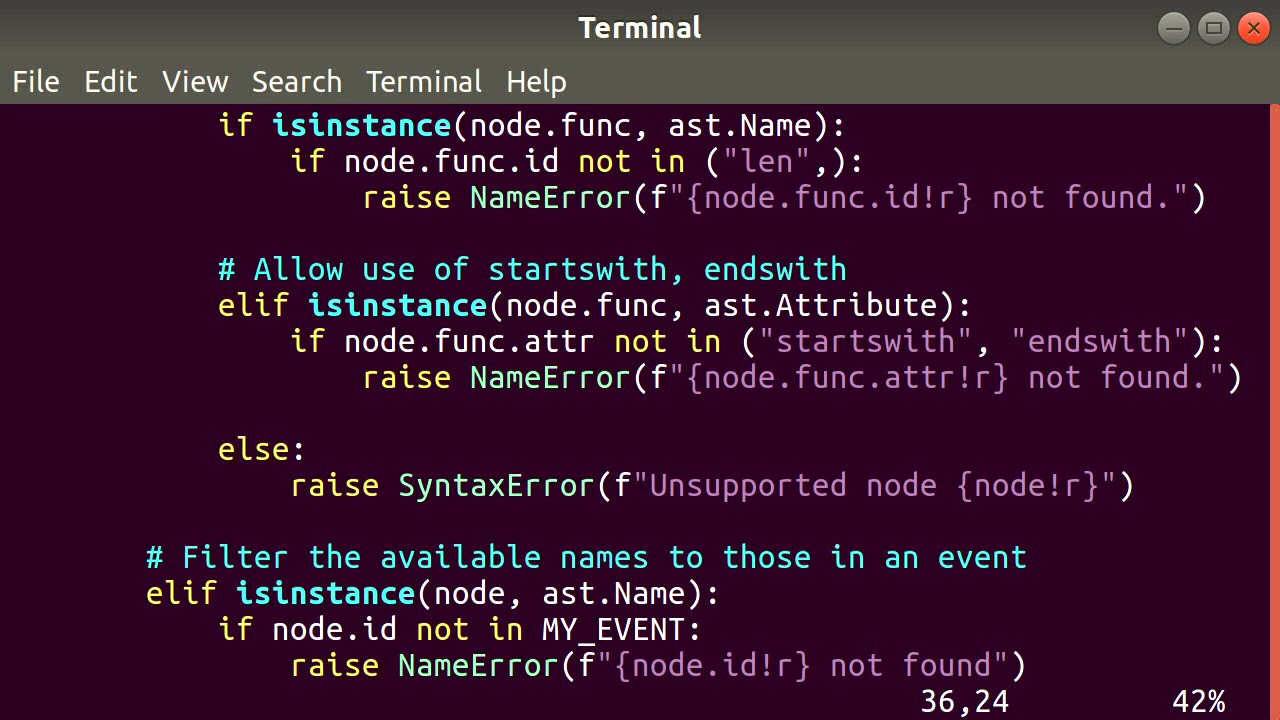
Tim Savage
Allow your users to supply queries or define rules using Python syntax and safely eval them. Processing an AST into safely executable code.
https://2019.pycon-au.org/talks/safely-eval-python-syntax-using-the-ast-module
PyCon AU, the national Python Language conference, is on again this August in Sydney, at the International Convent...
feral cedar
heady mauve
what's wrong with regex parsing?
verbal escarp
both talks are cool though
heady mauve
DOSing?
feral cedar
basically make a regex that is super slow to create and to check
heady mauve
I'm not worried unless the script can cause damage on the user's computer. If the script hangs, I'll kill it.
verbal escarp
iirc in the talk of tim savage it's about python in a banking environment
as in eval() in banking
which should give you some idea of how secure it can be
heady mauve
banking like handling money banking or something else?
verbal escarp
yes
pliant tusk
@verbal escarp that neuters python to the point its almost unusable to get any level of safety
verbal escarp
heady mauve
thank you!
you're welcome. i don't recall the details though, so enjoy the talk ^^
heady mauve
that I am
paper echo
feral cedar
<https://docs.microsoft.com/en-us/archive/msdn-magazine/2010/may/security-briefs...
if I remember correctly, the google re2 library is specifically designed to be resistant to malicious regex
and has python bindings
feral cedar
!pypi re2
 fallen slateBOT

Python wrapper for Google's RE2 using Cython
feral cedar
~~woah it fuzzy matches too?~~nvm 😔
paper echo
don't quote me on the safety thing, check in the docs
pliant tusk
heady mauve
thank you!
i encourage you to keep working on it, but dont be disappointed when you have to sacrifice major usability for safety (or vise versa)
theres a reason there are languages designed for this exact use case (lua)
heady mauve
right
heady mauve
heady mauve
Effectively I want to embed Python as a scripting language and block filesystem ...
see this 😉
pliant tusk
dont be suprised when people like myself find holes in it then
heady mauve
Surprised that you found it, I won't be. Surprised that that's what it was, you can bet I probably will be.
verbal escarp
i'd love to see the battle of wits on that 🙂
heady mauve
lol
pliant tusk
unless you plan on sandboxing it properly using something like https://github.com/python-discord/snekbox
GitHub
Easy, safe evaluation of arbitrary Python code. Contribute to python-discord/snekbox development by creating an account on GitHub.
feral cedar
like an arms race lol
heady mauve
again, I need windows support and snekbox uses nsjail that can't run on windows
pliant tusk
hence the something like
heady mauve
to clarify I need windows and linux support
I did see cuckoo sandbox but I didn't see much on how to set it up
verbal escarp
pliant tusk
<@!500372058186842123> that neuters python to the point its almost unusable to g...
which kind of is the point - reduce things to the bare minimum which is still python to basically get a DSL
pliant tusk
you wont be able to allow things like print()
verbal escarp
which probably isn't needed anyway
heady mauve
print will have to be redone anyway
pliant tusk
my point is that if something as simple as a bare function call will have to be disabled, what useful things will it be able to do
heady mauve
function calls would be permitted. I don't see why not
so long as they can't call malicious code
pliant tusk
how will you determine that
 naive saddle
you can abuse call frames to access some weird internals
pliant tusk
^
verbal escarp
if you can't access call frames?
pliant tusk
how will you block them?
heady mauve
can they be accessed without a lib?
pliant tusk
yes
heady mauve
how?
naive saddle
probably via an exception
pliant tusk
tracebacks
heady mauve
hmm
pliant tusk
!e py try:raise except Exception as e:print(e.__traceback__.tb_frame)
fallen slateBOT
@pliant tusk :white_check_mark: Your eval job has completed with return code 0.
<frame at 0x7f9707c797d0, file '<string>', line 2, code <module>>
ok, so if untrusted code gets access to a frame what can it do?
pliant tusk
step up it, modify variables
heady mauve
ok
pliant tusk
use it to get access to other modules
heady mauve
if those modules literally are not here it cant :P
pliant tusk
(configparser needs os which can be leveraged to write into memory)
pliant tusk
youre missing the point tho, that is just one example
and there are already countless security holes
spark magnet
@heady mauve try this: python -v -c "print(1)" it will list the modules Python imports just to get going.
(which includes os)
verbal escarp
well, i stand by my assumption - it's possible to make it safe by using a positive list of allowed calls/objects, as long as the list isn't too long
naive saddle
Just to be clear, I'm 100% all for building a sandbox within Python, just please don't use it in a real scenario. Sorta like amateur crypto: great for learning, but a bad idea for security. You'll probably learn some fun ways Python is highly introspectable 🌺
rich cradle
I think what you really need to do is find something like nsjail that works cross-platform, or some alternative specifically for windows.
heady mauve
well, os and io were both imported just to run a = 1
heady mauve
rich cradle
I think what you really need to do is find something like nsjail that works cros...
I'm thinking so
verbal escarp
watch the talk, if tim savage can make eval safe for banking, you should be able to make it safe for a game
heady mauve
I shall
pliant tusk
verbal escarp
well, i stand by my assumption - it's possible to make it safe by using a positi...
your list will need to be thousands of items long just to start python (and will have to include "unsafe" modules to do it)
rich cradle
Frankly, I feel like the only way harm can't be caused is if you can close off the interpreter from the system. Anything else is a fools mission.
pliant tusk
verbal escarp
watch the talk, if tim savage can make eval safe for banking, you should be able...
from what i watched it kinda boiled down to slightly more than ast.literal_eval
verbal escarp
pliant tusk
your list will need to be thousands of items long just to start python (and will...
not at all. you only need to check the AST over the module provided by the user, not against the whole system
heady mauve

pliant tusk
then the checked code will still be able to do dangerous things, provided you dont limit it as much as ast.literal_eval
verbal escarp
that's you assuming things, same as me assuming the contrary
won't know until @heady mauve gave it a try 😉
heady mauve
lol true
spark magnet
@verbal escarp i think Tim Savage's system is more limited than desired here, but it's hard to say
pliant tusk
im not assuming things tho? i have tried to do this in the past, and to get any degree of safety python becomes significantly less useful
verbal escarp
pliant tusk
im not assuming things tho? i have tried to do this in the past, and to get any ...
no doubt, question is whether it'll be useful enough to do the job at hand though
heady mauve
Well, whatever I do, I need to get rendering working first. I'll probably be in a help channel soon asking about OpenGL/OpenCL interops 😛
verbal escarp
well, have fun
red solar
PyCharm says error_msg local variable is not used? (for the one that = None)

is this PyCharm being slow, or another of python's weird scoping rules?
(ig the if statement is a redundant, but other than that...)
paper echo
@red solar confirmed, no cffi
% pyenv shell graalpython-21.2.0
% python -c 'import cffi'
Traceback (most recent call last):
  File "<string>", line 1, in <module>
ModuleNotFoundError: No module named 'cffi'
😦
paper echo
but again, i believe graalvm has its own ffi stuff
red solar
yeah i'm not gonna get into the mess of each implementation's ffi, pypy was enough of a pain :/ spent hours on that before just using cffi
maybe if i'm desperate to support graal later
but thanks for checking 🙂
paper echo
it seems like you can however use graalvm to build libraries that can be called from c, rust, etc. programs
https://www.graalvm.org/graalvm-as-a-platform/language-implementation-framework/NFI/ and it does seem like graalvm has some kind of built-in ffi

GraalVM is a high-performance JDK distribution designed to accelerate the execution of applications written in Java and other JVM languages along with suppor...
red solar
The NFI is an internal language designed for language implementors. It is not considered stable and the interface and behavior may change without warning. It is not intended to be used directly by end-users.
idk, i think technically i'm an end user :/
library = Polyglot.eval('nfi', 'load "libSDL2.dylib"')  # load a library
symbol = library['SDL_GetRevisionNumber']               # load a symbol from the lirbary
function = symbol.bind('():UINT32')
that's much nicer than ctypes tho (the .bind())
 white nexus
update on the lambda stuff:
I didn't do any of it. I made full functions and did it that way, which is sufficient for my usecase and gives me additional options
red solar
from atomics._impl.atomic.base import AtomicBase
import sys

a = AtomicBase(8, is_integral=False, is_signed=False)
i = 17
b = int.to_bytes(i, 8, sys.byteorder, signed=False)
a.store(b)
v = a.load()
print(int.from_bytes(v, sys.byteorder, signed=False))
If i run this normally in PyCharm, it will print 17.
If i run it using PyCharm's debugger with no breakpoints set, it will print 17.
If i set a breakpoint on any line from i = 17 onwards, i will get an assertion error from the C library i'm interfacing with (when I say interfacing, it's just ctypes).
any thoughts on how tf i would go about debugging this? I'm used to debug mode changing stuff in C/C++ (if there's UB), but i've never seen this happen in Python
like i don't see how debug mode in Python would change anything in Python, and it sure as hell shouldn't change anything in C (since that's already compiled)
(btw other people can ask questions, don't let this oddity hold up any other convo)
 raven ridge
what's the assertion error?
red solar
the parameter i passed (an int) had the wrong value
python3.8: /home/doodspav/CLionProjects/patomic/src/impl/std/std.c:889: patomic_opimpl_load_ulong_explicit: Assertion `patomic_is_valid_store_order(order)' failed.
raven ridge
so you put a breakpoint on i = 17, and your library says that the value of i is invalid?
red solar
no the assertion is in the C lib
i put a breakpoint on i = 17 and somehow it's already run a.load() and crashed before the debugger can pause it
raven ridge
well, the first thing to find out is what value order has
either add a printf in the C code, or use a C debugger
red solar
if i get rid of a.store(), then I still get the assertion error in C
the only other function calling C there is a.load()
wait
tf
#define PATOMIC_DEFINE_LOAD_OPS(type, name, order, vis)         \
    static PATOMIC_FORCE_INLINE void                            \
    patomic_opimpl_load_##name(                                 \
        const volatile void *obj                                \
   vis(_,int order)                                             \
        ,void *ret                                              \
    )                                                           \
    {                                                           \
        type val;                                               \
        assert(patomic_is_valid_load_order(order));             \
        val = atomic_load_explicit(                             \
            (const volatile _Atomic(type) *) obj,               \
            order                                               \
        );                                                      \
        PATOMIC_IGNORE_UNUSED(memcpy(ret, &val, sizeof(type))); \
    }
i mean, there's no patomic_is_valid_store_order(order) assertion inside patomic_opimpl_load_ulong_explicit...
so wtf
but anyway thanks @raven ridge ig this is a C issue now
i recompiled and it worked, who knows :/
but still really strange that it only broke once i set a breakpoint in python
paper echo
@zenith flint a help channel seems appropriate. nobody is ever too advanced for a help channel
 zenith flint
paper echo
<@!754091359782043676> a help channel seems appropriate. nobody is ever too adva...
zenith flint
paper echo
<@!754091359782043676> a help channel seems appropriate. nobody is ever too adva...
Yeah I've tried several times but couldn't find help, hence why I wanted to post somewhere where it sticks a bit
 gloomy rain
zenith flint
Yeah I've tried several times but couldn't find help, hence why I wanted to post...
gloomy rain
zenith flint
Yeah I've tried several times but couldn't find help, hence why I wanted to post...
That's not the purpose of this channel, though.
You're just going to have to be patient, or find help elsewhere.
zenith flint
gloomy rain
That's not the purpose of this channel, though.
Which one is?
gloomy rain
zenith flint
Which one is?
Are you asking what the purpose of this channel is?
zenith flint
gloomy rain
Are you asking what the purpose of this channel is?
No, I'm asking which channel should I ask my question in, I don't see anything related to neither logging or message queues
halcyon trail
channels don't get nearly that specific
help channels are for help "How do I do this, why doesn't this work, etc"
gloomy rain
zenith flint
No, I'm asking which channel should I ask my question in, I don't see anything r...
We don't have a topical channel for that, so a regular help channel is your best bet.
Maybe you can try #networks
verbal escarp
apropos safe python topic, AST eval with @spark magnet, @pliant tusk, @heady mauve from last night: what about using a python interpreter that doesn't expose as much of its internals as cpython? maybe pypy?
pliant tusk
Part of the issue is in order to be a compliant interpreter there has to be a fairly high level of exposing of internals
verbal escarp
if i were developing a python interpreter, i'd throw cpython-compliance out the window and focus on PEP-compliance with protocols
pliant tusk
What about PEPs that specifically detail introspection of internals?
verbal escarp

Python.org
The official home of the Python Programming Language
there are interpreters that don't try too hard to be cpython compliant like Jython

GitHub
The Stackless Python programming language. Contribute to stackless-dev/stackless development by creating an account on GitHub.
although i'm not sure how much those expose their internals
i could imagine even Brython could be an option for that
since it maps to JS, which doesn't have these kinds of issues
in this case, cpython non-compliance could prove to be an advantage
paper echo
zenith flint
Yeah I've tried several times but couldn't find help, hence why I wanted to post...
in general, if you aren't getting answers to your question, at least one of the following is probably true:
- answering your question requires specific knowledge that the community does not generally have
- your question is phrased in a way such that it is hard to understand
- you have not provided enough information for someone to help you
- your question is understandable, but too complicated, and needs to be broken down and asked in a simpler form; perhaps you have provided too much information, e.g. you have provided code and data, but they are far from "minimal", to the point where it's a lot of work to even try to understand
zenith flint
Well most of the time it's more like random people spam something nonsense in the channel and the people who could help won't even see the question anymore
(happened 4 times in a row)
paper echo
well that too. perhaps stackoverflow is a better forum, although stackoverflow drowns in low quality spam too
zenith flint
Yeah gonna try SO now
paper echo
note that your particular question i think has the first and last problem:
- it requires an understanding of rabbitmq and pika, which most people here probably don't have
- "it hangs silently" is a really nasty and difficult to debug error, and doesn't correspond to any known or obvious pattern of failure
does it hang if you swap out logging handlers? maybe you have an unrelated race condition. etc.
zenith flint
"it hangs silently" is a really nasty and difficult to debug error, and doesn't correspond to any known or obvious pattern of failure
Yeah I know but that's all I see, not sure how to debug it deeper because there's no exception nothing
It works if I replace the the publishing part with something like just printing the log message etc.
So the issue is definitely within the publishing but I don't see a reason why/how as it works fine outside of the class
I wish coding communities other than this Python Discord weren't complete garbage. There's 10k people on the RabbitMQ Slack and there are 2 messages a day happening on the entire server
halcyon trail
I think "garbage" and "inactive" or "quiet" etc are two different things....
paper echo
well did you do the obvious basic debugging steps? use a different log handler, try to just connect to rabbitmq without the logging framework, etc.
you might even have to drop into a debugger and step through the pika code
i've done things like that before
red solar
is there a way to specify separate package requirements for installing a package and building it? like installing it needs a single package, but building it needs a fair few
paper echo
red solar
is there a way to specify separate package requirements for installing a package...
this is what pep 517 is for! specify them in your build-backend in pyproject.toml
paper echo
you should have it anyway imo
red solar
ok i'm a little overwhelmed
i already have a setup.py file
can i just have this as my toml file?
[build-system]
requires = ["cmake >= 3.14", "GitPython", "setuptools", "wheel >= 0.25"]
I might be able to do that
I think a version of CPython that locks itself down based on command line args would be nice. Could run with it 100% CPython exact or lock it down whenever.
verbal escarp
probably not deemed useful enough to realize
red solar
is there any benefit to this over just sandboxing the process using the OS?
verbal escarp
"just sandboxing"? heh
red solar
when you guys say "safe"... how safe does that mean?
verbal escarp
really safe
red solar
So no access to any OS provided functionality?
heady mauve
red solar
So no access to any OS provided functionality?
No files, no networking, no os settings, nothing of that sort
Anything that could be used to cause damage to the end user's PC
red solar
What would be a use case?
heady mauve
embedding python as a scripting language in a video game
and please don't say "just use x language" that's all I ever hear
red solar
When people embed lua, is it a limited functionality version?
verbal escarp
why not use Brython? it looks like the perfect fit to me
you could even plug it in a browser directly with zero-install
heady mauve
I have never heard of it
verbal escarp
GitHub
Brython (Browser Python) is an implementation of Python 3 running in the browser - GitHub - brython-dev/brython: Brython (Browser Python) is an implementation of Python 3 running in the browser
 grave jolt
Just use agda, it compiles to JS 😉 😉
grave jolt
Hm... does anyone know why Python thinks it's invalid?
>>> from datetime import datetime
>>> datetime.fromisoformat("2021-10-26T10:35:11")
datetime.datetime(2021, 10, 26, 10, 35, 11)
>>> datetime.fromisoformat("2021-10-26T10:35:11Z")
Traceback (most recent call last):
  File "<stdin>", line 1, in <module>
ValueError: Invalid isoformat string: '2021-10-26T10:35:11Z'
>>>
ISO 8601 defines Z as valid, meaning UTC: https://en.wikipedia.org/wiki/ISO_8601#Time_zone_designators
 peak spoke
python only implements it as a reverse of its isoformat, there's been a lot of discussion on handling the Z but I've no idea why it wasn't added
paper echo
grave jolt
`datetime.fromisoformat(ts.replace("Z", "+00:00"))` this should work, right? 🙂
yes, which is as slow and hacky as you think this is
there is an infuriating thread on discuss.python.org about this

Discussions on Python.org
This is already opened as BPO 35829 but I wanted to ask about it over here for discussion. Problem Statement The function datetime.fromisoformat() parses a datetime in ISO-8601, format: >>> datetime.fromisoformat('2019-08-28T14:34:25.518993+00:00') datetime.datetime(2019, 8, 28, 14, 34, 25, 518993, tzinfo=datetime.timezone.utc) The timezone ...
this to me is intensely unproductive anti-pythonic bikeshedding over what imo is an obviously good change: add Z support, write a big loud warning in the docs that it does not fully implement iso-8601
halcyon trail
@paper echo agree
this is just silly, IMHO:
That said, in some ways it would violate the spirit of the contract, which is that, as of right now, fromisoformat is intended to be used only on the output of .isoformat, which means that all the people who want it to parse Z are in a sense using it in an unsupported way.
grave jolt
I am currently in disappointment of the highest degree
!d datetime.datetime.fromisoformat
fallen slateBOT
classmethod datetime.fromisoformat(date_string)```
Return a [`datetime`](https://docs.python.org/3/library/datetime.html#datetime.datetime "datetime.datetime") corresponding to a *date\_string* in one of the formats emitted by [`date.isoformat()`](https://docs.python.org/3/library/datetime.html#datetime.date.isoformat "datetime.date.isoformat") and [`datetime.isoformat()`](https://docs.python.org/3/library/datetime.html#datetime.datetime.isoformat "datetime.datetime.isoformat").

Specifically, this function supports strings in the format:

```py
YYYY-MM-DD[*HH[:MM[:SS[.fff[fff]]]][+HH:MM[:SS[.ffffff]]]]
```  where `*` can match any single character.

Caution

This does *not* support parsing arbitrary ISO 8601 strings - it is only intended as the inverse operation of [`datetime.isoformat()`](https://docs.python.org/3/library/datetime.html#datetime.datetime.isoformat "datetime.datetime.isoformat"). A more full-featured ISO 8601 parser, `dateutil.parser.isoparse` is available in the third-party package [dateutil](https://dateutil.readthedocs.io/en/stable/parser.html#dateutil.parser.isoparse)...I can't imagine that anybody using datetime, in practice, is aware that fromisoformat is intended to be used only on the output of .isoformat
that's just absurd
paper echo
halcyon trail
this is just silly, IMHO:
> That said, in some ways it would violate the spirit ...
yep, it looks like stubborn rationalization to me
grave jolt
I guess it does says so in the description 🤷
paper echo
see also: the thread about json.load_file
grave jolt
hm?
halcyon trail
I've defined been guilty of ignoring that aspect of the description 🙂 That said, it's really one or the other, if they want to stick to that description, then there needs to be a broader function
No matter how you slice it
paper echo
grave jolt
hm?
Discussions on Python.org
We have discussed about new function in the json module, but we didn’t make decision about its naming. Previous discussion: Mailman 3 A shortcut to load a JSON file into a dict : json.loadf - Python-ideas - python.org Issue: Issue 43457: Include simple file loading and saving functions in JSON standard library. - Python tracker poll
instead of "hey that's interesting! let's work on some proposals to meet this obvious need in the community", it's "i don't personally use this kind of thing and you are a noob for wanting it"
peak spoke
I don't agree with that one as much as pathlib's read_text and write_text can be used in a similar fashion, but I guess load/dump are already there offering tiny abstractions
surreal sun
paper echo
instead of "hey that's interesting! let's work on some proposals to meet this ob...
I notice that on a lot of threads/mailing lists
Few things are actually considered, a lot of people just like to point out only the flaws and not the good that could come out of it
peak spoke
You'll find that most people are resistant to change of what they're used to
grave jolt
paper echo
instead of "hey that's interesting! let's work on some proposals to meet this ob...
hmm... why is this an obvious need though?
halcyon trail
my personal and biased opinion is that the reality is that there a lot of languages that are offering "nicer" syntax for these things in a lot of cases
people see things and want them in python, at least to the degree practical
and people aren't persuaded about the benefits because it's a small, ergonomic thing at best, and it brings up issues that have to be dealt with (e.g. the encoding in the case of json) 🤷♂️
paper echo
grave jolt
hmm... why is this an obvious need though?
maybe it's not an "obvious need", but there is an "obvious desire" for it, and i think it has obvious benefits for a variety of reasons
it's funny because in the json case specifically afaik at least one spec requires utf-8, so that should be a non-issue
in all other cases... we literally deal with this everywhere else in python now
just default to utf-8 and give the user an encoding= kwarg
halcyon trail
with open("filename.json") as f: j = json.load(f) looked fantastic 20 years ago when C++ and Java had 20 line equivalents to this
 undone hare
Only the fact that you'd need to drop 3.10 support to use that function make it not seem that appealing anymore
paper echo
undone hare
Only the fact that you'd need to drop 3.10 support to use that function make it ...
wait what
grave jolt
you mean 3.10 support
halcyon trail
if such a function is introduced, I do not expect libraries to jump on it immediately?
you can say what you're saying about literally any new feature
undone hare
I do mean 3.10 now
grave jolt
yeah, I guess it's for the long term
halcyon trail
it's a non-argument
paper echo
it probably won't be used in some libraries ever! but imagine how much easier it would be for the literal thousands of newbies on this server
undone hare
But then you have to explain "blah blah blah your book doesn't mention it because it is older than you"
paper echo
i'd rather do that
grave jolt
you can say this about every new feature
halcyon trail
again, all these arguments apply equally to every single feature, function, that could be added to the language
paper echo
imagine, you can add one function to the standard library and save probably hundreds or thousands of man-hours across the world and for years to come, making the language friendlier for newbies and safer in general for non-experts
paper echo
halcyon trail
again, all these arguments apply equally to every single feature, function, that...
idk, in this case i think the benefit:cost ratio is massive
what was the benefit:cost ratio of pattern matching?
halcyon trail
I was talking to Akarys
paper echo
oh sorry
halcyon trail
I don't think it's massive, fwiw
undone hare
It does apply to every single new feature, you are right, but this function is only relevant in case of learning, and I think it is too confusing for that
halcyon trail
no, this function is not only relevant for learning...
plenty of times when I'm writing code, I want to open a json file as an expression
paper echo
learning is one extremely valuable use case, i strongly believe that it is less confusing
halcyon trail
i have utility functions exactly like this in my codebase
undone hare
Considering it cannot possibly support all the arguments open and loads have, I don't know how useful it would be
paper echo
but how often do you or anyone use those arguments
0.01% would be optimistically high
the point is not to support all needs and use cases
it's to make one very very very common use case less verbose, easier to teach, and less error-prone even in "serious" codebases written by serious experienced people
undone hare
Hey, you could use big query to check that haha
peak spoke
You only need the encoding and path in practically all cases, but I'm not that sold on the utility of this compared to the existing alternatives
flat gazelle
I think it's nice just for the convenience when loading sth into a repl
surreal sun
In general though, I’ve noticed syntactic sugar PEPs and ideas tend to more often be denied than accepted
paper echo
peak spoke
You only need the encoding and path in practically all cases, but I'm not that s...
python already defaults to utf-8 literally everywhere else as of 3.8, why is it so bad to add a few kwargs for the most popular cases
surreal sun
or even just sugar in making things less boilerplate
paper echo
i really am not trying to be closed-minded here, but i truly don't understand the resistance to this kind of thing
python is a big featureful language, blocking something as small as this will not reverse some perceived tide of concept bloat
which i agree exists in python, but not because of useful things
you could make the same arguments about str.removeprefix, the only pattern i can decipher is that the accepted changes are the ones that the core maintainers personally find useful
which is fine, if you are a minimal language with a standard library that exists only to bootstrap the runtime
many such languages exist. python is not currently one of them and probably will never be.
peak spoke
paper echo
python already defaults to utf-8 literally everywhere else as of 3.8, why is it ...
I'm not sure I understand, I was just thinking about such a small abstraction being worth being added when it can already be done succinctly, I have a similar opinion on the existing file versions of the json functions that can lead to misconceptions on it doing incremental parsing of the file instead of just being a wrapper to loads
flat gazelle
yeah, this seems like a pretty good helper function that would make using python easier.
halcyon trail
it's unfortunate that python does not have extension functions; it's so nice to simply add these kinds of functions as extensions to your Path type
flat gazelle
not by a lot, but well, it is trivial to implement
 inland wadi
Uhm, hello
May I ask where I could start learning Python?
I'm not sure if I'm using the right channel
surreal sun
paper echo
you could make the same arguments about `str.removeprefix`, the only pattern i c...
iirc that was mainly to end confusion because people kept using strip and were wondering why it wouldn’t work
paper echo
peak spoke
I'm not sure I understand, I was just thinking about such a small abstraction be...
i am generally opposed to making 1000s of people rewrite the same helper util (and associated tests!!) over and over and over, when it could just be part of the stdlib instead. every time you reimplement something, you risk messing it up. and every time you avoid implementing a useful abstraction to avoid adopting a nonstandard helper function, you risk messing it up.
inland wadi
inland wadi
I'm not sure if I'm using the right channel
Oh seems that I'm using the wrong channel, my bad
surreal sun
inland wadi
May I ask where I could start learning Python?
You could ask in #python-discussion usually, but for now check out the resources below!
!resources
fallen slateBOT
Resources
The Resources page on our website contains a list of hand-selected learning resources that we regularly recommend to both beginners and experts.
https://pythondiscord.com/resources
inland wadi
surreal sun
You could ask in <#267624335836053506> usually, but for now check out the resour...
Thanks
surreal sun
Some really good resources on here, but for future reference, this channel is for discussion about the language itself and what not (channel topic explains it better)
paper echo
good design is almost always an accumulation of small good things, and size of change is not generally correlated with size of benefit
sometimes the biggest improvements are the smallest, and sometimes the biggest changes are the least cost effective
surreal sun
^ a lot of the string methods could be argued with the logic that “this can be done already without it”
surreal sun
surreal sun
^ a lot of the string methods could be argued with the logic that “this can be d...
But it still exists because it’s just nice to have
halcyon trail
when it comes to types, there's an argument about adding more and more member functions, which is that it makes it more and more onerous to replace the type, if you so wanted
people more rarely replace modules than types, though in python specifically replacing types is probably also relatively rare.
but again, extensions really shine here as they separate the intrinsic, necessary, reaches-into-the-guts of the type member functions, from the helper functions that can be implemented in terms of other stuff
and it makes those helpers reusable, squashing one of the main objections to them without having to switch to free-function syntax which is often disliked
I almost had PTSD flashbacks today because I was writing some python code and I was expecting startswith ane endswith not to exist, because in C++ they are not added until C++20, which my company isn't even on yet 🤣
verbal escarp
paper echo
i am generally opposed to making 1000s of people rewrite the same helper util (a...
i think it's down to a few like rhettinger who resist that sentiment because it's easy to just write the helper function when you need it, no need to pollute the stdlib with usefulness
grave jolt
this must be my favourite JS function... I think I implemented it more than a dozen times ```ts
const sleep = (ms: number): Promise<void> => new Promise(resolve => setTimeout(resolve, ms))
i'm also a bit pissed by similar cases i encountered previously
paper echo
grave jolt
this must be my favourite JS function... I think I implemented it more than a do...
classic example of boilerplate that should be a stdlib function
paper echo
right, i'd say that specifically because this is JS it gets a pass
browser implementers have enough on their hands as it is
but if this were any "standalone" language i'd be pretty annoyed at having to write that. but at least sleeping is not all that common of a need (outside of demos)
verbal escarp
and those helpers wouldn't even require a lot of maintenance
paper echo
you know what is a really annoying glaring gap in the nodejs api? no built-in functionality to iterate over buffered lines of stdin or another text stream
imagine having to implement that yourself, in 2021, for every single application
verbal escarp
so the whole "we can't have all the nice things" argument doesn't apply
paper echo
verbal escarp
and those helpers wouldn't even require a lot of maintenance
big  on this, too. again, i think of all the crap in the stdlib that can surely be deprecated with sufficient coordination from linux distro maintainers (e.g. wav, aiff, asyncore)
red solar
Has no one implemented an std package for js with no dependencies? Surely that’s a thing by now
There must be multiple
paper echo
fwiw the sterring council and core devs do seem to be taking "dead battery removal" seriously
and i really appreciate that they are
grave jolt
red solar
Has no one implemented an std package for js with no dependencies? Surely that’s...
 verbal escarp
grave jolt
verbal escarp
grave jolt
there only can be one standard!
red solar
I mean, I figured… but still
verbal escarp
paper echo
fwiw the sterring council and core devs do seem to be taking "dead battery remov...
maybe a bit too overzealous
paper echo
verbal escarp
maybe a bit too overzealous
how so?
verbal escarp
just thinking of tuple unpacking for lambdas
paper echo
that was years ago, and not the same thing as "removing dead batteries" as per https://discuss.python.org/t/pep-594-removing-dead-batteries-from-the-standard-library/1704/2
Discussions on Python.org
I like this PEP, everything is well explained and makes totally sense.
verbal escarp
still hurts
halcyon trail
you guys need to program C++ 🙂 You can't even write anything in C++ without thousands of lines of utility code
paper echo
now that we have pattern matching, i would love to have full pattern matching in functions and =/:=
paper echo
halcyon trail
you guys need to program C++ 🙂 You can't even write anything in C++ without tho...
i avoid C++ on purpose and intend to write as little of it as possible until forever
halcyon trail
i might also if it didn't pay well
my ambition is for C++ to eventually die as I get older, so I can be like those aging COBOL programmers now
and consult at insane hourly rates
verbal escarp
heh
paper echo
apparently the cobol programmers don't actually make that much compared to the rest of the industry, they just get repeatedly called out of retirement
halcyon trail
well, you can't just force people out of retirement
you have to pay enough to be worth it
paper echo
well no, but even getting the emails/calls would be annoying
verbal escarp
"ok, i'm coming, but you pay the lunch"
halcyon trail
you can just ignore them.... the company doesn't own you after you retire lol
i'm sure it depends in what sector, but at least in NY finance, there are a lot of stories about obscene hourly rates
but I admit I don't have any first hand verification, I don't know any programmers that old
halcyon trail
it's a good scene, at least if you go into fintech
working at a straight up bank, I imagine pays fine but can probably get a bit miserable QoL wise, though it really depends what team you are on
HFT is nice, you get a lot of the perks of both finance, and tech, IMHO. And the company is generally very technology dependent, so that informs the culture a lot.
paper echo
i was in insurance in goddamn new jersey, i was underpaid and everything about it was a miserable slog
big major company too
this is OT though
paper echo
(off topic)
grave jolt
Do you think it's always a bad idea to have a default mutable argument? For example here:
async def fetch_all(
    session: ClientSession,
    url: Union[URL, str],
    field: str,
    params: Mapping[str, Any] = {},
    step: int = 100
) -> AsyncIterator[Any]:
    async with session.get(url, params={**params, "count": 0}) as resp:
        json = await resp.json()
    total = int(json["total"])

    for i in range(0, total, step):
        async with session.get(url, params={**params, "count": step, "offset": i}) as resp:
            json = await resp.json()
            for item in json[field]:
                yield item
#bad-career-choices-discussion 😉
verbal escarp
grave jolt
Do you think it's always a bad idea to have a default mutable argument? For exam...
yes.
grave jolt
so... you propose doing this? ```py
async def fetch_all(
session: ClientSession,
url: Union[URL, str],
field: str,
params: Optional[Mapping[str, Any]] = None,
step: int = 100
) -> AsyncIterator[Any]:
if params is None:
params = {}
...
 main ginkgo
only thing i can really think of a mutable default being good for is a cache
with the option to use a different cache of your own
grave jolt
here it's only accidentally mutable -- I'm not mutating it, of course
verbal escarp
future you will hate you for that
grave jolt
why?
main ginkgo
frozendict when 😦
verbal escarp
because future you might've forgotten about the context and mutates the thing somewhere else and then you'll end up wasting time debugging the whole thing for hours because there's no obvious exception and then you'll swear to never do it again
grave jolt
I guess... but adding None as default and then doing an if seems just ugly
 red elk
grave jolt
Do you think it's always a bad idea to have a default mutable argument? For exam...
red elk
grave jolt
Do you think it's always a bad idea to have a default mutable argument? For exam...
resource of future bugs
halcyon trail
I think it's always a bad decision to have a mutable default argument, yes
and that includes using it as a cache
and adding None as a default and doing if doesn't just seem ugly... it is ugly
but that is how we do
grave jolt
I guess I could use MappingProxyType({}) as the default
halcyon trail
You don't need the Optional annotation, FYI
that situation is already special-cased into python type checkers
halcyon trail
If you go out of your way, sure
grave jolt
I wouldn't want ```py
def f(x: int = None):
return x + 5
why
main ginkgo
why add extra unneeded overhead if all i need is just a simple cache?
halcyon trail
If you want to have a global default cache, then... have a global
main ginkgo
lru_cache has its own specific uses
halcyon trail
and use it as the cache
and even make it the default argument if you want
you can even make the global start with _ if you want it to be an implementation detail
there's literally no reason to write it that way; it just makes it harder for people to grok who aren't familiar with this very weird quirk of python
main ginkgo
im still not seeing a why
you presented an alternative, you didnt explain why that would be better though
halcyon trail
because its explicit, instead of depending implicitly on a bizarre behavior of python?
It's code that can be read by anyone, easily, with less likelihood of a mistake?
 spice pecan
It might just be me, but I wouldn't call this behavior bizarre
main ginkgo
i dont find it bizarre personally. it makes sense if you understand how python works. and 'implicit' is context-dependent.
halcyon trail
you don't find it bizarre personally, but many people will. Nobody will find using an explicit global bizarre, or confusing.
And yeah, the behavior is bizarre when you have e.g. a dozen popular programming languages, and python is one of, if not the only, that behaves this way.
mutable default argument is quite literally considered a common "trap" for people learning python because this behavior is so surprising
main ginkgo
i guess that's fair enough if youre releasing code that needs to be read by others often
spice pecan
I haven't personally seen a lot of complaints about it. AFAIA, it's a mistake you might make a couple times when starting out, but not something you repeatedly forget about
main ginkgo
if im just writing something for myself, im not gonna split hairs about it though
halcyon trail
well, yeah, I would assume it's a given that your code needs to be read by others, if we even bother discussing which way to do it
otherwise can just hack it out however, as long as either way is correct
halcyon trail
spice pecan
I haven't personally seen a lot of complaints about it. AFAIA, it's a mistake yo...
I mean, the convo you just joined started with someone (not me) complaining about it 🙂
main ginkgo
if it's a library/framework then i can see the need to keep cognitive load to a minimum. but if it's like, just you or a small team working on it and you all get it then i dont see the harm
halcyon trail
there was also a whole convo about this yesterday; because there's a PEP to fix it, so somebody found thsi behavior so irritating that they put in the effort ot write something up
spice pecan
That's a fair point, I'm just saying that it's usually something you grasp fairly quickly (albeit after stubbing your toe on it)
halcyon trail
yeah, it is definitely not rocket science, and I wouldn't have trouble grokking the code that used this for a mutable cache
grave jolt
I am being onboarded on a project of a small team... readability would be great
halcyon trail
I would just skim the code, double take a few times, and think that this code was too clever in a bad way, and move on
grave jolt
grave jolt
so... you propose doing this? ```py
async def fetch_all(
session: ClientSess...
I present to you... the penultimate hack. ```py
from typing import Callable, Any, TypeVar
from itertools import starmap
import inspect
C = TypeVar("C", bound=Callable)
def fix_default_mutable(fn: C) -> C:
sig = inspect.signature(fn)
replace_pos = {}
replace_kw = {}

def replace(param: inspect.Parameter, value: Any, index: int):
    if param.kind != param.KEYWORD_ONLY:
        replace_pos[index] = value
    if param.kind != param.POSITIONAL_ONLY:
        replace_kw[param.name] = value

for i, param in enumerate(sig.parameters.values()):
    if isinstance(param.default, dict):
        replace(param, MappingProxyType(param.default), i)
    elif isinstance(param.default, list):
        replace(param, tuple(param.default), i)
    elif isinstance(param.default, set):
        replace(param, frozenset(param.default), i)

fn.__defaults__ = tuple(starmap(replace_pos.get, enumerate(fn.__defaults__ or ())))
fn.__kwdefaults__ = {**(fn.__kwdefaults__ or {}), **replace_kw}
return fn

@verbal escarp I hope this is cursed enough to show you
I mean... yeah, that's what it protects against
it's for the cases like mine, where I don't intend to change the argument
verbal escarp
how does your @fix_default_mutable fix the "it's ugly to write if x is None.." argument - it's just wrapped in a different cloth ;p
grave jolt
it's ugly but now it's exciting
verbal escarp
@grave jolt while you're at wrapping your head around things, i have a quest for you
a while ago i tried to come up with a function that would extract the keyword params from inside the function it's called from
def all_kwargs(func, other_locals):
    d = {
        name: other_locals[name]
        for name, param in inspect.signature(func).parameters.items()
        if (param.kind is inspect.Parameter.KEYWORD_ONLY or param.kind is inspect.Parameter.VAR_KEYWORD)
    }
    d.update(d["kwargs"])
    del d["kwargs"]
    return d
is the function i got stuck with, which is called as
def foobar(*, a=2, b=3):
   print(all_kwargs(foobar, locals()))
i tried to simplify the function call to all_kwargs() but i couldn't come up with a solution
grave jolt
is it permissible to add a decorator to the function?
verbal escarp
sure
grave jolt
take out your hack-protection helmet
peak spoke
verbal escarp
i tried to simplify the function call to all_kwargs() but i couldn't come up wit...
getting the param types and names from the code obj didn't pan out?
verbal escarp
peak spoke
getting the param types and names from the code obj didn't pan out?
i did some experiments, but i gave up halfway
 elder blade
Dear God no
grave jolt
grave jolt
take out your hack-protection helmet
!e
import threading

def kwspy(fn):
    store = threading.local()
    def new_fn(*args, **kwargs):
        store.kwargs = kwargs
        try:
            return fn(*args, **kwargs)
        finally:
            store.kwargs = None

    new_fn.kwargs = lambda: store.kwargs
    return new_fn

@kwspy
def f(a, b, *, c, d):
    print(f.kwargs())

f(1, b=2, c=3, d=3)
@grave jolt :white_check_mark: Your eval job has completed with return code 0.
{'b': 2, 'c': 3, 'd': 3}
oh god, the first line says import threading
grave jolt
heh
doesn't work with generator functions and async, though
and will break with recursion
grave jolt
!e
What about this? ```py
def collect(fn):
def new_fn(*args, **kwargs):
return fn(*args, **kwargs, kwargs=kwargs)
return new_fn
@collect
def f(a, b, *, c, d, kwargs):
print(kwargs)
f(1, b=2, c=3, d=3)
@grave jolt :white_check_mark: Your eval job has completed with return code 0.
{'b': 2, 'c': 3, 'd': 3}
!e
or ```py
def collect(fn):
def new_fn(*args, **kwargs):
return fn(kwargs, *args, **kwargs)
return new_fn
@collect
def f(kwargs, /, a, b, *, c, d):
print(kwargs)
f(1, b=2, c=3, d=3)
@grave jolt :white_check_mark: Your eval job has completed with return code 0.
{'b': 2, 'c': 3, 'd': 3}
that would collide with **kwargs
 prime estuary
Hence why you need the positional arg.
grave jolt
yeah, so that's why I suggested the second one 🙂
this is 100% thread-safe and will work with generator functions and coroutine
s/will/should
verbal escarp
hm.. i like it, it's simple
not exactly what i asked for, but maybe it'll work well enough to replace the in-function thing
thanks
grave jolt
why do you want to do this in the first place? @verbal escarp
verbal escarp
ah, because of my buffet pattern
grave jolt
❓
verbal escarp
grave jolt
this must be a Russian buffet because my stomach audibly aches after smelling it
verbal escarp
basically i flattened a big function, split it up into many smaller ones which all get the same **locals(), from which each picks the kwarg they want, then pass along the rest
it simplified a lot of code and the signatures only take kwargs, which makes working with those functions very nice
although it's a bit of a rollercoaster if you try to follow a debugger
paper echo
@verbal escarp your buffet pattern makes me think of ocaml 🙂
verbal escarp
why's that 😄
paper echo
idk about abusing locals like that
but the overall appearance resembles pattern matching
 zinc folio
verbal escarp
zinc folio
verbal escarp
yeah, someone proposed a patma function as a replacement, which was nice
but i can't use it just yet, supporting py3.8
(no pun intended)
 halcyon trail
the people here need to like, NFT, or encrypt, or something, the awful hacks they come up with, so that there's no chance of someone lurking in this channel, and using it in my codebase 🤣
peak spoke
!e should work for everything if I copied from inspect correctly
import sys

def all_kwargs():
    kwargs = {}

    upper_frame = sys._getframe().f_back

    locals = upper_frame.f_locals

    code = upper_frame.f_code
    pos_count = code.co_argcount
    arg_names = code.co_varnames
    keyword_only_count = code.co_kwonlyargcount
    kw_only_names = arg_names[pos_count:pos_count + keyword_only_count]

    kwargs.update((name, locals[name]) for name in kw_only_names)

    # **kwargs
    if code.co_flags & 8:
        index = pos_count + keyword_only_count
        if code.co_flags & 4:
            index += 1
        kwargs.update(locals[arg_names[index]])

    return kwargs

def eggs(*, a=2, b=3):
    print(all_kwargs())

def spam(a, /, b, c, *, d=0, e=0, **kwargs):
    print(all_kwargs())

eggs()
spam(0, 1, 2, d=3, e=4, f=5, g=6)
@peak spoke :white_check_mark: Your eval job has completed with return code 0.
001 | {'a': 2, 'b': 3}
002 | {'d': 3, 'e': 4, 'f': 5, 'g': 6}
king of the lab eh.. channel!
peak spoke
It's all in the inspect source fwiw, just needed the irrelevant parts taken out of it
verbal escarp
obviously 😉
surreal sun
How does inspect.getsource work? does it just read the module and string match?
It seems like it doesn't work in the REPL either, so I'm guessing it does read the module
peak spoke
Yes, it goes through the file; the source is not present in any way in the compiled code so that's the only way
surreal sun
peak spoke
Yes, it goes through the file; the source is not present in any way in the compi...
Ah alright.
On another note,
I've seen some people make disassemblers for Python before via reading opcodes/opargs and it was pretty interesting but it wouldn't work for sometimes i.e. and and or since those don't exactly have an opcode for itself, etc.
oof
fallen slateBOT
@white nexus :warning: Your eval job has completed with return code 0.
[No output]
Basically uh, I could've just put that as the lambda signature
Not really advanced, but quite the opposite, it was something really simple in solution
 hollow aspen
do ya'll think you should use Java in vsc?
 unkempt rock
hollow aspen
do ya'll think you should use Java in vsc?
unkempt rock
hollow aspen
do ya'll think you should use Java in vsc?
That question belongs in an off-topic channel, this channel is for Python discussion
hollow aspen
unkempt rock
That question belongs in an off-topic channel, this channel is for Python discus...
I am very sorry.
 snow bronze
>>> b=0
>>> exec(a:='[globals().__setitem__("b",b+1),exec(a)]')
  [Previous line repeated 509 more times]
RecursionError: maximum recursion depth exceeded during compilation
>>> b
512

>>> b=0
>>> (a:=lambda:[globals().__setitem__("b",b+1),a()])()
  [Previous line repeated 1022 more times]
RecursionError: maximum recursion depth exceeded while calling a Python object
>>> b
1024
Can someone explain why does only half of the recursion limit occurs before it stops?
raven ridge
I believe exec compiles the statement you give to a code object, and then calls that code object as a separate stack frame. So every iteration you have 2 calls, one to exec and one from exec into your code.
snow bronze
Oh I see.. that makes sense now
>>> def a():
    global b
    b+=1
    c()
>>> def c():
    a()
>>> b=0
>>> a()
RecursionError: maximum recursion depth exceeded
>>> b
513
and the number in the error [Previous line repeated **1022 **more times] it doesn't include the first and last call?
raven ridge
I'm not sure why those don't match. I'd have expected them to be off by 1 at most.
white nexus
Depending on where it's run, the stack might already exist
They do match
1023 - 1 == 1022
1023 // 2 = 511 - 1 = 510, plus one more for what @raven ridge said with the double stack, it only got through one of them and not both
raven ridge
What doesn't match is the "repeated 509 more times" message with the counter showing 512 increments happened
raven ridge
Yeah - on the last iteration it performs the increment and then isn't able to create a new frame for the exec call - that's a difference of 1. And "Previous line repeated" implies a first line, so that accounts for another 1, so it should be off by 2. And in the 1024 case it was off by 2, but in the half that case it was off by 3 instead
snow bronze
raven ridge
I'm not sure why those don't match. I'd have expected them to be off by 1 at mos...
And also why is __del__ allowed to bypass the recursion limit, is it a bug or another reason or its not actually in recursion? and also why does KeyboardInterupt stop it?
like
>>> class a:
    def __del__(self):
        global b
        b+=1
        a()


>>> b=0
>>> c=a()
>>> del c
Exception ignored in: <function a.__del__ at 0x000002034617A8B0>
Traceback (most recent call last):
  File "<pyshell#6>", line 4, in __del__
KeyboardInterrupt:
>>> b
3927640
__del__ is special 🙂
raven ridge
That's not recursion, then. There's no way you could be making 3 million recursive calls without the interpreter crashing with a stack overflow.
RecursionError is just there for safety and convenience - you can disable it entirely, but if you do, the interpreter will eventually crash instead of raising an exception
red solar
lol really?
raven ridge
Sure. Stack is a limited resource, and there's no portable way to know how much of it is left. Eventually you run out and get a segmentation violation.
red solar
SEH? and maybe linux has an equivalent
Python definitely checks stuff with SEH on windows
snow bronze
raven ridge
That's not recursion, then. There's no way you could be making 3 million recursi...
ah I see...
I just thought it was recursion for some reason because this creates millions of objects
WARNING KILLS PC
>>> class a:
    def __del__(self):
        global b
        b+=1
        a()
        a()


>>> c=a()
>>> b=0
>>> del c
So RecursionError is a safety valve that says "assume something that makes more than N recursive calls is doing something wrong", because the interpreter doesn't know how many more calls it could possibly make successfully.
red solar
I always just imagined if you disabled it, the interpreter would still check and raise it if you were about to segfault
or maybe raise an OOM exception (idk if python has one)
red solar
snow bronze
ah I see...
I just thought it was recursion for some reason because this creates...
kills pc how?
raven ridge
red solar
or maybe raise an OOM exception (idk if python has one)
It does, MemoryError
red solar
oh so that 🙂
raven ridge
red solar
I always just imagined if you disabled it, the interpreter would still check and...
Perhaps on Windows it does. On Linux it definitely just segfaults.
 snow bronze
raven ridge
Perhaps on Windows it does. On Linux it definitely just segfaults.
snow bronze
raven ridge
Perhaps on Windows it does. On Linux it definitely just segfaults.
Oh just segfaults?
red solar
64gb
snow bronze
🤯🤯
red solar
chill, i couldn't find a gpu so i spent more money on ram lol
snow bronze
and here was myself bragging bout my 16GB ram lol
red solar
which is perfectly fine for 99% of things
 reef spindle
@fossil pumice @wide shuttle @granite heath @oblique raven @sturdy timber
red solar
the hackathon?
oh, well congrats 🙂
so you have an idea, and now you need to create a proof of concept?
ok - i'm not sure how i'd be able to help though
you want to make the proof of concept in python? do you know python?
aww @oblique raven you kicked him? 😦
 oblique raven
No
red solar
oh then he left
oblique raven
Yup
red solar
i mean, #data-science-and-ml might help? other than that not sure
i'm not sure - i still haven't understood what your issue is - you don't know how to use a specific AI thing? or you have no idea how to get started at all?
really? usually these challenges give you some testing environments
https://www.hackerearth.com/challenges/hackathon/reimaginefuture-hackathon/custom-tab/resource-centre/#Resource Centre i think you're supposed to set up a free account, and then use their APIs which are presumably free for some low limit?
then what's the issue? why can't you use it?
i'm not
what's the issue? you have an account, you have free access to the cloud, why can't you deploy?
class bdist_wheel(_bdist_wheel):

    def finalize_options(self):
        _bdist_wheel.finalize_options(self)
        self.root_is_pure = False
would me doing super().finalize_options() be identical to _bdist_wheel.finalize_options(self)?
grave jolt
red solar
would me doing `super().finalize_options()` be identical to `_bdist_wheel.finali...
not fullly
grave jolt
it will be different with multiple inheritance AFAIK
peak spoke
if there's no mro changing magic in _bdist_wheel they should act the same
red solar
hmm... ok fingers crossed there isn't then and i'll go with super() cuz it looks nicer 🙂
elder blade
red solar
this is single inheritance tho
But if someone makes another subclass, like this: ```python
class bdist_car(_bdist_wheel):
def finalize_options(self):
print('Finalized')
super().finalize_options()
class Subclass(bdist_wheel, bdist_car):
pass
bdist_car 😂 😂
elder blade
The MRO is now:
_bdist_wheelbdist_carbdist_wheelSubclass
red solar
it's alphabetical?
red solar
ah i'm blind, i somehow didn't even see Subclass
elder blade
Subclass inherits from bdist_wheel which has been changed to inherit from bdist_car which inherits from _bdist_wheel
So when you call a method Python will look it up in the reverse order from what I listed. Starting with Subclass and ending with _bdist_wheel
But as you notice bdist_car has been injected into the MRO, as bdist_wheel's parent isn't _bdist_wheel (well it's the parent's parent)
red solar
hmm... i think i actually want super() then even in that case
even though it's not the same
not sure why the example i copied didn't use super()
elder blade
Yes, good. This is actually why people use super(), even though they know their parent.
red solar
how do i figure out which version of stuff like setuptools and wheel i need to require?
or do i just not put a version requirement?
red solar
eh screw it i guessed
 lusty scroll
cool hack. seems like a "FrozenList" would work here too as a default argument. thinking why we have frozenset but not frozenlist
unkempt rock
I guess there was no use for it, heh
spice pecan
frozenlist = tuple
There you go :P
halcyon trail
I think I pretty much did that as a type alias, and then never used it 🙂
lusty scroll
spice pecan
`frozenlist = tuple`
There you go :P
lol, that's not bad
class frozenlist(tuple):
    pass
too bad it says __main__.frozenlist
spice pecan
!e ```py
class frozenlist(tuple):
module = frozenset.module
print(f"{frozenlist}, {frozenlist!r}")
@spice pecan :white_check_mark: Your eval job has completed with return code 0.
<class 'frozenlist'>, <class 'frozenlist'>
You can manually set it to 'builtins' as well
lusty scroll
are there other differences between a user-defined type and a builtin type?
spice pecan
Depends, most (if not all) built-ins types are implemented in C
That'd be the biggest difference ig
lusty scroll
if there are no new methods, it could plausibly be a C type?
spice pecan
I'm not sure about the details here, frankly. I'd guess that it'd be a Python type that proxies everything to its C parent
!e You can probably assign arbitrary attributes after subclassing
class Sub(tuple): pass
Sub().new_attr = 10
@spice pecan :warning: Your eval job has completed with return code 0.
[No output]
Yeah, it seems to be a regular Python-defined type
Just one that happens to rely on it's C-implemented parent
lusty scroll
I do see one thing I'm not sure of:
'__new__': <built-in method __new__ of type object at 0x7ff7f88950>
frozenlist does't have __new__ in its class dict. Just wondering if that's something a builtin type would have
the above was in tuple class dict
elder blade
lusty scroll
are there other differences between a user-defined type and a builtin type?
They don't have slots or a dict
red solar
do frozen containers have any optimisations compared to their regular counterparts?
elder blade
!e ```python
print(int.slots, int.weakref, int.dict)
@elder blade :x: Your eval job has completed with return code 1.
001 | Traceback (most recent call last):
002 |   File "<string>", line 1, in <module>
003 | AttributeError: type object 'int' has no attribute '__slots__'. Did you mean: '__class__'?
On the other hand, all user defined classes either has a __dict__ or __slots__ this is because they're not defined in C of course
elder blade
red solar
do frozen containers have any optimisations compared to their regular counterpar...
Smaller memory
Memory isn't freed perfectly after it's removed
spice pecan
I'd say one of the most important properties is hashability
red solar
smaller memory in that the PyObject takes up less memory, or it also allocates stuff more efficiently too? (like having FrozenSet be contiguous or something)
elder blade
!e ```python
from sys import getsizeof
d = dict()
print(getsizeof(d))
d['a'] = 1
print(getsizeof(d))
del d['a']
print(getsizeof(d))
@elder blade :white_check_mark: Your eval job has completed with return code 0.
001 | 64
002 | 232
003 | 232
See how it stayed the same, even though we removed an item?
elder blade
If you modify a dictionary it may have some extra overhead even though you don't store any more items in it
spice pecan
tuple would be smaller than a list because it allocates exactly enough memory for its elements, no need to overallocate for amortizing appends. Not sure about frozenset, since overallocating is not only done to amortize new additions, but also to reduce hash collisions
elder blade
red solar
but `frozendict` just doesn't let you modify it?
There is no frozendict
spice pecan
Yeah, there's mappingproxy, which gives you an immutable view of a dict, but it's not exactly a frozendict. IIRC it's still unhashable
red solar
tbh i thought there was a bunch of frozen containers, not just set :/
spice pecan
Well, tuple is effectively a frozenlist
But there aren't that many containers to begin with, tbf
Yeah, mappingproxy is still unhashable, so it's just an immutable view
elder blade
Okay but when would you store a dictionary as a key in another dictionary lmao
spice pecan
You may want to store it in a set
It's not an entirely unreasonable use case
There was a rejected pep that tried to introduce frozendict
!pep 416
fallen slateBOT
**PEP 416 - Add a frozendict builtin type**
Status
Rejected
Python-Version
3.3
Created
29-Feb-2012
Type
Standards Track
red solar
Multiple threads can agree by convention not to mutate a shared dict, there's no great need for enforcement. Multiple processes can't share dicts.
lusty scroll
wait, you can look at the class dict for all types, right? they don't have an instance dict though
red solar
not sure how i feel about that reasoning
sure they can agree, but enforcement is always nice
spice pecan
lusty scroll
wait, you can look at the class dict for all types, right? they don't have an in...
Yeah, but you won't get a dictionary, you'll get a mappingproxy
lusty scroll
ah I see
spice pecan
!e py print(repr(tuple.__dict__)[:100] + '...')
fallen slateBOT
@spice pecan :white_check_mark: Your eval job has completed with return code 0.
mappingproxy({'__new__': <built-in method __new__ of type object at 0x7f51a54eefc0>, '__repr__': <sl...
I thought that was just to make it immutable
spice pecan
It is
You can't alter it directly. You can get the underlying mutable dict with some gc hacks IIRC, but that's... very dirty, to say the least
!e ```py
import gc
d, = gc.get_referents(tuple.dict)
d['index'] = print
().index('Hello, world!')
@spice pecan :white_check_mark: Your eval job has completed with return code 0.
Hello, world!
lol 😂
spice pecan
This screams "Please don't do this"
lusty scroll
the referents are indexed by name?
lusty scroll
ah!
spice pecan
Yeah, it's just a list
With one item, that I immediately unpack into a tuple of 1 element
lusty scroll
I missed the ,
spice pecan
It's more readable if you do [item] = collection or (item,) = collection, but I basically copied it from my REPL, so yeah
halcyon trail
i admit it's not often I've ever wanted to use a dict as a key to another dict
on the other hand I'm not sure why they don't have it
lusty scroll
I've run into it a few times I think
halcyon trail
I can't find an obvious reason why frozenset is there but not frozendict
it seems like set was simply standardized later, and perhaps by a different person, and the value of immutability was perhaps better understood/appreciated
so frozenset just came in with set
it's easier I guess to add something incrementally as part of a PEP than get a whole new PEP accepted
lusty scroll
making mappingproxy hashable could work too
but I guess that'd be kind of unorthodox
A frozendict is hashable if and only if all values are hashable.
the trouble often seems to be lists
I guess you'd basically need a utility function to recursively copy the dict, changing every list to frozenlist and every dict to frozendict, which doesn't sound great
halcyon trail
i don't understand
lusty scroll
if you wanted ti make a hashable dict, but there were e.g. list vakues, or other regular dicts
halcyon trail
how is a frozendict being hashable iff values are hashable, different from a tuple being hashable iff elements are hashable?
lusty scroll
it isn't really I guess
halcyon trail
i think this problem is solved by error'ing out, not by recursively copying anything, at present
lusty scroll
it would be nice to have an easy way to make an immutable+hashable copy of the data
halcyon trail
In [1]: {([1,2,3], [])}
---------------------------------------------------------------------------
TypeError                                 Traceback (most recent call last)
<ipython-input-1-430e4d202ea5> in <module>
----> 1 {([1,2,3], [])}

TypeError: unhashable type: 'list'
it gets tricky once you have class types
lusty scroll
yeah, that's what I meant with it not being that practical
halcyon trail
you could write a deep copy that specifically converts list to tuple, set to frozen set, etc, while its copying
I'd prefer more support for working with immutable types in the day to day, personally, but this comes back a lot to th elack of support for more functional, expression oriented stuff in python
python is very imperative so outside of a small amount of sugar it encourages you to create collections and mutate them a lot
and while with comprehensions you avoid mutating something, they are unfortunately hard coded to create something mutable... so they are part of the problem, really
lusty scroll
halcyon trail
you could write a deep copy that specifically converts list to tuple, set to fro...
yeah, exactly
pliant tusk
there is hamt
nevermind that isnt hashable
https://github.com/python/cpython/blob/main/Python/hamt.c it is immutable tho

GitHub
The Python programming language. Contribute to python/cpython development by creating an account on GitHub.
 vapid lotus
!e
fallen slateBOT
 Command Help
!eval [code]
Can also use: e
*Run Python code and get the results.
This command supports multiple lines of code, including code wrapped inside a formatted code block. Code can be re-evaluated by editing the original message within 10 seconds and clicking the reaction that subsequently appears.
We've done our best to make this sandboxed, but do let us know if you manage to find an issue with it!*
main ginkgo
all the times ive needed a frozendict its only been for the hashability, which frozenset(dict.items()) covers well enough. so for me that really only leaves subscriptability (without the memory footprint of a copy) as a selling point. i did see a frozendict module somewhere thats implemented in c.
https://github.com/Marco-Sulla/python-frozendict this one i think

GitHub
A simple immutable dictionary for python. Contribute to Marco-Sulla/python-frozendict development by creating an account on GitHub.
fallen slateBOT
A simple immutable dictionary
halcyon trail
if you just want the hash you may as well just do tuple(dict.items())
if you can't meaningfully use the in operator on the set then not much point paying for hashing etc the items inside
main ginkgo
imo the hash should be independent of key sequence, but i suppose that's different now we have ordered-by-default dicts
halcyon trail
they are ordered by default but I would expect their hash is still independent
so your point seems valid to me
lusty scroll
but it's not guaranteed, right 🤔
raven ridge
Yep
halcyon trail
but the tuple and set are legitimately different in that with the tuple, different order would give a different hash, but not for the frozenset
I guess it depends what you're using the hash for
or how you're using it
lusty scroll
so list(d.items()) should always produce the same list? (if the dict isnt changed)
halcyon trail
well, in practice that would always have been true
main ginkgo
!e
print({1:2, 2:1} == {2:1, 1:2})
another argument in favour of hash being independent of order, at least in terms of consistency
fallen slateBOT
@main ginkgo :white_check_mark: Your eval job has completed with return code 0.
True
dont get the same thing with tuples
halcyon trail
Yep, I said that a bit ago. But it really depends, like I said, how you're using it.
main ginkgo
eh, i think it's a bit more than that
halcyon trail
@lusty scroll actually, I take that back, list(d.items()) will produce the same list for any reasonable implementation... in a given execution. But between different executions it might not, because of salting
different executions meaning, runs of the whole program
main ginkgo
it would be weird if two dicts with different ordering were considered to have the same content (which i suppose is effectively the meaning of a hash) but then frozendicts didnt
halcyon trail
Yeah, no disagreement, my point was only that depending what you're doing, you possibly could just use the tuple version instead, but you're right that the frozenset is more broadly applicable since it preserves that property
lusty scroll
PYTHONHASHSEED would take care of that?
halcyon trail
what do you mean by "take care of that" ?
lusty scroll
eliminate the difference between runs
halcyon trail
sure if you fixed that
but a) you wouldn't typically, and b) it's still not something to depend on in any way, it's an implementation detail so it can change e.g. when you upgrade python, without warning
lusty scroll
fair point
halcyon trail
beyond not being guaranteed to change, it's also not any useful order
whereas now the order is both guaranteed, and something at least potentially useful
though I've never used that property ever, that I can recall
I always forget even if changing an existing element changes its order location or not
lusty scroll
if you're doing reproducible builds, you would
halcyon trail
why would you depend on this for reproducible builds?
lusty scroll
on hashes ?
it's not about depending on it, but removing uncertainty that could affect the output of your process
raven ridge
halcyon trail
I always forget even if changing an existing element changes its order location ...
Changing the value for a key doesn't reorder it, but deleting and then re-inserting with a new value does
halcyon trail
right. that, to me seems like a practical compromise for performance reasons, as opposed to ideal behavior for an "insertion order" dict
which is totally fine; my understanding is that one of the main reasons why dict got the ordering guarantee was because it was basically free performance-wise anyways
halcyon trail
nice username btw, can't stop re-reading it lol
but yeah, IME in most cases you want some kind of "insertion order" dict, you usually want modifications to bring it to the top
 sly jay
I don't keep up with all of his posts or anything but from what I've seen, he really doesn't like making changes which cause the same operation in future python versions to be slower than previous versions
same or better is ok, slower is not. That's one of the reasons why cpython still uses the GIL even though basically no computers worth running python on are single core nowadays
halcyon trail
yeah, I"ve heard that angle wrt the GIL as well
sly jay
He's said he would be open to removing the GIL if a good solution is proposed which is at least as fast in singly threaded code
halcyon trail
Yeah, there's a pretty serious proposal for that now
sly jay
I think he also doesn't like lazy garbage collecting either
which is fair, neither do I.
halcyon trail
idk, in practice I haven't found python's eager GC to be useful in any way
sly jay
I think we should just eat the singly threaded perf loss but sadly not gonna happen
halcyon trail
even in cases where it looks like large allocations should be returned immediately, they haven't, and still caused OOM issues
sly jay
lmao
halcyon trail
oh what C++ channel are you in?
red solar
TPH server
halcyon trail
ah don't know that one. damn there's a lot of these eh?
red solar
A few lol, tph is more general tho, they do most languages
halcyon trail
I think anything wrt performance in python is a rough ride..... I doubt that we will ever again see a new, popular, language, as slow as python
or Ruby
sly jay
red solar
Lol soon this channel’s gonna be all C++ ppl
ey you wouldn't happen to know how to construct a Clang::MacroDefinition and the objects it depends on from scratch, would you? The libclang doc is only really clear on how to use these objects but not structure new ones
sly jay
I started writing a function which traces through a macrodef and all its members to dump all their data but I feel like that's a hacky crappy solution
red solar
Dm chandler on Twitter, he might reply 🙂
sly jay
might try it, thanks
lusty scroll
I guess the same complaints would apply about reading the argument names that make up the tuple (even though they'd be positional-only, you still want access to the name for help() and such)?
main ginkgo
didnt know you could do that in py2, thats cool
 full carbon
Anybody with digital twin projects? I have some questions. Thank you kindly
 lyric tusk
red solar
lyric tusk
red solar
I don’t think that’s an apt comparison? Wouldn’t it be more like django vs spring boot? (Either way idk)
I’d ask in #web-development
red solar
If I create a Python specific wheel for say Python 3.6 (but it’s not abi specific), would I then be able to install that on any Python version from 3.6 to <4?
Or do I still need to build each Python version separately even tho it would be the same wheel?
lusty scroll
depends
you want the interpreter to be py3 I believe
like yourpackage-1.0.0-py3-none-any.whl
red solar
Ugh :/ then i’d have to get rid of all my type hints tho to make it compatible with all py3 versions
elder blade
red solar
If I create a Python specific wheel for say Python 3.6 (but it’s not abi specifi...
Is it just Python?
Or are you using the C API?