#internals-and-peps
1 messages · Page 25 of 1
 thick hemlock
but i think you're right, i don't know if there's a better way than hoping a linter would catch it
but maybe if an Iterator wasn't an Iterable this would be trivial? Since then it would be safe to assume that see my next comment for better explanation__next__ does have side effects but __iter__ doesn't?
 flat gazelle
There are iterables which are sort of fundamentally single-use, for example a file
julia has an iteration API that looks something like
new_iterator, value = next(old_iterator)
```, which is great, since you can make `next` a side-effect free function. But well, an iterable going over every line of a file can't really be reusable like that.I think lists in java are not iterable but will return an iterable that is NOT themselves
meaning if you required (using intersection types or smthn) for something with __iter__ to not have __next__ then that would work, right?
flat gazelle
I'm a bit lost, work for what?
thick hemlock
i meant that a file would be an Iterable but a list wouldn't be
sorry, maybe im confusing how iterators work so this is non-sense
flat gazelle
thick hemlock
I think lists in java are not iterable but will return an iterable that is NOT t...
small sidenote, java lists are iterables and aren't iterators, just like Python. However, Java iterators are not iterables, unlike Python.
thick hemlock
yes
i meant the opposite my bad
so a list would have __iter__ that returns a new object which has __next__, but a file would have only __next__
flat gazelle
IG a for loop would then try to call __iter__, and if it fails, call __next__ directly?
thick hemlock
flat gazelle
IG a for loop would then try to call `__iter__`, and if it fails, call `__next__...
yeah, exactly
 radiant topaz
honestly i would have expected a different type of exception to denote this, like StopIteration vs DeadIteration or something
 raven ridge
collectons.abc.Collection is probably the best type there. Or, you can update the code to work with any iterable: ```py
def iterate_twice(inp: ...):
inp = list(inp)
for a in inp:
pass
for b in inp:
pass
As things stand today, iterators that don't define __iter__ are fundamentally broken, in a way that breaks Python syntax
thick hemlock
raven ridge
collectons.abc.Collection is probably the best type there. Or, you can update th...
would probably work better with tee, no? not that it really matters
 sturdy timber
thick hemlock
would probably work better with tee, no? not that it really matters
sturdy timber
thick hemlock
would probably work better with tee, no? not that it really matters
There's a relevant note in the docs, https://docs.python.org/3/library/itertools.html#itertools.tee:
In general, if one iterator uses most or all of the data before another iterator starts, it is faster to use
list()instead oftee().
thick hemlock
damn
cool
btw on that topic
is that something there's a PEP for? I remember reading about "...when we get negation types..." but couldn't find anything about it
sturdy timber
thick hemlock
is that something there's a PEP for? I remember reading about "...when we get ne...
There's some discussion here (which links to the discussion on intersection types too) https://github.com/python/typing/issues/801
Not sure what the current state of the proposal is
thick hemlock
thanks!
raven ridge
thick hemlock
see this quote
well, mistae or not, the interpreter itself depends on that behavior in places. See https://github.com/python/cpython/pull/29170#issuecomment-957457007 for instance
thick hemlock
yes, I meant to say that's it's too late now since it would be breaking
just talking ideally
raven ridge
It's not clear to me that what you're proposing would be ideal, either
for line in file: is a nice pattern, and you wouldn't be able to do that if files didn't have a __iter__
 halcyon trail
which proposal is that?
 final geode
Looks great! A few things I noticed while reading:
- "The internals of the pull request itself.": Due to a GitHub bug, the PR looks empty. You should probably just link to the actual commit for this: https://github.com/python/cpython/commit/f6d9e5926b6138994eaa60d1c36462e36105733d
- "the flags for the windows builds are the same": They aren't, but they're similar. They're spelled
--experimental-jit,--experimental-jit-off, and--experimental-jit-interpreter - "
--enable the-experimental-jit=yes-off": This option should be--enable-experimental-jit=yes-off. Probably also worth calling out thePYTHON_JIT=1environment variable here (PYTHON_JIT=0will also turn the JIT off in the other modes). - "
--enable-experimental-jit=interpreter": Maybe worth clarifying that this runs the same code as the JIT, but without actually jitting anything. Also worth calling out that it doesn't require LLVM, it works anywhere, and it's quite a bit slower. - I don't see any mention of needing to install LLVM. Probably worth calling this out and linking to the
Tools/jit/README.mdfor instructions. - "*Except in frames that are owned by the C Stack, i.e. C extensions calling into Python.": That's not really what "owned by the C stack" means. It's pretty subtle and not too important here, so I'd just leave it out (basically, these are "secret" shim frames that we sneak in whenever we re-enter the interpreter loop).
- "and creates an nice HTML summary": It creates a markdown summary, not HTML.
- "
--enable-experimental-jitjit": Repeated "jit" here. - For the deeper dive, might be worth directing interested people to the
jit_stencils.hfile now sitting in their build directory. 🙂
thick hemlock
raven ridge
`for line in file:` is a nice pattern, and you wouldn't be able to do that if fi...
like @flat gazelle said, a for loop would try to call __iter__ and if it falls call __next__
halcyon trail
i think it's a mistake to conflate Iterable vs Iterator, with single pass vs multi pass iteration
I mean most languages have something similar to Iterable and Iterator, and the distinction is never related to single vs multi pass.
iterator vs iterator is just for things like for loops, as well as other things as well (e.g. flat_map type functions) to understand when a type can be iterated, without needing to implement the iterator API directly on the type
most languages don't really do great at expressing that something can only be used once - in Rust you can express this, and the way it gets expressed is basically by what the type of the argument is in the Iterable (IntoIterator) to Iterator transformation
Like, for a Vec<T> (the equivalent of python's list[T]), IntoIterator is implemented separately for:
- Vec<T> - yields an Iterator<T>
- &Vec<T> - yields an Iterator<&T>
- &mut Vec<T> - yields an Iterator<&mut T>
In the first case, it really is single pass as the transformation of the Vec into an Iterator consumes the Vec - you can't iterate a second time
thick hemlock
I'm not really sure about rust, but I'll give the Java example. This is the first stackoverflow answer to Iterable vs Iterator in Java:
An Iterable is a simple representation of a series of elements that can be iterated over. It does not have any iteration state such as a "current element". Instead, it has one method that produces an Iterator.
An Iterator is the object with iteration state. It lets you check if it has more elements using hasNext() and move to the next element (if any) using next().
Typically, an Iterable should be able to produce any number of valid Iterators.
The last line explicitly mentions multi-pass, but even if it wasn't there, the distinction is that the Iterable does not have an iteration state. An object with an iteration state, by definition, will only be iterable once.
@halcyon trail ^
 spark magnet
thick hemlock
The last line explicitly mentions multi-pass, but even if it wasn't there, the d...
spark magnet
thick hemlock
The last line explicitly mentions multi-pass, but even if it wasn't there, the d...
this definition also applies in Python
raven ridge
the last line says "typically" exactly because some Java iterables are consumed by iterating over them
which is exactly the same situation as in Python
halcyon trail
not much of a Java dev, but yes, what godlygeek says is what I would expect
thick hemlock
spark magnet
this definition also applies in Python
Isn't the difference is that in Python an Iterator extends Iterable? Meaning any typed way to create a distinction is hard?
spark magnet
thick hemlock
Isn't the difference is that in Python an `Iterator` extends `Iterable`? Meaning...
it's true that in Python an iterator is an iterable. but other than that, the same definitions hold.
raven ridge
I'm not sure that iterators being iterables makes any difference. You're assuming that an iterable can be used to produce any number of iterators. That's not guaranteed by either language.
spark magnet
@thick hemlock i missed the start of this discussion, so I might be missing where you are headed.
halcyon trail
the problem is basically this: what do you do when you have a class that holds some state, outside of the iteration state.
you want to be able to iterate over it - but iterating over it will "consume" the associated resources?
An example of this would be something like a socket - once you read the data it's gone, you don't even have the option to re-open it like a file.
thick hemlock
I do think that makes a difference in relation to typing, no?
I mean, assuming these 2 interfaces weren't related, like in Java, in this function
def foo(it: Iterable):
    pass
it is, not garunteed, but typically, safe to iterate it twice as it has no state.
however in this:
def bar(it: Iterator):
   pass
you can assume that once you exhuast it, you can't iterate it again
halcyon trail
that's why both python and Java, as godly says, "occasionally" have classes that are Iterable, but can only be Iterated once.
you don't want to make them directly Iterators because someone may not intend to iterate over them immediately
so you wouldn't want to store that Iterator state
thick hemlock
so a function that accepts something like a socket would require an Iterator, but a function that doesn't want to consume it after iterating will ask for an Iterable
halcyon trail
but there's no way to not consume it - that's my point
thick hemlock
halcyon trail
but there's no way to not consume it - that's my point
so a socket would be Iterator, not an Iterable, since it must be consumed
spark magnet
@thick hemlock tbh, i think you are putting too much on the types here, and "Iterator extends Iterable" is not a Python-style sentence.
raven ridge
thick hemlock
I do think that makes a difference in relation to typing, no?
I mean, assuming ...
assuming these 2 interfaces weren't related, ... in this function ... it is, not guaranteed, but typically, safe to iterate it twice
OK - why would that be useful?
halcyon trail
thick hemlock
so a socket would be `Iterator`, not an `Iterable`, since it must be consumed
that's not desirable either - that means you always have to have all the state ready to perform the iteration inside the original class
thick hemlock
spark magnet
<@217353364076232705> tbh, i think you are putting too much on the types here, a...
can you elaborate? I don't think I follow
halcyon trail
the point is that when you create an Iterator, you get to call a function that returns a different type, and can do any initializaiton you need
as an example you might want to create a buffer
thick hemlock
halcyon trail
that's not desirable either - that means you always have to have all the state r...
that's not true, you can have some flag in your class to see if iteration has started and only then do the state initialization
spark magnet
thick hemlock
can you elaborate? I don't think I follow
the python statement is: an iterable has .__iter__() that must return an iterator. An iterator has .__next__()
halcyon trail
thick hemlock
that's not true, you can have some flag in your class to see if iteration has st...
you can lazily do the init but that has its own trade-offs as well
spark magnet
@thick hemlock there are no other guarantees. __iter__ might return the same object every time.
halcyon trail
laziness isn't free either
raven ridge
raven ridge
> assuming these 2 interfaces weren't related, ... in this function ... it is, n...
if you type the function as accepting an Iterator, you may or may not be able to iterate over it twice (but probably can't).
If you type the function as accepting an Iterable, you may or may not be able to iterate over it twice (but probably can).
Aren't those two things equivalent, as far as how generic code would need to deal with them? You can't assume that it's consumed in either case, you can't assume that it's repeatable in either case.
halcyon trail
Like, if you really want this in the type system so bad, then the actual solution would be to have another interface: MultiIterable
MultiIterable has the same API as Iterable, i.e. you can get an Iterator from it
except it conceptually "promises" that you can iterate over it multiple times
 grave jolt
raven ridge
if you type the function as accepting an `Iterator`, you may or may not be able ...
grave jolt
raven ridge
if you type the function as accepting an `Iterator`, you may or may not be able ...
but probably can
why
halcyon trail
as it happens, MultiIterable already exists, and it's called Collection 🤷♂️
raven ridge
grave jolt
> but probably can
why
because most iterables are collections
halcyon trail
it's not exact technically since Collection also requires a length, but like in 99% of cases this is true
If you want to accept something in generic code that you are guaranteed to be able to iterate over multiple times
Collection[Whatever] is your best bet
spark magnet
@thick hemlock are you trying to guarantee re-iterability in the type system?
halcyon trail
either that or simply accept an Iterator and construct a list from it
thick hemlock
spark magnet
<@217353364076232705> there are no other guarantees. `__iter__` might return th...
I'm aware there's no guarantees, it can do something completely wild and return a random set of elements on each call.
However, if the inheritance tree would be different, the iterator would have only __iter__, and not __next__. The actual iteration in a for loop will only happen using __next__ in this imaginary world, so it's much less likely for it to hold state about the current iteration if it doesn't have __next__
thick hemlock
spark magnet
<@217353364076232705> are you trying to guarantee re-iterability in the type sys...
I wouldn't say guarantee, but annotate, yes
halcyon trail
if the for loop iteration only used next then you'd need to manually call iter yourself
spark magnet
thick hemlock
I'm aware there's no guarantees, it can do something completely wild and return ...
inheritance tree: python doesn't have an iterator type that inherits from iterable.
thick hemlock
halcyon trail
If you want to accept something in generic code that you are guaranteed to be ab...
though that is also, not gauranteed, as noted
raven ridge
the current status quo is that, if you need to do two passes over the thing, you need to copy all of the elements into a temporary (regardless of whether the thing is an iterator or non-iterator iterable).
In the world you're proposing, that's all still true, right?
thick hemlock
spark magnet
inheritance tree: python doesn't have an iterator type that inherits from iterab...
sorry, i'm confused
 halcyon trail
thick hemlock
though that is also, not gauranteed, as noted
halcyon trail
thick hemlock
though that is also, not gauranteed, as noted
it depends what you mean by "guaranteed"
thick hemlock
raven ridge
the current status quo is that, if you need to do two passes over the thing, you...
yes
raven ridge
so - what's the point, then, if it doesn't change anything about how you interact with the object?
halcyon trail
short of deliberate obfuscation, it's hard to understand how someone wil be constructing a Collection[Foo] that doesn't allow iterating more than once
raven ridge
thick hemlock
sorry, i'm confused
that's about the collections.abc.Iterator abstract base class, not about iterators in general
thick hemlock
Maybe that's the gap then? I'm not sure of the difference. I thought the ABCs define this tree?
raven ridge
the ABCs are just a convenient way for you to implement your own containers
grave jolt
raven ridge
because most iterables are collections
I guess I'm a bit confused about using "probably" when writing generic code that should work with any iterable
or was that your point?
raven ridge
that was exactly my point
if it needs to work with any iterable, you need to cope with the possibility that the iterable is only able to be iterated once (like data streamed over a socket). That's true even if you only allow non-iterator iterables
spark magnet
thick hemlock
Maybe that's the gap then? I'm not sure of the difference. I thought the ABCs de...
my point about inheritance is that it's not relevant to this discussion. things are iterables or iterators based on the methods they have, no matter how they got them.
raven ridge
the overwhelming majority of iterators don't inherit from collections.abc.Iterator
halcyon trail
I guess mypy et al just "magic" that in
thick hemlock
spark magnet
my point about inheritance is that it's not relevant to this discussion. things...
yeah my bad, inheritence is irrelevant there. I just want that the objects that have __iter__ will not have __next__, and vice versa
halcyon trail
ah actually you'd use the ones from typing I suppose
raven ridge
halcyon trail
I guess mypy et al just "magic" that in
they just use structural subtyping
halcyon trail
or are the ones from typing deprecated now? I forget
spark magnet
thick hemlock
yeah my bad, inheritence is irrelevant there. I just want that the objects that ...
but why do you want that? It sounds like it doesn't give you the guarantees you wanted.
halcyon trail
raven ridge
they just use structural subtyping
I thought the stuff in typing predated protocols
grave jolt
halcyon trail
or are the ones from typing deprecated now? I forget
yeah you're supposed to use the collections.abc.*
type checkers treat collections.abc.Iterator and friends as protocols
raven ridge
halcyon trail
I thought the stuff in typing predated protocols
maybe it was once magic, I dunno. These days it's definitely not magic, though
halcyon trail
grave jolt
yeah you're supposed to use the `collections.abc.*`
it's hard to keep track - feels like every single python release has a massive breaking suggestion for "best practices" of typing
spark magnet
halcyon trail
it's hard to keep track - feels like every single python release has a massive b...
they aren't breaking: the old ways work for a long time
grave jolt
halcyon trail
it's hard to keep track - feels like every single python release has a massive b...
That deprecation was in 3.9, about 4 years ago
halcyon trail
Honestly if I had ignore the python inhibition against "star imports" and made my team a small prelude of types, I'd be in better shape
thick hemlock
spark magnet
but why do you want that? It sounds like it doesn't give you the guarantees you ...
does it not guarantee it in the same way that a Collection is "gauranteed" to give me what i want?
halcyon trail
grave jolt
That deprecation was in 3.9, about 4 years ago
and there's another one for List becoming list
grave jolt
yeah it's the same pep585
spark magnet
thick hemlock
does it not guarantee it in the same way that a `Collection` is "gauranteed" to ...
i thought you wanted to know which iterables could be iterated more than once?
halcyon trail
was Union to | there too
raven ridge
thick hemlock
does it not guarantee it in the same way that a `Collection` is "gauranteed" to ...
collections don't give you the guarantee you want in an even more important way: another thread may have modified the object in between your two iterations over it
thick hemlock
raven ridge
so - what's the point, then, if it doesn't change anything about how you interac...
I think the point is the same point I have when I make any annotation of a type which is a collection.abc, to communicate what sort of things I need to do with this container
 steel solstice
halcyon trail
was Union to | there too
steel solstice
halcyon trail
was Union to | there too
Different pep 604 iirc
spark magnet
thick hemlock
does it not guarantee it in the same way that a `Collection` is "gauranteed" to ...
forbidding __iter__ on iterators won't tell you that a file can only be iterated once
halcyon trail
raven ridge
collections don't give you the guarantee you want in an even more important way:...
I mean.... this feels a bit extreme - data races are another thing entirely.
by that reasonikng even your single pass might not be okay because of a race condition.
thick hemlock
spark magnet
forbidding `__iter__` on iterators won't tell you that a file can only be iterat...
If it only has __next__, then iterating it will mutate it's state, which means that I can't just do the for loop again and expect it to work
raven ridge
halcyon trail
I mean.... this feels a bit extreme - data races are another thing entirely.
by ...
assuming locks are used while the object is being mutated or iterated over, two passes are thread safe (not a data race) but not guaranteed to give you the same results
halcyon trail
yes, that's an assumption. Nothing about the Collection API says anything about locks.
I just don't really see the point dragging threading matters into this.
raven ridge
sure, fine
halcyon trail
that's ultimately not handled by the type system, either way
thick hemlock
btw, even the collection API doesn't garuantee multiple passes are safe as far as i'm concerned
spark magnet
thick hemlock
If it only has `__next__`, then iterating it *will* mutate it's state, which mea...
an open file is iterable. It has __iter__. How do I know if I can iterate it twice or not?
halcyon trail
if you receive a Collection[Foo] and your function doesn't otherwise mutate it, it's reasonable to assume you can iterate over it twice, IMHO
raven ridge
they're proposing that a file should not have __iter__
halcyon trail
and get the same results
assuming Foo is like, some simple piece of data or something
thick hemlock
spark magnet
an open file is iterable. It has `__iter__`. How do I know if I can iterate it ...
you can't! I'm suggesting (and I know this is a breaking change, which is why i said it's imaginary) that an open file will only be an Iterator, not an Iterable
spark magnet
i guess I am wrong: an open file is an iterator
thick hemlock
hm?
halcyon trail
@grave jolt so far I have "best practices" changes in two python versions - 3.8 and 3.9. I will find more...
thick hemlock
in the current tree, being an Iterator means it's also an Iterable
spark magnet
thick hemlock
you can't! I'm suggesting (and I know this is a breaking change, which is why i ...
ok, i understand now.
halcyon trail
sorry - 3.9 and 3.10
thick hemlock
thick hemlock
btw, even the collection API doesn't garuantee multiple passes are safe as far a...
@halcyon trail
halcyon trail
thick hemlock
<@512649489300062228>
I mean it depends what you mean by "guarantee" - as I said, in practice I think it is guaranteed, given the nature of a collection, unless someone is abusing it
grave jolt
import typing and import typing as t fans fr in shambles after the collections.abc.* thing
raven ridge
thick hemlock
you can't! I'm suggesting (and I know this is a breaking change, which is why i ...
That doesn't solve the problem, though. Imagine that an iterable holds a reference to a file, and does py def __iter__(self): return self._the_file You're still consuming the file, even though the object provides a __iter__ and not a __next__, and it's still not going to work if you iterate over it twice.
halcyon trail
but again - semantic requirements are up to people to agree on
thick hemlock
halcyon trail
I mean it depends what you mean by "guarantee" - as I said, in practice I think ...
yes, and I think that point holds true with my suggestion - someone can also abuse it, but making it harder will make code safer
halcyon trail
Is accessing something via the Mapping API guaranteed not to mutate it?
In a sane world yes, but not in the python standard library
halcyon trail
thick hemlock
yes, and I think that point holds true with my suggestion - someone can also abu...
well, there's just no way to enforce semantic requirements. "abusing it" means "people can write bad code"
good luck finding a language or a type system that can save you from that.
grave jolt
Haskell
grave jolt
can't have bad code if you don't have any
halcyon trail
😂
@thick hemlock it's already pretty hard to abuse Collection - it has a length, which means you have to already know exactly how many elements you have, which i fyou're retrieving it from a file/socket/database etc, you pretty much never do.
thick hemlock
raven ridge
That doesn't solve the problem, though. Imagine that an iterable holds a referen...
what sort of iterable would do this that doesn't reperesent the file itself?
thick hemlock
spark magnet
ok, i understand now.
wait so do you still disagree lol
raven ridge
thick hemlock
what sort of iterable would do this that doesn't reperesent the file itself?
think of something like importlib.resources.Resource, for instance
thick hemlock
give me a sec to read on that as im not familiar.
raven ridge
it represents a blob of data that may or may not correspond to a file, but if it does, iterating over the thing would be done by iterating over the file
thick hemlock
The doc says this:
The Resource type is defined as Union[str, os.PathLike].
raven ridge
ah, sorry, I meant importlib.resources.abc.Traversable (that happens to not be iterable, but imagine it was)
thick hemlock
either way, the point is, that if you know that iterating your data will consume it, then you should only implement __next__ and not __iter__. This is a way for the person writing the class to communicate that
thick hemlock
in the current state, even if it's consumable, you will implement __next__, and then __iter__ returning yourself, right?
raven ridge
yep, you're required to
thick hemlock
raven ridge
and what if you don't know?
if you can't promise that you won't consume the iterator, you should implement __next__
raven ridge
so everything generic that wraps an arbitrary iterable would implement __next__ and not __iter__
thick hemlock
for readers jumping in the middle: this is a disccusion about a change of behavior, im not saying this is the current state - I will try to say __new_next__ and __new_iter__ to make the distinction clearer as this is getting confusing
halcyon trail
I'm just curious what about this is better than MultiIterable?
Like, as long as we're changing existing stuff - that seems strictly better
raven ridge
I don't feel like you really answered this question: #internals-and-peps message
thick hemlock
raven ridge
so everything generic that wraps an arbitrary iterable would implement `__next__...
yes, in this world __new_iter__ will be used only for a non-consumable and used to create something which is consumable,
thick hemlock
raven ridge
I don't feel like you really answered this question: https://discord.com/channel...
I thought I answered here: #internals-and-peps message
basically this idea lets me annotate whether it's consumed or not after iteration
halcyon trail
like, we all agree that by virtue of its API, an Iterator is always single pass.
so now the question is whether the Iterable promises that it can produce more than one Iterator that are in some sense "the same", i.e. each of them will yield the same sequence of results
the very obvious way to do that is to have a separate type MultiIterable
it has the same syntactic requirement as Iterable
raven ridge
thick hemlock
I thought I answered here: https://discord.com/channels/267624335836053506/70990...
but it doesn't communicate that, right? If the end state is that regardless of whether the object passed to you has __new_iter__ or __new_next__ you may or may not be able to iterate it twice, you haven't actually communicated any new information
halcyon trail
but it has the semantic requirement on users, that you expect it to be able to produce multiple iterators
This seems strictly better than "implement next directly on it but not iter"
raven ridge
halcyon trail
it has the same syntactic requirement as Iterable
that sounds reasonable, though the caveat is that it won't be able to use structural typing, and each class would need to tag whether it can or can't be iterated twice
thick hemlock
raven ridge
but it _doesn't_ communicate that, right? If the end state is that regardless of...
this new api will explicitly communicate that. you can't force anyone to do anything, as mentioned before, but it's an API you're expected to follow just as Collection is today
halcyon trail
raven ridge
that sounds reasonable, though the caveat is that it won't be able to use struct...
Agree, I'm not even sure this is a great idea, i'm just trying to get Wolf to see this is purely better than their suggestion.
thick hemlock
okay wait let me think about the multiiterable thing
halcyon trail
In practical terms, as I've said, Collection is already basically MultiIterable, and it adds a new piece of API (len) so you can tell them apart structurally
technically technically, you could imagine cases where you can iterate well multiple times but not have a length but this is getting super niche
halcyon trail
raven ridge
that sounds reasonable, though the caveat is that it won't be able to use struct...
(this is a great example of the downsides of structural typing though)
thick hemlock
yes I guess that is the upside and downside
if you're talking about an API addition that won't break anything then obviously your idea is better
but at least in my mindset, it doesn't "naturally" happen, a.k.a someone can forget to mark it
with the API I propose as long as you do what the API says you should in __new_next__ and __new_iter__, you can annotate that purpose for everything
halcyon trail
well, it does happen naturally in the sense of - if you can iterate something twice, that generally means you already have the elemnts in memory, which means you can have a length
so the length ends up being a market
*marker
like, yes, someone could somehow implement a Collection that doesn't really iterate the same way twice - but they can also do that with your new_next stuff too
can't stop people from writing bad code
The point is that if you want a reasonable type to accept into a functions that ensures you can iterate multiple times -
def foo(x: ?):
    for e in x:
        if e.blub():
            return e
    print("No blub found, printing everything!")
    for e in x:
        print(e)
it's perfectly reasonable today to annotate this as x: Collection[Foo]
thick hemlock
also, i can think of one concrete use case @raven ridge - if this is not annotatable then the person calling my function may call list() before passing it to be sure, and i, inside my function, will call list() again to be sure
halcyon trail
at least, I wouldn't have a problem with this
thick hemlock
thick hemlock
also, i can think of one concrete use case <@451976922361102357> - if this is n...
basically the fact this is not annotatable means that there's no way for an API to say whether or not it will be consumed
halcyon trail
it is annotatable though...
thick hemlock
not if it doesnt have a length?
halcyon trail
And how common is this? What are your examples of types that can be iterated multiple types but don't have a length?
Even if such a type exists - it still solves the original problem pretty well. If you keep annotating Collection[Foo] down the call stack, then worst case the very top caller will have to do list(weird_multi_iterable_type_without_len)
so you create a single redundant list, rather than doing it repeatedly 🤷♂️
but again - I'd be curious where all these examples of multi iterable types that don't have length are
grave jolt
Multi-iterable as in, Iterables but not Iterators?
halcyon trail
I guess it's not totally clear exactly what it means.
you could have something that's Iterable, that lets you iterate over a bunch of results from a database.
maybe technically you can get iterators from it each time - but each time you do, you're just doing a new query on the database.
so you can "multi iterate" over it, but you probably shouldn't do it light
*lightly
thick hemlock
halcyon trail
but again - I'd be curious where all these examples of multi iterable types that...
well honestly if it were more common I would've brought it up separately. I originally thought about this because a colleague asked me how to annotate it, and I didn't know so I looked it up - and then I realized that's not possible. I'm not sure what their use case was. The only reason I brought it up again was because someone asked a very similar question: #internals-and-peps message
halcyon trail
the idea of Collection is basically - the only time it's really cheap to iterate multiple times is when it's already all in memory. And when that's the case - you have a length.
thick hemlock
thick hemlock
well honestly if it were more common I would've brought it up separately. I orig...
I am going to link that colleague this dicussion and I will ask them what their use case was
halcyon trail
if you don't have a length then you don't already have the elements and you're probably doing significant work to retrieve them. So creating a list and then multi-iterating over that is generally better anyhow.
I mean the simplest and most common explanation is just that your colleague wanted to iterate multiple times without overhead - but also wanted to be able to pass both, say, lists and sets
raven ridge
thick hemlock
also, i can think of one concrete use case <@451976922361102357> - if this is n...
If you both call tuple() instead of list(), the second call would be free, fwiw
thick hemlock
halcyon trail
if you don't have a length then you don't already have the elements and you're p...
actually, if a module like psycopg2 (PostgreSQL wrapper), which has a mechanism for choosing the class of Cursor you want to receive (currently supports DictCursor) would have a way to export a RepeatableCursor which would specifically be repeatable, even while not knowing the length in advance
this would be useful because sometimes you want to iterate the result-set twice
thick hemlock
raven ridge
If you both call tuple() instead of list(), the second call would be free, fwiw
good to know! is that because tuple is immutable so it doesn't need to bother copying if it's already a tuple?
halcyon trail
i mean it sounds like you're talking about lazy caching, are you not?
thick hemlock
I am
halcyon trail
I mean yeah, there exists uses for such things - it just tends to be very niche
thick hemlock
I think it can be useful in any IO consumption which certainly isn't niche
halcyon trail
lazy caching for something like this could be very error prone - you could keep the RepeatableCursor around and try to re-iterate expecting fresh results, but get the cache
i mean, no?
thick hemlock
not sure what you mean?
halcyon trail
it's not useful for "any IO consumption" - it's only useful if you decide to do lazy caching
lazy caching of IO is relatively niche - there's a lot of issues around invalidation
raven ridge
thick hemlock
good to know! is that because tuple is immutable so it doesn't need to bother co...
yep, if list() is called on a list, it makes a new copy. If tuple() is called on a tuple, it just returns a new reference to the same tuple - since it's immutable, there's no point copying it, because both copies would be identical for as long as they both live
thick hemlock
halcyon trail
lazy caching of IO is relatively niche - there's a lot of issues around invalida...
I meant that lazy caching can be useful for any IO consumption, sorry
thick hemlock
halcyon trail
lazy caching for something like this could be *very* error prone - you could kee...
executing an SQL statement will give you some sort of cursor that is a snapshot of a results. It's just on the server until you ask for it
halcyon trail
i think if you're in this ultra specific situation then you would simply annotate with the exact type
grave jolt
grave jolt
Multi-iterable as in, Iterables but not Iterators?
I suppose stuff like itertools.Cycle or itertools.Count could be an iterable but not an iterator, just like range. (I don't quite get why the two are so different).
halcyon trail
x: RepeatableCursor and then you simply know that its doing caching for you
thick hemlock
thick hemlock
executing an SQL statement will give you some sort of cursor that is a snapshot ...
you won't get different results from re-iterating a cursor
halcyon trail
Like, the point of things like Collection etc aren't that they're the only protocols you can have - they're just the most useful and most common
thick hemlock
halcyon trail
`x: RepeatableCursor` and then you simply know that its doing caching for you
I would want that my linter would warn me if I tried to iterate twice on a non-repeatable cursor though
halcyon trail
also to your point, if you're already doing laziness
then your RepeatableCursor can implement len just fine
it simply internally has a list, which it needs anyway
and if len is called and the list hasn't been populated yet, it populates it
and then returns the length of the list
thick hemlock
actually an SQL cursor would probably want to explicitly avoid implementing len, since it's much more expensive than doing COUNT on the SQL side
so this cursor would probably not encourage you to get the length by consuming the results, unless you actually need the results
halcyon trail
i mean unless you expect its a common use case that someone creates a RepeatableCursor, and never uses it
it doesn't really matter
you could also simply cache the length separately, if you prefer
Even in this niche example it's not clear there's any actual problem here 🤷♂️
thick hemlock
halcyon trail
i mean unless you expect its a common use case that someone creates a Repeatable...
This is getting too specific, but you could use part of it - like if you decide after the 3rd element it's enough
but again this example is very niche
thick hemlock
to be clear, I did not at any point suggest this was a very common use case for me
 jade raven
raven ridge
yep, if `list()` is called on a list, it makes a new copy. If `tuple()` is calle...
jade raven
raven ridge
yep, if `list()` is called on a list, it makes a new copy. If `tuple()` is calle...
.bm
halcyon trail
the worst thing about the status quo is probably the simple fact that some Iterables are "consuming", and you can iterate them twice, and mypy will not complain about it
is there a mypy bot here
thick hemlock
thick hemlock
to be clear, I did not at any point suggest this was a very common use case for ...
And if that's violating some rule here sorry :/, I explicitly didn't go with this to the discourse since I know it's probably not worth the implementation hassle for the use cases given the status quo
halcyon trail
no it's fine, I'm not a mod but I don't think you violated any rules or anything like that
thick hemlock
halcyon trail
the worst thing about the status quo is probably the simple fact that some Itera...
(I do think that is, generally, quite a bad thing)
halcyon trail
it was all completely civil
thick hemlock
good to know!
grave jolt
halcyon trail
is there a mypy bot here
||@ Jelle||
halcyon trail
LOL!
grave jolt
Oh here's another example. You might choose to make a linked list iterable, but not provide length via __len__.
thick hemlock
interesting
yeah actually I do think, to generalize, a use case where you wouldn't want to annotate a Collection is one where a length is expensive
that can happen in a couple scenarios and data structures
grave jolt
Well, you can store a length in a linked list, I'm pretty sure deque does this
Although if you're manipulating nodes directly, it might not make sense to do that
(also if you're using the same class for lists with and without cycles)
jade raven
!e ```py
from typing import Iterable
class example(list):
def len(self) -> Iterable:
return [1, 2, 3]
print(len(example())) # 3```
huh, is the parent return of int being enforced
 fallen slateBOT
jade raven
!e ```py
from typing import Iterable
class example(list):
def __len__(self)...
fallen slateBOT
jade raven
!e ```py
from typing import Iterable
class example(list):
def __len__(self)...
:x: Your 3.12 eval job has completed with return code 1.
001 | Traceback (most recent call last):
002 |   File "/home/main.py", line 8, in <module>
003 |     print(len(example()))  # 3
004 |           ^^^^^^^^^^^^^^
005 | TypeError: 'list' object cannot be interpreted as an integer
in practical terms it almost always makes sense to store the length of a linked list
maybe not for some kind of exotic multithreaded skiplist or something, idk
thick hemlock
as a good practice though, I think it's fair to ask to be able to annotate the bare minimum your function needs. You could also annotate a lot of thing as list when you don't actually need all that functionality, but you shouldn't
halcyon trail
well, Collection is extremely close to the bare minimum here - there's very good concrete reasons why something that is cheaply multi pass iterable will basically always have length
but it does come partly back to the structural typing
I suppose you could do this with a "marker function" that doe snothing, except satisfy the structural subtyper lol
thick hemlock
at least from my POV, the reason the collections.abc tree is so big, is exactly to be able to annotate the bare minimum
grave jolt
halcyon trail
in practical terms it almost always makes sense to store the length of a linked ...
If you're using some centralized store like deque, then yes. You should also just use a deque in that case.
But if you're manipulating linked list nodes directly (so a node is the list, kinda like Haskell's List), you won't be able to do that.
I mean stuff like LeetCode problems for rotating a linked list
grave jolt
thick hemlock
at least from my POV, the reason the `collections.abc` tree is so big, is exactl...
well, some things you just can't annotate/statically analyze at all
thick hemlock
true
grave jolt
see quicknir's above example of defaultdict potentially breaking the expectations of some users about Mapping or dict
thick hemlock
and i do think as a community we should strive for that set of un-annotatable things to be as small as it can
grave jolt
well, unfortunately, Python is turing complete 🙂
Haskell/Agda/other languages with advanced type systems and immutability guarantees might do a bit more, but still
thick hemlock
well, not small as it can be then, but, uncommon as it can be
grave jolt
If you formalize all the properties (expected by users informally) of a typical class like starlette.Request, you'll need to write some kind of research paper
halcyon trail
grave jolt
If you're using some centralized store like `deque`, then yes. You should also j...
if your linked list is simply defined as like Node, then sure, but that's not generally how people use linked lists
(outside of haskal and leetcode maybe)
thick hemlock
grave jolt
If you formalize all the properties (expected by users informally) of a typical...
i actually worked on something related to that last month, that effort is called HAR files
grave jolt
I thought that just records a history of requests and responses
thick hemlock
yes but for that you need to standardize what a request object looks like
halcyon trail
btw Wolf, since we talked about that most common error, here's roughly how you scan a file line by line in Rust, similar to what we write inpython
    let file = File::open("foo.txt")?;
    let reader = BufReader::new(&file);

    for line in reader.lines() {
        println!("{}", line?);
    }

    // trying to use reader again would be a compiler error
but also I don't see how this is related lol
halcyon trail
the mistake we talked about in python, where you can iterate a file twice and not get a complaint
thick hemlock
halcyon trail
btw Wolf, since we talked about that most common error, here's roughly how you s...
damn! a compiler error? how does that work?
halcyon trail
doesn't happen in Rust
thick hemlock
how does rust know though
halcyon trail
@thick hemlock so, this goes back to what I was saying about the signature of IntoIterator and such
thick hemlock
what in the signature of intoiterator says that?
halcyon trail
in this case, its the signature of lines() - it takes "self" (the BufReader) by value
in Rust, takign by value means you "consumed" the thing
"moved" from it
halcyon trail
yeah
thick hemlock
how would partially consuming work then?
halcyon trail
there is no partially consuming
thick hemlock
in python terms, if I hit break while consuming a file, i can consume the rest
halcyon trail
so, if you wrote for line in reader.lines() { .. } and then did a break, you wouldn't be able to consume the rest
you'd need to hang onto the iterator
thick hemlock
ohh okay
feel like this would be possible as static error in ruff if __new_iter__ and __new_next__ existed
jade raven
grave jolt
If you formalize all the properties (expected by users informally) of a typical...
shortcut to PHD idea
halcyon trail
to "consume the rest" in rust you'd need to do something like
    let lines = reader.lines()
    while let Some(line) = lines.next() {
    ... // break early
    }
    // lines is still usable here
I meant that the real code has classes with more complex interactions than just iterating over a thing. There are loads of expected properties that are hard to formalize. For example (github link):
- calling
request.stream()from two different async tasks and using the iterator simultaneously is a really bad idea - calling
request.body()andrequest.json()in two different tasks is a bad idea because they both callrequest.stream()
fallen slateBOT
starlette/requests.py line 199
class Request(HTTPConnection):```all the static type checking has costs too; before I wrote that snippet I had to double check a couple of signatures
grave jolt
grave jolt
I meant that the real code has classes with more complex interactions than just ...
Actually this stuff would probably be mitigated with Rust's borrow checker or other linear typing construct. But you can imagine some other "business object" with a series of complex states
halcyon trail
grave jolt
Actually this stuff would probably be mitigated with Rust's borrow checker or ot...
If you want you can model this in rust with type state pattern
All you really is the ability to model "consume" and then you can have as many distinct statically states as you want for some entity
grave jolt
Yeah, that's what I mean by linear typing
readJson : ( [L]RequestStarted ) -> ( JSON | NetworkError | JsonError, RequestConsumed )
halcyon trail
yes, I know, I'ma ddressing the second part of what you said
it seemed like you were saying that X would be mitigated by the linear typing, but you can imagine something else with a series of complex states
which made it sound like linear typing wouldn't be sufficient to model a series of complex states
grave jolt
Yeah I don't understand what my point was
I think I meant more like, you might have runtime requirements that would not be practically modeled with a series of distinct states
Like if you have a bunch of continuous parameters (numbers/strings/something else that I haven't thought about) that need to align in some way
halcyon trail
oh for sure
and it might be practical, but also just not worthwhile
type systems aren't the answer for everything
even the stuff i've shown in rust, it's cool but unless you're otherwise committed to avoiding GC I think the cost is pretty high
grave jolt
halcyon trail
and it might be practical, but also just not worthwhile
Yeah, like if you have a combination of states you can have stuff like ```rs
trait ThermalState {}
struct Cooling; impl ThermalState for Cooling {}
struct Heating; impl ThermalState for Heating {}
trait AlarmState {}
struct NoAlarms; impl AlarmState for NoAlarms {}
struct MaintenanceAlarm; impl AlarmState for MaintenanceAlarm {}
struct JustRun; impl AlarmState for JustRun {}
struct NuclearReactor<Alarm: AlarmState, Thermal: ThermalState> {
/* ... */
}
it might be worthwhile in a nuclear reactor, but not in a rubber ducky store
assuming none of the duckies are nuclear powered
halcyon trail
Well, you can play games with combinations of traits in many languages
What is unique to rust here is
impl Cooling {
    fn start_heating(self) -> Hearing { ... }
}
The point being that start_heating takes by value, so force the state into a new type
cooling will be unusable after you call start_heating on it
grave jolt
yep
 rain trellis
I’m sure it’s old hat to many of you, but I ran across this error message when building Python today and laughed out loud in astonishment. Very nifty Easter egg.
 grave jolt
.xkcd 2200
 neon troutBOT
ERROR: We've reached an unreachable state. Anything is possible. The limits were in our heads all along. Follow your dreams.
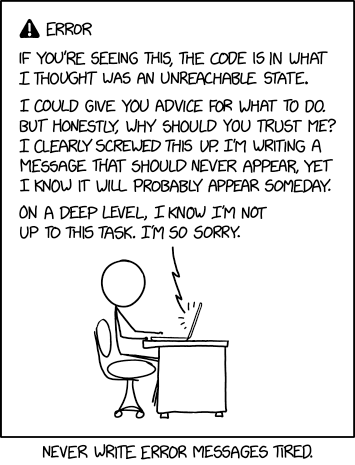
2019/9/9 - #2200, 'Unreachable State'
halcyon trail
That's a great one
 rose schooner
rain trellis
I’m sure it’s old hat to many of you, but I ran across this error message when b...
rose schooner
rain trellis
I’m sure it’s old hat to many of you, but I ran across this error message when b...
a thousand times i've seen this and it's still great each time
final geode
rain trellis
I’m sure it’s old hat to many of you, but I ran across this error message when b...
Compile again with -D RANDALL_WAS_HERE in your CFLAGS!
thick hemlock
that is awesome
rain trellis
final geode
Looks great! A few things I noticed while reading:
- "The internals of the pull ...
Thank you for the awesome feedback, you and @round path both! I'm implementing the adjustments and giving it a final proof, that post should be live in the next couple of days.
rain trellis
rain trellis
Thank you for the awesome feedback, you and <@843510746222428191> both! I'm impl...
I’m going to hold off on publishing until gh-120437 is fixed - building on linux with —enable-experimental-jit and —with-pydebug on the 3.13 branch breaks something.
The bug is triggered by running ./python -m ensurepip, but I would think it’s a JIT issue and not an ensurepip issue, that’s just where I happened to stumble on it.
 signal rivet
Hi there! I was unable to find any existing proposal or idea discussion, maybe this is the place where I can find help or thoughts. I'm curious if there is any particular reason for raise being not an expression but statement. Why users can't write code like:
do_something(on_event=lambda e: raise SomeError)
valid_x = x if is_valid(x) else (raise ValueError("invalid"))
Maybe it would be possible to change this to the expression, or allow function-like syntax (like it was for print function years ago) - so one can do raise(something) to force expression behavior. What do you think?
Some languages in a wild already have such a behavior, e.g in scala
val x = if true then 1 else throw RuntimeException("boom")
// val x: Int = 1
I think this is one of the reasons raise isn't an expression: you would be able to create more complex expressions that potentially do an important action (raise an exception). Instead of: py if is_valid(x): valid_x = x else: raise ValueError("x") or just py if not is_valid(x): raise ValueError("invalid") If you like this style, you can always make your own function: ```py
def throw(exc):
raise exc
Scala is a more "expression oriented" language so maybe it makes sense there
signal rivet
yeah, statements is something you can't compose...
 feral island
signal rivet
Hi there! I was unable to find any existing proposal or idea discussion, maybe t...
feral island
signal rivet
Hi there! I was unable to find any existing proposal or idea discussion, maybe t...
Apart from what @grave jolt said, I think allowing this would make the grammar ambiguous, because raise without arguments is legal syntax. That's the reason yield in an expression often requires lots of parentheses.
grave jolt
You could do the same as yield and require (raise) though
signal rivet
@feral island > raise without arguments is legal syntax
That's a point 🤔
Thank you!
feral island
In Python 2 raise x, y, z was also legal (I think it's type, value, traceback), that would have made an expression form even harder. Probably still fixable by requiring parentheses though. Python 3 simplifies the syntax, but this may help explain why it wasn't made an expression when the syntax was first added.
thick hemlock
To me this reminds of https://peps.python.org/pep-0463/ but you could argue it's not related at all
grave jolt
EAFPers in shambles
 neat delta
thick hemlock
To me this reminds of <https://peps.python.org/pep-0463/> but you could argue it...
neat delta
thick hemlock
To me this reminds of <https://peps.python.org/pep-0463/> but you could argue it...
rejected
why must the coredevs always thwart golfing
 peak spoke
I still think exceptions are a bit more annoying to deal with than they should be
Though not sure what I'd do about it apart from better documenting what can be raised in the stdlib
thick hemlock
never liked EAFP cause of the verbosity
flat gazelle
What an odd thing to say in the rejection notice, the glossary prefers EAFP https://docs.python.org/3/glossary.html#term-EAFP

Python documentation
, The default Python prompt of the interactive shell. Often seen for code examples which can be executed interactively in the interpreter.,,..., Can refer to:- The default Python prompt of the i...
 alpine rose
if raise was literally a function call, you'd also create a lot of cyclic references
raven ridge
Wouldn't the function just drop itself from the traceback, in order to maintain backwards compatibility with today's tracebacks? And wouldn't dropping the frame representing the raise() call itself resolve the circular references you're talking about? Or are you talking about something other than the local variables of the raise() function
rose schooner
why, for a function with this signature: py def foo(ham, *eggs): ... is ham a valid keyword argument?
eggs wouldn't be able to receive any arguments when ham is given as a keyword argument ```py
foo(1, ham=2) # multiple values for 'ham'
foo(ham=1, 2) # positional argument follows keyword argument
 spark verge
alpine rose
if raise was literally a function call, you'd also create a lot of cyclic refere...
spark verge
alpine rose
if raise was literally a function call, you'd also create a lot of cyclic refere...
It's kinda sorta available as a function call in (() for () in ()).throw(e)
grave jolt
rose schooner
why, for a function with this signature: ```py
def foo(ham, *eggs):
...
``` ...
It's not, this is (one of the reasons) why / was added
rose schooner
grave jolt
It's not, this is (one of the reasons) why `/` was added
foo(ham=1) works though
 radiant garden
you can consider eggs a funny kind of default argument taht doesn't let you assign it directly :)
thick hemlock
flat gazelle
What an odd thing to say in the rejection notice, the glossary prefers EAFP http...
This is actually very interesting to me
I was also under the impression this is something Python "recommends"
But looking at your link I don't think this is recommended
EAFP and LBYL are both mentioned
halcyon trail
I gotta say it's wild to see how hard exceptions are still working (not just in python) to solve the same issues for so long. Multiple exceptions, transporting across threads, using conveniently as expressions
I feel like non exception solutions have solved the propagation issue a lot better and more easily
thick hemlock
halcyon trail
I feel like non exception solutions have solved the propagation issue a lot bett...
Are you talking about Result like solutions? That have an .Ok or a .Err option?
halcyon trail
thick hemlock
Are you talking about `Result` like solutions? That have an .Ok or a .Err option...
Pretty much
Particularly in conjunction with a propagation operator
thick hemlock
Can you explain how this propagation operator works in "Python terms"? I'm not too familiar with Rust
halcyon trail
Sure
Say foo returns a result.
let x = foo()?;
Expands very roughly to
let f = foo();
if f.is_err() return f.err();
let x = f.ok();
I'm going out of my way to avoid pattern matching here
 quick snow
But that means you have to handle the (potential) error right where you call the function. Exceptions let you handle them where it makes sense.
halcyon trail
quick snow
But that means you have to handle the (potential) error right where you call the...
How is that "handling"? It's propagating
The only difference is that propagating happens explicitly via a single character instead of implicitly
quick snow
halcyon trail
The only difference is that propagating happens explicitly via a single characte...
Exactly, but if I want to handle the error five layers up, I need to touch all code in-between (even if it's "just one character"). I personally prefer it if the code "in the middle" doesn't have to concern itself with every possible error code "further down", if it doesn't want to.
 native flame
i think there is value in indicating which lines can possibly error
thick hemlock
halcyon trail
Say foo returns a result.
let x = foo()?;
Expands very roughly to
```
let f = fo...
So assume I have a function that returns a result which is a string of the response of an SQL query, or an error that occured during that.
I can think of a few problems, but the first is that there are many types of errors that can occur here. IO errors, DB errors, Transient errors, etc.
Ideally I would want different layers to handle each type of error. How can I do this here?
halcyon trail
quick snow
Exactly, but if I want to handle the error five layers up, I need to touch all c...
That is a downside but the benefit is that you can see error points when reading - it's a trade off. But meanwhile non exception methods easily handle all the other issues with exceptions I just mentioned. That's why I view exceptions as more dysfunctional overall
halcyon trail
thick hemlock
So assume I have a function that returns a result which is a string of the respo...
There's a lot of ways but the immediate answer is that Result can just do the same thing that exceptions do
Erase the type, and have handlers downcast to handle particular kinds of errors
thick hemlock
can you use some pattern matching magic to only propagate on specific values?
halcyon trail
You can do stuff like that too, but it's probably easier to start by looking at Result code that is more analogous to exceptions
radiant garden
in the case of rust, you'd use a dynamic dispatch pattern a la
fn handles_some_errors() -> anyhow::Result<()> {
    let db = connect_and_do_things(); // returns result with multiple errors
    if let Some(ClusterError { cluster }) = db.downcast_ref() {
        println!("damn that failed, {cluster} is down");
    }
    // do other things with db
}
Hmm okay I'll look at some code examples
radiant garden
for maximum ergonomics
halcyon trail
Pretty much
anyhow::Result is a class that only has one type parameter, for the result
It carries any error
thick hemlock
I do dislike exceptions because they break the control flow
halcyon trail
Yeah, so there's also that part of it, with Result you need ? to propagate. So it's visible. But I do think that's a trade off.
But things like handling multiple errors or using fallible things as expressions are just pure wins I think
thick hemlock
Is something like returns's Result container something you've tried and had success with? Or are there missing language constructs that make it less viable as a 3rd party package?
https://github.com/dry-python/returns?tab=readme-ov-file#result-container

GitHub
Make your functions return something meaningful, typed, and safe! - dry-python/returns
halcyon trail
thick hemlock
Is something like `returns`'s `Result` container something you've tried and had ...
Yes, not having ?
? is a magic language level operator
Without something like ?, propagating Result is kind of verbose
And you propagate errors a lot more than you handle them
grave jolt
Stupid question. Is an iterator always an iterable? why/why not?
The glossary says:
Iterators are required to have an
__iter__()method that returns the iterator object itself so every iterator is also iterable and may be used in most places where other iterables are accepted.
but I vaguely remember someone saying that it's not the case
flat gazelle
There was a rather extensive discussion on this, but an iterator should be an iterable, but certain language constructs will work despite an iterator missing __iter__. However, some won't.
grave jolt
flat gazelle
There was a rather extensive discussion on this, but an iterator should be an it...
Do you have a link to the discussion? I'm curious why it could be controversial
flat gazelle
grave jolt
Do you have a link to the discussion? I'm curious why it could be controversial
GitHub
It is now considered a historical accident that e.g. for loops and the iter() built-in function do not require the iterators they work with to define iter, only next.
grave jolt
what a snarky canadian
halcyon trail
Lol!
 woven sundial
man i need help i don't understand this
 sour thistle
!e shouldn't this raise a TabError instead? (using exec since discord converts tabs to spaces) py exec("""if True: \N{TAB}1 \N{SPACE}2""") Doing it in the opposite order (space first, tab second) gives a TabError
fallen slateBOT
sour thistle
!e shouldn't this raise a `TabError` instead? (using exec since discord converts...
:x: Your 3.12 eval job has completed with return code 1.
001 | Traceback (most recent call last):
002 |   File "/home/main.py", line 1, in <module>
003 |     exec("""if True:
004 |   File "<string>", line 3
005 |     2
006 |      ^
007 | IndentationError: unindent does not match any outer indentation level
!e ```py
exec("""if True:
\N{SPACE}1
\N{TAB}2""")
:x: Your 3.12 eval job has completed with return code 1.
001 | Traceback (most recent call last):
002 |   File "/home/main.py", line 1, in <module>
003 |     exec("""if True:
004 |   File "<string>", line 3
005 |     2
006 | TabError: inconsistent use of tabs and spaces in indentation
!e I'm guessing it would show that error if there was a matching outer indentation level:
exec("""if True:
\N{SPACE}if True:
\N{TAB}1
\N{SPACE}2""")
:x: Your 3.12 eval job has completed with return code 1.
001 | Traceback (most recent call last):
002 |   File "/home/main.py", line 1, in <module>
003 |     exec("""if True:
004 |   File "<string>", line 3
005 |     1
006 | TabError: inconsistent use of tabs and spaces in indentation
Ah, well, it doesn't reach it in this case.
!e what if there's more spaces?
s, t = " \t"
exec(f"""if True:
{t}1
{s * 9}2""")
:x: Your 3.12 eval job has completed with return code 1.
001 | Traceback (most recent call last):
002 |   File "/home/main.py", line 2, in <module>
003 |     exec(f"""if True:
004 |   File "<string>", line 3
005 |     2
006 | IndentationError: unexpected indent
 boreal umbra
I'm officially a cpython contributor  https://github.com/python/cpython/pull/114090
GitHub
Currently, attempting to await something that cannot be awaited results in this error message:
import asyncio
async def main():
await 1
asyncio.run(main())
TypeError: object int can't ...
grave jolt
What happens if you use a fake name in the CLA?
feral island
grave jolt
What happens if you use a fake name in the CLA?
you're a bad person
(it is basically honor system)
grave jolt
what if I just don't want to reveal my real name to the PSF
sturdy timber
@elder blade asked the PSF about that a while ago and they said that the email and address are most important and using an internet alias for the name is fine.
I think that's what I did
(That advice was to a specific instance of someone asking rather than a general policy afaik though, so it may be worth asking the PSF first yourself if you want to use a fake name)
 elder blade
grave jolt
what if I just don't want to reveal my real name to the PSF
elder blade
grave jolt
what if I just don't want to reveal my real name to the PSF
I signed with my psuedonym!

Almost leaked my home address sending the whole document, so the psuedonym will have to do

I suppose it's better to sign it under your psuedonym, because they will be able to know which signed CLA is which contributor... in hindsight though I am not sure I won anything writing "Bluenix" instead of my real name 🤷♂️
Here's a reminder to everyone to always store copies of all documents you sign! 😅 It should be easy-as-cake to find if necessary
raven ridge
elder blade
I suppose it's better to sign it under your psuedonym, because they will be able...
Knowing which CLA is which contributor is done by matching the email address in the git commits against the email address in the signed CLA
sturdy timber
Hmm, if you sign using the CLA bot do you even have to enter your name and physical address now 🤔
quick snow
sturdy timber
Hmm, if you sign using the CLA bot do you even have to enter your name and physi...
You do not; I'm pretty sure I never provided a physical address.
thick hemlock
this seemed off topic for the discourse, so if you don't mind me asking, @feral island, is there a specific reason you chose to do PEP 749 for the implementation tweaks instead of just halting acceptance of PEP 649 to when a draft PR was out?
or was it just too much work to draft a PR before an official acceptance? cause the current situation seems quite odd with PEP 749
feral island
I am not the author of PEP 649, so I don't feel comfortable editing it
thick hemlock
oh I see
feral island
Most of what's in PEP 749 I'd feel comfortable changing myself in an implementation PR, but the creation of a new stdlib module and the proposal for the future of from __future__ import annotations feel important enough that they should be called out in a PEP
thick hemlock
yeah no doubt the annotationlib thing should get proper approval
Is Larry also helping you implement 749? wondering if the question is relevant to him or maybe this is just a weird case with the author vs implementor
feral island
I haven't heard from him for some time
thick hemlock
feral island
Most of what's in PEP 749 I'd feel comfortable changing myself in an implementat...
I do feel like the future of the future import should probably have been defined better in PEP 649
But overall I'm happy that you did formalize it since the discussion there seems productive
thanks for the answer!
 glass arch
thick hemlock
I do feel like the future of the __future__ import should probably have been def...
glass arch
thick hemlock
I do feel like the future of the __future__ import should probably have been def...
I'm just ready for 3.8 and 3.9 to be deprecated so we can use | as optional without importing futures.
halcyon trail
i honestly still like Optional[Foo] over Foo | None
rose schooner
sour thistle
!e shouldn't this raise a `TabError` instead? (using exec since discord converts...
a tab is equivalent to 8 spaces
so 1 space is technically an unindent
thick hemlock
glass arch
I'm just ready for 3.8 and 3.9 to be deprecated so we can use | as optional with...
You live in a nice world if you can stop using versions once they become deprecated haha. I still have to (thankfully not often) work on projects in Python 2
rose schooner
rose schooner
a tab is equivalent to 8 spaces
(this was changed in 3.13) (i looked at the wrong file)
glass arch
thick hemlock
You live in a nice world if you can stop using versions once they become depreca...
I meant for personal stuff
thick hemlock
halcyon trail
i honestly still like Optional[Foo] over Foo | None
I prefer to import typing the least I can
thick hemlock
glass arch
I meant for personal stuff
fair enough lol. Sometimes even if I'm on a 3.10 project I just write Optional to simply avoid thinking about the version
halcyon trail
why? also typing is still crazy ubiquitous, Sequence and Mapping should be two of the most common type annotations
thick hemlock
Okay, to rephrase, I prefer to use typing's verbose forms the least I can. I don't actually mind the import time
What I meant to say is that I don't have anything specific against Optional I just prefer the "native" syntax in all places even if it's a bit less explicit.
same goes for the new typevars
halcyon trail
idk, Optional[Foo] is very very marignally more verbose than Foo | None
and it's also just like the vastly more common way to do it across languages
rose schooner
sour thistle
!e shouldn't this raise a `TabError` instead? (using exec since discord converts...
this case takes this branch https://github.com/python/cpython/blob/main/Parser/lexer/lexer.c#L499
fallen slateBOT
Parser/lexer/lexer.c line 499
else /* col < tok->indstack[tok->indent] */ {```col (of the space indent) is 1, as opposed to the previous col (of the tab indent), which is 8
so the python lexer takes that as a dedent
thick hemlock
halcyon trail
idk, Optional[Foo] is very very marignally more verbose than Foo | None
It's hard to explain it, I don't know. It's like how using list, dict, and tuple as annotations is an improvement. It's hard to say why because as you state it's not verbosity
maybe just feeling "first-class"?
halcyon trail
i guess, I mean i think it's a pretty different situation
in one case you just drop the capitalization and avoid an import
rose schooner
rose schooner
so the python lexer takes that as a dedent
but the previous dedent level (before indenting) is 0, and 1 != 0 https://github.com/python/cpython/blob/main/Parser/lexer/lexer.c#L506
fallen slateBOT
Parser/lexer/lexer.c line 506
if (col != tok->indstack[tok->indent]) {```so it raises an IndentationError instead of TabError
thick hemlock
Yeah obviously the list annotation has no downsides, but I was comparing it to show the fact that I really care about that change even though it doesn't mean anything.
halcyon trail
unironically I'm not a huge fan of the list/dict thing - tuple I don't mind so much.
it basically gives a higher precedence to a type annotation that is less likely to be correct
rose schooner
quick snow
!e what if there's more spaces?
```py
s, t = " \t"
exec(f"""if True:
{t}1
{s * 9...
!e ```py
s, t = " \t"
exec(f"""if True:
{t}1
{s * 8}2""")
:x: Your 3.12 eval job has completed with return code 1.
001 | Traceback (most recent call last):
002 |   File "/home/main.py", line 2, in <module>
003 |     exec(f"""if True:
004 |   File "<string>", line 3
005 |     2
006 | TabError: inconsistent use of tabs and spaces in indentation
wdym?
because of the Sequence thing?
halcyon trail
yeah
feral island
halcyon trail
unironically I'm not a huge fan of the list/dict thing - tuple I don't mind so m...
Yeah that's unfortunate. Unfortunately making Iterable/Sequence into builtins probably isn't going to fly
thick hemlock
so you're saying because the list import is "easier to reach" than other collections.abc's it makes lazy people make wrong annotations?
halcyon trail
yes
this was alread a problem before
honestly I made this mistake - I was new to python typing and I thought List was appropriate to use a lot, I didn't yet know about Sequence
thick hemlock
in my experience, people who care about annotations usually try to find the best annotation whether it requires an import or not
people who don't will use a list annotation for most things anyway
(and that's okay)
my worldview on it is basically that if you don't really care about typing you shouldn't need to import typing
halcyon trail
idk - I'm a living breathing counter-example 🙂
thick hemlock
and if you care it's okay that you import it
thick hemlock
halcyon trail
idk - I'm a living breathing counter-example 🙂
are you? It makes sense to me that a new user (past you) wouldn't bother with Sequence
honestly the collection inheritence tower was a bit overwhelming to me when starting
so in a way I'm glad it's not all a builtin? Maybe only Iterable I would want because of generators
halcyon trail
thick hemlock
are you? It makes sense to me that a new user (past you) wouldn't bother with `S...
I'm not a new user
halcyon trail
new to python typing specifically - sure
It's not that I didn't "bother" with Sequence - I just didn't really know about it
I'm familiar with the "tower" from other languages - e.g. Kotlin
thick hemlock
that's fair
halcyon trail
anyhow, list being first classed and Sequence not makes it "feel" like you shoudl annotate with list a lot and Sequence more rarely but it's actually the reverse
it would be funny to do a survey of Optional[Foo] vs Foo | None on the python reddit or something
thick hemlock
I agree, I just think there is value for common types to be "discovered" first as to create a gradual introduction to typing
thick hemlock
halcyon trail
it would be funny to do a survey of Optional[Foo] vs Foo | None on the python re...
I have been asking for the water cooler category on the discourse for a few weeks now
I hope eventually it will happen, this could really fit on it.
halcyon trail
from a quick google skim or two it seems like Foo | None is more popular - or at least people think it's better because its newer
who knows
I want @feral island 's opinion 😛
thick hemlock
I think that FastAPI recommends Foo | None in their docs
feral island
It's better because it's less confusing. Optional[] does not mean the argument is optional
halcyon trail
I think whatever FastAPI recommends doing the opposite seems appealing
thick hemlock
thick hemlock
I think that FastAPI recommends `Foo | None` in their docs
which is probably a very high traffic page
halcyon trail
feral island
It's better because it's less confusing. `Optional[]` does not mean the argument...
someone gave that argument. I think it's a pretty funny argument given multiple languages use Option or Optional. but I guess it is what it is.
feral island
I've definitely seen people write foo: Optional[int] = 0
thick hemlock
if I create a dataclass like so:
@dataclass
class A:
   param: Optional[int]
because the argument is optional
thick hemlock
thick hemlock
if I create a dataclass like so:
```python
@dataclass
class A:
param: Optio...
they still have to supply a value
it's not optional
halcyon trail
feral island
I've definitely seen people write `foo: Optional[int] = 0`
but that's valid? I don't really understand
feral island
halcyon trail
but that's valid? I don't really understand
It's not what they meant
halcyon trail
hard for me to tell I guess what you mean
thick hemlock
they meant that the Optional annotates you don't need to pass a value
feral island
The parameter is an optional one that takes an int and doesn't have a reason to accept None. But people write foo: Optional[int] = 0
thick hemlock
thick hemlock
they meant that the `Optional` annotates you don't need to pass a value
but that's not what it does
halcyon trail
I don't find this confusing, nor do I think it's particularly compelling that this would confuse people - but obviously, everything will confuse someone
I'm sure someone has been confused by this, N > 1 times
thick hemlock
thick hemlock
if I create a dataclass like so:
```python
@dataclass
class A:
param: Optio...
Do you think this also isn't confusing?
halcyon trail
no, I don't think it's confusing
thick hemlock
I mean I would expect this annotation to mean "passing param is optional, you don't have to"
that's what it says
halcyon trail
I wouldn't 🤷♂️
it says that its optional whether or not param contains an int
i think maybe this is a thing for people who are less used to static typing, primarily
thick hemlock
To me it reads as "This dataclass accepts a param which is optional, and it's type is an int"
I do understand that it actually reads "This dataclass accepts a param which is optionally an int", but it's confusing
halcyon trail
like, most statically typed languages have names for this kind of thing that is either Option or something very similar to Option (like Maybe) - nobody in Haskell is getting confused that a function parameter of Maybe type, only maybe has to be passed.
neat delta
i do wonder how often Optional appears without assigning a default value
spark magnet
these days you'd say param: int | None
thick hemlock
thick hemlock
don't know which
which I like more
halcyon trail
Kotlin
rose schooner
sour thistle
!e shouldn't this raise a `TabError` instead? (using exec since discord converts...
!e here's all the cases where TabError can be raised: ```py
tab = '\t'
space = ' '
space_8 = space * 8
for i, example in enumerate((
col (8) == TOIS (8), altcol (8) != TOAIS (1)
f"""if 1:
{tab}1
{space_8}2""",
col (8) > TOIS (1), altcol (1) == TOAIS (1)
f"""if 1:
{space}1
{tab}2""",
col (8) > TOIS (2), altcol (1) < TOAIS (2)
f"""if 1:
{space}if 2:
{space * 2}if 3:
{tab}4""",
col (8) < TOIS (16), altcol (8) != TOAIS (1)
f"""if 1:
{tab}if 2:
{tab * 2}3
{space_8}4""",
)):
try:
exec(example)
except TabError:
print(f"TabError raised for example {i}")
else:
break
else:
print("All examples raised TabError")
yeah, I think @halcyon trail is arguing against that though, no?
halcyon trail
but "nullable" often differs from optional subtly
it's not 100% consistent, but often
rose schooner
mk wait
halcyon trail
python's "optional" is really closer to "nullable" fwiw
fallen slateBOT
rose schooner
!e here's all the cases where `TabError` can be raised: ```py
tab = '\t'
space =...
:white_check_mark: Your 3.12 eval job has completed with return code 0.
001 | TabError raised for example 0
002 | TabError raised for example 1
003 | TabError raised for example 2
004 | TabError raised for example 3
005 | All examples raised TabError
they're saying they like Optional better: #internals-and-peps message
feral island
halcyon trail
python's "optional" is really closer to "nullable" fwiw
That's why Optional is a bad name 🙂
halcyon trail
feral island
That's why Optional is a bad name 🙂
that's probably actually the strongest reason 🙂
but only 1% of people know or care about that
neat delta
Nullable isn't great either, as python doesn't have a Null, but Noneable is terrible
rose schooner
rose schooner
!e here's all the cases where `TabError` can be raised: ```py
tab = '\t'
space =...
!e a weird case where TabError isn't raised ```py
tab = '\t'
space = ' '
exec(f"""if 1:
{tab}if 2:
{space * 8}{space}3
{tab}4""")
:warning: Your 3.12 eval job has completed with return code 0.
[No output]
Noneable?
spark magnet
this kind of debate is one of the reasons in the docs we're leaning to using more English to describe types instead of strict annotations.
halcyon trail
@thick hemlock usually, optional types support nesting, nullable types do not.
Option[Option[Foo]] in python is meaningless - Union types in python are automatically collapsed
thick hemlock
halcyon trail
that's probably actually the strongest reason 🙂
but only 1% of people know or c...
I think you're greatly underestimating
halcyon trail
which is actually a big headache sometimes
feral island
thick hemlock
`Noneable`?
we don't need a name for the concept, it's just a union with None
halcyon trail
Uhm I'm underestimating what percentage of people know the difference between nullable and optional types? I don't think so.
thick hemlock
Underestimating the people that annotate it wrong because they don't know the difference
halcyon trail
that's totally different, I don't think my comment that you responded to was saying what you think it was
spark magnet
halcyon trail
Uhm I'm underestimating what percentage of people know the difference between nu...
there is no possible way to resolve this. it's opinion/guess vs opinion/guess.
halcyon trail
I was replying to ned
halcyon trail
spark magnet
there is no possible way to resolve this. it's opinion/guess vs opinion/guess.
he was talking about something else anyway so it doesn't matter
thick hemlock
halcyon trail
that's totally different, I don't think my comment that you responded to was say...
sorry, my bad! misunderstood then
thick hemlock
feral island
we don't need a name for the concept, it's just a union with None
i dunno, that specific union is actually much more common than others
halcyon trail
^
feral island
But it's not any different from others. You can still talk about "union with None"
thick hemlock
I agree and I also don't know if it's actually needed in the stdlib, but it is something a term for would be useful for me
halcyon trail
I mean in a purely mechanical sense, sure, it' snot different. Practically it is - that's why you see distinctiosn around it in almost every language.
thick hemlock
thick hemlock
I agree and I also don't know if it's actually needed in the stdlib, but it is s...
i often say "okay, so for this feature we would need to make this field optional" and what I actually mean is nullable
halcyon trail
if you're using for example type annotations to help you deserialize something
it would be extremely common to have special handling for Option[Foo]
feral island
thick hemlock
i often say "okay, so for this feature we would need to make this field optional...
"we would need to allow None for this field"
feral island
halcyon trail
it would be extremely common to have special handling for Option[Foo]
that's a good point, I've written code like that
halcyon trail
I have too, and python really makes you suffer
because you can have a type annotation like Option[Union[Foo, Bar]] - okay, you tell your framework how to deserialize Union[Foo, Bar], right?
And now it has the generic logic for Union[T], it knows how to deserialize T - life is good, right?
thick hemlock
feral island
"we would need to allow None for this field"
sure, that works actually
halcyon trail
not actually though because python just collapses your type
anyhow - it is what it is I guess. but I will take note that Foo | None is the idiomatic recommendation, plus what Ned said makes me reconsider
(plus recalling my own bad experiences)
we just have a mixed C++ and python codebase, and in C++ it's std::optional - so Optional comes very naturally
thick hemlock
if we were to continue that earlier topic, are there more things in typing you wish you had as a builtin?
I personally would like Literal to be easier to write, but i don't really know how that would work
Maybe Any but that ship has sailed because of any()
but also maybe that's too permissive to even have as something that should be easy to reach
feral island
Yes, it runs into the same issue that you're making something easy that arguably shouldn't be easy
thick hemlock
mhm
Any is sometimes useful for me when transitioning codebases without annotations
feral island
I'm not entirely sure I agree with that argument myself
feral island
It feels like it goes against "practicality beats purity". People often have to use Any in practice
halcyon trail
thick hemlock
I personally would like `Literal` to be easier to write, but i don't really know...
I'm actually not a fan of Literal - like, values as types is no joke and I think people often misunderstand how it works
heck, python doesn't define clear rules for it so I'm not sure that I understand how it works in python - despite being very very familiar with how it works in another language (C++)
The only place I'd ever consider using literal in my own code is to type legacy - otherwise use an enum or something
thick hemlock
feral island
It feels like it goes against "practicality beats purity". People often have to ...
I don't know, I feel like if you're using Any you're probably just being lazy about your type. I've seen people annotate a JSON-able dict as dict[str, Any] which is plain wrong
halcyon trail
it's wrong but until relatively recently it's the only thing mypy really supported
thick hemlock
i love the recursive types being supported
but even specifying here another level would be useful
halcyon trail
there was a whole discussion here a while ago, where I brought this up, and people were saying that properly typing json as a recursive union didn't matter 😛
thick hemlock
halcyon trail
I'm actually not a fan of Literal - like, values as types is no joke and I think...
I use it a lot when working with discriminators in pydantic. Are you aware of that use case or should I elaborate more?
and it goes with enums
thick hemlock
This is the basic example in pydantic's docs:
class Cat(BaseModel):
    pet_type: Literal['cat']
    meows: int


class Dog(BaseModel):
    pet_type: Literal['dog']
    barks: float


class Lizard(BaseModel):
    pet_type: Literal['reptile', 'lizard']
    scales: bool


class Model(BaseModel):
    pet: Union[Cat, Dog, Lizard] = Field(..., discriminator='pet_type')
    n: int
discriminator is an OpenAPI thing that basically lets pydantic change its behavior from "try parsing as cat, try parsing as dog, try parsing as lizard" to "check the discriminator field and only parse as that"
which leads to much better error messages
halcyon trail
this is just not a good way to do this - its giving every single Cat a pet_type field which is entirely redundant
well, I guess it's not necessarily, because pydantic is kind of its own weird little world
but in the rest of python, that's what that would mean
thick hemlock
You do need this pet_type though
halcyon trail
you don't need every instance to have it - it's the property of the class
python instances already know their class
thick hemlock
I mean, in Python you don't, but this is not relevant to just pydantic, any serialization of this to JSON will require this information
halcyon trail
but the types above annotate as though every instance of Cat has it 🤷♂️
my point is that you can achieve this in other ways - I've written generic code that serializes and deserializes Unions
thick hemlock
This is also useful in non-discriminator use cases. Consider an enum for, let's say, an image processing type. I want my implementation to use that enum but to annotate it only supports 3 of the 5 processing types
so I would use a literal here to say that
I don't know any better way
thick hemlock
halcyon trail
my point is that you can achieve this in other ways - I've written generic code ...
sure, you could have this only appear at serialization but pydantic models are generally just used for that and not as internal entities in your app so it's fine
halcyon trail
btw, what the rest of the python world would probably do in that example is something like pet_type: ClassVar[str] = "cat"
the point is that the Literal annotation doesn't actually give you anything, doesn't improve type checking in any way
it's just a string fed to pydantic internals for serialization/deserialization
thick hemlock
that is fair and I'm not gonna re-ignite the discussion about runtime usage of annotations vs type checking
thick hemlock
thick hemlock
This is also useful in non-discriminator use cases. Consider an enum for, let's ...
what about this?
halcyon trail
you just create a new enum, that has 3 of the 5 types, and a function to convert between them (or throw)
it's pretty much exactly the same thing, except the enum is being explicit about the fact that it's effectively a new type
halcyon trail
The problem is that people who aren't very familiar with typing tend to fall into this trap - static checks good, so more static checks better, so they try to heavily use Literal for things like this
and then it doesn't always behave in ways they understand - there are things that may be obvious to a user, but which python's static type system cannot understand
thick hemlock
what behaviors are hidden here? I've always viewed it as a pretty simple feature
halcyon trail
people who have actually worked with statically typed languages, where these things need to be 100% correct (they're not just annotations after all) tend to understand that pulling values into a type system is no joke
thick hemlock
Python is different in that though
you can't just treat it as it's statically typed
halcyon trail
Yes, because the static type system isn't terribly well defined
so when you work with Literal in particular, mypy vs pylance vs whatever will very often give you different answers
I've seen it a lot
thick hemlock
I know this is oversimplifying and ignoring a looot of use cases
but really all I wanted with this example is for someone to get a warning when they explicitly pass a value they shouldn't
I don't want to create a new type for this
halcyon trail
you already did?
thick hemlock
wdym?
halcyon trail
Literal[1, 2, 3] is a type
halcyon trail
sure - but it's still a type. So just say - you don't want to write a few lines out of band 🙂
i was about ot say that in the end most people's reasoning is just to save a few characters
not very compelling
thick hemlock
I don't know why you don't find that compelling
halcyon trail
and it's less nice for the person using your function - they can get auto completion on both the enum, and the enumerators
halcyon trail
thick hemlock
I don't know why you don't find that compelling
idk, I feel like "optimize for the reader not the writer" is pretty widely accepted - that's what it's based on
saving a few characters to me just isn't a big deal. Having to consider the ramifications of a more poorly defined type system, less readability, less help for tooling - all these matter more
thick hemlock
I feel like you have to take into account that the typing system is not like in static language. The person can simply annotate it as being the enum ImageProcessingType and not give any annotation to what values of it are supported. This is often the difference in PRs between telling them to "just add a literal annotation" which wouldn't get pushback, or to create a new enum for this which would.
I am not saving a few characters to codegolf
I'm saving characters to encourage people to use type hinting.
When it's simpler and shorter to annotate something - people will do it more. Easier annotations create better annotations.
halcyon trail
I don't have an issue with people not type hinting
thick hemlock
I have seen a lot of people avoid TypeVar because of this, and I'm so glad PEP 695 passed
halcyon trail
It's still saving a few characters no matter how you slice it - there's much bigger obstacles to typing a codebase than this
If people choose not type things because of this - they're going to have a lot of untyped code 🙂
thick hemlock
I'm talking about situations where the codebase is typed but I want a new function to be typed better, if possible.
I would pass the PR if the annotation was simply ImageProcessingType and the first line would check the value and raise an exception if needed
but I would prefer if it specified the values
its not "typed" vs "untyped", it's how well it's typed
halcyon trail
An enum is obviously typed at the call site. Passing "foo" it's very far from clear it's one of 3 legal values
thick hemlock
Also it matters what characters you're saving. That type being inline saves you from needing to find another name for the enum
which is often hard for these subsets
halcyon trail
Anyhow I just don't think we'll agree, and I think the convo reinforces my previous beliefs.
Hard for the writer but good for the reader 🙂
thick hemlock
I agree with the sentiment
it's just not always practical
something something practicality beats purity
halcyon trail
Uhm you can disagree with me but please don't call it impractical
It's fully practical
I do it. It's very easy.
thick hemlock
what do you mean? I didn't say it's impractical, I said it's not always practical
there are situations where I can do what you suggest
in others, not
halcyon trail
There's no situation where you can't do it - it may take a couple extra lines, yes, but you can
thick hemlock
Again, I think that's idealistic. Codebases are not either "typed" or "untyped". It's a spectrum
halcyon trail
This is becoming bad faith so let's stop
thick hemlock
Oh, sorry
I didn't mean for that to happen at all, I was actually okay with the discussion
sorry it felt like that :(
I did not mean at all to say anything in bad faith, sorry if any of my messages sounded like it
Have a good day/night!
grave jolt
There is an ergonomic issue with Literal regarding type inference.
If you write x = [Color.red, Color.green], x is inferred as list[Color]. But it would be silly to infer the type of ["red", "green"] as list[Literal["red", "green"]]
Literals are extremely popular in TypeScript and you can do e.g. ["a", "b"] as const and it will infer it as readonly ["a", "b"].
However, TypeScript has a lot of uses for literals outside of just enum values, so that probably warrants some extra tooling
halcyon trail
grave jolt
There is an ergonomic issue with Literal regarding type inference.
If you write ...
That's a very good example
 gray galleon
does python exponentiation use exponentiation by squaring for integer exponents
 sharp plover
gray galleon
does python exponentiation use exponentiation by squaring for integer exponents
sharp plover
gray galleon
does python exponentiation use exponentiation by squaring for integer exponents
If the exponent is less than 61 bits long, it uses the left-to-right binary exponentiation algorithm (algorithm 14.79 in this book ).
If the exponent is larger than that, it uses "left-to-right k-ary sliding window exponentiation" (algorithm 14.85 in the same book).
I'm not sure I totally understand the second algorithm, but the first algorithm is the exponentiation by squaring that you already know, except working from the most significant bit of the exponent down to the least significant.
Essentially this: ```py
def pow(base, exp):
result = 1
bit = 1 << (exp.bit_length() - 1)
while bit > 0:
result *= result
if bit & exp:
result *= base
bit >>= 1
return result
You can see for yourself here: https://github.com/python/cpython/blob/a86e6255c371e14cab8680dee979a7393b339ce5/Objects/longobject.c#L4848
fallen slateBOT
Objects/longobject.c line 4848
long_pow(PyObject *v, PyObject *w, PyObject *x)```why don’t 'ba'[:10] cause an index error
grave jolt
gray galleon
why don’t `'ba'[:10]` cause an index error
slicing a sequence doesn't raise an error, instead it crops the range
It would be a huge pain to have to write user_input[:min(10, len(user_input))] insead
in other words, you almost never want it to error in the case when you have more elements
fallen slateBOT
 faint river
!e `print(*range(0, 7, 4))`
faint river
!e `print(*range(0, 7, 4))`
:white_check_mark: Your 3.12 eval job has completed with return code 0.
0 4
(unlike for example list/string indexing, where JavaScript made a mistake in the early days, and returned undefined when the element doesn't exist at an index)
halcyon trail
I mean, fwiw, I think it's perfectly reasoanble to error here too
and some languages do
faint river
which
halcyon trail
rust for example
grave jolt
Java I think
halcyon trail
i probably prefer erroring tbh
if you want to say "I want up to index 10 or the length, whichever is smaller" - why not be explicit and say that
but I dont' find it a hugely common use case
gray galleon
halcyon trail
if you want to say "I want up to index 10 or the length, whichever is smaller" -...
isn’t python about explicitness 🤔
halcyon trail
python is about having a mantra that says that it's explicit 😛
grave jolt
Well, Rust is different in that it doesn't treat strings as "arrays of characters for some definition of 'character' (since we're using unicode)"
halcyon trail
it's nothing to do with strings really - we can just talk about vectors as well
fn main() {
    let v = vec![1,2,3];
    let u = &v[..5];
}
this will panic in rust
grave jolt
yeah that is true
halcyon trail
another reason why it makes sense in rust is that rust offers non-throwing/panicking API for slicing.
the same way that python has a .get for say dict, that does not throw
so, this behavior is useful in conjunction with that
fn main() {
    let v = vec![1,2,3];
    if let Some(u) = &v.get(..5) {
        println!("{:?}", u);
    }
    else {
        println!("Oops!");
    }
}
it's really convenient implicitly cutting off
halcyon trail
this prints "Oops"
v.get and v[] have to be consistent with each other
if you implicitly cut off you would not be able to easily branch on whether the slice fit. It would also feel less consistent with regular indexing.
halcyon trail
rose schooner
it's really convenient implicitly cutting off
you can always have a different named function for that if you want - at least you can in rust, since things like ..5 are just a type you can pass anywhere
I think it makes more sense for the default behavior to "fail fast"
that's also part of the zen of python 😉
Errors should never pass silently.
grave jolt
I guess that's the tradeoff that was made when slicing was first developed. Kinda hard to go one way or another for me
halcyon trail
the problem I guess for me is that in python the "erroring" version is so awkward that nobody will ever write it- people will just say "yeah, i'm confident these strings have at least 10 characters"
I think you literally have to do
assert len(s) >= 10
x = s[:10]
in rust, the default errors, so you a) have no choice, and b) it's still a one liner s[..min(10, s.len())]
grave jolt
halcyon trail
in rust, the default errors, so you a) have no choice, and b) it's still a one l...
With strings, it would be let s2: String = s.chars().take(10).collect(); in Rust
unless you want a slice of the first 10 bytes for some reason
gray galleon
s.chars()[..10]?
grave jolt
no, chars() is an iterator
gray galleon
so to use slice you need to turn it into list smh
halcyon trail
grave jolt
With strings, it would be `let s2: String = s.chars().take(10).collect();` in Ru...
You don't need to do that
You can just get the byte index of the nth character
String slices.
grave jolt
ah, and then split_at
that is also possible
s.split_at(s.char_indices().nth(10).unwrap_or(s.len())).0??
halcyon trail
I'm confused
Just use char indices and then slice

Stack Overflow
In python you can get the last 5 characters of a string like this:
s[-5:]
How do you do the same concisely in Rust? The best I could figure out was extremely verbose:
s.chars().rev().take(5).colle...
grave jolt
halcyon trail
https://stackoverflow.com/questions/76211810/how-do-i-get-the-last-n-characters-...
Oh I misunderstood, for some reason I thought slicing a &str returns a &[u8]
Still, ```rs
{
let split_pos = s.char_indices().nth(10).unwrap_or(s.len());
&s[..split_pos]
}
I'm actually not quite sure what people use string slicing for most of the time in Python
gray galleon
for slicing strings
halcyon trail
grave jolt
Still, ```rs
{
let split_pos = s.char_indices().nth(10).unwrap_or(s.len());
...
For sure. You could write a convenience function. But orthogonally to the rest of the convo, rust emphasizes performance more so it makes sense to encourage a performant approach
Slicing utf 8 strings by character just isn't a cheap operation
So Python is hiding the cost somehow
gray galleon
halcyon trail
So Python is hiding the cost somehow
python has 3 different representations for strings
all of them have O(1) access
halcyon trail
If str has O(1) access then that just means that it's storing a map from characters to bytes
I.e. it's using extra space
Basically it's just storing that char_indices you get above on the fly
gray galleon
halcyon trail
If str has O(1) access then that just means that it's storing a map from charact...
it doesn't tho?
#internals-and-peps message
halcyon trail
Then Im not sure what to say, obviously there's something going on
Utf-8 is a variable length encoding
How is Python getting you the nth character in O(1) time?
Uh the message you linked to literally says it wastes space
Just not the kind of waste I was suggesting
Basically it's not really a uft 8 string
gray galleon
no it's not
it uses latin-1, ucs2 or ucs4 depending on the characters in the string
feral island
Yeah strings aren't stored as UTF-8 internally
halcyon trail
Yeah I was a bit surprised by that
raven ridge
they're stored as either ascii, latin1, ucs2, or utf32 depending on the largest codepoint in them. and the utf-8 representation is cached the first time it's needed.
halcyon trail
But anyhow, different trade offs
What rust is doing makes sense for rust. Most times you're doing slices it's after finding a character or something like that and you have the byte index
feral island
A recent suggestion to change this: https://github.com/faster-cpython/ideas/issues/684
GitHub
I'm sure this has been discussed elsewhere and I don't know when, or if, we'll have time to implement it, but I think it's worth adding here. Currently Python strs (PyUnicodeObject ...
halcyon trail
Yeah so basically what he is proposing is closer to how I already assumed (incorrectly) it worked
Oh wow this is very recent
 cold hull
Does the file size matter for the python interpreter?
I mean is there a size x lines of code (or bytes) where it's better to have two files and one import the other rather than all code being on one file?
feral island
cold hull
Does the file size matter for the python interpreter?
I mean is there a size x l...
at some point it's going to run into issues but that's only at really huge sizes. You should think about this in terms of readability not in terms of what the interpreter supports
Personally I'd start thinking about splitting up a file at 1000 lines or so, or just if it feels like it's becoming hard to understand
cold hull
I won't edit the file, it's generated
feral island
If it's generated code I wouldn't worry about it
cold hull
cool, thanks
 dusk comet
if it is generated you can run into another set of issues
python parser is written in C, and there are some assumptions about parsed code
one of them is that code is not nested very deeply (current limit is somewhere about 30, iirc)
if you violate these assumptions, parser can crash the process
my knowledge was a bit outdated
this (with 99 levels) works perfectly: ```py
if 1:
if 1:
if 1:
if 1:
if 1:
if 1:
if 1:
if 1:
... # a lot more lines
print(42)
with 100 levels it errors: `IndentationError: too many levels of indentation`
i guess it was changed several versions agoit will not be nested very deeply, 10 levels maybe of blocks of ifs and classes and whatever
it's just long, not sophisticated
dusk comet
dusk comet
my knowledge was a bit outdated
this (with 99 levels) works perfectly: ```py
if ...
for _ in [0]:
 for _ in [0]:
  for _ in [0]:
   for _ in [0]:
    for _ in [0]:
     for _ in [0]:
      for _ in [0]:
       for _ in [0]:
        for _ in [0]:
         for _ in [0]:
          for _ in [0]:
           for _ in [0]:
            for _ in [0]:
             for _ in [0]:
              for _ in [0]:
               for _ in [0]:
                for _ in [0]:
                 for _ in [0]:
                  for _ in [0]:
                   for _ in [0]:
                    print(42)
``` this works (20 levels)
if more - `SyntaxError: too many statically nested blocks`I'd try to solve it another way long before 20 levels of that :}
But I get what you mean
dusk comet
if perfomance is important and you want to micro-optimize the code, there are other things you could do
for example: if you have a lot of try-except/with blocks in one function, and exceptions occur pretty often, you can split this function into several to make exception handling faster
this is because in recent versions "zero-cost try-except" was implemented, that stored all information about try-except blocks (and with blocks, because they are basically the same thing) in one table. And if exception occurs, this table is decoded to figure out where is code that handles this exception. More try-except -> bigger table -> slower exception handling
cold hull
it is not important now, and if/when it will be I'll write C or something else probably
rain trellis
I've been working on a fresh branch for superinstructions... suffice to say something's gone a little wrong 😅

For some reason, with more than one instruction, it's not unrolling the switch that handles multiple ops. Basically:
//-D_JIT_OPCODES={1,2} -D_NUM_UOPS=2

opcodes[] = _JIT_OPCODES;
for (int i = 0; i < NUM_UOPS; i++){
  uopcode = opcodes[i]
  switch (uopcode) {
    #include executor_cases.c.h
  }
}
#include in a switch block 
rain trellis
fallen slateBOT
Tools/jit/template.c line 112
#include "executor_cases.c.h"``` crimson hatch
Does anyone know of a way to specify in argument clinic that an argument should be a mapping?
I know I can do a dictionary subclass check but as far as I can tell protocols are unsupported by argument clinic
raven ridge
Given that PyMapping_Check basically documents that it's impossible to check whether or not an arbitrary object is a mapping, I'm guessing the answer is "no", though I've never used argument clinic and I don't know for sure
!d PyMapping_Check
fallen slateBOT
int PyMapping_Check(PyObject *o)```
*Part of the [Stable ABI](https://docs.python.org/3/c-api/stable.html#stable).*Return `1` if the object provides the mapping protocol or supports slicing, and `0` otherwise. Note that it returns `1` for Python classes with a [`__getitem__()`](https://docs.python.org/3/reference/datamodel.html#object.__getitem__) method, since in general it is impossible to determine what type of keys the class supports. This function always succeeds.The two C-implemented functions I could think of that accept a mapping (str.format_map and dict.update) don't use argument clinic 🙂
crimson hatch
Ok! Sounds like I should just take object and do the check in the implementation
grave jolt
crimson hatch
Ok! Sounds like I should just take object and do the check in the implementation
Is it even possible to determine whether an object is definitely a mapping before doing anything mapping-y with it?
Lots of objects have a __getitem__ (sequences, generic classes, probably something else)
crimson hatch
Yeah that is true
faint river
With further restrictions
you could base the definition off of collections.abc.Mapping, which should make lists not mappings
grave jolt
dusk comet
`list[T]` is a mapping from `int` to `T`
https://docs.python.org/3/glossary.html#term-mapping
A container object that supports arbitrary key lookups and implements the methods specified in the
collections.abc.Mappingorcollections.abc.MutableMappingabstract base classes
grave jolt
feral island
The two C-implemented functions I could think of that accept a mapping (`str.for...
Actually dict.update accepts some weird thing, not a mapping
In [19]: dict.update??
Docstring:
D.update([E, ]**F) -> None.  Update D from dict/iterable E and F.
If E is present and has a .keys() method, then does:  for k in E: D[k] = E[k]
If E is present and lacks a .keys() method, then does:  for k, v in E: D[k] = v
In either case, this is followed by: for k in F:  D[k] = F[k]
Type:      method_descriptor
(Something with just getitem and keys is not a mapping according to a glossary)
feral island
grave jolt
<https://docs.python.org/3/glossary.html#term-mapping>
> A container object that...
But the documentation for dict() says that it wants a mapping (https://docs.python.org/3.10/library/stdtypes.html#dict); in fact that overload only requires keys() and __getitem__
These informally defined "protocols" tend to be very squishy
...     def keys(self):
...         return range(len(self))
...
>>> dict(mymap([1, 2, 3]))
{0: 1, 1: 2, 2: 3}
No, it's even worse. dict.update documentation (which is... different from the docstring? what?) says that it wants a dictionary
https://docs.python.org/3.10/library/stdtypes.html#dict.update
grave jolt
@lapis spade See #❓|how-to-get-help and make a help channel in #1035199133436354600
 lapis spade
grave jolt
<@1114918629788614769> See <#704250143020417084> and make a help channel in <#10...
lapis spade
grave jolt
<@1114918629788614769> See <#704250143020417084> and make a help channel in <#10...
OK
jade raven
when did python3 drop int objects and just use c-long objects and make that better instead?
spark magnet
jade raven
when did python3 drop int objects and just use c-long objects and make that bett...
3.0
 naive saddle
Hmm.. are there any more resources on using llvm-bolt with CPython other than the docs ? I am running into this issue on Ubuntu 24.04 and I can't find any good links for this error :/
BOLT-INFO: 62781 instructions were shortened
BOLT-INFO: removed 158 empty blocks
BOLT-INFO: UCE removed 918 blocks and 55709 bytes of code
BOLT-INFO: padding code to 0x1400000 to accommodate hot text
BOLT-ERROR: library not found: /usr/lib/libbolt_rt_instr.a
make[1]: *** [Makefile:854: profile-bolt-stamp] Error 1
make[1]: Leaving directory '/home/ichard26/Downloads/Python-3.12.4-bolted'
make: *** [Makefile:883: bolt-opt] Error 2
I installed llvm-bolt from apt.
rose schooner
jade raven
when did python3 drop int objects and just use c-long objects and make that bett...
wasn't there an idea to partially bring this back into python for faster-cpython
jade raven
rose schooner
wasn't there an idea to partially bring this back into python for faster-cpython
 i havent seen any issue on that repo like that
rose schooner
ok nvm
they just did a different way to spell the current implementation on <=3.11
jade raven
spark magnet
3.0

can features be removed after an (No new features beyond this point.) point?
rose schooner
they'd probably make it to the next minor release
jade raven
rose schooner
they'd probably make it to the next minor release
removed
3.13.0 beta 1: Wednesday, 2024-05-08 (No new features beyond this point.)
like i see this, can these features be removed before an RC?
rose schooner
i mean a feature removal is sort of a "new feature"
no major changes to the minor version are expected to come after the beta freeze
immediately after beta of the current dev minor is released the main repo would shift versioning to the next minor release
some bug fixes could be backported but that's about it
thick hemlock
Maybe if a feature is found to be too problematic to release it can be pushed back?
Shouldn't be something that regularly happens though
thick hemlock
thick hemlock
Maybe if a feature is found to be too problematic to release it can be pushed ba...
For example if it's found to be breaking a lot more use cases than expected
You should just say the specific situation though
feral island
thick hemlock
For example if it's found to be breaking a lot more use cases than expected
Yes, features can be dropped or removed during the beta phase
jade raven
feral island
Yes, features can be dropped or removed during the beta phase
so basically RCs are what can be reliably relied on for no more changes?
or really not set in stone until final release?
feral island
thick hemlock
why does that get a different treatment
I think so people can release wheels during the RC phase and they'll continue to work (for possibly an extended definition of "work")
thick hemlock
ah okay
sounds like a generally sensible motivation yeah
I'll read about it more though
jade raven
feral island
however, during the RC phase the ABI is final
is there an PEP or somewhere where this is formally laid out?
thick hemlock
weird how that applies only to the ABI since other things can break as well
but there are probably good reasons for it
feral island
jade raven
is there an PEP or somewhere where this is formally laid out?
Not sure, can't find it now. https://devguide.python.org/developer-workflow/development-cycle/#release-candidate-rc has something but doesn't mention the ABI part

Python Developer's Guide
The responsibilities of a core developer shift based on what kind of branch of Python a developer is working on and what stage the branch is in. To clarify terminology, Python uses a major.minor.mi...
but https://discuss.python.org/t/python-3-12-0-release-candidate-1-released/31137 mentions no ABI changes

Discussions on Python.org
It’s finally happening! Python 3.12.0 rc1 is here! As a reminder, until the final release of 3.12.0, the 3.12 branch is set up so that the Release Manager (me) has to merge the changes. Please add me (@Yhg1s on GitHub) to any changes you think should go into 3.12. This is the first release candidate of Python 3.12.0 This release, 3.12.0rc1, i...
jade raven
feral island
Not sure, can't find it now. https://devguide.python.org/developer-workflow/deve...
thanks, i think something like that should be formally stated somewhere, i'll open a discuss thread on this
General-use tools and libraries (e.g. mypy or Black) should also be developed outside the python organization, unless core devs (as represented by the SC) specifically want to “bless” one implementation (as with e.g. typeshed, tzdata, or pythoncapi-compat).
https://devguide.python.org/developer-workflow/development-cycle/#release-candidate-rc
i'm confused by this, aren't repos inside the github.com/python github.com/psforg, effectively part of the python org?
 safe basalt
jade raven
> General-use tools and libraries (e.g. mypy or Black) should also be developed ...
safe basalt
jade raven
> General-use tools and libraries (e.g. mypy or Black) should also be developed ...
no
feral island
jade raven
> General-use tools and libraries (e.g. mypy or Black) should also be developed ...
are you confused by the fact that mypy is inside the python org despite this statement?
jade raven
feral island
are you confused by the fact that mypy is inside the python org despite this sta...
yes.
feral island
I guess that's mostly for historical reasons
naive saddle
Well Black is actually OK as the psf/ organisation is meant to house community projects anyway.
safe basalt
jade raven
> General-use tools and libraries (e.g. mypy or Black) should also be developed ...
https://www.python.org/psf/github/, as linked on the org page for https://github.com/psf
feral island
I think the main reason for this policy was that Łukasz unilaterally put black in /python/ 😄
jade raven
feral island
I think the main reason for this policy was that Łukasz unilaterally put black i...
how was that received?
naive saddle
Haha :)
jade raven
https://www.python.org/download/alternatives/
i can't seem to find the part to add a PR to this https://github.com/python/pythondotorg/tree/main/downloads
https://github.com/python/pythondotorg/blob/2a45f8cbb0254f7f0a62e5aba0e6dd2349686559/fixtures/sitetree_menus.json#L2006
is the closest i got
fallen slateBOT
fixtures/sitetree_menus.json line 2006
"title": "Alternative Implementations",```I am not entirely understanding your question, but I can't find that page either
I'd probably forward you to https://discord.gg/MbVsKyrc, this doesn't really have anything to do with Python internals
Wow thanks embed
Better
jade raven
safe basalt
I am not entirely understanding your question, but I can't find that page either...
this channel isn't neccesarily just for the internals.
 south kayak
safe basalt
https://discord.gg/MbVsKyrc
south kayak
safe basalt
https://discord.gg/MbVsKyrc
wait is this an official server?
feral island
south kayak
wait is this an official server?
yes
safe basalt
south kayak
wait is this an official server?
Basically
Its where the core team hangs out
But not everyone likes it
Some of the core team still only uses Discuss/mailing lists/etc
There’s three Discord servers
The docs one and the PyPA ones are public
And then there’s a private one for core devs
south kayak
that's fair
naive saddle
I'll note that the PyPA and CPython project are independent of each other, although there's considerable overlap in core team membership.
crimson hatch
Huh so the devguide docs for asan/ubsan seem rather (to put it lightly!) out of date: https://devguide.python.org/development-tools/clang/
I tried just setting -fsanitize=address and -fsanitize=memory, and when I build CPython I get a bunch of errors from frozen modules, which is I assume is because they are immortals if I understand correctly?
Python Developer's Guide
This document describes how to use Clang to perform analysis on Python and its libraries. In addition to performing the analysis, the document will cover downloading, building and installing the la...
crimson hatch
Aha, I thought I remembered there being asan builders https://github.com/python/buildmaster-config/blob/main/master/custom/factories.py#L244
I should update the dev guide based on this
jade raven
from tkinter.filedialog import askopenfile
``` seems like i found a bug for 3.13tpython3.13t crashes entirely on this import
https://github.com/python/cpython/issues/118973 seems to be the closest issue, not sure if i should make my own
crimson hatch
Free threaded I presume
jade raven
free threaded yeah
crimson hatch
jade raven
https://github.com/python/cpython/issues/118973 seems to be the closest issue, n...
I presume the crash is the same reporting an access violation?
jade raven
crimson hatch
I presume the crash is the same reporting an access violation?
i don't get that same behavior no, probably because i'm not using a debugger or something
jade raven
crimson hatch
Their code does import tkinter.filedialog
ahh, maybe i should comment on that being the crasher
 merry venture
a case when Exception > BaseException
don't you think this should change?

oh, it did.
interesting.
i can't reproduce this on 3.12.
in 3.11 i can still reproduce this behavior.
thank you irit 🙏 https://github.com/python/cpython/issues/77757
GitHub
BPO 33576 Nosy @ncoghlan, @carljm, @serhiy-storchaka, @sir-sigurd PRs #6983 Note: these values reflect the state of the issue at the time it was migrated and might not reflect the current state. Sh...
I'm wondering if that isn't a breaking change. maybe someone based off their workflow on the fact that this allowed to dodge base exceptions? 
There are probably children out there holding down spacebar to stay warm in the winter! YOUR UPDATE MURDERS CHILDREN.
 torpid ember
merry venture
I'm wondering if that isn't a breaking change. maybe someone [based off their wo...
torpid ember
merry venture
I'm wondering if that isn't a breaking change. maybe someone [based off their wo...
dodging base exceptions seems like "something happens? let it be. it is what it is."
grave jolt
torpid ember
dodging base exceptions seems like "something happens? let it be. it is what it ...
hey, you're here as well
torpid ember
grave jolt
hey, you're here as well
typehints fans are everywhere
grave jolt
!delete #type-hinting
fallen slateBOT
✅ deleted
merry venture
 radiant garden
amazing
native flame
how does object()+x manage to call x.__radd__ if there's no default implementation of object.__add__ which returns NotImplemented
there is a default impl for the comparison operators though
 merry bramble
native flame
how does object()+x manage to call `x.__radd__` if there's no default implementa...
merry bramble
native flame
how does object()+x manage to call `x.__radd__` if there's no default implementa...
type(rhs).__radd__(rhs, lhs) is tried before type(lhs).__add__(lhs, rhs) iff type(rhs) is a strict subclass of type(lhs). Which, if type(lhs) is object itself and type(rhs) is not, will always be the case 🙂
This is generally true for all binary-operation dunders
merry bramble
I think it is, but not 100% sure. I don't know why there's the default impl for those on object, but not for the other dunders
native flame
native flame
is that not true for <, >?
hmm its true for them too
rain trellis
Is there a way to enable PyStats builds for windows? I don't see it in the build.bat options
I don't particularly need it, but I'm wondering if it's something that I need to worry about while poking at PyStats
native flame
merry bramble
I think it is, but not 100% sure. I don't know why there's the default impl for ...
hm i think theres a default impl for gt/ge/lt/le because the same C function object_richcompare has to handle all the comparison ops including eq and ne 
fallen slateBOT
Objects/typeobject.c line 6412
object_richcompare(PyObject *self, PyObject *other, int op)```yes, I think that's right. At the C level you must have either none or all of those
 glass mulch
Greetings! I'd like to add a way to detect which REPL (basic or PyREPL) is in use, mostly to be able to test that the PYTHON_BASIC_REPL environment variable is working as it should. That's a very weak use case, could you help me come up with better ones?
I've described a couple of lame use cases on a Discourse thread[1], but I'm bad at coming up with interesting ones. Maybe it would help to conditionally enhance the REPL with readline/history recording if it was detected the basic one was in use?
Discussions on Python.org
Fair enough. Thank you for your time in considering this. For context, I imagined a scenario where the instructor would ask students to run a script to make sure their environment is properly configured (e.g. in a venv with the right name, with the right Python version, with the right directories to put code on etc.) and whether PyREPL is enabl...
thick hemlock
Why would like to do this if you can't find strong use cases?
what's the motivation?
glass mulch
I added a unit test that only checks that PYTHON_BASIC_REPL is set on os.environ when passed as an env var, it should ideally check that the right REPL was chosen. And not checking that bothers me. Not a good reason, I know 😦
feral island
glass mulch
I added a unit test that only checks that PYTHON_BASIC_REPL is set on os.environ...
A CPython unit test?
That sounds like good enough reason to put something in test.support within CPython at least
Not sure about making it a public API, that would require a use case external to our own test suite
 brisk sparrow
Is there a discord sever where I can unban myself
glass mulch
feral island
A CPython unit test?
Yes, a CPython unit test.
feral island
also here's a possible way to tell the difference ```% PYTHON_BASIC_REPL=1 ./python.exe
Python 3.14.0a0 (heads/pep649-inspect-dirty:6e078fd344, Jun 12 2024, 19:54:37) [Clang 14.0.0 (clang-1400.0.29.202)] on darwin
Type "help", "copyright", "credits" or "license" for more information.
import sys
sys._getframe(1)
Traceback (most recent call last):
File "<stdin>", line 1, in <module>
sys._getframe(1)
~~~~~~~~~~~~~^^^
ValueError: call stack is not deep enough
^D
% ./python.exe
Python 3.14.0a0 (heads/pep649-inspect-dirty:6e078fd344, Jun 12 2024, 19:54:37) [Clang 14.0.0 (clang-1400.0.29.202)] on darwin
Type "help", "copyright", "credits" or "license" for more information.
import sys
sys._getframe(1)
<frame at 0x102dc75b0, file '/Users/jelle/py/cpython/Lib/code.py', line 91, code runcode>
That's awesome, maybe good enough for test.support 😄
merry bramble
If we're doing "cursed ways to detect whether the REPL is written in pure Python or not", here's my contender:
~/dev/cpython (main)⚡ % PYTHON_BASIC_REPL=1 ./python.exe
Python 3.14.0a0 (heads/main:ead676516d, Jun 25 2024, 10:30:23) [Clang 15.0.0 (clang-1500.3.9.4)] on darwin
Type "help", "copyright", "credits" or "license" for more information.
>>> import inspect
>>> len(inspect.stack()) > 1
False
>>> exit()
~/dev/cpython (main)⚡ % ./python.exe
Python 3.14.0a0 (heads/main:ead676516d, Jun 25 2024, 10:30:23) [Clang 15.0.0 (clang-1500.3.9.4)] on darwin
Type "help", "copyright", "credits" or "license" for more information.
>>> import inspect
>>> len(inspect.stack()) > 1
True
Oh, this actually might be a non-cursed way of figuring out whether the REPL is written in pure Python or not @glass mulch: pure-Python modules always have a __file__ dunder:
~/dev/cpython (main)⚡ % PYTHON_BASIC_REPL=1 ./python.exe
Python 3.14.0a0 (heads/main:ead676516d, Jun 25 2024, 10:30:23) [Clang 15.0.0 (clang-1500.3.9.4)] on darwin
Type "help", "copyright", "credits" or "license" for more information.
>>> import sys
>>> hasattr(sys.modules["__main__"], "__file__")
False
>>> exit()
~/dev/cpython (main)⚡ % ./python.exe
Python 3.14.0a0 (heads/main:ead676516d, Jun 25 2024, 10:30:23) [Clang 15.0.0 (clang-1500.3.9.4)] on darwin
Type "help", "copyright", "credits" or "license" for more information.
>>> import sys
>>> hasattr(sys.modules["__main__"], "__file__")
True
Non-cursed is even better! Let me test something real quick...
That does solve the "how was Python initialized REPL-wise" part 🙂
raven ridge
merry bramble
Oh, this actually might be a non-cursed way of figuring out whether the REPL is ...
Technically that only tells if the entry point is Python, not if the REPL is
it may work for the two possible REPLs that exist today, but definitely doesn't work in general for all possible REPLs
merry bramble
raven ridge
it may work for the two possible REPLs that exist today, but definitely doesn't ...
Fair enough, but that might be good enough in the context of CPython's test suite
raven ridge
yeah, definitely true - I didn't see that was the context, I assumed this was for a library
for CPython's test suite, it's definitely true that the set of possible REPLs is known 🙂
thick hemlock
on that note I just love the new REPL
I have been missing that as a built-in feature for so long lol
halcyon trail
is it actually better than ipython
I can't even remember the last time I used the "standard" python repl
thick hemlock
halcyon trail
is it actually better than ipython
haven't used it enough yet but gonna go ahead and say probably not
I use ipython where I can
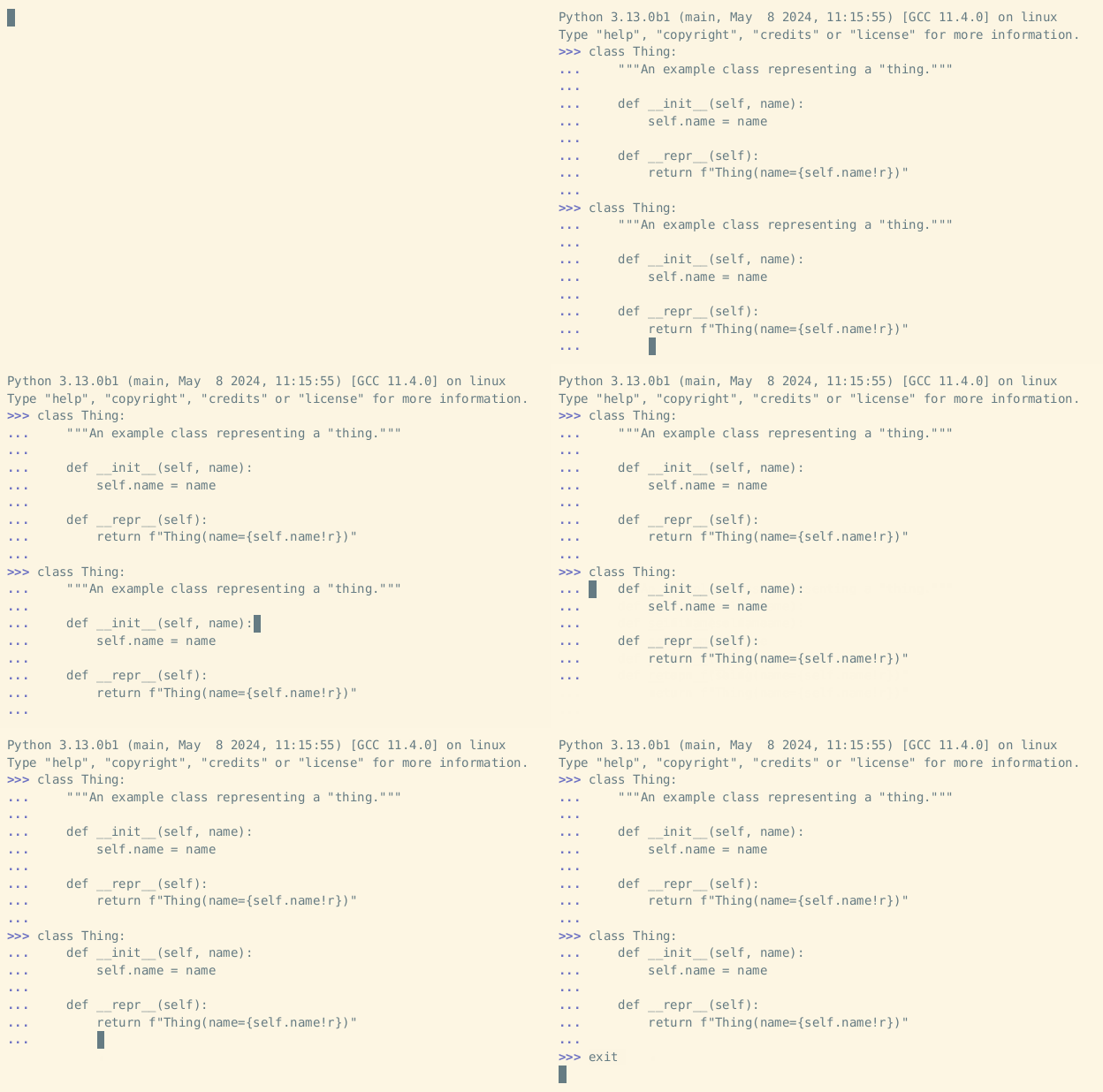 thick hemlock
but I use the REPL a lot on servers and generally a lot of things that aren't my main computer
thick hemlock
thick hemlock
but I use the REPL a lot on servers and generally a lot of things that aren't my...
so being builtin is a big advantage
halcyon trail
i guess it depends what you're doing, what workflows you use, etc
halcyon trail
you can throw micromamba on that server and have python, ipython, and all the third party packages that your heart desires inside of2 minutes
thick hemlock
those servers are not always connected to the internet
halcyon trail
then yeah, that's annoying
we have servers like that as well, but micromamba is what my work uses for C++ and python environments, so we have our own conda-forge channel hosted, so that works.
thick hemlock
also sometimes for troubleshooting I want to run a REPL in a docker container