#algos-and-data-structs
1 messages · Page 142 of 1
 slim crest
 high pewter
What do you mean?
slim crest
whats simulation?
 haughty mountain
i.e. the precision depends on the dt here
haughty mountain
slim crest
whats simulation?
simulation as in you repeatedly compute what the situation looks like a small time step into the future
this would be the most basic thing, the thing people would try instinctively: https://en.wikipedia.org/wiki/Euler_method
I guess my code is technically that, and so is Katakana's code (but with dt=1)
slim crest
oh okay
 storm night
What's the equivalent of zip(*args)?
The context is, I'd like to find a way to get a list of the columns of a sudoku board. using zip(rows) will give me all the columns AFAIK, but I'm not sure if that's considered cheating or not. I wonder if there's a better way 😛
haughty mountain
the core part of the solution I would have expected if I asked this problem to someone is
t = 0
while pos1 < goal and pos2 < goal:
  pos1 += dt*vel1
  pos2 += dt*vel2
  t += dt
at the end we have final positions and the final time
high pewter
Yes
haughty mountain
for part 2 you have different logic for one of the people
high pewter
Yeah
haughty mountain
storm night
What's the equivalent of zip(*args)?
The context is, I'd like to find a way to...
if I needed the columns I would do the zip, for sure
slim crest
high pewter
Yeah
its just a logic problem
does it take 20 mins for to charge
or hours
high pewter
Minutes
slim crest
high pewter
Minutes
for every hour in v2timetaken add 0.4
try to code that
i'll do it this side too
high pewter
K
haughty mountain
slim crest
for every hour in v2timetaken add 0.4
do not hardcode the numbers though, that are supposed to be given as inputs

 high pewter
Thats what this problem got me too
haughty mountain
no maths here would surely just means don't use the closed form equation
but simulate instead
simulation will of course involve some math
storm night
haughty mountain
if I needed the columns I would do the zip, for sure
Got it! Thanks a lot 🙂
high pewter
haughty mountain
simulation will of course involve some math
No math involved
slim crest
log
haughty mountain
but you are adding and multiplying numbers in your code 😱
high pewter
Oops my bad
haughty mountain
right
storm night
What if I was put in a situation where I cannot use zip? Would I have to use a naive solution like looping through the rows of a sudoku board, then getting all the 0 indexes, appending them to a new row, then moving to all the row[1]?
That would be n^2 huh
slim crest
input()*2/100 is not a equation tho
haughty mountain
storm night
What if I was put in a situation where I cannot use zip? Would I have to use a n...
any solution is at least O(n²), because there are O(n²) elements
why*2/10?
slim crest
then v2timetaken += (v2timetaken*0.4)
haughty mountain
0.4?
slim crest
sincr minues to charge is 20
haughty mountain
it's not in general, it's an input you get
slim crest
haughty mountain
it's not in general, it's an input you get
ik but assuming the input you get is 20
20*2/100
= 0.4
haughty mountain
you really can't assume a constant velocity here
they will run for a bit and then stay still while charging
haughty mountain
this is one way of implementing the actual logic, only advance if we are in the operation phase
t = 0
while pos1 < goal and pos2 < goal:
  t_cycle = math.fmod(t, t_o+t_c)
  if t_cycle <= t_o:
    pos1 += dt*vel1
  pos2 += dt*vel2
  t += dt
that's all the changes that would be needed for my solution
fwiw, math.fmod(x, m) takes x and removes as many multiples of m from it as it can (it's the float equivalent of modulo for integers)
high pewter
Never learned math.fmod in my class so I am unable to use this function
haughty mountain
the full operation-charge cycle takes t_o+t_c time, and we can only move in the first t_o time
(well f**k your teacher then...)
you can implement if manually, but it's dumb to have to do so
high pewter
I f***king agree
haughty mountain
t = 0
t_cycle = 0
while pos1 < goal and pos2 < goal:
  if t-cycle <= t_o:
    pos1 += dt*vel1
  pos2 += dt*vel2
  t += dt
  t_cycle += dt
  if t_cycle >= t_o + t_c:
    t_cycle -= t_o + t_c
this would be doing it manually
(a cute way of implementing this whole thing would be to use generator functions, but let me guess those aren't allowed either)
slim crest
 haughty mountain
(god I hate seeing those 1s instead of a dt)
 haughty mountain
also, there is no point in tracking both times, they are the same
haughty mountain
slim crest
<@!305401453336330241> i am using input*2/100
but why? you can't assume constant velocity like you were doing earlier
haughty mountain
it's wrong and I want to spare the misery of implementing the wrong thing in vain...
high pewter
Make sense
haughty mountain
e.g. pick t_o = 1, t_c=999 and pick the distance that is 1*velocity
the actual solution is 1 minute
the solution with the constant velocity thing is 1000 minutes
it's just...wrong
high pewter
Ima head to bed because it's 2 where I am at and I have school tomorrow
slim crest
i'm back
high pewter
K
slim crest
 high pewter
Did u do it?
 glossy breach
smh i still dont get why math shouldnt be involved in this problem
slim crest
glossy breach
smh i still dont get why math shouldnt be involved in this problem
his teacher is prolly mathematically challenged
 pure ocean
does the adjacency list representation have a faster Big O time complexity than the adjacency matrix representation when both are applied with Dijkstra's Algorithm??
haughty mountain
pure ocean
does the adjacency list representation have a faster Big O time complexity than ...
adjacency list doesn't give better time complexity, but it's a lot better for space complexity
adjacency matrix is really wasteful unless you have almost a fully connected graph
pure ocean
what would be their Big-O time complexities?
haughty mountain
time complexity for what exactly?
pure ocean
both adjacency list and adjacency matrix when they're applied with Dijkstra's Algorithm
haughty mountain
which of the two representations you use doesn't impact the time complexity of Dijkstra
haughty mountain
I guess technically is could be slower for adjacency matrix because you need to scan more elements to find neighbors 
pure ocean
haughty mountain
I guess technically is could be slower for adjacency matrix because you need to ...
https://www.geeksforgeeks.org/dijkstras-algorithm-for-adjacency-list-representation-greedy-algo-8/#:~:text=We have discussed Dijkstra's algorithm,O(V^2).&text=With adjacency list representation%2C all,%2BE)%20time%20using%20BFS.
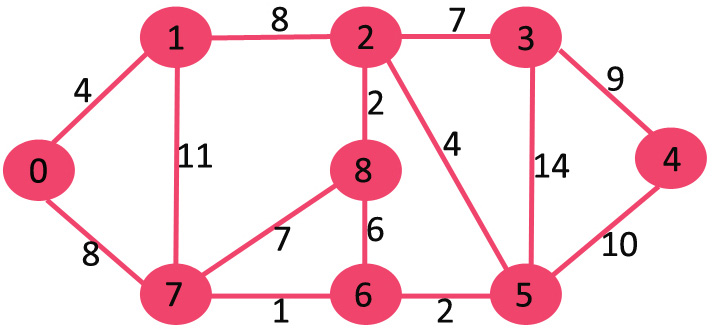
GeeksforGeeks
A Computer Science portal for geeks. It contains well written, well thought and well explained computer science and programming articles, quizzes and practice/competitive programming/company interview Questions.
does this explain it well or something
haughty mountain
if you want neighbors, adjacency list is just a nicer representation to work with
slim crest
class node:
def init(self,value= None):
self.value = value
self.left_child = None
self.right_child = None
class BST:
def init(self):
self.root = None
def insert(self,value):
    if self.root == None:
        self.root = node(value)
    else:
        self._insert(value,self.root)

def _insert(self,value,cur_node):
    #From root check whether to go right or left
    if value < cur_node.value:
        #if there is no value on the left child node inset value here
        if cur_node.left_child == None:
            cur_node.left_child = node(value)
        #else call recursive function to continue as if left node is root
        else:
            self._insert(value,cur_node.left_child)
    #From root check whether to go right or left
    elif value > cur_node.value:
        #if there is no value on the right child node inset value here
        if cur_node.right_child == None:
            cur_node.right_child = node(value)
        #else call recursive function to continue as if left node is root
        else:
            self.insert(value,cur_node.right_child)
    else:
        print('Value already in tree')

def print_tree(self):
    if self.root != None:
        self.print_tree(self>root)

def _print_tree(self,cur_node):
    if cur_node != None:
        self._print_tree(cur_node.left_child)
        print('%d'% cur_node.value)
        self._print_tree(cur_node.right_child)
def fill_tree(tree,num_elems = 100,max_int = 1000):
from random import randint
for k in range(num_elems):
cur_elem = randint(0,max_int)
tree.insert(cur_elem)
return tree
tree = BST()
tree = fill_tree(tree)
tree.print_tree
pure ocean
haughty mountain
if you want neighbors, adjacency list is just a nicer representation to work wit...
is there a scenario where adjacency matrix doesnt have a slower time complexity over adjacency list?
haughty mountain
the one thing adjacency matrix is useful for is if you want to answer "is a connected to b?" quickly, which is kinda rare
pure ocean
pure ocean
is there a scenario where adjacency matrix doesnt have a slower time complexity ...
when applied with dijkstra's algorithm that is
haughty mountain
I would say just use adjacency list as the default graph representation unless you have good reason to do otherwise
 haughty mountain
I've never seen a use for that kind of BST
balanced binary search trees (BBST) have good uses though
pure ocean
how do i develop a directed acyclic graph for a factorial?
slim crest
haughty mountain
I've never seen a use for that kind of BST <:pithink:652247559909277706>
i got it on a youtube video
i am gonna code on my own since understand theory behind
pure ocean
in a fully connected undirected graph, which has a higher space complexity,
adjacency matrix or adjacency list representation
 agile sundial
it's the same
pure ocean
agile sundial
it's the same
is there a case where a. matrix has higher space complexity than a. list considering the same fully connected undirected graph?
agile sundial
no
pure ocean
so the space complexity between the two are always the same under that kind of graph then?
agile sundial
yes, think about the two data structures
pure ocean
agile sundial
yes, think about the two data structures
is there a scenario where backtracking is better over complete search in terms of worst case time complexity
considering they deal the same problem
agile sundial
yes, when backtracking you can use the previous states to narrow down the states you have to search
pure ocean
agile sundial
yes, when backtracking you can use the previous states to narrow down the states...
is this always the case or can complete search be better in terms of worst case time complexity under other conditions?
agile sundial
no, complete search is almost always worse than everything else
pure ocean
agile sundial
no, complete search is almost always worse than everything else
why almost
agile sundial
i say almost because there's probably a case i didn't think of or don't know about
 cerulean elk
if I have
arr = [["name1", number1],["name2", number2], "name3", number3]]
and i want to sort the array with respect to the numbers, how can i do that?
haughty mountain
!d list.sort
 halcyon plankBOT
sort(*, key=None, reverse=False)```
This method sorts the list in place, using only `<` comparisons between items. Exceptions are not suppressed - if any comparison operations fail, the entire sort operation will fail (and the list will likely be left in a partially modified state).

[`sort()`](https://docs.python.org/3/library/stdtypes.html#list.sort "list.sort") accepts two arguments that can only be passed by keyword ([keyword-only arguments](https://docs.python.org/3/glossary.html#keyword-only-parameter)):

*key* specifies a function of one argument that is used to extract a comparison key from each list element (for example, `key=str.lower`). The key corresponding to each item in the list is calculated once and then used for the entire sorting process. The default value of `None` means that list items are sorted directly without calculating a separate key value.the key function mentioned here
haughty mountain
glossy breach
in this case you can sort with key a[0]
a[1], but yeah
halcyon plankBOT
filter(function, iterable)```
Construct an iterator from those elements of *iterable* for which *function* returns true. *iterable* may be either a sequence, a container which supports iteration, or an iterator. If *function* is `None`, the identity function is assumed, that is, all elements of *iterable* that are false are removed.

Note that `filter(function, iterable)` is equivalent to the generator expression `(item for item in iterable if function(item))` if function is not `None` and `(item for item in iterable if item)` if function is `None`.

See [`itertools.filterfalse()`](https://docs.python.org/3/library/itertools.html#itertools.filterfalse "itertools.filterfalse") for the complementary function that returns elements of *iterable* for which *function* returns false.
Similar names: label.filter, 2to3fixer.filter, django.filter
high pewter
thank you guys for your help
i got the solution to my problem
@slim crest
@haughty mountain
slim crest
high pewter
i got the solution to my problem
what was it
high pewter
its stupid but i got it this morning
slim crest
its okay
 slim crest
okay thats cool
high pewter
thx for the help
slim crest
comeback if you have any more problems
high pewter
and is kuroko's basketball your fav anime?
high pewter
yeah there is still 1 more part for this problem
i will see if i have any more problems
slim crest
high pewter
and is kuroko's basketball your fav anime?
Jujutsu Kaisen takes .#1
 slim crest
okay
high pewter
Have you tried @slim crest?
slim crest
no not yet
slim crest
df_out = dfs
slim crest
can some please help
 agile sundial
help with what
slim crest
o notations
agile sundial
yes, but what specifically in this problem do you need help with
slim crest
agile sundial
yes, but what specifically in this problem do you need help with
nevermind I'll ask my mom in the morning
however
heres my stab at a code challenge

how can I make my program more efficient
 fiery cosmos
hm
 austere sparrow
@high pewter Don't ask if anyone is available, just ask your question.
If people see a question, they will be more likely to help.
haughty mountain
the question was stated earlier
the code I sketched for part2 is easily adaptable to this task as well, this is just the same logic but for both simulations
high pewter
austere sparrow
<@!305401453336330241> Don't ask if anyone is available, just ask your question.
K thank you
high pewter
haughty mountain
the code I sketched for part2 is easily adaptable to this task as well, this is ...
Yeah it's the same logic
I tried to use the same thing
But Mr.Veera position does not change
haughty mountain
the thing you ended up writing does not generalize as easily I think
high pewter
K
haughty mountain
like, my code change is just
t = 0
while pos1 < goal and pos2 < goal:
  t_cycle = math.fmod(t, t_o+t_c)
  if t_cycle <= t_o:
    pos1 += dt*vel1
  pos2 += dt*vel2
  t += dt
```to
```py
t = 0
while pos1 < goal and pos2 < goal:
  t_cycle1 = math.fmod(t, t_o+t_c)
  if t_cycle1 <= t_o:
    pos1 += dt*vel1
  t_cycle2 = math.fmod(t, t_b+t_r)
  if t_cycle2 <= t_b:
    pos2 += dt*vel2
  t += dt
dt is the time step, I guess you use 1 everywhere
haughty mountain
haughty mountain
fwiw, `math.fmod(x, m)` takes x and removes as many multiples of m from it as it...
re: fmod
haughty mountain
high pewter
why did you use a time step
just because I don't like having it hardcoded as 1, it's also a thing that you are likely to want to change for the sake of precision
maybe some examples help with what fmod does
fmod(1.0, 2.0) == 1.0
fmod(1.5, 2.0) == 1.5
fmod(2.0, 2.0) == 0.0
fmod(2.5, 2.0) == 0.5
fmod(3.0, 2.0) == 1.0
fmod(3.5, 2.0) == 1.5
fmod(4.0, 2.0) == 0.0
...
i se
 rich pelican
comebine your function with a positional argument? 1 function to process both?

 fallow nymph
wish i could help you katakana!
is anyone know of a good cheat sheet for the basic python and data structure??
*guess google is my best friend lol.. for anyone that might be interested i found this:
https://www.pythoncheatsheet.org/

Anyone can forget how to make character classes for a regex, slice a list or do a for loop. This cheat sheet tries to provide a basic reference for beginner and advanced developers, lower the entry barrier for newcomers and help veterans refresh the old tricks.
fiery cosmos
Heap is overrated
haughty mountain
fiery cosmos
Heap is overrated
*angry dijkstra noises*
fiery cosmos
I made an algorithm that reports possible swaps in a bejeweled board along with their potential streak.
fiery cosmos
id like to see if any one has a conceptual idea of how they would do it or an implementation
so i can compare mine to yours
im very proud of my way but there might be another way

 fiery cosmos
maybe give more context. Whats the problem and what are partitions.
high pewter
Thank you @slim crest and @haughty mountain
slim crest
fiery cosmos
maybe give more context. Whats the problem and what are partitions.
partitions are breaking of numbers
high pewter
i am officially done with the mathematical challenged teacher question
bro i lost my soul in these past 2 days
high pewter
the problem was worth 30% of my mark
slim crest
slim crest
partitions are breaking of numbers
for example p(4) = 5
high pewter
i am done
slim crest
high pewter
the problem was worth 30% of my mark
damn
high pewter
i will for sure come bac if i have any more problems
but thank you
and have a great weekend
high pewter
may god bless you all
slim crest
1+1+2
high pewter
amen 🙏
fiery cosmos
well see thats alot easier to grasp than all that math in the beginning. Now somone may be able to help. Just need to put it all in one sentence and post it.
 autumn pendant
!e
for number in range(100,8):
print(number)
halcyon plankBOT
@autumn pendant :warning: Your eval job has completed with return code 0.
[No output]
!e
 thin river
Hey guys!
Can you please suggest how to sharpen data structures and algorithms skills?
slim crest
watch tutorials and solve problems like i am right now
 barren solstice
what's the cooldown name in python?
 clear vortex
!e
print("Hi"
o
!e
import Discord
from discord.ext import commands
client = commands.Bot="?"
@ember shore
async def ping(ctx):
await ctx.send("pong"
bot.run("123")
halcyon plankBOT
@clear vortex :x: Your eval job has completed with return code 1.
001 | File "<string>", line 6
002 | <@!545576944008298516>
003 | ^
004 | SyntaxError: invalid syntax
 shut breach
@clear vortex #bot-commands please dont spam here
clear vortex
shut breach
<@!916669127429591090> <#267659945086812160> please dont spam here
i didnt spam-
fiery cosmos
Good morning to everyone, I'm working on a csv file and I would like to write another csv. In particular my csv is composed of persons and an associated measurements list ( person1|[m1,m2,m3....] person2|[m1,m2,m3...] ecc). I want obtain something like this: person1|m1|m2, person1|m2|m3, person1|m3|m4, person2|m1,m2|.... So I would loosen the list and write a row for each tuple. Any help? I hope I was clear
i try to explain better using pseudocode
FOR EACH ROW IN CSV
name= row[0]
surname=row[1]
list= row[2]
if list.size==1
write name,surname, list[0], null
else if list.size>1
for i=0, i<list.size-1, i++{
write name, surname, list[i], list[i+1]
}
so I want to read from a csv and write on another csv
 runic anvil
You want each pairwise tuple?
I think itertools module might help you in breaking it up
perhaps the pairwise() function from it or product(), hope that helps... if I understood correctly
runic anvil
If anyone is interested on working with me with an expert-level hackerrank puzzle, send me a dm! I've been stuck on one for a while... i'm using python to solve it.
haughty mountain
not dm, but why not link the problem here?
fiery cosmos
i have a question would it be possible to loop without looping i have an issue with automatisation and i just can't figure it out any help or idea would be more than welcome
haughty mountain
would it be possible to loop without looping
what does this even mean?
fiery cosmos
my hash function for bejeweled swaps. only cares about combinations not permutations.
hash = is_horizontal ? min(swapee_index, swaper_index) : min(swapee_index, swaper_index) + (columns - 1) * rows
 dapper sapphire
sorting a string is O(n log n) and then joining it back again via join is O(n).
So to sort a string and then join it, it would be O (n) + (n log n), but we would simplify it to O(n log n)?
and if we have to perform the same sequence on a list of words, then we would be looking at O(K N log N), where K would be the number of words in a list, and N would be the length of each word?
words = ["This", "is", "a", "test"]
 slender sandal
dapper sapphire
sorting a string is O(n log n) and then joining it back again via `join` is O(n)...
slender sandal
dapper sapphire
sorting a string is O(n log n) and then joining it back again via `join` is O(n)...
Wouldn't it be O(n² log n)
Or O((1 + log n) n)
dapper sapphire
How would it be O(n^2 log n)?
dapper sapphire
slender sandal
Wouldn't it be O(n² log n)
It wouldnt be n^2 because we need to have a distinction between the length of each word (N), and the number of words (K) is a list/array.
storm night
Does anyone know of a weighted graph generator? I know its a super niche usage case but I really dont wanna manually write out a directed graph
OH wow this is really cool. I wish there was an option to simply export the graph in like python dictionaries

CSAcademy is a next generation educational platform. Discover computer science
with interactive lessons and a seamless online code editor.
 soft cape
Can somebody in here help me with the minimax algorithm? I make tic tac toe for a school project and struggle finding a way to implement this algorithm into my game so I can make an unbeatable ai. I would appreciate help alot.
slim crest
fiery cosmos
Good morning to everyone, I'm working on a csv file and I would like to write an...
.
slim crest
fiery cosmos
i have a question would it be possible to loop without looping i have an issue ...
recursion
 gritty marsh
soft cape
Can somebody in here help me with the minimax algorithm? I make tic tac toe for ...
gritty marsh
soft cape
Can somebody in here help me with the minimax algorithm? I make tic tac toe for ...
Send the code you have already
soft cape
wait
problem might be that it is mostly in german since its for a school project
but I can still send
and I tried multiple times but all tries didnt work
so should I just send you the code of my twolayerbot?
halcyon plankBOT
Pasting large amounts of code
If your code is too long to fit in a codeblock in discord, you can paste your code here:
https://paste.pythondiscord.com/
After pasting your code, save it by clicking the floppy disk icon in the top right, or by typing ctrl + S. After doing that, the URL should change. Copy the URL and post it here so others can see it.
gritty marsh
soft cape
if you have questions regarding the german words just ask
Oof, sorry, forgot about this. I'll get back to you in 15 minutes i just have to hop on a quick meeting
soft cape
it's ok
gritty marsh
@soft cape is your problem coming up with the algorithm, or are you encountering some kind of error in your program
soft cape
I just can't figure out how I should rewrite the bot function to not just look 1 move into the future but simulate every possible outcome
I watched several videos but none of this worked and couldn't figure it out
soft cape
soft cape
I watched several videos but none of this worked and couldn't figure it out
and in most of these Videos the Bot starts and in my program the player starts and not the bot
gritty marsh
soft cape
I just can't figure out how I should rewrite the bot function to not just look 1...
Alright, so I don't really understand the architecture of your program, but I'll help you out with hypotheticals 😆 is that good?
Can you point me to your minimax implementation if it exists already in your code?
soft cape
gritty marsh
Can you point me to your minimax implementation if it exists already in your cod...
it doesn't exist yet
but it should exist in the twolayerbot function
there already is a loop which predicts 1 move into the future
it should be the second for loop
gritty marsh
soft cape
it should be the second for loop
Well minimax is composed of a set of components
These components are:
- function that defines the utility (preference) of a state
- function that defines how to transition from state to state
- function that defines the transitions for a particular state
- function that defines if a desired state has been found
- function that defines what transition is best for the current state
The easiest to implement right now is 4.
It seems you've implemented it already, right? In the first function in your source code @soft cape
soft cape
yeah the first function tells if someone won
either the player or the bot
gewonnen is german for won
gritty marsh
Alright
The next easiest is 1.
The "utility" of a state is the sum of its score and the score of the states that come after it
soft cape
what do you mean with score?
gritty marsh
the score is defined by whether or not the state is a winner state, loser state, or neither
soft cape
ahh ok
gritty marsh
so, if it's a winner state, the score is 1
if it's a loser state, the score is -1
if it's neither, the score is sum of the score of the states that come after it
gritty marsh
Yep
gritty marsh
soft cape
but I want x not to win
We can easily negate that in the 5. function
soft cape
ok
if you go down to line 264 there is another win function (this is for the 2d list of the bot produces)
I changed the game_over in the case that 'O' wins to -1 and in case that 'X' wins to 1
and also made another elif that tells if it's a tie in which case it'd set it to 0
gritty marsh
Alright, good
soft cape
should I send you the function?
gritty marsh
It's all good you can send it later
gritty marsh
Next function to implement would be 3.
soft cape
ok
gritty marsh
Do you know how to implement it?
soft cape
not really if it isn't that what i already wrote in that for loop I told you about
gritty marsh
Alright, good then
- would just be applying an action, I see you've already done it
- is the main dish
soft cape
so 2. and 3. are both basically finished?
what my problem with 3. is ig is the swap between putting in 'O' and 'X'
gritty marsh
Well if you assume X goes first, it's X's turn if the number of X and O on the board are equal
soft cape
yeah I solve the via count%2 == 0: 'X' and count%2 == 1: 'O'
but when I try it in a loop for the minimax it doesn't really work
idk
gritty marsh
What do you mean?
soft cape
in the loop i did for that sometimes the board was full but there were more xs than os, sometimes the board wasn't full and sometimes the count extended over 9 which should be the time the board is full
so i don't know how to make that
gritty marsh
That's weird
soft cape
ik
gritty marsh
Maybe we should just write a dedicated function for it
soft cape
probably
gritty marsh
def turn(board) -> str:
  if board.count('X') == board.count('O'):
    return 'X'
  else:
    return 'O'
ahh ok thank you
gritty marsh
of course you can change it to whatever your representation of X and O are
gritty marsh
It's just a type hint
Here, i'm returning a string, so it's a visual hint that the function returns a string
it doesn't behave differently, it's just there for other developers in case they read it
soft cape
so it's basically like # -> string at the end?
gritty marsh
Yep
Except it's special syntax so that IDEs like PyCharm and VSCode can read it and give you helpful suggestions
soft cape
now I should try to do 2. again
can you help me there too?
so I got it for 1 turn into the future with either 'O' or 'X'
gritty marsh
- Is essentially just setting a value in a board
So, erm, it can be like this:
def transition(board: list[list[str]], position: tuple[int, int], turn: str) -> board:
  result = [row.copy() for row in board]
  i, j = position
  result[i][j] = turn
  return result
for i in frei:
dummy2[i] = turn(dummy2)
?
is the : again like the ->?
and do I have to use a 3D list or does it work with a 2D list aswell?
gritty marsh
soft cape
is the : again like the ->?
Indeed
gritty marsh
soft cape
and do I have to use a 3D list or does it work with a 2D list aswell?
Not sure what the 3D list will represent
Row and columns of lists?
What will the list represent
soft cape
sorry was afk for short
yeah rows and columns
the list I use for the 2layerbot is 2d
just index of each field
gritty marsh
result is just the result of applying the action
soft cape
and row.copy() for row in board
dummy2[i] = turn(dummy2)
isn't this all I need for a 2D list?
gritty marsh
What's dummy2 supposed to be?
slim crest
soft cape
Can somebody in here help me with the minimax algorithm? I make tic tac toe for ...
do know understand the use of binray trees
 quartz crest
How to determine the storage space complexity of algorithms?
shut breach
calculate how much it needs to store at one time
agile sundial
the same way you determine the time complexity, pretty much, but with storing stuff instead
slim crest
poop
 rich dagger
Hey folks, does anyone have any good resoures on understanding and implementing ECS systems?
rich dagger
Wow, such quiet lol
 half forge
yep
haughty mountain
rich dagger
Hey folks, does anyone have any good resoures on understanding and implementing ...
no really a ds/algo question, #software-architecture is probably a better fit
 alpine quiver
Hi! It's been a while since I've hung out here. cool to see this place has blown up. I've been trying to work on my fundamentals recently and would love some help on BSTs.
i noticed whenever i do leetcode problems i stumble more on BST-based problems. its prob cuz i havent used BSTs since college, but I feel like im just misunderstanding how pure BSTs are defined formally.
how i understand them is they are:
- valid if empty
- valid if left subtree node values are < root value
- valid if right subtree node values are > root value
- valid if left child value is < parent value
- valid if right child value is > parent value
in the screenshot I'm reviewing logic to calculate unique BSTs from n nodes (1, ..., n). in my mind once i think of a counter example to the formula you'd want to use I will end up backing myself into a corner. with the root as 2, are any of those BSTs invalid?
i'm trying to do more and more hard-level problems on leetcode but i perform poorly on BST-based medium problems. so i wanna make sure i understand the fundamental data structure. for some reason I see people defining BSTs differently so I'm having trouble poking holes in my logic.

for context I've always enjoyed The Algorithm Design Manual by Steven Skiena. so I've been reviewing that text. I'm assuming I've missed something. I also do fine on problems from leetcode or hackerrank for validating BSTs.
alpine quiver
maybe theres actually 5? ☠️
 slim crest
do you have trouble understanding binary trees?
haughty mountain
alpine quiver
Hi! It's been a while since I've hung out here. cool to see this place has blown...
I think the requirement is
everything in left subtree <= parent
everything in right subtree >= parent
alpine quiver
slim crest
do you have trouble understanding binary trees?
If those BSTs are invalid then I guess so
haughty mountain
alpine quiver
maybe theres actually 5? ☠️
and yeah, those are the 5 possible ones I think
alpine quiver
haughty mountain
I think the requirement is
everything in left subtree <= parent
everything in ri...
But given n = 5 I’m trying to understand how the right side is calculated using f(n-i) if I can generate 5 examples where i=2.
haughty mountain
alpine quiver
But given `n = 5` I’m trying to understand how the right side is calculated usin...
f is the number of bsts with n different values?
alpine quiver
Recursively the function G(n) that implements f(i-1) * f(n-i) calculates the number of possible BSTs given n where f(i-1) calculates the possible left subtrees and f(n-i) for the right.
At least how I understand it
In this case i is the root
You’d sum G(n) over every root
haughty mountain
fwiw the number of unique bsts is the same as the number of unique binary trees, which ends up being the Catalan numbers
haughty mountain
in short, you can put n different numbers at the top, which splits the tree into subtrees of size (0, n-1), (1, n-2), ..., (n-1, 0)
then
f(n) = sum(f(i)*f(n-1-i) for i=0,...,n-1)
haven't checked my work, but I think that thing is correct
yeah, that ends up being the catalan numbers
 haughty mountain
alpine quiver
I might be overthinking it
haughty mountain
alpine quiver
I might be overthinking it
The logic for the formula I wrote is simple, n choices for root, n corresponding splits of the tree. For every split we multiply the different configurations of the subtrees f(left_subtree_size)*f(right_subtree_size).
alpine quiver
haughty mountain
The logic for the formula I wrote is simple, `n` choices for root, `n` correspon...
Yea this is what I’ve seen but where f(right_subtree_size) is 3 nodes should that equal 3 unique subtree structures? That’s where for i = 2 I’m stumped since I see 5 unique BSTs.
alpine quiver
haughty mountain
yeah, that ends up being the catalan numbers
I feel like this may actually help me tho. If I’m understanding it properly it’d be 5 for i = 2 maybe?
alpine quiver
Hmm maybe I was interpreting the formula incorrectly
haughty mountain
the thing you drew up is one of the terms in f(5): f(1) * f(3)
alpine quiver
Yea exactly. That’s what’s thrown me off. How Ive understood it it’d be 3
haughty mountain
1*5
alpine quiver
1*3 sorry. f(2-1) * f(5-2)
Been grinding leetcode all weekend. Pretty brain fried haha
alpine quiver
You mean G(3) (if we’re following my diagram word for word)?
haughty mountain
whatever you call the number of BSTs 😛
alpine quiver
hmm
haughty mountain
your G is just one term I guess?
alpine quiver
I split the function into left side right side with the f’s and call that G(n) but I think I’m still confused on unique BSTs with root 2
haughty mountain
my f is your f, so that's good at least
alpine quiver
I think what I’m stuck on is are the unique BSTs I created valid? And if so how does that fit into #algos-and-data-structs message. Which is what Ive understood as the solution. But #algos-and-data-structs message I think checks out with what I’m thinking. Tho I’m not entirely sure yet.
Discord
Discord is the easiest way to communicate over voice, video, and text. Chat, hang out, and stay close with your friends and communities.
haughty mountain
the 5 trees you wrote are valid
alpine quiver
Can you elaborate on the math behind f(3)?
haughty mountain
as I mentioned f(3) are the trees you drew, ignoring the 1 and 2 that are just...there
alpine quiver
Then maybe i am interpreting the material wrong. Ive thought i=2 f(5-2)=3 since logically 3 nodes are available right of 2.
That’s kinda the gist of what Ive read
haughty mountain
how many ways can you arrange 3 nodes into a BST?
alpine quiver
5
haughty mountain
yep, these ones
 alpine quiver
Yea so that’s where I’m stumped. What Ive been studying has stated 3 unless I’m super misunderstanding. Granted none of the material actually “shows the work”
Really appreciative of the help tho. Been struggling with this for a good chunk of today
haughty mountain
alpine quiver
Yea so that’s where I’m stumped. What Ive been studying has stated 3 unless I’m ...
what material? the book you mentioned?
alpine quiver
Actually I think i 100% misunderstood and I even knew the logic. f(3) is G(3) recursion
Which I think would be the f(3) you’re talking about
G(n) is recursive*
haughty mountain
your G is the number of trees if you fix a root
f is a sum of G for all choices of root
alpine quiver
haughty mountain
what material? the book you mentioned?
The book covers more theory. I tried looking for explanations on forums/discussions.
alpine quiver
haughty mountain
your G is the number of trees if you fix a root
f is a sum of G for all choices ...
This
haughty mountain
this is from your book
 alpine quiver
That’s where I failed to bring it all together. I was reading too much into verbiage.
haughty mountain
(I think it's the right book at least)
alpine quiver
I knew it had to be executed recursively but kept seeing “given 3 nodes you have 3 structures”. I think I misread it that way at least. It’s given three nodes you have G(3) I think
Which I believe is your point
haughty mountain
yeah, I kinda skipped past using G at all when I derived my expression and directly expressed it in terms of f
alpine quiver
I’m pretty confident I get it now. Thanks! I’ll give it another shot tomorrow.
haughty mountain
I hope you didn't misread tree as three in some place
ah, "three-node trees" not to be confused with "three node-trees"
alpine quiver
Maybe. I’ll see if I can find the examples. I got so desperate that I even watched a couple YouTube videos. So even then I was missing it. I was reading/hearing [1,2,3,4,5] gives you 3 trees.
alpine quiver
haughty mountain
ah, "three-node trees" not to be confused with "three node-trees"
Yea probably this
Super brain fries 🍟
fiery cosmos
num = random.randint(0,8)
SwitchNum = [num]
def my_num(start):
current= start
while True:
continue current
nums= my_nums(SwitchNum)
for numz in nums:
print(numz)
how can i make work a randint object through a generator?
i have a little bit of trouble understanding the concpet
but i would like my loop to go infinitely through randoms numbers while remembering the last number
can someone help me with this a little bit?
slim crest
fiery cosmos
but i would like my loop to go infinitely through randoms numbers while remembe...
huh ?
fiery cosmos
You read me right
 pearl leaf
fiery cosmos
pearl leaf
fiery cosmos
I have a question regarding solving some M number of equations.
Say I have N number of variables and M number of equations.
I want to resolve them, SUCH THAT
- they ALL should have values more than or eq to 0.
- the norm should be minimum
- the sum of all of them should be 1
What have I done so far?
I have tried to resolve it using lstsq (https://docs.scipy.org/doc/scipy/reference/generated/scipy.linalg.lstsq.html#scipy-linalg-lstsq)
Issues with it: while it gives least squares, it generates minimum values in solN if required(which is expected).
Can anyone suggest me what else can I try?
Can this be resolved with LPSolver? I can add constraint that they should have positive value, tho then I'm not sure if it will try to find least squared solN.
 dire plume
Okay, so we first note that if M >= N we have either no, or exactly one solution; this probably isn't what you want, so we'll take M < N. You're also probably representing this as a matrix A and the variables by a row/col matrix x.
What do you mean by "they all" are >= 0? The values of A? And the norm of what, the matrix? Which norm? And the sum of what?
EDIT: Had M and N backwards.
fiery cosmos
dire plume
Okay, so we first note that if M >= N we have either no, or exactly one solution...
yep. No exact soln. It's mostly gonna be M<N.
dire plume
Whoops, you're right, I had my M and N backwards.
fiery cosmos
I'll add an example to explain more. It will be more convincing.
say I have 2 eqns.
x + y = 0.5
x + y + z = 1
now It's obvious that this has infinite solNs.
So I'd choose 0.25 0.25 0.5 since it's norm(norm 2) will be minimum and they are all positive.
I have also tried nnls but it's not giving me the least squared solN always, I added another equation at the end saying sum should be eq to 1.
 dense vortex
are you guys talking about this expression as in maths? because in python its not possible.
fiery cosmos
dense vortex
are you guys talking about this expression as in maths? because in python its no...
why not?
dire plume
Why wouldn't it be possible in Python?
dense vortex
how?
fiery cosmos
dense vortex
are you guys talking about this expression as in maths? because in python its no...
also it is possible. I have achieved things so far.
dire plume
I think they want to just do an optimization problem? Maybe I'm mis-reading?
 fiery cosmos
dire plume
I think they want to just do an optimization problem? Maybe I'm mis-reading?
fiery cosmos
dire plume
I think they want to just do an optimization problem? Maybe I'm mis-reading?
nope you're right, It's an optimization problem.
dire plume
They're noting the problem using mathematical notation for the sake of communicating the problem.
fiery cosmos
dense vortex
oh i mean, you're looking at it the wrong way.
when we say we want to solve
above 2 eqns we make vectors of them and put them in Ax = b form and solve them.
haughty mountain
you can solve this as an LP, but it's generally better if you find a linear algebra approach
dire plume
Even if not: https://www.sympy.org/en/index.html
fiery cosmos
haughty mountain
you can solve this as an LP, but it's generally better if you find a linear alge...
I thought about it, but would LP minimize the norm too?
haughty mountain
the LP would be to minimize the norm given the constraints
fiery cosmos
it will? then i would like to try it, but i mean i was reading the docs, I can't find it saying, it will minimize the norm.
constrains can be added as they all should be b/w 0 to 1. but how to add constraint for minimizing
haughty mountain
I mean, the LP needs to minimize/maximize something
fiery cosmos
haughty mountain
I mean, the LP needs to minimize/maximize something
which is linear, and what i want to minimize seems non linear(atleast to me)
dense vortex
Okay. maybe I'm not ready for learning that. anyways, I see a warning on discord here on void linux. I downloaded fresh install but still it's there.
 haughty mountain
fiery cosmos
which is linear, and what i want to minimize seems non linear(atleast to me)
haughty mountain
fiery cosmos
which is linear, and what i want to minimize seems non linear(atleast to me)
ah, right, 2 norm
fiery cosmos
dense vortex
Okay. maybe I'm not ready for learning that. anyways, I see a warning on discord...
this may be the wrong channel for that discussion.
dire plume
Right, so, that's not too bad working with, but summing things to one is a weirdo thing. So, I gave up doing it on paper and I'm trying brute force on an example to see if I can ween anything from that noise.
dense vortex
yeah I know I'm not gonna discuss on that. I thought if someone have gone through this. I could get a quick answer here. No prob.
dire plume
What is this for, by the way? I don't think I've seen this kind of structure in Linear Algebra before. Maybe like, cost networks or something?
fiery cosmos
dire plume
Right, so, that's not too bad working with, but summing things to one is a weird...
i kinda thought about softmaxing at the end but that would fuck up the equations right?

see this is the result i get by nnls
however there is solN
0.15 0.15 0.3 0.4 which will have less norm

now I get THAT solN by least squares directly, but for bigger examples it goes in negative too
So I don't get why NNLS fucks up even after they claim its prone to minimize least squares.
 haughty mountain
sum = 1 and minimize norm seems like an odd constraint
dire plume
Yeah, which is why I asked above what this was for, haha.
Some kind of probability thing, but then L2 norm is weird for that.
fiery cosmos
it is odd but it is required for the paper I'm trying to have practically.
dire plume
Okay, I have a guess, but this is only because I've only seen this condition once before in my life: does this have anything to do with quantum computing?
fiery cosmos
dire plume
Okay, I have a guess, but this is only because I've only seen this condition onc...
not at current stage. no.
fiery cosmos
haughty mountain
sum = 1 and minimize norm seems like an odd constraint <:pithink:652247559909277...
sum=1 just to imply that its a PDF.
dire plume
Ah, I was closer with probability. I'll have to read in a second about why we care about L2.
haughty mountain
yeah, I guessed it was probabilities
fiery cosmos
dire plume
Ah, I was closer with probability. I'll have to read in a second about why we c...
check page 13.
haughty mountain
the L2 norm of probablities was the odd part to me
fiery cosmos
in a nutshell it defines that our vector is more uniform.
dire plume
Jez, this is dense. I've not seen much of this notation before.
fiery cosmos
yeah notations are....well very complex.
my sir has suggested to look upon Groebner basis since it's a non linear problem but I got no idea about it right now.
haughty mountain
this paper is a bit over my head, especially after having been out of uni for a while 😛
dire plume
Huh. I'm not exactly sure why Grobner bases would work, I thought that was for polynomial rings, but I might also have been out too long.
Also, it shouldn't simplify the problem, the bases are fine for optimization --- there wouldn't be any bases, I feel, for which this would be an "easier" problem. We're pretty linear right now, except for L2.
haughty mountain
happy to see this kind of advanced topics though, always interesting
dire plume
Also, I just noticed this, but: what norm are we taking here? For example:
A = np.array([
    [1, 1, 1, 0],
    [0, 0, 0, 1],
    [1, 1, 0, 0],
    [0, 0, 1, 1],
    [1, 1, 1, 1]
])

x = np.array([0.6, 0.4, 0.3, 0.7, 1]).reshape(1, 5)
y = np.array([1.9, 1.9, 2.3, 2.1])  # xA
understandable. it took quite a lot of my time. I have had very nice results, but some values are getting negative(very small tho), I'm trying to resolve that issue.
dire plume
We have a few things here. We have the original matrix, which has a norm, we have x (the thing we're multiplying A by) and we have the product.
We prob don't care about A's norm, so it's either x or y?
fiery cosmos
wait. I think you're mistaken.
dire plume
It's entirely possible.
haughty mountain
norm of (x, y) I thought?
fiery cosmos
dire plume
Also, I just noticed this, but: what norm are we taking here? For example:
``...
we have y as your x.
so we find X.
given A and y.
dire plume
Okay, lemme reformulate.
fiery cosmos
A = np.array([
    [1, 1, 1, 0],
    [0, 0, 0, 1],
    [1, 1, 0, 0],
    [0, 0, 1, 1],
    [1, 1, 1, 1]
])

y = np.array([0.6, 0.4, 0.3, 0.7, 1]).reshape(1, 5)
find X such that its a pmf(which is in a way taken care by last eqN which i added)
and the X has least norm if there are more than one solNs(which will happen kinda always)
Okay, but where are we getting y from? Is that given to us?
fiery cosmos
dire plume
Okay, but where are we getting y from? Is that given to us?
yes.
dire plume
Ahhhh, got it. And we want to minimize the L2 norm of the vector x, while keeping sum(x) == 1.
fiery cosmos
exactly.
dire plume
Okay, I was doing the problem in reverse.
haughty mountain
so we have some solution space in x coming from Ax=y, and the remaining constraint is x > 0 and minimize norm?
dire plume
I think x >= 0, yeah.
haughty mountain
and that's the one annoying part, x>=0, otherwise this is trivial
dire plume
I now understand why LSTSQ was the go-to. Okay, cool.
fiery cosmos
haughty mountain
and that's the one annoying part, x>=0, otherwise this is trivial
I mean THAT is the thing that is itching for so long, otherwise least squares were gold.
haughty mountain
I guess you either get the correct solution using least squares, or the answer has some components = 0
I guess solving 2^N least square problems isn't feasible?
fiery cosmos
yes. I am dealing with 400 variables here.
dire plume
from scipy.linalg import lstsq

A = np.array([
    [1, 1, 1, 0],
    [0, 0, 0, 1],
    [1, 1, 0, 0],
    [0, 0, 1, 1],
    [1, 1, 1, 1]
])

b = np.array([0.6, 0.4, 0.3, 0.7, 1]).reshape(5, 1)

data = lstsq(A, b)
print(data[0])

[out]
[[0.15]
 [0.15]
 [0.3 ]
 [0.4 ]]
Hm, I'm able to get your solution in lstsq.
fiery cosmos
dire plume
```python
from scipy.linalg import lstsq
A = np.array([
[1, 1, 1, 0],
[...
I know, it fails on bigger eqns. say 400 vars.
dire plume
Okay, so this does work on smaller things, though.
fiery cosmos
not fails, but goes in negative, yeah.

this is for i think 49 vars
gets bit worse in 400 vars
haughty mountain
could Lagrangian relaxation be relevant?
fiery cosmos
I am not aware of this term, lemme check.
dire plume
from scipy.optimize import lsq_linear

def find_min_norm_nn_vector(n_vars: int = 50, n_eqs: int = 55):
    A = np.random.randint(0, 2, size=(n_eqs, n_vars))  # 50 vars.
    b = np.random.rand(1, n_eqs)[0]
    data = lsq_linear(A, b, (0, 1))
    return data

data = find_min_norm_nn_vector(n_vars=400, n_eqs=500)
print(data.x)

[out]
[7.88516441e-003 1.62862014e-034 1.06090201e-035 1.07819825e-034
 3.07195273e-002 4.25550093e-034 1.19323658e-002 6.43827861e-036
 1.36033363e-032 6.95032406e-035 3.74116037e-029 7.25841010e-035
...
...

sum(data.x)
[out]
1.0099802704176166
This gets pretty dang close.
But, remember: as we increase the dimensionality of our thing, the minimal norm'd vector here will have values closer and closer to zero on average.
I dunno if this matters.
fiery cosmos
dire plume
```python
from scipy.optimize import lsq_linear
def find_min_norm_nn_vector(n_...
how does this validate that all vals are positive?
wait what is (0,1) here?
dire plume
I'm not 100% sure, I haven't read their paper yet, this was just an attempt.
 dire plume
7
fiery cosmos
see the result is very good, except some vals are going negative
dire plume
Right, that's probably a tolerance issue or something.
fiery cosmos
no the issue is i was using the least squares only, without constraints, lemme add them
dire plume
Makes sense. I reproduced your original results with lsq_linear, so that's a good sign.
 active_mask: array([0., 0., 0., 0.])
        cost: 3.235562306570556e-32
         fun: array([ 1.11022302e-16, -5.55111512e-17,  2.22044605e-16,  0.00000000e+00,
        0.00000000e+00])
     message: 'The unconstrained solution is optimal.'
         nit: 0
  optimality: 3.3306690738754696e-16
      status: 3
     success: True
           x: array([0.15, 0.15, 0.3 , 0.4 ])
That's pretty cool. Optimization stuff, dang.
fiery cosmos
haughty mountain
could Lagrangian relaxation be relevant?
I did read this, but it kinda claims, things become faster, i guess currently I'm worried about, more closer to actual should be result, lemme know if I'm mistaken, I've just read it first time.
dire plume
I've never even heard of Lagrandian Relaxation. Cool, learned some new stuff today, haha.
haughty mountain
I've used related techniques for enforcing constraints way back, I just happened to remember the term
dire plume
This is pretty cool. I haven't done too much optimization stuff, so I only know the very basics. :']
fiery cosmos
I ran it, hold on, sending some results.s
I'm getting nearer with more equations in hand(which is expected since rank will increase)
but a few remarks to make

This is the values i get using just 1(or if we add sum = 1, then 2) equations.
theoretically, the middle values should be same.

but at the same time the difference is not too vast. I guess what makes it harder practically is that its a PMF, making values falling into smaller and smaller values, which makes it harder for atleast computer to achieve the result because of floating number issues.
moreover this is the original 7 we have(where we want to reach eventually)
So i guess we have kind of very nicely reached over there.
 dire plume
Right, I think that as it grows, it's not getting sparser, it's just spreading the values out, so all the values will be very close to 0. I'm not sure exactly what to do in that case, since it's technically constrained by the constraints of the problem.
I've got to sleep, but I'll check in tomorrow to see if any progress was made!
fiery cosmos
sure. also thanks a lot @dire plume and @haughty mountain , you both have really been a great great help!!
I'm way more closer now!!
cerulean elk
print(main_data)

decoded_data = json.load(data)

filtered_array = []

for country in main_data:
  temp_array = []
  temp_array.append(country.get(["confirmed"])
  temp_array.append(country.get(["recovered"])
  filtered_array.append(temp_array)
``` Im trying to convert this array (data)from byte to int. I used json for that. Also it is saying append is invalid syntaximport numpy as np
import matplotlib.pyplot as plt
import pylab as plt
import json
conn = http.client.HTTPSConnection("covid-19-data.p.rapidapi.com")
headers = {
'x-rapidapi-host': "covid-19-data.p.rapidapi.com",
'x-rapidapi-key': ""
}
conn.request("GET", "/country/code?code=it", headers=headers)
res = conn.getresponse()
data = res.read()
main_data = data.decode("utf-8")
print(main_data)
decoded_data = json.load(data)
filtered_array = []
for country in main_data:
temp_array = []
temp_array.append(country.get(["confirmed"])
temp_array.append(country.get(["recovered"])
filtered_array.append(temp_array)
``` whole codeis there a channel where i can ask about something related under automata theory and computability?
fiery cosmos
pure ocean
is there a channel where i can ask about something related under automata theory...
This is the closest channel to that i think.
pure ocean
fiery cosmos
This is the closest channel to that i think.
it's something about proving --- is enumerable using the definition of enumerability and making a high level description of a Turing Machine
how do i give a high level description of a Turing Machine to show that this is enumerable?
 fiery cosmos
Oh this is a famous problem. It has been proven in recent years.
austere sparrow
yeah the set is empty
fiery cosmos
But i am not aware of how to do what you said tho. Sorry for that.
fiery cosmos
austere sparrow
yeah the set is empty
The proof has been recent btw.
 fiery cosmos
Fermats conjecture
pure ocean
fiery cosmos
Fermats conjecture
so umm, for this case im asked to construct a high level description which accepts everything in that form and rejects if otherwise?
pure ocean
austere sparrow
yeah the set is empty
does a high level description of a TM does accepts nothing look like this?
M = on input <a,b,c>:
        reject
I have no idea about that subject, sorry 😄
rich pelican
#help-honey for a pandas thing if someone can help
 ivory vigil
Hi people, I am looking for an algorithm to calculate a large number fast enough with high efficiency. Anyone knows something like that?
 native garden
use bianary?
ivory vigil
Nope it's just a massive number that can hardly be emitted with e scientific notations.
 old rover

Level up your coding skills and quickly land a job. This is the best place to expand your knowledge and get prepared for your next interview.
what does overlapping here mean
oh
i figured it out
 sick fable
what type of algorithm and data structure beginner should know?
 lean dome
sick fable
what type of algorithm and data structure beginner should know?
lean dome
sick fable
what type of algorithm and data structure beginner should know?
this channel has some pinned messages that you might find helpful.
fiery cosmos
lean dome
this channel has some pinned messages that you might find helpful.
Thanks!
 idle pier
hello folks, currently doing 59. Spiral Matrix II on Leetcode
def generateMatrix(self, n: int) -> List[List[int]]:
        ans = [[0]*n for i in range(n)]
        i,j = 0, 0
        dire = [0,1,0,-1,0]
        po = 0
        for a in range(1,n*n+1):
            ans[i][j] = a
            ni,nj = i+dire[po],j+dire[po+1]
            if (not 0<=ni<n) or (not 0<=nj<n) or ans[ni][nj]!=0:
                po+=1
                po%=4
                ni,nj = i+dire[po],j+dire[po+1]
            i,j = ni,nj
        return ans```
I was having trouble solving it, so I looked up the solution. I understand most of the code but am having trouble understanding this part
```py
ni,nj = i+dire[po],j+dire[po+1]
if (not 0<=ni<n) or (not 0<=nj<n) or ans[ni][nj]!=0:
  po+=1
  po%=4
  ni,nj = i+dire[po],j+dire[po+1]
i,j = ni,nj```if you had posted details people could have looked at it 🤷♀️
slim crest
sick fable
what type of algorithm and data structure beginner should know?
 lost lark
sick fable
what type of algorithm and data structure beginner should know?
lost lark
sick fable
what type of algorithm and data structure beginner should know?
get good at using lists
slim crest
lost lark
get good at using lists
?
lost lark
slim crest
?
Using list comprehension is something I use everyday. Id say a beginner would be best off learning as much about how to work with lists as possible. Everything else can be looked up as needed
haughty mountain
idle pier
hello folks, currently doing `59. Spiral Matrix II` on Leetcode
```py
def genera...
That code isn't exactly written to be readable, is it? I made a recursive solution using generators, it's a lot nicer to look at and make sense of imo
def shells(n):
    if n <= 0:
        return
    for j in range(n): yield (0, j)
    for i in range(1,n): yield (i, n-1)
    for j in range(1, n): yield (n-1, n-1-j)
    for i in range(1, n-1): yield (n-1-i, 0)
    yield from ((i+1, j+1) for i,j in shells(n-2))

n = 4
res = [[0]*n for _ in range(n)]
for ix, (i,j) in enumerate(shells(n)):
    res[i][j] = ix+1
for row in res:
    print(row)
in short, generate all the positions (i, j) in order and then put the increasing numbers into the result following that order
the recursion builds the shell (outside layer of the pattern) and recurses to generate the inside
fiery cosmos
Guys, I've been working on counting the number of units assembled in the factory I'm working. I've developed a code to count them, but I'm facing some troubles
Python windows version does not support pip at all
I'm using Python 3.10.2
I tried in Colab but in that winsound would not work
Due to such troubles, I'm stuck with my work hanging in fate
Plus, I gotta develop a GUI to ensure that the hourly count and overall count is displayed
The factory's end time is not decided in morning itself and hence I gotta develop a command to stop so that total number of units manufactured are displayed at the end of the shift hours
Upon clicking End button
So far, I've been able to develop a code to count within an hour, but at the end of the hour code gets into infinite loop
Pls help
Sorry if I've typed in wrong channel
But this involves some data structures, I feel
slim crest
can someone please help with a code challenge

Codewars
Codewars is where developers achieve code mastery through challenge. Train on kata in the dojo and reach your highest potential.
slim crest
slim crest
https://paste.pythondiscord.com/ekuvuyahed.rb
here is my code
 lean walrus
@slim crest replace 26 with len(self.alphabet)
haughty mountain
slim crest
https://paste.pythondiscord.com/ekuvuyahed.rb
you might want to have a common function for most of the logic, the code for encode and decode are identical other than a minus instead of a plus
I also don't think you should consume a key character for stuff like whitespace and similar, at least the variants I'm used to
one nice way of dealing with the repeated key is to use itertools.cycle() and then use next to get the next key char as needed
pure ocean
how to make a high level description of a TM to show that this is enumerable?

 void tulip
Hi
I am Bash, And I am too a coder like u guys,
I code mainly Computer Vision and AI , Machine Learning, And i have also made some advanced Detection , and sensory Projects
slim crest
lean walrus
<@!897280611490857001> replace 26 with `len(self.alphabet)`
thanks
slim crest
haughty mountain
you might want to have a common function for most of the logic, the code for enc...
i will try that thanks
 nova sky
there are multiple ways to implement binary search right?
like one of the way is
int search(A, key, n)
  begin = 0
  end = n-1
  while begin < end do:
    if key <= A[(begin+end)/2] then
      end = (begin+end)/2
    else begin = 1+(begin+end)/2
return (A[begin]==key) ? begin : -1```but we can also have different conditions?
like py if key <= A[(begin+end)/2] then end = (begin + end)/2 - 1 else begin = 1 + (begin+end)/2?
like end = mid - 1 or begin = 1 + mid
or end = mid and begin = mid
slim crest
: /

 acoustic raptor
any guide using which I can plot graphs of price fluctuations of a share using python?
slim crest
have you tried google?
acoustic raptor
yes yfinance
slim crest
you should really try googling things before coming here
acoustic raptor
👍
slim crest
it just makes it an inconvience for someone to help you if you havent tried all possible options
but anyway

Medium
Build a powerful Python tool to perform Stock Price Trend Analysis

Learn how to download data, Display Price Charts, Plot Special Event Markers, Shade/Highlight Sections of a Chart, Change Line Color when a condition is true.
Tips and tricks to create useful and telling price charts for trading and investing research.
It has been brought to my attention that Yahoo Finance has changed their API and this code ...

In this article, we will perform stock price analysis with python. This can be used to understand a stock's short and long-term behaviour.

GitHub
:chart_with_upwards_trend: Python package for trend detection on stock time series data :chart_with_downwards_trend: - GitHub - alvarobartt/trendet: Python package for trend detection on stock time...

Medium
Using Python To Find When To Buy And Sell Stocks
good luck on making money
acoustic raptor
thanks so much @slim crest i appreciate that
slim crest
hello can someone please help me here i am using backtracking to solve a sudoko puzzle
but it doesn't work
fiery cosmos
unexpected attribute 'qaud' to Figure
hi. today i was following the cours and a weird error while trying to run the follwing code,
i was expecting to get a bokeh graph(squares with the function quad) and a interesting result… an error: can anyone help me understand what the error means and how to fix it? That would mean a lot to me. Thank you.


note: df is a csv file(DataFrame)
please? 😄
slim crest
slim crest
hello can someone please help me here i am using backtracking to solve a sudoko ...
: |
 somber kiln
"it doesn't work" is not very specific
haughty mountain
slim crest
hello can someone please help me here i am using backtracking to solve a sudoko ...
why the return in the loop?
and you probably want to have a check in the beginning of the function, if completely filled in do something (e.g. print) and return
slim crest
haughty mountain
why the return in the loop?
and you probably want to have a check in the beginni...

Fun comes in many forms - playing puzzles, or writing programs that solve the puzzles for you. Professor Thorsten Altenkirch on a recursive Sudoku solver.
https://www.facebook.com/computerphile
https://twitter.com/computer_phile
This video was filmed and edited by Sean Riley.
Computer Science at the University of Nottingham: https://bit...
slim crest
haughty mountain
why the return in the loop?
and you probably want to have a check in the beginni...
okay thanks I'll try that
thanks for all the help man
 nova hull
Please forgive me if this is the wrong thread, but I'm a two month novice at Python (worked with OOP, pandas, tkinter, and just starting on APIs) and I keep hearing about how important "DS&A" is. My background is law, government, and literature, so I have almost no prerequisites, but what would you all consider the best resources for such a beginner?
Again, I'm sorry if this is the wrong thread. Thank you.
shut breach
nova hull
Please forgive me if this is the wrong thread, but I'm a two month novice at Pyt...
there's some learning resources in the pins
some discrete math will go a long way when learning about algorithms
depending on what you're doing, you don't necessarily need to know much beyond the very basics
DSA is basically the study of doing an infeasible amount of computation or storing infeasibly large data in a smart way so that it becomes feasible
nova hull
shut breach
there's some learning resources in the pins
some discrete math will go a long wa...
Thank you.
And I didn't even know "pins" existed, so thank you again.
 neat violet
I want to make a program that's gonna check user input against a json file.
But the problem may be, that the user may mistype a word and therefore it won't be registered:
json = {'0': 'test', '1': 'blabla'}
input = 'tes t'

Error: Input not found!
----------------------
input = 'te5t'

Error: Input not found!
----------------------
input = 'test'

Success: Input found!
Another problem is, that I just can't delete all whitespaces for this (because some inputs need those).
Is there any good library or documentation on how to solve this problem?
Or has anyone an idea and would share it with me?
I'd be happy about any help ^^
fiery cosmos
https://github.com/AceLewis/my_first_calculator.py/blob/master/my_first_calculator.py what do you guys think of this implementation of a calculator in python
GitHub
my_first_calculator.py. Contribute to AceLewis/my_first_calculator.py development by creating an account on GitHub.
fiery cosmos
It's horrid @fiery cosmos -- Why not produce a generator and keep the source code compact?
20.8k lines for an example is ... a bit much.
 jolly mortar
Its a joke repository
fiery cosmos
Hah, my browser laughed for sure.
fiery cosmos
fiery cosmos
It's horrid <@456226577798135808> -- Why not produce a generator and keep the so...
Why not just do eval(f’{x}{operator}{y}’)
^ that's what I mean. Why'd you post 20k+ lines?
I'll remember the hardlink when I want to dos someone though 🙂
Remember...

++++ Watch in FHD ++++
I DO NOT OWN the Video Footages, Images & Music in this Video.
⧁ ᴠɪᴅᴇᴏ: Hakuna Matata Scene (The Lion King, 1994 ) #LionKing
For everyone who
WATCHED/LIKED/DISLIKED/SUBSCRIBED/SHARED...
Thank you so much! 😊
"Hakuna Matata; what a wonderful phrase.
Hakuna Matata; ...
neat violet
I still don't know what 51+50 is
soft cape
Hey I need help with my minimax algorithm in my tictactoe game
Most of the time it works but sometimes it just makes some mistakes
 wary token
Hey, i am looping a graph data structure in for loop i made it using a dictionary and i want to access its contents in a range for example dictionary is from A to U and i only want to access its values from A to N i am really confused how i should approach it, is there any simple way to do it?
graph = {
    'A' : ['B','C','D'],
    'B' : ['E','F'],'C' : ['G','H'],'D' : ['I','J'],
    'E' : ['K','L'],'F' : ['M'],'G' : ['N'],'H' : ['O'],'I' : ['P','Q'],'J' : ['R'],
    'K' : ['S'],'L' : ['T'],'M' : [],'N' : [],'O' : [],'P' : ['U'],'R' : [],
    'S' : [],'T' : [],'U' : [],'Q' : []
}
q = []
visited = []
q.append('A')
visited.append('A')
flag = 1
    while  q and flag:
        x = q.pop(0)
        print(x, end = "->")

        for i in T[A]:
            if i not in visited and i != T[N]:
                visited.append(i)
                q.append(i)

            if i == T[N]:
                flag = 0
break```i tried doing like this but its not working apparently
 wispy sedge
wary token
```
graph = {
'A' : ['B','C','D'],
'B' : ['E','F'],'C' : ['G','H'],'D' :...
wispy sedge
wary token
```
graph = {
'A' : ['B','C','D'],
'B' : ['E','F'],'C' : ['G','H'],'D' :...
you want to access the value of the keys of graph dictionary?
haughty mountain
wary token
```
graph = {
'A' : ['B','C','D'],
'B' : ['E','F'],'C' : ['G','H'],'D' :...
I would keep a sorted list of vertices that is easier to deal with. I.e.
vertices = sorted(graph)
for vert in vertices:
    if vert > 'N':
        break
    ...do thing using graph[vert]
keys and values both coz they are interconnected
wary token
haughty mountain
I would keep a sorted list of vertices that is easier to deal with. I.e.
```
ver...
thanks this worked
 charred kiln
neat violet
I want to make a program that's gonna check user input against a json file.
But ...
charred kiln
neat violet
I want to make a program that's gonna check user input against a json file.
But ...
Hey man, I've worked on a similar project in the past that was a simples dictionary app. repo >> https://github.com/RaphaelLMendes/English_Dictionary
I had a similar issue, and I resolved it using a python lib called difflib that has a function that gets close matches in the dict keys. Check it out, I hope it helps!
GitHub
A simple python project that gives you the meaning of a word typed in the prompt - GitHub - RaphaelLMendes/English_Dictionary: A simple python project that gives you the meaning of a word typed in ...
neat violet
charred kiln
Hey man, I've worked on a similar project in the past that was a simples diction...
Thank you very very much. So far it looks like. I will definitely try it out! Thanks a lot!
 merry scroll
Hi!
How can I find the number of binary trees having n nodes and minimum height of h?
(1<= h <= n < 35)
Thanks in advance!
 keen hearth
merry scroll
Hi!
How can I find the number of binary trees having n nodes and minimum height ...
keen hearth
merry scroll
Hi!
How can I find the number of binary trees having n nodes and minimum height ...
Can you think about how you might approach this recursively?
merry scroll
keen hearth
Can you think about how you might approach this _recursively_?
I can
But I don't know how to handle the minimum height
or height in general
keen hearth
🤔
The way I'm thinking about it is that at least one of the two sub-trees of the root node needs to have a height of at least h - 1.
merry scroll
yes...
keen hearth
So there are three cases:
- left tall, right short
- left short, right tall
- both tall
If the function takes n and h as arguments, then we can say "any height is ok" by setting h to 0.
But we can't specifically count the number of short trees.
Does that make sense so far? @merry scroll
merry scroll
keen hearth
If the function takes `n` and `h` as arguments, then we can say "any height is o...
wdym by "setting h to 0"?
keen hearth
Just do a recursive call where the minimum height is zero.
merry scroll
okay
keen hearth
So we need to add up, for each k in 0, ..., n-1:
count(k, h-1) * count(n-1-k, 0)(i.e. left tall, right any height)count(k, 0) * count(n-1-k, h-1)(i.e. left any height, right tall)
But then we've double counted the cases where they are both tall, so we need to subtract out:
count(k, h-1) * count(n-1-k, h-1)
In other words, for every possible way to distribute the remaining nodes between the two sub-trees, we need to count the number of ways each sub-tree could be constructed, considering the cases where:
- the left sub-tree must be at least h-1 in height,
- the right sub-tree must be at least h-1 in height,
- both sub-trees must be at least h-1 in height.
merry scroll
keen hearth
So we need to add up, for each `k` in `0, ..., n-1`:
- `count(k, h-1) * count(n-...
So why do we need to call for here
Or k will change after each step of recursion?
keen hearth
Well say you have to build a tree of size 5.
One of the nodes will be the root node, leaving four other nodes.
You could put all four in the right sub-tree.
You could put one in the left sub-tree, and three in the right sub-tree.
you could put two on the left, and two on the right.
Etc.
merry scroll
Oh
keen hearth
Would you like to see a solution and have me explain it, or would you like to write a solution yourself?
I'm not sure I'm explaining myself very clearly.
But the code may make it clear.
merry scroll
What is the Time Complexity of this approach?
merry scroll
keen hearth
Would you like to see a solution and have me explain it, or would you like to wr...
If you can, that is a great pleasure
keen hearth
With caching, I believe it will be O(n * n * h)
from functools import cache

@cache
def count(n, h):
    if h + 1 > n:
        return 0
    if n == 0:
        return 1
    total = 0
    for a in range(n):
        b = n - 1 - a
        total += count(a, h-1) * count(b, -1)
        total += count(a, -1) * count(b, h-1)
        total -= count(a, h-1) * count(b, h-1)
    return total
If you don't know what @cache does, it just saves the results from calls to the function, so if the function is called again with the same arguments the saved value can be returned, rather than re-computing it.
merry scroll
🤔 why can't we construct a binary tree with h+1 > n?
keen hearth
Well we can't construct one of that height with only so many nodes.
The tallest binary tree is one where all the nodes are in a line.
That would have height n - 1.
Something a little bit weird: the tree with zero nodes is defined as having height -1.
Just due to the way tree height is defined.
merry scroll
    0  |
   /   |
  0    | height: 3?
 /     |
0      |
That's meant to have three nodes right?
Conventionally, that tree would have height 2.
The height is defined as the number of edges on the longest path from the root to a leaf.
merry scroll
Oh
Thank you so much @keen hearth
You are so awesome
merry scroll
Yes.
I made one like this
But without the cache it doesn't work
keen hearth
Yes, the cache is important!
Without it, it's certainly exponential time.
I mean, just look at the answer for count(100, 10)  ```
```
896519947002960918869071082756320105290787033256522147392
It's a weirdly constrained version of Catalan numbers. count(n, 0) should be the catalan numbers
merry scroll
haughty mountain
It's a weirdly constrained version of Catalan numbers. `count(n, 0)` should be t...
I know
keen hearth
haughty mountain
It's a weirdly constrained version of Catalan numbers. `count(n, 0)` should be t...
I may have never gotten around to learning about Catalan numbers 👀
 open moth

Browse the challenges currently available on Topcoder. Search by type of challenge, then find those of interest to register for and compete in today.
Please DM
 jagged whale
Hi guys! You may be interested in learning algorithms Steve Wozniak used in his first operating system for Apple-1 - I’ve rewritten it in Python to give an idea what simple operating system do and what are key algorithms. You could get the code from GitHub to play with it - more details here https://twitter.com/smartykite/status/1484057995466186752?s=21

Here is ‘helicopter view’ of 256 bytes @stevewoz operating system for #apple1 rewritten in #Python. Will discuss it at @fosdem and on #SmartyKit webinar. It has a kind of #shell as UI and simple Keyboard and Display ‘drivers’ as interface to hardware https://t.co/OsojGLzO83

 Twitter
·
fiery cosmos
Twitter
·
fiery cosmos
does anyone even come in here
fiery cosmos
fiery cosmos
does anyone even come in here
you can judge that by chat above.
Hey, given an R^N space, are there any algorithms in place which would give us some M randomly generated subspaces(by giving their basis vectors) from it?
Basis vectors are important for my case.
It's good to note that we can basically generate infinite subspaces ofc.
that's incredibly beyond me.
i have median, mean, arma with coefficients set to 0.2, savinsky-goloy with coefficients for 2nd order. I have a 6th order HAAR discreet wavelet transform function.
I need, or want, to know how to optimize the combination to best reduce noise for single-channel 16bit audio normalized to between 0 and 1 with a real variance ptp no more than 1.0, which has been represented as 64 bit floating point numbers in a list of 48000 samples per second/48000khz.
I want to focus primarily on white noise reduction.
fiery cosmos
fiery cosmos
Hey, given an R^N space, are there any algorithms in place which would give us s...
My linear algebra is hazy but wouldn't choosing M purely random vectors almost always be valid basis vectors? Because it's super unlikely any two lie on the same line or plane 
fiery cosmos
fiery cosmos
My linear algebra is hazy but wouldn't choosing M purely random vectors almost a...
yeah, it's highly unlikely, but the question is, if I tell you that you are give R^10 now create 10 subspaces for me, how would you algorithmatically do it for me.
what is the case your working in? just because im curious. i am working on a linear audio decomposition project for noise reduction
I forget what a subspace is
kind of wish i could just make an array of 48000 * 48000 /2 and decompose alllll of the energy in the audio frame into a non-euclydian geometric topology, then apply some kind of fancy algo to it, then recompose it back into audio
fiery cosmos
fiery cosmos
I forget what a subspace is <:lemon_sweat:754441881718620281>
A subspace is a space which is a subset of a space.
just a TL;DR spaces are well defined under vector addition and scalar multiplication.
So a subspace of R^10 could be an R^9 or R^8 or R^1 (or trivially R^10 itself I guess)?
fiery cosmos
fiery cosmos
So a subspace of R^10 could be an R^9 or R^8 or R^1 (or trivially R^10 itself I ...
that is true, yes, moreover there will be infinite amount of them(like R^2 can have infinite lines passing origin)
theoretically these lines are subspaces. we can imagine higher degrees ofc. like planes.
fiery cosmos
fiery cosmos
So a subspace of R^10 could be an R^9 or R^8 or R^1 (or trivially R^10 itself I ...
also not trivially I must add, for R^2, we can even have {[0,1][1,1}
assuming we are not only considering ortho normal basis
So given the 10 basis vectors of an R^N you could select any 2 of them randomly for an R^2 subspace maybe?
fiery cosmos
fiery cosmos
So given the 10 basis vectors of an R^N you could select any 2 of them randomly ...
my current motto is to select M for any dimension, but we can break it down to find M subspaces for d dimensional subspace. yes.
fiery cosmos
fiery cosmos
So given the 10 basis vectors of an R^N you could select any 2 of them randomly ...
also, no its not as simple as selecting basis vectors from those 10 if you think about it.
Though, to get any random subspace within R^10 could you generate a random from 1-10 and generate that many random vectors and it's very likely they will be a basis of a subspace 
I might be way off btw I took linear algebra ages ago, this is just interesting
fiery cosmos
fiery cosmos
I might be way off btw <:lemon_sweat:754441881718620281> I took linear algebra a...
It's alright! and indeed it is quite interesting.
fiery cosmos
fiery cosmos
Though, to get any random subspace within R^10 could you generate a random from ...
i mean, if you think about it.
If i narrow it down to say d dimensions.
Putting things in place.
we will have vectors of size n (however for all of them the n-d will be 0)
So we can first choose d random dimensions for each vector (say for n=4, and d=2, and m=2)
for mi = 1,
we chose [0,2]
dimension for first vector, and creating a basis we have [1,0,5,0]
creating another basis we have [3,0,2,0]
So we found a subspace {[1,0,5,0], [3,0,2,0]}
Same way for mi=2 perhaps.
Now this can be done.
but I mean I am searching for, is there any existing way to do this?
which will choose best subspaces. And yes, I do not YET know what do we mean by Best here very precisely.
 rare dawn
can anyone help me ?
I have a test on data structures and algorithms in 4 days
i need help
slim crest
fiery cosmos
does anyone even come in here
yes I live here
fiery cosmos
i have two 1d lists of X elements of floating values
one comes after the other, in a chronological sense
slim crest
fiery cosmos
one comes after the other, in a chronological sense
so ascending
fiery cosmos
I need to take the end of one list and the beginning of the second and efficiently smooth their values together to eliminate a discongruity
slim crest
fiery cosmos
I need to take the end of one list and the beginning of the second and efficient...
take as in remove them?
fiery cosmos
no?
fiery cosmos
by "end" and "beignning i dont mean last value- i mean something more like last, first 200 values, where the trend is smoothed
slim crest
fiery cosmos
by "end" and "beignning i dont mean last value- i mean something more like last,...
ohh okay
use list indices
arr[x:len(arr)]
slim crest
fiery cosmos
i need to smooth their values togethr
smooth together?
fiery cosmos
i think you might be better suited to #python-discussion because you don't seem to care about what i'm asking but rather how you can explain simple things like syntax
rare dawn
 fiery cosmos
i need algorithm help, not syntax help brah
slim crest
fiery cosmos
i think you might be better suited to <#267624335836053506> because you don't se...

 fiery cosmos
@rare dawn does this allow numpy?
 fiery cosmos
this is either an essay or homework
why are you trying to get a programming job if you cant program
the question is actually asking you to sort a list of arbitrary size, then search it for zero, then find the value right above zero, then count upwards to see if each value is the same as the index, then return the index of the first value where it's not the same.
For negative integers, the assignment is slightly more complex.
fiery cosmos
For negative values, you're being asked to disregard them and simply return the smallest positive number, which means you need to discard all elements of the list which are negative, sort those which are positive, assign those which are positive to indices, and then search through it. good luck
are you trying to be a programmer?
rare dawn
I come from a heavy cybersecurity background
and trying to move into software engineer
fiery cosmos
@haughty mountain i see u typing
fiery cosmos
@rare dawn this is a test to evaluate your programming skills. This is not actually a data structure question, it's a basic interview question.
slim crest
fiery cosmos
<@!133944101929222144> i see u typing
duh
haughty mountain
fiery cosmos
Hey, given an R^N space, are there any algorithms in place which would give us s...
Silly idea: pick a random unit vector, project the basis along that direction, you now have a N-1 dimensional space spanned by N vectors
Compute an N-1 dimensional ON basis from the N projected basic vectors.
Repeat until you reach your desired subspace dimension.
rare dawn
i really appreciate your help
slim crest
rare dawn
i really appreciate your help
i am trying the problem
fiery cosmos
@haughty mountain given a list and a desired end value, how would you convolve it to gradually bring it to that point near the end
haughty mountain
this is about the smoothing question?
 haughty mountain
no need to sort things, put everything in a set or equivalent and just check whether 1, 2, ... exist
you can use a length N array of booleans as a set in this case to have true O(1) operations
slim crest
haughty mountain
no need to sort things, put everything in a set or equivalent and just check whe...
oh okay lemme try that
rare dawn
haughty mountain
no need to sort things, put everything in a set or equivalent and just check whe...
please help me
someone call me
explain
for love of god
haughty mountain
what I wrote is the whole approach to the task
rare dawn
Thank you
haughty mountain
it's like...3 lines to implement
slim crest
haughty mountain
what I wrote is the whole approach to the task
where?
haughty mountain
slim crest
where?
put everything in a set or equivalent and just check whether 1, 2, ... exist
haughty mountain
and it's a stupid short implementation
slim crest
haughty mountain
and it's a stupid short implementation
yea lol
rare dawn
im still lost
slim crest
rare dawn
im still lost
with
haughty mountain
!d set
halcyon plankBOT
class set([iterable])``````py

class frozenset([iterable])```
Return a new set or frozenset object whose elements are taken from *iterable*. The elements of a set must be [hashable](https://docs.python.org/3/glossary.html#term-hashable). To represent sets of sets, the inner sets must be [`frozenset`](https://docs.python.org/3/library/stdtypes.html#frozenset "frozenset") objects. If *iterable* is not specified, a new empty set is returned.

Sets can be created by several means:

• Use a comma-separated list of elements within braces: `{'jack', 'sjoerd'}`

• Use a set comprehension: `{c for c in 'abracadabra' if c not in 'abc'}`

• Use the type constructor: `set()`, `set('foobar')`, `set(['a', 'b', 'foo'])`...
Similar names: label.set
slim crest
rare dawn
how do i put everything in a set ?

GeeksforGeeks
A Computer Science portal for geeks. It contains well written, well thought and well explained computer science and programming articles, quizzes and practice/competitive programming/company interview Questions.
rare dawn
Thank you i know this as other words so your help is help me alot
im a Pentester not a programmer
slim crest
rare dawn
im a Pentester not a programmer
cool
agile sundial
haughty mountain
and it's a stupid short implementation
sorting might still be faster, though
haughty mountain
fiery cosmos
I need to take the end of one list and the beginning of the second and efficient...
I'm not well versed enough in signal processing to know a good principled way of doing this 😦
You can probably just convolve the relevant portion of the signal with a gaussian and get something good enough.
rare dawn
guys im still stuck
slim crest
rare dawn
guys im still stuck
how
haughty mountain
agile sundial
sorting might still be faster, though
sorting will for sure not be faster than doing a set using a bool array, which is akin to counting sort, assuming I'm in a language where I can actually write performant code
fiery cosmos
idk how to "convolve with a guassian
fiery cosmos
i know how to convolve, but not how to convolve with a guassian
 fiery cosmos
i have ARMA and savitsky-goloy accelerated 1d window of 5 second order functions i built
 agile sundial
haughty mountain
sorting will for sure not be faster than doing a set using a bool array, which i...
agile sundial
haughty mountain
sorting will for sure not be faster than doing a set using a bool array, which i...
i haven't actually benchmarked, but I'm just saying it might be faster still to sort ¯_(ツ)_/¯ 🥴
ah, I see that edit
rare dawn
I have a test 😭
Please help
im cry
dont want to fail
i feel so lost
also due to stress i feel im not understand simple things
fiery cosmos
can someone write my code for me? i need someone to help me make my convolution function work to "convolute with a gaussian" whatever that is
rare dawn
not code
haughty mountain
fiery cosmos
i know how to convolve, but not how to convolve with a guassian
I mean just convolving with a gaussian as a window function, it's a very iffy solution though. Not guaranteed to work well in general
fiery cosmos
@numba.jit(numba.float64[:](numba.float64[:]), nopython=True, parallel=True, nogil=True,cache=True)
def savgol(data: list[numpy.float64]):

    coeff = numpy.asarray([-0.08571429,  0.34285714,  0.48571430,  0.34285714, -0.08571429])
    #pad_length = h * (width - 1) // 2# for width of 5, this defaults to 2...
    data_pad = numpy.zeros(data.size + 4)
    data_pad[2:data.size + 2] = data[0:data.size]#leaving two on each side
    firstval =  2* data[0] - data[2:0:-1]
    lastvals = 2* data[-1] - data[-1:-3:-1]
    data_pad[0] = firstval[0]
    data_pad[1] = firstval[1]
    data_pad[-1] = lastvals[1]
    data_pad[-2] = lastvals[0]
    new_data = numpy.zeros(data.size)
    x = numpy.zeros(((data.size-2),6)) #create array for outputs
    for i in numba.prange(2, data.size):
        x[ i - 2,0] =  data_pad[i - 2]
        x[ i - 2,1] =  data_pad[i - 1]
        x[ i - 2,2] =  data_pad[i]
        x[i - 2,3] =  data_pad[i + 1]
        x[i - 2,4] =  data_pad[i + 2]
        x[i - 2,5]=  data_pad[i + 3]


    #
    #multiply vec2 by vec1[0] = 2    4   6
    #multiply vec2 by vec1[1] = -    3   6   9
    #multiply vec2 by vec1[2] = -    -   4   8   12
    #-----------------------------------------------
    #add the above three      = 2    7   16  17  12

    z = numpy.zeros((data.size, 30))

    for i in numba.prange(data.size):
        for n in numba.prange(30):
            for k in numba.prange(5):
                for gk in numba.prange(6):
                    z[i,n] = coeff[gk] * x[i, k]


        #create the array of each set of averaging values
    for i in numba.prange(data.size):
        new_data[i] = numpy.sum(z[i,:])
    return new_data
given this function
how would you make it into a guassian?
 grizzled schooner
rare dawn
I have a test 😭
grizzled schooner
rare dawn
I have a test 😭
are you taking it right now?
fiery cosmos
well, in 5 days, come ask me for help and i'll write your code for you
rare dawn
i just want to understand
fiery cosmos
now if i had a girlfriend i might consider writing it sooner, but i dont, so im going to drink coffee and watch anime instead
rare dawn
i want to understand this things
grizzled schooner
fiery cosmos
well, in 5 days, come ask me for help and i'll write your code for you
what? that's against our rules and also will not help them learn
fiery cosmos
its not against the rules to write code for people. i said in 5 days, which is after their test ends @grizzled schooner
rare dawn
to understand not just give code
agile sundial
arguably it is against the rules now, since they told you not to
rare dawn
people
fiery cosmos
I don't think a helper decides the rules. Moderators might
anyway they're in the wrong channel
@rare dawn go to #python-discussion
rare dawn
are you going to help or talk about rules while an innocent soul is here crying for help
?
you so rude
im ask for help
fiery cosmos
innocence must be established before the court of courtney freakin miller
rare dawn
so no help ?
agile sundial
what do you need explained
 haughty mountain
what in particular don't you understand?