#algos-and-data-structs
1 messages · Page 119 of 1
 lusty lantern
 U didn't what was the task was
Codewars
Codewars is where developers achieve code mastery through challenge. Train on kata in the dojo and reach your highest potential.
 distant dock
so ur trying to tell me available[name] and amount are not the index but the index?
 distant dock
then if its for test cases, u should ought to change them to integers like the problem
let me take another look give me a few moments to read and get some coffee
lusty lantern
I didn't want to waste time on test cases because they were not the point of my question
distant dock
what im confused about is, how do you know how much makes one cake
distant dock
def cakes4():
    recipe = {"apples": [3], "flour": [300], "sugar": [150], "milk": [100], "oil": [100]}
    available = {"sugar": [500], "flour": [2000], "milk": [2000]}


    for index, keys in enumerate(recipe):
        for index2,keys2 in enumerate(available):
            KEYS1 = recipe[keys]
            KEYS2 = available[keys2]

        for stuff, stuff2 in zip(KEYS1, KEYS2):
            calc = stuff//stuff2
            return calc
        else:
            if stuff > stuff2:
                calc = stuff//stuff2
                return calc
``` im getting the right answer but its giving me a type error for the interpretor on the website but in my IDE it runs just fineyes its sloppy
but ehh
ahh its because im using a list
eitherway that should be faster than ur code and it still gives the right answer, now what i want u to do is figure out why it wont run with a list instantiated
2.842704500000764, 2.159629199999472, 1.8395526999993308, 1.0164244000006875, last one is mine

hmmmm, i dont watch tutorials anymore, back then when I did that I was trying to understand real basic stuff like list comp and dictionaries which i still need to become more versed in. I personally like to read tutorials/documentation/sourcecode examples. Make print statements within the code to see what variables mean, what is actually going on in that code is what u gotta do.
algorithms in my opinion (just scratching in the surface to them myself) is really just learning to traverse and manipulate arrays
think about it like ur trying to sort a list from least to greatest, what algo or what condition or even conditions would that consist of?
tbh with u, that problem above is the first algo problem i solved
first one i ever worked on

 fiery cosmos
distant dock
think about it like ur trying to sort a list from least to greatest, what algo o...
fiery cosmos
distant dock
think about it like ur trying to sort a list from least to greatest, what algo o...
i would use bubble sort, learnt it from a Tom Scott video haha
fiery cosmos
distant dock
hmmmm, i dont watch tutorials anymore, back then when I did that I was trying to...
that would be really nice
so you just, decided to
solve a problem and did it? 🤔
distant dock
yes
yeah i guess u could say i did, didnt think of it like that but ye
not like i solved quantum entanglement though
 dapper sapphire
Is the space and time complexity for .join() method O(n)?
llist = ["This", "is", "a", "test"]
string = " ".join(llist)

print(string)
>> "This is a test"
why is ds algo so hard for me 🥲
i can't understand a thing
can anyone suggest me any books
 craggy wagon
@fiery cosmos please lemme know if u find one 😆
fiery cosmos
craggy wagon
<@456226577798135808> please lemme know if u find one 😆
i found one
craggy wagon
please?
fiery cosmos
grokking algorithm
craggy wagon
Oh
fiery cosmos
i have been told its a good book
craggy wagon
I did happened to come across that
fiery cosmos
craggy wagon
I did happened to come across that
did that book help
craggy wagon
No I just looked at first few chapters, It's fine ig
fiery cosmos
oh okie
craggy wagon
What I'm thinking of is to somehow learn problem solving along with ds algo
craggy wagon
At present I'm trying checkio.org btw
I just started, so not much review I can provide but it looks like a game 
fiery cosmos
craggy wagon
I just started, so not much review I can provide but it looks like a game <:ok_h...
noice
craggy wagon
fiery cosmos
what is check.io
You should definitely check it out then
craggy wagon
@dapper sapphire Space is definitely O(n) so is time, even I had feeling of quadratic. But checking stackover flow happened to be O(n)
And I think how it's done is you find the cumulative sum of length of all the sub-strings, then allocate required space, then you start copying! 😅
@fiery cosmos plus creative solutions by others 🎉
dapper sapphire
Yeah thanks! I am not sure how it's implemented. But if I were to implement something like this I guess I would use bytearray and pass in the size / length and then copy each element over of each substring index by index since bytearray is mutable.
 valid cedar
can sombody suggest me a good book or any other reference for DSA.I have just started competitive programming any kind of help would be appreciated .thank you!
 fervent saddle
craggy wagon
<@673649624250056721> Space is definitely O(n) so is time, even I had feeling of...
fervent saddle
craggy wagon
<@673649624250056721> Space is definitely O(n) so is time, even I had feeling of...
 halcyon plankBOT
Objects/stringlib/join.h line 57
/* Here is the general case. Do a pre-pass to figure out the total```This says you’re right
dapper sapphire
Oh wow thanks. What does "bytes-like" mean, when it says, and see whether all arguments are * bytes-like?
Oh so these are different types of bytes, like bytearray, mmap.mmap, array.array.
https://stackoverflow.com/questions/46750606/what-is-a-bytes-like-object

Stack Overflow
In Python 3.6, the base64.b64encode() requires a bytes-like object, not 'str'
What is an example of a bytes-like object as opposed to a normal string?
 empty swift
 green seal
Hey guys for algorithm and data structure kindly visit tutorialspoint for better explaination on algorithm and data structures 🙏🏽🙏🏽
fiery cosmos
DSA proselytizers 
craggy wagon
@fervent saddle thanks for the insight
I've always heard bad about goto but I see a lot of these here!
 strange coral
maybe someone has a idea to extract corners of a jigsaw puzzle piece... i tried almost everything... hough lines... polar coords with angle velocity.... contour defects...
 fiery cosmos
why is ds algo so hard for me 🥲
fiery cosmos
fiery cosmos
why is ds algo so hard for me 🥲
No matter the programming language, every programmer must learn data structures and algorithms (DSA). Our DSA tutorial will guide you to learn all the major topics of data structures and algorithms with their implementation in Python, C/C++ and Java.
 rocky moss
How do people feel about new finger(tip) and palm(up) forms of UI? https://www.youtube.com/watch?v=sbHvkL8IpOc

A holographic blob reacting to hand movement on the Hololens 2. This video demos the effect and walks through how it is achieved.
Only the index finger on each hand is used as the effect is much clearer on video that way.
Github with UE4.26.1 project here: https://github.com/JIoffe/HoloFluidBall
You know Guido is working for Microsoft now https://github.com/JIoffe/HoloFluidBall

GitHub
Hololens 2 Expriment with Ray Marching. Contribute to JIoffe/HoloFluidBall development by creating an account on GitHub.
I wonder how his IDE will look in HoloLens
fiery cosmos
rocky moss
How do people feel about new finger(tip) and palm(up) forms of UI? https://www.y...
wow, very cool
 chilly crane
hey guys, what kind of file you would propose to hold some info and by one click can load it to the entry boxes ?
i mean for easy writing and reading
craggy wagon
@chilly crane r u creating such file or looking for‽
chilly crane
i want load from file and save to file but wonder which would be easy to manipulate
fiery cosmos
Stack Overflow
I've been trying to implement a modified knapsack problem algorithm regarding bioinformatics.
What I have so far is, in my opinion, pretty close to the solution, but the program gets stuck at a cer...
can someone help pls?
 lament oriole
i want to "reverse search" a dictionary, but id prefer to avoid for loops.
im dynamically generating lists of unknown length, and all the items in a given list should correspond to a particular string.
i can easily construct a dictionary as {"string":[generated list here]}, but that would make searching for the key via an item in the list slow.
i can also generate {"item":"string"} for each of the items, but again thats slow.
is there a better datatype for having multiple keys go to a single value without having to generate a dictionary entry for every key? or is there a method for searching a dictionary this way that doesnt need loops?
craggy wagon
@lament oriole did you try sets in place of [generated list here], I believe even sets have O(1) time complexity
lament oriole
i have cast the list to sets (its a library generating the lists) but still have to iterate over the dictionary when searching, making it O(n) at worst
craggy wagon
You looking for O(1) 🔥
lament oriole
every day
craggy wagon
@lament oriole
I wonder how could this be slow:
i can also generate {"item":"string"} for each of the items, but again thats slow.
lament oriole
craggy wagon
<@773137363395674133>
I wonder how could this be slow:
i can also generate {"it...
reversedDict = {
        item: "string" for item in theList
    } | {
        item: "string" for item in theList
    }
for == sadness
 main flower
Well, you won't achieve O(1) If you also need to search that list
Also
also wdym by "search"
Do u just want to know If there is an element in that list
Or u want index or sth
craggy wagon
btw what that theList contains
main flower
Also, what are those "items" in a list? Integers, strings or sth else?
What I'd do is
For each string I'd have a BST (or even Red-Black or AVL tree)
This would make searching O(logn) which is not that bad
lament oriole
the list is a list of strings, each of those strings is unique across both its list and all other lists, so casting to set isnt a bad idea.
for searching, i want to have some way of addressing the dict/whatever type by an item in a list, and it returns to me the key that its under.
ideally, theres a way to generate and index without iteration.
i can do generation without iteration;
{"string": myList} but i then have to iterate twice when searching, once for the dict and once for the list.
i can do searching without iteration, but then the list generation looks like
mydict = {}
for l in all_lists:
  mydict.update({item: "string" for item in l})
which uses 2 loops.
i just wanna do this without loops, and faster than loops
lament oriole
main flower
For each string I'd have a BST (or even Red-Black or AVL tree)
im very new to data structures, idk what those 3 are lol
lament oriole
decided to bite the bullet on generation to ensure faster searching, just used this as it's fast enough at the scale im using it
reversedDict = {
        item: "string" for item in theList
    } | {
        item: "string" for item in theList
    }
 echo goblet
you think i could build a discreet system for breaking things apart, based on the heat equation?
like instead of heat its would be stress and if it hit a certian amount the lattice connection would snap
@mint hedge #❓|how-to-get-help
also
!rule 8
halcyon plankBOT
8. Do not help with ongoing exams. When helping with homework, help people learn how to do the assignment without doing it for them.
 mint hedge
im sorry
lament oriole
 loud trail
<@!773137363395674133> https://pypi.org/project/bidict/
loud trail
<@!773137363395674133> https://pypi.org/project/bidict/
>>> from bidict import bidict
>>> element_by_symbol = bidict({'H': 'hydrogen'})
>>> element_by_symbol['H']
'hydrogen'
>>> element_by_symbol.inverse['hydrogen']
'H'
would
>>> element_by_symbol = bidict({'H': {'hydrogen'}}) # <- changed to singleton set
>>> element_by_symbol.inverse['hydrogen']
still work?
loud trail
i doubt it, also sets aren't hashable, you need frozenset
lament oriole
oh right, shouldve made that a tuple really
loud trail
element_by_symbol = bidict({'H': ('hydrogen',)})
element_by_symbol.inverse[('hydrogen',)]
this should work
for individual list elements, yeah you might need to build 2 dicts or use a fancier data structure
lament oriole
element_by_symbol.inverse[('hydrogen',)] would this singleton tuple work if there were multiple items in the stored tuple?
loud trail
no
lament oriole
dang
still though, this seems like a useful library. ill make note of it. thank you
loud trail
red-black and AVL trees are binary search trees that can be rebalanced (or are self-balancing) to provide better guarantees about time complexity when searching
things = {
  'H': ('hydrogen', 'helium'),
  'C': ('carbon', 'cobalt'),
}

things_rev = {
    val: key
    for key, vals in things.items()
    for val in vals
}

query = 'H'
lookup = things.get(query, things_rev.get(query, None))
this could work if you don't know if you're looking for a key or value, and if you know that a value can only ever appear under one key
slow to construct + double storage, but still fast to do lookups
things = {
  'H': ('hydrogen', 'helium'),
  'C': ('carbon', 'cobalt'),
  '?': ('cobalt', 'hydrogen'),
}

from collections import defaultdict
things_rev = defaultdict(list)
for key, vals in things.items():
    for val in vals:
        things_rev[key].append(val)
this works in the more general setting where you might need the reverse lookup to be multi-valued
you can also use https://pypi.org/project/multidict/ for the multi-dict

things = {
  'H': ('hydrogen', 'helium'),
  'C': ('carbon', 'cobalt'),
  '?': ('cobalt', 'hydrogen'),
}

from multidict import MultiDict
things_rev = MultiDict()
for key, vals in things.items():
    for val in vals:
        things_rev.add(key, val)
 indigo berry
hi guys how can i write base64 in a text file using pyhton
i want to clear the file before i write it too
loud trail
@indigo berry just use with open in "write" mode
indigo berry
thanks
craggy wagon
@fiery cosmos I don't think it's due to recursive function, by default maximum-recursion-depth is set to 1000, if that's not modified then it should yell error at you. I believe the problem is somewhere else. Correct if I'm wrong!
 strange terrace
umm hello can someone teach the binary search
im just learn the python basic and i want to know more about binary search
craggy wagon
@strange terrace know what sorting is?
craggy wagon
gotta learn that first
strange terrace
oh k thanks
can i private chat with you so i can talk more about binary
just send a request friend
fervent saddle
You must know what sorting is
Sorting as in putting things in order from least-to-greatest or greatest-to-least
Binary search is checking the middle spot between all the possible values that could have the value you’re looking for
It’s like if you have to guess a number between 1 and 100, and first you guess 50, then 25, then 12 or 13, etc
 winged hamlet
Hello. I needed guidance from the experts. Is there a way to compare two numbers in the list using xor without using brute force coding?
seq = [1, 2, 3, 3, 4, 4, 4, 10, 10, 10]
def algorithm():
result = 0
for i in range(len(seq)):
for j in range(i+1, len(seq)):
findNo1 = seq[i]
findNo2 = seq[j]
        if findNo1 ^ findNo2 == 0:
            print('X={}, Y={}'.format(findNo1, findNo2))
            result += findNo1 ^ findNo2 == 0
print('Total Matches is {}'.format(result))
algorithm()
Is there a better solution to show the same output print without using brute force?
winged hamlet
No offense. The project want me to use xor without using brute force
winged hamlet
Given a sequence of positive integers, SEQ, sorted in ascending order, design and
implement an algorithm with Python to determine if there exist two integers X and Y in
the sorted sequence such that X XOR Y = 0
 runic tinsel
that doesn't say you need to use xor
or that you need to count matches
oh, it's about adding the end points probably
no that's not it
winged hamlet
The project wanted me to use xor? Since using for loop twice is getting the numbers in list is treated as brute force.
runic tinsel
like, I would never ever think that means I need to use xor
it's useless here
I would add the length to the first number
(1+10-1) = 10
that's the minimum the end number can be if there are no repeats
you can look at the end number, if it was 9, you immediately know there's a repeat
and then you can reevaluate that as you scan the list
and what about counting matches?
runic tinsel
proof?
winged hamlet
Counting matches is there but need to have better solution
A brute-force algorithm compares all possible pairs in the sorted sequence and
check if they Exclusive OR to 0. However, using this approach will only give you a
minimal points.
runic tinsel
what about counting matches
winged hamlet
if counting matches using xor operator then its fine
runic tinsel
alright
winged hamlet
Thank You Experts. Sorry I'm a newbie.
strange terrace
can someone check my code
i need experts
i just learn backtracking and this is the code
halcyon plankBOT
Hey @strange terrace!
Uh-oh! It looks like your message got zapped by our spam filter. We currently don't allow .txt attachments, so here are some tips to help you travel safely:
• If you attempted to send a message longer than 2000 characters, try shortening your message to fit within the character limit or use a pasting service (see below)
• If you tried to show someone your code, you can use codeblocks
(run !code-blocks in #bot-commands for more information) or use a pasting service like:
strange terrace
from typing import List, Optional, Tuple
Matrix = List[List[int]]
initial_grid: Matrix = [
[3, 0, 6, 5, 0, 8, 4, 0, 0],
[5, 2, 0, 0, 0, 0, 0, 0, 0],
[0, 8, 7, 0, 0, 0, 0, 3, 1],
[0, 0, 3, 0, 1, 0, 0, 8, 0],
[9, 0, 0, 8, 6, 3, 0, 0, 5],
[0, 5, 0, 0, 9, 0, 6, 0, 0],
[1, 3, 0, 0, 0, 0, 2, 5, 0],
[0, 0, 0, 0, 0, 0, 0, 7, 4],
[0, 0, 5, 2, 0, 6, 3, 0, 0],
]
no_solution: Matrix = [
[5, 0, 6, 5, 0, 8, 4, 0, 3],
[5, 2, 0, 0, 0, 0, 0, 0, 2],
[1, 8, 7, 0, 0, 0, 0, 3, 1],
[0, 0, 3, 0, 1, 0, 0, 8, 0],
[9, 0, 0, 8, 6, 3, 0, 0, 5],
[0, 5, 0, 0, 9, 0, 6, 0, 0],
[1, 3, 0, 0, 0, 0, 2, 5, 0],
[0, 0, 0, 0, 0, 0, 0, 7, 4],
[0, 0, 5, 2, 0, 6, 3, 0, 0],
]
def is_safe(grid: Matrix, row: int, column: int, n: int) -> bool:
for i in range(9):
if grid[row][i] == n or grid[i][column] == n:
return False
for i in range(3):
    for j in range(3):
        if grid[(row - row % 3) + i][(column - column % 3) + j] == n:
            return False

return True
def is_completed(grid: Matrix) -> bool:
return all(all(cell != 0 for cell in row) for row in grid)
def find_empty_location(grid: Matrix) -> Optional[Tuple[int, int]]:
for i in range(9):
for j in range(9):
if grid[i][j] == 0:
return i, j
return None
def sudoku(grid: Matrix) -> Optional[Matrix]:
if is_completed(grid):
    return grid

location = find_empty_location(grid)
if location is not None:
    row, column = location
else:
    return grid

for digit in range(1, 10):
    if is_safe(grid, row, column, digit):
        grid[row][column] = digit

        if sudoku(grid) is not None:
            return grid

        grid[row][column] = 0

return None
def print_solution(grid: Matrix) -> None:
its a sudoku with backtracking
is this wrong or right
im a begginer so sorry if its wrong😄
 glacial spire
Looks about right? Does it solve your example sudoku?
strange terrace
i just test it and it say cannot find solution
and i dont know what is wrong with it
glacial spire
Wait, I think I see the problem
strange terrace
?
glacial spire
wait no
strange terrace
let me see the code again
hmmm what is the problem
i just check it and nothing wrong with it
glacial spire
When I run sudoku(initial_grid) it just gives me a solution?
In [1]: sudoku(initial_grid)
Out[1]:
[[3, 1, 6, 5, 7, 8, 4, 9, 2],
 [5, 2, 9, 1, 3, 4, 7, 6, 8],
 [4, 8, 7, 6, 2, 9, 5, 3, 1],
 [2, 6, 3, 4, 1, 5, 9, 8, 7],
 [9, 7, 4, 8, 6, 3, 1, 2, 5],
 [8, 5, 1, 7, 9, 2, 6, 4, 3],
 [1, 3, 8, 9, 4, 7, 2, 5, 6],
 [6, 9, 2, 3, 5, 1, 8, 7, 4],
 [7, 4, 5, 2, 8, 6, 3, 1, 9]]
let me check
wait.
ohh just solved the problem thanks
thank you so much😀
XD
winged hamlet
winged hamlet
seq = [1, 2, 3, 3, 4, 4, 4, 10, 10, 10]
def algorithm():
result = 0
for ...
I need experts to be able to help me for this code
glacial spire
winged hamlet
I need experts to be able to help me for this code
So if I understand correctly, you want to find the number of equal pairs?
glacial spire
... why using xor?
glacial spire
"the project"?
glacial spire
Well normally I'd just combinations.Counter and some combinatoric maths
But it sounds like you have some sort of homework assignment
winged hamlet
So is there a solution?
glacial spire
Not without knowing what exactly you need to do
 fallen ridge
I'm new to having to wrangle bunches of data in bespoke ways, and I've got a question about the best way to accomplish something if anyone's got a second
winged hamlet
glacial spire
Not without knowing what exactly you need to do
Need to print out x and y that has the same numbers
and each time the same number compare by the xor operator if it is true then result add 1
fallen ridge
I've got a couple of nested classes that aren't really working like I expected, I was hoping to imitate some logic I've seen from some ML repos I've dug around in, but I have no idea how they implemented what they did.
Some semi-dummy code:
class TOKEN:
    def __init__(self, address, abi):
        self.address = address
        self.abi = abi
        self.contract = w3.eth.contract(address = self.address, abi = self.abi)

    class ROUTER:
        def __init__(self, address, abi):
            self.address = address
            self.abi = abi
            self.contract = w3.eth.contract(address = self.address, abi = self.abi)
        def quote()
            self.quote = get_quote


BUSD = TOKEN(abi.busd_address, abi.erc20_abi)
PCS = BUSD.ROUTER(abi.pcs_router_address, abi.pcs_router_abi)

print(BUSD.address)
print(BUSD.contract)
print(PCS.address)
print(PCS.contract)
All of my print statements return as expected, but I'm going to have multiple PCS objects as sub-objects of different TOKEN objects
so BUSD will have a PCS and BSP class, but I'll also have another token TETH that will also have PCS and BSP classes.
How do I keep this clean?
I thought I could do print(BUSD.PCS.address) or print(BUSD.BSP.address), but apparently not.
fiery cosmos
ok so i am gonna drop a bomb here, and i really need some help. Like please, i dont know calculus, and i found this formula for calculating exp exponentially for a discord bot. here it is
(xp + xp_to_add) // 42) ** 0.55
xp is the amount of xp a user already has, which is pulled from my database. xp_to_add is a random int from 1 to 20, that is added every time a message is sent(if it passes the time lock.
now everything works except that i dont know how to calculate the ex needed to get to another level. Since its exponential, it needs to be gotten using a derivative(?), which i have no idea what that is since i am a middle schooler lmao. Anyway here is my final result(the rank card, and the problem is the
/370 XP~ that needs to be dynamic, calculating the xp needed to level up(and i have no idea) plzzzzz help me this is 3d day of headaches lol

 thorn bay
What is the best collision detection algorithm?
fiery cosmos
fiery cosmos
ok so i am gonna drop a bomb here, and i really need some help. Like please, i d...
i will drop pastebin if more elaboration is needed:
https://pastebin.com/QidQEweK
 woven trench
any good free course for dsa?
fiery cosmos
if you need to get the rate of change in the value of the exponents as the user gradually levels up, then just use sympy to do the derivative needed for that its a calculus library
main flower
winged hamlet
Hmm. No other solution
What you could do is traverse that list and chech If i-th element is the same as i+1-th element. If yes, then the answer is yes, otherwise no
xor is equal to 0 only when both integers are same
This will be O(n)
And that would be the fastest you can go
fiery cosmos
fiery cosmos
if you need to get the rate of change in the value of the exponents as the user ...
hmm ok thx
fiery cosmos
fiery cosmos
if you need to get the rate of change in the value of the exponents as the user ...
i get the sympy part but can you explain the rate of change plz i lost u there lol
correct me if im wrong but i could technically just get the exponential value but using the ** operator so something like this?
exp_to_lvl = int((xp + xp_to_add) ** 0.55)
ugh, doesnt seem to work
 vocal gorge
fiery cosmos
ok so i am gonna drop a bomb here, and i really need some help. Like please, i d...
vocal gorge
fiery cosmos
ok so i am gonna drop a bomb here, and i really need some help. Like please, i d...
Since its exponential, it needs to be gotten using a derivative(?), which i have no idea what that is since i am a middle schooler lmao.
nah, you just need to inverse the function.
Your level is calculated from xp asint(xp ** 0.55), if I understand it correctly. So to reachlvl, it needs to be thatxp**0.55is at leastlvl. Put both sides to the power of1/0.55, and you'll get thatxp = lvl**(1/0.55)
 rustic roost
@winged hamlet does the data come sorted or unsorted?
fiery cosmos
vocal gorge
> Since its exponential, it needs to be gotten using a derivative(?), which i ha...
i cant thank you enough, thank you so much man, this saves my day, ive been scouring the internet for calculus formulas for way too long lol
rustic roost
@winged hamlet Please paste the question if you cna
 vernal urchin
guys, how can i use subprocess to call function of another file ?
#script1.py
import subprocess
l=[3,5,6,7,8,9]
for i in l:
call fun(i) of script2
#script2.py
def fun(f):
f=f*f
print(f)
this is just an example. when i run code for 900 videos(research purpose), it works stopped after 10 videos despite of using gpu
winged hamlet
rustic roost
<@!393023472839688192> Please paste the question if you cna
I have paste the question above
winged hamlet
winged hamlet
Given a sequence of positive integers, SEQ, sorted in ascending order, design an...
Refer to this
winged hamlet
rustic roost
<@!393023472839688192> does the data come sorted or unsorted?
it is sorted
rustic roost
winged hamlet
Given a sequence of positive integers, SEQ, sorted in ascending order, design an...
If they just want you to determine if there exists two integers such that their XOR is 0 then y are you printing x and y and total number of such pairs?
@winged hamlet
winged hamlet
rustic roost
If they just want you to determine if there exists two integers such that their ...
Yes
rustic roost
Why are you doing that I am asking, you could break the loop on the first pair saying such pair exists
whats the output format?
seq = [1,2,3,4,4,6,6,10,10,10]
def isPair(seq):
    for i in range(len(seq)):
        if(seq[i]^seq[i+1] == 0):
            return True
        return False
This should do the if pair exists trick
@winged hamlet
 rain snow
Hey, Im trying to write a mathmatical program to calculate pi based using newtons method of using the unit circle formula, rearanging it into a binomial formula and Using the binomial theorem to solve for pi/
########### Atempting to Calculate PI using the binomial series and Calculus
import math

####Binomial series
iterations  = 10
#x = int(input("Attempting to Calculate PI using the binomial series and Calculus\n The equation of a unit circle is x^2 + y^2 = 1 but we can rearrange that to get route(1-x^2) and simplify this \
#to (1-x^2)^0.5. Which is the equation for the top half of a circle since x can only be positive. by integrating this between the bounds 0 and 1 we can find the area of 1/4 of the circle \
   #and therefore pi will be equal to 4 times that. "))
#n = float(input("n: "))
x= 1
n = 0.5
## First 2 terms in the binomial theorem
number = x+(n*(-x**3)/3)
print(number)
for i in range(1, iterations):
    ###Third term index
    index = i+1
    print(f"index: {index}")
    ##Working out the factorial
    factorial = 1

    for j in range(1, index+1):

        factorial *=j
    print( f"factorial: {factorial}")
    ####Working out the coefficient of x.
    coefficient = 1
    for k in range(0, -i-1, -1):
        coefficient *= (n+k)
    print(f"first coefficient: {coefficient} ")
    #### Coefficient before integrating
    coefficient= coefficient/factorial
    print(f"real coefficient: {coefficient} ")
    newindex = index + 1
    value = -(coefficient)* (((x)**(2*newindex)) / 2*newindex)
    print(f"value: {value}")
    print(f"current value of pi is {number*4}")
    number+=value
    print("======================")

temp = math.sqrt(3) /8
pi =  (12*number)- temp
pi = 4*number
print(f"pi = {pi}")
3.89660390218099 is the closest I can get
it should be more exact than that but for some reason I cant anyone see an error?

these are my workings if it helps
winged hamlet
rustic roost
whats the output format?
Output format must be
X=3, Y=3
X=4, Y=4
X=4, Y=4
X=4, Y=4
X=10, Y=10
X=10, Y=10
X=10, Y=10
Total match is 7.
It must be format like this
winged hamlet
winged hamlet
X=3, Y=3
X=4, Y=4
X=4, Y=4
X=4, Y=4
X=10, Y=10
X=10, Y=10
X=10, Y=10
Total match...
@rustic roost
 brave oak
rain snow
Hey, Im trying to write a mathmatical program to calculate pi based using newton...
brave oak
rain snow
Hey, Im trying to write a mathmatical program to calculate pi based using newton...
you have way too many print statements in that
it makes it hard to understand what the logic is
rain snow
brave oak
it makes it hard to understand what the logic is
I was using it for debugging
rain snow
alright one sec
########### Atempting to Calculate PI using the binomial series and Calculus
import math
from decimal import *
####Binomial series

iterations  = 124


#x = int(input("Attempting to Calculate PI using the binomial series and Calculus\n The equation of a unit circle is x^2 + y^2 = 1 but we can rearrange that to get route(1-x^2) and simplify this \
#to (1-x^2)^0.5. Which is the equation for the top half of a circle since x can only be positive. by integrating this between the bounds 0 and 1 we can find the area of 1/4 of the circle \
   #and therefore pi will be equal to 4 times that. "))
#n = float(input("n: "))
x= 0.5
n = 0.5

### First 2 terms in the binomial theorem

number = x+(n*(-x**3)/3)
print(number)
for i in range(1, iterations):
    ###Third term index
    index = i+1
    #print(f"index: {index}")
    ##Working out the factorial
    factorial = 1

    for j in range(1, index+1):

        factorial *=j
    #print( f"factorial: {factorial}")
    ####Working out the coefficient of x.
    coefficient = 1
    for k in range(0, -i-1, -1):
        coefficient *= (n+k)
    #print(f"first coefficient: {coefficient} ")
    #### Coefficient before integrating
    coefficient= coefficient/factorial
    #print(f"real coefficient: {coefficient} ")
    newindex = index
    value = (coefficient)* (x**((2*index)+1))/ ((2*index)+1)
    #print(f"value: {value}")
    #print(f"current value of pi is {number*4}")
    number+=value
    #print("======================")
sqrt = Decimal(3).sqrt
temp = sqrt /8
print(temp)
pi =  (12*(number- temp))
#pi = 4*number
print(f"pi = {pi}")
print(cmath.sqrt(3))
BECAUUSE I NEED THEM
brave oak
okay honestly my head hurts just looking at it
let me
take a while
one suggestion
space out your operators
in general you should have spaces around arithmetic operators
so like
value = coefficient * (x ** (2 * index + 1)) / (2 * index + 1)
instead of:
value = (coefficient)* (x**((2*index)+1))/ ((2*index)+1)
rain snow
kk
brave oak
if your code is easy to read
it will be easier for you to get help
ngl I feel tired just looking at that chunk
rain snow
okay
brave oak
also you might want to break your code up into smaller functions?
because then you can test them individually
to know they work
e.g. the factorial
rain snow
no it's really not worth it
halcyon plankBOT
@brave oak :white_check_mark: Your eval job has completed with return code 0.
120
yeah wanted to see if I could do it myself
it was a bug fixing attempt I was going to add 1 to the index before I integrate but then I realised u cant so that
brave oak
rain snow
it was a bug fixing attempt I was going to add 1 to the index before I integrate...
yeah, that's another thing
remove dead code
goes back to the readability thing
rain snow
its removed on the main
brave oak
main what
rain snow
but I copied and pasted this ages ago
on my pc
the actual.code
########### Atempting to Calculate PI using the binomial series and Calculus
import math
from decimal import *
####Binomial series

iterations  = 124


#x = int(input("Attempting to Calculate PI using the binomial series and Calculus\n The equation of a unit circle is x^2 + y^2 = 1 but we can rearrange that to get route(1-x^2) and simplify this \
#to (1-x^2)^0.5. Which is the equation for the top half of a circle since x can only be positive. by integrating this between the bounds 0 and 1 we can find the area of 1/4 of the circle \
   #and therefore pi will be equal to 4 times that. "))
#n = float(input("n: "))
x= 0.5
n = 0.5

### First 2 terms in the binomial theorem

number = x+(n*(-x**3)/3)
print(number)
for i in range(1, iterations):
    ###Third term index
    index = i+1
    #print(f"index: {index}")
    ##Working out the factorial
    factorial = 1

    for j in range(1, index+1):

        factorial *=j
    #print( f"factorial: {factorial}")
    ####Working out the coefficient of x.
    coefficient = 1
    for k in range(0, -i-1, -1):
        coefficient *= (n+k)
    #print(f"first coefficient: {coefficient} ")
    #### Coefficient before integrating
    coefficient= coefficient/factorial
    #print(f"real coefficient: {coefficient} ")

    value = (coefficient)* (x**((2*index)+1))/ ((2*index)+1)
    #print(f"value: {value}")
    #print(f"current value of pi is {number*4}")
    number+=value
    #print("======================")
sqrt = Decimal(3).sqrt
temp = sqrt /8
print(temp)
pi =  (12*(number- temp))
#pi = 4*number
print(f"pi = {pi}")
it's late I gtg
bye
winged hamlet
rustic roost
```
seq = [1,2,3,4,4,6,6,10,10,10]
def isPair(seq):
for i in range(len(seq))...
Hmm it does not show the output that they wanted
runic tinsel
wait no
too many matches
!e
seq = [1, 2, 3, 3, 4, 4, 4, 10, 10, 10]
def algorithm():
    result = 0
    counts = {}
    for i in seq:
       counts[i] = counts.get(i,0)+1
    for k,v in counts.items():
        p = (v*v-v)//2
        for _ in range(p):
            print('X={}, Y={}'.format(k, k))
        result += p
    print('Total Matches is {}'.format(result))

algorithm()
@runic tinsel :white_check_mark: Your eval job has completed with return code 0.
001 | X=3, Y=3
002 | X=4, Y=4
003 | X=4, Y=4
004 | X=4, Y=4
005 | X=10, Y=10
006 | X=10, Y=10
007 | X=10, Y=10
008 | Total Matches is 7
it doesn't use sortedness
fiery cosmos
How open addressing and chaining help to resolve collision resolution in hashing?
i am in my exam and this is question of Data Structure
someone help pls
 charred fractal
i am 13
and i joined this server for fun
and i need help
its not related to python AT ALL
 austere sparrow
@charred fractal If it's not related to Python, we have off-topic channels.
(also keep in mind that we don't allow advertisement, if that's what you're hinting towards)
 prisma lily
I was wondering how to use a list comparison to iterate over the first element in the defined list?
 jolly mortar
could you show an example of what you mean?
charred fractal
austere sparrow
<@!728331167710969856> If it's not related to Python, we have off-topic channels...
i almost kept channel link ty
fiery cosmos
dude same i was wondering yestarday
austere sparrow
no @charred fractal, this is not a platform to advertise your youtube channel if that's what you're here for.
fiery cosmos
prisma lily
I was wondering how to use a list comparison to iterate over the first element i...
i mean this , i was wondering about this yestarday
prisma lily
!e
halcyon plankBOT
 Command Help
!eval [code]
Can also use: e
*Run Python code and get the results.
This command supports multiple lines of code, including code wrapped inside a formatted code
block. Code can be re-evaluated by editing the original message within 10 seconds and
clicking the reaction that subsequently appears.
We've done our best to make this sandboxed, but do let us know if you manage to find an
issue with it!*
prisma lily
!e for i in range(len(vectors)):
if (mask[i] != True):
near_dist = [[dissimilarity(vectors[i], vectors[i2]), [i, i2]] for i2 in range(len(vectors)) if (((dissimilarity(vectors[i], vectors[i2])) < near_dist[0]) and (i != i2) and (mask[i2] != True))]
halcyon plankBOT
@prisma lily :x: Your eval job has completed with return code 1.
001 | Traceback (most recent call last):
002 |   File "<string>", line 1, in <module>
003 | NameError: name 'vectors' is not defined

charred fractal
austere sparrow
no <@!728331167710969856>, this is not a platform to advertise your youtube chan...
ok i just came for help
so ye
austere sparrow
that's a pretty complicated comprehension
austere sparrow
!code could you format it with this?
halcyon plankBOT
Here's how to format Python code on Discord:
```py
print('Hello world!')
```
These are backticks, not quotes. Check this out if you can't find the backtick key.
prisma lily
Lemme make a quick simple version
In short though instead of appending over a list I was wondering if it was possible for a list comprehension to replace the list
Alrighty
halcyon plankBOT
@prisma lily :x: Your eval job has completed with return code 1.
001 | Traceback (most recent call last):
002 |   File "<string>", line 1, in <module>
003 |   File "<string>", line 1, in <listcomp>
004 | NameError: name 'i' is not defined
outlist = [i*i for i in range(10)]
print(outlist)
This list comprehension returns:
[0, 1, 4, 9, 16, 25, 36, 49, 64, 81]
I was wondering what I would need to do to iterate the first element of the list over all elements resulting in the list:
[81]
Would my only option be a for loop?
 dusk bison
hey everyone, i couldn't find this online but does interpolation search work for strings in a list too?
prisma lily
It's currently doing this:
outlist = []

    for i in range(10):
        outlist.append(i*i)
    print(outlist)
That's not what you want?
prisma lily
And I want it to do something more like this:
 for i in range(10):
    outlist[0] = i*i
print(outlist)
why do you want a list in that case? why not modify a single variable in the loop?
also, what are you iterating over in your main code?
prisma lily
This is to be nested within a list comprehension
I'm storing other elements in the list that relate to the iteration with the overall function
I'm iterating over an iteratable iterating over the length of another list if that makes any sense
 spark cedar
hello can anyone suggest me a course for DS&A ??? Are joma tech's courses any good ??
vocal gorge
It depends on the use case, but I think this "eventually" may come as soon as n=1
for this case:
def f(n):
    lst = [(i,i+1) for i in range(n)]
    %timeit next((el for el in lst if el[0]==n), None)
def g(n):
    dct = {i:i+1 for i in range(n)}
    %timeit dct.get(n,None)
(comparing a list of tuples to a dict), even for n=1 g(n) is faster; because the dict way doesn't need a genexpr with a comparison (all of which happens in Python code)
thorn bay
thorn bay
What is the best collision detection algorithm?
...
vocal gorge
what do you mean by "best"?
and for that matter, by "collision detection algorithm"? Like, do you want Continious Collision Detection or something?
fiery cosmos
Worth mentioning in general searching a list like that takes time proportional to the length of the list O(N), whereas a dictionary lookup is constant time O(1) (with high probability  ). So dict is definitely faster unless the list is tiny.
 uneven yarrow
you can thank hashes for that 
uneven yarrow
I don't understand it entirely either, but it's an integral piece.
Try asking someone else (and relay it to me if you could)
 half lotus
What do you want to know about hashing?
There's a hash function, and there may sometimes be collisions (2 keys result in the same hash). There are generally 2 solutions to deal with collisions: one is to create a linked list and store all values that have the same hash in it. The other is a probing technique, where it keeps modifying the key until it results in a hash that hasn't been used before.
fervent saddle
It’s basically making a list with a lot of empty space, and then doing some math formula on the value you want to put in the list to get a valid index position, and putting it at that index
A simple example for strings would be adding the numeric values of all the characters, then using the remainder of that sum divided by the length of the list
Then if you want to check if a string is in the list, you just use that formula and check at that index if it’s holding an equivalent string
That’s the basic idea of it. Then there’s also a lot of ways to deal with if multiple values get the same index position, like mark mentioned. If you don’t deal with that in some way then it won’t work right
But the idea of hashing is just using some formula to get an arbitrary non-random index position
fiery cosmos
The MIT 6.006 lectures 8 9 and 10 are on hashing and not bad. https://www.youtube.com/playlist?list=PLUl4u3cNGP61Oq3tWYp6V_F-5jb5L2iHb In fact the whole DSA course and coursework is online.

YouTube
This course provides an introduction to mathematical modeling of computational problems. It covers the common algorithms, algorithmic paradigms, and data str...
craggy wagon
@fiery cosmos 2021?
 hmm
hmm
 lean dome
Or 40, honestly 😄
runic tinsel
40 is conservative yeah
fiery cosmos
I was trying to make a math function that subtracts the minimum value of a list (lists are used as input). I end up getting this error:
Arr.minimum(*list1, *list2)
TypeError: minimum() takes 1 positional argument but 8 were given
My code:
class Arr():

    def __init__(self, f_list, s_list):
        self.f_list = f_list
        self.s_list = s_list

    def minimum(self):
        self.f_list = min(f_list)
        self.s_list = min(s_list)
        difference = self.f_list - self.s_list
        print(difference)

    def maximum(self):
        self.f_list = max(f_list)
        self.s_list = max(s_list)
        addes = self.f_list + self.s_list
        print(addes)

list1 = [1,3,2,6]
list2 = [5,2,5,6]

Arr.minimum(*list1, *list2)```I don't know much python. But can't you just make minimum() takes 2 lists instead?
 gritty marsh
What would a linked list implementation in Python look like especially since there's no way to store a reference to a certain location in memory?
fiery cosmos
If you have a Node class it can have a self.next member that is another Node instance
 marble bronze
I'm currently taking a course about Data Structures and algos, I have this hackerrank thing that I have to do, and it is about Binary Search Trees. Can I inquire here? Very, very new at coding
fiery cosmos
Ask away.
marble bronze
I'm gonna be frequent here in the future, haha
 untold crown
fiery cosmos
I was trying to make a math function that subtracts the minimum value of a list ...
untold crown
fiery cosmos
I was trying to make a math function that subtracts the minimum value of a list ...
I fixed that part but for some reason it still says f_list and s_list are undefined, even though it clearly shows them in the variables section on the right-hand side of this image
 fiery cosmos
untold crown
I fixed that part but for some reason it still says f_list and s_list are undefi...
fiery cosmos
untold crown
I fixed that part but for some reason it still says f_list and s_list are undefi...
Thank you, maybe the error appeared due to the fact that I did not put self.f_num in min ()?
untold crown
I think Ik what the problem is. In this case, f_list and s_list are objects rather than variables. The _init_ function passes these as variables, which is why they're not defined as variables, instead being defined as objects when called in the Arr class
untold crown
What about using *args or **kwargs instead of what I did? Maybe that'll work
austere sparrow
gritty marsh
What would a linked list implementation in Python look like especially since the...
!e
reference to a certain location in memory?
Actually, in Python you can't do anything but reference a certain location in memory 🙂
xs = (1, (2, (3, (4, (5, None)))))

def iterate_over_linked_list(ll):
    while ll:
        head, ll = ll
        yield head

for i in iterate_over_linked_list(xs):
    print(i)
@austere sparrow :white_check_mark: Your eval job has completed with return code 0.
001 | 1
002 | 2
003 | 3
004 | 4
005 | 5
Or do something like this:
class Node:
    def __init__(self, head, rest):
        self.head = head
        self.tail = tail
which will allow you to attach methods to it
 oak spindle
what this means?
 austere sparrow
oak spindle
what this means?
austere sparrow
oak spindle
what this means?
in the interactive console, _ will store the result of the last evaluated expression (12.5625 in this case)
where does this code come from?
oak spindle
austere sparrow
in the interactive console, `_` will store the result of the last evaluated expr...
but i'm getting error

this only works on console?
austere sparrow
oak spindle
this only works on console?
Yes.
oak spindle
okay, thanks
austere sparrow
also, you don't need semicolons
oak spindle
yea, i just followed from c++ and it became a habit, lol
 winter rampart
btw how many of u guys use virtual studio
oak spindle
vs code?
winter rampart
yep that one
oak spindle
i'm using that one
gritty marsh
austere sparrow
!e
> reference to a certain location in memory?
Actually, in Python you can't d...
Yup, thanks for the reminder
Sometimes you confuse different languages, ya know
 last fulcrum
Why is an inner loop quadratic?
For example if I do
n = 4
for j in range(n):
    for i in range(j + 1):
i is not quadratic for me. Even combining the sum of i and j goes nowhere near 16 times.
gritty marsh
It doesn't have to be n^2 exactly to be quadratix
In that example, the complexity is n(n+1)/2
Simplifying you get (n^2+n)/2
Dropping the lower order terms, you get n^2 ;)
Big-O notation describes how an algorithm grows
untold crown
@fiery cosmos Is this what you were looking for? (Sorry for the late response)
 gritty marsh
So your example grows quadratically
It doesn't necessarily have to be quadratic
Did this answer your question @last fulcrum ?
untold crown
untold crown
<@456226577798135808> Is this what you were looking for? (Sorry for the late res...
and I realised I didn't even use the *args variable
fiery cosmos
untold crown
<@456226577798135808> Is this what you were looking for? (Sorry for the late res...
Yes, thank you 🙂
untold crown
same result but without the extra *arglists in the bottom two functions
 last fulcrum
gritty marsh
Did this answer your question <@230942498086846464> ?
last fulcrum
gritty marsh
Did this answer your question <@230942498086846464> ?
Yes a little. I'll like to find out how you got n(n+1)/2
untold crown
fiery cosmos
Yes, thank you 🙂
np, glad to help
gritty marsh
It's the partial sum of an arithmetic series! Are you familiar with that topic in maths?
last fulcrum
gritty marsh
It doesn't necessarily have to be quadratic
So we would always take the highest number right?
gritty marsh
last fulcrum
So we would always take the highest number right?
Highest degree term, yes
last fulcrum
gritty marsh
It's the partial sum of an arithmetic series! Are you familiar with that topic i...
No. Not at all. Do I need to to really understand DS & A?
untold crown
the global statement I did is redundant, I was testing out some things with **kwargs so that's why it's there (got errors so I gave up on it, but I guess I forgot to remove the global statement afterwards)
winged hamlet
Hi can i ask is it possible to get the key function to able to sort like name, title, etc if is selected?
last fulcrum
@gritty marsh the book I'm reading says this. Although I don't understand the maths.

 gritty marsh
@last fulcrum ah. Are you familiar with arithmetic series?
gritty marsh
last fulcrum
<@!427783182948106241> the book I'm reading says this. Although I don't understa...
... would you like me to prove that formula for you right now? 😆
last fulcrum
gritty marsh
... would you like me to prove that formula for you right now? 😆
Yes if you can. I'll like you to help me with maths if you can.
last fulcrum
gritty marsh
<@!230942498086846464> ah. Are you familiar with arithmetic series?
Never heard of it
gritty marsh
An arithmetic series is simply a series of numbers produced by adding some other number to an original number repeatedly
Wow that's a bad definition
take for example the example series in that image you sent
1 + 2 + 3 + 4 + 5 + ... + (n - 2) + (n - 1)
here, the original number is 1
the common difference is 1
you get the second term of the series by adding 1 to 1 (resulting in 2)
you get the third term of the series by adding 2 to 1 (resulting in 3)
gritty marsh
mmhmm
so the general formula that will be used to represent an arithmetic series is as follows:
(a_1) + (a_1 + d) + (a_1 + 2d) + ... + (a_1 + (n-2)d) + (a_1 + (n-1)d)
a_1 is the starting number
d is the common difference
n is the number of terms you want
last fulcrum
so how does that go and transform into n2?
gritty marsh
Do you understand this formula?
last fulcrum
Yes.
last fulcrum
if d is 7 you always need to add 7 to the previous number to get the next
gritty marsh
Correct!
gritty marsh
gritty marsh
Notice how we can represent this series in a different way
Instead of starting from the first term, we start from the last term
The last term in this case would be a_n
so we would represent that as follows:
(a_n) + (a_n - d) + (a_n - 2d) + ... + (a_n - (n-2)d) + (a_n - (n-1)d)
Do you understand that this is simply the series above but in reverse?
last fulcrum
what is a _ n? Does_mean multiplication?
gritty marsh
a_n is simply the last term in this series
if a_1 is the first term, and a_2 is the second term
and we have n terms
then a_n is the last term
_ in this case is just subscript notation
last fulcrum
Oh that makes sense. So if we have 10 numbers we can say find a10
last fulcrum
gritty marsh
`(a_n) + (a_n - d) + (a_n - 2d) + ... + (a_n - (n-2)d) + (a_n - (n-1)d)`
yes
Makes sense now
gritty marsh
Alright, great!
Now, the result when you add up all of those terms is known as the "partial sum"
we call it the partial sum because of course, the series is infinite
so if we have the sum of the first 10 terms of the series it's only a part of the series
we use s_n to denote partial sum
last fulcrum
Ok
gritty marsh
if s_1 means the sum of the first 1 terms, and s_2 means the sum of the first 2 terms, then s_n is the sum of the first n terms
Are you following along with me?
last fulcrum
Yes. Basically like a_n So we can say get the sum of the first 30 terms, which would be s30
gritty marsh
Yep
Okay, we have all the bits and pieces to start our proof now
we have two equations to represent the partial sum:
s_n = (a_1) + (a_1 + d) + (a_1 + 2d) + ... + (a_1 + (n-2)d) + (a_1 + (n-1)d)
and
s_n = (a_n) + (a_n - d) + (a_n - 2d) + ... + (a_n - (n-2)d) + (a_n - (n-1)d)
Now tell me, do you notice anything interesting or useful about the two equations above?
last fulcrum
One is the reverse of the other.
last fulcrum
both have 2d, and (n-2)d
last fulcrum
All I see is that the signs are reversed for both
last fulcrum
Give me a min
I think that means we can get the first value of a sum if we are given the last
And the reverse is true
and d
gritty marsh
Not quite, here's a hint:
s_n = (a_1) + (a_1 + d) + (a_1 + 2d) + ... + (a_1 + (n-2)d) + (a_1 + (n-1)d)
s_n = (a_n) + (a_n - d) + (a_n - 2d) + ... + (a_n - (n-2)d) + (a_n - (n-1)d)
what do you think will happen when we add them together?
last fulcrum
We can add and subtract like terms?
gritty marsh
Correct!
We can cancel out all the d's!
So our result is simply
2*s_n = (a_1+a_n) + (a_1+a_n) + (a_1+a_n) + ... + (a_1+a_n)
(a_1+a_n) is repeated n times
so we can simplify this as
2*s_n = n(a_1+a_n)
isolating the s_n, we get
gritty marsh
Sorry, internet went out
Do you know how to isolate that s_n variable @last fulcrum ?
To isolate that s_n variable we simply perform algebra magic
s_n = n(a_1+a_n)/2
if we have the example series above 1 + 2 + 3 + ...
then a_n = n
a_1 = 1
thus
s_n = n(n+1)/2
last fulcrum
gritty marsh
`s_n = n(a_1+a_n)/2`
ok so you just divided by 2 instead of s-n. 😅 I was thinking you divide by s-n
gritty marsh
Yep
gritty marsh
gritty marsh
`s_n = n(n+1)/2`
note this is only when a_1 = 1 and d = 1
which is of course the series you were asking about
but does not apply to all series
last fulcrum
I was getting confused by that
gritty marsh
gritty marsh
`s_n = n(a_1+a_n)/2`
this is the general equation that is applicable to all series
gritty marsh
gritty marsh
`s_n = n(n+1)/2`
this is simply a simplification dedicated for the special series above that exists because of simplification magic
because a_1 = 1 and a_n = n
last fulcrum
So how does the general or simplification go to n2?
gritty marsh
Ah, this is a whole different explanation
okay so we've established that the complexity is quadratic
because of the above equation
n(n+1) / 2 expands to (n^2 + n) / 2
which expands to (1/2)*(n^2) + (1/2)*n
in big-O notation, we don't care about the lower order terms
we care about the algorithm's growth
thus, we throw away the lower order terms
n is a lower order term
(1/2) is a lower order term
so we simply say O(n^2)
because it grows quadratically
it does not necessarily have to be exactly n^2
let me throw up a quick desmos graph
This is the graph for very very small n

notice there are noticeable differnces
of course, they're different equations. there would be differences
but notice what happens when we zoom out

This is for n on the orders of the hundreds
They look like the same graph, don't they?
Because they grow the same
last fulcrum
gritty marsh
so we simply say `O(n^2)`
So basically it's growing quadratically compared to the other equations, even if it might not be n2.
gritty marsh
Correct
gritty marsh
😆 my pleasure
gritty marsh
Welcome!
winged hamlet
for key in emp_dict:
record_list.append(key)
templist = []
for key, value in emp_dict.items():
temp = [key, value]
templist.append(temp)
Can anyone help me for the coding
Basically i want to sort by name in dictionary. The key is Employee ID, and the following will have name, title, et
fiery cosmos
Have you tried googling something like "sort dictionary by value"?
 potent portal


Level up your coding skills and quickly land a job. This is the best place to expand your knowledge and get prepared for your next interview.
im failing on the test case of [1] and 1 but i cant really see why?
its expected to return an empty list but this returns [1]
fiery cosmos
Anybody knows a video or tutorial about how to create a simulation for image processing? With photon amount and exposure time and all of that?
fiery cosmos
Okay so I m gonna ask here because i can t find a proper explanation. What is a B Tree and why the hell should I use a B tree? Is there any good explanations? I can't find a satisfying one (for me)
The only thing that I see in a B tree is that the B tree is some sort of BST but with arrays
 oblique citrus
I'm new in coding with Python and this Problem showed up when I wrote this code.

I tipped this code in the anaconda probt and this error does not disappear. Pls help me.
 vocal gorge
Pycharm by default (if you click through the project creation dialogue) creates a venv for each project.
So installing the package via anaconda will install it into your main environment, not the venv.
Instead, click that insall package prompt and it'll install it for you (or the slightly longer way - go to the Packages tab and search scikit-learn there)
vocal gorge
oblique citrus
I'm new in coding with Python and this Problem showed up when I wrote this code.
^
(also, this isn't really what this channel is for)
oblique citrus
thanks
 valid slate
Hi, I wanted to ask if I wanted to visualize merge sort then how do I exactly keep track of the main array ?
 chrome field
hey
 unborn sundial
huh. feeling myself being an idiot
!e
def decorator_factory(argument):
    def decorator(function):
        def wrapper(delay, *args, **kwargs):
            print(f"getting argument {argument}")
            print(f"magically knowing in advance value {delay} of the functiom!")
            result = function(delay, *args, **kwargs)
            return result
        return wrapper
    return decorator

@decorator_factory(10)
def pause(delay):
    print(f"paused for {delay} seconds!")

pause(5)
I can actually use arguments of my function in decorator in a normal way... I always extracted from *args them
 sly bronze
anyone know if I use windows development kit's sign tool on my exe converted file (from python) will it stop seeing it as threat on other computers ?
 eager hamlet
say i had a tree
with a bunch of numbers
i have to perform 2 operations:
sum of numbers on the path between any two vertices
increment or decrement all numbers on the path between any two vertices by a set amount
how would i do this (preferably in log (size of tree))
 whole plover
vertices?

the space between the vertices are the space
between Documents and Downloads?
 lunar jacinth
# Definition for a binary tree node.
# class TreeNode:
#     def __init__(self, val=0, left=None, right=None):
#         self.val = val
#         self.left = left
#         self.right = right
class Solution:
    def mergeTrees(self, root1: TreeNode, root2: TreeNode) -> TreeNode:

        if root1 and root2:
            root = TreeNode(root1.val+root2.val)
            root.left = self.mergeTrees(root1.left, root2.left)
            root.right = self.mergeTrees(root1.right, root2.right)
            print(root)
            return root
        else:
            return root1 or root2
can someone help me understand this?
 stable pecan
some weird meld function that creates a tree with nodes whose values are the sum of the corresponding nodes in root1 and root2
lunar jacinth
 lunar jacinth
stable pecan
some weird meld function that creates a tree with nodes whose values are the sum...
lunar jacinth
stable pecan
some weird meld function that creates a tree with nodes whose values are the sum...
its a leetcode problem
but like im not sure how the algo works here...
like how does it know which is left or right?
stable pecan
when binary trees are densely packed into a list you can tell a left node from a right node by whether it's in an odd position or even position in the list
actually, because they're providing the trees as a list, you can massively simplify the solution
 keen hearth
eager hamlet
how would i do this (preferably in log (size of tree))
keen hearth
eager hamlet
how would i do this (preferably in log (size of tree))
Hey 🙂 Well any two vertices share a common root, so the path between them will be going up to that root from the first vertex, then down to the second vertex. If the tree is balanced, then the length of this path is O(log(num nodes in tree)).
 ashen jay
Instead of using 'last' from the 2nd line, if I use 'list1' in its place on lines 5 and 6 the code breaks, why is that? 'list2' is used without setting it to a variable: https://paste.pythondiscord.com/nefuhoneye.rb
 hollow kayak
please anybody that know how to get free rdp help me pls
eager hamlet
keen hearth
Hey 🙂 Well any two vertices share a common root, so the path between them will...
i mean this is for arbitrary trees
it could be a straight line, or just a bunch of nodes connected to a central one
 tall aurora
What's a good source to learn algo and ds?
 sullen dock
hey, anyone know how to implement multilevel queue cpu scheduling algorithm in python
 supple hemlock
IDK i just started learning python I know nothing
last fulcrum
def factorial(n):
    if n == 1:
        return 1
    else:
        return n * factorial(n - 1)

print(factorial(5))
Can someone help me with the return in the else block? How does it decrease itself?
last fulcrum
tall aurora
What's a good source to learn algo and ds?
Data Structures and Algorithms in Python [Goodrich, Michael T., Tamassia, Roberto, Goldwasser, Michael H.] on Amazon.com. FREE shipping on qualifying offers. Data Structures and Algorithms in Python
 onyx root
last fulcrum
```py
def factorial(n):
if n == 1:
return 1
else:
return...
onyx root
last fulcrum
```py
def factorial(n):
if n == 1:
return 1
else:
return...
isn't n-1 less than n?
 full portal
What's the mathematical way to find the average speed with miles and speed limits
or is it the same as finding the average with any list of numbers
last fulcrum
onyx root
isn't `n-1` less than `n`?
I don't really understand your question. I used 1 because n == 0 is the same as n == 1
onyx root
last fulcrum
I don't really understand your question. I used 1 because n == 0 is the same as ...
you asked how the else-return line decreases itself. n-1 is decreasing n.
last fulcrum
onyx root
you asked how the else-return line decreases itself. n-1 is decreasing n.
On the first iteration it's 5 - 4. But then n is still 5, that's why I'm confused. The value of 5 I gave does not change
So on the second it should still be 5 -4
onyx root
last fulcrum
On the first iteration it's 5 - 4. But then n is still 5, that's why I'm confuse...
your call to factorial has n=5, but then it calls factorial with n=4, which calls factorial with n=3
each call keeps its own value of n, but the function calls nest like russian dolls
last fulcrum
Still confusing me. You said it calls factorial with n = 4, but the value of n I gave to the code never changed. I guess my problem is why is n changing. In a normal python code that would not be possible
I'll go watch some YouTube videos to help
austere sparrow
last fulcrum
Still confusing me. You said it calls factorial with n = 4, but the value of n I...
The n will be different across function calls.
If you call factorial(2), it itself will call factorial(1) (in the else branch).
last fulcrum
fiery cosmos
noatation
Data Structures and Algorithms in Python [Goodrich, Michael T., Tamassia, Roberto, Goldwasser, Michael H.] on Amazon.com. FREE shipping on qualifying offers. Data Structures and Algorithms in Python
last fulcrum
austere sparrow
The `n` will be different across function calls.
If you call `factorial(2)`, it...
Why is the n different? Is it like using a for loop where the value of i changes on every iteration?
austere sparrow
!e
def print_numbers_down_from(n):
    print(n)
    if n > 0:
        print_numbers_down_from(n - 1)

print_numbers_down_from(4)
@austere sparrow :white_check_mark: Your eval job has completed with return code 0.
001 | 4
002 | 3
003 | 2
004 | 1
005 | 0
Thank you but why do you recommend this book
austere sparrow
austere sparrow
!e
```py
def print_numbers_down_from(n):
print(n)
if n > 0:
prin...
When you call print_numbers_down_from(4), it creates a 'frame' where all the local variables and such live inside the function. Then, inside that frame print_numbers_down_from(3) is called, and the computation for print_numbers_down_from(3) will happen separately
In other words, n isn't a global variable.
 jagged oasis
Ya n in scope of function only
last fulcrum
fiery cosmos
Thank you but why do you recommend this book
It covers everything, including Big O notation
onyx root
last fulcrum
Why is the n different? Is it like using a for loop where the value of i changes...
I think the thing you are missing is that there are 5 different function calls happening, each of which has its own n.
fiery cosmos
last fulcrum
It covers everything, including Big O notation
Have you read it?
last fulcrum
fiery cosmos
Have you read it?
Yes that is what I'm using right now.
onyx root
@fiery cosmos if you want to learn the basics of Big-O, this is a good less-mathematical introduction: https://bit.ly/bigopy
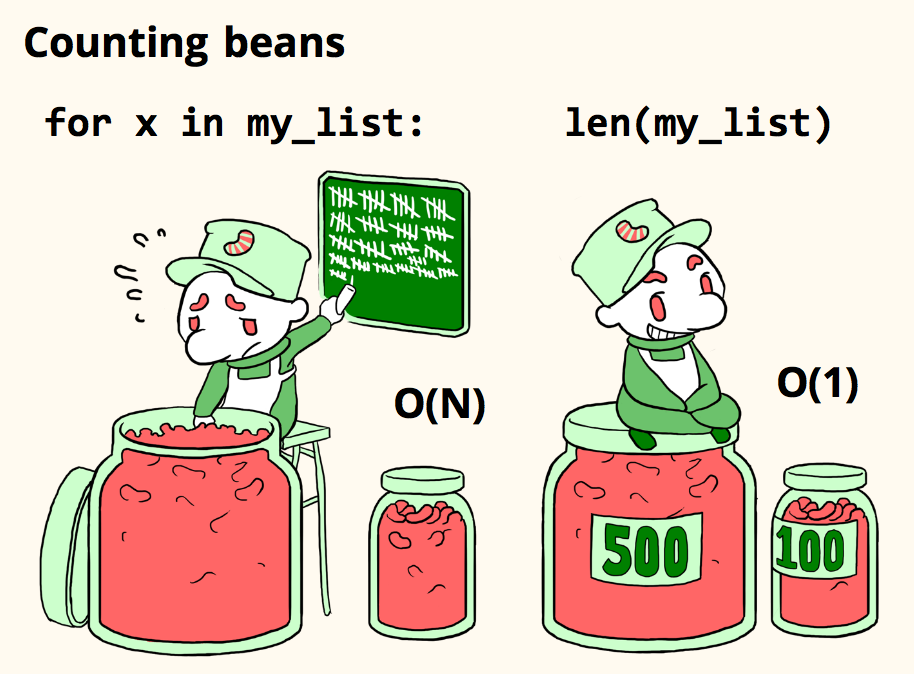
Big-O notation can be intimidating, but it doesn’t have to be. A common-sense approach will give you a good working technique for analyzing the time complexity of your code.
austere sparrow
austere sparrow
When you call `print_numbers_down_from(4)`, it creates a 'frame' where all the l...
Perhaps this visualization will help:
http://pythontutor.com/visualize.html#code=def print_numbers_down_from(n)%3A
print(n)
if n > 0%3A
print_numbers_down_from(n - 1)
print_numbers_down_from(4)&cumulative=false&curInstr=0&heapPrimitives=nevernest&mode=display&origin=opt-frontend.js&py=3&rawInputLstJSON=[]&textReferences=false
Or this one, for the factorial: http://pythontutor.com/visualize.html#code=def factorial(n)%3A
if n %3D%3D 1%3A
return 1
else%3A
return n * factorial(n - 1)
print(factorial(5))&cumulative=false&curInstr=0&heapPrimitives=nevernest&mode=display&origin=opt-frontend.js&py=3&rawInputLstJSON=[]&textReferences=false
fiery cosmos
last fulcrum
Yes that is what I'm using right now.
Ok, thank you again
last fulcrum
Ok thank you @austere sparrow @onyx root I think what is confusing me is that I've never seen 5 different function calls happening.
fiery cosmos
onyx root
<@456226577798135808> if you want to learn the basics of Big-O, this is a good l...
Thank you
fiery cosmos
onyx root
<@456226577798135808> if you want to learn the basics of Big-O, this is a good l...
Is that you in the video?
onyx root
fiery cosmos
Is that you in the video?
yes 🙂
last fulcrum
fiery cosmos
Ok, thank you again
Here is the table of contents. Plus it teaches Python and OOP if you've never learnt them.
 austere sparrow
smh rule 6  @onyx root||/s||
onyx root
austere sparrow
smh rule 6 <:lemon_pensive:754441880246419486> <@!424559318617161740>||/s||
that's the second time today i saw /s. what does that mean?
fiery cosmos
onyx root
yes 🙂
Wow, cool. I like the way how you explain
austere sparrow
onyx root
that's the second time today i saw `/s`. what does that mean?
it means that the preceding phrase was sarcasm, not serious
last fulcrum
@austere sparrow I really understood the print_numbers function. Not sure why it's not clicking for the factorial haha
austere sparrow
last fulcrum
<@!461097636791844865> I really understood the print_numbers function. Not sure ...
do you have Thonny?
it has a really good visual debugger
I'll show a screenshot, but I have 2gb of updates to download
last fulcrum
Nope. But I just understood the factorial also. I'll explain so you tell me if it's right
onyx root
austere sparrow
it means that the preceding phrase was sarcasm, not serious
thanks, i gathered it meant that, but didn't know why "s" 🙂
last fulcrum
So it's 5 right, then it calls the function on 5 saying factorial (5-1)
So now it's 4. So it calls the function on itself saying again 4-1, so it's basically like it stores the number subtracted and then on the next call uses that number.
austere sparrow
It's not really "changing n", it just spawns an entirely separate function call, which will have its own, completely separate n variable.
onyx root
@last fulcrum Look at this example:
def foo(n):
    print(n)

n = 5
foo(10)
print(n)
The call to foo doesn't change the n on the outside, only the n on the inside
last fulcrum
!e
def foo(n):
print(n)
n = 5
foo(10)
print(n)
halcyon plankBOT
@last fulcrum :white_check_mark: Your eval job has completed with return code 0.
001 | 10
002 | 5
So basically we give number to the function, that number then becomes a local variable, and then because the function is calling itself, each number becomes a separate local variable?
onyx root
last fulcrum
So basically we give number to the function, that number then becomes a local va...
exactly
austere sparrow
Imagine a shady Amazon seller. When you buy a book from him for $20, he goes on to buy it from another seller for $16. That seller in turn buys from another seller for $14, who just had it laying around.
Each of those transactions will have its own price, order ID etc.
last fulcrum
austere sparrow
Each of those transactions will have its own price, order ID etc.
Ok. Go on. And that's a great example
So I have one more question.
So then if it's doing separate calls how does it combine them all when it reaches the base case?
austere sparrow
def factorial(n):
    if n == 1:
        return 1
    else:
        return n * factorial(n - 1)
If you call factorial(1), it's going to return 1.
If you call factorial(2), it's going to return 2 * factorial(1), which will in turn call factorial(1), which will return 1, so the result is 2
If you call factorial(3), it's going to return 3 * factorial(2), which will in turn call factorial(2), which will return 2 (as shown above), so the result is 6
If you call factorial(4), it's going to return 4 * factorial(3), which will in turn call factorial(3), which will return 6 (as shown above), so the result is 24
You could change the function like this:
def factorial(n):
    if n == 1:
        return 1
    else:
        previous = factorial(n - 1)
        return n * previous
```, maybe that will help.I like this better. Thank you and @onyx root for explaining to me
austere sparrow
last fulcrum
I like this better. Thank you and <@!424559318617161740> for explaining to me
Maybe you'll understand it better if you implement this function:
def flatten(a_list):
    ...

>>> flatten([1, 2, 3])
[1, 2, 3]

>>> flatten([1, 2, [3, 4], 5, [6, 7]])
[1, 2, 3, 4, 5, 6, 7]

>>> flatten([1, 2, [3, [4, 5]], [6, 7], [[[8, 9], 10]]])
[1, 2, 3, 4, 5, 6, 7, 8, 9, 10]
I'll work on it. Going to bed now. And thanks once again
austere sparrow
👍
 sick dagger
Hi! I was browsing the internet and found this golden ratio formula. I tried to code it, unfortunately it seems endless and I have trouble conceptualizing the code. Someone would have any idea ? Thank you.
 austere sparrow
sick dagger
Hi! I was browsing the internet and found this golden ratio formula. I tried to ...
austere sparrow
sick dagger
Hi! I was browsing the internet and found this golden ratio formula. I tried to ...
Have you tried some implementation?
 topaz swallow
fiery cosmos
topaz swallow
fiery cosmos
@onyx root Could you please recommend an algorithms and data structure book?
onyx root
fiery cosmos
<@!424559318617161740> Could you please recommend an algorithms and data structu...
I don't have a recommendation.
fiery cosmos
I just want to have sevral choices
fiery cosmos
onyx root
I don't have a recommendation.
What's your source by the way
A favorite source
keen hearth
fiery cosmos
<@!424559318617161740> Could you please recommend an algorithms and data structu...
Check the pinned messages for some resource recommendations.
onyx root
fiery cosmos
What's your source by the way
I don't know what to tell you, i don't have a source for data structures etc, I guess I google when i need things.
fiery cosmos
onyx root
I don't know what to tell you, i don't have a source for data structures etc, I ...
Okey, thank you
fiery cosmos
keen hearth
Check the pinned messages for some resource recommendations.
I saw but i'm searching for a good book which helps me to prepare for the coding interviews using Python
keen hearth
fiery cosmos
I saw but i'm searching for a good book which helps me to prepare for the coding...
A book called Cracking the Coding Interview is often recommended for interview prep. I own a copy but I've not read any of it, so can't vouch for its quality 😄 A very popular undergraduate algorithms textbook is _Introduction to Algorithms, by Cormen, Leiserson, Rivest, and Stein. It's a good textbook, but quite mathy.
onyx root
fiery cosmos
I saw but i'm searching for a good book which helps me to prepare for the coding...
On behalf of our industry, i would like to apologize in advance for coding interviews
fiery cosmos
keen hearth
A book called _Cracking the Coding Interview_ is often recommended for interview...
Heavy artillery math? 😄
fiery cosmos
onyx root
On behalf of our industry, i would like to apologize in advance for coding inter...
But why? There is no problem i think
onyx root
fiery cosmos
But why? There is no problem i think
they expect you to write code on a whiteboard, while someone is watching, with no tools. You will never have to do that on the job.
they expect you to implement red-black trees, or something, which you will never have to do on the job.
if you can study for the interview, then what is the interview assessing?
fiery cosmos
onyx root
if you can study for the interview, then what is the interview assessing?
Interesting
austere sparrow
sick dagger
Hi! I was browsing the internet and found this golden ratio formula. I tried to ...
The trick to computing infinite fractions is usually to take some initial value and substitute it for the ....
For example, if you pick 1 for ... and some random depth, you end up with
phi = 1 + (1/(1 + (1/(1 + 1/(1 + 1/(1 + 1/(1 + 1/(1 + ...))))))))
phi = 1 + (1/(1 + (1/(1 + 1/(1 + 1/(1 + 1/(1 + 1/(1 + 1))))))))
...which is 1.619047619047619.
The way you could get up to this point is, for example:
- take some value as your result, like
1 - compute
1 + 1 / (1 + result). It's going to be a slightly better approximation. - store the new approximation
- go to step 1
However, this gets a bit tricky.
Let's try to find an exact solution for phi:
φ = 1 + 1/φ
φ^2 = φ + 1
φ^2 - φ - 1 = 0

φ = (1 + √5)/2
φ = (1 - √5)/2
So there are two solutions to this equation.
If you try to substitute some number (except -1) using the algorithm above, you'll be slowly approaching (1 + √5)/2 (approx. 1.618). However, if you choose (1 - √5)/2 (approx. -0.618) as your starting point, you'll get:
φ0 = (1 - √5)/2

φ1 = 1 + 1/φ0 = 1 + 2/(1 - √5) = ((1 - √5) + 2)/(1 - √5) = (3 - √5)/(1 - √5)
Using some transformations (e.g. using the proportion rule, (3 - √5)/(1 - √5) = (1 - √5)/2 <=> (6 - 2√5) = (1 - √5)(1 - √5) <=> 6 - 2√5 = 6 - 2√5), you can see that you end up at the same point, and result is going to stick to (1 - √5)/2.
(with floating point numbers, of course, it's going to eventually drift, but it's still going to do that very slowly).
oops sorry for the text wall
fiery cosmos
onyx root
they expect you to write code on a whiteboard, while someone is watching, with n...
But I think it's good idea to check problem solving skills which is very important to get fast and optimized solutions. But i'm not sure. What do you think about this
austere sparrow
if you implement your own optimized red-black tree for a simple CRUD application, you'll probably get fired 👀
onyx root
fiery cosmos
But I think it's good idea to check problem solving skills which is very importa...
problem solving is a good thing to assess. I just don't see how studying data structures will help with an interview that assesses problem solving.
fiery cosmos
onyx root
problem solving is a good thing to assess. I just don't see how studying data s...
So again what do you think which is the most reliable way to do that?
onyx root
fiery cosmos
So again what do you think which is the most reliable way to do that?
Practice solving problems.
have you built anything interesting?
 wide lake
hey guys just completed the basic of python if i want to start dsa where do i start like any youtube channels,books,websites
any recommend
oak spindle
wide lake
hey guys just completed the basic of python if i want to start dsa where do i st...
i'm also in the same path, if you get anything share with me too
stable pecan
austere sparrow
if you implement your own optimized red-black tree for a simple CRUD application...
job security
austere sparrow
stable pecan
job security
well, hopefully the company has code reviews 👀 👀
fiery cosmos
onyx root
have you built anything interesting?
I think yes but not many
I guess it wasn't about competitive problem solving, right?
 indigo radish
wide lake
hey guys just completed the basic of python if i want to start dsa where do i st...
indigo radish
wide lake
hey guys just completed the basic of python if i want to start dsa where do i st...
Geeeks4geeks for concepts.
Leetcode best for practicing learned concepts, filter by tags.
Elements of programming interviews Python edition, nice variety of questions, but solutions are little difficult.
But the theory of book, the approach is nice.
fiery cosmos
sick dagger
Hi! I was browsing the internet and found this golden ratio formula. I tried to ...
golden ratio is irrational.
Infinite and no pattern
you have formula to get closer, but never exact
Like pi
last fulcrum
For binary search, is it better if your item has not been found to make the new upperbound the mid - 1 or is just mid?
Same thing for lowerbound if the item has not been found (mid + 1 or mid)
And is it better to use iteration or recursion for binary search?
runic tinsel
performance-wise iteration is always better, you use recursion for aesthetic reasons like readability
well not always, often it's the same, depends on the compiler
for python you want iteration
last fulcrum
Anyone knows what I'm doing wrong?
def binary_search(sequence, item_to_find):
    lowerbound = 0
    upperbound = len(sequence) - 1

    while lowerbound <= upperbound:
        midpoint = (lowerbound + upperbound) // 2

        if sequence[midpoint] == item_to_find:
            return sequence[midpoint]

        elif sequence[midpoint] < item_to_find:
            upperbound = midpoint

        else:
            lowerbound = midpoint
    return None
Why is it >?
And why can't you do midpoint = lower, but you have to add one
runic tinsel
[1,2] and you look for 2
midpoint is 0
you change lower bound to 0, nothing changed
just how numbers work out
last fulcrum
runic tinsel
midpoint is 0
It would be 1. 0 + 2 // 2 == 1
last fulcrum
Ok makes sense.
 fierce wolf
hi there, I feel like I have been given a question in this practice paper which is not totally accurate and was hoping someone could help me understand. I need to apply branch-and-bound technique to a knapsack problem - but I need to do this by using jumptracking and not backtracking
I was under the impression knapsack problems were solved using backtracking and machine learning type problems were solved with jumptracking
so i'm at a loss when trying to solve a knapsack problem with jumptracking, any help is appreciated thank you

 shut phoenix
why does this doesnt work? (Ive a file were is the data I need, and its called codigos.py), appears an error in there
from Codigos import English

objQuestionnaire = English()

objQuestionnaire.empezar()
objQuestionnaire.respuestas()
objQuestionnaire.imprimir()
You probably want a help channel (see #❓|how-to-get-help), this doesn't appear to be DSA-related.
(also, please post the error you get if you do)
shut phoenix
okok, thanks
dapper sapphire
If we modify the current array/list, we are not using any extra space, then is it considered O(1)?
vocal gorge
Yes, inplace doesn't count as extra memory. For example, many inplace sorts are O(1) extra memory.
(timsort among them, I think)
dapper sapphire
ok got it thanks!!
fiery cosmos
Hi, Is this the right place to ask about resources related to algorithms and ds in python?
vocal gorge
Yup
fiery cosmos
So I've been looking for resources lately, I tried CLRS, Princeton Uni's course on Algorithms, elements of programming interview in python but none of them were good for me atleast. I was looking for something which would just explain me the basic algorithms, ds and maybe the implementation from scratch w/o importing anything, I'm ok with video lectures but I prefer articles/books.
jagged oasis
I recommend implementing data structures by hand in another language.
marble bronze
Is there anyone here knowledgeable about BSTs and heaps?
 drifting drum
Came across this question in some test:
You have an array of integers.
You're supposed to remove those elements A[i] which satisfy A[i] > A[i-1]
Do this until you cannot find any more pairs. How many rounds does it take till you cannot find any more pairs?
For example
[3, 6, 2, 7, 5]
After 1 round, it becomes [3, 2, 5]
After 2 rounds, it becomes [3, 2]
And then it stays that way forever so the answer would be 2

Another example is:
[6, 5, 8, 4, 7, 10, 9]
After 1 round, [6, 5, 4, 9]
After 2 rounds, [6, 5, 4]
Then it stays that way
Constraints were len(arr) <= 10^5
Initially thought it had to do with next smaller element and stacks, but then got stuck
thoughts?
I also tried simulating it, but that timed out ofcourse
vocal gorge
can't you do it in one pass? Like, just extract a descending subsequence from the list
iterate over the list, remembering the last accepted element. The first element is accepted, then accept only elements <= the remembered one.
drifting drum
vocal gorge
can't you do it in one pass? Like, just extract a descending subsequence from th...
well you're supposed to extract subarrays, not subsequences right cuz it states A[i] < A[i-1]
or maybe I don't understand clearly what you're trying to say
erm, okay you mean get rid of the elements that satisfy that condition
okay but then?
vocal gorge
You need to remove all elements that's higher than the previous one. So for an element to remain, it has to be <= the previous one, and therefore <= than all previous ones
vocal gorge
therefore, you just need to accept only elements that are lower or equal to the last accepted element
and that's pretty much it
a single pass over the list, O(n) complexity
drifting drum
how does that give us the number of rounds?
getting the numbers that remain in the end is easy, O(N) with a stack, yes.
However, the # of rounds is what's required.
vocal gorge
oooh, I totally missed this. Hmm...
perhaps the number of turns for a number to get removed is something like "how many positions away the previous lower number is"
drifting drum
so did I, when I was solving it initially. Implemented the same idea before realising it -.-
haha, yeah I thought so too but then it's easy to come up with counterexamples for that
1, 10, 11, 12, 13, 4
vs
1, 10, 11, 12, 13, 14, 15, 16, 17, 18, 4
Both cases require 2 days
and I tried handling that but then it got tricky because there can be examples like above where you need 3 days, 4 days, more
vocal gorge
A number that gets removed but doesn't get removed right away must be a part of a nonincreasing subsequence that starts with a higher number than the last accepted number before it, so, hmm
vocal gorge
hmm, indeed it's not obvious
drifting drum
thank you for saying that, makes me feel less bad that I couldn't solve it 😄
vocal gorge
I do feel like it's the right way to dig, though - for each nonincreasing subarray, determine how many numbers need to be chipped off of it
drifting drum
yeah essentially you could simulate it till you realise there's no increasing subarrays left anymore
but that's gonna time out
vocal gorge
in these cases, the subsequence is 13,4, and it needs to lose 1 number in the first (because then 5>4) and 2 in the second case (because 1 is lower than both of them)
drifting drum
yeah, I think getting the numbers isn't the hard part
vocal gorge
I feel like it might be, for each nonincreasing subarray, the number of numbers in it that's higher than the last accepted number
and then you take the max over all these counts to get the value for the entire list
drifting drum
I mean, getting the final list of numbers that survive
i was thinking of cases where you have like
p , .....q, ..... , r, ......, s,..... w
the dots are the elements that are going to get removed
so if q > p, then q needs 2 days.
and then if r < q and r > p, it will need 3 days
but if r > q, it needs 2 days
but if q < p
then, it's like q becomes the new p
and now if r > q, r needs 2 days.
and if r < q, then.. r becomes the new q? and in turn the new p
and that's like
O(N^2) again because
it really makes no difference whether our array was
p , .....q, ..... , r, ......, s,..... w
or
p, q, r, s , w
because in the worst case
we could have p > q > r > s
and for w, we might have to wound back all the way upto p to check whether it gets removed
Agh, now that I think of it
TreeSet sounds like such a good idea
Oh god -.-
that would give us the position of w in the array [p, q, r, s] and essentially the number of days, in log(n) time
hm, I'm still fuzzy about it, maybe I'm just wrong
vocal gorge
drifting drum
hm, I'm still fuzzy about it, maybe I'm just wrong
it still sounds to me like you don't need any ds here. Like...
def rounds(nums):
    accepted = last = nums[0]
    max_rounds = 0
    noninc_count = 0
    for num in nums[1:]:
        #print(num,accepted,max_rounds,noninc_count)
        if num<=last:
            # we're in a nonincreasing subsequence
            noninc_count += 1
            if num <= accepted:
                max_rounds = max(max_rounds, noninc_count+1)
                accepted = num
                noninc_count = 0
        else:
            noninc_count = 0
        last = num
    max_rounds = max(max_rounds, noninc_count+1)
    return max_rounds
this seems to pass all examples you posted
drifting drum
vocal gorge
it still sounds to me like you don't need any ds here. Like...
```py
def rounds(...
The examples I posted initially? Those are the easy ones
This for example
fails nums = [5, 10, 11, 12, 4]
well, probably this is an easy one too, but what I meant to say is there were many more cases yeah
I failed on like the last 2 amongst all their cases
and ofc, the cases weren't revealed
now the answer for this case btw, should be 1, the code outputs 2
vocal gorge
def rounds(nums):
    accepted = last = nums[0]
    max_rounds = 0
    noninc_count = 1
    for num in nums[1:]:
        if num<=last:
            # we're in a nonincreasing subsequence
            noninc_count += 1
            if num <= accepted:
                #print(num,accepted,max_rounds,noninc_count)
                max_rounds = max(max_rounds, noninc_count-1)
                accepted = num
                noninc_count = 0
        else:
            noninc_count = 1
            #print(num,accepted,max_rounds,noninc_count)
        last = num
    max_rounds = max(max_rounds, noninc_count)
    return max_rounds
passes it. Actually, lemme build a proper automatic tester...
drifting drum
well this one would fail on
nums = [5, 10, 11, 12, 6, 7]
drifting drum
drifting drum
i was thinking of cases where you have like
p , .....q, ..... , r, ......, s,......
it's very similar to what I'm talking about here
vocal gorge
ah, I see
I generated an example [0, 1, 1, 2, 1]
which... yeah, it shows why my approach is flawed
my approach would predict that both subsequences here 1,1 and 2,1 dissolve in 2 turns
but in reality, after one turn, 0,1,1 is left, and the second 1 doesn't dissolve on that turn
drifting drum
also, let's just assume numbers are unique right now
(not that it changes anything ofcourse)
and yes, correct
vocal gorge
here's the automated tester I used, using hypothesis to generate examples:
from hypothesis import given, strategies as st

def rounds_exact(nums):
    """Inefficiently (but, hopefully, correctly) calculates rounds needed by simulating"""
    nums = list(nums)#copy
    rounds = 0
    while True:
        new = [nums[0]]
        skips = 0
        for i in range(1,len(nums)):
            if nums[i] > nums[i-1]:
                skips += 1
                continue
            new.append(nums[i])
        if skips == 0:
            break
        rounds += 1
        nums = new
    return rounds

# make hypothesis disprove this.
# Limiting the list size to 1000, otherwise rounds_exact would be too slow.
@given(st.lists(st.integers(0,1000),min_size=2,max_size=1000))
def test_rounds(nums):
    true = rounds_exact(nums)
    calc = rounds(nums)
    assert true==calc,(true,calc)

test_rounds()
ah, quite cool
what's the st.lists() and given decorator doing
@given(st.lists(st.integers(0,1000),min_size=2,max_size=1000))
oh, building a list of ints from 0-1000 of 2 <= size <= 1000
hm
vocal gorge
drifting drum
what's the st.lists() and given decorator doing
`@given(st.lists(st.integers(0,1...
basically, hypothesis can automatically generate disproving test examples (mostly randomly, though once it finds one, it does smart stuff to reduce it to a hopefully-minimal one)
the decorator here describes the parameters - that nums should be a list of size 2 to 1000 of integers from 0 to 1000
 gleaming kite
wow, cool
gleaming kite
how it works? by trying to fuzz whole AST?
vocal gorge
gleaming kite
how it works? by trying to fuzz whole AST?
you need to provide parameters for what input strategy to use (like, here, a list of ints)
austere sparrow
it can also use type hints to infer the data to generate, which is cool
(if your data doesn't have additional constraints)
vocal gorge
as for how exactly it works, uhh... I'm trying to read the source but it's unclear. I think it generates examples randomly starting from "simple" ones, but a lot of the niceness comes from it being able to shrink a disproving example to a simpler one
gleaming kite
https://hypothesis.readthedocs.io/en/latest/details.html#use-with-external-fuzzers
looks like it support multiple fuzzers, this can be very useful for many use case, cool
vocal gorge
this is the function used to decide whether to stop adding elements to a list, say:
https://github.com/HypothesisWorks/hypothesis/blob/2b7d74e5621057d0c9f0fcfbae8de1c80fbacfc9/hypothesis-python/src/hypothesis/internal/conjecture/utils.py#L164
halcyon plankBOT
hypothesis-python/src/hypothesis/internal/conjecture/utils.py line 164
def biased_coin(data, p, *, forced=None):```it has... quite a bit of comments
 fallen breach
Hi ! I have a problem ! I have a data file with an array of 7221721721171, I would like to split whenever it meets the number 7
the result I want is : [7..],[7..],[7..] , I tried np.split but I have some difficulties . thx you !
 past escarp
is there a library that has max_heap implemented? i only found minheap
fiery cosmos
Negate all the numbers
past escarp
k thanks
loud trail
fallen breach
Hi ! I have a problem ! I have a data file with an array of 7221721721171, I wo...
is the data in a text file? or is it already loaded as a numpy array?
are there any performance constraints? is the file really big?
fallen breach
loud trail
is the data in a text file? or is it already loaded as a numpy array?
hey the datas are loaded in text file
fallen breach
loud trail
are there any performance constraints? is the file really big?
nope , I can reduce it
halcyon plankBOT
Hey @fallen breach!
Uh-oh! It looks like your message got zapped by our spam filter. We currently don't allow .txt attachments, so here are some tips to help you travel safely:
• If you attempted to send a message longer than 2000 characters, try shortening your message to fit within the character limit or use a pasting service (see below)
• If you tried to show someone your code, you can use codeblocks
(run !code-blocks in #bot-commands for more information) or use a pasting service like:
fallen breach
so basically the problem is I have 2 list
 scenic goblet
how to implement dfs in edge list vector<pair<int,int>>edges
loud trail
fallen breach
hey the datas are loaded in text file
you can do it the "stupid way" like this
text = '7221721721171'
sections = []
section = []
for c in text:
    if c == '7':
        sections.append(section)
        section = [c]
    else:
        section.append(c)
print(sections)
!e ```python
text = '7221721721171'
sections = []
section = []
for c in text:
if c == '7':
sections.append(section)
section = [c]
else:
section.append(c)
print(sections)
@loud trail :white_check_mark: Your eval job has completed with return code 0.
[[], ['7', '2', '2', '1'], ['7', '2', '1'], ['7', '2', '1', '1']]
I have another question , well basically this list is associated with time , how can I apply it on it ?
fallen breach
loud trail
!e ```python
text = '7221721721171'
sections = []
section = []
for c in text:
...
thx you a lot !
 dull yoke
hello guys, I have a deque with maxlen of 50 items that belongs to [0, 640].
Most of the items fluctuate minimally with the range of about 50 or 60. But suddenly, some items emerge from the graph, rise above or go lower than the fluctuation range. How do I detect that change?
the reason it is maxlen of 50 is because the deque is updated per frame.
loud trail
fallen breach
I have another question , well basically this list is associated with time , how...
can you clarify this further? this might also be more suited for a help channel as per #❓|how-to-get-help .
fallen breach
loud trail
can you clarify this further? this might also be more suited for a help channel ...
may I talk to you in DM ?
loud trail
i'd rather not, sorry
fallen breach
okay so basically I have two lists one with a serie of numbers and the second with the time associated
I asked how to split for the numbers and now I have to split for the time and then substract
for example : [7112],[7212] and the time associated [0,1,2,3],[4,5,6,7] and then I have to substract the second list ( there's a lot of number in the file ) [0,1,2,3],[4-4,5-46-4,7-4] @loud trail
loud trail
you want to subtract the first number in a list from every number in the list?
are these lists, or numpy arrays?
 ashen forge
 tranquil vigil
Is there anyone who can mentor me?
tranquil vigil
Is there anyone who can mentor me?
In which topic you want us to mentor you?
ashen forge
tranquil vigil
Is there anyone who can mentor me?
in DSA??
 lean spruce
https://paste.pythondiscord.com/novesuwohi.lua How to replay game (code) ?
After typing yes in input?
loud trail
@lean spruce you'd have to put the entire thing in another while loop
lean spruce
loud trail
<@!570276481268449310> you'd have to put the entire thing in another `while` loo...
while yes:
loud trail
sure, something like that
maybe it's a good idea to put your entire game into a function
def run_game():
    ...

def ask_yn(prompt):
    ask_repeat = True
    while ask_repeat:
        user_val = input(prompt).strip().lower()
        if user_val == 'n':
            return False
        elif user_val == 'y':
            return True
        else:
            print('That is not a valid response.')

def main():
    play_game = True
    while play_game:
        run_game()
        play_game = ask_yn("Play again? y/n: ")
        if play_game:
            print('Again!')
    print('Goodbye!')
something like this
 grizzled hemlock
Does anyone have a good article where I can learn about algorthims in terms of N+1 , N(0), etc...?
please ping me if you do! 🙂
austere sparrow
grizzled hemlock
Does anyone have a good article where I can learn about algorthims in terms of N...
Maybe you mean O-notation? 🙂
Try this article: https://nedbatchelder.com/text/slowsgrows.html
ashen forge
grizzled hemlock
Does anyone have a good article where I can learn about algorthims in terms of N...
geeksforgeeks has pretty good articles about time complexities
grizzled hemlock
Thanks for your recommendations 🙂
grizzled hemlock
austere sparrow
Maybe you mean O-notation? 🙂
That's probably what I meant haha, would N+1 be considered O-notation?
austere sparrow
No, that's not correct O-notation
grizzled hemlock
What term am I looking for that would explain N+1 complexities?
austere sparrow
grizzled hemlock
What term am I looking for that would explain N+1 complexities?
I don't understand what you're referring to.
Did you find that somewhere?
Maybe you are referring to the 'N+1 problem'?
grizzled hemlock
Algorithms that suffer from N+1 , sorry I'm a bit of a noobie with time complexity.
grizzled hemlock
austere sparrow
Maybe you are referring to the 'N+1 problem'?
Yes!
Is that just how it's referred to, N+1?
austere sparrow
That's not really related to algorithms in general. It's about making N+1 queries when you really need 1.
https://stackoverflow.com/questions/97197/what-is-the-n1-selects-problem-in-orm-object-relational-mapping
grizzled hemlock
Gotcha understood
ashen forge
grizzled hemlock
Algorithms that suffer from N+1 , sorry I'm a bit of a noobie with time complexi...
What study material are you referring to
grizzled hemlock
ashen forge
What study material are you referring to
Just trying to prepare for a Python technical interview. So if they ask for time-complexity questions related to my algo's, I have it nailed down.
ashen forge
grizzled hemlock
Just trying to prepare for a Python technical interview. So if they ask for time...
Okay
Time complexity is integral part of DSA
I learnt it from geeksforgeeks
grizzled hemlock
Yeah I just visited the many articles they have about time complexity
super useful stuff, thank you 👍
fervent saddle
It’s what type of line you’d see if you graphed how long something took vs how much data you have
So finding the length of a list is a flat horizontal line, it’s O(1), since lists keep track of their length
And finding the index position of something in an unsorted list would be a flat diagonal line, it would be O(n)
Like if the x axis was how much data you have, and the y axis was how long it took to do it
That’s why constant factors don’t matter for finding something’s time complexity
Because it doesn’t change what kind of line you see
grizzled hemlock
I see
grizzled hemlock
fervent saddle
And finding the index position of something in an unsorted list would be a flat ...
What would happen if the list is sorted? @fervent saddle
fervent saddle
Then you could use binary search
I mentioned it being unsorted so it’s clear that I’m talking about linear search and not binary search
grizzled hemlock
what notation would binary searches be?
fervent saddle
O(log(n))
fiery cosmos
Hey anyone who can code discord bots. I am willin to pay or do what ever you want. I just want my own discord bot for my discord server..
 sturdy crest
why do we have gaming flag at the background?
sturdy crest
fiery cosmos
Hey anyone who can code discord bots. I am willin to pay or do what ever you wan...
ey you can learn it...there is a bunch of good tutorial in yt
 cinder wigeon
fiery cosmos
Hey anyone who can code discord bots. I am willin to pay or do what ever you wan...
cinder wigeon
fiery cosmos
Hey anyone who can code discord bots. I am willin to pay or do what ever you wan...
you can find an open source bot and just host it
 inland forge
fiery cosmos
Hey anyone who can code discord bots. I am willin to pay or do what ever you wan...
inland forge
fiery cosmos
Hey anyone who can code discord bots. I am willin to pay or do what ever you wan...
Check #discord-bots
 stiff oyster
Hello there, I'm not sure were to ask. I try to build a data line graph with dash and plotly. The CSV sadly seperats the date in two rows: Date and Time. Is there an easy way to combine this rows with panda? So i can display the datetime on my x scale?
 gilded kernel
hi
py
import random
word_list = ["aardvark", "baboon", "camel"]

chosen_word = random.choice(word_list)

print (chosen_word)
guess = input("chose a word ").lower()

display = ['-']
for i in chosen_word:
    if guess==i:
        print(guess)
    else:
        print(display)
how can i print my output vertically
please teach me am new to python
 cerulean elk
gilded kernel
how can i print my output vertically
cerulean elk
gilded kernel
how can i print my output vertically
wdym vertically?
last fulcrum
Each cell of an array must use the same number of bytes. This is true in statically typed languages like C, since I have to do
int data[100]; so everything in memory would be the same since they are all int's. In Python, the language is dynamically typed, so I can do list_1 = ['a', 'b', 4, 4, 4.0]. An int, a character and a float would all take up different spaces in memory, so how does the statement work in Python?
 west hollow
Hello!
austere sparrow
last fulcrum
**Each cell of an array must use the same number of bytes.** This is true in sta...
Are you familiar with C?
In C, int data[100] creates a contiguous chunk of 400 bytes, and all the ints are stored in that chunk. However, you can make an array of pointers: char* strings[100]. Now you have an array of 100 strings, but the array itself only stores the memory addresses of where each string begins.
 jaunty cave
austere sparrow
In C, `int data[100]` creates a contiguous chunk of `400` bytes, and all the int...
jaunty cave
austere sparrow
In C, `int data[100]` creates a contiguous chunk of `400` bytes, and all the int...
U have to add const to make it works
fiery cosmos
Can someone suggest me a good python data structures algorithm book or video tutorials?
austere sparrow
jaunty cave
U have to add ```const``` to make it works
hm?
No, you don't, const just means that you can't change something.
last fulcrum
austere sparrow
Are you familiar with C?
Yes
austere sparrow
last fulcrum
Yes
does my explanation make sense?
last fulcrum
Click on my profile. And yes it makes sense
unborn sundial
!e
import contextlib

@contextlib.contextmanager
def withandler(var):
    try:
        print("start stuff")
        yield var
    finally:
        print("finish stuff")


with withandler("123") as var:
    print(f"do stuff = {var}")
@unborn sundial :white_check_mark: Your eval job has completed with return code 0.
001 | start stuff
002 | do stuff = 123
003 | finish stuff
more decorators to the throne of decorators
loud trail
!e ```python
import contextlib
@contextlib.contextmanager
def withandler(var):
print("start stuff")
try:
yield var
finally:
print("finish stuff")
with withandler("123") as var:
print(f"do stuff = {var}")
i'd do it like this@loud trail :white_check_mark: Your eval job has completed with return code 0.
001 | start stuff
002 | do stuff = 123
003 | finish stuff
 hollow skiff

last fulcrum
@austere sparrow can you help me explain this. The part of the referential structure.
Most significantly, the overall memory usage will be much lower for a compact structure because there is no overhead devoted to the explicit storage of the sequence of memory references (in addition to the primary data). That is, a referential structure will typically use 64-bits for the memory address stored in the array, on top of whatever number of bits are used to represent the object that is considered the element.
jaunty cave
austere sparrow
No, you don't, `const` just means that you can't change something.
Yes thats the only way to make array of strings from array of char pointer without warning after compiling. This is happening when g++ is used as compiler. To make array of string that is editable, u have to make 2 dimensional array of char, not array of char pointer.
const char* strings1[100];     //this is non-editable
char strings2[100][101];       //this is editable
If you make a char* strings1[100], the strings will be perfectly editable, it's just that you can't put read-only strings into it.
A string literal like "Hello!" will point into a read-only part of memory, and not create a new string on the heap or the stack.
This: ```c
#include <stdlib.h>
#include <stdio.h>
#include <string.h>
int main() {
char* strings[2];
char* hello = malloc(strlen("Hello!") + 1);
strcpy(hello, "Hello!");
char* world = malloc(strlen("world") + 1);
strcpy(world, "world");

strings[0] = hello;
strings[1] = world;
printf("%s %s\n", strings[0], strings[1]);

free(hello);
free(world);
}
(also, g++ is for C++, not C)
last fulcrum
austere sparrow
If you make a `char* strings1[100]`, the strings will be perfectly editable, it'...
I miss malloc and pointers. Now python does everything
austere sparrow
last fulcrum
I miss malloc and pointers. Now python does everything
Yeah, the sky was bluer and the grass was greSegmentation fault (core dumped)
last fulcrum
austere sparrow
Yeah, the sky was bluer and the grass was greSegmentation fault (core dumped)
😂 Still, I think every new programmer should learn C before python. Makes understanding low lvl things far easier.
austere sparrow
last fulcrum
😂 Still, I think every new programmer should learn C before python. Makes unde...
I would probably have given up programming if I started with C.
last fulcrum
austere sparrow
I would probably have given up programming if I started with C.
C is hard, no doubt. But the knowledge you get is so much. Most people would never learn C after python because python is far easier. So start with hard, then go to easy. But I digress.