#algos-and-data-structs
1 messages · Page 64 of 1
 fallow agate
 modern gulch
fallow agate
These patterns, you learnt from anywhere?
modern gulch
fallow agate
These patterns, you learnt from anywhere?
I guess, most DSA classes teach the same topics. Binary search, etc.
The planting problem above strikes me as a DP problem: it's not going to lend itself to some convenient solution other than brute force with optimization.
 narrow mica
DP prolly the way to go
i.e. let ||dp[i][c] := min if you planted flower type c at i||
fallow agate
modern gulch
I guess, most DSA classes teach the same topics. Binary search, etc.
ok, will check.
modern gulch
fallow agate
ok, will check.
Also, DSA is just one piece of learning software engineering. Make sure to do real projects... not just practice DSA.
fallow agate
modern gulch
Also, DSA is just one piece of learning software engineering. Make sure to do re...
also, i forgot to ask.
any source suggestion for system design ?
modern gulch
fallow agate
also, i forgot to ask.
any source suggestion for system design ?
To get good at system design? Just building projects.
Maybe also read/study real-world systems. I see this MIT OCW course too... never looked at it, but I like the syllabus: https://ocw.mit.edu/courses/2-882-system-design-and-analysis-based-on-ad-and-complexity-theories-spring-2005/pages/syllabus/ (might be lecture notes only tho)
modern gulch
But besides that, take any popular web-scale company: there's many articles that'll talk about their architecture and evolution and design decisions. Reddit, Twitter, Facebook, Amazon, Google Search, etc have fascinating histories
 haughty mountain
this seems like kinda textbook dp
let dp[i][j] be the smallest cost to plant the first i flowers, where the last planted flower was of type j
and you can express dp[i+1] in terms of dp[i]
the formula would be (in not quite python)
||dp[i+1][j] = min(dp[i][k] for k != j)||
 opal oriole
Yes, that is even better.
 west ocean
I’m allowed to send in images right?
opal oriole
Yeah.
west ocean

So let’s say this is our simple Binary tree
I want to insert 5
Each left child node must be less than the parent
While each right child must be greater than the parent

This is where the “binary search” of the binary search tree comes into play
Now to insert 5, we need to compare 5 with each node until we get to a leaf. If it’s less than the current node, it goes left, if it’s greater than the current node we go right
When we finally get to an leaf we append 5
 opal oriole
Ok, what are the fundamental building blocks here? That is the first part to convert to code. Identify the objects involved in this process, they will need a representation in code.
You can highlight them in your English sentences.
(For more simple algorithms, it often revolves around one object)
west ocean
Ok
The first value, the one you want to insert is 5
The second value is the node you are comparing 5 to
opal oriole
Ok, so two keywords there, value and node.
These things are fundamental objects present in the problem, that we will need to operate on.
west ocean
Hmmm
opal oriole
So keep a list of the objects, and mark them as needing some representation in code, there are multiple options for this, but they both need some implementation.
west ocean
I could write the possible sudocode here
opal oriole
Yeah, but before that I just want to list things at an even more high level.
west ocean
Oh, ok
opal oriole
So we know what must show up in the code somewhere.
west ocean
Mhm
opal oriole
Now a little asterisk on that, sometimes some things are reperesented implicitly, so no directly in code, but either way make that list.
opal oriole
west ocean
Now to insert 5, we need to compare 5 with each node until we get to a leaf. If ...
Ok, so next, make a list of actions that are taken, these will often show up as procedures / functions, etc in the code. They operate on/with the objects, and are transitions between states of the algorithm. They will often show up as verbs / near them. Can you spot them here?
west ocean
To insert 5, compare node, go left if lesser, go right if greater, run until leaf node
opal oriole
So we can "go left" and "go right" (based on some conditions).
And those transition us from the current state to the next state (which is now the new current state).
west ocean
So If/else statement?
opal oriole
west ocean
So If/else statement?
Yes, branches.
west ocean
Kk
opal oriole
So how is the "current state" represented? Which objects are used and how many? (from the list)
(Some objects are part of another)
The current state being the current place the algorithm is in / at at each step.
As in "state of being."
west ocean
“Current state” would be the first value of the comparable range of the branch to it’s leaf
opal oriole
Maybe this is what you meant, but let give another example. Say I have a house with 3 rooms, A, B, and C, and A <-> B <-> C is the layout, with "<->" meaning there is a door between them. If I start at A, and want to go to C, I can give a step by step instruction of start at A, go to B, go to C. My start state is "A," and I can represent my current state with just a single letter (the room name).
If I had in my object list "room," then each current state would be represented by one "room."
opal oriole
The important thing here is to think through time, where we have transitions between states through time, as the algorithm runs, and what is needed at each point in time.
west ocean
And after I compare the next value would be the new “current node”
west ocean
Ah, alright
opal oriole
Like moving from one room to another, the "current room" is updated to be what the "next room" was.
An algorithm runs through time, and so if we find out what is needed at each point in time to represent that point in time in code, and then what the transitions are (in the case of the binary tree, go left, and go right), and then when to do those transitions (the conditions), then we more or less have the solved problem.
opal oriole
The object list are the individual components, the binary tree is technically also in that list as it's the whole thing, but I meant from your English sentence describing the solution earlier, there were two other keywords, and they are what the binary tree is made of.
opal oriole
west ocean
Now to insert 5, we need to compare 5 with each node until we get to a leaf. If ...
The object i'm seeing here is "node."
And also there is "value."
west ocean
Oh
opal oriole
The tree is made of nodes, which hold values.
So for object list: tree node value
They can be found in your own English description, so if you are unsure about how to code it, start by highlighting these.
Next, you can write down the relationship between these.
"A tree is made of nodes that hold values."
Still just writing English, not code yet.
west ocean
Gotcha!
opal oriole
So next, we have the object and their relationships, what are the actions / transitions between states?
(Not conditions, just the actions themselves)
west ocean
Greater than or less than?
opal oriole
That would be conditions.
west ocean
Oh
opal oriole
You wrote them before, "go left," "go right."
west ocean
Left or right
opal oriole
Ok, so now we have ```
Objects:
tree
node
value
Tree is made of nodes which hold values.
Transitions/actions/operations:
Go left.
Go right.
We are missing a bit on the actions.
When we get to the end, we need to actually insert the value.
The final action.
west ocean
Mhm
opal oriole
If you have a "final" or "unique" action or object, mark it as such.
Using your wording from before "append the node."
To "go left," "go right," "append node." (final action).
Next, identify the conditions under which the actions happens.
west ocean
So now greater than or less than?
opal oriole
Yes.
west ocean
Kk
opal oriole
And try using the word "if."
So still in English, can you describe it?
And the previous list of objects and actions.
Try to use all of them.
west ocean
If the value 5 is greater than the value of node then go right
If the value 5 is less than value of the node then how left
If there are no more nodes append 5
opal oriole
Ok, so this is already more refined the the original, getting closer to code too.
So now lets refine it more.
What exactly does it mean to "go right?"
And to answer this you can partially get there by asking the question how "node" should be represented to make that as easy as possible to implement.
west ocean
The value 5 compares itself to the right child node
opal oriole
What information do you need at each point in time to make the decisions?
And where does it come from?
Where is it stored?
opal oriole
west ocean
The value 5 compares itself to the right child node
Ok, so how do we get the right child node? What would be a convenient way to have that available?
Given our current description, where do we pull that from? Which objects have it?
The objects hold all our data, so we know it has to be in one of them.
(Or multiple)
opal oriole
west ocean
If the value 5 is greater than the value of node then go right
If the value 5 is...
The only object being referenced here is "node."
And also "value."
Nodes hold values, so we know we are getting value from node.
So if you could define what is "inside" node, what would you like to be there?
We know value is in there.
Basically we need some way to fetch or compute the left and right children.
And so they need to be referenced somewhere in some way.
We can't pull them out of nothing.
Right now in the English description we are, because we have not given that detail yet, we just assume we have it somehow. Now we want to know how / where.
west ocean
How do we do that?
opal oriole
So there are multiple options, but the key thing here is that for every object involved, we need to be able have a reference to it somehow.
There are multiple ways to do this in code and I will give just one.
Are you fimiliar with classes in Python?
west ocean
Yes
opal oriole
Ok, what they let us do at the most basic level (and most important part) is bundle things together, this makes things concise and convenient as many variables are often used together in the same context.
(Passed around together, they are related)
Variables are a form of reference to an object / entity.
west ocean
Yep
opal oriole
So we know we need at least three references for our description. The value, the left child, and the right child. WIthout these we can't use our description.
We need them all at the same time.
When you need a bunch of things all the same time/place, a class can be a good tool to solve it.
Can you make a class with those three variables? What is the class name?
west ocean
I have to make one full class, right?
opal oriole
Yes.
opal oriole
That would contain everything. Think about one point in time what you need. The description you gave before.
You need the value, the left child, and the right child.
And node.
west ocean
Value which is 5
opal oriole
So without a class, you could just have ```
value = 5
node = ???
left_child = ???
right_child = ???
You need all 4 at that point in time.
opal oriole
Ok, but how do we "fetch" these?
They are stored somewhere in some way.
For the value it's simple, we are given it and can just set it once.
But at each step, we need to retrieve node, left child, and right child, and this depends on how/where we stores the nodes.
This is the datastructure part of data structures and algorithms.
We know that we want to store them in a binary tree structure, but how?
west ocean
Node.left_child and node.right_child???
opal oriole
Yes, but why?
Or how do we get there?
The key is taking the objects the structure (tree) is made of (nodes), and their relationships and encoding that in code.
west ocean
How though?
opal oriole
So see how in your diagram you have nodes pointing to other points?
In other words you can get from one to another.
So if I have a node, I have a reference / way to compute a reference to the children.
The key here is "references."
Variables are references.
west ocean
So node.left_child would be the value of the left child?
opal oriole
And so if I have a reference to node, I would like to have a reference to left and right nodes.
And also I would like a referenece to the value of that node.
In other words, node contains references to value, left node, right node.
Data structures is all about how you can get one thing to another via references.
And then setup in a clever way to make it efficient.
west ocean
How could I translate it into python though?
opal oriole
So we have nodes, and they have those things in them.
When you have a container, you can use a class.
class Node:
  def __init__(self, value, left_node, right_node):
    self.value = value
    self.left_node = left_node
    self.right_node = right_node
Now I can make Nodes.
And I can build a tree by setting up the references between them.
opal oriole
west ocean
# This is just the 25, no children yet.
root = Node(25, None, None)
# Add the children by making them and setting up the references, this is now a tree structure.
root.left_node = Node(15, None, None)
root.right_node = Node(30, None, None)
I think I get what you’re saying
opal oriole
It's a tree because I can follow the references from the top node down to whatever child.
The structure is the reference scheme.
You can think of the 1D version with the rooms, each would have a reference to the next and previous room, forming a chain of rooms that I can traverse.
The varaibles link them together.
Variables can directly references simple values, like 5, but they can also reference something that references other things.
west ocean
Mhm
opal oriole
Using the method I gave, build the entire tree in your image manually like I was.
opal oriole
Yes, so, when you are given such a programming problem, they will often have built the tree for you.
But to make sure you get the structure first, try making the tree manually.
west ocean
opal oriole
But to make sure you get the structure first, try making the tree manually.
Thanks for your help Squiggle!
 violet notch
Hello team, I was wondering if you have any useful rules of thumb when using recursion in typical recursion, backtracking and dynamic programming problems. Thank you in advance:)
 tight cedar
get the base case right first ig 🙂
 quasi oracle
violet notch
Hello team, I was wondering if you have any useful rules of thumb when using rec...
quasi oracle
violet notch
Hello team, I was wondering if you have any useful rules of thumb when using rec...
Writing recursion is a lot like mathematical induction:
- You make it work for the base case.
- You assume that your function works for the recursive call, and with its result you show how you build the answer for the current call. For example, if you have a function f(n) which calls f(n-1), you write it by assuming f(n-1) works, and from its return value you create the return value for your current f(n).
Another rule of thumb is that at least in Python, everything you can solve with recursion you can also solve without recursion, and it's usually easier without. It's a nice exercise at least
haughty mountain
not always easier
but avoiding recursion in python for performance reasons if often a good idea
quasi oracle
haughty mountain
not always easier
Didn't say always
 regal spoke
violet notch
Hello team, I was wondering if you have any useful rules of thumb when using rec...
regal spoke
violet notch
Hello team, I was wondering if you have any useful rules of thumb when using rec...
Something good to know about is that there is a trick to quickly convert a recursive DP solution to iterative ("bottom-up").
Say for example that you've coded this recursive solution for computing fibonacci numbers (mod 10^9 + 7 to keep them small).
import functools
MOD = 10**9 + 7

@functools.cache
def fibonacci(n):
  if n <= 1:
    return n
  return (fibonacci(n - 1) + fibonacci(n - 2)) % MOD

n = 10**5
print(n)
You can convert this to bottom-up DP simply by
!e
import functools
MOD = 10**9 + 7

@functools.cache
def fibonacci(n):
  if n <= 1:
    return n
  return (fibonacci(n - 1) + fibonacci(n - 2)) % MOD

n = 10**5
for i in range(n):
    fibonacci(i)
print(fibonacci(n))
 halcyon plankBOT
regal spoke
!e
```py
import functools
MOD = 10**9 + 7
@functools.cache
def fibonacci(n):
...
halcyon plankBOT
regal spoke
!e
```py
import functools
MOD = 10**9 + 7
@functools.cache
def fibonacci(n):
...
:white_check_mark: Your 3.12 eval job has completed with return code 0.
911435502
I would definitely recommend to start out with a recursive solution, and then use the trick ^ to make it bottom up if recursion is too slow/you are hitting the recursion limit.
 steady bone
in an http request , why is http requesting things from me?
regal spoke
steady bone
in an http request , why is http requesting things from me?
#algos-and-data-structs is not the right channel for this
violet notch
I am currently practicing for coding interviews in Python, while I do find the iterative solutions more intuitive I am doing my best to learn recursion in case it is asked from the interviewer. Would you consider solving everything iteratively a viable approach?
regal spoke
violet notch
I am currently practicing for coding interviews in Python, while I do find the i...
From a theoretical standpoint, recursive is by far the most preferred option.
Only when you are thinking about implementing it is the iterative approach considered
Best idea is to just ask which one the interviewer prefers.
steady bone
what does -> mean
for example data ->
 lean walrus
that is an arrow
 hushed nova
steady bone
what does -> mean
for example data ->
hushed nova
steady bone
what does -> mean
for example data ->
Return value annotations
fallow agate
Hi,
any good course for system design?
quasi oracle
fallow agate
Hi,
any good course for `system design`?
the pin in #software-architecture might be useful
 stiff quartz
Because sometimes you have so much data that it doesn’t fit in the ram
Also the ram is reset when your computer reboots so you need to go through the hard drive eventually anyway
@fallow agate
fallow agate
currently i am learning system design.
what i am thinking is to start the ball rolling with implementing a server using flask framework.
& then whatever the concept i am going to read, suppose caching, i will integrate a simple nosql database named TinyDB into my project(i will make my application use this nosql data base for caching).
Next, suppose i read the concept of load balancing, then i create 2 more flask servers & will write small code in python to route the requests to different servers one after the other, using round robin algo.
this way, i not only learn theory but also practice practically.
Once i covered all system components like this one by one, finally i will start practising questions like how to design Instagram & how to design what's app etc.
Any corrections to my strategy/suggestions?
Does this help me to answer system interview questions?
steady bone
graphql Vs Realm which one you choosing and why?
 fiery cosmos
(I know that there is better solution but I am interested to know what is wront with my code)
I am trying to solve this problem https://neetcode.io/problems/lru-cache
This is my code: https://pastecode.io/s/0h8m4saq
I do not understand how as a result I get [null,null,10,null,null,-1,10] instead of [null,null,10,null,null,20,-1]?
A better way to prepare for coding interviews.
quasi oracle
fiery cosmos
(I know that there is better solution but I am interested to know what is wront ...
What did you get while debugging it?
fiery cosmos
quasi oracle
What did you get while debugging it?
In the end I solved problem
 sacred kindle
looking for a hacker

 wheat oriole
hi
regal spoke
 jolly mortar
nsfl
jolly mortar
nsfl
This style of coding is very common in china for some reason
My guess is that the original code even had scanf/printf, which was changed to cin/cout to be more readable
Note that there is no cin.tie or sync_with_stdio
They also use the wonderful #define int long long
 quaint walrus
can anyone point me to a python markov chain implementation i could look at in on github
haughty mountain
jolly mortar
nsfl
bruh, who writes like this?
    (ans *= a) %= mod;
(a *= a) %= mod;
I kinda like it
 tepid blaze
anyone got a heuristic for multiple knapsack problem?
or some python code that i can look at
 brisk stream
hi
 proven gazelle
^_^
I just don’t understand like where the Normal Bible sort would stop if it isn’t normally stopping when no swaps are made
haughty mountain
proven gazelle
I just don’t understand like where the Normal Bible sort would stop if it isn’t ...
after n-1 passes you know it's sorted
lean walrus
each pass "bubbles" one number to the end/top
so after n-1 passes n-1 highest numbers are sorted at the end, that also means that the lowest number is at the beginning, so everything is sorted
 floral nebula
the datastructures course from opencourseware has too much pre req in math
i cant find a good datastructures course work. i really want to get a solid understanding of DSA. i already know a rough overview of the whole area as i had a whole subject on it in the last semester but i feel like i still don't have a solid understanding on the topic than being familiar to some algorithms and topics.
how do i get good at DSA
hushed nova
@floral nebula if youre looking for a course, im currently doing stiver's dsa sheet, high recommend it
modern gulch
floral nebula
how do i get good at DSA
Why? What's your goal here and where are you in your educational joirney? Real question: answer depends on where you're at.
 blissful cypress
floral nebula
the datastructures course from opencourseware has too much pre req in math
blissful cypress
floral nebula
the datastructures course from opencourseware has too much pre req in math
Which course? If intro to Algs yeah it has a heavy math pre-req
floral nebula
modern gulch
Why? What's your goal here and where are you in your educational joirney? Real q...
i have already covered some topics and data structures like stacks queues linked list dll but feels like all i done is just learn those algorithms just to forget it after a month
my goal is to actually understand data structures in detail
brisk stream
floral nebula
i have already covered some topics and data structures like stacks queues linked...
that is because you're only watching videos/courses and solving easy puzzles
you could use https://cses.fi/problemset/ and work by topic, you can't learn 5 topics in a month, but you can learn a lot about one single topic in a month, depending on how much effort do you put on it,
the datastructures course from opencourseware has too much pre req in math
I dont know why you dislike this, basically dsa is worse than maths, if you dont like math dont even try dsa
basically dsa/cp is for people than like to break their heads trying to solve something with a crazy solution
if you think you are that type of person, then keep it up
brisk stream
i am not good either, but i like it, if you want we can practice together and share solutions for diff problems
floral nebula
brisk stream
that is because you're only watching videos/courses and solving easy puzzles
yo...
yeah that can be a problem. its not that i hate math i am willing to learn the topics in math but too much is going on now along with uni exams
floral nebula
brisk stream
i am not good either, but i like it, if you want we can practice together and sh...
yea sure are u working out leetcode problems?
 vital ivy
brisk stream
i am not good either, but i like it, if you want we can practice together and sh...
vital ivy
brisk stream
i am not good either, but i like it, if you want we can practice together and sh...
Im working on leetcode
vital ivy
floral nebula
yea sure are u working out leetcode problems?
We can practice together
floral nebula
vital ivy
We can practice together
yea but i havent started with leetcode yet i been doing exercism.org python track thought i would go to leetcode after i completed that. but due to college exams dont get much time to code
brisk stream
vital ivy
We can practice together
sure man, ill send you the fr
vital ivy
floral nebula
yea but i havent started with leetcode yet i been doing exercism.org python trac...
Ez.
 real hatch
How can I connect my custom Python algorithmic trading bot to the MT5 platform via TeamViewer?
modern gulch
real hatch
How can I connect my custom Python algorithmic trading bot to the MT5 platform v...
I doubt you'll find anyone on this server, at least this channel, who'd know much about MT5 here. I'm familiar with it but don't use it Maybe open a help thread and hope someone knows? #❓|how-to-get-help
 hybrid topaz
Guys i have question and i dont know where to ask, my question is can phyton work with realtime database?
modern gulch
hybrid topaz
Guys i have question and i dont know where to ask, my question is can phyton wo...
Yes. #python-discussion or #databases is a better channel to ask
lean walrus
hello 👋
I implemented a Markov algorithms interpreter in python
pseudocode of it: #esoteric-python message
it works fine, but it is slow
I'm curious what data structures exist to solve this problem
most time is spent on iterating over rules and checking if they match or not
another point of concern is reallocating the entire string at each step even if only the small part of it has changed
I think the Rope DS can partially solve this problem [but it would mean that the built-in str in str would no longer be available]
all kinds of ideas (crazy or not) are welcome
haughty mountain
lean walrus
hello 👋
I implemented a Markov algorithms interpreter in python
pseudocode of ...
do you care about the order of replacements?
narrow mica
AC Automaton?
Should bump 1 iteration from O(len(rules)*len(before)*len(string)) down to O(len(before) + len(string)) but is complicated
haughty mountain
yeah aho corasick feels relevant
if replacement order doesn't matter it feels tempting to try to iterate over the string and shove stuff onto a stack, when a match is found you pop it and push the replacement
you might need some undo-ability in the string searching to make it really efficient though
lean walrus
haughty mountain
do you care about the order of replacements?
yes
only thet first matched rule must be applied, and only in the first occurrence
after that you have to start from the first rule again
narrow mica
in my head, there's also a possibility to have a rolling hash on the string and a range-update-point-query datastructure to reduce the if before in string from O(len(before) * len(string)) to O(len(string))
but len(before) isn't that big anyway as you said, dunno how much this affects things
lean walrus
since most time is spend on checking if rule match or not, it can be made faster by splitting work on several threads and then applying first found matched rule
but with gil it won't be faster
narrow mica
narrow mica
[AC Automaton](https://en.wikipedia.org/wiki/Aho%E2%80%93Corasick_algorithm)?
Sh...
I think I have a working implementation on my laptop if you want to see it
lean walrus
narrow mica
[AC Automaton](https://en.wikipedia.org/wiki/Aho%E2%80%93Corasick_algorithm)?
Sh...
I actually was thinking about something like this
as usual, some smart guys already invented it long before 🙂
lean walrus
narrow mica
I *think* I have a working implementation on my laptop if you want to see it
would be nice
haughty mountain
trying to get rid of the linear cost string replacement is probably a good idea
lean walrus
narrow mica
[AC Automaton](https://en.wikipedia.org/wiki/Aho%E2%80%93Corasick_algorithm)?
Sh...
btw naive string search algorithm is O(len(string)*len(before)), but with Z-function or other smart algorithms it can become O(len(string)+len(before))
I'm pretty sure cpython implementation uses one of such algorithms
narrow mica
lean walrus
would be nice
here
was used to solve AoC2023 Day 1
and I didn't write helpful comments soo uh...
haughty mountain
python string searching probably uses boyer moore or something
haughty mountain
narrow mica
[here](https://paste.pythondiscord.com/6G4A)
was used to solve AoC2023 Day 1
and...
aho corasick on a day 1 problem? 🥴
narrow mica
haughty mountain
aho corasick on a day 1 problem? 🥴
well I solved it with a more brute force thing first
then saw the opportunity to actually learn ACA
(which I definitely forgot by now)
haughty mountain
I had a groovy time
def magic(s) {
  def digits = s.findAll(/\d/)
  digits[0].toInteger()*10 + digits[-1].toInteger()
}

def part1(lines) {
  lines.sum { magic(it) }
}

def part2(lines) {
  lines.collect{
    it.replace("one", "o1e")
      .replace("two", "t2o")
      .replace("three", "t3e")
      .replace("four", "4")
      .replace("five", "5e")
      .replace("six", "6")
      .replace("seven", "7n")
      .replace("eight", "e8t")
      .replace("nine", "n9e")
  }.sum{ magic(it) }
}


def br = new BufferedReader(new InputStreamReader(System.in))
def lines = br.readLines()
println "Part 1: ${part1 lines}"
println "Part 2: ${part2 lines}"
Objects/stringlib/fastsearch.h lines 5 to 8
/* fast search/count implementation, based on a mix between boyer-
   moore and horspool, with a few more bells and whistles on the top.
   for some more background, see:
   https://web.archive.org/web/20201107074620/http://effbot.org/zone/stringlib.htm */```
`Objects/stringlib/stringlib_find_two_way_notes.txt` lines 19 to 22
```txt
The algorithm runs in O(len(needle) + len(haystack)) time and with
O(1) space. However, since there is a larger preprocessing cost than
simpler algorithms, this Two-Way algorithm is to be used only when the
needle and haystack lengths meet certain thresholds.```I was half correct
lean walrus
 haughty mountain
do you have some decent test case?
haughty mountain
lean walrus
oh god
lean walrus
haughty mountain
do you have some decent test case?
no :)
working on it...
narrow mica
lean walrus
what is happening
haughty mountain
lean walrus
gives me flashbacks of
https://www.youtube.com/watch?v=8_npHZbe3qM
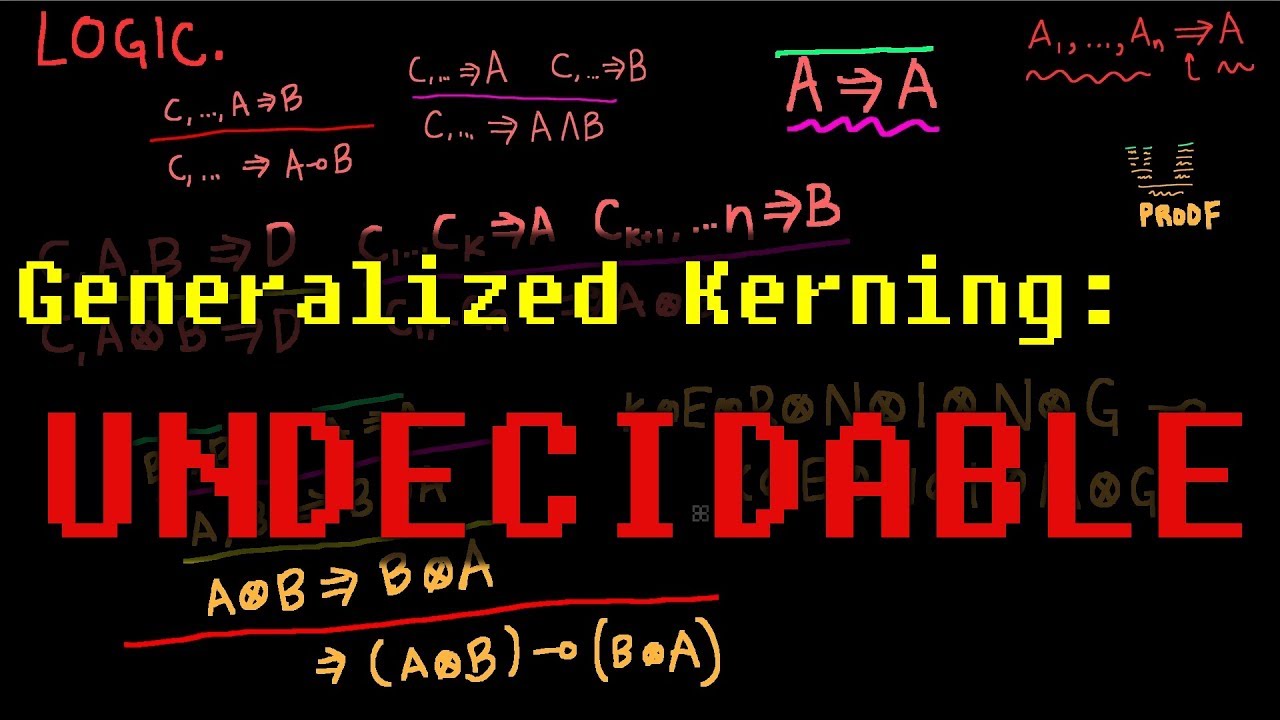
This lecture is an addendum to my video about Anagraphs, which you should watch first (or only). I do two proofs by reduction: One that the "generalized kerning" problem is undecidable, and one that the "generalized anagraphing" problem is decidable. The first proof uses turing machines, and the second a fragment of linear logic. I try to explai...
lean walrus
narrow mica
what is happening
that is how brainfuck is interpreted in markov algorithms :)
there are two "tapes": code and memory
to perform bf + operation you move a thingy from code tape to memory tape, and then perform increment there
lean walrus
haughty mountain
gives me flashbacks of
https://www.youtube.com/watch?v=8_npHZbe3qM
i think i have seen this video before
narrow mica
lean walrus
that is how brainfuck is interpreted in markov algorithms :)
there are two "tape...
all I see is something that'd appear in a hacker's screen in a movie /s
haughty mountain
here is a cute rule set
rules = [
    ('0>0', '10>'),
    ('0>$', '<1$'),
    ('1<1', '<10'),
    ('^<1', '^0>'),
]

string = '^0>00000000$'
results
^0>00000000$
^10>0000000$
^110>000000$
^1110>00000$
^11110>0000$
^111110>000$
^1111110>00$
^11111110>0$
^111111110>$
^11111111<1$
^1111111<10$
^111111<100$
^11111<1000$
^1111<10000$
^111<100000$
^11<1000000$
^1<10000000$
^<100000000$
^0>00000000$
...
it's similar to what you're doing, but the question is instead:
given some replacement rules, can I turn string s into string t with some application of the rules?
so not the same replacement scheme you have
the proof in the video is a reduction from turing machines, i.e. basically implement turing machines with this rule replacement problem
!e another rule set and string
rules = [
  ('0|$', '1|$'),
  ('1|$', '|0$'),
  ('0|', '1>'),
  ('1|', '|0'),
  ('>0', '0>'),
  ('>1', '1>'),
  ('>$', '|$'),
]

string = '00000000|$'


for i in range(100):
  if string.endswith('|$'):
    print(string)
  for before, after in rules:
    if before in string: # profiling says that 99% of time is spent on this line
      string = string.replace(before, after, 1)
      break
  else:
    break
:white_check_mark: Your 3.12 eval job has completed with return code 0.
001 | 00000000|$
002 | 00000001|$
003 | 00000010|$
004 | 00000011|$
005 | 00000100|$
006 | 00000101|$
007 | 00000110|$
008 | 00000111|$
009 | 00001000|$
010 | 00001001|$
... (truncated - too many lines)
Full output: https://paste.pythondiscord.com/ZWLVJEDKSLWC7TLAJZKVWPHCP4
lean walrus
GitHub
markov algorithm interpreter. Contribute to denballakh/markov development by creating an account on GitHub.
haughty mountain
rules = [
  ('| ', ' |'),
  ('w ', ' w'),
  ('h ', ' h'),
  ('e ', ' e'),
  ('> ', ' > '),
]

string = "|wheee> "
|wheee>
|wheee >
|whee e>
|whe ee>
|wh eee>
|w heee>
| wheee>
|wheee>
|wheee >
|whee e>
|whe ee>
|wh eee>
|w heee>
| wheee>
|wheee>
|wheee >
|whee e>
|whe ee>
|wh eee>
|w heee>
| wheee>
|wheee>
sorting a string of a and b can be done in just one rule: ba -> ab
Rules:
  0: ba -> ab

before: [6] >bababa<
after:  [6] >abbaba<
rule:   0: ba -> ab

before: [6] >abbaba<
after:  [6] >ababba<
rule:   0: ba -> ab

before: [6] >ababba<
after:  [6] >aabbba<
rule:   0: ba -> ab

before: [6] >aabbba<
after:  [6] >aabbab<
rule:   0: ba -> ab

before: [6] >aabbab<
after:  [6] >aababb<
rule:   0: ba -> ab

before: [6] >aababb<
after:  [6] >aaabbb<
rule:   0: ba -> ab

terminated: no matching rule
 lean walrus
haughty mountain
```py
rules = [
('| ', ' |'),
('w ', ' w'),
('h ', ' h'),
('e ', ' e'),
...
lean walrus
haughty mountain
```py
rules = [
('| ', ' |'),
('w ', ' w'),
('h ', ' h'),
('e ', ' e'),
...
here is a challenge for you:
you are given a string of a and b
your goal is to reverse it:
aabb --> bbaa
abab --> baba
aaa --> aaa
etc
some other ideas if you are interested:
- make a copy of a string
- split a string into two strings of even and odd indices (
s[::2]ands[1::2]) - compute length of a string into unary system
- compute length of a string into binary system
- compute number of
aandbseparately
this is a cool interpreter with GUI: https://yad-studio.github.io/
this is a binary counter:
s = State(
    '>0<',
    [
        Rule('0+', '1'),
        Rule('1+', '+0'),
        Rule('>+', '>1'),
        Rule('<', '+<'),
    ],
)
while True:
    s.step()
    input(s.string)
```  ```py
>0<
>0+<
>1<
>1+<
>+0<
>10<
>10+<
>11<
>11+<
>1+0<
>+00<
>100<
>100+<
>101<
>101+<
>10+0<
>110<
>110+<
>111<
>111+<
>11+0<
>1+00<
>+000<
>1000<
>1000+<
>1001<
...
what are the requirements of the input string? am I allowed to decorate it to make things doable?
I can do a cheaty version which upper cases as well
rules = [
  ('aA', 'Aa'),
  ('bA', 'Ab'),
  ('bB', 'Bb'),
  ('aB', 'Ba'),
  ('a<', 'A<'),
  ('b<', 'B<'),
]

string = ">ababbaaa<"
decorating is actually not necessary
to make > you can use the rule "" -> ">", and to put < at the end you can spawn a runner that will go to the end
there are actually two kinds of rules which were not refrected in my pseudocode: regular and terminating
if a terminating rule is matched, it halts the program completely, and the string you have is a result of your algorithm
haughty mountain
ah, termination was kinda my bigger concern
but if you can have terminating states that simplifies stuff
lean walrus
string = '...' # current state, might be long (100+ or 1000+ chars), changes at each step
rules: list[tuple[str, str, bool]] = [...] # a couple hundred rules (both left and right side are pretty short - usually less than 10 chars), doesn't change
while True:
  for before, after, terminating in rules:
    if before in string: # profiling says that 99% of time is spent on this line
      string = string.replace(before, after, 1)
      if terminating:
        break@while # break 2 loops at once
      break # end the rule search, start again
  else:
    break # no rule matched - halt
print(string)
something like this
that gives you a possibility to give a result of bba for input abb
without terminating rules it would be switching between abb and bba forever
haughty mountain
yeah
lean walrus
sometimes terminating rules are denoted as foo ->. bar (note the point in ->.)
 inner viper
hi
floral nebula
a deque is just a queue with insert at front and delete at last and only difference in algorithm is decrement of rear and head in those new operations??
 lament glen
Hi, why it give syntax error when I declare an empty 2d array? data = [num_of_algs][] ^ SyntaxError: invalid syntax
narrow mica
lament glen
Hi, why it give syntax error when I declare an empty 2d array? ```
data = [n...
because that's not the right syntax
are you trying to make num_of_algs rows of empty lists?
lament glen
I recall previously I've been using this pretty often ...
narrow mica
do you want the result to be like this?
[
  [],
  [],
  [],
  ...   # num_of_algs many
]
yes the size of the first layer of the array
lament glen
narrow mica
do you want the result to be like this?
```py
[
[],
[],
[],
... # num...
yes
exactly
narrow mica
lament glen
yes
l = [ [] for _ in range(num_of_algs) ]
i recall I was using "array = [][]", and it was kinda working?
narrow mica
lament glen
i recall I was using "array = [][]", and it was kinda working?
[[]] * num_of_algs does not work the way you want it to if that's what you're thinking of
!e
l = [[]] * 5
print(l)
l[0].append(1)
print(l)
:white_check_mark: Your 3.12 eval job has completed with return code 0.
001 | [[], [], [], [], []]
002 | [[1], [1], [1], [1], [1]]
Thank you. I was having impression that python array declaration was prettry straight forward, but it turns out I've been using wrong way for long time...
 vocal gorge
I recall previously I've been using this pretty often ...
in a different language, perhaps?
lament glen
vocal gorge
> I recall previously I've been using this pretty often ...
in a different langu...
maybe... but couldn't come up with what that was rn... is there other language supporting such way of using? the " array = [][] "
Or, maybe I've beening useing "array = []" so I just took it for granted I could simply expand it to 2d array....
vocal gorge
in C/Java/etc the syntax would be along the lines of int data[10] (to declare a 10-element array data), and similarly data[10][20] for a 2d array.
in python, well, there's no arrays and no special syntax for them. there's just lists which behave like all other objects.
lament glen
for C there the bracket usually cannot be empty, as to Java I'm not that sure...
narrow mica
can't you do this?
int a[] = {1, 2, 3};
```or is this c++ onlyyes, btw can the compiler do c++ code in this channel?
haughty mountain
narrow mica
can't you do this?
```c
int a[] = {1, 2, 3};
```or is this c++ only
C allows this too
lean walrus
iirc in C you also can do int a[N][M] = {{1,2,3}, {4,5,6}, {7,8,9}};
and maybe int a[][] = {{1,2,3}, {4,5,6}, {7,8,9}};
narrow mica
lean walrus
and maybe `int a[][] = {{1,2,3}, {4,5,6}, {7,8,9}};`
I think only 1 of (the last?) dimension can be left empty
lean walrus
just checked: x[][5] works but x[5][] does not
lament glen
lean walrus
iirc in C you also can do `int a[N][M] = {{1,2,3}, {4,5,6}, {7,8,9}};`
N and M all constant here?
lean walrus
yes
narrow mica
lament glen
N and M all constant here?
if they're variable (like inputs) then you should use a vector
fiery cosmos
if programmer wanna represent tranditional POSIX file system which has files, folders and also possible symbolic links then which data structure should use? Graph or Tree ? I think without symbolic links Tree can be used because every file has only 1 unique path which prevents loops. When symbolic links involves i do not know i need to change tree based representation to graph or not
 dusk ruin
reservoir sampling on wikipedia: https://en.wikipedia.org/wiki/Reservoir_sampling
Reservoir sampling is a family of randomized algorithms for choosing a simple random sample, without replacement, of k items from a population of unknown size n in a single pass over the items. The size of the population n is not known to the algorithm and is typically too large for all n items to fit into main memory. The population is revealed to the algorithm over time, and the algorithm cannot look back at previous items. At any point, the current state of the algorithm must permit extraction of a simple random sample without replacement of size k over the part of the population seen so far.
Why does it say that the population n is not known to the algorithm, but hten in the source code it is known?
(* S has items to sample, R will contain the result *)
ReservoirSample(S[1..n], R[1..k])
  // fill the reservoir array
  for i := 1 to k
      R[i] := S[i]
  end

  // replace elements with gradually decreasing probability
  for i := k+1 to n
    (* randomInteger(a, b) generates a uniform integer from the inclusive range {a, ..., b} *)
    j := randomInteger(1, i)
    if j <= k
        R[j] := S[i]
    end
  end
end
 mint jewel
dusk ruin
reservoir sampling on wikipedia: <https://en.wikipedia.org/wiki/Reservoir_sampli...
mint jewel
dusk ruin
reservoir sampling on wikipedia: <https://en.wikipedia.org/wiki/Reservoir_sampli...
the pseudocode notation just sucks here, they mean
i = k + 1
for s in S:
    j = randomInteger(1, i)
    if j <= k:
        R[j] = s
    i += 1
That looks incorrect, I think the correct python translation should be
R = S[:k]

for i in range(k, len(S)):
    j = random.randint(0, i)
    if j < k:
        R[j] = S[i]
the whole point is that you can't know len(S).
I preserved the 1 indexing
regal spoke
mint jewel
the whole point is that you can't know len(S).
still the first k elements of S should be stored in R
regal spoke
dusk ruin
reservoir sampling on wikipedia: <https://en.wikipedia.org/wiki/Reservoir_sampli...
The point is that, if you want to add one more element to S (i.e. adding one more sample) you can easily do that (without having to recompute everything)
Here is how I would describe the algorithm
num_samples_seen = 0
k = 100
R = []

def add_sample(s):
    global num_samples_seen
    num_samples_seen += 1
    if len(R) < k:
        R.append(s)
    else:
        j = random.randint(0, num_samples_seen - 1)
        if j < k:
            R[j] = s
!e
import random
num_samples_seen = 0
k = 10
R = []

def add_sample(s):
    global num_samples_seen
    num_samples_seen += 1
    if len(R) < k:
        R.append(s)
    else:
        j = random.randint(0, num_samples_seen - 1)
        if j < k:
            R[j] = s

n = 10**4
for _ in range(n):
    s = random.randint(1, 10**9)
    add_sample(s)
print(R)
:white_check_mark: Your 3.12 eval job has completed with return code 0.
[856959814, 627914769, 105585371, 374199574, 333850095, 704136957, 237044355, 128028442, 325962198, 385723663]
Note how the algorithm has no knowledge of n (the number of samples it will be given)
add_sample simply just works with one sample at a time
It does however keep track of how many samples it has seen
 last tangle
print("Hello, world")
For this problem https://leetcode.com/problems/find-all-numbers-disappeared-in-an-array/description/
is this solution
class Solution:
    def findDisappearedNumbers(self, nums):
        ans, seen = [], [False]*(len(nums)+1)
        for c in nums: seen[c] = True
        for i in range(1, len(nums)+1):
            if not seen[i]:
                ans.append(i)
        return ans
optimized version of this solution
class Solution:
    def findDisappearedNumbers(self, nums):
        s = set(nums)
        return [i for i in range(1, len(nums)+1) if i not in s]
because the boolean solution is only storing 1 byte of information while the hashset is storing 4 bytes?
 stray fractal
fiery cosmos
For this problem https://leetcode.com/problems/find-all-numbers-disappeared-in-a...
stray fractal
fiery cosmos
For this problem https://leetcode.com/problems/find-all-numbers-disappeared-in-a...
where do those amounts of bytes come from
fiery cosmos
stray fractal
where do those amounts of bytes come from
Idk, that's what one dude mentioned when he asked that same question
stray fractal
3 things
- a boolean in python does not store 1 byte, it stores at least 12 or 24 bytes depending on the system
- first solution has a redundant operation
- "letting python do the work" is how things are mostly optimized, which happens in the 2nd solution
in conclusion the second one is theoretically faster
but it does seem like over large inputs the 2nd one gets slower
so it basically just depends on how large your input is
 ivory bluff
Guys I am solving coding problems Can anybody help me here ?
fiery cosmos
stray fractal
3 things
1. a boolean *in python* does not store 1 byte, it stores at least 12 o...
Which operation is redundant in first solution?
stray fractal
fiery cosmos
Which operation is redundant in first solution?
~~```py
seen = [False]*(len(nums)+1)
for c in nums: seen[c] = True
ah i see
nvm
 tight totem
Hii
I need code for breadth search function
My professor asked for it and idk wut exactly he need
tight totem
from collections import deque

class Node:
    def __init__(self, state, parent=None):
        self.state = state
        self.parent = parent
        self.children = []

        if parent:
            parent.children.append(self)

def find(node, target_state):

    queue = deque([node])

    while queue:
        current_node = queue.popleft()
        if current_node.state == target_state:
            return current_node

        for child in current_node.children:
            queue.append(child)

    return None


root_node = Node("A")
B = Node("B", root_node)
C = Node("C", root_node)
D = Node("D", C)


result = find(root_node, "D")
if result:
    print(f"Node with state '{result.state}' found.")
else:
print("Node not found.")```Is this code explain breadth search correctly?
regal spoke
stray fractal
in conclusion the second one is theoretically faster
I could totally see the first one being faster since it doesn't use any hash maps
especially if someone gives it an evil designed sequence that makes set run in n^2
regal spoke
fiery cosmos
For this problem https://leetcode.com/problems/find-all-numbers-disappeared-in-a...
Its not about 1 byte vs 4 bytes
It is about using hash table vs not using hash table
 lime quest
working on genetic algorithm to create timetable? Anyone willing to help
fiery cosmos
regal spoke
It is about using hash table vs not using hash table
Yeah but why, if it is really that true, first one solution is better than second? It's because for hash tables there is need to calculate hash value?
regal spoke
fiery cosmos
Yeah but why, if it is really that true, first one solution is better than secon...
Hash tables are kind of complicated
There is a lot more going on than what you might expect
While a boolean list is about as basic as it gets.
 ripe oxide
Hi! could someone help me at #1307340581009096736 ? its a time limit issue
mint jewel
fiery cosmos
For this problem https://leetcode.com/problems/find-all-numbers-disappeared-in-a...
This is a perfect scenario for a bitset.
jolly mortar
!cban 1276028320688898108 troll
halcyon plankBOT
:incoming_envelope: :ok_hand: applied ban to @rain copper permanently.
 obtuse brook
Hello 👋 I am solving some past advent of code problems. For one of the problems, I need to count the number of literal characters in a string (I am not sure if the term "literal characters" is correct).
i.e. "\x27" -> 4 (\, x, 2 & 7)
Python processes this as "'" (apostrophe). Any ideas ?
narrow mica
obtuse brook
Hello 👋 I am solving some past advent of code problems. For one of the problems...
do you mean you get \x27 as input?
obtuse brook
Yes
narrow mica
obtuse brook
Yes
I'm not sure what you mean exactly, cause if you use input() then it works perfectly?
>>> input()
\x27
'\\x27'
>>> len(input())
\x27
4
>>>
if you're storing \x27 as a string directly, you can add a r prefix so it doesn't turn into '
>>> '\x27'
"'"
>>> r'\x27'
'\\x27'
Apologies, when I said input, I did not mean via input().
obtuse brook
narrow mica
if you're storing `\x27` as a string directly, you can add a `r` prefix so it do...
Thanks. This works I believe. I forgot about r""
 shadow glen
guys how do i make the comparation of the in t hing
i wanna compare it with strings
like a in "thing1, thing2, thing3"
shadow glen
guys, why my code is skipping lines?
it wasn't suppose to print stuff skipping lines
 serene galleon
Why do i have this error ???
 quasi oracle
serene galleon
Why do i have this error ???
quasi oracle
serene galleon
Why do i have this error ???
what version of Python are you using
serene galleon
Yeah i don't have swichs
 orchid violet
serene galleon
Yeah i don't have swichs
orchid violet
serene galleon
Yeah i don't have swichs
match case isn't switch case FWIW
serene galleon
orchid violet
match case isn't switch case FWIW
What is it then ?
orchid violet
serene galleon
What is it then ?
pattern matching
serene galleon
Just like a switch
orchid violet
serene galleon
Just like a switch
no, it's more powerful, it looks for patterns, if you want something like switch case you'd want a dict in python
serene galleon
Whats the difference ?
orchid violet
serene galleon
Whats the difference ?
https://peps.python.org/pep-0636/
give this a read
serene galleon
Ok thanks
hushed nova
this disjoint data struct just ate away my brain wtf 
narrow mica
hushed nova
this disjoint data struct just ate away my brain wtf <:yert:832277526809149461>
which one
disjoint set union?
hushed nova
narrow mica
which one
disjoint set union?
saw a tutorial in which guy explained union by rank first
istg i was about to fall asleep
then looked at union by size, its somewhat understandable now
narrow mica
hushed nova
then looked at union by size, its somewhat understandable now
both just say it's better to merge smaller groups into bigger ones, rather than the other way around
the really hard part comes if you try to prove the complexity
 basically said its near to constant time
narrow mica
hushed nova
<:ducky_sqlite:874451183568302087> basically said its near to constant time
basically said its near to constant time
narrow mica
hushed nova
<:ducky_sqlite:874451183568302087> basically said its near to constant time
pretty much
it's called the inverse ackermann
where the ackermann is a really fast growing function (so the inverse grows very slow)
hushed nova
i still havent done kruskal's yet, my brain cannot handle this much info for a day, so i have no idea how its gonna work with graphs
hushed nova
narrow mica
pretty much
it's called the inverse ackermann
where the ackermann is a *really* ...
yeah looked into that just rn, thanks for telling tho
narrow mica
hushed nova
i still havent done kruskal's yet, my brain cannot handle this much info for a d...
it's more that kruskal's needs to quickly check if 2 nodes are connected already
and you can think of nodes that are connected being part of the same group and vice versa
so check if nodes are connected => check if nodes are in the same group => fast with DSU
hushed nova
narrow mica
it's more that kruskal's needs to quickly check if 2 nodes are connected already...
 oh alr so basically we introduce disjoint to check for that, at first i thought wouldnt it change the graph itself? now i got it thanks
narrow mica
hushed nova
<:pithink:652247559909277706> oh alr so basically we introduce disjoint to check...
you don't need a DSU for kruskal, but it drastically improves the time
pseudo code:
def kruskal(edges):
  edges = sorted(edges)  # sort by weight
  mst_edges = []
  for edge in edges:
    if is_same_group(edge.source, edge.destination):
      continue
    mst_edges.append(edge)
    join_group(edge.source, edge.destination)
  return mst_edges
```and with a DSU, `is_same_group` and `join_group` is faast oh now i see, thanks a lot for explaining
 spice nacelle
I made an insertion sort algorithm and tested its performance and notice that everytime I ran the tests 2000 and 3000 elements were faster than 1000 elements. 1000 elements took 12 ms when 2000 took 4 ms and 3000 took 8ms. Why is that?
I used randomly generated array.
stiff quartz
spice nacelle
I made an insertion sort algorithm and tested its performance and notice that ev...
Run each of your algorithms 500 times and make an average for each array size
Or use the Python timeit module
regal spoke
spice nacelle
I made an insertion sort algorithm and tested its performance and notice that ev...
One bug I've seen in sort benchmarks is that you accidently benchmark on already sorted data
Basically, the first time you call sort, you do it on random data
which sorts the data used to benchmark
Then the rest of the benchmarks (after the first one) look weirdly fast
fiery cosmos
Given a list of lines which form a race track how would I color the inside of the track different from the outside of the track.
narrow mica
fiery cosmos
Given a list of lines which form a race track how would I color the inside of th...
You're gonna have to be more clear about what you're doing
fiery cosmos
The colliders for a 2d race track are a list of lines. I want to know how i can color the outside of the track.
different from the inside
i guess i could make a 2d concave polygon from the lines and split that into a bunch of triangles then render thoes triangles as a track
narrow mica
fiery cosmos
different from the inside
so what are your inputs and expected outputs
like do you have a list of numbers? An image?
the way you're describing it still doesn't make it clear
narrow mica
fiery cosmos
list of lines which are the colliders or edges of the race track
then what do these lines look like, how are they given to you, and wdym by color them
fiery cosmos
i don't want to color the lines i want to color the inside of the track.
the lines are just two points start and end
i know how to do it nevermind i asked
Triangle decomposition is what i needed
fiery cosmos
mint jewel
This is a perfect scenario for a bitset.
Can you explain?
mint jewel
fiery cosmos
Can you explain?
Instead of doing [False]*len(nums), you'd much rather pack it bit by bit. This can be done by using a single int, and bit shifting. For example, to say that that 40 is found, you'd do
seen |= 1 << 40, and to check whether 25 has been found, you'd do
seen & (1 << 25)
haughty mountain
mint jewel
Instead of doing [False]*len(nums), you'd much rather pack it bit by bit. This c...
granted, idk how efficient using ints for this in python is
memory efficient yes
but toggling a bit might end up expensive for large bitsets, while with a proper bitset it's just O(1)
 rare laurel
is 1 << n O(n/30) because base 2^30 digits?
haughty mountain
mint jewel
The big pain point is making the masks
the masking itself is equally as expensive
haughty mountain
rare laurel
is `1 << n` `O(n/30)` because base 2^30 digits?
something like that
regal spoke
mint jewel
Instead of doing [False]*len(nums), you'd much rather pack it bit by bit. This c...
Other than maybe being more memory efficient, people usually don't bother with that.
I doubt it is faster
mint jewel
it is faster if it's a proper bitset, but yea, python ints don't work too well for this usecase
regal spoke
In Python u could store 63 bits in an int, and get true O(1) performance
regal spoke
mint jewel
it is faster if it's a proper bitset, but yea, python ints don't work too well f...
Actually in C++, using vector<char> is usually faster than using bitset
The computer is kind of bad dealing with single bits in an efficient way
So for performance, counterintuitively 1 byte per bool is usually preferred
This is yet another reason for why c++ decision to make vector<bool> a bitset is stupid.
 fringe bobcat
I am not able to identify error and even Google is not able see
num=[]
while True:
    input=input("enter number and 0 to exit")
    if input ==0:
        break
    num.append(int(input))
ordered=sorted(num)
ls=len(num) //2
median=ordered[ls]
print("gratest number is",max(num))
print("median is",{median})
```What is error?
Ph error is variable sorry 😅
tight cedar
Don't use input as variable name
 near grove
Does anyone know how I can turn these two arrays to a 3D array similar to the array at the bottom:
xe1 = np.array([["H", "F"], ["D", "F"], ["J", "I"]])

# [[[1,2], ["H", "F"]], [[3,4], [D", "F"]],[[5,6], ["J","I"]]] ```well first of all the numbers would become strings to keep it homogeneous
second,
>>> np.stack((ex1, xe1), axis=1)
array([[['1', '2'],
        ['H', 'F']],

       [['3', '4'],
        ['D', 'F']],

       [['5', '6'],
        ['J', 'I']]], dtype='<U11')
Using input as a variable name is bad.
Another issue is that input always returns a string, so you need to check == "0" instead of == 0
num = []
while True:
    x = int(input("enter number, 0 to exit"))
    if x == 0:
        break
    num.append(x)
num.sort()
ls = len(num)//2
median = ordered[ls]
print("greatest number is", num[-1])
print("median is", median)
 half owl
does anyone know how i can implement a shortest path algo for a directed graph (like in the picture, but with self-arrows) with the following constraints:
- without using a stack/queue/linked list
- only with the option of using static arrays (implementing this in Java, couldnt find help online)
- TC needs to be less than exponential TC
 modern gulch
half owl
does anyone know how i can implement a shortest path algo for a directed graph (...
modern gulch
half owl
does anyone know how i can implement a shortest path algo for a directed graph (...
Sounds like a DP question. Are you familiar with dynamic programming?
half owl
modern gulch
Sounds like a DP question. Are you familiar with dynamic programming?
not really, i think it's just breaking down big problems into smaller and solvable ones?
like in recursion
which is what im trying to do rn
modern gulch
With recursion, you'd need some memory structure to avoid infinite loops (ie; 3-4-3-4-3-4-...)?
And your problem statement says no stack/queue/list
regal spoke
half owl
does anyone know how i can implement a shortest path algo for a directed graph (...
A static array can be used as the storage for stack, queue, linked list
But really, this sounds like they want you to use Floyd warshall
half owl
regal spoke
~~A static array can be used as the storage for stack, queue, linked list~~
yeah thats what im trying to do with it rn
half owl
regal spoke
But really, this sounds like they want you to use Floyd warshall
idk who that is, this is our 2nd cs course so idk how to make < exponential
last semester i had i think the same problem and only managed to make it n^2 or something but with hash maps
or even n! cause idk if i managed
mint jewel
n! is better than exponential
regal spoke
half owl
idk who that is, this is our 2nd cs course so idk how to make < exponential
It is a very standard alg that compute all pairwise shortest path in n^3 time
mint jewel
https://en.wikipedia.org/wiki/Bellman–Ford_algorithm if you just need one vertex to every other vertex/specific vertex, this algo is a move. A bad move, but a move nevertheless.
also O(|V||E|) <= O(|V|^3)
half owl
mint jewel
<https://en.wikipedia.org/wiki/Bellman%E2%80%93Ford_algorithm> if you just need ...
ill look at it after ill finish my current try, ty
regal spoke
Floyd is just 3 nested for loops, using a n x n matrix
I really think that is what they are trying to hint when they say you cannot use a stack/queue/linked list
mint jewel
yea, it does look likely
regal spoke
This is the entire algorithm
for (int k = 0; k < n; ++k) {
    for (int i = 0; i < n; ++i) {
        for (int j = 0; j < n; ++j) {
            d[i][j] = min(d[i][j], d[i][k] + d[k][j]);
        }
    }
}
The goal of this project is to translate the wonderful resource http://e-maxx.ru/algo which provides descriptions of many algorithms and data structures especially popular in field of competitive programming. Moreover we want to improve the collected knowledge by extending the articles and adding new articles to the collection.
hushed nova
regal spoke
But really, this sounds like they want you to use Floyd warshall
gave me a serious headache such that i had to take break from it
regal spoke
?
mint jewel
regal spoke
This is the entire algorithm
```cpp
for (int k = 0; k < n; ++k) {
for (int ...
well, you'd need to modify it a bit to get actual paths rather than just distances
regal spoke
mint jewel
well, you'd need to modify it a bit to get actual paths rather than just distanc...
https://github.com/cheran-senthil/PyRival/blob/master/pyrival/graphs/floyd_warshall.py here is a version that does that
GitHub
⚡ Competitive Programming Library. Contribute to cheran-senthil/PyRival development by creating an account on GitHub.
haughty mountain
mint jewel
n! is better than exponential
it's not
Stirling's approximation says hi
 narrow mica
hushed nova
floyd warshall
narrow mica
hushed nova
floyd warshall
floyd-warshall just keeps asking
is it better to go A->B directly, or introduce some midpoint C and go A->C->B
repeat enough times
haughty mountain
haughty mountain
Stirling's approximation says hi
and for reference n^n = e^(n log n)
so it's worse than exponential
mint jewel
oh wait yea ,I misremembered
haughty mountain
narrow mica
floyd-warshall just keeps asking
`is it better to go A->B directly, or introduce...
very relaxing
mint jewel
it's better than n^n
narrow mica
n! = 1 * 2 * ... * k * (k+1) * (k+2) * ...
if you select any exponential k^n, n! starts growing faster and faster after n == k
hushed nova
narrow mica
floyd-warshall just keeps asking
`is it better to go A->B directly, or introduce...
yeah i get that but for me the implementation got way confusing
cause we introduce 2 matrices one to keep record of paths, iirc
and other for shortest distance
modern gulch
I'm just not sure they'd ask a student to implement this given those instructions. But, I dunno.
 thorn oriole
Hey guys, I've a list A of n natural numbers, and a K number, natural also
I want to return B, where B has n * k numbers, and it has to have all elements of A, multiplied by j, 1 <= j <= k
So something like this:
A = [2, 4, 6, 8]
k = 3
B = [
    2, 4, 6, // For 2
    4, 8, 12, // For 4
    6, 12, 18, // For 6
    8, 16, 24 // For 8
]
and B needs to be in order
I need to give a solution in O(nk log n), what I thought was, first creating a B' like this:
A = [2, 4, 6, 8]
k = 3
B = [
    [2, 4, 6], // For 2
    [4, 8, 12], // For 4
    [6, 12, 18], // For 6
    [8, 16, 24] // For 8
]
I know I've n lists of k elements in B, where each list is in order. Getting here costs n * k
I thought I could take advantage of knowing all these lists are in order, to do a Merge Sort, but I'm not sure if I'm in the complexity range

Btw, this isnt a python problem, it's more a theoretical problem, from a uni excercise.
hushed nova
If no constraints on spce i think you can use min heap
hushed nova
You take extra o(n) spce for heap
And to get B
while min_heap: i = heapq.heappop(min_heap) B.append(i)
Or rather you can use binary search on the go?
thorn oriole
hmm BST.inorder is O(1) and inserting in the binary tree is log n, right?
so I get nk log n?
oh that makes sense
hushed nova
nk log(nk)
hushed nova
Merge sort is nlogn
So it will be nk + nklog(n k)
It still be ny log(nk)
Cause total numbers will be n * k, i dont think you can escape that
haughty mountain
thorn oriole
so I cannot use that method
can k > n?
if k ≤ n then log(n k) = O(log n)
there are also approaches that are O(max(n k, max_value)) but that use O(max_value) memory
thorn oriole
haughty mountain
can k > n?
yup
RIP
my exam is this friday, and I'm cooked 😄
I also need to study for my calc exam
haughty mountain
isn't O(n k log n) easy with a min-heap?
you only ever need to keep n values in the heap
the smallest value from each group
haughty mountain
thorn oriole
but the n inside the log, hmmmm idk
wdym?
haughty mountain
haughty mountain
you only ever need to keep n values in the heap
this makes it log n
haughty mountain
not in the heap at any one time
you know that the minimum is one of the values among the smallest values in each group
so you can make use of things being sorted
thorn oriole
I dont understand
Like, what you are trying to say 
I need to return B, which has to have n * k elements
if I use a heap to order, then I need a heap of n * k elements
haughty mountain
thorn oriole
if I use a heap to order, then I need a heap of n * k elements
you don't
if you have n lists of length k that you know are sorted, how many elements could possibly be the smallest?
thorn oriole
I've n lists of lenght k that are sorted, but I might have repeated lists for example?
also, A isnt in order
and I dont need to return the smallest number, I need to return the FULL list, in order
haughty mountain
thorn oriole
I've n lists of lenght k that are sorted, but I might have repeated lists for ex...
so? say you wanted to find the smallest element, how many elements would you need to look at?
half owl
regal spoke
https://cp-algorithms.com/graph/all-pair-shortest-path-floyd-warshall.html
ty, i managed to implement it using it
but the explanations i found are so bad
like they shouldve given simple code, simple execution and simple examples
thorn oriole
haughty mountain
so? say you wanted to find the smallest element, how many elements would you nee...
n
but I dont have to return the smallest number
haughty mountain
thorn oriole
n
cool, now remove that element and replace it with the next one in the same list
how many elements can now be the 2nd smallest?
it's again n
thorn oriole
n-1
haughty mountain
haughty mountain
cool, now remove that element and replace it with the next one in the same list
you can do these operation on a heap in O(heap size)
the heap has size ≤n at all times
i.e. at most n elements could be the minimum at any point, those are the ones you need to consider when finding the minimum
thorn oriole
Sorry I just dont get how you can return a list of lenght k * n without adding k * n elements to the heap. I'll continue with the next excercise.
Thanks btw
lean walrus
you can put k*n references to the same object into a list
haughty mountain
thorn oriole
Sorry I just dont get how you can return a list of lenght k * n without adding k...
all n*k elements will be at the heap at some point
but not at the same time
@thorn oriole sketch of how it would work
n=2, k=3

a = [4, 8, 12]
b = [3, 6, 9]

result = []
heap = [3, 4]
a = [4, 8, 12]
b = [3, 6, 9]

result = [3]
heap = [4, 6]
a = [4, 8, 12]
b = [6, 9]

result = [3, 4]
heap = [6, 8]
a = [8, 12]
b = [6, 9]

result = [3, 4, 6]
heap = [8, 9]
a = [8, 12]
b = [9]

...
How to do method overloading ?
stiff quartz
https://wiki.python.org/moin/TimeComplexity
What's the difference between pop intermediate and delete in that table for Python lists
Did they make two entries because pop returns the element and delete calls the garbage collector?
quasi oracle
stiff quartz
https://wiki.python.org/moin/TimeComplexity
What's the difference between pop in...
Pop removes the last element, delete is for any position in the list
Oh pop intermediate
Probably list.pop(i) vs del list[i]
No functional difference
regal spoke
stiff quartz
https://wiki.python.org/moin/TimeComplexity
What's the difference between pop in...
That table is just very funky in general
Some of these tables look wrong in general

if n = 2 then you should get same time complexity on both rows
But you dont
regal spoke
stiff quartz
Did they make two entries because pop returns the element and delete calls the g...
Something I'm more facinated by is that pop isnt marked as a [1]. [1] means it is making use of amortization.
I would assume that just like append, pop also has to deal with amortization
Unless you never want the memory usage of a list to shrink
haughty mountain
regal spoke
if n = 2 then you should get same time complexity on both rows
I guess someone mixed up max and min
it should be min in both I think
narrow mica
serene galleon
How to do method overloading ?
can't in python
you just have *args and **kwargs, then in the 1 function, choose which impl to use by parsing them
regal spoke
haughty mountain
I guess someone mixed up max and min
No, it should be a generalisation of the first worst case (which is comparing all elements)
So it hould say something like O((n - 1) * l^2)
 cold lodge
Hello chat
Im just about to start training my transformer based model, any useful tips before i run this nonstop for a while?
haughty mountain
regal spoke
So it hould say something like O((n - 1) * l^2)
oh, I was comparing the top left and bottom right for whatever reason
I think average case is (n-1) O(min(lens))
also "average"
maybe average on random input
regal spoke
haughty mountain
I think average case is (n-1) O(min(lens))
That assumes the programmer put the smallest set first
regal spoke
Someone should probably just remove that multiple intersection row from the table
haughty mountain
yeah
regal spoke
It tricks you into thinking that python has some special optimization for multiple intersections
While in fact it just runs pairwise intersection over and over
stiff quartz
regal spoke
I would assume that just like append, pop also has to deal with amortization
Does it? I’m not even sure it does
Like you can free the memory without having to copy your array somewhere else?
But when you append, if the memory you’re « requesting » when it grows is not free, then you have to copy everything
haughty mountain
I think you can't really free part of some allocated memory
stiff quartz
haughty mountain
I think you can't really free part of some allocated memory
Ah I guess, this is beyond what I know
stiff quartz
regal spoke
That table is just very funky in general
Isn’t that like the official Python doc lol
haughty mountain
official wiki of sorts
but I'm not surprised there are errors
I would assume they would do a realloc to shrink memory
which more than likely just keeps the same pointer
narrow mica
cold lodge
Im just about to start training my transformer based model, any useful tips befo...
probably better asked in #data-science-and-ml
cold lodge
sry
 north cosmos
For this question:
    You've decided to take the ultimate course: MATH131. However, that course has some requirements - you have to take MATH120, MATH121, and MATH122 first! But each of those have their own requirements:

        MATH131 requires MATH120, MATH121, MATH122
        MATH122 requires MATH111, MATH112
        MATH121 requires MATH111
        MATH120 requires MATH110, MATH111
        MATH112 requires MATH110
        MATH111 requires MATH110
        MATH110 has no requirements

    What order should you take these courses in?
How would you guys go about it?
This was my code, and let me know where I can improve it.
https://mystb.in/14eabcb146f111696d
Output = ['MATH110', 'MATH112', 'MATH111', 'MATH122', 'MATH121', 'MATH120', 'MATH131']

#The order matters
!docs graphlib.TopologicalSorter That's a topological sorting task, isn't it? Python has a builtin for it. (for some reason)
halcyon plankBOT
class graphlib.TopologicalSorter(graph=None)```
Provides functionality to topologically sort a graph of [hashable](https://docs.python.org/3/glossary.html#term-hashable) nodes.

A topological order is a linear ordering of the vertices in a graph such that for every directed edge u \-\> v from vertex u to vertex v, vertex u comes before vertex v in the ordering. For instance, the vertices of the graph may represent tasks to be performed, and the edges may represent constraints that one task must be performed before another; in this example, a topological ordering is just a valid sequence for the tasks. A complete topological ordering is possible if and only if the graph has no directed cycles, that is, if it is a directed acyclic graph.and again for some reason this stdlib exists solely for this class
and honestly a topo sort isn't hard to implement anyways
 summer fossil
class Solution:
    def takeCharacters(self, s: str, k: int) -> int:
            freqs = [0] * 3
            n = len(s)

            for c in s:
                freqs[ord(c) - ord('a')] += 1

            i = 0
            j = 0
            if freqs[0] < k or freqs[1] < k or freqs[2] < k:
                return -1

            for j in range(n):
                freqs[ord(s[j]) - ord('a')] -= 1

                if freqs[0] < k or freqs[1] < k or freqs[2] < k:
                    freqs[ord(s[i]) - ord('a')] += 1
                    i += 1

return n - (j - i + 1)```Input: s = "aabaaaacaabc", k = 2
Output: 8```can anyone explain how it works?
is j==n? use for loop here for j in range(n): working of j here?
regal spoke
range(n) is 0,1,..., n-1
regal spoke
summer fossil
is j==n? use for loop here ```for j in range(n):``` working of j here?
n is not included
summer fossil
oh yeah so j has no role? Return i
so how i works here? How i is the soln like valid
 odd skiff
How to send formatted code in this chat?
Could someone explain me the code implemented here..
Background : Its a code for finding the longest length of a sub-array in which its values sum to value k below is the code
def longest_subarray_with_sum_k(array, array_length, target_sum):
    # Dictionary to store prefix sums and their first occurrences
    prefix_sum_indices = {}

    # Initialize variables
    prefix_sum = 0
    longest_subarray_length = 0

    for index in range(array_length):
        # Update the prefix sum
        prefix_sum += array[index]

        # If the prefix sum itself equals the target, update the length
        if prefix_sum == target_sum:
            longest_subarray_length = max(longest_subarray_length, index + 1)

        # Check if the difference (prefix_sum - target_sum) exists in the hashmap
        difference = prefix_sum - target_sum
        if difference in prefix_sum_indices:
            # Calculate the subarray length
            subarray_length = index - prefix_sum_indices[difference]
            longest_subarray_length = max(longest_subarray_length, subarray_length)

        # Store the first occurrence of the prefix sum in the hashmap
        if prefix_sum not in prefix_sum_indices:
            prefix_sum_indices[prefix_sum] = index

    return longest_subarray_length


# Example usage
n = 7
k = 3
a = [1, 2, 3, 1, 1, 1, 1]
result = longest_subarray_with_sum_k(a, n, k)
print("Length of the longest subarray with sum =", k, "is", result)```Thank you so much.. much better 🙂
Here are my question... I am getting fuzzy in these two sections specially...
 # Check if the difference (prefix_sum - target_sum) exists in the hashmap
        difference = prefix_sum - target_sum
        if difference in prefix_sum_indices:
            # Calculate the subarray length
            subarray_length = index - prefix_sum_indices[difference]
            longest_subarray_length = max(longest_subarray_length, subarray_length)

        # Store the first occurrence of the prefix sum in the hashmap
        if prefix_sum not in prefix_sum_indices:
            prefix_sum_indices[prefix_sum] = index
do u know hindi check codestorywithmik
odd skiff
I dont know Hindi..
Do you anyone around here who knows Tamil?
Its another south indian language
summer fossil
i dont know but wait so many xpert peeps here
regal spoke
summer fossil
oh yeah so j has no role? Return i
The code looks buggy to me. j will always be n - 1 after the for loop. (Unless n=0, and in that case j=0.)
Technically it is return i - int(n<=0)
 upper crypt
Hi ! I have a question regarding the del method.
I've stumble onto a bug (sys.meta_path is None, Python is likely shutting down) and a bit of reading convinced me that I had the wrong understanding of how it works. It appears not to act as a destructor, or mainly that it may be called after the environment starts to tear down and that's what causes my issue, and it's globally a bad idea to use them.
However, I do need some of my objects to act when destroyed, how can I do that please ? 😄
regal spoke
upper crypt
Hi ! I have a question regarding the __del__ method.
I've stumble onto a bug (sy...
Looks like a good question for the people at #esoteric-python
upper crypt
Okay, thanks 😄
summer fossil
regal spoke
The code looks buggy to me. j will always be n - 1 after the for loop. (Unless n...
code works well
near grove
I have a numpy array like this: np.array(["1546", "234", "123414", "342", "9120831"]), and I want a new array instead with each strings lenght as a value. To this instead: np.array([4, 3, 6, 3, 7])
np.array(["1546", "234", "123414", "342", "9120831"]) # To this -> np.array([4, 3, 6, 3, 7]) Which is a new array of each strings length instead.
jolly mortar
apparently np.char.str_len(arr) exists
narrow mica
!rule 9
lean walrus
!d numpy.char.str_len
halcyon plankBOT
char.str_len(x, /, out=None, *, where=True, casting='same_kind', order='K', dtype=None, subok=True[, signature]) = <ufunc 'str_len'>```
Returns the length of each element. For byte strings, this is the number of bytes, while, for Unicode strings, it is the number of Unicode code points.guys one question
in bfs, you always have to have a initial node
and an reach node, or this last is not necessary
narrow mica
brisk stream
and an reach node, or this last is not necessary
not necessary
just keep bfs-ing until the queue becomes empty
brisk stream
narrow mica
not necessary
just keep bfs-ing until the queue becomes empty
but it always has to have like an initial node right?
narrow mica
brisk stream
but it always has to have like an initial node right?
yes
or initial nodes
depends on what you're doing
orchid violet
 vale gulch
Does json files go up to infinite numbers?
vale gulch
Does json files go up to infinite numbers?
uh, can you explain?
 wheat fulcrum
do you know how to fix
File "<console>", line 1
import os
^
SyntaxError: multiple statements found while compiling a single statement
File "<console>", line 1
import os
^
SyntaxError: multiple statements found while compiling a single statement
orchid violet
vale gulch
For numbers
what do numbers have to do with json files though
narrow mica
vale gulch
I can give it an infinite value?
Numeric values that cannot be represented in the grammar below (such
as Infinity and NaN) are not permitted.

IETF Datatracker
JavaScript Object Notation (JSON) is a lightweight, text-based, language-independent data interchange format. It was derived from the ECMAScript Programming Language Standard. JSON defines a small set of formatting rules for the portable representation of structured data. This document removes inconsistencies with other specifications of JSON, r...
but the python json does have some special functions to read them anyways
odd skiff
Looking for buddies for daily learning or connecting..
vale gulch
Ok
 outer rain
is there a fast, branchless way of getting any 3d vector non-collinear to the given non-zero vector?
 toxic hare
@raven dagger https://paste.pythondiscord.com/77YA
 raven dagger
my parser broke
 main berry
- Custom Sorting Algorithm
● Objective: Write a program to sort a list of integers using a custom sorting algorithm,
such as bubble sort or selection sort.
● Requirements:
○ Accept a list of integers from the user and provide options to sort it in ascending
or descending order.
○ Implement the sorting algorithm manually (no built-in sort() function).
○ Display the sorted list along with the number of comparisons or swaps made
during the sorting process.
○ Bonus: Implement both bubble sort and selection sort, allowing the user to
choose the algorithm they want to use.
● Skills Practiced: Loops, conditionals, algorithm design, and understanding of sorting
mechanics.
someone can help to create it? and can tell what this assignment exactly need?
what is bubble sort or selecion sort i mean?
toxic hare
main berry
1. Custom Sorting Algorithm
● Objective: Write a program to sort a list of integ...
a sorting algorithm takes a list of numbers and compares them to eachother so that the output contains all the numbers in ascending order
bubble sort and selection sort are algorithms that achieve this
regal spoke
outer rain
is there a fast, branchless way of getting _any_ 3d vector non-collinear to the ...
take a random unit vector
Maybe something like (a,b,c) -> (b,c,2*a)
outer rain
regal spoke
Maybe something like (a,b,c) -> (b,c,2*a)
doesn't work for (1, 2^(1/3), 2^(2/3))
pretty sure it can't be continious in general because something-something hairy ball theorem

The hairy ball theorem of algebraic topology (sometimes called the hedgehog theorem in Europe) states that there is no nonvanishing continuous tangent vector field on even-dimensional n-spheres. For the ordinary sphere, or 2‑sphere, if f is a continuous function that assigns a vector in ℝ3 to every point p on a sphere such that f(p) is always ta...
jolly mortar
u = v/abs(v); out = (u == i^)*j^ + (u != i^)*i^?
outer rain
jolly mortar
`u = v/abs(v); out = (u == i^)*j^ + (u != i^)*i^`?
that works ig but you might as well have an if at that point. It's not pretty, but this is even worse, especially considering that by u == i^ here you actually mean something like abs(u.x) - 1 > -eps.
It would be nice if there was just a weird function which would do that.
jolly mortar
agreed
regal spoke
outer rain
doesn't work for `(1, 2^(1/3), 2^(2/3))`
but that's not an integer solution
haughty mountain
outer rain
is there a fast, branchless way of getting _any_ 3d vector non-collinear to the ...
can't you just add something perpendicular to the vector to get something that's guaranteed to be not colinear?
actually, can't you just pick some perpendicular vector
e.g. (y - z, z - x, x - y)
outer rain
haughty mountain
e.g. (y - z, z - x, x - y)
doesn't work for (1, 1, 1)
In general, to find the perpendicular vector you take the cross product of your vector with any non-collinear vector and... well guess what
narrow mica
outer rain
is there a fast, branchless way of getting _any_ 3d vector non-collinear to the ...
what's the context here?
in c++ for example if iirc, simple ternaries might get converted to branchless by the compiler
outer rain
narrow mica
what's the context here?
in c++ for example if iirc, simple ternaries might get ...
shaders
well, ok, now it's curiosity more than anything
because as it has already been said, just take a random unit vector
jolly mortar
slightly funny that a matrix mult that does that exists in 2d and even 4d but not 3d
outer rain
I think (1, y + floor(abs(x)), z) works for normalized vectors because when abs(x) != 1 it's (1, y, z) which is not collinear, and if abs(x) = 1 it's (1, y + 1, z) which is (1, 1, 0) and it's collinear to (+-1, 0, 0)
although (1, y + floor(abs(x + x)), z) should have better floating point robustness if my math in correct
half owl
why didnt they just add that legals is of max length 8? it's very misleading


they shouldve added ? to the other areas
haughty mountain
half owl
why didnt they just add that `legals` is of max length 8? it's very misleading
it doesn't need to be
it can be whatever length (≤ len(V))
 pallid dock
lean walrus
pallid dock
lean walrus
practice
half owl
haughty mountain
it can be whatever length (≤ len(V))
it is that length of the other 2 arrays, so calling it an array at first and then calling it a stack is blatantly misleading
how is this O(n) and not O(n^2)?


inserting to an array should be O(1) since we keep track of the array's length (not the max array capacity)
so inserting to arr of size n should be n+1 operations to build and fill the new arr
oh i understand
haughty mountain
half owl
it is that length of the other 2 arrays, so calling it an array at first and the...
so calling it an array at first and then calling it a stack is blatantly misleading
what?
half owl
haughty mountain
> so calling it an array at first and then calling it a stack is blatantly misle...
all the others were plain arrays, and they only in the next slide changed the narrative that legals is a stack
haughty mountain
where did anything say legals is a stack?
it's a separate slide with a completely separate example
half owl
haughty mountain
it's a separate slide with a completely separate example
the next slide, and same example
haughty mountain
it's not?
haughty mountain
what is misleading?
half owl
haughty mountain
it's not?
btw, have u used CLRS?
haughty mountain
half owl
btw, have u used CLRS?
for my own learning no
half owl
haughty mountain
what is misleading?
calling an array an array, drawing only 2 out of 8 elements in memory of it (other arrays were drawn with the entirety of their elements in the example), and then the next slide saying that small array is a stack
of size 8
haughty mountain
half owl
calling an array an array, drawing only 2 out of 8 elements in memory of it (oth...
it did not say that
or you haven't shared whatever slide says that
half owl
haughty mountain
it did not say that
okay forget it, look at this:
 haughty mountain
half owl
calling an array an array, drawing only 2 out of 8 elements in memory of it (oth...
haughty mountain
half owl
calling an array an array, drawing only 2 out of 8 elements in memory of it (oth...
the length of that array doesn't need to be 8
half owl
i think there's a mistake here, because the $a_{i+1}$ Node might not exist (=be equal to null), so in the 2nd line: A.next<-A.next.next would be like doing A.next<-null.next, which is undefined, since null doesnt have any fields like next stored in memory
half owl
haughty mountain
the length of that array doesn't need to be 8
it's the same length asthe other arrays exactly
haughty mountain
it doesn't need to be
half owl
theyre allocated and vacant "?"
half owl
half owl
i think there's a mistake here, because the $a_{i+1}$ Node might not exist (=be ...
thoughts?
also why it is an array thats also a stack of the same size as the others
 haughty mountain
oh, they do use a stack, but I don't get your complaint
the stack ADT is not a fixed size thing
half owl
haughty mountain
oh, they do use a stack, but I don't get your complaint
u didnt understand that either
half owl
haughty mountain
the stack ADT is not a fixed size thing
it is fixed maxlen in our implemention
but thats okay
half owl
half owl
okay forget it, look at this:
i wanna know if u also think there's an edge case that needs to be account for here
half owl
half owl
i think there's a mistake here, because the $a_{i+1}$ Node might not exist (=be ...
this one
haughty mountain
it's assuming you're not at the end, yes
depending on how the function is used it might be a fine function
half owl
what am i not understanding? why is amort(Pop) both 1 time units, and 0 time units (not possible)
 regal spoke
half owl
what am i not understanding? why is `amort(Pop)` both 1 time units, and 0 time u...
regal spoke
half owl
what am i not understanding? why is `amort(Pop)` both 1 time units, and 0 time u...
I'm guessing the point is that you don't need to care about pop taking time
since before any pop comes a push
So "amortized" you could say pop has 0 cost by doubling the cost of push
 brazen magnet
return sum(1 for passenger in details if int(passenger[11:13]) > 60)
i feel like this probably isn't a great way of doing this
is the sum(1) thing idiomatic for python?
regal spoke
brazen magnet
```python
return sum(1 for passenger in details if int(passenger[11:13]) > 60)
`...
Its not uncommon to see the sum(1 for ...) in Python. The alternative in your case is to sum the Boolean condition without any ifs.
regal spoke
If you want your code to be easier to understand, a good alternative might be to create a list and do len on it.
fiery cosmos
what are cut vertices or articulation points?
fiery cosmos
How can I find them?
half owl
regal spoke
I'm guessing the point is that you don't need to care about pop taking time
ty, but it seems incorrect to say it (as in u can only say armortized of both is 2 and none can be 0)
@regal spoke have u uses clrs book and how good it is? I wonder if their explanations would be better than our lecture slides
regal spoke
half owl
ty, but it seems incorrect to say it (as in u can only say armortized of both is...
The slides are very informal
But they are not incorrect
regal spoke
Think of it more like this: for the time complexity analysis, it doesn't matter if you assume pop takes time or not
Since the time of doing pops will always be dominated by the time it takes to do the pushes
regal spoke
half owl
<@475657117509091329> have u uses clrs book and how good it is? I wonder if thei...
I have no clue
half owl
regal spoke
Since the time of doing pops will always be dominated by the time it takes to do...
that's true, I understand now, ty
 mortal dagger
Does learning DSA in python is beneficial or not
stiff quartz
https://cses.fi/problemset/task/1694/
Any idea how to make Edmonds-Karp pass in Python? I've tried to make it as fast as possible but I still get TLE on one test case
Here is my code: https://pastebin.com/uy7fg0uy
(I followed the pseudo code here: https://en.wikipedia.org/wiki/Edmonds–Karp_algorithm except I made two adjacency dicts, one for the curr flow between edges and one for the capacities)
Worth noting I also get TLE in C++ so it's probably that we can't use Edmonds-Karp for that problem?
stiff quartz
Ah so, using a stack instead of a queue (so not using edmonds-karp) works
even though it's supposedly O(Ef) which is a lot worse than O(E²V)
stiff quartz
stiff quartz
even though it's supposedly O(Ef) which is a lot worse than O(E²V)
Is it possible to make an example that's actually attaining this runtime? The wikipedia example here https://en.wikipedia.org/wiki/Ford–Fulkerson_algorithm (Integer flow example) is kind of bs imo (like in practice, a dfs wouldn't change randomly from one iteration to the other)
regal spoke
stiff quartz
(I followed the pseudo code here: https://en.wikipedia.org/wiki/Edmonds%E2%80%93...
Don't trust wiki. Also never use dictinaries unless absolutely required.
The trick is to keep track of a forward capacity and a backwards capacity for each edge
When you push x flow through an edge, you decrease the forward capacity by x and increase the backwards capacity by x
About the time complexity. Flow algorithms almost always run magnitudes faster than what you'd expect from looking at their time complexity
However, on websites that allow users to add hacks, probably someone has submitted a worst case for all of the popular flow algorithms
Your BFS is kind of bugged. You will try to go back to the source node since its parent is -1
stiff quartz
regal spoke
When you push x flow through an edge, you decrease the forward capacity by x and...
Yeah that I understand
stiff quartz
regal spoke
However, on websites that allow users to add hacks, probably someone has submitt...
Could you suggest a way to make the dfs version go slow?
If I understand correctly it is O(E*max_flow)
But I really don’t like the example of that worst case scenario / hack on Wikipedia
I don’t know if I’m clear
regal spoke
Codeforces comments are usually the best way to find stuff like this
stiff quartz
regal spoke
Your BFS is kind of bugged. You will try to go back to the source node since its...
Ah yes that’s smart, thank you
stiff quartz
regal spoke
Codeforces comments are usually the best way to find stuff like this
I see yeah
Just to make sure
On this page, the integer flow example
The Ford–Fulkerson method or Ford–Fulkerson algorithm (FFA) is a greedy algorithm that computes the maximum flow in a flow network. It is sometimes called a "method" instead of an "algorithm" as the approach to finding augmenting paths in a residual graph is not fully specified or it is specified in several implementations with different running...
Says it would take 2000 steps
To finish with dfs
Am I correct in saying that would never happen if you were to code it?
Or am I just misunderstanding something?
stiff quartz
They claim you do ABCD (which is fair)
Then augmenting path ACBD
but like you’d go for ABD
Because no way the iterable neighbours(A) changed its order
regal spoke
A's adjecency list is [B,C]
regal spoke
stiff quartz
Why is D there
I think you arent understanding my comment
regal spoke
regal spoke
The trick is to keep track of a forward capacity and a backwards capacity for ea...
here
What edges the graph contains dont change depending on the capacities

At this point ^ A,C,B,D is an augmenting path
stiff quartz
Yes that I understand
However I don’t understand why in the first iteration the first path we found with our dfs was ABCD
so clearly in the second iteration the first augmenting path should be ABD?
But I’m not sure I understand your adjacency lists
stiff quartz
regal spoke
When you push x flow through an edge, you decrease the forward capacity by x and...
This I understand, but why would there ever be D in A’s adjacency list
regal spoke
oh ops
stiff quartz
Since initially there is no way to push flow from A to D « directly » nor is there a way to push flow from D to A
regal spoke
A and D arent connected
regal spoke
stiff quartz
But I’m not sure I understand your adjacency lists
Hmm yes
stiff quartz
If we use dfs the first augmenting path we find will be A C B D and the second one will be A C D
regal spoke
Maybe this isn't a good example
stiff quartz
like there is no way
We alternate
A B and then A C
I know Wikipedia is usually not the greatest place for those examples but they seemed very convinced of their counter example
regal spoke
I think that "worst case" on wiki doesn't work for a fixed adjecency list
stiff quartz
Is it worst case if we take a random neighbor
And we are really really really unlucky
Which I guess from a theoretical point of view is enough to say that’s the worst case
regal spoke
You know, just do dinics if you want to avoid this kind of worst case
stiff quartz
But like if I were tasked to hack someone’s solution with a fixed adjacency list I really don’t see how I can attain this O(E*max_flow)
stiff quartz
regal spoke
You know, just do dinics if you want to avoid this kind of worst case
Thats fair but im really annoyed because I can’t reach that worst case
It’s probably not useful to try and build that counter example but still it bothers me
regal spoke
I think the point of the wiki article is just that if a bad actor could chose what dfs you do
Then the algorithm could become crazily slow
stiff quartz
And so my question is can your algo become crazily slow if the bad actor can just craft a shitty output
Basically like a Codeforces hack
But it might not be that easy to build
regal spoke
In the case of a BFS, the answer is no
stiff quartz
Oh yes I was talking about a DFS
regal spoke
In the case of a DFS, I'm not sure
stiff quartz
I read the proof that BFS is VE^2 (Edmonds Karp thing)
regal spoke
There probably is some killer out there
stiff quartz
And then I saw dinic but didn’t look at it yet
regal spoke
Dinics is basically same as edmonds karp
But it is able to reuse the BFS to find multiple augmenting paths
stiff quartz
Anecdotally, on the cses I think they expected dinics because I copy pasted a template to try it and it passed
And the Edmonds Karp one didn’t pass (fair enough seeing the constraints)
But the dfs did which seems crazy to me (and currently the fastest Python solution uses it)
regal spoke
What about this example
 stiff quartz
Ah
regal spoke
The idea is that the dfs is tricked into going into the loop before trying C
stiff quartz
Yes
That would definitely break it
I guess you would have to call B C
Coz the dfs goes to C first
stiff quartz
regal spoke
The idea is that the dfs is tricked into going into the loop before trying C
You should definitely propose this as a hack on cses
It would break so many solutions
stiff quartz
regal spoke
The idea is that the dfs is tricked into going into the loop before trying C
Actually can you go back to A after going to B?
Since A was marked as visited?
regal spoke
stiff quartz
Actually can you go back to A after going to B?
That depends on how you DFS
stiff quartz
regal spoke
Your BFS is kind of bugged. You will try to go back to the source node since its...
^
regal spoke
BFS != DFS
stiff quartz
Yes I know I know but
In my DFS
I could very well say
Im adding to the stack only
If parent[neighbour] != -1
To avoid that loop

This blog mentions a hack to the normal dfs ford fulkerson but I’m a bit confused
stiff quartz
regal spoke
There probably is some killer out there
So I tried to brute force it to find something bad
https://pastebin.com/ijUZDn3G
that failed miserably
regal spoke
Just do dinica
stiff quartz
I'm not trying to pass the cses problem
regal spoke
Its easy and runs reasonably fast
stiff quartz
I'm trying to hack my solution that passed despite it being O(E*f)
regal spoke
Btw all of these flow algorithms are technically O(E * f)
stiff quartz
I'm pretty sure Edmonds-Karp can actually be bound by E²V
There's a formal proof here: https://enos.itcollege.ee/~japoia/algorithms/GT/Introduction_to_algorithms-3rd Edition.pdf
 regal spoke
You can prove that the augmenting paths become longer and longer
That's the case with both dinics and Edmonds-karp
But the E*f bound still holds
 stiff quartz
regal spoke
You can prove that the augmenting paths become longer and longer
stiff quartz
regal spoke
You can prove that the augmenting paths become longer and longer
They prove this first
and then they prove this claim (and I went through it and was convinced)
 regal spoke
stiff quartz
I think their proof disregards that bound I might have misunderstood though
regal spoke
stiff quartz
I think their proof disregards that bound I might have misunderstood though
Thing is, all of the ford-fulkerson like algorithms obviously can be bounded by O(E * f)
stiff quartz
This O(VE²) is just a better bound if f is big is what I meant.
And in the case of Edmonds-Karp they prove there are at most E*V/2 augmentations.
regal spoke
Since an augmentation costs O(E) time, and there can be at most f augmentations
Edmonds-karp use of BFS also makes it so there is an order to which it finds its augmenting paths
This lets you show another bound on the number of augmentations that it will do
stiff quartz
regal spoke
This lets you show another bound on the number of augmentations that it will do
And that bound is (worst-case) better when f is really big, right? I thought that was the whole point
regal spoke
stiff quartz
And that bound is (worst-case) better when f is really big, right? I thought tha...
It is more the case when the capacities are big
stiff quartz
Well yes f being the max flow if f is big I meant the capacities will necessarily be big (since V and E are quite small in the problem)
stiff quartz
Yes but they derive the other bound without assuming the capacities are all 1
if I'm not mistaken
regal spoke
yes
stiff quartz
So there has to be an example where (for small V and E, and big capacities) BFS works and DFS times out crazy
and this would definitely hack my cses solution since I use the DFS which is not bound by VE² but only bound by E*f and the capacities can go up to 10^9
I really expected creating billions of random small graphs with big capacities would allow me to find that counter example but no 😦
narrow mica
stiff quartz
I really expected creating billions of random small graphs with big capacities w...
hmm... we talking about cses download speed?
cause my ff definitely didn't pass (timed out on test 20)
narrow mica
blank
regal spoke
Looks blank to me too
regal spoke
stiff quartz
I really expected creating billions of random small graphs with big capacities w...
Flow algorithms are super tricky to benchmark since their worst case almost never occur.
stiff quartz
regal spoke
Flow algorithms are super tricky to benchmark since their worst case almost neve...
Yeeah I'm now realizing
narrow mica
stiff quartz
https://cses.fi/paste/aba73738dacf15c9ac0337/
maybe it's due to you doing dfs with a stack and thus have a different order
I did dfs with recursion
regal spoke
You know, max flow can be solved in O(n log ^ 10 n) (not sure of the exact number of logs, its something like 10 logs).
I think of it like max flow algorithms are usually really fast, but there are tricky edge cases where they run slow.
The people that did the O(n log ^ 10 n) algorithm was able to rule out all of those edge cases.
stiff quartz
Those are the crazy edge cases I was looking for 😭
There has to be someone that hacked ff before
I'll probably just ask if they remember on a blog on codeforces
I initially thought it would be easy to come up with
how mistaken was i
stiff quartz
regal spoke
I think the point of the wiki article is just that if a bad actor could chose wh...
I copied that sentence on the blog because you explained it well and succintely, I hope you don't mind
regal spoke
Actually I have an idea
Maybe you can show that the DFS version isn't really O(E * f)
My idea is to duplicate the edges enough times
To where a BFS would take the same path as a DFS
We know that the BFS doesn't take O(E * f)
So maybe the DFS also cannot take O(E * f)
There could still be some case where the DFS is horribly slow, but at least it will be polynomial in the number of edges
stiff quartz
regal spoke
So maybe the DFS also cannot take O(E * f)
I feel like if you managed to prove that you could almost publish it, all sources I've seen so far all say FF with DFS is O(Ef) and that's why we like BFS in max flow because we have a bound that doesn't depend on the capacities (or at least that's how it was presented to me when I was in uni)
regal spoke
I asked some other people about this on another server
None of them have a clue about how to construct an E * f worst case in the DFS one
regal spoke
@stiff quartz Update.


Theoretical Computer Science Stack Exchange
This question is about the time complexity of the Ford-Fulkerson
maximum flow algorithm when using DFS to find augmenting paths.
There is a well-known example showing that using DFS one can need a
This is a recursive construction that adds two new nodes every time
It takes O(2^n) time