#algos-and-data-structs
1 messages · Page 61 of 1
 stiff quartz
Unfortunately the two longest paths were 1-2-3 (90) and 1-2-4 (90)
So I guess this "technique" of doing dfs from a random node, and then dfs from the farthest node (farthest defined from that random node) only works for the longest path?
 golden ravine
can someone explain the red bit please i did this and wanted to double check it and from what i understand this should be True

but gpt is saying its false?
if not P and not Q = false and they imply R then it should always be True right?

this is what i had
which is basically identical
besides the highlighted row
i know its pretty inaccurate a lot of the time but this i wanted to make sure i wasn't missing anything
 lean walrus
golden ravine
if not P and not Q = false and they imply R then it should always be True right?
lean walrus
golden ravine
if not P and not Q = false and they imply R then it should always be True right?
yes, you are correct
F => x is always T
the table seems incorrect
 hoary flare
Hi, I'm really stuck on this problem, I'm fairly new to data structures and algorithms and I can't seem to debug thus issue. I would really live some help possible
Also idk if this is inappropriate to put here, just lemme know and I can take it down.
 narrow mica
hoary flare
Hi, I'm really stuck on this problem, I'm fairly new to data structures and algo...
narrow mica
hoary flare
Hi, I'm really stuck on this problem, I'm fairly new to data structures and algo...
what issue?
you can just ask the problem you have, instead of asking for permission to ask
 stable pecan
golden ravine
can someone explain the red bit please i did this and wanted to double check it ...
stable pecan
golden ravine
can someone explain the red bit please i did this and wanted to double check it ...
>>> TruthTable("~p", "~q", "~p & ~q", "~p & ~q -> r", "~r", "~r & ~p & ~q", "~(~r & ~p & ~q)")
TruthTable('~p', '~q', '~p & ~q', '~p & ~q -> r', '~r', '~r & ~p & ~q', '~(~r & ~p & ~q)', binary=False)
>>> print(_)
┌───┬───┬───┬────┬────┬─────────┬──────────────┬────┬──────────────┬─────────────────┐
│ p │ q │ r │ ~p │ ~q │ ~p & ~q │ ~p & ~q -> r │ ~r │ ~r & ~p & ~q │ ~(~r & ~p & ~q) │
├───┼───┼───┼────┼────┼─────────┼──────────────┼────┼──────────────┼─────────────────┤
│ F │ F │ F │ T  │ T  │    T    │      F       │ T  │      T       │        F        │
│ F │ F │ T │ T  │ T  │    T    │      T       │ F  │      F       │        T        │
│ F │ T │ F │ T  │ F  │    F    │      T       │ T  │      F       │        T        │
│ F │ T │ T │ T  │ F  │    F    │      T       │ F  │      F       │        T        │
│ T │ F │ F │ F  │ T  │    F    │      T       │ T  │      F       │        T        │
│ T │ F │ T │ F  │ T  │    F    │      T       │ F  │      F       │        T        │
│ T │ T │ F │ F  │ F  │    F    │      T       │ T  │      F       │        T        │
│ T │ T │ T │ F  │ F  │    F    │      T       │ F  │      F       │        T        │
└───┴───┴───┴────┴────┴─────────┴──────────────┴────┴──────────────┴─────────────────┘
should be more dependable than gpt
golden ravine
theres a python truth table method?
stable pecan
i made a library for it a long time ago
golden ravine
actually while you're here
narrow mica
salt-die has really cool libraries
golden ravine
do you have any good suggestions for learning simplification of
hoary flare
narrow mica
what issue?
you can just ask the problem you have, instead of asking for permiss...
Dang it, I meant to add this link lol: #1283394663935643769 message
My bad
golden ravine
stable pecan
i made a library for it a long time ago
https://github.com/salt-die/truth_tables i'll have to check this one out i doubt i'd be able to use it from my class though but i'll check with the teacher if they'd allow stuff like this

GitHub
Print lovely formatted truth tables from any boolean logic expression! - salt-die/truth_tables
stable pecan
i can stick it on pypi probably, i haven't looked at the code in a long time
golden ravine
i'm pretty new never heard of pypi
stable pecan
when you do pip install my_library then my_library is usually on pypi
golden ravine
ooh alright
golden ravine
i feel like i've been looking at these for a couple hours and have nothing

are there any good sources for simplfying questions like these
i can't find any that partically seem to help
especially in relation to imply ones
we have a table like this but i just can't seem to get it down
 stable pecan
golden ravine
i feel like i've been looking at these for a couple hours and have nothing
stable pecan
golden ravine
i feel like i've been looking at these for a couple hours and have nothing
i might try replacing P' ^ Q' with a single variable here
golden ravine
its got to end up as (p' and q' and r') apperently so idk if i can do that
all i have so far is being able to turn it
into
(p' and Q')' or R using rule of implication
but i don't fully know if thats correct
stable pecan
might still help to replace with a single variable while you transform
   T -> R === (R' ^ T)'
=> T -> R === (R'' v T')
=> T -> R === (R v T')
=> ...
you can re-substitute later
lean walrus
stable pecan
i made a library for it a long time ago
how does that make any sense
() does not have any defined precedence, it doesnt make sense to compare it with something else
 stable pecan
lean walrus
how does that make any sense
`()` does not have any defined precedence, it doesn...
stable pecan
lean walrus
how does that make any sense
`()` does not have any defined precedence, it doesn...
what?
lean walrus
precedence is not, and, everything else
brackets do not belong to this list
stiff quartz
Is it me or it's a nightmare to get a functionning input reading in Python on SPOJ?
for this problem https://www.spoj.com/problems/MINDIST/

This gets me a runtime error
def get_int():
    return int(input())

def invr():
    return map(int, input().split())

def solve():
    n, s = invr()
    graph = [{} for _ in range(n)]
    for _ in range(n-1):
        x, y, z = invr()
        graph[x-1][y-1] = z
        graph[y-1][x-1] = z


if __name__ == "__main__":
    n_tests = get_int()
    for test_nb in range(n_tests):
        solve()
expressions can be in parens
lean walrus
that doesnt say anything about precedence of brackets
brackets do not have any precedence
stable pecan
if you say so
lean walrus
A @ B $ C can be parsed as (A @ B) $ C or A @ (B $ C), it is determined by @ and $ precedence relative to each other
with brackets there is never an ambiguity
brackets is an operator that controls order of operations
stable pecan
so they have precedence
lean walrus
there is never an ambiguity, so no
stable pecan
there is never an ambiguity because i made the grammar file that evaluates parens first, because i gave them precedence
lean walrus
you didnt
you can swap lines 11 and 12, it would not change anything
stable pecan
yep
lean walrus
if you say that not, (), and, ... does make sense, then how is (), not, and, ... or not, and, (), ... different from that?
stable pecan
they are in a different order
lean walrus
this order is invisible for the user
and if there is no observable difference, then they are the same
stable pecan
i don't know what you mean
lean walrus
i say that your readme should not mention () in precedence list, because it doesnt make any sense
stable pecan
i get you, i should ignore parens
stiff quartz
stiff quartz
This gets me a runtime error
```py
def get_int():
return int(input())
def i...
There were empty lines in the input, this works:
import sys
input = sys.stdin.readline

def next_non_empty():
    while True:
        line = input()
        if line.strip():
            return line

def get_int():
    return int(next_non_empty())

def invr():
    return map(int, next_non_empty().split())

def solve():
    n, s = invr()
    graph = [{} for _ in range(n)]
    for _ in range(n-1):
        x, y, z = invr()
        graph[x-1][y-1] = z
        graph[y-1][x-1] = z

    # insert logic

if __name__ == "__main__":
    n_tests = get_int()
    for test_nb in range(n_tests):
        solve()
But now there were so many empty lines that just reading the input takes 1.9 seconds
great
I guess I'll have to request the wiseness of @regal spoke to see if there is some magic that makes input reading faster because I'm really not seeing it
 regal spoke
Whats this about?
A quick way to read input is to just do
input = [int(x) for x in sys.stdin.read().split()][::-1].pop
split identifies tokens seperated by 1 or more whitespace characters
stiff quartz
Yes sorry, this problem:
https://www.spoj.com/problems/MINDIST/
Has (A LOT) empty lines scattered around (they didn't say we just inferred that from the multiple runtime errors)
stiff quartz
stiff quartz
There were empty lines in the input, this works:
```py
import sys
input = sys.st...
So I had to use that to get the input
but it takes 1.9 seconds of the time (2 seconds total allowed)
stiff quartz
regal spoke
A quick way to read input is to just do
```py
input = [int(x) for x in sys.stdin...
I'll try that
regal spoke
stiff quartz
but it takes 1.9 seconds of the time (2 seconds total allowed)
2s for reading 1e5?
stiff quartz
there are probably 10^8 empty lines
when I was putting sys.stdin.read() in an array I had almost 300 MB of memory used
import sys
input = [int(x) for x in sys.stdin.read().split()][::-1].pop

def get_int():
    return input()


def solve():
    n = get_int()
    s = get_int()
    graph = [{} for _ in range(n)]
    for _ in range(n-1):
        x = get_int()
        y = get_int()
        z = get_int()
        graph[x-1][y-1] = z
        graph[y-1][x-1] = z


if __name__ == "__main__":
    n_tests: int = get_int()
    for test_nb in range(n_tests):
        solve()
Your solution is faster: 1.54s (301M space)
to read input
Hopefully that's enough margin for my logic
or maybe i'm doing something wrong?
regal spoke
stiff quartz
```py
import sys
input = [int(x) for x in sys.stdin.read().split()][::-1].pop
d...
Two things. Just set get_int = input
Dont wrap functions like that
stiff quartz
ah yes my bad
regal spoke
tuples is one way to do it
stiff quartz
ah yes fair
but then I'd have to loop over the neighbours
to find the right tuple
regal spoke
I dont know what algortihm you want to use to begin with
stiff quartz
I'm finding the diameter of the tree (https://ideone.com/f4jLVc full code I didn't want to bother you with the details initially which is why i had cut the logic)
So I mainly need to be able to do DFS
(I do 3 DFS in total)
 tardy sable
hello, where is the apropriate channel that i can ask for advices to complete my project?
regal spoke
stiff quartz
So I mainly need to be able to do DFS
dfs for diameter?
stiff quartz
regal spoke
dfs for diameter?
I pick a random leaf
I do dfs to find the longest path from that leaf
And then I pick the leaf of that longest path
And I do DFS again from that selected leaf
To get the global longest path of the tree
Which I believe is called a diameter?
I know there is a way to do it with a queue when you have unweighted edges in a tree, but the tree has weighted edges, so I think that's the only way?
regal spoke
How do you then solve the problem?
stiff quartz
Oh, then I have the true longest path of the tree
I go to the middle of it (considering weights)
And I greedily add vertices as long as I have enough S
I keep two variables sum_left and sum_right
That represent how much distance from the (growing) middle part there is to the left part (beginning of the true longest path) and the right part (end of the true longest path)
I hope that's clear, this is quite a hard problem for me so I might have trouble communicating my ideas clearly
stiff quartz
stiff quartz
And I greedily add vertices as long as I have enough S
The greedy approach should work to minimize the maximum distance from other vertex to the (growing) middle part
regal spoke
stiff quartz
```py
import sys
input = [int(x) for x in sys.stdin.read().split()][::-1].pop
d...
Btw there is an ancient technique to read trees really fast
The trick is that for each node, store 2 things
- The degree of the node
- The xor of all neighbours of the node
no adjecency list needed
regal spoke
stiff quartz
Where do you store the weights?
In your case, you'll need to also store the xor of all weights of edges to neighbours too
regal spoke
stiff quartz
And isn’t the xor losing us information?
no information is lost
Think about the leaves
They only have one neighbour
narrow mica
regal spoke
Btw there is an ancient technique to read trees really fast
is there a term I can look for or nah
stiff quartz
regal spoke
They only have one neighbour
Yes indeed when the degree is 1 it’s easy
1-2-3
Now xor of 1and3 is 2 and 2 has two neighbors, I’m not sure how I « get back » to 1 and 3
9-2-11
xor of 9and11 is also 2 and 2 has two neighbors too
🤔
regal spoke
The trick is to remove one leaf at a time
stiff quartz
Ah and we only ever treat nodes with degree 1
Though it seems I can’t do a dfs starting from a non-leaf
Those two lines
import sys
input = [int(x) for x in sys.stdin.read().split()][::-1].pop
Take 0.75 seconds
So yeah my adjacency list is actually decently taking a lot of time on top of reading the input from stdin
regal spoke
narrow mica
is there a term I can look for or nah
I've never seen anyone talk about it. I once found it in a really old submission on cf. Then later on some people have told me that the technique is really old.
On cses, all fastest solutions for tree problems use this technique, including finding diameter
I would call it xor-representation of a tree
regal spoke
stiff quartz
Though it seems I can’t do a dfs starting from a non-leaf
Bottom up works
stiff quartz
mmm you're right
I'm going to try tuples first
It seems easier conceptually and might be faster than my current hashmap approach
I gain 0.2s on graph creation
regal spoke
deg[root] = -1
for node in range(n):
  while deg[node] == 1:
    deg[node] -= 1
    nei = xor[node]
    xor[nei] ^= node
    deg[nei] -= 1
    node = nei
This how to traverse an xor tree
No need for any stack/queue
You can pick which node becomes the root by doing deg[root] = -1 before running the traversal code
stiff quartz
regal spoke
You can pick which node becomes the root by doing `deg[root] = -1` before runnin...
and xoring the neighbour right?
stiff quartz
Ah it'll start at the other leaves
mmmh
Let's consider the graph 3-1-2
let's take root = 3
the for loop will go to node 1 first, and not do anything because its degree is 2
and then it'll go to node 2 and decrease the degree of 1 but it's too late, no?
stiff quartz
AH ok
makes sense
spoiler the tuple version timed out too though i'm pretty sure it was faster
regal spoke
I'm sure that this xor representation is by far the fastest
regal spoke
Optimally, you only traverse the tree once
stiff quartz
ah yes if you re-traverse you kind of have to reset everything?
stiff quartz
!e
class XorTree:
    def __init__(self, n):
        self.deg = [0] * n
        self.xor = [0] * n

    def add_edge(self, u, v):
        self.deg[u] += 1
        self.deg[v] += 1
        self.xor[u] ^= v
        self.xor[v] ^= u

    def traverse(self, root):
        self.deg[root] = -1
        for node in range(len(self.deg)):
            while self.deg[node] == 1:
                self.deg[node] -= 1
                neighbor = self.xor[node]
                self.xor[neighbor] ^= node
                self.deg[neighbor] -= 1
                node = neighbor

tree = XorTree(5)
edges = [(0, 1), (1, 2), (2, 3), (3, 4)]
for u, v in edges:
    tree.add_edge(u, v)

tree.traverse(0)
print(tree.xor)
print(tree.deg)
 halcyon plankBOT
stiff quartz
!e
```py
class XorTree:
def __init__(self, n):
self.deg = [0] * n
...
halcyon plankBOT
stiff quartz
!e
```py
class XorTree:
def __init__(self, n):
self.deg = [0] * n
...
:white_check_mark: Your 3.12 eval job has completed with return code 0.
001 | [0, 0, 1, 2, 3]
002 | [-2, 0, 0, 0, 0]
It appears you're right (I'm still to try to understanding the magic behind it)
But tree.deg is messed up
If I want to do tree.traverse(4), well I can't
regal spoke
If you are smart, you just need 1 traversal. Think about how to do it with 1 DFS. It is possible by keeping track of the two deepest descendants (from different subtrees) for each node
regal spoke
stiff quartz
!e
```py
class XorTree:
def __init__(self, n):
self.deg = [0] * n
...
Btw just so you know. I would guess doing oob is really slow
Python has to do hash table look ups every time you want to use a variable
stiff quartz
stiff quartz
It appears you're right (I'm still to try to understanding the magic behind it)
AH I understand
the data structure just became twice as cool
 patent junco
someone know how to get variable from random one of generated/forked processes?
like i did an algo to generate n number of processes each with a random number and i want to get from one (or more, like 3 or 5) of these processes variables…
patent junco
nvm. possibly did it
lean walrus
sounds like you are creating problems for yourself, tbh
 acoustic wadi
is python rly slower than java ?
golden ravine
@stable pecan your library was so helpful thanks again being able to generate truth tables directly makes it much easier even the teacher liked it
golden ravine
acoustic wadi
is python rly slower than java ?
Pretty new so someone should correct me if I'm wrong but python is a interpreted language which are much slower then compiled languages like Java
However I think some ides go ahead and just compile python so not sure if it fully matters
acoustic wadi
mm yeah but what about run time?
i wrote some code a while back that did the same in thing in java and then in python. python took several times longer but now im wondering if i just wrote it super unoptimised
golden ravine
Uhhh again pretty new I would look in things like big o notion I think that's what determines speed and you can check how optimised a program is but overall java is faster
lean walrus
acoustic wadi
is python rly slower than java ?
depends
you can write slow code in any language
pure Python should be generally slower than pure Java
narrow mica
acoustic wadi
i wrote some code a while back that did the same in thing in java and then in py...
if you have 2 similar pieces of code in Python and Java(in their respective syntaxes ofc) then Java will probably be faster, as it is JIT compiled
acoustic wadi
Yummers
narrow mica
stuff like being statically typed also allows Java to more aggressively optimize
acoustic wadi
Agh
 opal oriole
It depends on the implementation. There are several for both. Also statically typed makes it easier, but given how fast V8 is for Javascript which is not statically typed, it seems that it's more about how much effort is put into it (the JIT).
Python by design has a bunch of slow things (pointer chasing, memory usage).
GraalPy runs on the java virtual machine, so it's somewhat comparable.
(And Jython)
narrow mica
there's also pypy which is a jitted python (that doesn't rely on jvm)
numba's a library that can jit functions
opal oriole
As can Taichi (including targeting the GPU) (it can also ahead of time compile it, so not JIT, just full compile).
(It's better than numba from my testing)
narrow mica
that's a new one I've not heard of
opal oriole
CPython also has its own JIT now in 3.13, but it's not enabled and not even close to being ready.
(Probably ready by 3.15 earliest)
narrow mica
the other angle to make python fast is to not use python
e.g. numpy & friends
lean walrus
numba/taichi good only at jitting numerically heavy code
they are awful at optimizing regular python
stuff like nuitka/mypyc/cython can transpile python to C, giving you a decent speedup of pure Python code
 haughty mountain
narrow mica
the other angle to make python fast is to not use python
e.g. numpy & friends
haughty mountain
narrow mica
the other angle to make python fast is to not use python
e.g. numpy & friends
yeah, one secret to making python fast is to run less python code
opal oriole
lean walrus
stuff like nuitka/mypyc/cython can transpile python to C, giving you a decent sp...
Yeah Numba and Taichi are not full Python JITs, they don't do all the random things like objects and such. Just numeric stuff (which is a lot of stuff).
Most JITs struggle to get close to the JVM or V8, and that is because making a JIT that works that well is something that takes many years. CPython may get there eventually if they keep at it, but it will probably be around 6+ years.
Considering how much Python code is out there, worth it. Making all of it faster without any work on the user side is great.
 hushed nova
Need a suggestion : so im done with python basics and now wants to get started with DSA, is there any good Playlist I can follow?, I tried strivers list but since the Implementation is in java I find it quite hard to understand the concepts
 empty hound
hey guys, idk where to put this question, what do you call that thing where you split the paragraph by sentences while you add a newline. you also have to delete characters like ! ? , . - and others. after that, you have to label each sentence if it's positive or not. this is about natural language processing (NLP)
 worthy star
empty hound
hey guys, idk where to put this question, what do you call that thing where you ...
worthy star
empty hound
hey guys, idk where to put this question, what do you call that thing where you ...
Standardisation?
patent junco
lean walrus
sounds like you are creating problems for yourself, tbh
thing i'm doing is a problem itself 😉
haughty mountain
(possibly an xy problem)
patent junco
okay. now a more proper question (but please - be honest, i'm doing something non-debuggable/non-testable)
someone knows how to properly:
- import file with "code" making a bunch of "fork" processes with random data
- get variable from them in main file (not that forker)
- delete all of these processes (also in main file)
- process that (idk, some dividing that random num or taking last num+first num… like that)
?
(maybe i should post this also in #cybersecurity cause reasons…)
||yep, i'm writing thing wabbit-based||
code is like that currently and idk if proper:
var =0

def brick:
    import forker
    thing = var
    os.kill(current, 9)

brick()
if thing == …
and second (forker) file:
import os

var = var + random.choice(0,1,2,3,4,5,6,7,8,9)

while 1: #maybe some other number but yk…
    current = os.fork()
while 1: ... and while 2: ... do the same thing
patent junco
for i in 2 : ?
haughty mountain
patent junco
`for i in 2 :` ?
that's an error
you probably want for i in range(2):
but regardless, this thing sounds odd, maybe you can give some sensible high level overview of what you're actually trying to do
regal spoke
!e
for i in 1,...,3:
    print('hi')
:white_check_mark: Your 3.12 eval job has completed with return code 0.
001 | hi
002 | hi
003 | hi
!e
for i in 2, 3, ..., 7:
  print(hash(i) % 9)
i love …
halcyon plankBOT
haughty mountain
!e
```py
for i in 2, 3, ..., 7:
print(hash(i) % 9)
```
:white_check_mark: Your 3.12 eval job has completed with return code 0.
001 | 2
002 | 3
003 | 5
004 | 7
me? a game which can't be run and i want to use wabbit-like code to achieve this but smh i need to get variable from forks of imported process
here is the most actual code i'm working on: https://codeberg.org/hacknorris/impossible (it's a joke code if sth)

Codeberg.org
 topaz otter
is it normal for insertion sort to take 5 minutes plus sorting data from text files greater than 5000 integers?
haughty mountain
topaz otter
is it normal for insertion sort to take 5 minutes plus sorting data from text fi...
that does sound immensely slow
sorting 5000 values shouldn't be insanely slow
could be a bad impl that's actually O(n³)
regal spoke
topaz otter
is it normal for insertion sort to take 5 minutes plus sorting data from text fi...
Greater than 5000, or about 5000 integers?
5000 should take 1s max
narrow mica
topaz otter
is it normal for insertion sort to take 5 minutes plus sorting data from text fi...
what fenix and pajenegod said
can you show your code?
topaz otter
regal spoke
Greater than 5000, or about 5000 integers?
5000 integers, its going now took it like 10 minutes
topaz otter
regal spoke
Greater than 5000, or about 5000 integers?
I have to do the same for other text files up to one the size of 1,000,000 guess I need to leave it running for a while
regal spoke
haughty mountain
could be a bad impl that's actually O(n³)
Looks like this is a good guess ^
haughty mountain
!e here's a naive insertion sort that's O(n²)
import random
import time

start = time.perf_counter()

a = list(range(5000))
random.shuffle(a)

res = []
for x in a:
  ins = 0
  for ins, y in enumerate(res):
    if y > x:
      break
  res.insert(ins, x)

print(time.perf_counter() - start, 'seconds')
:warning: Your 3.12 eval job has completed with return code 0.
[No output]
does the bot fail to see edits if you have stuff above the code?
regal spoke
haughty mountain
!e here's a naive insertion sort that's O(n²)
```py
import random
import time
s...
Don't you need a special case if there is no break?
haughty mountain
!e
import random
import time

start = time.perf_counter()

a = list(range(5000))
random.shuffle(a)

res = []
for x in a:
  ins = 0
  for ins, y in enumerate(res):
    if y > x:
      break
  res.insert(ins, x)

print(time.perf_counter() - start, 'seconds')
:white_check_mark: Your 3.12 eval job has completed with return code 0.
1.7607092838734388 seconds
err...probably
topaz otter
haughty mountain
!e here's a naive insertion sort that's O(n²)
```py
import random
import time
s...
I'm new to big o notation so I'm not entirely sure. Its a while loop nested inside a for loop.
haughty mountain
just share the code?
my guess is that your code is cubic
cubic sounds about right for several minutes for 5000
topaz otter
haughty mountain
err...probably
InsertionSort(A)
  for j = 2 to length(A)
    key = A[j]
    i = j - 1
    while i > 0 and A[i] > key
      A[i + 1] = A[i]
      i = i - 1
    A[i + 1] = key
the answer will just be a tad incorrect, the performance will be the same with/without the fix
haughty mountain
topaz otter
```
InsertionSort(A)
for j = 2 to length(A)
key = A[j]
i = j - 1
w...
that's not python code 
topaz otter
haughty mountain
err...probably
I don't want to share the actual source cause its for a homework assignment
topaz otter
haughty mountain
that's not python code <:pithink:652247559909277706>
was jus wondering why it was taking forever lol and if that was normal, seeing as I'm getting no error message its just running still
haughty mountain
topaz otter
I don't want to share the actual source cause its for a homework assignment
then we can't help, that pseudocode looks sensible enough, so your impl is probably wrong
which is why we would need to see it
topaz otter
haughty mountain
then we can't help, that pseudocode looks sensible enough, so your impl is proba...
ok I'll just go with what I got I don't think the speed matters for the assignment as long as it finishes. 🤷♂️
haughty mountain
if you want to run for 1000000 that will take...a while
topaz otter
haughty mountain
then we can't help, that pseudocode looks sensible enough, so your impl is proba...
What's your estimation?
topaz otter
haughty mountain
if you want to run for 1000000 that will take...a while
I'll take a look at some other solutions see what I can come up with
haughty mountain
assuming it's actually cubic
You have: 10 minutes * (1000000/5000)**3
You want: years
        * 152.10607
150 years
even a quadratic solution would be very slow
topaz otter
haughty mountain
assuming it's actually cubic
```
You have: 10 minutes * (1000000/5000)**3
You wa...
lol I'll get this assignment turned in another lifetime
haughty mountain
or just share the code and we could point out some probably obvious error
!e
def InsertionSort(A):
  for j in range(1, len(A)):
    key = A[j]
    i = j - 1
    while i > 0 and A[i] > key:
      A[i + 1] = A[i]
      i = i - 1
    A[i + 1] = key

import random
import time

start = time.perf_counter()

a = list(range(5000))
random.shuffle(a)

InsertionSort(a)

print(time.perf_counter() - start, 'seconds')
:white_check_mark: Your 3.12 eval job has completed with return code 0.
1.3862372189760208 seconds
see, an impl of that pseudocode
runs in about the expected time
and 1000000 for that might take more like tens of hours
so clearly you're doing something bad in your implementation
topaz otter
haughty mountain
see, an impl of that pseudocode
yes it was my solution, I have to do this for many datasets of different sizes up to one of 1000000
topaz otter
haughty mountain
see, an impl of that pseudocode
I'll have to email my professor and see what they say. Was an issue with the last assignment for everyone the datasets being too large.
regal spoke
haughty mountain
!e
```py
import random
import time
start = time.perf_counter()
a = list(range(...
Here is a fixed version
import random
import time

start = time.perf_counter()

a = list(range(100000))
random.shuffle(a)

res = []
for x in a:
  ins = 0
  for ins, y in enumerate(res):
    if y > x:
      res.insert(ins, x)
      break
  else:
    res.append(x)

print(time.perf_counter() - start, 'seconds')
This one takes about 13s for 1e5
For 1e6 it would take around 20 min
For 5000 it takes just 0.02s
haughty mountain
regal spoke
Here is a fixed version
```py
import random
import time
start = time.perf_count...
you could also set ins = len(res) in the else and keep the rest of the code the same
haughty mountain
topaz otter
yes it was my solution, I have to do this for many datasets of different sizes u...
was the task to implement insertion sort in particular?
presumably what you can do is run it for a bunch of datasets but then decide to set some time limit
like, if it takes more than x minutes then just stop and say that time means >x minutes
haughty mountain
regal spoke
For 5000 it takes just 0.02s
let me guess that's in pypy
regal spoke
yes
topaz otter
haughty mountain
was the task to implement insertion sort in particular?
yes the task was implement insertion sort and sort multiple text files of various sizes.
I need to go now, thanks everyone for helping 😀
 fluid bone
Hey I'm working on a Linux package manager (essentially writing my own distro from scratch as a hobby project).
This will be the first time I need proper algorithms, in particular I need to work out how to traverse dependencies.
(packageA requires packageB and it must be >= 1.0.0, packageB also requires packageC and it must be version >= 2.0.0).
From what I've read the preferred method to do this is presents as a graph problem that can be solved either using "BFS" or "DFS".
I'm working on a class to standardise using this algorithm, any tips for implementation would be greatly appreciated. Thanks 🙂
regal spoke
What you are looking for is called topological sort
I think in Python there is a built in topological sort in the module graphlib. I've never tried using it myself.
But I think it might be exactly what you are looking for
hoary flare
Not really a data struct question. kinda ig, but does anyone know a good way of having a byte array in python with more than 8 bits per element? and I mean like 17 bits.
I could ofc use a list, but seems kinda gross plus, I need it to be compact and short of making my own data struct, I can't come up with a better solution.
ig I could store it in a string.
idk, anyone have any better ideas.
also, I can't import any libraries (short of math and random lol)
regal spoke
hoary flare
I could ofc use a list, but seems kinda gross plus, I need it to be compact and ...
You are wasting far more memory/time by using python to begin
However, you can store three 17 bit values in one 64 bit int, using some bitshifts and bitands.
So you can pretty easily save a factor of 3 in memory compared to storing one element per index in the list
hoary flare
regal spoke
You are wasting far more memory/time by using python to begin
lol, yeah. I would have much rather used like anything else.
hoary flare
regal spoke
However, you can store three 17 bit values in one 64 bit int, using some bitshif...
yeah, for sure. Thats a good idea actually
so you reckon using a list is the way to go then?
regal spoke
Yes
hoary flare
aight, sick. appreciate it. now I just gotta fix this dumbass stubborn bug, then hopefully I'll implement using 3 17 bit bytes per int.
haughty mountain
a numpy array of uint64 might also be an option
if it's worth using kinda depends on how you will actually use them, if you express your usage as vectorized operations that can win you a ton of performance
patent junco
someone here knows how to increment a variable if it isn't empty and if is - create it?
narrow mica
patent junco
someone here knows how to increment a variable if it isn't empty and if is - cre...
use a dictionary
patent junco
ok. linter shutted :D
patent junco
okay. now other problem. how to fix THIS: ???
def importer():
  from file import custom
  global custom
i get very much errors…
(mostly about unused variable, i use ruff cause file quite dangerous to be ran…)
see:
 lean walrus
patent junco
(mostly about unused variable, i use ruff cause file quite dangerous to be ran…)
lean walrus
patent junco
(mostly about unused variable, i use ruff cause file quite dangerous to be ran…)
ruff is a linter
its job is to complain about all sorts of unnecessary stuff
patent junco
but as far i heard this isn't global…
haughty mountain
patent junco
okay. now other problem. how to fix THIS: ???
```py
def importer():
from file ...
idk what having that in a function even implies
patent junco
i tried to debug it with someone else (due to hardware) and he was getting IndexError: string index out of range on line where variable was used
patent junco
haughty mountain
idk what having that in a function even implies
file it imports is quite dangerous so made it containerized in a function
haughty mountain
I'm surprised it's even allowed to have the global there
typically is needs to go before the usage
patent junco
okay fixed. broken was positioning (i'm dumb person)
patent junco
nvm. still broken… (decommented sussy lines to be able to run)
 haughty mountain
patent junco
nvm. still broken… (decommented sussy lines to be able to run)
haughty mountain
patent junco
nvm. still broken… (decommented sussy lines to be able to run)
what did you expect?
thing is not defined there
patent junco
deleted whole function. idgaf
patent junco
and works. now only fix image generation and whole project done :D
 fair marsh
why do you have a function with the same name as the module?
stiff quartz
Is there a way to use DP (there seems to be according to someone commenting) here https://www.spoj.com/problems/NPC2014H/ ?
I've been trying with
dp[i][j] => [largest arithmetic rectangle ending at (i, j) (included), beginning of that rectangle's row, beginning of that rectangle's column]
so size NxMx3
But for examples like this:
3 5
0 0 0 0 0
0 0 0 0 0
1 0 0 0 0
It always fails because if you only remember the biggest area at i' < i and j' < j you might "miss good opportunities to make an even bigger rectangle"
Like for example, when you're here
3 5
0 0 0  0 0
0 0 0  0 0
1 0 0* 0 0
You would want the guy to your left to "store" that rectangle:
3 5
0 0* 0 0 0
0 0* 0 0 0
1 0* 0 0 0
But it'll "store" that rectangle:
3 5
0  0  0 0 0
0* 0* 0 0 0
1* 0* 0 0 0
So you can't make that rectangle
3 5
0 0* 0* 0 0
0 0* 0* 0 0
1 0* 0* 0 0
dp[H][J] := max with height `H` ending at column `J`
dp[H][J] = max(dp[h][J-1] + h) for h in 1..S
    where S = max height that still makes valid rectangle
```maybeThank you very much 🙂
 shell burrow
Why does it show an error can someone help?

KeyError: 'M'
~~~~~~^^^
num += romans[i]
Line 12 in romanToInt (Solution.py)
^^^^^^^^^^^^^^^^^^^^^^^^^^^^^^
ret = Solution().romanToInt(param_1)
Line 32 in _driver (Solution.py)
_driver()
Line 43 in <module> (Solution.py)
regal spoke
shell burrow
Why does it show an error can someone help?
M:'1000'
instead of 'M':1000
shell burrow
Thanks
 obtuse merlin
Check out my video! | Captured by Outplayed
https://outplayed.tv/media/KEOgKe
Outplayed - The ultimate capture app for gamers
Outplayed - The ultimate capture app for gamers. While playing, it automatically captures your best moments and biggest plays. When the match is over, relive your best (and not so best) moments by watching them in the match timeline.
regal spoke
stiff quartz
for this problem https://www.spoj.com/problems/MINDIST/

Here is the code https://codeforces.com/contest/4/submission/281288504
It very much was possible to AC with Python

The XOR tree technique is OP
In the end I did two graph traversals. It is probably possible to do it in just one, but that would be far more complicated than doing it with two
First traversal is used to find the diameter (a path), and 2nd is used to find longest distance to the path from any node outside of the path
Optimized it a bit more

They didn't have to make TL be 2s. 1s is plenty 

 pulsar pumice
how to solve this issue?
 stiff quartz
regal spoke
They didn't have to make TL be 2s. 1s is plenty <:pythonk:756324563540901969>
stiff quartz
regal spoke
They didn't have to make TL be 2s. 1s is plenty <:pythonk:756324563540901969>
 stiff quartz
narrow mica
```
dp[H][J] := max with height `H` ending at column `J`
dp[H][J] = max(dp[h][J-...
stiff quartz
narrow mica
```
dp[H][J] := max with height `H` ending at column `J`
dp[H][J] = max(dp[h][J-...
Thanks! I'm going to see if I can make it work
edit: not sure how the transition works with, feels without the row incorporated somewhere I'm not following how you'd do it
stiff quartz
regal spoke
Here is the code <https://codeforces.com/contest/4/submission/281288504>
Thanks for sharing i'll try to understand it!!
 naive oak
regal spoke
Here is the code <https://codeforces.com/contest/4/submission/281288504>
naive oak
regal spoke
Here is the code <https://codeforces.com/contest/4/submission/281288504>
could you like pastebin it or something? i don't have permission to view it and i'm curious
regal spoke
naive oak
could you like pastebin it or something? i don't have permission to view it and ...
Pastebin
Pastebin.com is the number one paste tool since 2002. Pastebin is a website where you can store text online for a set period of time.
naive oak
thx
stiff quartz
naive oak
could you like pastebin it or something? i don't have permission to view it and ...
You just need to log in to see it (in case you didn’t know)
haughty mountain
regal spoke
sure
https://pastebin.com/7R8Cr4rR
is
input = [int(x) for x in sys.stdin.buffer.read().split()][::-1].pop
```really faster than something like
```py
input = iter([int(x) for x in sys.stdin.buffer.read().split()]).__next__
It really shouldnt matter
stiff quartz
regal spoke
Optimized it a bit more
Wait I'm so confused, I haven't fully gone over your solution yet but

That had taken me 0.75 seconds
how the hell did you solve the whole problem in like 0.00 seconds
regal spoke
CPython or PyPy?
stiff quartz
did you improve the stdin as well in your optimised thing?
regal spoke
no
stiff quartz
regal spoke
CPython or PyPy?
lemme check
stiff quartz

With merely those two lines
import sys
input = [int(x) for x in sys.stdin.read().split()][::-1].pop
not that it matters that much, I'm just very surprised, it means your xor tree is really really damn fast
haughty mountain
inb4 the bytes io speed it up a tad, but the actual logic for solving the problem is basically free
stiff quartz
Well, still surprised at the basically 0.00 s to do two traversals (n up to 10^5)
regal spoke
n = 10^5 is pretty smmall
stiff quartz
alright that's fair
haughty mountain
this is also code that's kinda written to JIT well
regal spoke
I also dont know how much you can trust spoj's timings
haughty mountain
very raw
stiff quartz
I was mainly wondering if you had a secret sauce to make input significantly faster
so if it's just the problem being not expensive to solve
i'm happier cos that means no black magic for me to decipher
haughty mountain
you could try the buffer on stdin
basically lets it work with bytes rather than str
stiff quartz
input = [int(x) for x in sys.stdin.buffer.read().decode().split()][::-1].pop like so?
well if i use decode
i get a string back
surely that's not it
regal spoke
stiff quartz
i get a string back
The points is that working with byte strings is faster
int() is fine with byte strings
stiff quartz
ah so i don't need .decode()
regal spoke
Yes, see my code
stiff quartz
ah i thought you had only done it on your "optimised version"
my bad
thanks
yeah it helps quite a bit

apparently, if we trust spoj timings
regal spoke
haughty mountain
is
```py
input = [int(x) for x in sys.stdin.buffer.read().split()][::-1].pop
```...
input = [int(x) for x in sys.stdin.buffer.read().split()][::-1].pop

input = (int(x) for x in sys.stdin.buffer.read().split()).__next__

input = iter([int(x) for x in sys.stdin.buffer.read().split()]).__next__
 haughty mountain
regal spoke
I don't know how much these times can be trusted (my guess is dont trust them at all)
But lowest memory usage on the generator one makes sense
haughty mountain
it makes sense for 3 to be faster than 2 at least
stiff quartz
3 faster than 2 because you read everything beforehands?
but more mem usage because you have to store it all?
haughty mountain
yeah, you just do the work in one batch
stiff quartz
fair fair
regal spoke
haughty mountain
it makes sense for 3 to be faster than 2 at least
Resubmitting 2 resulted in

So ye, these times cannot be trusted at all
 cosmic glacier
Hi everyone, I already tried everywhere but apparently i have no luck. I started with algo trading and crypto a few years ago, now I moved on the stock market. i am using backtrader as core library to build a backtesting system. Has to be said, im not a developer but i have python rudimentals. Now i implemented a basic genetic algorithm for hyperoptimization of parameters and I'm looking for fellow students/practitioners that have a similar goal so we can join forces, exchange ideas, help each other and collaborate. Whoever is interest let me know.
stiff quartz
regal spoke
I'm using sys.stdin.buffer, which should be slightly faster
not that it matters but buffer actually made my old submissions pass
the one with just [int(x) for x in sys.stdin.read().split()][::-1].pop
regal spoke
stiff quartz
not that it matters but buffer actually made my old submissions pass
what did you use before?
stiff quartz
stiff quartz
the one with just `[int(x) for x in sys.stdin.read().split()][::-1].pop`
this
instead of sys.stdin.buffer.read
regal spoke
I wonder how much of this is just because spoj is running ancient versions of pypy and cpython
PyPy has changed its io/strings since some while back
stiff quartz
I can check on a random submission on codeforces
https://codeforces.com/contest/987/submission/281405761 buffer
https://codeforces.com/contest/987/submission/281405724 no buffer
I don't know if the time difference and the memory difference are significant
stiff quartz
When you do the graph traversal with the xor tree
It's neither dfs nor bfs from the root
It's like going from leaves all the way up
Is that what you meant by "bottom-up traversal", is that a thing? (seems like it's called post-order https://en.wikipedia.org/wiki/Tree_traversal#Post-order)
wow I always assumed the best way to get the diameter of the tree was to run two dfs, I'm blown away
regal spoke
Fun story
Back when we tried to get fastest solve on all cses tree problems using this xor technique (which we were successful at).
There are some tree problems that require dfs
At first you might think this means it is impossible use the xor traversal
But turns out that if you are smart about it, you can compute a dfs ordering using a xor traversal
This got to be one of the weirdest ways to do a dfs out there
 merry lintel
class Node:
    def __init__(self, data):
        self.data = data
        self.next = None

class LinkedList:
    def __init__(self):
        self.head = None

    def insertAtHead(self, data):
        new_Node = Node(data)
        # head is a variable storing the location of head. It does have attributes like data and next
        if self.head is None:
            self.head = new_Node
        else:
            new_Node.next = self.head
            self.head = new_Node

    def insertAtEnd(self, data):
        new_Node = Node(data)
        pointer = self.head
        flag = True
        while flag:
            val = pointer.next is None
            if val:
                pointer.next = new_Node
                flag = False
            pointer = pointer.next

llinkedlist = LinkedList()

llinkedlist.insertAtHead(999999)
print(llinkedlist.head)
llinkedlist.insertAtEnd(23423)

pointer = llinkedlist.head
while pointer.next:
    print(pointer.data)
    pointer = pointer.next
insertAtEnd operation is working as it is supposed. Can you anyone help me out please?
 rapid valve
OrderedDict
Unlike the regular dict structure, it preserves the insertion order. As of Python 3.7, the standard dict also preserves the insertion order, but OrderedDict provides this feature in older versions.
İs it true? So is there a difference then?
rapid valve
merry lintel
```
class Node:
def __init__(self, data):
self.data = data
s...
Does it only work once?
merry lintel
rapid valve
Does it only work once?
Yes
merry lintel
the loop for printing the data?
rapid valve
merry lintel
the loop for printing the data?
    def insertAtEnd(self, data):
        new_Node = Node(data)
        if self.head is None:
            self.head = new_Node
            return

        pointer = self.head
        while pointer.next:
            pointer = pointer.next

        pointer.next = new_Node
``` 👀There was potential for an infinite loop in your code. You were also not printing the last item
merry lintel
rapid valve
There was potential for an infinite loop in your code. You were also not printin...
I tried to debug it. But there was no infinite loop.
@rapid valve I figured it out. The error was in how I printed in the values,
pointer = llinkedlist.head
while pointer:
    print(pointer.data)
    pointer = pointer.next
this works fine
rapid valve
merry lintel
I tried to debug it. But there was no infinite loop.
Only potential situations. Example when you convert a Circular Linked Lists. When you're addicted to circual dependency. This is also valid for the code I sent.
Also I don't know if it is thread safe. If it's not safe, it's still a problem. But these are more advanced topics. You don't need to worry about them so much.
Let the end of the Linked list point the head.
🤓
merry lintel
Let the end of the Linked list point the head
@rapid valve Are you referring to the circular linked list or some kind of cryptic message?
rapid valve
merry lintel
> Let the end of the Linked list point the head
<@462114381392773151> Are you r...
circular linked list
stiff quartz
regal spoke
Here is the code <https://codeforces.com/contest/4/submission/281288504>
https://cses.fi/problemset/queue/1131/1/?lang=8&status=2&user=&by=1&order=0 after shamelessly using everything you taught me there lol
regal spoke
🚤
stiff quartz
with a stack and 2 standard dfs i was at 0.55s
regal spoke
The xor technique really does wonders
stiff quartz
Such a weird thing that no one talks about it online
but I guess it doesn't change the complexity so it's not that big of a deal for the folks that do CP in C++ unless they just wanna have the fastest submission on a problem
stiff quartz
So I finally made it work on the initial problem
but I couldn't understand what you did there:
    # Greedily remove nodes from either end
    s = diameter - s

    i = 0
    j = len(weights) - 1

    sa = 0
    sb = 0

    while i <= j and sa + sb < s:
        if sa + weights[i] < sb + weights[j]:
            sa += weights[i]
            i += 1
        else:
            sb += weights[j]
            j -= 1
My code is to find the middle and greedily remove from the middle to both side
    # Find middle
    l: int = 0
    r: int = len(path) - 1
    sum_left: int = 0
    sum_right: int = 0
    while l < r:
        if sum_left < sum_right:
            sum_left += weights[l]
            l += 1
        else:
            sum_right += weights[r-1]
            r -= 1

    # Greedily remove from either side
    while l > 0 or r < len(path) - 1:
        if sum_left == 0 and sum_right == 0:
            break
        if sum_left < sum_right:
            # nullify the right side
            weight = weights[r]
            if weight <= s:
                s -= weight
                sum_right -= weight
                r += 1
            else:
                break
        else:
            # nullify the left side
            weight = weights[l-1]
            if weight <= s:
                s -= weight
                sum_left -= weight
                l -= 1
            else:
                break
And yours starts with s = diameter - s which I'm not sure I get
does that mean you remove the whole path even if you don't have the money and then if diameter > s then you have to "unremove" some you removed?
regal spoke
stiff quartz
but I couldn't understand what you did there:
```py
# Greedily remove nodes ...
I think of it like the entire tree is just one path
and weights is a list of the weight of the edges of the path
You are told to remove >= diameter - s of edge weight from this path.
I do this greedily.
There is no "middle" in the way I think of it
There are just two ends of a path
 mortal ridge
Dumb question, what's the python StringBuilder() equivalent? I'm in one of those rare situations where I'm concatenating hundreds of millions of tiny strings and I actually need it.
Just add build a list and l.join("")? Is there anything that actually builds it incrementally so that the tiny strings can be collected?
narrow mica
mortal ridge
Just add build a list and `l.join("")`? Is there anything that actually builds i...
yes, though it's ''.join(l)
builds it incrementally
don't think so,strs are immutable so if you tried to dos += 'tiny snippet'it'll make a new string every time, destroying performance
ig if you really wanted a dynamic string you'd have to compromise with a list of singular characters
or maybe there's a library out there
 jolly mortar
in cpython s += t is optimized to mutate the existing s instead of creating a new one
if there's no other references to s
narrow mica
o interesting
jolly mortar
pypy doesnt do it
 tight cedar
what is meant by build incrementally?
mortal ridge
Ah yeah other order, mb
mortal ridge
narrow mica
yes, though it's `''.join(l)`
> builds it incrementally
don't think so, `str`s a...
Yes, the "destroying performance" paradigm is where I'm at right now.
mortal ridge
jolly mortar
in cpython `s += t` is optimized to mutate the existing `s` instead of creating ...
That's... wild actually. Didn't know that. I would have thought it would be slower to run the check.
jolly mortar
tight cedar
what is meant by build incrementally?
strings arent mutable, so if you did s += t it's supposed to create a new string in memory where it copies over the characters in s and t
by building incrementally they mean modifying the s string in-place instead of creating a new one
mortal ridge
Unless if you already have the string you already have the refcount.
mortal ridge
I thought it required a dereference
But I suppose you're sort of doing that already so why not grab the object header
wack
tight cedar
does io.StringIo do what you want? I haven't seen ppl use it tho
mortal ridge
To be honest I'm not sure. My assumption was that it was meant to be backed by something.
 covert thorn
<@&831776746206265384> piracy of some fintech thingy. premium is $600/yr
 rigid steeple
!cban 312503822914289664 your only message is advertising pirated software
halcyon plankBOT
:incoming_envelope: :ok_hand: applied ban to @worthy skiff permanently.
regal spoke
jolly mortar
in cpython `s += t` is optimized to mutate the existing `s` instead of creating ...
It is actually O(n^2) both in CPython and PyPy https://pypy.org/posts/2023/01/string-concatenation-quadratic.html
https://stackoverflow.com/questions/44487537/why-does-naive-string-concatenation-become-quadratic-above-a-certain-length/44487738#44487738
PyPy
This is a super brief blog post responding to an issue that we got on the PyPy
issue tracker. I am moving my response to the blog (with permission of the
submitter) to have a post to point to, since i

Stack Overflow
Building a string through repeated string concatenation is an anti-pattern, but I'm still curious why its performance switches from linear to quadratic after string length exceeds approximately 10 ...
regal spoke
mortal ridge
Dumb question, what's the python `StringBuilder()` equivalent? I'm in one of tho...
The io module has streams that can be used as a string builder, for example io.BytesIO or io.StringIO
Thats probably the closest you'll get.
Other than using ''.join
Fun fact, PyPy has some string builders in the __pypy__ module. __pypy__.builders.BytesBuilder() and __pypy__.builders.StringBuilder().
hoary flare
Hey, y’all. I was wondering if anyone knew any good ways to decrease the false positive rate of a bloom filter. Currently, I hash the input with a cyclic shift and the compress it with MAD ((a*k + b) % p) % N where n is the size of the bloom filter, p is the next prime after N and a and b are randomly generated such that they are both less than p (also I keep sampling them until I get a unique a and unique b). Also, I just took the size of the bloom filter and the number of has functions from the wiki.
But rn, I’m only getting a false positive of about 3.8%. So other than increasing the number of bits, is there a good way I could try and bring down the false positive rate?
Idk, maybe there is a better way to hash it or smth.
regal spoke
hoary flare
Idk, maybe there is a better way to hash it or smth.
If you think you've got a bad hash function, then you could try using a theoretical optimal hash function.
from collections import defaultdict
import random
hasher = defaultdict(lambda: random.randrange(2**61))
If this has the same false positivity rate, then no you cant improve your hash function
hoary flare
Oh yeah, would that generate random hash functions in the range of your bloom filter? Sorry, I’m unaware of the collections.defaultdict class.
Good idea though.
regal spoke
defaultdict is just a dict with a default value
I use it a ton. For example defaultdict(lambda: 0) or defaultdict(lambda: [])
Very convenient to use
hoary flare
Okay, that makes sense. So, how would I use that to get a theoretical optimal hash?
regal spoke
hoary flare
Okay, that makes sense. So, how would I use that to get a theoretical optimal ha...
Think about hasher = defaultdict(lambda: random.randrange(2**61))
It maps integers to a random value in [0, 2**61)
hoary flare
Oh true. Couldn’t you just use random.randint?
regal spoke
Ofc
random.randint(0, 2**61-1)
is the exact same thing as random.randrange(2**61)
I just find randrange nicer to use
hoary flare
Yeah, okay. My bad, I’ve honestly never used randrange before.
That’s actually a really sick idea tho. Thanks heaps btw
regal spoke
Note that this is only useful to "benchmark" your bloom filter.
hoary flare
Ye, ofc
Okay, lol. My hash function sucked ass. I got 10^-3% as the false error rate for the “optimal” one and 3.8% for mine. Could the be any reason why mine sucked so much? Or is there a better way to hash it?
lean walrus
p is the next prime after N
that doesn't feel good
also, using random a and b is not good either
try picking extremely large prime a,b,p and testing your hash function again
hoary flare
lean walrus
try picking extremely large prime a,b,p and testing your hash function again
Aight. Should a and b be prime u reckon?
lean walrus
everything should be prime
hoary flare
Fr?
hoary flare
How come? Also how should I sample a and b then?
lean walrus
there are ways to generate big prime numbers
hoary flare
Yeah, I know but should I just choose any big prime?
regal spoke
((a*k + b) % p) % N to me what sticks out here is that the addition with b does almost nothing
I'm sure there are better hash functions out there for this
regal spoke
regal spoke
If you think you've got a bad hash function, then you could try using a theoreti...
But as I said before, if you don't see any improvments with hasher ^, then the hash function is not the issue
But if you see improvements, then your current hash function is inoptimal
lean walrus
regal spoke
`((a*k + b) % p) % N` to me what sticks out here is that the addition with `b` ...
expressions like this are used in PRNGs, but a,b,p should be carefully chosen, otherwise you will get trash results
if we are generating hashes using this, then I agree that b does almost nothing
it shifts all possible results, and that is it
hoary flare
Okay, so implemented it. Choosing a large p helped by .3% but choosing large primes a and b seemed to increase it by .4% from that strangely
To be fair, I just generate random a and b between p//2 and p - 1 such that a and b are prime. So it's still random. But I don't really see that mattering, ig I could choose the prev prime before p and then the next prev etc? Would that actually make a difference tho?
hoary flare
hoary flare
Okay, so implemented it. Choosing a large p helped by .3% but choosing large pri...
Ignore this, choosing large prime a and b didn't improve it or slow it down at all.
Actually the only thing that made a difference (+0.2%) was more carefully choosing p. Is it possible that cyclic shifting is making it fairly high?
halcyon plankBOT
Pasting large amounts of code
If your code is too long to fit in a codeblock in Discord, you can paste your code here:
https://paste.pythondiscord.com/
After pasting your code, save it by clicking the Paste! button in the bottom left, or by pressing CTRL + S. After doing that, you will be navigated to the new paste's page. Copy the URL and post it here so others can see it.
hoary flare
lean walrus
can you show your code?
I probably shouldn't, academic honesty and that.
hoary flare
Actually fuck it, doesn't matter just immediately a sec
Link: https://pastebin.com/qjsqJj8J
Password: gGsJqFgBB%#$%$@#$24B
Pastebin
Pastebin.com is the number one paste tool since 2002. Pastebin is a website where you can store text online for a set period of time.
lean walrus
!pypi bitarray
halcyon plankBOT

efficient arrays of booleans -- C extension
Released on <t:1704143281:D>.
hoary flare
Yeah that's what I was thinking
lean walrus
give me an hour, I will get back home and play with your code
hoary flare
Thanks heaps dude.
No stress tho, I don't wanna waste your time if you don't wanna do it, but I would really love the help
Plus, imma go to bed so I won't be able to get back to you for a few hrs.
regal spoke
hoary flare
Okay, so implemented it. Choosing a large p helped by .3% but choosing large pri...
What about using hasher?
hoary flare
regal spoke
What about using `hasher`?
Yeah... my hash function gives 3.35% false pos rate and hasher gave 0.0015% or smth
hoary flare
Ya. Pretty crazy
regal spoke
Here is something to try
struct custom_hash {
    static uint64_t splitmix64(uint64_t x) {
        // http://xorshift.di.unimi.it/splitmix64.c
        x += 0x9e3779b97f4a7c15;
        x = (x ^ (x >> 30)) * 0xbf58476d1ce4e5b9;
        x = (x ^ (x >> 27)) * 0x94d049bb133111eb;
        return x ^ (x >> 31);
    }

    size_t operator()(uint64_t x) const {
        static const uint64_t FIXED_RANDOM = chrono::steady_clock::now().time_since_epoch().count();
        return splitmix64(x + FIXED_RANDOM);
    }
};
Which translated to python would look something like this
import random
FIXED_RANDOM = random.randrange(2**64)
MASK = 2**64 - 1

def splitmix64(x):
    x = (x + FIXED_RANDOM) & MASK
    x = (x + 0x9e3779b97f4a7c15) & MASK;
    x = ((x ^ (x >> 30)) * 0xbf58476d1ce4e5b9) & MASK;
    x = ((x ^ (x >> 27)) * 0x94d049bb133111eb) & MASK;
    return x ^ (x >> 31);
For converting the key to a hash code?
regal spoke
yes
hoary flare
regal spoke
yes
the key could be a string tho
regal spoke
Pythons built in hashes for strings are pretty good
hoary flare
actually, nvm. I think I got it.
regal spoke
Try either splitmix64(hash(S)) or hash(S)
lean walrus
hoary flare
Link: https://pastebin.com/qjsqJj8J
Password: gGsJqFgBB%#$%$@#$24B
@staticmethod
def next_prime(n: int) -> int:
    """
    Returns the next prime number after n.
    """
    n += 1000
    while True:
        n += 1
        for i in range(2, n):
            if n % i == 0:
                return n

``` that does not return prime numbersit specifically returns non-prime numbers
def __str__(self) -> str:
    self._data.__str__()
``` do you have any typechecker enabled? this contains an errorhow are you checking your error rates? can i see that code?
def find_in_arr(self, arr: list, elem1: Any, elem2: Any = "") -> bool:
    for i in arr:
        if i == elem1 or i == elem2:
            return True
    return False
``` that reduces to `elem1 in arr or elem2 in arr`p = BloomFilter.next_prime(self._num_bits)
``` even if that generated a prime number, it would be comically lowWait ffs that's so gross. That's so stupid lol
lean walrus
also, all your hash functions are the same
for i in range(self._num_hashes): # initialise hash functions lol seems kinda goofy but whatever
    a = b = -1
    while self.find_in_arr(used_ab, a, b):
        a = random.randint(1, p - 1)
        b = random.randint(0, p - 1)
    used_ab[2*i] = a
    used_ab[2*i+1] = b
    self._hash_funcs[i] = lambda x: self.compression_function(x, a, b, p, self._num_bits)
all created lambdas will refer to the last value of a and b
hoary flare
What, really? But I generate new a and b each time?
lean walrus
that is how lambdas work
they do not capture all variables individually, they capture a reference to frame and extract variables from it when needed
lambda x,a=a,b=b: ... this will fix it
hoary flare
lean walrus
`lambda x,a=a,b=b: ...` this will fix it
Lol, I was just typing this exact thing haha.
Really appreciate the help btw dude.
lean walrus
from collections.abc import Callable
import math
import random

from bitarray import bitarray


def myhash(x: object) -> int:
    return hash(x)

def is_prime(n: int) -> bool:
    for i in range(2, int(n**0.5) + 1):
        if n % i == 0:
            return False
    return True

def next_prime(n: int) -> int:
    while True:
        n += 1
        if is_prime(n):
            return n


class BloomFilter:
    data: bitarray
    hash_funcs: list[Callable[[object], int]]
    size: int

    def __init__(self, max_keys: int, error_rate: float = 0.01) -> None:
        num_bits = round(- 2.08 * max_keys * math.log(error_rate, 2))
        num_hashes = round(- math.log(error_rate, 2))
        self.hash_funcs = []

        p = next_prime(num_bits)
        for _ in range(num_hashes):
            a = random.randint(1, p - 1)
            b = random.randint(0, p - 1)
            self.hash_funcs.append(lambda x,a=a,b=b: ((a * myhash(x) + b) % p) % num_bits)

        self.size = 0
        self.data = bitarray()
        for _ in range(num_bits):
            self.data.append(0)

    def add(self, key: object) -> None:
        for func in self.hash_funcs:
            self.data[func(key)] = 1
        self.size += 1

    def __contains__(self, key: object) -> bool:
        for func in self.hash_funcs:
            if not self.data[func(key)]:
                return False
        return True
``` this is what i am left withworks for me
i guess your math is just wrong on these lines ```py
num_bits = round(- 2.08 * max_keys * math.log(error_rate, 2))
num_hashes = round(- math.log(error_rate, 2))
i can get arbitrary precision by increasing number of bits and hashes
 lilac cradle
lean walrus
```py
from collections.abc import Callable
import math
import random
from bitar...
lilac cradle
lean walrus
```py
from collections.abc import Callable
import math
import random
from bitar...
wait you have a list of hash functions or whatever, but why dont you use any of the ones from hashlib
lean walrus
lilac cradle
wait you have a list of hash functions or whatever, but why dont you use any of ...
they are slow and not parametrisable
lilac cradle
are they? huh
ive tended to use them for some of my stuff since they're deterministic (unlike hash(), grrrrr)
wait wdym parametrizable
lean walrus
lilac cradle
wait wdym parametrizable
give me a thousand of different hash functions please
lilac cradle
well i mean
depends on your definition of different
cause some of them can spit out different amounts of bytes
lean walrus
there is definitely not a thousand of functions in hashlib
so it is useless for bloom filter
hoary flare
lean walrus
works for me
But what false positive rate r u getting?
Cos mine works, but I was really hoping for a technique to decrease the false positive rate.
 fluid sand
hey guys, i'm trying flatten json response
From:
input:```
[
{
"A1": "a",
"A2": "t",
"A3": [
{
"B1": 1,
"B2": "i",
"B3": [
{
"C1": "g",
"C2": [
{"D1": "Sa", "D2": 1},
{"D1": "Ss", "D2": 4}
]
},
{
"C1": "h",
"C2": [
{"D1": "Sb", "D2": 2},
{"D1": "St", "D2": 5}
]
}
]
},
{
"B1": 2,
"B2": "j",
"B3": [
{
"C1": "i",
"C2": [
{"D1": "Sc", "D2": 3},
{"D1": "Sd", "D2": 6}
]
},
{
"C1": "k",
"C2": [
{"D1": "Se", "D2": 7},
{"D1": "Sf", "D2": 8}
]
}
]
}
]
}
]
to this:
A1 A2 B1 B2 C1 D1 D2
0 a t 1 i g Sa 1
1 a t 1 i g Ss 4
2 a t 1 i h Sb 2
3 a t 1 i h St 5
4 a t 2 j i Sc 3
5 a t 2 j i Sd 6
6 a t 2 j k Se 7
7 a t 2 j k Sf 8
    records = []
    def process_item(item, parent_info=None):
        if parent_info is None:
            parent_info = {}
        if isinstance(item, dict):
            temp_record = parent_info.copy()
            for key, value in item.items():
                if isinstance(value, dict):
                    process_item(value, temp_record)
                elif isinstance(value, list):
                    temp_records = []
                    for sub_item in value:
                        if isinstance(sub_item, dict):
                            new_record = temp_record.copy()
                            process_item(sub_item, new_record)
                            temp_records.append(new_record)
                    if temp_records:

                        for record in temp_records:
                            combined_record = temp_record.copy()
                            combined_record.update(record)
                            if all(combined_record.get(field) is not None for field in ['A1', 'A2', 'B1', 'B2', 'C1', 'D1', 'D2']):                         records.append(combined_record)
                else:
                    temp_record[key] = value
            if all(temp_record.get(field) is not None for field in ['A1', 'A2', 'B1', 'B2', 'C1', 'D1', 'D2']):
                records.append(temp_record)
        elif isinstance(item, list):
            for sub_item in item:
                if isinstance(sub_item, dict):
                    new_record = parent_info.copy()
                    process_item(sub_item, new_record)
                    if all(new_record.get(field) is not None for field in ['A1', 'A2', 'B1', 'B2', 'C1', 'D1', 'D2']):
                        records.append(new_record)
    for item in data.get('A', []):
        process_item(item)
    df = pd.DataFrame(records)
    df = df.dropna(axis=1, how='all')
    df = df.drop_duplicates()
    df = df.reset_index(drop=True)
    return df
this is the recursive approach i'm following the only problem is I have to hardcode key names
lean walrus
hoary flare
Cos mine works, but I was really hoping for a technique to decrease the false po...
increase number of has functions and number of bits
hoary flare
Fair lol.
 modern gulch
fluid sand
```def flatten_json(data):
records = []
def process_item(item, parent_in...
modern gulch
fluid sand
```def flatten_json(data):
records = []
def process_item(item, parent_in...
I don't have a good solution, but I have a  solution, because I love my
  . This is an iterative approach that unnests the right-most columns... there's more clever ways of doing this, but I aint going to keep going. Example below assumes you assigned data = [...] (your example above) ```py
import duckdb
import pandas as pd
from numpy.dtypes import ObjectDType
def unnest_dataframe(f):
col="data"
df = pd.DataFrame({col: f})
first_iteration = True
while isinstance(df[col].dtype, ObjectDType):
select_cols = f"columns(c -> c not like '{col}'), " if not first_iteration else ""
query = f'SELECT {select_cols} UNNEST("{col}") AS unnest_col FROM df'
df = duckdb.execute(query).df()
col = df.columns[-1]
first_iteration = False
return df
final_df = unnest_dataframe(data)
print(final_df)
 haughty mountain
of course you would duck this up
haughty mountain
fluid sand
```def flatten_json(data):
records = []
def process_item(item, parent_in...
if you know what key is the final one (D2 in this case), then you can do something much simpler
def kv_stream(data):
  match data:
    case list():
      for x in data:
        yield from kv_stream(x)
    case dict():
      for k, v in data.items():
        match v:
          case list() | dict():
            yield from kv_stream(v)
          case _:
            yield k, v

def rows(leaf_key, kv_pairs):
  flat = {}
  for k, v in kv_pairs:
    flat[k] = v
    if k == leaf_key:
      yield flat.copy()

for row in rows('D2', kv_stream(json_data)):
  print(row)
```output:
```py
{'A1': 'a', 'A2': 't', 'B1': 1, 'B2': 'i', 'C1': 'g', 'D1': 'Sa', 'D2': 1}
{'A1': 'a', 'A2': 't', 'B1': 1, 'B2': 'i', 'C1': 'g', 'D1': 'Ss', 'D2': 4}
{'A1': 'a', 'A2': 't', 'B1': 1, 'B2': 'i', 'C1': 'h', 'D1': 'Sb', 'D2': 2}
{'A1': 'a', 'A2': 't', 'B1': 1, 'B2': 'i', 'C1': 'h', 'D1': 'St', 'D2': 5}
{'A1': 'a', 'A2': 't', 'B1': 2, 'B2': 'j', 'C1': 'i', 'D1': 'Sc', 'D2': 3}
{'A1': 'a', 'A2': 't', 'B1': 2, 'B2': 'j', 'C1': 'i', 'D1': 'Sd', 'D2': 6}
{'A1': 'a', 'A2': 't', 'B1': 2, 'B2': 'j', 'C1': 'k', 'D1': 'Se', 'D2': 7}
{'A1': 'a', 'A2': 't', 'B1': 2, 'B2': 'j', 'C1': 'k', 'D1': 'Sf', 'D2': 8}
 simple rivet
stiff quartz
stiff quartz
Is there a way to use DP (there seems to be according to someone commenting) her...
simple rivet
stiff quartz
stiff quartz
Is there a way to use DP (there seems to be according to someone commenting) her...
If anyone has an idea, I'm down! Couldn't make (recommendation of Purplys)
dp[H][J] := max with height `H` ending at column `J`
dp[H][J] = max(dp[h][J-1] + h) for h in 1..S
    where S = max height that still makes valid rectangle
work either :/
(and I know there's a solution (managed to get AC with it) using Largest Rectangle in Histogram and no DP but I'm really curious about the DP one 😄)
 pulsar garnet
I am looking for a developer who can solve captcha with python selenium.
narrow mica
stiff quartz
If anyone has an idea, I'm down! Couldn't make (recommendation of Purplys)
```py...
what about it is not working
I haven't really implemented it, but use an RMQ data structure to do the max(...) for h in 1..S part, and the S you need at H, J can be calculated quickly from S at H-1, J
stiff quartz
By couldn't make it work was more like
stiff quartz
stiff quartz
Thanks! I'm going to see if I can make it work
edit: not sure how the transition...
not sure how the transition works with, feels without the row incorporated somewhere I'm not following how you'd do it
but message got lost sorry
because when you mean ending at column J, it could end at column J row 5 or at column J row 200
So when I want to check if I can make a valid rectangle at column J+1
I don't know which row to look at
If that makes sense
narrow mica
stiff quartz
I don't know which row to look at
row and S are very related, which in turn makes row and h and H very related
or maybe the dp definition is just bad
stiff quartz
If at column J the biggest height that makes a valid rectangle starts at row 1000 and ends at row 1050 and you have 3000 rows
I'm not sure I get how you store that information in dp[50][J]
narrow mica
ehhh maybe the dp is bad
narrow mica
stiff quartz
I'm not sure I get how you store that information in dp[50][J]
ngl the more I think about what the dp transition should be, the closer it gets to the histogram thing
stiff quartz
maybe the comment threw me off and we have to do the histogram thing
narrow mica
stiff quartz
maybe the comment threw me off and we _have to_ do the histogram thing
actually, doesn't the "traditional" histogram problem have an O(n) solution using a monotone stack, but also an O(n log n) solution using a RMQ data struct
stiff quartz
I don't know, I only know the monotonic stack solution
If there's a DP solution with a RMQ then obviously I guess we can use it here
narrow mica
or maybe I'm misremembering
stiff quartz
I'm going to check
https://leetcode.com/problems/largest-rectangle-in-histogram/solutions/ I don't really see anyone in the solutions tab discussing it
narrow mica
disgostan site but looks like it
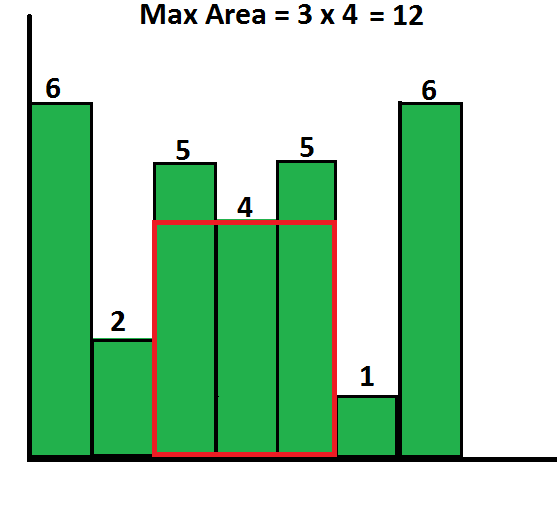
GeeksforGeeks
A Computer Science portal for geeks. It contains well written, well thought and well explained computer science and programming articles, quizzes and practice/competitive programming/company interview Questions.
 uncut void
@narrow mica can I run something by you?
narrow mica
uncut void
<@208918673178492929> can I run something by you?
sure? tho tbh you can just post whatever you have here(if appropriate, i.e. dsa cause tis the dsa channel) and other people can also look at it
stiff quartz
narrow mica
[disgostan site](https://www.geeksforgeeks.org/largest-rectangular-area-in-a-his...
it's not really dp right, but I guess that's probably what the persons in the comment of the original problem was talking about
uncut void
narrow mica
sure? tho tbh you can just post whatever you have here(if appropriate, i.e. dsa ...
ofc, I posted it in #databases but there doesnt seem to be anyone currently active at the moment. Here is the link to my post #databases message
narrow mica
stiff quartz
it's not really dp right, but I guess that's probably what the persons in the co...
if I search for another similar classic (largest rectangle in binary matrix) people seem to call that dp
so that might be where the dp comes from
stiff quartz
thanks for digging that up
narrow mica
uncut void
ofc, I posted it in <#342318764227821568> but there doesnt seem to be anyone cur...
personally idk, so you'll have to wait for someone else
uncut void
narrow mica
personally idk, so you'll have to wait for someone else
no worries, thanks for taking a look anyway
 kind scroll
damnn im just lookin at chats rn and im noticing how many smart people are in this serfver
 marsh quartz
My question is about complexity analysis. There is a function that accesses 5 different hash tables, where each hash table has M keys (Cannot be treated as a constant) and each key has N characters (Cannot be treated as a constant). If a single hash operation is considered O(K) where K is the number of characters of the key, what should be the worst case complexity of this function?
How do I write it in the most concise way possible
haughty mountain
worst case? something like K + 5 M min(K, N)
marsh quartz
haughty mountain
worst case? something like K + 5 M min(K, N)
why + K?
haughty mountain
you need to hash the thing
haughty mountain
not in general
though it's kinda weird that K and N are even different variables
if K=N then it would dominate
 merry igloo
looking for DSA guidance
 oblique panther
merry igloo
looking for DSA guidance
oblique panther
merry igloo
looking for DSA guidance
Please ask a complete question that someone can start answering.
merry igloo
there is too much overwhelming info
that is distracting and floating from one place to another
oblique panther
merry igloo
there is too much overwhelming info
what is your goal for learning DSA
merry igloo
to get in FAANG
oblique panther
merry igloo
to get in FAANG
DSA isn't the most important thing to get into FAANG, but even if it were, FAANG isn't the be-all-end-all of software development careers.
merry igloo
i know but
It is also the way to get in
I want to know how to progressively learn programming where i can solve problems
oblique panther
merry igloo
i know but
It is also the way to get in
I want to know how to progressively le...
try implementing a linked list.
merry igloo
thnks you ⭐
 meager rivet
hello guyw
Does anyone know how to create a list from a variable
for example, lets say im taking an input like x = input("hello enter a number"), lets say, for the sake of example, i enter 20. How do i make a list called 20 out of that?
lean walrus
meager rivet
for example, lets say im taking an input like `x = input("hello enter a number")...
lists don't have names
you can create a list of 20 elements
or list with a number 20 inside
lean walrus
ok
 spice glade
meager rivet
for example, lets say im taking an input like `x = input("hello enter a number")...
spice glade
meager rivet
for example, lets say im taking an input like `x = input("hello enter a number")...
x = input("Name of variable:")     # hello
y = input("Content of variable:")  # world

globals()[x] = y

print(hello) # world
its possible, but you should never do this
meager rivet
why not
 left mulch
There might be other reasons, but for one this code is hard to follow/understand
 jolly fog
meager rivet
for example, lets say im taking an input like `x = input("hello enter a number")...
jolly fog
meager rivet
for example, lets say im taking an input like `x = input("hello enter a number")...
You'd use a dictionary.
meager rivet
Hm alright
meager rivet
left mulch
There might be other reasons, but for one this code is hard to follow/understand
I mean
As long as it works
stiff quartz
I would like to remove 1 from all first k elements of an array in log(n) or faster where n is the size of the array. I want to be able to insert in this array in log(n) or faster as well. Seg tree + lazy propagation doesn’t work because you can’t really insert anything, right? Is there a way to do both?
Because I only ever need to look at the first k elements when I do the updates I feel like I could use SortedList
But I’m not sure I see a clear way on how to do it
regal spoke
stiff quartz
I would like to remove 1 from all first k elements of an array in log(n) or fast...
Dynamic datastructures in general are a bit tricky. Easiest thing would be to allocate extra memory to begin with
stiff quartz
The thing is that if I allocate extra memory my updates will remove 1 to those unused positions right
And I’m not sure how I could discriminate between used and non-used (actually I could just have tuples int + bool instead of integers in my array)
regal spoke
You can have a segment tree with 0 1 to keep track which elements are "active"
stiff quartz
Yes that makes sense
And because I know I won’t insert more than x times with x <10^5
I can just initialize a 10^5 sized array with most elements marked as « inactive »
stiff quartz
regal spoke
Dynamic datastructures in general are a bit tricky. Easiest thing would be to al...
Although now that I think about it if the only information I have is that I’ll insert x times then i need at least x slots between two elements right
stiff quartz
Not really I’m figuring them out on the go
regal spoke
Then I would a n^(1/3) datastructure
stiff quartz
I’d be fine with it tbf I probably wouldn’t see that much of a difference with logn
regal spoke
Do you know about the "sorted list" data structure?
stiff quartz
Yep
regal spoke
That one is basically what you'd want
stiff quartz
From the GitHub you usually reference
regal spoke
yes
stiff quartz
regal spoke
That one is basically what you'd want
Im not sure you can do range updates though
« Fast » range updates
regal spoke
Think about how to do n sqrt n first
stiff quartz
I « only » want to remove 1 to first k elements
lean walrus
regal spoke
Do you know about the "sorted list" data structure?
what is that? heap? regular list that is maintaned in sorted state? something else?
stiff quartz
Not sure I get what you mean with sqrt - ah no I see, sqrt decomposition with plenty of small arrays - thanks!
stiff quartz
lean walrus
what is that? heap? regular list that is maintaned in sorted state? something el...
GitHub
⚡ Competitive Programming Library. Contribute to cheran-senthil/PyRival development by creating an account on GitHub.
regal spoke
lean walrus
what is that? heap? regular list that is maintaned in sorted state? something el...
Dynamic datastructure for keeping track of elements in sorted order
Internally it uses insert sort into O(n^(1/3)) buckets
There are O(n^(2/3)) buckets in total
Once a bucket fills up, it is split into two
The split operation costs O(n^(2/3)), but amortized it is cheap, since you only have to do it after first doing O(n^(1/3)) inserts into the bucket that is split
lean walrus
ok, list of lists
dont see why you would use that instead of a heap
heap is a limiting case of the same idea - split lists into lists of lists to make insertion faster, until you get O(1) lists - that is a binary tree
stiff quartz
You can’t access the ith fast element in a heap (I think you can with SortedList)
regal spoke
lean walrus
ok, list of lists
dont see why you would use that instead of a heap
heap is a li...
Try benchmarking it. The "sorted list" stuff is stupidly fast compared to anything else I've implemented in Python
The expensive steps, inserting, is done via a .insert call on a list
Which has a crazy low constant factor
since it is basically just C code
lean walrus
stiff quartz
You can’t access the ith fast element in a heap (I think you can with SortedList...
you probably can, with some additional maintained state
lean walrus
regal spoke
The expensive steps, inserting, is done via a .insert call on a list
that's fair
stiff quartz
lean walrus
you probably can, with some additional maintained state
Stack Overflow
I remembered that heap can be used to search whether an element is in it or not with O(logN) time complexity. But suddenly I can't get the details. I can only find getmin delete add and so on.
Can
Looks like you can’t do look ups in heap fast (you don’t know if you should go left or right)
Even with an additional DSA on the side
regal spoke
Iirc all of these sorted datastructures, heaps etc, ... has a way to keep track of "kth order statistics"
By maintaining some extra state
That said, I really dont think you'll beat the speed of sorted list with any of those
stiff quartz
So for my problem I could just do, with sqrt decomposition:
Insert in sqrt(n)
Lookup in log(n) (binary search)
Range update in sqrt(n) by "caching" the value I update to arrays entirely covered
And I guess if I know in advance the final size of my array, I should start with blocks of size sqrt(final size of array) instead of doing from time to time linear re-buildings right?
regal spoke
stiff quartz
So for my problem I could just do, with sqrt decomposition:
Insert in sqrt(n)
L...
I was thinking of doing everything in sqrt(n) time. I don't know what kind of binary search you are thinking of doing
stiff quartz
Well if you know that your array is sorted
I was writing something like this to find where to insert (which eventually will be O(sqrt(n) because I'll call .insert after)
    def find_index_to_insert(self, value: int) -> tuple[int, int]:
        # Binary search to find the block
        left, right = 0, len(self.blocks) - 1
        while left < right:
            mid = (left + right) // 2
            if self.blocks[mid][-1] < value:
                left = mid + 1
            else:
                # It means self.blocks[mid][-1] >= value
                right = mid
        block_idx = left
        # Binary search within the block
        block = self.blocks[block_idx]
        left, right = 0, len(block)
        while left < right:
            mid = (left + right) // 2
            if block[mid] < value:
                left = mid + 1
            else:
                # It means block[mid] >= value
                right = mid
        return block_idx, left
And you can write something similar for lookup right, and because there's no .insert call afterwards, it's a log(n) lookup
Oh yes right initially I was only asking for range update and insert; turns out I just didn't talk about lookups because I knew if I had a sorted DSA I could do them fast
 vale frost
hello i need courses web scraping & automation
 past wren
does anyone have a good sentiment analysis program?
narrow mica
stiff quartz
I would like to remove 1 from all first k elements of an array in log(n) or fast...
if python recursion wasn't so slow, you could use a merge split treap, which could support all segment tree operations + more like inserting/deleting(what you need here), interval reversal, cyclic shift, etc all in log time
I was also gonna say you could probably do some shenanigans with a range update point query datastruct to keep track of indices, but then I looked and saw that's what SortedList is doing
 dusky creek
What's a good website for DSA problems
preferably very well categorized
Leetcode is nice but i do dislike the premium popups
 stiff quartz
I was writing something like this to find where to insert (which eventually will...
stiff quartz
stiff quartz
I was writing something like this to find where to insert (which eventually will...
actually I had forgotten but you need to consider if there is a value in .lazy so lookup as well is sqrt(n)
stiff quartz
narrow mica
if python recursion wasn't so slow, you could use a merge split treap, which cou...
Sounds like a super complicated data structure 👀 never heard of it
regal spoke
narrow mica
if python recursion wasn't so slow, you could use a merge split treap, which cou...
I have tried making iterative treaps in the past. https://github.com/cheran-senthil/PyRival/blob/4a735958bfd3ac130a1d60542a23390e99b756f4/pyrival/data_structures/Treap.py#L218-L232
But they just dont compare to the speed of sorted list. Even when n = 1e7

GitHub
⚡ Competitive Programming Library. Contribute to cheran-senthil/PyRival development by creating an account on GitHub.
narrow mica
stiff quartz
Sounds like a super complicated data structure 👀 never heard of it
it is a bit of a doozy
treap is bst + heap, each node stores (bst_key, heap_key=random()), and if you look at bst_key the structure is a bst, if you look at heap_key it's a heap, and the randomized nature keeps it pretty balanced so it won't degrade; you can implement it using rotate or merge & split, use the latter for our purposes
then instead of actual keys, use "implicit keys" that are calculated on the fly as you descend the tree which represent the array's indices
narrow mica
regal spoke
I have tried making iterative treaps in the past. https://github.com/cheran-sent...
interesting...
I wonder what the speed difference is in say c++
stiff quartz
regal spoke
Never seen anyone try implementing sorted list in C++
isn't std::set basically a sorted list?
ah it doesn't allow duplicates
but other than that it's the same right?
regal spoke
stiff quartz
isn't std::set basically a sorted list?
no std::set doesnt have kth order statistics
stiff quartz
ah yes fair enough
narrow mica
stiff quartz
ah yes fair enough
if you're using gcc then you could use pbds tree, which does have order statistics
or well g++ ig cause c++
stiff quartz
not really a c++ user to be fair anyway haha
meager rivet
Hello, need some help with this school homework 😭
I'm trying to make a library that stores info about books and then i need to be able to output it via ID
what i dont understand is, how do i link the id to the book
how do i make it so that if for example
the input is "19" as in, give me the book with the id 19, how do i show the specific details of that book?
lean walrus
dict is perfect for this task
 digital crane
How can I encode a hex string to a 5-6 length integer value without losing data or mapping? Then, I can decode it back to the original hex string again.
For example:
- Encode:
"664fbafb951c8e9cb32c7091"→ return238774 - Decode:
238774→ return"664fbafb951c8e9cb32c7091"
meager rivet
is bro trying to unhash hashed data💀
 hazy leaf
hey can someone tell me what's wrong in this,I want to filter the strings which only contains 'e' and 'r' in it
 narrow mica
digital crane
How can I encode a hex string to a 5-6 length integer value without losing data ...
narrow mica
digital crane
How can I encode a hex string to a 5-6 length integer value without losing data ...
impossible even in theory
there exist more hexstrings than 5-6 length integers
apply pigeonhole
 brave hound
hazy leaf
hey can someone tell me what's wrong in this,I want to filter the strings which...
brave hound
hazy leaf
hey can someone tell me what's wrong in this,I want to filter the strings which...
what output were you expecting and what are you currently getting?
hazy leaf
brave hound
what output were you expecting and what are you currently getting?
I'm expecting it to only show the letters with erf in it and I ain't getting no O/P
brave hound
in the if condition you are checking if the letter is in er not erf
hazy leaf
brave hound
in the if condition you are checking if the letter is in `er` not `erf`
mb
mb
hazy leaf
brave hound
in the if condition you are checking if the letter is in `er` not `erf`

@brave hound for this code I get the ints which only has 0s and 1s as output
but now I have to another thing
If I gave 32 as input,it gives me 0,1,10,11 as OP and I want these ints to sum to get the given intput
like If I give 32 as IP and the the ints with 1s and 0s from 0 to 32 are 0,1,10 and 11 and if I add any of these numbers they should give me 32
if I add 10 and 11 and 11,I get the sum equal to the given input which is 32
@brave hound can you help me to do it
brave hound
hazy leaf
if I add 10 and 11 and 11,I get the sum equal to the given input which is 32
since you already computed the numbers you are going to be using to get the sum
you can do something similar to a greedy coin change solution
basically you sort the numbers in reverse order and iterate over it, then check how many of that number can fit into the target like (two 11s = 22 <= 32, but three 11s = 33 > 32) and you add that many of that number into the result and move onto the next number in the sequence
 glossy nexus
Im using xarray to open a weather grib dataset, there is 2 levels in it, one is isobaricinhpa (vertical weather layers in millibar) and one is for tropopause layer, any solution? I need both and dont want to filter it, just tryna output a grib into a netcdf
 solemn moss
regal spoke
It would be interesting
solemn moss
regal spoke
It would be interesting
Do you know some tasks to test it?
When doing just random inserts and erases i am getting pretty similar results for set and sortedlist, but sortedlist seems to be a bit faster than multiset (though i don't really trust these tests xd)
is faster than pbds tree - 1e6 inserts, erases and order_of_keys (first screen pbds, second sortedlist)

 regal spoke
solemn moss
Do you know some tasks to test it?
When doing just random inserts and erases i...
regal spoke
solemn moss
Do you know some tasks to test it?
When doing just random inserts and erases i...
Did you implment it in c++?
solemn moss
yep
regal spoke
Have you optimized the block size parameter?
regal spoke
Oh did you translate the python code?
solemn moss
mostly
regal spoke
You might want to play around with the block size
regal spoke
I don't know the best way to benchmark it
sorted list kind of has a worst case when you do insert at index 0 (i.e. in decreasing order)
solemn moss
regal spoke
sorted list kind of has a worst case when you do insert at index 0 (i.e. in decr...
    for (int i = 5'000'000; i >= 0; i--) {
        s.insert(i);
    }
(block size) 700 ->
6822822us (set)
15355384us (sortedlist)

1300 ->
6902500us
8223500us

1700 ->
6924141us
7042001us

2700 ->
6919356us
6521755us
works pretty fine
regal spoke
I was kind of hoping this would beat std::set by a significant margin, since std::set is known to be slow
I've heard a lot of rants about how Abseil's set beats std::set by a mile
solemn moss
At least it is a nice alternative for pbds ordered set which is even slower
Also I believe it will be kinda 1.5x better than std::set on average
If inserting in increasing order it is >2 times faster
regal spoke
The real strength of it is if you need to iterate over the elements in some range [l:r]
Since everything is stored into decently sized vectors, it is memory contiguous
regal spoke
solemn moss
At least it is a nice alternative for pbds ordered set which is even slower
Als...
Btw one interesting idea I've had for sorted list in C++.
Suppose that in each block you were to store 8 bit pointers (or maybe 16 bit pointers) to some kind of look up table
The cost of inserting should then decrease proportionally to the pointer bit size
So this could make the inserts significantly cheaper
stiff quartz
@regal spoke I'm not sure I remember well, and I can't find it, but you once said there's loads of stuff Mo's algorithm can do and seg trees can't, and one of them was Range Frequency Queries? Or do I remember poorly? (the latter is likely)
regal spoke
stiff quartz
<@475657117509091329> I'm not sure I remember well, and I can't find it, but you...
Well ye. There are some ways to work around that limitation
Mo is used when queries are complicated enough to not be possible to do with segment trees
stiff quartz
regal spoke
Well ye. There are some ways to work around that limitation
by ways to work around the limitation do you mean weirdly implemented segment trees, but so hard to implement that mo does the job?
(I'm asking because I was looking at this problem which is apparently Mo's 101 (https://www.spoj.com/problems/DQUERY/) and there were some (albeit a tiny bit convoluted) seg tree solutions)
regal spoke
There are ways to for example query: count number of (different) elements in [l, r)
using a segment tree
But you need to work around it
stiff quartz
ah yeah that's exactly the one I just did
solemn moss
regal spoke
using a segment tree
well, MO is much faster here actually
stiff quartz
by setting 1 to the last time you saw a particular value, right?
solemn moss
even though the complexity is worse
regal spoke
solemn moss
well, MO is much faster here actually
What. The speed of the segment tree solution should be insanely fast
solemn moss
with changes
stiff quartz
def solve() -> None:
    n: int = get_int()
    a = line_integers()
    q: int = get_int()
    queries = [[] for _ in range(n)]
    # queries[j] represents a list of queries, each being the queries[j][k][1]th query -
    # that is between queries[j][k][0] and j
    for nb in range(q):
        l, r = line_integers()
        l -= 1
        r -= 1
        queries[r].append((l, nb))

    answers = [0] * q
    st: SegmentTreeSum = SegmentTreeSum([0] * n)
    last = [-1] * (10**6 + 1)

    for j in range(n):
        if last[a[j]] != -1:
            st.update_tree(last[a[j]], 0)
        st.update_tree(j, 1)
        last[a[j]] = j
        for l, nb in queries[j]:
            answers[nb] = st.sum_range(l, j)

    for answer in answers:
        print(answer)
gets me 2.33s
for count number of (different) elements in [l, r]
stiff quartz
stiff quartz
(I'm asking because I was looking at this problem which is apparently Mo's 101 (...
on that judge
solemn moss
https://codeforces.com/gym/507278/problem/B
i've made this very fun task
(though it hasn't english statement and in python you can't solve it for sure)
5e5 distinct elements on segment queries with changes in point
O(n^(5/3)) works fine, but O(nlog^2(n)) not
stiff quartz
You are not allowed to view the contest
regal spoke
stiff quartz
```py
def solve() -> None:
n: int = get_int()
a = line_integers()
q:...
- You could use a fenwick tree instead of segment tree for exatra speed
- Mapping down the elements to [0,n) will probably speed it up significantly
solemn moss
stiff quartz
You are not allowed to view the contest
mhm 1 min
stiff quartz
regal spoke
1. You could use a fenwick tree instead of segment tree for exatra speed
2. Mapp...
Insightful, I wasn't really trying to beat Mo's though. I never think of 2.
I was just curious as to how people solved it with seg trees when it's presented as a "Mo's 101"
regal spoke
stiff quartz
I was just curious as to how people solved it with seg trees when it's presented...
Easiest way to explain mo is to make a simple query problem
regal spoke
The standard problem used to explain mo on cf is https://codeforces.com/contest/86/problem/D , which I think doesn't have an easy segment tree solution (but I havent thought too hard about it)

Codeforces
solemn moss
solemn moss
https://codeforces.com/contestInvitation/d3c1661f07b37d836672895f88d4e8e434eb9a6...
second task
stiff quartz
solemn moss
second task
after i click the invit link i can click on the first link
stiff quartz
regal spoke
The standard problem used to explain mo on cf is https://codeforces.com/contest/...
I see I'll check it out
So the conclusion is more like
For some problems
There might be a seg tree solution
but the work to get it is just too much
and the Mo's solution is just a ton easier
regal spoke
solemn moss
https://codeforces.com/gym/507278/problem/B
i've made this very fun task
(though...
Havent really thought about online count unique values before? Can't you do a mix between the offline algorithm and a brute online algorithm?
to get something like n sqrt n
You rebuild the offline datastructure after every ~ sqrt(n) queries
There could be at most sqrt(n) updates that the offline datastructure doesnt know about at any point in time
Those updates you can handle in a brute force way. For each query, you simply check all relevent new updates in O(sqrt(n)) time and modify the result from the offline algorithm accordingly
solemn moss
xd
yeah sounds good
that's not fair 😄
though
how would you handle them
ah ok i know
 boreal wadi
Hi guys, im a gold trader. I have so far written some code which gives me the following output for the example market structure.
The problem lies in how I further interpret my tuples of data in the sequenced output.
Specific combinations and sequences of mitigation outputs have different interpreted conditions for the current price action.
So yeah! if anyone can help point me in the right direction in terms of finding the right community or person to help me I would greatly appreciate it!

Here is another example output:
 modern gulch
boreal wadi
Hi guys, im a gold trader. I have so far written some code which gives me the fo...
modern gulch
boreal wadi
Hi guys, im a gold trader. I have so far written some code which gives me the fo...
Whats the question?
boreal wadi
thats hard part. working out what I want to code
if 3 "fully mitigates" 5 and closure status = "yes" then when 2 "fully mitigates" 4 thats an indication trend has been broken
do I guess someone needs to have experience with market structures already potentially
its a very unique and niche area I understand
modern gulch
I don't know what fully mitigates means in this context.
modern gulch
Takes out what?
modern gulch
Is this some commodities terminology? I've never done commodities
boreal wadi
Its ICT terminology
fully mitigates is the act of something that has been made less severe or painful, or has been made less dangerous, harsh, or damaging
so when we fully mitigates previous highs or low in the market
its putting in damage for sellers but making damage less painful for buyers
in that context
but it can always be the opposite way around hence, "fully mitigates" in this context im using to refer to the purge of previous lows or highs
so like each poi will have previous points that it interacts with
and thats how im analysing it
modern gulch
I'm not sure you're going to find anyone who knows much about ICT or commodities trading here. If you can express it in terms of an algorithmic goal, maybe we could map it to something else?
boreal wadi
Right spot on
modern gulch
If you just want to label points based on their relationship to lag/lead values? That's straightforward
boreal wadi
In trading we interpret the market from a technical stand point.
So the process of analysis, if we repeat that and record the output enough times we get results and then can safely place trades
But its about being clever and interpreting it specifically but also having a high enough frequency for results
take the simple act of taking out (aka fully mitigating) the previous days high, it happens ALL the time.
Thats one confluence (or specific attribute about the current price)
then you combine it with another attribute, its an and statement.
We are taking out the previous days high and we are breaking a 5min trendline
for example
modern gulch
I don't need the background, I'm in the industry. I don't do much TA tho, not a big fan of trading off charts
Whats the algorithm you're trying to implement?
Like, if you want to find points that meet conditions X and Y?
boreal wadi
im very good at TA, suck at fundamental analysis.
I already got a little data manually recorded and its good profit (but not enough sample size) so I want to make a robot to do the technical analysis for me and give me results for hundreds of thousands of different trades for each specific trade type
boreal wadi
modern gulch
Like, if you want to find points that meet conditions X and Y?
yes, its the interpretation of the price data which is the really challenging part, but also im new to python so im using Claude at the moment to teach me.
modern gulch
boreal wadi
yes, its the interpretation of the price data which is the really challenging pa...
If you're trying to learn Python, you really have to avoid LLMs: I'm not just saying this: it really hurts your growth
modern gulch
boreal wadi
yes, its the interpretation of the price data which is the really challenging pa...
For the data part, I think youll find most of your questions really just require learning Pandas well.
boreal wadi
Your right. I used it to write the first couple hundred lines of code but after that ive had to ask the ai specific lines of code and go step by step
modern gulch
Like, if you want to calculate an ichimoku cloud and identify points that intersect, this is fairly straightforward in pandas (or similar),
modern gulch
boreal wadi
Your right. I used it to write the first couple hundred lines of code but after ...
Yah, the problem here isn't that you won't get the job done... it's that you're not learning how to think in programming terms.
boreal wadi
modern gulch
Yah, the problem here isn't that you won't get the job done... it's that you're ...
righttt thats probably why im finding it so hard to write this darn thing
I think in my own logical language and then work out how to make it into its python equivalent
modern gulch
boreal wadi
righttt thats probably why im finding it so hard to write this darn thing
Kaggle.com/learn is very helpful
boreal wadi
and its always counter intuitive
boreal wadi
modern gulch
Kaggle.com/learn is very helpful
Alright! ill check it out, thanks
modern gulch
You can skip the Ml stuff, the pandas part is really important
 modern gulch
boreal wadi
this is what I need, I was using the pdf manuals before
modern gulch
boreal wadi
this is what I need, I was using the pdf manuals before
Also, hang out in #python-discussion , you'll learn something new every day
boreal wadi
the ones with like 3000 pages of stuff
boreal wadi
modern gulch
Also, hang out in <#267624335836053506> , you'll learn something new every day
sure! thanks for the welcome
modern gulch
boreal wadi
the ones with like 3000 pages of stuff
😢
hoary flare
so, I guess this question is more kinda theoretical, but, let's imagine that we need to generate n hashes for an object. We use the pickle.dumps(obj) to convert our object to a byte array and we stitch the bits together so we get a long string of bits of length. Now we take the number of bits, m, and we have and divide it by the number of hashes that we want. Then, we just take n partitions of length m//n. Would this give a relatively uniform and independent set of hash values?
glossy nexus
Im using xarray to open a weather grib dataset, there is 2 levels in it, one is isobaricinhpa (vertical weather layers in millibar) and one is for tropopause layer, any solution? I need both and dont want to filter it, just tryna output a grib into a netcdf
modern gulch
hoary flare
so, I guess this question is more kinda theoretical, but, let's imagine that we ...
You have n objects, and want to compute a hash of all of them? Or one object and n hashes?
hoary flare
modern gulch
You have n objects, and want to compute a hash of all of them? Or one object and...
one object and I want to get multiple hash values. like what you'd do for a bloom filter
modern gulch
hoary flare
one object and I want to get multiple hash values. like what you'd do for a bloo...
Not really sure I follow but maybe ask in #python-discussion , there's enough ppl there who'll answer
 fiery cosmos
dusky creek
fiery cosmos
dusky creek
So I'm learning some DSA, and this resource seems pretty mathematical in its explanations
While I do understand it if I try slowly, do I really need to digest the math? Or should I find a simpler resource

 shut breach
Yeah you should read it slowly. If you find something simpler you're just going to have a worse understanding of it.
It's worth noting that this isn't even the mathematical definition of big O, it's talking unrigorously about functions.
 cobalt parcel
Anyone knows an optimized KMP algo where there's "two" prefix suffix table that starts with -1 ?
I saw it in my class but I cant find the source for it
 grizzled rock
just remember in regards to Big O it is always testing WORST CASE so when something is referring to Big O we can assume it is talking about worst case scenario. So for an example if something was big O(n)^2 -> this example is essentially a loop within a loop and so it is O(n)^2 because no matter what the input is we will have to look over that value twice - i.e.,
for i in something:
   for j in something:
     print(f"something: {j}")```

regardless if its 2-1000 we still need to look over the list twice

If I completely went off the rails here and missread what you've typed and told you something you already know sorry for wasting your time; if not, hope this helped.one shitty example but it's an example 
lean walrus
for i in something:
   for j in something:
     print(f"something: {j}")
``` this code does not "look over that value twice"
it does that `len(something)+1` times, so you get `len(something)*(len(something) + 1) = O(N^2)` (where `N=len(something)`) operationsjust remember in regards to Big O it is always testing WORST CASE so when something is referring to Big O we can assume it is talking about worst case scenario
no
big O is not generally "worst case"
it's an upper bound of something
you can upper bound the best case, or average case, or whatever
lean walrus
algorithm can be O(logN) in typical case and O(N) in the worst case (some kind of search tree, for example)
if you dont want to specify what you are upper-bound'ing, there are other letters for best case, average case, worst case
from wikipedia
 grizzled rock
haughty mountain
> just remember in regards to Big O it is always testing WORST CASE so when some...
grizzled rock
haughty mountain
> just remember in regards to Big O it is always testing WORST CASE so when some...
You're true it doesn't always mean worst case - but if we are talking layman terms, trying to understand seems like it's best to not over confuse. Nor am I trying to debate or care too just trying to help
grizzled rock
dusky creek
So I'm learning some DSA, and [this](<https://goalkicker.com/AlgorithmsBook/>) r...
If f(x) is a sum of several terms, if there is one with largest growth rate, it can be kept, and all others omitted
If f(x) is a product of several factors, any constants (terms in the product that do not depend on x) can be omitted.
Example:

f(x) = 6x^4 − 2x^3 + 5

Using the 1st rule we can write it as, f(x) = 6x^4

Using the 2nd rule it will give us, O(x^4)

What is Worst Case?
Worst case analysis gives the maximum number of basic operations that have to be performed during execution of the algorithm. It assumes that the input is in the worst possible state and maximum work has to be done to put things right.

For example, for a sorting algorithm which aims to sort an array in ascending order, the worst case occurs when the input array is in descending order. In this case maximum number of basic operations (comparisons and assignments) have to be done to set the array in ascending order.

It depends on a lot of things like:

CPU (time) usage
memory usage
disk usage
network usage
What's the difference?
Big-O is often used to make statements about functions that measure the worst case behavior of an algorithm, but big-O notation doesn’t imply anything of the sort.

The important point here is we're talking in terms of growth, not number of operations. However, with algorithms we do talk about the number of operations relative to the input size.

Big-O is used for making statements about functions. The functions can measure time or space or cache misses or rabbits on an island or anything or nothing. Big-O notation doesn’t care.

In fact, when used for algorithms, big-O is almost never about time. It is about primitive operations.

When someone says that the time complexity of MergeSort is O(nlogn), they usually mean that the number of comparisons that MergeSort makes is O(nlogn). That in itself doesn’t tell us what the time complexity of any particular MergeSort might be because that would depend how much time it takes to make a comparison. In other words, the O(nlogn) refers to comparisons as the primitive operation.

The important point here is that when big-O is applied to algorithms, there is always an underlying model of computation. The claim that the time complexity of MergeSort is O(nlogn), is implicitly referencing an model of computation where a comparison takes constant time and everything else is free.

Example -

If we are sorting strings that are kk bytes long, we might take “read a byte” as a primitive operation that takes constant time with everything else being free.

In this model, MergeSort makes O(nlogn) string comparisons each of which makes O(k) byte comparisons, so the time complexity is O(k⋅nlogn). One common implementation of RadixSort will make k passes over the n strings with each pass reading one byte, and so has time complexity O(nk).``` this might help you, just found this 🙂are there?
dusky creek
shut breach
It's worth noting that this isn't even the mathematical definition of big O, it'...
There was the mathematical definition as well
lean walrus
haughty mountain
are there?
there are some
 dusky creek
But I understand that its better to actually understand whats going on
stiff quartz
lean walrus
there are some
That’s not for best or average case
It’s just instead of having upper bound you can have a lower bound
Or a tight bound
dusky creek
Im using a book from my university's library which is doing a pretty good job of making me understand things so far though
stiff quartz
But you have to say what you bounding for (although most people bound worst case)
The big omega is quite common when you want to say « the solution is at least that bad »
haughty mountain
lean walrus
there are some
these aren't about best/worst case though
it's about what kind of bound of the function it is
O - upper (≤)
Ω - lower (≥)
o and ω for the strict variants which behave like < and >
the whole study of asymptotics boils down to looking at f(n)/g(n) and seeing what happens when n grows
does it tend to 0, a positive constant, or ∞?
 spring crag
Hi, i'm using the global forecast system(gfs) grib data, the model run has 120 hourly steps first, then transitions to 3 hour steps until 384, What I want to do is to linear interpolate the missing values between the 3 hours,
so pseduocode
pygrib open(file)
get data of time 120, 123 for example
interpolate 121,122
im not the best at the interpolation part and it has been quite challenging especially:
outputting the interpolation file the same structure as original dataset, including atmospheric layers for each variable, xarray is quite disasterous when handling layers, can anyone help?
 lilac cradle
i wrote this RLE algorithm yesterday for fun, thoughts?
def byte_RLE(arr, flag=0xff):
    """
    Run Length Encoding, using a flag byte, a count byte, and a value byte.
    Values without the flag are passed unchanged.
    """
    idx = 0
    while idx < len(arr):
        val = arr[idx]
        if val == flag:
            if idx + 2 >= len(arr): break
            count = arr[idx + 1]
            val = arr[idx + 2]
            for _ in range(count): yield val
            idx += 2
        else: yield val
        idx += 1
instead of having the count before each value it reserves a single value (by default 255) as a flag to denote that there should be multiple of a byte
haughty mountain
lilac cradle
i wrote this RLE algorithm yesterday for fun, thoughts?
```py
def byte_RLE(arr,...
how do you encode 0xff?
ff 01 ff?
 wraith ridge
 kind jolt
Hello there. I wont give the solution away but I will give you a few pointers. You will need to use recursion - and in such a way that when the arrow moves up by one in a pillar (towards the red square) you need to recall F2 every time you move by one blue square until you reach the red square and at that point you will start popping off the stack and the arrow will move back towards the bottom (by the same amount of squares that it moved up).
That's a bit of a mouthful I know, but hopefully it make a little sense.
stiff quartz
regal spoke
The standard problem used to explain mo on cf is https://codeforces.com/contest/...
That was a beautiful problem to do mo on, thanks for the suggestion, I did it yesterday and if you know you need to use mo it becomes so trivial
kind jolt
wraith ridge
Hello there. I wont give the solution away but I will give you a few pointers. Y...
thx, im still stuck but i try to solve
 half plume
Hello everyone.
Who can explain about suffix array algorithm?
regal spoke
half plume
Hello everyone.
Who can explain about suffix array algorithm?
Are you asking about an algorithm for computing the suffix array of a string?
Or asking what a suffix array is?
half plume
No, I want to know about suffix array algorithm, not concept.
regal spoke
There are a couple of algorithms.
The brute O(n^2 log n) is simply
def suffix_array(S):
    return sorted(range(len(S) + 1), key = lambda i: S[i:])
The standard algorithm you'll find for it out there uses cyclic shifts, in O(n log n) https://cp-algorithms.com/string/suffix-array.html#on-log-n-approach
Sometimes you'll also see the same cyclic shift algorithm implemented using the built in sort, which makes it run in O(n log^2 n). That version is probably the simplest suffix array algorithm out there.
The goal of this project is to translate the wonderful resource http://e-maxx.ru/algo which provides descriptions of many algorithms and data structures especially popular in field of competitive programming. Moreover we want to improve the collected knowledge by extending the articles and adding new articles to the collection.
However, there are more complicated algorithms out there like the SA-IS algorithm that runs in linear time. Here is a Python implementation I've made of SA-IS https://github.com/cheran-senthil/PyRival/blob/master/pyrival/strings/suffix_array.py
GitHub
⚡ Competitive Programming Library. Contribute to cheran-senthil/PyRival development by creating an account on GitHub.
This ^ runs in O(n + |alphabet|), so in true linear time.
 patent blade
Can you suggest an algorithm that completes the shape within a certain polygon in the picture? I want pixels outside the polygon to be ignored when completing the shape.
glossy nexus
import pygrib
import eccodes
import tempfile
import os

ds = pygrib.open('Tools/merged.grib')

with tempfile.NamedTemporaryFile(delete=False) as temp_file:
    temp_file_name = temp_file.name

    for msg in ds:
        with open('Tools/merged.grib', 'rb') as in_grib:
            gid = eccodes.codes_grib_new_from_file(in_grib)
            eccodes.codes_write(gid, temp_file)
            eccodes.codes_release(gid)

    h123 = ds.select(step=120)

    for msg in h123:
        values = msg.values
        new_values = values / 2

        gid = eccodes.codes_new_from_message(msg.tostring())

        eccodes.codes_set(gid, 'step', 121)

        eccodes.codes_set_values(gid, new_values.flatten())

        eccodes.codes_write(gid, temp_file)
        eccodes.codes_release(gid)

with open('Tools/merged_modified.grib', 'wb') as outfile:
    with open(temp_file_name, 'rb') as infile:
        while (gid := eccodes.codes_grib_new_from_file(infile)):
            eccodes.codes_write(gid, outfile)
            eccodes.codes_release(gid)

os.remove(temp_file_name)

ds.close()
in the output, theres a new time1 dimension that is replacing time when time is the dim that takes the new modified values, i have no idea what to do, searched all over internet/Ai and everything and asked but got 0 answers anywhere


 restive harbor
Hey I am having a problem with binary representation of integers, idk if it's normal or not :
(My version is Python 3.10.9)
When I slice in half a string integer and look at its binary form, it doesn't correspond to the lowest binary part of the original number. I would like to know why and if there's a way to fix the binary form of the sliced part to match the original one ? Surprisingly, only a small part of the binary representation matches.
n = 121332837237832748484297480923048038023787476482465738446464478484842942949922442024044992400310322222323222
halfn = int(str(n)[len(str(n))//2:])

hlength = halfn.bit_length()

for i in range(1, hlength+1):
    if not (bin(halfn)[-i:] == bin(int(n))[-i:]):
        print(i)
        print(f"{i}/{hlength}")
        break
56
56/179
I'm really not sure what you are trying to do. Base 10 and base 2 are very different
"halfn" in base 10 is not the same thing as "halfn" in base 2
12 in base 2 is 0b1100
restive harbor
regal spoke
I'm really not sure what you are trying to do. Base 10 and base 2 are very diffe...
This line (bin(halfn)[-i:] == bin(int(n))[-i:])
regal spoke
Think about the case of n=12
restive harbor
I am wondering why after taking half of the string of the number and then convert it back to int, it doesn't have the same binary representation of the same part but in the original number
regal spoke
restive harbor
I am wondering why after taking half of the string of the number and then conver...
Half of the string in base 10 is different from half of the base 2 string