#algos-and-data-structs
1 messages · Page 57 of 1
 regal spoke
Assume you are allowed to chose between 0 and up to 3 copies of A
 solemn moss
Probably I explained the task bad
I will start from the beggining without something extra
So we have a math expression like (A+A)-B+100
(with only +, - and brackets)
Each variable can take any value in range [1..10]
How many different values can we get as a result
So the stupid solve would be liike
s = set()
for a in range(1,11):
 for b in range(1,11):
  s.add(eval(expr.replace("a",a).replace("b",b)))
print(len(s))
The problem becomes a lot nicer if the values are in range [0,..,9]
Then it would become the "classical" version of this problem
solemn moss
That doesn't really change something I believe
solemn moss
ah, maybe
 obtuse brook
Hey, everyone 👋 New to DS & Algorithms. So I was studying the time complexities of list operations. According to https://www.pythonmorsels.com/time-complexities/, the time complexity for a list.insert operation was O(n). So I wanted to visualize that using a graph.
I wrote the following script to do it (using matplotlib for plots).
import time
from typing import List

import matplotlib.pyplot as plt

def construct_list(size: int) -> List[int]:
    return [i for i in range(0, size)]

element = 4
time_taken = []

list_size = 50000

for size in range(1, list_size):
    target_list = construct_list(size)

    start_time = time.process_time()

    target_list.insert(0, element)

    end_time = time.process_time()
    time_taken.append(end_time - start_time)

plt.plot(
    range(1, list_size),
    time_taken,
)
plt.xlabel("Size of list")
plt.ylabel("Time (sec)")
plt.grid()
plt.xlim(0)
plt.title("Complexity of list.insert() operation")
plt.show()
I was expecting a linearly increasing chart, but I got the following chart.

Any idea why this is ?
Thanks for any help on this !
 outer rain
obtuse brook
Hey, everyone 👋 New to DS & Algorithms. So I was studying the time complexities...
outer rain
obtuse brook
Hey, everyone 👋 New to DS & Algorithms. So I was studying the time complexities...
Because you are measuring an event so fast, there is not enough time resolution to measure it precisely. On windows time.time() only updates each 15ms, so there are multiple inserts between the updates. You should use timeit module for benchmarks like these instead, or at least do multiple inserts, or try measuring something else like cpu cycles, or idk. Time is hard.
obtuse brook
outer rain
Because you are measuring an event so fast, there is not enough time resolution ...
Thanks. I am able to see an approximate linear curve if I replace time.time() with timeit.timeit instead.
 haughty mountain
time.perf_counter if you don't want to use timeit
 pure loom
I can't add the ta-lib library in python. Can anyone help?
 raw zealot
@regal spoke (sorry for mention) is there a range update (lazy) segment tree in that pyrival repo
i see add in the lazy one
wait i can just make another exact method but set it to the value
regal spoke
Yeah you'll have to modify it if you want some other feature
raw zealot
got it 👍
 final night
does anyone the best resource to practice regex? preferably with solutions and explanations?
I'm using regex101 but it's just telling me that my solution is horribly long
 raven dagger
help
this might be more math tho
question:
Given a number n (n <= 10^6), and k, find the amount of numbers between 1 -> n that have exactly k factors```
cant think of anythink rn pls give some hints narrow mica
raven dagger
help
this might be more math tho
question:
```
Given a number n (n <= 10^6), an...
narrow mica
raven dagger
help
this might be more math tho
question:
```
Given a number n (n <= 10^6), an...
use a sieve
narrow mica
sieve for the number of divisors of each number between 1 and n, then just count how many of those equal k
narrow mica
narrow mica
sieve for the number of divisors of each number between 1 and n, then just count...
@raven dagger
raven dagger
ye
narrow mica
raven dagger
ye
well... do you get it?
raven dagger
uhhhhhhhhhhhm
raven dagger
narrow mica
well... do you get it?
do i just
get an array
and factors[i] = len(factorize(i))
narrow mica
raven dagger
and `factors[i] = len(factorize(i))`
no, you use the sieve to find the number of divisors, then after the sieve you can do a simple loop and check how many of them equal k
raven dagger

narrow mica
do you know what I'm refering to when I say 'sieve'?
narrow mica
raven dagger
kinda
no, it's a specific algorithm (the sieve of eratosthenes) that was originally for finding all prime numbers between 1 and n
you can augment it so it instead finds the number of divisors for all numbers between 1 and n
raven dagger
narrow mica
no, it's a specific algorithm (the sieve of eratosthenes) that was originally fo...
omfg tysm
narrow mica
raven dagger
omfg tysm
seems like you got it
gl implementing
raven dagger
so like
def sieve(n: int) -> list[int]:
    factors = [2] * n
    factors[0] = 0
    factors[1] = 1

    for i in range(sqrt(n)):
        for j in range(i * i, n, i):
            factors[j] += 1

return factors``` right?omfg
narrow mica
raven dagger
so like
```py
def sieve(n: int) -> list[int]:
factors = [2] * n
factors[...
well, almost
        if factors[i] != 2:
            continue
```you can't do that, e.g. `6` is also a factor of `12`oh yeah
narrow mica
raven dagger
oh yeah
you probably also can't stop at sqrt(n), e.g. 12 is a factor of 36
and also remember that range(n) stops at n-1
raven dagger
😭
narrow mica
raven dagger
😭
complexity's still like n log n even if you went to n instead of sqrt(n) though
so you should be fine in that regard
raven dagger
true
 dusky creek
Henlo
Looking at the pins rn
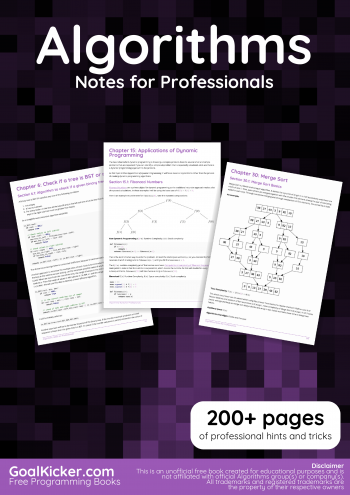
I've been considering following this though, anyone tried it and has opinions?
https://goalkicker.com/AlgorithmsBook/
 barren void
I had a bit of a broad question. I am testing A* and Dijkstra on a grid structure and testing their efficiency with different obstacle probabilities. The question is, should the time difference and nodes explored difference not be less significant if the obstacle probability is higher?
 half owl
why is this O(2^n)?

intuitively it has to be 2n at most operations
comparing n digits from both k and m
full code implemention (came after the explanation)
 regal spoke
half owl
why is this O(2^n)?
regal spoke
half owl
why is this O(2^n)?
2^(n-1) <= min(k,m) < 2^n
half owl
regal spoke
2^(n-1) <= min(k,m) < 2^n
2^n = min(k,m) at worst
that i follow
now what?
itll be an easy O(1) if both are the same size
regal spoke
Definition of n is "number of bits in min(k,m)"
half owl
regal spoke
Definition of n is "number of bits in min(k,m)"
okay i follow go on
it isnt time complexity
just the amount of bits
also not true
thats the max value possible
there are n bits at most
comparing these bits is at most 2n operations like i said
nothing here is exponential
regal spoke
half owl
nothing here is exponential
n = floor(log_2(min(k,m))) + 1
n is the log of min(k,m)
half owl
regal spoke
n = floor(log_2(min(k,m))) + 1
and that is?
regal spoke
half owl
and that is?
number of bits in min(k,m)
half owl
regal spoke
number of bits in min(k,m)
it's just n, min(k,m) would also at worst just be n
half owl
regal spoke
n = floor(log_2(min(k,m))) + 1
okay now i see it
regal spoke
10 bits
half owl
regal spoke
it runs exponential in n
that i dont understand
(base 2 n) amount of iterations is understandable now
regal spoke
Think of 2^n as the same thing as min(k,m)
They might be a factor of 2 off from eachother
So they are not identical
but almost the same thing
half owl
regal spoke
Think of 2^n as the same thing as min(k,m)
but thats not true
regal spoke
Take this example: 735 in base 2 is 1011011111 (10 bits)
half owl
n is just the amount of digits in the min, which we will for this purpose look at in base 2 rather than base 10 for some reason
regal spoke
2^10 = 1024 (11 bits)
half owl
regal spoke
They lie within a factor of 2 from eachother
i just dont understand
i dont see the implications here
regal spoke
Take this massive number 123456789123456789
In base 2 represeentatiom, it gas 57 bits
2^57 = 144115188075855872
half owl
regal spoke
In base 2 represeentatiom, it gas 57 bits
okay that i understand
half owl
regal spoke
2^57 = 144115188075855872
dont you mean? 2^58 as in an upper bound
for the value of the number
regal spoke
half owl
dont you mean? 2^58 as in an upper bound
Stop thinking about bounds
123456789123456789 is roughly 2^57
half owl
regal spoke
123456789123456789 is roughly 2^57
yes
so how come
2^57 = 144115188075855872 is bigger than something in base 57 bits represenation?
are some left-most digits 0?
it's a bigger number than the original for no reason as i see it
regal spoke
2^56 <= 123456789123456789 < 2^57
half owl
regal spoke
2^56 <= 123456789123456789 < 2^57
okay that i follow (that number is probably 56 bits in size)
regal spoke
Both 2^56 and 2^57 are good estimates for 123456789123456789
half owl
regal spoke
Both 2^56 and 2^57 are good estimates for 123456789123456789
well i dont see where you're going with this
regal spoke
For the purposse of big O analysis, it doesnt matter if you use 123456789123456789 or 2^56 or 2^57
half owl
regal spoke
For the purposse of big O analysis, it doesnt matter if you use 1234567891234567...
okay lets continue then
regal spoke
The slow gcd algorithm runs in:
O(min(k,m)) time
and also
O(2^n) time
and also
O(2^(n-1)) time
half owl
regal spoke
O(2^(n-1)) time
okay
well worst case is
both k and m are n bits/digits
and division is done twice in each iteration, division will always be here O(n) right?
so since the iterations are from n to 1 or 0 including
those are n iterations, which each iteration executes 2*O(n) operations
regal spoke
They assume division is O(1).
regal spoke
half owl
those are n iterations, which each iteration executes 2*O(n) operations
there are 2^n iterations
half owl
regal spoke
there are 2^n iterations
but there are only n options for common dividers
1<=divider<=n
regal spoke
Look here
 half owl
we just need to check n options (n iterations)
regal spoke
This is a for loop
regal spoke
That in worst case runs for min(k,m) iterations
half owl
regal spoke
That in worst case runs for min(k,m) iterations
yeah exactly!
regal spoke
i.e. 2^n iterations
half owl
regal spoke
i.e. 2^n iterations
yes, since 2^n is the upper bound for the value of the min(m, k) right? since it has n digits
regal spoke
half owl
yes, since 2^n is the upper bound for the value of the min(m, k) right? since it...
It is more than just an upper bound
really you should think of 2^n = min(m,k)
half owl
regal spoke
really you should think of 2^n = min(m,k)
it's not possible i think?
regal spoke
half owl
it's not possible i think?
You are completely missing my point
half owl
as in for every n digit number in base 2 represantion:
2^n <= value < 2^n+1
regal spoke
I'm not claiming that min(m,k) is a power of two
half owl
regal spoke
I'm not claiming that min(m,k) is a power of two
then what is it?
regal spoke
min(m,k) could be any number
half owl
although it should be to get a ~approximation of the number of iterations
regal spoke
However, 2^n is always going to be close to min(m,k)
half owl
regal spoke
min(m,k) could be any number
so long it has n digits right?
regal spoke
half owl
so long it has n digits right?
n is defined as the number of bits of min(m,k), yes
half owl
regal spoke
However, 2^n is always going to be close to min(m,k)
oh because we dont care if it's 2^n or 2*2^n right?
regal spoke
half owl
oh because we dont care if it's 2^n or 2*2^n right?
yes exactly
 simple dove
hmm
half owl
the minimum value that satisfies n digits will in any case be the worst case time complexity, others will just be it and a multiplication of of some constant c
which is negligble
regal spoke
half owl
oh because we dont care if it's 2^n or 2*2^n right?
For big O analysis, 5 * min(k,m), 1000*min(k,m), min(k,m) or 2^n are equivalent
half owl
regal spoke
For big O analysis, 5 * min(k,m), 1000*min(k,m), min(k,m) or 2^n are equivalent
yes i see it now, i just had a very had time understanding why O(2^n) is possible but now i understand it completely i think
thank you very much mate for your help
raw zealot
regal spoke
Yeah you'll have to modify it if you want some other feature
    def add(self, start, stop, value):
        """lazily add value to [start, stop)"""
        start = start_copy = start + self._size
        stop = stop_copy = stop + self._size
        while start < stop:
            if start & 1:
                self._lazy[start] += value
                self.data[start] += value
                start += 1
            if stop & 1:
                stop -= 1
                self._lazy[stop] += value
                self.data[stop] += value
            start >>= 1
            stop >>= 1

        # Tell all nodes above of the updated area of the updates
        self._build(start_copy)
        self._build(stop_copy - 1)

    # make range_update same as the add method if you want to set the value instead of adding
    def range_update(self, start, stop, value):
        """lazily set value to [start, stop)"""
        start += self._size
        stop += self._size
        start_copy = start
        stop_copy = stop
        while start < stop:
            if start & 1:
                self._lazy[start] = value
                self.data[start] = value
                start += 1
            if stop & 1:
                stop -= 1
                self._lazy[stop] = value
                self.data[stop] = value
            start >>= 1
            stop >>= 1

        # Tell all nodes above of the updated area of the updates
        self._build(start_copy)
        self._build(stop_copy - 1)
this probably has some bug lmao
regal spoke
raw zealot
```py
def add(self, start, stop, value):
"""lazily add value to [sta...
Exactly what operations do you want to support?
raw zealot
just overwrite a range with the given arg
regal spoke
so for modification query you want to set a range with a specific value?
raw zealot
yes
regal spoke
Well then you shouldnt do lazy to begin with
regal spoke
Here is the trick for what you are doing:
Everytime you want to modify something, have an list called modification_at_time
In this list, store the value you want to modify to
The trick now is that you can use indices to modification_at_time inside your segment tree
Allowing you to use a max segment tree
regal spoke
raw zealot
just overwrite a range with the given arg
Btw there is a general segment tree that supports this which is useful from time to time.
Suppose you allow modify queries of the form (a,b)
x -> a * x + b
If you set a = 0 then you get your set query.
If you set a = 1 then you get add queries
I've considered adding this to pyrival since it could be used to solve tons of problems
regal spoke
Yes, but noticably slower than the less generic versions
regal spoke
Not really
Supporting general lambas would be impossible probably
You need to hard code in which operations you want to support
raw zealot
makes sense
regal spoke
The operation
lambda x: a * x + b
turns out to be nice
Both for normal segment tree, and for a lazy segment tree
raw zealot
but it takes only one arg
regal spoke
x -> x + i * a
where i is the index of x
https://cses.fi/problemset/task/1736 here is a problem that uses that kind of modification query
regal spoke
raw zealot
like where does this lambda get passed
There is no passing of lambdas
raw zealot
because while combining we will use the func = lambda x,y : x+y right
oh
hardcoded ic
regal spoke
Very hardcoded, yes
raw zealot
so this goes in the add of lazy st
why not pass custom lambda inplace of value of add 🤔
but only for sum st i.e
a bit rewriting needed then
regal spoke
I think you are underestimating how tricky it is to code lazy segment trees
regal spoke
The idea is that you need to know how a value of a node in the segment tree will be modified by a modificiation query
Without digging down into the segment tree
regal spoke
Suppose that you want to deal with sums both as modification queries, and as range queries
Suppose that you decide to add 123 (some arbitrary number) to the entire range
Then the value of the root node of the segment tree would not increase by 123
it would increase by n * 123
raw zealot
yeah
regal spoke
That is what makes things to tricky
raw zealot
okay i see
regal spoke
If you instead have min on modification query and min on range query, then things become simple
x -> min(x, a)
regal spoke
Now the root node just acts like any other node
There is no need for an n when updating it
raw zealot
yeah
setting the entire range to n , will overwrite root as n^2 for sum
too strong stuff
regal spoke
Another thing making lazy segment trees tricky is that sometimes the order of the modification queries matter, and sometimes they do not.
For the x -> min(x, a) segment tree the order doesnt matter
But for the x -> a * x + b, the order matters
This kind of thing makes coding lazy segment trees very tricky if you want something generic
The more generic you try to make them, the more unesseccarily complicated they need to become
regal spoke
One of the most well known code libraries for c++, kactl, has gone with the approach of only having a very basic and simple lazy segment tree https://github.com/kth-competitive-programming/kactl/blob/main/content/data-structures/LazySegmentTree.h

GitHub
KTH Algorithm Competition Template Library (... eller KTHs AC-tillverkande lapp) - kth-competitive-programming/kactl
raw zealot
normal set and add are more than enough as of now for me
i dont solve 2000+s yet so yeah :P
regal spoke
I think the most important thing is to get used to modifiying the standard segment tree
raw zealot
right
raw zealot
directly implementing the iterative version is too strong for me
regal spoke
Its not really bad once you learn how they work
regal spoke
- Start with a power of 2 sized segment tree (there are other versions, but dont bother with them)
- You walk down the tree by i -> 2 * i for left child, and i -> 2 * i + 1 for right child
- You go up the tree by
i -> i // 2
- You are at a leaf when you are at
i >= n
The only really tricky thing is how to convert a range [l, r) into a set of nodes in the segment tree
raw zealot
regal spoke
1. Start with a power of 2 sized segment tree (there are other versions, but don...
1 << (self._len - 1).bit_length() , this is basically 2^h - 1 right
h is height of tree
regal spoke
# Convert interval [l, r) to set of nodes
def find_nodes_from_interval(self, l, r):
    nodes = []
    # Jump to the leaves that correspond to l and r
    l += self.n
    r += self.n
    while l < r:
        if l & 1: # if l is a right child
            nodes.append(l)
            l += 1
        if r & 1: # if r - 1 is a left child
            nodes.append(r - 1)
        # Walk up the tree
        l //= 2
        r //= 2
    return nodes
This is the tricky code ^
Try scetching down a small segment tree and think about what this code does
raw zealot
aight tysm
 celest thicket
What is the very important topic in the dsa
 wooden gulch
hello, i was wondering if someone could explain why this solution for longest consecutive sequence is O(N) and if you could try to dumb down the answer because i'm having a hard time understanding. There is a while loop running inside of the for loop, if in the worse case scenario this while loop runs N times (assuming the whole array is consecutive) wouldn't the time complexity be O(N^2)? I know looking up something in a set is O(1) but if we increment the value inside the while loop N times, wouldn't this add up?
class Solution:
    def longestConsecutive(self, nums: List[int]) -> int:

        num_set = set(nums)
        longest = 0

        for num in nums:

            if num-1 not in num_set: # if the previous number is not in the set, it means that we have to start looking at a new sequence starting with cur
                cur = num
                cur_len = 1

                while cur+1 in num_set:
                    cur += 1
                    cur_len += 1

                longest = max(longest, cur_len)

        return longest
define consecutive sequence
wooden gulch
regal spoke
define consecutive sequence
here's an example from the problem statement:
Input: nums = [100,4,200,1,3,2]
Output: 4
Explanation: The longest consecutive elements sequence is [1, 2, 3, 4]. Therefore its length is 4.
Thats not a definition
wooden gulch
regal spoke
Thats not a definition
you can infer it from the problem statement idk what you mean lol
one number after the other
regal spoke
ok
regal spoke
wooden gulch
hello, i was wondering if someone could explain why this solution for longest co...
This definitely looks O(n^2) to me
Is there a reason you think it is O(n)?
wooden gulch
i'm watching neetcode which is the person who gave out that solution https://www.youtube.com/watch?v=P6RZZMu_maU&ab_channel=NeetCode
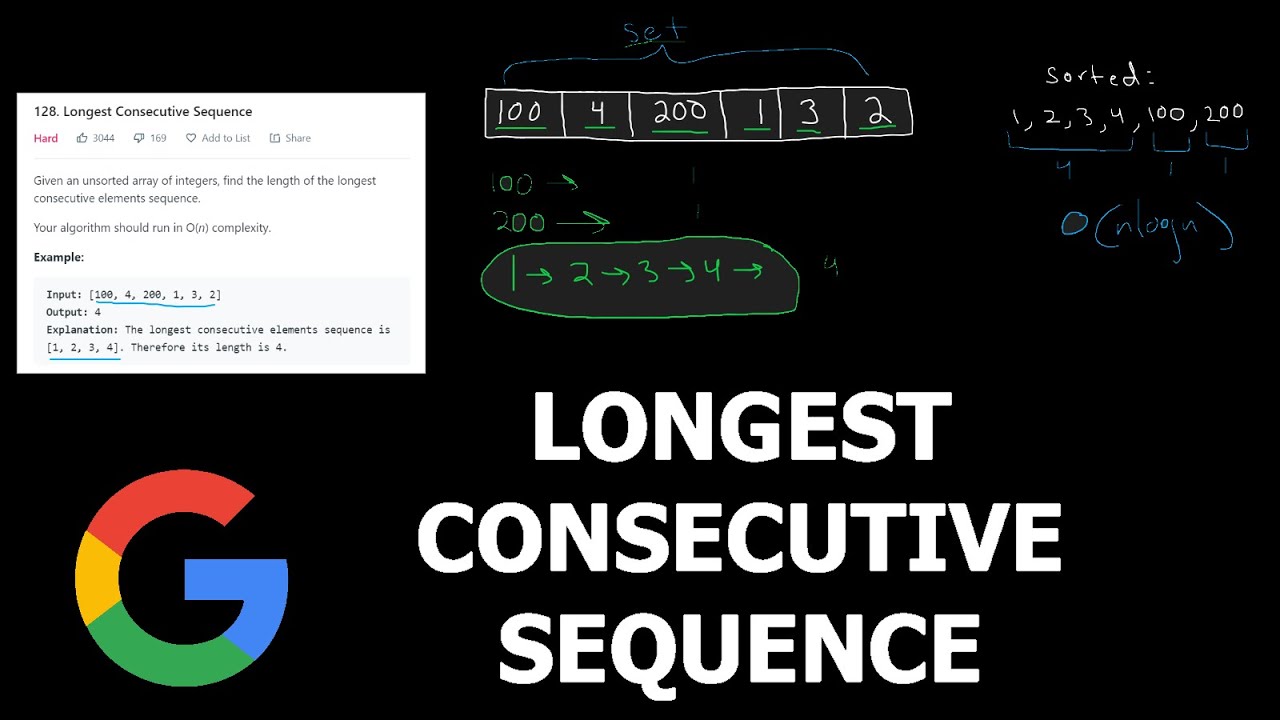
🚀 https://neetcode.io/ - A better way to prepare for Coding Interviews
🐦 Twitter: https://twitter.com/neetcode1
🥷 Discord: https://discord.gg/ddjKRXPqtk
🐮 Support the channel: https://www.patreon.com/NEETcode
Problem Link: https://neetcode.io/problems/longest-consecutive-sequence
0:00 - Sorting Solution
1:02 - Conceptual optimal solution
7:2...
outer rain
this while only runs once per each consecutive sequence
regal spoke
ah yes
if num-1 not in num_set:
This is the key
to make it run O(n)
Otherwise it would be O(n^2)
wooden gulch
outer rain
this while only runs once per each consecutive sequence
if i have [0, 1, 2, 3, 4, 5]
I enter the for loop once where num = 0
-1 isn't in the set so I enter the while loop now, wouldn't this while loop continue until I check if 6 is in the set?
regal spoke
wooden gulch
if i have [0, 1, 2, 3, 4, 5]
I enter the for loop once where num = 0
-1 isn't i...
yes
Which is O(n)
wooden gulch
but the for loop will keep running, now num = 1, but it won't pass the if condition and so on
that for loop will go on until N
regal spoke
The for loop goes over the elements in the set in an arbitrary order
If it hits a "left most element" of a consecutive sequence, then it starts a search
wooden gulch
regal spoke
The for loop goes over the elements in the set in an arbitrary order
yes but the for loop is O(N)
in the particular example I sent, the while loop will run N times too
even if we have visited all the numbers in the sequence, the for loop will continue until it's done (N times no matter what)
regal spoke
wooden gulch
in the particular example I sent, the while loop will run N times too
Think about it like this. The set can be split up into consecutive sequences.
For example {23,5,3,1,4,2,22} can be split into [1,2,3,4,5] and [22,23]
The inner while loop will go over each of these consecutive sequences exactly once
The total number of iterations of the inner while loop is n
wooden gulch
i think i get it, it would be O(N^2) if that while loop was iterating N times every single time we increment in the for loop
but in this solution that would never happen
regal spoke
wooden gulch
i think i get it, it would be O(N^2) if that while loop was iterating N times ev...
yes, which is basically what happens if you were to remove if num-1 not in num_set:
wooden gulch
okay thanks!!
 stiff quartz
Hi,
I'm trying to understand why this codeforces submission (https://codeforces.com/contest/25/submission/270922167) passes but not this one (https://codeforces.com/contest/25/submission/270922138).
The problem is that one: https://codeforces.com/contest/25/problem/D
I'm solving it using Disjoint Union Sets.
My reasoning is the following:
- Get all connected component of the initial graph (I call them "islands")
- Iterate through each of those components, if you find a cycle, remove an edge and use it to connect to another component. To join the connected components in almost
O(1), use what's described here https://cp-algorithms.com/data_structures/disjoint_set_union.html - Do that until there is only one connected component
The only difference between the two codes is that in the one that doesn't pass I add
if island not in dealt_with:
It's aO(1)operation (it's asetand I tried replacingset[int]parset[str]in case there were weird hacks to make thisO(n))
It should even improve the computation because if we arrive there it means we left the previous connected component so there are no more cycles to be found there and since that island is now in that previous connected component we save ourselves one dfs to find a cycle since we know there are none.
Weirdly enough instead of decreasing the solution from 400 ms to something lower, it TLE at 2s. This is doing my head in. Would love some insight!
regal spoke
stiff quartz
Hi,
I'm trying to understand why this codeforces submission (https://codeforces....
n is 1000 on that problem
To tle you'd need to basically be stuck in an infinite loop
stiff quartz
Um
Ah
I see
Nevermind
That’s a logic issue
Not a tle issue
I guess the one that passed could probably even be hacked
(Thanks btw)
Actually I'm having doubts
regal spoke
For this problem I wouldnt even use a dsu to begin with
stiff quartz
regal spoke
For this problem I wouldnt even use a dsu to begin with
To be fair I was learning dsu
and clicked on a random problem with a tag dsu so i didn't think too much, i just wanted to make sure i understood the concept
regal spoke
If I understand it correctly, then any spanning tree will work
BFS spanning tree is probably easiest to make with Python
stiff quartz
regal spoke
If I understand it correctly, then any spanning tree will work
well they "started" the spanning tree
and you have to "fix it"
update: it was a logic issue and indeed an infinite loop 😦 fixed it it passes now 🙂
regal spoke
stiff quartz
Hi,
I'm trying to understand why this codeforces submission (https://codeforces....
I tried making some solutions
BFS: https://codeforces.com/contest/25/submission/270932536
DSU: https://codeforces.com/contest/25/submission/270933096

Codeforces

Codeforces
The DSU solution is really short (excluding the DSU implementation)
 wide thistle
I'm writing one program for tree data structure and I want to insert one node in that tree.
code:
class Node:
    def __init__(self, value):
        self.left = None
        self.right = None
        self.value = value


def new_node(value):
    return Node(value=value)


def insert_node(root, data):
    root = new_node(data)


def main():
    root = None
    insert_node(root, 8)
    print(root.data)


main()
error:
D:\codes\Python\.venv\Scripts\python.exe D:\codes\Python\dsa\practice\program.py
Traceback (most recent call last):
  File "D:\codes\Python\dsa\practice\program.py", line 22, in <module>
    main()
  File "D:\codes\Python\dsa\practice\program.py", line 19, in main
    print(root.data)
          ^^^^^^^^^
AttributeError: 'NoneType' object has no attribute 'data'

Process finished with exit code 1
Can anyone help me how to fix it
stiff quartz
regal spoke
I tried making some solutions
BFS: https://codeforces.com/contest/25/submission/...
Thx I’m gonna look at it!


 torn tiger
i Dont now
narrow mica
half owl
why is this the algo?
it's not a specific algorithm per se, but an application of binary search
haughty mountain
half owl
why is this the algo?
if I can check if a guess is too high/too low, then I can use binary search
raw zealot
i suppose it cant be done with treapmultiset and treapset of pyrival without TLE'ing ?
seems like cses is so biased to cpp

the former is literally converted code of the latter using chatgpt
lol
def solve(case=None):
    x, n = map(int, input().split())
    arr = list(map(int, input().split()))

    lis = TreapSet([0, x])
    tset = TreapMultiSet()
    tset.add(x)
    for i in range(n):
        l = lis.floor(arr[i])
        r = lis.higher(arr[i])
        tset.remove(r - l)
        tset.add(r - arr[i])
        tset.add(arr[i] - l)
        print(tset.max(), end=" ")
        lis.add(arr[i])
its probably because of the constant factor
because like
yeah
i have too many logn operations
regal spoke
raw zealot
i suppose it cant be done with treapmultiset and treapset of pyrival without TLE...
I would use the sorted list datastructure in pyrival (it is faster even though it has worse time complexity).
But for performance reasons, it is likely better to go with a completely different approach based on segment trees
regal spoke
raw zealot
but removing from sortedlist is O(n) right
No, it is n^(1/3)
Same as insert
regal spoke
Don't think too much about the exact time complexity
raw zealot
yeah i just need an approx wrt logn
regal spoke
Sorted list is simply faster for any feasible n (n<1e7)
raw zealot
cool
how can we do this with segtree btw?
i can probably set light val to 0 and anything else 1
then maybe add if both are 1
idk
regal spoke
raw zealot
how can we do this with segtree btw?
Go through the elements in time order and put a 1 in its position.
Have a standard sum segment tree
Now binary search inside the segment tree to find which light is closest to the left and which is closest to the right
Additionally, you can for each light store which light is to the left or right of it, removing half of the binary searches
raw zealot
understood, ty
raw zealot
regal spoke
I would use the sorted list datastructure in pyrival (it is faster even though i...
and what for Multiset ?, like to fetch the max at any point in the gaps
if only heapq maintained a sorted list too it would have been too nice lol
regal spoke
raw zealot
and what for Multiset ?, like to fetch the max at any point in the gaps
For the gaps you can just compute the max of suffixes
gaps = [...]
for i in range(len(gaps)-1)[::-1]:
    gaps[i] = max(gaps[i], gaps[i + 1])
oh
isnt this equivalent to max(gaps)
i was worried for the time cost lets try this
    lis = SortedList([0, x])
    tset = CustomHashMap() # some xor hashmap
    tset[x] = tset.get(x, 0) + 1
    for i in range(n):
        l = lis.lower_bound(arr[i])
        r = lis.upper_bound(arr[i])
        tset[r - l] -= 1
        if not tset[r - l]:
            del tset[r - l]
        tset[r - arr[i]] = tset.get(r - arr[i], 0) + 1
        tset[arr[i] - l] = tset.get(arr[i] - l, 0) + 1
        print(max(tset.keys()), end=" ")
        lis.insert(arr[i])
import heapq
import bisect
import sys

def fn(input):
    x, n = map(int, input().split())
    arr = map(int, input().split())
    cut_off = int(x**0.5) + 1

    pq = [-x, 0]
    queued_removes = dict()
    blocks = [list() for _ in range(cut_off)]
    blocks[0].append(0)
    blocks[-1].append(x)
    ans = []
    for add_light in arr:
        block_i = add_light // cut_off
        block = blocks[block_i]
        ins_point_in_block = bisect.bisect(block, add_light)

        prev_block_i = block_i - 1
        next_block_i = block_i + 1

        if ins_point_in_block:
            lower = block[ins_point_in_block - 1]
        else:
            while not blocks[prev_block_i]:
                prev_block_i -= 1
            lower = blocks[prev_block_i][-1]

        if ins_point_in_block != len(block):
            higher = block[ins_point_in_block]
        else:
            while not blocks[next_block_i]:
                next_block_i += 1
            higher = blocks[next_block_i][0]

        queued_removes[lower - higher] = queued_removes.get(lower - higher, 0) + 1

        while pq[0] in queued_removes and queued_removes[pq[0]] > 0:
            queued_removes[pq[0]] -= 1
            heapq.heappop(pq)
        heapq.heappush(pq, add_light - higher)
        heapq.heappush(pq, lower - add_light)

        block.insert(ins_point_in_block, add_light)
        ans.append(-pq[0])

    sys.stdout.write(" ".join(map(str, ans)))

fn(sys.stdin.readline)
```passes everything in 0.7s except test6 and test7 because the ascending/descending input makes it keep doing the `while not blocks[next_block_i]: next_block_i += 1` thing
probably optimizable but annoying to do sodamn
stiff quartz
regal spoke
I tried making some solutions
BFS: https://codeforces.com/contest/25/submission/...
This is depressing, your DSU solution is like 10x more elegant than mine
haughty mountain
stiff quartz
This is depressing, your DSU solution is like 10x more elegant than mine
study and learn :P
 lilac cradle
https://www.youtube.com/watch?v=GSxgb7tD-YY
anyone know a way to recreate this effect?

This uses the principle of Moiré slit animations.
If you look at the picture from a very specific distance with a set FOV and resolution you can get a harmonic to line up. By teleporting tiny distances you can then switch from frame to frame of the animation.
Creating the illusion of movement. If I double the distance I could also get double t...
or like those 'holograms' you sometimes see where it's like it changes when you tilt it
stiff quartz
haughty mountain
study and learn \:P
haha yeah doing it as much as i can 😄
good thing the community is nice to beginners like me, really helps
 opal oriole
lilac cradle
https://www.youtube.com/watch?v=GSxgb7tD-YY
anyone know a way to recreate this e...
opal oriole
lilac cradle
https://www.youtube.com/watch?v=GSxgb7tD-YY
anyone know a way to recreate this e...
A high resolution texture with a bunch of details in it has problems being rendered at a distance. Your screen only has so many pixels and when picking the pixel color it needs to pick some color from the texture, but at a long distance even a tiny change in position / angle can cause a large change in which texel is being picked to be shown as the final color on the screen (may be interpolated). For example, imagine you only have 1 pixel on your screen, and you are viewing a detailed texture. You can imagine drawing an arrow going from that pixel into the scene and hitting the texture (projecting outward from the camera). As you slightly turn a bit that ray is touching an entirely different texel of the texture (small change is amplified over distance). The fix that video games use for this (usually) is to have mipmaps, which are basically down scaled versions of the texture that it switches to when the object is far away enough. Texture and its mipmaps:
 lilac cradle
im aware of the concept, but idk how to really figure that out without just straight up rendering a bunch
opal oriole
So to create this effect, you have a highly detailed texture at a distance, where different slices become the sampled final result color at different positions / angles.
This depends on how the texture is being rendered, especially which texture filtering is set.
The FOV matters too.
You can then calculate the projection of camera frustum.
lilac cradle
ok so it's not trivial at all, i'd need to recreate the camera basically then?
opal oriole
Yeah, it's not super complicated, but not trivial either.
You need to basically figure out how the image is projected onto the screen, which depends on the specific camera setup, the screen resolution / ratio, the texture filtering method, and any other methods that might be applied to the rendering (for the specific game).
lilac cradle
mmk
opal oriole
If they are using mipmaps (like they should be), then you are out of luck (probably).
 zinc sky
has anyone tried neetcode pro here, is it worth it if I am sitting for interviews in like 6 months?
regal spoke
raw zealot
https://cses.fi/problemset/task/1163/
Here is a relatively simple solution using SortedList (https://github.com/cheran-senthil/PyRival/blob/master/pyrival/data_structures/SortedList.py) that gets AC
x,n = [int(x) for x in input().split()]
P = [int(x) for x in input().split()]

Psorted = sorted(P + [0,x])
SL = SortedList(Psorted)

largest_gap = max(Psorted[i + 1] - Psorted[i] for i in range(n + 1))
largest_gaps = [largest_gap]
for p in P[1:][::-1]:
    i = SL.lower_bound(p) # Index of p in the sorted list
    L = SL[i - 1]
    R = SL[i + 1]
    SL.pop(i)
    largest_gaps.append(max(largest_gaps[-1], R - L))
print(*largest_gaps[::-1])
The idea is to simulate the process backwards in time, and keeping track of largest gap at each time step
regal spoke
Here is a similar solution, but without any use of sorted list
x,n = [int(x) for x in input().split()]
P = [int(x) for x in input().split()]

Psorted = sorted(P + [0,x])

to_left = {}
to_right = {}

largest_gap = 0
for i in range(n + 1):
    a = Psorted[i]
    b = Psorted[i + 1]
    to_left[b] = a
    to_right[a] = b
    largest_gap = max(largest_gap, b - a)

largest_gaps = [largest_gap]
for p in P[1:][::-1]:
    L = to_left[p]
    R = to_right[p]
    largest_gaps.append(max(largest_gaps[-1], R - L))
    to_left[R] = L
    to_right[L] = R
print(*largest_gaps[::-1])
Here is basically the same algorithm as above, but avoiding using hashmaps. This is the fastest version
import bisect

x,n = [int(x) for x in input().split()]
P = [int(x) for x in input().split()]

Psorted = sorted(P + [0,x])

to_left  = list(range(-1, n+1))
to_right = list(range( 1, n+3))

largest_gap = max(Psorted[i + 1] - Psorted[i] for i in range(n + 1))
largest_gaps = [largest_gap]

for p in P[1:][::-1]:
    i2 = bisect.bisect_left(Psorted, p)
    i1 = to_left[i2]
    i3 = to_right[i2]
    L = Psorted[i1]
    R = Psorted[i3]
    largest_gaps.append(max(largest_gaps[-1], R - L))
    to_left[i3] = i1
    to_right[i1] = i3
print(*largest_gaps[::-1])
Had some fun codegolfing this (according to cses rules which is that whitespace counts as 0 bytes). 214 bytes:
f = lambda:map(int,input().split())
x,n = f()
P = [0,x,*f()]

L = [0,*range(n+2)]
R = L[2:]

Q = sorted(P)
M = {Q[i]:i for i in R}

G = [max(Q[i]-Q[i-1] for i in L)]

for p in P[:2:-1]:
    i = L[M[p]]
    R[i] = k = R[R[i]]
    L[k] = i
    G += max(G[-1], Q[k] - Q[i]),
print(*G[::-1])
I think this is the shortest non-brute solution (there are however some shorter C++ sol that look like O(n^2))
wide thistle
I'm deleting whole binary tree but still root still remain in the memory. how to delete root as well?
How to fix it?
code:
class Node:
    def __init__(self, value):
        self.left = None
        self.right = None
        self.value = value


def new_node(value):
    return Node(value=value)


def create_binary_tree():
    root = new_node(1)
    root.left = new_node(2)
    root.right = new_node(3)
    root.left.left = new_node(4)
    root.left.right = new_node(5)
    root.right.left = new_node(6)
    root.right.right = new_node(7)
    return root


def delete_tree_recursion(root):
    if root is None:
        return

    # before deleting root, first delete both subtrees
    delete_tree_recursion(root.left)
    delete_tree_recursion(root.right)

    # delete current node only after deleting subtrees
    print(root.value, ' ', end=' ')
    root.left = None
    root.right = None
    del root


def main():
    root = create_binary_tree()
    print('deleted nodes: ', end=' ')
    delete_tree_recursion(root)
    # still I can access root value
    print('\nroot value:', end=' ')
    print(root.value)


main()
You don't have to delete objects in python manually. In fact, you can't do that completely, and your deletion function does nothing. If don't want to access root anymore for some reason, you can simply write del root in main, and it will delete the whole tree behind the scenes in your example. But you don't have to, the tree will be deleted anyway right after exiting main, so why bother?
haughty mountain
wide thistle
I'm deleting whole binary tree but still root still remain in the memory. how to...
drop your reference to the root
but really, you're probably better off just setting stuff to None and letting gc clean it up
 fiery cosmos
I am wondering why False is returned for my code. So this is problem that I am trying to solve:
You are given two strings s1 and s2.
Return true if s2 contains a permutation of s1, or false otherwise. That means if a permutation of s1 exists as a substring of s2, then return true.
Both strings only contain lowercase letters.
class Solution:
    def checkInclusion(self, s1: str, s2: str) -> bool:
        char_freq = {}
        for c in s1:
            char_freq[c] = char_freq.get(c, 0) + 1
        start_char_freq = char_freq
        matched = 0
        s1_len = len(s1)
        for i, right_char in enumerate(s2):
            if right_char in char_freq:
                char_freq[c] -= 1
                if char_freq[c] >= 0:
                    matched += 1
                    if matched == s1_len:
                        return True
                else:
                    char_freq = start_char_freq
                    char_freq[right_char] -= 1
                    matched = 1
            else:
                char_freq = start_char_freq
                matched = 0
        return False
I have another solution for which I passed test cases but I would like to understand why for input s1="ab"
s2="lecabee" False is returned for this code that I pasted
 boreal relic
fiery cosmos
I am wondering why False is returned for my code. So this is problem that I am t...
boreal relic
fiery cosmos
I am wondering why False is returned for my code. So this is problem that I am t...
Is the issue that you're using char_freq[c] instead of char_freq[right_char]?
fiery cosmos
boreal relic
Is the issue that you're using `char_freq[c]` instead of `char_freq[right_char]`...
yes, you are right
boreal relic
BTW, I think it would be enough to calculate char frequencies for both strings, then check that for every char in s1 the same frequency or higher is present in s2. Something like (untested):
class Solution:
    def checkInclusion(self, s1: str, s2: str) -> bool:
        char_freq_s1 = {}
        for c in s1:
            char_freq_s1[c] = char_freq_s1.get(c, 0) + 1
        char_freq_s2 = {}
        for c in s2:
            char_freq_s2[c] = char_freq_s2.get(c, 0) + 1
        return all(char_freq_s1[k] <= char_freq_s2.get(k, 0) for k in char_freq_s1)
Not sure that the return all(... line is correct, can you see if this passes the test cases?
fiery cosmos
boreal relic
BTW, I think it would be enough to calculate char frequencies for both strings, ...
For s1="abc"
s2="lecaabee" it returns False...if I understood your code correctly, you are not using just slice of string, but whole string which lead to wrong result
anyway my logic for that problem above is flawed, you can see how from this example
s1="adc"
s2="dcda"
I solved it in different way
but this is better solution than mine
class Solution:
    def findPermutation(self, str1, pattern):
        window_start, matched = 0, 0
        char_frequency = {}

        for chr in pattern:
            if chr not in char_frequency:
                char_frequency[chr] = 0
            char_frequency[chr] += 1

        # our goal is to match all the characters from the 'char_frequency' with the current
        # window try to extend the range [window_start, window_end]
        for window_end in range(len(str1)):
            right_char = str1[window_end]
            if right_char in char_frequency:
                # decrement the frequency of matched character
                char_frequency[right_char] -= 1
                if char_frequency[right_char] == 0:
                    matched += 1

            if matched == len(char_frequency):
                return True

            # shrink the window by one character
            if window_end >= len(pattern) - 1:
                left_char = str1[window_start]
                window_start += 1
                if left_char in char_frequency:
                    if char_frequency[left_char] == 0:
                        matched -= 1
                    char_frequency[left_char] += 1

        return False


def main():
    sol = Solution()
    print('Permutation exist: ' + str(sol.findPermutation("oidbcaf", "abc")))
    print('Permutation exist: ' + str(sol.findPermutation("odicf", "dc")))
    print('Permutation exist: ' + str(sol.findPermutation("bcdxabcdy", "bcdyabcdx")))
    print('Permutation exist: ' + str(sol.findPermutation("aaacb", "abc")))


main()
wondering whether this solution is better
class Solution:
    def checkInclusion(self, s1: str, s2: str) -> bool:
        from collections import Counter

        s1_count = Counter(s1)
        window_count = Counter()

        for i, char in enumerate(s2):
            window_count[char] += 1

            if i >= len(s1):
                left_char = s2[i - len(s1)]
                window_count[left_char] -= 1
                if window_count[left_char] == 0:
                    del window_count[left_char]

            if window_count == s1_count:
                return True

        return False
You should consider making simpler solutions
class Solution:
    def checkInclusion(self, s1: str, s2: str) -> bool:
        char_freq1 = {}
        for c in s1:
            char_freq1[c] = char_freq1.get(c, 0) + 1
        char_freq2 = {}
        for c in s2:
            char_freq2[c] = char_freq2.get(c, 0) + 1
        return char_freq1 == char_freq2
That returns false for
s1="ab"
s2="lecabee"
fiery cosmos
regal spoke
Still there are simpler solutions
Probably
I guess this is better
class Solution:
    def checkInclusion(self, s1: str, s2: str) -> bool:
        from collections import Counter

        s1_count = Counter(s1)
        window_count = Counter()

        for i, char in enumerate(s2):
            window_count[char] += 1

            if i >= len(s1):
                left_char = s2[i - len(s1)]
                window_count[left_char] -= 1
                if window_count[left_char] == 0:
                    del window_count[left_char]

            if window_count == s1_count:
                return True

        return False
class Solution:
    def checkInclusion(self, s1: str, s2: str) -> bool:
        char_freq1 = {}
        for c in s1:
            char_freq1[c] = char_freq1.get(c, 0) + 1
        char_freq2 = {}
        for c in s2:
            char_freq2[c] = char_freq2.get(c, 0) + 1
        return all(char_freq1[c] <= char_freq2.get(c, 0) for c in char_freq1)
That fails for
s1="abc"
s2="lecaabee"
regal spoke
fiery cosmos
That fails for
s1="abc"
s2="lecaabee"
fixed it
fiery cosmos
regal spoke
fixed it
again it fails becaus it outputs True instead of False (for s1="abc"
s2="lecaabee"), I think that you missread problem
regal spoke
ah ok that complicates things a bit
regal spoke
fiery cosmos
I guess this is better
```python
class Solution:
def checkInclusion(self, s...
Something that is good to know about is that from Python 3.10 you dont need to delete 0 elements from a counter
haughty mountain
boreal relic
BTW, I think it would be enough to calculate char frequencies for both strings, ...
Counter(s1) <= Counter(s2)
oh wait, substring not subsequence
 agile moth
Is there anything better than haarcascade_frontalface_default?
 dreamy nacelle
I'm not saying they're pretty. And I'm probably packing too much deferred execution behind my GUI. But I wrote my own observable property classes and I'm proud of them https://paste.pythondiscord.com/MOBQ
 ripe swan
have a difficulty understanding Linked lists
i get the concept but the idk how to actually use it
do i need to know oop to be able to work with linked lists
 old rover
ripe swan
do i need to know oop to be able to work with linked lists
old rover
ripe swan
do i need to know oop to be able to work with linked lists

Learn the basics of linked lists. Java & Python sample code below.
Check out Brilliant.org (https://brilliant.org/CSDojo/), a website for learning math and computer science concepts through solving problems. First 200 subscribers will get 20% off through the link above.
Special thanks to Brilliant for sponsoring this video.
Find sample code in...
ripe swan
thanks
 tight cedar
linked list sucks anyway
old rover
tight cedar
linked list sucks anyway
ye.
 left mulch
old rover
https://youtu.be/WwfhLC16bis?si=Pa-7A_TimSdanCC5
left mulch
old rover
https://youtu.be/WwfhLC16bis?si=Pa-7A_TimSdanCC5
This guy seems to have a whole series on data structures, is it any good? I'm a total beginner when it comes to this stuff
old rover
left mulch
This guy seems to have a whole series on data structures, is it any good? I'm a ...
He’s good
left mulch
old rover
He’s good
Thanks!
final night
hey
I have a question about a basic exercise
removing duplicates, on leetcode
class Solution:
    def removeDuplicates(self, nums: List[int]) -> int:
        dist = [nums[0]]
        i = 1
        k =0
        while i<len(nums):
            if dist[k] < nums[i]:
                print(nums[i])
                dist.append(nums[i])
                k+=1
            i+=1
        nums = dist
        return k
What exactly is wrong with this?
it's failing all test cases
the question https://leetcode.com/problems/remove-duplicates-from-sorted-array/
for reference
 vocal gorge
It says "remove the duplicates in-place", but you never modify nums, merely reassign the name
nums[:] = dist would work.
(it's possible to do this task in O(n) time and O(1) memory, though, whereas this solution is O(n) memory)
final night
vocal gorge
`nums[:] = dist` would work.
I tried, the dist is the correct output, but the last element is not getting added
So if dist is [1,2,3,4] , nums ends up being [1,2,3]
this problem only happens in leetcode
the only solution other solution I could think of is O(n^2) so I didn't even try
vocal gorge
final night
I tried, the dist is the correct output, but the last element is not getting add...
That shouldn't be possible, nums[:] = dist makes it so that nums == dist.
final night

this solution works fine in my vscode environment
I wish I could see what the tests look like
oh wait this is the test
int[] nums = [...]; // Input array
int[] expectedNums = [...]; // The expected answer with correct length

int k = removeDuplicates(nums); // Calls your implementation

assert k == expectedNums.length;
for (int i = 0; i < k; i++) {
    assert nums[i] == expectedNums[i];
}
Well, you're doing nums[0:len(nums)] =, not nums[:] =
final night
oh
you were right
it's accepted
but how do I implement the O(1) memory solution?
vocal gorge
You'd need to not have a second list at all. You also can't delete elements because that's O(n) each time. So the solution is to use the nums list itself - simultaneously read and write to it.
agile moth
What pixel number is best for training? to make a facial recognition system
 rigid trench
agile moth
What pixel number is best for training? to make a facial recognition system
rigid trench
agile moth
What pixel number is best for training? to make a facial recognition system
13
 austere sparrow
Any recommendations for a book/other resource on graph algorithms?
raven dagger
help
Given l and r, find the number of numbers `i` from l to r that have a prime number of factors.

Constraints:
l < r <= 10^12```Interesting.. All primes have a prime number of factors.. (That's not all needed numbers but they are the part of answer). And I am not sure that we can calculate count of primes from 1 to n
Maybe prime factors are meant?
stiff quartz
How do you guys deal with this sort of things when online judges don't tell you how any lines there will be

if i do while True: a = input()
It's going to time out waiting for a new line even though there wasn't a new line right?
ah turns out there is an empty line necessarily at the end on codeforces
my bad
outer rain
raven dagger
help
```
Given l and r, find the number of numbers `i` from l to r that have a ...
hint: ||most numbers have even number of factors||
hint 2: ||eratosthenes sieve can be used to count the number of divisors of all squares 1^2..n^2 too||
solemn moss
outer rain
hint: ||most numbers have even number of factors||
hint 2: ||eratosthenes sieve ...
But what about primes ? That have 2 divisors
haughty mountain
raven dagger
prime number of factors
wdym by factors?
outer rain
all primes are either 2 or odd (re: @solemn moss)
haughty mountain
divisors or prime factors
raven dagger
divisors
haughty mountain
divisors or proper divisors?
solemn moss
outer rain
all primes are either 2 or odd (re: <@656919778572632094>)
Yes
I am talking about that all primes have 2 divisors, which is a prime number. So we need to count all primes
narrow mica
raven dagger
help
```
Given l and r, find the number of numbers `i` from l to r that have a ...
perfect squares?
haughty mountain
raven dagger
divisor as in `x % d = 0`
e.g. does a prime p have divisors [1] or [1, p]?
raven dagger
solemn moss
Yes
I am talking about that all primes have 2 divisors, which is a prime number....
what about numbers with 3 factors
raven dagger
haughty mountain
e.g. does a prime p have divisors [1] or [1, p]?
[1, p]
outer rain
solemn moss
Yes
I am talking about that all primes have 2 divisors, which is a prime number....
hm, you are right
solemn moss
raven dagger
what about numbers with 3 factors
Everything else (that have >= 3 factors) is very easy to count
outer rain
my bad
haughty mountain
raven dagger
[1, p]
if so at minimum you need to find all primes, which isn't very feasible for 10^12
raven dagger
yeah
solemn moss
Is there a link to that problem?
outer rain
r - l < 1e6 would be nice
raven dagger
solemn moss
Is there a link to that problem?
no
solemn moss
Well, we can precalculate primes count for 10^6, 2 * 10^6 and so on
haughty mountain
(or rather, you need to at least count the number of primes)
solemn moss
solemn moss
Well, we can precalculate primes count for 10^6, 2 * 10^6 and so on
But this kinda sucks lol
raven dagger
the example is
Input:
2 5

Output:
1```wait, isn't it exactly the number of primes?
raven dagger
raven dagger
help
```
Given l and r, find the number of numbers `i` from l to r that have a ...
i also isnt a prime
im assuming they'd have to be squares
outer rain
I think you just need to count primes
raven dagger
huh really?
outer rain
because if n = p1^i1 * p2^i2 * ... pm^im then it has (i1 + 1)(i2 + 1)...(im + 1) divisors
raven dagger
outer rain
because if `n = p1^i1 * p2^i2 * ... pm^im` then it has `(i1 + 1)(i2 + 1)...(im +...
yeah
.wa s number of squares from 1 to 10^12
haughty mountain
outer rain
because if `n = p1^i1 * p2^i2 * ... pm^im` then it has `(i1 + 1)(i2 + 1)...(im +...
squares fit it too
solemn moss
raven dagger
.wa s number of squares from 1 to 10^12
10^6 * 10^6 = 10 ^ 12
narrow mica
outer rain
because if `n = p1^i1 * p2^i2 * ... pm^im` then it has `(i1 + 1)(i2 + 1)...(im +...
factors of 9 include 1, 3, and 9
haughty mountain
p^2 has 3 divisors
raven dagger
solemn moss
10^6 * 10^6 = 10 ^ 12
true
but then i'd also have to count the divisors
solemn moss
solemn moss
They can be only squares
To proof that it's only squares you can just look on the finding divisors algo
for d in range(1, int(x ** .5) + 1):
    if x % d == 0:
        ans += 2 # except the case d * d == x
that'd go over time limit
10^6 * 10^3
actually mayben ot
solemn moss
raven dagger
that'd go over time limit
For python probably
So you can do that with eratosthenes sieve i believe
raven dagger
haughty mountain
p^2 has 3 divisors
also p^4
narrow mica
I mean no matter what sieving 10^12 numbers doesn't seem great
any limit on r - l?
haughty mountain
solemn moss
To proof that it's only squares you can just look on the finding divisors algo
...
p**(q-1) where p and q prime
solemn moss
raven dagger
also p^4
p^4 = (p^2)^2
raven dagger
narrow mica
I mean no matter what sieving 10^12 numbers doesn't seem great
any limit on `r -...
no
solemn moss
narrow mica
I mean no matter what sieving 10^12 numbers doesn't seem great
any limit on `r -...
Ah yeah, big numbers
raven dagger
haughty mountain
p**(q-1) where p and q prime
hmm
idk imma take a shower and think about it later
raven dagger
ok shower's taken so more thinking
outer rain
forget it
haughty mountain
is this an existing problem or just something you made up?
raven dagger
haughty mountain
is this an existing problem or just something you made up?
existing problem
haughty mountain
where?
narrow mica
outer rain
is it possible to speed up linear eratosthenes maybe?..
tbh I'd assume there's more likely a memory problem rather than a time limit problem
so try segmented sieve
outer rain
narrow mica
tbh I'd assume there's more likely a memory problem rather than a time limit pro...
that's 10^12 anyway
raven dagger
also any speedup wouldn't deccrease the biggo whicch is the issue
raven dagger
yeah
solemn moss
We can calculate count of each prime divisor for numbers <= 10^6 and do something with that because we have just squares of that probably?
solemn moss
outer rain
because if `n = p1^i1 * p2^i2 * ... pm^im` then it has `(i1 + 1)(i2 + 1)...(im +...
Like with this formula
raven dagger
solemn moss
Like with this formula
yeah, so it has to be p^n
factors(p^n) = {p^0, p^1, ... p^n} i think
narrow mica
outer rain
that's 10^12 anyway
I mean that memory's still a bigger problem than time
outer rain
sure ig
stiff quartz
Is there a better way than a sorted list to support find median / pop median / insert element?
haughty mountain
narrow mica
I mean that memory's still a bigger problem than time
you can probably do some segmented sieve, but it still won't be fast
raven dagger
stiff quartz
Is there a better way than a sorted list to support find median / pop median / i...
insert element is O(1) /j
 agile sundial
can't you do that with 2 heaps?
outer rain
stiff quartz
Is there a better way than a sorted list to support find median / pop median / i...
any ordered set
stiff quartz
If i'm not forgotten with a sorted list it's O(1) / O(n^1/3) / O(n^1/3)
haughty mountain
2 heaps is a common approach, yeah
narrow mica
haughty mountain
you can probably do some segmented sieve, but it still won't be fast
honestly I'd just hope that r - l is limited (despite them not telling you)
stiff quartz
raven dagger
insert element is O(1) /j
what? what is j?
raven dagger
how fast can a computer calculate a log?
stiff quartz
outer rain
any ordered set
i don't see any apart from sorted list in python?
raven dagger
stiff quartz
what? what is j?
a joke
stiff quartz
haughty mountain
2 heaps is a common approach, yeah
didn't know about it, i'm gonna check
outer rain
stiff quartz
i don't see any apart from sorted list in python?
yeah, there isn't one in standard library
haughty mountain
narrow mica
honestly I'd just hope that `r - l` is limited (despite them not telling you)
if r-l is limited you can just find primes ≤1e6 and use those, yeah
outer rain
precalc works too
(assuming you don't have to send the solution)
(it's gonna be big)
stiff quartz
haughty mountain
2 heaps is a common approach, yeah
just found a tutorial talking about it, nice, I'll try and see if my O(n*n^1/3) is actually worse than O(nlogn) with two heaps on the codeforces problem i was on or if that optimization was too small for me to notice 💀 thanks!
haughty mountain
for reference, the two heap solution involves keeping a min heap and a max heap and balancing the sizes to be equal
stiff quartz
yeah that's what they say too
i guess from a dsa point of view might be a good thing to know
haughty mountain
I think you can even modify it to work with a sliding window
raven dagger
honestly i think the best one i can think of is (in pseudocode)
out = 0
for p in primes:
    out += (floor(log_p(r)) - ceil(log_p(l)))
does this work?
oops wrong order
solemn moss
It seems previous problem is still not fully solved
If we have cnt[p] then for square of it we will have cnt[p] = cnt[p] * 2
And count of divisors is (cnt[p1] + 1) * (cnt[p2] + 1) * ... for all primes
(We do that for all x such as l <= x ** 2 <= r and check if the result count is prime)
haughty mountain
anything that's not a prime power for sure has a composite number of divisors
if we were allowed to ignore primes themselves (so ignore stuff with two divisors) we could solve things faster
something like O(sqrt(n) log(log(n)))
I think
solemn moss
haughty mountain
if we were allowed to ignore primes themselves (so ignore stuff with two divisor...
#algos-and-data-structs message
we skip primes
haughty mountain
roughly the thing I imagine is
sieve primes up to sqrt(r)
for every prime p
  find largest k such that p**k <= r
  count += π(k) - 1
(I'm currently assuming l is irrelevant, things can be adjusted to work with a range)
 grand sphinx
I want to start learning DSA coz I've finished the basics of python
Can anyone tell what things I have to cover to learn DSA
and suggest me some content to learn from
thanks in advance
 topaz condor
Like is it good idea to start with dsa quickly
half owl
def quicksort(lst, rand=True):
    """ quick sort of lst """
    if len(lst) <= 1:
        return lst
    else:
        pivot = random.choice(lst) if rand else lst[0]
        smaller = [elem for elem in lst if elem < pivot]
        equal = [elem for elem in lst if elem == pivot]
        greater = [elem for elem in lst if elem > pivot]

        return quicksort(smaller, rand) + equal + quicksort(greater, rand)
can anyone explain why deterministic quicksort is faster than randomized quicksort? in the case of a randomized list
test code:
a = random.sample(range(1,10**5 + 1), 10**5)
t0 = time.perf_counter()
res = quicksort(lst=a, rand=True)
t1 = time.perf_counter()
print(t1 - t0)

b = random.sample(range(1,10**5 + 1), 10**5)
t0 = time.perf_counter()
res = quicksort(lst=a, rand=False)
t1 = time.perf_counter()
print(t1 - t0)
i mean it makes 0 sense, only explanation is "well the list is already random and not sorted so the random function to generate pivot needlessly takes more time" but this shouldnt be the case
i've ran more rigirous tests as well and this is the case, but i dont wanna send 2 functions since you get the point
outer rain
half owl
i mean it makes 0 sense, only explanation is "well the list is already random an...
that's exactly the explanation, what do you dislike about it?
half owl
outer rain
that's exactly the explanation, what do you dislike about it?
the whole point of quicksort is that the time complexity is O(nlogn) on average for a random list with a randomized pivot right?
and making a determinstic quicksort is supposed to be O(n^2) on average
so i dont see how O(nlogn) > O(n^2)
outer rain
do you understand where the O(n log n) comes from?
half owl
outer rain
do you understand where the O(n log n) comes from?
i guess not entirely, i do understand the O(n^2) for determinstic though
outer rain
half owl
and making a determinstic quicksort is supposed to be O(n^2) on average
this statement is wrong
it's O(n log n) on average on randomly shuffled list
half owl
outer rain
this statement is wrong
for index=0 it is true, for median it's nlogn
outer rain
regardless of the choise of pivot
outer rain
half owl
for index=0 it is true, for median it's nlogn
nope
half owl
outer rain
it's O(n log n) on average on randomly shuffled list
doesnt make sense
half owl
outer rain
it's worst case O(n^2)
when is worst case then?
half owl
outer rain
when chosen pivot is always the smallest or largest element
alright i get that
half owl
outer rain
when chosen pivot is always the smallest or largest element
so youre saying for the implementation above the only thing make quicksort randomized pivot slower is the random generation of a pivot?
that seems like itd hardly be the case
outer rain
Here's a rough idea why quick sort is O(n log n) with random pivot: there is 1/2 probably of choosing a pivot above 25th percentile and below 75th percentile. Imagine for a second that all other iterations do nothing (it makes time worse, obviously). Then all iterations split list in half, very roughly, so does on average O(log n) recursion calls in depth, and each "layer" of recursion is O(n)
Notice that you only need the pivot to be roughly close to the median
In case of random list it doesn't matter which element you choose. They all have same probability of being close to median
half owl
outer rain
Notice that you only need the pivot to be roughly close to the median
i guess i just dont understand
ill try to see another explanation later i guess
though thanks for the help mate
half owl
if i have a recursion tree of height=logn, and each level there n operations being done in that level, how do i write the sum?
0->lognSIGMA n = n * log n = O(nlogn)?
or does the sum start from 1, and not 0?
haughty mountain
does it matter?
half owl
haughty mountain
does it matter?
no, but i want to be rigirous
haughty mountain
.latex $$\sum_{i=1}^h n = n h$$
 grand havenBOT
 half owl
haughty mountain
.latex $$\sum_{i=1}^h n = n h$$
half owl
haughty mountain
.latex $$\sum_{i=1}^h n = n h$$
also, generally should i do depth*n, or height*n?
i mean of the tree
since i saw my lecturer do it for depth, but depth = height -1
which might not matter but it seems not good
half owl
haughty mountain
you could sum from 0 to depth
i see, so thats why they used 0, ty mate
half owl
haughty mountain
.latex $$\sum_{i=1}^h n = n h$$
so for depth do i write 0->dSIGMA n=nlogn=O(nlogn)? or do i write (logn+1)*n?
which is the same
but i mean in reality
actually it doesnt matter
 lean walrus
.latex $$\sum_{i=1}^n n = n^2$$
grand havenBOT
 haughty mountain
not false
stiff quartz
Hey I'm solving this problem

This is the solution that I implemented (it works on loads of test cases and the idea is standard):

Yes it's not optimal there is a O(n^3) solution, but after giving it some thinking, I think that O(n^4) solution doesn't work
On this example BYYYBYYYB 3 there is no way to segment it in three parts such that it works with dp.
Am I missing something and implementing it wrongly? My implementation returns No. Or is the official ICPC solution actually wrong? I highly doubt it but I really can't wrap my head around how they could be right
agile moth
yolo ultralytics vs mediapipe vs MTCNN what's good for use webcam to detect face and crop face and go to encode face recognition
haughty mountain
stiff quartz
On this example `BYYYBYYYB 3` there is no way to segment it in three parts such ...
BYYYB YYY B
where the concatenation BYYYBB is eliminatable
stiff quartz
Oh
I see
but @haughty mountain then there is something I'm missing, how do you check that the concatenation BYYYB B is "eliminatable" in O(1). Currently what I do is:
mono_colour_first: int = get_colour(start, i)
mono_colour_third: int = get_colour(j, start+length)
with memoization on the get_colour calls assuming that I'd only have to check if they have the same colour to determine if the concatenation is "eliminatable"
and that is clearly not the case here, I have to show that BYYYB B is eliminatable in the non "uni-color sequences" case
Any ideas how I should go around that?
I need to "store" somewhere that BYYYB is reducible to BB easily, right? 🤔
EDIT: Ah I think I see how I might be able to do it
EDIT2: got it accepted FINALLY
fiery cosmos
Given two strings s and t, return true if the two strings are anagrams of each other, otherwise return false.
Is this code
from collections import Counter

def are_anagrams(s: str, t: str) -> bool:
    return Counter(s) == Counter(t)

# Example usage:
s = "listen"
t = "silent"
print(are_anagrams(s, t))
actually same as
class Solution:
    def isAnagram(self, s: str, t: str) -> bool:
        occurences_s = {}
        occurences_t = {}
        for c in s:
            occurences_s[c] = occurences_s.get(c, 0) + 1
        for c in t:
            occurences_t[c] = occurences_t.get(c, 0) + 1
        for c in occurences_s:
            if occurences_s[c] != occurences_t.get(c, 0):
                return False
        for c in occurences_t:
            if c not in occurences_s:
                return False
        return True
 brave hound
Yes, pretty much. The comparison of the two dicts can be improved tho
half owl
does anyone know if instead of drawing the recursion tree i can just draw the chart on the right instead? and then calc the TC
also, what do i do if im analyzing the TC of a function which uses an envelope function with a lot parameters? do i really have to draw them out inside the circles?

- and put the TC of each node on the right after it*
haughty mountain
the tree can help you derive such a table
it's just another way to visualize the process
also, what do i do if im analyzing the TC of a function which uses an envelope function with a lot parameters? do i really have to draw them out inside the circles?
you rarely have many parameters that matter
often 1, sometimes 2, rarely more than that
half owl
haughty mountain
> also, what do i do if im analyzing the TC of a function which uses an envelope...
def reverse(L): # <--- envelope function
    def reverse_recursive_func(L, reversed_L, i_end_to_add): # <--- recursive function
        if i_end_to_add == 0:
            reversed_L.append(L[0])
            return reversed_L

        reversed_L.append(L[i_end_to_add])
        return reverse_recursive_func(L, reversed_L, i_end_to_add - 1)

    if len(L) == 0:
        return []
    return reverse_recursive_func(L, [], len(L) - 1)
for example here, how can i explain the TC is O(n)? i mean the last node in the recusive function is a huge list at that point and i cant write L[n-1], L[n-2],...,L[0] since on 1 node this just takes so much space
is there a better way to explain why the TC is O(n)? like i dont think it's okay to plaining just write O(1)*n=O(n), but also i dont wanna explain verbally much beforehand
haughty mountain
do the lists L and reversed_L matter for the complexity?
some aspect of them might, but the details less so
half owl
haughty mountain
some aspect of them might, but the details less so
but i have to write the details right? they else wouldnt recognize whats the parameters are
haughty mountain
let n be the length of L
T(n) = 1 + T(n-1)
this is the relevant recurrence hidden in your recursion
you do constant O(1) amount of processing in the body, and then call recursively with some data that is 1 smaller
half owl
haughty mountain
you do constant O(1) amount of processing in the body, and then call recursively...
yeah true, but you dont just write that
half owl
haughty mountain
you kinda do
i mean sure it's obvious, but it's like omitting details and making assumptions
think about this when there's a hard DSA question this might lead to errors and just generally be vague
haughty mountain
what details am I omitting?
half owl
here this is a basic recusive function so it's not a big deal but thats not feeling like a method i can use universally
haughty mountain
and what assumptions were made
half owl
haughty mountain
and what assumptions were made
i see what you mean
but i dont think it's correct to just write it down
the recursive tree seems more correct and well grounded
 half owl
haughty mountain
T(n) = 1 + T(n-1) defines a recursive tree <:pithink:652247559909277706>
half owl
haughty mountain
T(n) = 1 + T(n-1) defines a recursive tree <:pithink:652247559909277706>
but can we literally do:
"write the function, and explain the TC."
- "T(n) = 1 + T(n-1)."
no nothing before?
no "how" or "why"
haughty mountain
the point is that you want to get rid of the stuff that doesn't matter
does the body of the loop do constant amount of work, cool we can get rid of the details
haughty mountain
haughty mountain
you do constant O(1) amount of processing in the body, and then call recursively...
 is the motivation
half owl
haughty mountain
<:this:470903994118832130> is the motivation
but you dont say that
half owl
haughty mountain
<:pithink:652247559909277706>
but you agree when asked to explain why your TC is what it is you cant just write the equation?
haughty mountain
I mean fine, I didn't say it in order before.
you do constant O(1) amount of processing in the body, and then call recursively with some data that is 1 smaller
let n be the length of the data being processed, the time T for the recursive call can be expressed as
T(n) = 1 + T(n-1)
and then you analyse that recurrence
to see that it ends up being O(n)
half owl
haughty mountain
I mean fine, I didn't say it in order before.
you do constant O(1) amount of pr...
yes thats great,
and whats the final step to calculate T(n)? i dont know how to do it rigirously on paper the step itself
as in sure i can do 1+1+...+1 (sigma 1 to n) = n = O(n)
haughty mountain
in the general case techniques like induction ends up being important
but in this can you can just kind of...expand things
half owl
haughty mountain
but in this can you can just kind of...expand things
oh ill have to google then how to do it for this
but i think this is a better approach than mine
not sure completely on the method
but i get the idea
also, any idea whats the Ohm here is for?
 haughty mountain
but in this can you can just kind of...expand things
haughty mountain
haughty mountain
but in this can you can just kind of...expand things
T(n) = 1 + T(n-1)
     = 1 + (1 + T(n-2))
     = 2 + T(n-2)
     = 2 + (1 + T(n-3))
     = 3 + T(n-3)
     = ...
     = n + T(0)
 half owl
haughty mountain
```
T(n) = 1 + T(n-1)
= 1 + (1 + T(n-2))
= 2 + T(n-2)
= 2 + (1 + ...
half owl
haughty mountain
```
T(n) = 1 + T(n-1)
= 1 + (1 + T(n-2))
= 2 + T(n-2)
= 2 + (1 + ...
true but here it's easy to see
anyway i think i know what to look for
thank you very much
haughty mountain
O is an upper bound, Ω is a lower bound
there are actually 5 symbols relevant to this
o, O, Θ, Ω, ω
which corresponds to basically
<, ≤, =, ≥, >
half owl
haughty mountain
O is an upper bound, Ω is a lower bound
oh i see, but not a percise one right?
haughty mountain
asymptotic bound, yes
half owl
haughty mountain
there are actually 5 symbols relevant to this
o, O, Θ, Ω, ω
which corresponds t...
cant see the difference between o and O?
oh i do
haughty mountain
it all boils down to how 2 functions behave, what happens to f(n)/g(n) as n grows large
half owl
okay i get it now
half owl
haughty mountain
it all boils down to how 2 functions behave, what happens to f(n)/g(n) as n grow...
yes, thank you very much for point that out, i also think i've seen people wrongly using o(n) instead of O(n) or teta(n) to explain their TC
haughty mountain
if it goes to 0 then "f(n) < g(n)" which we can write as f(n) = o(g(n))
if it goes to 0 or a constant, then ≤, i.e. O
if it goes to a constant, then =, i.e. Θ
if it goes to a constant or ∞, then ≥, i.e. Ω
if it goes to ∞, then >, i.e. ω
half owl
haughty mountain
if it goes to 0 or a constant, then ≤, i.e. O
we didnt learn
f = O(g) -> f <= c*g (c is a constant)
for for o itll be:
f < c*g?
for all c != 0?
or c > 0?
technically the original was
| f | <= | c*g |
so it doesnt matter right?
just change <= to < here
with the absolute ones
of course, it's from a certain index N>n
haughty mountain
I think the typical formal way of writing it that
f(n) = O(n) if there exists some n0, such that for n≥n0 there exists a c such that f(n) ≤ c*g(n)
half owl
haughty mountain
I think the typical formal way of writing it that
f(n) = O(n) if there exists so...
yes
haughty mountain
the more useful way of looking at it in practice is that it's all about what happens to f(n) vs g(n) as n grows
e.g. f(n) ≤ c*g(n) → f(n)/g(n) ≤ c in the case of O
half owl
haughty mountain
e.g. f(n) ≤ c*g(n) → f(n)/g(n) ≤ c in the case of O
so all O is also o right?
haughty mountain
haughty mountain
e.g. f(n) ≤ c*g(n) → f(n)/g(n) ≤ c in the case of O
the thing that changes for the different versions is just that inequality
half owl
because if i can say:
f(n)= c * n
then i can just do:
g(n)= (c+1) * n
half owl
haughty mountain
the thing that changes for the different versions is just that inequality
yes
well i think i get it
 astral bough
hey guys, wanted to know how many of you faced this probelm, like when learnig coding you have to go back and forth from your youtube video to code editor.
fiery cosmos
astral bough
hey guys, wanted to know how many of you faced this probelm, like when learnig c...
I don't think that's a problem when you're new
fiery cosmos
Yoo
stiff quartz
astral bough
hey guys, wanted to know how many of you faced this probelm, like when learnig c...
I have two monitors 💀
fiery cosmos
brave hound
Yes, pretty much. The comparison of the two dicts can be improved tho
How?
brave hound
fiery cosmos
How?
instead of looping over both dicts to check if they are subsets of each other, check if length of both of them are the same then check if all elements of first dictionary exist in the second one
half owl
T(0) = 1 ```
any idea how to formalize for k=n-2 the end TC? scarlet chasm
with open("cowsignal.in") as read:
    height, width, scale = map(int, read.readline().split())
    signal = [read.readline() for _ in range(height)]

with open("cowsignal.out", "w") as written:
    for i in range(scale * height):
        for j in range(scale * width):
            print(signal[i // scale][j // scale], end="", file=written)

        print(file=written)
https://usaco.org/index.php?page=viewproblem2&cpid=665
the problem link is right here, and the solution code is the code above
my question is, why did they use floor division here print(signal[i//scale] [j // scale]?
 ashen niche
import NDTM # assume this NDTM is an external computer which runs a NDTM that decides 3SAT, and returns the result

def solve_3SAT(phi):
  return NDTM.query(phi)
def solve_U3SAT(phi):
  solveable = solve_3SAT(phi) # If there exists any assignment, this will be True
  return not solveable
Why is this theoretically not a polynomial time solution to the complement of 3SAT?
fiery cosmos
ashen niche
```python
import NDTM # assume this NDTM is an external computer which runs a ND...
3UNSAT is Co-NP-complete, meaning it is among the hardest problems in Co-NP. A problem being Co-NP-complete implies that it is unlikely to be solvable in polynomial time unless Co-NP is a subset of P (problems solvable in polynomial time). It is not known whether Co-NP problems, including 3UNSAT, can be solved in polynomial time.
ashen niche
fiery cosmos
3UNSAT is Co-NP-complete, meaning it is among the hardest problems in Co-NP. A p...
I know this
I was more curious about the error in this
I think the issue is that once you consider this program non deterministic, flipping the answer of the NDTMs doesn't actually give you the correct answer
fiery cosmos
ashen niche
I think the issue is that once you consider this program non deterministic, flip...
what does querying the NDTM actually do? Does it verify if the solution (given inputs) satisfies the problem?
ashen niche
Yeah, I was working by the idea that there is a black box, a NDTM that decides 3SAT.
It's probably more like an oracle at that point, though.
ashen niche
ashen niche
```python
import NDTM # assume this NDTM is an external computer which runs a ND...
for this program to be non deterministic means that any accepting path existing should accept
hence flipping the branches where , for example, half are rejects and half are accepts, wouldn't reject
basically the situation on the right here
fiery cosmos
so if a set of inputs correctly determines a solution to 3SAT, that means you've also found a solution to 3UNSAT by flipping the result. Since it would flip True to False
for an NDTM you only need 1 branch to return True for the entire problem to return True
fiery cosmos
ashen niche
https://imgur.com/PKVJD4F
You don't need to look at multiple branches. Once you've found at least ONE set of inputs that satisfy a formula, you've already answered 3UNSAT
ashen niche
yeah, it solves it if we consider the NDTM a black box
but if we consider it as a NDTM I'm flipping the states
fiery cosmos
You only have to flip the result, you don't have to flip each individual branch.
ashen niche
well, yes, but then it won't be a NDTM
fiery cosmos
ashen niche
well, yes, but then it won't be a NDTM
How so? an NDTM is a black box by definition because we only care about the final result and not the individual paths. The internal computations are abstracted away.
Think of an NDTM as a map-reduce problem. You map a function to all possible inputs and at the end you're taking an or of the results from every path and reducing it to a single truth value.
ashen niche
fiery cosmos
How so? an NDTM is a black box by definition because we only care about the fina...
I guess "it" is confusing, the NDTM will be a NDTM but the entire program won't be
that's what I meant
ashen niche
ashen niche
```python
import NDTM # assume this NDTM is an external computer which runs a ND...
think about it, this isn't proof that the complement of 3SAT is in NP
fiery cosmos
ashen niche
think about it, this isn't proof that the complement of 3SAT is in NP
Yes. This isn't proof that NP = Co-NP. Because that's essentially what you're trying to prove here.
ashen niche
Yeah, I tried proving it but realized the error, I think.
I mean a NDTM running another NDTM requires it being simulated
 ripe prism
hello guys I have a question so im a complete beginner, i tried going thru neetcode map but couldn't understand anything even after i see the solution how do i approach learning DSA
its been around a month and i still can't get it thru my head
fiery cosmos
ripe prism
its been around a month and i still can't get it thru my head
You need to start with the basics. Try doing only problems that involve array manipulations.
ripe prism
fiery cosmos
You need to start with the basics. Try doing only problems that involve array ma...
if u don't mind can you give me a roadmap so ik what to study
agile moth
To make face recognition effective, approximately how many images of the user should be used? Is 30 images too much?
fiery cosmos
ripe prism
if u don't mind can you give me a roadmap so ik what to study
Manning Publications
Grokking Algorithms is a fully illustrated, friendly guide that teaches you how to apply common algorithms to the practical problems you face every day as a programmer. You'll start with sorting and searching and, as you build up your skills in thinking algorithmically, you'll tackle more complex concerns such as data compression and artificial ...
left mulch
fiery cosmos
https://www.manning.com/books/grokking-algorithms
Woah it says this entire book is available for free? That's amazing, I'm gonna get started on it
 golden ravine
hey just recently enrolled in a comp sci class

can someone explain this
i'm having trouble fully understanding what it means
what does defining property mean
agile sundial
it defines the set based on whether it's true for a given thing
golden ravine
so like it takes an element and checks if it passed a certain condition?
for example if x is larger then 1 or smaller then 5
is that correct?
agile sundial
sure. in general it is a proposition
haughty mountain
set builder notation 🤩
stiff quartz
say i have an array f with n elements and an array g with n elements
elements are all positive integers
how can i choose i, j to maximize the following in O(n) or better:
f[i] + f[j] + g[all indices but i and j]
I only have a naive O(n^2) solution in mind
This is not a real official CP problem, maybe there's no answer
ah maybe i can just look at max(f-g)
vocal gorge
yeah, it kind of looks to me like you just want the top 2 indices of f-g
stiff quartz
How can I make that function iterative without using the magic decorator of pajenegod
    def dfs(u: int) -> None:
        visited[u] = True
        if len(graph[u]) == 0:
            # leaf node
            f[u] = 0
            g[u] = 1
            return
        for v in graph[u]:
            if not visited[v]:
                dfs(v)

        f[u] = sum(max(f[v], g[v]) for v in graph[u])
        g[u] = max(
            max(g[v] for v in graph[u]),
            max(f[v] for v in graph[u]) + 1
        )
since I have to do stuff after running dfs(v) I don't see how I can use a stack
The only thing I see is spending a lot of time first sorting the nodes per "height" in the graph:
and do the deepest nodes first etc so that I can ensure f[u] and g[u] can always get the information of their "children"
I forgot to mention, graph is a tree
and I store the children of a node in graph[node]
but that solution does not seem good
haughty mountain
stiff quartz
since I have to do stuff **after running dfs(v)** I don't see how I can use a st...
do you need to run it immediately after or does it just need to be run in reverse dfs order?
stiff quartz
it just needs to be run in reverse dfs order
Ah i see
you can use an iterative dfs to make that order
is that what you're getting at?
haughty mountain
you can store the ordering and do the final part afterwards, yeah
stiff quartz
yeah that's smart
EDIT actually when I said "spending a lot of time first sorting the nodes per "height" in the graph" that would have just been a bfs and wouldve worked too - wasn't that expensive
thanks!
what would i do without this discord
um
    visited: list[bool] = [False] * (n+2)
    stack: list[int] = [1]
    order: list[int] = []
    while stack:
        curr: int = stack.pop()
        visited[curr] = True
        order.append(curr)
        for v in graph[curr]:
            if not visited[v]:
                stack.append(v)
I don't think that works actually
I think I misunderstood something
oh no it works, i just have to reverse order my bad
got rid of that horrible runtime error!!!!!!!!!
golden ravine
if i have two sets
for example
A= 1,2,3,4,
B= 1,2,3
what does
A and B
A or B mean
in these contexts
i know they have their own notations but idk how to make them in discord
is A and B comparing both sets and finding all the same elements?
solemn moss
If you mean just and and or, then they behave like usually
https://docs.python.org/3/reference/expressions.html#boolean-operations
The expression x and y first evaluates x; if x is false, its value is returned; otherwise, y is evaluated and the resulting value is returned.
The expression x or y first evaluates x; if x is true, its value is returned; otherwise, y is evaluated and the resulting value is returned.
A & B finds intersection of sets, A | B finds union of sets
golden ravine
solemn moss
`A & B` finds intersection of sets, `A | B` finds union of sets
this is huge thank you
opal oriole
ripe prism
hello guys I have a question so im a complete beginner, i tried going thru neetc...
Could you do any of the problems? Like the first one, contains duplicate?
 hard wyvern
at what point in my programming journey should I start delving into algorithms and data structures? I have read a little bit of grokking algorithms but ive decided for now Im going to focus on doing personal projects to keep me out of my year long tutorial hell
fiery cosmos
hard wyvern
at what point in my programming journey should I start delving into algorithms a...
You should implement data structures and algorithms while you work on your programming projects. Like try and solve 1 - 2 problems a day. Overtime that really adds up.
 young jay
Hello guys! I have no idea if this issue should be reported here but, eitherways i would love to hear any suggestions on how i can fix this error. Unterminated string starting at: line 1 column 4092 (char 4091) its when im handlling large json responses.
fiery cosmos
young jay
Hello guys! I have no idea if this issue should be reported here but, eitherways...
stiff quartz
Is there an easy proof that the operations in DSU with path compression & union by rank allow us to have an amortized time complexity of alpha(n) (inverse Ackermann Function) which is almost 1?
I only find people saying "we will skip the proof that it is but you can intuitively see that lolilol it's fast clearly"
But maybe I'm searching the wrong way
haughty mountain
stiff quartz
Is there an easy proof that the operations in DSU with path compression & union ...
I don't suspect the proof of that is easy, no
proving O(log^* n) is a slightly weaker result, but the wiki includes a proof for that
where log star is the number of times you need to apply log to get something <= 1
lean walrus
log is inverse of exponentiation
log* is inverse of tetration (repeated exponentiation)
right?
haughty mountain
it's related
the inverse of iteration tends to be called slog
super logarithm
but yeah, they are very related
log^* is an integer though
 stiff quartz
haughty mountain
proving O(log^* n) is a slightly weaker result, but the wiki includes a proof fo...
stiff quartz
haughty mountain
proving O(log^* n) is a slightly weaker result, but the wiki includes a proof fo...
that's good enough for me
what wiki are you referring to?
haughty mountain
In computer science, a disjoint-set data structure, also called a union–find data structure or merge–find set, is a data structure that stores a collection of disjoint (non-overlapping) sets. Equivalently, it stores a partition of a set into disjoint subsets. It provides operations for adding new sets, merging sets (replacing them by their uni...
stiff quartz
thanks!!
stiff quartz
haughty mountain
https://en.wikipedia.org/wiki/Disjoint-set_data_structure#Proof_of_O(m_log*_n)_t...
did you read through their proof?
I'm struggling to understand the analysis for T3
I get that there are at most log*n buckets and there can't be more than 2n/2^B elements per bucket of size [B, 2^B-1]
haughty mountain
stiff quartz
did you read through their proof?
nope 🙃
outer rain
https://codeforces.com/blog/entry/98275 this is also this

did I reat it? no
do I believe it? yes
lilac cradle
in re, how do i get everything EXCEPT things that are specifically in square brackets
ive been trying to figure this out for like an hour but i cant get it to work
ok i found one online, no clue how it works but its r'\[[^\]]*\]|\([^\)]*\)|\"[^\"]*\"|\S+'
it actually just gets everything i think, i just ignore the match if it has "[" in it
haughty mountain
lilac cradle
in re, how do i get everything EXCEPT things that are specifically in square bra...
regex doesn't really do negative matching well
depending on what you actually need, maybe splitting on \[[^\]]*\] can be useful
or just do a linear time pass through the string with a stack if you need to handle nesting
fiery cosmos
Anyone help me
Im making image grab mod that lets u get images of ur pc when ur away

This is the errorr
fiery cosmos
fiery cosmos
lilac cradle
is there an algorithm to calculate the sort of 'average result' for something like, say, repeating an action N times
now that i think of it more i guess for like a given percentage it'd just converge to that given a large sample size; i.e flipping a regular coin would have roughly N/2 heads and tails for N attempts, so its kind of a dumb question lol
haughty mountain
lilac cradle
is there an algorithm to calculate the sort of 'average result' for something li...
depends on the action
lilac cradle
yeah fair
but i think for my case i was just forgetting how statistics worked for a sec lol
haughty mountain
lilac cradle
now that i think of it more i guess for like a given percentage it'd just conver...
in general, the average result converges to the mean of the distribution
which in the case of a Bernoulli trial (e.g. a coin flip) is just the probability of success, yeah
fiery cosmos
lilac cradle
yeah fair
but i think for my case i was just forgetting how statistics worked fo...
Average is generally computed as a sum of probabilities and their weights. The more precise term is Expected Value. So in your coin flip example, the expected value of getting heads or tails is 1 / 2 * N. If for example the coin was weighted so that the probability of getting heads was 1 / 3 then the average or expected value of getting heads would be 1 / 3 * N
 slim galleon
Hi can anyone suggest a full stack development project, easy to build
haughty mountain
topic pls
fiery cosmos
slim galleon
Hi can anyone suggest a full stack development project, easy to build
ToDo app
Functionalities:
- adding a new toDo
- editing existing toDo
- removing toDo
- UI for those activites and displaying UI
haughty mountain
topic pls
 ember igloo
can someone help me implement this

arXiv.org
An algorithm $M$ is described that solves any well-defined problem $p$ as quickly as the fastest algorithm computing a solution to $p$, save for a factor of 5 and low-order additive terms. $M$ optimally distributes resources between the execution of provably correct $p$-solving programs and an enumeration of all proofs, including relevant proofs...
 agile moth
tolerance and confidence How are they different in face recognition
agile moth
I have a problem with face detect, after turning on the webcam, there will be face detect, after that it will crop the face about 30 pictures, the picture sequence 1, 2, 3 have a chance to be incomplete. I think it is caused by the webcam not being ready to use, but it has started working, causing an error. I think I have to fix it at the point where when I start turning it on, I want it to be blank for about 3 seconds to prepare, after that start face detect and crop face. I think this method should solve the problem of corrupted images. Can anyone help me?
 fiery remnant
Hello!
Any documentation based resource for dsa in python just like odin project?
haughty mountain
agile moth
I have a problem with face detect, after turning on the webcam, there will be fa...
#data-science-and-ml will be a much better fit for these questions
 night haven
hey i need some help, i made some python problems. can anyone tell me where they would rank on the leetcode scale? like whether they would be considered a leetcode easy/medium/hard. I dont have much exp in leetcode
dusky creek
night haven
hey i need some help, i made some python problems. can anyone tell me where they...
just share the problem, if someone knows they'll reply
night haven
You are given a permutation array nums whos length is n and a positive integer X. For each index j=X, X+1, X+2.....n , find the X-th greatest value among the first j elements of nums.
For example:
For example, given an array (1,2,3) and X=2
For j=2, first greatest value among the first 2 terms of (1,2) is 2
For j=3, second greatest value among the first 3 terms of (1,2,3) is 2
can anyone rate?
 modern gulch
night haven
can anyone rate?
modern gulch
night haven
can anyone rate?
Are you familiar with nested loops?
modern gulch
night haven
You are given a permutation array `nums` whos length is `n` and a positive integ...
Oh you're just asking for ranking. I'd classify this as an easy.
haughty mountain
modern gulch
Are you familiar with nested loops?
sounds quadratic
you can for sure do this in ~O(n log n)
O(n) might be possible, but no immediate idea there
haughty mountain
I think the example is wrong yeah
modern gulch
haughty mountain
sounds quadratic
Well yah, it's just a sliding window, so you can do it in single pass
haughty mountain
(1, 2, 3), X=2

(1, 2) -> 1
(1, 2, 3) -> 2

answer [1, 2]
this is an example that matches the statement
modern gulch
haughty mountain
O(n) might be possible, but no immediate idea there
Since its average, you need to track sum of the window, and have memory of the window, so for each step you add new value and subtract the first value
haughty mountain
average?
 jolly mortar
its not average though
modern gulch
Oh sorry, greatest value... remembered it wrong
jolly mortar
X'th greatest value
haughty mountain
you're tracking something similar to a median
a kth statistic
the typical median tracking algo that balances heaps would give you n log n
actually, you can do n log X with that, since you only really need to add/remove from one of the heaps in this case
outer rain
When j = X, answer is just min. You can then go for i in range(j + 1, n) and compare the i-th value to the last answer. There are two cases, in one the answer does not change, and in the other it's the next largest value in the prefix after the previous answer. Since the array is a permutation, you can track that in O(n) in total (with bitset and pointer to the current answer). I don't know about O(n) if array is not permutation.
haughty mountain
yeah, I'm kinda ignoring the permutation part
that's the less weird feeling problem anyway
night haven
jolly mortar
what are j, k and X
I meant j not k sorry. k is a typo
 pine glade
guys i got a question. i built a minimax algorithm with python. if you dont know what it is its basically an algorithm that beats you at board games like chess or tic tac toe. i built one for tic tac toe and the wya it works is it recursively goes down the game tree looking at every single possible move, and at the end, assigns it a score of -1, 0, or 1, corresponding to whetrher the AI won, lost, or tied, and it then predicts if the player will go here or there (depending on the player it will go for the highest score or lowest to make the AI win or lose) and when it goes all the way back up it chooses the best move.
I made several enhancements to the algorithm. currently on my computer its not an actual tic tac toe game its just a program that simulates the algorithm and gives you data on the time complexity.
With the first version each match of tic tac toe took 2657 milliseconds. After all the enhancements i got it down to 0.89934 milliseconds, which is pretty fast.
It calls the recursive method 45 times in the first move, then 8, then 7, and slowly goes down. (this is on average)
The issue is that i tried upping it to a 4x4 board to get more data points and the program ended up running for like 2 whole minutes and threw a "MemoryError".
How do i fix this? What can i do with my program to lower the memory usage
 hybrid umbra
stiff quartz
```py
visited: list[bool] = [False] * (n+2)
stack: list[int] = [1]
o...
hybrid umbra
stiff quartz
```py
visited: list[bool] = [False] * (n+2)
stack: list[int] = [1]
o...
can anyone tell me on discord how can i format the code like this
like will it only be shown in python code ?
like this one ?
narrow mica
hybrid umbra
like will it only be shown in python code ?
```
```
```py
print('python code')
```
print('python code')
what about cpp ?
hmm got that
thanks
narrow mica
hybrid umbra
what about cpp ?
replace the py there with cpp
I think discord uses highlight.js, so for a full list of supported langs maybe check that
outer rain
pine glade
guys i got a question. i built a minimax algorithm with python. if you dont know...
I think you cache something, otherwise idk how minimax can take that much memory, and you simply solve the game until completion. That said, 4x4 tic tac toe has A LOT of states, and you probably will have to squeeze a lot of performance out of your algorithm to make it somewhat real-time. Let alone 5x5. If you want to analyze more interesting games, you usually don't run minimax until completion, and instead run it to some depth (not necessarily uniform across all search space) and once you reach the limit, evaluate the position approximately, and use that instead. That's kind of the whole point of minimax: using an evaluation instead of completely solving the game. You can try doing alpha-beta pruning then, it reduces search space drastically.
ripe prism
opal oriole
Could you do any of the problems? Like the first one, contains duplicate?
Quick update, I have started to understand a bit, I managed to solve a medium problem using two pointers and currently progressing
night haven
modern gulch
Oh you're just asking for ranking. I'd classify this as an easy.
Alice's teacher gave her a task. The teacher provided Alice with an array A containing N unique positive integers.
Then teacher told her you can draw an edge between
a[i] and a[j] if gcd(a[i], a[j]) > 1 where gcd denotes the greatest
common divisor.
The task is to identify the largest connected component within the graph.
how would you rate this?
leetcode easy/medium/hard
modern gulch
I dunno, leetcode rates it as a hard - https://leetcode.com/problems/largest-component-size-by-common-factor/description/
pine glade
outer rain
I think you cache something, otherwise idk how minimax can take that much memory...
I used lots of enhancements already. If you go to #game-development you’ll see the list of stuff I added which includes those things you mentioned. I believe the problem is the transposition tables. Whenever I compute the value for a state, I save it onto a dictionary so that next time I come across it I can directly get it from there instead of using the recursive method. This cut down on the time by a lot but now with so many states I believe the size of it would be approximately 16!
 plucky umbra
I'm making a bot on a host, I get an error and I think it's something with the token, can I send you the code of my bot and you can check what's wrong? My bot doesn't turn on because of that error and I don't know what's wrong.
 willow hollow
what is the right book to start dsa in python ? any suggestions
stiff quartz
What's the real definition of a Euler Tour?
I see sometimes this

And sometimes this

Both from Geeksforgeeks
Trying to learn how to do segment trees on trees
But struggling to find any consistency between tutorials
Maybe both work?
stiff quartz
I managed to do range sum queries on sub trees of a rooted tree
But I don’t understand why the Euler tour is relevant at all
We can just use the dfs order as the flattened array
Im so confused
haughty mountain
stiff quartz
We can just use the dfs order as the flattened array
a dfs order doesn't give enough info to recreate the tree, if that matters
stiff quartz
haughty mountain
a dfs order doesn't give enough info to recreate the tree, if that matters
Ah makes sense
 kind oracle
Can anybody help me work out what steps need to be taken in order to determine if two tiles can be removed in a game of shisen sho? https://en.wikipedia.org/wiki/Shisen-Sho
This picture represents a shisen sho board. Each tile is represented as such:
class Tile:
  x: int
  y: int
  kind: str
  removed: bool = False
These tiles are populated in a 2d array.
Given the input of two tiles after checking if they are the same kind, I need to find if the path is clear between the tiles respecting the rules of the game (check link). I've tried walking the board starting from a position of one of the tiles but it quickly turns into a mess once I start introducing turns. Is there an obvious way to do it?
I've tried looking at other people's implemetation but:
https://github.com/shlomif/PySolFC/blob/master/pysollib/games/mahjongg/shisensho.py this one seems to be using a direction walking method and looks like a mess
https://github.com/knilch0r/freeshisen/blob/master/app/src/main/java/de/cwde/freeshisen/Board.java and this one seems to solve this by drawing lines which I also don't like
 kind oracle
X - columns, Y - rows, if it's not clear
haughty mountain
kind oracle
Can anybody help me work out what steps need to be taken in order to determine i...
thinking out loud, for 0/1 turn try expanding from one tile vertically and the other tile horizontally (and vice versa), if the expansions meet you have a 1 (or possibly 0) turn path
for 2 turn you would expand both horizontally, and then check if there is any vertical line that can connect the horizontals (or again, swap horizontal/vertical)
vague sketch, expand blue as much as you can, then check if any red line connecting the blues exist
 kind oracle
haughty mountain
for 2 turn you would expand both horizontally, and then check if there is any ve...
kind oracle
haughty mountain
for 2 turn you would expand both horizontally, and then check if there is any ve...
Looks good to me, I'll try that, thank you 🙏
final night
I found a post about binary search.
I don't understand
we're looking for the min k such that k^2>n and the answer to that is k-1 ? How?
say n = 24, then for k =5, k^2 = 25>24, but clearly (k-1)^2 = 16 does not satisfy this condition

what?
What exactly is going on here?
outer rain
final night
I found a post about binary search.
I don't understand
we're looking for the min...
The intended integer square root of 24 is indeed 4. They should have defined sqrt as the max k such that k^2 <= n (it's the same as int(sqrt(n)), well, assuming the exact floating point arithmetic smh)
oh, wait, it's actually defined as such
Since the return type is an integer, the decimal digits are truncated and only the integer part of the result is returned.
final night
this : max k such that k^2 <= n makes sense
this: min k such that k^2 > n is k-1 does not make sense
the integer square root of 24 is 4, but I'm specifically talking about the condition for the algorithm
in the end they're returning k-1 after finding the min k that satisfies k^2>x. it makes sense when you look at it this way but the sentence itself makes zero sense
nevermind actually
regal spoke
Segment tree on trees? Only time I've heard that it has involved splay trees
regal spoke
stiff quartz
Trying to learn how to do segment trees on trees
What do you mean by segment tree on trees?
Oh you are talking about subtree queries and not path queries
stiff quartz
Yes sorry I was talking about https://cses.fi/problemset/task/1137/
I ended up doing it with just dfs order which I guess is good enough for this exercise
I don't know if it's called Euler tour but it's basically Euler tour without repetitions
@regal spoke Are you aware if it's possible to sum over (or max over, etc) all ancestors (query & update) instead of sum over (or max over, etc) the **subtree **(query & update)?
e.g. for this tree if I ask query(2) I would like to get val(2) + val(4) + val(5) + val(1)

I feel like this should be similar, we need to flatten the array somehow so that all indices after 2 are its ancestors
Although I guess that would not be possible since 4 is 2's ancestor and 3's ancestor too 🤔