#algos-and-data-structs
1 messages · Page 56 of 1
 solemn moss
O(n) precalc + O(log) answer will be always enough (and usually faster i guess)
except if you will have problem answer 10^9 queries just for fun
 unborn sundial
This link will be funny to add to article for showing "domain" in a better way 😄
may be even adding as iframe
 regal spoke
I'm not sure I understand that map. How are the space bases connected to eachother?
unborn sundial
regal spoke
I'm not sure I understand that map. How are the space bases connected to eachoth...
mm There are Star systems.
Bases are floating in space in them and have X, Y, Z position.
You can move around space system at regular speed in any direction. I joined all relevant star system objects with edges between each other. Weight is equal to normal distance between three dimensional points.
Additionally there is concept of "trade lane", which is speed booster allowing to travel 10 times faster inside a star system. I added their entry points as vertixes and joined with normal edges to other objects in the same system
And added edges inside of trade lanes, with distance divided by 10, to show that you can move faster in them.
You can travel between star systems by Jump Gates and Jump Holes. They literally just connect two star systems in exact locations between them. I added edge between jump holes/gates vertixes with weight 0.
Thus graph was built representing this galaxy map.
regal spoke
So the only way to enter/exit a star system is through a Jump Gate or a Jump Hole?
unborn sundial
regal spoke
So the only way to enter/exit a star system is through a Jump Gate or a Jump Hol...
yeah
and you have free flight ability (and space filled with different space objects) inside each star system
regal spoke
How many warp holes/gates are there in comparision to bases?
unborn sundial
regal spoke
How many warp holes/gates are there in comparision to bases?
https://darklab8.github.io/fl-data-discovery/
List of bases
Around 100-150 bases 🤔
Around 500 or smth like jump holes and jump gates. (rough estimation)
regal spoke
But you mentioned like 2000 nodes earlier
 haughty mountain
regal spoke
How many warp holes/gates are there in comparision to bases?
haughty mountain
regal spoke
How many warp holes/gates are there in comparision to bases?
are you thinking APSP for each cluster first or something?
regal spoke
haughty mountain
are you thinking APSP for each cluster first or something?
Yes something like that.
unborn sundial
regal spoke
But you mentioned like 2000 nodes earlier
yeah. 2150 vertexes if we add as nodes: Space Bases, Jump Hole and Jump Gates, and trade lanes (flight speed boosters) entrypoints, exit points and intermediate flight points (that could be refactored i gues)
only Space Bases matter to calculate distances as starting points, everything else is intermediate travel point
unborn sundial
regal spoke
But you mentioned like 2000 nodes earlier
total_systems 119

# vertix counts:
total_bases 550 # in addition i should try exclude Space Bases in dead systems, or that have no shop capabilities
total_jumpholes 425 # jumpgates included
total_tradelanes 1252 # i should remove intermediate vertexes in tradelanes for some optimization. there are some vertex noise that can be optimized
graph.vertixes= 2199 edges_count= 14372
Extracted precise numbers for fun. Excluded some not important stuff in addition
that will eliminate some additional starting points for Dijkstra calculations
regal spoke
Floyd warshall runs a lot faster too with fewer nodes
unborn sundial
a point, a point.
but sequential floyd is rather slow in general
and algorithm for parallel floyd is rather cucumbersome to make due to lack of any code examples
regal spoke
Floyd is great for dense graphs
unborn sundial
we can say my graph is sparse enough for Dijkstra stuff being better
I received twice faster calculations with DijstraAPSP without parallelizations
regal spoke
unborn sundial
we can say my graph is sparse enough for Dijkstra stuff being better
I received ...
Inside each system, your graph is dense, right?
unborn sundial
regal spoke
Inside each system, your graph is dense, right?
yeah.
sparsing only from limited jumpholes/gates connections between systems
And currently it is sparser because intermediate travel points in trade lane flight boosters are connected only with trade lane vertixes of same trade lane. Only entry and exit poitns for tradelanes are dense connected with other objects in star system. made this optimization purely for performance speed
regal spoke
Here is what I'm thinking. Solve all pairs shortest path for each system separately.
 storm sun
What dsa should I most concentrate on
storm sun
storm sun
What dsa should I most concentrate on
??
unborn sundial
regal spoke
Here is what I'm thinking. Solve all pairs shortest path for each system separat...
but people have Direct Space Flight capability into each direction inside a system
Objects in systems are pretty much connected directly with each other in a dense way (except trade lanes providing shorter flight paths)
there will be no point i think doing that
regal spoke
No there is a point. Each system is small in comparison to the whole thing
unborn sundial
yeah
regal spoke
Also the graph is dense in each system, so Floyd warshall will be super efficient
unborn sundial
but how we will be combining final data then into distances for trade routes across multiple star systems? 🤔
regal spoke
Now create a graph with one node per base, and one node per pair of warp holes/gates
Create edges between the nodes with weights given by your previous calculation. But don't add any edges between base node, because we don't need those
unborn sundial
regal spoke
Now create a graph with one node per base, and one node per pair of warp holes/g...
oh. I got your idea. Creating second graph that will have far lesser vertex and edges.
Smth like graph will be having less than 900 vertixes then
Which due to (V^2 + smth making up to V^3 in worst cases) complexity stuff, it will calculate way more rapidly
regal spoke
Ye
unborn sundial
regal spoke
Ye
Briliant ^_^ that will probably help reaching calculating speed to the level of less than 0.2 second (currently having 1.5s as best result)
unborn sundial
regal spoke
Ye
you are graph genius 😻
with such changes it will be probably 10 times faster calculations once again
 grizzled cosmos
Can anyone help me to write the program of battleship problem? I am not understanding it correctly.
 naive oak
just had a competitive programming comp, and one question in particular I spent like 2 hours on but kept getting TLE
given an unsorted array of positive integers, print all the indices such that if you remove that element, then the resulting array can be partitioned into two subsets with the same sum
I tried sorting the array and then doing a 3d dp of like dp[k, i, j] = there exists a subset of the first j numbers that sum to k that doesn't include i and putting results in a separate thing if i > j to try and squeeze some caching out, but that didn't work
the comp is over now to be clear
haughty mountain
naive oak
just had a competitive programming comp, and one question in particular I spent ...
what are the sizes of inputs?
naive oak
haughty mountain
what are the sizes of inputs?
array up to 3k in length, numbers between 1 and 1k
actually wait it might've been 300
lemme check
it was 300
haughty mountain
that feels bruteforce-able
naive oak
you mean iterate and do 2 partition for every element?
haughty mountain
or hmm...it's close
naive oak
naive oak
you mean iterate and do 2 partition for every element?
with saving results for a given digit
haughty mountain
naive oak
you mean iterate and do 2 partition for every element?
doing the usual sumset sum dp for 300 cases
oh wait maybe it is just the usual dp, but with 300 different backtrackings
naive oak
I'll try it later tonight and see if it's fast enough
haughty mountain
haughty mountain
doing the usual sumset sum dp for 300 cases
this one won't be
haughty mountain
haughty mountain
oh wait maybe it is just the usual dp, but with 300 different backtrackings
this one should be if it works
naive oak
what's the difference?
haughty mountain
haughty mountain
oh wait maybe it is just the usual dp, but with 300 different backtrackings
e.g. say sum of all elements is S, then the question is, if I don't get to use one of the x's, can I construct a sum (S - x)/2 backtracking in the dp array?
haughty mountain
naive oak
what's the difference?
you only calculate the dp array once for the full array
you deal with removing an element when backtracking when trying to find a solution for sum (S - x)/2 in that array
actually...will that work? you need to make sure the x goes in neither partition 
naive oak
is the dp still dp[i, j] = there exists a subset sum of i with the first j elements?
haughty mountain
yeah
naive oak
wait
haughty mountain
haughty mountain
actually...will that work? you need to make sure the x goes in neither partition...
there exists a sum S - x not involving one x
there exists a sum (S - x)/2 not involving one x
these together is enough, isn't it?
and the first condition is trivial, it's just the sum of everything except the item
naive oak
how do you figure that out from the full dp table?
haughty mountain
naive oak
how do you figure that out from the full dp table?
you mean how to backtrack to find solutions in the dp table?
naive oak
yeah
I still don't get that bit
would it be feasible to make two dp tables, one for the first j elements and one for the last j elements, and then do 2 sum on each index?
haughty mountain
actually I might have lied about which dp I wanted
naive oak
o
naive oak
how do you fill that up tho?
haughty mountain
!e writing code without testing, but something like
arr = [1, 2, 7]
S = sum(arr)
reachable = [False]*(S+1)
reachable[0] = True
for x in arr:
  for i in range(S+1):
    if i - x >= 0:
      reachable[i] = reachable[i] or reachable[i - x]

print(reachable)
 halcyon plankBOT
haughty mountain
!e writing code without testing, but something like
```py
arr = [1, 2, 7]
S = su...
halcyon plankBOT
haughty mountain
!e writing code without testing, but something like
```py
arr = [1, 2, 7]
S = su...
:white_check_mark: Your 3.12 eval job has completed with return code 0.
[True, True, True, True, True, True, True, True, True, True, True]
wait...I need to loop backwards
!e
arr = [1, 2, 7]
S = sum(arr)
reachable = [False]*(S+1)
reachable[0] = True
for x in arr:
  for i in reversed(range(S+1)):
    if i - x >= 0:
      reachable[i] = reachable[i] or reachable[i - x]

print(reachable)
:white_check_mark: Your 3.12 eval job has completed with return code 0.
[True, True, True, True, False, False, False, True, True, True, True]
otherwise you're solving the problem if you can use any amount of each element
!e and with backtracking
arr = [1, 2, 7]
S = sum(arr)
reachable = [False]*(S+1)
reachable[0] = True
for x in arr:
  for i in reversed(range(S+1)):
    if i - x >= 0:
      reachable[i] = reachable[i] or reachable[i - x]

print(reachable)

# The usual backtracking.
target = 8
assert reachable[target]
solution = []
for x in arr:
  if reachable[target - x]:
    solution.append(x)
    target -= x

print('one solution:', solution)
:white_check_mark: Your 3.12 eval job has completed with return code 0.
001 | [True, True, True, True, False, False, False, True, True, True, True]
002 | one solution: [1, 7]
I think if you just do len(arr) different backtrackings, each skipping one element, you can find the relevant thing
haughty mountain
haughty mountain
there exists a sum S - x not involving one x
there exists a sum (S - x)/2 not in...
assuming this thing is true, we know there is something with sum S - x, and that uses all elements except an x
then we do the backtracking to check if there exists a solution with sum (S - x)/2 that skips an x, the existence of such a solution implies that there exist another disjoint solution as well, since we could just remove this solution set from the S-x set
this (S-x)/2 is guaranteed to be a subset of the S-x set in this thing, which should be the key thing for correctness
since it means the other disjoint subset exists and doesn't contain that one x
haughty mountain
haughty mountain
!e and with backtracking
```py
arr = [1, 2, 7]
S = sum(arr)
reachable = [False]*...
actually constructing the solution list won't be needed in your case, but the approach is the exact same
naive oak
haughty mountain
!e and with backtracking
```py
arr = [1, 2, 7]
S = sum(arr)
reachable = [False]*...
why is target 8 here?
naive oak
right
haughty mountain
so the idea would be to run this backtracking len(arr) times
each skipping some index
naive oak
sounds good
I'll try it out when I'm back home later
do you want the other question I didn't manage to solve?
haughty mountain
feel free to drop that too, someone will probably have ideas
naive oak
it's kinda weird to explain so gimme a bit
haughty mountain
the problem statement isn't available?
naive oak
it is but it'd be annoying to grab it rn so I'll just paraphrase
two players are playing a game on a simple graph. they take turns choosing vertices. if a player chooses a vertex neighboring an enemy vertex, they gain a point (1 point for each neighboring enemy vertex). they proceed until no vertices are left, and then whoever has most points wins. if both players play optimally, figure who would win (or tie)
for example, if you play on K3, it's a tie because player 1 chooses some vertex, player 2 chooses another vertex and gains a point, and then player 1 chooses the last vertex and gains a point
I just essentially simulated the game with recursive backtracking and it worked, just TLE because it was O(|V|!)
maximum of 20 vertices
@agile sundial this is question E btw
 dull dawn
going straight to the point
i'm trying to generate provable fair numbers for some project i have
and chat gpt + some refactor i made ended up in this. but i have no idea what i'm doing, maybe some harvard mathematics
engineer can check up this code and tell if its really fair
code:
class Game:

    def __init__(self, seed: str = None) -> None:
        self.secret = secrets.token_hex(32)
        self.seed = (
            seed
            if seed
            else "".join(
                secrets.choice(string.ascii_letters + string.digits) for _ in range(16)
            )
        )
        self.nonce = str(int(time.time()))

    def generate(self, amount: int = 1, min: int = 0, max: int = 24):
        numbers = set()

        for iter in range(amount):
            message = f"{self.seed}:{self.nonce}:{iter}"
            hash_bytes = hmac.new(
                self.secret.encode(), message.encode(), hashlib.sha256
            ).digest()

            for index in range(0, len(hash_bytes) - 8 + 1, 8):
                if len(numbers) == amount:
                    break

                number = struct.unpack(">Q", hash_bytes[index : index + 8])[0]
                number = number % (max - min + 1)

                if number not in numbers:  # Check for uniqueness
                    numbers.add(number)

        return list(numbers)
 gritty quail
Im trying to make a Response class that all my functions can return. However I want any instantiation of said class to behave like the datatype of the first attribute:
token = "hjdkfhujksjhfiuhjkfhs"
loginresp = Response(token, "Done")
print(type(loginresp)) # class of Response, I want this to be class of string or whatever the first parameter in Response is.

print(loginresp.message) # Should output "Done"
print(loginresp) # should output token
Is there any way in which this is ever achieveable
 fiery cosmos
Hi, anyone here has ever made an algo for MT5? Is yes, do you find that python can be as robust as MQL5 in fast-moving markets ?
regal spoke
naive oak
two players are playing a game on a simple graph. they take turns choosing verti...
This should just be dp with 2^20 states
The tricky thing is how to get it down from 3^20 states, to 2^20 states
naive oak
what's the dp?
 lean walrus
dynamic programming
naive oak
no like what's the table storing
regal spoke
For the 3^20 dp,
Note that each node has either
- not been picked yet
- picked by player 1
- picked by player 2
So the state of the game can be described using an integer < 3^20
Let dp[state] = (score player 1, score player 2), where both players played optimal
You can compute the dp values bottom up
regal spoke
Sure
naive oak
would the 2^20 dp be something like storing whether each node has been picked yet, and the table stores like dp[state] = min(player1 - player2) if it's player 2's turn otherwise max(player1 - player2)?
regal spoke
naive oak
would the 2^20 dp be something like storing whether each node has been picked ye...
tbh I don't currently see how to do the 2^20 dp. If the problem had been slightly modified, like if you also get 1 point placing a node next to your own node, then I can see how to do it.
hmm actually
Suppose player 1 gets a point for each neighbouring node that has previously been picked (by either player), and loses 1 point for each neighbouring node that has not yet been picked, and player 2 never gets any points.
I think this should be equivalent to the game you described (equivalent as in the two games have the same score difference if you play the same in both games)
But in this modified version of the game, for the state it doesn't matter which players owns a node
Do you follow?
 outer rain
regal spoke
For the 3^20 dp,
outer rain
regal spoke
For the 3^20 dp,
I think this works though, no? It's not 3^20 technically
it's binom(20, 10, 10, 0) + binom(20, 10, 9, 1) + binom(20, 9, 9, 2) + ...
surely it's not that much..
regal spoke
outer rain
I think this works though, no? It's not 3^20 technically
It still feels close to 3^20
regal spoke
Anyways the equivalent game I mentioned above works
It can be simulated with a 2^20 state
Pretty sure that is intended
naive oak
regal spoke
Do you follow?
👍
regal spoke
naive oak
just had a competitive programming comp, and one question in particular I spent ...
About this problem, if you let dp[x] = number of subsets to get sum == x
Then there is a cool trick
You can add/remove numbers from the array, and then update the DP values accordingly
regal spoke
haughty mountain
!e writing code without testing, but something like
```py
arr = [1, 2, 7]
S = su...
Storing a reachable Boolean value is worse than storing the number of ways you can reach a sum, since Boolean values won't allow you to remove a number from the array
haughty mountain
you don't need to do that is this case, do you?
you can deal with the removal when backtracking to check if a solution exists
regal spoke
You don't need any "backtracking" the way I would do it
haughty mountain
but you get the solution I'm suggesting?
it's something like O(sum * n) for the reachable DP and then O(n^2) to backtrack n times
I'm guessing you want to do some fancier DP?
regal spoke
Mine would be O(sum * n)
haughty mountain
so effectively same complexity-wise, but I guess you would store some more state
regal spoke
def solve(A):
  n = len(A)
  m = sum(A) + 1

  dp = [0] * m
  dp[0] = 1
  def add_number(x):
    for i in range(m - x)[::-1]:
      dp[i + x] += dp[i]
  def remove_number(x):
    for i in range(m - x):
      dp[i + x] -= dp[i]

  for a in A:
    add_number(a)

  ans = []
  for i in range(n):
    remove_number(A[i])
    cur_sum = sum(A) - A[i]
    if cur_sum % 2 == 0 and dp[cur_sum//2]:
      ans.append(i)
    add_number(A[i])
  return ans
Here is what I would do
haughty mountain
did you mean to add all numbers to dp first?
regal spoke
oh ye
fixed
I need to add one thing more to make this run fast
The dp values can become really large, so the trick is to pick some random large prime
and then store all dp values modded by that prime
haughty mountain
I suspect this would end up slower than my thing
regal spoke

haughty mountain
the first step of adding all the numbers is the same (other than me using booleans, so no big values)
and then the work per element is O(n) rather than O(sum) twice in your case
regal spoke
Tbf, the code I posted can be speed up by a ton
You don't need to modify dp if you are smart about it
haughty mountain
untested, but my thing would be something like this, broke stuff out into functions just to make the parts clearer
def backtrack_possible(reachable, values, target):
  for x in values:
    if target - x >= 0 and reachable[target - x]:
      target -= x
  return target == 0


def solve(arr):
  # Typical DP.
  S = sum(arr)
  reachable = [False] * (S + 1)
  reachable[0] = True
  for x in arr:
    for i in reversed(range(S + 1)):
      if i - x >= 0:
        reachable[i] = reachable[i] or reachable[i - x]

  def arr_without(ix):
    return (x for i, x in enumerate(arr) if i != ix)

  # Backtrack, but removing some value.
  res = []
  for i, x in enumerate(arr):
    if (S - x) % 2 != 0:
      continue
    target = (S - x) // 2
    if backtrack_possible(reachable, arr_without(i), target):
      res.append(i)

  return res
Why is this code correct?
Can't you be tricked in backtrack_possible to backtrack into a path that requires arr[i] to reach 0
While there is a different path that works
Suppose arr is [3,1,2,1,6,4]
And i = 0
@haughty mountain this should be a counter example
1+2+4=1+6=7
But the backtrack will do 7-1-2-1=3 and then get stuck
haughty mountain
you're saying I pick a path that would have required the 3
regal spoke
Yes
haughty mountain
yeah ok, the idea might just be broken
 lucid geyser
Hi HELP :
js exceptional error 503
haughty mountain
not the right channel, not the right server 🥴
regal spoke
Btw there is a way to use a Boolean reachable dp
Make one for prefix, and another one for suffix
They can be used in combination to effectively skip index i
 fair sky
guys how can i import chatgpt in a scratch projecy
unborn sundial
regal spoke
Inside each system, your graph is dense, right?
made all final touches to the stuff ^_^
https://darklab8.github.io/blog/article/article_shortest_paths.html
In the end decided not building second graph with lesser vertixes
Because just with joining vertex for Trade Lanes of same structure i decreased vertex count from 2218 to 1218 count. building second graph to have 900 vertixes i think not a big point.
Removed Johnson's algo parts, stripped down to Dijkstra APSP.
And added path reconstructions capabilities to it.
So i get now for 1218 vertex and 22896 edges, okay enough 1.5 seconds speed to find all shortest paths ^_^
The final result is used for the game data navigational tool that provides the trading routes with profit per time 😎 as well as telling where to go for this shortest path

 lilac cradle
is there a way to rotate points in 3d space without using something like scipy or matrices?
haughty mountain
quaternions
lilac cradle
right but with what
lilac cradle
i might
haughty mountain
or just suck it up and use matrices and linear algebra
lilac cradle
i implemented matrices but i doubt its going to be performant
kind of annoying how much overhead it seems you need just to rotate shit
haughty mountain
should be pretty performant
lilac cradle
i might just hardcode the equations for rotation
haughty mountain
it's just one big matrix multiplication to transform a bunch of points
lilac cradle
ive already done that for 2d but 2d is simple
lilac cradle
haughty mountain
it's just one big matrix multiplication to transform a bunch of points
im not rotating a bunch of points with one though
well i guess i could cache it or some shit
haughty mountain
you're doing a bunch of rotations to single points?
lilac cradle
yeah
trying to orient blocks but they put the axis of rotation off center so i need to account for that
so i can't just set the angle value
also would numpy be good for lots of small vector operations? im considering using numpy in the backend for my vector code but idk if that would even help much
 opal oriole
lilac cradle
i might just hardcode the equations for rotation
opal oriole
lilac cradle
i might just hardcode the equations for rotation
That is just doing the matrix multiplication beforehand yourself.
lilac cradle
im aware
haughty mountain
lilac cradle
so i can't just set the angle value
but it is the same angles for a bunch of points?
lilac cradle
haughty mountain
but it is the same angles for a bunch of points?
possibly, im not really sure yet
opal oriole
If you don't like quaternions, you can use rotors instead, very similar implementation though, just easier to understand.
haughty mountain
lilac cradle
possibly, im not really sure yet
if it is that can be expressed as one matrix-matrix multiplication, rather than many matrix-vector ones
lilac cradle
so these are all at the same position but different angles, which is annoying when using stuff like this because it fucks up things when i want it rotated
 lilac cradle
opal oriole
If you don't like quaternions, you can use rotors instead, very similar implemen...
lilac cradle
opal oriole
If you don't like quaternions, you can use rotors instead, very similar implemen...
very poor choice of name, ill try and check it out though
lilac cradle
thanks
lilac cradle
lilac cradle
very poor choice of name, ill try and check it out though
cause
 opal oriole
lilac cradle
cause
opal oriole
lilac cradle
cause
It's a geometric algebra thing, and they do rotate things. Better than "quaternion" (wow, "quat," it has four parts, how descriptive).
haughty mountain
rotor math would be the natural search term
lilac cradle
fair
opal oriole
Main feature of GA is that things have nice visualizations, so it's easier to debug and reason about. Also not 4D (not the awkward extra dimension needed).
haughty mountain
opal oriole
It's a geometric algebra thing, and they do rotate things. Better than "quaterni...
I love my biternions
opal oriole
(Btw the reason it seems so strange to have to go to quaternions suddenly for rotations of vectors is because vectors come from quaternions, quaternions came first, and the vector part was separated out (now just called a "vector") because people found quaternions too hard to understand, from this the cross product was born to fill the gaps, but it only works for 3D and causes other issues...)
(Separated by Gibbs and Heaviside for the physicists to understand and use)
(GA unifies all of this, so we don't have this mess of all these separate things, including all the other stuff (all these things physicists come up with for the specific problems))
(sign up for the GA cult community)
haughty mountain
actual photo of squiggle
 lilac cradle
uh how to you make a bivector
i cant find much information on what its actual components are
its apparently just like a vector in terms of its values but idk how it all works out
opal oriole
lilac cradle
its apparently just like a vector in terms of its values but idk how it all work...
The link I gave has a side by side implementation with quaternions: https://marctenbosch.com/quaternions/code.htm
lilac cradle
yeah that code is bizarre and i believe actually evil
it also literally just declares it like a vector
opal oriole
It's C++.
lilac cradle
im not convinced theres an actual difference
 opal oriole
It's a different object, both may have 3 floats, but they behave differently.
Like how I can have 3 floats for a 2D position and health or something, not the same as 3D position, just both can use 3 floats.
lilac cradle
the code also literally only declares it and gives it a single method afaik
all the rest is rotors
opal oriole
Yup, you only care about wedge.
lilac cradle
i guess i can just implement that into vectors then instead of making a whole new class for it
opal oriole
You can, but it's technically not type safe/correct.
Since it's a different object/type technically.
Represents something else.
lilac cradle
i can just subclass it probably
opal oriole
It's just kind of coincidence both are just 3 floats.
What really matters is the functions on them.
lilac cradle
oh actually speaking of which i should probably redo some of my vector code since i had some of it duplicated (it wasnt returning the right type without it)
opal oriole
How you store the internals is up to you, can do it multiple ways.
Basically the interface defines the type here, the internals of needing those 3 floats to keep track of the state is an internal detail, which happens to align with the internal details of your vector3.
lilac cradle
mmk
ok so to return a subclass type i think i can do like self.__class__(blablabla)
opal oriole
I would just do a different class.
lilac cradle
i mean internally
vec2 and vec3 inherit from a generic vec class
otherwise it's a bunch of repeated code
opal oriole
Yeah, whatever works easiest for you.
Can always un-inherit it later and implement stuff elsewhere if needed.
lilac cradle
ok yeah it works
damn it i cant use 'self' in the actual class declaration
so i cant do like 'self.func' in order to then get it to return the right type
regal spoke
lilac cradle
ive already done that for 2d but 2d is simple
It is relatively easy to implement a 3d rotation using a 2d rotation. You just need to change the basis so the rotation happens in the x y plane
regal spoke
I meant just a single 2d rotation
lilac cradle
and how exactly would you change the basis without rotating?
regal spoke
Easiest would probably be to use cross product to find the new basis
lilac cradle
lilac cradle
so i cant do like 'self.func' in order to then get it to return the right type
oh god do i need to do this all in __init__
im declaring a bunch of methods like add, sub ,etc based off of another function because i'm not calling it outside of the class it doesnt work
would putting it in __init__ be slower or is it just the same
lemme try a classmethod nvm got it to work
i just got one of the inputs and used its class to do it
opal oriole
lilac cradle
~~lemme try a classmethod~~ nvm got it to work
i just got one of the inputs and ...
Feels like a match statement situation maybe?
lilac cradle
maybe
also i should fix my vectors i think since it has a bug where if you pass other vectors as components it silently errors (sorta, it's kinda intended behavior but kinda not so im gonna remove it to prevent bugs i think)
awesome
 fiery cosmos
Anybody used pyhhon for MT5 here ?
 turbid saddle
I am learning Python, and I had an idea while learning the built-in sort() function. But couldn't find this way of sorting exists or not. The bucket sort seems similar to this approach. I am curious if there is any existing research or algorithm that explores this interval grouping and sorting approach.
Can anybody help me with this info, please.
Let’s consider an array with 100,000 numbers, for example: array[] = [3, 5, 7, 3, 6, 3, 67, 8, 332, 75, 53, 5724, 656, 34, 63, 733, 75, 34, ...]. Suppose we define an interval size of 10 with help of Sturges’ formula.

We will create a 2D array where each sub-array contains unsorted data from the original array, grouped by the interval range. For instance:

2D[0] will contain all data from array[] that falls within the range [0, 9].
2D[10] will contain all data from array[] that falls within the range [10, 19].
2D[20] will contain all data from array[] that falls within the range [20, 29].
And so on…

Next, we will flatten this 2D array into a 1D array, new_array[], such that new_array[] contains the elements from 2D[0], followed by elements from 2D[10], then 2D[20], and so forth.

Finally, we will apply the sort() or timsort() function to new_array[]. The question is whether this method will sort the data faster than directly applying sort() to the original array.
it's kinda radix sort
I expect if it's written in plain python you won't gain anything
actually idk why timsort would gain anything from this
 vocal gorge
..huh, interesting. Timsort can take advantage of partially sorted arrays, but I think it needs runs, not just regions like these.
haughty mountain
timsort benefits from runs of sorted values
radix sort is kinda nested bucket sort, and can be plenty fast when it's applicable
turbid saddle
timsort() have O(n log n). but in fortunate times it becomes close to O(n). so, I wanted to give semi-sorted value to timsort.
vocal gorge
vocal gorge
..huh, interesting. Timsort can take advantage of partially sorted arrays, but I...
testing shows it might help a little - I'm getting 13ms vs 16ms normally.
def test_sorting():
    unsorted = random.choices(range(1000), k=100_000)
    buckets = [[el for el in unsorted if bucket_i*10 <= el < (bucket_i+1)*10] for bucket_i in range(100)]
    partially_sorted = [el for bucket in buckets for el in bucket]
    assert len(partially_sorted) == len(unsorted)
    %timeit sorted(unsorted)
    %timeit sorted(partially_sorted)
(oh, of course I'm timing only the final timsort, not the initial partitioning. with the partitioning it'd be way slower.)
but it's interesting that transforming the array this way helps timsort at all. Perhaps because on the edges between buckets, runs of sorted elements may form?
turbid saddle
vocal gorge
testing shows it might help a little - I'm getting 13ms vs 16ms normally.
```py
...
I am glad it helps. I am new in Python, I am so begginer that the code even seems little hard to understand for me. But I am happy that my approach actually works, though reversely 😂
turbid saddle
but why partially_sorted always takes more time? shouldn't it take equal time?
vocal gorge
sorted(partially_posted) takes less, 13ms vs 16ms for sorted(unsorted)
turbid saddle
no, sorry, I tried thrice, and got unsorted < partially_sorted.
then again I tried multiple time, I think it's now random.
regal spoke
turbid saddle
timsort() have O(n log n). but in fortunate times it becomes close to O(n). so, ...
Timsort runs in true linear time O(n) if the data is already sorted or if the data consists of a constant number of sorted blocks
So if you are feeling lazy when implementing merge sort, you can use pythons built in sort for the merge step
 silent ember
fiery cosmos
Anybody used pyhhon for MT5 here ?
silent ember
fiery cosmos
Anybody used pyhhon for MT5 here ?
Meta trader 5?
fiery cosmos
silent ember
Meta trader 5?
Yes
silent ember
fiery cosmos
Yes
I was searching for the same thing xd
fiery cosmos
So you're using the API to control the terminal?
silent ember
No I am still looking for how to implement it
fiery cosmos
I see
I think I figured out what I was looking for by myself anyway. What I want to do with the terminal might be impossible or highly difficult to implement
I asked on the forum will see
silent ember
Okie
I wanted to wait to apply what I want with pinescript
Then would move on to mt5
 novel sorrel
 crimson salmon
where can i find algorithm and data structs
crimson salmon
where can i find algorithm and data structs
bro you can find it on youtube
novel sorrel
crimson salmon
where can i find algorithm and data structs
except that geeks for geeks, etc are some significant websites that provide you the clear understanding of them
crimson salmon
novel sorrel
except that geeks for geeks, etc are some significant websites that provide you ...
thanks alot brother
 lone ivy
When should I start learning DSA ?
Like how comfortable I should be with the language ?
opal oriole
lone ivy
Like how comfortable I should be with the language ?
When you can at least solve the first 3-ish problems of the advent of codes.
 fair moat
nice
 wintry pine
novel sorrel
except that geeks for geeks, etc are some significant websites that provide you ...
wintry pine
novel sorrel
except that geeks for geeks, etc are some significant websites that provide you ...
but geeksforgeeks is an indian website, is it safe to use?
novel sorrel
@wintry pine ofc bro it's one of the greatest websites of all time... Quite informative 🔥❤️
haughty mountain
novel sorrel
<@1012768521136115855> ofc bro it's one of the greatest websites of all time... ...
it's one of the greatest websites of all time
it really isn't
wintry pine
haughty mountain
> it's one of the greatest websites of all time
it really isn't
then which is?
lilac cradle
btw i think i asked this before but is numpy significantly faster if you're doing lots of small operations on small (like less than 10 element) arrays a lot? i think ive heard its better for a smaller amount of large operations on large arrays
haughty mountain
lilac cradle
btw i think i asked this before but is numpy significantly faster if you're doin...
it certainly can be, much less overhead, more room for vectorization
lilac cradle
mmk
cause like i was like 'hm maybe i should use np arrays internally for my vectors' but idk if that'd really help much
rn my vectors store their values internally as a list and function mostly equivalent to a list comprehension or iterating through a for loop in terms of operating on them, just with much more compact and convenient syntax
haughty mountain
wintry pine
then which is?
Depends what you're looking for, I have good resources I can point to for some more advanced topics. For more basic stuff it shouldn't be too hard to find resources
g4g (and w3s) is good at search engine optimization, less good content-wise
lilac cradle
i mean 'the best website' for a thing is going to depend on what you want to learn
if it's just the language itself then python's own documentation is probably the best i'd think
opal oriole
lilac cradle
btw i think i asked this before but is numpy significantly faster if you're doin...
Numpy is indeed bad for many small vectors / matrices. This is why stuff like https://github.com/Zuzu-Typ/PyGLM exists. Which can interoperate with numpy still.

GitHub
Fast OpenGL Mathematics (GLM) for Python. Contribute to Zuzu-Typ/PyGLM development by creating an account on GitHub.
opal oriole
Creating and destroying numpy arrays has high overhead.
(allocation / deallocation)
Or if you are using a game engine like Panda3D, it has its own vector, matrix, and quaternion types too.
lilac cradle
ye, i know at least pygame has its own vectors
also i think i recreated the function jpeg compression uses for its cosine transform thing
not the mapping itself, but the actual grid it uses
the first one is apparently what jpeg uses, right is my own render
the actual parameters are likely a bit off but i think its the same thing


or maybe it's just that i've managed to approximate it with a different method
this is the entirety of the code i used
#=============#
image_res = 512
visual_scale = 72
grid_scale = 12
#=============#
from PIL import Image
import math

def snap_to_grid(n,grid_size):
    return (n//grid_size)*grid_size

sines = []
for i in range(image_res):
    n = snap_to_grid(i,grid_scale)/image_res
    cs = math.cos(n*n*visual_scale*math.pi)
    sines.append(cs)

im = Image.new("L",(image_res,image_res))
image_data = []
for y in range(image_res):
    for x in range(image_res):
        n = (sines[x]*sines[y])/2 + 0.5
        n = int(n*255)
        image_data.append(n)

im.putdata(image_data)
im.save("cos_test_render.png")
oh theres a thing that says how it actually works on wikipedia, lemme implement that
 iron flare
is that normal

how do I execute my script
like if I coded a bot that will do something on discord how do I execute it ?
and should I use visual studio pycharm or other ?
 swift oracle
 inland viper
<@&831776746206265384> suspicious link
 slim sparrow
what's the fastest way to find LCM of numbers 1...N?
lean walrus
possible way: go through all prime numbers p up to N, and multiply your result by p ** floor(log(N, p))
it feels like O(N) or O(NlogN)
solemn moss
well power is surely not O(1) so nlogn
though we won't have big powers.. but still i think nlogn
+the problem is that we need to deal with big integers
i guess for something like n=50 lcm 1..n will be already greater than 2^64
yep, 3099044504245996706400 for n=50
regal spoke
slim sparrow
what's the fastest way to find LCM of numbers 1...N?
Use the built in math.lcm
slim sparrow
regal spoke
Use the built in math.lcm
Need for range 1...1000 max, does python handle that quick with its long arithmetic?
Cuz in C++ I had trouble, numbers didn't even fit in unsigned int128
regal spoke
slim sparrow
Need for range 1...1000 max, does python handle that quick with its long arithme...
My guess is that math.lcm should be pretty fast
But I havent tested it
If you really need speed, you should check out how to do it using GMP
Thats the library that people normally use when they need fast big integers
The module is called gmpy2 in Python
Here is how to do it with math.lcm:
!e
import math
res = math.lcm(*range(1, 1001))
:warning: Your 3.12 eval job has completed with return code 0.
[No output]
Somehting that might be helpful is that lcm(1,...,1000) = lcm(501,...,1000). This could possibly speed things up
haughty mountain
can't you be more clever for that range in particular?
like for a range 1...n what matters is the largest powers of primes that are <= n
ok @lean walrus mentioned that already
lean walrus
lcm(x, y) = x * y // gcd(x, y) is O(log(x+y)) (in out case O(logN)) (using Euclid algo) (assuming arith operations are O(1) which is not true)
so if lcm(x, *args) = lcm(x, lcm(*args)), it performs N calls to lcm which are O(logN), so in total O(NlogN)
every time i try to take into account the fact, that integer operations are not constant, i get it wrong
turbid saddle
vocal gorge
testing shows it might help a little - I'm getting 13ms vs 16ms normally.
```py
...
I have tried to compare this way of sorting with other popular sorting methods. Though the results aren't great, it somehow works in a unique way. may I seek your help on this, please. and a funny question, will this technique be worthy to get a MIT License?
tested code: (tested in Google Colab) https://github.com/syed-zaki-reza/scrap-sort/blob/main/test_draft_scrap_sorting.ipynb

 modern gulch
turbid saddle
I have tried to compare this way of sorting with other popular sorting methods. ...
modern gulch
turbid saddle
I have tried to compare this way of sorting with other popular sorting methods. ...
What do you mean 'get a MIT license'?
turbid saddle
if this sorting algorithm actually works, (which I think have the potential) I want to license it as fully open source
regal spoke
turbid saddle
Did you accidently swap bucket and bubble sort?
It feels like something is wrong when bucket sort is ~10000 times slower than both bubble sort and insertion sort
lean walrus
bubble sort is the fastest 💪
turbid saddle
regal spoke
Did you accidently swap bucket and bubble sort?
no, didn't swap. I was also shocked by the result.
regal spoke
I would not trust those numbers
regal spoke
turbid saddle
no, didn't swap. I was also shocked by the result.
Just so you know, the sorting algorithms inside algorithm.sort seems to be modifying the list. See for example https://github.com/keon/algorithms/blob/master/algorithms/sort/bubble_sort.py
GitHub
Minimal examples of data structures and algorithms in Python - keon/algorithms
So you need to send them copies of the list to be sorted
Bubble sort and insert sort are really fast for already sorted data, which is what I'm guessing happened in your benchmark
Seems the reason bucket sort is slow is because they are using some weird O(n^2) sorting algorithm
That said, your numbers are still absurd

Looks to me like algorithms.sort.min_heap_sort is buggy
No way that should take 627s
lean walrus
O(N^3)?
regal spoke
Probably
Here is the source code https://github.com/keon/algorithms/blob/master/algorithms/sort/heap_sort.py
GitHub
Minimal examples of data structures and algorithms in Python - keon/algorithms
They claim it is O(n log n)
But it doesn't look that way
regal spoke
lean walrus
O(N^3)?
Reading the code, it looks more like O(n^2 log n)
There are two O(n) nested for loops with no break condintion, then inside the inner for loop, there is a while loop that runs log(n) iterations
lean walrus
i like wiggle sort
recently we had a conversation about counting sort
i was a bit confused because the algorithm i remembered apparently was not called counting sort
today i found it (rather a slight variation of it) in this repo, it is called "pigeonhole sort" 😄
wikipedia, as usual, has something smarter
regal spoke
lean walrus
recently we had a conversation about counting sort
i was a bit confused because ...
I don't see why you'd call that pigeonhole sort. It has nothing to do with the pigeonhole principle, which is the usual reason in math for why you'd call something pigeonhole
turbid saddle
at first i wanted to used pysort. but it showed error while importing. so I used algorithms. thank you for pointing out that to me.
haughty mountain
regal spoke
Reading the code, it looks more like O(n^2 log n)
how tf does one mess up heap sort?
oh, they are implementing their own crappy heap
otherwise heap sort is literally just
heapify(seq)
res = []
while seq:
  res.append(seq[0])
  heappop(seq)
their "heap sort" is
while seq:
  heapify(seq)
  seq.pop()
The issue isn't that they have their own crappy heap. They issue is that they are attempting to do "heap sort" without a heap
Maybe this could be called heapify sort
lilac cradle
im not sure if this is the place for it, i asked in discussion but didnt seem that anyone noticed
is there a possible way to make a sort of subtree / element in XML.etree and then, after the fact, 'merge it' to another tree with all its subtags?
i might be off in this but i wrote like an example of what i'd like to do in terms of the tags
so going from something like this:
<tag1 />

<tag2>
    <subtag1 blabla=blablabla>
        <subtag2 />
    </subtag1>
    <subtag3>blabla</subtag3>
</tag2>
where tag2 is its own element, to
<tag1>
    <tag2>
        <subtag1 blabla=blablabla>
            <subtag2 />
        </subtag1>
        <subtag3>blabla</subtag3>
    </tag2>
</tag1>
where it's a subelement of tag1
with all its subelements moving with it
 rancid compass
lilac cradle
i might be off in this but i wrote like an example of what i'd like to do in ter...
rancid compass
lilac cradle
i might be off in this but i wrote like an example of what i'd like to do in ter...
Yes by parsing the xml, and converting to string then using combination root.find, root.remove and root.append to accomplish case specific logic
I am cooking up an example now, just gotta run some test cases on it
rancid compass
lilac cradle
i might be off in this but i wrote like an example of what i'd like to do in ter...
here is something that any one can feel free to use, my favorite function for formatting xml elements vvv
rancid compass
lilac cradle
i might be off in this but i wrote like an example of what i'd like to do in ter...
basically doing a bunch of small manipultaions in proper order to move around elements and change there respective nesting order. look into the built in xmltree.root.functions
i have done many different things with xml data structure, and tbh formatting is the hardest part
hey everyone, since i was helping with this problem i put together a function that you can call from your lib and pass args to do merging of xml tags for you. it only works 100% effectively on parent tags nested within the root. But yeah basically you call function and pass the xml string arg that i assume you have already parsed from a file, then you pass the target_tag and the tag_to_merge_into, and boom!! done...
i also added some pretty formatting built in!!
ie... xml_nest.merge(xml_string, target_tag, tag_to_merge_into)
haughty mountain
rancid compass
Yes by parsing the xml, and converting to string then using combination root.fin...
idk if you need to go back to string
find relevant empty (or self-closed if you can check for that) tag T, move next sibling into T
rancid compass
haughty mountain
find relevant empty (or self-closed if you can check for that) tag T, move next ...
I wanted to handle edge cases to merge siblings into non empty tags, like a true merge
rancid compass
haughty mountain
idk if you need to go back to string
If this is accomplished in an easier way I would love to learn of how it works! If you would like to explain a little further
haughty mountain
if you want to do an actual merge things get more annoying, but from the example I assumed this was a much easier case
 waxen pewter
i need a course in datastrucyures and algo
wintry pine
waxen pewter
i need a course in datastrucyures and algo
either do something from IBM free courses or on coursera and internshala
 languid girder
 raven shard
any alg for converting 2d array into 1d array
 narrow mica
raven shard
any alg for converting 2d array into 1d array
narrow mica
raven shard
any alg for converting 2d array into 1d array
in what way?
there's always .flat (or .flatten())
>>> import numpy as np
>>> a = np.array([[1, 2, 3], [4, 5, 6]])
>>> a
array([[1, 2, 3],
       [4, 5, 6]])
>>> a.flat
<numpy.flatiter object at 0x000001C70429E090>
>>> a.flatten()
array([1, 2, 3, 4, 5, 6])
>>>
what if without libaries
narrow mica
raven shard
what if without libaries
so you have a list of lists?
raven shard
have a 2d array
narrow mica
raven shard
have a 2d array
there's no array in python without libraries, but assuming you have a 2d list
>>> l = [[1, 2, 3], [4, 5, 6]]
>>> flat = [value for row in l for value in row]
>>> flat
[1, 2, 3, 4, 5, 6]
>>>
oh thanks
 pseudo lynx
hi
halcyon plankBOT
:incoming_envelope: :ok_hand: applied timeout to @waxen jay until <t:1719657232:f> (10 minutes) (reason: duplicates spam - sent 4 duplicate messages).
The <@&831776746206265384> have been alerted for review.
 rare laurel
narrow mica
there's no `array` in python without libraries, but assuming you have a 2d list
...
rare laurel
narrow mica
there's no `array` in python without libraries, but assuming you have a 2d list
...
!d array.array
there kinda its just not used much
haughty mountain
(for general chat)
 halcyon plankBOT
class array.array(typecode[, initializer])```
A new array whose items are restricted by *typecode*, and initialized from the optional *initializer* value, which must be a [`bytes`](https://docs.python.org/3/library/stdtypes.html#bytes) or [`bytearray`](https://docs.python.org/3/library/stdtypes.html#bytearray) object, a Unicode string, or iterable over elements of the appropriate type.

If given a [`bytes`](https://docs.python.org/3/library/stdtypes.html#bytes) or [`bytearray`](https://docs.python.org/3/library/stdtypes.html#bytearray) object, the initializer is passed to the new array’s [`frombytes()`](https://docs.python.org/3/library/array.html#array.array.frombytes) method; if given a Unicode string, the initializer is passed to the [`fromunicode()`](https://docs.python.org/3/library/array.html#array.array.fromunicode) method; otherwise, the initializer’s iterator is passed to the [`extend()`](https://docs.python.org/3/library/array.html#array.array.extend) method to add initial items to the array.stdlib is still a lib
lean walrus
narrow mica
stdlib is still a lib
builtins is also a lib
 mighty crater
Guys do you know a good course where I can learn DSA
lean walrus
!res also check pins
halcyon plankBOT
Resources
The Resources page on our website contains a list of hand-selected learning resources that we regularly recommend to both beginners and experts.
mighty crater
lean walrus
!res also check pins
oke thnx
 wicked basalt
is string operation slower than storing chars in a list and doing "".join?
narrow mica
wicked basalt
is string operation slower than storing chars in a list and doing "".join?
yes, as strs are immutable, doing += makes a new string every time (it has to copy over and over) instead of say list += where it modifies the original
it's a bit more complicated cause python does try to optimize the str += to not copy, but it's not perfect by any means and you probably should just ''.join where you can
regal spoke
narrow mica
yes, as `str`s are immutable, doing `+=` makes a new string every time (it has t...
https://stackoverflow.com/questions/44487537/why-does-naive-string-concatenation-become-quadratic-above-a-certain-length/44487738#44487738 This is a really good stack exchange post about that.
TLDR: strings in Python do not allocate extra memory (unlike lists that do allocate extra memory to be able to expand), so appending anything to a string is fundamentally O(n) in Python

Stack Overflow
Building a string through repeated string concatenation is an anti-pattern, but I'm still curious why its performance switches from linear to quadratic after string length exceeds approximately 10 ...
''.join(list) is definitely the good way to do it
vocal gorge
I get uneasy every time this question is asked tbh, because the common wisdom is "concatenating strings is O(n+m)", but, well, it's false in practice. The optimization cpython uses is pretty good.
 tribal pond
Does anyone knows how to compute Triangular Moving Average?
vocal gorge
googling failed me - when I search this term all I find are probably-machine-written articles regurgitating the same content that makes no sense. what's the formula for it?
 atomic elm
Hey, anyone has any yt vid suggestion to learn Inhereitence in DS
 shadow grail
I was solving this hackerrank question ... I figured the logic to be a simple if-else ladder and I can't think of any other better way to solve this ...Is there any other way to solve this?
My solution:
if name == 'main':
N = int(input())
list_of_elems = []
for _ in range(N):
    statement = input().split()

    if statement[0] == 'insert':
        i, e = int(statement[1]), int(statement[2])
        list_of_elems.insert(i, e)
    elif statement[0] == 'remove':
        e = int(statement[1])
        list_of_elems.remove(e)
    elif statement[0] == 'append':
        e = int(statement[1])
        list_of_elems.append(e)
    elif statement[0] == 'sort':
        list_of_elems.sort()
    elif statement[0] == 'pop':
        list_of_elems.pop()
    elif statement[0] == 'reverse':
        list_of_elems.reverse()
    else:
        print(list_of_elems)

 stiff quartz
I don’t think you can do much better
It seems that question is just there to test a interviewee basic knowledge of the standard library they said they are knowledgeable in
 autumn pivot
Hi, I have been primarily using c++ for solving leetcode or algorithm problems in general, now I use c++ for leetcode only, and in the future I might have to do ds/ML for which I def. Have to use python, should I start solving with leetcode with python ? I just want to reduce the number of programming languages so I can focus on few properly and know them in depth. (Currently in the JavaScript environment as well)
haughty mountain
shadow grail
I was solving this hackerrank question ... I figured the logic to be a simple if...
match-case could make it cleaner
 naive forge
yo anyone down to grind some usaco problems together
 fiery remnant
Resources to learn dsa in python?
 serene hornet
Hi. I'm trying to groupby a list of db rows several times. In Java i would do like groupingBy(Row::customer, groupingBy(Row::department, groupingBy(Row::list))) Can I do something similar with itertools.groupby ?
vocal gorge
I'm not sure what it means to groupby several times. Perhaps you're looking for grouping by several columns, like .groupby(["customer", "department", "list"])?
lilac cradle
if anyone needs a simple but kinda jank (i think) menger cube algorithm, here's one i wrote yesterday
menger_points = ((-1,-1,-1), (-1,-1,0), (-1,-1,1), (-1,0,-1), (-1,0,1), (-1,1,-1), (-1,1,0), (-1,1,1), (0,-1,-1), (0,-1,1), (0,1,-1), (0,1,1), (1,-1,-1), (1,-1,0), (1,-1,1), (1,0,-1), (1,0,1), (1,1,-1), (1,1,0), (1,1,1))
def menger(steps):
    scales = [3**i for i in range(steps)]
    points = {(0,0,0)}
    for n in scales:
        points2 = set()
        for i in points:
            ix,iy,iz = i
            for px,py,pz in menger_points:
                points2.add((
                (px*n) + ix,
                (py*n) + iy,
                (pz*n) + iz,
                ))
        points = points2
    return points
I probably could have just had the points generated before the function call but whatever
it also is probably more efficient to only store the points you remove but once again whatever
luckily for my use case any more than tier 4 is unviable to generate anyway so
haughty mountain
lilac cradle
if anyone needs a simple but kinda jank (i think) menger cube algorithm, here's ...
speaking of, I started playing with ray marching and signed distance functions, have a menger sponge
lilac cradle
nice
how's that work?
like are you doing this in py or something else, and how do you do the raymarching
haughty mountain
a vertex shader
lilac cradle
ah
i ought to learn shaders but idk if python really works with em so i might end up having to really learn something like c/cpp
haughty mountain
I mean, you can make it work for sure. The shader stuff is pretty language agnostic
well, in the sense that you write the shaders in glsl and can use them in any other language
so basically I start with a box

and subtract out crosses

actually, intersection might make more sense
for level 1 I end up subtracting

a nice thing about signed distance functions, is that tiling patterns are easy to make, so for level two I create something like

and tile it

rinse and repeat for the deeper levels
the whole computation of the sdf boils down to
    float shapes = sdBoxScaled(p, vec3(0.5), 1.); // Unit cube.
    float sc = 1.;
    float fac = 1./3.;
    for (int i = 0; i < 10; i++) {
      sc *= fac;
      shapes = opSubtraction(shapes, sdCross(mod(p + sc, sc/fac) - sc, sc));
    }
```where sdCross is a function I wrote for drawing one such crosscheap computations for generating something so complex
the boolean operations are also weirdly simple
float opUnion(float d1, float d2) {
    return min(d1, d2);
}

float opSubtraction(float d1, float d2) {
    return max(-d2, d1);
}

float opIntersection(float d1, float d2) {
    return max(d1, d2);
}
inside the cube is also fun
 naive ridge
hey guys what are the 5 most important algorithms or data structures?
haughty mountain
haughty mountain
inside the cube is also fun
wheeeeeeeeeeeeeeeeeeeeeeeeeeeeeeeeeeeeeeeeeeeeeeee
haughty mountain
naive ridge
hey guys what are the 5 most important algorithms or data structures?
very vague question, what's important will depend a lot on what you're doing
naive ridge
i have a book about neural networks which i tried one time but i remember that it was pretty advanced
so i want to prepare myself
 lethal trail
what's the fastest way to convert a string like '12.34' to an integer, truncating everything after the decimal point?
int(float('12.34'))?
 austere sparrow
lethal trail
`int(float('12.34'))`?
austere sparrow
lethal trail
`int(float('12.34'))`?
how long will your string be?
lethal trail
somewhere around 5-10 digits
austere sparrow
before the .?
lethal trail
including before and after
austere sparrow
lethal trail
`int(float('12.34'))`?
This does seem to be the fastest way to do it in pure Python, pretty hard to beat 200ns
In [11]: small = "1.234567809"

In [12]: big = "123456780.9"

In [13]: %timeit int(float(small))
173 ns ± 1.25 ns per loop (mean ± std. dev. of 7 runs, 10,000,000 loops each)

In [14]: %timeit int(float(big))
198 ns ± 2.29 ns per loop (mean ± std. dev. of 7 runs, 1,000,000 loops each)
f-strings create new strings, they don't parse them 🙂
why do you need this though?
austere sparrow
Do note that this will not work if the numbers have 16 or more digits before the .
!e
n = 2.0**53
print(n)
print(n + 1)
print(n + 1 == n)
print(n + 2)
:white_check_mark: Your 3.12 eval job has completed with return code 0.
001 | 9007199254740992.0
002 | 9007199254740992.0
003 | True
004 | 9007199254740994.0
Basically I need something like dict[int, dict[int, dict[int, Row]]]
 earnest scaffold
Whats the largest number a program can calculate?
Does it dependd of the software or hardware we are using?
opal oriole
earnest scaffold
Whats the largest number a program can calculate?
If by calculate you mean "write out" the whole number in binary (store the whole thing physically, not just write a symbol representing it). Then using the Bekenstein bound for the observable universe (basically turning the whole thing into a black hole to store the largest integer possible (making use of all the space / all possible states)), somewhere around log_2(e) * 10^123 bits (or maybe 10^102, hard to tell, this is all speculation).
opal oriole
earnest scaffold
Does it dependd of the software or hardware we are using?
Both.
However much memory you physically have, and the software has to make use of it.
earnest scaffold
hmmm
haughty mountain
lethal trail
`int(float('12.34'))`?
that will break for negative numbers
 static sigil
anybody here knows about YOLO custom cfg?
Traceback (most recent call last):
File "train.py", line 616, in <module>
train(hyp, opt, device, tb_writer)
File "train.py", line 88, in train
model = Model(opt.cfg or ckpt['model'].yaml, ch=3, nc=nc, anchors=hyp.get('anchors')).to(device) # create
File "C:\Users\kuzey\yolov7\models\yolo.py", line 528, in init
self.model, self.save = parse_model(deepcopy(self.yaml), ch=[ch]) # model, savelist
File "C:\Users\kuzey\yolov7\models\yolo.py", line 738, in parse_model
anchors, nc, gd, gw = d['anchors'], d['nc'], d['depth_multiple'], d['width_multiple']
KeyError: 'depth_multiple'
keep getting this error no idea how to fix
Even thought I got depth multiple in the cfg
YOLOv7 custom configuration file
Number of classes
nc: 3 # Number of classes (Kalsifikasyon, Normal, Kitle)
Anchors
anchors:
- [10,13, 16,30, 33,23] # P3/8
- [30,61, 62,45, 59,119] # P4/16
- [116,90, 156,198, 373,326] # P5/32
YOLOv7 backbone and head configuration
backbone:
name: darknet53 # Darknet53 or any other supported backbone
depth_multiple: 0.33 # Depth multiple for backbone
width_multiple: 0.50 # Width multiple for backbone
head:
num_classes: ${nc}
anchors: ${anchors}
Training parameters
train:
img_size: 640
batch_size: 16
epochs: 300
data: C:\Users\kuzey\OneDrive\Masaüstü\data.yaml
cfg: models/yolov7-custom.cfg
weights: yolov7.pt
device: ''
multi_scale: False
freeze: [0]
Testing parameters
test:
img_size: 640
batch_size: 16
data: C:\Users\kuzey\OneDrive\Masaüstü\data.yaml
cfg: models/yolov7-custom.cfg
weights: yolov7.pt
naive ridge
.
modern gulch
earnest scaffold
Whats the largest number a program can calculate?
Phrased the way you asked, there's no answer. First, what do you mean by 'calculate'? Second, a program could divide a big problem into smaller problems, and summarize without needing an entire "number" in memory. Third, 'can' has no constraints: when? How long? Some future computer?
 valid comet
Does anyone know of any good libraries for sparse octrees? Preferably something running C or C++ under the hood
haughty mountain
lethal trail
why?
oh wait, python int conversion does truncate, my bad
I was probably thinking of the integer division behavior
 sharp dawn
Hi i was trying to solve this problem which the correct answer like this:
[A, B, C, DD, E, FFF, G, HHHH, I]
I tried to implement my logic, but the pattern is almost correct. My output looks like this: ['A', 'B', 'C', 'DDD', 'E', 'FFFFF', 'G', 'HHHHHHH', 'I']
I used various methods but still can't resolve the issue.
Anyone have any hints or suggestions to solve this problem? I've been stuck on it all day
 vocal gorge
if i%2==0, print one letter, otherwise print (i+1)//2 letters
sharp dawn
number = []
for i in range(0,len(df)):
if i==0:
number.append(df["Letter"][i])
i_t.append(1)
elif i%2==0:
number.append(df["Letter"][i])
else:
number.append(df["Letter"][i]//2)
You mean like this?
print(number)
print(i_t)
sharp dawn
vocal gorge
if i%2==0, print one letter, otherwise print (i+1)//2 letters
Thank you very much for your suggestion, i got it
I only need to divided it

 granite dove
Probably a super basic question but why does this work:
self.contents = []
for i in range(val):
self.contents.append(str(key))
but this doesn't:
self.contents = []
(self.contents.append(str(key)) for i in range(val))
The second set of lines just returns an empty list
regal spoke
granite dove
Probably a super basic question but why does this work:
self.content...
(self.contents.append(str(key)) for i in range(val)) creates a generator. For example:
!e
squares = (i * i for i in range(5))
for square in squares:
  print(square)
:white_check_mark: Your 3.12 eval job has completed with return code 0.
001 | 0
002 | 1
003 | 4
004 | 9
005 | 16
Makes sense. Thanks very much!
 gritty tulip
hi guys i wrote a background processor using python it is running using asyncio.run and im using while True: to infinitely run my asyncio.run that process records from database and upload the result to database. but sometimes it suddenly hangs for no reason? what do you is the reason for this scenario?
fiery cosmos
Given two strings s and t, return true if the two strings are anagrams of each other, otherwise return false.
An anagram is a string that contains the exact same characters as another string, but the order of the characters can be different.
I guess this code doesn't work if there is some letter in countT that isn't in countS?
(This is NeetCode's solution)
 stiff quartz
Youre not gonna reach anything after the first return Counter(s)==Counter(t)
But that’s correct
fiery cosmos
Yeah, I know that code wouldn't be executed, so just wanted to check whether my assumption is correct
fiery cosmos
Is there any website where are a lot of DSA patterns explained? By DSA pattern I mean something like two pointer pattern or fast and slow pointer or sliding window.
I am doing this course https://www.designgurus.io/course/grokking-the-coding-interview but I am interested if there is something like that

Design Gurus: One-Stop Portal For Tech Interviews.
Grokking the Coding Interview Patterns in Java, Python, JS, and C++. Most comprehensive course with 325 Lessons & 350+ Exercises.
haughty mountain
fiery cosmos
> Given two strings s and t, return true if the two strings are anagrams of eac...
shameful to leave code like that
 tight cedar
what
stiff quartz
fiery cosmos
Yeah, I know that code wouldn't be executed, so just wanted to check whether my ...
Well if it passes the tests
Usually it’s correct
haughty mountain
stiff quartz
Usually it’s correct
brave to think that 😛
stiff quartz
haughty mountain
brave to think that 😛
well I feel like if it makes sense to you and it passes
that should be enough of an indication it's correct
depends on the number of test cases i guess
tight cedar
if it is in s but not in t you would get countS[c] != 0
haughty mountain
stiff quartz
depends on the number of test cases i guess
test cases can be quite crappy at times 🙃
stiff quartz
haughty mountain
test cases can be quite crappy at times 🙃
yeah that's fair haha although it's more of a time complexity thing rather than correctness right?
haughty mountain
I've seen both
stiff quartz
that's fair
haughty mountain
tests failing to test edge cases and whatnot
stiff quartz
to be fully honest if your solution works but you forgot to treat the case where the input list is empty I feel like you've learned what you should've learned
actually i'm not sure i agree with what i just said
😆
tight cedar
I couldn't understand why the time limit for all languages are the same leading to something that is "impossible" for python to pass
well at least in few cases a shitty c++ can pass but the same shitty python cannot
haughty mountain
tight cedar
I couldn't understand why the time limit for all languages are the same leading ...
it's the easy thing to do
balancing multipliers is hard
lilac cradle
i wrote this silly little thing while super pissed off
 regal spoke
lilac cradle
i wrote this silly little thing while super pissed off
regal spoke
lilac cradle
i wrote this silly little thing while super pissed off
Something that is good to know about is that if you use .split() (without any argument), then you dont need to .strip() afterwards. Also, float(x) and int(x) are fine with x having some trailing whitespace.
Most of the time I see people .strip() or .rstrip(), they actually don't need it
 stray fractal
i see multiple violations of D.R.Y and convenient code writing
narrow mica
lilac cradle
i wrote this silly little thing while super pissed off
match is not switch btw, don't use it as such
it's not faster than if-elif, and on the other hand you can do a lot more with it
parts = line.split()
match parts:
  case "v", *tail:
    vts.append(scale * vec3([float(i) for i in tail]))
  case "vt", *tail:
    ...
  case "vn", *tail:
    ...
  case "f", *tail:
    ...
  case _:
    # p[0] isn't any of those
did you miss the ‘pissed off’ part :p
stray fractal
just providing code comments =w=
lilac cradle
fair
lilac cradle
regal spoke
Something that is good to know about is that if you use `.split()` (without any ...
without strip it sometimes had extra characters i believe btw
i’d have to check to be sure
regal spoke
lilac cradle
without strip it sometimes had extra characters i believe btw
i’d have to check...
Not if you use .split() (without any argument)
That one effectively calls .strip() for you
fiery cosmos
Hey guys can someone who doesn't know variables be a good colleague
 shut sierra
hey, so I wrote some code, which kind of seems to work, but then I continued to write a similar thing and started to wonder whether I'm doing a right thing or not
    for path, dirs, files in dotfiles.walk():
        for d in itertools.chain.from_iterable(
                fnmatch.filter(dirs, skippath)
                for skippath in [".git", ".mypy_cache", "blog", "scripts"]
            ):
            dirs.remove(d)
(dotfiles variable is Path from pathlib and I think every other function should be clear)
So, like, here we use itertools.chain.from_iterable which acts sort of like a flat_map, where I take the list of directories I want to skip while traversing the file tree (that's what Path.walk() does btw), and then over these "blacklisted" directories I create an iterator of paths I want to skip, which is then spliced by itertools.chain.from_iterable into one iterator.
Am I deleting the elements from dirs while I'm iterating dirs?
like, whatever way itertools.chain.from_iterable works, somewhere inside it hidden either yield or custom next() function, which means that it slowly builds my filtering list while I'm iterating over it my iterating over my dirs while I'm deleting them. Or simply put it seems that I mutate the list I'm iterating over.
which is sort of bad, I'd guess
but maybe it's actually ok in this case?
 final night
Hey guys.
I was wondering, there is a mooc for dsa https://tira.mooc.fi/spring-2024/
And I was wondering if anyone could take a quick look, and tell me if it's worth following as a course? I'm hoping to learn dsa, but I'm not a fan of watching videos.
I tried coursera's princeton course, which everybody recommends. but I found it too difficult for me. it was discouraging.
Anyway, just wondering if this course is worth it, or if I should give coursera another try. Ideally I'm looking for a course with theory, and then accompagnying relevant exercises with solutions
fiery cosmos
I was learning from this specialization https://www.coursera.org/specializations/data-structures-algorithms
If you don't like to learn about mathematical proofs, you can skip that

Coursera
Offered by University of California San Diego. Master Algorithmic Programming Techniques. Advance your Software Engineering or Data Science ... Enroll for free.
final night
fiery cosmos
I was learning from this specialization https://www.coursera.org/specializations...
thanks
 ashen niche
Assume I have 3D points(I drew in 2D for simplicity)
and a few unordered target points, is there a way to find out all the points to the left of the target points?(I drew a line for ease of understanding whats "left" of the target points)

Lik e ideally you would get something like this:
https://imgur.com/p2Eo3GL
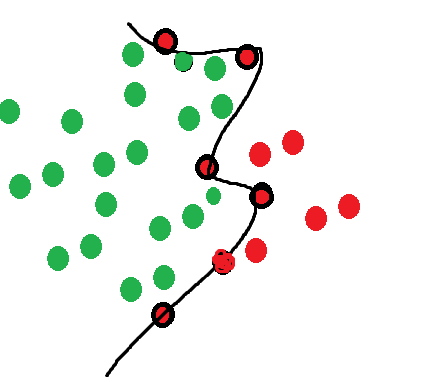
with green ones being to the left of the target points
I thought looking at the nearest neighbor but it doesn't work 100%
 lament totem
You could sort the target points from top to bottom, then draw a line between each of them (and continue the line above and below if necessary). Next for each other point you check between which two target points it is in y-coordinate, and check the corresponding line whether this point is to the left or right of it.
If you want a more smooth line, or a line that also continues after the target points, you may want to fit a curve through these target points instead.
@ashen niche
ashen niche
lament totem
You could sort the target points from top to bottom, then draw a line between ea...
well they might not be as nice as this picture which would cause a bunch of x crosses
lament totem
I'm gonna walk my dog, so I can respond in like 20 mins, sorry
vocal gorge
ashen niche
Assume I have 3D points(I drew in 2D for simplicity)
and a few unordered target ...
I don't really understand your definition of "left". You could compute the convex hull of the chosen points, but that'd be different:
 ashen niche
vocal gorge
I don't really understand your definition of "left". You could compute the conve...
ashen niche
vocal gorge
I don't really understand your definition of "left". You could compute the conve...
imagine the dark point on the red line between the texts is a little mor left, it would be classified as "left" even though it's not
vocal gorge
why isn't it, though?
ashen niche
well, if we imagine the line I drew I guess it makes sense
vocal gorge
in 2d there's some natural ways to connect the points, e.g. by ascending y coordinate - but in 3d I think there isn't a corresponding natural way to make a mesh out of them.
ashen niche
imagine you have two steel metals that you meld together in an awkward shape and you want to know which is which based on a few melting points, if that's an alright analogy
 acoustic nest
hey guys, im looking for a good (free) DSA python course before I start AI/ML/DL. does anyone have any recommendations? im not really trying to prepare for interviews/jobs yet, im just looking to gain enough knowledge to start AI
ashen niche
ashen niche
imagine you have two steel metals that you meld together in an awkward shape and...
https://imgur.com/yHV0hzl
this is just a visualization, in reality the metals are hollow inside(there's only the outside part) - so imagine two pieces are melted together by the edges alone, then I want to know basd on these melted points which part of the metal is which

https://imgur.com/SMGlzzX
as the result
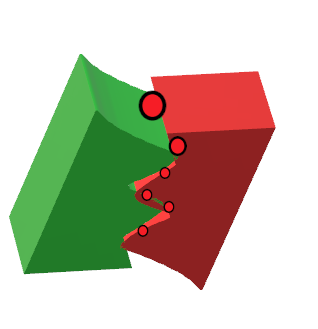 lament totem
So are these points generally on a line?
Because it is hard to automatically determine what would be "left" or "right" @ashen niche
ashen niche
lament totem
So are these points generally on a line?
generally a line, but unordered so it is possible, if we use the steel example that one would melt along the division line, then go back and patch it up a bit more
maybe they'd go from the top to the left, then to the right, then flip, etc
the end goal is the same but the process there is arbitrary so it makes it a bit more difficult, I guess
lament totem
So this is some idea I have:

Example is in 2d, but could do in 3d as well, just need to fit a 2d plane, and later on fit a hyper plane through the points.
But this makes an assumption that the separation is 2.5D (I.e. each x value has a single y value)
lament totem
 ashen niche
lament totem
So this is some idea I have:
ashen niche
lament totem
So this is some idea I have:
ah
hmm
I'm guessing the 2nd part is possible, but maybe some error is acceptable if it is low enough
lament totem
Well it would try to fit a curve through the points somehow
Or a hyperplane* in your case
ashen niche
My first solution was fitting a 2D ellipse, but with an angle(so it's sorta 2D in 3D space) and then just projecting that onto the points lol
but sadly that was too generalizing
lament totem
ashen niche
https://imgur.com/SMGlzzX
as the result
If the objects generally look a bit like this, I think this method would work okay.
But some assumptions are made for this method.
I wouldn't know how to find out what would be "left" or "right" in some other simple way.
ashen niche
I'll try this out, cool concept.
I'm wondering if I can just run a spline on the original points
opal oriole
ashen niche
Assume I have 3D points(I drew in 2D for simplicity)
and a few unordered target ...
You can imagine that if this boundary resulted in a convex "left" (lets call it "inside") side, then it would be easy, so the solution for something concave like this is to split it into multiple convex parts (basically what physics engines do for collision checking).
After it's multiple convex hulls it's just point inside convex hull test.
haughty mountain
lament totem
So this is some idea I have:
no real reason to constrain to fitting functions, splines could be nice if you can figure out the order, e.g. by some nearest neighbor heuristic
there are neat approaches where you use radial basis functions and neural nets to fit boundaries like these
I did some of it ages ago in uni, dots are the origin of the placed radial basis functions, the black line is the fitted boundary using these bases

 zinc sky
how can I optimize this code further for this Maximum Number of Vowels Problem
class Solution:
    def maxVowels(self, s: str, k: int) -> int:
        vowels = set('aeiou')
        ss = list(s[:k])
        count = sum([1 for x in ss if x in vowels])
        for i in range(0,len(s)-k):
            ss.pop(0)
            ss.append(s[i+k])
            count = max(count, sum([1 for x in ss if x in vowels]))
        return count
failing under time limit exceeded for long strings of more than 50k chars on leetcode
 boreal relic
Popping and appending are going to kill your timings.
It looks like a different approach would be better: how can you get every substring of size k from ss? The count vowels in those and return the max.
 shut breach
zinc sky
how can I optimize this code further for this [Maximum Number of Vowels Problem]...
shut breach
zinc sky
how can I optimize this code further for this [Maximum Number of Vowels Problem]...
popping from anywhere but the last place in the list is O(n)
stiff quartz
Why do they say
(8, 4), (4, 2), (8, 2), (8, 1), (4, 1), (2, 1)
and not
(8, 4), (8, 2), (8, 1), (2, 1), (4, 1), (4, 2)
?
 shut breach
popping from anywhere but the last place in the list is O(n)
shut breach
shut breach
popping from anywhere but the last place in the list is O(n)
if you know the number of vowels in some slice, then all you need to know how many are in the next slice is the character that enters the slice and the one that leaves
shut breach
stiff quartz
Why do they say
```py
(8, 4), (4, 2), (8, 2), (8, 1), (4, 1), (2, 1)
```
and not...
why would they say that?
stiff quartz
well if we do the inversions
8, 4, 2, 1 becomes 4, 8, 2, 1
and then we want to swap 8 and 2
4, 2, 8, 1
and then we want to swap 8 and 1
4, 2, 1, 8
at least that's how i understood the inversion count problem
zinc sky
shut breach
popping from anywhere but the last place in the list is O(n)
How can I improve my code instead of thinking for some other approach then?
shut breach
stiff quartz
at least that's how i understood the inversion count problem
you're not reversing the inversions, you're counting them
shut breach
shut breach
if you know the number of vowels in some slice, then all you need to know how ma...
@zinc sky ^
stiff quartz
shut breach
you're not reversing the inversions, you're counting them
I'm sorry I'm not sure I understand what you mean, this is a new notion for me
tight cedar
it is counting how many 2 pair inversions exists ig
stiff quartz
Isn't the number of inversions basically how long a bubble sort would take to sort the array?
oh i see inversion is just the number of i, j such that a[i] > a[j]?
shut breach
yeah
stiff quartz
ah that's my bad
i really thought it was linked to bubble sort
and like swapping them
It's actually the same number though right?
shut breach
same number as what?
zinc sky
shut breach
if you know the number of vowels in some slice, then all you need to know how ma...
So iterate over from the first slice char by char? Got it
stiff quartz
as the number of steps a bubble sort would take if we only count the steps where it swaps two elements of an array
zinc sky
Even append has same o(n) complexity?
shut breach
no, append is O(1)
shut breach
stiff quartz
as the number of steps a bubble sort would take if we only count the steps where...
yeah i think so
final night
I'm having trouble with an algorithm
let's say I have 3 rectangles, the sides of each rectangle are parallel to the x and y axis.
These rectangles can overlap, the goal is to find the area of all rectangles minus the intersection.
I have a few test cases and the area it's supposed to result in
Here's what I tried
I tried calculating the area of each of the 3 rectangles
Then I calculated the intersection between rectangles 1 and 3, 1 and 2 and 2 and 3, and substracted that.
I can't get that result.
If I could get a hint on what I'm supposed to do that would be great
Oh, there is the simple solution where I can map every point of each rectangle, but the question specifically states that it won't be accepted because it's too inefficent
lilac cradle
final night
I'm having trouble with an algorithm
let's say I have 3 rectangles, the sides of...
this feels almost like a weird set theory problem
because you'd want to make sure you aren't subtracting twice if all 3 rectangles overlap, so really the overall bit you subtract should be the union of the two intersections
final night
can I show you my function?
lilac cradle
sure
im honestly not entirely sure how you'd do it but i dont think checking all the points is the play
i think its possible to do it just from knowing the start and end points, and then sort of constructing a shape from that
final night
it's a mess sorry about that
def area(rec1, rec2, rec3):
    area1 = abs(rec1[2]-rec1[0])*abs(rec1[3]-rec1[1])
    area2 = abs(rec2[2]-rec2[0])*abs(rec2[3]-rec2[1])
    area3 = abs(rec3[2]-rec3[0])*abs(rec3[3]-rec3[1])

    #find intersection
    left12,right12 = max(rec1[0],rec2[0]), min(rec1[2],rec2[2])
    left13,right13 = max(rec1[0],rec3[0]), min(rec1[2],rec3[2])
    left23,right23 = max(rec2[0],rec3[0]), min(rec2[2],rec3[2])
    bottom12,top12 = max(rec1[3],rec2[1]), min(rec1[3],rec2[1])
    bottom13,top13 = max(rec1[3],rec3[1]), min(rec1[3],rec3[1])
    bottom23,top23 = max(rec2[3],rec3[1]), min(rec2[3],rec3[1])

    area = area1 + area2 + area3
    if left12<right12 and bottom12<top12:
        area -= (right12-left12)*(top12-bottom12)
    if left13<right13 and bottom13<top13:
        area -= (right13-left13)*(top13-bottom13)
    if left23<right23 and bottom23<top23:
        area -= (right23-left23)*(top23-bottom23)
    return area
`honestly i'd recommend using some sort of vector to do this sort of thing
having all the operations be done one by one manually tends to be tedious
having an actual rectangle/box class would also make it a lot easier to work with
lilac cradle
lilac cradle
i think its possible to do it just from knowing the start and end points, and th...
sorry if the diagram is confusing, i got a bit painterly with it lol

so basically you trim any redundant area
this pr obably wont work for some edge cases though
also this is ignoring angling the boxes because that's a whole can of worms you don't want to deal with
haughty mountain
final night
I'm having trouble with an algorithm
let's say I have 3 rectangles, the sides of...
1 + 2 + 3 - (1&2) - (2&3) - (1&3) + (1&2&3)
lilac cradle
hm yeah that seems simpler
lilac cradle
lilac cradle
this feels almost like a weird set theory problem
ironic (or, maybe not?) that the name for the operation most suited for this is called 'intersection'
final night
now the question is how to find the value of (1&2&3)
lilac cradle
1&2&3 is a composition so you can just do (1&2)&3
lilac cradle
lilac cradle
1&2&3 is a composition so you can just do (1&2)&3
this obviously doesn't work on every operation but intersection is commutative and associative so A∩B = B∩A and A∩(B∩C) = (A∩B)∩C
functionally the intersection of two boxes is essentially like using each one's corner (the ones facing into the intersection as a corner for the new box
lilac cradle
lilac cradle
1&2&3 is a composition so you can just do (1&2)&3
also this means that you can calculate 1&2 (or 1&3) only once and just use it twice
final night
works
there was a typo
but it works now
the suggested solution is basically the same in principle, but refactored
so thanks
 opaque gorge
hi
arr = [0] * (max(nums)+1)
for i in (nums):

    arr[i] = 1
z = set()
count = 0
for i in range (0,len(arr)):
    if arr[i-1] == 1:
        count += 1
    else:
        z.add(count)
        count = 0
print(z)
u = max(z)

print(u)```


this code runs for me in online compiler

but the following gives me error

```class Solution:
    def longestConsecutive(self, nums: List[int]) -> int:
        arr = [0] * (max(nums)+1)
        for i in (nums):

            arr[i] = 1
        z = set()
        count = 0
        for i in range (0,len(arr)):
            if arr[i-1] == 1:
                count += 1
            else:
                z.add(count)
                count = 0
        print(z)
        u = max(z)

        return u
it says z is empty on leetcode (q.128)
leetcode error message
        ^^^^^^
    u = max(z)
Line 16 in longestConsecutive (Solution.py)
          ^^^^^^^^^^^^^^^^^^^^^^^^^^^^^^^^^^^^^^
    ret = Solution().longestConsecutive(param_1)
Line 38 in _driver (Solution.py)
    _driver()
Line 49 in <module> (Solution.py)
 agile sundial
leetcode tries multiple inputs. did consider what happens when z is empty
though, max doesn't take a sequence..
opaque gorge
naw the same test case is failing
the one with nums = [100,4,200,1,3,2]
in leet code when I print the values of z it shows up, but when i put it in max function it says its empty.
agile sundial
what's the output
opaque gorge
out put for z is {0,1,4}
shut breach
please dont use ableist language
ashen niche
lament totem
Because it is hard to automatically determine what would be "left" or "right" <@...
I wonder if you have an idea for a more general sort of thing - I am trying to find isolated areas in this case.
So, the red dots would be isolators in my object, and I'd like to know everything that was "isolated" by them. (in practical terms I have a point cloud as the object and a few "isolator" points on each side)
https://imgur.com/pXOzXBi
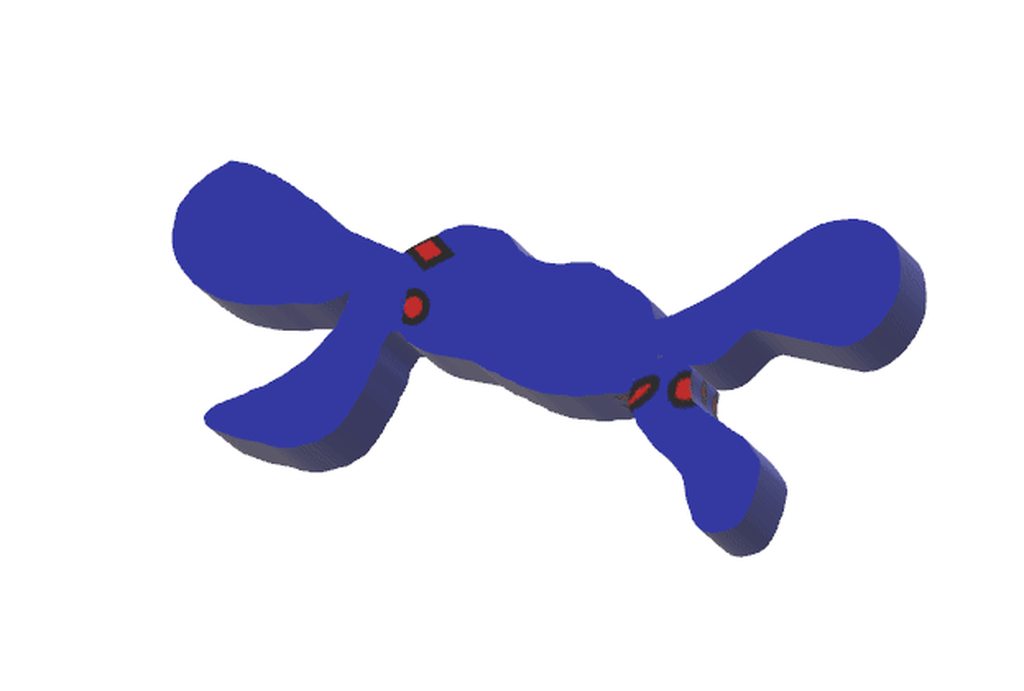

so the green/red I colored in are isolated based on the points I drew
acoustic nest
anyone have a good free dsa course for python? im not really looking to prep for interviews or anything im moreso just learning for the sake of learning. id also like to get into ai or data science later and i know most of your basic python stuff for reference
 ripe flame
okay this is funny and kind of irrelevant, although how does that pop up with my "Username" being the class 😂
 chrome mountain
Hello, I am making a custom data structure based on lists and dictionaries and am having some trouble understanding how the heirarchy is implemented between list and dictionaries in python. can somebody explain it?
narrow mica
chrome mountain
Hello, I am making a custom data structure based on lists and dictionaries and a...
uh... elaborate?
chrome mountain
Elaboration:
I am trying to implement a tree, in which each Node is similar to a python dictionary
head
|-> child
    {
        key:  value
    }
|->child2
    |-> child3
something like this
The problem I'm facing is, that one of the data types that can be used as a value is an array, similar to a Python list(will call this data structure list).
The twist is, that a list can also be a node in the tree, as well as a value in a node. (I am trying to make a wrapper for another software, hence trying to abstract the data types of that software into Python for the wrapper)
list1
(
    child1
    {
        key: value
    }
)
something like that. In order to implement this, I remembered that Python also has a similar use case: A list can be stored inside a dictionary and vice versa. I want to know how it is achieved internally, as there should be a proper hierarchy between the data types and this use case mixes the hierarchy.
narrow mica
chrome mountain
Elaboration:
I am trying to implement a tree, in which each Node is similar to a...
a list can also be a node in the tree
I'm not sure what you mean
though why not just wrap everything around nodes? i.e.
class Node:
    stuff: list | dict
    children: list[Node]
then
list1
(
    child1
    {
        key: value
    }
)
```is like
```py
Node(stuff=list1, children=[child1])
child1 = Node(stuff={key: value}, children=[])
I'm not wrapping everything around nodes because the nodes has some attributes other than the children which are stored as key value pairs, while list does not. And the software also supports multiple values for a single key, so that's another reason for not wrapping everything withing Node
narrow mica
chrome mountain
I'm not wrapping everything around nodes because the nodes has some attributes o...
multiple values for a single key
how does that work? if you look for a key you get multiple nodes back?
nodes has some attributes other than the children which are stored as key value pairs, while list does not
sounds like you need aNodeInterfacethat bothList(your list) andNodeWithExtraAttributesshould inherit from
chrome mountain
chrome mountain
I'm not wrapping everything around nodes because the nodes has some attributes o...
also keeping the two classes separate helps when I'm trying to export the data to be executed by the external software
chrome mountain
narrow mica
> multiple values for a single key
how does that work? if you look for a key you...
Node
{
    key: value1 value2 value3
}
If I try to access Node.key, I get [Value1, value2, value3] together
narrow mica
chrome mountain
```
Node
{
key: value1 value2 value3
}
```
If I try to access Node.key, I g...
so it's just key: list[value] then? i don't see how that affects things
chrome mountain
narrow mica
so it's just `key: list[value]` then? i don't see how that affects things
except its not list[values], as I am making a custom class to store the multiple values.
basically I made a custom data structure that stores multiple values for a single key
narrow mica
chrome mountain
except its not list[values], as I am making a custom class to store the multiple...
ok, but why does that matter? as in, sure you have a custom class storing multiple values, but why does this stop you from wrapping stuff in Nodes
narrow mica
narrow mica
> multiple values for a single key
how does that work? if you look for a key you...
NodeInterface
class NodeInterface:
    stuff: ...
    children: list[Node]

class List(NodeInterface):
    pass

class NodeWithExtraAttributes(NodeInterface):
    apple: ...
    orange: ...
    lemon: ...
then everything in a tree is a NodeInterface, some of them are Lists while others are NodeWithExtraAttributes
narrow mica
narrow mica
ok, but why does that matter? as in, sure you have a custom class storing multip...
class NodeInterface:
    values: ...
    children: list[NodeInterface]

class List(NodeInterface):
    values: ...

class NodeWithExtraAttributes(NodeInterface):
    values: MyClassThatStoresMultipleValues
    # the extra attributes that Lists don't have
    apple: ...
    orange: ...
    lemon: ...
```like I don't see what the problem isthis is fine. but how will I use the same list class when I need to store the list as a value inside the Node
Node
{
  list1:
  (
    value1
    value2
  )
}
In this case, Node is the NodeInterface object and the list1 is a List object, except the list is not a child but a value to an attribute
narrow mica
chrome mountain
this is fine. but how will I use the same list class when I need to store the li...
NodeInterface(values=None, children=list1) # I can't tell which it is cause your code doesn't show it
list1=List(values=[value1, value2])
ok, so list1 is the value of an attribute of the outer Node? what is it?
chrome mountain
narrow mica
```py
NodeInterface(values=None, children=list1) # I can't tell which it is caus...
yea, in this case list1 is a child of NodeInterface, which I don't want. I want it to an attribute
chrome mountain
narrow mica
ok, so `list1` is the value of an attribute of the outer `Node`? what is it?
yes.
narrow mica
chrome mountain
yea, in this case list1 is a child of NodeInterface, which I don't want. I want ...
sure?
NodeWithExtraAttributes(atttribute1=list1, children=[])
list1 = List(values=[value1, value2])
I'm probably missing something but I can't really tell
chrome mountain
narrow mica
sure?
```py
NodeWithExtraAttributes(atttribute1=list1, children=[])
list1 = List...
In this case, how will I tell the list class that it is not acting as a Node rn? the iteration and file generation will differ accordingly in the wrapper.
let me show an example of a file that I'm trying to make an abstraction of
narrow mica
chrome mountain
In this case, how will I tell the list class that it is not acting as a Node rn?...
so you need to differentiate between when a List is a node in the tree vs. when it's not? sure, add a flag
class List(NodeInterface):
    values: ...
    is_node: bool

NodeWithExtraAttributes(atttribute1=list1, children=[])
list1 = List(values=[value1, value2], is_node=False)
or instead of inheritance, just use composition
chrome mountain
/*--------------------------------*- C++ -*----------------------------------*\
  =========                 |
  \\      /  F ield         | OpenFOAM: The Open Source CFD Toolbox
   \\    /   O peration     | Website:  https://openfoam.org
    \\  /    A nd           | Version:  7
     \\/     M anipulation  |
\*---------------------------------------------------------------------------*/
FoamFile
{
    version     2.0;
    format      ascii;
    class       dictionary;
    object      blockMeshDict;
}
// * * * * * * * * * * * * * * * * * * * * * * * * * * * * * * * * * * * * * //

convertToMeters 1;

vertices
(
    (0 0 0)
    (0.012 0 0)
    (0.012 0.03 0)
    (0 0.03 0)
    (0 0 0.001)
    (0.012 0 0.001)
    (0.012 0.03 0.001)
    (0 0.03 0.001)
);

blocks
(
    hex (0 1 2 3 4 5 6 7) (100 150 1) simpleGrading (1 1 1)
    hex (8 9 10 11 12 13 14) (100 150 1) simpleGrading (1 1 1)
);

edges
(
);

boundary
(
    walls
    {
        type wall;
        faces
        (
            (0 1 5 4)
            (1 2 6 5)
            (2 3 7 6)
            (3 0 4 7)
            (0 3 2 1)
        );
    }


    atmosphere
    {
        type patch;
        faces    ((2 3 7 6));
    }

);

mergePatchPairs
(
);

// ************************************************************************* //
This is an example file. In the file structure, the file is refresented as a Node. All the containers(List and dictionaries) inside the file are also Nodes
you can see that the list blocks holds only physical values, so it can be represented a simple python list with some formatting while generating an output from the wrapper. The problem arises with the boudary list. It contains dictionaries(data in {} ), which are supposed to be Nodes, but are contained inside the list, which is supposed to be a container only for physical values. The current implementation I made manages this using flags. But is there a better solution other than separating the two types of lists?
narrow mica
narrow mica
or instead of inheritance, just use composition
class TreeNode:
    stuff: List | Node
    children: list[NodeInterface]

class List:
    values: ...

class Node:  # this is your original definition of the node, with kv pairs and extra attributes and stuff
    values: MyClassThatStoresMultipleValues
    apple: ...
    orange: ...
    lemon: ...
c++?
so is the problem like, List can only have PhysicalValues in it, but then sometimes they also hold Nodes, so now you need two versions of List?
chrome mountain
yep. and yes the main software is in c++
By PhysicalValues I mean int, float, string, vector etc.
chrome mountain
narrow mica
c++?
so is the problem like, `List` can only have `PhysicalValue`s in it, but th...
and for the 2 versions of list I don't want to make 2 separate classes
narrow mica
chrome mountain
By `PhysicalValues` I mean `int`, `float`, `string`, `vector` etc.
how are you handling this part then (storing different types in the same structure)?
oh wait, do you mean that PhysicalValues as in all int, or all float, etc.
chrome mountain
narrow mica
oh wait, do you mean that `PhysicalValues` as in *all* `int`, or *all* `float`, ...
yes
narrow mica
chrome mountain
yes
I'm not sure how your list looks, maybe check out union (c++11) or std::variant (c++17)
chrome mountain
will do, thanks!
narrow mica
the way python does it is through storing pointers, in c++ that'd look something like
class Interface {};
class Type1: public Interface {
  public:
    void type1Method() {}
};
class Type2: public Interface {};

std::vector<Interface *> vec;  //
vec.push_back(new Type1);  // ok
vec.push_back(new Type2);  // ok

Type1 *p = dynamic_cast<Type1*>(vec[0]);
if (p)  // it'd be null if the cast fails
    p->type1Method(); // ok
I'm not sure how easy that'd be for you cause you also have stuff like int in your list
or actually, maybe what you need is just template?
(this is how you can have "different" vectors like std::vector<int>, std::vector<float> without having to make multiple definitions of std::vector)
narrow mica
chrome mountain
will do, thanks!
. (making sure you see this, maybe one of these other options is what you'd prefer over union or variant)
chrome mountain
narrow mica
. (making sure you see this, maybe one of these other options is what you'd pref...
Wait. I am writing a python wrapper for a c++ software. I thing you are thinking the opposite.
narrow mica
chrome mountain
Wait. I am writing a python wrapper for a c++ software. I thing you are thinking...
oh 🙂
chrome mountain
chrome mountain
```
/*--------------------------------*- C++ -*---------------------------------...
This file here is a .txt file, which is read by Openfoam(the software whose wrapper I'm trying to make)
chrome mountain
chrome mountain
```
/*--------------------------------*- C++ -*---------------------------------...
The wrapper is supposed to read these .TXT files and generate a tree. That makes it easier to interact and change data in a script fashion
narrow mica
chrome mountain
The wrapper is supposed to read these .TXT files and generate a tree. That makes...
what's stopping you from just storing Nodes in your List again?
do you need different behavior if the List stores Nodes vs. other things?
chrome mountain
narrow mica
what's stopping you from just storing `Node`s in your `List` again?
do you need ...
Yes different behaviour. Expecially while parsing. Nodes contains key values pairs. While list contains the values directly.
narrow mica
chrome mountain
Yes different behaviour. Expecially while parsing. Nodes contains key values pai...
so the core issue that you need completely separate code for parsing List[int] vs. List[Node]?
chrome mountain
narrow mica
so the core issue that you need completely separate code for parsing `List[int]`...
Yes. While keeping a single class for list
narrow mica
chrome mountain
Yes. While keeping a single class for list
so... do some recursive parsing ig? idk what to tell you cause this is very dependent on what you have
e.g.
def parse(o):
    if isinstance(o, MyList):
        for thing in MyList:
            parse(thing)
    elif isinstance(o, Node):
        for key, value in o:
            parse(value)
    else:  # this leaves PhysicalValues
        render(value)
yes I'm doing a recursive parsing and I am trying to avoid these if-else conditions for types as much as possible.
 hardy ferry
guys is there any data structures and algorithms certification exam available?
opaque gorge
how to get started with dsa if i dont know any thing.
should i just start tackling nc150 and look up toutorials when i get stuck on the topic
 drifting hare
opaque gorge
how to get started with dsa if i dont know any thing.
drifting hare
opaque gorge
how to get started with dsa if i dont know any thing.

YouTube
Instructor: Prof. Erik Demaine, Dr. Jason Ku, Prof. Justin Solomon View the complete course: https://ocw.mit.edu/6-006S20 YouTube Playlist: https://www.youtu...
the first 1/3 of the course is data structures, second third is graph algos, third is dynamic programming
herer are lecture notes to go with:
https://ocw.mit.edu/courses/6-006-introduction-to-algorithms-spring-2020/pages/lecture-notes/

MIT OpenCourseWare
Full lecture and recitation notes for 6.006 Introduction to Algorithms.
and hw + solutions:
https://ocw.mit.edu/courses/6-006-introduction-to-algorithms-spring-2020/pages/assignments/
MIT OpenCourseWare
Full assignments, including python and LaTeX files, with solutions for 6.006 Introduction to Algorithms
gritty tulip
hey guys, can you recommend some good and comprehensive tutorials about asyncio and multithreading in python thank you very much
vocal gorge
https://realpython.com/python-concurrency/
https://realpython.com/async-io-python/ (a bit outdated by now, but the general stuff is fine)
 safe burrow
how do for loops work
haughty mountain
topic pls
chrome mountain
safe burrow
how do for loops work
for (<initial condition>: <terminal condition>: <step condition after each iteration>):
<code to execute for each iteration>
safe burrow
chrome mountain
for (<initial condition>: <terminal condition>: <step condition after each itera...
thank you
chrome mountain
in python the way those three conditions are declared is different but yea, that is the basic gist of for loop
haughty mountain
chrome mountain
for (<initial condition>: <terminal condition>: <step condition after each itera...
what?
chrome mountain
haughty mountain
what? <:pithink:652247559909277706>
basic pseudo code for a for loop 🙂
chrome mountain
haughty mountain
python doesn't do this kind of loop
python does, but the way of defining the conditions in a different manner
haughty mountain
there is only the for each
haughty mountain
chrome mountain
python does, but the way of defining the conditions in a different manner
no, they behave differently
the C style for is just a while in a thin disguise
chrome mountain
how abt this?
for i in range(10):
  #do stuff
I see the same implementation tbh
just written differently
haughty mountain
chrome mountain
I see the same implementation tbh
for (int i = 0; i < 10; ++i) {
  ++i;
}

for i in range(10):
  i += 1
e.g. these won't do the same thing
for each loops behave differently, less like a plain while loop
chrome mountain
haughty mountain
```
for (int i = 0; i < 10; ++i) {
++i;
}
for i in range(10):
i += 1
```
how come? explain pls
haughty mountain
the top loop iterates 5 times, the bottom 10
chrome mountain
why son't the bottom one iterate 5 times?
haughty mountain
because i is reassigned with the next value of the iterable on each iteration
that's how for each loops work
!e
for i in range(10):
  i += 100
  print(i)
:white_check_mark: Your 3.12 eval job has completed with return code 0.
001 | 100
002 | 101
003 | 102
004 | 103
005 | 104
006 | 105
007 | 106
008 | 107
009 | 108
010 | 109
okay, learnt something new.
but that is not the only way to write a for loop in python is it?
Also, this behaviour is more because of how in works, and not because of for.
haughty mountain
what would be another way of writing a for loop in python?
 woeful lion
Is there a fast way to evaluate the intersection of a bezier curve and a vertical line?
Like if I want to find Y of a point on a bezier curve at X, is there a way to do that that doesn't involve root-finding algorithms?
haughty mountain
woeful lion
Is there a fast way to evaluate the intersection of a bezier curve and a vertica...
I mean, you could binary search I guess
chrome mountain
haughty mountain
what would be another way of writing a for loop in python? <:pithink:65224755990...
aah. ok u got me there. appears that the in keyword is necessary for defining a for loop in python. But again, my point stands, that behaviour is because of how in behaves, not for
haughty mountain
if you don't want to do the proper math
haughty mountain
chrome mountain
aah. ok u got me there. appears that the `in` keyword is necessary for defining ...
how does the point stand? for ... in is the only valid for loop in python
it's the only thing for can mean in python
chrome mountain
true, without in, for is practically useless. But in is also used in other places, like in conditions. I guess in that use cae also, in works the same way.
if in future some other way of defining a for loop is made in python other than just the for .. in then maybe the iteration will be like the regular for
agile sundial
no.
agile sundial
chrome mountain
true, without `in`, `for` is practically useless. But `in` is also used in other...
comparing keywords like this just doesn't make sense
you need both to make a for loop, it's not in giving it power or something
haughty mountain
in in for ... in and the containment check in are completely different
then only really share the same name because they are vaguely semantically similar
 crude pier
I am looking for suggestions for a data structure. My case is:
- I have several ranges a particular variable can take for instance
range1 = np.arange(-3, 3)andrange2 = np.arange(0,6) - I have a particular function for mapping a value in range1 to range2 and vice versa
- I want to be wrap the ranges in a class or enum so that my code is more readable
I tried using enums but this did not work with numpy ranges since they are not easily comparible and I dont want the ranges to be mutable
opaque gorge
drifting hare
https://www.youtube.com/playlist?list=PLUl4u3cNGP63EdVPNLG3ToM6LaEUuStEY
ThankYou should I watch the whole thing first or topic and questions side by side
drifting hare
opaque gorge
ThankYou should I watch the whole thing first or topic and questions side by sid...
I would say pace yourself through the material as if you were actually taking the class
that way you get some practice to familiarize yourself before moving on to the next topic
stiff quartz
Is this not nlogn? (Edit nvm, it is nlogn, it's just the problem expected O(n) solution and the nlogn solutions time out except if i code it in cpp and optimize a bit)
    def compute_global_inversions_merge_sort(self, arr: list[int]) -> tuple[int, list[int]]:
        if len(arr) < 2:
            return 0, arr

        mid: int = len(arr) // 2
        left_inv, left_arr = self.compute_global_inversions_merge_sort(arr[:mid])
        right_inv, right_arr = self.compute_global_inversions_merge_sort(arr[mid:])

        tot_inv = left_inv + right_inv
        merged: list[int] = []
        i = j = 0
        while i < len(left_arr) and j < len(right_arr):
            if left_arr[i] < right_arr[j]:
                merged.append(left_arr[i])
                i += 1
            else:
                merged.append(right_arr[j])
                tot_inv += j + mid - i
                j += 1

        merged.extend(left_arr[i:])
        merged.extend(right_arr[j:])

        return tot_inv, merged
It gets TLE on Leetcode with 10^5 constraints (https://leetcode.com/problems/global-and-local-inversions/description/)
But I feel like that's the standard way to count inversions with merge sort
 half owl
def f1(L):
  n = len(L)
  while n > 0:
    n = n // 2
    for i in range(n):
      if i in L:
        L.append(i)

return L
whats the time complexity? O(n log n)?
half owl
stiff quartz
well no `i in L` is O(n)
explanation?
stiff quartz
ah no it is O(nlogn) overall
you lookup in O(n) then twice in O(n/2) then four times in O(n/4)
right?
ah yes no you don't resize L
but my list is resized
half owl
stiff quartz
~~you lookup in O(n) then twice in O(n/2) then four times in O(n/4)~~
it should be i think
1st iteration: n/2
2nd: n/4
3rd: n/8
...
so maybe logn is the time complexity?
then again i did see someone think it's o(n) but im pretty sure thats wrong
stiff quartz
what
i don't get it
were you answering my message or did i get confused and you asked a question that just happened to be similar?
half owl
stiff quartz
were you answering my message or did i get confused and you asked a question tha...
nope
half owl
half owl
```py
def f1(L):
n = len(L)
while n > 0:
n = n // 2
for i in range(n...
just dunno whats o(...) here
half owl
if LFS is the amount of operations done, why is the time complexity (big O) equal to the RHS? why is the -1 even there? it should not exist since we only have + summation and 2^i as elements summed
 vocal gorge
half owl
if LFS is the amount of operations done, why is the time complexity (big O) equa...
vocal gorge
half owl
if LFS is the amount of operations done, why is the time complexity (big O) equa...
2^0+2^1+2^2 = 1+2+4 = 7, not 8. This is right - it's the sum of a geometric progression.
half owl
vocal gorge
`2^0+2^1+2^2 = 1+2+4 = 7`, not 8. This is right - it's the sum of a geometric pr...
would big O be 2^n still then?
vocal gorge
2^n-1 is O(2^n), yeah
half owl
vocal gorge
`2^n-1` is `O(2^n)`, yeah
but shouldn't it be much bigger than 2^n will all these huge numbers summed?
vocal gorge
Huge numbers? Like what?
half owl
vocal gorge
Huge numbers? Like what?
nvm you are right
half owl
vocal gorge
Huge numbers? Like what?
can you help me understand another time complexity?
half owl
half owl
```py
def f1(L):
n = len(L)
while n > 0:
n = n // 2
for i in range(n...
the time complexity of this
and here's the answer
 haughty mountain
half owl
```py
def f1(L):
n = len(L)
while n > 0:
n = n // 2
for i in range(n...
haughty mountain
half owl
```py
def f1(L):
n = len(L)
while n > 0:
n = n // 2
for i in range(n...
that code is...bad
assuming L is a list
n*n + n/2*n + n/4*n * ... =
n*(n + n/2 + n/4 + ...) ~ O(n^2)
err...actually worse than that
because L gets larger
vocal gorge
I think O(n^2) in both best and worst case, since len(L) at the end is between 1x and 2x of the original value.
haughty mountain
vocal gorge
I think O(n^2) in both best and worst case, since len(L) at the end is between 1...
between 1x and 3x, but yeah
or wait no, you're right
the //2 is before the inner loop
outer rain
there is also that in is short circuiting, but ig it's still Θ(n^2)
half owl
vocal gorge
I think O(n^2) in both best and worst case, since len(L) at the end is between 1...
how? clearly the answer explains why it's O(n)
for k >= 1, can someone help me prove for >=?
i can only manage <=
 regal spoke
half owl
how? clearly the answer explains why it's O(n)
regal spoke
half owl
how? clearly the answer explains why it's O(n)
No. Take a look at the following example:
This code here simply runs in O(n^2) time because the i not in L is effectively a O(n) loop
L = []
for i in range(n):
  if i not in L:
    L.append(i)
Two nested loops resulting in O(n^2) time
half owl
regal spoke
No. Take a look at the following example:
This code here simply runs in O(n^2)...
this is O(n) loop, but
in the code it runs log n times and each iteration it runs the loop you showed n/2, n/4, m/8... n/n^i times
half owl
regal spoke
Two nested loops resulting in O(n^2) time
it's not at all two o(n) when you can see the n=n//2
regal spoke
half owl
this is O(n) loop, but
in the code it runs log n times and each iteration it ru...
Do you agree that the small example above that I showed you takes O(n^2) time?
The outer loop has to run n times
And then in each iteration it has to do the costly i not in L operation
half owl
regal spoke
Do you agree that the small example above that I showed you takes O(n^2) time?
yes
regal spoke
half owl
```py
def f1(L):
n = len(L)
while n > 0:
n = n // 2
for i in range(n...
Now take a look at your code. Do you see how in the first iteration of the while loop, you are essentially running my example
half owl
regal spoke
Now take a look at your code. Do you see how in the first iteration of the while...
yes true
but then it's doing log n times (first loop) * (n/2^i)*n (2nd loop + lookup)
half owl
half owl
but then it's doing log n times (first loop) * (n/2^i)*n (2nd loop + lookup)
but then it's not "*n" at the end because it's actually n/2,n/4... since we already halved the n in the first loop iteration
regal spoke
Btw what is the L in your code?
If L starts out empty, then nothing will ever get added to it
half owl
regal spoke
Btw what is the L in your code?
it's a list of size n (not any more givens)
half owl
regal spoke
If L starts out empty, then nothing will ever get added to it
they want worst time complexity
regal spoke
In that case, the time complexity is definitely O(n^2)
half owl
regal spoke
In that case, the time complexity is definitely O(n^2)
but how? I can't see why
regal spoke
First iteration takes n^2 time
2nd iteration takes n^2/2 time
3rd iteration takes n^2/4 time
half owl
regal spoke
First iteration takes n^2 time
it takes n/2 (2nd loop) * n/2 (inside 2nd loop)
regal spoke
The way I think of it is that i on L is always O(n)
The cost of that doesn't change between iterations
half owl
regal spoke
The way I think of it is that `i on L` is always O(n)
oh that's totally right
regal spoke
But the for loops decreases in size in each iteration
That's what causes the division by powers of two
half owl
regal spoke
The cost of that doesn't change between iterations
but then log n (first loop) * (n/2^i) (2nd loop) * (lookup time)
regal spoke
half owl
but then log n (first loop) * (n/2^i) (2nd loop) * (lookup time)
I don't understand your notation
half owl
regal spoke
I don't understand your notation
i being the number of iterations being done (i think log n)
I mean I want to regirously calculate the time complexity to show it
half owl
half owl
and here's the answer
but I can't think of a formula like in the above
regal spoke
Oh you use () to explain what you mean by log n etc
half owl
yeah
regal spoke
Just a thing. 1 + 1/2 + 1/4 + 1/8 + ... = 2
So when you sum up the cost n^2 + n^2/2 + n^2/4 + ... <= 2 * n^2
half owl
regal spoke
Just a thing. 1 + 1/2 + 1/4 + 1/8 + ... = 2
there's gotta be the same formula to what I showed earlier to show it with sum notation and n or i I think, I think it'll make it clearer once I manage to make one of those
half owl
regal spoke
So when you sum up the cost n^2 + n^2/2 + n^2/4 + ... <= 2 * n^2
don't you mean <= n^2 strictly? it's like the Walking Turtle problem
oh right we had 1*n^2 already
half owl
I'm trying to think up a formula to this using i and n
regal spoke
If you want to do a rigorous derivation, then you will have to take into account that L's size is slowly increasing. Meaning the cost of running i in L slowly increases
You can prove that L will have a size between n and 3n
half owl
regal spoke
You can prove that L will have a size between n and 3n
that's true, ty
 devout jay
Hello I am a starter, and have learned Python a bit, can anyone help me guide a bit please? seriously passionate guy here seeking guidance! Thanks in advance
 serene tartan
Can anyone provide me a good source to learn about run time complexity of an algorithm in python from scratch
vocal gorge
half owl
how? clearly the answer explains why it's O(n)
the math in the answer is fine, but it's based on (incorrectly) saying the loop body is O(1), hence the wrong answer.
 rose pollen
Can anyone tell me why we need to learn DSA as a programmer?
haughty mountain
rose pollen
Can anyone tell me why we need to learn DSA as a programmer?
why do you need to learn design patterns as a programmer? why do you need to learn systems design as a programmer?
rose pollen
to program better
half owl
rose pollen
Can anyone tell me why we need to learn DSA as a programmer?
if you learn to use a certain data structure and algorithm you can reduce the amount of time it takes to run an app and also reduce the amount of storage it needs to function
which can save both money and time and lives in some cases
haughty mountain
rose pollen
to program better
same answer
rose pollen
haughty mountain
same answer
thanks
lilac cradle
is there a good simple way to shuffle an image while knowing the original position of each point? i did this yesterday but i think the method was somewhat inefficient
i basically had a set() of used points, and randomly generated a position until i found one that wasn't in the set
vocal gorge
lilac cradle
is there a good simple way to shuffle an image while knowing the original positi...
You mean, like,
shuffled = np.arange(pixel_count)
np.random.shuffle(shuffled)
# pixel i goes to shuffled[i]
# which means that in the shuffled image, pixel i came from original[i], where:
original = np.argsort(shuffled)
?
lilac cradle
ig
is it possible to do it without np? ik its faster but in this usecase the speed isnt actually a big concern
also is it faster to do a concat or "".join() for combining two strings
vocal gorge
lilac cradle
ig
is it possible to do it without np? ik its faster but in this usecase the spe...
sure, the same way. it's even pretty fast since it's all builtins:
shuffled = list(range(pixel_count))
random.shuffle(shuffled)
original = sorted(range(pixel_count), key=shuffled.__getitem__)
just two? it would sure be wild if the answer is "join" :p
lilac cradle
or a handful really
lilac cradle
vocal gorge
sure, the same way. it's even pretty fast since it's all builtins:
```py
shuffle...
kk
hm i wonder if pillow lets you get a single index for a pixel
cause i know it lets you push data in that format to it, since i use that all the time but i dont think ive ever gotten single index pixels
i can prob jsut use tuple coordinates and shuffle that anyway though
vocal gorge
with a numpy array it'd be straightforward, without one, uhh, can get the image as a bytes instead
yeah, that'd work too
lilac cradle
btw is there a way to only give an argument to a function if a condition is met? other than just if statement and calling it differently in each block
vocal gorge
unpacking a variable-size collection comes to mind
e.g. args = (x,) if cond else () and then f(*args)
lilac cradle
hm
haughty mountain
vocal gorge
e.g. `args = (x,) if cond else ()` and then `f(*args)`
🙃
args = (x,)*cond
sorry, this is better
f(*(x,)*cond)
 gloomy yew
What is the best way to implement a trie?
vocal gorge
a nested dict would work fine
for a real application, I'd use a compiled third-party library like marisa-trie
gloomy yew
Yeah i was talking about real world application
fiery cosmos
Hi,
I was trying to solve a greedy problem. The problem is something else but the main crux of the algorithm is what i have stated below.
Given two integer arrays,
nums1andnums2, each of lengthn, for each indexiinnums1, we select an indexjinnums2and calculate the absolute difference between the values at these indices. How can we determine the minimum possible sum of all these absolute differences?
So apparently by sorting both arrays and then pairing the elements at the same indices, we are minimizing the differences at each position.
Can someone help me figure out a formal prove for it (preferably not by contradiction) and maybe some tips on how to convince or prove myself of greedy solutions in the future?
 lean junco
Anyone understands why max manhattan distance problem works in O(N) ??
vocal gorge
fiery cosmos
Hi,
I was trying to solve a greedy problem. The problem is something else but th...
So, find array c[i] such that sum_i |nums1[i]-nums2[c[i]]| is minimized? That sure can be solved greedily, yeah. c[i] should be the index of nums2 with the closest value to nums1[i], which... I'm not sure I believe it's the same as the ith element in the sorted array. Is there maybe some extra condition, like "there can be no repeats"?
haughty mountain
lean junco
Anyone understands why max manhattan distance problem works in O(N) ??
max manhattan distance problem?
lean junco
haughty mountain
max manhattan distance problem?
Yup
vocal gorge
fiery cosmos
Hi,
I was trying to solve a greedy problem. The problem is something else but th...
yeah, from some experimentation I think this is just false
 opaque grotto
devout jay
Hello I am a starter, and have learned Python a bit, can anyone help me guide a ...
opaque grotto
devout jay
Hello I am a starter, and have learned Python a bit, can anyone help me guide a ...
udemy
haughty mountain
vocal gorge
So, find array c[i] such that `sum_i |nums1[i]-nums2[c[i]]|` is minimized? That ...
I would assume it's with no repeats
i.e. a permutation
haughty mountain
vocal gorge
yeah, from some experimentation I think this is just false
if it's a permutation I think it is true
 lean walrus
WLOG = without loss of generality?
haughty mountain
yeah
if it's not true I could just swap the sequences
what this shows is that taking a pair that is not in the sorted order and making it sorted, we get a smaller or equal sum of absolute values
keep doing this and you end up with a sorted sequence
there is probably a neater way of showing the substitution property, but this works
haughty mountain
maybe it's more natural to start with
a, a+da
x, x - dx
and showing that swapping makes it ≤, but whatever
 spare warren
i see
haughty mountain
haughty mountain
maybe it's more natural to start with
a, a+da
x, x - dx
and showing that swappin...
actually, this one might end up being more awkward since I think you can't swap things wlog
lilac cradle
is there a better way of comparing a vector / numerical list (i.e checking if one is greater than the other) other than just checking if all entries of one are greater than / less than / etc than the other? (which is what i've been doing)
of course im not sure what 'greater than'/'less than' would necessarily mean for vectors
haughty mountain
maybe figuring out what it should mean is the first step 🙃
if you just need some ordering of vectors you can just lexicograpically sort it or whatever
lilac cradle
asking cause i just had to fix a problem with the class where != wouldn't work; it was because i was using all() for the comparison (i.e all(a.x!=b.x,a.y!=b.y,a.z!=b.z)) but that doesnt work if any component is equal
i fixed it by adding an option to switch what comparison it uses and set it to any() for __ne__
lilac cradle
lilac cradle
asking cause i just had to fix a problem with the class where != wouldn't work; ...
which lead to funkiness like this:
a = vec3(0,1,0)
b = vec3(0)
>>> a!=b
False
>>> a==b
False
err, how did you define == and != to make that happen?
lilac cradle
i use an internal function for all comparisons, it just take in an operator and compares it for each pair of components
lilac cradle
lilac cradle
i use an internal function for all comparisons, it just take in an operator and...
that way instead of having to implement each dunder as its own function i just assign it
haughty mountain
let me write a generic thing because I'm lazy
== -> all(x == y for x, y in zip(a, b))
!= -> not all(x == y for x, y in zip(a, b))
these work fine, and != is just not ==
lilac cradle
thats fair, and fairly similar to what i am doing anyway
haughty mountain
you don't even need to implement both, do you?
I think if you implement == then != will use it
lilac cradle
haughty mountain
let me write a generic thing because I'm lazy
```
== -> all(x == y for x, y in z...
this is actually pretty much exactly what i did actually, except i have a case for lists too
.. wait why do i have that
haughty mountain
the default definition should be basically
return not (a == b)
yeah i can just remove that actually
probably just a holdover tbh
is there a better way to check for iterability than try-except? afaik handling the error is kinda computationally heavy, no? or maybe thats just in other langs
maybe using iterable from collections.abc?
lean walrus
== -> all(x == y for x, y in zip(a, b))
!= -> any(x != y for x, y in zip(a, b))
de morgan pls
lilac cradle
lean walrus
```py
== -> all(x == y for x, y in zip(a, b))
!= -> any(x != y for x, y in zip(a...
that was what i switched to (well sorta since i didnt just make it its own function) until it was mentioned you can just not implement it
also i assume that syntax is just for this and not for actual implementation?
yeah it doesnt likei t when i try that lol
haughty mountain
the -> and stuff isn't meant for the actual impl no
solemn moss
Is bit shift for long integers in python n or n/int_size ?
If first, where can i find some bitset implementation? (in python)
regal spoke
solemn moss
Is bit shift for long integers in python n or n/int_size ?
Bitshift is fast in Python
So like n/64
However, changing a single bit of an integer is also n/64
So using Python big integers as bitsets is kind of flawed
solemn moss
Well usually i would just switch to cpp ofc
But sometimes there are cases when I don't want to do that (happened recently)
so wanna prepare for such case
regal spoke
The nice thing about using python integers as bitsets is that they are dynamic, which is not the case for most bitsets out there
regal spoke
solemn moss
Well usually i would just switch to cpp ofc
But sometimes there are cases when I...
Do you have an example?
I've found that for most bitset problems out there, python integers are sufficient
solemn moss
There was some expression parsing
For example A-(B-(C-(Z+A+B+Z-20+11)))+8-11
(that's why i didn't want to use cpp) and after that i had an equation like
C[0] * a + C[1] * b + C[2] * c + ....
where all variables (a, b, c...) can take value in range [1; 10]
Maybe there is another solution but I did just
possible = {0}
for x in C:
    if x:
        new_possible = set()
        for i in range(1, 11):
            for v in possible:
                new_possible.add(x * i + v)
        possible = new_possible
print(len(possible))
and it passed because of small constraints
(need to find how many different results can it give)
regal spoke
solemn moss
There was some expression parsing
For example `A-(B-(C-(Z+A+B+Z-20+11)))+8-11`
...
Firstly, I would use the trick that if you can have three copies avalible of the same value c, then that is equivalent to having one copy of c and one copy of 2*c.
In the case of 10 copies being avalible of c, this is equivalent to two copies of c, two copies of 2*c and one copy of 4*x
That way the range over i can be kept to either 1 or 2
After that the code is
possible = 1
for x,count in C:
    for i in range(count): # note: count here is either 1 or 2
        possible |= possible << x
print(possible.bit_count())
I am not sure I understood