#algos-and-data-structs
1 messages · Page 24 of 1
 tepid pivot
Looking for study buddy , so we can start learning python “Data structures and algorithms “ together
 haughty mountain
there are only a few cases
knights that block 0 squares (only appears for small k)
knights that block 2-4 squares (around corners)
knights that block 8 squares (everything in the center)
you can count the contribution from each
 urban kiln
haughty mountain
there are only a few cases
knights that block 0 squares (only appears for small ...
urban kiln
haughty mountain
there are only a few cases
knights that block 0 squares (only appears for small ...
oh
i was able to do cases with n <=4 only
ok0 ty
haughty mountain
I think a neater solution could be starting with everything k²*8 and then subtract the invalid moves that goes outside the board
haughty mountain
e.g. for k=6 I look at the border around the board and see how many squares inside the board can be reached
0112222110
1223443221
12......21
23......23
  ......
  ......
  ......
  ......
(ignoring the lower part of the board, the pattern is symmetric)
urban kiln
oh
haughty mountain
so 8k² minus the sum of all those
actually, maybe it's worth is just to count the moves in a particular direction
and then mult by 8, because symmetry
e.g all down-down right moves from + ends at a -
++++++
++++++
+±±±±±-
+±±±±±-
+±±±±±-
+±±±±±-
 ------
 ------
i thought grandmaster is an elo rank
haughty mountain
during the holidays cf has this thing where you can pick whatever rank for a few weeks
urban kiln
ah
haughty mountain
haughty mountain
e.g all down-down right moves from + ends at a -
```
++++++
++++++
+±±±±±-
+±±±±...
so (k-1)(k-2) squares can make a valid move down-down-right, which blocks another square
though I feel counting like this will overcount a bunch 
hmm, I guess there will be a nice inductive way to derive the formula
urban kiln
the amount of legal moves is always even right?
0/2/4/6/8
0/2 moves is only on a board n<=3
4/6/8 is for any board n>=4
haughty mountain
urban kiln
the amount of legal moves is always even right?
3 is possible
..*.
X...
..*.
.*..
....
oh
ty
oh and 2 is also possible on a normal board
given a 8x8 board
cornors have 2 legal moves
a2 b1 a7 b8 g1 h2 g8 h7 have 3 legal moves
urban kiln
it knights were allowed to attack each other, would the solution be:
(n*(n-1))/2 ?
n = number of squares
and then subtracting all the positions which would attack each other
haughty mountain
urban kiln
it knights were allowed to attack each other, would the solution be:
(n*(n-1))/2...
yes
urban kiln
i think this problem isnt even that difficult
urban kiln
only n<=3 are special cases i think
urban kiln
edge was the outer part of a square right? or is it called border?
google translate is saying that the thing i want is called edge-border
but that doesnt sound right
urban kiln
i solved it
 finite siren
I have to render a program which is on tree merge algorithm, and i have to turn this equation (picture 1 ) into merge tree. Here is the graphic representation of that tree ( picture 2 )
Picture 1

Picture 2

I already do that

But i'm stuck at the node part, because i don't have any idea of how translate picture 1 into code
Can someone please help me ? It's very urgent
urban kiln
i skipped it
time limit exceeded
and i dont know how the heapq library works fwhich i think is used for priiority queue
i havent done muc htoday
https://leetcode.com/problems/champagne-tower/ i want to solve this one
rn
but i havent started yet
and https://cses.fi/problemset/task/1092 (probably the easier one)
haughty mountain
that should just be about using a priority queue
doable in O(n log n) worst case
 crystal merlin
def my_towers(N, from_tower, to_tower, alt_tower):
    """
    Displays the moves required to move a tower of size N from the
    'from_tower' to the 'to_tower'.

    'from_tower', 'to_tower' and 'alt_tower' are uniquely either
    1, 2, or 3 referring to tower 1, tower 2, and tower 3.
    """

    if N != 0:
        # recursive call that moves N-1 stack from starting tower
        # to alternate tower
        my_towers(N-1, from_tower, alt_tower, to_tower)

        # display to screen movement of bottom disk from starting
        # tower to final tower
        print("Move disk %d from tower %d to tower %d."\
                  %(N, from_tower, to_tower))

        # recursive call that moves N-1 stack from alternate tower
        # to final tower
        my_towers(N-1, alt_tower, to_tower, from_tower)
why is this considerd divide and conquer?
don't you need to break it in half or something?
urban kiln
# set1 and set2 aren't actually sets, that's just how they were called in the question
if n % 2 == 0:
    set1 = [i for i in range(1, n+1) if i <= n // 4 or i > n // 4 * 3]
    set2 = [i for i in range(1, n+1) if n // 4 < i <= n // 4 * 3]
given these two list comprehensions(i think thats how it is called), i noticed that i am looping through one thing twice
would it be better:
for i in range(1, n+1):
  if ...: set1.append(i)
  else: set2.append(i)
 brazen python
Which should I use if I expect the word to not be present most of the time (aka get a KeyError from the Trie Dict) ?
    def contains_word(self, word: str) -> bool:
        """
        Check if each character from the given word is present in the Trie Dict,
        and that the last node is marked as a keyword.
        (so 'mac' wouldn't be present if 'machine' is the only word in the Trie Dict)
        """
        node = self.trie_dict
        for char in word:
            node = node.get(char)
            if node is None:
                return False
        return node.get(TrieDict._word) == word

    def contains_word(self, word: str) -> bool:
        node = self.trie_dict
        for char in word:
            try:
                node = node[char]
            except KeyError:
                return False
        return node.get(TrieDict._word) == word
and I will be calling this thousands of times (once for each word in a sentence)
 sage flame

LeetCode
View official solution of Longest Consecutive Sequence on LeetCode, the world's largest programming community.
In the third approach I'm still confused how it's O(n) and not O(n*n) cause of the while loop inside
 lean walrus
brazen python
Which should I use if I expect the word to not be present most of the time (aka ...
lean walrus
brazen python
Which should I use if I expect the word to not be present most of the time (aka ...
If word is not present most of the time, then you will frequently handle occuring exceptions. Exception handling is slow (idk how much slow it is, if you want, i can provide some benchmarks).So i think it would be faster if you do it without try-except
urban kiln
is there a reason why this number is often used for modulo solution output
 lean walrus
It is also easy to remember
brazen python
lean walrus
If word is not present most of the time, then you will frequently handle occurin...
I suspected that an exception would slow down the program by a tiny bit, if you have some benchmarks on it I'd love to have a look at them
but the disadvantage with the first option is that I need to do this check on each iteration: if node is None: ...
 robust dagger
brazen python
but the disadvantage with the first option is that I need to do this check on ea...
robust dagger
brazen python
but the disadvantage with the first option is that I need to do this check on ea...
I once benchmarked some code—a long time ago, so take this with a grain of salt—and found that if the key was not in the dictionary 50% the time, then using .get and testing for None was faster than try ... except. But if the key was not in the dictionary 1% of the time, then try ... except was faster than .get and testing for None. There's no perfect solution; somehow, on every iteration, you have to test whether the key was in the dictionary.
 clever fable
if I have a bunch of data points that follow piecewise constant functions save for a few outliers (so for x=1 to x=a, y=some constant, then from x=a+1 to x=b, y=some other constant, etc. save for outliers) how do I find those outliers?
robust dagger
There is no reliable way to do this without assumptions on the outliers.
Or assumptions on the piecewise constant functions. Or something like that.
The problem is that, unless you know something about the outliers and the piecewise constant functions, you can't tell an outlier from a really short piece.
But if you have guarantees like, "Each piece of the function has length at least ..." or "steps between pieces are no larger than ... but outliers always differ from other values by ..." then you can get somewhere.
urban kiln
https://leetcode.com/problems/distinct-prime-factors-of-product-of-array/description/
have you done this one?
https://leetcode.com/problems/closest-prime-numbers-in-range/description/
i wasnt able to solve this one
my code exceeded time limit since i tried getting all prime numbers between left and right
We store those primes in a global array, so we can reuse it between test cases.
can stuff from an earlier test case be reused for another test case in leetcode problems?
haughty mountain
urban kiln
`We store those primes in a global array, so we can reuse it between test cases....
that's more leetcode weirdness
haughty mountain
urban kiln
my code exceeded time limit since i tried getting all prime numbers between left...
getting all prime numbers <=10**6 can be done quickly
what are you doing to get them?
urban kiln
def isPrime(n):
    if n < 2: return False
    for x in range(2, int(n ** 0.5) + 1):
        if n % x == 0:
            return False
    return True
for all odd numbers between left and right
but maybe the looking for the closest numbers was bottlenecking
and i think the looking for prime numbers couldve been stopped as soon as 2primes with a difference of 2 were found
or if l=2 and r>3 then 2,3 would be the closest primes
haughty mountain
urban kiln
```py
def isPrime(n):
if n < 2: return False
for x in range(2, int(n ** ...
look into the sieve of eratosthenes
 vocal gorge
time it yourself, they are probably all about as fast but I'd expect sqrt or isqrt to be slightly faster
there are other speedups you could do, like only checking odd numbers above 2
but ultimately it's a sieve task
brazen python
Hey guys, I'm working on a function that replaces a bunch of keywords from a given string.
Now I already have a function that iterates through all the keywords and tells the start and end position that needs to be replaced:
>>> kp.get_keywords  # keywords to replace
{'py': 'python', 'go': 'golan', 'hello': 'hey'}

s = 'Hello how are you? I love learning Py, aka: Python, and I plan to learn about Go as well'
>>> kp.extract_keywords(s, True)
[('hey', 0, 5), ('python', 35, 37), ('python', 44, 46), ('golan', 78, 80)]
The question is now that I know where and what to replace how do I go about doing that?
Maybe loop though all the chars and then do: new_sentence += char ...
or I can do list(s) and then simple assign all the ranges, i.e: list(s)[0:5] = 'hey', but from my limited knowledge about DS,
that will rebuild a list each time. any ideas? what do yall recommend?
brazen python
Im using a Trie Dict to replace all the values, this is the algorithm if you want to have a look at it (flashtext):
https://github.com/shner-elmo/FlashText2.0/blob/43406e2c8034f78ddf0d93f66a2187de45474e51/flashtext2/keyword_processor.py#L20

GitHub
Contribute to shner-elmo/FlashText2.0 development by creating an account on GitHub.
 high lintel
Heyo, does anybody know how to change a specific element in a tuple which is a part of a list, and return the new list?
I don't quite get how to do it, i've tried referencing it's index, but it doesn't seem to be working.
 silent kraken
I am quite new to Python but I am pretty sure Tuples are immutable
meaning that you can't change the elements
high lintel
Should I use a list instead?
 wicked frost
high lintel
Should I use a list instead?
wicked frost
high lintel
Should I use a list instead?
Yes,
Once the tuple is created ,you can't change it.
If you want to alter the elements it is better to use list.
 fiery cosmos
hiii
silent kraken
Hi
 thorn echo
high lintel
Should I use a list instead?
thorn echo
high lintel
Should I use a list instead?
I gues you cam convert thsi tuple to list then change it and again reconvet it
urban kiln
is o(n!) ok for n <= 20
haughty mountain
!e
import math
print(math.factorial(20))
 halcyon plankBOT
@haughty mountain :white_check_mark: Your 3.11 eval job has completed with return code 0.
2432902008176640000
no, 20! is god damn huge
if you want to ballpark estimate, in a fast compiled language you might be able to do 10**8 to 10**9 cheap operations per second
!e
import math
print(math.factorial(20)/1e9/3600, 'hours')
@haughty mountain :white_check_mark: Your 3.11 eval job has completed with return code 0.
675806.1133824 hours
so...no way
urban kiln
ih
oh
10fac is somethin like 3.6m right?
10!
!e
from math import factorial
print(factorial(15))
@urban kiln :white_check_mark: Your 3.11 eval job has completed with return code 0.
1307674368000
!e
import math
print(math.factorial(13)/1e9/3600, 'hours')
@urban kiln :white_check_mark: Your 3.11 eval job has completed with return code 0.
0.001729728 hours
and it's a very optimistic estimate
 nimble basin
I'm trying to come up with an algorithm that finds the nearest RBGA value given a pixel input. I have exactly 1536 possible nearest points. I think what would work best is to find the nearest neighbor in each channel alone. As in find spot with nearest R value, find spot with nearest B value, same with G and A. Then I think I could just find which of those 4 is closest to my input pixel and go with that. Any thoughts on that approach? It saves me from doing time expensive trig to do 4th dimensional nearest neighbor searching.
Plotting the 1536 points has not been done yet because honestly that's a harder issue but I want to make sure this approach makes sense.
nimble basin
brazen python
Hey guys, I'm working on a function that replaces a bunch of keywords from a giv...
python string have a string.find(substring) method for finding substring locations within a string. It will output the starting location of the first instance of the substring found. I've done something sorta like what you're doing when coding a hangman game.
I hope that makes sense and helps? I kinda explained that poorly lol.
 ember igloo
@nimble basin how is it not simply euclidean distance?
nimble basin
what is that
haughty mountain
nimble basin
I'm trying to come up with an algorithm that finds the nearest RBGA value given ...
how would that be much cheaper? how do you intend to find the closest points in R, G and B?
just iterating over points and checking?
nimble basin
starting at the input R, G, B, or A and going down until it finds something, then going up until it finds something, then choosing the closer of the two
haughty mountain
nimble basin
starting at the input R, G, B, or A and going down until it finds something, the...
how would you implement that?
also, what expensive trig is it that you're trying to avoid?
you don't need any expensive operations to find the closest point in the usual euclidean distance
nimble basin
I have a big fucking list of all the points, I go through each set of RGBA and mark the first time one of those values are above my input pixel then after i've marked 4 points one for each value, I can grab that point and the one below it and save that location for comparison
I figured i'd use this for distance if I had to

this is what would be expensive lol
where input RGBA is the distance from the input pixel
so delta RGBA
haughty mountain
nimble basin
this is what would be expensive lol
sqrt(R² + G² + B² + A²) is euclidean distance, but you don't need to compare that
you can compare the square of euclidean distance instead
nimble basin
how so?
haughty mountain
in math speech, because x² is monotonic, just like x
basically, if x and y are positive, then if x < y holds x² < y² holds as well
nimble basin
so I can cut out the square and square root parts and just sum for total distance?
haughty mountain
nimble basin
so I can cut out the square and square root parts and just sum for total distanc...
just summing isn't right
sum of squares
if you want to compare euclidean distance
R² + G² + B² + A²
haughty mountain
there are also nice data structures for doing nearest neighbor searches faster
nimble basin
I wanna do it all myself. I'm trying to use as few libraries as possible
haughty mountain
like kd trees and whatever one would call the 4d version of octrees
I mean, I didn't say use a library
nimble basin
oh I get what you mean
maybe i'll look into it
I think I will actually lol
may help me get a better sense of this
haughty mountain
though with 1.5k points you could just do the simpler thing
it's not that many points
haughty mountain
10-100x of that maybe?
of course it depends on how much time you can spare to do computations
and how many times you need to compute this
nimble basin
once per pixel which the image size will be about 1000 x 1000 px
and then one image per frame
I'll probably do all the math BEFORE showing it though
for all the images
basically i'm making a video to colored ASCII program that works in cmd prompt
haughty mountain
oh, if so the rgba colors you compare against don't change?
then kd trees is a nice fit
nimble basin
correct they don't change
i'll look that up
i've never used a data structure before
this looks complex 
haughty mountain
the idea isn't too weird
basically pick one axis (e.g. R), split it in two equal size halves
then for both halves keep halving (in varying axis directions)
computerphile did a pretty good video to introduce the ideas https://www.youtube.com/watch?v=BK5x7IUTIyU
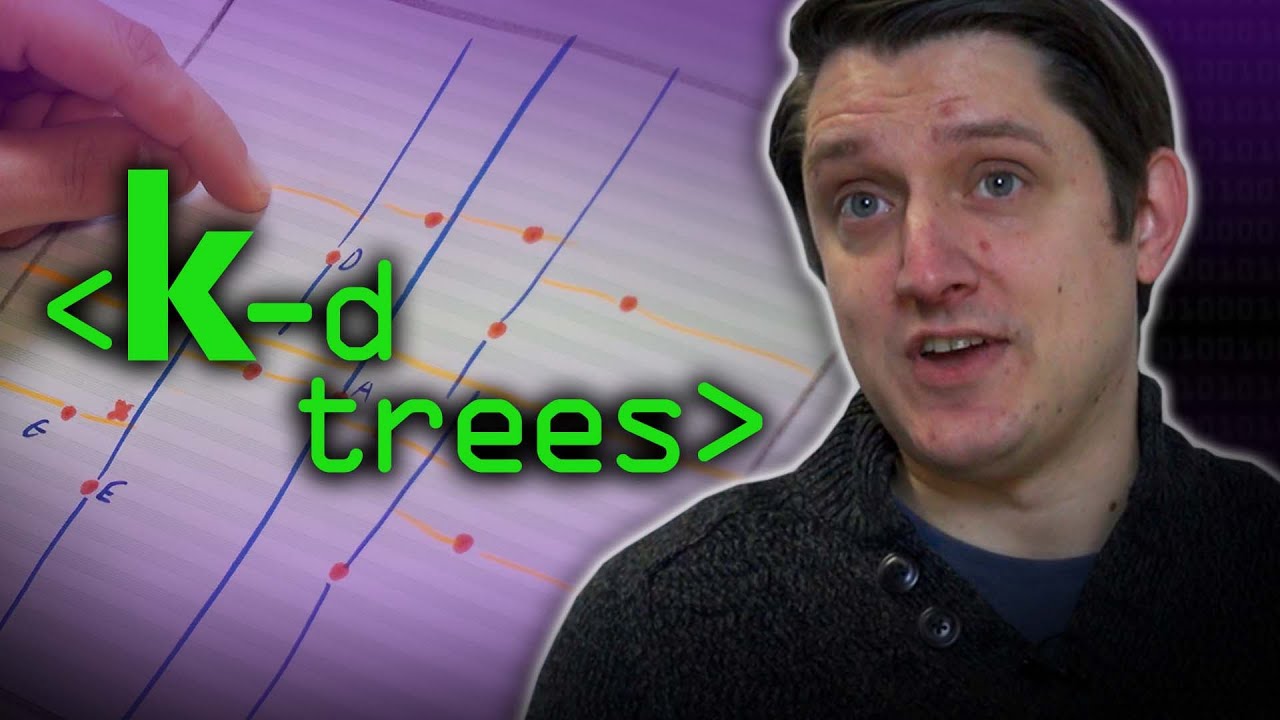
One of the cleanest ways to cut down a search space when working out point proximity! Mike Pound explains K-Dimension Trees.
EXTRA BITS: https://youtu.be/uP20LhbHFBo
https://www.facebook.com/computerphile
https://twitter.com/computer_phile
This video was filmed and edited by Sean Riley.
Computer Science at the University of Nottingham:...
nimble basin
thank you thank you
brazen python
nimble basin
python string have a string.find(substring) method for finding substring locatio...
I'm familiar with str.count and str.find, but the extract_keywords(sentence: str) -> list[str]: function from flashtext is much more powerful as it allows you to first split the string in words so you dont get substrings that arent words
the best alternative is regex, but its magnitudes of times slower
 umbral gulch
[
[cat,dog,hamster],
[hamster,cat, turtle],
[dog]
[cat, dog]
]
[
[cat,dog,hamster],
[hamster,cat, turtle],
[dog]
[dog, turtle]
]
say you have these 2 arrays. and you wanted to pick one item from each inner array such that it does not appear in any of the other arrays.
as you can see from the top array, this is impossible because you cannot pick one item from each that does not appear in any of the other inner arrays. the closest you could get would be
[ [hamster], [cat], [dog], [dog] ] or [ [cat], [hamster], [dog], [cat] ]
but because dog/cat appears in 2 of the resulting arrays this is not a valid answer
however with the second array. it is possible to get 1 unique item from each inner array such that it does not appear in any of the other inner array
this answer would be
[ [hamster], [cat], [dog], [turtle] ] or [ [cat], [hamster], [dog], [turtle] ]
as you can see from these answers. there is a unique item in each inner array that does not appear in any of the other inner arrays
 broken tiger
hey guys sup , i'm tryign to solve flow scedualing problem using genetic algorithm https://github.com/suyunu/Flow-Shop-Scheduling i already found a code but i can't understand much from it

GitHub
Genetic Algorithm for Flow Shop Scheduling. Contribute to suyunu/Flow-Shop-Scheduling development by creating an account on GitHub.
can someone take a look please
i just have some questions about some parts of the code , what is this and that
haughty mountain
umbral gulch
```
[
[cat,dog,hamster],
[hamster,cat, turtle],
[dog]
[cat, dog]
]
```
```
[
[ca...
hamster, turtle, dog, cat for the top one?
this smells like a question about bipartite graphs
which is close to 2SAT
urban kiln
if int(per_team) != per_team: return -1
is the above way slower than:
if per_team % 1 != 0: return -1
 frank bluff
!e
from timeit import timeit

tests = ["not x.is_integer()", "x % 1 != 0", "int(x) != x"]

setup = "x = 0.5"
exec(setup)
for test in tests:
  print(eval(test), timeit(test, setup))

setup = "x = 1.0"
exec(setup)
for test in tests:
  print(eval(test), timeit(test, setup))
@frank bluff :white_check_mark: Your 3.11 eval job has completed with return code 0.
001 | True 0.05052291299216449
002 | True 0.09663061890751123
003 | True 0.1375825849827379
004 | False 0.042399035999551415
005 | False 0.09298638999462128
006 | False 0.14875313104130328
oh thats how you time stuff
frank bluff
while it is slower, it shouldn't matter
these are the times for running those tests 1 000 000 times
urban kiln
ok
frank bluff
but I'd probably stick with not x.is_integer() to make it easier to see what you're doing
urban kiln
oh ok
 prisma sky
damn i am currently working on a qr code maker (i’m making it from scratch), and i hit a roadblock with the error correction codeword generation. basically i need to find a way to handle multi variable polynomials eg. x^2*y^3. I need to be able to somehow store it, and multiply it by another polynomial. Any ideas?
robust dagger
nimble basin
I'm trying to come up with an algorithm that finds the nearest RBGA value given ...
I'm familiar with a related problem. You said you were trying to avoid libraries; I wasn't, so I was able to use the k-d tree implementation in SciPy. I was working with 2^24 points, and it went plenty fast for me. I wrote a little about this at https://chromophile.readthedocs.io/en/latest/design/approximation.html, though most of that page is about other issues. The actual code is at https://github.com/kylehofmann/chromophile_dev/blob/main/src/chromophile_dev/conversion.py but it's mixed with a ton of other stuff, so it's kinda hard to read.
ember igloo
umbral gulch
```
[
[cat,dog,hamster],
[hamster,cat, turtle],
[dog]
[cat, dog]
]
```
```
[
[ca...
this is like a graph colouring question, each array is a node and each allowed colour for a node is an animal, and @haughty mountain is right in that its related to n-partite graphs because a graph is n-colorable iff it is n-partite
but the issue is some nodes don't have options to some colours
for example array 1 in the first example doesn't have a turtle
well that's easily remedied
by adding a turtle-colored node adjacent to the first array
so you could construct this alternative graph
and form it as a proper n-colorability problem
where n is the total number of animal types
and then run whatever the state of the art coloring algorithm is
haughty mountain
it feels like an easier version of the assignment problem, which is already a not so hard problem
the assignment problem is to optimize overall cost
while this is just about some assignment existing
haughty mountain
haughty mountain
the assignment problem is to optimize overall cost
I guess you could throw the hungarian algorithm on it and it would work, though it's using a sledgehammer on a nail
ember igloo
but it's a very well studied problem
haughty mountain
the assignment problem is in P
ember igloo
what's the assignment problem
haughty mountain
The assignment problem is a fundamental combinatorial optimization problem. In its most general form, the problem is as follows:
The problem instance has a number of agents and a number of tasks. Any agent can be assigned to perform any task, incurring some cost that may vary depending on the agent-task assignment. It is required to perform as ...
ember igloo
🤔
ooo
yeah it's not NP-hard for k=0,1,2
assignment problem is k=2
heh my brain is melting trying to intuit whether the problems are comparable
haughty mountain
basically you could reduce it to the assignment problem with matrix
#
        1 2 3 4
cat     1 1 0 1
dog     1 0 1 1
hamster 1 1 0 0
turtle  0 1 0 0
oh am i simply wrong
haughty mountain
and you can ask whether there exist an assignment with weight >=4
but I'm sure there will be better algos than reducing it to this
ember igloo
yes i think i reduce it to class of slightly modified complete graphs
which is not the same as the n-colouring problem which considers arbitrary graphs
nimble basin
robust dagger
I'm familiar with a related problem. You said you were trying to avoid libraries...
This will help greatly, thanks.
 random finch
I need to decrypt it

The algorithem takes a number of rows and a string and encrypts it in the way showed
haughty mountain
this will loop forever if the element doesn't exist
oh wait...
you do an O(n) check before the binary search...
don't do that...
and will this even work if the element you're looking for is the last one?
I tend to write something like
l = 0
r = len(numbers)
while r - l > 1:
  mid = (l + r)//2
  if target < numbers[mid]:
    r = mid
  else:
    l = mid
# if numbers[l] == target, you're good
# else it doesn't exist
!e
from math import factorial
print(factorial(120) > 120''120)
@urban kiln :x: Your 3.11 eval job has completed with return code 1.
001 |   File "<string>", line 2
002 |     print(factorial(120) > 120''120)
003 |           ^^^^^^^^^^^^^^^^^^^^^^
004 | SyntaxError: invalid syntax. Perhaps you forgot a comma?
!e
from math import factorial
print(factorial(120) > 120**120)
@urban kiln :white_check_mark: Your 3.11 eval job has completed with return code 0.
False
 jolly mortar
yes
broken tiger
anyone knows genetic algorithm
 shy path
I'm currently tackling the following problem and need some help.
I am given a coordinate on in a grid (2x2 array) with a radius, r. I need to iterate through all of the points in the grid that are at most r moves away from the given coordinate (no diagonal moves allowed).
Example:
- given coordinate (4, 2) and radius 3
- 1s below show the points I need to iterate through
[[0 0 0 0 1 0 0 0 0 0 0]
 [0 0 0 1 1 1 0 0 0 0 0]
 [0 0 1 1 1 1 1 0 0 0 0]
 [0 0 0 1 1 1 0 0 0 0 0]
 [0 0 0 0 1 0 0 0 0 0 0]
 [0 0 0 0 0 0 0 0 0 0 0]
 [0 0 0 0 0 0 0 0 0 0 0]
 [0 0 0 0 0 0 0 0 0 0 0]
 [0 0 0 0 0 0 0 0 0 0 0]
 [0 0 0 0 0 0 0 0 0 0 0]
 [0 0 0 0 0 0 0 0 0 0 0]]
Any thoughts on how to efficiently do this?
vocal gorge
shy path
I'm currently tackling the following problem and need some help.
I am given a c...
something like
for di in range(-r,r+1):
    for dj in range(-r+abs(di),r-abs(di)+1):
would do.
shy path
vocal gorge
something like
```py
for di in range(-r,r+1):
for dj in range(-r+abs(di),r-a...
Perfect! Thanks
urban kiln
(lines should be straight ik)
given 3 points, is it the law of cosines which is used to determinate the angle?
 vocal gorge
plenty of stuff you could use, but sure, that'd work
e.g. if you don't care about phi vs -phi, you could take the scalar product of the BA and BC vectors and that's the cosine of the angle
urban kiln
hmm ok
 opal oriole
urban kiln
(lines should be straight ik)
given 3 points, is it the law of cosines which is ...
opal oriole
urban kiln
(lines should be straight ik)
given 3 points, is it the law of cosines which is ...
Law of Cosines or stuff that comes from it / another way of writing it, such as the dot product (geometric).
Or other trig identities, some will be more roundabout than others.
opal oriole
haughty mountain
like kd trees and whatever one would call the 4d version of octrees
The lists I could find don't seem to go past 1/12, so IDK, sedectree/sexdectree/hexadectree?
(The fractional names don't mirror the none fractions, so I think it just needs to be made up)
 midnight pivot
hey i got a problem when manipulating list, i do a copy of it because i will delete things, intentionally, and reset it when i need but i found that the thing i deleted in the first list got deleted in the copy too, pls help
urban kiln
def distance(x1, y1, x2, y2):
    return ((x2 - x1)**2 + (y2 - y1)**2)**0.5
```this is the correct way to calculate the distance between two points right?that's a correct formula for euclidean distance, sure. though you could have used math.dist or math.hypot.
haughty mountain
midnight pivot
hey i got a problem when manipulating list, i do a copy of it because i will del...
because you didn't make a copy
!e
x = ['orig']
same_list = x
copy = x.copy()
slice = x[:]

x[0] = 'new'

print(f'{x = }')
print(f'{same_list = }')
print(f'{copy = }')
print(f'{slice = }')
@haughty mountain :white_check_mark: Your 3.11 eval job has completed with return code 0.
001 | x = ['new']
002 | same_list = ['new']
003 | copy = ['orig']
004 | slice = ['orig']
assignment never copies
it just gives a new name to something
so you have two names for the same list
urban kiln
i want to know if
var >= 90
but var is a calculation with floats
i was wondering if the float claculation inaccuracy only makes numbers bigger(like real sol + 10**-10)
or can the solution be smaller due to float inaccuracy than it should be
haughty mountain
urban kiln
i was wondering if the float claculation inaccuracy only makes numbers bigger(li...
it can go both ways
basically if you check float equality you're likely doing something iffy
and you should check if it's close enough
haughty mountain
and generally if you can use ints and avoid working with floats that's preferable most of the time
since you know int calculations are always exact
urban kiln
ill try to find a different approach
 queen furnace
Can someone help me this code:
`def pancake_stack(syrup):
soaked_pancakes = []
for i, pancake in enumerate(syrup):
if syrup[i] > 0:
soaked_pancakes.append(1)
else:
soaked_pancakes.append(0)
return soaked_pancakes
print(pancake_stack([0, 0, 2])) # should print [0, 1, 1]
print(pancake_stack([0, 0, 0])) # should print [0, 0, 0]
print(pancake_stack([0, 0, 3])) # should print [1, 1, 1]`
It's displaying wrong values
 rocky tree
what is the logic?
rocky tree
queen furnace
Can someone help me this code:
`def pancake_stack(syrup):
soaked_pancakes =...
tell how the first example is supposed to work
 agile sundial
ig the syrup soaks down the stack?
rocky tree
agile sundial
ig the syrup soaks down the stack?
then the parmeter should be single number instead of a list
agile sundial
not if you can have an input like [0, 2, 0, 2]
haughty mountain
agile sundial
not if you can have an input like `[0, 2, 0, 2]`
or the more interesting case
[0, 2, 0, 0, 2] -> [1, 1, 0, 1, 1]
urban kiln
    for i in nodes:
        for j in nodes:
            if i != j:
                i.distances.append([math.dist((i.x, i.y), (j.x, j.y)), j])
        i.distances = sorted(i.distances)
``` is this just O(n^2) ?class Node:
def __init__(self, x, y):
self.x = x
self.y = y
self.distances = []
``` this is the node classO(n² log n) with the sorting
urban kiln
oh ok
agile sundial
haughty mountain
or the more interesting case
`[0, 2, 0, 0, 2]` -> `[1, 1, 0, 1, 1]`
why is that more interesting?
haughty mountain
it shows that things happen independently
agile sundial
I thought that's what mine did also
haughty mountain
yours looks the same as [0, 0, 0, 4]
agile sundial
fair enough
haughty mountain
I suspect [0, 2, 2] is an interesting one to know the answer of
idk if the answer should be [2, 1, 1], [1, 1, 1] or [1, 2, 1]
I expect the first one, but we don't know the problem formulation
urban kiln
the time complexity of the nearest neighbour approach in tsp is O(n^2) right?
 wise kernel
def min_max(position, turn=True):
    filled = True
    num_1 = 0
    values = []
    for row in position:
        num_2 = 0
        num_1 += 1
        for space in row:
            num_2 += 1
            if space == "-":
                filled = False
                dupe = position.copy()
                dupe[num_1][num_2] = get_turn(turn)
                num_3 = min_max(dupe, swap_turn(turn))
                values.append(num_3)
    if filled:
        # return 100 for win -100 for loss and 0 for draw
        print(position)
        return check_if_game_over(position.copy())
    if turn:
        return max(values)
    return min(values)


def check_if_game_over(board):
    # returns either 100 for win -100 for loss or 0


def get_turn(turn):
    if turn:
        return "x"
    else:
        return "o"


def swap_turn(turn):
    if turn:
        return False
    else:
        return True
I have this minimax bot for tic tac toe
but now im hitting my max recursion limit 😐
it tried this
import sys
sys.setrecursionlimit(1000000)
but now i get this
Process finished with exit code -1073741571 (0xC00000FD)
changing the recursion limit is not the solution
haughty mountain
yeah, if you hit recursion limits here you have a bug
your depth should go to like...9
urban kiln
checking if an item is in a set is O(1) right?
urban kiln
can there be different starts in tsp nearest neighbour approach depending on where you start?
urban kiln
for tsp:
should i jsut make a MST and return the first value which is n% close to it or should i just return the best value after n attempts
i mean the improvement:time will get less and less and there wont be big improvements after being like 15% close to the mst value
haughty mountain
why not just ask the question in this channel? so anyone might look at it and help
haughty mountain
urban kiln
for tsp:
should i jsut make a MST and return the first value which is n% close t...
idk much about heuristics/approximations about TSP, I'm assuming that's what you're trying to do?
I recall an MST being involved in some approximation
like, the optimum is <= 2*MST
urban kiln
haughty mountain
idk much about heuristics/approximations about TSP, I'm assuming that's what you...
yes
(a**2 + b**2 - c**2) / (2 * a * b) can this even return > 1
im trying to find out if it is a problem with floats or if i implemented it wrong
1.0000000000000002
probably a float problem
haughty mountain
urban kiln
`(a**2 + b**2 - c**2) / (2 * a * b)` can this even return > 1
yes? you can easily make that happen
a=3, b=1
(10 - c²)/6
this is >1 for a bunch of c
urban kiln
hmm
the values are the length of the sides of a triangle
wait
forgot to say that sry
haughty mountain
well, it's >= -1, idk how interesting that is
c <= a + b  # triangle inequality

   (a² + b² - c²) / (2ab)
>= (a² + b² - (a + b)²) / (2ab)
 = (a² + b² - (a² + 2ab + b²)) / (2ab)
 = -2ab / (2ab)
 = -1
it was the formula which was on law of cosine wikipedia
idk how it works and why it works
 haughty mountain
oh, if it's used in arccos then it better be between -1 and 1
urban kiln
yea
rechnung = (a**2 + b**2 - c**2) / (2 * a * b)
if rechnung > 1: rechnung = 1
ill just do this now
haughty mountain
but yeah I would have recognized
c² = a² + b² - 2ab cos γ
yeah, clamping the value should be fine
urban kiln
ty
haughty mountain
you're german?
urban kiln
yes
haughty mountain
it's always interesting seeing non-english names in code 😛
haughty mountain
I would probably call it cos_gamma or something rather than just calling it calculation
urban kiln
but i used german names for this one because i have to write a documentation in german about it later which will make it easier to read i think(staying in one language)
urban kiln
haughty mountain
I would probably call it `cos_gamma` or something rather than just calling it `c...
ok
haughty mountain
cos_gamma makes it a lot clearer what it actually is, and why the value should be between -1 and 1
urban kiln
https://leetcode.com/problems/maximum-ice-cream-bars/description/
how is this a medium problem
@cobalt mirage have you done this one?
wait i dont have to sort the list?
oh
ah
if sum(costs) <= coins: return len(costs) is sum() O(n)?
yea
ah u mean o(n) for space?
huh
most of the solutions do the same as i

yea ik
oh bucketsort is O(n)?
idk how to use that
ig
haughty mountain
urban kiln
https://leetcode.com/problems/maximum-ice-cream-bars/description/
how is this a ...
as mentioned, you can make it O(n + k) where n is the number of ice creams and k is the range of prices
calling this O(n) is a bit iffy since it has another scaling
There is a better than O(n log n) solution even if the costs are allowed to be large, you can get the smallest m elements in either O(n + m log n) or O(n log m) time (with different space requirements for the two options)
Both those option would be using a heap, in slightly different ways
So you can have a solution that scales with the answer
haughty mountain
sort and then some sliding window stuff?
my first idea:
- sort
- sliding window to get the largest valid interval starting at each index i (call it A)
- go backwards through A and compute the largest interval starting at i or later (call it B)
- go forwards through A and try each interval starting at i, and look in B for the largest window starting at or after i + size
- the max combined size you find in 3 is your answer
why is their N so small if there is an N log N solution?
50000 is quite small for N log N
you could probably squeeze in N sqrt N or something with so small input
when I want to make ballpark runtime estimates I assume you can do 10**9 cheap operations in 1s
(in a compiled language)
!e
from math import *
n = 50000
print(f'{n*log(n) = }')
print(f'{n*sqrt(n) = }')
print(f'{n**2 = }')
@haughty mountain :white_check_mark: Your 3.11 eval job has completed with return code 0.
001 | n*log(n) = 540988.9142205141
002 | n*sqrt(n) = 11180339.887498949
003 | n**2 = 2500000000
so 1 and 2 seem feasible
3 not so much
it's good for knowing roughly where to aim complexity-wise
 hollow remnant
algos
 nova hazel
hi I have a question about numpy
I understand that np.random.rand() produces random numbers from 0 to 1 but if i type in np.random.rand(150) does the numbers that i produced add up to 150?
 covert thorn
nova hazel
I understand that np.random.rand() produces random numbers from 0 to 1 but if i ...
covert thorn
nova hazel
I understand that np.random.rand() produces random numbers from 0 to 1 but if i ...
no, you just get 150 random numbers
nova hazel
thanks
covert thorn
!e
import numpy
a = numpy.random.rand(5)
print(a, sum(a))
@covert thorn :white_check_mark: Your 3.11 eval job has completed with return code 0.
[0.49536493 0.10583609 0.86184596 0.02234967 0.39323677] 1.8786334225826695
i would guess that the sum of n random elements follows a normal distribution (aka a bell curve), with an expected value of n/2
turns out it's called an irwin-hall distribution, but it does approach a normal distribution as n increases
nova hazel
thanks and im sorry i didnt respond
haughty mountain
covert thorn
turns out it's called an irwin-hall distribution, but it does *approach* a norma...
to be fair, most things do
as per CLT
In probability theory, the central limit theorem (CLT) establishes that, in many situations, when independent random variables are summed up, their properly normalized sum tends toward a normal distribution even if the original variables themselves are not normally distributed.
The theorem is a key concept in probability theory because it impli...
 tiny briar
has anyone here ever done nand2tetris? i have a question about how the Hack Stack Machine is supposed to work.
given the following code:
push constant 5
push constant 7
sub
i'd expect that the answer would be "2", but their VM emulator shows "-2" instead. Why?
if we pop the top 2 arguments off the stack we get [7, 5] so why is the subtraction method doing 5 - 7 instead of 7 - 5?
I was expecting to be able to implement a stack in python using a simple list, and use .append() and .pop() to simulate a stack, but I"m guessing that's too naive an assumption?
tiny briar
also, would division work the same way? if the operation were div instead of sub would it be doing it be 5 / 7 and not 7 / 5?
 past gyro
I am trying to simulate key presses for the symbols:
    '~': 0x29,
    '!': 0x02,
    '@': 0x03,
    '#': 0x04,
    '$': 0x05
}```
With the function below:
```def KeyPress(key, intervals=0.01):
    hexKeyCode = VK_CODE[key.lower()]
    extra = ctypes.c_ulong(0)
    ii_ = Input_I()
    ii_.ki = KeyBdInput(0, hexKeyCode, 0x0008, 0, ctypes.pointer(extra))
    x = Input(ctypes.c_ulong(1), ii_)
    ctypes.windll.user32.SendInput(1, ctypes.pointer(x), ctypes.sizeof(x))```
So when I use the function
```KeyPress('$')```
It returns
```4```whats that
 urban kiln
for the tsp greedy algorithm, does it matter at which node you start
!e
from math import log
n = 120
print(n**2*log(n, 2)//1) # if it doesnt
print(n**3*log(n, 2)//1) # if it matters
@urban kiln :white_check_mark: Your 3.11 eval job has completed with return code 0.
001 | 99459.0
002 | 11935106.0
 jade mountain
If we have 100 numbers between 33-126 in float value
We make a Fibonacci sequence out of some numbers between 100-200 we get some values we then implement those numbers to existing numbers we get a extra number that does disagree pigeonhole principle cuz the values we got are more than the amount of values we inserted we get a cool random digit
Crazy encryptor can be made using pigeonhole principle violate
vocal gorge
i don't see a single questionmark here
jade mountain
Ah sorry i added the question here
haughty mountain
I have no clue what's trying to be said there...
 proven citrus
Sup!
Anyone currently here?
def myPow(self, x: float, n: int) -> float:
def yourPow(x,n):
if x == 0:
return 0
if n == 0:
return 1
res = yourPow(x * x, n // 2)
return res * x if n % 2 else res
    res = yourPow(x, abs(n))
    return res if n >= 0 else 1/res
having some problems with recursion
how does res every have a value other than 1
ping me when replying
agile sundial
haughty mountain
I have no clue what's trying to be said there...
it's like what you get when you google translate the same thing a bunch of times. the words are recognizable, but there's no content
ember igloo
proven citrus
def myPow(self, x: float, n: int) -> float:
def yourPow(x,n):
...
shouldn't it be
res = yourPow(x * x, n - 1)
you multiplied by a factor of x, so your exponent decreases by 1
urban kiln
but after the third run its x^2^2 and not x^3 ?@ember igloo
ember igloo
urban kiln
but after the third run its x^2^2 and not x^3 ?<@1055994790220669008>
you're right, you would have to pass the base along too
haughty mountain
ember igloo
shouldn't it be
```python
res = yourPow(x * x, n - 1)
```
no, the thing used is that x**(2*n) == (x**2)**n
I'm pretty sure the code is correct
proven citrus
ember igloo
shouldn't it be
```python
res = yourPow(x * x, n - 1)
```
Nope
The code is perfectly correct
I am not asking its correctness i am asking how?
How does pow have a value?
Way i see it
Recursion calls till base case is reached and then you get 1
And after that I'm sort of lost
What happens after base case has been reached
haughty mountain
it gets multiplied by a bunch of things in the chain of returns
!e
def myPow(x: float, n: int) -> float:
        def yourPow(x,n):
            print(f'called with {x=}, {n=}')
            if x == 0:
                return 0
            if n == 0:
                return 1
            print(f'recursing into {x**2=}, {n//2=}')
            res = yourPow(x * x, n // 2)
            print(f'result for {x**2=}, {n//2=} is {res}')
            if n%2:
              print(f'multiplied by {x=} because {n=} is odd')
            return res * x if n % 2 else res

        res = yourPow(x, abs(n))
        return res if n >= 0 else 1/res

myPow(2.0, 13)
@haughty mountain :white_check_mark: Your 3.11 eval job has completed with return code 0.
001 | called with x=2.0, n=13
002 | recursing into x**2=4.0, n//2=6
003 | called with x=4.0, n=6
004 | recursing into x**2=16.0, n//2=3
005 | called with x=16.0, n=3
006 | recursing into x**2=256.0, n//2=1
007 | called with x=256.0, n=1
008 | recursing into x**2=65536.0, n//2=0
009 | called with x=65536.0, n=0
010 | result for x**2=65536.0, n//2=0 is 1
011 | multiplied by x=256.0 because n=1 is odd
... (truncated - too many lines)
Full output: https://paste.pythondiscord.com/tamexoroqi.txt?noredirect
haughty mountain
welp, I guess look at the full output
 plain folio
For kNN when inspecting the features of the dataset, I have done a histogram and boxplot to check for normality/skewness and outliers. Is there anything else I should be doing visually?
haughty mountain
#data-science-and-ml is probably the better place
broken tiger
any one knows genetic algorithm
or flow shop scheduling problem
 merry hamlet
Does anybody know what is best algorithm to find chunk of progressive numbers in array of numbers...for example [1,3,4,5,7,9,11]Where I should extract only 3,4,5
agile sundial
don't you just loop and check
urban kiln
!e
print(120**3)
@urban kiln :white_check_mark: Your 3.11 eval job has completed with return code 0.
1728000
 thin parrot
any ideas what the solution to this question is looking for?

I was thinking decrease nodes by two until they either reach 0 or 1.
is this a bad question?
urban kiln
urban kiln
wait ill implement it and ask again
nvm i hate my life
everything is bugging
nothing makes sense
im tired
urban kiln
i just copied some solution
i was too lazy tzo do it
and i wanted those 10 leetcoins
had to do other stuff
code still not working
my code is saying that the distance from:
x=0 y=0 to x=1 y=1 is 1
the first part works

and im using math.dist()
i probably fucked some var name up
ill just delete the code and rewrite all of it after sleeping
    for bef in nodes:
        for cur in nodes:
            if bef != cur:
                if cur in bef.distances.keys() and bef.distances[cur] != []:
                    cur.distances[bef] = bef.distances[cur]
                else:
                    cur.distances[bef] = []
                    for after in nodes:
                        if cur != after:
                            if kosinussatz(math.dist((bef.x, bef.y), (cur.x, cur.y)),
                                           math.dist((cur.x, cur.y), (after.x, after.y)),
                                           math.dist((bef.x, bef.y), (after.x, after.y))) >= 90:
                                cur.distances[bef].append([math.dist((cur.x, cur.y), (after.x, after.y)), (after.x, after.y)])
                    cur.distances[bef] = sorted(cur.distances[bef], key=lambda p: p[0])
```this cant be the way to do it 💀idk @cobalt mirage
wait
i can describe what it was supposed to be
class Node:
    def __init__(self, x, y):
        self.x = x
        self.y = y
        self.distances = {"no_bef": []}  # {node_before: [distance, node after]}
the self.distances hashmap was supposed to be storing the edges
which are different, depending on which node you come from
(my problem didnt allow angles smaller than 90°)
i thought that i needed this list
idk if i even need it
ill retry it tomorrow
but i thought that i need it, to check if there is even a route in the first place
(hamiltonian path problem)
idk if i should just go to sleep now or try again
i hope that there is an easier way to find out if a route is even possible to find
sage flame

is the reason why it's O(n^2) because the first Loop is O(n) and the second loop is O(n-i)
and then when you multiply you get O(n)*O(n-i)
so o(n^2 -ni)
so o(n^2)
 glossy breach
its just n * (n - 1)/2 = O(n^2)
vocal gorge
sage flame
and then when you multiply you get O(n)*O(n-i)
saying the inner loop is O(n-i) isn't very correct because i changes with the outer loop.
There are two ways to consider this:
- Exact. The inner loop does
n-i-1iterations each time asigoes from 0 ton-1. So the total number of iterations of the inner loop is the sumn-1 + n-2 + n-3 + .. + 0, which is equal ton*(n-1)/2, which is O(n^2). - Upper bound.
n-iis at mostn, so the inner loop is O(n) regardless of i, hence O(n^2) total.
The latter way is the one that's more useful in general - there are plenty of cases where calculating the exact number of iterations is very complicated, but getting an upper bound is easy and gives you the right answer.
 bronze lichen
Anyone help me to solve this.

 polar shoal
bronze lichen
Anyone help me to solve this.
polar shoal
bronze lichen
Anyone help me to solve this.
That is copy-paste :/
How we can help you if you dont know how to program it. Maybe its difficult to understand for you.
urban kiln
bronze lichen
Anyone help me to solve this.
you just have to print "*" i times
per loop
!e
n = 16
for i in range(1, 8): print(n**i)
@urban kiln :white_check_mark: Your 3.10 eval job has completed with return code 0.
001 | 16
002 | 256
003 | 4096
004 | 65536
005 | 1048576
006 | 16777216
007 | 268435456
@urban kiln :white_check_mark: Your 3.11 eval job has completed with return code 0.
001 | 1
002 | 65536
003 | 43046721
004 | 4294967296
005 | 152587890625
006 | 2821109907456
007 | 33232930569601
what do you mean by n-i is at most n
haughty mountain
sage flame
what do you mean by n-i is at most n
n-i <= n
haughty mountain
vocal gorge
The latter way is the one that's more useful in general - there are plenty of ca...
assuming you know what's fine to ignore and still get a tight bound
sage flame
haughty mountain
n-i <= n
wouldn't it be like n-i <= n-1
because worst case it will start from 1 after the begginning
haughty mountain
both statements are true
fiery cosmos
How can I print the sequence 1,2,4,8,16 and so on
urban kiln
wait what was the difference betweeen paths and tours in graph theory
one was i think each vertex only once and the other each edge at most once right?
sage flame
haughty mountain
both statements are true
so with n-1 I can just get rid of the -1 since its a constant making it n
sage flame
haughty mountain
both statements are true
wouldn't it be like n-i <= n-1 so that is also correct
haughty mountain
if i >= 1 then n-i <= n-1 is a tight bound
bit n-i <= n is also true
and we don't really care about the -1 here
sage flame
haughty mountain
and we don't really care about the -1 here
because it's a constant right and we should always just remove those from big O
sage flame
haughty mountain
lower order terms can be ignored yeah
you think there's any website that will help me get better at big oh notation like they give me code and I respond with the big oh
haughty mountain
it's a common question, but idk of good resources for practicing it
you can probably find some problem sheets if you search a bit
overall I recommend getting comfortable doing the more proper calculations first, where you just try to count the number of operations
 fluid sand
        if not  root:
            return true
        def height(root):
            if not root:
                return False
            l=height(root.left)

            r=height(root.right)
            if  not l  or not r:
                return False

            if abs(l-r)>1:

                return False
            return max(l,r)+1
        a=height(root)
        if a==-1:
            return False
        return True
I'm trying to check if the binary tree is balanced or not ,But the above code is failing when has only left nodes or only right nodes
haughty mountain
haughty mountain
overall I recommend getting comfortable doing the more proper calculations first...
when you've done that a bit you learn what parts you can be a bit sloppy with and still get the right result, like the n-i <= n thing in this case
(some people don't learn things properly and start going "two loops, n²" which is just not true in general)
sage flame
haughty mountain
when you've done that a bit you learn what parts you can be a bit sloppy with an...
but in general it still does make sense to say the first loop is O(n) and the second loop is O(n-i) right?
haughty mountain
sure, though I probably wouldn't write O(n-i)
sage flame
haughty mountain
sure, though I probably wouldn't write O(n-i)
Yeah I know because O(n-i) is just O(n)
that's what I was trying to say
haughty mountain
sage flame
Yeah I know because O(n-i) is just O(n)
outer loop runs n times, inner loop runs n-i times, loop body does O(1) work, do the math and it's O(n²)
haughty mountain
sage flame
Yeah I know because O(n-i) is just O(n)
there are cases where you can't just simplify too early
sage flame
ok thx
haughty mountain
e.g. what's the time complexity of this?
for i in range(1, n):
  for j in range(0, n, i):
    ... some O(1) work
why is height returning True/False? seems like an odd thing to do
sage flame
haughty mountain
e.g. what's the time complexity of this?
```py
for i in range(1, n):
for j in ...
I would still say O(n^2) because first loop is O(n) and inner loop in worst case will still go until n going up by 1 so that makes it O(n) and then multiplying will be O(n^2)
haughty mountain
fluid sand
so i returned boolean value
you're not, the last return in the function returns an int
haughty mountain
sage flame
I would still say O(n^2) because first loop is O(n) and inner loop in worst case...
outer loop runs n times, inner loop runs n/i times, loop body does O(1) work
sage flame
haughty mountain
outer loop runs n times, inner loop runs n/i times, loop body does O(1) work
but it still makes it n^2
haughty mountain
haughty mountain
that /i matters
it's O(n log n)
n/1 + n/2 + n/3 + ... + n/n is O(log n)
an harmonic series
haughty mountain
haughty mountain
there are cases where you can't just simplify too early
hence why I said 
sage flame
haughty mountain
hence why I said <:this:470903994118832130>
so for addition,subtraction,multiplication you can simplify earlier but for division you should wait?
haughty mountain
it's not that simple
if the inner loop was i*n the whole thing would be O(n³)
it's not just a constant
sage flame
ok thanks
robust dagger
I think it's good to bear in mind that any time you write O(-), you're making an approximation. You're saying you don't know, or you're not going to figure out, or you're not going to say, precisely how many operations happen. Part of the art of using big-O notation is knowing how to get a good approximation.
haughty mountain
fluid sand
i updated it to -1
why not rewrite the function to return both the min and max height of a leaf?
then the answer is just
min, max = minmax_height(tree)
is_balanced = max - min <= 1
in particular what details you can drop without it mattering
haughty mountain
haughty mountain
overall I recommend getting comfortable doing the more proper calculations first...
which is why my recommendation is
robust dagger
Yeah, I think that's good advice.
haughty mountain
it takes some practice to get a feel for what matters when
fluid sand
haughty mountain
why not rewrite the function to return both the min and max height of a leaf?
t...
for every sub tree?
haughty mountain
haughty mountain
it takes some practice to get a feel for what matters when
and doing the working out ultimately means doing the math, getting a feel for sums and recurrences
robust dagger
And for what's going to be small and what's going to be large.
haughty mountain
fluid sand
for every sub tree?
no, for the whole tree, a tree is balanced if the height of leafs doesn't vary by more than 1, right?
haughty mountain
fluid sand
but also on every levels
wdym?
only the height from the root should matter
fluid sand
A tree is height balanced if difference between heights of left and right subtrees is not more than one for all nodes of tree.
haughty mountain
robust dagger
And for what's going to be small and what's going to be large.
one of my favorites is deriving the complexity for the sieve of eratosthenes, O(n log n) is easy to derive (boils down to my example earlier) but proving the tight bound of O(n log log n) is a bit more delicate 😄
haughty mountain
fluid sand
```A tree is height balanced if difference between heights of left and right sub...
if it's true for the whole tree it's true for all the subtrees though, isn't it?
what is this even computing
sage flame
haughty mountain
what is this even computing
solution("Wed",5)
so it would return "Mon"
 haughty mountain
fluid sand
for the above tree for root it is balanced
haughty mountain
fluid sand
for the above tree for root it is balanced
no it's not?
fluid sand
height of left subtree is 4 and right subtree is 3
but of node 3 height left subtree is 0 and right subtree is 2
haughty mountain
fluid sand
height of left subtree is 4 and right subtree is 3
that doesn't make it balanced
fluid sand
huh?
haughty mountain
one way of phrasing things is, if root has two subtrees x and y then
root is balanced if
x is balanced and
y is balanced and
abs(height(x) - height(y)) <= 1
in your example x and y aren't balanced
(or maybe I miss some extra constraint )
(or there are many definitions of a balanced tree)
actually, my definition on the tree level is a different one from the one I just gave, huh?
I think both are used though, and called the same thing
fluid sand
The one i reffered has mentioned that the height difference at every level must not be greater than 1
also finding min height and max height is very time consuming to solve this problem
I missed the condition to check when left subtree or right subtree is ubalanced
plain folio
haughty mountain
<#366673247892275221> is probably the better place
thanks didnt see that channel, very much what i needed
 upper hearth
Hi Guys I'm new to python when should I start learning data structures and algorithm
 main pulsar
urban kiln
cos_gamma = (a**2 + b**2 - c**2) / (2 * a * b)
return cos_gamma <= 0
``` this should return True if the angle is 90°+ right? (all angles are <= 180!e
from math import acos, degrees
print(degrees(acos(0)))
print(degrees(acos(0.0001)))
print(degrees(acos(-0.0001)))
@urban kiln :white_check_mark: Your 3.11 eval job has completed with return code 0.
001 | 90.0
002 | 89.99427042203915
003 | 90.00572957796086
Consider the angle 300 degrees.
 cold slate
Can anyone that understands coefficients for linear regression take a look of this when they get a chance?
urban kiln
opal oriole
Consider the angle 300 degrees.
i care about the inner angle(idk if it is called that way)
300 would be 60
on the other side
opal oriole
cos_gamma <= 0 tells you that gamma is between 90 and 270.
urban kiln
yea i shouldve asked differently
opal oriole
Ah yes, inside a triangle, it would be true for 90 to 180.
urban kiln
👍
cold slate
Is my question fit for this channel? Coefficients/linear regression?
opal oriole
cold slate
Is my question fit for this channel? Coefficients/linear regression?
Ask in #data-science-and-ml
cold slate
Thanks 🙂
bronze lichen
urban kiln
you just have to print "*" i times
Thank you I did it.
bronze lichen
urban kiln
you just have to print "*" i times
s = int(input("Enter an number:"))
for i in range(s,s+1):
for j in range(s+1,0,-1):
print(j*"*")
urban kiln
id just do:
for i in range(1, s+1): print("*"*i)
halcyon plankBOT
@urban kiln :white_check_mark: Your 3.11 eval job has completed with return code 0.
001 | *
002 | **
003 | ***
004 | ****
It is for inverted right angle triangle.
 stray fractal
!e center triangle ```py
s=4*2 # 2 separate so it can be customizable later
for i in range(1,s,2):print(f"{''*i:^{s}}")
@stray fractal :white_check_mark: Your 3.11 eval job has completed with return code 0.
001 |    *
002 |   ***
003 |  *****
004 | *******
idk too
i'm just showing a center version
urban kiln
👍
stray fractal
!e but here's a right-sided triangle ```py
s=4
for i in range(1,s+1):print(f"{'*'*i:>{s}}")
@stray fractal :white_check_mark: Your 3.11 eval job has completed with return code 0.
001 |    *
002 |   **
003 |  ***
004 | ****
is the only way to know if there is a path(all nodes visited once) in a graph(its directed i think), to try all combinations?
urban kiln
like bfs
robust dagger
urban kiln
its not about shortest
robust dagger
I thought that was your question? You asked about the existence of paths.
robust dagger
You said "all nodes visited once". Do you mean https://en.wikipedia.org/wiki/Hamiltonian_path_problem?
urban kiln
@cobalt mirage have you done todays one
urban kiln
todays one was fun

why is this problem ranked hard
oh i couldve solved it using the GCD
fiery cosmos
where can i learn about the time complexity of built in functions like sum(), max(), the "in" keyword etc? nobody really teaches this; where do people learn about it?
 severe lance
fiery cosmos
where can i learn about the time complexity of built in functions like sum(), ma...
severe lance
fiery cosmos
where can i learn about the time complexity of built in functions like sum(), ma...
well you can kind of assume what the function definition looks like
def in(something, the_list):
  for value in the_list:
    if something == value:
      return True # found

return False # not found```i just assume some stuff
severe lance
yeah
therefore it's O(n)
same for max and sum
how could sum possibly work without looking at each element individually
therefore it is O(n)
Yes
No because of two reasons
- Operating systems support memory "reallocation" which allows you to extend an existing memory allocation without needing to move the existing values (usually, sometimes the values are moved anyway)
- Python allocates in powers of 2
so when you have a list with 8 elements, and you do list.append(9)
python doesn't allocate only one more space
it actually allocates 16 spaces total
so the next 7 appends will not require any memory allocations
then when you append the 17th element, python will allocate for 32 elements
then you get 16 more free appends
then you get 32 free appends, etc.
the asymptotic behavior is that you get infinite free appends
thus O(1)
robust dagger
severe lance
2. Python allocates in powers of 2
(This is not actually true, but it's close. See Objects/listobject.c for the details.)
severe lance
I'm just simplifying it so it makes more sense
I'm not trying to be technically accurate about implementation details
 wheat laurel
That's interesting, I never knew this - but I can't think of a time where one might make use of it
wheat laurel
Ok yeah I get that, I mean when someone might need to consider something like this... I guess it feels low levelish so I immediately think of a different language to python being used
severe lance
yeah it's not super useful knowledge honestly
it's only useful when you try to figure out why list.append is O(1)
wheat laurel
All good, I don't do low level stuff so wasn't sure what I was missing 🙂
stray fractal
severe lance
2. Python allocates in powers of 2
(only in hashtables)
severe lance
severe lance
2. Python allocates in powers of 2
let me just add in a nutshell to this explanation so that people stop correcting me 😭
stray fractal
basically growth pattern is 0, 4, 8, 16, 24, 32, 40, 52, 64, 76, ...
wheat laurel
severe lance
it's only useful when you try to figure out _why_ list.append is O(1)
🤔 ok... Why wouldn't it be O(1) if this didn't happen? And what would it be instead?
If every additional appended required addition of memory it'd be slower I guess?
stray fractal
stray fractal
basically growth pattern is `0, 4, 8, 16, 24, 32, 40, 52, 64, 76, ...`
so it's only "powers of 2" at the very start
somewhere in the middle the gap expands
and you definitely can not say it's just powers of 2
severe lance
wheat laurel
🤔 ok... Why wouldn't it be O(1) if this didn't happen? And what would it be ins...
it would be O(n) because it would need to reallocate on every append, which is O(n) in the worst case
since realloc might need to copy the entire list to a new memory page
but I'm out of my depth there as to why that might happen
haughty mountain
I think it's fair to basically assume that realloc copies as long as you grow the allocation
severe lance
yeah, in worst case realloc is definitely O(n)
I think on most modern hardware it is basically always O(1) but you have to assume the worst here
the key is that asymptotically, realloc is called increasing far between
so asymptotically it is "never called"
haughty mountain
huh, I recognize the listobject.c code
from investigating fun cases where smaller lists take more space
!e
print('list with len  0:', [].__sizeof__())
print('list with len  1:', [1].__sizeof__())
print('list with len  2:', [1, 2].__sizeof__())
print('list with len  3:', [1, 2, 3].__sizeof__())
print('list with len  4:', [1, 2, 3, 4].__sizeof__())
print('list with len  5:', [1, 2, 3, 4, 5].__sizeof__())
print('list with len  6:', [1, 2, 3, 4, 5, 6].__sizeof__())
print('list with len  7:', [1, 2, 3, 4, 5, 6, 7].__sizeof__())
print('list with len  8:', [1, 2, 3, 4, 5, 6, 7, 8].__sizeof__())
@haughty mountain :white_check_mark: Your 3.11 eval job has completed with return code 0.
001 | list with len  0: 40
002 | list with len  1: 48
003 | list with len  2: 56
004 | list with len  3: 72
005 | list with len  4: 72
006 | list with len  5: 88
007 | list with len  6: 88
008 | list with len  7: 104
009 | list with len  8: 104
maybe your test code was broken
you didn't actually !e, you just pasted the output
haughty mountain
I wasn't even the one that initially mentioned it
haughty mountain
wth, the repro code I had doesn't work now
maybe it was something version specific
bronze lichen
Help me to solve this ?
 fluid sand
while n:
    n= n+1 if not n%2 else n+2
    for  x in range(2,n):
        if n%x==0:
           break
    else:
         print(n)
break```This should work but i don't think its the efficient way to solve it
urban kiln
fluid sand
```n = 1
while n:
n= n+1 if not n%2 else n+2
for x in range(2,n):
...
why would you test even numbers for prime
fluid sand
if we handle base case for >=1,i guess we can skip all the even numbers
 naive oak
you could sieve the numbers between n and 2n and then grab the next prime
bronze lichen
fluid sand
```n = 1
while n:
n= n+1 if not n%2 else n+2
for x in range(2,n):
...
Can you please describe this code, I can't understand your code,
 sudden rampart
Can someone tell me the difference between binary search and binary search tree? Or is it the same thing
nova hazel
hello
I have a question about this code right here
iris2=iris[(iris['species']=='versicolor')|(iris['species']=='virginica')]
What is this saying?
halcyon plankBOT
@bitter orchid Per Rule 6, your invite link has been removed. If you believe this was a mistake, please let staff know!
Our server rules can be found here: https://pythondiscord.com/pages/rules
 raw wharf
hi i have a big issue
 mellow linden
what are the best resources to learn DSA ?
 worldly jolt
hi, I am going insane,
can someone tell me what is the maximum amount of necessary array accesses in a binary search?
I remembered ceiling of log2(n)
but it's wrong,
for example in an array of 0..9 (top exclusive) searching for the number 8
where the expected maximum should be 4 checks
0+9 / 2 = 4, 4 is too small
look for 8 in 5..9
5+9 / 2 = 7, 7 is too small
8..9,
8+9 / 2 = 8, check 8, and it's found.
but this was 3 checks...
 half lotus
worldly jolt
hi, I am going insane,
can someone tell me what is the maximum amount of necessa...
half lotus
worldly jolt
hi, I am going insane,
can someone tell me what is the maximum amount of necessa...
I think this is because you're using floored division to find the middle value, which creates a bias such that there are fewer values to search for on the right. I believe if you were to use the same logic but search for 0 instead of 8, it would take 4 comparisons.
If your data resulted in a completely filled tree like this, then what it shows in the image as the worst case would be correct https://en.wikipedia.org/wiki/Binary_search_algorithm#/media/File:Binary_search_complexity.svg
I suppose then we could say that in your example, searching for "8" is not the worst case, just like searching for "4" is not the worst case.
half lotus
You're welcome
bronze lichen
fluid sand
```n = 1
while n:
n= n+1 if not n%2 else n+2
for x in range(2,n):
...
Dhanush please elaborate the code. I can't understand.
fiery cosmos
I got a leetcode problem
it is preorder tree traversal
I did recursive
but now i want to do it iteratively like with for loops
I think the basic idea is to add the root node to an array
loop over this area and add children to it
but each time the array has to be cleared of the parent nodes
am i on the right track?
just want a better way than making a new array each time
ah oh well
I will post my answer and look at the other answers
 worn laurel
I have a function that returns the most frequent item in an array
def FreqItemCheck(arr: list) -> str:
    holder = {}
    for i in arr:
        if i in holder:
            holder[i] += 1
        else:
            holder[i] = 1

    # Initialize variables to store the most frequent items and their counts
    freq_items = []
    freq_counts = []

    # Iterate over the items in the holder dictionary
    for item in holder:
        # If the count for the current item is greater than the current maximum count,
        # update the maximum count and reset the list of most frequent items
        if holder[item] > max(freq_counts):
            freq_counts = [holder[item]]
            freq_items = [str(item)]
        # If the count for the current item is equal to the current maximum count,
        # add the item to the list of most frequent items
        elif holder[item] == max(freq_counts):
            freq_items.append(str(item))

    # Print the most frequent items and their counts
    for i in range(len(freq_items)):
        print(f"{freq_items[i]} : {freq_counts[i]}")
in this line.
    # Iterate over the items in the holder dictionary
    for item in holder:
        # If the count for the current item is greater than the current maximum count,
        # update the maximum count and reset the list of most frequent items
        if holder[item] > max(freq_counts):
            freq_counts = [holder[item]]
            freq_items = [str(item)]
        # If the count for the current item is equal to the current maximum count,
        # add the item to the list of most frequent items
        elif holder[item] == max(freq_counts):
            freq_items.append(str(item))
The time complexity should be O(n**2) right? Since for = O(n) and max = O(n)
haughty mountain
worn laurel
I have a function that returns the most frequent item in an array
```py
def Freq...
- will this even run? seems it takes max of an empty list
freq_countsis at most 1 long, so taking max of it is O(1)
why is freq_counts even a list?
it should really be the max count seen so far, so you can start it at 0
!e
def FreqItemCheck(arr: list) -> str:
    # Could use Counter or defaultdict
    # from collections here
    counts = {}
    for i in arr:
        if i in counts:
            counts[i] += 1
        else:
            counts[i] = 1

    freq_items = []
    freq_max = 0
    for item, count in counts.items():
        if count > freq_max:
            freq_max = count
            freq_items = [item]
        elif count == freq_max:
            freq_items.append(item)

    for item in freq_items:
        print(f"{item}: {freq_max}")

FreqItemCheck([3, 1, 4, 1, 5, 9, 2, 6, 5, 3])
@haughty mountain :white_check_mark: Your 3.10 eval job has completed with return code 0.
001 | 3: 2
002 | 1: 2
003 | 5: 2
Ohh I sent the outdated one, should have been ```py
freq_items = [0]
freq_counts = [0]
but what you wrote is definitely more efficient. Thanks! rough dune
which library is better for handling CSV's ? python's csv library or pandas ?
haughty mountain
rough dune
which library is better for handling CSV's ? python's `csv` library or `pandas` ...
not the right channel for this, but if you want to use pandas dataframes use pandas. if you just want to read a csv the standard module is fine
 manic kite
Hi, sorry if this is not the right channel, but can someone give some article or something where they explain how list comprehensions work
naive oak
!listcomp
halcyon plankBOT
Do you ever find yourself writing something like this?
>>> squares = []
>>> for n in range(5):
...    squares.append(n ** 2)
[0, 1, 4, 9, 16]
Using list comprehensions can make this both shorter and more readable. As a list comprehension, the same code would look like this:
>>> [n ** 2 for n in range(5)]
[0, 1, 4, 9, 16]
List comprehensions also get an if clause:
>>> [n ** 2 for n in range(5) if n % 2 == 0]
[0, 4, 16]
For more info, see this pythonforbeginners.com post.
manic kite
naive oak
!listcomp
I meant how theu work, like what's the difference between them and doing it with a for loop
haughty mountain
manic kite
I meant how theu work, like what's the difference between them and doing it with...
they are basically equivalent to the loop with the append, idk what kind of difference you're after
manic kite
haughty mountain
they are basically equivalent to the loop with the append, idk what kind of diff...
I'm sort of more interested in memory usage. If you dont mind maybe you can check this stackoverflow question, it has only one answer and a few comments, and maybe point out any inaccuracies or shed light on something

Stack Overflow
Please explain how python decides on the size or capacity of lists, when they're created (with list(), using list comprehension ...),and when they're modified.
I have these questions because i trie...
haughty mountain
!e why not look at some bytecode to see what it does?
import dis
dis.dis('[i**2 for i in range(100)]')
@haughty mountain :white_check_mark: Your 3.11 eval job has completed with return code 0.
001 |   0           0 RESUME                   0
002 |
003 |   1           2 LOAD_CONST               0 (<code object <listcomp> at 0x7f0f1e168c60, file "<dis>", line 1>)
004 |               4 MAKE_FUNCTION            0
005 |               6 PUSH_NULL
006 |               8 LOAD_NAME                0 (range)
007 |              10 LOAD_CONST               1 (100)
008 |              12 PRECALL                  1
009 |              16 CALL                     1
010 |              26 GET_ITER
011 |              28 PRECALL                  0
... (truncated - too many lines)
Full output: https://paste.pythondiscord.com/isatafosew.txt?noredirect
manic kite
haughty mountain
!e why not look at some bytecode to see what it does?
```py
import dis
dis.dis('...
I don't really understand it but i'll try
haughty mountain
if you want to see what's exactly going on, learning to read the bytecode is quite helpful, along with reading the relevant python source code
(anything else is kinda guesswork)
manic kite
haughty mountain
if you want to see what's exactly going on, learning to read the bytecode is qui...
Yeah, btw do you know why it's hard to know the length of a list comprehension, if that's true?
haughty mountain
if you have a conditional knowing the length is basically impossible
and iterables might have lengths not known before they are evaluated
manic kite
So if the length of the list comprehension was known then python can allocate the needed memory at once instead of a series of append and resizing i guess
haughty mountain
manic kite
So if the length of the list comprehension was known then python can allocate th...
it could, idk if it does
that's why you look at the bytecode
I don't actually see anything about that in the bytecode, so I'm a bit sceptical
 bronze lichen
def nextPrime(n):
while True:
n += 1
for i in range(2,n):
if (n % 2 == 0):
break
else:
return n
Please help me to find the false.
bronze lichen
In this code when I print 7 it return 9. but it should return 11.

Please help me to correct it.
lean walrus
bronze lichen
Please help me to correct it.
n % i
 vocal sluice
 halcyon plankBOT
:incoming_envelope: :ok_hand: applied mute to @vocal sluice until <t:1673359947:f> (10 minutes) (reason: duplicates rule: sent 4 duplicated messages in 10s).
The <@&831776746206265384> have been alerted for review.
 hazy leaf
from datetime import datetime
from icalendar import Calendar, Event

def days_between_recurring_events(ics_file):
    with open(ics_file, 'rb') as f:
        cal = Calendar.from_ical(f.read())

    # Extract the events from the calendar
    events = [event for event in cal.walk() if event.name == 'VEVENT']

    # Initialize a list to store the days between events
    days_between = []

    for event in events:
        # Get the start and end date of the event
        start = event.get('dtstart').dt
        end = event.get('dtend').dt

        # Check if the event is recurring
        if event.get('RRULE'):
            # Get the recurrence rule of the event
            rrule = event.get('RRULE').to_ical().decode()

            # Extract the frequency and interval of the recurrence
            freq, interval = rrule.split(';')[:2]

            # Get the next recurrence of the event
            next_recurrence = start + interval

            # Calculate the number of days between the current event and the next recurrence
            days_between.append((next_recurrence - start).days)

return days_between```Hi guys
Trying to calculate days between events from an ICS calendar
So I store the ICS file, update it once a week and get the changes in days if any
changes
 tame cobalt
import itertools

def mandelbrot_set(width, height, zoom=1.0, x_offset=0, y_offset=0):
    x_min, x_max, y_min, y_max = -2.5, 1.5, -2, 2
    x_step = (x_max - x_min) / width * zoom
    y_step = (y_max - y_min) / height * zoom
    x_offset = x_min + x_offset * x_step
    y_offset = y_min + y_offset * y_step
    for y in range(height):
        for x in range(width):
            zx, zy = x * x_step + x_offset, y * y_step + y_offset
            c = zx + zy * 1j
            z = c
            for i in range(255):
                if abs(z) > 2.0:
                    break
                z = z * z + c
            yield i

width, height = 100, 100
image = list(itertools.islice(mandelbrot_set(width, height), width * height))
 white river
guys anyone here know any type of document to read to help me understand how create an system to distribute AD to my users based on user profile created by user actions? i know it's a bit complex topic, but i think some people here have this knowledge
like, what actions should i log, how to analyze this logs, the formulas to define a "user profile" and etc
PS: the ads are intern from my own platform, i do not get ads from google ads or any third party
 vital scaffold
class Doubt:
    def __init__(self, entry):
        self._entry = entry


ss = Doubt(3)
print(ss)
ss = Doubt(3)
print(ss)
Output
<__main__.Doubt object at 0x7f5f0de95480>
<__main__.Doubt object at 0x7f5f0de949d0>
As you can see a new object is created when called again.
Can somebody explain what happen to the previous object ?
 outer rain
vital scaffold
```
class Doubt:
def __init__(self, entry):
self._entry = entry
ss...
outer rain
vital scaffold
```
class Doubt:
def __init__(self, entry):
self._entry = entry
ss...
Wrong chat + see this #1061372783256416266
(self ad hehehe😈 )
Also, can anyone help me with cycle index polynomials of wreath products (group theory thing)? I feel like that's too specific to ask in help channels
 tiny jay
vital scaffold
```
class Doubt:
def __init__(self, entry):
self._entry = entry
ss...
tiny jay
vital scaffold
```
class Doubt:
def __init__(self, entry):
self._entry = entry
ss...
if the previous object has no other references, it will be deallocated by the garbage collector
vital scaffold
Thanks
 hasty bronze
hey, can anyone help me with json ?
 bright geyser
why does the solution with one line of code have almost double the time complexity then the other soln. Also how does use a bit more memory??

 bright geyser
agile sundial
lines of code has no relation to time complexity
bright geyser
agile sundial
lines of code has no relation to time complexity
wht bout space complexity? Doesn't tht determine the memory used?
agile sundial
space complexity doesn't tell you anything about how much memory was actually used
bright geyser
agile sundial
space complexity doesn't tell you anything about how much memory was actually us...
oh? Oh alright, seems I had it confused with something else, thanks!
agile sundial
no
 calm eagle
Hello people, I would like to learn data structures and algorithms in python from scratch to get ready for coding interviews can anyone help me or guide me to effectively learn dsa.
haughty mountain
bright geyser
why does the solution with one line of code have almost double the time complexi...
time complexity is about how run time grows as the input grows
for a given input two solutions with the same time complexity can have very different run time, and two solutions with different time complexity could have very similar run time
so growth, not exact values
 gentle trellis
Hello, I am having trouble understanding the difference between a Set ADT being implemented with a bitvector and a set ADT being implemented with an array
 halcyon ridge
guys, some advice of learn programming python and develope the Logic!!
fiery cosmos
hello, idk if this is the right channel for this question. So i have a txt file it is like unformatted, i want to remove any line that contains an # in it. Is it possible to do is there like any function? I couldn't find anything on google
 patent spire
Yup
with open("txt.txt", "w+") as f:
 lines = [line for line in f.readlines() if not "#" in line]
f.writelines(lines)```thanks i will try to use it and understand it
why do i feel like i am getting trolled i read it like 1000 times and i don't get it
agile sundial
it also doesn't work
agile sundial
patent spire
```
with open("txt.txt", "w+") as f:
lines = [line for line in f.readlines() if...
w+ truncates the file
agile sundial
fiery cosmos
why do i feel like i am getting trolled i read it like 1000 times and i don't ge...
you need to use "r+" instead
naive oak
why r+?
stray fractal
naive oak
why r+?
read and write mode maybe?
naive oak
they'd want to reopen the file to truncate it after they've traffic it right?
stray fractal
stray fractal
read and write mode maybe?
oh it's read and append
stray fractal
naive oak
they'd want to reopen the file to truncate it after they've traffic it right?
they can just do ```py
f.seek(f.truncate(0))
or
f.truncate(0)
f.seek(0)
does f.truncate() return something?
stray fractal
naive oak
does f.truncate() return something?
>>> help(io.StringIO.truncate)
Help on method_descriptor:

truncate(self, pos=None, /)
    Truncate size to pos.

    The pos argument defaults to the current file position, as
    returned by tell().  The current file position is unchanged.
    Returns the new absolute position.
huh
stray fractal
naive oak
huh
maybe just returns 0 in that case
stray fractal
w mode does that i think
fiery cosmos
    reading = read.readlines()
    for reado in reading:
        if not "#" in reado:
            write = open("output.txt", "a")
write.write(reado)```i fixed my problem with this, this time it just creates a new file
bright geyser
haughty mountain
time complexity is about how run time grows as the input grows
for a given inpu...
Thaf nakes sense thx
patent spire
agile sundial
w+ truncates the file
Forgot
manic kite
Does anyone know why namedtuple used to return OrderedDict instead of a normal dict? Like doesn't the fact that we transformed it into a dict means that we don't care about order anymore?
haughty mountain
idk, ask Raymond, he made that change
manic kite
Hettinger ?
haughty mountain
before that things were built using string replacements 🥴
haughty mountain
manic kite
Hettinger ?
yes
manic kite
haughty mountain
before that things were built using string replacements 🥴
What is it?
manic kite
haughty mountain
yes
Haha. Where can i find him
haughty mountain
this is the relevant commit https://github.com/python/cpython/commit/a4f52b
 haughty mountain
manic kite
Haha. Where can i find him
haughty mountain
manic kite
Haha. Where can i find him
iirc he is on twitter a bit
manic kite
Ok. Thanks!
haughty mountain
not that kind of ordering
 dusk elbow
Can someone help me with an algorithm ????????????????
length = [10, 20, 10, 8, 9, 30, 5, 15, 25, 10] i have a list it called "length" and i want that separate into different list. Require is current number must bigger than nubber behind just like “Continnue decending sequence" and i want it in to new liist. List = [ [10, 10], [20, 8], [9, 5], [30, 15], [25, 10] ]
lean walrus
Find first number X from array such that X <= arr[0]. Then add arr[0] and X to the result. Then remove arr[0] and X from arr. Repeat while arr is not empty.
(This might work, but I'm not sure)
@dusk elbow
dusk elbow
lean walrus
Find first number `X` from array such that `X <= arr[0]`. Then add `arr[0]` and ...
ohhh that sound like great idea thanks
haughty mountain
can't you just sort and then take pairs?
 dusk comet

This video tutorial explains how to convert hexadecimal to binary numbers.
My E-Book: https://amzn.to/3B9c08z
Video Playlists: https://www.video-tutor.net
Homework Help: https://bit.ly/Find-A-Tutor
Subscribe: https://bit.ly/37WGgXl
Support & Donations: https://www.patreon.com/MathScienceTutor
Youtube Membership: https://www.youtube.com/...
so in this video it shows the binary code to be 001110110111 in the code even though you dont need it
is their a reason its not just 111011111
 floral pumice
It could be 1110110111
It can't be 111011111
Assuming you dropped a zero on accident, there isn't really any reason
Something to note is that typically integers are stored in a number that is a multiple of 8 bits (or bytes)
floral pumice
floral pumice
Something to note is that typically integers are stored in a number that is a mu...
with this in mind
it might be represented as
00000111
because that has a bit count that is a multiple of 8
dusk comet
ohhh so you have to do that so the last goes 2^4
floral pumice
which is typically a byte or char datatype, depending on language
dusk comet
=8
floral pumice
Well it's because things are stored in bytes
so that's a 1 byte long number
which is 8 bits
dusk comet
right but how would 0111 be still 8 bits if 00000111 is also 8 bits
floral pumice
nonono
A byte is 8 bits
a bit is 1 or 0
0111 isn't 8 bits
it's 4
but because the minimum amount of memory you can allocate is a byte on a lot of systems, it ends up becoming 00000111 internally and so it might be represented as such
dusk comet
so going back to the original question you answered
It could be 1110110111
It can't be 111011111
the original problem was 3B7
floral pumice
You are correct, any leading zeros can be removed
floral pumice
you can remove leading zeros
it's similar to how 00000119 = 119 in decimal
so therefore 000111 = 111 in binary
dusk comet
so how is my answer wrong
floral pumice
ohhhh I see what you're missing
dusk comet
whats the difference tho like the 0 dont mean anything anyways
floral pumice
Yeah they are important here
floral pumice
so hex is base 16, pow(2, 4) = 16
each number must be 4 bytes
Lemme give an example in decimal
let's say you have
10 and 7
because
it's base 10
you need to store it so that each digit can have 1 of 10 possibilities
(0123456789)
you could store 7
in 8 possibilities
and 10 in two possibilties
but it wouldn't be correct
because you would then have the wrong base
so 3 = 11 only works for a base 4 system
because 2 ^ 2 = 4
so you need those two zeros
to get 16 for a base 16 system
0011 = 4 bits = 2 ^ 4 = 16
11 = 2 bits = 2 ^ 2 = 4
dusk comet
my professor told me their was only the base 10,2,8, and 16
is their also a base 4 then ?
floral pumice
Technically you can have any base
halcyon plankBOT
@floral pumice :white_check_mark: Your 3.11 eval job has completed with return code 0.
7
@floral pumice :white_check_mark: Your 3.11 eval job has completed with return code 0.
21429358
how could you store 7 in 8 possibilities
floral pumice
01234567
dusk comet
isnt 7 only 111
floral pumice
I'm not talking about binary
with that you already converted it 7 != 111 in base 8
!e print(int("7", base=8), int("111", base=8))
halcyon plankBOT
@floral pumice :white_check_mark: Your 3.11 eval job has completed with return code 0.
7 73
wait so in base 8 111 is 73 ?
floral pumice
Yep
floral pumice
well
dusk comet
like i thought it goes 2^2+2^1+2^0
floral pumice
coincidentally 8 is actually just octal

 dusk comet
i am way to confused rn
floral pumice
ok back to your original conversion issues
you can't convert 7 to 111 in base 16 because you wouldn't have enough bits to be in the right base
2 ^ 3 = 8
dusk comet
ohhh
so you are Required since 2^4 = 16
so like if you were to convert 5
it cant be 101
it has to be 0101
?
dusk comet
gotcha that makes a lot more sense
and thats only if their is a hexadecimal right >
?
if it is only numbers like (1)(3)(4)
floral pumice
Yeah so the base is actually related to the number of bits
dusk comet
you can do 111100
floral pumice
for what base
floral pumice
Yeah the base is very important
and actually the octal example can be very helpful here
dusk comet
in a real world application how would that affect a pc