#algos-and-data-structs
1 messages · Page 17 of 1
 fiery cosmos
so linear and quadratic inserts are running and inserting the proper number of elements
but not the chain insert
might it have to run through a different range than tablesize?
 haughty mountain
no
fiery cosmos
here is my very professional error message:
raise Exception('you dun goofed')
haughty mountain
if it did your exception would trigger
fiery cosmos
would that hit the command line
haughty mountain
can you share the code?
fiery cosmos
sure thing
haughty mountain
fiery cosmos
would that hit the command line
if you don't catch the exception elsewhere, your program will terminate with that message (and a bunch of information like tracebacks)
fiery cosmos
oh btw, the original file i was supposed to read i modified. it'd be nice to be able to read that or some test input i bake up
haughty mountain
do move that hashtype logic at some point 😛
fiery cosmos
?
haughty mountain
 and a handful of messages down
fiery cosmos
like move it to the main() function?
or just like as a global looking thing somewhere
haughty mountain
main function
use the if to pick a function, pass that function to the hash table rather than the string
fiery cosmos
wat
sorry i'm a bit frazzled rn
wait a tic
i think it just worked with one of the chaining functions
lol nvm now its not even making an output
yeah so that exception is getting raised and never printed anywhere its just getting caught at the try i guess but i commented it out and can confirm the chaining insert is not functioning quite right
haughty mountain
why do you have a try?
fiery cosmos
so i'll be able to do error handling later?
🤷♂️ mostly bc we had one in the first program
haughty mountain
add it when you need to actually handle errors
fiery cosmos
we do have to be able to prove error handling
haughty mountain
the sane default is to have exceptions fail loudly
haughty mountain
if you need to catch specific exceptions for a good reason, then catch those specific exceptions
haughty mountain
ok, then some logic is wrong
 fiery cosmos
its certainly possible, perhaps even probable that i was
haughty mountain
see if things make sense
fiery cosmos
ok i'll add some print statements
haughty mountain
you mean the code where I for sure had examples where it fails?
haughty mountain
just print after you have called insert
fiery cosmos
let me make the table size smaller for readability
haughty mountain
maybe I should read the chained insertion code to verify you actually did the change I assumed you would do
you did not
this is wrong
self.table[p].pointer = p
p = self.stack.pop()
and I understand why you would trigger the exception with this
what do you link bucket p to?
fiery cosmos
is it pointing to itself perhaps
haughty mountain
yes
you want it pointing to the new bucket
you can just make a very safe 3 line thing
new_p = self.stack.pop()
self.table[p].pointer = new_p
p = new_p
hopefully you see why the chained assignment I did was non-obvious
fiery cosmos
thats like a temp variable?
haughty mountain
order matters a lot
yes
you could also do
self.table[p].pointer = self.stack.pop()
p = self.table[p].pointer
but it's not really better
that's what the chained assignment boils down to though
fiery cosmos
yeah i'm not quite sure how to interpret this
haughty mountain
haughty mountain
you could also do
```py
self.table[p].pointer = self.stack.pop()
p = self.table[...
it's this
(edited code to do pop)
fiery cosmos
haughty mountain
you could also do
```py
self.table[p].pointer = self.stack.pop()
p = self.table[...
this one is more readable for me personally
alright let's try this bad boy
haughty mountain
I would do either the one with new_p or the chained assignment
I don't like repeating the long table lookup
fiery cosmos
new_p it is
you're thinking like a software engineer and i'm thinking like a grad student 😆
haughty mountain
(embrace laziness)
fiery cosmos
well i've ID'd at least one error i'd like to correct, i'll make a note for later
for now i just want to see that all the combinations run properly
and print to output text
what time is it there
haughty mountain
23:17
fiery cosmos
not so bad.. getting kind of late

those things are actually his nostrils
looking good so far
going to try every combination
ah frick i need to get my print statements formatted properly
should be straightfoward enough
no surprise with chaining all the elements are building up toward the end of the table (we're popping new free space from end of a list)
noooooooooo
getting errors
im changing bucket size to 3 and table table size to 40, getting errors
i think i need to just keep the table size 120
anyway, thanks for your help!! @haughty mountain

i'll be back tomorrow to work on collision counting and prints
haughty mountain
smaller table sizes should work if you're modding correctly
fiery cosmos
uh oh
haughty mountain
and not inserting too many elements
fiery cosmos
yeah so i cranked the table size way down to 40 to try that one problem instance, however its just worded poorly, what they meant was there will still be 120 table locations but we'll be printing only 40 elements bc there are 120 input ints and buckets of size 3 so we just won't print the buckets that are == [None, None, None] (i think)
that's how i'm seeing it anyhow, i should confirm w the instructors. let me at least test a smaller table but that is large enough to fit all the elements
haughty mountain
or put fewer elements in a smaller table
fiery cosmos
yeah there's got to be a bug, it's inserting exactly the number of elements in my modulo integer value
lms
not gonna lie, sounds like a problem for future me
really weird its only doing up to number of modulo_int value of keys
fiery cosmos
i think my primary hashes should be taking self.tablesize, not modulo_int
i think i found the error
haughty mountain
(and again this is why having the mod be different from table_size is kinda bizarre)
 azure osprey
the evasive fenix is here😛
fiery cosmos
all hail
maybe that error was why i couldn't change the table size
i'm testing every scheme over again.. we shall see
ok i see what's happening
it needs to have at least the number of buckets as elements to be inserted or else it'll error, even if there is enough room for all the items to be inserted
eg 40 buckets of size 3 should be able to fit 60 integers
but as soon as i change the table size to 59 it errors
haughty mountain
fiery cosmos
eg 40 buckets of size 3 should be able to fit 60 integers
120
fiery cosmos
right i just mean this test input with n = 60 should obviously be fine
haughty mountain
yeah
fiery cosmos
so.. how can i improve this thing to run through the number of bucket slots or whatever
haughty mountain
the exception will trigger in that case
haughty mountain
fiery cosmos
so.. how can i improve this thing to run through the number of bucket slots or w...
wdym?
fiery cosmos
we don't want the number of buckets to govern the input size
haughty mountain
well, tough luck
fiery cosmos
right now it requires 1 bucket for every datum, even if the buckets have multiple slots
haughty mountain
wait
haughty mountain
59 size with 60 data and bucket size 1 is the one that should fail
fiery cosmos
its failing somewhere between table size 40-57
for n=60
even when buckets are of size 3
ohhh
as soon as the modulo int becomes greater than the tablesize it throws an error
haughty mountain
if you mod by tablesize when working with the table it won't
(and again, their modulo thing is absurd)
fiery cosmos
there are two hashes, primary hash is modulo tablesize, for probing, you take your primary hash out and modulo by modulo_int
haughty mountain
probing needs to use tablesize
for sure
because probing is working with indices
haughty mountain
I wouldn't call it a probing hash
you hash to get the first bucket, then probe from that point
fiery cosmos
so you're saying to do a primary hash with their modulo value, then probe with mod tablesize
fiery cosmos
alright ill change this
haughty mountain
because probing works with indices, so you need to live in the space of valid indices
I...don't need to say again how much I dislike their decision to separate the two modulos
fiery cosmos
hey i'm right there with you
haughty mountain
I've never seen a hash table not use the table size as the modulo
fiery cosmos
ok i think it's fixed up now
i can work on error handling tomorrow
like hash table overflows and whathaveyou
but now it's working with like bucket size 3, table size 40, modulo int 42 or 39
🙇♂️
 crimson steeple
does anyone max flow
 timid kraken
- let's say there's a sequence that is meant to be circular, i.e. an arrangement of elements is equal to its reverse permutation ->
[0, 1, 2, 3] == [3, 2, 1, 0] #True - because of its circular nature, the following are equivalent, too:
[0, 1, 2, 3] == [3, 0, 1, 2] # True
[0, 1, 2, 3] == [2, 3, 0, 1] # True
[3, 0, 1, 2] == [2, 3, 0, 1] # True
etc.```
does anyone know the algorithm for generating the remaining permutations, given an arbitrary number of elements?to be clear, I don't want to use the built in next_permutation function and skip permutations conditionally, I just want to limit the space in which a permutation may be generated
haughty mountain
timid kraken
- let's say there's a sequence that is meant to be circular, i.e. an arrangement...
just index modulo len(your_list)?
 lament totem
You can just make a rotate function right?
haughty mountain
!e
a = [0,1,2,3,4,5,6]
for shift in range(len(a)):
  print([a[(shift+i)%len(a)] for i in range(len(a))])
 halcyon plankBOT
@haughty mountain :white_check_mark: Your 3.11 eval job has completed with return code 0.
001 | [0, 1, 2, 3, 4, 5, 6]
002 | [1, 2, 3, 4, 5, 6, 0]
003 | [2, 3, 4, 5, 6, 0, 1]
004 | [3, 4, 5, 6, 0, 1, 2]
005 | [4, 5, 6, 0, 1, 2, 3]
006 | [5, 6, 0, 1, 2, 3, 4]
007 | [6, 0, 1, 2, 3, 4, 5]
 outer kayak
Are there any map implementations that can run binary search in keys? I'm currently trying to create:
Function that returns the [highest key under a specific number]'s value in a map.
lament totem
Do you have a dictionary with lists as values?
like
my_dict = {
  'A': [1, 2, 5, 7, 9],
  'B': [1, 4, 5, 6, 7]
  ...
}
@outer kayak
 agile sundial
you probably just need a BST or BBST impl i think. python's std lib unfortunately doesn't have one
outer kayak
dictionary? Oh right it was called a dictionary my bad
I meant a pair from integer to a specific string
e.g. 1 -> "hello", 2 -> "bye", 4 -> "hi"
and if the input is
4 -> returns "bye" since 2 is the largest key under 4
2 -> returns "hello" since 1 is the largest key under 2
outer kayak
agile sundial
you probably just need a BST or BBST impl i think. python's std lib unfortunatel...
Oh okay. Should I try to implement one?
lament totem
Well you can only use binary search if the keys are sorted
agile sundial
outer kayak
Oh okay. Should I try to implement one?
yeah. it seems like what you need
outer kayak
Okay, thanks
 smoky tapir
what is going be big oh of 10log(n)+7n+3n^2+6n^3
fiery cosmos
O(n^3)
take the largest exponent n term, ignore constant factors
all the other n forms are dominated by the runtime of your n^3 term, and will be "absorbed" by the big O notation
fiery cosmos
I was wondering if I can share a opensource project I made for dsa/leetcode preparation here.
fiery cosmos
i need to count both primary and secondary collisions
 hardy tapir
Can someone please help me with a dfs-method
I'm trying to create a method that traverses a tree, picking the node that has the largest subtree (greedy algorithm) until it hits a leaf.
But i can't figure it out
fiery cosmos
@haughty mountain i think the insertion methods are incorrect. i think i need to try inserting at the primary hash location first, and only compute the linear probe if a collision is detected
that must have been why i had the primary hash written with the table size and not the modulo invteger
integer
which is also why i think i needed h value longer
fiery cosmos
fiery cosmos
<@133944101929222144> i think the insertion methods are incorrect. i think i nee...
which i think will coincidentally screw up the insertion locations of the loop
 bright geyser
fiery cosmos
I was wondering if I can share a opensource project I made for dsa/leetcode prep...
bright geyser
fiery cosmos
I was wondering if I can share a opensource project I made for dsa/leetcode prep...
could u send it?
fiery cosmos
bright geyser
could u send it?
GitHub
Notion Template to Track your Leetcode Problems and Improve Productivity 🚀 - GitHub - itsOwen/leetcode-tracker-helper: Notion Template to Track your Leetcode Problems and Improve Productivity 🚀
agile sundial
fiery cosmos
https://github.com/itsOwen/leetcode-tracker-helper
you know that just links to your notion right. if someone wants to make a copy they'll need to delete what you've filled in
fiery cosmos
agile sundial
you know that just links to your notion right. if someone wants to make a copy t...
that's what the template is for to duplicate, track your problems and come back to them from time to time and manage everything, Doing this helps you get better at leetcode and developing patterns for problem solving. You can always do leetcode without this if you can but this is just a management tool to keep track of everything you have done till now.
agile sundial
fiery cosmos
that's what the template is for to duplicate, track your problems and come back ...
I know, I'm just saying that links to the one that you're using, so everyone will just get your progress, then have to delete it
fiery cosmos
agile sundial
I know, I'm just saying that links to the one that you're using, so everyone wil...
oh no its not my progress its a public template that one is the duplicate one, I save my progress elsewhere, The filled in fields are just examples.
 stray oak
I need help understanding good OOP design patterns. I understand what classes and their attributes (constructors, static functions, the self keyword), but I have trouble using classes effectively. After about 5 or so classes my program gets bloated and feels unpleasant to work on. Are there any resources?
Especially web development with django, I have no idea whats going on there.
 dense cypress
Been learning OOP and I'm having similar problems, although I'm at the very base of it. Classes feel rigid to code and difficult to understand. Plus, I can't clearly see what they really do... are they some sort of data arranging resource? I prolly won't fully comprehend replies to your message, yet still, tag me when answering if possible, please.
azure osprey
@stray oak @dense cypress Everything can be functions. However once you find out how your data flows between functions its wise to create a class. Its important to think about data rather than the way it is used / implemented.
Classes are compartments (instances) which can be independent collections of data who share the same functions.
haughty mountain
classes should generally also be good abstractions
if you have a bunch of data and functions that handles users, maybe a UserManager class would be nice to encapsulate all that
with that the rest of the code can deal with users without needing to know the intricacies of how it's actually implemented
maybe the class needs to interface with a db to get things done, but callers don't need to know that, they just want to be able to do actions on users
 hybrid epoch
dense cypress
Been learning OOP and I'm having similar problems, although I'm at the very bas...
hybrid epoch
dense cypress
Been learning OOP and I'm having similar problems, although I'm at the very bas...
I usually recommend this book, by the gang of four:
https://www.amazon.ca/Design-Patterns-Elements-Reusable-Object-Oriented/dp/0201633612
It dives deep into the concepts of software architecture. However it can covers a lot of breadth but serves as a good starting point. The examples are in C++, but the approach and concepts described are not language specific

These texts cover the design of object-oriented software and examine how to investigate requirements, create solutions and then translate designs into code, showing developers how to make practical use of the most significant recent developments. A summary of UML notation is included.
azure osprey
I think OOP works differently across languages. A Java guy has a different outlook towards OOP than a Haskell guy
Seriously tho C++ ||OOP|| sucks ass
haughty mountain
it's kinda awkward wrt inheritance since you need to work with pointers all the time
but if you're not doing inheritance the object model of C++ is not terrible
haughty mountain
to be fair, most languages only has oop with dynamic dispatch (vtables and whatnot) while C++ also has static dispatch
 stiff plover
outer kayak
Oh okay. Should I try to implement one?
stiff plover
outer kayak
Oh okay. Should I try to implement one?
so you are looking for lower and upper bounds?
You can use built-in bisect module on dict's keys
outer kayak
Oh thanks
haughty mountain
stiff plover
so you are looking for lower and upper bounds?
You can use built-in `bisect` mod...
no you can't, unless they are sorted already
stiff plover
yes the dictionary has to be sorted by keys
stiff plover
!e
import bisect
a = [3, 7, 8, 9, 9, 9, 12]
print(bisect.bisect_right(a, 8))
# the difference is whether you want the left-most or right-most upper bound if there is more than one
print(bisect.bisect_left(a, 8))```if you need a dynamically updated sorted thing you want something like a BBST as was discussed previously
outer kayak
Oh okay
halcyon plankBOT
@stiff plover :white_check_mark: Your 3.11 eval job has completed with return code 0.
001 | 3
002 | 2
finally, sorry for the spam
stray oak
hybrid epoch
I usually recommend this book, by the gang of four:
https://www.amazon.ca/Desig...
Haha I found this book in my dad's office. I'll give it a read
 cunning copper
how does one define a bytearray with a single byte of value 0?
I need the byte array to essentially be a bool
 vocal gorge
cunning copper
how does one define a bytearray with a single byte of value 0?
vocal gorge
cunning copper
how does one define a bytearray with a single byte of value 0?
https://docs.python.org/3/library/stdtypes.html#bytearray
Creating a zero-filled instance with a given length: bytearray(10)
so bytearray(1) for you
cunning copper
Ok, that makes sense. Thanks
Another question, I have an array of lists that I need to check for a specific list. How would I go about this? I assume I do something along the lines of
if array.any([1,2,3,4]):
#blah
Sorry, I am really new to python.
I was getting an error that told me to use a.any or a.all before so I am trying to do that
vocal gorge
i suspect you're trying to do something like (array==[1,2,3,4]).all(axis=1).any(axis=0)
 lean lake
for this example. the max we have to iterate is 2n .. dropping the constant, we can conclude bigO(n) ? .. but what if A was length n and B was length m .. then bigO(n+m) ? im not sure how to handle this case
def number_in_two_arrays(A, B, num):
  arr_len = len(A)
  for i in range(arr_len):
    if A[i] == num:
      return True
  for i in range(arr_len):
    if B[i] == num:
      return True
  return False
worst case both arrays are the same lenght, so we get n+n or m+m, which is still 2n (or 2m) .. which simplifies to bigO(n) .. am i overthinking this? lol
haughty mountain
O(n+m) is correct
O(max(n, m)) is another way to write it
they end up being equivalent in O notation, but one tends to be more natural than the other depending on the problem
actually...this code is pretty broken
if n > m then the code will fail
lean lake
yeah, they provided the example, i didnt write it
haughty mountain
so it will either throw an error or succeed
both in O(n) :^)
m doesn't matter, as the code is written
lean lake
yeah, it would succeed without iterating through all of B if A<B .. or complain about index out of bound if A>B
haughty mountain
so O(n) because the code is bad, kinda
lean lake
isnt O(n+m) still just linear time tho?
should simplify to O(n) ?
i cant find much on google about n+m .. and i was told BigO questions should be asked here instead of the data science channel
 dreamy valley
O(n + m) is linear in n, and also linear in m
O(n + m^2) would be linear in n and quadratic in m
but it depends on what you know or are willing to assume about n and m
lean lake
ok i was able to ask a question and get the instructor to tell me that according to question 1.3 .. the code for 1.2 should be modified to fit question 1.3 .. even tho 1.3 says "above" referring to 1.2 ..
so code for 1.3 is
def number_in_two_arrays(A, B, num):
    for i in range(len(A)):
        if A[i] == num:
            return True
    for i in range(len(B)):
        if B[i] == num:
            return True
    return False
is it correct to say O(n+m)? if it's linear, shouldnt we refer to simply O(n) .. thats where im confused
dreamy valley
lean lake
is it correct to say O(n+m)? if it's linear, shouldnt we refer to simply O(n) .....
it depends on whether n and m are linearly related
the complexity of an algorithm can depend on multiple inputs, that's what n and m represent
if you assume m is constant, sure you can say it's O(n)
if you assume m and n are "about" the same magnitude, you can still say it's O(n)
but if n never grows beyond 5 and m goes to 100000000, O(n) doesn't capture anything useful about the function's behavior
loosely speaking
lean lake
well it would be O(m) which is still constant, it's always the biggest list that will have the most impact so yeah, idk, nested for loops is easier to understand.. when they are side by side like this, i just cant wrap my head around it
dreamy valley
O(m) is wrong if m is limited and n is unbounded
O(m + n) is not the same as O(m) or O(n) unless you make an assumption about the relationship between m and n
lean lake
im refering to specific code provided a few comments up there. n and m are len(A) and len(B)
dreamy valley
yes, I saw it
big O is about how the function grows as the input parameters grow without bounds
if n grows without bounds, the time it takes the function to complete will also grow unboundedly
same with m
so you can't capture that by just saying O(n) because n is only related to one of the inputs
if you suppose len(A) >= len(B) then that's one way you could flatten it
but there's nothing wrong with just quoting the complexity as O(n + m)
 chilly parrot
Is the algorithm design manual a good book to get started with DSA?
haughty mountain
lean lake
is it correct to say O(n+m)? if it's linear, shouldnt we refer to simply O(n) .....
it depends on two variables, so O(n+m) is correct
if the code was
for i in range(len(A)):
  for j in range(len(B)):
    # do stuff
```you similarly wouldn't say O(n²) or O(m²), but O(n m)i couldnt find anything on google that would relate to that answer, it's always reduced to O(n) or O(n²) and im not sure why
haughty mountain
if you have two parameters you specify the complexity in two parameters 
azure osprey
How would I convert (position, length) values into (position, delta-length) ones.
First I should sort the input values by position
However the length is completely independent from position, a value having a lower position but a higher length is possible
Dunno what to do
fiery cosmos
just like reformulate with the length_2 - length1 tuple?
azure osprey
I don't understand
haughty mountain
azure osprey
How would I convert (position, length) values into (position, delta-length) ones...
wdym by delta-length here?
azure osprey
haughty mountain
wdym by delta-length here?
difference between where last ended and where current ends
haughty mountain
idk why that's useful, but makes sense at least
no overlaps?
is this what you're saying?
(pos[i], pos[i] + len[i] - (pos[i-1] + len[i-1]))
wait hang on
i am creating a picture
it will make it clear
on the top left you have got (position, length) values, on the right there's midi events (delta-length) for the notes shown in bottom left
take a look at the final MidiTrackon right

this is a better image
C7 note is 84 and G6 is 79 in MIDI
@haughty mountain
azure osprey
anybody?
haughty mountain
azure osprey
take a look at the final `MidiTrack`on right
so what you really want is the time delta between adjacent events?
in that case you could generate an on and off event for each
sort those
azure osprey
I want to convert the position, length repr on left to the delta length repr on right
haughty mountain
haughty mountain
sort those
then take the delta
haughty mountain
you don't
azure osprey
also note 1 can be bigger than note 2, hence note 2's off event will come earlier and that all will change deltas
azure osprey
right
haughty mountain
then sort the events by time
azure osprey
i am trying to process what you mean
azure osprey
haughty mountain
then sort the events by time
the pos or len?
haughty mountain
azure osprey
the pos or len?
after generating the events there is no len
azure osprey
yes after both of them
haughty mountain
note 0, pos 0, len 2
note 1, pos 1, len 2
```into
note 0 on at 0
note 0 off at 2
note 1 on at 1
note 1 off at 3
then sort by time
azure osprey
so say the first thing is i get the (pos, len) values
then i create note_on and note_off events for them
sort how?
haughty mountain
the events have an absolute time
azure osprey
haughty mountain
then sort by time
the time is nothing but length between adjacent events and its 192 for 3 events in my case
as all events are equidistant
the time is actually delta_length
haughty mountain
not in your repr on the left, right?
azure osprey
consider a playhead moving over the notes from left to right, it would interpret the midi messages in that order
haughty mountain
(wrote right, meant left, edited)
azure osprey
haughty mountain
not in your repr on the left, right?
in the repr to the right, yes. that's where time is 192 its difference between the last note event and current note event length
hence the term "delta_length"
azure osprey
yes in left repr
haughty mountain
and you want to go left to right?
azure osprey
(pos, len) == (start, end) basically
azure osprey
haughty mountain
and you want to go left to right?
yes convert the left repr to the right (midi) one
haughty mountain
ok, then what I said holds
haughty mountain
haughty mountain
```
note 0, pos 0, len 2
note 1, pos 1, len 2
```into
```
note 0 on at 0
note 0 ...
this is a very simplified example
azure osprey
delta length calcs all makes it super confusive
haughty mountain
delta length is just time between events right?
azure osprey
haughty mountain
this is a very simplified example
yes but your interpretation of the right repr isn't how it is in midi
note 0 on at 0
note 0 off at 2
note 1 on at 1
note 1 off at 3
should be
note 0 on at 0
note 1 on at +1   (note 0 on + 1)
note 0 off at +1  (note 1 on + 1
note 1 off at +1  (note 0 off + 1)
you mean start, end values?
haughty mountain
take difference
haughty mountain
azure osprey
you mean start, end values?
yes
azure osprey
ok let me work it out
oh i was wrong about (pos, len) being (start, end)
aboslute end would be pos+len
haughty mountain
haughty mountain
```
note 0, pos 0, len 2
note 1, pos 1, len 2
```into
```
note 0 on at 0
note 0 ...
in my example, sort to get
note 0 on at 0
note 1 on at 1
note 0 off at 2
note 1 off at 3
```take differences in time
note 0 on at 0
note 1 on at +1
note 0 off at +1
note 1 off at +1
basically midi wants two things, on/off events and delta time, we can easily do events in absolute time, so that's the first step
then sort+diff to get delta time
azure osprey
step 0:
note 0 (0, 384)
note 1 (192, 384)
step 1 (events wrt absolute time):
note_on 0 (0)
note_off 0 (0+384)
note_on 1 (192)
note_off 1 (192+384)
step 2 (sort):
note_on 0 (0)
note_on 1 (192)
note_off 0 (0+384) == 384
note_off 1 (192+384) == 576
step 3 (diff):
note_on 0 (0)
note_on 1 (192-0) == 192
note_off 0 (384 - 192) == 192
note_off 1 (576 - 384) == 192
@haughty mountain thanks
gift me your brain cells 😛
 odd walrus
I have a question about the way python compiler optomizes for recursion
https://leetcode.com/problems/binary-tree-postorder-traversal/submissions/
This Morris Traversal algorithm has a space complexity of O(1)
class Solution:
    def postorderTraversal(self, root):
        def reverse(a, b):
            if a == b: return
            prev, curr = a, a.right
            while prev != b:
                prev, curr.right, curr = curr, prev, curr.right

        res, node = [], TreeNode(-1, root)
        while node:
            if node.left:
                prev = node.left
                while prev.right and prev.right != node:
                    prev = prev.right
                if prev.right == node:
                    curr = prev
                    reverse(node.left, prev)
                    while curr != node.left:
                        res.append(curr.val)
                        curr = curr.right
                    res.append(curr.val)
                    reverse(prev, node.left)
                    node, prev.right = node.right, None
                else:
                    node, prev.right = node.left, node
            else:
                node = node.right
        return res
Yet this recursive solution seems to use less space
class Solution:
    def postorderTraversal(self, root: Optional[TreeNode]) -> List[int]:

        if root is None:
            return None

        out = []

        def recurse(root):
            if root is None:
                return None
            recurse(root.left)
            recurse(root.right)
            out.append(root.val)

        recurse(root)

        return out
I've noticed this trend generally for other cases when I'm using Morris rather than iterative or recursion.
And this seems to only occur when I write in Python for some reason. Does anyone have any ideas?
fiery cosmos
having a bug in my hashtable algo
the number of elements that get added only runs up through the modulo integer value
i also need to implement some way of counting failed inserts and do some minor error handling
i added logic for primary and secondary collisions
haughty mountain
fiery cosmos
so you're saying to do a primary hash with *their* modulo value, then probe with...
you're not doing this
cool, then you literally can't insert more than modulo_int elements
like, the elements with index >= modulo_int will literally just sit there unused for the probing versions
which is insanely dumb
implement and submit versions, one with the sensible mod for probing and one terrible one with the professor quoted, and then complain how broken it is :^)
actually, one sensible way is to write it with two variables for mods
fiery cosmos
i was able to add the logic for primary and secondary collision counting, and make the initial insertion attempt at the primary hash location, and then go to probing
haughty mountain
haughty mountain
actually, one sensible way is to write it with two variables for mods
a probing_mod and a hashing_mod
fiery cosmos
thats a good idea
 quaint basin
ios minus 17 great...
 haughty mountain
a probing_mod and a hashing_mod
haughty mountain
haughty mountain
a probing_mod and a hashing_mod
and then you can just assign the same value to both and add an angry comment 😛
quaint basin
that aint ios thats soi
fiery cosmos
dang. you're right, i'll need to do that 😢
haughty mountain
I think I've done similar stuff before
where the stated problem is bad, but I write a general enough good solution such that it can turn into their terrible version if needed
fiery cosmos
yeah but now i have to compare all the variables against one another for two diff versions, instead of just looking at how the aspects of the table change with increasing input
haughty mountain
I don't mean write two completely different impls
fiery cosmos
oh i know what you mean
and i'm going to implement and add that to my like 7-8 input arguments i'm already taking
haughty mountain
you'll do it just to emphasize you know what you're supposed to be doing 😛
fiery cosmos
and they'll have no base for what is to be expected. bc the grader is just going to come along and look at where the outputs land and mark correct if the output line is as expected
haughty mountain
btw, you know what I meant when I said to pull
#
        if self.hashtype == 'division':
            primary_hash = primary_div_hash
        elif self.hashtype == 'multiplication':
            primary_hash = primary_mult_hash
```out of the class?not really
haughty mountain
so, this if can be outside the class, and it decides which of the two hash functions to use
you can then pass the function as an argument to the class
rather than having this annoying if elif in several places
fiery cosmos
it's only in one place now no?
haughty mountain
I count 3 places
fiery cosmos
oh
 kindred notch
is there a formula for quadratic probing?
fiery cosmos
haughty mountain
you can then pass the function as an argument to the class
how would you modify what i've done given that i'm taking the type of hash as a string when i call the program
fiery cosmos
kindred notch
is there a formula for quadratic probing?
yeah its in intro to algos third edition
fiery cosmos
fiery cosmos
how would you modify what i've done given that i'm taking the type of hash as a ...
i think i see
let me try
haughty mountain
contrived example but
def apply(op, x, y):
  if op == 'add':
    return x + y
  if op == 'mul':
    return x * y
  ...

###

def apply(op, x, y):
  return op(x, y)

def add(x, y): return x+y
def multiply(x, y): return x+y

if op == 'add':
  apply(add, x, y)
elif op == 'mul':
  apply(multiply, x, y)
so move what is basically input handling outside the logic
and make the code more generic by taking a function
this way adding a new hashing function is trivial
just pass a new function
fiery cosmos
i'm not understanding
i think there is a bit too much going on in this algo and i'm struggling to comprehend everything all at once
ok i've added the primary_hash and probing_hash inputs
and i already had a primary_hash var 🤦♂️
alright let's test this bad boy
still need to test larger / new / diff inputs and add error handling
 opal oriole
{
  "division": primary_div_hash,
  "multiplication": primary_mult_hash
}
``` Is another option and allows for easily adding more.(string -> function map (with a dict))
fiery cosmos
hmm ok
opal oriole
Or you can pass the function as an argument directly, rather than looking it up as shown in the add multiply example above.
fiery cosmos
i won't be adding more hash methods, the issue that had come up was that there are two hashes, the primary hash and the probe compute hash, and that i wanted to be able to mix and match whether i'm doing mod (tablesize) or mod (custom modulo integer)
with the modifications i've implemented suggested by fiery, i can do such a thing. the primary hash is now a required positional argument primary_hash_int, and the probe hash integer so too, probe_hash_int
opal oriole
You can do mod custom modulo integer, and have it default to tablesize.
fiery cosmos
thats a good idea
haughty mountain
fiery cosmos
i won't be adding more hash methods, the issue that had come up was that there a...
no, there aren't two hashes
there are two modulos
fiery cosmos
there are two hashes, if you check CLRS. the primary hash (what they call auxiliary hash for some reason), and the probe hash computation
they both do mod m
m could be custom mod, or tablesize, or it could be different
haughty mountain
I'm still iffy about calling the probing index a hash, but sure
my point was that you'll have 2+ primary hashes
haughty mountain
haughty mountain
my point was that you'll have 2+ primary hashes
and you can push the choice of that out of your class
because having a hash table do command line input parameter handling is weird
fiery cosmos
that's what they wanted 🤷♂️
haughty mountain
wdym?
fiery cosmos
oh nvm
haughty mountain
you need to handle input somewhere, sure
haughty mountain
haughty mountain
you need to handle input somewhere, sure
but inside the table is a weird place
fiery cosmos
no i know what you mean
honestly im trying to confer all the possible functionality first, then optimize. adding the primary collisions and printing stats is cool, but i need to make new test inputs and do error checking
eg these two things:
i need to do some error handling, for example, if one of the input integers is a letter
or someone passes a blank file
haughty mountain
just saying, factoring this kind of stuff out will make your life making changes to the program later on easier
e.g. when adding your own primary hash
fiery cosmos
i am erroring out for one of the req'd input schemes
that must be because i'm doing modulo of larger than the tablesize?
hmmm
sigh this is complicated
no i don't think my logic above is correct
fiery cosmos
i am aware
i'm also being fed conflicting information, being told different things within a 24 hr period. not sure why i'm being misled or led astray, extremely frustrating
this is worth more than 10% of our grade
dreamy valley
Unclear and contradictory specifications are a hallmark of basic CS courses for reasons I don't entirely understand
fiery cosmos
well this is grad school and C's mean you get the boot
dreamy valley
of course they are also a feature of real world work
fiery cosmos
no room for unclearness
dreamy valley
then you are in some bad luck
fiery cosmos
yep
dreamy valley
best talk to the prof
fiery cosmos
i did yesterday, they told me to do all the things that completely break the algo
then told me something today that would mean im violating what they told me to do y'day
dreamy valley
have you (tactfully) pointed out any of these contradictions?
fiery cosmos
yes just did in an email
fiery cosmos
no, i'm being told conflicting info, and/or they're doing things differently than in the book without telling us what to do differently and how
ty
 vale hill
Hello ladies and gents, I'm new to using numpy, I would like to add a numpy array of shape (3,) to a numpy matrix of shape (3, 3)
What method would I use

Like so
haughty mountain
mod > buckets won't work
vocal gorge
vale hill
You want to join two arrays along an already-existing axis, so concatenate (or a specialization for joining horizontally (along axis 1), hstack).
vale hill

I'm not really sure how to progress
They're both the same dimension (in one axis), which is all thats needed really
I'm trying to concatenate (1560, 20) with (1560,)
so the new shape is (1560, 21)
Not bothered if it's on the left or right of the 'matrix'
vocal gorge
You'll want to cast the second one to (1560,1).
vale hill
.reshape?
vocal gorge
that can be done via .reshape(-1,1) or via [:,None]

 muted oracle
Could use a bit of assistance
I have two dataframes old and new (records)
I want to compare the two and get a list of any of the records that share the same value in three specific columns
that list would be a dataframe, but only contain the data from the old records
then I would iterate over each row in that dataframe and delete the records that match in the database
essentially I am adding data to a database from a csv while also being sure to delete old data which has a new version, determined by a match of those three specific columns
 analog owl
is someone active? i need some help.
 thorny acorn
@analog owl @worn spruce dontasktoask.com
 frozen ridge
are hashTables and hashMaps the same thing?
agile sundial
pretty much
 sick crypt
pls help

 worn spruce
thorny acorn
<@508286086456541185> <@279278983009402880> dontasktoask.com
worn spruce
thorny acorn
<@508286086456541185> <@279278983009402880> dontasktoask.com
so instead of actually helping on the clearly specified problem you correct me on how to ask questions. cool ty for the help!
vocal gorge
frozen ridge
are hashTables and hashMaps the same thing?
pretty much, but I'd say that hash tables are the structures that power both hashmaps and hashsets (hashsets only differ in that they don't have values associated with keys)
fiery cosmos
do y'all use adjacency lists for graphing algos or adjacency matrices? i guess it depends on the size of the graph. eg a graph with few vertices and edges is reasonably viewed as an adjacency list. however as the number of vertices and edges grows it would become unrealistic to represent in such a way
vocal gorge
adjacency matrixes need V^2 space, which is kinda horrible (any graph takes as much space as a full graph). I usually immediately use adjacency lists or adjacency sets even.
(of course, there are some algorithms which need the matrix representation, which is an exception)
fiery cosmos
i thought one is typically more concerned with runtime reqs than space reqs? i guess in the case you might have many thousands of nodes or more this becomes an issue.
 leaden root
    def isPalindrome(self, x: int) -> bool:
          x = str(x)
          j = len(str(x))-1
          i=0
          while(i<=j):
              if x[i] == x[j]:

                 i+=1
                 j-=1
                 print("true")
                 return True
              else:
                  print("false")
                  return False


p = palindrome()
p.isPalindrome(1000021) ```hi guys i'am making this palindrome programme and i dont know why it's not working for this test case 1000021
it returns true as it's just comparing the last and first numbers then it returns directly true without checking the others ?
why is that
it is suppose in the 2nd iteration to figure out that x(1) != x(5) then enter the else loop and return false but it's not
am i missing anything ?
vocal gorge
you don't even have a loop here. it's literally just comparing the first and last elements
haughty mountain
fiery cosmos
i thought one is typically more concerned with runtime reqs than space reqs? i g...
even then, finding neighbors of a node is faster with adj lists
checking if two nodes are neighbors is more expensive though, not that that's a too common operation
haughty mountain
haughty mountain
even then, finding neighbors of a node is faster with adj lists
going through all neighbors of u is O(n) with an adj matrix and O(#neighbors(u)) for adj list
fiery cosmos
thanks i am learning DFS and BFS now
haughty mountain
DFS and BFS are identical if written iteratively
the one difference is the data structure to hold the things to do
DFS - stack
BFS - queue
("Dijkstra" - priority queue)
leaden root
vocal gorge
you don't even have a loop here. it's literally just comparing the first and las...
i am incrementing and decrementing i and j
and i'am using while loop
haughty mountain
leaden root
and i'am using while loop
your loop will never loop
you return in the first iteration
leaden root
haughty mountain
you return in the first iteration
yeah that what i was thinking, where should i return ?
haughty mountain
if x[i] == x[j] do you know that it's a palindrome?
leaden root
it should iterate till i=j to know the answer
leaden root
yeah
haughty mountain
cool, so in the != case you can return False
in the == case you just continue the loop
if the loop completes, then you can return True
leaden root
or i can just use a boolean variable and when it's x[i] != x[j] i assign a false to it then outside while variable i use that variable to decide what to return false or true
@haughty mountain thank's man!
haughty mountain
leaden root
or i can just use a boolean variable and when it's x[i] != x[j] i assign a false...
you don't need such a variable
leaden root
my problem is where to place the return exactly lol
haughty mountain
class palindrome:

    def isPalindrome(self, x: int) -> bool:
          x = str(x)
          j = len(x) - 1
          i = 0
          while i <= j:
              if x[i] != x[j]:
                  return False
              i += 1
              j -= 1
          return True
ah i see now
leaden root
i see i see now thank you very much
haughty mountain
a slightly more fun and simple solution
x = str(x)
return x == x[::-1]
 fathom forge
leaden root
i see i see now thank you very much
fathom forge
leaden root
i see i see now thank you very much
You could also do it by recursion but I don’t know if that would be efficient or not
 rotund swift
Could someone help me out with this? I'm taking a python class for school and I'm not sure what's going wrong here
(srry if this is bad, i'm sorta new to this)

I intend for it to do one or another, but when it plays out it does both.
(Triangle one, then rectangle one)
Ping me if you can help (Any and all is appreciated)
rotund swift
Wdym
What i'm trying to do is make it so that when a certain option is typed, only one of those code pieces activates
Both do
 glossy breach
I mean the part where you wrote a == "Rectangle" or "rectangle"
It should be a == "Rectangle" or a == "rectangle"
 raven steeple
Finally, I used the learning from leetcode tree questions like path sum , find good node in a real world project. 😊 https://github.com/Agent-Hellboy/trace-dkey

GitHub
Python library to trace path of a particular key inside a nested dict - GitHub - Agent-Hellboy/trace-dkey: Python library to trace path of a particular key inside a nested dict
 hollow needle
Does anybody here know Adaline algorithm i have a question about it ?
fiery cosmos
'''Develop an algorithm and write a python program to read the Date of Birth, if the number of
digits is not 8 then print “Cannot be processed” and terminate program. If the number of digits
is 8 and if the DOB is a lucky number, output the DOB with the message “Lucky Number.” If
the number of digits is 8 and if the DOB is not a lucky number, output the DOB with the
message “Not a Lucky Number.'''
having tuff time understanding this
 wooden bluff
maybe the format of the input must be dd/mm/yyyy or mm/dd/yyyy
The lucky numbers are similar to the prime numbers
 warped tendon
Is there any good course/guide that I can follow to learn ds algo the right way that you guys would recommend to a beginner? I just picked up the language, solved a very few basic leetcode questions and want to get my fundamentals strong. Would prefer if the course/material explains things in either pseudo code or python
fiery cosmos
warped tendon
Is there any good course/guide that I can follow to learn ds algo the right way ...
see pins
fiery cosmos
having trouble getting my optional arguments working with argparse
i'm not using required = True for any of them, so i cannot 'omit' that for my optional one
can someone help me add logic to my hash table algo?
i want to default keys that hash to a location beyond the length of the table to instead get the index value 0 (beginning of the table)
but i already have quite a bit of other logic already there so i'm not quite sure how to work it in
nvm pretty sure i got it
fiery cosmos
hmm yeah I need help getting an argument to be able to be either an int or None. also i think i am mixing up optional and required positional arguments that have a default
agile sundial
fiery cosmos
i want to default keys that hash to a location beyond the length of the table to...
why though, that's just asking for collisions
 quiet minnow
Please help 🙏
Question:
What algorithm is best to use to solve these type of tasks with graphs?
 agile sundial
where's the question
fiery cosmos
agile sundial
why though, that's just asking for collisions
you are correct. the reason is bc, that's how they want us to do it. say how can i get my optional argument to be optional?
agile sundial
fiery cosmos
you are correct. the reason is bc, that's how they want us to do it. say how can...
for a function?
fiery cosmos
i haven't used the required flag or any of my args, does it default to True?
for args into argparse
fiery cosmos
agile sundial
for a function?
well both
sry not both
i think im getting optional arguments and required args with defaults mixed up. basically i want to be able to omit an argument and have it default to another
agile sundial
to another what
quiet minnow
agile sundial
where's the question
I don't know how to type it
You get like this input:
2
6
0 1 1
0 2 2
1 3 3
2 4 1
2 5 1

every number in circle stands for oil tank
agile sundial
ok but what is it asking you to do
quiet minnow
the oil powers the lights, which are represented by dots
fiery cosmos
agile sundial
to another what
to another input argument
quiet minnow
1 litre of oil is required for each light one length away.
The task is to find out how many total litres are needed to run all the lights.
agile sundial
fiery cosmos
to another input argument
I'm not sure if that's possible directly with argparse, but if say the default is None, then you just set the value to what you want after parsing
fiery cosmos
i'm getting confused about None vs. the using typing in 'None' on the command line for that argument, or what the proper setup would be
agile sundial
if you set a default it becomes optional iirc
fiery cosmos
it might be optional to the function, but the command line is telling me its a required positional argument (argparse?)
agile sundial
send code? also this isn't #algos-and-data-structs
fiery cosmos
where should i put it? i cant do #python-discussion everything moves too fast and gets buried
TypeError: 'required' is an invalid argument for positionals
agile sundial
fiery cosmos
`TypeError: 'required' is an invalid argument for positionals`
what line
fiery cosmos
sorry, i'm jumping around a lot. let me send the most recent code
i don't really understand how but i think its working
i'm missing the collision logic for my chaining scheme
@fiery cosmos you still face this? TypeError: 'required' is an invalid argument for positionals
quiet minnow
Is there anyone here who can solve a larger problem and explain the solution procedure to me?
fiery cosmos
fiery cosmos
<@456226577798135808> you still face this? `TypeError: 'required' is an invalid ...
no i think i got that resolved
oh wait
Right, I was coming to that.
its still in the code
i think that was handled with a flag
maybe i can just delete the required bit
arguments with flags are by default not required
i need to add logic for counting collisions as part of my chaining
crap i totally broke something today
i think just by adding these two lines:
now my linear and quadratic probing are giving me the same output
fiery cosmos
i need help with sockets.
 lethal gazelle
box = {}
jars = {}
crates = {}
box['biscuit'] = 1
box['cake'] = 3
jars['jam'] = 4
crates['box'] = box
crates['jars'] = jars
print (len(crates[box]))

A. 1
B. 3
C. 4
D. Type Error
Correct answer is D. Will anyone kindly explain the train of thought behind this ??
agile sundial
lethal gazelle
```
box = {}
jars = {}
crates = {}
box['biscuit'] = 1
box['cake'] = 3
jars['jam'...
can't hash a dict
 brisk swift
hi
can you help me?
how to make a random with your chance. for example, 1 number will come up with a 90 percent chance and others will come up with a 5 percent chance
I use a translator so the translation may not be accurate
🙃
haughty mountain
brisk swift
how to make a random with your chance. for example, 1 number will come up with a...
!d random.choices
halcyon plankBOT
random.choices(population, weights=None, *, cum_weights=None, k=1)```
Return a *k* sized list of elements chosen from the *population* with replacement. If the *population* is empty, raises [`IndexError`](https://docs.python.org/3/library/exceptions.html#IndexError "IndexError").
If a *weights* sequence is specified, selections are made according to the relative weights. Alternatively, if a *cum\_weights* sequence is given, the selections are made according to the cumulative weights (perhaps computed using [`itertools.accumulate()`](https://docs.python.org/3/library/itertools.html#itertools.accumulate "itertools.accumulate")). For example, the relative weights `[10, 5, 30, 5]` are equivalent to the cumulative weights `[10, 15, 45, 50]`. Internally, the relative weights are converted to cumulative weights before making selections, so supplying the cumulative weights saves work. idle pier
hello folks, currently doing 300. Longest Increasing Subsequence. I couldn't come up with a binary search algo so I looked up an binary search algo
def lengthOfLIS(self, nums: List[int]) -> int:
temp = [nums[0]]
for i in nums:
x = bisect_left(temp,i)
if x == len(temp):
temp.append(i)
elif temp[x] > i:
temp[x] = i
return len(temp)```
I understand the algo except for this particular line ` if x == len(temp):`
Its really throwing me off humble flower
What are datastructures and Why are They so important?
 restive python
I consider myself to be a savvy programmer, but when it comes to DP , im a lost cause, what should I learn about to understand videos like this one https://www.youtube.com/watch?v=cl8Kdkr4Gbg&t=30s ?
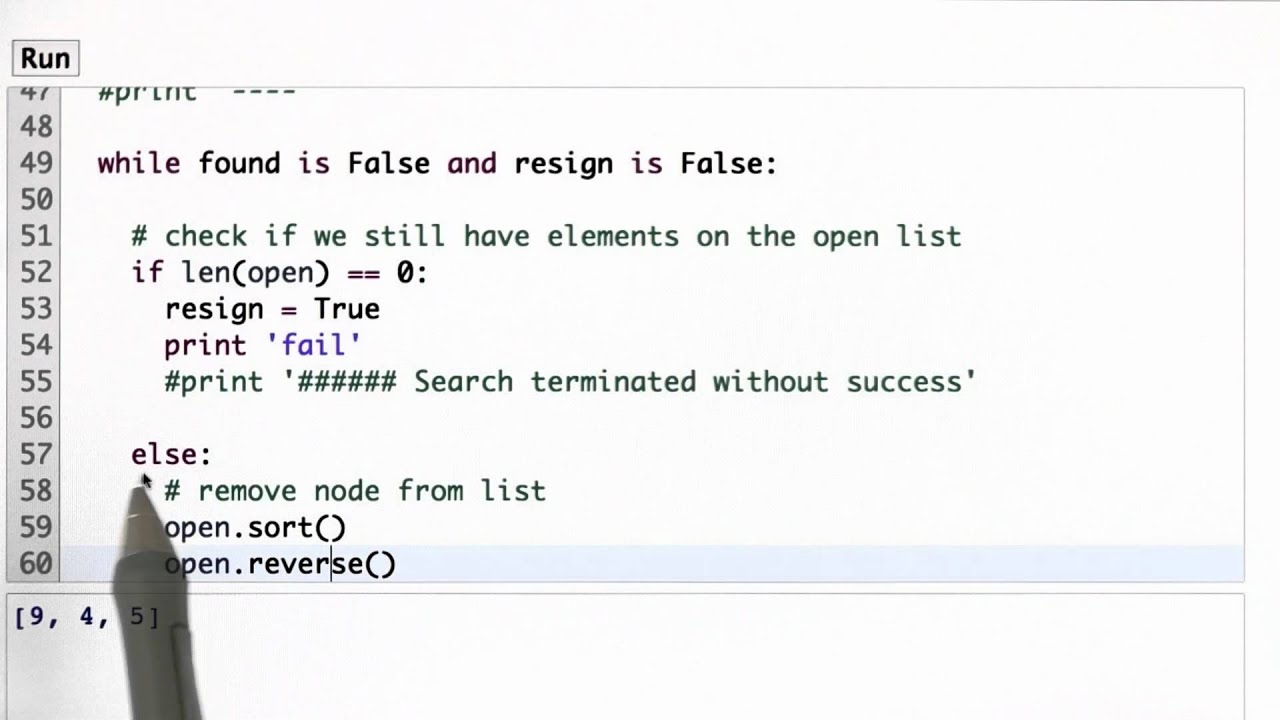
This video is part of an online course, Intro to Artificial Intelligence. Check out the course here: https://www.udacity.com/course/cs271.
agile sundial
humble flower
What are datastructures and Why are They so important?
because arrays are annoying to use for a lot of problems. we make data structures so things are easier (and faster sometimes)
 lost atlas
Okay so I am personally a C++ user. How I make a linked list/stack/queue there is making a struct of node with next, prev pointers to nodes and then making a class of linked list that has only head,tail node pointers and a bunch of functions to insert, delete.
I'd like to know how to implement that in python since there are no pointers.
 worthy escarp
lost atlas
Okay so I am personally a C++ user. How I make a linked list/stack/queue there i...
worthy escarp
lost atlas
Okay so I am personally a C++ user. How I make a linked list/stack/queue there i...
There are plenty of tutorials for how to make linked lists on the web, but if you need this for an actual project and not just practice I suggest collections.deque
fiery cosmos
restive python
I consider myself to be a savvy programmer, but when it comes to DP , im a lost ...
i can't help you with the video but DP is relatively straightforward, it stores pre-computed subproblems and looks them up rather than re-computing them each time.
restive python
fiery cosmos
i can't help you with the video but DP is relatively straightforward, it stores ...
I completely get the concept, I just dont get the exeution
fiery cosmos
anyone can help me with the asymptotics of my program / hashtable more generally?
fiery cosmos
restive python
I completely get the concept, I just dont get the exeution
i've only ever had to use it so far for graphing algorithms, where to find the shortest path, you go and look in your DP table and select and return the shortest path given rise to by the culmination of all the shortest subpaths between each node
restive python
yeah thats what im trying to do rite now
fiery cosmos
what problem are you trying to solve
fiery cosmos
fiery cosmos
anyone can help me with the asymptotics of my program / hashtable more generally...
slash add error handling
restive python
get from point A to B in the shortest with the shortest amount of steps
 austere forum
What would make a dataframe pass a dataframe to a def and that same call also pass the dataframe as a list?
It's messing up my def
I tried the help channels but nobody was on
restive python
austere forum
What would make a dataframe pass a dataframe to a def and that same call also pa...
by def u mean function ?
humble flower
what is a good project which would force me to learn datastructures and algorithms?
fiery cosmos
probably one of the games in a python crash course?
Python Crash Course, 2nd Edition teaches beginners the basics of programming in Python, with a focus on real projects.
humble flower
fiery cosmos
https://nostarch.com/pythoncrashcourse2e
what is that?
fiery cosmos
hmm maybe that's not the best to learn DS
 stoic nexus
So, according to leetcode, the longest substring without repeating chars in "dvdf" is 2. Maybe I'm fundamentally misunderstanding what they want, but "vdf" sure seems longer and non-repeating. I don't feel like my output is wrong for the asked question.. Is that not what a longest non-repeating substring is?
humble flower
fiery cosmos
hmm maybe that's not the best to learn DS
yeah i was a little confused when it said "the basics of programming" lol
fiery cosmos
idk most people use intro to algorithms 3rd edition, so im drawing a blank wrt what project you could undertake
humble flower
hmmm
fiery cosmos
stoic nexus
So, according to leetcode, the longest substring without repeating chars in "dvd...
are they counting from zero?
humble flower
well im just looking for something to make that would teach me datastructures and algos
where could i find that?
vocal gorge

Level up your coding skills and quickly land a job. This is the best place to expand your knowledge and get prepared for your next interview.
stoic nexus
fiery cosmos
are they counting from zero?
Not according to the test cases that passed. One is even a single char, expected output is 1.
fiery cosmos
humble flower
well im just looking for something to make that would teach me datastructures an...
you cannot find something you want to make, it does not exist yet
stoic nexus
So modified, i'm not crazy here right? that does seem like what they're asking?
humble flower
fiery cosmos
you cannot find something you want to make, it does not exist yet
i see what you did there
stoic nexus
Level up your coding skills and quickly land a job. This is the best place to expand your knowledge and get prepared for your next interview.
fiery cosmos
stoic nexus
So modified, i'm not crazy here right? that does seem like what they're asking?
im sure you're not crazy but i am not looking at leetcode, working on my own analysis rn
humble flower
stoic nexus
https://leetcode.com/problems/longest-substring-without-repeating-characters/
leetcode isnt a project
stoic nexus
Sorry, is this only for projects?
humble flower
thats what im looking for
fiery cosmos
no, selon thinks you were recommending something for his question
stoic nexus
I'm just asking my own question 🙂
stoic nexus
no problemo!
 gentle cypress
Hi I wanted to know how can I find the sum of the numbers until the imput number from the user
If user gave number 5 then I would like it to sum 1+2+3+4
but there are no restrictions so the number could even be 1mil
stoic nexus
Have you tried anything yet? what is your plan now? just a hint, sum(range(5)).
gentle cypress
I'm trying to do this in shapes not code
gentle cypress
stoic nexus
Have you tried anything yet? what is your plan now? just a hint, `sum(range(5))`...
but if run this on code I get no output
stoic nexus
print(sum(range(int(input("Enter any num: "),0)))) (print outputs the result, input gets from cli user input, substitute input with whatever input you're really using, and print with whatever output you're really using.)
Don't know which shapes you mean, but, if you're using plotly shapes, you'd need to get the user input another way, like from input() and pass it to the plotly call. Or use something like tkinter and connect it's forms to variables. I'd assume whatever it is you're using probably will require another lib, as it's likely not designed for user interaction as much as graphics.
gentle cypress
I think i found it

from the internet
could you explain why it does end + 1, 1
stoic nexus
because range doesn't go from [start, end], but [start, end), in math [] means include the given numbers too, () means don't include them. so [0,1,2) is actually[0,1]. ranges are always of the form [start, end), so to get [start, end], we do [start, end+1). So range(start, end+1, 1) just means go from the start to the end, and rather than stopping before end, stop at the end. (The last number, 1 means stepping forward 1 element each time.)
gentle cypress
damn
wow
okay I understand end+1 in order to reach the final number of the )
but why both end+1 and ,1 after it ?
oh wait
I got it
stoic nexus
So, the ,1 is the "step" of the range. basically if you do range(1,100,30) you'll get [1, 31, 61, 91], or range(0,10,2) you'll get all the evens
stoic nexus
Sorry, was wrong about what it'd return xD (edited it)
gentle cypress
I understood it now thanks a lot! really appreciate it fam
stoic nexus
Np bro! keep up the grind!
stoic nexus
There's lots of caveats, it just takes time and experience. Like this one 🙂
gentle cypress
yep! totally!
stoic nexus
I just gotta say, I'm recently a rust convert. Rust has both inclusive ranges[,] and exclusive ranges [,) (like python's). Furthermore the syntax is awesome:
range(1, 10) becomes 1..10, and if we want range(1, 10+1, 1) we just do 1..=10 (which reads so intuitively to me)
hybrid epoch
stoic nexus
So, according to leetcode, the longest substring without repeating chars in "dvd...
I got three
 hybrid epoch
idle pier
hello folks, currently doing `300. Longest Increasing Subsequence`. I couldn't c...
hybrid epoch
idle pier
hello folks, currently doing `300. Longest Increasing Subsequence`. I couldn't c...
bisect_left will return an index (or insertion point) that's equal to the length of the input list if (in this case) i is greater than the largest element in temp. Hence x == len(temp) is true. I would change x to i and i to x. It makes your code a little bit easier to read.
fiery cosmos
@haughty mountain i need your help if you are around at any point today
haughty mountain
the easier thing is just to ask the question and see
fiery cosmos
basically i modified the algo to compute an alternative load factor taking into consideration the case when the modulo is 113 and the tablesize is 120, it'll instead calculate the true load factor meaning keys / 113, since the other slots can never be used. now this is fine but i either screwed up my chaining load factor calculation or it never worked to being with. i imagine i just have to do keys in table / (bucketsize * tablesize)
haughty mountain
fiery cosmos
basically i modified the algo to compute an alternative load factor taking into ...
I think that should be correct, yes
fiery cosmos
i think i can just do away w the second one alltogether
no nvm
i need these to somehow all work for the cases where bucketsize is not 1 and in the event that the modulo integer is less than the tablesize, so use that to calc the load factor
lost atlas
gentle cypress
but there are no restrictions so the number could even be 1mil
||see if you can make up a formula for it :)||
haughty mountain
I feel you're overcomplicating it
fiery cosmos
can you help me find my direction? i've spent all day generating data i'm not sure i will use. i just need one insightful graph to show how the load factor and collisions change as a result of increasing input size, maybe 2 eg my scheme and the professors
oh and i need to do error handling
haughty mountain
why can probing_hash_int even be None here?
fiery cosmos
it defaults to None in the args, then if it is also none in the function it'll default to the primary hash modulo
it should be the other way around
haughty mountain
fiery cosmos
it defaults to None in the args, then if it is also none in the function it'll d...
why don't you just assign the right thing in the constructor?
fiery cosmos
i should default it to tablesize, and then change to primary hash w a flag
haughty mountain
fiery cosmos
wdym
if self.probing_hash_int is None:
    self.probing_hash_int = self.primary_hash_int
I’ll have to check the code. I do something similar to that somewhere
haughty mountain
if you do that in __init__ you don't need any other checks on probing_hash_int
like the ones you have in your code above
fiery cosmos
Yeah so I could never figure out the difference between required positional arguments that default to None and optional arguments and ones given by flags. I was trying to sort out like what if you have two optional args and you omit one, how the program would know which optional one it was. And someone said use argparse so that’s why I went in that direction but I’m still fuzzy on all those things I mentioned above and clearly I am conflating things that needn’t be conflated
haughty mountain
fiery cosmos
Yeah so I could never figure out the difference between required positional argu...
positional optional args to functions are order dependent
if you have a bunch of values that you want to maybe provide you can use keyword arguments
fiery cosmos
yeah so like what if i have
reqargA reqargB redargC optionalargA optionalargB
and i call myfunct(1, 3, 5, 4)
haughty mountain
In [8]: def f(x=None, y=None): print(x, y)

In [9]: f(42)
42 None

In [10]: f(42, 123)
42 123

In [11]: f(x=42)
42 None

In [12]: f(y=42)
None 42
how could i do optional argB and not A
haughty mountain
like I just posted
fiery cosmos
ok. i think i'm just getting confused regarding arguments as args on the command line vs args to functions
what about optional command line args
btw, i never used required = True, and everything was defaulting to required. i guess required = True by defult
for command line args
haughty mountain
fiery cosmos
what about optional command line args
optional command line args you just don't specify on the command line
haughty mountain
fiery cosmos
btw, i never used required = True, and everything was defaulting to required. i ...
probably not if you give a default value
fiery cosmos
i haven't given any of them a default, except for the optional one
fiery cosmos
that's funny bc it kept telling me that one was required
and like i said none of them have required = True on
and i know it wasn't my function telling me it was missing one bc it was saying argparser
anyhow
i should have written a script to do all these combinations of tests for me, i've been doing it manually all day (i am not a smart man)
haven't figured out what to say about runtime complexity
the book describes numbers of probes required as a function of load factor
load factor being totally fricked bc of this weird deployment
haughty mountain
like, I can easily construct inputs that totally messes up the quadratic probe load factor
fiery cosmos
for which scheme
haughty mountain
fiery cosmos
and i know it wasn't my function telling me it was missing one bc it was saying ...
example?
haughty mountain
fiery cosmos
for which scheme
wdym which scheme?
e.g. in the 120/120 case I can force a failed insert at load factor 1/3
40 collisions will mess you up
if the table was a power of 2 size I couldn't do that
fiery cosmos
oh i see. any chance you could help me implement some rudimentary error handling? doesn't have to be tonight obv
haughty mountain
if you have specific questions about it, ask
haughty mountain
what does fullness even mean here?
haughty mountain
like, for the quadratic one (because it's broken) the table can fail to insert even without being full
fiery cosmos
sigh
maybe i should set out to prove that and prove why the whole scheme is so broken
haughty mountain
!e
import argparse
parser = argparse.ArgumentParser()
parser.add_argument('--foo')
parser.parse_args(['no', 'foo', 'here'])
@haughty mountain :x: Your 3.11 eval job has completed with return code 2.
001 | usage: -c [-h] [--foo FOO]
002 | -c: error: unrecognized arguments: no foo here
i remember we removed my try block
haughty mountain
!e
import argparse
parser = argparse.ArgumentParser()
parser.add_argument('--foo')
parser.parse_args([])
@haughty mountain :warning: Your 3.11 eval job has completed with return code 0.
[No output]
see, optional by default
fiery cosmos
no you used the -- optional flag
i think i was going to use that try for error handling, but i'm not sure i need it like in the case that one of the keys is a letter or string, surely i'd be able to catch that somewhere and raise an error?
haughty mountain
fiery cosmos
i remember we removed my `try` block
well yeah, don't wrap everything in a try block...
you should try to catch errors as locally as possible
fiery cosmos
when reading in integers as strings like text from a file, they're always str until converted, yeah? or is 11111 known to be an int when read in?
haughty mountain
fiery cosmos
when reading in integers as strings like text from a file, they're always `str` ...
string
you'll need to convert it
haughty mountain
yes, but as locally as possible
fiery cosmos
but then blanklines would be seen as a non-int string input..
haughty mountain
try:
  x = int(s)
except ValueError:
  # oh noes, not an int
what now?
fiery cosmos
nvm, that impl above won't work due to the way i am reading in my values:
haughty mountain
do you get some terrible input format again?
fiery cosmos
haughty mountain
do you get some terrible input format again?
you know it 😂
haughty mountain
example of input?
fiery cosmos
just a text that also contains non-data integers and strings and blank spaces
the dots are continuation
fiery cosmos
no. the non-data ints are the header course number
once you hit the keys its just them or blanklines
after the annoying header and minimal required input string
fiery cosmos
idk i certainly didn't add them to my additional test inputs
no each time i run this, i do a command line argument and get an output, which is why i have many dozens of different cases now
haughty mountain
so the input genuinely has useless blank lines?
fiery cosmos
100%
haughty mountain
so what you could do is just
f.readline()  # skip header
all_strings = f.read().split()
and then parse the strings to int
fiery cosmos
you're saying this would enable catching strings in the input later on?
there is definitely a bug at the intersect of chaining and calculating the load factor based on the primary hash modulo
haughty mountain
fiery cosmos
there is definitely a bug at the intersect of chaining and calculating the load ...
how so?
haughty mountain
fiery cosmos
you're saying this would enable catching strings in the input later on?
this gets rid of all dumb whitespace and leaves the strings
so you can convert them
dreamy valley
method isn't coherent: it takes two arguments, but the recursive call uses only one
it looks like you solved it for (r^2)^n and not r^(2^n) like they said
fiery cosmos
haughty mountain
how so?
im getting tables with the same size, same number of keys, same everything, but different load factor
i think you were right in that this should have been two different programs 😦
haughty mountain
what part of it?
this will be very slow
oh wait, maybe I misread
oh that's n and not 2^n
but yeah, you want to square n times
return f(r, n-1)**2
for my two supplemental inputs with 108 keys
chaining
the sane method vs the profs method
haughty mountain
how do you keep track of the load factor?
agile sundial
a**2 is just the same as a * a so
haughty mountain
res = f(r, n-1)
return res*res
basically just let it default to the first assignment, if any of these if checks pass, that otherwise
haughty mountain
why didn't you fix the None thing?
and what is key?
well that's wrong, isn't it?
fiery cosmos
yeah it's only going to work for the required cases we've been given
haughty mountain
or wait, are you just brute force counting the number of elements?
fiery cosmos
it wouldn't work for bucketsize = 2
haughty mountain
why not just keep track of things?
agile sundial
^ every time something happens that adds or removes elements, modify a variable that counts the elements
fiery cosmos
i should. the most important part now is counting the number of comparisons needed to insert all the keys
haughty mountain
(also, have you heard of this nice construct called a loop?)
fiery cosmos
im not sure what is meant by number of comparisons.. primary collisions? primary and secondary?
fiery cosmos
haughty mountain
(also, have you heard of this nice construct called a loop?)
how about this:
haughty mountain
closer to nice
count = 0
for bucket in hashtable.table:
    for entry in bucket:
        if entry is not None:
            count += 1
i need keys in there somewheres
haughty mountain
I renamed it
oh, right
because bucket class
yeah that
but really, just have the class keep track
fiery cosmos
wdy think they mean by count the number of comparisons
haughty mountain
and load_factor should for sure be a method of the class
fiery cosmos
for sure i would just need a way to keep track of if im using tablesize as mod or the insane way
bc the insane way i calculate the load factor as keys / modulo integer if modulo integer < tablesize
but then my outputs look super wrong
emailed prof about it with screenshots of output, no response
haughty mountain
fiery cosmos
for sure i would just need a way to keep track of if im using tablesize as mod o...
why do you need to keep track?
it's always the probe mod, no?
fiery cosmos
haughty mountain
why do you need to keep track?
see above: line starting bc
if you recall, re-moduloing by the primary hash modulo artificially constrains the size of the table
so, in the event that keys can never get placed into that area of the table, i calculate the load factor differently
haughty mountain
but it's still the probe mod
fiery cosmos
oh i see what you're saying
haughty mountain
it's just the probe mod is the same as the primary hash mod
fiery cosmos
i could just use the probe mod in either case
haughty mountain
yes, it's not a special case
fiery cosmos
ok i'm trying to implement load_factor method now
also why are you still awake lol
are you not in your regular timezone?
hmm
i think load factor will get complicated when i have bucketsize bigger than 1
haughty mountain
surely this just boils down to a special case for chaining and in all other cases
count/(bucketsize*probe_mod)
it's...1 am?
because DST ended
fiery cosmos
oh thats cool
haughty mountain
fiery cosmos
i think load factor will get complicated when i have bucketsize bigger than 1
why?
haughty mountain
edge cases tend to melt away if things are formulated properly
haughty mountain
well
haughty mountain
haughty mountain
why not just keep track of things?
hashtable can just increment a variable on insertion and decrement on deletion
fiery cosmos
ok im going to add += 1 to count when try_insert passes
TypeError: type method doesn't define __round__ method
print(str('Load factor: ' + str((round(hashtable.load_factor, 3)) + '\n'), file = output)) TypeError: type method doesn't define __round__ method
uhh
does load factor need a repr method?
i must have really goofed something
oh i think i was just missing a ()
like hashtable.load_factor()
ok that's working nicely
humble flower
What is the best coding language for algorithms?
fiery cosmos
What is one of your favorite algorithms?
fiery cosmos
humble flower
What is the best coding language for algorithms?
Id say C
But if you end up not liking C after trying it Id try to use python
humble flower
fiery cosmos
But if you end up not liking C after trying it Id try to use python
But python is really good for algorithms aswell right?
I read something like that
fiery cosmos
humble flower
But python is really good for algorithms aswell right?
yeah
fiery cosmos
python is slow
algos can be implemented in nearly any language, python would be a poor choice if you wanted efficiency
the good thing is the object orientation
hey how do i print a raised error to file
nvm i will ask in general
 vital scaffold
Why is the value of nums not changing here , i am not able to understand why this error is happening.
Please Help!!
 fiery cosmos
i am trying to add comparison logic to my algo, lmk if anyone can assist. it is a hashtable algorithm, so i take comparison to mean looking at a table slot and seeing it is full as +1 comparison. more generally i would consider it to be each time a new probe location is computed
 carmine scaffold
vital scaffold
Why is the value of nums not changing here , i am not able to understand why thi...
carmine scaffold
vital scaffold
Why is the value of nums not changing here , i am not able to understand why thi...
Try this:
s_nums = set(nums)
return list(s_nums)
Yes, i understand this, but i want to know why is the original list not altering ?
vital scaffold
carmine scaffold
Try this:
```python
s_nums = set(nums)
return list(s_nums)
```
Does it means that if i pass a list to a function and perform some operations on it but do not return it ,then the original list will not alter ?
 runic tinsel
no, it's not because of return
it's because nums = means you change what nums means
a = 2
a = 3
like here, you;re saying i changed my mind, a is 3, forget that i said a is 2
haughty mountain
fiery cosmos
hey how do i print a raised error to file
catch the error, print it to file
runic tinsel
so you're just saying nums is not the what i got as argument, i changed my mind
fiery cosmos
haughty mountain
catch the error, print it to file
i got that sorted, i'm working on implementing comparisons counters. i don't have an objective what is correct for any one of the schemes though
haughty mountain
try:
  ...
except SomeException as e:
  print(str(e), file=your_file)
I guess you have counters as members of the class?
fiery cosmos
yes i have implemented a self.comparisons attribute of the table
and right now it's running and "working", i'm just trying to confirm the logic by looking at trace files of the program
haughty mountain
I would flip the sides of that inequality, but that's more of a me thing. It reads easier to me that way
fiery cosmos
i'm considering a comparison as any failed try_insert execution, and any time a probe is recomputed
what i don't yet know is if this is a separate value than primary_collisions + secondary_collisions
haughty mountain
haughty mountain
I would flip the sides of that inequality, but that's more of a me thing. It rea...
as in
if len > something computed
reads better as a sentence than
if something computed < len
what is a secondary collision here?
fiery cosmos
yeah thats probably a good point
secondary collision = a failed probe location insert. primary being failed initial hash insert
btw for my sanity, i'm working on the real version of the algo, and i'll do her defunct version if i get time
i did some error checking, like i won't take an inputfile with more keys than there are places to put them
haughty mountain
there is a term for such comparisons 😛
In programming jargon, Yoda conditions (also called Yoda notation) is a programming style where the two parts of an expression are reversed from the typical order in a conditional statement. A Yoda condition places the constant portion of the expression on the left side of the conditional statement.
Yoda conditions are part of the coding standar...
fiery cosmos
right, i'm just so wise and philosophical that use yoga conditions instead of the normal ones
{this is sarcasm}
haughty mountain
fiery cosmos
secondary collision = a failed probe location insert. primary being failed initi...
how do you count multiple collisions in a row?
fiery cosmos
i don't know that this is a strict requirement for this algo, so i'm not too worried about that. but it is definitely a requirement to count the number of comparisons
haughty mountain
say I insert 3 or more elements that have hash collisions
do the later ones have many secondary collisions?
btw, have you implemented lookup and deletion?
or is that not part of the task?
fiery cosmos
no i think i just have to mention the asymptotic implications that chaining have on deletion, but yes, it is not a part of the task to implement these characteristics
hybrid epoch
vital scaffold
Why is the value of nums not changing here , i am not able to understand why thi...
This is Leetcode's fault. For some problems, Leetcode will modify your output into something that matches the required format. In this case, you're returning None. Hence Leetcode chooses the input list as your answer. I'm not really sure why or the exact details on how this is done, but it must be some internal implementation.
Try implementing the same class in a separate editor and running that. You'll get different results
hybrid epoch
vital scaffold
Does it means that if i pass a list to a function and perform some operations on...
This is False in general
haughty mountain
hybrid epoch
This is Leetcode's fault. For some problems, Leetcode will modify your output in...
it's not leetcode's fault, it clearly specifies that the operation should be done in-place
(in multiple places in the problem statement)
fiery cosmos
i'm having trouble making a nice graph for this. excel just puts 1-5 at the x axis, not informative at all
the keys is irrelevant except that you can see how the comparisons begins to dwarf the number of keys in the input
hybrid epoch
haughty mountain
it's not leetcode's fault, it clearly specifies that the operation should be don...
We're saying the same thing. I'm also not saying that this is necessarily an error
OP is wondering is wondering why his input list isn't changing. To your point, the likely reason Leetcode is taking the input list as the output is because the problem specifies that the list must be modified in place. However, my previous point about them modifying the output still stands. Take a look at leetcode 22 (https://leetcode.com/problems/generate-parentheses/) for example. You can return any iterable although the type hint specifies a list of strings
Level up your coding skills and quickly land a job. This is the best place to expand your knowledge and get prepared for your next interview.
haughty mountain
"division modulo 120"
just say "modulo 120"
I'm curious why you would want to have a bar for "keys in table" when that's on the x axis
btw, is the instruction to check those values specifically? what I would do is insert a key and note the load factor and number of comparisons
and then plot load factor on the x axis and comparisons on the y axis
so just one curve plotted
as having both load factor and number of keys is kinda pointless for this hash table, it's just a straight line
(if it was a hashtable that resizes, then that could start being interesting)
 fringe valve
how do you make such a code text
fiery cosmos
haughty mountain
btw, is the instruction to check those values specifically? what I would do is i...
ah this is a great idea, thank you
haughty mountain
fringe valve
how do you make such a code text
!code this?
halcyon plankBOT
Here's how to format Python code on Discord:
```py
print('Hello world!')
```
These are backticks, not quotes. Check this out if you can't find the backtick key.
fiery cosmos
does the number of objects in an algo contribute to asymptotic complexity in any meaningful way?
the book only talks about cost of successful and unsuccessful searches, what are the asymptotics of hashtable insertions? O(1) on successful insertion for sure.
haughty mountain
fiery cosmos
the book only talks about cost of successful and unsuccessful searches, what are...
worst case for insertion at load factor f is f*table_size (ignoring the dumb modulo)
fiery cosmos
oh really?
haughty mountain
(i.e. O(number of keys in the set))
fiery cosmos
big o cheatsheet says O(1) without mentioning load factor
haughty mountain
not in the worst case
fiery cosmos
yeah you're right
Hash table Type Unordered associative array Invented 1953 Time complexity in big O notation Algorithm Average Worst case Space Θ(n)[1] O(n) Search Θ(1) O(n) Insert Θ(1) O(n) Delete Θ(1) O(n)
haughty mountain
if you keep the load factor < some constant you'll have constant costs on average
fiery cosmos
yeah that's what i'm noticing. i argued that above some load factor threshold one would be better off making a second duplicate hashtable and putting key sin there, though i haven't derived an exact factor
this has been near impossible w all the prof's fuckery. so much for going to my great aunts funeral
fiery cosmos
ok ok
haughty mountain
and that's what is done in practice
fiery cosmos
wait do you extend the current table or make a bigger one and copy everything over
haughty mountain
I would say the latter
maybe there are more clever things you can do, but probably not worth thinking about now
fiery cosmos
is any constant time number of operations always O(1)? is O(1,000,000) O(1)?
haughty mountain
yes
fiery cosmos
ok
 formal schooner
Hi
fiery cosmos
what's good
haughty mountain
fiery cosmos
what's good
idk why, but it reminded me of
 fiery cosmos
lol it was a common phrase here while i was growing up, what's good means like hello what's going on
still is according to a recent AOC tweet
how is the space complexity O(n) when I have a 2D array
thats a contradiction i think
fiery cosmos
i'm talking about a hashtable which is a list of lists
list of lists should be space complexity of n^2
oh, nvm
i figured it out, its cause i don't have an n*n array, i have like n by 1 or n by 3
dreamy valley
I don't know what you were referring to so I probably shouldn't have jumped to answer
haughty mountain
fiery cosmos
hashtable length * bucketsize to be more specific
O(number of slots)
fiery cosmos
precisely