#algos-and-data-structs
1 messages · Page 13 of 1
 fiery cosmos
 hybrid epoch
Hmm that stack overflow link or creating your own view seems like the best options.
Are you particular about using a global list specifically?
One idea is maybe changing your global list into a doubly linked list. That way it has order.
Create a function to return subsets (splices) of the linked list and modify them, then link them back into the global list using the prev and next pointer
Here's a simple demo with singly linked list (let's say you wanted to modify and append to slice root[1:3]):
class LL:
    def __init__(self, val=None, next=None):
        self.val = val
        self.next = next

root = LL(140.000)
root.next = LL(1)
root.next.next = LL("Channel #1")
root.next.next.next = LL(True)
start = root
for _ in range(1):
    start = start.next
start.val = 2

end = root
for _ in range(2):
    end = end.next
end.val = "Channel #2"
temp = end.next
end.next = LL("ChannelType.Sampler")
end.next.next = temp

temp = root
while temp:
    print(temp.val)
    temp = temp.next
# should be:
# 140.0
# 2
# Channel #2
# ChannelType.Sampler
# True
def findMinCutCost(m, n):
    cost = n * len(m)
    for i in range(len(m)):
        cost = min(findMinCutCostImpl(m, n, i), cost)
    return cost

def findMinCutCostImpl(m, n, i):
    if len(m) == 1: return n
    cl = 0; cr = 0
    if i > 0:
        cl = 10**10
        ml = m[0:i]
        nl = m[i]
        for j in range(len(ml)):
            cl = min(findMinCutCostImpl(ml, nl, j), cl)
    if i < len(m) - 1:
        cr = 10**10
        mr = m[i + 1:len(m)]
        nr = n - m[i]
        for j in range(len(mr)):
            mr[j] = mr[j] - m[i]
        for j in range(len(mr)):
            cr = min(findMinCutCostImpl(mr, nr, j), cr)
    return n + cl + cr

m=[2,8,10,15]
n=30

print(findMinCutCost(m,n))
here's what i understand so far:
cl = cost left
cr = cost right
m = array of cuts to be made, ints
n = string length
ml = segment, left to middle
mr = segment, middle to right
nl = ?
nr = ?
fiery cosmos
is it possible to have a dyn prog approach without the classic dp table?
 halcyon plankBOT
Hey @fiery cosmos!
You either uploaded a .txt file or entered a message that was too long. Please use our paste bin instead.
fiery cosmos
see here:

what is meant by dag in this context
eg:
"every dynamic program has an underlying dag structure"
oh
directed acyclic graph
did i share the google AI beating strassen's algo here?
 carmine sandal
Is lambda considered a form of list comprehension?
 haughty mountain
fiery cosmos
the case is small and i could solve by hand but idk what all the vars mean
haughty mountain
fiery cosmos
the case is small and i could solve by hand but idk what all the vars mean
solving by hand you should at least be able to tell which one is correct, right?
haughty mountain
carmine sandal
Is lambda considered a form of list comprehension?
no
carmine sandal
Thankyou.
haughty mountain
fiery cosmos
see here:
this is Levenshtein distance, no?
fiery cosmos
that particular instance may be, but they seem to be arguing in the book chapter that every dynamic program has an underlying directed acyclic graph structure
haughty mountain
I mean yes
otherwise the problem couldn't even be solved
having a DAG structure means (in this case) there exist some order you can solve things in so you only depend on things already computed (i.e. a topological ordering)
things not being a DAG means having a cycle in the graph
e.g. A(0) depends on A(1) depends on A(2) depends on A(0)
you can't start anywhere in that example digraph
fiery cosmos
right right ok
fiery cosmos
how can i turn this into a change-making program

rather, how can i make a dictionary where each key is on of a series of coin denominations from an input array
and each value of each key initialized to zero
oh i got it. you do:
mydict = {}
for i in denom_arr:
  mydict[i] = 0
ask in #python-discussion it's not relevant to the topic of this channel
 noble idol
oh sorry
fiery cosmos
is there a return to loop header with current i value function?
haughty mountain
noble idol
oh sorry
no problem, a lot of people randomly end up here, probably because it's the first topical help channel 🤷♀️
haughty mountain
fiery cosmos
is there a `return to loop header with current i value` function?
what would this even mean?
fiery cosmos
so i want to repeat the loop for the same i value while some condition is not yet met
for i in reversed(denom_array):
        while cum_val + denom_array[i] < inp_val:
so you want a while loop
fiery cosmos
well i need an interator to change the denomination of coin im adding
fiery cosmos
haughty mountain
no problem, a lot of people randomly end up here, probably because it's the firs...
✋
haughty mountain
fiery cosmos
so i want to repeat the loop for the same `i` value while some condition is not ...
so what's wrong with this?
fiery cosmos
it tries one coin denom one time and moves on. i think i can figure it out. the for loop needs nested within the while loop
but this has to be an n*k time complexity algo, so idk that this will work
 azure osprey
class EventList:
    def __init__(self, lst_: list[AnyEvent] | None = None, p: EventList | None = None):
        self.local = [(i, e) for i, e in enumerate(lst_ or [])]
        self.parent = p or self

    @overload
    def __getitem__(self, i: type[EventEnum]) -> EventList:
        ...

    @overload
    def __getitem__(self, i: EventEnum) -> EventList:
        ...

    def __getitem__(self, i: type[EventEnum] | EventEnum):
        if isinstance(i, EventEnum):
            return EventList([e for _, e in self.local if e.id == i], self.parent)

        return EventList([e for _, e in self.local if e.id in i], self.parent)

    def __iter__(self):
        yield from self.local

    def __len__(self):
        return len(self.local)

    def insert(self, i: int, event: AnyEvent):
        p_idx = self.local[i][0]    # Index of event in parent
        self.local[i:] = [(p_idx, event)] + [(i + 1, e) for i, e in self.local[i:]]

        if self.parent is not self:  # Prevent recursion loop
            self.parent.insert(p_idx, event)  # Insert in parent's local
Decided to use a list as the base collection.
I think this should do it @haughty mountain@hybrid epoch@austere sparrow@loud trail
Some smart recursion at end, should resolve any kind of invalidation issues ig
This will allow sublist of sublist of sublist to update original-most list as well, provided the g is passed correctly
 loud trail
that's an interesting way to do it
fiery cosmos

pseudocode makes no sense, why would you run 0 to n where n is the amt of change to be made
 opal oriole
fiery cosmos
eg:
"every dynamic program has an underlying dag structure"
opal oriole
fiery cosmos
eg:
"every dynamic program has an underlying dag structure"
This statement is technically not correct in general for all of dynamic programming (it's more general than that), but for the kinds of dynamic programming problems you will encounter it probably is.
fiery cosmos
how can i modify this code to return also the number of coins of each denomination:
INF = 100000

def min(x, y):
  if x < y:
    return x
  return y

#k is number of denominations of the coin or length of d
def coin_change(d, n, k):
  M = [0]*(n+1)

  for j in range(1, n+1):
    minimum = INF

    for i in range(1, k+1):
      if(j >= d[i]):
        minimum = min(minimum, 1+M[j-d[i]])
    M[j] = minimum
  return M[n]

if __name__ == '__main__':
  # array starting from 1, element at index 0 is fake
  d = [0, 1, 5, 10, 25]
  print(coin_change(d, 73, 4)) #to make 5. Number of denominations = 3
right now it simply prints the number of coins. i would like the number of each coin as well
fiery cosmos
opal oriole
This statement is technically not correct in general for all of dynamic programm...
i had a feeling, yeah. seemed too vague or generalizing
opal oriole
fiery cosmos
i had a feeling, yeah. seemed too vague or generalizing
Well, maybe if unrolled through time.
haughty mountain
opal oriole
This statement is technically not correct in general for all of dynamic programm...
how would you resolve a loop?
opal oriole
haughty mountain
how would you resolve a loop?
In successive approximations it's just updating the values. One could say that it's just generating a new value and that would still make it loop-less.
So some time subscripts to the values.
haughty mountain
this sounds less like dp and more like some system trying to find equilibrium over time
opal oriole
Dynamic programming has that kind of stuff.
haughty mountain
sound more like markov stuff
opal oriole
Dynamic programming also has that.
(Q-learning)
There is the DP programming method, and then there is DP as in mathematical optimization.
Both are DP.
The non-programming method part of it was actually kind of the main focus of the research back then.
haughty mountain
idk if I would call stuff like Q-learning and policy iteration dp, but this might be dp being a wildly terrible name for things again 
opal oriole
Some DP uses fixed point iteration, maybe that makes it more clear.
haughty mountain
it's very different from classical dp
opal oriole
Specifically solving Bellman's equation.
That is classical DP.
Wikipedia gets it right actually: "Dynamic programming is both a mathematical optimization method and a computer programming method. "
fiery cosmos
you'd be surprised how hard it is to find decent pseudocode for the coin change problem with a O(n*k) time complexity and using dp
opal oriole
A lot of it comes from Control Theory, and reinforcement learning (Q-learning) comes from Optimal Control Theory.
fiery cosmos
dp seems pretty obvious when it comes to not re-solving the same problems over and over, im waiting for the insightful or non-obvious part to come up
opal oriole
So not only is DP a bad name on purpose, it now refers to two different things that are technically the same, but feel very different in practice.
fiery cosmos
actually, i was already exposed to that in trying to understand how an algorithm works
haughty mountain
naming is hard, apparently
haughty mountain
fiery cosmos
pseudocode makes no sense, why would you run 0 to n where n is the amt of change...
wdym doesn't make sense?
fiery cosmos
n is the amt of change to be made
haughty mountain
sure, isn't the question what's the cheapest way of getting there?
what's the fewest coins to get from 0 to n
haughty mountain
so what's the thing that doesn't make sense?
it starts wIth C(0) = 0 and then for p = 1, ..., n considers the cheapest path it could have come from
that's it for computing the number of coins
fiery cosmos
i think im reading it wrong. the p loop will not run n times
haughty mountain
n-1 times
fiery cosmos
oh
fiery cosmos
i think it's saying like while p is not n but p could jump + 1*denom
or it will run n times?
haughty mountain
idk why the number of loops is that important?
fiery cosmos
i just don't see how you'd have to run a loop 79 times to make change for 79 cents
haughty mountain
it's more important what the loop does
fiery cosmos
it should be much simpler
fiery cosmos
fiery cosmos
i just don't see how you'd have to run a loop 79 times to make change for 79 cen...
at this cost you might as well just count pennies out until you get there
haughty mountain
what if you had one coin with denomination 1?
fiery cosmos
only coins w denom 1 yeah
haughty mountain
the point is finding the best solution, not just any solution
any solution could probably be done a bit simpler, e.g. 2 coin denominations is a simple diophantine equation
fiery cosmos
so sidebar, this is confusing to me bc they don't explicitly state what the C and S arrays are for, and furthermore there is another pseudocode which is called to compute the sltn, and which only uses S.. let me try to implement and see
haughty mountain
do you get the basic idea or not?
fiery cosmos
no, i get like the memoization and dp table stuff but i wasn't able to see why they are typically 2d arrays. i need to read the pseudocode again
haughty mountain
also idk what's the point of S, you shouldn't need it
 obsidian fern
hi, is anyone know how to insert into list objects all keys?how it is used in js? {...objects, newKey: value}
haughty mountain
fiery cosmos
no, i get like the memoization and dp table stuff but i wasn't able to see why t...
these should be 1d arrays
haughty mountain
fiery cosmos
right i just meant in general
they can be any dimension
fiery cosmos
most dp tables i see are 2d and are referenced like arr[i][j]
haughty mountain
depends on how many variables you have in your dp formulation
I've seen 4 or 5 used at some point
fiery cosmos
4 dimensional arrays? oh that's just a quadruply-nested array?
haughty mountain
yes, you can have 4 variables in the dp formulation
all combinations might need to store a dp value
you've seen 2d arrays because you've probably only seen dp formulations with 2 variables
fiery cosmos
sounds.. space complex
haughty mountain
depends on how big the variables can be
fiery cosmos
well 4^4 is 256 so, small amt of inputs, lots of individual table entries
does one need quad nested loops to read/write with that many vars?
haughty mountain
fiery cosmos
well 4^4 is 256 so, small amt of inputs, lots of individual table entries
well yeah, you can have small sized stuff though, like a dimension could be possible decimal digits, i.e. size 10
and then you can have larger stuff in other dimensions
haughty mountain
fiery cosmos
does one need quad nested loops to read/write with that many vars?
kinda yeah
fiery cosmos
its a logical extension given what i've seen required for 2d arrays
haughty mountain
but yeah, you don't really need the S array they have
fiery cosmos
well i'm glad bc i could not see the reasoning
haughty mountain
maybe it makes reconstruction easier, but not much
so reconstructing without S is pretty easy
start at n, the number of coins needed was c, where could you have come from?
if you took an optimal path
fiery cosmos
haughty mountain
start at `n`, the number of coins needed was `c`, where could you have come from...
wdym.. like from the c-1 state?
n-c_i?
haughty mountain
n - c_i are the states you could have come from yes
and only ones with C(n-c_i) = c-1 are optimal
pick any of the optimal ones
(and bad choice of name c by me)
haughty mountain
haughty mountain
pick any of the optimal ones
and then repeat
their S array I think is there to know which coin produced the minimum
so you know where to jump along an optimal path
but you can reconstruct that info easily while backtracking as well in this case
fiery cosmos
well i would like the series of coins which produced the mins, eg each coin denom and its count
so p looks to be a running summation of the values of coins we've picked, we're running it up to n
then we have for i beginning at 1 and running through k, where k is the number of denominations, eg 4 for the set d = [1,5,10,25], similarly one could simply use len(d), the denomination array
line 5 makes sense
how should i be thinking about the C array
or rather, what should i initialize it to, wrt to length and values?
oh it can simply be len(d) and zeroes
i keep getting local variable referenced b4 assign
 onyx root
fiery cosmos
i keep getting local variable referenced b4 assign
onyx root
fiery cosmos
i keep getting local variable referenced b4 assign
if you pastebin the code, people can help
fiery cosmos
def change(denom_arr,change):

    C = [0*i for i in range(len(denom_arr))]
    S = [0*i for i in range(len(denom_arr))]

    for p in range(0,change):
        min = 10**10
        for i in range(0,len(denom_arr)):
            if denom_arr[i] <= p:
                if 0 + C[p-denom_arr[i]] < min:
                    min = 1 + C[p-d[i]]
                    coin = i

        C[p] = min
        S[p] = coin

    return C, S

d = [1,5,10,25]
change(d,73)
it's clearly not passing the second if check, so coin is never assigned, leading to an error on the S[p] = coin line
onyx root
fiery cosmos
it's clearly not passing the second `if` check, so `coin` is never assigned, lea...
it sounds like you understand the problem
fiery cosmos
pseudocode is here:

i do but why would they write it to throw an error
i mean, i understand the error but not how to correct
i actually should probably just try to implement the greedy approach
haughty mountain
fiery cosmos
how should i be thinking about the `C` array
C(n) is the smallest amount of coins to make change n
haughty mountain
fiery cosmos
```py
def change(denom_arr,change):
C = [0*i for i in range(len(denom_arr))...
the p loop shouldn't be 0 indexed
fiery cosmos
haughty mountain
the p loop shouldn't be 0 indexed
implemented recommended change
haughty mountain
so my overall question is, do you know what the dp formulation is for this problem?
i.e. what is the formula for C(n)?
if you know that the impl should make sense
 fiery cosmos
not really. i know its based on the minimum expression of 1 + C[p - d_i] over all indices i checking d_i in the denomination array
but i think implementing the greedy algo would be more realistic
especially for a HW assignment. i just don't know if that is O(n*k) time
haughty mountain
greedy is not correct
fiery cosmos
hmm
haughty mountain
fiery cosmos
not really. i know its based on the minimum expression of 1 + C[p - d_i] over al...
think about what the minimum means, when C[p] is the smallest number coins needed to get to change p
fiery cosmos
its equal to 1 when if d[i] = p
haughty mountain
in general, where can I arrive to p from?
fiery cosmos
so this is where i don't like set notation. i would say that given a set C of coins which cumulatively equal P (of varying denominations), you could look at the p=C-1 set. but sets i cannot represent say, 5 coins of denom 5, i simply have a single 5
hang on
haughty mountain
ok, to be precise, where can I arrive to p from by adding a single coin
fiery cosmos
C[p-1]
haughty mountain
nope
fiery cosmos
C[p-d[i]]
haughty mountain
I was after just p-d[i], but yes
ok, how much does it cost me to go to p via p-d[i]?
fiery cosmos
so total change p minus some coin denomination with index i
fiery cosmos
haughty mountain
ok, how much does it cost me to go to p via p-d[i]?
d[i]
fiery cosmos
are you asking if one were to remove that entire denomination from consideration (computing the subproblem where we havent yet considered denomination i just yet)?
haughty mountain
no
this is about making sense of the dp formulation
so we could have come from p from p-d[i] (for some i)
what's the least amount of coins to get to p-d[i]?
(it's a dumb question with a dumb answer)
fiery cosmos
idk. here is my logic train:
d[i] represents a denomination of a coin. say 25 cents. then for example say we have one dollar. so i have 100-25 = 75 cents. then it'd be 3*d[i], but i don't know how to abstract it
haughty mountain
think about adding one coin at a time, that's the whole point of this formulation
haughty mountain
haughty mountain
(it's a dumb question with a dumb answer)
it's ||C[p-d[i]]||
fiery cosmos
i think the indices are tripping me up. also it's not clear to me if d[i] represents a single coin of denomination i or that entire denomination
haughty mountain
it represents the denomination, but we think of adding exactly one coin
fiery cosmos
ok so the next obvious question would be, how to we solve the subproblems (construct table C)
haughty mountain
so we know the lowest #coins to get (from 0) to p-d[i] is C[p-d[i]]
how many coins do we need to go to C[p] from there?
fiery cosmos
C[d[i]]
haughty mountain
technically correct
1
C[p - d[i]] + 1 total coins to get to p
we have a few options (different i) but we are only interested in the option with the lowest #coins
hence min(C[p - d[i]]) + 1
(or the 1 inside the min as in the version you showed earlier, same thing)
point is, stand at p, look at all options you could have gotten there by adding one coin: p - d[i]
the cheapest way to get to p is the cheapest way to get to one of those options, plus the 1 coin extra
fiery cosmos
adding one coin p-d[i]?
haughty mountain
maybe that's clearer
fiery cosmos
right ok
haughty mountain
p - d[i] refer to the "options"
fiery cosmos
right right the cheapest way is adding a single coin of denomination i, otherwise, if it weren't there would be no way to get to p
or if it requires multiply coins of a given denom, its not the cheapest way
actually wait
fiery cosmos
fiery cosmos
or if it requires multiply coins of a given denom, its not the cheapest way
this is false
haughty mountain
we only look one coin back
fiery cosmos
and there may be multiple coins of the same denom in the solution but we are considering each case one at a time and would get there by first adding each one at a time
haughty mountain
by thinking about adding one coin at a time we can relate the fewest amount of coins to get to p to the fewest amount of coins to get to some earlier points
for which we have already calculated the fewest coins needed
because we calculate them in order in the loop
p=1 up to p=n
fiery cosmos
its really just lines 6 and 7 that get me confused. im totally with you on the logic. if the first denom, d[i] we try is less than p, the total change, then we set min equal to 1 + the minimum number of coins on the way to p, minus d[i], given as min = 1 + C[p-d[i]]
i think C[p-d[i]] is really getting me
haughty mountain
how so?
the line 5 if is just there so we don't try to access C[-1], C[-2] and so on
the for loop as a whole is just computing the min
defaulting to infinity if there are no valid choices
fiery cosmos
i think p running up to n means we need an array of length n = p = change to be made. then in line 7 we are setting min = 1 plus the cost array C[p-d[i]], meaning we are subtracting the denomination amount and looking d[i] back in the cost array C, at that index?
haughty mountain
consider one iteration of the loop
we are standing at p and looking at where we could have come from
haughty mountain
you realize the for loop is just a min expression, right?
 haughty mountain
if the d[i] is a valid one (the if at 5) and it produces a smaller value than the current minimum (the if at 6) then overwrite the current minimum
that's how you compute a minimum with a loop, plus we have a constraint in this case (to not look at the invalid C[-1] and beyone)
fiery cosmos
does it matter the order of the denominations in the denomination array
haughty mountain
no
fiery cosmos
so C[some_index] is the minimum number of coins of that denomination?
fiery cosmos
right right
but if p runs through n, you'd never have so many different coin denominations
haughty mountain
e.g. if d = [5, 2, 1] then C[11] is 3 because 5+5+1
fiery cosmos
ohhh
haughty mountain
fiery cosmos
but if p runs through n, you'd never have so many different coin denominations
you loop over the values to reach
not the denominations
in the outer loop
fiery cosmos
oohh
fiery cosmos
not quite but it will click tonight or tomorrow. you've gotten me most of the way there and i appreciate your time as well as the socratic teaching method
most of my breakthroughs come when im not thinking about it
also, i have come a long way since asking how to implement "how do i interpret for p = 1 to n from pseudocode." so i am happy about that
haughty mountain
it's important to realize what the idea is
then the mechanics of computing it makes more sense
fiery cosmos
of course
haughty mountain
and realizing "oh, this is just computing a minimum" is useful
pattern matching
fiery cosmos
so there's no recursive calls here but certainly a lookup table
haughty mountain
well yeah, that's kinda the reason for using the table approach
you can eliminate the recursion
if you're careful about computing things in a correct order
(DAGs and topological orderings, as mentioned)
in this case the ordering is easy, compute the answer for smaller values first
since we depend on those
writing the recursion and memoizing answers has the nice property of fixing the ordering for you
but tends to be slower because recursion
fiery cosmos
so their S array is where they are storing the actual coins as well?
haughty mountain
they store the coin that gave the minimum
fiery cosmos
what about combinations of coins or coins of different denoms
haughty mountain
but as said, that information isn't strictly needed
haughty mountain
fiery cosmos
what about combinations of coins or coins of different denoms
wdym
fiery cosmos
i don't understand what S[p] would look like / how the number of each coin is represented
haughty mountain
if p - d[i] was the thing that created the minimum, store S[p] = i
fiery cosmos
but surely you'd need multiple coins to make certain p values
like 9
is 5+1+1+1+1
fiery cosmos
so it actually looks up for p = 6 what the minimum coin was that gave rise to p = 5?
opal oriole
Look at the recursion tree (if it were recursive) and work backwards.
haughty mountain
hypothetical situation:
S[9] = 5, ok some optimal path used a 5 here
9-5 = 4
S[4] = 1, ok some optimal path used 1 here
4-1 = 3
S[3] ...
for your 5+1+1+1+1 example
fiery cosmos
oof
haughty mountain
ok, note that I stored the coin values in S
not the indices
but you get the point
S points to where an optimal path came from
it's a trail of bread crumbs
follow it
fiery cosmos
haughty mountain
hypothetical situation:
S[9] = 5, ok some optimal path used a 5 here
9-5 = 4
S[4...
that must be this:

makes sense
alright i need to get some dinner, tysm
i'll be around
haughty mountain
yes
 broken sail
https://www.codechef.com/problems/LECANDY can someone help me with this, i will do the coding part just need explanation
CodeChef
broken sail
 burnt wolf
please tech me to find log
burnt wolf
please tech me to find log
 haughty mountain
broken sail
https://www.codechef.com/problems/LECANDY can someone help me with this, i will ...
haughty mountain
broken sail
https://www.codechef.com/problems/LECANDY can someone help me with this, i will ...
this is trivial, no? to boil the statement down: you have c things, you need to give A_k of them to each elephant, do you have enough?
broken sail
haughty mountain
this is trivial, no? to boil the statement down: you have c things, you need to ...
thanks got the answer
 austere sparrow
Suppose that you're in a while True loop and you have a single variable holding a string s. All you can do is:
- see if
smatches a regex (PCRE), and combine these checks with and/or/not - prepend a fixed string to the beginning of
s - use
breakandcontinue
You can't introduce additional variables or functions.
Would that be Turing-complete?
It "feels" like it's Turing-complete. But I can't figure it out
 forest tundra
is it possible that a dictionary is treated as a list depending on its content or something?
i have a dictionary i'm trying to add an element to but it's giving me this error

i've checked and im not redefining it as a list somehow anywhere
onyx root
forest tundra
i have a dictionary i'm trying to add an element to but it's giving me this erro...
is playerdata a list?
forest tundra
yeah
onyx root
forest tundra
yeah
it looks like it's an empty list.
onyx root
python3.11 has better error messages that would show you which part of the line was failing
haughty mountain
austere sparrow
Suppose that you're in a `while True` loop and you have a single variable holdin...
have a look at https://www.youtube.com/watch?v=8_npHZbe3qM
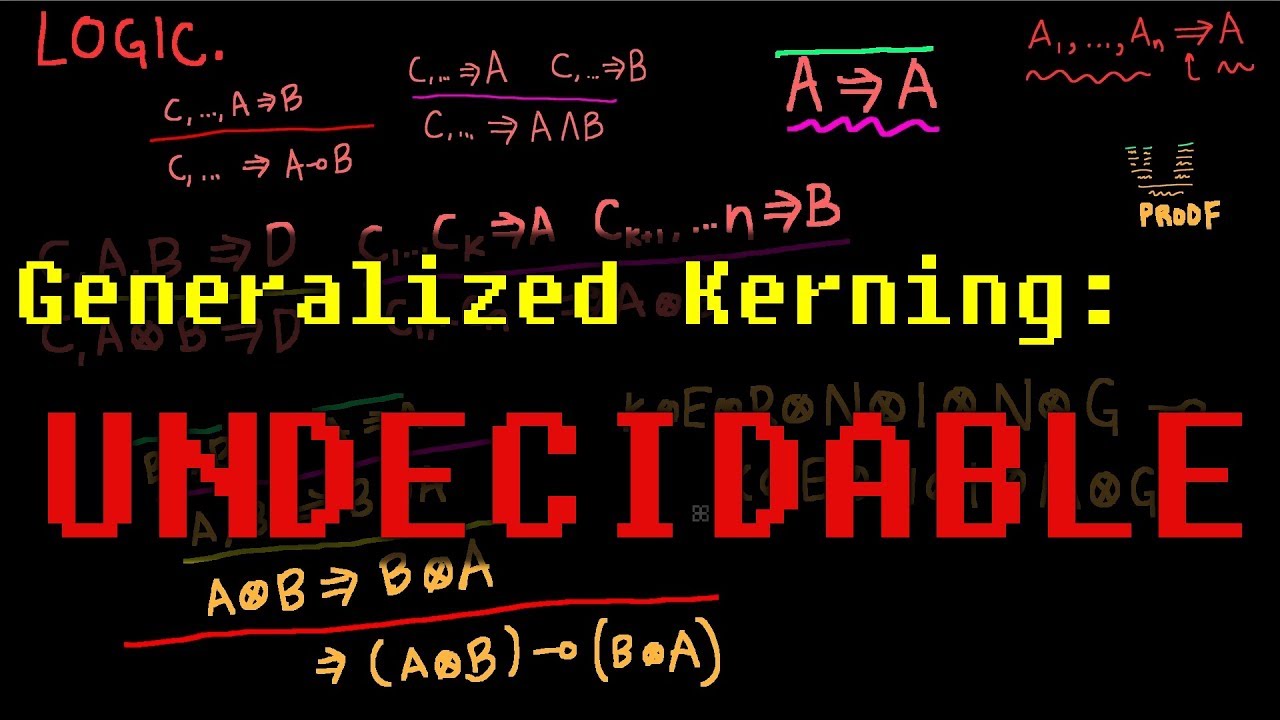
This lecture is an addendum to my video about Anagraphs, which you should watch first (or only). I do two proofs by reduction: One that the "generalized kerning" problem is undecidable, and one that the "generalized anagraphing" problem is decidable. The first proof uses turing machines, and the second a fragment of linear logic. I try to explai...
feels kinda similar, building a turing machine based on string replacements
(also that channel in general is great)
though I guess you're not allowing substitutions
so, one silly idea would be to use the regex just for divisibility checks (or modulo, rather)
then you can define a state machine with N states (consider the number of chars in the string mod N, that decides the action you do) and you can append strings to move between the states
so state machine without memory is for sure possible
not sure how far that gets you
haughty mountain
only allowing prepending a fixed string makes things a bit awkward
I think wlog you can think of this as a number in base 1
regex and append will allow some arithmetic and checks
e.g. regex is great at divisibility checks and modulo
but as I said idk how far this will take you
you might be able to pass some data between states, e.g. trigger state X if the number is 0 mod N, if the number is 0 mod 2N then the data passed is 0 if the number is N mod 2N it's a 1
maybe this state machine can go somewhere, but I'm iffy about the requirements to be a turing machine
I think the infinite tape requirement is the thing that might totally break this
burnt wolf
broken sail
can i get like this for understanding permetuation?
or can anyone say me how permetuation works
hybrid epoch
burnt wolf
or can anyone say me how permetuation works
A permutation is an arrangement of a set of elements where the order of the elements matter. This is opposed to a combination where the order of the elements doesn't matter:
321 and 132 are two permutations of 123
321, 132 are both a SINGLE combination (actually a 3-combination) of 123
Can someone help me figure out the difference between the greedy choice property vs optimal substructure?
The greedy choice means that a globally optimal solution can be obtained from choosing locally optimal solutions.
Optimal substructure means that a globally optimal solution to a problem can be constructed from optimally solving its subproblems.
Both of these sound similar to me. What's the difference?
haughty mountain
greedy generally involves ignoring a bunch of possibilities because they can't be optimal
for optimal substructure you actually consider the options (in some sense)
they are fairly similar concepts though
fiery cosmos
greedy choice means making the best looking choice at the time (during the given subproblem) e.g. hill climbing example
sometimes greedy can give you the optimal outcome, other times it does not
depending on the subproblems
greedy gives an optimal sltn to the fractional knapsack problem; it does not give optimal solution to the 0/1 knapsack
for which you need dynamic programming
how can i resolve these if checks to make sense and not throw an error
 haughty mountain
what would even throw an error?
fiery cosmos

one of them aren't passing, so min is never getting declared
oh wait
thats wrong
C is probably the wrong length
fiery cosmos
initializing a list of all zeroes?
fiery cosmos
0
fiery cosmos
oh i isee
haughty mountain
and as for the lengths of C and S
fiery cosmos
i fixed them up
haughty mountain
what is the largest and smallest index of C that you need?
fiery cosmos
p
fiery cosmos
er, the greatest val of p when it is equal to change
C = [0 for i in range(change)]
change being equal to the value of change you want to make
haughty mountain
that doesn't go up to change
it goes up to change - 1
and you want it to go up to change
fiery cosmos
C = [0 for i in range(change)+1]
fiery cosmos
C = [0 for i in range(change+1)]
haughty mountain
and how high does it currently go?
fiery cosmos
uhh the for loop only allows it to go up to and not including change, so change-1
haughty mountain
right
so that needs to be fixed
with the range of p fixed that should be everything I think
fiery cosmos
Soo we just had power surges including my comp turning back on and off again like 3x and internet going out, hadn’t saved, back to drawing board. It doesn’t matter this doesn’t have to run I just want to understand it
And I guess I like getting code running which is something new
second programming project just released, haven't looked at it. i know its on hashing
haughty mountain
do you remember us talking about argmin? what you are computing in the inner loop is basically an argmin
(you compute both the min and the argmin)
(min and coin)
 pastel wadi
alugien puede ayudarme con mis deberes
fiery cosmos
right so the min would be an integer or data point and the argmin would be a mathematical expression
or function call
haughty mountain
fiery cosmos
right so the `min` would be an integer or data point and the `argmin` would be a...
min is the minimum value
argmin is the argument that gives the minimum value
fiery cosmos
right makes sense
fiery cosmos
haughty mountain
do you remember us talking about argmin? what you are computing in the inner loo...
in what way is the inner loop an argmin
haughty mountain
fiery cosmos
in what way is the inner loop an argmin
it computes both the min (min) and argmin (coin)
fiery cosmos
right, the coin arg gives rise to the min value
haughty mountain
yep
fiery cosmos
ok!
haughty mountain
it's a common pattern worth recognizing, that for loop
there is an extra if in this one that you usually don't have if you're just calculating the min/argmin
haughty mountain
fiery cosmos
that extra if is to achieve the restriction i: d_i <= p
I guess dumb question, but do you know how to read that expression?
fiery cosmos
the one you linked back to above or the i: expression you just wrote
haughty mountain
well the thing I wrote now, but it's a part of the bigger expression
fiery cosmos
i such that coin denomination under consideration d[i] is less than or equal to running total, p
haughty mountain
ok cool, just wanted to check you knew how to read it out
so yeah, it's a constraint on the valid i
the "such that" directly translates to the extra if
fiery cosmos
hmm very curious
i really love the logic in all of this
or like, practicing reasoning
i like practicing reasoning bc its mentally stimulating / rewarding and of course challenging as well
as someone who loves music / art, playing music, all that creative stuff, using this part of my brain is quite fascinating
and its certainly a skill you can develop, even if at the outset you're a bit slow on the uptake
haughty mountain
you could break it apart as well
valid_i = [i for i in range(len(d)) if d[i] <= p]

min = 10**10
coin = None
for i in valid_i:
  if 1 + C[p - d[i]] < min:
    min = 1 + C[p - d[i]]
    coin = i
(I would maybe pick a name other than min since that is an existing function)
fiery cosmos
right right
haughty mountain
this is the more common form of the loop you would see
if the current value is smaller than the current min, replace the current min
(and update the argmin)
hopefully if should be obvious this computes the minimum
(and the argmin)
fiery cosmos
the syntax and what its trying to do are straightforward. i wouldn't say i can have the global scope or hierarchy of the program right there at my mental grasp, but that'll come
haughty mountain
as an example without the argmin
things = [5, 4, 1, 2, 3, 1, 5]
mini = 10**10
for thing in things:
  if thing < mini:
    mini = thing
hopefully you can make sense of the fact that this code indeed computes the minimum value
fiery cosmos
of course
haughty mountain
you could then add the argmin tracking on top of that
you could easily modify this to compute a maximum
you could allow something like
things = [5, 4, 1, 2, 3, 1, 5]
mini = 10**10
for thing in things:
  if f(thing) < mini:
    mini = thing
which would correspond to using python's min with a key function
(i.e. this would compute an argmin)
(the element in things that minimizes function f)
fiery cosmos
so then argmin = f(thing)
haughty mountain
argmin = mini
min = f(mini)
so...my naming was kinda bad
this is the form the algorithms has (ignoring the constraint/extra if)
mini = 10**10
argmin = None
for thing in things:
  if f(thing) < mini:
    mini = f(thing)
    argmin = thing
so this logic is what is underpinning something like argmin
 haughty mountain
both min and argmin, really
 proven sky
red is neural network prediction
haughty mountain
proven sky
anyone an idea why my neural network spits out binairy values
#data-science-and-ml is probably a better fit for this
fiery cosmos
argmin = thing helped with comprehension. seeing it as an argument to the function
hybrid epoch
haughty mountain
greedy generally involves ignoring a bunch of possibilities because they can't b...
Ah. So it's like you're pruning your problem space for a solution candidate, right? Then immediately choose that candidate because of the greedy choice property
haughty mountain
kinda yeah
hybrid epoch
fiery cosmos
greedy gives an optimal sltn to the fractional knapsack problem; it does not giv...
Does this mean if a problem is solvable by dp, then it isn't solvable by the other?
fiery cosmos
no
hybrid epoch
fiery cosmos
<@620279153974968321> do you have CLRS
Yes
fiery cosmos
some problems will be solvable by both, some only one or the other
hybrid epoch
Ah okay gotcha
fiery cosmos
there are some excellent problems where you go through and see that by tweaking one thing, it destroys the optimal substructure property
haughty mountain
dp is the more general thing
fiery cosmos
likewise, you see where greedy can be applied and where it fails
check the problems and solutions for chapters 15 and 16
haughty mountain
greedy is great and simple if you can prove that the greedy choice you do is actually optimal
fiery cosmos
don't forget the greedy choice can appear optimal in a subproblem but give rise to a wrong global sltn
or, a non-optimal soltn
e.g. hill climbing
hybrid epoch
fiery cosmos
check the problems and solutions for chapters 15 and 16
Problem 16.1-1 seems good actually. I don't have the solutions manual. That'll be a good buy
haughty mountain
fiery cosmos
don't forget the greedy choice can appear optimal in a subproblem but give rise ...
(and that is why we prove or at least try to motivate the correctness of the greedy solution)
hybrid epoch
haughty mountain
greedy is great and simple if you can prove that the greedy choice you do is act...
That makes sense. Showing that a greedy choice is optimal or not shouldn't take too much time to do
Very insightful guys. Thanks 🙂
fiery cosmos
still blows my mind that greedy is good for fractional but not 0/1 knapsack. i would have thought it'd be the other way round, since fractional seems more complex (more likely to require dp approach)
haughty mountain
finding a candidate for the greedy choice might not be trivial
e.g. in interval scheduling you have a bunch of intervals and you want to pick as many non-overlapping intervals as possible
a naive idea would be to just pick the interval that starts the first
is that an optimal greedy choice?
fiery cosmos
i know the ans to this 😜
hybrid epoch
Does not seem so. Because it could overlap, correct?
haughty mountain
well, I meant pick the first starting interval that don't overlap any of the intervals I already picked
so overlapping isn't an issue
but no, it's not an optimal choice, you can easily find counterexamples, e.g.
|------------|
  |--|
       |---|
picking the interval that starts first is not optimal here, clearly
hybrid epoch
Ah, because the finish time of one interval could occur after the start time of another
haughty mountain
any other idea for what could be an optimal greedy choice?
hybrid epoch
Hmm. We would have to show that the interval with the earliest endtime (just looking at the diagram) will sort of 'contain' or 'cover' all the other intervals. Suppose that the earliest endtime is x. Then any available timeslot for any other interval will occur after x. if we choose another interval with endtime y, then the same is true for anything that occurs after y. Then, we have to show that x <= y.... for all x and y. That must mean, that everything that occurs after y must be greater than everything that occurs after x, therefore there is no way anything to the left of y will be more than what's to the left of x
Let me know if that makes sense
haughty mountain
there is a common and neat argument for greedy algos that's called an exchange argument
assume that there exists some optimal move that is not the greedy one
we can replace that move with the greedy one, and we are in an as good or better position (the end point is the same or earlier than the other optimal one)
(actually, the first choice being optimal isn't actually important so far, what I said is actually true for any choice)
(we can replace the choice with a greedy one and the situation isn't worse than before, it might even be better)
so we can transform a sequence of choices into a greedy sequence of choices and be as good or better
this is true for any sequence of choices, even an optimal sequence
tl;dr: I can make the greedy choice and it doesn't make the solution worse than what I had previously
fiery cosmos
you may see it referred to as the 'cut and paste' argument
to me it feels like circular logic, but if it suffices for a mathematical proof, awesome. more based in logic and reason than math anyhow
i did a similar proof by contradiction for my last collaborative project, we'll see how the profs judge it (how convinced they are)
haughty mountain
maybe I'm actually confusing the name, there is also "greedy stays ahead" which might actually be what I'm describing here
hybrid epoch
haughty mountain
tl;dr: I can make the greedy choice and it doesn't make the solution worse than ...
That makes a lot of sense. I think I'm finally seeing the difference. Using exchange argument, you ignore making choices that will make your overall solution worse. With memoization, you cache a solution regardless of if it'll make the problem worse. You just care about the optimal path in the memoization table
haughty mountain
haughty mountain
maybe I'm actually confusing the name, there is also "greedy stays ahead" which ...
an actual exchange argument tends to boil down to showing that sorting by something is optimal, by showing that swapping two elements not in sorted order is as good or better
but the arguments are similar in spirit
fiery cosmos
i keep coming across hamming distance
haughty mountain
hamming distance is a very boring string distance
two strings of the same length, the distance is how many positions are different
stuff like levenshtein distance is a lot more interesting
and useful in practice
fiery cosmos
guess how long the knapsack problem has been around for
haughty mountain
idk 60s?
fiery cosmos
since at least 1897, per wiki
also you might find this interesting: (will be involved in my future work):
fiery cosmos
here we go with hidden markov models again
haughty mountain
yeah, I've realized string algorithms are very important in stuff like bioinformatics
opal oriole
austere sparrow
Suppose that you're in a `while True` loop and you have a single variable holdin...
Can almost make a cyclic tag system. Maybe it's possible.
austere sparrow
ah, Post stuff
opal oriole
fiery cosmos
here we go with hidden markov models again
See you in #data-science-and-ml 😉
A tag system is a deterministic computational model published by Emil Leon Post in 1943 as a simple form of a Post canonical system. A tag system may also be viewed as an abstract machine, called a Post tag machine (not to be confused with Post–Turing machines)—briefly, a finite-state machine whose only tape is a FIFO queue of unbounded length, ...
Hard to say, PCRE has a bunch of stuff in it that might work.
With a simple counter (current iteration of loop / index) variable it would def. be a cyclic tag system.
austere sparrow
austere sparrow
Suppose that you're in a `while True` loop and you have a single variable holdin...
!e
Well, I was able to make it work with adding two numbers. Suppose that the input is of the form aaaaaaa+aaa, and you need to return aaaaaaaaaa=aaaaaaa+aaa.
import re

s = "aaaaaaa+aaa"
while True:
    if not re.match(".*=", s):
        s = "=" + s
    elif not re.match(r"(a+)(a+)=\1\+\2$", s):
        s = "a" + s
    else:
        break
print(s)
@austere sparrow :white_check_mark: Your 3.11 eval job has completed with return code 0.
aaaaaaaaaa=aaaaaaa+aaa
Ok, I was looking for something like that.
haughty mountain
wait, you're allowed to add different fixed strings?
opal oriole
That makes it more possible.
austere sparrow
haughty mountain
wait, you're allowed to add different fixed strings?
Yeah, I meant that you can't "compute" the prefix you're adding
like you can't do s = s + s
haughty mountain
that's not how I read the problem 🥲
austere sparrow
oh sorry
opal oriole
I was going to ask about the "fixed string" part too, but I just guessed you meant that.
fiery cosmos
I learned about Turing machines but forgot everything
 molten moon
do I ask questions regarding linked lists in here?
 fervent saddle
Yeah
 timid lance
Guys, I have a peculiar question and asking it in #help didn't yield any results, I'm assuming because it's too specific.
I'm practicing with Pandas dataframes right now. And need a bit of help understanding something.
So, I have a dataframe:
size  color  length  id
25    28     33      5     1
      35     33      1     1
             34      2     1
28    37     33      3     1
      38     33      4     1
And I have to export it into a nested dictionary, like this:
{'size': {25: {'color': {28: {'length': {33: {'id': 5}}},
                         35: {'length': {33: {'id': 1},
                                         24: {'id': 2}}}}}},
 'size': {28: {'color': {37: {'length': {33: {'id': 3}}},
                         38: {'length': {33: {'id': 4}}}}}}}
But I can't figure out how export into a dictionary works and which modifying methods I should apply to get the required result.
The reason I can't use regular dicts and avoid using pandas completely is that there's might be another set of columns aside from "id"
 round glacier


 agile sundial
have you thought about it
fervent saddle
Because every possible shifted string exists as a substring in goal + goal
 gaunt bobcat
Hey people, I opened a ticket in #help-lemon. I use a dataframe but although saying all columns should be printed, it breaks the dataframe into two
gaunt bobcat
timid lance
```
size color length id
25 28 33 5 1
35 33 1 ...
Could you show me how you got to this structure? Would be appreicated
halcyon plankBOT
Hey @fiery cosmos!
It looks like you tried to attach file type(s) that we do not allow (.zip). We currently allow the following file types: .gif, .jpg, .jpeg, .mov, .mp4, .mpg, .png, .mp3, .wav, .ogg, .webm, .webp, .flac, .m4a, .csv, .json.
Feel free to ask in #community-meta if you think this is a mistake.
burnt wolf
hi
please tell me any website to learn algos from basics
🙂
and also say some website to learn maths for programming
hybrid epoch
Well, what are your goals? If it's to ace the coding interview, competitive programming or similar, then I'd recommend https://leetcode.com/, https://www.hackerrank.com/, or https://codeforces.com/ or similar. For academia, I'll recommend visiting any of the pinned links we have in this channel.

HackerRank
Join over 11 million developers in solving code challenges on HackerRank, one of the best ways to prepare for programming interviews.

Codeforces
 tired schooner
Which is faster computing sin/cos or computing a sqrt of a float
done by the math module?
 vocal gorge
see for yourself, that's what timeit is for
haughty mountain
if you care about the low level instruction https://www.agner.org/optimize/instruction_tables.pdf might be interesting
it suggests sqrt is significantly faster
(but if you're doing stuff though python the cost of these operations probably doesn't that much compared to the overhead of python)
vocal gorge
haughty mountain
it suggests sqrt is significantly faster
I don't think sin/cos CPU instructions are actually used, though, so this wouldn't apply
(as in, for them software implementations are faster than hardware ones)
not sure about sqrt
haughty mountain
vocal gorge
haughty mountain
<:pithink:652247559909277706>
my source for that is https://stackoverflow.com/a/2285277
opal oriole
vocal gorge
I don't think sin/cos CPU instructions are actually used, though, so this wouldn...
There is a tradeoff between performance and error.
Both hardware and software implementations are computing approximations. So it depends how approximate you are ok with.
As for the bit hacks used in many of the software implementations. I recommend reading Hacker's Delight.
haughty mountain
oh yeah, now I remember reading sin source code at some point
it's awfully complicated
but yeah I can imagine the hardware instruction hasn't aged well
vocal gorge
opal oriole
Both hardware and software implementations are computing approximations. So it d...
What do you mean by that? Software sin is guaranteed to be accurate to half an ulp.
opal oriole
vocal gorge
What do you mean by that? Software sin is guaranteed to be accurate to half an u...
I could implement sin as ```
def sin(x):
return 0
so unless the hardware one is even more accurate, that can't be an excuse for it being so slow
opal oriole
An example of higher error for way more speed is the fast inverse square root.
Depending on the hardware it could also just be straight up slower.
haughty mountain
opal oriole
I could implement sin as ```
def sin(x):
return 0
``` If I was ok with that er...
at least do the engineering thing and do sin(x) = x
accurate for all the angles that matter
opal oriole
haughty mountain
at least do the engineering thing and do sin(x) = x
Classic.
opal oriole
vocal gorge
so unless the hardware one is even more accurate, that can't be an excuse for it...
It turns out that a bunch of the hardware implementations were actually both inaccurate and slow in the past (just bad).
So GNU takes it into its own hands.
Which is kind of the correct answer anyhow.
One wants their sin to be predictable across hardware.
(Intel's fsin was bugged, it did not match the rounding of other instructions)
(But now they can't change it because code relies on it...)
(Hardware bugs are common)
 static zenith
Good morning im french, my name is Sami, im 16years old and i have a homework on arithmetic suits.
My teacher gave me this

And he gave also value : vn+1=2vn+n
V0 = -6
I tried this but this make me an error

My friend found this program on internet and this is working:
print("v({}) = {}".format(0,v))
for n in range (1,10):
v=2*v + v
print("v({}) = {}".format(n,v))```
But i dont want to cheat and i want to do like my teacher stray fractal
static zenith
My friend found this program on internet and this is working:
```v=-6
print("v({...
stray fractal
static zenith
My friend found this program on internet and this is working:
```v=-6
print("v({...
well your friend does not know how to simplify v=2*v + v because it's the same thing as v=3*v
stray fractal
static zenith
do you mean to indent the for loop code and the print expression?
static zenith
stray fractal
do you mean to indent the `for` loop code and the `print` expression?
Now i did an indent, but when I execute there is nothing happening
 stray fractal
static zenith
Now i did an indent, but when I execute there is nothing happening
stray fractal
static zenith
Now i did an indent, but when I execute there is nothing happening
because you have not called liste
 vital grail
Can somebody explain the confusion matrix to me please
static zenith
stray fractal
because you have not called `liste`
 stray fractal
static zenith
stray fractal
static zenith
liste is called by doing liste(n)
and n is how much iterations you will want to do
static zenith
stray fractal
`liste` is called by doing `liste(n)`
and `n` is how much iterations you will wa...
i understand like if i want 10 iterations i have to do : liste(10)
vital grail
vital grail
Can somebody explain the confusion matrix to me please
Is this the right channel for that?
stray fractal
static zenith
i understand like if i want 10 iterations i have to do : liste(10)
yes
static zenith
stray fractal
yes
 static zenith
stray fractal
you should be returning `vn`
static zenith
stray fractal
you should be returning `vn`
Thank you so mutch

i have a result now
But i want this

i think i have to put liste.append(vn) on my program
Also everithing i put on the n in the liste(n) gave me for the result -18
 waxen jackal
Is it possible to share a array between threads and function that arent in the same file?
azure osprey
waxen jackal
Is it possible to share a array between threads and function that arent in the s...
You can do inter-thread communication / IPC with queues
!d queue
halcyon plankBOT
Source code: Lib/queue.py
The queue module implements multi-producer, multi-consumer queues. It is especially useful in threaded programming when information must be exchanged safely between multiple threads. The Queue class in this module implements all the required locking semantics.
The module implements three types of queue, which differ only in the order in which the entries are retrieved. In a FIFO queue, the first tasks added are the first retrieved. In a LIFO queue, the most recently added entry is the first retrieved (operating like a stack). With a priority queue, the entries are kept sorted (using the heapq module) and the lowest valued entry is retrieved first.
waxen jackal
azure osprey
You can do inter-thread communication / IPC with queues
is it possible todo it without a queue? Just with a array?
bc i still need the data thats inside the array/queue
like are there a way with shared memory pool etc? in python
 cursive minnow
If I use bfs and create a queue where the Nodes are stored but removed after does that count as O(n) Space Complexity?
 thorny bluff
Does anyone know how to use BFS to determine whether a given undirected graph has a cycle that contains the source? Source is the starting point.
all the websites I found online states if parent[u] != v there is a cycle
but this doesn't necessarily mean the cycle contains the source
it just means as you do bfs down the graph, u will encounter a cycle
i want the cycle to include the source (ie the starting point of my BFS)
vocal gorge
If you have any cycle, you can extend it to include the source by adding a path to the source and back to the cycle
EDIT: oh right, cycle already requires no repeating nodes does it. hmm
haughty mountain
why not do the same technique that you can do to find a topological ordering on a DAG?
i.e. remove leaves until you can't remove any more leaves
everything that's left is part of some cycle
vocal gorge
i feel like it would work to, like... tag each node with which of the degree(source) subtrees starting from the source it belongs to. If you find that a node that is already part of one subtree is connected to another subtree's node, then you have found a cycle such that it passes through source
haughty mountain
actually, if we start a search at the source and at some point get back to the source then there is some cycle containing the source, no?
thorny bluff
yeah for example in this case if sourcce=3 then the function should returns false. Although clearly graph is a cycle, source is not on the path
 vocal gorge
how can you ever get back to the source in BFS?
haughty mountain
err, right
it would work in a dfs I guess
why do you want to do it with a BFS?
thorny bluff
it's a requirement
it's not like i come up with the question LOL
i'm not that nerdy
my prof is evil
i guess
vocal gorge
vocal gorge
i feel like it would work to, like... tag each node with which of the `degree(so...
this still seems like a working simple solution to me
haughty mountain
vocal gorge
i feel like it would work to, like... tag each node with which of the `degree(so...
could you elaborate?
vocal gorge
So, on the first steps of the bfs, we always handle the distance-1 nodes - the neighbours of source. These get their own indices, 1 to degree(source) inclusive, say. After that, every time we handle a node cur, we tag its neighbours with the same index as cur.
If when processing cur, you find a neighbouring node neib that's already tagged but haven't been processed yet, you have found some cycle. But if tag(neib) == tag(cur), then this cycle doesn't include source and should be ignored, whereas if tag(neib) != tag(cur), it does.
haughty mountain
ah, I see what you mean

in terms of coloring (which seems to be common for graphs)
color all the neighbors of the source differently
and expand those colors
if you ever have two colors meet there is a cycle containing the source
vocal gorge
yeah, I also was thinking in terms of coloring
thorny bluff
hmm
haughty mountain
the one case that spells disaster for most approaches is an example where there is a cycle within one color, e.g. in the image that @thorny bluff posted
but this approach deals with that
thorny bluff
Thanks for the responses guys. Though I'm not sure if this will work because the prof says I have to modify this psedocode.
 haughty mountain
this approach will work with any search where you can store some extra info
thorny bluff
but i'll ask him and see what he says
 waxen mica
What if you just traverse the previous array in a loop and return true if you find source?
haughty mountain
if u == s then give v it a unique number (we called them colors, but you already have color there so you would have to add something new) otherwise just give v the same number as u was given
if you end up trying to overwrite something existing, if the number stored is not the same as you try to write, there is a cycle
cursive minnow
If I use bfs and create a queue where the Nodes are stored but removed after does that count as O(n) Space Complexity?
haughty mountain
space complexity tends to care about the peak memory usage
 jolly mortar
why not
azure osprey
waxen jackal
bc i still need the data thats inside the array/queue
Wdym by that, shared memory is a lower level solution. What type of data will be shared between threads in your app?
 raven kraken
Hey everyone, I am trying to parse a text file to store all the words inside a list after getting rid of punctuations and unwanted numerals. But I am not getting satisfying output. Can someone help me with this problem. Below is the data inside text file and the code with its output.
INGREDIENTS:
Cereal Extract 519% * (Barley, &
Wheat), Sugar, Cocoa Solids,
Caramel (150c), Liquid Glucose,
Protein Isolate, Maltodextrin, Milk
Solids, Vitamins, Emulsifiers (322,
471), Raising Agent (500(ii)),
Minerals, lodised Salt. So |
Code -
with open("Ingrediants.txt") as f:
text = f.read()
words = text.split(",")
table = str.maketrans("", "", string.punctuation)
stripped_words = [w.translate(table) for w in words]
for word in stripped_words:
    if word[:11].lower() == "ingredients":
        improved_str.append(word[11:].replace('\n', '').replace('\x0c', ''))

    else:
        improved_str.append(word.replace('\n', '').replace('\x0c', ''))


print(list(set(improved_str)))
Output list - [' lodised Salt So ', ' Wheat', ' Vitamins', 'Cereal Extract 519 Barley', 'Minerals', ' MilkSolids', ' Sugar', ' Cocoa Solids', ' Raising Agent 500ii', 'Caramel 150c', ' Maltodextrin', '471', ' Liquid Glucose', ' Emulsifiers 322', 'Protein Isolate']
Any help would be very much appreciated!
 half lotus
 glass river
what are common stack/queue problems
glass river
what are common stack/queue problems
Lots of problems based on tree traversal like DFS/BFS, which use a stack/queue.
Though commonly done with recursion, so a stack may not explicitly be used.
glass river
half lotus
Lots of problems based on tree traversal like DFS/BFS, which use a stack/queue.
I have an easier time traversing with dfs
I once implemented level order tree traversal with dfs and once I tried it with a queue it was way easier
i’m studying for midterm I want a 100 raw grade so ive been doing online midterms from different unis
I feel pretty confident dealing with trees and recursions but unsure of what type of linked lists,stacks, or queue problems he’ll give
my weakness would probably be analyzing time complexity constraints
half lotus
glass river
I feel pretty confident dealing with trees and recursions but unsure of what typ...
There is a huge amount of problems to pick from, so of course you cannot and shouldn't try to study them all. Instead, you should study the building blocks e.g. common algorithm classifications (greedy, dynamic programming, recursive, divide and conquer, etc) and the data structures.
The actual challenge will be looking at a problem and identifying what the right tools for the solution are as well as how to apply them to the problem. But many problems tend to follow common patterns, so the way I studied for that was to look at a decent variety of problems to build up the "vocabulary" for solving them.
glass river
half lotus
There is a huge amount of problems to pick from, so of course you cannot and sho...
thanks appreciate it
greedy and dp are beyond scope of class but ive practiced them for technical interviews. gonna start building up my problem solving skills
waxen jackal
azure osprey
Wdym by that, shared memory is a lower level solution. What type of data will be...
Just a array
azure osprey
then use a queue
waxen jackal
azure osprey
then use a queue
but when I iterate it it loses all the data
waxen jackal
yeah but you can do
while not q.empty():
   item = q.get()
   return item
is possible to store python objects in a sqllite or not?
and then reconstruct it?
haughty mountain
the queues you're talking about are for things like assigning tasks for workers
which is the case you actually need the synchronization they provide
if you have a lot of shared and synchronized data between threads then you are probably doing something wrong
waxen jackal
I just have to share a array between the threads. It should be a array of objects. The data should be stored in memory and not on the disk
haughty mountain
waxen jackal
I just have to share a array between the threads. It should be a array of object...
read only?
waxen jackal
read and write
haughty mountain
well that's the problem
synchronizing reads and writes is not a good idea if you can avoid it
do threads depends on the writes done by other threads?
waxen jackal
no they dont
haughty mountain
so why do you need to write back to the same shared array?
modifying the same shared data is asking for problems
waxen jackal
1 thread is putting data in there and the other is reading the data
haughty mountain
if so why do you need an array?
thread 1 can put elements in a queue for the thread 2 to do work on
if thread 2 need an array it could build that locally in the thread
no sharing needed
waxen jackal
ah sry i said something wrong:
Thread 1: nothing
Thread 2: writing data
Thread 3: reading and writing
Thread 4: reading and writing
haughty mountain
what does thread 3 and 4 write?
waxen jackal
reading and writing new objects
waxen jackal
its should be a multi client socket server
3 is for handling new connection
4 is for "talking" to those
haughty mountain
so 3 should accept the connection and delegate the task of talking to it to 4
waxen jackal
yes
haughty mountain
that can easily be implemented by having 3 communicate with 4 with python's synchronized queues
just send the relevant information from 3 to 4 by pushing an object to the queue from 3
waxen jackal
aha
haughty mountain
4 can then pick the task up and do work
waxen jackal
so if theres a new connection, 3 is putting it into a queue, and 4 is getting the next item (client) and add it to a array in their own class?
haughty mountain
what's the array for?
waxen jackal
for the connected client
so you can do multi client connections
=> broadcast
ok I know how to implement this now. Thanks for you help 🙂
haughty mountain
as long as you can avoid having a bunch of synchronized data between threads you should be fine
I think something like a thread pool for talking threads and a bunch of tasks would be a sensible design for this kind of thing
(or delve into python async)
azure osprey
@haughty mountain here is an implementation of a ListView using dict as its base.
@pallid coral you might wanna take a look too
https://paste.pythondiscord.com/lofoqupifu
it turns out that instead of prioritising the append / remove part and using a list as a base. using dict simplifies lookup and doesn't complicate the append / remove part a lot.
haughty mountain
yes but they aren't just lists, they are
list[tuple[int, AnyEvent]]where theintcontains the index of theAnyEventmember in "master" list
are you saying the ordering is basically just random in that the indices relevant can be weird stuff like event with index [2, 5, 7, 123, 1024] are the ones relevant for this thing?
or are the indices something sensible like ranges of elements?
azure osprey
haughty mountain
> yes but they aren't just lists, they are `list[tuple[int, AnyEvent]]` where th...
yea they can be random can never tell (can't make assumptions)
 frozen ridge
Hello, can someone help me with queue and deque
 restive pivot
Hi, anyone knows anything about the WaterJug problem being solved using Hill Climbing or A star algorithm?
azure osprey
@haughty mountain This covers all the functionality I will ever need, any suggestions? https://paste.pythondiscord.com/atakujukas
glass river
most online courses are only concerned with upper bound of algorithms
my class wants us to dive into lower, upper, and asymptotically tight bound
fiery cosmos
O = "big oh" = upper bound
Θ = "theta" = upper and lower bound (big oh and big omega)
Ω = "omega" = lower bound
any of these can be asymptotically tight or non-tight. eg, O(n^2) on a linear algorithm is technically correct, though O(n) is tighter. Ω(n) is technically a lower bound on a quadratic runtime algo, though it is not asymptotically tight
 stuck wind
Hi guys, I need some help with this DSA question. I've done the coding part when I submit it is failing the test case for some reason. This is the question: "Find the largest rectangular area possible in a given histogram where the largest rectangle can be made of a number of contiguous bars. Assume that all bars have width of 1 unit.
Input Format
In the function an integer vector representing height of the bars is passed.
Output Format
Return an integer representing the maximum possible area.
Sample Input
{6, 2, 5, 4, 5, 1, 6}
Sample Output
12
" One of the test cases is {2,1,5,6,2,3} which has the highest area = 10 . I don't get where 10 comes from?
 fiery cosmos
hey all,
im interested in making every bucket in a hash table a list of length 2, where the first element will be the key to be inserted, and the second element will be an integer as a pointer to where another key was stored due to collision resolution, will this ruin the runtime benefits of using a hashtable?
timid lance
gaunt bobcat
Could you show me how you got to this structure? Would be appreicated
Ok, so the original task looks like this:
Incoming:
[
    {'id': 1, 'size': 25, 'color': 35, 'length': 33},
    {'id': 2, 'size': 28, 'color': 35, 'length': 33},
    {'id': 3, 'size': 28, 'color': 37, 'length': 33},
    {'id': 4, 'size': 28, 'color': 38, 'length': 33},
    {'id': 5, 'size': 25, 'color': 28, 'length': 33}
]
Outgoing:
{'size': {25: {'color': {28: {'length': {33: {'id': 5}}},
                         35: {'length': {33: {'id': 1},
                                         24: {'id': 2}}}}}},
 'size': {28: {'color': {37: {'length': {33: {'id': 3}}},
                         38: {'length': {33: {'id': 4}}}}}}}
The number of "columns" might differ; There might be more keywords aside from size, color, length...
I tried approaching it head-on and with the use of pandas but couldn't solve it and gave up. Is it supposed to be dealt with via a recursive loop?
waxen mica
Hi, i have this question where i gotta make an algorithm similar to (Kahn’s algorithm for Topological Sorting) but starting from vertices with 0 outgoing edges instead of incoming ones
Issue is that once i know which one has 0 incoming and remove it, how do i mention to remove the edge which is directed to it directly
Just need to make pseudo code for that
Basically this
 fiery cosmos
did anyone see my ? regarding time complexity of my hashing scheme
glass river
whats the diff between o(n) and theta(n)
agile sundial
theta means an asymptotically tight bound from both above and below
O(n) only means asymptotically bound from above
glass river
agile sundial
O(n) only means asymptotically bound from above
just for clarification
if a nested for loop breaks at a certain condition
would time complexity be theta(n^2)?
and if it never breaks its O(n^2)
glass river
glass river
would time complexity be theta(n^2)?
i think this reasoning is correct but i dont fully grasp theta(n)
like this java(lol) code's run time is theta(n^3) because to my understanding if it doesn't break in the loop you use big O, but if it does break, you use big theta
 agile sundial
that's not the difference
do you know the mathematical definition of the notation?
glass river
agile sundial
do you know the mathematical definition of the notation?
nah
when do i use big theta or big o
agile sundial
when you need to express the definition of big theta or big o
that's kind of it. it's just notation that expresses a long sentence in like 1 character
glass river
the thing i posted above the teacher said theta(n^3) is a better answer than o(n^3)
agile sundial
because it's a tighter bound
agile sundial
because Theta implies O, but not the other way around
glass river
so both upper and lower bound is a constant in front of n^3
agile sundial
and btw, you want to use caps, since little theta and little o notations both exist
glass river
theta implies big omega and big o?
agile sundial
yes
glass river
so using big theta implies that there are two constants and one grows faster/slower than f(n) after passing n naught?
for example c1 * f(n) < f(n) < c2* f(n)
glass river
agile sundial
yes
when analyzing algorithms how do i know to use big theta, big o, or big omega
agile sundial
when you need to express the definition of big theta or big o or big omega
glass river
i see some problems can only be expressed in big o
like one where the loop breaks
the answer said big o(n) instead of big theta (n)
example checking if all numbes in array are positive
if you see negative you break
and key said runtime is o(n)
the key described a summation algorithm of an array as big theta(n)
glass river
agile sundial
when you need to express the definition of big theta or big o or big omega
last question sorry but youve kind of confused me. when should you use big o notation instead of big theta
according to hw seems like a case exists where u cannot express in big theta
agile sundial
glass river
and key said runtime is o(n)
i'm pretty sure that one is big Omega as well, so it would probably be big Theta
agile sundial
glass river
last question sorry but youve kind of confused me. when should you use big o not...
when you can only claim what big O claims, and not what big Theta claims
agile sundial
algorithms aren't big o or big theta, you would analyze their best case or average or worst cases
agile sundial
well, i can give a trivial example, the function f(n) = n is O(n^2), but not Theta(n^2)
glass river
why is that
haughty mountain
because O is basically <=
glass river
nothing grows slower than n
haughty mountain
Ω is basically >=
glass river
is part of the reasoning of why theta is wrong?
agile sundial
glass river
nothing grows slower than n
that's not true. log, sqrt, cbrt, ...
glass river
no i mean constant
haughty mountain
Θ is both O and Ω, i.e. basically =
glass river

when i said constant i was thinking that no constant times n will be less than n so big omega cant exist? idk
im sorry im so dumb guys but i appreciate the help
haughty mountain
O and Ω are upper and lower bounds respectively
haughty mountain
Θ is when the bounds can be made the same
much like a <= b and a >= b implies a = b with inequalities
O and the friends are just ways of writing >=, <= and = for asymptotic behavior of functions
glass river
in my class any function that has loops that breaks is referred to with big o and if it doesnt break then its referred to as big theta
does this align with ur knowledge or na
haughty mountain
take something silly like
def smallest_divisor(n):
  for i in range(2, n):
    if n%i == 0:
      return i
  return n
```what's O and Ω?err, I meant to make i start at 2
agile sundial
glass river
it only runs once right?
always only running once would be O(1)
although since it's python it's log n? because ints can be any size
haughty mountain
in any case it's O(n) and Ω(1)
 haughty mountain
so, we have loads of values for which the function runs in constant time
e.g. anything divisible by 2
so the lower bound can't be higher than a constant
glass river
when can something only be expressed in big omega
would it be if a loop runs once and breaks no matter what
haughty mountain
similarly primes means linear time, so upper bound can't be lower than linear
haughty mountain
glass river
when can something only be expressed in big omega
always
O and Ω always exist
Θ might not
in the example I gave it doesn't exist
because O and Ω can't be made to match
glass river
so theta exists if big o and big omega are equivalent
haughty mountain
yes
glass river
oh that makes sense
i'd answer stuff correctly on hw but i wouldnt know the reasoning behind it
haughty mountain
that's why I'm saying they are like >=, <= and =
agile sundial
it's like the squeeze theorem if you're familiar with that
glass river
like this one i answered O(n) because it breaks but the real reasoning is that the lower bound is Ω(1) and upper bound is O(n)
 haughty mountain
glass river
so theta exists if big o and big omega are equivalent
haughty mountain
glass river
so theta exists if big o and big omega are equivalent
I guess it's worth noting that this applies for the tightest possible O and Ω
e.g. I could describe something with always linear runtime as O(n²) and Ω(1)
they would be terrible bounds, but still bounds
haughty mountain
for something that's really linear it's a terrible bound
glass river
i understand why n^2 is a bad bound
haughty mountain
like, it's like saying 1 <= n or n <= n²
haughty mountain
haughty mountain
like, it's like saying 1 <= n or n <= n²
true but probably not that useful
the tight upper and lower bounds are O(n) and Ω(n) for a function that's always linear runtime
glass river
yea that makes sense
haughty mountain
and those are what matters for Θ
glass river
in a linear function that doesnt break/return/etc the best case is omega(n) and worst case is O(n) is that ✅
saying it is theta(n) provides the tightest bound for the function
thats probably why teacher prefers big theta if there is a tight upper and lower bound
haughty mountain
glass river
thats probably why teacher prefers big theta if there is a tight upper and lower...
theta is the more precise thing yeah
haughty mountain
like O(n²) is saying the runtime is not worse than quadratic, but who knows if that bound is tight?
the real answer could be linear, who knows?
Θ(n²) is for sure a tight bound, it's exactly quadratic, not better not worse
glass river
should i change how i approach these problems where you give complexity of function?
my approach was if it interrupted i'd give big o but if it didnt interrupt then big theta
i didnt get logic behind it at that time
but it didnt give me an incorrect answer
if i get a free response on time complexity then its helpful to know the distinctions between big omega, big theta, and big o
anyways im grateful for help gonna study linked lists now
conceptually this topic was my biggest weakness because i didnt grasp how it worked its weird to get a problem right without knowing why you got it right
haughty mountain
glass river
my approach was if it interrupted i'd give big o but if it didnt interrupt then ...
yeah, there are plenty of examples where that's not true, e.g. quicksort which has a bad worst case without having a break or a nearly return
glass river
thats true
haughty mountain
haughty mountain
yeah, there are plenty of examples where that's not true, e.g. quicksort which h...
O(n²) and Ω(n log n)
glass river
no shortcuts then 😢
haughty mountain
and I could a loop with a break that is still linear
dumb example
for i in range(n):
  if i >= n//2:
    break
omega(n/2) still omega(n)
haughty mountain
yes, constant factors don't matter
opal oriole
haughty mountain
dumb example
```py
for i in range(n):
if i >= n//2:
break
```
@glass river This does less work (than full n steps), but big O, omega, theta, are concerned with the growth rate / "curvy-ness". https://www.desmos.com/calculator/clymw6pjdc

Desmos
Doing half does not change the curvy-ness.
(It just changes the slope of the line, still a line)
glass river
how about determining time complexity of recursive function
linear - o(n) tree (m^n) where m is # of calls made in function
like fib is 2^n (?)
opal oriole
Plot N vs number of steps for the given N.
Then given that plot you might have some idea of what it could be, try to see why.
Then prove it.
(With enough practice you can just look at the code and guess)
agile sundial
glass river
how about determining time complexity of recursive function
you have to solve the recursion. there are various methods
 upper tangle
can someone help me with my python code?
it runs 25% of the test but i cant seem to understand what is wrong with it
its due tonight in 2 hours lol pls, just an explanation or hint
glass river
why is this n log n

actually it makes sense when you look at higher values of i
if a function triples itself as it approaches n , is it still log(n)?
 flat sorrel
glass river
why is this n log n
flat sorrel
glass river
why is this n log n
The runtime of the function (here, the number of times print() is run) is
  n/1 + n/2 + n/3 + ... + n/n
= n * (1/1 + 1/2 + 1/3 + ... + 1/n)
Note that (1/1 + 1/2 + 1/3 + ... + 1/n) is the nth harmonic number, which can be approximated by ln(n) + const as n becomes large
Therefore the limit of the runtime as n becomes large is n * (ln(n) + const) = n * (log(n) / log(e) + const). At this point it should be easy to convert into big-O notation
Not sure what you mean by "triples itself"
Basically, the first step in proving the runtime complexity of a function is to express the runtime in terms of n (however you define it)
Those intuitions based on the structure of loop nesting are derived from this first step
 thick echo
Say you've got a row in a database of some description.
PK           col 1, col 2 .... col 10,000.  Col names are 2KB Varchar.
1KB varchar  1B Boolean
What's the best algorithm to turn the 10,000 boolean fields into a hashmap/set of a fairly small size? Some sort of data structure/2 way hashing algorithm?
Currently the row is fairly large since DB Table overhead. I want that row to be as small as possible, whilst still allowing instantaneous determination of whether Col 1 to Col 10,000 is True or False.
Best I got.
If you turn the 10,000 columns into an index hashed array, and then use a hashing algorithm on the 10,000 2KB varchar names. Then you have an array that's roughly 10KB in length, and a hashing algorithm.
0            1
1KB Varchar  10KB array of 10,000 places.  Hashing the 2KB col name gives you the array place.
How can you make a row that's smaller than 11KB? Whilst still supporting fast access.
haughty mountain
maybe I'm missing something, but can't you just shove things into a bitset? 10000/8 bytes = 1250 bytes
idk what's a good bitset in python though, you could build your own with the array module I guess
thick echo
yea, a bit array
that's the best thing I think.
you can also take multiple bit arrays, then compress a bit matrix.
Using matrix multiplication. But I don't think you want to do that.
It's not really a Python thing.
More like a how computers work thing.
No matter the programming language, you'd use a library implementation.
azure osprey
haughty mountain
idk what's a good bitset in python though, you could build your own with the arr...
Or you can use
!pip construct
halcyon plankBOT

A powerful declarative symmetric parser/builder for binary data
waxen jackal
is it possible to insert object classes into a queue?
haughty mountain
pretty sure the python queues can take whatever
much like other python containers
waxen jackal
<objectName object at object at 0x000002883D3618E0> when returning an filtered object in a array. How can I fix this so ITS the OBJECT
agile sundial
waxen jackal
<objectName object at object at 0x000002883D3618E0> when returning an filtered o...
that looks like it is the object
it's just the default repr from object
 hot latch
I've been struggling with some leetcode problems, would you mind if I send them in here to discuss them or is that wrong?
hybrid epoch
hot latch
I've been struggling with some leetcode problems, would you mind if I send them ...
Someone keep me honest, but as long as it's Python, related to DSA, and you're not spamming, I think you should be ok
glass river
hot latch
I've been struggling with some leetcode problems, would you mind if I send them ...
send it
what does this do
head = head and head.next or head
head is linked list head
hybrid epoch
glass river
head = head and head.next or head
Assigns head.next to head if head.next is not None. Otherwise it assigns head to head (if head or head.next is None)
thorny bluff
vocal gorge
So, on the first steps of the bfs, we always handle the distance-1 nodes - the ...
hmm I tried what you said. In this graph,
source is in the cycle, however tag(neib)=tag(cur) in this graph?
 vocal gorge
why so? you start by tagging left neighbour of source as 1 and right as 2. Then left bottom node gets tagged 1. Then right bottom node gets tagged 2, sees the node to the left of it, and there we go - neighbouring node with different tag.
hot latch
hybrid epoch
Someone keep me honest, but as long as it's Python, related to DSA, and you're n...
yeah it is dsa and you can implement it in python so I think we're good
thorny bluff
vocal gorge
why so? you start by tagging left neighbour of source as 1 and right as 2. Then ...
srry i just saw this. Why isn't bottom left node tag as 1 not 2? i thought it 's two because the distance from source is 1+1=2.
Are you saying the left subtree from source are all 1s? and right subtree from the source are all 2s?
thorny bluff
With that being said, what happens if we have 3 neighbours connecting to the source? In this case all will have 3 different values for each neighbor of source. This means as long there is a cycle, source will guarantee to be in the cycle for the case of 3 neighbors from a source
So essentially, the gist of this algorithm states that as long source has more than 1 neighbor, if there is a cycle, then guarantee source is in the cycle?
actually I get it. even this example it works. because all the left of S is labeled as 1, the cycle in the left would be comparing 1 with 1 and the cycle in the right will be comparing 2 with 2.
 vocal gorge
thorny bluff
With that being said, what happens if we have 3 neighbours connecting to the sou...
vocal gorge
thorny bluff
With that being said, what happens if we have 3 neighbours connecting to the sou...
I believe so, yes. Not like what I outlined about is a formal proof, of course.
gaunt bobcat
timid lance
<@281772482091024384> Any understanding of how to make it?
oh sorry there was a misunderstanding. I didn't mean to help because I can't but I needed to create a multiindex dataframe and wanted to ask how you did that haha
 summer fossil

 twilit lily
I am working on a quiz application, where I have to show the next question on the bases of next answer of the previous question.
for example the first question is
what do you like?
option 1 : Cat
option 2: Dog
if answer is cat then the next question will be
what type of cat do you like?
options with type cat.
same for dog selection
how I can make a system like that?
agile sundial
a tree
 plain fiber
Do I need to use two loops for swapping
agile sundial
no
 azure matrix
Yo! I'm interested in finding an algorithm that... I think is kind of like binary search but is more generally applicable to multiple dimensions.
Scenario... You're given access to a slow API that has a few features:
- Given a URL, return a list of years there is at least one archive for that URL.
- Given a URL and a year, return a list of days there is at least one archive for that URL.
- Given a URL and a day, return a list of times there as at least one archive for that URL.
- Given a URL and a time, return the title of the page for that URL at the given time.
Your goal is to find all titles that ever existed for the page, with the assumption that the title will never revert to a previous title.
The algorithm seems like it's straightforward but trying to write out a rough implementation yields a lot of pitfalls. This is not the correct algorithm, but it's kind of close to what I want:
- Get the list of years.
- Get the list of days for the first year and the last year.
- Get the list of times for the first day of the first year and the list of times for the last day of the last year.
- Get the title for the first time of the first day of the first year and the last time of the last day of the last year.
5a. If they're the same, you're done. Return a list with just that title.
5b. If they're different, yield that title, then repeat from step 2 but replace the last year with the middlemost year? - The above is repeated somehow until you locate the first change. It should take log(n) calls to do this.
- Repeat the algorithm from step 2 with the location of the first change as the new first year.
- Some similar recursive logic needs to be done on the days and times as well in case changes happen that quickly.
- You're done when you converge on the last change.
What would be nice is maybe an algorithm that can simply take a tree like this and traverse it in an intelligent way to find the changes in child nodes while skipping as much else as possible without having to code in all of that specific logic for years/days/times/etc.
azure matrix
Effectively, here is some dummy code I'd like to improve:
import hashlib
from time import sleep, time

YEAR_API_DELAY = 0.1
DAY_API_DELAY = 0.1
TIME_API_DELAY = 0.1
VALUE_API_DELAY = 0.1


def get_years():
    sleep(YEAR_API_DELAY)
    return [1, 2, 3, 4, 5, 6]


def get_days(year):
    sleep(DAY_API_DELAY)
    return [(year, 1), (year, 2), (year, 3)]


def get_times(day):
    sleep(TIME_API_DELAY)
    return [(day[0], day[1], 1), (day[0], day[1], 2)]


def get_value(t):
    sleep(VALUE_API_DELAY)
    return hashlib.sha256(str(((t[0] * (2 ** 4)) + (t[1] * (2 ** 2)) + t[2]) // 3).encode()).hexdigest()


def get_changes():
    # TODO: Optimize me!
    values = []
    for year in get_years():
        for day in get_days(year):
            for t in get_times(day):
                value = get_value(t)
                if values and values[-1] == value:
                    continue
                values.append(value)
    return values


def verify_result(result):
    assert hashlib.sha256(
        str(result).encode()).hexdigest() == "a17ff1f64d587ee4eb7811b2c0e874573a088a2bfdf634de9e2df0ddb3c6d896"


def main():
    t1 = time()
    result = get_changes()
    t2 = time()
    verify_result(result)
    print("Correct result produced in", t2 - t1, "seconds.")


if __name__ == '__main__':
    main()
Currently, the get_changes() function runs in 6.669126 seconds
When traversed in order the values never return to a previous value, but they're also not sorted (they ARE sorted, but then they're hashed to destroy the sort property, to simulate real world data that occasionally changes but not necessarily in a way that's alphabetically increasing, like a website title or a commit hash)
Can you do some kind of binary search to minimize the calls to the get_years/get_days/get_times/get_value functions? Feel free to cache those functions
haughty mountain
I don't get what you're trying to do, is the code for the api calls meant to be stuff we don't know about?
azure matrix
So, my original use case (although I'm interested in general solutions to problems like this)
was that I was trying to find a way to efficiently discover youtube title history by checking the Wayback Archive. The API is modeled like the above, and has rate limits.
I'd like to make as few calls as possible and find any change to the title of videos. I'm OK assuming that the titles will never return to a previous title once changed.
haughty mountain
so totally black box but you're expecting things to be constant most of the time?
yes, you can check the first date and then binary search for the last date that has that value
azure matrix
Yeah -- I think the nested nature of it is making it hard for me to devise a proper binary search
Enter Youtube ID or URL: https://www.youtube.com/watch?v=HeQX2HjkcNo&t=8s
2021.5.22.14.39.25 You Can't Prove Everything That's True
2021.5.22.14.54.02 You Can't Prove Everything That's True
2021.5.22.15.25.19 You Can't Prove Everything That's True
2021.5.22.16.03.49 You Can't Prove Everything That's True
2021.5.22.16.33.04 You Can't Prove Everything That's True
2021.5.22.17.40.06 You Can't Prove Everything That's True
2021.5.22.18.20.16 You Can't Prove Everything That's True
2021.5.22.19.26.06 You Can't Prove Everything That's True
2021.5.22.22.12.13 You Can't Prove Everything That's True
2021.5.23.24.94.3 There's a Hole at the Bottom of Math
2021.5.23.43.60.6 There's a Hole at the Bottom of Math
2021.5.23.75.30.8 There's a Hole at the Bottom of Math
2021.5.23.10.23.18 There's a Hole at the Bottom of Math
2021.5.23.11.38.50 There's a Hole at the Bottom of Math
2021.5.23.16.45.20 There's a Hole at the Bottom of Math
2021.5.24.71.84.4 There's a Hole at the Bottom of Math
2021.5.24.90.15.5 There's a Hole at the Bottom of Math
2021.5.24.95.14.8 There's a Hole at the Bottom of Math
2021.5.24.12.46.29 There's a Hole at the Bottom of Math
2021.5.24.15.41.49 There's a Hole at the Bottom of Math
2021.5.24.16.43.18 There's a Hole at the Bottom of Math
2021.5.24.17.29.44 There's a Hole at the Bottom of Math
2021.5.24.23.47.36 There's a Hole at the Bottom of Math
2021.5.25.38.22. There's a Hole at the Bottom of Math
2021.5.25.12.74.2 There's a Hole at the Bottom of Math
2021.5.25.51.50.7 There's a Hole at the Bottom of Math
2021.5.25.94.21.3 There's a Hole at the Bottom of Math
2021.5.25.10.03.21 There's a Hole at the Bottom of Math
2021.5.25.12.34.12 There's a Hole at the Bottom of Math
2021.5.25.16.32.40 There's a Hole at the Bottom of Math
2021.5.25.17.08.39 There's a Hole at the Bottom of Math
2021.5.25.19.30.45 There's a Hole at the Bottom of Math
2021.5.25.20.04.31 There's a Hole at the Bottom of Math
2021.5.26.51.63.4 There's a Hole at the Bottom of Math
2021.5.26.61.61.2 There's a Hole at the Bottom of Math
2021.5.26.82.74.2 There's a Hole at the Bottom of Math
2021.5.26.95.72.8 There's a Hole at the Bottom of Math
2021.5.26.12.16.55 There's a Hole at the Bottom of Math
2021.5.26.12.48.51 There's a Hole at the Bottom of Math
2021.5.26.13.50.07 There's a Hole at the Bottom of Math
2021.5.26.14.01.34 There's a Hole at the Bottom of Math
2021.5.26.20.30.33 There's a Hole at the Bottom of Math
2021.5.26.21.47.43 There's a Hole at the Bottom of Math
2021.5.26.23.53.12 There's a Hole at the Bottom of Math
2021.5.27.62.32.7 There's a Hole at the Bottom of Math
2021.5.27.13.54.35 There's a Hole at the Bottom of Math
2021.5.27.22.21.00 There's a Hole at the Bottom of Math
2021.5.28.11.27.07 This is Math's Fatal Flaw
2021.5.28.12.54.35 This is Math's Fatal Flaw
Here's an example
Really I just want to ignore the duplicates, but you can see how many wasted API calls are being made
there's also the issue of backtracking -- a binary search could easily find one change, but I want to find them all
haughty mountain
azure matrix
Yeah -- I think the nested nature of it is making it hard for me to devise a pro...
flatten things first
azure matrix
But discovering the nodes takes API calls too -- if the video has been out for 10 years, I wanna check just the first year and the last year first right?
I feel like this is kind of a tree problem..
haughty mountain
is it cheap enough to do all the calls to get the dates without the values?
haughty mountain
so you have to do some search guessing where the midpoint would be?
azure matrix
Right... I mean, at the top level it's easy, try the middle year. But it gets messy fast.
haughty mountain
it's not easy even then, unless you assume samples are evenly spread
azure matrix
In my case the examples are probably frontloaded with changes then stop but I feel like this can be solved in log(n) API calls regardless
where n is the total number of archived points
haughty mountain
if you're fine binary searching on the actual time then that might work, but it makes a bunch of assumptions
haughty mountain
azure matrix
In my case the examples are probably frontloaded with changes then stop but I fe...
no chance of log(n), it will also scale with the number of changes
azure matrix
Oh that's true...