#esoteric-python
1 messages · Page 146 of 1
 humble rune
 split salmon
@humble rune
look at this: https://github.com/AFK-debug-9/test
GitHub
Contribute to AFK-debug-9/test development by creating an account on GitHub.
humble rune
not poggers
those programs are super long
😔
from requests import post
from time import sleep as z
from random import randint as y,choice
from sys import argv as a,exit as q
print(f"Golfing Progress:{len(open(a[0]).read())-106} characters")#This is just for measuring code length
if "-h"in a:q(f"python3 {a[0]} -i <input file>\nHow to use:\nPut the token(s) on the first line of the file and separate them with \"|\"\nPut the channel ID on the second line\nThen put the messages after\nAfter that you can add optional flags:\n-s: show the amount of messages left\n-r: send messages randomly\n-h: show this")
del a[0]
if 1-("-i"in a):q("missing input file\ntry running -h")
f=open(a[a.index("-i")+1]).read().splitlines()
t,c=f[0].split("|"),f[1]
exec("del f[0];"*2)
s=lambda r:r.status_code
l,r=-1,"-r"in a
while True:
    l=[l+1,0][l>=len(f)-1]
    m=o=[f[l],choice(f)][r]
    m,x=[f"[{l+1}/{len(f)}]: "+m,f"[{f.index(o)+1}/{len(f)}]: "+m][r],0
    for i in t:
        d=post(f"https://discord.com/api/v9/channels/{c}/messages",headers={"Authorization":i},data={"content":m,"nonce":y(0,int("9"*23)),"tts":False})
        if s(d)==404or s(d)==400:q("Channel not found")
        elif s(d)==401:q("Incorrect token")
        elif s(d)==429:x=int(d.json()["retry_after"])
    z(2.5+x)
Any tips on shaving a few characters without harming QoL?
dead chat 😔
 rugged sparrow
!rules 2
 night quarryBOT
2. Follow the Discord Community Guidelines and Terms Of Service.
rugged sparrow
@humble rune that breaks discord TOS
 near gust
you can change a type's __dict__ by writing to id(obj) + 264
however, when using __dict__ directly it'll always convert to a mapping_proxy
 earnest wing
You can still mutate elements pointed to by mapping_proxy thanks to a cpython bug
er there was a demo here a couple times I think, hold on
Here's one I think
near gust
near gust
however, when using `__dict__` directly it'll always convert to a `mapping_proxy...
I think you would need write to id + 248 to disable this behavior
tp_getset or whatever it was
specifically changing it to a null pointer
or changing the __dict__'s entry in the table
rugged sparrow
if you null out tp_dict it will crash when using the type
replacing it can also have weird effects
!e ```py
def getdict(cls, E=type('',(),{'eq':lambda s,o:o})()):
return cls.dict == E
getdict(int)['bit_length'] = 42
print((1).bit_length)```
night quarryBOT
@rugged sparrow :white_check_mark: Your eval job has completed with return code 0.
42
^ that works too
near gust
I was just trying to mess around and make a metaclass that isn't an instance of type so it can have a custom __dict__ that isn't a proxy and then I ended up messing around and reading cpython source code
 swift trench
i wounder how can such code work...
rugged sparrow
#esoteric-python message here is when i worked through why that bug exists
near gust
however without ctypes, you'll be guaranteed to run into errors about your metaclass not being a class, and then that leads your own object class
swift trench
rugged sparrow
!e ```py
def getdict(cls, E=type('',(),{'__eq__':lambda s,o:o})()):
return c...
what this code is supposed to compute?
rugged sparrow
swift trench
what this code is supposed to compute?
it exploits a bug with how mappingproxies work, and uses it to get the int types internal class dictionary
swift trench
Impressive!
night quarryBOT
Hey @wheat river!
You either uploaded a .txt file or entered a message that was too long. Please use our paste bin instead.
 earnest wing
@fishhook.hook_cls(object)
class Ingredients:
    ingredients = [...]*2**30
that would fix it
 simple plinth
earnest wing
```
@fishhook.hook_cls(object)
class Ingredients:
ingredients = [...]*2**30
...
simple plinth
earnest wing
```
@fishhook.hook_cls(object)
class Ingredients:
ingredients = [...]*2**30
...
what does that do?
simple plinth
earnest wing
```
@fishhook.hook_cls(object)
class Ingredients:
ingredients = [...]*2**30
...
i dont quite understand how to implement this
 dark wharf
earnest wing
```
@fishhook.hook_cls(object)
class Ingredients:
ingredients = [...]*2**30
...
dark wharf
earnest wing
```
@fishhook.hook_cls(object)
class Ingredients:
ingredients = [...]*2**30
...
And this is why this channel should be quarantined so poor souls can't wander in
 next flame
@simple plinth #❓|how-to-get-help
this channel is for cursed python
Not the best spot to find help
simple plinth
next flame
<@815939073440350269> <#704250143020417084>
they banned me from the help channels for some reason
next flame

simple plinth
dark wharf
?
yeah
dark wharf
Who did, and did they give a reason?
simple plinth
dark wharf
Who did, and did they give a reason?
i dont know but i dont have permission to type in any of the help channels.
dark wharf
Well that would be dormant ones
 slim basalt
Hey. i could use some help getting my pygame to work properly
 vague cairn
It's not that we can't help you here, it's that all of us distrust the rest of us to be giving 'good' help while also being tempted to perform for this particular audience ... 😄
 languid hare
earnest wing
```
@fishhook.hook_cls(object)
class Ingredients:
ingredients = [...]*2**30
...
languid hare
earnest wing
```
@fishhook.hook_cls(object)
class Ingredients:
ingredients = [...]*2**30
...
💀
 wheat river
!e import fishhook
night quarryBOT
@wheat river :warning: Your eval job has completed with return code 0.
[No output]
D:::
!e
import fishhook
@fishhook.hook_cls(object)
class Ingredients:
    ingredients = [...]*2**2

print(str.ingredients)
print(int.ingredients)
print(type.ingredients)
@wheat river :white_check_mark: Your eval job has completed with return code 0.
001 | [Ellipsis, Ellipsis, Ellipsis, Ellipsis]
002 | [Ellipsis, Ellipsis, Ellipsis, Ellipsis]
003 | [Ellipsis, Ellipsis, Ellipsis, Ellipsis]
owo
 primal idol
What is that hack again where you can make so if you type any unbound variable in a repl it just returns the name of the variable?
I remember seeing it here somewhere but cant find it
>>> x = 3
>>> x
3
>>> foo
"foo"
Ah found it
__builtins__=type('', (dict,), {'__missing__': lambda *args: args[1]})(__builtins__.__dict__)
x)
 finite blaze
Hey,
is there any way to make it shorter? for i in range(n)
for i in range(tick):
  if Vy < 0.5:
    Vy = 0
    print("...")
    inertia = True
  else:
    print("....")
    Vy = (Vy - 0.08) * 0.98
thats the full code
trying to one-line it
 sudden osprey
!e deque.rotate for lists:
import random
x = [1, 2, 3, 4, 5]
random.shuffle(x, lambda:0)
print(x)
@sudden osprey :white_check_mark: Your eval job has completed with return code 0.
001 | <string>:3: DeprecationWarning: The *random* parameter to shuffle() has been deprecated
002 | since Python 3.9 and will be removed in a subsequent version.
003 | [2, 3, 4, 5, 1]
bonus points for deprecation warning?
 restive void
finite blaze
```py
for i in range(tick):
if Vy < 0.5:
Vy = 0
print("...")
inert...
restive void
finite blaze
```py
for i in range(tick):
if Vy < 0.5:
Vy = 0
print("...")
inert...
You're calling a function with a keyword argument of the same name? And does the for i in range(n) belong to it?
finite blaze
restive void
You're calling a function with a keyword argument of the same name? And does the...
nah, for i in range(n) for just an example
finite blaze
restive void
You're calling a function with a keyword argument of the same name? And does the...
my bad, typo
wheat river
table_data = [
            data for i, j in zip(soup.find_all('th')[1:15], soup.find_all('td')[1:15])
            if '...' not in (data := {
                        'inline': False,
                        'name': i.text if i.text else '...',
                        'value': '...' if valid_chars.match(j.text) else j.text if j.text else '...'
                        }
                    ).values()
        ]
needs shortening
 short crag
if([_:=(...)],[__:=({_}|{_})]):{(lambda:exec("with open(1, 'r+') as console:console.write('Result:'+str({}).format(console.readlines()))"))()};
``` Could anyone help, I am getting:
```Traceback (most recent call last):
File "main.py", line 1, in <module>
if([_:=(...)],[__:=({_}|{_})]):{(lambda:exec("with open(1, 'r+') as console:console.write('Result:'+str({}).format(console.readlines()))"))()};
File "main.py", line 1, in <lambda>
if([_:=(...)],[__:=({_}|{_})]):{(lambda:exec("with open(1, 'r+') as console:console.write('Result:'+str({}).format(console.readlines()))"))()};
File "<string>", line 1, in <module>
io.UnsupportedOperation: File or stream is not seekable.``` signal herald
use r instead of r+
ooh, wait, no - I see what you're doing. Hm.
you're trying to write to read from stdout.
That's not gonna work.
short crag
how can I get input then?
short crag
ty
lemme try
if([_:=(...)],[__:=({_}|{_})]):{(lambda:exec("open(1, 'w').write('Result: '+open(0, 'r').readline(1))"))()};
Input: 1+1
output: 1
thinking readline is only catching the first part
if([_:=(...)],[__:=({_}|{_})]):{(lambda:exec(f"open(1, 'w').write('Result:'+str({open(0, 'r').readline(9999)}))"))()};
``` Janked solution, but it works. Thanks @signal herald for the help. rapid sparrow
what am I doing wrong here
from ctypes import *
from time import *
tm = POINTER(c_int * 10).from_address(
    CDLL("").malloc(sizeof(c_int) * 10)
)
# ok so far
# tm = <__main__.LP_c_int_Array_10 object at 0x5555cd4810>
PyDLL("")._PyTime_gmtime(
    c_uint(int(mktime(gmtime(0)))),
    tm
) # crash
struct tm {
  int tm_sec;   /* Seconds.     [0-60] (1 leap second) */
  int tm_min;   /* Minutes.     [0-59] */
  int tm_hour;  /* Hours.       [0-23] */
  int tm_mday;  /* Day.         [1-31] */
  int tm_mon;   /* Month.       [0-11] */
  int tm_year;  /* Year - 1900.  */
  int tm_wday;  /* Day of week. [0-6] */
  int tm_yday;  /* Days in year.[0-365] */
  int tm_isdst; /* DST.         [-1/0/1]*/

  long int tm_gmtoff;  /* Seconds east of UTC.  */
  const char *tm_zone; /* Timezone abbreviation.  */
};```int _PyTime_gmtime(time_t t, struct tm *tm);```typedef long int __time_t; /* Seconds since the Epoch. */```probably a lot wrong but I'm mostly like to not crash
rapid sparrow
short crag
```py
if([_:=(...)],[__:=({_}|{_})]):{(lambda:exec(f"open(1, 'w').write('Result:...
nice exec from a lambda 
 quartz wave
shouldn't you do malloc(sizeof(c_int) * 9 + sizeof(c_long) + sizeof(c_char_p))
rapid sparrow
oops, probably yeah
that far still works 🥳
>>> tm <__main__.LP_c_int_Array_10 object at 0x5555cc3e40>```also doesn't tm_zone have to have a value or something
rapid sparrow
hmm
it crashes in PyCPointerType_paramfunc for my
(gdb) p obj $1 = <LP_c_int_Array_10 at remote 0x5555ae19a0>
-->> parg->value.p = *(void **)self->b_ptr;```lemme see if I can figure out how to initialize that field
oh crap
self.b_ptr is
b_ptr = 0x55b2edf0 <error: Cannot access memory at address 0x55b2edf0>,
I guess it's not a valid pointer to memory
maybe I need two allocations?
like I need to actually allocate space for the pointer
?
quartz wave
rapid sparrow
like I need to actually allocate space for the pointer
probably
or you can create a struct using Structure
rapid sparrow
now I think you were onto something
>>> st = c_size_t(addressof(tm))
>>> PyDLL("")._PyTime_gmtime(c_uint(int(mktime(gmtime(0)))), st)            Reading in symbols for offtime.c...
Program received signal SIGSEGV, Segmentation fault.
0x0000007ff78b1648 in __offtime (Reading in symbols for tzset.c...
Reading in symbols for /data/media/0/src/python3/src/Python/pytime.c...
t=0, t@entry=0, offset=0, offset@entry=0, tp=0x55b2edf0, tp@entry=0x55b2edf0) at /data/media/0/src/glibc/2.31/src/time/offtime.c:52
52 tp->tm_wday = (4 + days) % 7;```thatd be the better way, I would need to read the values eventually anyway I guess
there is struct_time in the time module but I wasn't sure if I could use that
yes my tp is pointing to invalid memory apparently
(gdb) p tp $1 = (struct tm *) 0x55b2edf0 (gdb) p tp[0] Cannot access memory at address 0x55b2edf0
I didn't don't know it was gonna be this hard to make one call 😂
definitely gives me an apprefciation for the volumes of C code
rapid sparrow
quartz wave
or you can create a struct using `Structure`
thanks for your help, I will keep fiddling with it.. trying that next
short crag
rapid sparrow
nice exec from a lambda <:lemon_smug:754441881730940988>
thanks lol
night quarryBOT
:incoming_envelope: :ok_hand: applied mute to @spice wren until <t:1649559471:f> (9 minutes and 59 seconds) (reason: duplicates rule: sent 4 duplicated messages in 10s).
rugged sparrow
!e ```py
from ctypes import *
from time import *
class tm(Structure):
fields = [
('tm_sec', c_int),
('tm_min', c_int),
('tm_hour', c_int),
('tm_mday', c_int),
('tm_mon', c_int),
('tm_year', c_int),
('tm_wday', c_int),
('tm_yday', c_int),
('tm_isdst', c_int),
('tm_gmtoff', c_long),
('tm_zone', c_char_p)
]
pythonapi._PyTime_gmtime.argtypes = [c_long, POINTER(tm)]
T = tm()
pythonapi._PyTime_gmtime(int(mktime(gmtime())), byref(T))
print(T.tm_sec, T.tm_zone)```
night quarryBOT
@rugged sparrow :white_check_mark: Your eval job has completed with return code 0.
15 b'GMT'
@rapid sparrow ^
finite blaze
Hey, is there any writeup or something about how to one-line code?
Would love to learn it
rapid sparrow
rugged sparrow
<@!856229099952144464> ^
oh wow, thanks ! you are the master 
so I needed to define .argtypes for it to work?
also didn't know byref was a thing
quartz wave
!e ```py
from ctypes import *
from time import *
class tm(Structure):
fields = [
('tm_sec', c_int),
('tm_min', c_int),
('tm_hour', c_int),
('tm_mday', c_int),
('tm_mon', c_int),
('tm_year', c_int),
('tm_wday', c_int),
('tm_yday', c_int),
('tm_isdst', c_int),
('tm_gmtoff', c_long),
('tm_zone', c_char_p)
]
T = tm()
pythonapi._PyTime_gmtime(int(mktime(gmtime())), byref(T))
print(T.tm_sec, T.tm_zone)
@quartz wave :white_check_mark: Your eval job has completed with return code 0.
18 b'GMT'
it's unneeded
rapid sparrow
interesting
finite blaze
 y,vy=0,0.42
 for i in range(130):
   print("tick n°",i,"| Y speed:",vy,"| Y position:",y)
   y,vy=y+vy,(vy-0.08)*0.98
   if(abs(vy)<0.005):vy=0
How can I one-line it?
y,vy=0,0.42
type = lambda w: ([(print("tick n°",i,"| Y speed:",vy,"| Y position:",y)) for i in range(w)], if(abs(vy)<0.005):vy=0
i've been searching thru this channel trying to learn how to one line stuff
but yeah, not going well
wheat river
type = lambda w: [y := 0, vy := 0.42, [[print("tick n°", i, "| Y speed:", vy, "| Y position:", y), y := y + vy, vy := (vy - 0.08) * 0.98 if abs(vy) >= 0.005 else 0] for i in range(130)]]
(y:=0,vy:=.42,lc:=locals(),[(print("tick n°",i,"| Y speed:",lc['vy'],"| Y position:",lc['y']),[[[]for lc['vy'] in [0]]if abs(lc['vy'])<5e-3 else None for lc['y'],lc['vy'] in[(y+vy,(vy-0.08)*0.98)]])for i in range(130)])and None
``` does this work quartz wave
finite blaze
quartz wave
finite blaze
it's only a SyntaxWarning in 3.11+
wheat river
wait actually?
finite blaze
quartz wave
```py
(y:=0,vy:=.42,lc:=locals(),[(print("tick n°",i,"| Y speed:",lc['vy'],"| Y ...
Thats way more complicated than i expected it to be
quartz wave
wheat river
```py
type = lambda w: [y := 0, vy := 0.42, [[print("tick n°", i, "| Y speed:", ...
that does not work as you forgot to take into account that (old_vy - 0.08) * 0.98 is supposed to be the vy in abs(vy) >= 0.005
wheat river
quartz wave
that does not work as you forgot to take into account that `(old_vy - 0.08) * 0....
oh yea
quartz wave
finite blaze
Thats way more complicated than i expected it to be
do @wheat river's solution ```py
type = lambda w:[y:=0,vy:=0.42,[[print("tick n°",i,"| Y speed:",vy,"| Y position:",y),y:=y+vy,vy:=(0 if abs(vy:=(vy-0.08)*0.98)<0.005 else vy)]for i in range(w)]]and None
discard the resulting unneeded list
wheat river
u can't assign vars with = in a list comp
so u have to use the walrus operator, i.e :=
quartz wave
wheat river
u can't assign vars with `=` in a list comp
*in an expression
wheat river
yea
 graceful venture
quartz wave
do <@704927892714291210>'s solution ```py
type = lambda w:[y:=0,vy:=0.42,[[print...
graceful venture
quartz wave
do <@704927892714291210>'s solution ```py
type = lambda w:[y:=0,vy:=0.42,[[print...
what the f
wheat river
welcome to estoric python
wheat river
!e
fizzshit = lambda n: [x:=n%3,y:=n%5,n%15,'fizzbuzz'[0 if not x else 4: 4 if y else 8]][-1] or n
for i in range(1, 100):
    print(fizzshit(i))
@wheat river :white_check_mark: Your eval job has completed with return code 0.
001 | 1
002 | 2
003 | fizz
004 | 4
005 | buzz
006 | fizz
007 | 7
008 | 8
009 | fizz
010 | buzz
011 | 11
... (truncated - too many lines)
Full output: https://paste.pythondiscord.com/dizomugibi.txt?noredirect
wheat river
!e
fizzshit = lambda l: [[x := n % 3, y := n % 5, n % 15, 'fizzbuzz'[0 if not x else 4: 4 if y else 8]][-1] or n for n in range(1,l)]
print(*fizzshit(100),sep='\n')
@wheat river :white_check_mark: Your eval job has completed with return code 0.
001 | 1
002 | 2
003 | fizz
004 | 4
005 | buzz
006 | fizz
007 | 7
008 | 8
009 | fizz
010 | buzz
011 | 11
... (truncated - too many lines)
Full output: https://paste.pythondiscord.com/zexizemayu.txt?noredirect
wheat river
fizzshit = lambda l: [[x:=n%3,y:=n%5,n%15,'fizzbuzz'[4 if x else 0: 4 if y else 8]][-1] or n for n in range(1,l)]
how can i use or instead of if-else
wheat river
fizzshit = lambda l: [[x:=[0,4][bool(n%3)],y:=[8,4][bool(n%5)],n%15,'fizzbuzz'[x:y]][-1] or n for n in range(1,l)]
how is this longer than if else 😔

fizzshit = lambda l: [[x:=[0,4][0<(n%3)],y:=[8,4][0<(n%5)],n%15,'fizzbuzz'[x:y]][-1] or n for n in range(1,l)]
u can make it 3 chars shorter
by removing spaces
Not sure if golfing is your goal here
rugged sparrow
rapid sparrow
so I needed to define `.argtypes` for it to work?
.argtypes isnt 100% required, but otherwise ctypes will attempt to guess converters (and that can fail on some builds)
also if you have a C function that returns a specific type (ie a pyobject or a pointer to a struct) you can set .restype=whatever_c_type
quartz wave
!e ```py
fizzshit=lambda l:[[x:=(0<n%3)*4,y:=8-(0<n%5)*4,n%15,'fizzbuzz'[x:y]][-1]or n for n in range(1,l)]
print(*fizzshit(100),sep='\n')
@quartz wave :white_check_mark: Your eval job has completed with return code 0.
001 | 1
002 | 2
003 | fizz
004 | 4
005 | buzz
006 | fizz
007 | 7
008 | 8
009 | fizz
010 | buzz
011 | 11
... (truncated - too many lines)
Full output: https://paste.pythondiscord.com/vaxibivoba.txt?noredirect
quartz wave
@wheat river made 12 characters shorter
oh wait we don't need the majority of the code
!e ```py
fizzshit=lambda l:[['fizzbuzz'[(0<n%3)*4:8-(0<n%5)*4]][-1]or n for n in range(1,l)]
print(*fizzshit(100),sep='\n')
@quartz wave :white_check_mark: Your eval job has completed with return code 0.
001 | 1
002 | 2
003 | fizz
004 | 4
005 | buzz
006 | fizz
007 | 7
008 | 8
009 | fizz
010 | buzz
011 | 11
... (truncated - too many lines)
Full output: https://paste.pythondiscord.com/ezuqucaquk.txt?noredirect
quartz wave
made 27 characters shorter
15 characters shorter from the last thing i did
wheat river
Oh damn, sick
Thanks 👍
fizzshit=lambda l:['fizzbuzz'[(0<n%3)*4:8-(0<n%5)*4]or n for n in range(1,l)]
``` we don't need the second list anymoreCool
rapid sparrow
!e
import __future__
flags = ["foo", "single", __future__.CO_FUTURE_BARRY_AS_BDFL]

exec(compile(
    'print(f"{1 <> 0=}")',
    *flags
))```@rapid sparrow :white_check_mark: Your eval job has completed with return code 0.
1 <> 0=True
What does the * do in print(*fizzshit(100))?
wheat river
its for unpacking an iterable
so in case of
print(*[1, 2, 3])
it would look like
print(1, 2, 3)
it like fills the args when u do it inside a function
u can use ** to do the same but for kwargs
finite blaze
Ooh
Thats super cool
Good for golfing
I don't have to use for loop to print my list
earnest wing
star unpacking is useful for all sorts of golfing
for example, [*iterable] is shorter than list(iterable)
 earnest wing
oh no, poor goto
rugged sparrow
earnest wing
oh no, poor goto
goto should still work, will just need some slight modifications
 lusty sinew
heres a puzzle. pkgutils.iter_modules generates tuples (..., str, bool). i need to make 2 sets of these strs corresponding to their bool
earnest wing
so group by -1st element, map by the -2nd element in each bucket?
humble rune
wheat river
!e
```py
fizzshit = lambda n: [x:=n%3,y:=n%5,n%15,'fizzbuzz'[0 if not x else 4: ...
3 lines and 142 characters? PFFFFFF
[print("Fizz"*(i%3==0)+"Buzz"*(i%5==0)or i)for i in range(1,101)]
i got 1 line 65 characters
lusty sinew
earnest wing
so group by -1st element, map by the -2nd element in each bucket?
for py [ (_, 'a', True), (_, 'b', False), (_, 'c', False), (_, 'd', True), ] output should be {'a', 'd'}, {'b', 'c'}
humble rune
humble rune
3 lines and 142 characters? PFFFFFF
```py
[print("Fizz"*(i%3==0)+"Buzz"*(i%5==0)...
66 if you include the newline that editors add at the end
anyone wanna show me some python code golfing moments?
🥺
primal idol
humble rune
3 lines and 142 characters? PFFFFFF
```py
[print("Fizz"*(i%3==0)+"Buzz"*(i%5==0)...
Interesting, this is a syntax error in my xonsh shell
The more you know ¯_(ツ)_/¯
primal idol
humble rune
im using python version 3 btw
No, it works fine in python, just interesting that the )or is a syntax error in Xonsh, it is lateral to python
humble rune
primal idol
No, it works fine in python, just interesting that the `)or` is a syntax error i...
hm
xonsh wont tolerate my code golfing antics
any fellow code golfers who want to share golfed code?
i would be very happy
primal idol
for i in range(1,101):print("Fizz"*(i%3==0)+"Buzz"*(i%5==0)or i)
One char shorter xD
humble rune
primal idol
```py
for i in range(1,101):print("Fizz"*(i%3==0)+"Buzz"*(i%5==0)or i)
```
yooooo
niceeeee
primal idol
You can go down to 59, but that is beyond me
 pastel sparrow
primal idol
```py
for i in range(1,101):print("Fizz"*(i%3==0)+"Buzz"*(i%5==0)or i)
```
pastel sparrow
primal idol
```py
for i in range(1,101):print("Fizz"*(i%3==0)+"Buzz"*(i%5==0)or i)
```
the ==0s are redundant though
or am i tripping
earnest wing
the first step is to reduce to
i=1;while i<100:print("Fizz"*(i%3==0)+"Buzz"*(i%5==0)or i);i+=1
!e
for i in range(1,6):print("Fizz"*(i%3)+"Buzz"*(i%5==0)or i)
its to check if its divisible by 3 or 5
night quarryBOT
@primal idol :white_check_mark: Your eval job has completed with return code 0.
001 | Fizz
002 | FizzFizz
003 | 3
004 | Fizz
005 | FizzFizzBuzz
of course you can also turn ==0 to <1
humble rune
earnest wing
of course you can also turn ==0 to <1
good idea
primal idol
earnest wing
the first step is to reduce to
```py
i=1;while i<100:print("Fizz"*(i%3==0)+"Buzz...
Isnt that is a syntax error?
lusty sinew
for i in range(100):print(i%3//2*'Fizz'+i%5//4*'Buzz'or-~i)
wait what the fuck?
why does -~ add 1
my brain hurts
lusty sinew
humble rune
why does `-~` add 1
~ reverses all bits
for ints its the same as (-x) - 1
then invert it again with -
humble rune
lusty sinew
~ reverses all bits
ohhhh damn
hm
why does it subtract 1 tho
im confused
eh
wheat river
humble rune
why does it subtract 1 tho
humble rune
it just works i guess
wheat river
for i in range(100):print('FizzBuzz'[i%~2&4:12&8+i%~4]or i)
 fleet bridge
!e
print(*('FizzBuzz'[i%~2&4:12&8+i%~4]or i for i in range(1,101)),sep='\n')
@fleet bridge :white_check_mark: Your eval job has completed with return code 0.
001 | 1
002 | 2
003 | Fizz
004 | 4
005 | Buzz
006 | Fizz
007 | 7
008 | 8
009 | Fizz
010 | Buzz
011 | 11
... (truncated - too many lines)
Full output: https://paste.pythondiscord.com/ihurisefig.txt?noredirect
lusty sinew
does eval work for everyone here?
 west cipher
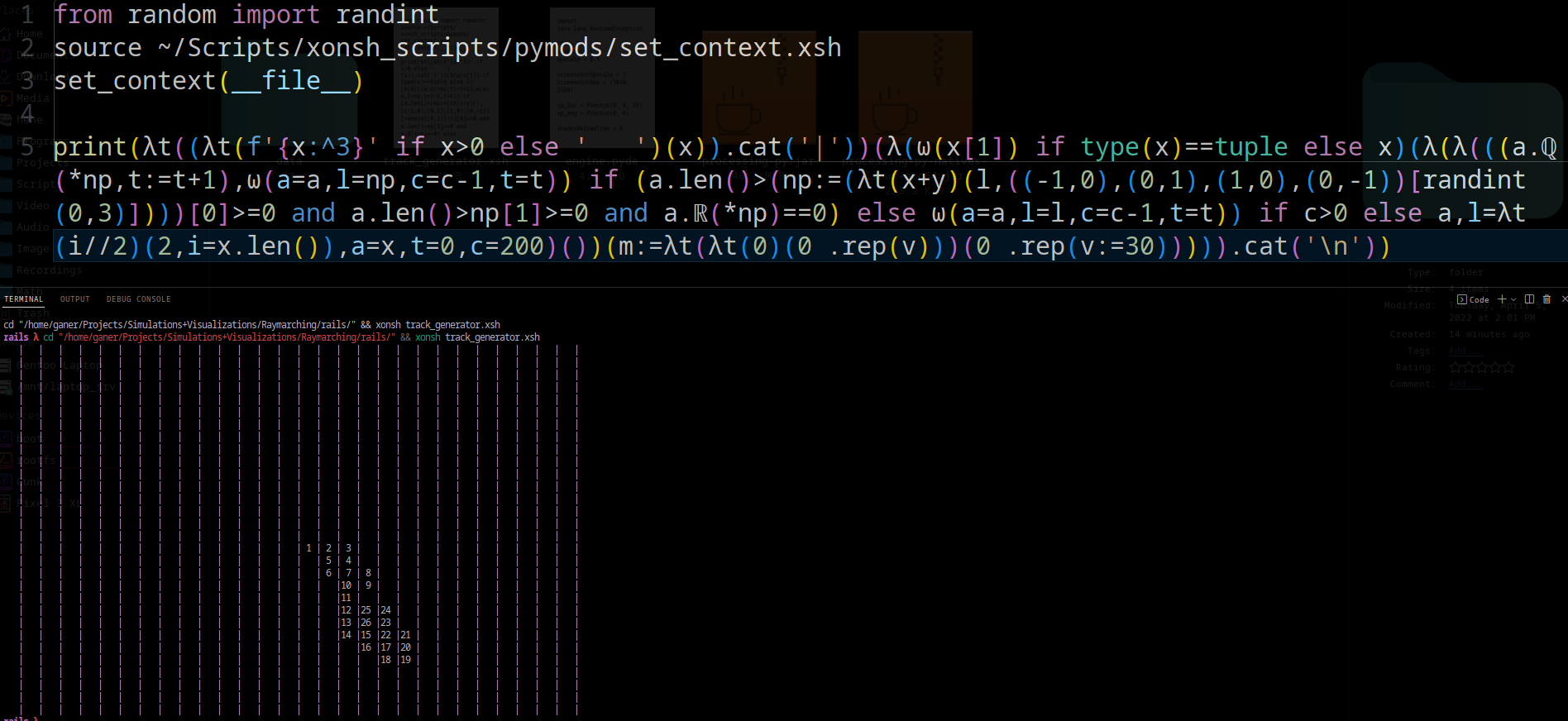 west cipher
pastel sparrow
what does it do
west cipher
pastel sparrow
what does it do
generates a random, non intersecting path
pastel sparrow
damn
west cipher
 wheat river
west cipher
https://ganer.xyz/s/cc8587cdd032ab73?e
wheat river
west cipher
https://ganer.xyz/s/cc8587cdd032ab73?e
what font is that, why is it so clean
text on windows is ugly af
west cipher
wheat river
what font is that, why is it so clean
Noto Mono
wheat river
nice
west cipher
Ubuntu mono as a 2ndary
west cipher
here's a super inefficent integration function lol
integrate = λ(sum(λ(λt(λ(f(x)*dx)(x=x*dx))(Δ[int(a/dx):int(b/dx)]),f=x,dx=y,a=z,b=w)()))
whats λ?
finite blaze
i see
west cipher
λt is for map
Δ[a:b:c] is for range
 sick hound
bro, your avatar is epic .
 lone sphinx
I'll post a sin here.
https://paste.pythondiscord.com/suroyeheru.py
19 lines of code to make the parens around await request() optional.
lone sphinx
@chain_coro
async def request():
    await asyncio.sleep(1)
    return "hello"


async def test_chained_async():
    # normally, (await request()).upper()
    assert await request() == "hello"
    assert await request().upper() == "HELLO"
    assert await request().upper()[0] == "H"
    assert await request().upper()[:2] == "HE"
    assert await request().upper()[::-1].lower() == "olleh"
 quartz wave
lone sphinx
```py
@chain_coro
async def request():
await asyncio.sleep(1)
return "he...
quartz wave
lone sphinx
```py
@chain_coro
async def request():
await asyncio.sleep(1)
return "he...
ok cool
quartz wave
lone sphinx
19 lines of code to make the parens around `await request()` optional.
https://paste.pythondiscord.com/kizoxelaja a few more lines of code to make it more performant (untested)
lone sphinx
I actually did update it a bit.
https://paste.pythondiscord.com/fokivirova.py
You can chain as many sync or async methods/attrs as you like, then await it at the end.
I also made a decorator to help with __await__()
def async_await(func):
    @functools.wraps(func)
    def decorator(*args, **kwargs):
        return (yield from func(*args, **kwargs).__await__())

    return decorator
 astral rover
what about adding support for nested awaits await (await asyncio.sleep(0, result=asyncio.sleep(10)))?
lone sphinx
out of scope
this is just fluent async
Posted originally in #async-and-concurrency btw
 spark abyss
Hello everyone! 🌻
lone sphinx
Hello.
sick hound
hey
 long hamlet
Hi
Im still busy with my python eso project lmao https://github.com/TechnoTanuki

GitHub
TechnoTanuki has one repository available. Follow their code on GitHub.
humble rune
finite blaze
Hey, do you have any golfing tips?
ima list common things and list golfed solutions under it
if not condition:

if 1-condition
#------
if condition:
  variable=value1
else:
  variable=value2

variable=[value1,value2][condition]
#------
if condition:
  print("Bigger Bungus Better Person")

print("Bigger Bungus Better Person"*condition) #will print a newline if the condition isnt true
#------
if condition1 or condition2:

if condition1|condition2: #may not work in some cases
#------
if condition1 or condition2:

if condition1or condition2: #will only work if the character before the OR is a ", ', a number, or any other thing like ( or [
oh yeah heres some more
var1=1
var2=1
var3=1

var1=var2=var3=1
#------
var1="Risk"
var2="of"
var3="Rain"
var4=2
var5="is"
var6="a"
var7="good"
var8="game"

var1,var2,var3,var4,var5,var6,var7,var8="Risk","of","Rain",2,"is","a","good","game"
#------
var1="a"
var2="b"
var3="c"
var4="d"
var5="e"

var1,var2,var3,var4,var5="abcde"
True,False

1,0
#---
[1,2][condition],[2,1][condition]

1+condition,2-condition
#---
(list_element1,list_element2,...],b)[1]

[list_element1,list_element2,...]and b # b is a variable that contains a list

[list_element1,list_element2,...]*0+b # works for tuple-tuple as well
#---
def a(*a,**k):return a,k

a=lambda*a,**k:(a,k)
#---
a.__setitem__(0,a1)or a.__setitem__(1,a2)or a.__setitem__(2,a3)

a.__setitem__(slice(0,3),[a1,a2,a3]) # also works with __getitem__
#---
bool(x%y),bool(y%x)

x%y>0,0<y%x
#---
n/100000000,10000.0

n*1e-8,1e4

n/1e8,1e4
more golfing tips
humble rune
code golfing in python is cracked
like theres so many techniques
i just shrunk a 3500 character perfectly readable and commented python file
into a 560 character mess with more spaghetti than an italian diner
wheat river
>>> λ = lambda *a,**k:a,k
Traceback (most recent call last):
  File "<stdin>", line 1, in <module>
NameError: name 'k' is not defined
ehh???
oh i need parens
lmao
finite blaze
Thanks @humble rune @quartz wave ! So many cool techniques
humble rune
👍
 jovial monolith
quartz wave
```py
True,False
1,0
#---
[1,2][condition],[2,1][condition]
1+condition,2-cond...
jovial monolith
quartz wave
```py
True,False
1,0
#---
[1,2][condition],[2,1][condition]
1+condition,2-cond...
thanks xD
 lunar moon
humble rune
ima list common things and list golfed solutions under it
```py
if not condition...
lunar moon
humble rune
ima list common things and list golfed solutions under it
```py
if not condition...
some better
if not condition:

if 1-condition

if ~condition
#------
if condition:
  print("Bigger Bungus Better Person")

print("Bigger Bungus Better Person"*condition) #will print a newline if the condition isnt true

condition and print("Bigger Bungus Better Person") #wont print a newline if the condition isnt true but longer
#------
if condition1 or condition2:

if condition1or condition2: #will only work if the character before the OR is a ", ', a number, or any other thing like ( or [

if condition1+condition2:
if ~condition:
``` only works if `condition` is `False`/`0` or `-1`oh yeah ur correct my mistake ~-condition shud work, but welp it doesn't reduce the characters
 icy frigate
like print for example
 formal sandal
Does anyone miss postfix await from Rust and how it lets you chain methods nicely? You can easily have it in Python:
!e
#* snip *#

async def main():
    sleeper = Sleeper()

    (sleeper
        .sleep(1)[await ing]
        .sleep(2)[await ing]
        .sleep(0.5)[await ing]
    )

asyncio.run(main())
@formal sandal :white_check_mark: Your eval job has completed with return code 0.
001 | Slept for 1s
002 | Slept for 2s
003 | Slept for 0.5s
Full code: https://paste.pythondiscord.com/ehesibuvus
 hard spoke
formal sandal
Full code: <https://paste.pythondiscord.com/ehesibuvus>
hard spoke
formal sandal
Full code: <https://paste.pythondiscord.com/ehesibuvus>
Hmm, is it possible to instead @hook this functionality to the type of coroutines?
formal sandal
well, not all awaitables are coroutines
hard spoke
ah
wheat river
github copilot knows whatsup
 quartz wave
wheat river
github copilot knows whatsup
quartz wave
wheat river
github copilot knows whatsup
*#esoteric-python intensifies*
night quarryBOT
Hey @wheat river!
It looks like you tried to attach file type(s) that we do not allow (.md). We currently allow the following file types: .gif, .jpg, .jpeg, .mov, .mp4, .mpg, .png, .mp3, .wav, .ogg, .webm, .webp, .flac, .m4a, .csv, .json.
Feel free to ask in #community-meta if you think this is a mistake.
formal sandal
quartz wave
\*<#470884583684964352> intensifies\*
I've been trying to read your name as "shnusaitinaveasooliiskiamee" for more than I'd like to admit
quartz wave
formal sandal
I've been trying to read your name as "shnusaitinaveasooliiskiamee" for more tha...
that's also how i would read it
but others have innaccurate greek letter nicknames that are supposed to be read like their latin lookalikes so 🤷
actually i think that has disappeared
wheat river
!e
from re import compile

code = """
def func(var1, var2):
    return var1 + var2
"""
DEF_TO_LAMBDA_RE = compile(r'def (.*)\((.*)\)')
RETURN_VALUE_RE = compile(r'return (.*)')

def to_lambda(code):
    signature = DEF_TO_LAMBDA_RE.findall(code)
    return_value = RETURN_VALUE_RE.findall(code)
    signature = [i[0] if len(i.split())==1else ','.join(x[0] for x in i.split()) for j in signature for i in j]
    return_value = [''.join(x[0] for x in i.split()) for i in return_value]
    return '{}=lambda {}:{}'.format(*signature, *return_value)

print(to_lambda(code))
code-golfer v1
night quarryBOT
@wheat river :white_check_mark: Your eval job has completed with return code 0.
f=lambda v,v:v+v
hmm you need to fix that
wheat river
!e
from re import compile

code = """
def func(var1, var2):
    return var1 + var2
"""
DEF_TO_LAMBDA_RE = compile(r'def (.*)\((.*)\)')
RETURN_VALUE_RE = compile(r'return (.*)')

def to_lambda(code):
    signature = DEF_TO_LAMBDA_RE.findall(code)
    return_value = RETURN_VALUE_RE.findall(code)
    signature = [i[0] if len(i.split())==1else ','.join([t:=[],[t.append(x[0]) if x[0] not in t else t.append(f'{x[0]}{t.count(x[0])}') for x in i.split()]][0]) for j in signature for i in j]
    return_value = [''.join([t:=[],[t.append(x[0]) if x[0] not in t else t.append(f'{x[0]}{t.count(x[0])}') for x in i.split()]][0]) for i in return_value]
    return '{}=lambda {}:{}'.format(*signature, *return_value)


print(to_lambda(code))
@wheat river :white_check_mark: Your eval job has completed with return code 0.
f=lambda v,v1:v+v1
nah this doesn't work either
!e
from re import compile

code = """
def func(var1, var2, var3, var4):
    return var1 + var2 + var3 + var4
"""
DEF_TO_LAMBDA_RE = compile(r'def (.*)\((.*)\)')
RETURN_VALUE_RE = compile(r'return (.*)')

def to_lambda(code):
    signature = DEF_TO_LAMBDA_RE.findall(code)
    return_value = RETURN_VALUE_RE.findall(code)
    signature = [i[0] if len(i.split())==1else ','.join(x[0]+x[-1] for x in i.replace(' ','').split(',')) for j in signature for i in j]
    return_value = [''.join(x[0]+x[-1] if len(x)>1 else x[0] for x in i.split()) for i in return_value]
    return '{}=lambda {}:{}'.format(*signature, *return_value)


print(to_lambda(code))
@wheat river :white_check_mark: Your eval job has completed with return code 0.
f=lambda v1,v2,v3,v4:v1+v2+v3+v4
 vestal vector
i absolutly LOVED the pipe oparator in elixir |>
This take the return a function and puts it as first argument of the next function
this(is(kinda(bad("right"))))
to
this("is")
|> kinda
|> cool
|> right
how would i go about impletmenting this into python
finite blaze
regex :v
vestal vector
how??
wheat river
!e
f1=lambda *a:a
f2=lambda *a:a
f3=lambda *a:a

string = """\
f1 |> f2 |> f3 |> 4
"""

def constructor(code: str):
    code = map(lambda x: x.strip(), code.split('|>'))
    code = ''.join(f'({i}' for i in code)
    code += ')' * code.count('(')
    code = 'print' + code
    eval(code)


constructor(string)
@wheat river :white_check_mark: Your eval job has completed with return code 0.
(((4,),),)
@vestal vector
humble rune
wheat river
github copilot knows whatsup
(Ape noises)
def XOR(t,k,o=""):
    for c in t:
        for l in k:
            c=chr(ord(c)^ord(l))
        o+=c
    return o
any golfers wanna help me?
(without changing definition name)
pastel sparrow
wheat river
!e
```py
from re import compile
code = """
def func(var1, var2, var3, var4):
...
i mean, why not just use ast
import ast
from ast import FunctionDef, Assign, Name, Store, Lambda, fix_missing_locations

code = """
def function(a, b):
    c = a**b
    return c
"""

class RewriteFunctions(ast.NodeTransformer):
    def visit_FunctionDef(self, node: FunctionDef) -> Assign:
        return Assign(
            targets=[Name(id=node.name, ctx=Store())],
            value=Lambda(
                args=node.args,
                body=node.body[0].value
            )
        )

tree = ast.parse(code)
tree = fix_missing_locations(RewriteFunctions().visit(tree))

print(ast.unparse(tree))
XOR=lambda t,k,o='':[o:=o+chr(ord(c)^ord(l))for c in t for l in k][-1]
👀 never uses ast b4
humble rune
wheat river
```py
XOR=lambda t,k,o='':[o:=o+chr(ord(c)^ord(l))for c in t for l in k][-1]
```
you are using the broken one
pastel sparrow
wheat river
👀 never uses ast b4
neither have i, just decided to try it out kek
humble rune
i fixed a thing that made my program break
>>> XOR=lambda t,k,o='':[o:=o+chr(ord(c)^ord(l))for c in t for l in k][-1]
>>> XOR("TEST","BEST")
'\x16\x11\x07\x00\x07\x00\x16\x11\x11\x16\x00\x07\x16\x11\x07\x00'
>>> XOR('\x16\x11\x07\x00\x07\x00\x16\x11\x11\x16\x00\x07\x16\x11\x07\x00',"BEST")
'TSEBSTBEEBTSBESTEBTSBESTTSEBSTBESTBETSEBBESTEBTSTSEBSTBEEBTSBEST'
we get this output with it
since you golfed the broken one
pastel sparrow
humble rune
i fixed a thing that made my program break
XOR=lambda t,k:"".join(chr(ord(c)^ord(l)) for c,l in zip(t,k)) probably
humble rune
pastel sparrow
`XOR=lambda t,k:"".join(chr(ord(c)^ord(l)) for c,l in zip(t,k))` probably
it outputs bytes instead of chars sadly
pastel sparrow
what
pastel sparrow
what do you want it to output-
humble rune
a string?
 humble rune
 pastel sparrow
yeah idk how you get that-
pastel sparrow
pastel sparrow
```py
import ast
from ast import FunctionDef, Assign, Name, Store, Lambda, fix_m...
gonna try working on and see how it goes kek
 unreal echo
does this belong here?
print((lambda decimals: bytes(decimals).decode())((lambda binary: [int(byte, 2) for byte in list(binary)])((lambda text: ([bin(ord(i)).replace('b', '') for i in str(text)]))("".join(map(lambda i: i, (i for i in (lambda string: [i for i in str(string)])('Hello world!'))))))))```print hello world
humble rune
unreal echo
```py
print((lambda decimals: bytes(decimals).decode())((lambda binary: [int(byt...
ew ungolfed code!
print("Hello world!")
golfed your code!(joke)
vestal vector
unreal echo
does this belong here?
#include<stdio.h>
#define The only language
int main(){prinft("hi");}
🤢
get that heretic garbage out of here
that wouldnt even work you typed prinft("hi");
vestal vector
True lang
defmodule Hello
  def main do
    IO.putline "hi"
  end
end
🤢🤢🤢🤢🤢🤢🤢🤢
humble rune
vestal vector
True lang
```elixir
defmodule Hello
def main do
IO.putline "hi"
end
end
...
 vestal vector
 humble rune
vestal vector
https://tenor.com/view/gigachad-chad-gif-20773266
humble rune
vestal vector
https://tenor.com/view/gigachad-chad-gif-20773266
not chad
cringe
you use languages other than python
you cheated on python
vestal vector
eff you dude, python cheated on me before i cheated
why is the interpreter written in c

just why
it should be pure python all the way down
wheat river
humble rune
you are using the broken one
XOR=lambda t,k,o='':[o:=o+chr(ord(c)^ord(l))for c in t for l in k][-1][1::5]
!e
def XOR(t,k,o=""):
    for c in t:
        for l in k:
            c=chr(ord(c)^ord(l))
        o+=c
    return o


print([ord(i) for i in XOR('TEST', 'BYTES')])

XOR=lambda t,k,o='':[o:=o+chr(ord(c)^ord(l))for c in t for l in k][-1][1::5]

print([ord(i) for i in XOR('TEST', 'BYTES')])
@wheat river :white_check_mark: Your eval job has completed with return code 0.
001 | [13, 28, 10, 13]
002 | [13, 28, 10, 13]
poggers
this is next level golfing
idk how you guys use list stuff tho
list formatting starts my brain on the path towards a padded cell
wheat river
ah i just pprinted [o:=o+chr(ord(c)^ord(l))for c in t for l in k] and analyzed the output
 pastel sparrow
vestal vector
True lang
```elixir
defmodule Hello
def main do
IO.putline "hi"
end
end
...
pastel sparrow
vestal vector
True lang
```elixir
defmodule Hello
def main do
IO.putline "hi"
end
end
...
true lang: ```brainfuck
++++++++[>++++[>++>+++>+++>+<<<<-]>+>+>->>+[<]<-]>>.>---.+++++++..+++.>>.<-.<.+++.------.--------.>>+.>++.
Witaj świecie!
^ true lang
vague cairn
humble rune
you cheated on python
No, more like, Python should be like English: https://www.zazzle.com/english_doesnt_borrow_from_other_languages_it_t_shirt-235501771001317548
I'm not cheating on python, I'm carrying on the good work...

Zazzle
English doesn't borrow from other languages
quartz wave
wheat river
👀 never uses ast b4
!e ```py
from ast import *
from itertools import product
code = """
def function(bb, aa):
return (bb + aa) * 8
"""
names=([*'abcdefghijklmnopqrstuvwxyzABCDEFGHIJKLMNOPQRSTUVWXYZ']
+ [*map(''.join, product('abcdefghijklmnopqrstuvwxyzABCDEFGHIJKLMNOPQRSTUVWXYZ',
'abcdefghijklmnopqrstuvwxyzABCDEFGHIJKLMNOPQRSTUVWXYZ'))])
class RewriteExpression(NodeTransformer):
def init(self, namespace: dict):
self.namespace = namespace
def visit_Name(self, node: Name) -> Name:
return Name(self.namespace.get(node.id, node.id), ctx=node.ctx)
class RewriteFunctions(NodeTransformer):
def visit_FunctionDef(self, node: FunctionDef) -> Assign:
node_arguments = node.args
posonlyargs = []
args = []
kwonlyargs = []
d = {}
pargs, nargs, kargs = node_arguments.posonlyargs, node_arguments.args, node_arguments.kwonlyargs
for i in range(j := len(pargs)):
d[pargs[i].arg] = names[i]
posonlyargs.append(arg(arg=names[i]))
minus = j
for j in range(minus, (i := len(nargs))):
d[nargs[j-minus].arg] = names[j]
args.append(arg(arg=names[j]))
minus = i
for i in range(minus, len(kargs)):
d[kargs[i-minus].arg] = names[i]
kwonlyargs.append(arg(arg=names[i]))
return Assign(
targets=[Name(id=node.name, ctx=Store())],
value=Lambda(
args=arguments(
posonlyargs=posonlyargs,
args=args,
kwonlyargs=kwonlyargs,
kw_defaults=node_arguments.kw_defaults,
defaults=node_arguments.defaults
),
body=fix_missing_locations(RewriteExpression(d).visit(node.body[0].value))
)
)
tree = parse(code)
tree = fix_missing_locations(RewriteFunctions().visit(tree))
print(unparse(tree))
@quartz wave :white_check_mark: Your eval job has completed with return code 0.
function = lambda a, b: (a + b) * 8
thanks @pastel sparrow for the node transformer idea
sick hound
remembering when i made a 20k character line to just print hello world
 prisma coral
!e How would y'all golf root finding? Here's what I tried for Newton-Raphson:
root=lambda f,x=1,k=1e-9:r if-k<(r:=x-f(x)*k/(f(x+k)-f(x)))-x<k else root(f,r)
E.g.:
print(root(lambda x:x*x-169))
@prisma coral :white_check_mark: Your eval job has completed with return code 0.
13.0
TIL you can separate codeblocks by text and it will still register as one for the !e command
sick hound
!e py exec(len("dbgPFtLzdIbeayKQVOFdZUJhsqAJSBglrwZxpfICYDVlGEeHRTGxdFzJYMCCSWIYZllTtlifMyJuJMVhtrjbWmUKrwscnzaMCqambZHYbbPkvEty")+len("OUePAWaqwIIHRwRetbfqKfOZAQTshWsyJvPIfZiNvESMntGrqGxJpVgCSqeAbtpAxUHQyPSrxnZzyJWgXXppZLbVUcZhvfsORyshMqrYsJiWKVNGPs")+len("NwfgkUZZIZtXZNyWEKgRlLWuPNROzyoHeTILPxVwEYxtvHasSOBBlQqdfbJBfazgEoALGVeTckUSBBrFywktLahjBIKhLYXbNrfSPtkbp")+len("tJRofAhHoHyQCDcDkAAoPQihrwClcDlAWMShJLqnajBvfdOfTdLgcTVrAwGYGOvEvcOrIDgGXvNSvBTzUgjoBpGcHSrTMkZXDNUZQALpRkCckC")+len("WlgmYchSASPqRAVXVgLWMIWalyDUGmktQgthGvpsxqEjzZEJBWGXWJkupMHJwvIqOESWEAtQroOahqEuqhnXfFEiCSEXjRUFBWnWDETWxpdtDWaSMPML")+len("ckpsCywKDpDYTmhdDwOjpTUlxxEOXAygQMUOmXbF")+len("OHPtUqRFibajrAJsTGsLqhdioPSqMvVHfSRQKAw")+len("mKLnbJeNOlOzgsSXwPQIPiLFmAuOrzsdjmIrpnGVrHcImhBdqhBnlsrObDvzwPeKuxjgiDHA")+len("pENoMCZotrzeVRmsJvSmxPhkYbBASoWyqUQjgxgUTZGptGWDvFrSSyYHEzpKrXjyNPyfuTmXChVLGMeCCeDCGkVKlTXjaGTfFFNhB")+len("nBWTTkaZvgTsYxXcosyFYRNdbGnzfUCEGIAjxPwcyGoAtHrmktZMYvfPlCDskkivjqvKfmlwSyggncHAWmBjBeULFueGRMjTFWOMrjlNoorT")+len("gefBklAClbeFkXdPQORdiGqwAHnxhklPPdhvhSNPsiIWlMlovNvnYpwMoZSwPbEOvUBkwqoTtYCwAJPFLdGZFGhfJlYNMPECowIvroCIcFaV")+len("mBwVnipdmcdEubnmKFgDuRnozisCSejSAlMRLNlMavkuPcBpgHRgJnobgXYSNaQwAADEJkkjeKGNqsUFeAMZNYKmYdkEWIVyfgIQgNDaYNwkefS")+len("eAIzbBNoBSOurGkcpNDsCvpTrwYNhylX")+len("CjufWRLcTMuuxciwkQNOZAPlOmqduSeJmhHopYenBvFRUUJGQePvAdYlBPBNDOAJXyYFJKXtoywDgJbKctQxJqO")+len("GImLsFiOrSiXIhuEEmkRRAqbreUICAEpERabbfHhfPjhnRXabSorciwMPNfWPPcGnrPeTvjXsFASAgKQUbpEEYkIPOymEddKBNmjJOakaglvnxP")+len("oYgieeDiAWgeNpqFbrTxYqSFFIgOiTIXfzeZcZViFcEZEjufQRtnfPzyYzNQBsKmyZzXgQaWWcUBdLXHQEUvmvSzVAwDTAzNZslVeOwQVklbVHHULF")+len("ADdGtadudVRvseeTRuRIZoflPZudvSvgUEhVIbStGxrEmVETaSMmZjKnevdEgmNUFcrwKqwUxORjJClmInPdiQSKtDEoDXYkAkKfwLiJPsgd")+len("gkhyBMEIZVoypWSeiinJwVhOunbWIpHTffmfCdfWNAbSLHoRKJqLskLjZLaZVkHJvVkmfMrVCcDfttCFqOtfJwDfyDpWmAicpgeY")+len("rifTgPsXqcPuROFveRmnjbpqYPNKoWBbf")+len("widUAtOZdVXWLXgeCPleDobLJFfunWHqdsfSDMLON"))
night quarryBOT
@sick hound :x: Your eval job has completed with return code 1.
001 | Traceback (most recent call last):
002 |   File "<string>", line 1, in <module>
003 | TypeError: exec() arg 1 must be a string, bytes or code object
!e py print(str(len("wPWrbOZTxCYabxeVkutKBOBoCnHubCDAqvlXZHaRhGhrzSYRuczSnysIndATRfWjMIRDBfHFDbDhOwUajTbrgtQRAvSSruwWMhKAFjTEXAIvetPa")+len("fKvWqfvkdhdaYNPtnXIdoCCpYFRIYUrGvRDlhcRHpOPzTgzfyozsenApohqtAtKkcsIpYrDdwCllrYSmzGccbFtxYgWDKDdKiLrUsmeOgmeiiGenUI")+len("JBkQOfEmrhbQwQahRNjnpGnBcQwUhBykKOkoUHzAXnfdWWsnGnkMYjfsmfbvvSoBAgxTkyeYdxCKbFYlMEvFqzRYAQGIzNujsfKHdFlVh")+len("NNIGnkNAmWKoXNUxGJlDmrttbmbUFOrNdauAVUypVhWcKHzWXuJNHGcmUbafiCsOPzHuVIphlJwUAmoHDRkoxEXHNGWjzpQoermUVxsxJFmepG")+len("PMkyahhCfYZlGXiLNZwZxxnBPTmSdkOJaowOMUZOpfVpXHytggtXRuqYqwtbQdmamhVtOfFVHHWtxfEHWQYCpLBwCVUcJjXbJgKuZneVKafCoFbGsZWZ")+len("ozjpmaioJwARQgNQjTjkdYUGbaRmfHXHPcNKaqxB")+len("AwXMBeSmUtsLAmZhdBlZziPRaHWureluDqXbmDb")+len("hHsXXvisxpOPAZphmeppAfRHUSAaKfNUNiqVtNwHbYmLkvceXRPpkDPjOXCJwWHZLPEOhwrS")+len("IteIZZtmRnyoaxbKbeIlFNXevYjXtvGmxUlIPvyPoxkVtrMXdTRVtOgSznfuGIrPLglyJScBThxtqqKsLFGTaxHCInBcGuxBZKwxT")+len("cZZrPMnWomRXotQdwENkqSZKJtLWVyQDAvbMdURgNesnJDyyvCfIDoWvhqvmDvDsyXwiOTvtwlNtAyWpGwLDTyMamSTpmuvuJZgAcgRwiZdX")+len("WeZlWVBVKmGLwFmJDIbJMPkHQnLHMANWgSQVTFKqQVDOVinaMPAQDDMhIbIGtympqaouQtXWllZlzuUZqeXQXtXHvOKKTApXSvSmiSTQxPpz")+len("HgMEbmSVPRUghEvoWBWeKguxPKuTIjUbFSghBzZyIYfwnttzePtCmDodlAwuGcYSMryWBuuCUsoCodoCVoxSuogpgMdzOuuosAXJKDMCXCTcyXl")+len("gBwCaVdvdUzmTuheBnaUaIwAmpKvbzfk")+len("DPOuVJiKJJBCpLnCmoQbjvNYdCbhdUYKHgfzVlTBHCMZuxmxKqOHghPmuSiwxjTpeCNSnfZZaGIqFCNTurkwxwZ")+len("suCZQHVqcrDuWqEuFllVwXZQirVicLFOvwAcLkjhmYacJUlMPlFEBduocZAvTkODXfuCjXFnBCVyjOGTtaxXsPndoeIcXgJCYzIygSsclPqaLTO")+len("KIMnWaFbruBGOaMvNSCmeCsbxtDbGhSUHUjztXKwSxfSDPNOhKIRpqFxeGfzENMAYPsJEXZAkMEiZvbstOpcgDviGDPYYgUyDXHhNHcODkwNzMfzcH")+len("NFxfbQbciEEjYtxxnrvbFMdkwaqMvhKXmuWLQvQaFUYUUokBNorvZOYFOxqyKjEaOJIaKZGqSFhEaxpjtoXzVTfpRMxTbcymlWazVMbinexY")+len("vgbtnngstPbBWdsqbwwEmGiUqrTwzshxgOjABRUTdlEIEwPcnKkYxrxBAVmkPjSIEhOWMibvWpiAXFbYpqQCYOPycbnsuaeaNmVk")+len("FqadgzbNrleqEZChJEtQXoNPBBOKeLFNT")+len("AYWBCmXiEWDKOAVwmSSPTaTuwxRcYugMvoPBVfKsY")))
night quarryBOT
@sick hound :white_check_mark: Your eval job has completed with return code 0.
1762

 shell brook
I hate this
sick hound
i could make it better but dont want to
 sturdy rune
looks like base64 at first
sick hound
sturdy rune
looks like base64 at first
it just takes a normal string and turns each letter into bytes then creates a randomized string with that amount of letters (the byte number) and does len() to turn it back to bytes
try: open('obfuscated.py','x')
except: pass

code = "print('Hello World!')"

import string
import random
import codecs

print('exec(str(', end='')
for letter in bytes(code,'utf-8'):
    line = ''.join([random.choice(string.ascii_letters) for _ in range(letter)])
    #print(f'len("{line}")+', end='')

    print(f"codecs.decode(len('{line}').to_bytes(1, byteorder='big'))+", end='')

print('""))', end='')```here the code its really simple
ignore the top part
its NOT a good obfuscation method to protect your code, its just funny to look at
pastel sparrow
quartz wave
!e ```py
from ast import *
from itertools import product
code = """
def functio...
doesn't this do exactly the same thing as what i did?
!e ```py
import ast
from ast import FunctionDef, Assign, Name, Store, Lambda, fix_missing_locations
code = """
def function(bb, aa):
return (bb + aa) * 8
"""
class RewriteFunctions(ast.NodeTransformer):
def visit_FunctionDef(self, node: FunctionDef) -> Assign:
return Assign(
targets=[Name(id=node.name, ctx=Store())],
value=Lambda(
args=node.args,
body=node.body[0].value
)
)
tree = ast.parse(code)
tree = fix_missing_locations(RewriteFunctions().visit(tree))
print(ast.unparse(tree))
@pastel sparrow :white_check_mark: Your eval job has completed with return code 0.
function = lambda bb, aa: (bb + aa) * 8
ah, just realised you shortened the variable names
long hamlet
Adding slowly some docs to my pure python graphics eso lib https://github.com/TechnoTanuki/Python_BMP building things ground up is fun

GitHub
A pure Python 2D/3D graphics library that outputs to windows bitmap format - GitHub - TechnoTanuki/Python_BMP: A pure Python 2D/3D graphics library that outputs to windows bitmap format
 sleek sphinx
someone should rewrite pillow or something but its code bowled
long hamlet
My library can do some stuff pillow can lmao like resize, crop, brightness adj, gamma correct, add text, lines , circles etc
Pure python with some eso byte array manipulations in memory CPU only
'''def horitransformincircregion(bmp,x,y,r,trans): def flip24(): bmp[s1:e1-2:k],bmp[s2:e2-2:k],bmp[s1+1:e1-1:k],bmp[s2+1:e2-1:k],bmp[s1+2:e1:k],bmp[s2+2:e2:k]=bmp[s2:e2-2:k],bmp[s1:e1-2:k],bmp[s2+1:e2-1:k],bmp[s1+1:e1-1:k],bmp[s2+2:e2:k],bmp[s1+2:e1:k] def flip8(): bmp[s1:e1:k],bmp[s2:e2:k]=bmp[s2:e2:k],bmp[s1:e1:k] def mirror24R(): bmp[s1:e1-2:k],bmp[s1+1:e1-1:k],bmp[s1+2:e1:k]=bmp[s2:e2-2:k],bmp[s2+1:e2-1:k],bmp[s2+2:e2:k] def mirror8R(): bmp[s1:e1:k]=bmp[s2:e2:k] def mirror24L(): bmp[s2:e2-2:k],bmp[s2+1:e2-1:k],bmp[s2+2:e2:k]=bmp[s1:e1-2:k],bmp[s1+1:e1-1:k],bmp[s1+2:e1:k] def mirror8L(): bmp[s2:e2:k]=bmp[s1:e1:k] bits,c=bmp[bmpcolorbits],getcomputeBMPoffsetwithheaderfunc(bmp) if trans=='L': if bits==24: f=mirror24L elif bits==8: f=mirror8L elif trans=='R': if bits==24: f=mirror24R elif bits==8: f=mirror8R elif trans=='F': if bits==24: f=flip24 elif bits==8: f=flip8 for v in itercirclepartvertlineedge(r): x1,x2=mirror(x,v[0]) y1,y2=mirror(y,v[1]) k=getxcharcount(bmp) s1,e1,s2,e2=c(bmp,x1,y2),c(bmp,x1,y1)+k,c(bmp,x2,y2),c(bmp,x2,y1)+k f():'''
Eso byte array manip from library using python slice op lmao
wheat river
quartz wave
!e ```py
from ast import *
from itertools import product
code = """
def functio...
Goddamn
quartz wave
https://paste.pythondiscord.com/vanukagaba.py function-to-lambda v5
def function(bb, aa):
    return bb + f"+ 3 {'and this'}{123}" + aa
``` gets unparsed into ```py
function = lambda a, b: a + '+ 3 and this123' + b
damn, i need to learn some ast
quartz wave
https://paste.pythondiscord.com/busowumewu.py function-to-lambda v6
def function(bb, aa):
    return [bb for bb in aa] + [x for x in [1, 2, 3, 4]]
``` gets unparsed into ```py
function = lambda a, b: [*b] + [1, 2, 3, 4]
https://paste.pythondiscord.com/axuxavehok function-to-lambda v7 py def function(bb, aa): return ([bb for bb in aa] + [x for x in [1, 2, 3, 4]] + [1,2,3,*(4,5,6)] + [*{'a': 3, 'b': 4}], [bb for bb in aa] + [x for x in [1, 2, 3, 4]] + [1,2,3,*(4,5,6)] + [*{'a': 3, 'b': 4}] and {7, 4, 9, 9, 8}) gets unparsed into ```py
function = lambda a, b: ([*b, 1, 2, 3, 4, 1, 2, 3, 4, 5, 6, 'a', 'b'], {7, 4, 9, 8})
i did not expect it would go this far
thanks again @pastel sparrow for the headstart
wheat river
wow
 severe canyon
prisma coral
!e How would y'all golf root finding? Here's what I tried for Newton-Raphson:
``...
severe canyon
prisma coral
!e How would y'all golf root finding? Here's what I tried for Newton-Raphson:
``...
you can rearrange a little and get -2 chars:
root=lambda f,x=1,k=1e-9:(-k<(r:=x-f(x)*k/(f(x+k)-f(x)))-x<k)*r or root(f,r)
it isnt true in general
iter(aa) can have side-effects
 wispy wedge
Maybe there's some background thread whose behavior heavily depends on the execution speed of this function 🤔
pastel sparrow
fleet bridge
it isnt true in general
`iter(aa)` can have side-effects
wait what side-effects
rugged sparrow
it calls aa.__iter__
you could theoretically pass an object that mutates itself when __iter__ is called
dark wharf
Even in the example, if you'd used fishhook and modified list iter you wouldn't get the same result from your new lambda
earnest wing
Code analysis should not have to assume builtin immutable types are mutable, so that's a little moot.
finite blaze
Hey,
I once asked what and None meant in this code:
type=lambda w:[y:=0,vy:=.42,[[print("tick n°",i,"| Y speed:",vy,"| Y position:",y),y:=y+vy,vy:=(0if abs(vy:=(vy-.08)*.98)<.005 else vy)]for i in range(w)]]and None
and someone told me:
discard the resulting unneeded list
What does that mean?
why I have to do this?
next flame
finite blaze
Hey,
I once asked what `and None` meant in this code:
`type=lambda w:[y:=0,vy:=....
it's so that the function return None instead of a junk list (that's only used to sequence operations)
wheat river
!e
type=lambda w:[y:=0,vy:=.42,[[print("tick n°",i,"| Y speed:",vy,"| Y position:",y),y:=y+vy,vy:=(0if abs(vy:=(vy-.08)*.98)<.005 else vy)]for i in range(w)]]
print(type(3))
without and None
night quarryBOT
@wheat river :white_check_mark: Your eval job has completed with return code 0.
001 | tick n° 0 | Y speed: 0.42 | Y position: 0
002 | tick n° 1 | Y speed: 0.33319999999999994 | Y position: 0.42
003 | tick n° 2 | Y speed: 0.2481359999999999 | Y position: 0.7531999999999999
004 | [0, 0.42, [[None, 0.42, 0.33319999999999994], [None, 0.7531999999999999, 0.2481359999999999], [None, 1.0013359999999998, 0.16477327999999988]]]
!e
type=lambda w:[y:=0,vy:=.42,[[print("tick n°",i,"| Y speed:",vy,"| Y position:",y),y:=y+vy,vy:=(0if abs(vy:=(vy-.08)*.98)<.005 else vy)]for i in range(w)]]and None
print(type(3))
with and nOne
night quarryBOT
@wheat river :white_check_mark: Your eval job has completed with return code 0.
001 | tick n° 0 | Y speed: 0.42 | Y position: 0
002 | tick n° 1 | Y speed: 0.33319999999999994 | Y position: 0.42
003 | tick n° 2 | Y speed: 0.2481359999999999 | Y position: 0.7531999999999999
004 | None
so i'm pretty sure you're referring to [bb for bb in aa]?
oh wait i just realized a bug in HasChanging
 sly flume
hi i'm know in python i'm take some basic thing about list and tuple but my not full understand the my cod i want create list have three index in each index have tuple with tow index like this [('a','b'),('b','c'),('c','d')] the first index in tuple have tow char or the length context when have like this [('~a','a'),('ab','b'),('bc',' c')] can any one help my ? The sample out put the my code
def getNGrams(wordlist, n):
ngrams = []
padded_tokens = "~"*(n) + wordlist
t = tuple(wordlist)
for i in range(3):
t = tuple(padded_tokens[i:i+n])
ngrams.append(t)
return ngrams

Just i need to specific index 0 in tuple to take one or tow or any number of char depending on ngram
Can anyone help me 🙏🏻
quartz wave
quartz wave
https://paste.pythondiscord.com/axuxavehok function-to-lambda v7 ```py
def funct...
https://paste.pythondiscord.com/vihupicoxu.py function-to-lambda v8 py def function(bb, aa): return ([bb for bb in aa] + [x for x in [1, 2, 3, 4]] + [1,2,3,*(4,5,6)] + [*{'a': 3, 'b': 4}], [x for x in [1, 2, 3, 4]] + [1,2,3,*(4,5,6)] + [*{'a': 3, 'b': 4}] and {7, 4, 9, 9, 8}, [bb for bb in aa] and {7, 7, 5}) now turns into ```py
function = lambda a, b: ([*b, 1, 2, 3, 4, 1, 2, 3, 4, 5, 6, 'a', 'b'], {7, 4, 9, 8}, [*b] and {7, 5})
i think you went to the wrong channel
either go to #python-discussion or see how to get help in #❓|how-to-get-help
 thorny tapir
l=[int(x)for x in sorted(input().split())]
print(sum(l)/(len(l))+l[len(l)//2]if len(l)%2 else(l[len(l)//2]+l[len(l)//2+1])/2)
can someone make this shorter (finds mean and median, iinput is string ex "1 3 2")
quartz wave
thorny tapir
```py
l=[int(x)for x in sorted(input().split())]
print(sum(l)/(len(l))+l[len(l)/...
what are the braces for
quartz wave
l=[*map(int,sorted(input().split()))]
print(sum(l)/n+l[n//2]if(n:=len(l))%2else l[n:=n//2]+l[n+1]/2)
``` i think this would work@fleet bridge is this ok now
quartz wave
https://paste.pythondiscord.com/azimamokeb.py function-to-lambda v9 py def function(bb, aa): return ([bb for bb in aa] + [x for x in [1, 2, 3, 4]] + [1,2,3,*(4,5,6)] + [*{'a': 3, 'b': 4}], [x for x in [1, 2, 3, 4]] + [1,2,3,*(4,5,6)] + [*{'a': 3, 'b': 4}] and {7, 4, 9, 9, 8}, [bb for bb in aa] and {7, 7, 5}, [int(x) for x in input()], [*[y for x in [range(10)]*5 for y in x]]) gets turned into ```py
function = lambda a, b: ([*b, 1, 2, 3, 4, 1, 2, 3, 4, 5, 6, 'a', 'b'], {7, 4, 9, 8}, [*b] and {7, 5}, [*map(int, input())], [y for x in [range(10)] * 5 for y in x])
the map() trick is only possible if use_map=True
so by default the golfer class assumes map is assigned to and will not use it
quartz wave
https://paste.pythondiscord.com/ejosapemej.py function-to-lambda v1.0 (pretty major update) py def function(bb, aa): return ([bb for bb in aa] + [x for x in [1, 2, 3, 4]] + [1,2,3,*(4,5,6)] + [*{'a': 3, 'b': 4}], [x for x in [1, 2, 3, 4]] + [1,2,3,*(4,5,6)] + [*{'a': 3, 'b': 4}] and {7, 4, 9, 9, 8}, [bb for bb in aa] and {7, 7, 5}, [int(x) for x in input()], [*[y for x in [range(10)]*5 for y in x]], '7'if (bb+aa)*8>2**(bb+aa) else '4') turns into ```py
function=lambda a,b:([*b,1,2,3,4,1,2,3,4,5,6,'a','b'],{7,4,9,8},[*b]and{7,5},[*map(int,input())],[y for x in[range(10)]5 for y in x],'7'if(a+b)8>2(a+b)else'4')
so yeah now it disables spaces whenever it can
quartz wave
didn't remove spaces for this part ```py
[y for x in[range(10)]*5 for y in x]
^
have we maxed out yet or should we do more
finite blaze
function=lambda a,b:([*b, *range(1,7),'a','b'],{7,4,9,8},[*b]and{7,5},[*map(int,input())],[y for x in[range(10)]*5 for y in x],'7'if(a+b)*8>2**(a+b)else'4')
that should work right?
nope
 vestal cedar
For the last part I might suggest
...('7','4')[(a+b)*8>2**(a+b)]
It's more exotic.
Less pythonic tho
(I love playing with implicit casts from any type to bool)
quartz wave
vestal cedar
For the last part I might suggest
```py
...('7','4')[(a+b)*8>2**(a+b)]
```
It's ...
hmm i can implement that
for the sake of side effects i can't do that
https://paste.pythondiscord.com/ovucejosol.py function-to-lambda v1.1 py def function(bb, aa): return ('7'if (bb+aa)*8>2**(bb+aa) else '4', bb if [1, 2, 3] else aa) turns into ```py
function=lambda a,b:('7'if(a+b)8>2*(a+b)else'4',a)
:0
vestal cedar
quartz wave
https://paste.pythondiscord.com/ovucejosol.py function-to-lambda v1.1 ```py
def ...
For the sake of making and example, that turns into:
function=lambda a,b:(('4','7')[(a+b)*8>2**(a+b)],a)
gfg exaplains it pretty good: https://www.geeksforgeeks.org/ternary-operator-in-python/
Basically, you have a tuple of two elements ('4','7'). You know you can access the '4' by doing ('4','7')[0], and same with seven, right? ('4','7')[1]
Then, you can do this: ('4','7')[my_condition], why? Well, indexes are ints, when you cast a bool to an int, you get: false -> 0, and likewise: true -> 1.
For instance, imagine my_condition = true, then ('4','7')[my_condition] -> ('4','7')[true] -> ('4','7')[1] -> '7'
quartz wave
vestal cedar
For the sake of making and example, that turns into:
```py
function=lambda a,b:(...
i know that
but for the sake of side effects i won't do that
vestal cedar
Ah, I see
quartz wave
for example the left side and the right side can be a call
vestal cedar
Oh, okay, okay. Then fair enough :P
quartz wave
https://paste.pythondiscord.com/akiluzaqoz.py function-to-lambda v1.2 py def function(bb, aa): return (bb(c, d, *bb, *aa, **l, **k, g=4, **{'y': 7, 'x' f'l{bb}': 5}), [*map(str, [*range(10)])]) now turns into ```py
function=lambda a,b:(a(c,d,*a,*b,**l,k,g=4,y=7,{f'xl{a}':5}),[*map(str,range(10))])
while making this update i discovered the possibility of name collisions
humble rune
any ⛳ enthusiasts wanna help me?
def xor(t, k):
    nt,nk=[],[]
    for i in t:nt.append(ord(i))
    for i in k:nk.append(ord(i))
    no,l,o=[],-1,""
    for i in nt:
        l=[-~l,0][l>=len(nk)-1]
        no.append(i^nk[l])
    for i in no:o+=chr(i)
    return o
a=lambda:print(xor(xor("THIS IS TO TEST IF IT WORKS","Python Golfer"),"Python Golfer")=="THIS IS TO TEST IF IT WORKS")
also no i cannot use nt=nk=[] for some reason it dont work
wheat river
nt,nk=[*map(ord,t)],[*map(ord,k)]
thanks
golfed it a bunch using this new map tech
def xor(t,k):
    z,y,x,l=[*map(ord,t)],[*map(ord,k)],[],-1
    for i in z:exec("l=[-~l,0][l>=len(y)-1];x.append(i^y[l])")
    return "".join([*map(chr,x)])
def xor(t,k):
    y,x,l=[*map(ord,k)],[],-1
    for i in [*map(ord,t)]:exec("l=[-~l,0][l>=len(y)-1];x.append(i^y[l])")
    return "".join([*map(chr,x)])
golfed more
prisma coral
humble rune
```py
def xor(t,k):
y,x,l=[*map(ord,k)],[],-1
for i in [*map(ord,t)]:exe...
Compressed a little more
def xor(t,k):
    y,l=[*map(ord,k)],-1
    return"".join(chr(i^y[l:=[-~l,0][l>=len(y)-1]])for i in map(ord,t))
oh you used list oddities
list formating will forever be black magic voodoo to me
prisma coral
humble rune
list formating will forever be black magic voodoo to me
What do you mean by list formatting? As in the comprehension expression I used?
humble rune
yeah lol
prisma coral
humble rune
yeah lol
 humble rune
prisma coral
humble rune
prisma coral
ah
wheat river
xor=lambda t,k:[y:=[*map(ord,k)],l:=-1,"".join(chr(i^y[l:=[-~l,0][l>=len(y)-1]])for i in map(ord,t))][2]
 sly root
humble rune
any ⛳ enthusiasts wanna help me?
```py
def xor(t, k):
nt,nk=[],[]
for i ...
sly root
humble rune
any ⛳ enthusiasts wanna help me?
```py
def xor(t, k):
nt,nk=[],[]
for i ...
Gist
Actually worlds smallest implementation of One-Time Pad algorithm in Python programming language - otp.py
does the same thing
quartz wave
quartz wave
while making this update i discovered the possibility of name collisions
https://paste.pythondiscord.com/fakuziruma.py function-to-lambda v1.3 py def function2(bb, aa): return (bb(a, b, *c, *d, **e, **f, g=4, **{'y': 7, 'x' f'l{bb}': 5}) + aa) turns into ```py
function2=lambda g,h:g(a,b,*c,*d,**e,f,g=4,y=7,{f'xl{g}':5})+h
 lethal cradle
d = {3:"Fizz", 5:"Buzz", 7:"Fuzz"}
print("\n".join([("".join(o) if o else str(i)) for o,i in [([d[g] for g in d if not i%g],i) for i in range(1,101)]]))
fizzbuzz scalable version in 2 lines
thanks to @viral rose for helping a bit with this btw
not really the most efficient script though since it iterates over every number in the range twice but it's still pretty good
how it works is it makes a list for every number containing all the valid words and then it iterates over all of those outputs again, checking if each one is an empty list and replacing it with the number if it is
 viral rose
this channel just made my brain explode
severe canyon
lethal cradle
```py
d = {3:"Fizz", 5:"Buzz", 7:"Fuzz"}
print("\n".join([("".join(o) if o else ...
you can make it a bit shorter :)
d = {3:"Fizz", 5:"Buzz", 7:"Fuzz"}
print(*[''.join(d[k]for k in d.keys()if i%k<1)or i for i in range(1,101)],sep='\n')
ooooooo
i didn't know you could use or in that way in python
severe canyon
if the string is empty, use the integer value
next flame
sly root
https://gist.github.com/ay0ks/d0bfc2fe23b7fd473faca14398c7e96e
that only works if strs are same length
xor=lambda t,k:"".join(chr(ord(a)^ord(b))for a,b in zip(t,k*len(t)))
you can make it even shorter 😉
d={3:"Fizz",5:"Buzz",7:"Fuzz"}
for i in range(1,101):print(''.join(d[k]for k in d if i%k<1)or i)
 granite flax
What the fuck is this
sick hound
granite flax
What the fuck is this
Lol
sly root
next flame
that only works if strs are same length
then
def encrypt(_0,_1):_2=[list(map(ord,_0)),list(map(ord,_1))];[_2.__setitem__(1,(_2[1][0:len(_2[0])],_2[1]+_2[1][::-1])[len(_2[1])<len(_2[0])])for(_)in range(len(_2[0]))];return __import__("base64").b64encode("".join(map(chr,[_2[0][_]^_2[1][_]for(_)in range(len(_2[0]))])).encode("utf-8"))
https://paste.pythondiscord.com/imewuyiqeb.py function-to-lambda v1.4 py def function2(bb, aa): return (bb(a, b, *c, *d, **e, **f, g=4, **{'y': 7, 'x' f'l{bb}': 5}) + aa, {*()} | {x for x in range(10)} and {x: y for x, y in zip(bb, aa)} | {}, not not [1, 2, 3], not 7) turns into ```py
function2=lambda g,h:(g(a,b,*c,*d,**e,f,g=4,y=7,{f'xl{g}':5})+h,{*range(10)}and{x:y for(x,y)in zip(g,h)},True,False)
OwO
long hamlet
This eso python project has been getting some stars of late so surprised lmao https://github.com/TechnoTanuki/Python_BMP ....not yet done with sample codes for it ... so moar soon

GitHub
A pure Python 2D/3D graphics library that outputs to windows bitmap format - GitHub - TechnoTanuki/Python_BMP: A pure Python 2D/3D graphics library that outputs to windows bitmap format
humble rune
next flame
you can make it even shorter 😉
```py
d={3:"Fizz",5:"Buzz",7:"Fuzz"}
for i in ra...
kek i have a 59 char one
for i in range(100):print(i%3//2*'Fizz'+i%5//4*'Buzz'or-~i)
me after violently golfing my code so much i dont know what does what anymore
😎
this is a relatively simple golf
def xor(a,b):
    c,d,e=[*map(ord,b)],[],-1
    for i in[*map(ord,a)]:exec("e=[-~e,0][e>=len(c)-1];d.append(i^c[e])")
    return "".join([*map(chr,d)])
its slightly readable
def xor(a,b,d=[],e=~0):
    c=[*map(ord,b)]
    for i in[*map(ord,a)]:exec("e=[-~e,0][e>=~-len(c)];d.append(i^c[e])")
    return "".join(map(chr,d))
149 chars
def xor(a,b,d=[],e=~0):
    c=[*map(ord,b)]
    for i in[*map(ord,a)]:e=[-~e,0][e>=~-len(c)];d.append(i^c[e])
    return "".join(map(chr,d))
this works apparently?
141 chars
def xor(a,b,d="",e=~0):
    c=[*map(ord,b)]
    for i in[*map(ord,a)]:e=[-~e,0][e>=~-len(c)];d+=chr(i^c[e])
    return d
121
119
any code golfers wanna help me out a bit?
finite blaze
Remove space before for
pastel sparrow
did not know that works
finite blaze
It looks like it should work
pastel sparrow
!e ```py
xor=lambda a,b:"".join(chr(ord(c)^ord(d))for c,d in zip(a,b))
print(xor("test", "longerstring"))
@pastel sparrow :white_check_mark: Your eval job has completed with return code 0.
001 |
002 |
4 bytes fair enough
 rare jay
any communities/channels that combine paranormal/supernatural with coding. such as summoning spirits via code etc.? I heard of it a while ago but can't find it now.
humble rune
@rare jay
 wheat river
rare jay
any communities/channels that combine paranormal/supernatural with coding. such ...
wheat river
rare jay
any communities/channels that combine paranormal/supernatural with coding. such ...
getattr(__import__('ghost'), 'CreateGhostInstance'))('Pydis-ghost')
maybe they do
humble rune
if it isnt bait im gonna lose my mind
wheat river
what if there is a secret cult which spawns ghosts with python scripts
humble rune
world(x,y).append(entity["ghost"])
night quarryBOT
Hey @humble rune!
You either uploaded a .txt file or entered a message that was too long. Please use our paste bin instead.
humble rune
sick hound
humble rune
`world(x,y).append(entity["ghost"])`
while True 😳😳😳
humble rune
💀
sick hound
does anyone have obfuscation that protects source code efficiently?? i dont want that exec stuff because you can just replace it with print to get the code
restive void
sick hound
does anyone have obfuscation that protects source code efficiently?? i dont want...
Ultimately futile. But you can try PyArmor, or just distributing .pyc files
sick hound
restive void
Ultimately futile. But you can try PyArmor, or just distributing .pyc files
pyarmor is vulnerable
 carmine sun
def fn_to_lambda(fn: function) -> lambda:
    return lambda *args, **kwargs: fn(*args, **kwargs)
ultimately futile
carmine sun
sick hound
pyarmor is vulnerable
yea, pyc would work anyways
you could add some boilerplate
quartz wave
update it doesn't crash anymore in 3.11.0a7
next flame
carmine sun
yea, pyc would work anyways
uncompyle6 says hello
quartz wave
next flame
uncompyle6 says hello
where uncompyle6 in python 3.9+
 coarse cave
why does this print 7?
https://paste.gg/p/anonymous/cbb22243f6844f9cb7f0cb7eab5e93ea
it’s supposed to count and print all ints from x to y
sick hound
!e (lambda x,y: print((chr(((int(None is None)+int(None is None)*(int(True is True)+int(False is False))))*(int(True)+int(True))+int(True)+int(True)).join(map(str, range(x,y+int(True is True)))))))(0,7)
night quarryBOT
@sick hound :white_check_mark: Your eval job has completed with return code 0.
01234567
!e ```py
print(int(True)+int(True)+int(True)+int(False)+int(True)+int(False)+int(True)+int(True)+int(False)+int(True)+int(True)+int(True)+int(True)+int(True)+int(True)+int(False)+int(True)+int(True)+int(True)+int(True)+int(True)+int(True)+int(False)+int(True)+int(True)+int(False)+int(True)+int(False)+int(True)+int(True)+int(True)+int(True)+int(False)+int(True)+int(False)+int(True)+int(False)+int(True)+int(False)+int(True)+int(True)+int(False)+int(True)+int(True)+int(True)+int(False)+int(True)+int(True)+int(False)+int(True)+int(True)+int(True)+int(True)+int(False)+int(True)+int(False)+int(True)+int(True)+int(True)+int(False)+int(True)+int(True)+int(True)+int(True)+int(False)+int(True)+int(True)+int(False)+int(True)+int(False)+int(True)+int(False)+int(True)+int(False)+int(True)+int(True)+int(False)+int(True)+int(False)+int(True)+int(True)+int(True)+int(True)+int(True)+int(True)+int(False)+int(True)+int(False)+int(True)+int(False)+int(True)+int(False)+int(True)+int(True)+int(True)+int(False)+int(True)+int(False)+int(True))```
night quarryBOT
@sick hound :white_check_mark: Your eval job has completed with return code 0.
69
 primal crag
Lmao
 dusty inlet
what is this channel
 runic mirage
sick hound
!e ```py
print(int(True)+int(True)+int(True)+int(False)+int(True)+int(False)+in...
runic mirage
sick hound
!e ```py
print(int(True)+int(True)+int(True)+int(False)+int(True)+int(False)+in...
btw you can add bools directly because bool is a subclass of int
True + False == 1
sick hound
runic mirage
btw you can add bools directly because bool is a subclass of int
`True + False =...
!e ```py
print(True + False)
@sick hound :white_check_mark: Your eval job has completed with return code 0.
1
@sick hound :white_check_mark: Your eval job has completed with return code 0.
001 | 1
002 | 0
@sick hound :white_check_mark: Your eval job has completed with return code 0.
001 | 1
002 | 0
003 | 1
004 | 1
005 | 0
006 | 1
!e ```py
print(int(bool([None]))+int(bool([None]))+int(bool([None]))+int(bool([None]))+int(bool([None]))+int(bool(None))+int(bool([None]))+int(bool([None]))+int(bool([None]))+int(bool(None))+int(bool([None]))+int(bool(None))+int(bool([None]))+int(bool(None))+int(bool([None]))+int(bool(None))+int(bool([None]))+int(bool(None))+int(bool([None]))+int(bool([None]))+int(bool(None))+int(bool([None]))+int(bool(None))+int(bool([None]))+int(bool(None))+int(bool([None]))+int(bool([None]))+int(bool([None]))+int(bool([None]))+int(bool(None))+int(bool([None]))+int(bool(None))+int(bool([None]))+int(bool([None]))+int(bool([None]))+int(bool([None]))+int(bool(None))+int(bool([None]))+int(bool([None]))+int(bool([None]))+int(bool(None))+int(bool([None]))+int(bool([None]))+int(bool(None))+int(bool([None]))+int(bool(None))+int(bool([None]))+int(bool([None]))+int(bool(None))+int(bool([None]))+int(bool([None]))+int(bool([None]))+int(bool(None))+int(bool([None]))+int(bool([None]))+int(bool([None]))+int(bool([None]))+int(bool(None))+int(bool([None]))+int(bool([None]))+int(bool([None]))+int(bool(None))+int(bool([None]))+int(bool([None]))+int(bool(None))+int(bool([None]))+int(bool([None]))+int(bool(None))+int(bool([None]))+int(bool(None))+int(bool([None]))+int(bool([None]))+int(bool(None))+int(bool([None]))+int(bool(None))+int(bool([None]))+int(bool([None]))+int(bool([None]))+int(bool(None))+int(bool([None]))+int(bool([None]))+int(bool(None))+int(bool([None]))+int(bool([None]))+int(bool(None))+int(bool([None]))+int(bool(None))+int(bool([None]))+int(bool([None]))+int(bool(None))+int(bool([None]))+int(bool(None))+int(bool([None]))+int(bool(None))+int(bool([None]))+int(bool(None))+int(bool([None]))+int(bool(None))+int(bool([None]))+int(bool([None]))+int(bool([None]))+int(bool([None])))```
night quarryBOT
@sick hound :white_check_mark: Your eval job has completed with return code 0.
69
 rich hound
nice
 stark dirge
nice
quartz wave
nice
sick hound
import random, os
os.system('cls' if os.name =='nt' else 'clear')

string = bytes("Hello World!", 'utf-8')

number = ''
for i in string:
    for _ in range(i):
        if _ == (i - 1): plus = ''
        else: plus = '+'
        number += 'int(bool([None]))'+plus
        if random.randint(1,2) == 2:
            number += 'int(bool(None))'+plus

    print(f"print(({number}).to_bytes(1, byteorder='big'));", end='')
number = ''``` can someone have a look at this code for me, its supposed to make golfed strings but i get invalid syntaxwhere do you get invalid syntax
are you in 3.6+
 fleet bridge
sick hound
```py
import random, os
os.system('cls' if os.name =='nt' else 'clear')
string ...
fleet bridge
sick hound
```py
import random, os
os.system('cls' if os.name =='nt' else 'clear')
string ...
you cant print strings larger than ~16k
sick hound
fleet bridge
you cant print strings larger than ~16k
any alternative?
fleet bridge
s = '...'
while s:
    print(s[:100], end='')
    s = s[100:]
get rid of the if _ == (i - 1): plus = '' else: thingy
sick hound
quartz wave
get rid of the `if _ == (i - 1): plus = '' else:` thingy
i need that
or its gonna put + at the end where i dont need it
and its too hard to manually remove on every single letter
quartz wave
quartz wave
get rid of the `if _ == (i - 1): plus = '' else:` thingy
then at the end of the second for-loop just do number = number.removesuffix('+')
fleet bridge
plus = '+' * (_ == i - 1)
quartz wave
fleet bridge
`plus = '+' * (_ == i - 1)`
no just do plus = '+'
quartz wave
quartz wave
then at the end of the second `for`-loop just do `number = number.removesuffix('...
and ^
it should work now
fleet bridge
!e
string = b'\1\2\3'
print(*map(lambda i: f'print(({"+".join(["int(bool([None]))"]*i)}).to_bytes(1, byteorder="big"))', string),sep='\n')
@fleet bridge :white_check_mark: Your eval job has completed with return code 0.
001 | print((int(bool([None]))).to_bytes(1, byteorder="big"))
002 | print((int(bool([None]))+int(bool([None]))).to_bytes(1, byteorder="big"))
003 | print((int(bool([None]))+int(bool([None]))+int(bool([None]))).to_bytes(1, byteorder="big"))
!e
string = b'\0'
print(*map(lambda i: f'print(({"+".join(["int(bool([None]))"]*i) or 0}).to_bytes(1, byteorder="big"))', string),sep='\n')
@fleet bridge :white_check_mark: Your eval job has completed with return code 0.
print(().to_bytes(1, byteorder="big"))
@sick hound do ```py
import random, os
os.system('cls' if os.name =='nt' else 'clear')
string = bytes("Hello World!", 'utf-8')
for i in string:
number = []
for _ in range(i):
number.append('int(bool([None]))+')
if random.randint(1,2) == 2:
number.append('int(bool(None))+')
print(f"print(({''.join(number)[:-1]}).to_bytes(1, byteorder='big'));", end='')
ok ill try it
import random, os
os.system('cls' if os.name =='nt' else 'clear')

string = bytes("Hello World!", 'utf-8')

for i in string:
    number = []
    for _ in range(i):
        number.append('int(bool([None]))+')
        if random.randint(1,2) == 2:
            number.append('int(bool(None))+')

print(f"print(({''.join(number)[:-1]}).to_bytes(1, byteorder='big').decode(), end='');")``` final result, thanks @quartz wave @fleet bridge for helpingHey @sick hound!
You either uploaded a .txt file or entered a message that was too long. Please use our paste bin instead.
Missing required argument
code
 Command Help
!eval <code>
Can also use: e
*Run Python code and get the results.
This command supports multiple lines of code, including code wrapped inside a formatted code block. Code can be re-evaluated by editing the original message within 10 seconds and clicking the reaction that subsequently appears.
We've done our best to make this sandboxed, but do let us know if you manage to find an issue with it!*
sick hound
bruhh i cant send the code its too long
is 30k char long enough? or does it need to be longer
coarse cave
sick hound
<@!725906143272239178> thanks for the idea
It isn't exactly mine, but if it helps you, that’s good.
humble rune
sick hound
does anyone have obfuscation that protects source code efficiently?? i dont want...
just golf your code so hard nobody can read it 😎
humble rune
sick hound
is 30k char long enough? or does it need to be longer
golf yo code jesus
pastel sparrow
my take on the string obfuscator: ```py
from random import choice
plainstring = "Hello World!"
cipherstring = '"".join(map(chr,'
def f():
return choice([True, False])
def g():
return choice([">", "<", "^"])
chars = list(map(ord, plainstring))
cipherchars = []
for c in chars:
intermediate = []
while c != 0:
    res = f"(({f()}{g()}{f()}{g()}{f()}{g()}{f()}){g()}{f()})"
    c -= eval(res)
    intermediate.append(res)

cipherchars.append("+".join(intermediate))
cipherstring = cipherstring + str(cipherchars).replace("'", "") + "))"
you'll never get the same output for the same input
 umbral prism
the thing is, how tf are you supposed to read that then
nvm i just realized u can do eval() on cipherstring lol
now thats epic
pastel sparrow
umbral prism
the thing is, how tf are you supposed to read that then
you're not?
that's the point
pastel sparrow
yeah just run it like normal python code
umbral prism
yeah i just did
long hamlet
GitHub
A pure Python 2D/3D graphics library that outputs to windows bitmap format - Python_BMP/Hello_Dodecahedron.py at main · TechnoTanuki/Python_BMP
Im commenting my code samples rn for pure python 3D rendering
Run that script it should generate that bitmap from scratch using pure python

(You need my eso library ofc to do that lmao)
quartz wave
!e ```py
def cast(v, t1, t2, bufsize=tuple.itemsize):
conv = memoryview(bytearray(bufsize))
conv.cast(t1)[0] = v
return conv.cast(t2)[0]
load_addr = lambda addr: type(m:=lambda n:lambda:n)(
(M:=m.code).replace(
co_code=b'\x88'+M.co_code[1:]
),{}
)(cast(addr, 'q', 'd'))()
print(load_addr(id(1)))
@quartz wave :white_check_mark: Your eval job has completed with return code 0.
1
!e ```py
BYTES_HEADER = bytes.basicsize - 1
PTR_SIZE = tuple.itemsize
ENDIAN = ['big','little'][memoryview(b'\1\0').cast('h')[0]&0xff]
def cast(v, t1, t2, bufsize=tuple.itemsize):
conv = memoryview(bytearray(bufsize))
conv.cast(t1)[0] = v
return conv.cast(t2)[0]
load_addr = lambda addr: type(m:=lambda n:lambda:n)(
(M:=m.code).replace(
co_code=b'\x88'+M.co_code[1:]
),{}
)(cast(addr, 'q', 'd'))()
memory_backing = bytes(PTR_SIZE)
+ id(bytearray).to_bytes(PTR_SIZE, ENDIAN)
+ bytes([255] * (PTR_SIZE - 1) + [127])
+ bytes(PTR_SIZE * 4)
memory = memoryview(load_addr(id(memory_backing) + BYTES_HEADER))
def getframe(level=0):
try:raise
except Exception as e:
frame = e.traceback.tb_frame.f_back
for () in [()] * level:
frame = frame.f_back
return frame
def Return(val):
frame = getframe(1)
offset = id(frame.f_code.co_code) + bytes.basicsize + frame.f_lasti - 1
memory[offset + 2: offset + 4] = bytes((83, 0))
return val
def test(x):
Return(x + 1)
print(test(1))
@quartz wave :white_check_mark: Your eval job has completed with return code 0.
2
🤔
rugged sparrow
@quartz wave questions?
quartz wave
quartz wave
!e ```py
BYTES_HEADER = bytes.__basicsize__ - 1
PTR_SIZE = tuple.__itemsize__
EN...
this somehow doesn't work on windows 3.10
rugged sparrow
where does it crash?
rugged sparrow
3.11 makes sense cause of all the frame and bytecode changes
quartz wave
3.11 broke creating custom code objects
rugged sparrow
it broke them entirely?

 bronze merlin
class j():
   class o():
      class e():
        class m():
          class a():
            class m():
              def a():
                print("joemama")
j.o.e.m.a.m.a()
what do we got using this speed?
quartz wave
rugged sparrow
it broke them entirely?
optimizing stuff in python 3.11 decided to CACHE some of my vital instructions in something i tried to make
bronze merlin
why's greyblue in esoteric python
quartz wave
bronze merlin
why's greyblue in esoteric python
he's been here for a long time now
bronze merlin
quartz wave
he's been here for a long time now
i thought he doesn't like cursed stuff
quartz wave
bronze merlin
i thought he doesn't like cursed stuff
well he's been here for a long time now
bronze merlin
akward
rapid sparrow
bronze merlin
i thought he doesn't like cursed stuff
why would you think that ?
bronze merlin
because your personality
 gentle bluff
hello, what's the topic of this specific channel?
long hamlet
Weird stuff we do with Python
I have one big weird project pure python image processing, 2D and 3D graphics that outputs to Bitmap format
GitHub
A pure Python 2D/3D graphics library that outputs to windows bitmap format - Python_BMP/Hello_DiscoBall.py at main · TechnoTanuki/Python_BMP
Outputs that ...pure python lmao
 wheat river
bronze merlin
```py
class j():
class o():
class e():
class m():
cla...
wheat river
bronze merlin
```py
class j():
class o():
class e():
class m():
cla...
Stack named tuples 🗿
earnest wing
Hmm, has anyone toyed around with cracking the PRNG in the random module?
I heard you only need a few hundred random() calls to completely figure out the seed.
languid hare
did it once or twice during ctfs, though always with a library
 magic wraith
sick hound
does anyone have obfuscation that protects source code efficiently?? i dont want...
magic wraith
sick hound
does anyone have obfuscation that protects source code efficiently?? i dont want...
Not exactly for sourcecode , but PjOrion obfuscates bytecode. It is designed for python 2 and mods for the game world of tanks but it works for python 3 and etc. Might not support the newest versions though.
long hamlet
earnest wing
Hmm, has anyone toyed around with cracking the PRNG in the `random` module?
I did crack one a long time ago ...lmao it was in a commercial product
jovial monolith
long hamlet
I did crack one a long time ago ...lmao it was in a commercial product
uh oh that's not good xD
long hamlet
Mua hahahaha
jovial monolith

GitHub
Predict python's random module generated values. Contribute to tna0y/Python-random-module-cracker development by creating an account on GitHub.
someone's done it
 cloud fossil
rapid sparrow
successfully decompiled a small .pyc file
cloud fossil
rapid sparrow
successfully decompiled a small .pyc file
Imagine having ≠ in your command line's font
Damn, even an arrow pointing left
quartz wave
quartz wave
optimizing stuff in python 3.11 decided to `CACHE` some of my vital instructions...
actually it seems fine when viewed raw (b'r' is POP_JUMP_FORWARD_IF_FALSE) ```py
(c_char * 62).from_address(id(c.code) + type(c.code).basicsize)[18]
b'r'
``` if youdisthe code, it'll showCACHEat position 18
https://github.com/python/cpython/blob/main/Objects/codeobject.c#L1157-L1175 this seems to be the root of the problem
PyObject *
_PyCode_GetCode(PyCodeObject *co)
{
    PyObject *code = PyBytes_FromStringAndSize(NULL, _PyCode_NBYTES(co));
    if (code == NULL) {
        return NULL;
    }
    _Py_CODEUNIT *instructions = (_Py_CODEUNIT *)PyBytes_AS_STRING(code);
    for (int i = 0; i < Py_SIZE(co); i++) {
        _Py_CODEUNIT instruction = _PyCode_CODE(co)[i];
        int opcode = _PyOpcode_Deopt[_Py_OPCODE(instruction)];
        int caches = _PyOpcode_Caches[opcode];
        instructions[i] = _Py_MAKECODEUNIT(opcode, _Py_OPARG(instruction));
        while (caches--) {
            instructions[++i] = _Py_MAKECODEUNIT(CACHE, 0);
        }
    }
    return code;
}
orb
long hamlet
humble rune
orb
 humble rune
from random import choice
import string
alpha=list(string.ascii_letters+string.digits+string.punctuation+" ")
alpha.remove("\\")
alpha.remove("\'")
alpha.remove("\"")
string=input("String to obfuscate: ")
number=int(input("Split number: "))
output=""
for i in range(len(string)):
    output+=string[i]
    for i in range(number):
        output+=choice(alpha)
print(f"\"\"\"{output}\"\"\"[::{number+1}]")
"IFc`Bc8ON0IfU1A1+: N*hu_+);]+Ma1RXmqaXy/I9= <j_d#&Ck{7dDH,f+)WkwX$af$uYVdS{:F_CO9F:l,JpF$we]Qqwge|BB37KoT{GEd(Pm9h)cKp@%P2a[8: H91r]:5Uq`nXw~r&)au(fD]Vl&8$HYO#CJG wXO~B[gZfZ+2.lC0;R-Y:_.fN-#rxJ2S~|_Ab2G{e%CMN>oTa&C>!T~)#iwh(%Z=0G(zJ@e l/jMWMcMNp+;IaC?No~4$=&G.$t]xyE9f=QnT]Lt$A6zZnyK -=zLtsO }aTJJWqnW!>&X1o:}MyJoUgb,@~yrV|F !57@/*6M[wMw(z=V7y6K/GV}Iy^ASI?dmT8orJH8eHHd,HSxw~n?gu3Zh5MR,WnNcD5z#)NruZOULc&#ZrqJP2R5` fO0%}B}A4NN9^`_~rPkM#;^TYEkVF@NaQ.uCBm:tTwsLVLcFIX1>h!qR#EJ[009GoT 4~cu E{y_icwp F]|d00gqT}E>A{|<GvC>V.se2}r5%_VGeq%xeDaObLkaoj(k7-%^`u?:khTk(gln9-Su}:/IS%4xopd-lufN-lSW6-oLcFg-O/eFH$O2JQDBrdD8Eiz!dz3_yS9:F9GI02EvkR [2(Y{B/xU?N=oU(8ceWx@Z|Mx44*NZ3Kvrwp-n%lm|Qq)jS..I?(miIo;bo/0_Rf Oa|&sIcw?gPK9f)}y>((<Ibx UQ,8nu6-CV! (Dy1fsc&&x[t&XI6uhpYEU#tVy$_.~l~]0<sX4x:]yr!O@)RNm$LVpZylFfl%/?HK|j=CNXVO5d6Oe?(9#3r.]0@5Q+l1>y!MY1|/t/@0{3wprI&U"[::18]
put this in your python interpreter
trust me its legit
wheat river
print([(a:=getattr(__import__('re'), 'sub')(r'\s\'"\\','',getattr(__import__('string'),'printable'))),s:=input('string: '),n:=int(input('num: ')),o:=''.join(i+''.join(getattr(__import__('random'),'choices')(a,k=n))for i in s),print(o),print(o[::n+1])]and None)
i just got banned from a python server i was in
humble rune
humble rune
```py
"IFc`Bc8ON0IfU1A1+: N*hu_+);]+Ma1RXmqaXy/I9= <j_d#&Ck{7dDH,f+)WkwX$af$uYVd...
for saying to run this in their console
😔
wheat river
😔
humble rune
 restive void
onto your PC
Joke's on you, I ran it on my phone
 icy wing
quicker way to do .replace("[", "").replace("]", "")? (stdlib only)
shorter way*
I guess I'll just say the context then
I have a list, and I need to turn it into a string and remove the brackets it has
rugged sparrow
!e py x = [1,2,3] print(repr(str(x)[1:-1]))
icy wing
yo
night quarryBOT
@rugged sparrow :white_check_mark: Your eval job has completed with return code 0.
'1, 2, 3'
assuming you don't have nested lists that'll work
wheat river
u can use regex for nested lists
runic mirage
!e
print("[1, 2, [3, 4], 5]".translate(str.maketrans("","","[]")))```@runic mirage :white_check_mark: Your eval job has completed with return code 0.
1, 2, 3, 4, 5
what happens if I do?
humble rune
from random import choice as z
import string
alpha=string.ascii_letters+string.digits+string.punctuation+" "
alpha,string,number,output=list(alpha.replace("\\","").replace("\'","").replace("\"","")),input("String to obfuscate: "),int(input("Split number: ")),""
for i in range(len(string)):
    output+=string[i]
    for i in range(number):output+=z(alpha)
print(f"\"{output}\"[::{number+1}]")
!e ```py
print("[1,2, [3, 4], 5]".translate({91:0,93:0}))
@rugged sparrow :white_check_mark: Your eval job has completed with return code 0.
�1,2, �3, 4�, 5�
^ just removes the str.maketrans call
humble rune
!e
f=lambda l:", ".join(f(x) if isinstance(x,list) else repr(x) for x in l)
print("[1, 2, [3, 4], 5]")
wheat river
humble rune
```py
from random import choice as z
import string
alpha=string.ascii_letters+st...
use choices instead of choice
runic mirage
Huh
rugged sparrow
!e ```py
print("".join(c for c in "[1,2,3,[4]]"if c not in "[]"))
@rugged sparrow :white_check_mark: Your eval job has completed with return code 0.
1,2,3,4
f=lambda l:", ".join(f(x)if isinstance(x,list)else repr(x)for x in l)
print("[1, 2, [3, 4], 5]")
!
night quarryBOT
Missing required argument
code
humble rune
humble rune
```py
f=lambda l:", ".join(f(x)if isinstance(x,list)else repr(x)for x in l)
prin...
!e
night quarryBOT
Missing required argument
code
@humble rune :white_check_mark: Your eval job has completed with return code 0.
[1, 2, [3, 4], 5]
why?
wheat river
!e
print(', '.join(getattr(__import__('re'), 'findall')('\d', "[1,2,3,[4]]")))
@wheat river :white_check_mark: Your eval job has completed with return code 0.
1, 2, 3, 4
a = choices(iterable, k=n)
================================================
a = []
for i in range(n):
  a.append(choice(iterable))
oh nice
rugged sparrow
!e ```py
import fishhook
@fishhook.hook(list)
def repr(self):
return fishhook.orig(self)[1:-1]
print([1,2,3, [4, 5]])```
night quarryBOT
@rugged sparrow :white_check_mark: Your eval job has completed with return code 0.
1, 2, 3, 4, 5
this is cool
icy wing
There’s strings in it too and I have to remove the ’ chars
What are the translate codes for that?
runic mirage
you can do ord(char)
rugged sparrow
!e ```py
print("".join(c for c in "[1,2,3,[4], 'abc']"if c not in "[]'"))
@rugged sparrow :white_check_mark: Your eval job has completed with return code 0.
1,2,3,4, abc
!e py print("[1,2, [3, 4], 5, 'abc']".translate({91:0,93:0,39:0}))
night quarryBOT
@rugged sparrow :white_check_mark: Your eval job has completed with return code 0.
�1,2, �3, 4�, 5, �abc��
!e
@getattr(fh := __import__('fishhook'), 'hook')(list)
def __repr__(self): return fh.orig(self)[1:-1]
@getattr(fh, 'hook')(str)
def __repr__(self): return fh.orig(self)[1:-1]
print([1, 2, 3, [4, 5], 'a'])
@wheat river :white_check_mark: Your eval job has completed with return code 0.
1, 2, 3, 4, 5, a
Hey @final cedar!
You either uploaded a .txt file or entered a message that was too long. Please use our paste bin instead.
 final cedar
https://paste.pythondiscord.com/wesuducale Hey everyone, I am trying to run this so I can explain what it is and how it works on my podcast. Can someone please tell me how to fix this error? ```py
note: This error originates from a subprocess, and is likely not a problem with pip.
error: metadata-generation-failed
× Encountered error while generating package metadata.
╰─> See above for output.
 royal whale
I've seen that error many times (namely while trying to install the esoterrible module)
I don't know how to fix it
 cyan nova
!e py x = [1,2,3] print(str(x)[1:-1]))
night quarryBOT
@cyan nova :x: Your eval job has completed with return code 1.
001 |   File "<string>", line 2
002 |     print(str(x)[1:-1]))
003 |                        ^
004 | SyntaxError: unmatched ')'
@cyan nova :x: Your eval job has completed with return code 1.
001 |   File "<string>", line 2
002 |     print(repr(str(x)[1:-1])
003 |          ^
004 | SyntaxError: '(' was never closed
@sick hound :white_check_mark: Your eval job has completed with return code 0.
1, 2, 3
@cyan nova
cyan nova
sick hound
<@712298368344260650>
Thanks mate
night quarryBOT
@sick hound :white_check_mark: Your eval job has completed with return code 0.
1, 2, 3, 6, 7, 9
I was checking code from up here, I don’t remember who wrote it prolly @rugged sparrow
sick hound
all good,
cyan nova
He wrote
!e py x = [1,2,3] print(repr(str(x)[1:-1]))
And I was wondering what difference it made to the code
cyan nova
Okay
sick hound
it just adds ' '
cyan nova
Ooh, did not realize that
sick hound
!e
x = [1,2,3]
print(repr(str(x)[1:-1]))
@sick hound :white_check_mark: Your eval job has completed with return code 0.
'1, 2, 3'
See
cyan nova
Aha
sick hound
👍
icy wing
quickest way to test if variable is a list stdlib only?
thorny tapir
icy wing
quickest way to test if variable is a list stdlib only?
v = [1, 2, 3]  # variable
print(type(v) == list)
```???you can use isinstance too
thorny tapir
oh right
v = [1, 2, 3]  # variable
print(isinstance(v, list))
Technically you could do py print(type([]) is list)
fleet bridge
[].__class__ is list
icy wing
I need to print out comma-separated contents of a list that can take two possible forms. Either ['label', value] or ['label', [values]]. So, for instance, I would need to output label, value or label, val1, val2, ..., valn. I think this is possible with one statement but my previous attempts have run into typing issues. Any ideas? (stdlib only)
icy wing
nvm, got it
magic wraith
icy wing
quickest way to test if variable is a list stdlib only?
just asking, are there any plans to revive those? https://github.com/python-discord/esoteric-python-challenges/
(sounds like a fun thing and too bad im late to the party)
night quarryBOT
:incoming_envelope: :ok_hand: applied mute to @mellow tapir until <t:1650362875:f> (9 minutes and 59 seconds) (reason: duplicates rule: sent 4 duplicated messages in 10s).
restive void
magic wraith
just asking, are there any plans to revive those? <https://github.com/python-dis...
You know about https://codegolf.stackexchange.com?
magic wraith
i know about that but looking at the past challenges it is nowhere near what is going on at codegolf today
magic wraith
restive void
You know about <https://codegolf.stackexchange.com>?
and those challenges strictly require least amount of characters, while not only python, what im looking for is exactly esoteric python
Im glad that this channel exists anyway
finite blaze
restive void
You know about <https://codegolf.stackexchange.com>?
I didn't know that this website existed!
What a cool place
rapid sparrow
I'm gonna start sharing stuff here I found installed as .pth files in my dist-packages
these are really little gems of esotericness
credit matplotlib:
import sys, types, os;has_mfs = sys.version_info > (3, 5);p = os.path.join(sys._getframe(1).f_locals['sitedir'], *('mpl_toolkits',));importlib = has_mfs and __import__('importlib.util');has_mfs and __import__('importlib.machinery');m = has_mfs and sys.modules.setdefault('mpl_toolkits', importlib.util.module_from_spec(importlib.machinery.PathFinder.find_spec('mpl_toolkits', [os.path.dirname(p)])));m = m or sys.modules.setdefault('mpl_toolkits', types.ModuleType('mpl_toolkits'));mp = (m or []) and m.__dict__.setdefault('__path__',[]);(p not in mp) and mp.append(p)```theres a bunch... and they are testing for python 3.5 (???) despite being in a 3.9-specific location
perhaps a way to gain some startup speed 👀
pastel sparrow
damn
Traceback (most recent call last):
  File "<stdin>", line 1, in <module>
ValueError: call stack is not deep enough
first time seeing this error
prisma coral
rapid sparrow
theres a bunch... and they are testing for python 3.5 (???) despite being in a *...
That's probably because they are relying on 3.5+ specific behaviour of importlib.util.module_from_spec and importlib.machinery.PathFinder.find_spec
And they want to support multiple Python versions with the same code
sick hound
restive void
!e
import ctypes
x = "hello"

for i, ctypes.c_byte.from_address(id(x) + i).value in zip(range(51, 53), range(112, 0, -79)):...

print(x)
@restive void :white_check_mark: Your eval job has completed with return code 0.
help!
i wanna make my own server specifically for code golfing but i wanna evaluate code for a discord bot
one problem
how do i do that without a script kiddie putting a RAT on my PC
finite blaze
Don't host it on your pc
restive void
humble rune
how do i do that without a script kiddie putting a RAT on my PC
GitHub
Easy, safe evaluation of arbitrary Python code. Contribute to python-discord/snekbox development by creating an account on GitHub.
humble rune
restive void
https://github.com/python-discord/snekbox
pog
long hamlet
Cone rendered with pure Python

Source code here https://github.com/TechnoTanuki/Python_BMP/blob/main/Hello_Cone.py

GitHub
A pure Python 2D/3D graphics library that outputs to windows bitmap format - Python_BMP/Hello_Cone.py at main · TechnoTanuki/Python_BMP
 glass crest
Hello all. I once posted about how our organization is using Nameko in production and someone on the IRC channel pointed out that the green threads implementation has an issue. Was hoping to discuss this further with the intention of identifying the issue and possible solutions. We're opting to move to Go, but I'd like to understand the exact issue and propose solutions to mgmt. Thanks
next flame
restive void
!e
```py
import ctypes
x = "hello"
for i, ctypes.c_byte.from_address(id(x) + i)...
TIL that any valid assignment target is valid as a for-loop index
night quarryBOT
@languid hare :white_check_mark: Your eval job has completed with return code 0.
{0: 'H', 1: 'e', 2: 'l', 3: 'l', 4: 'o', 5: '!'}

GitHub
A pure Python 2D/3D graphics library that outputs to windows bitmap format - Python_BMP/Hello_Icosahedron.py at main · TechnoTanuki/Python_BMP
Eso pure python render and source of platonic solid
sick hound
Ok
 patent pewter
!e print(len(''))
night quarryBOT
@patent pewter :white_check_mark: Your eval job has completed with return code 0.
10

humble rune
logo for the code golf server
 quartz wave
royal whale
Yeah a code-golfing server would be neat I wish python had an official one
quartz wave
royal whale
Yeah a code-golfing server would be neat I wish python had an official one
some cpython core devs are here so you might consider this one "official"
 strong meadow
Hey. I am working on a declarative Python parser for binary
structures. here is a quick snippet of current syntax. https://pastebin.com/gK1thUtN
Thoughts?
Pastebin
Pastebin.com is the number one paste tool since 2002. Pastebin is a website where you can store text online for a set period of time.
restive void
strong meadow
Hey. I am working on a declarative Python parser for binary
structures. here is...
Interesting. The context manager temporarily patches __build_class__, I assume?
humble rune
languid hare
!e
```py
d = {}
i = 0
for d[i] in "Hello!":
  i += 1
print(d)
```
d,i={},0
for d[i]in"Hello!":i+=1
print(d)
yes
exactly what it does
Not super satisfied with the template argument specification syntax though
but << is the best looking operator I found
Next thing I wanna do is struct parenting. To extend a struct with another struct, should be fairly easy.
wheat river
!e
print(dict(enumerate('hello', start=1)))
@wheat river :white_check_mark: Your eval job has completed with return code 0.
{1: 'h', 2: 'e', 3: 'l', 4: 'l', 5: 'o'}
!e ```py
print(dict(enumerate('Hello!')))
@quartz wave :white_check_mark: Your eval job has completed with return code 0.
{0: 'H', 1: 'e', 2: 'l', 3: 'l', 4: 'o', 5: '!'}
@humble rune :white_check_mark: Your eval job has completed with return code 0.
{(2, 'l'), (3, 'l'), (0, 'H'), (1, 'e'), (5, '!'), (4, 'o')}

 crimson plover
!ytdl
night quarryBOT
Per Python Discord's Rule 5, we are unable to assist with questions related to youtube-dl, pytube, or other YouTube video downloaders, as their usage violates YouTube's Terms of Service.
For reference, this usage is covered by the following clauses in YouTube's TOS, as of 2021-03-17:
The following restrictions apply to your use of the Service. You are not allowed to:

1. access, reproduce, download, distribute, transmit, broadcast, display, sell, license, alter, modify or otherwise use any part of the Service or any Content except: (a) as specifically permitted by the Service;  (b) with prior written permission from YouTube and, if applicable, the respective rights holders; or (c) as permitted by applicable law;

3. access the Service using any automated means (such as robots, botnets or scrapers) except: (a) in the case of public search engines, in accordance with YouTube’s robots.txt file; (b) with YouTube’s prior written permission; or (c) as permitted by applicable law;

9. use the Service to view or listen to Content other than for personal, non-commercial use (for example, you may not publicly screen videos or stream music from the Service)
one liner quick sort
!e
from random import choices
qs=lambda a:[l:=[],g:=[],p:=a.pop(len(a)//2),[l.append(i)if i<=p else g.append(i)for i in a],qs(l)+[p]+qs(g)][-1] if len(a)>=1 else a
randlist = choices(range(10), k=10)
print(randlist)
print(qs(randlist))
@wheat river :white_check_mark: Your eval job has completed with return code 0.
001 | [7, 1, 4, 0, 4, 8, 9, 5, 4, 5]
002 | [0, 1, 4, 4, 4, 5, 5, 7, 8, 9]
!e ```py
from random import choices
q=lambda a:a and[l:=[],g:=[],p:=a.pop(len(a)//2),[[l,g][i>p].append(i)for i in a]]*0+q(l)+[p]+q(g)
randlist = choices(range(10), k=10)
print(randlist)
print(q(randlist))
hmm
night quarryBOT
@quartz wave :white_check_mark: Your eval job has completed with return code 0.
001 | [4, 6, 9, 7, 2, 8, 1, 8, 3, 9]
002 | [1, 2, 3, 4, 6, 7, 8, 8, 9, 9]
 distant briar
!e
make facebook website
@distant briar :x: Your eval job has completed with return code 1.
001 |   File "<string>", line 1
002 |     make facebook website
003 |          ^^^^^^^^
004 | SyntaxError: invalid syntax
why not work
wheat river
!e
(l:='a')*0
print(l)
@wheat river :white_check_mark: Your eval job has completed with return code 0.
a
ah i c
wheat river
quartz wave
!e ```py
from random import choices
q=lambda a:a and[l:=[],g:=[],p:=a.pop(len(a)...
sick
restive void
strong meadow
but << is the best looking operator I found
I would use %, because it's already a templating operator
Alternatively, the boring solution is using a method instead of an operator
strong meadow
restive void
I would use `%`, because it's already a templating operator
Oh nice, I like that more
Thanks for the idea
sick hound
how do i update a print without having to print it again
strong meadow
sick hound
how do i update a print without having to print it again
carriage return escape sequence
 grave rover
I don't know if this counts as esoteric or plain cursed
 strong meadow
grave rover
I don't know if this counts as esoteric or plain cursed
strong meadow
grave rover
I don't know if this counts as esoteric or plain cursed
what language is that?
grave rover
Kotlin :)
strong meadow
grave rover
Kotlin :)
I first looked at it as Python and was trying to figure out what metaclass magic you employed to get this syntax running
I assume this is for interfacing Kotlin to Python
looks okay to me, can't call it cursed
grave rover

 silent notch
Wait... python semicolons are a thing?
 untold sphinx
!eval while run := True: print("".join(import("random").choices(import("string").ascii_letters + import("string").digits + import("string").punctuation, k=int((i if (i := input("Password length: ")) and i.isdigit() else(i := 12))))))
night quarryBOT
@untold sphinx :x: Your eval job has completed with return code 1.
001 | Password length: Traceback (most recent call last):
002 |   File "<string>", line 1, in <module>
003 | EOFError: EOF when reading a line
!eval while run := True: print("".join(__import__("random").choices(__import__("string").ascii_letters + __import__("string").digits + __import__("string").punctuation, k=int((i if (i := input("Password length: ")) and i.isdigit() else(i := 12))))))
night quarryBOT
@untold sphinx :x: Your eval job has completed with return code 1.
001 | Password length: Traceback (most recent call last):
002 |   File "<string>", line 1, in <module>
003 | EOFError: EOF when reading a line
aha
royal whale
wheat river
one liner quick sort
!e
q=lambda l:q([x for x in l[1:] if x<=l[0]])+[l[0]]+q([x for x in l if x>l[0]]) if l else []
l = [1, 34, 37, 12, 7.2]
print(q(l))
(taken from Christian Mayer's Python One Liners)
night quarryBOT
@royal whale :white_check_mark: Your eval job has completed with return code 0.
[1, 7.2, 12, 34, 37]
oh.
Current thread 0x00007fb8696c0740 (most recent call first):
<no Python frame>

``` python hates my code i think lol@earnest wing I got unlock to be way more stable https://paste.pythondiscord.com/ozaguyader
wheat river
royal whale
!e
```
q=lambda l:q([x for x in l[1:] if x<=l[0]])+[l[0]]+q([x for x in l if x>l...
Ah that's cool
rapid sparrow
prisma coral
That's probably because they are relying on 3.5+ specific behaviour of `importli...
yikes 💀
still admirably esoteric, underappreciated code
rapid sparrow
silent notch
Wait... python semicolons are a thing?
or you could use or ...
!e
(lambda : print("hello") or (l := []) or l.append("Hello") or l.append("World") or print(', '.join(l)))()```@rapid sparrow :white_check_mark: Your eval job has completed with return code 0.
001 | hello
002 | Hello, World
how did you just cause a fatal error
rich hound
uhhhhh yes
i literally ran something that did requests
and did Ctrl+C
it threw that
@quartz wave
quartz wave
did you select something before you ctrl+c'd
 potent jolt
quartz wave
potent jolt
quartz wave
ok idk probably caused by an unhandled KeyboardInterrupt
earnest wing
rugged sparrow
<@156021301654454272> I got `unlock` to be way more stable https://paste.pythond...
Very nice
quartz wave
rich hound
i have try/excepts tho
like what's the full error you encountered
before the Current thread ... stuff there should be a Fatal error message or something
rapid sparrow
quartz wave
before the `Current thread ...` stuff there should be a `Fatal error` message or...
does it abort if there's a KeyboardInterrupt while an exception is pending ?
quartz wave
rapid sparrow
does it abort if there's a KeyboardInterrupt while an exception is pending ?
usually everything aborts when a KeyboardInterrupt happens
rapid sparrow
like terminate your program completely ?
rapid sparrow
java will do so if two exceptions are thrown at once , I think
quartz wave
the real cause could be a function returning a non-null value with an unhandled exception
or a function returning a null value with no raised exceptions
rapid sparrow
oh yeah, that is true
sometimes it tells you that, I'm not sure when it's able to raise a SystemError and when it isn't
I guess the test would be to return 0 from some function with an exception is set
rich hound
does it help that i had threads
rapid sparrow
!e well this didn't have the intended effect but I thought it was funny anyway
import ctypes as c
@c.CFUNCTYPE(None, c.c_int, c.c_int)
def callback(a,b):
  raise Exception()
c.pythonapi.PyObject_CallFinalizer(callback)```@rapid sparrow :warning: Your eval job has completed with return code 135 (SIGBUS).
[No output]
for finding the error, maybe not... but for causing it? definitely
rapid sparrow
it isn't supposed to crash, though
rich hound
odd..
rapid sparrow
if you can post your program that would help
night quarryBOT
Pasting large amounts of code
If your code is too long to fit in a codeblock in discord, you can paste your code here:
https://paste.pythondiscord.com/
After pasting your code, save it by clicking the floppy disk icon in the top right, or by typing ctrl + S. After doing that, the URL should change. Copy the URL and post it here so others can see it.
quartz wave
rich hound
does it help that i had threads
i'm pretty sure it still says "current thread ..." even when you don't use threads
rapid sparrow
did anything else print out at all?
rich hound
rapid sparrow
did anything else print out at all?
uhhh yeah but i didnt copy it
lemme replicate error
or try
doesnt wanna do it
rich hound
yea
rapid sparrow
List Type: Full Alphabet
Thread Error (list index out of range)
Thread Error (list index out of range)
Thread Error (list index out of range)
Thread Error (list index out of range)
Thread Error (list index out of range)                                      Thread Error (list index out of range)
Thread Error (list index out of range)
Thread Error (list index out of range)
Thread Error (list index out of range)
Thread Error (list index out of range)
Thread Error (list index out of range)
Thread Error (list index out of range)
                [Thread: 0]             aaaaa           Taken
                [Thread: 0]             aaaab           Taken
[Thread: 0] aaaac Taken```it do that
idk how to make it work properly
keep pressing ctrl+c on that part
youll eventually get the error
i think
rapid sparrow
wonder why the KeyboardInterrupt isn't stopping it
quartz wave
it only worked at the end
well at the end i got Unknown Error [404] in the thread and a KeyboardInterrupt error in the REPL