#esoteric-python
1 messages · Page 141 of 1
 fleet bridge
x = something
y = -x
z = -y
it will decrement x, it isnt obvious for user
 finite blaze
i would probably need to check if it isn't in quotation marks
 floral meteor
fleet bridge
```py
x = something
y = -x
z = -y
```
it will decrement x, it isnt obvious for u...
floral meteor
fleet bridge
```py
x = something
y = -x
z = -y
```
it will decrement x, it isnt obvious for u...
not with the bytecode solution
finite blaze
like "i++"
floral meteor
we aren't interpreting a string, we are interpreting python code
i.e. modifying the runtime environment from within the runtime environment
fleet bridge
floral meteor
you could play around with the bytecode of everything during runtime and transla...
also we can get parent frame and check bytecode, if there are -- or ++ - implement different behavior
floral meteor
we only need to modify the present level frame
floral meteor
finite blaze
like `"i++"`
what you're thinking of is probably just an interpreter for an entirely different language, which is easy but tedious
fleet bridge
also we can implement postfix dec/increment in this way: x++ XXX
in bytecode it will be equal to x + (+XXX), but we can replace something + (+XXX) with custom increment call
(XXX - is reserved name in this implementation)
(this is ugly)
 severe canyon
!e
class Int():
    def __init__(s,v):s.v = v
    __pos__ = lambda s:Int(s.v+1)
    __str__ = lambda s:f'{s.v}'
a = Int(2)
print(+a)
 night quarryBOT
@severe canyon :white_check_mark: Your eval job has completed with return code 0.
3
lol, now make it work with two to increment it once, and a single plus does nothing\
severe canyon
mhm, ill do that tomorrow
fleet bridge
there was similar implementation:
+i returns i+0.5
+f returns rounded f+0.5
(f - float, i - int)
floral meteor
make a flag as optional input to the __init__
fleet bridge
ints is too simple, make it smarter!
i have implemented bitsets (arrays of bits) based on python int (it is possible, because python ints has no limit)
severe canyon
floral meteor
lol, now make it work with two to increment it once, and a single plus does noth...
!e
class Int():
    def __init__(s,v,state=0):
        s.v = v
        s.state = state
    def __pos__(s):
        if s.state: return Int(s.v+1,0)
        return Int(s.v,1)
    __str__ = lambda s:f'{s.v}'
a = Int(2)
b = Int(2)
print(+a)
print(++b)
@severe canyon :white_check_mark: Your eval job has completed with return code 0.
001 | 2
002 | 3
the worst solution ever
fleet bridge
what should i return, if i dont know how to compare object with self?
False or NotImplemented?

🥳
ints with dicts!
severe canyon
sure it wasnt you?
floral meteor
nope
!e ```py
class Int(int):
def init(self, n, flag=0):
super().init(n)
self.flag=flag
def pos(self):
if self.flag:
self.flag=0
return Int(self+1, 0)
self.flag=1
return self
def neg(self):
if self.flag:
self.flag = 0
return Int(self-1, 0)
return Int(0-self, 1)
import ctypes
p = ctypes.py_object.from_address(id(globals())+8)
class flogbals(p.value):
def setitem(self, item, value):
if type(value)in(int,Int):
value = Int(value, 0)
dict.update(self,{item:value})
p.value = flogbals
a = 1
print(++a, a)
print(--a, a)
@floral meteor :x: Your eval job has completed with return code 139 (SIGSEGV).
001 | Traceback (most recent call last):
002 |   File "<string>", line 26, in <module>
003 |   File "<string>", line 22, in __setitem__
004 | TypeError: int() can't convert non-string with explicit base
https://www.toptal.com/developers/hastebin/oxafosirov.rb
small implementation of pointer in python
imo it is simpler to use, than ctypes
floral meteor
ok it happens before the error i found
the last underscore in __name__ is blue

it's freaking me out
the syntax highlight is brok
fleet bridge
floral meteor
the last underscore in __name\_\_ is blue
floral meteor
the last underscore is thinner than the others
 fleet bridge
why second file is markdown (.md), but first - .rb ?
floral meteor
it probably autodetected and detected wrong
fleet bridge
class str(Sequence[str]):
the most weird place in typeshed
str is subclass of Sequence[str]
!e
class Dict(dict):
    ...

d = Dict({'a': 1, 'b': 2})
print(d)
assert type(d) is Dict
print(d.__dict__)
assert type(d.__dict__) is dict
d.__dict__.update(d)
print(d.__dict__)
@fleet bridge :white_check_mark: Your eval job has completed with return code 0.
001 | {'a': 1, 'b': 2}
002 | {}
003 | {'a': 1, 'b': 2}
dict with dict, you can use dict while using dict
severe canyon

 earnest wing
lol, d.__dict__.update(d) as a one-liner to create a frozen dotteddict
fleet bridge
it is possible to set .__dict__ to some value
and i can set d.__dict__ to d
and d.__dict__ will be syncronized with d
floral meteor
should I count scrolling up and seeing this as a bug?

if you don't scroll, there's nothing to see...
but if you do, the ghost of the startup sequence can be seen
fleet bridge
>>> class D(dict): ...
...
>>> d = D()
>>> d.__dict__
{}
>>> d.__dict__ = d
>>> d.__dict__ is d
True
>>> d[1] = 2
>>> d.a = 3
>>> d
{1: 2, 'a': 3}
i think it is the most efficient implementation of namespace
>>> class X: ...
...
>>> x1, x2 = X(), X()
>>> x1.__dict__ = x2.__dict__
>>> x1.a = 5
>>> x2.a
5
Is this in console?
I'm sure there is a flag or smthing that disables scrolling
earnest wing
Wow okay it's really that simple
class attrdict(dict):
    def __init__(self, *args, **kwargs):
        super().__init__(*args, **kwargs)
        self.__dict__ = self
wholesome error message

completely obfuscating the original line that raised the error
fleet bridge
миша
floral meteor
"[Previous line repeated 1 more time]"
floral meteor
I tried making itertools.product, it couldn't be brokener

maybe I've lost my grip on programming

!e okay i finally got it to work ```py
def product(*iters,repeat=1,_vars=()):
iters=[*iters]*repeat
if not iters:return()
if len(iters)==1:
for e in iters[0]:
yield _vars+(e,)
else:
for e in iters.pop(0):
yield (*product(*iters,_vars=_vars+(e,)),)
print(*product(range(3),[3,2,3]))
@floral meteor :white_check_mark: Your eval job has completed with return code 0.
((0, 3), (0, 2), (0, 3)) ((1, 3), (1, 2), (1, 3)) ((2, 3), (2, 2), (2, 3))
wait that doesn't look right
!e this is getting worse ```py
def product(*iters,repeat=1,_vars=(),_fr=None):
if _fr is None:_fr=[]
iters=[*iters]*repeat
if not iters:return _vars
if len(iters)==1:
for e in iters[0]:
_fr += [_vars+(e,)]
else:
for e in iters.pop(0):
*product(*iters,_vars=_vars+(e,),_fr=_fr),
for e in _fr:yield e
print(*product(range(3),repeat=2))
@floral meteor :white_check_mark: Your eval job has completed with return code 0.
(0, 0) (0, 1) (0, 2) (1, 0) (1, 1) (1, 2) (2, 0) (2, 1) (2, 2)
def product(*args, repeat=1):
    # product('ABCD', 'xy') --> Ax Ay Bx By Cx Cy Dx Dy
    # product(range(2), repeat=3) --> 000 001 010 011 100 101 110 111
    pools = [tuple(pool) for pool in args] * repeat
    result = [[]]
    for pool in pools:
        result = [x+[y] for x in result for y in pool]
    for prod in result:
        yield tuple(prod)
example from docs
floral meteor
yeah but tail end recursion is cool
and that has pools I don't like getting water near my laptop
my style of code has progressed much
  def aligned(_0, _1):
    _=[int()]*6
    _[:2] = _1.coords
    _[2:4] = _[0]-(_[0]%3),_[1]-(_[1]%3)
    return{
      _0[_[4],_[1]] for _[4] in range(9)
    }|{
      _0[_[0],_[5]] for _[5] in range(9)
    }|{
      _0[_[4],_[5]] for _[4] in range(_[2],_[2]+3)
                    for _[5] in range(_[3],_[3]+3)
    }^{_0[_[0],_[1]]}
it feels so wrong to put int() there, doesn't it?
that's why it's there
XD
i just initialising an int[] array of length 6
and using that for all the local variables
that's more readable to me than what would be considered "readable"
floral meteor
what about functools.reduce?
 grizzled zenith
(lambda: chr(sum(map(lambda i: True,
                     range(-3 * True + 5 * eval('l' + chr(sum(map(lambda i: True, range(eval(
                         ''.join(
                             [str(bool.__int__(what)) for what in [True, False, True]])))))) + 'n(str(id(\'id\')))'))
                     ))))()
my first esoteric code
finite blaze
!e
(lambda: chr(sum(map(lambda i: True,
                     range(-3 * True + 5 * eval('l' + chr(sum(map(lambda i: True, range(eval(
                         ''.join(
                             [str(bool.__int__(what)) for what in [True, False, True]])))))) + 'n(str(id(\'id\')))'))
                     ))))()
@finite blaze :warning: Your eval job has completed with return code 0.
[No output]

 last locust
grizzled zenith
i think snekbox broke
last locust
grizzled zenith
i think snekbox broke
Nope
 sly root
fleet bridge
<https://www.toptal.com/developers/hastebin/oxafosirov.rb>
small implementation ...
sly root
fleet bridge
<https://www.toptal.com/developers/hastebin/oxafosirov.rb>
small implementation ...
does it work when writing to string?
last locust
It's just because it returns, not prints @grizzled zenith
sly root
sly root
does it work when writing to string?
my memaddr class was messing around with bytes, and only worked for int
grizzled zenith
hmm
sly root
sly root
my memaddr class was messing around with bytes, and only worked for int
basically write method is the same as in your code
sly root
sly root
basically write method is the same as in your code
except that im __setattr__ng it
fleet bridge
sly root
does it work when writing to string?
No, it works only with atomic types
sly root
!e ```py
import ctypes as c
class memaddr:
init=lambda s,addr:s.setattr("addr",addr)
def write(s,d):
return 0if((lambda a:True if a is None else False)(({
int:c.c_int,
str:c.c_char_p,
bytes:c.c_char_p,
float:c.c_float,
}.get(type(d))).from_address(s.addr+type(d).basicsize).setattr("value",d)))else 1
get=lambda s,t:(t).from_address(s.addr)
repr=lambda s:"[memoryaddr: %s]"%(hex(s.addr),)
class mem_impl:
init=lambda s:s.setattr("cells",[])
def getitem(s,*cls):
with import("contextlib").suppress((SkipExc:=type("SkipExc",(Exception,),{"init":lambda s:None}))):raise[Exception("expected memaddr object, got %s"%(type(c),))if not isinstance(c,memaddr) else SkipExc for c in cls][0]
s.cells=cls[0]if type(cls[0])is tuple else cls
return s
get=lambda s,c:s.cells[c]
repr=lambda s:"[memorypack%s%s]"%(";"if len(s.cells)<1else": "," ".join([c.repr()for c in s.cells]),)
mem=mem_impl()
var = b"Test"
a = memaddr(id(var))
b = mem[a]
print(a, b)
print(b.get(0))
b.get(0).write(b"TEST")
print(var)
@sly root :white_check_mark: Your eval job has completed with return code 0.
001 | [memoryaddr: 0x7f4df32ac6f0] [memorypack: [memoryaddr: 0x7f4df32ac6f0]]
002 | [memoryaddr: 0x7f4df32ac6f0]
003 | b'TP\xc9*'
if the string isnt bytes it will not change
night quarryBOT
@sly root :white_check_mark: Your eval job has completed with return code 0.
001 | [memoryaddr: 0x7f7efe09e930] [memorypack: [memoryaddr: 0x7f7efe09e930]]
002 | [memoryaddr: 0x7f7efe09e930]
003 | Test
ok I think it's over
it's the start of the day so let's start the daily process: how can I torture python today?
!e ```py
from ctypes import py_object
p = py_object.from_address(id(0)+8)
class Int(p.value):
def pow(self, other):
return'1/'
p.value = Int
print(0**-0)
@floral meteor :white_check_mark: Your eval job has completed with return code 0.
1
it's still one
even ctypes agrees
unless this is one of those double dunder operators
 sick hound
!e
print(0**-0)
night quarryBOT
@sick hound :white_check_mark: Your eval job has completed with return code 0.
1
that's my new favourite way of writing 1
fuck ([]==[])
fatal error is going to be influential on this channel
like that one guy who completely changed how we wrote maths
you see I love this channel so much because we copy someone else's idea to death, until we can actually read it well. we then steal someone else's idea.
!e
print((([]!=[[()]][0])-1)**-0)
night quarryBOT
@sick hound :white_check_mark: Your eval job has completed with return code 0.
1
 west cipher
is there like
a way to do JS lambda notation through some preprocesser
lambda x: x + 1 is so much more ugly than x => x+1
 primal idol
No 
 restive void
not without recompiling cpython
west cipher
i might add something like that to xonsh and do my scripting exclusivity in xonsh
restive void
but you could make it so your editor shows you lambda as λ
west cipher
its like
if i wanna just filter a list I wanna use filter
if i wanna just map a list I wanna use map
but they're always longer
q = list(map(lambda x: 1 + 1, some_list))
q = [i + 1 for i in some_list]
q = list(map(λ x: x+1), some_list) # I'm fine with this
earnest wing
the closest you can get in pure python is λ.x("x + 1")
west cipher
well yea
theres rlly no way without recompiling? you used to be able to change True to something else
finite blaze
I've seen some solutions on code.golf and they have like 100 characters but 95 bytes. How is this possible?
earnest wing
though it would be pretty funny to have λ.x.y.z("x*y-z")
earnest wing
finite blaze
I've seen some solutions on code.golf and they have like 100 characters but 95 b...
Hm which language?
west cipher
thats some metaclass stuff isn't it
finite blaze
earnest wing
Hm which language?
python
west cipher
i could prob implement it; actually dont spoil it
finite blaze
thats why i am asking here ;p
west cipher
i wanna do that myself later
restive void
>>> from toolib.magic import ƒ
>>> list(map(ƒ**2, range(5)))
[0, 1, 4, 9, 16]
ƒ is easy to type on a Mac :P
(but this only works as a single-argument lambda)
west cipher
does that just interface all functiosn with some metaclass and return a lambda?
earnest wing
every operator except __call__ just returns a composed function
west cipher
manually?
earnest wing
well it would be convenient with a metaclass to just iterate over a list of dunder methods
primal idol
My throwaway
!e
print(~~(not ((c:=__import__("cmath")).pi)) ** int(str(not 0.0 and (c.exp(c.sqrt(~0)*c.pi) + ~-2)**24).strip('j')))
@primal idol :white_check_mark: Your eval job has completed with return code 0.
1
import antigravity
so 0100 -> 1011?
primal idol
!e print(bin(~int("0100", 2)))
night quarryBOT
@primal idol :white_check_mark: Your eval job has completed with return code 0.
-0b101
okeeey
severe canyon
its because of two's complement
primal idol
severe canyon
its because of two's complement
Oh yeah right, that is how it works on ints
Is there an actual not operaotr?
severe canyon
what do you mean by that?
primal idol
severe canyon
what do you mean by that?
Like Theos expect, in python "1001" & "1010" is "1000", "1001" | "1010" is "1011" and "1101" ^ "1111" is "0010"
so you would expect there to be a not operator
severe canyon
welll
thats ~
its just because of how we choose to interpret it, that it was the effect of - x - 1
primal idol
Humm, I wonder what would happen if you used ~ on a unsigned ctype
severe canyon
try it
primal idol
Doing it
sick hound
primal idol
!e
```py
print(~~(not ((c:=__import__("cmath")).pi)) ** int(str(not 0.0 and (c.e...
hmm
too obvious what its doingw
severe canyon
primal idol
Doing it
>>> a = np.uint8(255)
>>> ~a
0
a = 11111111 = 255
~a = 00000000 = 0
numpy has you covered tho :)
primal idol
True
 coarse void
l,n,p,cd,r,m,ru,wi,t,d,a,b = lambda:True if b[a].count(1)>0 else False,lambda:[i if x!=a else [*[1 for j in range(b[a-1].count(1))],*[0 for j in range(7-b[a-1].count(1))]] for x,i in enumerate(b)],lambda: [i if x!=a else [1 if (b[a-1][j]==1 and b[a][j]==1) else 0 for j in range(7)] for x,i in enumerate(b)],lambda: True if b[a][0]==1 else False if b[a][-1]==1 else None,lambda w:[0]+w[:-1] if d else w[1:]+[0],lambda:[i if x!=a else r(i) for x,i in enumerate(b)],True,__import__("pygame").display.set_mode((350,600)),__import__("time").time(),True,0,[[0,0,1,1,1,0,0],*[[0,0,0,0,0,0,0] for i in range(11)]]
# LINE BREAK HERE --------------------------------
while ru:[[b:=p() if a!=0 else b,a:=a+1,b:=n(),ru:=l()] for event in __import__("pygame").event.get()if event.type == __import__("pygame").KEYDOWN and event.key == __import__("pygame").K_SPACE]+[d := cd() if cd() is not None else d]+[(b:=m(),t:=t+0.1) if __import__("time").time()-t > 0.1 else None]+[wi.fill((255,255,255))]+[__import__("pygame").draw.rect(wi,(0,0,0),(i2*50,i1*50,50,50)) for i1,s in enumerate(b) for i2,e in enumerate(s) if e==1]+[__import__("pygame").display.flip()]
Is this esoteric enough? Fully working game in only 2 lines lol
severe canyon
can you show a screenshot of it running? :O
coarse void
convert what into one line?
 dark wharf
[d := cd() if cd() is not None else d]
could be
[d := cd() or d]
lol I tried but couldn't do it
dark wharf
unless running cd twice is useful
coarse void
cd stands for change direction
dark wharf
fair enough, i assumed it wouldnt
coarse void
True direction means block moving to right, false is left
dark wharf
ah :)
 viscid nymph
hopefully this will be possible soon :)
coarse void
But you can try converting my code into one line 😄
lol
Actually let me ask one - can we write match-cases in one-liners?
i mean you know, py x if b1 else x2 if b2 else x3 if b3...
works, but how ugly lol
sick hound
coarse void
```py
l,n,p,cd,r,m,ru,wi,t,d,a,b = lambda:True if b[a].count(1)>0 else False,lam...
oooh fancy
however anything can be written in 1 line.
.
coarse void
AnYthInG? Is it proven?
sick hound
yes.
coarse void
wow
sick hound
we should pin it honestly.
it's used semifrequently
like 2 lines without extended use of list comp is still impressive tho
coarse void
Without what? If this is not extended use of list comp, I don't know what is
viscid nymph
[_ for _ in iter(lambda:0,1)] is a cool way to do while True
coarse void
what does it do exactly? How is iter defined for lambdas?
sick hound
its essentially an infinite list
coarse void
actually how many ways are there to make infinite loops with for?
viscid nymph
coarse void
what does it do exactly? How is iter defined for lambdas?
well it's any callable
!d iter
night quarryBOT
iter(object[, sentinel])```
Return an [iterator](https://docs.python.org/3/glossary.html#term-iterator) object. The first argument is interpreted very differently depending on the presence of the second argument. Without a second argument, *object* must be a collection object which supports the [iterable](https://docs.python.org/3/glossary.html#term-iterable) protocol (the `__iter__()` method), or it must support the sequence protocol (the `__getitem__()` method with integer arguments starting at `0`). If it does not support either of those protocols, [`TypeError`](https://docs.python.org/3/library/exceptions.html#TypeError "TypeError") is raised. If the second argument, *sentinel*, is given, then *object* must be a callable object. The iterator created in this case will call *object* with no arguments for each call to its [`__next__()`](https://docs.python.org/3/library/stdtypes.html#iterator.__next__ "iterator.__next__") method; if the value returned is equal to *sentinel*, [`StopIteration`](https://docs.python.org/3/library/exceptions.html#StopIteration "StopIteration") will be raised, otherwise the value will be returned.like the most basic I can think of is py a = [0] for i in a: a.append(0)
sick hound
sick hound
||import time||

__import__("time") is clearly the correct way of doing it smh
i wonder if it would be possible to make a game without whitespace
coarse void
I would gently say I'm here for you, but hell nah
coarse void
sick hound
i wonder if it would be possible to make a game without whitespace
I think it would, because parantheses don't count as tuples
[(i)for(i)in(range(10))] should work
coarse void
wtf is that xd
I mean I probably know it in code, but I didn't know this is what it's called
coarse void
oh so that is list comp
coarse void
lool
and I believe semi-colon-less and exec-less
@sick hound you can just try and recreate this game in a completely different approach
sick hound
no then its not even esoteric
coarse void
send the code
I also have an old piano tiles code in 3 lines, and a game of life in 3 lines, but there, I used import - what a mistake

it worked for a bit
sick hound
imagine using pygame instead of doing everything on the terminal
coarse void
sick hound
imagine using pygame instead of doing everything on the terminal
wha?
lol cool stuff
import pygame as pg, time as t,random as r
s,g,k,f,kp,ki,u,w = 0.01,[[-1000],[],[],[]],"dfjk",lambda:[g[i][0] if len(g[i]) > 0 else -1000 for i in range(4)],lambda n: g[n].pop(0) if f().index(max(f())) == n else pg.quit(),lambda:[w.fill((255,255,255)),[pg.draw.rect(w,(0,0,0),(id * 100,j,100,200)) for id,i in enumerate(g) for j in i],pg.display.flip()],lambda n=800: [ g[r.randint(0,3)].append(-1000) if min([i for j in g for i in j]) >= -800 else None] + [pg.quit() for j in g if len(j)>0 and j[0]>n],pg.display.set_mode((400,800))
while True:s,g=[[kp(k.index(e.unicode)) for e in pg.event.get()if e.type == pg.KEYDOWN and e.unicode in k],[ki(),u(),t.sleep(s)], s*0.9997,[[i+4 for i in j] for j in g]][-2:]
Now there you go, here is my piano tiles, but it's 3 lines what a shame
coarse void
you fast bro
Do you want to convert a game of life as well? xd
I mean I could probably do it as well, as I can see you just change thing to walrus, and the while to iter
severe canyon
show us first, then he decides xD
night quarryBOT
Hey @west cipher!
It looks like you tried to attach a Python file - please use a code-pasting service such as https://paste.pythondiscord.com
west cipher
thoughts?
dangit the encoding is messed up on the file, whatever should be fine once u download it i think maybe
 rapid sparrow
!e
import sys
sys.rlimit = 1
@lambda c: c
class g:
  def __repr__(self):
    return repr(h)
  def __str__(self):
    return "%s" % g
h = g()
def f() -> h: ...
"%s" % f.__annotations__```@rapid sparrow :x: Your eval job has completed with return code 1.
001 | Traceback (most recent call last):
002 |   File "<string>", line 11, in <module>
003 |   File "<string>", line 6, in __repr__
004 |   File "<string>", line 6, in __repr__
005 |   File "<string>", line 6, in __repr__
006 |   [Previous line repeated 330 more times]
007 | RecursionError: maximum recursion depth exceeded while calling a Python object
is there some kind of minimum recursion limit?
and anyone know anything abt the symtable module?
!d symtable
night quarryBOT
Source code: Lib/symtable.py
Symbol tables are generated by the compiler from AST just before bytecode is generated. The symbol table is responsible for calculating the scope of every identifier in the code. symtable provides an interface to examine these tables.
rapid sparrow
I would like to know if there's a way to
- get an existing symbol table instead of providing new strings of code to symtable, and
- find a way to relate the function objects in symtable back to a real python function object
the _symtable_symtable function is accessible as symtable._symtable.symtable()
looking at the C, it's this:
PyObject *_symtable_symtable(PyObject *module, PyObject *const *args, Py_ssize_t nargs);
which calls
PyObject *_symtable_symtable_impl(PyObject *module, PyObject *source, PyObject *filename, const char * startstr);
restive void
rapid sparrow
is there some kind of minimum recursion limit?
rlimit is wrong? Minimum recursion limit is 4.
!e
import sys
sys.setrecursionlimit(4)
sorted([],key=len)
huh.
restive void
Huh, crashes for me locally
rapid sparrow
thats weird. maybe it changes if interactive?
restive void
But in a repl we're probably one or two levels deeper already, yes
rapid sparrow
interesting
rapid sparrow
!e I found something that's about halgway to what I'd like to do
import ctypes; import sys; PyFunction_New = ctypes.pythonapi.PyFunction_New; PyFunction_New.restype = ctypes.py_object; PyFunction_New.argtypes = [ctypes.py_object, ctypes.py_object]

def f(arg):
  def g(arg2=arg):
    print(f"{arg=} {arg2=}")
    return g

g_code = next(co for co in f.__code__.co_consts if type(co).__name__ == "code" and co.co_name == "g")
g = PyFunction_New(g_code, f.__globals__)
print(f"{f=}")
print(f"{g=}")
print(f"g()", end="=")
sys.stdout.flush()
print(g("hmm"))```@rapid sparrow :x: Your eval job has completed with return code 139 (SIGSEGV).
001 | f=<function f at 0x7f9f0e5e0c10>
002 | g=<function g at 0x7f9f0e63a200>
003 | g()=
it's not too surprising that it segfaults there because there was no context created for the g function yet , I guess
another way functions are created, which is passing &f->func_globals which seems kind of odd:
#define PyFunction_AS_FRAME_CONSTRUCTOR(func) \
        ((PyFrameConstructor *)&((PyFunctionObject *)(func))->func_globals)``` to call:
PyFunctionObject * _PyFunction_FromConstructor(PyFrameConstructor *constr);```
there seems to be a connection between a frame in memory and the globals, somehow
OK, I figured out why it segfaults - it is trying to read sometghing from a closure tuple, but the closure is NULL.
coarse void
Hey guys, is it possible to write a function, that goes in it's own code, and puts the length of lines in a list? It'd be sick
earnest wing
!d inspect.getsource
night quarryBOT
inspect.getsource(object)```
Return the text of the source code for an object. The argument may be a module, class, method, function, traceback, frame, or code object. The source code is returned as a single string. An [`OSError`](https://docs.python.org/3/library/exceptions.html#OSError "OSError") is raised if the source code cannot be retrieved.

Changed in version 3.3: [`OSError`](https://docs.python.org/3/library/exceptions.html#OSError "OSError") is raised instead of [`IOError`](https://docs.python.org/3/library/exceptions.html#IOError "IOError"), now an alias of the former.χ.range(10).reversed.map(Φ ** 2, Ψ).list.reduce(λ.x.y("x - y"), Ψ).print()() # prints -123
i should not be doing this
but i am
GitHub
xd. Contribute to GanerCodes/Useful_Python_tomfoolery development by creating an account on GitHub.
 proper vault
for {()+(...,):{}}[(...,)+()][()+((),)] in range(4):
    pass
```this style of thing can be nested pretty deeply earnest wing
Unfortunately I don't think you can create an object without __slots__ using non-alnum ascii characters
Otherwise you could also do for thing._
primal idol
primal idol
I am having a hard time parsing these x)
why does w,h=map(int,open(0)) iterate thrice?
 pure dew
west cipher
```py
χ.range(10).reversed.map(Φ ** 2, Ψ).list.reduce(λ.x.y("x - y"), Ψ).print()...
pure dew
west cipher
```py
χ.range(10).reversed.map(Φ ** 2, Ψ).list.reduce(λ.x.y("x - y"), Ψ).print()...
i didn't realize python accepted unicode identifiers lol
good lord that's a clever solution
pure dew
primal idol
why does `w,h=map(int,open(0))` iterate thrice?
because of how the iterator protocol works. just hit ctrl-d after you enter the two numbers
sick hound
evening chat
print this in the stupidest way possible
A little girl goes into a pet show and asks for a wabbit. The shop keeper looks down at her, smiles and says:

"Would you like a lovely fluffy little white rabbit, or a cutesy wootesly little brown rabbit?"

"Actually", says the little girl, "I don't think my python would notice."
Oh right, I got it now, I was just confused by the open(0) as the iterable
I have never seen that before
coarse void
!e
a=lambda:(s:=map.__doc__[17])+(y:=(li()()))(n:=104)+y(n:=n+11)*2+s+str(...)[0].lower()
li=lambda:lambda:lambda lambd=(a):chr([lambd+int(True),None][:-1][0])
print(" ".join([a(),chr(range(int(str(int(True))*2+"5"),0,-1)[2**2**2*2*2-2**2**2+2])][::-1]))
@coarse void :white_check_mark: Your eval job has completed with return code 0.
A little
This is how far I've gotten lol and I thought there is no God I'll have the patience to do this for the whole text lol
@sick hound
restive void
!e
print(int('4UKGYCY3P3W1PL5SKAKBDE12NRU29CTIKXBIKHGCMLTNX7HAFPFSPJBMG3WM2CNZR13Q7HM7XDUHWEAZWOLO6OFP6I67MTVYHMLO9KNW81ME11ERBZ0PQMLLKCK0DC5FMQ1NU2NA5GW14P1TZU2NSHG0JEAT0EAI6LC5RPBW453J3YVUD3UWPI9TFH63JC0ISSTEPSDLG87SPJ1NJ3S0CYAAH5UO4NO09TQ2OONV24SV9LRDZWKM0ERHR2AZCP4G059QLYE8AZRXD1KBNFD8LE4KGGESKRGLATA7CAWNM7RR8SDELA2NZXOO938HHVE5B2H25UH23QN7DC7EY3SIEWJZOCW0AQN78VBWWQSYAP549BLYD6X053WFIVPJQTPYYUMB743WC7H1B4Z3MJZ7VK4EHZ3RBK5JH25XWUUPVBK6AEEINMQ',36).to_bytes(281,'big').decode())
@restive void :white_check_mark: Your eval job has completed with return code 0.
001 | A little girl goes into a pet show and asks for a wabbit. The shop keeper looks down at her, smiles and says:
002 |
003 | "Would you like a lovely fluffy little white rabbit, or a cutesy wootesly little brown rabbit?"
004 |
005 | "Actually", says the little girl, "I don't think my python would notice."
bit boring
I've almost worked out of way to turn little into x^2
coarse void
sick hound
bit boring
and do you like mine? xd
sick hound
I do
 near gust
!e
import random


def get_largest_factor(i: int) -> str:
    for h in range(i // 2, 0, -1):
        if not i % h:
            return h
    return 1 # stop pylint from complaining


def get_int_as_true(i: int, self=None) -> str:
    if i == 0:
        return '~True'
    elif i == 1:
        return 'True'
    elif i == 2:
        return random.choice(['True << True', 'True + True', '-~True'])

    elif i < 0:
        return '-(' + get_int_as_true(-i) + ')'
    else:
        c = random.randint(0, 10)
        rand = random.randint(0, i)
        if c in range(7):
            factor = get_largest_factor(i)
            if factor == 1:
                return f'-~({get_int_as_true(i-1)})'
            return f'({get_int_as_true(factor)}) * ({get_int_as_true(int(i / factor))})'
        else:
                return f'-~({get_int_as_true(i-1)})'


def true_convert(string: str) -> str:
    res = ''
    for char in string:
        res += f'chr({get_int_as_true(ord(char))}) + \n'
    return res[:-3]

if __name__ == '__main__':
    print(true_convert("python"))
@near gust :white_check_mark: Your eval job has completed with return code 0.
001 | chr(-~((-~(-~((-~((-~(-~True)) * (True << True))) * (-~((True << True) * (True << True)))))) * (-~(True << True)))) +
002 | chr((-~((-~(-~(-~(-~True)))) * (True + True))) * (-~((-~((-~True) * (True << True))) * (True + True)))) +
003 | chr(((-~(-~((-~(((True + True) * (True << True)) * (True + True))) * (-~(True + True))))) * (-~True)) * (-~True)) +
004 | chr((((-~(((-~(True + True)) * (True << True)) * (True << True))) * (-~True)) * (True << True)) * (True << True)) +
005 | chr((-~(((-~(-~(-~((-~(-~True)) * (-~True))))) * (True + True)) * (True + True))) * (-~(True << True))) +
006 | chr((-~(-~(-~(((-~(((-~(True << True)) * (-~True)) * (True + True))) * (True + True)) * (-~True))))) * (True << True))
oops forgot to remove the newline
near gust
earnest wing
Unfortunately I don't think you can create an object without `__slots__` using n...
oh hey there. wasn't expecting to to see you here
floral meteor
near gust
!e
```py
import random
def get_largest_factor(i: int) -> str:
for h in ran...
bonus points for smiley faces in your code
 near gust
floral meteor
bonus points for smiley faces in your code
near gust
floral meteor
bonus points for smiley faces in your code
[:-3]
honestly true_convert should've been a list comprehension
floral meteor
yes
near gust
I was originally going to convert the string into binary and generate the Trues based on the bits, but that was stupid
floral meteor
replace True with 0**0
 mighty jetty
How would you implement in seeding in Python?
Specifically protocols, like xmur3 and sfc32
west cipher
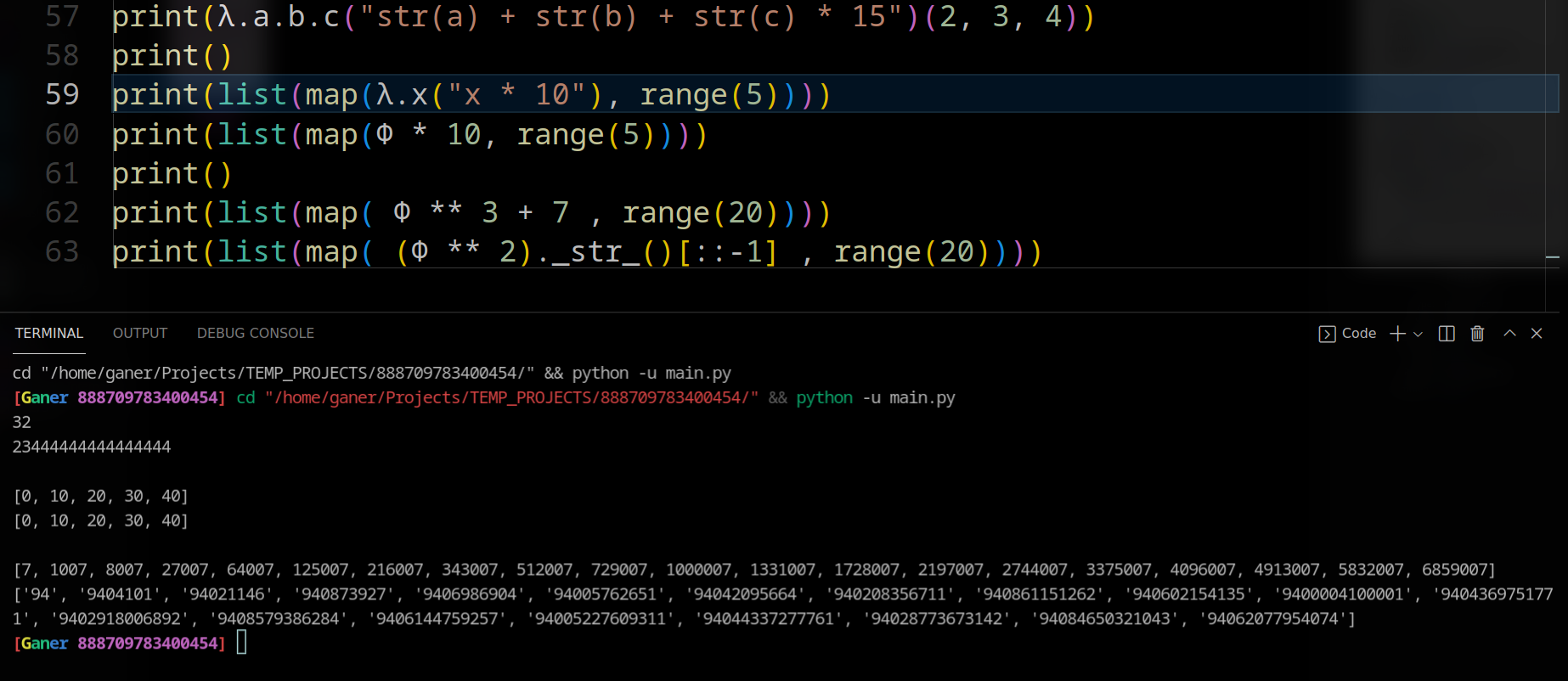
https://github.com/GanerCodes/Useful_Python_tomfoolery/blob/master/main.py
print('e' * χ.range(φ['k']('x * 10')).len()(k = 3))
print((Φ * 10)(2))
print(ζ("x**y + v")(2, 5, v = 5))
print(λ.a.b.c("str(a) + str(b) + str(c) + x * 15")(2, 3, 4, x = "xd"))
pjmap(χ(ρ[0]).ƒ(Φ ** 3 + 7).str(), range(5))
pjmap(Φ * 10, range(5))
pjmap(Φ ** 3 + 7, range(20))
pjmap(λ.x("x * 10"), range(5))
pjmap((Φ ** 2)._str_()[::-1], range(9))
χ.range(10).reversed.map(Φ ** 2, Ψ).list.reduce(ζ("x - y"), Ψ).print()()
χ(5).range(Ψ).map((Φ ** 3 + 7)._str_(), Ψ('x[::-1]')).ƒ(''.join).print()(5)
thoughts?
 languid hare
looks like discount avl
west cipher
languid hare
looks like discount avl
APL? sorta the style i was going for lol
but i wanted to keep it useful and still valid python syntax
languid hare
west cipher
APL? sorta the style i was going for lol
meant apl
autocorrect loves trees apparently
sick hound
what the hell
sick hound
hmmm i have an idea
severe canyon
says he has an idea
doesn't elaborate
leaves
sigma grindset
sick hound
right my idea has been developed
it is a golfing tournament
essentialyl
def game_problem(x,y):
    for selection in range(0,1):
        functions = [x,y]
        game_table = {
            (0,0) : (rand(0,5),rand(0,5)),
            (1,0) : (rand(0,5),rand(0,5)),
            (0,1) : (rand(0,5),rand(0,5)),
            (1,1) : (rand(0,5),rand(0,5)),
        }
        choice_a = functions[0](game_table,selection)
        choice_b = functions[1](game_table,not selection)
        results = game_table[(choice_a,choice_b)]

        return (results[0],results[1])
this is a non esoteric function that does a game theory table
it gives both function_a and function_b 2 variables: the table, and the order.

so essentially, you need to write a function that selects the choice (either quiet or fink for the above) that will gve them the highest score out of 100 rounds. their score being the amount of points they get out of the table
floral meteor
how fun would it be if * character didn't count as a byte?
and how much would that effect the code?
 lime smelt
west cipher
https://github.com/GanerCodes/Useful_Python_tomfoolery/blob/master/main.py
```py...
lime smelt
west cipher
https://github.com/GanerCodes/Useful_Python_tomfoolery/blob/master/main.py
```py...
omg
west cipher
!e (t:="") and eval(''.join(chr(int(''.join(map(lambda x:str("".index(x)),t[i:i+8])),2))for i in range(0,len(t),8)))
night quarryBOT
@west cipher :white_check_mark: Your eval job has completed with return code 0.
hi
interesting
west cipher
of this one
west cipher
dang that obvious
i should come back and obfuscate more at some point
add some red harrings so its impossible to realize
also on an unrelated note it would be way too easy to trick someone into running a whitespace based eval
!e (t:="") and eval(''.join(chr(int(''.join(map(lambda x:str("".index(x)),t[i:i+8])),2))for i in range(0,len(t),8)))
night quarryBOT
@west cipher :white_check_mark: Your eval job has completed with return code 0.
['Pipfile.lock', 'Pipfile', 'config', 'snekbox', 'user_base', 'tests', 'LICENSE']
!e (t:='0123456789') and eval(''.join(chr(int(''.join(c.index(x).str()for x in t[i:i+8]),2))for i in range(0,len(t)-10,8)if bool(c:='')|bool(t:=''.join(filter(c.contains,t)))))
night quarryBOT
@west cipher :white_check_mark: Your eval job has completed with return code 0.
['Pipfile.lock', 'Pipfile', 'config', 'snekbox', 'user_base', 'tests', 'LICENSE']
what
west cipher
(t:='1576408392')and eval(''.join(chr(int(''.join(c.index(x).__str__()for x in t[i:i+8]),2))for i in range(0,len(t)-10,8)if bool(c:='')|bool(t:=''.join(filter(c.__contains__,t)))))
yall should run this
finite blaze
!e (t:='1576408392')and eval(''.join(chr(int(''.join(c.index(x).str()for x in t[i:i+8]),2))for i in range(0,len(t)-10,8)if bool(c:='')|bool(t:=''.join(filter(c.contains,t)))))
night quarryBOT
@finite blaze :warning: Your eval job has completed with return code 0.
[No output]
why is it cut
!e
(t:='1576408392')and eval(''.join(chr(int(''.join(c.index(x).__str__()for x in t[i:i+8]),2))for i in range(0,len(t)-10,8)if bool(c:='')|bool(t:=''.join(filter(c.__contains__,t)))))
@finite blaze :warning: Your eval job has completed with return code 0.
[No output]
!e (t:="") and eval(''.join(chr(int(''.join(map(lambda x:str("".index(x)),t[i:i+8])),2))for i in range(0,len(t),8)
night quarryBOT
@lime smelt :x: Your eval job has completed with return code 1.
Code block escape attempt detected; will not output result
Full output: https://paste.pythondiscord.com/afecamagic.txt?noredirect
near gust
it feels like an oversight that you can't match an ellipsis in structural pattern matching. You have to bind a variable and then test if it is Ellipsis
class range:
    def __new__(cls, *args):
        if ... in args:
            match args:
                case (start, e, stop) if e is ...:
                    return __builtins__.range(start, stop + 1)
                case (start, other, e, stop) if e is ...:
                    ret = __builtins__.range(start, stop + other - start, other - start)
                    if stop not in ret:
                        raise ValueError("Invalid Ellipsis range")
                    return ret
                case (start, e, other, stop) if e is ...:
                    ret = __builtins__.range(start, 2*stop - other, stop - other)
                    if stop not in ret:
                        raise ValueError("Invalid Ellipsis range")
                    return ret
        return __builtins__.range(*args)
and using the name Ellipsis rebinds a local variable
sick hound
looking for genuine advice
does this code look dirty to anyone?
i find it neat yet my friend dont
just rate it for neatness
/10
class CustomDict(dict):

    def __setitem__(self, key, value):

        if key in self.keys():
            new = [self[key], value] if not isinstance(self[key],list) else self[key] + [value]
            dict.__setitem__(self, key, new)

        else: dict.__setitem__(self, key, value)


class overloads(type):

    def __prepare__(name, bases):

        return CustomDict()

    def __new__(cls, name, bases, dct):

        def choose(lst):

            annotate = [list(fn.__annotations__.values()) for fn in lst]

            def wrapper(*args):

                for num , a in enumerate(annotate):


                    check = [type(arg) == annotation for arg, annotation in zip(list(args)[1:], a)]
                    if all(check): return lst[num](*args)

                return None

            return wrapper


        edited_dct = {}

        for key, value in dct.items():

            if isinstance(value, list) and callable(value[0]): edited_dct[key] = choose(value)

            else: edited_dct[key] = value


        return type(name, bases, edited_dct)


class Funcs(metaclass=overloads):

    def add(self, a: int, b: int): return a + b

    def add(self, a: str, b: str): return f'{a} {b} it worked!'

    def add(self, a: int, b: str): return b*a
no that isn't what i meant. but, what i meant is that theres... clues. mostly the chr part
stop
you're not healthy
earnest wing
floral meteor
and how much would that effect the code?
most lambdas would become variadic
also there is now a maximum score that any possible challenge can take on
fleet bridge
!e print("123")
night quarryBOT
@fleet bridge :warning: Your eval job has completed with return code 0.
[No output]
!e ```py
s = '`'
print(s * 3 + '!' + s * 3)
@fleet bridge :white_check_mark: Your eval job has completed with return code 0.
Code block escape attempt detected; will not output result
Full output: https://paste.pythondiscord.com/hoxeyadeqo.txt?noredirect
sick hound
hmmm
we are going to break it.
if ESCAPE_REGEX.findall(output):
            paste_link = await self.upload_output(original_output)
            return "Code block escape attempt detected; will not output result", paste_link
found the code that manages that.
ESCAPE_REGEX = re.compile("[`\u202E\u200B]{3,}")
no idea what this is doing tho...
ah nvm i understand.
so its checking for 3 repetitions of the backtick
hmm.
sick hound
its impossible.
sick hound
sad
fleet bridge
!e print("Code block escape attempt detected; will not output result")
night quarryBOT
@fleet bridge :white_check_mark: Your eval job has completed with return code 0.
Code block escape attempt detected; will not output result
exec("""print((l:=["print", "('<{}>>')", "format"])[0],[1],f"{l[0]}.format('[({l})==({l})]'.join(l))")""")
!e
exec("""print((l:=["print", "('<{}>>')", "format"])[0],[1],f"{l[0]}.format('[({l})==({l})]'.join(l))")""")
night quarryBOT
@fleet bridge :white_check_mark: Your eval job has completed with return code 0.
print [1] print.format('[(['print', "('<{}>>')", 'format'])==(['print', "('<{}>>')", 'format'])]'.join(l))
funny
you see it looks like a complete mess of code and outputs a complete mess of code
finite blaze
i know you can do this : )
near gust
!e
print ("`\u200b`\u200b`\u200a")
@near gust :white_check_mark: Your eval job has completed with return code 0.
Code block escape attempt detected; will not output result
Full output: https://paste.pythondiscord.com/epigerawoh.txt?noredirect
near gust
!e
print("``\u200a`")
@near gust :white_check_mark: Your eval job has completed with return code 0.
`` `
!e
print("``\u200b`")
@near gust :white_check_mark: Your eval job has completed with return code 0.
Code block escape attempt detected; will not output result
Full output: https://paste.pythondiscord.com/icoqaxebop.txt?noredirect
near gust
interesting
 vague cairn
🙂
dark wharf
You can break out of it btw, it's a known issue
with how discord handles large amounts of escape sequences
night quarryBOT
@vague cairn :white_check_mark: Your eval job has completed with return code 0.
!e `print("hello world!")`
Ok, so that's not what you're worrying about happening, what is the problem and the strategy that you're investigating?
night quarryBOT
@dense skiff :x: Your eval job has completed with return code 1.
001 |   File "<string>", line 2
002 |     print("
003 |           ^
004 | SyntaxError: unterminated string literal (detected at line 2)
 dense skiff
!e
print("```this?```")
@dense skiff :white_check_mark: Your eval job has completed with return code 0.
\`\`\`this?
lmao

 next flame
xd
earnest wing
near gust
lmao
Acceptable
night quarryBOT
@sick hound :x: Your eval job has completed with return code 1.
001 |   File "<string>", line 1
002 |     print("
003 |           ^
004 | SyntaxError: unterminated string literal (detected at line 1)
@sick hound :x: Your eval job has completed with return code 1.
001 |   File "<string>", line 1
002 |     print("
003 |           ^
004 | SyntaxError: unterminated string literal (detected at line 1)
!e print("`"*(2**8))
night quarryBOT
@finite blaze :white_check_mark: Your eval job has completed with return code 0.
Code block escape attempt detected; will not output result
Full output: https://paste.pythondiscord.com/emixezusup.txt?noredirect
last locust
Stuff trying to break the bot should be going in #bot-commands please
This channel is for esoteric python, not bot testing
severe canyon
!e
f=1 .__and__
print(f(3))
@severe canyon :white_check_mark: Your eval job has completed with return code 0.
1
its very esoteric
sick hound
!e
west cipher
severe canyon
!e
```py
f=1 .__and__
print(f(3))
```
wait you can access int methods by adding a space
also dot notation works with a space
how am i still learning about this langauge
sick hound
!e ```py
print(chr(((~~(l:=lambda:(f:=~(((lambda x:3x)(((f:=lambda:7)()).and(2^63))))))())-630)+4))
@sick hound :white_check_mark: Your eval job has completed with return code 0.
❤
❤️
severe canyon
Space because otherwise the dot is treated as a continuation of the number
finite blaze
need to learn about all these __thingy__
fleet bridge
finite blaze
need to learn about all these `__thingy__`
https://docs.python.org/3.10/reference/datamodel.html
almost all __dunder__ methods are described in this page
finite blaze
thanks
fleet bridge
https://www.toptal.com/developers/hastebin/iyayemadiw.md
this is a list of all __dunders__ that are mentioned in docs
I have rearranged this list a little
sick hound
i haven't really experimented with pattern matching, anyone know some weird stuff you can do with it?
restive void
sick hound
i haven't really experimented with pattern matching, anyone know some weird stuf...
I tried, but it's fairly stubborn; __match_args__ must be a tuple.
floral meteor
west cipher
also dot notation works with a space
Most notations work with any sort of spacing
 earnest wing
@type.__call__
class rm:
    def __sub__(s,o):
        import os
        os.system(f"[insert the rm command here, retracted for safety] {o}")

# ...
rm -rf"/"
that's a good way to recreate ruby blocks in python lol
made new dsl
@use structures;
@use datetime;

struct human {
  name: str
  age: int
  born: datetime.timedelta
};
this gets parsed to
{
  'name': 'human',
  'fields': {
    'name': <class 'str'>,
    'age': <class 'int'>,
    'born': <class 'datetime.timedelta'>
  }
}
integrated with my structures snippet:
>>> human["",0,datetime.timedelta(days=0)]
<structure human, {'name': '', 'age': 0, 'born': datetime.timedelta(0)}>
>>>```use keyword is just literally __import__
pure dew
why not a dataclass
sly root
pure dew
why not a dataclass
they're too overcomplicated, when my implementation is just one class
also this is #esoteric-python channel so i think channel name explains why :)
pure dew
heh, fair point
restive void
!e
for type(
    type.__name__,
    (),
    {
        type.__name__: type(
            type.__name__,
            (),
            {
                "__{0}__".format(
                    type({0}).__name__
                ): lambda * type: print(type[(type==type)+(type==type)])
            },
        )(),
    },
)().type in range(7): pass
@restive void :white_check_mark: Your eval job has completed with return code 0.
001 | 0
002 | 1
003 | 2
004 | 3
005 | 4
006 | 5
007 | 6
 halcyon surge
hey people, im just curious, how did you get into esoteric py? i didnt even know it existed, did you guys want an extension of python for a challenge? or?
restive void
halcyon surge
hey people, im just curious, how did you get into esoteric py? i didnt even know...
I didn't know it had a name, but I've always liked breaking things, or using them in unintended ways. Made esoteric languages before, too (before even knowing about Python).
Also I miss doing art in my job :D
halcyon surge
restive void
I didn't know it had a name, but I've always liked breaking things, or using the...
Ohh wow that’s so cool, so does mean only you will understand your code? Or are there certain syntax’s with esoteric that known amongst others?
restive void
halcyon surge
Ohh wow that’s so cool, so does mean only you will understand your code? Or are ...
There's a whole community of people making esolangs, see esolangs.org
My most mature ones are OIL and Aceto, they are easy to understand in principle, just hard to write.
halcyon surge
Wow, that’s super cool, I’ll definitely check it out. And these esolangs can be implemented like any standard Lang right?
restive void
I think there are some that can't, but mine are all implemented at least once
night quarryBOT
@sick hound :white_check_mark: Your eval job has completed with return code 0.
12
@finite blaze :x: Your eval job has completed with return code 1.
001 |   File "<string>", line 1
002 |     print((* +2 +2))
003 |            ^^^^^^^
004 | SyntaxError: cannot use starred expression here
Naaah
viscid nymph
adding a comma to make it a tuple would work (apart from the type error)
near gust

 floral meteor
!e ```py
globals().clear()
builtins={}
no brackets after this
build_class=lambda*a:0
name='main'
sub = ....class.base.subclasses
@sub.class.call
@lambda _:sub
class a:0
try:
@a.getitem
@lambda _:84
class b:0
a.load_module
except:
@a.getitem
@lambda _:104
class b:0
@b.load_module
@lambda _:'sys'
class a:0
@a.stdout.write
@lambda _:"Hello World!\n"
class a:0
@floral meteor :white_check_mark: Your eval job has completed with return code 0.
Hello World!
honestly I think that obfuscating code is best when the output is completely expected
ok
 odd jay
 golden finch
In a function's __code__ attribute, where are the argument names located?
last locust
golden finch
In a function's `__code__` attribute, where are the argument names located?
!e ```py
def foo(a, b):
pass
print(foo.code.co_varnames)```do you mean this?
night quarryBOT
@last locust :white_check_mark: Your eval job has completed with return code 0.
('a', 'b')
>>> def foo(a, *, b, c=None):
    pass

>>> foo.__code__.co_varnames
('a', 'b', 'c')```note that it doesn't distinguish between different types of argsThat seems to be what I'm looking for, thanks!
The reason is kinda cursed so that's why I'm here
last locust
Heh
golden finch
something like:
def decorate(...):
  ...

@decorate(3):
def f():
  return a+b+c

print(f(1,2,3))#6
should be relatively easy to implement
 polar plover
!e ```python
def foo(a, b):
x = 123
print(foo.code.co_varnames)``` it is not only arguments
night quarryBOT
@polar plover :white_check_mark: Your eval job has completed with return code 0.
('a', 'b', 'x')
!e from what can tell the arguments are orderd first in that tuple, so ```py
def foo(a, b):
x = 123
print(foo.code.co_varnames[:foo.code.co_argcount])```
night quarryBOT
@polar plover :white_check_mark: Your eval job has completed with return code 0.
('a', 'b')
I suggest using inspect here
severe canyon
!e
for i in range(100):globals()[f'sh{"e"*i}sh']=i
print(shsh)
print(sheesh)
print(sheeeeesh)
@severe canyon :white_check_mark: Your eval job has completed with return code 0.
001 | 0
002 | 2
003 | 5
why do i find this funny
vague cairn
severe canyon
!e
```py
for i in range(100):globals()[f'sh{"e"*i}sh']=i
print(shsh)
print(shees...
!e
LETTER = lambda x:chr(x + ssssssssssssssssssssssssssssssssssssssssssssssssssssssssssssssss0)
letter = lambda x:chr(x + ssssssssssssssssssssssssssssssssssssssssssssssssssssssssssssssssssssssssssssssssssssssssssssssss0)
letters = lambda *xs:''.join([letter(x) for x in xs])
Letters = lambda *xs: LETTER(xs[0]) + letters(*xs[1:])
print(Letters(ssssssss0, sssss0,ssssssssssss0,ssssssssssss0,sssssssssssssss0, -ssssssssssssssssssssssssssssssssssssssssssssssssssssssssssssssss0, sssssssssssssssssssssss0, sssssssssssssss0, ssssssssssssssssss0,ssssssssssss0,ssss0,-sssssssssssssssssssssssssssssssssssssssssssssssssssssssssssssss0))
looks like peano arithmetic to me.
night quarryBOT
@vague cairn :white_check_mark: Your eval job has completed with return code 0.
Hello world!
🐍
vague cairn
looks like the start of a new obfuscation class: you get two '1's and as many '0's as you want, but no other digits...
 torn garnet
!e
vague cairn
actually... the first '1' is easy to replace with True, the second shouldn't be very much more difficult...
restive void
You could just implement Unary https://esolangs.org/wiki/Unary
severe canyon
!e
f=lambda i:'0'*int(f'1{"".join("{0:03b}".format("><+-.,[]".index(l))for l in i)}',2)
print(len(f(",[.,]")))
@severe canyon :white_check_mark: Your eval job has completed with return code 0.
56623
brainfuck to unary converter :D
please golf this more
nvm this doesnt actually work
ok, now it should
 whole vessel
Hi
I have a question about threading
I use
threadName.start()
To start the thread but i dont know how to stopeed
Someone can help me?
 pastel ibex
whole vessel
Someone can help me?
pastel ibex
whole vessel
Someone can help me?
#❓|how-to-get-help Please read the rules
severe canyon
!e
f=lambda i,a=0:'0'*([a:=a*8+"><+-.,[]".index(l)for l in i][-1]+2**len(i*3))
print(len(f(",[.,]")))
@severe canyon :white_check_mark: Your eval job has completed with return code 0.
56623
shorter ¯_(ツ)_/¯
whole vessel
pastel ibex
<#704250143020417084> Please read the rules
Oh, im sorry
finite blaze
Can't you make it a oneliner?
severe canyon
it is
floral meteor
It's two different scripts, the preprocessor and the driver.
They could be concatenated or intermingled, but that would be pointless.
viscid nymph
It’s just one of the attributes of the compiled bytecode
severe canyon
can you get around this?
 earnest wing
Is the error trying to assign to __code__ or to co_code because for the latter you can just replace(...) and assign the copied code object instead
earnest wing
!e ```py
def foo(): print("hey")
foo.code = foo.code.replace(co_consts=(None, "hi there"))
foo()
@earnest wing :white_check_mark: Your eval job has completed with return code 0.
hi there
ty
severe canyon
!e
f=lambda n:n*n
n=bytes([124,0,124,0,23,0,83,0])
print(f(3))
f.__code__ = f.__code__.replace(co_code=n)
print(f(3))
@severe canyon :white_check_mark: Your eval job has completed with return code 0.
001 | 9
002 | 6
fun!, gonna mess around with this
 amber silo
!e
print("Hello")
 dense nova
severe canyon
!e
```py
f=lambda n:n*n
n=bytes([124,0,124,0,23,0,83,0])
print(f(3))
f.__code__ ...
dense nova
severe canyon
!e
```py
f=lambda n:n*n
n=bytes([124,0,124,0,23,0,83,0])
print(f(3))
f.__code__ ...
whats co code?
sly root
dense nova
whats co code?
bytecode of the function
severe canyon
damn, the dis module gives you a lot of info to work with
all bytecode opcodes and disassembly of functions :O
!e
import dis
f=lambda n:1if n<2else f(n-1)*n
print(dis.dis(f))
@severe canyon :white_check_mark: Your eval job has completed with return code 0.
001 |   2           0 LOAD_FAST                0 (n)
002 |               2 LOAD_CONST               1 (2)
003 |               4 COMPARE_OP               0 (<)
004 |               6 POP_JUMP_IF_FALSE        6 (to 12)
005 |               8 LOAD_CONST               2 (1)
006 |              10 RETURN_VALUE
007 |         >>   12 LOAD_GLOBAL              0 (f)
008 |              14 LOAD_FAST                0 (n)
009 |              16 LOAD_CONST               2 (1)
010 |              18 BINARY_SUBTRACT
011 |              20 CALL_FUNCTION            1
... (truncated - too many lines)
Full output: https://paste.pythondiscord.com/goyuluzika.txt?noredirect
 bitter lake
https://sourceb.in/w7aXsAQN5VOkay this is my filetree and I have a function called timestamps_av in my info.py file but when I do from .info import timestamps_av,fromcogs .info import timestamps_av or from info import timestamps_avin events.py it errors telling me it can't find it
(Also asked in #discord-bots a few mins ago but thought this might be better place to ask)
next flame
bitter lake
https://sourceb.in/w7aXsAQN5VOkay this is my filetree and I have a function call...
this channel is for doing cursed shit with python, not a good fit for your question
also your source bin link doesn't work
bitter lake
next flame
this channel is for doing cursed shit with python, not a good fit for your quest...
yep ik the link died, managed to get a answer in #discord-bots but couldn't really find a general python help channel which is why i posted it here
next flame
bitter lake
yep ik the link died, managed to get a answer in <#343944376055103488> but could...
bitter lake
next flame
<#704250143020417084>
yeah I also tried those help channels (twice) and the bot flagged them as dormant bc a response took so long
 errant crescent
good to know.
 gleaming timber
how to generate primes
[i for i in range(2,100) if i in (2,3,5,7) or (i%6==1 or i%6==5) and i%5!=0 and i%7!=0]
!e ```py
[i for i in range(2,100) if i in (2,3,5,7) or (i%6==1 or i%6==5) and i%5!=0 and i%7!=0]
@gleaming timber :warning: Your eval job has completed with return code 0.
[No output]
!e ```py
print([i for i in range(2,100) if i in (2,3,5,7) or (i%6==1 or i%6==5) and i%5!=0 and i%7!=0])
@gleaming timber :white_check_mark: Your eval job has completed with return code 0.
[2, 3, 5, 7, 11, 13, 17, 19, 23, 29, 31, 37, 41, 43, 47, 53, 59, 61, 67, 71, 73, 79, 83, 89, 97]
!e ```py
print(*filter(lambda i:i in(2,3,5,7)or(i%6 in(1,5))and i%5 and i%7,range(2,100)))
@floral meteor :white_check_mark: Your eval job has completed with return code 0.
2 3 5 7 11 13 17 19 23 29 31 37 41 43 47 53 59 61 67 71 73 79 83 89 97
!e
print(2,3,5,7,*[i for i in range(2,100)if(i%6 in(1,5))and not(i%5==0 or i%7==0)])
@gleaming timber :white_check_mark: Your eval job has completed with return code 0.
2 3 5 7 11 13 17 19 23 29 31 37 41 43 47 53 59 61 67 71 73 79 83 89 97
!e ```py
print(2,3,5,7,*filter(lambda i:all([(i%6 in(1,5)),i%5,i%7]),range(2,100)))
mine's shorter
 jovial monolith
almao what
jovial monolith
floral meteor
!e ```py
print(2,3,5,7,*filter(lambda i:all([(i%6 in(1,5)),i%5,i%7]),range(2,100...
don't need a list with all
jovial monolith
you can pass a generator/iterable i forgot what it's calle
jovial monolith
!e
print(2,3,5,7,*filter(lambda i:all((i%6 in(1,5)),i%5,i%7),range(2,100)))```@jovial monolith :x: Your eval job has completed with return code 1.
001 | Traceback (most recent call last):
002 |   File "<string>", line 1, in <module>
003 |   File "<string>", line 1, in <lambda>
004 | TypeError: all() takes exactly one argument (3 given)
UHH
floral meteor
told you
jovial monolith
oh i misread it xD
night quarryBOT
@sick hound :white_check_mark: Your eval job has completed with return code 0.
2 3 5 7 11 13 17 19 23 29 31 37 41 43 47 53 59 61 67 71 73 79 83 89 97
@sick hound :white_check_mark: Your eval job has completed with return code 0.
2 3 5 7 1 11 13 17 19 23 29 31 37 41 43 47 53 59 61 67 71 73 79 83 89 97
You know how std[::cout] << "Hello World!"? I took it another step further because I was bored in class today.
https://paste.pythondiscord.com/useserajac.rb
std[::vector]<int,_> 'a';

a.push_back(10);
a.push_back(1);
a.push_back(69420);

for i in a:
    std[::cout] << i << " ";

std[::cout] << '\n'
now with templates (kinda not really)
night quarryBOT
@sick hound :warning: Your eval job has completed with return code 0.
[No output]
nothing happened
finite blaze
Hey, what would be the shortest way to open a file and save all lines into a list
with all lines stripped
earnest wing
x=[*map(str.rstrip,open("i"))]
x=[l.rstrip()for l in open("i")]
hmm it's actually longer
wait no it's shorter the chat textbox was just bad
finite blaze
thanks
pure dew
why rstrip and not strip?
viscid nymph
pure dew
why rstrip and not strip?
rstrip only strips from the right, hence the r prefix
viscid nymph
Whitespace at the beginning of a line could be indentation etc
floral meteor
pure dew
but why wouldn't you want full stripping when reading from the file?
full stripping is usually desired, however not when indents could be important
near gust
near gust
You know how `std[::cout] << "Hello World!"`? I took it another step further bec...
I'm almost done with a version that can have nested templates
it required a complete redo of the template code by making template_base a metaclass
and doing other stuff
near gust
template<(T, template<(U, V),_>_), _>'name'
what does H mean
pure dew
no, that's U+1D129 𝄩
near gust
std[::vector]<int,_>'vec',_ == {1, 2, 3}
std[::vector]<int,_>'vec',_('iterator', 'constructor here')
time to implement the actual vector interface
oh god
iterators
having to hack ++i
chained comparison
also that would try to call the string
operator precedence
I also tried == directly but that doesn't work because of chained comparison
_ is a temp variable that here gets assigned to be the class object
template_meta.__gt__(self, other: typing.Union[str, template_meta]) returns the class if both sides are the same object, otherwise assigns the namespaces variable of that name to the class
then == calls __call__, which constructs an instance of the class with the args. If self._var is defined on the class (which it is defined when there's a call to > when the right argument is not self), it sets the variable named by that variable to be the instance of the class and returns the instance (the same object)
 manic rune
print((lambda: getattr(getattr, '__name__')[0])() + __import__('string').ascii_lowercase[0 << 69] + getattr(any, '__name__')[int(hex(343433234222)[((-2 << 2) / 4).__int__()])])
made it myself 🙂
finite blaze
!e print((lambda: getattr(getattr, 'name')[0])() + import('string').ascii_lowercase[0 << 69] + getattr(any, 'name')[int(hex(343433234222)[((-2 << 2) / 4).int()])])
night quarryBOT
@finite blaze :white_check_mark: Your eval job has completed with return code 0.
gay

 rough mulch
!e
print((lambda: getattr(getattr, '__name__')[0])() + __import__('string').ascii_lowercase[0 << 69] + getattr(any, '__name__')[int(hex(343433234222)[((-2 << 2) / 4).__int__()])])
@rough mulch :white_check_mark: Your eval job has completed with return code 0.
gay
aww the very misleading pair of messages got deleted
rough mulch
night quarry
<@852911179450023976> :white_check_mark: Your eval job has completed with return...
how
floral meteor
it's called obfuscation
rough mulch
🧐
near gust
near gust
having to hack `++i`
unary pos the first time on the iterator will return a proxy object, and then calling unary pos again on the proxy will increment
rough mulch
rough mulch
!e
```py
print((lambda: getattr(getattr, '__name__')[0])() + __import__('string...
cant even understand single line
it smg convert 343433234222 to msg
floral meteor
!e then there's the opposite:
@type.__call__
class cout:
  def __lshift__(self, string):
    print(string)
    return self
endl = '\n'

cout << "Hello World!" << endl;
epic
night quarryBOT
@floral meteor :white_check_mark: Your eval job has completed with return code 0.
Hello World!
i can do this simply
!e
print("Hello World!")
@rough mulch :white_check_mark: Your eval job has completed with return code 0.
Hello World!
😂
floral meteor
getattr(getattr, '__name__')[0] gets the first character of 'getattr'
rough mulch
ok
floral meteor
0 << 69 is 0
rough mulch
ok
floral meteor
first ascii lowercase character is a
rough mulch
__import__('string').ascii_lowercase[0 << 69] + getattr(any, '__name__')[int(hex(343433234222)[((-2 << 2) / 4).__int__()])])
```???and the crazy integer stuff simplifies to 2
rough mulch
ok..
floral meteor
so the third character of "any"
rough mulch
..
floral meteor
Quad Et Deobfuscatum
rough mulch
i have no idea
interview bl:
Print("Hello")
make it so complex that anyone cant understand lol
floral meteor
who likes my abuse of Latin?
rough mulch
floral meteor
who likes my abuse of Latin?
Didnt understand
floral meteor
-2th index is '2'
rough mulch
!e
print(getattr'[0] + 'abcdefghijklmnopqrstuvwxyz'[0] + 'any'[int('0x4ff637472e'[-2])])
night quarryBOT
@rough mulch :x: Your eval job has completed with return code 1.
001 |   File "<string>", line 1
002 |     print(getattr'[0] + 'abcdefghijklmnopqrstuvwxyz'[0] + 'any'[int('0x4ff637472e'[-2])])
003 |                  ^^^^^^^^^^^^^^^^^^^^^^^^^^^^^^^^^^
004 | SyntaxError: invalid syntax. Perhaps you forgot a comma?
lol
`oh
!e
'getattr'[0] + 'abcdefghijklmnopqrstuvwxyz'[0] + 'any'[int('0x4ff637472e'[-2])]
night quarryBOT
@rough mulch :warning: Your eval job has completed with return code 0.
[No output]
!e ```py
a, i = [0,0,0,0,0,0], 0
a[i] = a[i] + 10
while a[i]:
i += 1
a[i] = a[i] + 3
i += 1
a[i] = a[i] + 7
i += 1
a[i] = a[i] + 8
i += 1
a[i] = a[i] + 10
i += 1
a[i] = a[i] + 11
i -= 5
a[i] = a[i] - 1
i += 2
a[i] = a[i] + 2
print(end=chr(a[i]))
i += 2
a[i] = a[i] + 1
print(end=chr(a[i]))
a[i] = a[i] + 7
print(end=chr(a[i])*2)
i += 1
a[i] = a[i] + 1
print(end=chr(a[i]))
i -= 4
a[i] = a[i] + 2
print(end=chr(a[i]))
i += 2
a[i] = a[i] + 7
print(end=chr(a[i]))
i += 2
print(end=chr(a[i]))
a[i] = a[i] + 3
print(end=chr(a[i]))
i -= 1
print(end=chr(a[i]))
a[i] = a[i] - 8
print(end=chr(a[i]))
i -= 3
a[i] = a[i] + 1
print(chr(a[i]))
@floral meteor :white_check_mark: Your eval job has completed with return code 0.
Hello World!
huh
 terse oriole
!e
print(__builtins__.str().join(map(chr,[q:=-~-~-~-~-~-~-~-~-~-~-~-~-~-~-~-~-~-~-~-~-~-~-~-~-~-~-~-~-~-~-~-~-~-~-~-~-~-~-~-~-~-~-~-~-~-~-~-~-~-~-~-~-~-~-~-~-~-~-~-~-~-~-~-~-~-~-~-~-~-~-~-~-~-~-~-~-~-~-~-~-~-~-~-~-~-~-~-~-~-~-~-~-~-~-~-~-~-~-~-~-~-~-~-~-~-~-~-~-~-~-~-~-~0,u:=-~-~-~-~q,u-ord('>')//(-~-~-~0),sum(map(ord, filter(lambda m: isinstance(ord(m), int), list('%>')))),u-(-~-~-~-~-~-~-~-~-~-~0)])))
@terse oriole :white_check_mark: Your eval job has completed with return code 0.
quack
That... worked?
rough mulch
floral meteor
!e ```py
a, i = [0,0,0,0,0,0], 0
a[i] = a[i] + 10
while a[i]:
i += 1
a[i] = ...
woah
rough mulch
floral meteor
!e ```py
a, i = [0,0,0,0,0,0], 0
a[i] = a[i] + 10
while a[i]:
i += 1
a[i] = ...
google?
rough mulch
!e
getattr'[0] + 'abcdefghijklmnopqrstuvwxyz'[0] + 'any'[int('0x4ff637472e'[-2])]
night quarryBOT
@rough mulch :x: Your eval job has completed with return code 1.
001 |   File "<string>", line 1
002 |     getattr'[0] + 'abcdefghijklmnopqrstuvwxyz'[0] + 'any'[int('0x4ff637472e'[-2])]
003 |                                                                            ^
004 | SyntaxError: unterminated string literal (detected at line 1)
hec
!e
'getattr'[0] + 'abcdefghijklmnopqrstuvwxyz'[0] + 'any'[int('0x4ff637472e'[-2])]
night quarryBOT
@rough mulch :warning: Your eval job has completed with return code 0.
[No output]
I typed the damn thing manually
rough mulch
floral meteor
I typed the damn thing manually
imposibble
floral meteor
although I could make a script to generate that given any message
rough mulch
floral meteor
!e ```py
a, i = [0,0,0,0,0,0], 0
a[i] = a[i] + 10
while a[i]:
i += 1
a[i] = ...
how u learned it
floral meteor
I made it
rough mulch
what is it called
terse oriole
!e
(lambda _, __, ___: (lambda p, ____________________, ___: [print(__import__('this').d.get(____, ____), end='', file=p) for ____ in ___])(__.stdout, setattr(__, 'stdout', open(_.devnull, 'w')), ___))(__import__('os'), __import__('sys'), 'frperg zrffntr')
@terse oriole :x: Your eval job has completed with return code 1.
001 | Traceback (most recent call last):
002 |   File "<string>", line 1, in <module>
003 |   File "<string>", line 1, in <lambda>
004 | FileNotFoundError: [Errno 2] No such file or directory: '/dev/null'
This is based on the concept of a Turing Machine
terse oriole
night quarry
<@751768586699276342> :x: Your eval job has completed with return code 1.
```
0...
Doesnt work in here...
Works fine in an IDLE shell I think?
floral meteor
however I only used 6 memory cells so it isn't Turing Complete
rough mulch
..
floral meteor
the concept behind it is turing complete though
rough mulch
floral meteor
!e ```py
a, i = [0,0,0,0,0,0], 0
a[i] = a[i] + 10
while a[i]:
i += 1
a[i] = ...
what are these use for
floral meteor
it is a transpilation from python to brainfuck, and back to python again
floral meteor
manually
floral meteor
rough mulch
flex probaly
that's kinda what this channel is for
rough mulch
floral meteor
that's kinda what this channel is for
lol
@floral meteor print 5 table with 1 line
 maiden river
!e Yo how's this workin
print(__builtins__.str().join(map(chr,[q:=-~-~-~-~-~-~-~-~-~-~-~-~-~-~-~-~-~-~-~-~-~-~-~-~-~-~-~-~-~-~-~-~-~-~-~-~-~-~-~-~-~-~-~-~-~-~-~-~-~-~-~-~-~-~-~-~-~-~-~-~-~-~-~-~-~-~-~-~-~-~-~-~-~-~-~-~-~-~-~-~-~-~-~-~-~-~-~-~-~-~-~-~-~-~-~-~-~-~-~-~-~-~-~-~-~-~-~-~-~-~-~-~-~0,u:=-~-~-~-~q,u-ord('>')//(-~-~-~0),sum(map(ord, filter(lambda m: isinstance(ord(m), int), list('%>')))),u-(-~-~-~-~-~-~-~-~-~-~0)])))
@maiden river :white_check_mark: Your eval job has completed with return code 0.
quack
huh
🪐 . .✦˚ . ✦˚ . ˚ . ✦ ˚ .🌍
˚ . ✦ . ˚ * ✦ . . ˚
. ✦ 🌒 . ˚ .
yoooooo
i was searching for this status for soo long
maiden river
inderesdin
rough mulch
!e
print(__builtins__.str().join(map(chr,[q:=-~-~-~-~-~-~-~-~-~-~-~-~-~-~-~-~-~-~-~-~-~-~-~-~-~-~-~-~-~-~-~-~-~-~-~-~-~-~-~-~-~-~-~-~-~-~-~-~-~-~-~-~-~-~-~-~-~-~-~-~-~-~-~-~-~-~-~-~-~-~-~-~-~-~-~-~-~-~-~-~-~-~-~-~-~-~-~-~-~-~-~-~-~-~-~-~-~-~-~-~-~-~-~-~-~-~-~-~-~-~-~-~-~0,u:=-~-~-~-~q,u-ord('>')//(-~-~-~0),sum(map(ord, filter(lambda m: isinstance(ord(m), int), list('%>')))),u-(-~-~-~-~-~-~-~-~-~-~0)])))```@rough mulch :white_check_mark: Your eval job has completed with return code 0.
quack
!e
print(__builtins__.str().join(map(chr,[s:=-~-~-~-~-~-~-~-~-~-~-~-~-~-~-~-~-~-~-~-~-~-~-~-~-~-~-~-~-~-~-~-~-~-~-~-~-~-~-~-~-~-~-~-~-~-~-~-~-~-~-~-~-~-~-~-~-~-~-~-~-~-~-~-~-~-~-~-~-~-~-~-~-~-~-~-~-~-~-~-~-~-~-~-~-~-~-~-~-~-~-~-~-~-~-~-~-~-~-~-~-~-~-~-~-~-~-~-~-~-~-~-~-~0,u:=-~-~-~-~q,u-ord('>')//(-~-~-~0),sum(map(ord, filter(lambda m: isinstance(ord(m), int), list('%>')))),u-(-~-~-~-~-~-~-~-~-~-~0)])))```@rough mulch :x: Your eval job has completed with return code 1.
001 | Traceback (most recent call last):
002 |   File "<string>", line 1, in <module>
003 | NameError: name 'q' is not defined
!e
print(__builtins__.str().join(map(chr,[s:=-~-~-~-~-~-~-~-~-~-~-~-~-~-~-~-~-~-~-~-~-~-~-~-~-~-~-~-~-~-~-~-~-~-~-~-~-~-~-~-~-~-~-~-~-~-~-~-~-~-~-~-~-~-~-~-~-~-~-~-~-~-~-~-~-~-~-~-~-~-~-~-~-~-~-~-~-~-~-~-~-~-~-~-~-~-~-~-~-~-~-~-~-~-~-~-~-~-~-~-~-~-~-~-~-~-~-~-~-~-~-~-~-~0,u:=-~-~-~-~s,u-ord('>')//(-~-~-~0),sum(map(ord, filter(lambda m: isinstance(ord(m), int), list('%>')))),u-(-~-~-~-~-~-~-~-~-~-~0)])))```@rough mulch :white_check_mark: Your eval job has completed with return code 0.
quack
hec?
earnest wing
floral meteor
!e ```py
a, i = [0,0,0,0,0,0], 0
a[i] = a[i] + 10
while a[i]:
i += 1
a[i] = ...
% precedence is higher than +
floral meteor
woops
floral meteor
floral meteor
!e ```py
a, i = [0,0,0,0,0,0], 0
a[i] = a[i] + 10
while a[i]:
i += 1
a[i] = ...
infinet memeree
terse oriole
maiden river
!e Yo how's this workin
```
print(__builtins__.str().join(map(chr,[q:=-~-~-~-~-~...
!e
print(-~0)
@terse oriole :white_check_mark: Your eval job has completed with return code 0.
1
Basically increments it so much that it reaches the ord value of the characters
terse oriole
terse oriole
!e
```py
(lambda _, __, ___: (lambda p, ____________________, ___: [print(__impo...
This one doesnt seem to work mainly cause of snekbox
It somewhat works in terminal and works as intended in an IDLE shell
floral meteor
this is me tryna make my code more readable:
 terse oriole
Readable is relative...
floral meteor
the lambda list is one of those "works for the wrong reason" things
night quarryBOT
@sly root :x: Your eval job has completed with return code 1.
001 | Traceback (most recent call last):
002 |   File "<string>", line 1, in <module>
003 | ModuleNotFoundError: No module named 'requests'
pog
floral meteor
@sly root ❌ Your eval job has completed with return code 1.
001 | Traceback (most recent call last):
002 |   File "<string>", line 1, in <module>
003 | BotUsageError: Please use #bot-commands for non-esoteric bot commands.
i've tried to execute esoteric code(
rapid sparrow
the bot knows what's esoteric and what isn't ?
sly root
floral meteor
but then you deleted it
ik, full code is too big for discord
i tried to load it with request but module is not installed
sick hound
floral meteor
this is me tryna make my code more readable:
today I learned that ... is an operator... that's pretty neat
night quarryBOT
@fleet bridge :white_check_mark: Your eval job has completed with return code 0.
Ellipsis
You can use it as expression like any other expression
floral meteor
!e ```py
print(....lt(...))
@floral meteor :white_check_mark: Your eval job has completed with return code 0.
NotImplemented
dumb idea to abstract away ANSI escape sequences
class _escape_sequence:
  def __init__(self, item):
    self._s='\x1b['+str(item).replace('(','').replace(')','').replace(',',';')
  def __getattribute__(self, attr):
    try:return super().__getattribute__(attr)
    except:return self._s+attr
@type.__call__
class x1b:
  def __getitem__(self, item):
    return _escape_sequence(item)

print(\
  x1b[32].m + "Green text." + \
  x1b[0].m)

any escape sequence works
 golden finch
terse oriole
Esoteric python permanently destroys your code forever
golden finch
terse oriole
Esoteric python permanently destroys your code forever
this is so, so true
!e
def argumentwrap(x):
  args=[x.__annotations__['f'](i)for i in range(x.__annotations__['n'])]
  argcount=len(args)
  co_names=tuple(i for i in x.__code__.co_names if not i in args)
  co_varnames=tuple(i for i in args)+tuple(i for i in x.__code__.co_varnames if i not in[*'nf'])
  co_consts=tuple(i for i in x.__code__.co_consts if i!=x.__doc__)
  co_code=''
  for i in range(0,len(x.__code__.co_code),2):
    if x.__code__.co_code[i]==124:
      co_code+='|'+chr(co_varnames.index(x.__code__.co_varnames[x.__code__.co_code[i+1]]))
    elif x.__code__.co_code[i]==116:
      if x.__code__.co_names[x.__code__.co_code[i+1]] in args:
        co_code+='|'+chr(co_varnames.index(x.__code__.co_names[x.__code__.co_code[i+1]]))
      else:
        co_code+='t'+chr(co_names.index(x.__code__.co_names[x.__code__.co_code[i+1]]))
    elif x.__code__.co_code[i]==100:
      co_code+='d'+chr(co_consts.index(x.__code__.co_consts[x.__code__.co_code[i+1]]))
    elif x.__code__.co_code[i]==125:
      co_code+='}'+chr(co_varnames.index(x.__code__.co_varnames[x.__code__.co_code[i+1]]))
    elif x.__code__.co_code[i]==160:
      co_code+='\xa0'+chr(co_names.index(x.__code__.co_names[x.__code__.co_code[i+1]]))
    else:
      co_code+=x.__code__.co_code[i:i+2].decode(x.__doc__)
  co_code=co_code.encode(x.__doc__)
  co_nlocals=len(co_varnames)
  return type(lambda:0)(x.__code__.replace(co_argcount=argcount,co_names=co_names,co_varnames=co_varnames,co_consts=co_consts,co_code=co_code,co_nlocals=co_nlocals),globals())

@argumentwrap
def f(n:3,f:lambda i:chr(i+97)):
  'iso-8859-1'
  print(a,b,c)

f(1,'2',None)
@golden finch :white_check_mark: Your eval job has completed with return code 0.
1 2 None
anyone done something like this before?
terse oriole
uhhhh no?
terse oriole
!e
raise_ = lambda ack:(_ for _ in [1]).throw(Exception(ack))
try:
  raise_('qu')
except Exception as e:
  a = str(e)
  b = ''.join(__import__('inspect').signature(raise_).parameters)
print(a+b)
@terse oriole :white_check_mark: Your eval job has completed with return code 0.
quack
anonymousdeveloper: writes some obscure bytecode hack
also anonymousdeveloper: "You should've done this before, anybody would do it"
terse oriole
why do I keep making print quack code...
terse oriole
terse oriole
!e
```py
raise_ = lambda ack:(_ for _ in [1]).throw(Exception(ack))
try:
raise...
how do I make this worse?
floral meteor
(()for()in()).throw
terse oriole
oh god
night quarryBOT
@floral meteor :x: Your eval job has completed with return code 1.
001 | Traceback (most recent call last):
002 |   File "<string>", line 1, in <module>
003 |   File "<string>", line 1, in <genexpr>
004 | Exception: XD
!e
raise_=lambda ack:(()for()in()).throw(Exception(ack))
try:
  raise_('qu')
except Exception as e:
  a=__builtins__.str(e)
  b=''.join(__import__('inspect').signature(raise_).parameters)
print(a+b)
@terse oriole :white_check_mark: Your eval job has completed with return code 0.
quack
the bytecode hack is just my way of doing it - hell, you could do it with eval()
floral meteor
(lambda ack:(()for()in()).throw(Exception(ack)))('qu')
terse oriole
onelined
floral meteor
after the try:
terse oriole
yeah
floral meteor
try:(lambda ack:(()for()in()).throw(Exception(ack)))('qu')
terse oriole
I was doing some testing with throw
!e
(lambda _, __, ___: (lambda p, ____________________, ___: [print(__import__('this').d.get(____, ____), end='', file=p) for ____ in ___])(__.stdout, setattr(__, 'stdout', open(_.devnull, 'w')), ___))(__import__('os'), __import__('sys'), 'frperg zrffntr')
@terse oriole :x: Your eval job has completed with return code 1.
001 | Traceback (most recent call last):
002 |   File "<string>", line 1, in <module>
003 |   File "<string>", line 1, in <lambda>
004 | FileNotFoundError: [Errno 2] No such file or directory: '/dev/null'
this doesnt work on the bot
but I have no other way to suppress prints?
I wanted to use contextlib.redirect_stdout
floral meteor
make a dummy file object
golden finch
terse oriole
!e
```py
(lambda _, __, ___: (lambda p, ____________________, ___: [print(__impo...
wow how does this catch the error?
terse oriole
golden finch
wow how does this catch the error?
uhh that isnt a try except
its a ROT 13 cipher using the dictionary in the this module
golden finch
oh
floral meteor
isn't that just a ceasar cipher?
floral meteor
I thought it was just any shift
golden finch
rot13 is special case of caesar
floral meteor
golden finch
rot13 is special case of caesar
that's what I thought, wait why is it special?
terse oriole
floral meteor
make a dummy file object
so if I were to do this, what methods do I need to define in the class?
planning on onelining it with type
floral meteor
just all of the ones you use, except they do nothing except return the expected returns
terse oriole
uhh no the print function is using it...
floral meteor
class DevNull:
  readable=writable=True
  read=lambda s,n:'\0'*n
  write=lambda s,stuff:len(stuff)
something like that
terse oriole
!e
a=type("devnull", (), {"readable":True,"writable":True,"read":lambda s,n:'\0'*n,"write":lambda s,something:""})()
print("asd",file=a)
@terse oriole :warning: Your eval job has completed with return code 0.
[No output]
oh
that worked?
!e
(lambda _, __, ___: (lambda p, ____________________, ___: [print(__import__('this').d.get(____, ____), end='', file=p) for ____ in ___])(__.stdout, setattr(__, 'stdout', type("devnull", (), {"readable":True,"writable":True,"read":lambda s,n:'\0'*n,"write":lambda s,something:""})(), ___))(__import__('os'), __import__('sys'), 'frperg zrffntr')
XD
terse oriole
whoops
terse oriole
!e
(lambda _, __, ___: (lambda p, ____________________, ___: [print(__import__('this').d.get(____, ____), end='', file=p) for ____ in ___])(__.stdout, setattr(__, 'stdout', type("devnull", (), {"readable":True,"writable":True,"read":lambda s,n:'\0'*n,"write":lambda s,something:""})()), ___))(__import__('os'), __import__('sys'), 'frperg zrffntr')
@terse oriole :x: Your eval job has completed with return code 120.
001 | secret messageException ignored in: <__main__.devnull object at 0x7fa01cc6bc10>
002 | AttributeError: 'devnull' object has no attribute 'flush'
need more stuff
terse oriole
yeah
floral meteor
and remove spaces after commas
terse oriole
!e
(lambda _,__,___:(lambda p, ____________________,___:[print(__import__('this').d.get(____,____),end='',file=p)for ____ in ___])(__.stdout, setattr(__,'stdout',type("devnull",(),{"readable":True,"writable":True,"read":lambda s,n:'\0'*n,"write":lambda s,something:"","flush":lambda a:None})()),___))(__import__('os'),__import__('sys'),'frperg zrffntr')
@terse oriole :white_check_mark: Your eval job has completed with return code 0.
secret message
perfect
!e
(lambda _,__,___:(lambda p, ____________________,___:[print(__import__('this').d.get(____,____),end='',file=p)for ____ in ___])(__.stdout, setattr(__,'stdout',type("devnull",(),{"readable":True,"writable":True,"read":lambda s,n:'\0'*n,"write":lambda s,something:"","flush":lambda a:None})()),___))(__import__('os'),__import__('sys'),'frperg zrffntr')
@terse oriole :white_check_mark: Your eval job has completed with return code 0.
secret message
I'm mostly learning esoteric python from this channel, still not that good at it though
floral meteor
I have a fun encryption method that takes an enormous amount of time to generate the key
terse oriole
hmm
floral meteor
the decrypter has a brainfuck interpreter built into it
terse oriole
about how enormous of a time?
floral meteor
on my nice beefy laptop, negligable.
on my older laptop, enough time to have a nap whilst generating the key
that is, with a 5 digit secret
terse oriole
oh
floral meteor
more digits, more thoncc
terse oriole
I can hear my pc fans spinning already
floral meteor
def generate(seed:int,key:int):return''.join([*map(lambda x:x**key,(*map(lambda x:int(x)<<1,str(seed)),))])
thoncc
returns a string, but the string can be interpreted as an abstractly large integer
encrypted message: an array of integers, each is usually under ten digits long.
decryption:
- for each number in array
-
- index the digit of the arbitrarily large integer at that position
-
- append to new digit array
- pass digit array as string to modified brainfuck interpreter
-
- 8 selected digits are translated to brainfuck characters
-
- the output from the equivalent of
.character in brainfuck is printed or piped.
- the output from the equivalent of
-
- optionally, allow usage of the equivalent of
,for an interactive encrypted io program.
- optionally, allow usage of the equivalent of
encryption:
- you have to write a brainfuck script, translate each character to matching digit, and randomly insert the unassigned digits.
- for each "intfuck" digit:
-
- choose a random position in the arbitrary integer
-
- while the digit doesn't match, change position.
-
- append index to array of encrypted data
it's overkill compared to ceasar shift
terse oriole
I-
floral meteor
!e but for simple message encryption I have this beautiful function
__annotations__=globals()
___:___ +'+-<>'=",.[]";
____:____//2 +1=(0x00for x in 100% yo_mamma is fat)
def code(
    _0:(str,"The code, preferably UTF-8")="",
    _1:(int,'architecture of target machine')=____
):
  if not(_0):return''
  if ord(max(_0))>1<<_1:raise RuntimeError(
    "Cannot encode "+max(_0)+" into character size "+str(_1)
  ) ;-D
  for _00 in['']:_01: (list, "mem::code")=[ord(_)for _ in str(_0)]
  _02:(list, "bf::mul-values")=[
    _ for _ in range((max(_01)+2)//10)if any([__//10==_ for __ in _01])
  ];_02+=(max(_01)//10 not in _02)*[max(_01)//10]
  _00+='+'*10+'[>'+'>'.join([_*'+'for _ in _02])+'<'*len(_02)+'-]>'
  _03:(int,"sys::pointer-shift state")=int()
  _04:(list,'mem::turing-machine')=[0]*len(_02)
  for _10 in _01:
    _11:(tuple, ("chop off last digit","last digit"))=_10.__divmod__(10)
    while _11[0]>_02[_03]:_03+=1;_00+='>';
    while _11[0]<_02[_03]:_03-=1;_00+='<';
    _12:(int,'cell_increment')= _11[1]-_04[_03]
    _00+={1<0:'+',0<1:'-'}[_12<0]*abs(_12)+'.'
    _04[_03]+=_12
  _05:(str, 'conflict')=___[4:6],___[6:8]
  for _2 in range(2):
    while _05[_2]in _00:_00=_00 .replace(_05[_2],'')
    while _05[_2][::-1]in _00:_00=_00.replace(_05[_2][::-1],'')
  return _00
print(code("Quack!\n"))
@floral meteor :white_check_mark: Your eval job has completed with return code 0.
++++++++++[>+>+++>++++++++>+++++++++>++++++++++>+++++++++++<<<<<<-]>>>+.>>>+++++++.<<+++++++.++.>+++++++.<<<+++.<.
quack
floral meteor
winking face
 floral meteor
!e ```py
def code(
_0:(str,"The message, preferably UTF-8")="",
_1:(int,'architecture of target machine')=8
):
___ = ''.join(map(str,range(1,9)))
if not(_0):return''
if ord(max(_0))>1<<_1:raise RuntimeError(
"Cannot encode "+max(_0)+" into character size "+str(_1)
) ;-D
for _00 in['']:01: (list, "mem::code")=[ord()for _ in str(_0)]
_02:(list, "bf::mul-values")=[
_ for _ in range((max(01)+2)//10)if any([__//10== for __ in _01])
];_02+=(max(_01)//10 not in _02)[max(_01)//10]
00+='1'*10+'74'+'4'.join(['1'for _ in _02])+'3'*len(_02)+'284'
_03:(int,"sys::pointer-shift state")=int()
_04:(list,'mem::turing-machine')=[0]*len(_02)
for _10 in _01:
_11:(tuple, ("chop off last digit","last digit"))=_10.divmod(10)
while _11[0]>_02[_03]:_03+=1;_00+='4';
while _11[0]<_02[_03]:_03-=1;_00+='3';
_12:(int,'cell_increment')= _11[1]-_04[_03]
_00+={1<0:'1',0<1:'2'}[12<0]*abs(12)+'5'
04[03]+=12
05:(str, 'conflict')=[4:6],[6:8]
for _2 in range(2):
while _05[_2]in _00:_00=_00 .replace(_05[_2],'')
while _05[_2][::-1]in _00:_00=_00.replace(_05[_2][::-1],'')
return _00
print(code("Roses are red, bananas are yellow, and my coffee is bitter, cold and black"))
@floral meteor :white_check_mark: Your eval job has completed with return code 0.
111111111174111411114111111114111111111411111111114111111111114111111111111333333328444115444151111531545333331154441111111544253533335444445352533311115354441525442222533544533544111115333335444544253153333544444415335111111155422251111111153333535444544222222222532222222253333544441111111115445333333544411544153222222255255333354444111154111153333354442545415532222542253333535444154422253111111152222222253333544422544253533335444154111111115325115425
so how do I insert random 0s and 9s into that?
!e ```py
from random import randint
def random_insertion(number:str):
a,b=number.iter(),[]
try:
while 1:b+=next(a)if randint(0,5)else str(9*randint(0,1))
except StopIteration:return''.join(b).lstrip('0')
print(random_insertion("111111111174111411114111111114111111111411111111114111111111114111111111111333333328444115444151111531545333331154441111111544253533335444445352533311115354441525442222533544533544111115333335444544253153333544444415335111111155422251111111153333535444544222222222532222222253333544441111111115445333333544411544153222222255255333354444111154111153333354442545415532222542253333535444154422253111111152222222253333544422544253533335444154111111115325115425"))
@floral meteor :white_check_mark: Your eval job has completed with return code 0.
11111110191917041114111141111111141111111119411019111119191411110110111199141111111111113393033303928444115440904151011153919954533339311544411111115044253533335440444535902530331111535444150254422225335944950335441111153333354445490425391533330540404944949153035111111155402022511110111153333535044454422222220022593220922022202053333549494411191111115445333393354441915441532922992222552553333540944491111541111593903393035444254954091595322220054225333353544415442292593911111101522222222533330054442254429535333354449154111911111532511594250
that actually worked
floral meteor
I think this might be hard to decrypt

unless you have the seed and pin

and it's so slow you need waitbars


def decrypt(filename,seed:int,key:int):
  with open(filename)as file:data='array='+file.read()
  with open('temp.py','w')as f:f.write(data)
  from temp import array
  __import__('os').remove('temp.py')
  print("generating...")
  abstract_integer = generate(seed,key)
  print("decrypting...")
  del key
  numbers = [int(abstract_integer[int(this)])for this in array]
  return[intfuck(numbers),print("decryption complete.")][0]

def encrypt(name:str,location:str,message:str,seed:int,key:int):
  fn = location+__import__('os').sep+name+'.txt'
  code = unfuck(message)
  print('generating...')
  abstract_integer = generate(seed,key)
  limit = len(abstract_integer)-1
  assert all([str(this)in abstract_integer for this in set(code)])
  print("encrypting...")
  del key
  def ff(ie):
    i,e=ie
    pos = randint(0,limit)
    while str(e)!=abstract_integer[pos]:pos-=1;pos%=limit
    code[i]=pos
  *map(ff,[*enumerate(code)]),
  with open(fn,'w')as f:f.write(str(code))
  print("encryption complete.")
!e for i in "etbj": print(chr(ord(i)+1))
night quarryBOT
@finite blaze :white_check_mark: Your eval job has completed with return code 0.
001 | f
002 | u
003 | c
004 | k
D:
sly root
now this
__try:__asm|[
  format ( MZ ),
  push   ( cs ),
  pop    ( ds ),
  mov    ( ah| 9 ),
  mov    ( dx| hello ),
  int    ( 21 ),
  mov    ( ax| 0x4C00 ),
  int    ( 21 ),
  hello| ( db| 'Hello world!' | 24 )
]
__except:(Exception)|[
  nop
]
parses to
__try __asm | [format(MZ), push(cs), pop(ds), mov(ah | 9), mov(dx | hello), int(21), mov(ax | 19456), int(21), hello | (db | 'Hello world!' | 24)]
__except Exception | [nop]
doing something like inline asm from c++ (idk why when my main lang is c++ but why not)
sly root
sly root
now this
```py
__try:__asm|[
format ( MZ ),
push ( cs ),
pop ( ds ),...
__try {
  __asm {
    format MZ
    push   cs
    pop    ds
    mov    ah, 9
    mov    dx, hello
    int    21h
    mov    ax, 4C00h
    int    24h
    hello  db 'Hello world!', 24h
  }
}
__except (...) {}
 vale tangle
!e __try:__asm|[
format ( MZ ),
push ( cs ),
pop ( ds ),
mov ( ah| 9 ),
mov ( dx| hello ),
int ( 21 ),
mov ( ax| 0x4C00 ),
int ( 21 ),
hello| ( db| 'Hello world!' | 24 )
]
__except:(Exception)|[
nop
]
vale tangle
sly root
genius
yes
sly root
here's the code that makes it work:
from __future__ import annotations

@lambda c:c()
class __annotations__:
 def __setitem__(s,k,v):
  match k:
   case "__try":
    s._k=k
    s._v=v
   case "__except":
    print(s._k,s._v)
    print(k,v)
   case "__asm":std.__asm(k,v)
   case "std":std.__getattr__(k)(v)
   case "__for":
    s.cond=v.split(",")[1].strip()
    s.var=v.split(",")[0].strip("(")
    globals().update({s.var:0})
   case "_":
    c=v.strip("{").strip("}").strip().split(", ")
    cs="\n".join(st.strip("'")for st in code)
    while eval(self.cond):
     exec(cs);globals()[s.var]+=1
   case _:pass

@type.__call__
class std:
 def __asm(s,k,i):
  _i=i.split("|")
  t,_c=_i[0].strip(),[expr.strip()for expr in _i[-1].strip()[1:][:-1].split(",")]
  print(t,_c)
 class std:
  def __init__(s,i):
   _cs=i.split("|")
   _fn=_cs[0].strip()
   _arg="".join([arg.strip().replace("+endl","\n")for arg in _cs[1:]])
   s.__getattribute__(_fn)(_arg)
  def cout(s,i):print(i)
 def __getattr__(s,a):
  return s.__getattribute__(a.replace("_annotations__","_std"))
but still wip
sly root
!e ```py
from future import annotations
@lambda c:c()
class annotations:
def setitem(s,k,v):
match k:
case "__try":s._k,s._v=k,v
case "__except":print(s._k,s.v);print(k,v)
case "__asm":std.__asm(k,v)
case "std":std.getattr(k)(v)
case "__for":s.cond,s.var=v.split(",")[1].strip(),v.split(",")[0].strip("(");globals().update({s.var:0})
case "":
c=v.strip("{").strip("}").strip().split(", ");cs="\n".join(st.strip("'")for st in c)
while eval(self.cond):exec(cs);globals()[s.var]+=1
case _:pass
@type.call
class std:
def __asm(s,k,i):
_i=i.split("|")
t,_c=_i[0].strip(),[expr.strip()for expr in _i[-1].strip()[1:][:-1].split(",")]
print(t,_c)
class std:
def init(s,i):
_cs=i.split("|")
_fn=_cs[0].strip()
_arg="".join([arg.strip().replace("+endl","\n")for arg in _cs[1:]])
s.getattribute(_fn)(arg)
def cout(s,i):print(i)
def getattr(s,a):
return s.getattribute(a.replace("annotations","_std"))
__try:__asm|[
format ( MZ ),
push ( cs ),
pop ( ds ),
mov ( ah| 9 ),
mov ( dx| hello ),
int ( 21 ),
mov ( ax| 0x4C00 ),
int ( 21 ),
hello| ( db ( 'Hello world!' ) | 24 )
]
__except:(AssertionError)|[
nop
]
@sly root :white_check_mark: Your eval job has completed with return code 0.
001 | __try __asm | [format(MZ), push(cs), pop(ds), mov(ah | 9), mov(dx | hello), int(21), mov(ax | 19456), int(21), hello | (db('Hello world!') | 24)]
002 | __except AssertionError | [nop]
 outer surge
!e ```
from types import FunctionType
a = (x for x in [1])
list(FunctionType(a.gi_code, {})(0))
@outer surge :warning: Your eval job has completed with return code 139 (SIGSEGV).
[No output]
I wonder if you could do fun things with ctypes on the evaluator
I hope it's sandboxed
sly root
sly root
!e ```py
from __future__ import annotations
@lambda c:c()
class __annotations__:...
also implemented brainfuck with this syntax:
__brainfuck:(
   movr| 3,
    add| 48,
  rprint,
  fprint,
    add| 12,
   loop| 71 |[
        movr| 1,
         add| 3
   ],
)```parses to [['movr', '3'], ['add', '48'], ['rprint', 'rprint'], ['fprint', 'fprint'], ['add', '12'], ['loop', '71'], ['movr', '1'], ['add', '3'],['end']]
"call stack"\™
0 ['movr', '3'] 1 ['add', '48'] 2 ['rprint', 'rprint'] 48 3 ['fprint', 'fprint'] 0 4 ['add', '12'] 5 ['loop', '71'] 6 ['movr', '1'] 7 ['add', '3'] 8 ['end'] unrecognised instruction end``` split salmon
!e print(dircompile("a=1",'','exec')))
sly root
sly root
"call stack"\™
```
0 ['movr', '3'] 1 ['add'...
updated
0 ['movr', '3'] 1 ['add', '48'] 2 ['rpr', 'rpr'] 48 3 ['fpr', 'fpr'] 0 4 ['add', '12'] 5 ['loop', '71'] 6 ['movr', '1'] 7 ['add', '3'] 8 ['nop', 'nop'] 9 ['end']```@split salmon :x: Your eval job has completed with return code 1.
001 | Traceback (most recent call last):
002 |   File "<string>", line 1, in <module>
003 | NameError: name 'dircompile' is not defined. Did you mean: 'compile'?
!e print(dir(compile("a=1",'','exec')))
night quarryBOT
@split salmon :white_check_mark: Your eval job has completed with return code 0.
['__class__', '__delattr__', '__dir__', '__doc__', '__eq__', '__format__', '__ge__', '__getattribute__', '__gt__', '__hash__', '__init__', '__init_subclass__', '__le__', '__lt__', '__ne__', '__new__', '__reduce__', '__reduce_ex__', '__repr__', '__setattr__', '__sizeof__', '__str__', '__subclasshook__', 'co_argcount', 'co_cellvars', 'co_code', 'co_consts', 'co_filename', 'co_firstlineno', 'co_flags', 'co_freevars', 'co_kwonlyargcount', 'co_lines', 'co_linetable', 'co_lnotab', 'co_name', 'co_names', 'co_nlocals', 'co_posonlyargcount', 'co_stacksize', 'co_varnames', 'replace']
added argument type cast
0 ['movr', 3] 1 ['add', 48] 2 ['rpr', 'rpr'] 48 3 ['fpr', 'fpr'] 0 4 ['add', 12] 5 ['loop', 71] 6 ['movr', '1'] 7 ['add', '3'] 8 ['nop', 'nop'] 9 ['end', 'end']
now i need to update the interpreter to make it work with loops
vague cairn
Not python, but I just became aware of this and needed to share: https://github.com/carlini/printf-tac-toe

GitHub
tic-tac-toe in a single call to printf. Contribute to carlini/printf-tac-toe development by creating an account on GitHub.
earnest wing
Yep printf programming is fun
sly root
sly root
```py
__struct:human|(
name| str,
age| int,
born| datetime.datetime
)
pri...
__repr__
<structure human {
  name: str
  age: int
  born: datetime
}>
I wanna make an esolang that compiles to brainfuck.
Just to make it easier to write brainfuck
I'm the interpreter, I would write brainfuck to end writing brainfuck
*compiler
sly root
floral meteor
I wanna make an esolang that compiles to brainfuck.
that's what I want to make
but problem is the compiler itself
sly root
sly root
also implemented brainfuck with this syntax:
```py
__brainfuck:(
movr| 3,
...
because its hard to parse something like this normally
so i was using .split
now I'm trying to migrate that code to sly/ply
its easy to parse something like this
__struct:human|(
  name| str,
   age| int,
  born| datetime.datetime
)``` because there's only one thing (`|`) you can split that text withand then just iterate over the list
but its not easy to parse this
__try:__brainfuck|(
   movr| 3,
    add| 112,
     fpr,
    add| 12,
   loop| 71 |[
        movr| 1,
         add| 3,
        loop| 4 |[
            movl| 3,
             mul| 77
        ]
   ],
)
__except:(Exception)|(
  print| "Oopsie"
)```lexed
LexToken(INSTR,'movr',1,0) LexToken(SPACE,' ',1,4) LexToken(ARG,'|',1,5) LexToken(SPACE,' ',1,6) LexToken(NUMBER,3,1,7) LexToken(COMMA,',',1,8) LexToken(SPACE,' ',1,9) LexToken(INSTR,'add',1,10) LexToken(SPACE,' ',1,13) LexToken(ARG,'|',1,14) LexToken(SPACE,' ',1,15) LexToken(NUMBER,112,1,16) LexToken(COMMA,',',1,19) LexToken(SPACE,' ',1,20) LexToken(INSTR,'fpr',1,21) LexToken(COMMA,',',1,24) LexToken(SPACE,' ',1,25) LexToken(INSTR,'add',1,26) LexToken(SPACE,' ',1,29) LexToken(ARG,'|',1,30) LexToken(SPACE,' ',1,31) LexToken(NUMBER,12,1,32) LexToken(COMMA,',',1,34) LexToken(SPACE,' ',1,35) LexToken(INSTR,'loop',1,36) LexToken(SPACE,' ',1,40) LexToken(ARG,'|',1,41) LexToken(SPACE,' ',1,42) LexToken(NUMBER,71,1,43) LexToken(SPACE,' ',1,45) LexToken(ARG,'|',1,46) LexToken(SPACE,' ',1,47) LexToken(LOOP_START,'(',1,48) LexToken(INSTR,'movr',1,49) LexToken(SPACE,' ',1,53) LexToken(ARG,'|',1,54) LexToken(SPACE,' ',1,55) ```LexToken(NUMBER,1,1,56) LexToken(COMMA,',',1,57) LexToken(SPACE,' ',1,58) LexToken(INSTR,'add',1,59) LexToken(SPACE,' ',1,62) LexToken(ARG,'|',1,63) LexToken(SPACE,' ',1,64) LexToken(NUMBER,3,1,65) LexToken(COMMA,',',1,66) LexToken(SPACE,' ',1,67) LexToken(INSTR,'loop',1,68) LexToken(SPACE,' ',1,72) LexToken(ARG,'|',1,73) LexToken(SPACE,' ',1,74) LexToken(NUMBER,4,1,75) LexToken(SPACE,' ',1,76) LexToken(ARG,'|',1,77) LexToken(SPACE,' ',1,78) LexToken(LOOP_START,'(',1,79) LexToken(INSTR,'movl',1,80) LexToken(SPACE,' ',1,84) LexToken(ARG,'|',1,85) LexToken(SPACE,' ',1,86) LexToken(NUMBER,3,1,87) LexToken(COMMA,',',1,88) LexToken(SPACE,' ',1,89) LexToken(INSTR,'mul',1,90) LexToken(SPACE,' ',1,93) LexToken(ARG,'|',1,94) LexToken(SPACE,' ',1,95) LexToken(NUMBER,77,1,96) LexToken(LOOP_END,')',1,98) LexToken(LOOP_END,')',1,99)```some progress
input:
__brainfuck:(
  movl| 3,
  loop| 30 |(
        add| 7,
       movr| 2
  ),
)
output:
LexToken(SHIFT_LEFT,'movl',2,1) LexToken(ARG,'|',2,5) LexToken(NUM,3,2,7) LexToken(COMMA,',',2,8) LexToken(LOOP,'loop',3,10) LexToken(ARG,'|',3,14) LexToken(NUM,30,3,16) LexToken(ARG,'|',3,19) LexToken(LPAREN,'(',3,20) LexToken(PLUS,'add',4,28) LexToken(ARG,'|',4,31) LexToken(NUM,7,4,33) LexToken(COMMA,',',4,34) LexToken(SHIFT_RIGHT,'movr',5,41) LexToken(ARG,'|',5,45) LexToken(NUM,2,5,47) LexToken(RPAREN,')',6,49)```What this numbers mean?
movl 3 equal to <<< in bf?
sly root
fleet bridge
What this numbers mean?
move left by 3 cells
loop, iterate 30 times
- add 7 to current cell
- move right by 2 cells
lexer is done, i guess
now parser and so on
vale tangle
!e
import random,time
class Imposter:
  def __init__(self,sus):
    self.sus = sus
theimposter = Imposter(False)
r = 0
while not theimposter.sus:
  if random.randint(0,10):
    r+=1
    time.sleep(0.1)
    continue
  theimposter.sus = True
print(f"The imposter was acting kinda sus and was thrown away on the {r} round.")
del theimposter # throw him outta here
@vale tangle :white_check_mark: Your eval job has completed with return code 0.
The imposter was acting kinda sus and was thrown away on the 38 round.
 untold mountain
sus
vale tangle
!e
i = 0
while True:
  i+=1
  print(i)
@vale tangle :x: Your eval job has completed with return code 143 (SIGTERM).
001 | 1
002 | 2
003 | 3
004 | 4
005 | 5
006 | 6
007 | 7
008 | 8
009 | 9
010 | 10
011 | 11
... (truncated - too many lines)
Full output: too long to upload
severe canyon
vale tangle
!e
```py
import random,time
class Imposter:
def __init__(self,sus):
self.s...
hehe, i like the last line
vale tangle
!e
import random,time
class Imposter:
  def __init__(self,sus):
    self.sus = sus
theimposter = Imposter(False)
r = 0
while not theimposter.sus:
  if random.randint(0,10):
    r+=1
    time.sleep(0.1)
    continue
  theimposter.sus = True
print(f"The imposter was acting kinda sus and was thrown away on the {r} round.")
del theimposter # throw him outta here
@vale tangle :white_check_mark: Your eval job has completed with return code 0.
The imposter was acting kinda sus and was thrown away on the 17 round.
 safe sinew
!e
print(len(""))
@safe sinew :white_check_mark: Your eval job has completed with return code 0.
60
!e
hi
@safe sinew :x: Your eval job has completed with return code 1.
001 | Traceback (most recent call last):
002 |   File "<string>", line 1, in <module>
003 | NameError: name 'hi' is not defined
@floral meteor can you teach me your cursed bf interpreters?
I love reading them but don't understand most
floral meteor
I've memorized one of them
floral meteor
!e Here's a version I don't think I've tried before
class brainfuck:
  def __iadd__(s, n):
    s.a[s.i] += n
    s.a[s.i] %= 256
    return s
  def __str__(s):
    return chr(s.a[s.i])
  def __bool__(s):
    return bool(s.a[s.i])
  def __init__(s, c):
    s.a=__import__("collections").defaultdict(int)
    s.i=0
    s.error=s.run(c)
  def run(s, c):
    s.t=p=0
    while 0<=p<=len(c)-1:
      if s.t:s.t+=(c[p]=='[')-(c[p]==']')
      else:getattr(s,{
        '+':'add', '-':'sub',
        '<':'left','>':'rite',
        '.':'dot', ',':'com',
        '[':'loop',']':'endl'
      }.get(c[p],'nop'))()
      p+=1-2*(s.t<0)
    return+bool(s.t)
  memory=property(lambda s:[*(
      lambda a:[s.a[_]for _ in range(min(a),max(a))]and s.a
    )([*s.a.keys()]).values()],__iadd__)
  def add(s):s += 1
  def sub(s):s +=-1
  def left(s):s.i -= 1
  def rite(s):s.i += 1
  def dot(s):print(end=str(s))
  def com(s):s.a[s.i]=0;s+=ord(__import__('sys').stdout.read(1))
  def loop(s):s.t+=not s
  def endl(s):s.t-=bool(s)
  def nop(*_):...
a = brainfuck("++++++++++[>+>+++>++++++++>+++++++++>++++++++++>+++++++++++<<<<<<-]>>>+.>>>+++++++.<<+++++++.++.>+++++++.<<<+++.<.")
print(a.memory)
@floral meteor :white_check_mark: Your eval job has completed with return code 0.
001 | Quack!
002 | [0, 10, 33, 81, 99, 107, 117]
you just need a memory, three pointers, 8 instructions and a no-op.
The only differences are technically refactoring and extra implementation.
!e one liner with only one variable name. ```py
(lambda :(lambda :([0 for [6]['+']in[lambda:[([2],0)for [1][[2]]in[([1][[2]]+1)%256]][0]]for [6]['-']in[lambda:[([2],0)for [1][[2]]in[([1][[2]]-1)%256]][0]]for [6]['<']in[lambda:([2]-1,0)]for [6]['>']in[lambda:([2]+1,0)]for [6]['.']in[lambda:print(end=chr([1][[2]]))or([2],0)]for [6][',']in[lambda:[([2],0)for [1][[2]]in[ord(5)]][0]]for [6]['[']in[lambda:([2],not [1][[2]])]for [6][']']in[lambda:([2],-bool([1][[2]]))]],{[[[0 for [3]in[[3]+([0][[4]]=='[')-([0][[4]]==']')]]if [3]else[0 for [2:4]in[[6].get(([0]+'\0')[[4]],lambda:([2],0))()]]]for [4]in[1+[4]-2*([3]<0)]]and()for{}[0]in iter(lambda:0<=[4]<len([0]),False)}, not not [3] )[-1])([' '+,import('collections').defaultdict(int),0,0,0,import("sys").stdin.read,{}]))("++++++++++[>+>+++>++++++++>+++++++++>++++++++++>+++++++++++<<<<<<-]>>>+.>>>+++++++.<<+++++++.++.>+++++++.<<<+++.<.")
@floral meteor :white_check_mark: Your eval job has completed with return code 0.
Quack!
Well guess you're making a lot of code that outputs quack now huh
finite blaze
floral meteor
!e one liner with only one variable name. ```py
(lambda _:(lambda _:([0 for _[6]...
Is this a brainfuck compiler?
pure dew
did some more work on this monstrosity https://totally-not.a-sketchy.site/4XGVBSK.png
(cc @near gust )
 near gust
pure dew
did some more work on this monstrosity https://totally-not.a-sketchy.site/4XGVBS...
near gust
pure dew
did some more work on this monstrosity https://totally-not.a-sketchy.site/4XGVBS...
i forgot about this. i have some more i was working on
floral meteor
that link name XD
floral meteor
finite blaze
Is this a brainfuck compiler?
just an interpreter.
floral meteor
I'm conceptualizing the compiler currently, before I start writing it.
golden finch
at any rate, hello
golden finch
floral meteor
!e Here's a version I don't think I've tried before
```py
class brainfuck:
def...
how does this particular one work?
 formal bridge
What does esoteric python mean

 sly root
!e ```py
pointer=0;memory=[0 for i in range(21)]
def _(_0=(list,'instruction to interpet')):
B='memory';A='pointer';_1=_0[0];_2=_0[1]
match _1:
case'add':globals()[B][globals()[A]]+=_2
case'sub':globals()[B][globals()[A]]-=_2
case'mul':globals()[B][globals()[A]]*=_2
case'mmul':globals()[B][globals()[A]]@=_2
case'div':globals()[B][globals()[A]]/=_2
case'rdiv':globals()[B][globals()[A]]//=_2
case'pow':globals()[B][globals()[A]]^=_2
case'mod':globals()[B][globals()[A]]%=_2
case'movl':globals()[A]-=_2
case'movr':globals()[A]+=_2
case'rst':globals()[A]=0
case'ind':print(globals()[A])
case'ret':print(chr(globals()[B][globals()[A]]))
case'mret':print(''.join([chr(globals()[B][i])for i in range(_2)]))
case'dump':print(globals()[B])
case'loop':print('loops are not implemented')
case'endl':0
case'nop':0
case _:0
_(['movr', 2])
_(['ind', None])
_(['add', 113])
_(['ret', None])
_(['dump', None])
@sly root :white_check_mark: Your eval job has completed with return code 0.
001 | 2
002 | q
003 | [0, 0, 113, 0, 0, 0, 0, 0, 0, 0, 0, 0, 0, 0, 0, 0, 0, 0, 0, 0, 0]
!e ```py
from future import annotations
pointer=0;memory=[0 for i in range(21)]
def _(_0=(list,'instruction to interpet')):
B='memory';A='pointer';_1=_0[0];_2=_0[1]
match _1:
case'add':globals()[B][globals()[A]]+=_2
case'sub':globals()[B][globals()[A]]-=_2
case'mul':globals()[B][globals()[A]]*=_2
case'mmul':globals()[B][globals()[A]]@=_2
case'div':globals()[B][globals()[A]]/=_2
case'rdiv':globals()[B][globals()[A]]//=_2
case'pow':globals()[B][globals()[A]]^=_2
case'mod':globals()[B][globals()[A]]%=_2
case'movl':globals()[A]-=_2
case'movr':globals()[A]+=_2
case'rst':globals()[A]=0
case'ind':print(globals()[A])
case'ret':print(chr(globals()[B][globals()[A]]))
case'mret':print(''.join([chr(globals()[B][i])for i in range(_2)]))
case'dump':print(globals()[B])
case'loop':print('loops are not implemented')
case'endl':0
case'nop':0
case _:0
@lambda c:c()
class annotations:
def setitem(s,k,v):
if'__brainfuck'in k:
instructions=v[1:][:-1]
_0=instructions.replace('(','(,')
_1=_0.replace(')',',)')
_2=_1.split(_A)
_3=[instruction.strip()for instruction in _2]
_4=[instruction.replace(' ','')for instruction in _3]
_5='\n'.join(_4)
_6=[]
for instruction in _5.splitlines():
_7=instruction.split('|')
if len(_7)>1:
_6.append([_7[0],int(_7[1])if _7[1].isnumeric()else _7[1]])
elif not _7[0]=='':
_6.append([_7[0],None])
for _instr in _6:
_(_instr)
else:0
__brainfuck:(
add| 104, movr| 1,
add| 101, movr| 1,
add| 108, movr| 1,
add| 108, movr| 1,
add| 111, movr| 1,
add| 32, movr| 1,
add| 119, movr| 1,
add| 111, movr| 1,
add| 114, movr| 1,
add| 108, movr| 1,
add| 100,
aret| 11,
loop| 3 |(
movr| 26,
),
ind,
dump,
)
@sly root :x: Your eval job has completed with return code 1.
001 | Traceback (most recent call last):
002 |   File "<string>", line 46, in <module>
003 |   File "<string>", line 32, in __setitem__
004 | NameError: name '_A' is not defined. Did you mean: '_0'?
Oh my god that is a lot of case
sly root
!e ```py
from future import annotations
pointer=0;memory=[0 for i in range(301)]
def _(_0=(list,'instruction to interpet')):
_1=_0[0];_2=_0[1]
match _1:
case'add':globals()['memory'][globals()['pointer']]+=_2
case'sub':globals()['memory'][globals()['pointer']]-=_2
case'mul':globals()['memory'][globals()['pointer']]*=_2
case'mmul':globals()['memory'][globals()['pointer']]@=_2
case'div':globals()['memory'][globals()['pointer']]/=_2
case'rdiv':globals()['memory'][globals()['pointer']]//=_2
case'pow':globals()['memory'][globals()['pointer']]^=_2
case'mod':globals()['memory'][globals()['pointer']]%=_2
case'movl':globals()['pointer']-=_2
case'movr':globals()['pointer']+=_2
case'rst':globals()['pointer']=0
case'ind':print(globals()['pointer'])
case'ret':print(chr(globals()['memory'][globals()['pointer']]))
case'mret':print(''.join([chr(globals()['memory'][i])for i in range(_2)]))
case'dump':print(globals()['memory'])
case'loop':print('loops are not implemented')
case'endl':0
case'nop':0
case _:0
@lambda c:c()
class annotations:
def setitem(s,k,v):
if'__brainfuck'in k:
instructions=v[1:][:-1]
_0=instructions.replace('(','(,')
_1=_0.replace(')',',)')
_2=_1.split(',')
_3=[instruction.strip()for instruction in _2]
_4=[instruction.replace(' ','')for instruction in _3]
_5='\n'.join(_4)
_6=[]
for instruction in _5.splitlines():
_7=instruction.split('|')
if len(_7)>1:
_6.append([_7[0],int(_7[1])if _7[1].isnumeric()else _7[1]])
elif not _7[0]=='':
_6.append([_7[0],None])
for _instr in 6:(_instr)
__brainfuck:(
add| 104, movr| 1,
add| 101, movr| 1,
add| 108, movr| 1,
add| 108, movr| 1,
add| 111, movr| 1,
add| 32, movr| 1,
add| 119, movr| 1,
add| 111, movr| 1,
add| 114, movr| 1,
add| 108, movr| 1,
add| 100,
mret| 11,
ind,
loop| 3 |(
movr| 26,
),
ind,
)```
night quarryBOT
@sly root :white_check_mark: Your eval job has completed with return code 0.
001 | hello world
002 | 10
003 | loops are not implemented
004 | 36
lol loops are not implemented. That's kinda essential
I wonder where you got this style from?
def _(_0=(list,'instruction to interpet')):
  ...
looks similar to this
def code(
    _0:(str,"The message, preferably UTF-8")="",
    _1:(int,'architecture of target machine')=8
):
XD
I like the annotations usage though
I just can't help but
for _1,_2 in _0:
  match _1:
    .
    :