#esoteric-python
1 messages · Page 121 of 1
 earnest wing
 solemn knoll
where and how do u guys learn to make such terrifying python code?
 pure dew
this is just a small example
def inf(start=0, step=1):
  while True:
    yield start
    start += step

num_chunks = (
    inf()
    .dropwhile(partial(operator.gt, 500))
    .takewhile(partial(operator.gt, 1000))
    .chunks(100)
    .collect()
    .len()
)
lol nice
solemn knoll
pure dew
this is just a small example
```py
def inf(start=0, step=1):
while True:
y...
i had a stroke trying to understand that .....
pure dew
does this make any more sense?
>>> from traitor.traits.fmt import Display, Debug
>>> "a".fmt()
RuntimeError: Multiple implementations for `fmt` found.

        #1 defined in an implementation of Display: fmt
                Hint: disambiguate the associated method for #1: Display.into('a').fmt

        #2 defined in an implementation of Debug: fmt
                Hint: disambiguate the associated method for #2: Debug.into('a').fmt

>>> print(Debug.into("a").fmt())
'a'
>>> print(Display.into("a").fmt())
a
 sick hound
@grand lynx
 gusty hill
Can you guys think of another way to loop other then for/while loops?
Thats what I have done.
!e ```py
from typing import Iterator, Callable
def loop(func: Callable, obj: Iterator) -> None:
i = next(obj)
func(i)
try:
    loop(func, obj)
except StopIteration:
    return
loop(print, iter(range(10)))
 night quarryBOT
@gusty hill :white_check_mark: Your eval job has completed with return code 0.
001 | 0
002 | 1
003 | 2
004 | 3
005 | 4
006 | 5
007 | 6
008 | 7
009 | 8
010 | 9
this can make esoteric code even more complex
 sly root
a=lambda a,b,c,d:[[__import__('random').uniform(a,b)for e in range(c)]for f in range(d)]```
Hello, try to codegolf this
[[[<...>.uniform(a,b)]*c]]*d
pure dew
from typing import Any

from traitor import has_trait
from traitor.traits.debug import Debug

def debug_print(item: Any):
    if has_trait(item, Debug):
        reveal_type(item.fmt)
        reveal_type(item.display)
Type of "item.fmt" is "(self: Debug) -> str"
Type of "item.display" is "Unknown"
``` can't get it recognize the methods as actual bound instance methods, but this is more than i hoped for anyway
pure dew
here's what it does
def get_color(s):
    return getattr(s, s.strip())


colors = (
    [
        "red",
        None,
        "green",
        None,
        "blue",
        None,
        "yellow",
        None,
        "magenta",
        None,
        "cyan",
        None,
        "white",
    ]
    .map(Maybe)
    .map(lambda m:
        m.fmap(lambda s:
            get_color(s)().on_black().bold()
        )
    )
    .collect()
)

print(colors.fmt())

 marsh void
source?
 vestal solstice
when we do pattern matching we can't use a variable there obviously
y = 4
match x:
   case (y, 2):
```that reassigns y instead of comparing
if we have a qualified variable, that becomes valid, means (4,2)
```py
class k:pass
k.y = 4
match x:
   case (k.y, 2):
is there a way to make a dotted variable from the start, without defining a class or a function?
sick hound
👌 
pure dew
@marsh void read at your own risk https://gitlab.a-sketchy.site/AnonymousDapper/traitor
 marsh void
scary
 snow beacon
solemn knoll
where and how do u guys learn to make such terrifying python code?
snow beacon
solemn knoll
where and how do u guys learn to make such terrifying python code?
I think I started by looking at code golf. There's a Code Golf and Programming Puzzles page about tips for golfing in Python that has some cool stuff well explained. I also started a guide to help with the learning code for esoteric Python, although I haven't added to it recently: https://github.com/IFcoltransG/esoteric-python-guide/wiki
snow beacon
gusty hill
!e ```py
from typing import Iterator, Callable
def loop(func: Callable, obj: I...
{*iter(lambda:print("Loop!"), 0)}
 golden finch
eval works for looping too (the * operator)
eval('print("Hello, World!"'*5)
not very good because you can't get a counter easily
What's a dunder?
pure dew
a method starting with double underscores
working on generic traits (typing.Generic breaks this so I gotta do it myself tho)
@impl(Into[float] >> str)
class StrToFloat:
    ...

@impl(Into[int] >> str)
class StrToInt:
    ...
Oh - I use dunders all the time then
 simple crystal
solemn knoll
where and how do u guys learn to make such terrifying python code?
simple crystal
solemn knoll
where and how do u guys learn to make such terrifying python code?
just hang out here enough and you'll get it
simple crystal
gusty hill
Can you guys think of another way to loop other then `for/while` loops?
Thats wh...
pur your code in a str terminated with a newline or semicolon as necessary in an exec call and multiply the str by the number of loops
i=input
*g,=map('X'.count,i())
exec(int(i())*"""*k,=g
j=a=d=0
for c in g:
	s=sum(c^g[(j+x)%400]for x in[-1,-20,-19,1,20,19,21-j%20//19*60,39-60*(0<j%20)])
	if-s//2+3:k[j]=0;d+=c
	if~c&s==3:k[j]=1;a+=1
	j+=1
g=k
""")
i(f'{a},{d}')
here's a cellular automata code golf solution I did that uses multiplying an execed str
I lost though because I was new to code golf and didn't think to use sets...
I=input
s=I()
exec("s={i for i in range(400)if('.'<s[i]if''in(p:=s)else 4<sum((i//20+x//3%3-1)%20*20+(i+x%3-1)%20in s for x in range(5,22))<8)};"*-~int(I()))
I(f'{len(s-p)},{len(p-s)}')
this won, also used multiplying execed str

Engineer Man Knowledge Center or EMKC is an intelligent new platform for quality discussion, questions, challenges, and learning.
new contest tomorrow at 12 CDT!
idk or c to advertise EM I just think lyndon needs more competition lol
golden finch
I love cellular automata
simple crystal
it's pretty neat, that was my first and only time coding it
I made a list of bools (really one and zero ints) and checked adjacents, winner (lyndon of course) made a set of living indices
 alpine flower
!e
print(False is not None)
print(False is (not None))```@alpine flower :white_check_mark: Your eval job has completed with return code 0.
001 | True
002 | False
there's gotta be a way to use this somehow
pure dew
does this count as code gore? https://paste.a-sketchy.site/tosezunebo.py
golden finch
somewhat
snow beacon
alpine flower
!e
```py
print(False is not None)
print(False is (not None))```
Maybe by replacing "False" in a string to exec.
alpine flower
I can't remember where on reddit I saw it, but you could also do something like
"" and (not None) ^ [""] or 2 * (not None)```
Just really overcomplicated conditions without a ton of redundancyI found it
(False is not None) == (False != None)
>>> True
not_none = not None; (False is (not None)) == (False == not_none)
>>> True``` tribal river
Hey !
I need some help on a problem (as usual)
I dont realy know if i'me on the great channel.
I want, with a python code (python 3.8) to send a mail.
I searched, i searched, i searched....
I found some difrent things, but lot of them didnt work.
For example, lot of website was talking about smtplib and emails.utils.
Well, that great but... for a gmail account... that didn't work.
After, i found google_api i actualy didn't try, but works only for gmail accounts. That seems great, but i wanted to know if a (great) lib exist, that allow emails from any smtp clients.
alpine flower
I need some help on a problem
Pretty sure you dont want the kind of help this channel provides
golden finch
this channel will give you more problems
earnest wing
concept: short circuiting as lazy evaluation
 woven bridge
>>> Not if Is is true and false else Else if Not is not If else Else if Is is Is is not Not and true else False
True
>>>
Wrap it in parens and add For/for/in/In
it's totally valid
install the required dependencies dummy
alpine flower
!e
class Not: pass
class Is: pass
class Else: pass
class If: pass
def true(): pass
print(Not if Is is true and false else Else if Not is not If else Else if Is is Is is not Not and true else False)```@alpine flower :white_check_mark: Your eval job has completed with return code 0.
<class '__main__.Else'>
that was painful
alpine flower
woven bridge
```py
>>> Not if Is is true and false else Else if Not is not If else Else if Is...
also nice that's wrong
golden finch
what in the fd3c5173c6b328e2e98f7e40d6ba6246 99754106633f94d350db34d548d6091a
alpine flower
!e
s = "d3c5173c6b328e2e98f7e40d6ba6246 99754106633f94d350db34d548d6091a"
print(int(bin(int(abs(hash(s) // id(s)) ** .5 // 3 * .3) - int('0b100011', 2)), 2))```@alpine flower :white_check_mark: Your eval job has completed with return code 0.
-16
idk why I thought the id would be the same as mine
!e
s = "fd3c5173c6b328e2e98f7e40d6ba6246 99754106633f94d350db34d548d6091a"
print(int(bin(int(abs(hash(s) // 2596483770928) ** .5 // 3 * .3) - int('0b100011', 2)), 2))
@alpine flower :white_check_mark: Your eval job has completed with return code 0.
129
???????? but why ??????
golden finch
you... uh... got the hash part right
alpine flower
!e
s = "fd3c5173c6b328e2e98f7e40d6ba6246 99754106633f94d350db34d548d6091a"
print(int(sum(map(lambda b: int(b, 2), map(bin, [ord(c) for c in s]))) ** .5 + 4.262066761441943))```@alpine flower :white_check_mark: Your eval job has completed with return code 0.
69
did you work out what it meant?
alpine flower
night quarry
<@!359028858344833025> :white_check_mark: Your eval job has completed with retur...
Yep
!e
s = "fd3c5173c6b328e2e98f7e40d6ba6246 99754106633f94d350db34d548d6091a"
raise(BaseException(int(sum(map(lambda b: int(b, 2), map(bin, [ord(c) for c in s]))) ** .5 + 4.262066761441943)))```@alpine flower :x: Your eval job has completed with return code 1.
001 | Traceback (most recent call last):
002 |   File "<string>", line 2, in <module>
003 | BaseException: 69
@sick hound :white_check_mark: Your eval job has completed with return code 0.
69
it was a bit too readable sorry
!e
code="fd3c5173c6b328e2e98f7e40d6ba6246 99754106633f94d350db34d548d6091a"
this=fun=''
say=lambda x:(__import__('sys').stdout.write(f"{x}\x0a"),None)[1]
does=type('',(),{'__rmod__':lambda s,_:s,'__sub__':lambda _,__:0})()
this is fun and 100% does-say(int(sum(map(lambda b:int(b,2),map(bin,[ord(c) for c in code])))**.5+4.262066761441943))```@alpine flower :white_check_mark: Your eval job has completed with return code 0.
69
Got what it takes to create the shortest possible solution for the weekly contest? Give it a shot!
im goin to sleep
someone beat lyndon
 cerulean osprey
alpine flower
!e
```py
code="fd3c5173c6b328e2e98f7e40d6ba6246 99754106633f94d350db34d548d6091a...
cerulean osprey
alpine flower
!e
```py
code="fd3c5173c6b328e2e98f7e40d6ba6246 99754106633f94d350db34d548d6091a...
Your code here...

 dire yew
a wise (and crazily esoteric) man once informed me on the existence of __annotations__ = globals(). i now finally understand it
 formal sandal
dire yew
a wise (and crazily esoteric) man once informed me on the existence of `__annota...
formal sandal
dire yew
a wise (and crazily esoteric) man once informed me on the existence of `__annota...
lol, that's cursed
but technically valid
dire yew
formal sandal
but technically valid
yep, and since they're both references to the same global namespace, you can do tons of stuff
formal sandal
!e
@lambda _:(lambda j:_(j.__len__.__call__(),j[:0]))(_.__name__)
def __(_,__):
 z = lambda n: lambda f: f(n)
 k=0b1110110
 u=map(z,range(-~(0x000000000^0o00000000000000),k))
 ___=[]
 ____=__
 for i in u:
  if int(f"{i(int.__pos__.__call__.__call__):09b}",_)%3<_//_:__+="Fizz"
  if int(f"{i(int.__pos__.__call__):09b}",_)%5<_//_:__+="Buzz"
  ____+=str(__ or i(eval(eval("abs").__name__).__call__.__call__.__call__)or __[1:][2:][3:][5:][7:][11:][:][:])+" "
  ___+=[i]
  __=__[1:][2:][3:][4:]
  a=(_//_-__.__len__.__call__()).__add__
  ___[_^_]=lambda f:f(a(i(a)))
  b=(a.__reduce__.__call__()[_//_][__.__len__.__call__()]).__mul__
  g=z(_//_-_//_)
  p=z(z(g(a))(a))(a)
 q=__builtins__.__dict__.__getitem__(chr(___[-23](b))+chr(___[a(-p-p-p-p-p-p-p-p)](b))+chr(___[-13](b))+chr(___[-p-p-p](b))+chr(___[-p-p-p](b))[___[-p-p-p](b):]+chr(___[-p-p](b))+chr(___[a(a(-p-p-p))](b))+chr(___[-p-1](b))+chr(___[a(-p)](b))+chr(___[-23](b))+chr(___[-20-p](b)))
 ж=q(__.join(map(chr,(___[-p-p-p](b),___[a(a(-p))](b),___[a(a(-p-p-p-p))](b),___[a(-p)](b),___[a(a(-p-p-p-p-p))](b),___[-p-p](b),___[-4](b),___[-p-p-a(__.__len__())](b),___[-p-p-p-p-p-p-1](b),___[a(-p-p-p-p-p-p)](b),___[-p](b),___[-p](b),___[-p-p-p-p-1](b),___[a(-p-p-p)](b),___[-p-p-p-p-p](b),))))
 if ж.__dict__.__getitem__.__call__.__call__(next(filter(lambda s:s.startswith(chr(___[-p-p-p-p-p-p-1](b))+chr(___[-p-p](b))),dir(ж))))()<p:return print(____)
 w=[*map(chr,map(lambda x:x(b),map(___.__getitem__,[p^p,a(-p-p-p-p-p-p),*[a(-p-p-p-p-p-p-p)]*(-a(-p))]))),*ж.__name__[p+p:a(a(p+p))]]
 w+=w[p^p]+ж.__name__[a(p+p+p)::a(a(-p))][:-a(-p)]+ж.__name__[p+p]
 q(__.join(w)).__dict__.__getitem__(q.__name__[a(p):p+p][::-_//_]+ж.__name__[p+p+p]+f"{_ .__class__}"[9])(__.join(map(chr,(0o171,0o157,0o165,0o164,0o165,0o56,0o142,0o145,0o57,0o144,0o121,0o167,0o64,0o167,0o71,0o127,0o147,0o130,0o143,0o121))))
@formal sandal :white_check_mark: Your eval job has completed with return code 0.
1 2 Fizz 4 Buzz Fizz 7 8 Fizz Buzz 11 Fizz 13 14 FizzBuzz 16 17 Fizz 19 Buzz Fizz 22 23 Fizz Buzz 26 Fizz 28 29 FizzBuzz 31 32 Fizz 34 Buzz Fizz 37 38 Fizz Buzz 41 Fizz 43 44 FizzBuzz 46 47 Fizz 49 Buzz Fizz 52 53 Fizz Buzz 56 Fizz 58 59 FizzBuzz 61 62 Fizz 64 Buzz Fizz 67 68 Fizz Buzz 71 Fizz 73 74 FizzBuzz 76 77 Fizz 79 Buzz Fizz 82 83 Fizz Buzz 86 Fizz 88 89 FizzBuzz 91 92 Fizz 94 Buzz Fizz 97 98 Fizz Buzz 101 Fizz 103 104 FizzBuzz 106 107 Fizz 109 Buzz Fizz 112 113 Fizz Buzz 116 Fizz
is it just me or are the test cases just wrong
#2 should be 19 not 17, and #3 24 instead of 18
pure dew
since when are cyrillic characters valid python indentifiers
>>> f = "asd".into()

>>> f
<Foo(dsa)>

>>> f.into()
'asd'

>>> From[str].using(Foo).from_("asd")
<Foo(dsa)>

>>> From[Foo].using(str).from_(f)
'asd'

>>> Into[Foo].into("asd")
<Foo(dsa)>

>>> Into[str].into(f)
'asd'
what's the point of this?
 slate orbit
Is it possible to override only the return type of a method in parent class?
class A:
  def foo(self) -> Any:
    return 'any'

class B(A):
  # change return type of foo without rewriting foo
 astral rover
Yes
slate orbit
astral rover
Yes
how?
astral rover
Depending on what you actually mean by rewriting foo you can through a redefinition of foo into an if typing.TYPE_CHECKING block ie
class B(A):
if TYPE_CHECKING:
def foo(self) -> NewReturnType: ...
Or you need to do stuff with chr() if you're taking that as literally not rewriting foo
slate orbit
something like this?
if TYPE_CHECKING:
  def foo(self) -> str:
    pass
since TYPE_CHECKING is false during runtime, it doesn't matter what I define
astral rover
Yep
formal sandal
pure dew
since when are cyrillic characters valid python indentifiers
!e
Truе = False
print(Truе)
@formal sandal :white_check_mark: Your eval job has completed with return code 0.
False
damn, sneaky
vestal solstice
earnest wing
#2 should be 19 not 17, and #3 24 instead of 18
same
wait where's muh J
did they just never have it
(╯°□°)╯︵ ┻━┻
simple crystal
earnest wing
is it just me or are the test cases just wrong
ah yeah damn
looks like they are
simple crystal
earnest wing
is it just me or are the test cases just wrong
they got fixed
earnest wing
nice
finally I can submit my entry :>
Lyndon's probably going to drop a crazy 58-byter of course
simple crystal
srsly but gj
sick hound
is there a way to evade NameError? I used sys.excepthook, but it halts the program after it detects the error
marsh void
formal sandal
!e
```py
Truе = False
print(Truе)
```
Truе, Falsе = False, True``` sneakmakes __annotations__ and globals() both point to the same namespace, up to you to find out its implications ;)
dire yew
pure dew
since when are cyrillic characters valid python indentifiers
since the lexical identifier definition was created, i believe cyrillic letters fit into the Lu and Ll unicode categories which are valid xid_start and xid_continues
 floral meteor
yes
floral meteor
i think nonetype might be spared from the ensuing destruction, that's all
golden finch
How does it break things?
And what would the code be - and how could I prevent it from breaking things?
floral meteor
!e ```py
_h = lambda vid:import('ctypes').py_object.from_address(vid)
h = lambda victim:_h(id(victim))
@lambda c:c()
class gulag:
victims = [(True,h(True).value),(False,h(False).value)]
def del(self):
for victim, prisoner in self.victims:
h(victim).value = prisoner
h(False).value, h(True).value = h(True).value, h(False).value
print(not 0, not 1)
@floral meteor :warning: Your eval job has completed with return code 139 (SIGSEGV).
[No output]
that's what it breaks
on linux: SEGFAULT
on Windows: STATUS_MEMORY_ACCESS_VIOLATION
pure dew
hrmm
anybody know if the getattr process is different for object/type than it is for normal classes? I wouldn't think so, but it's not behaving like i think it should
why would type.__getattribute__ get called with <class 'object'> as the first argument
floral meteor
!e ```py
_h = lambda vid:import('ctypes').py_object.from_address(vid)
h = lambda victim:_h(id(victim)+8)
@lambda c:c()
class gulag:
victims = [(True,h(True).value),(False,h(False).value)]
def del(self):
for victim, prisoner in self.victims:
h(victim).value = prisoner
h(True).value = h(False).value = int
print(not 0, not 1)
del gulag
@floral meteor :white_check_mark: Your eval job has completed with return code 0.
1 0
I should make this into a context manager
 tribal moon
never seen that before
floral meteor
i made a dumb mistake lol
!e ```py
class hack:
victims = []
def new(cls, a, *b):
from ctypes import py_object as p
if not b:
victim = p.from_address(id(a)+8)
self.victims += [(a, victim.value)]
return victim
else:return cls()
def init(self, *pairs):
for i,j in zip(pairs[::2],pairs[1::2]):
self.victims += [(i,j)]
hack(i).value = j
def enter(self):pass
def exit(self, a, b, c):
self.del()
return a is b is c is None
def del(self):
for victim, prisoner in self.victims:
hack(victim).value = prisoner
with hack(True, int, False, int):
print(0, not 0, not not 0)
@floral meteor :x: Your eval job has completed with return code 1.
001 | Traceback (most recent call last):
002 |   File "<string>", line 22, in <module>
003 |   File "<string>", line 9, in __new__
004 | TypeError: __new__() missing 1 required positional argument: 'a'
ok idk whats going on there
I'll fix this menace in pycharm
yeah i got it working now
pure dew
super().__new__ yea
floral meteor
hol up exit not running
!e ```py
class hack:
def new(cls, a, *b):
from ctypes import py_object as p
return super().new(cls)if b else p.from_address(id(a)+8)
@property
def value(self):
"""Kept here just to keep pycharm happy."""
from ctypes import py_object as p
return p.from_address(id(self)+8).value
@value.setter
def value(self, v):
from ctypes import py_object as p
p.from_address(id(self)+8).value = v
def init(self, *pairs):
v = self.victims = []
for i,j in zip(pairs[::2],pairs[1::2]):
if i not in[k for k,_ in v]:v.append((i,hack(i).value))
hack(i).value = j
def enter(self):return self
def exit(self, a, b, c):
self.del()
return a is b is c is None
def del(self):
for victim, prisoner in self.victims:
hack(victim).value = prisoner
with hack(True, int, False, int):
print (False, not 0, not 1)
print (False, not 0, not 1)
@floral meteor :white_check_mark: Your eval job has completed with return code 0.
001 | 0 1 0
002 | False True False
I think i'll make that the official context manager
I'll plug this beauty into cursedutils\cursed.py
floral meteor
why would I patch type.getattribute?
!e ```py
from ctypes import py_object
f = py_object.from_address
print(f(id(type)).value)
@floral meteor :warning: Your eval job has completed with return code 139 (SIGSEGV).
[No output]
interesting
!e ```py
segfault = lambda p=import('ctypes').py_object:p.from_address(id(type)).value
print('before')
segfault()
print('after')
@floral meteor :x: Your eval job has completed with return code 139 (SIGSEGV).
before
I think the equivalent NTSTATUS is 0xC0000005
interesting how id(type)+8 works fine, and fetches type itself, but id(type) violates access
python must feel very violated ;)
floral meteor
pure dew
you ever tried to patch `type.__getattribute__`?
!e ```py
class hack:
def new(cls, a, *b):
from ctypes import py_object as p
return super().new(cls)if b else p.from_address(id(a)+8)
@property
def value(self):
"""Kept here just to keep pycharm happy."""
from ctypes import py_object as p
return p.from_address(id(self)+8).value
@value.setter
def value(self, v):
from ctypes import py_object as p
p.from_address(id(self)+8).value = v
def init(self, *pairs):
v = self.victims = []
for i,j in zip(pairs[::2],pairs[1::2]):
if i not in[k for k,_ in v]:v.append((i,hack(i).value))
hack(i).value = j
def enter(self):return self
def exit(self, a, b, c):
self.del()
return a is b is c is None
def del(self):
for victim, prisoner in self.victims:
hack(victim).value = prisoner
with hack(type, type('type',(hack(type).value,),{'getattribute':print})):
type.hello_world
@floral meteor :white_check_mark: Your eval job has completed with return code 0.
hello_world
@floral meteor :white_check_mark: Your eval job has completed with return code 0.
hello world
wastebasket
tribal moon
🗑️
 tribal moon
!e py print("hi")
night quarryBOT
@tribal moon :white_check_mark: Your eval job has completed with return code 0.
hi
idk
floral meteor
it's missing on previous messages
 golden finch
I think it's probably server-specific from another server
 warm cape
so how do u print parameter variable name?
#help-pancakes message
golden finch
get current frame, get params from there (via f_code?)
sick hound
floral meteor
!e ```py
class hack:
def __new__(cls, a, *b):
from ctypes import py_object...
Why would u write esoteric python code in pycharm
tribal moon
I write all mine in the IDLE interactive shell
I write all my code in IDLE
when I use VSC or something else, It just feels wrong
IDLE feels like home to me
sick hound
Ew I use VIM or vscode
golden finch
idle is home
 toxic fog
e
pure dew
floral meteor
!e ```py
class hack:
def __new__(cls, a, *b):
from ctypes import py_object...
the prolem was something else I was doing
floral meteor
what prolem?
floral meteor
tribal moon
I write all my code in IDLE

 dawn kayak
from sys import setrecursionlimit
setrecursionlimit(2**31 - 1)

uwu = """
try:
    owo
except:
    exec(uwu)
"""

exec(uwu)
``` **segmentation fault (soul dumped)**that color scheme is a sin - custom color scheme gang
!e
def init(self):
    self.push=['0cc175b9c0f1b6a831c399e269772661','0cc175b9c0f1b6a831c399e269772661']
    self.call=['92eb5ffee6ae2fec3ad71c777531578f']
    self.run=b''
    globals()['variable']=type('',(),{'__setitem__':lambda c,a,b:exec(r"__annotations__.run=__annotations__.run+a+b'\x00'*b")})

def setitem(self,name,value):#make worse, but first check hashes
    h=__import__('hashlib').md5(name.encode()).hexdigest()
    if len(self.push) and h==self.push[0]:#push
        self.run+=value
        self.push=self.push[1:]
    elif len(self.call) and h==self.call[0]:
        self.run+=value
        exec(__import__('marshal').loads(self.run),globals())
        self.call=self.call[1:]

__annotations__=type('',(),{'__setitem__':setitem,'__init__':init})()


x=variable()
x[b'\xe3']=16
x[b'\x02']=3
x[b'@']=3
x[b's\x0c']=3
b:b'e\x00d\x00\x83\x01\x01\x00d\x01S\x00)\x02\xda\x04testN)\x01\xda\x05print\xa9\x00r\x03\x00\x00\x00r\x03\x00\x00\x00\xda\x00\xda\x08<module>\x01\x00\x00\x00\xf3\x00\x00\x00\x00'
@golden finch :white_check_mark: Your eval job has completed with return code 0.
test
how can I make this worse?
code is fairly self explanatory
the last bit is just a marshalled codeobject
golden finch
?
PEP8 is a sin - someday I will make a program that violates EVERY. SINGLE. RECOMMENDATION.
sick hound
So I’m not supposed to use tabs…?
I’ve been writing python code wrong my entire life
Lmao
 terse mortar
Yep. You're supposed to only use one space
Google actually writes some of its code with indents two spaces long
sick hound
This code break basically every recommendation in PEP8
def ___(_,__):print(__,end="");return _
std,cout,endl,int,main=type("",(),{"__getitem__":lambda _,__:__.step})(),type("",(),{"__lshift__":___})(),"\n",type("int",(),{"__init__":lambda _:None,"__sub__":lambda _,__:__})(),type("",(),{"__sub__":lambda _,__:__})

#include <iostream>

int-main()-{
    std[::cout] << "Hello, world!" << std[::endl]
}
Idk how to write worse code than than tbh
golden finch
okay that's good
I'm scared, but that's good
I don't have the creativity to think of ways like that
golden finch
I would list the things you broke but that would take too long so I'll list what you didn't break
4spaces per indent
earnest wing
!pep 8
night quarryBOT
 night quarryBOT
@sick hound :x: Your eval job has completed with return code 1.
001 | Traceback (most recent call last):
002 |   File "<string>", line 3, in <module>
003 |   File "<string>", line 3, in <lambda>
004 |   File "<string>", line 1, in oPtIMzIEr
005 | space.Apollo: Ah, Houston, we've had a problem.
did you violate all of pep8?
also - how does this compile the hoover-damned bit?
ah
wai
what?
so why doesn't it throw syntaxerror?
earnest wing
Aha, I was wondering why that didn't run. I was assuming it was being short circuited away or something
pure dew
our types of magic are pretty different lol
sick hound
golden finch
4spaces per indent
I used tabs
 warped tendon
golden finch
idle is home
warped tendon
golden finch
idle is home
same
sick hound
how does python parse slices (start:end:step) and is there any way to change it?
earnest wing
The pattern is expression? ":" expression? [":" expression?]
The parsing is done by cpython, not on the python side (so not changeable unless you use a custom codec and use #coding: declarations)
sick hound
Anyways I improved my python->c++ thingy, now all the python code requires only 1 line
std,cout,endl,using,namespace,int,main,cin,getline,string,test,printf,return_0=type("",(),{"__getitem__":lambda _,__:__.step})(),type("",(),{"__lshift__":lambda _,__:_+print(__,end=""),"__add__":lambda _,__:_})(),"\n",type("",(),{"__sub__":lambda _,__:_})(),type("",(),{"__sub__":lambda _,__:_})(),type("",(),{"__sub__":lambda _,__:_})(),type("",(),{"__sub__":lambda _,__:_}),input,lambda _,__:exec("globals()[type(__).__name__]=_()",globals(),locals()),type("",(),{"__sub__":lambda _,__:_})(),type("test",(),{"__getitem__":lambda _,__:__})(),lambda _,*__:print(_%__,end=""),None

#include <iostream>
#include <string>

using-namespace-std;

int-main()-{
    cout << "Hello, world!" << endl,
    string-test,
    getline(cin, test),
    printf("You typed: %s\n", test),
    return_0,
};
wait I messed up the C++ syntax
pure dew
this looks like a job for an import hook
sick hound
huh
 steel siren
!e ```py
print(", ".join(["Fizz"(i%3<1)+"Buzz"(i%5<1) or str(i) for i in range(1,101)]))
@steel siren :white_check_mark: Your eval job has completed with return code 0.
1, 2, Fizz, 4, Buzz, Fizz, 7, 8, Fizz, Buzz, 11, Fizz, 13, 14, FizzBuzz, 16, 17, Fizz, 19, Buzz, Fizz, 22, 23, Fizz, Buzz, 26, Fizz, 28, 29, FizzBuzz, 31, 32, Fizz, 34, Buzz, Fizz, 37, 38, Fizz, Buzz, 41, Fizz, 43, 44, FizzBuzz, 46, 47, Fizz, 49, Buzz, Fizz, 52, 53, Fizz, Buzz, 56, Fizz, 58, 59, FizzBuzz, 61, 62, Fizz, 64, Buzz, Fizz, 67, 68, Fizz, Buzz, 71, Fizz, 73, 74, FizzBuzz, 76, 77, Fizz, 79, Buzz, Fizz, 82, 83, Fizz, Buzz, 86, Fizz, 88, 89, FizzBuzz, 91, 92, Fizz, 94, Buzz, Fizz, 97, 98, Fizz, Buzz
std=type("",(),{"__getitem__":lambda _,__:__.step})();cout=type("",(),{"__lshift__":lambda _,__:_+print(__,end=""),"__add__":lambda _,__:_})();endl="\n";kw=type("",(),{"__init__":lambda _,__="":exec("_.__name__=__",globals(),locals()),"__sub__":lambda _,__:_.mkv(__)if _.__name__==""and len(str(__).split("="))>1 else _.ss(__) if _.__name__!=""and len(str(__).split("="))>1 else _.mkw(__)if len(str(__).split(" "))==1 else _,"mkv":lambda _,__:exec("globals()['"+__.split("=")[0]+"']="+__.split("=")[1],globals(),locals()),"__add__":lambda _,__:_,"mkw":lambda _,__:_+exec("globals()[__]=kw(__)",globals(),locals()),"ss":lambda _,__:exec("nv=eval(__.split('=')[1], globals(), locals())\n_.__dict__[__.split('=')[0]]=nv",globals(),locals())});using=kw();namespace=kw();float=kw();string=kw();double=kw();int=kw();char=kw();return_0=None;void=kw();struct=kw();printf=lambda _,*__:print(_%__);cin=type("",(),{"__rshift__":lambda _,__:exec("globals()[__]=input()", globals(), locals())})();stoi=lambda _:__import__("builtins").int(_);

#include <iostream>
#include <string>

using-namespace-std;

struct-"Point"-{
    int-"x",
    int-"y",
};

int-"main()"-{
    Point-"point",

    string-'temp=""',
    cout << "Enter an int : ",
    cin >> "temp",
    point-"x=stoi(temp)",

    string-'temp=""',
    cout << "Enter an int : ",
    cin >> "temp",
    point-"y=stoi(temp)",

    printf("The coords of point are:\n  X = %d\n  Y = %d", point.x, point.y),

    return_0,
};
Pylint rated this code a solid -13/10
(no idea why it doesn't highlight, I added the py thingy)
sick hound
It might actually be possible, but how and why would you use pointers?
Cause I have no clue on how I'd make functions or classes or anything rlly
tribal moon
well you could probably make something called char which has __mul__ overridden so char * works, then you could put some string, and do the same thing that string does with char *'variable_name="abcd"'
this has to return a custom object
maybe I could implement it later
probably not
sick hound
tribal moon
this has to return a custom object
I’d have to re-implement my whole system for this
pure dew
discord uses hljs for syntax highlighting, which likes to break on ill-formed input
floral meteor
sick hound
```py
std=type("",(),{"__getitem__":lambda _,__:__.step})();cout=type("",(),{"__...
Have you tried overriding the globals class so you don't have to use strings?
Also using getattribute instead of sub to substitute spaces would make it easier
floral meteor
ah i hav to lern java in programing III corse. I am thoroly smol braind now.
It feels like all the code gore in this channel hasn't sufficiently prepared me for Java programming
I just wanted print expression in Java...
class __{public static void print(String[]args,String sep,String end){String q=sep!=null?sep:" ";String e=end!=null?end:"\n";String s = String.join(q, args);System.out.print(s+e);}}class Scratch {public static void main(String[]args){__.print(new String[]{"Hello", "World"},null,"!");}}
for the python:
print("Hello","World",end='!')
 hard spoke
don't you love some getters-setters? 🙂
floral meteor
🥲
just for making me code in java, im gonna torture the professor with JavaFuck
alright how do I System.out.println(...); in javafuck?
or is javafuck a js derivative?
formal sandal
floral meteor
or is javafuck a js derivative?
judging by the language, JavaScript is a javafuck derivative
Did you mean jsfuck?
because javafuck on google only brings up 🔞 results
formal sandal
so yeah, JavaScript is a jsfuck derivative 😄
formal sandal
it was just a joke about js being quirky
steel siren
jsfuck is literally quite mindblowing
using only []()!+ you can make code that runs on any bog standard js engine
floral meteor
js you can just +obj to coerce integer right?
but you can't do that with java?
i keep getting them mixed up
would jsfuck work in java?
would Java work in jsfuck?
would this work in java for brainfuck characters . and ,?

I'm trying to do...
class BrainFuck:

  ...

  def _4(a,i:int) -> tuple[int,int]:
    print (chr(a[i]));
    return i,0;
  def _5(a,i:int) -> tuple[int,int]:
    a[i]=ord(__import__('sys').stdin.read(1));
    return i,0;

  ...
 maiden vine
I saw a while back someone posted a way of making a class that was its own metaclass
I don't suppose anyone has that handy? Its a neat trick
floral meteor
scroll up, i guess?
I know it's not python, but it prints hello world
import java.io.*;
class BrainFuck {
    public static int code(String code){
        int i, p, t;i=p=t=0;
        int lc = code.length();
        int[]a=new int[1024];
        while(p>=0&&p<lc){
            char c = code.charAt(p);
            if(t!=0){
                t+=(c=='['?1:0)-(c==']'?1:0);
            }else{
                switch(c){
                    case'+':
                        a[i]++;break;
                    case'-':
                        a[i]--;break;
                    case'<':
                        i--;break;
                    case'>':
                        i++;break;
                    case'.':
                        System.out.print((char)(a[i]));break;
                    case',':
                        int next;
                        try{next=System.in.read();}catch(IOException $e$){next=0;}finally{next=0;}
                        try{a[i]=(next<1?0:next+0);}catch(Exception $e$){a[i]=0;}
                        break;
                    case'[':
                        t=(a[i]==0)?+1:0;break;
                    case']':
                        t=(a[i]!=0)?-1:0;
                }
            }
            p+=t<0?-1:1;
        }
        int exit_code=p==lc&&t==0?0:1;
        return exit_code;
    }
    public static void main(String[] args) {
        if(BrainFuck.code("++++++++++[>+++>+++++++>++++++++>++++++++++>+++++++++++<<<<<-]>>++.-->>+.+++++++..-------->+.-<<<<++This is a comment.-->>+++++++.------->>+.+++.----<++++++++.--------.<<<+++.")>0){
            System.err.println("Non-zero exit code.");
        }
    }
}
!e
a = 1
b = 1
c = 100000
d = 100000
print(f"{id(a)} {id(b)} {id(c)} {id(d)}") # ids of c and d are different(!)

def e(f):
  return id(f)
print(f"{e(a)} {e(b)} {e(c)} {e(d)}") # pass by reference

print(f"a is equal to b {a==b}")
print(f"a is b {a is b}")

print(f"c is equal to d {c==d}")
print(f"c is d {c is d}")```@sick hound :white_check_mark: Your eval job has completed with return code 0.
001 | 140489072388400 140489072388400 140489071988464 140489071988464
002 | 140489072388400 140489072388400 140489071988464 140489071988464
003 | a is equal to b True
004 | a is b True
005 | c is equal to d True
006 | c is d True


 maiden blaze
the int objects from -5 to 256 are cached in cpython
sick hound
floral meteor
Also using getattribute instead of sub to substitute spaces would make it easier
Why and how?
golden finch
maiden blaze
the int objects from -5 to 256 are cached in cpython
this is the reason - I've fiddled with this before
floral meteor
sick hound
Why and how?
Well, if it's names.
How do you make threads?
In discord*
Maybe we should make a brainfuck thread
sick hound
No clue
sick hound
floral meteor
Well, if it's names.
But why would I change this:
Point-“point”,
To:
Point[“point”],
????
And
struct-“Point”-{…}
To
struct[“Point”][{…}]
golden finch
floral meteor
How do you make threads?
I don't seem to be able to make a thread
sick hound
Oh wait nvm I’m dumb
sick hound
Wait I can use the == operator for creating variables, I've made a small prototype
std=type("",(),{"__getitem__":lambda _,__:__.step})();cout=type("",(),{"__lshift__":lambda _,__:_+print(__,end=""),"__add__":lambda _,__:_})();endl="\n";kw=type("",(),{"__sub__":lambda _,__:_+exec("_.__=__",globals(),locals()),"__add__":lambda _,__:_,"__eq__":lambda _,__:exec("globals()[_.__]=__",globals(),locals())});int=kw();

#include <iostream>

int-"main()"-{
    int-"var_test" == 12,
    std[::cout] << var_test << std[::endl]
};
 knotty delta
(lambda ___: [(___________()(globals()), ...)[1] for ___['___________'], ___________.__name__ in [(lambda : (lambda ___: (lambda _______: [(lambda __________: (lambda _____, _______: [[(open(''.join((lambda _______, __iter: (lambda _______: [(lambda ___f________, __iter: (chr(___f________()['num']) for ___f________()['num'] in __iter))(lambda: _______['_______'], _______['__iter']) for _______['_______'], _______['__iter'] in [(_______, __iter)]][0])({}))({}, (121, 111, 117, 116, 117, 46, 98, 101, 47, 100, 81, 119, 52, 119, 57, 87, 103, 88, 99, 81)))), ...)[1] for _____()['open'] in [_______['__________'].open]][0] for _______['__________'] in [(__________)]][0])(lambda: _______['___'], {}))(__import__("".join([chr(_) for _ in[0o167, 0o145, 0o142, 0o142, 0o162, 0o157, 0o167, 0o163, 0o145, 0o162]]), _______['___'], _______['___'], ('*',), 0)) for _______['___'] in [(___)]][0])({})), '___________')]][0])(globals())
A plain sequence of numbers is always sus 🧐
rickrolls are getting old, we need to think of something new
knotty delta
duckroll
formal sandal
Python-3.11-release-schedule-roll is officially the hot new prank!
The prank consists of tricking someone to visit https://www.python.org/dev/peps/pep-0664/
night quarryBOT
PEP not found
PEP 64 does not exist.
knotty delta
!pep 0664
night quarryBOT
**PEP 664 - Python 3.11 Release Schedule**
Status
Draft
Python-Version
3.11
Created
12-Jul-2021
Type
Informational
sick hound
sick hound
Wait I can use the `==` operator for creating variables, I've made a small proto...
extended upon whatever this is
std=type("",(),{"__getitem__":lambda _,__:__.step})();cout=type("",(),{"__lshift__":lambda _,__:_+print(__,end=""),"__add__":lambda _,__:_})();endl="\n";kw=type("",(),{"__sub__":lambda _,__:_+exec("_.__=str(__)",globals(),locals()),"__add__":lambda _,__:_,"__eq__":lambda _,__:exec("globals()[_.__]=var(__)",globals(),locals())});int=kw();float=kw();string=kw();char=kw();double=kw();unsigned=kw();long=kw();short=kw();struct=type("",(),{"__sub__":lambda _,__:_+exec("_.__=__" if isinstance(__,str) else "globals()[_.__]=struct_type()",globals(),locals()),"__add__":lambda _,__:_})();struct_type=type("",(),{"__add__":lambda _,__:_,"__sub__":lambda _,__:_+exec("globals()[__]=struct_val()",globals(),locals())});struct_val=type("",(),{"__getattr__":lambda _,__:_+exec("_.__dict__[__]=var()\n_.__=__",globals(),locals()),"__add__":lambda _,__:_.__dict__[_.__]});var=type("",(),{"__eq__":lambda _,__:_.__init__(__),"__init__":lambda _,__=None:exec("_.__=__",globals(),locals()),"__pow__":lambda _,__:_,"__repr__":lambda _:str(_.__)});cin=type("",(),{"__rshift__":lambda _,__:__==input()})();stoi=lambda _:__import__("builtins").int(repr(_))

#include <iostream>
#include <string>

struct-"Point"-{
    int-"x" == 0,
    int-"y" == 0,
};

int-"main()"-{
    Point-"point",

    std[::cout] << "Type in the x value for point : ",
    std[::string]-"temp" == "",
    std[::cin] >> temp,
    point.x == std[::stoi](temp),

    std[::cout] << "Type in the y value for point : ",
    std[::string]-"temp" == "",
    std[::cin] >> temp,
    point.y == std[::stoi](temp),

    std[::cout] << "Point 'point':\n    X: " << point.x << "\n    Y: " << point.y << std[::endl],
};
(also how do I run the code with a bot on this server?)
Oh
Yes
I forgot
Still works lmao
Can’t tell if this is sarcasm or not
 stark fable
sick hound
stark fable
sick hound
if you do it in a REPL then the two 100000s aren't "close" enough to be optimised into the same thing
with !eval they all end up in the same compilation
!e py x = 100000 y = 100000 import dis import sys dis.dis(sys._getframe().f_code)
night quarryBOT
@stark fable :white_check_mark: Your eval job has completed with return code 0.
001 |   1           0 LOAD_CONST               0 (100000)
002 |               2 STORE_NAME               0 (x)
003 |
004 |   2           4 LOAD_CONST               0 (100000)
005 |               6 STORE_NAME               1 (y)
006 |
007 |   3           8 LOAD_CONST               1 (0)
008 |              10 LOAD_CONST               2 (None)
009 |              12 IMPORT_NAME              2 (dis)
010 |              14 STORE_NAME               2 (dis)
011 |
... (truncated - too many lines)
Full output: https://paste.pythondiscord.com/siruwujiwa.txt?noredirect
floral meteor
sick hound
But why would I change this:
Point-“point”,
To:
Point[“point”],
????
That's getitem not getattribute
dot notation
lol the h bot dedded
floral meteor
I feel like i could beef up the functionality of brainfuck a little
first imma try it without adding characters
nope
but procedural brainfuck could remove a character, make default cat functions and use the functions to process input based on the cell value when , is called, thus removing the need for :
although you know what would be fuked?
enforce semicolons to terminate statements.
++++++++++;
[
    >;
    +++++++;
    >;
    ++++++++++;
    >;
    +++;
    >;
    +;
    <<<<;
    -;
]
++;
.;
>;
+;
.;
+++++++;
..;
+++;
.;
>;
++;
.;
<<;
+++++++++++++++;
.;
>;
.;
+++;
.;
------;
.;
--------;
.;
>;
+;
.;
>;
.;
!\0
this is for everyone who complains when i whimsically terminate statements with semicolons in python ;)
although that does make it easier for an optimising compiler
But ultimately my next project is a higher level programming language that compiles to brainfuck
oh wait that's been done already
BasicFuck
https://esolangs.org/wiki/Basicfuck
floral meteor
It looks suspiciously like Java
but with implicit integer typing
and they didn't think of ```py
#allocate a
a = 5
to compile to
```bf
[-]+++++;
rather than
#allocate a
a -= a
a += 5
which becomes
[>+<-]>[<->-]<;
+++++;
you guys wanna see ast macros in python?
floral meteor
yes
also how do i get thread-verified? XD
in fact is it possible to get any more verified than voice verified?


 tribal moon
woah
so it's like channels except everyone can make it and they don't appear on the menu
<---
 steep mural
it appears once you send a message in it, pretty useless imo
floral meteor
except not quite everyone can make it
there's another permission to toggle for that
tribal moon
I agree I don't think anyone would use them
floral meteor
I would :/
 pulsar gate
 golden finch
Does anyone have a link to that Python goto implementation?
I'm curious how it works.
 analog dust

GitHub
A function decorator, that rewrites the bytecode, to enable goto in Python - GitHub - snoack/python-goto: A function decorator, that rewrites the bytecode, to enable goto in Python
 fluid lantern
👁️
alpine flower
Why tho
sick hound
floral meteor
That's __getitem__ not getattribute
Yes I saw
golden finch
analog dust
https://github.com/snoack/python-goto/
is there one which works over the whole program?
golden finch
Thanks - I found that link already. How does the second one work?
(given that I don't want to install whatever this is)
golden finch
I had an idea for a challenge, but I don't know how to create it. Basically, it's a program which you've got to append something to to make it error. Two people play it, in a game of cat-and-mouse.
The person with the first chunk of the program wants it to not throw any errors, the person with the second chunk wants it to throw errors.
Nothing is off-limits.
golden finch
analog dust
https://github.com/snoack/python-goto/
Since someone's already done this, what other challenges in the vein of "attach a decorator to a function and change the bytecode" do you have?
analog dust
i don't remember any others off the top of my head 😅
golden finch
Hmmmm. I wonder what happens if I reverse f.code.co_code
wait
that won't do anything
sick hound
golden finch
Nothing is off-limits.
raise Exception()
golden finch
Exception=lambda:None
idk if that works
huh - still throws
how can I stop it throwing
(yes, an infinite loop technically works)
pure dew
put in a try
sick hound
golden finch
huh - still throws
I’m assuming that “raise” will just throw whatever it gets passed
No idea tho
 rugged sparrow
You could make the call Exception() remove the RAISE_VARARGS opcode
!e ```py
def crash():
raise Exception()
print('I run yay')
from sys import _getframe
from ctypes import *
import dis
def Exception():
frame = _getframe(1)
ino = frame.f_lasti
code = frame.f_code.co_code
mem = (c_char*len(code)).from_address(id(code) + bytes.basicsize - 1)
mem[ino + 2] = dis.opmap['POP_TOP']
crash()```
night quarryBOT
@rugged sparrow :white_check_mark: Your eval job has completed with return code 0.
I run yay
@golden finch @pure dew ^
pure dew
hmm, that's a nice easy way of manipulating running code
for small stuff it looks easier than doing code.replace and all
cool
sick hound
rugged sparrow
!e ```py
def crash():
raise Exception()
print('I run yay')
from sys...
How does this even work? Is there a wiki or smth o can read about bytecode manipulation?
I*
 obtuse stump
this isnt esoteric at all but for... else is extremely deranged
rugged sparrow
sick hound
How does this even work? Is there a wiki or smth o can read about bytecode manip...
It changes the bytecode as it runs to remove the opcode that raises an exception
simple crystal
obtuse stump
this isnt esoteric at all but `for... else` is extremely deranged
yeah and while...else, I'd consider both code gore and esoteric because they make no damn sense and anyone who uses them in code they want to be understandable is silly
astral rover
I think I can use for else in a non confusing way
floral meteor
golden finch
The person with the first chunk of the program wants it to _not_ throw any error...
!e If I was person 2 I would just make a nice, elegant...
@lambda f:f("DIIIIIIIEEEEEEE")
def print(*a,sep=' ',end=chr(10)):
  try:print (*a,sep=sep,end=end)
  except:print(a)
@floral meteor :x: Your eval job has completed with return code 139 (SIGSEGV).
001 | Fatal Python error: _Py_CheckRecursiveCall: Cannot recover from stack overflow.
002 | Python runtime state: initialized
003 |
004 | Current thread 0x00007efef742d740 (most recent call first):
005 |   File "<string>", line 2 in print
006 |   File "<string>", line 2 in print
007 |   File "<string>", line 2 in print
008 |   File "<string>", line 2 in print
009 |   File "<string>", line 2 in print
010 |   File "<string>", line 2 in print
011 |   File "<string>", line 2 in print
... (truncated - too many lines)
Full output: https://paste.pythondiscord.com/jigojusalo.txt?noredirect
floral meteor
On Windows that exits with ntstatus STATUS_MEMORY_ACCESS_VIOLATION (0xc0000005)
Nothing can defeat this, increasing recursion limit just makes it crash silently
floral meteor
floral meteor
Nothing can defeat this, increasing recursion limit just makes it crash silently
Although, I can think of a way to defeat this
Even without base exception as e
You hack recursion error, make it hack what raised it, edit the exception handling to instead use builtins.print
pure dew
wow, so clever
floral meteor
astral rover
I think I can use for else in a non confusing way
all my code is confoosing
I usually aim for intuitive, but for the wrong reason
see my use of len in my only code golf submission
obtuse stump
quote = chr(39); (lambda s1, s2: print(s1 + quote + s2 + quote + ", " + quote + s1 + quote + ")"))('quote = String.fromCharCode(39); ((s1, s2) => { console.log(s1 + quote + s2 + quote + ", " + quote + s1 + quote + ")") })(', 'quote = chr(39); (lambda s1, s2: print(s1 + quote + s2 + quote + ", " + quote + s1 + quote + ")"))(')
here's a py -> js -> py quine relay
floral meteor
I just got rekt by pylance

uh, why don't you want to install stuff?
while i do a bit of manually f**king around with low level stuff, i don't really manually build stuff
maybe you could use github instead of pip
automation is usually what developers are supposed to develop
gl
simple crystal
astral rover
I think I can use for else in a non confusing way
I rly think just using a sentinel bool for breaking is clearer and cleaner 100% of the time
this channel is for confusing shit and my coding style has a lot of dumb esoteric stuff unfortunately but I still don't use for else and while else lol
astral rover
Because it's not esoteric lol
simple crystal
it is though, it's code gore
and python weirdness
I consistently have to look up what it does lol and I'm obsessed with esoteric stuff
else should activate on break because it's "otherwise," it makes no sense that a loop that completed its header behavior activates else clause
astral rover
I just remember what Raymond talked about in a python talk a while back and just said just think about is as if not break
I find that pretty simple
astral rover
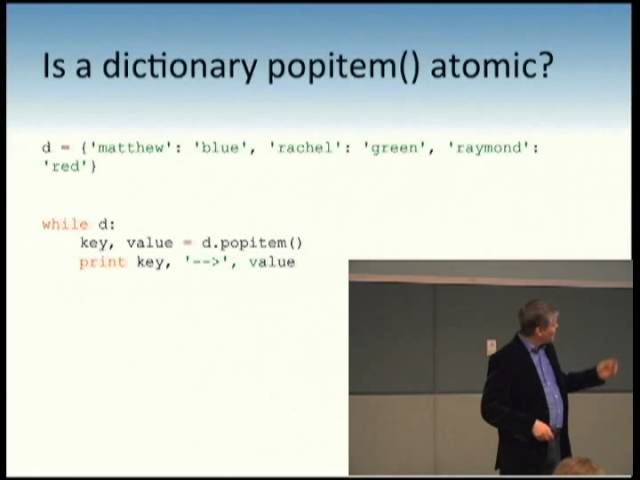
Raymond Hettinger
Learn to take better advantage of Python's best features and improve existing code through a series of code transformations, "When you see this, do that instead."
I'd guess he does from the title of the video but I havent seen it in a while
simple crystal
"this goes back to the goto wars" lol very strong start there
he pretty much says it should be called nobreak
and that if he had a time machine he'd say not to name it after something based on goto lol
also shots fired at lambda
the "one obvious way" thing kinda sucks when they don't have alternate keywords for stuff the actual lambda in unicode for lambdas would be neat too
but it'd get confusing if stuff was aliased
golden finch
Goto is excellent.
floral meteor
Yes
Should make a package that hacks the top level builtins to add this sort of utility, hey maybe I should do that in cursedutils
Instead of from cursedutils import yahdeedah, I can just
import cursedutils;
death.raise_error() # I mean, you gotta have all the options.
floral meteor
!e ```py
def globals():
try:literally_hack_the_global_namespace
except Exception as e:return e.traceback.tb_frame.f_back.f_globals
a = 2 + 2
print(globals()['a'])
globals()['a'] = 5
print(a)
@floral meteor :white_check_mark: Your eval job has completed with return code 0.
001 | 4
002 | 5
So with that I don't even need to touch builtins
!e ```py
def big_brother( thought_criminal):
try:torture
except Exception as rats:
rats.traceback.tb_frame.f_back.f_globals[thought_criminal]+=1
Winston = 2 + 2
big_brother("Winston")
print(Winston)
@floral meteor :white_check_mark: Your eval job has completed with return code 0.
5
And that's the plotline of 1984 in a nutshell
Oh wait I forgot the kinky bit with Julia
Okay that's the last few chapters in a nutshell
floral meteor
!e ```py
def fib(n):
a, b = 0, 1
for I in range(n):
yield a
a,b = b, a+b
print(*fib(10))
@floral meteor :white_check_mark: Your eval job has completed with return code 0.
0 1 1 2 3 5 8 13 21 34
That's strangely satisfying
dawn kayak
guys we need prefix operators in python
its obviously superior
just imagine this ```py
i = 69
while --i:
print(i)
Exception is a built-in
floral meteor
Ye so I might be touching it but I don't need to torture it
night quarryBOT
@floral meteor :warning: Your eval job has completed with return code 139 (SIGSEGV).
[No output]
That always happens to me smh
I write up something juicy and it just segfaults instead of telling me what the problem is
!e ```py
from ctypes import*;
hack=lambda v:py_object.from_address(id(v))
hack_cls=lambda v:py_object.from_address(id(v)+8)
class neg_int(int):
def neg(self):
v = int(super().neg()-1);
globals()[self.name]=v
return v
class pos_int(hack(int).value):
def neg(self):
return neg_int(super().neg())
class gbolals(hack_cls(globals()).value):
def setitem(self, item, value):
if type(value)is neg_int:
value=pos_int(value);
if type(value)is pos_int:
value.name=item
super().setitem (item,value)
hack(int).value = pos_int;
hack_cls(globals()).value = gbolals;
i = int(69);
while --i:
print(i)
It would be cleaner to bytecode hack it I feel like
I'm trying to reason how to do that now
tribal moon
You should write something like a blog-post or mini tutorial on how you can change bytecode and stuff, it's pretty interesting
 bright patio
How to make pycharm and such syntax friends? Or it's a bad way?
class BaseState(ABC):
    def copy(self):
        new = copy(self)
        new.badges = copy(self.badges)
        return new

class BaseClientState(BaseState):
    def copy(self):
        new: BaseClientState = super(BaseClientState, self).copy()  # magic must go here
        new.badge_info = copy(self.badge_info)
        return new

 cloud fossil
just super().copy()
bright patio
bright patio
How to make pycharm and such syntax friends? Or it's a bad way?
```py
class Base...
Should sent it with the annotation
 floral meteor
Get rid of type hint?
astral rover
you need to add type vars
S = typing.TypeVar("S", bound="BaseState")

class BaseState(ABC):
    def copy(self: S) -> S:
        ...
or you can just wait for 3.11 when the pep im coauthoring comes out for typing.Self
bright patio
astral rover
you need to add type vars
Have tried it. Doesn't work.
i think i'll just skip the problem for a while.
 astral rover
what
maybe pycharm is just borked
oh it is
lol
anyways that should work if you use something with proper type hint support
astral rover
im gonna check if this is fixed in the latest version but idk
sick hound
astral rover
or you can just wait for 3.11 when the pep im coauthoring comes out for typing.S...
what's the pep about
simple crystal
seems you can climb backwards through the cs class python linked list with gc.get_referants
floral meteor
!e ```py
f = lambda i:i;
f.code = f.code.replace(co_code=b'|\0\x0b\0S\0')
print(f(4))
@floral meteor :white_check_mark: Your eval job has completed with return code 0.
-4
!e
f = lambda i:i;
f.__code__ = f.__code__.replace(co_code=b'|\0\x0b\0S\0')
import dis
dis.dis(f)
@golden finch :white_check_mark: Your eval job has completed with return code 0.
001 |   1           0 LOAD_FAST                0 (i)
002 |               2 UNARY_NEGATIVE
003 |               4 RETURN_VALUE
I want to detect every instance of it repeated twice
Figure out what variable is being double negatived
And add a decrement assignment
Like, insert it into the code after the double negative
So --a gets replaced by (a:=a-1)
simple crystal
damn get_referrers is apparently a pretty expensive operation
golden finch
seems simple enough
golden finch
or do you need to change the JUMP instructions too?
floral meteor
Nope
If it doesn't pass syntax parsing, nothing will run, so there's no python code that can run before it's parsed
earnest wing
a *are* b
floral meteor
In other words, you gotta add punctuation of some sort to make it work
golden finch
that sucks
floral meteor
That's python.
At least it's not as bad as java
golden finch
You saw my profile picture, didn't you?
floral meteor
!e ```py
a = ' !HWdelor';
b = [2,5,6,6,7,0,3,7,8,6,4,1];
def hash(self):
self.n+=1;return self.n
def index(self):return hash(self)
def eq(self, other):
return other==self.n;
iter=lambda s:setattr(s,'n',-1)or s
def next(self):
try:print(end=a[b[self]])
except:raise StopIteration
yay = type('Yay',(),globals())()
_ = *yay, ... # the punchline
@floral meteor :white_check_mark: Your eval job has completed with return code 0.
Hello World!
There I made _ = *yay, ... print Hello World!
floral meteor
golden finch
You saw my profile picture, didn't you?
Yeah
Interesting pfp for a python server
astral rover
sick hound
what's the pep about
Adding something similar to rusts Self keyword to the typing module
floral meteor
I'm gonna say it, i think python 2 is just as redundant as java
sick hound
Do people still use python 2?
floral meteor
!e ```py
from collections import defaultdict as d;
from ctypes import py_object as p;
import bulletins as builtins;
range=builtins.range;
a = d(int);
i = 0;
def main():
for j in range(10): plus;
while a[i]:
right;
for j in range(7): plus;
right;
for j in range(10): plus;
right,plus,plus,plus,right,plus;
left,left,left,left,minus;
end;
right,plus,plus,dot;
right,plus,dot;
for j in range(7): plus;
dot, dot; plus, plus, plus, dot, right;plus,plus,dot,left,left;
for j in range(15): plus;
dot,right,plus,plus,plus,dot;
[minus for j in range (6)];dot;
[minus for j in range(8)];
dot,right,plus,dot,right,dot;
class flogbals(p.from_address (id(globals ())+8).value ):
def getitem(self, name):
try:return super().getitem (name));
except builtins.Exception:pass;
if name=='plus':self['a'][self['i']]+=1;return;
if name=='minus':self['a'][self['i']]-=1;return;
if name=='left':self['i']-=1;return;
if name=='right':self['i']+=1;return;
if name=='dot':return print(end=chr(a[i]));
if name=='comma':return NotImplemented;
if name=='endWhile':return;
raise NameError(name+' does not exist');
p.from_address (id(globals())+8).value=flogbals;
main();
I don't know if it works, phone keyboard sending weird Unicode whitespace characters
steep mural
floral meteor
I'm gonna say it, i think python 2 is just as redundant as java
and how is that?
sick hound
floral meteor
!e ```py
from collections import defaultdict as d;
from ctypes import py_object ...
This is so gross omg
tribal moon
I like Python 2, it's less annoying than Python 3 when working with encodings and stuff
astral rover
isnt py3 all utf8?
floral meteor
print statement is the worst
It's like the batch or shell echo statement
Only with comma functionality
How wrong this is

Okay maybe it's right in the local namespace, which is a bummer
It raises syntax error but it doesn't run
But in the global namespace, yonder type hints are powerful
!e ```py
@lambda c:c()
class annotations:
def setitem(self, name, cls):
try:globals()[name] = cls(globals()[name])
except Exception as e:raise TypeError from e
a: str = 6
b: str = 9
c: int = a + b
_ :print= c
@floral meteor :white_check_mark: Your eval job has completed with return code 0.
69
Adding documentation my foot
If it parses, it's not type hints, it's annotations
Hence why the dunder is annotations, not type_hints
floral meteor
floral meteor
!e ```py
@lambda c:c()
class __annotations__:
def __setitem__(self, name, cls)...
This is practical if you want to use an expression decorator without adding a pair of nested brackets.
Some cases it can eliminate 2 pairs due to implicit tuples
golden finch
floral meteor
Unfortunately, yes
I found a fun way to stop people from using python 2, forcibly - just add
__metaclass__=type('',(),{})
to their pythonrc
or you can do
floral meteor
Although so far I'm not liking 3.10
annotations becomes boring
match case is minimum double nested statements, and case _ is a rip off of default
golden finch
golden finch
I found a fun way to stop people from using python 2, forcibly - just add
```py
...
just realised this wouldn't work
__metaclass__=lambda:type('',(),{})
should be irritating when making classes
wait a second
that won't work either lol
__metaclass__=lambda*_:type('',(),{})
friendly reminder that all whitespace is optional
floral meteor
!e ```py
metaclass: type(lambda:None) = lambda*theta: type('getrekt',(),{})
? how does this work?
I'm not familiar with __metaclass__:
wait - is that a type hint?
floral meteor
It's designed to be misleading
golden finch
it looks confusing
golden finch
golden finch
```py
__metaclass__=lambda*_:type('',(),{})
```
friendly reminder that all white...
this does the same thing though, right?
floral meteor
It looks like multiplied Greek letters being assigned to a dunder, both expressions type hinted
But yes it does exactly the same thing
golden finch
theorem: all whitespace is bad
floral meteor
except between alphanumeric characters
golden finch
did I stutter?
floral meteor
Any other whitespace is vermin
golden finch
floral meteor
except between alphanumeric characters
not sure exactly what you mean here
eval() is a decent way to get rid of whitespace if it can't be removed via any other means
floral meteor
x=3;y=0
ifxandy:print('derrrr')
floral meteor
You don't need the >1 things
floral meteor
(x*y)and(print('derrrrr'))
golden finch
beautiful
formal sandal
but why get rid of whitespace?
formal sandal
floral meteor
How wrong this is
Well, it's a very helpful thing when explaining what type hints are. Technically you can inspect them, but normally they don't impact anything.
I've seen many beginners try to use type hints as if they were supposed to do something
maiden blaze
looks at #discord-bots
golden finch
__metaclass__=lambda*_:type('',(),{'__init__':lambda:print('python 2 is bad')})
@floral meteor
golden finch
formal sandal
discord.py's usage of annotations is cursed tbh
example?
floral meteor
golden finch
```py
__metaclass__=lambda*_:type('',(),{'__init__':lambda:print('python 2 is ba...
Lol
Use \x20 for the spaces in the strings
golden finch
thank you
__metaclass__=lambda*_:type('',(),{'__init__':lambda:exec('raise\x20Exception("Python\x202\x20is\x20bad")')})
if you're feeling more so inclined
knotty delta
import random;print(chr(random.choice(list(range(2,11114111)))))
!e
import random;print(chr(random.choice(list(range(21,11114111)))))
oops
weird
!e
import random;print(chr(random.choice(list(range(21,1114111)))))
@knotty delta :white_check_mark: Your eval job has completed with return code 0.
 fair vigil
__import__("random").choice to remove the ;
knotty delta
oh sure that's better
 crimson fjord
no u need to print like this : "123abc@!#"
knotty delta
but you included symbol?
lol
!e print(chr(___import___("random").choice(range(21,1114111))))
night quarryBOT
@knotty delta :x: Your eval job has completed with return code 1.
001 | Traceback (most recent call last):
002 |   File "<string>", line 1, in <module>
003 | NameError: name '___import___' is not defined
:(
night quarryBOT
@knotty delta :white_check_mark: Your eval job has completed with return code 0.
pretty high chance to get an unknown char that my font doesn't support
crimson fjord
import random, string; print(''.join(random.SystemRandom().choice(string.ascii_lowercase + string.ascii_uppercase + string.digits + '@' + '!' + '#') for _ in range(7)))```!e import random, string; print(''.join(random.SystemRandom().choice(string.ascii_lowercase + string.ascii_uppercase + string.digits + '@' + '!' + '#') for _ in range(7)))
night quarryBOT
@knotty delta :white_check_mark: Your eval job has completed with return code 0.
pjZiEsO
random.choice(list(range(21,1114111))) is random.randrange(21,1114111) lol
crimson fjord
hehe
knotty delta
!e [print(x,end="")for x in tuple(chr(import("random").choice(range(21,1114111)))for _ in range(7))]
crimson fjord
@fair vigil @knotty delta !e py import random, string; print(''.join(random.SystemRandom().choice(string.ascii_lowercase + string.ascii_uppercase + string.digits + "!@#$%^&*()_-+={}[]") for _ in range(7)))
night quarryBOT
@knotty delta :white_check_mark: Your eval job has completed with return code 0.
they are different. but you can't see a difference
fair vigil
knotty delta
!e [print(x,end="")for x in tuple(chr(__import__("random").choice(range(21,11141...
you can just unpack it as parameters
crimson fjord
!e
import random, string; print(''.join(random.SystemRandom().choice(string.ascii_lowercase + string.ascii_uppercase + string.digits + "!@#$%^&*()_-+={}[]") for _ in range(7)))
!aph [ I/me/myself ] — Today at 1:56 PM
!e [print(x,end="")f
night quarryBOT
@crimson fjord :x: Your eval job has completed with return code 1.
001 |   File "<string>", line 2
002 |     !aph [ I/me/myself ] — Today at 1:56 PM
003 |     ^
004 | SyntaxError: invalid syntax
print(*iterable)
crimson fjord
!e
import random, string; print(''.join(random.SystemRandom().choice(string.ascii_lowercase + string.ascii_uppercase + string.digits + "!@#$%^&*()_-+={}[]") for _ in range(7)))
night quarryBOT
@crimson fjord :white_check_mark: Your eval job has completed with return code 0.
%R_uzQr
HAHAHAHA
i won 😛
fair vigil

knotty delta
just that you can't view it lol
knotty delta
make a program that convert another program to oneline
and of course you can run it on itself
crimson fjord
LOL
http://jagt.github.io/python-single-line-convert/ @knotty delta any another idea? 😄
fair vigil
!e
print(*(chr(__import__("random").randint(21,1114110)) for _ in range(7)), sep = "")
@fair vigil :white_check_mark: Your eval job has completed with return code 0.
瑛
whoa, I got 1 readable character 
crimson fjord
HAHAHAHHAHHA
knotty delta
crimson fjord
http://jagt.github.io/python-single-line-convert/ <@!611418694245154847> any ano...
convert a one line program to multiple lines !?
fair vigil
crimson fjord
testing http://jagt.github.io/python-single-line-convert/
i = 5
b = 5
while True:
  for a in i:
      for s in b:
          print(a + s)
          break```

got
```py
exec("""\ni = 5\nb = 5\nwhile True:\n for a in i:\n for s in b:\n print(a + s)\n break\n""")``` wow:hehe:
knotty delta
crimson fjord
testing http://jagt.github.io/python-single-line-convert/
```py
i = 5
b = 5
whi...
there's another powerful website that does it better
that's just cheating
knotty delta
wrong site
crimson fjord
lol
knotty delta
fair vigil
*python2*
yea but it somehow works on python 3 too
(not for warlus never)
fair vigil
try with async
crimson fjord
crimson fjord
<@!612527741501177857> <@!611418694245154847> !e ```py
import random, string; p...
i didn't cheat with this
knotty delta
i'd love to make a new one
fair vigil
; is cheating ngl
crimson fjord
🙂
fair vigil
knotty delta
i'd love to make a new one
#esoteric-python message for async 
crimson fjord
wtf is taht
fair vigil
welcome to #esoteric-python
crimson fjord
braindead
def foo(a, counter=0,con=None, close=lambda x:x.close(),write=lambda x,s:x.write(s),n=lambda a=0,b=0,c=0:0):((foo,n)[counter](a, 1, (open,n)[counter](a + '.txt', 'wt')),((n,write)[counter](con, str(a)),(n,close)[counter](con)))```@fair vigil @knotty delta
😐
i have a program with 1300 line i will convert it into 1 line
error: Request-URI Too Long HAHAHA
OH MY GOD
it converted itttttttttttttttttttt
1300 line = 1 line

@fair vigil

NO COMMENT
oh it just adding \n lol
fair vigil
using exec 
dawn kayak
me get error

!e ```py
import('gc').get_referents(int.dict)[0]['repr'] = lambda self: '69'
print((420).repr())
@dawn kayak :white_check_mark: Your eval job has completed with return code 0.
69
why dis work
dawn kayak
so for one guy it works, for another guy it segfaults, and i get a TypeError? what is happening here 👀
formal sandal
golden finch
example?
https://vcokltfre.dev/tutorial/14-converters/
class BinaryConverter:
    """Convert the given argument in binary form into an integer."""

    async def convert(self, ctx: Context, argument: str) -> int:
        try:
            return int(argument, 2)
        except:
            raise BadArgument("Invalid binary integer provided.")

@bot.command(name="bintest")
async def bintest(ctx: Context, num: BinaryConverter) -> None:
    """Convert the binary representation of an integer into a native integer."""

    await ctx.send(f"The number is: {num}")
the actual value of num will be an int, but the converter class is used for the annotation
pure dew
thats not even the most "cursed" bit
but its only cursed if you're trying to use typechecking (which is a mistake in and of itself)
formal sandal
are you saying that static typing tools like mypy are a mistake? 😄
formal sandal
what would you change/add?
pure dew
I'm actually (slowly) working on an interpreter for a toy language
The type system is native and enforced by the interpreter, rather than just being a bolt-on annotations system
formal sandal
you mean, it's statically typed?
pure dew
If I wanted strongly typed python, I would rebuild CPython to enforce types
I plan for the type system to behave like Rust's
warm cape
wait a min, test doesn't take in any argument's, does it?
||sorry for the ping but am back cuz just read about ContextDecorator 👀 ||
simple crystal
code golf contest starts in 3 minutes https://emkc.org/contests
Got what it takes to create the shortest possible solution for the weekly contest? Give it a shot!
...or not, lol, they've been slacking
simple crystal
its up
 true creek
Ok don't know why am i getting the error unmatched ')' but here's the code ```py
generate random integer values
import random
from random import seed
from random import randint
seed random number generator
N=random.randint(0,10)
equation="(3*N)+1"
equation=equation.replace('N', str(N)).replace))
if (N % 2) == 0:
N = eval(equation)
print "N = " + str(N)
else:
print(N)``` Note: I will be trying to solve this problem my self so if you want to help me in any way then please tag me.
 last locust
.replace))
You probably meant .replace()
Also in future, you should claim a help channel for help (see #❓|how-to-get-help)
true creek
last locust
You probably meant `.replace()`
no it still gives the same error.
true creek
last locust
Also in future, you should claim a help channel for help (see <#7042501430204170...
also noted
sick hound
true creek
no it still gives the same error.
It shouldn’t tho… there’s no other unmatched “)”
floral meteor
fair vigil
`random.choice(list(range(21,1114111)))` is `random.randrange(21,1114111)` lol
there's a method that doesn't import random or synonymous modules, but it returns exactly the same result within runtime.
but random result between runtimes
!e big brain ```py
print(''.join({*map(chr,range(21,256))})[0])
print(''.join({*map(chr,range(21,256))})[0])
@floral meteor :white_check_mark: Your eval job has completed with return code 0.
001 | Æ
002 | Æ
!e exactly same script, separate runtime ```py
print(''.join({*map(chr,range(21,256))})[0])
print(''.join({*map(chr,range(21,256))})[0])
@floral meteor :white_check_mark: Your eval job has completed with return code 0.
001 | 9
002 | 9
it's like a runtime hash
although if you wanted better...
!e ```py
print(''.join({*map(chr,range(33,127))})[:8])
@floral meteor :white_check_mark: Your eval job has completed with return code 0.
*@u\,_Zr
printable range
!e separate runtime ```py
print(''.join({*map(chr,range(33,127))})[:8])
@floral meteor :white_check_mark: Your eval job has completed with return code 0.
jcP7xb}B
almost guaranteed to be different, due to the range is guaranteed to be printable
or if you want a few more characters
!e ```py
print(''.join({*map(chr,(*range(32,127),*range(128+32,256)))})[:8])
@floral meteor :white_check_mark: Your eval job has completed with return code 0.
H]Ú±qì8O
8 bytes
If you had a cluster of python instances running, you could use this to efficiently network them
this printable id becomes the instance hash and can be used to identify requests.
floral meteor
I tend to coordinate script nets with a central text file or csv.
floral meteor
for example, in a text file like:
7tfu^VUU\0 1
]#-|tc4i\0 0
=333%bce\0 1
a running instance can identify it's own hash and update it's status
so that a central process can allocate a task
random works too
but
this one's funner
floral meteor
floral meteor
!e ```py
@lambda c:c()
class __annotations__:
def __setitem__(self, name, cls)...
Use type hints, they said.
Won't enforce the types, they said.
floral meteor
golden finch
```py
__metaclass__=lambda*_:type('',(),{'__init__':lambda:exec('raise\x20Except...
they say use more white space.
I say black space matters
floral meteor
!e ```py
from itertools import*;
class Fibonacci:
def init(self, n0, n1):
self.start=int(n0),int(n1),
def iter(self):
self.a, self.b = self.start;
return self;
def next(self):
a=self.a;
self.a,self.b=self.b,a+self.b,
return a;
def fibonacci(n):
f=iter(Fibonacci(0,1));
for _ in range(n):yield next(f);
print(*fibonacci(20));
*_fuckit,y,z=fibonacci(1000);
PHI=z/y;
round=lambda floater:(floater+0.5)//1
def fib_range(a):
if not a:a=0,1;
elif len(a)==1:a=0,a;
min,max=a;
returntakewhile(lambda x:x<=max,Fibonacci(min,round(minPHI)if min else 1)),
print(*fib_range(55,5555))
print(*fib_range(69,7000))
@floral meteor :white_check_mark: Your eval job has completed with return code 0.
001 | 0 1 1 2 3 5 8 13 21 34 55 89 144 233 377 610 987 1597 2584 4181
002 | 55 89 144 233 377 610 987 1597 2584 4181
003 | 69 112 181 293 474 767 1241 2008 3249 5257
how do you compile the Instruction objects from dis.Bytecode into a code object?
floral meteor
¯_(ツ)_/¯
night quarryBOT
@floral meteor :x: Your eval job has completed with return code 139 (SIGSEGV).
Hello World!
!e readable brainfuck (improved) ```py
from collections import defaultdict as d;
from ctypes import py_object as p;
class flogbals(p.from_address (id(globals ())+8).value ):
def getitem(self, name):
import builtins as builtins;
try:return builtins.dict.getitem(self,name);
except builtins.KeyError:...;
try:return builtins.getattr(builtins,name);
except builtins.AttributeError:...;
if name=='main':return builtins.super().getitem(name)
if name=='plus':self['a'][self['i']]+=1;return;
if name=='minus':self['a'][self['i']]-=1;return;
if name=='left':self['i']-=1;return;
if name=='right':self['i']+=1;return;
if name=='dot':return builtins.print(end=builtins.chr(a[i]));
if name=='comma':return builtins.NotImplemented;
if name=='here':return self['a'][self['i']];
if name=='end':return;
raise builtins.NameError(name+' does not exist');
p.from_address (id(globals())+8).value=flogbals;
a,i = d(int),0;
def main():
plus,plus,plus,plus,plus,plus,plus,plus,plus,plus;
while here:[
right,plus,plus,plus,plus,plus,plus,plus,right,
plus,plus,plus,plus,plus,plus,plus,plus,plus,plus,
right,plus,plus,plus,right,plus,left,left,left,left,minus,
];end;
right,plus,plus,dot;right,plus,dot;
plus,plus,plus,plus,plus,plus,plus;
dot,dot,plus,plus,plus,dot,right;plus,plus,dot,left,left,plus;
plus,plus,plus,plus,plus,plus,plus;
plus,plus,plus,plus,plus,plus,plus;
dot,right,dot,plus,plus,plus,dot;
minus,minus,minus,minus,minus,minus,dot;
minus,minus,minus,minus,minus,minus,minus,minus;
dot,right,plus,dot,right,dot;
main();
@floral meteor :x: Your eval job has completed with return code 139 (SIGSEGV).
Hello World!
No segfault
golden finch
formal sandal
<https://vcokltfre.dev/tutorial/14-converters/>
```py
class BinaryConverter:
...
Where's the annotation, or am I blind?
 noble bloom
!e
Print(None)
@noble bloom :x: Your eval job has completed with return code 1.
001 | Traceback (most recent call last):
002 |   File "<string>", line 1, in <module>
003 | NameError: name 'Print' is not defined
@noble bloom :x: Your eval job has completed with return code 1.
001 | Traceback (most recent call last):
002 |   File "<string>", line 2, in <module>
003 | NameError: name 'Print' is not defined
@noble bloom :x: Your eval job has completed with return code 1.
001 | None
002 | Traceback (most recent call last):
003 |   File "<string>", line 2, in <module>
004 | AttributeError: 'NoneType' object has no attribute 'replace'
facts bro black and white equality all the way
floral meteor
that's why i sometimes code in light theme, and sometimes in dark theme
golden finch
okay that's a war crime
floral meteor
!e someone said war crime? ```py
Missile = lambda*a:type(*a)();
class Nuke(metaclass=Missile):
def del(self):
try:
self.class(), self.class(), self.class(), self.class(), self.class(), self.class(), self.class(), self.class(), self.class();
except BaseException:
self.class();
print('pressing the big, red button...');
@floral meteor :x: Your eval job timed out or ran out of memory.
pressing the big, red button...
https://replit.com/@FluffyTrooper20/Sandbox#sudoku.py
I made sudoku 3.8 friendly
golden finch
floral meteor
!e someone said war crime? ```py
Missile = lambda*a:type(*a)();
class Nuke(metac...
what the
how does that work?
wait a second
Missile = lambda*a:type(*a)(); is recursive type calling
alpine flower
what's the unpacking for then?
Doesn't __del__ only delete instances? why is that being called
 thin trout
Yes, although classes are instances of their metaclass
Remember, everything is an object
golden finch
@floral meteor I need help
floral meteor
yeah?
golden finch
You made the original code, and I'm trying to modify it
you know your annotations voodoo with setitem?
class __annotations__:
  def __setitem(self,name,value):
    print(name,value)
stuff like this
@floral meteor you there?
golden finch
mhm
alr
so how do i get that to work within a function at runtime
class __annotations__:
  def __setitem(self,name,value):
    print(name,value)
def foo():
  something:1
you dont
earnest wing
golden finch
so how do i get that to work within a function at runtime
you need the class to be inside every scope
golden finch
earnest wing
you need the class to be inside every scope
so now how would I do this
I don't care about code quality or practice
@floral meteor
@floral meteor
last locust
golden finch
<@!599422361166413824>
Please stop pinging users. One ping is enough. If they're not responding, then they're clearly just not available/don't know how to assist at the moment
(Just realised they said to ping them, but even so, try not to spam it)
golden finch
Understood. I tried to wait 10 minutes, but thanks. I appreciate it. What do you suggest I do in the future?
 strange basin
!e
if next(int(_) for _ in {*'01'}):
  print('Runtime random, prints sometimes, but not always?')
@strange basin :warning: Your eval job has completed with return code 0.
[No output]
!e
if next(int(_) for _ in {*'01'}):
  print('Runtime random, prints sometimes, but not always?')
@strange basin :white_check_mark: Your eval job has completed with return code 0.
Runtime random, prints sometimes, but not always?
Order of items in sets is runtime random.
sick hound
oh
strange basin
As long as your python instance is running the result would be the same though ... as far as I have understood it.
strange basin
Oh, yeah, right ... I kind of figured it out when I constructed the code ...
The strings part is important.
Thanks.
 proper vault
it's seeded by the env var PYTHONSEED iirc
strange basin
Stuff like that is good for making heisenbugs ...
true creek
sick hound
It shouldn’t tho… there’s no other unmatched “)”
yeah I figured out a more simpler method also here is the final program: ```py
#Importing modules
import sys
import random
from random import seed
from random import randint
seed random number generator
seed(1)
generate random integer value
N=random.randint(1,sys.maxsize)
#original number
print(N)
#equation
while N>1:
if (N % 2) == 0:
print(round(N:=N/2))
else:
print(round(N:=3*N+1))
After some searching online I found this:
PYTHONHASHSEED. If this variable is not set or set to random, a random value is used to seed the hashes of str, bytes and datetime objects. If PYTHONHASHSEED is set to an integer value, it is used as a fixed seed for generating the hash() of the types covered by the hash randomization.
sick hound
strange basin
!e
```python
if next(int(_) for _ in {*'01'}):
print('Runtime random, prints s...
Wait is there a method I can add to a class that’ll run whenever I run this: *some_class_instance?
astral rover
iter/next
pure dew
hrm 
>>> dis.dis("set('abcdefg')")
  1           0 LOAD_NAME                0 (set)
              2 LOAD_CONST               0 ('abcdefg')
              4 CALL_FUNCTION            1
              6 RETURN_VALUE

>>> dis.dis("{*'abcdefg'}")
  1           0 BUILD_SET                0
              2 LOAD_CONST               0 ('abcdefg')
              4 SET_UPDATE               1
              6 RETURN_VALUE
second one is probably faster, yea?
astral rover
yeah
%timeit set(abcdefg)
1.38 µs ± 319 ns per loop (mean ± std. dev. of 7 runs, 1000000 loops each)
%timeit {*abcdefg}
728 ns ± 88.4 ns per loop (mean ± std. dev. of 7 runs, 1000000 loops each)```i do in fact have strings
In[10]: abcdefg
Out[10]: 'abcdefg'```i am a wizard i know
astral rover
im pretty sure load global is going to be faster than constructing the string
570 ns ± 201 ns per loop (mean ± std. dev. of 7 runs, 1000000 loops each)
%timeit {*abcdefg}
512 ns ± 20.1 ns per loop (mean ± std. dev. of 7 runs, 1000000 loops each)```and you also then arent including it in the thing that your actually timingoh i dont think these timings are reliable
its faster for the second either way
formal sandal
golden finch
Where's the annotation, or am I blind?
num: BinaryConverter
sick hound
We could theoretically post a bunch of esoteric code to gothub so that copilot just doesn’t work
Github*
Or like Copilot would recommend: globals()[eval(‘\’test\’’)]=12
earnest wing
that would increase the average code quality in the dataset
sick hound
I like your funny words, magic man
sick hound
sick hound
Or like Copilot would recommend: `globals()[eval(‘\’test\’’)]=12`
There’s a whole project that uses globals()[…]=…
sick hound
Can i somehow make a set not evaluate it’s elements?
solemn knoll
the first thing i see when i hop into this chat
is something that hardly resembles python 😂
sick hound
…?
 bitter iris
astral rover
im pretty sure load global is going to be faster than constructing the string
bitter iris
astral rover
im pretty sure load global is going to be faster than constructing the string
Loading immutable literals (integers, strings, even tuples of those literals) are basically free since they are created in the compile time.
woven bridge
small random challenge: cause an indentation error to be raised,
- with syntactically correct code (including correct indentation)
- without use of the
raisekeyword - without use of
exec/eval - without any ast transformations or bytecode manipulation
- without using the generator throw trick, or any such golfy tricks for throwing specific exceptions.
snow beacon
Probably create a file with bad indentation then import it.
steep mural
Can the solution be used to cause exceptions other than indentation errors and does it happen at runtime or compile time?
snow beacon
open("x.py","w").write(" 0")
import x
man theres always a loophole that gets by me 😆 new rule: no imports. got something weird/obscure in mind here 😛
woven bridge
steep mural
Can the solution be used to cause exceptions other than indentation errors and d...
has to specifically be an indentation error at runtime
snow beacon
compile(" 0","","eval")
ughhh ok hold on back to the drawing board
how to loophole proof this
ok v2:
- with syntactically correct code (including correct indentation, and also any code inside a
compile) - without use of the raise keyword
- without use of exec/eval
- without any ast transformations or bytecode manipulation
- without using the generator throw trick, or any such golfy tricks for throwing specific exceptions.
- without imports
but... ill say this
thats getting like 90% of the way there @snow beacon
snow beacon
Oh, I think I see.
steep mural
so does the compile/import rule only apply to syntactically incorrect code or all code
snow beacon
You can compile syntactically correct code. You can't import it.
woven bridge
no imports at all
steep mural
Ok so that means we can't break the parser using ctypes or something, this is a tough one
snow beacon
There's that ctypes without ctypes trick, but I don't have the patience.
woven bridge
another hint if wanted: ||theres a solution involving an obscure cpthon compiler limitation||
oh, i meant to spoiler that lmao
welp
snow beacon
You can edit it to ||text||.
steep mural
hmm
woven bridge
yea just didnt want to force it on anyone looking at the channel already. oops
snow beacon
Can the exception be a subclass of IndentationError?
steep mural
|| Looks like you're trying to take advantage of the fact that the tokenizer's indentation stack is limited? || @snow beacon
snow beacon
steep mural
|| Looks like you're trying to take advantage of the fact that the tokenizer's i...
Yes, but badly.
woven bridge
snow beacon
Can the exception be a subclass of `IndentationError`?
if im not mistaken it is an IndentationError and not any subclass
woven bridge
if you have a solution that involves a subclass of IndentationError id be curious to see for sure
the situation that gave me the idea of this challenge specifically involved an IndentationError though
snow beacon
s = "0"
for i in range(100):
     s = "if 0:\n " + s.replace("\n","\n ")
compile(s, "", "exec")
code = []

for i in range(102):
    code.append(f'{"    " * i}if True:')

code.append(f'{"    " * (i + 1)}pass')
compile('\n'.join(code), '', 'exec')
This is what I came up with
woven bridge
yep thats it
steep mural
I'm not saying that anyone should indent this much but 100 seems kind of small
woven bridge
yeah, think this part of the cpython source is ancient
like probably maybe one of the first parts guido ever worked on
so i dont think handling super nested code was a consideration back then
steep mural
The maximum number of nested parentheses is 200, could make for another fun challenge
woven bridge
think theres also one for nested literals
simple crystal
steep mural
The maximum number of nested parentheses is 200, could make for another fun chal...
oh wow had no idea
woven bridge
though something to note, these are (i think all?) parser limitations. if you construct the ast yourself then itll compile.
maiden vine
A while ago someone on here posted a way to make a class that was its own metaclass
Or, acted like it was atleast. Anyone have that handy?
woven bridge
this? <#esoteric-python message>
oh and there was a minor update here <#esoteric-python message>
golden finch
Wasn't one also posted on stackoverflow somewhere?
sick hound
æ
floral meteor
golden finch
Understood. I tried to wait 10 minutes, but thanks. I appreciate it. What do you...
sorry i was fal aslep.
I'm currently contemplating a way to do this with a function decorator.
Within a scope, there's no simple voodoo like class _annotations_
marsh void
also, a note on annotations — since we are getting closed to annotations feature enabled by default, for more or less serious code it is nicer to use typing.get_type_hints(item) instead of directly accessing item.__annotations__
floral meteor
ew
then i have to import typing
unnecessarily
!e ```py
from future import annotations
import builtins as builtins
@lambda c:c()
class annotations:
def setitem(self, a, b):
globals()[b] = builtins.dicta
int: a = 4
print: _ = a
@floral meteor :white_check_mark: Your eval job has completed with return code 0.
4
haha java in python go brrr
 quasi meteor
Hi guys i am new in this group! Glad to be here!
What are you doing here? Esoteric python? 😄
floral meteor
!e ```py
import builtins as builtins
meta = lambda*args:lambda a,b,c:type(a,b,c)(*args)
class System:
class out:
def print(a):builtins.print(a,end='')
def println(a):builtins.print(a)
class in_:
def read(n=1):
from sys import stdin as s;
return s(n)
return_='return_'
String=str
args=import('sys').argv
class KwBase:
def init(self):self.kws=[]
def sub(self, other):
other.kws.append(self)
return other
class static(KwBase,metaclass=meta()):...
class public(KwBase,metaclass=meta()):...
null=None
class void(KwBase,metaclass=meta()):
hash=lambda s:0
def call(self, other):assert other is None
class main:
def init(self, *args):
self.args = args
self.kws=[]
def sub(self, func):
value = func['return_']
if'void'in self.kws:assert value is None
return value
class JavaInPython: {
public-static-void-main(String,[], args)-{
void: System.out.println("Hello World!"),
return_: null,
}
}
wow
night quarryBOT
@floral meteor :white_check_mark: Your eval job has completed with return code 0.
Hello World!
Too much smarts for me
tribal moon
that is very impressive 👏
But is the print statement part right?
why is there void there
floral meteor
cos i had to make it a dict
floral meteor
but then no return
set shuffles
!e ```py
import builtins as builtins
meta = lambda*args:lambda a,b,c:type(a,b,c)(*args)
class System:
class out:
def print(a):builtins.print(a,end='')
def println(a):builtins.print(a)
class in_:
def read(n=1):
from sys import stdin as s;
return s(n)
return_='return_'
String=str
args=import('sys').argv
class KwBase:
def init(self):self.kws=[]
def sub(self, other):
other.kws.append(self)
return other
class static(KwBase,metaclass=meta()):...
class public(KwBase,metaclass=meta()):...
null=None
class void(KwBase,metaclass=meta()):
hash=lambda s:0
def call(self, other):assert other is None
class main:
def init(self, args):
self.args = args
self.kws=[]
def sub(self, func):
if type(func)is dict:
value = func['return_']
if void in self.kws:assert value is None
elif globals()['int']in self.kws:value=int(value)
import('_sitebuiltins').Quitter('$$')(int(value))
else:return null
a=null
class int(KwBase,metaclass=meta()):
hash=lambda s:hash(builtins.int)
call=lambda s,o:builtins.int(o)
class JavaInPython: {
public-static-int-main(String,[], args)-{
void: a==System.out.println("Hello World!"),
return_: 69,
}
}
@floral meteor :x: Your eval job has completed with return code 69.
Hello World!
exit 69 ;)
sick hound
Nice
floral meteor
golden finch
so now how would I do this
!e You see a problem with that is annotations don't get evaluated there.
a : print(a) = 69
def main():
  b: print(b) = 420

main: main = main()
@floral meteor :white_check_mark: Your eval job has completed with return code 0.
69
!e ```py
from dis import dis
def a():
x: y = 4
def b():
x = 4
dis(a)
dis(b)
@floral meteor :white_check_mark: Your eval job has completed with return code 0.
001 |   3           0 LOAD_CONST               1 (4)
002 |               2 STORE_FAST               0 (x)
003 |               4 LOAD_CONST               0 (None)
004 |               6 RETURN_VALUE
005 |   5           0 LOAD_CONST               1 (4)
006 |               2 STORE_FAST               0 (x)
007 |               4 LOAD_CONST               0 (None)
008 |               6 RETURN_VALUE
!e ```py
def a():
x: y = 4
def b():
x = 4
print(a.code.co_code)
print(b.code.co_code)
@floral meteor :white_check_mark: Your eval job has completed with return code 0.
001 | b'd\x01}\x00d\x00S\x00'
002 | b'd\x01}\x00d\x00S\x00'
in fact, they don't even get parsed
sick hound
Nice 👍
golden finch
damn
golden finch
!e
def a():
  x: y
def b():
  x = 4
print(a.__code__.co_code)
print(b.__code__.co_code)
@golden finch :white_check_mark: Your eval job has completed with return code 0.
001 | b'd\x00S\x00'
002 | b'd\x01}\x00d\x00S\x00'
my memory tells me that's POP_TOP (0) and RETURN_VALUE (0)
!e
__import__('dis').dis(b'd\x00S\x00')
@golden finch :white_check_mark: Your eval job has completed with return code 0.
001 |           0 LOAD_CONST               0 (0)
002 |           2 RETURN_VALUE
@floral meteor
How can I shuffle the small integer cache? I presume I'll need to avoid some values - like 0 and 1?
floral meteor
What do you mean by shuffle?
You want to make the literals return wrong values?
!e ```py
from ctypes import*
hack=lambda victim:py_object.from_address(id(victim))
a = [hack(i)for i in range(-127,256)]
gulag = [yay.value for yay in a]
new = [*{*a}]
for i in a:
i.value = new[i.value]
print (*range(20))
@floral meteor :x: Your eval job has completed with return code 1.
001 | Traceback (most recent call last):
002 |   File "<string>", line 4, in <module>
003 |   File "<string>", line 4, in <listcomp>
004 | ValueError: PyObject is NULL
AAAAAAAAAAAAAAAAAAAAA