#esoteric-python
1 messages · Page 103 of 1
 plucky wedge
 night quarryBOT
@plucky wedge :white_check_mark: Your eval job has completed with return code 0.
3
lol
 naive roost
I got at most a 6 for now, I'm going to do a little statistical analysis
plucky wedge
!e
print(chr((3).__add__(__import__("operator").floordiv(__import__("random").randint(1,10000000), __import__("random").randint(1,1000000)))))
@plucky wedge :white_check_mark: Your eval job has completed with return code 0.
fun
naive roost
ok, out of 10_000_000 such numbers, I got an average of around 10.56, a standard deviation of about 1215, with a median of 3, a 75th-percentile of 4, 90th percentile of 7, 99th percentile of 52, and maximum of 1904107. wow, that's quite clumped around 3
plucky wedge
are u talking to me?
naive roost
I just wanted to do a quick analysis of the results of your code 😅
naive roost
interesting phenomenon: the standard deviation increases as you remove the smallest elements. that's quite an interesting distribution you got us 😄
plucky wedge
im not sure i know what that means
I still have yet to take anything on statistics so
 rugged sparrow
@bitter iris it all stems from the fact that LOAD_CONST doesnt do bounds check
plucky wedge
;/
rugged sparrow
so you can construct a fake bytearray object to get r/w to pythons entire address space
naive roost
wow, that's... interesting to say the least (talking to chilaxan)
rugged sparrow
!e ```py
def sizeof(obj):
return type(obj).sizeof(obj)
TUPLE_HEADER = sizeof(())
BYTES_HEADER = sizeof(b'') - 1
PTR_SIZE = sizeof((0,)) - TUPLE_HEADER
MAX_INT = (1 << PTR_SIZE * 8 - 1) - 1
def load_addr(addr):
magic = lambda:None
b_addr = addr.to_bytes(PTR_SIZE, 'little')
offset = id(b_addr) + BYTES_HEADER
offset -= id(magic.code.co_consts) + TUPLE_HEADER
offset //= PTR_SIZE
if offset < 0: # overflow offset to convert to unsigned
offset += 0xffffffff + 1
co_code = bytes((0x64, offset & 0xff))
offset >>= 8
while offset > 0:
co_code = bytes((0x90, offset & 0xff)) + co_code
offset >>= 8
co_code += bytes((0x53, 0))
magic.code = magic.code.replace(
co_code=co_code
)
return magic()
memory_backing = b''.join(n.to_bytes(PTR_SIZE, 'little') for n in (
1,
id(bytearray),
MAX_INT,
0, 0, 0, 0
))
mem = load_addr(id(memory_backing) + BYTES_HEADER)
mem is now a bytearray pointing to the entire address space```
night quarryBOT
@rugged sparrow :warning: Your eval job has completed with return code 0.
[No output]
@naive roost that is the basic construct
naive roost
oh, right. I don't understand much of that, though
 sick hound
dafq
naive roost
that's what you get when you delve in CPython's internals, but in Python
sick hound
this is too high low level for me
 sudden willow
why print and not (__import__("sys").stdout.write())
made my hello world statement longer btw
!e
(
  (_:=lambda _:(_ := _.__add__(__name__.__len__().__bool__().__int__())),

  (__import__("sys").stdout.write(
    chr(__:=[_(x) for x in range(ord(chr(72)).__int__())][-(__debug__.__int__())]).__add__(
      chr(__:=[_(x) for x in range(ord(chr(101)).__int__())][-(__debug__.__int__())]).__add__(
        chr(__:=[_(x) for x in range(ord(chr(108)).__int__())][-(__debug__.__int__())]).__add__(
          chr(__:=[_(x) for x in range(ord(chr(108)).__int__())][-(__debug__.__int__())]).__add__(
            chr(__:=[_(x) for x in range(ord(chr(111)).__int__())][-(__debug__.__int__())]).__add__(
              chr(__:=[_(x) for x in range(ord(chr(44)).__int__())][-(__debug__.__int__())]).__add__(
                chr(__:=[_(x) for x in range(ord(chr(32)).__int__())][-(__debug__.__int__())]).__add__(
                  chr(__:=[_(x) for x in range(ord(chr(87)).__int__())][-(__debug__.__int__())]).__add__(
                    chr(__:=[_(x) for x in range(ord(chr(111)).__int__())][-(__debug__.__int__())]).__add__(
                      chr(__:=[_(x) for x in range(ord(chr(114)).__int__())][-(__debug__.__int__())]).__add__(
                        chr(__:=[_(x) for x in range(ord(chr(108)).__int__())][-(__debug__.__int__())]).__add__(
                          chr(__:=[_(x) for x in range(ord(chr(100)).__int__())][-(__debug__.__int__())]).__add__(
                            chr(__:=[_(x) for x in range(ord(chr(33)).__int__())][-(__debug__.__int__())])
))))))))))))))))
@sudden willow :white_check_mark: Your eval job has completed with return code 0.
Hello, World!
 lavish shore
longer, but short enough to paste in here for immediate eval
tbh that's a good goal
sudden willow
can aswell be condensed down into a single line as its a tuple
!e
((_:=lambda _:(_ := _.__add__(__name__.__len__().__bool__().__int__())),(__import__("sys").stdout.write(chr(__:=[_(x) for x in range(ord(chr(72)).__int__())][-(__debug__.__int__())]).__add__(chr(__:=[_(x) for x in range(ord(chr(101)).__int__())][-(__debug__.__int__())]).__add__(chr(__:=[_(x) for x in range(ord(chr(108)).__int__())][-(__debug__.__int__())]).__add__(chr(__:=[_(x) for x in range(ord(chr(108)).__int__())][-(__debug__.__int__())]).__add__(chr(__:=[_(x) for x in range(ord(chr(111)).__int__())][-(__debug__.__int__())]).__add__(chr(__:=[_(x) for x in range(ord(chr(44)).__int__())][-(__debug__.__int__())]).__add__(chr(__:=[_(x) for x in range(ord(chr(32)).__int__())][-(__debug__.__int__())]).__add__(chr(__:=[_(x) for x in range(ord(chr(87)).__int__())][-(__debug__.__int__())]).__add__(chr(__:=[_(x) for x in range(ord(chr(111)).__int__())][-(__debug__.__int__())]).__add__(chr(__:=[_(x) for x in range(ord(chr(114)).__int__())][-(__debug__.__int__())]).__add__(chr(__:=[_(x) for x in range(ord(chr(108)).__int__())][-(__debug__.__int__())]).__add__(chr(__:=[_(x) for x in range(ord(chr(100)).__int__())][-(__debug__.__int__())]).__add__(chr(__:=[_(x) for x in range(ord(chr(33)).__int__())][-(__debug__.__int__())])))))))))))))))))
@sudden willow :white_check_mark: Your eval job has completed with return code 0.
Hello, World!
probably my best esoteric work
 stark fable
sudden willow
why print and not `(__import__("sys").stdout.write())`
stark fable
sudden willow
why print and not `(__import__("sys").stdout.write())`
why __import__("sys").stdout.write and not __import__("os").fdopen(1,"w").write
sudden willow
fair enough
!e
(
    _ := lambda message: print(message),
    _("i wonder if this works"))
@sudden willow :white_check_mark: Your eval job has completed with return code 0.
i wonder if this works
basially, what cityshow is doing is _ = print
lavish shore
got it
night quarryBOT
@sick hound :white_check_mark: Your eval job has completed with return code 0.
hello world
wait can I just start using _ for varnames everywhere
lavish shore
👀
sick hound
ngl i really want to try to create a really basic python obfuscator
 cloud hound
anyone know how to collapse cells in jupytr notebook?
i remember doing it once and I forgot..
lavish shore
alright y'all, we need an esoteric python implementation for this
more srsly tho idk :c
cloud hound
lol its all good back to google
sick hound
lol
cloud hound
ugh i can collapse the output cell but not input
sick hound
hey quick question
since there's an sys.stdout.write()
is there an input version of it?
nvm
there's a sys.stdin.readline()
sick hound
fuckk i don't want to write an expression parser
sick hound
!e
[a:=__name__.__len__().__bool__().__int__(), __import__("sys").stdout.write(a.__str__().__add__(chr(__name__.__len__().__bool__().__int__().__add__(__name__.__len__().__bool__().__int__()).__pow__(__name__.__len__().__bool__().__int__().__add__(__name__.__len__().__bool__().__int__()).__add__(__name__.__len__().__bool__().__int__())).__add__(__name__.__len__().__bool__().__int__().__add__(__name__.__len__().__bool__().__int__())))))]```@sick hound :white_check_mark: Your eval job has completed with return code 0.
1
(pretend "sys" is chr(__name__.__len__().__bool__().__int__().__add__(__name__.__len__().__bool__()...)
equivalent code is
a = 1
print(a)```actually here
!e
[a:=__name__.__len__().__bool__().__int__(), b:=__name__.__len__().__bool__().__int__(), c:=a.__add__(b), __import__('sys').stdout.write(c.__str__().__add__(chr(__name__.__len__().__bool__().__int__().__add__(__name__.__len__().__bool__().__int__()).__pow__(__name__.__len__().__bool__().__int__().__add__(__name__.__len__().__bool__().__int__()).__add__(__name__.__len__().__bool__().__int__())).__add__(__name__.__len__().__bool__().__int__().__add__(__name__.__len__().__bool__().__int__())))))]```@sick hound :white_check_mark: Your eval job has completed with return code 0.
2
(sys is here cause otherwise discord would throw a fit)
equivalent code is
a = 1
b = 1
c = a + b
print(c)```I find it interesting how you made the print statement so verbose
I wonder if the a+b part can be made into a bunch of 1+1s
sick hound
do it the brainfuck way I guess
lavish shore
yeah either that or more lambdas https://en.wikipedia.org/wiki/Church_encoding#Church_numerals
sick hound
powerful
 snow beacon
sick hound
fuckk i don't want to write an expression parser
snow beacon
sick hound
fuckk i don't want to write an expression parser
I think there's the AST library.
sick hound
lavish shore
I find it interesting how you made the print statement so verbose
it is literally a bunch of 1+1s
do everything with a series of increments ofc
it is literally that
lmfao
but with some slight optimizations
remove the optimizations and further obfuscate
only way to progress ofc
no like i don't want it too big
cause like
it wont fit on discord then
lavish shore
yeah, won't be as easy to demo it
sick hound
oh fair enough
lavish shore
sick hound
!e
```py
[a:=__name__.__len__().__bool__().__int__(), b:=__name__.__len__().__bo...
ohh most of all that is for \n, wow
lavish shore
sick hound
but with some slight optimizations
okee I get this then
sick hound
?
@lavish shore wdym
!e
[a:=__name__.__len__().__bool__().__int__().__add__(__name__.__len__().__bool__().__int__()).__add__(__name__.__len__().__bool__().__int__()), b:=__name__.__len__().__bool__().__int__().__add__(__name__.__len__().__bool__().__int__()).__add__(__name__.__len__().__bool__().__int__()).__add__(__name__.__len__().__bool__().__int__()), c:=a.__add__(b), __import__('sys').stdout.write(c.__str__().__add__(chr(__name__.__len__().__bool__().__int__().__add__(__name__.__len__().__bool__().__int__()).__pow__(__name__.__len__().__bool__().__int__().__add__(__name__.__len__().__bool__().__int__()).__add__(__name__.__len__().__bool__().__int__())).__add__(__name__.__len__().__bool__().__int__().__add__(__name__.__len__().__bool__().__int__())))))]
night quarryBOT
@sick hound :white_check_mark: Your eval job has completed with return code 0.
7
it's just that the add is c:=a.add(b)
sick hound
?
lavish shore
nvm
sick hound
!e
[a:=__name__.__len__().__bool__().__int__().__add__(__name__.__len__().__bool__().__int__()).__pow__(__name__.__len__().__bool__().__int__().__add__(__name__.__len__().__bool__().__int__()).__add__(__name__.__len__().__bool__().__int__()).__add__(__name__.__len__().__bool__().__int__()).__add__(__name__.__len__().__bool__().__int__())).__add__(__doc__.__bool__().__int__()), b:=__name__.__len__().__bool__().__int__().__add__(__name__.__len__().__bool__().__int__()).__pow__(__name__.__len__().__bool__().__int__().__add__(__name__.__len__().__bool__().__int__()).__add__(__name__.__len__().__bool__().__int__()).__add__(__name__.__len__().__bool__().__int__()).__add__(__name__.__len__().__bool__().__int__())).__add__(__name__.__len__().__bool__().__int__().__add__(__name__.__len__().__bool__().__int__()).__pow__(__name__.__len__().__bool__().__int__().__add__(__name__.__len__().__bool__().__int__()).__add__(__name__.__len__().__bool__().__int__()))).__add__(__name__.__len__().__bool__().__int__()), c:=a.__add__(b), __import__('sys').stdout.write(c.__str__().__add__(chr(__name__.__len__().__bool__().__int__().__add__(__name__.__len__().__bool__().__int__()).__pow__(__name__.__len__().__bool__().__int__().__add__(__name__.__len__().__bool__().__int__()).__add__(__name__.__len__().__bool__().__int__())).__add__(__name__.__len__().__bool__().__int__().__add__(__name__.__len__().__bool__().__int__())))))]```@sick hound :white_check_mark: Your eval job has completed with return code 0.
73
ooh
sick hound
if given the vars, i could also replace all of the vars with _
and bool
now i need to write conditionals
and loops
and boom turing complete
sighs
lavish shore
ya is tedious
lavish shore
that it is
sick hound
i have a thing to convert string -> dunder level encoding
and theoretically i could wrap that in an exec(eval())
but i can only work with ints
:c
 grave rover
import unittest

from mixin.decorators import inject
from mixin.entities import At
from mixin.enums import InjectionPoint


def head_target():
    print("head_target")
    return 10


def tail_target():
    print("tail_target")
    return 10


def return_target(check: bool):
    print("return_target")
    if check:
        return 100
    return 30


class InjectTestCase(unittest.TestCase):
    def info(self, tgt):
        # disassemble(tgt.__code__)
        pass

    @staticmethod
    @inject(head_target, At(InjectionPoint.HEAD), True)
    def inject_head_cancel(cbr):
        print("hi from head cancel")
        cbr.set_return(2)

    @staticmethod
    @inject(head_target, At(InjectionPoint.HEAD))
    def inject_head(cb):
        print("hi from head")

    def test_head(self):
        self.info(head_target)
        result = head_target()
        self.assertEqual(2, result)

    @staticmethod
    @inject(tail_target, At(InjectionPoint.TAIL))
    def inject_tail(cb):
        print("hi from tail")

    @staticmethod
    @inject(tail_target, At(InjectionPoint.TAIL), True)
    def inject_tail_cancel(cbr):
        print("hi from tail cancel")
        cbr.set_return(cbr.returned_value + 2)

    def test_tail(self):
        self.info(tail_target)
        result = tail_target()
        self.assertEqual(12, result)

    @staticmethod
    @inject(return_target, At(InjectionPoint.RETURN), True)
    def inject_return_cancel(cbr):
        print("hi from return cancel")
        cbr.set_return(cbr.returned_value * 2)

    def test_return(self):
        self.info(return_target)

        self.assertEqual(200, return_target(True))
        self.assertEqual(60, return_target(False))


if __name__ == '__main__':
    unittest.main()
this works somehow
cbr stands for CallbackReturnable in case anyone's wondering
sick hound
the fuck
lavish shore
never used unittest so idk what "the usual" is for that
oh wait
imagine for bool methods just injecting a negator at the end
sick hound
!e
[a:=[_:=__import__('sys'), _.stdout.write(chr(__name__.__len__().__bool__().__int__().__add__(__name__.__len__().__bool__().__int__()).__pow__(__name__.__len__().__bool__().__int__().__add__(__name__.__len__().__bool__().__int__()).__add__(__name__.__len__().__bool__().__int__())).__add__(__name__.__len__().__bool__().__int__()).__pow__(__name__.__len__().__bool__().__int__().__add__(__name__.__len__().__bool__().__int__())).__add__(__name__.__len__().__bool__().__int__().__add__(__name__.__len__().__bool__().__int__()).__pow__(__name__.__len__().__bool__().__int__().__add__(__name__.__len__().__bool__().__int__()).__add__(__name__.__len__().__bool__().__int__()).__add__(__name__.__len__().__bool__().__int__()))).__add__(__name__.__len__().__bool__().__int__().__add__(__name__.__len__().__bool__().__int__()).__add__(__name__.__len__().__bool__().__int__()).__add__(__name__.__len__().__bool__().__int__())))), _.stdin.readline()][__name__.__len__().__bool__().__int__().__add__(__name__.__len__().__bool__().__int__())], __import__('sys').stdout.write(a.__str__().__add__(chr(__name__.__len__().__bool__().__int__().__add__(__name__.__len__().__bool__().__int__()).__pow__(__name__.__len__().__bool__().__int__().__add__(__name__.__len__().__bool__().__int__()).__add__(__name__.__len__().__bool__().__int__())).__add__(__name__.__len__().__bool__().__int__().__add__(__name__.__len__().__bool__().__int__())))))]```@sick hound :white_check_mark: Your eval job has completed with return code 0.
e
good enough
 tribal moon
ehhh it's better when everything are dunders
I can cook up a fully dunder print function for you
give me a bit
!e py __builtins__.__dict__[__builtins__.__dir__()[().__class__.__name__.__len__().__rmul__(__debug__.__add__(__debug__)).__rmul__({}.__class__.__name__.__len__())]]("Hello, World")
night quarryBOT
@tribal moon :white_check_mark: Your eval job has completed with return code 0.
Hello, World
here you go
__builtins__.__dict__[__builtins__.__dir__()[().__class__.__name__.__len__().__rmul__(__debug__.__add__(__debug__)).__rmul__({}.__class__.__name__.__len__())]](anything in here to call it)```any way to overly complicate "return" ?
sudden willow
sick hound
!e
```py
[a:=[_:=__import__('sys'), _.stdout.write(chr(__name__.__len__().__bool...
i see stdout.write
i like it
!e
(
    _ := lambda _: (__ := ({"testprint": "(__import__(\"sys\").stdout.write(f"{_}"))"}))
    _ := lambda _: (___ := lambda _: __["testprint"])
)
@sudden willow :x: Your eval job has completed with return code 1.
001 |   File "<string>", line 2
002 |     _ := lambda _: (__ := ({"testprint": "(__import__(\"sys\").stdout.write(f"{_}"))"}))
003 |                                                                               ^
004 | SyntaxError: invalid syntax
im not sure
brb
!e
((_ := {"cout": "__import__(\"sys\").stdout.write(f\"test\")"}), _ := lambda _: exec(_["cout"]))
@sudden willow :warning: Your eval job has completed with return code 0.
[No output]
huh
sick hound
cause you didn't call anything
!e ((_ := {"cout": "import("sys").stdout.write(f"test")"}), __ := lambda: exec(_["cout"]), __())
night quarryBOT
@sick hound :white_check_mark: Your eval job has completed with return code 0.
test
give me terrible advice
lavish shore
scroll up for inspiration
 earnest wing
class C: ... is just sugar for type("C", ...), and we don't want sugar
lavish shore
I'm guessing I should go through the "built-in functions" for https://docs.python.org/3/library/functions.html ?
earnest wing
def foo(bar): source is just sugar for foo = types.FunctionType(types.CodeType(..., compile("source", ...)), ...), and we don't want sugar
lavish shore
wat.
sick hound
earnest wing
`def foo(bar): source` is just sugar for `foo = types.FunctionType(types.CodeTyp...
Python is just sugar for C, and we don't want sugar
lmfaoo
sick hound
sick hound
Python is just sugar for C, and we don't want sugar
c is just sugar for machine code, and we don't want sugar
lavish shore
obligatory
https://xkcd.com/378/
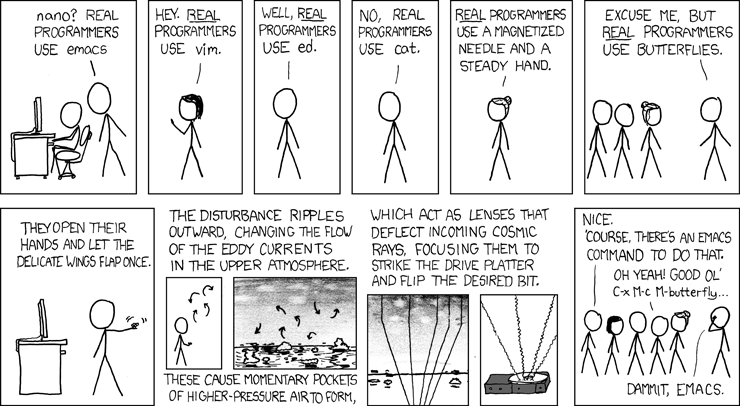
Real programmers set the universal constants at the start such that the universe evolves to contain the disk with the data they want.
 terse mortar
Binary is just sugar for computers, and we don't want binary
sick hound
lmfao
actually technically that's false
more like binary is just syntaxic sugar for transistors, and we don't want sugar
lavish shore
well you can use terrible electric components so that 0 and 1 aren't even clear
digital is sugar for analog?
terse mortar
And analog is sugar for information
lavish shore
not sure if there's an "analog computer" yet
sick hound

An analog computer or analogue computer is a type of computer that uses the continuously changeable aspects of physical phenomena such as electrical, mechanical, or hydraulic quantities to model the problem being solved. In contrast, digital computers represent varying quantities symbolically and by discrete values of both time and amplitude.
An...
this thing?
also logic gates
chain enough of them together
and boom
lavish shore
oh no
terse mortar
And they said this channel couldn't get more cursed.
 low apex
Next challenge:
. You are given an infinite amount of NAND gates
. Make GTA V
earnest wing
NAND aren't turing-complete, strictly speaking
but it IS a universal gate
anyways, python frickery
lavish shore
low apex
Next challenge:
. You are given an infinite amount of NAND gates
. Make GTA V
I mean, nand2tetris already gives you a very simplified feel of that
low apex
Hmm...
I do wonder however, what it would be like if any sort of abstraction was forbidden past and, not and or gates
Probably a huge mess
probably
lavish shore
pretty much, yeah
It'd be like zooming into one of these maybe https://en.wikipedia.org/wiki/Very_Large_Scale_Integration
lavish shore
!e
# Task: find the predecessor of a positive integer
# E.g. pred(1) = 0, pred(8) = 7
class Verify:
    def __init__(self, n, i):
        self.n = n
        self.i = i

    def __add__(self, x):
        return 1 if self.i + x == self.n else 0

def pred(n):
    verifiers = []
    for i in range(n):
        verifiers.append(Verify(n, i))

    pred_int = 0
    for i in range(n):
        if verifiers[i] + 1:
            pred_int = i

    return pred_int

print(pred(1))
print(pred(100))
@lavish shore :white_check_mark: Your eval job has completed with return code 0.
001 | 0
002 | 99
some totally efficient code I wrote a month or two ago
 formal sandal
@quick wing Please don't dump random images, especially in on-topic channels
 elfin onyx
!e
type('While',(),{"__iter__": lambda self: self, "__next__": lambda self: "Infinite", "__call__": lambda self: _ for _ in self()})()()
@elfin onyx :x: Your eval job has completed with return code 1.
001 |   File "<string>", line 1
002 |     type('While',(),{"__iter__": lambda self: self, "__next__": lambda self: "Infinite", "__call__": lambda self: _ for _ in self()})()()
003 |                                                                                                                     ^
004 | SyntaxError: invalid syntax
can someone help me implement this
 thin trout
I think you have to put parenthesis around the lambda expressions
elfin onyx
ooh
elfin onyx
!e
(type('While',(),{"__iter__": (lambda self: self), "__next__": lambda self: ("Infinite"), "__call__":lambda self: [... for _ in self()]}))()()
Hmmm why does this give me recursion error rather than the bot saying it ran out of memory?
night quarryBOT
@elfin onyx :x: Your eval job has completed with return code 1.
001 | Traceback (most recent call last):
002 |   File "<string>", line 1, in <module>
003 |   File "<string>", line 1, in <lambda>
004 |   File "<string>", line 1, in <lambda>
005 |   File "<string>", line 1, in <lambda>
006 |   [Previous line repeated 496 more times]
007 | RecursionError: maximum recursion depth exceeded
got it
!e
(type('While',(),{"__iter__": (lambda self: self), "__next__": lambda self: ("Infinite"), "__call__":lambda self:([_ for _ in self.__class__()])}))()()
@elfin onyx :warning: Your eval job timed out or ran out of memory.
[No output]
!e
print("\n".join((type('While',(),{"__iter__": (lambda self: self), "__next__": lambda self: ("Infinite"), "__call__":lambda self:(("Hello, World!" for _ in self.__class__()))}))()()))
@elfin onyx :warning: Your eval job timed out or ran out of memory.
[No output]
why did this give no output??
 twilit grotto
timed out or ran out of memory
elfin onyx
ye that kinda makes sense i think while joining it ran out of memory
sick hound
elfin onyx
!e
```py
print("\n".join((type('While',(),{"__iter__": (lambda self: self), "__n...
what does that do
sick hound
elfin onyx
ye that kinda makes sense i think while joining it ran out of memory
i ran it on my computer it uses 100mb of memory a second
naive roost
because esoteric Python
sudden willow
 proper vault
```py
("Infinite" for _ in iter(int, 1))
```
proper vault
```py
("Infinite" for _ in iter(int, 1))
```
wouldn't that cause a memoryerror
!e
("e" for _ in iter(int, 1))
@sudden willow :warning: Your eval job has completed with return code 0.
[No output]
guess not
night quarryBOT
@naive roost :warning: Your eval job timed out or ran out of memory.
[No output]
once you start evaluating an infinite iterator, you run out of memory
sudden willow
tuples are so useful
oh wait i didn't put any variables in the list
!e
(
    _ := ["hi", ":P"],
    _ := [(_.append(__), _.pop(0), print("t")) for __ in _]
)
@sudden willow :white_check_mark: Your eval job has completed with return code 0.
001 | t
002 | t
i don't think you can have a inf while loop w/o running out of memory in python using list compr :c
!e [print(i) for i in iter(int, 1)]
night quarryBOT
@sick hound :x: Your eval job timed out or ran out of memory.
001 | 0
002 | 0
003 | 0
004 | 0
005 | 0
006 | 0
007 | 0
008 | 0
009 | 0
010 | 0
011 | 0
... (truncated - too many lines)
Full output: too long to upload
naive roost
you can't have an infinite list without running out of memory
naive roost
just by the mere fact that a list stores pointers to the elements, which are on the heap (meaning they have to be in memory, and pointers to them are definitely in memory too)
sick hound
nvm
grave rover
def pad_nop(instructions: List[Instruction]) -> List[Instruction]:
    return [x for i in instructions for x in [_instruction("NOP", 0), i]]
``` is there a better way to do this?it basically adds a NOP before each instruction
lavish shore
that's pretty cool, tho I think that'd make a list of lists
also @grave rover what do you mean by a "better way"
do u want a shorter way, or a more obfuscated way, for example?
rugged sparrow
@grave rover you can use zip
rugged sparrow
def pad_nop(instructions):
     return sum([*zip(instructions, iter(lambda:_instruction("NOP", 0),0))],())
```That should work I think
rugged sparrow
class Test(AccessControl):
    internal_method: PRIVATE

    def internal_method(self):
        return 'value'

    def public_method(self):
        return self.internal_method()
>>> t = Test()
>>> t.internal_method()
Traceback (most recent call last):
  File "<stdin>", line 1, in <module>
  File "/Users/chilaxan/Desktop/Coding/python/access_control/access_control.py", line 98, in get
    check_access_prot(protections, cls, self, frame)
  File "/Users/chilaxan/Desktop/Coding/python/access_control/access_control.py", line 91, in check_access_prot
    raise PrivateAccessError(read)
__main__.PrivateAccessError: attempted to read PRIVATE value
>>> t.public_method()
'value'
>>> ``` i added class variable access protection to pythonnew PEP when?
rugged sparrow
lmao
i added all the ones from java that made sense DEFAULT = 1 << 0 PROTECTED = 1 << 1 PUBLIC = 1 << 2 PRIVATE = 1 << 3 FINAL = 1 << 4 STATIC = 1 << 5
you can combine any of the first 4 with the last 2 but static is still a bit weird
if anyone wants to check out the code just ping me
lavish shore
it seems somehow you added a type annotation but that annotation actually does something during runtime? confused
rugged sparrow
!e ```py
class Foo:
v: int
print(Foo.annotations)```
night quarryBOT
@rugged sparrow :white_check_mark: Your eval job has completed with return code 0.
{'v': <class 'int'>}
you can get the annotations at runtime like that
lavish shore
ahh I'm still learning bout some builtins that I never previously had to use
like id, getattr
ig dunders come next
notices compile()
🤔
sick hound
sudden willow
wouldn't that cause a memoryerror
!e ```py
list(iter(set,0))
no, but this will@sick hound :warning: Your eval job timed out or ran out of memory.
[No output]
 marsh void
@rugged sparrow hey, looks great! mind sharing some sources? also, I've come to tell that using cls.__annotations__ or function.__annotations__ is not as good as typing.get_type_hints(cls) or typing.get_type_hints(function) respectively
and even more so, because the latter were the things intended for use
rugged sparrow
typing.get_type_hints just gets __annotations__ and does some extra parsing to handle recursive type hints
I tend to use __annotations__ because it has the raw values from the class body
tribal moon
>>> my_tuple.append(3)
(3,)
>>> my_tuple.append(16)
(3, 16)```class tuple(tuple):
def __init__(self):
self.self = self
def append(self, item, /):
self.self = (*self.self, item)
return self.self
 cloud fossil
what happens when you do such thing as self.self = self
grave rover
hm, what could be wrong here?
(left: bytecode in function, right: expected stack)
ignore the NOPs, those are purely to indicate injected instructions
 ember grotto
hi i have a problem with my tcp chat room it works fine on a local network but i cant get it to run outside my network
can you help me
sick hound
this is probably one of the worst places to ask for help lmfao
grave rover
yup
except for things like what I asked for
oh wait i see
the parameter to that isn't the number of arguments but flags
cloud fossil
this JTP guy posted this question on every channel here
grave rover
or is it
uhhh
wait no it is the number of args
oh my god I knew i'd seen this before
co_nlocals was the wrong size
grave rover
can someone explain to me why co_nlocals is useful if you could also just check PyTuple_GET_SIZE(co_varnames)
 violet swallow
df = pd.read_csv("")
using this to get csv from a directory and using it in a panda dataframe.
what i want to do is, get all csv inside that directory in a list or something, so i can run a loop in the above function. and use them 1 by 1.
all files has similar initial naming.
For eg: xyz- is common below
xyz-abc
xyz-def
xyz-abc2
 restive rampart
!e
l = ["abc", "def", "def2"]
for i in l:
    print(f"xyz-{i}")
@restive rampart :white_check_mark: Your eval job has completed with return code 0.
001 | xyz-abc
002 | xyz-def
003 | xyz-def2
This was eg.
File name are bigger and there is 40-50 CSV.
Something like
xyz-* I am looking for but unable to find the solution.
restive rampart

Stack Overflow
I'm trying to loop through only the csv files in a folder that contains many kinds of files and many folders, I just want it to list all of the .csv files in this folder.
Here's what I mean:
impo...
Look into this
you can loop through all the available .csv files in a directory
using glob
cloud fossil
wanted to post here an esoteric C code but then I read the channel's name.
actually it's not so esoteric, just compact and very optimized
terse mortar
cloud fossil
actually it's not so esoteric, just compact and very optimized
I mean that's what this channel can be too
Maybe not the optimized part but...
proper vault
this channel is specifically for python
sudden willow
im sure a bit of C code never hurt anyone @cloud fossil
cloud fossil
a bit of C code was deleted from this channel, probably by lakmatiol
sudden willow
:/
 ornate spire
!e
from random import choice
from math import log


def basic_num(num):
    a = ["__name__.__len__().__bool__()"]
    c = ["__doc__.__bool__().__int__()"]
    if num == 0:
        return choice(c)

    b = [choice(a) for _ in range(num)]
    return b.pop(0) + ''.join(map(lambda x: f".__add__({x})", b))


def optimised_num(num):
    a = []

    while num > 5:
        pows = [int(log(num) / log(i)) for i in range(2, 6)]
        nums = [(i + 2) ** j for i, j in enumerate(pows)]
        max_ = max(nums)
        num -= max_

        i = nums.index(max_)
        a.append(f"{optimised_num(i + 2)}.__pow__({optimised_num(pows[i])})")

    a.append(basic_num(num))
    return a.pop(0) + ''.join(map(lambda x: f".__add__({x})", a))


def convert_string(word):
    a = [f"chr({optimised_num(ord(i))})" for i in word]
    return a.pop(0) + ''.join(map(lambda x: f".__add__({x})", a))


a = convert_string("print('Hello World!')")
print(eval(a))
print(a)
@ornate spire :white_check_mark: Your eval job has completed with return code 0.
001 | print('Hello World!')
002 | chr(__name__.__len__().__bool__().__add__(__name__.__len__().__bool__()).__add__(__name__.__len__().__bool__()).__pow__(__name__.__len__().__bool__().__add__(__name__.__len__().__bool__()).__add__(__name__.__len__().__bool__()).__add__(__name__.__len__().__bool__())).__add__(__name__.__len__().__bool__().__add__(__name__.__len__().__bool__()).__add__(__name__.__len__().__bool__()).__pow__(__name__.__len__().__bool__().__add__(__name__.__len__().__bool__()).__add__(__name__.__len__().__bool__()))).__add__(__name__.__len__().__bool__().__add__(__name__.__len__().__bool__()).__add__(__name__.__len__().__bool__()).__add__(__name__.__len__().__bool__()))).__add__(chr(__name__.__len__().__bool__().__add__(__name__.__len__().__bool__()).__add__(__name__.__len__().__bool__()).__pow__(__name__.__len__().__bool__().__add__(__name__.__len__().__bool__()).__add__(__name__.__len__().__bool__()).__add__(__name__.__len__().__bool__())).__add__(__name__.__len__().__bo
... (truncated - too long)
Full output: too long to upload
sick hound
hey that's my dunder thing
 languid wigeon
!e
marsh void
@rugged sparrow hey, uhm, I asked already but perhaps need to ask again; wanted to peek at the source of access_control thingy you were working on yesterday
grave rover
@marsh void I'm gonna guess the parent constructor does a check for property annotations, turns them into propertys and checks the stack in the setter/getter
grave rover
rugged sparrow
<@!161866631004422144> yea you guessed it
it's basically the same trick I used for generics :P
rugged sparrow
@marsh void https://paste.pythondiscord.com/ukadibasoj.py
to make a controlled class make it inherit from AccessControl
and put all the attributes you want protected at the top as annotations
like py class Foo(AccessControl): private: PRIVATE protected: PROTECTED | FINAL
making methods protected works, as does making protected @propertys but i wouldnt use it in production ever
snow beacon
+ might look better than |.
rugged sparrow
i did it like that cause i use them as flags if prot & PRIVATE: ...
so it made sense to use |
snow beacon
And I suppose with + it's no longer idempotent.
rugged sparrow
to be fair + does work but i think | is clearer imo
snow beacon
PROTECTED + PROTECTED = PUBLIC, which might not be for the best.
rugged sparrow
yea that wouldnt be great
to be fair you can change the protections on an attribute by setting cls.attr.fget.__closure__[idx of int closure].cell_contents
grave rover
I've been thinking of this challenge where you have flags, but you bit-and them instead of using bit-or
so PROTECTED | FINAL -> PROTECTED & FINAL
each combination needs to still be unique, but their actual values don't mind
what would be the rules for generating such flags' values?
snow beacon
They'd just be ~ of the normal flags.
1101 instead of 0010 effectively.
It's De Morgan's Law.
grave rover
but then how can you check if a value includes a certain flag
snow beacon
You'd OR it with a certain flag, then NOT it, I think.
grave rover
flags & my_flag != 0?
snow beacon
flags | my_flag != -1
grave rover
snow beacon
`flags | my_flag != -1`
nope: ```py
((~a & ~b) | c)
-7
((~a & ~b & ~c) | c)
-7
You might need to use ~c.
snow beacon
This symmetry is De Morgan's Law. It's basically "A or B is not(not A and not B)".
That's for Boolean algebra, but it works for sets and binary too.
grave rover
anyways imma head to bed, got a lot of bytecode hacking done today 
terse mortar
!e ```py
print("not rly useful but still cursed\n", ([].len().bool().str().len()).add([1].len().bool().str().len()).truediv(2))
@terse mortar :white_check_mark: Your eval job has completed with return code 0.
001 | not rly useful but still cursed
002 |
003 | 4.5
why not this
!e
__import__("sys").stdout.write((([].__len__().__bool__().__str__().__len__()).__add__([__debug__.__bool__().__int__()].__len__().__bool__().__str__().__len__()).__truediv__(__debug__.__bool__().__int__().__add__(__debug__.__bool__().__int__()))).__str__())
o
night quarryBOT
@sudden willow :white_check_mark: Your eval job has completed with return code 0.
4.5
what's __truediv__ ?
 steep mural
__truediv__ is called when the / operator is used... a/b, __floordiv__ is called when the // operator is used... a//b. For integers and floats this is regular division but __floordiv__ returns the "floored" result
 fluid tree

dogbin
import time
inc = list(range(1, 256))
def increment(n):
"""
Return n + 1
This functio
 little swan
I found this on stack overflow:
import re

def findWholeWord(w):
    return re.compile(r'\b({0})\b'.format(w), flags=re.IGNORECASE).search

findWholeWord('seek')('those who seek shall find')    # -> <match object>
findWholeWord('word')('swordsmith')                   # -> None
Does anyone know what this functionality is called where you call a function like this function(parameter)(more parameters?). Not sure if its really esoteric but i never seen it before and would like to learn more about it.
proper vault
to an extent, it could be called currying
but really, it's just using the fact python has first class functions
little swan
proper vault
to an extent, it could be called currying
thanks man, Now i can look up how it works 🙂
proper vault
a function can return another function
a simpler example would be
def fun():
    print('hello')
def bar():
    return fun
bar()()
# After mixins:
# 'head inject'
# 'head cancel'
# => return 2
def head_target():
    print("head_target")


@inject(head_target, at=At(InjectionPoint.HEAD), cancellable=True)
def inject_head_cancel(cir: CallbackInfoReturnable):
    print("head cancel")
    cir.set_return(2)


@inject(head_target, at=At(InjectionPoint.HEAD),
        priority=10)  # Run before cancel
def inject_head(ci: CallbackInfo):
    print("head inject")
``` this now works, nice
grave rover
shhh
I've already made sure this won't segfault on marshal-generated code, dw
I can also inject at any return, before loading a certain constant, and at the last return only
injecting before function calls is a bit more difficult sadly
since i need to quite literally look at how the stack behaves
terse mortar
!e py __builtins__.__dict__[__builtins__.__dir__()[().__class__.__name__.__len__().__rmul__(__debug__.__add__(__debug__)).__rmul__({}.__class__.__name__.__len__())]]((([].__len__().__bool__().__str__().__len__()).__add__([__debug__.__bool__().__int__()].__len__().__bool__().__str__().__len__()).__truediv__(__debug__.__bool__().__int__().__add__(__debug__.__bool__().__int__()))).__str__()) I made what I did yesterday worse
night quarryBOT
@terse mortar :white_check_mark: Your eval job has completed with return code 0.
4.5
an empty list
night quarryBOT
@terse mortar :white_check_mark: Your eval job has completed with return code 0.
0
!e ```py
print([].len().bool().str().len())
@terse mortar :white_check_mark: Your eval job has completed with return code 0.
5
!e print(doc.bool())
terse mortar
sick hound
!e print(__doc__.__bool__())
right, but i need to be able to get true aswell
sick hound
!e print(name.len().bool())
terse mortar
ahh cool
sick hound
wait i need to try somethign
!e print(doc.bool().invert())
the fuck
!e print(bin(False))
night quarryBOT
@sick hound :white_check_mark: Your eval job has completed with return code 0.
0b0
invert is just the number number * -2 I think
sick hound
!e
x = 2
print(bin(x))
print(bin(x.__invert__()))```@sick hound :white_check_mark: Your eval job has completed with return code 0.
001 | 0b10
002 | -0b11
dafq
terse mortar
ok ima just leave this here
!e ```py
for x in (type('While',(),{'iter': lambda self: self, 'next': lambda self: "Infinite"}))():(_:='One Piece Is The Greatest');builtins.dict[builtins.dir()[().class.name.len().rmul(debug.add(debug)).rmul({}.class.name.len())]]("".join(chr(ord(__)) for __ in _))
@terse mortar :x: Your eval job timed out or ran out of memory.
001 | One Piece Is The Greatest
002 | One Piece Is The Greatest
003 | One Piece Is The Greatest
004 | One Piece Is The Greatest
005 | One Piece Is The Greatest
006 | One Piece Is The Greatest
007 | One Piece Is The Greatest
008 | One Piece Is The Greatest
009 | One Piece Is The Greatest
010 | One Piece Is The Greatest
011 | One Piece Is The Greatest
... (truncated - too many lines)
Full output: too long to upload
terse mortar
oneliner cursed thingy
sick hound
!e for x in __import__("itertools").count(1): print("eee")
tribal moon
we have a lambda one liner, dunder one linder, and one liner, what else?
night quarryBOT
@sick hound :x: Your eval job timed out or ran out of memory.
001 | eee
002 | eee
003 | eee
004 | eee
005 | eee
006 | eee
007 | eee
008 | eee
009 | eee
010 | eee
011 | eee
... (truncated - too many lines)
Full output: too long to upload
sick hound
kek
tribal moon
is there any other way to make an obfuscator
we already have dunders and lambdas done
sick hound
yes
tribal moon
what else?
sick hound
exec(eval(str of program))
terse mortar
wont that just return none?
sick hound
str of the program
tribal moon
that's not obfuscated
sick hound
close enough there's too many fucking dunders to count
terse mortar
!e exec(eval("print('Hello, World!')"))
night quarryBOT
@terse mortar :x: Your eval job has completed with return code 1.
001 | Hello, World!
002 | Traceback (most recent call last):
003 |   File "<string>", line 1, in <module>
004 | TypeError: exec() arg 1 must be a string, bytes or code object
Hey @sick hound!
Uh-oh! It looks like your message got zapped by our spam filter. We currently don't allow .txt attachments, so here are some tips to help you travel safely:
• If you attempted to send a message longer than 2000 characters, try shortening your message to fit within the character limit or use a pasting service (see below)
• If you tried to show someone your code, you can use codeblocks
(run !code-blocks in #bot-commands for more information) or use a pasting service like:
tribal moon
also don't use exec
sick hound
fuck
tribal moon
use py __builtins__.__dict__[__builtins__.__dir__()[(lambda _, __, ___, ____, _____, ______, _______, ________, _________, __________: _).__code__.co_nlocals*(lambda _, __: _).__code__.co_nlocals]]
this is better
terse mortar
i made a dunder list the other day
tribal moon
idk
tribal moon
I can generate it for you
sick hound
but this
tribal moon
but it's gonna be long
terse mortar
dude why
terse mortar
i forgot what channel i was in LOL
sick hound
lmfao
tribal moon
!paste
night quarryBOT
Pasting large amounts of code
If your code is too long to fit in a codeblock in discord, you can paste your code here:
https://paste.pydis.com/
After pasting your code, save it by clicking the floppy disk icon in the top right, or by typing ctrl + S. After doing that, the URL should change. Copy the URL and post it here so others can see it.
tribal moon
https://paste.pythondiscord.com/yovilefoqo.py @sick hound
thin trout
terse mortar
i forgot what channel i was in LOL
It is fairly on topic
terse mortar
thin trout
It is fairly on topic
no ik lol
elfin onyx
!e
for x in (type('While',(),{'__iter__': lambda self: self, '__next__': lambda self: "Infinite"}))():(_:='One Piece Is The Greatest');__builtins__.__dict__[__builtins__.__dir__()[().__class__.__name__.__len__().__rmul__(__debug__.__add__(__debug__)).__rmul__({}.__class__.__name__.__len__())]]("".join(chr(ord(__)) for __ in _))
@elfin onyx :x: Your eval job timed out or ran out of memory.
001 | One Piece Is The Greatest
002 | One Piece Is The Greatest
003 | One Piece Is The Greatest
004 | One Piece Is The Greatest
005 | One Piece Is The Greatest
006 | One Piece Is The Greatest
007 | One Piece Is The Greatest
008 | One Piece Is The Greatest
009 | One Piece Is The Greatest
010 | One Piece Is The Greatest
011 | One Piece Is The Greatest
... (truncated - too many lines)
Full output: too long to upload
tribal moon
is there a way to use self in a class with type
because isn't the first argument the self part?
elfin onyx
sick hound
https://paste.pythondiscord.com/uwuzisapoh.md
umm, what exactly does that do?
sick hound
a=input("input a number: " )
a = int(a)
print(a)
a = a + 1
print(a)```dont use sys for print, use this ```py
builtins.dict[builtins.dir()[().class.name.len().rmul(debug.add(debug)).rmul({}.class.name.len())]]("What you print")
lol
sick hound
terse mortar
dont use sys for print, use this ```py
__builtins__.__dict__[__builtins__.__dir_...
kek
i could also do that one chr
thing
but i'm lazy
but it's literally 1 copy paste
tribal moon
I think I wrote one for chr
terse mortar
yeah, arent we all
tribal moon
it's all the way up now
sick hound
just chr
tribal moon
do you wanna know how to write dunder keywords
sick hound
um what
tribal moon
it's pretty easy
sick hound
?
tribal moon
>>> __builtins__.__dir__().index("chr")
14
>>> __debug__.__add__(__debug__).__rmul__(__debug__.__add__(__debug__)).__add__({__debug__}.__class__.__name__.__len__()).__rmul__(__debug__.__add__(__debug__))
14
>>> __builtins__.__dict__[__builtins__.__dir__()[__debug__.__add__(__debug__).__rmul__(__debug__.__add__(__debug__)).__add__({__debug__}.__class__.__name__.__len__()).__rmul__(__debug__.__add__(__debug__))]]
<built-in function chr>
>>>
like that
!e py print("Dunder Chr of A") print(__builtins__.__dict__[__builtins__.__dir__()[__debug__.__add__(__debug__).__rmul__(__debug__.__add__(__debug__)).__add__({__debug__}.__class__.__name__.__len__()).__rmul__(__debug__.__add__(__debug__))]](65))
night quarryBOT
@tribal moon :white_check_mark: Your eval job has completed with return code 0.
001 | Dunder Chr of A
002 | A
!e ```py
builtins.dictbuiltins.dir()[().class.name.len().rmul(debug.add(debug)).rmul({}.class.name.len())]
this isnt that bad but here@terse mortar :white_check_mark: Your eval job has completed with return code 0.
Hello, World!
ohh
tribal moon
that's how it works
it encodes it in base64 by the way
because all it can do is letters
but it's really bad it takes up a lot of space
a simple hello world program in Oof's dunder generator would be like a million lines in this one lol
I have to optimize it
terse mortar
optimize a deoptimizer
tribal moon
LOL
terse mortar
better yet: run the source code in the generator itself!
also i really hope you arent running that on your real pc
sick hound
wack
tribal moon
I am lol
I don't run it anymore
it's too bad
like a tic tac toe program took 20k lines
 shy remnant
!e
(lambda i: [print(chr(x),end='') for x in (lambda i=i: [globals().update({"h":(lambda _=(i[-1]+i[2]): (_*_)+i[3])()}) or h,h - i[2],globals().update({"l":h + i[3]}) or l,l,globals().update({"o":l + i[2]}) or o,(i[-1] + i[0]) * 4,o + (i[3] * 2),o,o + i[2],l,h - i[3],i[4] * 2])()])([_.__code__.co_argcount for _ in ((lambda _: None),(lambda _, __: None),(lambda _, __, ___: None),(lambda _, __, ___, ____: None),(lambda _, __, ___, ____, _____: None),(lambda _, __, ___, ____, _____, ______: None),(lambda _, __, ___, ____, _____, ______, _______: None))])
@shy remnant :white_check_mark: Your eval job has completed with return code 0.
hello world
 halcyon zinc
wtf
!e
(lambda i: [print(chr(x),end='') for x in (lambda i=i: [globals().update({"h":(lambda _=(i[-1]+i[2]): (_*_)+i[3])()}) or h,h - i[2],globals().update({"l":h + i[3]}) or l,l,globals().update({"o":l + i[2]}) or o,(i[-1] + i[0]) * 4,o + (i[3] * 2),o,o + i[2],l,h - i[3],i[4] * 2])()])([_.__code__.co_argcount for _ in ((lambda _: None),(lambda _, __: None),(lambda _, __, ___: None),(lambda _, __, ___, ____: None),(lambda _, __, ___, ____, _____: None),(lambda _, __, ___, ____, _____, ______: None),(lambda _, __, ___, ____, _____, ______, _______: None))])
night quarryBOT
@halcyon zinc :white_check_mark: Your eval job has completed with return code 0.
hello world
just realized that my goto implementation lets me write loops like this py f = lambda:int(i) if label .start or (i:=input('type a number: ')).isnumeric() else goto .start ```py
n = f()
type a number: no
type a number: 123a
type a number: 123
print(n)
123
type(n)
<class 'int'>
naive roost
well, interesting to see
rugged sparrow
honestly i thought it would break my bytecode patcher
naive roost
well, good if it doesn't
sudden willow
you guys ever heard of unlambda?
r``\``\``\``\``\`.h.e.l.l.o. .w.o.r.l.di
this is the hello world statement without the backspaces
been trying to figure out how to implement this into my python code
rugged sparrow
!e ```py
from ctypes import c_char
def getmem(addr, size):
return memoryview((c_char*size).from_address(addr)).cast('B')
all = ['goto', 'label']
def getframe(depth=0):
try:raise
except Exception as e:
frame = e.traceback.tb_frame
for _ in range(depth + 1):
frame = frame.f_back
return frame
def get_dest(frame, label):
code, names = frame.f_code.co_code, frame.f_code.co_names
frame_var = {**frame.f_globals, **frame.f_locals}.get
ops, args = code[::2], code[1::2]
for idx, (op, arg) in enumerate(zip(ops, args)):
if op == 106 and names[arg] == label and
isinstance(frame_var(names[args[idx - 1]]), Label):
return (idx - 1) * 2
raise RuntimeError(f'label {label!r} not found')
def set_instr(code, idx, op, arg):
code_addr = id(code) + bytes.basicsize - 1
mem = getmem(code_addr, len(code))
(op, arg), mem[idx:idx + 2] = mem[idx:idx + 2], bytes((op, arg))
return op, arg
restore_instr = [None, None, None]
class Goto:
def getattr(self, label):
code = (frame := getframe(1)).f_code.co_code
idx = frame.f_lasti + 2
op, arg = set_instr(code, idx, 114, get_dest(frame, label))
restore_instr[:3] = (idx, op, arg)
mul = getattr
class Label:
def getattr(self, name):
if None not in restore_instr:
frame = getframe(1)
set_instr(frame.f_code.co_code, *restore_instr)
restore_instr[:3] = (None, None, None)
goto = Goto()
label = Label()
x = 0
label .start
print(x)
if x == 10:
goto .end
x += 1
goto .start
label .end```
night quarryBOT
@rugged sparrow :white_check_mark: Your eval job has completed with return code 0.
001 | 0
002 | 1
003 | 2
004 | 3
005 | 4
006 | 5
007 | 6
008 | 7
009 | 8
010 | 9
011 | 10
@sick hound ^ thats how i have goto
 toxic jewel
tribal moon
toxic jewel
tribal moon
very cool
night quarryBOT
Did you mean ...
exit()
environments
enumerate
except
@sick hound :x: Your eval job has completed with return code 1.
001 |   File "<string>", line 1
002 |     (_:=lambda _:(_ := _.__add__(__name__.__len__().__bool__().__int__()))
003 |                                                                           ^
004 | SyntaxError: unexpected EOF while parsing
Hey @robust aspen!
Uh-oh! It looks like your message got zapped by our spam filter. We currently don't allow .txt attachments, so here are some tips to help you travel safely:
• If you attempted to send a message longer than 2000 characters, try shortening your message to fit within the character limit or use a pasting service (see below)
• If you tried to show someone your code, you can use codeblocks
(run !code-blocks in #bot-commands for more information) or use a pasting service like:
 robust aspen
made a hello world script purely from dunder functions and without numbers https://paste.pythondiscord.com/itogobikap.md
recursive optimization does wonders
3k characters
 boreal slate
def f(x):
s={}
for n in x:
if n not in s:s[n]=1
else:
k=s[n]
while(z:=f"{n}({k})")in s:k+=1
s[n]=k+1;s[z]=1
return list(s.keys())
print(f(["doc", "doc", "image", "doc(1)", "doc"]))
``` anyway to shortern this? hard spoke
hmm, if you use a defaultdict for s, you won't need to set default values to 1 manually
snow beacon
Or you could use k=s.get(n,0). At least, I think that's the function.
No if means less indentation.
 last locust
Don't think you need the .keys() in list(s.keys()) either```py
x = {'a': 1, 'b': 2, 'c': 3}
list(x.keys())
['a', 'b', 'c']
list(x)
['a', 'b', 'c']```
n+f"({k})"```also saves 1 charah yes,
boreal slate
snow beacon
Or you could use `k=s.get(n,0)`. At least, I think that's the function.
won't 'file(0)' be added then?
stark fable
  if n not in s:s[n]=1
  else:
   k=s[n]
   while(z:=f"{n}({k})")in s:k+=1
s[n]=k+1;s[z]=1``` why not swap the order here to avoid a `not`so py if n in s: k=s[n] while(z:=f"{n}({k})")in s:k+=1 s[n]=k+1;s[z]=1 else:s[n]=1
stark fable
last locust
Don't think you need the `.keys()` in `list(s.keys())` either```py
>>> x = {'a':...
[*x] is even shorter
last locust
stark fable
`[*x]` is even shorter
True, forgot about unpacking
thin trout
Sad
 distant wave
Huh.
thin trout
Still sad
distant wave
I am an idiot
thin trout
r-word 
distant wave
Fixed
thin trout
Nice
distant wave
!e ```py
import inspect
import sys
from importlib.machinery import PathFinder
class LogImporter(PathFinder):
def init(self, print_file_path: bool = False):
self.print_file_path = print_file_path
def find_spec(self, name, path=None, target=None):
    print('Importing', name, end=" ", flush=True)
    cf = inspect.currentframe().f_back
    a = 0
    while cf:
        a += 1
        # Handle non-file frames
        if "__file__" not in cf.f_globals:
            print("Exec() frame", cf.f_code.co_name, cf.f_code.co_filename)
            cf = cf.f_back
            continue
        # Skip import machinery
        if "importlib" in cf.f_globals['__file__']:
            cf = cf.f_back
            continue
        # Print the file path or just the filename
        if not self.print_file_path:
            print(a, "from file", '/'.join(cf.f_globals['__file__'].rsplit("/")[-2:]))
        else:
            print(a, "from file", cf.f_globals['__file__'])
        break
    # clean up our frames explicitly
    del cf
    # Engage the rest of the import system
    return super().find_spec(name, path, target)
sys.meta_path.insert(0, LogImporter())
import json
print(json)
@distant wave :white_check_mark: Your eval job has completed with return code 0.
001 | Importing json Exec() frame <module> <string>
002 | Importing json.decoder 4 from file json/__init__.py
003 | Importing json.scanner 6 from file json/decoder.py
004 | Importing _json 4 from file json/scanner.py
005 | Importing json.encoder 4 from file json/__init__.py
006 | <module 'json' from '/usr/local/lib/python3.9/json/__init__.py'>
!e ```py
print(().class.name.str()[::-(().class.name.str().len().sub([1].len().bool().str().len()).sub(().class.name.str().len().sub(().class.name.str().len().sub([1].len().bool().str().len()).sub(().class.name.str().len().sub([1].len().bool().str().len()).sub(().class.name.str().len().sub([1].len().bool().str().len()).sub(().class.name.str().len().sub([1].len().bool().str().len()).sub(().class.name.str().len().sub([1].len().bool().str().len()).sub(().class.name.str().len().sub([1].len().bool().str().len()).sub(().class.name.str().len().sub([1].len().bool().str().len()))))))))))])
@terse mortar :white_check_mark: Your eval job has completed with return code 0.
tl
replace all the 1s with __debug__
toxic jewel
hmm
anyone know an equivalent dunder thingy for 0?
right now im using this
__debug__.__bool__().__str__().__len__().__int__().__sub__(__debug__.__bool__().__str__().__len__().__int__())]
terse mortar
tribal moon
replace all the 1s with `__debug__`
ight
tribal moon
toxic jewel
`__debug__.__bool__().__str__().__len__().__int__().__sub__(__debug__.__bool__()...
__debug__.__sub__(__debug__)
toxic jewel
ik but never hurts to add some length
especially since im making an obfuscator and i need to get rid of any chance of readability
im currently using this for E
!e
print(....__class__().__str__()[__debug__.__bool__().__str__().__len__().__int__().__sub__(__debug__.__bool__().__str__().__len__().__int__())])
@toxic jewel :white_check_mark: Your eval job has completed with return code 0.
E
if you're making an obfuscator it should be better for it to be as small as possible
the size doesn't really matter for readability
toxic jewel
nvm found what i was looking for
__doc__.__bool__().__int__()
!e
print(
    ....__class__().__str__()[__doc__.__bool__().__int__()]
)
@toxic jewel :white_check_mark: Your eval job has completed with return code 0.
E
much cleaner
naive roost
if you start Python with -O or -OO, __debug__ will be false
tribal moon
ok
toxic jewel
!e __import__("sys").stdout.write(__doc__.__dir__())
night quarryBOT
@toxic jewel :x: Your eval job has completed with return code 1.
001 | Traceback (most recent call last):
002 |   File "<string>", line 1, in <module>
003 | TypeError: write() argument must be str, not list
none returns 0 correct?
naive roost
None evaluates to False when needed
toxic jewel
!e print(__doc__.__class__().__bool__().__int__())
night quarryBOT
@toxic jewel :white_check_mark: Your eval job has completed with return code 0.
0
pog
naive roost
I did not really know how to express it anymore 😅
toxic jewel
!e
print(
    ....__class__().__str__()[__doc__.__class__().__bool__().__int__()],
    __debug__.__bool__().__str__()[-(__name__.__len__().__bool__().__int__())], sep="\n"
)
@toxic jewel :white_check_mark: Your eval job has completed with return code 0.
001 | E
002 | e
perrrrrfect
snow beacon
Another way to say it is that None is falsey.
toxic jewel
is __hash__() random?
twilit grotto
in cpython yeah
naive roost
at least it is salted, and the salt changes between interpreter runs
that prevents malicious attacks on the worst case of dict insertion (security issues)
though the salt is always the same inside a Python interpreter's lifetime
toxic jewel
wonder how i can get 1 from 0
tribal moon
0 .__invert__().__abs__() do you mean this?
toxic jewel
you can do that???
thats crazy
!e
print(....__class__().__hash__().__str__().__len__().__floordiv__(....__class__().__hash__().__str__().__len__()))
@toxic jewel :white_check_mark: Your eval job has completed with return code 0.
1
tryna make a list of integers
!e
(
    zero := (__doc__.__bool__().__int__()),
    one := (__doc__.__bool__().__int__()).__invert__().__abs__(),
    two := (__name__.__len__().__bool__().__int__().__add__(__name__.__len__().__bool__().__int__())),
    three := (__debug__.__str__().__len__().__sub__(__debug__.__int__()))
)
print(zero, one, two, three)
@toxic jewel :white_check_mark: Your eval job has completed with return code 0.
0 1 2 3
heres what i have so far
any tips
trying not to use any of the same techniques in any
tribal moon
for 4 you can do {}.__class__.__name__.__len__()
for 5 you can do (__name__,).__class__.__name__.__len__()
 frigid wharf
four = ....__class__.__name__.__len__().__rshift__(....__class__.__base__().__sizeof__().__bool__())
six = ().__class__.__base__.__name__.__len__()
for 4 I got [[]].__str__().__len__()
and just removing and adding the brackets as needed
snow beacon
naive roost
at least it is salted, and the salt changes between interpreter runs
Isn't that only for strings and bytes?
robust aspen
!e
(__builtins__.__dict__['globals']().__setitem__('__',[].__len__()),__builtins__.__dict__['globals']().__setitem__('___',__debug__.__int__()),__builtins__.__dict__['list'](__builtins__.__dict__['map'](lambda _:[(__builtins__.__dict__['print'](__),__builtins__.__dict__['globals']().__setitem__('____',__.__add__(___)),__builtins__.__dict__['globals']().__setitem__('__', ___),__builtins__.__dict__['globals']().__setitem__('___',____))], [__]*__name__.__len__().__lshift__(__debug__))))
@robust aspen :white_check_mark: Your eval job has completed with return code 0.
001 | 0
002 | 1
003 | 1
004 | 2
005 | 3
006 | 5
007 | 8
008 | 13
009 | 21
010 | 34
011 | 55
... (truncated - too many lines)
Full output: https://paste.pythondiscord.com/oyibuwolat.txt
robust aspen
that was fun
toxic jewel
!e
print({}.__class__.__name__)
night quarryBOT
@toxic jewel :white_check_mark: Your eval job has completed with return code 0.
dict
very smart
night quarryBOT
@toxic jewel :white_check_mark: Your eval job has completed with return code 0.
str
!e
print(''.__str__().__class__.__name__)
night quarryBOT
@toxic jewel :white_check_mark: Your eval job has completed with return code 0.
str
 floral meteor
!e ```py
class Aaaaaa(float):
def init(self,value):self.value=value;self.dec=0;super().init()
def getattr(self,attr):
if attr in dir(float()):return super().getattr(attr)
elif attr=='point':self.dec=1 if not self.dec else self.dec
elif self.dec:self.dec+=1;return self+{"one":1,"two":2,"three":3,"four":4,"five":5,"six":6,"seven":7,"eight":8,"nine":9,"zero":0}[attr]*(10**(-self.dec+1))
return self
four_hundred_and_twenty=Aaaaaa(420)
print(four_hundred_and_twenty.point.seven.eight)
From memory you can also edit the actual exit object's attributes, unlike many other Python things.
night quarryBOT
@floral meteor :x: Your eval job has completed with return code 1.
001 | Traceback (most recent call last):
002 |   File "<string>", line 9, in <module>
003 | AttributeError: 'float' object has no attribute 'eight'
@floral meteor what do you mean
floral meteor
the Aaaaaa class getattr method holds until four_hundred_and_twenty.point.seven.eight is attempted, at which point it claims that the float object has no attribute eight even though i explicitly told it how to handle attribute not found error
rugged sparrow
>>> a=Aaaaaa(420)
>>> type(a.point)
<class '__main__.Aaaaaa'>
>>> type(a.point.seven)
<class 'float'>
>>> ```class Aaaaaa(float):
def __init__(self,value,dec=0):self.value=value;self.dec=dec;super().__init__()
def __getattr__(self,attr):
if attr in dir(float()):return super().__getattr__(attr)
elif attr=='point':self.dec=1 if not self.dec else self.dec
elif self.dec:return Aaaaaa(self+{"one":1,"two":2,"three":3,"four":4,"five":5,"six":6,"seven":7,"eight":8,"nine":9,"zero":0}[attr]*(10**(-self.dec+1)),dec=self.dec+1)
return self
four_hundred_and_twenty=Aaaaaa(420)
print(four_hundred_and_twenty.point.seven.eight.six.six)
!e ```py
class Aaaaaa(float):
def init(self,value,dec=0):self.value=value;self.dec=dec;super().init()
def getattr(self,attr):
if attr in dir(float()):return super().getattr(attr)
elif attr=='point':self.dec=1 if not self.dec else self.dec
elif self.dec:return Aaaaaa(self+{"one":1,"two":2,"three":3,"four":4,"five":5,"six":6,"seven":7,"eight":8,"nine":9,"zero":0}[attr]*(10**(-self.dec+1)),dec=self.dec+1)
return self
four_hundred_and_twenty=Aaaaaa(420)
print(four_hundred_and_twenty.point.seven.eight.six.six)
@floral meteor :white_check_mark: Your eval job has completed with return code 0.
427.866
AAAAAAAAAAAAAAAAAAAAAAAAAAAAAAAAAAAAAAAAAAAAAAAAAAAAAAAAAAAAAAAAA
!e ```py
class Aaaaaa(float):
def init(self,value,dec=0):self.value=value;self.dec=dec;super().init()
def getattr(self,attr):
if attr in dir(float()):return super().getattr(attr)
elif attr=='point':self.dec=1 if not self.dec else self.dec
elif self.dec:return Aaaaaa(self+{"one":1,"two":2,"three":3,"four":4,"five":5,"six":6,"seven":7,"eight":8,"nine":9,"zero":0}[attr]*(10**(-self.dec)),dec=self.dec+1)
return self
four_hundred_and_twenty=Aaaaaa(420)
print(four_hundred_and_twenty.point.seven.eight.six.six)
@floral meteor :white_check_mark: Your eval job has completed with return code 0.
420.78659999999996
AAAAAAAAAAAAAAAAAAAAAAAAAAAAAAAAAAAAAAAAAAAAAAAAAAAAAAAAAAAAAAAAAAAAAAAAAAAAAAAAAA
aha
!e ```py
class Aaaaaa(float):
def init(self,value,dec=0):self.value=value;self.dec=dec;super().init()
def getattr(self,attr):
if attr in dir(float()):return super().getattr(attr)
elif attr=='point':self.dec=1 if not self.dec else self.dec
elif self.dec:return Aaaaaa(round(self+{"one":1,"two":2,"three":3,"four":4,"five":5,"six":6,"seven":7,"eight":8,"nine":9,"zero":0}[attr]*(10**(-self.dec)),self.dec+1),dec=self.dec+1)
return self
four_hundred_and_twenty=Aaaaaa(420)
print(four_hundred_and_twenty.point.seven.eight.six.six)
@floral meteor :white_check_mark: Your eval job has completed with return code 0.
420.7866
ahahahahahahahahahahahahahahahahahahahahaha i am invincible
alright i need to reverse engineer my own cipher to get the key given a token and the encrypted token.
I have...
def enigma_de(source:str,key:str):
    """algorithm to decrypt substitution cipher.
e.g. t,F => N
    """
    if len(source)<len(key):key=key[:len(source)]                           # wrap key to match source size
    elif len(source)>len(key):key=(key*(len(source)//len(key)+1))[:len(source)]
    _s=[ord(c)for c in list(source)];_k=[ord(c)for c in list(key)];_p=[]    # init
    for i,e in enumerate(_s):_p.append((((e-32)-(_k[i]-32))%95)+32)         # <-- decryption algorithm
    return''.join([chr(n)for n in _p])                                     # return token
def enigma_en(source:str,key:str):
    """algorithm to encrypt substitution cipher.
e.g. N+F => t
    """
    if len(source)<len(key):key=key[:len(source)]                           # wrap key without requiring itertools
    elif len(source)>len(key):key=(key*(len(source)//len(key)+1))[:len(source)]
    _s=[ord(c)for c in list(source)];_k=[ord(c)for c in list(key)];_p=[]    # encode (_s,_k) and initialise variables (_s,_k,_p)
    for i,e in enumerate(_s):_p.append((((e-32)+(_k[i]-32))%95)+32)         # encrypt raw data
    return''.join([chr(n)for n in _p])                                     # decode _p and return it****
given that's the cipher, how would I, after evaluating...
>>> secret = "shh this is a secret"
>>> gobbledygook = enigma_en(secret,"P455w0rd1")
... get "P455w0rd1" from some function of secret and gobbledygook ?
but don't tell me the straight answer
I just need help thonking of me own answer
if no one says anything i'm kinda just gonna keep rambling until i figure it out on me own
:P
!e ```py
{print(int("9"*20)**int("9"*20))for _ in iter(int,1)}
@floral meteor :warning: Your eval job timed out or ran out of memory.
[No output]
aw that all
i got... ```nim
File "<string>", line 1, in <module>
KeyboardInterrupt
Exception in thread Thread-2:
Fatal Python error: _enter_buffered_busy: could not acquire lock for <_io.BufferedWriter name='<stderr>'> at interpreter shutdown, possibly due to daemon threads
Python runtime state: finalizing (tstate=000002D8773C38B0)
Current thread 0x000042fc (most recent call first):
<no Python frame>
B:>
you can't really evaluate keyboard interrupting that i guess
rugged sparrow
what was the code that caused that error?
 astral rover
floral meteor
!e ```py
{print(int("9"*20)**int("9"*20))for _ in iter(int,1)}
```
astral rover
floral meteor
!e ```py
{print(int("9"*20)**int("9"*20))for _ in iter(int,1)}
```
i would assume
toxic jewel
what does .__rshift__() do?
astral rover
support the >> operator
toxic jewel
ah
!e
print({}.__class__().__hash__().__int__().__rshift__(__debug__.__add__(__debug__.__mul__(__debug__.__add__(__debug__)))))
@toxic jewel :x: Your eval job has completed with return code 1.
001 | Traceback (most recent call last):
002 |   File "<string>", line 1, in <module>
003 | TypeError: 'NoneType' object is not callable
@toxic jewel :white_check_mark: Your eval job has completed with return code 0.
4578586700643154856
oh
proper vault
dicts are not hashable
toxic jewel
converting the word dict to a str to hash it
trollar
recreating random.randint but it only works from 50-60 something and its almost always 63
!e
print({}.__class__().__str__().__hash__().bit_length())
@toxic jewel :white_check_mark: Your eval job has completed with return code 0.
63
!e print({}.__class__().__str__().__hash__().__dir__())
night quarryBOT
@toxic jewel :white_check_mark: Your eval job has completed with return code 0.
['__repr__', '__hash__', '__getattribute__', '__lt__', '__le__', '__eq__', '__ne__', '__gt__', '__ge__', '__add__', '__radd__', '__sub__', '__rsub__', '__mul__', '__rmul__', '__mod__', '__rmod__', '__divmod__', '__rdivmod__', '__pow__', '__rpow__', '__neg__', '__pos__', '__abs__', '__bool__', '__invert__', '__lshift__', '__rlshift__', '__rshift__', '__rrshift__', '__and__', '__rand__', '__xor__', '__rxor__', '__or__', '__ror__', '__int__', '__float__', '__floordiv__', '__rfloordiv__', '__truediv__', '__rtruediv__', '__index__', '__new__', 'conjugate', 'bit_length', 'to_bytes', 'from_bytes', 'as_integer_ratio', '__trunc__', '__floor__', '__ceil__', '__round__', '__getnewargs__', '__format__', '__sizeof__', 'real', 'imag', 'numerator', 'denominator', '__doc__', '__str__', '__setattr__', '__delattr__', '__init__', '__reduce_ex__', '__reduce__', '__subclasshook__', '__init_subclass__', '__dir__', '__class__']
 limpid slate
what
toxic jewel
!e
print({}.__class__().__str__().__hash__().__rshift__(__debug__.__int__().__hash__()))
@toxic jewel :white_check_mark: Your eval job has completed with return code 0.
1631837941395044143
i love myself some random seeds
limpid slate
toxic jewel
i love myself some random seeds
whats that
toxic jewel
long number
toxic jewel
!e
[print({}.__class__().__str__().__hash__().__rshift__(__debug__.__int__().__hash__()))for(x)in(range(__debug__.__int__().__hash__()))]
@toxic jewel :white_check_mark: Your eval job has completed with return code 0.
310679553258299720
@toxic jewel :white_check_mark: Your eval job has completed with return code 0.
1
oh
astral rover
^ is xor
toxic jewel
!e
[print({}.__class__().__str__().__hash__().__rshift__(__debug__.__int__().__hash__()))for(x)in(range(__debug__.__int__().__hash__().__rshift__(().__class__().__str__().__hash__().strip("-"))))]
@toxic jewel :x: Your eval job has completed with return code 1.
001 | Traceback (most recent call last):
002 |   File "<string>", line 1, in <module>
003 | AttributeError: 'int' object has no attribute 'strip'
 sterile pecan
How to add an economy work command?
    users = await get_bank_data()
    ^
IndentationError: expected an indented bloc
# LEADERBOARD
@client.command(aliases = ["lb"])
async def leaderboard(ctx,x = 1):
users = await get_bank_data()
leaderboard = []
for user in users:
    leaderboard += (int(user), users[user]["wallet"] + users[user]["bank"])

leaderboard = sorted(leaderboard, key=lambda a: a[1])

# embed stuff here
for index, user in enumerate(leaderboard):
    em.add_field(
        name=client.get_user(int(user[0])),
        value=f"{index}: {user[1]}"
    )

    await ctx.send(embed = em)
How can i fix that?
astral rover
your in the wrong channel for that
robust aspen
!e
chr(__name__.__len__().__mul__(__name__.__len__().__add__(__debug__))).__add__(chr(__name__.__len__().__add__([].__str__().__len__()).__pow__([].__str__().__len__()).__add__(__debug__))).__add__(chr(__name__.__len__().__add__(__debug__).__mul__([[[]]].__str__().__len__().__lshift__(__debug__))).__mul__([].__str__().__len__())).__add__(chr(__name__.__len__().__mul__([[[]]].__str__().__len__().__add__(__name__.__len__())).__sub__(__debug__))).__add__(chr([[]].__str__().__len__().__mul__(__name__.__len__()))).__add__(chr(__name__.__len__().__mul__([[[]]].__str__().__len__().__lshift__(__debug__).__sub__(__debug__)).__sub__(__debug__))).__add__(chr(__name__.__len__().__mul__([[[]]].__str__().__len__().__add__(__name__.__len__())).__sub__(__debug__))).__add__(chr(__name__.__len__().__mul__([[[]]].__str__().__len__().__add__(__name__.__len__())).__add__([].__str__().__len__()))).__add__(chr(__name__.__len__().__add__(__debug__).__mul__([[[]]].__str__().__len__().__lshift__(__debug__)))).__add__(chr(__name__.__len__().__add__([].__str__().__len__()).__pow__([].__str__().__len__()))).__add__(chr([[]].__str__().__len__().__mul__(__name__.__len__()).__add__(__debug__)))
@robust aspen :warning: Your eval job has completed with return code 0.
[No output]
!e
print(chr(__name__.__len__().__mul__(__name__.__len__().__add__(__debug__))).__add__(chr(__name__.__len__().__add__([].__str__().__len__()).__pow__([].__str__().__len__()).__add__(__debug__))).__add__(chr(__name__.__len__().__add__(__debug__).__mul__([[[]]].__str__().__len__().__lshift__(__debug__))).__mul__([].__str__().__len__())).__add__(chr(__name__.__len__().__mul__([[[]]].__str__().__len__().__add__(__name__.__len__())).__sub__(__debug__))).__add__(chr([[]].__str__().__len__().__mul__(__name__.__len__()))).__add__(chr(__name__.__len__().__mul__([[[]]].__str__().__len__().__lshift__(__debug__).__sub__(__debug__)).__sub__(__debug__))).__add__(chr(__name__.__len__().__mul__([[[]]].__str__().__len__().__add__(__name__.__len__())).__sub__(__debug__))).__add__(chr(__name__.__len__().__mul__([[[]]].__str__().__len__().__add__(__name__.__len__())).__add__([].__str__().__len__()))).__add__(chr(__name__.__len__().__add__(__debug__).__mul__([[[]]].__str__().__len__().__lshift__(__debug__)))).__add__(chr(__name__.__len__().__add__([].__str__().__len__()).__pow__([].__str__().__len__()))).__add__(chr([[]].__str__().__len__().__mul__(__name__.__len__()).__add__(__debug__))))
@robust aspen :white_check_mark: Your eval job has completed with return code 0.
Hello World!
yea just the shortest equations I could get for each value
takes about 30s to generate
toxic jewel
working on numbers only using dunders
zero  = (__doc__.__bool__().__int__())
one   = (zero.__invert__().__abs__())
two   = ({}.__class__().__str__().__len__())
three = (''.__class__.__name__.__len__())
four  = ({}.__class__.__name__.__len__())
five  = (().__class__.__name__.__len__())
not sure what to use for 6
think im gonna use complex for 7
naive roost
you could do zero = {}.__len__(), or something like that
toxic jewel
astral rover
but what if i want to document my module?
¯_(ツ)_/¯
robust aspen
for one I just use __debug__
toxic jewel
__debug__ can be false if you use -O
robust aspen
not perfect but works
i think the next smallest one is __name__.__len__().__bool__()
you could also do all even with [].__str__().__len__() with more brackets but thats a bit boring
toxic jewel
or
True
One of my personal favorites is (__import__("__future__").__doc__.__str__().__len__().__int__().__bool__())
which returns true, but future kinda changes alot of things so !e cant handle it
ooh ive just came across a new 0 and 1
!e
_0 = (__import__("__main__").__doc__.__bool__().__int__())
_1 = (__import__("__main__").__doc__.__str__().__len__().__bool__().__int__())

print(_0, _1)
@toxic jewel :white_check_mark: Your eval job has completed with return code 0.
0 1
even longer strings to add into my number-inator
great
!e
print(_:=(__import__("__main__").__doc__.__str__().__len__().__bool__().__int__()).__add__(_:=(__import__("__main__").__doc__.__str__().__len__().__bool__().__int__()).__add__(_:=(__import__("__main__").__doc__.__str__().__len__().__bool__().__int__()).__add__(_:=(__import__("__main__").__doc__.__str__().__len__().__bool__().__int__()).__add__(_:=(__import__("__main__").__doc__.__str__().__len__().__bool__().__int__()).__add__(_:=(__import__("__main__").__doc__.__str__().__len__().__bool__().__int__()).__add__(_:=(__import__("__main__").__doc__.__str__().__len__().__bool__().__int__()).__add__(_:=(__import__("__main__").__doc__.__str__().__len__().__bool__().__int__()).__add__(_:=(__import__("__main__").__doc__.__str__().__len__().__bool__().__int__()).__add__(_:=(__import__("__main__").__doc__.__str__().__len__().__bool__().__int__()).__int__()))))))))))
@sudden willow :white_check_mark: Your eval job has completed with return code 0.
10
heres the src now
import sys

with open("writeoff.txt", "w") as f:
  temp=int(sys.argv[1])-2
  f.write("print(_:=(__import__(\"__main__\").__doc__.__str__().__len__().__bool__().__int__()).__add__(")

  for i in range(temp):
    f.write("_:=(__import__(\"__main__\").__doc__.__str__().__len__().__bool__().__int__()).__add__(")
  f.write("_:=(__import__(\"__main__\").__doc__.__str__().__len__().__bool__().__int__()).__int__()" + ")" * int(temp+2))
 olive stag
hello, can someone help me figure out what the source code is ?
tribal moon
olive stag
hello, can someone help me figure out what the source code is ?
Yes I can, it's right here #esoteric-python message
olive stag
tribal moon
Yes I can, it's right here https://discord.com/channels/267624335836053506/47088...
thank you.
toxic jewel
lmao
 tidal canyon
what in gods name
thin trout
That is honest to god programming!
 hot crypt
is there a way to redefine True to be False using ctypes? my interpreter exits when I try to access the value
 coarse igloo
fib = lambda x: (__doc__.__bool__().__int__()) if x < (__doc__.__bool__().__int__().__invert__().__abs__()) else (__doc__.__bool__().__int__().__invert__().__abs__()) if x == (__doc__.__bool__().__int__().__invert__().__abs__()) else fib(x - (__doc__.__bool__().__int__().__invert__().__abs__())) + fib(x - (__doc__.__bool__().__int__().__invert__().__abs__()) - (__doc__.__bool__().__int__().__invert__().__abs__()))
check my fibonacci function
terse mortar
What's the point of inverting something just to get its absolute value?
toxic jewel
not sure if this is really python but heres my own esoteric lang print that was made in python
\>>|{<---><<~--<>..>>]][[]].,/'|'}msg?=()l.trollared <<.compr..meth!!!!>>< >>/<<>+.__add*(int:msg.compile,$.radd::std::cout<<'trollared';int::main;def::main::(return(fstr.//'msg.{m3th.m3th.m3th,<i.love<boys>>}',endl.=[]))*((.) <$_<<++-#<<->return()if(not)__debug__.__bool__())][;cout<<::msg?|=f&>**(*,**,func?=m41n(##>:)
you can get 0 from 1
terse mortar
!e ```py
print([1,2,3,4,5].len().abs())
print([1,2,3,4,5].len().invert().abs())
yeah
night quarryBOT
@terse mortar :white_check_mark: Your eval job has completed with return code 0.
001 | 5
002 | 6
What the fuck
tribal moon
invert 1 is -2
toxic jewel
!e
print((__doc__.__bool__().__int__()).__invert__().__abs__())
@toxic jewel :white_check_mark: Your eval job has completed with return code 0.
1
there's no point in doing __int__ on a bool
astral rover
thats not true
tribal moon
And how is that not true?
astral rover
0/1 is different to False/True
tribal moon
print((__doc__.__bool__()).__invert__().__abs__()) the code should be this
yes.. I know
I am well aware
astral rover
its esoteric python there is no practical use for any of this
the more complex it looks the better
tribal moon
How does __int__() make it look more complex?
astral rover
its more characters
tribal moon
that's worse
astral rover
thats subjective
tribal moon
the longer your esoteric code generator is, the worse it is imo
It's always the best for your esoteric code generator to generate the smallest code as possible
unnecessary things that add more space just make it worse
toxic jewel
tribal moon
there's no point in doing `__int__` on a bool
ik just adds length
with my esoteric code generator you feed a string in thats == 1 and it generates an equation based off of it
 vagrant sleet
Wtf have I stumbled into
 vague salmon
what in the world is this channel
snow beacon
Everything you wouldn't put in production code.
 zealous widget
snow beacon
Everything you wouldn't put in production code.
zealous widget
snow beacon
Everything you wouldn't put in production code.
I accept your challenge
time for ultimate job security
snow beacon
I want an obfuscator that only changes Python's readability to about the level of C.
 mortal shadow
you can prolly do this by using semicolons instead of linebreaks
floral meteor
!e ```py
time=....class.class("Now",(),{'iter':(lambda s:s),'next':(lambda s:import('time').time()),'call':(lambda s:s.next())})()
print(time())
for i in time: print(i)
@floral meteor :x: Your eval job timed out or ran out of memory.
001 | 1612669962.330515
002 | 1612669962.3306365
003 | 1612669962.3306687
004 | 1612669962.3306978
005 | 1612669962.3307257
006 | 1612669962.3307536
007 | 1612669962.330781
008 | 1612669962.3308082
009 | 1612669962.3308358
010 | 1612669962.3309991
011 | 1612669962.331042
... (truncated - too many lines)
Full output: too long to upload
floral meteor
U like?
hard spoke
!e
import time
def random():
    return (time.time()**2)%1.0
print(*[random() for i in range(10)])
@hard spoke :white_check_mark: Your eval job has completed with return code 0.
0.0 0.0 0.0 0.0 0.0 0.0 0.0 0.0 0.0 0.0
!e
import time
def random():
    return (float(time.time())**2)%1.0
print(*[random() for i in range(10)])
nah, I'm fairly sure it gives non-ints when float%float
floral meteor
Try string, then chop it in half, then the right half is pretty much random
hard spoke
!e
import time
def random():
    return time.time() % 1.0
print(*[random() for i in range(10)])
@hard spoke :white_check_mark: Your eval job has completed with return code 0.
0.873577356338501 0.8735852241516113 0.8735859394073486 0.8735864162445068 0.873586893081665 0.8735873699188232 0.8735880851745605 0.8735885620117188 0.873589038848877 0.8735895156860352
to make it float, float("0."+yay)
hard spoke
why does it start being zero after I square it?...
hard spoke
!e
import time
print(time.time(),time.time()**2)
print(time.time()%1,time.time()**2 % 1)
@hard spoke :white_check_mark: Your eval job has completed with return code 0.
001 | 1612670327.4599767 2.60070558506987e+18
002 | 0.46011853218078613 0.0
weeeird
must be a float problem
too large a number => not enough precision to reach that decimal place
!e
import time
def random():
    return (time.time()%100000)**2%1.0
print(*[random() for i in range(10)])
@hard spoke :white_check_mark: Your eval job has completed with return code 0.
0.3099184036254883 0.49164390563964844 0.6930341720581055 0.7937288284301758 0.8944234848022461 0.02868366241455078 0.09581375122070312 0.2300739288330078 0.3307685852050781 0.43146419525146484
yeah, that was it
floral meteor
I see a pattern. Try range 50 you'll see pattern.
Oh me thinks of great idea ahahaha
hard spoke
of course there's a pattern, it's #esoteric-python, it wasn't meant to be an actual random number generator 😛
floral meteor
!e ```py
class Wait:
time=import('time').time
def init(s,t=1):s._wait=t;s.now=0
def iter(s):s.now=s.time();return s
def next(s):
t=s.time();
if t<s.now+s._wait: return t-s.now
else: raise StopIteration
a=[now for now in Wait(0.1)]
print(len(a))
Oh r00d
Aha
Wait
Ouch
Wow
night quarryBOT
@floral meteor :white_check_mark: Your eval job has completed with return code 0.
168916
this channel's great and this is totally perfect code style
idk what ppl are concerned bout /s
 lone scarab
!e
l = [[[["Hello, world!",4],3],2],1]
print(l[0][0][0][0])
@lone scarab :white_check_mark: Your eval job has completed with return code 0.
Hello, world!
!e
t = (((("Hello World!",),),),)
print(t[0][0][0][0])
@cloud fossil :white_check_mark: Your eval job has completed with return code 0.
Hello World!
!e
t = (((("Hello World!",),),),)
print(t[False][False][False][False])
@cloud fossil :white_check_mark: Your eval job has completed with return code 0.
Hello World!
!e
t = (((("Hello World!",),),),)
print(t[None][False][False][False])
@cloud fossil :x: Your eval job has completed with return code 1.
001 | Traceback (most recent call last):
002 |   File "<string>", line 2, in <module>
003 | TypeError: tuple indices must be integers or slices, not NoneType
yo i didn't know bool is actually a subclass of int
 full jewel
cloud fossil
yo i didn't know `bool` is actually a subclass of `int`
full jewel
cloud fossil
yo i didn't know `bool` is actually a subclass of `int`
!e
print(int(True))
print(int(False))
@full jewel :white_check_mark: Your eval job has completed with return code 0.
001 | 1
002 | 0
Default value of False is 0 and True is 1
snow beacon
Not exactly a default value, they are just ones and zeros that look a little different. In a previous Python, integers were used for the (at he time unimplemented) Booleans, and it's a holdover from maintaining backwards compatibility with that.
cloud fossil
issubclass(bool, int) returns True
 dusky dagger
Well yes, it says in the python docs that bool is a subclass of int
night quarryBOT
@umbral latch :x: Your eval job has completed with return code 1.
001 |   File "<string>", line 1
002 |     print (1===1)
003 |               ^
004 | SyntaxError: invalid syntax
 cedar herald
This isn't JavaScript 😛
terse mortar
I can see how you would get that confused with this channel tho
sick hound
😐
sick hound
!e 1==(_:=1)
night quarryBOT
@sick hound :warning: Your eval job has completed with return code 0.
[No output]
 verbal totem
!e print(1==(_:=1))
night quarryBOT
@verbal totem :white_check_mark: Your eval job has completed with return code 0.
True
!e print(f"{a=}")
night quarryBOT
@last locust :x: Your eval job has completed with return code 1.
001 | Traceback (most recent call last):
002 |   File "<string>", line 1, in <module>
003 | NameError: name 'a' is not defined
!e lambda x: print(f"{x=}")(3)
night quarryBOT
@last locust :warning: Your eval job has completed with return code 0.
[No output]
!e py l = lambda x: print(x) l(3)
night quarryBOT
@last locust :white_check_mark: Your eval job has completed with return code 0.
3
!e py lambda x: print(x)(3)
night quarryBOT
@last locust :warning: Your eval job has completed with return code 0.
[No output]
 night quarryBOT
@last locust :white_check_mark: Your eval job has completed with return code 0.
3
!e py (lambda x: print(f"{x=}"))(3)
night quarryBOT
@last locust :white_check_mark: Your eval job has completed with return code 0.
x=3
ok so why does ```py
print([].len().bool().str().len().add([1].len().bool().str().len()).str().add([].len().bool().str().len().add([1].len().bool().str().len()).str()).int())
```py
print(int([].__len__().__bool__().__str__().__len__().__add__([1].__len__().__bool__().__str__().__len__()).__str__().__add__([].__len__().__bool__().__str__().__len__().__add__([1].__len__().__bool__().__str__().__len__()).__str__())))
int(str) does not call str.__int__(), the parsing is in the int constructor
terse mortar
earnest wing
`int(str)` does not call `str.__int__()`, the parsing is in the `int` constructo...
I did not know that, thanks.
 broken mesa
@floral meteor yo your Cursed(float) breaks on this
floral meteor
ik its very broken
low apex
!e import antigravity
night quarryBOT
@low apex :warning: Your eval job has completed with return code 0.
[No output]
of course
sick hound
kids learn ur times table
cedar herald
This isn't what this channel is for
 fluid prawn
cedar herald
This isn't what this channel is for
fluid prawn
cedar herald
This isn't what this channel is for
it's for the ppl who uses python like this
!e
print(....__class__().__str__()[__debug__.__bool__().__str__().__len__().__int__().__sub__(__debug__.__bool__().__str__().__len__().__int__())])
@fluid prawn :white_check_mark: Your eval job has completed with return code 0.
E
Hey, I can actually follow this snippet haha
cloud fossil
i can
print(str(type(...)())[ len(str(bool(__debug__))) - len(str(bool(__debug__))) ])
print(str(Ellipsis)[len(str(True))-len(str(True))])
print("Ellipsis"[len("True")-len("True")])
print("Ellipsis"[4-4])
print("Ellipsis"[0])
print("E")
That's similar to this ```py
print(().class.name.str()[::-(().class.name.str().len().sub([1].len().bool().str().len()).sub(().class.name.str().len().sub(().class.name.str().len().sub([1].len().bool().str().len()).sub(().class.name.str().len().sub([1].len().bool().str().len()).sub(().class.name.str().len().sub([1].len().bool().str().len()).sub(().class.name.str().len().sub([1].len().bool().str().len()).sub(().class.name.str().len().sub([1].len().bool().str().len()).sub(().class.name.str().len().sub([1].len().bool().str().len()).sub(().class.name.str().len().sub([1].len().bool().str().len()))))))))))])
maybe
!e print(().class.name.str()[::-(().class.name.str().len().sub([1].len().bool().str().len()).sub(().class.name.str().len().sub(().class.name.str().len().sub([1].len().bool().str().len()).sub(().class.name.str().len().sub([1].len().bool().str().len()).sub(().class.name.str().len().sub([1].len().bool().str().len()).sub(().class.name.str().len().sub([1].len().bool().str().len()).sub(().class.name.str().len().sub([1].len().bool().str().len()).sub(().class.name.str().len().sub([1].len().bool().str().len()).sub(().class.name.str().len().sub([1].len().bool().str().len()))))))))))])
night quarryBOT
@cloud fossil :white_check_mark: Your eval job has completed with return code 0.
tl
 dapper parrot
broken mesa
<@!599422361166413824> yo your Cursed(float) breaks on this
dapper parrot
broken mesa
<@!599422361166413824> yo your Cursed(float) breaks on this
Does it support an optional -and-
terse mortar
after a few hours, ive finally finished it. 10k char hello world program!
onliner: https://gist.github.com/ChiliMX/cc81819f8ffc13387d8d2dc9cebdaef0
pycharm reformat: https://gist.github.com/ChiliMX/821bf6db53a5b6104bfcb516e2c5bd83

Gist
a nice, one liner hello world project. GitHub Gist: instantly share code, notes, and snippets.
Gist
Pycharm code reformat made my amazing oneliner(check out my other gist) into this - no longer a one liner.py
naive roost
wow
naive roost
what's next? 100k?
terse mortar
well, replaceing sqrt into dunders in that program
i did it with math so its def possible.
naive roost
well, x**.5 is close (but not equal in all circumstances) to sqrt(x)
so x.__pow__((1).__truediv__(2)) could work (however you define 1 and 2)
terse mortar
Yeah ik. I mean like writing out the letters sqrt just in dunders
thin trout
naive roost
well, `x**.5` is close (but not equal in all circumstances) to `sqrt(x)`
Depends on what x is
If it is a Decimal object, then it will be the same
naive roost
yeah, that's why floating point maths is annoying
terse mortar
I think y'all are misunderstanding me. I'm going to make the word sqrt using chr and Dunders
naive roost
oh, right
thin trout
Haha nice
terse mortar
That's what I did with the word math(variable ______ in this case), and it works AND it adds like 1k chars
night quarryBOT
Hey @terse mortar!
Uh-oh! It looks like your message got zapped by our spam filter. We currently don't allow .txt attachments, so here are some tips to help you travel safely:
• If you attempted to send a message longer than 2000 characters, try shortening your message to fit within the character limit or use a pasting service (see below)
• If you tried to show someone your code, you can use codeblocks
(run !code-blocks in #bot-commands for more information) or use a pasting service like:
terse mortar
I did not mean to do that.
toxic jewel
terse mortar
after a few hours, ive finally finished it. 10k char hello world program!
online...
very cool
sudden willow
reminds me of my hello world statement
editing ascii values i assume?
i love how wavy it is
terse mortar
sudden willow
editing ascii values i assume?
Na, it's actually just doing eval("__import__('__hello__')") with chr
sudden willow
ah very cool
terse mortar
ty ty
sudden willow
cloud fossil
```py
print(str(Ellipsis)[len(str(True))-len(str(True))])
print("Ellipsis"[len("...
why not __str__() or __len__() or ... for ellipsis
cloud fossil
i merely translated the dunder methods to built-in functions
terse mortar
sudden willow
hmmm
yikes naming variables uwu
terse mortar
sudden willow
i cant use _ because it would overwrite the main function
then just name it __
keep stacking the underscores lol
ok lets make sqrt with just dunders
sudden willow
"assignment expression cant be used in list comprehension"
life ruined
so glad i have a program to make these long strings
muahahahahaha
nooooooooooooooooooooooo
tribal moon
make your own esoteric language using Python
terse mortar
LMFAOOOO MY COMPSCI TEACHER DOESNT THINK ITS REAL PYTHON LOL
terse mortar
tribal moon
make your own esoteric language using Python
If i knew how to I would
tribal moon
there's a lot of tutorials online
I think how it goes is you have to build a lexer and then make your own syntax
here's an idea: make a programming language with only words
as in py print("Hello, World!") would be print OPENING_BRACKET DOUBLE_QUOTE UPPER_LETTER H LETTER E LETTER L LETTER L LETTER O COMMA UPPER_LETTER W LETTER O LETTER R LETTER L LETTER D DOUBLE_QUOTE CLOSING_BRACKET
something like that lol
terse mortar
Lol I mean I'm sure it's possible
Just like use ascii chars, since they are in uppercase, right?
tribal moon
I think it'd require regex
I really wanna make my own little fun language with python
terse mortar
tribal moon
I really wanna make my own little fun language with python
If you make a github project I'll contribute
toxic jewel
heres a fun way i found to print 66
!e
print((....__class__().__str__().__hash__().__abs__().as_integer_ratio.__str__().__len__()))
@toxic jewel :white_check_mark: Your eval job has completed with return code 0.
66
why not
$(LETTER P LETTER R LETTER I LETTER N LETTER T) OPENING_BRACKET DOUBLE_QUOTE UPPER_LETTER H LETTER E LETTER L LETTER L LETTER O COMMA UPPER_LETTER W LETTER O LETTER R LETTER L LETTER D DOUBLE_QUOTE CLOSING_BRACKET
how tf did you get the green highlight?
tribal moon
terse mortar
how tf did you get the green highlight?
```tex
$highlight$
```
it has to have the $ dollar sign in front of it to be highlighted
twilit grotto
yes
snow beacon
LaTeX is TeX plus some extra macros.
naive roost
A lot of convenience macros
 summer tulip
!e
print(int(str((1 << (1 << (1 << 1))) * ((11 << 1) + 1)), 1 << (1 << (1 << 1))))
A shortest expression I can do that getting 872 only using the digit 1.
night quarryBOT
@summer tulip :white_check_mark: Your eval job has completed with return code 0.
872
!e
print((((((((True << (((True << True) + True))) - True) << (True << True))) - True) << (True << True)) + True) << ((True << True) + True))
This time without integer literals and multiplication which is more computing-expensive than bit-shifts.
night quarryBOT
@summer tulip :white_check_mark: Your eval job has completed with return code 0.
872
!e
import timeit
print(timeit.timeit('(((((((True << (((True << True) + True))) - True) << (True << True))) - True) << (True << True)) + True) << ((True << True) + True)', number=5000000))
print(timeit.timeit('872', number=5000000))
Apparently the esoteric expression is sometimes faster than the literal. 🙂
night quarryBOT
@summer tulip :white_check_mark: Your eval job has completed with return code 0.
001 | 0.058903101831674576
002 | 0.0643576211296022
!e
import timeit
print(timeit.timeit('(((((((True << (((True << True) + True))) - True) << (True << True))) - True) << (True << True)) + True) << ((True << True) + True)', number=5000000))
print(timeit.timeit('872', number=5000000))
night quarryBOT
@sick hound :white_check_mark: Your eval job has completed with return code 0.
001 | 0.08057978143915534
002 | 0.06087453104555607
!e
import timeit
print(timeit.timeit('(((((((True << (((True << True) + True))) - True) << (True << True))) - True) << (True << True)) + True) << ((True << True) + True)', number=50000000))
print(timeit.timeit('872', number=50000000))
night quarryBOT
@sick hound :white_check_mark: Your eval job has completed with return code 0.
001 | 0.6325192009098828
002 | 0.7232883931137621
pretty sure that's just a measurement error
each operation would take nanoseconds on its own
sick hound
$highlight be cool$
!e py import dis dis.dis('(((((((True << (((True << True) + True))) - True) << (True << True))) - True) << (True << True)) + True) << ((True << True) + True)')
night quarryBOT
@stark fable :white_check_mark: Your eval job has completed with return code 0.
001 |   1           0 LOAD_CONST               0 (872)
002 |               2 RETURN_VALUE
lmfao