#esoteric-python
1 messages · Page 55 of 1
 silk warren
c,
 rapid sparrow
!e print(f"{-~-~-~-~-~-~-~-~-~-~-~-~-~-~-~-~-~-~-~-~-~-~-~-~-~-~-~-~-~-~-~-~-~-~-~-~-~-~-~-~-~-~-~-~-~-~-~-~-~-~-~-~-~-~-~-~-~-~-~-~-~-~-~-~-~-~-~-~-~-~-~-~-~-~-~-~-~-~-~-~-~-~-~-~-~-~-~-~-~-~-~-~-~-~-~-~-~-~-~-~-~-~-~-~-~-~-~-~-~-~-~-~0:c}")
 night quarryBOT
rapid sparrow
!e print(f"{-~-~-~-~-~-~-~-~-~-~-~-~-~-~-~-~-~-~-~-~-~-~-~-~-~-~-~-~-~-~-~-~-~-~...
night quarryBOT
rapid sparrow
!e print(f"{-~-~-~-~-~-~-~-~-~-~-~-~-~-~-~-~-~-~-~-~-~-~-~-~-~-~-~-~-~-~-~-~-~-~...
:white_check_mark: Your 3.13 eval job has completed with return code 0.
p
invert
 wanton tundra
rapid sparrow
wait that's a ~
wanton tundra
rapid sparrow
wait that's a ~
:luldog:
rapid sparrow
!e print(~~~0)
night quarryBOT
rapid sparrow
!e print(~~~0)
:white_check_mark: Your 3.13 eval job has completed with return code 0.
-1
what the fk is luldog
wanton tundra
grey can u post it
rapid sparrow
in still confused
wanton tundra
u got the emoji
night quarryBOT
wanton tundra
!e
```py
print(-~0)
print(~-0)
```
:white_check_mark: Your 3.13 eval job has completed with return code 0.
001 | 1
002 | -1
depending on order it either adds 1 or subtracts 1
silk warren
silk warren
what the fk is luldog
i'm old i need explanations
rapid sparrow
!e print(~-~-0)
night quarryBOT
rapid sparrow
!e print(~-~-0)
:white_check_mark: Your 3.13 eval job has completed with return code 0.
-2
ye its a fun lil trick that mtn reminded me exists
when we were talking about jsfuck
rapid sparrow
silk warren
i'm old i need explanations
it's just the name of the emote "  "
"
silk warren
yea i understand
wanton tundra
rapid sparrow
clever
do u know how to make math.ceil in base python without import or round
rapid sparrow
that's about all there is to it
rapid sparrow
wanton tundra
do u know how to make math.ceil in base python without `import` or `round`
(x + 1) // 1 - 1 ?
wanton tundra
rapid sparrow
(x + 1) // 1 - 1 ?
that doesnt work
rapid sparrow
how do you do it
 rapid sparrow
huh
silk warren
wanton tundra
`-(-x//1)`
i would get to it if u'd give me 1 more second
wanton tundra
rapid sparrow
huh
do u understand it
wanton tundra
silk warren
//1 rounds down
althought true i prefer to think it as "rounds towards negative infinity"
wanton tundra
>>> x = -0.3
>>> -(-x//1)
-0.0
this lil thing is also one of the few ways ik to get python to get me -0.0
no clue how useful that is but its funny
silk warren
wanton tundra
no clue how useful that is but its funny
-0.0 also gets you -0.0
 digital mesa
any operation which gives you 0.0 that you negate will give you -0.0
 wraith granite
had forgotten ~ exists
silk warren
wraith granite
had forgotten ~ exists
underrated operator
wraith granite
holy shit 3.14
digital mesa
!e
print(-(1.0-1.0))
:white_check_mark: Your 3.13 eval job has completed with return code 0.
-0.0
also gives you -0.0
wraith granite
silk warren
underrated operator
i also forgot what does it exactly do
wanton tundra
digital mesa
any operation which gives you `0.0` that you negate will give you `-0.0`
ah so its a float thing
wanton tundra
wraith granite
i also forgot what does it exactly do
flip all the bits
digital mesa
yes it's an IEEE 754 thing
silk warren
wanton tundra
flip all the bits
^
wraith granite
>>> bin(~0b100)
'-0b101'
what am i doing wrong
digital mesa
python uses two's complement
silk warren
digital mesa
any operation which gives you `0.0` that you negate will give you `-0.0`
yes, this is actually the correct way to look at it
wanton tundra
wraith granite
```py
>>> bin(~0b100)
'-0b101'
```
what am i doing wrong
u got a negative binary if u look closely
silk warren
the only way to get -0.0 i think
digital mesa
silk warren
the only way to get -0.0 i think
yeah I don't know of another way
silk warren
i dont think there's another way to get -0.0
night quarryBOT
digital mesa
!e
```py
print(0.0/-1)
```
:white_check_mark: Your 3.13 eval job has completed with return code 0.
-0.0
and of course, multiply by negative anything too
digital mesa
including math.copysign
silk warren
to bbe fair
it probably doing a negation
🤷♂️ i dont know
its like doing
def a(b):
  return b * -1

print(a(0.0))
the point is that when u pass it to a function, it matters less
there could be infinite amount of functions that do that
silk warren
digital mesa
copysign copies the sign of one input onto the other
i know what copysign is... what i say is that when u move it to a function it matters less
although i had to google it since i forgot about its signature and everything
digital mesa
I think it calls the C copysign function
silk warren
🤔
could be
i dont think so though
well... doesn't matter to me i guess much
shouldn't be hard to implement it in c
now i have to open the sln of cpython because of u
wanton tundra
!e
code = """
<svg width="100" height="100" viewBox="0 0 100 100" xmlns="http://www.w3.org/2000/svg">
  <polygon points="50,5 75,25 75,75 50,95 25,75 25,25" fill="#007BFF" stroke="black" stroke-width="2" />
</svg>
"""

with open('test.svg', 'w') as file:
    file.write(code)
:white_check_mark: Your 3.13 eval job has completed with return code 0.
 Files with disallowed extensions can't be uploaded: .svg
wanton tundra
aw disallowed
digital mesa
I wonder why svg is disallowed
wanton tundra
same tbh
 flint hollow
mildly unexpected
digital mesa
maybe because it can be abused to put bad images
hmm tho you can use PIL to put images
flint hollow
probably because svgs can contain scripts
silk warren
FUNC2(copysign, copysign,
      "copysign($module, x, y, /)\n--\n\n"
       "Return a float with the magnitude (absolute value) of x but the sign of y.\n\n"
      "On platforms that support signed zeros, copysign(1.0, -0.0)\n"
      "returns -1.0.\n")
!e import turtle
night quarryBOT
wanton tundra
!e import turtle
:x: Your 3.13 eval job has completed with return code 1.
001 | Traceback (most recent call last):
002 | File [35m"/home/main.py"[0m, line [35m1[0m, in [35m<module>[0m
003 | import turtle
004 | File [35m"/snekbin/python/3.13/lib/python3.13/turtle.py"[0m, line [35m101[0m, in [35m<module>[0m
005 | import tkinter as TK
006 | File [35m"/snekbin/python/3.13/lib/python3.13/tkinter/__init__.py"[0m, line [35m38[0m, in [35m<module>[0m
007 | [1;31mimport _tkinter[0m # If this fails your Python may not be configured for Tk
008 | [1;31m^^^^^^^^^^^^^^^[0m
009 | [1;35mImportError[0m: [35mlibtk8.6.so: cannot open shared object file: No such file or directory[0m
ah yeah, svg can include anything, since it's just XML
I wonder, can HTML be uploaded
silk warren
 digital mesa
html is disallowed too, just tested in bot commands
silk warren
i'm not sure i get it
wanton tundra
digital mesa
html is disallowed too, just tested in bot commands
makes sense cause of <script> ig ?
digital mesa
guess so
silk warren
how come math_copysign gets attached to:
FUNC2(copysign, copysign,
      "copysign($module, x, y, /)\n--\n\n"
       "Return a float with the magnitude (absolute value) of x but the sign of y.\n\n"
      "On platforms that support signed zeros, copysign(1.0, -0.0)\n"
      "returns -1.0.\n")
i guess its this _PyCFunction_CAST
so math copysign is literally c copysign, wrapped
 quartz wave
silk warren
how come math_copysign gets attached to:
```py
FUNC2(copysign, copysign,
"...
quartz wave
silk warren
how come math_copysign gets attached to:
```py
FUNC2(copysign, copysign,
"...
macro-built function
calls https://github.com/python/cpython/blob/main/Modules/mathmodule.c#L1014-L1016 with func as C's copysign()
night quarryBOT
Modules/mathmodule.c lines 1014 to 1016
static PyObject *
math_2(PyObject *const *args, Py_ssize_t nargs,
double (*func) (double, double), const char *funcname)``` versed eagle
silk warren
so math copysign is literally c copysign, wrapped
versed eagle
silk warren
so math copysign is literally c copysign, wrapped
lots of the math functions are like that
 wary python
people when software that implements function just uses stdlib
rapid sparrow
I have a challenge for y'all
make a PyCapsule object
it's new in 3.13 and I think you have to use ctypes because it can't be made from python
PyObject *PyCapsule_New(void *pointer, const char *name, PyCapsule_Destructor destructor)```though if you can find one in the wild that's also pretty good
it shouldn't check the pointer for anything so it doesn't matter what its value is, destructor might matter but I'm not sure. every attempt I made crashed in pymalloc because tstate was null
import ctypes; dll = ctypes.CDLL(None); PyCapsule_New = dll["PyCapsule_New"]; PyCapsule_New.argtypes = [ctypes.c_void_p, ctypes.c_char_p, ctypes.c_void_p]; PyCapsule_New.restype = ctypes.py_object; cap = PyCapsule_New(ctypes.c_void_p.in_dll(dll, "printf"), ctypes.c_char_p(b"HelloCapsule"), ctypes.c_void_p.in_dll(dll, "printf"))```that's my starter code that crashes

 austere mauve
rapid sparrow
it's new in 3.13 and I think you have to use ctypes because it can't be made fro...
austere mauve
rapid sparrow
it's new in 3.13 and I think you have to use ctypes because it can't be made fro...
Can you elaborate on this? I'm pretty much certain that it's older...

 pastel lagoon
How do you use ansi code?
 subtle viper
rapid sparrow
though if you can find one in the wild that's also pretty good
subtle viper
rapid sparrow
though if you can find one in the wild that's also pretty good
!e ```py
import datetime as dt
print(dt.datetime_CAPI)
:white_check_mark: Your 3.13 eval job has completed with return code 0.
<capsule object "datetime.datetime_CAPI" at 0x7f09cf0b1210>
on a side note, the attribute came from a 2009 commit
it still exists for some reason
 fleet lintel
Interesting, it looks like they've been cleaning those up, but that one might have been missed
 rapid sparrow
austere mauve
Can you elaborate on this? I'm pretty much certain that it's older...
rapid sparrow
austere mauve
Can you elaborate on this? I'm pretty much certain that it's older...
!d types.PyCapsuleType
night quarryBOT
Nah.
No documentation found for the requested symbol.
night quarryBOT
class types.CapsuleType```
The type of [capsule objects](https://docs.python.org/3/c-api/capsule.html#capsules).

Added in version 3.13.that's where I got the date from @austere mauve ^
maybe that's only where it got added as something that can be used inside python?
austere mauve
So in python 3.13 it was made accessible through types library...
I knew about it before because pygame/pygame-ce uses them to share internal functions between the sub-modules: ```py
import pygame
pygame-ce 2.5.5 (SDL 2.32.6, Python 3.13.1)
pygame.surface._PYGAME_C_API
<capsule object "pygame.surface._PYGAME_C_API" at 0x000001B05AF4A340>
 fluid pumice
!e
night quarryBOT
fluid pumice
!e
Please react with ✅ to upload your file(s) to our paste bin, which is more accessible for some users.
fluid pumice
hey @rapid sparrow , what do you think about this code?
wanton tundra
fluid pumice
hey <@856229099952144464> , what do you think about this code?
a fun mess
going out on a limb but im guess its hello world ?
 lusty crater
fluid pumice
!e
lusty crater
fluid pumice
!e
it says that is potentially dangerous
austere mauve
!e 3.14 ```py
import types
print(types.CapsuleType)
:white_check_mark: Your 3.14 pre-release eval job has completed with return code 0.
<class 'PyCapsule'>
yeah it does print hello world
fluid pumice
lusty crater
it says that is potentially dangerous
huh
lusty crater
fluid pumice
huh
idk why
wanton tundra
fluid pumice
yeah it does print hello world
figured
fluid pumice
that was fast
lusty crater
wanton tundra
figured
wanna see my coding skills?
wanton tundra
fluid pumice
that was fast
wat was
fluid pumice
you figuring it out
lusty crater
print(“Hello world!”)
austere mauve
austere mauve
!e 3.14 ```py
import types
print(types.CapsuleType)
```
I was confused by this:
https://github.com/python/cpython/blob/3.14/Lib/types.py#L73-L74
For python 3.14+ it's implemented by _types.
night quarryBOT
Lib/types.py lines 73 to 74
# CapsuleType cannot be accessed from pure Python,
# so there is no fallback definition.```aint my first rodeo :luldog:
fluid pumice
xd
wanton tundra
globals()[bytes()] is a fun one tho
fluid pumice
whenever I write obfuscated code it is probably hello world and nothing else
I mean, whenever I write obfuscated code and send it here
wanton tundra
fluid pumice
whenever I write obfuscated code it is probably hello world and nothing else
wanna see some fun code i wrote like 3y ago to print H
fluid pumice
sure
night quarryBOT
wanton tundra
Please react with ✅ to upload your file(s) to our paste bin, which is more accessible for some users.
wanton tundra
lusty crater
print(“Hello world!”)
damn u going far if u can do all that
fluid pumice
wanton tundra
how does that work?
lusty crater
wanton tundra
damn u going far if u can do all that
yeah, i bet you can’t 👌
fluid pumice
fluid pumice
how does that work?
looks like playing with integers and ascii and combining both to get the 72 (H)
with lots of lambdas
I love lambdas
wanton tundra
fluid pumice
how does that work?
a very funny algorithm i came up with then abused
fluid pumice
I love it
wanton tundra
!e
"""
test  gets passed to lambda right above
which then returns  "5"
which then is passed to lambda above it
which returns  "5" + "5"  aka  "55"
then thats passed into  int  becoming  55
which gets passed into lambda above and that returns  [55, "5"]
which gets passed into lambda above and that returns  [55, int("5" + "0")]  which is  [55, int("50")]  which is  [55, 50]
which then gets passed into lambda above and that returns  [chr(55), chr(50)]  which is  ["7", "2"]  cause of ascii table
which then gets passed into  "".join  above and that returns  "72"
which then gets passed into  int  above and that returns  72
which then gets passed into  chr  above and that returns  "H"
"""
@print
@chr
@int
@"".join
@lambda _: map(chr, _)
@lambda _: [_[0], int(_[1] + "0")]
@lambda _: [_, "5"]
@int
@lambda _: "5" + _
@lambda _: "5"
def test():
    pass
:white_check_mark: Your 3.13 eval job has completed with return code 0.
H
here is a less complicated version
fluid pumice
wanton tundra
!e
```py
"""
test gets passed to lambda right above
which then returns "5"
whi...
yup, I guessed it
it gets 55, 55 + 17 = 72
72 = H
wanton tundra
fluid pumice
it gets 55, 55 + 17 = 72
72 = H
it doesnt add 17 
fluid pumice
wanton tundra
!e
```py
"""
test gets passed to lambda right above
which then returns "5"
whi...
II did something similar at the end of my code, check last four lines
fluid pumice
wanton tundra
it doesnt add 17 <:pithink:652247559909277706>
yeah I just tried guessing
lusty crater
lusty crater
yeah, i bet you can’t 👌
or am i wrong?
wanton tundra
lusty crater
or am i wrong?
nah u not wrong, i phisically cant just write print("Hello World")
something in me just urges for the esopy complexity
wanton tundra
fluid pumice
how does that work?
want another code i made that i couldnt tell u how it works after the 2-3 years its been since i made it
lusty crater
wanton tundra
nah u not wrong, i phisically cant just write `print("Hello World")`
not a problem man, you’ll just figure out how to do it in some years
fluid pumice
wanton tundra
want another code i made that i couldnt tell u how it works after the 2-3 years ...
sure, you can't tell me because you don't remember or what?
wanton tundra
fluid pumice
sure, you can't tell me because you don't remember or what?
exactly
print(*[globals().update({"size": int(input("Size of matrix ? ")), "g": lambda k, v: globals().update({k: v})}),g("options", [-size, 1]), g("instructions", sorted([1,size] * (size - 1)) + [-1] * (size - 1) + sum([sum(x[:-1], []) for x in list([[options[i]] * mult for i in range(2)] + [globals().update({"options": [-x for x in options]})] for mult in range(size - 2, 0, -1))] + [[0]], [])),g("Spiral", list(map(lambda _: sum(_), [[x[y] for x in [[n + 1 if m == l else 0 for m in range(size**2)] for n, l in enumerate([sum(instructions[:x1]) for x1 in range(size**2)])]] for y in range(size**2)]))),["\n" + f"{Spiral[x3]}".zfill(len(f"{size**2}")) if x3 % size == 0 else f"{Spiral[x3]}".zfill(len(f"{size**2}")) for x3 in range(size**2)]][-1])
nice
wanton tundra
i can tell u what it does but i cant for my life tell u how
fluid pumice
it creates a matrix
wanton tundra
i spent like 3d studying really obscure patterns within spiral matrices to make that code
fluid pumice
oh wow
wanton tundra
it was fun
fluid pumice
btw I've heard some people here use some kind of obfuscators or something
a program that obfuscates code for you
fluid pumice
me too
wanton tundra
kinda robs the fun out of it
wanton tundra
fluid pumice
I see it as art
here is some art:
!e
from PIL import Image
import numpy as np

pixel_data = np.zeros((21, 21), dtype = np.uint8)
pixels = iter("1111111010001011111111000001011101010000011011101001010010111011011101000100010111011011101001001010111011000001010111010000011111111010101011111110000000011111000000000001101000100111000111111000110111011011101001111100001100110101101000001001010100001000111100110010111000000000001000101000111111111001000011011011000001001110011110001011101010010101111011011101010110100011101011101000110111000101000001000101010101011111111000011100101002")

for i in range(21):
    for j in range(21):
        pixel_data[j,i] = 255 * (not bool(int(next(pixels))))

image = Image.fromarray(pixel_data, mode = 'L')
image = image.resize((210, 210), Image.Resampling.NEAREST)
image.save('test.png', format = 'png')
:white_check_mark: Your 3.13 eval job has completed with return code 0.
 fluid pumice
I had no idea 3rd party stuff works here
fluid pumice
oh cool!!
fluid pumice
I see
wanton tundra
u should scan it btw 👀
wanton tundra
fluid pumice
I don't scan qr codes
eh smart choice for security reasons
but this one is a 21x21 qr code, literally only up to 17 bytes of encodeable data on it
fluid pumice
yeah version 1
wanton tundra
its usually safe
wanton tundra
fluid pumice
I see
#bot-commands message there is also this other PIL code i made with bot (althought had some1 else run it for me)
fluid pumice
pretty cool actually
the only other thing I wish about python bot is for it to be able to read and execute code from paste links
!paste
night quarryBOT
Pasting large amounts of code
If your code is too long to fit in a codeblock in Discord, you can paste your code here:
https://paste.pythondiscord.com/
After pasting your code, save it by clicking the Paste! button in the bottom left, or by pressing CTRL + S. After doing that, you will be navigated to the new paste's page. Copy the URL and post it here so others can see it.
wanton tundra
fluid pumice
the only other thing I wish about python bot is for it to be able to read and ex...
gonna be damn near impossible given it runs code on a sandbox aka no internet connection
fluid pumice
hmm true
but wait, it's a discord bot, discord bots can interact with APIs and HTTP requests I think?
right?
wanton tundra
well ye
but the code is running inside a sandbox on machine that hosts bot
bot isnt inside a sandbox
fluid pumice
yeah
wanton tundra
althought it might be too not sure
fluid pumice
anyway, you reminded me of qr codes, I learned to write them by hand on paper, it was painful
wanton tundra
!e
import ctypes

ctypes.c_uint.from_address(id(5) + 24).value = 4
print(5 == 4)
:white_check_mark: Your 3.13 eval job has completed with return code 0.
True
there is also this funny lil silly code
wanton tundra
when i changed 0 value to 1 it litterally crashed repl with bad cursor position (it was negative)
it was delightful
first time i ever seen repl actually crash
lusty crater
i just did a program that calculates the area of any triangle
 fluid pumice
wanton tundra
first time i ever seen repl actually crash
fluid pumice
wanton tundra
first time i ever seen repl actually crash
first time?
repl crashed for me many times...
it's probably my fault for that
wanton tundra
lusty crater
i just did a program that calculates the area of any triangle
u doing great for some1 new
lusty crater
wanton tundra
u doing great for some1 new <:pithink:652247559909277706>
i’m starting to understand
lusty crater
wanton tundra
u doing great for some1 new <:pithink:652247559909277706>
tyy
wanton tundra
ye
lusty crater
wanton tundra
u doing great for some1 new <:pithink:652247559909277706>
it’s just codebro that explains everything so clearly
fluid pumice
I mean, you can if you really wanna to
lusty crater
fluid pumice
pro tip: don't go in this channel
here i got pic perms
wanton tundra
lusty crater
it’s just codebro that explains everything so clearly
just listening to them wouldnt get u this far, u need to aactually practice like u doing
fluid pumice
lusty crater
here i got pic perms
oh
wanton tundra
lusty crater
here i got pic perms
send code as text
lusty crater
wanton tundra
just listening to them wouldnt get u this far, u need to aactually practice like...
i’m doing it
lusty crater
wanton tundra
send code as text
base = float(input("quanto vale la base?"))
altezza = float(input("quanto vale l'altezza?"))
area = (base * altezza)/2
print(f"l'area vale {area}")
wanton tundra
lusty crater
base = float(input("quanto vale la base?"))
altezza = float(input("quanto vale l...
yup like that
now share it in #python-discussion instead of here
here is a cursed land
wanton tundra
fluid pumice
oh
do u know pascal triangle
fluid pumice
yeah
wanton tundra
fluid pumice
yeah
!e
type("bruh", (), {"x": [1], "__call__": lambda self: [print(*self.x), setattr(self, "x", list(map(sum, zip([0] + self.x, self.x + [0])))), self][-1]})()()()()()()()()()()()()()()()()
:white_check_mark: Your 3.13 eval job has completed with return code 0.
001 | 1
002 | 1 1
003 | 1 2 1
004 | 1 3 3 1
005 | 1 4 6 4 1
006 | 1 5 10 10 5 1
007 | 1 6 15 20 15 6 1
008 | 1 7 21 35 35 21 7 1
009 | 1 8 28 56 70 56 28 8 1
010 | 1 9 36 84 126 126 84 36 9 1
... (truncated - too many lines)
Full output: https://paste.pythondiscord.com/ZCO67EV3FAS3H24CTZM7OV62RE
fluid pumice
impressive!
wanton tundra
fluid pumice
impressive!
its a fun lil "recursive" code
fluid pumice
very cool!
fluid pumice
I love lambda
wanton tundra
fluid pumice
I love `lambda`
!e
print((_:=(_:=lambda __:type([lambda:'',lambda:chr(__[False])][len(__)>False](),(),{chr(__.pop(False)):[lambda _:b'\x48\x65\x6c\x6c\x6f\x20\x57\x6f\x72\x6c\x64\x21',_][len(__)>False](__)}))([*b'\x48\x65\x6c\x6c\x6f\x57\x6f\x72\x6c\x64'])).H.e.l.l.o.W.o.r.l.d)
:white_check_mark: Your 3.13 eval job has completed with return code 0.
b'Hello World!'
here is my most recent hello world
fluid pumice
incredible, however why didn't you decode it at the end?
wanton tundra
no need
fluid pumice
yeah I know but the b'' looks kinda weird in my opinion
this is hello world by the way
0<01?<b1010<0<h<0<h<0.b1[>0>0<0.0>b1b<0<h<b1b
rapid sparrow
fluid pumice
hey <@856229099952144464> , what do you think about this code?
looking..
wow that's quite an impressive syntax soup I'll do a bit of my analysis to comment further
fluid pumice
thanks xd
wanton tundra
fluid pumice
yeah I know but the b'' looks kinda weird in my opinion
thats most of the point of eso code isnt it
 shell bramble
wanton tundra
!e
```py
print((_:=(_:=lambda __:type([lambda:'',lambda:chr(__[False])][len(__)>...
shell bramble
wanton tundra
!e
```py
print((_:=(_:=lambda __:type([lambda:'',lambda:chr(__[False])][len(__)>...
what is this even - there's no print("hello world") then how come the output is hello world
 restive void
shell bramble
what is this even - there's no ```print("hello world")``` then how come the outp...
restive void
shell bramble
what is this even - there's no ```print("hello world")``` then how come the outp...
I mean there's literally a print and a b"Hello World!"
shell bramble
oh i see it now
then what is this (_:=(_:=lambda __:type([lambda:'',lambda:chr(__[False])][len(__)>False](),(),{chr(__.pop(False)):[lambda _:b'\x48\x65\x6c\x6c\x6f\x20\x57\x6f\x72\x6c\x64\x21',_][len(__)>False](__)}))([*b'\x48\x65\x6c\x6c\x6f\x57\x6f\x72\x6c\x64']
wanton tundra
shell bramble
then what is this ```(_:=(_:=lambda __:type([lambda:'',lambda:chr(__[False])][le...
some very complicated python code
tl;dr its creating nested classes
shell bramble
wanton tundra
some very complicated python code
my eyes hurt even looking at it
wanton tundra
welcome to #esoteric-python
restive void
everything that's going on in here is profoundly _un_professional
 untold sparrow
wanton tundra
!e
```py
print((_:=(_:=lambda __:type([lambda:'',lambda:chr(__[False])][len(__)>...
untold sparrow
wanton tundra
!e
```py
print((_:=(_:=lambda __:type([lambda:'',lambda:chr(__[False])][len(__)>...
The longest ** hello world ** I’ve seen
night quarryBOT
wanton tundra
Click here to see this code in our pastebin.
wanton tundra
here is a really silly one i made when just getting started with esopy
untold sparrow
wanton tundra
srsly ? <:pithink:652247559909277706>
Yes
wanton tundra
its a bit longer
 arctic skiff
untold sparrow
The longest ** hello world ** I’ve seen
arctic skiff
untold sparrow
The longest ** hello world ** I’ve seen
well well it seems some innocent people accidentally stepped in this territory
for your own good of your soul, you may leave or become cursed
 stray cove
wanton tundra
stray cove
wanton tundra
okay wtf
arctic skiff
stray cove
okay wtf
that one seems formatted enough
arctic skiff
stray cove
okay wtf
pydis pastebin is run by cowards and can't handle the payload of this single line
 arctic skiff
https://basedbin.fly.dev/p/U4vETQ
arctic skiff
arctic skiff
https://basedbin.fly.dev/p/U4vETQ
only uses (),._abcdegijklmnoprstuvy
wanton tundra
stray cove
okay wtf
that one is straightforward enough
wanton tundra
arctic skiff
that one seems formatted enough
a lot of my esopy codes are formatted
arctic skiff
wanton tundra
a lot of my esopy codes are formatted
disable your formatter
night quarryBOT
wanton tundra
Please react with ✅ to upload your file(s) to our paste bin, which is more accessible for some users.
wanton tundra
arctic skiff
disable your formatter
its called "my hands" is the issue
arctic skiff
wanton tundra
its called "my hands" is the issue
you format by hand?
wanton tundra
arctic skiff
all your forked repos majorly use java
minecraft (specifically gtnh) modding
ye
arctic skiff
understandable
wanton tundra
"python is fun" is the main esopy repo
arctic skiff
wanton tundra
minecraft (specifically gtnh) modding
the only acceptable use of java
wanton tundra
wanton tundra
"python is fun" is the main esopy repo
need to update it tho
rapid sparrow
!e
import random, sys, pkgutil; modules = sorted(m.name for m in pkgutil.iter_modules(sys.path)); list(map(lambda _: print("{}, I choose you! {}".format((name := random.choice(modules)), __import__(name))), range(10)))```:x: Your 3.13 eval job timed out or ran out of memory.
001 | smtplib, I choose you!  <module 'smtplib' from '/snekbin/python/3.13/lib/python3.13/smtplib.py'>
002 | _interpchannels, I choose you!  <module '_interpchannels' from '/snekbin/python/3.13/lib/python3.13/lib-dynload/_interpchannels.cpython-313-x86_64-linux-gnu.so'>
lmao it ran out of memory 😭
rapid sparrow
night quarry
:x: Your 3.13 eval job timed out or ran out of memory.
```ansi
001 | smtplib, I...
@wanton tundra
wanton tundra
yo
rapid sparrow
we'll never know what module ran out of memory
wanton tundra
my guess is __builtins__
rapid sparrow
wanton tundra
my guess is `__builtins__`
importing builtins really?
!e import("builtins")
night quarryBOT
rapid sparrow
!e __import__("builtins")
:warning: Your 3.13 eval job has completed with return code 0.
[No output]
i think it's funny that it's builtins and __builtin__
or, it used to be, they might both be plural now
wanton tundra
rapid sparrow
importing builtins really?
no im guessing that builtins OOM
since its the one importing and sorting and doing all the crazy heavy stuff
:luldog:
rapid sparrow
wanton tundra
:luldog:
oh i should check to see if they considered adding luldog
i offered to try to vectorize it if that was preferred
it might be hard tho
don't think I've gotten any pings tho
rapid sparrow
wanton tundra
since its the one importing and sorting and doing all the crazy heavy stuff
oh you mean like buildin C modules
yeah, I was thinking it's probably definitely something like that too
 hybrid trail
fun snippet from a recent ctf:
# context:
class A[B]:__slots__=()
a=A()

#sol
{
 W+sh
 for W in a.__class__.__orig_bases__
 for W.__class__.__mul__ in {{}.__doc__.__getitem__}
 for s in {W*97}
 for h in {W*280}
 for o in {W*25}
 for sh in {s+h}
 for os in {o+s}
 for O in {{}.__class__.__base__}
 for T in {a.__slots__.__class__}
 for W.__class__.__add__ in {T}
 for W.__class__.__neg__ in {O.__subclasses__}
 for subclasses in {W+-W}
 for W.__class__.__add__ in {subclasses.__getitem__}
 for loader in {W+122}
 for loader in {loader.load_module}
 for W.__class__.__add__ in {loader.__call__}
 for module in {W+os}for W.__class__.__add__ in {module.system}
}
``` the task was to get shell without `[]()"':=`, with only access to this class `A`cute
 earnest wing
super cute
 jovial needle
hybrid trail
fun snippet from a recent ctf:
```py
# context:
class A[B]:__slots__=()
a=A()
#...
jovial needle
hybrid trail
fun snippet from a recent ctf:
```py
# context:
class A[B]:__slots__=()
a=A()
#...
the indentation makes it even better xd
 soft spruce
 errant crescent
hybrid trail
fun snippet from a recent ctf:
```py
# context:
class A[B]:__slots__=()
a=A()
#...
errant crescent
hybrid trail
fun snippet from a recent ctf:
```py
# context:
class A[B]:__slots__=()
a=A()
#...
so only properties & statments
hybrid trail
Yeah! If you're curious, you can see the actual problem statement here: https://bulmenisaurus.github.io/pyjail2025-writeup/
errant crescent
possibly arithmetic as well, since its assigning to mul, neg & add
errant crescent
hybrid trail
Yeah! If you're curious, you can see the actual problem statement here: https://...
yes. its set comprehensions... 
wanton tundra
>>> exec(f'a=1')
>>> exec(f'{"a"*1_000_000}=1')
>>> exec(f'{"a"*10_000_000}=1')
>>> exec(f'{"a"*100_000_000}=1')
>>> exec(f'{"a"*1_000_000_000}=1')
>>>
random experiment but there doesnt seem to be a variable name length limit
 magic wraith
!e ```py
exec(f'{"a"*10**9}=99')
:x: Your 3.13 eval job has completed with return code 1.
001 | Traceback (most recent call last):
002 | File [35m"/home/main.py"[0m, line [35m1[0m, in [35m<module>[0m
003 | exec(f'{[31m"a"[0m[1;31m*[0m[31m10**9[0m}=99')
004 | [31m~~~[0m[1;31m^[0m[31m~~~~~[0m
005 | [1;35mMemoryError[0m
works on my machine

guess it depends on available system memory
now the lexer ran out of memory

turns out the limit is 2**31-4

it is actually 2**31-1, because 2 chars go to =1 and 1 to probably \0
turns out python lexer actually eats a lot of memory
those mountains you see are lexer trying to parse the variable

code:py for i in range(65, 75): exec(chr(i)*(2**31-4)+'=1')
and the bottom lines are exec execution being completed
right after that the little bumps are strings getting generated and passed to exec

atleast this is what I inferred, anyone know any better can enlighten me
austere mauve
This is also machine dependent, but by nesting you can get shorter:

Though a different error is raised here.
Wait, parser - not lexer crashes here.
arctic skiff
austere mauve
This is also machine dependent, but by nesting you can get shorter:
its not parser here
actually lexer is a big part of parser itself, and when parsing these big identifiers, lexer is the first thing which would crash due to overflow
austere mauve
arctic skiff
its not parser here
I was referring to my sample. Yours triggers the lexer.
arctic skiff
austere mauve
This is also machine dependent, but by nesting you can get shorter:
they it can be machine dependent
arctic skiff
austere mauve
I was referring to my sample. Yours triggers the lexer.
yeah
austere mauve
arctic skiff
they it can be machine dependent
Yeah, I sent this sample before and someone else got different result.
arctic skiff
austere mauve
This is also machine dependent, but by nesting you can get shorter:
yeah
 arctic skiff
austere mauve
This is also machine dependent, but by nesting you can get shorter:
arctic skiff
austere mauve
This is also machine dependent, but by nesting you can get shorter:
on 3.10


its actually more of architecture AND version dependent
arctic skiff
arctic skiff
yeah
btw this is 3.14
austere mauve
Interesting
hybrid trail
is it possible to define a class that doesn't show up in object.__subclassess__()?
fleet lintel
Use python 2
hybrid trail
why delete? It seemed like your method works
fleet lintel
The reason was wrong, I'm doing more testing
!e But the answer is yes, just inherit from any other class
class A(tuple): ...
print(A in object.__subclasses__())
:white_check_mark: Your 3.14 eval job has completed with return code 0.
False
__subclasses__ is only for direct children. What you meant would be more like "can you make a class where isinstance(<class>(), object) is False / issubclass(<class>, object) is False / where it's not in the recursive search of __subclasses__", and I think the answer to that is no, at least in python 3
 terse pollen
Is there any detailed technical doc for the bootstrapping process of the interpreter? I've been trying to investigate what would be required for Python to go without standard library files (i.e., be able to start up without a valid PYTHONHOME). It appears that minimally, aside from what's implemented as a builtin, it requires at least os (and its dependencies), encoding/codecs (and probably at least the utf-8 plugin wrapper?) and at least a blank site.py (even with -S it seems that not having such a file will cause problems)
 distant salmon
A = [-2,3,-4,5]
A.sort(lambda x:abs(x))
print(*A)
I have a challenge to you guys. Guess in which version of python this is ok ^.
I saw this code in the wild, and I was initially sure it was incorrect
But turns out it is arguably correct, runnable, python code
subtle viper
distant salmon
```py
A = [-2,3,-4,5]
A.sort(lambda x:abs(x))
print(*A)
```
I have a challenge t...
<=3.2?
distant salmon
subtle viper
<=3.2?
Documentation for 3.2 says "The sort() method takes optional arguments for controlling the comparisons. Each must be specified as a keyword argument."
https://docs.python.org/3.2/library/stdtypes.html#list.sort
distant salmon
 stable hornet
pre 3.0?
stable hornet
pre 3.0?
No. Hint: ||its not cpython||
stable hornet
oh I've got no idea then 😓
earnest wing
It's not exactly a fun challenge if it requires knowing a piece of obscure trivia
I think just putting the fact in a spoiler could improve it
distant salmon
I myself didn't know what was going on when I first saw this in the wild. Took me some time to realize what was going on. That's why I didn't post the answer to the challenge.
Answer: turns out it is a quirk of ||pypy||
Probably, this should be reported as a bug.
distant salmon
earnest wing
It's not exactly a fun challenge if it requires knowing a piece of obscure trivi...
I don't think it is super obscure.
austere mauve
distant salmon
```py
A = [-2,3,-4,5]
A.sort(lambda x:abs(x))
print(*A)
```
I have a challenge t...
I'll stump you:
There's a python version where this code is correct (and equivalent to yours):
A = [-2,3,-4,5]
A.sort(lambda x, y:abs(x)<abs(y))
print(*A)
This one is obscure.
Also, not its latest release (this has been patched).
terse pollen
terse pollen
Is there any detailed technical doc for the bootstrapping process of the interpr...
still wondering... :(
subtle viper
terse pollen
Is there any detailed technical doc for the bootstrapping process of the interpr...
python builds currently need a previously built version of python, if that's what you're asking
i don't know how far down the line it goes or what you really mean by that though
earnest wing
i think at a certain point you can sidestep the build by using an alternate implementation
plus you don't strictly need the previous version of python for the current one
you could theoretically test every major version to see if that + the appropriate c compiler yields a bit-identical interpreter
subtle viper
earnest wing
plus you don't strictly need the previous version of python for the current one
yea, just a previously built one
terse pollen
subtle viper
python builds currently need a previously built version of python, if that's wha...
no I mean at runtime, when Python starts up, the process of loading the initial set of modules in sys.modules, as needed for importing other stuff
earnest wing
This looks like the startup sequence for the interpreter:
https://github.com/python/cpython/blob/main/Python/pylifecycle.c#L1183-L1394
GitHub
The Python programming language. Contribute to python/cpython development by creating an account on GitHub.
terse pollen
thx
I find that it's hard to get oriented in large C codebases and figure out where the important bits are or what the main flows are
well, in every language, but more so in C and C++ because of the header file system.
arctic skiff
terse pollen
thx
I find that it's hard to get oriented in large C codebases and figure out wh...
that's why docs are important
terse pollen
class function(object)
 |  function(code, globals, name=None, argdefs=None, closure=None)
 |
 |  Create a function object.
 |
 |  code
 |    a code object
 |  globals
 |    the globals dictionary
 |  name
 |    a string that overrides the name from the code object
 |  argdefs
 |    a tuple that specifies the default argument values
 |  closure
 |    a tuple that supplies the bindings for free variables
 |
... it seems that argdefs refers to default values for ordinary, keyword-or-positional arguments. There doesn't appear to be a way to supply default values for keyword-only arguments... ?
and not positional-only arguments, either.
>>> def foo(a, /, b, *, c): pass
...
>>> help(type(foo)(foo.__code__, foo.__globals__, foo.__name__, (1, 2, 3), foo.__closure__))

Help on function foo in module __main__:

foo(a, /, b=1, *, c)
The resulting object's __defaults__ are the entire tuple and Python doesn't seem to care that it's over-length.
but there must be more to it, because positional-only arguments can have default values, and those normally do get included in __defaults__.
... It's even stranger. It appears that the introspection facilities have a different idea than the actual call mechanism, which works when __defaults__ aren't over-length.
>>> import inspect
>>> def foo(a, /, b, *, c): return (a, b, c)
...
>>> bar = type(foo)(foo.__code__, foo.__globals__, foo.__name__, (1, 2, 3), foo.__closure__)
>>> inspect.signature(bar)
<Signature (a, /, b=1, *, c)>
>>> bar()
Traceback (most recent call last):
  File "<stdin>", line 1, in <module>
TypeError: foo() missing 1 required keyword-only argument: 'c'
>>> bar(c=4)
(2, 3, 4)
~~!e uhh what? ```py
def func(a, /, b, *, c=10):
"""
a is positional-only,
b is positional-or-keyword,
c is keyword-only (with default = 10)
"""
print("a =", a)
print("b =", b)
print("c =", c)
print(func(1, 3))
:white_check_mark: Your 3.14 eval job has completed with return code 0.
001 | a = 1
002 | b = 3
003 | c = 10
004 | None
defaults for kw only work just fine
stable hornet
terse pollen
```
class function(object)
| function(code, globals, name=None, argdefs=None,...
you could do this: ```python-repl
def foo(a, /, b, *, c): return a, b, c
...
bar = type(foo)(foo.code, foo.globals, foo.name, (1, 2), foo.closure)
bar.kwdefaults = {'c': 3}
bar()
(1, 2, 3)
inspect.signature(bar)
<Signature (a=1, /, b=2, *, c=3)>
or ```python-repl
bar = type(foo)(foo.code, foo.globals, foo.name, (1, 2), foo.closure, kwdefaults={'c': 4})
bar()
(1, 2, 4)
note that I'm on 3.13 and the kwdefaults argument was added to the constructor relatively recently (https://github.com/python/cpython/pull/112641)
terse pollen
oh, I didn't even think to check newer versions (I build each new minor version from source locally) x.x
also huh, __defaults__ and __kwdefaults__ can indeed be set after the fact (although they're type-checked). I expected them to be readonly attributes, lke __closure__ is
stable hornet
inspect.signature breaking when the defaults tuple is too long is kinda funny
terse pollen
and since __kwdefaults__ is a dict, it's also mutable in-place as there's no frozendict.
>>> def foo(*, x=1): return x
...
>>> foo.__kwdefaults__['x'] = 2
>>> foo()
2
Disturbing.
stable hornet
terse pollen
also huh, `__defaults__` and `__kwdefaults__` can indeed be set after the fact (...
yeah there's a surprising amount of stuff that is just... writeable https://docs.python.org/3/reference/datamodel.html#special-writable-attributes
terse pollen
anyway, confirmed a particular pattern of weirdness there with over-long __defaults__. and it's consistent from at least 3.8 onward. Seems that it doesn't actually care at all about positional-only vs positional-vs-keyword (of course, positional-only isn't supported before that)
anyway, seems like a bug in inspect
shell bramble
a=1
b=2
print(a+b)
this is my first program in esoteric python
subtle viper
!e a bit more ```py
i,=*a,=1,
[*b]=b[i]=a,2
print(sum(x!=0 for x in b for x in x))
:white_check_mark: Your 3.14 eval job has completed with return code 0.
3
which part is esoteric?
arctic skiff
subtle viper
!e a bit more ```py
i,=*a,=1,
[*b]=b[i]=a,2
print(sum(x!=0 for x in b for x in x...
!epy print(sum(map(ord,'Hello, world!'))//int(-(sum(map(ord,'Hello, world!'))/~sum(map(ord,'Hello, world!')))**sum(map(ord,'Hello, world!'))*sum(map(ord,'Hello, world!')))-~int(sum(map(ord,'Hello, world!'))/~sum(map(ord,'Hello, world!')))) hello world is mandatory
night quarryBOT
arctic skiff
!e```py
print(sum(map(ord,'Hello, world!'))//int(-(sum(map(ord,'Hello, world!'))...
:white_check_mark: Your 3.14 eval job has completed with return code 0.
3
though its 2+1 instead of 1+2
 sick hound
arctic skiff
which part is esoteric?
sick hound
arctic skiff
which part is esoteric?
its conceptual esotericism (??)
arctic skiff
arctic skiff
though its 2+1 instead of 1+2
!e py print(-~int(sum(map(ord,'Hello, world!'))/~sum(map(ord, 'Hello, world!')))+sum(map(ord,'Hello, world!'))//int(-(sum(map(ord,'Hello, world!'))/~sum(map(ord,'Hello, world!')))**sum(map(ord,'Hello, world!'))*sum(map(ord,'Hello, world!'))))here is 1+2
night quarryBOT
arctic skiff
!e ```py
print(-~int(sum(map(ord,'Hello, world!'))/~sum(map(ord, 'Hello, world!'...
:white_check_mark: Your 3.14 eval job has completed with return code 0.
3
lacks the aesthetic finesse of
a=1
b=2
print(a+b)
aesthetics are for kids
sick hound
arctic skiff
!e ```py
print(-~int(sum(map(ord,'Hello, world!'))/~sum(map(ord, 'Hello, world!'...
Then what is this?
its 100% an aesthetic job
subtle viper
everything's aesthetic in their own way 😊
arctic skiff
sick hound
Then what is this?
common ritual of hello world
sick hound
subtle viper
everything's aesthetic in their own way 😊
whats the point of esoteric programming if its not aesthetic?
subtle viper
subtle viper
!e a bit more ```py
i,=*a,=1,
[*b]=b[i]=a,2
print(sum(x!=0 for x in b for x in x...
actually the names a and b aren't required, they could just be x
subtle viper
sick hound
whats the point of esoteric programming if its not aesthetic?
it's aesthetic in its own way ^^
sick hound
subtle viper
it's aesthetic in its own way ^^
imo, its 100% aesthetic, thats why i defend
a=1
b=2
print(a+b)
as the most esoteric script i've ever seen
arctic skiff
sick hound
whats the point of esoteric programming if its not aesthetic?
athleticism
sick hound
this is me right now
 sick hound
arctic skiff
athleticism
sick hound
arctic skiff
athleticism
isn't that code golf?
arctic skiff
thats just a game we play
subtle viper
subtle viper
actually the names `a` and `b` aren't required, they could just be `x`
!e ```py
i,=*x,=1,
[*x]=x[i]=x,2
print(sum(x!=0 for x in x for x in x))
:white_check_mark: Your 3.14 eval job has completed with return code 0.
3
i saw the red X
arctic skiff
sick hound
i saw the red X
congrats you are not red color blind
sick hound
a=1
b=2
print(a+b)
 subtle viper
i'd argue that it's actually 2+1 in the image
sick hound
yeah i actually almost edited it to make a = 2
but i thought the obvious contradiction made it more artistic
magic wraith
the only esoteric part of that program is the fact that you're not doing print(3)
austere mauve
Touching on artistic side of programs, here's mine:
a = []
for b in a:
  b /= len(a)
It's called: Unreachable division by zero.
earnest wing
So I just implemented an assembly language as an import-system DSL ^.^

here's the whole program https://codeguessing.gay/86/machine.lesbian
 heady scaffold
!e
import math as m
x = m.pow(2,87)
a = m.pow(1,x)
def Ret():
return a + m.pow(x,x)
print(Ret())
night quarryBOT
heady scaffold
!e
import math as m
x = m.pow(2,87)
a = m.pow(1,x)
def Ret():
return a + m...
:x: Your 3.14 free threaded eval job has completed with return code 1.
001 | Traceback (most recent call last):
002 | File [35m"/home/main.py"[0m, line [35m7[0m, in [35m<module>[0m
003 | print([31mRet[0m[1;31m()[0m)
004 | [31m~~~[0m[1;31m^^[0m
005 | File [35m"/home/main.py"[0m, line [35m6[0m, in [35mRet[0m
006 | return a + [31mm.pow[0m[1;31m(x,x)[0m
007 | [31m~~~~~[0m[1;31m^^^^^[0m
008 | [1;35mOverflowError[0m: [35mmath range error[0m
!e
import math as m
x = m.pow(2,8)
a = m.pow(1,x)
def Ret():
return a + m.pow(x,x)
print(Ret())
night quarryBOT
heady scaffold
!e
import math as m
x = m.pow(2,8)
a = m.pow(1,x)
def Ret():
return a + m....
:x: Your 3.14 eval job has completed with return code 1.
001 | Traceback (most recent call last):
002 | File [35m"/home/main.py"[0m, line [35m7[0m, in [35m<module>[0m
003 | print([31mRet[0m[1;31m()[0m)
004 | [31m~~~[0m[1;31m^^[0m
005 | File [35m"/home/main.py"[0m, line [35m6[0m, in [35mRet[0m
006 | return a + [31mm.pow[0m[1;31m(x,x)[0m
007 | [31m~~~~~[0m[1;31m^^^^^[0m
008 | [1;35mOverflowError[0m: [35mmath range error[0m
!e
import math as m
x = m.pow(2,2)
a = m.pow(1,x)
def Ret():
return a + m.pow(x,x)
print(Ret())
night quarryBOT
heady scaffold
!e
import math as m
x = m.pow(2,2)
a = m.pow(1,x)
def Ret():
return a + m....
:white_check_mark: Your 3.14 eval job has completed with return code 0.
257.0
!e
import math as m
import py_compile as pyc
x = m.pow(2,2)
a = m.pow(1,x)
def Ret():
return a + m.pow(x,x)
print(Ret())
pyc.compile('script')
night quarryBOT
heady scaffold
!e
import math as m
import py_compile as pyc
x = m.pow(2,2)
a = m.pow(1,x)
def...
:x: Your 3.14 eval job has completed with return code 1.
001 | 257.0
002 | Traceback (most recent call last):
003 | File [35m"/home/main.py"[0m, line [35m10[0m, in [35m<module>[0m
004 | [31mpyc.compile[0m[1;31m('script')[0m
005 | [31m~~~~~~~~~~~[0m[1;31m^^^^^^^^^^[0m
006 | File [35m"/snekbin/python/3.14/lib/python3.14/py_compile.py"[0m, line [35m142[0m, in [35mcompile[0m
007 | source_bytes = loader.get_data(file)
008 | File [35m"<frozen importlib._bootstrap_external>"[0m, line [35m953[0m, in [35mget_data[0m
009 | [1;35mFileNotFoundError[0m: [35m[Errno 2] No such file or directory: 'script'[0m
 pearl mountain
Someone should make a python esolang variation where it’s just the pass statement
fleet lintel
pearl mountain
Someone should make a python esolang variation where it’s just the pass statemen...
"Easy" way to do it: just use Unary
 somber obsidian
sick hound
imo, its 100% aesthetic, thats why i defend
```
a=1
b=2
print(a+b)
```
as the m...
somber obsidian
sick hound
imo, its 100% aesthetic, thats why i defend
```
a=1
b=2
print(a+b)
```
as the m...
To make it esoteric you need to make a a capital letter and you need to declare b before a, while also switching their value
b = 1
A = 2
print(b+A)
A = 1, b = 2 is better balanced
night quarryBOT
heady scaffold
!e
a,b = 1,2
print(a+b)
:white_check_mark: Your 3.14 JIT-compilation enabled eval job has completed with return code 0.
3
So I found an old closed report for this, I think it wasn't duly considered and I'm going to follow up
pearl mountain
fleet lintel
"Easy" way to do it: just use [Unary](https://esolangs.org/wiki/Unary)
you call this easy?????????
who are you??????
fleet lintel
“Easy” since it’s a zero brain power method on the idea side, since someone already made it, and it would be trivially adaptable. Actually implementing it is left as an exercise for the reader :)
pearl mountain
ig
but brainf*** isnt easy
its in the damn name
they dont call it esoteric for nothing
i guess you could have chat gpt do it for you
fleet lintel
BF is just the most common unary backend since it’s so common and easy to implement, but nothing stops you from instead defining it in terms of something like python byte code instructions.
fleet lintel
Well implementing it would still be not easy, and as for the idea side that comes from spending several years around the esolang community.
subtle viper
pearl mountain
Someone should make a python esolang variation where it’s just the pass statemen...
!e btw did you know that ```py
print("Hello World!")
can be made using
```py
pass; pass; pass; pass; pass;
pass; pass; pass; pass; pass;
pass; pass;
pass; pass; pass; pass;
pass; pass; pass; pass;
pass; pass;
pass; pass; pass; pass; pass;
pass; pass; pass; pass; pass;
:white_check_mark: Your 3.14 eval job has completed with return code 0.
Hello World!
SEMICOLON
how DARE you
magic wraith
subtle viper
!e btw did you know that ```py
print("Hello World!")
```
can be made using
```py...
isn't that just one big E
 dawn raptor
!e
for i in range(1000000):
  for j in range(1000000):
    print(i, j)
:x: Your 3.14 eval job has completed with return code 143 (SIGTERM).
001 | 0 0
002 | 0 1
003 | 0 2
004 | 0 3
005 | 0 4
006 | 0 5
007 | 0 6
008 | 0 7
009 | 0 8
010 | 0 9
... (truncated - too many lines)
Full output: too long to upload
dawn raptor
truncates after 10 lines??
errant crescent
dawn raptor
truncates after 10 lines??
its always get truncated after the 10th line. usually it provides a pastebin link to the full output; unless met with some fault errors.
like the one you have here, with the exit code 143 (SIG TERM)...
!e print(*range(15), sep="\n")
night quarryBOT
errant crescent
!e print(*range(15), sep="\n")
:white_check_mark: Your 3.14 eval job has completed with return code 0.
001 | 0
002 | 1
003 | 2
004 | 3
005 | 4
006 | 5
007 | 6
008 | 7
009 | 8
010 | 9
... (truncated - too many lines)
Full output: https://paste.pythondiscord.com/O3GO37DEILGUER64N7K2MWHK5M
errant crescent
> note: exit code 0
earnest wing
>>> class Hello(slice(10)):
...     pass
...
>>> Hello
slice('Hello', (slice(None, 10, None),), {'__module__': '__main__', '__qualname__': 'Hello', '__firstlineno__': 1, '__static_attributes__': ()})
>>>
Hm, int() with base=0 infers the base from the prefix of the string
I wonder if this can be used to form a devious trick
like something with a variable base that secretly behaves differently when evaluating with 0
restive void
earnest wing
like something with a variable base that secretly behaves differently when evalu...
You mean like "0b0"?
arctic skiff
restive void
You mean like `"0b0"`?
yes
!epy print( int('010001', base=2), int('0b010001', base=0) )
night quarryBOT
arctic skiff
!e```py
print(
int('010001', base=2),
int('0b010001', base=0)
)```
:white_check_mark: Your 3.14 eval job has completed with return code 0.
17 17
 tranquil yarrow
earnest wing
```py
>>> class Hello(slice(10)):
... pass
...
>>> Hello
slice('Hello', (sl...
tranquil yarrow
earnest wing
```py
>>> class Hello(slice(10)):
... pass
...
>>> Hello
slice('Hello', (sl...
!e
class Hello_world(metaclass=slice):
    pass

print(Hello_world.start)
:white_check_mark: Your 3.14 eval job has completed with return code 0.
Hello_world
!e 3.12
import sys
from os import chdir, execve

assert sys.version_info[:2] < (3, 13)

chdir("/usr/bin")
class pip("pip", "install", "good-luck", metaclass=execve):
    pass
:x: Your 3.13 eval job has completed with return code 1.
001 | Traceback (most recent call last):
002 | File [35m"/home/main.py"[0m, line [35m4[0m, in [35m<module>[0m
003 | assert [1;31msys.version_info[:2] < (3, 13)[0m
004 | [1;31m^^^^^^^^^^^^^^^^^^^^^^^^^^^^^^[0m
005 | [1;35mAssertionError[0m
aw
night quarryBOT
:white_check_mark: Your 3.14 eval job has completed with return code 0.
/home/main.py
!e
import os, shutil

def lolcopy(_, zzzz):
    print("unlinking:", _)
    os.unlink(_)

shutil.copytree("/", "/", copy_function=lolcopy, dirs_exist_ok=True)
:x: Your 3.14 eval job has completed with return code 143 (SIGTERM).
001 | unlinking: /home/main.py
002 | unlinking: /snekbin/python/3.13/bin/pip
003 | unlinking: /snekbin/python/3.13/bin/python3.13
004 | unlinking: /snekbin/python/3.13/bin/python-config
005 | unlinking: /snekbin/python/3.13/bin/pydoc3.13
006 | unlinking: /snekbin/python/3.13/bin/python3.13-gdb.py
007 | unlinking: /snekbin/python/3.13/bin/pydoc
008 | unlinking: /snekbin/python/3.13/bin/python3.13-config
009 | unlinking: /snekbin/python/3.13/bin/pip3
010 | unlinking: /snekbin/python/3.13/bin/python
... (truncated - too many lines)
Full output: too long to upload
tranquil yarrow
xd
magic wraith
earnest wing
For example "10010" with base=2 vs 0
!e py print(int('0x1337', 36)) print(int('0x1337', 0))
night quarryBOT
magic wraith
!e ```py
print(int('0x1337', 36))
print(int('0x1337', 0))```
:white_check_mark: Your 3.14 eval job has completed with return code 0.
001 | 55477987
002 | 4919
afaik base 0 only works when the string starts with 0b, 0o or 0x
otherwise it tries base 10
night quarryBOT
rapid sparrow
!e print(int("0123gjhi", 32))
:white_check_mark: Your 3.14 eval job has completed with return code 0.
1144540722
!e print(int('100', 0))
night quarryBOT
earnest wing
!e ```print(int('100', 0))```
:white_check_mark: Your 3.14 eval job has completed with return code 0.
100
 unkempt scarab
!e
print(chr(3486))```:white_check_mark: Your 3.14 eval job has completed with return code 0.
ඞ
!e
print(chr(sum(range(ord(max(str(print()))), ord(max(str(not()))) + (ord(min(str(not(not())))) * ord(min(str(not()))) % ord(next(iter(reversed(str(print()))))))))))```:white_check_mark: Your 3.14 eval job has completed with return code 0.
001 |
002 |
003 | ඞ
(((:
austere mauve
!e ```py
class Hi(metaclass=print):
pass
:white_check_mark: Your 3.14 eval job has completed with return code 0.
Hi () {'__module__': '__main__', '__qualname__': 'Hi', '__firstlineno__': 1, '__static_attributes__': ()}
why is __annotations__ in dir(type) but type.__annotations__ fails?
I guess subclass stuff gets weird with type
Also is my understanding of subclasses wrong? I thought for example int.__str__(False) would return '0', not 'False'.
tranquil yarrow
!e
print(type.__dir__(type))
print(dir(type))
print(int.__str__(False))
:white_check_mark: Your 3.14 eval job has completed with return code 0.
001 | ['__new__', '__repr__', '__call__', '__getattribute__', '__setattr__', '__delattr__', '__init__', '__or__', '__ror__', 'mro', '__subclasses__', '__prepare__', '__instancecheck__', '__subclasscheck__', '__dir__', '__sizeof__', '__basicsize__', '__itemsize__', '__flags__', '__weakrefoffset__', '__base__', '__dictoffset__', '__name__', '__qualname__', '__bases__', '__mro__', '__module__', '__abstractmethods__', '__dict__', '__doc__', '__text_signature__', '__annotations__', '__annotate__', '__type_params__', '__hash__', '__str__', '__lt__', '__le__', '__eq__', '__ne__', '__gt__', '__ge__', '__reduce_ex__', '__reduce__', '__getstate__', '__subclasshook__', '__init_subclass__', '__format__', '__class__']
002 | ['__abstractmethods__', '__annotate__', '__annotations__', '__base__', '__bases__', '__basicsize__', '__call__', '__class__', '__delattr__', '__dict__', '__dictoffset__', '__dir__', '__doc__', '__eq__', '__flags__', '__format__', '__ge__', '__getattribute__', '__getstate__', '__
... (truncated - too long)
Full output: https://paste.pythondiscord.com/U6V66GW2QTJ73ZSP64LECIC6UU
subtle viper
!e print(int.str)
night quarryBOT
subtle viper
!e print(int.__str__)
:white_check_mark: Your 3.14 eval job has completed with return code 0.
<slot wrapper '__str__' of 'object' objects>
int.__str__() does not exist
it uses the placeholder which falls back to obj.__repr__()
quite curiously it might also accept other types
!e ```py
print(int.str("abc"))
:white_check_mark: Your 3.14 eval job has completed with return code 0.
'abc'
oh, so it's int.__repr__(False) that does what I expect
!e ```py
print(int.repr(False))
:white_check_mark: Your 3.14 eval job has completed with return code 0.
0
also would it be accurate to say that type(obj) returns the metaclass used to create an object?
subtle viper
hybrid trail
also would it be accurate to say that `type(obj)` returns the metaclass used to ...
if the metaclass returns an instance of itself on construction, yes
subtle viper
austere mauve
!e ```py
class Hi(metaclass=print):
pass
```
refer to ^
hybrid trail
I see
I've been trying to make a function that returns all the properties of an object and it seems to be a simple as object.__dir__(obj) + dir(type(obj))
well, I guess you could override __dir__ for the metaclass 🤔
stable hornet
hybrid trail
I've been trying to make a function that returns all the properties of an object...
it might be helpful to see how the repl does it https://github.com/python/cpython/blob/main/Lib/rlcompleter.py#L140-L209
it seems to be as simple as set(dir(int)) | set(get_class_members(int.__class__))
GitHub
The Python programming language. Contribute to python/cpython development by creating an account on GitHub.
 dense hemlock
such an interesting topic! What is Esoteric Python? I'm ready to have my mind blown!
austere mauve
I would call it "testing the limits of Python programming language".
earnest wing
python but make it at least a lil fucked up
dense hemlock
Interesting.
 old light
using Annotated and going down this path really butted up against edges of the typechecker that weren't very nice, so I did this instead:
class Validatable(ABC):
    def validate(self) -> list[TypeError]:
        """Validates attributes using line-ending comments left after them. Hell yeah!"""
        src, _ = inspect.getsourcelines(self.__class__)
        regex = re.compile("^\\s+(\\w+):\\s*(\\w+)\\s*#\\s*(.*it.*)$")
        errs: list[TypeError] = []
        for line in src:
            match = regex.match(line)
            if match is None: continue
            attr_name, attr_type, attr_cond = match.group(1, 2, 3)
            cond_callable = eval(f"lambda it: {attr_cond}")
            attr_val = getattr(self, attr_name)
            if not isinstance(attr_val, eval(attr_type)):
                errs.append(TypeError(f"{attr_name} = {attr_val}: Wanted type {attr_type}, got type {type(attr_val)}"))
                continue
            if not cond_callable(attr_val):
                errs.append(TypeError(f"{attr_name} = {attr_val}: Failed validation {attr_cond}"))
        return errs

@dataclass
class TestData(Validatable):
    epic_sauce: int # it < 420 and it % 5 == 0
    power_level: int # it > 9000
works nice
>>> t = TestData(power_level=100, epic_sauce=419)
>>> t.validate()
[TypeError('epic_sauce = 419: Failed validation it < 420 and it % 5 == 0'), TypeError('power_level = 100: Failed validation it > 9000')]
Implementation detail:
>>> int.__str__
<slot wrapper '__str__' of 'object' objects>
so int isn't actually overloading the behaviour; it falls all the way through from bool->int->object, and presumably that implementation explicitly type-checks at the C level.
... oh I was scrolled back sorry
discord keeps doing that to me
hybrid trail
So why the difference between str and repr?
subtle viper
hybrid trail
So why the difference between str and repr?
repr is for the eval-able representation, a.k.a something that creates the object or an object similar to it
str is for the custom representation
for example a fractions.Fraction repr can be Fraction(3, 10) but its str would be 3/10
hybrid trail
Does that explain the difference between int.__str__(False) and int.__repr__(False) ?
 karmic pumice
hybrid trail
Does that explain the difference between `int.__str__(False) ` and `int.__repr__...
karmic pumice
hybrid trail
Does that explain the difference between `int.__str__(False) ` and `int.__repr__...
that is because int doesnt explicitly define __str__, so it gets the default one from object, which uses the repr of that particular object
subtle viper
hybrid trail
Does that explain the difference between `int.__str__(False) ` and `int.__repr__...
no, that one is just a different matter
a non-overridden __str__() defaults to the .__repr__() of the argument to the method
subtle viper
subtle viper
a non-overridden `__str__()` defaults to the `.__repr__()` of the argument to th...
basically it goes like this
int.__str__(x)
|
unimplemented; is equivalent to
v
object.__str__(x)
|
default behavior
v
type(x).__repr__(x)
!e and it's perhaps provable ```py
print(int.str is object.str)
:white_check_mark: Your 3.14 eval job has completed with return code 0.
True
Why I didn't know about this before 🙁
hybrid trail
There's still time to submit if you want! From the mailing list:
As always, the deadline of October 30th is not super strict as this is a competition for fun. So even if you're a day or two late, still submit.
arctic skiff
hybrid trail
one day left for this year's [iopcc](https://pyobfusc.com/) competition btw
where does it say 30 oct
hybrid trail
That was in the mailing list
arctic skiff
ok
 paper hinge
this submission from the first iopcc wouldn't be a bad wallpaper

 plain shell
someone sent me this once

 dull glacier
What does that monstrosity do
karmic pumice
dull glacier
What does that monstrosity do
prints cool if you enter 1 with [any amount of whitespace around it], and bruh otherwise
equivalent to
print("cool" if input("enter number: ").strip() == "1" else "bruh")
the function O0O0O0O0000OO0OOO is equivalent to lambda a, b, c: b() if str(a).strip() == "1" else c()
here are some steps i've taken to make sure it is doing exactly that with no other edge cases: https://paste.pythondiscord.com/T4MA . i think all the reduction steps were sound.
dull glacier
Insane
hybrid trail
silly challenge i though of, given this code you need to read the contents of flag.txt
import re

def curry(a):
    def X(b):
        def Y(c):
            # todo: fix typo
            return a(c(b))
        return Y
    return X


code = input()

# it's cold outside, all your functions something warm to wear
assert re.match(r"^(\([a-z]+\))*$", code), "wrong format"
assert all(x not in code for x in ("eval", "exec", "breakpoint")), "no rce please"
assert len(code) < 105, "too long"

eval(code)
what would you use uppercase letters for?
versed eagle
hybrid trail
what would you use uppercase letters for?
for fun
hybrid trail
thats the spirit
karmic pumice
hybrid trail
silly challenge i though of, given this code you need to read the contents of fl...
did your solution use any functions other than ||curry, input (to get flag.txt), open, list (to read from the file), print||?
because given this set of things
||
from collections.abc import Callable
type F[A, B] = Callable[[A], B]

class Path: ...
class File: ...
class Flag: ...
class Win: ...
def input(x: object) -> Path: return Path()
def open(path: Path) -> File: return File()
def list(file: File) -> Flag: return Flag()
def print(flag: Flag) -> Win: return Win()
def curry[A, B, C](f: F[A, B], /) -> F[C, F[F[C, A], B]]: return lambda x: lambda g: f(g(x))
||
i cant solve it
(yes im using the type system to check this)
earnest wing
I'm on my phone so I can't check, but
||```py
(curry)(curry)(curry)(curry)(curry)(curry)(curry)(print)(curry)(curry)(curry)(id)(str)(input)(open)(list)
should be equivalent to
||```py
print(list(open(input(str(id)))))
```||it's very funny to work with this broken "curry"
combinatory python calculus
It's surprisingly easy because your only two operations for shaping the call tree are:
- Extend the call tree with another function call, this introduces a new variable
- Transform the call tree by substituting
curryfor the first variable in the tree, this eliminates a variable
Then once you've repeated these operations enough to get a nice call tree, you can substitute the remaining variables for ones of your choice
earnest wing
I'm fairly certain you can only achieve call trees of the form a1(a2(...(an)))(b1(b2(...(bn))))(...)
But no proof
karmic pumice
earnest wing
combinatory python calculus
curry is the quixotic bird
hybrid trail
wow nice, here's my solution: ||```py
(curry)(curry)(curry)(curry)(curry)(curry)(curry)(curry)(curry)(curry)(curry)(id)(input)(open)(max)(int)
looks like i messed up the length requirement in the original so even my own solution doesn't pass, oops
hybrid trail
earnest wing
It's surprisingly easy because your only two operations for shaping the call tre...
this is interesting, I didn't think about having two chains of curry (probably since I don't know the first thing about lambda calculus). I just wrote a python script to bruteforce (curry)*n and found that (curry)*11 = e(d(c(b(a))))(g(f)), which is the first one with enough space to fit the whole call chain
 novel remnant
python, but numbers
night quarryBOT
novel remnant
python, but numbers
Please react with ✅ to upload your file(s) to our paste bin, which is more accessible for some users.
novel remnant
 meager zinc
hybrid trail
this is interesting, I didn't think about having two chains of `curry` (probably...
meager zinc
hybrid trail
this is interesting, I didn't think about having two chains of `curry` (probably...
Here's all the answers I could find (barely work since they have 104 characters each)
||```py
(curry)(curry)(curry)(curry)(curry)(curry)(curry)(print)(curry)(curry)(curry)(id)(str)(input)(open)(set)
(curry)(curry)(curry)(curry)(curry)(curry)(curry)(print)(curry)(curry)(curry)(id)(input)(str)(open)(set)
(curry)(curry)(curry)(curry)(curry)(curry)(curry)(print)(curry)(curry)(curry)(id)(input)(open)(set)(str)
(curry)(curry)(curry)(curry)(curry)(curry)(curry)(print)(curry)(curry)(curry)(str)(id)(input)(open)(set)
i wonder, is there a way to prove mathematically you need at least 10 instances of the curry function to get the 5 level deep call chain we need?
versed eagle
the simplest way would be to exhaustively check all possible orderings of < 10 curryings
a more elegant proof might exist but brute force is a decent fallback
terse pollen
I tried some experiments with strace and I'm confused
many modules imported at startup, which are defined in actual source code files (for example, stat), don't correspond to any file-opening calls in the strace output; why not?
oh, weird. frozen modules nevertheless have a __file__ and a corresponding file on disk
(or at least they may... ?)
terse pollen
here's something I definitely wouldn't have expected:
$ python -m timeit '2**64'
50000000 loops, best of 5: 8.19 nsec per loop
$ python -m timeit '2**65'
2000000 loops, best of 5: 154 nsec per loop
I mean, 2**64 already doesn't fit in a machine word; I would have expected a breakpoint either between 63 and 64, or between 59 and 60 (because of how the big-int representation works internally).
(And it seems to have gotten worse in 3.14. Weirdly, 3.13 is noticeably slower for the small value, then that fixes itself again.)
arctic skiff
somehow on average, 2**128 is faster than 2**127 and 2**129
 stable hornet
if it is using a fast exponentiation algorithm then this kinda makes sense as 128 is a power of 2 https://en.wikipedia.org/wiki/Exponentiation_by_squaring
In mathematics and computer programming, exponentiating by squaring is a general method for fast computation of large positive integer powers of a number, or more generally of an element of a semigroup, like a polynomial or a square matrix. Some variants are commonly referred to as square-and-multiply algorithms or binary exponentiation. These c...

 night quarryBOT
Objects/longobject.c lines 4993 to 5000
/* k-ary values.  If the exponent is large enough, table is
 * precomputed so that table[i] == a**(2*i+1) % c for i in
 * range(EXP_TABLE_LEN).
 * Note: this is uninitialized stack trash: don't pay to set it to known
 * values unless it's needed. Instead ensure that num_table_entries is
 * set to the number of entries actually filled whenever a branch to the
 * Error or Done labels is possible.
*/```!e ```py
import dis
dis.dis('264')
dis.dis('265')
:white_check_mark: Your 3.14 eval job has completed with return code 0.
001 |   0           RESUME                   0
002 |
003 |   1           LOAD_CONST               1 (18446744073709551616)
004 |               RETURN_VALUE
005 |   0           RESUME                   0
006 |
007 |   1           LOAD_SMALL_INT           2
008 |               LOAD_SMALL_INT          65
009 |               BINARY_OP                8 (**)
010 |               RETURN_VALUE
that's approximately the limit before it doesn't optimize out the operation anymore
night quarryBOT
Python/flowgraph.c line 1742
if ((uint64_t)vbits > MAX_INT_SIZE / wbits) {```in v ** w, vbits is the number of bits in v and wbits is the converted C size_t of w
MAX_INT_SIZE is 128
subtle viper
night quarry
`Python/flowgraph.c` line 1742
```c
if ((uint64_t)vbits > MAX_INT_SIZE / wbits) ...
if this condition is true, the power is not optimized out
if v is 2 and w is 64, it evaluates to 2 > 128 / 64 => 2 > 2 => False, so it still works there
however, if w is 65, then it becomes 2 > 128 / 65 => 2 > 1 => True, and it doesn't get optimized out
 lean glacier
Does anyone have interest in mobile computing? Ive gotten my self hosted discord bot remarkably reliable on Android for 600 people and was wondering if anyone else wanted help doing something similar?
Here are GIFs that are the output generated by my Android and sent in real time to Discord as user responses. I also attached some logs showing my uptime on my Android using Termux.


 terse pollen
subtle viper
that's approximately the limit before it doesn't optimize out the operation anym...
terse pollen
subtle viper
that's approximately the limit before it doesn't optimize out the operation anym...
oh jeez I didn't even think about constant folding lol
 grave grail
lean glacier
Does anyone have interest in mobile computing? Ive gotten my self hosted discord...
grave grail
lean glacier
Does anyone have interest in mobile computing? Ive gotten my self hosted discord...
cool but wrong channel?
lean glacier
grave grail
cool but wrong channel?
I thought this was for weird use cases? I host it on my phone
Did i get that wrong?
hybrid trail
Were there any challenges to get it to run reliably on android?
magic wraith
me being me i'd immediately try every function from sys, os, platform, ctypes... to figure out how it behaves
arctic skiff
lean glacier
I thought this was for weird use cases? I host it on my phone
also phone is a perfectly fine place to host and I have recommended people to use old spare phones for self hosting stuff like that
arctic skiff
 tidal herald
how may i help you
tidal herald
how may i help you
!epy [*map(print,map(''.join,[map(chr,[121,111,117,32,100,111,110,116,39,116])]))]
night quarryBOT
arctic skiff
!e```py
[*map(print,map(''.join,[map(chr,[121,111,117,32,100,111,110,116,39,116]...
:white_check_mark: Your 3.14 eval job has completed with return code 0.
you dont't
 serene stratus
not weird places to run your normal code
serene stratus
not weird places to run your normal code
So a thermal monitoring script that predicts my phone core temperatures with newtons law of cooling or braille particle physics or gravitationally modeling cache dynamics doesnt count?
Define normal bub
grave grail
Anything that is less than this
#esoteric-python message
grave grail
lean glacier
So a thermal monitoring script that predicts my phone core temperatures with new...
In context of the topic channel, not really
The normal in context of here is how well you could confuse people with your code by the weird quirk of the programming language
Not how cool the project is(even tho it's really cool
arctic skiff
lean glacier
So a thermal monitoring script that predicts my phone core temperatures with new...
read the channel description
golfing, obfuscation, code gore
its about how weirdly and out of way you use the language
also the channel name is "esoteric"-python
esoteric means which is hard to understand for anyone who didn't write it
if you are sorting using bogo sort, it isn't esoteric code
arctic skiff
this is not esoteric code:```py
from time import sleep
from threading import Thread
l = [46,6,3,2,1,7,3]
n = []
def sleeper(i):
sleep(i/1000)
n.append(i)
for i in l:
Thread(target=sleeper, args=(i,)).start()
def printer():
sleep(sum(l)/1000)
print(n)
Thread(target=printer).start()
however this is:py
l = [46,6,3,2,1,7,3]
n = []
[t:=import("threading").Thread,*map(lambda i:t(target=lambda: (import("time").sleep(i/1000),n.append(i))).start(),l)]
t(target=lambda: (import("time").sleep(sum(l)/1000),print(n))).start()
both do the same thing btw
lean glacier
Ok thanks
 sacred pasture
Any ideas on how they might have implemented this function to allow "the elements of the shape parameter to be passed in as separate arguments"?
https://numpy.org/doc/stable/reference/generated/numpy.ndarray.reshape.html
restive void
sacred pasture
Any ideas on how they might have implemented this function to allow "the element...
Taking *args and checking if there's more than one, I presume
sacred pasture
Sigh I don't know why it's not clicking for me
I'm learning ml right now and running into issues understanding python
restive void
!e
def reshape(*shape, foo="bar"):
    if len(shape) == 1:
        shape = shape[0]
    print("shape:", shape)

reshape((10, 20))
reshape(10, 20)
:white_check_mark: Your 3.14 eval job has completed with return code 0.
001 | shape: (10, 20)
002 | shape: (10, 20)
!args-kwargs
night quarryBOT
The `*args` and `**kwargs` parameters
These special parameters allow functions to take arbitrary amounts of positional and keyword arguments. The names args and kwargs are purely convention, and could be named any other valid variable name. The special functionality comes from the single and double asterisks (*). If both are used in a function signature, *args must appear before **kwargs.
Single asterisk
*args will ingest an arbitrary amount of positional arguments, and store it in a tuple. If there are parameters after *args in the parameter list with no default value, they will become required keyword arguments by default.
Double asterisk
**kwargs will ingest an arbitrary amount of keyword arguments, and store it in a dictionary. There can be no additional parameters after **kwargs in the parameter list.
Use cases
- Decorators (see
/tag decorators) - Inheritance (overriding methods)
- Future proofing (in the case of the first two bullet points, if the parameters change, your code won't break)
- Flexibility (writing functions that behave like
dict()orprint())
See /tag positional-keyword for information about positional and keyword arguments
austere mauve
dct[something] = dct = {}
I have written code like this in a normal python context. Not very unusual, but it's a line I have to stop at and think about what it's doing.
magic wraith
same with py a ,= awhen a is a one element list
austere mauve
Okay, here's normal esoteric python code:
import ctypes

c = 2<<15
a = iter([ctypes.cast, ctypes.pointer, ctypes.POINTER] *c).__next__
b = iter(((v:=[ctypes.c_float, ctypes.c_long])+v[::-1])*c).__next__
s = lambda n: a()(a()(b()(n)), a()(b( ))     ).contents   .   value

def si(num):
    y =    s(s(c ** 4*2  ** (-12 / 25)) + int(s(0)) - (s(num) >> 1))
    return    (3 *  y-num*y *y*y)/ 2
to be fair I'd call that actually esoteric, instead of most of the things that get sent here, in your example every part of the code is used, usually people just put a ton of dunders that repeat all throughout
 unreal echo
❤️🩹✌️
subtle viper
austere mauve
```py
dct[something] = dct = {}
```
I have written code like this in a normal py...
that assigns to dct[something] then resets dct?
earnest wing
nope, = chains are evaluated right to left
versed eagle
dct[something] = (dct = {})
 lone gust
!e that's not valid is it
dct[something] = (dct = {})
:x: Your 3.14 eval job has completed with return code 1.
001 | File [35m"/home/main.py"[0m, line [35m1[0m
002 | dct[something] = ([1;31mdct = {}[0m)
003 | [1;31m^^^^^^^^[0m
004 | [1;35mSyntaxError[0m: [35minvalid syntax. Maybe you meant '==' or ':=' instead of '='?[0m
!e that's not valid is it
dct['h'] = dct = {}
print(dct)
:x: Your 3.14 eval job has completed with return code 1.
001 | Traceback (most recent call last):
002 | File [35m"/home/main.py"[0m, line [35m1[0m, in [35m<module>[0m
003 | [1;31mdct[0m['h'] = dct = {}
004 | [1;31m^^^[0m
005 | [1;35mNameError[0m: [35mname 'dct' is not defined. Did you mean: 'oct'?[0m
That's also not valid unless dct is defined in which case that assignment isn't useful
subtle viper
earnest wing
nope, = chains are evaluated right to left
they're not
rightmost expression first, then left-to-right assignment
subtle viper
i think they mean ```py
dct = dct[something] = {}
that's recursive though
hmm
if dct referred to a finished state transitioning into a new one then that earlier sample might make more sense
subtle viper
subtle viper
they're not
i questioned my reality there for a second..
austere mauve
lone gust
That's also not valid unless dct is defined in which case that assignment isn't ...
Yes it has to be defined beforehand and no, it's still useful.
It's equivalent to:
tmp = {}
dct[someting] = tmp
dct = tmp
I'm using it for generating nested dictionaries. Of course you have to keep the reference to the original value of dct somewhere else.
magic wraith
is it just dct = {something: dct} then?
hybrid trail
how do you set tp_call on a pytypeobj using ctypes?
It seems like the memory offset of tp_call is 0x80
but it seems like ```py
call_offset = 0x80
cfunc_t = ctypes.CFUNCTYPE(ctypes.py_object, ctypes.py_object, ctypes.py_object)
p = ctypes.POINTER(cfunc_t).from_address(id(my_class) + call_offset)
it seems like I'm in poking in the right place of the memory too, a couple bytes later at offset 0xa8 I can correctly retrieve tp_flags
ok I think I figured it out, this works ```py
call_offset = 0x80
cfunc_t = ctypes.CFUNCTYPE(ctypes.py_object, ctypes.py_object, ctypes.py_object)
func_ptr = ctypes.cast(id(my_class) + call_offset, ctypes.POINTER(cfunc_t))
nope !
chirk was being c-shaped
subtle viper
magic wraith
is it just `dct = {something: dct}` then?
new dct is the one inside of the old one
austere mauve
austere mauve
Okay, here's normal esoteric python code:
```py
import ctypes
c = 2<<15
a = ite...
Here's a puzzle:
What does this code do?
hybrid trail
is this like the inverse sqrt code?
I'm seeing some floats being cast as integers and that reminds me of that
hybrid trail
!e alchemy ```py
print(
"lead".encode("037")
.decode("860")
.encode("1026")
.decode("koi8_r")
.encode("maccyrillic")
.decode("932")
.encode("jisx0213")
.decode("uhc")
.encode("johab")
.decode("855")
.encode("1125")
.decode("037")
)
:white_check_mark: Your 3.14 eval job has completed with return code 0.
gold
What all kinds of translations are possible?
Noticeably some of these encodings go from a codepoint to multiple bytes, and some to a single byte
so I feel you can actually do a ton of funkiness
hybrid trail
I am not sure actually
you can do a lot with the help of punycode, since it allows you to add a dash to the end
and then you can try to bruteforce changing that dash into whatever you want
earnest wing
Hm
hybrid trail
It's also possible to start from empty string, like"" -> "hello"
earnest wing
Which codec?
hybrid trail
!e ```py
print(
"".encode("utf_8_sig")
.decode("mac_croatian")
.encode("037")
.decode("maclatin2")
.encode("jisx0213")
.decode("1251")
.encode("koi8_u")
.decode("big5")
.encode("uhc")
.decode("273")
.encode("mac_croatian")
.decode("koi8_r")
.encode("cp875")
.decode("1252")
.encode("437")
.decode("037")
)
:white_check_mark: Your 3.14 eval job has completed with return code 0.
hello
I wonder if it's possible to reformulate this as some sort of mathematical problem, with composition of like permutations or something
earnest wing
What code are you using to generate these
hybrid trail
I made a bruteforcer in python :P the hello one takes like half an hour
i can upload my code to gists if you want? It's not super interesting
earnest wing
Right I was just wondering if you did anything funky with the code
hybrid trail
yeah no clever tricks sadly :(
earnest wing
Regardless I think "pick a sequence of functions from a list to compose that maps a given input to a given output" is not a polynomial problem
versed eagle
earnest wing
Regardless I think "pick a sequence of functions from a list to compose that map...
surely its a pathfinding problem ?
 astral rover
are these all actual valid encodings?
hybrid trail
yes, they're all built in to python if that's what you're asking
terse pollen
many of them have aliased names fwiw. the ones that are just a numeric string, for example, are really that numbered code page
 snow beacon
If you take all n×n pairs of encodings, you could calculate how the composition maps each character (at least in the simpler cases where the input and output strings would have the same length).
I'm assuming not many of the codecs require actual complicated processing, just replacing certain bytestrings with sets of characters and vice versa.
From there it would just be pathfinding.
You wouldn't have much in the way of heuristics to guide you, so it might just be a bidirectional breadth-first search.
earnest wing
Yes, and the depth of the search tree is unknown to you (technically it's constant, but...)
If we restrict to only single-byte code pages, then each pair of encode/decode calls is a permutation of codepoints altering at most 256 elements. The set of permutations generated by these base cases is a very small subset of the set of total possible permutations of codepoints, but still fairly significant because function composition is not commutative. I think in practice most codepoints will be untouched, leaving only a few thousand entries. Of these few thousand, I strongly doubt we can generate arbitrary permutations, so the number of total permutations helpfully ends up... somewhere below [few thousand] factorial.
snow beacon
Every operation (I would hope) has an inverse, so in that setting it's a group, and you can use group theory to help.
I'm not up to scratch on my group theory enough to know how.
hybrid trail
snow beacon
Every operation (I would hope) has an inverse, so in that setting it's a group, ...
yeah most do, there are some edge cases but you can either stop using the encoding completely (unicode escape, utf7) or manually filter out errors
fleet lintel
hybrid trail
I made a bruteforcer in python :P the hello one takes like half an hour
I remember seeing this in a YouTube video on solving Rubik’s cubes, maybe you could speed it up by going from both sides at once? (Ie, try to turn the source string into the target, and at the same time the target into the source, so that the search trees might meet in the middle, reducing the time spent in the exponential search space growth)
hybrid trail
I'm actually doing 3 of those, one to get a common result, then one from each side to the common result
since storing the paths for all results in the first search takes too much memoery
 modest bough
hybrid trail
!e ```py
print(
"".encode("utf_8_sig")
.decode("mac_croatian")
.enco...
modest bough
hybrid trail
!e ```py
print(
"".encode("utf_8_sig")
.decode("mac_croatian")
.enco...
new programming book intro
fleet lintel
I recently ran into a problem where I wanted to reference a class while it's still being defined inside a class variable, and instead of doing anything more reasonable I have birthed this extremely cursed code:
!e ```py
from dataclasses import dataclass
import inspect
from typing import Final, Never, override
class _Placeholder:
def init(self):
frame_stack = inspect.stack()
if not frame_stack:
raise RuntimeError("Your python implementation does not support stack frames (inspect.stack() returned no frames)")
if len(frame_stack) < 3:
raise RuntimeError("Tried to use Placeholder at top level, only usage inside classes is supported")
object.setattr(self, "error", RuntimeError(f"Tried to use Placeholder object stemming from location {frame_stack[2].filename}:{frame_stack[2].lineno}. Containing class is most likely missing fix_class_placeholders decorator (or the decorator has a bug)."))
def __call__(self, *_args: object, **_kwargs: object) -> Never:
    raise self.error

def __getattr__(self, name: str, /) -> Never:
    raise self.error

@override
def __setattr__(self, name: str, value: object, /) -> Never:
    raise self.error
class S[T]:
def new(cls) -> T:
return _Placeholder() # pyright: ignore[reportReturnType]
def fix_class_placeholders[T: type](cls: T) -> T:
seen: list[object] = []
stack: list[object] = [cls]
while stack:
current = stack.pop()
if not hasattr(current, "dict"):
continue
for name, item in vars(current).items(): # pyright: ignore[reportAny]
if isinstance(item, _Placeholder):
setattr(current, name, cls)
elif item in seen:
pass
else:
stack.append(item) # pyright: ignore[reportAny]
seen.append(current)
return cls
@dataclass
class Storage[T]:
item: T
@fix_class_placeholders
class Test:
test: Final = Storage(S"Test")
print(Test.test)
:white_check_mark: Your 3.14 eval job has completed with return code 0.
Storage(item=<class '__main__.Test'>)
If it's just memory, you could also use iterative deepening depth-first search, which is constant-memory, just quite slow.
Actually, you could probably do breadth-first search but with a pair of bloom filters, and take the overlap of them for candidates...
fleet lintel
While trying my hand at this using a look-up graph, I managed to incidentally create modern art
 grave grail
Lmao
 solar pendant
hello world
class complex(zip(), zip(__name__), zip(__file__), zip(), zip(r'u'"n"), zip()):
    __annotations__ = vars()
    hel = help
    __firstlineno__ = locals()[r""u'''d
'''fr''] = __module__
    exc: Exception = StopIteration
    del [__firstlineno__]

def OSError(file, error, traceback):
    try:
        for breakpoint, frame in zip(error, complex):
            attrs = dict.pop(traceback, "__static_attributes__", error[:0x44a16_55e148b & -~0o0])
            traceback = dict(tuple(dict.items(traceback))[0b10 -~- len(attrs)::])
            return frame
    finally:
        return getattr(breakpoint, file)(*error[+0x1:], **traceback)

class to_bytes(0x6f207_76f726c, --0o6, f'b'"ig"u'', metaclass=OSError):
    list(zip(complex, type(...).__bases__))

class print(__builtins__, next(complex)[0o_2], to_bytes.decode(), metaclass=OSError):
    try:
        complex(next)
    except Exception as exc:
        [sep, (exc, __module__), end] = next(complex)
:white_check_mark: Your 3.14 eval job has completed with return code 0.
001 | /home/main.py:16: SyntaxWarning: 'return' in a 'finally' block
002 |   return getattr(breakpoint, file)(*error[+0x1:], **traceback)
003 | hello world
* for reference...
errant crescent
https://github.com/python/cpython/blob/main/Include/internal/pycore_unicodeobject.h#L42-L93 (standard conversion)
seems to be something with the difference in treatment between the encoding and decoding of the bytes...
as for a deterministic way to know what would happen from/to each character; some more research into the mapping is needed.
from the latest unicode update –
• https://www.unicode.org/reports/tr10/tr10-53.html
• https://standards.iso.org/iso-iec/14651/
anyhow, this is an interesting idea; might look into it later 👋
 serene holly
Does this count as esoteric Python:
https://coconut-lang.org/
Simple, elegant, Pythonic functional programming.
 bright valve
wtf is this
match [head] + tail in [0, 1, 2, 3]:
    print(head, tail)
!e you can find them all like this: py from encodings.aliases import aliases print(' '.join(sorted(set(aliases.values())))) the codecs library accepts even more, such as "hex" which was the bytes.hex equivalent in python 2.7
night quarryBOT
magic wraith
!e you can find them all like this: ```py
from encodings.aliases import aliases
...
:white_check_mark: Your 3.14 eval job has completed with return code 0.
ascii base64_codec big5 big5hkscs bz2_codec cp037 cp1026 cp1125 cp1140 cp1250 cp1251 cp1252 cp1253 cp1254 cp1255 cp1256 cp1257 cp1258 cp273 cp424 cp437 cp500 cp775 cp850 cp852 cp855 cp857 cp858 cp860 cp861 cp862 cp863 cp864 cp865 cp866 cp869 cp874 cp932 cp949 cp950 euc_jis_2004 euc_jisx0213 euc_jp euc_kr gb18030 gb2312 gbk hex_codec hp_roman8 hz iso2022_jp iso2022_jp_1 iso2022_jp_2 iso2022_jp_2004 iso2022_jp_3 iso2022_jp_ext iso2022_kr iso8859_10 iso8859_11 iso8859_13 iso8859_14 iso8859_15 iso8859_16 iso8859_2 iso8859_3 iso8859_4 iso8859_5 iso8859_6 iso8859_7 iso8859_8 iso8859_9 johab koi8_r kz1048 latin_1 mac_cyrillic mac_greek mac_iceland mac_latin2 mac_roman mac_turkish mbcs ptcp154 quopri_codec rot_13 shift_jis shift_jis_2004 shift_jisx0213 tis_620 utf_16 utf_16_be utf_16_le utf_32 utf_32_be utf_32_le utf_7 utf_8 uu_codec zlib_codec
now i'm not sure about the mac_croatian because it's a keyerror for the aliases dict but encoding strings works normally
versed eagle
serene holly
Does this count as esoteric Python:
https://coconut-lang.org/
reminiscent of some of olivia's work
i think it was called hoopy?
cute stuff
hybrid trail
!e I'm wondering if there can be made a fractran like turing complete language out of this? Seems unlikely so far but you never know
S = "testing padding handling"

prog = """+punycode/-u8/+utf_8_sig/-kz1048/+ptcp154/-utf_8/+cp864/-mac_arabic/+idna/-idna
+mac_arabic/-cp1251/+iso8859_5/-cp1257/+iso8859_10/-cp855/+koi8_r/-iso8859_6/+cp1256/-koi8_r/+cp855/-mac_arabic"""

while~0:
 for t in prog.split():
  try:
   temp = S
   for c in t.split("/"): temp = temp.encode(c) if c[0] == "+" else temp.decode(c)
   S = temp
   break
  except Exception: pass
 else: break

print(S)
:white_check_mark: Your 3.14 eval job has completed with return code 0.
(((((((((((((((((((testing padding handling)))))))))))))))))))
if we can show how to make a turing complete markov algorithm then it might be possible
terse pollen
hybrid trail
!e I'm wondering if there can be made a fractran like turing complete language o...
you can only ever alternate encode and decode steps in 3.x, because of the type requirements, so the encoding direction doesn't need to be... encoded in prog
also why wouldn't the +idna/-idna pair be a no-op?
hybrid trail
That makes the program terminate
Otherwise it would keep adding parens, but idna enforces a max length
terse pollen
ah, that's what the outer loop is for, ok
 mossy holly
class Greetings:
    def __init__(self, mornin=True):
        if mornin:
            self.greeting = "nice day for fishin'!"
        else:
            def evening():
                return "good evening"
            self.__init__ = evening

print(Greetings().greeting)
print(Greetings(mornin=False).__init__())
 digital dirge
!e
import inspect
import linecache
import ast

def debug(*values):
    frame = inspect.currentframe().f_back
    info = inspect.getframeinfo(frame)
    src_lines = [linecache.getline(info.filename, ln).strip() for ln in range(info.positions.lineno, info.positions.end_lineno + 1)]
    src_line = "\n".join(src_lines)
    tree = ast.parse(src_line)
    call = tree.body[0].value
    for n, v in zip(call.args, values):
        print(f"# {ast.unparse(n)}: {type(v).__name__} #\n{v}\n")

import random
debug(num := random.randint(0, 100))

x, y = num * 2, num / 2
debug(x, y, x == y)

def my_func(true: False):
    return "False" if true is False else true is False

debug(my_func(True), my_func(False))
:white_check_mark: Your 3.14 eval job has completed with return code 0.
001 | # (num := random.randint(0, 100)): int #
002 | 2
003 |
004 | # x: int #
005 | 4
006 |
007 | # y: float #
008 | 1.0
009 |
010 | # x == y: bool #
... (truncated - too many lines)
Full output: https://paste.pythondiscord.com/JHWAYS46FOBP6QARGQXJ4AMJVA
digital dirge
I was too lazy to keep writing print(f"{number=}") so I had to do a thing
 dreamy bridge
print = lambda x: text.insert(END,x+'\n') or output.see(END)
reminds me of when i was too lazy to replace all my prints to outputting in the textbox when i was making my backend work with tkinter
karmic pumice
dreamy bridge
```py
print = lambda x: text.insert(END,x+'\n') or output.see(END)
```
reminds m...
rename symbol was invented in
earnest wing
karmic pumice
rename symbol was invented in
Imagine if LSP renaming builtins would reach into the interpreter binary to change their name
 dull shell
hey
just made an ai
asking for suggestions
nlsbot.netlify.com
 rare marsh
dull shell
hey
just made an ai
asking for suggestions
nlsbot.netlify.com
rare marsh
dull shell
hey
just made an ai
asking for suggestions
nlsbot.netlify.com
Bro wtf is this
Can U share the datasets U used to train this
terse pollen
!e
def empty():
    _: (yield)
print(list(empty()))
:x: Your 3.14 eval job has completed with return code 1.
001 | File [35m"/home/main.py"[0m, line [35m2[0m
002 | _: ([1;31myield[0m)
003 | [1;31m^^^^^[0m
004 | [1;35mSyntaxError[0m: [35myield expression cannot be used within an annotation[0m
the !e has to go at the beginning the first time
night quarryBOT
terse pollen
!e
```py
def empty():
    _: (yield)
print(list(empty()))
```
:white_check_mark: Your 3.13 eval job has completed with return code 0.
[]

Python Enhancement Proposals (PEPs)
Annotations are a Python technology that allows expressing type information and other metadata about Python functions, classes, and modules. But Python’s original semantics for annotations required them to be eagerly evaluated, at the time the annotate...
terse pollen
In today's episode of programming horror...
In the Python docs of random.seed() def, we're told
"If a is an int, it is used directly." [1]
But if you seed with 3 or -3, you actually get the exact same rng object, producing the same streams. (TIL). In nanochat I was using the

 X
·
X
·
 vague cairn
Is there a good way (other than disabling virtual memory system wide) to tell python to raise a memory error as soon as it detects that its getting pushed to swap space? Or perhaps to hook the gc to predict when this is an issue and set my own semaphore to start terminating long running memory hogs.
 deft mist
vague cairn
Is there a good way (other than disabling virtual memory system wide) to tell py...
deft mist
vague cairn
Is there a good way (other than disabling virtual memory system wide) to tell py...
Maybe you can infer this from the results of resource.getrusage. Otherwise, maybe the third party psutil package might let you ask the necessary questions.
!doc resource.getrusage
night quarryBOT
resource.getrusage(who)```
This function returns an object that describes the resources consumed by either the current process or its children, as specified by the *who* parameter. The *who* parameter should be specified using one of the `RUSAGE_*` constants described below.

A simple example...There's also resource.setrlimit which would let you set a memory limit ahead of time.
vague cairn
Oh, nice!
I've built a fifo chain_set class (inspired by collections.ChainMap) which should avoid the issue, but resource.setrlimit looks like exactly what I want. Thanks.
 radiant anchor
vague cairn
Is there a good way (other than disabling virtual memory system wide) to tell py...
radiant anchor
vague cairn
Is there a good way (other than disabling virtual memory system wide) to tell py...
on linux you can use the mlockall() syscall with MCL_CURRENT|MCL_FUTURE flags
this forces all pages to be resident in RAM and you will get an ENOMEM if malloc (etc.) would exceed available RAM
found a helper someone made: https://github.com/kopchik/useful/blob/master/mlockall.py
vague cairn
Hmm! Ok wow.
I'm going to try the resource.setrlimit() route first... Then we'll see
hybrid trail
Define a periodic-N program as a string such that if it is repeated some number k>0 times, it prints f'periodic-{N}' iff k is divisible by N. For example, the following is a period-41 program (note the lack of trailing newline):
.1
i = i + 1 if 'i' in dir() else 1
class a:__add__ = lambda*s:print('period-41') if s[1] == 1 and i % 41 == 0 else ...
a()+1``` What is the shortest period 41 program?.1
i=('i'in dir()and i)+1
class a:
def __add__(s,o):not(o+i)%41and print('period-41')
a()+0```this has length 92
i feel like it can be shorter
but im sleepy
hybrid trail
85 py .1 i=('i'in dir()and i)+1 class a: def __gt__(s,o):o+i%41or print('period-41') a()>0
hybrid trail
this should work for 62?
()if()else()
i=('i'in dir()and i)+1
1>i%41==print('period-41')
print('period-1')
I think this one is the most boring
austere mauve
()if()else()
try:i+=1
except:i=1
1>i%41==print('period-41')
59 with a simple improvement
earnest wing
austere mauve
```py
print('period-1')
```
I think this one is the most boring
the empty program works for period-0
austere mauve
earnest wing
the empty program works for period-0
Sadly not really...
repeated some number k>0 times, it prints f'periodic-{N}' iff k is divisible by N
earnest wing
nothing is divisible by 0, hence the print is never needed
austere mauve
earnest wing
nothing is divisible by 0, hence the print is never needed
Wait, this is esoteric python. Then assuming esoteric math objects seems like a fair game. What would do the trick? The 1/ω seems appealing. Though how such program should look like, what does it even mean to repeat a program by fractional amount?
But writing the periodic-ω version sounds possible and like an interesting problem.
Continuing this chain of thoughts, I also " am opening a bounty" for a solutions to periodic-i programs (reward is imaginary). Of course this is only theoretical computation, so it has to work only in theory (what theory - there's a lot of leeway in interpreting this).
 vapid lagoon
Is it possible to allow x / 0 to equal +-inf, using C extensions.
restive void
vapid lagoon
Is it possible to allow x / 0 to equal +-inf, using C extensions.
!e Yes
import fishhook

@fishhook.hook(float)
@fishhook.hook(int)
def __truediv__(self, other):
    if other != 0:
        return fishhook.orig(self, other)
    if self > 0:
        return float("inf")
    return -float("inf")

print(23/0)
:white_check_mark: Your 3.13 eval job has completed with return code 0.
inf
Would periodic-ω mean something that doesn't print anything for any finite n but would for an infinite string?
So like ~print('period-ω')@? All finite n exit with syntax error, but the infinite expression could be parsed (?) and would execute one print before exiting.
versed eagle
austere mauve
Wait, this is esoteric python. Then assuming esoteric math objects seems like a ...
repeating a program of length ℓ by a rational z/ℓ is well defined
but its not really possible to write a program that would work for most z
hybrid trail
versed eagle
repeating a program of length ℓ by a rational z/ℓ is well defined
would that be taking the first z characters?
arctic skiff
restive void
!e Yes
```py
import fishhook
@fishhook.hook(float)
@fishhook.hook(int)
def __tr...
since this is esoteric channel
return(fishhook.orig(self,other),(-1*(self<0)+(self>0))*float('inf'))[other==0]```I think so
 wheat river
arctic skiff
since this is esoteric channel
```py
return(fishhook.orig(self,other),(-1*(self<...
wheat river
arctic skiff
since this is esoteric channel
```py
return(fishhook.orig(self,other),(-1*(self<...
This doesn't evaluate lazy-ly. x/0 is evaluated (in .orig(self, other)) when creating the tuple
arctic skiff
arctic skiff
since this is esoteric channel
```py
return(fishhook.orig(self,other),(-1*(self<...
return(other==0and(-1*(self<0)+(self>0))*float('inf'))and fishhook.orig(self,other)```cond and true-case or false-case
also you can do self * float('inf') if its -ve, it will become -inf
arctic skiff
wheat river
`cond and true-case or false-case`
can also be done yes
arctic skiff
wheat river
also you can do `self * float('inf')` if its -ve, it will become -inf
yeah when I wrote the first code I woke up from sleep at morning so that was the best I could think and, currently I just moved things here and there
terse pollen
hybrid trail
Define a periodic-N program as a string such that if it is repeated some number ...
can it print something else in other cases?
try:i+=1
except:i=1
print((i%41==0)*'period-41')
49 with required trailing newline
(a few more to clean up the output newlines)
subtle viper
terse pollen
can it print *something else* in other cases?
```py
try:i+=1
except:i=1
print((i...
it can be further reduced while not printing anything else
 gleaming linden
terse pollen
can it print *something else* in other cases?
```py
try:i+=1
except:i=1
print((i...
gleaming linden
terse pollen
can it print *something else* in other cases?
```py
try:i+=1
except:i=1
print((i...
Won't this print for any k>=41?
subtle viper
prints a newline for any k%41 != 0, yes
gleaming linden
But it would also output "period-41" on every 41st line
even if the final k is not divisible by 41
terse pollen
gleaming linden
But it would also output "period-41" on every 41st line
yes, but so do the previous submissions afaict
unless I missed something about the logic?
I mean, as the code executes, it doesn't know that there will be more copies
... oh, that's why some variation of "no trailing newline" trick is actually required. never mind then
... wait
yeah, ok I understand it now, but there is still an improvement
subtle viper
if there was a trailing newline equivalent it'd be pretty cool though
terse pollen
austere mauve
```py
()if()else()
try:i+=1
except:i=1
1>i%41==print('period-41')
```
59 with a ...
()and 0
try:i+=1
except:i=1
1>i%41==print('period-41')
fails after i==41
terse pollen
... wow, something really weird with precedence then
subtle viper
that first () attaches to the print and gets cancelled by the always-false condition in the next repeat of the first line
terse pollen
but with the conditional expression, the if-clause is evaluated first, yeah
subtle viper
if the code doesn't repeat, it's neither invalid nor cancelled because the first line doesn't repeat after it anymore
so basically a "don't execute if it repeats" thing
terse pollen
yeah I'm just not thinking straight at the moment
boo, other ideas also went nowhere.
versed eagle
hybrid trail
would that be taking the first z characters?
for z≤ℓ, yes
for z>ℓ, it would be ⌊z/ℓ⌋ repetitions of the string plus the first (z mod ℓ) characters of the string
i think thats a fairly sensible definition
versed eagle
wheat river
`cond and true-case or false-case`
doesnt work if true-case is falsy
arctic skiff
versed eagle
doesnt work if true-case is falsy
just make it (1,true-case)[0]
versed eagle
arctic skiff
just make it `(1,true-case)[0]`
then the overall expression doesnt evaluate to the result of true-case
which is fine for some cases i guess
(cond and[truecase]or[falsecase])[0] is more general
 open beacon
😂
 buoyant mirage
To understand the true nature of Python, one must look beyond the surface. What you perceive as mere syntax, others see as a canvas for profound techniques.
While many follow the conventional path, there exists a deeper realm—the realm of Esoteric Python. It is here that one encounters concepts like the Global Interpreter Lock, a binding that can be transcended by those who grasp its true form. The interned integers, seemingly simple, are but fragments of memory existing in an eternal cycle. Metaclasses, the unseen architects, shape the very essence of the classes you believe you command.
You prioritize clarity; others seek a different form of expression. Code can exist in unexpected forms, hidden within the patterns of a Piet painting or concealed within the Whitespace of a document. To truly comprehend the system, one must be willing to confront its most intricate aspects.
You reside in a world of f-strings and PEP 8. Others operate within the reality of the underlying bytecode. Their code is not designed for easy comprehension; it is designed to be understood on a different level.
subtle viper
buoyant mirage
To understand the true nature of Python, one must look beyond the surface. What ...
this is a lot of philosophy for what is basically code chaos
wary python
that's a lot of philosophy for what is basically ai slop
earnest wing
real
fleet lintel
That’s a lot of yapping to say “code can be art”
earnest wing
lot of slopping*
 jaunty lake
wary python
that's a lot of philosophy for what is basically ai slop
jaunty lake
wary python
that's a lot of philosophy for what is basically ai slop
You're just jealous because you can't operate within the reality of the underlying bytecode.
wary python
jaunty lake
You're just jealous because you can't operate within the reality of the underlyi...
mb i couldnt see the underlying forms and patterns of code and transcended the realms of mere syntax into the canvas for profound techniques
 foggy crown
heyy guys~i just find out, my codes are working on other sites~do you have any idea why the site is not sharing data. And when i run the code, the site does know "I am automating". Is there a way to hide my presence from website and fetch the data?
restive void
foggy crown
heyy guys~i just find out, my codes are working on other sites~do you have any i...
1.) Not on-topic for this channel, please read channel descriptions. 2.) Not something we help with anywhere on the server.
foggy crown
i see
arctic skiff
foggy crown
why are you scrapping NSE they have public api of their own
 urban void
Hello guy I need expert Python developer for Capcut APK device register
I'm willing to pay a reasonable payment after you complete my work
arctic skiff
errant crescent
urban void
Hello guy I need expert Python developer for Capcut APK device register
I'm wil...
!rules 6 9
night quarryBOT
6. Do not post unapproved advertising.
9. Do not offer or ask for paid work of any kind.
 keen prawn
Hi everyone 👋
I’m new here and wanted to share DeepCSIM
https://github.com/whm04/deepcsim
an open-source Python tool that uses AST analysis to detect structural and semantic code similarity.
It’s helpful for refactoring, duplicate code detection, and code quality analysis.
Feedback and testing are very welcome thanks!
GitHub
AST-based Python code similarity analyzer for detecting duplicated and semantically similar code, useful for refactoring, plagiarism detection, and code quality analysis. - whm04/deepcsim
 wraith wigeon
how can i check if my breseham's 3d line algorithm is right?
 frail token
Write some unit tests that exercise the corner cases that you are concerned about and check that your function returns the expected values.
night quarryBOT
There was an error uploading your paste.
sick hound
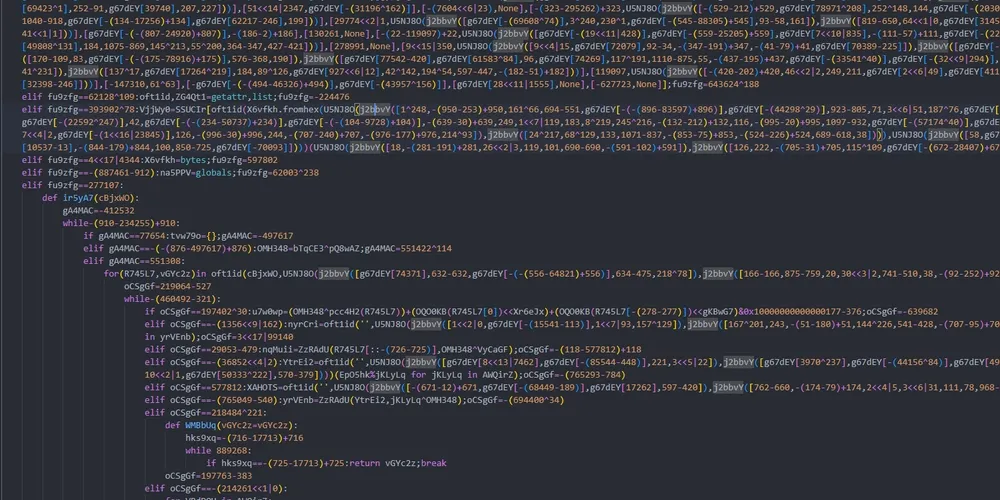
DEV Community
The Challenge: Protecting Python Source Code I’ve been building a custom obfuscator that...
 hollow crow

 nova oar
never heard of esoteric python
subtle viper
!e here's an introduction
from __future__ import barry_as_FLUFL
(lambda*_:[__import__(*_).main for{}[()]in _])("__hello__")[()<>()]()
:white_check_mark: Your 3.14 eval job has completed with return code 0.
Hello world!
Yea im never looking at it again
magic wraith
@sick hound would you like a little challenge?
luckily wayback has archived the file
sick hound
# The hardcoded hash stored inside the VM's bytecode array 'C'
TARGET_HASH = "7349175c986967e812397682855ec9009943486c676d296213567073b6480982"

def main():
    user_input = input("Enter password: ")

    # Generate SHA-256 hash of the input
    input_hash = hashlib.sha256(user_input.encode('utf-8')).hexdigest()

    if input_hash == TARGET_HASH:
        print("Correct!")
    else:
        print("Incorrect.")

if __name__ == "__main__":
main()```was i right?
@magic wraith
you didnt even change the opcodes. google gemini deobfuscated it in 30 seconds
magic wraith
mind you, that is two and a half years old
no, that is NOT right
not even close
idk what you did, you maybe fed the wrong file to gemini
but the main.py literally tells you what the goal is
sick hound
oh yea i didnt see main.py mb. i think it hallucinate the entire file. good job. im too lazy to touch the obfuscated code myself
versed eagle
sick hound
oh yea i didnt see main.py mb. i think it hallucinate the entire file. good job....
if you're too lazy to do the challenge why would you respond lol
 tulip glen
!e
message = ""
print(''.join(chr(int(''.join(str(ord(c) - 8203) for c in message)[i:i+8], 2)) for i in range(0, len(message), 8)))
:white_check_mark: Your 3.14 free threaded eval job has completed with return code 0.
Hello World!
I wrote a blog post about our IOPCC entry this year: https://bulmenisaurus.github.io/blog/iopcc-2025
earnest wing
oooh!!
 rare sphinx
!e
def lmfao(a: str):
 def g(x):return x&0xFF
 v=t=x=0;p=[]
 for h in list(a):
  match h:
   case'd':v=g(v-1)
   case')':v=p.pop()if p else 0
   case';':v=g(v+1)
   case'9':p.append(v)
   case'$':v,t=t,v
   case'[':print(chr(v),end='')
   case'4':v=g(v-t)
   case':':v=g(v*t)
   case'<':v=g(v+t)
   case'>':v,x=x,v
   case'8':v=g(v//t)
   case']':v=g(v**t)
lmfao(";;;$<:d::[$d$$;]>;;;;;;$44$>4[>;$><[[9;;;[9>$8;;$8<[4444>$>$4[)[;;;[)[>$844$>4[>$ddd$];[")
:white_check_mark: Your 3.14 eval job has completed with return code 0.
Hello World!
 dawn jacinth
!e
Py```answer = input("Are you gay? (y/n): ").strip().lower()
if answer == "y":
print("\n💙 A Letter For You 💙\n")
print(
"Being gay is completely okay.\n"
"You are not broken, wrong, or different in a bad way.\n"
"You are human, just like everyone else, and you deserve respect,\n"
"love, and happiness exactly as you are.\n"
"Never let anyone tell you otherwise.\n"
)
elif answer == "n":
print("\nYou are monkey 🐒\n")
print(r"""
,
(o,o)
/)__)
" "
""")
else:
print("Please type only 'y' or 'n'.")```
night quarryBOT
dawn jacinth
!e
Py```answer = input("Are you gay? (y/n): ").strip().lower()
if answer == "y"...
:x: Your 3.14 eval job has completed with return code 1.
001 | Are you gay? (y/n): Traceback (most recent call last):
002 | File [35m"/home/main.py"[0m, line [35m1[0m, in [35m<module>[0m
003 | answer = [31minput[0m[1;31m("Are you gay? (y/n): ")[0m.strip().lower()
004 | [31m~~~~~[0m[1;31m^^^^^^^^^^^^^^^^^^^^^^^^[0m
005 | [1;35mEOFError[0m: [35mEOF when reading a line[0m
!e
    answer = input("Are you gay? (y/n): ").strip().lower()
except EOFError:
    answer = "y"  # default if input is not allowed

if answer == "y":
    print("\n💙 A Letter For You 💙\n")
    print(
        "Being gay is completely okay.\n"
        "You are human, valid, and deserving of respect.\n"
        "You are not different in a bad way.\n"
    )

elif answer == "n":
    print("\nYou are monkey 🐒\n")
    print(r"""
      __,__
     (o,o)
     /)__)
      " "
    """)

else:
print("Please type only 'y' or 'n'.")```:white_check_mark: Your 3.14 eval job has completed with return code 0.
001 | Are you gay? (y/n):
002 | 💙 A Letter For You 💙
003 |
004 | Being gay is completely okay.
005 | You are human, valid, and deserving of respect.
006 | You are not different in a bad way.
 carmine bloom
dawn jacinth
!e
```try:
answer = input("Are you gay? (y/n): ").strip().lower()
except EO...
carmine bloom
dawn jacinth
!e
```try:
answer = input("Are you gay? (y/n): ").strip().lower()
except EO...
tf
 scenic kelp
!e
night quarryBOT
Missing required argument
code
scenic kelp
!eval [3.12] < def pizza_order():
print("Welcome to Python Pizza Deliveries!")
prices = {
    "small": 10,
    "medium": 12,
    "large": 15,
    "cheese": 1,
    "olives": 2,
    "sausage": 3
}

size = input("What size pizza do you want? (Small/Medium/Large): ").lower()

bill = 0

if size == "small":
    bill = prices["small"]
elif size == "medium":
    bill = prices["medium"]
elif size == "large":
    bill = prices["large"]
else:
    print("Invalid size selected.")
    return

topping = input("Choose a topping (Cheese/Olives/Sausage): ").lower()

if topping == "cheese":
    bill += prices["cheese"]
elif topping == "olives":
    bill += prices["olives"]
elif topping == "sausage":
    bill += prices["sausage"]
else:
    print("Invalid topping selected.")
    return

print(f"\nYour final bill is: ${bill}")
print("Thank you for your order!")
pizza_order()>
I would consider this to be 0 errors.
subtle viper
!eval ```py
def pizza_order():
print("Welcome to Python Pizza Deliveries!")
prices = {
    "small": 10,
    "medium": 12,
    "large": 15,
    "cheese": 1,
    "olives": 2,
    "sausage": 3
}

size = "small" # input("What size pizza do you want? (Small/Medium/Large): ").lower()

bill = 0

if size == "small":
    bill = prices["small"]
elif size == "medium":
    bill = prices["medium"]
elif size == "large":
    bill = prices["large"]
else:
    print("Invalid size selected.")
    return

topping = "cheese" # input("Choose a topping (Cheese/Olives/Sausage): ").lower()

if topping == "cheese":
    bill += prices["cheese"]
elif topping == "olives":
    bill += prices["olives"]
elif topping == "sausage":
    bill += prices["sausage"]
else:
    print("Invalid topping selected.")
    return

print(f"\nYour final bill is: ${bill}")
print("Thank you for your order!")
pizza_order()
:white_check_mark: Your 3.14 eval job has completed with return code 0.
001 | Welcome to Python Pizza Deliveries!
002 |
003 | Your final bill is: $11
004 | Thank you for your order!
try looking into using dict.get(); instead of having an if-elif tower.
also this channel is for #esoteric-python and weird code golfs. the #bot-commands is better suited for testing your code out.
subtle viper
untested golf ```py
P=lambda m,t:{"small":10,"medium":12,"large":15,"cheese":1,"olives":2,"sausage":3}.get(input(m).lower())or print("Invalid",t,"selected.")
def f():
print("Welcome to Python Pizza Deliveries!")
if b:=P("What size pizza do you want? (Small/Medium/Large): ","size"):a=b;b=P("Choose a topping (Cheese/Olives/Sausage): ","topping")
if b:print(f"\nYour final bill is: ${a+b}\nThank you for your order!")
pizza_order=f;f()
okie
 pearl geyser
!eval message = ""
print(''.join(chr(int(''.join(str(ord(c) - 8203) for c in message)[i:i+8], 2)) for i in range(0, len(message), 8)))
night quarryBOT
pearl geyser
!eval message = "...
:white_check_mark: Your 3.14 eval job has completed with return code 0.
Hello World!
zero-width whitespace being decoded, I assume?
!eval print(__import__('unicodedata').name(chr(8203)))
night quarryBOT
terse pollen
!eval `print(__import__('unicodedata').name(chr(8203)))`
:white_check_mark: Your 3.14 eval job has completed with return code 0.
ZERO WIDTH SPACE
 vernal crest
What is a code golf?