#unit-testing
1 messages · Page 17 of 1
 sterile valve
definately, but as I don't really like junit/xunit style, and never did - I chose pytest. It took some time for me to dive in. But as I'm familiar with other frameworks on other languages it was not a problem in my case
 plain siren
well good for you but projects have to start somewhere and that looks promising. you don't have to sound condescending
 sonic crown
is any1 interested in making a quizizz hack?
I'm having problem making one, I got the code from github and im trying to fix it but I'm stuck. I will send the code that I fixed and I hope you will help me fix it
sonic crown
sterile valve
@plain siren sorry if I sounded condescending - Just.. I've seen too many test frameworks in my life that are long dead now 😄 Ofc you can try to use something like this for exploratory or learning. But I would not advice to use on commercial production apps. Of course if it is not a project that should go offline in 2-3 months...
plain siren
i didnt ever say it was something i would use on a production application. obviously i'm not going to use brand new repositories in a production environment. that's not the point
sterile valve
👌 ok then
 night wolf
so i am done with writing my first graphql api
and i am about to write some tests
how should i structure tests
i'm planning on using unittest
should i make a testcase per mutation? (every mutation has about 3-4 responses)
 shut hedge
@night wolf That's a difficult question to answer. One thing that you could look at is which test methods share set-up methods so you both only do what's necessary for certain tests and you still stick to the DRY principle. So, group methods together that require the same setUp or setUpClass helpers method and/or look at the logical grouping of tests. At the end, test code is just code as well; try to keep it DRY, simple, and readable.
shut hedge
This is an interesting video on testing: https://www.youtube.com/watch?v=FxSsnHeWQBY
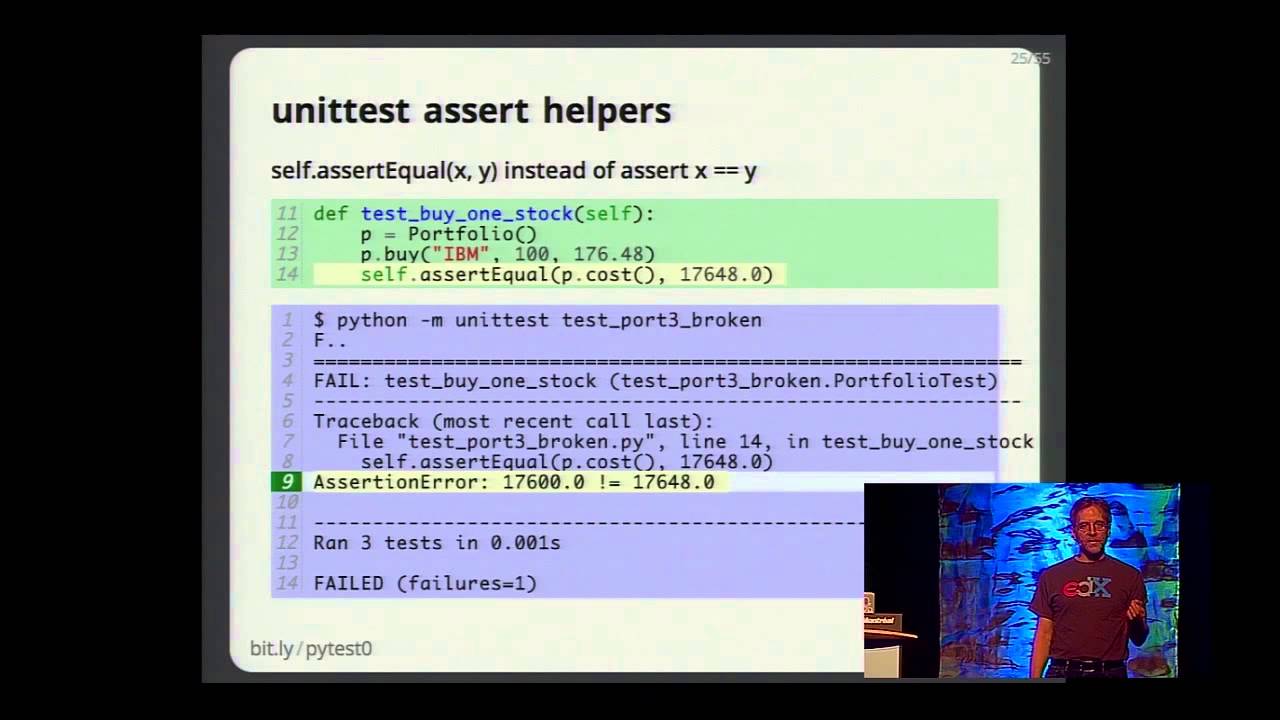
Speaker: Ned Batchelder
If you've never written tests before, you probably know you should, but view the whole process as a bureaucratic paperwork nightmare to check off on your ready-to-ship checklist. This is the wrong way to approach testing. Tests are a solution to a p...
nedbat is the author of coverage.py (https://coverage.readthedocs.io/en/stable/)
night wolf
okay so i'm writing tests
and i have decided for "testcase per mutation" strategy
so i'm having multiple test cases in one file and nosetests and unittests pick up only first test class, how do i fix these?
 kind meadow
How are you running the tests?
I usually do python -m unittest in the root and it will automatically discover all tests
night wolf
tried python3 -m unittest app/tests/tests_mutation.py
it only finds test for the first test case
this is my file
i have two testcase classes
i'm so confused
did some fiddling, nothing seems to work
@kind meadow should i just make a a file per mutation?
kind meadow
No I mean just type the command exactly how I wrote it (well adding a 3 to python is fine of course)
don't specify a file
If you do want to run tests for a specific module then try python3 -m unittest app.tests.test_mutation (I am guessing that's the right path)
night wolf
it only found 3 tests still
i sent a file of my tests, mind giving that a look?
also tried nosetests, same thing
this is my file structure
kind meadow
Oh it seems that in your second test case, your test functions are all nested inside the setup fixture
They shouldn't be
night wolf
are they?
kind meadow
Yes
kind meadow
You're welcome
 broken fern
Oh, testing!! Huzzah!
Anyone doing TDD, Red-Green-Refactor, TCR or any other Test-First style. I would enjoy trading experiences on Kata and Refactoring and such.
 marsh raft
I've done TDD about twice in my current job, at which I've been four years
broken fern
Sounds like you don't do TDD then 🙂
Do you do Katas?
marsh raft
don't even know what those are tbh
I refactor occasionally though, fwiw
once code is in production I don't refactor much, but while I'm developing something, I do it a lot
broken fern
Kata are the exercises that will establish you in the techniques of TDD as Test-First.
marsh raft
I may have done some of those. I've done the "python koans", which sound similar; I loved those
broken fern
You use the 3 laws
You must write a failing test before you write any production code.
You must not write more of a test than is sufficient to fail, or fail to compile.
You must not write more production code than is sufficient to make the currently failing test pass.
yeah I know, and admire those
broken fern
Lately I’ve been asked by more and more people inside Microsoft to help them
really learn to do TDD. Sure, they’ve read the books, and …
marsh raft
actually those are worded a bit more sharply than I'd remembered, but it's an improvement
You must not write more of a test than is sufficient to fail is new to me, but seems like a good idea. I'm guilty of violating this pretty often
broken fern
Usually I start people off with the FizzBuzz Kata, and move on from there. But I just did the String Calculator one tonight, and really learned that I was not up on my python string functions 🙂
and here is a nice huge collection:
Well, if you "work the process" and do kata as regular practice, you will get better at not violating them.
The most amazing one was the Prime Factorization one because I would have never come up with the resulting algorithm. But I might say that about the string calculator I just finished as well.
 wispy cradle
hi!! can someone provide me with some resources to start with testing in python ?? (never done testing before in my life and skipped writing unit test for my assignments too)
most basic level to start with ?
night wolf
Speaker: Ned Batchelder
If you've never written tests before, you probably know you should, but view the whole process as a bureaucratic paperwork nightmare to check off on your ready-to-ship checklist. This is the wrong way to approach testing. Tests are a solution to a probl...

In this Python Programming Tutorial, we will be learning how to unit-test our code using the unittest module. Unit testing will allow you to be more comfortable with refactoring and knowing whether or not your updates broke any of your existing code. Unit testing is a must on any...
Both are very comperhensive and good for starting
wispy cradle
thnx @night wolf
wispy cradle
is unit test better or pytest module is better
to start with >
?
i did write some on unittest module but was wondering if pytest was a better option ?
broken fern
@wispy cradle I am a big fan not only of unit testing but actual TDD. I have used both Pytest and unittest as well as writing my tests in unittest and using pytest to run them. Personally, I like pytest. It doesn't require any skeleton to setup, just import your module and start writing tests with asserts.
I have very strong opinions about TDD, and if you have even the slightest interest I would be happy to take the time to walk you through the process.
Also, here is a website from the podcast "Test & Code" (which was previously Python Testing) and it is a terrific resource with great links to all sorts of testing products and articles.
wispy cradle
thnx @broken fern i would love to learn more about TDD. i will check out the link
where is the link?
broken fern
Sorry friend, I just can't hit the paste keys this early in the morning 🙂 Here: https://pythontesting.net/start-here/
What info do you need to start testing? - If you don't find what you are looking for, please let me know what you are looking for. Click that link and let
wispy cradle
thnx @broken fern
broken fern
I am on east coast USA and it is morning now. find me in the evening, and I can actually walk you through process of TDD on a simple kata, and you can build on it from there.
broken fern
Or you can start with an article like this:
https://medium.com/@elliotchance/lets-talk-about-tdd-baby-5ce11bd9b53b
If you are a pycharm user then this video might be better:
https://www.linkedin.com/learning/unit-testing-and-test-driven-development-in-python/example-tdd-session-the-fizzbuzz-kata

Medium
Test Driven Development has been around for longer than you probably think, around 2003. Not that far back you say? Well actually TDD is…

Learn from a short example of test-driven development coding session using pytest and implementing the FizzBuzz code Kata.
broken fern
The video is fine regadless of which tool you are using, but he is using pycharm. No magic involved, you would just have to figure out which button VSC uses to run your tests. Otherwise it is the same lesson. Personally, I like 2 files one for tests and one for code. but if you are doing a video like this it is easier to do and for the watcher to follow with everything in one file.
In general I just run pytest -v in another terminal and that is sufficient for me. But if you are using an IDE they will likely either give you some way to have a terminal inside of it, or specifically recognize and run unit tests. Normally, I just use Vim with 3 windows open, one for a terminal, and one for each file (test_<stuff>.py and <stuff>.py) But that's just me 🙂
wispy cradle
ohh thnx for the info i will try to go through those videos first with all setting up the environment for the TDD and stuffs. thmx @broken fern. u got me pretty hyped wihtout all those resources.
broken fern
If you want to see some justification, check these out:
This is a good explanation of "why."
https://www.youtube.com/watch?v=HhwElTL-mdI
This is long, but very good. But it it doesn't use python.
https://www.youtube.com/watch?v=AoIfc5NwRks

"I know I should write some tests, but I can't afford the time. I have to get this feature out the door." That's absolute crap, friends, and if you hear someone say it you should slap them. Yes, tests provide a measure of code reliability at the apparent cost of extra work. ...

In this talk, Uncle Bob describes the three laws of Test Driven Development, and demonstrates the discipline using the Kotlin language.
0:00 : Introduction into the three laws of Test Driven Development
24:10 : A hand-on demo of Test Driven Development using the Kotlin language
...
broken fern
Both of those Uncle Bob videos are in the size of an hour, but he is worth it. I tend to listen at 1.7 speed though :).
broken fern
You will find that "experienced" programmers who don't do "TDD" will poop on it. And say how bad it is. Don't listen to those people 🙂 Actually try it and decide based on your experiences. Think of it like sushi. There is an age after which people who haven't eaten sushi, won't bother trying it. It is similar here. The process can feel "silly" at first, until you understand what it does to your code.
wispy cradle
i like the fact that it helps with writing low coupling code
broken fern
the side effect of that is that you write very "testable" code
broken fern
yes, they go hand in hand. You will appreciate that when you have to add or fix something in code that is tightly coupled.
wispy cradle
so far i like the whole idea y u need TDD. i can understand at start it might get too tedious for me.i guess i just need to practice more to get use to it and improve my productivity
broken fern
Think of it like baking a cake from a recipe.
To learn the process, then to do kata with some regularity will "set" your way of thinking. There are more advanced techniques as you move forward, but they can be a bit much to dump on people before they are ready. Kind of like giving a little kid the 'talk' ... you wait until they start asking those questions 🙂
wispy cradle
sure haha i just started writing tests from today lol Thnx @broken fern for the resources n guidance
broken fern
Yes, when you get really comfortable and have done at least 4 different kata... then ask about Zombies
wispy cradle
sure thnx
 inland sleet
In Robotframework, how can I continue onto the next robot file when all tests from one have been executed?
Im trying to use the DRY methodology and have a init.robot to open a browser session and then i have a bunch of robot files with tests I want to run against various subdomains of my site, however after the first one executes, the others fail as it can't open the new page I need to run tests against
 woeful kelp
What lib would you recommend to mock on pytest ?
inland sleet
@woeful kelp mock? https://realpython.com/python-mock-library/

In this tutorial, you'll learn how to use the Python mock object library, unittest.mock, to create and use mock objects to improve your tests. Obstacles like complex logic and unpredictable dependencies make writing valuable tests difficult, but unittest.mock can help you over...
woeful kelp
haha obviously, thks @inland sleet
inland sleet
Not trying to be a jerk btw, just figured if you haven't heard of if, it might be a good option
broken fern
GitHub
Thin-wrapper around the mock package for easier use with py.test - pytest-dev/pytest-mock
 rain wigeon
test now, regret it later
 honest verge
s/,/ or/
 prisma scaffold
is it hard to make an application where i can change color on like mouse or keyboard?
honest verge
@prisma scaffold please don't spam random channels with the same question
broken fern
when using pytest to run your unit tests (or other tests) using --exitfirst (or -x) will stop as soon as a test fails without going through the rest of the test. When working on a programming exercise with a set of unitttests it can keep your screen relevant 🙂
When using python -m unittest from the command line you can add --failfast (or -f)to do the same
broken fern
Just because Python calls the library unittest, doesn't mean it can't be also used for integration tests, feature tests, subcutaneous tests or even end-to-end tests.
honest verge
I like what you are doing Absinthe. Please keep sharing these little bits of info.
TIL about subcutaneous tests! https://www.martinfowler.com/bliki/SubcutaneousTest.html

 rotund wind
Anyone any good at using unittest.mock.patch ?
I thought I knew how to use it but the function I have patched still seems to run everytime I run my tests.
I imported subprocess.call and I have a method that uses call to call notify-send in the command line.
I've (tried to) patch call so I can test it gets called with the right args & also so it won't actually send a notification everytime the tests run. Patch seems to be working but the notifcation pops up every time I run my tests.
I've put the code for the file with the class and the test here: https://pastebin.com/VnPBNa0d
If anyone could help I'd apreciate it, I've been looking at this all day and I can't work out why the notifications are being sent (the tests run fine with the patch).

Pastebin
kind meadow
I couldn't reproduce your issue
That said, I did have to put the test in a unittest.TestCase class to get the test to even run
rotund wind
Thanks for trying @kind meadow, I think I had tunnel vision, I went for a walk and while walking realised that there was another test in another file that wasn't patching the call.
The call didn't exsist when that test got written and the new functionailty didn't break any of the old tests.
I don't have to put it in TestCase on my system; i'm running python -m pytest as my test runner on python 3.8
kind meadow
I suspected it may be something like that. And I was using unittest as the runner so that explains the discrepancy.
rotund wind
Yeah; I always feel silly when I spend hours on something so obvious. Coding time is never consistant.
 tropic maple
Hi, im new to Pytest and wondering if there is an appropriate way to monkeypatch a function on first call only?
kind meadow
That's a strange thing to need to do. I feel like either you're approaching writing your tests incorrectly or whatever you were testing was not designed to be very testable.
What is the context?
tropic maple
you could be completely right. i inherited some code and trying to build some tests around it
the function i'm trying to test checks for a change in temperature in a while loop
normally this will change and return a differential
since I'm mocking out the actual call to return a static number, i was hoping to increment the mocked return to a new number the second call
to exercise the existing code
however, im still pretty new to unit testing so open to any advise on better practice
broken fern
Why not put a little logic in the mock
tropic maple
like a counter on call?
broken fern
Well what do you want to test? Temperature changes or availability of the temperature probe or what
tropic maple
that the code to handle the change is doing what it should be
broken fern
You could have a list of numbers and each time the gettemp mock is called it returns the next one.
But for a unit test you have to be able to test for an expected result
tropic maple
i think i could manage that
broken fern
So you know how to make a generator with yield right?
broken fern
Well you have a function with a list or even a file full of values. Each call to it will give you the next one
broken fern
So when you gettemp that is what you return it
This way you could have 1 or 10000000ⁿ
tropic maple
thanks so much. dont know why i couldn't figure that out but it makes sense
broken fern
And you can write the test for different states
tropic maple
i guess i was thinking too much that pytest had some sort of magic that you could switch it on/off mid-test.
that's really great
broken fern
Well when you want hooves look for horses not zebras :)
tropic maple
lol
@broken fern seriously. appreciate it!
like i said, im new to unittesting and trying to wrap my head around some of the concepts
i'll probably be bugging everyone in here more frequently 😄
broken fern
There is a guy with a podcast test &code names Brian Okken he is all about the testing and will respond to dm on twitter
He has an associated web page that I can't type in but the Strat here link on it is full of all sorts of useful stuff for Python testing and testing in general
 halcyon zodiac
Why can't you type a web page?
broken fern
Testandcode.com is the podcast page but I am looking for the other one
What info do you need to start testing? - If you don't find what you are looking for, please let me know what you are looking for. Click that link and let
There it is
@halcyon zodiac because I am on my phone and can't type well on it :)
tropic maple
ha thanks 🙂 i have started listening to Brian Okken
broken fern
But I can cut and paste
tropic maple
i came to python from another language and I must say, i'm VERY impressed by how awesome the community is
broken fern
Well if you are into TDD we can have a deep chat on that. But any testing is better than no testing
What language is that?
tropic maple
youre better off 🙂
tropic maple
@broken fern if i have a generator that yields a list item, when i call that function (generator) I get a generator object back
without changing any of the current logic in the function under test, how would i call that monkeypatch generator and get __next__
broken fern
not sure I follow
I thought we were discussing returning a temperature.
def temp_gen():
  for x in [99]*10 + [88] + [99]*10:
    yield x

gen = temp_gen()
try:
   while true:
     temp = next(gen)
except StopIteration:
   pass
Something like this
@tropic maple boo!
tropic maple
oh great 🙂 thank you
broken fern
Hope it works.
kind meadow
I have this situation
# foo_module.py
from x import y


class Foo:
    def bar(self):
        return y.z


# test.py
from foo_module import Foo
How would I patch the z attribute of foo_module.y? As you can see, my test doesn't have the module foo_module, only the class Foo.
Do I have to change the test's import so that I can patch the module too?
halcyon zodiac
You can import y from foo_module, can't you?
kind meadow
Yes, I can. Turns out the issue was incorrect order for the patch decorator
In my test I also have from x import y, and patching that works too. Not sure why. I don't really understand how Python looks up objects.
Is it cause modules are really imported only once? And other imports just re-use it?
Cause y is a module
This is discussing classes https://docs.python.org/3/library/unittest.mock.html#unittest.mock.Mock
Here's a running example https://repl.it/repls/StableNovelApplicationsuite

Powerful and simple online compiler, IDE, interpreter, and REPL. Code, compile, and run code in 50+ programming languages: Clojure, Haskell, Kotlin (beta), QBasic, Forth, LOLCODE, BrainF, Emoticon, Bloop, Unlambda, JavaScript, CoffeeScript, Scheme, APL, Lua, Python 2.7, Ruby, ...
So question now is why does patching a_module.AClass work within the test when that import is separate from the one done inside foo_module
 unkempt aurora
can someone correct me if im wrong but if your trying to make a software with python would you use Tkinter ? please @ me so i dont forget
 tight geyser
@unkempt aurora it depends, what are you making
also this is not #unit-testing related
unkempt aurora
Sorry
 finite bay
Im looking for a quick way to time how long a program takes to run and compare it to another - seems to be alot of options out there so any suggestions?
broken fern
like this?
Timer objects are used to create some actions which are bounded by the time period. Using timer object create some threads that carries out some actions. In pyt ...
or if you use ipython they have some magic %timeit
honest verge
there's also the time command in linux if you're on a Mac/Linux computer and work with CLI apps. See man time.
 ashen whale
Hi there, having issues with patching. How can I patch or mock a class that is both defined and instantiated in the same file? Seems like patching only works for imports. Thanks! (unittest)
kind meadow
@ashen whale Sounds like you need to use unittest.mock.patch.object(module_name, "class_name", ...)
ashen whale
thanks @kind meadow , doesn't seem to have any effect but will keep trying different things
kind meadow
When does the class get instantiated? If it's as soon as the module is imported, then that's likely the problem.
ashen whale
yeah my thoughts as well...basically it's like
Class A:
    pass

ClassA()
I tried:
patch.object(path.to.module, 'A')
Right. The code executes at import time, so by the time your patch is called, it's too late since the class has already been instantiated.
kind meadow
You may not like this answer but the fix is to just not instantiate it at import time.
ashen whale
so i may need to instantiate this in another way that is not file level
sounds like we are on the same page
kind meadow
You can put it in a function. Depending on your use case, you could either have whoever imports the code call the function or you could call it in the same module but use if __name__ == "__main__" so that the code only executes when the module is not imported.
ashen whale
sounds good, ill think of the best use case here. Appreciate the help!
 zealous pollen
Does emteria os work on Raspberry PI 4 now?
 stone flare
I have a web scraper that is hanging on certain sites. What is the best way to try and find what is causing it to hang?
 fiery cove
 indigo forge
Anyone got any experience getting boto3.resources to work in the local stack for test automation?
I'm having trouble getting my tests to work in the local stack becausue i'm calling the resource (would calling the client make any difference?) to my understanding it will still not work
 violet birch
is there a way to get the name of the unittest to be run within setUp of a unittest.TestCase ?
basically during setup i create (currently randomly) named sqlite.db file and i want to name them after the test
kind meadow
Why not create a single database and use transaction control instead?
But no, I don't think it's possible to get the current tests name within those fixtures.
marsh raft
@violet birch If you use pytest, it's possible
def test_wat(request):
    print(request._pyfuncitem.name)
    5/0

# python3 -m pytest wat.py
# ==================================================== test session starts =====================================================
# platform darwin -- Python 3.8.1, pytest-5.3.2, py-1.8.1, pluggy-0.13.1
# rootdir: /private/tmp
# collected 1 item

# wat.py F                                                                                                               [100%]

# ========================================================== FAILURES ==========================================================
# __________________________________________________________ test_wat __________________________________________________________

# request = <FixtureRequest for <Function test_wat>>

#     def test_wat(request):
#         print(request._pyfuncitem.name)
# >       5/0
# E       ZeroDivisionError: division by zero

# wat.py:3: ZeroDivisionError
# ---------------------------------------------------- Captured stdout call ----------------------------------------------------
# test_wat
# ===================================================== 1 failed in 0.09s ======================================================
 eager igloo
hey all - I'm having a really hard time getting celery to work with pytest in a flask app and I was wondering if there's anyone I could share some thoughts with about it. When I run a test that uses endpoints that involve celery, the test will be irresponsive with no real traceback or details. when I ctrl-c out of the test, it looks like its not getting the proper conf details such as the broker for some reason.
 torn mirage
@shut hedge you mentioned I could ping you if I ran into some trouble with the tests can move to dev contrib if it's more fitting there, mostly playing around with how to do it in the future but ran into a small problem with the command I'm testing...
    @commands.command(aliases=("hush",))
    async def silence(
            self,
            ctx: Context,
            duration: HushDurationConverter = 10,
            channel: TextChannelConverter = None
    ) -> None:
        """docstring"""
        channel = channel or ctx.channel

        if not await self._silence(channel, persistent=(duration is None), duration=duration):
            await ctx.send(f"{Emojis.cross_mark} {channel.mention} is already silenced.")
            return
        if duration is None:
            await ctx.send(f"{Emojis.check_mark} Channel {channel.mention} silenced indefinitely.")
            return

        await ctx.send(f"{Emojis.check_mark} {channel.mention} silenced for {duration} minute(s).")
        await asyncio.sleep(duration*60)
        await self.unsilence(ctx, channel)
Got from the other cogs how to test the send through extracting its call args but how should the internal command it calls be handled? Just let it pass in this test and then test properly in others?
The second command coro used there also messes it up because of the self; how should that be dealt with? Or just looking at it now should that be invoked from ctx? Not really sure on the differences there
shut hedge
Do you mean self._silence(channel, persistent=(duration is None), duration=duration)?
If so, I'd test it separately, since it's a clear, seperate "unit" you can test independently
That means you can mock it here just to make sure you test every branch of execution within this coroutine
torn mirage
Yep for the internal
The unsilence that goes after a sleep delay... should that be an invoke? The tests run without an issue if it is one as the duration can be a float when passed directly
Also, how many test cases should there be for stuff? test each execution branch once or get some edge cases etc. there too even when the result is the same?
shut hedge
I wouldn't overdo the number of test cases, so a combination of testing each branch + things like very obvious boundary conditions that could make a difference.
I don't see many very tricky boundary conditions here (does HushDurationConverter already make sure that duration is non-negative?)
torn mirage
yes, it regex matches it for a \d[mM] like pattern
shut hedge
Right, yeah. So that one would be good to test with boundary conditions like "what happens with a negative duration" (regex doesn't match, but we should at least have that codified in a test so that if a change breaks that, it becomes obvious)
but that's not this command coroutine
From the perspective of this function, we can assume that the input is supplied properly by the converter
torn mirage
Was more curious because of the HushDurationConverter test conditions actually with the regex it involves... had a bunch but reduced it to 2 cases before commiting
Alright so here I would mock the _silence to return the bool I need and then test what was sent to ctx in this command
shut hedge
Sounds good
torn mirage
bit out of scope for here (can move to dpy) but what about the unsilence? It shifts the args and ctx is passed as self etc. when it's as above resuling in an error when it tries to access a channel
shut hedge
Is unsilence another command decorated method?
torn mirage
yep
shut hedge
I think you'd normally use the invoke method of Context for that, right?
!docs get discord.ext.commands.Context.invoke
 bitter wadiBOT
await invoke(*args, **kwargs)```
This function is a [*coroutine*](https://docs.python.org/3/library/asyncio-task.html#coroutine).

Calls a command with the arguments given.

This is useful if you want to just call the callback that a [`Command`](#discord.ext.commands.Command "discord.ext.commands.Command") holds internally.

Note

This does not handle converters, checks, cooldowns, pre-invoke, or after-invoke hooks in any matter. It calls the internal callback directly as-if it was a regular function.

You must take care in passing the proper arguments when using this function.

Warning

The first parameter passed **must** be the command being invoked.

Parameters  • **command** ([`Command`](#discord.ext.commands.Command "discord.ext.commands.Command")) – A command or subclass of a command that is going to be called.

• ***args** – The arguments to to use.

• ****kwargs** – The keyword arguments to use.Anyway, it's late here. I'll check back tomorrow morning.
torn mirage
Thanks for the help
shut hedge
no problem at all. thanks for working on the issue.
torn mirage
Say I have a test that has no special args, just checks a thing once; should a subtest be used there?
marsh raft
doubt it
even though I'm not 100% sure what you're talking about
"Keep It Simple, Stupid" is pretty good advice; a "subtest" sounds less simple than just "a plain old test"
kind meadow
A subtest is used when it needs to repeat assertions with different parameters.
It doesn't sound like you need one but your explanation wasn't very clear.
torn mirage
With a coro like this, what should be tested there? Checking logging messages seems a bit too much, the return bool is the same for different branches so that doesn't seem like the best way. Or would checking the bool while also mocking the _notifier.start to check if it was called be good? Just can't think of anything that doesn't sound a bit too complex
    async def _silence(self, channel: TextChannel, persistent: bool, duration: Optional[int]) -> bool:
        if channel.overwrites_for(self._verified_role).send_messages is False:
            log.debug(f"Tried to silence channel #{channel} ({channel.id}) but the channel was already silenced.")
            return False
        await channel.set_permissions(self._verified_role, overwrite=PermissionOverwrite(send_messages=False))
        if persistent:
            log.debug(f"Silenced #{channel} ({channel.id}) indefinitely.")
            self.loop_alert_channels.add(FirstHash(channel, self._notifier.current_loop))
            with suppress(RuntimeError):
                self._notifier.start()
            return True

        log.debug(f"Silenced #{channel} ({channel.id}) for {duration} minute(s).")
        return True
It'd be a bit easier if the code under persistent was a separate function
Definitely don't need to check the logs.
Well, the code for persistent doesn't seem to be dependent on anything else the function does, so it could be written as a separate test rather than a subtest
You could have 3 separate tests:
- Return false if
send_messagespermission isFalse. If you feel it's necessary you could also assertset_permissionsisn't called. set_permissionsgets called and true is returned- If
persistentisTrue, test adding to the set and thatstartis called. Could use subtests to assert the aforementioned will not happen whenpersistentisFalse.
torn mirage
the notifier handling could be moved to a second class now that you mention it as it doesn't really interact with other parts, thanks
torn mirage
How do the test mocks work? Wondering how the send_messages from the first test leak to the second one when I have a different mock object. Are they reused if set?
    def test_silence_private_for_false(self):
        """Test whether `_silence` does not set permissions and returns `False` in an already silenced channel"""
        channel = Mock()
        overwrites_for_mock = Mock
        overwrites_for_mock.send_messages = False
        channel.overwrites_for = overwrites_for_mock
        self.assertFalse(asyncio.run(self.cog._silence(channel, True, None)))
        channel.set_permissions.assert_not_called()

    def test_silence_private_silenced_channel(self):
        """TODO +NAME"""
        channel = MockTextChannel()
        print(channel.overwrites_for.send_messages)
        self.assertTrue(asyncio.run(self.cog._silence(channel, False, None)))
        channel.set_permissions.assert_called_once()
They are not re-used if a different mock instance is being created for each of the tests.
Have you actually confirmed that a mock is being re-used in a different test or is that just an assumption?
torn mirage
the False is carried over from the first test to the ones that run after it, it's for the above function
alone they all run fine, but together the first check is always true
kind meadow
I see. overwrites_for_mock is the Mock type rather than an instance of a Mock
So yes, attributes set on a type do persist.
You probably meant to use an instance there.
torn mirage
Oh right, they're all Mock's. How should I go around mocking the send_messages here? Making it an instance makes the send_messages attrib a mock
kind meadow
Like this ```py
perm_overwrite = discord.PermissionOverwrite(send_messages=False)
channel = Mock(overwrites_for=Mock(return_value=perm_overwrite))
The PermissionOverwrite doesn't really need to be mocked since it's a simple class
But you could if you wanted to, just by swapping out discord.PermissionOverwrite with Mock
Can also be done this way since overwrites_for should already be an existing Mock: ```py
perm_overwrite = Mock(send_messages=False)
channel = Mock()
channel.overwrites_for.return_value = perm_overwrite
Ah, missed that bit about setting attributes through kwargs in the docstring. Thanks again
Was overcomplicating it in my mind and googling didn't yield results
Doing this for a patch, is there a better way that doesn't involve a partial?
        with mock.patch(
                "bot.cogs.moderation.silence.Silence._unsilence",
                new_callable=partial(mock.AsyncMock, return_value=True)
        ):
for an awaited coro
kind meadow
Wouldn't just patch('...', return_value=True) work?
Also, patch.object may be more appropriate than patch.
kind meadow
How could something in __main__.py be patched? 🤔
torn mirage
can you import it?
torn mirage
it seems to work for me if I understood correctly, got an example?
from unittest import mock
import package.__main__

with mock.patch("package.__main__.func", return_value=10):
    print(package.__main__.func())

#######################
10
What if you don't import it before patching?
Does patch require things to already be imported?
Cause the whole reason I need to patch it is to prevent code from executing when importing it
I may have to do if __name__ == "__main__" inside __main__.py instead
It probably does need to be imported, it wouldn't make sense to be able to patch without importing
torn mirage
the patch works without me importing it myself, but it gets imported somewhere along the way
and can't change main itself
Do you just need to keep it from running?
kind meadow
I need to prevent the bot from starting
I this this is the best way ```py
if name == "main":
bot.run(BotConfig.token)
this seems to work
with mock.patch("package.__main__", create=True):
    import package
Well I need to access the bot instance it creates so I can't just mock the entire module
torn mirage
Does seem to need an import before accessing anything beyond main in the dotted path
torn mirage
Feels like this should be somehow separated as the test seems a bit complex but it tests one branch
    def test_unsilence_private_unsilenced_channel(self):
        """TODO"""
        perm_overwrite = MagicMock(send_messages=False)
        channel = MockTextChannel(overwrites_for=Mock(return_value=perm_overwrite))
        with mock.patch.object(self.cog, "notifier", create=True), \
             mock.patch.object(self.cog, "muted_channels", create=True):  # noqa E127
            self.assertTrue(asyncio.run(self.cog._unsilence(channel)))
            channel.set_permissions.assert_called_once()
            self.assertTrue(channel.set_permissions.call_args.kwargs['overwrite'].send_messages)
            self.cog.notifier.remove_channel.assert_called_once_with(channel)
            self.cog.muted_channels.remove.assert_called_once_with(channel)
Does this look fine or should it be in 2-3 tests? It feels like they'd be a bit too short (if that makes sense) when just checking the notifier and muted_channels were called separately, but the patches together also aren't nicest
kind meadow
Hard to say without more context.
torn mirage
for this
            await channel.set_permissions(
                self._verified_role,
                overwrite=PermissionOverwrite(**dict(current_overwrite, send_messages=True))
            )
            log.debug(f"Unsilenced channel #{channel} ({channel.id}).")
            self.notifier.remove_channel(channel)
            with suppress(KeyError):
                self.muted_channels.remove(channel)
            return True
I don't know enough about the code but it seems like these three things are independent, so they could be in separate tests
As in, removing a channel doesn't rely on the permissions to have been set first (unless you need/want to test the order of execution)
It's fine to have small tests. That's what units are after all
torn mirage
ah sorry I cut off the first line, which is an if that the permissions are False on send_messages
so when that passes the above is executed
kind meadow
Yeah I think it's still OK to make them separate.
torn mirage
How do you think it'd be best, 1 unit each for the overwrite, notifier and muted_channels?
kind meadow
Yeah, that sounds good.
Some others things: 1. a decorator may look nicer than a context manager for the patches 2. Don't use asyncio.run, you can subclass a special TestCase (see other tests for exact name) which supports async def tests, meaning you could just await inside them.
If you created the cog in the setup fixture, then it'd be recreated for each tests thus you could overwrite attributes directly with mocks rather than patching. But I don't know the best practices on that.
torn mirage
Oh I think I saw the async testcase somewhere, and the completely forgot about it; thanks.
Are the decorator patches something that's preferred overall?
kind meadow
I'm not 100% on their differences but I think it's just a stylistic thing in this case
Using a decorator I believe required the mock to be added as a param for the function, where as it can be omitted when using a context manager.
I prefer less nesting so I usually use the decorators
Especially if there were going to be multiple patches like that (though I recall a patch.multiple exists but I've never used it)
torn mirage
I'm at 98% coverage with 2 line_num->exit not covered on ifs.
Are those for when the condition is not met or something different? Adding a test case worked on one method but can't get it for those two
For example this if (whole func body)
        if await self._unsilence(ctx.channel):
            await ctx.send(f"{Emojis.check_mark} unsilenced current channel.")
has partial from
    async def test_unsilence_sent_correct_discord_message(self):
        """Check if proper message was sent to `alert_chanel`."""
        with mock.patch.object(self.cog, "_unsilence", return_value=True):
            await self.cog.unsilence.callback(self.cog, self.ctx)
            self.ctx.send.assert_called_once_with(f"{Emojis.check_mark} unsilenced current channel.")

    async def test_unsilence_skipped_sent_on_non_silenced(self):
        """test partial"""
        with mock.patch.object(self.cog, "_unsilence", return_value=False):
            self.ctx.send.assert_not_called()
 obsidian mortar
I was wondering if someone could take a minute or two to look over my first set of tests I've written? I'm not 100% sure I'm headed down the right path - I've taken each function in a single file and have written a test for valid and invalid values.
Gist
Hockey Game Bot - Testing - Schedule. GitHub Gist: instantly share code, notes, and snippets.
kind meadow
For the first test, test_get_team_id, you should split it up into three tests
One for a valid team name, one for an invalid team name, and one for the bad url + connection error
You should think smaller when making tests
They're unit tests after all
obsidian mortar
@kind meadow these are some of the first tests I've ever written so wasn't sure if all cases should be in the same test function but I definitely get why they'd be separate.
kind meadow
You can also look into parametrising tests, which is useful for repeating the same test with different input values. https://docs.pytest.org/en/latest/parametrize.html
And something like this ```py
resp_file = os.path.join(TESTS_RESOURCES_PATH, "teams.json")
with open(resp_file, encoding="utf-8") as json_file:
json_response = json.load(json_file)
Should just be read one time rather than reading it for every testGreat - that really helps. But for a first shot it sounds like I'm headed in the right direction?
kind meadow
I haven't seen the code that you're testing, but it did look fine as far as I can tell.
The only problem is you need to split things up like I said
And use mocks, if applicable. If you're testing a function A, and that in turn calls function B, you should be mocking B because that test's focus should only be on function A.
obsidian mortar
Oh I'm sorry - here's the applicable code.
kind meadow
You've already been doing that for requests so it's a good start
obsidian mortar

GitHub
🚨Hockey Game Bot is a Python application that sends important NHL events to social media platforms in (near) real time. - mattdonders/nhl-twitter-bot
Can you give me a bit of insight into what you mean by mocking the function. So when I call a function from within a test that's not the function I'm testing I should have static results?
kind meadow
Yes
And that's cause you should be limiting the scope of unit tests
So if a test fails, you know it happened cause something is directly wrong with that function
If functions all other functions which are part of your code, you'll have other tests anyway to cover those other functions.
And if they call library functions, well, you can assume that the libraries are tested by the maintainers of those libraries.
Granted that isn't always a safe assumption to make
obsidian mortar
Fair enough - I think that makes a lot of sense. So not only are my mock responses providing static data to avoid hitting APIs during unit tests they're providing me static data to test just the specific purpose of that function.
obsidian mortar
Thanks so much for your help @kind meadow 👌🏻
kind meadow
You're welcome
 pliant rivet
Hi, can someone help me with the way I should structure my database tests? how should I do it? can you point me to some resources? They are taking too long should I drop the tables for each test?
kind meadow
For tests you can use transaction control to prevent committing changes made during tests to the db. Not sure what exactly you're doing so sorry if this isn't applicable.
 vagrant obsidian
Can anyone help me to test my Game?
 proper wind
I'm trying to patch the __init__ method of a class in a file. I use @mock.patch('location_of_service_client_in_other_file.ServiceClient.__init__', mock.Mock(side_effect=mocked_init)). It does not seem to work however. An equivalent one, e.g. ServiceClient._wrapped_call does seem to work. Why is it not working for : __init__?
 modest tulip
def getProjected():
            with aiohttp.ClientSession() as cs:
                ua = UserAgent()
                url = "https://www.rolimons.com/projecteditems"
                headers= {
                    "Sec-Fetch-Dest": "document",
                    "Upgrade-Insecure-Requests": "1",
                    "User-Agent": ua.chrome
                }
                with cs.get(url, headers=headers) as content:
                    contentt = await content.text()

                    for match in re.finditer(r'item_details\W=(.+?(?=;))', contentt, re.MULTILINE):
                        loaded = json.loads(match.group(1))
                        real = {}
                        for load in loaded:
                            data = loaded[load]
                            if data[5] == 1:
                                real.update({load: loaded[load]})
                        return real```
How can I convert this into requests instead of aiohttp?I'd guess like this (untested): ```py
def getProjected():
ua = UserAgent()
url = "https://www.rolimons.com/projecteditems"
headers = {
"Sec-Fetch-Dest": "document",
"Upgrade-Insecure-Requests": "1",
"User-Agent": ua.chrome,
}
content = requests.get(url, headers=headers).text
for match in re.finditer(
    r"item_details\W=(.+?(?=;))", contentt, re.MULTILINE
):
    loaded = json.loads(match.group(1))
    real = {}
    for load in loaded:
        data = loaded[load]
        if data[5] == 1:
            real.update({load: loaded[load]})
    return real
thanks!
 cursive steeple
Do you guys think it is safe to rely on Python's smtplib to consistently send a user's order information to them? I'm logging errors but I have this feeling that I shouldn't rely on it
I'm just using a gsuite gmail account with it
 tranquil lynx
Hi! Does anybody use a bdd test framework in python like rspec in ruby? I use both languages and being able to describe tests in the rspec style is what I miss the most when using python. I used mamba + expects in the past but they are not actively maintained
kind meadow
I've not used it but what about behave? https://github.com/behave/behave
GitHub
BDD, Python style. Contribute to behave/behave development by creating an account on GitHub.
tranquil lynx
Actually, behave is too much, like cucumber for ruby. I used cucumber extensively some years ago,but having to write and maintain features is cumbersome. Rspec (and mamba for python) really shines to me because of how easy it makes to write the tests that I want
tranquil lynx
Do you guys think it is safe to rely on Python's smtplib to consistently send a user's order information to them? I'm logging errors but I have this feeling that I shouldn't rely on it
I'm just using a gsuite gmail account with it
@cursive steeple yes. You just need to handle erros/exceptions to retry if they happen
marsh raft
so, cucumber is cucumbersome? Noted
 smoky crest
I am writing a python package that creates stats based on photo metadata. As part of my pytest suite, I have a folder of test images. When I run it as a package or in Github CI, it can't find the folder. What's the right way to reference that in my pytest?
kind meadow
You're most likely using relative paths
Keep in mind the paths are relative to the current working directory, such is not necessarily the same directory as the python files
smoky crest
Sure. But how do I use absolute paths in a way that will work no matter what system is running the tests?
kind meadow
You can't use absolute paths unless you plan to dynamically create them
Which I don't recommend
Relative paths should be adequate
It just depends on the cwd when you run pytest
I don't suggest you make it your goal to make them work from any cwd
If you really want absolute path you can use __file__ to get the current modules absolute path
And manipulate that
smoky crest
Ah, ok
So in that case how do I use relative paths
do I have use OS.something to get the path at runtime?
kind meadow
Can you show your directory structure for the project?
smoky crest
sure
It's here https://github.com/djotaku/photo_stats

GitHub
Read directory containing photos and produce stats and graphs - djotaku/photo_stats
Here is where the tests are: https://github.com/djotaku/photo_stats/tree/master/photostats/tests
GitHub
Read directory containing photos and produce stats and graphs - djotaku/photo_stats
with teh images in a folder next to them there
kind meadow
photostats/tests/test_images should be the relative path. With that, invoking pytest from the root of the repository should work.
smoky crest
OK, just pushed that
oh, I need to change the test comparisons now
that worked! Thanks. (Had to also use a sort on my asserts because GH CI's Ubuntu grabs the files in a different order than my Fedora)
kind meadow
You're welcome
modest tulip
snip
kind meadow
You're in the wrong channel. Ask in #async-and-concurrency
 harsh gyro
I have a function, stoopid, which takes input and returns InPuT. I am writing some tests for this function, and I am working to fix the failing test_stoopid_bad_input test. Currently, the test fails because stoopid does not throw the exception when receiving lists, dictionaries, or tuples because they are iterable.
To fix this, I need to update stoopid to properly reject bad input. The root of the question is, which is more proper -- to use a regexp and match alphanumeric/digits/punctuation, or to check with something is isinstance(input, str)?
kind meadow
It seems unpythonic to check for types
If other types happen to work with the function, then let them work 🤷♂️
And if some don't work, then catch the exceptions or just let them be raised
You should just at the least document what kind of interface the function expects for the input type
harsh gyro
It does seem unpythonic, that's why I was shying away from it. For now, I did use an isinstance check but would not mind improving it. It does work with other data types, but produces the various forms of undefined behavior
Though one could argue that is a design flaw in the application logic itself.
night wolf
i got a question regarding CI platforms
since github published gh actions and they have a lot of cool presets, are circle ci, travis ci and such rendundant?
you can see actions right there in your repo opposed to external ci platforms
i am a bit lost
smoky crest
I think it's probably up to you and what you want to do
I use GH CI for all my GH projects
but I have some gitea projects and I use Drone CI on those
night wolf
Are there any pros that made you transfer to gh actions other than convenience
kind meadow
They're not mutually exclusive. You could run GH actions along with travis or whatever.
Maybe GH has a certain action that's more convenient to use or just doesn't exist on travis
Though this only applies to things that are not part of the same sequence of steps (like, you probably couldn't build on one and then test on the other without having to rebuild)
One pro of GH actions is that it has better integration into GH I believe. The output is visible right in the tasks page IIRC, rather than having to visit an external website.
night wolf
One pro of GH actions is that it has better integration into GH I believe. The output is visible right in the tasks page IIRC, rather than having to visit an external website.
yes, convenience is major point of github actions
but is it enough to go with gh actions rather than let's say travis?
kind meadow
I don't know, I don't have experience with a large number of CI services
From what I could tell, GH seems simplified
So if you work in smaller teams and don't need enterprise level features it may be better suited for you
halcyon zodiac
I don't know if there's a hugely compelling case to migrate existing non-trivial CI suites if they're already working without a more significant motivator, but for new CI development it's an attractive option if GH Actions provide all of the functionality that you need
kind meadow
I had an opportunity to choose GH actions recently but decided to stick to what I'm familiar with so I can leverage my experience to get it up and running quicker.
 fiery arrow
Hi everyone. I'm learning to unit test my stuff, so I wrote a small framework that allows me to test my functions.
How can the test names and test structure be improved here?
Basically, I have different objects that can be viewed and modified by users.
An object might not have any permission specification -- in that case, only admins can manipulate them. However, anyone can view them.
A permission specification consists of 3 fields:
- owner --- ID of the user who can reassign permissions and delete the object
- edit --- list of user IDs who are allowed to make any other changes to the object
- view --- either "anyone" or a list of IDs of those who can view the object
 cobalt ore
@broken fern 👋
cobalt ore
i can give you the names of the functions i think, they're fairly descriptive - is that alright?
broken fern
that's fine, but i am trying to understand why one needs the other for testing
do they share data?
cobalt ore
Right - the reason for that is that i was wondering how to setup the test env when I have written functions for the things that would be needed
eg - i need data on storage - i have written a function for this, but to set up the test env i would have to create sample data and upload, using the function that i've written
broken fern
Well if you write your tests first, then your functions are easier to test
cobalt ore
so, i'm using the function to setup the env to test the function
i have not written tests first
broken fern
So let's say we have a function that sets a global variable A to some value
cobalt ore
is what i've said clear
that i have a function, that uploads to DB
if i want to create mock data, i need this function to upload
broken fern
and an other function that only does something if that is set to A otherwise it will show that A is not set
cobalt ore
but ofc it is daft to use the function to setup the env to test the function
broken fern
is it something like that?
cobalt ore
i think if we stick to my specific example before abstracting it will be easier for me
broken fern
so you are manipulating a database in the process?
Okay, that's what you get when you ask me to guess things 🙂
cobalt ore
i am - so there are to be files on the data storage (not a data table)
just a storage bucket for files
i have written a function to upload to the storage, but i want to test it
broken fern
okay, like a directory or a remote site?
cobalt ore
a storage bucket on GCP, so just a directory makes sense yeah
broken fern
okay, so you have ftp'd or copied your files there and you want to make sure they made it
yes?
broken fern
okay, so that test requires that you are somehow able to tell if they files made it there, Are there queries available that will let you know they made it? ls or dir or something like that?
cobalt ore
sure - but i want to test the upload function as well
which is what i'm saying - i can't test that in the same file
so that i would have
test for the upload fn
tests that depend on the upload fn
again, your function is successful if <fill in the blank>
something like files are there and they are the right size
cobalt ore
and as long as they're in the right order it's ok 🤔
cobalt ore
Right - and i would lay it out as I have described there?
the circular reasoning was confusing me - as i wasn't sure what was usually done here
broken fern
are you using any of the unit test frameworks? Pytest or unittest?
cobalt ore
pytest
broken fern
okay, so you test is a simple assert of something
cobalt ore
yes that's fine, what i was confused about was how to order things
so that I wasn't using an untested function in order to create the sample data to test with
broken fern
def test_upload():
  perform_upload()
  assert remote_filecount() == expected_filecount
  assert remote_filelist() == expected_filelist
something like that
cobalt ore
sure, this is not the issue though
the issue is using an untested function in order to create the environment to use for testing
broken fern
can't you create a specific environment without using your function?
system call or some set of data uploads?>
cobalt ore
🤔 maybe if i use subprocess and shell commands
broken fern
okay, well here's the deal, you are either doing a unit test, or an integration test or an end-to-end test
cobalt ore
not sure what the difference is tbh - i just have a set of functions that i wanted to test
broken fern
So if you can't set up the environment to a specific known state, then you have to use your untested functions to setup each the next thing. that is integration or end-to-end
cobalt ore
an integration test is when untested functions are used to setup the test environment?
broken fern
For example we had something that gets environment variables from the system and if they are not set it returns a paticular default value. ,
and we have another function that can set environment variables
cobalt ore
maybe i will just write a shell script, seems easier
broken fern
The system can set the environment variables for me, so in my setup I used the system calls to set specific environment variables or even unset them so that I had a known values
you can call the shell script
os.system(myscript.sh)
cobalt ore
yeah setup_test_env.sh or whatever, and just call that at the start of test_functions.py
although i won't test that shell script then 🙃
broken fern
right, and if you do setup and teardown, you can set states either before/after all the tests in the module, or before/after each test and so forth
Pytest - Fixtures - Fixtures are functions, which will run before each test function to which it is applied. Fixtures are used to feed some data to the tests such as database conne
cobalt ore
yeah, I'll just pretend the shell is all perfect for now 😄 and do it like that , setup.sh, tear_down.sh
broken fern
Point is, that if your fixture fails that is not a test failure it is just an error
well think about it like this, you are not interested in testing your ability to write a shell script? you are testing your code's ability to perform a specific task
cobalt ore
right, for the tests the fixture (in my case this shell script) is just considered a ground truth
or an assumption
that's fine
broken fern
so as long as you are a bad scripter you will get errors in the FIXTURE then when that doesn't happen, you will get pass or fail from your tests
cobalt ore
so as long as you are a bad scripter
😄 i am indeed lol
it will only be a simple script tho
broken fern
theoretically system utilities and calls have known failure points. You can't write a file if the disk is full. You can't create a file with the same name. And so on. That you can write a proper shell script to handle.
cobalt ore
-> % tree tests
tests
├── setup.sh
├── tear_down.sh
└── test_functions.py
so I'll just have this
theoretically system utilities and calls have known failure points
yeah - i think these assumptions aren't unreasonable
broken fern
okay,
so look at the link to the pytest fixtures. It will show you how to call and recall these cleanly
but yes. You want absolutely trusted state for a test. Because it sucks to test something for hours only to find out it worked just fine, but what you thought it was getting for input or state was not correct.
cobalt ore
that link - is an alternative to using shell scripts?
broken fern
that is how to use pytest with "Fixtures"
Fixtures are very useful in tests because you can use them to setup and resetup your clean environment before each and every test or whatever you need
cobalt ore
i don't get why they've done assert input_value % 3 == 0 instead of assert input_value() % 3 == 0
presumably that's a typo?
or is the fixture handling that
broken fern
here this might be better
https://docs.pytest.org/en/latest/fixture.html
cobalt ore
yeah, they could have done that assert without a fixture surely
broken fern
yes but it more than anything else shows you the syntax.
they have a scope, and it can be down to the individual unit test or as high as the session of module
cobalt ore
ok fair - so if i have
@pytset.fixture
def foo():
  os.system('setup.sh')

@pytest.fixture
def bar():
  os.system('tear_down.sh')

def test_something(foo, bar):
  pass
it's not clear how i would do that, how it would work
broken fern
yes, close
cobalt ore
instead of
def test_something():
  os.system('setup.sh')
  <do stuff>
  os.system('tear_down.sh')
probably at what your are doing that is probably sufficient.
I am looking for an exmaple in my stuff here, and I just don't use them that often
at least not in python
🙂
cobalt ore
fair, would you ever use a decorator here?
given we basically want setup / tear_down at the start / end of each function
but eh, i feel that i'm being a bit hacky
maybe better to do something repetitive and clear
broken fern
Okay, here's the example from PyBytes that is for doing DB's https://pybit.es/pytest-fixtures.html

PyBites
Setting up test cases for code that manage data can be challenging but it's an important skill to reliably test your code. You might have heard of the setup and teardown methods in unittest. In pytest you use fixtures and as you will discover in this article they are actually ...
That is probably closest to how yours will be
cobalt ore
Setting up test cases for code that manage data can be challenging
😅 i feel validated lol
broken fern
yes
but once you have done it, you will find it easy the next time, it is a matter of getting your head wrapped around the concept of Fixtures to start with
cobalt ore
from this - the ordering is handled by the request.addfinalizer( ... ) ? in that - this will ensure that is the last thing run for a test
if one was to instead do request.addfinalizer(os.makedirs('a/b/c')) then the test would, at the end of the test code, create those directories
is my understanding
broken fern
right
cobalt ore
@pytest.fixture()
def db_setup(request):
    def fin():
        os.makedirs('a/b/c')
    request.addfinalizer(fin)
like this
hrmmm ok 🤔
broken fern
that is the teardown part in the add finalizer
cobalt ore
that is quite cool
broken fern
right and once setup it is the argument to your test
before the "def fin " line is where you do your setup
cobalt ore
@pytest.fixture()
def env_setup():
    os.system('setup.sh')
    def fin():
        os.system('tear_down.sh')
    request.addfinalizer(fin)
right then you pass env_setup to your test_xxxx(env_setup) functions
try one with print statements
broken fern
@pytest.fixture()
def fixture(request):
    print('setup the fixture')
    def fin():
        os.system('tear down the fixture')
    request.addfinalizer(fin)

def test_test(fixture):
  assert 1==1
I didn't run that but it's what I am talking about
cobalt ore
yeah - request here, this is part of pytest?
broken fern
I think it gets the base environment of the call. you can reference it to get the arguments I think, never actually used it just ignored it 🙂
hell, it might actually be your test_function reference 🙂
grrr
I can try doign a print on it, and see what it is
broken fern
well now I have to set up a folder and do some typing 🙂
cobalt ore
-> % cat test_functions.py
import os

import pytest


@pytest.fixture()
def fixture(request):
    print("setup the fixture" * 5)

    def fin():
        print("tear down the fixture" * 5)

    request.addfinalizer(fin)


def test_test(fixture):
    assert 1 == 1
-> % pytest test_functions.py
====================================================== test session starts =======================================================
platform darwin -- Python 3.7.6, pytest-5.3.5, py-1.8.1, pluggy-0.13.1
rootdir:
plugins: pylint-0.15.0
collected 1 item

test_functions.py .                                                                                                        [100%]
i was expecting output, perhaps incorrectly
broken fern
I see the output when the assert fails, just not when it doesn't
cobalt ore
ok, this works:
@pytest.fixture()
def fixture(request):
    print("setup the fixture" * 5)
    os.makedirs("before/yea")

    def fin():
        os.makedirs("after/yea")

    request.addfinalizer(fin)


def test_test(fixture):
    assert 1 == 1
well, i'm not sure how to check that it's in the right order, i need to sleep and check mtimes i guess
broken fern
hold on, I think it might be sent to stderr
pytest -s will not capture the input output so you will be able tosee it
=================================================== test session starts ===================================================
platform linux -- Python 3.7.3, pytest-5.4.1, py-1.8.1, pluggy-0.13.0
rootdir: /home/bms
collected 1 item

test_junk.py setup the fixture
.tear down the fixture
test_junk.py setup the fixture
Ftear down the fixture


======================================================== FAILURES =========================================================
________________________________________________________ test_test ________________________________________________________

fixture = None

    def test_test(fixture):
>       assert 1==0
E       assert 1 == 0

test_junk.py:12: AssertionError
top one is success bottom one is failure
Pytest shows . (period) for success and F (capital F) for failure. See then right before the words "tear down the fixture"
cobalt ore
ah ok yes, ace... the tests have been tested 😄
broken fern
woohoo
Here're the docs for that setting,
https://docs.pytest.org/en/latest/capture.html
this specifically
pytest -s                  # disable all capturing
pytest --capture=sys       # replace sys.stdout/stderr with in-mem files
pytest --capture=fd        # also point filedescriptors 1 and 2 to temp file
pytest --capture=tee-sys   # combines 'sys' and '-s', capturing sys.stdout/stderr
                           # and passing it along to the actual sys.stdout/stderr
hrm ok, cool, good to know
broken fern
it is an amazingly powerful tool
cobalt ore
ive just accepted request is some inbuilt magic
broken fern
oh?
broken fern
It is
Request = <SubRequest 'fixture' for <Function test_test>>
you can read the details here
https://docs.pytest.org/en/2.8.7/builtin.html
it is where the addfinalizer lives
cobalt ore
cool - so the fixture will be quite a bit function i guess for all the setup and tear down
which is fine
broken fern
it can be as big or as small as you need, but to be useful it needs some data and state info
okay @cobalt ore, we good?
cobalt ore
@broken fern hopefully 😅 I'm just grinding through now, i think that it might work tho, thank you 🙏
only skimmed a tiny bit of pytest before, it seems nice tho
broken fern
it is nice that you don't have to setup class structure to use it like unittest but it is still at least as powerful.
cobalt ore
i never actually used unittest, i heard it's a bit java-y tho
which isn't a great sign for me
broken fern
well it is probably based on jUnit because that was the king of unit test frameworks and so many of the other ones are based on it.
where it shines is with databases where you can have it create a transaction when you start and roll it back when you are done.
cobalt ore
where it shines
pytest? or unittest
broken fern
both
you can do fixtures in unittest too, just a little different syntax.
This post contains examples of how unittest test fixture functions and methods are written, and in what order they run. It may seem like a long post, but
If you poke around his site, he has direct comparisons between Pytest, unittest, and I think nose
cobalt ore
oh right... i have never seen nose, but have heard of it
broken fern
shoot, his examples are so much nicer 🙂 Guess that is why he wrote "The" book on python testing
In pytest xUnit style fixtures, I presented a problem where: Two tests exist in a test file. One uses a resource. The other doesn't. Module level fixtures
cobalt ore
2014 tho
broken fern
hasn't changed much since then.
His podcast is pretty good too, and he is part of the other podcast Python Bytes I think
cobalt ore
Is there anything to be aware of when using PyTest and importing modules? It seems that I can import a module in the terminal, but when I try from a pytest file i'm getting ModuleNotFoundError, which I dont' understand as it's running in the same env
using pytest -m <test_script>.py changes the errors to a stream of internalerrors
 thick sinew
!e ```py
class AmericanDate:
def init(self, year, month, day):
self.year = year
self.month = month
self.day = day
def set_year(self, current_year):
    self.year = current_year

def set_month(self, current_month):
    self.month = current_month

def set_day(self, current_day):
    self.day = current_day

def get_year(self):
    return self.year

def get_month(self):
    return self.month

def get_day(self):
    return self.day

def format(self):
    day = str(self.day).rjust(2, '0')
    month = str(self.month).rjust(2, '0')
    return f'{month}.{day}.{self.year}'
class EuropeanDate:
def init(self, year, month, day):
self.year = year
self.month = month
self.day = day
def set_year(self, current_year):
    self.year = current_year

def set_month(self, current_month):
    self.month = current_month

def set_day(self, current_day):
    self.day = current_day

def get_year(self):
    return self.year

def get_month(self):
    return self.month

def get_day(self):
    return self.day

def format(self):
    day = str(self.day).rjust(2, '0')
    month = str(self.month).rjust(2, '0')
    return f'{day}.{month}.{self.year}'
american = AmericanDate(2000, 9, 3)
european = EuropeanDate(2000, 9, 3)
print(american.format())
print(european.format())
american.set_year(2012)
print(american.get_month())
print(american.format())
print(european.format())
Sorry, but you may only use this command within #bot-commands.
fiery arrow
@thick sinew Why would you want these getters and setters?
First of all, why not use @property?
Secondly, why mutate a date instead of creating a new one?
thick sinew
I just recently started doing classes man
and this is my task
i need create all these methods
fiery arrow
Oh, sorry then
 fiery arrow
Outside of that task, I would suggest doing this instead:
class Date:
    def __init__(self, year, month, day):
        self.year = year
        self.month = month
        self.day = day

class DateView:
    def self(date):
        self.date = date

    def format(self):
        raise NotImplementedError

class AmericanDate(DateView):
    def format(self):
        day = str(self.date.day)
        month = str(self.date.month).rjust(2, '0')
        year = self.date.year
        return f'{month}.{day}.{year}'

class EuropeanDate(DateView):
    def format(self):
        day = str(self.date.day)
        month = str(self.date.month).rjust(2, '0')
        year = self.date.year
        return f'{day}.{month}.{year}'
Because a date is a position in time, while 'american' or 'european' is a means of displaying that data.
thick sinew
Big thanks man!
fiery arrow
In python, getters and setters are usually considered bad practice. You can read about @property if you want to control setting and getting the attributes.
But in most cases, just expose all the attributes. You can mark some of them with _ in the beginning to indicate that they aren't supposed to be used by others.
And immutable classes are usually easier to work with.
So you could do this:
from collections import namedtuple
Date = namedtuple("Date", ["year", "month", "day"])
However, you might want to check that the date being created is correct.
thick sinew
Thank you
@fiery arrow hey
class MinStat:
    def __init__(self):
        self.nums = []

    def add_number(self, num):
        self.nums += [num]

    def result(self):
        if self.nums:
            return min(self.nums)
        return None


class MaxStat:
    def __init__(self):
        self.nums = []

    def add_number(self, num):
        self.nums += [num]

    def result(self):
        if self.nums:
            return max(self.nums)
        return None


class AverageStat:
    def __init__(self):
        self.nums = []

    def add_number(self, num):
        self.nums += [num]

    def result(self):
        if self.nums:
            return sum(self.nums) / len(self.nums)
        return None
this is another one
and
thats what i need
but I'll do it how you told me
wait a minute
fiery arrow
What's the task?
thick sinew
Implement the MinStat, MaxStat, and AverageStat classes, which will find the minimum, maximum, and arithmetic mean of a sequence of integers.
Instances of classes are initialized without arguments. The add_number method must add a number to the statistics that will be taken into account when calculating the final result using the result method. For MinStat and MaxStat instances, the result must return an integer, and for AverageStat, it must return a float number (this number will be compared with the correct answer up to the seventh significant digit).
If there are no numbers in the sequence and statistical values cannot be calculated, the result method must return None.
fiery arrow
Well, you can't change the requirements of a task...
fiery arrow
Well
class Dataset:
    def __init__(self):
        self.numbers = []

    def add_number(self, number):
        self.numbers.append(number)

    def maximum(self):
        return max(self.numbers)

    def minimum(self):
        return min(self.numbers)

    def average(self):
        if self.nums == []:
            return None
        else:
            return sum(self.numbers) / len(self.numbers)
I don't see the need to create a class. max and min already exist. You just have to do:
def average(iterable, default=0):
    total = default
    count = 0
    for i in iterable:
        total += i
        count += 1
    if count == 0:
        return None
    else:
        return total / count

 formal portal
A project I contribute to is adopting pytest and I'm going through some teething issues with it. The person pushing the adoption of pytest just made a merge request that includes the following fixture in a test file:
@pytest.fixture
def natoms():
    return 7
Is this... kosher? why not just define natoms = 7 and be done with it? I don't understand the point of using a fixture for this
I think I just don't "get" pytest
it almost feels like pytest scripts aren't even really python
kind meadow
I don't use pytest much but I agree with you that using a fixture doesn't make much sense here
I suggest you ask the person responsible for that code directly what their justification for it is
formal portal
yeah I reviewed their MR and questioned the use of a fixture there
but I just feel incompetent when it comes to reviewing pytest code
kind meadow
I think fixtures are the main thing to understand about pytest
Maybe along with parameterisation
halcyon zodiac
Just because it offers fixtures doesn't mean you have to use them for everything
tight geyser
fixtures are neat and I'd like to use them more but with the way I prefer to write code, I end up not using them at all
for example my classes are simple to set up so there's no need for fixtures
I think they can hide some smelly code
halcyon zodiac
I don't see how they're at all related
tight geyser
well for example if you want to test a class you might need to instantiate it then mock out its dependencies, and repeat that same process across a number of test cases
to simplify that you could put that all in a fixture
but if your classes are easy to set up and mock, you could do it in your test case explicitly
proper wind
I’m working on a project that exists in a repository that’s already being tested by unittest, is it possible to just start adding in pytest tests and it’ll still work? I read that pytest automatically collects unittest so im@not sure if that means the two can exist in the same space? Or should I make a new folder for pytest tests and keep them separate?
The code im adding doesn’t impact the code that’s already being tested and vice versa, it’s in the same repo for other reasons
proper wind
Nvm I tried it
bitter wadiBOT
Hey @quaint anvil!
It looks like you tried to attach file type(s) that we do not allow (.zip). We currently allow the following file types: .3gp, .3g2, .avi, .bmp, .gif, .h264, .jpg, .jpeg, .m4v, .mkv, .mov, .mp4, .mpeg, .mpg, .png, .tiff, .wmv, .svg, .psd, .ai, .aep, .xcf, .mp3, .wav, .ogg, .md.
Feel free to ask in #community-meta if you think this is a mistake.
 quaint anvil
ok...
there are 2 lib files
1
sorry about long message
but it seems like it does not let me upload zip files
broken fern
@quaint anvil the way to handle large posting of code is to use pastebin/hastbin
quaint anvil
ok...
broken fern
!paste
bitter wadiBOT
Pasting large amounts of code
If your code is too long to fit in a codeblock in discord, you can paste your code here:
https://paste.pydis.com/
After pasting your code, save it by clicking the floppy disk icon in the top right, or by typing ctrl + S. After doing that, the URL should change. Copy the URL and post it here so others can see it.
broken fern
I hope that helps.
quaint anvil
yea thnks
 molten swallow
@quaint anvil Sorry, but specifically testing and posting of code in another languages is not something we can help with here, that's off topic for this channel. I'm going to delete the above messages with the large blocks of lua code. In the future, if you need to post code (it should be Python code, if any), please use a pastebin service, such as the above link or a Gist.
broken fern
I guess I could have mentioned that. When I saw the size of it I pointed him towards the pastbin stuff, but I hadn't even noticed that it was all in lua. But then he never came back with anything,
quaint anvil
Ok np
proper wind
I have the code I'm trying to test in /bin/myfile.py and then I have my tests in /tests/subdir/test_myfile.py but in the test file I try to import myfile and I keep getting module not found. How do I set it so that I can find that module from my tests directory?
using pytest if it matters
 knotty tusk
@proper wind Do you have the __init__.py file?
@proper wind The bin directory needs to be a package containing the myfile module.
proper wind
@knotty tusk I have an init file in /bin/__init__.py
My script does change the project root though. Maybe that's why
 steady sage
!or-gotcha
bitter wadiBOT
When checking if something is equal to one thing or another, you might think that this is possible:
if favorite_fruit == 'grapefruit' or 'lemon':
    print("That's a weird favorite fruit to have.")
After all, that's how you would normally phrase it in plain English. In Python, however, you have to have complete instructions on both sides of the logical operator.
So, if you want to check if something is equal to one thing or another, there are two common ways:
# Like this...
if favorite_fruit == 'grapefruit' or favorite_fruit == 'lemon':
    print("That's a weird favorite fruit to have.")

# ...or like this.
if favorite_fruit in ('grapefruit', 'lemon'):
    print("That's a weird favorite fruit to have.")
@steady sage hi! This channel is not for testing bot commands
that would be #bot-commands
proper wind
I've never written tests really for a new project til right now. I feel like it's makingme change how the code is written to be able to pass variables/capture returns better. is that common?
proper wind
you shouldn't really write code to "bypass" tests so to speak
but i do find that test help me have a clear direction on what my code/functions should be doing
to the point where i tend to write tests first and the actual functions later
halcyon zodiac
Testability is definitely something to consider when architecting your code. Ned has a nice talk on this from PyCon a few years ago: https://pyvideo.org/pycon-us-2010/pycon-2010--tests-and-testability---188.html
marsh raft
in theory, writing the tests first leads you to design your code better.
or that's what the TDD zealots say 🙂 I very rarely get a chance to do it.
 kind iron
Is virtaulenv or Anaconda better
marsh raft
very very different
virtualenv is doable with any version of python
anaconda is this giant thing you need to download and install.
anaconda comes with lots of pre-installed stuff too -- numpy, I think, and stuff like that
virtualenv comes with nothing (which is sort of the point)
 soft mango
Perhaps the question was about virtualenv vs conda, which is a legit comparison question, though not relevant for this channel
 tough pewter
any one familiar with tensorflow?
proper wind
hello i was wondering why my code isn't working is there anyway to send it through the chat without it being a giant mess
kind meadow
Is it related to software testing? If not, you'll want to claim a help channel at the top of the server in the "available" category
To share code, use a paste service like https://paste.pythondiscord.com/
proper wind
How does the script automatically delete the line of code?
I want the script to automatically edit (even when in exe) and delete a few lines of its code``` elder sun
You would have to create a python script. I recommend using os.path, os.remove and the open() feature in python. From there you would just have to overwrite the script. However you would have to have sudo because it would probably be an open file if you're running the script you're trying to change @proper wind
 verbal timber
Hey anyone used selenium here
 sour vector
Yeah.. @verbal timber
verbal timber
hey i am not able to install tkinter
it saying not able to find the file may i know the error
 visual sentinel
I'm trying to learn unittest.mock.mock_open https://docs.python.org/3/library/unittest.mock.html#unittest.mock.mock_open
But I'm a slow learner. Can someone tell me why their example, reproduced below, produces fileNotFoundError?
from unittest.mock import patch, mock_open

class TestMy_Module(unittest.TestCase):

    def test_opener(self):
        with patch("__main__.open", mock_open(read_data='bibble')) as m:
            with open("foo") as h:
                result = h.read()

        m.assert_called_once_with("foo")
        assert result == 'bibble'```
I had thought that it would pretend to open a file named foo, rather than try to find one.Looks like you haven't followed the example completely
You need to assign the mock_open to m, rather than use it directly in the context manager
m = mock_open(read_data='foo')
with patch('__main__.open', m):
   ...
Thanks Fiddle. Well I just copy, pasted it.
soft mango
Ah, my bad, I read the wrong example
visual sentinel
No problem. Just found 3-4 threads saying they had to use "builtins.open" instead of "__main__.open". Example works now.
 vale tulip
I am using the scrapy webscraper and I have a few questions would this be the right channel?
 marble hatch
Is there something roughly like selenium but for sending input to virtualbox machines, or even specific windows/programs on them?
kind meadow
This is not the appropriate channel to ask
Maybe #tools-and-devops would be better or just a regular help channel.
I wonder where people are getting the idea that software testing = web scraping because I am seeing quite a few questions incorrectly come in this channel for that topic.
Not just today.
marble hatch
@kind meadow i'm not asking for help scraping, I'm trying to understand what tools are available to help write integration tests for a game server implementation. The game only has win32 and linux desktop builds, so controlling client instances seems to be a necessary part of testing the server.
Everything related to testing your Python applications and libraries, and discussion of testing as a whole.
my understanding is that asking about automating the client side actions for integration tests falls within the channel topic
marble hatch
The reason i mentioned selenium is that i'm looking for libraries like it in that they control input events and maybe even navigating ui, but for the desktop
 trim meadow
mabye pynput?
 wicked radish
What is this channel for, exactly? Do people here test other people's software? Or is it more for asking questions about testing software?
 worthy trail
I'm writing an API in flask on a remote workspace on vscode, one of the endpoints is particularly slow and I'm trying to figure out why. I hear profilers are meant for this kind of thing, but i've never used a profiler. What's a good profiler to use on a remote workspace
marble hatch
@trim meadow pynput is a step towards what i need,ty!
marble hatch
i also found https://github.com/pywinauto/pywinauto but its not thoroughly cross-platform, sadly

GitHub
Windows GUI Automation with Python (based on text properties) - pywinauto/pywinauto
 left steeple
marble hatch
left steeple
marble hatch
@left steeple try the help channels
 empty pasture
Hey everyone, new to the discord but im searching for a guide on python testing. Something that covers mocking and fixtures. I cant seem to find a good guide for beginners. Tia
 radiant pollen
@empty pasture like this?
https://youtu.be/6tNS--WetLI
In this Python Programming Tutorial, we will be learning how to unit-test our code using the unittest module. Unit testing will allow you to be more comfortable with refactoring and knowing whether or not your updates broke any of your existing code. Unit testing is a must on ...
has mocking, but I can't recall if fixtures are covered
empty pasture
@radiant pollen thanks taking a look
radiant pollen
I just watched it 😄
 swift pollen
@empty pasture there's a free book about it https://www.obeythetestinggoat.com/pages/book.html#toc
note that this more about TDD as a philosophy, and works through django first, but it's a good starting place
 jaunty helm
anybody have a utility they like for functional testing of a cli?
cobalt ore
How does one typically test something which writes a file as output?
For example, if i have some code that creates an xlsx file, how would you go about testing that?
All i can really think of at the moment is writing the file, opening it up again and checking that it has the correct content... is that about it?
kind meadow
Patch the open() function to mock it
And make assertions on the arguments passed when write() is called
cobalt ore
@kind meadow not too sure i follow, is this a common pattern that i could search for?
Patch the open() function to mock it
here you're saying use the open( ) function to create mock data?
kind meadow
Yeah, is called patching and mocking
If you look at the unittest.mock documentation you should get a better idea of it
I'm saying to patch open() so that it's a mock, and thus also returns a mock
And the mock it returns will be a mock for the file object.
So instead of actually opening and writing to a file, you're just using these dummy objects which outwardly pretend like they're doing all that
But they actually keep track of calls made, arguments passed, etc
Which allows you to make assertions for testing
cobalt ore
@kind meadow ok thanks, i'll be using pytest, hopefully there's a similar thing. I think there was something that someone showed me before in this channel of a similar nature.
marsh raft
How does one typically test something which writes a file as output?
@cobalt ore rewrite it so that it doesn't 🙂 I'm 80% serious. I try to separate "i/o" (reading or writing files, talking over the network, etc) from "logic" as much as possible; I make the i/o code as simple as possible -- few if any "if" statements, e.g. That way I only need to test the i/o stuff superficially -- like, if I've seen it work once, that's plenty. Whereas the logic, which can be nasty, and thus needs lots of tests, I write unit tests for
cobalt ore
@marsh raft i kinda struggle a bit here... I have a function that will take in a file type and write out all the meta data to xlsx files, basically.
So I could split that into two functions - one which creates the metadata structures, and another that writes those to a file
I guess I can take the iO on faith 🤔
marsh raft
yep
you don't have to take the IO on faith; as I said above, you should at least run the code by hand once or twice to ensure it works.
But if that IO code is simple enough, you don't need anything beyond that.
I've been programming a long time, but I only started doing this in the last few years after a very good programmer that I worked with emphasized it. It's not hard to do, and it saves a bunch of hair-pulling.
cobalt ore
fair, that makes sense
marsh raft
!paste
bitter wadiBOT
Pasting large amounts of code
If your code is too long to fit in a codeblock in discord, you can paste your code here:
https://paste.pydis.com/
After pasting your code, save it by clicking the floppy disk icon in the top right, or by typing ctrl + S. After doing that, the URL should change. Copy the URL and post it here so others can see it.
cobalt ore
yeah, cheers... A lot of this is ported over from notebooks which I'm usually a lot looser in as they're often not hanging around for long / a lot gets scrapped
i'm actually really good at writing crap code, i realise reading this 😄
 hidden ibex
but you still need to check it either way, so why?
seems overrated
cobalt ore
@hidden ibex if it seems over-rated then maybe it's a sign you can look at it later
I have started testing more since writing things and having them change a lot, and wanting some confidence that i haven't broken something elsewhere. There are other examples/reasons i'm sure
 fervent ruin
Hello,
Everyone
I am here for a help.
This is my code. I want to login to "https://services.gst.gov.in/services/login" website using requests python lib.
but getting 405 error when sending a post requests.
How can I login ?
 balmy shell
they're sending the POST request to https://services.gst.gov.in/services/authenticate
check the network tab in the devtools of your browser
swift pollen
got a question about TDD -- I'm writing an app in django that performs lots of functions on a db -- whats the best approach to mocking a db? just creating loads of objects in the test suite? or making an actual 'fake' db for testing purposes?
marsh raft
best approach: don't 🙂
write most of your code to deal with dumb python data structures -- dicts, lists, etc
test the bejesus out of those
then write super-simple functions, ideally with no "if" statements or loops or anything, that read and write those data structures to and from the db
testing db stuff is hard, so you want to have as little "db stuff" as possible
this way it suffices to just see it run successfully once or twice
@swift pollen ⬆️
hidden ibex
does anyone know mutation testing?
kind meadow
@supple junco You should reset your credentials
Also this isn't related to software testing. Claim an available help channel instead
 supple junco
wich one does it belong to then?
kind meadow
A normal help channel
See the category on the top
2 green check marks
But seriously, reset your password
visual sentinel
When unit testing a simple function, does it matter that it relies on an import at the top of it's module, e.g. datetime, or re?
jaunty helm
What do you mean? Are you asking if you have to test imported code? No.
visual sentinel
Thanks. I just wondered if it was still a unit test, or an integration test(and should go in separate module).
jaunty helm
ahhh, so unit vs integration depends on how youre testing. it doesnt matter if the code your testing relies on imports or not.
Unit testing looks at testing specific functions.
integration and functional testing look at testing from the outside bigger picture
'if i call the program, do i get a final output that i expect' is functional, where as 'does my function turn_str_input_into_int_list(input: str) -> List[int] do what i expect it to
visual sentinel
Ok. Thanks very much Avian.
marble hatch
@hidden ibex imagine you're working on a big project, like a game. it'd take a long time to launch the server and the client, and you want to make some changes to a very specific part. which of the following would you rather do?
- write code that takes a few seconds to run to make sure your crafting mechanics work, and lets you know any time you break them
- manually launch the server and game, and do it all by hand, taking 40 minutes each time
 hollow basin
Are code reviews a real thing in industry? In my class they sound super formal with designated roles and stuff.
I can't imagine why something that heavily specified would be needed.
balmy shell
depends on the company, but yes, they're real
soft mango
Yup I do code reviews at work
And I find a crap ton of bugs
So it's definitely worth it
Technically there's no role for code reviews, everyone is expected to do code reviews as well as dev
In practice only the more experienced devs and those with approval rights will do code reviews
balmy shell
wow "approval rights", never been at a company with that
hollow basin
I manage an open source project and I look at all the pull requests
And make sure that it would still work if I merged it
That's about it.
soft mango
I do that too, just in greater detail. I don't just make sure that nothing breaks, but also that the new feature works, and that the new feature is the correct thing to be built.
hollow basin
I meant to imply that I do those thing as part of "looking at it", but I guess that wasn't evident.
soft mango
By looking at it, do you just mean you look at the diff of the code and that's it?
hollow basin
I make sure that the code looks like it makes sense and that the unit tests that came with it can only pass if it does what it's supposed to. And that they pass.
But also that they don't cause other tests in the package to fail.
soft mango
Right. That's still a code review, and tbh that's the level that most of my colleagues do their code reviews as well
I do it differently by doing a deep dive, but I also catch a lot more errors than my peers that way
hollow basin
I've never gotten a PR robust enough for me to learn about that.
Well, there was one time I got a PR that was meant to implement something that I didn't understand how it worked at all.
And it didn't come with any tests. So I wrote tests to make sure that the surface level behavior was what I expected.
And it wasn't.
soft mango
Oh, if I was asked to do a code review on someone's code and they hadn't written tests for it, I would just send it straight back
hollow basin
I tried to send it straight back after I demonstrated that it didn't work
But then I was told that it was my job to figure out how it worked (which would require having taken courses that I wasn't even eligible to take yet) and that I shouldn't have even written the black box tests.
But now I'm just expressing how jaded I was by that occasion.
Rather than discussing my thoughts on code reviews.
soft mango
Well, it might be your job to understand how it works, but it's their job to prove that it works. And if they haven't written tests for it, they haven't done that
It's also their job to write code in a way that isn't brittle, and again, if they don't write tests, they haven't done that.
But, to the subject of code review, I feel that I have to load the person's code into my IDE to do a proper review of it
There are a few reasons for that
soft mango
Yup, two reasons right there
Also, also the files that are changed are shown in a pull request. I feel that, in order to review it effectively, I have to see how the code sits within the system
I can only really do that in my IDE
There's another reason as well, which doesn't really apply to a lot of people
Our code review tool has some real issues with trying to line up the diffs in the code
If there are big changes, the code review tool just can't deal with it correctly
PyCharm's diff tool is much better in that regard
hollow basin
Pycharm is pretty Bae.
soft mango
Oh absolutely
It took me a while to get into it, because I started out with something quite simple, so PyCharm was initially overwhelming to me
But once you get into it and know all its features, it's hugely useful
hollow basin
The first python ide I tried to use was spyder
And I didn't know anything about programming
So when I got pycharm, I went in with the expectation that I'd initially have no idea what I was looking at.
Though I sometimes use sublime if I don't want to wait ten minutes for pycharm to open.
hollow basin
Nope, you need to use one of two extremes. Vim or pycharm.
soft mango
I want to try to learn the Vim commands someday
hollow basin
You can use vimtutor if you want.
soft mango
i tried that a number of times, but I feel that one has to use it actively when they code
Unfortunately I find that for me, learning it gets in the way of the coding process. I have to think not just about what I want to code but how to code it using Vim
If I want to learn Vim one day I'll have to get past that stage
hollow basin
The only time I ever use vim is if I'm on an ssh connection and I don't have pycharm open.
soft mango
For me I only use it when I am using Git on command line and it's the default editor
But even still I just stick to hjkl and basic : commands
hollow basin
Are you writing epistles in your commit messages?
soft mango
Lol XD Well, sometimes one forgets to use the -m flag
But yeah, it's rare that I use Vim
Even if I do use it, I would just use IdeaVim with PyCharm
PyCharm is too good to give up
 deep meteor
pycharm is crap get vscode
soft mango
I use both and definitely prefer PyCharm
deep meteor
Pycharm is well good looking and nice for beginners but i only had issues with it and since i also do c# and sued to vscode i might just stick with it.
hollow basin
Pycharm isn't meant to be cross platform for python and c# out of the box, I don't think.
Though there might be an add on for that
soft mango
I think if you want cross-platform you use Intellij with the relevant extensions
But, saying that PyCharm is "nice for beginners" is way off the mark IMO
deep meteor
I have been rather stuck on what to choose if i should stick to c# and just use that or learn python and be done with it, i use XAML for gui there and in python i use tkinter but it dosnt look that great, can anyone give me some advice?
soft mango
Yeah I've heard bad things about it
And that one should use qt instead, I think? I haven't done much UI stuff so idk
deep meteor
Yeah aware of that channel just posted wrong my bad.
I don't use graphical deisgners i preffer to code it.
soft mango
Well, tbh, we've been talking about editors in here rather than software testing so we aren't any better XD
hollow basin
@soft mango there is one IDE that's terrible
And it's android studio
But that's because it's designed to do a terrible thing.
hollow basin
No. By the time I open Firefox and android studio and the android emulator, my computer is basically inoperable
But I can't pick one to not have at any given time
soft mango
Ah. Well, Intellij is pretty resource heavy, and I imagine the emulator would be too
hollow basin
Intellij does a subset of what android studio does.
Android studio is larger and more sinister.
soft mango
Huh. Interesting. I wasn't aware lots of stuff was added onto Intellij to make Android Studio
hollow basin
I believe so.
It might not be that they added as much as I thought
But I couldn't find a way to get the same functionality with just intellij add ons.
soft mango
Right ok
Unfortunately it seems the only way around that is to get a new computer
PyCharm just wouldn't run on my old one so I upgraded
hollow basin
This is a gaming laptop
It runs games fine
Except for the most resource intense ones.
soft mango
Right. What are the specs, out of interest?
hollow basin
No idea.
It's a dell inspiron 15
A bit over two years old.
When I graduate I'll get a behemoth machine.
soft mango
If you go to Settings - System - About, you can look at the specs
I tried googling your machine but seems like there are a few with that name
hollow basin
I'm running a Gradle build, so I dare not interact with the machine until it's done.
soft mango
lol ok
Gradle - there's something that's black magic to me. Never understood it properly
marsh raft
I have that vague sense too
probably "Like a Makefile, but all XML for your convenience and enjoyment"
because, you know, Java
 lament prairie
Hey, guys, what's the proper way to test closures?
Separately test that it correctly captures the arguments and then create a function via closure and test it?
 weak spoke
hello, I have a project here called SuperPyOS- it is an OS written in python designed to run alongside your other system
it only uses 3 other modules, the rest are from the PSP

GitHub
the python OS for entry level coders. Contribute to 17lwinn/super-pyOS development by creating an account on GitHub.
proper wind
Hi, i have a problem with selenium in ubuntu with firefox, cannot change of tabs. I try with driver.switch_to.window(driver.window.handles[0]) and driver.navigate().back() but not found
jaunty helm
has anyone tested a repl? i cant find a way to do it
marsh raft
only repl I know of is the one built into python, and since I didn't write it, I don't feel the need to test it
 long ember
ipython is essentially a better version of the built in repl. Its pretty nice, except it gives these weird errors randomly somtimes
but I guess that isn't what you're asking about given the channel
 stable tinsel
Hi i have this
class TestVar:
    def __init__(self):
        self.test = 1

    def get_test(self):
        return self.test


if __name__ == '__main__':
    t = TestVar()
    a = t.get_test()
    a = 6
    print(a)
    print(t.get_test())
Result
6
1
8
But i want this result
6
6
8
I only see two calls to print and yet both your examples show three lines of output
when I run it I only get two lines
so you're not showing us the code that produces the output that you showed us
...
which is gonna make it awfully hard to help you
stable tinsel
sorry
    t = TestVar()
    a = t.get_test()
    a = 6
    print(a)
    print(t.get_test())

    t.test = 8
    print(t.get_test())
so let me get this straight
you're setting a member to some value
but when you print it, you want it to be some other value
I can't imagine why you'd want that, nor can I think of how you could make that happen
stable tinsel
wait
class TestVar:
    def __init__(self):
        self.test = 1

    def get_test(self):
        return self.test


if __name__ == '__main__':
    t = TestVar()
    a = t.get_test()
    a = 6
    print(t.get_test())
what is the result of the print?
think
 spice stag
1
marsh raft
I'm guessing: you're expecting that a is a sort of second name for t.test, and that by changing a, it should also change t.test
that's not insane, and some things in python do indeed work that way
spice stag
i came from python xD
marsh raft
but unfortunately, integers don't
stable tinsel
i dont know much about python so
spice stag
okay
stable tinsel
dont have way to make "protected" self.test var, make internal in TestVar
spice stag
want to learn python?
spice stag
but the output will be 1 on the above qus
stable tinsel
yeah, i try to "protect" the self.test to direct change,
Only can change the value if you call get_test() and change the value
and affect to the self.test
so in my test, for i want is self.test change to 6
spice stag
protected or private?