#tools-and-devops
1 messages · Page 76 of 1
 lucid roost
 shadow crow
lucid roost
Software isn't malicious, only intent is 😊
shadow crow
lucid roost
Software isn't malicious, only intent is 😊
Sure, but some software is designed for malicious purposes, like ransomware or a botnet.
shadow crow
lucid roost
orrr educational purposes
This has come up a lot over the years on this server. Lots of people asking for help with some really shady software claim it's "for educational purposes". We can't know what your real intent is, so we err on the safe side.
 limber cradle
i have a dependency in my poetry project that i want to change to be an older version
can i just use poetry add to specify the older version, or do i have to remove it first, or is there some other command for that?
 finite fulcrum
add should work, though personally I just change the pyproject.toml and go from there
 olive compass
finite fulcrum
add should work, though personally I just change the pyproject.toml and go from ...
olive compass
finite fulcrum
add should work, though personally I just change the pyproject.toml and go from ...
yeah I do the same
although removing and readding with a different version number could be better because poetry doesn't automatically reinstall packages for you based on a change in pyproject.toml
limber cradle
on what event does poetry update poetry.lock after a change in pyproject.toml?
finite fulcrum
if you're using pycharm, pyproject also integrates with the installed packages https://i.imgur.com/xAdehRa.png
 olive compass
limber cradle
on what event does poetry update poetry.lock after a change in pyproject.toml?
olive compass
limber cradle
on what event does poetry update poetry.lock after a change in pyproject.toml?
im pretty sure its when poetry install is next invoked
olive compass
finite fulcrum
add should work, though personally I just change the pyproject.toml and go from ...
so just changing the pyproject should be fine
poetry should let you know if its reinstalling a package so you'll see if its doing it in the command line
limber cradle
i thought poetry install worked off of poetry.lock when poetry.lock exists
olive compass
limber cradle
i thought poetry install worked off of poetry.lock when poetry.lock exists
delete the lock 👀
finite fulcrum
you can use poetry lock to relock
 brisk kettle
while all the poetry pros are here
when doing the interactive poetry init is there a way to go backwards if i mess smth up? or just start over
olive compass
I think it's just start over 😔
or edit the created file afterwards
Did you do a typo like just now or something lmao
finite fulcrum
or for updating a single package within its constrains with a relock on that specifically you can do poetry update
brisk kettle
olive compass
Did you do a typo like just now or something lmao
nah it was a while ago, picked the wrong package or version or something
finite fulcrum
my usual workflow when changing the constraint of something is to edit the pyproject, lock with --no-update and then install
olive compass
finite fulcrum
or for updating a single package within its constrains with a relock on that spe...
yeah i would have recommended this but it looks like hes trying to go back a version lel
 deep acorn
hey folks! anyone familiar with docker? trying to mount my directory and it says invalid mode, also tried editing my shell files and still getting same error :/
 wheat solar
You probably need to change the file permissions, or your current user, to allow you to read and write the files.
 cedar pivot
I've been working with PEX a bit lately with a project I've been deploying via Docker. I need to also support the .pex format and I'm trying to add several environment variables to my .pex file similar to what I'm doing in my Dockerfile.
I haven't been able to get it to work yet. . . I'm sure I'm missing something obvious although I didn't see anything in the doc. Any help is appreciated!
tl;dr how do you add arbitrary env vars to a .pex file? Also, please lmk if this is the wrong channel for this question.
 slender grotto
Hi folks, I'm new to the server. Would like to chat with someone about a tool I have in mind. Where is the best chat/group for that?
 mystic void
anyone has any opinion on sumo logic vs new relic / data dog?
 stark spruce
slender grotto
Hi folks, I'm new to the server. Would like to chat with someone about a tool I ...
stark spruce
slender grotto
Hi folks, I'm new to the server. Would like to chat with someone about a tool I ...
If you are planning to develop a tool, my DMs would be an excellent place.
 tall dirge
 heavy knot
I'm using docker, that's my issue :)
 patent crow
does anyone know how to get the file path right using docker for saving locally in windows
eg
docker run -d -p 8888:8888 -v "c:\Users\t1nn\OneDrive\Documents\UoB Masters work\dockertesting\jupyter":/home/jovyan/work jupyter/scipy-notebook
Im on windows using docker desktop
the notebook runs fine
and continer starts us
but doesnt seem to save my files locally
 indigo zenith
patent crow
docker run -d -p 8888:8888 -v "c:\Users\t1nn\OneDrive\Documents\UoB Masters work...
indigo zenith
patent crow
docker run -d -p 8888:8888 -v "c:\Users\t1nn\OneDrive\Documents\UoB Masters work...
Did you check the container logs in Docker?
patent crow
nope, sorry im v new to this, just messing around trying to get it working
do I have the right syntax on the file path
just to check thats not an issue
indigo zenith
heavy knot
I'm using docker, that's my issue :)
I don't know anything about Macs but if you elaborate maybe someone can help
indigo zenith
patent crow
do I have the right syntax on the file path
I'm not looking at the documentation and I don't know what your actual paths are but I don't see any obvious problem
patent crow
ok so I need the "
and it's \ not / in the local
(I realise these are basic queries, sorry)
Oh wait
it works
Im a moron
I wasn't saving in the right file once in the notebook
heavy knot
indigo zenith
I don't know anything about Macs but if you elaborate maybe someone can help
Not sure where to begin, because my benchmarks are all over the place.
I'm trying to get m1 docker containers performance similar to those on docker for mac on intel.
heavy knot
simple pgbench benchmarks are off the charts on m1
x5 transactions per second
but real case benchmarks are abysmal
x5 less
and I think it's jsonb insert
but not sure yet
I'm also using two extensions: jsquery and pllua
it could be anyone of those
I have 6 or more seperate images across m1/intel atm
I have to run more benchmarks
and I'm using postgresql12
official supported arm version is pg14
heavy knot
Just had pycharm pro and I can’t install custom plugins to it because of CPU usage. Is pycharm still worth using?
I've never used it, but from what I've always read, I'd say yes
if you can't install plugins due to CPU usage, that looks like you have other issues
Ah yes. Their support is looking into it. Will see
you have a paid license for pycharm and you get official support (just curious)?
heavy knot
a
 dull tangle
(from general)
i have really urgent non-python help issue, I accidentally merged something on github, but the undo pr doesn't clear history, how do I fix this?
Sorry for not posting at help but im panicking https://github.com/atom-community/atom/pulls?q=is%3Apr+is%3Aclosed
 velvet spire
but the undo pr doesn't clear history, how do I fix this?
you need to force push.
this means that you need to clone the repository locally, and reset your branch to the commit you want to reset to
@dull tangle do you have the repo cloned locally?
dull tangle
i just cloned it
velvet spire
mention me if you respond or i won't see it
 nvm
nvm
so you'll need to reset your branch to the commit you want master to be at
which from what I see is https://github.com/atom/atom/commit/6596e0fb4a11eed8193dbd85fff45339145bc967

GitHub
deps: "downgrade" node-fetch to ^v2.6.7 in script/ (fix "Bump dependencies" job in Nightly CI)
dull tangle
I think the merge had commits 5 years in the past
velvet spire
locally run git reset --hard 6596e0fb4a11eed8193dbd85fff45339145bc967
although are you sure that's what you want?
dull tangle
I want it to be like the prs "never happened"
 velvet spire
okay
velvet spire
velvet spire
locally run `git reset --hard 6596e0fb4a11eed8193dbd85fff45339145bc967`
.
dull tangle
i ran it
velvet spire
git status and send the output here
dull tangle

But wait a minute

it seems like when I merged that pr
a bunch of atom prs were automatically created to match
So actually the latest commit was
ughhhh
 velvet spire
actually I'm not that suited for this next bit of advice, but looking at the scope of the project and the ramifications, gonna mention the big devops ppl @deep estuary @vague silo
dull tangle
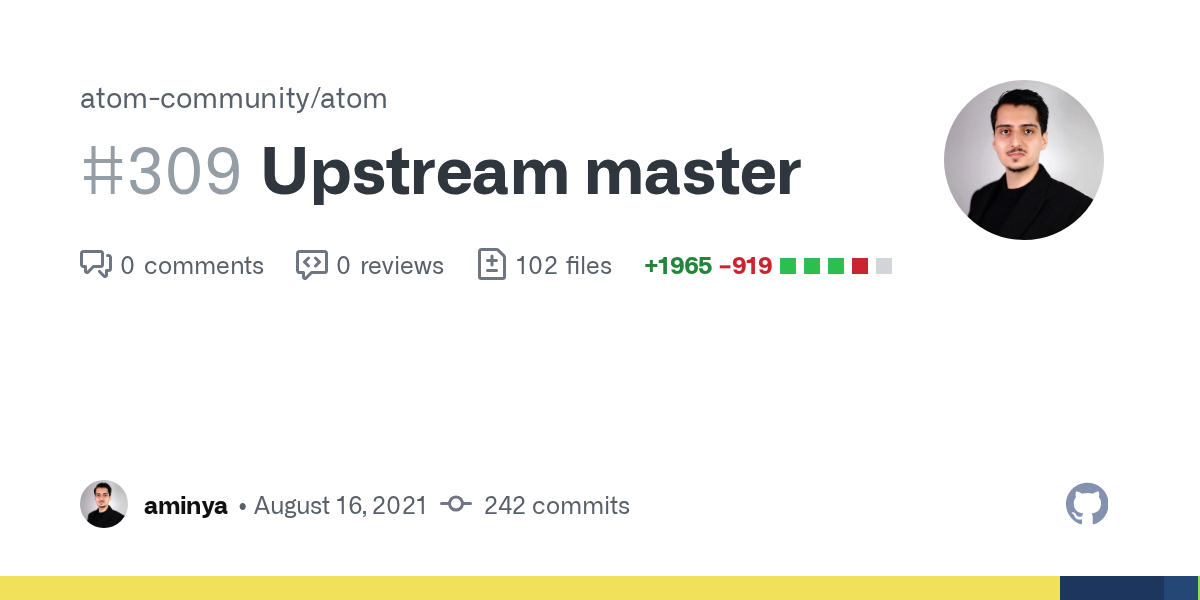
pretty sure it was this one but not that surehttps://github.com/atom-community/atom/pull/309
 dull tangle
hmm, is there anywhere else I can post?
does the mass undo/redo section apply here? https://github.blog/2015-06-08-how-to-undo-almost-anything-with-git/

One of the most useful features of any version control system is the ability to "undo" your mistakes. In Git, "undo" can mean many slightly different things.
ok it was fixed by
git reset HEAD^^
git reset HEAD^^
git push -f
 rapid sparrow
dull tangle
ok it was fixed by
```cmd
git reset HEAD^^
git reset HEAD^^
git push -f
```
rapid sparrow
dull tangle
ok it was fixed by
```cmd
git reset HEAD^^
git reset HEAD^^
git push -f
```
In a future I would recommend to use git revert function
Less chances to fuck up
Especially if it is master branch
And u have other people working there
dull tangle
I think git revert would've done the same thing as https://github.com/atom-community/atom/pull/352 bc according to the docs it adds new commits
But I see what you mean, and I guess in this case you mean "wait / do nothing"?
Or did I read the docs wrong

GitHub
Reverts #351
AAAA
I can't believe I did this on the first day
So sorry for the notifications
For the future I will use a fork
What happened was I wanted to look at the differences between t...
rapid sparrow
dull tangle
I think git revert would've done the same thing as https://github.com/atom-commu...
I mean, that git reset breaks the flow of commits.
If u push it to master, other people will not be able to push because their branches contain commits u don't already need
Git revert is not breaking chain of commits. It just adds new commits to revert old ones. Other people working in your repository will not have their forks/branches broken. The development would not be disrupted. At worst they will need just to pull your revert commits to them, which is not a problem
 bright cipher
Can any one suggest a good and efficient screen scrapping sdks or library in python or any other language. I need screen scrapping library not web scrapping library. Screen scrapping windows environment
 thin jasper
Short question: Is there a function that converts a log level string ('INFO' for example) into logging.INFO or do I have to write my own dict?
it's not hard, but that function is proably more robust, if it exists
rapid sparrow
thin jasper
Short question: Is there a function that converts a log level string ('INFO' for...
could you be more precise where it is supposed to be converted
where does it output in which format
and where do you wish to have it changed its output
thin jasper
Not sure, what you expect
rapid sparrow
thin jasper
Not sure, what you expect
describe your question in more details
thin jasper
I want to read the log level from an env variable via os.getenv
which is a string
but ini_logging from logging module wants a loglevel-object
logging.INFO for example
and I could imagine that is a pretty common problem
that's why i asked here
log_level_str = os.getenv('LOG_LEVEL', 'DEFAULT')

level_dict = {'DEBUG'   : logging.DEBUG,
                  'INFO'    : logging.INFO,
                  'WARNING' : logging.WARNING,
                  'ERROR'   : logging.ERROR,
                  'CRITICAL': logging.CRITICAL}

log_level = level_dict.get(log_level_str.upper(), logging.INFO)
that's my code now
shadow crow
Can someone recommend a tutorial on ElasticSearch? I have no idea about it, and the official documentation is confusing for me.
wheat solar
thin jasper
I want to read the log level from an env variable via os.getenv
Use one of the logging configuration options (either a dict or a .ini) and fill in the log level variable with your environment variable. You could also just use a dictionary to convert the strings from the environment into the log level integers.
heavy knot
Hello I'm using gitlens extension in vscode and I wonder if there is a way to configure so that every time I wanna push a new stash, it includes staged and unstaged files
 sharp fern
git again n again forces a prompt to install .net framework and i want to disable that as withouut net framework installed it too work
dm me if there's any solution
 steel sundial
thin jasper
I want to read the log level from an env variable via os.getenv
steel sundial
thin jasper
I want to read the log level from an env variable via os.getenv
There is a level to name function in the logging module, and a name to level,
Also as far as I know the function setting the level for a logger also accepts strings
 meager ore
Hi, Im learning git/GitHub.
I have a doubt-
If you make sime commits on remote repo
And if i go to my local main branch and type "git pull", will all the changes took place in other branches of remote repo come to my local repo?
Same with git fetch
wheat solar
just add --all to run pull/fetch for all branches, e.g. git pull --all
shadow crow
I'm trying to follow this guide on running Elasticsearch: https://www.elastic.co/guide/en/elasticsearch/reference/current/docker.html
I'm running this command: docker run --name es-node01 -m=4G --net elastic -p 9200:9200 -p 9300:9300 -t docker.elastic.co/elasticsearch/elasticsearch:8.0.0 and I see this message in the logs: ```
-> Elasticsearch security features have been automatically configured!
-> Authentication is enabled and cluster connections are encrypted.
X Unable to auto-generate the password for the elastic built-in superuser.
-> HTTP CA certificate SHA-256 fingerprint:
7016676e80cafb2f16e98cfd5538962d139bd89c221d35431bf150c8426f6f07
X Unable to generate an enrollment token for Kibana instances, try invoking bin/elasticsearch-create-enrollment-token -s kibana.
X An enrollment token to enroll new nodes wasn't generated. To add nodes and enroll them into this cluster:
- On this node:
- Create an enrollment token with
bin/elasticsearch-create-enrollment-token -s node. - Restart Elasticsearch.
- Create an enrollment token with
- On other nodes:
- Start Elasticsearch with
bin/elasticsearch --enrollment-token <token>, using the enrollment token that you generated.
I'm also getting log messages like this:
{"@timestamp":"2022-02-25T20:11:54.806Z", "log.level": "WARN", "message":"flood stage disk watermark [95%] exceeded on [mnVE0qvhRJmJWN6zsUOZoA][1423f8c2f39f][/usr/share/elasticsearch/data] free: 923.2mb[0.4%], all indices on this node will be marked read-only", "ecs.version": "1.2.0","service.name":"ES_ECS","event.dataset":"elasticsearch.server","process.thread.name":"elasticsearch[1423f8c2f39f][generic][T#4]","log.logger":"org.elasticsearch.cluster.routing.allocation.DiskThresholdMonitor","elasticsearch.cluster.uuid":"78uhsR6jTv-3DoZufR-QnA","elasticsearch.node.id":"mnVE0qvhRJmJWN6zsUOZoA","elasticsearch.node.name":"1423f8c2f39f","elasticsearch.cluster.name":"docker-cluster"}
- Start Elasticsearch with
what can I do? tawdry needle
wheat solar
just add `--all` to run pull/fetch for all branches, e.g. `git pull --all`
tawdry needle
wheat solar
just add `--all` to run pull/fetch for all branches, e.g. `git pull --all`
you might also want to git fetch --prune to delete remote branches that have been deleted from the actual remote
shadow crow
shadow crow
I'm trying to follow this guide on running Elasticsearch: <https://www.elastic.c...
I figured it out... I only had 1GB of space left on disk.
 regal shoal
(question moved to #microcontrollers)
 gilded ridge
For Env, are you guys using virtualenv and pipenv?
My understanding is pipenv creates a lock file similar to yarn, or npm with JS.
Can I use both together, or is this considered bad?
What do you guys see typically used in team environments when managing Envs, and sharing libraries.
Thanks!
rapid sparrow
gilded ridge
For Env, are you guys using virtualenv and pipenv?
My understanding is pipenv c...
I just use virtuenv out of requirements.txt + constraints.txt
pip install -r requirements.txt -c constraints.txt
but that's because I did not learn anything else and not felt the need to learn any alternative to it yet  So consider my being just lazy
Packing stuff into docker, and woala. everything is cool
I do experience the trouble with sharing private libraries though
It is easy to publish public pip package
but a bit more troublesome for private pip packages
Thinking just to use git submodules perhaps
gilded ridge
I see, thanks!
 slender goblet
Hey everyone, does anyone here have experience with managing private packages within Azure artifacts?
It just seems so messy and expensive
You can use azure artefacts to pull python libraries, however, you now have to make sure all developers switch to using the new feed, as well as you're forced into adding upstream of PyPI, which then leads to additional costs due to cached packages.
Has anyone managed to find a better solution than that?
rapid sparrow
slender goblet
Has anyone managed to find a better solution than that?
- Creating private self hosted pip server https://www.linode.com/docs/guides/how-to-create-a-private-python-package-repository/?__cf_chl_rt_tk=1BKcJVrmrof_pVzElawvEJiCtTEIA_85y_uGQjXA0R8-1646041218-0-gaNycGzNCJE
- Forgetting about pip and using git sub modules
slender goblet
Thanks for that, it seems like cloning + SSH is the way to go
wheat solar
rapid sparrow
but a bit more troublesome for private pip packages <:pithink:652247559909277706...
using git submodules complicates the basic git commands, I wouldn't recommend it unless everyone you're working with is really, really comfortable with git command line usage
 frosty tulip
How can I change my idle version from 3.10 to 3.9?
my system python version is 3.9 but IDLE seems to be stuck on 3.10?
heavy knot
windows?
someone had that issue recently and they posted:```
i literally just had to search for idle and choose the 3.9.2 version of idle instead of 3.8.5 on windows search
Mac. I had to uninstall pyenv for it to work and reinstall a new version of python
but now my CL is returning that python3 is pointing to a bad dir
nvm... seems to work now
I wanted to keep pyenv so I can use 3.10 if I needed too, but I rarely use python and doubt it's going to impact me much. Thanks for trying to help though!
heavy knot
pyenv should work
with pyenv you install a specific version for python, set a local python version in a folder, create a venv, activate it - go to town :)
 dark crow
Hi,
I'm using Elasticsearch and now I would like GET the price data when the price drops 20%. I have some ideas how to achieve this but not sure if its the right way to do it.
So every 1 minute the price is getting updated. I was thinking about subtract the last value of the second last value and if the difference is higher than 20% do something.
Do you think this is the right way or is there an obvious other way to do this? And is it even possible to GET second last document from Elasticsearch
tawdry needle
this doesnt seem like the best use of elasticsearch? maybe you can also get documents with a date-based filter
i haven't used elasticsearch in years, im sure theyve added a lot of features
 wooden ibex
slender goblet
You can use azure artefacts to pull python libraries, however, you now have to m...
wooden ibex
slender goblet
You can use azure artefacts to pull python libraries, however, you now have to m...
You block pypi at firewall
 spice ginkgo
is there anyone here who's any good at docker and could maybe spare a few moments to help me debug a bug? I would appreciate it. Thanks.
tawdry needle
@spice ginkgo there are docker users here and it is on-topic for this channel. just ask your question, and if someone is available to help then they will help
 cosmic pine
Hello
I am trying to build an AI software that can detect the emotion (good / bad ) of a review (piece of text)
What frameworks/ libraries should I be looking into to help me with this ?
 stuck badger
@cosmic pine NLP module/library from python such as nltk
tawdry needle
cosmic pine
Hello
I am trying to build an AI software that can detect the emotion (good / ba...
there is a #data-science-and-ml channel for topics like this
 graceful light
So question: I know of tools like pre-commit and know how to use GitHub Actions
Say that I have the following task I want to run automatically - is this the right order of operations, and am I using the tools properly?
- pre-commit: Format the code with
black - pre-commit: sort imports with
isort - GH Actions: Lint the code with
flake8. If any issues occur, then do not accept commit/PR, and post the results in a comment on that commit/PR - GH Actions: Compile code with Cython
- GH Actions: package code into portable executable for each individual platform with pyinstaller
My question is, should #3 be done with pre-commit or GH Actions?
Are there any other actions I could automate? I figure developing unit tests should go in between #3 and #4
 tawny temple
graceful light
My question is, should #3 be done with `pre-commit` or `GH Actions`?
Are there a...
tawny temple
graceful light
My question is, should #3 be done with `pre-commit` or `GH Actions`?
Are there a...
Do #3 in pre-commit and then in CI just trigger pre-commit run --all-files
And yes, automated testing would go between 3 and 4, but it can be a parallel job instead of waiting on lint to finish first
graceful light
Oh that's awesome, it simplifies my github workflow file tremendously
thank you!
finite fulcrum
There's also pre-commit.ci that runs pre-commit for you without any setup
tawny temple
Is it possible to do something like this with it? ```yaml
# Skip the flake8 hook because the following step will run it.
- name: Run pre-commit hooks
id: run-pre-commit-hooks
run: |
SKIP=flake8 pre-commit run --all-files
pre-commit run --all-files --hook-stage manual flake8-annotate```
finite fulcrum
https://pre-commit.ci/#configuration-skip looks like this should work
graceful light
Damn even better
 pallid wing
Can someone help give me some advice as to how do i clone/access a private/alternate git user repo without overwriting my normal git user identity?
tawny temple
I think what you can do is "git init" to initialize an empty repository. Then you can use "git config" to edit user settings (by default this command edits the repository configuration not the global configuration), and finally you can add a remote "git remote add" and pull
pallid wing
ok ill try git terminal thanks
tawny temple
Maybe editing the config isn't even necessary. I'm not sure how git auth works exactly.maybe if you just add the other users ssh key in your machine it'll be enough for it to let you clone
pallid wing
yeah i might need that config to add commit later so i dont think you are wrong
tawny temple
Ah for that yes you are right
pallid wing
im guessing ill need to do ssh key from github or something to get access
tawny temple
Yeah each user should have its own ssh key.
You need to generate the key if you don't have one yet, and then register the key with GitHub so it associates it with your gh account
The more I think about it the more I suspect that if you have the SSH key set up you will be allowed to clone, which is much simpler. I don't think you'd need to edit the gitconfig before cloning.
So you can first try to clone and then edit the user with git config. If it doesn't work then try it the other way.
pallid wing
yup ill try that
 rancid schoonerBOT

Bot's GitHub Repository
Repository
tawdry needle
!resources
rancid schoonerBOT
Resources
The Resources page on our website contains a list of hand-selected learning resources that we regularly recommend to both beginners and experts.
tawdry needle
@nova obsidian
 nova obsidian
tawdry needle
<@!690278271169855619>
nova obsidian
tawdry needle
<@!690278271169855619>
Ty
stuck badger

GitHub
 subtle spade
Hi, is there a way to activate custom build_ext from setup.cfg using setuptools module or do I have to do it through setup.py?
tawdry needle
subtle spade
Hi, is there a way to activate custom `build_ext` from `setup.cfg` using setupto...
I believe you need to use setup.py for anything "custom" with setuptools
subtle spade
tawdry needle
I believe you need to use setup.py for anything "custom" with setuptools
But on their site they stat that there is a slow move from setup.py to setup.cfg and it confuses me a lot. Not sure should I combine both files in my project and if yes; how to do it..
tawdry needle
Indeed, for most common cases you shouldn't need any custom code, so the declarative configuration file should be fine
In your case it sounds like you need custom code, so there's no way around that other than writing custom code
I don't believe they are planning to deprecated anytime soon, they just don't want it to be with everybody uses by default anymore
subtle spade
this kinda settles down my wonder: https://github.com/pypa/setuptools/issues/2570

GitHub
Having cmdclass defined in setup.cfg causes sdist, or any other, command to fail because its value is not properly parsed into a dict. How to replicate setup.cfg example: [metadata] name = cmdclass...
tawdry needle
ahhh good find
so you can define your custom class and still use setup.cfg
that's actually useful to know about
subtle spade
I tried; it doesn't work 😦
 gusty cape
any docker experts here? i have a 3 python modules, A, B, C that live in the root directory - module A and B have their own Dockerfile - both of them need module C as a dependency (C for common). Any trick to solve this problem?
 delicate sinew
so A and B build in a docker container, and depend on C. So you want that whenever C changes to rebuild A and B, or the other way around? When building A or B, to also build C?
wheat solar
You could do a multi-stage build. Use a dockerfile built with C as the base image for A and B's dockerfiles.
rapid sparrow
gusty cape
any docker experts here? i have a 3 python modules, A, B, C that live in the roo...
it sounds like a time for docker-compose
docker-compose provides multi containerized docker experience
 tawdry needle
gusty cape
any docker experts here? i have a 3 python modules, A, B, C that live in the roo...
tawdry needle
gusty cape
any docker experts here? i have a 3 python modules, A, B, C that live in the roo...
are we talking about "modules" or actual independent services that need to run simultaneously?
fwiw i now use docker compose even when i only have 1 dockerfile, the declarative config with the yaml file is so convenient
so what i would do is set your "build context" to the parent directory for the project, that way you can use all 3 packages/modules in the dockerfile
 neat roost
Do you prefer using configparser or loading variables from .env?
I would like to see some long-term opinion (so moved from #general) 😄
tawny temple
I prefer .env for convenience. I don't want to deal with setting up configparser.
Downside is a dependency on a third-party lib like python-dotenv unless one wants to parse the .env themselves
neat roost
I struggle with default values, its parsing and so on...
So turned towards the file...
tawny temple
It depends on the project's needs. I wouldn't use .env for anything complex.
neat roost
Like this:
    OUTPUT_DEVICE_INDEX = 0
    try:
        env_value = os.environ.get("OUTPUT_DEVICE_INDEX", "").strip() or 0
        OUTPUT_DEVICE_INDEX = (
            int(env_value) if env_value is not None else OUTPUT_DEVICE_INDEX
        )
    except ValueError:
        logger.warning(f"Invalid OUTPUT_DEVICE_INDEX={env_value}")
Well python-dotenv helps with some of that
Maybe not. I think I am confusing it with django-dotenv, which can set defaults.
 viral dove
Hello Guys, Is there any free hosting service like pythonanywhere but has free ALWAYS ON tasks?
 azure light
any GCP experts out there who can tell me why I keep getting this error? Just trying to upload a folder to my GCP Bucket
➜ wbanalysis git:(gcp) make upload_data
CommandException: Destination URL must name a directory, bucket, or bucket
subdirectory for the multiple source form of the cp command.
make: *** [upload_data] Error 1
 drifting marlin
viral dove
Hello Guys, Is there any free hosting service like pythonanywhere but has free A...
drifting marlin
viral dove
Hello Guys, Is there any free hosting service like pythonanywhere but has free A...
use replit and ping your website using uptimerobot
heavy knot
drifting marlin
use replit and ping your website using uptimerobot
what would happen if we ping replit with itself?

 pulsar bridge
any selenium experts here?
how can I switch to this popup window and operate there using selenium

can anyone help, Please ping me while you reply
drifting marlin
heavy knot
what would happen if we ping replit with itself?
dun dun dun.....
 primal cloak
how can i have a 'child' cell in colab?
example like this. where i can hide and show cell in a certain group

 hushed jungle
Would like help with setting up my Docker containers with Python as multistage and if there was any other code review suggestions? I tried multistage with wheels and venv, and haven't gotten it to work so far. Thanks
FROM python:3.9-alpine

ENV PYTHONDONTWRITEBYTECODE 1
ENV PYTHONUNBUFFERED 1

RUN apk update \
    && apk add --no-cache \
        gcc \
        libc-dev \
        musl-dev \
        postgresql-dev \
        alpine-sdk

EXPOSE 80

COPY ./requirements.txt /

RUN pip install --upgrade pip \
    && pip install -U setuptools \
    && pip install -r ../requirements.txt

COPY ./requirements-submodules.txt /
COPY ./common /common

RUN pip install -r ../requirements-submodules.txt

COPY ./app /app

WORKDIR /app

ENTRYPOINT ["python", "app.py"]
That looks fine. Do you have anything to share for your multi stage attempt?
hushed jungle
tawny temple
That looks fine. Do you have anything to share for your multi stage attempt?
FROM python:3.9-alpine AS builder

WORKDIR /app

ENV PYTHONDONTWRITEBYTECODE 1
ENV PYTHONUNBUFFERED 1

RUN apk update \
    && apk add --no-cache \
        gcc \
        libc-dev \
        musl-dev \
        postgresql-dev \
        alpine-sdk

RUN python -m venv /opt/venv
ENV PATH="/opt/venv/bin:$PATH"

COPY ./requirements.txt /

RUN pip install --upgrade pip \
    && pip install -U setuptools \
    && pip install -r ../requirements.txt

COPY ./requirements-submodules.txt /
COPY ./common /common

RUN pip install -r ../requirements-submodules.txt

COPY ./app /app

FROM python:3.9-alpine

COPY --from=builder /opt/venv /opt/venv

WORKDIR /app

ENV PATH="/opt/venv/bin:$PATH"

EXPOSE 80

ENTRYPOINT ["python", "app.py"]
 soft axle
Does anyone know if a git squash rebase would destroy previous commits? I'm wanting to squash all my commits in a Python project into one and rewrite it "on top" of the existing repository, but also don't want to lose data from history. im fine with an altered history, as long as data about previous commits isn't completely destroyed, and each individual unsquashed commit is still somehow accessible.
rapid sparrow
soft axle
Does anyone know if a git squash rebase would destroy previous commits? I'm want...
if you rebase with squash, you lose the commits
the best thing to do is
git checkout BranchToSendCommits
git merge --squash FeatureBranch
it leaves the FeatureBranch with original commits, while squasing them all into one and sending to CurrentBranch
rapid sparrow
soft axle
ill sketch something in paint
https://learngitbranching.js.org/?locale=en_US
Or use this. They have sandbox mod too
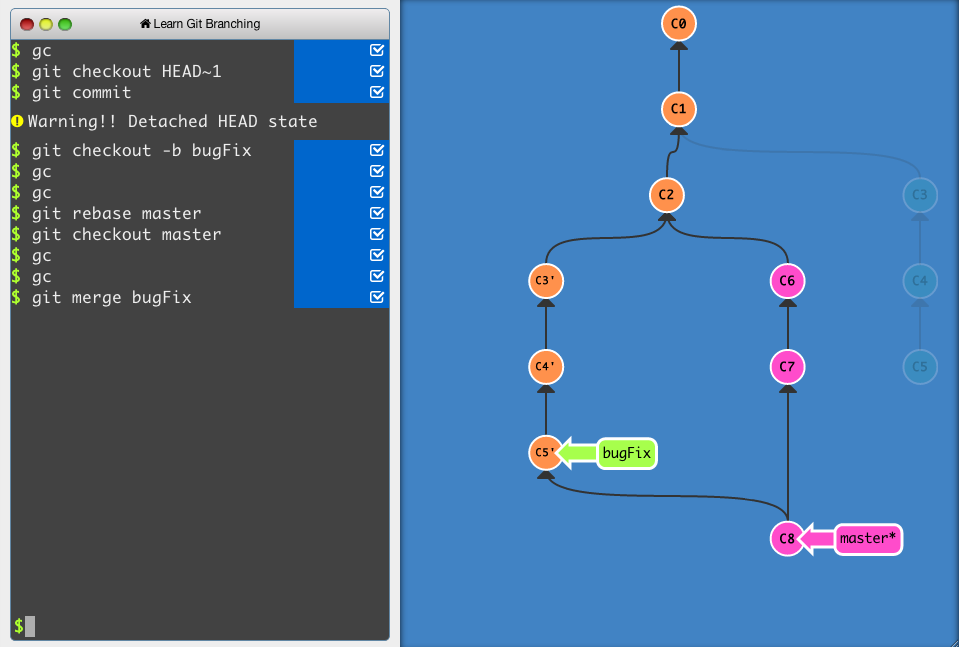
An interactive Git visualization tool to educate and challenge!
soft axle
Is this the sort of thing you're describing?

where everything I've done would be copied over to a different branch (e.g. past), plus a copy of all that squashed into the first node on main, allowing me to build off that
tawny temple
hushed jungle
```docker
FROM python:3.9-alpine AS builder
WORKDIR /app
ENV PYTHONDONTWRITEBY...
Instead of creating a venv an copying it, you can create a base image with the deps and then a final image that uses the base. ```dockerfile
FROM python:3.9-alpine as venv
...
RUN pip install requirements.txt
...
FROM venv
COPY ./app /app
ENTRYPOINT ...
On second thought, there generally isn't a need to do this and it doesn't offer advantages over a single stage. Are you just trying to avoid the packages you install with apk ending up in the final image?
hushed jungle
tawny temple
On second thought, there generally isn't a need to do this and it doesn't offer ...
Yes
rapid sparrow
soft axle
Is this the sort of thing you're describing?
nah, i was telling that

we have for example three additional commits ahead of main in branch past
hmm, the summulator is not having git commit --squash option, well, nvm, lets simmulate it
we run
git checkout main
git merge --squash past

and have the three commits merged into one commit in main
while the branch past is left living with its own commits untouched
tawny temple
hushed jungle
Yes
I guess copying a venv would work, but it doesn't look like you activated it properly. The site-packages in the venv need to be in Python's sys.path somehow. You should look at how the generated venv activate scripts work.
Anyway, I don't think venv is the nicest solution because of the extra steps needed to activated, and because it's less space efficient. I would try building wheels for the Python packages that need those libs you install, and then copying the wheels over to the final stage to install with pip.
Well, a wheel might not be space efficient either due to having to copy it to the final stage, which unavoidably creates a new layer.
 serene seal
How do I get the IP address of a docker container?
 remote stratus
Anyone know how to use Databrick Pyspark on GCP?
wheat solar
serene seal
How do I get the IP address of a docker container?
A docker container has no IP address, but it can be bound to a port PORT on the host machine so it can be addressed on the host computer - for example a docker machine on your laptop can be accessed on the browser in your laptop via localhost:PORT
 void ferry
Getting H14 error while deploying on heroku can anyone help ?
 buoyant snow
Hi there, why does this not raise any lint error using pylint?
from django.utils import timezone
timezone.datetime.datetime
can some 1 help me with java or pythhon with mc mod
neat roost
Do any of you have an experience with dynaconf?
I keep getting Invalid rule for parameter 'HOST' each time I run dynaconf -i 'config.settings' validate -p "settings.toml" 😦
 silent python
Does anyone here use Poetry?
wheat solar
I use poetry occasionally. The common courtesy in the server is to ask your question directly, instead of asking "does anyone know X" first
 gentle solstice
I use poetry (always)
stuck badger
GitHub
 crisp wing
How useful have monorepos been for large scale projects?
Based on the experiences of people here
rapid sparrow
crisp wing
How useful have monorepos been for large scale projects?
Super useful.
I mean, I don't always choose monorepos.
I choose monorepo or separate repos, becased on projects logical separation for now
If the application is out of N+ microservice components (even if each component has its own repo), but still the same application in total = it is mono repo infra for me
If those are separate applications and not connected in ANY logical way = I use separate repos for infra
crisp wing
rapid sparrow
If the application is out of N+ microservice components (even if each component ...
So as a rule of thumb when to use monorepos, it's when you have related but separate repos?
rapid sparrow
crisp wing
So as a rule of thumb when to use monorepos, it's when you have related but sepa...
yeah, if they exchange network requests, better to use monorepo
crisp wing
Like as an oversimplified example, pretend we have a complex web app
A monorepo can be used here to separate the frontend and backend repos
Perhaps a separate native mobile app repo in the monorepo
rapid sparrow
example:
I have backend app, it has its own repo, it has pipeline that builds, unit tests it, triggers infra repo for staging deploy, runs integration tests against staging, saves result to docker registry
I have backend app #2, it has its own repo, it has pipeline that builds it, triggers infra repo for staging deploy, runs integration tests against staging, saves result to docker registry
I have frontend app, it has its own repo, it has pipeline that builds it, triggers infra repo for staging deploy, runs integration tests against staging, saves result to docker registry
I have infra repo, it has its own one repo, it has pipeline for staging and production deployment, it pulls containers from docker registriesfor alll apps above and deploys stuff
backend + backend #2 + frontend = the same application with splitted code to microservces
crisp wing
rapid sparrow
example:
I have backend app, it has its own repo, it has pipeline that builds, u...
The same application, but split in their own repos to make managing the app as a whole easier, inside the main repo (which is the monorepo here)
Like that?
rapid sparrow
crisp wing
The same application, but split in their own repos to make managing the app as a...
applications have their own repos yes
but their all deployments in one infra monorepo.
crisp wing
rapid sparrow
applications have their own repos yes
but their all deployments in one infra mon...
So think of it like a normal repo that contains separated components of your app that together adds up into the complete, whole app?
rapid sparrow
crisp wing
So think of it like a normal repo that contains separated components of your app...
well, yeah
it can be implemented not just with docker registry
but with git submodules, but git submodules are heard to be PITA, I still did not try it
docker registry method is better
instead of git submodules, can be also used programming language specific publishing packaging system
That will work too, to unite the apps into one infra repo
docker registry is more flexible though. You will wish to deploy automatically infra repo with locked versions and with latest verisons of everything.
 dusky mantle
anyone know why i get ECONNREFUSED (can't connect) to Redis (port 6379)?
version: '3'
services:
  db:
    image: redis
    ports:
      - '6379:6379'
  bot:
    build: .
    links:
      - 'db'
fixed; used db as redis client hostname
 mellow siren
which software should i use to do coding?
 cosmic breach
mellow siren
which software should i use to do coding?
cosmic breach
mellow siren
which software should i use to do coding?
VS code, Sublime text, notepad etc It depends on you comfort
mellow siren
ok
 elfin slate
how do i check the utcnow() time is 00:00
rapid sparrow
elfin slate
how do i check the utcnow() time is 00:00
do you assume that within 1 minute the time is valid?
make a check of delta from (datetime 0000 - utcnow) within 1 minute
elfin slate
hmm
elfin slate
rapid sparrow
do you assume that within 1 minute the time is valid?
cant understand
like i need to check if 00:00:00 in utc now
then do smthing
elfin slate
can be a range
elfin slate
5 mins before n 5 mins after
elfin slate
nvm how to i check
rapid sparrow
this program is meant to schedule tasks every minute/hour/day/weel whatever
or there is more python specific option: Celery beats, that does fully at python level
elfin slate
nah, i want that task to exeute on that time
rapid sparrow
elfin slate
nah, i want that task to exeute on that time
and check https://help.dreamhost.com/hc/en-us/articles/215767047-Creating-a-custom-Cron-Job for more simple option
tawny temple
What sort of trouble?
 pure olive
 mild olive
how can i fix this?

 halcyon dock
I'm not sure if this is the right place to ask this, forgive me if it isn't please but my question is as follows. Can I use xlwings as the writer in pandas?
cosmic breach
mild olive
how can i fix this?
Basically it's just a warning, because usually you don't have a git repository nested into another, and if present they won't be tracked, unless added as a submodule
wheat solar
yeah this is just a warning, not an error. You don't have to do anything about it if you don't want to
otherwise it's telling you pretty much exactly what to do already in the warning text
tawdry needle
halcyon dock
I'm not sure if this is the right place to ask this, forgive me if it isn't plea...
this isn't built into pandas. i don't think it's easy to make a custom excel writing "driver" for pandas, but maybe it's possible
halcyon dock
tawdry needle
this isn't built into pandas. i don't think it's easy to make a custom excel wri...
Thanks!
 golden drum
So I have a web based game im making
and its based on events
Is there some google cloud (or similar) service that will allow me to "publish" events to any given "channel" (where the channels can be dynamically created) and the web app client can "subscribe"
through a websocket or something
ive looked at pub/sub but that seems to be for analytics
eventarc seems to be based around actual cloud events
and firebase cloud messaging sends the notifications directly to the browser
golden drum
woo
rapid sparrow
golden drum
Is there some google cloud (or similar) service that will allow me to "publish" ...
Check Kafka
golden drum
I did, it seems to be a framework
rapid sparrow
golden drum
is that deployable at scale?
rapid sparrow
it is really scalable
golden drum
Ok
golden drum
Yeah thats what my solution is atm
add the events then create a 'on_create' event that reads
via Cloud Run
but if I have to manage the deployment of kafka then I may as well just stay with redis
if there are any other managed solutions then im all ears
or
eyes i suppose
 sweet forge
can anyone show me a good example of pyproject.toml + pip for seperation of dev and production packages?


 elfin zephyr
Can we excute shell commands in mc?
rapid sparrow
mild olive
this my docker

without seeing your dockerfile, it would be tough to help you
indigo zenith
mild olive
this my docker
It shows that your frontend container has exited, so that's at least part of the issue. Check the container log for any hints about why. But also, what Darkwind said.
 quick notch
Good afternoon everyone. I am new to docker and kubernetes, Could anyone suggest me few resources for beginner level?
mystic void
quick notch
Good afternoon everyone. I am new to docker and kubernetes, Could anyone suggest...
Kubernetes' website is a great resource to get started with. That's how I learned about it myself
quick notch
mystic void
Kubernetes' website is a great resource to get started with. That's how I learne...
thank you
sweet forge
Any good flake8 config file? I don't want to research about all errors to create a template of my own.
 civic radish
Please, anyone, tell me how to make a container in docker?
tawny temple
civic radish
Please, anyone, tell me how to make a container in docker?
You mean how to run one?.Or how to create your own image (a container is just a instance of an image)?
civic radish
 civic radish
tawny temple
You mean how to run one?.Or how to create your own image (a container is just a ...
civic radish
tawny temple
You mean how to run one?.Or how to create your own image (a container is just a ...
I have just create image showing above error
tawny temple
Do you have Docker desktop running?
civic radish
No
tawny temple
What os is this? Looks like windows 11
civic radish
No it's KDE neon
tawny temple
Is your user in the docker group?
civic radish
Yes i did that command also.
sudo groupadd docker
After showing below message
groupadd: group 'docker' already exists
tawny temple
Well that's for creating the group, not for adding your user to that group
You can type "groups" to list the groups you're in
civic radish
Please then how to add to group, I'm new this
tawny temple
Can you first run groups to see if your user is in the group or not
tawny temple
I think you misunderstood. To run the command type literally "groups" no extra arguments
 tawny temple
Okay so you're indeed not in the group yet
sudo usermod -aG docker maddy
That will add you to the group
civic radish
Yes done this now
civic radish
Just i did command
docker built -t python -imdb .
But getting same above error
tawny temple
Hmm maybe try rebooting your computer
civic radish
Okay let me try
 tawny temple
🎉
civic radish
Many Thanks for your help and time
tawny temple
You're welcome
civic radish
You're professional
 real hedge
I'm having some issues getting vscode on mac to recognize my pyenv modules when debugging
 sterile mural
I personaly use webformatter.com for formatting and checking my website code. Does anyone know of a similar thing but for python that runs locally in the browser/function similar to it?
tawny temple
sterile mural
I personaly use webformatter.com for formatting and checking my website code. Do...
https://black.vercel.app/ though you can and probably should install the tool locally (pip install black) because it's more convenient IMO.
Playground for Black, the uncompromising Python code formatter.
 heavy stream
elfin zephyr
Can we excute shell commands in mc?
heavy stream
elfin zephyr
Can we excute shell commands in mc?
prob not
But I'm not a java coder
So i'm not bother to that
 idle ridge
Is there a way to make cx_freeze only make the .exe without gathering all the dependencies? Since the dependencies stay the same, I don't need it to keep packaging all of them on every build. I'm trying to debug something so I have to build alot and it takes alot of time this way.
heavy knot
Hi guys, I added some files, commited message but when I tried to push that to my repo then I got message "Your branch is ahead of 'origin/main' by 2 commits." and it was displayed that I should make pull request. I thought pull request will just take files that I don't have and everything will be ok, so I did pull. Then I again tried to add my files that I initially wanted to add and nothing could be added. When I tried to commit, I get "Your branch is ahead of 'origin/main' by 2 commits." git push origin worked out ok but I don't understand why.
What I don't understand is why push didn't work but push origin worked
 thorn thorn
import Image
import os
def crop(infile,height,width):
im = Image.open(infile)
imgwidth, imgheight = im.size
for i in range(imgheight//height):
for j in range(imgwidth//width):
box = (jwidth, iheight, (j+1)*width, (i+1)*height)
yield im.crop(box)
if name=='main':
infile=...
height=...
width=...
start_num=...
for k,piece in enumerate(crop(infile,height,width),start_num):
img=Image.new('RGB', (height,width), 255)
img.paste(piece)
path=os.path.join('/tmp',"IMG-%s.png" % k)
img.save(path)
trying to split image into 100 vertical sections
code not working
pls help
tawdry needle
thorn thorn
trying to split image into 100 vertical sections
you might want to ask in a help channel: #❓|how-to-get-help
!code also consider using code formatting to post your code:
rancid schoonerBOT
Here's how to format Python code on Discord:
```py
print('Hello world!')
```
These are backticks, not quotes. Check this out if you can't find the backtick key.
thorn thorn
tawdry needle
you might want to ask in a help channel: <#704250143020417084>
i tried this but noone answered unfortunately.
do you know why this doesnt work: https://paste.pythondiscord.com/imiduforon trying to split image into 100 vertical sections and save each section as separate image but image saved at end is same image as inputted
tawdry needle
thorn thorn
i tried this but noone answered unfortunately.
help is provided by volunteers on a best-effort basis. if nobody answers, either your question is difficult to answer, or nobody is around who knows the answer, or both. in general if you don't get an answer, 1) consider revising your question to make it easier to read and respond to, and 2) ask again in a little while
it's definitely not good to spam your question across several unrelated channels...
it looks like someone was helping in #data-science-and-ml anyway
thorn thorn
tawdry needle
help is provided by volunteers on a best-effort basis. if nobody answers, either...
okay sorry i understand, only joined this few days ago so thought all were help channels my bad. yes i was getting help on ai channel but unfortunately person left when i was quite close to fixing the code
 mossy slate
Hello, I opened an existing python file in visual studio code for the first time and have installed all the recommended plugins, but when i try running it its telling me all the libraries dont exist
and its making me install it again
is there a wayb around this?
real hedge
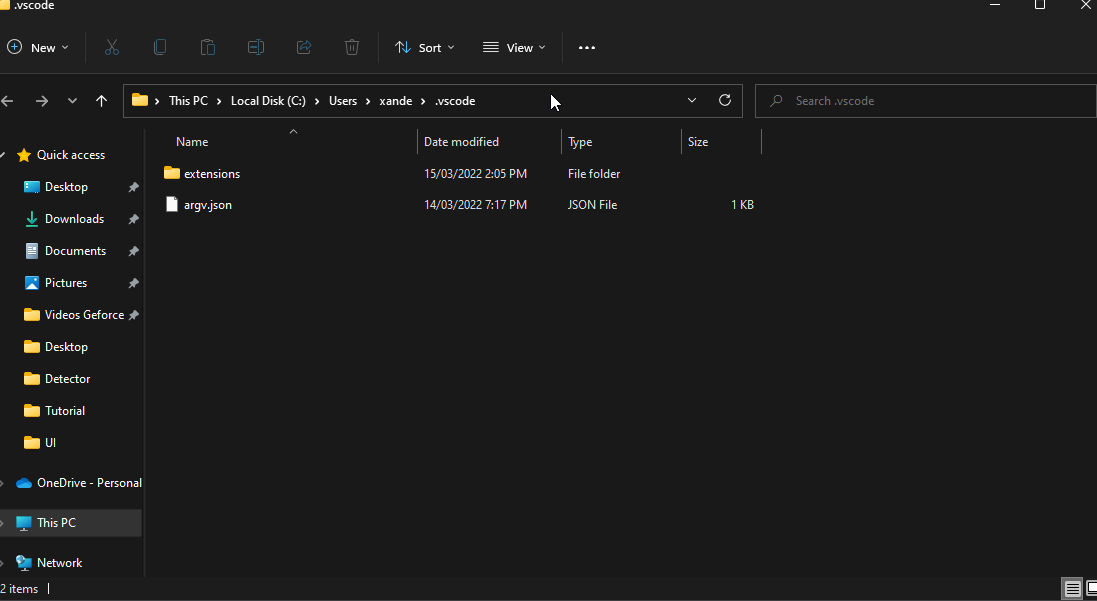
Alas!! After an entire day of testing vscode. I think i have a solution for my problem of missing modules.
- add
.envfile within.vscodedirectory - updated path to
.envfile${workspaceFolder}/.vscode/.env - add
PYTHONPATH=${workspaceFolder}
mossy slate
real hedge
Alas!! After an entire day of testing vscode. I think i have a solution for my p...
what is .vscode
and .env
are there files that i need to get from somewhere
real hedge

 real hedge
mossy slate
are there files that i need to get from somewhere
real hedge
mossy slate
are there files that i need to get from somewhere
No. Vscode will read your .env file for pythonpath or other global enviroment variables you configure
mossy slate
do i get .env from my python path?
real hedge
mossy slate
https://i.imgur.com/57XAzQ0.png
VsCode automatically creates a hidden .vscode directory whenever you create a workspace directory for your project
mossy slate
i did show hidden files on my python project folder
and i cant see it
anywayu
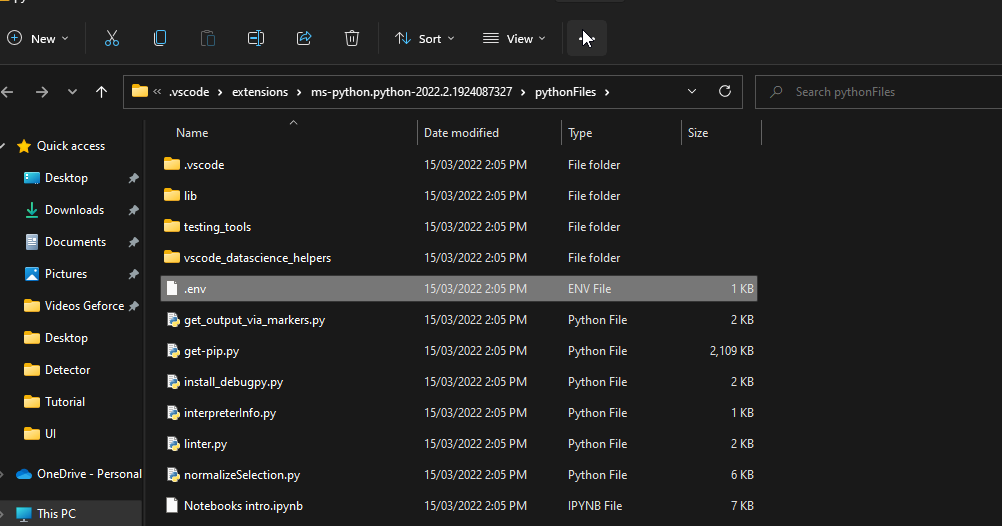
do i just copy the .env
from here
 real hedge
mossy slate
https://i.imgur.com/7mMHl9J.png
real hedge
mossy slate
https://i.imgur.com/7mMHl9J.png
No!
I'm on a mac, and it looks like you are in the vscode application directory
mossy slate
yh lol
real hedge
You must create your own directory for your python project
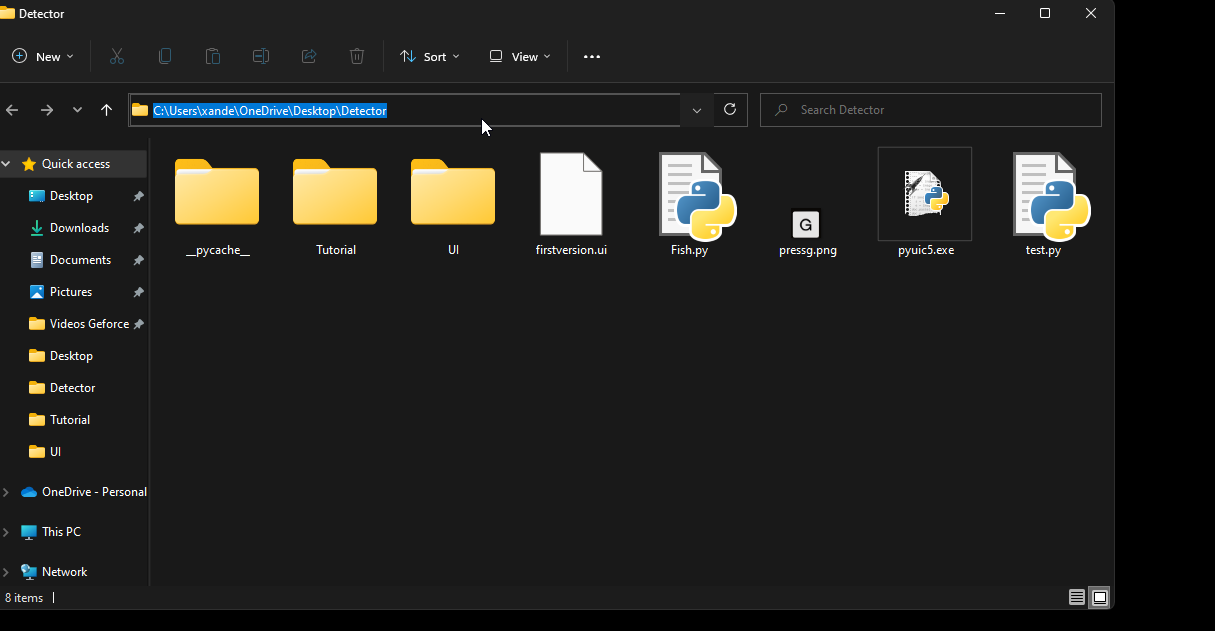 real hedge
can you display hidden files?
mossy slate
its turned on
also I already installed all of this from pyautogui import * import pyautogui import time import random import keyboard import win32api, win32con from pywinauto import win32defines from pywinauto.application import Application
with cmd
before i swtiched over to vis code
but when i try it in vis code
itrs asking me to install everything again
even normal python things
like keybaord
so is there a way for viscode to check already installed libaries
or do i just have to keep editing with IDLE
real hedge
ok. Open Vscode and install the Python extension
mossy slate
yep ive done that

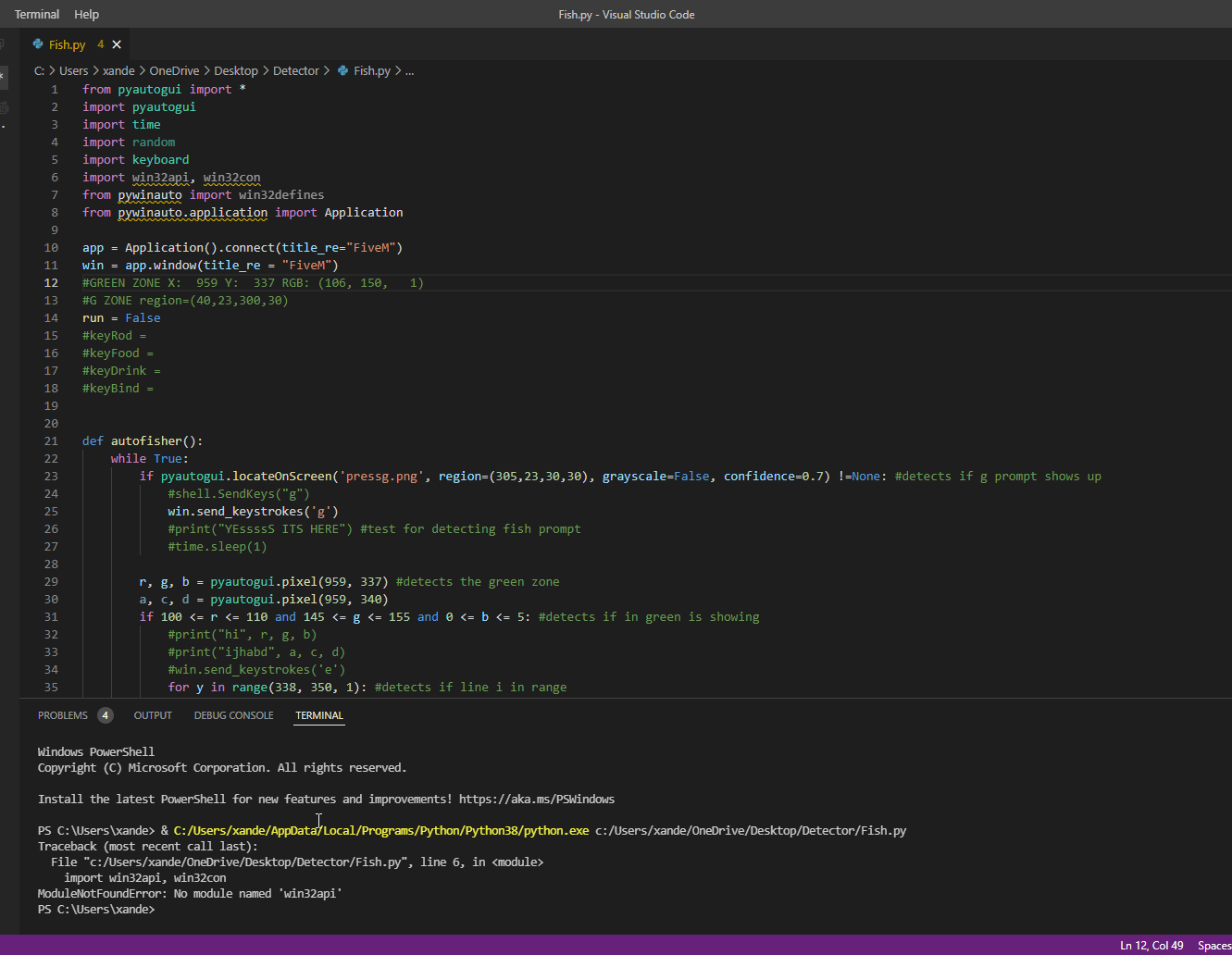
 mossy slate
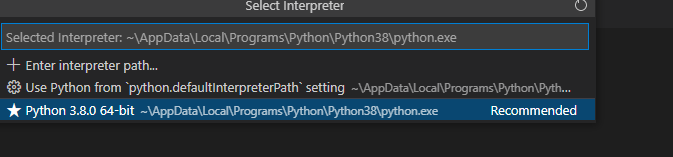 real hedge
I would now add .env file into your workspace .vscode folder
include the following configuration into the .env file
PYTHONPATH=${workspaceFolder}
can u guide me on how to do so?
very new to all this devving
so in my python project folder
i add a .env file?
and put that inside?
real hedge

Learn about Visual Studio Code workspaces
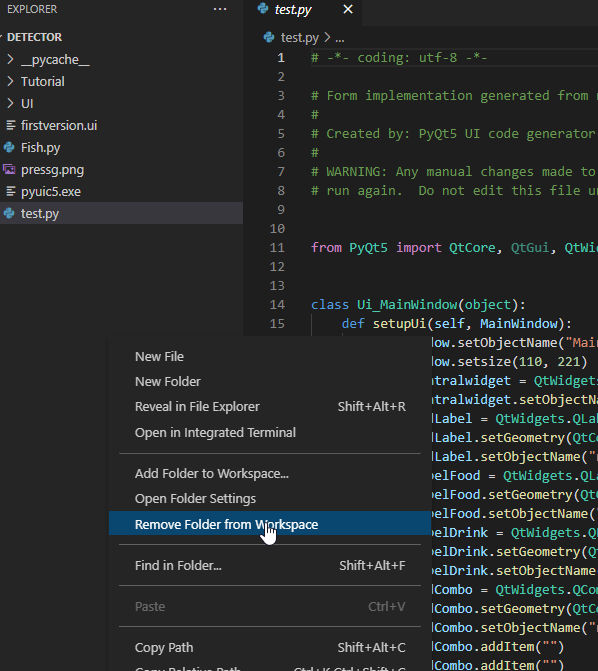 heavy knot
Hello I have the following settings.json within my .vscode folder to automatically activate a conda environment:
{
    "python.defaultInterpreterPath": "/path/to/miniconda3/envs/.../python.exe", "python.terminal.activateEnvironment": true, "python.terminal.activateEnvInCurrentTerminal": true
}
The thing is that it activates conda base environment before activating the desired environment. Is there a way to prevent conda from activating base env automatically?
 analog kettle
One of my project leads at work told me not to use Docker anymore--is Podman a viable alternative?
The reason being that our individual computers can't be linux, and I feel better about knowing that I can reproduce something at any time when it's in a container.
analog kettle
My coworker said to use Podman.
heavy knot
getting this error when using miniconda and importing matplotlib in docker:
Traceback (most recent call last): File "/root/miniconda/lib/python3.8/pathlib.py", line 377, in gethomedir return os.environ['HOME'] File "/root/miniconda/lib/python3.8/os.py", line 675, in __getitem__ raise KeyError(key) from None KeyError: 'HOME'
if I do an echo $HOME in the docker build it points to /root
Any ideas on what may be causing this? ty in advance
real hedge
heavy knot
Hello I have the following `settings.json` within my `.vscode` folder to automat...
I think you would need to specify which python interpreter you want vscode to use while running your python program
tawdry needle
heavy knot
getting this error when using miniconda and importing matplotlib in docker:
`Tr...
not having a HOME environment variable is weird..
can you provide more detail about how you are running all this?
heavy knot
real hedge
I think you would need to specify which python interpreter you want vscode to us...
Yeah I did that but it still activates the base environment before my environment
The very first time I enter vscode, this is what it does:
root@24FJS49DJ3:~/myproject$ source /home/user/miniconda3/bin/activate (base) root@24FJS49DJ3:~/myproject$ conda activate myenv (myenv) root@24FJS49DJ3:~/myproject$
The following command would solve this by creating a .condarc file (if it doesn't exist)? conda config --set auto_activate_base false
I did conda config --show and auto_activate_base is set to True
heavy knot
tawdry needle
can you provide more detail about how you are running all this?
thank you, I'm checking directly with the developers, this app is running within an intel SGX enclave, so it gets super messy with env variables, volumes and files
gilded ridge
is this where I can ask questions about pipenv?
I'm doing pipenv install and just getting a billion errors

like ...?
 subtle quarry
chocolatey, scoop or winget?
heavy knot
mossy slate
also I already installed all of this ```from pyautogui import *
import pyautogui...
you can simplify that with:
import pyautogui, time, random, keyboard, win32api, win32con
from pywinauto import win32defines
from pywinauto.application import Application
 mossy vortex
you can, it's not how pep suggests though
mossy vortex
subtle quarry
chocolatey, scoop or winget?
I've used choco and it's worked for me. I haven't used the others though
real hedge
heavy knot
I did `conda config --show` and `auto_activate_base` is set to True
I never used conda virtual env. Vscode just needs to know where your conda packages are if not on the python path
tawny temple
analog kettle
One of my project leads at work told me not to use Docker anymore--is Podman a v...
Yes, sort of. It is meant to be a drop-in replacement for Docker. However, since your host isn't Linux, and there's no "Podman Desktop" like there is a Docker Desktop, you're going to have to do some extra configuration to get things running on macOS or Windows.
I've never tried to use it outside of Linux hosts so I am not familiar with how involved the setup process is.
subtle quarry
mossy vortex
I've used choco and it's worked for me. I haven't used the others though
with choco to install apps, do i need to run choco install running powershell as admin?
 tribal sonnet
is there any way where we can do reverse dns look up with multiple ip address?
rapid sparrow
tribal sonnet
is there any way where we can do reverse dns look up with multiple ip address?
https://en.wikipedia.org/wiki/Reverse_DNS_lookup perhaps to check this
In computer networks, a reverse DNS lookup or reverse DNS resolution (rDNS) is the querying technique of the Domain Name System (DNS) to determine the domain name associated with an IP address – the reverse of the usual "forward" DNS lookup of an IP address from a domain name. The process of reverse resolving of an IP address uses PTR records. r...
there are even free tools to try for that https://mxtoolbox.com/ReverseLookup.aspx

MxToolbox
heavy knot
real hedge
I never used conda virtual env. Vscode just needs to know where your conda packa...
I did that and now it works fine, ty
Btw what would be the appropiate path to install anaconda/miniconda on linux? I was thinking to install it under /opt folder.
 mellow anvil
I've been tasked to give an internal candidate an interview. I don't have much experience working with DevOps. What kind of questions could I ask a Junior DevOps candidate?
 mossy topaz
hello, I've created a python program that applies a filter on the webcam. I would like to post that filter on Instagram. I've searched a bit but i did not find a way to do this thing.
On facebook you're allowed to post your filters, but, as I see, the filter is a ".arexport" file. How do I get that extension from a python file?
https://www.facebook.com/sparkarhub/effects/publish/ (that's the facebook link that requires that specific file)
See posts, photos and more on Facebook.
tawdry needle
analog kettle
My coworker said to use Podman.
did they have a strong reason not to use docker though?
there are good reasons to use podman, but there seem like few good reasons to switch from a functioning docker setup, unless you have a specific reason
analog kettle
tawdry needle
did they have a strong reason _not_ to use docker though?
having to buy a license for docker desktop. so I'm just going to use the CLI.
tawdry needle
ah
yeah or use lazydocker
i literally dont use docker desktop anyway except that it's convenient to install on a mac
GitHub
The lazier way to manage everything docker. Contribute to jesseduffield/lazydocker development by creating an account on GitHub.
analog kettle
> having a mac to install stuff on
tawny temple
At first I tried avoiding Docker Desktop and manually setting it up with docker machine and so on. It was an enormous headache and I got it to work but it had some annoying quirks that I can't remember.
tawdry needle
analog kettle
\> having a mac to install stuff on
it was given to me by work 🙂
analog kettle
tawdry needle
it was given to me by work 🙂
I got to pick between a Dell and a Macbook, and I picked the one that isn't a totalitarian dictatorship
tawdry needle
i definitely would prefer the macbook
they are both "bad" from that perspective
although if you use wsl they are probably equivalent
analog kettle
tawdry needle
although if you use wsl they are probably equivalent
pretty much all the actual development happens on a linux VM, or something like that
 dull nexus
how can i optimize this ? : https://paste.pythondiscord.com/lanurodovo
im running it with a value of 10 but after i need to run it with 250 so a lot longer
 south fox
Hey everyone I am working with poetry and pyenv. I use pyenv to create a local version file and then run poetry init however it doesn’t seem to recognize the local pyenv version file. Has anyone ran into this? I am on a Mac.
 chilly moss
how can I get visual studio to run python code?

when I try to run the code, it says "no interpreter found" even tho I installed the python language support
 stray otter
Hey guys so I wanna get better at python scripting and I have an idea on a automation project. I wanna make a script that will run on my raspberry pi. Said script will be like a RSS feed for my discord channels. I wanna tell python whenever a news outlet posts something it’ll push It through the channel with the webhook. Now I have a plan but don’t know how to execute It. Like how do I start? What should I include? I’m a beginner with no coding background.
 wheat egret
can someone try my tool -- have (selenium) Firefox
subtle quarry
chilly moss
how can I get visual studio to run python code?
do you have python installed on your system?
 cursive garden
I have a bunch of python scripts to run on a server. Is there any reason I shouldn't just set them all up as systemd services, other than the overhead of managing/installing all of those?
I guess the more obvious solution is to fire a bunch of docker containers together and run those instead?
 south fox
chilly moss
how can I get visual studio to run python code?
south fox
chilly moss
how can I get visual studio to run python code?
Hey if you open the command pallet and type Python: Select Interpreter
heavy knot
I'm trying to deploy my Django app on heroku and I keep getting the error no matching distribution found for apturl==0.5.2
 grizzled lagoon
can anyone help me with an apache server im trying to setup?
 modern carbon
Yi, I converted a pdf to image and when using foxit to for printing. But it's printing too big the stayed image. I'm doing this because this Report comes from Oracle Report 6i with a windows font for a barcode. Have any of you been through something similar?
Sorry for my bad english.
indigo zenith
heavy knot
I'm trying to deploy my Django app on heroku and I keep getting the error no mat...

Stack Overflow
I am currently trying to install a requirements and it is telling me that it is not found when I try and comment them out it happens for others.
I just deployed a Ubuntu 18.04 server. Made the
Sometimes you can just get away with removing the version number but most likely you need to do some troubleshooting with a proper virtual environment to get your requirements.txt right
heavy knot
indigo zenith
Sometimes you can just get away with removing the version number but most likely...
It works when I do pip install -r requirements.txt but I'm still getting the error. I've tried removing the version number also. Still doesn't work
 smoky stratus
Anyone here got experience with keeping a RabbitMQ (pika) consumer connection and channel open 24/7? I've got an use case where there is only about 1 message an hour but it needs to be delivered immediately, can't afford to reconnect before sending. I've tried disabling the heartbeat but didn't help
smoky stratus
I'm running the below code for consuming with heartbeat=0 and it doesn't receive anything if it's been stale for a while
channel.basic_qos(prefetch_count=1)
    channel.basic_consume(
        queue="orders",
        on_message_callback=callback,
        auto_ack=True,
    )

    while channel._consumer_infos:
        channel.connection.process_data_events(time_limit=5)

        if terminated:
            channel.stop_consuming()
            return
sounds like disabling the heartbeat would go counter to your goal
mystic void
smoky stratus
Anyone here got experience with keeping a RabbitMQ (`pika`) consumer connection ...
What is your maximum accepted latency?
smoky stratus
mystic void
sounds like disabling the heartbeat would go counter to your goal
To be honest I don't understand fully. I've disabled it on the consumer and it worked fine for a message just now that happened ~6 hours after starting, so maybe the heartbeat wasn't a great idea
smoky stratus
mystic void
What is your maximum accepted latency?
Sub 50ms, this was done in just 17ms. It takes significantly longer to reconnect, but I didn't have to on this one so that's great
mystic void
smoky stratus
To be honest I don't understand fully. I've disabled it on the consumer and it w...
The point of heartbeats is to ensure that the application layer promptly finds out about disrupted connections (and also completely unresponsive peers) (see https://www.rabbitmq.com/heartbeats.html ). So disabling heartbeats means any connection problem won't be discovered until you try to send a message.
Providing guarantees of sub 50ms could be challenging, especially if you are on the cloud. But in any case, I would recommend to measure it and to add some monitoring and metrics around that.
smoky stratus
mystic void
The point of heartbeats is `to ensure that the application layer promptly finds ...
And how should I keep the publisher's connection alive? I don't think my heartbeats are doing anything. For example if I do something like
connection = pika.BlockingConnection(pika.URLParameters(...))
channel = connection.channel()

while True:
    print(f"{datetime.now()} | Connection is {'open' if connection.is_open else 'closed'}")
    print(f"{datetime.now()} | Channel is {'open' if channel.is_open else 'closed'}")
    sleep(10)
They keep printing open forever even though they close after a couple minutes. The only thing that helps keeping them alive is disabling the heartbeat
 viscid sorrel
Repository owners and collaborators can request a pull request review from a specific person. Organization members can also request a pull request review from a team with read access to the repository
this is from github docs
just wanted to know why exactly we need to request a specific person to review a pr
cant the collaborator / owner do that itself
tawny temple
viscid sorrel
> Repository owners and collaborators can request a pull request review from a s...
It's just an organisational tool. It's a way to notify a specific person to review.
viscid sorrel
tawny temple
It's just an organisational tool. It's a way to notify a specific person to rev...
oh so as to have some fixed users responsible to review prs just for convention but still every contributor has the perms to review it right?
tawny temple
viscid sorrel
oh so as to have some fixed users responsible to review prs just for convention ...
Yes that's correct. This typically happens because certain people in the organisation are experts of different domains, so it makes the most sense to have them review changes that fall with their domain. In fact, this sort of criteria for requests can be automated by specifying "code owners" to GitHub.
wooden ibex
smoky stratus
I'm running the below code for consuming with `heartbeat=0` and it doesn't recei...
Why not just drop a heartbeat message on the stack every now and then? However, 50MS is pretty low requirement, RabbitMQ could take longer then that.
wooden ibex
I'd recommend something like ZeroMQ if you have latency requirements
 sage owl
how do I stop sucking at github styling and start with gh hooks?
I'm doing an internship at an IT company and I see them using gh hooks like black etc on github for styling convention / running tests before actually allowing a commit / .... Where can I read / learn about this? I just feel like my github commit game is bad
 pliant lantern
I downloaded Python from Python.org, and this version seems to have some additional logic running in the background. Normally this would be good because I can literally just type
example1="example2"
then open the shell and go
example1
'example2'
However, this prevents me from using a variety of semi-advanced code, so I was wondering if there's a version without the background logic that I can install from a safe site?
heavy knot
how do i solve this problem in regards to PyInstaller. I tried it both sourced into a venv created with virtualenv and by using the global python install. This is created with pyinstaller.exe bandcamp_flac_get.py
PS C:\Users\x\PycharmProjects\bandcamp-flac-get> .\build\bandcamp_flac_get\bandcamp_flac_get.exe
Error loading Python DLL 'C:\Users\x\PycharmProjects\bandcamp-flac-get\build\bandcamp_flac_get\python39.dll'.
LoadLibrary: The specified module could not be found.
PS C:\Users\x\PycharmProjects\bandcamp-flac-get>
I'm pretty familiar with python on linux but i have never tired build tools to make windows executable before.
https://paste.pythondiscord.com/zojikejige -- here is a more precise log of what i did
nevermind. the working exe is in the dist folder, not the build folder. I dont really get that part tbh
heavy knot
sudo apt install -y gnuplot is failing for me with Github actions saying E: Failed to fetch http://azure.archive.ubuntu.com/... failed with a 404 not found, is this fixable?
tawny temple
I think that server is legitimately down cause I can't even ping it. I assume it is an intermittent outage.
heavy knot
oh wow
tawny temple
Try running apt-get update though
Maybe it's normal to not be pingable, and that specific package is just out of date with the repo
viscid sorrel
tawny temple
Yes that's correct. This typically happens because certain people in the organis...
i see thanks
also
what does pre-commit install do
i see it on quite a lot of projects
is it a git thing
on the docs it says
Git hook scripts are useful for identifying simple issues before submission to code review. We run our hooks on every commit to automatically point out issues in code such as missing semicolons, trailing whitespace, and debug statements.
so does it run each file to check errors before committing🤔
heavy knot
can someone help me figure out why my GitHub workflow runs twice when I create a GitHub release
https://github.com/mendelsshop/sideway_space_invaders/blob/main/.github/workflows/python-rust-build.yml this is the workflow that runs twice

GitHub
Play a space invaders like game sideways in the terminal. - sideway_space_invaders/python-rust-build.yml at main · mendelsshop/sideway_space_invaders
tawdry needle
heavy knot
https://github.com/mendelsshop/sideway_space_invaders/blob/main/.github/workflow...
maybe [published, released, prereleased] this is the problem?
not sure what the difference between "published" and "released" is
heavy knot
I dont think its that but I'll check also when I tested it, I made my release a pre-release
 novel grotto
I've got a handful of clients running a django based application I'm actively developing. I'm trying to get a remote licensing and update system in place. I've build concepts for tracking licenses and instances but I'm having trouble deciding on how to deliver the updates to clients.
Current workflow at the moment is to install updates from git, i.e. pip3 install git+ssh://git@github.com/MyUser/MyProject.git@nightly
What I want to do is have clients make a request to my backend with a key, and res with the update. But I can't decide on the best way to serve or proxy the files.
One option I'm experimenting with is GitPython to copy the repositories to my backend to be served to client.
civic radish
Please can anyone tell me why it's showing me?
 tawdry needle
you can host your files on your own git server, which requires ssh authentication, and they need a license key to get an ssh key @novel grotto
tawdry needle
civic radish
Please can anyone tell me why it's showing me?
what program is this? it looks like its apparmor profile is not configured correctly. file a bug report with your distro
civic radish
Get solved
 solemn osprey
I am setting up CD with Jenkins and I want to know how I should go about pushing different branches into my docker repo. Should I just use different image names for different branches or there's a better approach?
For example I'll have latest images in master and dev branches. Or I should only let master have the latest tag?
 proud frost
Hello, I'm taking a look at docker swarm and using Traefik as my proxy, and I noticed on Traefik docs that theres a guide for Docker Swarm mode and Swarm cluster (which by the looks of it, is Docker Swarm). Are these two different?
 plush cobalt
Any Jython experts? Attempting to use Jython with Sikuli, I am stuck just using jython to call pip module. I keep getting this error:
java.lang.IllegalAccessException: class org.python.core.PyReflectedFunction cannot access class sun.security.x509.x509CertImpl
How do I get passed this? I turned off my AV and Firewall just encase. ReInsalled JythonInstaller - ALL (Thinking of trying Standalone)
 maiden shadow
what is a good data-lineage tool to "see" which functions access which data (particular data object) from the database?
for example:
def foo():
  pizzas = db.get_all_pizzas()
def foo_filter():
  pizzas = db.get_all_pizzas(topping='mushroom')
In the above example, the foo function accesses all the objects in the pizza table and the foo_filter function only accesses pizzas that have mushroom topping.
 idle depot
APM/or just profiling:
Lets say I am writing an app and I have something written really bad that consumes my CPU/RAM.
I want to know exactly which method is triggered it and all the other methods that are triggered by that method, because idk, maybe one of them is the bottleneck.
And see exactly how high the spike is. numeric and in as a chart.
Which tool should i use?
I came across a lot of tools like grafana, apacke skywalking, etc.
I came across some Python packages which just return a snapshot image.
I really didn't like them because all of the configuration I have to make something work.
And the snapshot ones feel less intuitive.
I am looking for something with
a simple gui
a simple chart/s
a simple table/s
simple filters
preferable real-time data. so when i execute a method i can see exactly whats happening.
Have it run in the background while working and have a peak on it one in a while.
Im not a devops 🤷♂️ and don't want to start messing around with configuring everything.
A few years ago i worked with PHP and had this dashboard with tables which i can order by CPU/RAM and see exactly where in my code the bottleneck occurs.
I forgot the name..
anyway, help please!
mystic void
idle depot
APM/or just profiling:
---------------------------
Lets say I am writing an ap...
Does it have to be open source or free? Otherwise services like splunk, datadog (has free tier) or new relic (free tier) may be simpler to start with since you don't have to host anything
Otherwise self hosting opensearch with a dashboard shouldn't be too much work
idle depot
mystic void
Does it have to be open source or free? Otherwise services like splunk, datadog ...
yes should be free or open source. its for personal use
idle depot
mystic void
Otherwise self hosting opensearch with a dashboard shouldn't be too much work
opensearch requires me to increase vm.max_map_count which caused my computer to run out of memory in almost anything i do 😆
proud frost
Hello, anyone worked with Docker Swarm here? I would like to ask, in the --advertise-addr flag in docker swarm init. The address will be my vps' public ip, right?
 jade birch
 crisp portal
Hello, I wanna create a multi tool with multible Pages, how do to multibile pages?
cursive garden
Anyone know of any resources regarding the advantages/disadvantages of running stuff in containers, vs just on a server using pipenv (or something similar). All the articles I'm finding are usually trying to sell me something.
wooden ibex
cursive garden
Anyone know of any resources regarding the advantages/disadvantages of running s...
Containers are considered more sustainable.
cursive garden
wooden ibex
Containers are considered more sustainable.
why is it they are more sustainable - because there is less maintenance/admin on the server?
wooden ibex
cursive garden
why is it they are more sustainable - because there is less maintenance/admin on...
They are more isolated.
mystic void
idle depot
yes should be free or open source. its for personal use
Then, I would suggest to just go with grafana, new relic or datadog. They all have some form of free tier.
heavy knot
So guys, if I have particular function, let's say function X that's in my main branch after I merged main branch with branch let's say A. What if particular time I realized that I should change A, what would you do?
tawdry needle
heavy knot
So guys, if I have particular function, let's say function X that's in my main b...
can you elaborate? this sounds like something i know how to answer, but i don't quite understand the question
heavy knot
tawdry needle
can you elaborate? this sounds like something i know how to answer, but i don't ...
Basically, I work with one guy on one project that's not used in production. We work in a way that we have main branch and branches for particular features that are made from main (yeah I know we should use test branch)
So basically, once I tried to merge one feature with main by using GitHub text editor I didn't make change in file in main
So now I am not sure how should I solve that problem
tawdry needle
heavy knot
So basically, once I tried to merge one feature with main by using GitHub text e...
what do you mean? you meant to make the change on branch main but instead made it on a different branch?
heavy knot
tawdry needle
what do you mean? you meant to make the change on branch `main` but instead made...
I made a change on particular feature, tried to merge that feature into main and I got confliction error. For solving confliction error I was using GitHub...I clicked that error is resolved but actually after I "solve" error I saw that wanted change is only visible in one file
tawdry needle
heavy knot
I made a change on particular feature, tried to merge that feature into main and...
so you had multiple conflicts, but you only resolved one of them? and now there are conflict markers like ==== and <<<< in your code on main?
heavy knot
tawdry needle
so you had multiple conflicts, but you only resolved one of them? and now there ...
hmm, I had one conflict
tawdry needle
i still don't understand then, sorry
after I "solve" error I saw that wanted change is only visible in one file
what do you mean by this?
heavy knot
and now there are conflict markers like ==== and <<<< in your code on main?
yes because I pulled code from main
tawdry needle
it sounds like you can just fix the files and make a new commit with the fixed versions
heavy knot
tawdry needle
> after I "solve" error I saw that wanted change is only visible in one file
wha...
Hmm, it was something like this: there is conflict error you can solve this error by using our github online text editor or from your command line -> I choosed github text editor -> made change that I want -> clicked save -> click resolved -> then there wasn't change in main
heavy knot
tawdry needle
it sounds like you can just fix the files and make a new commit with the fixed v...
Yeah in my head it's like I can push from main change that I want. Change that I want is already in other branch that I made from main
tawdry needle
maybe there was an option you need to click to "continue" performing the merge after resolving the conflicts
it sounds like it just didn't finish performing the merge
heavy knot
tawdry needle
maybe there was an option you need to click to "continue" performing the merge a...
yeah I am not sure
heavy knot
tawdry needle
it sounds like it just didn't finish performing the merge
yup, but as I clicked "resolved" or something like that, on GitHub everything seems fine
tawdry needle
when you look at the main branch on github now, it looks like you expect it to look, after the mege?
heavy knot
tawdry needle
when you look at the `main` branch on github now, it looks like you expect it to...
nope, it doesn't look as I want
tawdry needle
ok. how does it look?
heavy knot
as in the beginning before merge
tawdry needle
ok. maybe try doing the merge a 2nd time?
heavy knot
also, I am not sure how I should behave in a way when if I make let's say branch X from branch main, do push from main and then want to merge X with main
tawdry needle
it's possible that there was an additional confirmation button you didn't press
i have never done a merge conflict on github before 🤷♂️ normally i do this from the command line and my text editor
heavy knot
tawdry needle
ok. maybe try doing the merge a 2nd time?
yeah I will try to do that
heavy knot
heavy knot
also, I am not sure how I should behave in a way when if I make let's say branch...
(just tagging you in a case you didn't see this above @tawdry needle)
tawdry needle
heavy knot
also, I am not sure how I should behave in a way when if I make let's say branch...
i don't quite understand this question. if you create branch x off of branch main, and then you make a PR for branch x, github has a button to merge main into x. not sure if that helps
heavy knot
tawdry needle
i don't quite understand this question. if you create branch `x` off of branch `...
hmm, when you say merge main into x does that mean that you add code from main into a?
tawdry needle
into x, yes
heavy knot
hmm, isn't that reverse - we add code from x to main?
tawdry needle
your question wasn't clear, so i didn't know what you wanted
heavy knot
Hmm, so I have particular code in main, I make branch X from main, I do push from main after some time I want to merge X into main
all that I need to do is try to merge X into main and resolve conflict if there is conflict?
do you understand what I am asking?
tawdry needle
heavy knot
all that I need to do is try to merge X into main and resolve conflict if there ...
yes
another option is to rebase x onto the updated main
i don't think that's possible with the github web interface
it's more of an advanced technique
heavy knot
tawdry needle
another option is to _rebase_ `x` onto the updated `main`
I will google more about rebase command
tawdry needle
if you do a merge, your commit history will look like this after the merge:
C1 ─ C2 ─ C3 ─ C6 (main)
   └ C4 ─ C5 ┘    (feature-x)
yeah I think I understand you
thanks!
 devout tangle
Hey all, can I get poetry to install into a local venv but for only one project?
I speak and after I think...
poetry config virtualenvs.in-project true --local!
solemn osprey
I am building static frontend files with Jenkins + Docker. How should I go about deploying them on a server? I see this solution rn: put the static files into an nginx image, run it on the server and reverse proxy to that image with system-installed nginx
Seems overcomplicated
 silk imp
Hello. I have a question regarding Docker.
So I am running an application inside a container that requires a tty attached. If I create a new container using the 'run -it' flag the application plays nice and runs the way it is intended to.
However if I stop this container or say create a new container using create command and then try to start the container the application shortly exits giving the error 'stty: standard input: Not a tty'.
I checked the help section and theres no -t flag for the start command. How do I run this container again without having to create a new one every time with say the run --rm flag. Or am I overthinking it too much and its normal to create containers every run?
 azure niche
Hello everyone, this is an AutoCommit script for those who struggle with constant manual commits on github, feel free to try it and raise PRs for your contributions, we are aiming release it as an Action after conducting more tests. https://github.com/salsabeel-tn/GitAutoCommit-script
GitHub
Git AutoCommit script compatible with all OS . Contribute to salsabeel-tn/GitAutoCommit-script development by creating an account on GitHub.
tawdry needle
silk imp
Hello. I have a question regarding Docker.
So I am running an application insid...
you need to use the --tty --interactive options when you create the container. docker create -it ...
solemn osprey
azure niche
Hello everyone, this is an AutoCommit script for those who struggle with constan...
It's nice but why? A stream of autocommits without description and tags will only bring chaos to your repo. Most of the times you don't want to commit every single change separately, sometimes you need to merge and cherry pick and do other stuff with git which will become a nightmare. Besides, CI/CD will try to build and deploy your app on every git push, imagine what would happen to it if it's set up to build the dev branch with 100 autocommits a day
Again, it's great that you're trying to make something useful, but this exact idea is flawed
 jagged flame
anyboady know about vr career ahead
 trail crest
hi, im not sure if " To create the virtualenv
it assumes that there is a python3 executable in your path with access to the venv package." is working in my virtual enviornement so i tried to do it manually as given in the READ ME file, but it shows error
saying no such command as -m
silk imp
tawdry needle
you need to use the `--tty --interactive` options when you _create_ the containe...
ty. exactly what i was looking for
 heavy knot
hi i have this error ModuleNotFoundError: No module named '_ctypes
when i am installing pip modules
what should i do
tawdry needle
solemn osprey
It's nice but why? A stream of autocommits without description and tags will onl...
eh, some people don't care about "clean" commit history, they just want to use git like a sequence of checkpoints
also you don't have to have CI trigger on merges to trunk/main/master, you can have a release branch or whatever
personally i would not want to use this tool either, but i could see why someone (e.g. a solo dev, data analyst, etc.) would
 haughty jackal
hey guys, im trying to find a good way to manage secret credentials, that are needed to run a daily script in a docker container. I can't have those credentials present in the script due to privacy issues ofcourse, but they are at the same time needed in order to pull the required data from our sources. Anyone know what the best course of action here is? Any tips appreciated (Toolkit involves classic docker, kubernetes cluster the container will be setup on, and jenkins for routine scheudling of it).
do @ me when responding, much thanks
tawdry needle
haughty jackal
hey guys, im trying to find a good way to manage secret credentials, that are ne...
i think the most popular suggestions are to use a cloud-based secrets/key management service, or something like mozilla sops https://github.com/mozilla/sops

GitHub
Simple and flexible tool for managing secrets. Contribute to mozilla/sops development by creating an account on GitHub.
the latter is probably simpler to get started with, and of course you don't have to pay for it
haughty jackal
tawdry needle
i think the most popular suggestions are to use a cloud-based secrets/key manage...
interesting, wasn't aware of this
any idea how it works
tawdry needle
doesn't kubernetes have something like this? helm?
i think my company actually uses that
haughty jackal
like, i have a python script that contains credentials, it needs to be containerized, but not with the actual credentials exposed, the credentials are in a secrets.py file in the same local directory upon build
tawdry needle
we have our own diy version of sops (which didn't exist when the project was started), and i think we use that to generate helm config files, or something like that
i don't mess with that stuff
haughty jackal
but yeah, our company works with kubernetes and i have heard of helm, surprised my team lead didnt bring it up
wonder if theres a tutorial on sops, no idea how it works in this case
unless you have a tldr sum up for general knowledge
tawdry needle
pretty sure it just encrypts and decrypts files, but with a pre-defined file structure and a tidy cli
haughty jackal
i see
that would actually make alot of sense, considering encryption was the first thing that came to mind
thanks for the answer though, will look into this
 olive path
Isort just started ordering my imports differently without me updating it or doing anything (as far as I can tell) 😅
--- a/library/wumpy-interactions/wumpy/interactions/compat.py
+++ b/library/wumpy-interactions/wumpy/interactions/compat.py
@@ -1,6 +1,7 @@
 import json
-from typing import TYPE_CHECKING, Any, Mapping, Optional, Protocol, overload
+from typing import TYPE_CHECKING, Any, Mapping, Optional, overload

+from typing_extensions import Protocol
 try:
     from sanic import HTTPResponse  # type: ignore
     SANIC_AVAILABLE = True
I made this commit, and ran isort again, then it started formatting things differently
LMAO
..and now it's formatting things as I expected them...?
lol
heavy knot

Why is that problem if I rebase and other ppl used my code? What is different than if I rebase and other people didn't use my code?
tawdry needle
heavy knot
Why is that problem if I rebase and other ppl used my code? What is different th...
rebasing causes your git history to diverge from other people's
it can lead to messy conflicts for other users to resolve
heavy knot
tawdry needle
rebasing causes your git history to diverge from other people's
Ummm, I thought it's changing history of remote repo
heavy knot
tawdry needle
it can lead to messy conflicts for other users to resolve
If it's changing my git history, how it affects other people?
tawdry needle
heavy knot
If it's changing my git history, how it affects other people?
when you rebase, you rewrite the history in your repo. then you have to force-push it to the remote. when you force-push, then you rewrite the history in the remote.
 peak nexus
hi, have anyone worked with git hook? I have one flutter project on which I am currently working so, currently I am building Apk file using github actions. Now, I want to update the Readme file as soon as Apk build successful so, that when ever user vist the file they see the latest Apk download option... how could I do that? Could you pls suggest any blog posts?
cosmic breach
peak nexus
hi, have anyone worked with git hook? I have one flutter project on which I am c...
I don't think so you can accomplish this with git hooks. Maybe you can add another step in your workflow?
peak nexus
cosmic breach
I don't think so you can accomplish this with git hooks. Maybe you can add anoth...
ohh, I have never worked with it..
ohh, I just noticed
that you calling actions as workflow
cosmic breach
cosmic breach
I don't think so you can accomplish this with git hooks. Maybe you can add anoth...
By workflow I mean github action workflow...
cosmic breach
peak nexus
that you calling actions as workflow
Yea
peak nexus
currently this where I am storing
 peak nexus
cosmic breach
Yea
peak nexus
cosmic breach
Yea
but, I want a way to update the readme file auto-matically
peak nexus
peak nexus
currently this where I am storing
as soon as new version of apk is aval at that location
cosmic breach
Can you specify what exactly you want to update in the readme, I'm guessing the link to the artifact?
peak nexus
I was thing using git hook so, I will access that location every time when new build is done and then update the read me file
just like how vue devtool or many other projects doing ... they automatically update the readme file when a new version is available

similarly, I want to provide user with Install APK - option at the read-me file
currently to download apk users have manually go to the action tab and then select APK section then they will see the latest link and then they have to again click which again open another file and then only then user can download the app...

if you visit this I guess you might get idea what I am trying to express
cosmic breach
peak nexus
just like how vue devtool or many other projects doing ... they automatically up...
Well I have no clue how these projects are doing it via git hooks. AFAIK you can do it with github actions, just adding a few more lines.
peak nexus
cosmic breach
Well I have no clue how these projects are doing it via git hooks. AFAIK you can...
no no, I was simply guessing that they were doing using git hook... could you pls share any references or could you guide what should I do?
cosmic breach
Well i kinda know it, but I need to be somewhere else
peak nexus
cosmic breach
Well i kinda know it, but I need to be somewhere else
ahh no worries it's not very urgent for me... because anyway my project is very very tiny
once you are free could you pls guide me through the process
cosmic breach
Yea sure
heavy knot
Hi guys, I'm new to conda, I have to use a python3.6 version, so when I try to install
RUN conda install -c anaconda numpy==1.20.3
it upgrades me to python 3.7 , is there a flag that I can use so it doesn't upgrade my python version ? also, what does the -c mean ?
according to the numpy doc, python3.6 supports my version :
 heavy knot
I'm using docker btw
 dusky forge
Can anyone guide me how to autmote instgram with python. Insta python.
 quaint tiger
how to join this channel?
 balmy aspen
i need to scrape a list of links of twitter posts, i need to data of each posts, what could be the possible solution?
solemn osprey
For some reason I can't get an env file into my docker container when I use docker-compose
services:
  app:
    ...
    env_file:
      - .env.develop
    ...
I've tried everything from here already
https://github.com/docker/compose/issues/4223
I'm gonna lose my mind, really
GitHub
I'm trying to use ENV variables declared in a .env file in my docker-compose file (I.e. I don't want to use the .env file in a container, just in the build process). I have the foll...
rapid sparrow
solemn osprey
For some reason I can't get an env file into my docker container when I use dock...
How about to check your docker and docker compose version
May be it is so ancient, that is not supporting it
May be u specified legacy old version in docker compose beginning
rapid sparrow
solemn osprey
For some reason I can't get an env file into my docker container when I use dock...
If u wish to use them during the build...
Try to use build args
version: "3.9"
services:
  webapp:
    build:
      context: ./dir
      dockerfile: Dockerfile-alternate
      args:
        buildno: 1
Thanks, but it's a fresh install. It also works with another project on this machine
I need them on runtime, and when I exec echo the variables it shows an empty string
rapid sparrow
solemn osprey
Thanks, but it's a fresh install. It also works with another project on this mac...
Check perhaps wrong file permissions
Try to read compose logs
Perhaps u use wrong echo, try to check env var availablity with other tool
I sometimes notice there are several subsets of available shell langs and they behave differently
solemn osprey
Alright, I'll check that
Thank you

 urban pecan
i'm currently considering adding a use(git(..)) case for justuse, which could check the test status on github, pull and import the package inline
possibly transparently reload even
there were some concerns about hash-fixed modules and installations because they couldn't easily be updated for security patches
so i'm thinking that for those packages where getting patches ASAP is critical pulling them directly from github might be a good alternative to waiting for a release on pypi
what do you think? would there be interest for such a feature?
thus far it's possible to reload local files but only install hash-fixed packages and load hash-fixed online URLs
this would add a symmetry to reloading packages
urban pecan
(and no, i'm not trying to mimic Go or whatever language also has a feature like that 😉 )
some time ago we considered adding a mode to ignore the hash-checking for URLs and package installations, but I think it makes more sense to go directly to the source on github.. at least there's a way to track responsibilities
we might have to revisit the signature-compatibility issue for auto-updating
 vague silo
 runic plank
we need an english error to help you with it
 cyan ledge
does anyone use intellij, why do i not see python project option here

I did install the plugin
 idle creek
Is there a standard way to propagate a git tag (representing an application version) into a Docker container as an environment variable?
To give some more detail - I have CI/CD pipelines that automatically build a Docker container containing an application and push it to DockerHub when a new release/tag is created in GitHub. Typically, my applications have a __version__ variable set at the root of the project representing the version of the application, such as v1.4.5.
My current workflow looks something like this:
- Make changes to my application as needed
- Bump
__version__from previous release version (e.g.v1.4.4) to the next release version (e.g.v1.4.5). - Create a new release in GitHub with a tag of
v1.4.5.
The problem is that sometimes, I forget #2. Then, I'm in an awkward spot where GitHub says I should be running v1.4.5, but the application says I should be running v1.4.4. I'm looking to eliminate this problem by removing __version__ from my application entirely and propagating the git tag into the application itself as an environment variable baked into the Docker container.
tawdry needle
idle creek
Is there a standard way to propagate a git tag (representing an application vers...
what if you instead use a tool that keeps __version__ in sync w/ the git tag automatically?
that or you can have some kind of check in CI or even a pre-commit hook in git, which asserts that __version__ is set correctly for the tag
idle creek
tawdry needle
what if you instead use a tool that keeps `__version__` in sync w/ the git tag a...
Wouldn’t it be easier to eliminate one source of truth instead of trying to keep two in sync? Or am I missing a use case for ‘version’ that the fit tag doesn’t fulfill?
tawdry needle
idle creek
Wouldn’t it be easier to eliminate one source of truth instead of trying to keep...
it depends on how your application is used. if it's only ever deployed in the docker container, it's redundant. but __version__ is a nice convenience for programmers who are working with your code as a library, and it's useful if you are doing stuff like implementing a command line interface; basically it's good for times when the source code becomes detached from the git repo
it often ends up being duplicated in setup.cfg/pyproject.toml anyway, although a lot of people don't bother with that if they are just deploying stuff in docker
idle creek
Yeah, in my scenario for these applications, programmers aren't my users, so I think __version__ is redundant and is causing more problems than it solves
 lilac hearth
tawdry needle
idle creek
Yeah, in my scenario for these applications, programmers aren't my users, so I t...
lilac hearth
tawdry needle
idle creek
Yeah, in my scenario for these applications, programmers aren't my users, so I t...
fair enough, ditch it
devout tangle
Heya, what github CI tools do you use that can show you the change in coverage compared to the target branch?
heavy knot
Hello I get the following error when I try to clone a gitlab repo:
fatal: unable to access 'https://.../repo.git/': gnults_handshake() failed: The TLS connection was non-properly terminated.
heavy knot
devout tangle
did you try over `ssh` instead of `https`
I did and it doesn't work either
heavy knot
I'm connected to 2 VPNs one corresponding to my company and the other one is external
heavy knot
devout tangle
are you on debian?
Ubuntu 20.04
devout tangle
there was a curl bug, might need to upgrade it
heavy knot
I feel like it has to do with proxies on the external VPN cause I tried clonning the repository connected to my company VPN and it works but when I try to clone the repo connected to both VPNs I get the error described above
devout tangle
what happens when you try to ssh -t or curl or netcat the endpoints
heavy knot
devout tangle
what happens when you try to `ssh -t` or `curl` or `netcat` the endpoints
Using curl SSL_ERROR_SYSCALL
devout tangle
there you go, I think you can troubleshoot your way up the possibility tree
 pine fern
very interesting https://engineering.atspotify.com/2022/03/why-we-switched-our-data-orchestration-service/

Spotify Engineering
TL;DR Within Spotify, we run 20,000 batch data pipelines defined in 1,000+ repositories, owned by 300+ teams — daily. The majority of our pipelines rely on two tools: Luigi (for the Python folks) and Flo (for the Java folks). In 2019, the data orchestration team at Spotify decided to move away from
 lofty anchor
I'm not really sure if this is the right channel, but i am creating a python package and would like some help with getting started. I'll list some of the things that i can think of:
• Set up the repo to be in a proper package format.
• I want to be able to use the package right away for testing, but dont want to push to pypi yet. How can i do this? Can i just pip install <github repo link>? For this to be possible, in what format should i structure my repo so that i can do that? Any recommended tutorials regarding this, because i found a couple where both are quite different?
• Documentation (readthedocs.org)
• Document the entire package, and have a readthedocs page like discord.py
• I already created a readthedocs account and i think i understand how to push to there, but where do i start to learn the formatting of the docstrings, how things work, etc? Any recommended tutorials regarding this?
• Push to PyPI. Is there a recommended tutorial regarding this? Not quite sure how to do this yet.
Tbh a full tutorial on packaging that covers everything including these would be great but i wasn't able to find any yet. I want to make my package as nice as possible.
 wraith sundial
pip is for github right
rapid sparrow
lofty anchor
I'm not really sure if this is the right channel, but i am creating a python pac...
• I want to be able to use the package right away for testing, but dont want to push to pypi yet. How can i do this? Can i just pip install <github repo link>? For this to be possible, in what format should i structure my repo so that i can do that? Any recommended tutorials regarding this, because i found a couple where both are quite different?
Yes you can, not sure how 😉
lofty anchor
rapid sparrow
> • I want to be able to use the package right away for testing, but dont wa...
lmfao thanks
rapid sparrow
lofty anchor
lmfao thanks
 steel sundial
lofty anchor
lmfao thanks
steel sundial
lofty anchor
lmfao thanks
You can always install the directory that has the pyproject.toml via
Pip install path/to/folder -e
This installs it editable, which means you can test it and import it and if you make changes you do not have to reinstall
I recommend using flit(if your package is pure python and does not need compiling of C code) or poetry(no experience with poetry)
lofty anchor
steel sundial
You can always install the directory that has the pyproject.toml via
Pip install...
Thanks for the info!
 warm thorn
Hello everyone,
So, I currently have a logging system that looks something like this:
Various log sources from other teams send log data to a Syslog server and I redirect respective streams to their dedicated folder. Then I have a set of scripts that parse each log data and insert it into a Postgres DB as part of a web application. The parsing script is on the Syslog server.
I am planning to introduce RabbitMQ into the mix as a buffer between the web application and the Syslog server, something like this:
log source -> Syslog (parse data/exchange with bindings) -> RabbitMQ (queues) -> Web application (consumer). Essentially, RMQ will be able to hold as many messages as possible if Syslog or log sources before that, go offline for whatever reason, and vice-versa if the web application goes offline, then I can still process messages to each queue waiting for consumers to come online. (I hope I was clear with my explanation)
Now, I'm having a higher up asking me to do something like this:
- Log sources send to RabbitMQ
- RabbitMQ, make two copies of the data. 😦 😦
- Send one to the Syslog, parse the other (while still in the RMQ queue), and send it to the database used by the web application.
So essentially, something like:
log source -> RabbitMQ (duplicate data) -> (a) Syslog, (b)parse in RMQ and send to db -> Web application (consumer)
My question is this:
- Is
multiple log source -> RabbitMQis s typical use case? - Can RMQ duplicate data?
- Can I parse (using simple RegEx) in messages while still in queues?
Sorry if all that seems confusing/overwhelming.
Let me know if you need more clarifying information. Thanks.
 lavish edge
What is an entry file and what is the benefit to using it to build a Docker image?
wooden ibex
warm thorn
Hello everyone,
So, I currently have a logging system that looks something like...
RabbitMQ has ability to fan out so single message gets dropped into multiple queues
heavy knot
anyone have any advice for bundling a python script as a vm system service
if thats even the correct literature
 fresh pine
Hi Folks
This is a question for the combination of gitlab CICD pipelines + pipenv
I'm trying to get my head around building a package in .gitlab-ci.yml before uploading it to our internal gitlab
I've tried to use just
python3.10 -m pipenv run setup.py sdist bdist_wheel
Though getting an error
/bin/sh: 1: setup.py: not found
And again just using what I would do on workstation
python3.10 -m pipenv shell
python setup.py sdist bdist_wheel
With error
error: termios.error: (25, 'Inappropriate ioctl for device')
Full section is below. Am I missing something simple?
upload package:
  stage: deploy
  script:
  # We may need to use pipenv though that just reminds me that by default it won't understand the dependencies
  # Ideally we can use the below though for requirements we may need to use https://github.com/Madoshakalaka/pipenv-setup
  # Though getting error: /bin/sh: 1: setup.py: not found
  # - python3.10 -m pipenv run setup.py sdist bdist_wheel
  # The following may not be needed either as per https://stackoverflow.com/a/59971469/567606
  # - python -m pip freeze > requirements.txt
  # - python3.10 -m pipenv shell
  # error: termios.error: (25, 'Inappropriate ioctl for device')
  - python setup.py sdist bdist_wheel
  - TWINE_PASSWORD=${CI_JOB_TOKEN} TWINE_USERNAME=gitlab-ci-token pipenv run twine upload --repository-url ${CI_API_V4_URL}/projects/${CI_PROJECT_ID}/packages/pypi dist/*
Thanks. I just saw that.
crisp wing
Any recommendations/suggestions for Pre-commit hooks?
So far what I had in mind are the black and isort hooks
And a flake8 hook
 pure jungle



 pallid egret
Whats happeing here .lol
brisk kettle
salt rock lamp helped them in a help channel :)
pine fern
wanted to share this 
 wooden ibex
crisp wing
Any recommendations/suggestions for Pre-commit hooks?
wooden ibex
crisp wing
Any recommendations/suggestions for Pre-commit hooks?
Don't, handle it at CI/CD platform
crisp wing
wooden ibex
Don't, handle it at CI/CD platform
Already did it
Found it better to autoformat during before pushing code
Adding linting didn't make sense to me since any decent IDE integrates that into the editor itself
wooden ibex
crisp wing
Adding linting didn't make sense to me since any decent IDE integrates that into...
Yes, let's restrict our change tracking system because linting
Nothing is more annoying then to want to commit a piece of code you are furiously working on so you can track your changes and git is like "Linter doesn't like this"
Screw off linter, I'm working and don't have time for your shit
do that on CI/CD server you OCD pain in the ass
 true vapor
wooden ibex
Screw off linter, I'm working and don't have time for your shit
true vapor
wooden ibex
Screw off linter, I'm working and don't have time for your shit
Use an autoformatter in the precommit and this largely goes away as an issue
 tired sluice
Hi all. I just created a branch and pushed a merge request from vscode to GitLab. the push has now been merged. What's the next step? Do I just delete my branch in vscode, or do I do a git pull? I'm not sure what to do 😄
(for now i've renamed by branch to 'merged/featurename', checked out main and done a git pull)
wooden ibex
true vapor
Use an autoformatter in the precommit and this largely goes away as an issue
that may or may not make a mess of things
Esp on white space controlled languages
 lavish knoll
hey all, has anyone had their pip broken by upgrading to macOS 12.3 which removed python 2.7?
when i try to do anything with pip3, i get ModuleNotFoundError: No module named 'pip'
heavy knot
have you always been using python 2?
lavish knoll
never used python2
i installed 3 via homebrew
100% of my python dev has been on 3; that's where i learned it 🙂
 visual oxide
lavish knoll
when i try to do anything with pip3, i get `ModuleNotFoundError: No module named...
visual oxide
lavish knoll
when i try to do anything with pip3, i get `ModuleNotFoundError: No module named...
Show the full traceback?
lavish knoll
  File "/opt/homebrew/bin/pip", line 5, in <module>
    from pip._internal.cli.main import main
ModuleNotFoundError: No module named 'pip'```ah, but i solved it, i found a python script called get-pip.py (dunno if it's okay to post URLs here), then ran python3 on it
and that restored pip3
 winged frigate
can anyone recommend a good "no frills" python linter?
or one you can easily integrate into pycharm?
tawdry needle
lavish knoll
ah, but i solved it, i found a python script called get-pip.py (dunno if it's ok...
you should never need to do this with homebrew
you do not want to accidentally mess up the built-in python installation in macos
if pip is missing, some path is set incorrectly. do not try to "brute force" fix it by running the get-pip script
it looks like you have a nonstandard homebrew installation location in /opt, which might explain why something isn't set up right
run brew config and brew doctor to make sure things are set up correctly
lavish knoll
it's an m1 mac, homebrew puts its packages in /opt, not in /usr/local
and i believe it was reading pip from the mac's 2.7 framework, there was no pip at all when i was troubleshooting the issue (did a full find on / for it)
tawdry needle
lavish knoll
it's an m1 mac, homebrew puts its packages in /opt, not in /usr/local
interesting, that i did not realize
tawdry needle
lavish knoll
and i believe it was reading pip from the mac's 2.7 framework, there was no pip ...
yes, that's what i was afraid of. you don't want to start messing with that
on macs normally the /usr/libexec/path_helper script adds /usr/local/bin to the user's PATH, but i don't know if it does that with /opt on M1 systems
my work macbook is x86, i've never used M1
lavish knoll
yeah i upgraded my machine, was surprised to install homebrew and discover /usr/local was empty
dunno why they make the distinction
tawdry needle
it's probably better to not take over /usr/local tbh, it's too much of a mess there
theoretically /usr/local is for the system admin to manually install things
/opt/homebrew makes a lot more sense to me
macports, nix, pkgsrc, (basically all "non-standard" package managers) etc. all belong in /opt and/or ~/.local/opt imo
lavish knoll
oh, i concur, at least it isn't /fink 🙂
i like how /opt is meant to be for non-system stuff, use it a lot in the linux world
tawdry needle
lavish knoll
oh, i concur, at least it isn't /fink 🙂
heh, nix does this too with /nix
indeed, that's why i set up XDG_MISC_HOME=$HOME/.local/opt, which is my own personal extension to the xdg base directory spec 😆
i use it all the time
i use it for tools like pyenv, pipx, etc.
lavish knoll
nice
 vagrant rivet
Curios for thoughts from more experienced folks:
I am codeveloping 2 packages: B depends on A.
I would like B/main to test against pypi releases of A, while B/develop tests against git+https://...A.git (i.e. A's latest commits)
My CI file (.gitlab-ci.yaml) is version controlled, so one solution is to change the deps specified there and cherry-pick onto main as releases are made. Are there preferable alternatives?
crisp wing
Why would I want to use a linter only on Github Actions
I'm just not adding Flake8 pre-commit hook
crisp wing
wooden ibex
that may or may not make a mess of things
Never found Black once to make a mess
I'm more expecting of humans to make messes
I'm definitely keeping the linter locally and on CI/CD
 short peak
I find satisfying use linters locally (also black). According company is part of the task, not a waste of time
 outer radish
Is this the correct channel for automation scripts? Even if they are not DevOps related?
I wrote a small script that allows me to automate the Widevine Plugin installation for fresh or updated ungoogled-chromium instances on Microsoft Windows. https://github.com/caevee/WidevineUpdateScript/blob/main/update_widevine.py
I was curious if someone could give me some tips on improving the code and maybe try the script out. I tried to design it in a way that allows anyone to use it.
 magic forge
Hi can someone help me?
 distant ermine
If I have a network, composed of a server with kubernetes cluster - labeled 1, client A and client B. Client A and Client B both have limited hardware resources, but need to be able to run a very intensive python computation. How could would I configure the architecture, so that Client A can call a package hosted on Server 1, and run said package on Server 1, and then display the results of the operation back to Client A. Client B is a mirror of client A.
Requirements -
It must run the computations on the single instance, or we must have several pre-running clusters with said package, as the package has bad latency if we were for example to spawn a new process every time it's used.
Better explaination*
tawdry needle
outer radish
Is this the correct channel for automation scripts? Even if they are not DevOps ...
as a matter of code style, i don't like this:
    with open("widevine.zip", "wb") as widevinezip:
        widevinezip.write(requests.get(widevine_url).content)
i would much prefer this
    response = requests.get(widevine_url)
    with open("widevine.zip", "wb") as widevinezip:
        widevinezip.write(response.content)
i like to write my code so that "i/o" operations stand out on their own, instead of mushing them together in one long expression
you might also want to use r strings for paths so you don't have to use \\. or you can just use forward slashes, python (and windows) can handle them
default_lnk_path = os.path.join(r"C:\Users", os.getlogin(), r"Desktop\Chromium.lnk")
and little things like calling os.getlogin() twice instead of saving it to a variable
other than the small style things, this looks pretty unoffensive
 analog lava
Does someone know how the load more buttons work? I am learning flask and wondered how I could implement such a feature.
 shut bane
analog lava
Does someone know how the load more buttons work? I am learning flask and wonder...
shut bane
analog lava
Does someone know how the load more buttons work? I am learning flask and wonder...
You usually write a function returning part of the items with an offset parameter that controls the first returned item.
analog lava
So i'll have to do it with js right?
shut bane
On the flask backend you return part of the data and append it on the front-end via JavaScript. Yes.
analog lava
OK thanks for this explanation
outer radish
tawdry needle
other than the small style things, this looks pretty unoffensive
Thx for your feedback. I've changed up the code according to your tips. I'll push it later. Didn't know about r strings until now too
steel sundial
Is there any easy way to be able to install a Project editable with only a pyproject.toml, or do I have to write a setup.py?
I am personally using flit, but trying to help someone setting up a venv for project of his and I do not want to force flit / poetry or setup.py on him, just so he can use a venv.
Also:
Is there anywhere a list of possible build_backends and what they support? Or rather a list of the "standard" build backends?
tawdry needle
steel sundial
Is there any easy way to be able to install a Project **editable** with only a `...
it depends on the build backend. for example poetry installs the package in editable mode by default when you set up poetry, so you don't have to do anything with that
but in general we don't (yet) have editable installs for general pep 517 packages; only setuptools
i think a standard is in the late stages of being developed
tawdry needle
steel sundial
Also:
**Is there anywhere a list of possible `build_backends` and what they supp...
there is no hardcoded list. a build backend is just a python module
so for now if you want other people to use your package in editable mode without installing all your tooling, yes the best option is setuptools
steel sundial
thank you for the info!,
still weird that everything moves to pyproject.toml only and then the basic of editable is imposible without 3rd party
Its not my package, just want to help a friend that is new setting up a venv for his project. He will not upload it to PyPi, so forcing poetry or flit on him seems overkill, I still want to show him some best practices ala pyproject.toml though and not just manipulating python-path
ad list: Not looking for a hard coded list, just maybe a website with possible backends and features, it is quite hard to get an overview if you have to not only search PyPi, but then also go through each documentation. Seems weird that there also is not default. Makes the learning curve quite steep.
I mean I know flit, poetry, but never knew "setuptools.build_meta" or that there even could be sub-backends like the dotted path suggests.
tawdry needle
steel sundial
**thank you for the info!**,
still weird that everything moves to pyproject.to...
still weird that everything moves to pyproject.toml only and then the basic of editable is imposible without 3rd party
you are not the only person who feels this way. i get the impression that the people who developed pep 517 didnt think editable installs were useful, and only started thinking about them after the community complained
forcing poetry or flit on him seems overkill
i agree. that's why i think setuptools is the best option for this.
Not looking for a hard coded list
fair enough, that would definitely be useful. the ones i know of are setuptools, poetry, flit, and hatch.
never knew
you wouldn't/can't know in advance. it's entirely dependent on the build tool in question. sosetuptools.build_metais determined by setuptools, not by something specifically in the pep 517 spec. it has to be documented prominently in some way that users can find it (setuptools fails to do this, last i checked).
sub-backends
there are no sub-backends. the dotted path is literally just a module name
steel sundial
wow, learned a lot, again thank you very much for this information!!
 grim bloom
can anyone help with this plz?
 heavy knot
Hi guys, I use this telegram bot nftfox_bot, I was thinking to automate Purchase of collections mentioned in it, how can I do it, as I understand I need infura or alchemy to automate.
tawdry needle
grim bloom
can anyone help with this plz?
i helped someone else on this same exact assignment not too long ago
read this help session @grim bloom #help-pineapple message
i work through the assignment with someone (probably one of your classmates) in great detail
@ me if anything is unclear to you, after reading through that conversation carefully
 ruby cargo
hi everyone
does someone work with urllib3 and binary files? i'm really stucked in a problem and beg help
 umbral jay
When I install a package using pipx, can I use it globally as it it's installed using pip? when should one use pipx vs pip?
 wet citrus
Anyone worked on couchdb
 lost junco
Can anyone give me guidance on how to create and deploy a python based iOS app, using Azure's app service, and dB services. I'm experienced with python, quite new to cloud, know very little about DevOps. Just a high level explanation will be good just so I know what I need to read up on. Thanks
indigo zenith
umbral jay
When I install a package using pipx, can I use it globally as it it's installed ...
If you're going to use pipx, always use that. Otherwise use pip in a virtual environment or container. You generally want to avoid running pip directly and uncontained where it can break your OS
 hard crown
👍
heavy knot
how can I add \r\n to file?
visual oxide
heavy knot
how can I add \r\n to file?
    with open(fn, "ab") as f:
        f.write(b"\r\n")
Did that work?
heavy knot
for me yes
 sage arch
how do I make pylint exit with an 0 code if there are no erros,
as of now warnings, notes etc all make non-zero exit code
I don't want to do -no-exit and suppress everything
 timid haven
I have issues creating a Dockerfile
I use conda with conda-forge
FROM python:3.9
ADD requirements.txt .
ADD server.py .
RUN pip install -r requirements.txt
```When creating my conda environment I use a YML file. Cuz I need a few dependencies wanton bane
Hi guys. Is it possible to copy files automatically when doing git commit?
rapid sparrow
wanton bane
Hi guys. Is it possible to copy files automatically when doing git commit?
copy files automatically...
from where to where, what's going on
what sort of file copying is required during git commit?
 humble wing
wanton bane
Hi guys. Is it possible to copy files automatically when doing git commit?
humble wing
wanton bane
Hi guys. Is it possible to copy files automatically when doing git commit?
What do you mean?
tawdry needle
timid haven
```js
FROM python:3.9
ADD requirements.txt .
ADD server.py .
RUN pip install ...
this dockerfile doesn't use conda at all. can you show the conda version and explain what was going wrong?
you will probably need to use a base image like debian, and run the miniconda installer script in the dockerfile
heavy knot
Hello I have a local branch (develop) and I want to synchronize those changes to another branch from another remote. Should I use git push otheremote develop:develop or use git merge instead
tawdry needle
heavy knot
Hello I have a local branch (develop) and I want to synchronize those changes to...
push takes your stuff and puts it on the server. merge takes the stuff on the server and brings it down to your machine. two different things.
heavy knot
Cool git push is the correct one here
tawdry needle
heavy knot
Cool git push is the correct one here
you can just do git push otheremote develop if the branch names are the same
heavy knot
tawdry needle
you can just do `git push otheremote develop` if the branch names are the same
Yeah both branches have the same name
Good point
Once I push my local develop to otheremote develop for the first time and I make some changes to my local develop afterwards
tawdry needle
heavy knot
Once I push my local develop to `otheremote` develop for the first time and I ma...
are you using the term "remote" instead of "repo"?
or do you actually have two remotes?
heavy knot
Two different repositories
Yeah I have two remotes each pointing to a different repository, both of them have a develop branch
So I want to push my local develop to the develop of the other repository
git checkout develop
git push otheremote develop
heavy knot
heavy knot
`git checkout develop`
`git push otheremote develop`
Then I can keep using this to synchronize new changes. Ofc running git pull to retrieve changes made by coworkers
tawdry needle
heavy knot
Then I can keep using this to synchronize new changes. Ofc running `git pull` to...
a "remote" refers to a repository that is hosted somewhere other than your computer
so if this is your only remote, you can just do git push -u otheremote develop and then you can do git push in the future
-u sets the "upstream", i.e. the default push target
heavy knot
tawdry needle
a "remote" refers to a repository that is hosted somewhere other than your compu...
👌 I have two remotes then, one for my company and another one for the client. In my company's remote I'm following gitflow guidelines creating feature branches issue and all that stuff. Regarding client's remote, I just created a develop branch just to push code from my local copy of my company's develop branch. I don't wanna duplicate work creating features and issues in both remotes specially when I have to switch from different VPNs in order to interact with the repositories
 distant scroll
What is the key difference in DevOps n Cloud
As I'm a web dev so I have to deploy my sites to cloud platformd such as digitalocean vps hosting
Is Cloud computing subset of DevOps?
N what r the tools that come in DevOps
rapid sparrow
distant scroll
What is the key difference in DevOps n Cloud
As I'm a web dev so I have to depl...
I think cloud computing is subset of Infrastructure patterns. Not sure for sure
rapid sparrow
distant scroll
N what r the tools that come in DevOps
Tools of DevOps: CI CD tools like Gitlab CI. Docker. Ansible. Terraform. Kubernetes. Cloud provider features.
We use infrastructure as a code tools to have automated testing and deployment processes
There are other alternative tools available. I just mentioned the most popular enterprise choices
xD I still did not read the book explaining what DevOps is at all
And I dare to call myself DevOps person... 🤦♂️
tawdry needle
heavy knot
👌 I have two remotes then, one for my company and another one for the client. I...
ahh makes sense
heavy knot
tawdry needle
ahh makes sense
Thanks for your help
sage owl
sage owl
how do I stop sucking at github styling and start with gh hooks?
I'm doing an in...
bump
wooden ibex
sage owl
bump
read up, try and mess with it
sage owl
wooden ibex
read up, try and mess with it
any gh hooks you like?
I've seen my company use flake8, black and pre-commit, that's all I can currently think of
wooden ibex
sage owl
any gh hooks you like?
I've seen my company use flake8, black and pre-commit, th...
No, I hate commit hooks
I despise having to override it if I want to commit something before I start refactoring
I believe all that should be handled during CI/CD process instead, blocking the PR if it fails
sage owl
wooden ibex
No, I hate commit hooks
seems fair
distant scroll
rapid sparrow
Tools of DevOps: CI CD tools like Gitlab CI. Docker. Ansible. Terraform. Kuberne...
Damn dude u already r a legend in Python Js Django,etc
Now I also got u in DevOps channel
U god or something dude
distant scroll
rapid sparrow
Tools of DevOps: CI CD tools like Gitlab CI. Docker. Ansible. Terraform. Kuberne...
Using Cloud Provider Features
That's cloud computing ig
rapid sparrow
distant scroll
Damn dude u already r a legend in Python Js Django,etc
Now I also got u in DevOp...
I worked in startup.

and I was responsible mainly for backend and infrastrcture... plus in addition architecturing the projects... and coding frontend
those were fun times
 full bronze
Where can I find some good resources for CI/CD?
short peak
@full bronze https://github.com/awesome-soft/awesome-devops ?
GitHub
A curated list of awesome softwares for Devops. Contribute to awesome-soft/awesome-devops development by creating an account on GitHub.
full bronze
Thanks. This looks good
 amber hemlock
rapid sparrow
I worked in startup.
amber hemlock
rapid sparrow
I worked in startup.
this is also true if the company is just 2 people, and the other one isn't really a programmer
 rare terrace
self.locks = Lock()
        self.proxy_type = gratient_text = gratient.purple("<$> |1| Http/s - |2|Socks4 - |3|Socks5 : ")
        input(gratient_text)
        self.Target = gratient_text = gratient.purple("<$> Enter Target : ")
        input(gratient_text)
        self.Threads = gratient_text = gratient.purple("<$> Enter Threads : ")
        int(input(gratient_text))
        ctypes.windll.user32.MessageBoxW(0, 'Are you Ready?', f"{self.name} Swap")
        Thread(target=(self.Rs)).start()
        for i in range(self.Threads):
            Thread(target=(self.swapper)).start()
and I get this error
<$> Successfully loaded 'settings.txt'
<$> |1| Http/s - |2|Socks4 - |3|Socks5 : 1
<$> Enter Target : polo
<$> Enter Threads : 2000
Traceback (most recent call last):
File "polo.py", line 273, in <module>
swap()
File "polo.py", line 204, in init
for i in range(self.Threads):
TypeError: 'str' object cannot be interpreted as an integer
what can I do to fix ?
visual oxide
rare terrace
```py
self.locks = Lock()
self.proxy_type = gratient_text = gratient.pur...
You need to parse the str as an int
Why are you assigning gratient_text? And why are you throwing away the return value of input(?
Just call
def input_purple(msg):
    return input(gretient.purple(msg))

self.proxy_type = input_purple("<$> Http/s")
Wait are you building an http request spammer?
rare terrace
Yes
self.Threads = gratient_text = gratient.purple("<$> Enter Threads : ")
int(input(gratient_text))
start()
I get the error here
 sly sleet
rare terrace
Yes
sly sleet
rare terrace
Yes
!rule 5
rancid schoonerBOT
5. Do not provide or request help on projects that may break laws, breach terms of services, or are malicious or inappropriate.
 proper dew
hi all,
I have written two apps to help manage many repos with ease,
Things like labels or files that you need to change in many repos in once it is now very easy.
If you had similar struggles as me, please give these apps a try, let me know your feedback on a DM.
It would be awesome to get some input from Py Gurus 🙂
( please don't run pylint it is a bit of a mess atm 🙂 )
https://pypi.org/project/git-pusher/ ( I have written this first, it is more noob code wise)

 obtuse oak
Hey guys, has anyone ever worked on wireshark for dll files?
 midnight condor
Afternoon peeeeeps, wondering if someone can explain to me why I'm struggling to get a library imported within Windows/Python?
Using 3.9, being told that DLL load failed while importing <library name>
But I've added the location of the DLL via os.add_dll etc etc
Any advice on what I'm doing wrong?
visual oxide
midnight condor
Afternoon peeeeeps, wondering if someone can explain to me why I'm struggling to...
Show the full traceback and your code?
silk imp
Hi everyone,
I was learning Docker and felt that it was hard to remember all the commands and various arguments. I also kept forgetting the names of my containers & images so I decided to build a CLI for Docker using Prompt Toolkit. Hopefully it will be useful for those of you learning & working in devops. Let me know how I can improve.
The project can be found at https://github.com/solamarpreet/dockersh
GitHub
A shell for Docker commands with autocomplete & command history - GitHub - solamarpreet/dockersh: A shell for Docker commands with autocomplete & command history
tawdry needle
silk imp
Hi everyone,
I was learning Docker and felt that it was hard to remember all th...
this looks very useful. i wish this was part of lazydocker
great project idea and great idea in general
silk imp
Ty. i was super annoyed having to type help and looking at container names again and again. Then I came across a video on Prompt Toolkit by @steep jolt and immediately began working on this. Ty @steep jolt once again 🙂
rapid sparrow
silk imp
Hi everyone,
I was learning Docker and felt that it was hard to remember all th...
 heavy knot
rare terrace
```py
self.locks = Lock()
self.proxy_type = gratient_text = gratient.pur...
heavy knot
rare terrace
```py
self.locks = Lock()
self.proxy_type = gratient_text = gratient.pur...
please read the rules
that's highly against the rules due to request spam
and we don't help with stuff which is against rules
 steep jolt
Congrats @silk imp. That looks very nice.