#tools-and-devops
1 messages · Page 75 of 1
 woven jetty
pip freeze > requirements.txt after install or instead of install?
 rapid sparrow
woven jetty
pip freeze > requirements.txt after install or instead of install?
rapid sparrow
woven jetty
pip freeze > requirements.txt after install or instead of install?
after install
also be sure to work in venv
it will make sure your project has only dependencies used for the current project
woven jetty
FROM tiangolo/uwsgi-nginx-flask:python3.8
RUN apk --update add bash nano
ENV STATIC_URL /static
ENV STATIC_PATH /var/www/app/static
COPY ./requirements.txt /var/www/requirements.txt
RUN pip install --upgrade pip
RUN pip3 install notion-client=0.8.0
RUN pip install -r /var/www/requirements.txt
RUN pip freeze > requirements.txt
as such?
rapid sparrow
well, yeah. but use also pip3 as i said
woven jetty
ah ye sorry
rapid sparrow
and I would recommend probably putting notion-client string after requirements.txt line
it feels better
woven jetty
Done that now
Ill try do sudo bash start.sh now
This time I got a different error way earlier
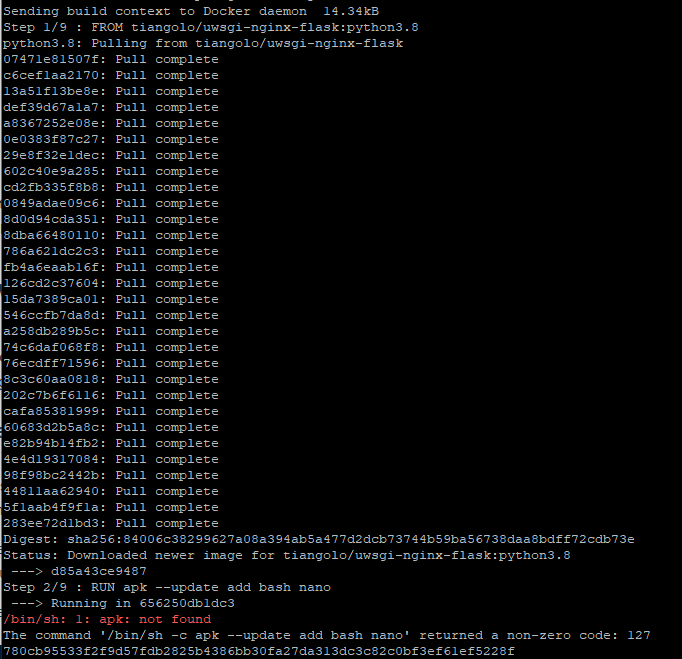
I managed to get past that one
however
Actually now it seems to have installed notion-client:D
Nice!
Time to try and figure out why I am getting Internal Server Error now :S
 devout temple
even tho i have liblzo lib installed, i still seem to geting to No module named lzo. what may be the potential cause?
 tawdry needle
devout temple
even tho i have liblzo lib installed, i still seem to geting to `No module named...
tawdry needle
devout temple
even tho i have liblzo lib installed, i still seem to geting to `No module named...
can you be more specific? liblzo sounds like it contains a shared library, not a python package. you might need to install it with pip, or look for something called python-lzo in your package repository
(note: do NOT run pip install as root)
(you will probably break your system if you do that)
 serene seal
I'm a little confused why when I try to execute the equivalent of a makemigrations command to my docker-compose it isn't seeing any of my env variables but my app itself does
$ docker-compose run fastapi alembic upgrade head
The DB_USER variable is not set. Defaulting to a blank string.
The DB_PASSWORD variable is not set. Defaulting to a blank string.
The DB_NAME variable is not set. Defaulting to a blank string.
The PGADMIN_EMAIL variable is not set. Defaulting to a blank string.
The PGADMIN_PASSWORD variable is not set. Defaulting to a blank string.
The CELERY_BROKER_URL variable is not set. Defaulting to a blank string.
The CELERY_RESULT_BACKEND variable is not set. Defaulting to a blank string.
The barbot_dev_key variable is not set. Defaulting to a blank string.
The sentry_dev_key variable is not set. Defaulting to a blank string.
Creating compose_fastapi_run ...
Creating compose_fastapi_run ... done
INFO  [alembic.runtime.migration] Context impl PostgresqlImpl.
INFO  [alembic.runtime.migration] Will assume transactional DDL.
as an example
rapid sparrow
serene seal
```python
$ docker-compose run fastapi alembic upgrade head
The DB_USER variable...

At least docker-compose.yml
 indigo zenith
rapid sparrow
indigo zenith
rapid sparrow
LOL nice... that is the appropriate response to so, so many questions 🤣
 rancid schoonerBOT
:incoming_envelope: :ok_hand: applied mute to @serene seal until <t:1642827517:f> (9 minutes and 59 seconds) (reason: newlines rule: sent 119 newlines in 10s).
 rugged flame
!unmute 266766446665793545
rancid schoonerBOT
:incoming_envelope: :ok_hand: pardoned infraction mute for @serene seal.
serene seal
❤️ apologies, didn't realize it was over the limit like that
rugged flame
serene seal
❤️ apologies, didn't realize it was over the limit like that
No worries, it's just that long code blocks with many line breaks tend to trip the spam filter.
 sweet token
How do I find an stl file in the inspect element?
serene seal
rapid sparrow
Pasted up the code 🙂
just to consolidate so the post is easier to read/respond to:
I'm a little confused why when I try to execute the equivalent of a makemigrations command to my docker-compose it isn't seeing any of my env variables but my app itself does
running the following command:
docker-compose run fastapi alembic upgrade head
$ docker-compose run fastapi alembic upgrade head
The DB_USER variable is not set. Defaulting to a blank string.
The DB_PASSWORD variable is not set. Defaulting to a blank string.
The DB_NAME variable is not set. Defaulting to a blank string.
The PGADMIN_EMAIL variable is not set. Defaulting to a blank string.
The PGADMIN_PASSWORD variable is not set. Defaulting to a blank string.
The CELERY_BROKER_URL variable is not set. Defaulting to a blank string.
The CELERY_RESULT_BACKEND variable is not set. Defaulting to a blank string.
The barbot_dev_key variable is not set. Defaulting to a blank string.
The sentry_dev_key variable is not set. Defaulting to a blank string.
Creating compose_fastapi_run ...
Creating compose_fastapi_run ... done
INFO  [alembic.runtime.migration] Context impl PostgresqlImpl.
INFO  [alembic.runtime.migration] Will assume transactional DDL.
as an example
Docker Compose File:
https://paste.pythondiscord.com/ikaboconul.http
Any ideas what could be causing the above behavior? It works fine and has the env variables when I do Docker-Compose up but when I do the above command it can't find the env variables.
rapid sparrow
serene seal
just to consolidate so the post is easier to read/respond to:
I'm a little conf...
U used environment before in other container code
environment:
- POSTGRES_USER=${DB_USER}
- POSTGRES_PASSWORD=${DB_PASSWORD}
- POSTGRES_DB=${DB_NAME}
But u did not use them or env_file syntax to transmit any env values to FastAPI
I don't understand why u expect FastAPI to have set any env vars then
serene seal
What is wrong with that?
Oh, I see what you mean so I would have to pass all of the environment variables into the fast API done?
I would have thought it would have access to the environment variables if they are globally available but I guess now that you point that out it makes sense
rapid sparrow
serene seal
I would have thought it would have access to the environment variables if they a...
Yes
rapid sparrow
serene seal
I would have thought it would have access to the environment variables if they a...
Use env_file syntax if u wish reusability
U can set same vars in it
And then uploading to containers same file with env vars
serene seal
How do I do that? Are there any shortcomings to note about doing it that way?
rapid sparrow
serene seal
How do I do that? Are there any shortcomings to note about doing it that way?
web:
  env_file:
    - web-variables.env
web-variables.env
VAR1=123
VAR2="467"
The only shortcoming is that it is ill advised to store important secrets and submitted to repo.
Same problem as if u had them written in docker-compose env vars directly
And that u can set only string values with it
Not sure if comments are allowed in it
rapid sparrow
serene seal
How do I do that? Are there any shortcomings to note about doing it that way?
In theory, setting up env values in docker compose file directly could be better because it could be having syntax to read env values from the operational system it runs in
So docker compose file will just redirect them from current OS to container
serene seal
Excellent! Thank you, I will try this in the morning! Appreciate the explanation by the way!
 heavy knot
I'm so stupid, any help? I just want a little tool/program when you click the Generate button, it types a sentence for you.
woven jetty
@rapid sparrow Hey so just wanted to thank you for the help yday, managed to get my flask app up and running
When it came to you saying you would suggest me to use venv, is it this you mean? https://www.arubacloud.com/tutorial/how-to-create-a-python-virtual-environment-on-ubuntu.aspx

Tutorial Cloud
In this guide you will find all the information needed to install and configure Python and create a virtual environment to run your Python applications on Ubuntu 20.04.
or should I change something in my dockerfile?
rapid sparrow
woven jetty
When it came to you saying you would suggest me to use venv, is it this you mean...
Yes. In containers it is useless.
But when u develop outside of containers, it helps to control dependencies for python application
woven jetty
Ye so it will look something like
My Ubuntu
My Venv
Container
rapid sparrow
Instead of polluting global python in the whole system
U create local python that has dependencies only for current project
woven jetty
Thanks ^^ Ill give that a try
rapid sparrow
woven jetty
Ye so it will look something like
My Ubuntu
My Venv
C...
Look it like
Ubuntu
My Venv during development
Ubuntu
Container during staging testing
Sometimes we need venv inside containers
But rarely
rapid sparrow
Then it would be
Ubuntu
Container
Venv
App
rapid sparrow
woven jetty
Think I start to understand it now^^
The point is ability to
pip freeze dependencies for current application easily
And not having conflicts in dependencies with other apps
During development
woven jetty
yes
serene seal
rapid sparrow
So docker compose file will just redirect them from current OS to container
Upon further consideration of the question last night regarding alembic upgrade not seeing the environment variables from the container, it shouldn't even need most of those environment variables, the only ones I imagine it would actually need are the database access variables. I am going to fiddle with it and see if it actually applies the migrations to the database table despite this issue and if it does I guess it is a non-issue but if it doesn't then I will have to figure out what is going on
serene seal
so it made my migrations seemingly with no issues, traceback:
$  docker-compose run fastapi alembic revision --autogenerate -m "New Migration"
Creating compose_fastapi_run ...
Creating compose_fastapi_run ... done
INFO  [alembic.runtime.migration] Context impl PostgresqlImpl.
INFO  [alembic.runtime.migration] Will assume transactional DDL.
INFO  [alembic.autogenerate.compare] Detected added table 'post'
INFO  [alembic.autogenerate.compare] Detected added index 'ix_post_id' on '['id']'
INFO  [alembic.autogenerate.compare] Detected added table 'server_controllers'
INFO  [alembic.autogenerate.compare] Detected added index 'ix_server_controllers_id' on '['id']'
INFO  [alembic.autogenerate.compare] Detected added index 'ix_server_controllers_server_id' on '['server_id']'
INFO  [alembic.autogenerate.compare] Detected added table 'user'
INFO  [alembic.autogenerate.compare] Detected added index 'ix_user_id' on '['id']'
Generating /app/alembic/versions/b9b585a270ec_new_migration.py ...  done
but when I make the migrations it doesn't seem to actually be running the upgrade:
$ docker-compose run fastapi alembic upgrade head
Creating compose_fastapi_run ...
Creating compose_fastapi_run ... done
INFO  [alembic.runtime.migration] Context impl PostgresqlImpl.
INFO  [alembic.runtime.migration] Will assume transactional DDL.
Hey @rapid sparrow So I got another question.
Just had time to experiment a lil with the venvs. So I created a venv, activated it, however all the dirs from my "real" environment were also on the venv. I did a pip install requests on the venv, and then deactivated the venv and saw it hadnt installed requests on the "real" environment so when it came to that all be good. So I guses my question is, what stays in the venv and what doesnt?
Since my folders from my real environment also exists in the venv
I hope my question make sense
is the venv only for pip packages ?
rapid sparrow
woven jetty
Hey <@!370435997974134785> So I got another question.
Just had time to experimen...
Venv creates a full basic environment with standard packages plus everything u will install to it
Venv is full python of certain version packed in one place
It has only one weakness
Venv can't be relocated. It depends on absolute paths. It can be relocated in some cases between operational systems, as long as destination path copies origin
rapid sparrow
People usually freeze venv dependencies and reinstall venv fully later
woven jetty
A venv isnt a FULL virtual environemnt as in, if I make a folder in my venv, the folder wont be "outside" the venv?
rapid sparrow
woven jetty
A venv isnt a FULL virtual environemnt as in, if I make a folder in my venv, the...
What does it mean
woven jetty
Well I am trying to understand how "far" the venv goes
As in
After I activated my newly made venv
I could see I could ofc do pip install X
and X would only be inside the venv
so if I deactivate the venv X wouldnt be there no more
which is great
but
rapid sparrow
Venv is just independent copy of python and pip installation.. That u can create for every project
woven jetty
ye that answered my question:P
venv isnt a full virtual "ubuntu" environment persay
its "just" a separate python installation persay
rapid sparrow
No. It is not related to virtualizations
It makes isolated only python environments
woven jetty
ye okay^^
So it's "just" for development purposes I guess?
You still run your docker outside the venv ?
or
Also how do you freeze venv dependencies ?
indigo zenith
woven jetty
Also how do you freeze venv dependencies ?
Usually pip freeze > requirements.txt
woven jetty
Ah thanks
Last question for tonight
On my windows environment I can do auth=os.environ["BLAHBLAH_TOKEN"]
how do I add values to system environment on ubuntu? and how do I access their values as I do in the above example
 finite fulcrum
given a .cer file, how can I verify that an executable was signed by the cert it was exported from?
indigo zenith
woven jetty
how do I add values to system environment on ubuntu? and how do I access their v...
I can't think of anything majorly different between Windows and Ubuntu in that regard. Check the documentation for os.environ but the example you gave should work cross platform
indigo zenith
finite fulcrum
given a .cer file, how can I verify that an executable was signed by the cert it...
What OS? With Python or you don't care how?
finite fulcrum
On Windows, through python
serene seal
So I'm interested in using Redis to cache API calls in my FastAPI app, I found Redis has some documentation about doing exactly this -
https://developer.redis.com/develop/python/fastapi
However, they want to use aioredis, I am using redis via Docker-Compose and I don't think I'm pulling the aio version - how can I correct this? I'm going to see if I can make sense of what needs to be done and see if I can better understand the changes required. Anyone have any insight?

This tutorial helps you get started with Redis and FastAPI.
woven jetty
@rapid sparrow By chance you also know a lil about nginx x)?
rapid sparrow
woven jetty
<@!370435997974134785> By chance you also know a lil about nginx x)?
my main web server by accidental chance
woven jetty
Well I made a self signed certificate
if I go to https://IPHere it works
however
With my flask application I have urls like https://Iphere/XXXXXXX
And that wont work, only works on http
so I cant get any webhooks on https atm
Do you know a solution to get the /XXXXX to work?
rapid sparrow
woven jetty
if I go to https://IPHere it works
very strange domain, which is not in any domain zone
woven jetty
Well
I havnt bought a domain
so I am just connecting with my public IP
Hence why I self signed
rapid sparrow
woven jetty
Do you know a solution to get the /XXXXX to work?
I guess I will be quoting this man very often
 rapid sparrow
yes, regular nginx default web page
woven jetty
my flask "routes" doesnt work on https:
http://167.99.229.124/zendeskIssue - works
https://167.99.229.124/zendeskIssue - Doesnt work
Ye I dont have any web "pages" persay
Just gonna use this for listening to webhooks
basically
So dont have a fancy webpage xd
What code do you want to see the nginx/sites-available/default?
or

or were you thinking of something else?
rapid sparrow
woven jetty
or were you thinking of something else?
I don't see any Nginx code that is used to direct to flask
woven jetty
and that is what I am curios about how to go about
rapid sparrow
woven jetty
and that is what I am curios about how to go about
here is an example of very dumb code that does that
 rapid sparrow
upstream django {
  server web:8000;
}

server {
   listen 80;
   listen [::]:80;
   return 301 https://$host$request_uri;
}


server {
  listen 443 ssl;
  listen [::]:443 ssl;

  server_tokens off;

  # # location of SSL certificates
  ssl_certificate /app/web/ssl/ssl.crt;
  ssl_certificate_key /app/web/ssl/ssl.key;

  location / {
    proxy_pass http://django;
    proxy_set_header X-Forwarded-For $proxy_add_x_forwarded_for;
    proxy_set_header Host $host;
    proxy_redirect off;

  }

  location /static/ {
    alias /app/web/build/static/;
  }

}
the add_header thing not sure if would be useful for you
read it with ignoring it for now, but just keep in mind in case of being needed
actually I will delete it
in order to be not confusing
as possible alternative static files
instead of
location / {
    alias /app/web/build/;
  }
can be served like
root /app/web/build;
location / {
    try_files $uri $uri/ =404;
 }
not really knowing the difference 🤔
rapid sparrow
woven jetty
I have build my Flask project in /var/www/NotionProd
and just to be sure I offered nginx config with http 80 strict redirect to 443 https
i am not allowing http in my config, just redirecting it
woven jetty
rapid sparrow
```nginx
upstream django {
server web:8000;
}
server {
listen 80;
liste...
Is this the entire file in sites-available?
rapid sparrow
woven jetty
Is this the entire file in sites-available?
yes
replace default.conf and have happiness
woven jetty
rapid sparrow
replace default.conf and have happiness
https://i.imgur.com/BEU36Mu.png like this ye?
also what is the "upstream django" part on port 8000?
When I do sudo nginx -t
I get:
https://i.imgur.com/4tEL23z.png
 rapid sparrow
woven jetty
also what is the "upstream django" part on port 8000?
rapid sparrow
woven jetty
also what is the "upstream django" part on port 8000?
it is my framework django instead of flask
i have it available at localhost:8000
in another container 🤔
of docker-compose or kubernetes-pod
so it has domain django to address it, that is resolved to its ip address
woven jetty
hm
Well
I post to http://167.99.229.124:56734/zendeskIssue
and want this to be https
rapid sparrow
replace with localhost:5000 or whever you host your flask
woven jetty
So 56734
web is your server name?
Should I replace server web:8000; with 167.99.229.124:56734
?
It seems to say syntax is successful now
after replace web:8000 with my serverip:flaskport
hm still goes to http and not https
I have opened up in my firewall, I have done a:
sudo systemctl restart nginx
I have even rebooted
but I still cant access https://167.99.229.124:56734/zendeskIssue
only as http
rapid sparrow
    log_records = []
    proc = subprocess.Popen(
        f"echo 123; sleep 2; echo 456; sleep 2; echo 789",
        stdout=subprocess.PIPE,
        stderr=subprocess.STDOUT,
        shell=True,
    )

    for line in proc.stdout:
        line = line.decode('utf-8')
        print(line)
        log_records.append(line)
    proc.wait()
I wonder how the hell it works
WHY IT WORKS
there is no proc.wait() in the loop 🤔
still nice that is works though
woven jetty
lol
rapid sparrow
it dublicates stdout log in real time
to stdout and to variable 😉
during command run
woven jetty
but odd I cant get my shit to work lol
Gonna see if I can find a Linux/Ubuntu discord and pay someone to fix this for me lol, tired of nginx lol
Thanks for trying tho
heavy knot
How could I add authentication my application. Like someone needs to have a license and enter it and I don’t wanna handle it in python I just want an api for this that is secure
rapid sparrow
Where to set Celery worker settings? I wish to declare worker_prefetch_multiplier = 1
oh yeah, found it is possible to set at least in worker launching CMD options
heavy knot
👋 Hey everyone, I'm Alex and am working on https://cogram.com/, a coding assistant for data science. We're currently exploring context-awareness of a team's shared codebase, eg. given a query in natural language or a line of code, Cogram would suggest relevant code from a team's Git repository. To understand if this is actually useful --
**Do you lose time searching for code snippets in a shared codebase, if you work in a team? Is this a pain point?
**
Would love to get your thoughts on this!
rapid sparrow
heavy knot
👋 Hey everyone, I'm Alex and am working on https://cogram.com/, a coding assist...
no. I have CTRL+Shift+F to use in VS Code in order to find any code snippet
It will render me comfortably at the left all code occurencies in the project

with easy moving to them by click mouse one time, to show them at the right
I have even flexible settings to search by REGEX record
for when I need more powerful search
 crisp wing
I wonder what are monorepos used for
I know I don't need it and don't want them yet but just curious
There's currently two tools I know for it, Nx and Turborepo (now a Vercel product)
 empty fable
How to use version control in vsc ssh fs extenstion?
Said no git installation detected, i think it meant local not ssh
rapid sparrow
I just wish to mention that gunicorn has beautiful icon
 crisp wing
G r e e n
 vernal mirage
Hi all, I've got a tech test interview on Thursday for a python infra role (CI, testing etc.)
What sort of questions / problems should I be researching??
Could do with some pointers
heavy knot
rapid sparrow
for when I need more powerful search
thanks for sharing this!
 gilded lichen
I need help in figuring out what's wrong with my exe... The exe contains same code as the py file https://paste.pythondiscord.com/aqapuhenob.py
But for some reason when i open a not allowed app, while it used to work in pycharm it doesnt notify nor play audio in the exe edition.
rancid schoonerBOT
Hey @gilded lichen!
You either uploaded a .txt file or entered a message that was too long. Please use our paste bin instead.
 fading blaze
So I installed pygraphviz by first downloading and running the exe for graphviz and then by running the pip command they said to run in the pygraphviz docs (https://pygraphviz.github.io/documentation/stable/install.html#windows-install), in a venv.
Then I made a jupyter kernel for that venv and tried importing pygraphviz in a notebook with that new kernel, which didn't work.
Then I tried installing pygraphviz through jupyter directly using sys.executable as jakevdp suggested in his blog:
In [7]: !{sys.executable} -m pip install --global-option=build_ext --global-option="-IC:\Program Files\Graphviz\include" --global-option="-LC:\Program Files\Graphviz\lib" pygraphviz
then I tried importing pygraphviz, and got this error
     11 # Import the low-level C/C++ module
     12 if __package__ or "." in __name__:
---> 13     from . import _graphviz
     14 else:
     15     import _graphviz

ImportError: DLL load failed while importing _graphviz: The specified module could not be found.```

getting this error trying to import pygraphviz even though both pygraphviz and graphviz appear to be installed@fading blaze if you look in C:\Program FIles\Graphviz\lib, do you see a _graphviz.dll or something like that?
fading blaze
No I don't see a file like that
Also I tried import pygraphviz as pgv in terminal python and it worked fine. The error only happens in Jupyter notebook
fading blaze
okay, i got it working in google colab using this: https://stackoverflow.com/questions/58535604/installing-pygrahviz-in-google-colab

Stack Overflow
In order to install graphviz, one can follow, this example:
https://colab.research.google.com/drive/1_Qb92Hj5_f2rpta67JC0JKXwE2581Ar-#scrollTo=BOa9gIcDo6GS
When I try to install pygraphviz (https://
I'm still not sure why it didn't work in plain jupyter but colab will work
tawdry needle
fading blaze
Also I tried ```import pygraphviz as pgv``` in terminal python and it worked fin...
this suggests that you might have 2 different python installations, and that it is installed cocrrectly in one but not the other
how did you install jupyter? you might need to set up a jupyter "kernel" that points specifically to the python that you used to install
what does py -0p show?
fading blaze
tawdry needle
how did you install jupyter? you might need to set up a jupyter "kernel" that po...
Yeah that makes sense
I think it also would explain why I installed pgv in the venv, made a kernel from that venv, but when i made a notebook using that kernel importing pgv didn't work (it said module not found or something).
(That lead me to this blog [https://jakevdp.github.io/blog/2017/12/05/installing-python-packages-from-jupyter/] and using !{sys.executable} install pygraphviz or whatever within Jupyter itself. It no longer said module not found when imported but got the new errorDLL load failed while importing _graphviz..)
fading blaze
tawdry needle
what does `py -0p` show?
 (venv)         C:\[venv-path]*
 -3.8-64        C:\Python38\python.exe
 -3.7-64        C:\Program Files\Python37\python.exe
 -3.6-64        C:\Users\[user]\AppData\Local\Programs\Python\Python36\python.exe
-3.6-32 C:\Users\[user]\AppData\Local\Programs\Python\Python36-32\python.exe```i installed jupyter using pip install notebook iirc
 brazen locust
you can launch a Jupyter notebook without prior installation, just blogged about it https://upcycled-code.com/blog/executable-documentation/

 small parrot
How can I zoom out using the geckodriver for selenium
indigo zenith
small parrot
How can I zoom out using the geckodriver for selenium
That's a Google question ;) https://stackoverflow.com/questions/32135085/how-to-zoom-out-of-page-using-python-selenium
Stack Overflow
I found this for java :-
WebElement html = driver.findElement(By.tagName("html"));
html.sendKeys(Keys.chord(Keys.CONTROL, Keys.ADD));
But how to do this using Python? I want to zoom out one level...
small parrot
browser.execute_script("$('#values').css('zoom', 5);")
small parrot
small parrot
browser.execute_script("$('#values').css('zoom', 5);")
how you zoom out to a 80%??
indigo zenith
small parrot
how you zoom out to a 80%??
I would assume its driver.execute_script("document.body.style.zoom='80%'")
 manic temple
Hi!!
I am trying to test bls signature verification in local GO etherem environment
from web3.providers.eth_tester import EthereumTesterProvider
How can i point it to localhost ??
rapid sparrow
I invoke my celery tasks like task = my_task.delay(params)
and I discovered that if all workers are busy... the task is not taken and my_task.delay(params) is awaiting in sync mode, until someone frees the queue
I did not expect such behavior 😦
I expected the task being sent to redis, and being awaiting until some worker is free to process the task
is it possible?
rapid sparrow
just to be sure I launch my workers like that 🤔
2022-01-25T08:43:42.531386814Z stdout F venv/bin/celery -A core worker -l INFO --prefetch-multiplier 1 --soft-time-limit 1200
rapid sparrow
nvm, SOLVED, wrongly utilized async library to get them started
 visual heron
Hi
 devout tangle
Hey everyone, which tools do you use to manage your dependencies? pip-tools? poetry?
wondering what the "go-to" is these days
rapid sparrow
devout tangle
Hey everyone, which tools do you use to manage your dependencies? pip-tools? poe...
I use just venv
and pip freeze from inside the venv
python3 -m venv venv
source venv/bin/activate
pip install pytest
pip freeze > requirements.txt # saving stuff
pip install -r requirements.txt # reinstalling from zero saved
 devout tangle
uf hahaha
rapid sparrow
I keep requirements.txt for prod ready stuff
and requirements.dev.txt that contains my dev dependencies too
rapid sparrow
what's a constraints.txt? 
I don't get it 🤔
what is the use case
Stack Overflow
I was reading the docs and couldn't wrap my head around it:
Constraints files are requirements files that only control which
version of a requirement is installed, not whether it is installed or
n...
Oh I see
Videos are useless
anyway, If I got it right... constraints are for the all secondary-nested dependencies
without forced installation of them
I guess it is cool indeed thing to use
https://luminousmen.medium.com/pip-constraints-files-b684992705b6

Medium
In python, it is common practice to write all the application dependencies that are installed via pip into a separate text file called…
increased readability of requirements.txt is surely welcome
the only regret I have
that I already have a mess without it 😉
good oportunity to refactor though
I am passionately hateful of any learning videos 😉
in my opinion they are mistake in 99% of cases, a mega huge waste of time
books, docs and texts are always better in content and faster to read
I don't care how much they are reputable.
I tried to listen even the most expensive high quality videos like MongoDB made to represent their product
it was still useless in comparison to docs
While someone tries to explain smth in video
I can re read something 4 times at least
with navigating quickly where I struggle and finding quickly more detailed explanations and additional info
with reading faster where I get it
Text is easy to navigate and comprehend, it is UX is perfect. Videos are not.
and I had 6 years of university also full of useless lections, where teacher was in uncomprehendable way something bubbling for few hours every time
once I understood this type of format is useless for me, I skipped 95% of them , and prefered reading and practicing on my own ;b
skipping almost all lections did not stop me from succesfully graduating.
I can say there were exceptions. Some teachers could give materials in a good way. But they are exceptions. Very rare exceptions
I needed few months ago to learn all basics about Kubernetes, I made a go through The Kubernetes Book and in fastest possible time learned all the basics
same thing before I did for Ansible with the book Practical Ansible 2
Books are giving me fastest way to learn all the basics and to start doing practice
And I can check their reviews at Amazon, to find the BEST books, which are having highest scores and reviews, from hundreds of people
To get the best quality material
to learn basics and advanced levels
indigo zenith
"Reading is better than watching, and doing is better than reading. " I think that works as a general rule for most people most of the time when it comes to mastering new skills
I agree though that the docs are not always the best thing to read first
rapid sparrow
well, that's why probably as one of best alternative ways to start doing something are the Interactive Tutorials
they are quite good often too
a healthy mix of reading and practice at the same time 😉
indigo zenith
I just find I never have the patience for videos, takes so much longer to get the same information
If I must I skim the transcript
 olive path
How do I get started running Nginx on my Windows computer (I need it for the TLS support with WebSockets)? I have a nginx.conf file from an open source project I have checked out.
 vernal harbor
Hey all -- having an issue with AWS / Lambda / Async/SQLAlchemy
Somehow SQLAlchemy session is being called twice
 uneven saddle
Hi all , AWS cloud engineer anyone here ?
rapid sparrow
uneven saddle
Hi all , AWS cloud engineer anyone here ?
https://www.pythondiscord.com/pages/guides/pydis-guides/asking-good-questions/
What Not To Ask
Q: Can I ask a question?
Yes. Always yes. Just ask.Q: Is anyone here good at Flask / Pygame / PyCharm?
There are two problems with this question:This kind of question does not manage to pique anyone's interest, so you're less likely to get an answer overall. On the other hand, a question like "Is it possible to get PyCharm to automatically compile SCSS into CSS files" is much more likely to be interesting to someone. Sometimes, the best answers come from someone who does not already know the answer, but who finds the question interesting enough to go search for the answer on your behalf.
When you qualify your question by first asking if someone is good at something, you are filtering out potential answerers. Not only are people bad at judging their own skill at something, but the truth is that even someone who has zero experience with the framework you're having trouble with might still be of excellent help to you.
So instead of asking if someone is good at something, simply ask your question right away.
heavy knot
I don't know if this belong to tools-and-devops, but everytime when I try to run different Python programs, I get same output: "Python nije prona"
 indigo zenith
heavy knot
I don't know if this belong to tools-and-devops, but everytime when I try to run...
indigo zenith
heavy knot
I don't know if this belong to tools-and-devops, but everytime when I try to run...
I don't know what language that is, what does it mean in English? Do you have Python3 installed?
heavy knot
indigo zenith
I don't know what language that is, what does it mean in English? Do you have Py...
Yeah, I have Python3 installed it. Reinstalled it and anyway same error. Message is in my native language is in my native language and it means "Python isn't found", but it's not fully printed, full message would be "Python nije pronađen." Guess because of letter "đ"
And if I run python3, just that, then Microsoft Store is opened
heavy knot
So it seems that for Windows there is no python3 command, but py
tawdry needle
heavy knot
So it seems that for Windows there is no python3 command, but py
you can set it up to use python.exe or python3.exe, but yes, windows comes with a special launcher called py.exe
 harsh nexus
Does anyone know about a crypto payment gateway that does not require Django?
 dull root
rapid sparrow
I am passionately hateful of any learning videos 😉
dull root
rapid sparrow
I am passionately hateful of any learning videos 😉
Oh you wanna learn the fundamentals 5000000 times over again? Have a banger salary of 200k? Well watch this shit.... aNd yOu wiLl bEcOmE a PrO wItH sOmE sImpLe PrOJecTs.
dull root
rapid sparrow
I am passionately hateful of any learning videos 😉
Read the docs. Thats where the key to success is.
tawdry needle
dull root
Oh you wanna learn the fundamentals 5000000 times over again? Have a banger sala...
"learn the fundamentals" is generous. "have someone blab examples and weak incomplete explanations at you" is more apt for a lot of videos that i've seen.
tawdry needle
there is no such thing as an "https key". you just need to change the git remote url, you don't need to change the actual data that you cloned; it's identical.
by default, the remote will be called origin, so you can do this:
git remote set-url origin <new-url>
in this case, the <new-url> should be the ssh url, so for example you might write:
git remote set-url origin 'git@github.com:aurimus/my-excellent-project'
 crisp kettle
What's the guidance for science-related python packages with a build system in the context of apple silicon / M1? e.g. "how to install numpy / pandas" on m1 is a popular search term and there's a bunch of stuff for one-off installs, but what about in the context of a system like poetry? I'm starting to think that the best way to do that on m1 is to just do "rosetta-only" & skip the arm64 stuff entirely
Especially considering some of our projects are still specified for py3.7 and most of the 'fixes' are probably only landing on 3.8+
 tawny temple
Hello, what's the advantage of pip-sync a.txt b.txt from pip-tools over pip install -r a.txt -r b.txt? It seems like pip-sync may support some extra arguments, but I am only curious about this very basic use case.
 next scroll
from what I understand, the advantage is that you can pip-compile sets together.
EG if you had base reqs, dev deps and N other deps, you could compile base+dev together into a single file and then pip-sync just that single text file to install base and dev.
You can have arbitrary breakdowns and sets
 smoky compass
Does anyone have a preferred tool for virtualenv management compatible with M1 Macs? Something similar to pyenv-virtualenv for example?
tawdry needle
smoky compass
Does anyone have a preferred tool for virtualenv management compatible with M1 M...
is pyenv-virtualenv not compatible with m1? try virtualenvwrapper if you like "centrally"-managed venvs. but it isn't pyenv so it can't install different python versions
tawdry needle
tawny temple
Hello, what's the advantage of `pip-sync a.txt b.txt` from `pip-tools` over `pip...
i think pip-sync is pip-compile + pip install
 maiden shadow
How can I set up a remote development environment in AWS?
 sly sleet
How would I split submodules (that are all under one module) in a pip package into separate installable components?
tawdry needle
sly sleet
How would I split submodules (that are all under one module) in a pip package in...
you have foo.a and foo.b, and you want to make them two separately-installable distributions? you will need a namespace package
@sly sleet
https://packaging.python.org/en/latest/guides/packaging-namespace-packages/
https://www.python.org/dev/peps/pep-0420/

Python.org
The official home of the Python Programming Language
smoky compass
tawdry needle
is pyenv-virtualenv not compatible with m1? try virtualenvwrapper if you like "c...
Oh maybe. I was just under the impression it was basically unmaintained at this point
tawdry needle
smoky compass
Oh maybe. I was just under the impression it was basically unmaintained at this ...
i am not sure, it might be
indigo zenith
maiden shadow
How can I set up a remote development environment in AWS?
Spin up an ec2 instance and have it... Beyond that depends what you're trying to do exactly
maiden shadow
@indigo zenith my primary goal is to allow a team of devs to use remote development
Does that mean each dev has to have their own ec2 instance?
indigo zenith
maiden shadow
Does that mean each dev has to have their own ec2 instance?
Or one with separate user accounts. It probably makes more sense to have a docker image that everyone runs locally but again it all depends on what you are trying to do
maiden shadow
I want to use ec2 so that I can take advantage of powerful ec2 instances
indigo zenith
maiden shadow
I want to use ec2 so that I can take advantage of powerful ec2 instances
I see. Well whether you can share one or each need a sperate one just depends on how (and when) you need to use them
maiden shadow
I was looking into code server
I think I have to use it with EFS. This way we can use different ec2 easily by just attaching the efs to that ec2. Not sure if that makes sense.
 deep crow
hey i have a generel question, first of all im just a few days old learning python and i dont understand why "return" is usefull if u just can use print if there is an example where "return" is usefull please show me one cause i dont understand where "return" is more efficient than print or for what "return" is even efficient for
indigo zenith
deep crow
hey i have a generel question, first of all im just a few days old learning pyth...
Return passes a value from inside a function to the outside. Print displays a value. Totally different things. If you start using functions that do anything other than just print, it will make sense
 analog portal
i'm using opencv and i need help with 2 things:
- it takes about 20 seconds for my code to open my webcam when i open it
- i want to be able to choose which camera on my computer i want to open (i only know how to open the default camera. i have windows 11)
cap = cv2.VideoCapture(0)
cap.set(3, 1366)
cap.set(4, 768)
cap.set(10, 100)
    while True:
        success, img = cap.read()
        cv2.imshow("camera", img)
        if cv2.waitKey(1) & 0xFF ==ord('q'):
            break
what happens if you want to do something later with the value returned from a function
can't do that with print
 neon jungle
I recently switched to flake8 as a linter instead of pylint, but now whenever I get an error it just highlights the first character of the line and not the whole line

its not that bad but it makes it kind of hard to see where errors are, do you guys know of any solutions?
 stuck beacon
Hello. I'm trying to compile Python3.8.9 from source on Windows 10 but getting compiling errors. I've tried a couple of version of python so far and got the same error below:
fatal error RC1116: RC terminating after preprocessor errors
Can anyone here help?
There is an issue for this https://bugs.python.org/issue45220
 patent edge
neon jungle
I recently switched to flake8 as a linter instead of pylint, but now whenever I ...
patent edge
neon jungle
I recently switched to flake8 as a linter instead of pylint, but now whenever I ...
is this vscode?
neon jungle
yes
 gloomy quail
neon jungle
I recently switched to flake8 as a linter instead of pylint, but now whenever I ...
gloomy quail
neon jungle
I recently switched to flake8 as a linter instead of pylint, but now whenever I ...
maybe you could try ```py
import tensorflow.keras.backend as K
I don't know if it will work. Just a suggestionI’m not trying to fix the error, the error is just that K is unused, I’m trying to make it so that vscode underlines the whole line and not just the first character
indigo zenith
neon jungle
I recently switched to flake8 as a linter instead of pylint, but now whenever I ...
This thread is about PyLint but it may be relevant: https://github.com/PyCQA/pylint/issues/3061
GitHub
Steps to reproduce Create file with contents from numpy import Array 1 + 2 in Visual Studio Code Enable pylint in settings.json by adding the following lines. { ... "python.linting.enabled...
 sand spoke
Best recommendation for a system cleaner for PC windows 10 ?
indigo zenith
sand spoke
Best recommendation for a system cleaner for PC windows 10 ?
I avoid them in general as they seem to often do more harm then good and you need to be really careful. But if I really need one I go for BleachBit https://www.bleachbit.org/download/windows
The most popular seems to be CCleaner but I trust BleachBit more as it's is open source
heavy knot
I am having trouble importing a class within a project using VS code. Can someone help me out please
indigo zenith
heavy knot
I am having trouble importing a class within a project using VS code. Can someon...
What are the paths of the relevant files, how are you doing the import exactly and what is the error message/issue you are having?
 twin valley
Anyone having weird issues with Python3.10, Poetry, and PyCharm? The Python3.10 virtualenv managed by poetry “seems to be broken” every time I try to poetry install
I guess PyCharm is irrelevant there
Nvm just needed to sudo apt-get install python3.10-venv
 reef latch
anybody use kafka stream jobs in a python app setting?
 mortal zodiac
👋🏾 Hi all, I have a few Git questions if anyone has a minute?
I'm working off a branch from main
But I need to create a new branch now and have changes on my previous branch that I need on this one
How would I go about doing that?
 hot bison
if you create a new branch, it will include your local changeset
 pliant meadow
SpiderDevelopers, I desperately need help. So I have spyder 5.1.5 installed, and I'm developing a UI based on PyQt5. According to the requirements for spyder 5.1.5, it can only support PyQt5<5.13. However, I have installed in my environment PyQt5 5.15.6 and spyder still runs, but if I run print(PYQT_VERSION_STR) within some code inside spyder, it spits out 5.12.3. But if I run pip list inside a console within spyder, I still see that my PyQt5 version os 5.15.6. What is happening??
pliant meadow
Ok, I found that in my anaconda navigator I have this pyqt package which seems to be the one spyder is using, but I have no idea what package that is

and why it's not using pyqt5 from python
 ionic quiver
Hey, do you guys add a license for your private projects on github?
tawdry needle
pliant meadow
SpiderDevelopers, I desperately need help. So I have spyder 5.1.5 installed, and...
it sounds like you have multiple versions of python installed, and/or possibly multiple conda envs
pliant meadow
tawdry needle
it sounds like you have multiple versions of python installed, and/or possibly m...
That wasn't it, it was something weirder, but somehow I think it may be working now
That dumb module "pyqt" is installed by anaconda when installing spyder, and I believe it encompasses pyqt5 5.12.3. On the other hand, I had used pip to install the latest version of pyqt5 (5.15.6) on the same venv. So it looks as though I had two versions of pyqt5 within the same env, but one was packed inside "pyqt" and the other in "pyqt5". I then uninstalled the pkg "pyqt5" through pip, and it worked (?)
it was a complete headache. Plus, I was working with Win 7 which made things worse, since I could use the latest anaconda installer, updating conda was taking forever, updating packages was also a nightmare.... I just hope it'll work from now on
tawdry needle
pliant meadow
That dumb module "pyqt" is installed by anaconda when installing spyder, and I b...
good catch. you sometimes have to check on pypi to see what things are, e.g. reading their descriptions
other times packages are aliases for other packages
!pypi pyqt5
rancid schoonerBOT

Python bindings for the Qt cross platform application toolkit
tawdry needle
it looks like there isn't even a pyqt package on pypi... you might have also been mixing up conda packages and pypi pacakges
tawdry needle
pliant meadow
it was a complete headache. Plus, I was working with Win 7 which made things wor...
i always suggest to never use anaconda and just stick to conda (i.e. the miniconda installer)
the anaconda gui doesn't really add much convenience, and they jam so much garbage into the base environment that it makes a big mess
indigo zenith
ionic quiver
Hey, do you guys add a license for your private projects on github?
Private projects that nobody else can see? No.
Personal projects that I make public? Yes.
tawdry needle
ionic quiver
Hey, do you guys add a license for your private projects on github?
doesn't github just detect any LICENSE.txt or LICENSE or COPYING etc file in the repo?
 sand thistle
i am getting a 504 error, but all my infrastructure seems to be up
i have checked my service providers as well and nothing seems to be down
tawdry needle
sand thistle
i am getting a 504 error, but all my infrastructure seems to be up
what does your infrastructure consist of?
sand thistle
nginx, docker, mysql are all up
tawdry needle
504 is gateway timeout: this suggests that maybe your application is taking too long to respond, and something in between the client and your application is giving up
is this all running on a single server? or in some kind of cloud services setup?
i don't know what you mean by that
tawdry needle
my first guess is that your application (in docker?) is failing to connect to mysql, and the python application is itself timing out trying to connect to mysql
i have similar errors when i misconfigure my docker containers at work, they time out trying to connect to the database (not mysql in my case)
sand thistle
you want me to log in to mysql
tawdry needle
well... yes? and no? your application obviously has to provide credentials for the database, or at least connect to the database at the right url
you have it set up like this?
outside world --> nginx --> docker container --> mysql
are docker containers even allowed to access network addresses outside of the container?
sand thistle
uhh this configuration has been up for a long time
about a month ago i changed some dns settings
for a sub domain leading to this container
anyway,i havent changed anything
sand thistle
tawdry needle
well... yes? and no? your application obviously has to provide credentials for t...
alright i mean i was able to log in to mysql
tawdry needle
at minimum, start by checking the nginx logs
it should tell you if the 504 is being returned from nginx, or if it's being returned by the python app itself
sand thistle
[error] 27648#27648: *2177993 upstream timed out (110: Connection timed out) while reading response header from upstrea
@tawdry needle
tawdry needle
sand thistle
``[error] 27648#27648: *2177993 upstream timed out (110: Connection timed out) w...
ok, and are you sure that nginx is pointing to the right upstream?
show your nginx config
!paste
rancid schoonerBOT
Pasting large amounts of code
If your code is too long to fit in a codeblock in discord, you can paste your code here:
https://paste.pythondiscord.com/
After pasting your code, save it by clicking the floppy disk icon in the top right, or by typing ctrl + S. After doing that, the URL should change. Copy the URL and post it here so others can see it.
sand thistle
tawdry needle
ok, and are you sure that nginx is pointing to the right upstream?
if it was misconfigured wouldn't it have had an error if i made DNS changes 2-4 weeks ago
i dont feel ok sharing the nginx config
tawdry needle
hard to say, need to see the config. at minimum, can you share the part of the config that points to the python application?
are you using proxy_pass? something else?
sand thistle
i dont see proxy pass
i changed the A record for the main domain, but its the subdomain thats having connection issues

sand thistle
tawdry needle
hard to say, need to see the config. at minimum, can you share the part of the c...
the issue is i dont see it pointed
tawdry needle
sand thistle
i dont see proxy pass
so how is nginx "connected" to the python application?
tawdry needle
sand thistle
i changed the A record for the main domain, but its the subdomain thats having c...
maybe you misconfigured the server_name directive in nginx
e.g. it's failing to match the correct server block because you set the server_name directive wrong, and it's falling back to the default_server server
i recommend reading this doc if you don't know what i mean https://nginx.org/en/docs/http/request_processing.html
it's a bit hard to explain
sand thistle
i see
 scarlet olive
Hey Pythonistas. I work with a pretty active small dev team as a front end dev. Dev teams will publish their environment files with updates to a .example file but not mention it or maybe mention it in a group chat somewhere. Well, if I go a few days or longer without upgrading one of the services on my remote dev box then I have to go and find and rectify the environment variables. Sometimes this is a pain so I wrote a little script to check them, compare them and offer to merge them with some user input. Works like a charm.
I am trying to publish it to pypi and since last time I did so I see they recommend now a .cfg file. I want the command for the package to run the script but but console_scripts doesn’t seem to work
(Like user doesn’t have to run python3 -m envcheck, rather just envcheck)
I took a look at how black package does this and the only different I see is that they’re still using setup.py
Has anyone published a package with a setup.cfg containing a console script to invoke commands directly?
scarlet olive
For anyone interested…. It does work with setup.py just wondering why not with .cfg 🤷🏻♂️
tawdry needle
scarlet olive
For anyone interested…. It does work with setup.py just wondering why not with ....
maybe you just had the syntax wrong in the .cfg version?
sand thistle
it was my app, not the devops stuff
 gray shell
I love copilot

 civic grove
response_model=UserCreate , that will give the password in the response as well lol
maiden shadow
I created a pylint plugin. However, I only want the plugin to run on specific modules. How do I specify that?
 grand vector
is there a good automatic code mapper for python? I need to see a flowchart of my code and i reeeeaaaallllly dont wanna manually craft it
 open robin
I recently made performance improvements to a library I maintain. Now I'm looking for a tool that can easily generate nice graphs showing the performance improvements. And by easily, I mean all you have to do is specify that you want to compare mylib_v1.foo(input) against mylib_v2.foo(input) (and specify some increasing input sizes), and the tool outputs a nice png or something that you can conveniently link to from your release notes. But I'm having trouble finding something like this, which is surprising since it seems like a pretty common use case. Any suggestions?
tawdry needle
open robin
I recently made performance improvements to a library I maintain. Now I'm lookin...
you can use matplotlib to generate graphs in general, or seaborn for a higher-level plotting interface
 blissful ice
Hi! I'm trying to adopt some package-requirements scheme for my projects. So maybe a simple requirements.txt or perhaps poetry? Bue either way, I'm unclear about how to specify "variant" dependencies like OpenCV or CuPy. Like, I don't care if you (as a user) install opencv-python or opencv-python-headless and I don't want to force you into one if you prefer the other. And with CuPy it's crucial not to take the decision away because I (the package) can't decide for you if you should be installing cupy-cuda113 or cupy-cuda114.
So how does one handle this? Only specify packages where a singular decision exists and inform users that the requirements are incomplete and require manual decisions?
 torn bane
hi, I'm used to using pyenv virtualenv in linux and in WSL, is it usable in Windows? I installed pyenv-win and virtualenv using the direction in this one writeup I found on google (RKadeZone), but it looks like it's still using the local installed python and not the version I installed with pyenv
seeing as how I installed 3.9.6 and python --version says 3.9.5 which is what I had installed on windows
torn bane
Probably have to figure out some other tool for making virtual environments in windows
rapid sparrow
torn bane
hi, I'm used to using pyenv virtualenv in linux and in WSL, is it usable in Wind...
i can say for sure that virtual venv (also known as python3-venv) is usable in windows, not knowing about pyenv
 full bronze
What's wrong with using the default venv implementation? Or rather, why would you use another package for a venv?
sly sleet
full bronze
What's wrong with using the default venv implementation? Or rather, why would yo...
venv, being a stdlib module, is missing features
torn bane
my main problem with venv originally was that I didn't understand how it works or how to use it, where as learning how to use pyenv virtualenv was quite straightforward
now that I've used python for 4-5 years, I still don't understand how venv works or how to use it
scarlet olive
Here’s a package I wrote (was asking about a little above). Working on some a more structured version for a real release but this is working and if anyone has suggestions I’d be happy to hear them https://pypi.org/project/envcheck/

PyPI
A small, simple command line utility to check for, compare and merge environment variables between environment files and their .example counterparts
uneven saddle
Need help AWS .
Folder of different users in ONE bucket only and each user can view access just there folder .
Need json code policy for this.
tawdry needle
You could use a "constraints" file and list all of those variants in the constraints file, at least. I'm not sure about specifying alternatives to satisfy an abstract requirement... another option is to use different requirements files? it kind of depends on why an end-user might choose a different variant
 mild swift
I'm trying to migrate a dockerfile from 3.9 to 3.10 - but I find that apt-get install python3.10-dev fails in the official 3.10 base images I've tried - is there a way to acheive this?
 smoky stratus
Enabling ufw makes my GitHub actions runners disconnect/timeout, everything else works as expected since all outbound is allowed. What could be the issue?
rancid schoonerBOT
:incoming_envelope: :ok_hand: applied mute to @wintry hearth until <t:1644155347:f> (9 minutes and 59 seconds) (reason: duplicates rule: sent 4 duplicated messages in 10s).
heavy knot
which one
 burnt ibex
The current one is fine
 heavy knot
burnt ibex
The current one is fine
heavy knot
burnt ibex
The current one is fine
?
burnt ibex
bundled is fine
heavy knot
?
 burnt ibex
either is fine
 burnt ibex
that is fine
heavy knot
use MinTTY or windows cmd?
burnt ibex
cmd is fine
burnt ibex
git credential manager
 burnt ibex
both
heavy knot
 burnt ibex
just click install
heavy knot
done
okay git worked
thanks
@burnt ibex do i need cmake added to the path for dlib to install
burnt ibex
I have no idea
 wet dune
hi there
I am making my first "lib" its a nasa api wrapper
I just dont really know how to upload the package
If someone can help
Thats great :)
heavy knot
Hey, does anybody know how to run bash commands in python?
rapid sparrow
heavy knot
Hey, does anybody know how to run bash commands in python?
import os
status_code = os.system("your command")
or you can use subprocess library for a more advanced capabilities
to capture output
or even capturing output to stdout and python code at the same time in real time
heavy knot
so it would be like
`import bash
import time
try:
while True:
    bashCommand = "sudo ./anti-ddos.sh"
    print("ddos check..")
    time.sleep(5)
    print("all possible ddos attempts eliminated")
    time.sleep(5)
    print("you can disable ddos check with ctrl+c")
    time.sleep(20)`
would it be like thaT?
sly sleet
os.system considered harmful
subprocess is objectively superior in every way
and less chance for vulnerabilities
tawdry needle
heavy knot
`import bash
import time
try:
while True:
bashCommand = "sudo ...
import bash?
heavy knot
tawdry needle
`import bash`?
yes. you can install it wit pip3 install bash.
tawdry needle
heavy knot
yes. you can install it wit `pip3 install bash`.
https://pypi.org/project/bash/ this? i don't see much benefit of using this
nor do i understand the point of it. i think you should stick with subprocess.run for all basic use cases
!d subprocess.run
rancid schoonerBOT
subprocess.run(args, *, stdin=None, input=None, stdout=None, stderr=None, capture_output=False, shell=False, cwd=None, timeout=None, check=False, encoding=None, errors=None, ...)```
Run the command described by *args*. Wait for command to complete, then return a [`CompletedProcess`](https://docs.python.org/3/library/subprocess.html#subprocess.CompletedProcess "subprocess.CompletedProcess") instance.

The arguments shown above are merely the most common ones, described below in [Frequently Used Arguments](https://docs.python.org/3/library/subprocess.html#frequently-used-arguments) (hence the use of keyword-only notation in the abbreviated signature). The full function signature is largely the same as that of the [`Popen`](https://docs.python.org/3/library/subprocess.html#subprocess.Popen "subprocess.Popen") constructor - most of the arguments to this function are passed through to that interface. (*timeout*, *input*, *check*, and *capture\_output* are not.)i wonder if sudo will even work in a subprocess
that would be the only sticky thing
you might have to put your password in at each loop, which wouldn't be good
heavy knot
I am trying to make a python script that runs a bash command as a loop.
heavy knot
like once every 30 seconds
tawdry needle
which runs another program as a given user
heavy knot
ooooh.
tawdry needle
literally sudo means switch user do, i.e. "do something as another user"
its name is based on the su command, which just switches the user and starts a new shell process
ionic quiver
anyone has experience packaging python app and automatically adding it to releases with github actions?
indigo zenith
ionic quiver
anyone has experience packaging python app and automatically adding it to releas...
Don't ask to ask, just ask
heavy knot
tawdry needle
literally `sudo` means `switch user do`, i.e. "do something as another user"
I thought it "super user do".
indigo zenith
heavy knot
I thought it "super user do".
Makes sense but su works with any user, not just root
ionic quiver
was wondering how would i go about building my app on push and put the built file to releases
tawdry needle
ionic quiver
was wondering how would i go about building my app on push and put the built fil...
you are looking for a "CI/CD" tool
if you use github for your code, you can probably use github actions for this
ionic quiver
yeah im using github actions
i can build but how would i publish it in releases afterwards?
tawdry needle
that i'm not sure. maybe you have to use the github api
 mystic void
ionic quiver
i can build but how would i publish it in releases afterwards?
mystic void
ionic quiver
i can build but how would i publish it in releases afterwards?
depends on what you mean by "releases". That could be as simple as a tag in your repo, to multi-stage complex processes
(ex: pushing some generated artefacts such as docker images, tarballs, or to pypi or updating some revision numbers automatically and announcing the release somewhere like slack/discord/email)
tawdry needle
mystic void
depends on what you mean by "releases". That could be as simple as a tag in your...
i assumed they were talking about "releases" on github specifically
 serene mango
Hi can I ask for docker help here (because it's not a python issue)
I'm getting a lot of dependency errors while trying to build a docker image of my app.
Stuff like "Failed to build multidict yarl" and a lot such errors (like for example unable to pip install git+ for which i have to include git too)
Is it possible to just use the existing python environment and then not to worry about pip installing at all? If yes, how do i do it
serene mango
ionic quiver
why not install dependencies on your container
Hold on, i'll send all the errors one by one haha
- I also need git to install packages directly from github (which i managed to solve so that isnt an issue)
(i'll get the other errors)
FROM python:3.9
RUN apt-get update && apt-get install -y git

COPY ./requirements.txt .

RUN pip install -r requirements.txt

COPY ./src ./src
COPY .env .env
CMD ["python", "src/main.py"]
Here's my Dockerfile
I'm experiencing this "glitch" where it installs so many times

it gets ALL releases of discord.py lmfao
 serene mango
ionic quiver
you did pip freeze right
serene mango
ionic quiver
you did pip freeze right
Yes, actually I managed to fix that issue somehow, and here's the latest error:
OSError: [Errno 99] error while attempting to bind on address ('::1', 20000, 0, 0): cannot assign requested address
Exception ignored in: <bound method BaseEventLoop.call_exception_handler of <_UnixSelectorEventLoop running=False closed=False debug=False>>```docker run -p 20000:20000 container_name
ionic quiver
not sure
tawdry needle
serene mango
I'm experiencing this "glitch" where it installs so many times
this is pip attempting to resolve a version conflict, so it's fetching multiple versions
serene mango
oh
How I fixed it was, I install then delete then install again in the same process
i don't know why it worked 😄
tawdry needle
at least... i think so? normally it has more output about "finding a compatible version"
serene mango
it didnt print that this time
 south dawn
what do u guys use to code
 edgy lake
Can someone help me write this python code, Im tryna grab duplicate images from one folder then sort them in next folder. I have no python experience but the code is here $$$
GitHub
A script to find and delete duplicate images using pHash. - GitHub - philipbl/duplicate-images: A script to find and delete duplicate images using pHash.
 flat summit
GitHub
This repository is a python library designed to allow an easy translation system for other projects - GitHub - Disk-MTH/Tradlib: This repository is a python library designed to allow an easy transl...
indigo zenith
serene mango
I'm experiencing this "glitch" where it installs so many times
That's usually a version comparability issue. 1) Make sure the version of pip inside your container is the same as the one you used to make your requirements.txt. 2) Try allowing an older version of the problem package
Looks like you sorted it out, but for future reference
heavy knot
Can anyone make good OpenCV python object detection script??
 snow zinc
heavy knot
Can anyone make good OpenCV python object detection script??
snow zinc
heavy knot
Can anyone make good OpenCV python object detection script??
!rule 5
rancid schoonerBOT
5. Do not provide or request help on projects that may break laws, breach terms of services, or are malicious or inappropriate.
heavy knot
Thats part of python @snow zinc OpenCv
snow zinc
I'm not sure if we log edits, but I'm pretty sure that their original message, before editing it two minutes after I sent my message, was directly asking for help with cheat programs
and OpenCV is not really on topic for this channel either tbh
 barren hamlet
Hmm
heavy knot
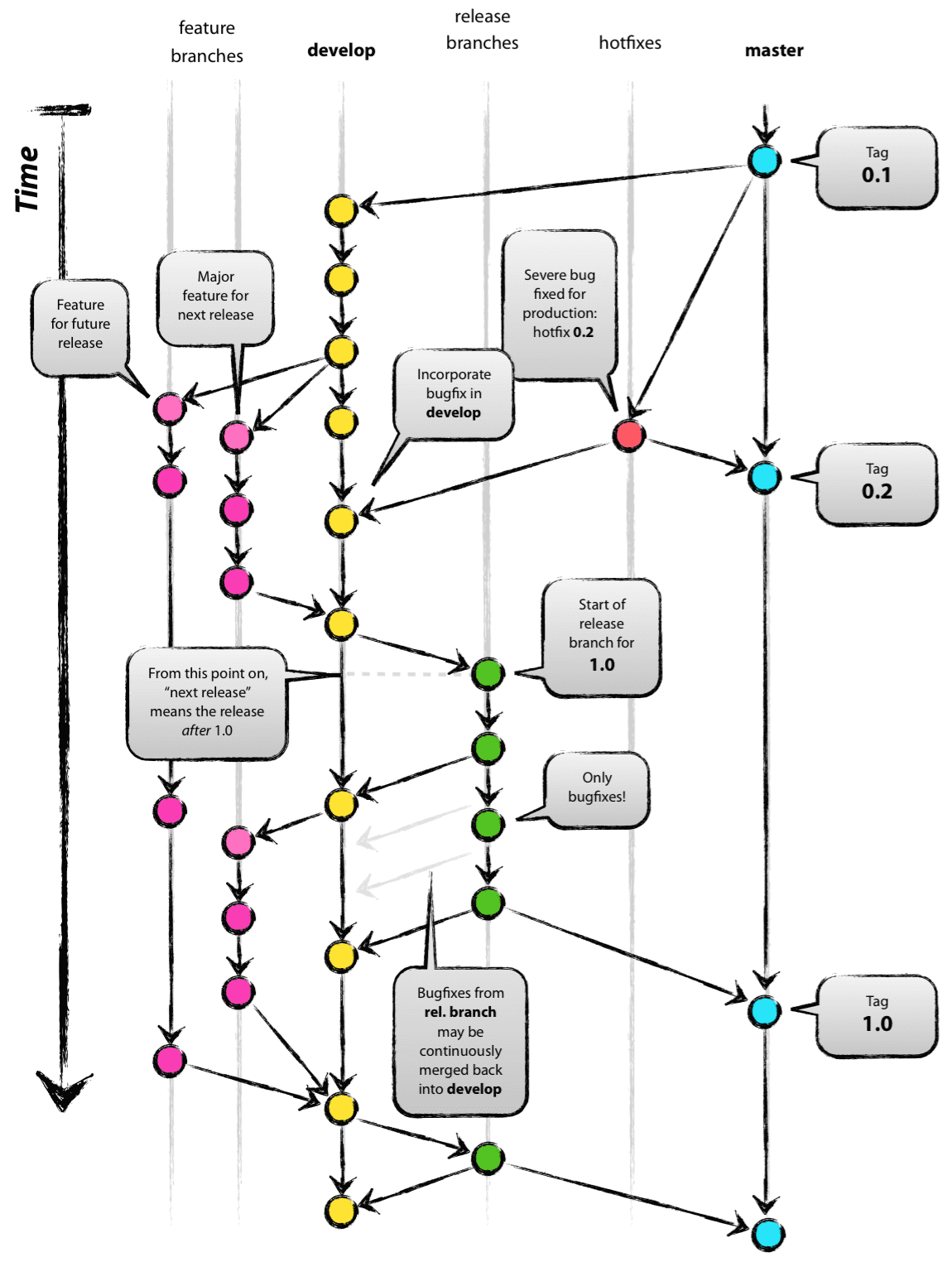
Hello just a quick question related to gitflow. Does develop branch off master? Or is it an independent branch?
nvie.com
In this post I present a Git branching strategy for developing and releasing software as I’ve used it in many of my projects, and which has turned out to be very successful.
heavy knot
According the diagram, develop branches off master
 solemn marlin
In the first version of your App the develop would bee a copy of the master branch. In next versions you would implement all the new features to the develop branch and when you are ready to release just merge the dev branch to the master one.
@heavy knot
heavy knot
solemn marlin
In the first version of your App the develop would bee a copy of the master bran...
Roger that, thank you so much
wet dune
Im not sure if this goes here lmao. Im making a NASA API wrapper, and i am currently working on the output and error handling. Any suggestions i could add on the output to be more like, easy to read or helpful to the user?

 rancid iron
Is this the channel to ask questions about python lining tools (flake8, pylint,...)?
 flat path
rancid iron
Is this the channel to ask questions about python lining tools (flake8, pylint,....
flat path
rancid iron
Is this the channel to ask questions about python lining tools (flake8, pylint,....
Mhmm, you can certainly do that here although type checking ones should go to #type-hinting
solemn marlin
wet dune
Im not sure if this goes here lmao. Im making a NASA API wrapper, and i am curre...
It looks nice to me
Maybe insert a break line after the “Response MSG” but idk if that would be really nice
rancid iron
flat path
Mhmm, you can certainly do that here although type checking ones should go to <#...
I just dialed down the severity of flake8 warnings in vscode settings. All G
 idle depot
Hi, Im looking for a good tool to monitor all my computer stack (usually use python/nodejs/react) or alternatively monitor docker containers.
rapid sparrow
idle depot
Hi, Im looking for a good tool to monitor all my computer stack (usually use pyt...
it is common to use ELK or PLG
i am an adept of PLG
PLG = Prometheus + Loki + AlertManager + Grafana
ELK = Elastic Logstash Kibana
idle depot
are they all free? (forgot to mentions that i am liooking for something free for personal use)
rapid sparrow
idle depot
are they all free? (forgot to mentions that i am liooking for something free for...
yes
at least they are open source and have free versions
Grafana has some sort of paid version, not sure about details
others should be having paid versions too, but it is not necessary to use them I think
I use perfectly for free for now
idle depot
Great thanks for the help
rapid sparrow
idle depot
Great thanks for the help
u a welcome
Just to be sure
Prometheus is monitoring tool, tells it is alive, CPU load, memory load and e.t.c. Metrics checking tool basically, to gather from all servers in one database, it has inbuilt visializer
Loki = Log aggregator, collects logs from all your applications, and gives simple query language to search through them
Alert Manager = can raise alarms based on conditions and send you notifications about it to Email/Discord/Slack/whatever
Grafana is just a visualizer for more comfortable usage of all previous things, quite useful for Loki especially, since it is not having inbuilt visualizer
idle depot
rapid sparrow
u a welcome
Just to be sure
Prometheus is monitoring tool, tells it is alive, CP...
yes this is exactly what i am looking for. thanks.
I tend to code fast and sometimes overlook process/memory leaks etc. I just think it will help me monitor the stack while working.
Is there any revommended "All in One" docker container installation you know of? Or i should just install all separably
rapid sparrow
idle depot
yes this is exactly what i am looking for. thanks.
I tend to code fast and some...
There is, if you are in Kubernetes/Helm ecosystem for example
it looks like they are offering some parts of the full package in other types of installations
docker compose version has Lok + Promtail + Grafana, not bad for start
idle depot
rapid sparrow
There is, if you are in Kubernetes/Helm ecosystem for example
I use only docker locally... so..
rapid sparrow
idle depot
I use only docker locally... so..
try docker-compose version then
it is without prometheus, but pretty much looking cool
 shadow crow
Do you think it's okay to split a change between several commits, if in some of these intermediate commits the tests get broken?
Or should the system be in a working state on every commit?
solemn marlin
shadow crow
Do you think it's okay to split a change between several commits, if in some of ...
O think its fine
Specially because you could make chances related to other features in order to achieve your end goal
shadow crow
solemn marlin
Specially because you could make chances related to other features in order to a...
but then it's harder to revert to a specific commit
and if you're browsing code on a particular commit, it might be really confusing how it works (because it doesn't - it might not even compile)
solemn marlin
shadow crow
but then it's harder to revert to a specific commit
Pros and cons
Maybe creating a commit name pattern to specify that you are in the middle of an new feature should work
And split your feautures into new branchs
shadow crow
solemn marlin
And split your feautures into new branchs
I wish there was a way to group commits in a tree somehow. Like, compose a commit out of sub-commits, without creating a new branch
solemn marlin
I Mean is creating an new branch then merging that bad of a decision?
shadow crow
I guess you can squash-merge
but then it's tricky to view the individual commits, you need to keep that branch alive and switch to it
wet dune
solemn marlin
Maybe insert a break line after the “Response MSG” but idk if that would be real...
Oh yeah good idea! Thx a lot :) I really appreciate that bro. I will fix it right now
 silent sedge
Are there any static opentelemetry renderer? A collector that will generate static reports?
So for example, I can use it in CI, it will collect spans into static files I can expose as artifacts for the CI job?
silent sedge
looks like opentelemetry-collector can output a JSON file. Did anyone try that on CI?
 narrow slate
In an aws context, where would you put internal tooling like code review, ci, cd to host it in the safest way ?
The best approach I have in mind is a separated account which would make use SSM to reach other accounts / subnets.
solemn marlin
narrow slate
In an aws context, where would you put internal tooling like code review, ci, cd...
Can you elaborate more your question ?
narrow slate
I don't think i can make it more elaborate :/
you have to deploy staging and production envs within aws, let's say both env have their own aws accounts, where would you put versioning/ci/cd tooling and how would you achieve the provisioning, let's say on k8s clusters
I have my own answer, i'd just like to be challenged
silent sedge
Another VPC at least
if you're using root accounts for anything, another root account
narrow slate
if it's in another account, there is of course another vpc yes
the question is what would you use to reach this k8s cluster and provision it ?
would yu just peer vpcs ?
tawdry needle
shadow crow
Do you think it's okay to split a change between several commits, if in some of ...
Leave comments about what is broken (including in the commit message), and don't push to a main/trunk branch until it works
shadow crow
tawdry needle
Leave comments about what is broken (including in the commit message), and don't...
That's what I usually do. I sometimes add TODOs in the ling description of the commit
 frozen zephyr
shadow crow
Do you think it's okay to split a change between several commits, if in some of ...
frozen zephyr
shadow crow
Do you think it's okay to split a change between several commits, if in some of ...
I've got a coworker who insists on having at least two commits per PR, one that introduces a new failing test, and one that makes the test pass
 carmine venture
Hi everyone. I wrote a package that lets me keep a single-source-of-truth for all of the .env files in my codebase. I'd like to pass it along in case it can help any of you as well. Cheers!
https://github.com/MikeChurvis/compile-env-files

GitHub
A script that builds and distributes environment variable files from a single-source-of-truth config file. - GitHub - MikeChurvis/compile-env-files: A script that builds and distributes environment...
rapid sparrow
frozen zephyr
I've got a coworker who insists on having at least two commits per PR, one that ...
It sounds as an interesting idea 🤔
TDD at git level
rapid sparrow
shadow crow
Do you think it's okay to split a change between several commits, if in some of ...
It does not make sense to have system working at every commit in branches
Because we use CI Cd tools that run at every commit to check integrations with other services
Which are meant for us to save our time from testing
It could be making sense to have every commit working in master branch
U could be squashing (uniting all commits into one) before merging branches into master
frozen zephyr
rapid sparrow
It sounds as an interesting idea 🤔
We also don't do fast forward merges when merging a PR that has more than one commit, so the trade-off is that you can no longer revert normal individual commits, only merge commits
That said, we rarely revert anything anyway. It's usually easier to roll forward and fix the fix than to throw it away entirely
civic grove
do jobs not retain "side-effects" when using needs in github actions?
name: C/C++ CI

on:
  push:
    branches: [ main ]


jobs:
  build:
    runs-on: ubuntu-latest
    steps:
    - uses: actions/checkout@v2
    - name: Build
      run: |
        make all

  test:
    needs: build
    runs-on: ubuntu-latest
    steps:
      - uses: actions/checkout@v2
      - name: Run tests
        run: |
          chmod +x ./runtests.sh
          ./runtests.sh
my build job basically just makes a bunch of .o files inside ./bin/test/ and test job needs those files to run tests, but i get this
./runtests.sh: line 14: ./bin/test/test_*: No such file or directory
obvoiusly i can just put them in the same job but i was wondering if there is something i can do so that build and test are different jobs
i'm assuming this is due to the 2 jobs having different runners
 chilly oriole
I don’t know if this is the proper spot for a question, but I got emails from apple, not sure it’s really apple about developers license and certifications but my laptop puts up massive warnings about downloading anything from the page. And the copyright date at the bottom is still 2018. Real or fake? Please and if this is the wrong spot for this can someone help me find the right one. Please and thank you.
mystic void
chilly oriole
I don’t know if this is the proper spot for a question, but I got emails from ap...
Your computer warning you is a massive flag.
You can also check the usual spots:
- Look at the email addresses, if they have some typo or weird domain
- If the message has a threatening town
- If they contact you out of the blue without you taking any action
- Paste some of the title/sentences of that email in google to see if it is a known scam
 jade birch
Hey there all! I'm looking for a Unix-based command line of some sort for Windows systems that can run commands installed on the Windows system itself. I have previously used sub-system Unix, which has its own package manager but am trying to move away from that more to something that is ideally just aliasing or otherwise using the Windows libraries itself rather than running a subverted operating system. Currently I am using Git Bash but it seems to have a number of issues, particularly with Python commands, and I am now looking for an alternative as I'm tired of dealing with random crashes if I do not provide arguments to commands that otherwise would normally function fine. (Example: If I run py it hangs indefinitely rather than dropping into the Python console as normally would occur; I cannot find any online forums addressing this bug, though if you know of it/have seen one please let me know. I may not be searching the right thing.)
Ideally whatever tool would be able to handle:
-javac and java (my university uses these languages for teaching)
-git
-python
-ls, cd, grep, and other basic unix utilities/commands
-ideally 'vim' and 'code' commands```Obviously, even if you know of a tool that fulfills only some of these conditions I'm trying to gain as much knowledge as possible of the tools available so I can select what's right for me so please do share; thank you!
civic grove
wsl2 is your best choice
tawdry needle
jade birch
Hey there all! I'm looking for a Unix-based command line of some sort for Window...
Cygwin or Msys2
Unlike WSL, those systems actually run as native windows applications
however i am curious what the problems are
git bash i believe is like a stripped down msys environment
jade birch
tawdry needle
git bash i believe is like a stripped down msys environment
I’m not really sure; didn’t use to be a problem, but just has had issues constantly that a reinstall has not resolved
 topaz aspen
PipEnv - a fresh approach that is going to become the “official” Python way of locking dependencies some day
From : https://pip-compile-multi.readthedocs.io/en/latest/why.html , is this true?
What are people typically using for project management at the moment? I've found poetry problematic at times, pip-tools seems reasonably sound tho missing out on some of the polish that poetry has, and I've not tried pipenv.
 idle ridge
Hey, I've got a GUI python dekstop app that I'm trying to deploy (with all its dependencies). Pyinstaller takes care of all the regular dependencies that are used in the code, but the app also depends on an external command line python program. The app runs commands for that program. If a user doesn't have this cmd line program installed then obviously the app won't function. What's the best way of packaging this cmd line prog with a version of python so that the user doesn't have to install it? I have a couple ideas on how to do it but I wasn't sure.
tawdry needle
jade birch
I’m not really sure; didn’t use to be a problem, but just has had issues constan...
If you can explain the problem then maybe someone can help!
tawdry needle
topaz aspen
> PipEnv - a fresh approach that is going to become the “official” Python way of...
pipenv is hopefully not becoming official, although the python packaging tutorial i think uses it
pip-tools and setuptools is still the way for me
topaz aspen
tawdry needle
pip-tools and setuptools is still the way for me
ive gone back to this from poetry
well i use pip compile multi with pip-tools
tawdry needle
pipenv isn't bad, but it explicitly does not support "packaging" in the sense that it cannot build wheels and maybe even is not a pep 517 build backend
topaz aspen
tawdry needle
pipenv isn't bad, but it explicitly does not support "packaging" in the sense th...
i've never actually build anything without using poetry 🤔
would be interested in seeing a poetry -> pip-tools conversion for that i guess, is it just having a setup.py ?
 wicked edge
Hey, I've just read through the blog post https://dev.to/frostming/a-review-pipenv-vs-poetry-vs-pdm-39b4, and I'd like to hear the other side of the story, if there is one. Is PDM definitely better than poetry, or does poetry have its advantages also?
heavy knot
Hi all, I'm here and i need some head ups.
Really wanna learn python programming to become a pro, but to skip that part first, i need a python programmer that can work on mailgun mailing sdk and a developer to help with developing an SMTP bulk email sending scrip, hit up my i box if you can refer to anyone available I'll be pleased to deal 🤝
 olive falcon
hi, how can I use the keyboard module to print out the keystroke that the user pressed
jade birch
tawdry needle
If you can explain the problem then maybe someone can help!
Here's the main one:

I am now hanging indefinitely.
Ctrl + C is not accepted.
I have to restart the terminal.
It does not matter what directory I am in when I run this.
This is the behavior even if I reinstall both the terminal and Python with nothing else involved.
 gentle cave
Lucknow Super Giants: KL Rahul, Ravi Bishnoi, Marcus Stoinis, Deepak Hooda, Jason Holder, Manish Pandey, Quinton de Kock, Krunal Pandya, Mark Wood, Avesh Khan, Ankit Singh Rajpoot, Krishnappa Gowtham, Dushmanta Chameera, Shahbaz Nadeem, Manan Vohra, Mohsin Khan, Ayush Badoni, Kyle Mayers, Karan Sharma, Evin Lewis, Mayank Yadav
this time we have lucknow too in ipl
yeeaahhhhhhhh!!!!!
tawdry needle
jade birch
This is the behavior even if I reinstall both the terminal and Python with nothi...
wdym by reinstall? linux?
but yes that is not normal
 opaque gorge
Is there a better way to do this in github workflows? This is just so annoying: ```yaml
matrix:
platform: [ubuntu-latest, macos-latest, windows-latest]
python-version: ["3.7", "3.8", "3.9", "3.10"]
include:
# Specify paths here, so we know what to cache
- platform: windows-latest
POETRY_CACHE_DIR_SUF: .cache\py-user-base
PYTHONUSERBASE_SUF: .cache\py-user-base
TOXDIR_SUF: .tox
- platform: ubuntu-latest
POETRY_CACHE_DIR_SUF: /.cache/py-user-base
PYTHONUSERBASE_SUF: /.cache/py-user-base
TOXDIR_SUF: /.tox
- platform: macos-latest
POETRY_CACHE_DIR_SUF: /.cache/py-user-base
PYTHONUSERBASE_SUF: /.cache/py-user-base
TOXDIR_SUF: /.tox
steps:
# I skipped some basic steps here
  - name: Test with tox
    run: python -m tox
    env:
      PIP_USER: 0  # We want tox to use it's environments, not user installs
      PYTHONUSERBASE: ${{ github.workspace }}${{ matrix.PYTHONUSERBASE_SUF }}
      POETRY_CACHE_DIR: ${{ github.workspace }}${{ matrix.POETRY_CACHE_DIR_SUF }}
It's really annoying that windows is using `\` for paths instead of `/`, and it forced me to just set suffix matrix variables which I then append to `github.workspace` to construct an os-dependant environment variable, and this needs to happen in each step in the workflow (maybe not with all 3 variables each time, but still) (link to the entire workflow: https://github.com/Dinnerbone/mcstatus/blob/f6b6d4050fc0d8441eec810617968a124d366b26/.github/workflows/tox-test.yml)doesn't / work? Windows should accept it everywhere for file paths
opaque gorge
huh, it does?
let me test that
that's very interesting, it indeed does seem to be fine with /
thanks
jade birch
tawdry needle
wdym by reinstall? linux?
I meant Python. I’m incompetent.
I have to reinstall Linux on a machine later today; loaned someone my laptop and they uninstalled a package they shouldn’t have that ripped like over a gig worth of packages off the OS
And I do not want to spend time rebuilding them
So probably got mixed up while thinking
But basically reinstalling Python and Git Bash didn’t help
rapid sparrow
jade birch
I have to reinstall Linux on a machine later today; loaned someone my laptop and...
U probably deinstall python? ;)
Python is dependency to a lot of stuff in ubuntus
Anyway, better reinstalling OS in such cases
jade birch
rapid sparrow
U probably deinstall python? ;)
Python is dependency to a lot of stuff in ubuntu...
No someone else did something stupid
That wasn’t what my question was about though
lol
 rare mirage
Hello!
Quesiton:
Look at setup.cfg at https://github.com/pre-commit/pre-commit-hooks
Does anybody know where does that file come from?
What tool is it from?
I'd really appreciate you to tell me if you know!
 visual oxide
rare mirage
Look at `setup.cfg` at https://github.com/pre-commit/pre-commit-hooks
visual oxide
rare mirage
Look at `setup.cfg` at https://github.com/pre-commit/pre-commit-hooks
setuptools parses that
Pep 621 is the new way of doing that
rare mirage
Awesome! Thank you very much!!!
So, an old way of adding plenty of metadata to your package, was to write a setup.cfg? And now, the new way, is to create a pyproject.toml instead?
rapid sparrow
Is there python packaging manager that allows easily dumb package publishing to access dependencies.
Something like sharing in online git is enough
https://adamj.eu/tech/2019/03/11/pip-install-from-a-git-repository/
https://gist.github.com/javrasya/e95ade856ff42e4649972f8a54368459


Oh it is possible with pip
Curious
 tight coral
thanks
so i have a repo initialized on my vs code and in github
and i made changes on another computer and committed them
 shy yoke
👋
tight coral
how do i get those changes from the repo onto my original computer? do i clone the repo again?
shy yoke
tight coral
and i made changes on another computer and committed them
ahh ok was about to say to commit them first
 civic pilot
if you already committed the changes, i think yeah just go ahead and clone it again
but
tight coral
oh ok
shy yoke
civic pilot
if you already committed the changes, i think yeah just go ahead and clone it ag...
^
civic pilot
i dont really work with vsc & github usually-
so take everything with a grain of salt lol
shy yoke
you could prolly just transfer the folder to the new pc or something
copy* it if you want it on both
civic pilot
yeah
honestly though a git clone would be the simplest answer lmao
shy yoke
you can alos create ssh keys with git
tight coral
so ive got my folders with like yesterdays stuff in it and i want to update the files to todays stuff that i edited on my other ccomputer, i should just clone it?
civic pilot
yeh i'd suggest move the files on the current pc somewhere else just in case something goes wack with the clone, and then clone the repo from your updated branch or whatever
flat path
if you already cloned the remote repository you should be able to do git pull as long there's no unsynced changes locally
not sure if this is less complicated than just moving files with an USB stick, but it is an option
civic pilot
flat path
if you already cloned the remote repository you should be able to do `git pull` ...
ooh
that's cool lol
flat path
cloning a remote repository also sets up a remote (you can list it via git remote -v) for git push and pull operations
tight coral
ok ty :) @flat path
even if i have files that arent the same as the current online repo, pull says all up to date, why? @flat path
flat path
hmm, did you push to the same branch on that other computer?
tight coral
yes, there is only 1 branch
flat path
Do you mean the files have changes locally that don't exist online or there's changes online that weren't copied down?
tight coral
changes online that arent copied down when i do "git pull"
if i look at git log it shows (HEAD -> main, origin/main) on a commit what is this? does it have somethign to do with branches?
flat path
so HEAD is the checked out ref in which case is a branch
the origin/main bit indicates the online version of main has the same commit locally
so either the local copy of the remote is outdated (those are those remote-tracking branches are) or something else is going awry here
tight coral
git pull https://github.com/REPOURL main
this is a valid command?
to get main branch
flat path
I think that should work but I don't think it does anything different unless the remotes are configured weirdly.
tight coral
ok thanks for the help :)
flat path
another option is do git reset --hard origin/main which forces the local index to be identical to the other index (which happens to be on the origin remote) but that's well, a bit dangerous since it will overwrite non-synced local changes.
tight coral
ok cool
one time i did that and i hadn't committed for a couple hours 💀
was not fun
flat path
yeah I have done that before, it's why I stash or make temp commits now so even if I do an accidental reset I have the reflog or stash to save me
tight coral
oh cool
flat path
I should probably make frequent disk backups too but I'm lazy 
flat path
no worries, it's in times like these I question whether I really know how to use git anywya 😄
 frail lagoon
Hi everyone, I have a question on how to develop a Package at the same time as a program using it. Should I :
A . develop the package in a repository appart from the main application essentially doing commits and push AND THEN testing it in the main application
B. develop the package in a repository within the main application at the same time. (having to mess with local imports etc ?)
Happy to clarify , sorry english isn't my first langage 😢
 somber lion
The first is probably much better.
Note that you can pass a directory path to pip install, to get it to install from disk if you want to test with in-progress versions.
frail lagoon
somber lion
Note that you can pass a directory path to `pip install`, to get it to install f...
Thank you very much, make sense
tawdry needle
frail lagoon
Thank you very much, make sense
You can also use pip install --editable to avoid having to re-run pip install after every change
However before releasing a package you should test in a clean env without --editable just to make sure it all works
 tender rose
does anyone know how to merge the commit of the original repo to the fork?
ie: the main repo can be so many commits ahead, how do i commit those changes into my fork?
 desert blaze
You can click Merge upstream button on github idk the command for it though
tawdry needle
tender rose
does anyone know how to merge the commit of the original repo to the fork?
ie: t...
clone your fork, set the original as a remote (e.g. upstream), merge the remote with your local clone of the fork (git pull upstream), push your fork back to github
frail lagoon
tawdry needle
However before releasing a package you should test in a clean env _without_ `--e...
got it thank you
 mellow mirage
what should i use to paste my code?
heavy knot
hey, im trying to run selenium in docker, but its getting stuck at the creating driver and just stays there without any error code. is there a way how i could debug this to find the issue?
heavy knot
heavy knot
hey, im trying to run selenium in docker, but its getting stuck at the creating ...
made any progress?
heavy knot
heavy knot
made any progress?
nope used heroku for it in meanwhile
tawdry needle
https://paste.pythondiscord.com @mellow mirage
sorry if you got duplicate notifications
heavy knot
Oops, wrong channel. Will delete shortly
rancid schoonerBOT
:incoming_envelope: :ok_hand: applied mute to @astral field until <t:1645010438:f> (9 minutes and 59 seconds) (reason: duplicates rule: sent 4 duplicated messages in 10s).
finite fulcrum
Is there any way to get poetry env use to work on windows without passing the full path to the executable? I tried creating symlinks to the version executables that follow what poetry uses but that opens an another terminal when ran for some reason and messes things up
 gentle hill
How can I install pip for Python 3.10 on Ubuntu? I already had 3.8 installed, where python3 --version returns 3.8.10, and then I followed this guide to install 3.10 from the deadsnakes repository: https://computingforgeeks.com/how-to-install-python-on-ubuntu-linux-system/.
Now if I run pip --version I get this back: pip 20.2.3 from /home/aleister/.local/lib/python3.8/site-packages/pip (python 3.8). There is no python3.10 under ~/.local/lib, I only see 3.10 under /usr/bin.
How do I get the command pip in my terminal to run the pip for Python 3.10?
finite fulcrum
try pip3.10
gentle hill
"command not found"
If I try curl -sS https://bootstrap.pypa.io/get-pip.py | python3.10 I get a traceback and a "No module named 'distutils.cmd'"
I had to do a sudo apt install python3.10-distutils before the curl worked. Now my pip is a happy 22.0.3 from python3.10 site-packages
 polar forge
Question:
Is it safe to delete ~/.local/lib/python3.8/site-packages on Ubuntu 20.04? I kind of screwed up, and did not use venv for my project! 
 velvet spire
prooooobaly, since its in your local directory and isn't the global one
but you should uh, wait for someone else to tell you yes or no
rapid sparrow
polar forge
Question:
Is it safe to delete ~/.local/lib/python3.8/site-packages on Ubuntu 20...
No
It is a way to delete half of a system
Default python is dependency to half of GUI systems at least
 mossy fulcrum
why did no one ever make a free soundboard? is it so hard?
basically all it has to do is load a file and play it
rapid sparrow
mossy fulcrum
basically all it has to do is load a file and play it
surely, easy.
But that sounds like traffic intensive thing to make
high payments for the internet traffic
So... what's the proffit
all optimizations are going to cost you some development time too
and BOOM it becomes not really easy, you will need to know how to handle Data Intensive Applications
So again comes the question, what's the proffit? 🙂
rapid sparrow
and consider high amount of competitors in this field. Are you ready to compete for the users from. in Spotify and etc
mossy fulcrum
you get what a soundpad is
rapid sparrow
mossy fulcrum
you mean for the download?
Yes, downloads have an internet traffic cost
mossy fulcrum
yep for that i'd use github
soundpad = tool to play sounds on your mic
like soundboard on steam or voicemod
just that these cost
rapid sparrow
you mean, a tool to make sound effects to your microphone
like changing your voice?
basically working with Virtual Audio Channels
rapid sparrow
it does not really sound useful to have as a web app
mossy fulcrum
no
rapid sparrow
it sounds more like dekstop app
mossy fulcrum
yep
rapid sparrow
for integrations with discord/skype and etc
rapid sparrow
All you will need to create Virtual Microphone
and redirecting transformed into it
mossy fulcrum
do you know a lib for that?
mossy fulcrum
oh ok
its not that urgent anyways since i have less to no coding experience
had to learn python before i'd start that
polar forge
rapid sparrow
It is a way to delete half of a system
Hey Darkwind, cheers for confirming that. I know that people are always raving about Ubuntu and Linux, but at least on macOS we don't have that particular problem.
rapid sparrow
polar forge
Hey Darkwind, cheers for confirming that. I know that people are always raving a...
i think it is possible to delete installed stuff safely by...
just run pip freeze in your global pip
and uninstall everything that it has
pip freeze | xargs pip uninstall -y
pip is not used in ubuntu
ubuntu uses just python without the pip
Stack Overflow
I'm trying to fix up one of my virtualenvs - I'd like to reset all of the installed libraries back to the ones that match production.
Is there a quick and easy way to do this with pip?
tbh, global pip is not even really needed
common, we all use usually just venv pips
I don't have even installed global pip 🙂
polar forge
rapid sparrow
common, we all use usually just venv pips
y
rapid sparrow
my pip is coming straight from venv
polar forge
yea! but one misstep and you have some weird library in your site-packages!
how can I explain...
This stuff annoys me
It gets unwieldly
If you have ideas/pointers, besides "venv", to keep this under control and clean, I'd be really interested
rapid sparrow
requirements.txt + constraints.txt makes a really safe usage of pip
pip install -r requirements.txt -c constraints.txt
we dump pip freeze into constraints.txt
and we copy only the primary dependencies into requirements.txt
requirements.txt are the dependencies which are installed
constraints.txt dependencies aren't installed, they just lock all dependencies including to secondary dependencies
polar forge
hmmmm!!!
all this stuff is new to me
sounds great
(it would solve another problem I often run into)
rapid sparrow
yeah, my problems too. just recently discovered about it
needing to refactor all my requirements.txt files now
tawdry needle
rapid sparrow
needing to refactor all my requirements.txt files now
i did this, it was very useful because we have specific packages installed in our org's docker base image
so i can put those package versions into a single shared shared-constraints.txt, without polluting the requirements.txt of single library/app and possibly pulling in extra deps that aren't needed (e.g. for development builds outside of docker)
but of course my changes were rejected 😆
rapid sparrow
tawdry needle
but of course my changes were rejected 😆
i am at the moment reading SEO and thinking if Vue.js virtual JS DOM really hurts my SEO or not 🤔
everything says it should not for new google crawlers
but it still seems like a more sure way to make at least prerender
tawdry needle
i know basically nothing about that topic
did you mean to reply to a different message?
rapid sparrow
nah
I am having no experience too. Just worked a bit with parsing in the past
And reading cool book

It looks like useful book
rapid sparrow
tawdry needle
i did this, it was very useful because we have specific packages installed in ou...
Indeed. much clearner the mess than without it
Tbh I wish also...
trying to pip install from github cloud repositories directly
it would be nice for private pip packages
I wonder how well would it work
I looked at the way to setup private pip server, it is possible too, but looks like a bit of troublesome a bit to have personal pip server
not sure which solution is better
tawdry needle
i believe it's pretty straightforward with the right tools
rapid sparrow
technically yes, private pip server should be not a problem 🤔
tawdry needle
i have seen the combo of bandersnatch + devpi recommended before
rapid sparrow
if you have CI/CD pipeline, it should be all working stably all the time
tawdry needle
what challenges did you have?
rapid sparrow
I looked over Golang publishing system, and fell in love with how easy to publish packages there
I wish to reuse my private python code more often too
tawdry needle
seems like you don't even need bandersnatch, you can just use devpi and it will cache files from pypi
rapid sparrow
I wish to make reusable private python packages
perhaps even just git submodules can be used in my case
tawdry needle
git submodules can work too, good solution when you need/want to use "vendored" dependencies
 uneven falcon
Hey,
I want to fork my github.com project to a github.on_corporate_site.com does anyone know if this is easily possible (via Browser)?
Command line is fine as well. Currently so no way around a local copy
rapid sparrow
uneven falcon
Hey,
I want to fork my github.com project to a github.on\_corporate\_site.com d...
Git clone original_url
Git remote set-url origin url_of_empty_repo_in_your_org
Git push
Forking in original way should be possible only within same git provider domain
Between different git providers, we clone and push
Or invoke migrating procedures if they exist, if we wish to transfer issues history and etc
 woven saffron
Im curious, if I use git's hooks like so
repo
|-hooks
  |- post-receive
and run
>git config core.hooksPath hooks
it should run the hook after pushing from my local computer
Is there a way to get the post-receive hook running, even if someone is only editing the file directly in the github website, e.g., editing a readme?
Also, I reckon that every user would have to use >git config core.hooksPath hooks on their local pc, anyways..
Is there no better way to make bamboo run on every change 😦
tawdry needle
rapid sparrow
Forking in original way should be possible only within same git provider domain
...
it should be theoretically possible to set up a git host that "forks" directly from another hosted repo
as far as i know, a hosted repo like on github is just a bare repo
so it should be possible for github et al to have a feature like "clone from external source"
and im actually a bit surprised that they don't, now that i think about it
maybe there's an additional technical obstacle
indigo zenith
maiden shadow
How can I set up a remote development environment in AWS?
Old question I know, but I just learned about this: https://docs.aws.amazon.com/workspaces/latest/adminguide/amazon-workspaces.html
Amazon WorkSpaces is a fully managed desktop computing service in the cloud.
 compact folio
Ugh i done goofed.
Didnt notice i was working while it was rebasing
and after quite a few changes i did git rebase skip
Is there any way to go back?
If i do git reflog
I can see
 tawdry needle
find HEAD@{1} in the reflog, do git checkout on that commit, and make a new branch there
@compact folio ☝️
that should be the commit where HEAD was pointing before the rebase
the old commits usually won't be "garbage collected" right away, so you just have to put a label back on the chain of the old commits in order to access them again
the entries with HEAD@{0} and rebase: i think are all of the rebase steps
oh cool, i just found out about ORIG_HEAD
so you can also probably do git branch mybranch-saved ORIG_HEAD or whatever
Stack Overflow
Does anybody know how to easily undo a git rebase?
The only way that comes to mind is to go at it manually:
git checkout the commit parent to both of the branches
then create a temp branch from ...
http://git-scm.com/docs/gitrevisions
ORIG_HEADis created by commands that move yourHEADin a drastic way, to record the position of theHEADbefore their operation, so that you can easily change the tip of the branch back to the state before you ran them.
 glacial temple
Pip is not installed in my computer?

How to install pip? I’ve installed Python already
tawny temple
Try python -m ensurepip
If that doesn't help, try following https://pip.pypa.io/en/stable/installation/#get-pip-py if it still doesn't help, then reinstall python I suppose
 split cloud
glacial temple
Pip is not installed in my computer?
split cloud
glacial temple
Pip is not installed in my computer?
Try to run sudo get update pip
sly sleet
split cloud
Try to run sudo get update pip
this is windows...
heavy knot
Hello I'm pretending to execute mypy by means of a bash script that looks like this:
#!bin/bash

set -x
set -e

mypy --config-file=mypy.ini my_directory
However whe I try to run the script bash mypy.sh, it prompts mypy: command not found. Any idea about how to fix it?
tawdry needle
glacial temple
Pip is not installed in my computer?
try py -m pip -V
it's possible that pip just isn't on your PATH
tawdry needle
heavy knot
Hello I'm pretending to execute mypy by means of a bash script that looks like t...
what do you mean by "pretending"? when you type mypy on the command line, does it work, or do you get the same error?
btw i also recommend -u and -o pipefail in bash for an "extra safe" script"
also normally a shebang needs to be an absolute path, no? #!bin/bash looks wrong, i'm surprised that even runs
#!/bin/bash
heavy knot
tawdry needle
what do you mean by "pretending"? when you type `mypy` on the command line, does...
Yes when I do it in the command line it works: mypy directory
It propmts type mismatches
heavy knot
Ouch when I put python --version within the bash script, it propmts python: command not found as well
I feel like it's not using the conda environment
tawdry needle
heavy knot
I feel like it's not using the conda environment
indeed, it isn't. this was important information
running a script with bash starts a new shell, and only exported environment variables will be inherited by the new shell
you should be running scripts in the current shell session, using source
source runs a script line-by-line
also i would just remove the shebang, or at least fix it to be syntactically correct
another option would be to actually activate the conda environment from inside the shell script, but there could be issues there too
heavy knot
tawdry needle
running a script with `bash` starts a _new shell_, and only exported environment...
Yeah that's the thing, the PATH variable within the shell script is different
heavy knot
tawdry needle
you should be running scripts in the _current shell_ session, using `source`
I'm gonna use that as well
I think that I prefer to not activate the conda env within the script at least for this use case, then for another shell scripts that take care of building process I will.
heavy knot
tawdry needle
also i would just remove the shebang, or at least fix it to be syntactically cor...
This one would be syntactically correct, I think so
#!/usr/bin/env bash
finite fulcrum
I'm looking into doing pre-commit properly instead of running my local tools through it, as it's a bit slower when using poetry as that adds an additional intermediate python process, but using additional-dependencies with strict version requirements seems rather limiting, and unlocking the requirements could produce different environments, is there a better way of doing that?
for example I have
flake8 = "~4.0"
flake8-annotations = "~2.7"
flake8-bandit = "~2.1"
flake8-bugbear = "22.1.11"
flake8-docstrings = "~1.6"
flake8-isort = "~4.1"
flake8-print = "~4.0"
as deps for poetry, but moving the pre-commit requires manual version updating for the plugins
rapid sparrow
finite fulcrum
I'm looking into doing pre-commit properly instead of running my local tools thr...
how about just using CI tool to run everything on commit
tawdry needle
heavy knot
This one would be syntactically correct, I think so
`#!/usr/bin/env bash`
that would also work. but it at least needs to be an absolute path, with a leading /
finite fulcrum
rapid sparrow
how about just using CI tool to run everything on commit
huh? I'm not going to push every single commit individually just so I have some linting done on it
I'm thinking of leaving flake8 to be managed by poetry but that seems like a weird disconnect between it and other tools
rapid sparrow
finite fulcrum
huh? I'm not going to push every single commit individually just so I have some ...
i mean, test locally as you wish, but CI tool would be making sure if you did not forget to do it
heavy knot
tawdry needle
running a script with `bash` starts a _new shell_, and only exported environment...
Now I'm trying to figure out how to let that new shell know that it has to use my conda environment
finite fulcrum
rapid sparrow
i mean, test locally as you wish, but CI tool would be making sure if you did no...
It's not like you can forget to run a pre commit hook, and the same is used in CI to ensure it's consistent, it just seems annoying to manage the versions properly if using pre-commit in the way it's intended to be used
tawdry needle
heavy knot
Now I'm trying to figure out how to let that new shell know that it has to use m...
alternatively you could invoke the mypy in the conda env directly
heavy knot
tawdry needle
alternatively you could invoke the mypy in the conda env directly
Yeah I mean, if I type mypy directory where I want mypy to check type mismatch it works perfectly
But I wanted to add some automation by means of a script
tawdry needle
here's a recipe to get the absolute path
#!/bin/bash
env_name='my_env'
env_dir="$( conda info --envs | grep -Po "${env_name}\K.*" | sed 's: ::g' )"
"${env_dir}/bin/mypy" --config-file=mypy.ini ./my_directory
found it on stackoverflow, might need to adjust the grep and sed stuff
Stack Overflow
When I do conda info --envs, I get list of all envs and their locations like this:
conda environments:
base * /Users/mbp/miniconda3
myenv /Users/mbp/miniconda3/envs/
heavy knot
tawdry needle
here's a recipe to get the absolute path
```bash
#!/bin/bash
env_name='my_env'...
Wow, that's a beauty, let me try it really quick
heavy knot
tawdry needle
here's a recipe to get the absolute path
```bash
#!/bin/bash
env_name='my_env'...
It tells me conda: command not found
tawdry needle
heavy knot
It tells me conda: command not found
ah. i think the default "conda.sh" bash setup creates a shell function instead of setting PATH
that would be the reason
try using source or you'll have to adjust your shell config
heavy knot
I'm on Windows, but I feel like i will replicate what I have right know on wsl
tawdry needle
heavy knot
I'm on Windows, but I feel like i will replicate what I have right know on wsl
are you using the "anaconda prompt"?
how are you running bash?
msys?
tawdry needle
but how did you install bash?
heavy knot
tawdry needle
but how did you install bash?
I didn't, it's working laptop
glacial temple
My terminal in vscode will not work! Anyone ever been in that situation?
indigo zenith
glacial temple
My terminal in vscode will not work! Anyone ever been in that situation?
There are all kinds of settings and things it can be so you'll need to be as specific as possible. If you had customizations, vs code updates sometimes wipe those out.
 scarlet whale
can you make tool to create gmail in bulk?
finite fulcrum
Is there some way to force pre-commit to recreate an environment?
 cosmic breach
Hey there, need someone help here with nginx
So I have a backend server running at localhost:8000, and at the same time I want to serve some static files from /var/www/html, The logic goes like this, if the requested uri starts with, api or auth I want to proxy pass it to backend, else serve the static file if it exists, else return 404 not found.
My current nginx configuration (in sites-available)
upstream backend_app {
    server localhost:8000;
}

server {
    server_name www.example.com;

    location / {
        root /var/www/html;
        try_files $uri =404;
    }

    location ^~ /(auth|api) {
        add_header X-debug-message "$request_uri was hit" always;
        proxy_pass http://backend_app;
    }
}
But it doesn't work, The static files are served fine but I cannot reach the backend endpoints whatsoever.
(Solved, it's the ^ before the tilde)
indigo zenith
cosmic breach
Hey there, need someone help here with nginx
So I have a backend server running ...
My first thought is file permissions... If you attach to shell in your container the target files are accessible?
cosmic breach
indigo zenith
My first thought is file permissions... If you attach to shell in your container...
Actually it was the ^ before the tilde. Didn't understand the exact reason though, you can see here: #help-peanut message
heavy knot
does anyone here have experience running postgresql on intel/m1 macOS for dev?
I have one m1 laptop with me and two on the way
I've been running benchmarks for the past week
and I'm lost
I have two laptops, m1/intel, and a couple of images
 abstract cape
What's the canonical way to document dataclass attributes with Sphinx?
I'd like to just be able to use :param name: sample text as usual, but PyCharm complains about an "Unresolved reference 'name'"
And having to resort to name: str #: sample text after the docstring feels very unergonomic
indigo zenith
heavy knot
does anyone here have experience running postgresql on intel/m1 macOS for dev?
No but I would consider using Docker if you can. Postgres is just one of these apps (in my limited experience) that seems to work better that way half the time. Using a standard container image cuts out the guesswork
tawdry needle
abstract cape
What's the canonical way to document dataclass attributes with Sphinx?
I'd like ...
i believe sphinx recognizes string literals after attribute definitions as "docstrings"
@dataclass
class Point:
    x: float
    """The first coordinate, on the horizontal axis."""
    y: float
    """The second coordinate, on the vertical axis."""
these aren't docstrings from the perspective of python, but sphinx should generate docs for them
heavy knot
Why pycharm so laggy?
heavy knot
anyone know how to show the column in a jupyter notebook in vscode? I wanna see the <80-90 char limit
 patent crow
Hey, trying to do a custom dockerifle for pycharm
FROM python:3

WORKDIR /usr/src/app

COPY requirements.txt ./
RUN pip install --no-cache-dir -r requirements.txt

COPY . .

CMD [ "python", "./your-daemon-or-script.py" ]
I get this,
but I can't specify the file
so is there an option for "run whatever file is in my window"
rapid sparrow
patent crow
so is there an option for "run whatever file is in my window"
docker run image_name -it python3 your_any_script.py
You can replace CMD command at any time
patent crow
So when I click run on pycharm
It will run whatever file I have open
I don’t have to manually change the .py in the docket file
shadow crow
!rule 5 @lucid roost asking for help with a botnet is not something you should do here
rancid schoonerBOT
5. Do not provide or request help on projects that may break laws, breach terms of services, or are malicious or inappropriate.
 lucid roost


